


Songs of Willow Frost
Jamie Ford, 2013
Random House
352 pp.
ISBN-13: 9780345522030
Summary
Set against the backdrop of Depression-era Seattle, Songs of Willow Frost is a powerful tale of two souls—a boy with dreams for his future and a woman escaping her haunted past—both seeking love, hope, and forgiveness.
Twelve-year-old William Eng, a Chinese American boy, has lived at Seattle’s Sacred Heart Orphanage ever since his mother’s listless body was carried away from their small apartment five years ago. On his birthday—or rather, the day the nuns designate as his birthday—William and the other orphans are taken to the historical Moore Theatre, where William glimpses an actress on the silver screen who goes by the name of Willow Frost. Struck by her features, William is convinced that the movie star is his mother, Liu Song.
Determined to find Willow and prove that his mother is still alive, William escapes from Sacred Heart with his friend Charlotte. The pair navigate the streets of Seattle, where they must not only survive but confront the mysteries of William’s past and his connection to the exotic film star. The story of Willow Frost, however, is far more complicated than the Hollywood fantasy William sees onscreen.
Shifting between the Great Depression and the 1920s, Songs of Willow Frost takes readers on an emotional journey of discovery. Jamie Ford’s sweeping novel will resonate with anyone who has ever longed for the comforts of family and a place to call home. (From the publisher.)
Author Bio
• Birth—July 9, 1968
• Born—Eureka, California, USA
• Raised—Ashland, Oregon; Seattle, Washington, USA
• Education—Art Institute of Seattle
• Awards—Asian/Pacific American Award-Best Adult Fiction
• Currently—lives in Montana
Jamie Ford is an American author. He is best known for his debut novel, Hotel on the Corner of Bitter and Sweet. The book received positive reviews after its release, and was also awarded best "Adult Fiction" book at the 2010 Asian/Pacific American Awards for Literature. The book was also named the #1 Book Club Pick for Fall 2009/Winter 2010 by the American Booksellers Association.
Background
Ford was born in Eureka, California, but grew up in Ashland, Oregon, and Port Orchard and Seattle, Washington. His father, a Seattle native, is of Chinese ancestry, while Ford’s mother is of European descent.
His Western last name "Ford" comes from his great grandfather, Min Chung (1850-1922), who immigrated to Tonopah, Nevada in 1865 and later changed his name to William Ford. Ford's great grandmother, Loy Lee Ford, was the first Chinese woman to own property in Nevada.
Ford earned a degree in Design from the Art Institute of Seattle and also attended Seattle’s School of Visual Concepts.
Writings
Ford is best known for his debut novel, Hotel on the Corner of Bitter and Sweet. The book received positive reviews after its release, and was also awarded best “Adult Fiction” book at the 2010 Asian/Pacific American Awards for Literature.
In 2013, he released his second book, Songs of Willow Frost, and his third, Love and Other Consolation Prizes in 2017.
His stories have also been included in Secret Identities: The Asian American Superhero Anthology and the The Apocalypse Triptych, a series of three anthologies of apocalyptic and post-apocalyptic fiction edited by John Joseph Adams and Hugh Howey. (Excerpted from Wikipedia. Retrieved 2/28/2017 .)
Book Reviews
[Ford's] new work depicts another star-crossed romance, but the real love here is between mother and son. On a movie outing, William Eng, a Chinese American boy at the repressive Sacred Heart Orphanage in 1930s Seattle, sees the beautiful actress Willow Frost on-screen and is convinced that she is his mother.... He finds her quickly...then hears her plaintive tale.... Writing in simple, unaffected language befitting both William and the young Willow, Ford delivers a tale his fans will certainly relish. —Barbara Hoffert
Library Journal
William awakens to yet another morning of beatings for bed-wetters at the Sacred Heart orphanage. In 1931, lots of children have been orphaned or left with the sisters because their parents could not care for them.... [He] joins the other boys on a trip to the theater. Just before the movie begins, a beautiful woman appears on screen.... Soon, William and his best friend, Charlotte...concoct a plan to escape the orphanage and find the mysterious singer named Willow Frost.... Ford writes of American life in the 1920s and '30s, bustling with go-getters and burdened with trampled masses.... A heartbreaking yet subdued story.
Kirkus Reviews
Discussion Questions
1. William’s life at Sacred Heart is, he feels, a hard one. Do you agree? In the long run, do the caregivers at Sacred Heart do more to help or harm their young wards?
2. The orphans at Sacred Heart share a collective “birthday,” one for boys and one for girls. What would it be like to celebrate such an event? Would it feel less special without a focus on the individual, or even more joyful to share it with a community?
3. On May 4, 1931, the first bookmobile hit the streets of Seattle, where it did indeed visit the historical Sacred Heart Orphanage (as well as Boeing Field). Why do you think there was such a need to bring the library to its patrons, rather than allowing those patrons to visit the library as they chose?
4. What qualities does Liu Song share with her mother? How are their lives similar or different?
5. Does Liu Song’s mother represent strength, weakness, or a little of both? Do you think she knew she was a second wife?
6. Why doesn’t Liu Song study Cantonese Opera instead of pursuing a career in film and stage?
7. What do you think happened to Mr. Butterfield after the loss of his music store? Personally and professionally, how would he react to Liu Song’s newfound fame as Willow?
8. Imagine that you are Liu Song and pregnant under her circumstances. What would you do? Who might you tell? And would you keep the baby?
9. The novel explores the subject of abandonment, whether by willful desertion or by circumstance. What forms does such abandonment take among contemporary families?
10. In the time period the novel is set in, economic and social classes were clearly defined, and while change was desired by some, it was feared by others. Do you think the time we live in today is more just and fair, or are we in fact worse off?
11. The social worker Mrs. Peterson represents an outside authority at a time when mothers had fewer rights to their children than fathers. When did that begin to change and why?
12. During the early years of the silent-film era, studios and production companies could be found in most states. So why had much of the film industry congregated in Hollywood a decade later?
13. What factors contributed to the eventual demise of the grand movie palaces of the 1920s and ’30s?
14. Willow always knew where her son was, so why didn’t she come back sooner, especially as she gained success?
15. Why does Willow die in all of her films?
16. How do you think Charlotte’s death impacted Sister Briganti?
17. In the end, Willow comes back for William. What do you think happened to them after the novel’s conclusion? What happened to her career?
18. Overall, do you think the story is one of hope and promise or suffering and sacrifice?
We'll add specific questions if and when they're made available by the publisher.


Songs without Words
Ann Packer, 2007
Knopf Doubleday
322 pp.
ISBN-13: 9780375727177
Summary
Ann Packer’s debut novel, The Dive from Clausen’s Pier, was a nationwide best seller that established her as one of our most gifted chroniclers of the interior lives of women.
Now, in her long-awaited second novel, she takes us on a journey into a lifelong friendship pushed to the breaking point. Expertly, with the keen introspection and psychological nuance that are her hallmarks, she explores what happens when there are inequities between friends and when the hard-won balances of a long relationship are disturbed, perhaps irreparably, by a harrowing crisis.
Liz and Sarabeth were childhood neighbors in the suburbs of northern California, brought as close as sisters by the suicide of Sarabeth’s mother when the girls were just sixteen. In the decades that followed—through Liz’s marriage and the birth of her children, through Sarabeth’s attempts to make a happy life for herself despite the shadow cast by her mother’s act—their relationship remained a source of continuity and strength.
But when Liz’s adolescent daughter enters dangerous waters that threaten to engulf the family, the fault lines in the women’s friendship are revealed, and both Liz and Sarabeth are forced to reexamine their most deeply held beliefs about their connection.
Songs Without Words is about the sometimes confining roles we take on in our closest relationships, about the familial myths that shape us both as children and as parents, and about the limits—and the power—of the friendships we create when we are young.
Once again, Ann Packer has written a novel of singular force and complexity: thoughtful, moving,and absolutely gripping, it more than confirms her prodigious literary gifts. (From the publisher.)
Author Bio
• Birth—1959
• Where—Stanford, California, USA
• Education—B.A., Yale University; M.F.A., University of Iowa
• Awards—James Michener Award, National Endowment for the Arts Fellowship
• Currently—lives in Northern California
Ann Packer is an American novelist and short story writer, perhaps best known for her critically acclaimed first novel The Dive From Clausen's Pier. She is the recipient of a James Michener Award and a National Endowment for the Arts fellowship.
Personal life
Packer was born in Stanford, California. She is the daughter of Stanford University professors Herbert Packer and Nancy (Huddleston) Packer.
Her mother was a student of novelist Wallace Stegner at the Stanford Writing Program; she later joined the Stanford faculty as professor of English and creative writing. Ann's father was on the faculty of Stanford Law School, where he highlighted the tensions between Due Process and Crime Control. In 1969, when Ann was 10 years old, he suffered a stroke that paralyzed the right side of his body. He committed suicide three years later. Her brother, George Packer, is a novelist, journalist, and playwright.
Packer currently lives in Northern California with her two children.
Early career
Packer was an English major at Yale University, but only began writing fiction during her senior year. She moved to New York after college and took a job writing paperback cover copy at Ballantine Books. She attended the Iowa Writers' Workshop from 1986 to 1988, selling her first short story to The New Yorker a few weeks before receiving her M.F.A. degree.
In 1988 Packer moved to Madison, Wisconsin as a fellow at the Wisconsin Institute for Creative Writing. During her two years in Wisconsin she published stories in literary magazines, including the story "Babies," which was included in the 1992 O. Henry Award prize stories collection. The New Yorker story, "Mendocino," became the title story of her first book, Mendocino and Other Stories, published by Chronicle Books in 1994.
Recent career
Packer spent almost 10 years writing The Dive From Clausen's Pier. Geri Thoma of the Elaine Markson Agency agreed to take on the book and sold it almost immediately to the editor Jordan Pavlin at Alfred A. Knopf. It was published in 2002 and became the first selection of the Good Morning America "Read This!" Book Club. It also received a Great Lakes Book Award, an American Library Association Award, and the Kate Chopin Literary Award. The novel was adapted into a 2005 cable television film.
Packer’s next two books were also published by Knopf: a novel, Songs Without Words (2007), and a collection of short fiction, Swim Back to Me (2011). "Things Said or Done," one of the stories in Swim Back to Me, was included in the 2012 O. Henry Award prize stories collection. In 2015 another novel, The Children's Crusade, was published by Scribner.
In addition to fiction, Packer has written essays for the Washington Post, Vogue, Real Simple, and Oprah Magazine. (From Wikipedia. Retrieved 4/13/2015.)
Book Reviews
After the keenly observed realism she demonstrated in her much more penetrating Dive From Clausen's Pier, Ms. Packer this time treats pedestrian, domestic details about her characters strategically, as if they captured physical manifestations of interior currents.... Ms. Packer's most intuitive point her is that mother-daughter dynamics and neediness linger throughout life, even among apparent peers, in ways that become sharper over time.
Janet Maslin - New York Times
Packer solidifies the reputation she established in the enormously successful The Dive from Clausen's Pier as an uncannily observant chronicler of contemporary American domestic life. Songs Without Words touches every nerve exposed by the solidly middle-class dilemmas of today's parents and children, husbands and wives, friends and lovers.... Packer is no ironist; she is not Claire Messud or Zadie Smith, whose most recent novels unspool under the cool panoramic gaze of a social critic. The characters in Packer's novels are not so much exposed as they are understood.... Packer is devoted to her characters, and it is her pleasure as a novelist—and ours as her readers—to watch these people move through the intensely familiar and intimate hours of their days and nights...her pursuit is so unnervingly attentive that it becomes revelatory. Middle-of-the-night readers...who cannot put down Songs Without Words will surely look up at the darkest hour with the sense that they are being watched.
Carrie Brown - Washington Post
This time Packer is telling a messier, meandering story about family, friendship, and deperession. The startlingly pointed truths are still there, but the momentum is different. Where Dive hurtled its heroine from inexperience toward maturity, Songs is more of a meditation on the nature of maturity itself.
Janice P. Nimura - Newsday
The psychology is skin deep, but Packer writes about adult female friendship with a nuanced understanding of its emotional intensity.... One of Packer’s strengths as a writer is her ability to subtly shift tone and voice to bring us into the interior of very different characters. The narrative moves with ease.
Lost Angeles Times Book Review
Sometimes whole sections seem like filler, as if this story should have been a novella.
Cleveland Plain Dealer
Readers will be pleased to find Packer’s remarkable talent for characterization in the pages of her second novel, Songs Without Words.... In this novel, commonplace events and everyday gestures reveal not only sorrow, but the complex, interior lives of characters. There is no heavy-handed foreshadowing by the author. Instead, every exchange between characters, each fleeting doubt or frail hope, is given equal weight. Relationships fray and falter, love is rekindled or lost, often surprising the characters themselves, and the reader.... If the story sags slightly under the uneven weight of five characters' ruminations,...Lauren’s sections are pitch-perfect.... It is Lauren who gives this novel its enormous heart.”
Charlotte Observer
Packer follows her well-received first novel, The Dive from Clausen's Pier, with a richly nuanced meditation on the place of friendship in women's lives. Liz and Sarabeth's childhood friendship deepened following Sarabeth's mother's suicide when the girls were 16; now the two women are in their 40s and living in the Bay Area. Responsible mother-of-two Liz has come to see eccentric, bohemian Sarabeth, with her tendency to enter into inappropriate relationships with men, as more like another child than as a sister or mutually supportive friend. When Liz's teenage daughter, Lauren, perpetuates a crisis, Liz doubts her parenting abilities; Sarabeth is plunged into uncomfortable memories; and the hidden fragilities of what seemed a steadfast relationship come to the fore. Packer adroitly navigates Lauren's teen despair, Sarabeth's lonely longings and Liz's feelings of guilt and inadequacy. Although Liz's husband, Brody, and other men in the book are less than compelling, Packer gets deep into the perspectives of Liz, Sarabeth and Lauren, and follows out their conflicts with an unsentimental sympathy.
Publishers Weekly
Expanding her canvas from The Dive from Clausen's Pier (2001, etc.), Packer explores a friendship and a family wounded by a teenager's attempted suicide. While she confined herself to the first-person narrator's point of view in her bestselling first novel, here the author persuasively enters the heads of five different people in northern California: Liz and Sarabeth, best friends since the suicide of Sarabeth's mother 30 years ago; Liz's husband, Brody, a business-development executive; their severely depressed 15-year-old, Lauren; and her carefully well-adjusted younger brother, Joe. Sarabeth is unmarried, a designer who gussies up for-sale houses and apartments with custom-made lampshades or pillows. She's the "creative" one, Liz the contented housewife who doesn't mind hand-holding her turbulent friend. But when Lauren slashes her wrists and Sarabeth doesn't call for days after finding out, Liz feels betrayed. Things are also rocky with Brody when Lauren comes home from the hospital; the different approaches the spouses take with their still-raw daughter drive them apart. At first, it's hard to sympathize with Packer's privileged, self-absorbed characters. Lauren seems to be wallowing in her distress; Sarabeth and Liz nurse their grievances instead of talking honestly about them; Brody flings himself into e-mail and business trips; Joe vanishes to soccer games and sleepovers. There isn't a lot of action to grab readers' attention. Slowly and carefully, Packer shows her characters putting their lives back together after a traumatizing blow. Lauren slowly regains her self-esteem and sense of humor; Brody and Liz reaffirm a deep, satisfying marital love; Sarabeth battles depression and makes new friends, understanding that she can't always lean on Liz. The two old friends' moving reconciliation closes a quiet narrative whose emotions, we come to realize, run deep and true. A slight sophomore slump after a pitch-perfect debut, but commendably ambitious and ultimately rewarding.
Kirkus Reviews
Discussion Questions
1. Ann Packer has been praised for the lifelike quality of her fiction. Do you feel that the friendship depicted here seems especially true to life? Do you find yourself choosing sides with either Liz or Sarabeth?
2. Why does Lauren attempt to kill herself? What are the immediate and the more suppressed causes? How does Lauren herself explain it?
3. Liz tells Brody that she feels completely guilty for Lauren’s suicide attempt. “I know, it sounds crazy,” she says, “but the point is: if it was your fault, then you weren’t powerless—you weren’t at the mercy of stuff just happening.” To which Brody replies: “You’re always going to be at the mercy of stuff just happening, no matter what” [p. 293]. What different ways of looking at life do these two positions represent? To what extent are they “at the mercy of stuff just happening”?
4. Thinking back over her relationship with her daughter, Liz imagines herself “bowing to Lauren, acknowledging Lauren. Had she somehow failed to do that? She couldn’t think of anything more important for a mother to do” [p. 127]. Why would nothing be more important than this kind of acknowledgment of one’s child? Why does Liz choose the word “bowing”?
5. After Lauren has returned from the hospital, Liz admits to Lauren that she and Sarabeth are “having some problems.” After that, Lauren occasionally asks her mother about her relationship with Sarabeth. Do you think Lauren is intentionally pressuring Liz to talk to her? Do you think it’s Lauren’s place to pressure her mother about Sarabeth?
6. Liz and Sarabeth have a long history together. Do you think that, without Lauren’s attempted suicide, Liz and Sarabeth would have ended up in the same place anyway?
7. Why do you think Lauren is drawn to Sarabeth? Do you think it has more to do with Sarabeth’s experience with depression and suicide, or with Sarabeth’s knowledge of art and her less-conventional life? Or something else entirely?
8. Why doesn’t Sarabeth call Liz immediately when she learns of Lauren’s suicide attempt? Is her reaction selfish or merely self-protective?
9. Why does Liz tell Sarabeth, “I’m not your mother” [p. 226]? Is she justified in saying this? How does it affect Sarabeth, immediately and ultimately?
10. Brody describes Sarabeth as “five feet of chaos” [p. 278]. In what ways is this statement true of Sarabeth?
11. What is the effect of tragedy—the suicide of Sarabeth’s mother and Lauren’s attempted suicide—occurring in such seemingly ordinary, and in Lauren’s case loving, families?
12. Near the end of the novel, after Joe has won at poker, he thinks: “The cards didn’t really matter. What mattered was how you played. What mattered was your face” [p. 314]. In what ways might this apply to the lives of the characters in the novel?
13. How are Liz and Brody able to repair their marriage? Why does Lauren’s attempted suicide create such anger and distance between them?
14. What do you think about the hostility between Sarabeth and Brody? Do you think they would have gotten along better if not for their relationships with Liz?
15. How are Liz and Sarabeth able to restore their friendship? Why is the gift of the bench so important?
16. What is the turning point in Lauren’s recovery? What is it that really begins to restore her optimism and interest in life?
17. Songs Without Words, though much of it is concerned with suffering, depression and suicide, ends happily, with the restoration of Liz and Sarabeth’s friendship and Lauren choosing to embrace rather than hide from life. Why does this ending feel right? How does Packer keep the novel from achieving too easy a closure?
18. What does Songs Without Words reveal about both the strength and fragility of human relationships?
(Questions from the publisher.)
top of page


Sons and Daughters of Ease and Plenty
Ramona Ausubel, 2016
Penguin Publishers
320 pp.
ISBN-13: 9781594634888
Summary
From the award-winning author of No One Is Here Except All of Us, an imaginative novel about a wealthy New England family in the 1960s and '70s that suddenly loses its fortune—and its bearings.
Labor Day, 1976, Martha's Vineyard.
Summering at the family beach house along this moneyed coast of New England, Fern and Edgar—married with three children—are happily preparing for a family birthday celebration when they learn that the unimaginable has occurred: There is no more money.
More specifically, there's no more money in the estate of Fern's recently deceased parents, which, as the sole source of Fern and Edgar's income, had allowed them to live this beautiful, comfortable life despite their professed anti-money ideals.
Quickly, the once-charmed family unravels. In distress and confusion, Fern and Edgar are each tempted away on separate adventures: she on a road trip with a stranger, he on an ill-advised sailing voyage with another woman. The three children are left for days with no guardian whatsoever, in an improvised Neverland helmed by the tender, witty, and resourceful Cricket, age nine.
Brimming with humanity and wisdom, humor and bite, and imbued with both the whimsical and the profound, Sons and Daughters of Ease and Plenty is a story of American wealth, class, family, and mobility, approached by award-winner Ramona Ausubel with a breadth of imagination and understanding that is fresh, surprising, and exciting. (From the publisher.)
Author Bio
• Birth—ca. 1978-79
• Raised—Santa Fe, New Mexico, USA
• Education—M.F.A., University of California, Irvine
• Awards—PEN Center USA for Literary Fiction (more below)
• Currently—lives in the San Francisco Bay area of California
Ramona Ausubel is an American writer, the author of two novels and a short story collection. She grew up in Santa Fe, New Mexico, and now lives with her husband and children in the San Francisco Bay area. She holds an MFA from the University of California, Irvine.
Writing
Ausubel's novels include Sons and Daughters of Ease and Plenty (2016) and No One is Here Except All of Us (2012). Her collection of stories is titled A Guide to Being Born (2013).
Her work has also appeared in The New Yorker, One Story, Electric Literature, FiveChapters, Green Mountains Review, Slice, among others. It has been collected in The Best American Fantasy, Paris Review online.
Her stories have also been included a list of "100 Other Distinguished Stories of 2008″ in the Best American Short Stories and three times as a "Notable" story in the Best American Non-Required Reading.
Recognition and honors
Ausubel is a winner of the PEN Center USA Literary Award for Fiction and the VCU Cabell First Novelist Award. She has also been a finalist for the New York Public Library Young Lions Fiction Award, and long-listed for the Frank O’Connor International Story Award and the International Impac Dublin Literary Award. She has also been a finalist for the Puschart Prize and a Fellow at the Bread Loaf Writers’ Conference and the Sewanee Writers’ Conference. While in graduate school, she won the Glenn Schaeffer Award in Fiction and served as editor of Faultline Journal of Art & Literature.
Ausubel has taught and lectured at the University of California, Irvine, the Bread Loaf Writers’ Conference, Pitzer College and the University of California, Santa Barbara. She has served as a mentor for the PEN Center USA Emerging Voices program. Currently, she is a faculty member of the Low-Residency MFA program at the Institute of American Indian Arts. (Adapted from the author's website.)
Book Reviews
Ausubel's often whimsical prose is in top form yet again as she imbues the story with her signature touch of magic. This one's just lovely.
Elle.com
"There's no more money." This stark discovery by a golden couple triggers a series of funny, touching adventures.... Set in the anything-goes '70s, this story inspires surprising happiness.
Good Housekeeping
Coming from moneyed backgrounds, married couple Edgar and Fern Keating react in a surprising fashion to their impending insolvency.... Ausubel offers an incisive look at...this couple and...family.... There is true wit in the author’s depiction...and with characters this memorable, the pages almost turn themselves.
Publishers Weekly
Ausubel offers a piercing view of the subtleties of class and privilege and what happens when things go awry.
Booklist
(Starred review.) Fortunes and hearts are lost and found in a modern fairy tale set in the 1960s and '70s. Ausubel's trademark combination of realist narrative with fabulist elements shines.... [Her] magical, engrossing prose style perfectly fits this magical, engrossing story.
Kirkus Reviews
Discussion Questions
We'll add the publisher's questions if they're made available. In the meantime, use these LitLovers talking points to kick off a discussion for Sons and Daughters of Ease and Plenty...then take off on your own:
1. Describe the main characters, Fern and Edgar Keating. Is Edgar a hypocrite, for example, or does he simply live by his own idiosyncratic code of behavior? How do you feel about both of the Keatings, and do those feelings change by the end? Do either of them learn, change, or grow during the course of the novel?
2. Talk about Cricket, James, and Will and how they fend for themselves after their parents' abandonment. Do you find irony in their ability to cope without so-called "adult" supervision...and without dependence on family money? (Who, by the way, are more responsible: parents or children?)
3. Sons and Daughters portrays different reactions to wealth—for instance, taking pleasure in the things money makes possible or viewing wealth as a burden. How do the various characters—Edgar and Fern and the families they came from—approach wealth?
4. Discuss your own attitudes toward money? Given the situation the Keatings find themselves in, how might you react? Is the adage true that money doesn't lead to happiness? Why or why not? Is there a qualifier to that saying?
5. Ramona Ausubel inserts fabulist, folktale-like elements in her otherwise realistic novel. Do these magical additions add to or detract from the story in your opinion?
6. How is the cultural ethos of the 1960s and '70s portrayed in this novel? Talk about how the era's values (or lack of) shape the characters' beliefs and actions. Why might the author have chosen this era as the setting for her story?
7. Will the characters ever achieve happiness? Does the book hint one way or another? What do you think lies in store for the Keating family members?
8. How are animals used to telegraph foreboding in the plot?
9. Given today's political discussions surrounding the 1%, income disparity, a shrinking middle-class, and minimum wage, what were your attitudes toward the privileged when you began reading Sons and Daughters, and has the book altered—or confirmed—your attitudes?
(Questions by LitLovers. Please feel free to use them, online or off, with attribution. Thanks.)
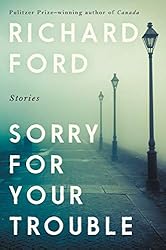
Sorry for Your Trouble: Stories
Richard Ford, 2020
HarperCollins
272 pp.
ISBN-13: 9780062969804
Summary
In Sorry for Your Trouble, Pulitzer Prize winner and New York Times-bestselling author Richard Ford enacts a stunning meditation on memory, love and loss.
"Displaced" returns us to a young man’s Mississippi adolescence, and to a shocking encounter with a young Irish immigrant who recklessly tries to solace the narrator’s sorrow after his father’s death.
"Driving Up" follows an American woman’s late-in-life journey to Canada to bid good-bye to a lost love now facing the end of this life.
"The Run of Yourself," a novella, sees a New Orleans lawyer navigating the difficulties of living beyond his Irish wife’s death.
And "Nothing to Declare" follows a man and a woman’s chance re-meeting in the New Orleans French Quarter, after twenty years, and their discovery of what’s left of love for them.
Typically rich with Ford’s emotional lucidity and lyrical precision, Sorry for Your Trouble is a memorable collection from one of our greatest writers. (From the publisher.)
Author Bio
• Birth—February 16, 1944
• Where—Jackson, Mississippi, USA
• Education—B.A., Michigan State University; M.F.A., University of California, Irvine
• Awards—PEN/Faulkner Award; Pulitzer Prize (more below)
• Currently—lives in Boothbay, Maine
Richard Ford is an American novelist and short story writer. His best-known works are the novels that form the Bascombe quartet: The Sportswriter (1986), Independence Day (1995), The Lay of the Land (2006), and Let Me Be Frank with You (2014). He has also published several short story collections, the stories of which have been widely anthologized.
Early years
Ford was born in Jackson, Mississippi, the only son of Edna and Parker Carrol Ford. Parker was a traveling salesman for Faultless Starch, a Kansas City company. Of his mother, Ford has said, "Her ambition was to be, first, in love with my father and, second, to be a full-time mother." When Ford was eight years old, his father had a major heart attack, and thereafter Ford spent as much time with his grandfather, a former prizefighter and hotel owner in Little Rock, Arkansas, as he did with his parents in Mississippi. Ford's father died of a second heart attack in 1960.
Ford's grandfather had worked for the railroad. At the age of 19, before deciding to attend college, Ford began work on the Missouri Pacific train line as a locomotive engineer's assistant, learning the work on the job.
Ford received a B.A. from Michigan State University. Having enrolled to study hotel management, he switched to English. After graduating he taught junior high school in Flint, Michigan, and enlisted in the US Marines but was discharged after contracting hepatitis. At university he met Kristina Hensley, his future wife; the two married in 1968.
Despite mild dyslexia, Ford developed a serious interest in literature. He has stated in interviews that his dyslexia may, in fact, have helped him as a reader, as it forced him to approach books at a slow and thoughtful pace.
Ford briefly attended law school but dropped out and entered the creative writing program at the University of California, Irvine, to pursue a Master of Fine Arts degree, which he received in 1970. Ford chose this course simply because "they admitted me, he confessed in a profile in Ploughshares (7/8/2010):
They admitted me. I remember getting the application for Iowa, and thinking they'd never have let me in. I'm sure I was right about that, too. But, typical of me, I didn't know who was teaching at Irvine. I didn't know it was important to know such things. I wasn't the most curious of young men, even though I give myself credit for not letting that deter me.
As it turned out, Oakley Hall and E. L. Doctorow were teaching there, and Ford has been explicit about his debt to them. In 1971, he was selected for a three-year appointment in the University of Michigan Society of Fellows.
Early writing
Ford published his first novel, A Piece of My Heart, the story of two unlikely drifters whose paths cross on an island in the Mississippi River, in 1976; he followed it with The Ultimate Good Luck in 1981. In the interim he briefly taught at Williams College and Princeton. Despite good notices the books sold little, and Ford retired from fiction writing to become a writer for the New York magazine Inside Sports. Speaking for same the Ploughshares profile, he said:
I realized there was probably a wide gulf between what I could do and what would succeed with readers. I felt that I'd had a chance to write two novels, and neither of them had really created much stir, so maybe I should find real employment, and earn my keep.
In 1982, the magazine folded, and when Sports Illustrated did not hire Ford, he returned to fiction writing with The Sportswriter, a novel about a failed novelist turned sportswriter who undergoes an emotional crisis following the death of his son. The novel became Ford's "breakout book", named one of Time magazine's five best books of 1986 and a finalist for the PEN/Faulkner Award for Fiction.
Ford followed the success immediately with Rock Springs (1987), a story collection mostly set in Montana that includes some of his most popular stories, adding to his reputation as one of the finest writers of his generation.
Dirty realism
Reviewers and literary critics associated the stories in Rock Springs with the aesthetic movement known as dirty realism. This term referred to a group of writers in the 1970s and 1980s that included Raymond Carver and Tobias Wolff—two writers with whom Ford was closely acquainted—along with Ann Beattie, Frederick Barthelme, Larry Brown, and Jayne Anne Phillips, among others.
Those applying this label point to Carver's lower-middle-class subjects or the protagonists Ford portrays in Rock Springs. However, many of the characters in the "Frank Bascombe" books (The Sportswriter, Independence Day, The Lay of the Land, and Let Me Be Frank With You), notably the protagonist himself, enjoy degrees of material affluence and cultural capital not normally associated with the "dirty realist" style.
Mid-career and acclaim
Although his 1990 novel Wildlife, a story of a Montana golf pro turned firefighter, met with mixed reviews and middling sales, by the end of the 1980s Ford's reputation was solid. He was increasingly sought after as an editor and contributor to various projects. Ford edited the 1990 Best American Short Stories, the 1992 Granta Book of the American Short Story, and the 1998 Granta Book of the American Long Story, a designation he claimed in the introduction to prefer to the novella.
In 1995, Ford's career reached a high point with the release of Independence Day, a sequel to The Sportswriter, featuring the continued story of its protagonist, Frank Bascombe. Reviews were positive, and the novel became the first to win both the PEN/Faulkner Award and the Pulitzer Prize for Fiction. In the same year, Ford was chosen as winner of the Rea Award for the Short Story, for outstanding achievement in that genre. He ended this prodigiously creative and successful decade of the 1990s with a well-received story collection Women with Men published in 1997.
Later life and writings
Ford lived for many years on lower Bourbon Street in the French Quarter and then in the Garden District of New Orleans, Louisiana, where his wife Kristina was the executive director of the city planning commission. He now lives in East Boothbay, Maine.[12] In between these dwellings, Ford has lived in many other locations, usually in the U.S., though he's pursued an equally peripatetic teaching career.
He took up a teaching appointment at Bowdoin College in 2005, but remained in the post for only one semester. In 2008 Ford served as an Adjunct Professor at the Oscar Wilde Centre with the School of English at Trinity College, Dublin, Ireland, teaching on the Masters programme in creative writing. But at the end of 2010, Ford assumed the post of senior fiction professor at the University of Mississippi in the fall of 2011, replacing Barry Hannah, who died in March 2010.
Ford's intense creative pace (writing, teaching, editing, publishing) did not subside, either, as a new decade (and a new century) commenced. He published another story collection A Multitude of Sins (2002), followed by The Lay of the Land (2006), which continues (and, according to Ford's explicit statements made at this time, was to have ended) the Frank Bascombe series.
However, in April 2013, Ford read from a new Frank Bascombe story without revealing to the audience whether or not it was part of a longer work. But by 2014, it was confirmed that the story would indeed appear as part of a longer work to be published in November of that year. Titled Let Me Be Frank With You, it is a work consisting of four interconnected novellas (or "ong stories"), all narrated by Frank Bascombe.
Also, as he did in the preceding decade, Ford continued to assist with various editing projects. In 2007, he edited the New Granta Book of the American Short Story, followed by the Library of America's two-volume edition of the selected works of fellow Mississippi writer Eudora Welty. Ford's latest novel, Canada, was published in 2012. That same year, he became the Emmanuel Roman and Barrie Sardoff Professor of the Humanities and Professor of Writing at the Columbia University School of the Arts.
Critical opinion
Richard Ford's writings demonstrate "a meticulous concern for the nuances of language ... [and] the rhythms of phrases and sentences." Ford has described his sense of language as "a source of pleasure in itself—all of its corporeal qualities, its syncopations, moods, sounds, the way things look on the page."
This "devotion to language" is closely linked to what he calls "the fabric of affection that holds people close enough together to survive." Comparisons have been drawn between Ford's work and the writings of John Updike, William Faulkner, Ernest Hemingway and Walker Percy.
Ford's works of fiction "dramatize the breakdown of such cultural institutions as marriage, family, and community." His...
marginalized protagonists often typify the rootlessness and nameless longing... pervasive in a highly mobile, present-oriented society in which individuals, having lost a sense of the past, relentlessly pursue their own elusive identities in the here and now.*
Ford "looks to art, rather than religion, to provide consolation and redemption in a chaotic time."
Awards and honors
2013 - Prix Femina Etranger for Canada
2013 - Andrew Carnegie Medal for Excellence in Fiction for Canada
2001 - PEN/Malamud Award for excellence in short fiction
1995 - PEN/Faulkner Award[9] for Independence Day
1995 - Pulitzer Prize for Fiction for Independence Day
1995 - Rea Award for the Short Story for outstanding achievement in that genre. (Author bio adapted from Wikipedia. Retrieved 11/20/2014.)
*Huey Guagliardo, Perspectives on Richard Ford: Redeemed by Affection, University Press of Mississippi, 2000.
Book Reviews
Ford has a gift for nimble interior monologues and a superb ear for the varieties and vagaries of human speech.… Acutely described settings, pitch-perfect dialogue, inner lives vividly evoked, complex protagonists brought toward difficult recognitions.
New York Times Book Review
[B]oth a coherent work of art and a subtle and convincing portrait of contemporary American life among the moneyed middle class.…This is America, and Richard Ford is its chronicler. In these superbly wrought tales he catches, with exquisite precision… the irresistible melancholy that is the mark of American life.
Wall Street Journal
Richard Ford remains an author hostage to the mysterious simplicities of emotional sentiment, commendably so.
Atlanta Journal-Constitution
Ford’s unrelenting exploration of life’s bleakness and sadness makes these stories enervating, particularly compared to his previous work, though his clear, nuanced prose continues to impress. Ford is a supremely gifted writer, but he’s not at his best here.
Publishers Weekly
A son recalls mourning his father's death in his Mississippi youth. A past-her-prime American woman heads to Canada to say good-bye to an old lover who's dying. And a New Orleans lawyer attempts to get beyond his wife's death. The Pulitzer Prize-winning Ford in short form.
Library Journal
(Starred review) Once again, virtuoso Ford deftly sails the seas and storms of consciousness.
Booklist
[A]bout lives shattered by divorce or death, with protagonists discovering that the pieces they are trying to put together no longer fit, and perhaps never did.… Powerfully unsettling stories in which men nearing the end of their lives wonder, befuddled, if that's all there is.
Kirkus Reviews
Discussion Questions
We'll add publisher questions if and when they're available; in the meantime, use our LitLovers Book Club Resources. They can help with discussions for any book:
• How to Discuss a Book (helpful discussion tips)
• Generic Discussion Questions—Fiction and Nonfiction
• Read-Think-Talk (a guided reading chart)
(Resources by LitLovers. Please feel free to use them, online and off, with attribution. Thanks.)
Sotah
Naomi Ragen, 2002
St. Martin's Press
512 pp.
ISBN-13: 9780312570248
Summary
Beautiful, fragile Dina Reich, a young woman in Jerusalem’s ultra-Orthodox haredi enclave, stands accused of the community’s most unforgivable sin: adultery.
Raised with her sisters to be an obedient daughter and a dutiful wife, Dina secretly yearned for the knowledge, romance, and excitement that she knew her circumscribed life would never satisfy. When her first romance is tragically thwarted, she willingly enters into an arranged marriage with a loving but painfully quiet man.
Dina’s deeply repressed passions become impossible to ignore, finding a dangerous outlet in a sudden and intense obsession with a married man, with terrible consequences. Exiled to New York City, Dina meets Joan, a modern secular woman who challenges all she knows of the world and herself.
Set against the exotic backdrop of Jerusalem’s glistening white stones and ancient rituals, Sotah is a contemporary story of the struggle to reconcile tradition with freedom, and faith with love. (From the publisher.)
Author Bio
• Birth—July 10, 1949
• Where—New York, New York, USA
• Education—B.A., Brooklyn College; M.A., Hebrew University
of Jerusalem
• Currently—lives in Jerusalme, Israel
Naomi Ragen is the author of seven novels, including several international bestsellers, and her weekly email columns on life in the Middle East are read and distributed by thousands of subscribers worldwide. An American, she has lived in Jerusalem for the past thirty-nine years and was recently voted one of the three most popular authors in Israel. (From the publisher.)
More
Ragen’s first three novels, which described the lives of ultra-Orthodox Jewish women in Israel and the United States, dealt with themes that had not previously been addressed in that society's literature: wife-abuse (Jephte’s Daughter: 1989), adultery (Sotah: 1992) and rape (The Sacrifice of Tamar: 1995). Reaction to these novels in the Orthodox and ultra-Orthodox communities was mixed. Some hailed her as a pioneer who for the first time exposed and opened to public discussion problems which the communities had preferred to pretend did not exist, while others criticized her for “hanging out the dirty laundry” for everyone to see, thus embarrassing the rabbis who were believed by many to be effectively dealing with these problems “behind the scenes” and also putting “ammunition in the hands of the anti-Semites.”
Her next novel (The Ghost of Hannah Mendes: 1998) told the story of a Sephardic family brought back from the abyss of assimilation by the spirit of their ancestor Gracia Mendes (a true historical figure), a 16th century Portuguese crypto-Jew who risked her life and her considerable fortune to practice her religion in secret.
Chains Around the Grass (2002) is a semi-autobiographical novel of the author’s childhood which dealt with the failure of the American dream for her parents.
In The Covenant (2004) Ragen dealt with the contemporary theme of an ordinary family sucked into the horror of Islamic terrorism.
The Saturday Wife (2007), the story of a rabbi's wayward wife, is loosely based on Flaubert’s Madame Bovary, and is a satire of modern Jewish Orthodoxy.
Ragen is also known as a playwright. Her 2001 drama, Women’s Minyan, tells the story of an ultra-Orthodox woman who, upon fleeing from her adulterous and abusive husband, finds that he has manipulated the rabbinical courts to deprive her of the right to see or speak to her twelve children. The story is based on a true incident. Women’s Minyan ran for six years in Israel's National Theatre and has been staged in the United States, Canada and Argentina. (From Wikipedia.)
Book Reviews
Most non-Jewish and many nonorthodox Jews have a skewed view of what life is like in the Haredi (ultra-orthodox) Jewish communities. For the most part, these communities are viewed as one homogeneous stereotypical prototype. The result of this is that the diversity and vibrancy of the different communities tend to become blended into a monotone image. This distorted ideal is often found in literature. Naomi Ragen has written a number of books that look at the lives of Haredi women, and which do not adhere to the common stereotypical banalities. In Sotah, Naomi Ragen takes an honest and unapologetic look at the lives led by three sisters in one close-knit community. In this book she paints a portrait that is as varied as the players portrayed, and which shows both positive and negative aspects of the culture.
Rochelle Caviness - The Jewish Eye.com
Ragen's second novel (after Jephte's Daughter) revisits the insular world of ultrareligious Jews, focusing on the Reich family's three daughters and how they fare in the elemental rite of passage—marriage. In the Haredi community (made up of Jews who observe "the tiniest dictate of law" and have "boundless contempt" for all things secular), a matchmaker handles—and sometimes mishandles—nuptials based on dowry, piety and family ties, and only incidentally on love or compatibility. Harsh as these customs may seem, Ragen's detailed and thoughtful evocations of daily life in such an enclave offer insights into its members' beliefs. The drama centers on the Reichs' devout middle daughter, Dina, who tries to reconcile her desires and dreams within the confines of her narrow world. How she becomes a sotah (a woman suspected of adultery), her banishment from seeing her husband and young child, and the ultimate reconciliation of her strict faith with the meaningful aspects of a secular society form the heart of this very readable, but at times simplistic novel. Ragen is most successful when she tells the story from the vantage point of the haredi world, less so when her characters are secular Jews. A stronger work of fiction than Jephte's Daughter, the narrative holds the reader's attention throughout.
Publishers Weekly
Love-conquers-all genre takes on deep philosophical questions as Ragen (Jephte's Daughter, 1989) continues her exploration of orthodox Jewish life in this story of a woman accused of adultery—the sotah. The setting is the ultraorthodox milieu of Jerusalem, where the men study the Torah in yeshivas while their wives bear numerous children, clean and cook, and find outside work to supplement their meager incomes. Here, heroine Dina's struggle to be independent and still religiously observant provides the more profound concerns of a story that, despite its religious background, is basically your typically rosy fade-out into a technicolor sunset, with all problems—and they are not insubstantial—wrapped up in the last chapter. Dina Reich, the beautiful and dutiful daughter of Rabbi Reich and his remarkably energetic and saintly wife, yearns for love, for knowledge of a wider world than the narrow one she is confined to. A brief romance, ended because her family could not pay the requisite dowry, means that Dina must accept a husband chosen by the sect's matchmaker and approved by her parents. She marries good but painfully inarticulate Judah, a carpenter; bears a child; then, bored and lonely, begins a relationship with a more worldly neighbor. Though it's not consummated, religious vigilantes threaten her, and at their behest she flees to New York, where she works as a maid for a wonderful family, who, when she breaks down, do all they can to bring about the inevitable happy ending. Not only is Dina reunited with Judah, whose virtues she now appreciates, but she also finds a satisfactory compromise between the comforting security of religion and tradition and the more fulfilling aspects of sectarian life. Richness of faith and family lovingly.
Kirkus Reviews
Discussion Questions
1. The Sotah was a woman accused of adultery who had to go through a purifying ritual to prove her innocence, or ascertain her guilt. Read Numbers 5, 11-28. How do the events in Sotah parallel the biblical ritual? What is Dina Reich guilty of? Does she reach purification, or teshuva?
2. Female family relationships are very important in Sotah. Describe the relationship between Dina and her sisters, the girls and their mother.
3. Joan opens Dina's eyes to the greater world, but Dina open's Joan's eyes and her heart to many things this modern woman is equally ignorant of. Describe their relationship and what they teach each other.
4. In the beginning of Sotah, we encounter Dina Reich as a young girl. In the course of the story she matures and changes. How would you describe the kind of transformation that takes place in her?
5. The word "sift" describes a pivotal concept in Sotah. Can you describe when the word is used, and what it means in terms of the story?
6. Attempts to find Dina a husband without the use of a matchmaker result in disaster. Describe the positive role of the matchmaker in the haredi world.
7. Compared to modern Western rituals of dating and marriage, the haredi world seems very narrow. Can you see anything positive in the haredi customs?
8. Statistics show that haredi women have a lower life expectancy than their husbands do. What elements in the life of Dina's mother and her sisters do you think could lead to that?
9. Moishe writes Dina: "I guess being a Chasid is pretty good training " (for being a soldier). What does he mean? Do you agree with him?
10. The idea of "chesed" is very important in Sotah. What is "chesed?" Can you describe acts of chesed in the book?
(Questions issued by the publisher.)
top of page

The Soul of an Octopus: A Surprising Exploration into the Wonder of Consciousness
Sy Montogmery, 2015
Atria Books
272 pp.
ISBN-13: 9781451697728
Summary
In this astonishing book from the author of the bestselling memoir The Good Good Pig, Sy Montgomery explores the emotional and physical world of the octopus—a surprisingly complex, intelligent, and spirited creature—and the remarkable connections it makes with humans.
Sy Montgomery’s popular 2011 Orion magazine piece, "Deep Intellect," about her friendship with a sensitive, sweet-natured octopus named Athena and the grief she felt at her death, went viral, indicating the widespread fascination with these mysterious, almost alien-like creatures.
Since then Sy has practiced true immersion journalism, from New England aquarium tanks to the reefs of French Polynesia and the Gulf of Mexico, pursuing these wild, solitary shape-shifters.
Octopuses have varied personalities and intelligence they show in myriad ways: endless trickery to escape enclosures and get food; jetting water playfully to bounce objects like balls; and evading caretakers by using a scoop net as a trampoline and running around the floor on eight arms.
But with a beak like a parrot, venom like a snake, and a tongue covered with teeth, how can such a being know anything? And what sort of thoughts could it think?
The intelligence of dogs, birds, and chimpanzees was only recently accepted by scientists, who now are establishing the intelligence of the octopus, watching them solve problems and deciphering the meaning of their color-changing camouflage techniques. Montgomery chronicles this growing appreciation of the octopus, but also tells a love story.
By turns funny, entertaining, touching, and profound, The Soul of an Octopus reveals what octopuses can teach us about consciousness and the meeting of two very different minds. (From the publisher.)
Author Bio
• Birth—February 7, 1958
• Where—Frankfurt, Germany
• Education—3 B.A. degrees, Syracuse University (USA)
• Currently—lives in Hancock, New Hampshire, USA
Sy Montgomery is a naturalist, author and scriptwriter who writes for children as well as adults. She is author of more than 20 books, including The Soul of an Octopus: A Surprising Exploration into the Wonder of Consciousness (2015), which was a finalist for the 2015 National Book Award for Nonfiction and was a New York Times Bestseller. Her most popular book is The Good Good Pig (2007), the bestselling memoir of life with her pig, Christopher Hogwood.
Her other notable titles include Journey of the Pink Dolphins, Spell of the Tiger, and Search for the Golden Moon Bear. She has been described as "part Indiana Jones, part Emily Dickinson".[1] Her book for children, Quest for the Tree Kangaroo: An Expedition to the Cloud Forest of New Guinea was the recipient of the 2007 Orbis Pictus Award and was selected as an Honor book for the ALA Sibert Award.[2]
For a half-hour National Geographic TV segment, she scripted and appeared in Spell of the Tiger, based on her book of that title. Also for National Geographic TV she developed and scripted Mother Bear Man based on the work of Ben Kilham, who raises and released orphaned black bears, which won a Chris Award. [3]
Author Vicki Croke asked Sy what she has learned, not just about an animal’s natural history, but lessons about life. Sy answered: “How to be a good creature. How do you be compassionate?… I think that animals teach compassion better than anything else and compassion doesn’t necessarily just mean a little mouse with a sore foot and you try to fix it. It means getting yourself inside the mind and heart of someone else. Seeing someone’s soul, looking for their truth. Animals teach you all of that and that’s how you get compassion and heart.”
Book Reviews
Charming and moving...with extraordinary scientific research.
Guardian (UK)
Sy Montgomery's The Soul of an Octopus does for the creature what Helen Macdonald 's H Is for Hawk did for raptors.
New Statesman (UK)
An engaging work of natural science... There is clearly something about the octopus’s weird beauty that fires the imaginations of explorers, scientists, writers.
Daily Mail (UK)
Fascinating…touching… informative.… Entertaining books like The Soul of an Octopus remind us of just how much we not only have to learn from fellow creatures, but that they can have a positive impact on our lives.
Daily Beast
Journalistic immersion…allows Montgomery to deliver a deeper understanding of the "other," thereby adding to our understanding of ourselves. A good book might illuminate something you knew little about, transform your world view, or move you in ways you didn't think possible. The Soul of an Octopus delivers on all three.
New Scientist
Informative and entertaining, part memoir and part scientific exploration, reminds us that if we are the best creatures on the planet at thinking, we can benefit by thinking about the creatures that may be doing it in some other way.
Columbus Dispatch
Sweet moments are at the heart of Montgomery's compassionate, wise and tender new book.… Only a writer of her talent could make readers care about octopuses as individuals.… Joins a growing body of literature that asks us to rethink our connection to nonhumans who may be more like us than we had supposed.
St. Paul Pioneer Press
Montgomery's deep love of these creatures often causes her to excessively anthropomorphize them, but her depictions of her intimate experiences with her cephalopod friends ring true, allowing readers to see them in an entirely new light.
Publishers Weekly
(Starred review.) Naturalist Montgomery admirably demonstrates the complexity, intellect, and personalities of the octopuses…without ever resorting to easy anthropomorphism. Her science is accessible but not overly simple, and the details she offers about these creatures bring them into sharp focus. —Lisa Peet
Library Journal
(Starred review.) In prose as gripping and entwining as her subjects’ many arms, Montgomery chronicles the octopus’ phenomenal strength, dexterity, speed.… She also tells funny and moving stories…[and] profoundly recalibrates our perception of consciousness.
Booklist
Naturalist Montgomery chronicles her extraordinary experience bonding with three octopuses.… With apparent delight, Montgomery puts readers inside the world of these amazing creatures. A fascinating glimpse into an alien consciousness.
Kirkus Reviews
Discussion Questions
1. Sy Montgomery writes about her scientific and emotional attraction to octopuses. Did anything surprise you in her poetic, sensuous language about the octopuses? Does she make clear what science cannot explain about octopuses?
2. How does Montgomery describe the different personalities that the octopuses have? Do you agree with her assessments of their attributes? Can you relate to the emotions that she interprets them to have?
3. Otherness is a central issue in the book—the otherness of the octopus with its nature so dramatically different from that of other mollusks as well as the differences between cephalopods and people. How does Montgomery use the otherness of the octopus to show the ways the human characters in the story can feel that they don’t fit in or belong? How do the human characters with their varied backgrounds find ways of coming together and belonging?
4. The similarities between octopuses and humans are another theme. What are the similarities that Montgomery sees? Would you share her point of view or do you see the differences more than the similarities?
5. What does Montgomery reveal about what constitutes consciousness, in humans and animals? Does she show that octopuses have consciousness?
6. Does Montgomery address and answer the question of whether an octopus can have a soul? If so, how does she show the animal has a soul? If not, does she explain that the animal does not have a soul?
7. What is anthropomorphism? Given what science knows now about the consciousness of animals, is anthropomorphism a problem? If so, why?
8. What are the issues involved in collecting wild octopuses from the oceans and studying them in an aquarium?
9. Many cultures consume octopuses as food. Do you see any issues regarding eating octopuses?
10. For a book that imparts a wealth of scientific information about octopuses, Montgomery uses humor and also a deep sense of feeling and respect for the octopus and all of nature. How does Montgomery convey the major conservation issues, such as global warming and the health of the oceans, in the stories she tells in this book about people and animals?
11. Has your view of human consciousness changed after reading this account? Has your view of animal consciousness changed? What information specifically influenced you?
12. Has your perspective on nature and on octopuses been influenced by this book? What views has the book reinforced and what views has it changed your mind about?
(Questions issued by the publisher.)
top of page (summary)
The Soul Thief
Charles Baxter, 2009
Knopf Doubleday
224 pp.
ISBN-13: 9781400034406
Summary
As a graduate student in upstate New York, Nathaniel Mason is drawn into a tangle of relationships with people who seem to hover just beyond his grasp. There's Theresa, alluring but elusive, and Jamie, who is fickle if not wholly unavailable.
But Jerome Coolberg is the most mysterious and compelling. Not only cryptic about himself, he seems also to have appropriated parts of Nathaniel's past that Nathaniel cannot remember having told him about. In this extraordinary novel of mischief and menace, we see a young man's very self vanishing before his eyes. (From the publisher.)
Author Bio
• Birth—May 13, 1947
• Where—Minneapolis, Minnesota, USA
• Education—B. A., Macalester College; Ph.D., State University
of New York, Buffalo
• Awards—Award in Literature, American Academy of Arts and
Letters; Prix St. Valentine for The Feast of Love
• Currently—lives in Minneapolis, Minnesota
Charles Baxter lives in Minneapolis and teaches at the University of Minnesota. He is the author of eight other works of fiction, including most recently Believers, Harmony of the World, and Through the Safety Net. The Feast of Love was a finalist for the National Book Award. (From the publisher.)
More
Although his body of work includes poetry and essays, award-winning writer Charles Baxter is best known for his fiction—brilliantly crafted, non-linear stories that twist and turn in unexpected directions before reaching surprising yet nearly always satisfying conclusions. He specializes in portraits of solid Midwesterners, regular Joes and Janes whose ordinary lives are disrupted by accidents, chance encounters, and the arrival of strangers; and his books have garnered a fierce and loyal following among readers and critics alike.
Born in Minneapolis in 1947, Baxter was barely a toddler when his father died. His mother remarried a wealthy attorney who moved the family onto a sprawling estate in suburban Excelsior. From prep school, Baxter was expected to attend Williams, but instead he chose Macalester, a small, liberal arts college in St. Paul. Intending to pursue a career in teaching and writing, he enrolled in the Ph.D. program at the State University of New York at Buffalo, attracted by a faculty that included such literary luminaries of the day as John Barth and Donald Barthelme.
After grad school, Baxter moved to Michigan to teach at Wayne State University in Detroit. He spent more than a decade concentrating on writing poetry, but after a particularly discouraging dry spell, he decided to try his hand at fiction. He labored long and hard over three novels, none of which was accepted for publication. Then, just as he was about to give up altogether, he attempted one last trick. He whittled the three novels down to short stories, replacing epic themes, extraordinary characters, and ambitious story arcs with the small, quiet stuff of ordinary life. It was a good decision, In 1984, his first collection of short fiction, Harmony of the World, was published. Another anthology followed, then a debut novel. Published in 1987, First Light charmed readers with its unusual structure (the story unfolds backwards in time) and a cast of richly, draw, fully human characters.
Baxter continued to publish throughout the 1990s, alternating between short and full-length fiction, and with each book he garnered larger, more appreciative audiences and better reviews. His breakthrough occurred in 2000 with The Feast of Love, a novel composed of many small stories that form a single, cohesive narrative. Described by the New York Times as "rich, juicy, laugh-out-loud funny and completely engrossing," The Feast of Love was nominated for a National Book Award.
"Every time I've finished a book, it feels to me as if the washrag has been rung out," Baxter confessed in a 2003 interview. Yet he keeps on crafting absorbing stories infused with quiet (sometimes absurdist) wit and a compassionate understanding of the human condition. A longtime director of the creative writing program at the University of Michigan, he is known as a generous mentor, and several of his students have gone on to forge successful literary careers of their own.
Extras
From a 2003 interview with Barnes & Noble:
• My novels are sometimes criticized for being episodic, or structurally weird. And they are! I like them that way. It's fairly late in the day — 2003 as I write — in the history of the novel, and I think it's fair for writers to mess around with that form, and to stop thinking that they have to write books that move smoothly from the first act to the second act, and then to the climax and the denouement. I like digressions, asides, intrusions, advice, anything that gets in the way of a smooth narcotic flow. New novels should not look like old novels, except when they want to.
• My father died when I was eighteen months old, and I expect the unexpected to happen in life and in art, and my fiction is full, or loaded down, with unexpected fatalities of one kind or another. For me, that's realism."
• I had an unhappy childhood that I thought was happy, and I dove into books as inspiration and relief and comfort and security and information about what people did and how they thought. I can still get happy and sentimental just over the thought of libraries — the image of a woman sitting quietly and reading is a terrifically sexy image for me.
• Like many writers, I'm private and quiet and observant and bookish. For a physical outlet, I lift weights at the gym two or three times a week, and I don't quit unless and until I've worked up a fairly good sweat. Many writers need an outlet like that to counter the sedentary nature of what they do. I don't have any wild delusions about the greatness of my work: I am happy to work humbly in this field where so many writers have created so many immortal manifestations of the mind and spirit. As Henry James said, you work in the dark; you do what you can; the rest is the madness of art.
• When asked what book most influenced his life as a writer, he answered:
For many writers, the experience of falling in love with a book has to happen in high school, or it won't happen at all. Love at that age is mad love. The book that did it for me at that period in my life was Thomas Hardy's The Return of the Native, with its voluptuous melancholy; I don't think I had ever imagined that the word "sorrow" could be deployed in so many densely lyrical ways. The book's dramatic idea of the outsider struck a chord in me, since in those days I felt as if I was outside everything of any importance. The other book that did it for me was Melville's Moby-Dick, whose language struck me as wonderfully over-the-top. I found myself pleasurably lost in it and never wanted it to end. (Bio and interview from Barnes & Noble.)
Book Reviews
Gloriously done.... It's like watching fire slowly travel up a curtain, waiting for the moment the whole cloth will be engulfed.
New York Times
Delicious.... Entirely original.... The Soul Thief is so craftily constructed that to appreciate how liberally Baxter plants creepy hints of what's to come a reader really should savor this book twice.
Washington Post Book World
Though a much trickier and more cerebral book than his previous novels, this is a dandy psychological thriller in which proliferating mirrors will make your head spin. Baxter has given us the writer's version of that famous M.C. Escher print in which one hand is drawing the other.
Minneapolis Star Tribune
Examines love and lust and the various permutations and cries in between.... Few American writers handle those compelling subjects with a more sure touch or more worthy insight.
Seattle Post-Intelligencer
With a prose style lyrical, accessible and warmly humorous, Charles Baxter has been quietly building a reputation as one of America's favorite literary authors.... His newest novel teems with the same good-natured empathy and wry humor that imbues his earlier works.... [I]t surely will delight.
St. Louis Post Dispatch
Opening in gritty, nineteen-seventies Buffalo, Baxter’s suspenseful fifth novel concerns a mildmannered graduate student, Nathaniel, who falls under the spell of a cerebral but affected outsider, the aptly named Coolberg. Drawn to Coolberg’s sneering persona (and to that of his girlfriend, Theresa, who relishes Coolberg’s performances), Nathaniel begins to unravel when he learns that Coolberg is appropriating his identity: a burglar steals clothes from Nathaniel that Coolberg ends up wearing, and Coolberg begins claiming Nathaniel’s history for his own. Baxter’s talent for creating uncanny settings and telling details and his inventive way with language (a similarly dressed couple are "umbilicaled") are both on display here, but the conceptual twist at the novel’s end feels unequal to the dramatic tension that precedes it.
The New Yorker
Critics’ reactions depended on how well they tolerated [Baxter's] inventiveness. Those who enjoyed it found The Soul Thief a compelling investigation into how identities are lost and found over a lifetime. Those who were less patient...left the novel feeling robbed of solid characters.
Bookmarks Magazine
The author of the National Book Award–nominated The Feast of Love, Baxter returns with this ninth book, an assay into the limits of character, fictional and otherwise. The first half of the novel follows the brief arc of Nathaniel Mason's graduate career in 1970s Buffalo, N.Y., which centers on his friendship with the sexy but self-dramatizing Teresa (which she pronounces Teraysa, as if she were French) and her lover Jerome Coolberg, a virtuoso of cast-off ideas. Coolberg, obsessed with Nathaniel, begins taking his shirts and notebooks, and claiming that episodes from Nathaniel's life happened to him. Coolberg drops a hint that something bad will happen to Jamie, Nathaniel's sometime lover; when it actually comes to pass, Nathaniel's world begins to collapse. In the novel's second half, decades after these events have occurred, Coolberg enters Nathaniel's life again for a final, dramatic confrontation. Baxter has a great, registering eye for the real pleasures and attritions of life, but the book gets hung up on metafictional questions of identity (the major one: who is writing this first-person narrative?). The results cheat readers out of identifying with any of the characters, perhaps intentionally.
Publishers Weekly
Discussion Questions
1. Is The Soul Thief a work of “metafiction”? What aspects of its narrative structure—and of the narrators themselves—might be considered metafictional? How does it differ from more conventional, naturalistic novels?
2. A fellow grad student, Bob Rimjky, says of Jerome Coolberg: “Really, all he wants to do is acquire everyone's inner life” [p. 15]. Why would Coolberg want to possess other people's inner lives? In what ways is this kind of appropriation similar to what novelists do?
3. Coolberg accuses Nathaniel of “willful incomprehension. And convenient amnesia. You're just like this country...a champion of strategic forgetting” [p. 193]. Is this true of Nathaniel? In what ways is America a champion of “strategic forgetting”?
4. After it is revealed that Coolberg himself is “the author” of Nathaniel's story, the narrator says that “the point cannot be that one person can take on another's life.... The point is that although love may die, what is said on its behalf cannot be consumed by the passage of time, and forgiveness is everything” [p. 203]. In what ways is The Soul Thief about love and forgiveness?
5. The Soul Thief exhibits a sharp satirical wit. What are Baxter's chief satirical targets in the novel? What does his satire reveal about these subjects?
6. In his role as host of the radio show, American Evenings, Coolberg guides his guests to a revelatory moment that uncovers “the story's secret heart” [p. 156]. What is the secret heart of The Soul Thief? How is it revealed?
7. In what ways does the act of telling stories save both Nathaniel and his sister? What is Baxter suggesting here about the power of stories?
8. When Nathaniel's sister regains her powers of speech, Nathaniel rejects the idea that this was a miracle. Instead, he attributes her recovery to “the force of compassion, which under certain circumstances can bring the dead to life.” He goes on to say that “though a prejudice exists in our culture against compassion, there being little profit in it, the emotion itself is ineradicable” [p. 153]. Why would compassion have the power to bring the dead to life? Is Nathaniel right in suggesting that there's a prejudice against compassion in our culture?
9. Why does Nathaniel fall in love with Theresa and Jamie? In what ways is his love for Jamie more real, even though she is a lesbian, than his love for Theresa? Why isn't Nathaniel ever able to get over Jamie?
10. Coolberg asserts that we're all copycats and that what he's done is really no different than what everyone does. Is he right? Are we all adopting other people's personalities or identities? How should Coolberg finally be judged?
11. Nathaniel asserts that identities are nothing more than “a pile of moldering personal clichés given sentimental value by the fact that someone owns them” [p. 87]. Does the sense of personal identity have any inherent value beyond the sentimental, either in the novel or in “real” life? Does the novel make a distinction between a soul and an identity?
12. Nathaniel wonders why Gertrude Stein keeps intruding on his consciousness. Why won't Stein leave him alone? In what ways is Stein relevant to The Soul Thief?
13. Why does Baxter end the novel with Nathaniel offering “blessings on everybody. Blessings without limit” [p. 210]? What has brought him to this sense of gratitude, forgiveness, and all-inclusive love?
(Questions issued by publisher.)
top of page
The Sound and the Fury
William Faulkner, 1929
Knopf Doubleday
448 pp.
ISBN-13: 9780679732242
Summary
First published in 1929, Faulkner created his "heart's darling," the beautiful and tragic Caddy Compson, whose story Faulkner told through separate monologues by her three brothers—the idiot Benjy, the neurotic suicidal Quentin and the monstrous Jason
The Sound and the Fury is made up of undifferentiated streams of consciousness that ultimately turn out to be the inner voices of a family's siblings. Its construction is so masterful that the last sentence refers the reader back to the first one, as any perfect work of art might do.
Sound has the earmarks of a modern psychological study, although the book was published in 1929. It is a dramatic and harrowing tale of the Compson family's pathology—primarily in the form of incest and incestuous thoughts. (From the publisher.)
Author Bio
• Birth—September 25, 1897
• Where—New Albany, Mississippi, USA
• Death—July 6, 1962
• Where—Byhalia, Mississippi
• Awards—Nobel Prize, 1950; 2 Pulitizer prizes; others
William Faulkner was born in New Albany, Mississippi, on September 25, 1897. His family was rooted in local history: his great-grandfather, a Confederate colonel and state politician, was assassinated by a former partner in 1889, and his grandfather was a wealth lawyer who owned a railroad. When Faulkner was five his parents moved to Oxford, Mississippi, where he received a desultory education in local schools, dropping out of high school in 1915. Rejected for pilot training in the U.S. Army, he passed himself off as British and joined the Canadian Royal Air Force in 1918, but the war ended before he saw any service. After the war, he took some classes at the University of Mississippi and worked for a time at the university post office. Mostly, however, he educated himself by reading promiscuously.
Faulkner had begun writing poems when he was a schoolboy, and in 1924 he published a poetry collection, The Marble Faun, at his own expense. His literary aspirations were fueled by his close friendship with Sherwood Anderson, whom he met during a stay in New Orleans. Faulkner's first novel, Soldier's Pay, was published in 1926, followed a year later by Mosquitoes, a literary satire. His next book, Flags in the Dust, was heavily cut and rearranged at the publisher's insistence and appeared finally as Sartoris in 1929. In the meantime he had completed The Sound and the Fury, and when it appeared at the end of 1929 he had finished Sanctuary and was ready to begin writing As I Lay Dying. That same year he married Estelle Oldham, whom he had courted a decade earlier.
Although Faulkner gained literary acclaim from these and subsequent novels—Light in August (1932), Pylon (1935), Absalom, Absalom! (1936), The Unvanquished (1938), The Wild Palms (1939), The Hamlet (1940), and Go Down, Moses (1942)—and continued to publish stories regularly in magazines, he was unable to support himself solely by writing fiction. he worked as a screenwriter for MGM, Twentieth Century-Fox, and Warner Brothers, forming a close relationship with director Howard Hawks, with whom he worked on To Have and Have Not, The Big Sleep, and Land of the Pharaohs, among other films. In 1944 all but one of Faulkner's novels were out of print, and his personal life was at low ebb due in part to his chronic heavy drinking. During the war he had been discovered by Sartre and Camus and others in the French literary world. In the postwar period his reputation rebounded, as Malcolm Cowley's anthology The Portable Faulkner brought him fresh attention in America, and the immense esteem in which he was held in Europe consolidated his worldwide stature.
Faulkner wrote seventeen books set in the mythical Yoknapatawpha County, home of the Compson family in The Sound and the Fury. "No land in all fiction lives more vividly in its physical presence than this county of Faulkner's imagination," Robert Penn Warren wrote in an essay on Cowley's anthology. "The descendants of the old families, the descendants of bushwhackers and carpetbaggers, the swamp rats, the Negro cooks and farm hands, the bootleggers and gangsters, tenant farmers, college boys, county-seat lawyers, country storekeepers, peddlers--all are here in their fullness of life and their complicated interrelations." In 1950, Faulkner traveled to Sweden to accept the 1949 Nobel Prize for Literature. In later books—Intruder in the Dust (1948), Requiem for a Nun (1951), A Fable (1954), The Town (1957), The Mansion (1959), and The Reivers (1962) -- he continued to explore what he had called "the problems of the human heart in conflict with itself," but did so in the context of Yoknapatawpha's increasing connection with the modern world. He died of a heart attack on July 6, 1962. (From the publisher.)
Book Reviews
The critics...now tell us that his style is florid, that his plots are hard to follow, that he sometimes shows bad taste in his choice of material.... On the other hand, I can think of no other living American author who writes with the same intensity or who carries us so completely into a world of his own. There is no American author or our time who has undertaken and partly completed a more ambitious series of novels and stories..... Faulkner has been writing a sort of human comedy that was partly inspired by his reading of Balzac.
Malcolm Cowley - New York Times (10/29/1944)
For all his concern with the South, Faulkner was actually seeking out the nature of man. Thus we must return to him for that continuity of moral purpose which made for the greatness of our classics.
Ralph Ellison
Faulkner...belongs to the full-dressed post-Flaubert group of Conrad, Joyce, and Proust.
Edmund Wilson
For all the range of effect, philosophical weight, originality of style, variety of characterization, humor, and tragic intensity [Faulkner's works] are without equal in our time and country.
Robert Penn Warren
Discussion Questions
1. The novel's title is taken from a monologue spoken by Shakespeare's Macbeth, who has attained the throne of Scotland through murder and has held it through the most brutal violence and tyranny; at this point in the play he has just heard that his wife has killed herself. Sated with his own corruption and looking forward to his imminent defeat and death, he says:
Tomorrow, and tomorrow, and tomorrow
Creeps in this petty pace from day to day,
To the last syllable of recorded time
And all our yesterdays have lighted fools
The way to dusty death. Out, out, brief candle!
Life's but a walking shadow, a poor player
That struts and frets his hour upon the stage
And then is heard no more. It is a tale
Told by an idiot, full of sound and fury,
Signifying nothing."
Why do you think Faulkner chose a phrase from this passage for his title? How is this passage applicable to the novel? Do you find the novel as pessimistic and despairing as Macbeth's speech?
2. In The Sound and the Fury Faulkner makes use of the stream of consciousness technique, which was also used earlier in the 1920s in such experimental works as James Joyce's Ulysses and Virginia Woolf's Mrs. Dalloway. He further complicates matters for the reader by scrambling, as it were, the time frames referred to by the narrating consciousness of the opening section of the novel. How do you learn to find your way in Benjy's chapter? How many time periods are interspersed? What are some of the events Benjy is remembering? If Benjy is the "idiot" of Macbeth's speech, in what ways can he be seen, nonetheless, as both a sensitive and sentient observer of his family?
3. All of the novel's crucialevents are registered in Benjy's section and are later recapitulated or expanded upon by other narrators, for Benjy is in many ways the central and most important narrating consciousness. Faulkner said of Benjy, "To that idiot, time was not a continuation, it was an instant, there was no yesterday and no tomorrow, it all is this moment, it all is [now] to him. He cannot distinguish between what was last year and what will be tomorrow, he doesn't know whether he dreamed it, or saw it." What are some of the effects of the opening section upon your experience of the Compson family story? Why would Faulkner choose Benjy to introduce the reader to his story? What is Benjy's importance in a novel that is dominated by memory rather than action?
4. Which characters, if any, serve as registers of emotional and moral value? In whom do we find love, honor, loyalty, strength? Is Jason the embodiment of the opposite traits? How does Caddy's daughter, Quentin, fit into the scheme of value here? What about Mrs. Compson? Do Benjy's perceptions function as a sort of touchstone for the reader?
5. Each of the four sections has a date rather than a chapter number. Note that three of the narratives take place on three sequential days in April of 1928 though they are not presented in chronological sequence. The second of the four, Quentin's narrative, is dated June 2, 1910—the day he drowned himself at the end of his first year at Harvard. With each section the narrative voice becomes more coherent, and we finish with a fairly straightforward and traditional third-person voice. Why do you think Faulkner has chosen to present things in this way and in this order?
6. What are the reasons for Quentin's decision to drown himself? Why does Faulkner choose to have Quentin narrate his own section, even though he has been dead for nearly eighteen years? What do you see as the meaning of his dual obsession with his sister's virginity and the loss of the family honor? Why does he attempt to make, in a crucial conversation with his father, a false confession of incest? Given Quentin's state of mind at the time, what do you think of Mr. Compson's response to him?
7. For her brothers, Caddy is the traumatic absence at the center of their experience. For Faulkner, Caddy was the image around which the novel took shape; she was "the sister which I did not have and the daughter which I was to lose, " and it all began with the image of "the muddy bottom of a little doomed girl climbing a blooming pear tree in April to look in the window" at the funeral of her grandmother. While Caddy is presented as maternal, erotic, promiscuous, and imperious, she is also unknowable, given that she can only be glimpsed in the rather unreliable narrations of her brothers. Does she appeal to you as a sympathetic character? Is Caddy's fall the cause of the family tragedy or is she just another child-victim of the abdication of parental responsibility? Why do Caddy's brothers each have a narrative voice, while Caddy has none?
8. Jason is an embittered young man with a nasty sense of humor. Nonetheless, he is the querulous Mrs. Compson's favorite, the son upon whom she depends. He imagines people saying of his siblings, "one of them is crazy and another one drowned himself and the other one was turned out into the street by her husband..." [p. 233]. Do you think he succeeds in preserving the appearance of normality that is so important to him? How would you describe Jason's mode ofthinking and reasoning? What are some of his activities and preoccupations? What is the effect of his narrative's mood and voice, following as it does upon Benjy's and Quentin's?
9. What role does Dilsey play in the novel? Why does the narrative of the fourth and final section focus upon her, and why do you think Faulkner chose not to give her a narrative in her own voice? What is the significance of the black community and its church in the final section? The novel ends on Easter Sunday; how does this turn to an overtly Christian context work for you as a reader?
10. The novel takes into its scope a number of serious philosophical and psychological issues—the meaning of time, for instance, and the psychopathology of the family—but it does not devote itself to a cohesive exploration of any of them. What, then, would you say this novel is "about"? Think again about the Macbeth quotation—life is "a tale told by an idiot, signifying nothing." What does Faulkner's tale, told four times, signify? What does it achieve? In what ways does the novel focus our attention upon the problem of representing consciousness realistically within the novel form? How does The Sound and the Fury change or affect your experience as a reader of novels?
(Questions issued by publisher.)
top of page


The Sound of Broken Glass (Kincaid and James Series, 15)
Deborah Crombie, 2013
HarperCollins
359 pp.
ISBN-13: 9780061990632
Summary
In the past...
On a blisteringly hot August afternoon in Crystal Palace, once home to the tragically destroyed Great Exhibition, a solitary thirteen-year-old boy meets his next-door neighbor, a recently widowed young teacher hoping to make a new start in the tight-knit South London community. Drawn together by loneliness, the unlikely pair forms a deep connection that ends in a shattering act of betrayal.
In the present...
On a cold January morning in London, Detective Inspector Gemma James is back on the job now that her husband, Detective Superintendent Duncan Kincaid, is at home to care for their three-year-old foster daughter. Assigned to lead a Murder Investigation Team in South London, she's assisted by her trusted colleague, newly promoted Detective Sergeant Melody Talbot. Their first case: a crime scene at a seedy hotel in Crystal Palace. The victim: a well-respected barrister, found naked, trussed, and apparently strangled.
Is it an unsavory accident or murder? In either case, he was not alone, and Gemma's team must find his companion—a search that takes them into unexpected corners and forces them to contemplate unsettling truths about the weaknesses and passions that lead to murder. Ultimately, they will begin to question everything they think they know about their world and those they trust most. (From the publisher.)
Author Bio
• Birth—June 6, 1952
• Raised—McKinney, Texas, USA
• Education—Austin College; Tarrant County
College
• Awards—3 Macavity Awards (more below)
• Currently—lives in McKinney, Texas
Deborah Crombie (nee Darden) is an American author of the Duncan Kinkaid / Gemma James mystery series set in the United Kingdom. Crombie was raised in McKinney, Texas, studied Biology at Austin College, and was a writing student of Warren Norwood at Tarrant County College. She has lived in both England and Scotland in the UK.
Crombie began writing her first mystery after dissecting the structure of books by mystery novelists—and has never had a rejection slip. The author of more a dozen novels, she is a top regarded mystery writer. The Independent Mystery Booksellers selected her 1997 Dreaming of the Bones as one of the 100 Best Crime Novels of the Century. She is a three-time Macavity Award winner, an Edgar Award nominee, and New York Times Notable author.
Crombie still lives in McKinney, Texas, sharing a house that is more than one hundred years old with her husband, three cats, and two German shepherds. (Adapted from the publisher and Wikipedia.)
Book Reviews
The Sound of Broken Glass, Deborah Crombie’s 15th mystery featuring the Scotland Yard detectives Gemma James and Duncan Kincaid, is new on the hardcover fiction list at No. 9. These books are as British as Downton Abbey, so it’s a bit surprising to learn that Crombie still lives outside her hometown, Dallas.
Gregory Cowles - New York Times Book Review
Bestseller Crombie puts together past and present in her solid, finely controlled 15th novel featuring married police detectives Gemma James and Duncan Kincaid (after 2012’s No Mark upon Her). While Duncan looks after their three-year-old foster daughter at home, Gemma and Det. Sgt. Melody Talbot investigate the murder of barrister Vincent Arnott, found in a seedy hotel in London’s Crystal Palace area, naked, tied with a belt, and strangled. When the body of a second barrister, killed in exactly the same way, turns up, physical evidence proves the same person murdered both men. Gemma and Melody painstakingly and methodically unravel the clues, finding connections that began 15 years earlier in the Crystal Palace area. Flashbacks show how the meeting of a lonely 13-year-old boy and a recently widowed teacher had grave consequences. The unfolding domestic relationship between Gemma and Duncan softens and humanizes them. The city of London, foggy, blustery, and historic, provides a seductive background.
Publishers Weekly
Friendships go seriously awry.... DS Melody Talbot spends the night with guitarist Andy Monahan, a witness and possibly even a suspect in a murder case.... Andy had argued with barrister Vincent Arnott, the victim, between sets at a pub in the Crystal Palace area. Could the musician have followed Arnott to the sleazy Belvedere Hotel, plied him with drugs, stripped him naked, trussed him up, then strangled him with a scarf?.... When another barrister, Shaun Francis, is murdered in identical fashion, the only link between the two dead men seems to be Andy.... Another solid outing for the reliable Crombie, who turns a judicious eye on secrets that can overwhelm what they're meant to protect despite the best intentions.
Kirkus Reviews
Discussion Questions
1. Talk about the four detectives featured in the novel: Melody, Gemma, Duncan, and Doug. What techniques do they use during their investigation? Does their gender have any influence on how they approach their jobs?
2. Discuss the structure of the novel. Each chapter begins with a small entry on the history of the Crystal Palace. It also includes information from one of the main character's lives: Andy. Why did the author frame the story this way? How does this add to the tension and the plotting? What do you learn about this section of London—how has it changed from when Crystal Palace was built to Andy's childhood to today?
3. How do some of the detectives' choices complicate the case? By the book or think outside of the box?
4. If you are fans of the series, compare the characters from the first novel you read to this one. Describe the arc of each of the characters' developments and identify the factors that helped shape their personalities. Do you have a favorite character? Identify and explain what attracts you to him or her.
5. Being a detective is a highly immersive profession. How do Gemma and Duncan balance work and family life? How does having small children complicate their work? What does it add to it? How does Duncan cope with being a stay-at-home dad?
6. If you are a fan of mystery novels, how does this novel—and the series compare to others in the genre? What is it about this series that appeals to you? Compare and contrast British and American detectives. If this were set in America, how would it be different?
7. Were you surprised when the killer's identity became clear? If yes, what plot devices did Deborah Crombie employ to keep you guessing? If you suspected the killer early, what led you to suspect the truth?
8. What role does class play in the story? Do the detectives have their own prejudices that shape their attitudes and color their investigations?
9. What do you think will happen in the next novel? Will Melody still be seeing Andy? What would you like to see happen in her and Doug's relationship? What may happen to Duncan and his career?
(Questions issued by publisher.)
top of page (summary)


The Sound of Glass
Karen White, 2015
Penguin Publishing
432 pp.
ISBN-13: 9780451470898
Summary
Nominee, 2015 Goodreads Best Book of the Year
It has been two years since the death of Merritt Heyward’s husband, Cal, when she receives unexpected news—Cal’s family home in Beaufort, South Carolina, bequeathed by Cal’s reclusive grandmother, now belongs to Merritt.
Charting the course of an uncertain life—and feeling guilt from her husband’s tragic death—Merritt travels from her home in Maine to Beaufort, where the secrets of Cal’s unspoken-of past reside among the pluff mud and jasmine of the ancestral Heyward home on the Bluff.
This unknown legacy, now Merritt’s, will change and define her as she navigates her new life—a new life complicated by the arrival of her too young stepmother and ten-year-old half-brother.
Soon, in this house of strangers, Merritt is forced into unraveling the Heyward family past as she faces her own fears and finds the healing she needs in the salt air of the Low Country. (From the publisher.)
Author Bio
• Birth—N/A
• Where—Tulsa, Oklahoma, USA
• Education—B.S., Tulane University
• Currently—lives near Atlanta, Georgia
Karen White is an American author of some 20 fiction novels.
She was born in Tulsa, Oklahoma, but because of her father's work with Exxon, her family moved around. She spend most of her childhood in various U.S. states, as well as in Venezuela and England, where she graduated from The American School in London.
Inspired by Gone With the Wind, Karen knew early on that she wanted to be a writer. Instead, however, when it was time for college, she returned to the U.S. to earn a B.S. degree in management from Tulane University in New Orleans, Louisiana.
After 10 years in the business world, Karen finally turned to her dream of becoming an author. She published her first book in 2000—In the Shadow of the Moon—which went on to became a double finalist for the Romance Writers of America RITA Award.
Her books have since achieved best seller status on both the New York Times and USA Today lists. They have also been nominated for numerous national contests including the SIBA (Southeastern Booksellers Alliance) Fiction Book of the Year, and has twice won the National Readers’ Choice Award.
She writes what she refers to as "grit lit"—Southern women’s fiction. She has also expanded her horizons into writing a mystery series set in Charleston, South Carolina.
When not writing, she spends her time reading, scrapbooking, playing piano, and avoiding cooking. She currently lives near Atlanta, Georgia, with her husband and two children...and two spoiled Havanese dogs. (Adapted from Wikipedia and the author's website. Retrieved 12/06/2015.)
Book Reviews
Some books you read for the pure pleasure of the writing. Others you read for the emotions that are invoked. The Sound of Glass is a book that pays off in both areas. Karen White dug deep to create this tale of the south and it is well worth all of her efforts. Don't miss this one!
Jackie K. Cooper - Huffington Post
In this fish-out-of-water tale, Merritt moves from her native Maine to a small town in South Carolina.... Verdict: White deftly handles the multifaceted plot while creating a vivid atmosphere. —Karen Core, Detroit P.L.
Library Journal
Discussion Questions
1. Discuss the effect of the plane crash in 1955 and the effect on Beaufort. How does it affect the lives of the characters in this story for generations? How did it recast Edith’s life?
2. Of all Loralee’s maxims found in her Journal of Truths, which rings the truest to you? Do you carry around any of your own "truths" to guide your thinking?
3. Even after her husband’s death, why does Edith keep her "secret project" under wraps, even though it helps and inspires the police community?
4. Why do you think Edith makes the sea-glass wind chimes so devotedly? And why do you think Merritt chooses to leave them all in place? What do they come to represent, and why might they be called "mermaid’s tears"?
5. Why does Merritt blame herself for Cal’s death? How does she transform herself over the course of the book? Is she finally at peace with her journey at the end of the story?
6. Discuss the tragic connection between the women in the book. How did each survive her circumstances? Do you think a predisposition for domestic violence is a trait you can inherit?
7. Were you shocked by the "beloved" letter’s contents? Or by Merritt’s ties to the letter?
8. Do you think Edith was right to keep the letter writer’s secret? Was she justified in any way?
9. Did Cal’s personal struggles and rationale for seeking out Merritt surprise you? Was he sensible in feeling wronged by Edith’s secrecy?
10. Do you believe in fate or coincidences? Are there such things in your opinion? Do you think Merritt and Gibbes were ultimately meant for each other?
11. What is Loralee’s legacy for her loved ones? Do you think she successfully "built" a family or guidebook for Owen?
(Questions found on author's website.)


The Sound of Things Falling
Juan Gabriel Vasquez, 2011; Anne McClean, trans., 2013
Penguin Group USA
288 pp.
ISBN-13: 9781594487484
Summary
From a global literary star comes a prize-winning tour de force an intimate portrayal of the drug wars in Colombia.
Juan Gabriel Vasquez has been hailed not only as one of South America’s greatest literary stars, but also as one of the most acclaimed writers of his generation. In this gorgeously wrought, award-winning novel, Vasquez confronts the history of his home country, Colombia.
In the city of Bogota, Antonio Yammara reads an article about a hippo that had escaped from a derelict zoo once owned by legendary Colombian drug kingpin Pablo Escobar. The article transports Antonio back to when the war between Escobar’s Medellín cartel and government forces played out violently in Colombia’s streets and in the skies above.
Back then, Antonio witnessed a friend’s murder, an event that haunts him still. As he investigates, he discovers the many ways in which his own life and his friend’s family have been shaped by his country’s recent violent past. His journey leads him all the way back to the 1960s and a world on the brink of change: a time before narco-trafficking trapped a whole generation in a living nightmare.
Vasquez is “one of the most original new voices of Latin American literature,” according to Nobel Prize winner Mario Vargas Llosa, and The Sound of Things Falling is his most personal, most contemporary novel to date, a masterpiece that takes his writing—and will take his literary star—even higher. (From the publisher.)
Author Bio
• Birth—1973
• Where—Bogota, Columbia
• Education—J.D., University of Rosario; Ph.D.,
Sorbonne University
• Awards—Premio Alfaguara de Novela; Roger
Caillois Award (France)
• Currently—lives in Bogota
Juan Gabriel Vasquez is a Colombian writer and the author, most recently, of The Sound of Things Falling.
Vasquez studied Law in his native city, at the University of Rosario in Bogota, and after graduating left to France, where he lived in París from 1996 to 1999. There, at the Sorbonne, he received a doctorate in Latin American Literature. Later he moved to a small town in the Ardennes in Belgium. After living there for a year, he moved to Barcelona, where he resided until 2012. Today he lives in Bogota.
Vasquez is the author of three "official" novels — The Informers (2004), The Secret History of Costaguana, (2007) and The Sound of Things Falling (2011; U.S. transl, 2013). He wrote two others, which he prefers to ignore, when he was 23 and 25 years old: "I would like to leave this part of my past forgotten. I have this right," he has said.
Even though he recognizes a debt to Gabriel Garcia Marquez, his work is a reaction to magical realism, saying this with regard to The Secret History of Costaguana:
I want to forget this absurd rhetoric of Latin America as a magical or marvellous continent. In my novel there is a disproportionate reality, but that which is disproportionate in it is the violence and cruelty of our history and of our politics.... I can say that reading One Hundred Years...in my adolesence contributed much to my vocation, but I believe that all of the side of magical realism is the least interesting part of this novel.... Like all grand novels, One Hundred Years of Solitude requires us to reinvent the truth. I believe that this reinvention is to make us lose ourselves in the magical realism. And what I have tried to make in my novel is to recount the 19th Century Colombian story in a radically distinct key and I fear to oppose what Colombians have read until now.
Vasquez also writes essays and is a weekly columnist in the Colombian newspaper, El Espectador. His stories have appeared in anthologies in different countries and his novels have been translated to various languages. Furthermore, he himself has translated works of John Hersey, Victor Hugo, and E. M. Forster, among others. He was part of the jury of 81 Latin American and Spanish writers and critics who in 2007 elected for the Colombian review, Semana, the best 100 books in the Castilian language in the last 25 years. (Adapted from Wikipedia. Retrieved 8/18/1213.)
Book Reviews
Juan Gabriel Vasquez's brilliant new novel rejects the vivid colors and mythical transformations of [Garcia Marquez's] Caribbean masterpiece, One Hundred Years of Solitude, in favor of the cold, bitter poetry of Bogota and the hushed intensity of young married love…A gripping novel, absorbing right to the end…The Sound of Things Falling...[is] also a deep meditation on fate and death. Even in translation, the superb quality of Vasquez's prose is evident, captured in Anne McLean's idiomatic English version. All the novel's characters are well imagined, original and rounded. Bogota and the Colombian countryside are beautifully if grimly described.
Edmund White - New York Times Book Reivew
Like Bolano, [Vasquez] is a master stylist and a virtuoso of patient pacing and intricate structure, and he uses the novel for much the same purpose that Bolaño did: to map the deep, cascading damage done to our world by greed and violence and to concede that even love can’t repair it.
Lev Grossman - Time
Vasquez creates characters whose memories resonate powerfully across an ingeniously interlocking structure.... Vasquez creates a compelling literary work—one where an engaging narrative envelops poignant memories of a fraught historical period
New Republic
Quietly elegant… Vasquez is a resourceful storyteller. Scenes and dialogue shine with well-chosen details. His theme echoes compellingly through family parallels, ill-fated flights and even a recurring hippo motif. He shrugs off the long shadow of Gabriel Garcia Marquez with a gritty realism that has its own persuasive magic.
Bloomberg News
If you only read one book this month...
Esquire
(Starred review.) [T]his book is an exploration of the ways in which stories profoundly impact lives.... Yammara befriends enigmatic stranger Ricardo Laverde. One night, assassins on motorbikes open fire on the two, killing Laverde and seriously wounding Yammara.... Yammara eventually finds Laverde’s daughter....Together they lose themselves in stories of Laverde’s childhood....and as the puzzle of Laverde is pieced together, Yammara comes to realize just how thoroughly the stories of these other people are part of his own.
Publishers Weekly
(Starred review.) In this latest from Vasquez, law professor Antonio Yammara recalls befriending retired pilot and former convict Ricardo Laverde, who is later killed in a shooting in which Yammara is seriously wounded. The murder propels an extensive inquiry into Laverde's background.... Only near the very end do we discover Laverde's involvement in one of drug kingpin Pablo Escobar's drug cartels. Yet Vasquez does not emphasize the drug trafficking, instead focusing on poor choices and the role of memory in the retelling of events: "reality [is] adjusted to the memory we have of it." Verdict:... [a] genuine and magnificently written examination of memory's persistence.... —Lawrence Olszewski, OCLC Lib., Dublin, OH
Library Journal
An odd coincidence leads Antonio Yammara, a law professor and narrator of this novel...deep into the mystery of personality, both his own and especially that of Ricardo Laverde, a casual acquaintance of Yammara before he was gunned down on the streets of Bogota.... Yammara is... intrigued by Laverde's murder and wants to find out the mystery behind his life. His curiosity leads him circuitously to Laverde's relationship with Elena, his American wife [and] Maya Fritts, Laverde's daughter by Elena, who fills in some of the gaps in Yammara's knowledge.... [This] ambiguous borderland where things don't quite come into coherent focus is where most of the characters remain.
Kirkus Reviews
Discussion Questions
Use our LitLovers Book Club Resources; they can help with discussions for any book:
• How to Discuss a Book (helpful discussion tips)
• Generic Discussion Questions—Fiction and Nonfiction
• Read-Think-Talk (a guided reading chart)
We'll add specific questions if and when they're made available by the publisher.

Sourdough
Robin Sloan, 2017
Farrar, Straus and Giroux
272 pp.
ISBN-13: 9780374203108
Summary
In his much-anticipated new novel, Robin Sloan does for the world of food what he did for the world of books in Mr. Penumbra’s 24-Hour Bookstore.
Lois Clary is a software engineer at General Dexterity, a San Francisco robotics company with world-changing ambitions.
She codes all day and collapses at night, her human contact limited to the two brothers who run the neighborhood hole-in-the-wall from which she orders dinner every evening. Then, disaster! Visa issues.
The brothers close up shop, and fast. But they have one last delivery for Lois: their culture, the sourdough starter used to bake their bread. She must keep it alive, they tell her—feed it daily, play it music, and learn to bake with it.
Lois is no baker, but she could use a roommate, even if it is a needy colony of microorganisms. Soon, not only is she eating her own homemade bread, she’s providing loaves daily to the General Dexterity cafeteria. The company chef urges her to take her product to the farmer’s market, and a whole new world opens up.
When Lois comes before the jury that decides who sells what at Bay Area markets, she encounters a close-knit club with no appetite for new members. But then, an alternative emerges: a secret market that aims to fuse food and technology. But who are these people, exactly?
Leavened by the same infectious intelligence that made Robin Sloan’s Mr. Penumbra’s 24-Hour Bookstore such a sensation, while taking on even more satisfying challenges, Sourdough marks the triumphant return of a unique and beloved young writer. (From the publisher.)
Author Bio
• Birth—ca. 1980
• Raised—Troy, Michigan, USA
• Education—B.A., Michigan State University
• Currently—lives in Berkeley, California
Robin Sloan is an American novelist and short story writer — the author of the New York Times bestselling novel, Mr. Penumbra's 24-Hour Bookstore (2012), and Sourdough (2017), as well as the novella Annabel Scheme (2009) and an assortment of short stories.
Sloan was raised in Troy, Michigan, and earned a degree in economics from Michigan State University. While still a student, he co-founded a literary magazine called Oats. For 10 years, (2002-2012), he worked at the Poynter Institute for Media Studies, Current TV, and Twitter — in various positions, all of which explore the future of media. Currently, Sloan works as a "media inventor" out of the Murray Street Lab in South Berkeley.
In addition to his writing and media work, Sloan and his partner, Kathryn Tomajan, lease three acres in Sunol, California, where they produce extra virgin olive oil. Sloan makes his home in Berkeley, California. (Adapted from the author's website.)
Book Reviews
The magical world Robin Sloan used to such affect in Mr. Penumbra’ 24-Hour Bookstore shows up in his newest, Sourdough. The “magick” here, though, is less Harry Potter and more of the Garden Spells variety: whimsical rather than mystical.… The writing is, in parts, smart and insightful, particularly when describing the tech world. The how-tos of baking, the invisible “empire” of microbes, and the politics of agribusiness are also quite good. Overall, though, while pleasant and occasionally clever, Sourdough feels somewhat lackluster.
Molly Lundquist - LitLovers
In his novel Mr. Penumbra’s 24-Hour Bookstore, Sloan unraveled a mystery about a web designer who takes a job in a peculiar all-night Bay area book shop. New technology clashed, then melded, with classic history. Sourdough promises a similar sort of tech and analog mashup, in this case involving the food industry: a software engineer learns to bake bread and uncovers a secret underground market. We’re already hungry for it.
Miami Herald
Delightful…equal measures techie and foodie fodder, a perfect parable for our times.
San Francisco Magazine
As he did in Mr. Penumbra's 24-Hour Bookstore, Robin Sloan will have readers looking for magic in the mundane.
Nora Horvath - Real Simple
Sloan captures contemporary work environments, current reality, and future trends. It’s a busy novel, crammed with some excellent bits…and some bits that are just creative hyperactivity…. [M]uch to savor, but like the starter it proves rich and buoyant at first, then overreaches.
Publishers Weekly
[B]uoyant, touch-of-magic prose.… How many novels can boast an obstreperous sourdough starter as a key character? A delightful and heartfelt read.
Library Journal
(Starred review.) Filled with crisp humor and weird but endearing characters.… At once a parody of startup culture and a foodie romp.… [A] delight, perfect for those who like a little magic with their meals.
Booklist
A listless coder discovers inspiration—and some unusual corners of the Bay Area—via a batch of sourdough starter.… But the absurdities of the plot twists…ultimately feel less cleverly offbeat than hokey.… Fluffy but overbaked.
Kirkus Reviews
Discussion Questions
We'll add publisher questions if and when they're available; in the meantime, please use our LitLovers talking points to help start a discussion for Sourdough … then take off on your own:
1. Talk about Lois, especially as the book opens. How does she feel about her job, and how has the job affected her outlook on life? What might her experience, as presented in the novel, suggest about contemporary jobs in Silicon Valley?
2. What does Lois mean when she says, "Here's a thing I believe about people my age: We are the children of Hogwarts, and more than anything, we just want to be sorted." Why does that belief or idea inspire her to leave Michigan for San Francisco?
3. Do you find the robotic blue arm just a little creepy ... or funny? Is it the wave of the future? While you're at it, can you understand, even define, proprioception? It is truly a marvel of human ability, isn't it?
4. In what ways does the sour dough starter function as a symbol in the novel? Compare, for instance, the sourdough to both the blue arm and Tetra Pak nutritional gel. Think of the meaning of the word "starter" itself.
5. Follow-up to Question 1: Once Lois has taken up kneading dough and building a brick oven, consider her statement about exhaustion : "When I fell into my bed, I was truly tired; not merely the brain-spent Well, I guess I’ll give up now tiredness of a day at the robot factory, but something deeper, actually muscular." How else does her life change? Better yet, how does she change?
6. What do you think of the innovative Marrow Fair Lois is invited to join — funny, frightening, off-putting, even slightly repulsive? All or none of the above?
7. What is Agrippa's empire of microbes — "This is their world, not ours, and their stories are greater."
8. Robin Sloan seems to be taking on both the farm-to-table movement and giant agribusiness. What is his criticism, and does he offer up a solution for feeding the world's growing population?
9. Why does Alice turn down the job offered to her by the doyenne of the California food world?
(Questions by LitLovers. Please feel free to use them, online or off, with attribution. Thanks.)

South
Lance Charnes, 2014
Wombat Group Media
416 pp.
ISBN-13: 9780988690332
Summary
Luis Ojeda owes his life to the Pacifico Norte cartel. Literally. Now it’s time to pay.
Luis led escaping Muslims out of the U.S. during the ten years following a 2019 terrorist attack on Chicago. He retired after nearly being killed by a border guard. But now in 2032, the Nortes give Luis a choice: pay back the fortune they spent saving his life, or take on a special job.
The job: Nora Khaled—FBI agent, wife, mother of two, and Muslim. She claims her husband will be exiled to one of the nation’s remote prison camps to rot with over 400,000 other Muslim Americans. Faced with her family’s destruction, she’s forced to turn to Luis—the kind of man she’s spent her career bringing to justice.
But when the FBI publicly accuses Nora of terrorism, Luis learns Nora’s real motive for heading south: she has proof that the nation’s recent history is based on a lie—a lie that reaches to the government’s highest levels.
Torn between self-preservation and the last shreds of his idealism, Luis guides Nora and her family toward refuge in civil war-wracked Mexico. The FBI, a dogged ICE agent, killer drones, bandits, and the fearsome Zeta cartel all plan to stop him. Success might just free Luis from the Nortes...but failure means disappearing into a black-site prison, or a gruesome death for them all.
In a day-after-tomorrow America where government has been downsized and outsourced into irrelevance, and none but the very wealthy few can afford hopes or dreams, Luis and Nora must learn to trust each other to ensure the survival of the truth—and of the people they love. (From the publisher.)
Author Bio
• Birth—1960
• Where—Oakland, California, USA
• Education—B.A. University of California, Berkeley; M.S.,California State University, Long Beach
• Currently—lives in Orange County, California
Lance Charnes has been an Air Force intelligence officer, information technology manager, computer-game artist, set designer and Jeopardy! contestant, and is now an emergency management specialist. He’s had training in architectural rendering, terrorist incident response and maritime archaeology, but not all at the same time. His Facebook author page features spies, archaeology and art crime.
Lance is the author of the international thriller DOHA 12, the near-future thriller SOUTH, and the DEWITT AGENCY FILES series of international art-crime novels. All are available in trade paperback and digital editions. He's also a frequent contributor to Macmillan's Criminal Element website. (From the author.)
Visit the author's website.
Follow Lance on Facebook.
Book Reviews
South is a riveting work of action/adventure suspense that is a real page-turner.... Lance Charnes demonstrates a truly impressive knack for deftly creating a complex and thoroughly engaging story.
Midwest Book Review
South is a compelling futuristic thriller, as convincing a cautionary novel as Margaret Atwood's The Handmaid's Tale was in its day...these were real people forced to live in terrible times, and I was only too happy to cheer them on—or cry over their tragedies.
Criminal Element
Charnes creates characters you can understand and care for. The action scenes in South make you feel as though you are a participant.... South is a brilliantly conceived and executed thriller.
William Brooks, author of Black Karma
Discussion Questions
1. Is Luis a criminal? Why or why not? Do you think it’s possible to do the right thing for the wrong reasons, or the wrong thing for the right reasons?
2. Bel says to Ros, “I just can’t fight anymore” (p. 22, paperback edition). Discuss the various ways that Bel finds to continue fighting, despite her words. Why do you think she refuses to help Ros?
3. Discuss Nora’s relationship with Paul. Who do you think is the dominant member of their household, and why? Take into account that in every instance where they disagree during the story, Nora defers to Paul.
4. Place yourself in Nora’s position. If you learned what she had, what would you have done? How much—if anything—would you risk to bring the truth to light? Would you ask a criminal for help if you needed it?
5. Is McGinley a hero, villain, or some of each? Is he a good law-enforcement officer? Do you approve of his methods? Why or why not?
6. Who was your favorite character, and why? Who was your least-favorite character, and why? Who was the strongest character, and what made them seem that way to you?
7. Do you think anything like the Terrorist Detention Program (South’s network of prison camps in the western U.S.) could actually come about? Why or why not? Given the provocation—the terrorist attack on Wrigley Field that killed thousands—would you support or oppose a real-world TDP? Would you do so publicly?
8. South’s America has become a poorer, less healthy, more brutal and less secure place than it is today. However, it has also achieved full employment, has a booming industrial sector and is an energy exporter. Is this a good tradeoff? Would you want to live there?
9. Newport Beach—a wealthy real-world beach community in Orange County, California—has become a walled, gated enclave in South’s world. Do you think similar cities would opt to isolate themselves from their less-well-off neighbors if allowed? What effect do you think that would have on (a) their residents, and (b) their neighbors? Can you think of instances where this has already been done?
10. Small drones are sold today in electronics stores and on the Internet. Do you have any interest in owning a drone? If you had one, what would you do with it? Would you object to your neighbors owning a drone?
11. Do you think the amount of cultural change required to generate the social and economic conditions seen in South could occur in the next twenty years? Why or why not?
12. How strong a role does religion play in this story? Other than the obvious (Nora’s predicament), how does it manifest itself?
13. What other aspects of South’s reality would you have liked to hear about, but weren’t included in the story? Given the conditions of the book’s world, how do you think these bypassed issues would work?
14. Real-world gunfights tend to be messy, confused actions, frightening to both participants and onlookers, in which far more shots miss than hit their targets. Did the author portray this reality effectively in the action sequences? Do you find this preferable to the usual Hollywood depiction of gunfights, and why/why not?
15. Consider the various fates of the principal characters. Which ones ended up the way you expected? Which ones had outcomes different from what you expected? If you could change one main character’s fate, whose would it be, what would you change, and why?
(Questions courtesy of the author.)
South of Broad
Pat Conroy, 2009
Knopf Doubleday
528 pp.
ISBN-13: 9780385344074
Summary
Against the sumptuous backdrop of Charleston, South Carolina, South of Broad gathers a unique cast of sinners and saints. Leopold Bloom King, our narrator, is the son of an amiable, loving father who teaches science at the local high school. His mother, an ex-nun, is the high school principal and a respected Joyce scholar.
After Leo's older brother commits suicide at the age of ten, the family struggles with the shattering effects of his death, and Leo, lonely and isolated, searches for something to sustain him. Eventually, he finds his answer when he becomes part of a tightly knit group of high school seniors that includes friends Sheba and Trevor Poe, glamorous twins with an alcoholic mother and a prison-escapee father; hardscrabble mountain runaways Niles and Starla Whitehead; socialite Molly Huger and her boyfriend, Chadworth Rutledge X-and an ever-widening circle whose liaisons will ripple across two decades, from 1960s counterculture through the dawn of the AIDS crisis in the 1980s.
The ties among them endure for years, surviving marriages happy and troubled, unrequited loves and unspoken longings, hard-won successes and devastating breakdowns, as well as Charleston's dark legacy of racism and class divisions. But the final test of friendship that brings them to San Francisco is something no one is prepared for.
South of Broad is Pat Conroy at his finest: a long-awaited work from a great American writer whose passion for life and language knows no bounds. (From the publisher.)
Author Bio
• Birth—October 26, 1945
• Where—Atlanta, Georgia, USA
• Education—B.A., The Citadel
• Currently—lives in San Francisco, California, and Fripp
Island, South, Carolina
Pat Conroy was born in Atlanta, Georgia, to a young career military officer from Chicago and a Southern beauty from Alabama, whom Pat often credits for his love of language. He was the first of seven children.
His father was a violent and abusive man, a man whose biggest mistake, Conroy once said, was allowing a novelist to grow up in his home, a novelist "who remembered every single violent act.... My father's violence is the central fact of my art and my life." Since the family had to move many times to different military bases around the South, Pat changed schools frequently, finally attending the Citadel Military Academy in Charleston, South Carolina, upon his father's insistence. While still a student, he wrote and then published his first book, The Boo, a tribute to a beloved teacher.
After graduation, Conroy taught English in Beaufort, where he met and married a young woman with two children, a widow of the Vietnam War. He then accepted a job teaching underprivileged children in a one-room schoolhouse on Daufuskie Island, a remote island off the South Carolina shore. After a year, Pat was fired for his unconventional teaching practices—such as his unwillingness to allow corporal punishment of his students—and for his general lack of respect for the school's administration. Conroy evened the score when he exposed the racism and appalling conditions his students endured with the publication of The Water is Wide in 1972. The book won Conroy a humanitarian award from the National Education Association and was made into the feature film Conrack, starring Jon Voight.
Writings
Following the birth of a daughter, the Conroys moved to Atlanta, where Pat wrote his novel, The Great Santini, published in 1976. This autobiographical work, later made into a powerful film starring Robert Duvall, explored the conflicts of his childhood, particularly his confusion over his love and loyalty to an abusive and often dangerous father.
The publication of a book that so painfully exposed his family's secret brought Conroy to a period of tremendous personal desolation. This crisis resulted not only in his divorce but the divorce of his parents; his mother presented a copy of The Great Santini to the judge as "evidence" in divorce proceedings against his father.
The Citadel became the subject of his next novel, The Lords of Discipline, published in 1980. The novel exposed the school's harsh military discipline, racism and sexism. This book, too, was made into a feature film.
Pat remarried and moved from Atlanta to Rome where he began The Prince of Tides which, when published in 1986, became his most successful book. Reviewers immediately acknowledged Conroy as a master storyteller and a poetic and gifted prose stylist. This novel has become one of the most beloved novels of modern time—with over five million copies in print, it has earned Conroy an international reputation. The Prince of Tides was made into a highly successful feature film directed by Barbra Streisand, who also starred in the film opposite Nick Nolte, whose brilliant performance won him an Oscar nomination.
Beach Music (1995), Conroy's sixth book, was the story of Jack McCall, an American who moves to Rome to escape the trauma and painful memory of his young wife's suicidal leap off a bridge in South Carolina. The story took place in South Carolina and Rome, and also reached back in time to the Holocaust and the Vietnam War. This book, too, was a tremendous international bestseller.
While on tour for Beach Music, members of Conroy's Citadel basketball team began appearing, one by one, at his book signings around the country. When his then-wife served him divorce papers while he was still on the road, Conroy realized that his team members had come back into his life just when he needed them most. And so he began reconstructing his senior year, his last year as an athlete, and the 21 basketball games that changed his life. The result of these recollections, along with flashbacks of his childhood and insights into his early aspirations as a writer, is My Losing Season, Conroy's seventh book and his first work of nonfiction since The Water is Wide.
South of Broad, published in 2009, 14 years after Beach Music, tells the story of friendships, first formed in high school, that span two decades.
He currently lives in Fripp Island, South Carolina with his wife, the novelist Cassandra King. (Adapted from the author's website and Barnes & Noble.)
Book Reviews
South of Broad is a big sweeping novel of friendship and marriage—and, perhaps, vintage Pat Conroy…Conroy is an immensely gifted stylist, and there are passages in the novel that are lush and beautiful and precise. No one can describe a tide or a sunset with his lyricism and exactitude. My sense is that the millions of readers who cherish Conroy's work won't be at all disappointed—and nor will anyone who owns stock in Kleenex.
Chris Bohjalian - Washington Post
Echoing some themes from his earlier novels, Conroy fleshes out the almost impossibly dramatic details of each of the friends’ lives in this vast, intricate story, and he reveals truths about love, lust, classism, racism, religion, and what it means to be shaped by a particular place, be it Charleston, South Carolina, or anywhere else in the U.S. —Mark Knoblauch
Booklist
Charleston, S.C., gossip columnist Leopold Bloom King narrates a paean to his hometown and friends in Conroy's first novel in 14 years. In the late '60s and after his brother commits suicide, then 18-year-old Leo befriends a cross-section of the city's inhabitants: scions of Charleston aristocracy; Appalachian orphans; a black football coach's son; and an astonishingly beautiful pair of twins, Sheba and Trevor Poe, who are evading their psychotic father. The story alternates between 1969, the glorious year Leo's coterie stormed Charleston's social, sexual and racial barricades, and 1989, when Sheba, now a movie star, enlists them to find her missing gay brother in AIDS-ravaged San Francisco. Too often the not-so-witty repartee and the narrator's awed voice (he is very fond of superlatives) overwhelm the stories surrounding the group's love affairs and their struggles to protect one another from dangerous pasts. Some characters are tragically lost to the riptides of love and obsession, while others emerge from the frothy waters of sentimentality and nostalgia as exhausted as most readers are likely to be. Fans of Conroy's florid prose and earnest melodramas are in for a treat.
Publishers Weekly
"Kids, I'm teaching you to tell a story. It's the most important lesson you'll ever learn," says the protagonist of Conroy's first novel in 14 years (since 1995's Beach Music). Switching between the 1960s and the 1980s, the narrative follows a group of friends whose relationship began in Charleston, SC. The narrator is Leopold Bloom King (his mother was a Joyce scholar), a likable but troubled kid who goes from having one best friend, his brother, to having no friends after a tragedy, to having, suddenly, a gang, of which he is perhaps not the leader but certainly the glue. Conroy continues to demonstrate his skill at presenting the beauty and the ugliness of the South, holding both up for inspection and, at times, admiration. He has not lost his touch for writing stories that are impossible to put down; the fast pace and shifting settings grip the reader even as the story occasionally veers toward the unbelievable. Verdict: Filled with the lyrical, funny, poignant language that is Conroy's birthright, this is a work Conroy fans will love. Libraries should buy multiple copies. —Amy Watts, Univ. of Georgia Lib., Athens
Library Journal
First novel in 14 years from the gifted spinner of Southern tales (Beach Music, 1995, etc.)—a tail-wagging shaggy dog at turns mock-epic and gothic, beautifully written throughout. The title refers, meaningfully, to a section of Charleston, S.C., and, as with so many Southern tales, one great story begets another and another. This one starts most promisingly: "Nothing happens by accident." Indeed. The Greeks knew that, and so does young Leopold Bloom King. It is on Bloomsday (June 16) 1969 that 18-year-old Leo learns his mother had once been a nun. Along the way, new neighbors appear, drugs make their way into the idyllic landscape and two new orphans turn up "behind the cathedral on Broad Street." The combination of all these disparate elements bears the unmistakable makings of a spirit-shaping saga. The year 1969 is a heady one, of course, with the Summer of Love still fresh in memory, but Altamont on the way and Vietnam all around. Working a paper route along the banks of the Ashley River and discovering the poetry of place ("a freshwater river let mankind drink and be refreshed, but a saltwater river let it return to first things"), Leo gets himself in a heap of trouble, commemorated years later by the tsk-tsking of the locals. But he also finds out something about how things work ("Went out with a lot of women when I was young," says one Nestor; "I could take the assholes, but the heartbreakers could afflict some real damage.") and who makes them work right—or not. Leo's classic coming-of-age tale sports, in the bargain, a king-hell hurricane. Conroy is a natural at weaving great skeins of narrative, and this one will prove a great pleasure to his many fans.
Kirkus Reviews
Discussion Questions
1. At the beginning of the novel, Leo is called on to mitigate the racial prejudice of the football team. What other types of prejudice appear in the novel? Which characters are guilty of relying on preconceived notions? Why do you think Leo is so accepting of most people? Why is his mother so condemnatory?
2. What do you think of the title "South of Broad"? How does the setting inform the novel? Would the novel be very different if it were set in another city or region?
3. As a teenager, Leo is heavily penalized for refusing to name the boy who placed drugs in his pocket. Why did he feel compelled to protect the boy's identity? Do you think he did the right thing?
4. When Leo's mother asks him to meet his new peers, she warns, “Help them, but do not make friends with them.” Do you think such a thing possible? Through the novel, how does Leo help his friends, and how do they help him?
5. Leo's mother tells him, “We're afraid the orphans and the Poe kids will use you,” to which he responds, “I don't mind being needed. I don't even mind being used.” Do you think this is a healthy attitude toward friendship? Do any of the characters end up “using” Leo? Does his outlook on friendship changed by the end of the novel?
6. Leo admits that the years after Steven's suicide nearly killed him. How was he able to cope? How do Leo's parents deal with their grief? What does the novel say about human resilience and our propensity to overcome tragedy?
7. When Sheba suggests to Leo that he divorce his wife, he says, “I knew there were problems when I married Starla so I didn't walk into that marriage blind.” Do you think that knowledge obligates Leo to stay with his wife? In your opinion, does Leo do the right thing by staying married? Would you do the same?
8. Both Chad and Leo are unfaithful to their wives, but only Leo is truthful about it. Do you think this makes Chad's infidelity a worse offense? Why or why not?
9. At two points in the novel, the group tries to rescue a friend: first Niles, then Trevor. But when Starla is in trouble, they don't attempt to save her. Why do you think this is? Has Starla become a “lost cause”?
10. At one point Leo remarks, “I had trouble with the whole concept [of love] because I never fully learned the art of loving myself.” How does the concept of self-love play into the novel?
11. In the moment before Leo attacks Trevor's captor, he recites a portion of “Horatio at the Bridge,” a poem about taking a lone stand against fearful odds. What is the significance of the verse? Do you think it's appropriate to that moment?
12. The twins are the novel's most abused characters and also the most creative. Do you think there is a connection between suffering and art?
13. What do you make of the smiley face symbol that Sheba and Trevor's father paints? How does the novel address the idea of happiness coexisting with pain?
14. At several points in the novel, characters divulge family secrets. Do you believe that this information should stay secret, or is there value in bringing it to light?
15. Leo examines his Catholicism at several points in the novel. What do you think he might say are the advantages and drawbacks of his religion? Do you think all religions are fraught with those problems?
16. One might interpret Leo's mother's attitude toward religion as one of blind faith. If Steven had admitted his abuse to her, do you think she would she have believed him? How do you think the information might have affected her?
17. Sheba and Trevor are literally tormented by their childhoods, in the form of their deranged father. How are some of the other characters hindered by the past? Are they ever able to escape its clutches and, if so, by what means?
18. Discuss the scene in which Leo and Molly rescue the porpoise. What does the event symbolize?
19. Why do you think the discoveries about Leo's mother and Monsignor Max begin and end the novel? What theme do these incidents convey?
20. Chapter one begins with the statement, “Nothing happens by accident,” and Leo often reflects on the way that destiny has shaped his life. How does destiny affect the other characters? Do you agree that real life is the result of predetermined forces? Or can we affect our fate.
(Questions issued by publisher.)
top of page (summary)

South Pole Station
Ashley Shelby, 2017
Picador : Macmillan
368 pp.
ISBN-13: 9781250112828
Summary
DO YOU HAVE DIGESTION PROBLEMS DUE TO STRESS?
DO YOU HAVE PROBLEMS WITH AUTHORITY?
HOW MANY ALCOHOLIC DRINKS DO YOU CONSUME A WEEK?
WOULD YOU RATHER BE A FLORIST OR A TRUCK DRIVER?
These are some of the questions that determine if you have what it takes to survive at South Pole Station, a place with an average temperature of -54°F and no sunlight for six months a year.
Cooper Gosling has just answered five hundred of them. Her results indicate she is abnormal enough for Polar life. Cooper’s not sure if this is an achievement, but she knows she has nothing to lose.
Unmoored by a recent family tragedy, she’s adrift at thirty and—despite her early promise as a painter—on the verge of sinking her career. So she accepts her place in the National Science Foundation’s Artists & Writers Program and flees to Antarctica, where she encounters a group of misfits motivated by desires as ambiguous as her own.
The only thing the Polies have in common is the conviction that they don’t belong anywhere else.
Then a fringe scientist arrives, claiming climate change is a hoax. His presence will rattle this already-imbalanced community, bringing Cooper and the Polies to the center of a global controversy and threatening the ancient ice chip they call home.
A warmhearted comedy of errors set in the world’s harshest place, Ashley Shelby's South Pole Station is a wry and witty debut novel about the courage it takes to band together when everything around you falls apart. (From the publisher.)
Author Bio
• Birth—1977
• Where—Minneapolis, Minnesota, USA
• Education—M.F.A., Columbia University
• Awards—Third Coast Fiction Prize; William Faulkner Award-Short Fiction
• Currently—lives in Minneapolis, Minnesota
Ashley Shelby is a former editor at Penguin Books, prize-winning writer/journalist, and author of both fiction and nonfiction.
Born and raised in Minneapolis, Minnesota, Shelby received her MFA from Columbia University. She is the author of Red River Rising: The Anatomy of a Flood and the Survival of an American City (2003), a narrative nonfiction account of the record-breaking flood that, in 1997, devastated Grand Forks, North Dakota.
The short story that became the basis for her debut novel, South Pole Station (2017) is a winner of the Third Coast Fiction Prize.
Her work has been published widely, including in the Seattle Review, Post Road, Sonora Review, Portland Review, J Journal: New Writings on Social Justice, Sierra, Full Circle Journal, Babble, Gastronomica, Carve, and Southeast Review.
She lives in Minneapolis, Minnesota, with her family. (From the publisher.)
Book Reviews
For those who like stories that “turn up the heat” on off-beat personalities trapped in tight quarters, South Pole Station is super cool. It’s a worthy debut and a sign of a smart new novelist arriving on the scene. (By the way, be sure to take note of Cooper’s last name.)
P.J. Adler - LitLovers
Entertaining.… The mechanics of the central plot — …astrophysicists squabbling over the Big Bang Theory… — are best not inspected too closely, although they do yield some nicely rebellious behavior …and a satisfying …nerd romance.… More appealing …are the back stories and posturings of the ensemble cast, whose day-to-day dramas provide a vivid notion of what it's like to live in a frigid landscape that's dark for six months of the year.
Alida Becker - New York Times Book Review
[An] enjoyable first novel.… Shelby is very good on social interactions at the end of the earth, and South Pole Station crackles with energy whenever science takes center stage
Dennis Drabelle - Washington Post
If you like literature that transports you to exotic locales beyond the reach of commercial airlines and enables you to view hot topics from cool new angles, South Pole Station is just the ticket.… Shelby's writing is pithy and funny …[and] in this unusual, entertaining first novel, [she] combines science with literature to make a clever case for scientists' and artists' shared conviction that "the world could become known if only you looked hard enough."
Heller McAlpin - NPR
Most associate [climate fiction] with 'sci-fi' and therefore sci-fi's most recognizable tropes.… But what if we expand the genre's definition to works that address issues of climate change in the here-and-now, in worlds that aren’t speculative or futuristic at all, but rather, unnervingly familiar? What we would find are some of the most urgent, funny, and beautifully written works in contemporary fiction. Case in point: Ashley Shelby’s South Pole Station.
Chicago Review of Books
Set in the vast yet claustrophobic reality of Antarctica, the novel's first delight is in its vivid depiction of sub-zero life.…The second delight is the clear message that science is not belief. It's science.… Shelby keeps more than a few story lines thrumming here, yet a keen eye for character and a sharp ear for smartass dialogue keeps the strands straight.
Minneapolis Star Tribune
This is a fascinating novel, loaded with interesting history of Antarctic exploration, current scientific operations, and the living and working conditions of those folks brave enough to endure six months of darkness and six months of daylight.
Publishers Weekly
(Starred review.) Shelby's first novel, based on a short story that won the Third Coast Fiction Prize, skillfully weaves science, climate change, politics, sociology, and art.… All readers of fiction, particularly those interested in life in extreme climates, will find [South Pole Station] appealing. —Joanna Burkhardt, Univ. of Rhode Island Libs., Providence
Library Journal
[Shelby] eschews easy choices and treats interpersonal relations, grief, science, art, and political controversy with the same deft, humorous hand. Readers will find characters to love, suspect, and identify with…. [F]or readers …who enjoy stories about quirky individuals and …armchair travelers.
Booklist
Throughout witty, often hilarious scenarios, Shelby expertly weaves in the legitimate political and environmental concerns…. Shelby's exploration of the human spirit continuously digs deeper, ever in search of answers to all of life's important questions—scientific and otherwise.
BookPage
In the messy human petri dish at the South Pole, a comic novel brews.… [S]mart and inventive…. Jokes lubricate a moving and occasionally preposterous story of love and death in the Antarctic cold.
Kirkus Reviews
Discussion Questions
1. In her interview, Tucker prods Cooper for her motivation for going to the South Pole. She’s hesitant to say she desires "to be somewhere else" because that sounds like she’s "running from something." But Tucker responds that it’s not "running from something.… It’s turning aside.… Looking askance." Do you agree with Tucker’s assessment? Does this hold true for Cooper? For the other Polies?
2. Many of the Polies take issue with calling Pavano a "climate skeptic" because, as Sal says, "All scientists are born skeptics. Pavano is not a practicing scientist." Do you agree with Sal? Why or why not?
3. Though it’s eventually disproved, Sal poses a compelling theory about the origins of the universe, a "cyclic model" in which "every trillion or so years, the universe remakes itself as an echo of its previous form.… Every corner of space makes galaxies, stars, planets, and presumably life, over and over again." This model, he says, "has an explanation for 'what happened before the Big Bang.'" He proposes, "Instead of a single 'bang,' it was engaged in an endless cycle with endless variations." Cooper, however, poses the question of how this cycle begins, of what happens "before." What do you think of Sal’s theory? In what ways do you find it believable? How might you contest it?
4. Cooper spends much time trying to come to grips with David’s suicide. How do you see her working through his death throughout the novel? In what ways do you think she makes peace with his choice?
5. What do you think of Pearl’s ambitions in the kitchen? Did you root for her? Think she was manipulative? Both?
6. South Pole Station unfolds through various narrative perspectives — Cooper, Pearl, Tucker, Bozer, Pavano, even emails, and official government documents. How does having these multiple vantage points shape your sense of the community? In what ways would the story be different if we were only privy to Cooper’s perspective?
7. Congressman Bayless gives a speech in which he purports, "Dissent is the healthiest state of affairs in any democracy … democracy is under attack. That in a bastion of free thought, the covenant of free thought has been broken.… Dr. Pavano has been the victim of a systematic and sustained pattern of harassment based solely on his research." Sal’s rebuttal is that "in the scientific community, there’s virtually unanimous consensus that the earth is warming … instead of fearing this new knowledge … accept it, and leave science to science." How would you respond to both of these statements?
8. As an artist, Cooper’s role at the station is more nebulous than that of some of the other characters. Right before the standoff, Denise tells Cooper that her "paintings will remind the people here that they are not just cogs of the machine." How do you interpret Denise’s statement?
9. What did you think of Cooper’s reaction to her injury? How might you have reacted in her position?
10. Climate change is the subject of much debate in our society; it’s a complicated issue. What did you take away from South Pole Station about the interplay of science, politics, religion, and economics in the climate change debate? Did the novel shift your perspective at all? How so?
11. We aren’t privy to Pavano’s perspective until the end of the novel when we learn of his ascendance as a "climate change skeptic." In what ways did his backstory align with your expectations? What elements surprised you?
(Guide written by Laura Chasen and issued by the publisher.)


Soy Sauce for Beginners
Kristin Chen, 2014
Houghton Mifflin Harcourt
256 pp.
ISBN-13: 9780544114395
Summary
Gretchen Lin, adrift at the age of thirty, leaves her floundering marriage in San Francisco to move back to her childhood home in Singapore and immediately finds herself face-to-face with the twin headaches she’s avoided her entire adult life: her mother’s drinking problem and the machinations of her father’s artisanal soy sauce business.
Surrounded by family, Gretchen struggles with the tension between personal ambition and filial duty, but still finds time to explore a new romance with the son of a client, an attractive man of few words. When an old American friend comes to town, the two of them are pulled into the controversy surrounding Gretchen’s cousin, the only male grandchild and the heir apparent to Lin’s Soy Sauce.
In the midst of increasing pressure from her father to remain permanently in Singapore—and pressure from her mother to do just the opposite—Gretchen must decide whether she will return to her marriage and her graduate studies at the San Francisco Conservatory, or sacrifice everything and join her family’s crusade to spread artisanal soy sauce to the world.
Soy Sauce for Beginners reveals the triumphs and sacrifices that shape one woman’s search for a place to call home, and the unexpected art and tradition behind the brewing of a much-used but unsung condiment. The result is a foodie love story that will give readers a hearty appreciation for family loyalty and fresh starts. (From the publisher.)
Author Bio
• Birth—N/A
• Where—Singapore, Singapore
• Education—B.A., Stanford University; M.F.A., Emerson College
• Currently—San Francisco, CA
Kristin Chen is the author of Soy Sauce for Beginners, featured in USA Today’s "New Voices”, an Oprah Magazine book pick, and a Glamour book club pick.
A former Steinbeck Fellow in Creative Writing, she holds an MFA from Emerson College and a BA from Stanford University. She has received awards from the Sewanee and Napa Valley writers’ conferences. Her short stories have appeared in Zyzzyva, Hobart, Pank, and others, and have been nominated for the Pushcart Prize and the Best New American Voices.
Born and raised in Singapore, she currently lives in San Francisco, where she’s at work on her second novel, set on a tiny island off the coast of southern China in 1958. (From .)
Book Reviews
Chen’s debut illustrates a young woman caught between east and west, and between family tradition and her own ambition.... [A] lighthearted glimpse into the rapidly changing culture and economy of Singapore, and into the lives of the young people hoping to find their future there.
Publishers Weekly
When Gretchen Lin returns to her family home in Singapore...to decide what to do about the unfaithful husband she left behind in California.... Gretchen’s journey of self-discovery forms the backbone of this story about family, tradition, and honor. [A] behind-the-scenes look at the world of artisanal soy sauce. —Cortney Ophoff
Library Journal
East or West, music studies or the family business, authentic soy sauce or a cheaper modern alternative? These are the choices facing droopy Gretchen Lin in a pleasant if generic tale of roots and romance.... [S]hort on depth and complexity...given the conventional flavor of Chen's readable but lightweight debut.
Kirkus Reviews
Discussion Questions
Use our LitLovers Book Club Resources; they can help with discussions for any book:
• How to Discuss a Book (helpful discussion tips)
• Generic Discussion Questions—Fiction and Nonfiction
• Read-Think-Talk (a guided reading chart)
(We'll add specific questions if and when they're made available by the publisher.)


The Space Between Us
Thrity Umrigar, 2006
HarperCollins
352 pp.
ISBN-13: 9780060791568
Summary
Each morning, Bhima, a domestic servant in contemporary Bombay, leaves her own small shanty in the slums to tend to another woman's house. In Sera Dubash's home, Bhima scrubs the floors of a house in which she remains an outsider. She cleans furniture she is not permitted to sit on. She washes glasses from which she is not allowed to drink.
Yet despite being separated from each other by blood and class, she and Sera find themselves bound by gender and shared life experiences.
Sera is an upper-middle-class Parsi housewife whose opulent surroundings hide the shame and disappointment of her abusive marriage. A widow, she devotes herself to her family, spending much of her time caring for her pregnant daughter, Dinaz, a kindhearted, educated professional, and her charming and successful son-in-law, Viraf.
Bhima, a stoic illiterate hardened by a life of despair and loss, has worked in the Dubash household for more than twenty years. Cursed by fate, she sacrifices all for her beautiful, headstrong granddaughter, Maya, a university student whose education—paid for by Sera—will enable them to escape the slums.
But when an unwed Maya becomes pregnant by a man whose identity she refuses to reveal, Bhima's dreams of a better life for her granddaughter, as well as for herself, may be shattered forever.
Poignant and compelling, evocative and unforgettable, The Space Between Us is an intimate portrait of a distant yet familiar world.
Set in modern-day India and witnessed through two compelling and achingly real women, the novel shows how the lives of the rich and the poor are intrinsically connected yet vastly removed from each other, and vividly captureshow the bonds of womanhood are pitted against the divisions of class and culture. (From the publisher.)
Author Bio
• Where—Mumbai, India
• Education—B.A., Bombay, University; M.A., Ohio State
University; Ph.D., Kent State University
• Awards—Neiman Fellowship to Harvard
• Currently—lives in Cleveland, Ohio, USA
A journalist for seventeen years, Thrity Umrigar has written for the Washington Post, Cleveland Plain Dealer, and other national newspapers, and contributes regularly to the Boston Globe's book pages. She teaches creative writing and literature at Case Western Reserve University.
The author of The Space Between Us; Bombay Time, the memoir First Darling of the Morning: Selected Memories of an Indian Childhood, and The Weight of Heaven, she was a winner of the Nieman Fellowship to Harvard University. She has a Ph.D. in English and lives in Cleveland, Ohio. (From the publisher.)
Learn more about Umrigar from an interview on author's website.
Book Reviews
Umrigar is a perceptive and often piercing writer, although her prose occasionally tips into flamboyant overstatement....[H]er portrait of Sera as a woman unable to "transcend her middle-class skin" feels bracingly honest. But Umrigar never makes a similar imaginative leap with Bhima. The housekeeper seems exaggeratedly ignorant and too good-hearted to be true.Yet this novel does allow for one moment when Sera and Bhima close up the space between them. In a flashback, Bhima sees the results of a savage beating the young Sera has received from her husband and...gently rubs medicinal oil over her mistress's bruises. At first, Sera recoils from Bhima's touch, then tearfully submits. It's a powerful scene, with an uncomfortable echo of the age-old way the social classes have come together: furtively, in silence, in the dark.
Ligaya Mishan - New York Times Book Review
Against terrible odds, Bhima must find the strength and the will to keep going. The tragedy is that there is so little to hope for. Which brings us to the implicit, pivotal question raised at the beginning and end of the book: Why survive at all in the face of continuous despair? The life of the privileged is harshly measured against the life of the powerless, but empathy and compassion are evoked by both strong women, each of whom is forced to make a separate choice. Umrigar is a skilled storyteller, and her memorable characters will live on for a long time.
Frances Itani - Washington Post
Umrigar's schematic novel (after Bombay Time) illustrates the intimacy, and the irreconcilable class divide, between two women in contemporary Bombay. Bhima, a 65-year-old slum dweller, has worked for Sera Dubash, a younger upper-middle-class Parsi woman, for years: cooking, cleaning and tending Sera after the beatings she endures from her abusive husband, Feroz. Sera, in turn, nurses Bhima back to health from typhoid fever and sends her granddaughter Maya to college. Sera recognizes their affinity: "They were alike in many ways, Bhima and she. Despite the different trajectories of their lives—circumstances...dictated by the accidents of their births—they had both known the pain of watching the bloom fade from their marriages." But Sera's affection for her servant wars with ingrained prejudice against lower castes. The younger generation—Maya; Sera's daughter, Dinaz, and son-in-law, Viraf—are also caged by the same strictures despite efforts to throw them off. In a final plot twist, class allegiance combined with gender inequality challenges personal connection, and Bhima may pay a bitter price for her loyalty to her employers. At times, Umrigar's writing achieves clarity, but a narrative that unfolds in retrospect saps the book's momentum.
Publishers Weekly
Journalist Umrigar (Bombay Time) evocatively describes daily life in two very different households in modern-day Bombay, where the traditions that separate the classes and the sexes still persist. The relationship between Sera Dubash, an upper-class Parsi housewife, and Bhima, her servant, is full of contradictions. They talk over cups of tea like girlfriends, but Bhima must squat on the floor using her own cup, while Sera sits on a chair. Bhima is loyal to Sera, but sometimes has to talk herself through minor humiliations and slights from her employer by reminding herself how generous this woman has always been to her. While money and class keep these two from fully bridging the gap between them, they remain closer than either of them can fully see, for as women, they suffer equally the abuse of men, the loss of love, and the joys and sorrows of motherhood. Umrigar beautifully and movingly wends her way through the complexities and subtleties of these unequal but caring relationships. Recommended for all fiction collections. —Joy Humphrey, Pepperdine Univ. Law Lib., Malibu, CA
Library Journal
Set in contemporary Bombay, Umrigar's second novel (Bombay Time, 2001) is an affecting portrait of a woman and her maid, whose lives, despite class disparity, are equally heartbreaking. Though Bhima has worked for the Dubash family for decades and is coyly referred to as "one of the family," she nonetheless is forbidden from sitting on the furniture and must use her own utensils while eating. For years, Sera blamed these humiliating boundaries on her husband Feroz, but now that he's dead and she's lady of the house, the two women still share afternoon tea and sympathy with Sera perched on a chair and Bhima squatting before her. Bhima is grateful for Sera, for the steady employment, for what she deems friendship and, mostly, for the patronage Sera shows Bhima's granddaughter Maya. Orphaned as a child when her parents died of AIDS, Bhima raised Maya and Sera saw to her education. Now in college, Maya's future is like a miracle to the illiterate Bhima—her degree will take them out of the oppressive Bombay slums, guaranteeing Maya a life away from servitude. But in a cruel mirror of Sera's happiness—her only child Dinaz is expecting her first baby—Bhima finds that Maya is pregnant, has quit school and won't name the child's father. As the situation builds to a crisis point, both women reflect on the sorrows of their lives. While Bhima was born into a life of poverty and insurmountable obstacles, Sera's privileged upbringing didn't save her from a husband who beat her and a mother-in-law who tormented her. And while Bhima's marriage begins blissfully, an industrial accident leaves her husband maimed and an alcoholic. He finally deserts her, but not before he bankrupts the family and kidnaps their son. Though Bhima and Sera believe they are mutually devoted, soon decades of confidences are thrown up against the far older rules of the class game. A subtle, elegant analysis of class and power. Umrigar transcends the specifics of two Bombay women and creates a novel that quietly roars against tyranny.
Kirkus Reviews
Discussion Questions
1. At the end of The Space Between Us, Sera has a tough choice to make. Can you envision a scenario where she could've made a different choice? What would it have taken for her to have made a different choice? And what would be the consequences of that choice?
2. The novel deals with a relationship that, despite all the good will in the world, is ultimately based on the exploitation of one human being by another. Has this novel caused you to look at any situations in your own life where you may be benefiting from the labor or poverty of another?
3. Remarking on the fact that Bhima is not allowed to sit on the furniture in Sera Dubash's home, or drink from the same glass, it could be said that the novel is about a kind of "Indian Apartheid." Do you think that's putting it too strongly? If not, can you identify any parallels in contemporary America?
4. The novel tracks the lives of two women. Trace some of the ways in which their lives resemble each other's. What are the points of departure?
5. Neither Sera nor Bhima end up with happy, successful marriages. Why? Trace the factors that cause each marriage to fail. And for all its failings, which woman has the better marriage?
6. Sera's mother-in-law, Banu, makes life miserable for the young Sera. Is Banu the kind of mother-in-law that many American women can identify with? Examine the ways in which she is or isn't the typical in-law.
7. The Afghani balloonwalla is a minor but pivotal character in the novel. What is his role? What does he symbolize or represent?
The novel is told from the points of view of the two women, Bhima and Sera. Should it have included more points of view? For instance, should Viraf have had his own "voice"?
8. How do you read the ending of the book? Is it a hopeful ending? Do you think the ending is justified, given what awaits Bhima the next day?
9. What is your opinion about Sera, especially given the choice she makes in the end. Is she a sympathetic character? Or is she part of the problem?
10. This is a novel about the intersection of class and gender. Can you think of ways in which gender bonds the two women and ways in which class divides them?
11. Is Gopal justified in being furious at Bhima for having signed the contract that the accountant puts before her during the cab ride to the hospital? Would the family's fate have been different if she hadn't signed that paper?
12. Two characters who help Bhima—Hyder, the boy in the hospital and the Afghani balloon seller, both happen to be Muslims. Why? What does the novel say about the issues of religious and communal divisions in India?
13. What does this novel say about the importance of education? Think of some examples where the lack of education hurts a character and conversely, instances of where having an education benefits someone.
14. In some ways, the city of Bombay is a character in the novel. What are your impressions of Bombay after having read this novel? Does the author portray the city with affection or disdain?
15. What societal changes and/or personal choices would need to be different in order for us to envision the possibility of someone like Bhima having a better life?
16. The author has said that although the plot of The Space Between Us is a work of fiction, the character of Bhima is based on a woman who used to work in her home when the writer was a teenager. Is there any person in your own life who has inspired you enough to want to write a book about them? What is it about that person that had a deep impact on you?
(Questions issued by publisher.)
top of page (summary)


Space Pilot Conor Grant
Todd Templeman, 2012
Logic Factory
446 pp.
ISBN-13: 9780988297500
Summary
Space is lovely, dark, and deep, but he has promises to keep ....
In a future that embraces humanity's desire to explore and exploit the Solar System, raiding pirates have managed to hide their enormous strange base somewhere inside it. Space Pilot, Connor Grant, is about to learn just how immense it can be out there. Even in the age of metadrives, rescuing a friend lost in the Outer System is no easier than finding a coin tossed in the ocean.
And while pilots enjoy visiting the great cities of the Inner System, as engineers continue upgrading their ships with fantastic inventions, everybody will find out soon enough that someone tougher than pirates has been hunting in the Asteroid Belt. (From the book cover.)
Author Bio
• Birth—1970
• Where—Seattle, Washington, USA
• Education—B.A., University of California, Berkeley
• Awards—CODIE Award (computer games industry award)
• Currently—currently lives in California
Born in Seattle, WA in 1970, Templeman spent his childhood moving around the world as his parents chased one adventure after another. From his family's American-style pizza franchise—the first of its kind in Australia—to the oil business in Dallas, Texas, to owning Kentucky Derby co-favorite, Total Departure (1982), Templeman learned that the key ingredient to making any dream happen is belief.
Templeman has worked in the computer games industry, specializing in sci-fi games for seventeen years. He produced the game, "Ascendancy," first released in 1996, which won the CODIE Award for Best Strategy Software, and is now on the iTunes App Store, where it has been featured globally as a Staff Favorite. Before that he attended UC Berkeley, majoring in English. He lives with his family in California.
Templeman began work on SPCG with his seven year old son, as they told stories together about space. He finished the first book in the series when his son was fifteen, and readers will see the characters in the book mature throughout. No—the author having fully succumbed to the writing bug—Book Two in the "Space Pilot" series is in progress, and will be on the shelves soon. The first four chapters of Book Two, Sheyn's Retreat are included in the current edition of Space Pilot Connor Grant as an excerpt at the end. (From the author.)
Book Reviews
(See Amazon for additional customer reviews.)
The characters are well developed and the plot does keep you interested to the very end.
Robert
Waiting impatiently for the next book.
Steve Kile
Here is another excellent addition to the science fiction genre.
E. Duffield
Discussion Questions
1. If you could have the chance to live in a metropolis on Mars, what would most attract you to making the move?
2. If you found yourself living further out in the Solar System, where the law cannot yet reach, what things would you try to do to keep yourself reasonably secure?
3. In spite of the viciousness of Dav Sheyn, do you share any of his frustrations with what he claims is a ubiquitous injustice in modern civilization?
4. SPOILER ALERT: What would be your reaction if you suddenly discovered that humanity had created an entirely new species of terrifying creature, based on manipulating the human genome. Would these creatures, created by man, be born with natural rights?
5. If you could equip your own spaceship, can you think of any gadgets, gizmos, or features you wish you could have that you've never heard of before?
6. What do you think would happen to you if you went to the authorities with absolute proof in-hand that you had discovered a hostile alien species?
7. In an age where practically anything can be faked, whether audio, video, or written on the page, do you think something like the Notary Corps will be necessary in the near future?
8. If technology advanced to the point where individuals could reasonably protect themselves and their children against aggressors, do you think it would be possible—somewhere—for a human society to prosper in the total absence of rules?
(Questions provided by author.)

A Spark of Light
Jodi Picoult, 2018
Random House
384 pp.
ISBN-13: 9780345544988
Summary
A powerful and provocative new novel about ordinary lives that intersect during a heart-stopping crisis.
The warm fall day starts like any other at the Center—a women’s reproductive health services clinic—its staff offering care to anyone who passes through its doors.
Then, in late morning, a desperate and distraught gunman bursts in and opens fire, taking all inside hostage.
After rushing to the scene, Hugh McElroy, a police hostage negotiator, sets up a perimeter and begins making a plan to communicate with the gunman. As his phone vibrates with incoming text messages he glances at it and, to his horror, finds out that his fifteen-year-old daughter, Wren, is inside the clinic.
But Wren is not alone. She will share the next and tensest few hours of her young life with a cast of unforgettable characters:
- A nurse who calms her own panic in order to save the life of a wounded woman.
- A doctor who does his work not in spite of his faith but because of it, and who will find that faith tested as never before.
- A pro-life protester, disguised as a patient, who now stands in the crosshairs of the same rage she herself has felt.
- A young woman who has come to terminate her pregnancy. And the disturbed individual himself, vowing to be heard.
Told in a daring and enthralling narrative structure that counts backward through the hours of the standoff, this is a story that traces its way back to what brought each of these very different individuals to the same place on this fateful day.
One of the most fearless writers of our time, Jodi Picoult tackles a complicated issue in this gripping and nuanced novel. How do we balance the rights of pregnant women with the rights of the unborn they carry? What does it mean to be a good parent?
A Spark of Light will inspire debate, conversation … and, hopefully, understanding. (From the publisher.)
Author Bio
• Birth—May 19, 1966
• Where—Nesconset (Long Island), New York, USA
• Education—B.A., Princeton University; M.Ed., Harvard University
• Currently—lives in Hanover, New Hampshire
Jodi Lynn Picoult is an American author. She was awarded the New England Bookseller Award for fiction in 2003. Picoult currently has approximately 14 million copies of her books in print worldwide.
Early life and education
Picoult was born and raised in Nesconset on Long Island in New York State; when she was 13, her family moved to New Hampshire. Even as a child, Picoult had a penchant for writing stories: she wrote her first story— "The Lobster Which Misunderstood"—when she was five.
While still in college—she studied writing at Princeton University—Picoult published two short stories in Seventeen magazine. To pay the bills, after graduation she worked at a variety of jobs, including copy writing and editing textbooks; she even taught eighth-grade English and attained a Masters in Education from Harvard University.
In 1989, Picoult married Timothy Warren Van Leer, whom she met in college, and while pregnant with their first child, wrote her first book. Song of the Humpbacked Whale, her literary debut, came out in 1992. Two more children followed, as did a string of bestseller novels. All told, Picoult has more than 20 books to her name.
Writing
At an earlier time in her life, Picoult believed the tranquility of family life in small-town New England offered little fodder for writing; the truly interesting stuff of fiction happened elsewhere. Ironically, it is small-town life that has ended up providing the settings for Picoult's novels. Within the cozy surroundings of family and friends, Picoult weaves complex webs of relationships that strain, even tear apart, under stress. She excels at portraying ordinary people who find themselves in extraordinary circumstances. Disoriented by some accident of chance, they stumble, whirl, and attempt to regain a footing in what was once their calm, ordered world.
Nor has Picoult ever shied from tackling difficult, controversial issues: school shooting, domestic violence, sexual abuse, teen suicide, and racism. She approaches painful topics with sympathy—and her characters with respect—while shining a light on individual struggles. Her legions of readers have loved and rewarded her for that compassion—and her novels have been consistent bestsellers.
Personal life
Picoult and her husband Timothy live in Hanover, New Hampshire. They have three children and a handful of pets. (Adapted from a 2003 Barnes and Noble interview and from Wikipedia. Retrieved 9/28/2016.)
Book Reviews
Picoult at her fearless best.… Timely, balanced and certain to inspire debate.
Washington Post
The author presents the white-knuckled narrative in a reverse-chronological order. The effect is mesmerizing, as Picoult establishes moments in the overarching event, before revealing how they came to be.
Houston Chronicle
Drama abounds in Picoult’s latest issue-driven novel…. Picoult’s extensive research shines throughout, but the book’s reverse chronological structure interferes with the complicated back stories…. Nevertheless, this is a powerful story that brings clarity to the history of abortion.
Publishers Weekly
(Starred review) Picoult has achieved what politicians across the spectrum have not been able to: humanized a hot-button issue. Excellent for book clubs, this should also be considered for discussions in critical thinking and political debate. —Julie Kane, Washington & Lee Lib., Lexington, VA
Library Journal
(Starred review) Picoult delivers another riveting yarn …in this carefully crafted, utterly gripping tale.
Booklist
At times, Picoult defaults to her habitual sentimentality…. Novels such as this extensively researched and passionate polemic are not necessarily art, but, like Sinclair Lewis’ The Jungle, they are necessary.
Kirkus Reviews
Discussion Questions
1. The story is narrated from the points of view of ten different characters. Why do you think the author chose to include so many different perspectives? Was there a voice that you connected to most strongly? Did you have difficulty connecting with any characters?
2. Regardless of their feelings on the issue of abortion, many characters are preoccupied with being a good parent. Why do you think it means to be a good parent?
3. Initially, Joy and Janine seem to stand on opposite sides of the pro-life/pro-choice debate. By the end, do you think they have found common ground? Do you understand where each one is coming from? Is it possible to form a connection with someone with opposing viewpoints and still maintain a commitment to one’s own beliefs?
4. At one point, Rachel, the employee who escaped from the Center, accuses Allen and his fellow protestors of being responsible for the hostage crisis situation: "If people like you didn’t spout the bullshit you do, people like him wouldn’t exist." Is this a fair accusation? Is there a point at which one does not have the right to voice one’s beliefs? If so, where should that line be drawn?
5. Did your feelings about the issue of abortion evolve during the reading of this novel, and, if so, how?
6. By the end of the book, we discover that these characters’ lives are interwoven in more ways than one and that each individual has a deeper story than we expected. Were you surprised by any of the interconnections? Which twist struck you the most strongly?
7. Did anything about Jodi’s research surprise you? What did you learn?
8. Did Jodi’s Author Note change your reading experience at all?
9. A Spark of Light is different than the traditional novel structure. How did you feel about the events of the story unfolding backwards? Did this structure affect your reading experience?
(Questions issued by the publishers.)
The Sparrow
Mary Doria Russell, 1996
Random House
405 pp.
ISBN-13: 9780449912553
Summary
It is the year 2019. From an outer space listening post on Puerto Rico come the sounds of exquisite singing—emanating from a planet that will be known by earth as Rakhat.
While the international community debates endlessly about sending a mission, a scientific team of eight Jesuits quietly launches its own.
What they discover on Rakhat makes them question the very basis of what it means to be human. Four decades later, Emilio Sandoz, the sole survivor, attempts to tell what happened. (From the publisher.)
Author Bio
• Birth—August 19, 1950
• Where—Elmhurst, Illinois, USA
• Education—B.A. University of Illinois; M.A. Northeastern
University; Ph.D. University of Michigan
• Awards—The John W. Campbell Award, 1998
• Currently—lives in Cleveland, Ohio
Mary Doria Russell was born in suburban Chicago in 1950. Her mother was a U.S. Navy nurse and her father was a Marine Corps drill sergeant. She and her younger brother, Richard, consequently developed a dismaying vocabulary at an early age. Mary learned discretion at Sacred Heart Catholic elementary school and learned how to parse sentences at Glenbard East High; she moved on to study cultural anthropology at the University of Illinois, social anthropology at Northeastern University in Boston, and biological anthropology at the University of Michigan.
After earning a doctorate, Russell taught human gross anatomy at Case Western Reserve University in the 1980s but left the academic world to write fiction, which turned out to be a good career move.
Her novels have struck a deep chord with readers for their respectful but unblinking consideration of fundamental religious questions. The Sparrow and Children of God remain steady sellers, translated into more than a dozen languages. Russell has received nine national and international literary awards and has been a finalist for a number of others. She and her family live in Cleveland, Ohio. (From the publisher.)
Extra
From a 2005 Barnes & Noble interview:
• I honestly think getting up early gives you cancer. You should definitely sleep in as often as possible.
• Coffee is good for you. Don't believe anyone who says different. All research concluding that coffee is bad is seriously flawed in scientific design.
• Here's how you know when you're grown up: you decide if you get to have a pet. You don't have to ask anyone else's permission. I just got myself a 4-year-old miniature dachshund named Annie from Petfinder.com. She makes me laugh out loud first thing in the morning, and at least half a dozen times a day after that.
• When asked what book most influenced her career as a writer, here is her response:
Seven Pillars of Wisdom by T. E. Lawrence (1935). I saw the David Lean movie Lawrence of Arabia when it first came out in 1962. I was twelve then, and ripe for hero worship, living in Lombard, Illinois, but ready to imagine a larger world than the Chicago suburbs. I found a musty old copy of Seven Pillars, and to this day I remain fascinated by the book and the man who wrote it. I can name a number of direct effects of reading the book.
Initially, I became interested in archeology because of Lawrence's early work, and that led me to anthropology, which sustained my interest through three degrees and years of professional work. I keep my hand in by editing the professional papers of friends in the field.
Lawrence taught me that speaking more than one language opens doors to experiences you'd miss if you only speak English. Over the years, I've studied Spanish, Russian, French and Croatian fairly formally, with less studious stabs at Latin, Hebrew, Italian and German. Each one has led me places I'd never have gone other wise. My study of Croatian led directly to the adoption of our son Daniel in Zagreb—so Lawrence is Dan's sort-of godfather!
I learned that intentions are irrelevant and regrets are useless: it doesn't matter what you thought would happen, or that you meant no harm. Unintended consequences of good intentions are a theme I return.
Lawrence taught me that how you write is as important as what you have to tell about. Choice of word, rhythm, detail, editing and overall structure make Seven Pillars literature, not just a military history or personal memoir.
There are echoes of Lawrence's experience in Deraa in my first novel, echoes of his war guilt in my third. I'm beginning research for a novel about the 1921 Cairo Peace Conference, and will come full circle: T. E. Lawrence will actually be a character in that one.
I also caught the colon habit from reading Lawrence's work: quod erat demonstradum. (Interview from Barnes & Noble.)
Book Reviews
Powerful... Father Emilio Sandoz [is] the only survivor of a Jesuit mission to the planet Rakhat, "a soul...looking for God." We first meet him in Italy...sullen and bitter.... But he was not always this way, as we learn through flashbacks that tell the story of the ill-fated trip.... The Sparrow tackles a difficult subject with grace and intelligence.
San Francisco Chronicle
A notable achievement... Russell shows herself to be a skillful storyteller who subtly and expertly builds suspense.
USA Today
Two narratives—the mission to the planet and its aftermath four decades later—interweave to create a suspenseful tale.
Seattle Times
It is rare to find a book about interplanetary exploration that has this much insight into human nature and foresight into a possible future.
San Antonio Express News
If you have to send a group of people to a newly discovered planet to contact a totally unknown species, whom would you choose? How about four Jesuit priests, a young astronomer, a physician, her engineer husband, and a child prostitute-turned-computer-expert? That's who Mary Doria Russell sends in her new novel, The Sparrow. This motley combination of agnostics, true believers, and misfits becomes the first to explore the Alpha Centuri world of Rakhat with both enlightening and disastrous results.... Vivid and engaging... An incredible novel.
Milwaukee Journal Sentinel
Russell's debut novel...focuses on her characters, and it is here that the work truly shines. An entertaining infusion of humor keeps the book from becoming too dark, although some of the characters are so clever that they sometimes seem contrived. Readers who dislike an emphasis on moral dilemmas or spiritual quests may be turned off, but those who enjoy science fiction because it can create these things are in for a real treat.
Science Fiction Weekly
The dense prose in this complex tale may at first seem off-putting, but hang on for the ride; it's riveting! —Jennifer Henderson
Booklist
An enigma wrapped inside a mystery sets up expectations that prove difficult to fulfill in Russell's first novel, which is about first contact with an extraterrestrial civilization. The enigma is Father Emilio Sandoz, a Jesuit linguist whose messianic virtues hide his occasional doubt about his calling. The mystery is the climactic turn of events that has left him the sole survivor of a secret Jesuit expedition to the planet Rakhat and, upon his return, made him a disgrace to his faith. Suspense escalates as the narrative ping-pongs between the years 2016, when Sandoz begins assembling the team that first detects signs of intelligent extraterrestrial life, and 2060, when a Vatican inquest is convened to coax an explanation from the physically mutilated and emotionally devastated priest. A vibrant cast of characters who come to life through their intense scientific and philosophical debates help distract attention from the space-opera elements necessary to get them off the Earth. Russell brings her training as a paleoanthropologist to bear on descriptions of the Runa and Jana'ata, the two races on Rakhat whose differences are misunderstood by the Earthlings, but the aliens never come across as more than variations of primitive earthly cultures. The final revelation of the tragic human mistake that ends in Sandoz's degradation isn't the event for which readers have been set up. Much like the worlds it juxtaposes, this novel seems composed of two stories that fail to come together.
Publishers Weekly
Brilliant first novel about the discovery of extraterrestrial life and the voyage of a party of Jesuit missionaries to Alpha Centauri. Russell lays down two narratives: One begins in 2059, in the aftermath of the mission; the other in 2019, when a young astronomer intercepts a transmission of haunting songs from Alpha Centauri. In the latter, a linguist and Jesuit priest named Emilio Sandoz swiftly organizes a group of Jesuits and civilian specialists to turn an asteroid into a spaceship. The ship will reach the singing planet, called Rakhat, in four years of passenger time, even though 17 years will pass on Earth. In the narrative beginning in 2059, therefore, the mission's only survivor, Sandoz himself, is only a decade older. But he is a broken man physically and spiritually. The mission began well: Rakhat was beautiful and bountiful, and the men and women from Earth lived peacefully alongside a gentle and dreamy race, rather like the eloi of H.G. Wells's The Time Machine, here called the runa. Then, inadvertently, the visitors improve the local diet, causing a surge in births among the Runa; suddenly, another, fiercer race appears to put things right. It seems that the Jana'ata raise the Runa like rabbits. The newborn are slain and eaten, as is the party from Earth, except for Sandoz, who is taken to the strange capitol city and sold into a brothel. There, he is raped repeatedly by the great poet who wrote the angelic songs that fetched the Jesuits in the first place. A startling portrait of an alien culture and of the nature of God as well, since, in his utter humiliation and in the annihilation of his spirit, Sandoz is reborn in faith. Shades of Wells, Ursula K. LeGuin, and Arthur C. Clarke, with just a dash of Edgar Rice Burroughs—and yet strikingly original, even so.
Kirkus Reviews
Discussion Questions
1. How do faith, love, and the role of God in the world drive the plot of this story? One reviewer characterized this book as "a parable about faith—the search for God, in others as well as Out There." Do you agree? If so, why?
2. This story takes place from the years 2019 to 2060. The United States is no longer the predominant world power, having lost two trade wars with Japan, which is now supreme in both space and on Earth. Poverty is rampant. Indentured servitude is once more a common practice, and "future brokers" mine ghettos for promising children to educate in return for a large chunk of their lifetime income. What kinds of changes do you think will occur by the twenty-first century—with governments, technology, society, and so on? Do you think America will lose its predominant status in the world?
3. Do you think it likely that we will make contact with extraterrestrials at some time in the future? What will the implications of such an event be? We've always viewed Earth, and human beings, as the center of the universe. Will that still be the case if we discover alien life forms? How will such a discovery change theology? Does God love us best? Will such a discovery confirm the existence of God or cause us to question his existence at all?
4. If, sometime within the next century, we hear radio signals from a solar system less than a dozen light years away from our own, do you think humankind would mount an expedition to visit that place? Who do you think might leadsuch an expedition? If you had to send a group of people to a newly discovered planet to contact a totally unknown species, whom would you choose? Is the trip to Rakhat a scientific mission or a religious one?
5. The Sparrow tells a story by interweaving two time periods—after the mission to Rakhat and before. Do you think this makes the story more interesting and easier to follow or more difficult to follow? How does this story differ from other stories you have read?
6. Why do you think Sandoz resists telling the story of what happened on Rakhat?
7. A basic premise of this story is an evaluation of the harm that results from the explorer's inability to assess a culture from the threshold of exploration. Do you see any parallels between the voyage of the eight explorers on the Rakhat mission and the voyages of other explorers from past history—Columbus, Magellan, Cortez, and others—who inaccurately assessed the cultures they discovered?
8. Despite currently popular revisionism, many historians view the early discoverers of the fifteenth and sixteenth centuries not as imperialists or colonists but as intellectual idealists burning to know what God's plan had hidden from them. Do you agree? Does this story make you reconsider the motives of those early explorers?
9. One of the mainstays of the Star Trek universe is the "prime directive" which mandates the avoidance of interference in alien cultures at all costs. Would the "prime directive" have changed the outcome of events on Rakhat?
10. In an interview, the author said, "I wanted readers to look philosophically at the idea that you can be seduced by the notion that God is leading you and that your actions have his approval." What do you think she means by that? In what way was Emilio Sandoz seduced by this notion?
11. The discoverers of Rakhat seem to be connected by circumstances too odd to be explained by anything but a manifestation of God's will. Do you think it was God's will that led to the discovery of and mission to Rakhat, as Sandoz initially believes? If that's the case, how could God let the terrible aftermath happen?
12. How is Emilio Sandoz's faith tested on Rakhat? One reviewer suggests that in his utter humiliation and in the annihilation of his spirit, Sandoz is reborn in faith. Do you agree? Consider Sandoz's dilemma on page 394. Did God lead the explorers to Rakhat—step by step—or was Sandoz responsible for what happened? If God was responsible for bringing the explorers to Rakhat, does that mean that God is vicious?
13. One reviewer wrote, "It is neither celibacy, faith, exotics goods, nor (as Sandoz bitterly asserts) the introduction of one of humanity's oldest inventions that leads to the crisis between humans and aliens. The humans get into trouble because they fail to understand how Rakhat society controls reproduction. In short, they fail because they fail to put themselves into the aliens' shoes." Do you agree? If so, why? If not, why not?
14. Is confession good for the soul? Do you think Emilio Sandoz will ultimately recover—both as a man and as a priest—from his ordeal?
15. Why do you think it's so important to Emilio to stand by his vow of celibacy when he so obviously loves Sofia Mendez?
16. The Jesuits saw so many of their fellows martyred all over the world throughout history. Why aren't they more sympathetic in dealing with Sandoz—a man victimized by his faith?
17. What is this story about? Is it a story about coming face-to-face with a sentient race that is so alien as to be incomprehensible, or about putting up a mirror to our own inner selves?
(Questions issued by publisher.)
top of page (summary)


The Sparrow Sisters
Ellen Herrick, 2015
HarperCollins
384 pp.
ISBN-13: 9780062386342
Summary
An enchanting love story about a place where magic whispers just beneath the surface and almost anything is possible, if you aren’t afraid to listen.
The Sparrow Sisters are as tightly woven into the seaside New England town of Granite Point as the wild sweet peas that climb the stone walls along the harbor. Sorrel, Nettie and Patience are as colorful as the beach plums on the dunes and as mysterious as the fog that rolls into town at dusk.
Patience is the town healer and when a new doctor settles into Granite Point he brings with him a mystery so compelling that Patience is drawn to love him, even as she struggles to mend him.
But when Patience Sparrow’s herbs and tinctures are believed to be implicated in a local tragedy, Granite Point is consumed by a long-buried fear—and its three hundred year old history resurfaces as a modern day witch-hunt threatens. The plants and flowers, fruit trees and high hedges begin to wither and die, and the entire town begins to fail; fishermen return to the harbor empty-handed, and blight descends on the old elms that line the lanes.
It seems as if Patience and her town are lost until the women of Granite Point band together to save the Sparrow. As they gather, drawing strength from each other, will they be able to turn the tide and return life to Granite Point?
The Sparrow Sisters is a beautiful, haunting, and thoroughly mesmerizing novel that will capture your imagination. (From the publishers.)
Author Bio
Ellen Herrick was a publishing executive in New York until she moved to London for a brief stint; she returned nearly twenty years later with three grown children (her own, it must be said). She now divides her time between Cambridge, Massachusetts and a small Cape Cod town very much like Granite Point. (From the publisher.)
Book Reviews
At this point, there are no mainstream press reviews online for The Sparrow Sisters. Head to Amazon to find helpful customer reviews.
Discussion Questions
1. What do you think is the meaning of the first line in The Sparrow Sisters: "All stories are true, some of them actually happened." Do you think, for instance, that it is a reference to the story that is about to be told?
2. The Sparrow Sisters is set in a New England seaside village, Granite Point. Why are we often attracted to stories about small-town life?
3. Living a simple life in a small town is seductive. Yet, Granite Point becomes very complicated as it turns on Patience Sparrow. Is that particular to small towns?
4. The three sisters in this novel each play a role in their family and at the Nursery. Discuss each role and how they complement each other and sometimes conflict with each other.
5. How does the author create the tension that exists between Patience and Henry? How does she create it differently between Sorrel and Charlotte, Simon and Sorrel, Nettie and Ben?
6. The Sparrow Sisters has an old-fashioned feel. In fact, in the early pages it could almost be set many, many years in the past. Do you think this timeless effect makes it easier for the reader to believe the magical realism aspects?
7. There are a handful of vivid characters that inform The Sparrow Sisters even though they are dead. How does the author make those characters real and relevant to the sisters and to the reader?
8. The author paints both a realistic picture of Granite Point and its residents and a fairy-tale one. What elements and senses and words does she use to make her word pictures so vivid? Which of the senses she employs is most appealing to you?
9. Why do you think Henry Carlyle and Patience Sparrow are attracted to each other when they so clearly have very different views on healing?
10. Do you believe that Eliza Howard and Clarissa Sparrow were really witches? Do you believe that Patience Sparrow is a witch?
11. Do you think Rob Short will stay in Granite Point?
12. Do you feel hopeful for Sorrel?
13. Do you believe in magic?
(Questions issued by the publisher.)


Sparta
Roxana Robinson, 2013
Farrar, Straus and Giroux
400 pp.
ISBN-13: 9780374267704
Summary
Giving voice to one of the most crucial issues of our time, the acclaimed novelist Roxana Robinson has created a portrait of the walking wounded among America’s veterans—soldiers who have no physical scars but who cannot overcome the emotional traumas of Operation Iraqi Freedom and its otherworldly horrors.
In Sparta, Conrad Farrell’s family has no military heritage, but as a classics major at Williams College, Conrad is drawn to the Marine Corps ethic: “Semper Fidelis” came straight from the ancient Greek city-state of Sparta, where every citizen doubled as a full-time soldier. After college, Conrad joins the Marines and is deployed to Iraq at the height of U.S. attempts to democratize a nation overrun by brutal factions.
Returning home to New York’s Westchester County after four years of honorable service, Conrad appears to be in perfect shape: he hasn’t been shot, he was never wounded by an IED, and he sticks to a tough workout routine. As strong as he is, it’s soon apparent that the transition from war to peace may destroy him.
As he attempts to reconnect with the people and places he once loved, he is haunted by psychological demons. The survival tactics that brought him home safely are now his worst enemy, winding his psyche into a taut knot of fear and guilt. Picturing dangers and destruction at every turn while questioning the value of his mission in Iraq, he tries to navigate a homeland that no longer feels like home to him.
He longs for help—from his family, his girlfriend, his fellow troops, the VA—but each attempt to reach out ends disastrously. Capturing the nuances of the unique estrangement that modern soldiers face as they attempt to rejoin the society they’ve fought for, Sparta is a powerful testament to the moral consequences of war, for civilians and soldiers alike. (From the publisher.)
Author Bio
• Birth—N/A
• Where—Pine Mountain, Kentucky, USA
• Raised—New Hope, Pennsylvania
• Education—B.A., University of Michigan
• Currently—lives in New York City
Roxana Robinson is an American novelist and biographer whose fiction explores the complexity of familial bonds and fault lines. Her 2013 novel, Sparta, was published to wide acclaim, and her 2008 novel, Cost, was named one of the Five Best Novels of the Year by the Washington Post. She is also the author of Georgia O’Keeffe: A Life, and has written widely on American art and issues pertaining to ecology and the environment.
Life and Work
Robinson was born in Pine Mountain, Kentucky, and raised in New Hope, Pennsylvania, the child of educators and the great-great-granddaughter of social reformer Henry Ward Beecher. She graduated from Buckingham Friends School, in Lahaska, and from The Shipley School, in Bryn Mawr. She studied writing at Bennington College with Bernard Malamud and received a B.A. degree in English Literature from the University of Michigan. She worked in the American painting department at Sotheby's and wrote about American art until she began to successfully publish short fiction in the 1980s.
Equally skilled in both long and short form fiction, Robinson is the author of several novels, three story collections and a biography. Her work has appeared in The New Yorker, Harper's, Atlantic, and Best American Short Stories, and been widely anthologized and broadcast on National Public Radio. Four of her works have been chosen as Notable Books of the Year by the New York Times, and Cost won the Maine Fiction Award and was long-listed for the Dublin Impac Prize for Fiction. She was named a Literary Lion by the New York Public Library, and currently serves on the board of PEN American Center and the Authors Guild. She has received fellowships from the National Endowment for the Arts, the MacDowell Colony, and the Guggenheim Foundation.
Robinson has taught at Wesleyan University, the University of Houston and at the New School. Since 1997, she has taught at the Wesleyan Writers’ Conference, and is currently teaching in the Hunter College MFA Program.
Robinson is also a biographer and scholar of nineteenth- and early twentieth-century American art. Her articles have appeared in Arts, ARTnews, and Art & Antiques, as well as in exhibition catalogues for the Metropolitan Museum of Art and the Katonah Museum of Art and others. Her biography of Georgia O'Keeffe was deemed by Calvin Tomkins, of The New Yorker, "without question the best book written about O'Keeffe,” and named a New York Times Notable Book. Robinson lectures frequently on Georgia O'Keeffe, and appeared in the BBC documentary on the artist.
She reviews books for the New York Times and Washington Post, and her essays have appeared in the New York Times, Harper's, Vogue, Real Simple, and More. She has also written about travel for the New York Times, Travel and Leisure, and elsewhere.
Robinson is passionate about environmental concerns, explored in her novel Sweetwater, and has published numerous op-eds in the Boston Globe, International Herald Tribune, and the Philadelphia Inquirer. She has also been a guest blogger for the National Resource Defense Council. She also writes about gardening for publications such as House and Garden, Horticulture, and Fine Gardening. Her garden is listed in the Garden Conservancy Open Days, and has been written about in the New York Times, House and Garden, Traditional Homes, Atlantic, and Gardens Illustrated. She serves on the council of the Maine Coast Heritage Trust, which promotes the conservation of natural places statewide.
She lives in New York, Maine and Connecticut with her husband. Her daughter is a painter whose work appeared on both the hardcover and paperback editions of Cost.
Critical Reception
Hailed as “one of our best writers” by Jonathan Yardley of the Washington Post, and “John Cheever’s heir apparent” by the New York Times Book Review, Robinson has also been said, by Time, to be in the “august company” of Edith Wharton, Louis Auchincloss and Henry James.
With Cost, Robinson moved into a larger arena, and, as critic Ron Charles of the Washington Post has said, she “has crept into corners of human experience [that] each of us is terrified to approach ... the implacable tragedies that shred our sense of how the world should work.” In a New York Times interview on the extensive research she did, Robinson said, “Cost has a larger reach than my previous books, both in terms of emotional risk and experience. Alzheimer's and heroin addiction are things I found both very threatening and compelling. They seemed like things I needed to explore."
Spotlighted for her short fiction in the New York Times Book Review, Robinson compared writing a story to
like doing a cliff dive, the kind that only works when the wave hits just right. You stand on top, poised and fearful, looking at what lies below: you must start your dive when the wave has withdrawn, and there's nothing beneath you but sand and stone. You take a deep breath and throw yourself over, hoping that, by the time you hit, the wave will be back, wild and churning, and full of boiling energy. It's kind of terrifying. It's unbelievably fun.
Robinson has written introductions to The Best Early Stories of F. Scott Fitzgerald, A Matter of Prejudice and Other Stories by Kate Chopin, and a forthcoming edition of the English novelist Elizabeth Taylor's A Game of Hide and Seek. She edited and wrote the introduction to The New York Stories of Edith Wharton, published by NYRB Classics, as well the introduction to Wharton’s The Old Maid: The Fifties, published by Modern Library Classics. Robinson was also a guest on the recent WAMC/Northeast Public Radio program “American Icons,” on which she discussed House of Mirth. She is also on the Advisory Council at The Mount, Wharton’s historic home in Lenox, Massachusetts.
Commenting on her affinity with Wharton, Robinson notes,
Wharton and I come from similar backgrounds. I grew up with the rules that governed her: emotions were to be strictly controlled, pain was not to be acknowledged, and the rules of decorum were to be obeyed. I’ve always been fascinated by her unblinking exegesis of all this, the way you are when someone breaks the rules, the way you are when you read something and think, “What? Are you allowed to write about this?” Wharton wrote about her world in a way that made it possible for me – and for all of us who come after her—to go into our own worlds still further, and to tease out the innermost reaches of pain and passion from the decorous woven fabric of our lives.
Her work is increasingly used for teaching purposes, and the University of Connecticut has taught a course called, “The Works of Roxana Robinson.”A. (From Wikipedia. Retrieved 7/26/2013.)
Book Reviews
Pardon the pun, but Roxana Robinson's new novel, Sparta, which takes us deep inside the troubled head of a Marine returning from four years of active duty in Iraq, really is a tour de force.... Sparta is a novel with a mission—which in a lesser writer's hands could spell its doom. But Robinson manages to convey the difficulties of a warrior returning to society and dramatize how we fail our veterans without reducing her story to a polemic. She pulls this off by expertly deploying three literary weapons: emotional insight, moral nuance and intellectual depth.
Heller McAlpin - Washington Post
Both lyrical and unsentimental, richly honest and humane.
Wall Street Journal
An intelligent, sensitive analyst of family life.
Chicago Tribune
[After] four years of service in Iraq, [Conrad Farrell] finds coming back to his family in Westchester, N.Y., a disorienting experience.... Robinson brings us deep inside Conrad’s soul, and inside the suffocating despair and frustration that can stalk soldiers even when they are ostensibly out of harm’s way. By letting the reader live in Conrad’s skin, Robinson creates a moving chronicle of how we fail our returning troops.
Publishers Weekly
A Marine commander returns home from Iraq badly shaken in this novel...[and] slowly slips off the rails.... Robinson has convincingly summarized the wartime experience, but only rarely does it feel like she's made a full person out of Conrad, who has the distant feel of an Everyvet.... As Conrad's decline accelerates, Robinson hurries the pace of the closing chapters.... A well-intentioned but flawed exploration of an underdiscussed topic.
Kirkus Reviews
Discussion Questions
1. Explore the novel’s title. How does the description of Spartan life in chapter 4 compare to the life of a U.S. soldier in the twenty-first century? Why was Conrad drawn to classicism? Did he experience any of those ideals as a modern American warrior?
2. If you were in Claire’s position, how would you respond to Conrad’s homecoming? Ultimately, what does he need from her, and from all his loved ones? What makes it hard for him get his needs met without turning people away?
3. What are some of the differences between Marshall’s and Lydia’s approaches to their children? Despite her career as a successful therapist, why is Lydia mystified by Conrad’s symptoms, culminating in chapter 24, when she rejects his rage by telling him, “I can’t stand this. Con, you have to do something about this”?
4. How did Ali change Conrad’s perspective on privilege and political struggles? What common fears did they share?
5. As Conrad observes the dramatic changes in Go-Go’s value system, what does he discover about the way he and his friends have changed since graduation? Are we our true selves during our college years, or is that just an experimental phase? Do the demands of adulthood transform us into our true selves?
6. From chapter 5, where the factions of Fallujah are explained, what clarity did you gain? How did an American soldier’s duties in Iraq compare to those of armed forces in Vietnam and Korea?
7. While being with Jenny, what does Conrad discover about growing older and the changes that took place while he was away? As he walks familiar ground in Katonah and Manhattan, what has changed within him? What did his military service cost him?
8. What does Conrad’s heartrending experience with the VA and his session with Dr. Chandler reveal about the high suicide rates among U.S. soldiers and veterans? What would it take to fully fund psychiatric care in the military and rank it alongside weapons and armor in importance?
9. As Conrad remembers Carleton, Olivera, Anderson, and others, what emotions does he experience beyond guilt? How does his network of survivors cope with the seemingly trivial, naive nature of civilian life?
10. Everyone in Conrad’s world seems to have a purpose tied to meaningful work. Despite his damaged psyche, Conrad tries to find a new mission, enrolling in an economics class and forcing himself through the GMAT. How did his perception of a meaningful life radically change whenhe enlisted?
11. What truths are finally spoken at the end of chapter 24? How does the Farrells’ response to trauma compare to your family’s? Throughout the novel, Conrad told himself that he must keep certain truths from his family. Was he right?
12. What makes Conrad’s relationship with Ollie special? What is Ollie able to see and do that the other family members—and the VA clinician—can’t?
13. In what ways can fiction sometimes capture reality better than a history book? How did Conrad’s story affect your understanding of the challenges faced by veterans and the aftermath of modern warfare?
14. What themes of healing are woven throughout this and other fiction you’ve read by Roxana Robinson? What is both unique and universal about Conrad’s experience?
(Questions issued by the publisher.)


Special Topics in Calamity Physics
Marisha Pessl, 2006
Penguin Group USA
528 pp.
ISBN-13: 9780143112129
Summary
Special Topics in Calamity Physics, the dazzling debut of Marisha Pessl, is a buoyant combination of comedy, tragedy, mystery, and romance, a story of disturbing secrets and the eccentric high school student who uncovers them. In vivid prose sprinkled with literary and cultural references, Pessl weaves a complicated tale of self-awakening in a postmodern world.
Blue van Meer is the precocious only daughter of a dashing and scholarly father. After her mother’s death in a car accident when Blue is six, they hit the road together, traveling between her father’s ever-changing teaching positions in obscure college towns. While Blue’s intellectual gifts have been nurtured by her devoted father, she has never had a real home or friends. Instead, she has been raised on her father’s voice and on the literature and political history that he thrives on.
Enter Hannah Schneider and the Bluebloods, an enigmatic clique at St. Gallway, the private school Blue enters for her senior year. Hannah is the gorgeous, mysterious mentor to a select group of St. Gallway seniors, and she invites dutiful and shy Blue to join them. A film studies teacher, Hannah is alluring and unconventional, “the lone bombshell slinking into a Norman Rockwell,” who treats the students as friends and equals. For the first time in her life, Blue finds herself drawn out of the insular family world she and her father have created, and into the lives of these maverick and beautiful peers.
But after a suspicious death at Hannah’s house, this new world raises some disturbing questions, and Blue’s life begins to come “unstitched like a snagged sweater.” Who is Hannah Schneider and why is she so interested in Blue? Does Blue’s narcissistic father really love constant travel, or is he running away from more than the ghost of her mother? What really happened the day her mother died? Who can Blue really trust?
In one life-changing year, Blue will unveil a mystery bigger than her own life. Along the way she will learn to act like a teenager, to love unexpectedly, and to think for herself. Special Topics in Calamity Physics is a coming-of-age tale and a disturbing mystery, a snapshot of the dark relationship between ideology and violence but also the poignant tale of a young woman learning to stand on her own. Pessl is a virtuosic writer, energetic and erudite, perceptive about relationships, history, and politics, and able to paint a portrait of contemporary youth alongside a complicated picture of the political battles waged by their parents’ generation. Starting with a “Core Curriculum,” and complete with citations, Web sites, footnotes, and even a final exam, Pessl guides us through the dynamic evolution of Blue van Meer, named after a butterfly, from cocooned caterpillar to free-flying individual. (From Wikipedia.)
Author Bio
• Birth—October 26, 1977
• Where—near Detroit, Michigan, USA
• Raised—Asheville, North Carolina
• Education—B.A., Barnard College (Columbia University)
• Currently—New York, New York
Marisha Pessl is an American writer best known for her debut novel, Special Topics in Calamity Physics, published in 2006. Her second novel, Night Film, came out in 2013.
Pessl was born in Clarkston, Michigan, to Klaus, an Austrian engineer for General Motors, and Anne, an American homemaker. Pessl's parents divorced when she was three, and she moved to Asheville, North Carolina with her mother and sister.
Pessl had an intellectually stimulating upbringing, recalling that her mother read "a fair chunk of the Western canon out loud" to her and her sister before bed, and entered her in lessons for riding, painting, jazz, and French. She started high school at the Asheville School, a private, co-educational boarding school, but graduated from Asheville High School in 1995. She attended Northwestern University for two years before transferring to Barnard College, where she graduated Phi Beta Kappa with a degree in English Literature.
After graduating, Pessl worked as a financial consultant at PricewaterhouseCoopers, while writing in her free time. After two failed attempts at novels, she began writing a third in 2001 about the relationship between a daughter and her controlling, charismatic father. She completed the novel, Special Topics in Calamity Physics, in 2004 and it was published in 2006 to "almost universally positive" reviews, translated into thirty languages, and eventually becoming a New York Times Best Seller.
Pessl's second novel, Night Film, a psychological literary thriller, was published in 2013 to mixed reviews. Janet Maslin of the New York Times suspected it "was more exciting to write than to read," while Kirkus referred to it as "an inventive—if brooding, strange and creepy—adventure in literary terror."
Pessl married Nic Caiano, a hedge fund manager, in 2003, and they lived in New York City. Pessl and Caiano divorced in 2009.
Pessl was also a contributing musician to The Pierces' third studio album, Thirteen Tales of Love and Revenge, released in 2007. She is credited in the liner notes as having played the French horn on track 9 titled "The Power Of..." (From Wikipedia. Retrieved 8/18/2013.)
Book Reviews
Marisha Pessl’s Special Topics in Calamity Physics is the most flashily erudite first novel since Jonathan Safran Foer’s Everything Is Illuminated. With its pirouettes and cartwheels, its tireless annotations and digressions, it has a similar whiz-kid eagerness to wow the reader.
The New York Times
This skylarking book will leave readers salivating for more. The joys of this shrewdly playful narrative lie not only in the high-low darts and dives of Pessl's tricky plotting, but in her prose, which floats and runs as if by instinct, unpremeditated and unerring.
The New York Times Book Review
Blue's cross-referencing mania can be surprisingly enjoyable, because Pessl is a vivacious writer who's figured out how to be brainy without being pedantic.
Donna Rifkin - The Washington Post
(Audio version.) Pessl's showy (often too showy) debut novel, littered as it is with literary references and obscure citations, would seem to make an unlikely candidate for a successful audiobook. Yet actor and singer Emily Janice Card (a North Carolina native like the author) has a ball with Pessl's knotty, digressive prose, eating up Pessl's array of voices, impressions and asides like an ice-cream sundae. Card reads as if she is composing the book as she goes along, with a palpable sense of enjoyment present in almost every line reading. Her girlish voice, immature but knowing, is the perfect sound for Pessl's protagonist and narrator Blue van Meer, wise beyond her years even as she stumbles through a disastrous final year of high school. Card brings out the best in Pessl's novel and papers over its weak spots as ably as she can.
Publishers Weekly
Pessl's stunning debut is an elaborate construction modeled after the syllabus of a college literature course 36 chapters are named after everything from Othello to Paradise Lost to The Big Sleep that culminates with a final exam. It comes as no surprise, then, that teen narrator Blue Van Meer, the daughter of an itinerant academic, has an impressive vocabulary and a knack for esoteric citation that makes Salinger's Seymour Glass look like a dunce. Following the mysterious death of her butterfly-obsessed mother, Blue and her father, Gareth, embark, in another nod to Nabokov, on a tour of picturesque college towns, never staying anyplace longer than a semester. This doesn't bode well for Blue's social life, but when the Van Meers settle in Stockton, N.C., for the entirety of Blue's senior year, she befriends sort of a group of eccentric geniuses (referred to by their classmates as the Bluebloods) and their ringleader, film studies teacher Hannah Schneider. As Blue becomes enmeshed with Hannah and the Bluebloods, the novel becomes a murder mystery so intricately plotted that, after absorbing the late-chapter revelations, readers will be tempted to start again at the beginning in order to watch the tiny clues fall into place. Like its intriguing main characters, this novel is many things at once it's a campy, knowing take on the themes that made The Secret History and Prep such massive bestsellers, a wry sendup of most of the Western canon and, most importantly, a sincere and uniquely twisted look at love, coming of age and identity.
Publishers Weekly
Precocious Blue van Meer is used to moving around with her professor father, who travels from job to job and affair to affair. But she's not prepared for the consequences when both a friend and a favorite teacher die tragically.
Library Journal
Donna Tartt goes postmodern in this eclectically intellectual murder mystery. Blue van Meer, daughter of a womanizing widower, has spent her entire life following her erudite father on six-month stints to the small posts he chooses at obscure universities. During her senior year in high school, though, she convinces him to let her stay put for the entire academic year, which she will spend at the St. Gallway School in Stockton, N.C. There, while immediately proving her academic prowess by besting the presumed valedictorian, she also finds herself courted by an intriguing faculty member, Hannah Schneider, and is reluctantly accepted into her group of student followers: Milton, Charles, Leulah and Jade, each of whom seems to be hiding something about their past. The group meets at Hannah's every Sunday for international cuisine and intellectual banter, and soon Blue is also going on social excursions with the girls and secretly lusting after Milton. Things go awry when Blue and her compatriots break into Hannah's house and witness the mysterious drowning of one of Hannah's friends. The drowning becomes a rallying cry for the group to find out more about their teacher's secret life. The plot thickens again when Hannah herself dies, leaving Blue to put the pieces together and determine the truth. Who was Hannah Schneider really? What was the nature of her various relationships? And why did she welcome Blue into her clique so readily? The writing is clever, the text rich with subtle literary allusion. But while even the gimmicks work well (chapters are structured like a literature syllabus; hand-drawn visual aids appear throughout), they don't compensate for the fact that The Secret History came first. Sharp, snappy fun for the literary-minded.
Kirkus Reviews
Discussion Questions
1. Blue describes herself as a “Jane Goodall,” an observer not a main actor. She is quiet, in thrall to her father, bookish, and solitary. What did you think of her when we first meet her? How does she change over the course of the novel? At the end, what new characteristics has she acquired?
2. Her father, Gareth van Meer, is her opposite: charming and callous, verbose and secretive. He dazzles women, is adored by his students, and is completely committed to his daughter. Yet there are clues that all is not right with Gareth. Go back to some passages in the book where Blue hints that he is hiding something, such as when she describes her frightening apprehension, at the age of eleven, that he is a “terrifying, red-faced stranger bearing his dark, moldy soul” (p. 33). What is your opinion of him at the novel’s conclusion?
3. The relationship between Blue and her father changes over Blue’s senior year. At the start she loves and trusts him unconditionally, but at the end she has hard questions for him. How does Blue’s attitude toward him begin to change? Does he alter the way that he treats her? Try to imagine their future relationship; how might they feel toward each other?
4. The death of Hannah Schneider, movie-star beautiful and charismatic, is the mystery at the heart of the novel. Who was Hannah Schneider? What does Blue learn about her past, and about how they are linked? Do you have sympathy for Hannah? Was she well-intentioned or do you think she was disturbed and dangerous?
5. Hannah takes Blue under her wing and includes her in the group of students, the Bluebloods, that she has befriended and mentored. Why is she so interested in Blue? How does she encourage Blue to act? Try to think of what she provides for each of them that they wouldn’t otherwise have, the way she “reads” each of them “so you thought you were her favorite paperback” (p. 322). Is she a good influence on Blue and the others?
6. Small-town America is also a subject of this book; Gareth is a “perennial visiting lecturer,” who raises Blue in a series of obscure towns throughout America. Think back to some of the places that they have lived, and the accompanying Americana—the Wal-Marts, chain restaurants, and suburbs that Blue and her father drift through. How would you describe this America? How is it different from other, more mainstream, depictions of the country? Do you recognize these places? What do you think Blue thinks of them?
7. Zach Soderberg seems to Blue at first to be bland and simple, a regular guy who does not attract her as the wild and nonconformist Bluebloods do. But what does Zach offer that the others cannot? What do you think he sees in Blue? Why do you think the Bluebloods are so disparaging toward him? What role does he play in Blue’s transformation?
8. Blue calls her father’s endless stream of romantic conquests “June Bugs,” saying “Dad picked up women the way certain wool pants can’t help but pick up lint” (p. 29). What is her relationship to some of these women like? Does she grow more sympathetic to them? Consider some of the specific encounters Blue has with women Gareth is involved with. What does the incident with “Kitty,” in particular, teach her?
9. The Bluebloods are mesmerizing but merciless and are at first cruel even to Blue. How would you describe them as a clique? Individually? Which of them grow more sympathetic, and which become kinder toward Blue? Are any of them redeemed by the end of the story?
10. The relationship between ideology and violence is a subtext that turns into a main theme. Who is particularly ideological or political in this book? What do they believe in and advocate for? Try to trace Gareth van Meer’s beliefs, in particular, by returning to earlier passages in the novel where Blue mentions his ideas, reading material, or lectures.
11. At the end of the book, Blue is faced with a hard choice about the information she has uncovered. How does she act and why? Though he never says, do you think her father is proud of her ultimate decision about the secret she uncovers? What does her decision, which costs her plenty, tell you about Blue’s morals and inner strength? What would you have done?
12. Much of the investigation that Blue undertakes depends on her interpreting various clues and events correctly. Sometimes she succeeds, sometimes she fails. Who attempts to mislead her, and how do they do it? What enables her to grow better at understanding the machinations of the adults around her? Do you agree with her final assessment of the mystery at the heart of her origins and of the novel? Or do you agree with Gareth that “we are under an invincible blindness as to the true and real nature of things” (p. 261)?
(Questions issued by publisher.)
top of page


Spill Simmer Falter Wither
Sara Baume, 2015 (2016, U.S.)
Houghton Mifflin Harcourt
288 pp.
ISBN-13: 9780544716193
Summary
A debut novel already praised as "unbearably poignant and beautifully told" (Eimear McBride) this captivating story follows—over the course of four seasons—a misfit man who adopts a misfit dog.
It is springtime, and two outcasts—a man ignored, even shunned by his village, and the one-eyed dog he takes into his quiet, tightly shuttered life—find each other, by accident or fate, and forge an unlikely connection.
As their friendship grows, their small, seaside town suddenly takes note of them, falsely perceiving menace where there is only mishap; the unlikely duo must take to the road.
Gorgeously written in poetic and mesmerizing prose, Spill Simmer Falter Wither has already garnered wild support in its native Ireland, where the Irish Times pointed to Baume’s "astonishing power with language" and praised it as "a novel bursting with brio, braggadocio and bite."
It is also a moving depiction of how—over the four seasons echoed in the title—a relationship between fellow damaged creatures can bring them both comfort. One of those rare stories that utterly, completely imagines its way into a life most of us would never see, it transforms us not only in our understanding of the world, but also of ourselves. (From the publisher.)
Author Bio
• Birth—1984
• Where—Lancashire, England (UK)
• Raised—County Cork, Ireland
• Education—M.F.A., Trinity College
• Awards—Davy Byrnes Short Story Award
• Currently—lives in County Cork, Ireland
Sara Baume has always immersed herself in images. In addition to being a highly acclaimed debut author (yes, "debut"—attaining resounding success with her very first novel), she is also a visual artist. It is an artistic sensibility that finds its way into her writing:
First and foremost I see; I see the world and then I describe it.... I don't know another way to write. I always anchor everything in an image.
That anchoring is clearly evident in her 2015 novel, Spill Simmer Falter Wither. Critics have praised the book's vivid, poetic, even "dazzling" descriptions of the natural landscape.
Baume's short fiction has appeared in The Moth, Stinging Fly, Irish Independent, and other publications. Her story, "Solesearcher1," won the prestigious Davy Byrnes Award. Simmer Falter actually began as a short story before morphing into a novella and eventually into a full-fledged novel.
Personal
Baume was born in a caravan in Lancaster, England; her English father worked on rural gaslines, so the family traveled from place to place. But when there came to be too many children to fit in the van, they settled down in her mother's home country of Ireland. Lyndsay was four when the family moved to County Cork, and it is where she lives today with her two dogs. (Adapted from interviews with NPR and Totally Dublin. Retrieved 3/20/2016.)
Be sure to visit the author's blog.
Book Reviews
[A] lovely book…destined to become a small classic of animal communion literature.
Wall Street Journal
A tour de force.... No writer since JM Coetzee or Cormac McCarthy has written about an animal with such intensity. This is a novel bursting with brio, braggadocio and bite. Again and again it wows you with its ambition…. At its heart is a touching and inspiriting sense of empathy, that rarest but most human of traits. Boundaries melt, other hearts become knowable…. This book is a stunning and wonderful achievement by a writer touched by greatness.
Joseph O'Connor - Irish Times
An ambitious stylist with an astonishing eye for detail and a clear passion for language. But it is the beautifully measured control of plot and the authenticity of the narrative voice that most impresses.
Irish Examiner
A deft and moving debut.... To capture this constrained setting and quiet character requires specific skills, which Baume has in spades.... It’s not easy to tell such a sparse tale, to be so economic with story, but the book hums with its own distinctiveness, presenting in singing prose an unforgettable landscape peopled by two unlikely Beckettian wanderers, where hope is not yet lost.
Guardian (UK)
Told in splendid prose, with lyrical descriptions of the landscape, it’s an involving story and possibly the best first novel to emerge from Ireland since Eimear McBride’s debut.
Herald (UK)
"[A] joltingly original debut.... Baume charts the growing dependency between these two stray souls with remarkable deftness and almost unbearable poignancy.
Mail on Sunday (UK)
Sara Baume’s exquisite debut has a simple plot: an outcast man and his dog One Eye take to the road in a ramshackle car and watch the world, weather and seasons change as they drive through the highways and byways of Ireland. But the prose is full of wonder, inventive, poetic and dazzling, concerned with the smallest detail of the natural landscape and the terrain of human emotion, as Baume heartbreakingly describes how an ordinary life can falter and stall.
Sunday Express (UK)
[A] fine debut.... Baume succeeds in reawakening her reader's capacity for wonder...so much so that the book and its one-eyed dog became companions I was loathe to leave.
Observer-Guardian (UK)
Ambitious and impressive.... Baume’s engaging, intriguing and brightly original first novel may mark a comparably significant debut.
Times Literary Supplement
One of the most quietly devastating books of the year…With Spill Simmer Falter Wither she has created a dark, tender portrait of what it’s like to live life on the margins.
Sydney Morning Herald
An unsettling literary surprise of the best sort. This first novel’s voice is singular in its humility and imaginative range.... What gives Baume’s book its startling power…is her portrait of an unexpectedly protean mind at work.... Baume’s prose makes sure we look and listen. Her book insists we take notice.
Atlantic
[Baume’s] rhythmic, intimate prose abounds with startling sights, smells and sounds.... [Her] sympathy for her 'wonkety' characters is infectious and their relationship—in all its drama and ordinariness—beautifully conveyed. Places and smells, plants and animals are conjured with loving attention, the narrative propelled by a striking linguistic intensity.... Baume’s capacity for wonder turns this portrait of an unusual friendship into a powerful meditation on humanity.
New Statesman
(Starred review.) This haunting debut novel by an award-winning Irish short story writer will appeal to readers who don't mind a little darkness in their dog stories. The detailed and almost poetic descriptions of the natural world as the seasons change add an element of enchantment to this lovely story. —Dan Forrest, Western Kentucky Univ. Libs., Bowling Green
Library Journal
Elegant, heartbreaking, and inspiring.... The lyric, lilting style of Baume’s voice will endear even animal non-lovers to her thrilling and transformative story. With echoes of Mark Haddon’s narrative style and a healthy dose of empathy for the lost and lonely among us, Spill Simmer Falter Wither is a superlative first novel.
Booklist
[I]t seems unreal that Ray could grow up without attending school and without any social services intervention. Baume perhaps means to make a statement about marginalized people..., but something doesn't quite ring true in Ray's isolation. The vague, sad ending doesn't help.
Kirkus Reviews
Discussion Questions
Use our LitLovers Book Club Resources; they can help with discussions for any book:
• How to Discuss a Book (helpful discussion tips)
• Generic Discussion Questions—Fiction and Nonfiction
• Read-Think-Talk (a guided reading chart)
1. Describe Ray. Why is he such an outcast? What about him makes the villagers keep their distance, even shun him? How would you react to Ray?
2. Follow-up to Question 1: In what way are Ray and One-Eye alike? Talk about how man's and dog's pasts have left them deeply scarred? In other words, how have their pasts shaped them both?
3. Talk about the presence of Ray's father, even though he died 18 months before the opening of the book. What role does he play in Ray's life, now and in the past?
4. Ray tells One Eye: "You have to learn to fathom your way through a world of which you are frightened." How do the two "fathom their way" together? How do you fathom your way through life?
5. We originally think of Ray as inward, trapped within himself and unable to focus on others. Yet it turns out he is attuned to others in an unusual way. He's ever curious, once asking Ray, for instance, "what exactly people do, all day long, every day?" Find other examples of how Ray thinks about people or animals?
6. Ray says to One Eye: "I wish I’d been born with your capacity for wonder." Does Ray, by the story's end acquire that capacity, or has he had it all along? By the end of the book, have you felt wonder?
7. Talk about the quality of compassion, which stands at the center of this book. Start with the advertisement for One Eye, which asks for a "compassionate and tolerant owner." Where else does compassion come into play...and importantly, where (or in whom) is it missing?
8. Baume's use of the second-person narrative is unusual. Why might the author have chosen that point of view? What does it allow her to do? What affect does it have you how you read the work?
9. Spill Simmer Falter Wither is heartrending. Does it leave any space for hope?
(We'll add specific questions if and when they're made available by the publisher. In the meantime use these, online or off, with attribution. Thanks.)

A Spool of Blue Thread
Anne Tyler, 2015
Knopf Doubleday
386 pp.
ISBN-13: 9781101874271
Summary
It was a beautiful, breezy, yellow-and-green afternoon. . .
This is how Abby Whitshank always begins the story of how she fell in love with Red that day in July 1959. The Whitshanks are one of those families that radiate togetherness: an indefinable, enviable kind of specialness. But they are also like all families, in that the stories they tell themselves reveal only part of the picture.
Abby and Red and their four grown children have accumulated not only tender moments, laughter, and celebrations, but also jealousies, disappointments, and carefully guarded secrets. From Red’s father and mother, newly arrived in Baltimore in the 1920s, to Abby and Red’s grandchildren carrying the family legacy boisterously into the twenty-first century, here are four generations of Whitshanks, their lives unfolding in and around the sprawling, lovingly worn Baltimore house that has always been their anchor.
Brimming with all the insight, humor, and generosity of spirit that are the hallmarks of Anne Tyler’s work, A Spool of Blue Thread tells a poignant yet unsentimental story in praise of family in all its emotional complexity. It is a novel to cherish. (From the publisher.)
Author Bio
• Birth—October 25, 1941
• Where—Minneapolis, Minnesota, USA
• Education—B.A., Duke University
• Awards—Pulitzer Prize (see below)
• Currently—lives in Baltimore, Maryland
Anne Tyler is a Pulitzer Prize-winning American novelist, short story writer, and literary critic. She has published 20 novels, the best known of which are Dinner at the Homesick Restaurant (1983), The Accidental Tourist (1985), and Breathing Lessons (1988). All three were nominated for the Pulitzer Prize for Fiction and the third won it.
She has also won the Janet Heidinger Kafka Prize, the Ambassador Book Award, and the National Book Critics Circle Award. In 2012 she was awarded The Sunday Times Award for Literary Excellence. She is recognized for her fully developed characters, her "brilliantly imagined and absolutely accurate detail" (New York Times), and her "rigorous and artful style" and "astute and open language" (also, New York Times). While many of her characters have been described as quirky or eccentric, she has managed to make them seem real through skillfully fleshing out their inner lives in great depth.
Her subject in all her novels has been the American family and marriage: the boredom and exasperating irritants endured by partners, children, siblings, parents; the desire for freedom pulling against the tethers of attachments and conflicted love; the evolution over time of familial love and sense of duty. Tyler celebrates unremarkable Americans and the ordinary details of their everyday lives. Because of her style and subject matter, she has been compared to John Updike, Jane Austen, and Eudora Welty, among others.
Childhood
The eldest of four children, she was born in Minneapolis, Minnesota. Her father, Lloyd Parry Tyler, was an industrial chemist and her mother, Phyllis Mahon Tyler, a social worker. Both her parents were Quakers who were very active with social causes in the Midwest and the South. Her family lived in a succession of Quaker communities in the South until they settled in 1948 in a Quaker commune in Celo, in the mountains of North Carolina near Burnsville.
The Celo Community settlement was founded by conscientious objectors and members of the liberal Hicksite branch of the Society of Friends, with community labor needs shared by the residents. Tyler lived there from age 7 through 11 and helped her parents and others with caring for livestock and organic farming. While she did not attend formal public school in Celo, lessons were taught in art, carpentry, and cooking in homes and in other subjects in a tiny school house. Her early informal training was supplemented by correspondence school.
Her first memory of her own creative story-telling was of crawling under the bed covers at age 3 and "telling myself stories in order to get to sleep at night." Her first book at age 7 was a collection of drawings and stories about "lucky girls...who got to go west in covered wagons." Her favorite book as a child was The Little House by Virginia Lee Burton. Tyler acknowledges that this book, which she read many times during this period of limited access to books, had a profound influence on her, showing how the years flowed by, people altered, and nothing could ever stay the same."
This early perception of changes over time is a theme that reappears in many of her novels decades later, just as The Little House itself appears in her novel Dinner at the Homesick Restaurant. Tyler also describes reading Little Women 22 times as a child. When the Tyler family left Celo after four years to move to Raleigh, NC, 11-year-old Anne had never attended public school and never used a telephone. This unorthodox upbringing enabled her to view "the normal world with a certain amount of distance and surprise."
Raleigh, North Carolina
It also meant that Tyler felt herself to be an outsider in the public schools she attended in Raleigh, a feeling that has followed her most of her life. She believes that this sense of being an outsider has contributed to her becoming a writer:
I believe that any kind of setting-apart situation will do [to become a writer]. In my case, it was emerging from the commune…and trying to fit into the outside world.
Despite her lack of public schooling prior to age 11, Anne entered school academically well ahead of most of her classmates in Raleigh. With access now to libraries, she discovered Eudora Welty, Gabriel García Márquez, F. Scott Fitzgerald, and many others. Welty remains one of her favorite writers, and she credits Welty with showing her that books could be about the everyday details of life, not just about major events.
During her years at N. B. Broughton High School in Raleigh, she was inspired and encouraged by a remarkable English teacher, Phyllis Peacock. Peacock had previously taught the writer Reynolds Price, under whom Tyler would later study at Duke University. She would also later teach the writer Armistead Maupin. Seven years after high school, Tyler would dedicate her first published novel to "Mrs. Peacock, for everything you’ve done."
Education
Tyler won a full scholarship to Duke University, which her parents urged her to go accept it because they also needed money for the education of her three younger brothers. At Duke, Tyler enrolled in Reynolds Price's first creative writing class, which also included a future poet, Fred Chappell. Price was most impressed with the sixteen-year-old Tyler, describing her as "frighteningly mature for 16," "wide-eyed," and "an outsider." Years later Price would describe Tyler as "one of the best novelists alive in the world,… who was almost as good a writer at 16 as she is now."
While an undergraduate, Tyler published her short story "Laura" in the Duke literary journal Archive, for which she won the newly created Anne Flexner award for creative writing. She wrote many short stories, one of which impressed Reynolds Price so that he later stated that it was the "most finished, most accomplished short story I have ever received from an undergraduate in my thirty years of teaching." "The Saints in Caesar’s Household" was published in Archive also and won her a second Anne Flexner award. This short story led to her meeting Diarmuid Russell, to whom Price had sent it with kudos. Russell, who was an agent for both Reynolds Price and for Tyler’s "crowning influence" Eudora Welty, later became Tyler’s agent.
Tyler majored in Russian Literature at Duke—not English—and graduated in 1961, at age 19, having been inducted into Phi Beta Kappa. With her Russian Literature background she received a fellowship to graduate school in Slavic Studies at Columbia University although she left after a year without her master's degree. She returned to Duke where she got a job in the library as a Russian bibliographer. It was there that she met Taghi Modarressi, a resident in child psychiatry in Duke Medical School and a writer himself, and they were married a year later (1963).
Early writing
While working at the Duke library—before and after marrying Modarressi—Tyler continued to write short stories, which appeared in The New Yoker, Saturday Evening Post, and Harpers. She also started work on her first novel, If Morning Ever Comes, eventually published 1964, followed by The Tin Can Tree in 1965. Years later she disowned both of these novels, as well as many of the short stories she wrote during this period, going so far as to say she "would like to burn them." She feels that most of this early work suffers from the lack of thorough character development and her failure to rework material repeatedly.
After the birth of two children (1965 and 1967), followed by a move from Montreal, Canada, to Baltimore in the U.S., Tyler had little time or energy for writing. She published nothing from 1965 to 1970. By 1970, however, she began writing again and published three more novels by 1974—A Slipping-Down Life, The Clock Winder, and Celestial Navigation. In her own opinion, her writing improved considerably during this period; with her children entering school, she was able to devote more time—and focus more intensely—than at any time since her undergraduate days.
National recognition
With Celestial Navigation, Tyler began to get wider recognition. Morgan's Passing (1980) won her the Janet Heidinger Kafka Prize for Fiction and was nominated for both the American Book Awards and the National Book Critics Circle Award.
With her next novel (her ninth), Dinner at the Homesick Restaurant, Tyler truly arrived as a recognized artist in the literary world. (She considers Homesick her best work.) Her tenth novel, The Accidental Tourist, was awarded the National Book Critics Circle Award for Fiction in 1985. It was also made into a 1988 movie starring William Hurt and Geena Davis. The popularity of this well-received film further increased the growing public awareness of her work. Her 11th novel, Breathing Lessons, received the Pulitzer Prize for Fiction in 1989 and was Time magazine’s "Book of the Year." It was adapted into a 1994 TV movie, as eventually were four other of her novels.
Since her Pulitzer Prize with Breathing Lessons, Tyler has written 9 more novels, all of favorably reviewed, many Book of the Month Club Main Selections and New York Times Bestsellers.
Analysis
In Tyler’s own words, the characters are the driving forces behind the stories and the starting point for her writing:
I do make a point of writing down every imaginable facet of my characters before I begin a book, trying to get to know them so I can figure out how they’ll react in any situation…..My reason for writing now is to live lives other than my own, and I do that by burrowing deeper and deeper….till I reach the center of those lives.
The magic of her novels starts with her ability to create those characters in the reader’s mind through the use of remarkably realistic details. The late Canadian author Carol Shields, writing about Tyler's characters, observes:
Tyler has always put her characters to work. Their often humble or eccentric occupations, carefully observed and threaded with humor, are tightly sewn to the other parts of their lives, offering them the mixed benefit of tedium and consolation, as well as a lighted stage for the unfolding of their dramatic selves. She also allows her men and women an opportunity for redemption.
Tyler has clearly spelled out the importance of her characters to her stories: "As far as I’m concerned, character is everything. I never did see why I have to throw in a plot, too."
Stylistically, Tyler's writing is difficult to categorize or label. Novelist Cathleen Schine describes how her "style without a style" manages to pull the reader into the story:
So rigorous and artful is the style without a style, so measured and delicate is each observation, so complex is the structure and so astute and open the language, that the reader can relax, feel secure in the narrative and experience the work as something real and natural.
The San Francisco Chronicle made a similar point: "One does not so much read a Tyler novel as visit it.
While Tyler herself does not like to think of her novels in terms of themes, numerous reviewers and scholars have noted the importance of family and marriage relationships to her characters and stories. Reviewing Noah's Compass, New York Times' Mitchiko Kakutani noted that
The central concern of most of this author’s characters has always been their need to define themselves in terms of family—the degree to which they see themselves as creatures shaped by genetics, childhood memories and parental and spousal expectations, and the degree to which they are driven to embrace independent identities of their own.
Tyler is not without her critics. The most common criticism is that her works are "sentimental," "sweet," and "charming and cosy." Even Kakutani has also occasionally bemoaned a "cloying cuteness," noting that "her novels—with their eccentric heroes, their homespun details, their improbable, often heartwarming plots—have often flirted with cuteness." In her own defense, Tyler has said,
For one thing I think it is sort of true. I would say piss and vinegar for [Philip] Roth and for me milk and cookies. I can’t deny it…. [However] there’s more edge under some of my soft language than people realize.
Also, because almost all of Tyler’s work covers the same territory—family and marriage relationships—and are located in the same setting, she has come under criticism for being repetitive and formulaic.
Tyler’s advice to beginning writers:
They should run out and buy the works of Erving Goffman, the sociologist who studied the meaning of gesture in personal interactions. I have cause to think about Erving Goffman nearly every day of my life, every time I see people do something unconscious that reveals more than they’ll ever know about their interiors. Aren’t human beings intriguing? I could go on writing about them forever."
Author bio adapted from Wikipedia. Retrieved 2/10/2015.)
Book Reviews
The seemingly effortless, leisurely pace at which Tyler introduces her complicated, multigenerational family and lets the plot unfold belie the skill with which she compresses information into a relatively short space.... Anne Tyler’s novels are invitations to spend time in the houses of the Baltimore neighborhood that she has built—house by house, block by block, word by word—over her long and bright career.
Francine Prose - New York Review of Books
Tyler slyly dismantles the myth-making behind all our family stories.... She does so with a compassion that recognizes that few of us will be immune to similar accommodations with the truth.... The novel [makes] piercing forays into the long-distant past.... We are not reading the fiction of estrangement, or of disorientation, but its power derives from the restless depths beneath its unfractured surface.
Alex Clark - Guardian (UK)
Tyler tenderly unwinds the tangled skeins of three generations, then knits them together . . . in precise often hilarious detail.... By the end of this deeply beguiling novel, we come to know a reality entirely different form the one at the start. Not that anyone’s lying, only that everything—the way we see the world and the way we understand it to work—is changed by the intimate, incremental shifts of daily life.
Roxana Robinson - O magazine
It is wonderful to pick up a novel from a bonafide literary superstar. A Spool of Blue Thread is Anne Tyler’s twentieth novel and it shows in every flawless sentence.... A stunning novel about family life which just rings so true—it depicts the bonds and the tensions, the love and the exasperation beautifully.... A terrific novel. (Book of the Month)
Bookseller (UK)
Thoroughly enjoyable but incohesive.... [An] interlude [about the parents] proves jarring for the reader, who at this point has invested plenty of interest in the siblings. Despite this, Tyler does tie these sections together, showing once again that she’s a gifted and engrossing storyteller.
Publishers Weekly
(Starred review.) It's been half a century since Tyler debuted with If Morning Ever Comes, and her writing has lost none of the freshness and timelessness that has earned her countless awards and accolades. Now 73, she continues to dazzle with this multigenerational saga, which glides back and forth in time with humor and heart and a pragmatic wisdom that comforts and instructs. —Beth Andersen, formerly with Ann Arbor Dist. Lib., MI
Library Journal
(Starred review.) Tyler is as fleet and graceful as a skater, her prose as transparent as ice.... We get swept up in the spin of conversations, the slipstream of consciousness, and the glide and dip of domestic life, then feel the sting of Tyler’s quick and cutting insights into unjust assumptions about class, gender, age, and race.... Tyler’s long dedication to language and story [is] an artistic practice made perfect in this charming, funny, and shrewd novel of the paradoxes of self, family, and home. —Donna Seaman
Booklist
(Starred review.) Tyler gives us lovely insights into an ordinary family who, ‘like most families . . . imagined they were special.’ They will be special to readers thanks to the extraordinary richness and delicacy with which Tyler limns complex interactions and mixed feelings familiar to us all and yet marvelously particular to the empathetically rendered members of the Whitshank clan. The texture of everyday experience transmuted into art.... Family life in Baltimore [is] still a fresh and compelling subject in the hands of this gifted veteran.
Kirkus Reviews
Discussion Questions
1. What are the main themes of the novel? Which did you find most thought-provoking?
2. The novel opens and closes with Denny. Do you think he’s the main character? If not, who is?
3. We don’t learn the full significance of the title until nearly (on page 350). How did this delay make the metaphor more powerful? What is the metaphor?
4. On page 10, Tyler writes, "Well, of course they did hear from him again. The Whitshanks weren’t a melodramaticfamily." What type of family are they? Compare the way you see them with the way they see themselves.
5. Chapter 2 begins with the Whitshank family stories: "These stories were viewed as quintessential—as defining, in some way—and every family member, including Stem’s three-year-old, had heard them told and retold and embroidered and conjectured upon any number of times." (page 40) Why are these two stories so important? Why is the story of Red’s sister important to Red’s family?
6. "Patience, in fact, was what the Whitshanks imagined to be the theme of their two stories—patiently lying in wait for what they believed should come to them." (page 57) Others might say it was envy or disappointment. Which interpretation makes the most sense to you? Can you think of another linking theme?
7. How does Abby’s story about the day she fell in love with Red fit into the Whitshank family history? Why isn’t it one of the family’s two defining stories?
8. Much is made of Abby’s "orphans," which we learn also include Stem. What does her welcoming of strangers into her home say about her character? How do the others’ responses set up a subtle contrast?
9. Discuss the character Denny. Why is he so resentful of Stem? Why is he so secretive about his life?
10. Do Red and Abby have favorite children and grandchildren? Who do you think each one favors?
11. On page 151, Tyler writes about Abby: "She had always assumed that when she was old, she would have total confidence, finally. But look at her: still uncertain." Do you think Abby’s family sees her as uncertain or lacking in confidence? Why?
12. Abby dies suddenly in an accident, just like Red’s parents did. When it came to his parents, "Red was of the opinion that instantaneous death was a mercy…" (page 153) Do you think he felt the same way after Abby’s death?
13. Why didn’t Abby tell Red about Stem’s mother? Why didn’t Denny tell Stem? And why, after they learn the truth, does Stem make Red and Denny promise not to tell anyone else?
14. At Abby’s funeral, Reverend Alban speculates that heaven may be "a vast consciousness that the dead return to," bringing their memories with them. (page 189) What do you think of his theory? What do you imagine Abby would say about it?
15. Why did Red’s pausing to count the rings on the felled poplar make Abby fall in love with him?
16. The novel isn’t structured chronologically. How does Tyler use shifts in time to reveal character and change the reader’s perception?
17. What is the significance of the porch swing? What does it tell us about Linnie Mae and Junior?
18. After reading their story, how did your opinion of Linnie Mae change?
19. The Whitshank house, built by Junior and maintained by Red, is practically a character in the novel. What does it mean to the Whitshank family? Why, in the end, does it seem easy for Red to leave?
20. On the train at the end of the novel, Denny sits next to a teenage boy who cries quietly. What is the significance of this scene?
(Questions issued by the publisher. Thanks, Dorothy.)

Spoonbenders
Daryl Gregory, 2017
Knopf Doubleday
416 pp.
ISBN-13: 9781524731823
Summary
Teddy Telemachus is a charming con man with a gift for sleight of hand and some shady underground associates. In need of cash, he tricks his way into a classified government study about telekinesis and its possible role in intelligence gathering.
There he meets Maureen McKinnon, and it’s not just her piercing blue eyes that leave Teddy forever charmed, but her mind—Maureen is a genuine psychic of immense and mysterious power.
After a whirlwind courtship, they marry, have three gifted children, and become the Amazing Telemachus Family, performing astounding feats across the country. Irene is a human lie detector. Frankie can move objects with his mind. And Buddy, the youngest, can see the future. Then one night tragedy leaves the family shattered.
Decades later, the Telemachuses are not so amazing. Irene is a single mom whose ear for truth makes it hard to hold down a job, much less hold together a relationship. Frankie’s in serious debt to his dad’s old mob associates. Buddy has completely withdrawn into himself and inexplicably begun digging a hole in the backyard.
To make matters worse, the CIA has come knocking, looking to see if there’s any magic left in the Telemachus clan. And there is: Irene’s son Matty has just had his first out-of-body experience. But he hasn’t told anyone, even though his newfound talent might just be what his family needs to save themselves — if it doesn’t tear them apart in the process.
Harnessing the imaginative powers that have made him a master storyteller, Daryl Gregory delivers a stunning, laugh-out-loud new novel about a family of gifted dreamers and the invisible forces that bind us all. (From the publisher.)
Author Bio
• Birth—1965
• Where—Chicago, Illinois, USA
• Education—B.A., Illinois State University
• Awards—Crawford Award; World Fantasy Award; Shirley Jackson Award
• Currently—Oakland, California
Daryl Gregory is an American science fiction, fantasy and comic book author and won the 2009 Crawford Award for his novel Pandemonium. His most recent novel, Spoonbenders, was released in 2017.
Personal life
Daryl Gregory was born and raised in Chicago, Illinois, with his two sisters. He graduated from Illinois State University in 1987 with majors in English and theater. After graduation, he taught high school in Michigan for three years and attended the Michigan State University Clarion science fiction workshop.
When his wife, Kathleen Bieschke, attained a job at the University of Utah, the couple moved to Salt Lake City. Later they moved to State College, Pennsylvania, where Bieschke took a job with Penn State University. Gregory worked for Minitab, a company producing statistical analysis software. They have two adult children but are now divorced. In 2016 Gregory moved to Oakland, California, where he writes full time and lives Liza Groen Trombi, Locus Magazine Publisher and Editor in Chief.
Career
In 1990 Gregory sold his first story to the Magazine of Fantasy and Science Fiction. His first novel, Pandemonium, came out in 2008, winning him the Crawford Award for best first fantasy book. The novel was also nominated for the World Fantasy Award, the Mythopoeic Awards and the Shirley Jackson Award.
Gregory's second novel, The Devil's Alphabet, was published in 2009 and named one of the best books of 2009 by Publishers Weekly. It was additionally nominated for the Philip K. Dick Award. In 2011 he published Raising Stony Mayhall, as well as the short story collection, Unpossible and Other Stories. Publishers Weekly named the collections one of the five best science fiction books of the year.
In 2010 Gregory was hired by Boom! Studios to co-write Dracula: Company of Monsters with Kurt Busiek and later the Planet of the Apes tie-in comic. He also wrote the stand-alone graphic novel, The Secret Battles of Genghis Khan, published in 2013.
Neuro-SF novel Afterparty came out in 2014, and his novella, "We Are All Completely Fine," in 2014. The novella was a Nebula Award finalist, and won the 2015 World Fantasy Award for Best Novella, as well as the Shirley Jackson Award. (Adapted from Wikiipedia. Retrieved 7/13/2017.)
Book Reviews
Daryl Gregory’s heartfelt and immensely entertaining novel takes us inside a wacky family endowed with psychic gifts. Maybe “gifts” is the wrong word — because not one of the family’s psychic powers is in good working order, nor does anyone in the family even want them. For the most part, the Telemachus family would prefer to be ordinary suburban folks left alone to live their lives in peace. But of course … that won’t happen. And we know it won’t because we’re told, right at the outset, that 14-year-old Mattie Telemachus has just taken his first astral-plane trip out of his body. What else would a kid do with such power but get into trouble? READ MORE …
P.J. Adler - LitLovers
[F]unny and charming.… Gregory writes with humor and charm, offering up a rollicking and quick-paced plot tailor-made for summer, but what makes the novel magical is his exploration of what it means to harbor these gifts, and to be the World’s Most Powerful Psychic.… At times, Gregory speeds us through moments that should be lingered over or leaves loose ends untied. Other ends he ties too tightly.… But as with all novels, choices must be made, and the danger of creating such an enjoyable world is that it leaves a reader longing for more.
Manuel Gonzales - New York Times Book Reivew
A family plagued with malfunctioning superpowers, persistent federal agents, and the mafia should make for a fast-paced and enthralling story, but a stalled plot grounds the [novel]…. Gregory seamlessly switches between different points of view, creating vivid voices for each Telemachus family member. But the intermittent bursts of incomplete information…result in a less-than-concrete understanding.
Publishers Weekly
(Starred review.) Masterful.… [G]racefully balances the outrageous melodrama of Chicago mobsters and shadowy government agencies with the ordinary mysteries of family dynamics.… Readers will emerge from the fray sure they know each Telemachus down to the smudges on their hearts. A skillfully written family drama that employs quirk and magic with grace.
Kirkus Reviews
Discussion Questions
1. What happens when the Telemachus family goes on Mike Douglas’s television show? What leads to the act not going as planned? What impact does it have on the family thereafter?
2. Why is Irene unable to trust anyone? How does this affect her relationships, including her relationship with Joshua? Is she able to overcome this? What advice does her father give her about this dilemma? Why is Irene exhilarated by online communication?
3. Why does Teddy refuse to invest in any of Frankie’s proposed ventures? What does Teddy believe is "the ultimate test of evolutionary fitness" (50)? How has Teddy succeeded in this test?
4. Why doesn’t Buddy speak most of the time even though he is able to? What is the question that haunts him the most? What does he mean when he thinks "Duty eats free will for breakfast"?
5. According to Teddy, what effect did "fear of the Russians" have on the U.S. government during the Cold War? What is the correlation between fear and gullibility?
6. What is "the great catch" in Irene’s ability? What might this suggest about truth?
7. After Maureen falls ill, she confesses to Teddy that she allied herself with a dissident Russian and reported false results to her government employer. Why did she choose to do this? Were her actions justified? Explain.
8. Why does Buddy take Frankie to the casino boat even though he knows what will happen to his brother? Where does Buddy go when he disappears?
9. Who is Archibald and what is his relationship to the Telemachus family? Is Archibald responsible for Maureen’s death as Frankie believes?
10. What does Maureen make Teddy promise before her death and why? Does Teddy honor his promise? Why or why not?
11. Are the Telemachuses’ powers ultimately beneficial or are they more of a hindrance or a curse? Discuss.
12. Despite their powers, what common problems or obstacles does the Telemachus family face? How do they resolve these issues? What seems to unite the family?
13. What does the book indicate about the power of suggestion? Which of the characters in the book are swayed by placebos, cons, and the power of suggestion? What is the most surprising example of this? Do we learn what causes these characters to believe in something that isn’t true or real?
14. What are "the moment the future ends" (86) and "the Zap"? What favor does Buddy ask of his sister on the day the future ends? How is he changed as a result?
15. At the end of the story, where does Matty go? Who does he believe is his "partner in transparency" (399)? What does Matty ultimately realize navigation is an act of?
(Questions issued by publishers.)

The Sport of Kings
C.E. Morgan, 2016
Farrar, Straus & Giroux
560 pp.
ISBN-13: 9781250131843
Summary
An American tale centered on a horse and two families: one white, a Southern dynasty whose forefathers were among the founders of Kentucky; the other African-American, the descendants of their slaves.
It is a dauntless narrative that stretches from the fields of the Virginia piedmont to the abundant pastures of the Bluegrass, and across the dark waters of the Ohio River; from the final shots of the Revolutionary War to the resounding clang of the starting bell at Churchill Downs.
As C. E. Morgan unspools a fabric of shared histories, past and present converge in a Thoroughbred named Hellsmouth, heir to Secretariat and a contender for the Triple Crown. Newly confronted with one another in the quest for victory, the two families must face the consequences of their ambitions, as each is driven — and haunted — by the same, enduring question: How far away from your father can you run?
A sweeping narrative of wealth and poverty, racism and rage, The Sport of Kings is an unflinching portrait of lives cast in the shadow of slavery and a moral epic for our time. (From the publisher.)
Author Bio
• Birth—1976
• Where—Cincinnati, Ohio, USA
• Education—B.M., Berea College; Th.M., Harvard Divinity School
• Awards—Whiting Award (more below)
• Currently—lives in Berea, Kentucky
Catherine Elaine Morgan is an American author of the novels, The Sport of Kings (2016) and All the Living (2009) She was born in Cincinnati, Ohio. As an undergraduate, she studied voice at Berea College, a tuition-free labor college for students from poor and working-class backgrounds in Appalachia. In exchange for a free education, all students work for the college while enrolled. Morgan also attended Harvard Divinity School, where she studied literature and religion and attained her Masters in Theology. While at Harvard, she wrote her first novel, All the Living. She lives in Berea, Kentucky, with her husband.
Recognition and Awards
2009 - National Book Foundation "5 under 35" Award
2010 - Lannan Literary Fellowship
2012 - United States Artists Fellow Award
2013 - Whiting Award
2016 - Windham–Campbell Literature Prizes (Fiction)
2016 - Kirkus Prize (Fiction)
2017 - Finalist, Pulitzer Prize for Fiction
2017 - Finalist, James Tait Black Prize for Fiction
2017 - Finalist, Baileys Women's Prize for Fiction (former Orange Prize)
2017 - Finalist, Rathbones Folio Prize
2017 - Longlist, Andrew Carnegie Medal for Excellence
(Author Bio dapted from Wikipedia. Retrieved 5/29/2017.)
Book Reviews
[R]avishing and ambitious…a mud-flecked epic, replete with fertile symbolism, that hurtles through generations of Kentucky history. On its surface, The Sport of Kings has enough incident (arson, incest, a lynching, miscegenation, murder) to sustain a 1980s-era television mini-series.… But Ms. Morgan is not especially interested in surfaces, or in conventional plot migrations. She's an interior writer, with deep verbal and intellectual resources. She fills your head with all that exists in hers, and that is quite a lot—she has a special and almost Darwinian interest in consanguinity, in the barbed things that are passed on in the blood of people and of horses, like curses, from generation to generation…Ms. Morgan's prose has some of [Terrence Malick's] elastic sense of time. Her pace frequently slows to a dream-crawl as she scrutinizes the natural world as if cell by cell. Then, with the flick of a thoroughbred's tail, we are catapulted generations forward or back.
Dwight Garner - New York Times
The Sport of Kings…abounds with Faustian characters and dangerous learning…C. E. Morgan [possesses]…a boundless breadth of knowledge on the darker history of humans and horses in Kentucky…[a] riverine, gorgeously textured novel…There is life, wild joy and finally salvation in the language itself. C. E. Morgan has more nerve, linguistic vitality and commitment to cosmic thoroughness in one joint of her little finger than the next hundred contemporary novelists have in their entire bodies and vocabularies
Jaimy Gordon - New York Times Book Review
Morgan has dared to write the kind of book that was presumed long extinct: a high literary epic of America.
Telegraph (UK)
Sport of Kings boasts a plot that maintains tension and pace, and Morgan weaves its characters, its themes, its several histories together in a marvelous display of literary control and follow-through.
Christian Science Monitor
[A] rich and compulsive new novel.… This book confirms [Morgan] as the new torchbearer of the Southern Gothic tradition.… What emerges is a panoramic view of race relations in America, from the slow crumbling of the Jim Crow laws until shortly before the election of Barack Obama, with occasional glimpses into the more distant past. Racing provides the novel’s overarching metaphor for race (a set of tracks that determine the course of a life, and for which the correct breeding is essential), and Morgan’s white characters are hardly less constricted by history than her black ones.… It’s a bleak and bitter inversion of the American dream — a world in which circumstances are impossible to change, and legacies impossible to shake.… [Morgan is]…an immersive storyteller.… Her prose is often ravishingly beautiful, displaying an unerring instinct for metaphor and music.
Financial Times (UK)
Remarkable achievement.… The Sport of Kings hovers between fiction, history, and myth, its characters sometimes like the ancient ones bound to their tales by fate, its horses distant kin to those who drew the chariot of time across the sky . . . Novelists can do things that other writers can’t—and Morgan can do things that other novelists can’t.… Tremendous, the work of a writer just starting to show us what she can do.
New Yorker
[A]sprawling, magisterial Southern Gothic for the twenty-first century.
Oprah Magazine
[E]njoyable if overwritten…. The novel starts strong out of the gate…then blows it in the backstretch with a series of melodramatic incidents that undermines the care with which Morgan has created these larger-than-life characters. However, …the novel’s authentically pungent shed-row atmosphere, [is] ultimately satisfying as a mint julep on Derby Day.
Publishers Weekly
(Starred review.) Though set in the 21st century, the narrative establishes each character's backstory to reveal how the tendrils of …racial history continue to color and coil around the present.… A dense meditation on the ugliness that undergirds much of the sublime we as humans strive for and admire in life. —Joshua Finnell, Los Alamos National Lab., NM
Library Journal
C.E. Morgan’s The Sport of Kings takes the kind of dauntless, breathtaking chances readers once routinely expected from the boldest of American novels.… It is a profoundly orchestrated work that is both timeless and up-to-the-minute in its concerns, the most notable of which is what another Kentucky-bred novelist, Robert Penn Warren, once labeled "the awful responsibility of time."
Judges' panel - Kirkus Prize for Fiction
(Starred review.) [A]n epic novel steeped in American history and geography.… Vaultingly ambitious, thrillingly well-written, charged with moral fervor and rueful compassion. How will this dazzling writer astonish us next time?
Kirkus Reviews
Discussion Questions
1. The Sport of Kings opens with a question that resounds throughout the story: "How far away from your father can you run?" Later, Henry Forge reflects, "That was the game of youth, wasn’t it — murdering one’s father?" (p. 312) Henry, Henrietta, and Allmon Shaughnessy all rebel against their fathers’ identities and values. How far away does each of them ultimately manage to run? What impact do their mothers have, present and absent?
2. John Henry Forge mixes learning with cruelty, arrogance, and isolation as he fashions an education for his son, Henry. How do Henry’s lessons with his father compare to his teaching of Henrietta? And how does this compare with what Allmon learns during his time in juvenile detention? (p. 269)
3. When teaching Henrietta about Thoroughbreds, Henry says, "Evolution is a ladder, and our aim is to climb it as quickly as possible." (p. 105) There are many references to ladders throughout the book. What might these signify beyond Henry’s understanding of evolution?
4. Unlike the Forges, Jamie Barlow, Ginnie Miller, Penn, and Lou, the veterinarians are not wealthy or powerful. They speak a plain language about a simple world, thereby offering comfort, relief, and sanctuary. What wisdom do they try to convey to Henry and Henrietta? How do they compare with the nonfamilial influences in Allmon’s life?
5. When Henry is at last free of his father, letting the Forge farm go fallow so he can plant clover and raise horses, does he break free of the past or is he somehow perpetuating the legacy of his ancestors?
6. The Sport of Kings comprises a narrative thread about the Forge family and Hellsmouth interspersed with self-contained stories. Some of these stories read like myths or folktales; others have biblical echoes. How do these inform the main narrative, and how do they contribute to the themes of this novel?
7. What are Henrietta’s passions as a girl and how do they shape the woman she becomes? How does she change after her encounter with Penn?
8. Are there times in their lives when the main characters experience real love as opposed to lust, admiration, greed, or other emotions they mistake or substitute for love? Do Henrietta and Allmon love each other?
9. Discuss the culture and codes of the Jockey Club. What is at stake besides money? What are the parallels between Hellsmouth’s captivity and Allmon’s?
10. What does Allmon learn from his grandfather? What is the meaning of his sermon? (pp. 215–221) How does the jockey Reuben Bedford Walker III relate to the Reverend?
11. What does the genesis story, featuring the God of Pine Mountain, say about the origins of human suffering?
12. How does Henry feel about horses as a boy? As a breeder? After Henrietta’s death? Based on the last line of chapter 6, what might Hellsmouth’s future hold?
13. Why doesn’t Allmon kill Henry? When he goes into Henry’s house to set it on fre, what is he seeking to destroy?
14. The book is structured with six chapters, fve interludes, and an epilogue. What is the purpose of the interludes? Did they distract from or enhance your experience as a reader? How did you interpret the epilogue? Is there redemption in The Sport of Kings?
15. In The Sport of Kings and in her debut novel, All the Living, what images of longing and hunger does C. E. Morgan create? What is the ultimate source of solace for her characters? How do both novels capture humanity’s relationship to the natural world?
(Questions issued by the publisher.)
A Spot of Bother
Mark Haddon, 2006
Knopf Doubleday
354 pp.
ISBN-13:9780307278869
Summary
George Hall is an unobtrusive man. A little distant, perhaps, a little cautious, not at quite at ease with the emotional demands of fatherhood, or manly bonhomie. He does not understand the modern obsession with talking about everything. “The secret of contentment, George felt, lay in ignoring many things completely.” Some things in life, however, cannot be ignored.
At 61, George is settling down to a comfortable retirement, building a shed in his garden, reading historical novels and listening to a bit of light jazz. Then his tempestuous daughter, Katie, announces that she is getting re-married, to the deeply inappropriate Ray. Her family is not pleased—as her brother Jamie observes, Ray has “strangler’s hands.”
Katie can’t decide if she loves Ray, or loves the wonderful way he has with her son Jacob, and her mother Jean is a bit put out by all the planning and arguing the wedding has occasioned, which get in the way of her quite fulfilling late-life affair with one of her husband’s ex-colleagues. And the tidy and pleasant life Jamie has created crumbles when he fails to invite his lover, Tony, to the dreaded nuptials.
Unnoticed in the uproar, George discovers a sinister lesion on his hip, and quietly begins to lose his mind.
The way these damaged people fall apart—and come together—as a family is the true subject of Haddon’s disturbing yet amusing portrait of a dignified man trying to go insane politely. (From the publisher.)
Author Bio
• Birth—September 26, 1962
• Where—Northampton, UK
• Education—Oxford University
• Awards—Whitbread Book of the Year; Common-
wealth Writer's Prize
• Currently—lives in Oxford, UK
Mark Haddon was born in Northampton and educated at Uppingham School and Merton College, Oxford, where he studied English.
In 2003, Haddon won the Whitbread Book of the Year Award and in 2004, the Commonwealth Writers' Prize Overall Best First Book for his novel The Curious Incident of the Dog in the Night-time, a book which is written from the perspective of a boy with Asperger syndrome. Haddon's knowledge of Asperger syndrome, a condition on the autism spectrum, comes from his work with autistic people as a young man. In an interview at Powells.com, Haddon claimed that this was the first book that he wrote intentionally for an adult audience; he was surprised when his publisher suggested marketing it to both adult and child audiences.
His second adult novel, A Spot of Bother, was published in September 2006, and The Red House in 2012.
Mark Haddon is also known for his series of Agent Z books, one of which, Agent Z and the Penguin from Mars, was made into a 1996 Children's BBC sitcom. He also wrote the screenplay for the BBC television adaptation of Raymond Briggs's story Fungus the Bogeyman, screened on BBC1 in 2004. In 2007 he wrote the BBC television drama Coming Down the Mountain.
Haddon is a vegetarian, and enjoys vegetarian cookery. He describes himself as a 'hard-line atheist'. In an interview with The Observer, Haddon said "I am atheist in a very religious mould". His atheism might be inferred from The Curious Incident of the Dog in the Night-time in which the main character declares that those who believe in God are stupid.
In 2009, he donated the short story "The Island" to Oxfam's 'Ox-Tales' project, four collections of UK stories written by 38 authors. Haddon's story was published in the Fire collection. (From Wikipedia.)
Book Reviews
Recent retiree George Hall, convinced that his eczema is cancer, goes into a tailspin in Haddon's (Curious Incident of the Dog in the Night-Time) laugh-out-loud slice of British domestic life. George, 61, is clearly channeling a host of other worries into the discoloration on his hip (the "spot of bother"): daughter Katie, who has a toddler, Jacob, from her disastrous first-marriage to the horrid Graham, is about to marry the equally unlikable Ray; inattentive wife Jean is having an affair-with George's former co-worker, David Symmonds; and son Jamie doesn't think George is OK with Jamie's being queer. Haddon gets into their heads wonderfully, from Jean's waffling about her affair to Katie's being overwhelmed (by Jacob, and by her impending marriage) and Jamie's takes on men (and boyfriend Tony in particular, who wants to come to the wedding). Mild-mannered George, meanwhile, despairing over his health, slinks into a depression; his major coping strategies involve hiding behind furniture on all fours and lowing like a cow. It's an odd, slight plot-something like the movie Father of the Bride crossed with Poe's "The Tell-Tale Heart" (as skin rash)-but it zips along, and Haddon subtly pulls it all together with sparkling asides and a genuine sympathy for his poor Halls. No bother at all, this comic follow-up to Haddon's blockbuster (and nicely selling book of poems) is great fun.
Publishers Weekly
A spot of bother is quite an understatement for what Haddon's characters endure in his impressive second novel (after his best-selling Curious Incident of the Dog in the Night-Time). George Hall, retired and content with building his painting studio, discovers a lesion on his skin. Despite a diagnosis of eczema, he thinks he is dying of cancer, but no one in George's family notices his mental decline because of their own bit of trouble. Wife Jean is having a not-so-secret affair with David, one of George's old coworkers. Daughter Katie will soon marry someone unsuitable in the eyes of her family. Son Jamie feels "he's landed on the wrong planet, in the wrong family," as he copes with a breakup with his boyfriend. In the carnival atmosphere of Katie's wedding, the toilet overflows, unexpected guests bring their dog, and George goes after David in a rage because he can't stand the smug look on his face, but their lives are mended as well as they could be. Haddon perfectly captures his characters' frailties and strengths while injecting humor with pinpoint accuracy. Highly recommended for all public libraries. —Donna Bettencourt, Mesa Cty. P.L., Grand Junction, CO
Library Journal
A novelist of major potential puts his artistic ambition on hold with this minor follow-up to his audacious breakthrough. The Curious Incident of the Dog in the Night-Time (2003) would be a tough act for any writer to follow. Haddon earned raves from critics and readers alike for the ingenious narrative voice of his protagonist, an autistic teenaged math genius investigating the disappearance of his mother and the death of a dog. The British author's first shot at adult fiction (following a number of children's books) was so strikingly original that it's particularly disappointing to find him here settling into the sort of conventional domestic comedy that so many have done before and that some have done better. George Hall is a 61-year-old retiree, a dutiful father and a dull, dependable husband. He has been living on autopilot until he discovers a spot on his skin and convinces himself that he has cancer. When neither his family nor his doctor takes his self-diagnosis seriously, he starts to think he's losing his mind. Wife Jean has been distracted by her affair with one of George's former coworkers. Their divorced daughter, Katie, announces her impending marriage to a man who might even be duller than George, but who provides security and emotional support for her son. Her gay brother, Jamie, ismainly concerned with whether to bring his lover to the wedding, knowing that his parents are in denial and that the guests will be scandalized. Will George die or go crazy? Will Jean leave him? Will Katie go through with the wedding? Will Jamie bring his lover? Will the reader care? Though Haddon is a clever writer with an eye and ear for the absurdities of everyday life, the results here fall somewhere between the psychological depth of Anne Tyler and the breeziness of Nick Hornby. Takes too long to arrive at its farcical finale and seems too slight in the process.
Kirkus Reviews
Discussion Questions
1. What methods does Haddon use to create the tremendous narrative energy of A Spot of Bother? How do chapter lengths, paragraph lengths, and the predominance of dialogue affect the pace of the novel?
2. A Spot of Bother takes the form of a romantic comedy in which a couple must overcome a series of obstacles before they can be married. What internal and external obstacles must Katie and Ray overcome? To what degree do Jamie and Tony and George and Jean have to overcome similar obstacles?
3. What are some of the most humorous moments in A Spot of Bother? What makes them so funny?
4. While he’s playing with Jacob and Ray, George thinks that “if he could find the handle he might be able to open up the secret door and slide down that long chute all the way back to childhood and someone would take care of him and he would be safe” [p. 23]. Why does George feel this desire to return to the safety of childhood?
5. Jamie, Jean, and George (and even, at times, Katie) initially regard Ray with suspicion, mild contempt, and outright dislike. Why do they come to accept and appreciate him over the course of the novel? Does Ray himself change or do their perceptions of him change?
6. In what ways are the Halls a typical family? In what ways are they unusual? How does their family dynamic change over the course of the novel?
7. Why doesn’t George tell anyone after he sees his wife having sex with David? Why doesn’t he confront Jean? What are the consequences of his thinking that he could put the image in the back of his mind where he hopes that after a time it will “fade and lose its power”. [p. 127]?
8. George tells Katie: “I’ve wasted my life.... Your mother doesn’t love me. I spent thirty years doing a job that meant nothing to me. And now...it hurts so much” [p. 138]. Has George wasted his life? Is this feeling the source of his mental unraveling?
9. A Spot of Bother is a deeply comic and at times farcical novel. But it is also a novel about the fear of death. How does George try to manage his fear of dying?
10. Why does Katie fall in love with Ray only after the wedding has been called off? Is theirs likely to be a good marriage? Why do Jamie and Jean similarly realize the true worth of their relationships only after they seem to be lost?
11. Near the end of the novel, Ray says: “Eventually you realize that other people’s problems are other people’s problems” [p. 346]. Is this a wise or a selfish way of looking at things? In what ways is it relevant to what’s happened in the novel itself? What does it reveal about Ray that no one had really noticed before?
12. Jean thinks to herself: “Her life with George was not an exciting life. But wouldn’t life with David go the same way eventually?... Perhaps the secret was to make the best of what you had” [p. 311]. In what ways do all the major characters in the novel come to realize the truth of this view?
13. After the various catastrophes of their wedding day have subsided, Ray tells Katie: “We’re just the little people on top of the cake. Weddings are about families. You and me, we’ve got the rest of our lives together” [p. 302]. Why are weddings about families? What effects does Ray and Katie’s wedding have on the Hall family?
14. At the very end of the book, George says: “it was time to stop all this nonsense” [p. 354]. What does he mean?
15. A Spot of Bother is very specifically about one family, but what larger truths about the human condition does it express?
(Questions issued by publisher.)
top of page
Spring Moon
Bette Bao Lord, 1981
HarperCollins
480 pp.
ISBN-13: 9780060599751
Summary
At a time of mystery and cruelty...in an ancient land of breathtaking beauty and exotic surprise...a courageous woman triumphs over her world's ultimate tragedy.
Behind the garden walls of the House of Chang, pampered daughter Spring Moon is born into luxury and privilege. But the tempests of change sweep her into a new world—one of hardship, turmoil, and heartbreak, one that threatens to destroy her husband, her family, and her darkest secret love.
Through a tumultuous lifetime, Spring Moon must cling to her honor, to the memory of a time gone by, and to a destiny, foretold at her birth, that has yet to be fulfilled. (From the publisher.)
Author Bio
• Birth—November 3, 1938
• Where—Shanghai, China
• Education—B.A., Tufts University; M.A., Fletcher School of
Law and Diplomacy (at Tufts)
• Awards—Award of Excellence from The International Center
in New York
• Currently—N/A
She was born in Shanghai, China with her mother and father Dora and Sandys Bao and came to the United States at the age of eight when her father, a British-trained engineer, was sent there in 1946 by the Chinese government to purchase equipment. In 1947 Bao Lord and her family were stranded in the United States when Mao Zedong and his communist rebels won the civil war in China.
Bao Lord has written eloquently about her painful childhood experiences as a Chinese immigrant in the post-World War II United States in her autobiographical children's book In the Year of the Boar and Jackie Robinson. In this book she describes her struggle to learn English and to become accepted by her classmates.
Today, Bao Lord is a distinguished novelist and writer, and serves as chair of the Board of Trustees of Freedom House.
President Clinton has hailed Ms. Bao Lord as "someone who writes so powerfully about the past and is working so effectively to shape the future." Her First novel, Spring Moon (1981), set in pre-revolutionary China, was an international bestseller and American Book Award nominee for best first novel. The Middle Heart (1996), Bao Lord's second novel, spans 70 years of modern Chinese history, ending in 1989 with the student-led demonstrations at Tiananmen Square.
Bao Lord graduated with her BA from Tufts University and received an MA from Fletcher School of Law and Diplomacy. She married Winston Lord, later an Ambassador to China, in 1963. They have a daughter and son.
Ms. Bao Lord is a recipient of The International Center in New York's Award of Excellence. (From Wikipedia.)
Book Reviews
An excellent novel.
Wall Street Journal
The interwoven fates of five generation...Murder, passion, betrayal, incest and intrigue...and the conflict of generations.
Boston Globe
A Chinese Gone With The Wind.
Publishers Weekly
Discussion Questions
1. At the beginning of the novel, Spring Moon's happy existence is thrown into turmoil because of the family's plan for her servant, Plum Blossom. Her young uncle, Noble Talent, explains: "Plum Blossom is not yours ... [S]he belongs to the House of Chang." How do honor and duty factor into family decision making in the House of Chang?
2. How does the death of Old Venerable affect Bold Talent's life and responsibilities? How is Bold Talent received upon his untimely return to Soochow? What steps does he take to shed the Western manners and behaviors and reacquaint himself with Chinese traditions and customs?
3. How would you characterize the initial relationship between Spring Moon and her uncle, Bold Talent? What elements of Spring Moon's character does Bold Talent admire? Why does he agree to teach SpringMoon how to read and write? How does the House of Chang react to Bold Talent's decision to educate Spring Moon?
4. What aspects of China's political life cause unrest between Bold Talent and Noble Talent? How does Noble Talent feel about China's entering into agreements that weaken its power as a nation? When Soochow becomes a treaty port, how does Bold Talent react to protect China's interests?
5. Spring Moon's reaction to the news of her arranged marriage with Pan Tai Tai's son? Why does she go to Bold Talent and reveal the news of her marriage to him? Were you surprised by Bold Talent's willingness to intervene to rescue Spring Moon? Why does the Matriarch encourage him to find a husband for Spring Moon? Were you at all surprised by his choice of a husband? Why does Spring Moon feign grief at the news of her newly arranged marriage to Glad Promise?
6. Describe Spring Moon's mode of travel on her ten-day journey from Soochow to Peking. What does her treatment as a new bride suggest about the roles and opportunities of upper-class women in China in the late 19th and early 20th centuries? How does Spring Moon and Glad Promise's wedding night defy tradition?
7. Discuss the significance of ancestors and filial obligation in Spring Moon. How important are ancestors and ancestor worship in this novel? How is the role of ancestors evident in rites of passage like births, betrothals, New Year's celebrations, weddings, and deaths?
8. What motivates Glad Promise to return to Peking and leave his pregnant wife? Why does Spring Moon decide not to bind Lustrous Jade's feet? How does the Woo clan treat her and her daughter after Glad Promise's departure?
9. What changes does Spring Moon find in Soochow when she returns with Lustrous Jade from Peking? How is she received by her family? How would you describe Bold Talent's marriage to Golden Virtue? How does Spring Moon's return affect that relationship? Discuss the implications of Spring Moon's decision to conceal her pregnancy and the birth and adoption of Enduring Promise from Bold Talent and his wife.
10. How does Lustrous Jade's awakening to Christianity and Communism affect her relationship with Spring Moon? How do Lustrous Jade and Resolute Spirit get entangled in affairs with Noble Talent? Discuss how Lustrous Jade's political fervor differs from that of her granduncle.
11. What elements of Chinese history did you find most compelling as they played out in the chronicle of the House of Chang? What aspects of Spring Moon's experience resonated most for you as a reader?
(Questions issued by publisher.)
top of page

The Spy
Paulo Coelho, 2016
Knopf Doubleday
208 pp.
ISBN-13: 9781524732066
Summary
In his new novel, Paulo Coelho, brings to life one of history's most enigmatic women: Mata Hari. The story of her celebrated yet mysterious life as an exotic dancer and courtesan, and her controversial execution as a spy during the First World War unfolds as a fascinating first-person narrative of self-creation and bravery.
Her only crime was to be an independent woman: "I do not know if the future will remember me, but if it should, may no one ever view me as a victim, but as someone who moved forward with courage, and paid the price she had to pay."
On the occasion of the centenary of Mata Hari's execution for espionage in 1917, Paulo Coelho reconsiders her life and character in a fictional memoir.
In a series of letters, written from prison on the eve of her death, Mata Hari reflects on the choices she has made to always pursue her own truth—from her childhood in a small Dutch town, to unhappy years as the wife of an alcoholic diplomat in Java, to her calculated and self-fashioned rise to celebrity in Paris and across Europe as an exotic dancer and confidante to the most powerful men of the time.
Though there was little evidence to incriminate her, Mata Hari was unable to escape persecution and prosecution by French military intelligence, and at the novel's end, Coelho re-creates a final letter, written by Mata Hari's lawer, Edouard Clunet, that offers a captivating view of Europe at war and the fatal price of suspicion. (From the publisher.)
Author Bio
• Birth—August 24, 1947
• Where—Rio de Janeiro, Brazil
• Education—Left law school in second year
• Awards—Crystal Award (Switzerland); Rio Branco Order (Brazil); Legion d’Honneur (France);
Brazilian Academy of Letters (Brazil)
• Currently—lives in Rio de Janeiro, Brazil
Paulo Coelho de Souza is a Brazilian lyricist and novelist. He is the recipient of numerous international awards, amongst them the Crystal Award by the World Economic Forum. He is best know for his novel The Alchemist (1987, 1994), which has been translated into 80 languages.
Early life
Coelho was born in Brazil and attended a Jesuit school. As a teenager, Coelho wanted to become a writer. Upon telling his mother this, she responded,
My dear, your father is an engineer. He's a logical, reasonable man with a very clear vision of the world. Do you actually know what it means to be a writer?
At 17, Coelho's introversion and opposition to following a traditional path led to his parents committing him to a mental institution from which he escaped three times before being released at the age of 20
Born into a Catholic family, his parents were strict about the religion and faith. Coelho later remarked that
It wasn't that they wanted to hurt me, but they didn't know what to do... They did not do that to destroy me, they did that to save me.
At his parents' wishes, Coelho enrolled in law school and abandoned his dream of becoming a writer. One year later, he dropped out and lived life as a hippie, traveling through South America, North Africa, Mexico, and Europe and started using drugs in the 1960s Upon his return to Brazil, Coelho worked as a songwriter, composing lyrics for Elis Regina, Rita Lee, and Brazilian icon Raul Seixas. Composing with Raul led to Coelho being associated with magic and occultism, due to the content of some songs.
In 1974, Coelho was arrested for "subversive" activities by the ruling military government, who had taken power ten years earlier and viewed his lyrics as left-wing and dangerous. Coelho also worked as an actor, journalist, and theatre director before pursuing his writing career.
In 1986, Coelho walked the 500-plus mile Road of Santiago de Compostela in northwestern Spain, a turning point in his life. On the path, he had a spiritual awakening, which he described autobiographically in The Pilgrimage In an interview, he aserted,
[In 1986], I was very happy in the things I was doing. I was doing something that gave me food and water— to use the metaphor in The Alchemist, I was working, I had a person whom I loved, I had money, but I was not fulfilling my dream. My dream was, and still is, to be a writer.
Coelho would leave his (by then) lucrative career as a songwriter and pursue writing full-time.
Writing career
In 1982, Coelho published his first book, Hell Archives, which failed to make a substantial impact. In 1986 he contributed to the Practical Manual of Vampirism, although he later tried to take it off the shelves since he considered it "of bad quality."
After making his 1986 pilgrimage to Santiago de Compostela, Coelho wrote The Pilgrimage (1987), and the following year, he wrote The Alchemist, publishing d it through a small Brazilian house with an initial print run of 900 copies. It was decided not to issue another reprint.
Later, however, he found a larger publishing house, and with the publication of his next book Brida, The Alchemist took off. HarperCollins, then the biggest publishing House in the U.S., decided to publish the book in 1994. It became, first, a Brazilian bestseller and, later, a world-wide phenomenon. The Alchemist has gone on to sell more than 83 million copies, becoming one of the best-selling books in history, and has been translated into 67 different languages, winning the Guinness World Record for most translated book by a living author.
The Alchemist, easily known as his most successful book, is a story about a young shepherd who travels from his homeland in Spain to the Egyptian desert in search of a treasure buried in the Pyramids. No one knows what the treasure is or if Santiago will be able to surmount the obstacles along the way. But what starts out as a journey to find worldly goods turns into a discovery of the treasure found within.
Later writing
Since the publication of The Alchemist, Coelho has generally written one novel every two years, in total, some 30 books. Three of them—The Pilgrimage,The Valkyries and Aleph—are autobiographical, while the majority of the rest are fictional, although rooted in his life experiences. Others, like Maktub, The Manual of the Warrior of Light, and Like the Flowing River, are collections of essays, newspaper columns, or selected teachings. In total, Coelho has sold more than 210 million books in over 170 countries worldwide (June 2015 sales figures), and his works have been translated into 80 languages
Coelho writes up to three blog posts a week at his blog,[16] and has over 28.5 million fans on Facebook, and more than 11.1 million followers on Twitter, a higher number than authors such as Stephen King and J.K. Rowling.[17] Coelho discussed his relationship with readers through social media platforms with The Wall Street Journal in August 2014.[17]
Não Pare na Pista
In November 2014, Paulo Coelho finished uploading around 80,000 documents-manuscripts, diaries, photos, reader letters, press clippings-and created a virtual Paulo Coelho Foundation,[19] together with the physical foundation which is based in Geneva.
Personal life
Coelho has been married to his wife, the artist Christina Oiticica, since 1980. Together they had previously spent half the year in Rio de Janeiro and the other half in a country house in the Pyrenees Mountains of France. Coelho and Oiticica now permanently reside in Geneva, Switzerland.
In 1996, Coelho founded the Paulo Coelho Institute, which provides support to children and the elderly. He continues to write, following his own version of The Alchemist's "Language of the World."
Though he was raised in a Catholic family, he left his faith in his 20's. However, he later returned to his faith and is a devout Catholic now, attending Holy Mass regularly and participating in several charity programs organized by the Church. Though he accepts the supremacy of the supreme pontiff, the Pope, he is suspicious and often criticises various views of the Church, such as the its views on gay marriage. (From Wikipedia. Retrieved 12/5/2016).
Book Reviews
[S]triking.... Although...not Coelho's strongest work, the ending is brilliant in its irony, and throughout, he displays an ability to inhabit her voice.... [R]eaders will believe they've read Zelle's actual letters.
Publishers Weekly
The absurdity of the charges against Mata Hari comes through clearly, but even as she tells her own story we never get a sense of her humanity, only her various personas and masks. A sympathetic but sketchy portrait of a legend.
Kirkus Reviews
Discussion Questions
We'll add publisher questions if and when they're available; in the meantime, feel free to use these LitLovers talking points to help start a discussion...then take off on your own:
1. After reading Coelho's book, what do you think of Margaretha Zelle AKA Mata Hari? How would you describe her? Do you find her, say, admirable or deeply flawed, astute or devious, manipulated or manipulative (did she use men, or they her)? Did she ever understand the ease with which her power over men could be be demonized?
2. Discuss the views of Mata Hari's contemporaries: how did the society in which she lived see her?
3. What was the evidence was used to accuse and convict Mata Hari?
4. Performing undressed on stage, what does Mata Hari mean when she says, "I was nothing, not even my body. I was just movements communing with the universe." She asks that her attitudes about sexuality and self-expression be taken as universal truths. Do you think they are? If not then, are they now, a century later?
5. How well does Coelho portray the character of his heroine? Is his depiction superficial or does he plumb her depths? Does Mata Hari come to life for you?
6. Could Mata Hari's life have ended another way? Was her execution inevitable? What about the men who could have stepped forward to free her—why didn't they?
7. Mata Hari was a victim of patriarchy. Do you consider her a proto-feminist, perhaps even a martyr to feminism? Or do you see her as a self-promoter, as someone who led a daring but thoughtlessly reckless life?
(Questions by LitLovers. Please feel free to use them, online or off, with attribution. Thanks.)

Squeeze Me
Carl Hiaasen, 2020
Knopf Doubleday
352 pp.
ISBN-13: 9781524733452
Summary
A hilarious new novel of social and political intrigue, set against the glittering backdrop of Florida's gold coast.
It's the height of the Palm Beach charity ball season: for every disease or cause, there's a reason for the local luminaries to eat (minimally), drink (maximally), and be seen.
But when a prominent high-society dowager suddenly vanishes during a swank gala, and is later found dead in a concrete grave, panic and chaos erupt.
Kiki Pew was notable not just for her wealth and her jewels—she was an ardent fan of the Winter White House resident just down the road, and a founding member of the POTUSSIES, a group of women dedicated to supporting their President.
Never one to miss an opportunity to play to his base, the President immediately declares that Kiki was the victim of rampaging immigrant hordes. This, it turns out, is far from the truth.
The truth might just lie in the middle of the highway, where a bizarre discovery brings the First Lady's motorcade to a grinding halt (followed by some grinding between the First Lady and a love-struck Secret Service agent).
Enter Angie Armstrong, wildlife wrangler extraordinaire, who arrives at her own conclusions after she is summoned to the posh island to deal with a mysterious and impolite influx of huge, hungry pythons. (From the publisher.)
Author Bio
• Birth—March 12, 1953
• Where—Plantation, Florida, USA
• Education—B.A., University of Florida
• Awards—Newbery Honor Award
• Currently—lives in Tavernier, Florida
When one thinks of the classics of pulp fiction, certain things—gruff, amoral antiheroes, unflinching nihilism, and a certain melodramatic self-seriousness—inevitably come to mind. However, the novels of Carl Hiaasen completely challenge these pulpy conventions. While the pulp of yesteryear seems forever chiseled in an almost quaint black and white world, Hiaasen's books vibrate with vivid color. They are veritable playgrounds for wild characters that flout clichés: a roadkill-eating ex-governor, a bouncer/assassin who takes care of business with a Weed Wacker, a failed alligator wrestler named Sammy Tigertail. Furthermore, Hiaasen infuses his absurdist stories with a powerful dose of social and political awareness, focusing on his home turf of South Florida with an unflinching keenness.
Hiaasen was born and raised in South Florida. During the 1970s, he got his start as a writer working for Cocoa Today as a public interest columnist. However, it was his gig as an investigative reporter for the Miami Herald that provided him with the fundamentals necessary for a career in fiction. "I'd always wanted to write books ever since I was a kid," Hiaasen told Barnes & Noble.com. "To me, the newspaper business was a way to learn about life and how things worked in the real world and how people spoke. You learn all the skills—you learn to listen, you learn to take notes—everything you use later as a novelist was valuable training in the newspaper world. But I always wanted to write novels."
Hiaasen made the transition from journalism to fiction in 1981 with the help of fellow reporter Bill Montalbano. Hiaasen and Montalbano drew upon all they had learned while covering the Miami beat in their debut novel Powder Burn, a sharp thriller about the legendary Miami cocaine trade, which the New York Times declared an "expertly plotted novel." The team followed up their debut with two more collaborative works before Hiaasen ventured out on his own with Tourist Season, an offbeat murder mystery that showcased the author's idiosyncratic sense of humor.
From then on, Hiaasen's sensibility has grown only more comically absurd and more socially pointed, with a particular emphasis on the environmental exploitation of his beloved home state. In addition to his irreverent and howlingly funny thrillers (Double Whammy, Sick Puppy, Nature Girl, etc), he has released collections of his newspaper columns (Kick Ass, Paradise Screwed) and penned children's books (Hoot, Flush). With his unique blend of comedy and righteousness ("I can't be funny without being angry."), the writer continues to view hallowed Florida institutions—from tourism to real estate development—with a decidedly jaundiced eye. As Kirkus Reviews has wryly observed, Hiassen depicts "...the Sunshine State as the weirdest place this side of Oz.
Extras
• Perhaps in keeping with his South Floridian mindset, Hiaasen keeps snakes as housepets. He says on his web site, "They're clean and quiet. You give them rodents and they give you pure, unconditional indifference."
• Hiaasen is also a songwriter: He's co-written two songs, "Seminole Bingo" and "Rottweiler Blues", with Warren Zevon for the album Mutineer. In turn, Zevon recorded a song based on the lyrics Hiaasen had written for a dead rock star character in Basket Case.
• In Hiaasen's novel Nature Girl, he gets the opportunity to deal with a long-held fantasy. "I'd always fantasized about tracking down one of these telemarketing creeps and turning the tables—phoning his house every night at dinner, the way they hassle everybody else," he explains on his web site. "In the novel, my heroine takes it a whole step farther. She actually tricks the guy into signing up for a bogus ‘ecotour' in Florida, and then proceeds to teach him some manners. Or tries. (Bio fom Barnes & Noble.)
Book Reviews
If you could use some wild escapism right now, Hiaasen is your guy. In its themes and its wild imagination, Squeeze Me offers some familiar pleasures, akin to a Greatest Hits collection. Anyone who’s read him will know what a prime recommendation that is…. Angie is a tonic, as Hiaasen’s heroines tend to be.
Janet Maslin - New York Times
By the evidence of the scabrous and unrelentingly hilarious Squeeze Me, the Trump era is truly Carl Hiaasen’s moment.… Just dive in and have a wonderful time.
Washington Post
Squeeze Me is funny, but as with Hiaasen’s best work, it’s grounded in genuine outrage over the corruption that increasingly defines American political and cultural life. And it turns out there’s no better place to invoke that outrage than the wealthy swamps of Florida.
New Republic
Pink pearls, pythons and a philandering president add up to a rather unusual Palm Beach social season in Carl Hiaasen’s riotously funny new novel, Squeeze Me…. [Hiaasen] knows and loves Florida and hates what has been done to it as much as anyone I know of, and those passions shape his razor-sharp satirical fiction.
Tampa Bay Times
Squeeze Me is vintage Hiaasen—wry humor, social commentary and satire akin to Jonathan Swift, and all fun.
South Florida Sun-Sentinel
A frothy blend of murder mystery and political satire.… Yes, the humor gets wild and the satire a little outlandish… [but] never loses its buoyancy thanks to Hiaasen’s deftly drawn characters and zingy dialogue. This exuberant elegy for Florida's paved-over paradise performs the near miracle of making us laugh even as we despair.
Kirkus Reviews
Discussion Questions
We'll add publisher questions if and when they're available; in the meantime, use our LitLovers Book Club Resources. They can help with discussions for any book:
• How to Discuss a Book (helpful discussion tips)
• Generic Discussion Questions—Fiction and Nonfiction
• Read-Think-Talk (a guided reading chart)
(Resources by LitLovers. Please feel free to use them, online and off, with attribution. Thanks.)
Standing in the Rainbow
Fannie Flagg, 2003
Random House
560 pp.
ISBN-13: 9780345452887
Summary
Good news! Fannie’s back in town—and the town is among the leading characters in her new novel.
Along with Neighbor Dorothy, the lady with the smile in her voice, whose daily radio broadcasts keep us delightfully informed on all the local news, we also meet Bobby, her ten-year-old son, destined to live a thousand lives, most of them in his imagination; Norma and Macky Warren and their ninety-eight-year-old Aunt Elner; the oddly sexy and charismatic Hamm Sparks, who starts off in life as a tractor salesman and ends up selling himself to the whole state and almost the entire country; and the two women who love him as differently as night and day. Then there is Tot Whooten, the beautician whose luck is as bad as her hairdressing skills; Beatrice Woods, the Little Blind Songbird; Cecil Figgs, the Funeral King; and the fabulous Minnie Oatman, lead vocalist of the Oatman Family Gospel Singers.
The time is 1946 until the present. The town is Elmwood Springs, Missouri, right in the middle of the country, in the midst of the mostly joyous transition from war to peace, aiming toward a dizzyingly bright future.
Once again, Fannie Flagg gives us a story of richly human characters, the saving graces of the once-maligned middle classes and small-town life, and the daily contest between laughter and tears. Fannie truly writes from the heartland, and her storytelling is, to quote Time, "utterly irresistible." (From the publisher.)
Author Bio
• Real Name—Patricia Neal
• Birth—September 21, 1944
• Where—Birmingham, Alabama, USA
• Education—University of Alabama
• Currently—lives in Montecito, California
Fannie Flagg began writing and producing television specials at age nineteen and went on to distinguish herself as an actress and writer in television, films, and the theater. She is the author of the New York Times bestsellers Daisy Fay and the Miracle Man, Fried Green Tomatoes at the Whistle Stop Cafe (which was produced by Universal Pictures as Fried Green Tomatoes), Welcome to the World, Baby Girl!, Standing in the Rainbow, and A Redbird Christmas. Flagg’s script for Fried Green Tomatoes was nominated for both the Academy and Writers Guild of America awards and won the highly regarded Scripters Award. Flagg lives in California and in Alabama.
Before her career as a novelist, Flagg was known principally for her on-screen television and film work. She was second banana to Allen Funt on the long-running Candid Camera, perhaps the trailblazer for the current crop of so-called reality television. (Her favorite segment, she told Entertainment Weekly in 1992, was driving a car through the wall of a drive-thru bank.) She appeared as the school nurse in the 1978 film version of Grease, and on Broadway in The Best Little Whorehouse in Texas. And she was a staple of the Match Game television game shows in the '70s.
Quite early on in her writing career, Fannie Flagg stumbled onto the holy grail of secrets in the publishing world: what editors are actually good for.
Attending the Santa Barbara Writer's Conference in 1978 to see her idol, Eudora Welty, Flagg won first prize in the writing contest for a short story told from the perspective of a 11-year-old girl, spelling mistakes and all—a literary device that she figured was ingenious because it disguised her own pitiful spelling, later determined to be an outgrowth of dyslexia. But when a Harper & Row editor approached her about expanding the story into a full-length novel, she realized the jig was up. In 1994 she told the New York Times:
I just burst into tears and said, "I can't write a novel. I can't spell. I can't diagram a sentence." He took my hand and said the most wonderful thing I've ever heard. He said, "Oh, honey, what do you think editors are for?"
Writing
And so Fannie Flagg—television personality, Broadway star, film actress and six-time Miss Alabama contestant—became a novelist, delving into the Southern-fried, small-town fiction of the sort populated by colorful characters with homespun, no-nonsense observations. Characters that are known to say things like, "That catfish was so big the photograph alone weighed 40 pounds."
Her first novel, an expanded take on that prize-winning short story, was Coming Attractions: A Wonderful Novel, the story of a spunky yet hapless girl growing up in the South, helping her alcoholic father run the local bijou. But it was with her second novel where it all came together. Fried Green Tomatoes at the Whistle Stop Cafe—a novel, for all its light humor, that infuses its story with serious threads on racism, feminism, spousal abuse and hints at Sapphic love -- follows two pairs of women: a couple running a hometown café in the Depression-era South and an elderly nursing home resident in the late 1980s who strikes up an impromptu friendship with a middle-aged housewife unhappy with her life.
The result was not only a smash novel, but a hit movie as well, one that garnered Flagg an Academy Award nomination for adapting the screenplay. She won praise from the likes of Erma Bombeck, Harper Lee and idol Eudora Welty, and the Los Angeles Times critic compared it to The Last Picture Show. The New York Times called it, simply, "a real novel and a good one."
As a writer, though, this Birmingham, Alabama native found her voice as a chronicler of Southern Americana and life in its self-contained hamlets. "Fannie Flagg is the most shamelessly sentimental writer in America," The Christian Science Monitor wrote in a 1998 review of her third novel. "She's also the most entertaining. You'd have to be a stone to read Welcome to the World, Baby Girl! without laughing and crying. The cliches in this novel are deep-fat fried: not particularly nutritious, but entirely delicious."
The New York Times, also reviewing Baby Girl, took note of the spinning-yarns-on-the-front-porch quality to her work: "Even when she prattles—and she prattles a great deal during this book—you are always aware that a star is at work. She has that gift that certain people from the theater have, of never boring the audience. She keeps it simple, she keeps it bright, she keeps it moving right along—and, most of all, she keeps it beloved."
But, lest she be pegged as simply a champion of the good ol’ days, it's worth noting that her writing can be something of a clarion call for social change. In Fried Green Tomatoes, Flagg comments not only on the racial divisions of the South but also on the minimization of women in both the 1930s and contemporary life. Just as Idgie Threadgoode and Ruth Jamison commit to a life together—without menfolk—in the Depression-era days of Whistle Stop, Alabama, middle-aged Evelyn Couch in modern-day Birmingham discovers the joys of working outside the home and defining her life outside meeting the every whim of her husband.
On top of her writing, Flagg has also stumped for the Equal Rights Amendment.
I think it's time that women have to stand up and say we do not want to be seen in a demeaning manner," Flagg told a Premiere magazine reporter in an interview about the film adaptation of Fried Green Tomatoes.
Extras
• Flagg approximated the length of her first novel by weight. Her editor told her a novel should be around 400 pages. "So I weighed 400 pages and it came to two pounds and something," she told the Los Angeles Times in 1987." I wrote until I had two pounds and something, and, as it happened, the novel was just about done."
• She landed the Candid Camera gig while a writer at a New York comedy club. When one of the performers couldn't go on, Flagg acted as understudy, and the show's host, Allen Funt, was in the audience.
• Flagg went undiagnosed for years as a dyslexic until a viewer casually mentioned it to her in a fan letter. (Author bio from Barnes & Noble.)
Book Reviews
Flagg writes page-turners and this is one in spades.... The characters come at you thick and fast...Dorothy, prodigious pie-baker, supremely likeable and conscientious neighbor, [and] hostess of a wildly popular daily radio program; Minnie Oatman, the generously fleshed and bighearted lead singer (baritone) of the Oatman Family Gospel Singers; Beatrice, the Little Blind Songbird, who appears regularly on the Neighbor Dorothy program until she is swept away by the Oatmans; prickly Aunt Elner, who owns a series of orange cats, all named Sonny. Flagg’s inventiveness never loses its energy.
Newsday
What is so appealing about Elmwood Springs? It’s Fannie Flagg’s unswerving devotion to folksy, sly humor and her uncanny ability to make a small town a big character in her sweetly engaging fourth novel.... Flagg ushers you into the residents’ hearts and minds with a flourish. She sits you right down in Neighbor Dorothy’s home during her radio broadcast, hands you a plate of homemade cookies, and assures you that putting up your feet and staying a bit is the right thing to do.
Miami Herald
A warm, witty, refreshing journey through fifty years with the residents of Elmwood Springs, Missouri.... As time rolls along until the year 2000, we watch an assortment of lovable characters adapt to a changing America. And we thank Fannie Flagg for a look at those years before "the world had flipped over like a giant pancake."
Dallas Morning News
From the talented storyteller whose Fried Green Tomatoes at the Whistle Stop Cafe became a beloved bestseller and a successful film comes a sprawling, feel-good novel with an old-fashioned beginning, middle and end. The predominant setting is tiny Elmwood Springs, Mo., and the protagonist is 10-year-old Bobby Smith, an earnest Cub Scout also capable of sneaking earthworms into his big sister's bed. His father is the town pharmacist and his mother is local radio personality Neighbor Dorothy (whom readers will recognize from Flagg's Welcome to the World, Baby Girl!). In 1946, Harry Truman presides over a victorious nation anticipating a happy and prosperous future. During the next several decades, the plot expands to include numerous beguiling characters who interact with the Smith family among them, the Oatman Family Southern Gospel Singers, led by matriarch Minnie, who survive misadventures galore to find fame after an appearance on the Arthur Godfrey show in 1949, the same year Bobby's self-esteem soars when he wins the annual town bubble gum contest. Also on hand are tractor salesman Ham Sparks, who becomes amazingly successful in politics, despite his marriage to overwhelmingly shy Betty Raye Oatman, and well-liked mortician Cecil Figgs, a sponsor of Neighbor Dorothy, who, as a bachelor in the mid-century South, also enjoys a secret life. The effects of changing social mores are handled deftly; historical events as they impact little Elmwood Springs are duly noted, and everything is infused with the good humor and joie de vivre that are Flagg's stock-in-trade.
Publishers Weekly
Touching moments border on syrupy, but Flagg's straightforward, unadorned prose keeps them sweet and pure and grounded in everyday life. If there's a flaw in the narrative, it's the 50-year span; too soon Bobby grows up, times change, and one pines for those days once again. —Mary Frances Wilkens
Booklist
Welcome to Elmwood, Missouri, 1946-2000.... And meet Neighbor Dorothy (she of Welcome to the World, Baby Girl!, 1998), the motherly host of a radio chat-show broadcast throughout the rural Midwest and South from her Elmwood backyard, just one of a host of deftly drawn local eccentrics. Although she doesn't think that there's anything particularly odd about her family and friends-it's more that odd things have a way of happening to them. For instance, the Oatman Family Southern Gospel Singers, who travel with Chester, a Scripture-quoting ventriloquist's dummy, just decided to drop their tongue-tied daughter Betty Raye at Dorothy's house. Betty Raye doesn't say much, but she's a quick study. And there's Dorothy's ten-year-old son Bobby, who daydreams about being the unrecognized son of Dale Evans and Roy Rogers, when not sneaking off to take a blind singer on his mother's radio show to thrill rides at the carnival. And poor Tot, whose senile mother steals the Christmas presents and hides them in the backyard. Tot wanders through the story like the lost member of an ancient Greek chorus (if ancient Greek chorus members wore chenille bathrobes). She has more than her mother to contend with: husband Dwayne Sr. is a drunk, and feckless son Dwayne Jr. is no use to anyone. Terminally gracious Ida, who believes that only the heathen eat without a tablecloth, clucks and fusses. Then there's Hamm Sparks, a young tractor-salesman with the natural affability of a born politician. He surprises everyone by marrying Betty Raye, and one fine day she surprises them even more by becoming governor of Missouri. As the decades unfold, each character flowers in unexpected ways-and wonder of wonders, Hamm experiences a truly southern apotheosis and gets to heaven in a fishing boat. Hilarious, charming, authentic-a winner all the way.
Kirkus Reviews
Discussion Questions
1. The novel starts in the immediate aftermath of World War II. How does the period compare with the times following more modern wars—Vietnam, Gulf War, Desert Storm, etc.?
2. In what ways is Bobby the typical pre-teenage son?
Does he differ in any important details? Does his active imagination hamper him, confuse him, or fuel his ambitions?
3. In what ways is Neighbor Dorothy a good neighbor? What makes her such an effective seller of her sponsors’ products or services?
4. Does Neighbor Dorothy speak through the silences surrounding some farmers’ wives—the silent or the working-all-day husband, for example. Or the limited view the nation had of housewives at that time? Or perhaps the distance between towns and cities and countryside? Was this the loneliness that can come with working alone in a house almost all the time?
5. How does Dorothy succeed in making small events into larger ones—an anniversary, the birth of a kitten, some honor bestowed in school or church, one of the ordinary
recognitions?
6. Is the humor in the novel satire—or not?
7. How does Hamm break out of the tractor salesman category?
8. How does he use his salesmanlike skills to win the young woman who becomes his wife?
9. Hamm eventually takes on a mistress and advisor. How does Vita not fit into the usual Other Woman mold? We see their relationship grow—but what of that between his wife and his mistress?
10. With all the evidence of “dysfunctional” families these days, why do some marriages in the novel work out so well?
11. Why do you think the author begins the novel with Tot, the voice of one of theminor characters?
12. The Oatman family of gospel singers: Do they reveal a “hidden” aspect of American culture (hidden, that is, unless you grew up with such entertainments and forms of worship)? What other pockets of American life are almost invisible to white, middle-class, urban Americans?
13. Hamm’s politics seem to be a bit all over the place. He’s not a true conservative or liberal; he’s not a true demagogue or, on the other hand, a true blue Boy Scout, or without endless ambition. At what point does he leave off being a populist do-gooder and let ambition take over? Is the process gradual or sudden?
14. Because of the author’s attitude toward her characters and presumably the world, some might call this a feel-good novel. In what ways does she allow some of the harsher realities to creep in?
15. Is small-town life any better per se than city life?
16. Is the Midwestern small town indistinguishable from the Southern small town in Fried Green Tomatoes, for example?
17. The decade of the ’50s occurs in the middle of the novel. It was the time of the Eisenhower presidency, the end of the war in Korea, etc. For years, much of the
intelligentsia portrayed those years as dull ones, uneventful, complacent, unremarkable. Later, there was a revision in opinion. They were special years of peace (despite the Cold War), stability, growth, etc. What is your opinion?
18. Aunt Elner, Norma, Macky.... Can you think of counterparts in real life? Do you know a character or two who exhibit some of their characteristics?
19. Do you agree that Aunt Elner would have made a good governor? Or that Poor Tot would make a splendid Secretary of Health and Human Services?
20. If you’re a woman, don’t you wish you could find a nightgown just like the one Macky so admired on Norma? What did it do for her?
21. How would you like a two-week vacation, all expenses paid, in Elmwood Springs, “The Most Middle Town in America.” How would you spend the time?
22. Transformations occur with fair frequency in the lives of these characters. Can you name some? Do you know of similar transformations in your own life experience?
23. “You can’t go home again,” wrote Thomas Wolfe, famously. Bobby tries it with mixed results. But can you ever get away from home, no matter how far you travel?
24. Macky eases into retirement only to find that everything rubs him the wrong way. But one gift, one wonder of modern technology, changes all that. What was it? And has that invention done the same for you?
25. How would you write the next chapter, beyond the ending of the novel, to see the surviving characters through the next phase of their lives?
(Questions issued by publisher.)
top of page


A Star for Mrs. Blake
April Smith, 2014
Knopf Doubleday
352 pp.
ISBN-13: 9780307958846
Summary
The United States Congress in 1929 passed legislation to fund travel for mothers of the fallen soldiers of World War I to visit their sons’ graves in France. Over the next three years, 6,693 Gold Star Mothers made the trip. In this emotionally charged, brilliantly realized novel, April Smith breathes life into a unique moment in American history, imagining the experience of five of these women.
They are strangers at the start, but their lives will become inextricably intertwined, altered in indelible ways. These very different Gold Star Mothers travel to the Meuse-Argonne American Cemetery to say final good-byes to their sons and come together along the way to face the unexpected: a death, a scandal, and a secret revealed.
None of these pilgrims will be as affected as Cora Blake, who has lived almost her entire life in a small fishing village off the coast of Maine, caring for her late sister’s three daughters, hoping to fill the void left by the death of her son, Sammy, who was killed on a scouting mission during the final days of the war. Cora believes she is managing as well as can be expected in the midst of the Depression, but nothing has prepared her for what lies ahead on this unpredictable journey, including an extraordinary encounter with an expatriate American journalist, Griffin Reed, who was wounded in the trenches and hides behind a metal mask, one of hundreds of “tin noses” who became symbols of the war.
With expert storytelling, memorable characters, and beautiful prose, April Smith gives us a timeless story, by turns heartwarming and heartbreaking, set against a footnote of history—little known, yet unforgettable. (From the publisher.)
Author Bio
• Birth—1950
• Raised—New York, New York, USA
• Education—B.S. Boston University; M.F.A., Standord University
• Currently—lives in Santa Monica, California
April Smith is the author of the successful novels featuring FBI Special Agent Ana Grey as the central character. She is also an Emmy-nominated television writer and producer. In her research for A Star for Mrs. Blake (2014), she traveled to Maine, New York City, Paris, Verdun, and the Meuse-Argonne American Cemetery. Her home base is Santa Monica, California, where she lives with her husband.
A 1967 graduate of The Bronx High School of Science, Smith earned a BS in English from Boston University and a Master’s Degree in Creative Writing from Stanford University.
Television producer and writer.
Smith worked on several hit television series from the late 1970s through 2000 as producer, writer, and executive story editor, including Lou Grant, Cagney and Lacey, and Chicago Hope. She also adapted stories by Stephen King for the TNT series Nightmares & Dreamscapes.
She wrote teleplays for several made-for-TV movies, including the critically acclaimed 1998 remake of The Taking of Pelham One Two Three and the 1999 adaptation of the Anna Quindlen novel Black and Blue. She was nominated for an Emmy Award for her screenplay for Ernie Kovacs: Between the Laughter (1984).
In 2011 Smith penned the adaptation of her own novel Good Morning, Killer, for the TNT Mystery Movie Night series.
Smith's work has been nominated for three Emmys and two Writer's Guild awards.
Smith wrote four novels with FBI Special Agent Ana Grey as the central character: North of Montana (1994), Good Morning, Killer (2003), Judas Horse (2008), and White Shotgun (2011). She also is the author of Be the One (2000), and two novels based on the TV series James at 15. (From Wikipedia. Retrieved 3/20/2014.)
Book Reviews
A first rate novel that is well worth reading.... Smith has the unique ability to take a long forgotten story and craft it into a page turner.... She’s found an important but forgotten postscript in America’s past and has written a compelling historical novel that confronts racism, class and economic differences as well as government bureaucracy. Smith conveys all of these topics through story and characters rather than a soapbox, and her subtle approach has far more impact than the histrionics of any television or radio pundit.
Huffington Post
A moving novel [that] gives readers a detailed and colorful description of life during the interim between the War to End All Wars and the next world war that quickly followed. . . This is not simply a story of grieving mothers but a story of America—rich in the lives of each of the characters who raise small boys to become part of the dream but instead bury them in a faraway land.... The questions are posed: How do we achieve peace? What are the costs of war? Can freedom and patriotism co-exist in America? And, for us in this century, how are our lives richer for the sacrifices of those who served before us?
Lorinda Hayes - Pittsburgh Post
Smith writes with great depth of detail and of emotion, giving voice to these Gold Star Mothers who traveled from America to their sons’ graves in France.
Historical Novel Society
[A] touching story, set in the 1930s, of Gold Star Mothers—the mothers of fallen U.S. service members—visiting their sons’ graves in France.... Smith captures the mothers’ interactions in beautiful detail and delves into the government’s not-entirely-altruistic reasons for sponsoring the trip. Several plot threads, however, are unresolved, leaving the reader wanting more at the end of this captivating read.
Publishers Weekly
What initially feels like a straightforward and heartwarming road trip novel becomes more complicated as the women draw nearer to their destination and squabbles over class and personality differences give way to increasing criticism of the government and military bureaucracy. Though some later plot developments are a bit far-fetched, Smith...artfully maintains a generally warm tone while also allowing her characters to ask hard questions about the war and its consequences.
Library Journal
(Starred review.) [A] heartfelt glimpse into a little-known episode in U.S. history, the journey taken by mothers of U.S. soldiers fallen in WWI to visit their sons’ graves in Europe. Smith focuses on five mothers whose sons were buried at the Meuse-Argonne American Cemetery in France. Their unofficial leader is Cora Blake, a single mother from Maine.... Smith’s foray into historical fiction is captivating and enlightening. —Deborah Donovan
Booklist
During the early 1930s, the U.S. government arranged for grieving "Gold Star Mothers" to visit the French burial sites of their sons killed during World War I.... While the line-by-line writing is engaging, this take on historic events is made shallow by broad brush strokes and lots of heartstring pulling.
Kirkus Reviews
Discussion Questions
1. The Gold Star Mother’s group was founded after World War I. Why was President Herbert Hoover so eager to pass legislation to fund these pilgrimages? Was there more to it than wanting to honor the fallen soldiers and their mothers.
2. Consider the Gold Star Mothers in Party A featured in April Smith’s book. How would you characterize their relationship with one another? How are the women different? How are they similar? What tensions are evident between them and what is at the root of these problems?
3. The parents of each soldier had the choice of whether to inter their son’s remains in America or in France. What was behind Cora Blake’s ultimate decision to have her son interred in France? Do you think she was at peace with that decision?
4. What cultural issues does the mix-up of Wilhelmina Russell and Selma Russell expose? There is documentation that some “Negro mothers” would not go on the trip when they found out they wouldn’t be treated as equals to the “white mothers.” Do you agree with these mothers’ decisions not to go?
5. What does Smith mean when she writes of war and “the democracy of death” (page 22)? What examples are found in the book?
6. How are the mothers treated in America? How are they received in France? What does this seem to indicate about international opinions of America’s role in the war?
7. While much of the focus of the story is on the physical and emotional journey of each of the Gold Star Mothers, what kind of journeys do Lieutenant Thomas Hammond and Nurse Lily undertake? How do they change from the start of the pilgrimage to its conclusion? What causes these changes?
8. The book features several expatriate characters. Does Smith indicate why these Americans are living in France? What kinds of occupations do they have? What do they share in common? What do these characters suggest about postwar living in Europe? Who are some real-life expatriates and how do they compare with Smith’s expatriates?
9. The tension between Clancy Hayes and Griffin Reed helps to illuminate issues of ethics, propaganda, and the role of the press in determining how war is presented. How does each journalist approach the task of writing about war and its effects? Why does Reed have such a problem with Hayes? How is Reed’s version of the story of the Gold Star Mothers different than Hayes’s version? What is the overall effect of the article Reed writes? How is it received? Why is this important?
10. There are different ideas about war expressed by the book’s characters: the mothers, the journalists, Nurse Lily, and Lieutenant Hammond. What are those ideas and how do they compare? How does General Perkins’s point of view affect our understanding of the issues at hand? Who do you sympathize with the most?
11. American expatriate journalist Griffin Reed wears a mask because of his severe disfigurement, but this mask may also be interpreted as a symbol of secrets, the inner self, and the emotional masks we all wear. What secrets do each of the characters keep? Is one more surprising than another? Why is Cora’s telling of her story to Reed so important? Does he keep her secret? How do the characters react to the revelation or discovery of each other’s secrets?
12. What part does legacy play in the book? Cora says that her family’s military involvement dates back to the time of the Revolutionary War. Perkins is from an army family, as is Lieutenant Hammond. How do tradition and the will to break from tradition feature as themes of the book? Consider Minnie Seibert’s reaction to the young woman on the bus. Why is Minnie so disgruntled by the young woman’s initial response to her?
13. Each of the female characters is confronted with her own personal choices. What do their situations tell us collectively about the role of women during this time? Do the women change throughout the story, or do they continue to adhere to societal norms and roles?
14. Evaluate the motif of pilgrimage in the book. How is a pilgrimage different from a trip? How does this categorization tie the book in with a greater thread in American history? What does this tell us about common experience? What common plights and challenges do all pilgrims face and how do they surmount these?
15. Discuss the treatment of faith in the book. What examples of faith are found throughout? Besides religious faith, what other kinds of faith are depicted? Which characters experience a loss of their faith or a conflict of faith? Do they ever regain their faith? If so, how? At the conclusion of the book, what do the characters seem to find faith in?
16. Many of the characters exhibit a strong sense of duty at one time or another. Does this change throughout the story? Is duty to something always external? Or are there any examples in the story of duty to one’s self?
17. Griffin Reed says that Cora worries over “what a war mother is really supposed to do” (274). Is this question answered by the end of the book? How does Smith’s story change or confirm your own ideas about duty and sacrifice?
18. A Star for Mrs. Blake is anchored in a footnote of history. The book is inspired by a diary of a real-life American colonel and Gold Star Mother liaison officer, but the story is from the author’s imagination. Discuss the role of truth and accuracy in historical fiction. What other books can this one be likened to? What do these books indicate about war and its effects and the way that we view them? What can a reader take away from reading about events in a novel rather than in a history book?
19. Nelson DeMille, author of Word of Honor, said, “Everyone who has served or is serving in the military, and also their families and friends, should read this book.” Why do you think he suggests this and do you agree?
(Questions issued by the publisher.)

The Starless Sea
Erin Morgenstern, 2019
Knopf Doubleday
512 pp.
ISBN-13: 9780385541213
Summary
From the author of The Night Circus, a timeless love story set in a secret underground world—a place of pirates, painters, lovers, liars, and ships that sail upon a starless sea.
Zachary Ezra Rawlins is a graduate student in Vermont when he discovers a mysterious book hidden in the stacks.
As he turns the pages, entranced by tales of lovelorn prisoners, key collectors, and nameless acolytes, he reads something strange: a story from his own childhood.
Bewildered by this inexplicable book and desperate to make sense of how his own life came to be recorded, Zachary uncovers a series of clues—a bee, a key, and a sword—that lead him to a masquerade party in New York, to a secret club, and through a doorway to an ancient library hidden far below the surface of the earth.
What Zachary finds in this curious place is more than just a buried home for books and their guardians—it is a place of lost cities and seas, lovers who pass notes under doors and across time, and of stories whispered by the dead.
Zachary learns of those who have sacrificed much to protect this realm, relinquishing their sight and their tongues to preserve this archive, and also of those who are intent on its destruction.
Together with Mirabel, a fierce, pink-haired protector of the place, and Dorian, a handsome, barefoot man with shifting alliances, Zachary travels the twisting tunnels, darkened stairwells, crowded ballrooms, and sweetly soaked shores of this magical world, discovering his purpose—in both the mysterious book and in his own life. (From the publisher.)
Author Bio
• Birth—N/A
• Where—Marshfield, Massachusetts, USA
• Education—B.A., Smith College
• Currently—lives Massachusetts
Erin Morgenstern is a writer and artist. Most of her writings and paintings are fairy tales, in one way or another. She lives in Massachusetts. (From the publisher.)
In her words
I’m a Cancerian with a Leo Moon and Taurus rising and, yes, I know what all of that means.
I studied theatre & studio art at Smith College.
I grew up in Marshfield, Massachusetts. Steve Carrell now owns the store where I bought penny candy and blue raspberry Slush Puppies as a child. This both amuses and disturbs me.
I was reading Stephen King at age 12 and J.K. Rowling at age 21. This likely speaks volumes about my literary development.
I currently live in Salem, Massachusetts & will be relocating to Boston in the foreseeable future. Kittens are looking forward to the impending influx of cardboard boxes. (From the author's website.)
Book Reviews
[A]n abstruse series of fragmented fables... [and] the Starless Sea, a labyrinthine underground repository of stories embedded in paper, ribbons, skin, funeral shrouds and candies…. Sound thrilling? It certainly might be, but it isn’t.... [It] is strangely devoid of tension…. We flit from story to story… never knowing where we might land, or who will turn out to really be who, or if the pirate is a real pirate or a metaphor, or whether any of it has a point.
New York Times Book Review
[M]ythical… a story about stories, all essentially relating to Fate and Time.… The Starless Sea is the kind of book that could spawn a Harry Potter-esque cult. I can imagine fan sites devoted to mapping, analyzing and connecting the dots among its fantastical intricacies. I predict readers for whom it will become a holy of holies, one of their most treasured books of all time. It’s that kind of book.
Long Island Newsday
The most joyous reading experience I’ve had in recent memory.… It is, not to put too fine a point on it, wonderful… a master-class in plotting and prestidigitation… unabashedly romantic… [and] a warm, honeyed bath of words and ideas
Toronto Star
Assuredly beautiful…. The novel reads like panel after panel of mythic illustrations…. It demands that its readers interpret it in an older way; the way we read The Faerie Queene…. Well-written…. the novel’s scope and ambition are undeniable.
Guardian (UK)
A mystical adventure in an enchanted universe.… The novel is not simply a quest narrative—it’s also a meta-examination of stories that demands the reader’s patience—and then rewards it…. Morgenstern’s elegant, poetic prose keeps the pages turning as she begins to draw connections within a web of tales…. For Zachary, that pleasure outweighs any temptation he might have to return to school and his regular life. It leads, instead, to a journey of sacrifice and self-discovery as he unearths his own place in the puzzling book’s narrative. For everyone else, the thrill comes from watching him on the ride.
Time
Erin Morgenstern has magic to make… [in] a new fantastical fairy-tale for grown-ups…. The Starless Sea poses big questions about stories—the ones we read, the ones we live, and the ones we tell ourselves. And at the heart of her work lies the themes that have provoked those comparisons: redemption, sacrifice, fate, time, reincarnation.… The Starless Sea is a door to another world—one just waiting for readers to open it.
Entertainment Weekly
A richly imaginative ode to books and storytelling…. [T]his fantasy-filled novel entwines a mysterious underground world with the story of a grad student on a quest to understand his past.
People
(Starred review) Built from fables, myths, and fairy tales, Morgenstern’s long-awaited second fantastical novel delves into a vast subterranean library… This love letter to bibliophiles is dreamlike and uncanny, grounded in deeply felt emotion, and absolutely thrilling.
Publishers Weekly
(Starred review) [A] grad student discovers a mysterious book in his university library stacks…. What results is a magnificent quest,unfolding adventure and danger, gold-wrought fantasy, and endless provocation on what storytelling really means. Highly recommended.
Library Journal
(Starred review) Morgenstern's new fantasy epic is a puzzlebox of a book…, the very concept of what we expect and want from our stories…. She [gives] the book a mythic quality that will stick with readers long after they put it down. [R]eaders will be clamoring to recapture the magic of [her debut].
Booklist
(Starred review) A withdrawn graduate student embarks on an epic quest to restore balance to the world in this long-anticipated follow-up to The Night Circus.… This novel is a love letter to readers,… an ambitious and bewitching gem of a book with mystery and passion inscribed on every page.
Kirkus Reviews
Discussion Questions
We'll add publisher questions if and when they're available; in the meantime, use our LitLovers talking points to help start a discussion for THE STARLESS SEA … and then take off on your own:
1. Talk about the underground realm of the Starless Sea. How would you describe the library to someone who has never read the book?
2. Three of the book's most prominent symbols, in a book full of them, are a sword, a key, and a bee. What is the role each symbol plays in the book and what does each signify, or represent?
3. One of the novel's central ideas is that we are our stories. How does this theme unfold during the course of the story?
4. (Follow-up to Question 3) In what way is this book about Zachary's life story—that as a child he made a choice not to open a magical door? What does he learn throughout this book about how that decision altered his life? What about turning points in your own life. Do you think back on some of them and wonder how a different decision might have led you on a completely different path?
5. (Follow-up to Question 4) The novel asks the question, if a single decision can alter the direction of our lives, to what degree are we in charge of our own stories/lives? Are our lives subject to fate, or destiny?
6. In what way is The Starless Sea also about how stories take over our lives? Zachary, for instance is presented with "a labyrinthine of tunnels and rooms filled with stories." How can he (or we) not be drawn in?
7. Morgenstern has packed her novel with literary allusions. Even Zachary's own name contains three of them. Can you unpack others: consider works by Lewis Carroll, Neil Gaiman, J.K. Rowling. J.R.R. Tolkien, C.S. Lewis, Jules Verne. Can you identify others? Are the literary references clever "affectations," or do they actually affect the plot of the novel?
8. Which of the mysterious characters were you most puzzled by… intrigued by… or drawn to? Take any one of the following, for instance: Rhyme, the Keeper, Mirabel (is she Fate…or is she the Moon?), Allegra, Eleanor, and Simon. Any others?
9. Zachary observes at one point that reading a novel is like "playing a game where all the choices have been made for you ahead of time by someone who is much better at this particular game." Care to comment on that statement?
10. What was your experience reading The Starless Sea? Was it what you had hoped for? More than you'd hoped for? Less? Did you find yourself entering a world of enchantment… or a cluttered, confusing world? In other words, were you pleased or disappointed? How would you compare this book to Morgenstern's first, The Night Circus?
(Question by LitLovers. Please feel free to use them, online and off, with attribution. Thanks.)

The Stars Are Fire
Anita Shreve, 2017
Knopf Doubleday
256 pp.
ISBN-13: 9780385350907
Summary
An exquisitely suspenseful new novel about an extraordinary young woman tested by a catastrophic event and its devastating aftermath--based on the true story of the largest fire in Maine's history.
In October 1947, after a summer long drought, fires break out all along the Maine coast from Bar Harbor to Kittery and are soon racing out of control from town to village.
Five months pregnant, Grace Holland is left alone to protect her two toddlers when her husband, Gene, joins the volunteer firefighters.
Along with her best friend, Rosie, and Rosie's two young children, Grace watches helplessly as their houses burn to the ground, the flames finally forcing them all into the ocean as a last resort. The women spend the night frantically protecting their children, and in the morning find their lives forever changed: homeless, penniless, awaiting news of their husbands' fate, and left to face an uncertain future in a town that no longer exists.
In the midst of this devastating loss, Grace discovers glorious new freedoms--joys and triumphs she could never have expected her narrow life with Gene could contain--and her spirit soars. And then the unthinkable happens--and Grace's bravery is tested as never before. (From the publisher.)
Author Bio
• Birth—1946
• Raised—Dedham, Massachusetts, USA
• Education—B.A. Tufts University
• Awards—PEN/L.L. Winship Award; O. Henry Prize
• Currently—lives in Longmeadow, Massachusetts
Anita Shreve is the acclaimed author of nearly 20 books—including two works of nonfiction and 17 of fiction. Her novels include, most recently, Stella Bain (2013), as well as The Weight of Water (1997), a finalist for England's Orange prize; The Pilot's Wife (1998), a selection of Oprah's Book Club; All He Even Wanted (2003), Body Surfing (2007); Testimony (2008); A Change in Altitude (2010). She lives in Massachusetts. (From the publisher.)
More
For many readers, the appeal of Anita Shreve’s novels is their ability to combine all of the escapist elements of a good beach read with the kind of thoughtful complexity not generally associated with romantic fiction. Shreve’s books are loaded with enough adultery, eroticism, and passion to make anyone keep flipping the pages, but the writer whom People magazine once dubbed a "master storyteller" is also concerned with the complexities of her characters’ motivations, relationships, and lives.
Shreve’s novels draw on her diverse experiences as a teacher and journalist: she began writing fiction while teaching high school, and was awarded an O. Henry Prize in 1975 for her story, "Past the Island, Drifting." She then spent several years working as a journalist in Africa, and later returned to the States to raise her children. In the 1980s, she wrote about women’s issues, which resulted in two nonfiction books—Remaking Motherhood and Women Together, Women Alone—before breaking into mainstream fiction with Eden Close in 1989.
This interest in women’s lives—their struggles and success, families and friendships—informs all of Shreve’s fiction. The combination of her journalist’s eye for detail and her literary ear for the telling turn of phrase mean that Shreve can spin a story that is dense, atmospheric, and believable. Shreve incorporates the pull of the sea—the inexorable tides, the unpredictable surf—into her characters’ lives the way Willa Cather worked the beauty and wildness of the Midwestern plains into her fiction. In Fortune’s Rocks and The Weight of Water, the sea becomes a character itself, evocative and ultimately consuming. In Sea Glass, Shreve takes the metaphor as far as she can, where characters are tested again and again, only to emerge stronger by surviving the ravages of life.
A domestic sensualist, Shreve makes use of the emblems of household life to a high degree, letting a home tell its stories just as much as its inhabitants do, and even recycling the same house through different books and periods of time, giving it a sort of palimpsest effect, in which old stories burn through the newer ones, creating a historical montage. "A house with any kind of age will have dozens of stories to tell," she says. "I suppose if a novelist could live long enough, one could base an entire oeuvre on the lives that weave in and out of an antique house."
Shreve’s work is sometimes categorized as "women’s fiction," because of her focus on women’s sensibilties and plights. But her evocative and precise language and imagery take her beyond category fiction, and moderate the vein of sentimen-tality which threads through her books. Moreover, her kaleidoscopic view of history, her iron grip on the details and detritus of 19th-century life (which she sometimes inter-sperses with a 20th-century story), and her uncanny ability to replicate 19th-century dialogue without sounding fusty or fussy, make for novels that that are always absorbing and often riveting. If she has a flaw, it is that her imagery is sometimes too cinematic, but one can hardly fault her for that: after all, the call of Hollywood is surely as strong as the call of the sea for a writer as talented as Shreve. (Adapted from Barnes & Noble.)
Book Reviews
Characterizations, however, are less convincing; Gene’s cruelty to Grace seems disproportionate to its purported rationale, and the novel’s final pages feel implausible and anachronistic.… [Still,] many readers will…be eager to debate the ethical decisions [Grace] makes
Publishers Weekly
(Starred review.) Based on the harrowing true story of the largest fire to ravage the coast of Maine.… Shreve's prose mirrors the action of the fire, with popping embers of action, licks of blazing rage, and the slow burn of lyrical character development. Absolutely stunning. —Julie Kane, Washingrton & Lee Lib., Lexington, VA
Library Journal
Shreve shakes things up in a way that descends into woman-in-jeopardy territory. The back stories of the main characters are so sketchy that their actions seem unmotivated and arbitrary. Formulaic plot aside, worth reading for the period detail and the evocative prose.
Kirkus Reviews
Discussion Questions
1. The epigraph is a quote from Shakespeare’s Hamlet: "Doubt thou the stars are fire; / Doubt thou the sun doth move; / Doubt truth to be a liar; / But never doubt I love." What does it mean? What does it have to do with the novel it introduces?
2. "Containerize, her own mother once told Grace, as if imparting the secret of sanity. Her mother meant children as well as dry goods." (pages 9–10) In what ways does Grace follow this advice? When does she disregard it?
3. Grace intends to seduce Gene on page 15, but the results are degrading and painful. If the novel were set in the present, might this be considered marital rape? How are things different now from in the 1940s?
4. On page 22, Grace thinks, "It feels true that she might have wished her mother-in-law gone. Not dead, just gone. It feels true that she caused the hurtful night in bed, even though she sort of knows she didn’t." Why does she blame herself for these things? When does she stop blaming herself?
5. Discuss Grace’s relationship with Rosie. Why is this friendship so important to Grace? What function does Rosie serve in her life?
6. Before reading The Stars Are Fire, what did you know about the fires that tore through Maine in 1947?
7. Can you think of anything Grace could have done differently to prepare?
8. After the fire, after losing the baby, Grace believes Gene may have used the chaos as cover for him to leave the family. What makes her think this? Would she rather that he fled, or died fighting the fire?
9. Why do Matthew and Joan take in Grace and the children? How does their action help her to heal?
10. At various points in the novel, Grace either ignores or heeds her intuition—for instance, when Claire has a fever, or when Grace lets Aidan stay in the house. How does she decide when to follow her gut, and when to disregard it? Does her faith in her intuition grow over the course of the novel?
11. What do you think would have happened to Grace and the children if Marjorie hadn’t found them?
12. When does Grace begin to believe in her ability to survive and even thrive on her own? Is it purely a matter of necessity?
13. How does the notion of a "diaspora" figure into the story?
14. Which does more to pull Grace toward Aidan, their conversations or his music?
15. Why do you think Merle hid her jewelry where she did? What would have happened to Grace and the children if Grace hadn’t found it?
16. What prompts Grace to lie to her mother about Dr. Lighthart and about the money?
17. When Gene reappears, Grace thinks, "She will live in this house with this injured man on the couch until one of them dies. She will never again go to a job. She will never make love again. She will not have friends." (page 175) What prompts her to find a way to escape this fate?
18. Are there any ways in which Gene’s rage about his situation is justified?
19. On page 195, Gene says, " ‘Goddamnit, Grace. What’s got into you?’ " She replies, " ‘What’s gone out of me is a better question." What does she mean?
20. In her goodbye letter to Gene, Grace writes, "I think that if the fire hadn’t happened, we’d have continued as the little family that we were. In time, I believe, we would have come to care about each other in a way that was companionable." (page 221) Without the upheaval of the fire, do you think Grace would have stayed in her marriage?
21. When Grace decided to drive north, where did you think she was going? Did the epilogue surprise you?
22. The novel ends on a serendipitous note. Did you find it satisfying?
(Questions issued by the publisher.)
top of page (summary)


Stars Over Sunset Boulevard
Susan Meissner, 2016
Penguin
400 pp.
ISBN-13: 9780451475992
Summary
Two women working in Hollywood during its Golden Age discover the joy and heartbreak of true friendship.
Los Angeles, Present Day. When an iconic hat worn by Scarlett O’Hara in Gone With the Wind ends up in Christine McAllister’s vintage clothing boutique by mistake, her efforts to return it to its owner take her on a journey more enchanting than any classic movie…
Los Angeles, 1938. Violet Mayfield sets out to reinvent herself in Hollywood after her dream of becoming a wife and mother falls apart, and lands a job on the film-set of Gone With the Wind.
There, she meets enigmatic Audrey Duvall, a once-rising film star who is now a fellow secretary. Audrey’s zest for life and their adventures together among Hollywood’s glitterati enthrall Violet...until each woman’s deepest desires collide.
What Audrey and Violet are willing to risk, for themselves and for each other, to ensure their own happy endings will shape their friendship, and their lives, far into the future. (From the publishers.)
Author Bio
• Birth—January 9, 1961
• Where—San Diego, California, USA
• Education—Point Loma Nazarene University
• Currently—lives in San Diego, California
Susan Meissner is an American writer born and raised in San Diego, California. She began her literary career at the age of eight and since then has published more than a dozen novels (though that part came a bit later in her life).
Early years and career
Susan attended Point Loma Nazarene University, married a U.S. Air Force man, raised four children, and spent five years overseas and several more in Minnesota. Those were the years she put her novel-writing itch on hold. In 1995, however, she took a part-time reporting job at her county newspaper, became a columnist three years later, and eventually editor of a local weekly paper. One of the things she is most proud of that her paper was named the Best Weekly Paper in Minnesota in 2002.
That was the same year Susan's latent novel-writing itch resurfaced, and she began working on her first novel, Why the Sky is Blue. In a little more than a year, the book was written, published, and in the bookstores. She's been noveling ever since—with a string of 12 books under her name. Historical Fiction is one of her favorite genres.
Booklist placed A Fall of Marigolds on its "Top Ten" list of women's fiction for 2014. In 2008, Publishers Weekly named The Shape of Mercy as one of the year's 100 Best Novels.
Personal
Susan lives with her husband and four children in San Diego where her husband is a pastor and Air Force Reserves chaplain. She teaches in writing workshops. In addition to writing books, she enjoys spending time with her family, making and listening to music, reading, and traveling. (Based on the author's website.)
Books
2016 - Stars Over Sunset Boulevard
2015 - Secrets of a Charmed Life
2014 - A Fall of Marigolds
2013 - The Girl in the Glass
2011 - A Sound Among the Trees
2010 - Lady in Waiting
2009 - White Picket Fences
2008 - The Shape of Mercy
2008 - Blue Heart Blessed
2006 - A Seahorse in the Thames
2006 - In All Deep Places
2005 - The Remedy for Regret
2003 - Why the Sky is Blue
Book Reviews
Meissner spins an entertaining, touching story of two friends who meet on the buzzing set of one of the most famous movies in history and whose dreams, hopes, and ambitions will be forever entwined. A lovely, well-crafted story that peeks at a fascinating moment in cinematic history and examines the power and vulnerability of sincere friendship.
Kirkus Reviews
Discussion Questions
Use our LitLovers Book Club Resources; they can help with discussions for any book:
• How to Discuss a Book (helpful discussion tips)
• Generic Discussion Questions—Fiction and Nonfiction
• Read-Think-Talk (a guided reading chart)
Also consider these LitLovers talking points to help start a discussion for Stars Over Sunset Boulevard:
1. Consider the two protagonists, Violet and Audrey. How are they different (or similar?) in their personalities, their dreams, and in the way each reacts to life's events? Did you admire or sympathize with one over the other? Did your attitudes toward either change by the novel's end?
2. What secrets was each woman hiding...and why?
3. What did you learn about the behind-the-scenes filming of Gone With the Wind? Did you know, for instance, that Vivienne Leigh was cast only after filming had begun?
4. Are there parallels between what happens in the film...and what happens in the novel? Consider, for example, destroying the draperies to make a dress—and the way Violet uses that analogy to justify her own choices.
5. Consider this quote: "Unhappiness has an insatiable appetite. It does not care what it might have to kill to feed its cravings.” What does that mean? If you were in either woman's shoes, how much would you be willing to sacrifice to attain your lifelong dreams?
6. Much of the story is taken up with the idea of beauty and desire. Locate and discuss passages in the book that relate to those concepts. For instance...
Beauty is all about perception, Vi. Your own perception is right up there with everyone else's. True...or not? Is our concept of beauty truly subjective? How much of our own lives, as well as the lives in this story, is driven by the attainment of beauty?
Don't ever sleep with a man to get what you want, because you wont' get it. He will, but you won't." Does that maxim hold true today?
7. Was the ending a suprise or predictable?
(Questions by LitLovers. Please feel free to use them, online or off, with attribution.)
Started Early, Took My Dog
Kate Atkinson, 2011
Little, Brown & Company
371 pp.
ISBN-13: 9780316066730
Summary
Tracy Waterhouse leads a quiet, ordered life as a retired police detective—a life that takes a surprising turn when she encounters Kelly Cross, a habitual offender, dragging a young child through town. Both appear miserable and better off without each other—or so decides Tracy, in a snap decision that surprises herself as much as Kelly. Suddenly burdened with a small child, Tracy soon learns her parental inexperience is actually the least of her problems, as much larger ones loom for her and her young charge.
Meanwhile, Jackson Brodie, the beloved detective of novels such as Case Histories, is embarking on a different sort of rescue—that of an abused dog. Dog in tow, Jackson is about to learn, along with Tracy, that no good deed goes unpunished. (From the publisher.)
Author Bio
• Birth—1951
• Where—York, England, UK
• Education—M.A., Dundee University
• Awards—Whitbread Award; Woman's Own Short Story Award; Ian St. James Award;
Saltire Book of the Year Award; Prix Westminster
• Currently—lives in Edinburgh, Scotland, UK
Kate Atkinson was born in York, and studied English Literature at the University of Dundee, gaining her Masters Degree in 1974. She subsequently studied for a doctorate in American Literature which she failed at the viva stage. During her final year of this course, she was married for the first time, although the marriage lasted only two years.
After leaving the university, she took on a variety of miscellaneous jobs from home help to legal secretary and teacher. She lived in Whitby, Yorkshire for a time, before moving to Edinburgh, where she taught at Dundee University and began writing short stories. She now lives in Edinburgh.
Writing
She initially wrote for women's magazines after winning the 1986 Woman's Own Short Story Competition. She was runner-up for the Bridport Short Story Prize in 1990 and won an Ian St James Award in 1993 for her short-story "Karmic Mothers," which she later adapted for BBC2 television as part of its Tartan Shorts series.
Atkinson's breakthrough was with her first novel, Behind the Scenes at the Museum, which won the 1995 Whitbread Book of the Year award, ahead of Salman Rushdie's The Moor's Last Sigh and Roy Jenkins biography of William Ewart Gladstone. The book has been adapted for radio, theatre and television. She has since written several more novels, short stories and a play. Case Histories (2004) was described by Stephen King as "the best mystery of the decade." The book won the Saltire Book of the Year Award and the Prix Westminster.
Her work is often celebrated for its wit, wisdom and subtle characterisation, and the surprising twists and plot turns. Four of her novels have featured the popular former detective Jackson Brodie—Case Histories (2004), One Good Turn (2006), When Will There Be Good News (2008), and Started Early, Took My Dog (2010). She has shown that, stylistically, she is also a comic novelist who often juxtaposes mundane everyday life with fantastic magical events, a technique that contributes to her work's pervasive magic realism.
Life After Life (2013) revolves around Ursula Todd's continual birth and rebirth. Janet Maslin of the New York Times called it "a big book that defies logic, chronology and even history in ways that underscore its author's fully untethered imagination."
A God in Ruins (2015), the companion book to Life After Life, follows Ursula's brother Todd who survived the war, only to succumb to disillusionment and guilt at having survived.
Atkinson was appointed Member of the Order of the British Empire (MBE) in the 2011 Birthday Honours for services to literature. (Adapted from Wikipedia.)
Book Reviews
[Atkinson's] books cannot be simply read. They must also be wrestled with, and that's where much of the fun lies…Ms. Atkinson remains a wonderful stylist and Grade A schemer.
Janet Maslin - New York Times
[C]omplicated, elegant and completely satisfying…Atkinson's dark wit and mastery at sketching connections—between people, places, times, things, emotions—are reminiscent of Ruth Rendell, and Atkinson shares that grand master's facility in balancing cynicism, compassion and pragmatism. The result is crime fiction that's also splendid modern literature.
Kevin Allman - Washington Post
British author Atkinson's magnificently plotted fourth novel featuring Jackson Brodie (after When Will There Be Good News?) takes the "semi-retired" PI back to his Yorkshire hometown to trace the biological parents of Hope McMasters, a woman adopted by a couple in the 1970s at age two. Jackson is faced with more questions than answers when Hope's parents aren't in any database nor is her adoption on record. In the author's signature multilayered style, she shifts between past and present, interweaving the stories of Tracy Waterhouse, a recently retired detective superintendent now in charge of security at a Leeds mall, and aging actress Tilly Squires. On the same day that Jackson and Tilly are in the mall, Tracy makes a snap decision that will have lasting consequences for everyone. Atkinson injects wit even in the bleakest moments—such as Jackson's newfound appreciation for poetry, evoked in the Emily Dickinson inspired title—yet never loses her razor-sharp edge.
Publishers Weekly
Jackson Brodie returns in Atkinson's fourth novel (Case Histories; One Good Turn; When Will There Be Good News?) featuring the former policeman. Jackson (semiretired at 50) is doing some private detective work and trying to come to grips with his personal life, which includes a teenage daughter from his first marriage, a son with a former lover, and a second wife who stole his savings. Jackson adds a small dog to the mix by rescuing it from its abusive owner as he undertakes an "innocent" request from a woman in Australia: Could Jackson help her find her birth parents in England? In this literary mystery on the theme of missing children, nothing is innocent or simple. The intricate narrative, composed with deftness and humor, moves among scenes set alternately in 1975 and the present and contains a cast of well-drawn characters whose relationships unfold like the layers of a peeled onion. Verdict: This book will not disappoint Atkinson and Jackson Brodie fans, but it might be a stretch for some readers to keep up with the multifaceted plot, though it is well worth the effort. —Nancy Fontaine, Dartmouth Coll., Hanover, NH
Library Journal
British private detective Jackson Brodie, star of three previous Atkinson novels (When Will There Be Good News, 2008, etc.), finds himself embroiled in a case which shows that defining crime is sometimes as difficult as solving it. Tracy Waterhouse, who is middle-aged, overweight and lonely, heads security for a mall in Leeds. Retired from the local police force, she remains haunted by one of her earliest cases, when she and her partner found a little boy abandoned in the apartment where his mother had been murdered days earlier. Although the murderer was supposedly found (but died before being brought to trial), Tracy never learned what happened to the child with whom she'd formed a quick bond. When Tracy sees a known prostitute/lowlife mistreating her child at the mall, she impulsively offers to buy the child, and the woman takes the money and runs. Tracy knows she has technically broken the law and even suspects the woman might not be the real mother, but her protective instinct and growing love for the little girl named Courtney overrides common sense; she begins arrangements to flee Leeds and start a new life with the child. Meanwhile, Jackson has come to Leeds on his own case. Raised and living in Australia, adoptee Hope McMaster wants information about her birth parents, who supposedly died in a car crash in Leeds 30 years ago. As he pursues the case, Jackson considers his relationships with his own kids—a troublesome teenage daughter from his first marriage and a young son whom DNA tests have recently proved he fathered with a former lover. Jackson's search and Tracy's quest intertwine as Jackson's questions make the Leeds police force increasingly nervous. It becomes clear that the 1975 murder case Tracy worked on is far from solved and has had lasting repercussions. The sleuthing is less important than Atkinson's fascinating take on the philosophic and emotional dimensions of her characters' lives.
Kirkus Reviews
Discussion Questions
1. “For want of a nail the shoe was lost / For want of a shoe the horse was lost....” How do you think this traditional proverb, quoted by Kate Atkinson before the start of the novel, relates to what happens in Started Early, Took My Dog?
2. Another epigraph quotes Peter Sutcliffe, suggesting that this novel was partly inspired by the 1970s Yorkshire Ripper. Are there any other true crime cases that come to mind that resonate with the stories in this book?
3. A reviewer called this a “state of the nation novel — far sharper and more observant and satirically understanding than anything else out there at the moment.” Do you agree, and if so, what did the novel reveal for you about Britain today?
4. This is the fourth Jackson Brodie novel. What qualities make the former police detective so attractive to readers? And would you want to see him appear in another novel after this?
5. Another reviewer called Kate Atkinson “possibly the only author writing crime fiction that is also literary fiction alive today.” What are the elements that turn Started Early, Took My Dog into crime fiction, and what are its literary features? And do you agree with the way fiction is commonly classified into these separate genres by the critics, and also in libraries and bookshops?
6. On an impulse, Tracy Waterhouse buys little Courtney for a wad of cash from a woman she assumes to be her mother, after witnessing her behaving abusively toward the child. What do you think of Tracy’s motives, and do you think this kind of unusual transaction could ever be morally justified?
7. How do Courtney and Tracy change each other’s lives, and in what ways are they important to one another? How does their relationship compare to Jackson’s relationship with the dog?
8. The book alternates between telling part of the story in the 1970s and part of the story in the present day. What has changed between what was going on in the seventies in the police force and what is going on now? What is the same? How does Atkinson weave these two time periods together?
9. The characters in Started Early, Took My Dog are all tied to the past in different ways; some are held victim to it, but no one can escape it. How does the past influence the present lives of the characters in the book?
10. Discuss the role of guilt in the novel, and how it affects different people (e.g., Barry Crawford, Len Lomax, Ray Strickland, and Linda Pallister).
11. Sexism is an issue that shows itself in many forms throughout the novel, particularly in the police force in the 1970s. What type of sexism did Tracy and the other female characters face? How is that reflected in the way female prostitutes and female victims are portrayed in the book? Were you able to see past the sexism of some of the characters in the novel?
12. Kate Atkinson’s novels have often featured lost or abandoned children. Discuss the role of the lost girls — Courtney and Hope McMaster — in Started Early, Took My Dog. How do they relate to the other lost girls in Jackson’s own life?
13. Many of the women in the novel have no children of their own, for various reasons. How does each character manage her desire to have children, or her struggles when she loses her children?
14. The title is taken from a poem by Emily Dickinson, a poet Jackson Brodie has recently discovered, and it ends with another Dickinson poem, “Hope.” Why do you think Kate Atkinson decided to finish on this note?
(Questions issued by publisher.)
top of page


Starting Now (Blossom series 9)
Debbie Macomber, 2013
Random House
352 pp.
ISBN-13: 9780345528810
Summary
#1 New York Times bestselling author Debbie Macomber returns to Seattle’s beloved Blossom Street in this heartfelt tale of friendship, renewal, and discovering what’s truly important in life.
For years Libby Morgan dreamed only of making partner in her competitive, high-pressure law firm. She sacrificed everything for her career—her friends, her marriage, her chance at creating a family. When her boss calls Libby into his office, she assumes it will finally be good news, but nothing can prepare her for the shocking reality: She’s been let go and must rebuild her entire life...starting now.
With no job prospects in sight, Libby reaches out to old friends and spends her afternoons at A Good Yarn, the local knitting store. There she forms a close bond with Lydia, the sweet-natured shop owner; Lydia’s spirited teenage daughter, Casey; and Casey’s best friend, Ava, a shy yet troubled girl who will shape Libby’s future in surprising and profound ways.
As A Good Yarn becomes a second home—and the women a new kind of family—Libby relishes the different person she’s become. She even finds time for romance with a charming and handsome doctor who seems to be her perfect match. But just as everything is coming together, Libby must make a choice that could forever change the life she holds so dear.
Warmly told and richly textured, Starting Now is filled with the promise of new beginnings and the unending delights of companionship and love. (From the publisher.)
Author Bio
• Birth—October 22, 1948
• Where—Yakima, Washington, USA
• Education—high school
• Awards—Quill Award; RITA and Distinguished Lifetime Achievement (Romance Writers of America)
• Currently—Port Orchard, Washington
Debbie Macomber is a best-selling American author of over 150 romance novels and contemporary women's fiction. Over 170 million copies of her books are in print throughout the world, and four have become made-for-TV-movies. Macomber was the inaugural winner of the fan-voted Quill Award for romance in 2005 and has been awarded both a Romance Writers of America RITA and a lifetime achievement award by the Romance Writers of America.
Beginning writer
Although Debbie Macomber is dyslexic and has only a high school education, she was determined to be a writer. A stay-at-home mother raising four small children, Macomber nonetheless found the time to sit in her kitchen in front of a rented typewriter and work on developing her first few manuscripts. For five years she continued to write despite many rejections from publishers, finally turning to freelance magazine work to help her family make ends meet.
With money that she saved from her freelance articles, Macomber attended a romance writer's conference, where one of her manuscripts was selected to be publicly critiqued by an editor from Harlequin Enterprises Ltd. The editor tore apart her novel and recommended that she throw it away. Undaunted, Macomber scraped together $10 to mail the same novel, Heartsong, to Harlequin's rival, Silhouette Books. Silhouette bought the book, which became the first romance novel to be reviewed by Publishers Weekly.
Career
Although Heartsong was the first of her manuscripts to sell, Starlight was the first of her novels to be published. It became #128 of the Silhouette Special Edition category romance line (now owned by Harlequin). Macomber continued to write category romances for Silhouette, and later Harlequin. In 1988, Harlequin asked Macomber to write a series of interconnected stories, which became known as the Navy series. Before long, she was selling "huge" numbers of books, usually 150,000 copies of each of her novels, and she was releasing two or three titles per year. By 1994, Harlequin launched the Mira Books imprint to help their category romance authors transition to the single title market, and Macomber began releasing single-title novels. Her first hardcover was released in 2001.
In 2002, Macomber realized that she was having more difficulty identifying with a 25-year-old heroine, and that she wanted to write books focusing more on women and their friendships. Thursdays at Eight was her first departure from the traditional romance novel and into contemporary women's fiction.
Since 1986, in most years Macomber has released a Christmas-themed book or novella. For several years, these novels were part of the Angel series, following the antics of angels Shirley, Goodness, and Mercy. Macomber, who loves Christmas, says that she writes Christmas books as well because "Every woman I know has a picture of the perfect Christmas in her mind, the same way we do romance. Reality rarely lives up to our expectations, so the best we can do is delve into a fantasy."
In general, Macomber's novels focus on delivering the message of the story and do not include detailed descriptive passages. Her heroines tend to be optimists, and the "stories are resolved in a manner that leaves the reader with a feeling of hope and happy expectation." Many of the novels take place in small, rural town, with her Cedar Cove series loosely based on her own hometown. Because of her Christian beliefs, Macomber does not include overly explicit sexual details in her books, although they do contain some sensuality.
Over 170 million copies of her books are in print throughout the world. This Matter of Marriage, became a made-for-tv movie in 1998. In 2009, Hallmark Channel broadcast "Debbie Macomber's Mrs. Miracle," their top-watched movie of the year. The next year Hallmark Channel aired "Call Me Mrs. Miracle," based on Debbie's novel of the same name, and it was the channel's highest rated movie of 2010. In 2011 Hallmark premiered "Trading Christmas," based on Debbie's novel When Christmas Comes (2004).
Debbie also now writes inspirational non-fiction. Her second cookbook, Debbie Macomber's Christmas Cookbook, and her second children's book, The Yippy, Yappy Yorkie in the Green Doggy Sweater (written with Mary Lou Carney), were released in 2012. There is also a Debbie Macomber line of knitting pattern books from Leisure Arts and she owns her own yarn store, A Good Yarn, in Port Orchard, Washington.
Now writing for Random House, Debbie published two Ballantine hardcovers in 2012, The Inn at Rose Harbor and Angels at the Table (November). The same year also saw the publication of two inspirational non-fiction hardcovers, One Perfect Word (Howard Books) and Patterns of Grace (Guideposts April). Starting Now, the ninth in her Blossom Street series, was issued in 2013.
Recognition
Macomber is a three-time winner of the B. Dalton Award, and the inaugural winner of the fan-voted Quill Award for romance (2005, for 44 Cranberry Point). She has been awarded the Romantic Times Magazine Distinguished Lifetime Achievement Award and has won a Romance Writers of America RITA Award, the romance novelist's equivalent of an Academy Award, for The Christmas Basket. Her novels have regularly appeared on the Waldenbooks and USAToday bestseller lists and have also earned spots on the New York Times Bestseller List. On September 6, 2007 she made Harlequin Enterprises history, by pulling off the rarest of triple plays—having her new novel, 74 Seaside Avenue, appear at the #1 position for paperback fiction on the New York Times, USAToday and Publishers Weekly bestseller lists. These three highly respected bestseller lists are considered the bellwethers for a book's performance in the United States.
She threw out the first pitch in Seattle Mariners games at Safeco Field in 2007 and 2012. The Romance Writers of America presented Debbie with their prestigious 2010 Nora Roberts Lifetime Achievement Award.
Personal
Macomber has mentored young people, is the international spokesperson for World Vision’s Knit for Kids and serves on the Guideposts National Advisory Cabinet. She was appointed an ambassador for the Big Brothers Big Sisters of America national office in 1997.
Debbie and her husband, Wayne, raised four children and have numerous grandchildren. They live in Port Orchard, Washington and winter in Florida. When not writing, she enjoys knitting, traveling with Wayne and putting on Grandma Camps for her grandchildren, for whom she has built a four-star tree house behind her home in Port Orchard. (From Wikipedia. Retrieved 3/11/2015.)
Book Reviews
Macomber’s latest is a by-the-numbers tale of midlife crisis and renewal. High-powered attorney Libby Morgan has abandoned her friends and marriage in order to make partner at her firm. One morning, in the sixth year of her eight-year partnership track, her boss lets her go.... But when a tantalizing offer comes from her old firm, she may drop everything and return to her old ways.... Libby and Stone are archetypes who come with no surprises. Readers have read this story too many times.
Publishers Weekly
No. 1 New York Times best seller Macomber takes us back to Blossom Street, site of her popular series and a fabulous place called A Good Yarn. That's where Libby Morgan washes up after the law job she's sacrificed everything for comes crashing down. Libby becomes close to Good Yarn owner Lydia, her teenage daughter, and the daughter's best friend and even has time to fall for the local doctor. Then she faces a tough decision. Fans will clamor.
Library Journal
When Libby Morgan is expecting to be named partner of her law firm but instead gets laid off, she's shocked and angry, but it may prove to be just what she needs to create the life she deserves.... Libby's journey is more about self-discovery and understanding what "a good life" truly means for her, while opening her heart to other damaged characters in the story broadens her understanding of love and purpose. Macomber's writing and storytelling deliver what she's famous for—a smooth, satisfying tale with characters her fans will cheer for and an arc that is cozy, heartwarming and ends with the expected happily-ever-after.
Kirkus Reviews
Discussion Questions
1. Starting Now is not only the title of this book, it also suggests the idea of starting over, one of the book's themes. Besides Libby, what other characters in the book are coping with life-changing developments? How are they handling the upheaval in their lives?
2. During Libby’s time of unemployment, she learned she was a survivor. Share with your group about a time in your life when you had to start over or went through a similar period of adversity. What did you learn about yourself in the process?
3. When Libby’s boss lets her go, he advises her to get a life outside of work. What did you think about Libby’s attempts to do that? Would you have approached it differently than she did? Why do some people struggle more than others to maintain a balance in life? What do you think are the keys to achieving that balance?
4. Libby discovers great joy by volunteering at the hospital. What do you think it was about the experience that proved so fulfilling? Would a different type of volunteer work have had the same impact?
5. Libby demonstrated her optimistic outlook on life when she told her friend, Robin, that eventually everything would right itself. Even so, Libby still had setbacks and disappointments. Do you believe that everything works out like it’s supposed to? Did you agree with how Libby faced her challenges? How would you have responded differently?
6. For Libby, re-discovering knitting is therapeutic. What is it about this activity that helps her? Have you had similar experiences with taking up a hobby?
7. Both Libby and Phillip have a tendency towards being workaholics but this is something Phillip has taken action to address when the book opens. How do you think this tendency impacts their relationship? Is the fact that these two characters are cut from the same cloth, so to speak, a benefit or a hindrance?
8. Several of the characters in Starting Now, including Libby and Ava, feel they have been defined by their mothers. Likewise, Casey is having a much different mother/daughter experience with Lydia. Discuss these characters and how their mothers have had an impact on them, particularly at critical crossroads in their lives.
9. Which character in Starting Now do you relate to the most—and why?
10. Libby and Robin have a falling out. Do you think Robin was justified in being upset with Libby? How would you have handled it differently?
11. Starting Now demonstrates the resilience of the human spirit. By the story’s end, in what ways was Libby’s life better because of her ability to turn adversity into opportunity?
Caution! Spoiler Alert Questions
12. Lydia seeks out Ava’s grandmother when she and Libby are made aware of Ava’s pregnancy, and they debate about whether or not this is the best course to take. Intervention by outsiders into private family matters can be challenging and controversial. Did you agree with this course of action? How might you have handled it differently?
13. When Libby thought she was going to adopt Ava’s baby, she planned on it being an open adoption, where Ava could be a part of the baby’s life. Do you think Libby’s decision was wise? If you were in Libby’s shoes, would you choose an option adoption? Why or why not?
14. How do you think things would have played out if Libby had been able to adopt Ava’s baby? How would it have affected her career? Would the course of her relationship with Phillip have been any different?
(Questions from the author's website.)

State of Wonder
Ann Patchett, 2011
HarperCollins
368 pp.
ISBN-13: 9780062049810
Summary
Ann Patchett raises the bar with State of Wonder, a provocative and ambitious novel set deep in the Amazon jungle.
Research scientist Dr. Marina Singh is sent to Brazil to track down her former mentor, Dr. Annick Swenson, who seems to have disappeared in the Amazon while working on an extremely valuable new drug. The last person who was sent to find her died before he could complete his mission. Plagued by trepidation, Marina embarks on an odyssey into the insect-infested jungle in hopes of finding answers to the questions about her friend's death, her company's future, and her own past.
Once found, Dr. Swenson is as imperious and uncompromising as ever. But while she is as threatening as anything the jungle has to offer, the greatest sacrifices to be made are the ones Dr. Swenson asks of herself, and will ultimately ask of Marina.
State of Wonder is a world unto itself, where unlikely beauty stands beside unimaginable loss. It is a tale that leads the reader into the very heart of darkness, and then shows us what lies on the other side. (From the publisher.)
Author Bio
• Birth—December 2, 1963
• Where—Los Angeles, California, USA
• Raised—Nashville, Tennessee
• Education—B.A., Sarah Lawrence College; M.F.A., University of Iowa
• Awards—Guggenheim Fellowship; PEN/Faulkner Award; Orange Prize
• Currently—lives in Nashville, Tennessee
Ann Patchett is an American author of both fiction and nonfiction. She is perhaps best known for her 2001 novel, Bel Canto, which won her the Orange Prize and PEN/Faulkner Award and brought her nationwide fame.
Patchett was born in Los Angeles, California, and raised in Nashville, Tennessee. Her mother is the novelist Jeanne Ray. Her father, Frank Patchett, who died in 2012 and had been long divorced from her mother, served as a Los Angeles police officer for 33 years, and participated in the arrests of both Charles Manson and Sirhan Sirhan. The story of Patchett's own family is the basis for her 2016 novel, Commonwealth, about the individual lives of a blended family spanning five decades.
Education and career
Patchett attended St. Bernard Academy, a private Catholic school for girls run by the Sisters of Mercy. Following graduation, she attended Sarah Lawrence College and took fiction writing classes with Allan Gurganus, Russell Banks, and Grace Paley. She managed to publish her first story in The Paris Review before she graduated. After college, she went on to the Iowa Writers' Workshop at the University of Iowa
For nine years, Patchett worked at Seventeen magazine, writing primarily non-fiction; the magazine published one of every five articles she wrote. She said that the magazine's editors could be cruel, but she eventually stopped taking criticism personally. She ended her relationship with the magazine following a dispute with one editor, exclaiming, "I’ll never darken your door again!"
In 1990-91, Patchett attended the Fine Arts Work Center in Provincetown, Massachusetts. It was there she wrote The Patron Saint of Liars, which was published in 1992 (becoming a 1998 TV movie). It was where she also met longtime friend Elizabeth McCracken—whom Patchett refers to as her editor and the only person to read her manuscripts as she is writing.
Although Patchett's second novel Taft won the Janet Heidinger Kafka Prize in fiction in 1994, her fourth book, Bel Canto, was her breakthrough novel. Published in 2001, it was a National Book Critics Circle Award Finalist and won the PEN/Faulkner Award and Britain's Orange Prize.
In addition to her other novels and memoirs, Patchett has written for publications such as The New York Times Magazine, Washington Post, Oprah Magazine, ELLE, GQ, Gourmet, and Vogue. She is the editor of the 2006 volume of the anthology series The Best American Short Stories.
Personal
Patchett was only six when she moved to Nashville, Tennessee, and she lives there still. She is particularly enamored of her beautiful pink brick home on Whitland Avenue where she has lived since 2004 with her husband and dog. When asked by the New York Times where would she go if she could travel anywhere, Patchett responded...
I've done a lot of travel writing, and people like to ask me where I would go if I could go anyplace. My answer is always the same: I would go home. I am away more than I would like, giving talks, selling books, and I never walk through my own front door without thinking: thank-you-thank-you-thank-you.... [Home is] the stable window that opens out into the imagination.
In 2010, when she found that her hometown of Nashville no longer had a good book store, she co-founded Parnassus Books with Karen Hayes; the store opened in November 2011. In 2012, Patchett was on Time magazine's list of the 100 most influential people in the world. She is a vegan for "both moral and health reasons."
In an interview, she once told Barnes and Noble that the book that influenced her writing more than any other was Humboldt's Gift by Saul Bellow.
I think I read it in the tenth grade. My mother was reading it. It was the first truly adult literary novel I had read outside of school, and I read it probably half a dozen times. I found Bellow's directness very moving. The book seemed so intelligent and unpretentious. I wanted to write like that book.
Books
1992 - The Patron Saint of Liars
1994 - Taft
1997 - The Magician's Assistant
2004 - Truth and Beauty: A Friendship
2001 - Bel Canto
2007 - Run
2008 - What Now?
2011 - State of Wonder; The Getaway Car: A Practical Memoir About Writing and Life
2013 - This Is the Story of a Happy Marriage
2016 - Commonwealth
2019 - The Dutch House
(Author bio adapted from Wikipedia. Retrieved 9/5/2016.)
Book Reviews
The large canvas of sweeping moral issues, both personal and global, comes to life through careful attention to details, however seemingly mundane—from ill-fitting shoes and mosquito bites to a woman tenderly braiding another woman’s hair.
O Magazine
Patchett (Bel Canto) is a master storyteller who has an entertaining habit of dropping ordinary people into extraordinary and exotic circumstances to see what they're made of. In this expansive page-turner, Marina Singh, a big pharma researcher, is sent by her married boss/lover to the deepest, darkest corner of the Amazon to investigate the death of her colleague, Anders Eckman, who had been dispatched to check on the progress of the incommunicado Dr. Annick Swenson, a rogue scientist on the cusp of developing a fertility drug that could rock the medical profession (and reap enormous profits). After arriving in Manaus, Marina travels into her own heart of darkness, finding Dr. Swenson's camp among the Lakashi, a gentle but enigmatic tribe whose women go on bearing children until the end of their lives. As Marina settles in, she goes native, losing everything she had held on to so dearly in her prescribed Midwestern life, shedding clothing, technology, old loves, and modern medicine in order to find herself. Patchett's fluid prose dissolves in the suspense of this out-there adventure, a juggernaut of a trip to the crossroads of science, ethics, and commerce that readers will hate to see end.
Publishers Weekly
In this superbly rendered novel, Patchett (Run) takes the reader into the primitive world of the Amazon in Brazil. Pharmacologist Marina Singh from Minnesota works for the pharmaceutical company Vogel. Her colleague Anders Eckman dies in the jungle while trying to locate Dr. Annick Swenson, who has been working on a fertility drug for Vogel by studying the Lakashi people, whose women bear children into old age. Marina's journey to the Amazon to find the uncommunicative and intimidating Dr. Swenson and to discover the details of Anders's death is fraught with poisonous snakes and poisonous memories, malarial mosquitoes and sickening losses, but her time among the Lakashi tribe is transformative. Verdict: Not a sentimental view of a primitive people, Patchett's portrayal is as wonderful as it is frightening and foreign. Patchett exhibits an extraordinary ability to bring the horrors and the wonders of the Amazon jungle to life, and her singular characters are wonderfully drawn. Readers who enjoy exotic locales will especially be interested, but all will find this story powerful and captivating. —Joy Humphrey, Pepperdine Univ. Law Lib., Malibu, CA
Library Journal
In fluid and remarkably atmospheric prose, Patchett captures not only the sights and sounds of the chaotic jungle environment but also the struggles and sacrifice of dedicated scientists.
Booklist
Discussion Questions
1. How would you describe Marina Singh? How has the past shaped her character? Discuss the anxieties that are manifested in her dreams.
2. “Marina was from Minnesota. No one ever believed that. At the point when she could have taken a job anywhere she came back because she loved it here. This landscape was the one she understood, all prairie and sky.” What does this description say about the character?
3. Talk about Marina’s relationship with her boss, Mr. Fox. Would you call what they share love? Do they have a future? Why does he want Marina to go to the Amazon? What propels her to agree?
4. What drew Marina to her old mentor, Annik Swenson? Compare and contrast the two women. How does Annick see Marina? Barbara Bovender, one of Annik’s caretakers/gatekeepers tells Marina, “She’s such a force of nature. . . . a woman completely fearless, someone who sees the world without limitations.” Is this a fair assessment of Annik? How would you describe her? How has the elderly doctor’s past shaped the person she is and the choices she has made?
5. Describe the arc of Marina and Annik’s relationship from the novel’s beginning to its end. Do you like these women? Did your opinion of them change as the story unfolded? Why didn’t Marina ever tell anyone the full story of her early experience with Annick?
6. Consider Annik’s research in the Amazon. Should women of any age be able to have children? What are the benefits and the downsides? Why does this ability seem to work in the Lakashi culture? What impact does this research ultimately have on Marina? Whether you are a man or woman, would you want to have a child in your fifties or sixties? How far should modern science go to “improve” on nature?
7. In talking about her experiences with the indigenous people, Annik explains, “the question is whether or not you choose to disturb the world around you; or if you choose to go on as if you had never arrived. “ How does Marina respond to this? Did Annik practice what she preached? How do these women’s early choices impact later events and decisions? How does Annik’s statement extend beyond the Amazon to the wider world? Would you rather make a “disturbance” in life, or go along quietly?
8. Talk about the Lakashi people and the researchers. How do they get along? Though the scientists try not to interfere with the natives’ way of life, how does their being there impact the Lakashi? What influence do the Lakashi have on the scientists?
9. Would you be able to live in the jungle as the researchers and natives do? Is there an appeal to going back to nature; from being removed from the western constraints of time and our modern technological society?
10. What role does nature and the natural world—the jungle, the Amazon River—play in Marina’s story? How does the environment influence the characters—Marina, Annik, Milton, Anders, Easter, and the others? Annik warns Marina, “It’s difficult to trust yourself in the jungle. Some people gain their bearings over time but for others that adjustment never comes.” Did Marina ultimately “gain her bearings”?
11. Marina travels into hell, into her own Conradian “heart of darkness.” What keeps her in the jungle longer than she’d ever thought she’d stay? How does this journey transform her and her view of herself and the world? Will she ever return—and does she need to?
12. What is your opinion of the choices Marina made regarding Easter? What role did the boy play in the story? Do you think Marina will ever have the child—one like Easter—that she wants?
13. What do you think happens to Marina after she returns home?
14. State of Wonder is rich in symbolism. Identify a few—for example, Eden Prairie (Marina’s Minnesota home), Easter (the young deaf native boy), Milton (the Brazilian guide)—and talk about how Ann Patchett uses them to deepen the story.
15. State of Wonder raises questions of morality and principle, civilization, culture, love, and science. Choose a few events from the book to explore some of these themes.

Station Eleven
Emily St. John Mandel, 2014
Knopf Doubleday
352 pp.
ISBN-13: 9780804172448
Summary
An audacious, darkly glittering novel set in the eerie days of civilization’s collapse, Station Eleven tells the spellbinding story of a Hollywood star, his would-be savior, and a nomadic group of actors roaming the scattered outposts of the Great Lakes region, risking everything for art and humanity.
One snowy night Arthur Leander, a famous actor, has a heart attack onstage during a production of King Lear. Jeevan Chaudhary, a paparazzo-turned-EMT, is in the audience and leaps to his aid. A child actress named Kirsten Raymonde watches in horror as Jeevan performs CPR, pumping Arthur’s chest as the curtain drops, but Arthur is dead.
That same night, as Jeevan walks home from the theater, a terrible flu begins to spread. Hospitals are flooded and Jeevan and his brother barricade themselves inside an apartment, watching out the window as cars clog the highways, gunshots ring out, and life disintegrates around them.
Fifteen years later, Kirsten is an actress with the Traveling Symphony. Together, this small troupe moves between the settlements of an altered world, performing Shakespeare and music for scattered communities of survivors. Written on their caravan, and tattooed on Kirsten’s arm is a line from Star Trek: "Because survival is insufficient." But when they arrive in St. Deborah by the Water, they encounter a violent prophet who digs graves for anyone who dares to leave.
Spanning decades, moving back and forth in time, and vividly depicting life before and after the pandemic, this suspenseful, elegiac novel is rife with beauty. As Arthur falls in and out of love, as Jeevan watches the newscasters say their final good-byes, and as Kirsten finds herself caught in the crosshairs of the prophet, we see the strange twists of fate that connect them all.
A novel of art, memory, and ambition, Station Eleven tells a story about the relationships that sustain us, the ephemeral nature of fame, and the beauty of the world as we know it. (From the publisher.)
Author Bio
• Birth—ca. 1979-80
• Where—Comox, British Columbia, Canada
• Education—Toronto Dance Theater.
• Awards—Prix Mystere de la Critique (France)
• Currently—lives in New York City, New York, USA
"St. John's my middle name. The books go under M."
Emily St. John Mandel was born and raised on the west coast of British Columbia, Canada. She studied contemporary dance at the School of Toronto Dance Theatre and lived briefly in Montreal before relocating to New York.
Mandel's latest novel, The Glass Hotel, was released in 2020 to high praise and numerousf starred reviews. Her fourth novel, Station Eleven, published in 2014 was long listed for the National Book Award. All three of her previous novels—Last Night in Montreal, The Singer's Gun, and The Lola Quartet—were Indie Next Picks, and The Singer's Gun was the 2014 winner of the Prix Mystere de la Critique in France.
Mandel's short fiction and essays have been anthologized in numerous collections, including Best American Mystery Stories 2013. She lives in New York City with her husband. (Adapted from the author's website.)
Book Reviews
Mandel is an able and exuberant storyteller, and many readers will be won over by her nimble interweaving of her characters' lives and fates…Station Eleven is as much a mystery as it is a post-apocalyptic tale, and Mandel is especially good at planting clues and raising the kind of plot-thickening questions that keep the reader turning pages…. If Station Eleven reveals little insight into the effects of extreme terror and misery on humanity, it offers comfort and hope to those who believe, or want to believe, that doomsday can be survived, that in spite of everything people will remain good at heart, and that when they start building a new world they will want what was best about the old.
Sigrid Nunez - New York Times Book Review
In Station Eleven, by Emily St. John Mandel, the Georgia Flu becomes airborne the night Arthur Leander dies during his performance as King Lear. Within months, all airplanes are grounded, cars run out of gas and electricity flickers out as most of the world’s population dies. The details of Arthur’s life before the flu and what happens afterward to his friends, wives and lovers create a surprisingly beautiful story of human relationships amid such devastation. Among the survivors are Kirsten, a child actor at the time of Arthur’s death who lives with no memory of what happened to her the first year after the flu.... A gorgeous retelling of Lear unfolds through Arthur’s flashbacks and Kirsten’s attempt to stay alive.
Nancy Hightower - Washington Post
Emily St. John Mandel's Station Eleven sensitively explores the dynamics of....a theater troupe called the Traveling Symphony whose musicians and actors perform Shakespeare for small communities around the Great Lakes. Ms. Mandel.... writ[es] with cool intelligence and poised understatement. Her real interest is in examining friendships and love affairs and the durable consolations of art.
Sam Sacks - Wall Street Journal
If you’re planning to write a post-apocalyptic novel, you’re going to have to breathe some new life into it. Emily St. John Mandel does that with her new book, Station Eleven.... The story is told through several characters, including an A-list actor, his ex-wives, a religious prophet and the Traveling Symphony, a ragtag group of Shakespearean actors and musicians who travel to settlements performing for the survivors. Each bring a unique perspective to life, relationships and what it means to live in a world returned to the dark ages.... Mandel doesn’t put the emphasis on the apocalypse itself (the chaos, the scavenging, the scientists trying to find a cure), but instead shows the effects it has on humanity. Despite the state of the world, people find reasons to continue.... Station Eleven will change the post-apocalyptic genre. While most writers tend to be bleak and cliched, Mandel chooses to be optimistic and imaginative. This isn’t a story about survival, it’s a story about living.
Andrew Blom - Boston Herald
Mandel deviates from the usual and creates what is possibly the most captivating and thought-provoking post-apocalyptic novel you will ever read.... Beautiful writing.... An assured handle on human emotions and relationships.... Though not without tension and a sense of horror, Station Eleven rises above the bleakness of the usual post-apocalyptic novels because its central concept is one so rarely offered in the genre—hope.
Independent (UK)
A beautiful and unsettling book, the action moves between the old and new world, drawing connections between the characters and their pasts and showing the sweetness of life as we know it now and the value of friendship, love and art over all the vehicles, screens and remote controls that have been rendered obsolete. Mandel's skill in portraying her post-apocalyptic world makes her fictional creation seem a terrifyingly real possibility. Apocalyptic stories once offered the reader a scary view of an alternative reality and the opportunity, on putting the book down, to look around gratefully at the real world. This is a book to make its reader mourn the life we still lead and the privileges we still enjoy.
Sunday Express (UK)
A novel that carries a magnificent depth.... We get to see something that is so difficult to show or feel – how small moments in time link together. And how these moments add up to a life.... Her best yet. It feels as though she took the experience earned from her previous writing and braided it together to make one gleaming strand.... An epic book.
Claire Cameron - Globe and Mail (Toronto)
So impressive.... Station Eleven is terrifying, reminding us of how paper-thin the achievements of civilization are. But it’s also surprisingly— nd quietly—beautiful.... As Emily Dickinson knew and as Mandel reminds us, there’s a sumptuousness in destitution, a painful beauty in loss.... A superb novel. Unlike most postapocalyptic works, it leaves us not fearful for the end of the world but appreciative of the grace of everyday existence.
Anthony Domestic - San Francisco Chronicle
Darkly lyrical.... An appreciation of art, love and the triumph of the human spirit.... Mandel effortlessly moves between time periods.... The book is full of beautiful set pieces and landscapes; big, bustling cities before and during the outbreak, an eerily peaceful Malaysian seashore, and an all-but-abandoned Midwest airport-turned museum that becomes an all important setting for the last third of the book.... Mandel ties up all the loose ends in a smooth and moving way, giving humanity to all her characters — both in a world that you might recognize as the one we all live in today (and perhaps take for granted) and a post-apocalyptic world without electricity, smartphones and the Internet. Station Eleven is a truly haunting book, one that is hard to put down and a pleasure to read.
Doug Knoop - Seattle Times
Haunting and riveting.... In several moving passages, Mandel's characters look back with similar longing toward the receding pre-plague world, remembering all the things they'd once taken for granted — from the Internet to eating an orange.... It's not just the residents of Mandel's post-collapse world who need to forge stronger connections and live for more than mere survival. So do we all.
Mike Fischer - Milwaukee Journal Sentinel
Though it centers on civilization’s collapse in the aftermath of a devastating flu, this mesmerizing novel isn’t just apocalyptic fantasy—it’s also an intricately layered character study of human life itself. Jumping back and forth between the decades before and after the pandemic, the narrative interlaces several individuals’ stories, encompassing a universe of emotions and ultimately delivering a view of life that’s both chilling and jubilant.
People
Emily St. John Mandel’s tender and lovely new novel, Station Eleven.... miraculously reads like equal parts page-turner and poem.... One of her great feats is that the story feels spun rather than plotted, with seamless shifts in time and characters.... "Because survival is insufficient," reads a line taken from Star Trek spray painted on the Traveling Symphony’s lead wagon. The genius of Mandel’s fourth novel...is that she lives up to those words. This is not a story of crisis and survival. It’s one of art and family and memory and community and the awful courage it takes to look upon the world with fresh and hopeful eyes.
Karen Valby - Entertainment Weekly
Few themes are as played-out as that of post-apocalypse, but St. John Mandel finds a unique point of departure from which to examine civilization’s wreckage.... With its wild fusion of celebrity gossip and grim future, this book shouldn’t work nearly so well, but St. John Mandel’s examination of the connections between individuals with disparate destinies makes a case for the worth of even a single life.
Publishers Weekly
A movie star who's decided to pound the boards as King Lear collapses and dies mid-performance, and shortly thereafter civilization collapses and starts dying as well. The narrative then moves between the actor's early career and a journey through the blasted landscape 15 years after the book's opening events. Indie Next darling Mandel breaks out with a major publisher.
Library Journal
(Starred review.) Survivors and victims of a pandemic populate this quietly ambitious take on a post-apocalyptic world where some strive to preserve art, culture and kindness.... Mandel spins a satisfying web of coincidence and kismet while providing numerous strong moments.... [S]olid writing and magnetic narrative make for a strong combination in what should be a breakout novel.
Kirkus Reviews
Discussion Questions
1. Now that you’ve read the entire novel, go back and reread the passage by Czeslaw Milosz that serves as an epigraph. What does it mean? Why did Mandel choose it to introduce Station Eleven?
2. Does the novel have a main character? Who would you consider it to be?
3. Arthur Leander dies while performing King Lear, and the Traveling Symphony performs Shakespeare’s works. On page 57, Mandel writes, "Shakespeare was the third born to his parents, but the first to survive infancy. Four of his siblings died young. His son, Hamnet, died at eleven and left behind a twin. Plague closed the theaters again and again, death flickering over the landscape." How do Shakespearean motifs coincide with those of Station Eleven, both the novel and the comic?
4. Arthur’s death happens to coincide with the arrival of the Georgia Flu. If Jeevan had been able to save him, it wouldn’t have prevented the apocalypse. But how might the trajectory of the novel been different?
5. What is the metaphor of the Station Eleven comic books? How does the Undersea connect to the events of the novel?
6. "Survival is insufficient," a line from Star Trek: Voyager, is the Traveling Symphony’s motto. What does it mean to them?
7. On page 62, the prophet discusses death: "I’m not speaking of the tedious variations on physical death. There’s the death of the body, and there’s the death of the soul. I saw my mother die twice." Knowing who his mother was, what do you think he meant by that?
8. Certain items turn up again and again, for instance the comic books and the paperweight—things Arthur gave away before he died, because he didn’t want any more possessions. And Clark’s Museum of Civilization turns what we think of as mundane belongings into totems worthy of study. What point is Mandel making?
9. On a related note, some characters—like Clark—believe in preserving and teaching about the time before the flu. But in Kirsten’s interview with François Diallo, we learn that there are entire towns that prefer not to: "We went to a place once where the children didn’t know the world had ever been different...." (page 115). What are the benefits of remembering, and of not remembering?
10. What do you think happened during the year Kirsten can’t remember?
11. In a letter to his childhood friend, Arthur writes that he’s been thinking about a quote from Yeats, "Love is like the lion’s tooth." (page 158). What does this mean, and why is he thinking about it?
12. How does the impending publication of those letters affect Arthur?
13. On page 206, Arthur remembers Miranda saying "I regret nothing," and uses that to deepen his understanding of Lear, "a man who regrets everything," as well as his own life. How do his regrets fit into the larger scope of the novel? Other than Miranda, are there other characters that refuse to regret?
14. Throughout the novel, those who were alive during the time before the flu remember specific things about those days: the ease of electricity, the taste of an orange. In their place, what do you think you’d remember most?
15. What do you imagine the Traveling Symphony will find when they reach the brightly lit town to the south?
16. The novel ends with Clark, remembering the dinner party and imagining that somewhere in the world, ships are sailing. Why did Mandel choose to end the novel with him?
(Questions are issued by the publisher.)
The Stationery Shop
Marjan Kamali, 2019
Gallery Books
336 pp.
ISBN-13: 9781982107499
Summary
A poignant, heartfelt novel of lost love explores loss, reconciliation, and the quirks of fate.
Roya, a dreamy, idealistic teenager living amid the political upheaval of 1953 Tehran, finds a literary oasis in kindly Mr. Fakhri’s neighborhood stationery shop, stocked with books and pens and bottles of jewel-colored ink.
Then Mr. Fakhri, with a keen instinct for a budding romance, introduces Roya to his other favorite customer—handsome Bahman, who has a burning passion for justice and a love for Rumi’s poetry—and she loses her heart at once.
Their romance blossoms, and the little stationery shop remains their favorite place in all of Tehran.
A few short months later, on the eve of their marriage, Roya agrees to meet Bahman at the town square when violence erupts—a result of the coup d’etat that forever changes their country’s future. In the chaos, Bahman never shows.
For weeks, Roya tries desperately to contact him, but her efforts are fruitless.
With a sorrowful heart, she moves on—to college in California, to another man, to a life in New England—until, more than sixty years later, an accident of fate leads her back to Bahman and offers her a chance to ask him the questions that have haunted her for more than half a century: Why did you leave? Where did you go? How is it that you were able to forget me? (From the publisher.)
Author Bio
• Birth—ca. 1970-71
• Where—Turkey
• Raised—Turkey, Kenya, Germany, Iran, and the U.S.
• Education—B.A., University of California-Berkeley; M.B.A., Columbia University; M.F.A., New York University
• Currently—lives outside of Boston, Massachusetts
Marjan Kamali was born in Turkey to Iranian parents. Her father was in the diplomatic corp, and Kamali spent her childhood in Kenya, Germany, Turkey, post-revolutionary Iran. In 1982, the family moved to Forest Hills, Queens, in New York City.
Kamali holds degrees from UC Berkeley, Columbia University, and New York University. To distract herself from spreadsheet drudgery while studying for her M.B.A. at Columbia, she began to write at fiction, eventually penning a short story that would become the opening chapter of her debut novel.
That debut, Together Tea, was published in 2013. It became a Massachusetts Book Award Finalist, an NPR WBUR Good Read, and a Target Emerging Author Selection. In 2019, Kamali issued her second novel, The Stationery Shop.
Kamail's other work has been broadcast on BBC Radio 4 and published in two anthologies: Tremors and Let Me Tell You Where I’ve Been. An excerpt from The Stationery Shop was published in Solstice Literary Magazine and nominated for a Pushcart Prize.
Marjan lives with her husband and two children in the Boston area. (Adapted from the publisher and Boston Athenaeum.)
Book Reviews
[M]oving.… The refined, melancholic mood of their story extends to Roya’s feelings about the Iran she left behind, which vanishes completely as the Shah’s authoritarian government gives way to an even more despotic clerical rule after the 1979 revolution.
Sam Sacks - Wall Street Journal
[A] wistful look at two idealists and the world they should have inherited.… Kamali offers a paean not just to lost love, but to the poetry, food, and culture that fed their memories for 60 years.
Christian Science Monitor
Grab your tissues.… Marjan Kamali’s second novel channels love in the time of coup d’états. Set among the political upheaval of 1950s Tehran, The Stationery Shop follows teenager Roya as she discovers the power of love, loss, and then, decades later, fate. And did we mention you’ll need tissues?
Boston Magazine
I! Am! Obsessed! With! This! Book!… Think The Notebook, only better (no offense, Ryan Gosling).
Cosmopolitan.com
A beautiful, emotionally honest story about first love, deep family bonds, and fate.
Pop Sugar
[A] tender story of lifelong love.… The loss of love and changing worlds is vividly captured by Kamali; time and circumstances kept these lovers apart, but nothing diminishes their connection. Readers will be swept away.
Publishers Weekly
The unfurling stories in Kamali’s sophomore novel will stun readers as the aromas of Persian cooking wafting throughout convince us that love can last a lifetime. For those who enjoy getting caught up in romance while discovering unfamiliar history of another country.
Library Journal
Kamali paints an evocative portrait of 1950s Iran and its political upheaval, and she cleverly writes the heartbreak of Roya and Bahman’s romance to mirror the tragic recent history of their country. Simultaneously briskly paced and deeply moving, this will appeal to fans of Khaled Hosseini and should find a wide audience.
Booklist
Sixty years after her first love failed to meet her in a market square, Roya Khanom Archer finally has the chance to see him. But will he break her heart again?… A sweeping romantic tale of thwarted love.
Kirkus Reviews
Discussion Questions
1. The first two chapters show us very different stages in Roya’s life. Discuss the similarities and differences between her life as a married woman in New England and her life as a teenager living in Tehran.
2. On page 3, Roya observes, "For hadn’t she married a man who was reasonable and, my goodness, unbelievably understanding? Hadn’t she, in the end, not married that boy, the one she met so many decades ago in a small stationery shop in Tehran, but lassoed her life instead to this Massachusetts-born pillar of stability?" How are Bahman and Walter different? How are they similar? What do you think Roya was looking for in each of them? How do her expectations for a relationship change throughout the story?
3. On page 56, after discovering Bahman’s mother believes he should marry Shahla, Roya tries to contain her anger: "This was the societal web of niceties and formalities and expected good female behavior that often suffocated her. But she had no choice but to bear it, to try to navigate within it. That much she knew." Discuss the importance of "saving face" for Iranian women in the 1950s. Do those expectations differ from what was expected of American women? What about women today? Research the cultural expectations of young women in Iran and discuss as a group. How are they similar or different to the expectations you or the women in your life have experienced?
4. Roya and Zari have very different personalities and ways of looking at life, and the two sisters often argue and clash. But there is a bond between them that is unbreakable. Have you experienced that simultaneous closeness and clashing with siblings in your life? What do you think it is about the sibling relationship in general and Roya and Zari’s sisterhood in particular that lends itself to such contradictions?"
5. Throughout the course of her courtship in 1953, Roya experiences passion and longing in new, surprising ways. For example, on page 84, when she watches Jahangir and Bahman dance, she is filled with desire. Compare Roya’s desire as a young woman to Badri’s. Do their social classes influence their actions? What would be the repercussions if Roya acted as Badri did in her youth?
6. Marjan Kamali employs foreshadowing as a plot device in The Stationery Shop. Discuss how it adds to the story and moves the narrative along. How would the novel read without foreshadowing?
7. In the 1950s, women in Tehran weren’t allowed the freedoms, though still limited, that women in America were. How does Roya’s family challenge those social expectations? How does that inform Roya’s life as grown woman?
8. In chapter 14, the readers learn about the history between Mr. Fakhri and Bahman’s mother. After reading this, why do you think Badri treated Roya so terribly?
9. On page 172, Roya struggles with cultural differences in flirting: "Sometimes there didn’t seem to be any rules. It had been far easier in Iran where tradition and tarof who your grandfather was often dictated how to behave." How do flirting and dating in both Tehran and America challenge Roya and her expectations for relationships? Discuss the differences in how Roya and Zari approach dating. Why do you think Zari feels more comfortable in America than Roya does? Do you think Roya would have had an easier time dating in America if she had never met Bahman?
10. In chapter 18, Bahman reveals the struggles of living with a mentally ill mother in Tehran. Discuss mental illness and its stigma as a group. How was mental illness viewed throughout time, and how does the treatment of the mentally ill vary across cultures? How is the way that Bahman and his father care for his mother countercultural?
11. At the beginning of chapter 19, Roya and Walter go on a double date with Zari and her boyfriend, Jack. Jack offends Roya with the way he speaks about Iran and its food and culture. Do you think Roya is right in feeling offended? Would you have been offended? Discuss cultural ignorance and bias as a group.
12. The characters in The Stationery Shop experience several devastating losses, from love to identity to miscarriage. How do they recover, and how do those losses forever change them? Can your group relate to these sorrows? What losses in your lives have forever changed you?
(Questions issued by the publisher.)

Stay With Me
Ayobami Adebayo, 2017
Knopf Doubleday
272 pp.
ISBN-13: 9780451494603
Summary
This celebrated, unforgettable first novel gives voice to both husband and wife as they tell the story of their marriage—and the forces that threaten to tear it apart.
Yejide and Akin have been married since they met and fell in love at university. Though many expected Akin to take several wives, he and Yejide have always agreed: polygamy is not for them.
But four years into their marriage — after consulting fertility doctors and healers, trying strange teas and unlikely cures — Yejide is still not pregnant. She assumes she still has time — until her family arrives on her doorstep with a young woman they introduce as Akin's second wife.
Furious, shocked, and livid with jealousy, Yejide knows the only way to save her marriage is to get pregnant, which, finally, she does — but at a cost far greater than she could have dared to imagine. An electrifying novel of enormous emotional power, Stay With Me asks how much we can sacrifice for the sake of family. (From the publisher.)
Author Bio
• Birth—January 29, 1988
• Where—Lagos, Nigeria
• Education—B.A., M.A., Obafemi Awolowo University; M.A., University of East Anglia
• Currently—lives in Nigeria
Ayobami Adebayo, a Nigerian novelist, was born in Lagos. She holds BA and MA in English literature from Obafemi Awolowo University. She also has an MA in creative writing from the University of East Anglia, where she was awarded an international bursary for creative writing. She has also studied with Chimamanda Ngozi Adichie and Margaret Atwood.
In addition to her university degrees, Adebayo has received fellowships and residencies from Ledig House, Sinthian Cultural Centre, Hedgebrook, Ox-Bow School of Art, Ebedi Hills and the Siena Art Institute. Adebayo's stories have appeared in a number of magazines and anthologies, and one was highly commended in the 2009 Commonwealth short story competition.
Since 2009, Adebayo has worked as an editor for Saraba Magazine. She lives in Nigeria. (Adapted from the publisher.)
Book Reviews
[A] stunning debut…Stay With Me …has a remarkable emotional resonance and depth of field. It is, at once, a gothic parable about pride and betrayal; a thoroughly contemporary — and deeply moving — portrait of a marriage; and a novel, in the lineage of great works by Chinua Achebe and Chimamanda Ngozi Adichie.… [Adebayo] is an exceptional storyteller. She writes not just with extraordinary grace but with genuine wisdom about love and loss and the possibility of redemption. She has written a powerfully magnetic and heartbreaking book.
Michiko Kakutani - New York Times
Affecting and powerful.… Adebayo's prose is a pleasure: immediate, unpretentious and flecked with whip-smart Nigerian-English dialogue. She handles weighty themes with an absence of sentimentality.
Sunday Times (UK)
(Starred review.) Adebayo slowly reveals [the couple's] unspoken shame by having both narrate chapters covering the same events.… Her methodical exposure of her characters' secrets…culminates in a tender, satisfying conclusion.
Publishers Weekly
(Starred review.) [An] emotionally powerful first novel that relies…on old-fashioned storytelling.… Adebayo's work makes a blazing entry onto the list of young, talented writers from Nigeria. Readers who pick up this debut novel will not put it down until they've finished. —Ally Bissell
Library Journal
(Starred review.) Adebayo describes parenthood and love with heartbreaking prose. She deftly reveals secrets and the decisions that set life-altering events in motion. The story's fast pace brings surprising twists.
Booklist
(Starred review.) Set against a backdrop of student protests, a presidential assassination, and a military coup, Adebayo's novel captures how the turmoil of Nigerian life in the 1980s and '90s seeps into the most personal of decisions — to fight for…one's family. [A] fine young writer.
Kirkus Reviews
Discussion Questions
1. Discuss the early stages of Yejide and Akin's courtship, from both of their perspectives. What is Yejide's initial reaction to Akin's romantic propositions? Consider Yejide's childhood and past that is revealed over the course of the novel. What does she seek in a romantic relationship? How does Akin provide security for her? How does Akin convince Yejide that he is trustworthy?
2. Consider the family unit as a social force in Stay with Me. How do the opinions of Akin's family members influence his decisions? Describe the relationship between Akin and his parents. How does Akin both obey and defy the wishes of his family? How does Yejide navigate her role as a daughter-in-law?
3. In the beginning of Stay with Me, the reader is introduced to the central conflict of Yejide and Akin's life: their infertility as a couple. How is Yejide and Akin's childlessness seen as a reflection on the family unit? What is the burden of expectation placed on Yejide? How is she treated by Akin's family as a result of her infertility? By the community? How do attitudes toward Yejide change once she is pregnant?
4. Discuss the road leading to Yejide's first pregnancy. How do the social pressures to become a mother weigh on Yejide? Once Yejide learns that she is no longer Akin's only wife, how does the urgency of her mission become more pronounced? Consider the barriers to her pregnancy, and what she learns about herself from the field remedies and the medical establishment. How does the psychological trauma that accompanies her journey weigh on her throughout the novel?
5. The tension between modern attitudes and traditional thought informs much of Stay with Me. How does Yejide and Akin's early agreement of monogamy conflict with the prevailing social attitude? How does this create tension over the course of the novel? How does Yejide defy the wishes of her husband's family? How does the eventual shift of parental responsibilities to Akin upend the expectations of motherhood and parenting?
6. Consider the identity of "mother," and how understanding of that role shifts for Yejide over the course of the novel. How does the story of her mother's death influence her worldview and her perspective on family? Discuss the relationship Yejide had with her father's other wives. Which woman in her life, if any, provides her with an understanding of what a loving mother-child relationship looks like? Once she becomes a mother, how does her self-image change?
7. Describe Yejide's relationship with Iya Bolu. How does Iya Bolu's attitude toward Yejide shift over the years? When does Yejide seem to earn the most respect from Iya Bolu? When does she earn her sympathy?
8. Consider the political background of Stay with Me. How does the instability of the government undermine the health and happiness of Yejide and her family? How does the political upheaval reflect the emotional turmoil of Yejide and Akin?
9. The reveal of Akin's medical condition is an important development in the plot. Given this revelation, would you consider Funmi's death to be purposeful? How did you interpret his reaction to her accusation? How does Akin contend with threats to his masculinity throughout the novel?
10. Discuss the significance of the hair salon in Yejide's life. How does it encourage her independence? How does it act as a place of gathering within their community?
11. Compare the bedtime story that Yejide tells her children with the tale that Akin shares with Rotimi as she grows. What do these stories reveal about the worldviews of both parents? What lessons are they sharing? How is it a cautionary tale between parent and child? How does it reflect Yejide's own childhood experiences?
12. Discuss the process of mourning as depicted in Stay with Me. How does the community react to Yejide's mourning for the loss of her first child versus her second? Discuss the general attitude towards Yejide's depression from her family and those around her.
13. What is Akin's relationship with his brother? How do they compete with each other? How do they jockey for the coveted spot of favored son throughout the novel? After their brawl, how does their relationship change? Do you think Dotun possessed real romantic feelings for Yejide?
14. Discuss Yejide's reunion with Rotimi. Were you surprised by this reveal? How did you interpret Timi's insistence on calling Yejide “Moomi”?
15. Stay with Me is a novel that challenges readers' expectations with its surprising reveals, its secrets, and its deception. What plot development did you find to be most surprising? How does Adebayo play with the idea of expectation versus reality throughout the novel?
(We'll add publisher questions if and when they're available.)
Staying On (The Raj Quartet, Epilogue)
Paul Scott, 1977
University of Chicago Press
216 pp.
ISBN-13: 9780226743493
Summary
Winner, 1977 Booker Prize
In this sequel to "The Raj Quartet," Colonel Tusker and Lucy Smalley stay on in the hills of Pankot after Indian independence deprives them of their colonial status.
Finally fed up with accommodating her husband, Lucy claims a degree of independence herself. Eloquent and hilarious, she and Tusker act out class tensions among the British of the Raj and give voice to the loneliness, rage, and stubborn affection in their marriage.
Staying On won the Booker Prize in 1977 and was made into a 1979 motion picture starring Trevor Howard and Celia Johnson. (From the publisher.)
Author Bio
• Birth—March 25, 1920
• Where—Southgate (north London), England, UK
• Death—March 1, 1978
• Where—London, Englan
• Awards—Booker Prize—1971, 1977
Paul Mark Scott was a British novelist, playwright, and poet, best known for his monumental tetralogy "The Raj Quartet." His novel Staying On won the Booker Prize for 1977.
Paul Scott was born in Southgate, north London, the younger of two sons. His father, Thomas (1870-1958), was a Yorkshireman who moved to London in the 1920s and was a commercial artist specialising in furs and lingerie. His mother, Frances, nee Mark (1886-1969) was the daughter of a labourer from south London, socially inferior to her husband but with artistic and social ambitions. In later life Scott differentiated between his mother’s creative drive and his father’s down-to-earth practicality.
He was educated at Winchmore Hill Collegiate School (a private school) but was forced to leave suddenly, and without any qualifications, when 14, at a time that his father’s business was in severe financial difficulty. He worked as an accounts clerk for CT Payne and took evening classes in bookkeeping. He started writing poetry in his spare time. It was in this environment that he came to understand the rigid social divisions of suburban London, so that when he went to British India he had an instinctive familiarity with the interactions of caste and class in an imperial colony.
He was called up (conscripted) in to the army as a private in early 1940 near the start of World War II and was assigned to Intelligence Corps. He met and married his wife, Penny, née Avery, in Torquay in 1941.
In 1943 he was posted as an Officer Cadet to India, where he was commissioned. He ended the war as a Captain in the Indian Army Service Corps organizing logistics for the Fourteenth Army’s reconquest of Burma, which had fallen to the Japanese in 1942. Despite being initially appalled by the attitudes of the British, the heat and dust, the disease and poverty and the sheer numbers of people, he, like so many others, fell deeply in love with India.
After demobilisation in 1946 he was employed as an accountant for two small publishing houses and remained until 1950. His two daughters (Carol and Sally) were born in 1947 and 1948. In 1950 Scott moved to the literary agent Pearn, Pollinger & Higham (later to be split into Pollinger Limited and David Higham Associates) and subsequently became a director. Whilst there he was responsible for representing Arthur C Clarke, Morris West, M M Kaye, Elizabeth David, Mervyn Peake, and Muriel Spark, amongst others.
Scott published a collection of three religious poems under the title I, Gerontius in 1941, but his writing career began in earnest with his first novel Johnny Sahib in 1952; despite seventeen rejections it met with modest success. He continued to work as a literary agent to support his family, but managed to publish regularly. The Alien Sky (US title, Six Days in Marapore) appeared in 1953, and was followed by A Male Child (1956), The Mark of the Warrior (1958), and The Chinese Love Pavilion (1960). He also wrote two radio-plays for the BBC, Lines of Communication (1952) and Sahibs and Memsahibs (1958). All the novels were respectfully received though selling only moderately, but in 1960 Scott decided to try to earn a living as a full time author, and resigned from his literary agency.
More
His novels persistently draw on his experiences of India and service in the armed forces with strong subtexts of uneasy relationships between male friends or brothers; both the social privilege and the oppressive class and racial stratifications of empire are represented, and novel by novel the canvas broadens. The Alien Sky remains the principal fictional exploration of a very light-skinned Eurasian (mixed race, British-Indian) woman who has married a white man by pretending to be white; A Male Child is set principally in London and deals with the domestic effects of losing a family member to imperial service; and The Chinese Love Pavilion, after an Indian opening, is largely concerned with events in Malaya under Japanese occupation.
In retrospect these novels can be seen as studies towards "The Raj Quartet," and one of its minor characters appears by name in The Birds of Paradise (1962), but the lack of commercial success forced Scott to broaden his range. His next two novels, The Bender (1963), a satirical comedy, and The Corrida at San Feliu (1964), comprising multiple linked texts and drawing extensively on family holidays to the Costa Brava, are a clear attempt to experiment with new forms and locales. However, while still well received neither was especially successful, either financially or artistically, and Scott decided that he must either write the novel of the Raj of which he believed himself capable, or return to salaried work.
Scott flew to India in 1964 to see old friends, both Indian and Anglo-Indian, make new acquaintances in independent India, and recharge his batteries by reconfronting the place that obsessed him. Artistically he felt drained and a failure, feelings that were reinforced by financial straits and physical weakness. Since serving in India, Scott suffered from undiagnosed amoebic dysentery, which can seriously affect mood as well as digestion, and had managed to handle it by what his biographer, Hilary Spurling, describes as “alarming” quantities of alcohol. The condition was exacerbated by the visit and on his return he had to undergo painful treatment, but afterwards felt better than he had for years.
The Raj Quartet
In June 1964, Scott began to write The Jewel in the Crown, the first novel of what was to become "The Raj Quartet". It was published in 1966 to minor and muted enthusiasm. The remaining novels in the sequence were published over the next nine years – The Day of the Scorpion (1968), The Towers of Silence (1971) and A Division of the Spoils (1974). Scott wrote in relative isolation and only visited India twice more during the genesis of "The Raj Quartet", in 1968 and in 1971, latterly for the British Council. He worked in an upstairs room at his home in Hampstead overlooking the garden and Hampstead Garden Suburb woodland—a far cry from the archetypal administrative province, between the Ganges and the foothills of the Himalaya, in which the novels were set. He supplemented his earnings from his books with writing reviews for the Times, the Times Literary Supplement, New Statesman and Country Life.
The Jewel in the Crown engages with and rewrites E. M. Forster's A Passage to India (1924), and so is necessarily set in a small, Hindu-majority rural town with an army garrison, but the wider province is implicit, and the later novels spread out to the cold-weather capital on the plains, the hot-weather capital in the hills, a neighbouring Muslim-ruled Princely State, and the railways-lines that bind them together—as well as Calcutta, Bombay, and the Burmese theatre of war. The cast also expands to include at least 24 principals, more than 300 named fictional characters, and a number of historical figures including Churchill, Gandhi, Jinnah, Wavell, and Slim. The story is initially that of the gang rape of a young British woman in 1942, but follows the ripples of the event as they spread out through the relatives and friends of the victim, the child of the rape, those arrested for it but never charged and subsequently interned for political reasons, and the man who arrested them. It also charts events from the Quit India riots of August 1942 to the violence accompanying the Partition of India and creation of Pakistan in 1946-7, and so represents the collapse of imperial dominance, a process Scott describes as 'the British coming to the end of themselves as they were'.
Scott's wife Penny had supported him throughout the writing of "The Raj Quartet" despite his heavy drinking and sometimes violent behaviour, but once it was complete she left him and filed for divorce. Forced to reassess his life and options he turned to teaching, and in 1976 and 1977 he was visiting Professor at the University of Tulsa in the U.S. state of Oklahoma. His coda to "The Raj Quartet", Staying On, was published in 1977 just before his second visit. Soon after its publication, and while he was in Tulsa, Scott was diagnosed with colon cancer.
At the time of their publication, the novels of "The Raj Quartet" were, individually and collectively, received with little enthusiasm. Only The Towers of Silence and Staying On achieved success with the award of the Yorkshire Post Fiction Award and the Booker Prize in 1971 and 1977 respectively. Sadly, Scott was too ill to attend the Booker presentation in November 1977. He died at the Middlesex Hospital, London on 1 March 1978.
Scott stated that “For me, the British Raj is an extended metaphor [and] I don’t think a writer chooses his metaphors. They choose him.” From his earliest experiences in north London, he felt himself an outsider in his own country. As his biographer comments,
Probably only an outsider could have commanded the long, lucid perspectives he brought to bear on the end of the British raj, exploring with passionate, concentrated attention a subject still generally treated as taboo, or fit only for historical romance and adventure stories. However Scott saw things other people would sooner not see, and he looked too close for comfort. His was a bleak, stern, prophetic vision and, like Forster's, it has come to seem steadily more accurate with time.
The Jewel in the Crown has at its heart the confrontation between Hari Kumar, the young, English-public-school educated Indian liberal, and the grammar-school scholarship-boy turned police superintendent Ronald Merrick who both hates and is attracted to Kumar and seeks to destroy him after Daphne Manners, the English girl who is in love with Kumar and has been courted by Merrick, is raped.
Critics have seen this conflict as one fundamentally influenced by Scott’s own deeply-divided bisexual nature, with Kumar representing everything young, bright, and forward-looking that had been brutally crushed in Scott’s own youth. At the same time Merrick, probably (but not absolutely certainly) a repressed homosexual, with authoritarian leanings and an arrogant sense of his own racial standing, is partly a self-portrait in which Scott confronted his own and his compatriots' defensive impulse to racial and personal self-aggrandisement, and to moral and political pretence. The result is widely seen as a substantial, and to date definitive, fictional exploration both of the underbelly and of the moral workings of the Raj in India.
In 1980, Granada Television filmed Staying On, with Trevor Howard and Celia Johnson as Tusker Smalley and his wife Lucy, famously advertised at the time as "Reunited for the first time since Brief Encounter". The success of its first showing on British television in December 1980 encouraged Granada Television to embark on the much greater project of making "The Raj Quartet" into a major fourteen-part television series known as The Jewel in the Crown, first broadcast in the UK in early 1984 and subsequently in the US and many Commonwealth countries. It was rebroadcast in the UK in 1997 as part of the 50th anniversary celebrations of Indian independence, and in 2001 the British Film Institute voted it as 22nd in the all time best British television programmes. It has also been adapted as a nine-part BBC Radio 4 dramatisation under its original title in 2005. (From Wikipedia.)
Book Reviews
Staying On provides a sort of postscript to [Scott's] deservedly acclaimed "The Raj Quartet".... He has, as it were, summoned up the Raj's ghost in Staying On.... It is the story of the living death, in retirement, and the final end of a walk-on character from the quartet.... Scott has completed the task of covering in the form of a fictional narrative the events leading up to India's partition and the achievement of independence in 1947. It is, on any showing, a creditable achievement.
Malcolm Muggeridge - New York Times Book Review
Scott's vision is both precise and painterly. Like an engraver cross-hatching in the illusion of fullness, he selects nuances that will make his characters take on depth and poignancy.
Jean G. Zorn - New York Times Book Review
Staying On far transcends the events of its central action... [The work] should help win for Scot...the reputation he deserves—as one of the best novelists to emerge from Britain's silver age.
Robert Towers - Newsweek
A graceful comic coda to the earlier song of India.... No one writing knows or can evoke an Anglo-Indian setting better than Scott.
Paul Gray - Time
Discussion Questions
Use our LitLovers Book Club Resources; they can help with discussions for any book:
• How to Discuss a Book (helpful discussion tips)
• Generic Discussion Questions—Fiction and Nonfiction
• Read-Think-Talk (a guided reading chart)
Also consider these LitLovers talking points to help get a discussion started for Staying On:
1. Why do the Smalleys not return to England after Indian independence? Might their decision have been different in the England that is today?
2. As Tusker says, "I still think we were right to stay on, though I don't think of it any longer as staying on, but just as hanging on." What does he mean...and do you think he was "right to stay on"? Does staying on suggest passivity and weakness...or strength and endurance...or what?
3. What effect does Tusker's death at the onset of the book have on the way you read the work? Why would Scott have started the novel with his death? When you revisit his death at the end of the book, has your perspective changed?
4. Talk about the irony of the Smalleys' stature in the newly independent India—their place in the economic-social hierarchy Lucy, for instance, feels she has become "a black sheep in reverse exposure"—what does she mean? For the Smalleys and others who stayed on, are they receiving their "just deserts"? Or not.
5. Discuss how Scott limns the portraits of his characters, particularly Tusker and Lucy. Do his portrayals capture their emotional and psychological complexity? In other words, does he create real people?
6. How would you describe the Smalleys' relationship? What is it (or who is it) that makes the marriage so difficult? In what way did they sacrifice their happiness—was it circumstance... or habit...or what? Is one more to blame than the other—do you sympathize with one more than the other?
6. Talk about how Lucy views her situation? What makes her plight so precarious?
7. Scott uses varying perspectives—Smalleys, Ibrahim, and Mr. Bhoolabhoy—to tell his story. How does each of the characters' reflections reveal the fading days of the Raj and the new society which took its place?
8. Talk about Mr. Bhoolabhoy and his wife. Funny or maddening? In what way was Frank Bhoolabhoy shaped by the Raj—and perhaps left stranded, as much as the Smalleys? What does that say about the effects of colonialism?
9. Talk about Mr. Bhoolabhoy's reaction to the arrival of the new Anglican priest, from south India. How does the priest revitalize the community—and what might this suggest about the possibility of blending cultures?
9. Have you read any novel of the "Raj Quartet," perhaps The Jewel in the Crown (or seen the 1984 BBC series)? If so, in what way might Staying On be considered an epilogue to the Quartet?
10. What is the thematic significance of The newer Shiraz overshadowing Smith's Hotel...and Tusker's dying hand clutching the notice of Mrs. Bhoolabhoy's sale of Smith's?
11. Consider watching Granada TV's 1980 adaptation of Staying On with Trevor Howard and Celia Johnson. Does the film reveal new insights? Is it a faithful adaptation?
(Questions by LitLovers. Please feel free to use them, online or off, with attribution. Thanks.)
top of page


The Steady Running of the Hour
Justin Go, 2014
Simon & Schuster
480 pp.
ISBN-13: 9781476704586
Summary
A Quest Novel and a historical tour de force, The Steady Running of the Hour unravels a tale of passion, legacy, and courage reaching across the twentieth century.
In 1924, the English mountaineer Ashley Walsingham dies attempting to summit Mount Everest, leaving his fortune to his former lover, Imogen Soames-Andersson—whom he has not seen in seven years. Ashley’s solicitors search in vain for Imogen, but the estate remains unclaimed.
Nearly eighty years later, new information leads the same law firm to Tristan Campbell, a young American who could be the estate’s rightful heir. If Tristan can prove he is Imogen’s descendant, the inheritance will be his. But with only weeks before Ashley’s trust expires, Tristan must hurry to find the evidence he needs.
From London archives to Somme battlefields to the Eastfjords of Iceland, Tristan races to piece together the story behind the unclaimed riches: a reckless love affair pursued only days before Ashley’s deployment to the Western Front; a desperate trench battle fought by soldiers whose hope is survival rather than victory; an expedition to the uncharted heights of the world’s tallest mountain.
Following a trail of evidence that stretches to the far edge of Europe, Tristan becomes consumed by Ashley and Imogen’s story. But as he draws close to the truth, Tristan realizes he may be seeking something more than an unclaimed fortune.
The Steady Running of the Hour announces the arrival of a stunningly talented author. Justin Go’s novel is heartrending, transporting, and utterly compelling. (From the publisher.)
Author Bio
• Birth—September 7, 1980
• Where—Los Angeles, California
• Education—B.A., University of California, Berkeley; M.A., University
College, London
• Currently—"Transient. Usually in the US or Europe" (mostly New York City
or Berlin, Germany).
Justin Go attended the University of California at Berkeley, where he graduated with a BA in history and art history. He also holds an MA in English from University College London. He has lived in Tokyo, Paris, London, (Brooklyn) New York City, and Berlin. He is currently at work on his second novel. (From the publisher.)
Book Reviews
With this debut, Justin Go deploys the elements of a caper—an unclaimed fortune, an illicit affair—in an assured literary thriller.
Wall Street Journal
Go’s intriguing first novel spans the 20th century… with vivid accounts of wartime France, pioneering mountaineering expeditions, and an isolated village in Iceland.
BBC
Go’s debut is ambitious in many ways: it evokes a time of privileged daring... [and] love that transcends time and disdains convention; and it fluidly moves between past and present.... [The] story, as told in flashback, feels heartfelt but overwrought, and the trench warfare and climbing scenes, while competently executed, mine an oft-depicted period without adding much that’s new.
Publishers Weekly
Gifted storyteller Go captures a period feel in the backstory through his narratives and uses dialog to reveal his characters' place among the affluent, while Tristan's contemporary story line profiles a young man making do with what he has and driven to unravel the truth behind his family's past. This story is a page-turner and an impressive first work, sure to be appreciated by fans of historical and travel fiction. —Shirley Quan, Orange Cty. P.L., Santa Ana, CA
Library Journal
Ambitious…this is a remarkable work.
Booklist
Debut novelist Go splices two stories in his extravagant, superficial debut.... Tristan, a young Californian, is told by a London lawyer [a] fortune is his if he can prove Imogen was his great-grandmother. The guy is a windup toy; Go sends him on a document search, traveling from Sweden to Paris to Berlin to Iceland to beat a seven-week deadline.... Go is a maximalist (lofty emotions, extreme settings) punching above his weight
Kirkus Reviews
Discussion Questions
1. The novel’s title is taken from a line in the epigraph that begins the novel. How does the epigraph, from “Strange Meeting,” relate both to Tristan’s quest and Ashley’s life? Why do you think Justin Go chose to title his novel The Steady Running of the Hour?
2. Of Imogen and Ashley, Geoffrey Khan says, “These were not people like you and me.” What does he mean? What were your first impressions of both Ashley and Imogen? Did any of their actions surprise you as you learned more of their love story? Which ones, and why?
3. Tristan recounts how his half brother, Adam, told him, “I always ask for advice so I can worry about it. Then I go and do the thing I was going to do anyway, because knowing it’s a bad idea never stopped me.” Do you agree with Adam’s assessment of Tristan? Give examples from the book that support your opinion. Why do you think Tristan chooses to share Adam’s words with Mireille?
4. Describe the trust that Tristan stands to inherit. How was it set up, and why? Why do you think Prichard is so invested in having Tristan inherit Ashley’s estate?
5. Ashley tells Imogen that he joined the army because “I was bored at Cambridge.... And I was fool enough to worry I’d miss something if I kept out of the war.” Compare Ashley’s ideas of war with the realities he faces in the trenches. Describe his wartime experiences. Do they change him? If so, how?
6. Mireille says that “even love can sometimes be a mistake, and that perhaps this vanished love of Ashley and Imogen’s had been a wasted one.” Do you agree with Mireille about Ashley and Imogen’s relationship? Do you think they loved each other? Why or why not? Describe the nature of their love.
7. As Tristan delves more deeply into Ashley and Imogen’s history, his reaction to Ashley’s estate changes. How does it change? What accounts for the alteration in his feelings toward it? Why do you think Imogen never claimed Ashley’s estate, despite being named heir?
8. Eleanor criticizes Imogen for “turning away from ordinary choices,” saying, “If someone expects something from you, you can’t bear to give it to them.” Is Eleanor right about Imogen’s character? In what ways has Imogen turned away from “ordinary choices,” and what have the results been? Compare the two sisters. How are they different?
9. When a hotel clerk mistakenly thinks Imogen and Ashley are married, she’s displeased because “it’s just not how I want to think of us.” Contrast Imogen’s attitude toward marriage with Ashley’s. She believes that “one oughtn’t give names to what two people are to one another. It only makes it harder to be one’s self.” Do you agree with her? Why or why not?
10. When Tristan speaks of his plan to leave France and go to Berlin, Mireille is critical of him: “You don’t understand what’s going on around you.” In what ways do his experiences change him, and are they for the better? Why do you think Mireille reacts so strongly to the plan? Is she justified in her criticisms of Tristan? Why or why not? What are some of Tristan’s aspects that Mireille disapproves of?
11. While Imogen is in Sweden, she wonders if she and Ashley had “truly made choices, or had they given in to forces they felt too weak to resist?” What do you think? Did they have choices with regard to their love affair? Both Imogen’s relationship with Ashley and Tristan’s with Mireille unfold over the course of only a few days. Compare and contrast the two relationships. In what ways, if any, are the two relationships alike?
12. After the war, Ashley tells Eleanor that he won’t give up trying to find Imogen. She replies, “You are giving something up.... You just don’t realize it.” Is she correct? What is Ashley giving up by continuing to search for Imogen? Why do you think he persists?
13. Book 3 begins with an epigraph that, in part, reads, “If you are a brave man you will do nothing: if you are fearful you may do much, for none but cowards have need to prove their bravery.” Discuss instances of bravery that occur in The Steady Running of the Hour. Do you think that Imogen is brave for the way she handles her relationship with Ashley? Why or why not?
14. Duties figure prominently throughout The Steady Running of the Hour. When Imogen asks Ashley to leave the army, he tells her he cannot, because, he says, “I’ve a duty.” Do you agree with his decision to “see this through”? Why or why not? Does Imogen have any responsibilities toward Ashley? What are they? What duties does Tristan have toward Ashley’s estate, if any?
(Questions issued by the publisher.)

Stealing Ghosts (The DeWitt Agency Files, 2)
Lance Charnes, 2017
Wombat Media Group
344 pp.
ISBN-13: 9780988690387
Summary
Dorotea DeVillardi is ninety-one years old, gorgeous, and worth a fortune. Matt Friedrich’s going to steal her.
The Nazis seized Dorotea’s portrait from her Viennese family, then the Soviets stole it from the Nazis. Now it’s in the hands of a Russian oligarch. Dorotea’s corporate-CEO grandson played by the legal rules to get her portrait back, but he struck out. So he’s hired the DeWitt Agency to get it for him – and he doesn’t care how they do it.
Now Matt and Carson, his ex-cop partner, have to steal Dorotea’s portrait from a museum so nobody knows it’s gone, and somehow launder its history so the client doesn’t have to hide it forever. The client’s saddled them with a babysitter: Dorotea’s granddaughter Julie, who may have designs on Matt as well as the painting. As if this wasn’t hard enough, it looks like someone else is gunning for the same museum – and he may know more about Matt and Carson’s plans than he should.
Matt went to prison for the bad things he did at his L.A. art gallery. Now he has a chance to right an old wrong by doing a bad thing for the best of reasons. All he has to do is stay out of jail long enough to pull it off. (From the publisher.)
Author Bio
• Birth—1960
• Where—Oakland, California, USA
• Education—B.A. University of California, Berkeley; M.S.,California State University, Long Beach
• Currently—lives in Orange County, California
Lance Charnes has been an Air Force intelligence officer, information technology manager, computer-game artist, set designer and Jeopardy! contestant, and is now an emergency management specialist. He’s had training in architectural rendering, terrorist incident response and maritime archaeology, but not all at the same time. His Facebook author page features spies, archaeology and art crime.
Lance is the author of the international thriller DOHA 12, the near-future thriller SOUTH, and the DEWITT AGENCY FILES series of international art-crime novels. All are available in trade paperback and digital editions. He's also a frequent contributor to Macmillan's Criminal Element website. (From the author.)
Visit the author's website.
Follow Lance on Facebook.
Discussion Questions
1. The back-cover synopsis for this novel says that Matt’s "doing a bad thing for the best of reasons." Can good intentions make up for doing the wrong thing? How do Matt’s and Carson’s sins stack up against those of the other characters (seen and unseen)?
2. Put yourself in Ron Bowen’s and Julie’s positions. If the only way you can retrieve a priceless family treasure is to steal it, would you? If not, how else might you get that treasure back if legal measures have failed?
3. Do you have mementos of your grandparents or earlier relatives? If so, are there some that seem more precious than others? Why are they special? What resonance do you find in Julie saying about her grandmother’s other paintings (p. 282 in the print edition), "Those are just things she owned. This [meaning the portrait] is her"?
4. Did Julie become Gillian, or was she Gillian all along? Use examples from the text to support your conclusion.
5. Have you ever been in a romantic relationship with someone of a significantly different age? If so, were you the older or younger participant? Why did you do it? What did you learn from the experience?
6. Is Ute Kinigader a victim or co-perpetrator of her father’s crimes? Why?
7. Matt and Geisman debate how they should deal with Ute Kinigader after they interview her (Chapter 63, starting on page 298 of the print edition). Whose argument do you agree with more: Matt’s, or Geisman’s? Why? What third approach can you propose that they didn’t discuss?
8. Part of Matt’s motivation to finish this project is to atone for what he helped do to Ida Rothenberg, a Holocaust survivor his gallery cheated. Do you think he succeeds? Why or why not? What’s your definition of "atonement" or "redemption" in this situation?
9. Who was your favorite character, and why? Who was your least-favorite character, and why? Who was the strongest character, and what made him/her seem that way to you?
10. If you also read The Collection (the first in the DeWitt series): Describe how you think Matt’s and Carson’s relationship has changed from that story to this one. Why do you think this change happened? What do you expect of their relationship in future stories?
11. With which character do you identify with most closely? Why?
12. Did anything happen that surprised you? If so, what and why?
(Questions courtesy of the author.)


Stella Bain
Anita Shreve, 2013
Little, Brown & Co.
272 pp.
ISBN-13: 9780316098861
Summary
When an American woman, Stella Bain, is found suffering from severe shell shock in an exclusive garden in London, surgeon August Bridge and his wife selflessly agree to take her in.
A gesture of goodwill turns into something more as Bridge quickly develops a clinical interest in his houseguest. Stella had been working as a nurse's aide near the front, but she can't remember anything prior to four months earlier when she was found wounded on a French battlefield.
In a narrative that takes us from London to America and back again, Shreve has created an engrossing and wrenching tale about love and the meaning of memory, set against the haunting backdrop of a war that destroyed an entire generation. (From the publisher.)
Author Bio
• Birth—1946
• Raised—Dedham, Massachusetts, USA
• Education—B.A. Tufts University
• Awards—PEN/L.L. Winship Award; O. Henry Prize
• Currently—lives in Longmeadow, Massachusetts
Anita Shreve is the acclaimed author of nearly 20 books—including two works of nonfiction and 17 of fiction. Her novels include, most recently, Stella Bain (2013), as well as The Weight of Water (1997), a finalist for England's Orange prize; The Pilot's Wife (1998), a selection of Oprah's Book Club; All He Even Wanted (2003), Body Surfing (2007); Testimony (2008); A Change in Altitude (2010). She lives in Massachusetts. (From the publisher.)
More
For many readers, the appeal of Anita Shreve’s novels is their ability to combine all of the escapist elements of a good beach read with the kind of thoughtful complexity not generally associated with romantic fiction. Shreve’s books are loaded with enough adultery, eroticism, and passion to make anyone keep flipping the pages, but the writer whom People magazine once dubbed a “master storyteller” is also concerned with the complexities of her characters’ motivations, relationships, and lives.
Shreve’s novels draw on her diverse experiences as a teacher and journalist: she began writing fiction while teaching high school, and was awarded an O. Henry Prize in 1975 for her story, "Past the Island, Drifting." She then spent several years working as a journalist in Africa, and later returned to the States to raise her children. In the 1980s, she wrote about women’s issues, which resulted in two nonfiction books—Remaking Motherhood and Women Together, Women Alone—before breaking into mainstream fiction with Eden Close in 1989.
This interest in women’s lives—their struggles and success, families and friendships—informs all of Shreve’s fiction. The combination of her journalist’s eye for detail and her literary ear for the telling turn of phrase mean that Shreve can spin a story that is dense, atmospheric, and believable. Shreve incorporates the pull of the sea—the inexorable tides, the unpredictable surf—into her characters’ lives the way Willa Cather worked the beauty and wildness of the Midwestern plains into her fiction. In Fortune’s Rocks and The Weight of Water, the sea becomes a character itself, evocative and ultimately consuming. In Sea Glass, Shreve takes the metaphor as far as she can, where characters are tested again and again, only to emerge stronger by surviving the ravages of life.
A domestic sensualist, Shreve makes use of the emblems of household life to a high degree, letting a home tell its stories just as much as its inhabitants do, and even recycling the same house through different books and periods of time, giving it a sort of palimpsest effect, in which old stories burn through the newer ones, creating a historical montage. "A house with any kind of age will have dozens of stories to tell," she says. "I suppose if a novelist could live long enough, one could base an entire oeuvre on the lives that weave in and out of an antique house."
Shreve’s work is sometimes categorized as "women’s fiction," because of her focus on women’s sensibilties and plights. But her evocative and precise language and imagery take her beyond category fiction, and moderate the vein of sentimen-tality which threads through her books. Moreover, her kaleidoscopic view of history, her iron grip on the details and detritus of 19th-century life (which she sometimes inter-sperses with a 20th-century story), and her uncanny ability to replicate 19th-century dialogue without sounding fusty or fussy, make for novels that that are always absorbing and often riveting. If she has a flaw, it is that her imagery is sometimes too cinematic, but one can hardly fault her for that: after all, the call of Hollywood is surely as strong as the call of the sea for a writer as talented as Shreve. (Adapted from Barnes & Noble.)
Book Reviews
Shreve’s 17th novel is a tragic yet hopeful story of love, memory, loss, and rebuilding. A young woman wakes up with amnesia in a battlefield hospital tent in Marne, France, in 1916. She thinks her name is Stella Bain, and she thinks she knows how to nurse and drive an ambulance.... The novel is both tender and harsh, and the only false note is the use of present tense, which prevents the reader from being pulled in more closely. Shreve’s thoughtful, provocative, historical tale has modern resonance.
Publishers Weekly
Shreve is back with a period piece that will keep readers thinking. In the midst of World War I, a woman finds herself lost and alone in London with no idea of who she is or how she got there.... As the story unfolds, Stella does find her identity and the reasons that made her abandon her American family and head off to Europe to help in the war.... [A]n emotional conclusion.... As usual, [Shreve's] plotlines and domestic drama do not disappoint. —Beth Gibbs, Davidson, NC
Library Journal
A woman awakens in a field hospital in Marne, France, in 1916. Fragments of memory surface: She recalls that she was serving near the front as a nurse's aide and ambulance driver before suffering a shrapnel wound and shell shock and that her name is Stella Bain.... Although the novel's structure is somewhat disjointed, and the preliminary amnesiac chapters seem gratuitous in light of the full revelations that follow, the characters are well-drawn and sympathetic. Many surprises are in store. An exemplary addition to Shreve's already impressive oeuvre.
Kirkus Reviews
Discussion Questions
Use our LitLovers Book Club Resources; they can help with discussions for any book:
• How to Discuss a Book (helpful discussion tips)
• Generic Discussion Questions—Fiction and Nonfiction
• Read-Think-Talk (a guided reading chart)
We'll add specific questions if and when they're made available by the publisher.
Stern Men
Elizabeth Gilbert, 2000
Houghton Mifflin Harcourt, 2000; Penguin Groups USA 2009
304 pp.
ISBN-13: 9780143114697
Summary
In this big, wise, funny first novel from a PEN/Hemingway Award finalist, a resilient young woman brings an end to an age-old fishing feud...
On two remote islands off the coast of Maine, the local lobstermen have fought savagely for generations over the fishing rights to the ocean waters between them. Young Ruth Thomas is born into this feud, a daughter of Fort Niles destined to be at war with the men of Courne Haven.
Eighteen years old, smart as a whip, irredeemably unromantic, Ruth returns home from boarding school determined to throw her education overboard and join the "stern men" who work the lobster boats. She is certain of one thing: she will not surrender control of her life to the wealthy Ellis family, which has always had a sinister hold over the island. On her side are Fort Niles's eccentric residents: the lovable Mrs. Pommeroy and her various deadbeat sons; sweet old Senator Simon, on a mission to dig up shipwreck treasure; and Simon's twin brother, Angus Addams, the most ruthless lobsterman alive.
The feud between the islands escalates daily—until Ruth gets a glimpse of Owney Wishnell, a silent young Courne Haven Adonis with a prenatural gift for catching lobsters. Their passion is fast, furious, and forbidden. Their only hope is an unlikely truce.
For readers who love the work of John Irving, Stern Men is a comedy that is as smart and finely crafted as it is entertaining. Stern Men captures a particular American spirit with on-the-mark dialogue and a fine funny touch that pierces our notions of commerce and class. This is a large-canvas novel with a heroine destined for greatness in spite of herself. (From the publisher.)
Author Bio
• Birth—July 18, 1969
• Raised—Litchfield, Connecticut, USA
• Education—B.A., New York University
• Awards—Pushcart Prize
• Currently—Frenchtown, New Jersey
Elizabeth M. Gilbert is an American author, essayist, short story writer, biographer, novelist and memoirist. She is best known for her 2006 memoir, Eat, Pray, Love, which spent 200 weeks on the New York Times Best Seller list, and was also made into a film by the same name in 2010.
Gilbert was born in Waterbury, Connecticut. Her father was a chemical engineer, her mother a nurse. Along with her only sister, novelist Catherine Gilbert Murdock, Gilbert grew up on a small family Christmas tree farm in Litchfield, Connecticut. The family lived in the country with no neighbors, and they didn’t own a TV or even a record player. Consequently, they all read a great deal, and Gilbert and her sister entertained themselves by writing little books and plays.
Gilbert earned a Bachelor of Arts degree in Political Science from New York University in 1991, after which she worked as a cook, a waitress, and a magazine employee. She wrote of her experience as a cook on a dude ranch in short stories, and also briefly in her book The Last American Man (2002).
Journalism
Esquire published Gilbert's short story "Pilgrims" in 1993, under the headline, "The Debut of an American Writer." She was the first unpublished short story writer to debut in Esquire since Norman Mailer. This led to steady—and well paying—work as a journalist for a variety of national magazines, including SPIN, GQ, New York Times Magazine, Allure, Real Simple, and Travel + Leisure.
Her 1997 GQ article, "The Muse of the Coyote Ugly Saloon", a memoir of Gilbert's time as a bartender at the very first Coyote Ugly table dancing bar located in the East Village section of New York City, was the basis for the feature film Coyote Ugly (2000). She adapted her 1998 GQ article, "The Last American Man: Eustace Conway is Not Like Any Man You've Ever Met," into a biography of the modern naturalist, The Last American Man, which received a nomination for the National Book Award in non-fiction. "The Ghost," a profile of Hank Williams III published by GQ in 2000, was included in Best American Magazine Writing 2001.
Early books
Gilbert's first book Pilgrims (1997), a collection of short stories, received the Pushcart Prize and was a finalist for the PEN/Hemingway Award. This was followed by her novel Stern Men (2000), selected as a New York Times "Notable Book." In 2002 she published The Last American Man (2002), a biography of Eustace Conway, a modern woodsman and naturalist, which was nominated for National Book Award.
Eat, Pray, Love
In 2006, Gilbert published Eat, Pray, Love: One Woman's Search for Everything Across Italy, India and Indonesia (Viking), a chronicle of her year of "spiritual and personal exploration" spent traveling abroad. She financed her world travel for the book with a $200,000 publisher's advance.
The memoir was on the New York Times Best Seller List of non-fiction in the spring of 2006, and in October 2008, after 88 weeks, the book was still on the list at number 2. Gilbert appeared on The Oprah Winfrey Show in 2007, and has reappeared on the show to further discuss the book and her philosophy, and to discuss the film. She was named by Time as among the 100 most influential people in the world. The film version was released in 2010 with Julia Roberts starring as Gilbert.
After EPL
Gilbert's fifth book, Committed: A Skeptic Makes Peace with Marriage, was released in 2010. The book is somewhat of a sequel to Eat, Pray, Love in that it takes up Gilbert's life story where her bestseller left off. Committed also reveals Gilbert's decision to marry Felipe, the Brazilian man she met in Indonesia as recounted in the final section of EPL. The book is an examination of the institution of marriage from several historical and modern perspectives—including those of people, particularly women, reluctant to marry. In the book, Gilbert also includes perspectives on same-sex marriage and compares this to interracial marriage prior to the 1970s. Gilbert and Felipe are still married and operate a story called Two Buttons.
In 2012, she republished At Home on the Range, a 1947 cookbook written by her great-grandmother, the food columnist Margaret Yardley Potter.
Gilbert returned to fiction in 2013 with The Signature of All Things, a sprawling 19th-century style novel following the life of a young female botonist. The book brings together that century's fascination with botany, botanical drawing, spiritual inquiry, exploration, and evolution. Kirkus Reviews called it "a brilliant exercise of intellect and imagination," and Booklist a "must read."
Literary influences
In an interview, Gilbert mentioned The Wizard of Oz with nostalgia, adding, "I am a writer today because I learned to love reading as a child—and mostly on account of the Oz books..." She is especially vocal about the importance of Charles Dickens to her, mentioning his stylistic influence on her writing in many interviews. She lists Marcus Aurelius' Meditations as her favorite book on philosophy. (Adapted from Wikipedia. Retrieved 9/16/2013.)
Book Reviews
Her metaphoric writing flashes with welcome brillance...[Stern Men] makes its mark through vividness and toughness.
New York Times
A wonderful first novel about life, love and lobster fishing...Stern Men is high entertainment.
USA Today
Set on two fictitious islands in northern Maine during the 1970s, this first novel by the author of a sparkling story collection, Pilgrims, begins slowly but warms up with smart, sassy humor. Isolated from the mainland by 20 miles of sea, but separated from each other only by a small channel, the islands of Fort Niles and Courne Haven should be natural allies, sharing the local lobster industry. Instead, the two communities are old enemies, torn apart by centuries of hostile, occasionally violent competition among their territorial lobstermen. Ruth Thomas, daughter of one of Fort Niles's most cutthroat lobstermen, has returned home after four years at a private girls' school, determined both to resist her rich grandfather's plans to send her to college and to find her place among the island's rough-spoken personalities. Both propositions prove more difficult than the headstrong romantic expects. As Gilbert charts Ruth's attempts to decide her future, she introduces a strong dose of lobster lore and a large cast of sly villains and oddball characters. Her prose is as light-hearted and amusing as ever, though some narrative twists lack the emotional resonance of her previous work and several characters seem hemmed in as caricatures. Ruth's meeting with her estranged mother is smoothed over in an anticlimactic fashion, blunting the power of the scene, and her offbeat coming-of-age story gets going only a third of the way through the book. Nonetheless, Gilbert's comic timing grows sharper in the second half, and her gift for lively, authentic dialogue and atmospheric settings continually lights up this entertaining, and surprisingly thought-provoking, romp.
Publishers Weekly
This is the first novel by Gilbert, whose collection of short stories, Pilgrims, was published to critical acclaim. The novel takes place on the remote Maine island of Fort Niles and its neighboring twin, Courne Haven. For years, the residents of these islands have been lobster fishermen constantly at war with one another for control of the waters. Ruth Thomas is born into this community, but she is not quite of it. Her father's family has fished here for generations. Her mother was raised as a servant, the illegitimate child of an adopted daughter of the influential Ellis family, who summer on the island where they once ran a quarry. Ruth's task is to find her own way in the world, despite the Ellis family's attempts to control her and the opinion of many that a smart girl like her would be better off moving to the mainland. This is a beautiful novel, funny and moving at the same time and populated by some quite memorable characters. Highly recommended for public and academic fiction collections. —Debbie Bogenschutz, Cincinnati State Technical & Community Coll. Lib.
Library Journal
A sly picaresque about a young woman who single-handedly ends a generations-long feud between two remote islands off the coast of Maine. Ruth Thomass parentsher lobsterman father and New England sort-of aristocrat motherseparated when she was a child. Largely ignored but adored by her gruff father, Ruth is sent off to boarding school, but she still spends her summers and vacations happily adrift among the oddball characters of Fort Niles Island. She virtually lives with her neighborsa widow with five inbred sonsand cusses as heatedly and colorfully as the most ruthless lobstermen (whom she alone seems able to befriend). But Ruth is not just your run-of-the-mill tomboy: she also has strong ties to her mother, who lives as a glorified maid/half-sister in the wealthy and powerful Ellis family, and Ruth thus has the typical (if slightly more hard-boiled) romantic yearnings of every teenage girl. Part offbeat social history of lobstermen and their environment and partyeslove story, Gilbert's debut (after a particularly arresting set of stories called Pilgrims, 1997) is a surprisingly satisfying combination of ideas: that a young woman can be tough and still be a girl, that even in a masculine culture, a smart and crafty woman can take charge and end decades of feuding, that sleeping with the enemy can be a good idea. Theres romance here, but little sentimentality and, mercifully (considering that this is a first novel by a young urban woman), no trendy psychologizing. In fact, while the story is more or less contemporary, it has the time-out-of-time quality typical of the best fiction and it has a heroine who owes more to Voltaire than to Helen Fielding. Sophisticated yet ribald, comic yet serious: an exceptional debut from a writer to watch.
Kirkus Reviews
Discussion Questions
1. “As humans, after all, we become that which we seek. Dairy farming makes men steady and reliable and temperate; deer hunting makes men quiet and fast and sensitive; lobster fishing makes men suspicious and wily and ruthless” (p. 5). Can you think of other occupations to which this statement could apply?
2. The men of Fort Niles and Courne Haven have historically hated one another. How do you think the women felt?
3. Do you think Ruth would have grown up to be more or less the same person without Mrs. Pommeroy’s influence? What are the benefits for a woman to have a same-sex role model and/or confidante?
4. Ruth stubbornly declares a love of lobster fishing and island life when, in fact, she finds them both rather boring. Can you think of a situation in your own life when you loved the idea of something more than the truth of it?
5. In assembling the collection for his projected museum, Senator Simon tells Ruth, “It’s the common objects...that become rare” (p. 77). What are some everyday objects that you think should become tomorrow’s artifacts and why?
6. How are the mudflats where Senator Simon and Webster search for the elephant’s tusk a metaphor for Ruth’s predicament? What does the tusk represent to Webster? Ruth?
7. Do you think Jane Smith-Ellis’s death was a suicide? Are there clues in the text that lead the reader to that conclusion? What are they?
8. Where do you think Ruth’s mother ought to live? To whom does she owe her greatest allegiance? What about Ruth?
9. Lanford Ellis sent Ruth away to school in order for her to eventually save the islands. Why did he think it was necessary for her to be educated so far away from Fort Niles?
10. How would the outcome of the novel change if Ruth had been born a boy?
11. What literary heroines does Ruth remind you of? Why is a headstrong young girl such an appealing protagonist in a novel?
(Questions issued by publisher.)
top of page


Still Alice
Lisa Genova, 2007
Simon & Schuster
320 pp.
ISBN-13: 9781439102817
Summary
Still Alice is a compelling debut novel about a 50-year-old woman's sudden descent into early onset Alzheimer's disease, written by first-time author Lisa Genova, who holds a Ph. D in neuroscience from Harvard University.
Alice Howland, happily married with three grown children and a house on the Cape, is a celebrated Harvard professor at the height of her career when she notices a forgetfulness creeping into her life.
As confusion starts to cloud her thinking and her memory begins to fail her, she receives a devastating diagnosis: early onset Alzheimer's disease. Fiercely independent, Alice struggles to maintain her lifestyle and live in the moment, even as her sense of self is being stripped away. In turns heartbreaking, inspiring and terrifying, Still Alice captures in remarkable detail what's it's like to literally lose your mind...
Reminiscent of A Beautiful Mind, Ordinary People and The Curious Incident of the Dog in the Night-time, Still Alice packs a powerful emotional punch and marks the arrival of a strong new voice in fiction. (From the publisher.)
See the 2014 movie with Julianne Moore (Oscar for Best Actress) and Alec Baldwin.
Listen to our Movies Meet Book Clubs Podcast as Hollister and O'Toole discuss book and film.
Author Bio
• Birth—November 22, 1970
• Where—N/A
• Education—B.S. Bates College; Ph.D, Harvard University
• Currently—lives on Cape Cod, Massachusetts
Lisa Genova is an American neuroscientist and author of fiction. She graduated valedictorian, summa cum laude from Bates College with a BS degree in biopsychology and received her Ph.D. in neuroscience from Harvard University in 1998.
Genova did research at Massachusetts General Hospital East, Yale Medical School, McLean Hospital, and the National Institutes of Health. She also taught neuroanatomy at Harvard Medical School fall 1996.
Genova married and gave birth to a daughter in 2000. Four years later she and her husband divorced, and Genova began writing full-time. To hear Genova tell it:
When I was 33, I got divorced. I’d been a stay-at-home mom for four years, and I planned to go back to work as a health-care industry strategy consultant. But then I asked myself a question that changed the course of my life: If I could do anything I wanted, what would I do? My answer, which was both exciting and terrifying—write a novel about a woman with Alzheimer’s (Cape Cod Magazine.).
In 2007 she self-published her first novel, Still Alice, which went on to became a major best seller and award winning film. Since then, Genova has written three other fictional works about characters dealing with neurological disorders.
Still Alice
Genova's debut novel follows a woman suffering from early-onset Alzheimer’s disease. Alice Howland, a 50-year-old woman, is a cognitive psychology professor at Harvard and a world-renowned linguistics expert. She is married to an equally successful husband, and they have three grown children. The disease takes hold swiftly, changing Alice’s relationship with her family and the world.
Self-published, Genova sold copies of the book out of the trunk of her car. The book was later acquired by Simon & Schuster and published in 2009. It appeared on the New York Times best seller list for more than 40 weeks, was sold in 30 countries, and translated into more than 20 languages.
The book was adapted for the stage by Christine Mary Dunford and performed by Chicago's Lookingglass Theatre Company in 2013.
A 2014 film adaptation starred Julianne Moore as the lead and co-starred Alec Baldwin, Kristen Stewart, and Kate Bosworth. Moore won an Oscar for Best Actress.
Other books
♦ Left Neglected (2011)
Genova's second novel tells the story of a woman who suffers from left neglect (also called hemispatial or unilateral neglect), caused by a traumatic brain injury. As she struggles to recover, she learns that she must embrace a simpler life. She begins to heal when she attends to elements left neglected in herself, her family, and the world around her.
♦ Love Anthony (2012)
Offering a unique perspective in fiction, this third novel presents the extraordinary voice of Anthony, a nonverbal boy with autism. Anthony reveals a neurologically plausible peek inside the mind of autism, why he hates pronouns, why he loves swinging and the number three, how he experiences routine, joy, and love. And it is the voice of this voiceless boy that guides two women in this powerfully unforgettable story to discover the universal truths that connect us all.
♦ Inside the O'Briens (2015)
In her fourth novel, Genova follows Joe O'Brien, a middle-aged Boston policeman diagnosed with Huntington's. There is no cure, and the disease is progressive and lethal. The story revolves around the fallout on Joe's family, including his daughter who is at risk for carrying the genes.
TV and film
Since her first novel was published, Genova has become a professional speaker about Alzheimer's disease. She has been a guest on the Today Show, Dr. Oz, CNN, PBS News Hour, and the Diane Rehm Show. She appeared in the documentary film To Not Fade Away. It is a follow-up to the Emmy Award-winning film, Not Fade Away (2009), about Marie Vitale, a woman who was diagnosed with Alzheimer's disease at the age of 45. (Adapated from Wikipedia. Retrieved 4/6/2015.)
Book Reviews
After I read Still Alice, I wanted to stand up and tell a train full of strangers, "You have to get this book."
Beverly Beckham - Boston Globe
Reads like a gripping memoir of a woman in her prime watching the life she once knew fade away....A poignant portrait of Alzheimer's, Still Alice is not a book you will forget.
Craig Wilson - USA Today
The brutal facts of Alzheimer's are heartbreaking, and it's impossible not to feel for Alice and her loved ones, but Genova's prose style is clumsy and her dialogue heavy-handed. This novel will appeal to those dealing with the disease and may prove helpful, but beyond the heartbreaking record of illness there's little here to remember.
Publishers Weekly
Alice's own emotional responses, including fear, suicidal thoughts, shame and panic, are offered in semi-educational fashion, sometimes movingly, sometimes mechanically. Alice's address to the Alzheimer's Association Annual Dementia Care Conference is an affecting final public statement before her descent into fog and the loving support of her children. Worthy, benign and readable, but not always lifelike.
Kirkus Reviews
Discussion Questions
1. When Alice becomes disoriented in Harvard Square, a place she's visited daily for twenty-five years, why doesn't she tell John? Is she too afraid to face a possible illness, worried about his possible reaction, or some other reason?
2. After first learning she has Alzheimer's disease, "the sound of her name penetrated her every cell and seemed to scatter her molecules beyond the boundaries of her own skin. She watched herself from the far corner of the room" (pg. 70). What do you think of Alice's reaction to the diagnosis? Why does she disassociate herself to the extent that she feels she's having an out-of-body experience?
3. Do you find irony in the fact that Alice, a Harvard professor and researcher, suffers from a disease that causes her brain to atrophy? Why do you think the author, Lisa Genova, chose this profession? How does her past academic success affect Alice's ability, and her family's, to cope with Alzheimer's?
4. "He refused to watch her take her medication. He could be mid-sentence, mid-conversation, but if she got out her plastic, days-of-the-week pill container, he left the room" (pg. 89). Is John's reaction understandable? What might be the significance of him frequently fiddling with his wedding ring when Alice's health is discussed?
5. When Alice's three children, Anna, Tom and Lydia, find out they can be tested for the genetic mutation that causes Alzheimer's, only Lydia decides she doesn't want to know. Why does she decline? Would you want to know if you had the gene?
6. Why is her mother's butterfly necklace so important to Alice? Is it only because she misses her mother? Does Alice feel a connection tobutterflies beyond the necklace?
7. Alice decides she wants to spend her remaining time with her family and her books. Considering her devotion and passion for her work, why doesn't her research make the list of priorities? Does Alice most identify herself as a mother, wife, or scholar?
8. Were you surprised at Alice's plan to overdose on sleeping pills once her disease progressed to an advanced stage? Is this decision in character? Why does she make this difficult choice? If they found out, would her family approve?
9. As the symptoms worsen, Alice begins to feel like she's living in one of Lydia's plays: "(Interior of Doctor's Office. The neurologist left the room. The husband spun his ring. The woman hoped for a cure.)" (pg. 141). Is this thought process a sign of the disease, or does pretending it's not happening to her make it easier for Alice to deal with reality?
10. Do Alice's relationships with her children differ? Why does she read Lydia's diary? And does Lydia decide to attend college only to honor her mother?
11. Alice's mother and sister died when she was only a freshman in college, and yet Alice has to keep reminding herself they're not about to walk through the door. As the symptoms worsen, why does Alice think more about her mother and sister? Is it because her older memories are more accessible, is she thinking of happier times, or is she worried about her own mortality?
12. Alice and the members of her support group, Mary, Cathy, and Dan, all discuss how their reputations suffered prior to their diagnoses because people thought they were being difficult or possibly had substance abuse problems. Is preserving their legacies one of the biggest obstacles to people suffering from Alzheimer's disease? What examples are there of people still respecting Alice's wishes, and at what times is she ignored?
13. "One last sabbatical year together. She wouldn't trade that in for anything. Apparently, he would" (pg. 223). Why does John decide to keep working? Is it fair for him to seek the job in New York considering Alice probably won't know her whereabouts by the time they move? Is he correct when he tells the children she would not want him to sacrifice his work?
14. Why does Lisa Genova choose to end the novel with John reading that Amylix, the medicine that Alice was taking, failed to stabilize Alzheimer's patients? Why does this news cause John to cry?
15. Alice's doctor tells her, "You may not be the most reliable source of what's been going on" (pg. 54). Yet, Lisa Genova chose to tell the story from Alice's point of view. As Alice's disease worsens, her perceptions indeed get less reliable. Why would the author choose to stay in Alice's perspective? What do we gain, and what do we lose?
(Questions issued by publisher.)
top of page (summary)


Still Life (Inspector Gamache series, 1)
Louise Penny, 2006
St. Martin's Press
336 pp.
ISBN-13: 9780312948559
Summary
Winner, "New Blood" Dagger; Arthur Ellis; Barry; Anthony; and Dilys Awards.
Chief Inspector Armand Gamache of the Surete du Quebec and his team of investigators are called in to the scene of a suspicious death in a rural village south of Montreal and yet a world away. Jane Neal, a long-time resident of Three Pines, has been found dead in the woods. The locals are certain it’s a tragic hunting accident and nothing more but Gamache smells something foul this holiday season…and is soon certain that Jane died at the hands of someone much more sinister than a careless bowhunter.
With this award-winning first novel, Louise Penny introduces an engaging hero in Inspector Gamache, who commands his forces—and this series—with power, ingenuity, and charm. (From the publisher.)
See all our Reading Guides for Chief Inspector Gamache novels by Louise Penny.
Author Bio
• Birth—1958
• Where—Toronto, Canada
• Education—B.A, Ryerson University
• Awards—Agatha Award (4 times) "New Blood" Dagger Award;
Arthur Ellis Award; Barry Award, Anthony Award; Dilys Award.
• Currently—lives in Knowlton, Canada (outside of Montreal)
In her words
I live outside a small village south of Montreal, quite close to the American border. I'd like to tell you a little bit about myself. I was born in Toronto in 1958 and became a journalist and radio host with the Canadian Broadcasting Corporation, specializing in hard news and current affairs. My first job was in Toronto and then moved to Thunder Bay at the far tip of Lake Superior, in Ontario. It was a great place to learn the art and craft of radio and interviewing, and listening. That was the key. A good interviewer rarely speaks, she listens. Closely and carefully. I think the same is true of writers.
From Thunder Bay I moved to Winnipeg to produce documentaries and host the CBC afternoon show. It was a hugely creative time with amazingly creative people. But I decided I needed to host a morning show, and so accepted a job in Quebec City. The advantage of a morning show is that it has the largest audience, the disadvantage is having to rise at 4am.
But Quebec City offered other advantages that far outweighed the ungodly hour. It's staggeringly beautiful and almost totally French and I wanted to learn. Within weeks I'd called Quebecers "good pumpkins", ordered flaming mice in a restaurant, for dessert naturally, and asked a taxi driver to "take me to the war, please." He turned around and asked "Which war exactly, Madame?" Fortunately elegant and venerable Quebec City has a very tolerant and gentle nature and simply smiled at me.
From there the job took me to Montreal, where I ended my career on CBC Radio's noon programme.
In my mid-thirties the most remarkable thing happened. I fell in love with Michael, the head of hematology at the Montreal Children's Hospital. He'd go on to hold the first named chair in pediatric hematology in Canada, something I take full credit for, out of his hearing.
It's an amazing and blessed thing to find love later in life. It was my first marriage and his second. He'd lost his first wife to cancer a few years earlier and that had just about killed him. Sad and grieving we met and began a gentle and tentative courtship, both of us slightly fearful, but overcome with the rightness of it. And overcome with gratitude that this should happen to us and deeply grateful to the family and friends who supported us.
Fifteen years later we live in an old United Empire Loyalist brick home in the country, surrounded by maple woods and mountains and smelly dogs.
Since I was a child I've dreamed of writing and now I am. Beyond my wildest dreams (and I can dream pretty wild) the Chief Inspector Gamache books have found a world-wide audience, won awards and ended up on bestseller lists including the New York Times. Even more satisfying, I have found a group of friends in the writing community. Other authors, booksellers, readers—who have become important parts of our lives. I thought writing might provide me with an income—I had no idea the real riches were more precious but less substantial. Friendships.
There are times when I'm in tears writing. Not because I'm so moved by my own writing, but out of gratitude that I get to do this. In my life as a journalist I covered deaths and accidents and horrible events, as well as the quieter disasters of despair and poverty. Now, every morning I go to my office, put the coffee on, fire up the computer and visit my imaginary friends, Gamache and Beauvoir and Clara and Peter. What a privilege it is to write. I hope you enjoy reading the books as much as I enjoy writing them.
Chief Inspector Gamache was inspired by a number of people, and one main inspiration was this man holding a copy of En plein coeur. Jean Gamache, a tailor in Granby. He looks slightly as I picture Gamache, but mostly it was his courtesy and dignity and kind eyes that really caught my imagination. What a pleasure to be able to give him a copy of En plein coeur! (From the author's website with permission.)
Book Reviews
Like her neighbors in the picturesque Canadian village of Three Pines, the dear old thing had hidden depths, courtesy of an author whose deceptively simple style masks the complex patterns of a well-devised plot—rather like the subtle designs of Jane’s "primitive" pictures. Chief Inspector Armand Gamache of the Surete du Quebec, who is as bemused as we are by life in Three Pines, has the wit and insight to look well beyond its idyllic surface.
Marilyn Stasio - New York Times
It’s hard to decide what provides the most pleasure in this enjoyable book: Gamache, a shrewd and kindly man constantly surprised by homicide; the village, which sounds at first like an ideal place to escape from civilization; or the clever and carefully constructed plot.
Chicago Tribune
(Starred review.) Canadian Penny's terrific first novel, which was the runner-up for the CWA's Debut Dagger Award in 2004, introduces Armand Gamache of the Sorete du Quebec. When the body of Jane Neal, a middle-aged artist, is found near a woodland trail used by deer hunters outside the village of Three Pines, it appears she's the victim of a hunting accident. Summoned to the scene, Gamache, an appealingly competent senior homicide investigator, soon determines that the woman was most likely murdered. Like a virtuoso, Penny plays a complex variation on the theme of the clue hidden in plain sight. She deftly uses the bilingual, bicultural aspect of Quebecois life as well as arcane aspects of archery and art to deepen her narrative. Memorable characters include Jane; Jane's shallow niece, Yolande; and a delightful gay couple, Olivier and Gabri. Filled with unexpected insights, this winning traditional mystery sets a solid foundation for future entries in the series.
Publishers Weekly
(Starred review.) This is a real gem of a book that slowly draws the reader into a beautifully told, lyrically written story of love, life, friendship, and tragedy. And it's a pretty darn good mystery too. This belongs in the same league with such other outstanding Canadian mysteries as Eric Wright's Charlie Salter series. —Emily Melton
Booklist
Cerebral, wise and compassionate, Gamache is destined for stardom. Don’t miss this stellar debut.
Kirkus Reviews
Discussion Questions
1. At the beginning of Still Life, we are told that “violent death still surprised” Chief Inspector Armand Gamache. Why is that odd for a homicide detective, and how does it influence his work? What are his strengths and his weaknesses?
2. The village of Three Pines is not on any map, and when Gamache and Agent Nicole first arrive there, they see “the inevitable paradox. An old stone mill sat beside a pond, the mid morning sun warming its fieldstones. Around it the maples and birches and wild cherry trees held their fragile leaves, like thousands of happy hands waving to them on arrival. And police cars. The snakes in Eden.” Can you find other echoes of Paradise in Three Pines, and what role do snakes—real or metaphorical—play there?
3. There are three main couples in the book: Clara and Peter, Olivier and Gabri, and Gamache and Reine-Marie. How would you characterize each of these relationships?
4. Gamache says “I’ve never met anyone uniformly kind and good,” yet no one has anything bad to say about Jane—except regarding her art. What is your impression of that art? How do you understand the game Jane used to play with Yolande and the Queen of Hearts?
5. When the charred arrowhead is found in his home, it is said that Matthew Croft “had finally been hurt beyond poetry.” How does poetry help him and other characters in this novel? Does it ever have the power to hurt? What do you think of Timmer Hadley’s idea that “there’s something about Ruth Zardo, something bitter, that resents happiness in others, and needs to ruin it. That’s probably what makes her a great poet, she knows what it is to suffer.”
6. Consider Gamache’s advice to Nichol: “Life is choice. All day, everyday. Who we talk to, where we sit, what we say, how we say it.And our lives become defined by our choices. It’s as simple and as complex as that. And as powerful.” Similarly, Myrna stopped practicing psychology because she lost patience with people who lead “still” lives, “waiting for someone to save them….The fault lies with us, and only us. It’s not fate, not genetics, not bad luck, and it’s definitely not Mom and Dad. Ultimately it’s us and our choices.” How do their choices affect the principal characters in the novel? Do any of their choices remind you of ones you have made in your own life?
7. There’s a huge clue to the murder early in the book, when Jane gives Ben a meaningful look and then quotes from W. H. Auden: “Evil is unspectacular and always human, and shares our bed and eats at our own table.” Why is it so easy to overlook that clue at the time, and what impact does it have when it’s quoted again in the last chapter?
8. Who do you think Gamache has in mind when he tells Gabri and Olivier: “You’re not the types to do murder. I wish I could say the same for everyone here.”
9. Clara has “very specific tastes” in murder mysteries: “Most of them were British and all were of the village cozy variety.” Do you see Still Life as a typical “cozy”? Why or why not?
(Questions issued by publisher.)


Still Life with Bread Crumbs
Anna Quindlen, 2014
Random House
272 pp.
ISBN-13: 9780812976892
Summary
Still Life with Bread Crumbs begins with an imagined gunshot and ends with a new tin roof.
Between the two is a wry and knowing portrait of Rebecca Winter, a photographer whose work made her an unlikely heroine for many women. Her career is now descendant, her bank balance shaky, and she has fled the city for the middle of nowhere. There she discovers, in a tree stand with a roofer named Jim Bates, that what she sees through a camera lens is not all there is to life.
Brilliantly written, powerfully observed, Still Life with Bread Crumbs is a deeply moving and often very funny story of unexpected love, and a stunningly crafted journey into the life of a woman, her heart, her mind, her days, as she discovers that life is a story with many levels, a story that is longer and more exciting than she ever imagined. (From the publisher.)
Author Bio
• Birth—July 8, 1952
• Where—Philadelphia, PA, USA
• Education—B.A., Barnard College
• Awards—Pulitzer Prize for her New York Times column
• Currently—New York, New York
Anna Quindlen could have settled onto a nice, lofty career plateau in the early 1990s, when she had won a Pulitzer Prize for her New York Times column; but she took an unconventional turn, and achieved a richer result.
Quindlen, the third woman to hold a place among the New York Times' Op-Ed columnists, had already published two successful collections of her work when she decided to leave the paper in 1995. But it was the two novels she had produced that led her to seek a future beyond her column.
Quindlen had a warm, if not entirely uncritical, reception as a novelist. Her first book, Object Lessons, focused on an Irish American family in suburban New York in the 1960s. It was a bestseller and a New York Times Notable Book of 1991, but was also criticized for not being as engaging as it could have been. One True Thing, Quindlen's exploration of an ambitious daughter's journey home to take care of her terminally ill mother, was stronger still—a heartbreaker that was made into a movie starring Meryl Streep. But Quindlen's fiction clearly benefited from her decision to leave the Times. Three years after that controversial departure, she earned her best reviews yet with Black and Blue, a chronicle of escape from domestic abuse.
Quindlen's novels are thoughtful explorations centering on women who may not start out strong, but who ultimately find some core within themselves as a result of what happens in the story. Her nonfiction meditations—particularly A Short Guide to a Happy Life and her collection of "Life in the 30s" columns, Living Out Loud—often encourage this same transition, urging others to look within themselves and not get caught up in what society would plan for them. It's an approach Quindlen herself has obviously had success with.
Extras
• To those who expressed surprise at Quindlen's apparent switch from columnist to novelist, the author points out that her first love was always fiction. She told fans in a Barnes & Noble.com chat, "I really only went into the newspaper business to support my fiction habit, but then discovered, first of all, that I loved reporting for its own sake and, second, that journalism would be invaluable experience for writing novels."
• Quindlen joined Newsweek as a columnist in 1999. She began her career at the New York Post in 1974, jumping to the New York Times in 1977.
• Quindlen's prowess as a columnist and prescriber of advice has made her a popular pick for commencement addresses, a sideline that ultimately inspired her 2000 title A Short Guide to a Happy Life Quindlen's message tends to be a combination of stopping to smell the flowers and being true to yourself. Quindlen told students at Mount Holyoke in 1999, "Begin to say no to the Greek chorus that thinks it knows the parameters of a happy life when all it knows is the homogenization of human experience. Listen to that small voice from inside you, that tells you to go another way. George Eliot wrote, 'It is never too late to be what you might have been.' It is never too early, either. And it will make all the difference in the world."
• Studying fiction at Barnard with the literary critic Elizabeth Hardwick, Quindlen's senior thesis was a collection of stories, one of which she sold to Seventeen magazine. (From Barnes & Noble.)
Book Reviews
Rebecca Winter is a 60-year-old photographer...[who] needs a fresh start after her marriage falls apart because her husband trades her in for a younger model.... Quindlen has always excelled at capturing telling details in a story, and she does so again in this quiet, powerful novel, showing the charged emotions that teem beneath the surface of daily life.
Publishers Weekly
Quindlen has made a home at the top of the bestsellers lists with novels that capture the grace and frailty of everyday life, and her latest work is sure to take her there again. With spare, elegant prose, she crafts a poignant glimpse into the inner life of an aging woman who discovers that reality contains much more color than her own celebrated black-and-white images.
Library Journal
A Pulitzer Prize–winning columnist and star in the pantheon of domestic fiction (Every Last One, 2010), Quindlen presents instantly recognizable characters who may be appealingly warm and nonthreatening, but that only serves to drive home her potent message that it’s never too late to embrace life’s second chances.
Booklist
A photographer retreats to a rustic cottage, where she confronts aging and flagging career prospects.... Occasionally profound, always engaging, but marred by a formulaic resolution in which rewards and punishments are meted out according to who ranks highest on the niceness scale.
Kirkus Reviews
Discussion Questions
1. What part of Rebecca Winter’s life do you relate to the most? How did the way Rebecca handled her hardships compare to decisions you’ve made in your own life?
2. One of the themes of Still Life with Bread Crumbs is discovering how to age gracefully. What has been one of your biggest struggles when entering a different stage of life? What is something you’ve enjoyed?
3. Rebecca finds herself living far outside the comfort zone of her former New York City life. What do you think is the most difficult part of moving somewhere new? Have you ever been in a similar situation? How did you handle it?
4. At one point in the book, Jim says that he believes that people live in houses that look like them. How does your own house or apartment reflect your personality?
5. "Language had always failed her when it came to describing her photographs…There was nothing she could say about the cross photographs that could come close to actually seeing them." Rebecca realizes this after speaking at the Women’s Art League event. Do you ever find it difficult to describe the effect that art --- photographs, paintings, writing --- has had on you? What might that say about the power of artwork?
6. Throughout the book, Sarah is often the perfect antidote for Rebecca’s unhappiness. Do you have a person like this in your life? Think about one of the times that you were most grateful for him or her.
7. One of the turning points for Rebecca is when Ben tells her, "You will always be Rebecca Winter." How has Rebecca’s personal identity become entangled with her identity as an iconic artist? What helps her to ground herself?
8. The dog gradually becomes a bigger part of Rebecca’s life as she moves further away from her past self—the "not a dog person" city girl. The dog pictures are even the catalyst for Rebecca’s break with TG. What do you think the presence of the dog means in Rebecca’s life, especially after she discovers his name is Jack? How might the constant company of an animal have a different effect from that of the company of people?
9. When Rebecca finally learns the meaning of the crosses, she wonders if the great artists had ever considered "the terrible eternity of immortality" for their subjects. We live in a culture of camera phones and constant photography. Was there ever a moment when you were particularly grateful to have a certain photograph? Do you ever wish that our lives were less documented?
10. O. Henry’s short story and the story of Rebecca’s mother’s Mary Cassatt both have a bittersweet quality to them. Think about a moment in your life that might have been upsetting or sad. Was there someone who helped you see beauty or happiness in that moment instead?
(Questions issued by the publisher.)