


The Revisioners
Margaret Wilkerson Sexton, 2019
Counterpoint Press
288 pp.
ISBN-13: 9781640092587
Summary
In 1924, Josephine is the proud owner of a thriving farm. As a child, she channeled otherworldly power to free herself from slavery.
Now her new neighbor, a white woman named Charlotte, seeks her company, and an uneasy friendship grows between them. But Charlotte has also sought solace in the Ku Klux Klan, a relationship that jeopardizes Josephine’s family.
Nearly one hundred years later, Josephine’s descendant, Ava, is a single mother who has just lost her job. She moves in with her white grandmother, Martha, a wealthy but lonely woman who pays Ava to be her companion.
But Martha’s behavior soon becomes erratic, then threatening, and Ava must escape before her story and Josephine’s converge.
The Revisioners explores the depths of women’s relationships—powerful women and marginalized women, healers and survivors. It is a novel about the bonds between mothers and their children, the dangers that upend those bonds.
At its core, The Revisioners ponders generational legacies, the endurance of hope, and the undying promise of freedom. (From the publisher.)
Author Bio
• Birth—ca. 1982 (?)
• Where—New Orleans, Louisiana, USA
• Education—B.A., Dartmouth; J.D., University of California-Berkeley
• Awards—(see below)
• Currently—lives in the San Francisco Bay Area, California
Margaret Wilkerson Sexton, born and raised in New Orleans, studied creative writing at Dartmouth College and law at UC Berkeley.
Her debut novel, A Kind of Freedom (2017), was long-listed for the National Book Award and the Northern California Book Award, won the Crook's Corner Book Prize, and was the recipient of the First Novelist Award from the Black Caucus of the American Library Association. She lives in the San Francisco Bay Area with her family. (From the publisher.)
Book Reviews
A] stunning new novel…. Song lyrics, prayers, chants and Scripture are used liberally to situate the characters in time, but also to bind them to one another through a shared culture.… Today’s readers will find the novel’s most visceral moments of cruelty all too familiar: white Americans dismantling any pretense of civility, taking out their own great pain on a black body. But the… novel is about the women, the mothers.… The Revisioners also reminds us that… there are also connections… that turn a collection of individuals into a community, and will forever be more significant than any bond that’s merely skin deep.
Stephanie Powell Watts - New York Times Book Review
[Sexton's] subtle portrayal of a black mother’s competing desires is layered with both pathos and wit…. We hear from her as an enslaved child in 1855 and as a successful businesswoman in 1924.… Each of these episodes is shattered by violence, yes, but also leavened by varying degrees of progress, despite the persistence of white people convinced of their superiority, innocence and benevolence. The result is a novel marked by acts of cruelty but not, ultimately, overwhelmed by them.
Ron Charles - Washington Post
Few capture the literary world’s attention with their debut like this author did; her first novel, A Kind of Freedom, was nominated for the National Book Award and earned several other top accolades. Her anticipated follow-up offers a bracing window into Southern life and tensions, alternating between two women’s stories—set nearly 100 years apart.
Entertainment Weekly
[A] sweeping novel…. Sexton’s characters gain strength by finding one another across the generations.
New Yorker
The fragility fashioned by the sacrifices of Black bodies is confronted in this smart and spooky novel.
Essence
A powerful tale of racial tensions across generations.
People
Wilkerson crafts a necessary narrative on motherhood, race and freedom. (A Must Read Book of the Year)
Time
In this incantatory novel by the author of A Kind of Freedom, a biracial New Orleans woman grapples with prejudice by excavating the story of a female ancestor who endured the roil between slavery and the Jazz Age.
Oprah Magazine,
(Starred review) [An] excellent story of a New Orleans family’s ascent from slavery to freedom…. A chilling plot twist reveals the insidious racial divide that stretches through the generations, but it’s the larger message that’s so timely… powerful and full of hope.
Publishers Weekly
(Starred review) [W]ell-crafted…. The dynamics of a brutal past… is core here, but the narrative… [acknowledges] that the past is not completely past…. Two fearless women separated by time but both dealing with white women’s racism.
Library Journal
It's rare for dual narratives to be equally compelling, and Sexton achieves this while illustrating the impact of slavery long after its formal end.… Readers will engage fully in this compelling story of African American women who have power in a culture that attempts to dismantle it.
Booklist
(Starred review) This second novel from Sexton confirms the storytelling gifts she displayed in her lushly readable debut, A Kind of Freedom…. At the intriguing crossroads of the seen and the unseen lies a weave among five generations of women
Kirkus Reviews
Discussion Questions
We'll add publisher questions if and when they're available; in the meantime, use our LitLovers talking points to help start a discussion for THE REVISIONERS … then take off on your own:
1. The Revisioners is structured as different narratives, each featuring a woman trying to free herself from some kind of crisis. What are the nature of these crises, and what, if anything, do they have in common?
2. Mothers are prominent in all three narratives. What role do they play in each section? Taken all together, what central role do they play that ties all three sections together?
3. In the third narrative, the earliest in time, we are introduced to secret meetings held by slaves who call themselves the Revisioners. What does it mean to "revision," and how does revisioning become a connecting link throughout the novel (thus the title)?
4. Why is spiritual knowledge and practice so vitally important to the mothers throughout the novel?
5. Talk about Ava's experience as the only African American in her school. How does she use the imaginary "white light" to encase herself? Where does she think the white light might come from?
6. The novel recounts acts of racism: in what way does the present echo the past? To what degree has racism abated today? Or has it? Has it merely changed its appearance and modus operandi?
7. Does The Revisioners leave any hope for us today or, more important, for future generations?
(Questions by LitLovers. Please feel free to use them, online and off, with attribution. Thanks.)

The Revolution of Marina M.
Janet Fitch, 2017
Little, Brown
816 pp.
ISBN-13: 9780316022064
Summary
From the mega-bestselling author of White Oleander, a sweeping historical saga of the Russian Revolution, as seen through the eyes of one young woman.
St. Petersburg, New Year's Eve, 1916.
Marina Makarova is a young woman of privilege who aches to break free of the constraints of her genteel life, a life about to be violently upended by the vast forces of history.
Swept up on these tides, Marina will join the marches for workers' rights, fall in love with a radical young poet, and betray everything she holds dear, before being betrayed in turn.
As her country goes through almost unimaginable upheaval, Marina's own coming-of-age unfolds, marked by deep passion and devastating loss, and the private heroism of an ordinary woman living through extraordinary times.
This is the epic, mesmerizing story of one indomitable woman's journey through some of the most dramatic events of the last century. (From the publisher.)
Author Bio
• Birth—November 9, 1956
• Where—Los Angeles, California, USA
• Education—B.A., Reed College
• Currently—lives in Los Angeles
Janet Fitch is an American author most famously known her 1999 novel White Oleander, which was chosen as an Oprah's Book Club pick the year it came out. The novel was adapted to film in 2002. Other novels followed: Paint it Black in 2006 and The Revolution of Marina M. in 2017.
Janet Fitch was born in Los Angeles, a third-generation native, and grew up in a family of voracious readers. She is a graduate of Reed College, located in Portland, Oregon. As an undergraduate, she had decided to become a historian, attracted to its powerful narratives, the scope of events, the colossal personalities, and the potency and breadth of its themes.
But when she won a student exchange to Keele University in England, where her passion for Russian history led her, she awoke in the middle of the night on her twenty-first birthday with the revelation she wanted to write fiction.
Currently, Fitch is a faculty member in the Master of Professional Writing Program at the University of Southern California, where she teaches fiction.
Two of her favorite authors are Fyodor Dostoevsky and Edgar Allan Poe. (Adapted from Wikipedia. Retrieved 2/14/2017.)
Book Reviews
[A] vast, ambitious historical tale.… Marina, the reader [eventually] concludes, is not a true revolutionary; she is tossed like flotsam by great events; the the novel would benefit if she were more a participant.… [S]omewhere in the middle of its 800 pages, this novel loses any semblance of [the author's] 19th century forbear's sense of narrative control. That said, the feral descriptions of sex provide some of the novel's most amusing, if decidedly unDostoyevskian, moments.
Simon Sebag Montefiore - New York Times Book Review
[A] question that haunts the story…what is this book about?… Many books, especially those requiring 800 pages of time from their readers, would be undone by the absence of a clear purpose. And yet, astonishingly, The Revolution of Marina M. is hard to put down. Like Marina, it is maddening and flawed. It makes a good many bad decisions. And yet it is charming and lively and, ultimately, worth the time.
Trine Tsouderos - Chicago Tribune
Marina M is a budding 16-year-old poet on the eve of the 1917 October revolution, when the Bolsheviks take power. Fitch creates a virtual magic lantern show of the following three years of turmoil, immersing Marina in each scene. She begins a love affair with Kolya, a mercurial officer secretly involved in the lucrative black market. She moves in with Genya, a poet in a futurist commune. She plays dangerous games with her childhood friend Varvara, who becomes a Cheka commissar. Her father is involved with a counter-revolutionary plot; her mother inspires a spiritualist cult that withdraws into the countryside to escape the Red Terror and cholera epidemic. Marina is by turns adventurous, foolish, romantic, self-destructive and courageous in this extraordinary coming-of-age tale.
Jane Ciabbatari - BBC Culture
[A]n epic bildungsroman.… The resilient Marina has much in common with the modern heroines of the author’s previous books and is a protagonist worth following. However, even though the book is well researched, the overlong narrative peters out.
Publishers Weekly
Fitch captures the epic grandeur of Russian novelist Leo Tolstoy…. Yet she also infuses her protagonists with transgressive sexual energy…. Verdict: Readers…will thrill to this narrative of women in love during the cataclysm of war. —Barbara Conaty, Falls Church, VA
Library Journal
Fitch's novel…provides an excellent sense of history's unpredictability and shows how the desperate pursuit of survival leads to morally compromising decisions.… [C]inematic storytelling and Marina's vibrant personality are standout elements in this dramatic novel. —Sarah Johnson
Booklist
Discussion Questions
We'll add publisher questions if and when they're available; in the meantime, please use our LitLovers talking points to help start a discussion for The Revolution of Marina M. … then take off on your own:
1. Describe Marina. Early on in the novel, she leads a life of privilege, yet she is dissatisfied. Why? What does she want? (Okay, sex...but what else?) Do you admire her? In what ways does Marina change over the course of the novel?
2. Follow-up to Question 1: Near the beginning of the novel, Marina says,
I was in love with the Future, in love with the idea of Fate. There's nothing more romantic to the young — until its dogs sink their teeth into your calf and pull you to the ground.
Do you think she is correct: that the idea of future or fate (which one is she actually referring to … or is it both?) is exciting to the young? As you read through the novel, at what point did fate stop being romantic for Marina? When did the the dogs start to "sink their teeth into [her] calf"? By the end of the novel, has Marina changed? In her outlook? Or in her essential character traits? What, if anything, has she learned?
3. What is the political state of Russia early on in the book? Marina describes history as "the sound of a floor underneath a rotten regime, termite-ridden and ready to fall." She is obviously referring to the government of the Czar. In what way is the regime "rotten" and "ready to fall"?
4. Why are the reforms offered up by Premier Prince Lvov — the promise of freedom of speech and assembly, the right to strike, and elections by ballot — insufficient for the radicals? What causes the provisional government to fail?
5. Talk about the effect that Leon Trotsky has as he addresses the crowd at the Cirque Moderne. Is he a typical demagogue out for power and self-aggrandizement? Or does he offer genuine path of reform for the Russian people?
6. What do you think of Marina's best friend Varvara and their relationship? In the fervor of revolution, was Varvara right or wrong in persuading Marina to spy on her father? And what about her father's outing of his daughter?
7. Describe the conditions of life for the population in the months following the October 17 overthrow? How grim is it?
8. Baron Arkady von Princip. Care to talk about him? What was your experience reading about the S&M he subjects Marina to?
9. Returning to the quotation in Question 2 — about how youthful romanticism can turn into a vicious animal — what do you see as the thematic concern of The Revolution of Marina M.? Is it how young people come of age in the midst of life's trials? Is it what happens to bonds of love and loyalty during social and political upheaval? Is a cautionary tale about how revolutions can turn more repressive than the regimes they replace? Or perhaps it's simply offered as a bird's eye view into one of the great events of the 20th century, one that shaped Western politics for decades to come. Or is it something else?
10. What have you learned about the October 17 Revolution that you did not know before reading Janet Fitch's novel? What surprised you most? What did you find most disturbing, maybe horrifying? Where did you find your sympathies falling: with the victors or the vanquished?
11. The novel is 800 pages long. Too long for you? Do you feel the author made some unnecessary detours in order to ramp up the plot line? Or do Marina's many adventures — as a sex slave, as part of a spiritual cult, living with the astronomers — enhance the story for you, giving it life and color?
(Questions by LitLovers. Please feel free to use them, online or off, with attribution.)
Revolutionary Road
Richard Yates, 1961, 1989
Knopf Doubleday
480 pp.
ISBN-13: 9780375708442
Summary
From the moment of its publication in 1961, Revolutionary Road was hailed as a masterpiece of realistic fiction and as the most evocative portrayal of the opulent desolation of the American suburbs.
It's the story of Frank and April Wheeler, a bright, beautiful, and talented couple who have lived on the assumption that greatness is only just around the corner. With heartbreaking compassion and remorseless clarity, Richard Yates shows how Frank and April mortgage their spiritual birthright, betraying not only each other, but their best selves.
(From the publisher.)
The book was adapted into a 2008 film, starring Leonardo DiCaprio and Kate Winslet.
Author Bio
• Birth—February 3, 1926
• Where—Yonkers, New York, USA
• Death—November 7, 1992
• Where—Birmingham, Alabama
• Education—World War II
A native New Yorker, Richard Yates was born in 1926; his first novel, Revolutionary Road, was a finalist for the National Book Award (in the same year as Catch-22). Much admired by peers, he was known during his lifetime as the foremost fiction writer of the post-war "age of anxiety." He published his last novel in 1986, and died in 1992. (From the publisher.)
More
Richard Yates, an American novelist and short story writer, was a chronicler of mid-20th century mainstream American life, often cited as artistically residing somewhere between J.D. Salinger and John Cheever. He is regarded as the foremost novelist of the post-WWII Age of Anxiety.
Born in Yonkers, New York, Yates came from an unstable home. His parents divorced when he was three and much of his childhood was spent in many different towns and residences. Yates first became interested in journalism and writing while attending Avon Old Farms School in Avon, Connecticut. After leaving Avon, Yates joined the Army, serving in France and Germany during the late 1940s and early 1950s. Upon his return to New York he worked as a journalist, freelance ghost writer (briefly writing speeches for Senator Robert Kennedy) and publicity writer for Remington Rand Corporation.
His career as a novelist began in 1961 with the publication of the widely heralded Revolutionary Road. He subsequently taught writing at Columbia University, the New School for Social Research, Boston University (where his papers are archived), at the University of Iowa Writer's Workshop, at Wichita State University, and at the University of Southern California Master of Professional Writing Program.
In 1962, he wrote the screenplay for a film adaptation of William Styron's Lie Down In Darkness. Yates was also an acclaimed author of short stories. Despite this, only one of his short stories appeared in the The New Yorker (after repeated rejections). This story, "The Canal," was published in the magazine nine years after the author's death to celebrate the 2001 release of The Collected Stories of Richard Yates.
For much of his life, Yates's work met almost universal critical acclaim, yet not one of his books sold over 12,000 copies in hardcover first edition. All of his novels were out of print in the years after his death, although he was championed by writers as diverse as Kurt Vonnegut, Dorothy Parker, William Styron, Tennessee Williams and John Cheever. Yates's brand of realism was a direct influence on writers such as Andre Dubus, Raymond Carver and Richard Ford.
Twice divorced, Yates was the father of three daughters: Sharon, Monica and Gina. In 1992, he died of emphysema and complications from minor surgery in Birmingham, Alabama.
His reputation has substantially increased posthumously and many of his novels have since been reissued in new editions. This current success can be largely traced to the influence of Stewart O'Nan's 1999 essay in the Boston Review "The Lost World of Richard Yates: How the great writer of the Age of Anxiety Disappeared from Print." With the revival of interest in Yates' life and work after his death, Blake Bailey published the first in-depth biography of Yates, A Tragic Honesty: The Life and Work of Richard Yates (2003). (From Wikipedia.)
Book Reviews
More than two decades after its original publication, it remains a remarkable and deeply troubling book—a book that creates an indelible portrait of lost promises and mortgaged hopes in the suburbs of America.... Writing in controlled, economical prose, Mr. Yates delineates the shape of these disintegrating lives without lapsing into sentimentality or melodrama. His ear for dialogue enables him to infuse the banal chitchat of suburbia with a subtext of Pinteresque proportions, and he proves equally skilled at reproducing the pretentious, status-conscious talk of people brought up on Freud and Marx. If, at times, we are tempted to see Frank as something of a deluded, ineffectual snob, we are also inclined to sympathize with him—so graceful is Mr. Yates's use of irony. His portrait of these thwarted, needlessly doomed lives is at once brutal and compassionate.
Michiko Kakutani - New York Times (4/25/83)
(Refers to Yates's Collected Stories, 2001) At his best, Yates was a poet of post-World War II loneliness and disappointment, creating in his finest stories and in his masterpiece, Revolutionary Road, indelible, Edward Hopperesque portraits of dreamers who have mortgaged their dreams. Trapped in ill-considered marriages and dead-end jobs, they find themselves living on the margins of the postwar boom, the gap between their modest expectations and the even more modest realities of their day-to-day lives leading to rage, humiliation and alcoholic despair.
Michiko Kakutani - New York Times (4/17/01)
A powerful treatment of a characteristically American theme.... A moving and absorbing story.
Atlantic Monthly
So much nonsense has been written on suburban life and mores that it comes as a considerable shock to read a book by someone who seems to have his own ideas on the subject and who pursues them relentlessly to the bitter end..... It is reminiscent of the popular [1999] film American Beauty in its depiction of white-collar life as fraught with discontent. Others have picked up on this theme since, but Yates remains a solid read.
Library Journal
Discussion Questions
1. What is the significance of the novel's title, "Revolutionary Road"? In what ways might it be read as an ironic commentary on mid-twentieth century American values?
2. Why does Yates begin the novel with the story of the play? In what ways does it set up some of the themes—disillusionment, self-deception, play-acting, etc.—that are developed throughout the novel?
3. Frank rails about the middle-class complacency of his neighbors in the Revolutionary Hill Estates. “It's as if everybody'd made this tacit agreement to live in a state of total self-deception. The hell with reality! Let's have a whole bunch of cute little winding roads and cute little houses painted white and pink and baby blue; let's all be good consumers and have a lot of Togetherness and bring our children up in a bath of sentimentality...and if old reality ever does pop out and say Boo we'll all get busy and pretend it never happened” [pp. 68-69]. Is Frank's critique of suburbia accurate? In what ways does Frank himself live in a state of self-deception? Why can he see so clearly the self-deception of others but not his own?
4. What ironies are involved in Frank going to work for the same firm his father worked for? What is Frank's attitude toward his job and the fact that he's walking in his father's footsteps?
5. Describing a Negro couple holding hands at the mental hospital where John Givings has been confined, the narrator writes that “it wasn't easy to identify the man as a patient until you noticed that his other hand was holding the chromium leg of the table in a yellow-knuckled grip of desperation, as if it were the rail of a heaving ship” [p. 296]. What do such precise and vivid physical descriptions—often highly metaphorical—add to the texture of the novel? Where else does Yates use such descriptions to reveal a character's emotional state?
6. Revolutionary Road frequently—and seamlessly—moves between past and present, as characters drift in and out of reveries. (April's childhood memory [pp. 321-326] is a good example). What narrative purpose do these reveries serve? How do they deepen the reader's understanding of the inner lives of the main characters?
7. What roles do Frank's affair with Maureen and April's sexual encounter with Shep play in the outcome of the novel? Are they equivalent? What different motivations draw Frank and April to commit adultery?
8. Twice Frank talks April out of an abortion, and both times he later regrets having done so, admitting that he didn't want the children any more than she did. What motivates him to argue so passionately against April aborting her pregnancies? What methods does he use to persuade her? Is John Givings right in suggesting that it's the only way he can prove his manhood?
9. What role does John Givings play in the novel? Why is he such an important character, even though he appears in only two scenes? How does he move the action along?
10. How do Frank and April feel about Shep and Milly Campbell? What do they reveal about themselves in their attitudes toward their closest friends?
11. Before she gives herself a miscarriage, April leaves a note telling Frank not to blame himself if anything should happen to her. But is he to blame for April's death? Why, and to what extent, might he be responsible?
12. The narrator writes, after April's death, that “The Revolutionary Hill Estates had not been designed to accommodate a tragedy” [p. 339]. In what ways is the novel tragic? What tragic flaws might be ascribed to both Frank and April? Why are the Revolutionary Hill Estates ill-suited to tragedy?
13. What is Yates suggesting by the fact that the only character in the novel who sees and speaks the truth has been confined to an insane asylum? Does John Givings's‚ outsider status give him the freedom to speak the truth, or has his natural tendency toward telling the truth, however unpleasant it might be, landed him in a mental hospital?
14. Near the end of the novel, the narrator says of Nancy Brace, as she listens to Milly's retelling of April's death: “She liked her stories neat, with points, and she clearly felt there were too many loose ends in this one” [p. 345]. What is the problem with wanting stories to be “neat”? In what ways does Revolutionary Road circumvent this kind of overly tidy or moralistic reading? Does the novel itself present too many “loose ends”?
15. The novel ends with Mrs. Givings chattering on to her husband about how “irresponsible” and “unwholesome” the Wheelers were. What is the significance, for the novel as a whole, of the final sentences: “But from there on Howard Givings heard only a welcome, thunderous sea of silence. He had turned off his hearing aid”? [p. 355]. What symbolic value might be assigned to the plant that Mrs. Givings mentions at the end of the novel?
16. Revolutionary Road was first published in 1961. In what ways does it reflect the social and psychological realities of that period? In what ways does it anticipate and illuminate our own time?
(Questions issued by publisher.)
top of page (summary)
The Rice Mother
Rani Manicka, 2002
Penguin Group USA
448 pp.
ISBN-13: 9780142004548
Summary
Winner, 2003 Commonwealth Prize for Southeast Asia & South Pacific
At the age of fourteen, Lakshmi leaves behind her childhood among the mango trees of Ceylon for married life across the ocean in Malaysia, and soon finds herself struggling to raise a family in a country that is, by turns, unyielding and amazing, brutal and beautiful.
Giving birth to a child every year until she is nineteen, Lakshmi becomes a formidable matriarch, determined to secure a better life for her daughters and sons. From the Japanese occupation during World War II to the torture of watching some of her children succumb to life's most terrible temptations, she rises to face every new challenge with almost mythic strength.
Dreamy and lyrical, told in the alternating voices of the men and women of this amazing family, The Rice Mother gorgeously evokes a world where small pleasures offset unimaginable horrors, where ghosts and gods walk hand in hand. It marks the triumphant debut of a writer whose wisdom and soaring prose will touch readers, especially women, the world over (From the publisher.)
Author Bio
• Birth—N/A
• Where—Malaysia
• Education—N/A
• Awards—Commonwealth Award for South East Aisa and
Pacific Region
• Currently—London, UK; Malaysia
Rani Manicka is a novelist, born and educated in Malaysia and living in England. Infused with her own Sri Lankan Tamil family history, The Rice Mother is her first novel. It recently won the Commonwealth Writers' Prize in 2003 for South East Asia and South Pacific region. It has been translated into 17 languages. Her second novel, Touching Earth, was published in 2005. Rani is also an economic graduate. (From Wikipedia.)
Book Reviews
Manicka's luminous first novel is a multigenerational story about a Sri Lankan family in Malaysia. In the 1920s, Lakshmi is a bright-eyed, carefree child in Ceylon. But at 14, her mother marries her to Ayah, a 37-year-old rich widower living in Malaysia. When she arrives at her new home, she promptly discovers that Ayah is not rich at all, but a clerk who had borrowed a gold watch and a servant to trick Lakshmi's mother. Ayah is for the most part a decent man, however, and Lakshmi rallies and takes control of a sprawling household that soon includes six children of her own. There is a period of contented family life before WWII and the Japanese occupation of Malaysia, during which Lakshmi's eldest and most beautiful daughter, Mohini, is abducted and killed by Japanese soldiers. The family unravels as Ayah withdraws and Lakshmi falls prey to fits of rage. Mohini's twin brother, Lakshmnan, becomes a compulsive gambler, leaving his own wife and three children impoverished. The story is told through the shifting perspectives of different family members, including son Sevenese, who can see the dead; youngest daughter, Lalita, neither pretty nor gifted; Rani, Lakshmnan's fierce and beleaguered wife; and Lakshmnan's daughter, Dimple. Their voices are convincingly distinct, and the prismatic sketches form a cohesive and vibrant saga. Manicka can be a bit syrupy on the subjects of childhood and maternal love, but she also has a fine feeling for domestic strife and the ways in which grief permeates a household.
Publishers Weekly
When 14-year-old Lakshmi marries a widower of 37, she believes that she is leaving her Sri Lankan village for a life of luxury in Malaysia. Instead, she endures hardship and poverty, giving birth to six children in the years before the Japanese invasion of World War II. In this gripping multigenerational saga, the tumultuous history of Malaysia becomes the backdrop for Lakshmi's indomitable spirit. The barbarity of the Japanese, postwar prosperity, the bursting of the Southeast Asian financial bubble, the vice trades of opium, gambling, and sex-all take their toll on Lakshmi's children and grandchildren. However, while her husband and ultimately all of her children prove to be disappointments, Lakshmi continues to love them and do what's best for all of them, even if it seems cruel. First novelist Manicka's sympathetic portrait of this larger-than-life matriarch is based on her own grandmother. Her page-turner, narrated in turn by Lakshmi and various family members, is not only a portrait of one family but also a tantalizing glimpse of an unfamiliar world. Strongly recommended for most public libraries. —Andrea Kempf, Johnson Cty. Community Coll. Lib., Overland Park, KS
Library Journal
Graceful, engrossing, and peopled with memorable characters, this novel is sure to attract a wide audience. —Kristine Huntley
Booklist
Loosely autobiographical, multigenerational first novel: exotic, sensual, sometimes sentimental, often searing, and ultimately universal in its depiction of an Indian family in Malaysia. It's 1931, and 14-year-old Lakshmi leaves Ceylon in an arranged marriage to the much older Ayah. When Ayah turns out to be not the rich businessman Lakshmi expected but a lowly clerk whose sweet, simple nature keeps him from professional advancement, bright and ambitious Lakshmi quickly takes charge of their financial and domestic affairs. By the time she's twenty she has six children whom she feeds, clothes, and educates with iron-willed devotion. There are the twins, brilliant oldest son Lakshmnan and his twin sister Mohini, with her otherworldly beauty; pretty Anna; the adventurous outsider Sevenese; Jeyan, who is perhaps not as simple-minded as everyone assumes; and the homely, shy Lalita. The children all remember their early years as close to idyllic. Then WWII breaks out. When Mohini is raped and killed by the Japanese (whom Manicka, with a loss of perspective, portrays as unrelentingly monsterlike), the family begins to fall apart. Lakshmi has fits of rage that approach madness, while Lakshmnan's early promise fizzles into dissolute gambling and an unhappy marriage (his wife is an almost cartoonish villain among otherwise highly nuanced characters). Except for the happily married Anna, life does not work out as Lakshmi planned for her children. Yet they all revere her, even Lakshmnan; and Ayah's gentle love provides an emotional ballast that Lakshmi does not understand until too late. Lakshmnan's daughter Dimple, whose beauty recalls Mohini, tape-records her aunts' and uncles' (as well as her parents' and grandparents') memories—and shifting perspectives—to preserve the family legacy for her own daughter. Toward the end Manicka falters, forcing the story of Dimple's unhappy marriage into plot manipulations that feel forced, but, still, the story's richness and careful accumulation of detail are reminiscent of a very different family chronicle, Thomas Mann's Buddenbrooks. Read this one slowly, to savor.
Kirkus Reviews
Discussion Questions
1. What was your favorite part of the birds'-nest story that introduced the novel? How did it echo throughout the novel? Give some examples.
2. Did you feel that the author's use of the first person was an effective way to tell this story? Why or why not?
3. Lakshmi says this of Mui Tsai: "I had found a friend, but it was the beginning of a lost friendship. If I had known then what I know now, I would have treasured her more. She was the only true friend I ever made." Discuss this passage and its implications. Do you think Lakshmi could have been a better friend to Mui Tsai? Why and how? Were there any authentic friendships between women in the novel?
4. Consider the scene in which Sevenese explains "Rice Mother" to Dimple, and tells her that Lakshmi is their family's Rice Mother. Give examples of how Lakshmi is a Rice Mother. Were there any other Rice Mothers in the novel? What about in your own life?
5. Rani Manicka filled her novel with symbolism and motifs. Name a few images that continually emerged—such as spiders, bamboo, and the colors black and red—and discuss what they might have meant. Did they represent different things to the various members of your reading group? What does this richness of symbols say about the novel?
6. hysically, Dimple is described as being almost a mirror image of Mohini. How do you think this altered the course of her life? What do you think drew her to Sevenese, and, for that matter, to Luke?
7. Which characters resonated most powerfully for you? Were there other characters that you would have liked to know more about? Why?
8. "It is true that your mind can float out and hover over you when it can no longer endure what is happening to your body." Dimple says this as Luke rapes her. How does this one line illuminate one of the novel's themes? What do you think the author is saying about grief, and coping with tragedy? In what ways do the characters escape their grief? Do any face it head-on?
9. What do you see in the future for Nisha? Do you think she will become a Rice Mother? Why? Has the author left any clues for the reader?
10. How resilient is the human spirit? Does time heal all wounds? Do we do the best with the skills we've been given? In your opinion, could the lives of the characters in The Rice Mother have been any different? Or, even if Mohini had lived, would they have fallen prey to the same vices that consumed them in the end?
(Questions issued by publisher.)
top of page

Rich and Pretty
Rumaan Aman, 2016
HarperCollins
304 pp.
ISBN-13: 9780062429933
Summary
As close as sisters for twenty years, Sarah and Lauren have been together through high school and college, first jobs and first loves, the uncertainties of their twenties and the realities of their thirties.
Sarah, the only child of a prominent intellectual and a socialite, works at a charity and is methodically planning her wedding. Lauren—beautiful, independent, and unpredictable—is single and working in publishing, deflecting her parents’ worries and questions about her life and future by trying not to think about it herself.
Each woman envies—and is horrified by—particular aspects of the other’s life, topics of conversation they avoid with masterful linguistic pirouettes.
Once, Sarah and Lauren were inseparable; for a long a time now, they’ve been apart. Can two women who rarely see one other, selectively share secrets, and lead different lives still call themselves best friends? Is it their abiding connection—or just force of habit—that keeps them together?
With impeccable style, biting humor, and a keen sense of detail, Rumaan Alam deftly explores how the attachments we form in childhood shift as we adapt to our adult lives—and how the bonds of friendship endure, even when our paths diverge. (From the publisher.)
Author Bio
Rmaan Alam’s writing has been published in New York Magazine, Los Angeles Review of Books, Wall Street Journal, Rumpus, Washington Square Review, Gettysburg Review, American Short Fiction, and elsewhere.
He started his career in fashion publishing at Lucky magazine, has written extensively on interior design for Domino, Lonny, Elle Decor, architecturaldigest.com, and elsewhere, and has worked in advertising as a copywriter and creative director. He studied at Oberlin College, and lives in New York. (From the publisher.)
Book Reviews
Rumaan Alam creates characters who are grappling with their adult identities while securing their childhood bond.
Wall Street Journal
[A] smart, enticing novel.
Miami Herald
Rumaan Alam transforms a whimsical beach read into compelling literary prose…Rich and Pretty is a realistic look at female friendship.
Associated Press
Written with humor and an impeccable ear for girlfriendly conversation--by a man, no less!--Rich and Pretty is a sparkling debut.
People
Rumaan Alam beautifully frames the nuances of female friendship: that complex alchemy of expectations and envy, and how they chafe with a lingering deep affection for each other.
Elle
[A] sweet yet cutting exploration of the bonds of friendship.... With astute descriptions of how values, tastes, desires, and ambitions change over two decades, Alam’s tale of a divergent friendship smartly reflects the trial and error nature of finding a mate and deciding how to grow up.
Publishers Weekly
Sarah and Lauren, best friends since age 11...[find] their lives are diverging.... Perfectly capturing a changing yet resilient friendship, this debut novel full of warmth and humor will appeal to anyone who has experienced a similar bond. —Catherine Coyne, Mansfield P.L., MA
Library Journal
Although Alam seems to have no deep new insight to share and his story is thin on plot, his characters are real and rounded enough to escape being entirely cliche.... [He] captures something truthful and essential about the push-pull of friendship.
Kirkus Reviews
Discussion Questions
We'll add the publisher's questions if and when they're available; in the meantime use these LitLovers talking points to start a discussion for Rich and Pretty...then take off on your own:
1. Describe the two young woman: what are their personalities, desires, and motivation in life? How do their backgrounds shape their decisions? Do you admire one character more than the other?
2. Talk about the pressures the friendship faces as the two mature. What do you see as the fault lines in their relationship?
3. (Follow-up to Question #2) Sarah thinks to herself:
Things change, in life—of course they do. People grow up, become interested in new things, new people. Our way of being in the world is probably a lot less fixed than most people think. But Lauren is a part of her world, and she's a part of Lauren's.
On the other hand, Lauren wonders if her friendship with Sarah has survived because of habit. What is your assessment?
4. Do you see yourself in either of the characters? Have you ever had a similar relationship in your own life—a long friendship that has felt the strains of different backgrounds or different life choices?
6. What role does socio-economic status play in this book?
7. Talk about the title of the book, "Rich and Pretty." What is its thematic significance? (Notice, too, the blurred cover image.) Lauren's prettiness is never described while Sarah's unattractive features are spelled out. Why do you think that is?
8. As the story ends, what do you think the future holds for the two women? Will their friendship survive?
9. The author is male. How well do you think he captures the female voice? In an interview, Nina Wertheimer of NPR said, "you have a nearly flawless ear for the way women talk. And you are a guy." Do you agree...or not.
(Questions by LitLovers. Please feel free to use them, online or off, with attribution. Thanks.)
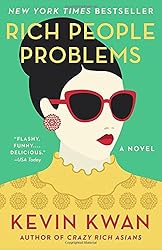
Rich People Problems (Crazy Rich Asians Trilogy 3)
Kevin Kwan, 2017
Knopf Doubleday
416 pp.
ISBN-13: 9780525432371
Summary
Kevin Kwan, bestselling author of Crazy Rich Asians and China Rich Girlfriend, is back with an uproarious new novel of a family riven by fortune, an ex-wife driven psychotic with jealousy, a battle royal fought through couture gown sabotage, and the heir to one of Asia's greatest fortunes locked out of his inheritance.
When Nicholas Young hears that his grandmother, Su Yi, is on her deathbed, he rushes to be by her bedside—but he's not alone. The entire Shang-Young clan has convened from all corners of the globe to stake claim on their matriarch’s massive fortune.
With each family member vying to inherit Tyersall Park—a trophy estate on 64 prime acres in the heart of Singapore—Nicholas’s childhood home turns into a hotbed of speculation and sabotage. As her relatives fight over heirlooms, Astrid Leong is at the center of her own storm, desperately in love with her old sweetheart Charlie Wu, but tormented by her ex-husband—a man hell bent on destroying Astrid’s reputation and relationship.
Meanwhile Kitty Pong, married to China’s second richest man, billionaire Jack Bing, still feels second best next to her new step-daughter, famous fashionista Colette Bing.
A sweeping novel that takes us from the elegantly appointed mansions of Manila to the secluded private islands in the Sulu Sea, from a kidnapping at Hong Kong’s most elite private school to a surprise marriage proposal at an Indian palace, caught on camera by the telephoto lenses of paparazzi, Kevin Kwan's hilarious, gloriously wicked new novel reveals the long-buried secrets of Asia's most privileged families and their rich people problems. (From the publisher.)
Author Bio
• Birth—ca. 1973-74
• Where—Singapore
• Raised—Clear Lake, Texas, USA
• Education—B.A., University of Houston-Clear Lake; B.F.A., Parsons School of Design
• Currently—lives in New York, New York
Kevin Kwan is a Singaporean-American novelist best known for his satirical Crazy Rich Asians Trilogy (2013-17). He was born in Singapore, the youngest of three boys, into an established, old-wealth Chinese family.
Background and early years
His great-grandfather, Oh Sian Guan, was a founding director of Singapore's oldest bank, the Overseas-Chinese Banking Corporation. His paternal grandfather, Dr. Arthur Kwan Pah Chien, was an ophthalmologist who became Singapore's first Western-trained specialist and was knighted by Queen Elizabeth II for his philanthropic efforts. His maternal grandfather, Rev. Paul Hang Sing Hon, founded the Hinghwa Methodist Church. Kwan is also related to Hong Kong-born American actress Nancy Kwan.
As a young boy, Kwan lived in Singapore with his paternal grandparents and attended the Anglo-Chinese School. When he was 11, his father, an engineer, and mother, a pianist, moved the family to the U.S., eventually landing in Clear Lake, Texas, where Kwan graduated from high school at the age of 16. Kwan earned a B.A. in Media Studies from the University of Houston-Clear Lake, after which he moved to Manhattan to attend Parsons School of Design to pursue a B.F.A. in Photography.
Career
Staying in New York, Kwan worked for Andy Warhol's Interview Magazine, Martha Stewart Living, and Tibor Kalman's design firm M & Co. In 2000, Kwan established his own creative studio; his clients have included Ted.com, Museum of Modern Art, and the New York Times.
In 2007, Kwan edited I Was Cuba, a photographic "memoir" of Cuba; in 2008 he co-authored with Deborah Aaronson an advice book, Luck: The Essential Guide.
Then, in 2009, while caring for his dying father, Kwan began to conceive of Crazy Rich Asians. He and his father reminisced about their life in Singapore while driving to and from medical appointments. Hoping to capture those memories, Kwan began writing them down in story form.
Living in the U.S. since 1985, Kwan's view of Asia had become westernized—he has said he feels like "an outsider looking in." His goal was to change the stereotypical perception of wealthy Asians' conspicuous consumption, refocusing instead on old-wealth families more like his own, families that exude "style and taste [and] have been quietly going about their lives for generations."
Four years later, in 2013, Kwan published Crazy Rich Asians, the first volume of what would become his trilogy. Two years later, in 2015, he released China Rich Girlfriend and, in 2017, Rich People's Problems. In 2018 the first book of the trilogy was released as a film and became an immediate box office hit.
In August 2018, Amazon Studios ordered a new drama series from Kwan and STX Entertainment. The as yet unnamed series is to be set in Hong Kong and will follow the "most influential and powerful family" along with their business empire.
Recognition
In 2014, Kwan was named as one of the "Five Writers to Watch" on the list of Hollywood's Most Powerful Authors published by The Hollywood Reporter. In 2018, he made Time magazine's list of 100 most influential people; that same year he was also inducted into The Asian Hall of Fame. (Adapted from Wikipedia. Retrieved 10/18/2018.)
Book Reviews
Flashy, funny.… Delicious, the juicy stuff of classic high-society drama.… Rich People Problems is a fun tabloid romp full of over-the-top shenanigans, like a society party brawl that ruins both a Ramon Orlina glass sculpture of the hostess’s breasts and "a special pig that had only eaten truffles its entire life and was flown in from Spain.…" A memorable, laugh-out-loud Asian glitz fest that’s a pure pleasure to read.
Steph Cha - USA Today
I gobbled all three volumes of Kevin Kwan’s gossipy, name-droppy and wickedly funny Crazy Rich Asians trilogy as if they were popcorn. (Really fresh, still-warm popcorn, with that good European butter… but I digress.) The novels, set among three intergenerational and ultrarich Chinese families and peppered with hilarious explanatory footnotes, are set mostly in Singapore but flit easily from one glamorous world city to another.… Irresistible
Moira Macdonald - Seattle Times
Kevin Kwan has done it again. The mastermind behind the delicious Crazy Rich Asians series has drawn a cult-like following with his extravagant tales of Asia’s upper echelon. He’s back at with the series’s final installment, Rich People Problems (rest assured, it’s just as enthralling as the trilogy’s first two volumes).
Isabel Jones - InStyle
[A] hilarious family drama.… This delightfully wicked family saga will have you laughing over your summer daiquiris at the long-buried secrets of Asia’s most privileged families and their rich people problems.
Redbook Magazine
There are a lot of lines in Kevin Kwan’s forthcoming novel Rich People Problems that will make you both roll your eyes and chuckle at the pure absurdity of the characters.… Pure entertainment. Think: Bravo’s Housewives but with a lot more money and, as a result, a lot more drama.
Taylor Bryant - Nylon
Thank god for Kwan.… In Rich People Problems—Kwan’s third installment in his Crazy Rich Asians series—even more insane family hijinks unfold when greed and jealousy get fortune-hungry schemers up in a wild tizzy. Catch up on the whole saga before the film’s release.
W Magazine
Discussion Questions
We'll add publisher questions if and when they're available; in the meantime, use our LitLovers talking points to help start a discussion for Rich People Problems …then take off on your own:
1. A good place to start a discussion for Rich People Problems is perhaps here: what's wrong with these people? And another starting point: what's funny about them—plastic surgery for a droopy-eyed fish, maybe? (By the way, according to author Kevin Kwan, plastic surgery for fish "absolutely, 100 percent" exists in Singapore.)
2. Characters in all three of Kevin Kwan's novels define themselves by what and how much they own. Talk about the ways in which money and status permeate every social interaction in this book, even the most private relationships. Compare this level of class-consciousness with other well-known stories of the rich and privileged, say, Downton Abbey or even further back in time to say Pride and Prejudice.
3. Talking openly about expensive brands of clothing or cars is prevalent in the book—and in real Singapore high-society, according to Kwan. It's almost like talking about sports, he says, while in the U.S. it's considered flashy and vulgar. What do you think? Is brand-name-dropping simply being honest…or is it boastful?
4. Who is your favorite character and your least favorite? Is anyone authentic in Rich People Problems? Is anyone not obsessed with materialism?
5. The novel is clearly satirical. What is Kwan skewering? Who and what best typifies the object of his satire? What moments seem particularly barbed to you?
6. In China Rich Girlfriend (book two of the trilogy), a family friend tries to warn Nick against possible disinheritance should he marry Rachel: "in everyone's eyes, you are nothing without Tyersall Park," the woman tells him. What does that mean? Might Tyersall Park be considered a sort of character unto itself in this book?
7. This novel makes use of flashbacks to reveal Su Yi's backstory. What do we learn about her past life?
(Questions by LitLovers. Please feel free to use them, online or off, with attribution. Thanks.)
Ride with Me, Mariah Montana
Ivan Doig, 1990
Simon & Schuster
336 pp.
ISBN-13: 9780743271264
Summary
Third in Doig's "McCaskill" Trilogy—Dancing at the Rascal Fair and English Creek (but read Rascal Fair first).
"We are a family that can be kind of stiffbacked," Jick McCaskill reflects with a characteristic sense of life's complications as he narrates this final novel of the "McCaskell" Trilogy.
In English Creek Ivan Doig gave us the West of the l930's; in Dancing at the Rascal Fair, the alluring Rocky Mountain frontier of the late nineteenth century. Now, by way of Jick again and another cast of ineffably believable characters, he brings the story forward to l989, Montana's centennial summer.
Jick, facing age and loss, is jump-started back into adventure and escapade by his red-headed and headlong daughter Mariah, a newspaper photographer: "Pack your socks and come along with me on this," she directs. The grand tour she has in mind is centenary Montana by Winnebago, but the drawback is the reporter assigned with her, restless-minded Riley Wright. "Listen, petunia," says Jick, "I don't even want to be in the same vicinity as that Missoula whistledick, let alone go chasing around the whole state of Montana with him."
But chase around they do, in beguiling encounters with the American road and all the rewards and travails this can bring—among them, a charging buffalo, a senior citizens' used car caravan, astounding bartenders, obtuse admonitions from the home office, and blazing arguments (and a surprising alliance of convenience) between Mariah and Riley.
And just as the centennial is a cause for reflection as well as jubilation, the exuberant travels of this trio bring on "memory storms" that become occasions for reassessment and necessary accommodations of the heart. (From the author's website.)
Author Bio
• Birth—June 27, 1939
• Where—White Sulphur Springs, Montana, USA
• Death—April 9, 2015
• Where—Seattle, Washington
• Education—B.A., M.A., Northwestern University; Ph.D., University of Washington
Ivan Doig was born in Montana to a family of home-steaders and ranch hands. After the death of his mother Berneta, on his sixth birthday, he was raised by his father Charles "Charlie" Doig and his grandmother Elizabeth "Bessie" Ringer. After several stints on ranches, they moved to Dupuyer, Pondera County, Montana in the north to herd sheep close to the Rocky Mountain front.
After his graduation from Valier high school, Doig attended Northwestern University, where he received a bachelor's degree and a master's degree in journalism. He later earned a Ph.D. in American history at the University of Washington, writing his dissertation about John J. McGilvra (1827-1903). He now lives with his wife Carol Doig, nee Muller, a university professor of English, in Seattle, Washington.
Before he became a novelist, Doig wrote for newspapers and magazines as a free-lancer and worked for the United States Forest Service. He has also published two memoirs—This House of Sky (1979) and Heart Earth (1993).
Much of his fiction (more than 10 novels) is set in the Montana country of his youth. His major theme is family life in the past, mixing personal memory and regional history. As the western landscape and people play an important role in his fiction, he has been hailed as the new dean of western literature, a worthy successor to Wallace Stegner. (From Wikipedia.)
Extras
His own words:
• Taking apart a career in such summary sentences always seems to me like dissecting a frog—some of the life inevitably goes out of it—and so I think the more pertinent Ivan Doig for you, Reader, is the red-headed only child, son of ranch hand Charlie Doig and ranch cook Berneta Ringer Doig (who died of her lifelong asthma on my sixth birthday), who in his junior year of high school (Valier, Montana; my class of 1957 had 21 members) made up his mind to be a writer of some kind.
• No one is likely to confuse my writing style with that of Charlotte Bronte, but when that impassioned parson’s daughter lifted her pen from Jane Eyre and bequeathed us the most intriguing of plot summaries—"Reader, I married him"—she also was subliminally saying what any novelist ... must croon to those of you with your eyes on our pages: "Reader, my story is flirting with you; please love it back."
• One last word about the setting of my work, the American West. I don’t think of myself as a "Western" writer. To me, language—the substance on the page, that poetry under the prose—is the ultimate "region," the true home, for a writer. Specific geographies, but galaxies of imaginative expression —we’ve seen them both exist in William Faulkner’s postage stamp-size Yoknapatawpha County, and in Gabriel Garcia Marquez’s nowhere village of Macondo, dreaming in its hundred years of solitude. If I have any creed that I wish you as readers, necessary accomplices in this flirtatious ceremony of writing and reading, will take with you from my pages, it’d be this belief of mine that writers of caliber can ground their work in specific land and lingo and yet be writing of that larger country: life. (From the author's website.)
Book Reviews
An extravagant celebration filled with devotion, and with passion for its locale, its people, and their history.
Washington Post
Spiced with Doig's inimitable dialogue and colorful characters, Ride with Me, Mariah Montana preserves a cherished bit of America's landscape and history for all of us.
USA Today
Spurred by the 1989 centennial of Montana's statehood, moody widower Jick McCaskill, turning 65, criss-crosses the state in a Winnebago with his photographer daughter, strong-willed, feisty Mariah, and her ex-husband, Riley, a reporter. In this crowning volume of a trilogy, which includes English Creek and Dancing at the Rascal Fair, Doig again displays a masterly skill in depicting the American West which few writers match. Instead of patriotic hoopla, the canvas is dotted with failing ranches, oil pumps clanking away in farmed fields, Montanans tensely poised between an uncertain future and a frontier past. Jick, who narrates this road story with brash humor, faces two emotional crises: Mariah precipitously announces plans to remarry Riley; and Leona, Riley's mother, who once had an ill-fated fling with Jick's dead brother, joins the caravan. This entertaining ramble adroitly blends travelogue, family drama, history and newspaper lore
Publishers Weekly
To explore the meaning of Montana's century of statehood, 65-year-old Jick McCaskill, his photographer daughter Mariah, and her newspaper columnist ex-husband Riley Wright tour the Treasure State in Jick's Winnebago. While Riley writes on-the-scene dispatches and Mariah takes photos of the places they visit, Jick, the narrator, recounts the state's—and his family's—good and bad times. A lengthy picaresque with innumerable well-crafted vignettes, this leisurely novel could easily serve as a tour guide of Montana's historic places. As the miles go by, Riley and Mariah again fall in and out of love, and Jick, a widower, unexpectedly finds a new mate. The culminating volume in the McCaskill trilogy, which includes English Creek and Dancing at the Rascal Fair (1987), is highly recommended for its depiction of the past's impact on the present. —James B. Hemesath, Adams State Coll. Llb., Alamosa, Col.
Library Journal
A casually artful and triumphant end to Doig's trilogy.
Kirkus Reviews
Discussion Questions
1. At one point in Ride with Me, Mariah Montana, Jick muses, "Everything of life picture-size, neatly edged. Wouldn't that be handy, if but true." In one sense, Doig does tie the lives of his characters to the art of photography. Explore the ocular imagery in the novel, particularly as related to Jick and Mariah. How much of the novel is about learning to readjust your eyes to new light?
2. Why is the newspaper business, a vagrant occupation reliant on waves of inspiration, so appealing to Mariah and Riley? Study the articles in the Centennial series and compare/contrast how Mariah with her camera and Riley with his pen respond to the challenge of portraying the West. Why do they steer away from romanticizing the "wistful little town off the beaten path" in their depiction of Montana?
3. Jick remarks that the buttes arising from the heart of Montana's earth are "lone sentinel forms the eye seeks." Why does the eye seek them? How do they inform Jick's invisible landscape, and to what extent is the ranch (also a kind of sentinel) a part of Jick's mental dwelling place?
4. Doig, through the persona of Riley, flexes his storytelling muscles when describing the Baloney Express. Riley writes, "They have seen the majority of Montana's century, each of these seven men old in everything but their restlessness, and as their carefully strewn line of taillights burns a route into the night their stories ember through the decades." Discuss the significance of the encounter with these colorful old men and how their tales prove to be a turning point in the Centennial series.
5. Having read his ancestors' letters with surprise and sorrow, Jick becomes acutely vulnerable. He reflects about Mariah and Riley, "Let history whistle through their ears all it wanted. Mine were ready for a rest." Why does Jick resist reminiscence?
6. Compare the scene at the Nez Perce gravesite with the scene at the gravesite where Alex is buried. Which is harder for Jick to bear—the recollection of his own experience at war or his recollection of the "battle" Alec waged with his family?
7. At the height of his depression, Jick wryly regrets, "People do end up this way, alone in a mobile home of one sort or another, their remaining self shrunken to fit into a metal box." After an exasperated cry for help to his late wife, where, then, does Jick turn? What events, people and thoughts lead him out of his sense of abandonment and urge him to grasp at life with both vigor and calm resolve?
8. In "East of Crazy," Doig describes the wind with subtle imagery. How does the image of the Chinook complement the plot of Mariah and Riley venturing into a questionable second relationship?
9. Jick sums up Riley's character as "the king who never forgot anything but never learned anything either". Explain why Mariah is initially willing to overlook Riley's impenetrable hard-headedness and re-enter a marriage with him. Does Doig lead us to side with Mariah in her final decision?
10. What effect does Leona's revelation of the events leading to her breakup with Alec have on Jick? Could we attribute his subsequent, even stronger desire for her to the fact that he, too, has felt her "dry sorrow beyond tears," and finds consolation in knowing she can relate to his sense of loss. How does this feeling of loss both include and transcend the loss of Alec?
11. In his stories and memoirs, Doig depicts the historic struggle to keep Montana's working ranches alive. Contrast Riley's cynical attitude toward the fate of the Montana ranch with Jick's initial idealism about his own sheep ranch. How does Jick come to terms with the reality of losing what he had worked so hard for?
12. As he did in English Creek, Doig incorporates a dancing scene and a moving speech at the end of Ride with Me, Mariah Montana to frame the emotional development of his characters, Jick and Mariah. Discuss how the style of writing in these passages elevates the reader's attitude toward Jick as father and as rancher and Mariah as daughter and photographer.
(Questions courtesy of the author's website.)
top of page


Ridge (Five Oaks Ranch, 1)
Stephanie Payne Hurt, 2015
Horseshoe Publishing
186 pp.
ISBN-13: 9781507783566
Summary
He’s the oldest son of the Cauthen brood and the hardest of all the siblings. After two tours in Iraq, he returns to the 5 Oaks Ranch to take his place in the business.
But he struggles with nightmares and the memories of everything he’s seen in the last seven years. Always the toughest of the siblings, he’s turned hard edged and even harder to get close to.
But the new veterinarian comes in and starts to chisel her way through his stone facade. She’s drawn to him and his stubbornness. They are at odds with every turn and the electricity that sparks between them is unmistakable. Their story is full of his fight to forget and her struggle to get through to him. (From the publisher.)
Author Bio
• Birth—December 10, 1968
• Raised—Milner, Georgia, USA
• Education—Griffin Technical Institute
• Currently—lives in Milner, Georgia
Stephanie Payne Hurt has been writing stories since she was a teenager, but only started publishing her work in 2012, 30 years later. The romance genre drew her in at an early age. Since 2012 she's published over 15 Romance novels/novellas.
Stephanie's a busy lady, as a Children's Minister, Accountant, wife, mother, along with being a blogger and writer. Now she owns ting a publishing service called Horseshoe Publishing alongside her editor. It's been an exciting ride and she looks forward to what the future holds for her writing.
Currently she writes romance ranging from Christian, Contemporary, Suspense and Cowboy. Her work is available at many online retailers, on her website and in a bookstore in Zebulon, Georgia near her home.
Head to Stephanie's website to subscribe, get updates, release dates, and her monthly newsletter. Don't forget to join Stephanie's Street Team for all the new updates and to get free chapters of upcoming books and lots of other prizes. (From the author.)
Visit the author's website.
Book Reviews
Ridge by Stephanie Hurt is a novel that will fill your heart. You will feel so much compassion and kindness for Ridge that you will tear up. Ridge is such a nice guy; he is kind and very sweet. This novel showed how pointless wars have destroyed the lives of many men and how they are suffering because they pledged to protect their country. When you sit down to read the novel, keep a tissue box nearby because you will need it. A really good novel. 5 stars!
Rabia Tanveer - Readers' Favorite
This is a love story that follows Ridge Cauthen. He is the eldest son of the Cauthen clan. Ridge fought in the war in Iraq. He is now back home and working on his family's ranch. He by chance meets the new Veterinarian, Mallory. Ridge is dealing with PTSD from his military service. PTSD that includes nightmares, flashbacks and mood swings. Not an ideal time to try and make someone fall in love with you. My favorite part of this story was the amount of love, patience and forgiveness Ridge is shown by his family and friends. I would hope all Veterans would receive the same treatment. I'm not going to tell you if Boy gets Girl you just have to read it for yourself :) 4 Stars.
Lynn F. - Amazon Customer Review
Discussion Questions
1. Did you enjoy the book? Why or why not?
2. Did the plot pull you in or did you have trouble staying interested?
3. Were the characters made real to you through the authors writing?
4. Did the actions of the characters seem plausible? Why or why not?
5. At the end of the book did you feel satisfied or lacking?
6. Which character was your favorite?
7. Did the story line leave you ready for the next book in the series?
8. Would you recommend this book to others?
(Questions courtesy of the author.)


Riding Lessons
Sara Gruen, 2004
HarperCollins
389 pp.
ISBN-13: 9780061549045
Summary
As a world-class equestrian and Olympic contender, Annemarie Zimmer lived for the thrill of flight atop a strong, graceful animal. Then, at eighteen, a tragic accident destroyed her riding career and Harry, the beautiful horse she cherished.
Now, twenty years later, Annemarie is coming home to her dying father's New Hampshire horse farm. Jobless and abandoned, she is bringing her troubled teenage daughter to this place of pain and memory, where ghosts of an unresolved youth still haunt the fields and stables—and where hope lives in the eyes of the handsome, gentle veterinarian Annemarie loved as a girl... and in the seductive allure of a trainer with a magic touch.
But everything will change yet again with one glimpse of a white striped gelding startlingly similar to the one Annemarie lost in another lifetime. And an obsession is born that could shatter her fragile world. (From the publisher.)
Author Bio
• Birth—N/A
• Where—Vancouver, Canada
• Raised—London, Ontario
• Education—Carleton University (Ottawa)
• Currently—lives in western North Carolina
Sara Gruen is the author of the New York Times bestseller Water for Elephants and Riding Lessons. She lives in western North Carolina with her husband, three sons, and a menagerie of rescued animals. (From the publisher.)
More
Sara Gruen is a Canadian-born author, whose books deal greatly with animals; she is a supporter of numerous charitable organizations that support animals and wildlife.
Gruen moved to the U.S. from Canada in 1999 for a technical writing job. When she was laid off two years later, she decided to try her hand at writing fiction. A devoted animal lover, her first novel, Riding Lessons (2004), explored the intimate and often healing spaces between people and animals and was a USA Today bestseller. She wrote a second novel, Flying Changes (2005), also about horses.
Although her first two novels sold several hundred thousands of copies—and Riding Lessons was a best seller—her third release, Water for Elephants, was initially turned down by her publisher at the time, forcing Gruen to find another publisher. That book, of course, went on to become one of the top-selling novels of our time. Readers fell in love with its story of Jacob, the young man tossed by fate onto a rickety circus train that was home to Rosie, the untrainable elephant. This #1 New York Times bestseller has been printed in 44 languages and the movie version (2011) stars Reese Witherspoon, Christoph Waltz, and Robert Pattinson.
Gruen sold her fourth novel, Ape House (2010), on the basis of a 12-page summary to Random House, which won that and another of her novels in a bidding war with 8 other publishers. Ape House features the amazing Bonobo ape. When a number of apes are kidnapped from a language laboratory, their mysterious appearance on a reality TV show calls into question our assumptions about these animals who share 99.4% of our DNA.
Gruen has had a life-long fascination with human-ape discourse, with a particular interest in Bonobo apes. She has studied linguistics and a system of lexigrams in order to communicate with apes, and is one of the few visitors who has been allowed access to the Great Ape Trust in Des Moines, Iowa, where the apes have come to love her. In bringing her experience and research to bear on her fourth novel, she opens the animal world to us as few novelists have done.
Sara Gruen’s awards include the 2007 Book Sense Book of the Year Award, the Cosmo Fun Fearless Fiction Award, the Bookbrowse Diamond Award for Most Popular Book, the Friends of American Literature Adult Fiction Award and the ALA/Alex Award 2007. (From Wikipedia.)
Book Reviews
Like The Horse Whisperer, Gruen's polished debut is a tale of human healing set against the primal world of horses. The Olympic dreams of teenaged equestrian Annemarie Zimmer end when her beloved horse, Harry, injures her and destroys himself in a jumping accident. In the agonizing aftermath, she gives up riding and horses entirely. Two decades later, she returns to her family's horse farm a divorcee, with her troubled teenaged daughter, Eve, in tow. There, her gruff Germanic mother struggles to maintain the farm and care for Annemarie's father, who is stricken with ALS. Although Annemarie decides (disastrously) to manage the farm's business, her attention quickly turns to an old and ostensibly worthless horse with the same rare coloring as Harry. Her long-denied passion for riding reawakens as she tracks the horse's identity and eventually discovers it to be Harry's younger brother. She must heal both horse and herself as she struggles with her father's deterioration, Eve's rebellion and her attraction to both the farm's new trainer and her childhood sweetheart Dan. Impulsive and self-absorbed, Annemarie isn't always likable, but Gruen's portrait of the stoic elder Zimmers is beautifully nuanced, as is her evocation of Eve's adolescent troubles. Amid this realistically complex generational sandwich, the book's appealing horse scenes—depicted with unsentimental affection—help build a moving story of loss, survival and renewal.
Publishers Weekly
(Starred review.) Annemarie, 18, is a world-class equestrienne who is sure to be a contender in the next Olympics. Then, a terrible jumping accident causes the death of her magnificent horse.... Fans of Nicholas Evans' The Horse Whisperer (1995) and Jessica Bird's impressive debut, Leaping Hearts (2002), will also enjoy this emotion-packed book, which is so exquisitely written it's hard to believe that it's also a debut. —Shelley Mosley
Booklist
Discussion Questions
Riding Lessons features an Olympic-level equestrienne who suffers a devastating accident that ends both her career and the life of her beloved horse. It also sets off a chain of events that doesn't end until twenty years later, when her husband leaves her, she loses her job, and she discovers that her estranged father is dying. In an attempt to pick up the pieces, Annemarie returns to her parents' riding academy with her intransigent teenage daughter. When a mysterious striped horse shows up at a local rescue center, Annemarie begins to slide into an obsession that threatens to destroy her tenuous relationship with her parents, their life's work, and her sanity.
1. Following her accident, Annemarie puts her riding days behind her and moves her life in a completely different direction. Yet the accident and the loss of Harry haunt her and influence her life in ways she doesn't even initially comprehend (e.g. she names her dog Harriet). Do you think we can ever truly leave the past in the past, or does it always follow us? Do you think some people are better-equipped to move on from tragedy than others, and why?
2. The mother-daughter relationship can be a very complicated one, and it is a theme that runs throughout the book. Annemarie's relationship with her mother is strained, just as her relationship with her own teenage daughter is. Annemarie says that motherhood never came naturally to her. Do you think that she let her unresolved problems with own mother affect the way she dealt with Eva? Do you think such cycles always repeat themselves in families, or can they be broken? Why do you think the mother-daughter relationship in particular can be such a volatile one?
3. Mutti helps her ALS-stricken husband end his life. Do you think she did the right thing? Even if it was understandable in this case, should she have been punished for breaking the law? Is helping a seriously ill person die the ultimate act of compassion, or is it playing God?
4. During a steamy encounter with Jean-Claude, which she initiates after he comforts her about Hurrah being taken away, Annemarie stops things before they go too far. Do you think that acting on lustful feelings is a typical reaction for someone going through a difficult time? Annemarie knows, even when she approaches Jean-Claude, that she really loves Dan. Do you think the power of love is ultimately stronger than that of lust?
5. Do you think Annemarie does the right thing when she dyes Hurrah's stripes in order to hide his identity once it is finally revealed? What would you have done in that situation?
6. Annemarie had a relationship with Harry that is unlike any she ever has with a human being, and she forms an equally strong bond with Hurrah. Eva also thrives when she is around horses, particularly Flicka. Do you think that people can have a stronger bond with animals than they do with other humans? What is it that animals can give to us that other people cannot?
(Questions issued by publisher.)
top of page

The Right Swipe
Alisha Rai, 2019
HarperCollins
400 pp.
ISBN-13: 9780062878090
Summary
Alisha Rai returns with a sizzling new novel, in which two rival dating app creators find themselves at odds in the boardroom but in sync in the bedroom.
Rhiannon Hunter may have revolutionized romance in the digital world, but in real life she only swipes right on her career—and the occasional hookup. The cynical dating app creator controls her love life with a few key rules:
— Nude pics are by invitation only
— If someone stands you up, block them with extreme prejudice
— Protect your heart
Only there aren't any rules to govern her attraction to her newest match, former pro-football player Samson Lima. The sexy and seemingly sweet hunk woos her one magical night… and disappears.
Rhi thought she'd buried her hurt over Samson ghosting her, until he suddenly surfaces months later, still big, still beautiful—and in league with a business rival. He says he won't fumble their second chance, but she's wary. A temporary physical partnership is one thing, but a merger of hearts?
Surely that’s too high a risk. (From the publisher.)
Author Bio
Alisha Rai pens award-winning contemporary romances and her novels have been named Best Books of the Year by Washington Post, NPR, Amazon, Entertainment Weekly, Kirkus, and Cosmopolitan Magazine. When she’s not writing, Alisha is traveling or tweeting. (From the author's website.)
Book Reviews
The plot… feels propulsive and complex…. Much rests on [Rhiannon and Samson's] memories of the strong chemistry they discovered in their first night together. At first this feels like a bit of an emotional shortcut, but the real depth—and much of the book's joy—comes from the natural growth of their mutual trust and connection. It's especially intriguing to watch Rhiannon open up. She's prickly and often emotionally closed-off, but vulnerable, too. She slips between stereotypes, always more complicated than she seems.
New York Times Book Review
(Starred review) [A] luscious contemporary series launch.… Both Rhi and Samson are learning how to enjoy life and balance each other beautifully as they face realistic conflicts and tantalizing romance and sensuality. This winning novel will enhance any romance reader’s collection.
Publishers Weekly
Best-selling author Rai taps into the modern dating-app scene with hilarious, horrifying, and relatable results, blending contemporary social issues, such as sexual harassment in the workplace and CTE brain injuries in sports, into the story. —Melanie C. Duncan, Washington Memorial Lib., Macon, GA
Library Journal
Rai turns up the heat and finds the funny in modern dating…. But it’s not all steamy, as the characters have issues with trust and love, making them vulnerable both to each other and the public.… Rai scores a touchdown.
Booklist
[A] new series by a writer known for her expansive view of what a romance novel can do…. Rai addresses heavy issues without sacrificing passionate sensuality or emotional connection.… An ex-football player woos an entrepreneur in a high-tech romance that proves respect is the most potent love drug.
Kirkus Reviews
Discussion Questions
We'll add publisher questions if and when they're available; in the meantime, use our LitLovers Book Club Resources. They can help with discussions for any book:
• How to Discuss a Book (helpful discussion tips)
• Generic Discussion Questions—Fiction and Nonfiction
• Read-Think-Talk (a guided reading chart)
(Resources by LitLovers. Please feel free to use them, online and off, with attribution. Thanks.)

The Rise and Fall of D.O.D.O
Neal Stephenson and Nicole Galland, 2017
HarperCollins
768 pp.
ISBN-13: 9780062409164
Summary
A captivating and complex near-future thriller combining history, science, magic, mystery, intrigue, and adventure that questions the very foundations of the modern world.
When Melisande Stokes, an expert in linguistics and languages, accidently meets military intelligence operator Tristan Lyons in a hallway at Harvard University, it is the beginning of a chain of events that will alter their lives and human history itself.
The young man from a shadowy government entity approaches Mel, a low-level faculty member, with an incredible offer. The only condition: she must sign a nondisclosure agreement in return for the rather large sum of money.
Tristan needs Mel to translate some very old documents, which, if authentic, are earth-shattering. They prove that magic actually existed and was practiced for centuries. But the arrival of the scientific revolution and the Age of Enlightenment weakened its power and endangered its practitioners.
Magic stopped working altogether in 1851, at the time of the Great Exhibition at London’s Crystal Palace — the world’s fair celebrating the rise of industrial technology and commerce. Something about the modern world "jams" the "frequencies" used by magic, and it’s up to Tristan to find out why.
And so the Department of Diachronic Operations — D.O.D.O.— gets cracking on its real mission: to develop a device that can bring magic back, and send Diachronic Operatives back in time to keep it alive … and meddle with a little history at the same time. But while Tristan and his expanding operation master the science and build the technology, they overlook the mercurial — and treacherous — nature of the human heart.
Written with the genius, complexity, and innovation that characterize all of Neal Stephenson’s work and steeped with the down-to-earth warmth and humor of Nicole Galland’s storytelling style, this exciting and vividly realized work of science fiction will make you believe in the impossible, and take you to places — and times — beyond imagining. (From the publisher.)
Author Bios
Neal Stephenson
• Birth—October 31, 1959
• Raised—Champaign-Urbana, Illinois; Ames, Iowa, USA
• Education—B.A., Boston University
• Awards—2 Prometheus Hall of Fame Awards
• Currently—lives in Seattle, Washington
Neal Town Stephenson is an American writer and game designer known for his works of science fiction, historical fiction, cyber- and postcyber-punk.
Stephenson's work explores subjects such as mathematics, cryptography, linguistics, philosophy, and the history of science. He also writes non-fiction articles about technology in publications such as Wired.
Stephenson has worked part-time as an advisor for Blue Origin, a company (funded by Jeff Bezos) developing a manned sub-orbital launch system, and is also a cofounder of Subutai Corporation, whose first offering is the interactive fiction project The Mongoliad. He is currently Magic Leap's Chief Futurist.
Background
Born in Fort Meade, Maryland, Stephenson came from a family of engineers and scientists; his father was a professor of electrical engineering while his paternal grandfather was a physics professor. His mother worked in a biochemistry laboratory, and her father was a biochemistry professor.
Stephenson's family moved to Champaign-Urbana, Illinois, in 1960 and then to Ames, Iowa, in 1966 where he graduated from high school in 1977.
He went on to stydy at Boston University, first specializing in physics, then switching to geography after he found that it would allow him to spend more time on the university mainframe. He graduated in 1981 with a B.A. in geography and a minor in physics.
In 1984, Stephenson published his first novel, The Big U — a satirical take on life at American Megaversity, a vast, bland and alienating research university beset by chaotic riots. His breakthrough novel came in 1992 with Snow Crash, a comic novel in the late cyberpunk or post-cyberpunk tradition. It was was the first of Stephenson's epic science fiction novels.
Successive novels deal with futurism, technology, World War II cryptology, metaphysics, ancient Greek philosophy, and international crime/terrorism (a thriller). He has also writen historical fiction, the Baroque Cycle — a series of eight books set in the 17th and 18th centuries, one of which won the 2005 Prometheus Award.
In May 2010, the Subutai Corporation, of which Stephenson was named chairman, announced the production of an experimental multimedia fiction project called The Mongoliad, which centered around a narrative written by Stephenson and other speculative fiction authors, including Nicole Galland (see below).
In 2012, Stephenson launched a Kickstarter campaign for CLANG, a realistic sword fighting fantasy game. The concept of the game was to use motion control to provide an immersive experience. The campaign's funding goal of $500,000 was reached by the target date of July 9, 2012 on Kickstarter, but the project ran out of money and finally closed down in 2014.
Seveneves, a science fiction novel, came out in 2015, and plans have been announced to adapt it for the screen. (Adapted from Wikipedia. Retrieved 7/12/2017 .)
Nicole Galland
• Birth—ca. 1965
• Raised—West Tisbury (Martha's Vineyard), Massachusetts, USA
• Education—B.A., Harvard University
• Currently—lives on Martha's Vineyard, Massachusetts
Nicole Galland is an American novelist, first known for her historical fiction. Then, in 2017 she switched genres to publish a near-future thriller, The Rise and Fall of D.O.D.O., with Neal Stephenson. She has also published a contemporary comic novel, Stepdog, and using the pseudonym E.D. de Birmingham, she wrote Book Five of the Mongoloid Cycle. Mongoloid, a historical-epic-fantasy, is a collaborative effort of several speculative writers, including Neal Stephenson (see above.)
Background
Galland was born in New York, but grew up in West Tisbury, Massachusetts, a farming community on the island of Martha's Vineyard, where her maternal family has roots going back to the 18th century. Her mother works as a nurse and her stepfather, a Viet Nam vet, was a Physician’s Assistant at Martha’s Vineyard only hospital.
She studied theater and earned a degree at Harvard in Comparative Religion with a focus in Buddhism. Although she received a full fellowship to pursue a Ph.D. in Drama at the University of California at Berkeley, she withdrew following a violent and bizarre assault at gunpoint. Traumatized by the encounter, she would eventually use it as fodder in her writing.
Moving back and forth between east and west coasts, and a stint on the Mediterranean, Galland spent her 20s and 30s working in theater, teaching, editing and juggling various odd jobs. This included co-founding a teen theater company in California that debuted at the Edinburgh Fringe Festival in Scotland. She once described her eclectic life as existing at the whim of serendipity.
Her screenplay, The Winter Population, won an award in 1998 but has yet to be produced. When her first novel, The Fool’s Tale, was published in 2005, she left her position as Literary Manager/Dramaturge at Berkeley Repertory Theatre to write full-time. While at Berkeley Rep she had written Revenge of the Rose, her second novel, and her third, Crossed: A Tale of the Fourth Crusade, was written over a 2-year period during which she essentially lived out of a backpack.
Having resided in the California Bay Area, Los Angeles and New York City for years, Galland returned to Martha's Vineyard to live full-time. She is married to actor Billy Meleady.
In addition to her novels, Galland has written for Salon.com and several Vineyard-based publications, including the Vineyard Gazette, Martha’s Vineyard Magazine, and Edible Vineyard, of which she is a contributing editor
Galland has been involved in Vineyard theater, working at the Vineyard Playhouse and with ArtFarm Enterprises. She is co-founder, with Chelsea McCarthy, of Shakespeare for the Masses, an off-season series presenting irreverent adaptations Shakespeare’s plays on the Vineyard. And finally, a point of trivia, she appears in the CD-ROM Star Wars: Rebel Assault II as Ina Rece. (Adapted from Wikipedia. Retrieved 7/12/2017.)
Book Reviews
[T]hough it’s no comic classic, The Rise and Fall of D.O.D.O. is big, roomy and enjoyable. The historical scenes are refreshingly unembarrassed by their hey-nonny-nonnyisms. The characters are lively, the plot moves along and the whole thing possesses heart and charm. And you don’t need me to tell you whether it tends towards a tragic or comic denouement. You can guess
Adam Roberts - Guardian (UK)
Quantum physics, witchcraft, and multiple groups with conflicting agendas, playfully mixed with vernacular from several centuries and a dizzying number of acronyms, create a fascinating experiment in speculation and metafiction that never loses sight of the human foibles and affections of its cast.
Publishers Weekly
According to the dusty old documents military intelligence operator Tristan Lyons asks linguistics expert Melisande Stokes to translate, magic actually existed until the scientific revolution. The government's Department of Diachronic Operations aims to get it back.
Library Journal
(Starred review.) Immense and immensely entertaining genre-hopping yarn.… Blend time travel with Bourne-worthy skulduggery, throw in lashings of technology and dashes of steampunk.… A departure for both authors and a pleasing combination of much appeal to fans of speculative fiction.
Kirkus Reviews
Discussion Questions
We'll add publisher questions if and when they're available; in the meantime, use our LitLovers talking points to start a discussion for The Rise and Fall of D.O.D.O … then take off on your own:
1. Talk about Triston Lyones and Melisande Stokes. How would you describe them, their skills, personalities, inner strengths and weaknesses, desires, fears?
2. Why does Tristan hire Melisande? What are her skill sets that he believes qualifies her to do the work?
3. What does Melisande come to learn about the manuscripts? What are they in such good shape despite their age?
4. (Follow-up to Question 3) How was magic vanished or at least brought to an end? Where did it go? Explain the role photography played in its demise.
5. Talk about Doctor Frank Oda and his role in all this.
6. How about Erszebet Karpaty? And the Irish witch?
7. Talk about the D.O.D.O. — and the joke that runs for about 150 pages to uncover its full name. Did you find it amusing?
8. (Follow-up to Question 7) How would you describe the growth of D.O.D.O mirror into a bureaucracy: to what extent is the novel a satirical mirror of real life institutions?
9. There is a blizzard of memos back & forth. What were your feelings about them? Funny. Informative? Tiresome? Too many?
10. Were you able to pick up references to Shakespeare or, say, Monty Python? What do you think about the chapter sub-headings written in an 18th or 19th century style?
11. Comment on the conspiratorial machinations of The Fuggers (btw, there really is a Fugger bank dynasty, going back to the 14th century).
12. How did you experience Neal Stephenson's melding of technobabble with magic?
13. (Follow-up to Question 12) What challenges might be presented were time travel a possibility? How does Stephenson describe the technical issues?
14. What does the novel have to say about the human proclivity for foolishness?
'
15. Well, what do you think of the book? The ending — satisfying or not?
(Questions issued by LitLovers. Please feel free to use them, online or off, with attribution. Thanks.)


The Rise & Fall of Great Powers: A Novel
Tom Rachman, 2014
Random House
400 pp.
ISBN-13: 9780679643654
Summary
Following one of the most critically acclaimed fiction debuts in years, New York Times bestselling author Tom Rachman returns with a brilliant, intricately woven novel about a young woman who travels the world to make sense of her puzzling past.
Tooly Zylberberg, the American owner of an isolated bookshop in the Welsh countryside, conducts a life full of reading, but with few human beings. Books are safer than people, who might ask awkward questions about her life. She prefers never to mention the strange events of her youth, which mystify and worry her still.
Taken from home as a girl, Tooly found herself spirited away by a group of seductive outsiders, implicated in capers from Asia to Europe to the United States. But who were her abductors? Why did they take her? What did they really want? There was Humphrey, the curmudgeonly Russian with a passion for reading; there was the charming but tempestuous Sarah, who sowed chaos in her wake; and there was Venn, the charismatic leader whose worldview transformed Tooly forever. Until, quite suddenly, he disappeared.
Years later, Tooly believes she will never understand the true story of her own life. Then startling news arrives from a long-lost boyfriend in New York, raising old mysteries and propelling her on a quest around the world in search of answers.
Tom Rachman—an author celebrated for humanity, humor, and wonderful characters—has produced a stunning novel that reveals the tale not just of one woman but of the past quarter-century as well, from the end of the Cold War to the dominance of American empire to the digital revolution of today.
Leaping between decades, and from Bangkok to Brooklyn, this is a breathtaking novel about long-buried secrets and how we must choose to make our own place in the world. It will confirm Rachman’s reputation as one of the most exciting young writers we have. (From the publisher.)
Author Bio
• Birth—1974
• Where—London, England, UK
• Raised—Vancouver, Canada
• Education—B.A., University of Toronto; M.A., Columbia University
• Currently—lives in London
Tom Rachman was born in London and raised in Vancouver, Canada. A graduate of the University of Toronto and the Columbia School of Journalism, he has been a foreign correspondent for the Associated Press, stationed in Rome. From 2006 to 2008, he worked as an editor at the International Herald Tribune in Paris. He lives in London.
The Imperfectionsists (2010) is his first novel; The Rise and Fall of Great Powers (2014) his second, followed by The Italian Teacher (2018). (Adapted from the publisher and Wikipedia. Retrieved 6/09/2014.)
Book Reviews
The tale begins to wobble in the second chapter, as Tooly...shows signs that she may be as zany as her name suggests.... [W]e are told that she is wearing mismatched Converse sneakers, one black and one red. She also, we learn, plays the ukulele in her spare time. So it’s going to be like that. Suddenly, in the middle of her long walk, like someone in a musical, she bursts "into a sprint.... Then she halts, "breathless and grinning" (Tooly tends to grin, and frown, and squeal), because she has a "secret." And her secret is that she has "nowhere to run, no place to hasten toward, not in this city or in the world." I’m afraid Tooly has another secret: She is annoying.
Jim Windolf - New York Times Book Review
This book is mesmerising: a thorough work-out for the head and heart that targets cognitive muscles you never knew you had. Thanks, though, to Rachman’s lightness of touch and quite considerable streaks of silliness, it feels much more like dancing than exercise.
Times (UK)
Some novels are such good company that you don’t want them to end; Tom Rachman knows this, and has pulled off the feat of writing one.... Rachman has written a hugely likeable, even loveable book about the people we meet and how they shape us.
Telegraph (UK)
A bookshop-lover’s book, and beautiful prose-lover’s book, and read-it-all-in-one-weekend book.
New Republic
[A] suspenseful novel that whisks readers around the world [in a]...coming-of-age story.... The novel weaves a critique of modern society through Tooly’s odyssey, with a cast of characters grappling with the mundane realities of the 21st century. The novel loses steam toward the end, but the journey is still worth taking.
Publishers Weekly
Rachman follows his breakout debut, The Imperfectionists, with a novel featuring an American named Tooly Zylberberg, who runs a bookstore in Wales. Tooly is still confused after being abducted as a child and shuttled worldwide by book-loving Russian Humphrey, sexy Sarah, and mysterious ringleader Venn. Now she's trying to find out what really happened to her.
Library Journal
[Rachman's novel] spans the last 30 years in [a ]tale of a rocky road to adulthood. Over the course of flashbacks and fast-forward escapades, Tooly gradually pieces together the jigsaw of her unconventional life.... Rachman’s kaleidoscopic second novel demonstrates that one’s family is very often made up of the people you find and who find you along the way. —Carol Haggas
Booklist
(Starred review.) [T]he haunting tale of a young woman reassessing her turbulent past.... [T]he overwhelming emotions here are loss and regret, as Tooly realizes how she was alienated from her own best instincts by a charismatic sociopath. Brilliantly structured, beautifully written and profoundly sad.
Kirkus Reviews
Discussion Questions
Use our LitLovers Book Club Resources; they can help with discussions for any book:
• How to Discuss a Book (helpful discussion tips)
• Generic Discussion Questions—Fiction and Nonfiction
• Read-Think-Talk (a guided reading chart)
(We'll add specific questions if and when they're made available by the publisher.)
top of page (summary)
Rise and Shine
Anna Quindlen, 2006
Random House
288 pp.
ISBN-13: 9781616850425
Summary
From Anna Quindlen, acclaimed author of Blessings; Black and Blue; and One True Thing, a superb novel about two sisters, the true meaning of success, and the qualities in life that matter most.
It’s an otherwise ordinary Monday when Meghan Fitzmaurice’s perfect life hits a wall. A household name as the host of Rise and Shine, the country’s highest-rated morning talk show, Meghan cuts to a commercial break–but not before she mutters two forbidden words into her open mike.
In an instant, it’s the end of an era, not only for Meghan, who is unaccustomed to dealing with adversity, but also for her younger sister, Bridget, a social worker in the Bronx who has always lived in Meghan’s long shadow. The effect of Meghan’s on-air truth telling reverberates through both their lives, affecting Meghan’s son, husband, friends, and fans, as well as Bridget’s perception of her sister, their complex childhood, and herself.
What follows is a story about how, in very different ways, the Fitzmaurice women adapt, survive, and manage to bring the whole teeming world of New York to heel by dint of their smart mouths, quick wits, and the powerful connection between them that even the worst tragedy cannot shatter. (From the publisher.)
Author Bio
• Birth—July 8, 1952
• Where—Philadelphia, PA, USA
• Education—B.A., Barnard College
• Awards—Pulitzer Prize for her New York Times column
• Currently—New York, New York
Anna Quindlen could have settled onto a nice, lofty career plateau in the early 1990s, when she had won a Pulitzer Prize for her New York Times column; but she took an unconventional turn, and achieved a richer result.
Quindlen, the third woman to hold a place among the New York Times' Op-Ed columnists, had already published two successful collections of her work when she decided to leave the paper in 1995. But it was the two novels she had produced that led her to seek a future beyond her column.
Quindlen had a warm, if not entirely uncritical, reception as a novelist. Her first book, Object Lessons, focused on an Irish American family in suburban New York in the 1960s. It was a bestseller and a New York Times Notable Book of 1991, but was also criticized for not being as engaging as it could have been. One True Thing, Quindlen's exploration of an ambitious daughter's journey home to take care of her terminally ill mother, was stronger still—a heartbreaker that was made into a movie starring Meryl Streep. But Quindlen's fiction clearly benefited from her decision to leave the Times. Three years after that controversial departure, she earned her best reviews yet with Black and Blue, a chronicle of escape from domestic abuse.
Quindlen's novels are thoughtful explorations centering on women who may not start out strong, but who ultimately find some core within themselves as a result of what happens in the story. Her nonfiction meditations—particularly A Short Guide to a Happy Life and her collection of "Life in the 30s" columns, Living Out Loud—often encourage this same transition, urging others to look within themselves and not get caught up in what society would plan for them. It's an approach Quindlen herself has obviously had success with.
Extras
• To those who expressed surprise at Quindlen's apparent switch from columnist to novelist, the author points out that her first love was always fiction. She told fans in a Barnes & Noble.com chat, "I really only went into the newspaper business to support my fiction habit, but then discovered, first of all, that I loved reporting for its own sake and, second, that journalism would be invaluable experience for writing novels."
• Quindlen joined Newsweek as a columnist in 1999. She began her career at the New York Post in 1974, jumping to the New York Times in 1977.
• Quindlen's prowess as a columnist and prescriber of advice has made her a popular pick for commencement addresses, a sideline that ultimately inspired her 2000 title A Short Guide to a Happy Life Quindlen's message tends to be a combination of stopping to smell the flowers and being true to yourself. Quindlen told students at Mount Holyoke in 1999, "Begin to say no to the Greek chorus that thinks it knows the parameters of a happy life when all it knows is the homogenization of human experience. Listen to that small voice from inside you, that tells you to go another way. George Eliot wrote, 'It is never too late to be what you might have been.' It is never too early, either. And it will make all the difference in the world."
• Studying fiction at Barnard with the literary critic Elizabeth Hardwick, Quindlen's senior thesis was a collection of stories, one of which she sold to Seventeen magazine. (From Barnes & Noble.)
Book Reviews
Anna Quindlen has developed an enormously likable writing voice, and by telling her tale through the humble voice of an unassuming naif, she allows her readers the illusion that we all might live securely within the velvety pink confines of the New York maw, safely out of the way of those silver teeth. She makes the city accessible and downright neighborly.
Carolyn See - Washington Post
Moving from the fetid tenements of the Bronx to the ethereal penthouses of Manhattan, Quindlen pens a lavishly perceptive homage to the city she loves, while her transcendentally agile and empathic observations of the human condition underlie the Fitzmaurice sisters' discovery of the transience of fame and the permanence of family. —Carol Haggas
Booklist
Bridget Fitzmaurice, the narrator of Quindlen's engrossing fifth novel, works for a women's shelter in the Bronx; her older sister, Meghan, cohost of the popular morning show Rise and Shine, is the most famous woman on television. Bridget acts as a second mother to the busy Meghan's college student son, Leo; Meghan barely tolerates Bridget's significant other, a gritty veteran police detective named Irving Lefkowitz. After 9/11 (which happens off-camera) and the subsequent walking out of Meghan's beleaguered husband, Evan, Meghan calls a major politician a "fucking asshole" before her microphone gets turned off for a commercial, and Megan and Bridget's lives change forever. As Bridget struggles to mend familial fences and deal with reconfigurations in their lives wrought by Meghan's single phrase, Quindlen has her lob plenty of pungent observations about both life in class-stratified New York City and about family dynamics. The situation is ripe with comic potential, which Bridget deadpans her way through, and Quindlen goes along with Bridget's cool reserve and judgmentalism. The plot is very imbalanced: a couple of events early, then virtually nothing until a series of major revelations in the last 50 or so pages. The prose is top-notch; readers may be more interested in Quindlen's insights than in the lives of her two main characters.
Publishers Weekly
Orphaned in childhood, sisters Meghan and Bridget have grown up to be pillars in each other's lives. Meghan, a nationally known television personality hosting Rise and Shine, the nation's number one morning show, lives a cushy celebrity life. Younger sister Bridget toils in a modest, sometimes dispiriting career as a social worker. Meghan is married with a personable teenaged son; Bridget lives with a jaded, crusty cop who doesn't want kids. Meghan suffers a fall from grace after a muttered profanity into a live microphone shocks the nation. Her plunge into public disgrace triggers both sisters' soul searching and realigns their lives. The New York City backdrop allows Pulitzer Prize-winning journalist and Newsweek columnist Quindlen to wield her powers of observation and description to establish a true sense of place. Actress Carol Monda's clear, nontheatrical diction is unobtrusive, casting the spotlight on the narrative. Recommended for public libraries. —Judith Robinson, Univ. at Buffalo, NY
Library Journal
Discussion Questions
1. Rise and Shine centers on the unique bond of sisterhood–potentially one of the most supportive, competitive, and difficult relationships in life. Describe Bridget and Meghan’s relationship and how each woman views her sister, and herself. What roles do they each play? Does this portrait of sisterhood reflect your own relationship with a sibling, or perhaps with a close friend? Do you identify with one of the Fitzmaurice sisters more than the other?
2. Meghan’s audacious on-air slip, and its repercussions, incites the novel’s forward action. How would you judge the seasoned anchorwoman’s mistake? Was she wrong to let her personal opinion and emotions show? Do you believe that the network’s reaction was justified? Finally, what was the public’s response to Meghan’s fall from grace?
3. Describe Anna Quindlen’s portrait of New York City. Is the Big Apple “unequivocally the center of the universe,” as some New Yorkers believe? Compare Bridget and Tequila’s experiences at the shelter with Meghan’s worldview from the Upper East Side. How does Quindlen attempt to capture all sides of the city?
4. Describe Meghan and Bridget’s conflicting perceptions and memories of their mother. How does the loss of their mother shape the Fitzgerald sisters’ lives and ways of relating to each other? What role does Aunt Maureen play?
5. Is Evan justified in leaving Meghan, or do you agree with Bridget, that there must have been another woman in the picture right from the start? What factors led to the failure of their relationship? How does Bridget deal with the breakup? Meghan?
6. Meghan retreats to Jamaica to escape the turmoil in her life and, in doing so, detaches from her old persona and responsibilities. What did you think of this episode? Was Meghan being selfish by isolating herself? How did it affect Leo? Bridget? Or was this period in Meghan’s life necessary and inevitable? Finally, discuss the outcome of the trip. Does Meghan sustain this growth of character when she reenters the real world? How about Bridget?
7. What attracts Bridget to Irving Lefkowitz? Describe Irving’s attitude toward children and his reaction to Bridget’s unexpected news. Will this relationship work for Bridget? Why or why not?
8. Bridget’s daily experience in New York City is marked by relationships with “familiar strangers.” What does she mean by this? Are there “familiar strangers” in your own life?
9. Discuss Meghan’s role in apprehending the shooter in the Tubman projects; was her involvement self-serving, or was she defending her son and the safety of others? What were her true motivations, and how were her actions perceived? Do you agree with Meghan’s decision to take matters into her own hands?
10. Quindlen writes in the first person, from Bridget’s perspective. What effect does this narrative viewpoint have on the story? How would the book be different if it were told from Meghan’s point of view?
11. In the last few pages of the novel, Quindlen writes, “Does someone have to break so someone else can be whole?” (p. 268). Who in Rise and Shine breaks, and who has been made whole? Is there more than one way to think about this question?
12. The dust jacket for Rise and Shine shows a beautiful butterfly, a symbol of metamorphosis. How does the concept of change apply to the characters in the novel? Consider, especially, Meghan and Bridget, Evan, Leo, Irving, Tequila, and Princess Margaret. Have you undergone similar changes in your own life? Finally, how did your opinion of the Fitzmaurice sisters, and your assessment of their relative strengths and weaknesses, evolve over the course of the novel?
13. What do you think defines a “successful” life? According to your definition, who is the most successful character in Rise and Shine? Does success equal happiness? How does that concept play out in the novel, and what do Bridget and Meghan come to understand by the end?
14. Does Rise and Shine have a happy ending? What new directions and challenges face the Fitzmaurice sisters, Leo, Irving, and the others?
(Questions issued by publisher.)
top of page


Risking Exposure
Jeanne Moran, 2013
CreateSpace
182 pp.
ISBN-13: 9781492179825
Summary
Munich, Germany, 1938. The Nazis are in power and war is on the horizon. The law makes fourteen-year old Sophie Adler a member of Hitler Youth; her talent makes her an amateur photographer.
Then she contracts polio. During her long hospitalization, her Youth leader supplies her with film. Photographs she takes of fellow polio patients are turned into propaganda, mocking people with disabilities. Sophie’s new disability has changed her status. She’s now an outsider, a target of Nazi scorn and possible persecution. Her only weapon is her camera.
Can she find the courage to separate from the crowd, photograph the full truth, and risk exposure? (From the author.)
Author Bio
• Birth—July 9, 1956
• Raised—New York City, New York and environs (USA)
• Education—N/A
• Currently—Tunkhannock, Pennsylvania
In her words:
I am the sister of a person with a disability and have spent my career as a pediatric physical therapist. Risking Exposure is a historical fiction novel in which the protagonist, a young teen who wants to blend in with the Nazi regime in which she lives, contracts polio. As she copes with her new disability, she gains personal strength and decides to stand up for what she feels is right.
I love to read and write stories in which unlikely heroes make a difference in their corner of the world. In my everyday life, I try to be one of them. (From the author.)
Visit the author's website.
Visit Jeanne on Facebook.
Book Reviews
[A]n incredibly powerful novel about WWII. Not many books discuss the treatment of handicapped individuals at the hands of Nazi Germany. This novel is well written and pretty accurate. I think this is a great novel for young adults because so few young adult novels accurately portray the atrocities committed by Nazis. I think the character of Sophie will stick with me for a long time. This is the best young adult novel I have read in a long time and I can't wait until my nieces and nephews are old enough to read it.
Goodreads reviewer
Risking Exposure shines a light on Nazi Germany not often explored: the treatment of the disabled by the Nazis. Sophie Alder is a deeply compelling character and her struggle to find courage within herself was engaging. This book is perfect for young readers and would make an excellent addition to World War II centered curriculum.
Goodreads reviewer
Because the story and characters continue to resonate, Risking Exposure is ideal for book discussions or classrooms. It’s geared for young adults, but could certainly find an audience with readers past their school years.
Amazon customer review
Risking Exposure is an engaging, well written, thought provoking book. It reminds us of the responsibility we have to one another.
Amazon customer review
[W]hat makes a novel extraordinary? That the characters become so real to us that we carry them in our hearts forever. Sophie is one of those characters and this is one of those books.
Amazon customer review
This is a novel that will leave you wanting more. It tackles a moral dilemma from the teenage point of view during one of the worst periods of time in history. It's a great read!!!
Barnes and Noble customer review
Discussion Questions
1. In the beginning of the novel, Sophie is happy to belong to a group of ‘insiders.’ She is reluctant to act in a way that may mark her as different from them, even though she doesn’t always like what they do. In what situations have you noticed people behaving that way? Have you behaved that way yourself?
2. Sophie’s photos are used as propaganda, defined by Webster’s New World Dictionary as “the widespread promotion of particular ideas and doctrines.” Think about the way today’s media promotes certain ideas. How does this promotion influence your thinking? Do you accept commonly held views as your own or do you research answers for yourself?
3. Think about courage and how Sophie showed courage at the end of the novel. Did she ‘learn how’ to show it or was it always there? What factors brought it out? Do you wonder about your ability to be brave when faced with danger or the threat of harm?
4. Some people around Sophie held true to their morals and ideals and others didn’t. Should morals influenced by the people around you, by the school you attend, or the town or country in which you live? Do you think your own morals can or should change during your lifetime, or should they always be the same?
5. The Nazi pogrom called T4 exterminated tens of thousands of residents of hospitals for the mentally ill, nursing homes, and facilities for the developmentally disabled. Were you aware of this pogrom, or similar actions taken against people who were deaf, homosexual, or Jehovah’s Witness? Why do you think pogroms against Jews and political prisoners are more widely known?
(Questions courtesy of the author.)

The River at Night
Erica Ferencik, 2017
Gallery/Scout Press
304 pp.
ISBN-13: 9781501143199
Summary
A high-stakes drama set against the harsh beauty of the Maine wilderness, charting the journey of four friends as they fight to survive the aftermath of a white water rafting accident, The River at Night is a nonstop and unforgettable thriller by a stunning new voice in fiction.
Winifred Allen needs a vacation.
Stifled by a soul-crushing job, devastated by the death of her beloved brother, and lonely after the end of a fifteen-year marriage, Wini is feeling vulnerable. So when her three best friends insist on a high-octane getaway for their annual girls’ trip, she signs on, despite her misgivings.
What starts out as an invigorating hiking and rafting excursion in the remote Allagash Wilderness soon becomes an all-too-real nightmare: A freak accident leaves the women stranded, separating them from their raft and everything they need to survive. When night descends, a fire on the mountainside lures them to a ramshackle camp that appears to be their lifeline.
But as Wini and her friends grasp the true intent of their supposed saviors, long buried secrets emerge and lifelong allegiances are put to the test. To survive, Wini must reach beyond the world she knows to harness an inner strength she never knew she possessed.
With intimately observed characters, visceral prose, and pacing as ruthless as the river itself, The River at Night is a dark exploration of creatures—both friend and foe—that you won’t soon forget. (From the publisher.)
Author Bio
• Birth—October 21, 1958
• Where—Urbana, Illinois, USA
• Education—B.A., University of Massachusetts-Boston, M.F.A., Boston University
• Currently—lives in Boston, Massachusetts
Erica Ferencik is a Massachusetts-based novelist, screenwriter and stand-up comic. She was born in Urbana, Illinois, and obtained a Bachelor of Arts degree in painting and French from University of Massachusetts. Later she earned her Master of Fine Arts in creative writing from Boston University.
Ferencik did stand-up comedy for ten years at various comedy clubs in Boston and New York and was also a material writer for David Letterman during the early years of his national late-night show.
Most recently, Ferencik is the author of The River at Night (2016), as well as Repeaters (2011), and Cracks in the Foundation (2008). Her work has appeared in Salon and the Boston Globe, as well as on National Public Radio. (From Wikipedia. Retrieved 1/20/2017.)
Book Reviews
This novel quickly becomes a dark, more-twisted-than-the-river tale of secrets as night falls in the wilderness.
Marie Claire
Author Erica Ferencik’s storytelling [is]…brutally effective…hurtling <emRiver’s harrowing narrative along in a visceral, white-knuckle rush.
Entertainment Weekly
Ferencik's debut novel is a must-read for anyone who loves high intensity thrillers. Her use of foreshadowing and flair for suspense is impeccable.... Rich imagery and attention to detail are just a few of the reasons why Ferencik is one of the best new thriller writers out there!
Romance Times Book Reviews
[An] adrenaline rush.... Set over five days, this adventure tests the women’s friendship while also depicting their resilience. Fans of John Dickey’s Deliverance will enjoy this current take on the wilderness survival tale.
Publishers Weekly
[T]his exciting survival tale...hooks from the first page, but it is the strong character development that really stands out. Wini is a compelling heroine, a flawed woman whose fears and regrets are fleshed out by flashbacks.... The friendships...are well drawn and believable. —Lynnanne Pearson, Skokie P.L., IL
Library Journal
A gal-pal vacation goes over the falls and into hell....[A]t a certain point Ferencik’s latest takes a turn for the bloody and deranged. The wilderness adventure part of this book is excellent; the heart-of-darkness horror movie in the third act less so. Still, you won’t put it down.
Kirkus Reviews
Discussion Questions
1. “The woods on either side grew dense, impenetrable, alive with their own logic and intelligence” (page 38). Discuss how nature, specifically the woods and the river, act as a character in the novel.
2. The book opens with a quote by Henry David Thoreau. Consider the quote in relation to Simone and Dean, as well as the relationships between Pia, Rachel, Sandra, and Wini. Why do you think the author chose to start the novel with this quote?
3. Concerns about aging and the passing of time come up frequently in The River at Night. Why do you think age becomes a factor in Pia’s encounter with Rory? Why does age matter in terms of Rory’s expertise as a guide? Discuss how age plays a role in the novel and within your own lives.
4. The women use Pia and Rory’s sexual encounter to unearth some frustrations they have with one another. Discuss the strength of their bonds and how a trip like this may have forced them to reconcile previous tensions more than a less stressful vacation would have.
5. Wini, Pia, Rachel, and Sandra have long been friends—but they have strikingly different personalities. Which of the women do you relate to the most? The least? Discuss the reasons as a group.
6. On page 51, the characters learn that the river is largely on public property. Sandra goes so far as to say, “Nobody owns a river, right?” Is there an underlying message about conservation and environmentalism in the novel? Discuss what other ways a river, forest, or public park might be “owned.”
7. Wini, Rachel, Sandra, and Pia have experienced heartache in many different ways. Whose heartache do you relate to the most? The least?
8. In Chapter 7, just before the women truly commence their trip, Wini remembers her last camping experience. Discuss how the loss of her brother affects Wini’s life and how this flashback weaves its way into the rest of the novel.
9. Discuss the two major deaths in this novel. How are they different? What strikes you most about Rory’s passing? About Sandra’s? Do you think that either could have been prevented?
10. As the antagonist of the story, Simone can be seen as ruthless, deadly, and potentially crazy. One could argue, however, that Simone is just another survivor in the novel. Do you think the author means for her to be more than the villain? Why or why not?
11. “This raft—any raft—flips, and when it does, you have to be prepared. You get no warning. You need to always be ready to be upside down and in that water” (page 125). Discuss what it means to be prepared. Which of the women would you trust most to help should you find yourself lost in a similar situation? Which qualities do you believe are most necessary for surviving in the woods?
12. When the trip is over, the women attempt to get back to normalcy. Wini, however, becomes legal guardian over Dean. Does her decision surprise you?
13. Traveling with a group (or a partner) can often strengthen a friendship. Do you think the trip brought these women closer together? Why or why not?
14. Have you ever been in a situation where you say yes to something—even while feeling fearful or deeply distrustful—because you want to be part of a group? What has been the result?
15. The River at Night references loneliness many times, especially in the context of female friendships. Do you feel that the nature of your close friendships has changed over the years? If so, why, and how have you coped with these changes?
16. Fear plays a big role in this book. A natural survival mechanism, fear speeds our reaction times, energizing the muscles for a swifter escape. But what about the role of fear in modern life? Does it ever play a negative role?
17. What is your relationship with nature? Fearful, comfortable, awe-inspired, disgusted, indifferent? Has it changed over the years? If so, in what ways?
(Questions issued by the publisher.)


A River in the Ocean
Michael Allen, 2013
Createspace
264 pp.
ISBN-13: 9781482323405
Summary
When a near fatal accident separates a single father from his daughter, fate has a way of finding her a good home.
While Chris fights for his life in a coma for nine years, his daughter Krista is raised by a well-intentioned couple who have no idea how to properly raise a child. Gilmer has wild ideas that he doesn’t think through. Maggie knows the basics and figures the rest out as she goes. But there is one thing they have in common, the love for the little girl who stole their hearts while her father was absent.
When Chris awakens from his coma, he has no idea he has a daughter. Putting his life back together, he takes to furniture repair and then design. But he picks up a paint brush one day when an apparition of a little girl soon starts haunting him even while he is awake. He captures scenes of her on canvas, but he can’t figure out what connection they have. While he paints his little angel, she becomes more and more real to him.
Something stirs in both of them when Chris and Krista finally meet late in her teen years. It's certainly a drama, but with comedy to lighten the way.
A River in the Ocean is a heartwarming tale about two lost souls, only one of them feels it and the other has yet to know. He didn’t know he was looking. She didn’t know she needed found. It leads to an overwhelming confusion with the potential to push them together or drive them apart. (From the publisher.)
Author Bio
• Birth—1970
• Born—Cedar Rapids, Iowa, USA
• Raised—in Maryland and Virginia
• Education—B.A., Frostburg State University
• Currently—lives in Clearwater, Florida
Michael Allen was born in Cedar Rapids, Iowa. But he was quickly moved from there to be raised in both Cumberland, Maryland, and Fredericksburg, Virginia. He finally graduated from James Monroe High School in Fredericksburg and went straight into the Marine Corps.
In 1993, Michael was honorably discharged from the Marine Corps and had some wild oats to sow before finally settling down to earn his B.A. in English from Frostburg State University. Fulfilling a lifelong dream, he was quick to learn that plenty of people would be willing to hire him to write their books.
Over twenty books later, Michael has been able to also publish four books of his own. A Danger to Society is loosely based on a true story. When You Miss Me is a children’s book originally written for his daughter. Thoughts and Reconsideration is a journey in poetry through themes of Love, Hate, Spirituality and Philosophy. A River in the Ocean is his fourth book.
Michael currently resides in Clearwater, Florida where he adores the sun, makes his name known along the beaches and volunteers as often as he can. If he’s not substituting to teach English as a second language, he’s filling up plates at a soup kitchen.
When his daughter hit her teenage years, she left him in the dust as most teenagers do to parents they no longer find cool. So if he’s not busy helping people, he tucks himself away in his “cave” tapping steadily away at his next piece of work. (From the author.)
Visit Michael's website.
Book Reviews
(Although A River in the Ocean has not yet garnered reviews, we have included excerpts of two interviews with author Michael Allen by online book sites.)
I was about six years old when I first started writing. At least, that's as far back as I can remember. My first work was a a poem I called Slick Move. It was about people slipping on banana peels and oil slicks. Very age appropriate material. I would have to say it's just something that has always been in my blood, writing many short stories and poems in my youth. But my first contact with a publisher who hired me to write a book was when I realized that I could really do something with it. So, I dedicated myself to it.
Book Junkies Journal
I get to know my characters is about the best way to answer that question. I think them through and know how they would act, how they would talk if they were real. I do not think I’ve ever had a conversation with one of my characters though. But, it does sound like something I would do.
Book Goodies
Discussion Questions
1. What defines family today in the world of broken families?
2. What do you think makes a good parent?
3. Have you ever felt an emptiness or void in your life that actually compelled you to find out what it was about? What did you learn?
4. Have you ever lost anyone who was close to you? How hard was it for you to let go?
5. How would you feel if you suddenly learned that someone you thought you lost had not actually passed away?
6. What would you do if you found yourself having to start over in life?
7. Do you think there’s a special bond family members share, even if they have never met or have been separated for a very long time?
8. What is the significance of the book's title?
(Questions provided courtesy of the author.)


The River of No Return
Bee Ridgway, 2013
Penguin Group (USA)
464 pp.
ISBN-13: 9780142180839
Summary
Devon, 1815. The charming Lord Nicholas Davenant and the beguiling Julia Percy should make a perfect match.
But before their love has a chance to grow, Nicholas is presumed dead in the Napoleonic war. Nick, however, is lost in time. Somehow he escaped certain death by leaping two hundred years forward to the present day where he finds himself in the care of a mysterious society, the Guild.
Questioning the limits of the impossible, Nick is desperate to find a way back to the life he left behind. Yet with the future of time itself hanging in the balance, could it be that the girl who first captured his heart has had the answers all along? Can Nick find a way to return to her? (From the publisher.)
Author Bio
• Birth—ca. 1971-72
• Where—Amherst, Massachuesetts, USA
• Education—B.A., Oberlin College; Ph.D., Cornell University
• Currently—lives in Philadelphia, Pennsylvania.
In her words
I was born and raised in Amherst, Massachusetts, in a parsonage made from three stuck-together old cottages. I attended Oberlin College. I worked for a year in features at Elle Magazine, then went to Cornell for a doctoral degree in English literature. After several years spent chasing research materials and true love around the UK, I settled down to teach American literature at Bryn Mawr College. I live with my partner in Philadelphia. The River of No Return is my first novel. (From the author's website.)
Book Reviews
[A]n accomplished if sometimes slow-going literary mash-up. In the midst of battle, Lord Nicholas Falcott suddenly jumps 200 years into the future. Finding himself in 2003, Lord Nicholas forges a new life as “Nick Davenant."... Ridgway offers a well-crafted blend of science fiction, romance, mystery, and historical fiction, but stumbles with overlong explanations that, while helpful in untangling the story’s convolutions, stall the plot.
Publishers Weekly
A highly entertaining romp; [Ridgway’s] historical details are accurate, and the characters are believable. Fans of Diana Gabaldon’s “Outlander” series should enjoy this time-traveling romantic adventure, which may also attract readers who like historical fiction with a twist.
Library Journal
In her stellar debut, Ridgeway manages the permutations of the time-travel trope with originality and aplomb. Lord Nick Falcott was an early nineteenth-century aristocrat, until he unexpectedly “jumped” into the twenty-first century while engaged in bloody battle.... [T]he entire premise and plot capture unwavering attention. Recommend this engaging, nuanced read to fans of A Discovery of Witches.... —Julie Trevelyan
Booklist
Literate time-travel exercise by English professor and debut novelist Ridgway.... [Nicholas Falcott is in] Napoleon’s dragoons one minute and recovering in a London hospital nearly two centuries later.... [He] goes with the flow anyway. Not much happens for all that, but Ridgway’s talky narrative is smart and often funny.... It’s not especially distinguished, but bookish fantasy fans who make it a point to keep up with Doctor Who will like this one
Kirkus Reviews
Discussion Questions
1. Throughout the novel, Nick struggles to reconcile his knowledge of the future with the tide of the past. What do you think he finds to be the most difficult adjustment and why? What would be the greatest challenge for you, personally?
2. When do Nicholas Falcott and Nick Davenant seem to be the most similar? How much of Nick’s personality is determined by his location in time and space?
3. After learning that she is the talisman, Julia worries over the different meanings of the word and even fears for her life. Do you agree with the choice Ignatz made to keep her in the dark about her origin and her powers? In what sense of the word do you think Julia most embodies the talisman?
4. Nick’s return to his natural time affects his sisters in many ways, limiting certain freedoms while affording them power. What do you make of Clare’s idea for a model community and Arabella’s desire for education? Are these women trapped in their historical context? Or in what ways, if any, are they able to swim against the tide of history?
5. Time travelers harness emotions in order to travel up and down the river of time, and yet despair repels them. What implications does this have for human history, and why does Mr. Mibbs seem to be able to use despair to his advantage?
6. At the Guild compound in Chile, Nick becomes close friends with Meg and Leo. But when Meg and Leo grow suspicious of The Guild, they decide to leave Nick behind, reasoning that he is not ready, and leaving him to assume they are dead. What do you think motivated their decision to desert Nick? What would you have done in their position?
7. This novel presents many strong female characters, each of whom does what she can within her historical perspective. Consider the strengths and weaknesses of characters like Clare, Arabella, Alva, and Peter. As a time–traveler who has yet to travel in time, where do you think Julia fits within this spectrum? In what ways do you think she’ll continue to grow?
8. Throughout the novel, various characters rely on objects to keep them emotionally grounded, or even to stay rooted in time. What symbolic differences do you see between the Guild members’ rings, Nick’s acorn, and Julia’s box of trinkets and fairings?
9. At the end of the novel, Julia and Nick jump forward in time, and Nick sees a new version of the future. Castle Dar is standing, and so is the couple’s special oak tree. What else do you imagine is different, and what effect do you think Julia ultimately has on the past, present, or future?
10. How do you imagine Nick and Julia will resolve the problem of the encroaching Pale? Can you see the Ofan and The Guild working together to save the future?
(Questions issued by publisher.)
River of Smoke (Ibis Trilogy, 2)
Amitav Ghosh, 2011
Farrar, Straus and Giroux
528 pp.
ISBN-13: 9780374174231
Summary
The Ibis, loaded to its gunwales with a cargo of indentured servants, is in the grip of a cyclone in the Bay of Bengal; among the dozens flailing for survival are Neel, the pampered raja who has been convicted of embezzlement; Paulette, the French orphan masquerading as a deck-hand; and Deeti, the widowed poppy grower fleeing her homeland with her lover, Kalua.
The storm also threatens the clipper ship Anahita, groaning with the largest consignment of opium ever to leave India for Canton. And the Redruth, a nursery ship, carries Frederick “Fitcher” Penrose, a horticulturist determined to track down the priceless treasures of China that are hidden in plain sight: its plants that have the power to heal, or beautify, or intoxicate. All will converge in Canton’s Fanqui-town, or Foreign Enclave: a tumultuous world unto itself where civilizations clash and sometimes fuse. It is a powder keg awaiting a spark to ignite the Opium Wars.
Spectacular coincidences, startling reversals of fortune, and tender love stories abound. But this is much more than an irresistible page-turner. The blind quest for money, the primacy of the drug trade, the concealment of base impulses behind the rhetoric of freedom: in River of Smoke the nineteenth and twenty-first centuries converge, and the result is a consuming historical novel with powerful contemporary resonance. Critics praised Sea of Poppies for its vibrant storytelling, antic humor, and rich narrative scope; now Amitav Ghosh continues the epic that has charmed and compelled readers all over the globe. (From the publisher.)
Author Bio
• Birth—1956
• Where—Kolkata, India
• Education—St. Stephen's College, Deli; Delhi University;
Ph.D., Oxford University.
• Awards—see below
• Currently—lives in New York City; Kolkata and Goa, India
Amitv Ghosh is the internationally bestselling author of many works of fiction and nonfiction, including The Glass Palace, and is the recipient of numerous awards and prizes. Ghosh divides his time between Kolkata and Goa, India, and Brooklyn, New York. (From the publisher.)
More
Ghosh was born in Kolkata (Calcutta) and was educated at The Doon School; St. Stephen's College, Delhi; Delhi University; and St Edmund Hall, Oxford, where he was awarded a Ph.D. in social anthropology.
Ghosh lives in New York with his wife, Deborah Baker, author of the Laura Riding biography In Extremis: The Life of Laura Riding (1993) and a senior editor at Little, Brown and Company. They have two children, Lila and Nayan.
He has been a Fellow at the Centre for Studies in Social Sciences, Calcutta. In 1999, Ghosh joined the faculty at Queens College, City University of New York as Distinguished Professor in Comparative Literature. He has also been a visiting professor to the English department of Harvard University since 2005. Ghosh has recently purchased a property in Goa and is returning to India.
Sea of Poppies (2008), the first installment of a planned trilogy, is an epic saga, set just before the Opium Wars, which encapsulates the colonial history of the East. The second in the trilogy, River of Smoke was published in 2011.
His previous novels are The Circle of Reason (1986), The Shadow Lines (1990), In an Antique Land (1992), The Calcutta Chromosome (1995), Dancing in Cambodia, At Large in Burma (1998), Countdown (1999), The Glass Palace (2000) and The Hungry Tide (2004). Ghosh's fiction is characterised by strong themes that may be somewhat identified with postcolonialism but could be labelled as historical novels. His topics are unique and personal; some of his appeal lies in his ability to weave "Indo-nostalgic" elements into more serious themes.
In addition to his novels, Ghosh has written The Imam and the Indian (2002), a large collection of essays on different themes such as fundamentalism, history of the novel, Egyptian culture, and literature).
In 2007, he was awarded the Padma Shri by the Indian government.
Amitav Ghosh's literary awards include:
• Prix Medicis Etranger (French; for Circle of Reason)
• Sahitya Akademic and Ananda Pursaskar Awards (Indian;
for The Shadow Lines)
• Arthur C. Clarke Award (UK; for The Calcutta Chromosome)
• Grand Prize-Fiction, Frankfurt International e-Book Awards
(for The Glass Palace)
• Hutch Crossword Book Prize (Indian; for The Hungry Tide)
• Grinzane Cavour Prize (Italian)
• Shortlisted for Man Booker (UK; for Sea of Poppies)
(Author bio from Wikipedia.)
Book Reviews
River of Smoke does not disappoint...[it] reclaims a story appropriated for too long by its winners...yet Ghosh does so without excessive earnestness, leavening his narrative with nuggets of fact and insight...[his] historical judgments are largely rendered subtly, without any of the sledgehammer effect of retrospective moralism that a lesser writer might have employed…With River of Smoke, Ghosh's Ibis trilogy is emerging as a monumental tribute to the pain and glory of an earlier era of globalization.
Shashi Tharoor - Washington Post
On one level, [River of Smoke] is a remarkable feat of research, bringing alive the hybrid customs of food and dress and the competing philosophies of the period with intimate precision; on another it is a subversive act of empathy, viewing a whole panorama of world history from the 'wrong' end of the telescope. The real trick, though, is that it is also fabulously entertaining.
Observer (UK)
Eloquent.... Fascinating.... [River of Smoke's] strength lies in how thoroughly Ghosh fills out his research with his novelistic fantasy, seduced by each new situation that presents itself and each new character, so that at their best the scenes read with a sensual freshness as if they were happening now.
Guardian (UK)
[This] vast book has a Dickensian sweep of characters, high- and low-life intermingling . . . Ghosh conjures up a thrilling sense of place.
Economist (UK)
Brillian.... By the book’s stormy and precarious ending, most readers will clutch it like the ship’s rail awaiting, just like Ghosh’s characters, the rest of the voyage to a destination unknown.
Don Oldenburg - USA Today
Ghosh’s best and most ambitious work ye.... [He] writes with impeccable control, and with a vivid and sometimes surprising imagination.
New Yorker
Ghosh sets the second volume of his Ibis trilogy in 1838, appropriately enough, because at heart he's a 19th-century novelist with a sweeping vision of character and culture.... Ghosh triumphs both through the clarity of his style and the sweep of his vision, and he leaves the reader eager for volume three.
Kirkus Reviews
Discussion Questions
1. The opening scenes recount Deeti's survival after she and Kalua escaped the Ibis. She insists that destiny, not chance, led her to the site of her hidden shrine. For her, what does destiny mean? What legacies does she pass on to the next generation?
2. Like many of the novel's characters, Ah Fatt and Robin Chinnery have bicultural ancestries. What limitations and freedoms accompany their lack of a legitimate, aristocratic bloodline? Do ancestry and prestige go hand in hand in River of Smoke?
3. Discuss Bahram's and Fitcher's motivations. Are they simply greedy?
4. Paulette is a master of disguise and can comfortably move between cultures. What does she consider to be her true identity? Why is horticulture a suitable field for her?
5. Discuss the role of religion in shaping the characters' view of the world. How are the novel's Hindu characters affected by the expectations of the gods? When Christian characters justify the opium trade, how do they reconcile it with their faith? (You may enjoy revisiting Charles King's letter to Charles Elliot near the book's final pages.)
6. Bahram and Zadig discuss the experience of having an additional, foreign wife, debating whether love is a factor. How does the relationship between Bahram and Chi-mei change over the years? Would Bahram enjoy Canton as much if he weren't a foreigner?
7. How do the trilogy's ships—the formerly slave-trading Ibis, Fitcher's practical but eccentric-looking Redruth, and the treasure-laden Anahita (named for a Hindu goddess of water)—reflect their passengers?
8. In chapter seven, Robin's letter describes the Pearl River as a suburb of Canton. In chapter thirteen, Zadig recalls the legend that claims the river got its name from a foreign trader who dropped a mysterious pearl. Drawing on these and other impressions, discuss the Pearl River as a character: how would you describe its powers and its personality?
9. Consider Ghosh's penchant for intertwining fates. For example, Ah Fatt had been Neel's companion in the labor prison, while Neel (qualified to work as a munshi because of the education that accompanied his noble status) is close by when Mr. Punhyqua is arrested, marking the unlikely fall of another member of the ruling class. Does Ghosh create tragicomedy or pure irony in story lines such as these?
10. Near the end of chapter six, Bahram has a chance encounter with Napoleon (a scene inspired by reported encounters between the French emperor and seafaring traders). If you had been in Bahram's position, what would you have asked Napoleon?
(Questions issued by publisher.)
top of page (summary)
A River Runs Through It and Other Stories
Norman Maclean, 1976
University of Chicago Press
276 pp.
ISBN-13: 9781616850425
Summary
This work will captivate readers with its vivid images of Montana's Big Blackfoot River, its tender yet realistic renderings of Maclean's father and trouble-prone brother, and its uncanny blending of fly fishing with the affections of the heart.
In this celebration of the river and the trout that inhabit it, Maclean writes of the river ritual that he shares with his brother Paul. They begin at sunrise and end hours later with cold beer, having fished their limit, since "to women who do not fish, men who come home without their limit are failures in life." As Paul tries to think like a fish, Maclean tries to think like Paul, wainting to find a way to offer help that Paul can accept but concluding, "you can love completely without completely understanding." (From the publisher.)
Author Bio
• Birth—December 23, 1902
• Where—Clarinda, Iowa, USA
• Reared—Missoula, Montana
• Death—August 2, 1990
• Where—Chicago, Illinois
• Education—B.A., Dartmouth College; Ph.D., University of
Chicago
• Awards—National Book Critics Award, 1992
Norman Maclean grew up in the western Rocky Mountains in the early decades of the 20th century. He worked many summers in logging camps and for the U.S. Forest Service. This novella is based on his experiences of a young man who found that life was only a step from art in its structures and beauty. The beauty he found was in reality.
Maaclean was William Rainey Harper Professor of English at the University of Chicago. He died in 1990. (From Wikipedia.)
Book Reviews
On its surface, this beautiful memoir is about the intricacies of fly fishing and the two Montana brothers who fish the big western rivers. Fishing devotees will revel in descriptions of the rhythm, angles, whip and whistle of the perfect cast. We even get a bit of fish psychology: a trout knows it's being tricked if the fly isn't set perfectly on the water. (Read more..).
A LitLovers LitPick (May '07)
Altogether beautiful in the power of its feelings....As beautiful as anything in Thoreau or Hemingway.
Alfred Kazin - Chicago Tribune Book World
This is more than stunning fiction: It is a lyric record of a time and of a life, shining with Maclean's special gift for calling the reader's attention to arts of all kinds—the arts that work in nature, in personality, in social intercouse, in fly-fishing.
Kenneth M. Pierce - Village Voice
The title novella is the prize…Something unique and marvelous: a story that is at once an evocation of nature's miracles and realities and a probing of human mysteries. Wise, witty, wonderful, Maclean spins his tales, casts his flies, fishes the rivers and the woods for what he remembers from his youth in the Rockies.
Barbara Bannon - Publishers Weekly
Discussion Questions
Use our LitLovers Book Club Resources; they can help with discussions for any book:
• How to Discuss a Book (helpful discussion tips)
• Generic Discussion Questions—Fiction and Nonfiction
• Read-Think-Talk (a guided reading chart)
top of page
Rivak's War
Marilyn Oser, 2013
Mill City Press
268 pp.
ISBN-13: 9781626520509
Summary
Russia, 1914. Rivka, daughter of a prosperous boot maker, seems destined by tradition for marriage and the humdrum rounds of shtetl life.
Then war breaks out, and things go badly for the tsar’s army. When demoralized troops begin deserting their posts in the trenches, one unlikely officer recruits a battalion of girls to set an example for the men.
Rivka seizes upon this chance for adventure as her once-in-a-lifetime opportunity to do something great in the world. She signs on, never suspecting the terrors that await her, or the trials that will test her, or the mishaps that will take her from the frozen steppes of Siberia to the hot, dusty hills of Palestine.
Based on actual events, Rivka’s War is a riveting tale of loss and survival. In vivid detail, it portrays the impact of the Great War on Jewish life, re-creating a vanished world. (From the author.)
Author Bio
Marilyn Oser lives in New York’s Hudson Valley and on Long Island. A Ph.D. in language and literature, she has taught English and history and has raised funds for arts, environmental and community organizations. Author of the novel Playing for Keeps and the blog Streets of Israel, she is a recipient of the University of Michigan’s coveted Avery Hopwood Prize for excellence in writing. (From tha author .)
Book Reviews
A figure steps forward from history and shows herself to be a strong and courageous character. In Rivka's War, Marilyn Oser gives us a hero to cheer. A thoughtful and inspiring novel.
Susan Issacs
Outstanding....Five stars.
Fran Lewis, Just Reviews
Discussion Questions
1. Many of the chapters in Rivka’s War are named for characters in the story. How does Rivka change and grow from her encounter with each of them? Which ones become role models for her?
2. One chapter is called “The Land.” How is the land also a kind of character that has its affect on Rivka?
3. Rivka wonders how she and Mischa have ended up on opposite sides of a political divide. How do you account for this?
4. Twice in Rivka's War, Rivka plunges into a deep depression. What are the factors that cause this? What factors help her overcome it?
5. Yashka is based on a historical figure. What attributes do you admire in her? What do you find less than admirable, even reprehensible?
6. Did biblical references in the novel enlarge your understanding of the events as they unfold?
7. Many horrifying scenes are portrayed in this novel, though these are mild compared to what actually occurred in Russia and Palestine during the war and its aftermath. Are such scenes appropriate in this novel? In any novel?
8. The story is based on events that happened a hundred years ago. What relevance does it have for our lives today?
(Questions provided courtesy of the author.)
The Road
Cormac McCarthy, 2006
Knopf Doubleday
287 pp.
ISBN-13: 9780307387899
Summary
Pulitizer Prize, 2007
A searing, postapocalyptic novel destined to become Cormac McCarthy's masterpiece. A father and his son walk alone through burned America.
Nothing moves in the ravaged landscape save the ash on the wind. It is cold enough to crack stones, and when the snow falls it is gray. They sky is dark.
Their destination is the coast, although they don't know what, if anything, awaits them there. They have nothing; just a pistol to defend themselves against the lawless bands that stalk the road, the clothes they are wearting, a cart of scavenged food-and each other.
The Road is the profoundly moving story of a journey. It boldly imagines a future in which no hope remains, but in which the father and his son, "each the other's world entire," are sustained by love.
Awesome in the totality of its vision, it is an unflinching meditation on the worst and the best that we are capable of: ultimate destructiveness, desperate tenacity, and the tenderness that keeps two people alive in the face of total devastation. (From the publisher.)
Author Bio
• Birth—July 20, 1933
• Where—Providence, Rhode Island, USA
• Education—University of Tennessee, US Air Force
• Awards— Ingram-Merrill Aware, 1959 and 1960; Faulkner
Prize, 1965; Traveling Fellowship from American Academy
of Arts and Letters, 1965; Guggenheim Fellowship, 1969;
MacArthur Fellowship, 1981; National Book Award, 1992;
National Book Critics Circle Award, 1992; James Tait Black
Memorial Prize UK, 2006; Pulitzer Prize, 2007 for The Road.
• Currently—lives in Tesuque, New Mexico (Santa Fe area)
Cormac McCarthy (born Charles McCarthy) is an American novelist and playwright. He has written ten novels, ranging from the Southern Gothic, western, and post-apocalyptic genres. He has also written plays and screenplays.
He received the Pulitzer Prize in 2007 for The Road, and his 2005 novel No Country for Old Men was adapted as a 2007 film of the same name, which won four Academy Awards, including Best Picture. He received a National Book Award and National Book Critics Circle Award for his 1992 novel, All the Pretty Horses.
His previous novel, Blood Meridian, (1985) was among Time Magazine's poll of the best English-language books published between 1923 and 2005 and he placed joint runner-up in a poll taken in 2006 by the New York Times of the best American fiction published in the last 25 years.
Literary critic Harold Bloom named him as one of the four major American novelists of his time, along with Don DeLillo, Thomas Pynchon and Philip Roth. In 2010 the London Times ranked The Road no.1 on its list of the 100 best fiction and non-fiction books of the past 10 years. He is frequently compared by modern reviewers to William Faulkner.
Early years
McCarthy was born in Providence, Rhode Island on July 20, 1933, and moved with his family to Knoxville, Tennessee, in 1937. He is the third of six children, with three sisters and two brothers. In Knoxville, he attended Knoxville Catholic High School. His father was a successful lawyer for the Tennessee Valley Authority from 1934 to 1967.
McCarthy entered the University of Tennessee in 1951-1952 and was a liberal arts major. In 1953, he joined the United States Air Force for four years, two of which he spent in Alaska, where he hosted a radio show. In 1957, he returned to the University of Tennessee. During this time in college, he published two stories in a student paper and won awards from the Ingram Merrill Foundation in 1959 and 1960. In 1961, he and fellow university student Lee Holleman were married and had their son Cullen. He left school without earning a degree and moved with his family to Chicago where he wrote his first novel. He returned to Sevier County, Tennessee, and his marriage to Lee Holleman ended.
Writing
McCarthy's first novel, The Orchard Keeper, was published by Random House in 1965. He decided to send the manuscript to Random House because "it was the only publisher [he] had heard of." At Random House, the manuscript found its way to Albert Erskine, who was William Faulkner's editor until Faulkner's death in 1962. Erskine continued to edit McCarthy for the next twenty years.
In the summer of 1965, using a Traveling Fellowship award from The American Academy of Arts and Letters, McCarthy shipped out aboard the liner Sylvania, hoping to visit Ireland. While on the ship, he met Anne DeLisle, who was working on the ship as a singer. In 1966, they were married in England. Also in 1966, McCarthy received a Rockefeller Foundation Grant, which he used to travel around Southern Europe before landing in Ibiza, where he wrote his second novel, Outer Dark. Afterward he returned to America with his wife, and Outer Dark was published in 1968 to generally favorable reviews.
In 1969, McCarthy and his wife moved to Louisville, Tennessee, and purchased a barn, which McCarthy renovated, even doing the stonework himself. Here he wrote his next book, Child of God, based on actual events. Child of God was published in 1973. Like Outer Dark before it, Child of God was set in southern Appalachia. In 1976, McCarthy separated from Anne DeLisle and moved to El Paso, Texas. In 1979, his novel Suttree, which he had been writing on and off for twenty years, was finally published.
Supporting himself with the money from his 1981 MacArthur Fellowship, he wrote his next novel, Blood Meridian, which was published in 1985. The book has grown appreciably in stature in literary circles. In a 2006 poll of authors and publishers conducted by The New York Times Magazine to list the greatest American novels of the previous quarter-century, Blood Meridian placed third, behind only Toni Morrison's Beloved and Don DeLillo's Underworld.
McCarthy finally received widespread recognition in 1992 with the publication of All the Pretty Horses, which won the National Book Award and the National Book Critics Circle Award. It was followed by The Crossing and Cities of the Plain, completing a Western trilogy. In the midst of this trilogy came The Stonemason, McCarthy's second dramatic work. He had previously written a film for PBS in the 1970s, The Gardener's Son.
McCarthy's next book, 2005's No Country for Old Men, stayed with the western setting and themes, yet moved to a more contemporary period. It was adapted into a film of the same name by the Coen Brothers, winning four Academy Awards and more than 75 film awards globally. McCarthy's latest book, The Road, was published in 2006 and won international acclaim and the Pulitzer Prize for literature. A film adaptation starring Viggo Mortensen and Kodi Smit-McPhee was released on November 25, 2009. Also in 2006, McCarthy published a play entitled The Sunset Limited.
Extras
• According to Wired magazine in December, 2009, McCarthy's Olivetti Lettera 32 typewriter was put up for auction at Christie's. The Olivetti Lettera 32 has been in his care for 46 years, since 1963. He picked up the used machine for $50 from a pawn shop in Knoxville, Tennessee. McCarthy reckons he has typed around five million words on the machine, and maintenance consisted of “blowing out the dust with a service station hose”. The typewriter was auctioned on Friday, December 4 and the auction house, Christie’s, estimated it would fetch between $15,000 and $20,000; it sold for $254,500. The Olivetti’s replacement for McCarthy to use is another Olivetti, bought by McCarthy’s friend John Miller for $11. The proceeds of the auction are to be donated to the Santa Fe Institute, a nonprofit interdisciplinary scientific research organization.
• McCarthy now lives in the Tesuque, New Mexico, area, north of Santa Fe, with his wife, Jennifer Winkley, and their son, John. He guards his privacy. In one of his few interviews (with The New York Times), McCarthy reveals that he is not a fan of authors who do not "deal with issues of life and death," citing Henry James and Marcel Proust as examples. "I don't understand them," he said. "To me, that's not literature. A lot of writers who are considered good I consider strange." McCarthy remains active in the academic community of Santa Fe and spends much of his time at the Santa Fe Institute, which was founded by his friend, physicist Murray Gell-Mann.
• Talk show host Oprah Winfrey chose McCarthy's 2006 novel The Road as the April 2007 selection for her Book Club. As a result, McCarthy agreed to his first television interview, which aired on The Oprah Winfrey Show on June 5, 2007. The interview took place in the library of the Santa Fe Institute; McCarthy told Winfrey that he does not know any writers and much prefers the company of scientists.
• During the interview he related several stories illustrating the degree of outright poverty he has endured at times during his career as a writer. He also spoke about the experience of fathering a child at an advanced age, and how his now-eight-year-old son was the inspiration for The Road. Cormac noted to Oprah that he prefers "simple declarative sentences" and that he uses capital letters, periods, an occasional comma, a colon for setting off a list, but "never a semicolon." He does not use quotation marks for dialogue and believes there is no reason to "block the page up with weird little marks." (From Wikipedia.)
Book Reviews
This is an exquisitely bleak incantation — pure poetic brimstone. Mr. McCarthy has summoned his fiercest visions to invoke the devastation. He gives voice to the unspeakable in a terse cautionary tale that is too potent to be numbing, despite the stupefying ravages it describes. Mr. McCarthy brings an almost biblical fury as he bears witness to sights man was never meant to see.
Janet Maslin - New York Times
The Road is a dynamic tale, offered in the often exalted prose that is McCarthy's signature, but this time in restrained doses—short, vivid sentences, episodes only a few paragraphs or a few lines long…the most readable of his works, and consistently brilliant in its imagining of the posthumous condition of nature and civilization—"the frailty of everything revealed at last. Old and troubling issues resolved into nothingness and night."
William Kennedy - The New York Times Book Review
In Cormac McCarthy's new novel, The Road, the bloodbath is finally complete. The violence that animated his great Western novels has been superseded by a flash of nuclear annihilation, which also blasts away some of what we expect from the reclusive author's work. With this apocalyptic tale, McCarthy has moved into the allegorical realm of Samuel Beckett and José Saramago — and, weirdly, George Romero [Night of the Living Dead].
Ron Charles - The Washington Post
(Audio version.) McCarthy's latest novel, a frightening apocalyptic vision, is narrated by a nameless man, one of the few survivors of an unspecified civilization-ending catastrophe. He and his young son are trekking along a treacherous highway, starving and freezing, trying to avoid roving cannibal armies. The tale, and their lives, are saved from teetering over the edge of bleakness thanks to the man's fierce belief that they are "the good guys" who are preserving the light of humanity. In this stark, effective production, Stechschulte gives the father an appropriately harsh, weary voice that sways little from its numbed register except to urge on the weakening boy or soothe his fears after an encounter with barbarians. When they uncover some vestige of the former world, the man recalls its vanished wonder with an aching nostalgia that makes the listener's heart swell. Stechschulte portrays the son with a mournful, slightly breathy tone that emphasizes the child's whininess, making him much less sympathetic than his resourceful father. With no music or effects interrupting Stechschulte's carefully measured pace and gruff, straightforward delivery, McCarthy's darkly poetic prose comes alive in a way that will transfix listeners.
Publishers Weekly
Winner of the National Book Award and the National Book Critics Circle Award, McCarthy (All the Pretty Horses) here offers a prescient account of a man and his son trying to survive in a devastated country where food is scarce and everyone has become a scavenger. The term survival of the fittest rings true here—very few people remain, and friends are extinct. Essentially, this is a story about nature vs. nurture, commitment and promises, and though there aren't many characters, there is abundant life in the prose. We are reminded how McCarthy has mastered the world outside of our domestic and social circles, with each description reading as if he had pulled a scene from the landscape and pasted it in the book. He uses metaphors the way some writers use punctuation, sprinkling them about with an artist's eye, showing us that literature from the heart still exists. Recommended for all libraries. —Stephen Morrow, Columbus, OH
Library Journal
Even within the author's extraordinary body of work, this stands as a radical achievement, a novel that demands to be read and reread. McCarthy (No Country for Old Men, 2005, etc.) pushes his thematic obsessions to their extremes in a parable that reads like [George Romero's camp film] Night of the Living Dead as rewritten by Samuel Beckett. Where much of McCarthy's fiction has been set in the recent past of the South and West, here he conjures a nightmare of an indeterminate future. A great fire has left the country covered in layers of ash and littered with incinerated corpses. Foraging through the wasteland are a father and son, neither named (though the son calls the father "Papa"). The father dimly remembers the world as it was and occasionally dreams of it. The son was born on the cusp of whatever has happened—apocalypse? holocaust?—and has never known anything else. His mother committed suicide rather than face the unspeakable horror. As they scavenge for survival, they consider themselves the "good guys," carriers of the fire, while most of the few remaining survivors are "bad guys," cannibals who eat babies. In order to live, they must keep moving amid this shadowy landscape, in which ashes have all but obliterated the sun. In their encounters along their pilgrimage to the coast, where things might not be better but where they can go no further, the boy emerges as the novel's moral conscience. The relationship between father and son has a sweetness that represents all that's good in a universe where conventional notions of good and evil have been extinguished. Amid the bleakness of survival—through which those who wish they'd never been born struggle to persevere—there are glimmers of comedy in an encounter with an old man who plays the philosophical role of the Shakespearean fool. Though the sentences of McCarthy's recent work are shorter and simpler than they once were, his prose combines the cadence of prophecy with the indelible images of poetry. A novel of horrific beauty, where death is the only truth.
Kirkus Reviews
Discussion Questions
Introduction: Set in the smoking ashes of a postapocalyptic America, Cormac McCarthy's The Road tells the story of a man and his son's journey toward the sea and an uncertain salvation. The world they pass through is a ghastly vision of scorched countryside and blasted cities "held by cores of blackened looters who tunneled among the ruins and crawled from the rubble white of tooth and eye carrying charred and anonymous tins of food in nylon nets like shoppers in the commissaries of hell" [p. 181]. It is a starved world, all plant and animal life dead or dying, some of the few human survivors even eating each other alive.
The father and son move through the ruins searching for food and shelter, trying to keep safe from murderous, roving bands. They have only a pistol to defend themselves, the clothes they are wearing, a cart of scavenged food—and each other.
Awesome in the totality of its vision, The Road is an unflinching meditation on the worst and the best that we are capable of: ultimate destructiveness, desperate tenacity, and the tenderness that keeps two people alive in the face of total devastation.
1. Cormac McCarthy has an unmistakable prose style. What do you see as the most distinctive features of that style? How is the writing in The Road in some ways more like poetry than narrative prose?
2. Why do you think McCarthy has chosen not to give his characters names? How do the generic labels of "the man" and "the boy" affect the way in which readers relate to them?
3. How is McCarthy able to make the postapocalyptic world of The Road seem so real and utterly terrifying? Which descriptive passages are especially vivid and visceral in their depiction of this blasted landscape? What do you find to be the most horrifying features of this world and the survivors who inhabit it?
4. McCarthy doesn't make explicit what kind of catastrophe has ruined the earth and destroyed human civilization, but what might be suggested by the many descriptions of a scorched landscape covered in ash? What is implied by the father's statement that "On this road there are no godspoke men. They are gone and I am left and they have taken with them the world" [p. 32]?
5. As the father is dying, he tells his son he must go on in order to "carry the fire." When the boy asks if the fire is real, the father says, "It's inside you. It was always there. I can see it" [p. 279]. What is this fire? Why is it so crucial that they not let it die?
6. McCarthy envisions a postapocalyptic world in which "murder was everywhere upon the land" and the earth would soon be "largely populated by men who would eat your children in front of your eyes" [p. 181]. How difficult or easy is it to imagine McCarthy's nightmare vision actually happening? Do you think people would likely behave as they do in the novel, under the same circumstances? Does it now seem that human civilization is headed toward such an end?
7. The man and the boy think of themselves as the "good guys." In what ways are they like and unlike the "bad guys" they encounter? What do you think McCarthy is suggesting in the scenes in which the boy begs his father to be merciful to the strangers they encounter on the road? How is the boy able to retain his compassion—to be, as one reviewer put it, "compassion incarnate"?
8. The sardonic blind man named Ely who the man and boy encounter on the road tells the father that "There is no God and we are his prophets" [p. 170]. What does he mean by this? Why does the father say about his son, later in the same conversation, "What if I said that he's a god?" [p. 172] Are we meant to see the son as a savior?
9. The Road takes the form of a classic journey story, a form that dates back to Homer's Odyssey. To what destination are the man and the boy journeying? In what sense are they "pilgrims"? What, if any, is the symbolic significance of their journey?
10. McCarthy's work often dramatizes the opposition between good and evil, with evil sometimes emerging triumphant. What does The Road ultimately suggest about good and evil? Which force seems to have greater power in the novel?
11. What makes the relationship between the boy and his father so powerful and poignant? What do they feel for each other? How do they maintain their affection for and faith in each other in such brutal conditions?
12. Why do you think McCarthy ends the novel with the image of trout in mountain streams before the end of the world: "In the deep glens where they lived all things were older than man and they hummed of mystery" [p. 287]. What is surprising about this ending? Does it provide closure, or does it prompt a rethinking of all that has come before? What does it suggest about what lies ahead?
(Questions issued by publisher.)
top of page (summary)
The Road Home
Rose Tremain, 2007
Little, Brown & Co.
432 pp.
ISBN-13: 9780316002622
Summary
In the wake of factory closings and his beloved wife's death, Lev makes his way from Eastern Europe to London, seeking work to support his mother and his little daughter. After a spell of homelessness, he finds a job in the kitchen of a posh restaurant and a room in the house of an appealing Irishman who has already lost his family.
Never mind that Lev must sleep in a bunk bed surrounded by plastic toys—he has found a friend and shelter. However constricted his life in England remains, he compensates by daydreaming of home, by having an affair with a younger restaurant worker, and by trading gossip and ambitions via cell phone with his hilarious friend Rudi, who, dreaming of the wealthy West, lives largely for his battered Chevrolet.
Homesickness dogs Lev, not only for nostalgic reasons, but because he doesn't belong, body or soul, to his new country—but can he really go home again?
Rose Tremain's prodigious talents as a prose writer are on full display in The Road Home, and her novel never loses sight of what is truly important in the lives we lead. (From the publisher.)
Author Bio
• Birth—1943
• Where—London, England, UK
• Education—Sorbonne, Paris; B.A., University of East Anglia
• Awards—James Tait Black Memorial Prize, Prix Fémina
Etranger, Whitbread Award, Orange Prize
• Currently—lives in East Anglia, UK
Rose Tremain was born Rosemary Jane Thomson in 1943 in London, the daughter of Viola (known as Jane) and Keith Thomson, a playwright.
She went to boarding school at Crofton Grange in Hertfordshire, an experience of which she later said in a Guardian interview, "It had all the horrors of boarding school— it was very cold and the food was disgusting. But the good thing about being sent away to school is that there’s a lot of what I would call dead time. You had to really use your own resources and what some of us did was to write our own plays and put them on. We starred in them, made the costumes, made the scenery, and it was thrilling."
After school she studied at the Sorbonne in Paris, and then graduated with a degree in English from the University of East Anglia, where she later taught creative writing from 1988-1995.
She married Jon Tremain in 1971 and in 1972 had a daughter, Eleanor. Her second marriage was to the theatre director Jonathan Dudley. She now lives in East Anglia with the writer and biographer Richard Holmes.
Her first novel, Sadler’s Birthday, was published in 1976, and picked up by the editor Penelope Hoare, who later said, "I remember feeling utterly thrilled when I read it.... It was so unlike most people’s first novels, in the sense that it didn’t seem to be in the least bit autobiographical." Hoare has been Tremain’s editor ever since, working together on ten novels and several short story collections.
In the course of her writing career, Tremain has garnered a host of prizes, including the James Tait Black Memorial Prize (for fiction) and the prestigious Prix Fémina Etranger, the Whitbread Novel Award, and several others. She has been nominated for the Booker and Orange Prize several times. She won the Orange Prize in 2008 for The Road Home. (Author bio from Chatto & Windus, a division of Random House, UK.)
Book Reviews
Journeys like Lev's are very much a part of Britain's present reality, with discussion of the Eastern European invasion appearing all over. But Tremain elevates the subject beyond its outlines by making Lev not a statistic or a caricature or the standard-bearer of a trend but simply a man—fully embodied, his ignoble and noble acts presented without exaggeration, without excessive praise or condemnation.... A less disciplined and agile author might have been tempted to ease Lev's transition from daydreamer to doer. Or she might have jollied Lev into a toque at London's River Cafe and set Rudi up as a chauffeur on Belisha Road. But Rose Tremain is in the business of inventing not so much fantasies as alternate realities.
Liesl Schillinger - New York Times
Rose Tremain brings the full tone and range of her novelist's imagination to bear on Lev, giving him, besides his enduring and endearing grief, humour, a romantic temperament, a genius for intimate male friendship and a poets' eye for images.
Times Literary Supplement (UK)
A classic work by the gifted Tremain.... She has the art of finding the improbable graces in human connection.
Guardian (UK)
This is a finely balanced novel of urgent humanity.... The Road Home should keep you gripped...and fraught with anxious sympathy.
Sunday Telegraph (UK)
The pleasure, the wit and the joy in humanity that Tremain brings to every page do what literature, at its best, should do: connect us, as E.M. Forester famously exhorted.
Stacey D'Erasmo - Los Angeles Times
It's not difficult to see why author Rose Tremain won the Orange Prize—a prestigious British fiction award--for her latest novel, The Road Home. From page one, Tremain plunges readers deep into the journey of Lev, an immigrant from an unnamed Eastern European country.... An unexpected, poignant story.
Allecia Vermillion - Chicago Sun Times
Tremain transforms this episodic road story into a gem of a novel, driven by a memorable character whose caring and ambition move him from a difficult personal situation and damaging historical past toward a positive new life.
Robert Allen Papinchak - Seattle Times
Why do I love Rose Tremain? It's not just the clarity of her prose, the liveliness of her plots, the precision of her settings, or the depth of her characters. I love Tremain because she is so compassionate. Her novels exemplify this moral quality, even as they excel at all the others.
Susan Balee - Philadelphia Inquirer
Tremain's protagonists are often faced with trials that have a fabled quality...and her latest novel is no exception...At once timeless and bitingly contemporary, this novel explores the life now lived by millions—when one's hope lies in one country and one's heart in another.
The New Yorker
Tremain (Restoration) turns in a low-key but emotionally potent look at the melancholia of migration for her 14th book. Olev, a 42-year-old widower from an unnamed former east bloc republic, is taking a bus to London, where he imagines every man resembles Alec Guinness and hard work will be rewarded by wealth. He has left behind a sad young daughter, a stubborn mother and the newly shuttered sawmill where he had worked for years. His landing is harsh: the British are unpleasant, immigrants are unwelcome, and he's often overwhelmed by homesickness. But Lev personifies Tremain's remarkable ability to craft characters whose essential goodness shines through tough, drab circumstances. Among them are Lydia, the fellow expatriate; Christy, Lev's alcoholic Irish landlord who misses his own daughter; and even the cruelly demanding Gregory, chef-proprietor of the posh restaurant where Lev first finds work. A contrived but still satisfying ending marks this adroit emigre's look at London.
Publishers Weekly
A displaced European's Candide-like progress through contemporary London is charted in this ambitious novel from the Whitbread Award-winning British author (The Colour, 2003, etc.). The protagonist is Lev, a recently widowed and also jobless former sawmill worker. He has left his young daughter and his (also widowed) mother behind (in a generically economically disadvantaged country that is and isn't Poland), hoping to find work and send money home. Debarking from the Trans-Euro bus on which he meets a similarly down-at-heels countrywoman (Lydia, who'll re-enter Lev's new life at variously crucial moments), Lev acquires a fragile living working as a distributor of leaflets, as a dishwasher, and so on, slowly ascending the ladder of minimal solvency, making a painstaking adaptation to a society that seems, to his bemused view, inexplicably self-indulgent, pampered and unmotivated. While sticking close to Lev's roiling thought processes, Tremain simultaneously constructs a subtly detailed mosaic of personal and cultural distinctions and conflicts-notably in Lev's cautious approach to reclaiming a sex life (perhaps even a love life?) and in generously developed conversations between Lev and his fulsome Irish landlord, bibulous plumber and compulsive worrywart Christy Slane. The novel's texture is further enriched by lengthy flashbacks spun from Lev's wistful memories, which acquaint us more fully with his warmhearted late wife Marina and his best friend Rudi, a resourceful hustler whose busy head is filled with visions of all things American, and foolproof scams by which such riches may be acquired. Rudi is an ingenious comic counterpart to Candide's annoyingly optimistic mentor Pangloss, and the novel dances into vigorous life whenever he takes hold of it. Still, Lev offers readers ample reason to get lost in this immensely likable novel's many pleasures. One of the best from the versatile Tremain, who keeps on challenging herself, and rewarding readers.
Kirkus Reviews
Discussion Questions
1. "Through Lev’s eyes, we see London as the incomer views it and it is not an attractive sight: alternately moneyed and poverty-stricken, its inhabitants obsessed by status and success." (Edward Marriott, Observer)
Do you agree with Marriot’s assessment of how Lev views London, and do you feel Tremain paints a realistic picture?
2. In her author interview Rose Tremain says "I've deliberately built my fictions around characters who are distant from me, in gender, place or time—or all of these. The moment I get close to my own biography, I feel boredom (and even mild self-dislike) creeping up on me."
Does this reflect your own feelings as a reader? Do you prefer novels which reflect your own experiences or take you somewhere else? What do you think you have in common with Lev?
3. Food is a very important motif in the novel. How does Tremain illustrate Lev’s journey in terms of food? Why do you think she only begins to describe the food of his own country towards the end?
4. In the author interview Tremain says that in her view, "most Brits want to be welcoming to migrants, but have worries—or indeed extreme anxieties—of their own which sometimes prevent them from doing this."
Do you believe that is true in your country? What worries and anxieties do you think Tremain is referring to and how are these played out in the novel?
5. Have you ever lived in another country? If so, how far did your experiences reflect Lev’s? What did you find challenging about establishing a new life in a different culture? Did it affect the way you read the novel? If not, do you think you could ever do what Lev did? What would you find hardest to leave behind?
6. Lev’s relationship with Sophie becomes very dark when he turns violent towards her. Why do you think he has such difficult relationships with women?
7. In the end Lev returns to his family and builds a life with his new found skills and money. Why do you think that the novel has ended in such an idealistic way? Do you think that this ending is possible for immigrants?
(Questions issued by Chatto & Windus, a division of Random House, UK.)


The Road to Little Dribbling: Adventures of an American in Britain
Bill Bryson, 2016
Knopf Doubleday
400 pp.
ISBN-13: 9780385539289
Summary
The hilarious and loving sequel to a hilarious and loving classic of travel writing: Notes from a Small Island, Bill Bryson’s valentine to his adopted country of England
In 1995 Bill Bryson got into his car and took a weeks-long farewell motoring trip about England before moving his family back to the United States. The book about that trip, Notes from a Small Island, is uproarious and endlessly endearing, one of the most acute and affectionate portrayals of England in all its glorious eccentricity ever written.
Two decades later, Bryson sets out again to rediscover that country, and the result is The Road to Little Dribbling. Nothing is funnier than Bill Bryson on the road—prepare for the total joy and multiple episodes of unseemly laughter. (From the publisher.)
Author Bio
• Birth—December 8 1951
• Where—Des Moines, Iowa, USA
• Education—B.A., Drake University
• Awards—(see below)
• Currently—lives in Norfolk, England, UK
William McGuire "Bill" Bryson is a best-selling American author of humorous books on travel, as well as books on the English language and on science. Born an American, he was a resident of North Yorkshire, UK, for most of his professional life before moving back to the US in 1995. In 2003 Bryson moved back to the UK, living in Norfolk, and was appointed Chancellor of Durham University.
Early years
Bill Bryson was born in Des Moines, Iowa, the son of William and Mary Bryson. He has an older brother, Michael, and a sister, Mary Jane Elizabeth.
He was educated at Drake University but dropped out in 1972, deciding to instead backpack around Europe for four months. He returned to Europe the following year with a high school friend, the pseudonymous Stephen Katz (who later appears in Bryson's A Walk in the Woods). Some of Bryson's experiences from this European trip are included as flashbacks in a book about a similar excursion written 20 years later, Neither Here Nor There: Travels in Europe.
Staying in the UK, Bryson landed a job working in a psychiatric hospital—the now defunct Holloway Sanatorium in Virginia Water in Surrey. There he met his wife Cynthia, a nurse. After marring, the couple moved to the US, in 1975, so Bryson could complete his college degree. In 1977 they moved back to the UK where they remained until 1995.
Living in North Yorkshire and working primarily as a journalist, Bryson eventually became chief copy editor of the business section of The Times, and then deputy national news editor of the business section of The Independent.
He left journalism in 1987, three years after the birth of his third child. Still living in Kirkby Malham, North Yorkshire, Bryson started writing independently, and in 1990 their fourth and final child, Sam, was born.
Books
Bryson came to prominence in the UK with his 1995 publication of Notes from a Small Island, an exploration of Britain. Eight years later, as part of the 2003 World Book Day, Notes was voted by UK readers as the best summing up of British identity and the state of the nation. (The same year, 2003, saw Bryson appointed a Commissioner for English Heritage.)
In 1995, Bryson and his family returned to the US, living in Hanover, New Hampshire for the next eight years. His time there is recounted in the 1999 story collection, I'm A Stranger Here Myself: Notes on Returning to American After 20 Years Away (known as Notes from a Big Country in the UK, Canada and Australia).
It was during this time that Bryson decided to walk the Appalachian Trail with his friend Stephen Katz. The resulting book is the 1998 A Walk in the Woods: Rediscovering America on the Appalachian Trail. The book became one of Bryson's all-time bestsellers and was adapted to film in 2015, starring Robert Redford and Nick Nolte.
In 2003, the Brysons and their four children returned to the UK. They now live in Norfolk.
That same year, Bryson published A Short History of Nearly Everything, a 500-page exploration, in nonscientific terms, of the history of some of our scientific knowledge. The book reveals the often humble, even humorous, beginnings of some of the discoveries which we now take for granted.
The book won Bryson the prestigious 2004 Aventis Prize for best general science book and the 2005 EU Descartes Prize for science communication. Although one scientist is alleged to have jokingly described A Brief History as "annoyingly free of mistakes," Bryson himself makes no such claim, and a list of nine reported errors in the book is available online.
Bryson has also written two popular works on the history of the English language—Mother Tongue: English and How It Got That Way (1990) and Made in America: An Informal History of the English Language in the United States (1994). He also updated of his 1983 guide to usage, Bryson's Dictionary of Troublesome Words. These books were popularly acclaimed and well-reviewed, despite occasional criticism of factual errors, urban myths, and folk etymologies.
In 2016, Bryson published The Road to Little Dribbling: Adventures of an American in England, a sequel to his Notes from a Small Island.
Honors
In 2005, Bryson was appointed Chancellor of Durham University, succeeding the late Sir Peter Ustinov, and has been particularly active with student activities, even appearing in a Durham student film (the sequel to The Assassinator) and promoting litter picks in the city. He had praised Durham as "a perfect little city" in Notes from a Small Island. He has also been awarded honorary degrees by numerous universities, including Bournemouth University and in April 2002 the Open University.
In 2006, Frank Cownie, the mayor of Des Moines, awarded Bryson the key to the city and announced that 21 October 2006 would be known as "Bill Bryson, The Thunderbolt Kid, Day."
In November 2006, Bryson interviewed the then Prime Minister of the United Kingdom Tony Blair on the state of science and education.
On 13 December 2006, Bryson was awarded an honorary OBE for his contribution to literature. The following year, he was awarded the James Joyce Award of the Literary and Historical Society of University College Dublin.
In January 2007, Bryson was the Schwartz Visiting Fellow of the Pomfret School in Connecticut.
In May 2007, he became the President of the Campaign to Protect Rural England. His first area focus in this role was the establishment of an anti-littering campaign across England. He discussed the future of the countryside with Richard Mabey, Sue Clifford, Nicholas Crane and Richard Girling at CPRE's Volunteer Conference in November 2007. (From Wikipedia. Adapted 2/1/2016.)
Book Reviews
Although he's now entering what he fondly calls his "dotage"…Bryson seems merely to have sharpened both his charms and his crotchets…. [H]e remains devoted to Britain's eccentric place names as well as its eccentric pastimes…. He's still apt to seek out the obscure.
Alida Becker - New York Times Book Review
Bryson’s capacity for wonder at the beauty of his adopted homeland seems to have only grown with time.... Britain is still his home four decades later, a period in which he went from lowly scribe at small-town British papers to best-selling travel writer. But he retains an outsider’s appreciation for a country that first struck him as "wholly strange...and yet somehow marvelous."
Griff Witte - Washington Post
[Y]ou could hardly ask for a better guide to Great Britain than Bill Bryson. Bryson’s new book is in most ways a worthy successor and sequel to his classic Notes From A Small Island. Like its predecessor, The Road to Little Dribbling is a travel memoir, combining adventures and observations from his travels around the island nation with recounting of his life there, off and mostly on, over the last four decades. Bryson is such a good writer that even if you don’t especially go in for travel books, he makes reading this book worthwhile.
Nancy Klingener - Miami Herald
Fans should expect to chuckle, snort, snigger, grunt, laugh out loud and shake with recognition…a clotted cream and homemade jam scone of a treat.
Sunday Times (UK)
At its best as the history of a love affair, the very special relationship between Bryson and Britain. We remain lucky to have him.
Matthew Engel - Financial Times (UK)
We have a tradition in this country of literary teddy bears—John Betjeman and Alan Bennett among them—whose cutting critiques of the absurdities and hypocrisies of the British people are carried out with such wit and good humour that they become national treasures. Bill Bryson is American but is now firmly established in the British teddy bear pantheon.... The fact that this wonderful writer can unerringly catalogue all our faults and is still happy to put up with us should make every British reader’s chest swell with pride.
Jake Kerridge - Sunday Express (UK)
There were moments when I snorted out loud with laughter while reading this book in public... He can be as gloriously silly as ever.
London Times
Everybody loves Bill Bryson, don’t they? He’s clever, witty, entertaining, a great companion... his research is on show here, producing insight, wisdom and startling nuggets of information... Bill Bryson and his new book are the dog’s bollocks.
Independent on Sunday (UK)
Stuffed with eye-opening facts and statistics.... Bryson's charm and wit continue to float off the page....Recognising oneself is part of the pleasure of reading Bryson's mostly affable rants about Britain and Britishness.
Daily Mail (UK)
We go to him less for insights—though there are plenty of these—and more for the pleasure of his company. And he can be very funny indeed. Almost every page has a line worth quoting.
Glasgow Herald
At last, Bill Bryson has got back to what he does best—penning travel books that educate, inform and will have you laughing out loud... I was chuckling away by page four and soaking up his historic facts to impress my mates with. Sure to be a bestseller.
Sun (UK)
Bryson has no equal. He combines the charm and humour of Michael Palin with the cantankerousness of Victor Meldrew and the result is a benign intolerance that makes for a gloriously funny read.
Daily Express (UK)
As usual, [Bryson] scatters an entertaining mix of wacky anecdotes and factoids.... His wry observations and self-deprecating humor keep him from coming off as a bitter cynic, and his lyrical way with words keeps the pages turning.
Publishers Weekly
Bryson complements his expansive repertoire with a revisit of Great Britain, reflecting on his experiences over the past several decades as a British immigrant as he travels "The Bryson Line" from southern England to the northernmost point of Scotland.... Britain and all its quirks. —Lacy S. Wolfe, Ouachita Baptist Univ. Lib. Arkadelphia, AR
Library Journal
(Starred review.) This being Bryson, one chuckles every couple of pages, of course, saying, "yup, that sounds about right."... He clearly adores his adopted country. There are no better views, finer hikes, more glorious castles, or statelier grounds than the ones he finds, and Bryson takes readers on a lark of a walk across this small island with megamagnetism.
Booklist
[A]nother fascinating cross-country jaunt [with Bryson].... No words are minced or punches pulled where he finds social decline.... However, the majority of his criticisms bear his signature wit, and the bulk of his love/hate relationship with Britain falls squarely on the love side.... [E]ntertaining and educational.
Kirkus Reviews
Discussion Questions
Use our LitLovers Book Club Resources; they can help with discussions for any book:
• How to Discuss a Book (helpful discussion tips)
• Generic Discussion Questions—Fiction and Nonfiction
• Read-Think-Talk (a guided reading chart)
Also, consider these LitLovers talking points to start a discussion for The Road to Little Dribbling—then take it from there...
1. In his 1995 Notes from a Small Island, Bryson referred to what he saw as a consideration for others that permeated British communal life. Now, in The Road to Little Dribbling, he sees the absence of consideration:
The Britain I came to [in 1977] was predicated on the idea of doing the right thing most of the time whether anyone knew you were doing it or not.... You might not leave a tip...but you wouldn't pretend to leave a decent tip and then stick in a small coin.
Talk about the above observation. Is Bryson correct? Is what he sees as Britain's current self-absorption endemic to other countries? Is it true for all age groups, or is it more prevalent in young people (thus it is always so)? Perhaps you disagree with him altogether.
2. The overriding theme of Bryson's book might be put this way: "in countless small ways the world around us grows gradually [lousier]." Is Bryson simply a cantankerous older man, who uses his fame and prestige to take umbrage at whatever annoys him? Or has he earned the right to be genuinely concerned about what he perceives as England's decline, its carelessness, and its misplaced values?
3. Bryson weaves a substantial amount of research with numerous facts into his tale. For instance, 600,000 riders populate the London Underground at any one time, "making it both a larger and more interesting place than Oslo." What other tidbits of information surprised you, made you think, or even laugh out loud? Consider his stops at Sutton Hoo where he contemplates Britain's long ago past; New Forest where he considers Arthur Conan Doyle's spiritualism; or Oxford where Roger Bannister ran the first sub-four-minute mile. Was all this of interest to you...or did it drag down the book's pace?
4. Bryson lists very specific reasons for continuing to live in England. Talk about his list...and make your own list, if not for Britain, than for the place you do live.
5. Do you find Bill Bryson funny? What are some of the funniest parts of his book? Where is the humor (perhaps) strained?
6. Have you read other Bill Bryson works, specifically his 1995 Notes on a Small Island, the prequel to this book, or A Walk in the Woods (1998) an account of his trek along America's Appalachian Trail? If so, how does this book compare to either of those?
(Questions by LitLovers. Feel free to use them, online or off, with attribution. Thanks.)

The Roanoke Girls
Amy Engle, 2017
Crown/Archetype
288 pp.
ISBN-13: 9781101906668
Summary
Roanoke girls never last long around here. In the end, we either run or we die.
After her mother's suicide, fifteen year-old Lane Roanoke came to live with her grandparents and fireball cousin, Allegra, on their vast estate in rural Kansas.
Lane knew little of her mother's mysterious family, but she quickly embraced life as one of the rich and beautiful Roanoke girls. But when she discovered the dark truth at the heart of the family, she ran…fast and far away.
Eleven years later, Lane is adrift in Los Angeles when her grandfather calls to tell her Allegra has gone missing. Did she run too? Or something worse?
Unable to resist his pleas, Lane returns to help search, and to ease her guilt at having left Allegra behind. Her homecoming may mean a second chance with the boyfriend whose heart she broke that long ago summer. But it also means facing the devastating secret that made her flee, one she may not be strong enough to run from again.
As it weaves between Lane’s first Roanoke summer and her return, The Roanoke Girls shocks and tantalizes, twisting its way through revelation after mesmerizing revelation, exploring the secrets families keep and the fierce and terrible love that both binds them together and rips them apart. (From the publisher.)
Author Bio
• Birth—N/A
• Where—Kansas
• Raised—Iran; Taiwan; Kansas City, Missouri, USA
• Education—University of Kansas; J.D. Georgetown University
• Currently—lives near Kansas City, Missouri
Amy Engle is best known as a young adult writer, but in 2017 she made her first foray into adult books with the gothic thriller The Roanoke Girls.
Born in Kansas, Amy's family moved to Iran when she was three. After her parents' divorced, she returned to the States, to Kansas City, Missouri. When her mother remarried, she moved with her mother and stepfather to Taiwan. The family eventually returned to Kansas City, Missouri, where Amy graduated from high school. She received her B.A. in English from the University of Kansas and then headed to Washington, D.C., where she earned a law degree from Georgetown University.
With her law degree in hand, Amy returned to Kansas City. During the next 10 years, she worked as a criminal defense attorney, married a another attorney, and started a family. Once her children were born, Amy decided to leave law and stay at home. However, she set a 10-year goal for herself: to write and publish a book.
The results of her efforts, after some procrastination and a false start or two, were her popular 2014 The Book of Ivy, and its sequel, The Revolution of Ivy, in 2015. Both are young adult novels. Between the two Ivy novels, Amy began work on her first adult novel, which became The Roanoke Girls, released in 2017. Amy said she enjoyed "exploring the shadowy side of the human experience." (Adapted from the author's website.)
Book Reviews
With more twists than a bag of pretzels, this compelling family saga may make you question what you think you know about your own relatives.
Cosmopolitan
A page-turning thriller that will allow you to escape into another world…filled with family secrets and a legacy of death and disappearance for the infamous “Roanoke Girls” — a privileged Kansas matriarchy with more than its fair share of tragic drama.
Bustle
A crime must-read to devour.… The Roanoke Girls has nothing to do with Virginia but everything to do with missing girls, as the females in the Roanoke family, who live in a tiny town in rural Kansas not worth naming, are rich, beautiful, and generally short-lived…The farmhouse, which is "equal parts horrifying and mesmerizing," is a perfect setting for a gothic mystery full of small-town secrets, lies, and guilt.
Literary Hub
Engel drops a wicked twist in the first 35 pages—in the middle of a paragraph on the middle of the page—and lets it sit like a coiled snake…from that point on, The Roanoke Girls becomes a thrilling mystery and a satisfyingly gothic portrait of Middle America…a dark fable of trauma and acceptance about damaged people accepting their crooked parts and using them to move forward.
Bookpage
Engel hits a homerun with this “gothic suspense novel” that tells the story of the Roanoke family, a prominent and very private Kansas family…a rollercoaster ride through a dark family history and the one devastating family secret.
Pulse Magazine
[A] gripping if creepy thriller set on the Kansas prairie.… Skipping lightly between past and present…this gothic page-turner speeds inexorably toward the kinds of devastating revelations readers won’t soon forget.
Publishers Weekly
[D]ark family secrets…bring the ugly past to light. Engel… memorable cast of characters and a twisting, tangled plot that attracts readers from the first page.… [An] atmospheric and unsettling tale of the secrets and bonds of family. —Amy Hoseth, Colorado State Univ. Lib., Fort Collins
Library Journal
An emotionally captivating story.
Booklist
Whole lotta dead girls in this rural Kansas family.… In her acknowledgments, the author thanks her grandparents for showing her the joys of small-town life, but, unfortunately, the book traffics in the most vicious stereotypes.… Sordid, unrealistic, and unredeemed.
Kirkus Reviews
Discussion Questions
(We'll add specific questions if and when they're made available by the publisher. In the meantime, use our generic mystery questions.)
GENERIC DISCUSSION QUESTIONS
Mystery / Crime / Suspense Thrillers
1. Talk about the characters, both good and bad. Describe their personalities and motivations. Are they fully developed and emotionally complex? Or are they flat, one-dimensional heroes and villains?
2. What do you know...and when do you know it? At what point in the book do you begin to piece together what happened?
3. Good crime writers embed hidden clues in plain sight, slipping them in casually, almost in passing. Did you pick them out, or were you...clueless? Once you've finished the book, go back to locate the clues hidden in plain sight. How skillful was the author in burying them?
4. Good crime writers also tease us with red-herrings—false clues—to purposely lead readers astray? Does your author try to throw you off track? If so, were you tripped up?
5. Talk about the twists & turns—those surprising plot developments that throw everything you think you've figured out into disarray.
- Do they enhance the story, add complexity, and build suspense?
- Are they plausible or implausible?
- Do they feel forced and gratuitous—inserted merely to extend the story?
6. Does the author ratchet up the suspense? Did you find yourself anxious—quickly turning pages to learn what happened? A what point does the suspense start to build? Where does it climax...then perhaps start rising again?
7. A good ending is essential in any mystery or crime thriller: it should ease up on tension, answer questions, and tidy up loose ends. Does the ending accomplish those goals?
- Is the conclusion probable or believable?
- Is it organic, growing out of clues previously laid out by the author (see Question 3)?
- Or does the ending come out of the blue, feeling forced or tacked-on?
- Perhaps it's too predictable.
- Can you envision a different or better ending?
8. Are there certain passages in the book—ideas, descriptions, or dialogue—that you found interesting or revealing...or that somehow struck you? What lines, if any, made you stop and think?
9. Overall, does the book satisfy? Does it live up to the standards of a good crime story or suspense thriller? Why or why not?
(Generic Mystery Questions by LitLovers. Please feel free to use them, online or off, with attribution. Thanks.)
top of page (summary)

Rodham: A Novel
Curtis Sittenfeld, 2020
Random House
432 pp.
ISBN-13: 9780399590917
Summary
From the author of American Wife and Eligible … He proposed. She said no. And it changed her life forever.
In 1971, Hillary Rodham is a young woman full of promise: Life magazine has covered her Wellesley commencement speech, she’s attending Yale Law School, and she’s on the forefront of student activism and the women’s rights movement.
And then she meets Bill Clinton. A handsome, charismatic southerner and fellow law student, Bill is already planning his political career. In each other, the two find a profound intellectual, emotional, and physical connection that neither has previously experienced.
In the real world, Hillary followed Bill back to Arkansas, and he proposed several times; although she said no more than once, as we all know, she eventually accepted and became Hillary Clinton.
But in Curtis Sittenfeld’s powerfully imagined tour-de-force of fiction, Hillary takes a different road. Feeling doubt about the prospective marriage, she endures their devastating breakup and leaves Arkansas.
Over the next four decades, she blazes her own trail—one that unfolds in public as well as in private, that involves crossing paths again (and again) with Bill Clinton, that raises questions about the tradeoffs all of us must make in building a life.
Brilliantly weaving a riveting fictional tale into actual historical events, Curtis Sittenfeld delivers an uncannily astute and witty story for our times.
In exploring the loneliness, moral ambivalence, and iron determination that characterize the quest for political power, as well as both the exhilaration and painful compromises demanded of female ambition in a world still run mostly by men, Rodham is a singular and unforgettable novel. (From the publisher.)
Author Bio
• Birth—August 23, 1975
• Where—Cincinnati, Ohio, USA
• Education—B.A., Stanford University; M.F.A., Iowa Writers' Workshop
• Currently—lives in St. Louis, Missouri
Elizabeth Curtis Sittenfeld is an American writer, the author of several novels and a collection of short stories.
Sittenfeld was the second of four children (three girls and a boy) of Paul G. Sittenfeld, an investment adviser, and Elizabeth (Curtis) Sittenfeld, an art history teacher and librarian at Seven Hills School, a private school in Cincinnati.
She attended Seven Hills School through the eighth grade, then attended high school at Groton School, a boarding school in Groton, Massachusetts, graduating in 1993. In 1992, the summer before her senior year, she won Seventeen magazine's fiction contest.
She attended Vassar College in Poughkeepsie, New York, before transferring to Stanford University in Palo Alto, California. At Stanford, she studied Creative Writing, wrote articles for the college newspaper, and edited that paper's weekly arts magazine. At the time, she was also chosen as one of Glamour magazine's College Women of the Year. She earned an MFA from the Iowa Writers' Workshop at the University of Iowa.
Novels
• Prep
Her first novel Prep (2005) deals with coming of age, self-identity, and class distinctions in the preppy and competitive atmosphere of a private school.
• The Man of My Dreams
Sittenfeld's second novel, The Man of My Dreams (2006), follows a girl named Hannah from the end of her 8th grade year through her college years at Tufts and into her late twenties.
• American Wife
Sittenfeld's third novel, American Wife (2008), is the tale of Alice Blackwell, a fictional character who shares many similarities with former First Lady Laura Bush.
• Sisterland
Her fourth novel, Sisterland (2013), concerns a set of identical twins who have psychic powers, one of whom hides her strange gift while the other has become a professional psychic.
• Eligible
A 21st-century retelling of Jane Austen's Pride and Prejudice, Eligible was released in 2016. (Adapted from Wikipedia. Retrieved 6/12/2013.)
Book Reviews
[I]ntelligent and respectful and well made but bland…. Rodham never has a thought, in this novel, that stabs you or comes from anywhere close to left field. As if it were the Great Salt Lake, you won’t sink in this book—but it won’t quench your thirst, either…. The best thing about reading Rodham, while living through our government’s response to the coronavirus, is that it allows us to do something some of us were doing already, which is to recall her competence and empathy and to miss her enormously.
Dwight Garner - New York Times
[R]eadable and psychologically acute…. Ms. Sittenfeld is at her best in depicting the bizarre freak show into which presidential elections have devolved…. Ms. Sittenfeld’s one misstep in this hugely enjoyable book was in turning Bill Clinton into a comic-book villain…. Caught up in the novel, I was almost surprised to remember… that these two forged a partnership that has endured in spite of everything— [which] is more interesting than Ms. Sittenfeld’s simplistic good feminist/bad sexist dichotomy.
Brooke Allen - Wall Street Journal
Curtis Sittenfeld’s Rodham descends like an avenging angel… a high-profile novel—not a parody or a joke book, but a serious work of literary fiction…. While telling a compelling story, Rodham provides an insightful analysis of the function of sexism in our political discourse…. Sittenfeld is at her wittiest when re-creating the men who dominate modern American politics… captures Trump better than any other novel has so far… It’s an astounding, slaying parody.
Ron Charles - Washington Post
Smart, engaging, and heartbreakingly plausible…. Hillary always was a policy wonk, and Sittenfeld evokes her smart, detailed voice for good and ill…. In the longing and loneliness, the anger as well as ambition, this Hillary makes Rodham a compelling portrait of a future that might have been.
Clea Simon - Boston Globe
In this entertaining political fantasy, Sittenfeld… begins with an intimate perspective on historical events… [and] movingly captures Hillary’s awareness of her transformation into a complicated public figure…. [An] often funny, mostly sympathetic, and always sharp what-if.
Publishers Weekly
[A] fascinating premise…. Successfully interspersing fact with fiction, Sittenfeld imagines Rodham's personal and professional life without marriage in aching detail in this captivating novel. —Melissa DeWild, Comstock Park, MI
Library Journal
Daring, seductive, and provocative… [an] exhilaratingly trenchant, funny, and affecting tale…. Sittenfeld orchestrates a gloriously cathartic antidote to the actual struggles women presidential candidates face in a caustically divided America.
Booklist
Sittenfeld… [creates] an interior world for a woman everyone thinks they know. This Hillary tracks with the real person who’s been living in public all these years, and it’s enjoyable to hear her think about her own desires, her strengths and weaknesses.
Kirkus Reviews
Rodham is a provocative, bitingly funny re-imagining of what a woman’s life could be if she didn’t need to compromise her own ambitions in support of her partner’s. Sittenfeld has written a nuanced, astute portrait of one of modern history’s most contentious figures, and never shies away from either the thornier aspects of her character, or those of our society.
Refinery29
Discussion Questions
We'll add publisher questions if and when they're available; in the meantime, use our LitLovers talking points to help start a discussion for RODHAM ... and then take off on your own:
1. How does this book portray the Hillary we know from her long years in the public's eye? Is the portrayal credible? Is the Hillary Rodham in this novel the same woman (we think) we have known through years of watching and hearing her? What kind of inner life does the novel reveal?
2. Talk about Hillary's 1969 commencement speech at Wellsley, which has been a famous touchstone throughout her public career. Why do you think Curtis Sittenfeld included it in this novel? What does it reveal about Hillary?
3. Talk about Bill Clinton. How does he come across in the novel? Is it a fair portrait, unfair, a funny one, or unpleasant one?
4. Talk about the sexism and the double standard ever present in American politics that Settinfeld details explicitly. Does her depiction feel about right to you? Does she over- or under-do it?
5. What about portrayals of other real-life characters, primarily Donald Trump?
6. In what way does Hillary's youthful idealism fade as she engages with the realities of politics? Is that loss of idealism inevitable? Why or why not?
(Questions by LitLovers. Please feel free to use them, online and off, with attribution. Thanks.)
Roger's Version
John Updike, 1986
Knopf Doubleday
480 pp.
ISBN-13: 9780449912188
Summary
A born-again computer whiz kid bent on proving the existence of God on his computer meets a middle-aged divinity professor, Roger Lambert, who'd just as soon leave faith a mystery.
Soon the computer hacker begins an affair with professor Lambert's wife — and Roger finds himself experiencing deep longings for a trashy teenage girl. (From the publisher.)
Author Bio
• Birth—March 18, 1932
• Where—Reading, Pennsylvania, USA
• Death—January 27, 2009
• Where—Danvers, Massachusetts
• Education—A.B., Harvard University; also studied at the
Ruskin School of Drawing and Fine Art in Oxford, England
• Awards—National Book Award for The Centaur, 1964;
Pulitzer Prizer, National Book Critics Circle Award, and
National Book Award for Rabbit Is Rich, 1982; Pulitzer Prize
and National Book Critics Circle Award for Rabbit at Rest,
1990
With an uncommonly varied oeuvre that includes poetry, criticism, essays, short stories, and novels, two-time Pulitzer Prize winner John Updike has helped to change the face of late-20th-century American literature.
Born in Reading, Pennsylvania, Updike graduated summa cum laude from Harvard in 1954. Following a year of study in England, he joined the staff of The New Yorker, establishing a relationship with the magazine that continues to this day. Since 1957, he has lived in two small towns in Massachusetts that have inspired the settings for several of his stories.
In 1958, Updike's first collection of poetry was published. A year later, he made his fiction debut with The Poorhouse Fair. But it was his second novel, 1960's Rabbit, Run, that forged his reputation and introduced one of the most memorable characters in American fiction. Former small-town basketball star Harry "Rabbit" Angstrom struck a responsive chord with readers and critics alike and catapulted Updike into the literary stratosphere.
Updike would revisit Angstrom in 1971, 1981, and 1990, chronicling his hapless protagonist's jittery journey into undistinguished middle age in three melancholy bestsellers: Rabbit Redux, Rabbit Is Rich, and Rabbit at Rest. A concluding novella, "Rabbit Remembered," appears in the 2001 story collection Licks of Love.
Although autobiographical elements appear in the Rabbit books, Updike's true literary alter ego is not Harry Angstrom but Harry Bech, a famously unproductive Jewish-American writer who stars in his own story cycle. In between—indeed, far beyond—his successful series, Updike has gone on to produce an astonishingly diverse string of novels. In addition, his criticism and short fiction remain popular staples of distinguished literary publications.
Extras
• Updike first became entranced by reading when he was a young boy growing up on an isolated farm in Pennsylvania. Afflicted with psoriasis and a stammer, he escaped from his into mystery novels.
• He decided to attend Harvard University because he was a big fan of the school's humor magazine, The Harvard Lampoon.
• Updike has basically won every major literary prize in America, including the Guggenheim Fellow, the Rosenthal Award, the National Book Award in Fiction, the O. Henry Prize, the American Book Award, the National Book Critics Circle Award, the Union League Club Abraham Lincoln Award, the National Arts Club Medal of Honor, and the National Medal of the Arts. (Author bio from Barnes & Noble.)
Book Reviews
[Discussions of God's existence] might at first sound like alien territory for Mr. Updike, and yet ... it provides him with a comfortable armature on which to drape some of his favorite preoccupations. Questions of faith and existential doubt, after all, hover along the margins of many of his novels—surfacing ... most recently in The Witches of Eastwick, which featured the Devil in a starring role—and his heroes, over the years, have all suffered from ''the tension and guilt of being human.'' Torn between ... spiritual yearnings and ... self-fulfillment, they hunger for salvation even as they submit to the demands of the flesh .... [In this novel, Updike's] unpleasant characters might make for rather grim reading, but by presenting them through the scrim of his narrator, Mr. Updike diffuses some of their vitriol. Further, his command of narrative techniques—his orchestration of emotional and physical details, his modulation of voice, his quick, lyric facility with language—is so assured in this novel, so fluent, that even the most hesistant reader is soon drawn irresistibly into Roger's fictional world.
Michiko Kakutani - New York Times
Sex and its combinations and permutations apart, two of Updike's commanding, long-standing interests in theology and various kinds of science come together to form the matrix of his new novel. The conflicting ideas are as ancient as time: reason versus faith; science versus religion; belief versus any of the forms of unbelief. The contestants representing the fundamental opposition are the narrator, Roger Lambert, 52, a former minister, now a professor of divinity at a New England university, theologically a (Karl) "Barthian all the way" with a civilized tolerance for heretics and the steadfast conviction that God must be taken on faith; and Dale Kohler, 28, a computer scientist fixed in the belief that at the base of all science "God is showing through,'' now working on a definitive demonstration by computer technology of God's existence. That would keep anyone busy, but Dale finds a few hours a week for an affair with Roger's angry, unhappy wife, and Roger's version of belief does not prevent him from having a brief fling with his half-sister's daughter, herself an unmarried mother. For all Updike's finesse and dexterity in the deployment of ideas, there is more arcane computerology here than readers, including his most devoted, can digest by force-feeding, and probably more theology as well. Most readers will also think the characters contrived, mouthpieces for the perspectives they espouse.
Publishers Weekly
Updike's 12th novel continues his portrayal of middle America in all its social, religious, and cultural ramifications. Divinity professor Roger Lambert is visited by Dale Kohler, an earnest young student who wants a grant to prove the existence of God by computer. The visit disrupts Roger's ordinary existence, bringing him into contact with the wild and sexy Verna (his half-sister's daughter), and leading to his wife's affair with Dale. Updike spends a great deal of time in this novel discussing religion, sex, and computers, not always to the advantage of the characters. There are some fine Updike touches—just the right phrase or detail—but it still adds up to a rather lifeless work (perhaps intentionally so). Roger's is an unattractive character with whom we only occasionally become truly involved. Roger's Version is more Marry Me than Rabbit Is Rich. —Thomas Lavoie, formerly with English Dept., Syracuse Univ., N.Y.
Library Journal
Discussion Questions
Use our LitLovers Book Club Resources; they can help with discussions for any book:
• How to Discuss a Book (helpful discussion tips)
• Generic Discussion Questions—Fiction and Nonfiction
• Read-Think-Talk (a guided reading chart)
Also consider these LitLovers talking points to help get a discussion started for Roger's Version:
1. The subject of Roger's Version is the age-old argument between faith and science—and how one can know the existence of God. Talk about the ways in which Updike uses his novel to portray this philosophical debate?
2. Do you find the discussions between Roger and Dale intriguing and enlightening? Or do you find them a heavy-handed drag on the flow of the novel? In other words, were you interested or bored with this book?
3. How does Esther's pregnancy reflect, in a very human way, the theological questions that Kohler and Lambert ponder?
4. Consider the parallels of this novel with Hawthorne's The Scarlet Letter (1850): the names Roger (Chillingworth), (Dimmes)Dale and (H)Esther (Prynne) are clues.
5. Is Roger's "version" the only version in this story? Could there be other versions as well? Can Roger be trusted as a reliable narrator?
(Questions by LitLovers. Please feel free to use them, online or off, with attribution. Thanks.)
top of page

The Romance Reader's Guide to Life
Sharon Pywell, 2017
Flatiron Books
320 pp.
ISBN-13: 9781250101754
Summary
As a young girl, Neave was often stuck in a world that didn’t know what to do with her. As her mother not unkindly told her, she was never going to grow up to be a great beauty.
Her glamorous sister, Lilly, moved easily through the world, a parade of handsome men in pursuit. Her brother didn’t want a girl joining his group of friends.
And their small town of Lynn, Massachusetts, didn’t have a place for a girl whose feelings often put her at war with the world — often this meant her mother, her brother, and the town librarian who wanted to keep her away from the Dangerous Books she really wanted to read.
But through an unexpected friendship, Neave finds herself with a forbidden copy of The Pirate Lover, a steamy romance, and Neave discovers a world of passion, love, and betrayal. And it is to this world that as a grown up she retreats to again and again when real life becomes too much.
Neave finds herself rereading The Pirate Lover more than she ever would have expected because as she gets older, life does not follow the romances she gobbled up as a child. When Neave and Lilly are about to realize their professional dream, Lilly suddenly disappears.
Neave must put her beloved books down and take center stage, something she has been running from her entire life. And she must figure out what happened to Lilly — and if she’s next.
Who Neave turns to help her makes Sharon Pywell's The Romance Reader's Guide to Life one of the most original, entertaining, exciting, and chilling novels you will read this year. (From the publisher.)
Author Bio
Sharon Pywell grew up on the edge of the snow belt in upstate New York. She has published in a number of literary quarterlies and held residencies at the MacDowell Colony. Her previous novels include What Happened to Henry and Everything After. Professionally, she has run dog kennels and dance companies, though she now teaches and writes in Boston. (From the author's website.)
Book Reviews
A lively blend of suspense, comedy, and paranormal fiction and women’s fiction, Romance Reader’s Guide to Life pulls the reader into the post WW II life of two sisters, one a daring, world wise woman eager to find and exercise her power as an adult, the other a shy bookworm who never quite manages to fit in neatly with what the world expects of a woman. With touching irony, it turns out that the more experienced of the two is not as adept at seeing people for who they are as her less worldly sister. Fans of Hoffman’s Practical Magic will appreciate the touch of whimsy that turns what might have been a heavy handed sermon of a story in the hands of a less adroit writer into a touching portrayal of the bond sisters share. Read more…
Clara Kless - LitLovers
Beautiful and perfectly paced.
People
Haunting yet touching.… Equal parts beautiful and heartbreaking, rippling outward like a pebble in a lake.
Charleston Post and Courier
One of those books that pulls and tugs at you.
Denver Post
[A] tongue-in-cheek commentary on the influence of romances on societal expectations.… This is simultaneously the leisurely coming-of-age of two sisters, a bodice-ripper pastiche, and a psychological thriller that never truly embraces its romantic aspects.
Publishers Weekly
A compelling mix of mystery, love, family dynamics, and growing up. Smart and smartly told.… A pirate romance novel, as unlikely as that seems, plays an important role, revealing to Neave some of the secrets of life.
Library Journal
Equal parts mystery, romance, and family saga, with a dash of dark comedy, this book has something for fans of all genres.
Booklist
[A] zesty fictional stew. The author throws us off balance from the get-go, as older sister Lilly opens the story by revealing that she’s dead.… Smart, funny, and compulsively readable: this one may finally win the under-recognized author the wider audience her talent deserves.
Kirkus Reviews
Discussion Questions
1. Discuss Mrs. Daniels’s defense of romance novels: "The first thing that might happen to you is that people mock you for reading them. They think that women who read romances are idiots. I assure you, they are not…They are people who trust that love exists and that it is more powerful than bad logic or bad writing." What do you think? Did The Romance Reader’s Guide to Life change your opinion of romance novels?
2. When Electra Gates meets Basil Le Cherche, her mood is that "of a huntress who, at the same moment that she understood herself to be engaged in a blood sport, felt that she was the hunted as well as the hunter." She revels in these new feelings. Discuss the power dynamics within The Pirate Lover and how they compare to those within Neave and Lilly’s stories.
3. Neave tells us: "This was the first time in my life, listening to Mrs. Daniels with The Pirate Lover and Leaves of Grass all tangled up in my head, that I felt the truth of this — everybody died. Such a dark discovery, but also so wild and satisfying. There was a pull toward dark things in the poem and in the romance, both. What did it mean that there was this terrible sweet pull?" How is that "terrible sweet pull" explored in The Romance Reader’s Guide to Life? What is the connection between pleasure and danger for the various characters?
4. Neave’s mother often criticizes her daughter’s outspokenness and lack of femininity: "Happy women aren’t like that, Neave. They understand that others depend on them and they shape themselves to others. You’re just going to make yourself unhappy by insisting on your own way. Smart women don’t do that…You’re going to have to start damping yourself down. You’ll do yourself mischief if you don’t. You’ll end up alone. You’ll be too hard to love." Discuss how this novel explores and subverts traditional gender roles. Would you consider it feminist?
5. Neave is shocked to learn that Snyder read The Pirate Lover, too: "My brother had turned the same pages that I had, but read an entirely different story." Compare and contrast the romance novels and comics that are so important to the siblings growing up. Have you ever experienced men and women interpreting the same thing very differently?
6. From "Where She Is Now," Lilly wryly remarks: "If you’ve never been treated like a goddess, I’ll tell you, it messes with your judgment. You forget, if you ever knew it to begin with, that lots of goddesses end up sacrificed on some altar or other." Do you agree? Can you think of a modern-day "altar" and a modern-day "goddess" who sits upon it?
7. Lilly tells Boppit: "Neave’s so vulnerable…. You know that book she rereads every year? The one with the pirate? She actually thinks that that book is the truth: good triumphing over evil, love triumphing over everything." He responds: "But that is the truth, Lilly." Do you agree? Does The Romance Reader’s Guide to Life argue that good is the more powerful force in the universe, or evil?
8. Boppit argues that "glamour has always required a little touch of tramp. It’s why your ‘Fast Girl’ hot pink and ‘Vampy Red’ flew out the door. Every girl wants a little Pirate Lover in her life." Be Your Best cosmetics is in large part about female empowerment, encouraging women to achieve success in business, but it stands out from its competitors largely because of its "bad girl" line of makeup. Are those contradictory impulses?
9. The Pirate Lover is very much Electra’s coming-of-age story: "That young woman was gone, and here in her place was a creature who could embrace both battle and lovemaking, and the only opinion in the world besides her own that swayed her was his — because he was hers, chosen with the full freedom of her heart and soul, given to him with the surging fullness of her own desires." Discuss how her story’s resolution compares to Neave’s and Lilly’s. What can they teach us about the relationship between being in love and being independent?
10. The Romance Reader’s Guide to Life plays with genre in surprising ways, juxtaposing the romance novel with the more traditional historical narrative, and including a talking, cross-dressing dog and narration from the afterlife. Did this unconventional structure work for you? What does it suggest about the difficulty (or futility) of categorizing books or elevating certain genres above others?
11. In her author’s note, Sharon Pywell writes: "In Romancelandia, sex and power were tangled, even interdependent. But wasn’t that the way it really was? Weren’t they also linked in The Taming of the Shrew, in Wuthering Heights, in the evening news reports of recent domestic murders?" Neave discovers this, too, when she has similar kinds of revelations reading The Pirate Lover and books by Walt Whitman and Charlotte Bronte. Do you agree with the suggestion that romance novels are rooted in the classics, in some universally shared idea of the mating dance?
(Questions issued by the publisher.)
top of page (summary)

Room
Emma Donoghue, 2010
Little, Brown & Co.
352 pp.
ISBN-13: 9781443449625
Summary
To five-year-old Jack, Room is the entire world. It is where he was born and grew up; it's where he lives with his Ma as they learn and read and eat and sleep and play. At night, his Ma shuts him safely in the wardrobe, where he is meant to be asleep when Old Nick visits.
Room is home to Jack, but to Ma, it is the prison where Old Nick has held her captive for seven years. Through determination, ingenuity, and fierce motherly love, Ma has created a life for Jack. But she knows it's not enough...not for her or for him. She devises a bold escape plan, one that relies on her young son's bravery and a lot of luck. What she does not realize is just how unprepared she is for the plan to actually work.
Told entirely in the language of the energetic, pragmatic five-year-old Jack, Room is a celebration of resilience and the limitless bond between parent and child, a brilliantly executed novel about what it means to journey from one world to another. (From the publisher.)
See the 2015 movie with Brie Larson (Oscar winner) and Jacob Trimblay.
Author Bio
• Birth—October 24, 1969
• Where—Dublin, Ireland
• Education—B.A., University College Dublin; Ph.D., Cambridge University
• Awards—Irish Book Award
• Currently—lives in London, Ontario, Canada
Emma Donoghue was born in Dublin, Ireland, the youngest of eight children. She is the daughter of Frances (nee Rutledge) and academic and literary critic Denis Donoghue. Other than her tenth year, which she refers to as "eye-opening" while living in New York, Donoghue attended Catholic convent schools throughout her early years.
She earned a first-class honours BA from the University College Dublin in English and French (though she admits to never having mastered spoken French). Donoghue went on receive her PhD in English from Girton College at Cambridge University. Her thesis was on the concept of friendship between men and women in 18th-century English fiction.
At Cambridge, she met her future life partner Christine Roulston, a Canadian, who is now professor of French and Women's Studies at the University of Western Ontario. They moved permanently to Canada in 1998, and Donoghue became a Canadian citizen in 2004. She lives in London, Ontario, with Roulston and their two children, Finn and Una.
Works
Donoghue has been able to make a living as a writer since she was 23. Doing so enables her to claim that she's never had an "honest job" since she was sacked after a summer as a chambermaid. In 1994, at only 25, she published first novel, Stir Fry, a contemporary coming of age novel about a young Irish woman discovering her sexuality.
Donoghue is perhaps best known for her 2010 novel, Room—its popularity practically made her a household name. Room spent months on bestseller lists and won the Irish Book Award; it was shortlisted for the Man Booker Prize, the Orange prize, and the (Canadian) Governor General's Award. In 2015, the novel was adapted to film. Donoghue wrote the screenplay, which earned her a nomination for an Academy Award, Golden Globe, and Bafta Award.
Since Room, Donoghue has published seven books, her most recent released in 2020—The Pull of the Stars. (Adapted from the author's website and Wikipedia. Retrieved 9/22/2016.)
Book Reviews
Here come the debating points that are embedded in Ms. Donoghue's story. Was the world inside Room somehow safer than the world outside? Will it be damaging for Jack to have to share his mother with new people in her life—or with the people she left behind? Will Ma still be content to do nothing but interact with her frisky son? Is it harder to choose freely from a whole bowl of lollipops than to have no choice at all? Room is sophisticated in outlook and execution, but it's not too complicated to use actual lollipops to frame that theoretical question. Fortunately Ms. Donoghue makes both Ma and Jack too unpredictable for any of those answers to be easy.
Janet Maslin - New York Times
Jack's voice is one of the pure triumphs of the novel: in him, [Donoghue] has invented a child narrator who is one of the most engaging in years—his voice so pervasive I could hear him chatting away during the day when I wasn't reading the book. Donoghue rearranges language to evoke the sweetness of a child's learning without making him coy or overly darling… Through dialogue and smartly crafted hints of eavesdropping, Donoghue fills us in a on Jack's world without heavy hands or clunky exposition…a truly memorable novel…It presents an utterly unique way to talk about love, all the while giving us a fresh, expansive eye on the world in which we live.
Aimee Bender - New York Times Book Review
[O]ne of the most affecting and subtly profound novels of the year.... Not too cute, not too weirdly precocious, not a fey mouthpiece for the author's profundities, Jack expresses a poignant mixture of wisdom, love and naivete that will make you ache to save him—whatever that would mean: Delivering him to the outside world? Keeping him preserved here forever?…until you finish it, beware talking about Room with anyone who might clumsily strip away the suspense that's woven through its raw wonder. You need to enter this small, harrowing place prepared only to have your own world expanded.
Ron Charles - Washington Post
[A] riveting, powerful novel.... Donoghue's inventive storytelling is flawless and absorbing. She has a fantastic ability to build tension in scenes where most of the action takes place in the 12-by-12 room where her central characters reside. Her writing has pulse-pounding sequences that cause the reader's eyes to race over the pages to find out what happens next.... Room is likely to haunt readers for days, if not longer. It is, hands down, one of the best books of the year.
Liz Raftery - Boston Globe
Only a handful of authors have ever known how to get inside the mind of a child and then get what they know on paper. Henry James, Mark Twain, William Faulkner, and, more recently, Jean Stafford and Eric Kraft come to mind, and after that one gropes for names. But now they have company. Emma Donoghue's latest novel, Room, is narrated by a 5-year-old boy so real you could swear he was sitting right beside you.... Room is so beautifully contrived that it never once seems contrived. But be warned: once you enter, you'll be Donoghue's willing prisoner right down to the last page.
Malcolm Jones - Newsweek
[T]he developments in this novel—there are enough plot twists to provide a dramatic arc of breathtaking suspense—are astonishing.... While there have been several true-life stories of women and children held captive, little has been written about the pain of re-entry, and Donoghue's bravado in investigating that potentially terrifying transformation grants the novel a frightening resonance that will keep readers rapt.
Publishers Weekly
Gripping, riveting, and close to the bone, this story grabs you and doesn't let go. Donoghue skillfully builds a suspenseful narrative evoking fear and hate and hope—but most of all, the triumph of a mother's ferocious love. Highly recommended for readers of popular fiction. —Susanne Wells, P.L. of Cincinnati & Hamilton Cty.
Library Journal
Room is beautifully written as a first-person narrative from Jack’s perspective, and within it, Donoghue has constructed a quiet, private, and menacing world that slowly unbends with a mother and son’s love and determination. —Vanessa Bush
Booklist
Talented, versatile Donoghue relates a searing tale of survival and recovery, in the voice of a five-year-old boy.... Donoghue brilliantly shows mother and son grappling with very different issues as they adjust to freedom.... Wrenching, as befits the grim subject matter, but also tender, touching and at times unexpectedly funny.
Kirkus Reviews
Discussion Questions
1. Why do you think the entire book is told in Jack’s voice? Do you think it is effective?
2. What are some of the ways in which Jack’s development has been stunted by growing up in Room? How has he benefited?
3. If you were Ma, what would you miss most about the outside world?
4. What would you do differently if you were Jack’s parent? Would you tell Jack about the outside world from the start?
5. If Ma had never given birth to Jack, what would her situation in Room be like?
6. What would you ask for, for Sundaytreat, if you were Jack? If you were Ma?
7. Describe the dynamic between Old Nick and Ma. Why does the author choose not to tell us Old Nick’s story?
8. What does joining the outside world do to Jack? To Ma?
9. What role do you think the media play in the novel?
10. In a similar situation, how would you teach a child the difference between the real world and what they watch on television?
11. Why are we so fascinated by stories of long-term confinement?
12. What were you most affected by in the novel?
(Questions issued by publisher.)
Room of Marvels
James Bryan Smith, 2007
B & H Publishing
197 pp.
ISBN-13: 9780805445633
Summary
In one tragic blow after another, accomplished Christian writer Tim Hudson lost his mother, his close friend, and his two-year-old daughter. Now he’s on the brink of losing his faith.
Room of Marvels takes readers on a silent spiritual retreat with Tim where he is swept up in a dream vision of heaven and given a guided tour by those he has lost. Reminiscent of the C. S. Lewis classic, The Great Divorce, the book carries a contemporary voice that made Library Journal declare it “a good companion to Mitch Albom’s The Five People You Meet in Heaven.
Remarkably, Room of Marvels mirrors author James Bryan Smith’s own heart-wrenching season of loss when his mother (Wanda), close friend (“Awesome God” singer Rich Mullins), and two-year-old daughter (Madeline) passed away within months of each other.
Room of Marvels will comfort those touched by grief and stir the hunger for heaven in every reader. (From the publisher.)
Author Bio
James Bryan Smith teaches theology at Friends University in Wichita, Kansas. His previous books include A Spiritual Formation Workbook, Devotional Classics (coauthored with Richard Foster), and Rich Mullins: An Arrow Pointing to Heaven. Jim and his wife, Meghan, have two children, Jacob and Hope. (From the publisher.)
Book Reviews
If you’ve ever felt the sting of death from the loss of one you love, Smith’s book will lead you into a warm, inviting room.
Knight Ridder
One of those profound, special books that only comes along once in awhile.
InfuzeMag.con
There's some serious theology here, but communicated in a way that brings it to life, as a story…Highly recommended.
Christian Fiction Review
Revealing the hope of heaven, this book gives more than platitudes. It portrays a different—and comforting—mindset about death, showing in story form that for the Christian, what appears to be death is really life. Though I’ve never lost someone close to me, it will be the first book I reach for when I do. If you can’t find the words to say to a friend who has lost someone, let Room of Marvels speak for you.
Katie Hart - Christian Book Previews
[All of what Tim encounters in the dream] sounds very kitschy and schtick-y.... Yet it's not. Smith, who is Chaplain and Assistant Professor of Theology at Wichita's Friends University, has crafted a deceptively simple and psychologically clever read about the things—thing, really—that matter most to Christian faith.
Faithful Reader.com
Discussion Questions
Use our LitLovers Book Club Resources; they can help with discussions for any book:
• How to Discuss a Book (helpful discussion tips)
• Generic Discussion Questions—Fiction and Nonfiction
• Read-Think-Talk (a guided reading chart)
Also consider these LitLovers talking points to help get a discussion started for Room of Marvels:
1. When Tim Hudson says he has arrived at "God's address," what does he mean? Is that a literal...or metaphorical address?
2. Why does Hudson head to a monastery? What is he hoping to find...or escape from?
3. What is the state of Hudson's faith at this point? What is he questioning?
4. Why does Tim find Brother Taylor irritating? What role does Brother Taylor play in Tim's soul journey?
5. Talk about the significance of Tim's dream. What happens, whom does he meet and where is he taken? Is it a dream, or is it something else? (For Narnia lovers, who is Jack?!)
6. What does Tim learn through his dream? What are the lessons or insights he gains about himself and his life? Are those insights applicable to you...to others?
7. A review by Faithful Reader says that everything in this "dream revolves around love: love given, taken, rejected, fulfilled." Discuss that observation: what does it mean; do you agree?
8. How does this book portray death? Does it open up, or offer, a different perspective? Or does it align with your own perspective?
9. Has this book altered you? How does Smith present Christianity, or what it means to be religious? Does he present a different view or one that is similar to your own?
10.Would this book—its message—be of help to someone grieving the loss of a loved one? Would you recommend it to others who are not in the midst of grief?
(Questions by LitLovers. Please feel free to use them, online or off, with attribution. Thanks.)
top of page
The Room on Rue Amelie
Kristin Harmel, 2018
Gallery Books
400 pp.
ISBN-13: 9781501171406
Summary
This powerful novel of fate, resistance, and family tells the tale of an American woman, a British RAF pilot, and a young Jewish teenager whose lives intersect in occupied Paris during the tumultuous days of World War II.
When newlywed Ruby Henderson Benoit arrives in Paris in 1939 with her French husband Marcel, she imagines strolling arm in arm along the grand boulevards, awash in the golden afternoon light.
But war is looming on the horizon, and as France falls to the Nazis, her marriage begins to splinter, too.
Charlotte Dacher is eleven when the Germans roll into the French capital, their sinister swastika flags snapping in the breeze. After the Jewish restrictions take effect and Jews are ordered to wear the yellow star, Charlotte can’t imagine things getting much worse.
But then the mass deportations begin, and her life is ripped forever apart.
Thomas Clarke joins the British Royal Air Force to protect his country, but when his beloved mother dies in a German bombing during the waning days of the Blitz, he wonders if he’s really making a difference.
Then he finds himself in Paris, in the shadow of the Eiffel Tower, and he discovers a new reason to keep fighting—and an unexpected road home.
When fate brings them together, Ruby, Charlotte, and Thomas must summon the courage to defy the Nazis—and to open their own broken hearts—as they fight to survive.
Rich with historical drama and emotional depth, this is an unforgettable story that will stay with you long after the final page is turned. (From the publisher.)
Author Bio
• Birth—May 4, 1979
• Born—Newton, Massachesetts, USA
• Education—B.A., University of Florida
• Currently—lives in Orlando, Florida
Kristin Harmel is an American author with more than a dozen novels to her name. Originally from Massachusetts, she gained her first writing experience at the age of 16 as a sports reporter for the St. Petersburg Times, and Tampa Bay All Sports magazine while still attending Northeast High School in St. Petersburg, Florida.
A graduate of the University of Florida, Harmel was a reporter for People magazine starting in 2000. Her work has appeared in dozens of other publications, including Men's Health, Glamour, YM, Teen People, People en Español, Runner's World, American Baby, Every Day With Rachel Ray, and more.
Harmel is the author of more than 10 books, which have been translated into many languages around the world. They include more recently including The Book of Lost Names (2020), The Winemaker’s Wife (2019), The Room on Rue Amelie (2018), and The Sweetness of Forgetting (2012).
Harmel resides in Orlando, Florida with her husband Jason. (Adapted from Wikipedia. Retrieved 4/22/2015.)
Book Reviews
Harmel injects new life into a well-worn story… about the struggle to find normalcy amid the horrors of WWII.… [An] emotionally fraught story… [and] celebration of those…who found the courage to face life head-on.
Publishers Weekly
[F]ocusing primarily on the development of a wartime romance rather than on immersive details of life under German occupation…. [Harmel] does create likable if somewhat cliched protagonists… [but] the book's ending feels…emotionally manipulative. —Mara Bandy Fass, Champaign P.L., IL
Library Journal
Harmel writes a poignant novel based loosely on the true story of an American woman who helped on the Comet Line, which rescued hundreds of airmen and soldiers. This compelling story celebrates hope and bravery in the face of evil.
Booklist
Discussion Questions
1. Describe Ruby Henderson’s first encounter with Marcel Benoit. Who or what is responsible for the distance that grows between them during their short marriage?
2. "Why do we have to be Jewish anyhow?" (page 14) How does eleven-year-old Charlotte Dacher experience religious discrimination in the days leading up to the Nazi occupation of France? To what extent do her feelings of alienation facilitate her special bond with the American expatriate Ruby Benoit? What shared qualities make Charlotte and Ruby compatible?
3. Compare and contrast Marcel Benoit’s and Charlotte Dacher’s reactions to the news that Ruby is pregnant. What do their reactions reveal about their characters and their feelings about Ruby?
4. "I don’t understand. You’re working for the Allies? Why didn’t you tell me?"(page 60) Discuss Marcel’s secrecy about his underground Resistance efforts. How reasonable is his decision to keep his work concealed from his wife? Does Ruby’s sense of personal betrayal in light of Marcel’s secret seem justified? Why, or why not?
5. How does Ruby’s baby’s stillbirth impact her relationship with the Dacher family and her sense of personal responsibility for Charlotte? How does the child’s death affect Ruby’s relationship with her husband, Marcel?
6. "I must help. I must take over Marcel’s work on the [escape] line."(page 103) Why does Ruby volunteer to continue her late husband’s work in the immediate aftermath of his death? What does her determination suggest about her love for her adopted country?
7. How does the arrival of the injured RAF pilot Thomas Clarke help Ruby to regain her self-confidence and sense of purpose? What does his willingness to risk discovery in order to help Charlotte’s mother reveal about his nature?
8. "This is France, Madame Benoit. We are French citizens."(page 204) Discuss the roundups taking place in Paris during the German occupation. Why does Monsieur Dacher persist in believing his French citizenship will protect him and his family from being arrested? To what extent does Ruby’s eventual arrest and imprisonment as an American citizen seem surprising?
9. How does Lucien, the young forger, become an important part of Ruby’s extended Resistance family? What explains the intensity of Lucien’s connection with Charlotte?
10. How does Thomas’s return to Paris two years after Ruby helped him to escape the first time confirm the depth of their feelings for each other? Given her unique predicament—serving as a surrogate parent to Charlotte, sheltering wayward Allied pilots, and eking out survival during wartime without any steady income—why does Ruby surrender to Thomas’s affections? How does her eventual pregnancy transform her?
11. "This war, it has changed everything about the world. But our most important lives are still on the inside, aren’t they? What matters is what’s in your heart.” (page 312) Discuss Charlotte’s distinction between inside lives and outside lives. Why might difficult historical and cultural periods such as wartime serve as catalysts for more dramatic interior lives?
12. How would you describe Ravensbrück, the German work camp where Ruby is imprisoned? Why does her pregnancy make Ruby especially vulnerable in the camp? What does the altruism of fellow detainees and German civilians reveal about the potential for goodness in the midst of tremendous evil?
13. To what extent were the deaths of Ruby and Thomas a narrative surprise to you? Why do you think the author chose to end their lives at the same point in the dramatic arc of the novel? How would you describe your reaction to the author’s description of their afterlife reunion in the poppy fields of California?
14. Discuss the depictions of Paris in wartime in the novel. How do the author’s details of the behavior of German soldiers toward the French, of the detention camps, and of the efforts of the Resistance enable you to visualize the novel’s milieu? Which details did you find most compelling? Why?
15. Why do you think the author chose to frame her novel with beginning and ending chapters involving Charlotte and Lucien? Based on ambiguities in the book’s opening chapter, what assumptions did you make about Ruby and Thomas as you read the novel? How did you feel when you discovered the final chapter was about Charlotte and Lucien?
(Questions issued by the publisher.)
A Room with a View
E.M. Forster, 1908
~250 pp. (Varies by publisher.)
Summary
E.M. Forster's brilliant comedy of manners shines a gently ironic light on the attitudes and customs of the British middle class at the beginning of the 20th century.
When Lucy Honeychurch, visiting Italy, mentions the lack of a view from her room, George Emerson and his father offer to swap. But Lucy's suspicions that the Emersons are the wrong sort of people seem confirmed when George impulsively kisses her during a picnic in the Tuscan countryside. Soon, however, thoughts of that kiss have Lucy questioning her engagement to boorish, if utterly acceptable, Cecil Vyse.
All in all, the situation presents quite a muddle for a young woman who wishes to be absolutely truthful—even when she's lying to herself about the most important aspects of life and love. (From Penguin Classics—cover image, top-right.)
Author Bio
• Birth—January 1, 1879
• Where—London, UK
• Death—June 7, 1970
• Where—Coventry, UK
• Education—B. A., (two: in classics and in history); M.A.,
Cambridge
Edward Morgan Forster was an English novelist, short story writer, essayist and librettist. He is known best for his ironic and well-plotted novels examining class difference and hypocrisy in early 20th-century British society. Forster's humanistic impulse toward understanding and sympathy may be aptly summed up in the epigraph to his 1910 novel Howards End: "Only connect." His 1908 novel, A Room with a View, is his most optimistic work, while A Passage to India (1924) brought him his greatest success.
Early years
Forster was born into an Anglo-Irish and Welsh middle-class family at 6 Melcombe Place, Dorset Square, London NW1, in a building that no longer exists. He was the only child of Alice Clara "Lily" (nee Whichelo) and Edward Morgan Llewellyn Forster, an architect. His name was officially registered as Henry Morgan Forster, but at his baptism he was accidentally named Edward Morgan Forster. To distinguish him from his father, he was always called Morgan. His father died of tuberculosis in 1880, before Morgan's second birthday.
He inherited £8,000 (£659,300 as of 2013) from his paternal great-aunt Marianne Thornton (daughter of the abolitionist Henry Thornton), who died in 1887. The money was enough to live on and enabled him to become a writer. He attended the notable public school Tonbridge School in Kent as a day boy. The theatre at the school has been named in his honour.
At King's College, Cambridge, between 1897 and 1901, he became a member of a discussion society known as the Apostles (formally named the Cambridge Conversazione Society). Many of its members went on to constitute what came to be known as the Bloomsbury Group, of which Forster was a peripheral member in the 1910s and 1920s. There is a famous recreation of Forster's Cambridge at the beginning of The Longest Journey.
After leaving university, he travelled in continental Europe with his mother. In 1914, he visited Egypt, Germany and India with the classicist Goldsworthy Lowes Dickinson, by which time he had written all but one of his novels. In the First World War, as a conscientious objector, Forster volunteered for the International Red Cross, and served in Alexandria, Egypt.
Forster spent a second spell in India in the early 1920s as the private secretary to Tukojirao III, the Maharajah of Dewas. The Hill of Devi is his non-fictional account of this period. After returning to London from India, he completed his last novel, A Passage to India (1924), for which he won the James Tait Black Memorial Prize for fiction.
After A Passage to India
In the 1930s and 1940s Forster became a successful broadcaster on BBC Radio and a public figure associated with the Union of Ethical Societies. He was awarded a Benson Medal in 1937.
Forster was a closeted homosexual and lifelong bachelor. He developed a long-term, loving relationship with Bob Buckingham, a married policeman. Forster included Buckingham and his wife May in his circle, which included J. R. Ackerley, a writer and literary editor of The Listener, the psychologist W. J. H. Sprott and, for a time, the composer Benjamin Britten. Other writers with whom Forster associated included the poet Siegfried Sassoon and the Belfast-based novelist Forrest Reid.
From 1925 until his mother's death at age 90 in 1945, Forster lived with her at West Hackhurst, Abinger Hammer, finally leaving in 1946. His London base was 26 Brunswick Square from 1930 to 1939, after which he rented 9 Arlington Park Mansions in Chiswick until at least 1961.
Forster was elected an honorary fellow of King's College, Cambridge in 1946 and lived for the most part in the college, doing relatively little. He declined a knighthood in 1949 and was made a Companion of Honour in 1953. In 1969 he was made a member of the Order of Merit. Forster died of a stroke at the Buckinghams' home in Coventry on June 7, 1970. He was 91.
Novels
Forster had five novels published in his lifetime. Although Maurice was published shortly after his death, it had been written nearly sixty years earlier. He never finished a seventh novel Arctic Summer.
His first novel, Where Angels Fear to Tread (1905), is the story of Lilia, a young English widow who falls in love with an Italian man, and of the efforts of her bourgeois relatives to get her back from Monteriano (based on San Gimignano). Philip Herriton's mission to retrieve her from Italy has features in common with that of Lambert Strether in Henry James's The Ambassadors. Forster discussed that work ironically and somewhat disapprovingly in his book Aspects of the Novel (1927). Where Angels Fear to Tread was adapted to film in 1991.
Next, Forster published The Longest Journey (1907), an inverted bildungsroman following the lame Rickie Elliott from Cambridge to a career as a struggling writer and then to a post as a schoolmaster, married to the unappealing Agnes Pembroke. In a series of scenes on the hills of Wiltshire, which introduce Rickie's wild half-brother Stephen Wonham, Forster attempts a kind of sublime related to those of Thomas Hardy and D. H. Lawrence.
Forster's third novel, A Room with a View (1908), is his lightest and most optimistic. It was started as early as 1901, before any of his others; its earliest versions are entitled "Lucy." The book explores the young Lucy Honeychurch's trip to Italy with her cousin, and the choice she must make between the free-thinking George Emerson and the repressed aesthete Cecil Vyse. George's father Mr Emerson quotes thinkers who influenced Forster, including Samuel Butler. A Room with a View was adapted as a film in 1985 by the Merchant-Ivory team.
Where Angels Fear to Tread and A Room with a View can be seen collectively as Forster's Italian novels. Both include references to the famous Baedeker guidebooks and concern narrow-minded middle-class English tourists abroad. The books share many themes with his short stories collected in The Celestial Omnibus and The Eternal Moment.
Howards End (1910) is an ambitious "condition-of-England" novel concerned with different groups within the Edwardian middle classes, represented by the Schlegels (bohemian intellectuals), the Wilcoxes (thoughtless plutocrats) and the Basts (struggling lower-middle-class aspirants). Critics have observed that numerous characters in Forster's novels die suddenly. This is true of Where Angels Fear to Tread, Howards End and, most particularly, The Longest Journey.
Forster achieved his greatest success with A Passage to India (1924). The novel takes as its subject the relationship between East and West, seen through the lens of India in the later days of the British Raj. Forster connects personal relationships with the politics of colonialism through the story of the Englishwoman Adela Quested, the Indian Dr. Aziz, and the question of what did or did not happen between them in the Marabar Caves. Forster makes special mention of the author Ahmed Ali and his Twilight in Delhi in his Preface to its Everyman's Library Edition.
Maurice (1971) was published posthumously. It is a homosexual love story which also returns to matters familiar from Forster's first three novels, such as the suburbs of London in the English home counties, the experience of attending Cambridge, and the wild landscape of Wiltshire. The novel was controversial, given that Forster's homosexuality had not been previously known or widely acknowledged. Today's critics continue to argue over the extent to which Forster's sexuality and personal activities influenced his writing.
Critical reception
In the United States, interest in, and appreciation for, Forster was spurred by Lionel Trilling's E. M. Forster: A Study, which began:
E. M. Forster is for me the only living novelist who can be read again and again and who, after each reading, gives me what few writers can give us after our first days of novel-reading, the sensation of having learned something. (Trilling 1943).
Key themes
Forster was President of the Cambridge Humanists from 1959 until his death and a member of the Advisory Council of the British Humanist Association from 1963 until his death. His views as a humanist are at the heart of his work, which often depicts the pursuit of personal connections in spite of the restrictions of contemporary society.
His humanist attitude is expressed in the non-fictional essay "What I Believe." When Forster’s cousin, Philip Whichelo, donated a portrait of Forster to the Gay and Lesbian Humanist Association (GLHA), Jim Herrick, the founder, quoted Forster's words: "The humanist has four leading characteristics—curiosity, a free mind, belief in good taste, and belief in the human race."
Two of Forster's best-known works, A Passage to India and Howards End, explore the irreconcilability of class differences. A Room with a View also shows how questions of propriety and class can make human connection difficult. The novel is his most widely read and accessible work, remaining popular long after its original publication. His posthumous novel Maurice explores the possibility of class reconciliation as one facet of a homosexual relationship.
Sexuality is another key theme in Forster's works. Some critics have argued that a general shift from heterosexual to homosexual love can be observed through the course of his writing career. The foreword to Maurice describes his struggle with his homosexuality, while he explored similar issues in several volumes of short stories. Forster's explicitly homosexual writings, the novel Maurice and the short story collection The Life to Come, were published shortly after his death.
Forster is noted for his use of symbolism as a technique in his novels, and he has been criticised (as by his friend Roger Fry) for his attachment to mysticism. One example of his symbolism is the wych elm tree in Howards End. The characters of Mrs. Wilcox in that novel and Mrs. Moore in A Passage to India have a mystical link with the past, and a striking ability to connect with people from beyond their own circles. (From Wikipedia. Retrieved 5/25/2013.)
Book Reviews
(Older works have few, if any, mainstream press reviews online. See Amazon and Barnes & Noble for helpful customer reviews.)
Like the heroines of Mansfield Park and Daisy Miller, Lucy begins the novel as a naif on the threshold of adulthood in a strange new world.... Certainly A Room with a View can be appreciated from this perspective as a story of sexual awakening.... But it can be read on other levels as well. As a domestic comedy in the tradition of Jane Austen, it brilliantly skewers the world of Edwardian manners and social codes, providing some of Forster's most riotous and revealing portraits in the characters of Cecil Vyse and Charlotte Bartlett. It also can be enjoyed as a book about the contradictions and conflicts of being human: how we reconcile our inner lives with outside expectations, and how it is possible, by opening one's mind, to find faith and love in unexpected places.
Penguin Classics
Discussion Questions
1. How are Lucy's character and mood captured in the descriptions of her piano playing throughout the novel? Why does she refuse to play Beethoven in Mrs. Vyse's well-appointed flat? What compels her to sing, after breaking her engagement with Cecil, the song that ends with the line "Easy live and quiet die"?
2. Forster's use of light and darkness, vision and blindness, day and night has transparent meaning in many passages: Lucy throws open the window of her room with a view while Charlotte closes the shades. Cecil is best suited to a room, while George is in his element in the naked sunlight of the Sacred Lake. Discuss the variations on the theme of clarity and shadow in the book, for example the twilight on the Piazza Signoria before Lucy witnesses the murder, or her attempts to flee "the king of terrors—Light" in the novel's second half.
3. Lucy and George both stand outside Britain's traditional class structure. George is a clerk, the son of a journalist and grandson of a laborer. Lucy is the daughter of a lawyer and her social status is "more splendid than her antecedents entitled her to." What role does social class play in the novel? Why did Forster choose Cecil to deliver the statement: "The classes ought to mix...There ought to be intermarriage—all sorts of things. I believe in democracy."?
4. Mr. Beebe is portrayed early in the novel as an observant, thoughtful counselor with a good sense of humor and an unusually open mind for a clergyman. Soon after meeting Lucy he predicts that "one day music and life shall mingle" for her. Why does he fail, in the end, to support her decision to leave Cecil for George?
5. In comparison, Charlotte Bartlett is absurdly prudish, forbidding her cousin even to sleep in the bed where George Emerson had slept. If George's surmise at the novel's end is correct, what motivates her to help bring the lovers together by facilitating Lucy's fateful meeting with Mr. Emerson? What does this turnabout suggest about the repressive forces in society? Is she, as George jokes, made of the "same stuff as parsons are made of"?
5. "Muddle" is one of Forster's favorite words and seems to carry more weight in his work than in current colloquial usage. Lucy declares at the end of Part 1, "I want not to be muddled. I want to grow older quickly." What does Mr. Emerson mean when he uses the word to describe Lucy's state of mind near the novel's end, saying, "It is easy to face Death and Fate...It is on my muddles that I look back with horror"?
6. Lucy and George's final happiness is clouded by their severed relations with those she left behind. The Honeychurches "were disgusted at her past hypocrisy," and Mr. Beebe will never forgive them. Do you think Forster believes, as Lucy asserts, that "if we act the truth, the people who really love us are sure to come back to us in the long run"?
7.What is "medieval" about Cecil's attitude toward women in general and toward Lucy in particular? What role is she allotted in his notion of chivalry? Why does Lucy feel, after George throws her blood-stained photographs into the Arno, that it is "hopeless to look for chivalry in such a man"? What kind of companionship and protection does George offer in exchange?
8. Forster, who was greatly influenced by the art of Italy during his first visit there, not only explores the proper relationship of life and art in A Room with a View but also uses art to illuminate his characters. What do we learn about the inner lives of George and Mr. Emerson from their views of Giotto's fresco in Santa Croce (Chapter 2)? Why is Lucy's outburst over Mr. Eager like "Leonardo on the ceiling of the Sistine"?
9.A frequent criticism of Forster's plots is his reliance on coincidence and chance. What improbable circumstances are required to unite Lucy and George? Is George right when he says of their reunion in England, "It is Fate. Everything is Fate"? Does the novel suggest an external force that brings the lovers together?
10.There are many kinds of deceit in the book: betrayal by friends, secrets between lovers, and most importantly Lucy's self-deceit. Four of the last five chapters show Lucy lying to nearly everyone else in the book. Which kinds of lies are most harmful to the "personal relations" that Forster cherished?
11.Though sparing in his descriptions of physical love, Forster often expresses the physical component of spiritual passion indirectly, as in his description of Lucy's piano playing: "Like every true performer she was intoxicated by the mere feel of the notes: they were fingers caressing her own; and by touch, not by sound alone, did she come to her desire." What balance between the physical and emotional expressions of love does Mr. Emerson suggest in his statement, "I know by experience that the poets are right: love is eternal.... I only wish poets would say this too: love is of the body; not the body, but of the body"?
(Questions from Penguin Classics—cover image, top right.)
top of page (summary)


A Room with a View
E.M. Forster, 1908
Penguin Random
240 pp.
ISBN-13: 9780141183299
Summary
E.M. Forster's vision of love struggling to assert itself in spite of the rigid class boundaries of Edwardian England.
Visiting Florence with her prim and proper cousin Charlotte as a chaperone, Lucy Honeychurch meets the unconventional, lower-class Mr Emerson and his son, George.
Upon her return to England, Lucy becomes engaged to the supercilious Cecil Vyse, but she finds herself increasingly torn between the expectations of the world in which she moves and the passionate yearnings of her heart.
More than a love story, A Room with a View is a penetrating social comedy and a brilliant study of contrasts—in values, social class, and cultural perspectives—and the ingenuity of fate.
In his sparkling introduction Malcolm Bradbury notes that A Room with a View...
was the work where Forster laid down most of his key themes, the place where he displayed both his warmth and sharpness, and developed his famous light style.
This edition also contains suggestions for further reading and explanatory notes. (From the publisher.)
Author Bio
• Birth—January 1, 1879
• Where—London, UK
• Death—June 7, 1970
• Where—Coventry, UK
• Education—B. A., (two: in classics and in history); M.A., Cambridge University
Edward Morgan Forster was an English novelist, short story writer, essayist and librettist. He is known best for his ironic and well-plotted novels examining class difference and hypocrisy in early 20th-century British society. Forster's humanistic impulse toward understanding and sympathy may be aptly summed up in the epigraph to his 1910 novel Howards End: "Only connect." His 1908 novel, A Room with a View, is his most optimistic work, while A Passage to India (1924) brought him his greatest success.
Early years
Forster was born into an Anglo-Irish and Welsh middle-class family at 6 Melcombe Place, Dorset Square, London NW1, in a building that no longer exists. He was the only child of Alice Clara "Lily" (nee Whichelo) and Edward Morgan Llewellyn Forster, an architect. His name was officially registered as Henry Morgan Forster, but at his baptism he was accidentally named Edward Morgan Forster. To distinguish him from his father, he was always called Morgan. His father died of tuberculosis in 1880, before Morgan's second birthday.
He inherited £8,000 (£659,300 as of 2013) from his paternal great-aunt Marianne Thornton (daughter of the abolitionist Henry Thornton), who died in 1887. The money was enough to live on and enabled him to become a writer. He attended the notable public school Tonbridge School in Kent as a day boy. The theatre at the school has been named in his honour.
At King's College, Cambridge, between 1897 and 1901, he became a member of a discussion society known as the Apostles (formally named the Cambridge Conversazione Society). Many of its members went on to constitute what came to be known as the Bloomsbury Group, of which Forster was a peripheral member in the 1910s and 1920s. There is a famous recreation of Forster's Cambridge at the beginning of The Longest Journey.
After leaving university, he travelled in continental Europe with his mother. In 1914, he visited Egypt, Germany and India with the classicist Goldsworthy Lowes Dickinson, by which time he had written all but one of his novels. In the First World War, as a conscientious objector, Forster volunteered for the International Red Cross, and served in Alexandria, Egypt.
Forster spent a second spell in India in the early 1920s as the private secretary to Tukojirao III, the Maharajah of Dewas. The Hill of Devi is his non-fictional account of this period. After returning to London from India, he completed his last novel, A Passage to India (1924), for which he won the James Tait Black Memorial Prize for fiction.
After A Passage to India
In the 1930s and 1940s Forster became a successful broadcaster on BBC Radio and a public figure associated with the Union of Ethical Societies. He was awarded a Benson Medal in 1937.
Forster was a closeted homosexual and lifelong bachelor. He developed a long-term, loving relationship with Bob Buckingham, a married policeman. Forster included Buckingham and his wife May in his circle, which included J. R. Ackerley, a writer and literary editor of The Listener, the psychologist W. J. H. Sprott and, for a time, the composer Benjamin Britten. Other writers with whom Forster associated included the poet Siegfried Sassoon and the Belfast-based novelist Forrest Reid.
From 1925 until his mother's death at age 90 in 1945, Forster lived with her at West Hackhurst, Abinger Hammer, finally leaving in 1946. His London base was 26 Brunswick Square from 1930 to 1939, after which he rented 9 Arlington Park Mansions in Chiswick until at least 1961.
Forster was elected an honorary fellow of King's College, Cambridge in 1946 and lived for the most part in the college, doing relatively little. He declined a knighthood in 1949 and was made a Companion of Honour in 1953. In 1969 he was made a member of the Order of Merit. Forster died of a stroke at the Buckinghams' home in Coventry on June 7, 1970. He was 91.
Novels
Forster had five novels published in his lifetime. Although Maurice was published shortly after his death, it had been written nearly sixty years earlier. He never finished a seventh novel Arctic Summer.
His first novel, Where Angels Fear to Tread (1905), is the story of Lilia, a young English widow who falls in love with an Italian man, and of the efforts of her bourgeois relatives to get her back from Monteriano (based on San Gimignano). Philip Herriton's mission to retrieve her from Italy has features in common with that of Lambert Strether in Henry James's The Ambassadors. Forster discussed that work ironically and somewhat disapprovingly in his book Aspects of the Novel (1927). Where Angels Fear to Tread was adapted to film in 1991.
Next, Forster published The Longest Journey (1907), an inverted bildungsroman following the lame Rickie Elliott from Cambridge to a career as a struggling writer and then to a post as a schoolmaster, married to the unappealing Agnes Pembroke. In a series of scenes on the hills of Wiltshire, which introduce Rickie's wild half-brother Stephen Wonham, Forster attempts a kind of sublime related to those of Thomas Hardy and D. H. Lawrence.
Forster's third novel, A Room with a View (1908), is his lightest and most optimistic. It was started as early as 1901, before any of his others; its earliest versions are entitled "Lucy." The book explores the young Lucy Honeychurch's trip to Italy with her cousin, and the choice she must make between the free-thinking George Emerson and the repressed aesthete Cecil Vyse. George's father Mr Emerson quotes thinkers who influenced Forster, including Samuel Butler. A Room with a View was adapted as a film in 1985 by the Merchant-Ivory team.
Where Angels Fear to Tread and A Room with a View can be seen collectively as Forster's Italian novels. Both include references to the famous Baedeker guidebooks and concern narrow-minded middle-class English tourists abroad. The books share many themes with his short stories collected in The Celestial Omnibus and The Eternal Moment.
Howards End (1910) is an ambitious "condition-of-England" novel concerned with different groups within the Edwardian middle classes, represented by the Schlegels (bohemian intellectuals), the Wilcoxes (thoughtless plutocrats) and the Basts (struggling lower-middle-class aspirants). Critics have observed that numerous characters in Forster's novels die suddenly. This is true of Where Angels Fear to Tread, Howards End and, most particularly, The Longest Journey.
Forster achieved his greatest success with A Passage to India (1924). The novel takes as its subject the relationship between East and West, seen through the lens of India in the later days of the British Raj. Forster connects personal relationships with the politics of colonialism through the story of the Englishwoman Adela Quested, the Indian Dr. Aziz, and the question of what did or did not happen between them in the Marabar Caves. Forster makes special mention of the author Ahmed Ali and his Twilight in Delhi in his Preface to its Everyman's Library Edition.
Maurice (1971) was published posthumously. It is a homosexual love story which also returns to matters familiar from Forster's first three novels, such as the suburbs of London in the English home counties, the experience of attending Cambridge, and the wild landscape of Wiltshire. The novel was controversial, given that Forster's homosexuality had not been previously known or widely acknowledged. Today's critics continue to argue over the extent to which Forster's sexuality and personal activities influenced his writing.
Critical reception
In the United States, interest in, and appreciation for, Forster was spurred by Lionel Trilling's E. M. Forster: A Study, which began:
E. M. Forster is for me the only living novelist who can be read again and again and who, after each reading, gives me what few writers can give us after our first days of novel-reading, the sensation of having learned something. (Trilling 1943).
Key themes
Forster was President of the Cambridge Humanists from 1959 until his death and a member of the Advisory Council of the British Humanist Association from 1963 until his death. His views as a humanist are at the heart of his work, which often depicts the pursuit of personal connections in spite of the restrictions of contemporary society.
His humanist attitude is expressed in the non-fictional essay "What I Believe." When Forster’s cousin, Philip Whichelo, donated a portrait of Forster to the Gay and Lesbian Humanist Association (GLHA), Jim Herrick, the founder, quoted Forster's words: "The humanist has four leading characteristics—curiosity, a free mind, belief in good taste, and belief in the human race."
Two of Forster's best-known works, A Passage to India and Howards End, explore the irreconcilability of class differences. A Room with a View also shows how questions of propriety and class can make human connection difficult. The novel is his most widely read and accessible work, remaining popular long after its original publication. His posthumous novel Maurice explores the possibility of class reconciliation as one facet of a homosexual relationship.
Sexuality is another key theme in Forster's works. Some critics have argued that a general shift from heterosexual to homosexual love can be observed through the course of his writing career. The foreword to Maurice describes his struggle with his homosexuality, while he explored similar issues in several volumes of short stories. Forster's explicitly homosexual writings, the novel Maurice and the short story collection The Life to Come, were published shortly after his death.
Forster is noted for his use of symbolism as a technique in his novels, and he has been criticised (as by his friend Roger Fry) for his attachment to mysticism. One example of his symbolism is the wych elm tree in Howards End. The characters of Mrs. Wilcox in that novel and Mrs. Moore in A Passage to India have a mystical link with the past, and a striking ability to connect with people from beyond their own circles. (From Wikipedia. Retrieved 5/25/2013.)
Discussion Questions
1. How are Lucy’s character and mood captured in the descriptions of her piano playing throughout the novel? Why does she refuse to play Beethoven in Mrs. Vyse’s well-appointed flat? What compels her to sing, after breaking her engagement with Cecil, the song that ends with the line "Easy live and quiet die"?
2. Forster’s use of light and darkness, vision and blindness, day and night has transparent meaning in many passages: Lucy throws open the window of her room with a view while Charlotte closes the shades. Cecil is best suited to a room, while George is in his element in the naked sunlight of the Sacred Lake. Discuss the variations on the theme of clarity and shadow in the book, for example the twilight on the Piazza Signoria before Lucy witnesses the murder, or her attempts to flee "the king of terrors—Light" in the novel’s second half.
3. Lucy and George both stand outside Britain’s traditional class structure. George is a clerk, the son of a journalist and grandson of a laborer. Lucy is the daughter of a lawyer and her social status is "more splendid than her antecedents entitled her to." What role does social class play in the novel? Why did Forster choose Cecil to deliver the statement: "The classes ought to mix.... There ought to be intermarriage—all sorts of things. I believe in democracy."?
4. Mr. Beebe is portrayed early in the novel as an observant, thoughtful counselor with a good sense of humor and an unusually open mind for a clergyman. Soon after meeting Lucy he predicts that "one day music and life shall mingle" for her. Why does he fail, in the end, to support her decision to leave Cecil for George?
5. In comparison, Charlotte Bartlett is absurdly prudish, forbidding her cousin even to sleep in the bed where George Emerson had slept. If George’s surmise at the novel’s end is correct, what motivates her to help bring the lovers together by facilitating Lucy’s fateful meeting with Mr. Emerson? What does this turnabout suggest about the repressive forces in society? Is she, as George jokes, made of the "same stuff as parsons are made of"?
6. "Muddle" is one of Forster’s favorite words and seems to carry more weight in his work than in current colloquial usage. Lucy declares at the end of Part 1, "I want not to be muddled. I want to grow older quickly." What does Mr. Emerson mean when he uses the word to describe Lucy’s state of mind near the novel’s end, saying, "It is easy to face Death and Fate.... It is on my muddles that I look back with horror"?
7. Lucy and George’s final happiness is clouded by their severed relations with those she left behind. The Honeychurches "were disgusted at her past hypocrisy," and Mr. Beebe will never forgive them. Do you think Forster believes, as Lucy asserts, that "if we act the truth, the people who really love us are sure to come back to us in the long run"?
8. What is "medieval" about Cecil’s attitude toward women in general and toward Lucy in particular? What role is she allotted in his notion of chivalry? Why does Lucy feel, after George throws her blood-stained photographs into the Arno, that it is "hopeless to look for chivalry in such a man"? What kind of companionship and protection does George offer in exchange?
9. Forster, who was greatly influenced by the art of Italy during his first visit there, not only explores the proper relationship of life and art in A Room with a View but also uses art to illuminate his characters. What do we learn about the inner lives of George and Mr. Emerson from their views of Giotto’s fresco in Santa Croce (Chapter 2)? Why is Lucy’s outburst over Mr. Eager like "Leonardo on the ceiling of the Sistine"?
10. A frequent criticism of Forster’s plots is his reliance on coincidence and chance. What improbable circumstances are required to unite Lucy and George? Is George right when he says of their reunion in England, "It is Fate. Everything is Fate"? Does the novel suggest an external force that brings the lovers together?
11. There are many kinds of deceit in the book: betrayal by friends, secrets between lovers, and most importantly Lucy’s self-deceit. Four of the last five chapters show Lucy lying to nearly everyone else in the book. Which kinds of lies are most harmful to the "personal relations" that Forster cherished?
12. Though sparing in his descriptions of physical love, Forster often expresses the physical component of spiritual passion indirectly, as in his description of Lucy’s piano playing: "Like every true performer she was intoxicated by the mere feel of the notes: they were fingers caressing her own; and by touch, not by sound alone, did she come to her desire." What balance between the physical and emotional expressions of love does Mr. Emerson suggest in his statement, "I know by experience that the poets are right: love is eternal.... I only wish poets would say this too: love is of the body; not the body, but of the body"?
(Questions issued by the publisher.)


Roots: The Saga of an American Family
Alex Haley, 1974
Vanguard
912 pp.
ISBN-13: 9781593154493
Summary
One of the most important books and television series ever to appear, Roots, galvanized the nation, and created an extraordinary political, racial, social and cultural dialogue that hadn’t been seen since the publication of Uncle Tom’s Cabin.
The book sold over one million copies in the first year, and the miniseries was watched by an astonishing 130 million people. It also won both the Pulitzer Prize and the National Book Award. Roots opened up the minds of Americans of all colors and faiths to one of the darkest and most painful parts of America’s past.
Over the years, both Roots and Alex Haley have attracted controversy, which comes with the territory for trailblazing, iconic books, particularly on the topic of race. Some of the criticism results from whether Roots is fact or fiction and whether Alex Haley confused these two issues, a subject he addresses directly in the book. There is also the fact that Haley was sued for plagiarism when it was discovered that several dozen paragraphs in Roots were taken directly from a novel, Roots, by Harold Courlander, who ultimately received a substantial financial settlement at the end of the case.
But none of the controversy affects the basic issue. Roots fostered a remarkable dialogue about not just the past, but the then present day 1970s and how America had fared since the days portrayed in Roots.
Vanguard Press feels that it is important to publish Roots: The 30th Anniversary Edition to remind the generation that originally read it that there are issues that still need to be discussed and debated, and to introduce to a new and younger generation, a book that will help them understand, perhaps for the first time, the reality of what took place during the time of Roots. (From the publisher.)
Author Bio
• Birth—August 11, 1921
• Raised—Ithaca, New York, USA
• Death—February 10, 1992
• Where—Seattle, Washington
• Awards—Anisfield-Wolf Book Award; Pulitzer Prize
Alex Haley was an American writer. He is best known as the author of the 1976 book Roots: The Saga of an American Family. It was adapted by ABC as a TV mini-series of the same name and aired in 1977 to a record-breaking 130 million viewers. It had great influence on awareness in the United States of African-American history and inspired a broad interest in genealogy and family history.
Haley had previously written The Autobiography of Malcolm X (1965), a collaboration through numerous lengthy interviews with the subject, a major African-American leader.
He was working on a second family history novel at his death. Haley had requested that David Stevens, a screenwriter, complete it; the book was published as Alex Haley's Queen. It was adapted as a film of the same name released in 1993.
Early life
Alex Haley was born in Ithaca, New York, on August 11, 1921, and was the oldest of three brothers and a sister. Haley lived with his family in Henning, Tennessee, before returning to Ithaca with his family when he was five years old. Haley's father was Simon Haley, a professor of agriculture at Alabama A&M University, and his mother was Bertha George Haley (nee Palmer) who was from Henning. The younger Haley always spoke proudly of his father and the obstacles of racism he had overcome.
Like his father, Alex Haley was enrolled at age 15 in Alcorn State University, a historically black college, and, a year later, enrolled at Elizabeth City State College, also historically black, in North Carolina. The following year he returned to his father and stepmother to tell them he had withdrawn from college.
His father felt that Alex needed discipline and growth, and convinced him to enlist in the military when he turned 18. On May 24, 1939, Haley began what became a 20-year career with the United States Coast Guard.
US Coast Guard
Haley enlisted as a mess attendant. Later he was promoted to the rate of petty officer third-class in the rating of steward, one of the few ratings open to African Americans at that time. It was during his service in the Pacific theater of operations that Haley taught himself the craft of writing stories. During his enlistment he was often paid by other sailors to write love letters to their girlfriends. He said that the greatest enemy he and his crew faced during their long voyages was not the Japanese forces but rather boredom.
After World War II, Haley petitioned the U.S. Coast Guard to allow him to transfer into the field of journalism. By 1949 he had become a petty officer first class in the rating of journalist. He later advanced to chief petty officer and held this grade until his retirement from the Coast Guard in 1959. He was the first Chief Journalist in the Coast Guard, the rating having been expressly created for him in recognition of his literary ability.
Haley's awards and decorations from the Coast Guard include the Coast Guard Good Conduct Medal (with 1 silver and 1 bronze service star), American Defense Service Medal (with "Sea" clasp), American Campaign Medal, Asiatic-Pacific Campaign Medal, European-African-Middle Eastern Campaign Medal, World War II Victory Medal, Korean Service Medal, National Defense Service Medal, United Nations Service Medal, and the Coast Guard Expert Marksmanship Medal.[7] Additionally, he was awarded the War Service Medal by the Republic of Korea ten years after his death.
Literary career
After retiring from the U.S. Coast Guard, Haley began another phase of his journalism career. He eventually became a senior editor for Reader's Digest magazine.
Playboy magazine
Haley conducted the first interview for Playboy magazine. His interview with jazz musician Miles Davis appeared in the September 1962 issue. Haley elicited candid comments from Davis about his thoughts and feelings on racism. That interview set the tone for what became a significant feature of the magazine. Rev. Martin Luther King, Jr.'s Playboy Interview with Haley was the longest he ever granted to any publication.
Throughout the 1960s, Haley was responsible for some of the magazine's most notable interviews, including one with George Lincoln Rockwell, leader of the American Nazi Party. He agreed to meet with Haley only after gaining assurance from the writer that he was not Jewish. Haley remained professional during the interview, although Rockwell kept a handgun on the table throughout it. (The interview was recreated in Roots: The Next Generations, with James Earl Jones as Haley and Marlon Brando as Rockwell.)
Haley also interviewed Muhammad Ali, who spoke about changing his name from Cassius Clay. Other interviews include Jack Ruby's defense attorney Melvin Belli, entertainer Sammy Davis, Jr., football player Jim Brown, TV host Johnny Carson, and music producer Quincy Jones.
The Autobiography of Malcolm X
Published in 1965, The Autobiography of Malcolm Xwas Haley's first book. It describes the trajectory of Malcolm X's life from street criminal to national spokesman for the Nation of Islam to his conversion to Sunni Islam. It also outlines Malcolm X's philosophy of black pride, black nationalism, and pan-Africanism. Haley wrote an epilogue to the book summarizing the end of Malcolm X's life, including his assassination in New York's Audubon Ballroom.
Haley ghostwrote the autobiography based on more than 50 in-depth interviews he conducted with Malcolm X between 1963 and the February 1965 assassination. The two men had first met in 1960 when Haley wrote an article about the Nation of Islam for Reader's Digest. They met again when Haley interviewed Malcolm X for Playboy.
The first interviews for the autobiography frustrated Haley. Rather than discussing his own life, Malcolm X spoke about Elijah Muhammad, the leader of the Nation of Islam; he became angry about Haley's reminders that the book was supposed to be about Malcolm X. After several meetings, Haley asked Malcolm X to tell him something about his mother. That question drew Malcolm X into recounting his life story.
The Autobiography of Malcolm X has been a consistent best-seller since its 1965 publication. The New York Times reported that six million copies of the book had sold by 1977. In 1998, Time magazine ranked the book as one of the 10 most influential nonfiction books of the 20th century.
In 1966, Haley received the Anisfield-Wolf Book Award for The Autobiography of Malcolm X.
Roots
In 1976, Haley published Roots: The Saga of an American Family, a novel based on his family's history, going back to slavery days. It started with the story of Kunta Kinte, who was kidnapped in the Gambia in 1767 and transported to the Province of Maryland to be sold as a slave.
Haley claimed to be a seventh-generation descendant of Kunta Kinte, and his work on the novel involved ten years of research, intercontinental travel and writing. He went to the village of Juffure, where Kunta Kinte grew up and which had continued, and listened to a tribal historian (griot) tell the story of Kinte's capture. Haley also traced the records of the ship, The Lord Ligonier, which he said carried his ancestor to the Americas.
Haley has stated that the most emotional moment of his life occurred in 1967 when he stood at the site in Annapolis, Maryland, where his ancestor had arrived from Africa in chains exactly 200 years before. A memorial depicting Haley reading a story to young children gathered at his feet has since been erected in the center of Annapolis.
Roots was eventually published in 37 languages. Haley won a special Pulitzer Prize for the work in 1977. The same year, Roots was adapted as a popular television miniseries of the same name by ABC. The serial reached a record-breaking 130 million viewers. Roots emphasized that African Americans have a long history and that not all of that history is necessarily lost, as many believed. Its popularity also sparked a greatly increased public interest in genealogy.
In 1979, ABC aired the sequel miniseries, Roots: The Next Generations, which continued the story of Kunta Kinte's descendants. It concluded with Haley's travel to Juffure. Haley was portrayed at different ages by Kristoff St. John, The Jeffersons actor Damon Evans, and Tony Award winner James Earl Jones.
Haley was briefly a "writer in residence" at Hamilton College in Clinton, New York, where he began work on Roots. He enjoyed spending time at The Savoy, a local bistro in nearby Rome, where he would sometimes pass the time listening to the piano player. Today, there is a special table in honor of Haley, with a painting of Haley writing Roots on a yellow legal tablet
Later life and death
In the late 1970s, Haley began working on a second historical novel based on another branch of his family, traced through his grandmother Queen, the daughter of a black slave woman and her white master. Unable to finish the novel before his death, he had requested that David Stevens complete it. Published as Alex Haley's Queen, it was subsequently adapted as a movie of the same name in 1993.
Late in his life, Haley had acquired a small farm in Norris, Tennessee, adjacent to the Museum of Appalachia, intending to live there. After his death, the property was sold to the Children's Defense Fund (CDF) and is now known as The Alex Haley Farm. The CDF uses the property as a national training center and retreat site. An abandoned barn on the property was redesigned as a traditional cantilevered barn by architect Maya Lin and serves as a library for the CDF.
Haley died of a heart attack on February 10, 1992, in Seattle, Washington. He was 70 years old and is buried beside his childhood home in Henning, Tennessee. (From Wikipedia. Retrieved 10/9/2012.)
Book Reviews
The book is an act of love, and it is this which makes it haunting.
New York Times
Roots is a study of continuities, of consequences, of how a people perpetuate themselves, how each generation helps to doom, or helps to liberate, the coming one (A Times Book of the Century).
Charles McGrath - New York Times Books
A Pulitzer Prize-winning story about the family ancestry of author Alex Haley... [and] a symbolic chronicle of the odyssey of African Americans from the continent of Africa to a land not of their choosing.
Washington Post
A gripping mixture of urban confessional and political manifesto, it not only inspired a generation of black activists, but drove home the bitter realities of racism to a mainstream white liberal audience.
Observer (UK)
Groundbreaking.
Associated Press
(Starred review.) [T]he story of the young African boy named Kunte Kinte, who in the late 1700s was kidnapped from his homeland and brought to the United States as a slave. Haley follows Kunte Kinte's family line over the next seven generations, creating a moving historical novel spanning 200 years.
Publishers Weekly
When Roots was published in the mid-1970s, America was still in a period of introspection caused by all things Watergate and the bicentennial celebration. Haley's self-described "novelized amalgam" chronicled seven generations of his family, from West Africa to the United States and back. Roots—both the book and the groundbreaking TV miniseries that followed—became a cultural phenomenon. [Though listed as nonfiction on the cover, Roots is generally considered historical fiction. - Ed.]
Library Journal
Roots is the fictionalized account of Alex Haley's family history and an epic narrative of the African American experience.... The story traces Haley's family history from the imagined birth of his ancestor Kant Kin in an African village in 1750 to the death, seven generations later, of his father in Arkansas. Based on fifteen years of research by Haley, the novel is a combination of fact and fiction...that puts a human face on the suffering of black people through the ordeal of the Middle Passage, slavery, and Jim Grow. Its combination of compelling, affectionate storytelling and informative history has had a revolutionary effect on the way Americans—black and white—think about the history of a people.
Sacred Fire
Discussion Questions
Use our LitLovers Book Club Resources; they can help with discussions for any book:
• How to Discuss a Book (helpful discussion tips)
• Generic Discussion Questions—Fiction and Nonfiction
• Read-Think-Talk (a guided reading chart)
(We'll add specific questions if and when they're made available by the publisher.)
Roses
Leila Meacham, 2010
Grand Central Publishing
609 pp.
ISBN-13: 9780446550000
Summary
Spanning the 20th century, the story of Roses takes place in a small East Texas town against the backdrop of the powerful timber and cotton industries, industries controlled by the scions of the town's founding families.
Cotton tycoon Mary Toliver and timber magnate Percy Warwick should have married but unwisely did not, and now must deal with the deceit, secrets, and tragedies of their choice and the loss of what might have been—not just for themselves but for their children, and children's children.
With expert, unabashed, big-canvas storytelling, Roses covers a hundred years, three generations of Texans and the explosive combination of passion for work and longing for love. (From the publisher.)
Author Bio
• Birth—ca. 1938 or 1939
• Where—Minden, Louisiana, USA
• Raised—Texas
• Education—B.A., North Texas State University
• Currently—lives in San Antonio, Texas
Beginning in the 1960s, Ms. Meacham taught English to high school students in a handful of cities in Texas. She published three romance novels in the mid-1980s with Walker & Company, but she mostly found the process burdensome. “I didn’t like the isolation,” she said. “I didn’t like the discipline required. I didn’t like the deadlines. So I put away my pen. The romance novel was not my calling.”
Ms. Meacham was a decade into her retirement, growing increasingly bored...when she returned to Roses, a manuscript that she had started in the 1980s. When she completed the novel, one of her friends made a call to a niece, who just happened to be married to David McCormick, a literary agent in New York. Mr. McCormick agreed to take on the book and later sold it to Grand Central, which published it in January 2010. Reviewers compared it to those door-stopper-size, soap operatic novels by the likes of Belva Plain and Barbara Taylor Bradford that were popular in the late 1970s and ‘80s. [She is currently working a a sequel to Roses.]....
Tumbleweeds [2012], which takes place between 1979 and 2008, begins in a small West Texas town and revolves around two star high school football players who fall for the same girl. Yet other than the contemporary setting, it is very much of a piece with Roses, with twists piled atop twists, and well-intentioned characters who seem to make a wreck of things. (Adapted from the New York Times "Texas Weekly.")
Critics Say . . .
This enthralling stunner, a good old-fashioned read, may herald the overdue return of those delicious doorstop epics from such writers as Barbara Taylor Bradford and Colleen McCullough. Meacham's multigenerational family saga, set in East Texas circa 1914–1985, charts the transformation of Mary Toliver, a wide-eyed 16-year-old heiress, into a calculating cotton plantation queen as hardheaded as Scarlett O'Hara. Her brother, Miles, goes off to WWI, returns home, but then goes back to France to marry Marietta, a French Communist, leaving Mary to deal with their plantation, Somerset, and Darla, their alcoholic mother (who later hangs herself ). Many years later, Mary, now an elderly, terminally ill widow, resolves to defeat the “Toliver Curse” and regrets “selling her soul for Somerset” and giving up her true love, Percy Warwick, the father of their secret child, to marry their friend Ollie DuMont, who helped her save Somerset when Percy refused. Meacham uses three well-balanced viewpoints: Mary's, Percy's and Rachel's, Mary's great-niece, who must confront Percy when she discovers some disquieting family information after Mary dies. A refreshingly nostalgic bouquet of family angst, undying love and “if onlys.”
Publishers Weekly
It's been almost 30 years since the heyday of giant epics in the grand tradition of Edna Ferber and Barbara Taylor Bradford, but Meacham's debut might bring them back. This story of two founding families in a small East Texas town spans the 20th century. When Mary Toliver inherits her family's cotton plantation, Somerset, in 1916, it tears apart her family; her mother turns to alcohol, and her brother leaves. Mary's obsession with Somerset even causes her to lose the love of her life, timber magnate Percy Warwick. By the time she's 85, Mary is determined that the family curse will not continue and, despite her grandniece's love of Somerset, plans for the plantation to be sold after her death. Mary Toliver and Percy Warwick can't share anything more than friendship, but Mary's actions might allow Rachel to see past Somerset to the man who loves her. Verdict: Readers who like an old-fashioned saga will devour this sprawling novel of passion and revenge. Highly recommended. —Lesa Holstine, Glendale P.L., AZ
Library Journal
First-time novelist Meacham’s sweeping, century-encompassing, multigenerational epic is reminiscent of the film Giant, and as large, romantic, and American a tale as Texas itself. —Hilary Hatton
Booklist
The Wars of the Roses relocate to America as a struggle between the Toliver and Warwick families, descended respectively from the houses of Lancaster and York. Emigrating to South Carolina in 1670, these proud clans provided a youngest son each to the 1836 Revolution in Texas, where generations of their offspring have been scrapping ever since. It had to happen that one of the Tolivers would start a-smooching with one of the Warwicks, and so Mary Toliver and Percy Warwick find themselves here in bodice-ripping contortions and secret pacts. Do such stories ever end happily? Meacham begins her saga in recent times, when elderly Mary decides to act on long-hidden feelings by tweaking the noses of her assembled heirs, who patiently await their cut of fortune and a big, beautiful estate in the piney woods, part of a genteel town that Mary has pretty well single-handedly put in the pages of Southern Living and Texas Monthly, which "extolled its Greek Revivalist charm, regional cuisine, and clean restrooms." There are worse places on earth, and worse people than the feuding Texans, though as dark secrets go, Mary and Percy's is less dark than most gothic-romance readers are used to. Still, there are plenty of broken hearts (and at least one broken organ). As San Antonio novelist Meacham (Crowning Design, 1984, etc.) writes of one such instance, "He would never lack for her affection, commitment, and respect, but she felt the part of her that had loved and been loved by the only man she could ever care for curl up in some remote, hidden corner of her being like an animal whose time has come to die." Cue the violins and tears, as Meacham's saga winds slowly to a foreseeable but satisfying conclusion. A suitably long and intermittently engaging descendant of such Southern-fried epics as Gone with the Wind and Giant—just the thing for genre fans with time to spare.
Kirkus Reviews
Discussion Questions
1. Early in the story, an elderly Mary Toliver contemplates the changes that have taken place in the community she’s lived in all her life: Sassie now refers to “dinner” as “lunch” (37), the Toliver mansion has been outfitted with modern conveniences. Yet “the antebellum grace of the avenue remained the same, a small part of the South not yet gone with the wind” (38). How do these surface observations set the tone for the deep traditions and powerful changes that are described throughout the story? What things in your home (or community or family) have changed over time, and what has stayed the same?
2. When a desperate young Mary tries to find solace in the mother who has seemingly turned her back on both her daughter and her late husband, Darla replies, “You ask me what else he could have done.... He could have loved me more than he loved his land. That’s what he could have done” (55). This is the first of many times that we see bitterness over a loved one choosing Somerset above all else. What do you think it was about the land that was worth so much for so long, until Mary’s death?
3. From a young age, Mary is stubborn and headstrong, believing that she knows without a shadow of a doubt what is best for herself, her family, and Somerset. In a heated argument with Percy Warwick, she declares, “What none of you can see is that I am honor bound to carry out my father’s wishes.... I would never marry a man who didn’t understand and support my feelings for Somerset” (60). What is it besides the confidence of youth that gives Mary such conviction? Have you ever been similarly completely sure of something, only to realize later that you were wrong?
4. Amos Hines (and many others over the years) is shocked and skeptical when he reads of the Toliver curse: that any owner of Somerset will never have more than one heir. Mary was convinced of the curse’s reality by the end of her life, but what are other, more credible downsides to owning this particular piece of land? Is the curse truly specific to Tolivers?
5. Mary is positive that Lucy Gentry, despite her devotion to him, could never be the kind of woman that Percy could care for, yet Mary is truly taken by surprise when Percy tells her he plans to marry no one but her. How is it possible that she could have been so perceptive of his desires (and her own) on one count, yet completely blind on another?
6. Lucy insists to her roommate that she can be with Percy, saying, “My love for him will blind him” (90). Later she pushes herself into the Warwick household, determined to spend as much time with Percy as possible. Can such relentlessness and aggression work in the realm of love (keep in mind that Percy uses a similar tactic when he bargains with Mary to test whether they can live without one another)? How would you have dealt with such an unwanted visitor in your home if you were Percy’s mother?
7. Percy admits to Mary, “I want to marry you because I love you. I’ve loved you all your life, ever since you smiled at me through your cradle bars. I’ve never considered marrying anyone else (115). He’s taken the concept of love at first sight to a new level—is it really possible to love someone the way he has, for your entire life?
8. Think about how promises play out in the novel: Rachel’s promise to her late father to care for Somerset, Ollie’s promise to Mary that he’ll protect Percy, and Percy’s being left with a commission from Mary to keep Somerset out of Rachel’s hands are just a few of the pledges that are key to the story. What others are there? When were they beneficial, and when are they destructive?
9. When Mary complains that Miles has abandoned the Toliver family for Paris, Percy points out that “Miles has the same right to his choices as you to do yours” (148). At what point (if ever?) does individual happiness come before family obligation? How would Mary (at a young age and at an older age), Percy, Miles, and Rachel each answer that question?
10. Emmitt Waithe is disturbed by Mary’s desire to expand her farm with Fair Acres, saying, “This is not about vision. This is about blind desire that falls short of greed only because you love the land.... It’s your pride pushing you to buy Fair Acres” (170). Is he correct? What distinction, if any, is there between Mary’s desire to do right by her family and her desire to find satisfaction for herself?
11. “Apprehension and fatigue were her constant companions. Worry went to bed with her at night and awoke with her in the morning” (180). Why does Mary keep at this unrelenting, thankless farm work, particularly as Percy spends time with other women? What are her drives, and what are his?
12. Compounding the horror of Darla's suicide are the pink ribbons she left behind, the memory of which “writhed between [Mary and Percy] like a poisonous snake” (197). Roses and the colors pink, red, and white all have major significance in the story. What kind of symbolism to we ascribe to objects and their colors today? Why do you think that those objects that represent emotions are so important and powerful?
13. Throughout the ups and downs of their relationship, Percy is steadfast in his knowledge that they are meant to be together, while Mary—just as certain at every moment—
wavers: “It was inevitable that she and Percy would clash...steel against steel” (207); “This was love, she thought.... They would work out their differences. They needed each other” (213); “I am Somerset....To separate me from the plantation is to have half of me. I would not be the same. I’m convinced of that now” (236). Why is it so difficult for Mary to understand what she “knows,” only to realize, in the end, that she has made a mistake?
14. Had Mary and Percy married after all, do you think that their relationship would have worked out in the end?
15. Percy marries Lucy after he accepts that Mary is gone, but the new husband and wife realize they have made a grave misstep. “He’d married her knowing it was the idol she loved and not the man” (296). When have you gotten what you most wanted, only to realize that it wasn’t at all what you’d expected?
16. Wyatt’s teacher realizes that the boy picks on Matthew because he is lonely. Later, when Lucy realizes that Matthew is Percy’s son, she realizes that all this time, her husband has been lonely. Why were father and son, both such lonely figures, unable to find a bond until the end of Matthew’s life? How does this relationship compare to the other parent/child connections (or lack of) in the story?
17. So many of the conflicts in Roses arise from traditions: keeping Somerset in the Toliver family above all else leads to a host of problems, the impossibility of financial aid among the Toliver, Warwick, and DuMont families drives Mary and Percy to commit fraud, and everything repeats itself again with Rachel and Matt’s generation until Mary’s codicil ends the lock on Somerset. What place do traditions have in your life, and how do they help or hinder you in your endeavors?
18. Discussing all the troubles that have arisen from their decisions, Mary and Percy are distraught about what they are responsible for until Percy suggests, “Maybe we should begin by forgiving ourselves for the pain we’ve caused” (363). At what point does one have to shift from atoning for the past, and look to moving into the future with a clear conscience?
19. Both Mary’s mother Darla and Rachel’s mother Alice have rifts between themselves and their daughters caused by Somerset. How are the two mothers the same, and how are they different? What were the two daughters’ reactions to their distant mothers?
20. “So the difference, Rachel, is that your father would look upon the proceeds of the sale of Aunt Mary’s property as compensation. He’d consider it charity to share in the profits of what he ran away from” (429). Is this legitimate reasoning? Do you think that William would agree with his wife’s assertions about his perceptions?
21. Should Mary have revealed the necessary fraud she had to undertake to the nephew that she inadvertently insulted? Should she have warned Rachel of the power of Somerset before cultivating her grand-niece’s passion for farming? What knowledge does the older generation owe its heirs, and when should that knowledge be passed down?
22. Did Mary really “save” Rachel, as she told Amos at the beginning of the story?
(Questions issued by publisher.)
top of page (summary)

The Rosie Project
Graeme Simsion, 2013
Simon & Schuster
304 pp.
ISBN-13: 9781476729091
Summary
Meet Don Tillman, a brilliant yet socially challenged professor of genetics, who’s decided it’s time he found a wife. And so, in the orderly, evidence-based manner with which Don approaches all things, he designs the Wife Project to find his perfect partner: a sixteen-page, scientifically valid survey to filter out the drinkers, the smokers, the late arrivers.
Rosie Jarman is all these things. She also is strangely beguiling, fiery, and intelligent. And while Don quickly disqualifies her as a candidate for the Wife Project, as a DNA expert Don is particularly suited to help Rosie on her own quest: identifying her biological father.
When an unlikely relationship develops as they collaborate on the Father Project, Don is forced to confront the spontaneous whirlwind that is Rosie—and the realization that, despite your best scientific efforts, you don’t find love, it finds you.
Arrestingly endearing and entirely unconventional, Graeme Simsion’s distinctive debut will resonate with anyone who has ever tenaciously gone after life or love in the face of great challenges. The Rosie Project is a rare find: a book that restores our optimism in the power of human connection. (From the publisher.)
Author Bio
• Birth—ca. 1956-57
• Where—Auckland, New Zealand
• Education—B.S, Monash University; M.B.A., Deakin University;
Ph.D., University of Melbourne; Advanced Diploma, Screen-
writing, RMIT*
• Awards—Victorian Premier's Unpublished Manuscript Award
• Currently—lives in Fitzroy, Victoria, Australia
Graeme C. Simsion is a New Zealand born Australian author, screen-writer, playwright and data modeller. He won the 2012 Victorian Premier's Unpublished Manuscript Award for his book, The Rosie Project.
Prior to writing fiction he was an information systems consultant and wrote two books and several papers about data-modelling. He established a consulting business in 1982 and sold it in 1999. At that time Simsion Bowles and Associates had over seventy staff. He co-founded a wine distribution business, Pinot Now with Steven Naughton.
From 2002-2006, as a PhD candidate at the University of Melbourne, he conducted the largest published study of data modeling practitioners (489 participants, most with substantial industry experience), to address the question, Is data modeling better characterized as description or design? The research included interviews with thought leaders, surveys of practitioners, and practical modeling tasks.
He concluded that, in contrast to the assumption implicit in most data modeling research, data modeling is best characterized as a design discipline (the term design is used in the broad sense of design theory, rather than its more narrow and casual usage in the information systems field). His work was published as his PhD thesis "Data Modeling: Description or Design," University of Melbourne, 2006 and in Data Modeling Theory and Practice (Technics Publications, 2007).
He is married to Professor Anne Buist and has two children. (From Wikipedia. Retrieved 10/03/2013.)
* RMIT is the renamed Royal Melbourne Institute of Technology
Book Reviews
The Rosie Project is the kind of Panglossian comedy in which everything is foreordained to work out for the best. That’s not a genre that can be dismissed entirely—at least not without sacrificing P. G. Wodehouse, which no one should be prepared to do—but it’s one that doesn’t comfortably accommodate things like autism spectrum disorders.... The ultimate convention of romantic comedy is that love conquers all, but to propose that it can so easily mitigate such a painful condition may be to take convention too far.
Gabriel Roth - New York Times Book Review
Read-out-loud laughter begins by page two in Simsion’s debut novel about a 39-year-old genetics professor with Asperger’s—but utterly unaware of it—looking to... find love.... His plans take a backseat when he meets Rosie, a bartender who wants him to help her determine her birth father’s identity.
Publishers Weekly
Funny, touching, and hard to put down, The Rosie Project is certain to entertain even as readers delve into deep themes. For a book about a logic-based quest for love, it has a lot of heart….[an] immensely enjoyable novel.
Booklist
Polished debut fiction, from Australian author Simsion, about a brilliant but emotionally challenged geneticist who develops a questionnaire to screen potential mates but finds love instead.... The story lurches from one set piece of deadpan nudge-nudge, wink-wink humor to another: We laugh at, and with, Don as he tries to navigate our hopelessly emotional, nonliteral world....sparkling.
Kirkus Reviews
Discussion Questions
1. Do Don’s Asperger’s conditions help him or hinder him? Does Don’s having Autism offer any advantages in his life?
2. Don goes through a number of spectacularly bad dates. What have been some of your own dating nightmares?
3. Where do you fall on the spectrum between structure and chaos in life? Are you highly rigid in your routines or very relaxed?
4. Do you agree with Don’s assessment that “humans often fail to see what is close to them and obvious to others”? (p. 88)
5. What do you think of Gene and Claudia’s relationship? Do you know anyone in an open marriage? Can it work?
6. Don says that the happiest day of his life was spent at the Museum of Natural History. Do you have a happiest day of your life? Or is there a special place where you are happiest?
7. As Don’s affection for Rosie grows, he becomes aware of his instincts overriding reason. What is the role of instinct versus reason when it comes to choosing a life partner?
8. Do you have anyone on the Autism spectrum in your life?
9. Don watches a number of movies to try to learn about romance, including When Harry Met Sally, The Bridges of Madison County, An Affair to Remember, and Hitch. What are your top five romantic movies?
10. Have you ever had a moment of breaking out of your routine and opening up in a significant way? Or has someone broken through your routine for you?
11. Is it smart to have a list of criteria for a potential partner or is it limiting?
12. Don gets in trouble with the dean for using the genetics lab for his personal project with Rosie. Is it ever okay to break the rules in order to help someone?
13. Do you feel happy for Don when he “eliminates a number of unconventional mannerisms” (p. 268) in order to win Rosie, or has he lost something?
14. Does Gene get his comeuppance?
15. Were you surprised at the ultimate revelation of Rosie’s biological father? Did you suspect someone else?
(Questions 1-15 issued by publisher.)
Additional Questions by LitLovers
16. After his lecture on Aspergers, Don confronts Julie with what he considers her lack of understanding: earlier, she obliquely refereed to Aspergers as a "fault"—as in "[it's] something you're born with. It's nobody's fault." She also worries that the nickname "Aspies" will get "them thinking it's some sort of club." How do Don and Julie view Aspergers? Do you agree with Don's approach...or Julie's?
17. Follow-up to Question 12: Don comes to see that morality and ethics are nuanced. What brings him to this point? And is morality nuanced? Is there such a thing as a purely moral/ethical stance, as Don has, up to this point, always believed?
18. Don accuses Gene of being just like him. One would hardly consider Gene autistic, so what does Don mean? In what way are the two men similar?
19. SPOILER ALERT: Don comes to the realization that he loves Rosie. Does he? Is he capable of the same kind of love as those of us feel who are low on the autism spectrum? Don realizes he feels happiness with her...is that the same as love? Or is his concept of love—compatibility and pleasure in each other's company—a better basis for marriage than deep feelings? Will Don's love, or his idea of love, be satisfying for Rosie over the long haul? What do you think?
20. SPOILER ALERT: Follow up to Question 17: Don has autism. How would you rate the chances for a happy marriage between Don and Rosie? What problems might they encounter? Is the book's ending overly optimistic, too much like a fairytale? Or is the ending based on optimism tinged with realism?
21. Overall, talk about the changes that Rosie precipitates in Don? In some ways, this novel can be seen as an adult coming-of-age story. How does Don grow over the course of the novel...not just the changes in his appearance or social behavior but in his essentials?
(Questions 16-21 by LitLovers. Please feel free to use them, online or off, with attribution. Thanks!)
The Rossetti Letter
Christi Phillips, 2007
Simon & Schuster
480 pp.
ISBN-13: 9781416527381
Summary
In seventeenth-century Venice, Alessandra Rossetti becomes entangled in a dangerous political conspiracy when the Spanish viceroy of Naples and the Spanish ambassador to Venice devise a scheme to bring the Venetian Republic under the dominance of Spain.
Historians know that Alessandra wrote a letter to the Venetian Council exposing the plot, but they have never been able to determine how she learned of the conspiracy or what became of the young courtesan after the treachery was revealed.
Claire Donovan, a Ph.D. candidate at Harvard University, is researching Alessandra's role in the Spanish Conspiracy of 1618. Divorced and broke, Claire has doubts that she will ever make it to Venice to complete her thesis. When she finds out that an academic rival is researching the Spanish Conspiracy for a book, she reluctantly agrees to her best friend's suggestion that she chaperone a wealthy, spoiled teenage girl on an Italian vacation.
Claire is soon on her way to Venice, where Cambridge University professor Andrew Kent is lecturing on the conspiracy at an academic conference. If Kent's theory that Alessandra was a co-conspirator of the Spanish proves right, it will destroy Claire's work — jeopardizing not just her dissertation but her future in academia.
The Rossetti Letter weaves together Claire's and Alessandra's stories in alternating narratives, bringing to life Venice both past and present. As Claire races to discover the truth about Alessandra's role in the conspiracy, she explores Venice with a beguiling Italian man, matches wits with worthy adversary Andrew Kent, helps a troubled young girl find her way, and learns a thing or two about bouncing back from heartbreak and living la dolce vita. (From the publisher.)
Author Bio
Christi Phillips lives in the San Francisco Bay Area. Her interest in European history has led her all over the Continent. The Rossetti Letter is her first novel. (From the publisher.)
Book Reviews
1618 Spanish Conspiracy, Venice was saved. Four hundred years later in Phillips's lovingly researched half-historical, half-contemporary debut, Claire Donovan, an American graduate student, struggles to finish her dissertation on the courtesan's brave act. Claire attends a Venice conference to check out the work of British superstar historian Andrew Kent, who sees Rossetti as nothing more than the pawn of very powerful men in a diplomatic double cross: once Andrew's work is published, his ideas could derail Claire's fledgling career. Phillips, developing parallel plots, unspools Alessandra's story directly to the reader in detail denied Claire and Andrew, who overcome their initial animosity to solve the greater mystery. Academic machinations and missing manuscripts soon add complications. Further, Claire has to deal with her difficult teenage charge, Gwendolyn Fy, and with Giancarlo Baldessari, a handsome and rich admirer. Andrew has to deal with his gorgeous harridan of an Italian girlfriend-and, inevitably, his growing attraction to Claire. Such a profusion of textual plots and characters spread out over past and present recalls A.S. Byatt's Possession, but Phillips, while not aiming as high, misses her mark. Despite a nicely detailed Venice, a clear affection for the main characters and extensive period touches, Phillips's ambitious debut founders long before its predictable happy ending.
Publishers Weekly
Claire Donavan thought she had problems when she passed out at her first speaking engagement, but it was nothing compared to learning that someone was publishing a book on the same topic as her relatively obscure dissertation on the Spanish Conspiracy in 17th-century Venice. She has been researching the life of Alessandra Rossetti, a courtesan who wrote a letter of denunciation exposing the Spanish plot to overthrow the Venetian government. Phillips's first novel alternates between the 21st and 17th centuries, telling the stories of the two women and their independent struggles to do the right thing. Claire travels to a conference in Venice, where her competitor is speaking, and Alessandra tries to keep herself and her loved ones out of trouble as rumors of the conspiracy spread. Phillips's well-researched novel is more than a little bit thrilling to read. The alternate story lines, each including intrigue, adventure, and a touch of romance, are nicely woven together; the details are seamlessly blended. Recommended for all fiction collections.
Anna M. Nelson - Library Journal
Moving effortlessly from the seventeenth to the twenty-first century and back, Phillips crafts an entertaining story with intrigue, espionage, and romance in both centuries. —Laurie Sundborg
Booklist
A debut novel jumping between the saucy adventures of a 17th-century courtesan and the 21st-century academic researching her life. Claire Donovan is almost finished with her dissertation on Alessandra Rossetti when she learns a Cambridge professor is about to challenge her entire thesis at an Italian conference. A bit of luck comes through when the economically strapped Claire gets a free trip to Venice-all she has to do is chaperone 14-year-old Gwen while the girl's father honeymoons in France. Claire hopes to learn what the scholar has planned and then beat him to publishing. It sounds reasonable stateside, but that's before Claire lands in magical Venice, where beautiful men and sparkling canals blur her focus. Not to mention escorting a girl with purple hair and an attitude, far different from the teenager Claire has spent the last two years of her life researching. Alessandra Rossetti is not yet 18 when her father and brother (and their fortune) are lost at sea. She briefly becomes the mistress of her financial advisor, but when he dies, Alessandra finds herself penniless. Without dowry or virginity, marriage prospects are slim, leaving the only other alternative—the convent. Or is it? The premier courtesan of Venice, La Celestia, accepts Alessandra as a protege, and Alessandra takes to a life of prostitution. But soon political power plays involve her in ways that endanger her life. The fictional plot turns on a bit of history—the Spanish controlled most of Italy at the time, with the exception of Venice, which they had hoped to invade. In this telling, Venice can thank its sovereignty to Alessandra. Both Claire and Alessandra have more adventure than they bargained for (Claire is courted by a gorgeous architect, then nearly thrown in jail over a misunderstanding), but by the end, it will come as little surprise that things end well for our heroines. The dialogue is often exposition-heavy and the coincidences are a bit too much, but Phillips's depiction of lonely Claire blossoming in Venice is nicely told. A fairly romanticized view of history, yet an amiable first effort sure to appeal to the many fans of the genre.
Kirkus Reviews
Discussion Questions
1. Discuss the novel's structure. Did the alternating chapters between the past and the present enrich the reading experience? How so? In what ways does this technique allow the author to heighten the suspense in the story?
2. Claire's dissertation "filled her thoughts so completely that sometimes it was a shock, at the end of the day, to find herself returned to her mundane, uneventful, twenty-first century existence" (25). Completing her dissertation is an important milestone in Claire's career, but is she in a sense using the past to avoid living in the present? Why has Claire, as her friend Meredith claims, shut herself away?
3. Claire's first impression of Gwen is a negative one, and it's reinforced by the teen's inappropriate behavior during the flight to Venice. How does Claire come to change her opinion of Gwen during their time together? What does Gwen gain from her trip to Venice and also from Claire's influence?
4. When Alessandra finds out she is nearly penniless, why does she choose to become a courtesan rather than opt for one of the more traditional solutions to her predicament, such as entering a convent or living with relatives? Is it possible for modern-day readers to fully understand the constraints placed on women during this time period? Why or why not?
5. Claire wondered how Alessandra felt about being a courtesan. She preferred to think that her heroine was happy, or at least complacent, knowing that she'd made the best of what life had offered her. But was it possible to be happy living the life that Alessandra lived? Or even content?" (152). Given what you know of Alessandra, how do you suppose she would answer these questions?
6. When Antonio first meets Alessandra, he is impressed with her "incredible self-possession" (161). What makes Alessandra, as Antonio acknowledges, different from the other women he has known? What compels him to confide in Alessandra the story of his ill-fated love and his father's death, something he has kept to himself for nine years?
7. Discuss the author's depiction of Venice, both in the seventeenth century and the present. How integral is the Venetian setting to the story? How does the author's use of historical facts about Venice color the narrative? Is this an aspect of the book you enjoyed? Why or why not?
8. "I did what I had to do," La Celestia says (322) about being pressured to arrange Alessandra's introduction to the marquis of Bedmar. Is La Celestia as much of a political pawn in this situation as Alessandra? Do you have any empathy for La Celestia? Why or why not?
9. At her manservant Nico's suggestion, Alessandra writes a letter detailing what she knows of the Spanish ambassador's plot and sets out to deliver it to the Great Council. What motivates Alessandra to take this course of action -- fear for her own safety, to avenge La Celestia's murder, a sense of civic duty, or something else?
10. What does Claire see in Giancarlo? Is she merely attracted to his good looks? Is he the kind of man with whom Claire will be able to build a life-long romantic relationship?
11. What prompts Claire to ask Andrew for help in translating Alessandra's letters? Does this encounter change their relationship personally as well as professionally? Why do you suppose Andrew is involved in a romantic relationship with a woman as unbecoming as Gabriella?
12. "Our job is to discover the truth, not make it up," Andrew says to Claire. Ultimately, what benefits Claire more in uncovering the truth about Alessandra's role in the Spanish conspiracy: her training as a historian or her intuition?
13. During his second lecture at the academic conference, why does Andrew call Claire to the podium and invite her to deliver the lecture? Did you find this to be a surprising gesture given his contentious history with Claire? Why does Claire at first refuse to take the stage when Andrew is offering her the very thing she came to Venice to seek -- recognition for her work?
14. What is the tipping point that finally compels Antonio and Alessandra to acknowledge their love for one another?
15. When Alessandra is imprisoned in the Doge's palace, does she make the right decision? What, if anything, could she have done differently?
16. Discuss the novel's ending. Were you surprised at the direction Alessandra's life takes? What instances in the story foreshadowed this turn of events?
(Questions issued by publisher.)
top of page

The Round House
Louise Erdrich, 2012
HarperCollins
369 pp.
ISBN-13: 9780062065254
Summary
Winner, 2012 National Book Award
One Sunday in the summer of 1988, a woman living on a reservation in North Dakota is attacked. The details of the crime are slow to surface as Geraldine Coutts is traumatized and reluctant to reveal the details of what happened, either to the police or to her husband, Bazil, and thirteen-year-old son, Joe.
In one day, Joe's life is irrevocably transformed. He tries to heal his mother, but she will not leave her bed and slips into an abyss of solitude. Increasingly alone, Joe finds himself thrust prematurely into an adult world for which he is ill prepared.
While his father endeavors to wrest justice from a situation that defies his efforts, Joe becomes frustrated and sets out with his trusted friends, Cappy, Zack, and Angus, to get some answers of his own. Their quest takes them to the Round House, a sacred place of worship for the Ojibwe.
And this is only the beginning. (From the publisher.)
Author Bio
• Birth—June 7, 1954
• Where—Little Falls, Minnesota, USA
• Education—A.B., Dartmouth College; M.A., Johns Hopkins
• Awards—National Book Award; National Book Critics Circle Award; Nelson Algren Prize
• Currently—lives in Minnesota
Karen Louise Erdrich is an author of some 20 novels, as well as poetry, short stories, and children's books. She has some Native American ancestry and is widely acclaimed as one of the most significant writers of the second wave of what critic Kenneth Lincoln has called the Native American Renaissance.
In 1984, Erdrich won the National Book Critics Circle Award for her debut novel, Love Medicine. In 2009, her novel The Plague of Doves was named a finalist for the Pulitzer Prize in Fiction, and three years later, in 2012, she won the National Book Award for Round House.
Erdrich is the owner of Birchbark Books, a small independent bookstore in Minneapolis, Minnesota. The eldest of seven children, Erdrich was born to Ralph and Rita Erdrich in Little Falls, Minnesota. Her father was German-American while her mother was French and Anishinaabe (Ojibwa). Her grandfather Patrick Gourneau served as a tribal chairman for the Turtle Mountain Band of Chippewa Indians. Erdrich grew up in Wahpeton, North Dakota where her parents taught at the Bureau of Indian Affairs school.
She attended Dartmouth College in 1972-1976, earning an AB degree and meeting her future husband, the Modoc anthropologist and writer Michael Dorris. He was then director of the college’s Native American Studies program. Subsequently, Erdrich worked in a wide variety of jobs, including as a lifeguard, waitress, poetry teacher at prisons, and construction flag signaler. She also became an editor for The Circle, a newspaper produced by and for the urban Native population in Boston. Erdrich graduated with a Master of Arts degree in creative writing from Johns Hopkins University in 1979.
In the period 1978-1982, Erdrich published many poems and short stories. It was also during this period that she began collaborating with Dorris, initially working through the mail while Dorris was working in New Zealand. The relationship progressed, and the two were married in 1981. During this time, Erdrich assembled the material that would eventually be published as the poetry collection Jacklight.
In 1982, Erdrich's story "The World’s Greatest Fisherman" was awarded the $5,000 Nelson Algren Prize for short fiction. This convinced Erdrich and Dorris, who continued to work collaboratively, that they should embark on writing a novel.
Early Novels
In 1984, Erdrich published the novel Love Medicine. Made up of a disjointed but interconnected series of short narratives, each told from the perspective of a different character, and moving backwards and forward in time through every decade between the 1930s and the present day, the book told the stories of several families living near each other on a North Dakota Ojibwe reservation.
The innovative techniques of the book, which owed a great deal to the works of William Faulkner but have little precedent in Native-authored fiction, allowed Erdrich to build up a picture of a community in a way entirely suited to the reservation setting. She received immediate praise from author/critics such as N. Scott Momaday and Gerald Vizenor, and the book was awarded the 1984 National Book Critics Circle Award. It has never subsequently been out of print.
Erdrich followed Love Medicine with The Beet Queen, which continued her technique of using multiple narrators, but surprised many critics by expanding the fictional reservation universe of Love Medicine to include the nearby town of Argus, North Dakota. Native characters are very much kept in the background in this novel, while Erdrich concentrates on the German-American community. The action of the novel takes place mostly before World War II.
The Beet Queen was subject to a bitter attack from Native novelist Leslie Marmon Silko, who accused Erdrich of being more concerned with postmodern technique than with the political struggles of Native peoples.
Erdrich and Dorris’ collaborations continued through the 1980s and into the 1990s, always occupying the same fictional universe.
Tracks goes back to the early 20th century at the formation of the reservation and introduces the trickster figure of Nanapush, who owes a clear debt to Nanabozho. Erdrich’s novel most rooted in Anishinaabe culture (at least until Four Souls), it shows early clashes between traditional ways and the Roman Catholic Church.
The Bingo Palace updates but does not resolve various conflicts from Love Medicine: set in the 1980s, it shows the effects both good and bad of a casino and a factory being set up among the reservation community. Finally, Tales of Burning Love finishes the story of Sister Leopolda, a recurring character from all the former books, and introduces a new set of white people to the reservation universe.
Erdrich and Dorris wrote The Crown of Columbus, the only novel to which both writers put their names, and A Yellow Raft in Blue Water, credited to Dorris. Both of these were set away from the Argus reservation.
Domestic Life
The couple had six children, three of them adopted. Dorris had adopted the children when he was single. After their marriage, Erdrich also adopted them, and the couple had three daughters together. Some of the children had difficulties.
In 1989 Dorris published The Broken Cord, a book about fetal alcohol syndrome, from which their adopted son Reynold Abel suffered. Dorris had found it was a widespread and until then relatively undiagnosed problem among Native American children because of mothers' alcohol issues. In 1991, Reynold Abel was hit by a car and killed at age 23.
In 1995 their son Jeffrey Sava accused them both of child abuse. Dorris and Erdrich unsuccessfully pursued an extortion case against him. Shortly afterward, Dorris and Erdrich separated and began divorce proceedings. Erdrich claimed that Dorris had been depressed since the second year of their marriage.
On April 11, 1997, Michael Dorris committed suicide in Concord, New Hampshire.
Later Writings
Erdrich’s first novel after divorce, The Antelope Wife, was the first to be set outside the continuity of the previous books. She has subsequently returned to the reservation and nearby towns, and has produced five novels since 1998 dealing with events in that fictional area. Among these are The Master Butchers Singing Club, a macabre mystery which again draws on Erdrich's Native American and German-American heritage, and The Last Report on the Miracles at Little No Horse. Both have geographic and character connections with The Beet Queen.
Together with several of her previous works, these have drawn comparisons with William Faulkner’s Yoknapatawpha novels. The successive novels have created multiple narratives in the same fictional area and combined the tapestry of local history with current themes and modern consciousness.
In The Plague of Doves, Erdrich has continued the multi-ethnic dimension of her writing, weaving together the layered relationships among residents of farms, towns and reservations; their shared histories, secrets, relationships and antipathies; and the complexities for later generations of re-imagining their ancestors' overlapping pasts. The novel was a finalist for the Pulitzer Prize in 2009.
Erdrich's 2010 book, Shadow Tag, was a departure for her, as she focuses on a failed marriage.
Erdrich is an enrolled member of the Anishinaabe nation (also known as Ojibwa and Chippewa). Erdrich also has German, French and American ancestry. One sister, Heidi, publishes under the name Heid E. Erdrich; she is a poet who also resides in Minnesota. Another sister, Lise Erdrich, has written children's books and collections of fiction and essays. For the past few years, the three Erdrich sisters have hosted annual writers workshops on the Turtle Mountain Indian Reservation in North Dakota.
The award-winning photographer Ronald W. Erdrich is one of their cousins. He lives and works in Abilene, Texas. He was named "Star Photojournalist of the Year" in 2004 by the Texas Associated Press Managing Editors association. (Adapted from Wikipedia.)
Book Reviews
With The Round House, her 14th novel, Louise Erdrich takes us back to the North Dakota Ojibwe reservation.... This time she focuses on one nuclear family—the 13-year-old Joe Coutts; his mother, Geraldine; and his father, Judge Antone Coutts—that is shattered and remade after a terrible event.... Although its plot suffers from a schematic quality that inhibits Ms. Erdrich’s talent for elliptical storytelling, the novel showcases her extraordinary ability to delineate the ties of love, resentment, need, duty and sympathy that bind families together.... The event that changes the Coutts family’s lives is the rape and savage beating of Geraldine, which occurs in 1988 near the round house.... While evidence piles up pointing to the identity of the man who raped Geraldine, his arrest and conviction are complicated by jurisdictional rules having to do with whether the crime took place on state or tribal land, and “who had committed it—an Indian or non-Indian.” It is Joe’s story that lies at the heart of this book, and Joe’s story that makes this flawed but powerful novel worth reading.
Michiko Kakutani - New York Times
The Round House represents something of a departure for Erdrich, whose past novels of Indian life have usually relied on a rotating cast of narrators, a kind of storytelling chorus. Here, though, Joe is the only narrator, and the urgency of his account gives the action the momentum and tight focus of a crime novel, which, in a sense, it is. But for Erdrich, The Round House is also a return to form. Joe's voice...recalls that of Judge Antone Bazil Coutts, one of the narrators of Erdrich's masterly novel The Plague of Doves. That's appropriate because Joe is the judge's son.... If The Round House is less sweeping and symphonic than The Plague of Doves, it is just as riveting. By boring deeply into one person's darkest episode, Erdrich hits the bedrock truth about a whole community.
Maria Russo - New York Times Book Review
Erdrich never shields the reader or Joe from the truth.... She writes simply, without flourish.
Philadelphia Inquirer
An artfully balanced mystery, thriller and coming-of-age story.... This novel will have you reading at warp speed to see what happens next.
Minneapolis Star Tribune
Book by book, over the past three decades, Louise Erdrich has built one of the most moving and engrossing collections of novels in American literature.... Joe is an incredibly endearing narrator, full of urgency and radiant candor...and the story he tells transforms a sad, isolated crime into a revelation about how maturity alters our relationship with our parents, delivering us into new kinds of love and pain.
Michael Dirda - Washington Post
The story draws the reader unstoppably page by page.
Seattle Times
The Round House is filled with stunning language that recalls shades of Faulkner, Garcia Marquez and Toni Morrison. Deeply moving, this novel ranks among Erdrich’s best work, and it is impossible to forget.
USA Today
A sweeping, suspenseful outing from this prizewinning, generation-spanning chronicler of her Native American people, the Ojibwe of the northern plains.... A sumptuous tale.
Elle Magazine
A gripping mystery with a moral twist: Revenge might be the harshest punishment, but only for the victims.
Entertainment Weekly
Erdrich threads a gripping mystery and multilayered portrait of a community through a deeply affecting coming-of-age novel.
Karen Holt - O, the Oprah Magazine
Erdrich, a Pulitzer Prize finalist, sets her newest (after Shadow Tag) in 1988 in an Ojibwe community in North Dakota; the story pulses with urgency as she probes the moral and legal ramifications of a terrible act of violence. When tribal enrollment expert Geraldine Coutts is viciously attacked, her ordeal is made even more devastating by the legal ambiguities surrounding the location and perpetrator of the assault—did the attack occur on tribal, federal, or state land? Is the aggressor white or Indian? As Geraldine becomes enveloped by depression, her husband, Bazil (the tribal judge), and their 13-year-old son, Joe, try desperately to identify her assailant and bring him to justice. The teen quickly grows frustrated with the slow pace of the law, so Joe and three friends take matters into their own hands. But revenge exacts a tragic price, and Joe is jarringly ushered into an adult realm of anguished guilt and ineffable sadness. Through Joe’s narration, which is by turns raunchy and emotionally immediate, Erdrich perceptively chronicles the attack’s disastrous effect on the family’s domestic life, their community, and Joe’s own premature introduction to a violent world.
Publishers Weekly
Set on an Ojibwe reservation in North Dakota in 1988, Erdrich's 14th novel focuses on 13-year-old Joseph. After his mother is brutally raped yet refuses to speak about the experience, Joe must not only cope with her slow physical and mental recovery but also confront his own feelings of anger and helplessness. Questions of jurisdiction and treaty law complicate matters. Doubting that justice will be served, Joe enlists his friends to help investigate the crime. Verdict:Erdrich skillfully makes Joe's coming-of-age both universal and specific. Like many a teenage boy, he sneaks beer with his buddies, watches Star Trek: The Next Generation, and obsesses about sex. But the story is also ripe with detail about reservation life, and with her rich cast of characters, from Joe's alcoholic and sometimes violent uncle Whitey and his former-stripper girlfriend Sonja, to the ex-marine priest Father Travis and the gleefully lewd Grandma Thunder, Erdrich provides flavor, humor, and depth. Joe's relationship with his father, Bazil, a judge, has echoes of To Kill a Mockingbird, as Bazil explains to his son why he continues to seek justice despite roadblocks to prosecuting non-Indians. Recommended. —Christine DeZelar-Tiedman, Univ. of Minnesota Libs., Minneapolis
Library Journal
(Starred review.) A stunning and devastating tale of hate crimes and vengeance.... Erdrich covers a vast spectrum of history, cruel loss, and bracing realizations. A preeminent tale in an essential American saga.
Booklist
Erdrich returns to the North Dakota Ojibwe community she introduced in The Plague of Doves (2008)—akin but at a remove from the community she created in the continuum.... The novel combines a coming-of-age story (think Stand By Me) with a crime and vengeance story while exploring Erdrich's trademark themes.... This second novel in a planned trilogy lacks the breadth and richness of Erdrich at her best, but middling Erdrich is still pretty great.
Kirkus Reviews
Discussion Questions
1. The Round House opens with the sentence: "Small trees had attacked my parents' house at the foundation." How do these words relate to the complete story that unfolds?
2. Though he is older as he narrates the story, Joe is just thirteen when the novel opens. What is the significance of his age? How does that impact the events that occur and his actions and reactions?
3. Describe Joe's family, and his relationship with his parents. In talking about his parents, Joe says, "I saw myself as different, though I didn't know how yet." Why, at thirteen, did he think this? Do you think the grown-up Joe narrating the story still believes this?
4. Joe's whole family is rocked by the attack on his mother. How does it affect the relationship between his mother and father, and between him and his mother? Does it alter Joe's view of them? Can trauma force a child to grow up "overnight"? What impact does it have on Joe? How does it transform his family?
5. "My mother's job was to know everybody's secrets," Joe tells us. How does this knowledge empower Geraldine and how does it make her life more difficult?
6. Joe is inseparable from his three friends, especially his best friend, Cappy. Talk about their bond. How does their closeness influence unfolding events?
7. What is the significance of The Round House? What is the importance of the Obijwe legends that are scattered through the novel? How do they reflect and deepen the main story? What can we learn from the old ways of people like the Ojibwe? Is Joe proud of his heritage? Discuss the connection between the natural and animal world and the tribe's spirituality.
8. After the attack, Joe's mother, Geraldine, isn't sure exactly where it happened, whether it was technically on Reservation land or not. How does the legal relationship between the U.S. and the Ojibwe complicate the investigation? Why can't she lie to make it easier?
9. Secondary characters, including Mooshum, Linda Wishkob, Sonja, Whitey, Clemence, and Father Travis, play indelible roles in the central story. Talk about their interactions with Joe and his friends and parents. What do their stories tell about the wider world of the reservation and about relations between white and Native Americans?
10. Towards the novel's climax, Father Travis tells Joe, "in order to purify yourself, you have to understand yourself. Everything out in the world is also in you. Good, bad, evil, perfection, death, everything. So we study our souls." Would you say this is a good characterization of humanity? How is each of these things visible in Joe's personality?
11. He also tells Joe about the different types of evil—the material version, which we cannot control, and the moral one, which is harm deliberately caused by humans. How does this knowledge influence Joe?
12. When Joe makes his fateful decision concerning his mother's attacker, he says it is about justice, not vengeance. What do you think? How does that decision change him? Why doesn't he share the information he has with the people who love him?
13. What do you think about the status of Native Americans? Should we have reservations in modern America? How does the Reservation preserve their heritage and culture and how does it set them apart from their fellow Americans?
14. Could the American West have been settled without the conflicts between white Europeans and native peoples? Do you think we, as Americans, have changed significantly today?
15. We hear a great deal about reparations and atonement for slavery. What about America's history with the Native American population—should these same issues be raised? Racism is often seen in terms of black and white. How does this view impact prejudices against others who aren't white, including people like the Ojibwe? Do you think there is prejudice against Native Americans? How is this portrayed in the book? Contrast these with examples of kindness and fairness.
16. "My father remembered that of course an Ojibwe person's clan meant everything at one time, and no one didn't have a clan; thus, you know your place in the world and your relationship to all other beings." How has modernity—and westward expansion—transformed this? Has our rush to the future, and our restless need to move, impacted us as a society and as individuals?
17. Race, politics, injustice, religion, superstition, magic, and the boundary between childhood and adulthood are explored in The Round House. Choose a theme or two and trace how it is demonstrated in a character's life throughout the novel.
18. The only thing that God can do, and does all the time, is to draw good from any evil situation," the priest advised Joe. What good does Joe—and also his family—draw from the events of the summer? What life lessons did Joe learn that summer of 1988?
(Questions issued by publisher.)


The Royal We
Heather Cocks, Jessica Morgan, 2015
Grand Central Publishing
464 pp.
ISBN-13: 9781455557103
Summary
I might be Cinderella today, but I dread who they'll think I am tomorrow. I guess it depends on what I do next.
American Rebecca Porter was never one for fairy tales. Her twin sister, Lacey, has always been the romantic who fantasized about glamour and royalty, fame and fortune.
Yet it's Bex who seeks adventure at Oxford and finds herself living down the hall from Prince Nicholas, Great Britain's future king. And when Bex can't resist falling for Nick, the person behind the prince, it propels her into a world she did not expect to inhabit, under a spotlight she is not prepared to face.
Dating Nick immerses Bex in ritzy society, dazzling ski trips, and dinners at Kensington Palace with him and his charming, troublesome brother, Freddie. But the relationship also comes with unimaginable baggage: hysterical tabloids, Nick's sparkling and far more suitable ex-girlfriends, and a royal family whose private life is much thornier and more tragic than anyone on the outside knows.
The pressures are almost too much to bear, as Bex struggles to reconcile the man she loves with the monarch he's fated to become.
Which is how she gets into trouble.
Now, on the eve of the wedding of the century, Bex is faced with whether everything she's sacrificed for love-her career, her home, her family, maybe even herself-will have been for nothing. (From the publisher.)
Author Bio
Heather Cocks and Jessica Morgan are authors and owners of the blog Go Fug Yourself. The two met when they were working as recappers for the website Television Without Pity, then known as Mighty Big TV. Morgan and Cocks initially created the site as a diversion for themselves and their friends, but it quickly became popular and well known.
Fug Madness
Each March, in an homage to the NCAA "March Madness" Championship, Morgan and Cocks present a tournament featuring those celebrities deemed to have made the worst fashion faux pas in the previous calendar year. Each match-up is presented as a poll in which readers can vote on which celebrity has made "fuglier" fashion choices.
The inaugural 2008 tournament was won by Bai Ling, who defeated Victoria Beckham in the final match. Subsequent winners have included Aubrey O'Day (2009), Amber Rose (2010), Taylor Momsen (2011), Vanessa Hudgens (2012), Justin Bieber (2013), and Miley Cyrus (2014).
The Fug Awards
Morgan and Cocks co-authored The Fug Awards, which features a number of "honors" offered to the worst offenders in celebrity fashion, along with commentary similar to that found on the site. The book was released on February 6, 2008.
Novels
Morgan and Cocks co-authored Spoiled, a young adult novel about what happens when a Midwestern girl learns that her father is actually the most famous movie star in the world, and goes to live with him and her half-sister in Los Angeles. The book was published in 2011. The book's follow-up, Messy was published in 2012.
Morgan and Cocks's first adult novel, The Royal We, said to be loosely based on the courtship between Kate Middleton and Prince William, was published in 2015.
Media attention
Go Fug Yourself was named one of Entertainment Weekly's 25 favorite entertainment sites in its June 23, 2006 issue. In 2005 it was named one of the 50 Coolest Websites by Time magazine and one of the Top 100 Best Things of the Year by CBC. It was named one of the 50 Most Powerful Blogs by the UK's Guardian in March 2008. It has also been mentioned in Vanity Fair, Elle, Business Week Online, Harper's Bazaar, Chicago Tribune, and Newsweek, among others. The authors also blog regularly as "The Fug Girls" in New York Magazine. The Fug Girls also appeared on Season Three Episode Five of All on the Line, a Sundance channel series, offering feedback to struggling fashion designer Brooke Rodd. (From Wikipedia. Retrieved 11/2/2015.)
Book Reviews
Smart, funny.... [Cocks and Morgan] write like the pros they've become.
Janet Maslin - New York Times
The characters should all be familiar: the heir to the British throne, his mischievous younger brother, his granny and the pretty commoner he meets in college. But in this version by bloggers Cocks and Morgan (a.k.a. the Fug Girls), the girl is American. Nick and Bex's love story is so fun and dishy, you'll hope for a sequel—with royal babies.
People
In the grand tradition of Curtis Sittenfeld's American Wife . . . A breezy, juicy novel that's like The Princess Diaries with fewer made-up countries and more sex-the kind of book you can imagine Pippa sneaking into Kensington Palace.
Entertainment Weekly
Every bit as engrossing as the real Kate and Will.... The pages turn as easily as a tabloid feature on the royal couple-and you'll end up just as obsessed with Bex and Nick as you already are with Wills and Kate.
Glamour
Cocks and Morgan tackled their first dip into mainstream fiction for adults and nailed it. The Royal We is a wonderful tale of young love, peppered with animated characters, difficult hardships and self-discovery
Romance Times Book Reviews
Cocks and Morgan, the bloggers behind Go Fug Yourself, charm readers with this modern-day Cinderella tale.... [T]he authors create their own unique and endearing characters...along with an entertaining cast of characters....[A] sparkling tale. Pure fun.
Publishers Weekly
(Starred review.) The authors hit all the right notes in this funny, smart, emotional tale that will definitely appeal to fans of Jojo Moyes.
Library Journal
[R]oyal watchers will appreciate the craftsmanship that went into fitting the fictional Lyons dynasty into the timeline of the existing monarchy. Some of the details are invented while others are tweaked.... Pages of biting humor and breathtaking glamour rewrite a fairy tale into something more satisfying than a stack of tabloids.
Kirkus Reviews
Discussion Questions
Use our LitLovers Book Club Resources; they can help with discussions for any book:
• How to Discuss a Book (helpful discussion tips)
• Generic Discussion Questions—Fiction and Nonfiction
• Read-Think-Talk (a guided reading chart)
Some obvious starting places for a discussion, however, might be:
1. What did you find humorous in the book?
2. How close to the real royals are the characters in The Royal We? Can you tell which parts of the plot are real in the book...and which are fictional?
3. Does this book touch on any of your own fantasies?
4. If you ever attracted the eye of a prince, would you be willing to give up a large portion of your life to marry into a royal family? Or would you gain more then you lose?
(We'll add specific questions if and when they're made available by the publisher.)


Ruby
Cynthia Bond, 2014
Crown Publishing
368 pp.
ISBN-13: 9780804188241
Summary
Oprah Book Club 2.0 Selection
The epic, unforgettable story of a man determined to protect the woman he loves from the town desperate to destroy her, this beautiful and devastating debut heralds the arrival of a major new voice in fiction.
Ephram Jennings has never forgotten the beautiful girl with the long braids running through the piney woods of Liberty, their small East Texas town. Young Ruby Bell, "the kind of pretty it hurt to look at," has suffered beyond imagining, so as soon as she can, she flees suffocating Liberty for the bright pull of 1950s New York.
Ruby quickly winds her way into the ripe center of the city—the darkened piano bars and hidden alleyways of the Village—all the while hoping for a glimpse of the red hair and green eyes of her mother. When a telegram from her cousin forces her to return home, thirty-year-old Ruby finds herself reliving the devastating violence of her girlhood. With the terrifying realization that she might not be strong enough to fight her way back out again, Ruby struggles to survive her memories of the town’s dark past.
Meanwhile, Ephram must choose between loyalty to the sister who raised him and the chance for a life with the woman he has loved since he was a boy.
Full of life, exquisitely written, and suffused with the pastoral beauty of the rural South, Ruby is a transcendent novel of passion and courage. This wondrous page-turner rushes through the red dust and gossip of Main Street, to the pit fire where men swill bootleg outside Bloom’s Juke, to Celia Jennings’s kitchen, where a cake is being made, yolk by yolk, that Ephram will use to try to begin again with Ruby.
Utterly transfixing, with unforgettable characters, riveting suspense, and breathtaking, luminous prose, Ruby offers an unflinching portrait of man’s dark acts and the promise of the redemptive power of love. (From the publisher.)
Author Bio
• Birth—ca. 1961-62
• Raised—East Texas, USA
• Education—Northwestern university
• Currently—lives in Los Angeles, California
Cynthia Bond has taught writing to homeless and at-risk youth throughout Los Angeles for more than fifteen years. She attended Northwestern University’s Medill School of Journalism, then moved to New York and attended the American Academy of Dramatic Arts. A PEN/Rosenthal Fellow, Bond founded the Blackbird Writing Collective in 2011. At present, Bond teaches therapeutic writing at Paradigm Malibu Adolescent Treatment Center. A native of East Texas, she lives in Los Angeles with her daughter. (From the publisher.)
Book Reviews
Channeling the lyrical phantasmagoria of early Toni Morrison and the sexual and racial brutality of the 20th century east Texas, Cynthia Bond has created a moving and indelible portrait of a fallen woman.... Bond traffics in extremely difficult subjects with a grace and bigheartedness that makes for an accomplished, enthralling read.
Thomas Chatterton Williams - San Francisco Chronicle
A beautifully wrought ghost story, a love story, a survival story.... [A] wonderful debut.
Angela Flournoy - Los Angeles Review of Books
In Ruby, Bond has created a heroine worthy of the great female protagonists of Toni Morrison…and Zora Neale Hurston…. Bond’s style of writing is as magical as an East Texas sunrise.
Dallas Morning News
Ruby explores the redeeming power of love in the face of horrific trauma…. If the truth shall set us free, Ms. Bond shows us, in her story of grace, that love is truth.
Pittsburgh Post-Gazette
Bond proves to be a powerful literary force, a writer whose unflinching yet lyrical prose is reminiscent of Toni Morrison’s.
Oprah Magazine
Evocative, affective and accomplished…. Bond tells the story of Ruby and Ephram’s lives and their relationship with unflinching honesty and a surreal, haunting quality.
Texas Observer
If you love well-written historical fiction and multifaceted grown-up characters, put Ruby at the top of your beach bag.... Bond delivers multiple goods with this one.
Essence
Cynthia Bond creates a vibrant chorus of voices united by a common struggle…. [T]he prose’s lyricism and Ruby’s interaction with the dead call to mind Beloved…. While Bond’s characters may sense the inevitability of loss and loneliness, they are also driven by something else, a timid hopefulness that they may find serenity and compassion amid the ghosts who haunt them.
Rumpus
Exquisite, juxtaposing horrific imagery with dreamy evocative lyricism.
Lambda Literary
Bond’s debut novel is difficult to read for its graphic and uncomfortable portrayal of racism, sexual violence.... Bond is a gifted storyteller, able to make the reader squirm with anger and unease as she vividly depicts how easily bad things happen to good people.... This is a grim tale, well told, but there’s no comfort in these pages—just tragedy and heartache.
Publishers Weekly
(Starred review.) Ruby's story is truly that of a people and a place, outlined lyrically and honestly, even when the most brutal events unfold. Verdict: Definitely not for the faint of heart or for those who prefer lighter reads, this book exhibits a dark and redemptive beauty. Bond's prose is evocative of...the greats of Southern gothic literature. —Jennifer B. Stidham, Houston Community Coll. Northeast
Library Journal
(Starred review.) [A] powerful, explosive novel. Bond immerses readers in a fully realized world, one scarred by virulent racism and perverted rituals but also redeemed by love.
Booklist
Bond is an accomplished.... Some of the more intense passages of the novel lapse into purple prose, and the...closing redemption feel[s] somewhat pat. But the force of Ruby's character, and Bond's capacity to describe it, is undeniable. A very strong first novel that blends tough realism with the appealing strangeness of a fever dream.
Kirkus Reviews
Discussion Questions
1. How did Ruby’s story change the way you view the world? What does the novel show us about the nature of trauma and the power of compassion?
2. Celia copes with tragedy by putting her world in strict order, from her family life to her church life. But Ruby becomes lost to disorder. What accounts for their different approaches to emotional pain?
3. At the heart of the novel is Ruby’s vision of her children, and her vision of herself as a mother. How is she able to respond with a nurturing urge although no one nurtured her? Discuss the roles of mothers and fathers in Liberty.
4. How did your understanding of the Dyboù shift throughout the novel? Do you believe that evil comes from the supernatural or spiritual, or that it is simply part of human nature?
5. What protection do you think Ma Tante gives to young Maggie, Ruby, and Ephram? Are they comforted by her powers, or does she only stoke their fears?
6. What fuels the racism depicted in the novel? Do some of these factors persist today? Discuss Ruby’s different experiences with racism in East Texas, New York City, and on her trip back to Liberty.
7. As you read the story of Ruby’s mother, how did you react to the notion that the past is still present? What does it take to overcome the Bell family’s legacy?
8. What role does Christianity play in Liberty? Does faith enhance or hinder Celia and her congregation in their attempts to heal Ruby? What does Ephram’s baptism mean to him?
9. Discuss the irony of the township’s name. Is there any liberty for the novel’s African-American characters there? How do their experiences compare to the freedoms and shackles Ruby encounters in New York?
10. Otha Jennings and Ruby both lose their sanity as a result of Reverend Jennings’s actions, while chapter twenty reveals the Reverend’s own tormented past. In the novel, how do women and men react differently to trauma? How are the expectations for Liberty’s girls different from those for the boys?
11. The author gives us vivid scenes of the night on which Ruby’s fate was hinged. What were the Reverend’s motivations that night? As you read the scene from the perspective of different characters, how did your perceptions change?
12. Evoking the image of a precious gem, why is Ruby’s name appropriate? Throughout her life, what is she taught about her beauty and her value?
13. What common losses do Ruby and Ephram share, from childhood to adulthood? What opens their eyes to the possibility of peace? What do you predict for their future?
14. Although Ruby is a work of fiction, the situations it describes are very much a reality. How can you and your community help protect the most vulnerable?
(Questions written by Amy Clements; issued by the publisher.)


Ruin and Rising (Grisha Trilogy, 3)
Leigh Bardugo, 2014
Henry Holt & Co.
464 pp.
ISBN-13: 9780805094619
Summary
The capital has fallen. The Darkling rules Ravka from his shadow throne.
Now the nation's fate rests with a broken Sun Summoner, a disgraced tracker, and the shattered remnants of a once-great magical army.
Deep in an ancient network of tunnels and caverns, a weakened Alina must submit to the dubious protection of the Apparat and the zealots who worship her as a Saint. Yet her plans lie elsewhere, with the hunt for the elusive firebird and the hope that an outlaw prince still survives.
Alina will have to forge new alliances and put aside old rivalries as she and Mal race to find the last of Morozova's amplifiers. But as she begins to unravel the Darkling's secrets, she reveals a past that will forever alter her understanding of the bond they share and the power she wields. The firebird is the one thing that stands between Ravka and destruction—and claiming it could cost Alina the very future she’s fighting for.
Ruin and Rising is the thrilling final installment in Leigh Bardugo's Grisha Trilogy. The first is Shadow and Bone (2012), and the second is Seige and Storm (2013). (From the publisher.)
Read an excerpt.
Author Bio
• Birth—1975
• Where—Jerusalem, Israel
• Education—B.A., Yale University
• Currently—lives in Hollywood, California, USA
Leigh Bardugo is the author of the New York Times bestsellers Shadow and Bone (2012) and Siege and Storm (2013). Ruin and Rising (2014) is the third installment in her Grisha Trilogy. Leigh was born in Jerusalem, grew up in Los Angeles, and graduated from Yale University. She has worked in advertising, journalism, and most recently, makeup and special effects. These days, she’s lives and writes in Hollywood where she can occasionally be heard singing with her band. (From the author's website .)
Book Reviews
(Starred review.) [T]he characters are perfectly imperfect; they question themselves, take risks, and make plenty of mistakes. While The Darkling is a little too similar to Harry Potter's Voldemort, he is still a delicious combination of evil, cunning, and manipulation. Fans of the first two books will not be disappointed. (Gr 8 & up.) —Leigh Collazo, Ed Willkie Middle School, Fort Worth, TX
School Library Journal
Readers won't be able to turn the pages fast enough to the conclusion that will generate much discussion.
Booklist
(Starred review.)Bardugo’s Grisha Trilogy comes to a thunderous conclusion. If opener Shadow and Bone (2012) was a magical coming-of-age story and middle-volume Siege and Storm (2013) was a political thriller, then this third book is an epic quest.... Every time readers may think she’s written herself into a corner, Bardugo pulls off a twist that, while surprising, will keep them turning pages furiously. Triumphant. (13 and up.)
Kirkus Reviews
Discussion Questions
1. The connection between Alina and the Darkling has changed in Ruin and Rising. How? Why? What does this change mean for each of them and how does it affect the events of the book?
2. Genya undergoes a big physical transformation throughout the series. How does her personality change too? What does Genya mean when she says, “I am not ruined. I’m ruination”?
3. What does the Apparat want from Alina? What methods does he use to try to manipulate her? How does she manipulate him?
4. What motives might the Darkling have for telling Alina his real name? How does she use this knowledge?
5. Alina says that David’s crime is a hunger for knowledge, not power. How does David’s way of thinking help and hurt Alina’s cause? How is David different from Morozova, and how is he the same?
6. Nikolai and Alina are allies. What are his reasons for wanting to marry her? How does she feel about those reasons and the idea of being his queen?
7. Why does Baghra decide to tell Alina the story of her childhood? How does it help Alina? What part of the story does Alina misinterpret and why do you think she makes this mistake?
8. Alina and Zoya start out as enemies. How does their relationship change? Why does Alina choose Zoya to be one of the people to lead the Grisha at the end of the story?
9. What happens to Alina’s power at the end of the book? Why? How does this affect her future and her understanding of her past? Why does Harshaw choose to fight on?
10. Alina’s side? Why do Tolya and Tamar stay loyal to her? What are the motives of some of her other allies?
11. What are the Darkling’s strengths as a leader? Why do people choose to follow him? Why does Sergei make the choice that he does?
12. Alina and Mal have a long history together. How does this infl uence their friendship? Their romance? How does it make their relationship stronger? How does it hold them back?
13. Why does the Darkling choose to punish Nikolai the way that he does? How does Nikolai’s transformation affect him, both physically and mentally, by the end of the book?
(Questions issued by the publisher.)
top of page (summary)
|
Ruin and Rising |
|
|
ON THE FOURTH DAY, we came upon a cavern with a perfectly still pool that gave the illusion of a night sky, its depths sparkling with tiny luminescent fish. * * *
|
|


A Rule Against Murder (Inspector Gamache series, 4)
Louise Penny, 2009
St. Martin's Press
336 pp.
ISBN-13: 9780312614164
Summary
It is the height of summer, and Armand Gamache and his wife are celebrating their wedding anniversary at an isolated, luxurious inn not far from the village of Three Pines. But they’re not alone.
The Finney family—rich, cultured, and respectable—has also arrived for a celebration of their own. As the heat rises and the humidity closes in, some surprising guests turn up at the Finney reunion...and a terrible summer storm leaves behind a dead body. Now it’s up to Chief Inspector Gamache to unearth long-buried secrets and hatreds hidden behind polite smiles. The chase takes him to Three Pines—into the dark corners of his own life, and finally to a harrowing climax. (From the publisher.)
See all our Reading Guides for Chief Inspector Gamache novels by Louise Penny.
Author Bio
• Birth—1958
• Where—Toronto, Canada
• Education—B.A, Ryerson University
• Awards—Agatha Award (4 times) "New Blood" Dagger Award;
Arthur Ellis Award; Barry Award, Anthony Award; Dilys Award.
• Currently—lives in Knowlton, Canada (outside of Montreal)
In her words
I live outside a small village south of Montreal, quite close to the American border. I'd like to tell you a little bit about myself. I was born in Toronto in 1958 and became a journalist and radio host with the Canadian Broadcasting Corporation, specializing in hard news and current affairs. My first job was in Toronto and then moved to Thunder Bay at the far tip of Lake Superior, in Ontario. It was a great place to learn the art and craft of radio and interviewing, and listening. That was the key. A good interviewer rarely speaks, she listens. Closely and carefully. I think the same is true of writers.
From Thunder Bay I moved to Winnipeg to produce documentaries and host the CBC afternoon show. It was a hugely creative time with amazingly creative people. But I decided I needed to host a morning show, and so accepted a job in Quebec City. The advantage of a morning show is that it has the largest audience, the disadvantage is having to rise at 4am.
But Quebec City offered other advantages that far outweighed the ungodly hour. It's staggeringly beautiful and almost totally French and I wanted to learn. Within weeks I'd called Quebecers "good pumpkins", ordered flaming mice in a restaurant, for dessert naturally, and asked a taxi driver to "take me to the war, please." He turned around and asked "Which war exactly, Madame?" Fortunately elegant and venerable Quebec City has a very tolerant and gentle nature and simply smiled at me.
From there the job took me to Montreal, where I ended my career on CBC Radio's noon programme.
In my mid-thirties the most remarkable thing happened. I fell in love with Michael, the head of hematology at the Montreal Children's Hospital. He'd go on to hold the first named chair in pediatric hematology in Canada, something I take full credit for, out of his hearing.
It's an amazing and blessed thing to find love later in life. It was my first marriage and his second. He'd lost his first wife to cancer a few years earlier and that had just about killed him. Sad and grieving we met and began a gentle and tentative courtship, both of us slightly fearful, but overcome with the rightness of it. And overcome with gratitude that this should happen to us and deeply grateful to the family and friends who supported us.
Fifteen years later we live in an old United Empire Loyalist brick home in the country, surrounded by maple woods and mountains and smelly dogs.
Since I was a child I've dreamed of writing and now I am. Beyond my wildest dreams (and I can dream pretty wild) the Chief Inspector Gamache books have found a world-wide audience, won awards and ended up on bestseller lists including the New York Times. Even more satisfying, I have found a group of friends in the writing community. Other authors, booksellers, readers—who have become important parts of our lives. I thought writing might provide me with an income—I had no idea the real riches were more precious but less substantial. Friendships.
There are times when I'm in tears writing. Not because I'm so moved by my own writing, but out of gratitude that I get to do this. In my life as a journalist I covered deaths and accidents and horrible events, as well as the quieter disasters of despair and poverty. Now, every morning I go to my office, put the coffee on, fire up the computer and visit my imaginary friends, Gamache and Beauvoir and Clara and Peter. What a privilege it is to write. I hope you enjoy reading the books as much as I enjoy writing them.
Chief Inspector Gamache was inspired by a number of people, and one main inspiration was this man holding a copy of En plein coeur. Jean Gamache, a tailor in Granby. He looks slightly as I picture Gamache, but mostly it was his courtesy and dignity and kind eyes that really caught my imagination. What a pleasure to be able to give him a copy of En plein coeur! (From the author's website with permission.)
Book Reviews
With its small-town hominess, the Canadian village of Three Pines draws the reader into its quaint traditions. Who wouldn’t be charmed by the dramas of a community where Easter egg hunts and socials at the bed and breakfast are the most exciting events? Yet it is Penny’s fastidious, cultured, and smart Inspector Gamache who makes [The Cruelest Month] impossible to put down.
People
Penny’s plotting has been compared to Agatha Christie’s...in these wonderful books full of poetry and weather and a brooding manor house, and people who read and think and laugh and eat a lot of really excellent food. Move over, Mitford.
Charlotte Observer
(Starred review.) Murder interrupts Chief Insp. Armand Gamache and his wife's annual summer holiday at Quebec's isolated, lake-front Manoir Bellechasse in Agatha-winner Penny's intriguing, well-crafted fourth mystery (after 2008's The Cruelest Month). Irene Finney, the matriarch of a large eccentric family having a reunion at the Manoir, marks the event by having installed in the lodge's garden a statue of the long-dead father of her middle-aged children. When the massive statue falls and crushes one of the daughters, Gamache investigates and discovers no love lost among the surviving offspring. Also in the suspect pool are Bellechasse's owner, chef and maître d'. Despite the scorn the snobbish Finneys heap on Gamache's sleuthing efforts as well as his own infamous family tree, the inspector treats them all respectfully as he seeks to bring a killer to justice. Seamless, often lyrical prose artfully reveals the characters' flaws, dreams and blessings.
Publishers Weekly
The Quebecois village of Three Pines (first introduced in Still Life and Fatal Grace) is once again the scene of a perplexing murder, and Chief Inspector Armand Gamache and his team have caught the case. Madeleine Favreau, a cheerful and well-liked village resident, collapsed and died at an impromptu seance at a local house thought to be haunted. The cause of death is pronounced a high dose of ephedrine and fright. But Madeleine wasn't dieting, so who slipped her the ephedrine? Gamache is an engaging, modern-day Poirot who gently teases out information from his suspects while enjoying marvelous bistro meals and cozy walks on the village common. His team is an unlikely troupe of departmental misfits who blossom under his deft tutelage, turning up just the right clues. Penny is an award-winning writer whose cozies go beyond traditional boundaries, providing entertaining characters, a picturesque locale, and thought-provoking plots. Highly recommended. —Susan Clifford Braun
Library Journal
(Starred review.) Readers who haven’t discovered Louise Penny and her Armand Gamache series yet are in for a treat.... Suspects abound, naturally, and Gamache sorts through them with aplomb. One of the best traditional mystery series currently being published. —Judy Coon
Booklist
Discussion Questions
1. Louise Penny has said that she initially set out to write A Rule Against Murder as a classic mystery, a tribute to Golden Age writers such as Christie and Tey and Sayers, masters of the hermetic environment. She wanted to take that form and bring it into the 21st century. As the story unfolds, in what ways does it follow—or diverge from—the conventions of traditional crime fiction?
2. In the course of the Finney reunion, numerous parent-child relationships are explored: between Charles Morrow and his children when they were young; between Irene Finney and those now adult children; between Pierre Patenaude and his father and the staff he regards as surrogate sons and daughters; even between Gamache and his father and son. What sorts of things go wrong in those relationships, and what goes right?
3. What about other family relationships? How do you view the interactions, past and present, among the Morrow siblings? Consider the various marriages in the book—for example, between Armand and Reine-Marie Gamache, Clara and Peter Morrow, and Bert and Irene Finney. What makes them happy or otherwise?
4. What do you think about the character of Bean? How about the mother, Marianna?
5. How does Louise Penny plant clues to the murder throughout the story? Which ones did you pick up, and what conclusions did you draw? Did you, like Gamache—who tells Bean he made a massive mistake—miss anything important?
6. If you have read other novels in the series, how does it feel to step away from Three Pines? How does it change your view of Clara and Peter? What about Gamache, who functions much more as a private citizen here than in other books?
7. The title of the book is taken from a conversation that occurs after the murder:
“What happened here last night isn’t allowed,” said Madame Dubois.
It was such an extraordinary thing to say, it stopped the ravenous Inspector Beauvoir from taking another bite of his roast beef on baguette.
“You have a rule against murder?” he asked.
“I do. When my husband I bought the Bellechasse we made a pact.... Everything that stepped foot on this land would be safe.”
In what ways does the Manoir Bellechasse succeed at being a refuge from the harshness of the world? How and why does it fail?
8. What roles do courage and cowardice play in the story?
9. “We’re all blessed and we’re all blighted,” Bert Finney tells Gamache. “Every day each of us does our sums. The question is, what do we count?” Do you agree with Bert? What sorts of things do you count?
10. “Paradise lost,” says Gamache at the end; “to have it all and to lose it. That’s what this case was about.” What is paradise in this story, and how is it lost?
(Questions issued by publisher.)

The Rules Do Not Apply
Ariel Levy, 2017
Random House
224 pp.
ISBN-13: 9780812996937
Summary
A gorgeous memoir about a woman overcoming dramatic loss and finding reinvention—for readers of Cheryl Strayed and Joan Didion
When thirty-eight-year-old New Yorker writer Ariel Levy left for a reporting trip to Mongolia in 2012, she was pregnant, married, financially secure, and successful on her own terms. A month later, none of that was true.
Levy picks you up and hurls you through the story of how she built an unconventional life and then watched it fall apart with astonishing speed. Like much of her generation, she was raised to resist traditional rules—about work, about love, and about womanhood.
"I wanted what we all want: everything. We want a mate who feels like family and a lover who is exotic, surprising. We want to be youthful adventurers and middle-aged mothers. We want intimacy and autonomy, safety and stimulation, reassurance and novelty, coziness and thrills. But we can’t have it all."
In this profound and beautiful memoir, Levy chronicles the adventure and heartbreak of being "a woman who is free to do whatever she chooses." Her own story of resilience becomes an unforgettable portrait of the shifting forces in our culture, of what has changed—and of what is eternal. (From the publisher.)
Author Bio
• Birth—October 17, 1974
• Raised—Larchmont, New York, USA
• Education—B.A., Wesleyan University
• Currently—lives in New York, New York
Ariel Levy is an American staff writer at The New Yorker magazine and the author of the books The Rules do Not Apply (2017) and Female Chauvinist Pigs: Women and the Rise of Raunch Culture (2005). Her work has appeared in the Washington Post, New Yorker, Vogue, Slate, and New York Times. Levy was named one of the "Forty Under 40" most influential out individuals in the June/July 2009 issue of The Advocate.
Early life and education
Levy was raised in Larchmont, New York, and says she knew from early on that she wanted to become a writer
I always wanted to be a writer, for as long as I can remember. I’ve kept a journal since at least the third grade—writing has always been my method for making sense of the world and my experience. Also, my dad is a writer so it seemed sort of natural.
She graduated from Wesleyan University in 1996 and claims that her experiences at the university, which had "coed showers, on principle," influenced her views regarding modern sexuality. After graduating, she was briefly employed by Planned Parenthood, but claims that she was fired because she is "an extremely poor typist." Not long after, she was hired by New York magazine.
Levy spent 12 years at New York magazine where, as a contributing editor, she wrote about John Waters, Stanley Bosworth, Donatella Versace, the writer George W. S. Trow, the feminist Andrea Dworkin, and the artists Ryan McGinley and Dash Snow.
In 2008, she moved to The New Yorker, becoming staff writer and publishing profiles of Cindy McCain, Silvio Berlusconi, Caster Semenya and Callista Gingrich. Levy has explored issues surrounding American drug use, gender roles, lesbian culture, and the popularity of U.S. pop culture staples such as Sex and the City. Some of these articles allude to Levy's personal thoughts on the status of modern feminism.
Culture critic
Levy criticized the pornographic video series Girls Gone Wild after she followed its camera crew for three days, interviewed both the makers of the series and the women who appeared on the videos, and commented on the series' concept and the debauchery she was witnessing. Many of the young women Levy spoke with believed that bawdy and liberated were synonymous.
Levy's experiences amid Girls Gone Wild appear again in Female Chauvinist Pigs, in which she attempts to explain "why young women today are embracing raunchy aspects of our culture that would likely have caused their feminist foremothers to vomit."
In today's culture, Levy writes, the idea of a woman participating in a wet T-shirt contest or being comfortable watching explicit pornography has become a symbol of strength; she says that she was surprised at how many people, both men and women, working for programs such as Girls Gone Wild told her that this new "raunch" culture marked not the downfall of feminism but its triumph, but Levy is unconvinced.
Levy's work is anthologized in The Best American Essays of 2008, New York Stories, and 30 Ways of Looking at Hillary.
Personal life
In 2013 she wrote about losing her unborn baby at 19 weeks while traveling alone in Mongolia, which became the basis for her 2017 memoir Rules Do Not Apply. (Adapted from Wikipedia. Retieved 3/1/2017.)
Book Reviews
[A] dark and absorbing memoir.… Though some of the lessons learned in this memorable story are painful, Levy ultimately finds redemption in her ability to glimpse the light beyond the darkness, and to gain a deepening gratitude for friends, family, and her profession.
Publishers Weekly
With dignity and grace, this former golden girl eloquently acknowledges how the fact that "everybody doesn’t get everything"” in life is "as natural and unavoidable as mortality." Unflinchingly candid and occasionally heartbreaking.
Kirkus Reviews
Discussion Questions
We'll add publisher questions if and when they're available; in the meantime, please use our LitLovers taking points to start a discussion for The Rules Do Not Apply…then take off on your own:
1. Ariel Levy's memoir begins with this statement: "For the first time I can remember, I cannot locate my competent self." She feels disoriented and confused. Have you ever felt this way, even without the devastating loss Levy has experienced?
2. Levy comes to see herself as the cause of her own collapse: "I knew, as surely as I now knew that I wanted a child, that this change in fortune was my fault," she writes. What do you think? What realization does she eventually come to?
3. How do you see Ariel Levy? Is she too hard on herself? She has led a particularly comfortable existence, one my say a life of privilege. Do you think in some way that comfort shielded her from experiences that the majority of people struggle with and perhaps left her less able to cope with life's vicissitudes?
4. Consider your own life: which circumstances have been, or are, outside of your control? Which ones have been, or are, within your purview? How much control do we have over our lives?
5. Talk about Levy's marriage, her infidelity, and her spouse's alcoholism.
(Questions by LitLovers. Please feel free to use them, online or off, with attribution.)
top of page (summary)
The Rules of Attraction
Bret Easton Ellis, 1987
Knopf Doubleday
288 pp.
ISBN-13: 9780679781486
Summary
Set at a small, affluent liberal-arts college in New England at the height of the Reagan 80s, The Rules of Attraction is a startlingly funny, kaleidoscopic novel about three students with no plans for the future—or even the present—who become entangled in a curious romantic triangle. Bret Easton Ellis trains his incisive gaze on the kids at self-consciously bohemian Camden College and treats their sexual posturings and agonies with a mixture of acrid hilarity and compassion while exposing the moral vacuum at the center of their lives.
Lauren changes boyfriends every time she changes majors and still pines for Victor who split for Europe months ago and she might or might not be writing anonymous love letter to ambivalent, hard-drinking Sean, a hopeless romantic who only has eyes for Lauren, even if he ends up in bed with half the campus, and Paul, Lauren's ex, forthrightly bisexual and whose passion masks a shrewd pragmatism. They waste time getting wasted, race from Thirsty Thursday Happy Hours to Dressed To Get Screwed parties to drinks at The Edge of the World or The Graveyard. The Rules of Attraction is a poignant, hilarious take on the death of romance. (From the publisher.)
Author Bio
• Birth—March 7, 1964
• Where—Los Angeles, California, USA
• Education—B.A., Bennington College (Vermont)
• Currently—lives in New York, NY and Los Angeles, CA
Bret Easton Ellis, an American novelist and short story writer, once regarded as one of the so-called literary Brat Pack, (which also included Tama Janowitz and Jay McInerney) is a self-proclaimed "moralist." Ellis employs a technique of linking novels with common, recurring characters.
Ellis was raised in Sherman Oaks in the San Fernando Valley, the son of Robert Martin Ellis, a wealthy property developer, and Dale Ellis, a homemaker. His parents divorced in 1982. He was educated at The Buckley School, where he did not distinguish himself; then he took a music-based course at Bennington College in Vermont, which is thinly disguised as Camden College in all of his novels. He was a part-time musician in 1980s bands such as The Parents before his first book was published.
Less Than Zero, a tale of disaffected, rich teenagers of Los Angeles, was praised by critics and sold well. He moved to New York City in 1987 for the publication of his second novel, The Rules of Attraction, which follows a group of sexually promiscuous college students. Although it sold fairly well, Ellis admits he felt he had "fallen off," after the novel failed to match the success of his debut effort.
That novel introduced Patrick Bateman, who would become the principal character of his controversial third novel, the graphically violent novel American Psycho. Originally intended to be published by Simon & Schuster, it was withdrawn after external protests from groups such as the NOW and others due to the alleged misogynistic nature of the book. The novel was later published by Vintage in 1991. Some consider American Psycho, whose protagonist, Patrick Bateman, is both a cartoonishly materialistic yuppie and a serial killer, to be an example of transgressive art. The novel has achieved considerable cult status.
His collection of short stories, The Informers, was released in 1994, while his publishers waited on the promised fourth novel. His fourth novel, Glamorama, published in 1998, is set in the world of high fashion. The story follows a male model who becomes entangled in a bizarre terrorist organization composed entirely of other models. Glamorama plays with themes of media, celebrity, and political violence and, like its predecessor American Psycho, uses surrealism to convey a sense of postmodern dread.
Lunar Park, released in 2005, uses the form of a celebrity memoir to tell a ghost story about the novelist "Bret Easton Ellis," and his chilling experiences in the apparently haunted home he shares with his wife and son. In keeping with his usual style, Ellis mixes absurd comedy with a bleak and violent vision. In this semi-autobiographical novel, the fictional Bret continues both transient affairs and long-term relationships with men and women at various points in the novel. Critical reaction to the novel was mostly positive, with many critics endeared by the tones of wistfulness and sentimentality Ellis had achieved.
When asked a 2002 interview whether or not he was gay, Ellis explained that he does not identify himself as gay or straight. He explained that he is comfortable to be thought of as gay, bisexual or heterosexual and that he enjoys playing with his persona, identifying variously as gay, straight and bi to different people over the years.
In an August 2005 New York Times article, "Bret Easton Ellis: The Man in the Mirror," Ellis revealed that his best friend and lover for six years, Michael Wade Kaplan, died in 2004 at the age of 30. Ellis described their partnership as being a "very loose kind" and "not particularly conventional" as "neither one of us was interested in the lifestyle." Kaplan's death left Ellis bereft and experiencing what he describes as "a midlife crisis" which acted as a "big catalyst" in helping Ellis finish Lunar Park, adding "a new layer of wistfulness and melancholy to the writing" that had not been there before."
Lunar Park was dedicated to Kaplan and Ellis's father, Robert, who died in 1992 and about whom he speaks openly in interviews promoting the novel. Ellis describes feeling liberated by completing the novel which allowed him to come to terms with many of the unresolved issues regarding his father. In his author Q&A on the Random House website, Ellis comments on their relationship, which left him with a lot of damage. Now older, Ellis describes how his opinion of his father changed over the prior 15 years while writing Glamorama, in which the central conspiracy concerns the relationship of a father and son. Even earlier, the character of Patrick Bateman from American Psycho was based on his father. (Adapted from Wikipedia.)
Book Reviews
Having read some 200-plus pages of this sort of thing, the reader senses that Mr. Ellis is not only playing to our cheapest voyeuristic impulses by trying to glamorize the shallow world he's created but is also zeroing in on his characters' worst traits in order to feel superior to them himself. While there's a hint of a plot ..., his characters are so sketchily defined, so uniformly jaded and drugged out as to be indistinguishable from one another, and we're left to echo their own refrain: ''It's all so boring.''
Michiko Kakutani - New York Times
Serves to establish Mr. Ellis' reputation further as one of the primary inside sources in upper-middle-class America's continuing investigation of what has happend to its children....There is a raunchy tradition in literature— the young man lurching around the lower depths, short on cash, long on nerve, taking his knocks and writing about it. But here we have...young men and women spending their parents' dough and feeling victimized by the help.
Scott Spencer - New York Times Book Review
Ellis is, first and last, a moralist. Under cover of his laconic voice, every word in his [novels] springs from grieving outrage at our spiritual condition.
Los Angeles Times Book Review
This tale of privileged college students at their self-absorbed and childish worst is the very book that countless students have dreamed of writing at their most self-absorbed and childish moments. With one bestseller to his credit, Less Than Zero author and recent Bennington College graduate Ellis has had the unique opportunity of seeing his dream become a reality, and all those other once-and-future students can breathe a sigh of relief that it didn't happen to them. Through a series of brief first-person accounts, the novel chronicles one term at a fictional New England college, with particular emphasis on a decidedly contemporary love triangle (one woman and two men) in which all possible combinations have been explored, and each pines after the one who's pining after the other. Theirs is a world of physical, chemical and emotional excess—an adolescent fantasy of sex, drugs and sturm und drang—wherein characters are distinguished only by the respective means by which they squander their health, wealth and youth. Despite its contemporary feel and flashy structure, the book begins and ends midsentence—the narrative relies on the stalest staples of melodrama and manages to pack in a suicide, assorted suicide attempts, an abortion and the death of a parent without giving the impression that anything is happening or that any of it matters.
Publishers Weekly
Two years after his debut best seller, Less Than Zero, Ellis returns with a very different novel. Though still about college students (Ellis graduated only last year), this story is told through numerous student diaries, illustrating the "accidents" that often form the basis of modern relationships. Here, misunderstandings, differing perceptions, and often just bad hearing cause pairings to begin or end, proving Ellis' implicit thesis that there are no "rules." Ellis has his pretensions (the book starts and finishes in the middle of a sentence, and one diary entry is in easy French), but he successfully fleshes out his characters and creates involving situations. —Susan Avallone
Library Journal
Discussion Questions
Use our LitLovers Book Club Resources; they can help with discussions for any book:
• How to Discuss a Book (helpful discussion tips)
• Generic Discussion Questions—Fiction and Nonfiction
• Read-Think-Talk (a guided reading chart)
Also consider these LitLovers talking points to help get a discussion started for The Rules of Attraction:
1. What kind of world does Ellis describe in The Rules of Attraction? Does he is glamorize it? Does he seem to approve or admire it...or something else? What do you think?
2. Is this the world of real college students? Would you consider the novel a work of "social psychology" as some have? Others call it a "dark comedy." What do you think (actually, what is a dark comedy)?
3. The story begins and ends, intentionally, half-way through a sentence. Why might Ellis have done so? What effect does it create?
4. Do you come to sympathize with, or like, any of these characters? If so, who—Lauren, Mary, Sean, Paul, or Victor? How would you describe them?
5. In what way do these students represent a culture of conspicuous consumption? How do they use (or abuse) their privilege?
6. What is at the heart of these young peoples' lives, anything? One character writes, "I am very tired. That's what I am. Tired of everything." What's the significance of that statement? Are they vacant individuals, or do they long for something underneath their shiny, rich exteriors.
7. What is the larger picture Ellis attempts to suss out for us in The Rules of Attraction?
(Questions by LitLovers. Please feel free to use them, online or off, with attribution. Thanks.)
top of page


Rules of Civility
Amor Towles, 2011
Penguin Group USA
352 pp.
ISBN-13: 9780670022694
Summary
Set in New York City in 1938, Rules of Civility tells the story of a watershed year in the life of an uncompromising twenty-five-year- old named Katey Kontent.
Armed with little more than a formidable intellect, a bracing wit, and her own brand of cool nerve, Katey embarks on a journey from a Wall Street secretarial pool through the upper echelons of New York society in search of a brighter future.
The story opens on New Year's Eve in a Greenwich Village jazz bar, where Katey and her boardinghouse roommate Eve happen to meet Tinker Grey, a handsome banker with royal blue eyes and a ready smile. This chance encounter and its startling consequences cast Katey off her current course, but end up providing her unexpected access to the rarified offices of Conde Nast and a glittering new social circle.
Befriended in turn by a shy, principled multimillionaire, an Upper East Side ne'er-do-well, and a single-minded widow who is ahead of her times, Katey has the chance to experience first hand the poise secured by wealth and station, but also the aspirations, envy, disloyalty, and desires that reside just below the surface.
Even as she waits for circumstances to bring Tinker back into her orbit, she will learn how individual choices become the means by which life crystallizes loss.
Elegant and captivating, Rules of Civility turns a Jamesian eye on how spur of the moment decisions define life for decades to come. A love letter to a great American city at the end of the Depression, readers will quickly fall under its spell of crisp writing, sparkling atmosphere and breathtaking revelations, as Towles evokes the ghosts of Fitzgerald, Capote, and McCarthy. (From the publisher.)
Author Bio
• Birth—1964
• Where—near Boston, Massachusetts, USA
• Education—B.A., Yale University; M.A., Stanford University
• Currently—lives in New York City, New York
Amor Towles was born and raised just outside Boston, Massachusetts. He graduated from Yale University and received an MA in English from Stanford University, where he was a Scowcroft Fellow. For his Master's thesis, he wrote a series of five related stories that was published in the Paris Review in 1989.
Towles spent the next 20 years in the financial industry as director of research for Select Equity Group, an $18 billion hedge fund. During that time, he never gave up the dream of becoming an author. A decade into his financial career, he began work on a novel set in the Russian countryside, only to toss the manuscript after seven years. Finally, in 2006, he made another effort, this time succeeding with what would become his 2011 debut novel, Rules of Civility.
In 2013, Towles retired so he devote himself to full-time writing. His second book, A Gentleman in Moscow came out in 2016. According to Towles, the book was inspired by a business trip two years earlier as he mused about guests at Le Richemond hotel in Geneva, Switzerland. He had noticed the same people on a previous trip, and he began to wonder what it would be like to be trapped, for decades, inside a hotel. Towles wrote his thoughts down on Le Richemond hotel stationery, notes which he has kept to this day. (Adapted from the publisher and Wall Street Journal.)
Book Reviews
With this snappy period piece, Towles resurrects the cinematic black-and-white Manhattan of the golden age of screwball comedy, gal-pal camaraderie and romantic mischief.
Liesl Schillinger - New York Times
This very good first novel about striving and surviving in Depression-era Manhattan deserves attention The great strength of Rules of Civility is in the sharp, sure-handed evocation of Manhattan in the late '30s.
Wall Street Journal
Even the most jaded New Yorker can see the beauty in Amor Towles' Rules of Civility, the antiqued portrait of an unlikely jet set making the most of Manhattan.
San Francisco Chronicle
The new novel we couldn't put down...in the crisp, noirish prose of the era, Towles portrays complex relationships in a city that is at once melting pot and elitist enclave - and a thoroughly modern heroine who fearlessly claims her place in it.
Oprah Magazine
Put on some Billie Holiday, pour a dry martini and immerse yourself in the eventful life of Katey Kontent...[Towles] clearly knows the privileged world he's writing about, as well as the vivid, sometimes reckless characters who inhabit it.
People
In his smashing debut, Towles details the intriguing life of Katherine Kontent and how her world is upended by the fateful events of 1938. Kate and her roommate, Evelyn Ross, have moved to Manhattan for its culture and the chance to class up their lives with glamour—be it with jazz musicians, trust fund lotharios, or any man with a hint of charm who will pay for dinner and drinks. Both Kate and Evelyn are enamored of sophisticated Tinker Grey, who they meet in a jazz club; he appears to be another handsome, moneyed gent, but as the women vie for his affection, a tragic event may seal a burgeoning romance's fate. New York's wealthy class is thick with snobbery, unexpected largesse, pettiness, jealousies, and an unmistakable sense of who belongs and who does not, but it's the undercurrent of unease—as with Towles's depiction of how the upper class can use its money and influence to manipulate others' lives in profoundly unsavory ways—that gives his vision depth and complexity. His first effort is remarkable for its strong narrative, original characters and a voice influenced by Fitzgerald and Capote, but clearly true to itself.
Publishers Weekly
On New Year's Eve 1937, at a jazz bar in New York's Greenwich Village, Katey and Eve are charmed by the handsome and successful Tinker Grey. The three become fast friends and spend early 1938 exploring the town together, until a car accident permanently injures Eve. Feeling guilty, Tinker, the driver, takes care of Eve and unsuccessfully tries to love her. Despite the presence and initial impact of Tinker and Eve, though, this first novel is about Katey's 1938. Eve moves on, and Tinker fades, but Katey, the narrator, stays to challenge the New York bourgeois unwaveringly with her acerbic wit, capturing the attention of several doting men. She quits her job as a typist and pursues a career as editor of a respected, if risqué, society magazine. And Katey does it without a handout (she thinks). Verdict: Historical love story. Snappy dialog and sophisticated characters. A romantic look at the difficulties of being a New Yorker. But not, as the publisher suggests, reminiscent of Fitzgerald, though similar themes (class, betrayal, despair) arise. This novel would, however, make a nice (contemporary) companion to novels like The Great Gatsby and is thusly recommended.—Stephen Morrow, Ohio Univ., Columbus.
Library Journal
Manhattan in the late 1930s is the setting for this saga of a bright, attractive and ambitious young woman whose relationships with her insecure roommate and the privileged Adonis they meet in a jazz club are never the same after an auto accident. Towles' buzzed-about first novel is an affectionate return to the post–Jazz Age years, and the literary style that grew out of it (though seasoned with expletives). Brooklyn girl Katey Kontent and her boardinghouse mate, Midwestern beauty Eve Ross, are expert flirts who become an instant, inseparable threesome with mysterious young banker Tinker Grey. With him, they hit all the hot nightspots and consume much alcohol. After a milk truck mauls his roadster with the women in it, permanently scarring Eve, the guilt-ridden Tinker devotes himself to her, though he and she both know he has stronger feelings for Katey. Strong-willed Katey works her way up the career ladder, from secretarial job on Wall Street to publisher's assistant at Condé Nast, forging friendships with society types and not allowing social niceties to stand in her way. Eve and Tinker grow apart, and then Kate, belatedly seeing Tinker for what he is, sadly gives up on him. Named after George Washington's book of moral and social codes, this novel documents with breezy intelligence and impeccable reserve the machinations of wealth and power at an historical moment that in some ways seems not so different from the current one. Tinker, echoing Gatsby, is permanently adrift. The novel is a bit light on plot, relying perhaps too much on description. But the characters are beautifully drawn, the dialogue is sharp and Towles avoids the period nostalgia and sentimentality to which a lesser writer might succumb. An elegant, pithy performance by a first-time novelist who couldn't seem more familiar with his characters or territory.
Kirkus Reviews
Discussion Questions
(Questions developed by the author.)
1. At the outset, Rules of Civility appears to be about the interrelationship between Katey, Tinker, and Eve; but then events quickly lead Eve and Tinker offstage. Are Dicky Vanderwhile, Wallace Wolcott, Bitsy, Peaches, Hank, and Anne Grandyn as essential to Katey's "story" as Tinker and Eve? If so, what role do you think each plays in fashioning the Katey of the future?
2. Katey observes at one point that Agatha Christie "doles out her little surprises at the carefully calibrated pace of a nanny dispensing sweets to the children in her care." Something similar could be said of how Katey doles out information about herself. What sort of things is Katey slow to reveal, and what drives her reticence?
3. After seeing Tinker at Chinoisserie, Katey indicts George Washington's "Rules of Civility" as "A do-it yourself charm school. A sort of How to Win Friends and Influence People 150 years ahead of its time." But Dicky sees some nobility in Tinker's aspiration to follow Washington's rules. Where does your judgment fall on Tinker? Is Katey wholly innocent of Tinker's crime? Where does simulation end and character begin? Which of Washington's rules do you aspire to?
4. A central theme in the book is that a chance encounter or cursory decision in one's twenties can shape one's course for decades to come. Do you think this is true to life? Were there casual encounters or decisions that you made, which in retrospect were watershed events?
5. When I told my seven-year-old son that I had written a book that was going to be published, he said: That's great! But who is going to do the pictures? While the Walker Evans portraits in the book may not meet my son's standards of illustration, they are somewhat central to the narrative. In addition, there are the family photographs that line Wallace Wolcott's wall (including the school picture in which Tinker appears twice); there are the photographs of celebrities that Mason Tate reviews with Katey at Condé Nast; there are the pictures that end up on Katey and Valentine's wall. Why is the medium of photography a fitting motif for the book? How do the various photographs serve its themes?
6. One of the pleasures of writing fiction is discovering upon completion of a project that some thread of imagery has run through the work without your being aware—forming, in essence, an unintentional motif. While I was very conscious of photography as a motif in the book, and the imagery of fairy tales, here are two motifs that I only recognized after the fact: navigation (expressed through references to the Odyssey; to the shipwrecks of the Titanic, Endurance, and Robinson Crusoe; and through Thoreau's reckoning and pole star metaphors); and the blessed and the damned (expressed through scattered references to churches, paradise, the inferno, doomsday, redemption day, the pietà and the language of the Gospels). What role do these motifs play in the thematic composition of the book? And if you see me in an airport, can you please explain them to me?
7. Upon completion of this book, one of my guilty pleasures has been imagining how Eve was doing in Hollywood. When Eve says, "I like it just fine on this side of the windshield," what does she mean? And why is the life Tinker offers her so contrary to the new life she intends to pursue? If you register at my Web site, on the first of the year I will send you a short story on Eve's progress.
8. When Tinker sets out on his new life, why does he intend to start his days saying Katey's name? What does he mean when he describes Katey as someone of "such poise and purpose"? Is the book improved by the four sections from Tinker's point of view, or hindered by them?
9. T. S. Eliot's "The Love Song of J. Alfred Prufrock" is referenced in the book's preface and its epilogue. Why is that poem somehow central to Katey's 1969 reflections on her 1938 experiences?
10. Please don't answer this last question until the wine bottles are empty and the servers are waiting impatiently to clear your table: In the epilogue, Katey observes that "Right choices are the means by which life crystallizes loss." What is a right choice that you have made and what did you leave behind as a result?
(Questions by the author...issued by the publisher.)
top of page (summary)

The Rules of Magic
Alice Hoffman, 2017
Simon & Schuster
384 pp.
ISBN-13: 9781501137471
Summary
From beloved author Alice Hoffman comes the spellbinding prequel to her bestseller, Practical Magic.
Find your magic.
For the Owens family, love is a curse that began in 1620, when Maria Owens was charged with witchery for loving the wrong man.
Hundreds of years later, in New York City at the cusp of the sixties, when the whole world is about to change, Susanna Owens knows that her three children are dangerously unique. Difficult Franny, with skin as pale as milk and blood red hair, shy and beautiful Jet, who can read other people’s thoughts, and charismatic Vincent, who began looking for trouble on the day he could walk.
From the start Susanna sets down rules for her children: No walking in the moonlight, no red shoes, no wearing black, no cats, no crows, no candles, no books about magic. And most importantly, never, ever, fall in love. But when her children visit their Aunt Isabelle, in the small Massachusetts town where the Owens family has been blamed for everything that has ever gone wrong, they uncover family secrets and begin to understand the truth of who they are. Back in New York City each begins a risky journey as they try to escape the family curse.
The Owens children cannot escape love even if they try, just as they cannot escape the pains of the human heart. The two beautiful sisters will grow up to be the revered, and sometimes feared, aunts in Practical Magic, while Vincent, their beloved brother, will leave an unexpected legacy. Thrilling and exquisite, real and fantastical, The Rules of Magic is a story about the power of love reminding us that the only remedy for being human is to be true to yourself. (From the publisher.)
Author Bio
• Birth—March 16, 1952
• Where—New York, New York, USA
• Education—B.A., Adelphi University; M.A., Stanford University
• Currently—lives in Boston, Massachusetts
Alice Hoffman was born in New York City and grew up on Long Island. After graduating from high school in 1969, she attended Adelphi University, from which she received a BA, and then received a Mirrellees Fellowship to the Stanford University Creative Writing Center, which she attended in 1973 and 74, receiving an MA in creative writing. She currently lives in Boston ,Massachusetts.
Beginnings
Hoffman’s first novel, Property Of, was written at the age of twenty-one, while she was studying at Stanford, and published shortly thereafter by Farrar Straus and Giroux. She credits her mentor, professor and writer Albert J. Guerard, and his wife, the writer Maclin Bocock Guerard, for helping her to publish her first short story in the magazine Fiction. Editor Ted Solotaroff then contacted her to ask if she had a novel, at which point she quickly began to write what was to become Property Of, a section of which was published in Mr. Solotaroff’s magazine, American Review.
Since that remarkable beginning, Alice Hoffman has become one of our most distinguished novelists. She has published a total of twenty-three novels, three books of short fiction, and eight books for children and young adults.
Highlights
♦ Her novel, Here on Earth, an Oprah Book Club choice, was a modern reworking of some of the themes of Emily Bronte’s masterpiece Wuthering Heights.
♦ Practical Magic was made into a Warner film starring Sandra Bullock and Nicole Kidman.
♦ Her novel, At Risk, which concerns a family dealing with AIDS, can be found on the reading lists of many universities, colleges and secondary schools.
♦ Hoffman’s advance from Local Girls, a collection of inter-related fictions about love and loss on Long Island, was donated to help create the Hoffman Breast Center at Mt. Auburn Hospital in Cambridge, MA.
♦ Blackbird House is a book of stories centering around an old farm on Cape Cod.
♦ Hoffman’s recent books include Aquamarine and Indigo, novels for pre-teens, and the New York Times bestsellers The River King, Blue Diary, The Probable Future, and The Ice Queen.
♦ Green Angel, a post-apocalyptic fairy tale about loss and love, was published by Scholastic and The Foretelling, a book about an Amazon girl in the Bronze Age, was published by Little Brown. In 2007 Little Brown published the teen novel Incantation, a story about hidden Jews during the Spanish Inquisition, which Publishers Weekly has chosen as one of the best books of the year.
♦ More recent novels include The Third Angel, The Story Sisters, the teen novel, Green Witch, a sequel to her popular post-apocalyptic fairy tale, Green Angel.
♦ The Red Garden, published in 2011, is a collection of linked fictions about a small town in Massachusetts where a garden holds the secrets of many lives.
Recognition
Hoffman’s work has been published in more than twenty translations and more than one hundred foreign editions. Her novels have received mention as notable books of the year by the New York Times, Entertainment Weekly, Los Angeles Times, Library Journal, and People magazine. Her short fiction and non-fiction have appeared in the New York Times, Boston Globe Magazine, Kenyon Review, Los Angeles Times, Architectural Digest, Harvard Review, Ploughshares and other magazines.
She has also worked as a screenwriter and is the author of the original screenplay "Independence Day," a film starring Kathleen Quinlan and Diane Wiest. Her teen novel Aquamarine was made into a film starring Emma Roberts.
In 2011 Alice published The Dovekeepers, which Toni Morrison calls "... a major contribution to twenty-first century literature" for the past five years. The story of the survivors of Masada is considered by many to be Hoffman’s masterpiece. The New York Times bestselling novel is slated for 2015 miniseries, produced by Roma Downey and Mark Burnett, starring Cote de Pablo of NCIS fame.
Most recent
The Museum of Extraordinary Things was released in 2014 and was an immediate bestseller, the New York Times Book Review noting, "A lavish tale about strange yet sympathetic people, haunted by the past and living in bizarre circumstances… Imaginative…"
Nightbird, a Middle Reader, was released in March of 2015. In August of 2015, The Marriage Opposites, Alice’s latest novel, was an immediate New York Times bestseller. "Hoffman is the prolific Boston-based magical realist, whose stories fittingly play to the notion that love—both romantic and platonic—represents a mystical meeting of perfectly paired souls," said Vogue magazine. (Adapted from the author's website.)
Book Reviews
(Starred review.) Hoffman delights in this prequel to Practical Magic, as three siblings discover both the power and curse of their magic.… The spellbinding story, focusing on the strength of family bonds through joy and sorrow…. Fans of Practical Magic will be bewitched.-
Publishers Weekly
(Starred review.) Hoffman deftly weaves in dramatic events from the era, including the Vietnam War… without sacrificing the fairy-tale feeling of her story.… [R]eaders who…prefer to be kept at something of a remove from the grittiness of life's tragedies will relish this book. —Sharon Mensing, Emerald Mountain School, Steamboat Springs, CO
Library Journal
No one's more confident or entertaining than Hoffman at putting across characters willing to tempt fate for true love. Real events…enter the characters' family history, as well as a stunning plot twist — everything fans… could hope for.
Kirkus Reviews
Discussion Questions
1. We learn that the rules of magic are to harm no one, remember that what you give will be returned to you threefold, and fall in love whenever you can. Do Franny, Jet, and Vincent live by these rules? What happens when they break them? What set of rules would you live by?
2. Make note of the part titles. What do the titles add to the narrative? Why do you think the author chose the titles she did?
3. Alice Hoffman’s novels are often woven with qualities that earn them a place in the genre of magical realism. Discuss how she achieves this writing style. What details do you notice she includes? What sources of inspiration does she draw from?
4. When the Owens siblings visit Aunt Isabelle for the first time, she tells them a story about a cousin named Maggie, who was turned into a rabbit. She warns Franny, Jet, and Vincent that this "is what happens when you repudiate who you are" (page 30). Each is certain that the harrowing tale was meant to caution her or him specifically. How do they interpret it differently? Why do you think Isabelle shared this story?
5. If you are familiar with Practical Magic, you already know that the Owenses’ ancestor, Maria, cast a curse that brought an end to any man who fell in love with a member of the family. In The Rules of Magic, we uncover the secret that they are "all descendants of a witch-finder and a witch" (page 138). What is revealed about Maria’s love affair? Does it help us understand the reasoning behind the curse?
6. Frances in particular seems to wrestle the most with the curse, even with her Maid of Thorns reputation. Why is this so? Why do you think she can’t embrace love the way her siblings do?
7. Forgiveness quickly becomes a large theme of the novel. After their parents die, Jet develops a deep self-hatred. The distrust between Franny and Haylin only grows after the incident at Turtle Pond, and Vincent’s own heavy secrets burden him. Discuss how the characters work through their conflicts, and whether or not they are able to resolve the issues.
8. There is something magical about Vincent’s music. Audiences are spellbound by his performances, even early on in Isabelle’s garden. His song, "I Walk at Night," seems to tell the past and the future, like a prophecy. Discuss which lines you liked best. Did you notice any that foreshadowed events? What references do the lyrics make? When he says, "I walked at night, I longed to fight" (page 217), what do you think he means?
9. One summer night while walking his dog, Harry, Vincent stumbles upon the Stonewall riots, often recognized as the origin of the gay rights movement in the United States. What do you know about this historical event? Do you think the revolt changed him? How do the riots contrast with Vincent and William’s trip to California during the Summer of Love?
10. Jet also wanders through a historical event inspired by the Human Be-In, held in Central Park on Easter Sunday of 1967. She accidentally ingests LSD and almost drowns herself in one of the park’s ponds. What brought Jet to this moment? Would you consider it her rock bottom? When she meets Rafael, he begins to pull Jet out of her despair. How does their love help her recover, and how does it differ from her relationship with Levi?
11. When Vincent and William visit April in California, she remarks, "Fate is what you make of it.… You can make the best of it or you can let it make the best of you" (page 220). In a novel that often seems ruled by fate, how do the characters determine their own destinies? How is the advice applicable to April’s own life?
12. Vincent’s fate is altered when he is drafted to Vietnam in one of the country’s most unpopular and controversial wars. Do you think his sisters did the right thing by smuggling him out of the country? What would you have done if you or a loved one were drafted at the time?
13. When Haylin, the love of Franny’s life, dies from cancer, she asks her sister, "How will I ever love anyone again?" Of course, Sally and Gillian Owens, recently orphaned through a tragedy of their own, become the answer to that question. Still, this is an issue that resurfaces throughout the book. In a family where love is destined to bring loss, how do the characters continue to find the courage to love more, not less?
(Questions issued by the publisher.)

Run
Ann Patchett, 2007
HarperCollins
295 pp.
ISBN-13:& 9780061340642
Summary
It's a winter evening in Boston and the temperature has drastically dropped as a blizzard approaches the city. On this fateful night, Bernard Doyle plans to meet his two adopted sons, Tip the older, and more serious, and Teddy, the affectionate dreamer, at a Harvard auditorium to hear a speech given by Jesse Jackson.
Doyle, an Irish Catholic and former Boston mayor, has done his best to keep his two sons interested in politics, from the day he and his now deceased wife became their parents, through their childhoods, and now in their lives as college students. Though the two boys are African-American, the bonds of the family's love have never been tested. But as the snow begins to falls, an accident triggers into motion a series of events that will forever change their lives.
This is at its very center, a novel about what truly defines family and the lengths we will go to protect our children. Patchett beautifully weaves together seemingly disparate lives to show how intimately humans can connect. Stunning and powerful, Run is sure to engage any Patchett fan and bring her even more admirers. (From the publisher.)
Author Bio
• Birth—December 2, 1963
• Where—Los Angeles, California, USA
• Raised—Nashville, Tennessee
• Education—B.A., Sarah Lawrence College; M.F.A., University of Iowa
• Awards—Guggenheim Fellowship; PEN/Faulkner Award; Orange Prize
• Currently—lives in Nashville, Tennessee
Ann Patchett is an American author of both fiction and nonfiction. She is perhaps best known for her 2001 novel, Bel Canto, which won her the Orange Prize and PEN/Faulkner Award and brought her nationwide fame.
Patchett was born in Los Angeles, California, and raised in Nashville, Tennessee. Her mother is the novelist Jeanne Ray. Her father, Frank Patchett, who died in 2012 and had been long divorced from her mother, served as a Los Angeles police officer for 33 years, and participated in the arrests of both Charles Manson and Sirhan Sirhan. The story of Patchett's own family is the basis for her 2016 novel, Commonwealth, about the individual lives of a blended family spanning five decades.
Education and career
Patchett attended St. Bernard Academy, a private Catholic school for girls run by the Sisters of Mercy. Following graduation, she attended Sarah Lawrence College and took fiction writing classes with Allan Gurganus, Russell Banks, and Grace Paley. She managed to publish her first story in The Paris Review before she graduated. After college, she went on to the Iowa Writers' Workshop at the University of Iowa
For nine years, Patchett worked at Seventeen magazine, writing primarily non-fiction; the magazine published one of every five articles she wrote. She said that the magazine's editors could be cruel, but she eventually stopped taking criticism personally. She ended her relationship with the magazine following a dispute with one editor, exclaiming, "I’ll never darken your door again!"
In 1990-91, Patchett attended the Fine Arts Work Center in Provincetown, Massachusetts. It was there she wrote The Patron Saint of Liars, which was published in 1992 (becoming a 1998 TV movie). It was where she also met longtime friend Elizabeth McCracken—whom Patchett refers to as her editor and the only person to read her manuscripts as she is writing.
Although Patchett's second novel Taft won the Janet Heidinger Kafka Prize in fiction in 1994, her fourth book, Bel Canto, was her breakthrough novel. Published in 2001, it was a National Book Critics Circle Award Finalist and won the PEN/Faulkner Award and Britain's Orange Prize.
In addition to her other novels and memoirs, Patchett has written for publications such as The New York Times Magazine, Washington Post, Oprah Magazine, ELLE, GQ, Gourmet, and Vogue. She is the editor of the 2006 volume of the anthology series The Best American Short Stories.
Personal
Patchett was only six when she moved to Nashville, Tennessee, and she lives there still. She is particularly enamored of her beautiful pink brick home on Whitland Avenue where she has lived since 2004 with her husband and dog. When asked by the New York Times where would she go if she could travel anywhere, Patchett responded...
I've done a lot of travel writing, and people like to ask me where I would go if I could go anyplace. My answer is always the same: I would go home. I am away more than I would like, giving talks, selling books, and I never walk through my own front door without thinking: thank-you-thank-you-thank-you.... [Home is] the stable window that opens out into the imagination.
In 2010, when she found that her hometown of Nashville no longer had a good book store, she co-founded Parnassus Books with Karen Hayes; the store opened in November 2011. In 2012, Patchett was on Time magazine's list of the 100 most influential people in the world. She is a vegan for "both moral and health reasons."
In an interview, she once told Barnes and Noble that the book that influenced her writing more than any other was Humboldt's Gift by Saul Bellow.
I think I read it in the tenth grade. My mother was reading it. It was the first truly adult literary novel I had read outside of school, and I read it probably half a dozen times. I found Bellow's directness very moving. The book seemed so intelligent and unpretentious. I wanted to write like that book.
Books
1992 - The Patron Saint of Liars
1994 - Taft
1997 - The Magician's Assistant
2004 - Truth and Beauty: A Friendship
2001 - Bel Canto
2007 - Run
2008 - What Now?
2011 - State of Wonder; The Getaway Car: A Practical Memoir About Writing and Life
2013 - This Is the Story of a Happy Marriage
2016 - Commonwealth
2019 - The Dutch House
(Author bio adapted from Wikipedia. Retrieved 9/5/2016.)
Book Reviews
Run, with a title that suggests many things (including Kenya's athletic prowess and Doyle's political drive), and with a watery looking cover that reflects the whole book's aura of a human aquarium, becomes an elegant melange of family ties. Ms. Patchett gives her readers much to contemplate when genetics, privilege, opportunity and nurture come into play. And to her credit she is neither vague nor reductive about any of these things; she creates a genuinely rich landscape of human possibility…Run…shimmers with its author's rarefied eloquence, and with the deep resonance of her insights.
Janet Maslin - New York Times
This fifth novel by the author of the much-admired Bel Canto is engaging, surprising, provocative and moving. Its force is diminished somewhat by a couple of extended passages in which Ann Patchett resorts to conversation rather than action to fill in some of her plot's holes, but these are minor annoyances in what is otherwise a thoroughly intelligent book, an intimate domestic drama that nonetheless deals with big issues touching us all: religion, race, class, politics and, above all else, family.
Jonathan Yardley - Washington Post
Novelists can no longer take it as an insult when people say their novels are like good television, because the finest American television is better written than most novels. Ann Patchett's new one has the texture, the pace and the fairy tale elegance of a half dozen novels she might have read and loved growing up, but the magic and the finesse of Run is really much closer to that of Six Feet Under or ER or The Sopranos, and that is good news for everybody, not least her readers. Bernadette and Bernard Doyle were a Boston couple who wanted to have a big lively family. They had one boy, Sullivan, and then adopted two black kids, Teddy and Tip. Mr. Doyle is a former mayor of Boston and he continues his interest in politics, hoping his boys will shape up one day for elected office, though none of them seems especially keen. Bernadette dies when the adopted kids are just four, and much of the book offers a placid requiem to her memory in particular and to the force of motherhood in lives generally. An old statue from Bernadette's side of the family seems to convey miracles, and there will be more than one before this gracious book is done. One night, during a heavy snowfall, Teddy and Tip accompany their father to a lecture given by Jessie Jackson at the Kennedy Centre. Tip is preoccupied with studying fish, so he feels more than a little coerced by his father. After the lecture they get into an argument and Tip walks backwards in the road. A car appears out of nowhere and so does a woman called Tennessee, who pushes Tip out of the car's path and is herself struck. Thus, a woman is taken to hospital and her daughter, Kenya, is left in the company of the Doyles. Relationships begin both to emerge and unravel, disclosing secrets, hopes, fears. Run is a novel with timeless concerns at its heart—class and belonging, parenthood and love—and if it wears that heart on its sleeve, then it does so with confidence. And so it should: the book is lovely to read and is satisfyingly bold in its attempt to say something patient and true about family. Patchett knows how to wear big human concerns very lightly, and that is a continuing bonus for those who found a great deal to admire in her previous work, especially the ultra-lauded Bel Canto. Yet one should not mistake that lightness for anything cosmetic: Run is a book that sets out inventively to contend with the temper of our times, and by the end we feel we really know the Doyle family in all its intensity and with all its surprises.
Andrew O'Hagan - Publishers Weekly
Two families come together in a traffic accident during a snowstorm. Nothing terribly unusual there, except that a woman has purposely thrown herself under a car to protect a stranger. It quickly becomes clear that the families-a poor, single black mother with her 11-year-old daughter and a white, Irish Catholic, former Boston mayor with a biological son and two adopted black college-aged sons whose much-loved wife died over 20 years ago-have a connection. The award-winning Patchett (Bel Canto) here presents an engrossing and enjoyable novel. While there are a few unexpected turns, the reader very quickly figures out where the plot is headed, but that does not detract from the pleasure of reading. The somewhat unusual premise is presented very matter-of-factly; this is not a story about race but about family and the depths of parents' love of their children, whether biological, adopted, given away, or otherwise acquired, and of each other.
Sarah Conrad Weisman - Library Journal
A family-of-man fable that reads a little too pat to ring true. Like the popular previous novel by Patchett (Bel Canto, 2001), this one finds an unexpected incident connecting and affecting a seemingly disparate cast of characters, isolating them within their own microcosm. The setting is Boston-very Catholic, very political, very racially divided-on the snowiest evening in more than two decades, when a large group gathers to hear a speech by the Rev. Jesse Jackson. Among them is widower Bernard Doyle, once the city's mayor until a scandal involving his oldest son compromised his career (one of the underdeveloped subplots here). Still a political junkie, Doyle wants his two adopted, college-age African-American sons to express more interest in his passion. Though he'd had high political aspirations for these two-even going so far as to name them Tip and Teddy-both are pursuing different paths. Tip wants to be a scientist studying fish; Teddy hears the call of the priesthood, likely inspired by his adoptive mother's uncle, the elderly Father Sullivan. The priest has reluctantly gained notoriety as a faith healer (another underdeveloped subplot), though he doesn't believe he has extraordinary powers, and his own faith has become shaky. Leaving the Jackson speech, Tip steps amid the swirling snow into the path of an SUV. A woman with her young daughter pushes him out of the way, letting the SUV hit her. Is the woman Tip's real mother? (And Teddy's?) Is the young daughter their sister? Why do she and her mother seem to know so much more about the Doyles than they know about her? What do we make of the statue of the Virgin Mary that looks so much like the only mother Tip and Teddy have known? And what about that significant plot twist revealed in conversation between a dead woman and one who may be dying? By the time the extended family converges on the hospital, it has become plain that neither these people nor this family can ever be the same. Compelling story but thematically heavy-handed.
Kirkus Reviews
Discussion Questions
1. How would you characterize Teddy and Tip's relationship as siblings? How does it compare to their relationship with their brother, Sullivan?
2. At the Jesse Jackson lecture, Doyle reviews the personalities of his three sons and thinks about which of them would be most able to lead. Which of the boys do you think would make the best politician? Do you think Doyle's assessments of their characters are accurate or biased?
3. Discuss the concept of nature versus nurture. Do you think that Sullivan, Tip, and Teddy are who they are, or would they have turned out differently had Bernadette lived? How would those differences manifest themselves?
4. Discuss the different meanings of the title. How many different ways does the word Run work for you?
5. Run includes several incidences of doubling—two brothers who get adopted, two mothers who die, two men named Sullivan, two Tennessee Alice Mosers, two accidents involving hospital stays. What is the effect for you as a reader of seeing similar characters and events repeated over the course of the book? Can you think of any other examples of doubling in literature?
6. Why is Kenya the one subject that Sullivan and his father can agree on? How does her adoption into the family help Teddy and Tip understand Sullivan and what he went through growing up?
7. Towards the end of the story we see images of four mothers (including the Virgin Mary) on Kenya's dresser. What is the author saying about women and mothers to have them all there together?
8. Why does Kenya's mother conceal her true identity from her daughter? Do you think that she imagines the conversation in the hospital with Tennessee Alice Moser after surgery or do you think it really happened?
9. What does Father Sullivan's encounter with Tennessee in the hospital suggest about his ability to heal?
10. Doyle is very invested in politics on both local and national levels, but he falters at the idea of taking home a stray child. What does this book say to you about social responsibility?
11. Of the many characters in Run, which did you feel most connected to on an emotional level? How do you explain that connection?
12. How did you react to Bernard Doyle's decision to bestow the heirloom statue on Kenya, a daughter who has literally shared nothing with his former wife, Bernadette? Do you think he made the same decision his wife would have made?
(Questions issued by publisher.)
top of page (summary)

Run Me to Earth
Paul Yoon, 2020
Simon & Schuster
272 pp.
ISBN-13: 9781501154041
Summary
A beautiful, aching novel about three kids orphaned in 1960s Laos—and how their destinies are entwined across decades, anointed by Hernan Diaz as "one of those rare novels that stays with us to become a standard with which we measure other books."
Alisak, Prany, and Noi—three orphans united by devastating loss—must do what is necessary to survive the perilous landscape of 1960s Laos.
When they take shelter in a bombed out field hospital, they meet Vang, a doctor dedicated to helping the wounded at all costs.
Soon the teens are serving as motorcycle couriers, delicately navigating their bikes across the fields filled with unexploded bombs, beneath the indiscriminate barrage from the sky.
In a world where the landscape and the roads have turned into an ocean of bombs, we follow their grueling days of rescuing civilians and searching for medical supplies, until Vang secures their evacuation on the last helicopters leaving the country.
It’s a move with irrevocable consequences—and sets them on disparate and treacherous paths across the world.
Spanning decades and magically weaving together storylines laced with beauty and cruelty, Paul Yoon crafts a gorgeous story that is a breathtaking historical feat and a fierce study of the powers of hope, perseverance, and grace. (From the publisher.)
Author Bio
• Birth—1980
• Where—New York City, New York, USA
• Education—B.A., Weslyan University
• Award—New York Library Young Lion Award
• Currently—lives in Cambridge, Massachusetts
Paul Yoon is an American writer—author of two novels, Snow Hunters (2014) and Run Me to Earth (2020), and two short story collections, Once the Shore (2009) and The Mountain (2017).
His work has appeared in the PEN/O. Henry Prize Stories collection. The National Book Foundation him it one of its "5 under 35" awards.
Once on the faculty of the Bennington Writing Seminars, Yoon is now a Briggs-Copeland lecturer at Harvard University. He lives in Cambridge, Massachusetts with his wife, the author Laura van den Berg. (Adapted from Wikipedia. Retrireved 3/28/2020.)
Book Reviews
Richly layered…. Throughout the novel, beauty and violence coexist in a universe that seems by turns cruel and wondrous…. Yoon has stitched an intense meditation on the devastating nature of war and displacement (Editor's Choice).
New York Times Book Review
Spellbinding…. With his panoramic vision of the displacements of war, Yoon reminds us of the people never considered or accounted for in the halls of power.
Washington Post
[A] gorgeous book about the bonds of friendship and the ruptures of war. Even more significantly, in telling the stories of a trio of Laotian teens, it inverts and reorients the American war story…. Yoon is a master of subtle storytelling often leaving powerful emotions unexpressed, violent acts undetailed.
Los Angeles Times
Yoon's artfully orchestrated narrative illuminates this loudest, harshest, most chaotic of situations with restraint and elegance, finding and tracing an emotional thread that weaves the story into the reader's heart…. This unique work of historical fiction could not be more timely, or more timeless.
Minneapolis Star Tribune
[Yoon] writes with a soft, measured hand. He calmly builds memorable scenes even when events turn violent.
Associated Press
Yoon’s greatest skill lies in crafting subtle moments that underline the strange and specific sadness inherent to trauma…. As children around the world continue to grow up surrounded by violence and war, authors like Yoon seek to understand how experiencing those horrors shapes the adults they eventually become. And in Run Me to Earth, those horrors are scattered like unexploded bombs, waiting to go off at any time.
Time
Engrossing and luminous…. Yoon crafts an exceptionally human and poignant story.
Newsweek
This story of three Laotian orphans making their way through their war-torn world in the 1960s asks important questions about what it means to feel safe, and to call a place home.
Vogue
Run Me to Earth isn’t trying to educate or do the work of scholars and teachers; it has its own agenda. Art cannot supplant history, but it can amplify it.
New Republic
Yoon asks whether anyone can truly survive the ruins of war in this sparely written gem.… Yoon’s eloquent, sensitive character study… illustrates how the horrors of the past can linger…. This is a finely wrought tale about courage and endurance.
Publishers Weekly
(Starred review) Yoon, ever the elegant and penetrating writer, coolly delivers a devastating sense of what it’s like to be in the midst of war…. Yoon, ever the elegant and penetrating writer, coolly delivers a devastating sense of what it’s like to be in the midst of war
Library Journal
(Starred review) Yoon again exemplifies his unparalleled ability to create a quietly spectacular narrative that reveals the unfathomable worst and unwavering best of humanity; the result here provides mesmerizing gratification.
Booklist
(Starred review) [Yoon is] stretching his abilities while still writing with deliberate, almost vigilant care…. [His] imaginative prose and affection for his characters make the story… [a]nother masterpiece in miniature about the unpredictable directions a life can take.
Kirkus Reviews
Discussion Questions
We'll add publisher questions if and when they're available; in the meantime, use our LitLovers Talking Points to help start a discussion for RUN ME TO EARTH … then take off on your own:
1. Consider how the violence of war and its continual bombing affects the three young children at the heart of Run Me to Earth.
2. In what way do the children manage to hold on to a shred of shared innocence, even as they sense that their lives will soon become harder.
3. Talk about how memories persist for years after the war, some filled with vivid suffering, others with deep tenderness. Which recollections most moved you—either because of their horror and brutality, or because of their humanity?
4. Alisak recalls the time he swallowed a tooth during a beating. "There were times this fact bothered him more than his own hunger or the sudden volley of gunfire." Why would that particular memory be so persistent?
5. What drives Prany to commit the violent acts that he does?
6. Twenty years after the end of the war, Khit tries to track down Alisak. Why does she search for him; what does she hope for. What did she and Prany feel for one another as teenagers, and how has that long ago connection affected her relations with her husband?
7. The novel begins and ends with Alisak. Why do you think the author made that choice? How has he been left after the war? How has the war continued to shape his life?
8. The novel begins as a single narrative line centered on the three children and Dr. Vang. Eventually, the storyline breaks up into separate strands. Talk about how the fractured structure reflects the shattered lives of the characters as a result of the ongoing war.
9. What is the complicity of America's intervention in Laos with the destruction it wrought?
(Questions by LitLovers. Please feel free to use them, online and off, with attribution. Thanks.)
The Russian Concubine
Kate Furnivall, 2007
Penguin Group
517 pp.
ISBN-13: 9780425215586
Summary
A sweeping novel set in war-torn 1928 China, with a star-crossed love story at its center.
In a city full of thieves and Communists, danger and death, spirited young Lydia Ivanova has lived a hard life. Always looking over her shoulder, the sixteen-year-old must steal to feed herself and her mother, Valentina, who numbered among the Russian elite until Bolsheviks murdered most of them, including her husband. As exiles, Lydia and Valentina have learned to survive in a foreign land.
Often, Lydia steals away to meet with the handsome young freedom fighter Chang An Lo. But they face danger: Chiang Kai Shek's troops are headed toward Junchow to kill Reds like Chang, who has in his possession the jewels of a tsarina, meant as a gift for the despot's wife.
The young pair's all-consuming love can only bring shame and peril upon them, from both sides. Those in power will do anything to quell it. But Lydia and Chang are powerless to end it. (From the publisher.)
Author Bio
• Birth—N/A
• Raised—Penarth, Wales, UK
• Education—London University
• Currently—lives in Devon, England
Kate Furnivall was raised in Penarth, a small seaside town in Wales. Her mother, whose own childhood was spent in Russia, China and India, discovered at an early age that the world around us is so volatile, that the only things of true value are those inside your head and your heart. These values Kate explores in The Russian Concubine.
Kate went to London University where she studied English and from there she went into publishing, writing material for a series of books on the canals of Britain. Then into advertising where she met her future husband, Norman. She travelled widely, giving her an insight into how different cultures function which was to prove invaluable when writing The Russian Concubine.
By now Kate had two sons and so moved out of London to a 300-year old thatched cottage in the countryside where Norman became a full-time crime writer. He won the John Creasey Award in 1987, writing as Neville Steed. Kate and Norman now live by the sea in the beautiful county of Devon, only 5 minutes from the home of Agatha Christie!
It was when her mother died in 2000 that Kate decided to write a book inspired by her mother's story. The Russian Concubine contains fictional characters and events, but Kate made use of the extraordinary situation that was her mother's childhood experience—that of two White Russian refugees, a mother and daughter, stuck without money or papers in an International Settlement in China. (From the author's website.)
Book Reviews
The experiences of the author's mother inspired this debut novel, a somewhat improbable tale of star-crossed love in 1928 China. Valentina Ivanova and her 16-year-old daughter, Lydia, White Russian refugees, live in grinding poverty in the International Settlement of Junchow, subsisting off whatever presents Valentina can charm from gentlemen admirers and the profits Lydia makes from pawning stolen goods. When Lydia inadvertently attracts the unwelcome attentions of a criminal gang, the Black Snakes, she finds a rescuer in Chang An Lo, an English-speaking Communist and kung fu master. Danger is never far as the two fall in love. Lydia's travails are mirrored by those of Theo Willoughby, the British headmaster of her school. Theo's struggle to preserve his school and his happy life with his Chinese mistress, Li Mei, drives him to collude with Li Mei's estranged father-the leader of the Black Snakes-to run opium into Junchow. Violence is more prevalent (and graphic) than sex, and the narrative has extended periods of inertia during which there is much action, but not of the plot-advancing sort. Despite these flaws, Furnivall vividly evokes Lydia's character and personal struggles against a backdrop of depravity and corruption.
Publishers Weekly
Set in prerevolutionary China between the world wars, Furnivall's debut offers up a love story as tumultuous as its setting. Lydia, a 16-year-old refugee from Russia, and her mother, Valentina, a former concert pianist, have taken up a life of impoverishment in the International Settlement in Junchow. Indulging in deception and petty thievery to survive, Lydia one day finds herself on the wrong side of the Black Snakes, an organized gang of Chinese criminals. Enter the young Communist Chang An Lo, who saves Lydia's life on impulse and thus sets off their disastrous love story. Surrounded by a cast of nefarious characters who entangle Lydia and Chang in a web of crimes as varied as drug trafficking, sexual perversion, and thieving, the young lovers find their romance meeting resistance and complication at every turn. While her characters are engaging and her pacing quick, Furnivall's zealousness gets in the way. Too many characters and unnecessary plot points cause this otherwise entertaining story to lose focus, diminishing its impact. Recommended only for larger historical fiction collections.
Library Journal
Discussion Questions
1. Despite her being a European girl, and therefore less than nothing to his people, Chang saves Lydia's life at the beginning of the novel. Why do you think he does so?
2. Lydia's stubborn bravery at the beginning of The Russian Concubine is described as foolhardy by many of the people she encounters. Do you agree with this assessment? Do you think that other people's opinion of her changes by the end of the book? Why?
3. How does Theo serve as a bridge between the Chinese and Western worlds he lives in? How does acting in that capacity take its toll on him towards the end of the novel?
4. Discuss the sacrifices and moral compromises that each character makes for what he or she believes is the greater good. For example, Theo becomes an opium runner in order to earn money to keep his school open, educating the European children in China. Do you think that the characters' actions in their respective situations help make them stronger people, or do their actions lessen them as humans?
5. Lydia and Chang get caught up in the turmoil of the political situation in the 1920s. Do you think that the poverty levels in China made it easy for young men to become Communists? Did the presence of the expatriate Russians make a difference in their political leanings? Discuss how Chang's Communist beliefs war with his love for Lydia.
6. Toward the end of the novel, Valentina reveals the secret of Lydia's scholarship to the Willoughby Academy. Do you think that her sacrifice for her daughter is an example of her strength as a mother, or her weakness as a woman?
7. When Lydia first meets Liev Popkov, she's facing him at a line-up after her lie regarding the stolen necklace at the Ulysses Club gets him arrested. Later, she hires him as her bodyguard, but their relationship develops into a friendship beyond employer/employee. Why do you think that Liev becomes so protective of Lydia after he meets her?
8. In many ways, Alfred is the first stable male influence in Lydia's life. What kind of life do you think Lydia would have led had Alfred entered her life earlier? Do you feel his nature/personality was as influential as his money? Does his money play a positive or a negative role in shaping their relationship?
9. The theme of freedom is prevalent throughout the novel. In what ways are Lydia and Chang caged, even before they are kidnapped by the Black Snakes? How does their love for each other help to set them free? Do you think that their relationship mirrors the political situation in China at all?
(Questions issued by publisher.)
top of page (summary)
The Russian Debutante's Handbook
Gary Shteyngart, 2002
Penguin Group USA
496 pp.
ISBN-13: 9781573229883
Summary
Vladimir Girshkin—twenty-five-year-old Russian immigrant, "Little Failure" according to his high-achieving mother, unhappy lover to fat dungeon mistress Challah (his "little Challah bread"), and lowly clerk at the bureaucratic Emma Lazarus Immigrant Absorption Society—is about to have his first break.
When the unlikely figure of a wealthy but psychotic old Russian war hero appears and introduces Vladimir to his best friend, who just happens to be a small electric fan, Vladimir has little inkling that he is about to embark on an adventure of unrelenting lunacy—one that overturns his assumptions about what it means to be an immigrant in America."
The Russian Debutante's Handbook takes us from New York City's Lower East Side to the hip frontier wilderness of Prava—the Eastern European Paris of the '90s—whose grand and glorious beauty is marred only by the shadow of the looming statue of Stalin's foot. There, with the encouragement of the Groundhog, a murderous (but fun-loving) Russian mafioso, Vladimir infiltrates the American ex-pat community with the hope of defrauding his young middle-class compatriots by launching a pyramid scheme that's as stupid as it is brilliant.
Things go swimmingly at first, but nothing is quite as it seems in Prava, and Vladimir learns that in order to reinvent himself, he must first discover who he really is. (From the publisher.)
Author Bio
• Birth—July 5, 1972
• Where—Leningrad, USSR
• Education—B.A., Oberlin College (Ohio); M.F.A.,
Hunter College (NYC)
• Awards—Stephen Crane Award; National Jewish
Book Award
• Currently—lives in New York, New York
Gary Shteyngart (born Igor Semyonovich Shteyngart) is an American writer born in Leningrad, USSR. Much of his work is satirical and relies on the invention of elaborately fictitious yet somehow familiar places and times.
Background
Shteyngart spent the first seven years of his childhood living in a square dominated by a huge statue of Vladimir Lenin in what is now St. Petersburg, Russia; (he alternately calls it "St. Leningrad" or "St. Leninsburg"). He comes from a Jewish family and describes his family as typically Soviet. His father worked as an engineer in a LOMO camera factory; his mother was a pianist.
In 1979 when Gary was 7, the Shteyngart family immigrated to the United States, where he was brought up with no television in his family's New York City apartment and where English was not the household language. He did not shed his thick Russian accent until the age of 14.
Later Shteyngart traveled to Prague, an experience that inspired his first novel, set in the fictitious European city of Prava. He is a graduate of Stuyvesant High School in New York City; Oberlin College in Ohio, where he earned a degree in politics; and Hunter College of the City University of New York, where he earned an MFA in Creative Writing.
Writing career
Shteyngart took a trip to Prague which inspired his first novel, The Russian Debutante's Handbook (2002), which is set in the fictitious European city of Prava. He has published two more novels: Absurdistan (2006) and Super Sad True Love Story (2010). His fourth book, Little Failure (2014), is a memoir recounting his family's emigration to the U.S. in 1979.
His other writing has appeared in The New Yorker, Slate, Granta, Travel and Leisure, and The New York Times.
Shteyngart's work has received numerous awards. The Russian Debutante's Handbook won the Stephen Crane Award for First Fiction, the Book-of-the-Month Club First Fiction Award and the National Jewish Book Award for Fiction. It was named a New York Times Notable Book and one of the best debuts of the year by The Guardian. In 2002, he was named one of the five best new writers by Shout NY Magazine. Absurdistan was chosen as one of the ten best books of the year by the New York Times Book Revieww and Time magazine, as well as a book of the year by the Washington Post, Chicago Tribune, San Francisco Chronicle and many other publications. In June 2010, Shteyngart was named as one of The New Yorker magazine's "20 under 40" luminary fiction writers. Super Sad True Love Story won the 2011 Bollinger Everyman Wodehouse Prize for comic literature.
Personal
Shteyngart now lives in New York City. He has taught writing at Hunter College, and currently teaches writing at Columbia University. During the Fall of 2007, he also had a fellowship at the American Academy in Berlin, Germany.
Shteyngart is married to Esther Won who is of Korean descent. In October 2013, they became parents to Johnny Won Shteyngart. (Adapted from Wikipedia. Retrieved 2/14/2014.)
Book Reviews
The "Russian debutante" in Gary Shteyngart's very funny, very deft first novel is one Vladimir Girshkin, a feckless 25-year-old Russian-American who...[is] trying to cope with the confusions of life in America of the 1990's and the incessant demands of an ambitious and endlessly aggrieved mother.... Mr. Shteyngart tells the uproarious and highly entertaining story of how Vladimir journeys from St. Petersburg to Scarsdale and back to Eastern Europe.... And the people Vladimir meets along the way are sketched with an equally wicked and comic hand.... [helping] the very talented Mr. Shteyngart expose the absurdities that exist on either side of the former iron curtain.
Michikio Kakutani - New York Times
Gary Shteyngart ... has produced a sardonic,moving and ingeniously crafted update of earlier sagas of upward-struggling American newcomers.
Washington Post
[A] terrifically charming tale of a young Russian immigrant's capitalist and carnal aspirations.
Vanity Fair
This picaresque debut...transcends its personal genesis to become an all-around great American story.
New York Time Out
The rampaging narrative is festooned on every page with glitering one-liners,improbably apt similes and other miniature pleasures.
Elle
Orwell once remarked that the narrator of Tropic of Cancer was so far from endeavoring to influence the future, he simply lies down and lets things happen to him. Shteyngart, whose sensibility is allied with Miller's, takes a passive character, Vladimir Girshkin, and makes him briefly proactivewith disastrous resultsin his smart debut novel. Vladimir is the son of immigrants who came to the U.S. via a Carter administration swap (American wheat for Russian Jews); his father, a doctor prone to dreams of suicide and complicated medical schemes, and his mother, an entrepreneur who makes fun of her son's gait, give him the inestimable gift of alienation. In true slacker fashion, Vladimir, at 25, is wasting his expensive education clerking at the Emma Lazarus Immigration Absorption Society. A client, Rybakov, bribes Vladimir to get him American citizenship, confiding that his son, the Groundhog, is a leading businessman (in prostitutes and drugs) in Pravathe Paris of the nineties in the fictional Republika Stolovaya. Vladimir fakes a citizenship ceremony for Rybakov in order to curry favor with the Groundhog. Then, because he has unwisely repelled the sexual advances of crime boss Jordi while trying to make some illicit bucks to keep his girlfriend, Francesca, in squid and sake dinners in Manhattan, Vladimir leaves abruptly for Prava. Once there, and backed by the Groundhog, Vladimir embarks on a scheme to fleece the American students who have flocked to Prava's legendary scene. Although the satire on the expatriate American community is a little too easy, Shteyngart's Vladimir remains an impressive piece of work, an amoral buffoon who energizes this remarkably mature work.
Publishers Weekly
Failurchka Mother's Little Failure is what Vladimir Girshkin's overweening Russian immigrant mother calls her 25-year-old son at the beginning of this picaresque, episodic, and somewhat sprawling first novel. Vladimir is stuck in a dead-end job and saddled with girlfriend Challah, "queen of everything musky and mammal-like." Then through a series of chance encounters, he is catapulted to the eastern European city of "Prava" to find himself welcomed into the fold of powerful Mafiosi. Shteyngart introduces a large cast of exotic characters, mainly twentysomethings meandering from adventure to adventure. Yet this distinctive new voice, which is both richly ironic and often side-splittingly funny, still seems to be seeking the right register. The relentless humor and satire obscure the development of character that is necessary to make readers believe the cast is real and not just being staged. Moreover, one wonders why the author felt the need to (thinly) disguise Prague (Prava) with its river Tavlata (Vltava) and the 1969 (1968) Soviet invasion. Thus, his highly imaginative but at times maddening panorama comes to resemble a dazzling Potemkin village. Though this is not an experimental novel, it is difficult to escape the conclusion that the author is still experimenting with a very large talent he's not entirely sure what to do with. But having gotten a taste, we will eagerly await his next offering, in which less just might be more. Recommended for all literary collections and larger public libraries. —Edward Cone
Library Journal
This moving and funny debut novel offers a fresh take on the oft-told story of the immigrant longing for an authentic sense of place.... This is a complex and impressive work, full of humanistic touches and worldly humor.
Book Magazine
First-novelist Shteyngart casts a cold eye alike on Clinton-era aimlessness and free-enterprise excess in Eastern Europe. It's Vladimir Girshkin's 25th birthday in 1993, and his mother wastes no time reminding him that he's a disappointment. Since the family arrived in New York from the USSR 13 years before, she's become a successful businesswoman, while Dr. Girshkin adds to their coffers by defrauding Medicare. But Vladimir has dropped out of a progressive midwestern college to take a job at the Emma Lazarus Society helping new immigrants. One of them, the decidedly crazy Mr. Rybakov, wants to get Vladimir in touch with his son Groundhog, a mafioso operating in Prava, "the Paris of the '90s," an imaginary Eastern European city transformed by the collapse of communism into a mecca for criminals and novelty-seeking Americans. At first, Vladimir prefers to hang around the trendier sections of Manhattan, exchanging grad-student babble with the crowd gathered around girlfriend Francesca. But a misadventure in Miami with an amorous drug-dealer makes it advisable for him to get out of town, so Vladimir heads for Prava, where he persuades Groundhog to fund a Ponzi scheme based on getting American expatriates to invest in a literary magazine. Heavy drinking, observations about the void after communism, and a new girlfriend await Vladimir before his bamboozling comes to light and he must once again flee vengeful mafiosi. A sardonic but surprisingly moving epilogue finds him five years later in Cleveland, working at his father-in-law's insurance company, thinking wistfully of the days when he lived "foolishly, imperially, ecstatically" in the Wild West of Eastern Europe. Himself a Leningrad-bornAmerican citizen, Shteyngart mercilessly exposes the moral ambiguities of late-20th-century life under whatever form of government. Though slightly chilly toward its large cast of characters, the novel is redeemed by its thematic sweep and Vladimir's engaging brio. Ambitious, funny, intelligent, in love with irony and literary allusions, as if by a lighter Nabokov.
Kirkus Reviews
Discussion Questions
1. Assimilation is a major theme in The Russian Debutante's Handbook. Discuss Vladimir's various attempts to assimilate. Which one is most successful and why?
2. Vladimir retains a distinct self-identification as a poor Russian Jew, despite his mother's success in America and the many opportunities available to him as an American citizen. Discuss his ennui as a manifestation of successful Americanization.
3. Rybakov is also attempting to assimilate in his way. Discuss the humor inherant in the Fan Man's chief impetus toward citizenship being the legitimization of his opinions.
4. How does Vladimir's mother's intense desire for her son's success backfire? Why does her pressure on him to assimilate also backfire?
5. Vladimir doesn't seem to care much about money in his days at the Emma Lazarus Society. How does his affair with Frannie change that? What is the newfound appeal of material success?
6. Vladimir shows himself to be remarkably adaptable. What is the crucial difference between adaptation and assimilation?
7. History is an important character in this novel. How does it differently effect the lives of Rybakov? Kostya? Perry Cohen?
8. How is the destruction of the Foot symbolic of both Prava's escape from history and Vladimir's?
9. What does Vladimir learn about appearances from Morgan? Discuss the irony of this All-American girl's desire to immerse herself in Prava and its politics, and flee the bland, affluent normalcy so many immigrants seek.
10. Do you believe that Vladimir has assimilated at the end—that his life in Cleveland as an accountant with a wife and baby on the way has finally Americanized him? Or does Vladimir's nostalgia for his past status as an outcast reveal something more complex about the makeup of our souls.
(Questions issued by publishers.)