


Rebecca
Daphne du Maurier, 1938
HarperCollins
384 pp.
ISBN-13: 9780380778553
Summary
Last night I dreamt I went to Manderley again.
So the second Mrs. Maxim de Winter remembered the chilling events that led her down the turning drive past ther beeches, white and naked, to the isolated gray stone manse on the windswept Cornish coast.
With a husband she barely knew, the young bride arrived at this immense estate, only to be inexorably drawn into the life of the first Mrs. de Winter, the beautiful Rebecca, dead but never forgotten...her suite of rooms never touched, her clothes ready to be worn, her servant— the sinister Mrs. Danvers—still loyal.
And as an eerie presentiment of evil tightened around her heart, the second Mrs. de Winter began her search for the real fate of Rebecca...for the secrets of Manderley. (From the publisher.)
Author Bio
• Birth—May 13, 1907
• Where—London, England, UK
• Death—April 19, 1989
• Where—Cornwall, England
• Education—finishing school near Paris
• Recognition—Dame of the British Empire (DBE)
Daphne du Maurier, who was born in 1907, was the second daughter of the famous actor and theatre manager-producer, Sir Gerald du Maurier, and granddaughter of George du Maurier, the much-loved Punch artist who also created the character of Svengali in the novel Trilby.
After being educated at home with her sisters, and then in Paris, she began writing short stories and articles in 1928, and in 1931 her first novel, The Loving Spirit, was published. Two others followed. Her reputation was established with her frank biography of her father, Gerald: A Portrait, and her Cornish novel, Jamaica Inn. When Rebecca came out in 1938 she suddenly found herself to her great surprise, one of the most popular authors of the day. The book went into thirty-nine English impressions in the next twenty years and has been translated into more than twenty languages.
There were fourteen other novels, nearly all bestsellers. These include Frenchman's Creek (1941), Hungry Hill (1943), My Cousin Rachel (1951), Mary Anne (1954), The Scapegoat (1957), The Glass-Blowers (1963), The Flight of the Falcon (1965) and The House on the Strand (1969).
Besides her novels she published a number of volumes of short stories, Come Wind, Come Weather (1941), Kiss Me Again, Stranger (1952), The Breaking Point (1959), Not After Midnight (1971), Don't Look Now and Other Stories (1971), The Rendezvous and Other Stories (1980) and two plays—The Years Between (1945) and September Tide (1948).
She also wrote an account of her relations in the last century, The du Mauriers, and a biography of Branwell Brontë, as well as Vanishing Cornwall, an eloquent elegy on the past of a country she loved so much. Her autobiography, Growing Pains, appeared in 1977 and The Rebecca Notebook and Other Memories in 1981. Her books have translated well to the cinema. Sir Laurence Olivier starred in the filmed version of Rebecca; Jamaica Inn, Hungry Hill and Frenchman's Creek have also been notable successes; as well as The Birds and Don't Look Now, both adapted from a short story.
Daphne du Maurier was made a D.B.E. in 1969. She was married to Lieutenant-General Sir Frederick Browning K.C.V.O., D.S.O. She died in 1989 at her home in Cornwall. Margaret Forster wrote in a tribute to her, "No other popular novelist has so triumphantly defied classification as Daphne du Maurier. She satisfied all the questionable criteria of popular fiction and yet satisfied too the exacting requirements of ‘real literature', something very few novelists ever do. (From Wikipedia.)
Book Reviews
(Sorry. Older works have few, if any, mainstream press reviews online. See Amazon and Barnes & Noble for helpful customer reviews.)
Discussion Questions
Use our LitLovers Book Club Resources; they can help with discussions for any book:
• How to Discuss a Book (helpful discussion tips)
• Generic Discussion Questions—Fiction and Nonfiction
• Read-Think-Talk (a guided reading chart)
Also consider these LitLovers talking points to help get a discussion started for Rebecca:
1. Du Maurier admitted that her heroine has no name because she could never think of an appropriate one—which in itself is a telling comment. What effect does it have on the novel that the heroine has no first name?
2. What kind of character is our heroine—as she presents herself at the beginning of her flashback? Describe her and her companion, Mrs. Hopper.
3. What kind of character is Maxim de Winter, and why does a man of his stature fall in love with the young heroine? What draws him to her?
4. The heroine describes Maxim thus: "His face...was arresting, sensitive, medieval in some strange inexplicable way...rob him of his English tweeds, and put him in black, with lace at his throat and wrists, he would stare down at us in our new world from a long distant past—a past where men walked cloaked at night, and stood in the shadow of old doorways, a past of narrow stairways and dim dungeons, a past of whispers in the dark, of shimmering rapier blades, of silent, exquisite courtesy." Why is this an apt description? In other words, how does it set the tone and foretell the events of the novel?
5. In what way does the relationship between the young heroine and Maxim change during the months after their arrival to Manderley?
6. What role does Mrs. Danvers play in this story—in her relationships to the characters (dead and alive) and also in relation to the suspense within the novel?
7. What is the heroine led to believe about Rebecca? In what way does the dead woman exert power over Manderley? At this point, what are your feelings about the new Ms. de Winter? Are you sympathetic toward her plight...or impatient with her lack of assertion? Or are you confused and frightened along with her?
8. What is the heroine's relationship with Maxim's sister Beatrice and her husband Giles? What about the advice Beatrice offers the heroine? ?
9. Both Beatrice and Frank Crawley talk to the heroine about Rebecca. Beatrice tells the heroine, "you are so very different from Rebecca." Frank Crawley says that "kindliness, and sincerity, and...modesty...are worth far more to a man, to a husband, than all the wit and beatufy in the world." What are both characters trying to convey to the heroine...and how does she interpret their words?
10. What are some of the other clues about Rebecca's true nature that the author carefully plants along the way?
11. How might the costume ball—and the heroine's appearance in Rebecca's gown—stand as a symbol for young Mrs. de Winter's situation at Manderley?
12. Were you suprised by the twist the plot takes when Rebecca's body is found...and when Maxim finally tells the truth about his and Rebecca's marriage? Did the strange details of plot fall into place for you?
13. How, if at all, do Maxim's revelations change your attitude toward him? Did you feel relief upon first reading his confessions? Can you sympathsize with his predicament, or do you censure his actions? What do you think of the heroine's reaction? In her place, how might you have reacted?
14. How does this new knowledge alter the heroine's behavior and her sense of herself?
15. After Favell threatens to blackmail him, Maxim calls on Colonel Julyan. Why? Why does Maxim act in a way that seems opposed to his own best interests?
16. In the end, what really happened to Rebecca? What is the full story of her death? Is it right that Maxim is absolved of any crime? Was he caught in an untenable position? Was Rebecca simply too evil—did she end up getting what she deserved?
17. How do you view the destruction of Manderley? Is it horrific...or freeing...or justified vengeance on Rebecca's part? Would the de Winters have had a fulfilling life at Manderley had it not burned?
18. Now return to the beginning of the book. How would you put into words, or explain, the sense of loss and exile that permeates tone of the opening? (You might think about a spiritual as well as physical exile.)
(Questions by LitLovers, Please feel free to use them, online or off, with attribution. Thanks.)
top of page (summary)


The Recipe Box
Sandra Lee, 2013
Hyperion
272 pp.
ISBN-13: 9781401310837
Summary
Sandra Lee's debut novel is a heartwarming story about food, family, and forgiveness.
Grace Holm-D'Angelo is at her wit's end, trying to create a new life from broken pieces. Newly divorced, she is navigating suddenly becoming a single mother to her fourteen-year-old daughter. Emma, resentful about being uprooted from Chicago to LA and still reeling from the divorce, is generally giving her mother a hard time.
Then Grace's best friend, Leeza, succumbs to breast cancer after a long battle, and Grace realizes that you don't get a second chance at life. She returns to her hometown of New London, Wisconsin, to try to reconcile with her own mother, Lorraine, with whom she's been estranged for longer than she cares to remember.
Over the course of the summer, Grace rediscovers the healing powers of cooking, coming to terms with your past, and friendship, and learns you can go home again, and sometimes that's exactly where you belong.
The Recipe Box celebrates mothers, daughters, and friendships, and also features Sandra's delicious original recipes. (From the publisher.)
Author Bio
• Birth—July 3, 1966
• Where—Los Angeles, California, USA
• Raised—Onalaska, Wisoconsin
• Education—University of Wisconsin-La Crosse; Le Cordon Bleu, Ottawa, Canada
• Awards—Daytime Emmy Award
• Currently—lives in Chappaqua, New York
Sandra Lee Christiansen is an American television chef and author. She is known for her "Semi-Homemade" cooking concept, which Lee describes as using 70 percent pre-packaged products and 30 percent fresh items.
Early life
Sandra and her sister Cindy lived with their paternal grandmother, Lorraine, who was a formative influence on her culinary habits and whose tips are featured throughout her various cooking books. By 1972, her parents had divorced; her mother remarried, moving them to Sumner, Washington. When Sandra was 11, her mother divorced for a second time.
After her mother's divorce, Sandra took on the role of mother for her four younger siblings, which included buying groceries, preparing the meals, and handling the family finances. She graduated from Onalaska High School in Onalaska, Wisconsin. She then attended the University of Wisconsin-La Crosse and attended Le Cordon Bleu in Ottawa, Canada.
Career
In the early 1990s, Lee created a product called "Sandra Lee Kraft Kurtains," a home decorating tool that used a wire rack and sheets or other fabric samples to create decorative drapery. The product was sold via infomercials and cable shopping networks. QVC, the home-shopping network, hired her as on-air talent; in her first 18 months on the network, Lee sold $20 million worth of products.
Semi-Homemade Cooking with Sandra Lee premiered on the Food Network in 2003. Each episode contains an arts and crafts element, in which Lee decorates the table setting in accordance with the theme of the meal that she just prepared. She refers to these as "tablescapes."
Her second Food Network series, Sandra's Money Saving Meals, aired in 2009. The addition of two new shows—Sandra’s Restaurant Remakes and Sandra Lee’s Taverns, Lounges & Clubs—makes four successful shows on cable TV.
In addition to television, Lee also has 25 books to her name—including Sandra Lee Semi-Homemade: Cool Kids Cooking (2006); a memoir, Made From Scratch (2006); and a novel, The Recipe Box (2013). She is editor-in-chief of the magazine Sandra Lee, launched in 2009.
In 2012, Lee won the Daytime Emmy Award for Outstanding Lifestyle/Culinary Host for Semi-Homemade Cooking.
Philanthropy
Lee's primary charity focus is on the issues of hunger, poverty and homelessness. She serves as national spokesperson for Share our Strength’s No Kid Hungry Campaign and anchors their their largest annual fundraiser, The Great American Bake Sale. She also works with Food Banks across New York state and America and with Citymeals-on-Wheels.
In addition to hunger programs, Lee is involved with Rheumatoid Arthritis. Inspired by her grandmother who suffered from the disease, Lee created the "I Can With RA" program, which helps cooks living with the condition to "shop, organize their kitchens and whip up delicious dishes in a way that causes the least discomfort."
Lee also works with the Elton John Aids Foundation, as well as with the Central Park Conservancy. She is a founding member of UNICEF's Board of Directors-Los Angeles chapter. In recognition of her many efforts, Lee received both the President’s Volunteer Service Award and the Ellis Island Medal of Honor.
Critical reaction
Amanda Hesser wrote in the New York Times that Lee "seems more intent on encouraging people to create excuses for not cooking than on encouraging them to cook wholesome simple foods."
The Charlotte Observer, while summarizing the criticism from food critics and nutritionists, noted that Lee has both harsh critics and adoring fans. When the Observer asked Lee about the criticism, she replied that she "was surprised by the reaction on both sides," adding "that's how you know it's meaningful, when you get a reaction."
When the Seattle Post-Intelligencer ran a review of Lee's cookbook Semi-Homemade Cooking, which criticized both her recipe and her "Semi-Homemade" concept, the review's author received a response "that was more impassioned than I anticipated." Although most readers agreed with the article, a number took issue with it. As one reader wrote, "Lots of people who don't want to take the time to shred a cup of carrots want to cook a good meal."
Kurt Soller, writing for Newsweek, compared Lee's impact upon television cooking with that of Julia Child, noting that although Lee's show "is the furthest from Child's methods," both women "filled a niche that hasn't yet been explored".
Personal life
From 2001 to 2005 Lee was married to KB Home CEO and philanthropist Bruce Karatz. In fall of 2005, she entered a relationship with Governor of New York, Andrew Cuomo. The two share a house in Chappaqua, New York. (Adapted from Wikipedia and the author's website. Retrieved 10/27/2014.)
Book Reviews
Lee’s writing is more tell than show and heavy-handed with moral messages, but her straightforward style and humorous dialogue allow the plot to move along at a pleasantly zippy pace.... Lee’s original recipes, scattered throughout, enhance the narrative and allow the reader to form a visceral connection to this foodcentric narrative. —Emily Roth
Booklist
Slow in some parts, and with some awkward storytelling...the book still offers a generally heartwarming tale of a mother and daughter who are facing real-life problems and show the courage and determination to confront them, along with some clever details that flesh out the story in unique, surprising ways.
Kirkus Reviews
Discussion Questions
(The following questions were offered to LitLovers by Angela at Ligonier Public Library, Ligonier, IN. Thank you, Angela.)
1. Sandra Lee is famous for her television show on the Food Network, books, and magazines; all of which are non-fiction. How successful was her first voyage into fiction in the form of The Recipe Box.
2. Sandra Lee is especially known for her recipes that focus around Semi-Homemade and Keeping it Simple. What did you think of the recipes included in the book? Was there any that you wanted to make copies of? Did you find the recipe index helpful?
3. Did you agree with Ken about the secret of the recipe box, is it something to get over and leave in the past, or with Grace that it changed her whole view on the world and the connections she had?
4. Is there that much difference in Lorraine hiding the secret of Grace’s father and Grace hiding the secret of the reasons of her divorce from her daughter? Then later, the larger secret of Grace not truly knowing who the father of Emma truly is? Why does Grace not see, especially when trouble arises with Emma, that honesty may be the needed element.
5. Do you think Grace is like the recipe box—“a hard, weather shell hiding a heart-shattering truth in plain sight”?
6. What do you think of Grace’s relationships with the four men in her life: Von, Brian, Mike, and Ken?
7. Later Grace sees the real value of the recipe box. That instead of causing her pain, it instead was the source of so many good things such as history, heritage, and love. Do you have anything passed through your family that is like this?
8. The relationship between Grace and Emma dramatically changes from beginning to end. What was she failing on as a mother and what did Emma really need from her? What was the best move Grace made in dealing with Emma?
(Questions courtesy of Angela at Ligonier Public Library, Ligonier, IN. Please feel free to use them, online or off, with attribution. Thanks.)
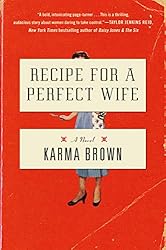

Recipe for a Perfect Wife
Karma Brown, 2019
Penguin Publishing
342 pp.
ISBN-13: 9781524744939
Summary
After reluctantly leaving New York City for the suburbs, newlywed Alice struggles with shifting roles at home and achieving domestic bliss in a new fixer-upper.
When she discovers a vintage cookbook in her basement, the allure of cooking up Baked Alaska and Chicken a la King soon leads her into the darker story of the woman who previously owned the house, unfolding in notes tucked into the book.
As Alice discovers striking parallels between this woman’s life and her own, she is finally forced to focus on the trajectory of her own life, questioning the foundation of her marriage and what it means to be a wife fighting for her place in a patriarchal society.
This mesmerizing dual narrative of a modern-day woman and a quintessential 1950s housewife is at once witty and charming and dark and sinister—much like its focus characters. With great care and gravity, this book offers a satisfying look at the lies we tell to feed the secrets we keep. (From the publisher.)
Author Bio
Karma Brown is an award-winning Canadian journalist and bestselling author of the novels Come Away With Me, The Choices We Make, In This Moment, and The Life Lucy Knew. In addition to her novels, Brown's writing has appeared in publications such as Self, Redbook, Canadian Living, Today's Parent, and Chatelaine. (From the publisher.)
Book Reviews
[It] turns out Nellie has a lot more to teach Alice about being a wife and a woman than how to bake a good batch of cookies. The most important? Take those trappings you resent so much—cooking, gardening, bearing children—embrace them, then wield them like weapons.
Jenny Rosenstrach - New York Times Book Review
A captivating read, full of twists and turns. Brown weaves a thrilling story that parallels the lives of two characters who struggle with being strong, independent women in a patriarchal world.
Associated Press
(Starred review) Chapters alternate between Alice and Nellie…. Brown kills it; her latest is a winner so captivating that fans of modern and old-fashioned stories about women could easily read it in one day.
Library Journal
[Brown] excels at bringing the complexities of women’s lives to the page, and her latest novel questions how much has really changed for women over the last 60 years. The pacing is brisk, the characters are appealing, and both timelines are equally well realized. Thoughtful, clever, and surprisingly dark.
Booklist
With plentiful historical details (including recipes and depressingly hilarious marriage advice), the pages devoted to Nellie come to life. …An engaging and suspenseful look at how the patriarchy shaped women’s lives in the 1950s and continues to do so today.
Kirkus Reviews
Strong, well-drawn women anchor Brown's deeply thought-provoking, feminist novel. The spellbinding dual stories complement each other, raising themes of self-discovery, self-preservation and liberation for two women living eras apart.
Shelf Awareness
Discussion Questions
1. What similar challenges do Alice and Nellie face in their marriages? What are differences between these two relationships? Do you think these similarities and differences are products of the different personalities at play, or of the different eras that these relationships occur in?
2. Food plays a role in bonding the characters in this book together, and also in creating power dynamics. Do you see food playing a similar role in your own life, ever? Did you relate to the ways Alice and Nellie emotionally connected with the dishes they prepared?
3. Was it a mistake for Alice to agree to leave Manhattan? Does running away from your problems ever work out? What personal experiences have you had trying to start over in a new place?
4. Were you surprised by the quotes from old books and women’s magazines? What did you make of them?
5. Were you surprised by the plot twist in Nellie’s point of view?
6. Do you have a collection of old family recipes like Elise left Nellie? What is your favorite recipe passed down by family?
7. Do you see anything symbolic or metaphorical about Nellie’s tending to the garden? Does she remind you of other women from literature or mythology because of her skill for planting?
8. Do you identify more with Nellie or with Alice? Why?
9. Is there a parallel in Nellie’s life to the situation Alice is forced to endure with James Dorian?
(Questions issued by the publisher.)


Reconstructing Amelia
Kimberly McCreight, 2013
HarperCollins
382 pp.
ISBN-13: 9780062225436
Summary
When Kate, single mother and law firm partner, gets an urgent phone call summoning her to her daughter's exclusive private school, she's shocked. Amelia has been suspended for cheating, something that would be completely out of character for her over-achieving, well-behaved daughter.
Kate rushes to Grace Hall, but what she finds when she finally arrives is beyond comprehension. Her daughter Amelia is dead.
Despondent over having been caught cheating, Amelia has jumped from the school's roof in an act of impulsive suicide. At least that's the story Grace Hall and the police tell Kate. In a state of shock and overcome by grief, Kate tries to come to grips with this life-shattering news. Then she gets an anonymous text:
Amelia didn't jump.
The moment she sees that message, Kate knows in her heart it's true. Clearly Amelia had secrets, and a life Kate knew nothing about. Wracked by guilt, Kate is determined to find out what those secrets were and who could have hated her daughter enough to kill. She searches through Amelia's e-mails, texts, and Facebook updates, piecing together the last troubled days of her daughter's life.
Reconstructing Amelia is a stunning debut page-turner that brilliantly explores the secret world of teenagers, their clandestine first loves, hidden friendships, and the dangerous cruelty that can spill over into acts of terrible betrayal. (From the publisher.)
Author Bio
Kimberly McCreight attended Vassar College and graduated cum laude from the University of Pennsylvania Law School. After several years as a litigation associate at some of New York City’s biggest law firms, she left the practice of law to write full-time. Her work has appeared in such publications as Antietam Review, Oxford Magazine, Babble, and New York Magazine online. She lives in Park Slope, Brooklyn, with her husband and two daughters. (From the publisher.)
Book Reviews
Like Gone Girl, Reconstructing Amelia seamlessly marries a crime story with a relationship drama. And like Gone Girl, it should be hailed as one of the best books of the year.
Entertainment Weekly
After her teenage daughter Amelia’s mysterious suicide, litigation attorney Kate Baron becomes an unlikely amateur sleuth in McCreight’s diverting, if busy, debut.... [A] series of anonymous text messages intimating[e] that Amelia was actually murdered.... Amelia’s first-person narration provides the most human note, as McCreight portrays the darkness of adolescence, complete with doomed love, bullies, poisonous friendship, and insecurity. Fans of literary thrillers will enjoy the novel’s dark mood and clever form, even if the mystery doesn’t entirely hold together.
Publishers Weekly
Alternating perspectives from Kate and Amelia reveal the inner lives of a woman trying to balance motherhood with a demanding career and a teenager struggling with her blossoming sexuality while dealing with severe bullying. Despite a plot heavily dependent on coincidence, this is a compulsively readable novel that will appeal to Jodi Picoult fans. —Michele Leber, Arlington, VA
Library Journal
An elaborately plotted mystery.... A harrowing story.... McCreight does a fne job of building suspense and creating characters, notably Kate and Amelia, whom the target audience—both adults and older teens—will care about and empathize with.
Booklist
Former attorney McCreight pens a multilayered legal thriller. Single mom Kate Baron struggles with the unholy demands that come with being an associate at a high-powered New York City law firm while raising her 15-year-old daughter, Amelia.... Amelia has fallen from the school roof, a victim of her own failure..., but Kate]doesn't believe Amelia killed herself.... The author tells the story in flashbacks, alternating between Kate's and Amelia's point of view, leading up to the day Amelia died.... [T]he book never bogs down and comes to a seamless and unanticipated conclusion.... [A] solid debut novel.
Kirkus Reviews
Discussion Questions
1. What is Amelia's relationship like with her mother? Why doesn't she share more with Kate? Why are adolescents often so reluctant to talk to their parents about the events in their lives—especially problems they are having with friends?
2. Describe Amelia. Is she a typical teenager? Talk about her friendship with Sylvia. What drew the girls together? What about her relationships with Zadie and Dylan? What made her feel so close to her Internet friend, Ben?
3. Might Amelia's situation have been different if she'd had a larger family around her? What if that family had been larger, but more filled with conflict?
4. Is Kate a good mother? She believes she knows her daughter well, but does she? What does she discover about Amelia that surprises her? What does she discover that confirms her deepest beliefs about Amelia and their relationship?
5. What kind of a support network does Kate have to rely on? Does she bear any blame for the events that occur? Is there any way she could have prevented the tragedy? What about Grace Hall—how much, if any, responsibility does the school bear for Amelia's death? Who can you turn to for help in handling a problem involving your child?
6. Why is being popular so important in adolescence? Has the Internet and social networking added to the pressures teenagers must cope with?
7. What impact does class play in the story? What about sexuality—Amelia's recognition of her own desires? What about Amelia's need to be perfect—her drive to be a good student?
8. Why does such a smart girl like Amelia fall into the trap of the secret clubs? Why isn't she more suspicious of the Magpies and the boys around them? How did her keeping the secret about the Maggies impact her relationship with Sylvia? Why are some children cruel to others? Did your school have a hierarchy or clubs like the Magpies? Where did you fit it?
9. If you have a child, how much do you know about his or her life? How far should parents go to monitor their child's life? Do children have a right to privacy the way adults do? What might someone learn if they tried to "reconstruct" you from your emails, correspondence, texts, tweets, messages, blog posts, and Facebook updates? Does social media make us too connected? What is your opinion of social media—do you think it's a positive development or an erosion of who we are and how we interact?
10. How does the author ratchet up the suspense in the story? What clues does she provide to point you toward the truth—or away from it?
11. Bullying is a major topic across the media and throughout society. Do you believe it is a serious issue, or do you think it's a phase that all children go through? How has the rise of the Internet contributed to the severity of bullying and to our awareness of it? Can we decrease the incidents of bullying? How do we learn to stand up to mean people?
12. Does Kate get closure when she discovers the truth? Where do you think she will go from here?
13. What inspired you or your group to choose Reconstructing Amelia? Did it meet your expectations? Is it an accurate representation of modern parenting and growing up in twenty-first century America? What did you take away from reading the book?
(Questions issued by publisher.)

Recursion
Blake Crouch, 2019
Random House
336 pp.
ISBN-13: 9781524759797
Summary
Reality is broken.
At first, it looks like a disease. An epidemic that spreads through no known means, driving its victims mad with memories of a life they never lived.
But the force that’s sweeping the world is no pathogen. It’s just the first shock wave, unleashed by a stunning discovery—and what’s in jeopardy is not our minds but the very fabric of time itself.
In New York City, Detective Barry Sutton is closing in on the truth—and in a remote laboratory, neuroscientist Helena Smith is unaware that she alone holds the key to this mystery … and the tools for fighting back.
Together, Barry and Helena will have to confront their enemy—before they, and the world, are trapped in a loop of ever-growing chaos. (From the publisher.)
Author Bio
• Birth—1978
• Where—Statesville, North Carolina, USA
• Education—B.A., Univerfsity of North Carolina-Chapel Hill
• Currently—lives in Durango, Colorado
Blake Crouch is an American author, known for his 2012-14 Wayward Pines Trilogy, which was adapted into the 2015 television series Wayward Pines. In 2016, he published Dark Matter and in 2019, Recursion, both science fiction thrillers, both achieving wide acclaim.
Early life and career
Crouch was born near the piedmont town of Statesville, North Carolina in 1978. He attended the University of North Carolina at Chapel Hill and graduated in 2000 with degrees in English and Creative Writing. He published his first two novels, Desert Places and Locked Doors, in 2004 and 2005.
In addition to his novels, his short stories have appeared in Ellery Queen's Mystery Magazine, Alfred Hitchcock's Mystery Magazine, Thriller 2 and other anthologies.
Crouch lives in Durango, Colorado. (From Wikipedia. Retrieved 7/29/2016.)
Book Reviews
[A] fantastic philosophical thriller [with] ingenious plotting, cinematic action and unflappable characters.
Minneapolis Star Tribune
A mind-bending thriller.
USA Today
[Crouch] has sketched out the rules for a new reality.… [Recursion] has a thrumming pulse that moves beyond big ideas and into their effects on a larger, more complex world.
Jason Sheehan - NPR
[Recursion] will keep you up all night—first because you can't stop reading it, and then because you can't stop thinking about it.
BuzzFeed
[An] epic page-turner.
Good Housekeeping
Suffice it to say that, having tackled the subject of alternative dimensions in 2016’s Dark Matter, the author tackles another familiar science fiction trope here. And, as was the case with that previous book, he breathes fresh life into the matters with a mix of heart, intelligence, and philosophical musings.… Recursion is definitely one not to forget when you’re packing for vacation.
Etertainment Weekly
[I]ntriguing, adventurous, terrifying, emotional, philosophical, and even inspirational…. Blake Crouch may be a daredevil, unafraid of any speculative heights, but he’s an incredibly talented writer and thinker, too. His surefootedness… is well worth every ooh and aah it collects. Bravo.
Washington Independent Review of Books
[I]ntelligent, mind-bending thriller.… Crouch effortlessly integrates sophisticated philosophical concepts—such as the relationship of human perceptions of what is real to actual reality—into a complex and engrossing plot. Michael Crichton’s fans won’t want to miss this one.
Publishers Weekly
Completely engrossing… highly recommended, especially for readers who enjoy suspenseful, fast-moving, well-crafted, science-based Sci-Fi.
Library Journal
Crouch fills his follow-up to Dark Matter (2016) with mind-bending science, mounting suspense, and some romance. Readers may have to accept that they might not get the physics of what’s going on, but, in a peculiar way, that’s part of the fun.
Booklist
Crouch delivers a bullet-fast narrative and raises the stakes to a fever pitch. A poignant love story is woven in with much food for thought on grief and the nature of memories and how they shape us, rounding out this twisty and terrifying thrill ride.
Kirkus Reviews
Discussion Questions
1. If put in Helena’s position, would you have accepted Jee-woon’s offer, especially without knowing who you’d be working for?
2. Who would benefit/suffer most from the creation of the chair?
3. What are the pros and cons of the chair?
4. When Helena laments her lack of personal relationships and work-life imbalance, Slade says, "I think balance is for people who don’t know why they’re here.” (p. 39). Do you agree?
5. Do you think Helena’s tunnel vision about building the chair blinds her to its potential for evil? Or is she aware of all of its capabilities—both good and bad?
6. Is there anything to be learned from the characters in the book about reconciling with the past?
7. Which of the two protagonists do you find more relatable—Barry or Helena? In what ways, if any, can you relate to Slade? Explain.
8. Does the view of time presented in the book make you think differently about déjà vu or memories in general? How so?
9. What do you think of Marcus Slade’s obsession with (re)creating the chair? Can you empathize with him? If you were in his situation, would you be tempted to do the same?
10. Would you use the chair for self-gain or for humanitarian purposes, if put in Slade’s position?
11. If you could relive a treasured moment of your past without consequences, would you? What moment would you choose?
12. Is there some moment in your past you would go back to and do differently, even if it meant your loved ones experiencing dead memories?
13. Helena feels solely responsible for the fate of the world due to her creation of the chair. Is she right for feeling this way?
14. What lesson, if any, does Barry learn throughout the course of the book and how does it contrast with the view of the past that Slade endorses?
15. The author leaves the book somewhat open-ended. Do you believe Barry and Helena will eventually be together again?
(Questions issued by the publisher.)
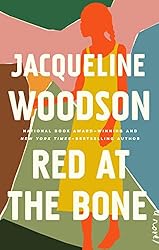
Red at the Bone
Jacqueline Woodson, 2019
Penguin Publishing
208 pp.
ISBN-13: 9780525535270
Summary
An extraordinary new novel about the influence of history on a contemporary family, from the New York Times-bestselling and National Book Award-winning author of Another Brooklyn and Brown Girl Dreaming.
Two families from different social classes are joined together by an unexpected pregnancy and the child that it produces.
Moving forward and backward in time, with the power of poetry and the emotional richness of a narrative ten times its length, Jacqueline Woodson's extraordinary new novel uncovers the role that history and community have played in the experiences, decisions, and relationships of these families, and in the life of this child.
As the book opens in 2001, it is the evening of sixteen-year-old Melody's coming of age ceremony in her grandparents' Brooklyn brownstone. Watched lovingly by her relatives and friends, making her entrance to the soundtrack of Prince, she wears a special custom-made dress.
But the event is not without poignancy. Sixteen years earlier, that very dress was measured and sewn for a different wearer: Melody's mother, for her own ceremony-- a celebration that ultimately never took place.
Unfurling the history of Melody's parents and grandparents to show how they all arrived at this moment, Woodson considers not just their ambitions and successes but also the costs, the tolls they've paid for striving to overcome expectations and escape the pull of history.
As it explores sexual desire and identity, ambition, gentrification, education, class and status, and the life-altering facts of parenthood, Red at the Bone most strikingly looks at the ways in which young people must so often make long-lasting decisions about their lives--even before they have begun to figure out who they are and what they want to be. (From the publisher.)
Author Bio
• Birth— February 12, 1963
• Where—Columbus, Ohio, USA
• Raised—Geenville, South Carolina, and Brooklyn, New York
• Education—B.A., Adelphi University
• Awards—(see below)
• Currently—lives in New York City, New York
Jacqueline Woodson is an American writer of books for children and teens. She is best known for her 2014 Bown Girl Dreaming, which won the National Book Award and a Newbery Honor. In 2016, she published her first adult novel, Another Brooklyn, and in 2019 she released her second adult novel, Red at the Bone, both to wide praise.
Woodson's youth was split between South Carolina and Brooklyn. In a 2002 interview with Publishers Weekly she recalled:
The South was so lush and so slow-moving and so much about community. The city was thriving and fast-moving and electric. Brooklyn was so much more diverse: on the block where I grew up, there were German people, people from the Dominican Republic, people from Puerto Rico, African-Americans from the South, Caribbean-Americans, Asians.
After college at Adelphi University, Woodson went to work for Kirchoff/Wohlberg, a literary agent for children's authors. She caught the attention of a book agent, and athough the partnership did not work out, it got her first manuscript out of a drawer.
She later enrolled in Bunny Gable's children's book writing class at the New School in New York, where an editor at Delacorte, heard a reading from Last Summer with Maizon and requested the manuscript. Delacorte bought the manuscript and published Woodson's first six books.
Writing
As an author, Woodson is known for the detailed physical landscapes she writes into each of her books. She places boundaries everywhere—social, economic, physical, sexual, racial—then has her characters break through both the physical and psychological boundaries to create a strong and emotional story.
She is also known for her optimism. She has said that she dislikes books that do not offer hope. She has offered William H. Armstrong's 1969 novel Sounder as an example of "bleak" and "hopeless"; on the other hand, A Tree Grows in Brooklyn offers "moments of hope and sheer beauty" despite the family's poverty. She uses this philosophy in her own writing, saying, "If you love the people you create, you can see the hope there."
Woodson has tackled topics such as interracial coupling, teenage pregnancy, and homosexuality—subjects not commonly or openly discussed when her books were published. Overall, she explores issues of class, race, family ties, and history in ground-breaking ways, and she does so by placing sympathetic characters into realistic situations. Many of her characters, who might be considered "invisible" in the eyes of society, engage in a search for self-identity rather than equality or social justice.
Some of the content in Woodson's books, however, has raised flags—homosexuality, child abuse, harsh language, and teen pregnancy have led to threats of censorship. In an NPR interview Woodson said that her books contain few curse words and that the difficulty adults have with her subject matter has more to do with their own discomfort than what young people should be thinking about. She suggests parents and teachers assess the many cultural influences over teens and then make a comparison with how her books treat those same issues.
Honors
Woodson's books have won numerous awards, including four Newbery Honors for Brown Girl Dreaming (2014), After Tupac & D Foster (2008), Feathers (2007), and Show Way (2005). Miracle's Boys (2000) won the Loretta Scott King Award. In 2005 Woodson won the Margaret Edwards Award for her lifetime contribution as a children's writer.
In 2014 Brown Girl Dreaming won the national Book Award for Young People's Literature. That same year she was the U.S. nominee to the international Hans Christian Andersen Awards and became one of the Award's six finalists. In 2015 the Poetry Foundation named Woodson the Young People's Poet Laureate.
Racial joke
When Woodson received her National Book Award in November, 2014, author Daniel Handler, the evening's emcee, made a joke about watermelons. In a New York Times Op-Ed piece, "The Pain of the Watermelon Joke," Woodson explained that "in making light of that deep and troubled history," Handler had come from a place of ignorance. She underscored the need for her mission to "give people a sense of this country's brilliant and brutal history, so no one ever thinks they can walk onto a stage one evening and laugh at another's too often painful past."
Handler, a friend of Woodson, issued multiple apologies and donated $10,000 to We Need Diverse Books, promising to match donations up to $100,000. "It was a disaster of my own making, he said. "[M]any, many people were very upset by it, and rightfully so."
Personal
Woodson is a lesbian with a partner and two children, a daughter named Toshi Georgianna and a son named Jackson-Leroi. (Adapted from Wikipedia. Retrieved 8/17/2016.)
Book Reviews
Woodson manages to remember what cannot be documented, to suggest what cannot be said.
Washington Post
Woodson does for young black girls what short story master Alice Munroe does for poor rural ones: She imbues their everyday lives with significance.
Elle
Woodson writes lyrically about what it means to be a girl in America, and what it means to be black in America. Each sentence is taut with potential energy, but the story never bursts into tragic flames; it stays strong and subtle throughout.
Huffington Post
Emotionally transfixing.
Entertainment Weekly
A slim novel with tremendous emotional power.
Real Simple
Red at the Bone is fall’s hottest novel.
Town & Country
[A]s teenage Melody takes part in a coming-of-age ceremony, the history of her New York family unfurls, and three generations of longing and ambition come into razor-sharp focus.
Vanity Fair
Slender miracle of a novel [that] performs a magic trick with time…. Woodson skips back and forth between the decades so deftly that it feels like it all happens in a heartbeat.
Family Circle
(Starred review) [A] beautifully imagined novel.… Woodson’s nuanced voice evokes the complexities of race, class, religion, and sexuality in fluid prose and a series of telling details. This is a wise, powerful, and compassionate novel.
Publishers Weekly
Oft-crowned children's/YA author Woodson… [offers] a tale of two families separated by class, ambition, gentrification, sexual desire, and unexpected parenthood.
Library Journal
(Starred review) [E]motionally rich…. Woodson channels deeply true-feeling characters, and [i]n spare, lean prose, she reveals rich histories and moments in swirling eddies, while also leaving many fateful details for readers to divine. —Annie Bostrom
Booklist
(Starred review) [E]motionally rich…. Woodson channels deeply true-feeling characters, all of whom read Woodson famously nails the adolescent voice. But so, too, she burnishes all her characters' perspectives…. In Woodson, at the height of her powers, readers hear the blues: "beneath that joy, such a sadness."
Kirkus Reviews
Discussion Questions
1. In Red at the Bone, two families from different social classes are brought together by an unexpected pregnancy. How do you think the lives of the characters—from each family—might have been different if Melody had never been conceived? Which characters gained or lost the most, ultimately, as a result of this unplanned child? Consider all the many ways in which their fortunes were altered.
2. Consider the title and how it works with the story. Why do you think the author chose it? What does the phrase mean to you?
3. The author dedicates the book to “the ancestors, a long long line of you bending and twisting.” How does the story explore the idea of legacy? How does it look at the passing down of regret and loss and trauma and history, and also of love and guidance and wisdom and experience? Discuss your own legacies: What have you inherited in this way from your ancestors, and what will be passed on to future generations? How do these legacies compare to the legacies in Red at the Bone?
4. The story begins and ends in Brooklyn, but incorporates the stories of how both Iris and Aubrey’s families came to live there, and also watches Iris experiment with living elsewhere. In your own experience, how strong or important is the connection between people and place? Do you think people and their lives are shaped by their relationships with the places they are from and their feelings about home? Do you see this illustrated in the story, in any particular characters or storylines? What do you think of Iris’s decision to stay away from her family? Can you empathize with her?
5. The theme of mothers and daughters is one that plays throughout the book, and we begin and end the novel with Iris and Melody. How would you describe their relationship? Do you think their relationship has progressed, regressed, or otherwise changed by the conclusion of the novel? In what ways are Iris and Melody similar and in what ways are they different?
6. When Aubrey first brings Iris to his house, he feels a kind of shame about his mother and his way of life that he never experienced before. Consider the different ways in which Aubrey and Iris’s class differences manifest within their relationship. How do those differences affect their relationship as teenagers? As adults? How do other characters in the novel grapple with their class? Consider the upbringings of CathyMarie, Aubrey, Sabe, Melody, and Iris. What do you think the novel is saying about the relationship between race, class, and education?
7. Some of the big historic events that happen in the background of the narrative include the Tulsa massacre of 1921, the crack epidemic of the 1980s and ’90s, and the attacks on the Twin Towers in 2001. How does the author use these events in the book? What do they provide to the structure of the story and time line? What do they contribute to our emotional understanding of the characters? Are the individual characters changed by these events? Do you see this history influencing their outlooks and their ambitions or their legacies? As a child Iris fought with Sabe about the Tulsa story, claiming it wasn’t her history. Is Iris right? Can history truly belong to someone? And who is allowed to tell the story?
8. Discuss the use of musical references in the novel. How does “Darling Nikki” shape our impression of Melody in the first chapter? How does music aid in telling the stories of the other characters and their respective generations: Sabe and Po’Boy? Iris and Aubrey? Slip Rock and CathyMarie?
9. What do we learn about the characters from the way they show their love to each other: From Aubrey’s love of his mother? From Iris’s love of Jam? From Sabe’s love of Po’Boy? From Melody’s love of Malcolm, and vice versa? How does time away from the loved one affect that love? Are there right ways and wrong ways to love, and if so, who exemplifies them within the novel?
10. What do you think the author is saying, ultimately, about generational trauma? Sabe declares: “I carry the goneness. Iris carries the goneness. And watching her walk down those stairs, I know now that my grandbaby [Melody] carries the goneness too.” What do you think she means by this? How does this goneness affect their lives and relationships with others? Is there an opposite to goneness, and if so, is it achievable for any of the characters?(Questions issued by the publisher.)

Red Clocks
Leni Zumas, 2018
Little, Brown and Co.
368 pp.
ISBN-13: 9780316434812
Summary
Five women. One question. What is a woman for?
In this ferociously imaginative novel, abortion is once again illegal in America, in-vitro fertilization is banned, and the Personhood Amendment grants rights of life, liberty, and property to every embryo.
In a small Oregon fishing town, five very different women navigate these new barriers alongside age-old questions surrounding motherhood, identity, and freedom.
- Ro is a single high-school teacher, trying to have a baby on her own while also writing a biography of Eivor, a little-known 19th-century female polar explorer.
- Susan is a frustrated mother of two trapped in a crumbling marriage.
- Mattie is the adopted daughter of doting parents and one of Ro's best students, who finds herself pregnant with nowhere to turn.
- Gin is the gifted, forest-dwelling herbalist, or "mender," who brings all their fates together when she's arrested and put on trial in a frenzied modern-day witch hunt.
Red Clocks is at once a riveting drama, whose mysteries unfold with magnetic energy, and a shattering novel of ideas. In the vein of Margaret Atwood and Eileen Myles, Leni Zumas fearlessly explores the contours of female experience, evoking The Handmaid's Tale for a new millennium.
This is a story of resilience, transformation, and hope in tumultuous-even frightening-times. (From the publisher.)
Author Bio
• Birth—1972
• Where—N/A
• Education—B.A., Brown University; M.F.A., University of Massachusetts
• Currently—lives in Portland, Oregon
Leni Zumas is the author of three books of fiction: Red Clocks (2018), The Listeners (2012), and Farewell Navigator: Stories (2008). Her fiction has appeared in numerous literary magazines, including Columbia: A Journal of Art and Literature, Quarterly West, Keyhole, Salt Hill, Gigantic, Open City, and New York Tyrant.
A graduate of Brown University and the University of Massachusetts Amherst MFA Program, Zumas is an associate professor of English at Portland State University. She has also taught at Columbia University, Hunter College, Eugene Lang College, the University of Massachusetts Amherst, the Great Smokies Writing Program at UNC Asheville, and the Juniper Summer Writing Institute. (From Wikipedia. Retrieved 2/4/2018.)
Book Reviews
Zumas has a perfectly tuned ear for the way measures to restrict women's lives and enforce social conformity are couched in the moralizing sentimentalism of children's imagined needs…Zumas is a skillful writer, expertly keeping each of her characters in balanced motion, never allowing one to dominate the rest. Her cunning device of not revealing the name of each character in the sections she narrates grants us a multidimensional perspective on all four women, highlighting their roles in one another's stories. It's a beautiful metaphor for the interdependence of women's lives—for the way that…the laws that imprison or criminalize one of us narrow the options for all of us.
Naomi Alderman - New York Times Book Review
[P]owerful…. [With her]…consistently engaging tone [Zumas] illustrates the extent to which the self-image of modern women is shaped by marriage, career, or motherhood. Dark humor further … [makes] this a thoroughly affecting and memorable political parable.
Publishers Weekly
(Starred review) [P]oetic and political…[with] characters who are strong and determined.… Zuma's work is not nearly as dystopic or futuristic [as The Handmaid's Tale], only serving to make it that much more believable. Highly recommended. —Faye Chadwell, Oregon State Univ., Corvallis
Library Journal
(Starred review) Shattering.… With its strong point of view … Zumas has raised [her novel] … to the level of literature, which readers will find deeply moving.… [B]eautifully realized…compulsively readable…. The result is powerful and timely.
Booklist
Following the current fashion for braided narratives, this story is told from five perspectives. [C]haracters are entangled in complicated …ways, as is usual in this type of fractured narrative.… A good story energized by a timely premise but perhaps a bit heavy on the literary effects.
Kirkus Reviews
Discussion Questions
1. The novel begins with an epigraph from Virginia Woolf’s To the Lighthouse: "For nothing was simply one thing. The other Lighthouse was true too." How do you see this quote pertaining to Red Clocks?
2. Five women are at the novel's center: the Biographer, the Wife, the Daughter, the Mender, and the Polar Explorer. Which character do you identify with most, and why?
3. The characters' threads intertwine at the level of plot, but also at the level of form, as the narrative perspective keeps shifting among five different points of view. How does this "braided" structure affect your experience of the novel? What does it suggest about the boundaries between self and other, individual and collective, history and present moment?
4. Ro, Mattie, and Gin are all significantly impacted by new federal restrictions on abortion, fertility treatments, and adoption. How do you respond to their fictional experiences in light of current realities in American politics?
5. During the courtroom trial, the mender reflects:
This predicament is not new. The mender is one of many. They aren’t allowed to burn her, at least, though they can send her to a room for ninety months. Officials of the Spanish Inquisition roasted them alive. If the witch was lactating, her breasts exploded when the fire grew high (p. 257).
Do you think Gin Percival is a witch? Why or why not?
6. Absent loved ones are recurring shadows in Red Clocks. Ro’s mother and brother, Gin’s mother and aunt, Mattie’s best friend Yasmine—all are gone, yet they leave significant traces. What roles do grief and loss play in the novel?
7. In the school music room, after a painful conversation with Mattie, Ro rips a poster of pirates ("THEY CAN HIT THE HIGH C’S!") off the wall (p. 303). Pirates, shipwrecks, and nautical adventure are juxtaposed against domestic/personal crisis throughout the novel. What do you make of this contrast? And how do whales—from Moby-Dick to the stranded bodies Mattie mourns on the beach—figure in?
8. How does Red Clocks define motherhood?
(Questions issued by the publisher.)
top of page (summary)

Red Dress in Black & White
Elliot Ackerman, 2020
Knopf Doubleday
288 pp.
ISBN-13: 9780525521815
Summary
From the widely acclaimed author of Waiting for Eden: a stirring, timely new novel that unfolds over the course of a single day in Istanbul: the story of an American woman attempting to leave behind her life in Turkey—to leave without her husband.
Catherine has been married for many years to Murat, an influential Turkish real estate developer, and they have a young son together, William.
But when she decides to leave her marriage and return home to the United States with William and her photographer lover, Murat determines to take a stand.
He enlists the help of an American diplomat to prevent his wife and child from leaving the country—but, by inviting this scrutiny into their private lives, Murat becomes only further enmeshed in a web of deception and corruption.
As the hidden architecture of these relationships is gradually exposed, we learn the true nature of a cast of struggling artists, wealthy businessmen, expats, spies, a child pulled in different directions by his parents, and, ultimately, a society in crisis.
Riveting and unforgettably perceptive, Red Dress in Black and White is a novel of personal and political intrigue that casts light into the shadowy corners of a nation on the brink. (From the publisher.)
Author Bio
• Birth—April 12, 1980
• Where—Los Angeles, California, USA
• Education—B.A., M.A., Tufts University
• Currently—lives in Washington, D.C., and New York City
Elliot Ackerman is an American author, currently based out of Istanbul. He is the son of businessman Peter Ackerman and the brother of mathematician and wrestler Nate Ackerman.
Early life
At the age of 9, his family moved to London where he lived until the family moved back to Washington, DC, when he was 15. He studied literature and history at Tufts University, graduating summa cum laude and Phi Beta Kappa in 2003, in a special program to earn Bachelor's and Master's degrees in 5 years, rather than the usual six. He holds a Master’s degree in International Affairs from the Fletcher School of Law and Diplomacy, and has completed many of the United States military’s most challenging special operations training courses.
Career
Beginning in 2003, Ackerman spent eight years in the U.S. military as both an infantry and special operations officer. He served multiple tours of duty in the Middle East and Southwest Asia. As a Marine Corps Special Operations Team Leader, he operated as the primary combat advisor to a 700-man Afghan commando battalion responsible for capture operations against senior Taliban leadership. He also led a 75-man platoon that aided in relief operations in post-Katrina New Orleans.
Ackerman served as Chief Operating Officer of Americans Elect, a political organization founded and chaired by his father, Peter Ackerman, and continues to serve on its Board of Advisors. Americans Elect is known primarily for its efforts to stage a national online primary for the 2012 US Presidential Election. As one of its officers, Ackerman was interviewed extensively, notably on NPR's Talk of the Nation.
He has served on the board of the Afghan Scholars Initiative and as an advisor to the No Greater Sacrifice scholarship fund. Most recently, Ackerman served as a White House Fellow in the Obama Administration.
Ackerman divides his time between Washington, D.C., and New York City.
Writing
Ackerman's fiction and essays have appeared in The New Yorker, Atlantic, New Republic, New York Times Magazine, Ecotone and others. He is also a contributor to the Daily Beast, and a member of the Council on Foreign Relations. He has been interviewed in the Washington Post, New York Times, and Wall Street Journal and appeared on Charlie Rose, Colbert Report, NPR's Talk of the Nation, Meet the Press, CNN, MSNBC, Fox News, Al Jazeera and PBS NewsHour among others.
Ackerman's first novel, Green on Blue, published in 2015, with Publishers Weekly referring to the novel as "bleak and uncompromising, a powerful war story that borders on the noir." Los Angeles Review of Books describes the novel as a radical departure from veterans writing thus far due to his choice of a first person narrator, the lowly Aziz, a poor soldier in a local militia.
Military Honors
Ackerman is a decorated veteran, having earned a Silver Star and Purple Heart for his role leading a Rifle Platoon in the November 2004 Second Battle of Fallujah and a Bronze Star for Valor while leading a Marine Corps Special Operations Team in Afghanistan in 2008. Ackerman is also a recipient of the Major General Edwin B. Wheeler Award for Infantry Excellence. (Adapted from Wikipedia. Retrieved 2/10/2015.)
Book Reviews
[E]ntirely absorbing…. [The] characters, despite their vividness and their claims on our sympathy, are carried by a mighty undertow of self-interest. What lasts is the book’s emphasis on hidden machinations of power…. This reminder of unseen forces … provides the resonance… that ends the book—a musing on America’s overseas intrusions.
New York Times Book Review
Shrewd, intricately plotted, propulsive…. With all the intersecting perspectives, past-action leaps, socio- and geopolitical intrigue, and the need to contextualize modern Istanbul, the novel can feel a bit labyrinthine. But… there’s something of Graham Greene, too, in the insights and authority on foreign affairs, the combination of moral complexity with entertainment.
Washington Post
Cunning, atmospheric and filled with surprises in ways that call to mind the fiction of Joseph Conrad and John le Carré. Partly an ethical Rorschach test and partly a thriller in the vein of The Year of Living Dangerously, it’s the best novel yet from Ackerman…. It’s also a ton of tangled fun…. Splendidly gnarly.
Seattle Times
At once suspenseful and delicate, Red Dress in Black and White deftly depicts love in a brutal time.
Elle.com
In Ackerman’s wry if convoluted latest, the story of an unhappy marriage is suffused with pointed commentary on Turkey.… Still, the big reveal arrives too late and doesn’t quite offer enough payoff to justify such dense plotting. This falls short of Ackerman’s best work.
Publishers Weekly
(Starred review) This absolutely riveting novel moves rapidly…. An attention-grabbing, cleverly plotted, character-driven yarn…. In Agatha Christie fashion, Ackerman gathers his characters for what appears to be the grand finale but saves the true reveal for the very end. —Michael Russo, Louisiana State Univ., Baton Rouge
Library Journal
Ackerman’s trademark prose evocatively captures the strained nature of contemporary Turkish life…. Deftly hints at a shadowy world that exists just out of frame and is one that lives long in the memory.
Booklist
The novel is deftly plotted, though the characters themselves seem more like pawns in the author’s narrative scheme, lacking much flesh-and-blood depth…. A novel in which relationships develop more from pragmatism than passion.
Kirkus Reviews
Discussion Questions
We'll add publisher questions if and when they're available; in the meantime, use our LitLovers talking point to help start a discussion for THE RED DRESS IN BLACK & WHITE … then take off on your own:
1. What do you think of Catherine? Is she a sympathetic character? What is her reason for wanting to return to the U.S?
2. Talk about Murat and his business practices. Our initial proclivity is to dislike him for his greed and dishonesty, as well as for a comment such as this: "he loves the idea of [his family] while, at times, he isn't certain if he's capable of actually loving them." Gradually, though, Murat becomes more sympathetic. How does the author humanize him?
3. What role does Kristen play in all of this?
4. Talk about the way state corruption directs the characters and their actions in this novel? Describe, if you can, the intricate, circuitous dealings within the government—and how Catherine, Peter, and Murat are manipulated without their knowledge.
5. How do the protests in Gezi Park propel the plot?
6. The book slips back in time frequently, making the story anything but linear. Did you have trouble following the many flashbacks, feeling perhaps that they overly complicate the plot? Or do you think the flashbacks add context and depth?
7. What is the significance of the photo of the woman in the red dress at Gezi Park—and why the book's title?
(Questions by LitLovers. Please feel free to use them, online and off, with attribution. Thanks.)


The Red Garden
Alice Hoffman, 2011
Crown Publishing
270 pp.
ISBN-13: 9780307405975
Summary
The Red Garden introduces us to the luminous and haunting world of Blackwell, Massachusetts, capturing the unexpected turns in its history and in our own lives.
In exquisite prose, Hoffman offers a transforming glimpse of small-town America, presenting us with some three hundred years of passion, dark secrets, loyalty, and redemption in a web of tales where characters' lives are intertwined by fate and by their own actions.
From the town's founder, a brave young woman from England who has no fear of blizzards or bears, to the young man who runs away to New York City with only his dog for company, the characters in The Red Garden are extraordinary and vivid: a young wounded Civil War soldier who is saved by a passionate neighbor, a woman who meets a fiercely human historical character, a poet who falls in love with a blind man, a mysterious traveler who comes to town in the year when summer never arrives.
At the center of everyone’s life is a mysterious garden where only red plants can grow, and where the truth can be found by those who dare to look.
Beautifully crafted, shimmering with magic, The Red Garden is as unforgettable as it is moving. (From the publisher.)
About the Author
• Birth—March 16, 1952
• Where—New York, New York, USA
• Education—B.A., Adelphi Univ.; M.A., Stanford Univ.
• Currently—lives in Boston, Massachusetts
Born in the 1950s to college-educated parents who divorced when she was young, Alice Hoffman was raised by her single, working mother in a blue-collar Long Island neighborhood. Although she felt like an outsider growing up, she discovered that these feelings of not quite belonging positioned her uniquely to observe people from a distance. Later, she would hone this viewpoint in stories that captured the full intensity of the human experience.
After high school, Hoffman went to work for the Doubleday factory in Garden City. But the eight-hour, supervised workday was not for her, and she quit before lunch on her first day! She enrolled in night school at Adelphi University, graduating in 1971 with a degree in English. She went on to attend Stanford University's Creative Writing Center on a Mirrellees Fellowship. Her mentor at Stanford, the great teacher and novelist Albert Guerard, helped to get her first story published in the literary magazine Fiction. The story attracted the attention of legendary editor Ted Solotaroff, who asked if she had written any longer fiction. She hadn't — but immediately set to work. In 1977, when Hoffman was 25, her first novel, Property Of, was published to great fanfare.
Since that remarkable debut, Hoffman has carved herself a unique niche in American fiction. A favorite with teens as well as adults, she renders life's deepest mysteries immediately understandable in stories suffused with magic realism and a dreamy, fairy-tale sensibility. (In a 1994 article for the New York Times, interviewer Ruth Reichl described the magic in Hoffman's books as a casual, regular occurrence — "...so offhand that even the most skeptical reader can accept it.") Her characters' lives are transformed by uncontrollable forces — love and loss, sorrow and bliss, danger and death.
Hoffman's 1997 novel Here on Earth was selected as an Oprah Book Club pick, but even without Winfrey's powerful endorsement, her books have become huge bestsellers — including three that have been adapted for the movies: Practical Magic (1995), The River King (2000), and her YA fable Aquamarine (2001).
Hoffman is a breast cancer survivor; and like many people who consider themselves blessed with luck, she believes strongly in giving back. For this reason, she donated her advance from her 1999 short story collection Local Girls to help create the Hoffman Breast Center at Mt. Auburn Hospital in Cambridge, MA
Extras
From a 2003 Barnes & Noble interview:
• Hoffman has written a number of children's books, including Fireflies: A Winter's Tale (1999), Horsefly (2000), and Moondog (2004).
• Aquamarine was written for Hoffman's best friend, Jo Ann, who dreamed of the freedom of mermaids as she battled brain cancer.
• Here on Earth is a modern version of Hoffman's favorite novel, Wuthering Heights.
• Hoffman has been honored with the Massachusetts Book Award for her teen novel Incantation.
• When asked what books most influenced her life or career, here's what she said:
Edward Eager's brilliant series of suburban magic: Half Magic, Magic by the Lake, Magic or Not, Knight's Castle, The Time Garden, Seven-Day Magic, The Well Wishers. Anything by Ray Bradbury, Shirley Jackson, J. D. Salinger, Grace Paley. My favorite book: Emily Brontë's Wuthering Heights. (Author bio and interview from Barnes & Noble.)
Book Reviews
Hoffman has developed her own brand of magical realism. Lulling and thought-provoking, she conjures soothing places where readers, like the children to whom we tell fairy tales, can learn with pleasure…"A story can still entrance people even while the world is falling apart," Hoffman writes in "The Fisherman's Wife," a story about gossip during the Depression. These tall tales, with their tight, soft focus on America, cast their own spell.
Anne Trubek - Washington Post
Hoffman brings us 200 years in the history of Blackwell, a small town in rural Massachusetts, in her insightful latest.... The result is a certain ethereal detachment as Hoffman's deft magical realism ties one woman's story to the next even when they themselves are not aware of the connection. The prose is beautiful, the characters drawn sparsely but with great compassion.
Publishers Weekly
This collection of interrelated stories from the talented Hoffman chronicles the 300-year history of Blackwell, MA, a mythical town tucked deep in the Berkshire Mountains.... Hoffman has done it again, crafting a poignant, compelling collection of fairy tales suffused with pathos and brightened by flashes of magic. Her fans, as well as those of magical realism in general, will be enchanted. —Jeanne Bogino, New Lebanon Lib., NY
Library Journal
According to the critics, The Red Garden is among Alice Hoffman’s recent best. She can occasionally be melodramatic, her stories overrun by fairy tale syntax. Although the magical abounds here—women become eels—there is little, if anything, that is overdone.
Bookmarks Magazine
(Starred review.) In gloriously sensuous, suspenseful, mystical, tragic, and redemptive episodes, Hoffman subtly alters her language, from an almost biblical voice to increasingly nuanced and intricate prose reflecting the burgeoning social and psychological complexities her passionate and searching characters face in an ever-changing world. —Donna Seaman
Booklist
In 14 freestanding but consecutive stories, Hoffman traces the life of the town of Blackwell, Mass., from its founding in 1750 up to the present as the founders' descendents connect to the land and each other.... Fans of Hoffman's brand of mystical whimsy will find this paean to New England one of her most satisfying.
Kirkus Reviews
Discussion Questions
Use our LitLovers Book Club Resources; they can help with discussions for any book:
• How to Discuss a Book (helpful discussion tips)
• Generic Discussion Questions—Fiction and Nonfiction
• Read-Think-Talk (a guided reading chart)
Also consider these LitLovers talking points to help get a discussion started for Red Garden:
1. What is the symbolic significance of the red garden at the center of this collection of stories? And why red? What are all the permutations of the color red which turn up in this story (e.g., the Boston Red Sox on tv)?
2. In its review of Hoffman's book, BookPage says that the author "manages to communicate a yearning interpretation of the life we all live...." What is the yearning that's referred to in the review? How does Hoffman use magical realism to examine yearning, open it up, or fulfill it? How is yearning evidenced in The Red Garden? Or another question: why does Hoffman use magical realism in this novel? What does she use it to express?
3. Consider the town of Blackwell as a character. How is it fleshed out in the book—describe the town's characteristics and the ethos of those who live there, present and past. How does it change over time?
4. What are some of the themes that tie these stories together—the central ideas they share with one another or that are carried from one story to another? Consider, say, love and loss, or connection of the present with the past. How are those—and other—ideas developed?
5. Follow-up to Question 4: What is the idea behind the bear? And how is the idea of the bear transformed, by time and repetition, so that when it's finally uncovered, it has attained a different, larger significance than it had in the initial story?
6. Ghosts play a recurring role in these stories. Explain their presence in each story...and the reasons Hoffman might be using them? What is she getting at?
7. At one point, in the first story, Hallie often "gazed out the window, as if there was someplace she wanted to be, some other life that was more worth living." What makes Hallie long for a different life? Do you ever have a desire similar to Hallie's? What life do you long for?
8. Many of the stories are concerned with the human connection to the natural world. How would you describe that relationship, how does it change over time in this book? Or does it change?
9. What about Hoffman's blending of fictional characters with real historical figures—the appearance of Emily Dickenson and Johnny Appleseed. Why might she have incorporated them into her story? For what purpose?
10. Of the 14 stories, which story do you like most? Which do you find most intriguing ... or magical ... or moving? Do any disappoint you?
11. Alice Hoffman has always been hailed as a remarkable prose stylist. What passages of particular beauty, or keen insight, struck you as you read this book?
Red Hook Road
Ayelet Waldman, 2010
Knopf Doubleday
343 pp.
ISBN-13: 9780385517867
Summary
As lyrical as a sonata, Ayelet Waldman’s follow-up novel to Love and Other Impossible Pursuits explores the aftermath of a family tragedy.
Set on the coast of Maine over the course of four summers, Red Hook Road tells the story of two families, the Tetherlys and the Copakens, and of the ways in which their lives are unraveled and stitched together by misfortune, by good intentions and failure, and by love and calamity.
A marriage collapses under the strain of a daughter’s death; two bereaved siblings find comfort in one another; and an adopted young girl breathes new life into her family with her prodigious talent for the violin.
As she writes with obvious affection for these unforgettable characters, Ayelet Waldman skillfully interweaves life’s finer pleasures—music and literature—with the more mundane joys of living. Within these resonant pages, a vase filled with wildflowers or a cold beer on a hot summer day serve as constant reminders that it’s often the little things that make life so precious. (From the publisher.)
Author Bio
• Birth—December 11, 1964
• Where—Jerusalem, Israel
• Raised—Montreal, Canada; Rhode Island; Ridgewood, New
Jersey, USA
• Education—B.A., Weslyan University; J.D., Harvard
University
• Currently—lives in Berkeley, California
Ayelet (eye-YELL-it—"gazelle") Waldman is novelist and essayist who was formerly a lawyer. She is noted for her self-revelatory essays, and for her writing (both fiction and non-fiction) about the changing expectations of motherhood. She has written extensively about juggling the demands of children, partners, career and society, in particular about combining paid work with modern motherhood, and about the ensuing maternal ambivalence.
Waldman is the author of seven mystery novels in the series The Mommy-Track Mysteries and has published four novels of general interest, Daughter's Keeper (2003), Love and Other Impossible Pursuits (2006) Red Hook Road, (2010), and Love and Treasure (2014), as well as a collection of personal essays entitled Bad Mother: A Chronicle of Maternal Crimes, Minor Calamities, and Occasional Moments of Grace (2009).
Personal Life
Waldman was born in Jerusalem, Israel. After the 1967 Six-Day War, when she was two and a half, her family moved to Montreal, Canada, then to Rhode Island, finally settling in Ridgewood, New Jersey. By then she was in sixth grade.
Waldman graduated from Wesleyan University, where she studied psychology and government and studied in Isreal for her her junior year. She returned to Israel after college, to live on a kibbutz, but finding it unsatisfying returned to the US. She entered Harvard University and earned her a J.D. in 1991 (she was a class-mate of Barack Obama’s).
After receiving her law degree, Waldman clerked for a federal court judge and worked in a large corporate law firm in New York for a year.
In 1993 she married Pulitzer Prize-winning author Michael Chabon, whose novels include The Yiddish Policemen's Union, The Amazing Adventures of Kavalier & Clay and Wonder Boys. They met on a blind date, when both were living in New York City. They were engaged in three weeks and married a year later, in 1993.
After moving to California with Chabon, Waldman became a public defence lawyer and later taught law at the University of California at Berkeley. She left the legal profession altogether after the birth of her second child and, although she still calls herself a lawyer on her tax returns, says she will not be returning to the legal profession—preferring to work at home with her husband and their now four children.
Writing
She and Chabon work from the same office in the backyard of their home, often discussing and editing each other's work—critiquing each other's work in what Chabon has called a "creative freeflow."
While working as a university professor, Waldman attempted to research legal issues with a view to writing articles for legal journals and thus increasing her chances of a tenured job teaching law. She has said that every time she tried to write those scholarly articles she because bored or intimidated, so she began writing fiction instead.
Waldman has said that her fiction is all about being a bad mother. She has said she chose to write because it was not as time-consuming a career as the law, it gave her something to do during nap times, kept her entertained, because it gave her a way of putting off going back to work full-time. She has also written several times about her 2002 diagnosis of bipolar disorder, a disease that runs in her family, and has spoken publicly on parenting while having a mental illness. She has said, "When I write about being bipolar, I feel queasy and ashamed, but I also feel really strongly that I shouldn't feel this way, that this is a disease, like diabetes."
Waldman started writing mystery novels, thinking they would be “easy ... light and fluffy." At first she wrote in secret, then with her husband's encouragement. She has said that she chose mysteries because they are primarily about plot. Her Mommy-Track" series, seven mysteries in all, features "part-time sleuth and full-time mother" Juliet Applebaum.
She has also published three literary novels of general interest: Daughter's Keeper (2003) drew on Waldman's experience as a criminal defense lawyer and features a young woman who inadvertently becomes involved in the trafficking of drugs; Love and Other Impossible Pursuits (2006) is about a Harvard-educated lawyer dealing with a precocious step-son and the loss of a newborn child to SIDS; and Red Hook Road (2010) revolves around two bereaved families in a small village in Maine.
Waldman has also published short stories in McSweeney's anthologies, as well as essays in the New York Times, Guardian (UK), San Francisco Chronicle, Elle Magazine, Vogue, Allure, Cookie, Child, Parenting, Real Simple, Health and other publications.
Controversy
Waldmen became the center of controversy for an essay, "Motherlove," in which she wrote, "I love my husband more than I love my children." She went on to say that she could survive the death of her children, but not that of her husband, and summarized her ideal family dynamic as follows: "He [her husband, Chabon] and I are the core of what he cherishes ... the children are satellites, beloved but tangential.” The essay led to extensive and vitriolic debate on television shows like "The View" and "Oprah" (on which she was a guest). (Adapted from Wikipedia.)
Book Reviews
Some of these relationships seem unlikely, but Waldman knits them together with the pleasing symmetry of a doily, her cool attention to the quotidian details of food, furnishings and personal dress forming a sturdy backdrop for the novel's occasionally soap-operatic plot turns. She also constructs an impressive parallel between the vocations of shipbuilding and playing a stringed instrument. But…what is ultimately prized here is the restoration of domestic harmony… Red Hook Road has its bumps, but readers will enjoy the ride.
Alexandra Jacobs - New York Times
This engagingly complex examination of two close families is a leap ahead for the essayist and author.
O Magazine
Waldman (Love and Other Impossible Pursuits) delivers a dense story of irreparable loss that tracks two families across four summers. After John Tetherly and Becca Copaken die in a freak car accident an hour after their wedding, their families are left to bridge stark class and cultural divides, and eventually forge deep-rooted bonds thanks to the twin deities of love and music. Becca's family is well off, from New York, and summers in Red Hook, Maine, a small coastal town where John's blue-collar single mother, Jane, cleans houses for a living. They interact, awkwardly, over how to bury the couple, the staging of an anniversary party, and over Jane's adopted niece, whose amazing musical talent makes a connection to Becca's ailing grandfather, a virtuoso violinist, who agrees to give her lessons. Becca's younger sister, Ruthie, a Fulbright scholar, meanwhile, falls in love with John's younger brother, Matt, the first Tetherly to go to college, before he drops out to work at a boatyard and finish restoring his brother's sailboat, which he plans on sailing to the Caribbean. Though Waldman is often guilty of overwriting here, the narrative is well crafted, and each of the characters comes fully to life.
Publishers Weekly
It's a beautiful summer day in Maine and perfect weather for the smiling young couple who just got married. Never mind that the groom's mother, Jane, doesn't really like John's marrying a "from awayer"—the name the locals give to people who just spend their summers in East Red Hook near the water. Jane is a Tetherly and, having lived her whole life in East Red Hook, considers her family real Mainers. The bride's mother, Iris Hewins Copaken, insists that she is native since her family's summer home was built in 1879, but since she and husband Daniel spend most of their time in New York City, Jane doesn't see it that way. Now, the guests are waiting for the young couple to show up, but when John's brother, Matt, arrives with two policemen, life as the Tetherlys and Copakens knew it ends. Over the course of four summers, they work through grief, new beginnings, and more loss. Verdict: Waldman has written a tale of two families forced together through love and tragedy. Fans of Waldman's work and readers who enjoy family sagas will find this book a pleasure. —Robin Nesbitt, Columbus Metropolitan Lib., OH
Library Journal
Critics diverged over Waldman's dissection of the aftermath of tragedy, loneliness, and grief. While some felt drawn in by the intriguing plot, characters, and portrait of grief, no matter how bleak, others felt hoodwinked by an overly depressing, cliched story of fairytale romance and family relationships gone terribly awry.
Bookmarks Magazine
[A] lyrical tale of love and loss...Waldman's startling premise—a newly married couple dies in an automobile accident enroute to their reception—sets the scene for this searing, soul-searching examination of human emotions and reactions
Booklist
Discussion Questions
Use our LitLovers Book Club Resources; they can help with discussions for any book:
• How to Discuss a Book (helpful discussion tips)
• Generic Discussion Questions—Fiction and Nonfiction
• Read-Think-Talk (a guided reading chart)
Also consider these LitLovers talking points to help get a discussion started for Red Hook Road:
1. Why might Waldman have chosen to open her novel with the taking of photos after the wedding? What effect does the scene have on the emotional impact of the accident?
2. How would you describe Iris Copaken, mother of the bride?
3. What about Jane Tetherley, mother of the groom—how would you describe her? How does she feel toward Iris? Is Jane's opinion accurate...or does it stem from resentment?
4. Waldman describes a funny—and very human—reaction that always seems to occur whenever Jane talks to Iris. Jane makes Iris...
so uncomfortable that she inevitably found herself fulfilling what she imagined to be Jane's worst expectations of the fancy-pants New York from-away....her voice crept into a high shrill register and she said the most absurd things.
Why does Jane make Iris uncomfortable? Does the passage excuse Iris's behavior—perhaps make her transgressions not so intentional but rather a result of anxiety?
5. How does each of the different characters—parents and siblings—cope with grief?
6. What does Emil Kimmelbrod do for the families? What does he teach them? What have the Holocaust and his music taught Emil about life and death?
7. How—and why—does Waldman draw the parallel between boatbuilding and playing a stringed instrument?
8. How do the two families differ—how does Waldman use them to reflect the clash of culture and class?
9. Can Iris ever truly belong to the Maine community she loves...to which she has such deep ties? Is it her personality that keeps her an outsider, a "from-away," or the fact that the family spends only its summers there?
10. What are the fault lines in Iris and Daniel's marriage? Talk about the impact of the accident on the couple. Absent the tragedy of losing their daughter, would the two have split...or remained together?
11. Care to comment on this passage?
A long marriage, like a classic wooden boat, could be a thing of grace, but only if great effort was devoted to its maintenance.
12. Is the novel's end satisfying...or too much melodrama?
(Questions by LitLovers. Pleas feel free to use them, online of off, with attribution. Thanks.)
top of page


The Red House
Mark Haddon, 2012
Knopf Doubleday
272 pp.
ISBN-13: 978-0385535779
Summary
The set-up of Mark Haddon's brilliant new novel is simple: Richard, a wealthy doctor, invites his estranged sister Angela and her family to join his for a week at a vacation home in the English countryside. Richard has just re-married and inherited a willful stepdaughter in the process; Angela has a feckless husband and three children who sometimes seem alien to her. The stage is set for seven days of resentment and guilt, a staple of family gatherings the world over.
But because of Haddon's extraordinary narrative technique, the stories of these eight people are anything but simple. Told through the alternating viewpoints of each character, The Red House becomes a symphony of long-held grudges, fading dreams and rising hopes, tightly-guarded secrets and illicit desires, all adding up to a portrait of contemporary family life that is bittersweet, comic, and deeply felt. As we come to know each character they become profoundly real to us. We understand them, even as we come to realize they will never fully understand each other, which is the tragicomedy of every family.
The Red House is a literary tour-de-force that illuminates the puzzle of family in a profoundly empathetic manner—a novel sure to entrance the millions of readers of The Curious Incident of the Dog in the Night-Time. (From the publisher.)
Author Bio
• Birth—September 26, 1962
• Where—Northampton, UK
• Education—Oxford University
• Awards—Whitbread Book of the Year; Common-
wealth Writer's Prize
• Currently—lives in Oxford, England
Mark Haddon was born in Northampton and educated at Uppingham School and Merton College, Oxford, where he studied English. In 2003, Haddon won the Whitbread Book of the Year Award and in 2004, the Commonwealth Writers' Prize Overall Best First Book for his novel The Curious Incident of the Dog in the Night-time, a book which is written from the perspective of a boy with Asperger syndrome. Haddon's knowledge of Asperger syndrome, a condition on the autism spectrum, comes from his work with autistic people as a young man. In an interview at Powells.com, Haddon claimed that this was the first book that he wrote intentionally for an adult audience; he was surprised when his publisher suggested marketing it to both adult and child audiences.
His second adult novel, A Spot of Bother, was published in September 2006, and The Red House in 2012.
Mark Haddon is also known for his series of Agent Z books, one of which, Agent Z and the Penguin from Mars, was made into a 1996 Children's BBC sitcom. He also wrote the screenplay for the BBC television adaptation of Raymond Briggs's story Fungus the Bogeyman, screened on BBC1 in 2004. In 2007 he wrote the BBC television drama Coming Down the Mountain.
Haddon is a vegetarian, and enjoys vegetarian cookery. He describes himself as a 'hard-line atheist'. In an interview with The Observer, Haddon said "I am atheist in a very religious mould". His atheism might be inferred from The Curious Incident of the Dog in the Night-time in which the main character declares that those who believe in God are stupid.
In 2009, he donated the short story "The Island" to Oxfam's 'Ox-Tales' project, four collections of UK stories written by 38 authors. Haddon's story was published in the Fire collection. (From Wikipedia.)
Book Reviews
[Haddon] is almost unrivalled at the notoriously tricky task of giving an authentic voice to children, and his ability to pinpoint the comic aspects of the everyday scenarios.
Sunday Times (UK)
Hugely enjoyable, sympathetic novel would make perfect reading for those setting out on holiday.
Observer (UK)
"[Haddon] writes like a dream. Never showy, but often lyrically descriptive, he takes the reader with him to the core of this crazy family. Secondly, he has a true understanding of the human heart.
Spectator (UK)
It’s every bit as charmingly idiosyncratic as his brilliant The Curious Incident of the Dog in the Night-Time.
Daily Mirror (UK)
Engaging....From the first page in which the train carrying Dominic and Angela's family "unzips the fields", there is a vigor to Haddon's prose which carries you along. I read it twice, both times with enjoyment.
Independent (UK)
The story unfolds from all eight characters’ points of view, a tricky strategy that pays off, letting Haddon dig convincingly into all of the failures, worries and weaknesses that they can’t leave behind.
Entertainment Weekly
Haddon (The Curious Incident of the Dog in the Night-Time) sets his sights on the modern social novel with a seriously dysfunctional family. Radiologist Richard, newly remarried to Louisa, who has something of a “footballer’s wife” about her, hosts his resentful sister Angela and her family at his vacation home in the English countryside for the week. Both Richard’s new wife, and her cold-blooded 16-year-old daughter, Melissa, arouse the attentions of Angela’s teenage children: son Alex, and daughter Daisy, whose sexual curiosity might lead her to trouble. Angela’s uninterested husband, Dominic; their youngest son, Benjy; and the lurking ghost of their stillborn child round out the family. But most of all there’s the universe of media—from books and iPods to DVDs and video games—that fortifies everyone’s private world; intrudes upon a week of misadventures, grudges, and unearthed secrets; and illuminates Haddon’s busy approach to fairly sedate material, a choice that unfortunately makes the payoffs seldom worth the pages of scattershot perspective. Characters are well-drawn (especially regarding the marital tensions lurking below facades of relative bliss), but what emerges is typical without being revelatory, familiar without becoming painfully human. The tiresomely quirky Haddon misses the epochal timbre that Jonathan Franzen hit with Freedom, and his constantly distracted novel is rarely more than a distraction itself.
Publishers Weekly
Wealthy doctor Richard, having recently married trophy wife Louisa and inherited a teenage stepdaughter, the classically disaffected, aggressive Melissa, is feeling bad about his estrangement from sister Angela, particularly after Mum's death. So he invites Angela and her family—husband Dominic and three children—for a holiday at a rented house on the Welsh border. Could anything sound more grim and humdrum, not simply for the vacationers but for the reader? In fact, in the capable hands of British author Haddon (The Curious Incident of the Dog in the Night-Time), this is a stunning and absorbing read. The not unexpected happens—Richard and Angela scrap over who fared better in childhood; Angela's older son, Alex, struggles to shrug off teen dopiness and get it on with Melissa; misfit daughter Daisy, in a devout Christian phase, comes to a shattering new personal place; feckless Dominic's sins are revealed; and Benjy, still unplugged from adult tensions, plays Batman. Verdict: Refreshingly, Haddon takes the risk of making the ordinary extraordinary and succeeds; each character is poignantly real and each small trauma a revelation. And the language! Highly recommended. —Barbara Hoffert
Library Journal
(Starred review.) Surprising and deeply moving....the set-up ensures that there will be revelations, twists and shifts in the family dynamic....sustaining suspense....while enriching the developing relationships among people....organic rather than contrived, the characters convincing throughout, the tone compassionate and the writing wise. A novel to savor.
Kirkus Reviews
Discussion Questions
1. What role does the Welsh landscape play in The Red House? How might this story be different if it portrayed an American family? Where would you set the story and what points of American culture would you add?
2. To what extent, if at all, did you see your family or your own family vacations reflected in The Red House?
3. What roles do death and absence play in the narrative? Discuss mortality as it relates to the characters of Angela, Richard, Karen, and Melissa.
4. Which character did you identify with most? Which characters would you want to spend a week with in a secluded vacation setting? Who seemed the most likable? The most perplexing?
5. Discuss the dining room table as a microcosm of the familial vacation experience. How do shifting places at the table reflect changing relationships and characters’ internal and external struggles? Talk about the role seating order plays in your own family or groups of friends.
6. Discuss inner monologue as a plot device. What are the recurring themes of the inner monologue of each character? Give examples of how the characters’ inner monologues come to light and come to the attention of other characters. How do the involved parties deal with the divulgence of these intimacies?
7. Romance, lust and longing weave themselves through the novel. Discuss the romantic and sexual urges of Louisa, Alex, Dominic, and Daisy. Are there any parallels between them? How do romantic overtures affect the other inhabitants of the red house?
8. What role does the house itself play in this novel? How might a different physical structure bring about alternate results for the characters? On another structural note, the novel is broken into sections, each titled with a day of the week.
9. Ian McEwan, Shakespeare, and the Legend of the Willow (Koong-se and Chang) all make appearances in the novel. What functions do these literary references serve in plot and character development?
10. On page 116, Daisy is reading Dracula, which Haddon quotes: “We need have no secrets amongst us. Working together and with absolute trust, we can surely be stronger than if some of us were in the dark.” What resonance does this quote have in this context? How does it relate to matters at hand between the members of Richard’s and Angela’s family? To your own family?
11. From the start of the book, photography comes into play as a method of immortalizing landscape and human experience. What visual snapshots stick with you from the novels?
12. Where do you think the members of Richard and Angela’s families will find themselves in two months? Five years? Two decades? How might incidents from the vacation play themselves out in the future?
13. Benjy’s inscription in the visitor’s book reads, "I liked walking up the hill and the rain storm and shepherds pie at the granary." Do you think this is poignant? Explain why or why not. What is left out?
(Questions issued by publisher.)

The Red Lotus
Chris Bohjalian, 2020
Knopf Doubleday
400 pp.
ISBN-13: 9780385544801
Summary
A twisting story of love and deceit: an American man vanishes on a rural road in Vietnam and his girlfriend, an emergency room doctor trained to ask questions, follows a path that leads her home to the very hospital where they met.
The first time Alexis saw Austin, it was a Saturday night. Not in a bar, but in the emergency room where Alexis sutured a bullet wound in his arm.
Six months later, on the brink of falling in love, they travel to Vietnam on a bike tour so that Austin can show her his passion for cycling and he can pay his respects to the place where his father and uncle fought in the war.
But as Alexis sips white wine and waits at the hotel for him to return from his solo ride, two men emerge from the tall grass and Austin vanishes into thin air. The only clue he leaves behind is a bright yellow energy gel dropped on the road.
As Alexis grapples with this bewildering loss, navigating the FBI, Austin's prickly family, and her colleagues at the hospital, Alexis uncovers a series of strange lies that force her to wonder: Where did Austin go? Why did he really bring her to Vietnam? And how much danger has he left her in?
Set amidst the adrenaline-fueled world of the emergency room, The Red Lotus is a global thriller about those who dedicate their lives to saving people, and those who peddle death to the highest bidder. (From the publisher.)
Author Bio
• Birth—1960
• Where—White Plains, New York, USA
• Education—Amherst College
• Awards—Anahid Literary Award, 2000; New England Book Award, 2002
• Currently—lives in Lincoln, Vermont
Christopher Aram Bohjalian, who goes by the pen name Chris Bohjalian, is an American novelist. Bohjalian is the author of nearly 20 novels, including New York Times bestsellers Midwives, Secrets of Eden, The Law of Similars, Before You Know Kindness, The Double Bind, Skeletons at the Feast, and The Night Strangers.
Bohjalian is the son of Aram Bohjalian, who was a senior vice president of the New York advertising agency Romann & Tannenholz. Chris Bohjalian graduated summa cum laude from Amherst College, where he was a member of the Phi Beta Kappa Society. In the mid-1980s, he worked as an account representative for J. Walter Thompson advertising agency in New York.
He and his wife lived in a co-op in Brooklyn until March 1986, when the two were riding in a taxicab in which the driver refused to let them out of the car for 45 minutes, ignoring all traffic lights and stop signs. Around midnight, the driver dropped them off at a near-deserted street in front of a crack house, where the police were conducting a raid and Bohjalian and his wife were forced to drop to the ground for their protection. The incident prompted the couple to move from Brooklyn; Bohjalian said, "After it was all over, we just thought, "Why do we live here?" A few days later, the couple read an ad in The New York Times referencing the "People's Republic of Vermont," and in 1987 the couple moved to Lincoln, Vermont.
Early career
After buying their house, Bohjalian began writing weekly columns for local newspaper and magazine about living in the small town, which had a population of about 975 residents. The Concord Monitor said of Bohjalian during this period, "his immersion in community life and family, Vermont-style, has allowed him to develop into a novelist with an ear and empathy for the common man." Bohjalian continued the column for about 12 years, writing about such topics as his own daily life, fatherhood and the transformation of America. The column has run in the Burlington Free Press since 1992. Bohjalian has also written for such magazines as Cosmopolitan, Reader's Digest and the Boston Globe Sunday Magazine.
Bohjalian's first novel, A Killing in the Real World, was released in 1988. Almost two decades after it was released, Bohjalian said of the book, "It was a train wreck. I hadn't figured things out yet." His third novel, Past the Bleachers, was released in 1992 and adapted as a Hallmark Channel television movie in 1995.
In 1998, Bohjalian wrote his fifth book, Midwives, a novel focusing on rural Vermont midwife Sibyl Danforth, who becomes embroiled in a legal battle after one of her patients died following an emergency Caesarean section.
The novel was critically acclaimed and was selected by Oprah Winfrey as the October 1998 selection of her Oprah's Book Club, which helped push the book to great financial success. It became a New York Times and USA Today bestseller. Victoria Blewer has often described her husband as having "a crush" on the Sybil Danforth character. In 2001, the novel was adapted into a Lifetime Movie Network television film starring Sissy Spacek in the lead role. Spacek said the Danforth character appealed to her because "the heart of the story is my character's inner struggle with self-doubt, the solo road you travel when you have a secret."
Later career
Bohjalian followed Midwives with the 1999 novel The Law of Similars, about a widower attorney suffering from nameless anxieties who starts dating a woman who practices alternative medicine. The novel was inspired by Bohjalian's real-life visit to a homeopath in an attempt to cure frequent colds he was catching from his daughter's day care center. Bohjalian said of the visit, "I don't think I imagined there was a novel in homeopathy, however, until I met the homeopath and she explained to me the protocols of healing. There was a poetry to the language that a patient doesn't hear when visiting a conventional doctor."
The protagonist, a father, is based in part on Bohjalian himself, and his four-year-old daughter is based largely on Bohjalian's daughter, who was three when he was writing the book., Liz Rosenberg of The New York Times said the novel shared many similarities with Midwives but that it paled in comparison; Rosenberg said, "Unlike its predecessor, it fails to take advantage of Bohjalian's great gift for creating thoughtful fiction featuring characters in whom the reader sustains a lively interest." Megan Harlan of The Boston Phoenix described it as "formulaic fiction" and said Bohjalian focused too much on creating a complex plot and not enough of complex characterizations. The Law of Similars, like Midwives, made the New York Times bestsellers list.
He won the New England Book Award in 2002, and in 2007 released "The Double Bind," a novel based on Fitzgerald's The Great Gatsby.
In 2008, Bohjalian released Skeletons at the Feast, a love story set in the last six months of World War II in Poland and Germany. The novel was inspired by an unpublished diary written by German citizen Eva Henatsch from 1920 to 1945. The diary was given to Bohjalian in 1998 by Henatsch's grandson Gerd Krahn, a friend of Bohjalian, who had a daughter in the same kindergarten class as Bohjalian's daughter. Bohjalian was particularly fascinated by Henatsch's account of her family's trek west ahead of the Soviet Army, but he was not inspired to write a novel from it until 2006, when he read Armageddon: The Battle for Germany, Max Hastings' history of the final years of World War II. Bohjalian was struck not only by how often Henatsch's story mirrored real-life experiences, but also the common "moments of idiosyncratic human connection" found in both. Skeletons of the Feast was considered a departure for Bohjalian because it was not only set outside of Vermont, but set in a particular historical moment.
His 2010 novel, Secrets of Eden, was also a critical success, receiving starred reviews from three of the four trade journals (Booklist, Library Journal, and Publishers Weekly), as well as many newspapers and magazines. It debuted at # 6 on The New York Times bestseller list.
His next novel, The Night Strangers, published in 2011, represents yet another departure for Bohjalian. The is both a gothic ghost story and a taut psychological thriller.
He has written a weekly column for Gannett's Burlington Free Press since February 1992 called "Idyll Banter." His 1,000th column appeared in May 2011.
Personal comments
In a 2003 Barnes & Noble interview, Bohjalian offered up these personal comments:
I was the heaviest child, by far, in my second-grade class. My mother had to buy my pants for me at a store called the "Husky Boys Shop," and still she had to hem the cuffs up around my knees. I hope this experience, traumatizing as it was, made me at least marginally more sensitive to people around me.
I have a friend with Down syndrome, a teenage boy who is capable of remembering the librettos from entire musicals the first or second time he hears them. The two of us belt them out together whenever we're driving anywhere in a car.I am a pretty avid bicyclist. The other day I was biking alone on a thin path in the woods near Franconia Notch, New Hampshire, and suddenly before me I saw three bears. At first I saw only two, and initially I thought they were cats.
Then I thought they were dogs. Finally, just as I was approaching them and they started to scurry off the path and into the thick brush, I understood they were bears. Bear cubs, to be precise. Which is exactly when their mother, no more than five or six feet to my left, reared up on her hind legs, her very furry paws and very sharp claws raised above her head in a gesture that an optimist might consider a wave and guy on a bike might consider something a tad more threatening. Because she was standing on a slight incline, I was eye level with her stomach—an eventual destination that seemed frighteningly plausible. I have never biked so fast in my life in the woods. I may never have biked so fast in my life on a paved road.
I do have hobbies—I garden and bike, for example—but there's nothing in the world that gives me even a fraction of the pleasure that I derive from hanging around with my wife and daughter.
He lives with his wife and daughter in Lincoln, Vermont, where he is active in the local church and the Vermont theater community—always off-stage, never on.
Writing style
Bohjalian novels often focus on a specific issue, such as homelessness, animal rights and environmentalism, and tend to be character-driven, revolving around complex and flawed protagonists and secondary characters.
Bohjalian uses characteristics from his real life in his writings; in particular, many of his novels take place in fictional Vermont towns, and the names of real New Hampshire towns are often used throughout his stories. Bohjalian said, "Writers can talk with agonizing hubris about finding their voices, but for me, it was in Vermont that I discovered issues, things that matter to me."
His novels also tend to center around ordinary people facing extraordinarily difficult situations resulting from unforeseen circumstances, often triggered by other parties. (From Wikipedia.)
Book Reviews
[T]errific…. What to withhold, what to reveal, when to dole out information and in what manner—these are among the hardest decisions for an author to make in any thriller, particularly one with this many moving parts. Bohjalian strikes a fine balance between disclosure and secrecy…. [He] is a pleasure to read. He writes muscular, clear, propulsive sentences…. As suspenseful as it is, The Red Lotus is also unexpectedly moving—about friendship, about the connections between people and, most of all, about the love of parents for children and of children for parents. Bohjalian is a writer with a big heart and deep compassion for his characters.
Sarah Lyall - New York Times Book Review
[W]ritten through the alternate perspectives of a number of well-drawn characters…. The… hunches of Alexis and her allies propel her closer to the truth… [but] deductive reasoning can take you only so far in a thriller as full of surprises as this one. Those who… [relish] sudden shocks and well-timed twists… should be well-pleased by his latest book, whose unexpected revelations extend to the final sentence.
Wall Street Joiurnal
[R]eaders who crave suspense will get it, along with a grim chill…. They will get, as well, a resolution that swiftly unsnarls the many narrative threads, metes out punishments to the evil and (mostly) spares the good…. Bohjalian’s focus on current problems in his novels is admirable, and in this case feels prescient; but the villains in The Red Lotus are such sociopaths, and some of the plot twists so farfetched, that the specter of biological warfare begins to feel improbable instead of truly threatening.
Washington Post
[An] intricately plotted thriller…. Each character, including secondary players, is carefully drawn, and Bohjalian keeps the tension high all the way to the surprising finale. Bohjalian’s many fans and newcomers alike will be satisfied.
Publishers Weekly
Bohjalian reinvents himself with each new novel, and… he's at it again. Here, ER doctor Alexis falls for Austin…, and six months later they're taking a bicycle trip through Vietnam.… Then he vanishes, leaving Alexis wondering how much danger she's in.
Library Journal
[A] breathless thriller…. Abetted by shifting points of view, seemingly disparate elements eventually converge to create a burgeoning sense of dread.… [With] tantalizing questions…, Bohjalian manages to keep us guessing and turning pages until the very end
Kirkus Reviews
Discussion Questions
1. Alexis’s work as an emergency room doctor has shown her that life is short—and full of unexpected horrors. How do you think the trauma she’s seen in her career affects the choices she makes early in her relationship with Austin?
2. What initially attracts Alexis to Austin? How does their "meet-cute" in the ER set the tone for their relationship even before Austin disappears?
3. The Vietnam that Alexis experiences on the bike trip is full of natural beauty and thriving cities, but references are made often to the destruction that the country faced during the war. How do events of the Vietnam War loom over the action of the book despite it being set in the present? Have you ever traveled somewhere that felt deeply immersed in its past?
4. Rats are a recurring motif throughout the narrative and noted for their ability to survive chemical warfare and wreak havoc by carrying pathogens. They’re also a common—albeit loathed—aspect of life in cities like New York and Ho Chi Minh City. How are rats being used as a metaphor in this story? What "rat-like" qualities do characters like Austin and Douglas possess?
5. Why do you think Alexis insists on investigating Austin’s death when she returns home from Vietnam? What reasons might she have for trying to solve the mystery beyond the fact that the victim was her boyfriend?
6. Ken Sarafian connects personally to different aspects of Austin’s murder: he’s a Vietnam vet, and his daughter was the same age as Alexis. Do you think these personal connections help or hinder him more as he moves through the investigation?
7. Alexis’s relationship with her mother is complicated, but loving. How do you think Alexis grows to understand her mother more after Austin’s death?
8. Taleen Sarafian observes that the “red lotus” plague is named after a beautiful flower that "sinks at night" and "rises again at dawn." Where else in the novel do you see themes of resurrection?
9. Can you think of recent health crises or pandemics that you found particularly frightening? Why do you think stories about biological warfare and "new plagues" are so consistently scary?
10. How did you understand the motivation behind the creation of the "red lotus" pathogen? Do you think it was solely about money, or was there another reason so many doctors and scientists might have collaborated on something so dangerous?
11. The Red Lotus is Chris Bohjalian’s 20th novel. It’s a diverse collection. What qualities—of plot, character, theme, mood, and style—make his novels uniquely "Bohjalian"?
(Questions issued by the publisher.)

The Red Queen (Cousins' War, 2)
Philippa Gregory, 2010
Touchstone
432 pp.
ISBN-13: 9781476746302
Summary
Heiress to the red rose of Lancaster, Margaret Beaufort never surrenders her belief that her house is the true ruler of England and that she has a great destiny before her.
Her ambitions are disappointed when her sainted cousin Henry VI fails to recognize her as a kindred spirit, and she is even more dismayed when he sinks into madness. Her mother mocks her plans, revealing that Margaret will always be burdened with the reputation of her father, one of the most famously incompetent English commanders in France.
But worst of all for Margaret is when she discovers that her mother is sending her to a loveless marriage in remote Wales.
Married to a man twice her age, quickly widowed, and a mother at only fourteen, Margaret is determined to turn her lonely life into a triumph. She sets her heart on putting her son on the throne of England regardless of the cost to herself, to England, and even to the little boy. Disregarding rival heirs and the overwhelming power of the York dynasty, she names him Henry, like the king; sends him into exile; and pledges him in marriage to her enemy Elizabeth of York’s daughter.
As the political tides constantly move and shift, Margaret charts her own way through another loveless marriage, treacherous alliances, and secret plots. She feigns loyalty to the usurper Richard III and even carries his wife’s train at her coronation.
Widowed a second time, Margaret marries the ruthless, deceitful Thomas, Lord Stanley, and her fate stands on the knife edge of his will. Gambling her life that he will support her, she then masterminds one of the greatest rebellions of the time—all the while knowing that her son has grown to manhood, recruited an army, and now waits for his opportunity to win the greatest prize.
In a novel of conspiracy, passion, and coldhearted ambition, number one bestselling author Philippa Gregory has brought to life the story of a proud and determined woman who believes that she alone is destined, by her piety and lineage, to shape the course of history. (From the publisher.)
Author Bio
• Birth—January 9, 1954
• Where—Nairobi, Kenya
• Raised—Bristol, England, UK
• Education—B.A., Sussex University; Ph.D., Edinburgh University
• Currently—lives in the North York Moors, Yorkshire, England
Philippa Gregory is a British historical novelist, writing since 1987. The best known of her works is The Other Boleyn Girl (2001), which in 2002 won the Romantic Novel of the Year Award from the Romantic Novelists' Association.
Early life and academic career
Philippa Gregory was in Nairobi, Kenya, the second daughter of Elaine (Wedd) and Arthur Percy Gregory, a radio operator and navigator for East African Airways. When she was two years old, her family moved to Bristol, England.
She was a "rebel" at Colston's Girls' School where she obtained a B grade in English and two E grades in History and Geography at A-level. She then went to journalism college in Cardiff and spent a year as an apprentice with the Portsmouth News before she managed to gain a place on an English literature degree course at the University of Sussex, where she switched to a history course.
She worked in BBC radio for two years before attending the University of Edinburgh, where she earned her doctorate in 18th-century literature. Gregory has taught at the University of Durham, University of Teesside, and the Open University, and was made a Fellow of Kingston University in 1994.
Private life
Gregory wrote her first novel Wideacre while completing a PhD in 18th-century literature and living in a cottage on the Pennine Way with first husband Peter Chislett, editor of the Hartlepool Mail, and their baby daughter, Victoria. They divorced before the book was published.
Following the success of Wideacre and the publication of The Favoured Child, she moved south to near Midhurst, West Sussex, where the Wideacre trilogy was set. Here she married her second husband Paul Carter, with whom she has a son. She divorced for a second time and married Anthony Mason, whom she had first met during her time in Hartlepool.
Gregory now lives on a 100-acre (0.40 km2) farm in the North York Moors national park, with her husband, children and stepchildren (six in all). Her interests include riding, walking, skiing, and gardening.
Writing
She has written novels set in several different historical periods, though primarily the Tudor period and the 16th century. Reading a number of novels set in the 17th century led her to write the bestselling Lacey trilogy — Wideacre, which is a story about the love of land and incest, The Favoured Child and Meridon. This was followed by The Wise Woman. A Respectable Trade, a novel of the slave trade in England, set in 18th-century Bristol, was adapted by Gregory for a four-part drama series for BBC television. Gregory's script was nominated for a BAFTA, won an award from the Committee for Racial Equality, and the film was shown worldwide.
Two novels about a gardening family are set during the English Civil War: Earthly Joys and Virgin Earth. She has also written contemporary fiction—Perfectly Correct; Mrs Hartley And The Growth Centre; The Little House; and Zelda's Cut. She has also written for children.
Some of her novels have won awards and have been adapted into television dramas. The most successful of her novels has been The Other Boleyn Girl, published in 2002 and adapted for BBC television in 2003 with Natascha McElhone, Jodhi May and Jared Harris. In the year of its publication, The Other Boleyn Girl also won the Romantic Novel of the Year and has subsequently spawned sequels—The Queen's Fool, The Virgin's Lover, The Constant Princess, The Boleyn Inheritance, and The Other Queen. Miramax bought the film rights to The Other Boleyn Girl and produced a film of the same name starring Scarlett Johansson as Mary Boleyn and co-starring Natalie Portman as Anne Boleyn, Eric Bana as Henry Tudor, Juno Temple as Jane Parker, and Kristin Scott Thomas as Elizabeth Boleyn. It was filmed in England and generally released in 2008.
Gregory has also published a series of books about the Plantagenets, the ruling houses that preceded the Tudors, and the Wars of the Roses. Her first book The White Queen (2009), centres on the life of Elizabeth Woodville the wife of Edward IV. The Red Queen (2010) is about Margaret Beaufort the mother of Henry VII and grandmother to Henry VIII. The Lady of the Rivers (2011) is the life of Jacquetta of Luxembourg, mother of Elizabeth Woodville, first married to John of Lancaster, 1st Duke of Bedford, younger brother of Henry the Fifth. The Kingmaker's Daughter (2012) is the story of Anne Neville, the daughter of the Earl of Warwick, the wife of Richard III. The next book, The White Princess (2013), centres on the life of Elizabeth of York, wife of Henry VII and the mother of Henry VIII.
Controversy
In her novel The Other Boleyn Girl, her portrayal of Henry VIII's second wife Anne Boleyn drew criticism. The novel depicts Anne as cold and ruthless, as well as heavily implying that the accusations that she committed adultery and incest with her brother were true, despite it being widely accepted that she was innocent of the charges. Novelist Robin Maxwell refused on principle to write a blurb for this book, describing its characterisation of Anne as "vicious, unsupportable." Historian David Starkey, appearing alongside Gregory in a documentary about Anne Boleyn, described her work as "good Mills and Boon" (a publisher of romance novels), adding that: "We really should stop taking historical novelists seriously as historians. The idea that they have authority is ludicrous." Susan Bordo criticized Gregory's claims to historical accuracy as "self-deceptive and self-promoting chutzpah", and notes that it is not so much the many inaccuracies in her work as "Gregory’s insistence on her meticulous adherence to history that most aggravates the scholars."
Media
Gregory is a frequent contributor to magazines and newspapers, with short stories, features and reviews. She is also a frequent broadcaster and a regular contestant on Round Britain Quiz for BBC Radio 4 and the Tudor expert for Channel 4's Time Team. She won the 29 December 2008 edition of Celebrity Mastermind on BBC1, taking Elizabeth Woodville as her specialist subject.
Charity work
Gregory also runs a small charity building wells in school gardens in The Gambia. Gardens for The Gambia was established in 1993 when Gregory was in The Gambia, researching for her book A Respectable Trade.
Since then the charity has dug almost 200 low technology, low budget and therefore easily maintained wells, which are on-stream and providing water to irrigate school and community gardens to provide meals for the poorest children and harvest a cash crop to buy school equipment, seeds and tools.
In addition to wells, the charity has piloted a successful bee-keeping scheme, funded feeding programmes and educational workshops in batik and pottery and is working with larger donors to install mechanical boreholes in some remote areas of the country where the water table is not accessible by digging alone. (From Wikipedia. Retrieved 9/22/2013.)
Book Reviews
[C]olorful, convincing, and full of conflict, betrayal, and political maneuvering. Gregory gives readers Margaret Beaufort...who stops at nothing to see her son on England’s throne.... Gregory clones have made historical novels from a woman’s perspective far too familiar to make this seem as fresh as her earlier works. Yet...Gregory puts her many imitators to shame by dint of unequalled energy, focus, and unwavering execution.
Publishers Weekly
The second entry in Gregory's new series, "The Cousins War," presents a main character far less sympathetic than Elizabeth Woodville of The White Queen....but [her] qualities enable her to persist against overwhelming odds in her quest to see her son crowned king of England.... [E]xcellent characterization and a well-researched story. —Pam O'Sullivan, Coll. at Brockport Lib., SUNY
Library Journal
While England seethes with discord during the turbulent Wars of the Roses, Margaret [Beaufort's] transformation from powerless innocent to political mastermind progresses believably as rival heirs to England's throne are killed in battle, executed, or deliberately eliminated.... Gregory's vivid, confident storytelling makes this devout and ruthlessly determined woman a worthy heroine for her time. —Sarah Johnson
Booklist
Discussion Questions
1. In the beginning of The Red Queen, young Margaret Beaufort is an extremely pious young girl, happy to have “saints’ knees” when she kneels too long at her prayers. Discuss the role of religion throughout Margaret’s life. What does she see as God’s role for her?
2. As a pious young girl, Margaret wants to live a life of greatness like her heroine, Joan of Arc. However, her fate lies elsewhere, as her mother tells her, “the time has come to put aside silly stories and silly dreams and do your duty.” (Page 26). What is Margaret’s duty and how does she respond to her mother’s words?
2. At the tender age of twelve, Margaret is married to Edmund Tutor and fourteen months later she bears him the son who will be the heir to the royal Lancaster family line. During the excruciating hours of labor, Margaret learns a painful truth about her mother and the way she views Margaret. Discuss the implications of what Margaret learns from her mother, and what is “the price of being a woman.” (63)
3. How does Jasper Tudor aid Margaret in her plans for herself and her son, Henry? What does he sacrifice in order to keep Henry Tudor safe? In what ways are Jasper and Margaret alike?
4. After the death of Edmund Tudor, Margaret marries the wealthy Sir Henry Stafford. How is Stafford different from Edmund? Margaret laments that she is “starting to fear that my husband is worse than a coward” (p. 105). What are her reasons for this? Do you see any sense in Stafford’s careful diplomacy?
5. On Easter of 1461, violence breaks out between the armies of Lancaster and York. This time, Sir Henry Stafford goes out to fight for Lancaster, only to witness a terrible battle. What does he understand about war and politics and why are these truths so difficult for Margaret to grasp?
6. Ever since she was a young girl, Margaret believed she was destined for greatness. How does her pride in her destiny manifest itself throughout the story? Identify key moments where Margaret’s pride overwhelms her judgment.
7. In the spring of 1471, Stafford sides with York and supports Edward in his quest to take the throne of England once and for all. Do you understand Stafford’s reasons for doing this? Is Margaret’s rage at her husband’s decision understandable?
8. Sir Henry Stafford suffers a mortal wound in battle. After his death, Margaret decides she must be strategic in her next marriage and so she approaches Thomas, Lord Stanley, who Jasper describes as “a specialist of the final charge” (217). What does Jasper mean by this? How is Stanley different from Stafford and what does it mean for Margaret that she decides to unite her fortunes with this man?
9. In April 1483, Margaret tries to enlist Stanley in helping to get her son, Henry, and Jasper back on English shores. An argument ensues between the two of them, and the ever-shrewd Stanley confronts Margaret with his view of her true nature, much to her horror (236). Do you think Stanley’s assessment of her is correct? Why is this so significant?
10. Discuss Margaret’s feelings towards the White Queen, Elizabeth Woodville. Why does she cause her so much anger? How does Margaret’s view of Elizabeth change as she becomes her lady-in-waiting, and then as she actively plots with her—and against her—for the throne of England?
11. Once King Richard has installed himself on the throne, Margaret and Lord Stanley scheme to replace him with her son, Henry Tudor. Margaret must make the difficult decision about whether to sacrifice the two princes in the Tower for her own ambitions (271). Is there any way to justify Margaret’s actions? Do you sympathize with her plight?
12. In the winter of 1483-84, Margaret despairs when her plans fail miserably. Under house arrest by the king, she looks back on her schemes and declares, “the sin of ambition and greed darkened our enterprise” (305). Discuss Margaret’s conclusion about her behavior. Do you think she takes responsibility for her actions? What blame does she place on Elizabeth Woodville?
13. As the fortunes of England shift once again, Margaret finds herself playing host to the young Lady Elizabeth, the beautiful daughter of Elizabeth Woodville. Discuss the interaction between these two headstrong women. How does Lady Elizabeth treat Margaret and what does she say on page 344 that leaves Margaret stunned into silence?
14. Discuss the final battle scenes in The Red Queen. How does Henry Tudor, young and inexperienced, eventually gain the upper hand, and how does King Richard lose his throne, and his life?
15. By the end of the book, Margaret, now Margaret Regina, the King’s mother, has achieved all she wanted. Do you respect her and her ideals? Do you think her achievement justifies her actions?
(Questions issued by publisher.)
top of page (summary)
The Red Scarf
Kate Furnivall, 2008
Penguin Group USA
480 pp.
ISBN-13: 9780425221648
Summary
Davinsky Labor Camp, Siberia, 1933: Only two things in this wretched place keep Sofia from giving up hope: the prospect of freedom, and the stories told by her friend and fellow prisoner Anna, of a charmed childhood in Petrograd, and her fervent girlhood love for a passionate revolutionary named Vasily.
After a perilous escape, Sofia endures months of desolation and hardship. But, clinging to a promise she made to Anna, she subsists on the belief that someday she will track down Vasily. In a remote village, she's nursed back to health by a Gypsy family, and there she finds more than refuge-she also finds Mikhail Pashin, who, her heart tells her, is Vasily in disguise. He's everything she has ever wanted—but he belongs to Anna.
After coming this far, Sofia is tantalizingly close to freedom, family—even a future. All that stands in her way is the secret past that could endanger everything she has come to hold dear. (From the publisher.)
Author Bio
• Birth—N/A
• Raised—Penarth, Wales, UK
• Education—London University
• Currently—lives in Devon, England
Kate Furnivall was raised in Penarth, a small seaside town in Wales. Her mother, whose own childhood was spent in Russia, China and India, discovered at an early age that the world around us is so volatile, that the only things of true value are those inside your head and your heart. These values Kate explores in The Russian Concubine.
Kate went to London University where she studied English and from there she went into publishing, writing material for a series of books on the canals of Britain. Then into advertising where she met her future husband, Norman. She travelled widely, giving her an insight into how different cultures function which was to prove invaluable when writing The Russian Concubine.
By now Kate had two sons and so moved out of London to a 300-year old thatched cottage in the countryside where Norman became a full-time crime writer. He won the John Creasey Award in 1987, writing as Neville Steed. Kate and Norman now live by the sea in the beautiful county of Devon, only 5 minutes from the home of Agatha Christie!
It was when her mother died in 2000 that Kate decided to write a book inspired by her mother's story. The Russian Concubine contains fictional characters and events, but Kate made use of the extraordinary situation that was her mother's childhood experience — that of two White Russian refugees, a mother and daughter, stuck without money or papers in an International Settlement in China. (From the author's website.)
Book Reviews
Sophia Morozova's relationship with fragile Anna Fedorina begins through a small act of kindness at a 1930s Siberian labor camp. As the two inmates struggle daily to survive, they increasingly rely on each other for hope and comfort; when Anna falls ill, Sophia escapes, intending to find Anna's lifelong love, Vasily, and rescue Anna. Beautiful and charismatic, Sophia quickly becomes a force to reckon with in the town of Tivil, where she hopes to find Vasily, and her connections with powerful gypsy Rafik, the handsome factory director Mikhail Pashin and the stern but unreadable Aleksei Fomenko become satisfying sources of danger and desire. Furnivall (The Russian Concubine) paints a stark picture of rampant scarcity, grim regimentation and blaring propaganda in pre-WWII Soviet Russia. In pushing the limits of Sophia and Anna's love and friendship, she nicely pits small lives against a monolithic state, paradoxically composed of watchful villages.
Publishers Weekly
Can a Russian Gypsy with mystical powers protect a wretched village from marauding soldiers and commissars? Does the daughter of a murdered priest succeed in springing her best friend from a Siberian labor camp? Will an innocent victim of the Gulag find her true love? Furnivall, whose previous novel, The Russian Concubine, was set in 1920s China, now moves to Siberia in 1933, when Stalin's agricultural collectivization policies sent millions to their deaths. Following the path of Dr. Zhivago and the more recent The People's Act of Love, this romantic confection can make a reader shiver with dread for the horrors visited on the two heroines imprisoned in a labor camp and quiver with anticipation for their happy endings. Furnivall shows she has the narrative skills to deliver a sweeping historical epic, but we get too much of a good thing with a too-convoluted plot and repetitive sufferings. Still, the novel arrives in time for great beach reading and will fit well into the popular fiction collections of most large public libraries.
Barbara Conaty - Library Journal
Beautifully detailed descriptions of the land and the compelling characters who move through a surprisingly upbeat plot make this one of the year’s best reads. —Jen Baker
Booklist
Discussion Questions
Use our LitLovers Book Club Resources; they can help with discussions for any book:
• How to Discuss a Book (helpful discussion tips)
• Generic Discussion Questions—Fiction and Nonfiction
• Read-Think-Talk (a guided reading chart)
Also consider these LitLovers talking points to help get a discussion started for The Red Scarf:
1. Talk about the conditions of the labor camp and how they foreshadow the Nazi concentration camps 10 years later. What is the camp's purpose, and how realistic do you think the novel's descriptions are?
2. Sofia and Anna form a deep friendship in the camp. Do you think bonds of friendship become more intense under the harsh conditions of a labor camp?
3. Sofia escapes to find Vasily in hopes that he can rescue Anna. After hearing stories about him, has Sofia fallen in love with him before she has even met him? Talk about Sofia's belief that Mikahil is Vasily—and how her growing attraction to him strains or tests the bonds of loyalty to Anna.
4. Discuss the mystical side of the novel. Are the gypsy Rafik's powers believable? Do you think they enhance or detract from what is otherwise a realistic story line?
5. When the Soviets banned the practice of religion, villagers took their faith underground. Why would the regime find religion a threat to the political order? And why will people go to such dangerous lengths to uphold their beliefs?
6. What about the title? What thematic significance does Sofia's red scarf carry in the novel?
7. Do you find the characters believable? Does Furnivall develop them into rich, psychologically complex individuals? Or do you find them flat, stereotypical figures—pure good vs. pure evil? Or something in between?
8. Were you surprised by the novel's reversal of events, the twists and turns of the plot? Did you feel manipulated...or is that how real life sometimes unfolds?
(Questions by LitLovers. Please feel free to use them online or off with attribution. Thanks.)
top of page

Red Sky at Noon (Moscow Trilogy, 3)
Simon Sebag Montefiore, 2018
Pegasus Books
416 pp.
ISBN-13: 9781681776736
Summary
The stunning new novel from the New York Times bestselling author of The Romanovs and Jerusalem, set during an epic cavalry ride across the hot grasslands outside Stalingrad during the darkest times of World War II.
“The black earth was already baking and the sun was just rising when they mounted their horses and rode across the grasslands towards the horizon on fire."
Imprisoned in the Gulags for a crime he did not commit, Benya Golden joins a penal battalion made up of Cossacks and convicts to fight the Nazis. He enrolls in the Russian cavalry, and on a hot summer day in July 1942, he and his band of brothers are sent on a suicide mission behind enemy lines.
But is there a traitor among them?
The only thing Benya can truly trust is his horse, Silver Socks, and that he will find no mercy in onslaught of Hitler’s troops as they push East.
Spanning ten epic days, between Benya’s war on the grasslands of southern Russia and Stalin’s intrigues in the Kremlin, between Benya’s intense affair with an Italian nurse and a romance between Stalin’s daughter and a war correspondent, this is a sweeping story of passion, bravery, and survival—where betrayal is a constant companion, death just a heartbeat away, and love, however fleeting, offers a glimmer of redemption. (From the publisher.)
Author Bio
• Birth—June 27, 1965
• Where—London, England, UK
• Education—B.A., Ph.D., Cambridge University
• Awards—(see below)
• Currently—lives in London, England
Simon Jonathan Sebag Montefiore is a British historian, television presenter, and award-winning author of popular history books and novels.
Early life
Montefiore, born in London is descended from a line of wealthy Sephardi Jews, originating from Morocco and Italy, who became diplomats and bankers throughout Europe. At the start of the 19th century, Simon's great-great-uncle, Sir Moses Montefiore, was an international financier who worked with the Rothschild family and who became a noted philanthropist.
His mother, Phyllis April Jaffe, comes from a Lithuanian Jewish family of scholars. Fleeing the Russian Empire in the early 20th century, her parents had bought tickets for New York City but were somebow cheated and, instead of the U.S., were dropped off in Ireland. Because of the Limerick boycott against Jews in 1904, his grandfather Henry Jaffe left the country and moved to Newcastle, England.
Simon Montefiore was educated at Ludgrove School and Harrow School. He read history at Gonville and Caius College, Cambridge where he received his Ph.D. He won an Exhibition to Caius College. Early on, he worked as a banker, then a foreign affairs journalist and war correspondent covering the fall of the Soviet Union.
Fiction
Montefiore published his debut novel King's Parade in 1991. The Spectator called it "embarrassing" and "extremely silly." Eventually, however, he went on to write his widely acclaimed Moscow Trilogy: Sashenka (2008), One Night in Winter (2013), which won the Political Novel of the Year Prize, and Red Sky at Noon (2018).
Nonfiction
His nonfiction work includes several well regarded histories.
- Catherine the Great & Potemkin (2001) was shortlisted for the Samuel Johnson Prize, the Duff Cooper Prize, and the Marsh Biography Award.
- Stalin: The Court of the Red Tsar (2003) won History Book of the Year at the 2004 British Book Awards.
- Young Stalin (2007) won the LA Times Book Prize for Best Biography, the Costa Book Award, the Bruno Kreisky Award for Political Literature, Le Grand Prix de la Biographie Politique, and was shortlisted for the James Tait Black Memorial Prize.
- Jerusalem: The Biography (2011) was a number one non-fiction Sunday Times bestseller and won The Book of the Year Prize from the Jewish Book Council.
- His latest history is The Romanovs, 1613–1918 (2016).
Montefiore is a Fellow of the Royal Society of Literature and Visiting Professor of Humanities at the University of Buckingham. He lives in London with his wife, the novelist Santa Montefiore, and their two children. (Adapted from Wikipedia. Retreived 1/20/2018.)
Book Reviews
Montefiore is a natural storyteller who brings his encyclopedic knowledge of Russian history to life in language that glitters. Montefiore shows that the historian seeking the truth must call upon creativity as much as upon meticulous research. Here’s hoping we get more spellbinding historical fiction from him.
Washington Post
The worthy conclusion to [the Moscow Trilogy]. The vivid interplay between a war story and a love story, and between the Kremlin and the frontline, grants the novel its momentum. Like so much historical fiction, Red Sky at Noon keeps readers turning pages not to learn the end but to better understand the individuals who brought about this end. A gripping adventure, a compelling history, and a work that adds humanity to stories we thought we already knew.
Wall Street Journal
For the sheer pleasure of being swept away in an epic tale of love and war by a master storyteller, Red Sky At Noon by Simon Sebag Montefiore had me enthralled from beginning to end. This is the final part of his Moscow trilogy—a series of compelling historical novels in the great tradition of Scott, Thackeray and Tolstoy.
Sunday Herald (UK)
The gripping final installment of The Moscow Trilogy tells of a man wrongly imprisoned in the Gulags and his fight for redemption. Meticulously researched. In this searing tale of love and war, most moving is the redemptive relationship between a soldier and a nurse that blooms amid the brutality. An homage to the author's favorite Russian writers and the Western masterpieces of Larry McMurtry, Cormac McCarthy and Elmore Leonard, such influences pervade this atmospheric tale told in the author's distinct own voice.
Observer (UK)
A gripping novel. Montefiore is brilliant at depicting brooding menace. As the penal battalions are given increasingly risky missions, it is Benya's journey on horseback that we follow behind enemy lines in the grasslands of southern Russia. An epic tale. The language is arresting. It's all beautifully done: a western on the eastern front.
Daily Telegraph (UK)
Mythic and murderous violence in Russia…there are power-drunk Nazis and Soviet traitors, including a particularly memorable villain. Written with brio & deep knowledge of its fascinating subject matter. Red Sky at Noon is a deeply satisfying page turner. There are atrocities on all sides and a smidgen of love as Benya falls for a brave Italian nurse. A subplot follows the ill-starred affair between Stalin's daughter and a Jewish writer. But Benya's struggle to keep his humanity is the memorable spine of the book.
Times (UK)
Amidst the killing and the chaos, a group of prisoners are offered a chance of redemption on a secret mission behind enemy lines on horseback. Montefiore has a keen sense of place and an eye of unexpected details. Switching between the frontline on the Russian steppes and Stalin in the Kremlin, this is an exciting and fast-paced adventure and a lament for love in dark and brutal times.
Mail on Sunday (UK)
Montefiore's skill with imagery is such that he immerses the reader in an utterly ethereal landscape, only to snap them into horror as men emerge from rippling sunflowers with "swords streaked with blood and grass," and that soft horizon is suddenly filled "squadrons of tanks like steel cockroaches." Montefiore can effortlessly meld beauty with battle. Vivid and impeccably researched.
Times Literary Supplement (UK)
(Starred review.) Montefiore’s third novel in his Moscow Trilogy.… Montefiore’s immersive portrayal of the Eastern Front makes this a gripping, convincing tale.
Publishers Weekly
Montefiore has legions of fans…, but his "Moscow Trilogy" opens the floodgates to the imaginative re-creation of archival facts.… World War II fiction aficionados will want to read this. —Barbara Conaty, Falls Church, VA
Library Journal
(Starred review.) [Montefiore's]…latest demonstrates his deftness in crafting a deeply engaging story that is only enriched by his skills as a historian and biographer. Offering historical accuracy, a fine empathy for his characters…Red Sky at Noon is brilliant on multiple levels.
Booklist
A novel this ambitious could use a little more moral nuance, as the characters are either all good or (in most cases) all evil. Yet the gritty war scenes and the lovers' pursuit keep the pages turning.
Kirkus Reviews
Discussion Questions
We'll add publisher questions if and when they're available; in the meantime, use our LitLovers talking points to help start a discussion for Red Sky at Noon … then take off on your own:
1. Describe the conditions for prisoners in the Gulags … which are then traded for conditions at the front. Which is the more horrific—the forced labor camp or warfare?
2. How would you describe Benya's relationship with Silver Socks? How do they give one another strength?
3. What have you learned about the Cossacks: their history and their role in World War II?
4. Benya is an odd man out when it comes to his comrades in arms: he is a Jew, an intellectual, a political prisoner, and an urbanized man. What is his relationship with his fellow soldiers?
5. The novel contains two romances. How well do you think the author handles them? Do they add to the novel's poignancy … or feel cumbersome? Do they enhance the narrative … or feel extraneous? Does it make a difference in knowing that Svetlana's romance is based on real life?
6. What are your overall reactions to Red Sky at Noon? Is it a "page turner"?
7. Is it necessary to have read the first two volumes of Montefiore's trilogy to appreciate this final one? If you've read the other two—Shashenka (2008) and/or One Night in Winter (2013)—how does this final installment stack up? If you haven't read the other two, do you think you might?
(Questions by LitLovers. Please feel free to use them, online and off, with attribution. Thanks.)


The Red Tent
Anita Diamant, 1997
St. Martin's Press
336 pp.
ISBN-13: 9780312427298
Summary
Deeply affecting, The Red Tent combines rich storytelling with a valuable contribution in modern fiction: a new perspective of female life in biblical society. It is a vast and stirring work described as what the Bible might have been had it been written by God's daughters instead of sons.
Far beyond the traditional women-of-the-Bible sagas in both impact and vigor, The Red Tent is based upon a mention in Genesis of Jacob's only female offspring—his daughter, Dinah.
Author Anita Diamant, in the voice of Dinah, gives an insider's look at the details of women's lives in biblical times and a chronicle of their earthy stories and long-ignored histories. The red tent of the title is the place where women were sequestered during their cycles of birthing, menses, and illness. It is here that Dinah hears the whispered stories of her four mothers—Jacob's wives Leah, Rachel, Zilpah, and Bilhah—and tells their tales to us in remarkable and thought-provoking oratories. Familiar passages from the Bible take on new life as Dinah fills in what the Bible has left out—the lives of women. Dinah tells us of her initiation into the religious and sexual practices of the tribe; Jacob's courtship with Rachel and Leah; the ancient world of caravans, farmers, midwives, and slaves; her ill-fated sojourn in the city of Sechem; her years in Canaan; and her half-brother Joseph's rise in Egypt.
Skillfully interweaving biblical tales with characters of her own invention, the author re-creates the life of Dinah providing an illuminating portrait of a courageous woman and the life she might have lived. A new view of the panorama of life in biblical times emerges from the female perspective, and the red tent itself becomes a symbol of womanly strength, love, and wisdom.
The Red Tent is one of those extremely rare publishing phenomenons—a little promoted, but dynamically successful book (over 250,000 copies sold) that owes its success to enthusiastic word-of-mouth endorsements. (From the publisher.). (From the publisher.)
Author Bio
• Birth—June 27, 1951
• Where—New York, New York, USA
• Education—B.A., Washington University; M.A., State University of New York, Binghamton
• Currently—lives in Newton, Massachusetts
Anita Diamant is an American author of fiction and non-fiction books. She is best known for her novel, The Red Tent, a New York Times best seller. She has also written several guides for Jewish people, including The New Jewish Wedding and Living a Jewish Life.
Early life and education
Diamant spent her early childhood in Newark, New Jersey, and moved to Denver, Colorado, when she was 12 years old. She attended the University of Colorado Boulder and transferred to Washington University in St. Louis, Missouri, where she earned a bachelor's degree in Comparative Literature in 1973. She then went on to receive a master's degree in English from State University of New York at Binghamton in 1975.
Career
Diamant began her writing career in 1975 as a freelance journalist. Her articles have been published in the Boston Globe magazine, Parenting, New England Monthly, Yankee, Self, Parents, McCalls, and Ms.
She branched out into books with the release of The New Jewish Wedding, published in 1985, and has since published seven other books about contemporary Jewish practice.
Her debut as a fiction writer came in 1997 with The Red Tent, followed by the novels, Good Harbor and The Last Days of Dogtown, an account of life in a dying Cape Ann, Massachusetts village, Dogtown, in the early 19th century. Day After Night, is a novel about four women who survived the Holocaust, and find themselves detained in a British displaced persons camp. The Boston Girl, published in 2014, is the story of a young Jewish woman growing up in early 20th century Boston.
Diamant is the founding president of Mayyim Hayyim: Living Waters Community Mikveh and Education Center, a community-based ritual bath in Newton, Massachusetts.
She lives in Newton, is married, and has one daughter. (Adapted from Wikipedia. Retrieved 12/9/2014.)
Book Reviews
Diamant vividly conjures up the ancient world of caravans, shepherds, farmers, midwives, slaves, and artisans.... Her Dinah is a compelling narrator that has timeless resonance.
Merle Rubin - Christian Science Monitor
Skillfully interweaving biblical tales with events and characters of her own invention, Diamant's (Living a Jewish Life, 1991) sweeping first novel re-creates the life of Dinah, daughter of Leah and Jacob, from her birth and happy childhood in Mesopotamia through her years in Canaan and death in Egypt. When Dinah reaches puberty and enters the Red Tent (the place women visit to give birth or have their monthly periods), her mother and Jacob's three other wives initiate her into the religious and sexual practices of the tribe. Diamant sympathetically describes Dinah's doomed relationship with Shalem, son of a ruler of Shechem, and his brutal death at the hands of her brothers. Following the events in Canaan, a pregnant Dinah travels to Egypt, where she becomes a noted midwife. Diamant has written a thoroughly enjoyable and illuminating portrait of a fascinating woman and the life she might have lived. Recommended for all public libraries. —Nancy Pearl, Washington Ctr. for the Book, Seattle
Library Journal
Cubits beyond most Woman-of-the-Bible sagas in sweep and vigor, this fictive flight based on the Genesis mention of Dinah, offspring of Jacob and Leah, disclaims her as a mere "defiled" victim and, further, celebrates the ancient continuity and unity of women. Dinah was the cherished only daughter of "four mothers," all of whom bore sons by Jacob. It is through daughters, though, that the songs, stories, and wisdom of the mothers and grandmothers are remembered. Dinah tells the mothers' tales from the time that that shaggy stranger Jacob appears in the land of his distant kin Laban. There are Jacob's marriages to the beautiful Rachel and the competent Leah, "reeking of bread and comfort." Also bedded are Zilpah, a goddess worshipper who has little use for men, and tiny, dark, and silent Bilhah. Hard-working Jacob is considerate to the equally hard-working women, who, in the "red tent"—where they're sequestered at times of monthly cycles, birthing, and illness—take comfort and courage from one another and household gods. The trek to Canaan, after Jacob outwits Laban, offers Dinah wonders, from that "time out of life" when the traveling men and women laugh and sing together, on to Dinah's first scent of a great river, "heady as incense, heavy and dark." She observes the odd reunion of Jacob and Esau, meets her cruel and proud grandmother, and celebrates the women's rite of maturity. She also loves passionately the handsome Prince Shalem, who expects to marry her. Dinah's tale then follows the biblical account as Jacob's sons trick and then slaughter a kingdom. Diamant's Dinah, mad with grief, flees to Egypt, gives birth to a son, suffers, and eventually finds love and peace. With stirring scenery and a narrative of force and color, a readable tale marked by hortatory fulminations and voluptuous lamentations. For a liberal Bible audience.
Kirkus Reviews
Discussion Questions
1. Read Genesis 34 and discuss how The Red Tent changes your perspective on Dinah's story and also on the story of Joseph that follows. Does The Red Tent raise questions about other women in the Bible? Does it make you want to re-read the Bible and imagine other untold stories that lay hidden between the lines?
2. Discuss the marital dynamics of Jacob's family. He has four wives; compare his relationship with each woman?
3. What do you make of the relationships among the four wives?
4. Dinah is rich in "mothers." Discuss the differences or similarities in her relationship with each woman.
5. Childbearing and childbirth are central to The Red Tent. How do the fertility childbearing and birthing practices differ from contemporary life? How are they similar? How do they compare with your own experiences as a mother or father?
6. Discuss Jacob's role as a father. Does he treat Dinah differently from his sons? Does he feel differently about her? If so, how?
7. Discuss Dinah's twelve brothers. Discuss their relationships with each other, with Dinah, and with Jacob and his four wives. Are they a close family?
8. Female relationships figure largely in The Red Tent. Discuss the importance of Inna, Tabea, Werenro, and Meryt.
9. In the novel, Rebecca is presented as an Oracle. Goddesses are venerated along with gods. What do you think of this culture, in which the Feminine has not yet been totally divorced from the Divine? How does El, the God of Abraham, Isaac, and Jacob, fit into this?
10. Dinah's point of view is often one of an outsider, an observer. What effect does this have on the narrative? What effect does this have on the reader?
11. The book travels from Haran (contemporary Iraq/Syria), through Canaan and into Shechem (Israel), and into Egypt. What strikes you about the cultural differences Dinah encounters vis-a-vis food, clothing, work, and male-female relationships.
12. In The Red Tent, we see Dinah grow from childhood to old age. Discuss how she changes and matures. What lessons does she learn from life? If you had to pick a single word to describe the sum of her life, what word would you choose? How would Dinah describe her own life experience?
(Questions issued by publisher.)
top of page (summary)

The Red-Haired Woman
Orhan Pamuk (transl. Ekin Oklap), 2017
Knopf Doubleday
272 pp.
ISBN-13: 9780451494429
Summary
A fable of fathers and sons and the desires that come between them.
On the outskirts of a town thirty miles from Istanbul, a master well digger and his young apprentice are hired to find water on a barren plain.
As they struggle in the summer heat, excavating without luck meter by meter, the two will develop a filial bond neither has known before — not the poor middle-aged bachelor nor the middle-class boy whose father disappeared after being arrested for politically subversive activities. The pair will come to depend on each other and exchange stories reflecting disparate views of the world.
But in the nearby town, where they buy provisions and take their evening break, the boy will find an irresistible diversion. The Red-Haired Woman, an alluring member of a travelling theatre company, catches his eye and seems as fascinated by him as he is by her.
The young man's wildest dream will be realized, but, when in his distraction a horrible accident befalls the well digger, the boy will flee, returning to Istanbul. Only years later will he discover whether he was in fact responsible for his master's death and who the redheaded enchantress was.
A beguiling mystery tale of family and romance, of east and west, tradition and modernity, by one of the great storytellers of our time. (From the publisher.)
Author Bio
• Birth—June 7, 1952
• Where—Istanbul, Turkey
• Education—Istanbul Technical University; graduated from the
Institute of Journalism, Uiversity of Istanbul
• Awards—Nobel Prize, 2006; Milliyet Press Novel Contest;
Orhan Kemal Novel Prize; Madarali Novel Prize; Prix de la
Decourverte Europeenne; Independent Award for Foreign
Fiction; IMPAC Dublin Award.
• Currently—teaches at Columbia University (New York City)
Ferit Orhan Pamuk is a Turkish novelist. He is also the Robert Yik-Fong Tam Professor in the Humanities at Columbia University, where he teaches comparative literature and writing.
One of Turkey's most prominent novelists, his work has sold over seven million books in more than fifty languages, making him the country's best-selling writer. Pamuk is the recipient of numerous literary awards, including the 2006 Nobel Prize for Literature—the first Nobel Prize to be awarded to a Turkish citizen.
Pamuk was born in Istanbul in 1952 and grew up in a wealthy yet declining bourgeois family; an experience he describes in passing in his novels, The Black Book and Cevdet Bey and His Sons, as well as more thoroughly in his personal memoir Istanbul. He was educated at Robert College secondary school in Istanbul and went on to study architecture at the Istanbul Technical University since it was related to his real dream career, painting. He left the architecture school after three years, however, to become a full-time writer, and graduated from the Institute of Journalism at the University of Istanbul in 1976. From ages 22 to 30, Pamuk lived with his mother, writing his first novel and attempting to find a publisher. He describes himeself as a "cultural" Muslim, who associates the historical and cultural identification with the religion.
Pamuk married Aylin Türegün, a historian, in 1982. From 1985 to 1988, while his wife was a graduate student at Columbia University, Pamuk assumed the position of visiting scholar there, using the time to conduct research and write his novel The Black Book in the university's Butler Library. This period also included a visiting fellowship at the University of Iowa.
Pamuk returned to Istanbul, a city to which he is strongly attached. He and his wife had a daughter named Rüya born in 1991, whose name means "dream" in Turkish. In 2001, he and Aylin were divorced.
In 2006, Pamuk returned to the US to take up a position as a visiting professor at Columbia. Pamuk is currently a Fellow with Columbia's Committee on Global Thought and holds an appointment in Columbia's Middle East and Asian Languages and Cultures Department and at its School of the Arts.
Orhan Pamuk started writing regularly in 1974. In 1983 he won the Turkish Orhan Kemal Novel Prize for Mr. Cevdet and His Sons. The book tells the story of three generations of a wealthy Istanbul family living in Nişantaşı, the district of Istanbul where Pamuk grew up.
More prizes came his way. His second novel, The Silent House, won both the 1984 Turkish Madarali Novel Prize and the 1991 Prix de la Decourverte Europeenne (for the book's French translation). His historical novel, The White Castle, published in Turkish in 1985, won the 1990 Independent Award for Foreign Fiction and extended his reputation abroad. The New York Times Book Review wrote, "A new star has risen in the east—Orhan Pamuk." He started experimenting with postmodern techniques in his novels, a change from the strict naturalism of his early works.
Popular success took a bit longer to come to Pamuk, but his 1990 novel, The Black Book, became one of the most controversial and popular readings in Turkish literature, due to its complexity and richness. Pamuk's fourth novel, New Life, caused a sensation in Turkey upon its 1995 publication and became the fastest-selling book in Turkish history. By this time, Pamuk had also become a high-profile figure in Turkey, due to his support for Kurdish political rights. In 1995, Pamuk was among a group of authors tried for writing essays that criticized Turkey's treatment of the Kurds.
Pamuk's international reputation continued to increase when he published My Name is Red in 2000. The novel blends mystery, romance, and philosophical puzzles in a setting of 16th century Istanbul. That book won international literature's most lucrative prize, the IMPAC Dublin Award in 2003.
Pamuk's next novel was Snow in 2002, which takes place in the border city of Kars and explores the conflict between Islamism and Westernism in modern Turkey. The New York Times listed Snow as one of its Ten Best Books of 2004. In 2003, Pamuk published his memoirs, Istanbul: Memories and the City. The Museum of Innocence was first published in 2008.
Pamuk's books are characterized by a confusion or loss of identity brought on in part by the conflict between Western and Eastern values. They are often disturbing or unsettling, but include complex, intriguing plots and characters of great depth. His works are also redolent with discussion of and fascination with the creative arts, such as literature and painting. Pamuk's work often touches on the deep-rooted tensions between East and West and tradition and modernism/secularism.
In 2006 Pumak was awarded te the Nobel Prize for Literature. His acceptance speech, given in Turkish, viewed the relations between Eastern and Western Civilizations:
What literature needs most to tell and investigate today are humanity's basic fears: the fear of being left outside, and the fear of counting for nothing, and the feelings of worthlessness that come with such fears; the collective humiliations, vulnerabilities, slights, grievances, sensitivities, and imagined insults, and the nationalist boasts and inflations that are their next of kin....
Whenever I am confronted by such sentiments, and by the irrational, overstated language in which they are usually expressed, I know they touch on a darkness inside me. We have often witnessed peoples, societies and nations outside the Western world—and I can identify with them easily— succumbing to fears that sometimes lead them to commit stupidities, all because of their fears of humiliation and their sensitivities.
I also know that in the West—a world with which I can identify with the same ease—nations and peoples taking an excessive pride in their wealth, and in their having brought us the Renaissance, the Enlightenment, and Modernism, have, from time to time, succumbed to a self-satisfaction that is almost as stupid.
—Orhan Pamuk, Nobel Lecture (translation by Maureen Freely)
(Autho bio adapted from Wikipedia.)
Book Reviews
[B]y the end of the book, the contemplation of fatherly themes feels heavy-handed and…melodramatic…. Pamuk’s power continues to lie not with the theatrical but with the quiet and the slow.
Publishers Weekly
(Starred review.) Reality and myth intertwine to create a twist that will send readers back to page one with hurried excitement.… [T] this novel will both appease fans…and delight first-time readers. —Joshua Finnell, Los Alamos National Lab., NM
Library Journal
(Starred review.) Pamuk masterfully contrasts East with West, tradition with modernity, the power of fables with the inevitability of realism…As usual, Pamuk handles weighty material deftly, and the result is both puzzling and beautiful.
Booklist
[A] brooding novel … [with] Pamuk's customary wealth of atmospheric detail…. It's also ham-fistedly obvious and relentlessly overdetermined.… A disappointment, though no book by this skillful and ambitious writer is without interest.
Kirkus Reviews
Discussion Questions
1. At the start of the story, we are told that Cem’s father has disappeared, but that it is not the first time he has disappeared and he "didn’t always disappear for the same reason" (5). What are the reasons for his disappearances and how does his absence affect young Cem? Does Cem ever come to terms with his father’s disappearance?
2. The Red-Haired Woman is said to be a novel in the tradition of the conte philosophique, or philosophical tale. How does the novel fit in with this genre and what are some of the philosophical and social ideas and arguments the novel puts forth?
3. Evaluate Cem’s relationship with Master Mahmut. Would you characterize it as a father-son relationship? Why or why not? How does it differ from Cem’s relationship with his own father?
4. A motif of storytelling runs through the novel. Which of the characters are storytellers, and what kinds of stories do they share? Do their stories have anything in common? What seems to be the role or purpose of storytelling?
5. When Cem shares his version of the story of Oedipus with Master Mahmut, Mahmut replies, "Nobody can escape their fate" (46). Do you agree with him? Why or why not? Does the story ultimately support or overturn the notion of fate? How much do the characters seem to be driven by forces beyond their control and how much seems to be the result of their own actions and free will?
6. When does Cem believe he is "most completely [him]self" (63)? How does he believe a father’s presence affects this? Do you agree with him?
7. The Red-Haired Woman tells Cem that he should simply find a new father. "We all have many fathers in this country" (86). What does she mean? Who or what are some of the other father figures to which she refers?
8. Why does Cem ultimately abandon the dig and return home? How does his decision affect him in the years ahead? What does Cem decide is "the best thing to do" (117)? Do you agree with him?
9. Through detailed descriptions of the landscape, the author provides a snapshot of a rapidly changing world. Does the book ultimately offer a statement about progress and modernization versus tradition? Is the modernization of Turkish culture as represented in the book primarily positive? What has changed? What, if anything, seems to remain the same despite modernization?
10. In chapter 28, Cem notices the major difference between the story of Oedipus from the West and the story of Rostam and Sohrab from the East. What is this difference and why might it be notable?
11. After visiting with Mrs. Fikriye the librarian, Cem realizes a new commonality between Oedipus and Sohrab. What is it and how does it affect Cem’s understanding of the events of his own past? What do both stories say about loyalty?
12. Why does Ayşe call in a panic when she realizes that Cem has attended the Sohrab meeting even though he said he would not? What happens to Cem, and who is responsible? Does the book seem to suggest whether this outcome could have been avoided? If so, how?
13. When Gülcihan ends up at the same table as another woman with red hair who challenges the authenticity of her appearance, how does she respond? What does she see as the main difference between her and the other woman? How does this new knowledge contribute to the book’s more expansive dialogues about identity, desire, choice, and fate?
14. Evaluate the corresponding themes of innocence and guilt. Where do these themes surface in the book? Is it easy to determine which of the characters in the book are innocent and which are guilty? Why or why not? Does the book ever answer the question of how one’s innocence or guilt is determined? Why does Cem come to the conclusion that Oedipus and Rostam may be considered innocent, for instance? Through its exploration of these two overlapping themes, what view of morality does the author ultimately offer?
15. Gülcihan wishes to talk to Ayşe to tell her "as women, we were not responsible for what happened, for it had all been dictated by myth and history" (246). What does she mean by this? Do you agree with her? Why or why not? Are the Red-Haired Woman and Ayşe truly innocent, or are they somehow complicit or even responsible for what has happened?
(Questions issued by publisher.)

Red, White & Royal Blue
Casey McQuiston, 2019
St. Martin's Press
432 pp.
ISBN-13: 9781250316776
Summary
What happens when America's First Son falls in love with the Prince of Wales?
When his mother became President, Alex Claremont-Diaz was promptly cast as the American equivalent of a young royal. Handsome, charismatic, genius—his image is pure millennial-marketing gold for the White House.
There's only one problem: Alex has a beef with the actual prince, Henry, across the pond. And when the tabloids get hold of a photo involving an Alex-Henry altercation, U.S./British relations take a turn for the worse.
Heads of family, state, and other handlers devise a plan for damage control: staging a truce between the two rivals.
What at first begins as a fake, Instragramable friendship grows deeper, and more dangerous, than either Alex or Henry could have imagined.
Soon Alex finds himself hurtling into a secret romance with a surprisingly unstuffy Henry that could derail the campaign and upend two nations and begs the question: Can love save the world after all?
Where do we find the courage, and the power, to be the people we are meant to be? And how can we learn to let our true colors shine through? Casey McQuiston's Red, White & Royal Blue proves: true love isn't always diplomatic. (From the publisher.)
Author Bio
• Birth—ca. 1990-91 (?)
• Where—Baton Rouge, Louisiana, U.S.A.
• Education—Louisiana State University
• Currently—lives in New York, New York
Casey McQuiston is the New York Times bestselling author of Red, White & Royal Blue, as well as a pie enthusiast. She writes books about smart people with bad manners falling in love. Born and raised in southern Louisiana, she now lives in New York City with her poodle mix and personal assistant, Pepper. (From the publisher.)
Book Reviews
[A n] exquisite debut…. McQuiston masterfully navigates two very different political realms, conjuring the quick-fire decision-making of a progressive White House and the iron-grip traditionalism of Buckingham Palace with equal skill. That would be impressive enough, but it's nothing compared to the consuming vividness of Alex and Henry. They shine as individuals… and when they fall in love, the intensity of their infatuation, youthful but not immature, is intoxicating…. McQuiston manages to make her characters believably, truly flawed while still utterly lovable…. It's hard to watch [Alex] fall in love with Henry without falling in love a bit yourself—with them, and with this brilliant, wonderful book.
Jaimie Green - New York Times Book Review
Effervescent and empowering on all levels, Red, White & Royal Blue is both a well-written love story and a celebration of identity. McQuiston may not be royal herself, but her novel reigns as must read rom-com.
NPR
[A] fireworks in the sky, glitter in your hair joyous royal romance that you’ll want to fall head over heels in love with again and again. A+
Entertainment Weekly
[An] escapist masterpiece…. It’s a truly glorious thing to live inside the world of this book and to imagine it becoming reality, too.
Vogue
The super specific love story you never knew you needed.
Cosmopolitan
(Starred review) [O]utstanding…. The impossible relationship between Alex and Henry is portrayed with quick wit and clever plotting. The drama… is both irresistible and delicious. Readers will be eager to see more from McQuiston after this extremely promising start.
Publishers Weekly
(Starred review) [With] quick-witted dialog and a complicated relationship…, McQuiston's debut is an irresistible, hopeful, and sexy romantic comedy that considers real questions about personal and public responsibility.
Library Journal
(Starred review) In between sweet and steamy love scenes, Red, White & Royal Blue allows readers to imagine a world where coming out involves no self-loathing; where fan fiction and activist Twitter do actual good…. This Blue Wave fantasy could be the feel-good book of the summer.
Booklist
(Starred review) The much-loved royal romance genre gets a fun and refreshing update…. The love affair between Alex and Henry is intense and romantic… [with] poetic emails that manage to be both funny and steamy. A clever, romantic, sexy love story.
Kirkus Reviews
Discussion Questions
1. Red, White & Royal Blue has fun with a number of romance tropes. Which ones are your favorites and why are they so appealing?
2. At the beginning of the novel, Alex and Henry are enemies, then they become friends, and eventually lovers. Why does their relationship work so well? How do they balance each other out?
3. What’s the most swoon-worthy moment in this book (if you can pick one)? What do you think is the biggest turning point for Alex and Henry’s relationship? Discuss.
4. McQuiston adds a great deal of LGBTQ+ historical context for Alex’s journey throughout the novel. In what ways is this important for both Alex and the reader?
5. Alex and Henry’s communication escalates from texts to phone calls, and eventually to intense emails that quote the love letters of historical figures. How does their correspondence add to the story?
6. While the book is about a romantic relationship at its core, there are a number of other relationships with friends, parents, and siblings throughout. How are these relationships important to Alex and Henry, and how do they enhance the story?
7. McQuiston has provided a rich cast of supporting characters. Who is your favorite supporting character and why? Do you have any favorite secondary pairings? If so, who and why?
8. How do the concepts of community and found family play a part in the novel? How might Alex and Henry’s journey have differed without a support system of friends and family in place?
9. Red, White & Royal Blue takes place in a United States and United Kingdom that closely resemble our own but ultimately exist in an alternate universe. How do the politics in the book reflect what’s happening in the real world? Who are your favorite fictional political or royal figures in the book and why?
10. Why do readers have royal fever? What is it about royalty that sparks such interest? What did you think of this royal family? Did it make you think differently about real-life royal families?
11. The book ends with Alex’s Democrat mom, Ellen Claremont, winning a second term as President of the United States and Alex and Henry making plans for the future. What happens afterward for this cast of characters? Where do you see Alex and Henry in five years, in ten?
(Questions issued by publisher.)
A Redbird Christmas
Fannie Flagg, 2004
Random House
240 pp.
ISBN-13: 9780345480262
Summary
With the same incomparable style and warm, inviting voice that have made her beloved by millions of readers far and wide, New York Times bestselling author Fannie Flagg has written an enchanting Christmas story of faith and hope for all ages that is sure to become a classic.
Deep in the southernmost part of Alabama, along the banks of a lazy winding river, lies the sleepy little community known as Lost River, a place that time itself seems to have forgotten. After a startling diagnosis from his doctor, Oswald T. Campbell leaves behind the cold and damp of the oncoming Chicago winter to spend what he believes will be his last Christmas in the warm and welcoming town of Lost River.
There he meets the postman who delivers mail by boat, the store owner who nurses a broken heart, the ladies of the Mystic Order of the Royal Polka Dots Secret Society, who do clandestine good works. And he meets a little redbird named Jack, who is at the center of this tale of a magical Christmas when something so amazing happened that those who witnessed it have never forgotten it. (From the publisher.)
Author Bio
• Real Name—Patricia Neal
• Birth—September 21, 1944
• Where—Birmingham, Alabama, USA
• Education—University of Alabama
• Currently—lives in Montecito, California
Fannie Flagg began writing and producing television specials at age nineteen and went on to distinguish herself as an actress and writer in television, films, and the theater. She is the author of the New York Times bestsellers Daisy Fay and the Miracle Man, Fried Green Tomatoes at the Whistle Stop Cafe (which was produced by Universal Pictures as Fried Green Tomatoes), Welcome to the World, Baby Girl!, Standing in the Rainbow, and A Redbird Christmas. Flagg’s script for Fried Green Tomatoes was nominated for both the Academy and Writers Guild of America awards and won the highly regarded Scripters Award. Flagg lives in California and in Alabama.
Before her career as a novelist, Flagg was known principally for her on-screen television and film work. She was second banana to Allen Funt on the long-running Candid Camera, perhaps the trailblazer for the current crop of so-called reality television. (Her favorite segment, she told Entertainment Weekly in 1992, was driving a car through the wall of a drive-thru bank.) She appeared as the school nurse in the 1978 film version of Grease, and on Broadway in The Best Little Whorehouse in Texas. And she was a staple of the Match Game television game shows in the '70s.
Quite early on in her writing career, Fannie Flagg stumbled onto the holy grail of secrets in the publishing world: what editors are actually good for.
Attending the Santa Barbara Writer's Conference in 1978 to see her idol, Eudora Welty, Flagg won first prize in the writing contest for a short story told from the perspective of a 11-year-old girl, spelling mistakes and all—a literary device that she figured was ingenious because it disguised her own pitiful spelling, later determined to be an outgrowth of dyslexia. But when a Harper & Row editor approached her about expanding the story into a full-length novel, she realized the jig was up. In 1994 she told the New York Times:
I just burst into tears and said, "I can't write a novel. I can't spell. I can't diagram a sentence." He took my hand and said the most wonderful thing I've ever heard. He said, "Oh, honey, what do you think editors are for?"
Writing
And so Fannie Flagg—television personality, Broadway star, film actress and six-time Miss Alabama contestant—became a novelist, delving into the Southern-fried, small-town fiction of the sort populated by colorful characters with homespun, no-nonsense observations. Characters that are known to say things like, "That catfish was so big the photograph alone weighed 40 pounds."
Her first novel, an expanded take on that prize-winning short story, was Coming Attractions: A Wonderful Novel, the story of a spunky yet hapless girl growing up in the South, helping her alcoholic father run the local bijou. But it was with her second novel where it all came together. Fried Green Tomatoes at the Whistle Stop Cafe—a novel, for all its light humor, that infuses its story with serious threads on racism, feminism, spousal abuse and hints at Sapphic love -- follows two pairs of women: a couple running a hometown café in the Depression-era South and an elderly nursing home resident in the late 1980s who strikes up an impromptu friendship with a middle-aged housewife unhappy with her life.
The result was not only a smash novel, but a hit movie as well, one that garnered Flagg an Academy Award nomination for adapting the screenplay. She won praise from the likes of Erma Bombeck, Harper Lee and idol Eudora Welty, and the Los Angeles Times critic compared it to The Last Picture Show. The New York Times called it, simply, "a real novel and a good one."
As a writer, though, this Birmingham, Alabama native found her voice as a chronicler of Southern Americana and life in its self-contained hamlets. "Fannie Flagg is the most shamelessly sentimental writer in America," The Christian Science Monitor wrote in a 1998 review of her third novel. "She's also the most entertaining. You'd have to be a stone to read Welcome to the World, Baby Girl! without laughing and crying. The cliches in this novel are deep-fat fried: not particularly nutritious, but entirely delicious."
The New York Times, also reviewing Baby Girl, took note of the spinning-yarns-on-the-front-porch quality to her work: "Even when she prattles—and she prattles a great deal during this book—you are always aware that a star is at work. She has that gift that certain people from the theater have, of never boring the audience. She keeps it simple, she keeps it bright, she keeps it moving right along—and, most of all, she keeps it beloved."
But, lest she be pegged as simply a champion of the good ol’ days, it's worth noting that her writing can be something of a clarion call for social change. In Fried Green Tomatoes, Flagg comments not only on the racial divisions of the South but also on the minimization of women in both the 1930s and contemporary life. Just as Idgie Threadgoode and Ruth Jamison commit to a life together—without menfolk—in the Depression-era days of Whistle Stop, Alabama, middle-aged Evelyn Couch in modern-day Birmingham discovers the joys of working outside the home and defining her life outside meeting the every whim of her husband.
On top of her writing, Flagg has also stumped for the Equal Rights Amendment.
I think it's time that women have to stand up and say we do not want to be seen in a demeaning manner," Flagg told a Premiere magazine reporter in an interview about the film adaptation of Fried Green Tomatoes.
Extras
• Flagg approximated the length of her first novel by weight. Her editor told her a novel should be around 400 pages. "So I weighed 400 pages and it came to two pounds and something," she told the Los Angeles Times in 1987." I wrote until I had two pounds and something, and, as it happened, the novel was just about done."
• She landed the Candid Camera gig while a writer at a New York comedy club. When one of the performers couldn't go on, Flagg acted as understudy, and the show's host, Allen Funt, was in the audience.
• Flagg went undiagnosed for years as a dyslexic until a viewer casually mentioned it to her in a fan letter. (Author bio from Barnes & Noble.)
Book Reviews
Lured by a brochure his doctor gives him after informing him that his emphysema has left him with scarcely a year to live, 52-year-old Oswald T. Campbell abandons wintry Chicago for Lost River, Ala., where he believes he'll be spending his last Christmas. Bestselling author Flagg makes this down-home story about good neighbors and the power of love sparkle with wit and humor, as she tells of Oswald's new life in a town with one grocery store and a resident cardinal (or redbird, as the natives call it). Frances Cleverdon, one of four widows and three single women in town, hopes to fix him up with her sister, Mildred—if only Mildred wouldn't keep dying her hair outrageous colors every few days. The quirky story takes a heartwarming turn when Frances and Oswald become involved in the life of Patsy Casey, an abandoned young girl with a crippled leg. As Christmas approaches, the townspeople and neighboring communities-even the Creoles, whose long-standing feud with everybody else keeps them on the other side of the river-rally round shy, sweet Patsy. Flagg is a gifted storyteller who knows how to tug at readers' heartstrings, winding up her satisfying holiday tale with the requisite Christmas miracle.
Publishers Weekly
Flagg's latest work is just the thing this holiday season for anyone who loves warm, cuddly, feel-good books. Much like Jan Karon's popular "Mitford" series, the story takes place in a small town full of interesting characters. But Lost River, AL, is even smaller, and the story is set sometime in the recent past. Oswald T. Campbell leaves snowy Chicago for Lost River either to regain his health or to spend his last few months in peace. Instead, he's welcomed into this tiny community with open arms and discovers not only his health but also love, acceptance, and a whole new life. Along with Oswald's cure are other examples of love's power. Despite some unfortunate stereotypes, Flagg's gentle humor and positive life view should make the book popular. The selected recipes will bring back fond memories for many; expect regional outbreaks of the Mystic Order of the Royal Polka Dots. —Rebecca Kelm, Northern Kentucky Univ. Lib., Highland Heights
Library Journal
One more Christmas, one more chance. Diagnosed with terminal emphysema, Oswald T. Campbell leaves wintry Chicago for a friendly little town in Alabama recommended by his doctor. Lost River seems as good a place as any to spend his last Christmas on earth; and Oswald, a cheerful loser all his life, believes in going with the flow. Turns out that the people of Lost River are a colorful bunch: Roy Grimmit, the strapping owner of the grocery/bait/beer store, hand-feeds a rescued fledgling named Jack (the redbird of the title) and doesn't care who thinks he's a sissy. Many of the local women belong to the Mystic Order of the Royal Polka Dots, which does good things on the sly, like fixing up unattached men. Betty Kitchen, former army nurse, coaxes Oswald's life story out of him. Seems he was an orphan named for a can of soup—could there be anything sadder? Oswald is quite taken with the charms of Frances Cleverdon, who has a fabulous collection of gravy boats and a pink kitchen, too. Back to Jack, the redbird: it's a favorite of Patsy, a crippled little girl abandoned by her worthless parents. She'll be heartbroken when she finds out that Jack died, so the townsfolk arrange for a minor miracle. Will they get it? Yes—and snow for Christmas, too. Charming tale, sweet as pie, with a just-right touch of tartness from the bestselling Flagg.
Kirkus Reviews
Discussion Questions
Use our LitLovers Book Club Resources; they can help with discussions for any book:
• How to Discuss a Book (helpful discussion tips)
• Generic Discussion Questions—Fiction and Nonfiction
• Read-Think-Talk (a guided reading chart)
Also consider these LitLovers talking points to help get a discussion started for A Redbird Christmas:
1. Describe Oswald Campbell at the beginning of the story. How did he come by his name...and how might his naming incident be symbolic of the life he has led (so far)?
2. Fannie Flagg seems to be having fun with names in this novel: not just Oswald's name, but also the name of Lost River. In what way do many of its residents fit the name of the town? What have some of them lost...or missed out on...?
3. Who are your favorites among the cast of characters and why—Betty Kitchen, Roy Grimmitt, Frances Cleverdon, Claude Underwood, Mildred, Dottie ...? (Exclude Jack or Patsy; we'll get to them next.)
4. Jack, the redbird...do you love him? How does he "serve" the community? In what way does he foreshadow what happens to both Patsy and Oswald?
5. Talk about Patsy and her plight. Why is she so drawn to Jack? And why is Lost River so drawn to her?
6. Healing is a central motif in this novel. Who gets healed in this book—and it what ways? And, more importantly, what enables healing to occur? What is Flagg suggesting about the power of community?
7. Can you relate the sense of community in A Redbird Christmas to where you live? What are the attractions, or drawbacks, of a tightly-knit group of people? What other types of community are there? In other words, what do we mean by "community"... what makes a community?
8. Why is this book and its title centered around the Christmas holiday?
9. Talk about the ways in which this book might be considered a fable, as well as a novel?
10. Do you find this book satisfying—is it what you hoped for? Is it too sweet, or saccharine, for your taste? Or is it just right—its sweetness cut by Fannie Flagg's wit? If you've read other works by Flagg, how does this one compare?
(Questions by LitLovers. Please feel free to use them, online or off, with attribution. Thanks.)
top of page


Redeemed (House of Night Series, 12)
P.C. Cast, Kristin Cast, 2014
St. Martin's Press
320 pp.
ISBN-13: 9780312594442
Summary
The final electrifying installment in the #1 New York Times bestselling vampyre series...
Zoey Redbird is in trouble. Having released the Seer Stone to Aphrodite, and surrendered herself to the Tulsa Police, she has isolated herself from her friends and mentors, determined to face the punishment she deserves—even if that means her body will reject the change, and begin to die. Only the love of those closest to her can save her from the Darkness in her spirit; but a terrible evil has emerged from the shadows, more powerful than ever…
Neferet has finally made herself known to mortals. Crowning herself a Dark Goddess, she is evil unleashed and is enslaving the citizens of Tulsa. The vampyres of the House of Night have banded with the police, and are gathering every last resource they have, but they know that no single vampyre is strong enough to vanquish her—unless that vampyre has the power to summon the elements as well as the ability to wield Old Magick. Only Zoey is heir to such power…but because of the consequences of using Old Magick, she is unable to help.
In the final novel in the House of Night series, an epic battle of Light versus Darkness will decide who is redeemed…and who is forever lost.
The House of Night series by P.C. Cast and Kristin Cast is an international phenomenon, reaching #1 on U.S., German, and UK bestseller lists, and remaining a fixture on The New York Times Children’s Series bestseller list for nearly 160 weeks and counting, with more than 12 million copies in print and rights sold in thirty–eight countries to date. (From the publisher.)
Author Bio
• Birth—1960
• Raised—the states of Oklahoma and Illinois, USA
• Education—
• Awards—
• Currently—lives in Tulsa, Oklahoma
Phyllis Christine Cast is an American romance/fantasy author, best known for the House of Night series she writes with her daughter Kristin Cast.
On her own, she has written the Goddess Summoning and Partholon book series, beginning with her first book, Goddess by Mistake (2001). The book won the Prism, Holt Medallion, and Laurel Wreath awards, and was a finalist for the National Readers' Choice Award. Her subsequent books have won a variety of prizes.
In 2005, she and her daughter began co-writing the House of Night series. In the wake of the current popularity of vampire fiction led by Stephenie Meyer's Twilight series, the Casts' books have enjoyed substantial and increasing critical and commercial success. In March 2009, the fifth book in their series, Hunted, opened as #1 on the best-seller lists of USA Today and Wall Street Journal.
According to the author, the concept for the House of Night novels came from her agent, who suggested the idea of a vampire finishing school. The books take place in an alternative universe version of Tulsa, Oklahoma, inhabited by both humans and "vampyres." (Cast uses this alternative spelling in the books, explaining it as a choice she made "just 'cause I like the way it looks.) The protagonist, Zoey Redbird, age 16, is "marked" as a "fledgling" and moves to the "House of Night" school to undergo her transformation.
Personal information
Born in Watseka, Illinois, P.C. Cast lives in Tulsa, Oklahoma, where she taught high school English. She has been married and divorced three times. In June 2010, Cast wrote about her marriages and her current personal relationship with Seoras Wallace, a Scottish historian and chieftain of Clan Wallace, whom she met while researching her novel The Avenger. (Adapted from Wikipedia. Retrieved 9/11/2014.)
Book Reviews
Twilight meets Harry Potter
MTV.com (on The House of Night series)
This amazing writing pair once again weaves together a world where rising darkness threatens and brave teens risk everything (4 ½ stars).
RT Book Reviews (on Destined)
The saga of the House of Night series continues to smolder in Burned . . . fast paced and packed with mystery, suspense, and romance, this book is a hard one to put down.
Voya (on Burned)
Both intense and thoroughly entertaining....this outing will not disappoint House of Night fans.
Kirkus Reviews (on Destined)
Discussion Questions
Use our LitLovers Book Club Resources; they can help with discussions for any book:
• How to Discuss a Book (helpful discussion tips)
• Generic Discussion Questions—Fiction and Nonfiction
• Read-Think-Talk (a guided reading chart)
(We'll add specific questions if and when they're made available by the publisher.)
Redeeming Love
Francine Rivers, 1991
Doubleday Religious
480 pp.
ISBN-13: 9781590525135
Summary
Best-selling author Francine Rivers skillfully retells the biblical love story of Gomer and Hosea in a tale set against the exciting backdrop of the California Gold Rush. The heroine, Angel, is a young woman who was sold into prostitution as a child.
Michael Hosea is a godly man sent into Angel's life to draw her into the Savior's redeeming love. This remarkable novel has sold over a million copies globally and has been a fixture on the CBA bestsellers list for nearly a decade. A six-part reading guide, suitable for individual use or group discussion, is included in this best-selling novel. (From the publisher.)
Author Bio
• Birth—1947
• Where—N/A
• Education—B.A., University of Nevada
• Awards—see below
• Currently—northern California
Francine Sandra Rivers is an American author of fiction with Christian themes, including inspirational romance novels. Prior to becoming a born-again Christian in 1986, Rivers wrote historical romance novels. She is best known for her inspirational novel Redeeming Love, while another novel, The Last Sin Eater has become a feature film.
Francine Rivers is the daughter of a police officer and a nurse. From the time she was a child, Rivers wanted to be a published author. She attended the University of Nevada, Reno, where she graduated with a Bachelor of Arts degree in English and journalism. After her graduation she spent time as a newspaper reporter, writing obituaries and human interest stories.
Career
After her mother-in-law lent her several romance novels, Rivers decided that she would try to write in that genre. Her first manuscript was sold and became published in 1976. For the next several years she wrote historical romance novels.
In 1986, Rivers became a born-again Christian, and for three years she had difficulty finding plots for new novels. She spent her time instead studying the Bible, and decided to adapt her writing to focus on more Christian themes. Her first novel in the new vein, Redeeming Love, was released in 1991. Rivers considers it to be her statement of faith. Redeeming Love updates the Old Testament book of Hosea to the American West of the 1850s and tells the story of a prostitute named Angel, who is eventually reformed and converted to Christianity by the stoic patience and love of a frontier farmer named Michael Hosea.
Rivers's subsequent novels have all been in the inspirational fiction genre, as Rivers wants to "illustrate Christ and the Christian walk, to address difficult problems and write realistic stories." In a letter on her webpage Francine Rivers refers to the books written before her conversion to Christianity as her "B.C." (before Christ) bibliography. She has purchased the publication rights to her earlier romance novels so that she can prevent them from being released again, but some titles have been rereleased and others circulate in used bookstores.
Her inspirational series, The Mark of the Lion, sold over half a million copies. In 2007, her novel The Last Sin Eater was made into a feature film , directed by Michael Landon Jr. and distributed by Fox Faith.
Francine Rivers is married to Rick Rivers and they live together in northern California (where the action in many of her contemporary novels is set). They have three children: Trevor, Shannon, and Travis; and five grandchildren.
Awards
Rivers has been honored with many awards, including the Christy Award, the ECPA Gold Medallion, and the Holt Medallion. Rivers is also a member of the Romance Writers of America's Hall of Fame. She has won four RWA RITA Awards, the highest award given in romantic fiction. Her first RITA was for Best Historical Romance in 1986 for Not So Wild a Dream. Her subsequent ones, in 1995, 1996, and 1997, have been for Best Inspirational Romance. (From Wikipedia
Book Reviews
Rivers has rewritten a secular historical romance of the same name for the Christian market, and it is a splendid piece of work exploring both physical love and a love of God. Angel, a young, hardened prostitute sold into "the life" as a child, has no interest in God or religion. Then she meets Michael Hosea, a devout Christian who tells her it is his mission to save her. After being badly beaten, Angel decides to take Michael up on his offer of marriage. Eventually, she learns not only to love Michael but to love God as well. There is not one false note in this wonderful novel. The publisher's foreword rates the book "PG" for its adult themes and subplots of rape and incest. However, these are handled with great sensitivity and are very much a part of the story's development. Very highly recommended for most libraries.
Library Journal
Discussion Questions
1. How was Sarah/Angel rejected and betrayed? What were her earliest experiences with God and/or the church?
2. What experience did Michael have with rejection or betrayal? Contrast Michael’s and Angel’s examples in coping with life’s circumstances.
3. Who else in the story suffered from rejection or betrayal, and how did they cope?
4. Which character do you identify with the most and why?
5. Describe a time when you were rejected or betrayed. To whom did you turn and why?
6. Which scene do you feel best shows how Angel was resigned to relying on no one but herself? What events caused her to do so? Why do you think she never cried out to God?
7. Contrast Michael with Angel in regard to authority.
8. Describe Miriam’s relationship with God. Why were her attitudes and beliefs so different from Angel’s?
9. On whom do you rely and why?
10. Who helped Michael escape his past? In what ways was he rescued?
11. Angel repeatedly tried to escape her circumstances. Describe the various plans.
12. Contrast Hosea, the slave who helped Michael, with the slave dealer Duke.
13. Discuss Michael’s rescue of Angel from the hand of Magowan.
14. Why do you think Angel returned to her former ways?
15. From what or whom are you trying to escape and why?
16. What causes you to return to old habits?
17. Angel was bought and sold on numerous occasions. What was different about Michael’s redeeming her? Discuss the role of trust (or lack of trust) in Angel.
18. When Michael and Angel helped the Altman family, what did Angel learn about Michael? Herself? God?
19. Describe thechanges in actions and thinking that took place after Angel was rescued a second time by Michael. What do you think caused the changes?
20. What trust issues do you have? Who has God placed in your life as positive examples?
21. What caused Angel to leave yet again?
22. How is this different from before?
23. Why was it necessary for Paul to be the one to find Angel?
24. What did he learn about himself? How did this help him?
25. What did Angel learn through this experience?
26. What was Michael learning through this difficult time?
27. Is there someone who needs to be reconciled with you? Or, do you need to be the one who does the reconciling, like Paul did? Explain.
28. What steps had Angel taken to restore her spirit?
29. What were the lasting effects of Angel’s soul search?
30. What steps did Angel take to restore her marriage? How did Michael respond?
31. In what ways did God reward Sarah and Michael?
32. What have you learned about the love of a man for a woman?
33. What have you learned about the love of God for all mankind—including you?
(Questions issued by WaterBrook Multnomah Publishers.)
top of page (summary)

Redemption Road
John Hart, 2016
St. Martin's Press
432 pp.
ISBN-13: 9780312380366
Summary
Since his debut bestseller, The King of Lies, reviewers across the country have heaped praise on John Hart, comparing his writing to that of Pat Conroy, Cormac McCarthy and Scott Turow. Each novel has taken Hart higher on the New York Times Bestseller list as his masterful writing and assured evocation of place have won readers around the world and earned history's only consecutive Edgar Awards for Best Novel with Down River and The Last Child. Now, Hart delivers his most powerful story yet.
Imagine:
A boy with a gun waits for the man who killed his mother.
A troubled detective confronts her past in the aftermath of a brutal shooting.
After thirteen years in prison, a good cop walks free as deep in the forest, on the altar of an abandoned church, a body cools in pale linen…
This is a town on the brink. This is Redemption Road.
Brimming with tension, secrets, and betrayal, Redemption Road proves again that John Hart is a master of the literary thriller. (From the publisher.)
Author Bio
• Birth—1965
• Where—Durham, North Carolina, USA
• Education—B.A., Davidson College; MAcc, University of North Carolina-Chapel Hill;
J.D., University of New Hampshire
• Awards—Edgar Awards (2), Best Novel; Barry Award; Ian Fleming Steel Dagger Award
• Currently—lives in Charlottesville, Virginia
John Hart is an American author of five mystery-thriller novels that have achieved both popular and critical acclaim—and that have garnered him several major awards.
Hart was born and raised in North Carolina; his father was a surgeon and his mother a French teacher. Spending a year in France and learning the language, he decided to major in French at Davidson College (north of Charlotte, North Carolina). After college, Hart tried his hand at writing and completed his first novel, though it remains unpublished. He went on to earn his Master's in Accounting at the University of North Carolina, headed to Juneau, Alaska, for a spell with his two sisters, and eventually returned to school for his law degree at the University of New Hampshire. He wrote a second novel while there, but that, too, went unpublished.
Hart returned to Salisbury, North Carolina, where he practiced law for three years—until he was assigned a case involving the defense of a child murderer. Deciding the law wasn't for him, he left the law practice and returned to his first love, writing. He spent just shy of a year buried in the local library writing what would become his first published work, The King of Lies.
Initially rejected by publishers, he and his wife Katie, also a North Carolinian, moved to Greensboro where Hart worked as a stockbroker for Merrill Lynch. That was when he decided to revisit and revise The King of Lies and send it out again. This time it was scooped up by the second publisher who saw it. It was published by St. Martin's Press in 2006 and became an immediate bestseller.
Four more books followed, most recently the 2016 Redemption Road. His books have accrued awards, including two back-to-back Edgar Allan Poe Awards for Best Novel, in 2008 and 2010—he is the only writer to have done so. (He won for Down River and The Last Child). Over two million of his books are in print.
He and Katie now live with their children in Charlottesville, Virginia, where he writes full time.
Novels
2006 - The King of Lies
2007 - Down River (Edgar Allan Poe Award)
2009 - The Last Child (Edgar Allan Poe Award, Ian Flemming Silver Dagger, Barry Award)
2011 - Iron House
2016 - Redemption Road.
(Visit the author's website.)
Book Reviews
[A]s good as any of [Hart's] previous novels and in some cases even better. His grasp of plot is still phenomenal, his creation of characters is still amazing, and his way with words is still magnificently acute. ... [H]is story rings true. It possesses tremendous depth as it reveals the isolation a wounded heart can feel. It shows understanding in the emotions of rage and revenge. It shows the curative blessings of a redemptive soul. That is a lot to pack into a story but Hart has the heart and stamina to make it all work.
Huffington Post
One of today’s finest thriller writers - certainly in the same league as David Baldacci, John Grisham, Frederick Forsyth and Lee Child. There are moments when Hart’s writing soars off the page with a lyricism that probably only James Lee Burke can match. Unforgettable.
Daily Mail (UK)
John Hart's exquisite writing had me the moment I opened this book.... Hart introduces a full cast of characters and manages to weave them together seamlessly.
New Jersey Star Ledger
Hart ties the two plot threads in a gripping, believable story that doesn't rest until the last sentence.... Redemption Road contains a more ambitious plot than Hart's previous novels, and he weaves this seemingly far-flung story with aplomb.
Associated Press
The pages keep turning—almost involuntarily—until the end. Hart's writing is, at times, pure poetry. Yet at other times, the violence and cruelty he describes are almost too horrible to read. And that's probably the best way to describe this book—a novel that has everything from torture and tortured people to beauty and what is the best in human nature. Hart manages to encompass it all. Beautifully.
Examiner.com
There’s a magic in his work.... Hart creates characters your heart bleeds for...thoroughly worth a slow, attentive read. Hart’s muscular prose is an editor’s dream, written not just in active voice but using verbs you feel in your viscera.
Raleigh News & Observer
Hart once again has proved that he ranks among the best writers anywhere when it comes to literary and psychological thrillers, those novels that combine crime, suspense and searing glimpses into the human mind and soul.
Greensboro News & Record
With prose that runs the gamut between tough and lyrical, a page-turner plot that raises issues both timely and timeless and the talent to delve deeply into the psyches of the injured, Hart...again shines in a novel that examines our ability to rise above the destructive events in our lives―or to surrender to our weaknesses. More than a crime novel, “Redemption Road” offers a volcano of unspeakable cruelty, corruption and sin―but also a testament to saving love, courage and grace.
Richmond Times-Dispatch
Edgar Award winning John Hart cements his status as one of America’s premier novelists, as well as mystery writers, in "Redemption Road," a beautifully rendered, heart wrenching tale that’s the perfect combination of brains and brawn...haunting in its base simplicity and riveting in its emotional angst, this is an extraordinary novel in which the human heart proves the most confounding mystery of all.
Providence Journal
(Starred review.) In this stellar crime thriller, Edgar-winner Hart explores the human capacity for resilience and trust in the face of heartbreaking betrayal.... Though Hart employs plot twists effectively, it’s his powerful, wounded but courageous lead whom readers will remember.
Publishers Weekly
Hart unwinds another complex plot, rich in backstory but driven by a propulsive main narrative.... [H]is grasp of character gives this novel―and all his works―the extra dimension that extends his audience well beyond adrenaline junkies.... Hart hasn’t lost his touch
Booklist
Enough characters, confrontations, secrets, and subplots to fill the stage of an opera house―and leave spectators from the orchestra to the balcony moved and misty-eyed
Kirkus Reviews
Discussion Questions
(We'll add specific questions if and when they're made available by the publisher. In the meantime, use our generic mystery questions.)
GENERIC DISCUSSION QUESTIONS
Mystery / Crime / Suspense Thrillers
1. Talk about the characters, both good and bad. Describe their personalities and motivations. Are they fully developed and emotionally complex? Or are they flat, one-dimensional heroes and villains?
2. What do you know...and when do you know it? At what point in the book do you begin to piece together what happened?
3. Good crime writers embed hidden clues in plain sight, slipping them in casually, almost in passing. Did you pick them out, or were you...clueless? Once you've finished the book, go back to locate the clues hidden in plain sight. How skillful was the author in burying them?
4. Good crime writers also tease us with red-herrings—false clues—to purposely lead readers astray? Does your author try to throw you off track? If so, were you tripped up?
5. Talk about the twists & turns—those surprising plot developments that throw everything you think you've figured out into disarray.
- Do they enhance the story, add complexity, and build suspense?
- Are they plausible or implausible?
- Do they feel forced and gratuitous—inserted merely to extend the story?
6. Does the author ratchet up the suspense? Did you find yourself anxious—quickly turning pages to learn what happened? A what point does the suspense start to build? Where does it climax...then perhaps start rising again?
7. A good ending is essential in any mystery or crime thriller: it should ease up on tension, answer questions, and tidy up loose ends. Does the ending accomplish those goals?
- Is the conclusion probable or believable?
- Is it organic, growing out of clues previously laid out by the author (see Question 3)?
- Or does the ending come out of the blue, feeling forced or tacked-on?
- Perhaps it's too predictable.
- Can you envision a different or better ending?
8. Are there certain passages in the book—ideas, descriptions, or dialogue—that you found interesting or revealing...or that somehow struck you? What lines, if any, made you stop and think?
9. Overall, does the book satisfy? Does it live up to the standards of a good crime story or suspense thriller? Why or why not?
(Generic Mystery Questions by LitLovers. Please feel free to use them, online or off, with attribution. Thanks.)
top of page (summary)


Redeployment
Phil Klay, 2014
Penguin Group (USA)
400 pp.
ISBN-13: 9781594204999
Summary
Phil Klay's Redeployment takes readers to the frontlines of the wars in Iraq and Afghanistan, asking us to understand what happened there, and what happened to the soldiers who returned. Interwoven with themes of brutality and faith, guilt and fear, helplessness and survival, the characters in these stories struggle to make meaning out of chaos.
• In "Redeployment" a soldier who has had to shoot dogs because they were eating human corpses must learn what it is like to return to domestic life in suburbia, surrounded by people "who have no idea where Fallujah is, where three members of your platoon died."
• In "After Action Report", a Lance Corporal seeks expiation for a killing he didn't commit, in order that his best friend will be unburdened.
• In "Bodies," a Morturary Affairs Marine tells about his experiences collecting remains—of U.S. and Iraqi soldiers both.
• In "Praying in a Furnace," a chaplain sees his understanding of Christianity, and his ability to provide solace through religion, tested by the actions of a ferocious Colonel.
• And in the darkly comic "Money as a Weapons System," a young Foreign Service Officer is given the absurd task of helping Iraqis improve their lives by teaching them to play baseball.
These stories reveal the intricate combination of monotony, bureaucracy, comradeship and violence that make up a soldier's daily life at war, and the isolation, remorse, and despair that can accompany a soldier's homecoming.
Redeployment is poised to become a classic in the tradition of war writing. Across nations and continents, Klay sets in devastating relief the two worlds a soldier inhabits: one of extremes and one of loss. Written with a hard-eyed realism and stunning emotional depth, this work marks Phil Klay as one of the most talented new voices of his generation. (From the publisher.)
Author Bio
• Birth—ca. 1983-84
• Where—White Plains, New York, USA
• Education—B.A., Dartmouth College; M.F.A., Hunter College
• Currently—lives in New York, New York
Phil Klay was born in White Plains, NY, and went to high school at the Jesuit school Regis High School, in New York City. He graduated from Dartmouth College in 2005, and was commissioned as a 2nd Lieutenant in the Marine Corps. He deployed to Iraq with the 2nd Marine Logistics Group from January 2007 to February 2008.
He left the Corps in July, 2009, and received his MFA from Hunter College, where he studied with Colum McCann and Peter Carey, and worked as Richard Ford’s research assistant. His first published story, “Redeployment”, appeared in Granta’s Summer 2011 issue. That story led to the sale of his forthcoming collection, which will be published in seven countries. His writing has also appeared in the New York Times, New York Daily News, Tin House, and in The Best American Nonrequired Reading 2012. (From the publisher.)
Visit the author's website.
Book Reviews
In Redeployment, Phil Klay, a former Marine who served in Iraq show[s] us the myriad human manifestations that result from the collision of young, heavily armed Americans with a fractured and deeply foreign country that very few of them even remotely understand. Klay succeeds brilliantly, capturing on an intimate scale the ways in which the war in Iraq evoked a unique array of emotion, predicament and heartbreak. In Klay’s hands, Iraq comes across not merely as a theater of war but as a laboratory for the human condition in extremis. “Redeployment” is hilarious, biting, whipsawing and sad. It’s the best thing written so far on what the war did to people’s souls.
Dexter Filkins - New York Times Book Review
(Starred review.) This debut collection of a dozen stories resonates with themes of battle and images of residual battlefield pain and psychological trauma.... It’s clear that Klay, himself a veteran of the U.S. Marine Corps who served in Iraq, has parlayed his insider’s knowledge of soldier-bonding and emotional scarring into a collection that proves a powerful statement on the nature of war, violence, and the nuances of human nature.
Publishers Weekly
(Starred review.) The Iraq War and its aftermath is the subject of this powerful and unflinching compendium, which explores the true cost of serving in combat on the human body and, more important, the human psyche.... Harrowing at times and blackly comic at others, the author's first collection could become for the Iraq and Afghanistan conflicts what Tim O'Brien's The Things They Carried is for the Vietnam War. —Lawrence Rungren, Merrimack Valley Lib. Consortium, Andover, MA
Library Journal
(Starred review.) A sharp set of stories, the author's debut, about U.S. soldiers in the Iraq and Afghanistan wars and their aftermaths, with violence and gallows humor dealt out in equal measure. [T]he 12 stories reveal a deep understanding of the tedium, chaos and bloodshed of war, as well as the emotional disorientation that comes with returning home from it.... Klay's grasp of bureaucracy and bitter irony here rivals Joseph Heller and George Orwell.... A no-nonsense and informed reckoning with combat.
Kirkus Reviews
Discussion Questions
1. Which of the 12 stories most strikes you...and why? Which story do you find most poignant or heart-wrenching? Most brutal or gruesome? Funny or sardonic?
2. Talk about the title story "Redeployment." Does it reflect soldiers' real-world attempts to return to normalcy in civilian life? Is normalcy even possible, given what they have witnessed and/or participated in? What is your experience—either as a returning soldier or as someone who has known, or perhaps read about, a returning soldier?
3. What does the story "In Money as a Weapons System" suggest about bureaucratic bumbling with regards to the government's war efforts?
4. Discuss the story "OIF" and the military's list of alphabet-soup acronymns. Why are such nondescriptive and impersonal terms used? How would you desribe the narrative tone of the story?
5. How has the chaplain's faith, in "Praying in the Furnace," been challenged by his experiences of the war?
6. What is the overall sense of the war in Iraq that you (personally) take away from these stories? In a Short Form interview, Klay said that there are books in which...
war is where men will glory, or a tragi-comic farce, or a quasi-mystical experience, or a product of corporate interests, or a noble sacrifice for freedom, or meaningless suffering, or mundane and kind of boring, or the place where boys become men, or where men become traumatized victims, or where green soldiers become fearsome killers. I could go on.
How is war portrayed in these stories? Does the depiction of war differ from story to story?
7. How did Phil Klay’s choice of first person narration affect your reading experience? What did you think of his use of various, and quite different, narrators? does the lack of Iraqi voices in these stories add to or detract from your reading experience?
8. In what ways does knowing Klay is a former marine who served in Iraq inform your understanding of, and emotional connection to, these stories? How might your reading experience have been different if he had not served?
9. What do you think Phil Klay achieved by writing short stories instead of a novel?
10. If you've read other modern war novels or stories (The Naked and the Dead, Catch 22, Slaughterhouse Five, The Things They Carried, Billy Lynn's Long Half-Time Walk, Yellow Birds, or others), how does Redeployment compare? Is the war in Iraq different from other wars the U.S. has fought?
(Questions by both LitLovers and the publisher. Please feel free to use them, online or off, with attribution. Thanks.)

Redhead by the Side of the Road
Anne Tyler, 2020
Knopf Doubleday
192 pp.
ISBN-13: 9780525658412
Summary
A sparkling new novel about misperception, second chances, and the sometimes elusive power of human connection.
Micah Mortimer is a creature of habit.
A self-employed tech expert, superintendent of his Baltimore apartment building, cautious to a fault behind the steering wheel, he seems content leading a steady, circumscribed life.
But one day his routines are blown apart when his woman friend (he refuses to call anyone in her late thirties a "girlfriend") tells him she's facing eviction, and a teenager shows up at Micah's door claiming to be his son.
These surprises, and the ways they throw Micah's meticulously organized life off-kilter, risk changing him forever.
An intimate look into the heart and mind of a man who finds those around him just out of reach, and a funny, joyful, deeply compassionate story about seeing the world through new eyes, Redhead by the Side of the Road is a triumph, filled with Anne Tyler's signature wit and gimlet-eyed observation. (From the publisher.)
Author Bio
• Birth—October 25, 1941
• Where—Minneapolis, Minnesota, USA
• Education—B.A., Duke University
• Awards—Pulitzer Prize (see below)
• Currently—lives in Baltimore, Maryland
Anne Tyler is a Pulitzer Prize-winning American novelist, short story writer, and literary critic. She has published more than 20 novels, the best known of which are Dinner at the Homesick Restaurant (1983), The Accidental Tourist (1985), and Breathing Lessons (1988). All three were nominated for the Pulitzer Prize for Fiction and the third won it.
She has also won the Janet Heidinger Kafka Prize, the Ambassador Book Award, and the National Book Critics Circle Award. In 2012 she was awarded The Sunday Times Award for Literary Excellence. She is recognized for her fully developed characters, her "brilliantly imagined and absolutely accurate detail" (New York Times), and her "rigorous and artful style" and "astute and open language" (also, New York Times). While many of her characters have been described as quirky or eccentric, she has managed to make them seem real through skillfully fleshing out their inner lives in great depth.
Her subject in all her novels has been the American family and marriage: the boredom and exasperating irritants endured by partners, children, siblings, parents; the desire for freedom pulling against the tethers of attachments and conflicted love; the evolution over time of familial love and sense of duty. Tyler celebrates unremarkable Americans and the ordinary details of their everyday lives. Because of her style and subject matter, she has been compared to John Updike, Jane Austen, and Eudora Welty, among others.
Childhood
The eldest of four children, she was born in Minneapolis, Minnesota. Her father, Lloyd Parry Tyler, was an industrial chemist and her mother, Phyllis Mahon Tyler, a social worker. Both her parents were Quakers who were very active with social causes in the Midwest and the South. Her family lived in a succession of Quaker communities in the South until they settled in 1948 in a Quaker commune in Celo, in the mountains of North Carolina near Burnsville.
The Celo Community settlement was founded by conscientious objectors and members of the liberal Hicksite branch of the Society of Friends, with community labor needs shared by the residents. Tyler lived there from age 7 through 11 and helped her parents and others with caring for livestock and organic farming. While she did not attend formal public school in Celo, lessons were taught in art, carpentry, and cooking in homes and in other subjects in a tiny school house. Her early informal training was supplemented by correspondence school.
Her first memory of her own creative story-telling was of crawling under the bed covers at age 3 and "telling myself stories in order to get to sleep at night." Her first book at age 7 was a collection of drawings and stories about "lucky girls...who got to go west in covered wagons." Her favorite book as a child was The Little House by Virginia Lee Burton. Tyler acknowledges that this book, which she read many times during this period of limited access to books, had a profound influence on her, showing how the years flowed by, people altered, and nothing could ever stay the same."
This early perception of changes over time is a theme that reappears in many of her novels decades later, just as The Little House itself appears in her novel Dinner at the Homesick Restaurant. Tyler also describes reading Little Women 22 times as a child. When the Tyler family left Celo after four years to move to Raleigh, NC, 11-year-old Anne had never attended public school and never used a telephone. This unorthodox upbringing enabled her to view "the normal world with a certain amount of distance and surprise."
Raleigh, North Carolina
It also meant that Tyler felt herself to be an outsider in the public schools she attended in Raleigh, a feeling that has followed her most of her life. She believes that this sense of being an outsider has contributed to her becoming a writer:
I believe that any kind of setting-apart situation will do [to become a writer]. In my case, it was emerging from the commune…and trying to fit into the outside world.
Despite her lack of public schooling prior to age 11, Anne entered school academically well ahead of most of her classmates in Raleigh. With access now to libraries, she discovered Eudora Welty, Gabriel García Márquez, F. Scott Fitzgerald, and many others. Welty remains one of her favorite writers, and she credits Welty with showing her that books could be about the everyday details of life, not just about major events.
During her years at N. B. Broughton High School in Raleigh, she was inspired and encouraged by a remarkable English teacher, Phyllis Peacock. Peacock had previously taught the writer Reynolds Price, under whom Tyler would later study at Duke University. She would also later teach the writer Armistead Maupin. Seven years after high school, Tyler would dedicate her first published novel to "Mrs. Peacock, for everything you’ve done."
Education
Tyler won a full scholarship to Duke University, which her parents urged her to go accept it because they also needed money for the education of her three younger brothers. At Duke, Tyler enrolled in Reynolds Price's first creative writing class, which also included a future poet, Fred Chappell. Price was most impressed with the sixteen-year-old Tyler, describing her as "frighteningly mature for 16," "wide-eyed," and "an outsider." Years later Price would describe Tyler as "one of the best novelists alive in the world,… who was almost as good a writer at 16 as she is now."
While an undergraduate, Tyler published her short story "Laura" in the Duke literary journal Archive, for which she won the newly created Anne Flexner award for creative writing. She wrote many short stories, one of which impressed Reynolds Price so that he later stated that it was the "most finished, most accomplished short story I have ever received from an undergraduate in my thirty years of teaching." "The Saints in Caesar’s Household" was published in Archive also and won her a second Anne Flexner award. This short story led to her meeting Diarmuid Russell, to whom Price had sent it with kudos. Russell, who was an agent for both Reynolds Price and for Tyler’s "crowning influence" Eudora Welty, later became Tyler’s agent.
Tyler majored in Russian Literature at Duke—not English—and graduated in 1961, at age 19, having been inducted into Phi Beta Kappa. With her Russian Literature background she received a fellowship to graduate school in Slavic Studies at Columbia University although she left after a year without her master's degree. She returned to Duke where she got a job in the library as a Russian bibliographer. It was there that she met Taghi Modarressi, a resident in child psychiatry in Duke Medical School and a writer himself, and they were married a year later (1963).
Early writing
While working at the Duke library—before and after marrying Modarressi—Tyler continued to write short stories, which appeared in The New Yoker, Saturday Evening Post, and Harpers. She also started work on her first novel, If Morning Ever Comes, eventually published 1964, followed by The Tin Can Tree in 1965. Years later she disowned both of these novels, as well as many of the short stories she wrote during this period, going so far as to say she "would like to burn them." She feels that most of this early work suffers from the lack of thorough character development and her failure to rework material repeatedly.
After the birth of two children (1965 and 1967), followed by a move from Montreal, Canada, to Baltimore in the U.S., Tyler had little time or energy for writing. She published nothing from 1965 to 1970. By 1970, however, she began writing again and published three more novels by 1974—A Slipping-Down Life, The Clock Winder, and Celestial Navigation. In her own opinion, her writing improved considerably during this period; with her children entering school, she was able to devote more time—and focus more intensely—than at any time since her undergraduate days.
National recognition
With Celestial Navigation, Tyler began to get wider recognition. Morgan's Passing (1980) won her the Janet Heidinger Kafka Prize for Fiction and was nominated for both the American Book Awards and the National Book Critics Circle Award.
With her next novel (her ninth), Dinner at the Homesick Restaurant, Tyler truly arrived as a recognized artist in the literary world. (She considers Homesick her best work.) Her tenth novel, The Accidental Tourist, was awarded the National Book Critics Circle Award for Fiction in 1985. It was also made into a 1988 movie starring William Hurt and Geena Davis. The popularity of this well-received film further increased the growing public awareness of her work. Her 11th novel, Breathing Lessons, received the Pulitzer Prize for Fiction in 1989 and was Time magazine’s "Book of the Year." It was adapted into a 1994 TV movie, as eventually were four other of her novels.
Since her Pulitzer Prize with Breathing Lessons, Tyler has written 9 more novels, all of favorably reviewed, many Book of the Month Club Main Selections and New York Times Bestsellers.
Analysis
In Tyler’s own words, the characters are the driving forces behind the stories and the starting point for her writing:
I do make a point of writing down every imaginable facet of my characters before I begin a book, trying to get to know them so I can figure out how they’ll react in any situation…..My reason for writing now is to live lives other than my own, and I do that by burrowing deeper and deeper….till I reach the center of those lives.
The magic of her novels starts with her ability to create those characters in the reader’s mind through the use of remarkably realistic details. The late Canadian author Carol Shields, writing about Tyler's characters, observes:
Tyler has always put her characters to work. Their often humble or eccentric occupations, carefully observed and threaded with humor, are tightly sewn to the other parts of their lives, offering them the mixed benefit of tedium and consolation, as well as a lighted stage for the unfolding of their dramatic selves. She also allows her men and women an opportunity for redemption.
Tyler has clearly spelled out the importance of her characters to her stories: "As far as I’m concerned, character is everything. I never did see why I have to throw in a plot, too."
Stylistically, Tyler's writing is difficult to categorize or label. Novelist Cathleen Schine describes how her "style without a style" manages to pull the reader into the story:
So rigorous and artful is the style without a style, so measured and delicate is each observation, so complex is the structure and so astute and open the language, that the reader can relax, feel secure in the narrative and experience the work as something real and natural.
The San Francisco Chronicle made a similar point: "One does not so much read a Tyler novel as visit it.
While Tyler herself does not like to think of her novels in terms of themes, numerous reviewers and scholars have noted the importance of family and marriage relationships to her characters and stories. Reviewing Noah's Compass, New York Times' Mitchiko Kakutani noted that
The central concern of most of this author’s characters has always been their need to define themselves in terms of family—the degree to which they see themselves as creatures shaped by genetics, childhood memories and parental and spousal expectations, and the degree to which they are driven to embrace independent identities of their own.
Tyler is not without her critics. The most common criticism is that her works are "sentimental," "sweet," and "charming and cosy." Even Kakutani has also occasionally bemoaned a "cloying cuteness," noting that "her novels—with their eccentric heroes, their homespun details, their improbable, often heartwarming plots—have often flirted with cuteness." In her own defense, Tyler has said,
For one thing I think it is sort of true. I would say piss and vinegar for [Philip] Roth and for me milk and cookies. I can’t deny it…. [However] there’s more edge under some of my soft language than people realize.
Also, because almost all of Tyler’s work covers the same territory—family and marriage relationships—and are located in the same setting, she has come under criticism for being repetitive and formulaic.
Tyler’s advice to beginning writers:
They should run out and buy the works of Erving Goffman, the sociologist who studied the meaning of gesture in personal interactions. I have cause to think about Erving Goffman nearly every day of my life, every time I see people do something unconscious that reveals more than they’ll ever know about their interiors. Aren’t human beings intriguing? I could go on writing about them forever."
Author bio adapted from Wikipedia. Retrieved 2/10/2015.)
Book Reviews
Tyler wastes neither sentence nor scene…. [E]every quirky character… is a vintage Tyler portrait, fully drawn…. [with] an ending both nuanced and satisfying. A master at the small domestic moments that stand in for large and universal truths, Tyler never disappoints. This is a wonderful novel.
Boston Globe
Tyler’s brief novel covers just a few weeks in Micah’s life and it moves so quickly and seamlessly you might think it slight. You would be wrong. As in a short story, each observation, each detail, carries meaning… like so many Anne Tyler characters over the years, Micah Mortimer has trouble seeing what is right in front of his eyes. His inability to do so suffuses this poignant book with almost unbearable loneliness.
Minneapolis Star Tribune
[R]eading this enjoyable novel—her 23rd—it struck me that there can’t be a writer, of either gender, who creates more engaging or multi-dimensional men…. Tyler rarely disappoints, but this is her best novel in some time—slender, unassuming, almost cautious in places, yet so very finely and energetically tuned, so apparently relaxed, almost flippantly so, but actually supremely sophisticated.… Tyler’s ability to make you care about her characters is amazing, and never more so than here.
Guardian (UK)
it’s the wealth of brilliantly caught characters that’s her book’s greatest appeal…. Bursting with vitality and variety, it’s a tour de force display —funny, sharply aler of Tyler’s acute enthralment with social interactions and idiosyncratic personalities.… [The]novel fizzes with the qualities—characters who almost leap off the page with authenticity, speech and body language wonderfully caught—that, for more than half a century, have won her such admiration and affection.
Times (UK)
A compassionate, perceptive novel…. While Micah’s cool indifference occasionally feels like a symptom of Tyler’s spare, detached style, his moments of growth bring satisfaction. This quotidian tale of a late bloomer goes down easy.
Publishers Weekly
[W]armly comedic…. Radiantly polished and emotionally intricate…. Tyler’s perfectly modulated, instantly enmeshing, heartrending, funny, and redemptive tale sweetly dramatizes the absurdities of flawed perception and the risks of rigidity.
Booklist
A man straitjacketed in routine blinks when his emotional blinders are removed in Tyler's characteristically tender and rueful latest….Tyler is too warmhearted an artist not to give her sad-sack hero at least the possibility of a happy ending… very moving.
Kirkus Reviews
Discussion Questions
We'll add publisher questions if and when they're available; in the meantime, use our LitLovers Book Club Resources. They can help with discussions for any book:
• How to Discuss a Book (helpful discussion tips)
• Generic Discussion Questions—Fiction and Nonfiction
• Read-Think-Talk (a guided reading chart)
(Resources by LitLovers. Please feel free to use them, online and off, with attribution. Thanks.)


Reflected in You (Crossfire Series, 2)
Sylvia Day, 2012
Penguin Group USA
432 pp.
ISBN-13: 9780425263914
Summary
Gideon Cross. As beautiful and flawless on the outside as he was damaged and tormented on the inside. He was a bright, scorching flame that singed me with the darkest of pleasures. I couldn't stay away. I didn't want to. He was my addiction.... My every desire.... Mine.
My past was as violent as his, and I was just as broken. We’d never work. It was too hard, too painful.... Except when it was perfect. Those moments when the driving hunger and desperate love were the most exquisite insanity.
We were bound by our need. And our passion would take us beyond our limits to the sweetest, sharpest edge of obsession. (From the publisher.)
Reflected in You is the second in the Crossfire Series. Bared to You is the first installment.
Author Bio
• Birth—N/A
• Where—Los Angeles, California, USA
• Education—N/A
• Awards—Readers' Crown Award (2), National Readers
Choice Award (2), Romantic Times Magazine Reviewers'
Choice Award
• Currently—lives in San Diego, California
The #1 New York Times & #1 Sunday Times bestselling author of over a dozen award-winning novels translated into three dozen languages. With a few million copies of her books in print, her work has appeared on multiple international bestseller lists, including (but not limited to) USA Today, Publishers Weekly, the Wall Street Journal, the Washington Post, the Irish Times, the Globe and Mail, Veja, Volkskrant, Nielsen, and Indiebound. Sylvia was elected President-Elect of Romance Writers of America in 2011 and took office as President in 2012.
Sylvia is a lifelong California resident who loves to travel. Her adventures have taken her to Japan, Holland, Germany, France, Mexico, Jamaica, and all over the United States. Born in Los Angeles, she grew up in Orange County (the O.C.), and later lived in Monterey, Oceanside, and the Temecula Valley.
She is a Japanese-American who enjoys the many Japanese cultural events in Southern California as well as frequent family jaunts to Disneyland, Knott’s Berry Farm, and Sea World. Her childhood career aspirations were few—become a dolphin trainer at Sea World or a bestselling novelist. Obviously, the dolphin trainer career took a back seat. She is now a wife and mother of two, a full-time writer, and a former Russian linguist for the U.S. Army Military Intelligence.
A year after she first sat down at the keyboard, Sylvia sold her first book to Kensington Brava and three years later—to the day—she sold her 15-17th single title books. In addition to her novels, she’s written numerous novellas and short stories for both print and digital-first release. Sylvia’s work has been called an “exhilarating adventure” by Publishers Weekly and “wickedly entertaining” by Booklist. She’s been honored with the RT Book Reviews Reviewers’ Choice award, the EPPIE award, and the National Readers’ Choice Award, as well as multiple nominations for Romance Writers of America’s prestigious RITA® Award of Excellence.
Sylvia travels extensively in conjunction with various speaking engagements. In addition to presenting workshops before writing groups around the country, she is a frequent panelist at events such as the RT Book Lovers Convention, Romance Writers of America’s National Convention, and Comic-Con. (From the author's website.)
Book Reviews
The scorching sex scenes and fast-paced plot are strengthened by Day's superb writing, and readers will find themselves getting pulled deeper into Gideon and Eva's world. I can't wait to see what Day does next!
RT Book Reviews
The sensual saga of Eva and Gideon continues in the hotly anticipated follow-up to Bared to You.... The New York Times bestselling novel of “Erotic romance that should not be missed."
Romance Novel News
The steamy sex scenes and intriguing plot twists will have readers clamoring for more.
Library Journal
Discussion Questions
Use our LitLovers Book Club Resources; they can help with discussions for any book:
• How to Discuss a Book (helpful discussion tips)
• Generic Discussion Questions—Fiction and Nonfiction
• Read-Think-Talk (a guided reading chart)
Also consider these LitLovers talking points to help get a discussion started for Reflected in You:
1. Readers and reviewers have talked about the addictive quality of Reflected in You. Do you find the book addictive—was it hard to tear yourself away from its pages? Why or why not?
2. Despite his flaws, do you find yourself liking Gideon Cross? If so, how does the author manage to make a character likable who has so many dysfunctionalities?
3. Were there points in the story where you could guess what's coming next? If so, what are they? How did that affect your reading experience?
4. Did you tire of the back-and-forth of the relationship; the hot-cold, up-down, on-off? Do you want them to stay together?
5. Why are Gideon and Eva initially attracted to one another? What personality traits to the share? In what ways do their troubled pasts effect the relationship?
6. Would you ever—or have you ever—become involved with a "Gideon"? Or if you have a daughter, how would you feel if she brought him home?
7. Talk about Eva Tramell as a character. Has Gideon met his match in Eva? If so, in what way? Or do you see Eva as soft and submissive when it comes to Gideon? How has her character evolved since Bared to You?
8. Did you tire of reading the back-and-forths of the relationship; the hot-cold, up-down, on-off? Do you want them to stay together?
9. How would you describe Eva and Gideon's relationship? Many readers describe it as abusive or unhealthy. Do you agree? Or do you view it as a passionate love story with characters destined to be together? What do you think makes Eva stay with Gideon?
10. Both characters are young (24 and 28). Do their ages make the story less or more believable? For example, it believable that Travis is a multi-billionaire and such a young age?
11. Reflected in You has been compared to Fifty Shades of Grey. If you've read Fifty, what similarites do you see?
12. Did your opinion of Gideon change when you learned about his past?
13. Compare Reflected in You with Bared to You. Which novel do you prefer? Will you be reading the third installment, Entwined With You, when it is released in December, 2012?
(Questions by LitLovers. Please feel free to use them, online or off, with attribution. Thanks.)

The Refugees
Viet Than Nguyen*, 2017
Grove/Atlantic
224 pp.
ISBN-13: 9780802126399
Summary
A collection of perfectly formed stories written over a period of twenty years, exploring questions of immigration, identity, love, and family.
With the coruscating gaze that informed his Pulitizer Prize winning The Sympathizer, Viet Thanh Nguyen gives voice in The Refugees to lives led between two worlds—the adopted homeland and the country of birth.
From a young Vietnamese refugee who suffers profound culture shock when he comes to live with two gay men in San Francisco…
…to a woman whose husband is suffering from dementia and starts to confuse her for a former lover…
…to a girl living in Ho Chi Minh City whose older half-sister comes back from America having seemingly accomplished everything she never will…
Viet Than Nguyen's stories are a captivating testament to the dreams and hardships of immigration.
The second piece of fiction by a major new voice in American letters, The Refugees is a beautifully written and sharply observed book about the aspirations of those who leave one country for another, and the relationships and desires for self-fulfillment that define our lives. (From the publisher.)
*(Pronounced "n-gwen.")
Author Bio
• Birth—N/A
• Where—Buon Me Thuot, Vietnam
• Raised—Harrisburg, Pennsylvania; San Jose, California, USA
• Education—B.A., Ph.D., University of California, Berkeley
• Awards—Pulitzer Prize; Edgar Award (see more below)
• Currently—lives in Los Angeles, California
Viet Than Nguyen (Pronounced "n-gwen.") was born in Buon Me Thuot, Vietnam. He came to the United States as a refugee in 1975 with his family and was initially settled in Fort Indiantown Gap, Pennsylvania, one of four such camps for Vietnamese refugees. From there, he moved to Harrisburg, Pennsylvania, where he lived until 1978.
Seeking better economic opportunities, his parents moved to San Jose, California, and opened one of the first Vietnamese grocery stores in the city. In the late 1970s and early 1980s, San Jose had not yet been transformed by the Silicon Valley economy, and was in many ways a rough place to live, at least in the downtown area where Viet’s parents worked. He commemorates this time in his short story “The War Years” (TriQuarterly 135/136, 2009).
Education and teaching
Viet attended St. Patrick School and Bellarmine College Preparatory in San Jose. After high school, he briefly attended UC Riverside and UCLA before settling on UC Berkeley, where he graduated with degrees in English and ethnic studies. He stayed at Berkeley, earning his Ph.D. in English.
After getting his degree, Viet moved to Los Angeles for a teaching position at the University of Southern California, and has been there ever since.
Writing
Viet's short fiction has been published in Manoa, Best New American Voices 2007, A Stranger Among Us: Stories of Cross-Cultural Collision and Connection, Narrative Magazine, TriQuarterly, Chicago Tribune, and Gulf Coast, where his story won the 2007 Fiction Prize.
He has written a collection of short stories and an academic book called Nothing Ever Dies: Vietnam and the Memory of War, which is the critical bookend to a creative project whose fictional bookend is The Sympathizer (2015). Nothing Ever Dies examines how the so-called Vietnam War has been remembered by many countries and people, from the US to Vietnam, Laos, Cambodia, and South Korea, across literature, film, art, museums, memorials, and monuments.
Recognition
2016 - Winner, Pulitzer Prize for Fiction
2016 - Winner, Edgar Award for Best First Novel
2016 - Winner, Andrew Carnegie Medal for Excellence in Fiction
2015 - Winner, Center for Fiction First Novel Prize
2015-16 - Winner, Asian/Pacific American Award for Literature (Adult Fiction)
2016 - Finalist, PEN/Faulkner Award
2016 - Finalist, PEN/Robert W. Bingham Prize for Debut Fiction
(Author bio adapted from the author's website.)
Book Reviews
Short stories are strange things: somber, intense, and abrupt—they lack the luxurious pacing of a novel, the sense of life unfolding over the span of 400 or 800 pages. In a story everything is compressed, every word matters, and every action reaches for metaphorical standing. It practically cries out "proceed with care!"
Molly Lundquist - LitLovers
Fiction supposedly "gives voice" to its characters, but what can it do for those who would rather not speak? In Viet Thanh Nguyen's superb new collection, The Refugees, men and women displaced from wartime Saigon and resettled in California don't say much about the journey, having practiced many versions of silence—from state censorship to language barriers—along the way. To illustrate their plight, Nguyen homes in on their bodies rather than their words, so that a more accurate description of what the book does is "give flesh" to characters at risk of fading from memory, sometimes their own…If at times I found myself missing the playful, voice-driven punch of The Sympathizer, it's a tribute to Nguyen's range that these eight stories cast a quieter, but no less devastating, spell. The collection's subtle, attentive prose and straightforward narrative style perfectly suit the low-profile civilian lives it explores…With the volume turned down, we lean in more closely, listening beyond what the refugees say to step into their skins.
Mia Alvar - New York Times Book Review
[An] accomplished collection.… With anger but not despair, with reconciliation but not unrealistic hope, and with genuine humour that is not used to diminish anyone, Nguyen has breathed life into many unforgettable characters, and given us a timely book focusing, in the words of Willa Cather, on "the slow working out of fate in people of allied sentiment and allied blood."
Guardian (UK)
With President Trump’s recent attempt to ban refugees from entering America, the quiet but impressively moving tales dissecting the Vietnamese experience in California in Viet Thanh Nguyen’s The Refugees are a powerful antidote to all the fear mongering and lies out there.… A rich exploration of human identity, family ties and love and loss, never has a short story collection been timelier.
Independent (UK)
The Refugees is as impeccably written as it is timed.… This is an important and incisive book written by a major writer with firsthand knowledge of the human rights drama exploding on the international stage—and the talent to give us inroads toward understanding it.… It is refreshing and essential to have this work from a writer who knows and feels the terrain on an intellectual, emotional and cellular level—it shows.… An exquisite book.
Washington Post
The Refugees arrives right on time.… In The Refugees, such figures aren’t, contra Trump, an undifferentiated, threatening mass. They are complicatedly human and deserving our care and empathy.… In our moment, to look faithfully and empathetically at the scars made by dislocation, to bear witness to the past pain and present vulnerability such scars speak of, is itself a political act. So, too, is Nguyen’s dedication: "For all refugees, everywhere."
Boston Globe
A terrific new book of short stories.… Nguyen is an exceptional storyteller who packs an enormous amount of information and images into a short work.… Nguyen’s vision of the Vietnamese migration to the United States and its impact on the nation is complex. His message is not Pollyannaish or demonizing.… Nguyen’s message, instead, is that they are people, like all of us, with complicated lives and histories.
Chicago Tribune
The Refugees showcases the same astute and penetrating intelligence that characterized [Nguyen’s] Pulitzer Prize-winning novel The Sympathizer.… Nguyen is an expert on prickly family dynamicsv.… He can also be a sly humorist.… The Refugees confirms Nguyen as an agile, trenchant writer, able to inhabit a number of contrary points of view. And it whets your appetite for his next novel.
Seattle Times
At a time when paranoia about refugees and migrants has reached a new high in America and perhaps the world, Viet Thanh Nguyen’s first collection of short stories, The Refugees, adds a necessary voice humanizing this group of demonized people.… These eight works celebrate the art of telling stories as an act of resilience and survival .… A beautifully written collection, filled with empathy and insight into the lives of people who have too often been erased from the larger American media landscape.
Dallas Morning News
A beautiful collection that deftly illustrates the experiences of the kinds of people our country has, until recently, welcomed with open arms (UK). It’s hard not to feel for Nguyen’s characters.… But Nguyen never asks the reader to pity them; he wants us only to see them as human beings. And because of his wonderful writing, it’s impossible not to do so. It’s an urgent, wonderful collection that proves that fiction can be more than mere storytelling—it can bear witness to the lives of people who we can’t afford to forget.
NPR Books
Tragically good timing.… A short-story collection mostly plumbing the experience of boat-bound Vietnamese who escaped to California.… But there are others of different nationalities, alienated not from a nation but from love or home, and displaced in subtler ways.… Ultimately, Nguyen enlarges empathy, the high ideal of literature and the enemy of hate and fear.
New York Magazine
The 2016 Pulitzer Prize winner returns with a beautifully crafted collection that explores the netherworld of Vietnamese refugees, whose lives and cultural dislocation he dissects with precision and grace.
Oprah Magazine
(Starred review.) Each searing tale.…a pressure cooker of unease, simmering with unresolved issues of memory and identity.… Nguyen is not here to sympathize...but to challenge the experience of white America as the invisible norm.
Publishers Weekly
(Starred review.) Refugees is a highly gratifying interlude.… Nguyen won't disappoint.… [H]ighly recommended. —Terry Hong, Smithsonian BookDragon, Washington, DC
Library Journal
(Starred review.) Each intimate, supple, and heartrending story is unique in its particulars even as all are works of piercing clarity, poignant emotional nuance, and searing insights into the trauma of war and the long chill of exile, the assault on identity and the resilience of the self, and the fragility and preciousness of memories.
Booklist
Nguyen's slice-of-life approach is precise without being clinical, archly humorous without being condescending, and full of understanding.… [His] stories, excellent from start to finish, transcend ethnic boundaries to speak to human universals.
Kirkus Reviews
Discussion Questions
We'll add publisher questions if and when they're available; in the meantime, please use our LitLovers talking points to start a discussion for The Refugees…then take off on your own:
GENERAL
1. In most of these stories, the primary characters are refugees from Vietnam to America. One way to discuss them is to ask what other ways it is possible to be a refugee, not only in terms of geography and nationality, but in a more personal way?
BLACK EYED WOMAN
1. The unnamed daughter of the story asks us, "Was it ironic, then, that I made a living from being a ghost writer?" Of course it is…but why?
2. When the narrator bemoans the fact that she, not her brother, was the one who got to live, her brother replies, "You died, too. You just don't know it." What does he mean?
3. Do you believe in ghosts?
LIEM'S PLAN
1.What does the title refer to—what is Liem's plan?
2. What do you think of Marcus? When Liem tells him he was too worried about getting a seat on the crowded bus to tell his parents he loved them, Marcus assures him, "that's all in the past. The best way you can help them now is by helping yourself." Is Marcus correct? Liem thinks his response is a very American way of thinking. Why does he think so? What do you think: is the response from Marcus typically American? If so, is that good or bad?
3. At the story's end, after reading his parents' letter, Liem peers out through the window at two men walking by. What is he thinking? And what is the significance of the fact that after the men had passed, "he was still standing with his hand pressed to the window," wondering if anyone was watching him?
THE WAR YEARS
1. The first phrase of the opening sentence recalls the time Mrs. Hoa "broke into our lives." Why "broke"? What does that particular word suggest? Why not the summer that "we met Mrs. Hoa" or that "she came into our lives"?
2. Why does the narrator's mother end up giving Mrs. Hoa money?
THE TRANSPLANT
1. Talk about the irony of the title and the fact that Arthur received a new kidney from a Vietnamese immigrant?
2. Consider, too, the hundreds of boxes of knock-off merchandise "transplanted" to Arthur's garage.
I'D LOVE YOU TO WANT ME
1. Why is the wife known only as Mrs. Khanh; we're not given her first name. Why is that?
2. How do memories of the family's escape from Vietnam affect Mrs. Khanh, even years later?
3. In what way is Mrs. Khanh a refugee in her marriage?
THE AMERICANS
!. Why is this story, about an American-born man and his daughter, included in a collection about Vietnamese refugees who have settled in America? Who is the refugee in the story?
2. How differently do James Carver and his daughter Claire view Vietnam? What has made James so angry; what is he angry about? What does James come to realize by the end, and why does he cry?
SOMEONE ELSE BESIDES YOU
1. Do Sam and his ex-wife have any future together? Is this their final goodbye?
2. What is the significance of the title? To whom does it refer?
FATHER LAND
1. Why does Vivien misrepresent herself? Had she not confessed to Phuong, would her lies have made any difference; would they have done any harm?
2. Vivien tells Phuong that she lacks respect for their father. Why?
3. Later, Phuong studies one of the photos she took of Vivien and her father; she is certain that her father prefers Vivien over his other children. Why does she think so? Do you think she is correct?
4. Why does Phuong burn the photos at the end? What is the significance of the ashes vanishing into the sky—"an inverted blue bowl of the finest crystal, covering the whole of Saigon as far as her eyes could see"?
(Questions by LitLovers. Please feel free to use them, online or off, with attribution. Thanks.)
top of page (summary)

The Regional Office Is Under Attack!
Manuel Gonzales, 2016
Penguin Publishing
416 pp.
ISBN-13: 9781594632419
Summary
In a world beset by amassing forces of darkness, one organization—the Regional Office—and its coterie of super-powered female assassins protects the globe from annihilation.
At its helm, the mysterious Oyemi and her oracles seek out new recruits and root out evil plots. Then a prophecy suggests that someone from inside might bring about its downfall. And now, the Regional Office is under attack.
Recruited by a defector from within, Rose is a young assassin leading the attack, eager to stretch into her powers and prove herself on her first mission. Defending the Regional Office is Sarah—who may or may not have a mechanical arm—fiercely devoted to the organization that took her in as a young woman in the wake of her mother’s sudden disappearance.
On the day that the Regional Office is attacked, Rose’s and Sarah’s stories will overlap, their lives will collide, and the world as they know it just might end.
Weaving in a brilliantly conceived mythology, fantastical magical powers, teenage crushes, and kinetic fight scenes, The Regional Office Is Under Attack! is a seismically entertaining debut novel about revenge and allegiance and love. (From the publisher.)
Author Bio
• Birth—ca. 1974
• Raised—Fort Worth and Plano, Texas, USA
• Education—B.A., University of Texas; M.F.A., Columbia University
• Awards—Sue Kaufman Price for First Fiction; John Gardner Prize for Fiction
• Currently—lives in Lexington, Kentucky
Manuel Gonzales is the author of The Miniature Wife and Other Stories (2013) and his debut novel, The Regional Office is Under Attack! (2016). He is an assistant professor of writing at the University of Kentucky. He and his wife have two children.
Gonzales graduated with a BA in English from the University of Texas in 1996 and then with an MFA in Creative Writing (Fiction) from Columbia University's School of the Arts in 2003.
His fiction and nonfiction have been published in McSweeney's, Fence, Tin House, Open City, One Story, The Believer, i09.com, and various other publications. He is the recipient of the Academy of Arts and Letters Sue Kaufman Price for First Fiction and the Binghamton University John Gardner Prize for Fiction.
For four years he ran the nonprofit writing and tutoring center for kids, Austin Bat Cave, and in times past he co-owned The Clarksville Pie Company in Austin, TX, where he baked pies for a living. (Adapted from University of Kentucky profile.)
Book Reviews
Zounds! Something has gone horribly wrong. After 20 years of fighting against the forces of evil, The Regional Office has come under attack, but no one can figure out why…or who. Manuel Gonzales has written a terrific, quirky novel, a real genre-bender that’s tough to pin down (and put down). It’s hard to know what to call it—sci-fi, fantasy, action-thriller, parody, or romance. Answer: All of the above, which is precisely what makes the book such fun.
P.J. Adler - LitLovers
Supernaturally powerful though they may be, these characters, like us, are constantly searching for their role in the world: the place where they fit in…Like Gonzales's 2013 story collection, The Miniature Wife, The Regional Office Is Under Attack! is primarily concerned not with the action-packed events at the surface but with the greater question of human alienation, through talent, technology or a combination of the two…. Gonzales's prose is crisp, but fittingly looping and parenthetical, often doubling back on itself to offer a slightly different interpretation…. The Regional Office Is Under Attack! is an entertaining and satisfying novel. Like the best of the stories it satirizes so gently, it's rollicking good fun on the surface, action-packed and shiny in all the right places; underneath that surface, though, it's thoughtful and well considered. Gonzales has created a superheroic fighting force of the kind we've grown so used to through constant exposure to the Avengers and various iterations of the X-Men, and then he has turned out their pockets and flipped open their diaries.
Kelly Braffet - New York Times Book Review
The novel is divided into four books, and we read about Rose and Sarah in short bursts of action that alternate between the past and present. It’s an odd narrative structure,...which may be why this book feels more like a pitch for TV than a fully fleshed out novel; it is tailor-made for the small screen. And yet, it’s just so much fun to read.
Dallas Morning News
[H]ighly entertaining… Wonderfully strange and fun, Gonzales’ novel follows both the women attacking and defending the Regional Office and how their lives intersect.
Buzzfeed
Like the writers he is compared to, Gonzales’s stories’ fantastic premises are always anchored in real-world conflicts that hold universal familiarity. The Regional Office is Under Attack!, …carries some of his stories’ thematic arsenal into a book length narrative…. The story nods to tons of tropes—from Kill Bill and Charlie’s Angels to Blade Runner and The Karate Kid—but it frequently subverts those tropes and uses them to flesh out characters that dazzle.
Rumpus
The Regional Office is Under Attack!—set in the underground headquarters of an organization deploying a team of "superpowered warrior women" to battle "the forces of darkness that threaten, at nearly every turn, the fate of the planet"—is fundamentally an office novel, a tale of the prosaic struggles of young adulthood, set, with deliciously rich irony, against a distant background of absurdly operatic adventure.
Slate
[A]n intricate, if frustrating, debut novel about a subterranean superhero organization under attack by its own rogue operatives.... Gonzales writes with an abundance of imagination, riffing on comic book and pop culture plot lines and characters while adding his own unique perspective. The novel...occasionally feels overextended, but there are moments of brilliance.
Publishers Weekly
[A] nonstop action fest peppered with pop-culture references, explosions, and karate-esque fight scenes.... The plotline can be confusing owing to the narrative changing among the characters, and their differing perceptions of reality, but the action is captivating. —Jennifer Funk, McKendree Univ. Lib., Lebanon, IL
Library Journal
(Starred review.) You might want to get a firm grip on your socks before cracking open this one; otherwise, Gonzales is likely to knock them off. It's very difficult to categorize this mind-bending novel... it's pure excitement.... A brilliant genre-blender.
Booklist
A clash of swords, spells, and wills erupts in an upper Manhattan office building under assault by well-armed mercenaries. A dense mythology threatens to undermine this frenetic action novel..., but the author just manages to wobble to the end.... A surprisingly erudite bit of sci-fi that throws in everything but the kitchen sink.
Kirkus Reviews
Discussion Questions
We'll add the publisher's questions if and when they're available. In the meantime use our LitLovers talking points to kick off a discussion for The Regional Office Is Under Attack!...then take off on your own...
1. Describe Rose, her personality, upbringing and her longings. Why is she disgruntled enough to lead the attack against her former employer?
2. Same goes for Sarah. In fact, what does the novel suggest about the need fit in, to belong, not just for Rose and Sarah but for all the characters?
3. Talk about Oyemi and Mr. Niles and how they came to found The Regional Office. Is Oyemi insane? And why does Mr. Niles begins to have second thoughts about the enterprise?
4. What about the mysterious Henry? Playing both sides? Motivations? Is Henry the good guy...or bad guy?
5. In attempting to fill out his fictional world, Manuel Gonzales weaves in excerpts from an essay subtitled, "Tracking the Rise and Fall of an American Institution." What do you learn about the world in which the book's characters live? Is there enough information for you to get full sense of what that wider fictional world is like?
6. Did you find the sudden switch in point-of-view to the hostages jarring...or a clever and revealing narrative move on the part of the author? What do we learn through the above-ground workers' complaints and resentments?
7. What is Gonzales satirizing in The Regional Office Is Under Attack!? Consider, for instance, whether an office setting—with its humdrum, prosaic tasks—offers a sufficiently heroic setting for an epic battle between good and evil. In other words, think how Gonzales makes use of familiar sci-fi / thriller tropes to break the genre open and reveal the deeper truths of the people who populate—and read—fantasy novels. Consider the all-too-human need for escape, adventure, acceptance, and belonging—as those needs apply both to the superheroes within the genre and to the readers of the genre.
8. What is the meaning of the message from the Oracles?—The one who once loved will one day destroy that which was loved. How did Oyemi misinterpret the message? And who turns out to be "the one" predicted to destroy the Regional Office?
9. The Regional Office commits crimes to safeguard society. Are those crimes justified?
10. What actually happens at the end? Who lives? Who dies? What about Emma?
(Questions by LitLovers. Please feel free to use them, online or off, with attribution. Thanks.)
A Reliable Wife
Robert Goolrick, 2009
Algonquin Books of Chapel Hill
304 pp.
ISBN-13: 9781565129771
Summary
Rural Wisconsin, 1909. In the bitter cold, Ralph Truitt, a successful businessman, stands alone on a train platform waiting for the woman who answered his newspaper advertisement for "a reliable wife." But when Catherine Land steps off the train from Chicago, she's not the "simple, honest woman" that Ralph is expecting. She is both complex and devious, haunted by a terrible past and motivated by greed.
Her plan is simple: she will win this man's devotion, and then, ever so slowly, she will poison him and leave Wisconsin a wealthy widow. What she has not counted on, though, is that Truitt — a passionate man with his own dark secrets —has plans of his own for his new wife. Isolated on a remote estate and imprisoned by relentless snow, the story of Ralph and Catherine unfolds in unimaginable ways.
With echoes of Wuthering Heights and Rebecca, Robert Goolrick's intoxicating debut novel delivers a classic tale of suspenseful seduction, set in a world that seems to have gone temporarily off its axis. (From the publisher.)
Author Bio
Robert Goolrick worked for many years in advertising and lives in New York City. He is the author of The End of the World as We Know It (2007), a memoir. A Reliable Wife is his first novel. (From the publisher.)
Book Reviews
Reliable Wife isn't just hot, it's in heat: a gothic tale of such smoldering desire it should be read in a cold shower. This is a bodice ripper of a hundred thousand pearly buttons, ripped off one at a time with agonizing restraint. It works only because Goolrick never cracks a smile, never lets on that he thinks all this overwrought sexual frustration is anything but the most serious incantation of longing and despair ever uttered in the dead of night. ....The novel is deliciously wicked and tense, presented as a series of sepia tableaux, interrupted by flashes of bright red violence....Ultimately, this bizarre story is one of forgiveness. But the path to that salutary conclusion lies through a spectacularly orchestrated crescendo of violation and violence, a chapter you finish feeling surprised that everyone around you hasn't heard the screams, too.
Ron Charles - Washington Post
Robert Goolrick has managed a minor miracle....[A] detailed exploration of love, despair, and the distance people can travel to reach each other that is as surprising, and as suspenseful, as any beach read.
Boston Globe
The unforeseen conclusion provides a big payoff for readers of this tension-laden debut from a promising new talent. —Margaret Flanagan
Booklist
Set in 1907 Wisconsin, Goolrick's fiction debut (after a memoir, The End of the World as We Know It) gets off to a slow, stylized start, but eventually generates some real suspense. When Catherine Land, who's survived a traumatic early life by using her wits and sexuality as weapons, happens on a newspaper ad from a well-to-do businessman in need of a "reliable wife," she invents a plan to benefit from his riches and his need. Her new husband, Ralph Truitt, discovers she's deceived him the moment she arrives in his remote hometown. Driven by a complex mix of emotions and simple animal attraction, he marries her anyway. After the wedding, Catherine helps Ralph search for his estranged son and, despite growing misgivings, begins to poison him with small doses of arsenic. Ralph sickens but doesn't die, and their story unfolds in ways neither they nor the reader expect. This darkly nuanced psychological tale builds to a strong and satisfying close.
Publishers Weekly
(Starred review.) After breaking through with a disquieting memoir... Goolrick applies his storytelling talents to a debut novel, set in 1907, about icy duplicity and heated vengeance.... A sublime murder ballad that doesn't turn out at all the way one might expect.
Kirkus Reviews
Discussion Questions
1. The novel’s setting and strong sense of place seem to echo its mood and themes. What role does the wintry Wisconsin landscape play? And the very different, opulent setting of St. Louis?
2. Ralph and Catherine’s story frequently pauses to give brief, often horrific glimpses into the lives of others. Ralph remarks on the violence that surrounds them in Wisconsin, saying, “They hate their lives. They start to hate each other. They lose their minds, wanting things they can’t have” (page 205). How do these vignettes of madness and violence contribute to the novel’s themes?
3. Catherine imagines herself as an actress playing a series of roles, the one of Ralph’s wife being the starring role of a lifetime. Where in the novel might you see a glimpse of the real Catherine Land? Do you feel that you ever get to know this woman, or is she always hidden behind a facade?
4. The encounter between Catherine and her sister, Alice, is one of the pivotal moments of the novel. How do you view these two women after reading the story of their origins? Why do the two sisters wind up on such different paths? Why does Catherine ultimately lose hope in Alice’s redemption?
5. The idea of escape runs throughout the novel. Ralph thinks, “Some things you escape.... You don’t escape the things, mostly bad, that just happen to you” (pages 5–6). What circumstances trap characters permanently? How do characters attempt to escape their circumstances? When, if ever, do they succeed? How does the bird imagery that runs through the book relate to the idea of imprisonment and escape?
6. “You can live with hopelessness for only so long before you are, in fact, hopeless,” reflects Ralph (page 8). Which characters here are truly hopeless? Alice? Antonio? Ralph himself? Do you see any glimmers of hope in the story?
7. Why, in your opinion, does Ralph allow himself to be gradually poisoned, even after he’s aware of what’s happening to him? What does this decision say about his character?
8. Why does Catherine become obsessed with nurturing and reviving the “secret garden” of Ralph’s mansion? What insights does this preoccupation reveal about Catherine’s character?
9. Does Catherine live up in any way to the advertisement Ralph places in the newspaper (page 20)? Why or why not?
10. Did you have sympathy for any of the characters? Did this change as time went on?
11. At the onset of A Reliable Wife the characters are not good people. They have done bad things and have lived thoughtlessly. In the end how do they find hope?
12. The author directly or indirectly references several classic novels—by the Brontë sisters, Daphne du Maurier, and Frances Hodgson Burnett, among others. How does A Reliable Wife play with the conventions of these classic Gothic novels? Does the book seem more shocking or provocative as a result?
(Questions issued by publisher.)
top of page (summary)
The Reluctant Fundamentalist
Mohsin Hamid, 2007
Houghton Mifflin Harcourt
184 pp.
ISBN-13: 9780156034029
Summary
Excuse me, sir, but may I be of assistance? Ah, I see I have alarmed you. Do not be frightened by my beard: I am a lover of America. I noticed that you were looking for something; more than looking, in fact you seemed to beon a mission, and since I am both a native of this city and a speaker of your language, I thought I might offer you my services as a bridge.
From the author of the award-winning Moth Smoke comes a perspective on love, prejudice, and the war on terror that has never been seen in North American literature.
At a café table in Lahore, a bearded Pakistani man converses with a suspicious, and possibly armed, American stranger. As dusk deepens to night, he begins the tale that has brought them to this fateful meeting.
Changez is living an immigrant’s dream of America. At the top of his class at Princeton, he is snapped up by Underwood Samson, an elite firm that specializes in the “valuation” of companies ripe for acquisition. He thrives on the energy of New York and the intensity of his work, and his infatuation with regal Erica promises entrée into Manhattan society at the same exalted level once occupied by his own family back in Lahore.
For a time, it seems as though nothing will stand in the way of Changez’s meteoric rise to personal and professional success. But in the wake of September 11, he finds his position in his adopted city suddenly overturned, and his budding relationship with Erica eclipsed by the reawakened ghosts of her past. And Changez’s own identity is in seismic shift as well, unearthing allegiances more fundamental than money, power, and perhaps even love.
Elegant and compelling, Mohsin Hamid’s second novel is a devastating exploration of our divided and yet ultimately indivisible world. (From the publisher.)
Author Bio
• Birth—1971
• Where—Lahore, Pakistan
• Education—A.B., Princeton Univer.; J.D., Harvard Univer.
• Awards—Betty Trask Award; South Bank Show Award
• Currently—lives in London, England, UK
Although he was born and raised in Lahore, Pakistan, award-winning novelist Mohsin Hamid spent part of his childhood in California while his father attended grad school at Stanford. Returning to the U.S. to complete his own education, Hamid graduated from Princeton University and Harvard Law School. He worked for a while as a management consultant in New York, then moved to London, where he continues to work and write.
Hamid made his literary debut in 2000 with Moth Smoke, a noir-inflected story about a young banker living on the fringes of Lahore society who plummets into an underworld of drugs and crime when he is fired from his job. Providing a rare glimpse into the complexities of the Pakistani class system, the book was called "a brisk, absorbing novel" (New York Times Book Review), "a hip page-turner" (Los Angeles Times), and "a first novel of remarkable wit, poise, profundity, and strangeness" (Esquire). Moth Smoke received a Betty Trask Award and was named a New York Times Notable Book of the Year.
In 2007, Hamid added luster to his reputation with The Reluctant Fundamentalist. Written as a single, sustained monolog, this "elegant and chilling little novel" (New York Times) is an electrifying psychological thriller that puts a dazzling new spin on culture, success, and loyalty in the post-9/11 world. The book became an international bestseller; it was shortlisted for the Man Booker Prize, the Decibel Award, and the Commonwealth Writers Prize, and went on to win the South Bank Show Award for Literature. 2013 saw the publication of How to Get Filthy Rich in Rising Asia to both public and critical acclaim.
2013 saw the publication of How to Get Filthy Rich in Rising Asia to both public and critical acclaim. The New York Time's Michiko Kakutani called it "deeply moving," writing that How to Get Filthy Rich in Rising Asia "reaffirms [Hamid's] place as one of his generation's most inventive and gifted writers."
There is no question that Hamid's unusual life experience, a cross-cultural stew of influences and perspectives, has informed his fiction. In addition to consulting and writing novels, he remains a much-in-demand freelance journalist, contributing articles and op-ed pieces — often with a Pakistani slant — to publications like Time magazine, The Guardian, New York Times, Independent, and Washington Post. He holds dual citizenship in the U.K. and Pakistan.
Extras
From a 2007 Barnes & Noble interview:
• When I was three years old I spoke no English, but fluent Urdu. We moved from Pakistan to America for a few years. I got lost in the backyard because all the townhouses were identical. I was knocking on the door of the townhouse next to ours by mistake, and some kids gathered around, making fun of me. For a month after that I didn't say a word. When I started speaking again, it was entirely, and fluently, in English.
• I once woke up in Pakistan and found a bullet in the bonnet of my car. Someone had fired it into the air, probably to celebrate a wedding, and it had hit on the way down. That incident set in motion an entire line of the plot of my first novel, Moth Smoke. Without it, the protagonist would not have been an orphan.
• My wife was born four houses from the house in which I had been born in Lahore, Pakistan. But we met for the first time by chance in a bar in London, thirty-two years later. It's a small world.
•When asked what book most influenced his career as a writer, here is his response:
Toni Morrison's Jazz. Not because it is her best book, nor because it is my favorite book, but because it was the first book of hers I read and also the book I was reading when she read me. I wrote the first draft of my first novel, Moth Smoke, for a creative writing class with her in my final semester at Princeton. When she read my words aloud I understood something about writing, about the power of orality, of cadence and rhythm and the spoken word, that unlocked my own potential for finding voices and shaped everything I have written since. This book opened a door that I walked through without ever, in fourteen years, looking back.
(Author bio and interview from Barnes & Noble.)
Book Reviews
The novel begins a few years after 9/11. Changez happens upon the American in Lahore, invites him to tea and tells him the story of his life in the months just before and after the attacks. That monologue is the substance of Hamid's elegant and chilling little novel.... A less sophisticated author might have told a one-note story in which an immigrant's experiences of discrimination and ignorance cause his alienation. But Hamid's novel, while it contains a few such moments, is distinguished by its portrayal of Changez's class aspirations and inner struggle. His resentment is at least in part self-loathing, directed at the American he'd been on his way to becoming. For to be an American, he declares, is to view the world in a certain way—a perspective he absorbed in his eagerness to join the country's elite.
Karen Olsson - New York Times Book Review
The courage of The Reluctant Fundamentalist is in the telling of a story about a Pakistani man who makes it and then throws it away because he doesn't want it anymore, because he realizes that making it in America is not what he thought it was or what it used to be. The monologue form allows for an intimate conversation, as the reader and the American listener become one. Are we sitting across from Changez at a table in Lahore, joining him in a sumptuous dinner? Do his comments cause us to bristle, making us more and more uncomfortable? Extreme times call for extreme reactions, extreme writing. Hamid has done something extraordinary with this novel, and for those who want a different voice, a different view of the aftermath of 9/11, The Reluctant Fundamentalist is well worth reading.
Laila Halaby - Washington Post
It's a testament to author Mohsin Hamid's skill that Changez, despite this cold-blooded admission, remains a partly sympathetic character.... Everything we know comes to us by his voice, by turns emotionally raw, teasingly ambiguous, fawning and tinged with menace. We read on to see what he will reveal, increasingly certain that he will also conceal.
Dallas Morning News
Hamid's second book (after Moth Smoke) is an intelligent and absorbing 9/11 novel, written from the perspective of Changez, a young Pakistani whose sympathies, despite his fervid immigrant embrace of America, lie with the attackers. The book unfolds as a monologue that Changez delivers to a mysterious American operative over dinner at a Lahore, Pakistan, cafe. Pre-9/11, Princeton graduate Changez is on top of the world: recruited by an elite New York financial company, the 22-year-old quickly earns accolades from his hard-charging supervisor, plunges into Manhattan's hip social whirl and becomes infatuated with Erica, a fellow Princeton graduate pining for her dead boyfriend. But after the towers fall, Changez is subject to intensified scrutiny and physical threats, and his co-workers become markedly less affable as his beard grows in ("a form of protest," he says). Erica is committed to a mental institution, and Changez, upset by his adopted country's "growing and self-righteous rage," slacks off at work and is fired. Despite his off-putting commentary, the damaged Changez comes off as honest and thoughtful, and his creator handles him with a sympathetic grace.
Publishers Weekly
A Princeton degree, a high-class job, a well-connected girlfriend: immigrant Changez would seem to have it all, until the tumbling of the Twin Towers realigns his thinking.
Library Journal
A young Muslim's American experience raises his consciousness and shapes his future in this terse, disturbing successor to the London-based Pakistani author's first novel, Moth Smoke (2000). It's presented as a "conversation," of which we hear only the voice of protagonist Changez, speaking to the unnamed American stranger he encounters in a cafe in the former's native city of Lahore. Changez describes in eloquent detail his arrival in America as a scholarship student at Princeton, his academic success and lucrative employment at Underwood Samson, a "valuation firm" that analyzes its clients' businesses and counsels improvement via trimming expenses and abandoning inefficient practices-i.e., going back to "fundamentals." Changez's success story is crowned by his semi-romantic friendship with beautiful, rich classmate Erica, to whom he draws close during a summer vacation in Greece shared by several fellow students. But the idyll is marred by Erica's distracted love for a former boyfriend who died young and by the events of 9/11, which simultaneously make all "foreigners" objects of suspicion. Changez reacts in a manner sure to exacerbate such suspicions ("I was caught up in the symbolism of it all, the fact that someone had so visibly brought America to her knees"). A visit home to a country virtually under siege, a breakdown that removes the fragile Erica yet further from him and the increasing enmity toward "non-whites" all take their toll: Changez withdraws from his cocoon of career and financial security ("...my days of focusing on fundamentals were done") and exits the country that had promised so much, becoming himself the bearded, vaguely menacing "stranger" who accompanies his increasingly worried listener to the latter's hotel. The climax builds with masterfully controlled irony and suspense. A superb cautionary tale, and a grim reminder of the continuing cost of ethnic profiling, miscommunication and confrontation.
Kirkus Reviews
Discussion Questions
1. At the beginning of the book, Changez says that his companion's "bearing" gives him away as an American. What does Changez mean by this? What are his deeper implications?
2. What do we learn about the American who sits across the table from Changez? How does Hamid convey this information? What do we never learn about the American? Consider how what we don't know about him influences our understanding of both Changez's monologue and the author's intent.
3. Who is Jim, and why does he take such a liking to Changez? What do they have in common? Is his sympathy for Changez genuine?
4. In Chapter 5, Changez is in a hotel in Manila, packing his suitcase and watching television, when he sees the towers of the World Trade Center collapse. "And then I smiled," he confesses. Explore this scene as the turning point of the novel — in terms of plot, character, scope, and tone.
5. In Chile, Changez befriends the head of the publishing company his firm is there to value. Why are the two men drawn to each other? Why has Changez suddenly become so disinterested in his work? Who were the janissaries? Why does their history resonate so strongly with Changez?
6. Discuss the two meanings of "fundamentalist" Hamid's title plays on — the first religious, the second suggested by Underwood Samson's business commitment to "Focus on the fundamentals." What do the different meanings suggest about the novel's themes?
7. The Reluctant Fundamentalist turns out to be quite a page-turner — a political thriller that builds to a memorable conclusion. What exactly happens at the end of the novel? What clues or foreshadowings tipped you off as to how the book would end? Why does Changez tell this stranger his story?
8. Since 9/11, there has been a growing trend in contemporary fiction to write about the tragedy of that day and its aftermath. Compare The Reluctant Fundamentalist with some other "9/11 novels" you have read. What sets it apart or makes it unique?
(Questions issued by publisher.)
top of page (summary)


The Remains of the Day
Kazuo Ishiguro, 1989
Knopf Doubleday
256 pp.
ISBN-13: 9780679731726
Summary
Winner, 1989 Man Booker Prize
Winner, 2017 Nobel Prize
The novel The Remains of the Day tells the story of Stevens, an English butler who dedicates his life to the loyal service of Lord Darlington (mentioned in increasing detail in flashbacks).
The novel begins with Stevens receiving a letter from an ex co-worker called Miss Kenton, describing her married life, which he believes hints at her unhappy marriage. Stevens' new employer, Mr. Farraday, who Stevens fails to hold in high esteem, then grants permission for Stevens to borrow the car to take a break.
As he sets out on the motoring trip and meets the long since retired housekeeper, Miss Kenton, he ponders (via numerous flashbacks) his previous actions and his feelings of love for Miss Kenton, which she silently reciprocated. Both characters failed to ever fully admit their true feelings for one another. Arguably this is due to the lack of communication between the pair; throughout the flashbacks, the majority of their interactions are through conflict and confrontation.
Many of Stevens' memories are biased, leaving the reader with the impression that he is an unreliable narrator. Yet throughout the novel, he prides himself on his attention to detail, which leads the reader to believe that Stevens deliberately mis-remembers or alters his recollections so that they cast him in a better light. These purposefully altered memories support what he wants to believe, that there is still a chance for him and Miss Kenton. (From Wikipedia.)
Author Bio
• Birth—November 8, 1954
• Where—Nagasaki, Japan
• Raised—England, UK
• Education—B.A., University of Kent (UK); M.A., University of East Anglia
• Awards—Nobel Prize, (more below)
• Currently—lives in London, England
Kazuo Ishiguro is a British novelist. Born in Nagasaki, Japan, his family moved to England in 1960 when he was five. Ishiguro obtained his Bachelor's degree from the University of Kent in 1978 and his Master's from the University of East Anglia's creative-writing course in 1980.
Ishiguro is one of the most celebrated contemporary fiction authors in the English-speaking world, having received four Man Booker Prize nominations, and winning the 1989 award for his novel The Remains of the Day. In 2008, The Times ranked Ishiguro 32nd on their list of "The 50 greatest British writers since 1945."
Early life and career
Ishiguro was born in Nagasaki on 8 November 1954, the son of Shizuo Ishiguro, a physical oceanographer, and his wife Shizuko. In 1960 his family, including his two sisters, moved to Guildford, Surrey so that his father could begin research at the National Institute of Oceanography. He attended Stoughton Primary School and then Woking County Grammar School in Surrey. After finishing school he took a gap year and traveled through the United States and Canada, while writing a journal and sending demo tapes to record companies.
In 1974 he began at the University of Kent, Canterbury, and he graduated in 1978 with a Bachelor of Arts (honours) in English and Philosophy. After spending a year writing fiction, he resumed his studies at the University of East Anglia where he studied with Malcolm Bradbury and Angela Carter, and gained a Master of Arts in Creative Writing in 1980. He became a British citizen in 1982.
He co-wrote four of the songs on jazz singer Stacey Kent's 2009 Breakfast on the Morning Tram. He also wrote the liner notes to Kent's 2003 album, In Love Again.
Literary characteristics
A number of his novels are set in the past. His 2005 novel, Never Let Me Go, has science fiction qualities and a futuristic tone; however, it is set in the 1980s and 1990s, and thus takes place in a very similar yet alternate world. His fourth novel, The Unconsoled (1995), takes place in an unnamed Central European city. The Remains of the Day (1989)is set in the large country house of an English lord in the period surrounding World War II.
An Artist of the Floating World (1986) is set in an unnamed Japanese city during the period of reconstruction following Japan's surrender in 1945. The narrator is forced to come to terms with his part in World War II. He finds himself blamed by the new generation who accuse him of being part of Japan's misguided foreign policy and is forced to confront the ideals of the modern times as represented by his grandson. Ishiguro said of his choice of time period, "I tend to be attracted to pre-war and postwar settings because I’m interested in this business of values and ideals being tested, and people having to face up to the notion that their ideals weren’t quite what they thought they were before the test came."
HIs novels are usually written in the first-person narrative style and the narrators often exhibit human failings. Ishiguro's technique is to allow these characters to reveal their flaws implicitly during the narrative. The author thus creates a sense of pathos by allowing the reader to see the narrator's flaws while being drawn to sympathize with the narrator as well. This pathos is often derived from the narrator's actions, or, more often, inaction. In The Remains of the Day, the butler Stevens fails to act on his romantic feelings toward housekeeper Miss Kenton because he cannot reconcile his sense of service with his personal life.
Ishiguro's novels often end without any sense of resolution. The issues his characters confront are buried in the past and remain unresolved. Thus Ishiguro ends many of his novels on a note of melancholic resignation. His characters accept their past and who they have become, typically discovering that this realization brings comfort and an ending to mental anguish. This can be seen as a literary reflection on the Japanese idea of mono no aware.
Japan
Ishiguro was born in Japan and has a Japanese name (the characters in the surname Ishiguro mean 'stone' and 'black' respectively). He set his first two novels in Japan; however, in several interviews he has had to clarify to the reading audience that he has little familiarity with Japanese writing and that his works bear little resemblance to Japanese fiction. In a 1990 interview he said, "If I wrote under a pseudonym and got somebody else to pose for my jacket photographs, I'm sure nobody would think of saying, 'This guy reminds me of that Japanese writer.'"
Although some Japanese writers have had a distant influence on his writing— un'ichirō Tanizaki is the one he most frequently cites—Ishiguro has said that Japanese films, especially those of Yasujirō Ozu and Mikio Naruse, have been a more significant influence.
Ishiguro left Japan in 1960 at the age of 5 and did not return to visit until 1989, nearly 30 years later, as a participant in the Japan Foundation Short-Term Visitors Program. In an interview with Kenzaburo Oe, Ishiguro acknowledged that the Japanese settings of his first two novels were imaginary:
I grew up with a very strong image in my head of this other country, a very important other country to which I had a strong emotional tie[...]. In England I was all the time building up this picture in my head, an imaginary Japan.
When discussing his Japanese heritage and its influence on his upbringing, the author has stated
I’m not entirely like English people because I’ve been brought up by Japanese parents in a Japanese-speaking home. My parents didn’t realize that we were going to stay in this country for so long, they felt responsible for keeping me in touch with Japanese values. I do have a distinct background. I think differently, my perspectives are slightly different.
When asked to what extent he identifies as either Japanese or English the author insists
People are not two-thirds one thing and the remainder something else. Temperament, personality, or outlook don’t divide quite like that. The bits don’t separate clearly. You end up a funny homogeneous mixture. This is something that will become more common in the latter part of the century—people with mixed cultural backgrounds, and mixed racial backgrounds. That’s the way the world is going.
Personal
Ishiguro has been married to Lorna MacDougall, a social worker, since 1986. They met at the West London Cyrenians homelessness charity in Notting Hill, where Ishiguro was working as a residential resettlement worker. They have a daughter and live in London.
Awards and recognition
1982: Winifred Holtby Memorial Prize (A Pale View of Hills)
1983: Named a Granta Best Young British Novelist
1986: Whitbread Prize (An Artist of the Floating World)
1989: Booker Priz (The Remains of the Day)
1993: Named a Granta Best Young British Novelist
1995: Order of the British Empire (OBE)
1998: Chevalier de l'Ordre des Arts et des Lettres
2005: Never Let Me Go: listed in "100 greatest English language novels since 1923 the magazine formed in 1923"—Time magazine.
2008: Listed in "The 50 greatest British writers since 1945"—The Times (London)
2017: Nobel Prize for Literature
Except for A Pale View of Hills, all of Ishiguro's novels and his short story collection have been shortlisted for major awards. Most significantly, An Artist of the Floating World, When We Were Orphans, and Never Let Me Go, were all short-listed for the Booker Prize. A leaked account of a judging committee's meeting revealed that the committee found itself deciding between Never Let Me Go and John Banville's The Sea before awarding the prize to Banville.
Books
1982 - A Pale View of Hills
1986 - An Artist of the Floating World
1989 - The Remains of the Day
1995 - The Unconsoled
2000 - When We Were Orphans
2005 - Never Let Me Go
2009 - Nocturnes: Five Stories of Music and Nightfall
2015 - The Buried Giant
(Author bio adapted from Wikipedia. Retrieved 2/17/2015.)
Book Reviews
First though let's say there's not a lot of plot; this is a character-driven novel. But what a character. Stevens is the butler of a once great English estate, and he tells us his story. In doing so, he becomes the poster child for Unreliable Narrator.
A LitLovers LitPick (Jan '08)
Greeted with high praise in England, where it seems certain to be shortlisted for the Booker Prize, Ishiguro's third novel is a tour de force-- both a compelling psychological study and a portrait of a vanished social order.… This insightful, often humorous and moving novel should significantly enhance Ishiguro's reputation here.
Publishers Weekly
The Remains of the Day is a dream of a book: a beguiling comedy of manners that evolves almost magically into a profound and heart-rending study of personality, class and culture.... Stevens plays perfectly the role of model butler as obliging narrator.... .Underneath what Stevens says, something else is being said, and the something else eventually turns out to be a moving series of chilly revelations of the butler's buried life - and, by implication, a powerful critique of the social machine in which he is a cog. As we [progress on the trip] with Stevens, we learn more and more about the price he has paid in striving for his lofty ideal of professional greatness.
Lawrence Graver - New York Times Book Review
Discussion Questions
1. What does Stevens care most deeply about? Can you articulate a world view for him?
2. Consider the decisions Stevens makes during time of his father's death, as well as the dismissal of the two Jewish servants. Where do Stevens's ethical responsibilities lie — given his time in history and place in society?
3. Talk about is the social hierarchy to which Stevens is completely loyal—yet which exploits him thoroughly.
4. And, of course, poor Miss Kenton. Would she ever have been happy with Stevens? Or could she have humanized him had she persisted and won him over? Oh...and what about the fact that she never left when she was forced to dismiss the two Jewish maids? Is she as culpable as Stevens in this matter? What would most of us do in her place?
5. This novel is famous for its "unreliable narrator," meaning that Stevens who tells the story colors a great deal in his telling. He seems blind to much that goes on around him, events that we, the readers, see and judge differently than Stevens seems to. Give some examples of Steves's inability to see things as readers see them. What blinds Steven, or gets in his way of understanding, especially when it comes to Lord Darlington.
6. You might also tackle the ending. What happens to Stevens after he leaves Miss Kenton? What does he come to understand, what insights has he gained? Will he change—indeed, is he capable of change?
(Questions by LitLovers. Please feel free to use them, online or off, with attribution. Thanks.)
top of page (summary)
Remarkable Creatures
Tracy Chevalier, 2010
Penguin Group USA
496 pp.
ISBN-13: 9780452296725
Summary
A voyage of discoveries, a meeting of two remarkable women, and extraordinary time and place from bestselling author Tracy Chevalier.
From the moment she's struck by lightening as a baby, it is clear that Mary Anning is marked for greatness. On the windswept, fossil-strewn beaches of the English coast, she learns that she has "the eye"-and finds what no one else can see. When Mary uncovers an unusual fossilized skeleton in the cliffs near her home, she sets the religious fathers on edge, the townspeople to vicious gossip, and the scientific world alight. In an arena dominated by men, however, Mary is barred from the academic community; as a young woman with unusual interests she is suspected of sinful behavior. Nature is a threat, throwing bitter, cold storms and landslips at her. And when she falls in love, it is with an impossible man.
Luckily, Mary finds an unlikely champion in prickly Elizabeth Philpot, a recent exile from London, who also loves scouring the beaches. Their relationship strikes a delicate balance between fierce loyalty, mutual appreciation, and barely suppressed envy. Ultimately, in the struggle to be recognized in the wider world, Mary and Elizabeth discover that friendship is their greatest ally.
Remarkable Creatures is a stunning novel of how one woman's gift transcends class and social prejudice to lead to some of the most important discoveries of the nineteenth century. Above all, is it a revealing portrait of the intricate and resilient nature of female friendship. (From the publisher.)
About the Author
• Birth—October 19, 1962
• Where—Washington, D.C., USA
• Education—B.A., Oberlin College (USA); M.A., University of
East Anglia (UK)
• Currently—lives in London, UK
Raised in Washington D.C., Tracy Chevalier moved to England in 1984 after graduating from Oberlin College in Ohio. Initially intending to attend one semester abroad, she studied for a semester and never returned. After working as a literary editor for several years, Chevalier chose to pursue her own writing career and in 1994, she graduated with a degree in creative writing at the University of East Anglia.
The Virgin Blue (her first novel), was chosen by W. H. Smith for its Fresh Talent promotion in 1997. She lives in London with her husband and son and hopes to see all of Vermeer's thirty-five known paintings in her lifetime (thus far, she's seen twenty-eight of them). Tracy Chevalier first gained attention by imagining the answer to one of art history's small but intriguing questions: Who is the subject of Johannes Vermeer's painting "Girl with a Pearl Earring"?
It was a bold move on Chevalier's part to build a story around the somewhat mysterious 17th-century Dutch painter and his unassuming but luminous subject; but the author's purist approach helped set the tone. In an interview with her college's alumni magazine, she commented:
I decided early on that I wanted [Girl] to be a simple story, simply told, and to imitate with words what Vermeer was doing with paint. That may sound unbelievably pretentious, but I didn't mean it as "I can do Vermeer in words." I wanted to write it in a way that Vermeer would have painted: very simple lines, simple compositions, not a lot of clutter, and not a lot of superfluous characters.
Chevalier achieved her objective expertly, helped by the fact that she employed the famous Girl as narrator of the story. Sixteen-year-old Griet becomes a maid in Vermeer's tumultuous household, developing an apprentice relationship with the painter while drawing attention from other men and jealousy from women. Praise for the novel poured in: "Chevalier's exploration into the soul of this complex but naïve young woman is moving, and her depiction of 17th-century Delft is marvelously evocative," wrote the New York Times Book Review. The Wall Street Journal called it "vibrant and sumptuous."
Girl with a Pearl Earring was not Chevalier's first exploration of the past. In The Virgin Blue, her U.K.-published first novel (U.S. edition, 2003), her modern-day character Ella Turner goes back to 16th-century France in order to revisit her family history. As a result, she finds parallels between herself and a troubled ancestor — a woman whose fate had been unknown until Ella discovers it.
With 2001's Falling Angels, Chevalier — a former reference book editor who began her fiction career by enrolling in the graduate writing program at University of East Anglia — continued to tell stories of women in the past. But she has been open about the fact that compared to writing Girl with a Pearl Earring, the "nightmare" creating of her third novel was difficult and fraught with complications, even tears. The pressure of her previous success, coupled with a first draft that wasn't working out, made Chevalier want to abandon the effort altogether. Then, reading Barbara Kingsolver's The Poisonwood Bible led Chevalier to change her approach. "[Kingsolver] did such a fantastic job using different voices and I thought, with Falling Angels, I've told it in the wrong way," Chevalier told Bookpage magazine. "I wanted it to have lots of perspective."
With that, Chevalier began a rewrite of her tale about two families in the first decade of 20th-century London. With more than ten narrators (some more prominent than others), Falling Angels has perspective in spades and lots to maintain interest over its relatively brief span: a marriage in trouble, a girlhood friendship born at Highgate Cemetery, a woman's introduction to the suffragette movement. A spirited, fast-paced story, Falling Angels again earned critical praise. "This moving, bittersweet book flaunts Chevalier's gift for creating complex characters and an engaging plot," Book magazine concluded.
Chevalier continues to pursue her fascination with art and history in her fourth novel, on which she is currently at work. According to Oberlin Alumni Magazine, she is basing the book on the "Lady and the Unicorn" medieval tapestries that hang in Paris's Cluny Museum.
Extras
From a 2003 Barnes & Noble interview:
• Chevalier's interest in Vermeer extends beyond a fascination with one painting. "I have always loved Vermeer's paintings," Chevalier writes on her Web site. "One of my life goals is to view all thirty-five of them in the flesh. I've seen all but one — ‘Young Girl Reading a Letter' — which hangs in Dresden. There is so much mystery in each painting, in the women he depicts, so many stories suggested but not told. I wanted to tell one of them."
• Chevalier moved from the States to London in 1984. "I intended to stay six months," she writes. "I'm still here." She lives near Highgate Cemetery with her husband and son.
• The film version of Girl with a Pearl Earring was released 2003 with Scarlett Johansson in the role of Griet and Colin Firth playing Vermeer.
• When asked what book most influenced her life as a writer, here is her response:
It's impossible to list just one! I would say more generally— books that I read when I was a girl, that showed me how different worlds can be brought to life for a reader. My aunt likes to quote that when I was young I once said I was never alone when I had a book to read. (I don't remember saying that, but my aunt isn't prone to lying.) Those companions would be books like the Laura Ingalls Wilder series; Anne of Green Gables by L. M. Montgomery; A Wrinkle in Time by Madeleine L'Engle; The Egypt Game by Zylpha Keatley Snyder; "The Dark Is Rising" series by Susan Cooper; The Wolves of Willoughby Chase by Joan Aiken plus subsequent books in that series; and of course The Lord of the Rings by J.R.R. Tolkien.
• Other favorite books include: Pride and Prejudice (Austen), The Sound and the Fury (Faulkner), Anna Karenina (Tolstoy), The Catcher in the Rye (Salinger), Alias Grace (Atwood), and Song of Solomon (Morrison).
(Author bio and interview from Barnes & Noble.)
Book Reviews
Chevalier's newest is a flat historical whose familiar themes of gender inequality, class warfare and social power often overwhelm the story. Tart-tongued spinster Elizabeth Philpot meets young Mary Anning after moving from London to the coastal town of Lyme Regis. The two quickly form an unlikely friendship based on their mutual interest in finding fossils, which provides the central narrative as working-class Mary emerges from childhood to become a famous fossil hunter, with her friend and protector Elizabeth to defend her against the men who try to take credit for Mary's finds. Their friendship, however, is tested when Colonel Birch comes to Lyme to ask for Mary's help in hunting fossils and the two spinsters compete for his attention. While Chevalier's exploration of the plight of Victorian-era women is admirable, Elizabeth's fixation on her status as an unmarried woman living in a gossipy small town becomes monotonous, and Chevalier slows the story by dryly explaining the relative importance of different fossils. Chevalier's attempt to imagine the lives of these real historical figures makes them seem less remarkable than they are.
Publishers Weekly
In early 1800s England, unmarried women of the upper classes were often relegated to the fringes of society, where they could find a polite way to spend their days; those of the lower classes had even fewer options. This work, based on a true story, portrays two women from these diverse backgrounds who share a fascination with fossils. Mary Anning is an impoverished girl with a gift for finding prehistoric skeletons along the coast, which also interest genteel spinster Elizabeth Philpot. She recognizes Mary's talent as she also understands the enormous implications of the specimens uncovered, for this was before Darwin, when the concept of extinction was unknown, and it was blasphemous to consider that some of God's creatures may have been flawed. Over time, both women strive for scientific credibility, love, and financial stability, with varying degrees of success. Verdict: Superbly creating a unique setting, as she did in The Girl with a Pearl Earring, Chevalier captures the atmosphere of a chilly, blustery coast and an oppressive social hierarchy in real Dickensian fashion. Readers of historical fiction will enjoy this fascinating tale of rustic paleontology. —Susanne Wells, P.L. of Cincinnati & Hamilton Cty.
Library Journal
More fact-based historical fiction from Chevalier: the vivid, rewarding tale of 19th-century fossil hunter Mary Anning. Before Darwin's findings rocked the world, a small group of scientists were already-in some people's view, blasphemously-questioning the age of the Earth, the finality of God's creation and the possibility of an ancient world before man. In young Mary's case, however, finding fossils quite simply keeps her family from the workhouse. Raised in Lyme Regis on the English coast, she's trained by her father to spot what they call "curies" (curiosities): ammonites, belemnites, fossilized fish on the beach and embedded in cliffs that the family sells to tourists during the summer. Paired with Mary's narrative is that of Elizabeth Philpot, dispatched with her two sisters from London to the coast when their brother marries. Elizabeth (also a historical figure, like most of the characters) is impressed by Mary's sharp eye and considerable knowledge about fossils, remarkable qualities for an illiterate girl. Plain, outspoken and without the substantial income that would make those failings palatable, Elizabeth is resigned to spinsterhood, but Lyme offers outlets for her curiosity about the natural world, as well as the satisfaction of watching a burgeoning science develop. She forms an unlikely alliance with Mary as they comb the beach together, and when Mary's discoveries of several complete dinosaur fossils (including a pterodactyl) bring the scientific community to her door, Elizabeth acts as spokeswoman for her less confident friend. Chevalier handles the science with a deft hand, but her real subject is two women barred from the professional community of men who are also denied access to the more acceptable roles of wife and mother. (Mary's "unwholesome" pursuits and working-class background put her beyond the pale of proper society.). Yet somehow Mary and Elizabeth thrive, and the novel glories in their substantial achievements against considerable odds. Shines a light on women usually excluded from history—and on the simple pleasures of friendship.
Kirkus Reviews
Discussion Questions
1. The first sentence of the novel is, “Lightning has struck me all my life.” What did you expect after reading that? What does Mary mean?
2. What attracts Mary to fossil hunting? How is it different from Elizabeth’s motivation?
3. How would you characterize the relationship between Mary and Elizabeth—mother/daughter, sisters, or something else?
4. On page 39 Elizabeth says, “After little more than a year in Lyme I’d come to appreciate the freedom a spinster with no male relatives about could have there.” Why is that? What did “freedom” mean for a woman of the time? Who had more freedom—Elizabeth or Mary?
5. What role does religion play in Elizabeth’s life? In Mary's?
6. How does the notion of “God’s intention” affect their fossil-hunting?
7. Why do you think that in the novel, the women are fossil hunters, while the men are fossil collectors? What point is Chevalier trying to make?
8. At different points in the novel, both Mary and Elizabeth have reason to think that they, themselves, might become fossils. What did each woman mean by that?
9. How does Colonel Birch come between the two women? What are his motives? In the end, do you consider him a decent man?
10. After Birch’s auction, on page 203, Elizabeth cries, “Not for Mary, but for myself.” Why?
11. Which woman needs the other more? Why?
12. Why does Elizabeth go to London? What does she hope to achieve?
13. Regarding her time on the Unity, Elizabeth says, “I did not expect it, but I had never been so happy.” (page 250) Why does she feel that way?
14. After Mary agrees to sell a specimen to Cuvier, Mam accuses her of becoming a collector, no longer a hunter. What does she mean by that? Is she right?
15. Upon Elizabeth’s return from London, Mary says she “was like a fossil that’s been cleaned and set so everyone can see what it is.” (page 298) What happened to change her?
16. What was your response to the ending?
17. Have you read any of Tracy Chevalier’s other novels? What similarities and differences do you see?
(Questions issued by publisher.)
top of page (summary)


The Remedy for Love
Bill Roorbach, 2014
Algonquin Books
320 pp.
ISBN-13: 9781616203313
Summary
They’re calling for the "Storm of the Century," and in western Maine, that means something. So Eric closes his law office early and heads to the grocery store. But when an unkempt and seemingly unstable young woman in line comes up short on cash, a kind of old-school charity takes hold of his heart—twenty bucks and a ride home; that’s the least he can do.
Trouble is, Danielle doesn’t really have a home. She’s squatting in a cabin deep in the woods: no electricity, no plumbing, no heat. Eric, with troubles—and secrets—of his own, tries to walk away but finds he can’t. She’ll need food, water, and firewood, and that’s just to get her through the storm: there’s a whole long winter ahead.
Resigned to help, fending off her violent mistrust of him, he gets her set up, departs with relief, and climbs back to the road, but—winds howling, snow mounting—he finds his car missing, phone inside. In desperation, he returns to the cabin. Danielle’s terrified, then merely enraged. And as the storm intensifies, these two lost souls are forced to ride it out together.
Intensely moving, frequently funny, The Remedy for Love is a harrowing story about the truths we reveal when there is no time or space for artifice. (From the publisher.)
Author Bio
• Birth—August, 1953
• Where—Chicago, Illinois, USA
• Raised—New Cannan, Connecticut
• Education—B.A., Ithaca College; M.F.A, Columbia University
• Awards—(see below)
• Currently—lives in Maine
Bill Roorbach is an American novelist, short story and nature writer, memoirist, journalist, blogger and critic. He has authored fiction and nonfiction works including Big Bend, which won the Flannery O'Connor Award for Short Fiction and the O. Henry Prize. His recent novels include Life Among Giants (2012) and The Remedy for Love (2014). Roorbach and his wife, painter Juliet Karelsen, live in Maine. They have a daughter.
Background
Bill Roorbach was born in Chicago, Illinois. The next year his family moved to suburban Boston, Massachusetts, where he attended kindergarten, and in 1959 moved to New Canaan, Connecticut, where he attended public schools from first grade on, graduating from New Canaan High School in 1971. In 1976, he received his B.A. (cum laude) from Ithaca College.
During what he has called his "writing apprenticeship," Roorbach traveled and worked a series of different jobs. He played piano and sang in a succession of bands, bartended, worked briefly on a cattle ranch, and worked extensively as a carpenter, plumber, and handyman. In January, 1987, he enrolled in the Master of Fine Arts Writing Program of the Columbia University Graduate School of the Arts, where he was awarded a School of the Arts Fellowship, a Fellowship of Distinction and an English Department teaching assistantship. In addition, he was a fiction editor of Columbia: A Magazine of Poetry and Prose. He graduated in May 1990.
Soon after he published his first book, Summers with Juliet.
Teaching
Roorbach taught at the University of Maine at Farmington from 1991 to 1995 and subsequently at the Ohio State University from 1995 to 2001, winning tenure in 1998. In 2001, he quit his tenured position and returned with his family to Maine where he taught odd semesters as visiting full professor at Colby College.
He wrote full-time until Fall, 2004, when he was awarded the William H.P. Jenks Chair of Contemporary American Letters at the College of the Holy Cross in Worcester, Massachusetts, a five-year position as full professor. He commuted from Maine to Worcester until April, 2009, when he returned to full-time writing.
Works
Roorbach sold his first book, Summers with Juliet shortly after graduating from Columbia. In 1998, he published Writing Life Stories. During the interim, he published short work, both fiction and nonfiction, in a number of magazines and journals, including The New York Times Magazine, Atlantic Monthly, Harper’s Magazine, Playboy, Missouri Review, and Granta,
His first novel, The Smallest Color; a collection of stories, Big Bend; and a collection of essays, Into Woods, written incrementally during the preceding decade, were published in a flurry in 2000 and 2001. Big Bend was featured on the NPR program Selected Shorts, performed by the actor James Cromwell. Contemporary Creative Nonfiction: The Art of Truth, a widely used anthology, was published in 2002. A Place on Water, which Roorbach wrote with poet Wesley McNair and essayist Robert Kimber, was published in 2004. In 2005, Temple Stream: A Rural Odyssey was published. Roorbach based on an article of the same name he wrote for Harper’s Magazine. More recently, he published two novels, Life Among Giants in 2012 and The Remedy for Love in 2014.
Awards
2001 - Flannery O'Connor Award for Short Fiction
1999 - National Endowment for the Arts Fellow
2002 - O. Henry Prize
2004 - Kaplan Foundation Fellow
2006 - Maine Prize for Literary Nonfiction
(Author bio adapted from Wikipedia. Retrived 10/14/2014.)
Book Reviews
A snowstorm hits a small town in Maine, trapping strangers in a cabin: Danielle, who is homeless, and Eric, a lawyer who swoops in to help her. As temps drop, tensions rise and passions flare.
Good Housekeeping
Predictably, they are trapped by the storm, woefully underprepared, and forced to weather it together. Danielle’s careening and unpredictable personality seems an odd fit for Eric’s mellow character. Roorbach does little to subvert the classic male rescue fantasy.
Publishers Weekly
Part survival tale and part romance.... Roorbach does well in the limited space, keeping the narrative tight without being claustrophobi.... There’s more depth to the fierce and mercurial Danielle than meets the eye, which gives [the characters'] interactions spark as the storm rages outside and something even more powerful develops within.
Booklist
(Starred review.) A closely observed meditation on isolation and loneliness.... [A] superbly grown-up love story.... Lyrical, reserved and sometimes unsettling—and those are the happier moments. Another expertly delivered portrait of the world from Roorbach, that poet of hopeless tangles.
Kirkus Reviews
Discussion Questions
Use our LitLovers Book Club Resources; they can help with discussions for any book:
• How to Discuss a Book (helpful discussion tips)
• Generic Discussion Questions—Fiction and Nonfiction
• Read-Think-Talk (a guided reading chart)
(We'll add specific questions if and when they're made available by the publisher.)


Remember Me Like This
Bret Anthony Johnston, 2014
Random House
384 pp.
ISBN-13: 9781400062126
Summary
A gripping novel with the pace of a thriller but the nuanced characterization and deep empathy of some of the literary canon’s most beloved novels, Remember Me Like This introduces Bret Anthony Johnston as one of the most gifted storytellers writing today. With his sophisticated and emotionally taut plot and his shimmering prose, Johnston reveals that only in caring for one another can we save ourselves.
Four years have passed since Justin Campbell’s disappearance, a tragedy that rocked the small town of Southport, Texas. Did he run away? Was he kidnapped? Did he drown in the bay? As the Campbells search for answers, they struggle to hold what’s left of their family together.
Then, one afternoon, the impossible happens. The police call to report that Justin has been found only miles away, in the neighboring town, and, most important, he appears to be fine. Though the reunion is a miracle, Justin’s homecoming exposes the deep rifts that have diminished his family, the wounds they all carry that may never fully heal.
Trying to return to normal, his parents do their best to ease Justin back into his old life. But as thick summer heat takes hold, violent storms churn in the Gulf and in the Campbells’ hearts. When a reversal of fortune lays bare the family’s greatest fears—and offers perhaps the only hope for recovery—each of them must fight to keep the ties that bind them from permanently tearing apart. (From the publisher.)
Author Bio
• Birth—ca. 1974
• Where—N/A
• Education—B.A., Texas A&M University; M.A., Miami University;
M.F.A., Iowa Writers' Workshop
• Awards—Pushcart Prize (more below)
• Currently—lives somewhere in the Northeast...don't they all?
Bret Anthony Johnston is the author of the 2014 novel, Remember Me Like This, and the award-winning Corpus Christi: Stories, which was named a best book of the year by the Independent (London) and Irish Times.
He is the editor of Naming the World: And Other Exercises for the Creative Writer and also teaches in the Bennington Writing Seminars, as well as at Harvard University, where he is the director of creative writing.
Johnston' work has appeared in Atlantic Monthly, Esquire, Paris Review, Best American Short Stories, and elsewhere. His nonfiction has appeared in New York Times, New York Times Magazine, Wall Street Journal, Tin House, Best American Sports Writing, and on NPR’s All Things Considered.
His awards include the Pushcart Prize, the Glasgow Prize for Emerging Writers, the Stephen Turner Award, the Cohen Prize, and the Kay Cattarulla Prize for short fiction. He is the recipient of both a National Endowment for the Arts Literature Fellowship and a James Michener Fellowship. And he received the "5 Under 35" honor from the National Book Foundation. (Adapted from the publisher and the author's website.)
Book Reviews
There’s real humanity in Johnston’s writing, and it’s heartening to spend time with these folks as they relearn how to be a family. Rendered in these compassionate, candid chapters, theirs is a struggle that speaks to those of us who have endured far less.
Washington Post
[Bret Anthony] Johnston’s scenes are exquisite, the internal and external worlds kept in taut balance.... [A] fully immersive novel in which the language is luminous and the delivery almost flawless.
Boston Globe
I know the novel you’re looking for. It’s the thriller that also has interesting sentences. It’s the one with the driving plot but fully realized characters as well, the one that flows like it was plotted by Dennis Lehane but feels like it was written by Jonathan Franzen.... It’s a surprisingly rare breed.... Fortunately, there’s Bret Anthony Johnston’s Remember Me Like This.... The book is riveting, with the elements of suspense neatly folded into an elegant series of interlocking arcs.... There is nowhere you want to stop.
Esquire
[A] strong debut.... The novel offers a melodrama that tries to sympathetically portray the devastating effects of loss on a family.... Johnston has a talent for drawing well-rounded characters, although verbal excess weighs down the novel’s pace. In the end, this is a convincing and uplifting portrait of a family in crisis
Publishers Weekly
(Starred review.) An admirable achievement.... The story starts where other stories might end.... [Readers] will find their expectations continually defied as characters refuse to follow a formulaic plot trajectory.... This is ultimately an uplifting reading experience owing to the believable love and warmth of the family.
Library Journal
[Johnston’s] first novel is so spellbinding, so moving, that one’s only complaint is that we had to wait ten years to read it.... Johnston is a master at creating honest portraits of family members that could easily be your neighbor. Make no mistake about it: Bret Anthony Johnston is a writer to watch.
BookPage
Discussion Questions
(We'll add specific questions if and when they're made available by the publisher. In the meantime, use our generic mystery questions.)
GENERIC QUESTIONS
Mystery / Crime / Suspense Thrillers
1. Talk about the characters, both good and bad. Describe their personalities and motivations. Are they fully developed and emotionally complex? Or are they more one-dimensional heroes and villains?
2. What do you know...and when do you know it? At what point in the book do you, the reader, begin to piece together what happened?
3. Good crime writers are skillful at hiding clues in plain sight. How well does the author hide the clues in this work?
4. Does the author use red-herrings—false clues—to purposely lead readers astray?
5. Talk about plot's twists & turns—those surprising developments that throw everything you think you've figured out into disarray. Do they enhance the story, add complexity, and build suspense? Are they plausible? Or do the twists & turns feel forced and preposterous—inserted only to extend the story.
6. Does the author ratchet up the story's suspense? Did you find yourself anxious—quickly turning pages to learn what happened? How does the author build suspense?
7. What about the ending—is it satisfying? Is it probable or believable? Does it grow out of clues previously laid out by the author (see Question 2). Or does the ending come out of the blue? Does it feel forced...tacked-on...or a cop-out? Or perhaps it's too predictable. Can you envision a better, or different, ending?
8. Are there certain passages in the book—ideas, descriptions, or dialogue—that you found interesting or revealing...or that somehow struck you? What lines, if any, made you stop and think?
9. Overall, does the book satisfy? Does it live up to the standards of a good crime story or suspense thriller? Why or why not?
(Generic Mystery Questions by LitLovers. Please feel free to use them, online or off, with attribution. Thanks.)
top of page (summary)
Remember Me?
Sophie Kinsella, 2008
Random House
400 pp.
ISBN-13: 9780440242406
Summary
When twenty-eight-year-old Lexi Smart wakes up in a London hospital, she’s in for a big surprise. Her teeth are perfect. Her body is toned. Her handbag is Vuitton. Having survived a car accident—in a Mercedes no less—Lexi has lost a big chunk of her memory, three years to be exact, and she’s about to find out just how much things have changed,
Somehow Lexi went from a twenty-five-year-old working girl to a corporate big shot with a sleek new loft, a personal assistant, a carb-free diet, and a set of glamorous new friends. And who is this gorgeous husband—who also happens to be a multimillionaire? With her mind still stuck three years in reverse, Lexi greets this brave new world determined to be the person she…well, seems to be.
That is, until an adorably disheveled architect drops the biggest bombshell of all. Suddenly Lexi is scrambling to catch her balance. Her new life, it turns out, comes complete with secrets, schemes, and intrigue. How on earth did all this happen? Will she ever remember? And what will happen when she does? (From the publisher.)
Author Bio
• Aka—Madeleine Wickham
• Birth—December 12, 1969
• Where—London, England, UK
• Education—B.A., Oxford University, M.Mus., King's College,
London
• Currently—lives in London, England
Madeleine Sophie Wickham (born Madeleine Sophie Townley) is an English author of chick lit who is most known for her work under the pen name Sophie Kinsella.
Madeleine Wickham was born in London. She did her schooling in Putney High School and Sherborne School for Girls. She studied music at New College, Oxford, but after a year switched to Politics, Philosophy and Economics. She then worked as a financial journalist (including for Pensions World) before turning to fiction.
While working as a financial journalist, at the age of 24, she wrote her first novel. The Tennis Party (1995) was immediately hailed as a success by critics and the public alike and became a top ten bestseller. She went on to publish six more novels as Madeleine Wickham: A Desirable Residence (1996), Swimming Pool Sunday (1997), The Gatecrasher (1998), The Wedding Girl (1999), Cocktails for Three (2000), and Sleeping Arrangements (2001).
Her first novel under the pseudonym Sophie Kinsella (taken from her middle name and her mother's maiden name) was submitted to her existing publishers anonymously and was enthusiastically received. She revealed her real identity for the first time when Can You Keep a Secret? was published in 2005.
Sophie Kinsella is best known for writing the Shopaholic novels series, which focus on the misadventures of Becky Bloomwood, a financial journalist who cannot manage her own finances. The series focuses on her obsession with shopping and its resulting complications for her life. The first two Shopaholic books—Confessions of a Shopaholic (2000) and Shopaholic Takes Manhattan (2001) were adapted into a film in February 2009, with Isla Fisher playing an American Becky and Hugh Dancy as Luke Brandon. The latest addition to the Shopaholic series, Mini shopaholic came out in 2010.
Can you Keep a Secret (2004), was also published under the name Sophie Kinsella, as were The Undomestic Goddess (2006), Remember Me (2008), Twenties Girl (2009), I've Got Your Number (2012), and Wedding Night (2013). All are stand-alone novels (not part of the Shopaholic series).
A new musical adaptation by Chris Burgess of her 2001 novel Sleeping Arrangements premiered in 2013 in London at The Landor Theatre.
Personal life
Wickham lives in London with her husband, Henry Wickham (whom she met in Oxford), the headmaster of a boys' preparatory school. They have been married for 17 years and have five children. She is the sister of fellow writer, Gemma Townley. (From Wikipedia.)
Extras
Excerpts from a 2004 Barnes & Noble interview:
• "I am a serial house mover: I have moved house five times in the last eight years! But I'm hoping I might stay put in this latest one for a while.
• "I've never written a children's book, but when people meet me for the first time and I say I write books, they invariably reply, 'Children's books?' Maybe it's something about my face. Or maybe they think I'm J. K. Rowling!
• "If my writing comes to a halt, I head to the shops: I find them very inspirational. And if I get into real trouble with my plot, I go out for a pizza with my husband. We order a pitcher of Long Island Iced Tea and start talking—and basically keep drinking and talking till we've figured the glitch out. Never fails!"
• Favorite leisure pursuits: a nice hot bath, watching The Simpsons, playing table tennis after dinner, shopping, playing the piano, sitting on the floor with my two small boys, and playing building blocks and Legos.
• Least favorite leisure pursuit: tidying away the building blocks and Legos.
• When asked what book most influenced her career as a writer, here is her answer:
My earliest, most impactful encounter with a book was when I was seven and awoke early on Christmas morning to find Roald Dahl's Charlie and the Chocolate Factory in my stocking. I had never been so excited by the sight of a book—and have possibly never been since! I switched on the light and read the whole thing before the rest of my family even woke up. I think that's when my love affair with books began. (Interview from Barnes & Noble.)
Book Reviews
Lexi's doctor tells her she has retrograde amnesia: She's woken up to a life she doesn't know—and as a person she doesn't know either. Luckily, Kinsella knows exactly who Lexi is, was and will be. And Lexi is just the sort of gal you want to hang out with for nearly 400 pages.... You'll spend the book rooting for this likable character and her search for love.
Debra Leithauser - Washington Post
A delicious page-turner, filled with both hearty chuckles and heartache.... [Kinsella] finds a way to make losing one's memory seem refreshingly funny.
USA Today
Shopaholic powerhouse Kinsella delights again with her latest, a winning if unoriginal tale of amnesia striking an ambitious shrew and changing her life for the better. After taking a nasty bump on the head, Lexi Smart awakens in a hospital convinced that it's 2004 and that she's just missed her father's funeral. It's actually three years later, and she no longer has crooked teeth, frizzy hair and a loser boyfriend. Initially wowed by what she's become—a gorgeous, cut-throat businesswoman—Lexi soon finds herself attempting to figure out how it happened. As her personality change and lost memory threaten her job, Lexi tries to dredge up some chemistry with her handsome albeit priggish husband, Eric, though the effort is unnecessary with Eric's colleague Jon, who tells Lexi that she was about to leave Eric for him. Amnesia tales may be old hat, but Kinsella keeps things fresh and frothy with workplace politicking, romantic intrigue and a vibrant (though sometimes caricatured) cast. Though the happy ending won't come as a surprise, readers will be rooting for Lexi all along.
Publishers Weekly
In the same tradition of Kinsella's other stand-alone works, Can You Keep a Secret? and The Undomestic Goddess, this light novel will entice readers with 28-year-old Lexi Smart as an empathetic character who wakes up in the hospital with amnesia. She is informed that she arrived at the hospital five days ago, but she can't seem to remember the last three years of her life or, more important, who she has become within these past years. The once affectionately called Snaggletooth is now a glamorous and toned woman with perfect teeth. In what is both awkward and humorous, Lexi meets her gorgeous husband, sees their impressively hi-tech loft, and learns of all her successes as a corporate bigwig who wears a tight chignon and a neutral-colored wardrobe. As Lexi adjusts to this life, she can't shake the feeling that something is missing and that this life is just not as perfect as it seems. Though the scenario is rather far-fetched and there is mild language use, the situations that arise are truly entertaining and humorous. Recommended for all popular fiction collections. —Anne Miskewitch, Chicago P.L.
Library Journal
Buoyed by Kinsella’s breezy prose, this winning offering boasts a likable heroine and an involving story. —Kristine Huntley
Booklist
From Kinsella (Shopaholic & Baby, 2007, etc.), a rags-to-riches fable with a twist. Self-proclaimed "sucker" Lexi Smart has a thankless job and a boyfriend known as "Loser Dave." When the book opens, our plucky-in-spite-of-it-all heroine is wrapping up a night out with gal pals in London. Struggling to find a taxi in the rain to take her home, Lexi slips on the slick pavement and...wakes up with retrograde amnesia three years later. Seems Lexi has been busy in recent years-too bad she remembers none of it. When she opens her eyes, she's in a first-class hospital room, the victim, doctors say, of a car wreck in her Mercedes. No longer a working-class drone, Lexi now has a Louis Vuitton handbag, and her previously humdrum body is toned and tanned. As she switches into freak-out mode, her sister notifies Lexi that she is also married—to a square-jawed, hunky millionaire. Talk about getting lucky! Hilarity ensues as Lexi attempts to reclaim her past and negotiate her dazzling present, while contemplating an even more wondrous romance with a black-jeans-clad architect. That Lexi discovers that her transformation from worker to boss turned her from good buddy to bitch adds a bit of morality-tale vinegar to this sugar-shock tale. Cute.
Kirkus Reviews
Discussion Questions
1. What were your theories about what had happened to Lexi? How did your first guesses change when you learned more about the aftermath of her father’s funeral?
2. What were the best and worst parts of Lexi’s life before she broke up with Loser Dave?
3. If you were to go through an experience like Lexi’s, waking up in the midst of your own life but not recalling anything about it, what quirks or secrets might you encounter? What would an Eric-style manual to your life look like?
4. Would you have been willing to stay with Eric in order to live in such a state-of-the art residence, with high-end clothing, sporty cars, and other status symbols? Would you have resorted to Lexi’s turnaround in order to save your mother from financial ruin?
5. What are the plusses and minuses of having a fabulous body like Lexi’s? Were her carb-free ways worth it?
6. What does Remember Me? say about healthy versus destructive ambition? What separates those who would use the entertainment system’s disco feature every night and those who (like Eric) would see it as an absurd waste of time?
7. What accounts for the insensitive behavior of Lexi’s mother? Is her personality the result or the cause of Lexi’s father’s wild side? If you had been Lexi’s mother, would you have withheld the truth from your daughter?
8. How does Lexi interact with her feisty younger sister, Amy?
9. Give Lexi a pop-science medical diagnosis. Why was she unable to recall anything that happened between the night she fell while hailing a taxi and the day she woke up? What was significant about the novel’s opening scene? Why might her mind have rejected all events that occurred afterward?
10. Discuss the comments made by Lexi’s friends after she tried to make amends, when they admitted that they respected her even though she was a tough boss. Who are the best bosses? What is the ideal way to motivate co-workers? Could you stand it if your best friend became your boss?
11. Would you have trusted Jon? Did he handle the situation well, or did he badger Lexi to the point of seeming dodgy?
12. How did your opinion of Lexi’s father shift as you read to the end? Did he have any heroic traits? Was his materialism worse than Eric’s?
13. What does Lexi’s plan for the carpeting coup prove about getting ahead in business? Which traits will get you better returns: creativity or financial sense? Ingenuity or ruthlessness?
14. Discuss the closing scene on the terrace. What is your best memory or fantasy of a secret code that would unite you and a lover? What do you predict for Jon and Lexi’s future? What will become of Eric?
15. What would the characters in Sophie Kinsella’s other novels think of Lexi Smart and her predicament? What refreshing outlook on life do all of Kinsella’s heroines share?
(Questions issued by publisher.)
top of page (summary)

The Reminders
Val Emmich, 2017
Little, Brown and Company
320 pp.
ISBN-13: 9780316316996
Summary
Grief-stricken over his partner Sydney's death, Gavin sets fire to every reminder in the couple's home before fleeing Los Angeles for New Jersey, where he hopes to find peace with the family of an old friend. Instead, he finds Joan.
Joan, the family's ten-year-old daughter, was born Highly Superior Autobiographical Memory, or HSAM: the rare ability to recall every day of her life in cinematic detail. Joan has never met Gavin until now, but she did know his partner, and waiting inside her uncanny mind are startlingly vivid memories to prove it.
Gavin strikes a deal with Joan: in return for sharing her memories of Sydney, Gavin will help her win a songwriting contest she's convinced will make her unforgettable. The unlikely duo set off on their quest until Joan reveals unexpected details about Sydney's final months, forcing Gavin to question not only the purity of his past with Sydney but the course of his own immediate future.
Told in the alternating voices of these two irresistible characters, The Reminders is a hilarious and tender exploration of loss, memory, friendship, and renewal. (From the publisher.)
Author Bio
• Birth—1978-79
• Raised—Manalapan, New Jersey, USA
• Education—B.A., Rutgers University
• Currently—lives in Jersey City, New Jersey
Dubbed a "Renaissance Man" by the New York Post, Val Emmich is a writer, singer-songwriter, actor, and now, with his 2017 The Reminders, a novelist. Raised in Manalapan, New Jersey, Emmich attended Rutgers University. Today, he lives with his wife and children in Jersey City, New Jersey.
Music
Emmich has been writing music since he was 15, and he signed his first record deal after graduating from Rutgers. Since then, he has released more than a dozen albums and toured the country several times over. Newark's Star-Ledger referred to him as "one of the finest songwriters in the Garden State, [and] also one of the most prolific."
Acting
Emmich has also been acting since he was 18 with recurring roles on Vinyl, The Big C, and Ugly Betty. He has also played Liz Lemon's "coffee-boy" on 30 Rock.
Writing
As he told NJ.com, Emmich had talked about writing a novel for so long it became a "running joke" among his friends:
I started writing long-form fiction in 2007, that's when I started my first novel, and it's been ten years of struggle. I wrote two other novels that weren't any good and didn't get me an agent or anywhere, and in 2013, I began this one — my third try. Then I got an agent in 2015 and it's finally being published in 2017, so it feels like a solid decade of "I WANNA WRITE A BOOK."
That book, of course, is his debut, The Reminders, the story of a gifted 10-year-old girl and her collaboration with a 30-year-old actor struggling with grief. The novel has been well reviewed and optioned for film. (Adapted from various online sources, including the author's website. Retrieved 6/13/2017.)
Book Reviews
Like Nick Hornby, Emmich has a knack for avoiding the treacly and saccharine while finding magic in unlikely relationships.
National Book Review
Charming, raw and filled with empathy and sorrow, The Reminders is also a refreshing look into the lives of people on the road to healing and new purpose, and for these reasons alone I give The Reminders five stars.
Aquarian
[T]his is a sad, sweet story of the pain and joy of the past, the curse of remembering everything, and the importance of new friendships.
Book Riot
Beautiful and beguiling, a story that will stay with you long after you finish reading it.
Popsugar
Emmich's quirky first novel tracks the developing friendship between 10-year-old Joan and 30-something Gavin as they unite to try to win a songwriting contest.… Told in the alternating voices of Joan and Gavin, and illustrated with doodled line drawings from Joan's journal, the breezy novel raises intriguing questions about the nature of memory.
Publishers Weekly
(Starred review.) This adorable first novel alternates between two strangers who come together in a quirky way.… Emmich captures the voices of Joan and Gavin, two such different characters, brilliantly.… [A] quirky, touching, and addictive read. —Beth Gibbs, Davidson, NC
Library Journal
Charming and relatable.
Booklist
Overwhelmingly tender, sometimes verging on saccharine, the novel gets by on its profoundly likable pair of leading characters: what the book lacks in bite, it makes up for in charm. Heartfelt and charming; a book that goes down easy.
Kirkus Reviews
Discussion Questions
We'll add publisher questions if and when they're available; in the meantime, please use our LitLovers talking points to help start a discussion for The Reminders ...then take off on your own:
1. Joan Sully's memory of events in her life is infallible, and she wonders why other peoples' memories are so innacurate. As she says,
I don't understand how people can pretend something happened differently than it actually did, but Dad says they don't even realize they're pretending.
Why are human memories inaccurate? Is it because we want our life to be "like fairy tales… simpler and funnier and hahppier and more exciting than how life really is"? How accurate are your own memories (how would you know, of course, but do others ever challenge your version of events)?
2. What are the downsides of having a perfect memory — for Joan and those around her?
3. Talk about Gavin Winter's reaction to the death of Sydney — his need to rid himself of all the reminders of their life together. What is your reaction to Gavin's reaction?
4. How does Gavin respond to Joan when they first meet? How does he think she can help him? What does Gavin begin to learn about Sydney through Joan?
5. What happens to a person's understanding of someone when new information emerges about that individual? How unnerving would that be? How unnerving is it to Gavin when he learns that Sydney seemed to be hiding secrets from him?
6. (Follow-up to Question 5) The question the book explores is this: what is identity? Is it possible to truly know someone? If your perceptions of someone turnout to be far different from reality, what is "reality" — and who is that person?
7. One reviewer has written that this story tugs at the heartstrings without turning maudlin. Do you agree? If so, how does the author accomplish it — what prevents the novel from becoming saccharine?
8. Joan and Gavin tell their stories in alternating chapters. Why might the author have chosen shifting point-of-views? Does this stucture enhance or detract from your enjoyment? How would you describe the two characters? Do you find them appealing, engaging, believable?
9. What does Gavin come to understand about both himself and Sydney by the end of the novel? How is Joan changed by the end?
(Questions by LitLovers. Please feel free to use them, online or off, with attribution. Thanks.)
The Rent Collector
Camron Wright, 2012
Shadow Mountain Publishing
288 pp.
ISBN-13: 9781609077051
Summary
Survival for Ki Lim and Sang Ly is a daily battle at Stung Meanchey, the largest municipal waste dump in all of Cambodia.
They make their living scavenging recyclables from the trash. Life would be hard enough without the worry for their chronically ill child, Nisay, and the added expense of medicines that are not working.
Just when things seem worst, Sang Ly learns a secret about the ill-tempered woman they call "the rent collector" who comes demanding money—a secret that dates back to the Khmer Rouge and sets in motion a tide that will change the life of everyone it sweeps past.
The Rent Collector powerfully illustrates how literacy can change lives and how anyone can "rise from the ashes" in the most unlikely of places. (From the publisher.)
Author Bio
• Birth—N/A
• Where—Salt Lake City, Utah, USA
• Education—M.A., Westminster College
• Awards—Best Novel, Whitney Award; Book of the Year, ForeWord Review Magazine
• Currently—lives south of Salt Lake City
Camron Wright was born and raised in Salt Lake City, Utah. He has a master’s degree in Writing and Public Relations from Westminster College.
He has owned several successful retail stores, in addition to working with his wife in the fashion industry, designing for the McCall Pattern Company in New York.
He currently works in public relations, marketing and design.
Camron began writing to get out of attending MBA School at the time and it proved the better decision. Letters for Emily was a “Readers Choice” award winner, as well as a selection of the Doubleday Book Club and the Literary Guild. In addition to North America, Letters for Emily was published in several foreign countries.
Camron lives with his wife, Alicyn, in Utah, just south of Salt Lake City, at the base of the Wasatch mountains. He is the proud father of four children. (From the author's website.)
Book Reviews
A beautifully told story about the perseverance of the human spirit and the importance of standing up for what is right.
Booklist
Through Sang Ly and the rent collector, readers will discover a wealth of insights: the lingering ravages of war, the common bonds of humanity, and the uplifting power of literature.
School Library Journal
The written word offers hope for a brighter future in Wright's fact-based new novel.... The miseries of the dump...are interwoven throughout the story, but...the peripheral chaos overwhelms and dilutes the core plot. Like Stung Meanchey, Wright's book sometimes shimmers, but there's a lot to sift through to get to the goods.
Publishers Weekly
Discussion Questions
1. In the opening pages of The Rent Collector, Sang Ly’s grandfather promises that it will be a very lucky day. What role do you think luck plays in our lives? How does the idea of luck reconcile with the novel’s epigraph, the quote from Buddha on the opening page?
2. After reading Sarann (the Cambodian Cinderella), Sopeap and Sang Ly discuss how story plots repeat, reinforcing the same lessons. Sopeap calls resurfacing plots “perplexing” and then asks, “Is our DNA to blame for this inherent desire to hope? Is it simply another survival mechanism? Is that why we love Sarann or Cinderella? Or is there more to it?” How would you answer? What are possible explanations for the phenomenon?
3. Sang Ly says that living at the dump is a life where “the hope of tomorrow is traded to satisfy the hunger of today.” How might this statement also apply to those with modern homes, late-model cars, plentiful food, and general material abundance?
4. Sang Ly mentions that Lucky Fat has an “uncanny knack of finding money lost amongst the garbage.” Do you suppose someone may have been helping him by placing money for him to find? If so, who?
5. Speaking of her clock, Sang Ly says, “Sometimes broken things deserve to be repaired.” What might she be referring to more than the clock?
6. The shelters at Stung Meanchey are built to protect the resting pickers from the sun. What other purposes do they serve? What “shelters” do we build in our own lives? How would you react if the “shelters” in your life were constantly being torn down?
7. At first, Ki is reluctant to welcome change, specifically to see Sang Ly learn to read. He says, “I know that we don’t have a lot here, but at least we know where we stand.” What do you think he means? When have you found it hard to accept change?
8. Sopeap tells Sang Ly: “To understand literature, you read it with your head, but you interpret it with your heart. The two are forced to work together—and, quite frankly, they often don’t get along.” Do you agree? Can you think of examples?
9. Koah Kchol, or scraping, is an ancient remedy Sang Ly says has been practiced in her family for generations. Do you have your own family remedies that have been passed down? What are they, and do they work?
10. Sang Ly and Sopeap discuss dreams. Have you ever had a dream that changed your attitude, decisions, or outlook? Was it a subconscious occurrence or something more?
11. In a moment of reflection, Sang Ly admits that she doesn’t mean to be a skeptic, to lack hope, or to harbor fear. However, she notes that experience has been her diligent teacher. She asks, “Grandfather, where is the balance between humbly accepting our life’s trials and pleading toward heaven for help, begging for a better tomorrow?” How would you answer her question?
12. Sang Ly speaks often to her deceased grandfather, but not to her father, until after her meeting with the Healer. Why did her attitude change? How might the same principle apply to relationships in our own lives?
13. Sopeap always wears thick brown socks, no matter the weather. As Sopeap lies dying, Sang Ly notices that the socks have slipped, exposing scars on Sopeap’s ankles. How would you presume Sopeap got these scars? How might Sopeap’s scars (or rather their source) have influenced her appreciation for the story of the rising Phoenix? In what ways does Sopeap rise from her own ashes, literally and figuratively?
14. The story ends with Sang Ly retelling the myth of Vadavamukha and the coming of Sopeap to Stung Meanchey. By the time you reached the final version in the book’s closing pages, had you remembered the original version in the book’s opening pages? How had the myth changed? How had Sopeap changed? How had Sang Ly changed?
15. When the story closes, Sang Ly and her family are still living at Stung Meanchey. Are you satisfied with the ending, that they remain at the dump? Why or why not?
Additional Questions
1. Lucky Fat is generally cheerful. In fact, most of the people who actually work and live at Stung Meanchey are happy, despite the fact they are only “earning enough money to buy food on the very day they eat it.” If you had to move to the dump today, could you be happy in your circumstance? Explain why or why not.
2. Sopeap warns Sang Ly: “Life at the dump has limitations, but it serves a plate of predictability. Stung Meanchey offers boundaries. There are dangers, but they are understood, accepted, and managed. When we step out of that world, we enter an area of unknown.” What boundaries do we accept or create for ourselves? In reply, Sang Ly says, “I’m just talking about literature.” Sopeap responds, “And so am I.” What do you suppose Sopeap is trying to imply? What might literature represent?
3. When returning from the province, Sang Ly declares, “Home. I let the word ring in my head. Stung Meanchey—a dirty, smelly, despicable place where our only possessions can be carried in two hands. ‘Yes,’ I confirm, ‘we are home.’” Contrast this with her declaration that for Sopeap, “the dump was never her home—no matter how hard she tried to make it so.” Why the difference? Where is home for you and why?
4. Sopeap’s last name is Sin. Do you think this was intentional by the author? If so, what are the implications and what parallels might be drawn?
5. Sitting beside Sopeap on the garden roof, Sang Ly says, “As the clouds close in, an evening rain begins to fall. The drops are large, like elephant tears, and as they smack the floor, they break into tiny beads that dance and play across the tiles.” How is the rain symbolic? What other symbolism did you notice?
(Questions from the author's website.)


Reparations: A Tale of War and Rebirth
Ruth Sidransky, 2015
Shadowteams
522 pp.
ISBN-13: 9781505646825
Summary
With the sweep of Sophie's Choice and search for identity of Everything is Illuminated, Reparations is the story of Molly Rose, an innocent catapulted from the streets of New York into the bombed out cities of Austria and Germany at the end of World War II.
This is her story, a story of circumstance and choices, survival and strength, love and betrayal. In the early years in Europe, Molly meets stateless Jews in Austria and Germany. They become her European family.
Slowly, they begin to tell their secrets of horror under the Nazis: mutilation, experimentation, rape, torture, state-induced abortions, relentless cruelty and death. Some turn to smuggling goods, gold bullion and loose silver, to Spain and Italy. Molly and Jacob join them, driving across borders in a specially made car.
Molly has another quest as well: Molly wants a baby for herself and for the surviving Jewish women experimented on by Nazi doctors. Molly wants to undo the wrong done to her sisters by the ultimate affirming act: Molly wants to create new life.
Author Bio
• Birth—1926
• Where—New York, New York, USA
• Education—B.A., Hunter College
• Currently—Lenox, Massachusetts; Delray Beach, Florida
Discussion Questions
1. The POV in Reparations is quite different from many holocaust books. This centers around two young American Jews and their attempts to help their people as they emerged from the sewers and forests around Vienna. How are the ways Molly and Jacob helped their new friends in Europe?
2. The title of the book is "reparations" and in this case, refers to children. Why were child the reparations the Jewish people sought after WWII?
3. In the love story between Molly and Jacob, one is destroyed by ambition even in the midst of such hubris and destruction. Can you discuss?
4. What does it mean in today's world to remember the holocaust? Is it more important now than ever? Is there anything in the telling of this highly personal story that you can still see at work in the world today?
5. How is the character of Molly a modern woman?
6. The rape by the German soldiers is a turning point in the book. Discuss the meaning of Molly's choice to have the baby and raise it as a Jew.
7. What does the loss of Jacob mean?
8. In what ways does the author create the difficult living conditions in post-war Europe. How does she characterize the people?
9. This book was written in 1950 and put away in a box for many years. Does the book feel more immediate or dated because of when it was written?
10. This book covers one of the most heartbreaking elements of war: How families and lovers find each other when the world has been destroyed. Discuss how Jews remade their family after near annihilation.
(Questions courtesy of the author.)
Rescue
Anita Shreve, 2010
Little, Brown & Co.
288 pp.
ISBN-13: 9780316020725
Summary
A rookie paramedic pulls a young woman alive from her totaled car, a first rescue that begins a lifelong tangle of love and wreckage. Sheila Arsenault is a gorgeous enigma—streetwise and tough-talking, with haunted eyes, fierce desires, and a never-look-back determination. Peter Webster, as straight an arrow as they come, falls for her instantly and entirely. Soon Sheila and Peter are embroiled in an intense love affair, married, and parents to a baby daughter. Like the crash that brought them together, it all happened so fast.
Can you ever really save another person? Eighteen years later, Sheila is long gone and Peter is raising their daughter, Rowan, alone. But Rowan is veering dangerously off track, and for the first time in their ordered existence together, Webster fears for her future. His work shows him daily every danger the world contains, how wrong everything can go in a second. All the love a father can give a daughter is suddenly not enough.
Sheila's sudden return may be a godsend—or it may be exactly the wrong moment for a lifetime of questions and anger and longing to surface anew. What tore a young family apart? Is there even worse damage ahead? The questions lifted up in Anita Shreve's utterly enthralling new novel are deep and lasting, and this is a novel that could only have been written by a master of the human heart. (From the publisher.)
Author Bio
• Birth—1946
• Raised—Dedham, Massachusetts, USA
• Education—B.A. Tufts University
• Awards—PEN/L.L. Winship Award; O. Henry Prize
• Currently—lives in Longmeadow, Massachusetts
Anita Shreve is the acclaimed author of nearly 20 books—including two works of nonfiction and 17 of fiction. Her novels include, most recently, Stella Bain (2013), as well as The Weight of Water (1997), a finalist for England's Orange prize; The Pilot's Wife (1998), a selection of Oprah's Book Club; All He Even Wanted (2003), Body Surfing (2007); Testimony (2008); A Change in Altitude (2010). She lives in Massachusetts. (From the publisher.)
More
For many readers, the appeal of Anita Shreve’s novels is their ability to combine all of the escapist elements of a good beach read with the kind of thoughtful complexity not generally associated with romantic fiction. Shreve’s books are loaded with enough adultery, eroticism, and passion to make anyone keep flipping the pages, but the writer whom People magazine once dubbed a “master storyteller” is also concerned with the complexities of her characters’ motivations, relationships, and lives.
Shreve’s novels draw on her diverse experiences as a teacher and journalist: she began writing fiction while teaching high school, and was awarded an O. Henry Prize in 1975 for her story, "Past the Island, Drifting." She then spent several years working as a journalist in Africa, and later returned to the States to raise her children. In the 1980s, she wrote about women’s issues, which resulted in two nonfiction books—Remaking Motherhood and Women Together, Women Alone—before breaking into mainstream fiction with Eden Close in 1989.
This interest in women’s lives—their struggles and success, families and friendships—informs all of Shreve’s fiction. The combination of her journalist’s eye for detail and her literary ear for the telling turn of phrase mean that Shreve can spin a story that is dense, atmospheric, and believable. Shreve incorporates the pull of the sea—the inexorable tides, the unpredictable surf—into her characters’ lives the way Willa Cather worked the beauty and wildness of the Midwestern plains into her fiction. In Fortune’s Rocks and The Weight of Water, the sea becomes a character itself, evocative and ultimately consuming. In Sea Glass, Shreve takes the metaphor as far as she can, where characters are tested again and again, only to emerge stronger by surviving the ravages of life.
A domestic sensualist, Shreve makes use of the emblems of household life to a high degree, letting a home tell its stories just as much as its inhabitants do, and even recycling the same house through different books and periods of time, giving it a sort of palimpsest effect, in which old stories burn through the newer ones, creating a historical montage. "A house with any kind of age will have dozens of stories to tell," she says. "I suppose if a novelist could live long enough, one could base an entire oeuvre on the lives that weave in and out of an antique house."
Shreve’s work is sometimes categorized as "women’s fiction," because of her focus on women’s sensibilties and plights. But her evocative and precise language and imagery take her beyond category fiction, and moderate the vein of sentimen-tality which threads through her books. Moreover, her kaleidoscopic view of history, her iron grip on the details and detritus of 19th-century life (which she sometimes inter-sperses with a 20th-century story), and her uncanny ability to replicate 19th-century dialogue without sounding fusty or fussy, make for novels that that are always absorbing and often riveting. If she has a flaw, it is that her imagery is sometimes too cinematic, but one can hardly fault her for that: after all, the call of Hollywood is surely as strong as the call of the sea for a writer as talented as Shreve. (Adapted from Barnes & Noble.)
Book Reviews
Shreve gets deep inside these characters, and her insights draw us into their lives…The relationship between the secretive, hard-drinking, oddly vulnerable Sheila and the down-to-earth small-town hero is wonderfully etched. Shreve creates a little world, peoples it with believable characters, and puts them through agonizing and joyful moments without a false note or a dissonant figure of speech.
Brigitte Weeks - Washington Post
Rescue is Shreve at her best....Shreve knows love may be intense, life-changing and passionate, but it is never enough. Her characters bruise each other as much as they comfort each other.... Rescue is full of themes Shreve loves: How a moment can change a life; loss and love; forgiveness and pain.
Mary Foster - Associated Press
A paramedic and the troubled young beauty he saves propel Shreve's engrossing latest...With the insistent thrum of life-and-death EMT calls as background, Shreve's vividly told tale captures the deep-seated fears of mortality and loneliness that can drive us to test the bounds of family and forgiveness.
Joanna Powell - People
In Shreve's smooth if unsurprising latest (after A Change in Altitude), EMT Peter Webster is drawn to a woman he rescues at the scene of a one-car drunk driving accident. Webster is well intentioned, but alcoholic Sheila, with her dangerous history, could prove beyond his efforts to save her, though the two embark on an affair that evolves into marriage and parenthood with the birth of their daughter, Rowan. Sheila's drinking, meanwhile, escalates until she causes another accident, this time with young Rowan in the car, causing Webster to send Sheila away to avoid jail time. Years later, with not a word from long-gone Sheila, Rowan is a typically turmoil-ridden high school senior—moody, her grades slipping, drinking—and her tribulations prompt Webster to reach out to Sheila to help his daughter. Webster and Sheila are more type than character—good-hearted man, damaged woman incapable of love—and the paramedic rescue scenes feel mostly like opportunities for Shreve to show off her research. Still, the story runs like a well-oiled machine and should sate the author's fans.
Publishers Weekly
Shreve's 11th work of fiction, following A Change in Altitude (2009) centers on rookie paramedic Pete Webster, whose life is irrevocably changed when he becomes romantically involved with Sheila, a woman he rescues from a car wreck. Shreve displays her talent for research through her emphasis on Pete's work as an emergency medical technician and once again displays her ability to create engaging characters. Narrator Dennis Holland, meanwhile, does an excellent job of voicing Pete; Sheila; their teenage daughter, Rowan; and several minor characters in a seamless manner that allows for Shreve's superb storytelling to shine through. Shreve's many fans and all appreciators of good fiction will be pleased. —Gloria Maxwell, Metropolitan Community Coll.-Penn Valley Lib., Kansas City, MO
Library Journal
The prolific Shreve brings her customary care to this thoroughly absorbing, perfectly paced domestic drama. Alternating between the life-and-death scenarios Pete encounters on the job and the fraught family tension between father and daughter, Shreve pulls readers right into her story. —Joanne Wilkson
Booklist
In Shreve's latest (A Change in Altitude, 2009, etc.), an EMT medic falls in love with a woman he saves and ends up raising their child alone. At 21, (Peter) Webster has just begun a career as an EMT in Hartstone, Vt., where he still lives with his parents, when he's called to the scene of a one car smashup. Despite himself, Webster is drawn to the victim, Sheila, and breaks protocol to seek her out. Drunk when she crashed, Sheila is a lovely 24-year-old from Chelsea, Mass., running away from her abusive cop lover. She is also a pool hustler who has lived by her wits all her life. Webster's not sure she genuinely loves him the way he loves her, but ultimately he doesn't care. When she becomes pregnant, he puts aside his plans to buy the land he's dreamed of owning and marries her. Despite misgivings, his parents are supportive, and their baby daughter Rowan is a delight. At first life seems to be perfect for the young couple. But Webster begins to see signs that Sheila is drinking again as he confides in both his parents and his partner at work. The marriage turns rocky as Sheila spirals down. The crisis occurs when she drives drunk, with Rowan in town, and causes an accident with injuries to both Rowan and the other driver. To avoid jail, she agrees to leave Rowan with Webster and disappear. Every woman's ideal of the nurturing male, Webster devotes his life to Rowan. Eighteen years later, Rowan is a high-school senior, and the joy of Webster's life. Then her life goes off the rails, in part because she thinks she's inherited Sheila's alcoholism. Webster selflessly tracks down Sheila, who has stopped drinking and become a painter, because he realizes Rowan needs her. A pale novel, heavy on uplift and padded with episodes of Webster responding as an EMT to various crises, but it's hard not to root for such a WASP mensch.
Kirkus Reviews
Discussion Questions
1. Rowan and Webster seem to have had a good relationship until recently. However, as a single father raising a daughter, Webster has doubts about how well he's done. What kinds of things might Rowan have missed out on, growing up without a mother? To what extent do you think this accounts for her recent behavior?
2. Sheila's daring and devil-may-care attitude is part of what attracts Webster to her, but early on he sees warning signs in her behavior. Is Webster foolish to get romantically involved with her nonetheless, or are attraction and love too strong to be checked by logic? Do you think he believes Sheila will change for him? And if so, is this a reasonable expectation to have of one's lover or spouse?
3. Burrows and Webster get an emergency call from a teenager and her mother, but the situation turns out to be very different from what it seems, with disastrous consequences (49). Do you think they were at fault for the judgment call they made? What would you have done in that situation?
4. When Sheila goes to AA, Webster believes their problems are over: "Now life would be different. He was sure of it" (130). But Sheila soon relapses. Why do you think the program doesn't work for her at this point? Is any part of her effort is sincere, or is she just trying to appease Webster?
5. Webster, Rowan, and Sheila share a picnic breakfast in the woods, but it soon becomes clear that their moods during this outing are very different (134). What does this scene convey about how Sheila and Webster view their relationship, parenthood, and their family? Why might their views be so far apart?
6. Sheila tells Webster, "You were my best shot .... [at] safety. You exude safety" (118). Why is Webster so insulted by this statement? What do you think Sheila means by it?
7. As Rowan starts to act out, Webster uses different strategies: confronting her, ignoring the behavior, even seeking help from an unlikely source. But none of these have the desired effect. How might he have coped differently? Or do you think nothing he could have done would have worked?
8. Why does Sheila react the way she does when Webster first comes to see her? Did you expect her to behave differently? What might she have wanted to say to Webster that she held herself back from saying?
9. Initially, Webster chooses not to tell Rowan the whole story about how Sheila left. Why do you think he withholds "one important fact" (186)? Is he right to do so? Would have changed Rowan's outlook if he had told her the truth from the outset?
10. Sheila and Webster blame themselves and each other for Sheila's departure. Do they share the blame equally or is one of them more responsible than the other? Is Sheila at fault because she acted recklessly? Should Webster have tried harder to find a solution that kept their family intact?
11. Sheila has missed many years of Rowan's life. To what extent do you think true reconciliation between Rowan and Sheila is possible? Is the role of "mother" something irrevocable or, as Webster says, do you "have to earn the title of mother" (222)?
12. The first time Rowan and Sheila meet again, Webster observes that there is "No mention yet of abandonment or guilt. Anger or remorse. That will come..."(274). If you were Rowan, what would you want to say to Sheila? And in Sheila's place, what would you want to tell Rowan?
13. How does the theme of "rescue" play out in the novel? Is it possible to rescue another person, even when they refuse help? Do we have a responsibility to try to rescue our loved ones? If so, is there a limit to that responsibility?
14. Imagine the characters' lives a year after the end of the novel. What do you think the shape of this family will be?
(Questions from the author's website.)
The Reserve
Russell Banks, 2008
HarperCollins
304 pp.
ISBN-13: 9780061430251
Summary
Part love story, part murder mystery, set on the cusp of the Second World War, Russell Banks's sharp-witted and deeply engaging new novel raises dangerous questions about class, politics, art, love, and madness—and explores what happens when two powerful personalities, trapped at opposite ends of a social divide, begin to break the rules.
Twenty-nine-year-old Vanessa Cole is a wild, stunningly beautiful heiress, the adopted only child of a highly regarded New York brain surgeon and his socialite wife. Twice married, Vanessa has been scandalously linked to any number of rich and famous men. But on the night of July 4, 1936, at her parents' country home in a remote Adirondack Mountain enclave known as The Reserve, two events coincide to permanently alter the course of Vanessa's callow life: her father dies suddenly of a heart attack, and a mysteriously seductive local artist, Jordan Groves, blithely lands his Waco biplane in the pristine waters of the forbidden Upper Lake. . . .
Jordan's reputation has preceded him; he is internationally known as much for his exploits and conquests as for his paintings themselves, and, here in the midst of the Great Depression, his leftist loyalties seem suspiciously undercut by his wealth and elite clientele. But for all his worldly swagger, Jordan is as staggered by Vanessa's beauty and charm as she is by his defiant independence. He falls easy prey to her electrifying personality, but it is not long before he discovers that the heiress carries a dark, deeply scarring family secret. Emotionally unstable from the start, and further unhinged by her father's unexpected death, Vanessa begins to spin wildly out of control, manipulating and destroying the lives of all who cross her path.
Moving from the secluded beauty of the Adirondack wilderness to the skies above war-torn Spain and Fascist Germany, The Reserve is a clever, incisive, and passionately romantic novel of suspense that adds a new dimension to this acclaimed author's extraordinary repertoire. (From the publisher.)
Author Bio
• Birth—March 28, 1940
• Where—Newton, Massachusetts, USA
• Education—University of North Carolina
• Awards—John Dos Passos Award for Fiction
• Currently—lives in upstate New York
Russell Banks was raised in a hardscrabble, working-class world that has profoundly shaped his writing. In Banks's compassionate, unlovely tales, people struggle mightily against economic hardship, family conflict, addictions, violence, and personal tragedy; yet even in the face of their difficulties, they often exhibit remarkable resilience and moral strength.
Although he began his literary career as a poet, Banks forayed into fiction in 1975 with a short story collection Searching for Survivors and his debut novel, Family Life. Several more critically acclaimed works followed, but his real breakthrough occurred with 1985's Continental Drift, a Pulitzer Prize-nominated novel that juxtaposes the startlingly different experiences of two families in America. In 1998, he earned another Pulitzer nomination for his historical novel Cloudsplitter, an ambitious re-creation of abolitionist John Brown.
Since the 1980s, Banks has lived in upstate New York—a region he (like fellow novelists William Kennedy and Richard Russo) has mined to great effect in several novels. Two of his most powerful stories, Affliction (1990) and The Sweet Hereafter (1991), have been adapted for feature films. (At least two others have been optioned.) He has also received numerous honors and literary awards, including the prestigious John Dos Passos Prize for fiction. (From the publisher.)
Book Reviews
The plot of The Reserve, which takes place in the Adirondacks in the summer of 1936, moves not with the swift, sharklike momentum of his best fiction but in a hokey, herky-jerky fashion that never lets the reader forget that Mr. Banks is standing there behind the proscenium, pulling the characters’ strings. Even the language he uses is weirdly secondhand: a bizarre melange of Hemingwayesque action prose and romance-novel cliches that manages to feel faux macho and sickly sweet at the same time.
Michiko Kakutani - New York Times
Banks is a genius at showing people slipping into crises that scramble their moral reason, but this story depends on several startling revelations that alter everything we thought we knew about these characters. In some ways, The Reserve is a romantic thriller laboring away in the heavy costume of social realism. It vacillates oddly between aha moments and long passages of subtle analysis. And the novel's complicated political and aesthetic concerns are too quickly upstaged by romantic angst and bedroom shenanigans.... one more incongruous element in this alternately engaging and frustrating novel.
Ron Charles - Washington Post
Banks’s new novel, The Reserve, may well be the best—and darkest—work of fiction written to date about the storied regiou of high peaks, glacial lakes, and vast forests covering an area nearly teh size of Massachusetts.
Boston Globe
[A] riveting narrative, featuring an almost pot-boiling love story...tantalizing.... Banks works with a vast palette and a sure stylistic command. The Reserve gratifies page by page.
Los Angeles Times
The novel’s strength...is the story Banks has to tell...The Reserve captures the drama, not just of these characters’ lives, but of this moment in American history.
Atlanta Journal-Costitution
This is a vividly imagined book. It has the romantic atmosphere of those great 1930s tales in film and prose, and it speeds the reader along from its first pages. In fact, Banks talents are so large—and the novel so fundamentally engaging—that it continued to pull me in even when, in its climactic moments, I could no longer comprehend why the characters were doing what they were doing. By then, the denouement has been determined largely by the literary expectations of a bygone era where character flaws require a tragic end. Despite that, The Reserve is a pleasure well worth savoring.
Scot Turow - Publishers Weekly
It all begins on July 4, 1936, in the achingly beautiful and unspoiled Adirondack Mountains, where the wealthy built their summer retreats. Vanessa Cole is one of the lucky ones: her family inherited land on "the Reserve" before the implementation of building restrictions, and as such, it owns a secluded lodge that can be reached only by boat and plane. On that July night, Vanessa's father invites local artist Jordan Groves to the lodge to see his art collection, but it's the meeting between Jordan and Vanessa that will show just how destructive this seclusion and sense of privilege can be. Known for his complex and conflicted characters, Banks (Rule of the Bone) here reveals how the mentally unbalanced Vanessa and Jordan, a wealthy, married socialist, are attracted to these contradictions in each other. The plot gets off to a slow start, but the breathtaking scenic descriptions create a setting central to the story. As the chain of events builds to an inevitable and tragic conclusion, we are left with the feeling that no one, not even the well-to-do, can escape the laws of nature. Recommended for all libraries. —Kellie Gillespie
Library Journal
A left-wing artist tangles with a troubled heiress in this characteristically somber, class-conscious novel from Banks. On the evening of July 4, 1936, at their luxurious summer camp in a privately owned Adirondacks wilderness reserve, Carter and Evelyn Cole get a visit from Jordan Groves, a Rockwell Kent-like creator of woodcuts, prints and etchings. Though Jordan's a notorious Red who has little use for people like the Coles (he's there to look at some paintings), it's hard for this inveterate womanizer to resist the attentions of their beautiful daughter Vanessa, twice-divorced veteran of many scandalous love affairs. She is also, Banks reveals not long into the narrative (with a shockingly unexpected image of Evelyn Cole bound and gagged by her daughter), quite crazy. After Dr. Cole has a fatal heart attack the night of Jordan's visit, Vanessa becomes convinced (not without reason) that her mother plans to have her committed once again to a discreet Swiss asylum. So Vanessa ties up Mom and implausibly manages to enlist the help of Hubert St. Germain, one of the many locals whose ill-paid seasonal work comes from serving the summer people. Hubert is also the lover of Jordan's discontented wife Alicia, and learning of their affair drives the artist into Vanessa's arms-though not before her mother has been disposed of in a shotgun accident. Dark hints that Dr. Cole sexually abused Vanessa have been freely scattered, but also cast into serious doubt. A catastrophic fire covers up the evidence of Evelyn's demise, and Hubert gets off scot-free despite having confessed his involvement to the odious manager of the Reserve's country club. Jordan and Vanessa meet theirseparate just deserts in ends that owe more to history (the Hindenburg crash, the Spanish Civil War) than the author's imagination. Banks is one of America's finest novelists, but this oddly distanced work lacks the passionate personal engagement of a masterpiece like Continental Drift (1985) or the bracing historical revisionism of Cloudsplitter .
Kirkus Reviews
Discussion Questions
Use our LitLovers Book Club Resources; they can help with discussions for any book:
• How to Discuss a Book (helpful discussion tips)
• Generic Discussion Questions—Fiction and Nonfiction
• Read-Think-Talk (a guided reading chart)
Also consider these LitLovers talking points to help get a discussion started for The Reserve:
1. Banks offers a sobering description of the US in the throes of the Great Depression. Talk about the people and hardships he presents in this novel.
2. Much of Banks's book is about socio-economic class. How do class divisions reveal themselves in the book? What does the author's tone suggest about his attitude toward class? In what way do class distinctions exist today...do they exist in the same manner?
3. The staff and servants are are "allowed onto the Reserve and club grounds, but only to work, and not to fish or hunt or hike on their own.... The illusion of wilderness was as important to maintain as the reality." What does Banks mean by that statement? Why is illusion important?
4. What kind of man is Jordan Groves? How would you describe him? Does he have a moral center?
5. What about Vanessa Cole? What do you think of her...and what does Jordan think about her? Why does Jordan allow himself to become entangled with her?
6. Discuss the following passage describing Vanessa's relationship with truth:
The truth was somewhat transient and changeable, one minute here, the next gone. It was something one could assert and a moment later turn around and deny, with no sense of there being any contradiction. Merely a correction.
7. Talk about Hubert S. Germain and the ways in which he differs from Vanessa and Jordan? How does he get caught up in the events of the story? Would you consider him the moral force in the story? Perhaps the most sympathetic?
8. Talk about Alicia. What does her affair with Hubert cause her to realize about her marriage to Jordan?
9. Were you surprised by the plot's twist and turns, the revelations that come later? How do those revelations alter what we know about the characters?
10. Russell Banks intersperses italicized chapters between the formal chapters. Did you have difficulty with them at first? Do they make sense to you now? Do they ever get resolved? Why might Banks have used this time-shifting structure?
11. There has been much talk by critics of Banks channeling Hemingway in the book. Evidences of Ernest are in the name of Banks's lead character (Robert Jordan is the main character in For Whom the Bells Toll), the Spanish Civil War episodes, and the way Banks uses Hemingwayesque prose. Have you read Hemingway's work, particularly For Whom the Bells Toll? If so, can you see similarities in prose style? Why might Banks have drawn from Hemingway? Is this simply a homage to the former writer...or something else?
12. In addition to class issues (see Question #1), the novel is also concerned with individual identity. How do world events—the depression and the rise of facism—affect characters' sense of who they are and what they believe in? To what degree do characters change by the end of the novel...or do they change?
13. The setting is the heavily forested Adirondack mountains in upstate New York. What symbolic significance does the natural setting have in this story? What might the wilderness represent for the characters?
14. Do you care for any of these characters?
15. Is the ending of The Reserve satisfying? Are loose ends tied up, issues and questions resolved? Would you have preferred a different ending?
16. Did you enjoy reading this novel? Have you read other novels by Russell Banks? If so, how does this compare? If not, are you inspired to read others?
(Questions by LitLovers. Please feel free to use them, online or off, with attribution. Thanks.)
top of page (summary)

Reservoir 13
Jon McGregor, 2017
Catapult
304 pp.
ISBN-13: 9781936787708
Summary
Midwinter in an English village. A teenage girl has gone missing.
Everyone is called upon to join the search. The villagers fan out across the moors as the police set up roadblocks and a crowd of news reporters descends on what is usually a place of peace.
Meanwhile, there is work that must still be done: cows milked, fences repaired, stone cut, pints poured, beds made, sermons written, a pantomime rehearsed.
As the seasons unfold and the search for the missing girl goes on, there are those who leave the village and those who are pulled back; those who come together and those who break apart.
There are births and deaths; secrets kept and exposed; livelihoods made and lost; small kindnesses and unanticipated betrayals.
An extraordinary novel of cumulative power and grace, Reservoir 13 explores the rhythms of the natural world and the repeated human gift for violence, unfolding over thirteen years as the aftershocks of a tragedy refuse to subside. (From the publisher.)
Author Bio
• Birth—1976
• Where—Bermuda
• Raised—Norfolk, England, UK
• Education—Bradford University
• Awards—Betty Trask Prize; Somerset Maugham Award; International Dublin Literary Award
• Currently—lives in Norwich, UK
Jon McGregor, a British novelist and short story writer, was born in Bermuda and raised in Norwich and Thetford, Norfolk, in the U.K. He studied for a degree in Media Technology and Production at Bradford University.
After moving to Nottingham (where he still lives), McGregor wrote his first novel, If Nobody Speaks of Remarkable Things, while living on a narrowboat. The novel won the Betty Trask Prize and the Somerset Maugham Award. It was also nominated for the 2002 Booker Prize — he was only 26 at the time.
McGregor's second and fourth novels were longlisted for the Booker Prize (2006 and 2017), and his third won the International Dublin Literary Award (2012) — the same year The New York Times labeled him a "wicked British writer."
Currently, McGregor is Professor of Creative Writing at the University of Nottingham, England, where he edits The Letters Page, a literary journal in letters. The university awarded him an honorary doctorate in 2010.
Works
2002 - If Nobody Speaks of Remarkable Things
2006 - So Many Ways to Begin
2010 - Even the Dog
2012 - This Isn't the Sort of Thing That Happens to Someone Like You (Stories)
2017 - Reservoir 13
2017 - The Reservoir Tapes (Stories)
(Author bio adapted from Wikipedia. Retrieved 12/18/2017.)
Book Reviews
Jon McGregor has revolutionized that most hallowed of mystery plots: the one where some foul deed takes place in a tranquil English village that, by the close of the case, doesn’t feel so tranquil anymore.… McGregor’s writing style is ingenious.
Maureen Corrigan - Washington Post
Disturbing, one-of-a-kind.… Most books involving crime and foul play provide the consolation of some sort of resolution. But Mr. McGregor's novel, which was long-listed for this year's Man Booker Prize, shows how life, however unsettlingly, continues in the absence of such explanation.
Tom Nolan - Wall Street Journal
Jon McGregor has been quietly building a reputation as one of the outstanding writers of his generation since 2002, when he became the youngest writer to be longlisted for the Booker prize.… Reservoir 13 is an extraordinary achievement; a portrait of a community that leaves the reader with an abiding affection for its characters, because we recognise their follies and frailties and the small acts of kindness and courage that bind them together.
Observer (UK)
He excels at charting how, over the years, relationships fray, snap or twine together.… There are images Seamus Heaney might have coveted.… Making clarity gleam with poetry, McGregor again highlights the remarkable in the everyday.
Sunday Times (UK)
Even by the standards of his mature work, McGregor’s latest novel is a remarkable achievement.… Fluid and fastidious, its sparing loveliness feels deeply true to its subject. There are moments, as in life, of miraculous grace, but no more than that.… [A] humane and tender masterpiece.
Irish Times
Award-winning Jon McGregor defies expectations with this superbly crafted and mesmerizingly atmospheric portrait of an unnamed village.… Unsentimental and occasionally very funny, this is a haunting, beautiful book.
Daily Mail (UK)
McGregor's book achieves a visionary power.… [H]e has written a novel with a quiet but insistently demanding, even experimental form. The word "collage" implies something static and finally fixed, but the beauty of Reservoir 13 is in fact rhythmic, musical, ceaselessly contrapuntal.… A remarkable achievement [and a] subtle unraveling of what we think of as the conventional project of the novel.
James Wood - The New Yorker
This is above all a work of intense, forensic noticing: an unobtrusively experimental, thickly atmospheric portrait of the life of a village which, for its mixture of truthfulness and potency, deserves to be set alongside the works of such varied brilliance as Ronald Blythe’s Akenfield, Jim Crace’s Harvest, and Dylan Thomas’s Under Milk Wood.
Times Literary Supplement (UK)
Reservoir 13 leaves the reader feeling mesmerised, disconcerted and with senses oddly heightened, as if something had walked over their own grave.
Australian
(Starred review.) [U]nforgettable.… McGregor portrays individuals and the community as a whole, across seasons, in mundane scenes and moments of heartbreak, cruelty, and guilt.… This is an ambitious tour de force … a singular and haunting story.
Publishers Weekly
(Starred review.) [E]xtraordinary, and while the narrative technique is initially wearing in the way village life can be—the monotony, the knowledge of everybody's business—it coheres remarkably into a knowable, comforting, ultimately compelling world. —Reba Leiding, emeritus, James Madison Univ. Lib., Harrisonburg, VA
Library Journal
(Starred review.) McGregor masterfully employs a free, indirect style that… seamlessly blends narrative, dialogue, and wonderfully observant, poetic musings.… [The] novel’s subtly devastating impact … imparts wisdom about the tenuous and priceless gift of life.
Booklist
(Starred review.) In simple, quiet, and deliberate prose, McGregor describes the passing months. The seasons change…. "It went on like this. This was how it went on."… A stunningly good, understated novel told in a mesmerizing voice (A best book of the year).
Kirkus Reviews
Discussion Questions
We'll add publisher questions if and when they're available; in the meantime, please use our LitLovers talking points to help start a discussion for Reservoir 13 … then take off on your own:
SPOILER ALERT: Proceed at your own risk if you've not finished the book!
1. The Guardian (in the UK) asks a question in the opening of its Reservoir 13 review, which is this: "Why is it always a girl who's missing?" Care to talk about that? Would the loss of a boy have the same attavistic tug that a girl engenders?
2. What were your expectations at the onset of the book? Were you certain that Rebecca would be found?
3. How does author Jon McGregor raise our expectations and build suspense? Someone cuts away the river weeds. Children ask about a boarded up old led mine. A school boiler house is destroyed. What were your feelings as each these events was underway?
4. Whom did you suspect?
5. What about all the villagers who lives are glimpsed at — Geoff the potter, Sally and her marriage and dangerous brother, Irene and her special needs son, Jackson the farmer? Do you get to truly know any of them? Or does the author keep us at a distance, like a distant hawk circling above? Do you find any one of the characters particularly sympathetic? As the years passed, were you caught up in their stories?
6. Is this novel a murder mystery at all? What is it? By it's end, does the book shed any light on the first question posed in this set of discussion questions: why is it always a little girl who goes missing?
7. How does Rebecca's disappearance affect the villagers? How does its impact change over time?
8. Were you engaged by Reservoir 13 … or bored? Were you impatient ... or irritated? Is there a payoff in the end? What was your experience while reading the novel, and how did you feel at its end? Would you recommend the book to others?
(Resources by LitLovers. Please feel free to use them, online and off, with attribution. Thanks.)
Resistance Women
Jennifer Chiaverini, 2020
William Morrow
608 pp.
ISBN-13: 9780062841100
Summary
An enthralling historical saga that recreates the danger, romance, and sacrifice of an era and brings to life one courageous, passionate American—Mildred Fish Harnack—and her circle of women friends who waged a clandestine battle against Hitler in Nazi Berlin.
After Wisconsin graduate student Mildred Fish marries brilliant German economist Arvid Harnack, she accompanies him to his German homeland, where a promising future awaits.
In the thriving intellectual culture of 1930s Berlin, the newlyweds create a rich new life filled with love, friendships, and rewarding work—but the rise of a malevolent new political faction inexorably changes their fate.
As Adolf Hitler and his Nazi Party wield violence and lies to seize power, Mildred, Arvid, and their friends resolve to resist.
Mildred gathers intelligence for her American contacts, including Martha Dodd, the vivacious and very modern daughter of the US ambassador. Her German friends, aspiring author Greta Kuckoff and literature student Sara Weitz, risk their lives to collect information from journalists, military officers, and officials within the highest levels of the Nazi regime.
For years, Mildred’s network stealthily fights to bring down the Third Reich from within. But when Nazi radio operatives detect an errant Russian signal, the Harnack resistance cell is exposed, with fatal consequences.
Inspired by actual events, Resistance Women is an enthralling, unforgettable story of ordinary people determined to resist the rise of evil, sacrificing their own lives and liberty to fight injustice and defend the oppressed. (From the publisher.)
Author Bio
• Birth—1969
• Raised—Ohio, Michigan, and Southern California (USA)
• Education—B.A., University of Notre Dame; University of Chicago
• Currently—lives in Madison, Wisconsin
Jennifer Chiaverini is an American quilter and author. She is best known for writing the Elm Creek Quilts novels. In 2013, in a departure from her quilting novels, she published Mrs. Lincoln's Dressmaker.
Growing up one of three children, Chiaverini lived in Ohio, Michigan and Southern California. She loved to read all genres, but ultimately fell in love with historical fiction. "My parents indulged my storytelling. I’ve wanted to write since I was young." The desire to quilt came later.
A graduate of the University of Notre Dame and the University of Chicago, she is also a former writing instructor at Penn State and Edgewood College. She lives with her husband and two sons in Madison, Wisconsin.
In addition to the seventeen volumes of the Elm Creek Quilts series, she is the author of four volumes of quilt patterns inspired by her novels, as well as the designer of the Elm Creek Quilts fabric lines from Red Rooster Fabrics. (From Wikipedia.)
Book Reviews
[A]n intimate… exploration of the years leading up to and through WWII… told with prose that ranges from forthright to eloquent…. [T]he focus on the road to war and evolving attitudes regarding fascism and Nazism is exceptionally insightful, making for a sweeping and memorable WWII novel.
Publishers Weekly
Readers who value historical accuracy will definitely find it here. Skilled storyteller Chiaverini once again offers a compelling read based on real-life events and people. Even those not usually drawn to historical fiction will find this hard to put down. —Pamela O'Sullivan, Coll. at Brockport Lib., SUNY
Library Journal
Chiaverini never loses her focus on her four extraordinarily courageous, resourceful, yet relatable narrators. Chiaverini’s many fans and every historical fiction reader who enjoys strong female characters, will find much to love in this revealing WWII novel.
Booklist
[F]our women boldly defy the Nazis, risking their own lives and those of their loved ones.… Chiaverini's latest historical novel masterfully reimagines [their] real lives…. A riveting, complex tale of the courage of ordinary people.
Kirkus Reviews
Discussion Questions
1. Had you heard of Mildred Fish Harnack or the Red Orchestra before reading Resistance Women? What role do novels have in our understanding of history? Did Resistance Women change your perception of World War II or Nazi Germany?
2. From Mildred’s and Greta’s humble beginnings to Sara’s and Martha’s more privileged upbringings, Resistance Women tells the story of women from very different backgrounds. Discuss how their unique personalities contributed to the resistance fight. Which woman’s story resonated with you the most?
3. In response to Mildred saying that she is no longer surprised by the fighting between the Communist Reds and the Nazi Browns, Arvid responds, "Darling, you must never become accustomed to the extraordinary and outrageous. If you do, little by little, you’ll learn to accept anything." Do you agree? In what ways does Mildred take his advice to heart? What examples of this accepting of the outrageous have you seen in your own life?
4. Kinder, Küche, Kirche (children, kitchen, church)—the traditional vision of women aspurely domestic—is mentioned more than once by Mildred and her comrades. The slogan dates from the eighteenth century but reappeared in Hitler’s Germany. Why do you think the Nazis chose to glorify homemaking and childrearing in their vision of the Reich? How did that idealized vision of housewives contrast with what women were actually doing in Germany during the war years?
5. When forced to decide whether to help translate Hitler’s manifesto into English, Greta ultimately decides to work on the translation. Was that the right decision? What was her motivation for doing the work?
6. Despite having a young child, Greta and Adam still chose to take part in the Red Orchestra. Would you have done the same?
7. What did you make of Sarah’s relationship with Dieter? What do you think her life would have been like had she chosen to stay with him and get married?
8. Mildred goes home to the US at one point, but chooses to return to Germany, to Arvid and the work of resistance. Was that a foolish decision? A brave one? What would you have done?
9. "Perhaps Germany will serve as a warning," Arvid says. "May they learn from us tosnuff out fascism in America when the first sparks arise and not delay until democracy goes up in flames all around them." Has America learned that lesson? What factors might cause fascism to rise in America as it did in Nazi Germany? How would Americans combat it?
(Questions by the publishers.)
top of page (summary)


Resolve
J.J. Hensley, 2013
The Permanent Press
250 pp.
ISBN-13: 9781579624828
Summary
In the Pittsburgh Marathon, 18,000 people from all over the world will participate. Over 9,500 will run the half marathon, 4,000 will run in relays while others plan to run brief stretches. 4,500 people will attempt to cover the full 26.2 miles.
Over 200 of the participants will quit, realizing it just wasn't their day. More than 100 will get injured and require medical treatment—and one man is going to be murdered.
When Dr. Cyprus Keller lines up to start the race, he knows who is going to die for one simple reason. He's going to kill them.
As a professor of Criminology at Three Rivers University, and a former police officer, Dr. Cyprus Keller is an expert in criminal behavior and victimology. However, when one of his female students is murdered and his graduate assistant attempts to kill him, Keller finds himself frantically swinging back and forth between being a suspect and a victim.
When the police assign a motive to the crimes that Keller knows cannot be true, he begins to ask questions that somebody out there does not want answered. (From the publisher.)
Author Bio
• Birth—ca. 1974-75
• Where—Huntington, West Virginia, USA
• Education—B.A., Pennsylvania State University; M.S., Columbia Southern University
• Awards—Suspense Magazine Best Debut; Authors on the Air, Top 10 of the Year
• Currently—lives near Pittsburgh, Pennsylvania
J.J. Hensley spent three years as a police officer in Virginia before becoming a special agent with the U.S. Secret Service in the Bill Clinton and George W. Bush administrations. He draws upon those experiences to write novels full of suspense and insight.
Hensley, who is originally from Huntington, WV, graduated from Penn State University with a B.S. in Administration of Justice and has a M.S. in Criminal Justice Administration from Columbia Southern University. The author lives with his family near Pittsburgh, Pennsylvania.
Hensley’s novel Resolve was named one of the Best Books of 2013 by Suspense Magazine and as a finalist for Best First Novel by the International Thriller Writers organization. His second book, Measure Twice, was released in 2014, and his third, Chalk's Outline, came out in 2016.
In addition to his three novels, Hensley writes short stories—"Vehemence" was published in 2014, and "Four Days Forever" appeared in the 2015 anthology, Legacy.
Hensley is a member of the International Thriller Writers and Sisters in Crime. (Adapted from the author's website.)
Visit the author's website.
Follow J.J. Hensley on Facebook.
Book Reviews
Hensley has drawn upon his law enforcement experience and his love of long-distance running to create a fast-paced novel about murder at the Pittsburgh Marathon. The descriptions of running rituals and what happens once sneakers are laced feels real enough to get the heart of even the most committed couch potatoes racing.
Pittsburgh Post-Gazette
This artfully constructed mystery makes effective use of the third-rate-college setting and of Pittsburgh, as revealed by the course of the marathon, marked by each of the 26 chapters plus a brief final one headed “.2.”
Publishers Weekly
J.J. Hensley's debut novel is a lean, fast-paced, suspenseful murder mystery—told with style, intelligence, and wit. It pulled me in immediately and kept me guessing from start to finish.
John Verdon - bestselling author of Let The Devil Sleep
Resolve marks the emergence of J.J. Hensley as a crime writer to watch, an author whose real world scars give him an insight into fiction's mean streets.
James Grady - author of Six Days of the Condor and Mad Dogs
Five Stars...this is a near-perfect debut that gripped me from the crowds milling at the starting line, to the exhausting sprint across the finish line.
Rachel Cotterill Book Reviews
It takes serious resolve to run a marathon, to solve a crime, or to kill someone, and this Pittsburgh race provides a perfect framework for the murder to come. But what makes a former police officer turned criminology professor turn so far from the rule of law? The route twists and turns through wide streets of clean modernity down into poverty and shame, while the plot twists through Keller’s memories, giving both race and mystery a taut immediacy. Perfectly paced like the runner’s tread, cleverly revealed, tautly plotted and convincingly woven, Resolve brings vivid excitement and complex drama to marathon running, murder and investigation. Authentic, compelling, gripping and impossible to put down, this pleasingly different mystery novel is highly recommended.
Sheila Deeth, Gather.com
Discussion Questions
We'll add specific questions if and when they're made available by the publisher. In the meantime, use our generic mystery questions.
GENERIC DISCUSSION QUESTIONS
Mystery / Crime / Suspense Thrillers
1. Talk about the characters, both good and bad. Describe their personalities and motivations. Are they fully developed and emotionally complex? Or are they flat, one-dimensional heroes and villains?
2. What do you know...and when do you know it? At what point in the book do you begin to piece together what happened?
3. Good crime writers embed hidden clues in plain sight, slipping them in casually, almost in passing. Did you pick them out, or were you...clueless? Once you've finished the book, go back to locate the clues hidden in plain sight. How skillful was the author in burying them?
4. Good crime writers also tease us with red-herrings—false clues—to purposely lead readers astray? Does your author try to throw you off track? If so, were you tripped up?
5. Talk about the twists & turns—those surprising plot developments that throw everything you think you've figured out into disarray.
- Do they enhance the story, add complexity, and build suspense?
- Are they plausible or implausible?
- Do they feel forced and gratuitous—inserted merely to extend the story?
6. Does the author ratchet up the suspense? Did you find yourself anxious—quickly turning pages to learn what happened? A what point does the suspense start to build? Where does it climax...then perhaps start rising again?
7. A good ending is essential in any mystery or crime thriller: it should ease up on tension, answer questions, and tidy up loose ends. Does the ending accomplish those goals?
- Is the conclusion probable or believable?
- Is it organic, growing out of clues previously laid out by the author (see Question 3)?
- Or does the ending come out of the blue, feeling forced or tacked-on?
- Perhaps it's too predictable.
- Can you envision a different or better ending?
8. Are there certain passages in the book—ideas, descriptions, or dialogue—that you found interesting or revealing...or that somehow struck you? What lines, if any, made you stop and think?
9. Overall, does the book satisfy? Does it live up to the standards of a good crime story or suspense thriller? Why or why not?
(Generic Mystery Questions by LitLovers. Please feel free to use them, online or off, with attribution. Thanks.)
top of page (summary)


Rest Now, Beloved
Blake S. Lee, 2015
CreateSpace
334 pp.
ISBN-13: 1508754039
Summary
In Rest Now, Beloved, a fictional account of an actual police case, seven-year-old Christopher Abkhazian refuses to be forgotten.
This child's death took place during the waning days of Prohibition in San Diego. Some said it was accidental death; pathologists disagreed.
Unsolved, it gathered dust on cold case shelves for over sixty years. When a team of forensic detectives reopens the investigation in 1990, it expects to put the case to closure. But this victim demands closure, not obscurity.
An unlikely duo begins an investigation of their own. Ex-policeman Pete McGraw believes this case has been purposely mishandled; there is a cover-up. McGraw knows the facts; he was the chief detective in 1933.
Reporter Sera Schilling begins delving. As the truth unfolds, she steps on a land mine when she uncovers a dark and deadly family secret—a secret they would kill to keep buried.
Author Bio
• Birth—April 5, 1944
• Where—Rochester, New York, USA
• Education—B.A., San Diego State University
• Currently—San Diego, California
Writing under the pseudonym of Blake S. Lee, the author is a long-time resident of San Diego. She is married, the mother of three grown daughters, and the grandmother of four grandchildren who delightfully fill her time. Having taught high school literature, she has a profound respect for the written word and admiration of other brilliant minds who have expressed it. This is her debut novel.
Ms. Lee has been asked how the idea for this novel came to her. In 1990, as a graduate student in an archival records research class, she was assigned a name of a victim. She had no further information, other than the victim's death became a cold case. It was her responsibility to "solve" the case using documents, interviews, records, etc.
The path that the protagonist, Sera Schilling, a newspaper reporter, takes in seeking the truth behind a child's brutal death so long ago mirrors Lee's paper trail, the mode of investigation in 1990, pre-computer age. The obsession for closure that propels protagonist, Pete McGraw in his obsession for closure, is felt in Lee's compelling sensitivity to the lives and times of those involved in the boy's death.
The catalyst that fired inspiration to write a fictional account of this story was when this case was reopened by a forensic team of detectives in 2005. Using no new information, witnesses, or evidence, the team closed the case and purged the records. Feeling that this re-investigation appeared shamefully scanty, Lee wrote this parallel story in order to give the victim voice. (From the author.)
Book Reviews
A fast-paced and haunting mystery novel (that) almost seamlessly weaves together the new and old, bringing sentimentality, family, love, and violent injustice together in a way that feels both touching and painfully true.
CreateSpace
An intrepid junior reporter takes on a decades-old cold case.... Lee's engrossing prose is rooted in specific detail that wonderfully evokes the setting of San Diego, both contemporary and historical. A complex, well-plotted tale with an engaging setting.
Kirkus Reviews
Discussion Questions
1. Although the book, Rest Now, Beloved is specific to a place and time, what human issues are presented to readers that are universal and common?
2. How does the relationship between Pete McGraw and Sera Schilling evolve in the book?
3. Pete McGraw's police journal is the key to solving the mystery. Why does Lee wait until near the end of the story to present it?
4. If you were to choose a single adjective to describe your feelings at the end of the book, Rest Now, Beloved, what word would you choose and why?
5. What drives Sera Schilling?
6. What drives Pete McGraw?
7. What are your impressions of the fictional character, Paco? Was his character developed enough to create suspense? Why did author Lee keep his character in the background?
8. In what ways does Rest Now, Beloved differ from typical mysteries or cold case novels?
(Questions courtesy of the author.)
The Rest of Her Life
Laura Moriarity, 2007
Hyperion
352 pp.
ISBN-13: 9781401309435
Summary
In The Rest of Her Life, Laura Moriarty delivers a luminous, compassionate, and provocative look at how mothers and daughters with the best intentions can be blind to the harm they do to one another.
Leigh is the mother of high-achieving, popular high school senior Kara. Their relationship is already strained for reasons Leigh does not fully understand when, in a moment of carelessness, Kara makes a mistake that ends in tragedy—the effects of which not only divide Leigh's family, but polarize the entire community. We see the story from Leigh's perspective, as she grapples with the hard reality of what her daughter has done and the devastating consequences her actions have on the family of another teenage girl in town, all while struggling to protect Kara in the face of rising public outcry.
Like the best works of Jane Hamilton, Jodi Picoult, and Alice Sebold, Laura Moriarty's The Rest of Her Life is a novel of complex moral dilemma, filled with nuanced characters and a page-turning plot that makes readers ask themselves, "What would I do?" (From the publisher.)
Author Bio
• Birth—December 24, 1970
• Where—Honolulu, Hawaii, USA
• Education—B.S.W. and M.A., University of Kansas
• Currently—Lives in Lawrence, Kansas
Laura Moriarty received her master’s degree from the University of Kansas, and was awarded the George Bennett Fellowship for Creative Writing at Phillips Exeter Academy. The Center of Everything is Moriarty's first novel. Her second, The Rest of her Life, was published in 2007, While I'm Falling in 2009, and The Chaperone in 2012. (From the publisher.)
Extras
From a 2003 Barnes & Noble interview:
• There are other Laura Moriartys I shouldn't be confused with: Laura Moriarty the poet, and Laura Moriarty the crime writer. If it helps, I'm Laura Eugenia Moriarty, though I've never used my middle name professionally.
• I got my first job when I was sixteen, cooking burgers at McDonald's. I've been a vegetarian since I was ten, so it was a little hard on me. I'm also technically inept and kind of dreamy, so I frustrated the guy who worked the toaster to the point where he threatened to strangle me on a daily basis. I kept that job for two years. I gave Evelyn a job at McDonald's too, and I made her similarly unsuccessful.
• Another job I was really bad at was tending bar. I was an exchange student at the University of Malta about ten years ago. I thought I wanted to go to medical school, so I signed up to take all these organic chemistry and physiology classes. In Malta. It was terrible. The Maltese students were into chemistry. I had a lab partner named Ester Carbone. There was a rumor my instructor had his house built in the shape of a benzene molecule. I couldn't keep up. I dropped out in February, and I needed money. Malta has pretty strict employment laws, and the only job I could get was an illegal one, working at a bar. I don't know anything about mixed drinks, and I don't speak Maltese. I think I was supposed to stand behind the bar be American and female and smile, but I ended up squinting at people a lot, so eventually, I was in the back, doing dishes. That was the year I started writing.
• The Center of Everything has a few autobiographical moments, but not many. I grew up with three sisters in Montana. When you say you're from Montana, people get this wistful look in their eyes. I think they've seen too many Brad Pitt movies. I saw A River Runs Through It, which is set in my hometown, Bozeman. That movie drove me nuts: I don't think anyone is even wearing coat in the whole movie. They can't keep filming up there in August and tricking everyone. Of course, now I live in Maine.
• I have tender hands, and the worst thing in the world, for me, is going to an event that requires a lot of hand shaking. Some people shake nicely, but some people have a death grip, and it's really painful. The thing is, you can't tell who's going to be a death gripper and who isn't. Big, strapping men have shaken my hand gently, but an elderly woman I met last month almost brought me to my knees. She was smiling the whole time. I went to a hand shaking event a month ago, and I went along with the shaking, because I didn't want to look rude or standoffish or freaky about germs. But hand shaking just kills me. I'm not sure what to do about it. I went back to Phillips Exeter a month ago, and a very polite student reintroduced himself to me and extended his hand to shake. I actually tried to high five him. He looked at me like I was a crazy person. My sister told me I should take a cue from Bob Dole and carry a pen in my right hand all the time, so I might try that.
• When asked what book most influenced her career as a writer, here is her response:
It's difficult to pick just one, of course. But I will say that while I was writing The Center of Everything, I read Carl Sagan's The Demon Haunted World, and it made a strong impression on me. I only knew about Sagan from watching the Nova Channel when I was a kid, but I happened upon an essay he'd written before he died. I was so impressed I went to the library and checked out some of his books. In The Demon Haunted World, Sagan stresses the importance of skepticism and rational reasoning when considering the mysteries of the universe.
It's easy for us today to see the insanity of the witchcraft trials, but Sagan gives a sympathetic account of how frightening the world must have seemed in those times, and how quickly our ability to reason can be dismissed in the face of fear and superstition. Today, Sagan points out, we have crop circles, alien abductions, and religious fundamentalism; the book has a great chapter called "The Baloney Detection Kit," an important tool for any open-minded skeptic. What I like most about Sagan is that he seems skeptical without coming across as cynical. He looks at the vastness of the universe and the intricacy of the natural world with so much wonder and awe, and he's able to translate it to a reader who isn't a scientist, such as myself. I also noticed how he refrains from making fun or putting down his opponents; there's such a generosity of spirit in his writing. I tried to put a bit of Sagan in Evelyn, the narrator of The Center of Everything. (Author interview from Barnes & Noble.)
Book Reviews
Like Kate DiCamillo's Because of Winn-Dixie and Sue Monk Kidd's The Secret Life of Bees, Laura Moriarty's first novel, The Center of Everything, owed its success to the immense likability of a young female protagonist. Mixing just the right combination of solemnity and cheer, Moriarty turned a potentially sappy coming-of-age tale into a full-on charmer with the voice of her 10-year-old narrator, Evelyn Bucknow of Kerrville, Kan., who courageously traversed a hard-luck childhood without any false moves. In her second novel, the author has achieved an even more impressive goal, inspiring compassion for a character unblessed with Evelyn's immediate appeal.... Moriarty's novel shows that it is not literature's job to be uplifting, or even to be beautiful. It is literature's job to say yes, to every corner of every life: yes to disaffected characters like Leigh as well as to winsome ones like Evelyn Bucknow; yes to grief as much as to solace; yes to wrongdoers as well as to the wronged; and yes most of all to "our weak attempts," as Leigh acknowledges, "to feel each other's burdens."
Donna Rifkind - Washington Post
Moriarty's follow-up to book-group favorite The Center of Everything again explores a tense, fragile mother-daughter relationship, this time finding sharper edges where personal history and parenting meet. Now a junior high school English teacher married to a college professor, Leigh has spent much of her adult life trying to distance herself from her dysfunctional childhood. Raising their two children in a small, safe Kansas town not far from where Leigh and her troubled sister, Pam, were raised by their single mother, Leigh finds her good fortune still somewhat empty. Daughter Kara, 18 and a high school senior, is distant; sensitive younger son Justin is unpopular; Leigh can't seem to reach either-Kara in particular sees Leigh (rightly) as self-absorbed. When Kara accidentally hits and kills another high school girl with the family's car, Leigh is forced to confront her troubled relationship with her daughter, her resentment toward her husband (who understands Kara better) and her long-buried angst about her own neglectful mother. The intriguing supporting characters are limited by not-very-likable Leigh's point of view, but Moriarty effectively conveys Leigh's longing for escape and wariness of reckoning.
Publishers Weekly
(Audio version.) It's the dream of every woman who had a troubled relationship with her mother that her relationship with her own daughter will be different, and Leigh's mother, who left Leigh to fend for herself when she was 16 years old, was certainly no role model. Unfortunately, though raised with love, care, and the financial security of an upper-middle class lifestyle, 18-year-old Kara has never been close to her mom. So when Kara, driving inattentively, accidentally kills another high school girl, past and present begin to merge in Leigh's distraught mind. While the first half of the novel is excellent, the second half is studded with what seem like unavoidable cliches. Moriarty (The Center of Everything) can't seem to get out of her own way; it's almost as if she's repeating information straight out of self-help books. Then there's the larger problem of transferring a novel this slowly paced to audio. Julia Gibson's narration is spirited, but Moriarty's sense of language is not well crafted enough to be fully absorbing. Recommended for larger collections.
Rochelle Ratner - Library Journal
Another novel of troubled mothers and daughters from Moriarty (The Center of Everything, 2003), whose straightforward, unadorned prose speaks on some level to every woman. Leigh and her older sister Pam came up the hard way, always the new kids at school in one nameless town after another because their divorced mother kept changing jobs. Left to fend for herself when Mom moved alone to California, Leigh struggled to make it through college. In addition to a degree in education, she also picked up Shakespearean grad student Gary. As the book opens, the couple lives in a small Kansas town; Gary teaches at the local university, Leigh at the middle school. Their daughter Kara, just about to graduate from high school and leave for college, is a golden girl who doesn't find it easy to relate to her mother. Younger child Justin, engaging but friendless, longs for acceptance from his peers. The middle-class family's seemingly golden life hits a bump in the road when Kara, driving home from school, accidentally strikes a fellow student in a pedestrian crossing and kills her. The small town that had seemed like a protective blanket suddenly becomes a city of eyes, watching and prying — or at least that's how the family perceives it. As Kara struggles with her conscience, Leigh finds herself unable to connect with her own daughter. She remembers her hardscrabble childhood and the mother she swore never to emulate. In this compelling story of female relationships — mothers, sisters, daughters and best friends — Moriarty's characters grab readers the minute they enter the story, and recollections of their vivid personalities will linger long after the last page. Well-written, convincing and impossible to put down.
Kirkus Reviews
Discussion Questions
1. Leigh is certainly a flawed human being. But what are her strengths — as a mother and as a human being? What are her weaknesses? If her weaknesses are a product of her difficult childhood, why is her sister so different?
2. In the course of the novel, the relationship between Leigh and Kara changes. What do you think of as the major turning point in their relationship? What do you think was at the heart of the conflict?
3. How important is the setting to this story? Would the same situation have played out differently in a larger town, a suburb, or a city? What do you think would have been the same?
4. At the beginning of the novel, Leigh believes she likes living in a small town like Danby because she likes the sense of community it offers. Is she really a part of this community? How does Leigh’s relationship to the town change over the summer?
5. When Leigh accuses Eva of being a gossip, Eva defends herself by saying she just cares about what’s happening in the lives of people in her community. Do you buy this? Leigh spends a lot of time worrying about what people are saying about her family, but is gossip ever a positive force in the story? Do you like Eva? Why or why not?
6. After hearing Eva deny being a gossip, Leigh is stunned: “People didn’t see themselves, she considered. It was almost eerie when you saw it face to face.” Who else in the novel might not see herself or himself clearly? Does anyone? Do you think of this selective “vision” as a conscious choice or a true inability?
7. Is Gary a better parent than Leigh? In what ways does his relationship with Justin mirror Leigh’s relationship with Kara? What is it about each child that brings out such different responses from both Gary and Leigh?
8. The first time the bereaved mother confronts Kara, it is Leigh — not Gary — who steps in to protect her. Leigh believes she recognizes something in Diane Kletchka, something we can assume Gary does not. What do you think it is about Diane that feels familiar to Leigh?
9. In this novel, we see Leigh in several different kinds of relationships: she's a mother, a daughter, a sister, a wife, and a friend. How do all these different roles compete with each other for Leigh's attention/ loyalty? Does she give too much attention to any one role? Not enough to another? In what ways do these different kinds of relationships influence one another?
(Questions from the publisher.)
top of page

The Resurrection of Joan Ashby
Cherise Wolas, 2017
Flatiron Books
544 pp.
ISBN-13: 978125008143#
Summary
I viewed the consumptive nature of love as a threat to serious women. But the wonderful man I just married believes as I do—work is paramount, absolutely no children—and now love seems to me quite marvelous.
These words are spoken to a rapturous audience by Joan Ashby, a brilliant and intense literary sensation acclaimed for her explosively dark and singular stories.
When Joan finds herself unexpectedly pregnant, she is stunned by Martin’s delight, his instant betrayal of their pact. She makes a fateful, selfless decision then, to embrace her unintentional family.
Challenged by raising two precocious sons, it is decades before she finally completes her masterpiece novel. Poised to reclaim the spotlight, to resume the intended life she gave up for love, a betrayal of Shakespearean proportion forces her to question every choice she has made.
Epic, propulsive, incredibly ambitious, and dazzlingly written, The Resurrection of Joan Ashby is a story about sacrifice and motherhood, the burdens of expectation and genius. Cherise Wolas’s gorgeous debut introduces an indelible heroine candid about her struggles and unapologetic in her ambition. (From the publisher.)
Author Bio
• Birth—N/A
• Raised—Los Angeles, California, USA
• Education—B.F.A., New York University; J.D., Loyola University
• Currently—lives in New York, New York
Cherise Wolas is a writer, lawyer, and film producer. She received a BFA from New York University’s Tisch was School of the Arts, and a JD from Loyola Law School. The Resurrection of Joan Ashby, her debut novel, was published in 2017, and The Family Tabor in 2018.
A native of Los Angeles, she lives in New York City with her husband. (From the publisher.)
Book Reviews
Love and betrayal and expectation, all encapsulated in the story of one woman, Joan Ashby, and the surprises and disappointments of her life. Wolas' debut turns a critical and perceptive eye onto the complications and expectations of marriage. It’s also gorgeously written. Get into it.
Southern Living
You will not come away unchanged, and you will continue to think about Joan Ashby’s path long after you put this brick down.… [A] masterful (mistress-ful? We need a better modifier …) debut novel that dares to consider whether becoming a mother is worth it, or not.
LitHub
[L]ong-winded.… The novel, in addition to overextending itself…is frustrating, shallowly addressing its central theme of artistic pursuit versus family, and eventually turns into more of an inspirational primer on Buddhism than character study.
Publishers Weekly
[A]stonishing debut…innovative…brilliant.
Shelf Awareness
(Starred review.) [L]ayer upon layer of precisely meshed poetic and cinematic scenes to realize a life of such quiet majesty…. Readers not only will mourn coming to the end, they will feel compelled to start over to watch the miracle of this novel unfold again. Breathtaking.
Library Journal
It’s almost impossible to believe that The Resurrection of Joan Ashby…is the first novel by Cherise Wolas, a lawyer and film producer. Gorgeously written and completely captivating, the book spans decades and continents, deftly capturing the tug so many women feel between motherhood and self-identity.
BookPage
(Starred review.) This breathtaking…novel will do for motherhood what Gone Girl (2012) did for marriage. "A story requires two things: a great story to tell and the bravery to tell it," Joan observes. Wolas’ debut expertly checks off both boxes.
Booklist
(Starred review.) Like John Irving’s The World According to Garp, this is a look at the life of a writer that will entertain many nonwriters. Like Lauren Groff’s Fates and Furies, it’s a sharp-eyed portrait of the artist as spouse…. [O]ne wonders how Wolas is possibly going to pay off the idea that her heroine is such a genius. Verdict: few could do better.
Kirkus Reviews
Discussion Questions
1. Discuss the novel’s title. How is Joan "resurrected" over the course of the novel?
2. Do you agree that "treacheries experienced in childhood are among the most difficult to overcome, or to forgive"? How is Joan shaped by her childhood, and how are her husband and children? Discuss the ways in which treachery affects their family dynamic. What do you believe is the role of nature vs. nurture in terms of ambition success?
3. Daniel reflects:
It is a long-borne burden, knowing what you lack, and I knew what I lacked.… Where, I thought, was the lost and found for discarded genius, from which I could select what I desperately wanted and needed ?" How does this novel define "genius"?
What is the relationship between genius and work in these characters’ lives?
4. Joan says in an interview:
Love was more than simply inconvenient; its consumptive nature always a threat to serious women. I had seen too often what happened to serious women in love, their sudden, unnatural lightheartedness, their new wardrobe of happiness their prior selves would never have worn, the loss of their forward momentum. I wanted no such conversion, no vulnerability to needless distraction.
Do you agree? How do Joan’s views on love shift over the course of the novel?
5. What role do the excerpts of Joan’s stories and novels play in The Resurrection of Joan Ashby? Did you read them as a lens into her character, ambitions, and perspective on motherhood? Do you have a favorite excerpt?
6. Joan asks:
Is motherhood inescapably entwined in female life, a story every woman ends up telling, whether or not she sought or desired that bond; her nourishment, her caretaking, her love, needed by someone standing before her, hands held out, heart demanding succor, commanding her not to look away, but to dig deep, give of herself unstintingly, offer up everything she can?
What would you answer? Discuss the various depictions of motherhood in the novel, including in Joan’s own writing.
7. Joan reflects at one point: "Writers have infinite choices and mothers nearly no choice at all." How do her roles as writer and mother shape her over the course of the novel? Does she ultimately reconcile those two sides of herself?
8. Joan refers to her characters as "her people." Discuss Joan’s different creations, as an author and as a mother. How much control does she have over her characters? Over her children?
9. How do you feel about Joan’s letter to Daniel? Do you think he deserves a second chance? What does the novel suggest about unconditional love within families? Do you think we hold mothers to different standards than fathers when it comes to unconditional love?
10. Vita Brodkey says to Joan: "I will not tell you to be safe, safety is for fools, but remember everything." What is the importance of memory and history in this novel? Discuss Vita’s importance in Joan’s life.
11. Joan finds herself living an"unintended life." What is the relationship between intention and accident in the novel? How much agency do we have in our own stories? How does meditation shape Joan’s quest to live an intended life?
12. Names play a significant role throughout this novel. Discuss Joan’s decision to go by "Ashby" when she is in India. How does she change over the course of the novel, and what role do names play in that transformation?
13. What is the role of place in the narrative? How do Joan’s various homes influence her happiness and creativity? Where does she most belong, and how does she find belonging? How is India, in particular, portrayed, and how does the country itself shape Joan’s transformation?
14. Joan, Martin, Daniel, and Eric all keep secrets from one another. How do those secrets protect or harm them? Are secrets inevitable within families? Do artistic endeavor and genius have their own rules when it comes to openness?
15. When Joan has been in Dharamshala for several months, she finally takes a pilgrimage. Willem meets her on the way, and tells her a pilgrimage doesn’t have to be taken alone. Discuss Joan and Willem’s relationship, and how it differs from Joan’s relationship with Martin.
16. Kartar tells Daniel his name means "Lord of Creation." What does Kartar’s presence in both Daniel’s and Joan’s life mean? How would you characterize his role? Has he shaped his life around the meaning of his name and the stories his own mother told him?
17. If you could leave your life to pursue your dream, where would you go, what would you do?
(Questions issued by the publisher.)
top of page (summary)
Retribution
Jilliane Hoffman, 2004
Penguin Group USA
464 pp.
ISBN-13: 9781616875213
Summary
When an elite prosecutor faces the most lethal predator she's ever encountered, it all comes down to a choice between justice...and retribution.
One rainy night in New York City, outstanding law student Chloe Larson wakes from a terrible nightmare. But it's not a nightmare-it's real. A stranger stands over her, a rubber clown mask covering his face, and in one, horrifying instant, everything in Chloe’s life is forever changed. She becomes a victim, a statistic. And no one is brought to justice.
Twelve years later a very different Chloe is forging a formidable reputation as a Major Crimes prosecutor in the Miami-Dade State Attorney's Office. For more than a year she has been assigned to assist a task force of detectives who have been searching for a vicious serial killer nicknamed Cupid for the way he kills his victims. Nine women are dead and two are missing and the pressure is mounting to find the vicious killer. When the police stop a speeding motorist on the McArthur Causeway, it seems that the hunt for Cupid is finally over. But as Chloe begins the task of prosecuting the suspect, she soon realizes that this case will be anything but easy. Because her past is about to force itself on her present-and the terror is only just beginning.
Sometimes there is a price to be paid for justice. And sometimes that price is awful. Revenge could cost Chloe her sanity. The truth could cost her life. (From the publisher.)
Author Bio
• Birth—N/A
• Where—Long Island, New York, USA
• Education—B.A., J.D., St. John's University
• Currently—lives in South Florida
Jilliane Hoffman is an American writer of legal thrillers. Before starting to write Hoffman experienced the true life of a lawyer while working as an assistant state's attorney prosecuting felonies in Florida from 1992 to 1996. From 1996 to 2001, she was a regional advisor for the Florida Department of Law Enforcement consulting with more than 100 special agents in complicated investigations including homicide, narcotics and organized crime.
With the knowledge obtained through years of work as a lawyer, Hoffman turned to writing legal/crime thrillers. Her first novel, Retribution, was published in 2004, followed by Last Witness in 2005 and Plea of Insanity in 2007. She lives in South Florida with her husband and two children. (From Wikipedia.)
Book Reviews
Highly satisfying.... Retribution explores chillingly dark places.
San Francisco Chronicle
A tense legal tale...Retribution delivers.... A little bit James Patterson, a little bit John Grisham.
New York Daily News
A Nasty, exciting scenario.
Chicago Tribune
This is a fine first novel, with twists and turns of the highest order and an ending that is downright breathtaking
Booklist
With this graphic serial killer/courtroom thriller, debut novelist Hoffman joins the lengthening list of high-powered legal ladies whose professional expertise serves as the basis for authentic, insider crime fiction. Blond, beautiful law student Chloe Larson is looking forward to a great future with successful New York businessman Michael Decker. Her expectations are shattered forever after a madman in a clown mask rapes and tortures her until she is near death. She survives physically, but psychologically slips into an extended mental breakdown. Twelve years later she's dyed her hair mousy brown and become unassuming, hardworking C.J. Townsend, assistant chief of the Miami Dade State Attorney's office. A suspiciously lucky break nets serial killer suspect William Bantling, and C.J. takes over the prosecution as part of her normal workload. When Bantling stands up in court and speaks, C.J. realizes he's the man who raped her years ago. C.J. learns that the statute of limitations has run out on her rape and that her involvement in that case might very well cause Bantling to be freed on a technicality. Love interest Special Agent Dominick Falconetti knows there is something seriously wrong as C.J.'s mental state begins to deteriorate, but she brushes off his concern and immerses herself in her work on the case. The far-fetched resolution will throw some readers, but Hoffman compensates with a compellingly horrific villain and an undeniably exciting final confrontation.... Hoffman fits right in [with courtroom thriller genre] and ups the ante with an original premise and more-graphic-than-usual violence.
Publishers Weekly
(Audio version.) In the late 1980s, law student Chloe Larson was brutally raped and left for dead in her New York apartment. Fast-forward 12 years; Chloe, now known as C.J. Townsend, is one of the top prosecutors in Miami. It is in this capacity that she finds herself face to face with the man who terrorized her. She recognizes the voice of William Bantling, who is now on trial for a string of gruesome murders. C.J. confronts an impossible dilemma: perform her ethical duty and recuse herself from the case, or exact retribution on the man who almost killed her. With this predicament firmly in hand, Hoffman takes the listener on a remarkable ride, one that is fast paced, thrilling, and features extremely interesting characters. The courtroom scenes and legal explanations are especially enjoyable. Martha Plimpton's characterizations for the abridged versions are strong and distinct. Kathe Mazur's performance is natural, more subtle, and not as pronounced or staged as Plimpton's. Either audio edition of Retribution is recommended for public libraries. —Nicole A. Cooke, Montclair State Univ. Lib., NJ
Library Journal
Pedestrian debut thriller about a rape victim who tries her assailant in court. Chloe Larson is a law student on Long Island in 1988, and outside her apartment, a man watches her every move, including her hot trysts with a boyfriend. One stormy night, the watcher breaks into her apartment, rapes her, then brutally carves her up with a serrated blade. She barely survives. So far, so familiar-and so flat, with Hoffman laying on the clichés and brand names as description. Then comes the first of many twists. It's September 2000 and Miami state attorney C.J. Townsend faces defendant William Bantling, who may be "Cupid," a serial killer who rapes his victims, then cuts out their hearts. C.J. spots a scar on Bantling's arm and crumbles: he's the man who raped her when she was Chloe Larson, before she altered her identity and fled Long Island. C.J. decides to nail this vermin and bends the law by hiding this part of her past, even from law enforcement agent Dominick Falconetti, with whom she becomes romantically involved. Hoffman adds a modicum of suspense by throwing several roadblocks in the way of C.J.'s quest for retribution. The FBI wants to usurp the case. The defense attorney has evidence that could derail it. And Bantling slowly realizes C.J. is Chloe. (The tired and offensive notion that Bantling may be a frustrated, woman-hating homosexual comes up, but is wisely scrapped — as the pointless and gratuitous homophobic thoughts of one of the investigators should have been.) C.J. lands her case, but learns she may have convicted the wrong man. In a burst of last-act plotting, Hoffman lets matters unravel, then provides a satisfying tie-up. Although criminal attorney Hoffman devises an interesting premise and springs some surprises, her flat prose fails to lift her work above the ordinary.
Kirkus Reviews
Discussion Questions
Use our LitLovers Book Club Resources; they can help with discussions for any book:
• How to Discuss a Book (helpful discussion tips)
• Generic Discussion Questions—Fiction and Nonfiction
• Read-Think-Talk (a guided reading chart)
Also consider these LitLovers talking points to help get a discussion started for Retribution:
1. Hoffman's writing is particuarly graphic. Do you think she used her depictions judiciously—in the service of the story? Or do you think the brutality is gratis—there only to sensational-ize her book?
2. As both victim and prosecutor, C.J. is faced with a terrible conundrum and must decide, ultimately, what is right or wrong. Do you think she handles the problem correctly or not?
3. In her work, Hoffman has counseled rape victims. Do you feel that she portrayed C.J.'s emtional and psychological wounds realistically?
4. The case's big stumbling block is a technicality: a rooky policemen's improper search, conducted without probably cause. Do you think the issue is resolved fairly? ... which leads to the next question:
5. Do you feel the justice system favors the accused at the expense of the victim or survivors? Do defendants' rights too often trump the victims' rights for retribution? Or are the rights of the accused important to preserve justice?
6. Is retribution, the book's title, the proper goal of a criminal justice system? Are other goals at stake?
7. Did the ending surprise you? Or did you anticipate it? Some readers say they knew it was coming...if that was true for you, at what point did you figure it out?
8. Do you think justice was served in this case? Why and why not? What, in your definition, is justice? Can you define it?
(Questions by LitLovers. Please feel free to use them, online or off, with attribution. Thanks.)
top of page


The Return
Victoria Hislop, 2008 (U.S., 2009)
HarperCollins
404 pp.
ISBN-13: 9780061715419
Summary
From the internationally bestselling author of The Island comes a dazzling new novel of family betrayals, forbidden love, and historical turmoil.
Sonia knows nothing of Granada's shocking past, but ordering a simple cup of coffee in a quiet café will lead her into the extraordinary tale of a family's fight to survive the horror of the Spanish Civil War.
Seventy years earlier, in the Ramírez family's café, Concha and Pablo's children relish an atmosphere of hope. Antonio is a serious young teacher, Ignacio a flamboyant matador, and Emilio a skilled musician. Their sister, Mercedes, is a spirited girl whose sole passion is dancing, until she meets Javier and an obsessive love affair begins. But Spain is a country in turmoil. In the heat of civil war, everyone must take a side and choose whether to submit, to fight, or to attempt escape. (From the publisher.)
Author Bio
• Birth—1959
• Where—Bromley, Kent, England, UK
• Raised—Tonbridge, England
• Education—B.A., Oxford University
• Currently—lives in Sissinghurst, England
Victoria Hislop writes travel features for The Sunday Telegraph and The Mail on Sunday, along with celebrity profiles for Woman & Home. She lives in Kent, England, with her husband and their two children. (From the publisher.)
More
Born in Bromley (Kent), Victoria Hislop (nee Hamson) grew up in Tonbridge. She read English at St Hilda's College, Oxford, and worked in publishing and as a journalist before becoming an author.
In 1988 she married Private Eye editor Ian Hislop in Oxford. They have two children, Emily Helen and William David, and live in Sissinghurst.
Hislop's first novel, The Island (2005), which the Sunday Express hailed as "the new Captain Corelli's Mandolin" was a Number 1 Bestseller in the UK, selling more than 1 million copies. According to her website, she rejected a Hollywood film offer (worth £300,000) for the novel. Instead, she offered the rights to Mega, a Greek television channel, for a fraction of the fee. Her desire was "to preserve the integrity of the book and to give something back to the Mediterranean island on which it is based."
The Return, her second novel, a sequel set in Spain, has also been a success and was followed by The Thread in 2012.
In 2009, she donated the short story "Aflame in Athens" to Oxfam's Ox-Tales project—four collections of UK stories written by 38 authors. Her story was published in the Fire collection. ("More" adapted from Wikipedia and the author's website.)
Book Reviews
For her follow-up to international bestseller The Island, British author Hislop has friends Sonia and Maggie jetting off for flamenco lessons in Granada, Spain. Sonia is escaping monotony and a souring marriage to an older man while Maggie is celebrating her 35th birthday. The trip proves an odyssey of discovery for Sonia, who over a morning cup of coffee is mesmerized by an elderly cafe owner's stories of the Spanish Civil War and the Ramirez family who once owned the cafe and were torn apart during the time of Franco and the upheaval of war. Most intriguing was the story of Mercedes, whose passion for flamenco dancing was matched only by her love for renowned guitarist Javier Montero with whom she performed. Separated from her fractured family, she set out to search for Javier in the chaos of Civil War Spain. Dance holds a place of importance in the tale, especially when Sonia learns the truth about her own mother in a twist that adds suspense to the romance and familial drama. The well-done historical background is a rewarding plus in this fast-paced account of love's power through generations.
Publishers Weekly
Discussion Questions
1. "In the picture book of marriage, they were the perfect married couple. It was a story told for an audience." What does this extract tell us about Sonia and James's relationship? What changes between them as the novel progresses? Is James a villain? What tactics does he employ to control Sonia?
2. Why are music and dance so important to the characters in The Return? What does the way a character dances say about them and their relationships? Why is Sonia so drawn to flamenco in particular, and why does James disapprove of her dance classes so vehemently?
"
3. "We need real men in this country.... Spain will never be strong while it's full of fairies." What image of masculinity do the Ramírez males—and the other men in the book —present? Is maleness portrayed as a good or bad thing? How do women exert their power?
4. Did you identify any family traits that ran through the Ramírez generations? Does Sonia take after her father or her mother, or any of her other relations?
5. "For Ignacio, there was a distinction between what he regarded as being a casual informer and actually being an assassin." Why does Ignacio make this distinction? Is it an accurate one? Where else in the novel are we invited to compare physical violence with more subtle forms of cruelty?
6. 'The saints and martyrs with their painted on blood and theatrical stigmata had once been part of her life. Now she saw the church as a sham, a cupboard full of redundant props'. Why does Mercedes lose her faith? How does The Return portray religion and particularly the Catholic Church?
7. What does this book have to say about friendship? Is blood thicker than water?
8. "The lack of truth in [Concha and Mercedes'] correspondence did not mean there was no love between them. It merely meant that they loved each other enough to want to protect the other party." Who else withholds information in the novel, and why? What is the role of these secrets or non-disclosures? How do they affect the plot?
9. What did you make of Javier and Mercedes' relationship? Is it a childish infatuation, a survival tactic, a "fathomless love," or what?
10. What does The Return have to say about politics? To what extent does it affect real life? Did you detect a political bias to this book? If so, what is it?
11. What is the relevance of bull fighting in The Return? Does it tell us anything about Spanish culture or the Civil War more generally? Is it relevant that Republican citizens are assassinated in Granada's bullring and that Ignacio is hunted and killed like a bull? If so, why?
12. How does the history of the Ramírez family represent the Spanish Civil War more generally? Do you find their story a good way of conveying the history of the Civil War? Is Victoria Hislop successful in melding fact and fiction together?
13. "Antonio discovered that there was nothing more brutalising than to drive a bayonet into another human being and in this killing he felt part of himself die too." How does Antonio's perspective on killing compare to Ignacio's, and to other characters'? Were you surprised by the novel's violence? How does Victoria Hislop treat the subject of death in her writing?
14. Whose story did you enjoy most? Did the different strands hang well together, do you think?
15. "On his outstretched hand lay nothing more than a small mound of dirt, a pathetic sample of Spain's soil that he had brought with him over the mountains." What does this old man's gesture tell us about the emigrant experience? How do other characters in the book think about exile and home?
16. If you have read The Island, what similarities and differences did you identify between the two novels? Are there any plot and structure devices common to both? How do the two heroines, Sonia and Alexis, compare?
(Questions issued by publlisher.)
Return to Sullivans Island
Dorothea Benton Frank, 2009
HarperCollins
384 pp.
ISBN-13: 9780061891755
Summary
Dorothea Benton Frank returns to the enchanted landscape of South Carolina's Lowcountry made famous in her beloved New York Times bestseller Sullivans Island to tell the story of the next generation of Hamiltons and Hayes.
Newly graduated from college, aspiring writer Beth Hayes is elected by her family to house-sit the Island Gamble. Buoyed by sentimental memories of growing up on this tiny sandbar seemingly untouched by time, Beth vows to give herself over to the Lowcountry force and discover the wisdom it holds. Just as she vows she will never give into the delusional world of white picket fences, minivans, and eternal love, she meets Max Mitchell. All her convictions and plans begin to unravel with lightning speed.
There is so much about life and her family's past that she does not know. Her ignorance and naivete nearly cost her both her inheritance and her family's respect, but Beth finds unexpected friends to help her through the disaster she faces. If everything happens for a reason, then Beth's return to Sullivans Island teaches her that betrayal and tragedy are most easily handled when you surround yourself with loyal family and friends in a magical place that loves you so much it wants to claim you as its own. (From the publisher.)
Author Bio
• Birth—1951
• Where—Sullivan's Island, North Carolina, USA
• Education—Fashion Institute of America
• Currently—lives in New Jersey and on Sullivan Island
An author who has helped to put the South Carolina Lowcountry on the literary map, Dorothea Benton Frank hasn't always lived near the ocean, but the Sullivan's Island native has a powerful sense of connection to her birthplace. Even after marrying a New Yorker and settling in New Jersey, she returned to South Carolina regularly for visits, until her mother died and she and her siblings had to sell their family home. "It was very upsetting," she told the Raleigh News & Observer. "Suddenly, I couldn't come back and walk into my mother's house. I was grieving."
After her mother's death, writing down her memories of home was a private, therapeutic act for Frank. But as her stack of computer printouts grew, she began to try to shape them into a novel. Eventually a friend introduced her to the novelist Fern Michaels, who helped her polish her manuscript and find an agent for it.
Published in 2000, Frank's first "Lowcountry tale," Sullivan's Island made it to the New York Times bestseller list. Its quirky characters and tangled family relationships drew comparisons to the works of fellow southerners Anne Rivers Siddons and Pat Conroy (both of whom have provided blurbs for Frank's books). But while Conroy's novels are heavily angst-ridden, Frank sweetens her dysfunctional family tea with humor and a gabby, just-between-us-girls tone. To her way of thinking, there's a gap between serious literary fiction and standard beach-blanket fare that needs to be filled.
"I don't always want to read serious fiction," Frank explained to The Sun News of Myrtle Beach, South Carolina. "But when I read fiction that's not serious, I don't want to read brain candy. Entertain me, for God's sake." Since her debut, she has faithfully followed her own advice, entertaining thousands of readers with books Pat Conroy calls "hilarious and wise" and characters Booklist describes as "sassy and smart,."
These days, Frank has a house of her own on Sullivan's Island, where she spends part of each year. "The first thing I do when I get there is take a walk on the beach," she admits. Evidently, this transplanted Lowcountry gal is staying in touch with her soul.
Extras
From a Barnes & Noble interview:
• Before she started writing, Frank worked as a fashion buyer in New York City. She is also a nationally recognized volunteer fundraiser for the arts and education, and an advocate of literacy programs and women's issues.
• Her definition of a great beach read—"a fabulous story that sucks me in like a black hole and when it's over, it jettisons my bones across the galaxy with a hair on fire mission to convince everyone I know that they must read that book or they will die."
• When asked about her favorite books, here is what she said:
After working your way through all of F. Scott Fitzgerald, Jane Austen, Eudora Welty, Tennessee Williams, Flannery O'Connor, of course, you have to read Gone with the Wind a billion times, then [tackle these authors].
The Water is Wide by Pat Conroy; To Kill a Mockingbird by Harper Lee; The Handmaid's Tale by Margaret Atwood; A Thousand Acres by Jane Smiley; The Red Tent by Anita Diamant; Ladder of Years by Anne Tyler; Brunelleschi's Dome by Ross King; Making Waves and The Sunday Wife by Cassandra King; Islands by Anne Rivers Siddons; Rich in Love, Fireman's Fair, Dreams of Sleep, and Nowhere Else on Earth (all three) by Josephine Humphrey. (Author bio and interview from Barnes and Noble.)
Book Reviews
Frank brings to vivid life the rich landscape and its unpretentious folks.... A reader need only close her eyes for a moment to feel that thick-sticky heat, smell the wild salt marshes.
Atlanta Journal-Consistution
Frank (Sullivan's Island) creates a world in which aspiring writer Beth Hayes, whose chirpy internal monologues and quiet uncertainties make her easily endearing, is as much a character as the house she lives in. After graduating from college in Boston, Beth returns to the South to spend a year house-sitting her family's home, Island Gamble, while her mother, Susan, visits Paris. Frank's portrayal of a large and complicated family is humorous and precise: there's Susan, adoring and kind; Aunt Maggie, a stickler for manners; twin aunts Sophie and Allison, who run an exercise-and-vitamin empire; and uncles Timmy and Henry, the latter of whom has ties to Beth's trust fund. Frank's lovable characters occasionally stymie her pace; there's almost no room left for Beth's friends or her love affairs with sleazy Max Mitchell and cherubic Woody Morrison, though these become important later on. Frank is frequently funny, and she weaves in a dark undercurrent that incites some surprising late-book developments. Tight storytelling, winsomely oddball characters and touches of Southern magic make this a winner.
Publishers Weekly
Discussion Questions
1. Sullivans Island and the Island Gamble are very special to Dorothea Benton Frank and her characters. What does the island and their beloved home mean to the Hamilton and Hayes families? What does it mean to Beth? Do you have a special place—or a special retreat—of your own? If not, what kind of "Island Gamble" would you want? What would you call it?
2. When she returns from college in Boston, Beth remarks on how Sullivans Island has changed. Has your own hometown changed? If so, how? How do you feel about those changes?
3. When she arrives on Sullivans Island, Beth has some interesting thoughts about the place. "In her heart she felt the island really belonged to her mother's generation and those before her." BY the novel's end, do you think Beth has made her own claim to the island? Why?
4. The Hamilton/Hayes are extraordinarily close. What benefits does such closeness offer? Can there be a downside to being so close? How does this closeness influence Beth as she grows into a woman? How does Beth see her family and her role in it? What factors influence her viewpoint? How does distance affect her perspective: both her own, going to college in Boston, and her mother Susan's when she goes to Paris?
5. Beth also muses about her family: "The last four years had prepared her to live her own life, independent of her tribe. Isn't that why she went to college a thousand miles away in the first place?" Is that the purpose of college? Is Beth more or less independent by the story's end?
6. Describe Beth's relationship with the women in her life: her mother, Susan, her aunts Maggie and Sophie, her friend Cecily, even her editor Barbara Farlie, their importance to her and how they shape her.
7. Determined to do her duty to the family, Beth's "intention was to avoid any and all controversy and every kind of chaos." Why does it seem that the best of intentions often go awry?
8. Beth was long wary of intimacy with men. "In her mind there was nothing more dangerous that what her mother called love." How does this mindset affect her when she meets Max Mitchell? Discuss Beth's affair with him. Why is she attracted to him?
9. What does Beth think about Woody Morrison? How do her relationships with Max and Woody contrast? What does each man offer her?
10. Beth and Susan both lost their fathers at a young age. How does this loss color different aspects of their lives?
11. Susan had always dreamed of living in Paris, but circumstances cut her stay short. Yet Susan isn't disappointed. Why? Is it always better to realize our dreams? Is there a benefit in leaving some unfilled?
12. Dorothea Benton Frank has a gift for bringing the wild beauty and magic of the Lowcountry to life. How do you picture the Lowcountry? Is it a place you'd like to visit? If you have been there, how do your impressions compare to those in the novel?
13. One of the charms of the Island Gamble is that it is haunted. Do you believe in ghosts? Have you had any interesting experiences with the supernatural?
14. The author touches on the subject of race with grace and compassion. As Beth enjoys her close friendship with Cecily she thinks of the strictures placed upon her mother and Cecily's grandmother, Livvie. How else have changing social mores freed us over the years?
15. Family, independence, love, marriage, race, heartbreak, acceptance, trust, and change, are all themes interwoven in the novel. Using examples from the book, explain the role of each and how they evolve in the story's arc.
(Questions issued by publisher.)
top of page


The Returned
Jason Mott, 2013
Harlequin/MIRA
352 pp.
ISBN-13: 9780778315339
Summary
Harold and Lucille Hargrave's lives have been both joyful and sorrowful in the decades since their only son, Jacob, died tragically at his eighth birthday party in 1966. In their old age they've settled comfortably into life without him, their wounds tempered through the grace of time
.
Until one day Jacob mysteriously appears on their doorstep—flesh and blood, their sweet, precocious child, still eight years old. All over the world people's loved ones are returning from beyond. No one knows how or why this is happening, whether it's a miracle or a sign of the end.
Not even Harold and Lucille can agree on whether the boy is real or a wondrous imitation, but one thing they know for sure: he's their son. As chaos erupts around the globe, the newly reunited Hargrave family finds itself at the center of a community on the brink of collapse, forced to navigate a mysterious new reality and a conflict that threatens to unravel the very meaning of what it is to be human.
With spare, elegant prose and searing emotional depth, award-winning poet Jason Mott explores timeless questions of faith and morality, love and responsibility. One of the most highly acclaimed novels of the year, The Returned is an unforgettable story that marks the arrival of an important new voice in contemporary fiction. (From the publisher.)
Author Bio
• Birth—1978
• Where—Bolton, North Carolina, USA
• Education—B.A., M.F.A., University of North Carolina,
Wilmington
• Currently—lives in southeastern North Carolina
Jason Mott lives in southeastern North Carolina. He has a BFA in Fiction and an MFA in Poetry, both from the University of North Carolina at Wilmington. His poetry and fiction have appeared in various literary journals, and he was nominated for a 2009 Pushcart Prize award. Entertainment Weekly listed him as one of their 10 “New Hollywood: Next Wave” people to watch.
Mott is the author of two poetry collections: We Call This Thing Between Us Love and “…hide behind me…” His debut novel, The Returned, was published in 2013 in over 13 languages and became a New York Times Bestseller. A film adaptation will air on ABC-TV in March, 2014, under the title Resurrection. (Adapted from the author's webiste.)
Book Reviews
Jason Mott's impressive debut novel...is a tense and touching treatise on life, death and life again.
USA Today
(Starred review.) In his exceptional debut novel, poet Mott brings drama, pathos, joy, horror, and redemption to a riveting tale of how the contemporary world handles the inexplicable reappearance of the dead. The primary focus is on Harold and Lucille Hargrave, who lost their son, Jacob, half a century ago.... Mott brings depth and poignancy to the Returned and their purpose for existing.
Publishers Weekly
What if the dead came back to us on Earth? Would your loved one's reappearance be a blessing or a curse? All over the world, people are spontaneously rising from the dead.... Highly recommended for those who love a strong story that makes them think. —Katie Lawrence, Chicago
Library Journal
(Starred review.) Mott brings a singularly eloquent voice to this elegiac novel, which not only fearlessly tackles larger questions about mortality but also insightfully captures life's simpler moments....A beautiful meditation on what it means to be human.
Booklist
(Starred review.) The world, a community, and an elderly couple are confused and disconcerted when people who have died inexplicably come back, including the couple's 8-year-old son, whom they lost nearly 50 years ago. No one understands why people who died are coming back.... Mott has written a breathtaking novel that navigates emotional minefields with realism and grace.
Kirkus Reviews
Discussion Questions
Use our LitLovers Book Club Resources; they can help with discussions for any book:
• How to Discuss a Book (helpful discussion tips)
• Generic Discussion Questions—Fiction and Nonfiction
• Read-Think-Talk (a guided reading chart)
We'll add specific questions if and when they're made available by the publisher.
Returning to Earth
Jim Harrison, 2007
Grove/Atlantic
280 pp.
ISBN-13: 780802143310
Summary
Hailed by the New York Times Book Review as "a master … who makes the ordinary extraordinary, the unnamable unforgettable," beloved author Jim Harrison returns with a masterpiece — a tender, profound, and magnificent novel about life, death, and finding redemption in unlikely places.
Slowly dying of Lou Gehrig's Disease, Donald, a middle-aged Chippewa-Finnish man, begins dictating family stories he has never shared with anyone, hoping to preserve history for his children. The dignity of Donald's death and his legacy encourages his loved ones to find a way to redeem — and let go of — the past, whether through his daughter's emersion in Chippewa religious ideas or his mourning wife's attempt to escape the malevolent influence of her own father.
A deeply moving book about origins and endings, and how to live with honor for the dead, Returning to Earth is one of the finest novels of Harrison's long, storied career, and will confirm his standing as one of the most important American writers now working. (From the publisher.)
Author Bio
• Birth— December 11, 1937
• Where—Grayling, Michigan, USA
• Education—Michigan State University
• Awards—National Endowment for the Arts grant;
Guggenheim Fellowship
• Currently—lives in Michigan, New Mexico, Montana
Jim Harrison is an American author known for his poetry, fiction, essays, reviews, and writings about food. His work has appeared in Esquire, Sports Illustrated, Rolling Stone, Outside, Playboy, Men's Journal, and the New York Times Magazine. He has published several collections of novellas, including Legends of the Fall (1979), which contained two that were eventually turned into films: Revenge (1990) and Legends of the Fall (1994).
He has written over twenty-five books of fiction, nonfiction, and poetry, including four volumes of novellas, The Beast God Forgot to Invent, Legends of the Fall, The Woman Lit by Fireflies, and Julip; seven other novels, The Road Home, Wolf, A Good Day to Die, Farmer, Warlock, Sundog, and Dalva; ten collections of poetry, including most recently Braided Creek, with Ted Kooser, and The Shape of the Journey: New and Collected Poems; and three works of nonfiction, Just Before Dark, The Raw and the Cooked: Adventures of a Roving Gourmand, and the memoir Off to the Side.
Much of Harrison's writing depicts sparsely populated regions of North America with many stories set in places such as Nebraska's Sand Hills, Michigan's Upper Peninsula and Montana's mountains.
The winner of a National Endowment for the Arts grant, a Guggenheim Fellowship, and the Spirit of the West Award from the Mountains & Plains Booksellers Association, he has had his work published in twenty-two languages. (Adapted from Wikipedia and the publisher.)
Book Reviews
As a rough rule, it seems that writers fall into two camps. There are those who delight in rousting the truth from its concealment amid pieties and convention. If they must strip-mine the world to expose its hypocrisy, they will do so, even if they leave a landscape barren of hope. Then there are those writers who prefer to remythologize life on earth, finding it rich with strange congruences and possibilities. Jim Harrison is a writer of the second type, and Returning to Earth is his extraordinary valediction to mourning. It sharpens one’s appetite for life even at its darkest.
Will Blythe - The New York Times
Dying at 45 of Lou Gehrig's disease, Donald, who is Chippewa-Finnish, dictates his family story to his wife, Cynthia, who records this headlong tale for their two grown children (and also interjects). Donald's half-Chippewa great-grandfather, Clarence, set out from Minnesota in 1871 at age 13 for the Upper Peninsula of Michigan. In Donald's compellingly digressive telling, Clarence worked the farms and mines of the northern Midwest, and arrived in the Marquette, Mich., area 35 years later. As Donald weaves the tale of his settled life of marriage and fatherhood with that of his restless ancestors, he reveals his deep connection to an earlier, wilder time and to a kind of people who are "gone forever." The next three parts of the novel, each narrated by a different member of Donald's family, relate the story of Donald's death and its effects. While his daughter, Clare, seeks solace in Donald's Anishnabeg religion, Cynthia and her brother, David, use Donald's death to come to terms with the legacy of their alcoholic father. The rambling narrative veers away from the epic sweep of Harrison's Legends of the Fall, and Donald's reticence about the role religion plays in his life dilutes its impact on the story. But Harrison's characters speak with a gripping frankness and intimacy about their own shortcomings, and delve into their grief with keen sympathy.
Publishers Weekly
Time, memory, and the land all play key roles in Harrison's remarkable new novel, set, like much of his work (e.g., True North), in Michigan's Upper Peninsula. At the center of the story is Donald, a middle-aged Chippewa-Finnish man dying of Lou Gehrig's disease. His dignity, presence, and approach to life, deeply influenced by Native American culture and spirituality, have had a powerful effect on his family, and the novel is largely concerned with his feelings about his impending demise and his family's reactions to it. Along with the example of his life, his legacy is a family history he dictates to his wife, Cynthia, during his last days in order to preserve what memories he can for those who remain, including children Clare and Herald. After his death, the family must come to terms with how he has affected their lives and find their own ways both to honor him and to let him go. A deeply felt meditation on life and death, nature and God, this is one of Harrison's finest works. Recommended for all public libraries. —Lawrence Rungren, Merrimack Valley Lib. Consortium, Andover, MA
Library Journal
Meditations on mortality and quasi-incestuous desire inform this thoughtful, occasionally rambling novel. Making his fictional return to Michigan's Upper Peninsula, Harrison (True North, 2004, etc.) tells the story of a death and its aftermath through four different narrators. The first is Donald, a man of mixed Chippewa-Finnish blood, who reflects on his life as he suffers through the final stages of Lou Gehrig's disease. He's a 45-year-old man of deep spirituality and profound dignity, and he's determined to assume control over his last days. The final section's narrator is Cynthia, Donald's wife, who is still trying to come to terms with his death five months later. He had enriched her life in ways that her wealthy family never could, and she had married him because he was so unlike her pedophile father. These sections are by far the novel's strongest, leaving the reader to wonder how and why Harrison chose the two narrators in the middle. One is K, a free spirit with a Mohawk haircut, who is the stepson of Cynthia's brother, David. K helps Donald through his last days, while sleeping with Donald's daughter, Clare, and lusting after her mother. Though the familial ties are too close for comfort, Cynthia occasionally feels twinges of desire for her daughter's cousin/lover as well. The weakest section of the novel is narrated by David, who hasn't been able to come to terms with unearned wealth as well as his sister has, and whose life balances good works with mental instability. It seems that their disgraced father has somehow influenced both David's character and his fate. As the last three narrators resume their lives after Donald's death, it appears to each of them that his spirit has not died with him and perhaps is now inhabiting a bear. Studying Chippewa spirituality, daughter Clare comes to believe this most strongly, which makes one wonder why she and perhaps her brother weren't narrators instead of K and David. Death remains a mystery, as Harrison explores the meaning it gives to life.
Kirkus Reviews
Discussion Questions
1. As in his previous works of fiction, Jim Harrison chronicles life in Michigan’s Upper Peninsula, a rugged landscape of thick forests filled with bear and deer. Begin your discussion of this novel by considering how this untamed backdrop affects and shapes his characters’ lives on both a physical and spiritual level. Consider the vast expanse of Lake Superior as well as the extreme climate of harsh winters and hot mosquito-filled summers–how might this influence people to be constantly at the mercy of nature?
2. K. describes Donald’s story as “what William Faulkner called ‘the raw meat on the floor’” (p. 98). What does he mean by this statement? What is it about Donald’s character and the way in which he lives that generates such respect and admiration among his family members? How far do you agree with the statement that “I never knew anyone who so thoroughly was what he was” (p. 162)? Would you describe anyone else’s story in the novel as “the raw meat on the floor?”
3. Donald’s attitude toward his death is stoic and without self-pity: “I think you’re better off understanding things like this than simply being pissed off” (p. 25). Talk about the importance of his religion in his ability to remain strong throughout his illness and the preparations for his suicide. Why is he so private about his religion? Trace the influences of his past on his personal brand of religion: take into accounts his months spent with Flower as a child, his Indian Chippewa heritage, his work ethic, and his reverence for nature.
4. What do we learn about Donald through his admission of his plan to murder a childhood enemy? Does your impression of him change? For the better or the worse?
5. Donald states “my own father’s solution for the hard knocks of life was to work too hard and that’s also been a downfall of my own” (p. 46). Identify and explain the ways in which work and the need to work appear in the novel: think about the contrast between Cynthia’s father and Donald’s father, about David’s teaching position in Mexico and what it means to him, as well as Cynthia’s decision to move away to find meaningful work. Find instances where mental well-being depends on physical exertion and, in contrast, where a lack of physical activity hinders intellectual thought.
6. As Donald recounts his family history to his wife, Cynthia, he seems to discover or rediscover a deep connection to his ancestors, especially with his great-grandfather, the first Clarence. How are the two of them alike? Consider Donald’s empathy for Clarence losing his beloved horse, Sally, stating that “I understand his feelings because I have lost my body” (p. 26). Even before the telling of these stories, what are some of the ways in which Donald has passed down his Indian heritage to his children?
7. In relating a moving story about a raven funeral, Donald muses about his own death (p. 71). How is his death similar to the raven’s passing? Discuss the author’s portrayal of Donald’s final moments, narrated by K. in one short paragraph in fairly clinical terms. Was the brevity of this description surprising to you or did it resonate with deeper, unspoken emotion? Did you want to see the family’s immediate reactions to the death or were you content to give them their privacy and imagine for yourself?
8. “We’ve been so inept and careless about death in America and have paid big for the consequences” (p. 226). What do you think this statement means and how far would you agree with it?
9. Death and attitudes toward it obviously play a central role in this novel. David states: “Death gives us a shove into a new sort of landscape” (p. 166) while Cynthia questions, “What’s an appropriate response to death?” (p. 228). Briefly consider the different characters’ responses to Donald’s death. Given what we know of their personalities does anyone’s reaction surprise you? Does anyone manage to act as Donald hoped? – “You can remember me but let me go?” (p. 228).
10. Why do you think Clare feels the need to immerse herself in Chippewa ideas on death after her father’s passing? Why is she drawn to Flower instead of her own mother? Is there a parallel between her feelings for Flower and those of her father’s feelings for Flower? How realistic do you find her responses?
11. Consider the ways in which Cynthia deals with Donald’s death. Why is she unable to help Clare? Discuss the parallels of learning to let go as a mother with letting someone go in death.
12. Donald’s death serves as a catalyst of sorts for David and gives him the strength to seek out Vera, the girl he loved twenty years earlier. Why do you think he is able to put the past behind him now?
13. Herald and Clare, Donald and Cynthia’s children, are strikingly dissimilar in character. Find instances of this dissimilarity and discuss how their character traits prepare them for handling their father’s illness and death. Do they step out of their expected roles at all? In many ways they mirror the difference that exists between Cynthia and her brother David, even K. and his sister, Rachel. What might these differences tell us about human nature?
14. David is a fascinating character, balancing his life between the wilds of his cabin and the remote poverty of Mexican villages. K. states, “David had spent his life nearly suffocated by ambiguities” (p. 137). How far would you agree with this statement? Central to his being is the need to make reparations for wrongs committed by his family over the last century. How do his survival kits for Mexican illegal immigrants fit into this picture? At one point he is advised to “cast your role as a screwdriver rather than a tank” (p. 187) in his humanitarian efforts. How far could this statement apply to his personal life too?
15. Fathers and father figures play an important role throughout the novel. Consider Cynthia’s attitude toward her father as a girl and its influence on her falling in love with Donald. Does her attitude toward her father and his monstrous act of raping Vera change over the course of the novel? What does she discover about his experience in the war, and does her knowledge bring any conclusions? What do we learn about David’s relationship with his father, and how has this affected his life? Who were father figures for Cynthia and her brother David? What about K? Talk about the four father figures in his life.
16. What are your impressions of the author’s portrayal of love in the novel? Consider the reasons for Donald and Cynthia’s deep and lasting love, which started in the most unlikely of circumstances. K. reflects with anger on “the randomness of love” (p. 105), which makes him love Cynthia more than Clare. Discuss the different relationships presented in the novel and consider the role played by “randomness.”
17. Discuss how the novel explores the idea of history, especially through the characters of David and Donald. David compares the destructive nature of Donald’s disease to his own “dithering obsession with the destructiveness of history” (p. 149). What do you think he means by this and is it a fair analogy to make? How does his preoccupation with history impact his life? Consider both the positive and negative ways. Talk about Donald’s attitude toward history. Why do you think he states “I like the stories with people myself” (p. 6)?
18. We learn, quite surprisingly, that Donald was jealous of David’s vivid animal-filled dreams (p. 119) but Donald seems to have had many striking dreams himself. Identify examples of dream images that have special importance in the novel. Consider the dream of the first Clarence that led him to a horse farm. How does Cynthia follow in his footsteps at the end of the novel? Given that dreaming occurs when the mind is in a state of subconsciousness, could Donald’s three days on the mountain fit into the dream category? What are some of the visions he experienced during his fast and how are they relevant to the rest of the novel?
19. As you will have noted, bears appear in dreams throughout the novel, and from Donald’s first mention of bad dreams about flying bears as a child, it is evident that bears will play a major role in the book. Consider the implications of the statement that “a bear is just a bear” in terms of understanding Donald’s religion. Find instances of the prevalence of bears in daily life in the Upper Peninsula. and discuss the spiritual importance of bears in Chippewa lore. How do different family members react to the possibility of Donald’s soul migrating into a bear’s body? What realization occurs at the very end of the novel when Cynthia and Clare sight a bear together? Has Cynthia changed since Donald’s death? What might this mean for her relationship with her daughter?
20. Discuss how the novel portrays man’s symbiotic relationship with nature. Consider the ways in which Donald and his family bring nature into their lives, indeed need nature in order to live life fully, and find instances where people show a lack of reverence toward nature and animals. When Donald spends his three days in the wilderness he finds his place in the world and recounts “I was able to see how creatures including insects looked at me rather than just how I saw them” (p. 70). Given what we know about the importance of nature in the characters’ lives, what might K.’s sister, Rachel, represent in the novel?
21. At the end of the novel Cynthia discovers what Camus refers to as “terrible freedom” (p. 274). What is this, and why does it fill Cynthia with “vertigo”? Do you think she will survive in Montana?
(Questions issued by publisher.)
top of page