


The Love Affairs of Nathaniel P.
Adelle Waldman, 2013
Henry Holt
256 pp.
ISBN-13: 9780805097450
Summary
Bold, touching, and funny—a debut novel by a brilliant young woman about the coming-of-age of a brilliant young literary man
“He was not the kind of guy who disappeared after sleeping with a woman—and certainly not after the condom broke. On the contrary: Nathaniel Piven was a product of a postfeminist 1980s childhood and politically correct, 1990s college education. He had learned all about male privilege. Moreover, he was in possession of a functional and frankly rather clamorous conscience.” – From The Love Affairs of Nathaniel P.
Nate Piven is a rising star in Brooklyn’s literary scene. After several lean and striving years, he has his pick of both magazine assignments and women: Juliet, the hotshot business reporter; Elisa, his gorgeous ex-girlfriend, now friend; and Hannah, “almost universally regarded as nice and smart, or smart and nice,” who is lively fun and holds her own in conversation with his friends.
In this 21st-century literary world, wit and conversation are not at all dead. Is romance? Novelist Adelle Waldman plunges into the psyche of a modern man—who thinks of himself as beyond superficial judgment, yet constantly struggles with his own status anxiety, who is drawn to women, yet has a habit of letting them down. With tough-minded intelligence and wry good humor The Love Affairs of Nathaniel P. is an absorbing tale of one young man’s search for happiness—and an inside look at how he really thinks about women, sex and love. (From the publisher.)
Author Bio
• Birth—N/A
• Where—Baltimore, Maryland, USA
• Education—B.A., Brown University; M.A., Columbia
University
• Currently—lives in Brooklyn, New York, New York
Adelle Waldman is a graduate of Brown University and Columbia University's journalism school. She worked as a reporter at the New Haven Register and the Cleveland Plain Dealer, and wrote a column for the Wall Street Journal's website. Her articles also have appeared in the New York Times Book Review, New Republic, Slate, Wall Street Journal, and other national publications. She lives in Brooklyn, New York. (From the publisher.)
Book Reviews
[A] smart, engaging 21st-century comedy of manners in which the debut novelist Adelle Waldman crawls convincingly around inside the head of one Nathaniel (Nate) Piven.... Nate is like a jigsaw puzzle.... [A]fter you’ve invested way too much time, you are going to realize that key pieces are missing. (Empathy? Self-awareness?).... This is also a book about a scene—the Brooklyn literary thing.... But Brooklyn feels a bit perfunctory, maybe a little stale (everyone apparently knows everyone in Brooklyn). A fuzzy sameness blurs the descriptions. “Francesca was a prettyish, stylish writer who’d been extremely successful with her first book at a young age.” They come at you in bland waves, these attractive young writers working for important magazines with six-figure deals whose books are long-listed for fairly prestigious prizes. Maybe it’s just hard to imagine—being one of the 13 American writers who don’t live in New York — but really: attractive writers? When did they start making those?
Jess Walter - New York Times Book Review
Adelle Waldman's debut novel…scrutinizes Nate and the subculture that he thrives in with a patient, anthropological detachment. Ms. Waldman has sorted and cross-categorized the inhabitants of Nate's world with a witty, often breathtaking precision, one eye always on the crude sexual politics of the culture industry…there are many rewards to be had in the elegant, careful way [Waldman] makes sense of Nate's struggle to be both a good person and a sexual person. This book takes seriously the question of romantic compatibility—of why we end up with one person and not another—and foregrounds the question of whether it's a subject even worth paying attention to…There is something beguiling about the very project of teasing out the thought processes of someone like Nate, who so often cuts and runs, avoiding spelling things out when feelings get complicated.
Maria Russo - New York Times
[A] pitch-perfect debut… In the demure tradition of the comedy of manners, Ms. Waldman is rarely mocking or mean-spirited.... Full disclosure: The setting of this novel is one with which I'm cringingly familiar. But even if you find hipster Brooklyn alien territory, Ms. Waldman's surgical skewering of its pretensions and hang-ups is a comic performance you shouldn't miss.
Wall Street Journal
Bright young men, do you feel that chilly wind of exposure? Somehow, Adelle Waldman has stolen your passive-aggressive playbook and published it in her first novel…Waldman offers a delectable analysis of contemporary dating among literary wannabes. You might think it'd be easier to find a parking space in Manhattan than to say anything new about that subject, but this dark comedy delivers one prickling insight after another…Neither chick lit nor lad lit…Waldman has captured a whole group of privileged people who've been seduced into believing that their choice of a spouse is just one more consumer purchase—like an expensive coffee maker, something to be considered according to its pros and cons and then constantly reevaluated for how much it satisfies the original expectations.
Ron Charles - Washington Post
Incisive and very funny… This is an impressive book, full of sharp and amusing observations about urban life, liberal pieties and modern dating—that minefield of "intimate inspections" that often yields more loneliness than romance. Though Nate has an archetypal quality—his mix of lofty ideals and poor behaviour is not uncommon among the triumphant ex-nerds of literary Brooklyn—Ms Waldman has skilfully rendered him both fascinating and sympathetic. He is a man of his age, though his strengths and weaknesses are timeless.
Economist
Fiendishly readable… Most importantly, Waldman gets the big detail right: When it comes to women, Nate’s "clamorous conscience" comes into conflict with the exercise of his natural advantages as a single, successful, attractive heterosexual man in a sexual economy that, for him, is very much a buyer’s market…. He is misogynistic and ashamed of his misogyny.
Marc Tracy - New Republic
Although the novel is about his love affairs in Brooklyn, this is really a novel that reveals—astutely—how Nate thinks…. The book is an exacting character study and Waldman an excellent and witty prose stylist…. [Nate] is a frog in a wax tray, sliced open and pinned back, his innermost private thoughts on display for inspection by the reader…. One must read the magical ending to understand that although his thoughts on women will leave many outraged, his dissected frog's heart still beats.
Jennifer Gilmore - Los Angeles Times
While Lena Duham's TV series Girls and Noah Baumbach's film Frances Ha have reaffirmed Brooklyn's status as the capital of hipster cool, Waldman's debut novel offers a more critical look at the district's arty milieu... Her writing displays an awareness that the Brooklynites' middle-class problems don't amount to a hill of fair trade coffee beans in the real world. This is brilliantly observed stuff.
David Evans - Financial Times (London)
Every so often... a novel comes along that actually deserves the hype. Adelle Waldman's outstanding debut is one of these.... The Love Affairs of Nathaniel P. is really something much darker, funnier, and more profound. It fixes for all time on the page a very particular type of man— the contemporary up-and-coming literary intellectual. And it isn't a pretty sight.... Psychologically astute, subtle, funny and whip-smart, this is a novel that anyone interested in how we live now should read.... With the insinuating sharpness of a stiletto blade, Waldman opens up Nate's interior to show us the mess inside.... she pieces together a portrait of contemporary upper-middle-class manhood. The level of insight is bracing... On every page of The Love Affairs of Nathaniel P. there is something that gives pleasure— the prose is razor-sharp, the characters in all their pretentions are lovingly skewered. This month's hot novel it may be, but this is a book that will bear repeated readings; funny, angry, subtle and sad, it is the debut of a novelist who's already the real, achieved thing. Highly recommended.
Sunday Business Post (London)
The best debut novel of the summer.… It’s hard to know whether Adelle Waldman’s portrait of Brooklyn’s sad young literary men in The Love Affairs of Nathaniel P. is meant to be scathing satire or plain realism, but frankly, you won’t give a damn…. Waldman’s gift is to give voice to the minute calculations and fickle desires of modern manhood as we cringe and read just one more chapter, and then another, and then another.
Kira Henehan - GQ
Brooklynite Nathaniel Piven, “a product of a postfeminist, 1980s childhood,” is the modern male...[who] hates feeling guilty over the many women he hurts ... and [has earned] a rep for being “the kind of guy women call an asshole.” .... An acute study of present-day struggles with intimacy, Waldman seems to suggest that love is too constricting a tie for the 21st century, and that, perhaps, a different kind of connection might better define the contemporary couple. She navigates the male psyche and a highly entertaining hipster mindset, and sneaks in an unexpected, understated ending that brings this pulpy read a satisfying poignancy.
Publishers Weekly
Nathaniel P. is...[t]he sensitive, artistic sort who secretly turns out to be passive-aggressive and adverse to long-term commitment.... Waldman's debut ...makes this character the protagonist, and she builds such a solid point of view for her creation that the reader is drawn in despite the somewhat depressing subject matter.... Tales of relationship struggles are common, [but] Waldman takes a cliche and turns it on its ear.... For fans of relationship literature and those who prefer their summer reading sour instead of sweet. —Julie Elliott, Indiana Univ. Lib., South Bend
Library Journal
Reminiscent of classic realist novels from authors like Graham Greene or Henry James, this delightful debut jumps headfirst into the mind of one man, revealing what he really thinks about women, dating and success.
Megan Fishmann - Bookpage
Nate Piven's affairs are convoluted, to say the least, and some of his relationships seem to come right out of Seinfeld episodes.... Throughout the narrative, Waldman also flashes us back to Nate's earlier girlfriends, pals and hookups. The characters that populate Waldman's world are artistic, creative, funny and intelligent—except when it comes to matters of the heart, for they are constitutionally incapable of making long-term commitments. It would be refreshing to find one mature adult.
Kirkus Reviews
Discussion Questions
1. How does Nate see himself, and how does this differ from the way his girlfriends see him? What is your view of Nate? Does he come off as pretentious? As a womanizer? Are you able to sympathize with his thoughts or actions? If you had to summarize what his main character flaw is, what would you say?
2. “Dating is probably the most fraught human interaction there is. You’re sizing people up to see if they’re worth your time and attention, and they’re doing the same to you.... We submit ourselves to these intimate inspections and simultaneously inflict them on others and try to keep our psyches intact.” Do you agree with this summary of the nature of dating? Is it as overwhelming as it is described, or is it really not “that big of a deal” as Nate believes?
3. The book delves into the psyche of a man, yet it is written by a woman. What effect does this have on the overall conversation and tone of the narrative? How would it be different if a man had written the book?
4. Do the male and female characters in the book seem to behave in ways that conform to or differ from our evolving conceptions of gender roles? Does the book present a world in which men and women are equal? If not, what inequalities seem to persist?
5. At one point, Nate wonders if he is a misogynist. He says that when he reads “something he admired…there was about an 80 percent chance a guy wrote it.” Do you think Nate is a misogynist? Later Hannah tells him that he “is treated like a big shot because he is a guy and has the arrogant sense of entitlement to ask for and expect to get everything he wanted.” Do you think the fact that Nate is male benefi ts him in terms of his career and the way he is seen in the world? He alsosilently criticizes Hannah for not working as hard at her writing as he does at his. Is that a fair criticism?
6. Aurit is the only major female character in the story who does not have a romantic history with Nate. Why is this, and what role does she play in the story and in Nate’s life?
7. Despite the fact that Nate initially found Hannah to be different from the other women he had dated, his attitude toward her eventually begins to change. Do you think there is a legitimate reason for this change? Or does it refl ect a limitation of Nate’s? What do you think keeps the relationship going after the initial excitement has died down?
8. Why does Hannah agree to salvage her relationship with Nate multiple times after it begins to turn sour? She says she feels “ashamed of [her]self” for changing for Nate and for making allowances for his bad behavior because she cares for him. Do you think that there is a difference in the way men and women change throughout a relationship? Is it necessary to change for your partner, and if so to what extent?
9. Nate has relationships with many different kinds of women, and yet he can’t seem to be content with any of them—Kristen the socially conscious do-gooder, Elisa the beautiful, and Hannah, who exhibits both cool and intelligence. Nat wonders, “Why [do] women say men [are] threatened by women who challenge them?” Do you believe that, in spite of his claim not to be, Nate may be threatened on some level? Is he truly fi nding himself incompatible with these women, or are his breakups results of his own insecurities? All of them or only certain ones?
10. Nate is largely infl uenced during his time in college by his male friends. How much of one’s mindset is infl uenced by his peers during these formative years in his life? Do you think that Nate would have had a different outlook on women and relationships had he chosen to associate with a different group of friends? Consider the male characters in the novel. What role do they play in Nate’s life, and how do they still infl uence the way he thinks?
11. Discuss the idea of being seen through others’ eyes in the context of the book. Throughout this novel, we see Nate’s views on others and also his thoughts on how people view him. Do you feel that it is a natural feeling to be validated through others’ opinions? Do we need reassurance from our partners in order to accept ourselves?
12. What do you think Nate takes away from each relationship, if anything? At the end of the novel, is Nate in a relationship that will last?
(Questions issued by publisher.)


Love All
Callie Wright, 2013
Henry Holt and Co.
272 pp.
ISBN-13: 9780805096972
Summary
An addictive and moving debut about love, fidelity, sports, and growing up when you least expect it, told through the irresistible voices of three generations
It’s the spring of 1994 in Cooperstown, New York, and Joanie Cole, the beloved matriarch of the Obermeyer family, has unexpectedly died in her sleep. Now, for the first time, three generations are living together under one roof and are quickly encroaching on one another’s fragile orbits. Eighty-six-year-old Bob Cole is adrift in his daughter’s house without his wife. Anne Obermeyer is increasingly suspicious of her husband, Hugh’s, late nights and missed dinners, and Hugh, principal of the town’s preschool, is terrified that a scandal at school will erupt and devastate his life. Fifteen-year-old tennis-team hopeful Julia is caught in a love triangle with Sam and Carl, her would-be teammates and two best friends, while her brother, Teddy, the star pitcher of Cooperstown High, will soon catch sight of something that will change his family forever.
At the heart of the Obermeyers’ present-day tremors is the scandal of The Sex Cure, a thinly veiled roman à clef from the 1960s, which shook the small village of Cooperstown to the core. When Anne discovers a battered copy underneath her parents’ old mattress, the Obermeyers cannot escape the family secrets that come rushing to the surface. With its heartbreaking insight into the messy imperfections of family, love, and growing up, Love All is an irresistible comic story of coming-of-age—at any age. (From the publisher.)
Author Bio
• Birth—ca. 1977-1978
• Raised—Cooperstown, New York, USA
• Education—B.A., Yale; M.F.A., University
of Virginia
• Awards—Glimmer Train Short Story Award
• Currently—lives in Brooklyn, New York City
Callie Wright is a reporter–researcher at Vanity Fair. She graduated from Yale and earned her MFA at the University of Virginia, where she was a Poe/Faulkner Fellow in Creative Writing and won a Raven Society Fellowship. She is the recipient of a Glimmer Train Short Story Award for New Writers and her short fiction has appeared in Glimmer Train and The Southern Review. She lives in Brooklyn, New York. (From the publisher.)
Book Reviews
[A] winsome debut novel… Wright is a sure-handed writer who's at her strongest when describing the vicissitudes of marriage, which she does with great heart and originality… Love All is a study in intimacy—how we create it, how we bungle it; and, most of all, how we yearn for and require it, no matter how small or large our daily geography.
Oprah.com
The problem with most first novels is that they read like first novels. Callie Wright’s debut, Love All, reads like the work of a writer in mid-career… [Wright] has a feel for life among the small-town gentry reminiscent of Updike.
Vanity Fair
[A] fetching debut novel.
Elle Magazine
A generation after a salacious roman à clef airs an entire town’s dirty laundry, the tell-all book resurfaces in the same house it originally wreaked havoc on, forcing one family to ask if history will repeat itself… [LOVE ALL’s] storyline will launch any kind of gossip session or book club discussion.
Marie Claire
In this winning first novel, three generations of a Cooperstown, New York, clan find their lives upended by a long-buried copy of The Sex Cure—a real-life roman a clef from 1962 that scandalized town residents.
AARP Magazine
Three generations of a family in transition are at the center of Wright’s touching character-driven tale. Octogenarian grandfather Bob Cole is grieving the death of his wife.... But the Obermeyers have their own problems.... And The Sex Cure, a novel that was published in the 1960s—a thinly veiled expose of the town’s scandalous inhabitants—resurfaces, painfully connecting the generations. Wright’s greatest asset, her ability to switch voices as family members narrate in turn, is also the novel’s greatest weakness, skimming each story without gaining emotional resonance or tying together themes. But the prose is effortless, and the characters are accessible and genuine, making this a promising debut.
Publishers Weekly
[T]hree generations of the same family see their settled lives begin to splinter. Sex, marriage vows and teenage angst seam Wright's first novel, set in the small community of Cooperstown, made famous in the 1960s when a notorious novel, The Sex Cure, exposed the thinly veiled affairs of its citizens.... Narrated from multiple perspectives, some more compelling than others, and larded with themes, Wright's novel is overfreighted yet capable and humane. Inhabiting an appealing if familiar scenario, this is a novel long on empathy but missing the spark of animation.
Kirkus Reviews
Discussion Questions
1. Each chapter of Love All is told from the point of view of one of the five family members living at 59 Susquehanna, but only Julia’s chapters are in the first person. What is the significance of this? How does isolating the points of view from chapter to chapter affect the way the narrative comes together and how you felt about each character? Which Obermeyer did you connect to the most and why?
2. The power of secrets is a recurring theme in Love All. What are some of the secrets each character holds, and how do they impact the characters’ development? Do you think it is better to keep a damaging secret hidden, or is it better to reveal it, no matter the consequences?
3. The Sex Cure was a real novel published in the 1960s. How is the scandal of The Sex Cure reflected in the lives of the characters in the novel? Why do you think the author chose to use this as the foundation of her novel?
4. Each Obermeyer possesses certain unfulfilled desires or dreams that get in the way of their ideal happiness. How do the characters deal with their discontent as their plans go astray? What holds each of them back and do the reasons overlap? Do any of the characters resolve their inner conflicts?
5. Would things have turned out differently if Anne and Hugh had communicated their feelings to one another after the Valentine’s Day party back when their relationship was new? What attracted them to each other in the first place, and what changed in their relationship? Do you believe that their marriage could have been saved? When have you regretted a misstep in a relationship and what, if anything, would you have done differently?
6. How much does the unique setting of Cooperstown defi ne this story? How does the town act as a source of comfort, but also a crutch to its inhabitants?
7. Anne seems to place great importance on the way she is perceived. In what ways does her external posture differ from her internal self? Why does she become fascinated by The Sex Cure as a young girl? Why does she vandalize the author’s home? Why do you think she never shows Hugh the will she writes when she’s upset?
8. Why is Teddy so afraid to leave Cooperstown? What is the significance of the Ted Williams card and why do you think Teddy destroys it? What changes in Teddy after he finds out about his dad’s affair?
9. Hugh gains a new sense of power and resolve after the accident at his school and the onset of his affair overcoming the inertia that began with the death of his brother. What stirs this emotion in him? Do you sympathize with Hugh or do you think he is selfi sh as a husband and a father?
10. Bob never finds out if his wife knew about his ongoing affairs throughout their marriage. He says that he doesn’t care to look forward or back in life, but his past continues to haunt him even after the death of his wife. Do you think that it is possible to strictly live in the moment, or is your present state a constant blend of past, present, and future?
11. Julia says, “the only people who could really hurt us were the people we love.” Do you think this is true? Why does Julia write the letter about Carl? How is this manifested in the other relationships in the novel? Is it inevitable to hurt those we love the most? Why or why not?
(Questions issued by publisher.)


Love and Other Consolation Prizes
Jamie Ford, 2017
Random House
320 pp.
ISBN-13: 9780804176750
Summary
From the bestselling author of Hotel on the Corner of Bitter and Sweet comes a powerful novel, inspired by a true story, about a boy whose life is transformed at Seattle’s epic 1909 World’s Fair.
For twelve-year-old Ernest Young, a charity student at a boarding school, the chance to go to the World’s Fair feels like a gift.
But only once he’s there, amid the exotic exhibits, fireworks, and Ferris wheels, does he discover that he is the one who is actually the prize. The half-Chinese orphan is astounded to learn he will be raffled off — a healthy boy "to a good home."
The winning ticket belongs to the flamboyant madam of a high-class brothel, famous for educating her girls. There, Ernest becomes the new houseboy and befriends Maisie, the madam’s precocious daughter, and a bold scullery maid named Fahn. Their friendship and affection form the first real family Ernest has ever known — and against all odds, this new sporting life gives him the sense of home he’s always desired.
But as the grande dame succumbs to an occupational hazard and their world of finery begins to crumble, all three must grapple with hope, ambition, and first love.
Fifty years later, in the shadow of Seattle’s second World’s Fair, Ernest struggles to help his ailing wife reconcile who she once was with who she wanted to be, while trying to keep family secrets hidden from their grown-up daughters.
Against a rich backdrop of post-Victorian vice, suffrage, and celebration, Love and Other Consolation Prizes is an enchanting tale about innocence and devotion—in a world where everything, and everyone, is for sale. (From the publisher.)
Author Bio
• Birth—July 9, 1968
• Born—Eureka, California, USA
• Raised—Ashland, Oregon; Seattle, Washington, USA
• Education—Art Institute of Seattle
• Awards—Asian/Pacific American Award-Best Adult Fiction
• Currently—lives in Montana
Jamie Ford is an American author. He is best known for his debut novel, Hotel on the Corner of Bitter and Sweet. The book received positive reviews after its release, and was also awarded best "Adult Fiction" book at the 2010 Asian/Pacific American Awards for Literature. The book was also named the #1 Book Club Pick for Fall 2009/Winter 2010 by the American Booksellers Association.
Background
Ford was born in Eureka, California, but grew up in Ashland, Oregon, and Port Orchard and Seattle, Washington. His father, a Seattle native, is of Chinese ancestry, while Ford’s mother is of European descent.
His Western last name "Ford" comes from his great grandfather, Min Chung (1850-1922), who immigrated to Tonopah, Nevada in 1865 and later changed his name to William Ford. Ford's great grandmother, Loy Lee Ford, was the first Chinese woman to own property in Nevada.
Ford earned a degree in Design from the Art Institute of Seattle and also attended Seattle’s School of Visual Concepts.
Writings
Ford is best known for his debut novel, Hotel on the Corner of Bitter and Sweet. The book received positive reviews after its release, and was also awarded best “Adult Fiction” book at the 2010 Asian/Pacific American Awards for Literature.
In 2013, he released his second book, Songs of Willow Frost, and his third, Love and Other Consolation Prizes in 2017.
His stories have also been included in Secret Identities: The Asian American Superhero Anthology and the The Apocalypse Triptych, a series of three anthologies of apocalyptic and post-apocalyptic fiction edited by John Joseph Adams and Hugh Howey. (Excerpted from Wikipedia. Retrieved 2/28/2017 .)
Book Reviews
Combining rich narrative and literary qualities, the book achieves a multi-faceted emotional resonance. It is by turns heart-rending, tragic, disturbing, sanguine, warm, and life-affirming. Perceptive themes that run throughout culminate at the end. A true story from the 1909 Alaska-Yukon-Pacific Exposition inspired this very absorbing and moving novel. Highly recommended (Editor's Choice).
Historical Novel Society
The latter half of the book feels rushed, with what is perhaps a too-tidy ending. Still, it's a laudable effort that shines light on little-known histories.… [J]ust enough emotional resonance to move most readers. —Suzanne Im, Los Angeles P.L.
Library Journal
Poignant.… Vibrantly rendered
Booklist
Alternating between Ernest's past and present, Ford captures the thrill of first kisses and the shock of revealing long-hidden affairs. A lively history of romance in the dens of iniquity, love despite vice.
Kirkus Reviews
Discussion Questions
1. The story of Ernest starts off on a very sad note. Do you condemn Ernest’s mother for her actions, and if so, what were her alternatives?
2. The early suffrage movements in the U.S. all took place in what were regarded as frontier territories in the west. Why do you think the trends of suffrage and vice emerged at the same time, in the same places? (Like Wyoming, where women first got the vote in 1869).
3. Those suffrage campaigns were often intertwined with religious movements. When did women’s rights diverge somewhat from a religious underpinning and why?
4. This book ultimately deals with prostitution. Is there an intersection between prostitution, personal agency, and feminism? Or are these mutually exclusive concepts?
5. Caucasian prostitution in the early 20th century has often been glamorized, while Asian prostitution has been demonized. Is there truth behind those cultural tropes? Are our historical perceptions off? What’s the reality of those perceptions then—and now?
6. Madam Flora and Miss Amber have a unique relationship. Do you see this as one born of love, of shared business interests, or a bit of both?
7. Speaking of business interests, do you see Madam Flora and Miss Amber as two people exploiting young women, or benefiting them?
8. Early world’s fairs often had ethnographic exhibits — human zoos, if you will. When did this stop being socially acceptable and why the change?
9. World’s fairs also try to be predictive of the future. The 1962 World’s Fair boasted the latest technology and hinted at a grand technological leap. Were those predictions right?
10. At the Tenderloin (and in the character of Turnbull) we see wealthy, successful men breaking rules and social conventions. Is there a modern analog? Are wealthy men today able to live above and beyond the margins of law and civil discourse and if so, who, and how are they able to get away with such behavior?
11. For much of the book, the reader is wondering whom Ernest will ultimately end up marrying. Did he make the right choice? Why or why not?
12. Lastly, Ernest and Fahn read a certain book by Henry de Vere Stacpoole. How does that novel reflect the innocence and tragedy of their relationship? And do you know what that book is? (Hint, it was made into a somewhat cheesy movie in the 80s).
(Questions issued by the publisher.)
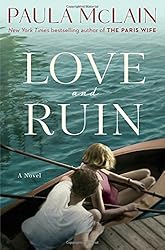
Love and Ruin
Paula McLain, 2018
Random House
400 pp.
ISBN-13: 9781101967386
Summary
The bestselling author of The Paris Wife returns to the subject of Ernest Hemingway in a novel about his passionate, stormy marriage to Martha Gellhorn—a fiercely independent, ambitious young woman who would become one of the greatest war correspondents of the 20th century.
In 1937, twenty-eight-year-old Martha Gellhorn travels alone to Madrid to report on the atrocities of the Spanish Civil War and becomes drawn to the stories of ordinary people caught in the devastating conflict.
It’s the adventure she’s been looking for and her chance to prove herself a worthy journalist in a field dominated by men. But she also finds herself unexpectedly—and uncontrollably—falling in love with Hemingway, a man on his way to becoming a legend.
In the shadow of the impending Second World War, and set against the turbulent backdrops of Madrid and Cuba, Martha and Ernest’s relationship and their professional careers ignite.
But when Ernest publishes the biggest literary success of his career, For Whom the Bell Tolls, they are no longer equals, and Martha must make a choice: surrender to the confining demands of being a famous man’s wife or risk losing Ernest by forging a path as her own woman and writer.
It is a dilemma that could force her to break his heart, and hers.
Heralded by Ann Patchett as "the new star of historical fiction," Paula McLain brings Gellhorn’s story richly to life and captures her as a heroine for the ages: a woman who will risk absolutely everything to find her own voice. (From the publisher.)
Author Bio
• Birth—1965
• Where— Fresno, California, USA
• Education—M.F.A., University of Michigan
• Currently—lives in Cleveland, Ohio
Paula McLain is an American author best known for her novel, The Paris Wife, a fictionalized account of Ernest Hemingway's first marriage. That work became a long-time New York Times bestseller. Her 2015 novel centering on female aviator Beryl Markham was released to excellent reviews in 2015.
McLain has also published two collections of poetry in 1999 and 2005, a memoir about growing up in the foster system in 2003, and the novel A Ticket to Ride in 2008.
McLain was born in Fresno, California. Her mother vanished when she was four, and her father was in and out of jail, leaving McLain and her two sisters (one older, one younger) to move in and out of various foster homes for the next fourteen years. It was an ordeal described in her memoir, Like Family: Growing Up in Other People's Houses.
When she aged out of the system, McLain supported herself by working in various jobs before discovering she could write. Eventually, she received an MFA in poetry from the University of Michigan and has been a resident of Yaddo and the MacDowell Colony as well as the recipient of fellowships from the Ohio Arts Council and the National Endowment for the Arts.
She lives in Cleveland with her family. (Adapted from Wikipedia. Retrieved 8/19/2015.)
Book Reviews
McLain strikingly depicts Martha Gellhorn’s burgeoning career as a writer and war correspondent during the years of her affair with and marriage to Ernest Hemingway.… Gellhorn emerges as a fierce trailblazer every bit Hemingway’s equal in this thrilling book.
Publishers Weekly
(Starred review.) [The] tempestuous relationship, a ferocious contest between two brilliant, willful, and intrepid writers. McLain’s fast-moving, richly insightful, heart-wrenching, and sumptuously written tale pays exhilarating homage to its truly exceptional and significant inspiration.
Booklist
Martha comes across as one tough cookie, Ernest as a great writer but a small man. This elegant if oddly bloodless narrative is a good introduction for those who know nothing of Gellhorn, but it basically rehashes information and sentiments.
Kirkus Reviews
Discussion Questions
1. Martha tells us from the outset that, for better or worse, she is a born traveler. What kind of expectation does that set up about her personality and disposition? What character traits might "born travelers" have that others don’t?
2. Just before Martha meets Ernest, her father dies. How might that make her more impressionable or susceptible to Ernest’s influence?
3. How would you describe Martha’s outlook as she heads off to Madrid? What are her reasons for going? What did the war seem to mean to her, and to others who volunteered?
4. When Martha begins to feel Ernest is drawn to her physically, she initially resists, saying he’s "too Hemingway." What does she mean by that? What is she afraid of?
5. Martha tells us that after three weeks in Madrid she felt she never wanted to leave, saying, "It was like living with my heart constantly in my throat." How could that feeling be perceived as positive? What are some of things she loves about Spain? About her circle of friends and colleagues at the Hotel Florida?
6. When Martha finds the house in Cuba, the Finca Vigía, she falls in love with it instantly, even though it’s in ruins. Why? What does she hope to gain by restoring the property and living there with Ernest? What are the risks?
7. When Martha accepts the assignment to travel to Finland for Collier’s, Ernest says teasingly to their group of friends in Sun Valley that she’s abandoning him. Is it really a joke or is there significant tension brewing? What are Martha’s reasons for going? How does she feel about her work in relation to her personal life? Can the two coexist? Can she—or anyone—have everything?
8. Though Martha is the one who chooses the Finca as a "beautiful foxhole" to share with Ernest, the house eventually begins to weigh on her. Why? What is draining to her about domesticity? Does Ernest have the same ambivalence? Why or why not?
9. Although Martha loves Ernest and doesn’t want to give up her life with him, she has a lot of trepidation about marrying him. Why? What factors contribute to her anxiety? What does she stand to lose?
10. When For Whom the Bell Tolls is published in 1940, it’s a runaway success, selling more copies than any American novel before it save Gone with the Wind. How do the book’s success and Ernest’s intensifying fame challenge Martha as his wife? What about as a writer?
11. When Martha and Ernest go off to China, they’re both working as reporters in search of a story. How do their journalistic methods differ? Are they different kinds of travelers, with different worldviews? Would you say they’re compatible? Why or why not?
12. As the world plunges toward war, Martha feels increasingly compelled to go to Europe to try to write about what’s happening, while Ernest becomes obsessed with his sub-hunting "mission." What are the instincts that pull them in opposite directions? Do we understand what drives them? Do they understand and have compassion for each other, or are they spiraling toward an impasse?
13. When Martha is finally convinced she must go to Europe to report on the war if she’s going to live with herself, Ernest feels more and more despondent and abandoned. Finally, he betrays her by taking her correspondent’s credentials from Collier’s, effectively replacing her on the masthead and making a place at the front lines impossible for her. Can we comprehend his actions and find empathy for him? Why or why not?
14. When the marriage disintegrates beyond repair, Ernest almost immediately finds a new love interest in Mary Welsh (who will become Mrs. Hemingway #4), while Martha turns to her work to ease her pain, finding strength in reclaiming her name and her independence. Do you think their contrasting strategies for surviving heartbreak symbolize the essential differences between Martha and Ernest as people? And do you believe that two such very different personalities could ever hope to find lasting happiness together?
(Questions from the author's website.)


Love and Treasure
Ayelet Waldman, 2014
Knopf Doubleday
352 pp.
ISBN-13: 9780385533546
Summary
A spellbinding new novel of contraband masterpieces, tragic love, and the unexpected legacies of forgotten crimes, Ayelet Waldman’s Love and Treasure weaves a tale around the fascinating, true history of the Hungarian Gold Train in the Second World War.
In 1945 on the outskirts of Salzburg, victorious American soldiers capture a train filled with unspeakable riches: piles of fine gold watches; mountains of fur coats; crates filled with wedding rings, silver picture frames, family heirlooms, and Shabbat candlesticks passed down through generations. Jack Wiseman, a tough, smart New York Jew, is the lieutenant charged with guarding this treasure—a responsibility that grows more complicated when he meets Ilona, a fierce, beautiful Hungarian who has lost everything in the ravages of the Holocaust.
Seventy years later, amid the shadowy world of art dealers who profit off the sins of previous generations, Jack gives a necklace to his granddaughter, Natalie Stein, and charges her with searching for an unknown woman—a woman whose portrait and fate come to haunt Natalie, a woman whose secret may help Natalie to understand the guilt her grandfather will take to his grave and to find a way out of the mess she has made of her own life.
A story of brilliantly drawn characters—a suave and shady art historian, a delusive and infatuated Freudian, a family of singing circus dwarfs fallen into the clutches of Josef Mengele, and desperate lovers facing choices that will tear them apart—Love and Treasure is Ayelet Waldman’s finest novel to date: a sad, funny, richly detailed work that poses hard questions about the value of precious things in a time when life itself has no value, and about the slenderest of chains that can bind us to the griefs and passions of the past. (From the publisher.)
Author Bio
• Birth—December 11, 1964
• Where—Jerusalem, Israel
• Raised—Montreal, Canada; Rhode Island; Ridgewood, New
Jersey, USA
• Education—B.A., Weslyan University; J.D., Harvard
• Currently—lives in Berkeley, California
Ayelet (eye-YELL-it—"gazelle") Waldman is novelist and essayist who was formerly a lawyer. She is noted for her self-revelatory essays, and for her writing (both fiction and non-fiction) about the changing expectations of motherhood. She has written extensively about juggling the demands of children, partners, career and society, in particular about combining paid work with modern motherhood, and about the ensuing maternal ambivalence.
Waldman is the author of seven mystery novels in the series The Mommy-Track Mysteries and has published four novels of general interest, Daughter's Keeper (2003), Love and Other Impossible Pursuits (2006) Red Hook Road, (2010), and Love and Treasure (2014), as well as a collection of personal essays entitled Bad Mother: A Chronicle of Maternal Crimes, Minor Calamities, and Occasional Moments of Grace (2009).
Personal Life
Waldman was born in Jerusalem, Israel. After the 1967 Six-Day War, when she was two and a half, her family moved to Montreal, Canada, then to Rhode Island, finally settling in Ridgewood, New Jersey. By then she was in sixth grade.
Waldman graduated from Wesleyan University, where she studied psychology and government and studied in Isreal for her her junior year. She returned to Israel after college, to live on a kibbutz, but finding it unsatisfying returned to the US. She entered Harvard University and earned her a J.D. in 1991 (she was a class-mate of Barack Obama’s).
After receiving her law degree, Waldman clerked for a federal court judge and worked in a large corporate law firm in New York for a year.
In 1993 she married Pulitzer Prize-winning author Michael Chabon, whose novels include The Yiddish Policemen's Union, The Amazing Adventures of Kavalier & Clay and Wonder Boys. They met on a blind date, when both were living in New York City. They were engaged in three weeks and married a year later, in 1993.
After moving to California with Chabon, Waldman became a public defence lawyer and later taught law at the University of California at Berkeley. She left the legal profession altogether after the birth of her second child and, although she still calls herself a lawyer on her tax returns, says she will not be returning to the legal profession—preferring to work at home with her husband and their now four children.
Writing
She and Chabon work from the same office in the backyard of their home, often discussing and editing each other's work—critiquing each other's work in what Chabon has called a "creative freeflow."
While working as a university professor, Waldman attempted to research legal issues with a view to writing articles for legal journals and thus increasing her chances of a tenured job teaching law. She has said that every time she tried to write those scholarly articles she because bored or intimidated, so she began writing fiction instead.
Waldman has said that her fiction is all about being a bad mother. She has said she chose to write because it was not as time-consuming a career as the law, it gave her something to do during nap times, kept her entertained, because it gave her a way of putting off going back to work full-time. She has also written several times about her 2002 diagnosis of bipolar disorder, a disease that runs in her family, and has spoken publicly on parenting while having a mental illness. She has said, "When I write about being bipolar, I feel queasy and ashamed, but I also feel really strongly that I shouldn't feel this way, that this is a disease, like diabetes."
Waldman started writing mystery novels, thinking they would be “easy ... light and fluffy." At first she wrote in secret, then with her husband's encouragement. She has said that she chose mysteries because they are primarily about plot. Her Mommy-Track" series, seven mysteries in all, features "part-time sleuth and full-time mother" Juliet Applebaum.
She has also published three literary novels of general interest: Daughter's Keeper (2003) drew on Waldman's experience as a criminal defense lawyer and features a young woman who inadvertently becomes involved in the trafficking of drugs; Love and Other Impossible Pursuits (2006) is about a Harvard-educated lawyer dealing with a precocious step-son and the loss of a newborn child to SIDS; and Red Hook Road (2010) revolves around two bereaved families in a small village in Maine.
Waldman has also published short stories in McSweeney's anthologies, as well as essays in the New York Times, Guardian (UK), San Francisco Chronicle, Elle Magazine, Vogue, Allure, Cookie, Child, Parenting, Real Simple, Health and other publications.
Controversy
Waldmen became the center of controversy for an essay, "Motherlove," in which she wrote, "I love my husband more than I love my children." She went on to say that she could survive the death of her children, but not that of her husband, and summarized her ideal family dynamic as follows: "He [her husband, Chabon] and I are the core of what he cherishes ... the children are satellites, beloved but tangential.” The essay led to extensive and vitriolic debate on television shows like "The View" and "Oprah" (on which she was a guest). (Adapted from Wikipedia.)
Book Reviews
Waldman skillfully interweaves [a] striking and enigmatic object...into an ambitious sweep of history.... [She] sustains her multiple plot lines with breathless confidence and descriptive panache, fashioning complex personalities caught up in an inexorable series of events. Less satisfactorily, she never fully explains the provenance of the painting Amitai is hunting, and with the exception of Jack and Ilona...the love scenes are cliched.
Catherine Taylor - New York Times Book Review
This lush, multigenerational tale...traces the path of a single pendant.... Inventively told from multiple perspectives, Waldman's latest is a seductive reflection on just how complicated the idea of "home" is—and why it is worth more than treasure.
Publishers Weekly
A sensitive and heartbreaking portrayal of love, politics, and family secrets.... Waldman's appealing novel recalls the film The Red Violin in its following of this all-important object through various periods in history and through many owners. Fans of historical fiction will love the compelling characters and the leaps backward and forward in time.
Library Journal
A necklace with a peacock pendant raises provocative questions about loss, guilt and recovery in Waldman's intriguing new novel. The necklace is one of thousands of items confiscated from Hungary's Jews and found on a train seized in Austria by the U.S. Army in 1945.... No big points made here, just strong storytelling combined with thoughtful exploration of difficult issues
Kirkus Reviews
Discussion Questions
1. Love and Treasure is a novel that illuminates the shifting nature of identity. In the beginning of the novel, Jack Wiseman is described as a New York Jew whose father’s parents are of “authentic German Jewish stock,” (page 18) yet he finds it a struggle to connect with both the American soldiers under his command and the European Jews he encounters. How does Jack’s definition of himself change over the course of the novel? How do Jack’s fellow soldiers view him? How is he viewed by the Hungarian civilians he meets? What does this say about the how cultural heritage is assigned or interpreted? 2. On page 12, Jack admits that for many years the “contents of the pouch had been a kind of obsession” to him. In what ways does his granddaughter internalize this obsession and make it her own? What drives Natalie’s quest? Did Jack send her on this mission out of duty to the owner or to renew the “glimmer of interest” (page 13) in his granddaughter that had been destroyed by her divorce? Both?
3. When Jack first meets Ilona, he declares that she is all “wire and sparks” (page 29). How does her presence help Jack to better understand his identity as a Jew? As an American? How does she challenge his views about the war or its aftermath?
4. Throughout the novel, Jack is caught between his duty to country (in maintaining his position of watching over the train) and his duty to the people of Hungary (in trying to ensure that the goods are returned to their rightful owners). How do these two missions conflict with each other?
5. Chart Jack’s view of the military over the course of the novel, taking into account his interactions with his fellow American soldiers. Does he relate to any of the soldiers? If so, who? Discuss his conversation with Lieutenant Hoyle at the bar after his breakup with Ilona. How did you interpret the violence at the end of this encounter?
6. Jack’s encounters with Aba Yuval give him a more fully realized understanding of the political situation facing the Jews of Europe. What is Jack’s mind-set going into the trip where he helps smuggle the refugees over the border? What are his feelings toward the group’s goal by the end of the mission? How does this encounter challenge his understanding of nationalism?
7. Ilona and Natalie are described as physically similar, with both having fiery red hair. Is the author’s choice to have the two women share this feature purposeful? What else, if anything, do the two women share?
8. On page 139, Natalie struggles to admit to Amitai that the pendant is stolen, instead saying her grandfather “found” it during the occupation. Why does she stumble over these words? What does her hesitation say about the definition of discovery? Of ownership? How are these problems echoed throughout the novel? How are they reflected in the world of stolen paintings that Amitai deals in?
9. Compare and contrast the failed marriages of Amitai and Natalie. How do their failed marriages prepare them for meeting each other? Discuss the symbolism of Natalie wearing the pendant to her wedding to Daniel.
10. Why is Amitai hesitant to share his military past with Natalie? What other sins of omission occur throughout the novel? ( page 156)
11. Amitai is Israeli but he craves “the anonymity of the immigrant, to be a man with a vague accent in a city of vague accents” (page 175). How does this desire for erasure contrast with Natalie’s desire to understand her cultural heritage? How do their respective homelands encourage or complicate those desires?
12. When Natalie Stein becomes Natalie Kennedy, she meaningfully disrupts the established script for her behavior. What does this say about the fluidity of identity? How does this transgression embolden her?
13. On page 221, the pendant is returned to as close to its rightful heir as possible. What was your reaction to Dalia’s request to get the necklace appraised? What does her indifference to the physical object say about the dilution of history over time? Of personal connection to the Holocaust? To kin?
14. On pages 224–225, Natalie and Amitai fill out the Page of Testimony for Vidor Komlos, Gizella Weisz, and Nina Einhorn. What is the significance of this act?
15. The events of part three are narrated from the perspective of Dr. Zobel, a Freudian analyst. Why do you think the author to choose to include this point of view? Is the doctor reliable as a narrator? What textual evidence exists to
16. Gizella and Nina are introduced as strong-willed women who are ahead their time: Nina dreams of medical school, and Gizella is active in radical politics. What challenges do these early feminists face, both from their countrymen and from their families? Why do you think Zobel seeks them out years later?
17. Stealing is a motif in the novel: Jack pockets the pendant; the American soldiers freely “shop” from the Gold Train; Natalie lifts a painting; Amitai deals in the world of stolen paintings. How do the motivations for these acts differ? Who is morally right in his actions? What does the novel as a whole assert about ownership?
18. Love and Treasure is a novel that weaves intricate plotlines among stunning character portraits, bringing to life a historical event with fictitious details. Yet as the history unravels, gaps emerge and often disrupt a clear narrative. What does this assert about memory, both collective and personal? About how history is interpreted or reinterpreted over time?
(Questions issued by the publisher.)
The Rose of York: Love & War
Sandra Worth, 2002
Atlasbooks
340 pp.
ISBN-13: 9780975126400
Summary
Adventure, deadly passion and intrigue… History’s most enduring mystery… A love story that may have inspired a beloved fairy tale and Shakespeare’s Romeo and Juliet…
Known as Shakespeare’s villain, Richard III is also the king who gave mankind “Blind Justice” and the legal concepts that flowered into modern Western democracy. Against the sweep of England’s fifteenth century Wars of the Roses, Love and War, the first book in the "Rose of York" series, recreates Richard’s tumultuous early years and his love affair with Anne Neville, the traitor’s daughter he made his queen. (From the publisher.)
More
In a tumultuous era marked by peril and intrigue, reversals of fortune and violent death, the passions of a few rule the destiny of England and change the course of history.
A stirring tale of passion, romance, friendship, honor, betrayal and civil strife, and the winner of a remarkable eight awards, including the 2005 Glyph Award for Best General Fiction, this historically accurate novel tells the true love story of two star-crossed lovers—Richard of Gloucester and Lady Anne Neville—before they become King and Queen of England. Set in Malory's England during the Wars of the Roses, The Rose of York: Love & War is a page turner that thrills as it enlightens. (Also from the publisher.)
top of page
Author Bio
• Birth—1954
• Where—Canada
• Education_B.A. University of Toronto
• Awards—Gylph Award-Best General Fiction
Sandra Worth holds an honors B.A. in Political Science and Economics from the University of Toronto and was first published at twenty-three by University of Toronto Press. She is a frequent contributor of articles to The Ricardian Register, the quarterly publication of the U.S. Richard III Society and has been published by Blanc Sanglier, the publication of the Yorkshire, England, branch of the Richard III Society.
Sandra has been invited to teach the Wars of the Roses Course at Suite University, a Canadian internet university, commencing in late 2003. Love and War, her debut novel was nominated for the 2003 Dorothy Parker Award, awarded by the Reviewers International Organization. (From the publisher.)
Book Reviews
Expounding an historical epic of honor and love during the time of the Wars of the Roses, The Rose Of York (Love & War) is both dramatic and evocative in its portrayal of struggling souls making the best choices they can in an unjust world. A deftly written, reader engaging, thoroughly entertaining and enthusiastically recommended historical novel which documents its author as a gifted literary talent.
MidWest Book Review
Worth has done meticulous research… Though conversations and some incidents must of necessity be invented, she makes them seem so real that one agrees this must have been what they said, the way things happened.
Myrna Smith - Ricardian Register (U.S. Richard III Society)
With her debut novel, author Sandra Worth takes readers on an unforgettable journey through the life of Richard Plantagenet III.... Ms. Worth is an extremely gifted writer with the ability to immerse her readers into the lives and world of her characters ... The Rose of York: Love and War isn't historical fiction; it is a time machine.... I know shall be placing this novel on my keeper shelf and anxiously await the remaining books.
Sharon McGinty - Library Reviews
Ms. Worth chronicles brilliantly his (Richard's) all too brief childhood and the events and the people that molded him into the thoughtful and insightful young man he became. It is powerful; it is heartbreaking; and it is a beautifully told love story.... The historical aspects will give you insights that the casual historical fiction reader has probably never thought of, as I can surely attest to.... oh for the lovers of history, and for those looking forward to a most passionate story of love, this for you is a marvelous treat!... Whether intentional or not, I found that the secondary romance between John Neville, Lord Montagu and his wife Isobel to be pure poetry...depicted so beautifully that it simply took my breath away. I am definitely looking forward to the next book in this planned trilogy and if the tone and finesse imbued in this, her debut novel is any indication of what to expect we are all in for a marvelous treat.
Marilyn Rondear - Historical Romance Writers.com
Discussion Questions
Use our LitLovers Book Club Resources; they can help with discussions for any book:
• How to Discuss a Book (helpful discussion tips)
• Generic Discussion Questions—Fiction and Nonfiction
• Read-Think-Talk (a guided reading chart)
Also consider these LitLovers talking points to help get a discussion started for The Rose of York: Love & War:
1. One of the overriding themes in this book is loyalty vs. betrayal. You might talk about the costs of loyalty.
2. Sandra Worth presents an honest, detailed and unvarnished view of life in the 15th century. You might discuss how she portrays that life, particularly for women.
3. Worth's portrait of Richard is vastly different from that of Shakespeare's version in Richard III. It would be interesting to compare the two views. You might read the Shakespeare play...well, okay. Here's another idea: rent Al Pacino's Looking for Richard (1996)—an intriguing and entertaining film in which Pacino plummets the character of Shakespeare's Richard.
4. Consider the political atmosphere of the time—then discuss the jurisprudence reforms Richard introduces: innocent till proven guilty, for one.
5. What were the events and people in Richard's young life that helped form and shape his later character— as a thoughtful, insightful adult?
6. You might want to explore the various romances in the story: that between Richard and Anne Neville, between Richard and Katherine Haute, and between John Neville and his wife Isobel.
(Questions by LitLovers. Please feel free to use them, online or off, with attribution. Thanks.)
top of page


Love Anthony
Lisa Genova, 2012
Simon & Schuster
309 pp.
ISBN-13: 9781439164693
Summary
I’m always hearing about how my brain doesn’t work right.... But it doesn’t feel broken to me.
Olivia Donatelli’s dream of a “normal” life shattered when her son, Anthony, was diagnosed with autism at age three. Understanding the world from his perspective felt bewildering, nearly impossible. He didn’t speak. He hated to be touched. He almost never made eye contact. And just as Olivia was starting to realize that happiness and autism could coexist, Anthony died.
Now she’s alone in a cottage on Nantucket, separated from her husband, desperate to understand the meaning of her son’s short life, when a chance encounter with another woman facing her own loss brings Anthony alive again for Olivia in a most unexpected way.
Beth Ellis’s entire life changed with a simple note: “I’m sleeping with Jimmy.” Fourteen years of marriage. Three beautiful daughters. Yet even before her husband’s affair, she had never felt so alone. Heartbroken, she finds the pieces of the vivacious, creative person she used to be packed away in a box in her attic. For the first time in years, she uncaps her pen, takes a deep breath, and begins to write. The young but exuberant voice that emerges onto the page is a balm to the turmoil within her, a new beginning, and an astonishing bridge back to herself.
In a piercing story about motherhood, autism, and love, New York Times bestselling author Lisa Genova offers us two unforgettable women on the verge of change and the irrepressible young boy whose unique wisdom helps them both find the courage to move on. (From the publisher.)
Author Bio
• Birth—November 22, 1970
• Where—N/A
• Education—B.S. Bates College; Ph.D, Harvard University
• Currently—lives on Cape Cod, Massachusetts
Lisa Genova is an American neuroscientist and author of fiction. She graduated valedictorian, summa cum laude from Bates College with a BS degree in biopsychology and received her Ph.D. in neuroscience from Harvard University in 1998.
Genova did research at Massachusetts General Hospital East, Yale Medical School, McLean Hospital, and the National Institutes of Health. She also taught neuroanatomy at Harvard Medical School fall 1996.
Genova married and gave birth to a daughter in 2000. Four years later she and her husband divorced, and Genova began writing full-time. To hear Genova tell it:
When I was 33, I got divorced. I’d been a stay-at-home mom for four years, and I planned to go back to work as a health-care industry strategy consultant. But then I asked myself a question that changed the course of my life: If I could do anything I wanted, what would I do? My answer, which was both exciting and terrifying—write a novel about a woman with Alzheimer’s (Cape Cod Magazine.).
In 2007 she self-published her first novel, Still Alice, which went on to became a major best seller and award winning film. Since then, Genova has written three other fictional works about characters dealing with neurological disorders.
Still Alice
Genova's debut novel follows a woman suffering from early-onset Alzheimer’s disease. Alice Howland, a 50-year-old woman, is a cognitive psychology professor at Harvard and a world-renowned linguistics expert. She is married to an equally successful husband, and they have three grown children. The disease takes hold swiftly, changing Alice’s relationship with her family and the world.
Self-published, Genova sold copies of the book out of the trunk of her car. The book was later acquired by Simon & Schuster and published in 2009. It appeared on the New York Times best seller list for more than 40 weeks, was sold in 30 countries, and translated into more than 20 languages.
The book was adapted for the stage by Christine Mary Dunford and performed by Chicago's Lookingglass Theatre Company in 2013.
A 2014 film adaptation starred Julianne Moore as the lead and co-starred Alec Baldwin, Kristen Stewart, and Kate Bosworth. Moore won an Oscar for Best Actress.
Other books
♦ Left Neglected (2011)
Genova's second novel tells the story of a woman who suffers from left neglect (also called hemispatial or unilateral neglect), caused by a traumatic brain injury. As she struggles to recover, she learns that she must embrace a simpler life. She begins to heal when she attends to elements left neglected in herself, her family, and the world around her.
♦ Love Anthony (2012)
Offering a unique perspective in fiction, this third novel presents the extraordinary voice of Anthony, a nonverbal boy with autism. Anthony reveals a neurologically plausible peek inside the mind of autism, why he hates pronouns, why he loves swinging and the number three, how he experiences routine, joy, and love. And it is the voice of this voiceless boy that guides two women in this powerfully unforgettable story to discover the universal truths that connect us all.
♦ Inside the O'Briens (2015)
In her fourth novel, Genova follows Joe O'Brien, a middle-aged Boston policeman diagnosed with Huntington's. There is no cure, and the disease is progressive and lethal. The story revolves around the fallout on Joe's family, including his daughter who is at risk for carrying the genes.
TV and film
Since her first novel was published, Genova has become a professional speaker about Alzheimer's disease. She has been a guest on the Today Show, Dr. Oz, CNN, PBS News Hour, and the Diane Rehm Show. She appeared in the documentary film To Not Fade Away. It is a follow-up to the Emmy Award-winning film, Not Fade Away (2009), about Marie Vitale, a woman who was diagnosed with Alzheimer's disease at the age of 45. (Adapated from Wikipedia. Retrieved 4/6/2015.)
Book Reviews
Lisa Genova's novels ring true. Love Anthony, like Genova's two previous novels, is beautifully written, and poignant to the point of heartbreak.... Anyone who has had even a passing contact with an autistic child will relate.... Try not to weep.
USA Today
Genova's newest (after Left Neglected) tells the tales of two women struggling with a timely topic, but the device she uses to connect their stories—a bland bit of mysticism—obfuscates otherwise compelling narratives. Olivia's life is in shambles—she spent years coming to terms with her son, Anthony, being diagnosed with autism, only to lose him to a subdural hematoma at age 8. Now her husband's filing for divorce. Meanwhile, Beth is reeling from the discovery that her husband has been cheating on her for months. In an effort to cope, she returns to her former passion—writing—and begins a new book inspired by a dream. That story magically turns out to be Anthony's story, as told by him. Eventually, the women come together, and Olivia reads Beth's story and begins to heal. Though each story is engaging in its own right, the plot device that connects Beth and Olivia makes the book read like self-help.
Publishers Weekly
Writing with deep empathy and insight, Genova has created an engaging story that fearlessly asks the big questions.
Booklist
A story about unconditional love, loss and renewal by bestselling author Genova (Left Neglected, 2011, etc.). Nantucket residents Beth Ellis and Olivia Donatelli have both experienced life-shattering events that have left them raw and wounded and questioning everything that they ever believed to be true.... As Olivia turns to photography...Beth picks up a pen and reconnects with a passion she's long forgotten: writing. Ensconced in a comfortable area of the library, Beth writes the story of a young autistic boy with humor and intelligence and exuberance for life, who through her, can voice his thoughts and feelings and allow others to see into his world. And as she shares these words with Olivia, they provide the strength and understanding and purpose that both women need to come to terms with the past and move on with their lives. There's a point in the narrative where one of the characters becomes so engrossed in reading a book that she loses track of time. Readers of Genova's latest excellent offering might very well find the same happening to them.
Kirkus Reviews
Discussion Questions
1. How much did you know about this condition before starting Love Anthony? Do you know anyone who has autism or an autistic person in their family?
2. What significance does the setting of Nantucket play in this story? Would the story have been different if it had taken place in New York City or Chicago?
3. Beth pulls a box out of her attic, filled with remnants from her old life, and is reminded of the woman she once was. If you were to go through a box from your attic, what items might you find?
4. On the subject of marriage and fidelity, Beth’s friend Courtney muses: “You’re always at the mercy of the people you’re in a relationship with, right?” (p. 171) Do you agree? What do you think of the advice she offers Beth?
5. Do you think the author accurately captured the voice of a young autistic boy in the Anthony chapters? Did these sections enhance Beth’s story for you? What about Olivia’s journal entries?
6. After receiving David’s letter about his impending engagement, Olivia ponders the concept of happiness: “He’s right. I forgot about happiness. At first, it wasn’t a priority. Anthony had autism, and every ounce of energy went into saving him. Her happiness was irrelevant.... And then, just when she was starting to realize that happiness and autism could co-exist in the same room, in the same sentence, in her heart, Anthony died, and happiness was no longer a concept she could fathom.” (p. 283) Do you think happiness is a conscious choice? Do you find it telling that Olivia uses the phrase “saving him” in reference to Anthony and his autism?
7. Toward the end of the story, Olivia has an epiphany when she realizes that “There was more to Anthony’s life than his death. And there was more to Anthony than his autism.” (p. 283) What do you think finally enables Olivia to have this realization? Was it a singular event or a process?
8. When Jimmy and Beth share their homework assignments given to them by Dr. Campbell, were you surprised by Beth’s initial reaction? Why is forgiving Jimmy the one thing Beth can’t do?
9. After reading Beth’s novel, Olivia is convinced Anthony is speaking to her through Beth. Skeptical, Beth discusses the idea with the more spiritual Petra, who feels “we’re all connected, even if we don’t know how. Maybe communicating through you gives you the something you need in this lifetime.” (p. 308) Do you agree or disagree with Petra?
10. Through writing her book, Beth realizes “this story was more about Anthony the boy than Anthony the boy with autism.... She was simply writing about Anthony, a boy worthy of happiness and safety, of feeling wanted and loved. Just like her. The more she wrote about Anthony, the more she realized that she was actually writing about herself.” (p. 331) How so?
11.Beth ultimately decides the lesson of her book is “Find someone to love and love without condition.” (p.332) Do you think this could also apply as an overall theme for Love Anthony? Can you find any others?
12.Which character did you relate to the most and why? Where do you see these characters in five years?
13.What do you think of Beth’s epilogue? Do you think it provides a satisfying ending to her story? To the novel as a whole?
14.Another recurring theme of Love Anthony is faith—having faith, losing faith, and taking a leap of faith. Can you remember a time in your own life when you took a leap of faith?
(Questions issued by publisher.)


Love in Lowercase
Frascesc Miralles, 2010 (U.S., 2016)
Penguin Publishing
249 pp.
ISBN-13: 9780143128212
Summary
A romantic comedy for language lovers and fans of The Rosie Project, about a brainy bachelor and the cat that opens his eyes to life’s little pleasures.
When Samuel, a lonely linguistics lecturer, wakes up on New Year’s Day, he is convinced that the year ahead will bring nothing more than passive verbs and un-italicized moments—until an unexpected visitor slips into his Barcelona apartment and refuses to leave.
The appearance of Mishima, a stray, brindle-furred cat, becomes the catalyst that leads Samuel from the comforts of his favorite books, foreign films, and classical music to places he’s never been (next door) and to people he might never have met (a neighbor with whom he’s never exchanged a word).
Even better, the Catalan cat leads him back to the mysterious Gabriela, whom he thought he’d lost long before, and shows him, in this international bestseller for fans of The Rosie Project, The Solitude of Prime Numbers, and The Guest Cat, that sometimes love is hiding in the smallest characters. (From the publisher.)
Author Bio
• Birth—August 27, 1968
• Where—Barcelona, Catalonia, Spain
• Education—Autonomous University of Barcelona (no degree); B.A., University of
Barcelona
• Awards—Gran Angular Prize (YA novel); Torrevieja Prize
• Currently—lives in Barcelona
Francesc Miralles Contijoch is a Spanish writer, essayist, translator, and musician. He was born in Barcelona as the son of a dressmaker and an erudite office worker. After spending eight years in a religious school in la Ribera, he attended high school at the now-defunct academy Almi and Ies Montserrat.
Education
Despite his bad grades, he was accepted into the Universidad Autonoma de Barcelona (UAB) to study journalism, which he quit after four months. That the same year, he started to work as a waiter at Puces del Barri Gotic, a bar in the Gothic Quarter of Barcelona, where he learned to play the piano.
In the following year, Miralles returned to the UAB, this time to study English literature, which he combined with precarious language-teacher jobs. After five years of being a sloth, he stalled in his third year...and quit again.
A lover of travel, Miralles decided to leave everything behind to travel the world. A bunch of chance encounters led him to live in Croatia and Slovenia during the armed conflicts.
Upon returning to Barcelona, Miralles resumed his academic life as a student—this time of German literature—at the Universidad de Barcelona. Before finishing his postgraduate studies, he began work in the publishing business, initially as a translator of English and German spirituality and alternative-therapy books. Later he became an editor overseeing several collections of self-help books, even writing under a pseudonym.
Writing
Miralles eventually left publishing and promised himself he would never work for another company again. Instead, he decided to try his hand at writing a youth novel, a decision that payed off—he has since published some 30 books, including young adult, fantasy, and adult novels, as well as nonfiction.
His first adult novel, Love in Lowercase, came out in 2010 and has been translated into 20 languages. A sequel, Wabi-Sabi, was published in 2014 (so far only in Europe). In 2016, six years after it was first released, Love in Lowercase was published in the U.S.
Miralles currently dedicates his time to both literature and journalism, combining monthly contributions to newspapers and magazines, such as El Pais Semanal and Mente Sana, with his work as a literary adviser to publishers and a literary agency.
Music
Aside from his writing life, Miralles is also a musician. In 2007, he released an album of songs, which he wrote and played, called Hotel Guru. The next year, in 2008, he and a group of musicians who work in publishing got together and formed the band, Nikosia. The group has released a number of albums. (Author bio adapted from the author's website and Wikipedia. Retrieved 2/19/2016.)
Book Reviews
This novel, the quirky tale of Barcelona linguistics professor Samuel, a mysterious cat named Mishima, and the bumpy road to love, is an international bestseller in its original Spanish edition....
Publishers Weekly
[A] cat sneaks into the Barcelona apartment of forlorn linguistics professor Samuel and eventually leads him to his neighbors and his long-lost Gabriela. You've gotta love a book that's compared to Graeme Simsion's The Rosie Project and Paolo Giordano's The Solitude of Prime Numbers.
Library Journal
A lovely little book with nods to literature, philosophy and music that encourages us to wake up to our lives and to the people in them, and to let small coincidences lead us to love.
BookPage
[G]enuinely charming if a little predictable...[with] an easy protagonist to root for. The simplicity of Miralles' writing is also key; his short chapters are like brief, linked thoughts that highlight the magic in the ordinar.... A satisfyingly quaint romance.
Kirkus Reviews
Discussion Questions
Use our LitLovers Book Club Resources; they can help with discussions for any book:
• How to Discuss a Book (helpful discussion tips)
• Generic Discussion Questions—Fiction and Nonfiction
• Read-Think-Talk (a guided reading chart)
(We'll add specific questions if and when they're made available by the publisher.)
Love in Mid Air
Kim Wright, 2010
Grand Central Publishing
320 pp.
ISBN-13: 9780446540438
Summary
A chance encounter with a stranger on an airplane sends Elyse Bearden into an emotional tailspin. Suddenly Elyse is willing to risk everything: her safe but stale marriage, her seemingly perfect life in an affluent Southern suburb, and her position in the community. She finds herself cutting through all the instincts that say "no" and instead lets "yes" happen.
As Elyse embarks on a risky affair, her longtime friend Kelly and the other women in their book club begin to question their own decisions about love, sex, marriage, and freedom. There are consequences for Elyse, her family, and her circle of close friends, all of whom have an investment in her life continuing as normal. But is normal what she really wants after all? In the end it will take an extraordinary leap of faith for Elyse to find—and follow—her own path to happiness.
An intelligent, sexy, absorbing tale and an honest look at modern-day marriage, Love in Mid Air offers the experience of what it's like to change the course of one's own destiny when finding oneself caught in mid air. (From the publisher.)
Author Bio
Kim Wright has been writing about travel, food, and wine for more than 25 years and is a two-time recipient of the Lowell Thomas Award for Travel Writing. Love in Mid Air is her first novel and she is presently at work on a mystery about Jack the Ripper. (From .)
Book Reviews
Astute and engrossing, this debut is a treat.
People
(Starred review.) Wright hits it out of the park in her debut, an engaging account of a woman contemplating divorce. Despite finally getting her husband, Phil, to attend counseling sessions with her, Elyse Bearden realizes her marriage is dead in the water. Though Phil’s a doting father and a decent man, he’s also the occasional jerk who snickers at his wife in lingerie and is generally indifferent to her. Elyse already knows she’s going to leave her husband when she meets Gerry Kincaid and soon begins an affair that allows her to escape from the crushing banality of her suburban life. Serving as Elyse’s foil is her beautiful best friend, Kelly, now married to an older, wealthy man. While the idea of housewives complaining about their husbands over lunch may strike some as a conventional hen-lit trope, Wright conveys friendships and the blasé everyday with authenticity and telling detail, while passages depicting Elyse’s inner life are rife with the same wit and insight that infuse the dialogue. Though this story is one that readers may have seen many times before, Wright delivers fresh perspective and sympathetic characters few writers can match.
Publishers Weekly
As Elyse questions what she wants out of life, she must weigh the risk of what will happen if, or when, her husband finds out about Gerry. An intense, thoughtful novel about love and friendship, or the lack thereof, in a marriage. —Hilary Hatton
Booklist
With a successful dentist husband, adorable young daughter and close-knit group of female friends, Elyse, like so many heroines who have it all, could not be more miserable. She’s stifled by her suburban life, and she cannot communicate with her taciturn hubby, Phil. She fortunately happens to have a creative outlet (she’s a talented potter) and it is during a flight for work that she finds herself seated next to Gerry, an attractive Boston-based investment banker who, like her, has a spouse at home. The two strangers have an instant rapport, and back at home in Charlotte, N.C., she calls him. That leads to an erotically charged encounter in New York, followed by brief monthly meetings that help to convince her that marrying Phil was a mistake. But while Gerry certainly seems besotted with Elyse, he offers her no promises. Phil, unaware of her infidelity but sensing her growing unease with their life, agrees to marriage counseling, as long as they use his best friend Jeff, their minister, as mediator. Big mistake. Elyse goes along with it while mentally making plans to leave him. Meanwhile, her affluent inner circle senses something is amiss, with her best friend Kelly, herself in a less-than-ideal marriage, feeling threatened by Elyse’s risky behavior. Knowing full well how her actions will impact her entire community, Elyse bides her time, until a shocking act of violence forces a decision. So will she choose her husband, her lover or neither? Sharply written and emotionally accessible, Wright’s debut offers a clear-eyed taste of hope without letting anyone, especially Elyse, off the hook. A modern take on adultery that does not shy away from the costs—and benefits—of a post-marriage life.
Kirkus Reviews
Discussion Questions
1. What do you think the title means? Obviously, Elyse meets Gerry on an airplane but in what other ways does she remain “in mid air” during the course of the novel? At what point, if any, would you say she finally lands?
2. Although the novel is told from Elyse’s point of view, the voices of the other women are a major part of the story and they represent varying, and at times contradictory, perspectives on love and marriage. Are all the viewpoints equally valid? Did you identify primarily with one character or did you find yourself siding with different women at different points in the novel?
3. When Elyse reflects on Kelly’s past affair she says “She was my best friend. It happened to one of us and so, in a way, it happened to both of us.” How do you think Kelly’s painful romantic history influences Elyse’s decisions? How does it influence the role Kelly plays as Elyse’s confidant?
4. What makes Gerry so irresistible to Elyse? Is it merely the fact he isn’t Phil, or are there other qualities in his personality and/or the way the two met that make it believable Elyse would be easily seduced?
5. Is an affair ever forgivable? Do you find Elyse’s situation sympathetic or do you see her as impulsive and selfish? Does the fact she has a child make the situation worse? Do you agree with Kelly that society’s double standard makes an affair more acceptable for a man than for a woman?
6. The story is set in the south and much of the action revolves around the social life of a church. Would Love in Mid-Air be a drastically different book if it were set in another part of the country or could these things happen in any affluent American suburb?
7. While watching a movie starring Elizabeth Taylor, Elyse says that she can’t bear to see other women unhappy and that this is why she moved to a place “where the women hide their pain so well.” Is this accurate? Is there evidence that other women in the group are also hurting or is the statement simply a projection of Elyse’s own state of mind? Is discontent among women really contagious? What signs are there at the end of the book that Elyse’s decisions have had an impact on how the other women view their own lives?
8. It would be easy to see a novel about a married woman who is having an affair as a classic woman-caught-between-two-men sort of story. How is Love in Mid-Air different from your standard love triangle?
9. The book is full of symbols – broken pottery, falling, myopia, vintage movies, the cat, the casseroles, the handcuffs, the old love letters Kelly gives to Elyse, even the fact the women walk in circles for exercise. What do you think these symbols mean to Elyse and how does their significance change through the course of the story?
10. Kelly tells Elyse that an affair is like cocaine because it takes more to get you off every time, and Elyse’s behavior does become increasingly reckless as the novel progresses. Do you think she’s lost touch with reality? That she wants to be caught? That she’s trying to force either Gerry or Phil to react in a way that takes the decision out of her hands?
11. Would things have worked out differently if Elyse and Phil had kept the original marriage counseling session they’d scheduled instead of choosing counseling with Jeff? Did the fact he was their pastor and friend hamper Jeff’s ability to understand what was really going on in their marriage?
12. Lynn is an enigmatic character throughout the book, but especially at the end when, after saying that “Jesus and Elvis and wild horses couldn’t drag me back” she abruptly reconciles with her ex-husband. Elyse imagines why Lynn might return to her marriage. Do you find Elyse’s fantasy plausible or do you think Lynn could have other reasons for going back? Why do you think Elyse’s postcard from Belize was the last to arrive? Why do you think she opts not to read it?
13. We see everything in the book through Elyse’s eyes. How would the story have been different if Kelly had been the narrator?
14. SPOILER ALERT: Elyse is upset that Tory is present during the scene on the church steps and wonders what stories she will tell herself later about what she’s witnessed. How do you think these events – the affair, seeing her father strike her mother, the ultimate divorce – will affect Tory’s future life?
15. SPOILER ALERT: Also in the scene on the church steps, Elyse literally “takes the fall” for something Kelly had done years earlier. Do you consider it ironic that it is her decision to keep Kelly’s letters, and not the affair that pushes the novel to its climax? Although Phil’s actions are surprising and violent, Elyse believes she’s been “set free on a technicality.” Why do you think she compares being struck to a kind of religious grace? Did the reactions of any of the other characters who witness the event surprise you?
16. Elyse clearly changes the most in the course of the novel but there are sizable shifts in other characters as well. How does Gerry change? Belinda? Jeff? Nancy? Phil?
17. Elyse recalls at one point that her grandmother told her “When you marry the man, you marry the life” and she concludes the inverse is also true; if she leaves Phil she will have to leave her comfortable life – i.e., economic security, the church, her close group of friends, and perhaps even her child. Is this what’s happening at the end of the book? Or are there signs that the transition might not be as wrenching as she predicted?
18. Would you say that Love in Mid Air has a happy ending?
(Questions issued by publisher.)
Love in the Time of Cholera
Gabriel Garcia Marquez, 1985
Knopf Doubleday
368 pp.
ISBN-13: 9780307389732
Summary
In the late 1800s, in a Caribbean port city, a young telegraph operator named Florentino Ariza falls deliriously in love with Fermina Daza, a beautiful student. She is so sheltered that they carry on their romance secretly, through letters and telegrams. When Fermina Daza's father finds out about her suitor, he sends her on a trip intended to make her forget the affair. Lorenza Daza has much higher ambitions for his daughter than the humble Florentino. Her grief at being torn away from her lover is profound, but when she returns she breaks off the relationship, calling everything that has happened between them an illusion.
Instead, she marries the elegant, cultured, and successful Dr. Juvenal Urbino. As his wife, she will think of herself as "the happiest woman in the world." Though devastated by her rejection, Florentino Ariza is not one to be deterred. He has declared his eternal love for Fermina, and determines to gain the fame and fortune he needs to win her back. When Fermina's husband at last dies, 51 years, 9 months, and 4 days later, Florentino Ariza approaches Fermina again at her husband's funeral. There have been hundreds of other affairs, but none of these women have captured his heart as Fermina did. "He is ugly and sad," says one of his lovers, "but he is all love."
In this magnificent story of a romance, García Márquez beautifully and unflinchingly explores the nature of love in all its guises, small and large, passionate and serene. Love can emerge like a disease in these characters, but it can also outlast bleak decades of war and cholera, and the effects of time itself. (From the publisher.)
Author Bio
• Birth—March 06, 1928
• Where—Aracataca, Colombia
• Education—Universidad Nacional de Colombia; Universidad
de Cartagena
• Awards—Nobel Prize, 1982
• Currently—lives in Mexico City, Mexico
Gabriel García Márquez is the product of his family and his nation. Born in the small coastal town of Aracataca in northern Colombia, he was raised by his maternal grandparents. As a child, he was mesmerized by stories spun by his grandmother and her sisters — a rich gumbo of superstitions, folk tales, and ghost stories that fired his youthful imagination. And from his grandfather, a colonel in Colombia's devastating Civil War, he learned about his country's political struggles. This potent mix of Liberal politics, family lore, and regional mythology formed the framework for his magical realist novels.
When his grandfather died, García Márquez was sent to Sucre to live (for the first time) with his parents. He attended university in Bogotá, where he studied law in accordance with his parents' wishes. It was here that he first read The Metamorphosis by Franz Kafka and discovered a literature he understood intuitively — one with nontraditional plots and structures, just like the stories he had known all his life. His studies were interrupted when the university was closed, and he moved back north, intending to pursue both writing and law; but before long, he quit school to pursue a career in journalism.
In 1954 his newspaper sent García Márquez on assignment to Italy, marking the start of a lifelong self-imposed exile from the horrors of Colombian politics that took him to Barcelona, Paris, New York, and Mexico. Influenced by American novelist William Faulkner, creator of the fictionalized Yoknapatawpha County, and by the powerful intergenerational tragedies of the Greek dramatist Sophocles, García Márquez began writing fiction, honing a signature blend of fantasy and reality that culminated in the 1967 masterpiece One Hundred Years of Solitude. This sweeping epic became an instant classic and set the stage for more bestselling novels, including Love in the Time of Cholera, Love and Other Demons, and Memories of My Melancholy Whores. In addition, he has completed the first volume of a shelf-bending memoir, and his journalism and nonfiction essays have been collected into several anthologies.
In 1982, García Márquez was awarded the Nobel Prize for Literature. In his acceptance speech, he called for a "sweeping utopia of life, where no one will be able to decide for others how they die, where love will prove true and happiness be possible, and where the races condemned to one hundred years of solitude will have, at last and forever, a second opportunity on earth." Few writers have pursued that utopia with more passion and vigor than this towering 20th-century novelist.
Extras
• Gabriel José García Márquez' affectionate nickname is Gabo.
• García Márquez' first two novellas were completed long before their actual release dates, but might not have been published if it weren't for his friends, who found the manuscripts in a desk drawer and a suitcase, and sent them in for publication. (Bio from Barnes and Noble.)
Book Reviews
Suppose...it were possible, not only to swear love ''forever,'' but actually to follow through on it — to live a long, full and authentic life based on such a vow, to put one's alloted stake of precious time where one's heart is? This is the extraordinary premise of Gabriel Garcia Marquez's new novel, Love in the Time of Cholera, one on which he delivers, and triumphantly.... He writes with impassioned control, out of a maniacal serenity: the Garcimarquesian voice we have come to recognize from the other fiction has matured, found and developed new resources.
Thomas Pinchon - New York Times
Like many great novels, Gabriel Garc ía Márquez's Love in the Time of Cholera portrays the tension between illusions and material reality, especially in the context of love. In the novel's final pages, when Florentino Ariza and Fermina Daza are finally together in their old age, we are told that love "was more solid the closer it came to death" (p. 345). This statement exemplifies the novel's method—instead of saying what love is, and in this way judging the strength of its characters' grasp of reality, it articulates the relationship between love and something else, giving different perspectives but no definitions. This circling around love gives Love in the Time of Cholera the quality of capturing the ineffable.
Different ways of understanding, experiencing, and representing love are embodied by the novel's three central characters—Florentino Ariza, Fermina Daza, and Dr. Juvenal Urbino. For Florentino, love has the properties of a dream; its fullest expression occurs in art (especially in writing), and it stands in opposition to everyday reality, entirely resistant to rational understanding. Like Emma in Madame Bovary, Florentino is filled with notions of love derived from popular literature; he also becomes a comic figure when reality unexpectedly intrudes into the world of his imagination. The bird droppings that fall on Fermina's embroidery when they meet as teenagers in the park and the intestinal disruption that betrays him when they meet following Dr. Urbino's death both testify to the unavoidable fact of the material world. But Florentino's fate suggests neither acquiescence to reality nor the continuation of his belief in a wholly illusory kind of love.
As the relationship between Florentino and Fermina unfolds following Dr. Urbino's death, it seems enabled by Florentino's emergence from the imaginary world in which he has lived for so long—the very existence of his imaginary world is made possible by Fermina's absence from it. The letters Florentino writes to her after Dr. Urbino's death possess, in Fermina's words, "a foundation in reality" (p. 330), as opposed to the letters of his youth, inspired by "half-baked endearments taken whole from the Spanish romantics" (p. 75). But other aspects of the novel's conclusion complicate this interpretation. Before making love, Florentino tells Fermina, "I've remained a virgin for you" (p. 339). In light of his many trysts and affairs, in what sense could this be true other than an imaginary one? When asked how long their ship will sail, keeping up its deception by flying the yellow cholera flag, Florentino answers, "Forever" (p. 348), as if to specifically deny the reality of death.
Because of his belief in the power of the rational mind, Dr. Urbino often appears more grounded in reality than Florentino. He considers marriage "an absurd invention" (p. 209), and his marriage to Fermina represents a lifelong effort to defeat the absurd and replace it with something that can withstand logical analysis. After his death, Fermina recalls his belief that "the most important thing in a good marriage is not happiness, but stability" (p. 300). On the night they consummate their marriage, Dr. Urbino readily admits to himself that he does not love Fermina, but "he was sure there would be no obstacle to their inventing true love" (p. 159). He thinks of love not as an unruly passion, but as if it can be brought into existence merely by an act of will. But his determination to avoid the chaos of emotion can make Dr. Urbino seem just as divorced from reality as Florentino. In his dissertation, Dr. Urbino asserts that, given the human organism's "many useless or duplicated functions...it could be more simple and by the same token less vulnerable" (p. 158-59). Is this idea any less illusory than the most extravagant of Florentino's ecstatic proclamations of his love for Fermina?
Between the extremes of Florentino and Dr. Urbino is Fermina. When Dr. Urbino first tells her about the importance of stability, she hears in it a "miserable threat," but when she remembers his words after he dies, she thinks of them as "the lodestone that had given them both so many happy hours" (p. 300). She ends her first affair with Florentino by telling him in a letter that "what is between us is nothing more than an illusion" (p. 102). As coldly precise as this declaration is, Fermina is nevertheless open to the emotional upheavals that attend her marriage to Dr. Urbino. When he confirms her suspicion of his adulterous affair with Barbara Lynch, she wishes he had denied it, preferring the illusion of his fidelity to the feeling that "her rage would never end" (p. 251). Sharing memories of Dr. Urbino with Florentino, Fermina "could not conceive of a husband better than hers had been, and yet when she recalled their life she found more difficulties than pleasures," admitting to Florentino that she does not "really know if it was love or not" (p. 329).
It is tempting to see Fermina as encompassing both the illusory and the real, but such symmetry would reduce her to a thematic device, as opposed to a fully alive character, capable of expecting nothing more from life after her husband dies and then falling in love with Florentino. The fact that neither she nor the novel ever arrive at a fixed definition of love suggests that its elusiveness is part of its very nature.
(Copyright 2007 by the Random House Publishing Group. Permission for use granted by Random House Inc.)
Discussion Questions
1. Why does García Márquez use similar terms to describe the effects of love and cholera?
2. Plagues figure prominently in many of García Márquez's novels. What literal and metaphoric functions does the cholera plague serve in this novel? What light does it shed on Latin American society of the nineteenth century? How does it change its characters' attitudes toward life? How are the symptoms of love equated in the novel with the symptoms of cholera?
3. What does the conflict between Dr. Juvenal Urbino and Florentino Ariza reveal about the customs of Europe and the ways of Caribbean life? How is Fermina Daza torn between the two?
4. Dr. Urbino reads only what is considered fine literature, while Fermina Daza immerses herself in contemporary romances or soap operas. What does this reveal about the author's attitude toward the distinction between "high" and "low" literature. Does his story line and style remind you more of a soap opera or a classical drama?
5. After rejecting Florentino's declaration of love following her husband's funeral, why is Fermina eventually won over by him?
6. Why does a change in Florentino's writing style make Fermina more receptive to him?
7. What does Florentino mean when he tells Fermina, before they make love for the first time, "I've remained a virgin for you" (p. 339)?
8. Why does Florentino tell each of his lovers that she is the only one he has had?
9. What does Florentino's uncle mean when he says, "without river navigation there is no love" (p. 168)?
10. Do Fermina and Dr. Urbino succeed at "inventing true love" (p. 159)?
11. Set against the backdrop of recurring civil wars and cholera epidemics, the novel explores death and decay, as well as love. How does Dr. Urbino's refusal to grow old gracefully affect the other two characters? What does it say about fulfillment and beauty in their society? Does the fear of aging or death change Florentino Ariza's feelings toward Fermina Daza?
12. Compare the suicide of Jeremiah de Saint-Amour at the beginning of the book with that of Florentino's former lover, América Vicuña at the end. How do their motives differ? Why does the author frame the book with these two events?
13. Why is Leona Cassiani "the true woman in [Florentino's] life although neither of them ever knew it and they never made love" (p. 182)?
14. When Tránsito Ariza tells Florentino he looks as if he were going to a funeral when he is going to visit Fermina, why does he respond by saying, "It's almost the same thing" (p. 65)? (Questions issued by publisher.)
top of page (summary)


Love Is a Canoe
Ben Schrank, 2013
Farrar, Straus and Giroux
352 pp.
ISBN-13: 9780374192495
Summary
Peter Herman is something of a folk hero. Marriage Is a Canoe, his legendary, decades-old book on love and relationships, has won the hearts of hopeful romantics and desperate cynics alike. He and his beloved wife lived a relatively peaceful life in upstate New York. But now it’s 2010, and Peter’s wife has just died. Completely lost, he passes the time with a woman he admires but doesn’t love—and he begins to look back through the pages of his book and question homilies such as: A good marriage is a canoe—it needs care and isn’t meant to hold too much—no more than two adults and a few kids.
It’s advice he has famously doled out for decades. But what is it worth?
Then Peter receives a call from Stella Petrovic, an ambitious young editor who wants to celebrate the fiftieth anniversary of Marriage Is a Canoe with a contest for struggling couples. The prize? An afternoon with Peter and a chance to save their relationship.
The contest ensnares its creator in the largely opaque politics of her publishing house while it introduces the reader to couples in various states of distress, including a shy thirtysomething Brooklynite and her charismatic and entrepreneurial husband, who may just be a bit too charismatic for the good of their marriage. There’s the middle-aged publisher whose imposing manner has managed to impose loneliness on her for longer than she cares to admit. And then there is Peter, who must discover what he meant when he wrote Marriage Is a Canoe if he is going to help the contest’s winners and find a way to love again.
In Love Is a Canoe, Ben Schrank delivers a smart, funny, romantic, and hugely satisfying novel about the fragility of marriage and the difficulty of repairing the damage when well-intentioned people forget how to be good to each other. (From the publisher.)
Author Bio
• Birth—ca. 1969-1970
• Raised—Brooklyn, New York City, New York, USA
• Education—B.A., Brown University; M.A., New York
University
• Currently—lives in Brooklyn, New York City
Ben Schrank published his first novel, Miracle Man, in 1999. The New Yorker selected it as one of six debut novels in that year’s fiction issue, saying “As the ethical lines blur, Schrank makes New York seem sharp and new.” Time magazine called it a “brilliantly observed story about the desire to live in an egalitarian world.”
In 2002 Schrank published his second novel, Consent. Leonard Michaels wrote of Consent: “It is a very serious story, and, in places, it is hilarious. As for the woman at the center, she is unforgettable.”
Schrank has taught at the MFA program at Brooklyn college. He was for some years the voice of "Ben’s Life," a fictional column for Seventeen magazine. He is currently publisher of Razorbill, an imprint of Penguin Young Readers. He grew up in Brooklyn where he now lives with his wife, Lauren Mechling, and son. (From the author's website.)
Book Reviews
Despite a softly cynical underside, Love Is a Canoe is an affirmation that secrets, fantasies and wrong turns are part of both publishing careers and love. Schrank has done something here that may sound impossible: He’s written a funny novel about publishing that is not caustic but optimistic, not biting but bighearted—a story about the delusions with which self-aware, smart people are all too willing to live in order to avoid the painful (yet entertaining) upheaval that comes with truth.
Dean Bakopoulos - New York Times Book Review
(Starred review.) Three stories of personal and literary authenticity weave through this novel of love and books that gets sharper and smarter as it progresses. Forty years ago, Peter Herman penned Love Is a Canoe, a memoir and meditation on marriage that retains a devoted following. Canoe’s homilies from Peter’s adolescent summer spent in upstate New York with his grandparents as his own parents’ marriage crumbled contain a certain enduring quality: “A good marriage is a canoe—it needs care and isn’t meant to hold too much—no more than two adults and a couple of kids.” But as the recently widowed author ponders the course of his marriage and current relationship, straining against late-middle age, there’s a danger that his personal and literary fictions will unravel. The danger grows acute when Stella, a young book editor trying to spur sales on Canoe’s 40th anniversary, creates a contest for a couple in trouble; winners will spend an afternoon with the somewhat reclusive author in the hopes that their troubled relationship will be rescued. But as Emily and Eli Corelli, a young Brooklyn couple with a rocky marriage, enter Peter’s orbit, they, Peter, and Stella confront the underlying truths of their lives. The honesty doled out as events unspool is bracing and frank, and give these characters added depth and wisdom.
Publishers Weekly
The revival of a classic self-help book reveals some raw emotions in this canny novel by Schrank (Consent, 2002, etc.). Published in 1971, Peter Herman's Marriage Is a Canoe became the kind of '70s self-help book that everybody seemed to own yet nobody seemed to take seriously.... [I]n 2011, it's inspired Stella, a young editor at the book's publisher, to find a way to boost sales: A contest in which a couple with marriage troubles wins a weekend with Peter to talk out their issues.... Schrank has firm command of the story, never letting the plot turns descend into farce, and the closing pages are a convincing portrait of how relationships shift in ways no self-help book can anticipate. A wise imagining of modern-day love, unromantic but never cynical.
Kirkus Reviews
Discussion Questions
1. How did your impressions of Eli and Emily shift throughout the novel? How does their marriage compare with Peter and Lisa’s?
2. What does the novel say about love in the twenty-first century? Have expectations for relationships changed very much since the 1960s and ’70s?
3. How were Emily and her sister, Sherry, affected by their mother’s experience as a wife?
4. Discuss Marriage Is a Canoe as if you had chosen it for your book group. Is Peter’s advice relevant to your situation? What inspiration can you take from his grandparents Hank and Bess? What metaphors, besides a canoe, would you use for marriage?
5. Peter and Helena talk candidly about the illusions and untested advice contained in Marriage Is a Canoe. Do self-help books have to be steeped in facts and reality in order to be helpful? Was Emily harmed by the fantasy of a watertight marriage?
6. In “Stolen Bases,” Peter tells the story of his friend Johnny, whose parents had a rough marriage but whose problems were easily sorted out by Hank. Why did Peter’s parents struggle so much in their relationship, despite the great role models of Hank and Bess?
7. What are the essential differences between Jenny and Emily? What does Eli need from each of them? Would you have stayed with Eli for as long as Emily did? Are he and Peter evidence that monogamy is unnatural, especially for men?
8. How did the success of the book help and harm Peter and Lisa’s marriage? How does Peter’s enterprise compare with Eli’s ambition for Roman Street Bicycles? How involved do spouses need to be in each other’s professional lives?
9. What kept Peter and Lisa together for so many years, despite severe disappointments, especially financial ones? How would the story of their marriage unfold if it were described from her point of view?
10. How does Belinda figure in Peter’s life? How does he see his role as a parent? When Eli andEmily considered becoming parents, what were their motivations?
11. During the contest award dinner, Peter prefers harmony and reconciliation, quashing any unpleasant topics that Eli and Emily try to raise. Does he prove to be good counselor? Wha would you have discussed with him if you had won the contest?
12. Why is it hard for Peter to commit to moving west with Maddie? What was he ultimately looking for in a relationship?
13. Why is Stella so intent on pleasing Helena? What does the Canoe project teach Stella about business and about love? What do you predict for her future with Ivan?
14. Reread the novel’s conclusion (the introduction to the revised, annotated, and retitled edition of Peter’s book). What do you make of the statement that “love is not so fickle and mean—not as tough as marriage can be,” and the idea that love is distinct from marriage?
(Questions issued by publisher.)


Love Letters (Rose Harbor Series 3)
Debbie Macomber, 2014
Random House
320 pp.
ISBN-13: 9780553391138
Summary
In this enchanting novel set at Cedar Cove’s cozy Rose Harbor Inn, #1 New York Times bestselling author Debbie Macomber celebrates the power of love—and a well-timed love letter—to inspire hope and mend a broken heart.
Summer is a busy season at the inn, so proprietor Jo Marie Rose and handyman Mark Taylor have spent a lot of time together keeping the property running. Despite some folks’ good-natured claims to the contrary, Jo Marie insists that Mark is only a friend.
However, she seems to be thinking about this particular friend a great deal lately. Jo Marie knows surprisingly little about Mark’s life, due in no small part to his refusal to discuss it. She’s determined to learn more about his past, but first she must face her own—and welcome three visitors who, like her, are setting out on new paths.
Twenty-three-year-old Ellie Reynolds is taking a leap of faith. She’s come to Cedar Cove to meet Tom, a man she’s been corresponding with for months, and with whom she might even be falling in love. Ellie’s overprotective mother disapproves of her trip, but Ellie is determined to spread her wings.
Maggie and Roy Porter are next to arrive at the inn. They are taking their first vacation alone since their children were born. In the wake of past mistakes, they hope to rekindle the spark in their marriage—and to win back each other’s trust. But Maggie must make one last confession that could forever tear them apart.
For each of these characters, it will ultimately be a moment when someone wore their heart on their sleeve—and took pen to paper—that makes all the difference. Debbie Macomber’s moving novel reveals the courage it takes to be vulnerable, accepting, and open to love. (From the publisher.)
Author Bio
• Birth—October 22, 1948
• Where—Yakima, Washington, USA
• Education—high school
• Awards—Quill Award; RITA and Distinguished Lifetime Achievement (Romance Writers of America)
• Currently—Port Orchard, Washington
Debbie Macomber is a best-selling American author of over 150 romance novels and contemporary women's fiction. Over 170 million copies of her books are in print throughout the world, and four have become made-for-TV-movies. Macomber was the inaugural winner of the fan-voted Quill Award for romance in 2005 and has been awarded both a Romance Writers of America RITA and a lifetime achievement award by the Romance Writers of America.
Beginning writer
Although Debbie Macomber is dyslexic and has only a high school education, she was determined to be a writer. A stay-at-home mother raising four small children, Macomber nonetheless found the time to sit in her kitchen in front of a rented typewriter and work on developing her first few manuscripts. For five years she continued to write despite many rejections from publishers, finally turning to freelance magazine work to help her family make ends meet.
With money that she saved from her freelance articles, Macomber attended a romance writer's conference, where one of her manuscripts was selected to be publicly critiqued by an editor from Harlequin Enterprises Ltd. The editor tore apart her novel and recommended that she throw it away. Undaunted, Macomber scraped together $10 to mail the same novel, Heartsong, to Harlequin's rival, Silhouette Books. Silhouette bought the book, which became the first romance novel to be reviewed by Publishers Weekly.
Career
Although Heartsong was the first of her manuscripts to sell, Starlight was the first of her novels to be published. It became #128 of the Silhouette Special Edition category romance line (now owned by Harlequin). Macomber continued to write category romances for Silhouette, and later Harlequin. In 1988, Harlequin asked Macomber to write a series of interconnected stories, which became known as the Navy series. Before long, she was selling "huge" numbers of books, usually 150,000 copies of each of her novels, and she was releasing two or three titles per year. By 1994, Harlequin launched the Mira Books imprint to help their category romance authors transition to the single title market, and Macomber began releasing single-title novels. Her first hardcover was released in 2001.
In 2002, Macomber realized that she was having more difficulty identifying with a 25-year-old heroine, and that she wanted to write books focusing more on women and their friendships. Thursdays at Eight was her first departure from the traditional romance novel and into contemporary women's fiction.
Since 1986, in most years Macomber has released a Christmas-themed book or novella. For several years, these novels were part of the Angel series, following the antics of angels Shirley, Goodness, and Mercy. Macomber, who loves Christmas, says that she writes Christmas books as well because "Every woman I know has a picture of the perfect Christmas in her mind, the same way we do romance. Reality rarely lives up to our expectations, so the best we can do is delve into a fantasy."
In general, Macomber's novels focus on delivering the message of the story and do not include detailed descriptive passages. Her heroines tend to be optimists, and the "stories are resolved in a manner that leaves the reader with a feeling of hope and happy expectation." Many of the novels take place in small, rural town, with her Cedar Cove series loosely based on her own hometown. Because of her Christian beliefs, Macomber does not include overly explicit sexual details in her books, although they do contain some sensuality.
Over 170 million copies of her books are in print throughout the world. This Matter of Marriage, became a made-for-tv movie in 1998. In 2009, Hallmark Channel broadcast "Debbie Macomber's Mrs. Miracle," their top-watched movie of the year. The next year Hallmark Channel aired "Call Me Mrs. Miracle," based on Debbie's novel of the same name, and it was the channel's highest rated movie of 2010. In 2011 Hallmark premiered "Trading Christmas," based on Debbie's novel When Christmas Comes (2004).
Debbie also now writes inspirational non-fiction. Her second cookbook, Debbie Macomber's Christmas Cookbook, and her second children's book, The Yippy, Yappy Yorkie in the Green Doggy Sweater (written with Mary Lou Carney), were released in 2012. There is also a Debbie Macomber line of knitting pattern books from Leisure Arts and she owns her own yarn store, A Good Yarn, in Port Orchard, Washington.
Now writing for Random House, Debbie published two Ballantine hardcovers in 2012, The Inn at Rose Harbor and Angels at the Table (November). The same year also saw the publication of two inspirational non-fiction hardcovers, One Perfect Word (Howard Books) and Patterns of Grace (Guideposts April). Starting Now, the ninth in her Blossom Street series, was issued in 2013.
Recognition
Macomber is a three-time winner of the B. Dalton Award, and the inaugural winner of the fan-voted Quill Award for romance (2005, for 44 Cranberry Point). She has been awarded the Romantic Times Magazine Distinguished Lifetime Achievement Award and has won a Romance Writers of America RITA Award, the romance novelist's equivalent of an Academy Award, for The Christmas Basket. Her novels have regularly appeared on the Waldenbooks and USAToday bestseller lists and have also earned spots on the New York Times Bestseller List. On September 6, 2007 she made Harlequin Enterprises history, by pulling off the rarest of triple plays—having her new novel, 74 Seaside Avenue, appear at the #1 position for paperback fiction on the New York Times, USAToday and Publishers Weekly bestseller lists. These three highly respected bestseller lists are considered the bellwethers for a book's performance in the United States.
She threw out the first pitch in Seattle Mariners games at Safeco Field in 2007 and 2012. The Romance Writers of America presented Debbie with their prestigious 2010 Nora Roberts Lifetime Achievement Award.
Personal
Macomber has mentored young people, is the international spokesperson for World Vision’s Knit for Kids and serves on the Guideposts National Advisory Cabinet. She was appointed an ambassador for the Big Brothers Big Sisters of America national office in 1997.
Debbie and her husband, Wayne, raised four children and have numerous grandchildren. They live in Port Orchard, Washington and winter in Florida. When not writing, she enjoys knitting, traveling with Wayne and putting on Grandma Camps for her grandchildren, for whom she has built a four-star tree house behind her home in Port Orchard. (From Wikipedia. Retrieved 3/11/2015.)
Book Reviews
Prolific author Macomber’s mastery of women’s fiction is evident in her latest.... Macomber breathes life into each plotline, carefully intertwining her characters’ stories to ensure that none of them overshadow the others. Yet it is her ability to capture different facets of emotion which will entrance fans and newcomers alike.
Publishers Weekly
(Starred review.) Romance and a little mystery.... Innkeeper Jo Marie Rose is working through her grief over the loss of her husband—and...sets out to learn what she can about [Mark Taylor].... Macomber's latest...will have [fans]flipping pages until the end and eagerly anticipating the next installment. —Jane Blue, Prince William Cty. Lib. Syst., VA
Library Journal
Tensions rise when Mark discovers Jo Marie’s probing [into his past] and doesn’t like it one bit. Meanwhile, new guests arrive at the inn, bringing their own troubled pasts along with them.... As per usual, Macomber’s fans will be lining up to see what happens in this gentle and heartwarming read, and they won’t be disappointed. —Rebecca Vnuk
Booklist
[D]ud of a handyman, Mark Taylor...may be hiding a troubled past. Jo Marie's guests are in even more awkward predicaments.... Hurt feelings are mended in believable and unexpectedly uplifting ways, and a cliffhanger ending for Jo Marie begs for a swift resolution in the next book.
Kirkus Reviews
Discussion Questions
Use our LitLovers Book Club Resources; they can help with discussions for any book:
• How to Discuss a Book (helpful discussion tips)
• Generic Discussion Questions—Fiction and Nonfiction
• Read-Think-Talk (a guided reading chart)
(We'll add specific questions if and when they're made available by the publisher.)


Love Medicine
Louise Erdrich, 1984 (rev. 2009)
HarperCollins
400 pp.
ISBN-13: 9780061787423
Summary
Winner, 1984 National Book Critics Circle Award
The first book in Louise Erdrich's Native American series, which also includes The Beet Queen, Tracks, and The Bingo Palace, Love Medicine tells the story of two families—the Kashpaws and the Lamartines. Now resequenced by the author with the addition of never-before-published chapters, this is a publishing event equivalent to the presentation of a new and definitive text.
Written in Erdrich's uniquely poetic, powerful style, Love Medicine springs to raging life: a multigenerational portrait of new truths and secrets whose time has come, of strong men and women caught in an unforgettable drama of anger, desire, and the healing power that is "love medicine." Discover the writer whom Philp Roth called "the most interesting new American novelist to have appeared in years" all over again. (From the publisher.)
Author Bio
• Birth—June 7, 1954
• Where—Little Falls, Minnesota, USA
• Education—A.B., Dartmouth College; M.A., Johns Hopkins
• Awards—National Book Award; National Book Critics Circle Award; Nelson Algren Prize
• Currently—lives in Minnesota
Karen Louise Erdrich is an author of some 20 novels, as well as poetry, short stories, and children's books. She has some Native American ancestry and is widely acclaimed as one of the most significant writers of the second wave of what critic Kenneth Lincoln has called the Native American Renaissance.
In 1984, Erdrich won the National Book Critics Circle Award for her debut novel, Love Medicine. In 2009, her novel The Plague of Doves was named a finalist for the Pulitzer Prize in Fiction, and three years later, in 2012, she won the National Book Award for Round House.
Erdrich is the owner of Birchbark Books, a small independent bookstore in Minneapolis, Minnesota. The eldest of seven children, Erdrich was born to Ralph and Rita Erdrich in Little Falls, Minnesota. Her father was German-American while her mother was French and Anishinaabe (Ojibwa). Her grandfather Patrick Gourneau served as a tribal chairman for the Turtle Mountain Band of Chippewa Indians. Erdrich grew up in Wahpeton, North Dakota where her parents taught at the Bureau of Indian Affairs school.
She attended Dartmouth College in 1972-1976, earning an AB degree and meeting her future husband, the Modoc anthropologist and writer Michael Dorris. He was then director of the college’s Native American Studies program. Subsequently, Erdrich worked in a wide variety of jobs, including as a lifeguard, waitress, poetry teacher at prisons, and construction flag signaler. She also became an editor for The Circle, a newspaper produced by and for the urban Native population in Boston. Erdrich graduated with a Master of Arts degree in creative writing from Johns Hopkins University in 1979.
In the period 1978-1982, Erdrich published many poems and short stories. It was also during this period that she began collaborating with Dorris, initially working through the mail while Dorris was working in New Zealand. The relationship progressed, and the two were married in 1981. During this time, Erdrich assembled the material that would eventually be published as the poetry collection Jacklight.
In 1982, Erdrich's story "The World’s Greatest Fisherman" was awarded the $5,000 Nelson Algren Prize for short fiction. This convinced Erdrich and Dorris, who continued to work collaboratively, that they should embark on writing a novel.
Early Novels
In 1984, Erdrich published the novel Love Medicine. Made up of a disjointed but interconnected series of short narratives, each told from the perspective of a different character, and moving backwards and forward in time through every decade between the 1930s and the present day, the book told the stories of several families living near each other on a North Dakota Ojibwe reservation.
The innovative techniques of the book, which owed a great deal to the works of William Faulkner but have little precedent in Native-authored fiction, allowed Erdrich to build up a picture of a community in a way entirely suited to the reservation setting. She received immediate praise from author/critics such as N. Scott Momaday and Gerald Vizenor, and the book was awarded the 1984 National Book Critics Circle Award. It has never subsequently been out of print.
Erdrich followed Love Medicine with The Beet Queen, which continued her technique of using multiple narrators, but surprised many critics by expanding the fictional reservation universe of Love Medicine to include the nearby town of Argus, North Dakota. Native characters are very much kept in the background in this novel, while Erdrich concentrates on the German-American community. The action of the novel takes place mostly before World War II.
The Beet Queen was subject to a bitter attack from Native novelist Leslie Marmon Silko, who accused Erdrich of being more concerned with postmodern technique than with the political struggles of Native peoples.
Erdrich and Dorris’ collaborations continued through the 1980s and into the 1990s, always occupying the same fictional universe.
Tracks goes back to the early 20th century at the formation of the reservation and introduces the trickster figure of Nanapush, who owes a clear debt to Nanabozho. Erdrich’s novel most rooted in Anishinaabe culture (at least until Four Souls), it shows early clashes between traditional ways and the Roman Catholic Church.
The Bingo Palace updates but does not resolve various conflicts from Love Medicine: set in the 1980s, it shows the effects both good and bad of a casino and a factory being set up among the reservation community. Finally, Tales of Burning Love finishes the story of Sister Leopolda, a recurring character from all the former books, and introduces a new set of white people to the reservation universe.
Erdrich and Dorris wrote The Crown of Columbus, the only novel to which both writers put their names, and A Yellow Raft in Blue Water, credited to Dorris. Both of these were set away from the Argus reservation.
Domestic Life
The couple had six children, three of them adopted. Dorris had adopted the children when he was single. After their marriage, Erdrich also adopted them, and the couple had three daughters together. Some of the children had difficulties.
In 1989 Dorris published The Broken Cord, a book about fetal alcohol syndrome, from which their adopted son Reynold Abel suffered. Dorris had found it was a widespread and until then relatively undiagnosed problem among Native American children because of mothers' alcohol issues. In 1991, Reynold Abel was hit by a car and killed at age 23.
In 1995 their son Jeffrey Sava accused them both of child abuse. Dorris and Erdrich unsuccessfully pursued an extortion case against him. Shortly afterward, Dorris and Erdrich separated and began divorce proceedings. Erdrich claimed that Dorris had been depressed since the second year of their marriage.
On April 11, 1997, Michael Dorris committed suicide in Concord, New Hampshire.
Later Writings
Erdrich’s first novel after divorce, The Antelope Wife, was the first to be set outside the continuity of the previous books. She has subsequently returned to the reservation and nearby towns, and has produced five novels since 1998 dealing with events in that fictional area. Among these are The Master Butchers Singing Club, a macabre mystery which again draws on Erdrich's Native American and German-American heritage, and The Last Report on the Miracles at Little No Horse. Both have geographic and character connections with The Beet Queen.
Together with several of her previous works, these have drawn comparisons with William Faulkner’s Yoknapatawpha novels. The successive novels have created multiple narratives in the same fictional area and combined the tapestry of local history with current themes and modern consciousness.
In The Plague of Doves, Erdrich has continued the multi-ethnic dimension of her writing, weaving together the layered relationships among residents of farms, towns and reservations; their shared histories, secrets, relationships and antipathies; and the complexities for later generations of re-imagining their ancestors' overlapping pasts. The novel was a finalist for the Pulitzer Prize in 2009.
Erdrich's 2010 book, Shadow Tag, was a departure for her, as she focuses on a failed marriage.
Erdrich is an enrolled member of the Anishinaabe nation (also known as Ojibwa and Chippewa). Erdrich also has German, French and American ancestry. One sister, Heidi, publishes under the name Heid E. Erdrich; she is a poet who also resides in Minnesota. Another sister, Lise Erdrich, has written children's books and collections of fiction and essays. For the past few years, the three Erdrich sisters have hosted annual writers workshops on the Turtle Mountain Indian Reservation in North Dakota.
The award-winning photographer Ronald W. Erdrich is one of their cousins. He lives and works in Abilene, Texas. He was named "Star Photojournalist of the Year" in 2004 by the Texas Associated Press Managing Editors association. (Adapted from Wikipedia.)
Book Reviews
There are at least a dozen of the many vividly drawn people in this first novel who will not leave the mind once they are let in. Their power comes from Louise Erdrich's mastery of words. Nobody really talks the way they do, but the language of each convinces you you have heard them speaking all your life, and that illusion draws you quickly into their world, a place of poor shacks stuck amid the wrecks of old cars and other junk made beautiful in Miss Erdrich's evocation.
D.J.R. Bruckner - New York Times (1984)
A dazzling series of family portraits.... This novel is simply about the power of love.
Chicago Tribune
This reissue of Erdrich's exquisite first novel includes five new sections that color and complement the original multigenerational saga of two extended families who live on and around a Chippewa reservation in North Dakota. Each chapter is narrated in a memorable voice like the one of Lipsha Morrissey, a young man who is believed to have "the touch,'' with which he attempts to bring his wandering grandfather back to his long-suffering grandmother with a love medicine made from goose hearts. By placing us right inside the heads of her remarkable characters, Erdrich allows us to feel the despair that insensitive government policies, poverty, and alcoholism have brought them. For those who have yet to discover this magical novel and for those who will have the pleasure of re-experiencing its heartbreak and its hope, this new version is highly recommended. —Barbara Love, St. Lawrence Coll., Kingston, Ontario.
Library Journal
Discussion Questions
1. The novel deals extensively with the love-hate relationships between family members. What are some of the different kinds of familial bonds, positiveand negative? What themes are explored through these relationships? What does this novel suggest about the nature of families?
2. One theme of the novel is the unavoidable impact of the non-Indian world (for instance, Catholicism, alcohol, intermarriages, the Vietnam War, capitalism, the legal system) on the Chippewa. How does the interaction with outsiders affect specific characters? What does the novel suggest about the difficulties and consequences of dealing with a mixed world?
3. Why do you think Erdrich chose to write her novel in the way she did, using time leaps and a series of different narrators to recount their own tales? What do you think is gained by this form of narrative? How might the form's emphasis on individual storytelling relate to the novel's larger themes?
4. Why do you think the section "Love Medicine" was chosen as the title story of the novel? Would you have chosen another section on the basis of a strength or unifying theme?
(Questions issued by publisher.)
top of page (summary)
The Love of My Youth
Mary Gordon, 2011
Knopf Doubleday
320 pp.
ISBN-13: 9780307377425
Summay
Miranda and Adam, high-school sweethearts now in their late fifties, arrive by chance at the same time in Rome, a city where they once spent a summer deeply in love, living together blissfully.
At an awkward reunion, the two—who parted in an atmosphere of passionate betrayal in the 1960s and haven’t seen each other since—are surprised to discover that they may have something to talk about. Both have their own guilt, their sense of who betrayed whom, and their long-held interpretation of the events that caused them not to marry and to split apart into the lives they’ve led since—both are married to others, with grown children. For the few weeks they are in Rome, Adam suggests that they meet for daily walks and get to know each other again. Gradually, as they take in the pleasures of the city and the drama of its streets, they discover not only what matters to them now but also more about what happened to them long ago.
Miranda and Adam are masterfully portrayed characters, intent upon understanding who they are in relation to who they were. A story about what first love means and how it is shattered, and the lessons old lovers may still have to share with each other many years later, The Love of My Youth is also a poignant look back at the hopes and dreams of a generation and what became of them. (From the publisher.)
Author Bio
• Aka—Mary Gilmour
• Birth—December 8, 1949
• Where—New York, New York, USA
• Education—B.A., Barnard College; M.A., Syracuse
University
• Awards—Guggenheim Fellowship; O. Henry Award;
Janet Heidegger kafka Award
• Currently—lives in New York, New York
Mary Gordon is the author of the novels Spending, The Company of Women, and The Rest of Life, as well as the memoir The Shadow Man. She has received a Lila Wallace-Reader's Digest Writer's Award, a Guggenheim Fellowship, and the 1997 O. Henry Award for best short story. She teaches at Barnard College and lives in New York City. (From the publisher.)
Extras
From a 2004 Barnes & Noble interview:
• I don't have any great first job tales: I ve never worked on a tramp steamer or in a coal mine or anything like that. I think the inspiration for my writing came largely from my father and the joy that life in books represented to me."
• I love dancing; I adore salsa dancing and wish I could be in a Broadway chorus."
• I could not write without my dog, Rhoda, a Lab-chow mix."
• I would trade any writerly success if it would mean my children would be happy."
• I hate George Bush, John Ashcroft, Rumsfeld, and Cheney. I hate bullies. I hate people who say, It's so fun,' and say, 'literally,' when they mean, figuratively.' "
• When asked what book most influenced her life or career as a writer, here is what she said:
Mrs. Dalloway by Virginia Woolf. When I read it, I thought of myself as a poet. It made me aware that I could write prose that had the lyric power of poetry, and that I could explore the inner life of a woman with a depth and expansiveness I had never imagined.
(Author interview from Barnes & Noble.)
Book Reviews
Emotionally engaging and smoothly flowing, The Love of My Youth showcases Gordon's power to write with controlled urgency, without dissembling or exaggeration, to reveal truths that are hard to face in the unsparing light of day, but without which we could not see ourselves as we are.
Liesl Schillinger - New York Times Book Review
Gordon...writes of the affection and wistfulness one has looking at the self growing smaller in the rearview mirror. And as a soulful and spiritual writer, the author of Final Payments and Circling my Mother, she is in many ways just the person to write such a book.... [The Love of My Youth] provides us a nice leisurely space to wander—and wonder.
Karen Sandstrom - Cleveland Plain Dealer
Thoughtful and moving, Gordon's latest captures the ardor and vulnerability of young love and the cautious circumspection of middle age. Miranda and Adam began a love affair in high school that endured through college only to end in a painful betrayal. When a mutual friend brings them together in present-day Rome, they haven't seen each other in more than three decades. Adam's ambitions to be a concert pianist never came to pass, and Miranda, once convinced that political activism could change the world, is now an epidemiologist. Both have married and raised children, but Rome still holds passionate memories for them. Though wary, they meet for daily walks, and Gordon's vividly detailed descriptions make Rome a palpable presence. Miranda and Adam tentatively reveal to each other the events of their lives, touching on aspirations, disillusionments, ideals, and desires, and these conversations set the pace of Gordon's novel. Only when Miranda is about to leave Rome are they able to fully express their emotions and achieve catharsis. Gordon's (Pearl) restraint is admirable, gradually exposing the differences in character that spelled the inevitable demise of this relationship. An accumulation of detail breathes life into her characters, and the writer's affection for this beloved, eternal city is endearing.
Publishers Weekly
The most honest scene in Gordon's new novel (after Pearl) has a 60-year-old Miranda in front of the full-length mirror in her Rome apartment dressing for a reunion dinner with old friends. She will be seeing Adam, who, decades ago, she believed to be the great love of her life. As she rejects one outfit after another she also tries on and casts off variations on how she will behave at this awkward gathering. Annoyance, excitement, and pride jockey for position as Miranda recalls Adam's long-ago betrayal. Ironically, Adam is performing the same ritual in front of his own armoire. He knows Italy and offers to meet Miranda, there on business, for daily walks that prove to be as aimless as their conversation, in which they needle each other while skirting around their big questions. It's only through flashbacks and interior monolog that readers meet the passionate, activist firebrand that was Miranda and the intense, insecure pianist that was Adam. But who are they now? Verdict: Gordon's stellar literary reputation ensures that her fans will line up for this latest entry. Their enjoyment, however, may hinge on whether they believe that Adam and Miranda were in love in their youth or just in love with their youth. —Sally Bissell, Lee Cty. Lib. Syst., Ft. Myers, FL
Library Journal
The novel is also filled with small resonating details, from the architectural beauties of urban Rome to Adam and Miranda’s anxious glimpses of their aging bodies in front of hotel mirrors. The Love of My Youth is as much about how we feel about our past and the choices we made and make, as it is about the love story between two young people. —Lauren Bufferd
BookPage
(Starred review.) In her first novel since Pearl (2005), virtuoso and versatile Gordon offers brilliantly fresh takes on family conflicts, women's lives, war, and global suffering while ingeniously meshing classic love stories with modern mores, and ecstasy with wisdom, to create an enthralling drama of innocent passion, crushing tragedy, and the careful construction of stable, nurturing lives.... [An] alluring novel. —Donna Seaman
Booklist
Discussion Questions
1. The Love of My Youth is, from the title onward, a novel about age. Do Adam's and Miranda's experiences of youth and/or older age speak to your own? Do they ring true to the course of a life? When you are young, [Miranda] thinks, you never believe that courage isn t enough. That the imaginative, original decision isn t always the right one [p. 16]. How does the idea of choice play into their actions as teenagers and then at the end of the story, when they separately decide not to become lovers again?
2. Have you been to Rome? Do Gordon s descriptions of the piazzas and museums, the artwork and puppet theater, the poor beggars and the upscale restaurants reflect your memories of the city? How does having the main characters walk around the city help you experience it? How do you think the landscape and the food ( the vivid flavors, spicy tomato, peppery meat and beans, bitter greens drenched in salty fish and vinegar and oil [p. 81]) fit into Adam s and Miranda s ideas about beauty, especially in comparison to their different views on artists such as Bernini?
3. Do Adam and Miranda s discussions ring true to their characters? Why do you think Gordon chose to structure the novel in this way, focusing on their conversations, and then including flashbacks to the years of their youth? What do you make of Miranda's statement that it excites her to be speaking this way, a way she no longer speaks [p. 140]? Do you think there is a language you share with your first love that is different from any subsequent relationship?
4. This is a novel of firsts first loves and first endings. The phrase the first arises frequently, including for the first time she considers the possibility that she might wish he were other than he is [p. 188], and, regarding Beverly's attentions to Adam, the first thing he has been reluctant to talk about to Miranda [p. 202]. What other firsts take place in the novel, and how do they drive the narrative? What do they say about how we come to know ourselves and experience another person?
5. In what ways does Gordon bring to life the novel s two time periods: 1964 1970 and then 2007? Is one era more alive on the page or are they equally successful at illuminating Adam s and Miranda s pasts and presents, as individuals within a generation at the forefront of so many changes?
6. With the exception of the opening, Gordon titles each contemporary chapter with the date, place(s), and a quote. Why do you think she choose this format? Does it act to enrich or distract from your experience of the narrative? Why do you think a quote from Miranda almost always heads the chapters?
7. Do you find meaning in the fact that Adam's name exists in the reverse spelling of Miranda's? Adam is, of course, the name of the first man in the Bible, his story beginning before he and Eve taste of the Tree of Knowledge. Do you think Adam's name fits his character and, if so, in what ways?
8. Questions of self-identity play a fundamental role in the novel. Miranda asks, Are we fated to always be the people we were? Always making the same mistakes? [p. 29] and then, at a different moment, wonders Is this the most important thing that can be said about us, that we are not who we were? [p. 64]. Perhaps as a way of combining these ideas, she also says that she is someone to whom, like [Adam], a great many things have happened. So the person I am was the one I was and also another person, perhaps many other persons [p. 154]. What is Gordon saying about how well we can know ourselves? How is that related to our ability to deeply understand another person? Did Adam and Miranda truly know each other when they were young? Do they see each other, and themselves, more clearly now that they are older? Do you feel you have a confident grasp on your own identity, or do you feel it shifting through the years?
9. In what ways do Adam and Miranda experience the past is it an ever-present aspect in either of their lives, or does it seem that they don t often think of it? How do their ideas relate to Yonatan's, who lets the past go (except for what he cannot escape, his nightmares of the 67 war), and Clare, who is perhaps too young to have a past long enough to focus on or forget?
10. Adam and Miranda discuss money much less directly than other topics, though its absence or presence has greatly affected their lives. Miranda has always had money, though it s unclear if she realizes where her money came from, and how much there is (Adam wonders if she knows it was her mother's inheritance, not her father's business acumen). For Adam, money is always a worry from his youth, when the family tried to keep the cost of his music lessons from him, continuing throughout his life as a teacher and father. What do you see as the role of money in Adam's and Miranda's lives separately and when they were together?
11. Spend some time discussing Adam's and Miranda's marriages and families, both their families of birth and the ones they have created. Was Miranda fair to her parents, in keeping her distance from them? Why did she feel much closer to Adam's mother than her own? What does it mean that one of the reasons she married Yonatan was because he was so unlike Adam? Is the same true for Adam, in regard to both Beverly and Clare? What do you think about him having known Clare since she was thirteen? What parts do Adam's and Miranda's children, all four of them, and their siblings, Rob and Jo, play in the narrative?
12. Regret is a running thread throughout the novel. Do you think Adam and Miranda feel equal regret for their actions? What do you make of the section in which Miranda says In order to have had the children we have, we had to lead our lives exactly as we did. Therefore, there can be no regrets [p. 283] and Adam responds in part by asking Would it have been better if my son had not been born? [p. 285]. As someone with or without children, how would you react to their discussion?
13. Adam slept with Beverly twice and believed she was on birth control. Miranda slept with Toby and never told Adam. Adam's betrayal is assumed by both to be much greater. Why is that the case? Do you believe Miranda when she thinks, but does not say, I too am guilty of lying, by omission [p. 232]? Does Miranda believe that she has betrayed Adam? Do their actions bear greater weight because they were each other s first sexual relationship? When Miranda sleeps with Toby, is the greater betrayal the infidelity of the body or the emotional infidelity of the secret? For Adam, was he betrayed equally by Beverly, or should he assume all responsibility for her pregnancy? What do you make of the scene in which Miranda cuts off her hair, and Adam feels betrayed? What have you done to me? [p. 272] Adam asks, to which Miranda replies with the voice of a generation, To you? I thought it was my hair. My body [p. 272].
14. Miranda remarks that forgiveness is irrelevant now because the pain he caused her is long gone and, painless, forgiveness is not difficult, therefore perhaps not worth much [p. 41]. When considering how she has hurt other people, Miranda says, We can forgive those who trespass against us. We can t forgive those we ve trespassed against [p. 213]. What does it mean to forgive someone? Is there a need to forgive one's self? What do you make of Adam's dismissal of Miranda's confession that she slept with Toby? Me? I forgive you? It is I who need forgiveness [p. 291]. Do you think that Miranda truly forgives Adam? Does Adam forgive himself?
15. Miranda has converted to Judaism, while Adam stays an unbelieving Catholic I don t have it, the ear for faith [p. 228] though as a teenager he believed that sleeping with Miranda put him in a state of sin. Is faith an active element in either Adam's or Miranda's life? Is it perhaps expressed not through religious faith, but through their perspectives on the purpose of their lives? Or through some other outlet?
16. Adam's and Miranda's definitions of what constitutes an ethical and worthy life are different his music, her saving the world a divide that began in their youth, and remains their guide to how they see the world. Levi says to Adam, The question must be not only why do we live but what do we live for? And one of the most important answers, Adam, you must believe me about this, is for beauty. For beauty whose greatness goes on and on [p. 183]. Adam believes that his musical gift is the way in which he must make some kind of mark [p. 52], to create beauty [p. 83], while Miranda wants to relieve suffering [p. 83]. In the end, Adam has not achieved fame, success, even, but he has not given over his calling [p. 9]. Do you think Miranda feels the same way about her work? Does either of them deeply value what the other does, or even understand the other s work? What is your own definition of a worthy life, and in what ways has that question helped direct your life choices?
17. Do you recognize yourself in any of the characters, particularly with regards to Adam and Miranda, and their spouses, children, or parents? If so, in what ways are you similar, and to what extent do you differ?
18. Adam and Miranda discuss ideas of belief, age, self-identity, beauty, and what it means to live a moral life, among other issues. Gordon is an author who covers these concepts in compelling and complicated ways, in both her fiction and nonfiction. Have you read any of her other books? How do themes of faith, family, love, and redemption operate here and elsewhere in her work?
19. The final words in the novel are Adam's, as he mirrors Miranda's about being grateful to "These trees. This light" [p. 302]. These images, based in the natural world, refer in part to two losses Miranda s father, her estrangement from him and the way she is able to miss him through the trees he taught her to name; and Adam's loss of Beverly, or perhaps more truthfully, Beverly s inability to exist in the world (her suicide note: it s too dark for me [p. 283]). Why do you think Gordon chose to close The Love of My Youth with these words, and a focus on gratefulness? What was your emotional experience of these final lines, and of the novel as a whole?
(Questions issued by publisher.)


The Love Season
Elin Hilderbrand, 2006
St. Martin's Press
320pp.
ISBN-13: 9780312369699
Summary
It’s a hot August Saturday on Nantucket Island. Over the course of the next 24 hours, two lives will be transformed forever.
Marguerite Beale, former chef of culinary hot spot Les Parapluies, has been out of the public eye for over a decade. This all changes with a phone call from Marguerite’s goddaughter, Renata Knox.
Marguerite has not seen Renata since the death of Renata’s mother, Candace Harris Knox, fourteen years earlier. And now that Renata is on Nantucket visiting the family of her new fiance, she takes the opportunity, against her father’s wishes, to contact Marguerite in hopes of learning the story of her mother’s life—and death.
But the events of the day spiral hopelessly out of control for both women, and nothing ends up as planned.
Welcome to The Love Season—a riveting story that takes place in one day and spans decades; a story that embraces the charming, pristine island of Nantucket, as well as Manhattan, Paris and Morocco. Elin Hilderbrand’s most ambitious novel to date chronicles the famous couplings of real lives: love and friendship, food and wine, deception and betrayal—and forgiveness and healing. (From the publisher.)
Author Bio
• Birth—ca. 1969-70
• Raised—Collegeville, Pennsylvania, USA
• Education—B.A., Hopkins University; University of Iowa Writers' Workshop
• Currently—lives in Nantucket, Massachuestts
Elin Hilderbrand is an American writer of Summer beach read romance novels, some 20 in all. Her books have been set on and around Nantucket Island where she lives with her husband and three children.
Hilderbrand was born and raised in Collegeville, Pennsylvania. As a child, she spent summers on Cape Cod, "playing touch football at low tide, collecting sea glass, digging pools for hermit crabs, swimming out to the wooden raft off shore," until her father died in a plane crash when she was sixteen. She spent the next summer working—doing piecework in a factory that made Halloween costumes; she promised herself that the goal for the rest of her life would be that she would always have a real summer.
She graduated from Johns Hopkins University and became a teaching/writing fellow at the University of Iowa Writers' Workshop. In 1993 she moved to Nantucket, took a job as "the classified ads girl" at a local paper, and later started writing.
Her first novels were published by St. Martin's Press. With A Summer Affair, published in 2008, she moved to Little, Brown and Company. (From Wikipedia. Retrieved 7/11/2013.)
Book Reviews
Hilderbrand serves up a mouthwatering menu, keeps the Veuve Clicquot flowing and tops it all with a dollop of mystery that will have even drowsy sunbathers turning pages until the very satisfying end.
People
Hilderbrand's fifth book is a fulfilling tale of familial excavation and self-exploration. Marguerite is a lonely chef on Nantucket Island who hasn't cooked for anyone since she sold her restaurant 14 years ago, following the death of her best friend Candace and her own brief stint in a psychiatric hospital. A quirky, endearingly insecure recluse, Marguerite is startled from her solitude by a late-night phone call from Renata Knox, whose question, "Aunt Daisy?" sends Marguerite scrambling to come to terms with her past. Nineteen-year-old Renata is Candace's daughter and Marguerite's estranged goddaughter, visiting the island with her wealthy fiance. The novel takes place over the day Marguerite spends preparing a meal to welcome Renata, whose own problems include an overbearing mother-in-law-to-be and an incomplete sense of her own mother. Desperate for nurturing and guidance, Renata turns to Marguerite, the woman who knew her mother best-and whom Renata has been forbidden to see most of her life. The story is crafted as expertly as Marguerite's dishes, seasoned with well-measured flashbacks and convincing details of island life and the restaurant business. It's a refreshing, resonant summertime treat.
Publishers Weekly
Here's a classic beach book with a summer locale (Nantucket), a sanctified dead mother, a child searching out the mysteries of her past, impossibly attractive and/or wealthy cast members, and some love and sex thrown into the mix. Renata is just 19, lovely and mostly innocent, but, impetuously, she has become engaged to Cade, a preppy child of Nantucket, and so they travel there to meet his rich parents. Over the course of one (very long) day, she arranges to meet her godmother, whose involvement in her mother's death when she was a tot has caused her father to forbid Renata from ever meeting her. Godmother Marguerite had a sumptuous restaurant on the island that was abruptly closed when Renata's mother was struck and killed by a drunk driver while jogging, and that story is very slowly revealed in flashbacks. A good page-turner that doesn't involve too much effort on the part of the reader.—Ann H. Fisher, Radford P.L., VA.
Library Journal
In Hilderbrand's fifth Nantucket novel, a vacationing college student arranges to meet with her mysterious godmother, a former restaurateur of renown, to learn more about her dead mother. Despite ambivalence, 19-year-old Columbia sophomore Renata has become engaged to Cade. While visiting his wealthy family at their Nantucket summer home, she calls her godmother Marguerite and arranges to have dinner. Renata wants to know more about her mother Candace, who died on the island 14 years earlier. Renata does not realize that Marguerite was so overcome by guilt and despair after Candace's death that she had a psychotic break, sold her very successful restaurant and has been living for years as an island recluse. The novel follows Renata and Marguerite's lives hour by hour throughout the day leading up to the dinner Marguerite prepares for them. While shopping for the meal, Marguerite visits key people from her past who force her to relive what happened years earlier: how she met her long-time, part-time lover Porter, and through him his half-sister Candace, who became her dearest friend; how Candace fell in love and married Dan, owner of the Beach Club; how they had Renata and moved away; how in a moment of despair after Porter's final rejection, Marguerite declared her love for Candace; how shortly thereafter Candace was hit by a drunk driver while jogging. Meanwhile, Renata is struggling against Cade's insufferable mother and against her own attraction to the handsome houseboy. She calls her father to announce her engagement, subconsciously knowing Dan will come to the rescue. He does, but not before Renata has come face to face with near tragedy and run away to Marguerite, leaving Cade's engagement ring behind. Dan, Marguerite and Renata finally reunite, truths are told and old wounds healed. Less chick-lit beach read than old-fashioned Joan Crawford tearjerker.
Kirkus Reviews
Discussion Questions
1. What is the love season? Is it a place in time? An environment? A feeling? Take a moment to discuss the meaning of the title.
2. A show of hands: Who has been to the island of Nantucket? How is it similar or different than portrayed in The Love Season? Others: Does this book make you want to go there for a visit?
3. The action in The Love Season centers around two elaborate meals: the one Marguerite prepares for Renata, and the dinner party at the Driscoll’s. What is the significance of food—how it’s prepared, served, and appreciated—in The Love Season? Discuss the dynamics, and politics, of the dining table.
4. In what ways is reading a good novel like eating a good meal? Are readers ever truly satisfied at “The End”? Or are they always left hungry for more?
5. What are the themes of hunger and nourishment that resonate throughout Marguerite’s life? And in this novel?
6. Renata believed that Marguerite was like a shipwreck——she had, somewhere within her hull, a treasure trove of information about Candace. Do you think, in the end, that Renata found the answers she was looking for? Can one individual ever reveal the “truth” about another’s life? How is it possible to discover someone’s essence after death?
7. Talk about the characters’ lives off the island of Nantucket—in Paris, Morocco, and New York City. What did these outside locations reveal about the inner lives of Marguerite, Candace, and Renata respectively?
8. During a moment of romantic desperation, the younger Marguerite had asked herself: Did love fall into categories, or was it a continuum? Were there right ways to love and wrong ways, or was there just love and its object? How might the more “modern” Renata answer these questions? How would you?
9. Discuss the symbolism of Renoir’s Les Parapluies painting as it’s represented and referenced in the book. (You may wish to have a reproduction of it on hand during your meeting as well.)
10. Marguerite, during her early visits with Porter, played a game called “One Word.” What word would each member of your group use to describe The Love Season?
(Questions issued by publisher.)


Love Sick
Autumn J. Bright, 2014
A Light Bulb Publishing
380 pp.
ISBN-13: 9780986192319
Summary
One woman's turbulent journey to self-discovery and change.
Toni Jones, Charleston’s rising radio personality, has everything going for her: beauty, talent, a promising career, and now a handsome, ambitious husband on the move. The perfect catch!
But when his business fails, his dark side is revealed, leaving Toni to endure a doomed marriage plagued with years of domestic violence, deception, and even murder. But for Toni, giving up the only man she’s ever loved will be harder than she thinks.
And in time, she’ll discover her unhealthy attachment to her husband will make her… Love Sick.
Author Bio
• Birth—N/A
• Where—Charleston, South Caroline, USA
• Education—B.A. Columbia College; B.A., University of North Carolina
• Currently—lives in North Carolina
Autumn J. Bright is an American writer. She is a lover of many things: laughter, world travel and, definitely, great stories. Autumn has been writing short stories and poems for over ten years. Love Sick is her debut novel.
She resides in the state of North Carolina, but is a native of Charleston, South Carolina and still considers the beautiful city home. Autumn is currently working on her second novel, Lovely.
Visit the author's website.
Follow Autumn on Facebook.
Discussion Questions
1. In the beginning of the story, did you believe Marvin was innocent of the crime committed against his wife?
2. While in the hospital, Toni was interviewed by an investigator. How did she make you feel as she explained what happened the night she was assaulted? What were your thoughts of her at that point?
3. What were the dynamics between Toni and her sisters, Thelma and Stephanie?
4. After learning about Marvin's troubled upbringing, did you have any sympathy for him? Did it explain his crime of passion?
5. Toni and Justine had a rocky mother-daughter relationship. Justine, a smart kid, strove for a better life and learned self-preservation through negative reinforcement. Examples: She got good grades to avoid conflicts with her mother & she kept her bedroom clean to avoid the chaos that was beyond her walls. But, do you think Justine may have suffered from Post-traumatic stress disorder?
6. What were the similarities and differences between Toni and Marvin?
7. Toni finally realized her tolerance for abuse was learned from her mother as a child. From her childhood, she constructed an unhealthy concept of what real love was and discovered it was her own mind that kept her hostage in a dangerous marriage and unable to leave Marvin for years. What are some other reasons why People tolerate emotional/physical abuse at all cost?
8. Do you think Toni's children will break the cycle of violence?
(Questions courtesy of the author.)


The Love Song of Jonny Valentine
Teddy Wayne, 2013
Simon & Schuster
285 pp.
ISBN-13: 9781476705859
Summary
Megastar Jonny Valentine, eleven-year-old icon of bubblegum pop, knows that the fans don’t love him for who he is. The talented singer’s image, voice, and even hairdo have been relentlessly packaged—by his L.A. label and his hard-partying manager-mother, Jane—into bite-size pabulum.
But within the marketing machine, somewhere, Jonny is still a vulnerable little boy, perplexed by his budding sexuality and his heartthrob status, dependent on Jane, and endlessly searching for his absent father in Internet fan sites, lonely emails, and the crowds of faceless fans.
Poignant, brilliant, and viciously funny, told through the eyes of one of the most unforgettable child narrators, this literary masterpiece explores with devastating insight and empathy the underbelly of success in 21st-century America. The Love Song of Jonny Valentine is a tour de force by a standout voice of his generation. (From the publisher.)
Watch the (very funny) video.
Author Bio
• Birth—ca. 1979-80
• Raised—New York City, New York, USA
• Education—B.A., Harvard University; M.A.,
Washington University in St. Louis;
• Awards—Whiting Writers' Award
• Currently—lives in New York City
Teddy Wayne, the author of Kapitoil, is the winner of a 2011 Whiting Writers’ Award and a finalist for the Young Lions Fiction Award, PEN/Bingham Prize, and Dayton Literary Peace Prize. He writes regularly for The New Yorker, The New York Times, Vanity Fair, McSweeney’s, and elsewhere. He lives in New York. (From the publisher.)
Book Reviews
As he did in his critically acclaimed debut novel, Kapitoil...Mr. Wayne seems intent on satirizing the absurdities of late-stage capitalism. In this case he sends up America's obsession with celebrity and the insatiable, implacable fame machine that eats up artists and dreams, lacquers the talented and untalented alike with glitz, and spits out merchandise and publicity in a never-ending cycle of commodification…. What makes Mr. Wayne's portraits of Jonny, his mother and the tour staff so persuasive—and affecting, in the end—is his refusal to sentimentalize them, combined with his assiduous avoidance of easy stereotypes…. Mr. Wayne depicts Jonny as a complicated, searching boy, by turns innocent and sophisticated beyond his years, eager to please and deeply resentful, devoted to his unusual talent and aware of both its rewards and its costs. This is what makes The Love Song more than a scabrous sendup of American celebrity culture; it's also a poignant portrait of one young artist's coming of age.
Michiko Kakutani - New York Times
Onto [Jonny Valentine's] thin, prepubescent shoulders, the very funny Wayne has heaped the full weight of our obnoxious, vacuous, fame-sodden culture. It speaks well of both Jonny and his creator that the result is this good, a moving, entertaining novel that is both poignant and pointed — a sweet, sad skewering of the celebrity industry.
Jess Walters - New York Times Book Review
At once brilliantly funny and beautifully written...The Love Song of Jonny Valentine is a novel of many distinctions…. Consistently engaging and lively...Wayne never sacrifices the reader’s sympathies. Jonny is a victim of popular culture, and we wince for him throughout brilliantly awkward set-pieces: a choreographed “homecoming” where he completely fails to communicate with a former best friend, an ill-fated trip to a nightclub with his mischievous support act and an appearance on a Letterman-esque show that channels David Foster Wallace.… If there is any justice in the world, with The Love Song of Jonny Valentine, Wayne will have penned a chart-busting hit.
New York News Day
(Starred review.) A coming-of-age tale with a modern context, this sharply written novel...pulls back the curtain on the 21st-century fame machine. Not unlike a certain fever-inducing pop star, ‘tween sensation Jonny Valentine went from YouTube to Madison Square Garden with bubblegum hits like “Guys vs. Girls” and “U R Kewt.” Now each decision on his national tour is choreographed for mass appeal, from what team to feature on his baseball hat, to the femme pop star with whom his label stages a date. Along for the ride is his mom Jane, micromanaging his image, scheduling weekly weigh-ins, and generally fending off normalcy to keep a good thing going. But through an intimate first-person characterization masterfully executed by Wayne, we see fame through Jonny’s complicated point of view. Beneath the rote catechism of his overmanaged career (“Jane says we’re in the business of making fat girls feel like they’re pretty for a few hours”) are the wholehearted yearnings of a conflicted 11-year-old: his obsession with getting a successful erection, a desire to be like his musical idols, and most of all a quest to reconnect with his father. The smart skewering of the media, both highbrow and low, is wickedly on target. And a mock New Yorker article is a memorable literary lampoon. But the real accomplishment is the unforgettable voice of Jonny. If this impressive novel, both entertaining and tragically insightful, were a song, it would have a Michael Jackson beat with Morrissey lyrics.
Publishers Weekly
Hilarious and heartbreaking.... An original, poignant and captivating coming-of-age story...a breathtakingly fresh novel about the dark side of show business.
BookPage
A provocative and bittersweet illumination of celebrity from the perspective of an 11-year-old pop sensation.... Wayne once again sees American culture through the eyes of an exceptional outsider—in this case, a pre-pubescent pop star.... Rather than turning Jonny into a caricature or a figure of scorn...the novel invites the reader inside Jonny's fishbowl, showing what it takes to gain and sustain what he has and how easily he could lose it. Best of all is his relationship with an artist who made it through this arduous rite of passage...who teaches him that "The people with real power are always behind the scenes. Talent gets chewed up and used. Better to be the one chewing." A very funny novel when it isn't so sad, and vice versa.
Kirkus Reviews
Discussion Questions
1. What do you think makes the first-person narration in the novel ring so true as an eleven-year-old’s voice? When does Jonny display knowledge beyond his years and when does he reveal his inexperience and naïveté?
2. How does Jonny regard his pre-music-career life in St. Louis? Is he nostalgic, or conflicted? Does this change after his tour stop in St. Louis?
3. Why does Jane offer Jonny the choice between continuing to tour and going to school? Do you think he’s equipped to choose well? How do you feel about Jonny’s decision, in the end?
4. How do marketing and promotional concerns circumscribe Jonny’s life? How do you think his life would have been different if Jane had not chosen to be his manager? Do you think he would have more freedom to be a kid, or not?
5. Though they are employees, Walter and Nadine both care for Jonny and he cares for them. Why are these relationships so important to him? Why do you think Jonny has an easier time relating to adults than to his peers?
6. What attracts Jonny to the Latchkeys, especially to the lead singer, Zack? In your opinion, were they using him, as Jonny comes to suspect, or was Zack’s big-brotherly interest in him genuine?
7. Jane tells Jonny, “The top person is never simply the most talented, or the smartest, or the best-looking. They sacrifice anything in their lives that might hold them back.” (p 37) Do you agree? After his appearance with Tyler Beats, how does Jonny’s perception of his own talent and work ethic change? Do you think this is a healthy change, or not? Would Jonny have been able to see himself this way at the beginning of the book?
8. How would you characterize Jonny’s feelings about his fans and celebrity? At one point he says, “A celeb is only a celeb if you remember them. It’s like we disappear if no one is paying attention.” (p 96) Do you think he’d prefer to disappear? Or to be loved unconditionally by his fans? If you could choose, would you want to have Jonny’s level of fame?
9. Towards the end of his tour, before his Detroit concert, Jonny thinks: “So screw them. If this is what they were giving me, I wasn’t just going to do a bad job. I was going to make it my worst show ever.” (p 236) What is making him feel this way? Does he deserve to be so angry? Why is he unable to follow through on his intention to deliver a poor show?
10. How does the author use the video game Zenon as a metaphor throughout the book? Does Jonny gain something valuable from the game or does the fictional world of Zenon obstruct his understanding of the real world?
11. Over the course of the book we learn that Jane has concealed from Jonny information both personal and music-related. In your opinion, are her decisions motivated more by protecting Jonny or herself, or by keeping him career-focused? Is she really the bad mother the press claims she is?
12. By the time Jonny finally gets a chance to meet his father, he has built up a number of expectations throughout the course of their correspondence. Discuss how this plays out, and what the result of this meeting means for both Jonny and the novel.
13. Throughout the book, Nadine and Jonny are studying slavery in their history lessons; Jonny’s final essay question is “What does it mean to be the property of another person and what does it mean to be free?” (p 223) Talk about how this theme ties into the book’s larger message. When Jonny claims at the end that he knows how to answer the essay question, do you think he’s right? What does his answer tell you about the journey he’s taken in the course of the book?
14. After reading this novel did your feelings about celebrity culture or the music industry change? Do you think one can have both celebrity and normalcy, or are they mutually exclusive?
(Questions issued by publisher.)
 The Love Song of Miss Queenie Hennessy
Rachel Joyce, 2015
Random House
384 pp.
ISBN-13: 9780812996678
Summary
From the bestselling author of The Unlikely Pilgrimage of Harold Fry comes an exquisite love story about Queenie Hennessy, the remarkable friend who inspired Harold’s cross-country journey.
A runaway international bestseller, The Unlikely Pilgrimage of Harold Fry followed its unassuming hero on an incredible journey as he traveled the length of England on foot—a journey spurred by a simple letter from his old friend Queenie Hennessy, writing from a hospice to say goodbye. Harold believed that as long as he kept walking, Queenie would live.
What he didn’t know was that his decision to walk had caused her both alarm and fear. How could she wait? What would she say? Forced to confront the past, Queenie realizes she must write again.
In this poignant parallel story to Harold’s saga, acclaimed author Rachel Joyce brings Queenie Hennessy’s voice into sharp focus. Setting pen to paper, Queenie makes a journey of her own, a journey that is even bigger than Harold’s; one word after another, she promises to confess long-buried truths—about her modest childhood, her studies at Oxford, the heartbreak that brought her to Kingsbridge and to loving Harold, her friendship with his son, the solace she has found in a garden by the sea.
And, finally, the devastating secret she has kept from Harold for all these years.
A wise, tender, layered novel that gathers tremendous emotional force, The Love Song of Miss Queenie Hennessy underscores the resilience of the human spirit, beautifully illuminating the small yet pivotal moments that can change a person’s life. (From the publisher.)
Author Bio
• Birth—1962
• Where—London, England, UK
• Education—N/A
• Awards—Tinniswood Award
• Currently—Gloucestershire, England
Rachel Joyce is a British author. She has written plays for BBC Radio Four, and jointly won the 2007 Tinniswood Award for her To Be a Pilgrim.
Her debut novel, The Unlikely Pilgrimage of Harold Fry, was on the longlist for the 2012 Man Booker Prize. In December 2012, she was awarded the "New Writer of the Year" award by the National Book Awards for the novel. Her second novel, Perfect, was published in 2013 to critical acclaim. The Love Song of Miss Queenie Hennessy, a companion novel to Harold Fry, was released in 2015.
She is married to actor Paul Venables, and lives in Gloucestershire with her husband and four children. (Adapted from Wikipedia. Retrieved 8/18/2015.)
Book Reviews
In the end, this lovely book is full of joy. Much more than the story of a woman’s enduring love for an ordinary, flawed man, it’s an ode to messy, imperfect, glorious, unsung humanity.... [Queenie’s] love song is for us. Thank you, Rachel Joyce.
Washington Post
Joyce’s writing at moments has a simplicity that sings. She captures hope best of all.
Guardian (UK)
Joyce has a wonderfully evocative turn of phrase and like her other books this is a delightful read. . . . Queenie is an uplifting and moving companion to Harold.
Daily Express (UK)
Joyce nicely calls the book a companion rather than a sequel. But The Love Song is bolder than a retread of the same material from another angle. . . . After two such involving novels, readers are bound to wish for a third.
Telegraph (UK)
A wonderful read.... It is not necessary to read Harold’s story before reading Queenie’s to enjoy this bittersweet novel, which is a pleasure in its own right. However, reading both will only serve to double that pleasure.
Independent (UK)
[A] deeply affecting novel.... Culminating in a shattering revelation, [Queenie’s] tale is funny, sad, hopeful: She’s bound for death, but full of life.
People
Like Harold Fry, Queenie is delightful and dark.... But Joyce is so deft that when the book is over and you close the cover, the darkness fades. What sticks with you is the light of Queenie’s unwavering love.
Minneapolis Star Tribune
Fans of Harold's story will appreciate a chance to meet him again and hear his story from a new angle, and after a slow and slightly confusing start, even newcomers to Queenie and Harold's doomed love story will not be immune to its charms. A bittersweet final twist is a fitting cap to a tragic, touching tale.
Publishers Weekly
(Starred review.) [A] beguiling follow-up.... In telling Queenie’s side of the story, Joyce accomplishes the rare feat of endowing her continuing narrative with as much pathos and warmth, wisdom and poignancy as her debut. Harold was beloved by millions; Queenie will be, too.
Booklist
[A] sometimes-funny, sometimes-sad reflection on life's bitter end. Any pathos is mostly subsumed by wry humor and clarity regarding life's foibles, the story ending with a beautiful twist reminding us we all journey through life as lonely, sometimes-inarticulate pilgrims. Reading Harold Fry first will allow this deeply emotional novel to resonate more fully.
Kirkus Reviews
Discussion Questions
1. Although Queenie is waiting for Harold Fry, she too is on a journey. Did you notice any parallels between the journeys in The Unlikely Pilgrimage of Harold Fry and The Love Song of Miss Queenie Hennessy?
2. In her letter, Queenie notes that "we write ourselves certain parts and then keep playing them as if we have no choice." Do you agree with this statement?
3. "When I woke, I had a visitor. She had a grapefruit on her head. She’d also brought her horse." From the beginning of the novel, it is clear that Queenie is under the influence of morphine. With hindsight, how far do you think reality blurred with illusion?
4. Queenie describes her sea garden in exquisite detail. What is the relevance of the sea garden to the novel as a whole?
5. In her letter to Harold, Queenie describes how she witnessed David’s declining mental health. Do you put David’s troubles down to nature or nurture?
6. "Sometimes we like to laugh at ourselves. We like to be silly." How does Rachel Joyce use humour throughout The Love Song of Miss Queenie Hennessy?
7. "I am starting again, I thought. Because that is what you do when you reach the last stop. You make a new beginning." How do beginnings and endings interact throughout this novel?
8. In her own letter, included at the end of The Love Song of Miss Queenie Hennessy, Rachel Joyce says that the patients at St Bernadine’s are a "chorus for Queenie—her backing vocals." However, Finty and her fellow patients are described in vivid detail. What backstories might you give them?
9. The doctor of philosophy argues that "when we love, it is only to fool ourselves that we are something." Queenie’s unrequited love for Harold is sustained for twenty years. What do you make of this? Is it true love or something else?
10. At which point in her life do you think Queenie is happiest?
11. Is the Harold of this novel the same man that walks out of his home in The Unlikely Pilgrimage of Harold Fry?
12. Queenie writes "I was to blame. I am to blame." Is her guilt justified?
13. Has the book changed your perception of hospices?
(Questions issued by the publisher.)


Love the One You're With
Emily Giffin, 2008
St. Martin's Press
342 pp.
ISBN-13: 9780312348663
Summary
Ellen's relationship to Andy doesn't just seem perfect on the surface, it really is perfect. She loves his family, and everything about him, including that he brings out the best in her.
That is, until Ellen unexpectedly runs into Leo. The one who got away. The one who brought out the worst in her. The one she can't forget. This is the story about why we chose to love the ones we love, and why we just can't forget the ones who aren't right for us.
Emily Giffin brings both humor and heart to her novels and has an uncanny ability to tap into the things women are really thinking and feeling. In Love the One You're With, she proves, once again, why she is the fastest rising star of women's fiction writing today. (From the publisher.)
Author Bio
• Birth—March 20, 1979
• Where—Baltimore, Maryland, USA
• Raised—Naperville, Illinois
• Education—B.A., Wake Forest University; J.D., University of Virginia
• Currenbtly—lives in Atlanta, Georgia
Emily Giffin is the bestselling American author of eight novels commonly categorized as "chick lit." More specifically, Giffin writes stories about relationships and the full array of emotions experienced within them.
Giffin earned her undergraduate degree at Wake Forest University, where she also served as manager of the basketball team, the Demon Deacons. She then attended law school at the University of Virginia. After graduating in 1997, she moved to Manhattan and worked in the litigation department of Winston & Strawn. But Giffin soon determined to seriously pursue her writing.
In 2001, she moved to London and began writing full time. Her first young adult novel, Lily Holding True, was rejected by eight publishers, but Giffin was undaunted. She began a new novel, then titled Rolling the Dice, which became the bestselling novel Something Borrowed.
2002 was a big year for Emily Giffin. She married, found an agent, and signed a two-book deal with St. Martin's Press. While doing revisions on Something Borrowed, she found the inspiration for a sequel, Something Blue.
In 2003, Giffin and her husband left England for Atlanta, Georgia. A few months later, on New Year's Eve, she gave birth to identical twin boys, Edward and George.
Something Borrowed was released spring 2004. It received unanimously positive reviews and made the extended New York Times bestsellers list. Something Blue followed in 2005, and in 2006, her third, Baby Proof, made its debut. No new hardcover accompanied the paperback release of in 2007. Instead, Giffin spent the year finishing her fourth novel and enlarging her family. Her daughter, Harriet, was born May 24, 2007.
More novels:
2008 - Love the One You're With
2010 - Heart of the Matter
2012 - Where We Belong
2014 - The One & Only
2016 - First Comes Love
(Author bio adapted from Wikipedia.)
Visit the author's website.
Follow Emily on Twitter.
Book Reviews
Giffin's talent lies in taking relatable situations and injecting with enough wit and suspense to make them feel fresh. The cat-and-mouse game between Ellen and Leo lights up these pages, their flirtation as dangerously addictive as a high-speed car chase. The ending isn't explosive, but what Ellen learns is quietly thrilling: Sometimes, you have to do whatever it taks to be with the one you love.
People
[Giffin’s books] are smart, sad and witty.... In her latest novel, newlywed photographer Ellen begins to have misgivings about her marriage when she runs into an old flame and feels the familiar lightning bolt of attraction. She contemplates an affair. It all sounds very formulaic, doesn’t it? It isn’t.... Giffin is bold enough to allow a mainstream heroine to be happily married while still maintaining her curiosity about the road—or the guy—not taken, let alone considering infidelity. And she’s able to show the strains that these considerations take on family, friends and husband.... It’s the difference between appealing to a mass audience and a reader who wants her ideals challenged rather than affirmed, often intentionally ending in ambiguity and compromise. It’s the stuff of real life, stripped of literary pretensions.
National Post (Canada)
Love that’s clouded by the memory of an old romantic relationship is the subject of Emily Giffin’s aptly titled Love the One You’re With.... Readers will follow Ellen with fascination and trepidation as she enters the dangerous waters of what might have been—or still could be.
Hartford Courant
Giffin’s book is instantly relatable—few don't wonder how their lives would be different if they had turned left rather than right at life's big forks. Her writing is realistic and entertaining. There are unexpected plot twists and measured jabs at materialism and Southern societal norms…[and] Giffin's funny, honest voice lends credence to this modern riff on the old adage that the grass appears greener on the other side of the fence.
Charlotte Observer
A chance encounter with an old flame in Giffin's bittersweet, sometimes mawkish fourth novel causes Ellen Dempsey to consider anew what could have been. Shortly after marrying Andy, Ellen runs into Leo, her intense first love. Leo, a moody writer, has secretly preoccupied Ellen ever since he broke her heart, so after seeing him again, Ellen wonders if her perfect life is truly what she wants or simply what she was expected to want. This scenario is complicated by Ellen's past: the early death of her mother and subsequent disintegration of her family have left Ellen insecure and saddled with unresolved feelings of guilt. These feelings intensify when Andy's career takes the newlyweds from Ellen's beloved New York City to suburban Atlanta. As Ellen's feelings of inadequacy and resentment grow, her marriage begins to crumble. The novel is sometimes bogged down by characters so rooted in type that they, and the story line, can only move in the most obvious trajectory. However, Giffin's self-aware narrator and focus on troubled relationships will satisfy those looking for a light women's lit fix.
Publishers Weekly
New York City-based photographer Ellen Graham is a happy newlywed—until a chance meeting with an old boyfriend leads her to revisit the past and question her present in Giffin's (Baby Proof) fourth novel. When Ellen crosses paths with her journalist ex, Leo, her obsessive love for him resurfaces. Leo quickly finds an inroad to Ellen's life, offering her up a plum photography assignment she can't refuse. Ellen remains faithful to her husband but can't deny her strong feelings for Leo. Nonetheless, she agrees to move to Atlanta to make her husband happy. Of course, once settled there, Ellen is profoundly unhappy and reconnects with Leo, making plans to take photographs for another of his articles. The tension builds as Ellen balances on the brink of an action that could change the course of her life. Giffin delivers another relatable and multifaceted heroine who may behave unexpectedly but will ultimately find her true path.
Karen Core - Library Journal
Discussion Questions
1. Ellen and Leo’s meeting at the crosswalk is accidental—or it is fate? Do you believe in fate or destiny? How have fate and destiny played a role in your own life?
2. After running into Leo on the street, Ellen becomes very preoccupied with thoughts of him. Do you think that this is a normal reaction to running into someone you once loved? Do you feel that it is okay to maintain relationships with exes? Explain.
3. The Grahams’ world is vastly different from the world in which Ellen grew up. Would you be attracted to the Grahams’ world? Do you feel that a desire to leave Ellen’s roots behind played a role in her initial friendship with Margot? Do you think it is possible to maintain a close friendship with someone from a much different background? Why or why not?
4. In many ways, Andy seems to be an ideal husband. He is thoughtful, considerate, successful. How do you feel about the fact that Ellen often questions her relationship with him? How do you feel when she compares Andy and Leo?
5. How is Leo different from Andy? Can you think of any ways in which they are similar? What do their similarities and differences say about Ellen? Are the two men reflections of truly different sides of her?
6. Margot was the first person to be supportive of Ellen’s desire to be a photographer. Was Leo? Was Andy supportive of her career? Why or why not?
7. What do you think it says about Ellen that she likes to view the world through the lens of her camera?
8. Do you think that Ellen made the right decision by taking the offer to shoot Drake Watters? At what point do you feel Ellen should have told Andy about Leo’s involvement with the Drake and/or Coney Island projects? Do you feel he would have been accepting if she had been straightforward with him? Do you think it is ever okay to withhold the truth from a spouse? Explain.
9. When Andy suggests the move to Atlanta, did you find yourself rooting for Ellen to agree—or hoping that she’d stay in New York? Do you feel she had good reasons for her decision?
10. What are your overall thoughts on Leo? Do you feel that he is genuine in what he says to Ellen throughout the book? Did your thoughts change at all as the story progressed?
11. Margot doesn’t tell Ellen that Leo came back to the apartment to see her. She does this for Ellen’s “own good.” Do you agree? Do you see this as a betrayal or act of friendship—or both? If you were in Ellen’s shoes, would you be angry?
12. In many friendships, there is a delicate balance of power. Whom do you feel has the power in Margot and Ellen’s relationship? Does that balance of power shift? If so, what causes it to shift?
13. At Ellen and Andy’s going away party, Margot recognizes Leo’s byline in the magazine and puts the pieces together. How do you think Margot feels being caught between her loyalty to her best friend and her brother? Do you feel she handled her conflicting loyalties well throughout the book?
14. Describe the relationship between Ellen and her sister Suzanne. Do you think Suzanne has a positive or negative influence on Ellen and her decision-making? Do you feel Suzanne is a truer friend to Ellen than Margot? If so, how? If not, why not?
15. After the Coney Island shoot, Leo and Ellen go back to Leo’s apartment and are interrupted by a phone call from Suzanne. Do you feel Ellen would have gone further with Leo had her sister not called when she did? Do you feel that Ellen had already cheated on Andy prior to this moment?
16. At what point does a relationship with another man become a true infidelity? When you share secrets with him? When there is physical contact? Do you believe Ellen cheated on Andy on the red-eye flight with Leo?
17. Throughout the book, did Leo give any warning signs that he wouldn’t be good for Ellen? Do you feel Andy gave any warning signs that he also might not be good for Ellen?
18. Do you feel Ellen made the right decision at the end of the book? Were you surprised by her choice?
19. Do you think Ellen and Andy’s relationship was changed by this experience? Do you think Ellen ever confesses what happened in Leo’s apartment? Would you confess?
20. Discuss Ellen’s revelation that love is a choice and not a surge of passion. Do you agree?
(Questions from author's website.)


Love Walked In
Marisa de los Santos, 2006
Penguin Group USA
307 pp.
ISBN-13: 9780452287891
Summary
A tribute to classic film and true romance, Love Walked In tells the story of two women—one older, one younger—and the unexpected ways in which their lives are forever changed by chance.
For thirty-one-year old Cornelia Brown, life is a series of movie moments, and "Jimmy Stewart is always and indisputably the best man in the world, unless Cary Grant should happen to show up."
So imagine Cornelia's delight when her very own Cary Grant walks through the door of the hip Philadelphia cafe she manages. Handsome and debonair, Martin Grace sweeps Cornelia off her feet, becoming Cary Grant to Cornelia's Katharine Hepburn, Clark Gable to her Joan Crawford. Meanwhile, on the other side of town, eleven-year-old Clare Hobbes must learn to fend for herself after her increasingly unstable mother has a breakdown and disappears.
With no one to turn to, Clare seeks out her estranged father, and when the two of them show up at Cornelia's cafe, the lives of Cornelia and Clare are changed in drastic and unexpected ways. A cinematic and heartfelt debut that pays homage to the classic Cary Grant/Katharine Hepburn romantic comedy The Philadelphia Story, Love Walked In is sure to win over critics and readers of contemporary fiction. (From the publisher.)
Author Bio
• Birth—August 12, 1966
• Where—Baltimore, Maryland, USA
• Education—B.A., University of Virginia; M.F.A., Sarah Lawrence College; Ph.D., University
of Houston
• Currently—lives in Wilmington, Delaware
Marisa de los Santos achieved her earliest success as an award-winning poet, and her work has been published in several literary journals. In 2000, her debut collection, From the Bones Out, appeared as part of the James Dickey Contemporary Poetry Series.
De los Santos made her first foray into fiction in 2005 with the surprise bestseller Love Walked In. Optioned almost immediately for the movies, this elegant "literary romance" introduced Cornelia Brown, a diminutive, 30-something Philadelphian with a passion for classic film and an unshakable belief in the triumph of true love.
In her 2008 sequel, Belong to Me, de los Santos revisited Cornelia, now a married woman, newly relocated to the suburbs, and struggling to forge friendships with the women in her new hometown.
Her third novel, Falling Together, released in 2011, recounts the reunion of three college friends, whose friendships dissolve as everything they believed about themselves and each other is brought into question.
The Precious One, published in 2015, follows the two half-sisters who meet for the first time as they struggle to please their narcissistic, domineering father.
Extras
From a 2008 Barnes & Noble interview:
• De los Santos' love affair with books began at a young age. She claims to have risked life and limb as a child by insisting on combining reading with such incompatible activities as skating, turning cartwheels, and descending stairs.
• I'm addicted to ballet, completely head-over-heels for it. I did it as a little kid, but took about a thirty year hiatus before starting adult classes. I do it as many times a week as I can, but if I could, I'd do it every day! In my next life, I'm definitely going to be a ballerina.
• I'm terrible with plants, outdoor plants, indoor plants, annuals, perennials. I kill them off in record time. I adore fresh flowers and keep them all over my house all year round because they're beautiful and already dead, but you won't find a single potted plant in my house. So many nice people in the world and in books are growers and gardeners, but the sad truth is that I'll never be one of them.
• I'm an awful sleeper, and the thing that helps me fall asleep or fall back to sleep is reading books from my childhood. Elizabeth Enright's Melendy series and her two Gone Away Lake books, all of the Anne of Green Gables books, Little Women, The Secret Garden, the Narnia books, and a bunch of others. I have probably read some of these books twenty, maybe thirty times. I read them to pieces, literally, and then have to buy new ones.
• I am crazy-scared of sharks and almost never swim in the ocean. Yes, I know it's silly, I know my chances of getting bitten by a shark are about the same as my chances of becoming president of the United States, but I can't help it.
• My favorite way to spend an evening is eating a meal with good friends. The cheese plate, the red wine, the clink of forks, a passel of kids dancing to The Jonas Brothers and laughing their heads off in the next room, food that either I or someone else has cooked with care and love, and warm, lively conversation-give me all this and I'm happy as a clam.
• I adore black and white movies, particularly romantic comedies from the thirties and forties. I love them for the dialogue and for the whip smart, fascinating, fast-talking, funny women.
• When asked what book that most influenced her career as a writer, here is her response:
I read To Kill a Mockingbird when I was ten, I can't count how many times I've read it since, and every single time, I am utterly pulled in. I don't read it; I live it. I'm with Scout on Boo Radley's porch and in the colored courtroom balcony, and my heart breaks with hers at Tom Robinson's fate. Over and over, the book lifts me up and sets me down into her shoes. I remember the wonder I felt the first time it happened, the sudden, jarring illumination: every person is the center of his or her life the way I am the center of mine. It changed everything. I know that sounds dramatic, but it's true. That empathy is the greatest gift fiction gives us, and it's the biggest reason I write. (Author bio and interview adapted from Barnes & Noble.)
Book Reviews
Love Walked In by Marisa de los Santos, is the kind of book that makes you want to hunker down on a chilly day in a comfy chair and read straight through 'til dark. The beginning is light, entertaining and inviting, the middle grows more serious, and then, toward the end, the violins really start to play in this poignant, heart-tugging story about a single woman and a little girl who develop an unlikely bond.
Susan Adams - Washington Post
Philadelphia cafe manager Cornelia Brown drifts effortlessly through her unattached life, unapologetic for idealizing romance and breathlessly recommending The Philadelphia Story-to the reader and everyone else. Eleven-year-old Clare is a child of divorce whose mother, a successful party planner, is quickly going to pieces. In alternating chapters of Cornelia's first person and Clare's free and direct third, poet de los Santos, making her novel debut, tells the story of their finding each other. That Cornelia, early on, immediately falls for Cary Grant doppelganger Martin Grace is no surprise; his relation to Clare, revealed a third of the way in, isn't really either. As she discovers maternal instincts she wasn't sure she had, Cornelia works up the courage to face her own feelings for Clare with honesty. As Martin exits, Cornelia's childhood friend Teo enters, but neither makes much impact, and Clare's rather serious issues get reduced to Clare-did-this, Clare-thought-that episodes. The two main characters exist for one purpose: to enact a cross-generational, strong-but-vulnerable-and-loving, screenplay-ready femininity. Chick lit? You bet: with rights sold in at least eight countries, and, indeed, to Paramount-Sarah Jessica Parker will star and coproduce with Sideways's Michael London. The book is fine, but for this property, it's a case of waiting for Carrie to walk in.
Publishers Weekly
Cornelia would be the first to admit that she has turned her life into a series of movie moments. She moved to Philadelphia because she fell in love with a movie—The Philadelphia Story—and there she waits for her leading man. When Martin, the handsome stranger in a perfectly cut suit, opens the door of the coffee shop Cornelia manages, she is all too ready to be swept off her feet and into the arms of her Cary Grant, her Clark Gable, her Jimmy Stewart. But is Martin her real love? Will he be the one to transform her fantasies into reality? Across town, eleven-year-old Clara struggles to hold her life together as her mother becomes increasingly unstable. When her mother disappears, abandoning Clara on the side of a road, Clara turns to her estranged father for help. And when Clara and her father show up on Cornelia's doorstep, Clara's and Cornelia's lives are changed forever. This is a novel about love between men and women, friends and strangers, mothers and daughters. There are a few (very few) obscenities, and the intimate moments between some of the characters are discrete. A choice for older teenage girls although many—if not most—will not be familiar with the leading men and the romantic movies of the past.
Anita Barnes Lowen - Children's Literature
Cornelia is a sprightly little thing who's stuck in a rut managing a coffee shop and watching her beloved film classics in her spare time. Then, right out of the movies, "love walked in," looking just like a modern-day incarnation of Cary Grant. Martin seems to be perfect for Cornelia, until she meets his ten-year-old daughter, Clare, whom he had failed to mention. When Cornelia learns that Clare's mother, Martin's ex-wife, has disappeared, she steps right into the situation. Narrated by Cornelia and Claire in alternating chapters, this is the story of how two lives intersect and a great relationship blooms from an unexpected seed. Poet de los Santos's debut is a light, sweet read with just a bit of substance underneath. Sarah Jessica Parker is slated to star and coproduce the film version with Sideways producer Michael London, and it seems like a good match. This may be one of those books that will be even better on the big screen. Recommended. —Beth Gibbs, Davidson, NC
Library Journal
Two heroines, Clare Martin and Cornelia Brown, discover the power of friendship and the meaning of love in this remarkable tale. De los Santos crafts two irresistible characters in her debut novel. First we meet Cornelia, a hopeless romantic, addicted to classic films in which dashing men like Carey Grant bedazzle glamorous leading ladies like Grace Kelly. Cornelia is a 30-something underachiever whiling her time away as the manager of a Philadelphia coffee shop. While she neglects her interior life, Cornelia keeps her intellect sharp by engaging in clever repartee with the eccentrics who patronize Cafe Dora. But everything changes when Martin Grace strolls through the cafe's door. Martin is matinee-idol perfect-the witty banter, the impeccable clothes, the air of mystery. Cornelia is hooked. The relationship whizzes along, bringing Cornelia an offer of marriage. But before she gets to live happily ever after, Cornelia delves deeper into her feelings for Martin. Is she willing to settle for a safe and reliable relationship with a weak physical and emotional connection? Maybe chemistry only exists on movie screens and sparks don't fly for mere mortals. As Cornelia struggles to find her romantic bearings, our other heroine is facing tragedy. Clare, a tenderhearted pre-teen, is devastated when her mother experiences a mental breakdown and abandons Clare during the holidays. Through serendipity, Clare and Cornelia cross paths at the cafe, and the author deftly interweaves their stories. These two fragile souls instinctively cling to one another and share their dreams. Clare longs for a safe and secure home life and a reunion with her mother; Cornelia hopes to create a family of her own and find love. De los Santos's writing engages throughout this powerful story. It's impossible not to cheer for these characters as they search for happiness. A timeless gem.
Kirkus Reviews
Discussion Questions
1. Discuss Clare's attraction to fictional orphans. Why is she so fascinated by them, even before her mother leaves? Why can she relate to them? In what ways is she abandoned even before she is actually abandoned?
2. Cornelia claims that she doesn't fantasize about living in an old Hollywood movie but it becomes clear that she does. In what ways does she try to keep her own desires for the perfect Hollywood romance at bay? Why does she think she'll never have it? Does she harbor false or unrealistic expectations about love? In what ways, in the end, is Cornelia's story "old Hollywood?"
3. Why do you think Cornelia is so immediately drawn to Martin Grace? What does he represent to her? In what ways does he live up to her expectations? In what ways does he fail?
4. Discuss Martin's reaction to Clare's situation. Why do you think he never told Cornelia about Clare? Once Clare reappears in his life, what do you make of his actions and reactions to both Clare and to the missing Viviana? Do you think he handles it well? Try to imagine his perspective. Discuss.
5. In what ways are Cornelia and Clare alike? Why does Cornelia immediately feel the need to comfort Clare? How do they fill empty places in each other's lives? Also, why does Clare take to Teo so quickly when she can't do the same for her father? What about Cornelia and Teo together comforts Clare?
6. Clare realizes quickly that her father does not love her. Do you think that she's correct in her assessment? Do you think, in general, she is fair to Martin? Is Cornelia? When Martin told Cornelia he loved her, did you believe him? Why or why not? Do you think it's possible that he could love Cornelia but not his own daughter?
7. Why does Cornelia insist on taking Clare to her own house for Christmas? Do you think that was a mistake? In what other ways does Cornelia try to accommodate Clare? Why do you think she does these things? In what ways does returning to the house help Cornelia to better understand Clare? Why is this so important later on?
8. On p. 184, Clare thinks about love: "What she came to was that even if someone wasn't perfect or even especially good, you couldn't dismiss the love they felt. Love was always love; it had a rightness all its own, even if the person feeling the love was full of wrongness." Do you think Martin is a bad person? Do you think he deserves Cornelia's love? Clare's? Why or why not?
9. What do you make of Clare's reaction to Martin's death? Discuss the conversation she has with Teo on p. 204. Why does Clare think she's evil? Do you think she is? Why do you think she can have such open conversations with Teo? What about him makes him so trustworthy to her? Why are his opinions so important? What void does he fill in her life?
10. Throughout the novel, Linny is a very stabilizing force. What about her soothes Cornelia? Why are both Clare and Cornelia so relieved when Linny arrives just after Viviana? What role does Linny's character play in the novel? In what ways is she the opposite of Cornelia? Why is that something both Clare and Cornelia need so badly?
11. Were you surprised by Viviana's return? Did you believe that she would return? Do you think Cornelia's plans for herself and Clare were realistic?
12. What does Mrs. Goldberg represent to Cornelia? How do her memories of Mrs. Goldberg help her through difficult situations? How do her stories about Mrs. Goldberg help Clare? What does Mrs. Goldberg's house represent to Cornelia? To Clare? Why does Clare want so badly to stay there?
13. In the end, do you think Cornelia makes the right decision to leave Clare with Viviana? How is leaving them at Mrs. Goldberg's different than them returning to their own home? Why does it seem safer to all of them? Do you think Clare will really forgive Cornelia for leaving her?
14. Why is Cornelia surprised to discover that she is in love with Teo? Were you surprised? Why or why not? In what ways is he exactly what she was looking for? In what ways is he not? What do you make of his relationship with Ollie? Do you think he and Cornelia have a chance? Why or why not?
(Questions issued by publisher.)

Love Warrior: A Memoir
Glennon Doyle, 2016
Flatiron Press
272 pp.
ISBN-13: 9781250128546
Summary
Oprah’s Book Club 2016 Selection
A journey of self-discovery after the implosion of a marriage.
Just when Glennon Doyle was beginning to feel she had it all figured out—three happy children, a doting spouse, and a writing career so successful that her first book catapulted to the top of the New York Times bestseller list—her husband revealed his infidelity and she was forced to realize that nothing was as it seemed.
A recovering alcoholic and bulimic, Glennon found that rock bottom was a familiar place. In the midst of crisis, she knew to hold on to what she discovered in recovery: that her deepest pain has always held within it an invitation to a richer life.
Love Warrior is the story of one marriage, but it is also the story of the healing that is possible for any of us when we refuse to settle for good enough and begin to face pain and love head-on.
This astonishing memoir reveals how our ideals of masculinity and femininity can make it impossible for a man and a woman to truly know one another. It captures the beauty that unfolds when one couple commits to unlearning everything they've been taught so that they can finally, after thirteen years of marriage, commit to living true—true to themselves and to each other.
Love Warrior is a gorgeous and inspiring account of how we are born to be warriors: strong, powerful, and brave; able to confront the pain and claim the love that exists for us all. This chronicle of a beautiful, brutal journey speaks to anyone who yearns for deeper, truer relationships and a more abundant, authentic life. (From the publisher.)
Author Bio
• Birth—March 20, 1976
• Where—Burke, Virginia, USA
• Education—B.A., James Madison University
• Awards—(see below)
• Currently—lives in Naples, Florida
Glennon Doyle (formerly Doyle Melton) is a New York Times bestselling author of Untamed (2020), Love Warrior (2016), and Carry On, Warrior (2012). She is an activist, philanthropist and the creator of the online community Momastery. She is also president of Together Rising, a non-profit that has raised more than four million dollars for women and children in crisis.
Doyle was born in Burke, Virginia, and comes from a close family that includes one sister, Amanda Doyle. She completed her B.A. at James Madison University in 1998 and became a teacher in Northern Virginia. During her time at James Madison University.
Career
Doye began her online writing career in 2009, with the creation of her blog, Momastery. The funny, conversational and tell-all nature of her writing quickly gained popularity. Viral blog posts beginning with "2011 Lesson #2: Don't Carpe Diem" led to the publication of her memoir, Carry On, Warrior, and the growth of her social media audience.
Her 2016 memoir, Love Warrior, became an Oprah Book Selection. Doyle describes her career and life philosophy like this:
Life is brutal. But it's also beautiful. Brutiful, I call it. Life's brutal and beautiful are woven together so tightly that they can't be separated. Reject the brutal, reject the beauty. So now I embrace both, and I live well and hard and real. My job is to wake up every day, say yes to life's invitation, and let millions of women watch me get up off the floor, walk, stumble, and get back up again.
Glennon is a sought-after public speaker, and her work has been featured on The Today Show, The Talk, OWN, and NPR; in the New York Times, Ladies' Home Journal, Glamour, Family Circle, Parents Magazine, Newsweek,Woman's Day, and The Huffington Post; and in other television and print outlets.
Awards
In 2013, Carry On, Warrior received the Books for a Better Life Best Relationship Award and was a finalist in the Goodreads Choice Awards for "Best Memoir & Autobiography." In 2014, Parents Magazine named Doyle and Momastery the winner of its award for Best All-Around at Social Media. (Author bio adapted from the publisher and Wikipedia Retrieved 9/10/2016.)
Book Reviews
A testament to the power of vulnerability. Glennon shows us the clearest meaning of "To thine own self be true." It's as if she reached into her heart, captured the raw emotions there, and translated them into words that anyone who's ever known pain or shame—in other words, every human on the planet—can relate to. She's bravely put everything on the table for the whole world to see (Oprah's Book Club 2016 selection).
Oprah Winfrey
Glennon Doyle Melton has mastered sharing her emotional life with the world, which she does nearly daily on momastery.com. Now she lays herself bare once again in Love Warrior, chronicling her struggles and the depths of her resilience in the darkest of time. A heroic achievement.
Family Circle
How a marital crisis became a catalyst for a painful but ultimately enlightening journey into the depths of the human heart.... Though the memoir sometimes reads like a self-help book rather than a narrative, it nevertheless tells a compelling story about self-discovery and the nature of mature love. Candid, brave, and generous.
Kirkus Reviews
Discussion Questions
PART ONE
1. Initially, Glennon assumes her marriage began with her wedding. In what ways do we expect weddings to function as beginnings? When do you think a marriage begins?
2. By the time she graduates high school, Glennon has come to see that there are hidden rules about how to matter as a girl (pages 30 and 187). Glennon later understands how she’s been hurt by the messages our culture sends about what success should look and feel like for a woman. What are those messages? Where do they come from? What "hidden rules" did you follow, or feel pressured to follow, as a child or a teenager? How about now? How has following those rules affected your life? What are the hidden rules for boys? How do you think those rules affect the males in your life?
3. When Glennon runs out of places to go, she drives toward God (page 52). How does her experience with Mary compare to her conversation with the priest? Why do you think she feels safe in the presence of Mary? How could the priest have been more helpful or supportive?
4. At Glennon’s first twelve-step meeting, she is relieved to notice that "there are no representatives in this circle, "just "folks who are ready to quit pretending" (pages 66–67). Discuss a time you felt like you had to show up as your representative instead of your true self. How would it have felt to stop pretending?
5. After Glennon accepts her pregnancy as an invitation to come back to life and Craig proposes, she decides she will be a new person. Have you ever wanted to put your old self in a box and tuck it away? Do you believe it’s possible to be a new person?
PART TWO
1. For years in her marriage, Glennon feels lonely because it seems she and Craig cannot meaningfully connect. She says, "He wants to be inside my body like I want to be inside his mind" (page 99). Why do you think men and women often have different understandings of intimacy?
2. When she discovers pornography on the family computer, Glennon realizes she is "part of a system that agrees women are for being… dominated and filmed and sold and laughed at" (page 121). Although her fury "feels primal, all-encompassing…and general and impersonal enough to burn the whole world," she decides to point her anger "directly at Craig" (page 122). Have you ever felt a similar fury? In what ways is it easier to blame a person than a system?
3. After learning of Craig’s infidelities, Glennon wonders, "if the answers to the question of me are not successful wife and mother, then what answers do I have left?" (page 137). What labels would you feel lost without? How do these roles define who you believe you are?
4. Though she would prefer an easier choice, Glennon vows not to use the security of her relationship to avoid her fear and loneliness. She declares that "self-betrayal is allowing fear to overrule the still, small voice of truth"(page 145). What does self-betrayal mean to you? When have you heard your own still, small voice? What habits or activities do you engage in that help you to access that inner wisdom?
5. People respond in varying ways to the news of Glennon’s separation (pages 146–47). Were the descriptions of Shovers, Comparers, Fixers, Reporters, Victims, and God Reps familiar to you? Discuss a time when some onereacted to your pain. What felt supportive? What didn't?
6. While she’s alone at the beach, Glennon’s mother tells her, "Sand and water have always been home to you" (page169). Learning "one true thing" about herself cements Glennon’s commitment to care fiercely for her soul and to become her strongest, healthiest self. What feels like home to you? What is "one true thing" you know about yourself?
PART THREE
1. Reflecting on a passage from Pema Chodron’s When Things Fall Apart, Glennon realizes that pursuing the journey of the warrior means enduring the "hot loneliness" without reaching for what Glennon calls the "easy buttons" (pages201–202). What are some of your go-to easy buttons? What happens when you resist pressing them and choose stillness instead?
2. Glennon says that the poison is not our pain, but the lies we tell about our pain. She writes, "We either allow ourselves to feel the burn of our own pain or someone we love gets burned by it" (page 203). Can you think of a time when you’ve found this statement to be true? How does refusing to experience our own pain hurt others?
3. So many people tell Glennon to breathe that she eventually takes a class on the topic and has a transformative experience (pages 213–20). Have you ever paid close attention to your breath? What do you think your breath can teach you?
4. Reflect on Glennon’s experience during her breathing class. Do you agree that "grace can only be personal if it's also universal" (page 219)? How does this understanding affect Glennon's view of Craig? Do you believe forgiveness can be universal without being personal?
5. Glennon grew up understanding the biblical defnition of "woman" to be "helper." When she questions this, she learns that the original Hebrew word for "woman" has a different translation altogether (page 222). Discuss what Glennon’s discovery that "woman" was created "as a warrior" means to you.
6. When she teaches the children at Sunday school that"they are loved by God—wildly, fiercely, gently, completely,without reservation" and that they have nothing inside of them to be ashamed of, Glennon says she is also speaking to her ten-year-old self (page 232). What would you tell your ten-year-old self?
7. To reunite her body, mind, and spirit, Glennon must learn to tell the story of her insides with her voice, which she does for the first time in the scene with the man and the garbage truck (pages 235–37). Do you think the man intended to hurt Glennon with his behavior? How did her response effectively honor them both? When have you given voice to your inside self? Was that experience comfortable or difficult, and why?
8. What do you think allows for the creation of physical intimacy between Glennon and Craig? Discuss the idea of consent and how voicing needs and concerns can create safety and connection (pages 237, 241, and 249).
9. What do you think it means to be sexy? Revisit Glennon’s previous understanding of sexy (page 248) and the explanation of sexy she gives to her daughters (page 252). Is there anything you would add or change?
10. The ending of Love Warrior is deliberately ambiguous. Why do you think that is? Were you tempted to root for a happily ever after? In what ways does our society equate staying married with success? In what ways can separation or divorce be considered successes?
(Questions issued by the publisher.)

Love, Hate and Other Filters
Samira Ahmed, 2017
Soho Teen
288 pp.
ISBN-13: 9781616958473
Summary
In this unforgettable debut novel, an Indian-American Muslim teen copes with Islamophobia, cultural divides among peers and parents, and a reality she can neither explain nor escape.
American-born seventeen-year-old Maya Aziz is torn between worlds.
There’s the proper one her parents expect for their good Indian daughter: attending a college close to their suburban Chicago home, and being paired off with an older Muslim boy her mom deems “suitable.”
And then there is the world of her dreams: going to film school and living in New York City—and maybe (just maybe) pursuing a boy she’s known from afar since grade school, a boy who’s finally falling into her orbit at school.
There’s also the real world, beyond Maya’s control.
In the aftermath of a horrific crime perpetrated hundreds of miles away, her life is turned upside down. The community she’s known since birth becomes unrecognizable; neighbors and classmates alike are consumed with fear, bigotry, and hatred. Ultimately, Maya must find the strength within to determine where she truly belongs. (From the publisher.)
Author Bio
• Birth—ca. 1971-72
• Where—Bombay, India
• Raised—Batavia, Illinois, USA
• Education—B.A., M.T.A., University of Chicago
• Currently—lives in Chicago, Illinois
Samira Ahmed is and American-Indian author, born in Bombay, India, and raised in Batavia, Illinois—growing up in a house scented with the seasonings and spices of India. At the age of eight, while sitting in a car, a man tapped on the window and yelled, "Go home you goddamned fucking Iranian!" It was a racist incident that has haunted her over the years and became the inspiration for her 2017 novel, Love, Hate and Other Filters.
Ahmed attended the University of Chicago, earning both a Bachelor's and Master's of Teaching degree. After graduating, she taught high school English for seven years. She also spent for several years working with two non-profit groups—New Visions for Public Schools and Campaign for Fiscal Equity—attempting to establish 70 smaller high schools in New York City and to obtain additional public school funding from New York State.
Ahmed has appeared in the New York Times and New York Daily News, and on Fox News, NBC, National Public Radio, NY1, and on BBC Radio. Her creative non-fiction has appeared in Jaggery Lit and Entropy.
She currently resides in the Chicago, Illinois. (Adapted from various online souces.)
Book Reviews
Ahmed authentically and expertly tells a story relevant to today's climate. More than that, it's a meaningful #OwnVoices book about identity and inner strength that everyone should absolutely read.
Buzzfeed
Heartfelt.… Ahmed deftly and incisively explores the complicated spaces between "American and Indian and Muslim" in modern America.
Teen Vogue
This intriguing coming-of-age debut will rival Thomas’s The Hate U Give with its sensitive and must-read tale of an Indian-American Muslim teen and her battle with Islamophobia.
HuffPost
An entertaining coming-of-age story that tackles Islamophobia.
Paste Magazine
(Starred review.) In an astute debut, Ahmed intertwines a multicultural teen’s story with a spare, dark depiction of a young terrorist’s act. The characters are fully dimensional and credible, lending depth to even lighter moments and interactions. Alternately entertaining and thoughtful, the novel is eminently readable, intelligent, and timely
Publishers Weekly
(Starred review.) Maya's voice is pitch-perfect; funny, warm, and perfectly teenaged. Sweet and smart with a realistic but hopeful ending, this novel is a great examination of how hatred and fear affects both communities, and individual lives. —Beth McIntyre, Madison Public Library, WI
School Library Journal
The book is wonderfully constructed. Maya’s voice is authentic, providing readers with insight into her life as an American Muslim teenager.… readers will find much to digest here and will be totally engrossed from page one.
VOYA
(Starred review.) Ahmed crafts a winning narrator—Maya is insightful, modern, and complex, her shoulders weighted by the expectations of her parents and the big dreams she holds for herself. Brief interstitials spread evenly throughout the text key readers into the attack looming ahead, slowly revealing the true figure behind its planning with exceptional compassion. Utterly readable, important, and timely.
Booklist
High school senior Maya Aziz works up the courage to tell her parents that she's gotten into the film school of her dreams in New York City, but their expectations combined with anti-Muslim backlash from a terror attack threaten to derail her dream.… A well-crafted plot with interesting revelations about living as a secular Muslim teen in today's climate. (Ages 13-18)
Kirkus Reviews
Discussion Questions
We'll add publisher questions if and when they're available; in the meantime, use our LitLovers talking points to help start a discussion for Love, Hate and Other Filters … then take off on your own:
1. How would you describe Maya? Do you admire her … find fault with her … or what? Were you suprised by her final act of rebellion; does it seem out of character?
2. How do Maya's dreams clash with her parents' aspirations for her? Are those contradictions typical of most adolescents and their parents? Or are they perhaps more intense among immigrants who want their children to assimilate yet still maintain ties to their ancestral culture?
3. Maya's narrative alternates with interludes of the troubled young man who commits the Springfield killings. How did you feel reading those passages? Did their display of hate and racism unsettle you, even spur you to consider your own preconceived ideas? If you are an immigrant living in a country with a different culture from your previous country, does the depiciton of prejudice in Ahmed's novel ring true to you?
4. Talk about the attack in Springfield and its affect, physically and emotionally, on Maya and her family.
5. Discuss the role Hini plays in Maya's life. What has Hini sacrificed in her pursuit of independence? What does she offer her niece in terms of Maya's own future?
6. Consider the book's title, especially the word "filters"—obviously drawn from Maya's fascination with film and cameras. How does Maya use filters in her daily life? Do you have filters in your own life?
7. Phil … or Kareem? Who are you rooting for? To what degree is Phil responsible for Brian?
8. What do you think of Violet and her fierce protectiveness of Maya? Thinking back on your own life, have you ever had a friend like Violet … or been a friend like Violet?
(Questions by LitLovers. Please feel free to use them, online and off, with attribution. Thanks.)


The Loveliest Chocolate Shop in Paris
Jenny Colgan, 2013
Sourcebooks
384 pp.
ISBN-13: 9781402284403
Summary
Inside Paris's premiere chocolate shop, sometimes dreams really can come true.
It's true that Anna Trent is a supervisor in a chocolate factory...but that doesn't necessarily mean she knows how to make chocolate. And when a fateful accident gives her the opportunity to work at Paris's elite chocolatier Le Chapeau Chocolat, Anna expects to be outed as a fraud. After all, there is a world of difference between chalky, mass-produced English chocolate and the gourmet confections Anna's new boss creates.
But with a bit of luck and a lot of patience, Anna might learn that the sweetest things in life are always worth working for. Hopeful, laugh-out-loud funny, and irresistibly addictive, The Loveliest Chocolate Shop in Paris is a novel worth savoring. (From the publisher.)
Author Bio
• Birth—January 1, 1972
• Where—Prestwick, Ayrshire, Scotland, UK
• Education—University of Edinburgh
• Awards—Romantic Novelists' Association's Romantic Novel of the Year
• Currently—lives in France and London, England
Jenny Colgan is a British chick-lit writer of romantic comedies since 2000. She also used the pseudonym Jane Beaton and J. T. Colgan for other fiction. In 2013, her novel Welcome to Rosie Hopkin's Sweetshop of Dreams won the Romantic Novel of the Year Award by the .
In 2000, she published her first novel, iniating a string romantic comedies. In 2013, her novel Welcome to Rosie Hopkin's Sweetshop of Dreams won the Romantic Novelists' Association's Romantic Novel of the Year Award . In July 2012 her Doctor Who tie-in novel Dark Horizons was published under the name J. T. Colgan.
Personal life
Jenny Colgan was born in 1972 in Prestwick, Ayrshire, Scotland, British. She studied at Edinburgh University. She worked for six years in the health service, moonlighting as a cartoonist and a stand-up comic.
She is married to Andrew, a marine engineer, and has had three children. She divides her time between France and London.
Novels
• Stand Alone
Amanda's Wedding (2000)
Looking for Andrew McCarthy (2001)
Talking to Addison (2001)
Working Wonders (2003) aka Arthur Project
Do You Remember the First Time? (2004) aka The Boy I Loved Before
Sixteen Again (2004)
Where Have All the Boys Gone? (2005)
West End Girls (2006)
Operation Sunshine (2007)
Diamonds Are A Girls Best Friend (2008)
The Good, the Bad and the Dumped (2010)
The Loveliest Chocolate Shop In Paris (2013)
The Little Beach Street Bakery (2014)
• Cupcake Cafe
Meet me at the Cupcake Cafe (2011)
Christmas at the Cupcake Cafe (2012)
• Rosie Hopkins' Sweet Shop
Welcome to Rosie Hopkins' Sweet Shop of Dreams (2012)
Christmas at Rosie Hopkins Sweet Shop (2013)
• As Jane Beaton
Maggie, a Teacher In Turmoil
Class (2008)
Rules (2010)
• J. T. Colgan
Doctor Who: Dark Horizons (2012)
(Author bio from Wikipedia. Retrieved 2/21/2014.)
Book Reviews
Parallel love stories play out in Paris a generation apart in this funny, lyrical story from U.K.—based chick-lit writer Colgan... This cross-generational story is as irresistible as Colgan's portrayal of Paris itself—and all things chocolate.
Publishers Weekly
Colgan has created a story where love and baked goods are central to the story and sweet endings are a must. Her characters are both believable and funny, while the Parisian setting makes this story practically irresistible.
Shelf Awareness Reader
You can't go wrong with Jenny Colgan books. She's the queen of British chick lit.
American Cupcake Life
The Loveliest Chocolate Shop in Paris will have you laughing one moment and crying the next... will entertain you at every turn. 4 Stars
Romance Times Book Reviews
Heartwarming and funny.... Delightful and compassionate, this will resonate with readers of women's fiction. Chocolate recipes from the author, listed in the back of the book, add to its charm.
Booklist
Discussion Questions
Use our LitLovers Book Club Resources; they can help with discussions for any book:
• How to Discuss a Book (helpful discussion tips)
• Generic Discussion Questions—Fiction and Nonfiction
• Read-Think-Talk (a guided reading chart)
(We'll add specific questions if and when they're made available by the publisher.)


The Lovely Bones
Alice Sebold, 2002
Little, Brown & Co.
400 pp.
ISBN-13: 9780316044400
Summary
When we first meet Susie Salmon, she is already in heaven. As she looks down from this strange new place, she tells us, in the fresh and spirited voice of a fourteen-year-old girl, a tale that is both haunting and full of hope.
In the weeks following her death, Susie watches life on Earth continuing without her—her school friends trading rumors about her disappearance, her family holding out hope that she'll be found, her killer trying to cover his tracks. As months pass without leads, Susie sees her parents' marriage being contorted by loss, her sister hardening herself in an effort to stay strong, and her little brother trying to grasp the meaning of the word gone.
And she explores the place called heaven. It looks a lot like her school playground, with the good kind of swing sets. There are counselors to help newcomers adjust and friends to room with. Everything she ever wanted appears as soon as she thinks of it—except the thing she most wants: to be back with the people she loved on Earth.
With compassion, longing, and a growing understanding, Susie sees her loved ones pass through grief and begin to mend. Her father embarks on a risky quest to ensnare her killer. Her sister undertakes a feat of remarkable daring. And the boy Susie cared for moves on, only to find himself at the center of a miraculous event.
The Lovely Bones is luminous and astonishing, a novel that builds out of grief the most hopeful of stories. In the hands of a brilliant new writer, this story of the worst thing a family can face is transformed into a suspenseful and even funny novel about love, memory, joy, heaven, and healing. (From the publisher.)
Author Bio
• Birth—September 6 1963
• Where—Philadelphia, Pennsylvania, USA
• Education—B.A., Syracuse University; M.F.A., University of
California, Irvine
• Currently—lives in Long Beach, California
As Alice Sebold relates in her chilling memoir Lucky, she was considered fortunate for surviving a violent, devastating rape in her freshman year at Syracuse University. The woman before her had not been so "lucky": She was murdered and dismembered.
The shadow of this fact survives in Sebold's acclaimed novel The Lovely Bones, which is narrated by another not-so-lucky victim from beyond the grave. It's such a maudlin premise that the book shouldn't have been successful—in fact, Sebold's editor has told the author that the manuscript never would have been bought if she had been told what it was about before reading it.
But in her ability to convey the brutal details of crime and its aftermath—both the imagined instance and the real—Sebold is a gripping writer. She is straightforward, but not simply a reporter; in The Lovely Bones, she maintains with sympathy and humor the voice of a 14-year-old who continues, from heaven, to be engaged with life on earth. Without pandering or overwriting, Sebold can elicit tears with the simple but painfully true expression of a character's thought or wish.
Extras
• Sebold is married to author Glen David Gold, author of Carter Beats the Devil. The two met when Sebold was in the fiction writing program at University of California, Irvine.
• Part of the aftermath of Sebold's traumatic rape in college was a long period of self-abuse, including heroin addiction. After a hard trial in New York trying (and failing) to get published, Sebold decided to leave the city and ultimately applied to grad school at Irvine. ''I couldn't handle the rejection and the failure anymore...and the 'almost' of it all,'' she told Entertainment Weekly. ''Everybody from New York has their almost-but-not-quite story, and I just felt like I don't want to be walking around on the planet trotting out mine.''
• Sebold says that her continued failures ended up creating a good mindset for her writing. "After a while, you don't think what can't be done and what can be done, because no one's going to care anyway," she said in an Associated Press interview. "You just go and have fun in your room, which is what, to me, art should be about anyway." (Christina Nunez - From Barnes and Noble.)
Book Reviews
At its most basic level, The Lovely Bones is about how family and friends cope with every parent's worst nightmare. For the next 8 1/2 years, Suzie looks down from heaven as her father and police attempt to find her murderer. As our narrator, Suzie is omniscient, with the ability to see into the hearts and minds of all, tracing their descent into grief and back out again. On another level, though, the story is a retelling of the Persephone / Demeter myth.
A LitLovers LitPick (July '08)
A savagely beautiful story.... The Salmon family's tragedy is...palpable and multifaceted...a strange and compelling novel....
Sebold takes an enormous risk in her wonderfully strange début novel: her narrator, Susie Salmon, is dead -- murdered at the age of fourteen by a disturbed neighbor -- and speaks from the vantage of Heaven. Such is the author's skill that from the first page this premise seems utterly believable. Susie's voice has all the inflections of a smart teen-ager's, by turns inquisitive, sarcastic, and wistful; unplacated by Heaven, she watches as her family falls apart and her friends resume their lives without her. Sebold slips easily from the ordinary pleasures of a suburban childhood (cutting class; the first kiss) to moments of eerie beauty (a cloud of souls, "all of them clamoring at once inside the air"). If in the end she reaches too far, the book remains a stunning achievement.
San Francisco Chronicle Book Review
Sebold's first novel after her memoir, Lucky is a small but far from minor miracle. Sebold has taken a grim, media-exploited subject and fashioned from it a story that is both tragic and full of light and grace. The novel begins swiftly. In the second sentence, Sebold's narrator, Susie Salmon, announces, "I was fourteen when I was murdered on December 6, 1973." Susie is taking a shortcut through a cornfield when a neighbor lures her to his hideaway. The description of the crime is chilling, but never vulgar, and Sebold maintains this delicate balance between homely and horrid as she depicts the progress of grief for Susie's family and friends. She captures the odd alliances forged and the relationships ruined: the shattered father who buries his sadness trying to gather evidence, the mother who escapes "her ruined heart, in merciful adultery." At the same time, Sebold brings to life an entire suburban community, from the mortician's son to the handsome biker dropout who quietly helps investigate Susie's murder. Much as this novel is about "the lovely bones" growing around Susie's absence, it is also full of suspense and written in lithe, resilient prose that by itself delights. Sebold's most dazzling stroke, among many bold ones, is to narrate the story from Susie's heaven (a place where wishing is having), providing the warmth of a first-person narration and the freedom of an omniscient one. It might be this that gives Sebold's novel its special flavor, for in Susie's every observation and memory of the smell of skunk or the touch of spider webs is the reminder that life is sweet and funny and surprising,. Agent, Henry Dunow. (July 3) Forecast: Sebold's memoir, Lucky, was the account of her rape in 1981, at Syracuse University. It is, of course, impossible to read The Lovely Bones without considering the memoir, but the novel moves Sebold effortlessly into literary territory. A long list of writers including Michael Chabon and Jonathan Franzen blurb The Lovely Bones, and booksellers should expect the novel to move quickly; the early buzz has been considerable. Foreign rights have been sold in England, France, Germany, Holland, Italy, Japan, Norway, Spain and Sweden, with film rights to Film Four.
Publishers Weekly
Sebold, whose previous book, Lucky, told of her own rape and the subsequent trial of her attacker, here offers a powerful first novel, narrated by Susie Salmon, in heaven. Brutally raped and murdered by a deceptively mild-mannered neighbor, Susie begins with a compelling description of her death. During the next ten years, she watches over her family and friends as they struggle to cope with her murder. She observes their disintegrating lives with compassion and occasionally attempts, sometimes successfully, to communicate her love to them. Although the lives of all who knew her well are shaped by her tragic death, eventually her family and friends survive their pain and grief. In Sebold's heaven, Susie continues to grow emotionally. She learns that human existence is "the helplessness of being alive, the dark bright pity of being human feeling as you went, groping in corners and opening your arms to light all of it part of navigating the unknown." Sebold's compelling and sometimes poetic prose style and unsparing vision transform Susie's tragedy into an ultimately rewarding novel. Highly recommended for academic and public libraries. —Cheryl L. Conway, Univ. of Arkansas Lib., Fayetteville.
Library Journal
An extraordinary, almost-successful debut that treats sensational material with literary grace, narrated from heaven by the victim of a serial killer and pedophile. "My name was Salmon, like the fish; first name, Susie. I was fourteen when I was murdered on December 6, 1973." These opening lines in Susie's thoroughly engaging voice show the same unblinking and straightforward charm that characterized Sebold's acclaimed memoir, Lucky (2002)—the true story of the author's surviving a brutal rape when she was a college freshman. Now, the fictional Susie recounts her own rape and—less lucky than the author—murder in a Pennsylvania suburb at the hands of a neighbor. Susie's voice is in exquisite control when describing the intensity and complexity of her family's grief, her longing for Ray Singh-the first and only boy to kiss her-and the effect her death has on Ruth, the lonely outsider whose body her soul happened to brush while rising up to a personal, whimsical, yet utterly convincing heaven. Rapt delight in the story begins to fade, though, as the narrative moves farther away in time from Susie's death and grows occasionally forced or superficial as Susie watches what happens over the next decade to everyone she knew on earth, including her killer. By the time Susie's soul enters Ruth's body long enough to make love to Ray, the author's ability to convince the reader has flagged. The closing third forces its way toward affirmative closure, and even the language changes tone: "The events that my death wrought were merely the bones of a body that would become whole at some unpredictable time in the future." Works beautifully for so long as Susie simply tells the truth, then falters when the author goes for bigger truths about Love and Life. Still, mostly mesmerizing and deserving of the attention it's sure to receive.
Kirkus Reviews
Discussion Questions
1. In Susie's Heaven, she is surrounded by things that bring her peace. What would your Heaven be like? Is it surprising that in Susie's inward, personal version of the hereafter there is no God or larger being that presides?
2. Why does Ruth become Susie's main connection to Earth? Was it accidental that Susie touched Ruth on her way up to Heaven, or was Ruth actually chosen to be Susie's emotional conduit?
3. Rape is one of the most alienating experiences imaginable. Susie's rape ends in murder and changes her family and friends forever. Alienation is transferred, in a sense, to Susie's parents and siblings. How do they each experience loneliness and solitude after Susie's death?
4. Why does the author include details about Mr. Harvey's childhood and his memories of his mother? By giving him a human side, does Sebold get us closer to understanding his motivation? Sebold explained in an interview about the novel that murderers "are not animals but men," and that is what makes them so frightening. Do you agree?
5. Discuss the way in which guilt manifests itself in the various characters—Jack, Abigail, Lindsay, Mr. Harvey, Len Fenerman.
6. "Pushing on the inbetween" is how Susie describes her efforts to connect with those she has left behind on Earth. Have you ever felt as though someone was trying to communicate with you from "the inbetween"?
7. Does Buckley really see Susie, or does he make up a version of his sister as a way of understanding, and not being too emotionally damaged by, her death? How do you explain tragedy to a child? Do you think Susie's parents do a good job of helping Buckley comprehend the loss of his sister?
8. Susie is killed just as she was beginning to see her mother and father as real people, not just as parents. Watching her parents' relationship change in the wake of her death, she begins to understand how they react to the world and to each other. How does this newfound understanding affect Susie?
9. Can Abigail's choice to leave her family be justified?
10. Why does Abigail leave her dead daughter's photo outside the Chicago Airport on her way back to her family?
11. Susie observes that "The living deserve attention, too." She watches her sister, Lindsay, being neglected as those around her focus all their attention on grieving for Susie. Jack refuses to allow Buckley to use Susie's clothes in his garden. When is it time to let go?
12. Susie's Heaven seems to have different stages, and climbing to the next stage of Heaven requires her to remove herself from what happens on Earth. What is this process like for Susie?
13. In The Lovely Bones, adult relationships (Abigail and Jack, Ray's parents) are dysfunctional and troubled, whereas the young relationships (Lindsay and Samuel, Ray and Susie, Ray and Ruth) all seem to have depth, maturity, and potential. What is the author saying about young love? About the trials and tribulations of married life?
14. Is Jack Salmon allowing himself to be swallowed up by his grief? Is there a point where he should have let go? How does his grief process affect his family? Is there something admirable about holding on so tightly to Susie's memory and not denying his profound sadness?
15. Ray and Susie's final physical experience (via Ruth's body) seems to act almost as an exorcism that sweeps away, if only temporarily, Susie's memory of her rape. What is the significance of this act for Susie, and does it serve to counterbalance the violent act that ended Susie's life?
16. Alice Sebold seems to be saying that out of tragedy comes healing. Susie's family fractures and comes back together, a town learns to find strength in each other. Do you agree that good can come of great trauma?
(Questions issued by publisher.)

Lovely War
Julie Berry, 2019
Penguin Young Readers
480 pp.
ISBN-13: 9780147512970#
Summary
They are Hazel, James, Aubrey, and Colette.
A classical pianist from London…
A British would-be architect turned soldier…
A Harlem-born ragtime genius in the U.S. Army…
A Belgian orphan with a gorgeous voice and a devastating past.
Their story is told by the goddess Aphrodite, who must spin the tale or face judgment on Mount Olympus
It is a tale filled with hope and heartbreak, prejudice and passion, and reveals that, though War is a formidable force, it's no match for the transcendent power of Love. (From the publisher.)
Author Bio
Julie Berry is the author of the 2017 Printz Honor and Los Angeles Times Book Prize shortlisted novel The Passion of Dolssa, the Carnegie and Edgar shortlisted All the Truth That's in Me, and many other acclaimed middle-grade novels and picture books.
She holds a BS from Rensselaer in communication and an MFA from Vermont College. She lives in Southern California with her family. (From the publisher.)
Book Reviews
[A] virtuoso historical fantasy.… When the hurly-burly's done, and the battle's lost and won, does Love conquer War? The answer is never in doubt, but it's a pleasure to have it confirmed by a celestially inspired storyteller.
New York Times Book Review
Leavened by wit and informed by history, Lovely War is a romantic and inventive story from its dramatic start to its laughter- and tear-spangled ending.
Wall Street Journal
The novel you'll want to steal from your teen's night stand.… Though Lovely War is being marketed to teens, adults looking for a memorable, well-told tale should not be shy about delving in, too.
Washington Post
(Starred review) Berry’s evocative novel… gains steam as the stories flesh out. Along the way, it suggests that while war and its devastation cycles through history, the forces of art and love remain steady, eternal, and life-sustaining.
Publishers Weekly
(Starred review) Readers will be swept away by Berry’s lyrical prose.
Library Journal
Berry’s accomplished talent for developing all elements of plot—character, tone, and mood—in addition to her fresh writing style makes this title a compelling page turner.
Library School Journal
(Starred review) Proves again that Berry is one of our most ambitious writers. Happily for us, that ambition so often results in great success.
Booklist
(Starred review) Scheherazade has nothing on Berry…. An unforgettable romance so Olympian in scope, human at its core, and lyrical in its prose that it must be divinely inspired.
Kirkus Reviews
(Starred review) Julie Berry [is] a modern master of historical fiction for young readers…. Berry’s superb research and attention to detail are perfectly suited to the layers of this story of love in wartime…. [A] romantic yet unflinching look at teenagers coming of age during World War I.
BookPage
Discussion Questions
We'll add publisher questions if and when they're available; in the meantime, use our LitLovers talking points to help start a discussion for LOVELY WAR … then take off on your own:
1. Why might Julie Berry have used the device of Olympia to tell her story of love during a time of a devastating war? Why frame her story using mythology? Does the frame work for you? Why or why not?
2. What is your familiarity with Greek mythology, especially the Arphrodite-Ares-Hephestus triangle? If you're familiar with it, how does Berry (shall we say…) "flesh it out"?
3. Talk about the immortals and their incessant bickering, snark, and competition with one another. Which diety did you find funny … sympathetic … wise? Any? None?
4. Which of the mortal couples most pulled at your heart-strings … and why? Or perhaps a fairer question would be how did both couples pull at your heartstrings? Our of the four characters, do you have a favorite?
5. Talk about the manner in which each of the two couples met. What drew them together? Consider, for instance, Hazel and James's dance in London.
6. What does the novel teach about the treatment of black troups during the war? Were you aware of the blatant prejudice African-Americans faced in the military (in World War II, as well)?
7. The horrors of trench warfare in World War I are well-known—through history lessons, oral recollections, books (fiction and nonfiction), and film portrayals. How vividly does Lovely War present those conditions? Have you gained a new perspective, perhaps a more personal one … or neither?
8. The historical war in tbis novel can also be viewed as symbolic—the ongoing battles most of us fight in our personal lives: we have our own demons to overcome, our own weaknesses, to say nothing of societal injustices, and the cruelty and seeming randomness of fate. How do the four mortal characters—Hazel, James, Aubrey, and Colette—face the tragedies and challenges in their lives?
9. The book poses the question that love wins out over war, hope over fear. Do you think so? Is this book realistic? Or is it bascially a diverting, feel-good romance. What's your take?
(Questions by LitLovers. Please feel free to use them, online and off, with attribution. Thanks.)


Lovers at the Chameleon Club, Paris 1932
Francine Prose, 2014
HarperCollins
448 pp.
ISBN-13: 9780061713781
Summary
A richly imagined and stunningly inventive literary masterpiece of love, art, and betrayal, exploring the genesis of evil, the unforeseen consequences of love, and the ultimate unreliability of storytelling itself.
Paris in the 1920s. It is a city of intoxicating ambition, passion, art, and discontent, where louche jazz venues like the Chameleon Club draw expats, artists, libertines, and parvenus looking to indulge their true selves. It is at the Chameleon where the striking Lou Villars, an extraordinary athlete and scandalous cross-dressing lesbian, finds refuge among the club's loyal denizens, including the rising photographer Gabor Tsenyi, the socialite and art patron Baroness Lily de Rossignol, and the caustic American writer Lionel Maine.
As the years pass, their fortunes—and the world itself—evolve. Lou falls in love and finds success as a race car driver. Gabor builds his reputation with vivid and imaginative photographs, including a haunting portrait of Lou and her lover, which will resonate through all their lives. As the exuberant twenties give way to darker times, Lou experiences another metamorphosis that will warp her earnest desire for love and approval into something far more sinister: collaboration with the Nazis.
Told in a kaleidoscope of voices, Lovers at the Chameleon Club, Paris 1932 evokes this incandescent city with brio, humor, and intimacy. A brilliant work of fiction and a mesmerizing read, it is Francine Prose's finest novel yet. (From the publisher.)
Author Bio
• Birth—April 1, 1947
• Where—Brooklyn, New York, USA
• Education—B.A., Radcliffe College
• Awards—Pushcart Prize; PEN-America prize for translation; Guggenheim Fellowship
• Currently—lives in Brooklyn, New York
When it comes to an author as eclectic as Francine Prose, it's difficult to find the unifying thread in her work. But, if one were to examine her entire oeuvre—from novels and short stories to essays and criticism—a love of reading would seem to be the animating force.
That may not seem extraordinary, especially for a writer, but Prose is uncommonly passionate about the link between reading and writing. "I've always read," she confessed in a 1998 interview with Atlantic Unbound. "I started when I was four years old and just didn't stop.... The only reason I wanted to be a writer was because I was such an avid reader." (In 2006, she produced an entire book on the subject—a nuts-and-bolts primer entitled Reading Like a Writer, in which she uses excerpts from classic and contemporary literature to illustrate her personal notions of literary excellence.)
If Prose is specific about the kind of writing she, herself, likes to read, she's equally voluble about what puts her off. She is particularly vexed by "obvious, tired cliches; lazy, ungrammatical writing; implausible plot turns." Unsurprisingly, all of these are notably absent in her own work. Even when she explores tried-and-true literary conventions—such as the illicit romantic relationship at the heart of her best known novel, Blue Angel—she livens them with wit and irony. She even borrowed her title from the famous Josef von Sternberg film dealing with a similar subject.
As biting and clever as she is, Prose cringes whenever her work is referred to as satire. She explained to Barnes & Noble editors, "Satirical to me means one-dimensional characters...whereas, I think of myself as a novelist who happens to be funny—who's writing characters that are as rounded and artfully developed as the writers of tragic novels."
Prose's assessment of her own work is pretty accurate. Although her subject matter is often ripe for satire (religious fanaticism in Household Saints, tabloid journalism in Bigfoot Dreams, upper-class pretensions in Primitive People), etc.), she takes care to invest her characters with humanity and approaches them with respect. "I really do love my characters," she says, "but I feel that I want to take a very hard look at them. I don't find them guilty of anything I'm not guilty of myself."
Best known for her fiction, Prose has also written literary criticism for the New York Times, art criticism for the Wall Street Journal, and children's books based on Jewish folklore, all of it infused with her alchemic blend of humor, insight,and intelligence.
Extras
• Prose rarely wastes an idea. In Blue Angel, the novel that the character Angela is writing is actually a discarded novel that Prose started before stopping because, in her own words, "it seemed so juvenile to me."
• While she once had no problem slamming a book in one of her literary critiques, these days Prose has resolved to only review books that she actually likes. The ones that don't adhere to her high standards are simply returned to the senders.
• Prose's novel Household Saints was adapted into an excellent film starring Tracey Ullman, Vincent D'Onofrio, and Lili Taylor in 1993.
• Another novel, The Glorious Ones, was adapted into a musical.
• In 2002 Prose published The Lives of the Muses, an intriguing hybrid of biography, philosophy, and gender studies that examines nine women who inspired famous artists and thinkers—from John Lennon's wife Yoko Ono to Alice Liddell, the child who inspired Alice in Wonderland. (From Barnes & Noble.)
Book Reviews
Lovers at the Chameleon Club, Paris 1932 is a novel of great reach and power, a portrait of an entire era. Prose's canvas is crowded with many characters, but they’re all well-delineated. She has a miraculous gift for imagining a foggy quay or a smoky cabaret—or a strait-laced banquet given by the Führer, eating his vegetarian nut cutlets while his guests tremble with fear. Though there are multiple narrators, each is distinct, since Prose has a knack for parodying different voices.
Edmund White - New York Times Book Review
Prose’s 21st novel captures the brilliance of Paris’s bohemian art scene in the ’20s and ’30s, as well as the dark days that followed.... The novel skillfully portrays the headiness of Parisian cafes, where artists and writers came together to talk and cadge free drinks, and the terror of the Nazi Occupation. Though the momentum lags at times, Prose deftly demonstrates with a wink the self-seeking nature of memory and the way we portray our past.
Publishers Weekly
What's most striking about this latest work from Prose is how effectively she weaves together the stories of more than a half dozen characters to tell the larger picture of France (and, indeed, Europe) between the World Wars while reflecting on the nature of evil and the limits of biography (and biographical fiction).... At first a smoothly unrolling tapestry, the novel deepens as it portrays a society careening toward war. —Barbara Hoffert
Library Journal
(Starred review.) Artistically and intellectually adventurous, Prose presents a house-of-mirrors historical novel built around a famous photograph by Brassai of two women at a table in a Paris nightclub. The one wearing a tuxedo is athlete, race-car driver, and Nazi collaborator Violette Morris.... Prose considered writing a biography, but instead she forged an electrifying union of fact and fiction.... A dark and glorious tour de force. —Donna Seaman
Booklist
(Starred review.) A tour de force of character, point of view and especially atmosphere, Prose's latest takes place in Paris from the late 1920s till the end of World War II. The primary locus of action is the Chameleon Club, a cabaret where entertainment edges toward the kinky.... Within this multilayered web of characters, Prose manages to give almost every character a voice.... Brilliant and dazzling Prose.
Kirkus Reviews
Discussion Questions
1. The story of Lovers at the Chameleon Club, Paris 1932 centers around Lou Villars. Who is she? What do we learn about her as the novel progresses? What three adjectives would you use to describe her?
2. The novel is told in the voices of the various contemporaries of Lou. How does this method of narration add to the drama and depth of the story? Do you trust one viewpoint more than another? Did you like one narrator more than another?
3. There is another voice in the novel that is not part of Lou's circle—or even of the time—Nathalie Dunois. What does her voice add to the story? When you learn about Nathalie later in the book, how does it affect your understanding of Lou? What is Francine Prose trying to convey to us about the nature of narrative truth? Can we trust any of the characters in the book? Can we ever trust personal narrative—whether in fiction or nonfiction? What are the implications
for our understanding of these characters—especially Lou?
4. Discuss Lou's circle—the photographer Gabor Tsenyi, his girlfriend Suzanne Dunois, Baroness Lily de Rossignol, the Chameleon Club's manager, Yvonne Nagy, the American journalist Lionel Maine, German racer Inge Wallser, and even the collaborator Jean-Claude Bonnet. What impact did they have on Lou's life and outlook? Describe a few of them as individuals and their relationships with each other. What do they each think of Lou? What do Lou's subsequent actions hold for each of their lives? Choose one character and tell the story from his or her viewpoint.
5. What precipitated Lou's actions before and during the war? Was it spurned love, lost opportunity, or something more? Think about her character. Might Lou have acted the same way even if circumstances were different? How much influence did the Nazis have over her? Think about her childhood. How did the circumstances of her youth shape her? What about notions of nationalism and cultural chauvinism? Did they color who she was? Do you think she ever really considered the consequences of her choices?
6. Talk about the Chameleon Club. What purpose does it serve in the novel? Who were its patrons and what drew them there? What about Lou? How were places like the Chameleon Club indicative of their time?
7. Discuss the Paris that is recreated in the pages of the novel. How is the city itself a character? What is intriguing about Lou Villar's Paris? Would you have liked to visit this Paris? Can you feel the winds of change shifting in the novel? How does Francine Prose create mood and atmosphere? How do both add to the story as it unfolds?
8. In her biography of Lou, Nathalie writes, "Not only does creative work mine the rich veins of the unconscious, it also has an uncanny ability to obtain what the artist needs, from the world." How does creative work "mine the rich vein of the unconscious"? How does i have "an uncanny ability to obtain what the artist needs, from the world'? Use examples from this work or another to explain your understanding of Nathalie's words.
9. What is the role of art in the novel? How is it used to elevate the spirit and how can it be used for evil? Think about the period. How did the Nazis use art to promote their cause?
10. Would Lou feel at home with the political atmosphere today—the divisions between left and right, the anger over immigration, the "takers" and the "makers"? How does Lou's world compare to today? Use examples from the story to illustrate your ideas.
11. Late in the novel, the Baroness confides, "During the Occupation we learned to live with fear and humiliation, anger and insults, the witnessing of horrific scenes one could hardly believe were real." How did their lives and their art change as the political situation shifted —as their feelings of freedom turned to terror as fascism took hold?
12. At the end of the novel, well after the war, we learn that Lionel Maine is obsessed with the end of the movie Carrie, from Stephen King's horror novel. Why do you think that final scene—of the dead Carrie's arm punching through the ground where she is buried—affects him so much?
13. What are your impressions of Lovers at the Chameleon Club, Paris 1932? Did it meet your expectations? What made your group choose to read the novel? What did you take away from your reading? If you've read other stories that bring to life this period and place, how do they compare to Lovers at the Chameleon Club?
(Questions issued by the publisher.)


Loving Frank
Nancy Horan, 2007
Random House
222 pp.
ISBN-13: 9780345495006
Summary
I have been standing on the side of life, watching it float by. I want to swim in the river. I want to feel the current.
So writes Mamah Borthwick Cheney in her diary as she struggles to justify her clandestine love affair with Frank Lloyd Wright. Four years earlier, in 1903, Mamah and her husband, Edwin, had commissioned the renowned architect to design a new home for them. During the construction of the house, a powerful attraction developed between Mamah and Frank, and in time the lovers, each married with children, embarked on a course that would shock Chicago society and forever change their lives.
In this groundbreaking historical novel, fact and fiction blend together brilliantly. While scholars have largely relegated Mamah to a footnote in the life of America's greatest architect, author Nancy Horan gives full weight to their dramatic love story and illuminates Mamah's profound influence on Wright.
Drawing on years of research, Horan weaves little-known facts into a compelling narrative, vividly portraying the conflicts and struggles of a woman forced to choose between the roles of mother, wife, lover, and intellectual. Horan's Mamah is a woman seeking to find her own place, her own creative calling in the world, and her unforgettable journey, marked by choices that reshape her notions of love and responsibility, leads inexorably to this novel's stunning conclusion. (From the publisher.)
Author Bio
Nancy Horan is the American author of Loving Frank (2007) and Under the Wide and Starry Sky (2014). The first is a novel about Mamah Borthwick and her relationship with American architect Frank Lloyd Wright. The author was awarded the James Fenimore Cooper Prize for Best Historical Fiction by the Society of American Historians in 2009 for works written in 2007-2008.
Under the Wide and Starry Sky is her second biographical novel, this one detailing the marriage of Fanny Van de Grift Osbourne to Robert Louis Stevenson.
A native Midwesterner, Nancy Horan was a teacher and journalist before turning to fiction writing. She lived for 24 years in Oak Park, Illinois, a suburb of Chicago, where she raised her two sons. She now lives with her husband on an island in Puget Sound. (Adapted from the publisher and Wikipedia. Retrieved 1/9/2014.)
Book Reviews
Though engrossing and beautifully imagined, this book is disturbing. When real-life Mamah Cheney leaves her husband and children to elope with Frank Lloyd Wright, she pays a price. Throughout, one wonders: is the price too high or not high enough?
A LitLovers LitPick (Apr '08)
An enthralling first novel.... A century after pathbreakers like Emma Goldman, Charlotte Perkins Gilman and Ellen Key struggled to raise female consciousness, there is still no satisfactory answer to the question of how a woman dedicated to her own self-expression can fulfill the tradition-bound, justly demanding needs of her children when presented with a competitor for their love. The problem Ellen Key wrestled with in her philosophy, and that Mamah could not solve in her life, had no solution in 1907 and still has none in 2007. In Loving Frank, bringing the buried truths of the ill-starred relationship of Mamah Borthwick Cheney and Frank Lloyd Wright to light, Horan only increases her heroine's mystery. Mamah Borthwick Cheney wasn't just any woman, but Horan makes her into an enigmatic Everywoman—a symbol of both the freedoms women yearn to have and of the consequences that may await when they try to take them.
Liesl Schillinger - New York Times Book Review
The novel belongs to the feminist genre not only in its depiction of a woman's conflicting desires for love and motherhood and a central role in society, but also through its sophisticated—and welcome—focus on the topic of feminism itself.... Loving Frank is a novel of impressive scope and ambition. Like her characters, Horan is going for something big and lasting here, and that is to be admired. In writing about tenderness between lovers or describing a physical setting, she uses prose that is is knowing and natural. At other times, she allows us a glimpse of the hand of fact guiding the hand of art, taking it places where it might not necessarily have chosen to go.
Meg Wolitzer - Washington Post
Horan's ambitious first novel is a fictionalization of the life of Mamah Borthwick Cheney, best known as the woman who wrecked Frank Lloyd Wright's first marriage. Despite the title, this is not a romance, but a portrayal of an independent, educated woman at odds with the restrictions of the early 20th century. Frank and Mamah, both married and with children, met when Mamah's husband, Edwin, commissioned Frank to design a house. Their affair became the stuff of headlines when they left their families to live and travel together, going first to Germany, where Mamah found rewarding work doing scholarly translations of Swedish feminist Ellen Key's books. Frank and Mamah eventually settled in Wisconsin, where they were hounded by a scandal-hungry press, with tragic repercussions. Horan puts considerable effort into recreating Frank's vibrant, overwhelming personality, but her primary interest is in Mamah, who pursued her intellectual interests and love for Frank at great personal cost. As is often the case when a life story is novelized, historical fact inconveniently intrudes: Mamah's life is cut short in the most unexpected and violent of ways, leaving the narrative to crawl toward a startlingly quiet conclusion. Nevertheless, this spirited novel brings Mamah the attention she deserves as an intellectual and feminist.
Publishers Weekly
In 1904, architect Frank Lloyd Wright designed a house for Edwin and Mamah Borthwick Cheney, respectable members of Oak Park, IL, society. Five years later, after a clandestine affair, Frank and Mamah scandalized that society by leaving their families to live together in Europe. Stunned by the furor, Mamah wanted to stay there, particularly after she met women's rights advocate Ellen Key, who rejected conventional ideas of marriage and divorce. Eventually, Frank convinced her to return to Wisconsin, where he was building Taliesin as a home and retreat. Horan's extensive research provides substantial underpinnings for this engrossing novel, and the focus on Mamah lets readers see her attraction to the creative, flamboyant architect but also her recognition of his arrogance. Mamah's own drive to achieve something important is tinged with guilt over abandoning her children. Tentative steps toward reconciliation end in a shocking, violent conclusion that would seem melodramatic if it weren't based on true events. The plot, characters, and ideas meld into a novel that will be a treat for fans of historical fiction but should not be pigeonholed in a genre section. Highly recommended.
Kathy Piehl - Library Journal
Journalist Horan's debut novel reflects her fascination with the brilliant, erratic architect Frank Lloyd Wright and his scandalous love affair with a married woman and mother of two. The book capitalizes on Horan's research into both the architect's private and professional lives. The story opens when Mamah (pronounced May-Muh) Cheney, an Oak Park, Ill., woman, and her husband Edwin, a successful local businessman, contract with Frank to build their new home. Although both Frank and Mamah are married and seem content, the architect and his female client soon find they not only like being together-they must be together. Mamah, an early feminist longing for a more meaningful life, succumbs to Frank's charms as the two enter an affair that is both physical and spiritual. Soon, their relationship is the hook for all of Oak Park's gossip. After leaving their spouses, the pair flees to Europe, finding delight in a less- disapproving continental society, as well as an outlet for their cultural pursuits. Frank, father of the "prairie style" of architecture, proves a thoughtless and irresponsible businessman, but Mamah remains by his side until the couple finally quits Europe and returns home. There, Frank builds a home they call Taliesin. Eventually, Mamah makes peace with her former husband and her two children-son John and daughter Martha-who visit her at the rural estate. However, Frank's wife, Catherine, adamantly continues her refusal to grant her husband a divorce. But just when it appears that their relationship problems have lessened, a terrible and unanticipated tragedy strikes and changes forever the lives of the two lovers who were forbidden to marry. Lovers Frank and Mamah fail to generate sympathy, and the story closes with the unsubtle reminder that real life is never quite as tidy as fiction.
Kirkus Reviews
Discussion Questions
1. Do you think that Mamah is right to leave her husband and children in order to pursue her personal growth and the relationship with Frank Lloyd Wright? Is she being selfish to put her own happiness and fulfillment first?
2. Why do you think the author, Nancy Horan, gave her novel the title Loving Frank? Does this title work against the feminist message of the novel? Is there a feminist message?
3. Do you think that a woman today who made the choices that Mamah makes would receive a more sympathetic or understanding hearing from the media and the general public?
4. If Mamah were alive today, would she be satisfied with the progress women have achieved or would she believe there was still a long way to go?
5. In Sonnet 116, Shakespeare writes, "Let me not to the marriage of true minds/Admit impediments. Love is not love/That alters where it alteration finds..." How does the relationship of Mamah and Frank bear out the sentiments of Shakespeare’s sonnet? What other famous love matches fill the bill?
6. Is Mamah’s story relevant to the women of today?
7. Is Frank Lloyd Wright an admirable figure in this novel? Would it change your opinion of him to know that he married twice more in his life?
8. What about Edwin Cheney, Mamah’s husband? Did he behave as you might have expected after learning of the affair between his wife and Wright?
9. Edwin’s philosophy of life and love might be summed up in the following words from the novel: "Tell her happiness is just practice. If she acted happy, she would be happy." Do you agree or disagree with this philosophy?
10. "Carved over Wright's fireplace in his Oak Park home are the words "Life is Truth." What do you think these words mean, and do Frank and Mamah live up to them?
11. Why do you think Horan chose to give her novel the epigraph from Goethe, "One lives but once in the world."?
12. When Mamah confesses her affair to her friend Mattie, Mattie demands, "What about duty? What about honor?" Discuss some of the different meanings that characters in the novel attach to these two words.
13. In analyzing the failure of the women’s movement to make more progress, Mamah says, "Yet women are part of the problem. We plan dinner parties and make flowers out of crepe paper. Too many of us make small lives for ourselves." Was this a valid criticism at the time, and is it one today?
14. Why does seeing a performance of the opera Mefistofele affect Mamah so strongly?
15. Why is Mamah's friendship with Else Lasker Schuler important in the book?
16. Ellen Key, the Swedish feminist whose work so profoundly influences Mamah, states at one point, "The very legitimate right of a free love can never be acceptable if it is enjoyed at the expense of maternal love." Do you agree?
17. Another of Ellen Key’s beliefs was that motherhood should be recompensed by the state. Do you think an idea like this could ever catch on in America? Why or why not?
18. Is there anything that Frank and Mamah could have done differently after their return to America that would have ameliorated the harsh welcome they received from the press? Have things changed very much in that regard today?
19. What part did racism play in Julian Carlton’s crime? Were his actions the product of pure insanity, or was he goaded into violence?
(Questions issued by publisher.)
top of page (summary)
Lowcountry Summer
Dorothea Benton Frank, 2010
HarperCollins
352 pp.
ISBN-13: 9780061961175
Summary
When Caroline Wimbley Levine returned to Tall Pines Plantation, she never expected to make peace with long-buried truths about herself and her family. The Queen of Tall Pines, her late mother, was a force of nature, but now she is gone, leaving Caroline and the rest of the family uncertain of who will take her place.
In the lush South Carolina countryside, old hurts, betrayals, and dark secrets will surface, and a new generation will rise along the banks of the mighty Edisto River.
Wonderfully evocative, infused with humor and poignancy, and rich with the lyrical cadences of the South, Lowcountry Summer is vintage Dorothea Benton Frank, a deeply moving novel you'll want to savor and share. (From the publisher.)
Author Bio
• Birth—1951
• Where—Sullivan's Island, North Carolina, USA
• Education—Fashion Institute of America
• Currently—lives in New Jersey and on Sullivan Island
An author who has helped to put the South Carolina Lowcountry on the literary map, Dorothea Benton Frank hasn't always lived near the ocean, but the Sullivan's Island native has a powerful sense of connection to her birthplace. Even after marrying a New Yorker and settling in New Jersey, she returned to South Carolina regularly for visits, until her mother died and she and her siblings had to sell their family home. "It was very upsetting," she told the Raleigh News & Observer. "Suddenly, I couldn't come back and walk into my mother's house. I was grieving."
After her mother's death, writing down her memories of home was a private, therapeutic act for Frank. But as her stack of computer printouts grew, she began to try to shape them into a novel. Eventually a friend introduced her to the novelist Fern Michaels, who helped her polish her manuscript and find an agent for it.
Published in 2000, Frank's first "Lowcountry tale," Sullivan's Island made it to the New York Times bestseller list. Its quirky characters and tangled family relationships drew comparisons to the works of fellow southerners Anne Rivers Siddons and Pat Conroy (both of whom have provided blurbs for Frank's books). But while Conroy's novels are heavily angst-ridden, Frank sweetens her dysfunctional family tea with humor and a gabby, just-between-us-girls tone. To her way of thinking, there's a gap between serious literary fiction and standard beach-blanket fare that needs to be filled.
"I don't always want to read serious fiction," Frank explained to The Sun News of Myrtle Beach, South Carolina. "But when I read fiction that's not serious, I don't want to read brain candy. Entertain me, for God's sake." Since her debut, she has faithfully followed her own advice, entertaining thousands of readers with books Pat Conroy calls "hilarious and wise" and characters Booklist describes as "sassy and smart,."
These days, Frank has a house of her own on Sullivan's Island, where she spends part of each year. "The first thing I do when I get there is take a walk on the beach," she admits. Evidently, this transplanted Lowcountry gal is staying in touch with her soul.
Extras
From a Barnes & Noble interview:
• Before she started writing, Frank worked as a fashion buyer in New York City. She is also a nationally recognized volunteer fundraiser for the arts and education, and an advocate of literacy programs and women's issues.
• Her definition of a great beach read—"a fabulous story that sucks me in like a black hole and when it's over, it jettisons my bones across the galaxy with a hair on fire mission to convince everyone I know that they must read that book or they will die."
• When asked about her favorite books, here is what she said:
After working your way through all of F. Scott Fitzgerald, Jane Austen, Eudora Welty, Tennessee Williams, Flannery O'Connor, of course, you have to read Gone with the Wind a billion times, then [tackle these authors].
The Water is Wide by Pat Conroy; To Kill a Mockingbird by Harper Lee; The Handmaid's Tale by Margaret Atwood; A Thousand Acres by Jane Smiley; The Red Tent by Anita Diamant; Ladder of Years by Anne Tyler; Brunelleschi's Dome by Ross King; Making Waves and The Sunday Wife by Cassandra King; Islands by Anne Rivers Siddons; Rich in Love, Fireman's Fair, Dreams of Sleep, and Nowhere Else on Earth (all three) by Josephine Humphrey. (Author bio and interview from Barnes and Noble.)
Book Reviews
Here’s one for the Southern gals as well as Yankees who appreciate Frank’s signature mix of sass, sex, and gargantuan personalities. In this long-time-coming sequel to Plantation, opinionated and family-centric Caroline Wimbly Levine has just turned 47, but she’s less concerned with advancing middle age than she is with son Eric shacking up with an older single mom. She’s also dealing with a drunk and disorderly sister-in-law, Frances Mae; four nieces from hell; grieving brother Tripp; a pig-farmer boyfriend with a weak heart; and a serious crush on the local sheriff. Then there’s Caroline’s dead-but-not-forgotten mother, Miss Lavinia, whose presence both guides and troubles Caroline as she tries to keep her unruly family intact and out of jail. With a sizable cast of minor characters with major attitude, Frank lovingly mixes a brew of personalities who deliver nonstop clashes, mysteries, meltdowns, and commentaries; below the always funny theatrics, however, is a compelling saga of loss and acceptance. When Frank nails it, she really nails it, and she does so here.
Publishers Weekly
Reprising the characters introduced in Plantation (2001), Frank creates a richly atmospheric tale of a loving, if dysfunctional, southern family. —Carol Haggas
Booklist
More folksy love, marriage and magic in Frank's winning book. Caroline Wimbley Levine is at loose ends. The daughter of Wimbley matriarch, Miss Lavinia, she has returned to Tall Pines Plantation to take charge of the family home and, apparently, the lives of her relatives. The lowcountry of South Carolina may have limited romantic possibilities—neither of Caroline's major beaus (a barbecue chef and a local cop) tempt her to remarry—but its limited social circle is full of complications. The major one is her brother Trip's troubled separation from the falling-down drunk Frances Mae, a woman both Caroline and her mother had disapproved of from the start not because "she was a low class red neck slut from nowhere" but because "she was greedy, jealous, small-minded, petty and mean-spirited." The main conflict begins when Frances Mae crashes her car with her young daughter as a passenger, forcing Caroline—and an unwilling Trip—to take action. But as Caroline tries to channel Miss Lavinia's voice, she tends to hear only the old prejudices. While Frances Mae, a woman whose unrefined accent is made clear through her slurred protestations of "I love yew" when the extended family enacts an intervention, is hardly sympathetic, Caroline has a few lessons to learn about tolerance and commitment, too. Joined and amply supported by Frank's usual colorful lowcountry crew-particularly the ancient Miss Sweetie and the magical Millie Smoak-Caroline makes it through this particularly bumpy summer a little wiser and a lot happier. Although a particularly providential accident is necessary to bring about the usual happy ending, this chatty first-person tale of friendship, love and toothsome Southern food shares the appeal of its predecessors. Family complications and Southern charm bolster a proven formula.
Kirkus Reviews
Discussion Questions
1. Describe Caroline's relationship with her brother and the rest of her clan. How do the young people in the novel behave towards each other and towards their elders?
2. What things might Lavinia—coming from a different generation—have taken for granted that Caroline cannot? What accounts for these differences? How do the three generations of Wimbley women compare and contrast with one another?
3. What is Millie's role in the story? How would you characterize her relationship with Caroline?
4. Caroline firmly believes in good manners and propriety. Why? Do you think these attributes are out of date—or are they more necessary than ever in today's world?
5. Tradition is also important to Caroline. "Families like ours and Miss Sweetie's never downsized and moved to condos in Boca. Sell the blood-soaked land our ancestors had died to protect? Never in a million years! We stayed where we were born until we drew our last breath, making sure that our heirs swore the same fealty to the cause." How does such loyalty shape a person's life? Can someone be too loyal? When can loyalty to a cause, a place, a person become destructive?
6. "In our world, women took care of everything, especially each other, and the art of making each other look good was something that gave us great joy and satisfaction," Caroline explains when pondering her niece, Belle's graduation. "Lesson one of adulthood was putting the needs or even just the wishes of others before your own and then taking pleasure in making them come to pass." Do you agree with Caroline's assessment?
7. Dorothea Benton Frank uses the Lowcounty as both a setting and a character in the novel. How does this place shape its inhabitants? How would you describe it? Have you ever had a connection with a place like Caroline does with Tall Pines Plantation? Would having such a link be comforting or confining?
8. Compare Caroline with her sister in law, Frances Mae. Why do they dislike each other? Are they alike in any way? How can the two join together in the name of the family? Could such a bond be strengthened? Can it last?
9. The bond—or lack of one—between parents and children—is a prevalent theme of Lowcountry Summer. What is Trip's relationship like with his daughters? Why is he so helpless to contain them? Was he placing too much of a burden on his beloved, Rusty, to care for them? What did the girls think about their mother? What makes a good mother?
10. Trip asks his sister if she thinks his relationship with Rusty is wrong. How would you answer this? Should Trip have stayed with Frances Mae? Do you agree with his choices at the end? Do you think reconciliation can work? How much does success depend on Caroline?
11. Did Caroline overreact when she discovered her other niece, Linnie, was smoking pot at Belle's graduation party? Could she have handled the situation better? Did Linnie deserve the slap she got from her aunt? Millie doesn't like hitting and slapping, "But maybe sometimes a chile needs something to shake 'em up. Specially that knucklehead [Linnie]." What do you think of this?
12. What about Caroline's feelings for Matthew—why was she so reluctant to admit how she really felt about him? What do you think the future holds for them?
13. The book is filled with several rites of passage: weddings, funerals, a graduation. How is Caroline's position as matriarch defined by these rites?
(Questions issued by publisher.)
top of page

The Lowland
Jhumpa Lahiri, 2013
Knopf Doubleday
pp. 432
ISBN-13: 9780307278265
Summary
Two brothers bound by tragedy; a fiercely brilliant woman haunted by her past; a country torn by revolution: the Pulitzer Prize winner and #1 New York Times best-selling author gives us a powerful new novel—set in both India and America—that explores the price of idealism and a love that can last long past death.
Growing up in Calcutta, born just fifteen months apart, Subhash and Udayan Mitra are inseparable brothers, one often mistaken for the other.
But they are also opposites, with gravely different futures ahead of them. It is the 1960s, and Udayan—charismatic and impulsive—finds himself drawn to the Naxalite movement, a rebellion waged to eradicate inequity and poverty: he will give everything, risk all, for what he believes.
Subhash, the dutiful son, does not share his brother's political passion; he leaves home to pursue a life of scientific research in a quiet, coastal corner of America. But when Subhash learns what happened to his brother in the lowland outside their family's home, he comes back to India, hoping to pick up the pieces of a shattered family, and to heal the wounds Udayan left behind—including those seared in the heart of his brother's wife.
Suspenseful, sweeping, piercingly intimate, The Lowland expands the range of one of our most dazzling storytellers, seamlessly interweaving the historical and the personal across generations and geographies. This masterly novel of fate and will, exile and return, is a tour de force and an instant classic. (From the publisher.)
Author Bio
• Birth—July 11, 1967
• Where—London, England, UK
• Raised—Kingston, Rhode Island, USA
• Education—B.A., Barnard College; 2 M.A's., M.F.A., and
Ph.D., Boston University
• Awards—Pulitizer Prize (see more below)
• Currently—lives in Rome, Italy
Jhumpa Lahiri is an Indian American author. Lahiri's debut short story collection, Interpreter of Maladies (1999), won the 2000 Pulitzer Prize for Fiction, and her first novel, The Namesake (2003), was adapted into the popular film of the same name.She was born Nilanjana Sudeshna but goes by her nickname Jhumpa. Lahiri is a member of the President's Committee on the Arts and Humanities, appointed by U.S. President Barack Obama.
Biography
Lahiri was born in London, the daughter of Indian immigrants from the state of West Bengal. Her family moved to the United States when she was two; Lahiri considers herself an American, having said, "I wasn't born here, but I might as well have been." Lahiri grew up in Kingston, Rhode Island, where her father Amar Lahiri works as a librarian at the University of Rhode Island; he is the basis for the protagonist in "The Third and Final Continent," the closing story from Interpreter of Maladies. Lahiri's mother wanted her children to grow up knowing their Bengali heritage, and her family often visited relatives in Calcutta (now Kolkata).
When she began kindergarten in Kingston, Rhode Island, Lahiri's teacher decided to call her by her pet name, Jhumpa, because it was easier to pronounce than her "proper names". Lahiri recalled, "I always felt so embarrassed by my name.... You feel like you're causing someone pain just by being who you are." Lahiri's ambivalence over her identity was the inspiration for the ambivalence of Gogol, the protagonist of her novel The Namesake, over his unusual name. Lahiri graduated from South Kingstown High School and received her B.A. in English literature from Barnard College in 1989.
Lahiri then received multiple degrees from Boston University: an M.A. in English, M.F.A. in Creative Writing, M.A. in Comparative Literature, and a Ph.D. in Renaissance Studies. She took a fellowship at Provincetown's Fine Arts Work Center, which lasted for the next two years (1997–1998). Lahiri has taught creative writing at Boston University and the Rhode Island School of Design.
In 2001, Lahiri married Alberto Vourvoulias-Bush, a journalist who was then Deputy Editor and now Senior Editor of Time Latin America. The couple lives in Rome, Italy with their two children.
Literary career
Lahiri's early short stories faced rejection from publishers "for years." Her debut short story collection, Interpreter of Maladies, was finally released in 1999. The stories address sensitive dilemmas in the lives of Indians or Indian immigrants, with themes such as marital difficulties, miscarriages, and the disconnection between first and second generation United States immigrants. Lahiri later wrote,
When I first started writing I was not conscious that my subject was the Indian-American experience. What drew me to my craft was the desire to force the two worlds I occupied to mingle on the page as I was not brave enough, or mature enough, to allow in life.
The collection was praised by American critics, but received mixed reviews in India, where reviewers were alternately enthusiastic and upset Lahiri had "not paint[ed] Indians in a more positive light." However, according to Md. Ziaul Haque, a poet, columnist, scholar, researcher and a faculty member at Sylhet International University, Bangladesh,
But, it is really painful for any writer living far away in a new state, leaving his/her own homeland behind; the motherland, the environment, people, culture etc. constantly echo in the writer’s (and of course anybody else’s) mind. So, the manner of trying to imagine and describe about the motherland and its people deserves esteem. I think that we should coin a new term, i.e. “distant-author” and add it to Lahiri’s name since she, being a part of another country, has taken the help of "imagination" and depicted her India the way she has wanted to; the writer must have every possible right to paint the world the way he/she thinks appropriate.
Interpreter of Maladies sold 600,000 copies and received the 2000 Pulitzer Prize for Fiction (only the seventh time a story collection had won the award).
In 2003, Lahiri published The Namesake, her first novel. The story spans over thirty years in the life of the Ganguli family. The Calcutta-born parents emigrated as young adults to the United States, where their children, Gogol and Sonia, grow up experiencing the constant generational and cultural gap with their parents. A film adaptation of The Namesake was released in 2007, directed by Mira Nair and starring Kal Penn as Gogol and Bollywood stars Tabu and Irrfan Khan as his parents. Lahiri herself made a cameo as "Aunt Jhumpa".
Lahiri's second collection of short stories, Unaccustomed Earth, was released in 2008. Upon its publication, Unaccustomed Earth achieved the rare distinction of debuting at number 1 on the New York Times best seller list. The Times Book Review editor, Dwight Garner, wrote, "It’s hard to remember the last genuinely serious, well-written work of fiction — particularly a book of stories — that leapt straight to No. 1; it’s a powerful demonstration of Lahiri’s newfound commercial clout."
Her fourth book and second movel, The Lowland, was published in 2013, again to wide acclaim. The story of two Indian born brothers who take different paths in life, it was placed on the shortlist for the Man Booker Prize.
Lahiri has also had a distinguished relationship with The New Yorker magazine in which she has published a number of her short stories, mostly fiction, and a few non-fiction including "The Long Way Home; Cooking Lessons," a story about the importance of food in Lahiri's relationship with her mother.
Since 2005, Lahiri has been a Vice President of the PEN American Center, an organization designed to promote friendship and intellectual cooperation among writers. In 2010, she was appointed a member of the Committee on the Arts and Humanities, along with five others.
Literary focus
Lahiri's writing is characterized by her "plain" language and her characters, often Indian immigrants to America who must navigate between the cultural values of their homeland and their adopted home. Lahiri's fiction is autobiographical and frequently draws upon her own experiences as well as those of her parents, friends, acquaintances, and others in the Bengali communities with which she is familiar. Lahiri examines her characters' struggles, anxieties, and biases to chronicle the nuances and details of immigrant psychology and behavior.
Unaccustomed Earth departs from this earlier original ethos as Lahiri's characters embark on new stages of development. These stories scrutinize the fate of the second and third generations. As succeeding generations become increasingly assimilated into American culture and are comfortable in constructing perspectives outside of their country of origin, Lahiri's fiction shifts to the needs of the individual. She shows how later generations depart from the constraints of their immigrant parents, who are often devoted to their community and their responsibility to other immigrants.
Television
Lahiri worked on the third season of the HBO television program In Treatment. That season featured a character named Sunil, a widower who moves to the United States from Bangladesh and struggles with grief and with culture shock. Although she is credited as a writer on these episodes, her role was more as a consultant on how a Bengali man might perceive Brooklyn.
Awards
• 1993 – TransAtlantic Award from the Henfield Foundation
• 1999 – O. Henry Award for short story "Interpreter of Maladies"
• 1999 – PEN/Hemingway Award (Best Fiction Debut of the Year) for "Interpreter of Maladies"
• 1999 – "Interpreter of Maladies" selected as one of Best American Short Stories
• 2000 – Addison Metcalf Award from the American Academy of Arts and Letters
• 2000 – "The Third and Final Continent" selected as one of Best American Short Stories
• 2000 – The New Yorker's Best Debut of the Year for "Interpreter of Maladies"
• 2000 – Pulitzer Prize for Fiction for her debut "Interpreter of Maladies"
• 2002 – Guggenheim Fellowship
• 2002 – "Nobody's Business" selected as one of Best American Short Stories
• 2008 – Frank O'Connor International Short Story Award for "Unaccustomed Earth"
• 2009 – Asian American Literary Award for "Unaccustomed Earth"
(Author bio from Wikipedia. Retrieved 9/12/13.)
Book Reviews
A classic story of family and ideology at odds, love and risk closely twined.... Lahiri’s subject has always been the complex roots of families, cut and transplanted, trailing thwarted dreams and former selves.... The Lowland, her most ambitious work to date, marks the author’s shift in perspective toward that of a parent, with all its heightened vulnerability.... As the stripped-down sentences accrue with a kind of geologic inevitability, Lahiri renders the undertow of grief and loss.... Novels are often elegies for things that would otherwise be lost to time. Here, over the passing decades, a sacred marshland is sold to developers; a daughter loses a mother, then becomes one. An author, at the height of her artistry, spins the globe and comes full circle.
Megan O’Grady - Vogue
Leave it to Lahiri to create yet another novel that’s as transporting and educational as it is beautiful and emotive. The Lowland explores the bonds of love, family, and obligation against backdrops from the radical Naxalite movement of 1960s Calcutta to the tidal shores of collegiate Rhode Island.... A writer of Lahiri’s caliber is always greeted with fanfare, but The Lowland is among the biggest events of the season.
Elle
Gorgeous.... The painful partitioning of a great country is echoed in the life of one family in Lahiri’s novel of love’s tragic missteps and the sustained devastation of personal independence. The Lowland’s beating heart is the relationship between two devoted brothers.... Lahiri’s beautifully wrought characters make decisions that isolate them inside their haunted thoughts.
Susanna Sonnenberg - More
(Starred review.) Haunting.... A novel that crosses generations, oceans, and the chasms within families.... Lahiri’s skill is reflected not only in her restrained and lyric prose, but also in her moving forward chronological time while simultaneously unfolding memory, which does not fade in spite of the years. A formidable and beautiful book.
Publishers Weekly
(Starred review.) Pulitzer Prize-winner Lahiri’s unparalleled ability to transform the smallest moments into whole lives pinnacles in this extraordinary story of two brothers coming of age in the political tumult of 1960s India.... Lahiri is remarkable, achieving multilayered meaning in a simple act.... [This is] is deservedly one of this year’s most anticipated books. Banal words of praise simply won’t do justice; perhaps what is needed is a three-word directive: just read it. —Terry Hong
Library Journal
(Starred review.) An absolute triumph. Lahiri uses a gorgeously rendered Calcutta landscape to profound effect.... As shocking complexities tragedies, and revelations multiply, Lahiri astutely examines the psychological nuances of conviction, guilt, grief, marriage, and parenthood, and delicately but firmly dissects the moral conundrums inherent in violent revolution. Renowned for her exquisite prose and penetrating insights, Lahiri attains new heights of artistry—flawless transparency, immersive intimacy with characters and place—in her spellbinding fourth book and second novel. A magnificent, universal, and indelible work of literature.... Lahiri’s standing increases with each book, and this is her most compelling yet. —Donna Seaman
Booklist
(Starred review.) A tale of two continents in an era of political tumult, rendered with devastating depth and clarity by the Pulitzer Prize-winning author. The narrative proceeds from the simplicity of a fairy tale into a complex novel of moral ambiguity and aftershocks, with revelations that continue through decades and generations until the very last page.... The story of two brothers in India who are exceptionally close to each other, and yet completely different, the novel spans more than four decades in the life of [their] family, shaped and shaken by the events that have brought them together and tear them apart.... Lahiri has earned renown for her short stories, [yet] this masterful novel deserves to attract an even wider readership.
Kirkus Reviews
Discussion Questions
1. “Udayan was the one brave enough to ask them for autographs…He was blind to self-constraints, like an animal incapable of perceiving certain colors. But Subhash strove to minimize his existence, as other animals merged with bark or blades of grass” (p. 11). How do the differences between the boys both strengthen and strain the tie between them?
2. Does Subhash’s decision to make it “his mission to obey (his parents), given that it wasn’t possible to surprise or impress them. That was what Udayan did” (p. 11) follow a pattern common among siblings? What part do their parents play in fostering the roles each boy assumes?
3. What does Udayan’s reaction to Subhash’s decision to go to America (p. 30) and Subhash’s admission that he wanted to leave Calcutta “not only for the sake of his education but also . . . to take a step Udayan never would” (p. 40) convey about the balance between admiration and envy, support and competition, that underlies their relationship? Do you think that Udayan is manipulative, or does Subhash misread him (p. 31)?
4. What aspects of the immigrant experience are captured in Subhash’s first impressions of Rhode Island (p. 34)? How do his feelings about school and about his roommate, Richard, bring to light both his pleasure and his uncertainties about his new independence? In what ways does Udayan’s letter add to his ambivalence about the choice he has made (p. 47)?
5. What does Subhash’s affair with Holly convey about his transition to life in America (pp. 65-83)? What does it reveal about his emotional ties to his old life and family?
6. Why does the author describe the courtship and marriage of Udayan and Gauri from Gauri’s perspective (pp. 51-61)? To what extent does Gauri’s independence, rare for women in India, influence their decision to marry?
7. How do the descriptions of Calcutta (pp. 88-90, 91-2) and Subhash’s first glimpse of his parents (p. 91) capture the complex feelings Subhash experiences on returning home? How do the brothers’ parents’ expectations and beliefs shape their treatment of Gauri?
8. What emotions lie behind his mother does his mother’s reaction to Gauri’s pregnancy (p. 114)? Is it understandable in light of Gauri’s behavior and manner? Is Subhash right to believe that the only way to help the child is to take Gauri away (p. 115)? What other motivation might he have for marrying his brother’s widow?
9. From the start, Gauri and Subhash react differently to Bela and to parenthood. Gauri thinks, “Bela was her child and Udayan’s; that Subhash, for all his helpfulness, for the role he’d deftly assumed, was simply playing a part. I’m her mother . . . I don’t have to try as hard” (p. 146). Although Subhash has a close, loving relationship with his daughter, he is troubled by his marriage: “Almost five years ago they had begun their journey as husband and wife, but he was still waiting to arrive somewhere with her. A place where he would no longer question the result of what they’d done” (p. 159). What is the source of the underlying uneasiness of their marriage? To what extent are they haunted by their attachments to Udayan? What other factors make Gauri feel resentful and trapped? Is Subhash partially responsible for her unhappiness? How does Subhash’s insistence on hiding the truth from Bela influence Gauri’s behavior and the choices she makes?
10. How does the portrait of the brothers’ mother, Bijoli, enhance the novel’s exploration of the repercussions of the family tragedy (pp. 179-89)? What effect does his visit to Calcutta and its many reminders of Udayan have on Subhash—as a son, a brother, and a father?
11. After Gauri the family, what does Bela rely on to make sense of the situation and to create a life for herself? Is her reclusiveness natural, given her family history, although much of it is unknown to her? In what ways do her decisions about her education and her work represent her need to separate and distinguish herself from her parents?
12. Why, despite his pride in Bela and his confidence in her affection, does Subhash feel “threatened, convinced that . . . Udayan’s influence was greater” (p. 225)? How might Bela’s life have been different had Udayan raised her?
13. The novel presents many kinds of parents—present and absent, supportive and reluctant. What questions does the novel raise about the challenges and real meaning of being a parent?
14. What do you find most striking or surprising about Gauri’s reflections on her life (p. 231-40)? “She had married Subhash, she had abandoned Bela. She had generated alternative versions of herself, she had insisted at brutal cost on these conversations. Layering her life only to strip it bare, only to be alone in the end” (p. 240). Is this an accurate and just self-assessment, or is Gauri too hard on herself—and if so, why?
15. Despite his accomplishments and relative contentment, Subhash remains in the grip of the deception that has dominated his life: “He was still too weak to tell Bela what she deserved to know. Still pretending to be her father . . . The need to tell her hung over him, terrified him. It was the greatest unfinished business of his life” (p. 251-52). Why does Bela’s pregnancy move him to reveal the truth? Were you surprised by Bela’s reaction? How does learning about Udayan and the story of her parents’ marriage
16. The keeping of secrets plays a large part in the novel, from the facts of Bela’s parentage to Gauri’s long-hidden guilt about her role in Udayan’s fateful actions. To what extent are the continued deceptions fed by the love and sense of loyalty Gauri and Subhash feel toward Udayan even years after his death? Do they also serve Gauri’s and Subhash’s self-interest?
17. The details of the family’s history emerge through various retellings set in different times and seen from different perspectives. Why do you think Lahiri chose to tell the story in this way? How does this method increase the power of the narrative? Do your opinions of and sympathies for the characters change as more information is revealed?
18. Before reading TheLowland, were you aware of the Naxalite movement? (The group remains active: on May 25, 2013, Naxalite insurgents attacked a convoy of Indian National Congress leaders, causing the deaths of at least twenty-seven people.) What insights does Lahiri offer into the development of radical political groups? What role does history play in the creation of the Naxalite movement and, by extension, other uprisings around the world? What parallels do you see between the events described in the novel and recent activities in the Egypt and other countries torn by internal dissension and violence?
19. In an interview, Lahiri said, “As Udayan’s creator, I don’t condone what he does. On the other hand, I understand the frustration he feels, his sense of injustice, and his impulse to change society” (NewYorker.com, June 3, 2013) Does the novel help you see more clearly the reasons for destruction and deaths revolutionary forces perpetrate to attain their goals? How do you feel about Udayan after reading the novel’s last chapter?
(Questions issued by publisher.)
Lucia Zarate: The Odyssey of the World's Smallest Woman
Cecelia Velastegui, 2017
Libros Publishing
278 pp.
ISBN-13: 9780990671381
Summary
In this thrilling new historical novel, award-winning author Cecilia Velástegui again demonstrates her talent for creating spellbinding and haunting period pieces.
Lucia Zárate is based on the poignant, real-life odyssey of the world’s smallest woman. Pretty and gregarious, Lucia Zárate was just twenty inches tall. After her "display" at the 1876 Philadelphia Centennial Exhibition, Lucia’s extraordinary, heartbreaking story is one of exploitation by greedy sideshow hucksters and a fishbowl existence on the road, from New York to Victorian London.
Snatched away from her parents at the age of twelve from Veracruz, Mexico, minuscule Lucia Zárate began her life’s arduous journey among Frank Uffner’s traveling troupe, in the care of an interpreter and protector. Despite Velástegui’s rigorous and extensive research, the name of Lucia’s interpreter has disappeared with the dust of time. Nonetheless, Velástegui masterfully creates Zoila, Lucia’s companion, as a character of depth and emotion.
Zoila is a woman who’s felt the sting of exploitation and exile at the hands of powerful vanilla growers in Mexico: her linguistic talents, wily temperament and compassion help her protect Lucia at all costs. She foils kidnapping attempts, teaches Lucia how to hold her own among European royalty, and facilitates a budding romance between Lucia and General Mite, a member of the traveling troupe of little people.
We follow the adventures of diminutive Lucia Zárate and the devoted Zoila as they grapple with life and death, finding joy and adventure in their bumpy sideshow journey of more than fourteen years. This is an artfully balanced novel that is a mesmerizing tale of survival, resilience, and the uplifting force of friendship.
Author Bio
• Birth—September 29, 1953
• Where—Quito, Ecuador
• Education—M.S.Ed., University of Southern California
• Awards—First Place-International Latino Book Awards (twice)
• Currently—Dana Point, California, USA
Cecilia Velastegui received First Place from the International Latino Book Awards for her novels Missing in Machu Picchu (2013) and Traces of Bliss (2012). The Association of American Publishers and Las Comadres International organization selected her novels to the National Latino Book Club. Parisian Promises (2014) was the runner-up for the Paris Book Award and Gathering the Indigo Maidens (2011) was a finalist for the Mariposa Award. Her children’s bilingual fables: Olinguito Speaks Up, Lalo Loves to Help, and Howl of the Mission Owl have received numerous awards.
Cecilia is an experienced public speaker and has been invited to present her novels and fables at the Los Angeles Times Book Festival, Literary Orange, the Smithsonian Institution, the Los Angeles Zoo, the Big Orange Book Festival, the California Bilingual Education Association, and the Los Angeles and Orange County Libraries.
Cecilia was born in Ecuador and raised in California and France. She received her graduate degree from the University of Southern California, is a former Marriage and Family Therapist, speaks four languages, serves on the board of directors of several educational and arts institutions, and has traveled to one hundred countries. She lives in Dana Point, California. (From the author.)
Book Reviews
Cecilia Velástegui’s mystical prose, depth of characterization and adroit plotting have been compared favorably to the work of established literary figure Arturo Pérez-Reverte. It should be no surprise, therefore, that her latest historical novel, Lucía Zarate, Velástegui, though a relative new-comer, is tied with Pérez-Reverte as a finalist in the 2017 International Latino Book awards.…
This unusual tale typifies the strange and wondrous vision associated with great Latin writers like Márquez, Llosa and Allende. Endowing ordinary events with magical symbolism is a talent that Velástegui has displayed in previous works, notably Missing in Machu Picchu and Traces of Bliss, both winners of the coveted Latino Book Award.
Lucía Zárate has been crafted with admirable acumen. It features two heroines—one a physically fragile but spirited entertainer, the other her steely, seasoned caretaker—locked together in an enthralling tale both true and imagined, and polished to gem-like brilliance by skilled wordsmith Velástegui.
Barbara Bamberger Scott - www.awomanswrite.com
Cecilia velástegui’s historical novel, Lucia Zárate, chronicles the extraordinary life of the tiniest person who ever lived. the opening pages, lyrical and riveting, paint Mexico with vivid brushstrokes, bringing the sights, sounds, and smells of Veracruz and its vanilla bean industry to life.
Like all historical fiction, Lucia Zárate plaits fact and fancy. Lucia Zárate (January 2, 1864–January 15, 1890) holds the Guinness World Record as the smallest human, measuring twenty-one inches tall and weighing less than five pounds at seventeen years of age. velástegui describes her as “a wisp of a girl, a perfect and miniature thing, whose singular appearance and sparkling personality were as unique as the cherished fragrance of Veracruz vanilla.” despite her diminutive size, she “spread the velvet folds and lace frills of her gowns in such a way that she extended her personal space in a wide circle all around her.”
Lucia’s story is told primarily from the vantage point of her governess, Zoila. When Zoila realizes she must extricate herself from her village’s internecine vanilla bean trade skirmishes, as well as from the rumors swirling around her own perhaps-nefarious actions, she tucks a vial of her beloved Felipe’s salvaged blood between her ample breasts and heads out. she secures a position as governess for the improbably tiny Lucia, whose parents have contracted for their daughter to perform in human curiosity sideshows. zoila accompanies the Lilliputian girl on the decade-long tour, with visits to domestic and foreign heads of state, as well as considerable time spent among seedy denizens and gawking voyeurs.
This sad life story is intriguing and informative. velástegui’s sensitive descriptions of humans with a variety of deformities and odd conditions is commendable, as is her condemnation of their abominable treatment in nineteenth-century sideshows. Lucia Zárate should appeal to people interested in the human psyche, and those drawn to history should appreciate the author’s adherence to carefully researched historical details. also, young adults with sophisticated vocabularies should enjoy this book.
Forward Reviews
Discussion Questions
1. The novel is framed by the risks and realities of the vanilla trade in nineteenth-century Mexico. Why do you think the author chose to structure the novel this way? How do these risks relate to Lucia’s fragile constitution and to the perils she would encounter by being exhibited abroad? In what way is the vanilla trade symbolic of Lucia’s life?
2. To what extent does the initial chapter concerning Zoila’s life in Paplanta enhance your understanding of her loyalty to Lucia?
3. In what ways do the chapters about Lucia’s childhood in Mexico contribute to a deeper understanding of Lucia’s later life?
4. What is the importance of loyalty in Lucia Zárate? In what ways does the author contrast the treachery and greed of sideshow life with the quality of loyalty and instances of caring?
5. What effect did the opening scene of peril and flight have on your perception of the story that follows?
6. What sort of atmosphere does the author create by using the witchdoctor’s whistle as a recurring motif? Does it initially alarm Lucia and Zoila and how does the motif progress through the novel?
7. How was Lucia’s self-perception shaped by the beliefs of others that she was not human, but rather a mythological chaneque?
8. Consider Zoila’s father’s advice to "always follow the money." Did Zoila heed his advice or did she opt to put Lucia’s immediate welfare first?
9. Despite viewing herself as an "armadillo," how naïve is Zoila? Why didn’t she stand up to Frank Uffner’s or Señor Zárate’s greed?
10. In what ways did Zoila’s compassion for Lucia limit the options she had to lead her own life?
11. Consider Lucia’s progression from a hyperactive and charismatic personality that charmed audiences to a lackluster performer. How would you describe the last phase of her professional life?
12. Consider parallels between Lucia’s diva-like behaviors to today’s young celebrities.
13. How did Lucia cope with her fishbowl existence?
14. Zoila remarks, "As I said earlier, an odyssey is a long and adventurous journey," to which Lucia replied, "But you also said that during an odyssey one faces both adventure and hardships." Do you think that Zoila could have prepared Lucia for the hardships?
15. What parallels does Zoila perceive between the possible trajectory of Lucia’s life and that of Julia Pastrana, Carolina Crachami, and Antonietta Gonzalez ? Comment on the statement, "Zoila resolved to uncover the devious ways these so-called promoters employed to entice unique girls such as Julia Pastrana and to use this knowledge to prevent Lucia from falling victim to their cunning ways."
16. In what ways were Lucia’s shipboard travels transformative for her at different stages of her life?
17. Reflecting on the fact that Frank Uffner felt he had, "Single-handedly created her stage persona, and because of his genius as an impresario, her fame had spread worldwide. Soon, he and he alone would enjoy his well-deserved payback." Do you think Frank Uffner enjoyed the money he earned through exploitation of his performers?
18. What were the pivotal moments that helped Lucia to become a resilient young woman?
19. What is the purpose of the motif of the flying-men from Paplanta? What does this ancient ritual represent in the novel?
20. Lucia was betrayed emotionally, financially, and romantically by her father, Frank Uffner, and General Mite, yet her sense of duty to her family was foremost. Are the morally ambiguous actions of characters, such as Mr. and Mrs. Uffner and Señor Zárate, redeemed?
21. What is the symbolism of the train wrecks and train accidents?
22. How does the friendship between Lucia and Zoila evolve?
(Questions issued by the publisher.)
Lucia, Lucia
Adriana Trigiani, 2003
Random House
304 pp.
ISBN-13: 9780812967791
Summary
It is 1950 in glittering, vibrant New York City. Lucia Sartori is the beautiful twenty-five-year-old daughter of a prosperous Italian grocer in Greenwich Village.
The postwar boom is ripe with opportunities for talented girls with ambition, and Lucia becomes an apprentice to an up-and-coming designer at chic B. Altman’s department store on Fifth Avenue. Engaged to her childhood sweetheart, the steadfast Dante DeMartino, Lucia is torn when she meets a handsome stranger who promises a life of uptown luxury that career girls like her only read about in the society pages.
Forced to choose between duty to her family and her own dreams, Lucia finds herself in the midst of a sizzling scandal in which secrets are revealed, her beloved career is jeopardized, and the Sartoris’ honor is tested. (From the publisher.)
Author Bio
• Birth—1960
• Where—Big Stone Gap, Virginia, USA
• Education—B.A., St. Mary’s College, Indiana, USA
• Currently—lives in New York, New York
As her squadrons of fans already know, Adriana Trigiani grew up in Big Stone Gap, a coal-mining town in southwest Virginia that became the setting for her first three novels. The "Big Stone Gap" books feature Southern storytelling with a twist: a heroine of Italian descent, like Trigiani, who attended St. Mary's College of Notre Dame, like Trigiani. But the series isn't autobiographical—the narrator, Ave Maria Mulligan, is a generation older than Trigiani and, as the first book opens, has settled into small-town spinsterhood as the local pharmacist.
The author, by contrast, has lived most of her adult life in New York City. After graduating from college with a theater degree, she moved to the city and began writing and directing plays (her day jobs included cook, nanny, house cleaner and office temp). In 1988, she was tapped to write for the Cosby Show spinoff A Different World, and spent the following decade working in television and film. When she presented her friend and agent Suzanne Gluck with a screenplay about Big Stone Gap, Gluck suggested she turn it into a novel.
The result was an instant bestseller that won praise from fellow writers along with kudos from celebrities (Whoopi Goldberg is a fan). It was followed by Big Cherry Holler and Milk Glass Moon, which chronicle the further adventures of Ave Maria through marriage and motherhood. People magazine called them "Delightfully quirky... chock full of engaging, oddball characters and unexpected plot twists."
Critics sometimes reach for food imagery to describe Trigiani's books, which have been called "mouthwatering as fried chicken and biscuits" (USA Today) and "comforting as a mug of tea on a rainy Sunday" (New York Times Book Review). Food and cooking play a big role in the lives of Trigiani's heroines and their families: Lucia, Lucia, about a seamstress in Greenwich Village in the 1950s, and The Queen of the Big Time, set in an Italian-American community in Pennsylvania, both feature recipes from Trigiani's grandmothers. She and her sisters have even co-written a cookbook called, appropriately enough, Cooking With My Sisters: One Hundred Years of Family Recipes, from Bari to Big Stone Gap. It's peppered with anecdotes, photos and family history. What it doesn't have: low-carb recipes. "An Italian girl can only go so long without pasta," Trigiani quipped in an interview on GoTriCities.com.
Her heroines are also ardent readers, so it comes as no surprise that book groups love Adriana Trigiani. And she loves them right back. She's chatted with scores of them on the phone, and her Web site includes photos of women gathered together in living rooms and restaurants across the country, waving Italian flags and copies of Lucia, Lucia.
Trigiani, a disciplined writer whose schedule for writing her first novel included stints from 3 a.m. to 8 a.m. each morning, is determined not to disappoint her fans. So far, she's produced a new novel each year since the publication of Big Stone Gap.
I don't take any of it for granted, not for one second, because I know how hard this is to catch with your public," she said in an interview with The Independent. "I don't look at my public as a group; I look at them like individuals, so if a reader writes and says, 'I don't like this,' or, 'This bit stinks,' I take it to heart.
Extras
From a 2004 Barnes & Noble interview:
• I appeared on the game show Kiddie Kollege on WCYB-TV in Bristol, Virginia, when I was in the third grade. I missed every question. It was humiliating.
• I have held the following jobs: office temp, ticket seller in movie theatre, cook in restaurant, nanny, and phone installer at the Super Bowl in New Orleans. In the writing world, I have been a playwright, television writer/producer, documentary writer/director, and now novelist.
• I love rhinestones, faux jewelry. I bought a pair of pearl studded clip on earrings from a blanket on the street when I first moved to New York for a dollar. They turned out to be a pair designed by Elsa Schiaparelli. Now, they are costume, but they are still Schiaps! Always shop in the street—treasures aplenty.
• When asked what book most influenced her life as a writer, here is what she said:
Jane Eyre by Charlotte Brontë. When I was a girl growing up in Big Stone Gap, Virginia, I was in the middle of a large Italian family, but I related to the lonely orphan girl Jane, who with calm and focus, put one foot in front of the other to make a life for herself after the death of her parents and her terrible tenure with her mean relatives. She survived the horrors of the orphanage Lowood, losing her best friend to consumption, became a teacher and then a nanny. The love story with the complicated Rochester was interesting to me, but what moved me the most was Jane's character, in particular her sterling moral code. Here was a girl who had no reason to do the right thing, she was born poor and had no connections and yet, somehow she was instinctively good and decent. It's a story of personal triumph and the beauty of human strength. I also find the book a total page turner- and it's one of those stories that you become engrossed in, unable to put it down. Imagine the beauty of the line: "I loved and was loved." It doesn't get any better than that! (Bio and interview from Barnes & Noble.)
Book Reviews
Trigiani does a wonderful job evoking Lucia’s beloved, homey Greenwich Village and the couture-clad Upper East Side. Vivid, too, are the descriptions of Italian cooking and feasting, and the Sartoris’ storybook hometown in the old country.
Boston Herald
[Trigiani] writes with commanding authenticity about Italian-American life, the landscape of Italy, and New York City.... Lucia, her Italian family, her ambitious girlfriends, her colorful boss, and her mysterious lover are colorful, poignant characters, representative of another time, yet as real as today.... Trigiani has proved she is a multi-faceted writer whose name and stories will be celebrated for years to come.
Richmond Times-Dispatch
In 1950 Greenwich Village, 25-year-old Lucia has it all: a warm and loving Italian family, a papa with a successful grocery business, an engagement ring from her childhood sweetheart, and best of all, a career she loves as a seamstress and apprentice to a talented dress designer at B. Altman's department store. When Lucia meets a rich, handsome businessman whose ambitions for a luxurious uptown lifestyle match her own, her goals for her future soar even higher. Over the next two years, however, her dreams gradually unravel. Sorvino is well-cast as the narrator of Trigiani's (Milk Glass Moon) first-person tale. She ably conveys the confidence, eagerness, and romantic yearnings of youth, as well as the guilt Lucia suffers when she disappoints her loved ones. Sorvino is also adept at providing voices for a large cast of characters: the rich Italian accent of Lucia's father, the scolding tone of her mother, the shy voice of her sister-in-law and the smooth, movie-star tones of the rich stranger Lucia pins her hopes on. This is an engaging, well-told tale about life's unexpected twists and turns, the ways that even small choices have large repercussions and the hopeful notion that sometimes, when you least expect it, you can find happiness.
Publishers Weekly
Trigiani here leaves the rural Virginia setting of her "Big Stone Gap" trilogy for New York City. Kit, an aspiring playwright, agrees to afternoon tea with "Aunt" Lu, an old, but still elegant, fellow tenant. Kit's casual question about Lu's frequently worn mink coat is rewarded by the story of two pivotal years in Lucia Sartori's life. For the bulk of the novel, we are swept back to Greenwich Village in the early 1950s, where we meet Lucia's family. Beautiful and talented Lucia, who works in the custom dress shop at B. Altman's, wants to retain her maiden name after marriage, continue in a nonfamily business, and delay having children, all taboo for an Italian Catholic. Then she meets the irresistible John Talbot, and Lucia's happy life seems destined to unravel. Trigiani creates a compelling story, artfully uniting a snapshot of the past with the present. This bittersweet novel should have broad appeal. —Rebecca Sturm Kelm, Northern Kentucky Univ. Lib., Highland Heights
Library Journal
Adriana Trigiani’s enchanting new novel will find a warm welcome from every reader who has encountered a fork in the road to love and taken the more perilous path.... A testament to the power of familial love and friendship.... Perhaps [this] is Trigiani’s greatest gift to her reader: the recognition that devotion, loyalty, and forgiveness will ultimately win the day.
BookPage
A heartfelt depiction of homespun characters whose emotions are always very close to the surface.... Trigiani offers an inviting picture of Italian life as well as a finely detailed appreciation of Old World craftsmanship. —Joanne Wilkinson
Booklist
More like a big, sloppy wet kiss to Greenwich Village than anything as mundane and unromantic as a novel: Trigiani's fourth (after Milk Glass Moon, 2002, etc.) starts off in extremely unpromising territory but thankfully doesn't stick with it for long. Narrator Kit is a flighty writer of universally rejected plays and an occasional journalist who lives in the Village and is given to mundane reflections on just how wonderful her neighborhood is. Fortunately, she doesn't have much of a life, so when her neighbor—a charming, gracious old lady everyone calls Aunt Lu—invites her in for some tea and ends up telling Kit the story of her life, Kit has no good reason to say no. In the early 1950s, Lucia Sartori lived with her large Italian family in the Village, where her father and brother ran the beloved Groceria food market. Lucia herself, still in her 20s and considered the neighborhood beauty, worked in the custom clothing section in the grand B. Altman's department store on Fifth Avenue and was engaged to the most promising bachelor around, Dante DeMartino. Spunky Lucia, though, breaks the engagement when she discovers that the DeMartinos expect her to leave work and live with them as a cleaning, cooking, baby-producing housewife. It isn't long before Lucia gets snapped up by John Talbot, a rakishly handsome man-about-town who's vaguely employed in the importing business (alarm bells clang in everyone's head, except for that of the normally bright Lucia). Trigiani is mostly interested in Lucia's relationships with her coworkers and family, only intermittently cutting back to her blossoming romance with John. But she knows how to deliver on basic desires: her story is filled-to-bursting with gorgeous clothes, sumptuous meals, beautiful weather, and the rhapsody of New York City. Where it runs into problems is with its humans: solidly depicted but never quite lifelike. Silly but romantic stuff, written in a state of never-ending swoon.
Kirkus Reviews
Discussion Questions
1. Why do you think the novel begins in the present before telling Lucia's story in flashback? Is this an effective way to relate Lucia's story? How do you think your reading or interpretation of the novel is affected as a result of partially knowing the story's ending?
2. Lucia, Lucia is set in 1950s Greenwich Village. Discuss how Trigiani portrays the neighborhood, especially in contrast to its usual bohemian image.
3. On page 45, Lucia's father tells her, "You deserve your own life." Do you think Lucia eventually gets her own life, or is what happens to her the result of circumstances beyond her control? Overall, how much is Lucia free of her traditions? How much is she a captive of them?
4. What role do the men in Lucia's family—her father and brothers—play in shaping her life and her destiny?
5. What's behind Lucia's decision to stay at home and care for her mother despite the opportunity to advance her career? Also, why does she stay on at B. Altman's despite having to change positions and the changes in the store? Is it only because she has to care for her mother, or are there other factors?
6. Why do you think Lucia keeps all of her wedding presents in her apartment and continues to wear her mink coat? What do you think Lucia's life was like in the years after being jilted by John Talbot until the time she tells her story to Kit?
7. Religion plays a large role in shaping the Sartoris' behavior and customs, as well as the behavior of those closest to them. What is Lucia's view of religion and faith, especially during her and her family's various trials?
8. Dante and John Talbot love Lucia in different ways. Discuss the ways they both love her and the different ways she loves them back. Does Lucia have a true love? Given her experiences, what do you think is Lucia's view of love?
9. How do you think Lucia's life would have turned out if she had married John Talbot? If she had married Dante? Do you think Lucia would have been happier if she'd moved to Hollywood to work with Delmarr?
10. On page 249, Lucia tells Kit that people don't change very much in their lives. Do you think Lucia changes? If so, how?
11. While in Lucia's apartment (page 10) Kit feels as if she's in a room filled with things with meaning but no purpose. Do you think this in any way symbolizes Lucia's life, or is this only Kit's superficial impression of Lucia?
12. Why does Lucia choose to bestow her things on Kit? Is Kit like Lucia? Does Lucia see some of herself in Kit, or vice versa?
13. Lucia believes in beauty, style, and elegance. Do these qualities betray her or do they give her life meaning?
14. Do you think there is any truth in John Talbot's saying to Lucia that she is a woman who can survive being left at the altar (page 255), or is he just making excuses for himself?
15. In her last meeting with John Talbot in the state prison, Lucia seems unusually poised and equanimous throughout their conversation. Are you surprised either by her composure or by her attitude toward him?
16. What do you think are Lucia's dreams? On page 256, Lucia says that she has no regrets over the events in her life. Do you believe her? Do you think Lucia has led a happy life?
(Questions issued by publishers.)


Luckiest Girl Alive
Jessica Knoll, 2015
Simon & Schuster
352 pp.
ISBN-13: 9781476789637
Summary
Her perfect life is a perfect lie.
As a teenager at the prestigious Bradley School, Ani FaNelli endured a shocking, public humiliation that left her desperate to reinvent herself. Now, with a glamorous job, expensive wardrobe, and handsome blue blood fiancé, she’s this close to living the perfect life she’s worked so hard to achieve.
But Ani has a secret.
There’s something else buried in her past that still haunts her, something private and painful that threatens to bubble to the surface and destroy everything.
With a singular voice and twists you won’t see coming, Luckiest Girl Alive explores the unbearable pressure that so many women feel to "have it all" and introduces a heroine whose sharp edges and cutthroat ambition have been protecting a scandalous truth, and a heart that's bigger than it first appears.
The question remains: will breaking her silence destroy all that she has worked for—or, will it at long last, set Ani free? (From the publisher.)
Author Bio
• Birth—ca. 1984 (?)
• Raised—Philadelphia area, Pennsylvania, USA
• Education—B.A., Hobart and William Colleges
• Currently—New York City, New York
Jessica Knoll has been a senior editor at Cosmopolitan and the articles editor at SELF. She grew up in the suburbs of Philadelphia and graduated from The Shipley School in Bryn Mawr, Pennsylvania, and from Hobart and William Smith Colleges in Geneva, New York. She lives in New York City with her husband. Luckiest Girl Alive is her first book. (From the publisher.)
Book Reviews
Luckiest Girl Alive is Gone Girl meets Cosmo meets Sex and the City.... Knoll hits it out of the park.
Fort Worth Star-Telegram
Readers guessing what the "dark underbelly" of this story is can guess again. It is just the beginning, a trap set by the author [who] scatters the clues so obscurely and randomly that peeking at the ending is just a waste of time.... No shortcuts here.... Knoll’s knack for social nuances on both sides of the socioeconomic tracks deserves mention for the high praise it already is receiving in the book world.
Buffalo News
This is going to be the book you insist all your friends read this summer.... [A] clever, cunning satire on the female condition in the 21st century.
Milwaukee Journal-Sentinel
Luckiest Girl Alive is crime fiction at its best, proving the genre’s deep connections to society’s fears, ambitions, and ability to question the status quo.... Jessica Knoll is a writer to keep an eye on, especially after being compared to Gillian Flynn by Megan Abbott. . . . However, I have found enough personality in Knoll’s debut novel to let her stand on her own, rather than label her "the next Gillian Flynn." Knoll’s version of the feminist crime novel is more steeped in pop culture than Flynn’s, and Ani’s psyche has nothing to envy of Amy’s: they are both troubled, and they both put up outstanding gender and class performances. But while Amy is more private and emotional, Ani relies on modern fashion references that will thrill even Vogue, Cosmo, and Glamour readers.... Luckiest Girl Alive is the ultimate critical companion to millennial femininity.
Los Angeles Review of Books
The perfect page-turner to start your summer (Book of the Week).
People
Dark, twisty...razor-sharp writing...propulsive prose.... [The] reveal is a real doozy—a legitimately shocking, completely unputdownable sequence that unfolds like a slow-motion horror film. It instantly elevates Luckiest Girl...and that momentum keeps going until its final pages.
Entertainment Weekly
Knoll slowly reveals the harrowing truth in a debut that’s part The Devil Wears Prada, part We Need to Talk About Kevin.
O Magazine
Loved Gone Girl? We promise [Luckiest Girl Alive is] just as addictive.
Good Housekeeping
A pulse-pounding, jaw-dropping novel about how tragedy twists and shapes lives.
InTouch
When Ani FaNelli wants something, she gets it: the job, the body, the man. What starts as a Mean Girls-seeming story line transforms into something so dark, so plot-twistingly intense that…well, actually, no spoilers here.
Marie Claire
The perfect kind of summer read: Nail-bitingly addictive, equal parts funny and twisted, and full of "I never saw THAT coming" moments.
Glamour
[Readers] probably won't leave Luckiest Girl Alive wishing they had a friend just like TifAni, but...if they liked Gone Girl, they'll be thrilled to see another woman who's allowed to be smart and mean, vulnerable and detestable.
Time.com
Knoll introduces you to your new best frenemy, and you’re going to love it.... Destined to become one of the summer’s most gripping reads.
Bustle.com
One of "18 Brilliant Books You Won't Want To Miss This Summer."
Huffington Post
One woman’s carefully orchestrated, perfect life slowly cracks to reveal a dark underbelly in Knoll’s knockout debut novel.... [W]hat sets this novel apart is the author’s ability to snare the reader from page one.... [A] completely enthralling read.
Publishers Weekly
[Ani FaNelli is] a cross between Sex and the City’s Carrie Bradshaw and Gone Girl’s Amy Dunne.... Knoll’s debut truly delivers and will keep readers engaged until the end.
Library Journal
[A] dark, cynical psychological comment on our culture of excess and violence.... The promise of redemption in the end is not enough to balance the darkness.
Kirkus Reviews
Discussion Questions
2. During the course of the book, the way that Ani is identified changes. At varying times, she is TifAni FaNelli, Tif, Finny, and Ani Harrison. What do these names indicate about her and how she relates to herself and others?
3. Why do you think Ani agrees to participate in the documentary about the Five? What was her role in the tragedy? How has it shaped her as an adult?
4. When describing Arthur for the documentary, Ani remembers how “he was the only one who stood up for me when a lot of people turned on me.” Why is it so important that she shares something positive about him? Discuss Ani’s friendship with Arthur. Why do you think he defended her? What was your first impression of Arthur? Did your feelings about him change? If so, why?
5. Ani says the word “fiancé” does not “bother me so much as the one that came after it. Husband. That word laced the corset tighter, crushing organs, sending panic into my throat with the bright beat of a distress signal.” Discuss why it is so important to Ani to be married before the documentary airs. Do you think, as Ani does, that her engagement ring is a symbol of status and legitimacy? What compromises, if any, must Ani make for the sake of her engagement? Do you think the compromises are worth it? Explain your answer.
6. What were your initial impressions of Dina FaNelli? After learning what happened to Ani at Dean’s party, Dina “told me I was not the daughter she raised.” What values did Dina impart? Do you think she was a good mother? Why or why not?
7. During Ani’s junior year of high school, she takes a trip to New York City with her classmates. How is this trip a watershed moment for her? Contrast the reality of her life in New York City with the vision of her future that she had then. Has she achieved the success she dreamed of? How does Ani measure success? Does this change by the novel’s conclusion? In what ways?
8. Although Ani initially distrusts the documentary director, Aaron, she begins to think of him as “kind, rather than leering.” What causes Ani to change her mind? Do you think Aaron has her best interests at heart? Ani’s burgeoning trust of Aaron ultimately leads her to wonder “if that had been the reality all along, and, if it was, what else I’d read wrong.” Many of the characters in this book struggle to distinguish their perceptions from reality. Are there any who are particularly adept at it? If so, who are they? Discuss how they manage to do it.
9. Explain the significance of the title of the book. When Ani is called the “‘luckiest girl alive,’” the phrase is used derisively. Who describes her as such and why? By the conclusion of the book, did you think Ani was lucky? If so, in what way?
10. What do you think led to the tragedy at Bradley? Could it have been prevented, and, if so, how? What role, if any, does Ani play in the tragedy?
11. After Luke meets Ani’s parents, he says “I can’t believe I’m the one who got to save you.” Discuss Luke’s relationship with Ani. Do you think he did save her from her past? Why is he so reluctant to speak with Ani about it? Did you think Luke and Ani were well suited?
12. Discuss the structure of the book. What’s the effect of alternating between Ani’s current life and her freshman year at Bradley? Did learning about Ani’s past help you better understand her current actions? Did your feelings about Ani change as you learned more about her? If so, how?
13. Ani tells Andrew Larson that she is wary of participating in the documentary because “‘I don’t know what the bent is. I know what the editing process can do.’” Are Ani’s reservations justified? Many of the characters edit their versions of events, often to fit self-serving narratives. When Ani is interviewed by Dr. Anita Perkins, Ani “had to guide everyone in my direction with swift surety, otherwise they would dig, dig, dig.” What effect does Ani’s distortion of the truth have on her life and the lives of those around her? Are there other characters who are lying by omission? Who are they and what are their motivations?
14. Why is Ani is desperate to be friends with Hilary and Olivia. What sacrifices is she willing to make to keep their friendship? Contrast Ani’s friendship with Hilary and Olivia with her friendship with Nell. Do you think that Nell is a good friend? In what ways?

Lucky Boy
Shanthi Sekaran, 2017
Penguin Publishing
480 pp.
ISBN-13: 9781101982242
Summary
Eighteen years old and fizzing with optimism, Solimar Castro-Valdez embarks on a perilous journey across the Mexican border. Weeks later, she arrives in Berkeley, California, dazed by first love found then lost, and pregnant.
This was not the plan.
Undocumented and unmoored, Soli discovers that her son, Ignacio, can become her touchstone, and motherhood her identity in a world where she’s otherwise invisible.
Kavya Reddy has created a beautiful life in Berkeley, but then she can’t get pregnant and that beautiful life seems suddenly empty.
When Soli is placed in immigrant detention and Ignacio comes under Kavya’s care, Kavya finally gets to be the singing, story-telling kind of mother she dreamed of being. But she builds her love on a fault line, her heart wrapped around someone else’s child.
“Nacho” to Soli, and “Iggy” to Kavya, the boy is steeped in love, but his destiny and that of his two mothers teeters between two worlds as Soli fights to get back to him. Lucky Boy is a moving and revelatory ode to the ever-changing borders of love. (From the publisher.)
Author Bio
• Birth—ca. 1977-78
• Where—State of California, USA
• Education—B.A., University of California-Berkeley; M.F.A, Johns Hopkins University;
Ph.D, University of Newcastle-Upon Tyne (UK)
• Currently—lives in Berkeley, California
Shanthi Sekaran teaches creative writing at California College of the Arts, and is a member of the Portuguese Artists Colony and the San Francisco Writers’ Grotto.
Sekaran's work has appeared in the New York Times, Best New American Voices and Canteen, and online at Zyzzyva and Mutha Magazine. Her first novel, The Prayer Room was published in 2008 and reissued in 2016. Lucky Boy, her second novel, came out in 2017.
A California native, Sekaran lives in Berkeley with her husband and two children. (Adapted from the publisher.)
Book Reviews
Sekaran has made sure to tell a story without obvious villains.... Despite the unsurprising and drawn-out ending, Soli and Kavya are both given sympathetic treatment thanks to the textured rendering of their lives, and readers will be emotionally invested.
Publishers Weekly
(Starred review.) By giving both sides equal weight, Sekaran evokes compassion for all the principals involved in the story, which...will not lead to a fully happy conclusion. Despite a few implausible plot twists in the book's last third, the novel is highly recommended. —Christine DeZelar-Tiedman, Univ. of Minnesota Libs., Minneapolis
Library Journal
Remarkably empathetic...Deeply compassionate...Delivers penetrating insights into the intangibles of motherhood and indeed, all humanity.
Booklist
(Starred review.) Two very different women reckon with pregnancy, childbirth, and the meaning of family.... [Their] heartbreaking journeys [are] bound by love of the baby boy.... Sekaran is a master of drawing detailed, richly layered characters and relationships.... A superbly crafted and engrossing novel.
Kirkus Reviews
Discussion Questions
1. The narrative alternates between Soli and Kavya. Did you relate to one woman more than the other? If so, why?
2. Soli travels to America riding on La Bestia, while Kavya’s family arrived by more traditional means. How does this novel portray privileged versus unprivileged immigration? Do you feel differently about immigration after reading the book?
3. Kavya would be the first to admit she did not live the life her parents pictured for her. How do the expectations of her parents shape her character? Does Kavya’s love for Iggy change her understanding of heritage? Does it change her husband’s and parents’ understanding of heritage?
4. Is Silvia a good role model for Soli? Why or why not? Is Silvia’s one big lie forgivable?
5. Discuss how the novel explores motherhood. What are some key differences between the way Soli thinks of motherhood and the way Kavya does? In what ways is motherhood the same for both women?
6. When Rishi is asked if he wants a child, he thinks “Children had seemed like a project planted permanently in the future. A certainty about which he never thought he’d be asked. Had anyone asked his own father if he’d wanted a baby?” (p. 54). How does the novel portray fatherhood? Is it different from motherhood? Do you think men plan for children differently than women do?
7. Discuss how Lucky Boy addresses the classic idea of the American dream. Is the American dream still attainable? Has it changed?
8. After giving birth to Nacho, Soli thinks “I’m a mother in Berkeley, but I’m no Berkeley mother” (p. 188). What do you think she means.
9. As Soli plans to become a housekeeper in California, she remembers her father telling her that “servitude lives in the heart” (p. 63). How does the novel portray class stratification? Does race play a role in these class divides?
10. From Santa Clara Popocalco to Berkeley, the Weebies campus, and Silicon Valley, the novel paints a vivid portrait of the West. How does this setting shape the novel? Would the story be different if it was set elsewhere in America?
11. Were you shocked by how Soli was treated in immigrant detention? Why or why not?
12. Kavya reasons with herself...
Why did people love children who were born to other people? For the same reason they lived in Berkeley, knowing the Big One was coming: because it was a beautiful place to be, and because there was no way to fathom the length or quality of life left to anyone, and because there was no point running from earthquakes into tornadoes, blizzards, terrorist attacks. Because destruction waited around every corner, and turning one corner would only lead to another” (p. 350).
Do you agree with Kavya’s decision to fight to keep Iggy? Why or why not? Have you ever made a decision you knew might hurt down the line? What about a decision you knew others might not understand?
13. How did you feel about the ending? Were you surprised? Do you think Soli should have made a different choice?
(Questions issued by the publisher.)
The Lucky One
Nicholas Sparks, 2008
Grand Central Publishing
400 pp.
ISBN-13: 9780446618328
Summary
A photograph found by chance; a chain of events that lead inexorably to the woman it portrays: The Lucky One traces a path so ephemeral and artful that we would know that Nicholas Sparks had written even if his name did not appear on the title page. This story about a man whose scrape with death leads to his one true love will keep you up at night and then make you sleep more soundly. Inimitable storytelling. (From Barnes & Noble.)
Author Bio
• Birth—December 31. 1965
• Where—Omaha, Nebraska, USA
• Education—B.A., University of Notre Dame
• Currently—lives in New Bern, North Carolina
Nicholas Charles Sparks is an American novelist, screenwriter and producer. He has published some 20 novels, plus one non-fiction. Ten have been adapted to films, including Message in a Bottle, A Walk to Remember, The Notebook, Nights in Rodanthe, Dear John, The Last Song, The Lucky One, and most recently The Longest Ride.
Background
Sparks was born to Patrick Michael Sparks, a professor of business, and Jill Emma Marie Sparks (nee Thoene), a homemaker and an optometrist's assistant. He was the middle of three children, with an older brother and a younger sister, "Dana", who died at the age of 33 from a brain tumor. Sparks said that she is the inspiration for the main character in his novel A Walk to Remember.
His father was pursuing graduate studies at University of Minnesota and University of Southern California, and the family moved a great deal, so by the time Sparks was eight, he had lived in Watertown, Minnesota, Inglewood, California, Playa del Rey, California, and Grand Island, Nebraska, which was his mother's hometown during his parents' one year separation.
In 1974 his father became a professor of business at California State University, Sacramento teaching behavioral theory and management. His family settled in Fair Oaks, California, and remained there through Nicholas's high school days. He graduated in 1984 as valedictorian from Bella Vista High School, then enrolled at the University of Notre Dame under a full track and field scholarship. In his freshman year, his team set a record for the 4 x 800 relay.
Sparks majored in business finance and graduated from Notre Dame with honors in 1988. He also met his future wife that year, Cathy Cote from New Hampshire, while they were both on spring break. They married in 1989 and moved to New Bern, North Carolina.
Writing career
While still in school in 1985, Sparks penned his first (never published) novel, The Passing, while home for the summer between freshman and sophomore years at Notre Dame. He wrote another novel in 1989, also unpublished, The Royal Murders.
After college, Sparks sought work with publishers or to attend law school, but was rejected in both attempts. He then spent the next three years trying other careers, including real estate appraisal, waiting tables, selling dental products by phone and starting his own manufacturing business.
In 1990, Sparks co-wrote with Billy Mills Wokini: A Lakota Journey to Happiness and Self-Understanding. The book was published by Random House sold 50,000 copies in its first year.
In 1992, Sparks began selling pharmaceuticals and in 1993 was transferred to Washington, DC. It was there that he wrote another novel in his spare time, The Notebook. Two years later, he was discovered by literary agent Theresa Park, who picked The Notebook out of her agency's slush pile, liked it, and offered to represent him. In October 1995, Park secured a $1 million advance for The Notebook from Time Warner Book Group. The novel was published in 1996 and made the New York Times best-seller list in its first week of release.
With the success of his first novel, he and Cathy moved to New Bern, NC. After his first publishing success, he began writing his string of international bestsellers.
Personal life and philanthropy
Sparks continues to reside in North Carolina with his wife Cathy, their three sons, and twin daughters. A Roman Catholic since birth, he and his wife are raising their children in the Catholic faith.
In 2008, Entertainment Weekly reported that Sparks and his wife had donated "close to $10 million" to start a private Christian college-prep school, The Epiphany School of Global Studies, which emphasizes travel and lifelong learning.
Sparks also donated $900,000 for a new all-weather tartan track to New Bern High School. He also donates his time to help coach the New Bern High School track team and a local club track team as a volunteer head coach.
In addition to track, he funds scholarships, internships and annual fellowship to the Creative Writing Program (MFA) at the University of Notre Dame. (Adapted from Wikipedia.)
Book Reviews
U.S. Marine Logan Thibault carries a picture of a woman he's never met because it brings him good luck. But when he sets out to find the woman, he is met with unexpected circumstances surrounding his new love and his shrouded past. Though not Sparks's most original tale, the story flows well and narrator John Bedford Lloyd delivers a solid performance. Lloyd's deep bass tone is perfectly suited for Thibault, a manly man if ever there was one. Lloyd's supporting characters are rich and interesting in their own right, some speaking in comical Southern drawls, others with a raw reality. The final result is quite touching without much over-the-top sentimentality on Lloyd's part.
Publishers Weekly
While stationed in Iraq, U.S. Marine Logan Thibault finds a picture of a mystery woman whom he tracks down on his return home. Sparks's (nicholassparks.com) novel can be predictable, but his strong, determined characters make this an excellent piece of escapist lit. Narrator John Bedford Lloyd (A King's Ransom) handles the Southern accents with ease, believably voicing characters of both genders. Romance fans will enjoy this.
Johannah Genett - Library Journal
Discussion Questions
1. After Thibault finds the photo of a girl wearing a shirt that says lucky lady across the front, his best friend Victor convinces him that the photo is his lucky charm. Do you believe in lucky charms? Do you think the photo is Thibault’s lucky charm, or is his good luck just a coincidence?
2. Do you find it odd that Thibault walked across the country to find the girl in the photograph, a woman he knew next to nothing about? Why is Thibault so compelled to find this woman?
3. Thinking about how difficult marriage is, Beth remembers her grandmother’s saying: “Stick two different people with two different sets of expectations under one roof and it ain’t always going to be shrimp and grits on Easter.” Do you agree? Do you think marriage is worth the hardship that often accompanies it?
4. Compare the main male characters in the novel—Thibault, Clayton and Drake. How are they different and how are they similar?
5. Thibault, we learn, was a soldier in the Iraq war, but when we meet him he looks and acts nothing like a soldier. How has the war affected Thibault and in what ways are his actions in this novel determined by his time spent in Iraq?
6. Victor seems to think that Thibault is in love with Beth even before he’s met her. Do you think it is true that Thibault fell in love with Beth before he ever met her?
7. Beth is somewhat guarded and she doesn’t allow herself to fall in love with Thibault easily. What, besides her past romantic failures, makes her initially wary of Thibault?
8. What role does Nana play in bringing Thibault and Beth together?
9. Why doesn’t Thibault reveal the truth about himself to Beth earlier? Do you think he acted dishonestly and do you think Beth is right to be upset when he finally tells her the truth? Should she have forgiven him?
10. Do you think Thibault and Beth are destined to be together? Do you believe in fate?
11. What do you make of Clayton? Do you dislike him? Do you understand why he behaves the way he does? Is he a good father to Ben? Does your own opinion of him change by the end of the book?
12. What role does Zeus play in this story?
13. Describe Ben and Thibault’s relationship. How does Ben change as he and Thibault become close?
(Questions issued by publisher.)


Lucky Us
Amy Bloom, 2014
Random House
256 pp.
ISBN-13: 9781400067244
Summary
My father’s wife died. My mother said we should drive down to his place and see what might be in it for us.
So begins the story of teenage half sisters Eva and Iris in this brilliantly written, deeply moving, and fantastically funny novel by the beloved and critically acclaimed author of Away.
Disappointed by their families, Iris, the hopeful star, and Eva, the sidekick, journey across 1940s America in search of fame and fortune. Iris’s ambitions take the sisters from small-town Ohio to an unexpected and sensuous Hollywood, across the America of Reinvention in a stolen station wagon, to the jazz clubs and golden mansions of Long Island.
With their friends in high and low places, Iris and Eva stumble and shine through a landscape of big dreams, scandals, betrayals, and war. Filled with memorable characters and unexpected turns, Lucky Us is a thrilling and resonant novel about success and failure, good luck and bad, and the pleasures and inevitable perils of family life. From Brooklyn’s beauty parlors to London’s West End, these unforgettable people love, lie, cheat, and survive in this story of our fragile, absurd, heroic species. (From the publisher.)
Author Bio
• Birth—1953
• Where—N/A
• Education—B.A. Weslyan University; M.S.W. Smith College
• Awards—Costa Award; National Magazine Award
• Currently—lives in Connecticut, USA
Amy Bloom is an American writer best know for her 2007 novel Away. Her next novel, Lucky Us, was published in 2014. She has also penned short stories—in 1993 her collection, Come to Me, was nominated for National Book Award, and in 2000 her collection, A Blind Man Can See How Much I Love You, was a finalist for the National Book Critics Circle Award.
Bloom received a Bachelor of Arts degree in Theater/Political Science, Magna Cum Laude, Phi Beta Kappa, from Wesleyan University, and a M.S.W. (Master of Social Work) from Smith College.
Having trained and practiced as a clinical social worker, Bloom used her psychotherapeutic background in creating the Lifetime Television network TV show, State of Mind. She is listed as creator, co-executive producer, and head writer for the series, which examines the professional lives of psychotherapists.
Bloom has also written articles in periodicals including The New Yorker, New York Times Magazine, Atlantic Monthly, Vogue, Slate, and Salon.com. Her short fiction has appeared in The Best American Short Stories, O. Henry Prize Stories and several other anthologies, and has won a National Magazine Award.
Currently, Bloom is a University Writer in Residence at Wesleyan University (as of 2010). Previously, she was a senior lecturer of Creative Writing in the department of English at Yale University, where she taught Advanced Fiction Writing, Writing for Television, and Writing for Children.
In August 2012, Bloom published her first children's book entitled Little Sweet Potato. According to the New York Times, the story "follows the trials of a 'lumpy, dumpy, bumpy' young tuber who is accidentally expelled from his garden patch and must find a new home. On his journey, he is castigated first by a bunch of xenophobic carrots, then by a menacing gang of vain eggplants."
Bloom resides in Connecticut. (Adapted from Wikipedia. Retrieved 6/3/2014.)
Book Reviews
(Starred review.) [E]verything here is fresh.... Told partially from Eva’s perspective, and with epistolary interludes...Eva’s world is one of endless opportunities for reinvention—and redemption—if one only takes them. With a spare and trusting style, Bloom invites readers to fill the spaces her pretty prose allows, with true and beautiful results. —Annie Bostrom
Booklist
Discussion Questions
Use our LitLovers Book Club Resources; they can help with discussions for any book:
• How to Discuss a Book (helpful discussion tips)
• Generic Discussion Questions—Fiction and Nonfiction
• Read-Think-Talk (a guided reading chart)
(We'll add specific questions if and when they're made available by the publisher.)
top of page (summary)


The Luminaries
Eleanor Catton, 2013
Little, Brown & Co.
848 pp.
ISBN-13: 9780316074292
Summary
Winner, 2013 Man Booker Prize
A breathtaking feat of storytelling where everything is connected, but nothing is as it seems....
It is 1866, and Walter Moody has come to make his fortune upon the New Zealand goldfields. On the stormy night of his arrival, he stumbles across a tense gathering of twelve local men, who have met in secret to discuss a series of unsolved crimes.
A wealthy man has vanished, a prostitute has tried to end her life, and an enormous fortune has been discovered in the home of a luckless drunk. Moody is soon drawn into the mystery: a network of fates and fortunes that is as complex and exquisitely patterned as the night sky.
Eleanor Catton was only 22 when she wrote The Rehearsal, which Adam Ross in the New York Times Book Review praised as "a wildly brilliant and precocious first novel" and Joshua Ferris called "a mesmerizing, labyrinthine, intricately patterned and astonishingly original novel." The Luminaries amply confirms that early promise, and secures Catton's reputation as one of the most dazzling and inventive young writers at work today. (From the publisher.)
Author Bio
• Birth—1985
• Raised—Christ Church, New Zealand
• Education—B.A., Umiversity of Canterbury; M.A., Victoria
University of Wellington
• Awards—Man Booker Prize
• Currently—lives in New Zealand
Eleanor Catton is a New Zealand author whose second novel The Luminaries has been named on the shortlist of the 2013 Man Booker Prize, thus making her the youngest author ever to be shortlisted for the Man Booker Prize. Set on the goldfields of New Zealand in 1866, The Luminaries is a mystery and a ghost story. The novel was published by Granta in 2013.
Catton's 2007 debut novel, The Rehearsal deals with reactions to an affair between a male teacher and a girl at his secondary school.
Catton was born in Canada while her father, a New Zealand graduate, was completing a doctorate at the University of Western Ontario. She grew up in Christchurch, New Zealand. She attended Burnside High School, studied English at the University of Canterbury, and completed a Master's in Creative Writing at The Institute of Modern Letters, Victoria University of Wellington. She wrote The Rehearsal as her Master's Thesis.[3]
She was described in 2009 by London's Daily Mail as "this year's golden girl of fiction." (From Wikipedia. Retrieved 9/16/13.)
Book Reviews
Eleanor Catton is an extraordinary writer. Her first novel, The Rehearsal, ...had the reader's mind spinning with the complexities of its narrative invention.... The Luminaries is every bit as exciting. Apparently a classic example of 19th-century narrative, set in the 19th century...the project twists into another shape altogether as we read, and continue to read. The book is massive—weighing in at a mighty 832 pages. But every sentence of this intriguing tale set on the wild west coast of southern New Zealand during the time of its goldrush is expertly written, every cliffhanger chapter-ending making us beg for the next to begin. The Luminaries has been perfectly constructed as the consummate literary page-turner..
Guardian (UK)
It is, in this way, a very old-fashioned book; one that rightfully respects the joy it imparts with each of its many small revelations. And it is this sheer rip-roaring readability, perhaps, that could work against it when the Booker Prize comes to be handed out. Yes it's big. Yes it's clever. But do yourself a favor and read The Luminaries before someone attempts to confine its pleasures to the screen, big or small. It may not be the thing to say these days, but this is a story written to be absorbed from the page.
Observer (UK)
Catton matches her telling to her 19th-century setting, indulging us with straightforward character appraisals, moral estimations of each character along with old-fashioned rundowns of their physical attributes, a gripping plot that is cleverly unravelled to its satisfying conclusion, a narrative that from the first page asserts that it is firmly in control of where it is taking us. Like the 19th-century novels it emulates, The Luminaries plays on Fortune’s double meaning – men chasing riches, and the grand intertwining of destinies.
Telegraph (UK)
But there is a problem with characterisation, especially in a novel of this size. While Anna and Lydia stand out easily enough, the men do not. Catton has a tendency to establish characters by summarising their appearance in a long paragraph, then by giving us another long paragraph to expound on their moral views or emotional predilections. This is scarcely enough.... Catton writes with real sophistication and intelligence, so this weak characterisation is at odds with the rest of the novel, its intricate plotting and carefully wrought scenes. Can it be part of her subversion of the 19th-century narrative? I suspect not – but with a talent like Catton’s, one can never be too sure.
Scotsman (UK)
Discussion Questions
1. Do you believe in astrology? Do you attribute any part of your personality to your star sign? To what extent do you think the characters in The Luminaries are bound to their astrological signs?
2. In a similar vein, Eleanor Catton has given each of the twelve men the personality stereotypical to an astrological sign. Does this mean all their actions are pre-determined? And when taking into account the fact that this is a story filled with coincidences, unpredictability, and mistaken assumptions, what do you think Catton is saying about fate vs. coincidence? Does she give more clout to one concept than to the other?
3. Following the Zodiac as a guiding structure, The Luminaries is a stunning feat of construction. Some have argued that, in novels especially, high structural complexity can come at the expense of plot. In what ways does The Luminaries defy this theory?
4. Throughout the book, people are either hurting Anna or helping her. What is it about her that makes her a litmus test for other characters' morality?
5. This book is filled with stories within stories. The reader is often told multiple versions of events. For example, at the beginning of the book, do the twelve men at the secret meeting tell Walter Moody the whole truth? If not, what are their reasons for being less than truthful? Are there other times when you found yourself doubting the validity of a character's assertions?
6. Do you feel that the narrator was completely trustworthy? Like her Victorian predecessors, Catton doesn't hesitate to intersperse the narrative with moral judgments of her characters—frequently, her characters judge one another. Sometimes, the narrator "breaks the fourth wall" by addressing the audience directly. Do these techniques make the narrator more reliable than one who "feigns" neutrality? Is there ever such a thing as a narrator who is completely objective?
7. Some have interpreted The Luminaries as a philosophical meditation on time, pointing to the conflation of present and past throughout the story. Do you agree? What do you think The Luminaries is saying about time?
8. The Luminaries is set in a New Zealand that is rapidly changing as a result of the gold rush. Banking has become all-important, and the outside world is exerting its growing influence, resulting in the confluence of "the savage and civil, the old world and the new." Do any of the concerns of the people in this place and time still resonate today? Are there ways in which this story could be universal?
9. Eleanor Catton was born in Canada, lives in New Zealand, studied in the United States, and travels regularly. How do you think that her experiences as an international citizen have shaped her prose? Are there certain limitations or freedoms that Catton's nationality have on her legacy as a writer?
10. Some media outlets have asserted that The Luminaries is dominated by male characters and brings to life a male-dominated world with this story. Do you agree? If Catton were a man, do you think this issue would have surfaced? Should female writers have to take their own gender into account when writing?
(Questions issued by the publisher.)
top of page (summary)
|
An Interview with Roland Merullo |
|
* * * |
|
 In early 2013 Roland Merullo sat down with good friend and author Matthew Quick (

Lunch with Buddha
Roland Merullo, 2012
AJAR Contempories
392 pp.
ISBN-13: 9780984834570
Summary
Heartbreaking in places, hilarious in others, Lunch with Buddha takes its readers on a quintessentially American road trip across the Northwest. That outer journey, complete with good and bad meals, various outdoor adventures, and an amusing cast of quirky characters, mirrors a more interior journey—a quest for meaning in the hectic routine of modern life.
Otto Ringling, who's just turned 50, is an editor of food books at a prestigious New York publishing house, a middle-of-the-road father with a nice home in the suburbs, children he adores, and a sense of himself as being a mainstream, middle-class American. His sister, Cecelia, is the last thing from mainstream. For two decades she's made a living reading palms and performing past-life regressions. She believes firmly in our ability to communicate with those who have passed on.
In Lunch with Buddha, when Otto faces what might be the greatest of life's emotional challenges, it is Cecelia who knows how to help him. As she did years earlier—in this book's best-selling predecessor, Breakfast with Buddha—she arranges for her brother to travel with Volya Rinpoche, a famous spiritual teacher—who now also happens to be her husband. After early chapters in which the family gathers for an important event, the novel portrays the road trip made by Otto and Rinpoche, in a rattling pickup, from Seattle, across the Idaho panhandle and the vast Montana prairie, to the family farm in North Dakota. Along the way, the brothers-in-law have a series of experiences—some hilarious, some poignant—all aimed at bringing Otto a deeper peace of mind.
During visits to American landmarks, they meet a cast of minor characters, each of whom enables Rinpoche to impart some new spiritual lesson. Their conversations range from questions about life and death to talk of history, marijuana, marriage and child-rearing, sexuality, Native Americans, and outdoor swimming. In the end, with the help of their miraculous daughter, Shelsa, and the prodding of Otto's own almost-adult children, Rinpoche and Cecelia push this decent, middle-of-the-road American into a more profound understanding of the purpose of his life. His sense of the line between possible and impossible is altered, and the story's ending points him toward a very different way of being in this world. (From the publisher.)
Read Roland Merullo's interview and Matthew Quick
Author Bio
• Born—September 19, 1953
• Raised—Revere, Massachusetts, USA
• Education—B.A., M.A., Brown University
• Awards—Massachusetts Book Award for Nonfction; Maria
Thomas Fiction Prize; Alex Award
• Currently—lives in western Massachusetts
Roland Merullo is an American author who writes novels, essays and memoir. His best-known works are the novels Lunch with Buddha (2012), Breakfast with Buddha (2007), A Little Love Story (2005), Golfing with God (2005), In Revere, In Those Days (2002), Revere Beach Boulevard (1998) and the memoir Revere Beach Elegy (2002). His books have been translated into Spanish, Portuguese, Korean, German and Croatian
Early years
Merullo was born in Boston and raised in Revere, Massachusetts. His father, Roland (Orlando) was a civil engineer who worked for state government and was named personnel secretary by Christian Herter, governor of Massachusetts. In his 50s, Orlando attended Suffolk Law School, passed the Bar at 60, and became an attorney. Roland's mother Eileen was a physical therapist who worked at Walter Reed Army Hospital with amputees injured in the Pacific Theatre of World War II. Later, she became a science teacher and taught at the middle school level for 25 years. He has two brothers, Steve and Ken.
Merullo earned his high school degree from Phillips Exeter Academy. After receiving a B.A. and M.A. (in Russian Language and Literature) from Brown University, Merullo spent time in Micronesia during a stint with the Peace Corps. He worked in the former Soviet Union for the United States Information Agency and was employed as a cab driver and carpenter. He taught creative writing at Bennington College and Amherst College, and was a writer in residence at Miami Dade Colleges and North Shore Community College.
In 1979 Merullo married Amanda Stearns, a photographer he met in college. The couple lives in western Massachusetts and has two daughters.
His first published essays appeared in the early 1980s. They include a piece on solitude featured in The Rosicrucian Digest and a humorous "My Turn" column for Newsweek.
Writing
Leaving Losapas, Merullo's first novel, was published by Houghton Mifflin in 1991 and named a B. Dalton Discovery Series Choice. Publishers Weekly called his second book, A Russian Requiem (1993), "smoothly written and multifaceted, solidly depicting the isolation and poverty of a city far removed from Moscow and insightfully exploring the psyches of individuals caught in the conflicts between their ideals and their careers."
The works Revere Beach Boulevard, In Revere in Those Days, and Revere Beach Elegy are often referred to as the Revere Beach trilogy. Of In Revere, in Those Days David Shribman of the Boston Globe wrote,
The details are just right, and the result is a portrait of a time and a place and a state of mind that has few equals.This is a story that is true to life because it is about life itself, the tragedies and trials and travails, and even the triumphs, momentary and meaningless as they sometimes seem. This is a Boston story for the ages.
PBS correspondent Ray Suarez said,
I've never met Roland Merullo, or even read anything he's written before now. Yet today I feel as if I've known him my whole life.... At the close of Elegy, the reader is comfortably walking alongside a man who has grown into himself, accepted and embraced his past.
A Little Love Story, published in 2005, centers on a woman with Cystic Fibrosis. According to Bloomsbury Review (2005), the novel...
tinkers with traditional formula; the lovers are neither innocent nor naive, nor completely helpless in the face of their impossible barrier to produce a love story for the 21st century.... [The story] circumscribes a dramatic arc that takes in 9/11, media saturation, lecherous men in politics, ethnic family stereotypes, adult-onset dementia, and terminal illness in the relatively young. This is an utterly charming, beautifully told, completely affecting story that is one part love story, one part medical thriller.
Merullo’s early works have been termed thoughtful and reflective. "I think I am a person who cares about the emotional life of people...and so I spend a lot of time on the emotional experiences of my characters," he has said.
But Golfing with God, Breakfast with Buddha, American Savior and, most recently, Lunch with Buddha exhibit a more overtly spiritual theme—albeit humorous in tone. The seeds of this thematic shift can perhaps be traced to A Little Love Story. However, in the fall of 2008, Merullo surprised many with the release of Fidel’s Last Days, his first thriller. At the time, Merullo said,
I've had editors counsel me to write the same book over and over, and some readers who complained that I haven’t kept writing books set in greater Boston. But it would be like trying to keep a migratory bird in your backyard. I just want to go places, to see things, to observe the human predicament in different forms.... Like most novelists, I have a peculiar fascination with the way people behave and the psychological roots of, or reasons for, their behavior.
Merullo has won the Massachusetts Book Award for non fiction and the Maria Thomas Fiction Prize. He has been a Booklist Editor's Choice recipient and was among the finalists for a PEN New England / Winship Prize. In 2009, Breakfast with Buddha was nominated for the International IMPAC Dublin Literary Award and American Savior was chosen as an Honor Book in Fiction at the Massachusetts Book Awards. Revere Beach Boulevard was recently named one of New England's top 100 essential books by the Boston Globe. The Talk-Funny Girl was a 2012 Alex Award Winner. (From the publisher.)
Book Reviews
[A]lternately hilarious and poignant...Merullo's detailed descriptions of the American Northwest keep the writing grounded even as its themes turn increasingly spiritual. Merullo doesn't try too hard to prove any spiritual points, however. As a result, Lunch is a moving yet entertaining and never histrionic account of how an ordinary American family—with a few extraordinary members in its ranks--deals with the overwhelming grief of losing one of their own.
Tricycle: The Buddhist Review
Lunch with Buddha examines questions that crop up sooner or later for many (most?) of us. Although Volya's wise lectures are helpful to Otto's search for answers, it is the variety of people they meet-and the attitudes [they] carry-that are what provide Otto with the evidence and reminders and motivation to decide to live a certain way.... Reading Merullo's novel, I couldn't help but think of Emerson, Thoreau, and Whitman—their great reverence for independent, passionate, non-conformist thought-the different drummer-but never without the accompanying respect for it in others.
Salem News
[An] engaging follow-up novel (Breakfast With Buddha, 2008).... Otto Ringling is a successful New York City editor who has built a happy, comfortable life with his family in the suburbs. But when his wife, Jeannie, dies, Otto's entire orbit is suddenly thrown off course. Along with his two college-aged children, his New-Age sister Cecelia, her eccentric, sort-of Buddhist husband and guru, Volya Rinpoche, and their enlightened 6-year-old daughter, Otto finds himself in the forests of Washington to spread his wife's ashes.... Volya teaches Otto how to let go.... One can't help but root for Otto, despite—or perhaps because of—his curmudgeonly tendencies.... [A] beautifully written and compelling story about a man's search for meaning that earnestly and accessibly tackles some well-trodden but universal questions. A quiet meditation on life, death, darkness and spirituality, sprinkled with humor, tenderness and stunning landscapes.
Kirkus Reviews
Discussion Questions
1. The main idea of this novel is a very somber one. How does the author use humor to soften it? Do you feel it’s appropriate to mix such a sad subject with humorous moments? Does it dilute or sharpen the reader’s empathy with Otto and his family?
2. How important is family in this story? At the end of the novel there is a shift where Rinpoche appears a bit less and other family members more. What did the author have in mind by doing this?
3. How does the author approach the sensitive subject of religious faith? Did you feel the book was ever “preachy”? If you have read Breakfast with Buddha, did you see any progression in Otto’s spiritual search? If so, how would you describe it?
4. What role does food play and does that role change at all as the book goes on?
5. What kinds of images and objects does Rinpoche use as spiritual lessons and do these work for you? Did you connect this with Emerson’s quote in the epigraph?
6. Is Rinpoche likeable and, if so, how is he made likeable? What don’t you like about him? About Otto?
7. This story is fiction, but it’s based on an actual road trip. In what way does that “factual skeleton” strengthen or weaken the novel? There are photos of the trip on the website. Did you choose to look at them? Did they correspond to the written descriptions in the book?
8. What are your thoughts about Shelsa? Landrea? Gilligan Neufaren? Rundy? Jarvis Barton-Phillips? What role or roles do these minor characters play in the novel?
9. It’s a risk to end a book with a solitary retreat. Was it effective for you? Did it fit the rest of the novel?
10. What role does Cecelia play in Otto’s spiritual education? Does his opinion of her change as the novel progresses?
11. What roles do Otto’s children play? How are they different?
12. What do you think of Rinpoche’s talk in Spokane? Did your opinion of it change as the book went on?
13. Is there an effort here to make a distinction between Otto’s spiritual search and the “powers” that someone like Landrea has? Is there a difference between her contact with Jeannie and Otto’s contact with Jeannie?
14. What role does the Spokane transgendered person play? When she speaks of troubles, and when Rinpoche mentions his worrisome dreams—where do you think that could lead in the future?
15. Why does the author mention roadside signs and radio programs so often?
16. If you read Breakfast with Buddha, how is Lunch with Buddha the same, and how is it different? Would you be interested in having Dinner with these characters?
(Questions courtesy of the author.)
top of page (summary)
Luncheon of the Boating Party
Susan Vreeland, 2007
Penguin Group USA
448 pp.
ISBN-13: 9780143113522
Summary
Instantly recognizable, Auguste Renoir’s masterpiece depicts a gathering of his real friends enjoying a summer Sunday on a cafe terrace along the Seine near Paris. A wealthy painter, an art collector, an Italian journalist, a war hero, a celebrated actress, and Renoir’s future wife, among others, share this moment of la vie moderne, a time when social constraints were loosening and Paris was healing after the Franco-Prussian War.
Parisians were bursting with a desire for pleasure and a yearning to create something extraordinary out of life. Renoir shared these urges and took on this most challenging project at a time of personal crises in art and love, all the while facing issues of loyalty and the diverging styles that were tearing apart the Impressionist group.
Narrated by Renoir and seven of the models and using settings in Paris and on the Seine, Vreeland illuminates the gusto, hedonism, and art of the era. With a gorgeous palette of vibrant, captivating characters, she paints their lives, loves, losses, and triumphs in a brilliant portrait of her own. (From the publisher.)
Author Bio
• Birth—January 20, 1946
• Where—Racine, Wisconsin, USA
• Death—August 23, 2017
• Where—San Diego, California
• Education—San Diego State University
• Awards—Inkwell Grand Prize, Fiction, 1999; San Diego Book Awards' Theodore Geisel Award and Best Novel of the Year, 2002.
Susan Vreeland's short fiction has appeared in journals such as The New England Review, The Missouri Review, Confrontation, Calyx, Manoa, and Alaska Quarterly Review. Her first novel, What Love Sees, was broadcast as a CBS Sunday night movie in 1996. Ms. Vreeland is the recipient of several awards, including a Women's National Book Association First Place Award in Short Fiction (1991) and a First Place in Short Fiction from New Voices (1993). Inkwell Magazine for her short story, "Gifts". She teaches English literature, creative writing, and art in San Diego public schools, where she has taught since 1969. (From the publisher.)
More
"When I was nine, my great-grandfather, a landscape painter, taught me to mix colors," Susan Vreeland recalls in an interview on her publisher's web site. "With his strong hand surrounding my small one, he guided the brush until a calla lily appeared as if by magic on a page of textured watercolor paper. How many girls throughout history would have longed to be taught that, but had to do washing and mending instead?"
As a grown woman, Vreeland found her own magical way of translating her vision of the world into art. While teaching high school English in the 1980s, she began to write, publishing magazine articles, short stories, and her first novel, What Love Sees. In 1996, Vreeland was diagnosed with lymphoma, which forced her to take time off from teaching—time she spent undergoing medical treatment and writing stories about a fictional Vermeer painting.
Creative endeavor can aid healing because it lifts us out of self-absorption and gives us a goal," she later wrote. In Vreeland's case, her goal "was to live long enough to finish this set of stories that reflected my sensibilities, so that my writing group of twelve dear friends might be given these and know that in my last months I was happy—because I was creating."
Vreeland recovered from her illness and wove her stories into a novel, Girl in Hyacinth Blue. The book was a national bestseller, praised by the New York Times as "intelligent, searching and unusual" and by Kirkus Reviews as "extraordinarily skilled historical fiction: deft, perceptive, full of learning, deeply moving." Its interrelated stories move backward in time, creating what Marion Lignana Rosenberg in Salon called "a kind of Chinese box unfolding from the contemporary hiding-place of a painting attributed to Vermeer all the way back to the moment the work was conceived."
Vreeland's next novel, The Passion of Artemisia, was based on the life of the 17th-century painter Artemisia Gentileschi, often regarded as the first woman to hold a significant place in the history of European art. "Forthright and imaginative, Vreeland's deft recreation ably showcases art and life," noted Publishers Weekly.
Love for the visual arts, especially painting, continues to fire Vreeland's literary imagination. Her new novel, The Forest Lover, is a fictional exploration of the life of the 20th-century Canadian artist Emily Carr. She has also written a series of art-related short stories. For Vreeland, art provides inspiration for living as well as for literature. As she put it in an autobiographical essay, "I hope that by writing art-related fiction, I might bring readers who may not recognize the enriching and uplifting power of art to the realization that it can serve them as it has so richly served me."
Extras
• Two other novels relating to Vermeer were published within a year of Girl in Hyacinth Blue: The Music Lesson by Katharine Weber and Girl with a Pearl Earring by Tracy Chevalier.
• Vreeland taught high school English and ceramics for 30 years before retiring to become a full-time writer. She lived in San Diego, California, and died in 2017. (From Barnes & Noble.)
Book Reviews
Vreeland takes the big bold brush strokes of Renoir's personal and artistic oeuvre and displays them with her usual vividness in this eponymous novel.... Sensual and provocative.
Baltimore Sun
Exquisitely wrought.... This summer's most satisfying historical novel.
Seattle Times
Imagining the banks of the Seine in the thick of la vie moderne, Vreeland (Girl in Hyacinth Blue) tracks Auguste Renoir as he conceives, plans and paints the 1880 masterpiece that gives her vivid fourth novel its title. Renoir, then 39, pays the rent on his Montmartre garret by painting "overbred society women in their fussy parlors," but, goaded by negative criticism from Emile Zola, he dreams of doing a breakout work. On July 20, the daughter of a resort innkeeper close to Paris suggests that Auguste paint from the restaurant's terrace. The party of 13 subjects Renoir puts together (with difficulty) eventually spends several Sundays drinking and flirting under the spell of the painter's brush. Renoir, who declares, "I only want to paint women I love," falls desperately for his newest models, while trying to win his last subject back from her rich fiance. But Auguste and his friends only have two months to catch the light he wants and fend off charges that he and his fellow Impressionists see the world "through rose-colored glasses." Vreeland achieves a detailed and surprising group portrait, individualized and immediate.
Publishers Weekly
Here, Vreeland uses words to paint the changing world of late 19th-century France. After being stung by remarks in an essay written by French novelist Émile Zola concerning the inadequacies of Impressionism, Pierre-Auguste Renoir is goaded to paint a masterpiece surpassing his Montmartre spectacle Bal au Moulin de la Galette, which will finally establish this school as heir to the artistic traditions of France and Italy. He uses models, allowing the listener to experience la vie moderne, the new modes of living, thinking, and expressing that transformed the social world of the late 19th century into the one we inhabit today. Alphonsine, daughter of the proprietor of La Maison Fournaise, and Angèle, a debauched child of Montmartre, are naturals. The beautiful yet spoiled Circe, fobbed off on Renoir by a jaded Parisian socialite, provokes a crisis when she quits midstream, refusing to be painted in profile. Renoir finds her replacement in Aline, a 19-year-old seamstress he will one day marry. Other models add their own piquancy. Karen White brings a cadenced elegance to her reading that is set off by her irreverent over-the-top voicing of the snobby Circe and the naïve innocence of Aline. Recommended for libraries with a commitment to historical fiction and books about art.
David Fauacheux - Library Journal
Critics agree that the concept (tracing Renoir's steps back from this joyous painting) and the research (combining facts not only about Renoir's inner circle but also details about French café society, culture, and painting techniques) demonstrate considerable skill and dedication.... Despite this perhaps overabundance of historical material, Luncheon succeeds as a portrait of both a man and an era.
Bookmarks
(Starred review.) Once again—to the delight of her legion of fans—the best-selling author of Girl in Hyacinth Blue (1999) and The Passion of Artemesia (2002) imaginatively uses art history as the basis for a carefully constructed historical novel.... [R]iveting, complex novel. —Brad Hooper
Booklist
Discussion Questions
1. How do you think Renoir’s humble beginnings affected his life and his painting?
2. Describe what you think was going through Renoir’s mind as he took on the technical challenge of this painting. Was he ready for this? How was he to achieve the perspective? Position the figures? Anchor the terrace? Convey the river below?
3. Besides Renoir, how do other characters explore the issue of creative expression? In whom is this yearning most deeply felt? What effect does the gathering of these people have on each other? While reading this book, could you imagine being a model in the painting? What would it have been like for you? Elaborate on how you would have fit in or not.
4. Discuss the level of commitment each character had to the painting. How did their involvement affect the painting? Do you relate to any one of the characters in the painting Luncheon of the Boating Party?
5. How do the separate models’ plots act upon the progress of the painting and enlighten a single common theme? Which of the male models is your favorite? And of the female models? Why does each hold a place in your affections?
6. How did the fact that there was time pressure to finish the painting affect its result? Would the painting have turned out differently if Renoir had had more time to work on it?
7. Renoir seems to fall in love over and over again with the two things he most adored: the female form and the riverscape. He saw one woman as color, another as line. Was there something about the season in which he was painting and his relationships with Aline and Alphonsine that contributed to the overall effect of the image?
8. Why did Renoir hate the term “Impressionist” so much?
9. What does Luncheon of the Boating Party suggest about finding oneself in life and in love? Is there something unique about the way an artist finds his or her way?
10. In what ways, if any, did the novel surprise you? How do you react to a novel that incorporates real and well-known people as characters? Did anything in the novel affect the way you had previously thought about Renoir? Impressionism? French culture?
11. What in the story of this painting gives you a fresh perspective on understanding and developing the relationships and creative inclinations in your own life?
(Questions issued by publisher.)
top of page (summary)
Lush Life
Richard Price, 2008
Macmillan Picador
480 pp.
ISBN-13: 9780312428228
Summary
So, what do you do?” Whenever people asked him, Eric Cash used to have a dozen answers. Artist, actor, screenwriter.... But now he’s thirty-five years old and he’s still living on the Lower East Side, still in the restaurant business, still serving the people he wanted to be.
What does Eric do? He manages. Not like Ike Marcus. Ike was young, good-looking, people liked him. Ask him what he did, he wouldn’t say tending bar. He was going places—until two street kids stepped up to him and Eric one night and pulled a gun. At least, that’s Eric’s version. (From the publisher.)
Author Bio
• Birth—1949
• Where—New York, New York, USA
• Education—B.A., Cornell University; M.F.A., Columbia University
• Awards—Gotham Award, 1991
• Currently—lives in New York, New York
Richard Price is an American novelist and screenwriter, known for the books The Wanderers (1974), Clockers (1992), Lush Life (2008), and The Whites (2015, writing under the pen name of Harry Brandt).
Early life
A self-described "middle class Jewish kid," Price was born in the Bronx, New York City and grew up in a housing project in the northeast Bronx. He graduated from the Bronx High School of Science in 1967 and obtained a B.A. from Cornell University and an MFA from Columbia University. He also did graduate work at Stanford University.
He has taught writing at Columbia, Yale University, and New York University. He was one of the first people interviewed on the NPR show Fresh Air when it began airing nationally in 1987. In 1999, he was inducted into the American Academy of Arts and Letters, receiving the academy's Award in Literature that year.
Novels
Price's novels explore late 20th century urban America in a gritty, realistic manner that has brought him considerable literary acclaim. Several of his novels are set in a fictional northern New Jersey city called Dempsy. In his review of Lush Life (2008), Walter Kirn compared Price to Raymond Chandler and Saul Bellow.
Price's first novel was The Wanderers (1974), a coming-of-age story set in the Bronx in 1962, written when Price was 24 years old. It was adapted into a film in 1979, with a screenplay by Rose and Philip Kaufman and directed by the latter.
Clockers (1992), nominated for the National Book Critics Circle Award, was praised for its humor, suspense, dialogue, and character development. In 1995, it was made into a film directed by Spike Lee; Price and Lee shared writing credits for the screenplay.
Screen plays
Price has written numerous screenplays including The Color of Money (1986), for which he was nominated for an Oscar, Life Lessons (the Martin Scorsese segment of New York Stories) (1989), Sea of Love (1989), Mad Dog and Glory (1993), Ransom (1996), and Shaft (2000).
He also wrote for the HBO series The Wire. Price won the Writers Guild of America Award award for Best Dramatic Series at the February 2008 ceremony for his work on the fifth season of that series. He wrote the screenplay for the 2015 film Child 44. He is often cast in cameo roles in the films he writes. His eight part HBO mini series CRIME began filming in Sept. 2014
Price did uncredited work on the film American Gangster, wrote and conceptualized the 18-minute film surrounding Michael Jackson's "Bad" video.
Other
He has published articles in the New York Times, Esquire, The New Yorker, Village Voice, Rolling Stone and others.
In July 2010, a group art show inspired by Lush Life was held in nine galleries in New York City.
Personal life
Price lives in Harlem in New York City, and is married to the journalist Lorraine Adams. (Adapted from Wikipedia. Retrieved 2/22/2015.)
Book Reviews
The hard, daily slog of police work, made up not of highlight-reel discoveries and arrests, but of the grinding, old-school, shoe-leather following of leads; the glitter, aspirational energy and spiritual emptiness of the "Bohèmers'" world of swank bars and trendy restaurants; the narrow, unforgiving routine of life in the projects, where drug dealing seems like one of the few ways out of a future of small-time "mouse plays"—all these disparate worlds are captured by Mr. Price here with a pitch-perfect blend of swagger and compassion. He knows how these tectonic plates slide and crash up against one another, and he also knows how the six degrees of separation between his characters can instantly collapse into one, when a random act of violence or kindness brings players from these worlds together. He depicts his characters' daily lives with such energy, such nuance and such keen psychological radar that he makes it all come alive to the reader—a visceral, heart-thumping portrait of New York City and some of its residents, complete with soundtrack, immortalized in this dazzling prose movie of a novel.
Michiko Kakutani - New York Times
Raymond Chandler is peeping out from Price's skull, as well he should be, given such gloomy doings…one detects Saul Bellow's vision, too. Price is a builder, a drafter of vast blueprints, and though the Masonic keystone of his novel is a box-shaped N.Y.P.D. office, he stacks whole slabs of city on top of it and excavates colossal spaces beneath it. He doesn't just present a slice of life, he piles life high and deep. Time too.
Walter Kirn - New York Times Book Review
A vivid study of contemporary urban landscape. Price's knowledge of his Lower East Side locale is positively synoptic, from his take on its tenements, haunted by the ghosts of the Jewish dead and now crammed with poor Asian laborers, to the posh clubs and restaurants, where those inclined can drink "a bottle of $250 Johnnie Walker Blue Label" or catch "a midnight puppet porno show." In this "Candyland of a neighborhood," where kids from all over the nation come to "walk around starring in the movie of their lives," it is hardly surprising that an ambitious suburban boy believes he can front up to armed muggers and live to write a treatment about it. Price's ear for dialogue is equally sharp.... In the end, Lush Life is most effective as a study of sudden crime and its lingering aftermath.
Stephen Amidon - Washington Post
(Audio version.) With a perfect ear for dialogue, Bobby Cannavale sounds like he grew up on the same patch of New York's Lower East Side that Price so effectively captures. It's a neighborhood in the midst of gentrification.... He adds dimension and surprisingly subtle touches to all of Price's already rich characters.
Publishers Weekly
(Audio version.) The whodunit part of the book contains enough twists and turns to hold listeners' interest. More powerful are Price's descriptions of the different neighborhoods of Manhattan, making the city as much a character as any human in the story.
Stephen L. Hupp - Library Journal
Price tells [his characters'] stories in a complex structure of juxtaposed scenes that ratchets up the tension. The only thing even close to a flaw in this book is its plot's surface resemblance to that of Clockers. But this time Price digs deeper, and the pain is sharper. There oughta be a law requiring Richard Price to publish more frequently. Because nobody does it better. Really. No time, no way.
Kirkus Reviews
Discussion Questions
Use our LitLovers Book Club Resources; they can help with discussions for any book:
• How to Discuss a Book (helpful discussion tips)
• Generic Discussion Questions—Fiction and Nonfiction
• Read-Think-Talk (a guided reading chart)
Also consider these LitLovers talking points to help get a discussion started for Lush Life:
1. How sympathetic a character is Eric Cash? How would you describe him? Why does he dislike Ike?
2. Once exonerated, why does Cash refuse to help Matty Clark identify the killers? Given his treatment at the hands of the police, is his refusal justified, self-indulgent, cowardly, self-pitying... or what?
3. Talk about the community itself. The book opens with Cash feeling a sense of connectedness to the previous denizens, the Jewish immigrants who settled the neighborhood at the turn of the 20th century and then moved on. There are also under-ground cellars which contain relics of previous lives. Talk about the kind people who populate the neighborhood now— the Bohemer's, the project kids, the drug dealers, and the police. Is there even a "community" or simply disconnected people who walk the same sidewalks?
4. Cash says he feels like everyone he knows on the lower East side "went to the same...art camp or something." What does he mean?
5. What about the memorial service Steven Boulware puts on? Is it an appropriate mourning, a brilliant celebration of Ike's life...or self-dramatization of the part of the participants? How did it affect Ike's family?
6. Talk about Billy, Ike's father. Do you find him sympathetic or irritating or a brave survivor? And what's going on between Matty Clark and Billy's wife?
7. How do you feel about Matty Clark. Is he the book's hero? What about his two sons?
8. Do you find the ending satisfying? Is anything resolved? Should it be?
(Questions by LitLovers. Please feel free to use them, online or off, with attribution. Thanks.)
top of page

Luster
Raven Leilani, 2020
Farrar. Straus and Giroux
240 pp.
ISBN-13: 9780374194321
Summary
No one wants what no one wants.
And how do we even know what we want? How do we know we’re ready to take it?
Edie is stumbling her way through her twenties—sharing a subpar apartment in Bushwick, clocking in and out of her admin job, making a series of inappropriate sexual choices. She is also haltingly, fitfully giving heat and air to the art that simmers inside her.
And then she meets Eric, a digital archivist with a family in New Jersey, including an autopsist wife who has agreed to an open marriage—with rules.
As if navigating the constantly shifting landscapes of contemporary sexual manners and racial politics weren’t hard enough, Edie finds herself unemployed and invited into Eric’s home—though not by Eric.
She becomes a hesitant ally to his wife and a de facto role model to his adopted daughter. Edie may be the only Black woman young Akila knows.
Irresistibly unruly and strikingly beautiful, razor-sharp and slyly comic, sexually charged and utterly absorbing, Raven Leilani’s Luster is a portrait of a young woman trying to make sense of her life—her hunger, her anger—in a tumultuous era.
It is also a haunting, aching description of how hard it is to believe in your own talent, and the unexpected influences that bring us into ourselves along the way. (From the publisher.)
Author Bio
• Birth—ca. 1990-91
• Raised—Bronx, New York, and Albany, New York, USA
• Education—M.A., New York University
• Currently—lives in Brooklyn, New York
Raven Leilani Baptiste is an American writer whose debut novel, Luster, was published in 2020 under the name Raven Leilani. Her writing, she has said, is influenced by her experiences and her love of art, poetry, comic books and music.
Leilani grew up in a family of artists in the Bronx and later moved to a suburb of Albany, New York. She attended an art high school, aiming for a career as a visual artist. Her first job after college was as an imaging specialist at Ancestry.com., but several jobs, and several years, later she enrolled in New York University's MFA program for creative writing. At NYU she studied under Zadie Smith and with writers Katie Kitamura and Jonathan Safran Foer.
Leilani's writing has also been published in Granta, Yale Review, McSweeney’s Quarterly Concern,
Conjunctions, The Cut, and New England Review, among other publications. (Adapted rom the publisher and Wikipedia. Retrieved 8/10/2020.)
Book Reviews
There is nothing on offer like Luster―the story of a Black woman who is neither heroic nor unduly tragic.… She is destructive but tender, ravenous for experience but deeply vulnerable―and often wickedly funny.
Parul Sehgal - New York Times
The relationship between Edie and Rebecca is a living thing with its own heartbeat, and it is here that Leilani is at her most nimble, her writing sinewy and sharp…. [I]t is Edie’s hunger for recognition—more than her desire for self-improvement or the humiliation of heterosexuality, or her attempts to wrestle her life into something worth the pain—that colors the novel.
Jazmine Hughes - New York Times Book Review
Luster is a crackling debut about sex, art and the inescapable workings of race…. [J]ust when one fears that Luster might sink into endless woeful lusting, the book slyly pivots…. Edie addresses us in a funny, shrewd narrative voice that precisely describes the wide-ranging contours of her life.
John Powers - NPR
There are no perfect Black women in Raven Leilani’s debut novel, Luster, and that is by design.… Edie’s matter-of-fact confessions, underscored by Leilani’s caustic prose, are on-brand for Millennial literature of the past few years…. The most interesting moments in Luster are those between Edie and other Black women and girls, especially Akila, because they subvert expectations of what Black women should mean to one another.
Atlantic
Blistering… thrums with observational humor…. Luster is not a novel concerned with romantic drama. It’s all about attention―why we crave it and what forms it takes. Leilani carefully pulls the strings of Edie, Rebecca, Eric and Akila, revealing how lonely they all are…. Unsettling and surreal.
Time
[S]trikingly observed…. What ensues over the next 200-plus pages is indeed a wild ride: an irreverent intergenerational tale of race and class that’s blisteringly smart and fan-yourself sexy…. Leilani paints a complex, gloriously messy portrait of three people pushing boundaries.
Oprah Magazine
Darkly funny with wicked insight…. This keenly observed, dynamic debut is so cutting, it almost stings.
Elle
Wildly beguiling…. [Leilani is] a phenomenal writer, her dense, dazzling paragraphs shot through with self-effacing wit and psychological insight.
Entertainment Weekly
[This] moving examination of a young black woman’s economic desperation and her relationship to violence… is perceptive, funny, and emotionally charged. Edie’s frank, self-possessed voice will keep a firm grip on readers all the way to the bitter end.
Publishers Weekly
Luster is a gritty novel about appetites—for sex, companionship, attention, money—and what happens when they are sated…. Edie is deftly written… suffering from the rootlessness of an addict’s child…. Leilani’s writing is cerebral and raw…. [She's] a powerful new voice.
BookPage
(Starred review) Leilani’s radiant debut belongs to its brilliant, fully formed narrator. Old soul Edie has an otherworldly way of seeing the world and reflecting it back to readers…. A must for seekers of strongly narrated, original fiction.
Booklist
(Starred review) An unstable ballet of race, sex, and power. Leilani’s characters act in ways that often defy explanation, and that is part of what makes them so alive.… Sharp, strange, propellent—and a whole lot of fun.
Kirkus Reviews
Discussion Questions
1. When we meet Edie, the narrator of Raven Leilani’s Luster, she is an aspiring painter who hasn’t taken a brush to canvas in years. She explains, "The last time I painted, I was twenty-one. The president was black. I had more serotonin and I was less afraid of men" (7). Discuss the reasons for Edie’s initial paralysis when it comes to making art. Later, what motivates her to start painting again?
2. In the novel’s opening chapter, Edie goes on her first date with Eric, an older man she met online. Rather than diminishing her attraction to him, their age difference forms part of Eric’s appeal for Edie. "Beyond the fact of older men having more stable finances and a different understanding of the clitoris, there is the potent drug of a keen power imbalance," she observes (7). As their relationship evolves, what forms does Eric’s power over Edie take? Why is a relationship marked by "a keen power imbalance" appealing to her?
3. The novel takes us through Edie’s past, shedding light on her sexual history and the loneliness that has defined her life since she was young. Considering her dynamic with Eric, she thinks, "If I’m honest, all my relationships have been like this, parsing the intent of the jaws that lock around my head. Like, is he kidding, or is he hungry? In other words, all of it, even the love, is a violence"(206). What role does violence play in Edie’s connection with Eric? How do her prior experiences of sex, love, and violence inform her response to him?
4. In her relationship with Eric, the fact that Edie is black contributes to "our asymmetry, which even in New York is a stumbling block for waitresses and cabbies and which Eric is totally oblivious to, even as I am routinely making assurances that yes we are going to the same place, and yes, it is a single check" (5). Consider Edie’s feelings about this asymmetry. What factors allow Eric, a "friendly, white, midwestern man," to remain unaware of it (36)?
5. Early in their relationship, Eric informs Edie that he and his wife, Rebecca, have reached an understanding: their marriage is open, but governed by rules that she has laid out for him. Talk about the significance of these rules for Edie, Eric, and Rebecca. How does this significance shift over the course of the novel? Are there unspoken rules that apply to the changing relationships between these characters?
6. Edie’s curiosity about Eric’s life with his wife drives her to enter their home on a day when she expects neither will be there. To her surprise, she encounters Rebecca in the couple’s bedroom, and winds up attending their anniversary party, where she notes, "Eric’s fly is down and this current iteration, this soft, breathing haircut—I can’t say what it is, but I get this feeling that this is actually his most honest form, and it really pisses me off" (56). Why do you think Edie reacts this way? How does the "form" Eric takes in his private encounters with Edie differ from the man his family and friends know? How does it change as his relationship with Edie progresses?
7. Over the course of the novel, Edie engages in a variety of work: as a managing editorial coordinator at a publishing house, as a delivery person, as a job applicant, and—in a way that is complicated, and unspoken—within Eric and Rebecca’s home. Consider Edie’s expectations for each of these kinds of labor and the work environments, as well as what expectations are held of her—directly and indirectly. What role do aspects of Edie’s identity play in these dynamics? How does work figure into Edie’s self-concept and self-worth? What other characters do "work" in the book and how does that work play into your understanding of who they are and their places in the world? Finally, how does the idea of work engage with the idea of art—the reality of being a worker with the ambition of being an artist?
8. Edie is fired from her publishing job because of her "inappropriate sexual behavior" at the office: she has had affairs as fleeting as a single encounter or as significant as her abruptly truncated relationship with Mark, the head of the art department (25). What motivates Edie to pursue these encounters with her coworkers? What makes her relationship with Mark special?
9. After Edie loses her job and apartment, Rebecca allows her to move into the couple’s home—without Eric’s knowledge. Talk about why Rebecca makes this decision. What does she gain from getting to know Edie during her stay in New Jersey? What does Edie get out of their time together?
10. Eavesdropping on a conversation between Eric and Rebecca, Edie thinks that they resemble "a couple of aliens who have seen all the invasion agitprop and want to reiterate that they come in peace" (141-142). Consider the evolution of Eric’s marriage to Rebecca. Why might their relationship feel alien to Edie?
11. Like Edie, Eric and Rebecca’s adopted daughter, Akila, is black. Edie feels that she has been "invited here partly on the absurd presumption that I would know what to do with Akila simply because we are both black" (120). Discuss Eric and Rebecca’s parenting of Akila. How do they approach parenting a black girl as white parents? What impact do they expect Edie’s presence in their home will have on her?
12. Talk about Edie’s relationship with Akila. How does their shared race affect the development of their relationship? What does Akila make of Edie’s relationship with each of her parents?
13. When Eric begins to pull away from her, Edie thinks, "I have learned not to be surprised by a man’s sudden withdrawal. It is a tradition that men like Mark and Eric and my father have helped uphold"(153–154). Discuss Edie’s father and mother. How have her relationships with them influenced what Edie expects from the people in her life? How have they shaped her view of herself as a woman and an artist?
14. Edie finds inspiration for her long-dormant art practice throughout her stay with Eric and Rebecca. After she realizes that Eric has gotten her pregnant, Edie feels that her paintings are better than ever, noting, "I can’t sleep knowing what is happening inside my body, and when I don’t sleep, I paint. I have never been so tired. I have never been so prolific" (194). Talk about the art Edie creates during her time in New Jersey. Why does pregnancy have this effect on her?
15. Discuss the closing lines of the novel: "I’ve made my own hunger into a practice, made everyone who passes through my life subject to a close and inappropriate reading that occasionally finds its way, often insufficiently, into paint. And when I am alone with myself, this is what I am waiting for someone to do to me, with merciless, deliberate hands, to put me down onto the canvas so that when I’m gone, there will be a record, proof that I was here" (227). What are some of the ways Edie has sought to create a record of her existence? At the novel’s end, what has she learned about herself as an artist?
(Questions issued by the publisher.)

Lying Game
Ruth Ware, 2017
Simon & Schuster
468 pp.
ISBN-13: 9781501156007
Summary
On a cool June morning, a woman is walking her dog in the idyllic coastal village of Salten along a tidal estuary known as the Reach. Before she can stop him, the dog charges into the water to retrieve what first appears to be a wayward stick, but to her horror, turns out to be something much more sinister.
The next morning, three women in and around London — Fatima, Thea, and Isabel — receive the text they had always hoped would NEVER come, from the fourth in their formerly inseparable clique, Kate, that says only, "I need you."
The four girls were best friends at Salten, a second rate boarding school set near the cliffs of the English Channel. Each different in their own way, the four became inseparable and were notorious for playing the Lying Game, telling lies at every turn to both fellow boarders and faculty, with varying states of serious and flippant nature that were disturbing enough to ensure that everyone steered clear of them.
The myriad and complicated rules of the game are strict: no lying to each othe r— ever. Bail on the lie when it becomes clear it is about to be found out. But their little game had consequences, and the girls were all expelled in their final year of school under mysterious circumstances surrounding the death of the school’s eccentric art teacher, Ambrose (who also happens to be Kate’s father).
Atmospheric, twisty, and with just the right amount of chill that will keep you wrong-footed — which has now become Ruth Ware’s signature style — The Lying Game is sure to be her next big bestseller. Another unputdownable thriller from the Agatha Christie of our time. (From the publisher.)
Author Bio
• Birth—1977
• Raised—Lewes, Sussex, England, UK
• Education—B.A., Manchester University
• Currently—lives in London
Ruth Ware is the British author of mystery thrillers. She grew up in Sussex, on the south coast of England. After graduating from Manchester University she moved to Paris, before returning to the UK. She has worked as a waitress, a bookseller, a teacher of English as a foreign language, and a press officer. She now lives in London with her husband and two small children.
After her debut In a Dark, Dark Wood was published in 2015, Ware was asked by NPR's David Greene about mystery writers who had influenced her:
I read a huge amount of it as a kid. You know, Agatha Christie, Josephine Tey, Dorothy L. Sayers, Sherlock Holmes. And I didn't consciously channel that when I was writing, but when I finished and reread the book, I did suddenly realize how much this kind of structure owed to...Agatha Christie. And it wasn't consciously done, but...I would say I definitely owe a debt to Christie.
Indeed many have noticed Christie's influence in both of Ware's books, including her second, The Woman in Cabin 10, released in 2016. Ware's third novel, The Lying Game, came out in 2017, and her fourth, The Death of Mrs. Westaway in 2018. (Adapted from the publisher.)
Book Reviews
[An] engrossing psychological thriller…. Alternating between the past and present, Ware builds up a rock-solid cast of intriguing characters and spins a mystery that will keep readers turning pages to the end.
Publishers Weekly
The mystery unfolds slowly and the "big reveal" is likely to be guessed at by observant readers. Verdict: Though not as chill-inducing as her previous titles, Ware's latest offers nuanced characters, an atmospheric small-town British setting, and a satisfying mystery. —Kiera Parrott
Library Journal
(Starred review.) Ware masterfully harnesses the millhouse’s decrepit menace to create a slow-rising sense of foreboding, darkening Isa’s recollections of the weeks leading to Ambrose’s disappearance.… [W]ith arguably her most complex, fully realized characters yet, this one may become her biggest hit yet.
Booklist
(Starred review.) Suspense queen Ware's third novel in three years introduces four women who have been carrying a terrible secret since their boarding school days, a secret that is about to be literally unearthed.… Cancel your plans for the weekend when you sit down with this book, because you won't want to move until it's over.
Kirkus Reviews
Discussion Questions
1. Describe the Lying Game and its rules. What inspired Thea originally to come up with the idea for the game? Why do she and Kate decide to include Fatima and Isa in the Lying Game? What about the game is appealing to the girls?
2. Isa says that Kate "knows what we’ll say—what we’ve always said, whenever we got that text" (p. 5). Were you surprised by how quickly Isa, Fatima, and Thea rushed down to Salten upon receiving Kate’s text? Why do they rush to her aid so quickly? Do you have any friends whom you would do the same for?
3. Describe the Tide Mill. What role has it played in the adolescence of the girls in the clique, and why is it so important to Kate, in particular? Isa is convinced that Kate will never leave the Tide Mill or Salten. Did you think she was correct in her assessment as the novel progressed? Why might Kate be unwilling or unable to leave?
4. When Isa and her friends reunite at Salten seventeen years after they have been dismissed from school there, Thea gives the same toast that she gave when they were students: "To us… May we never grow old" (p. 56). What is Isa’s reaction to Thea’s toast? Were you surprised by it? Why do you think Isa reacts the way she does? How has she changed since leaving Salten as a student?
5. Each section of The Lying Game begins with a rule from the game. What’s the effect of having the rules as chapter headings? How do they inform your reading of the story?
6. Isa says, "I once tried to describe Ambrose to an old boyfriend … but I found it almost impossible" (p. 73). How would you describe Ambrose? What kind of a teacher and parent was he? Mary Wren says that Ambrose would have done anything for his children whereas Fatima describes him as "an irresponsible fool" (p. 243). Why do each of the women feel so differently about Ambrose? What did you think of him?
7. Isa’s housemistress tells her, "I’m very glad you’ve found friends. But remember, part of being a well-rounded young woman is having a wide variety of friends" (p. 99). Do you agree with the housemistress? What were some of the benefits of having such close friends? Mary describes Isa and her friends as a "little clique" (p. 105). Is that an accurate description? How does Isa feel about Mary’s description and the clique itself as an adult? Were there any disadvantages to being part of it?
8. Rick praises Kate for staying in Salten, telling her, "Your dad was a good man, no matter what others in this place say, and you done well to stick it out here with the gossips" (p. 23). Do you think that Kate is brave for staying in Salten? Why or why not? Discuss some of the rumors about Kate and her father. What are they? Why might the townspeople find them plausible? Were there any rumors that you thought had merit? Which ones and why?
9. On Isa’s first morning back at the Mill, Kate discovers a dead sheep. Who or what did you think was responsible for the sheep’s death? Why? Describe the note that Isa finds in Kate’s pocket. What does it say? Although Isa’s initial impulse is to tell Fatima, "a kind of instinct takes over" (p. 88). Why doesn’t Isa tell Fatima about the note? Would you?
10. When Isa reflects upon the events that took place, she muses that she will tell Freya "a story about bravery, and selflessness, and sacrifice" (p. 366). Do you agree with Isa? Do any of the characters in The Lying Game embody the traits that Isa enumerates? If so, who? How would you characterize the events that have taken place at Salten both during Isa’s school days and at the friends’ reunion?
11. When describing the events that happened shortly before their expulsion from Salten, Thea proclaims that the girls had no choice but to take the actions that they did. Do you agree with Isa when she cries, "Of course we had a choice!" (p. 197). Why or why not? Why might the girls have felt that they had no other options in the moment? Do you think that Kate took advantage of her friends when she asked for their help? If so, how?
12. Although Isa wants to tell Owen what she and her friends did while they were students at Salten, she feels she "can’t. Because it’s not only my secret — it’s theirs, too. And I have no right to betray them" (p. 223). Do you agree with Isa’s decision to withhold this information from Owen? Explain your answer. Do you think that there are any instances when it is permissible to betray a shared secret? If so, what are they?
13. Isa says that she and her friends "have spent seventeen years running and hiding, in our different ways" (p. 93). What are they hiding from? Describe the ways that each of the women has attempted to run from their shared past. Have any of their attempts been successful? Why or why not?
14. What were your initial impressions of Luc? Did you trust him? Why or why not? Describe his relationship with Ambrose and Kate. Were you surprised by his anger as an adult? Why does he harbor such resentment toward Kate? Do you think he is justified in doing so?
(Questions issued by the publisher.)
Lying in Wait
Liz Nugent, 2018
Simon & Schuster
320 pp.
ISBN-13: 9781501167775
Summary
An "unputdownable psychological thriller with an ending that lingers long after turning the final page” (The Irish Times) about a Dublin family whose dark secrets and twisted relationships are suddenly revealed.
My husband did not mean to kill Annie Doyle, but the lying tramp deserved it.
On the surface, Lydia Fitzsimons has the perfect life—wife of a respected, successful judge, mother to a beloved son, mistress of a beautiful house in Dublin.
That beautiful house, however, holds a secret. And when Lydia’s son, Laurence, discovers its secret, wheels are set in motion that lead to an increasingly claustrophobic and devastatingly dark climax.
For fans of Ruth Ware and Gillian Flynn, this novel is a “seductively sinister story. The twists come together in a superbly scary denouement, which delivers a final sting in the tail. Brilliantly macabre” (Sunday Mirror).
(From the publisher.)
Author Bio
• Birth—1967
• Where—Dublin, Ireland
• Education—Holy Child Killiney Secondary School
• Awards—Irish Book Award
• Currently—lives in Dublin
Liz Nugent is an Irish novelist who has twice won the Irish Book Award. She was born and raised in Dublin, attending Holy Child Killiney Secondary School, and continues to reside in Dublin today, with her husband.
Her first novel, Unraveling Oliver was published in 2014, and her second, Lying In Wait, came out in 2017. Both won the Irish Book Award, and the latter was also selected for the Spring 2017 list of the UK's Richard & Judy Book Club, winning the overall Readers' Vote.
Skin Deep, Nugent's third novel was released in Ireland in 2018. (From Wikipedia. Retrieved 6/22/2018.)
Book Reviews
(Starred review) [A] devastating psychological thriller.… Lydia is the most intriguing puzzle; equal parts victim and villain, she simultaneously inspires pity, outrage, and horror. The result is an exquisitely uncomfortable, utterly captivating reading experience.
Publishers Weekly
(Starred review) Readers who love sinister psychological thrillers will tear through these pages to discover how far Lydia will go to keep her son at home, and what accidents will befall those who cross her. —K.L. Romo, Duncanville, TX
Library Journal
(Starred review) Nugent introduces an unforgettable cast of characters in this tour de force.… [A]stonishing… everyone should grab it the second it appears.
Booklist
[T]his is a whydunit, not a whodunit, and the real meat lies in Nugent's exploration of motherhood, mental illness, and what could drive a person to murder…. A page-turner chock full of lies and betrayals and a very creepy mother-son relationship.
Kirkus Reviews
Discussion Questions
1. From the start of the book, we know respected judge Andrew Fitzsimons and his wife, Lydia, have murdered Annie Doyle. How does this narration style, starting with such a shocking event, affect your understanding of the story? How did you react to the first chapter?
2. Would things have turned out differently for Annie if she had been the pretty sister? Why or why not?
3. Lydia often says that everything she does is for Laurence, for his protection and his benefit. What are Lydia’s true motivations?
4. Consider each of the parent-child relationships in the book. Which parents are good parents in your opinion? How would things have been different for Laurence if his parents acted more like Bridget’s parents, or like Karen and Annie’s parents, or Helen’s mother?
5. How is Laurence’s sense of self affected by the way he views his father and his father’s death? How does this affect him as an adult?
6. What does Lydia's mother's red lipstick mean to her? Why does she put it on after Laurence tells her about Karen?
7. Dessie is obsessively protective of Karen; he tries to explain this as he fears that Karen will end up like Annie. How does Annie’s reputation continue to haunt her family?
8. How is marriage depicted in the novel? Are any of the marriages happy? Which marriages are affected by divorce being illegal in 1980s Ireland?
9. How is Lydia shaped by her sister’s death and her mother’s downfall? Why are reputations and appearances so important to Lydia?
10. Compare and contrast the two sister dynamics in the book: how are Lydia and Diana similar to Annie and Karen? What does being a sister mean to Karen? What does it mean to Lydia?
11. Lydia assumes all children are closest to their mothers. How does the novel prove or disprove her assumption?
12. What role does class play in Laurence's relationships? How much of that influence is inherited versus learned?
13. Laurence is very self-aware, but it takes him a long time to see his mother clearly. Why do you think that is? Why is it difficult for adult children to see their parents' flaws?
14. How did you react to the scene after Laurence and Karen's dinner with Lydia, the final events of the novel, and Part Three? Were you surprised by the final revelations?
15. Does Lydia get what she wants? Does she get what she deserves? Does anyone else? Why or why not?
(Questions issued by the publisher.)
The Lying Life of Adults
Elena Ferrante, 2019 (2020, U.S.)
Europa Editions
324 pp.
ISBN-13: 9781609455910
Summary
Giovanna’s pretty face is changing, turning ugly, at least so her father thinks. Giovanna, he says, looks more like her Aunt Vittoria every day.
But can it be true? Is she really changing? Is she turning into her Aunt Vittoria, a woman she hardly knows but whom her mother and father clearly despise?
Surely there is a mirror somewhere in which she can see herself as she truly is.
Giovanna is searching for her reflection in two kindred cities that fear and detest one another: Naples of the heights, which assumes a mask of refinement, and Naples of the depths, a place of excess and vulgarity. She moves from one to the other in search of the truth, but neither city seems to offer answers or escape.
Named one of 2016’s most influential people by Time magazine and frequently touted as a future Nobel Prize-winner, Elena Ferrante has become one of the world’s most read and beloved writers.
With this new novel about the transition from childhood to adolescence to adulthood, Ferrante proves once again that she deserves her many accolades. In The Lying Life of Adults, readers will discover another gripping, highly addictive, and totally unforgettable Neapolitan story. (From the publisher.)
The Lying Life of Adults is set to become a Netflix series.
Author Bio
Elena Ferrante is the pen-name of an Italian novelist whose true identity is not publicly known. Though heralded as the most important Italian novelist of her generation, she has kept her identity secret since the publication of her first novel in 1992.
Works
Ferrante is the author of a half dozen novels, the most well-known of which is Days of Abandonment. Her four "Neapolitan Novels" revolve around two perceptive and intelligent girls from Naples who try to create lives for themselves within a violent and stultifying culture. The series consists of four novels: My Brilliant Friend (2012), The Story of a New Name (2013), Those Who Leave And Those Who Stay (2014), and The Story of the Lost Child (2015), which was nominated for the Strega Prize, an Italian literary award.
Two of Ferrante's novels have been turned into films by Italian filmmakers. Troubling Love became the 1995 feature film Nasty Love, and The Days of Abandonment became a 2005 film of the same title.
Her nonfiction book Fragments (2003) discussion her experiences as a writer.
Identity
In a January 21, 2013, article in The New Yorker, James Woods wrote that Ferrante has said, "books, once they are written, have no need of their authors." Perhaps that is one reason for her pen-name.
Speculation about Ferrante's identity is rife. In the same New Yorker article, Woods also wrote:
In the past twenty years or so, though, she has provided written answers to journalists’ questions, and a number of her letters have been collected and published. From them, we learn that she grew up in Naples, and has lived for periods outside Italy. She has a classics degree; she has referred to being a mother. One could also infer from her fiction and from her interviews that she is not now married. (“Over the years, I’ve moved often, in general unwillingly, out of necessity.… I’m no longer dependent on the movements of others, only on my own” is her encryption.) In addition to writing, “I study, I translate, I teach. (Author bio adapted from Wikipedia. Retrieved 9/11/2015.)
Book Reviews
[S]uspenseful and propulsive.… [It is] the story of the evolution of a young woman, so brash and sensibly secretive, allergic to banality, prone to fabrication but honest with herself about her desires. Ferrante leaves many threads dangling; we’re left to wonder at the… enigmatic, oddly heroic conclusion.
Parul Sehgal - New York Times
Yes, this book lives up to its author’s reputation, and then some. In focusing on Giovanna and her journey, The Lying Life of Adults achieves an energy and warmth sometimes missing in the narratives about Lila and Lenu in the Quartet.… Giovanna’s fate, containing elements both expected and unexpected, makes her one of this year’s most memorable heroines.
Bethanne Patrrick - Boston Globe
Ferrante… shows again how she is unbeatable at pulling you inside the mind of a teenage girl, making you see how everything that looks irrational from the outside—the moods, the silences, the jealousy, fears, tears and resentments—are utterly logical and reasonable…. The book does sag in the middle.… However, the pace picks up in the final third.… [and shows] that five years on Elena Ferrante can still deliver.
Tom Kington - Guardian (UK)
[T]he overwrought language of [Ferrante's] new book doesn’t illuminate the anguish that it seeks to plumb.... [T]he Lying Life has passages of electric dialogue and acute perception. But its crude hinting and telegraphing suggest an author who distrusts her reader’s discernment, and they made me wonder if Ferrante hadn’t drafted the story as a much younger writer, still honing her craft.
New Yorker
Giovanna’s coming-of-age trials… buttress the gripping, plot-heavy tale. While this feels minor in comparison to Ferrante’s previous work, Giovanna is the kind of winning character readers wouldn’t mind seeing more of.
Publishers Weekly
[A] powerful coming-of-age story…. Ferrante’s ability to draw in her reader remains unparalleled.… The novel simmers with overt rage toward parental deception, teachers’ expectations and society’s impossible ideals of beauty and behavior.
BookPage
(Starred review) Fans of Ferrante’s first two Neopolitan novels, My Brilliant Friend (2012) and The Story of a New Name (2013), will especially revel in Giovanna’s confessional, perceptive, gut-wrenching, and often funny narration of what she calls her "arduous approach to the adult world."
Booklist
Ferrante’s legion of devoted readers will be encouraged by another equivocal ending, permitting the hope of further exploration of Giovanna’s journey in future volumes. A girl, a city, an inhospitable society: Ferrante’s formula works again!
Kirkus Reviews
Discussion Questions
Use our LitLovers talking points to help start a discussion for THE LYING LIFE OF ADULTS, then take off on your own:
1. What would your reaction have been as a child to have heard a parent say you were "ugly"? What effect would such a remark have had on you?
2. For most of us going through adolescence, we view our families through a different lens than we did in childhood. How does Giovanna come to questions her family and the "lies" that were once accepted as truths?
3. (Follow-up to Question 2) How similar to Giovanna's was your own passage from childhood to young adulthood? Consider the ideals of love, marriage, faith, and sex. How did your own understanding of them change?
4. As in her other works, Ferrante focuses on class. Start by talking about the childhood household of Giovanna and her parents. How does it differ from the Naples in which her aunt Vittoria lives. What effect does this new environment have on Giovanna? Why is she intent on casting off her privileged upbringing?
5. How would you describe Vittoria? What is Giovanni's reaction to meeting Vittoria? How does the relationship change Giovanni? In what way do her familial alliances change?
6. Giovanni wonders, "What happened in the world of adults, in the heads of very reasonable people, in their bodies loaded with knowledge? What reduced them to the most untrustworthy animals, worse than reptiles?" How would you answer that question? How does Giovanni come to answer that question?
7. Giovanna's sexual experiences are dark? Why does she pursue young men to whom she has no attraction? What drives her?
8. What is the significance of the bracelet, symbolically?
9. What is the meaning of Ferrante's title for this novel?
10. At the end of The Lying Life of Adults, Giovanna and a friend promise each other to "become adults like no one else has before." What do they mean? Does the ending suggest the possibility of additional Giovanni novels?
(Questions by LitLovers. Please feel free to use them, online and off, with attribution. Thanks.)


Madame
Antoni Libera, 1998 (trans., Agnieszka Kolakowska, 2000)
Canaongate Books
438 pp.
ISBN-13: 9781841955209
Summary
The comic "sentimental education" of a schoolboy who falls in love with his French teacher.
Madame is an unexpected gem: a novel about Poland during the grim years of Soviet-controlled mediocrity, which nonetheless sparkles with light and warmth.
Our young narrator-hero is suffering through the regulated boredom of high school when he is transfixed by a new teacher—an elegant "older woman" (she is thirty-two) who bewitches him with her glacial beauty and her strict intelligence. He resolves to learn everything he can about her and to win her heart.
In a sequence of marvelously funny but sobering maneuvers, he learns much more than he expected to—about politics, Poland, the Spanish Civil War, and his own passion for theater and art—all while his loved one continues to elude him. Yet without his realizing it, his efforts—largely bookish and literary—to close in on Madame are his first steps to liberation as an artist. Later, during a stint as a teacher-in-training in his old school, he discovers that he himself has become a legendary figure to a new generation of students, and he begins to understand the deceits and blessings of myth, and its redemptive power.
A winning portrait of an artist as a young man, Madame is at the same time a moving, engaging novel about strength and weakness, first love, and the efforts we make to reconcile, in art, the opposing forces of reason and passio. (From the publisher.)
Author Bio
• Birth—April 19, 1949
• Where—Warsaw, Poland
• Education—Warsaw University; Ph.D., Polish Academy of
Sciences
• Awards—Grand Prix of Znak
• Currently—N/A
Antoni Libera, a Polish leading literary critic, translator, writer, theatre director, is best known for his translations and productions of Samuel Beckett's plays. Other translated authors include Shakespeare (Macbeth), Sophocles (Antigone), Wilde (Salome), Hölderlin and others. He translated a number of operas as well.
Libera's first novel Madame (1998) was awarded Grand Prix of Znak (a major publishing house in Poland) and has been translated into 20 languages. (Adapted from Wikipedia .)
Book Reviews
Madame is at the same time an enthralling read, a nostalgic tale of youthful passion, and a sober analysis of growing up under Eastern Europe's gray skies in the sixties. Antoni Libera, known in Poland up till now as a translator and director, proves himself here to be an experienced and absorbing prose writer.
Times (London)
Antoni Libera's Madame, set in Soviet-controlled Warsaw in the 1960's, demonstrates the power of the coming-of-age novel to renew itself with each generation.... Libera's portrayal of a gifted mind learning courage and honor in the most deprived of circumstances is inherently powerful and dramatic.
David Walton - New York Times Book Review
Stendhal would have loved this novel. If he had known Polish, he would even have been able to write it himself.
Washington Post
The hero of this excellent novel is a high-school student, trying to fulfill his romantic destiny in the decidedly unromantic world of the Communist Polish People's Republic... As the boy investigates his beloved's complicated past with a particularly earnest and endearing deviousness, he is forced to make sense of the social and political myths he has inherited.
The New Yorker
A teenage boy's doomed love for his glamorous French instructor in 1960s Poland informs the masterfully constructed debut of Warsaw critic and drama director Libera. When a beautiful 32-year-old teacher, known primarily as "Madame," takes over the narrator's high school French class, he is entranced by her combination of austere intelligence and immaculate beauty. He soon begins following her and researching her life to feed his obsession. When he flirtatiously taunts her in class with covert references to her past, she seems only mildly indignant. Finally, he discovers that she is the daughter of a man who left Poland for political reasons during the 1940s, and that she has felt uncertain of her own identity for much of her adult life; this revelation fills him with empathy for her. The unlikely chemistry between the immature pupil and his adult teacher is electrifying, and the tantalizing pace builds to a mystifying and heart-wrenching climax. Libera paints the narrator's obsession with Madame with a wit worthy of Nabokov (in a crystalline translation by Kolakowska) as his satire of the youth's reckless romantic impulse mixes with heated romantic intrigue. In the course of researching his amour, the narrator sees Picasso's The Human Comedy drawings and Lelouch's film A Man and a Woman, both new at the time; the attitude toward physical and psychological love expressed in both adds a complex and fitting symbolism to the intense politics and passion in the narrative. The layers of the student's obsession unravel with impressive measure as well, even if Libera occasionally gives too much attention to the inner workings of his hero's mind or the history of Poland's oppression by Communist forces. This epic fantasy is deeply satisfying, heartbreaking and enthralling.
Publishers Weekly
In this first novel from Polish critic and theater director Libera, the high school-aged protagonist finds life in Soviet-dominated Poland to be dreary and lacking in the drama of earlier eras. The pressure to conform politically and socially thwarts his desire for pure artistic expression. His resignation to the unremarkable is interrupted by a growing obsession with his elegant and enigmatic French teacher, Madame—seemingly out of reach at age 32. Thus, the young man spends his final year of high school uncovering the details of Madame's personal life, hoping to use these details to woo her through a covert operation that involves the intricate manipulation of the spoken and written word. While engaged in this espionage, he learns that the dramatic is made up of the everyday and that the Polish-Soviet system promotes mediocrity while burying the exceptional. This deeply symbolic Bildungsroman is full of tragedy and comedy, exuberance and suffocation. Highly recommended. —Rebecca A. Stuhr, Grinnell Coll. Libs., IA
Library Journal
Though numerous digressions sometimes take away from the flow of the novel, the narrator's lively and passionate voice keeps the reader engaged. The only other detraction is the untranslated French throughout the text, but overall, this is an impressive debut. —Kristine Huntley
Booklist
Discussion Questions
(Many thanks to Monterey County Free Libraries, of California, for developing and sharing the following questions as part of their Book Club to Go program.)
1. What makes this book distinctive?
2. Did you notice any symbolism or underlying themes?
3. How is the setting and period important to the theme?
4. Recollect your time in High School and compare your school with the one portrayed in the book.
5. Did you have any memorable teachers similar to any teacher portrayed in the book?
6. How did you perceive the countries from behind the “iron curtain”? Did you learn something new about life in Eastern Europe in the sixties?
7. How did the ending of the book change your perception of the whole story?
8. Did any literary allusions encourage you to read more books, like “Victory” by Joseph Conrad or plays by Samuel Beckett?
9. Which of the characters from the book would you like to meet in person? What would you like to talk about with her/him?
10. In your opinion, why was Madame so desperate to leave Poland?
11. What do you think really happened to Madame and what was her life like after she left Poland?
12. In your opinion, why didn’t the protagonist escape from Poland? Do you think he finally did, when he finished the book?
13. What can be the meaning of the fact that we don’t know characters’ names?
14. Would this book make a good movie? Why or why not?
(Questions issued by Monterey County Free Libraries of California. Please feel free to use them, online or off, with attribution. Thanks.)


Madame Tussaud: A Novel of the French Revolution
Michelle Moran, 2011
Crown Publishing Group
480 pp.
ISBN-13: 9780307588661
Summary
The world knows Madame Tussaud as a wax artist extraordinaire.... but who was this woman who became one of the most famous sculptresses of all time? In these pages, her tumultuous and amazing story comes to life as only Michelle Moran can tell it. The year is 1788, and a revolution is about to begin.
Smart and ambitious, Marie Tussaud has learned the secrets of wax sculpting by working alongside her uncle in their celebrated wax museum, the Salon de Cire. From her popular model of the American ambassador, Thomas Jefferson, to her tableau of the royal family at dinner, Marie’s museum provides Parisians with the very latest news on fashion, gossip, and even politics.
Her customers hail from every walk of life, yet her greatest dream is to attract the attention of Marie Antoinette and Louis XVI; their stamp of approval on her work could catapult her and her museum to the fame and riches she desires. After months of anticipation, Marie learns that the royal family is willing to come and see their likenesses. When they finally arrive, the king’s sister is so impressed that she requests Marie’s presence at Versailles as a royal tutor in wax sculpting. It is a request Marie knows she cannot refuse—even if it means time away from her beloved Salon and her increasingly dear friend, Henri Charles.
As Marie gets to know her pupil, Princesse Élisabeth, she also becomes acquainted with the king and queen, who introduce her to the glamorous life at court. From lavish parties with more delicacies than she’s ever seen to rooms filled with candles lit only once before being discarded, Marie steps into a world entirely different from her home on the Boulevard du Temple, where people are selling their teeth in order to put food on the table.
Meanwhile, many resent the vast separation between rich and poor. In salons and cafés across Paris, people like Camille Desmoulins, Jean-Paul Marat, and Maximilien Robespierre are lashing out against the monarchy. Soon, there’s whispered talk of revolution.... Will Marie be able to hold on to both the love of her life and her friendship with the royal family as France approaches civil war? And more important, will she be able to fulfill the demands of powerful revolutionaries who ask that she make the death masks of beheaded aristocrats, some of whom she knows?
Spanning five years, from the budding revolution to the Reign of Terror, Madame Tussaud brings us into the world of an incredible heroine whose talent for wax modeling saved her life and preserved the faces of a vanished kingdom. (From the publisher.)
Author Bio
• Birth—August 11, 1980
• Where—San Fernando Valley of California, USA
• Education—B.A., Pomona College; M.A., Claremont Graduate University
• Currently—lives in southern California
Michelle Moran, an American novelist, was born in California's San Fernando Valley. She took an interest in writing from an early age, purchasing Writer's Market and submitting her stories and novellas to publishers from the time she was twelve. She majored in literature at Pomona College. Following a summer in Israel where she worked as a volunteer archaeologist, she earned an MA from the Claremont Graduate University.
Her experiences at archaeological sites were what inspired her to write historical fiction. A public high school teacher for six years, Moran is currently a full-time writer living in California
Novels
Moran's novels have been published in both the UK and the US, and have been translated and sold in more than 20 countries, including France, Bulgaria, Portugal, Brazil, Greece, Poland, Russia, China, and Taiwan.
2016 - Mata Hari's Last Dance
2015 - Rebel Queen
2012 - The Second Empress
2011 - Madame Tussaud
2009 - Cleopatra's Daughter
2008 - The Heretic Queen
2007 - Nefertiti
(Author bio adapted from Wikipedia. Retrieved 7/18/2016.)
Visit the author's website.
Follow Michelle's on History Buff.
Book Reviews
[A] historical novel of fierce polarities.... This is an unusually moving portrayal.... Marie Antoinette in particular becomes a surprisingly dimensional figure rather than the fashionplate, spendthrift caricature depicted in the pamphlets of her times.
Publishers Weekly
[T]his superbly written and plotted work is a welcome addition to historical fiction collections. The shocking actions and behavior required of Tussaud to survive the revolution make the novel a true page-turner and a perfect reading group choice. —Audrey M. Johnson, Arlington, VA
Library Journal
Moran takes liberties with the facts, as any historical novelist has a right to do; but some of her inventions tend to clutter up a story that is already fascinating on its own. Still, readers will be intrigued by Madame Tussaud, and by witnessing a tumultuous era through her eyes. —Mary Ellen Quinn
Booklist
Well-plotted if sometimes slow-moving novel of the French Revolution and one now-famous survivor of that heady (or, perhaps, be-heady) time.... Mannered and elegant; reminiscent in many ways of novels of days long past, particularly the Baroness Orczy's swifter-paced Scarlet Pimpernel.
Kirkus Reviews
Discussion Questions
1. How do you think Marie’s life differed from most other women of her time? Where would you say she placed her emphasis?
2. When Marie visited the Marquis de Sade in the Bastille, she was surprised by the conditions she found there. Were you surprised as well? If so, in what way did those conditions surpass or fall short of your expectations?
3. What was the comparison Marie made between the Bastille and Versailles? How would you describe the organization, operations, scent and reality of daily life in each location?
4. Who was the Duc D’Orleans and what type of role would you say he played regarding the French revolution? What role would you say he played in the common people’s belief regarding the king?
5. When the Royal family tried to economize their personal lifestyle and the kingdom’s expenses, how did the other nobles respond and why?
6. At one point, Marie told her neighbor, and later fiancé, Henri, she didn’t agree with Rousseau’s philosophy regarding the goodness of man. In what way would you say Marie’s philosophy regarding people differed from Rousseau?
7. How would you describe the Royal family’s knowledge of the way the populace felt about them? Why was this so? What role do you think this knowledge, or lack thereof, played as a catalyst for the revolution?
8. How would you describe the king’s style of ruling? What factor do you think this played in the people revolting against him? If he’d been a harsher ruler do you think the people would have been more or less likely to revolt and why? By the same token, if he had been a more lenient ruler do you think this would have increased or diminished the likelihood of the revolution?
9. hat do you think was the king’s greatest virtue as a ruler? What was his greatest vice? Which characteristic of his do you think played the greatest role in his ultimately losing his throne and his life?
10. What events in Madame Tussaud would you describe as ironic? Can you think of similar things or events that have occurred during your lifetime, whether in this country or elsewhere? If so, how are they similar?
11. Marie’s brother, Edmund, accused Marie of making matters worse for the Royal family by portraying them through her wax figures in a misleading or lurid way. Do you agree? How did the Salon De Cire’s exhibits mirror or differ from the way the French newspapers described the Royal family?
12. Would you describe Marie as a Royalist or a revolutionary? Why? If she’d had the ability to do so, at the end of her life what specific things do you think she would have gone back and rectified or done differently?
(Questions issued by publisher.)
top of page (summary)


MaddAddam
Margaret Atwood, 2013
Knopf Doubleday
416 pp.
ISBN-13: 9780385528788
Summary
Bringing together Oryx and Crake and The Year of the Flood, this thrilling conclusion to Margaret Atwood's speculative fiction trilogy points toward the ultimate endurance of community, and love.
Months after the Waterless Flood pandemic has wiped out most of humanity, Toby and Ren have rescued their friend Amanda from the vicious Painballers. They return to the MaddAddamite cob house, newly fortified against man and giant pigoon alike.
Accompanying them are the Crakers, the gentle, quasi-human species engineered by the brilliant but deceased Crake. Their reluctant prophet, Snowman-the-Jimmy, is recovering from a debilitating fever, so it's left to Toby to preach the Craker theology, with Crake as Creator. She must also deal with cultural misunderstandings, terrible coffee, and her jealousy over her lover, Zeb.
Zeb has been searching for Adam One, founder of the God's Gardeners, the pacifist green religion from which Zeb broke years ago to lead the MaddAddamites in active resistance against the destructive CorpSeCorps. But now, under threat of a Painballer attack, the MaddAddamites must fight back with the aid of their newfound allies, some of whom have four trotters.
At the center of MaddAddam is the story of Zeb's dark and twisted past, which contains a lost brother, a hidden murder, a bear, and a bizarre act of revenge.
Combining adventure, humor, romance, superb storytelling, and an imagination at once dazzlingly inventive and grounded in a recognizable world, MaddAddam is vintage Margaret Atwood—a moving and dramatic conclusion to her internationally celebrated dystopian trilogy. (From the publisher.)
This is the third book in Atwood's dystopian trilogy: the first is Oryx and Crake (2003); the second is The Year of the Flood (2009).
Author Bio
• Birth—November 18, 1939
• Where—Ottawa, Ontario, Canada
• Education—B.A., University of Toronto; M.A. Radcliffe; Ph.D., Harvard University
• Awards—Governor General's Award; Booker Prize; Giller Award
• Currently—lives in Toronto, Canada
Early life
Born in Ottawa, Ontario, Canada, Atwood is the second of three children of Margaret Dorothy (nee Killam), a former dietitian and nutritionist, and Carl Edmund Atwood, an entomologist. Due to her father’s ongoing research in forest entomology, Atwood spent much of her childhood in the backwoods of Northern Quebec and traveling back and forth between Ottawa, Sault Ste. Marie, and Toronto. She did not attend school full-time until she was in grade 8. She became a voracious reader of literature, Dell pocketbook mysteries, Grimm's Fairy Tales, Canadian animal stories, and comic books. She attended Leaside High School in Leaside, Toronto, and graduated in 1957.
Atwood began writing at the age of six and realized she wanted to write professionally when she was 16. In 1957, she began studying at Victoria College in the University of Toronto, where she published poems and articles in Acta Victoriana, the college literary journal. Her professors included Jay Macpherson and Northrop Frye. She graduated in 1961 with a Bachelor of Arts in English (honours) and a minor in philosophy and French.
In late 1961, after winning the E.J. Pratt Medal for her privately printed book of poems, Double Persephone, she began graduate studies at Harvard's Radcliffe College with a Woodrow Wilson fellowship. She obtained a master's degree (MA) from Radcliffe in 1962 and pursued further graduate studies at Harvard University for two years but did not finish her dissertation, “The English Metaphysical Romance." She has taught at the University of British Columbia (1965), Sir George Williams University in Montreal (1967–68), the University of Alberta (1969–70), York University in Toronto (1971–72), the University of Alabama in Tuscaloosa (1985), where she was visiting M.F.A. Chair, and New York University, where she was Berg Professor of English.
Personal life
In 1968, Atwood married Jim Polk; they were divorced in 1973. She formed a relationship with fellow novelist Graeme Gibson soon after and moved to a farm near Alliston, Ontario, north of Toronto, where their daughter was born in 1976. The family returned to Toronto in 1980.
Other genres
While she is best known for her work as a novelist, she has also published fifteen books of poetry. Many of her poems have been inspired by myths and fairy tales, which have been interests of hers from an early age. Atwood has published short stories in Tamarack Review, Alphabet, Harper's, CBC Anthology, Ms., Saturday Night, and many other magazines. She has also published four collections of stories and three collections of unclassifiable short prose works.
Atwood has also produced several children's books, including Princess Prunella and the Purple Peanut (1995) and Rude Ramsay and the Roaring Radishes (2003)—delicious alliterative delights that introduce a wealth of new vocabulary to young readers
Speculative fiction vs. sci-fic
The Handmaid's Tale received the first Arthur C. Clarke Award in 1987. The award is given for the best science fiction novel that was first published in the United Kingdom during the previous year. It was also nominated for the 1986 Nebula Award, and the 1987 Prometheus Award, both science fiction awards.
Atwood was at one time offended at the suggestion that The Handmaid's Tale or Oryx and Crake were science fiction, insisting to the UK's Guardian that they were speculative fiction instead: "Science fiction has monsters and spaceships; speculative fiction could really happen." She told the Book of the Month Club: "Oryx and Crake is a speculative fiction, not a science fiction proper. It contains no intergalactic space travel, no teleportation, no Martians."
She clarified her meaning on the difference between speculative and science fiction, admitting that others use the terms interchangeably: "For me, the science fiction label belongs on books with things in them that we can't yet do.... [S]peculative fiction means a work that employs the means already to hand and that takes place on Planet Earth." She said that science fiction narratives give a writer the ability to explore themes in ways that realistic fiction cannot.
Environmentalism
Although Atwood's politics are commonly described as being left-wing, she has indicated in interviews that she considers herself a Red Tory in the historical sense of the term. Atwood, along with her partner Graeme Gibson, is a member of the Green Party of Canada (GPC) and has strong views on environmental issues. She and Gibson are the joint honorary presidents of the Rare Bird Club within BirdLife International. She has been chair of the Writers' Union of Canada and president of PEN Canada, and is currently a vice president of PEN International. In a Globe and Mail editorial, she urged Canadians to vote for any other party to stop a Conservative majority.
During the debate in 1987 over a free trade agreement between Canada and the United States, Atwood spoke out against the deal, and wrote an essay opposing the agreement.
Atwood celebrated her 70th birthday at a gala dinner at Laurentian University in Sudbury, Ontario, marking the final stop of her international tour to promote The Year of the Flood. She stated that she had chosen to attend the event because the city has been home to one of Canada's most ambitious environmental reclamation programs: "When people ask if there's hope (for the environment), I say, if Sudbury can do it, so can you. Having been a symbol of desolation, it's become a symbol of hope." (Adapted from Wikipedia. Retrieved 9/17/2013.)
Book Reviews
What a joy it is to see Margaret Atwood taking such delicious pleasure in the end of the world.... In MaddAddam, the third volume of Atwood's apocalyptic MaddAddam trilogy, she has sent the survivors of Oryx and Crake and The Year of the Flood to a compound where they await a final showdown. But what gives MaddAddam such tension and light are the final revelations of how this new world came to be, and how the characters made their way to this battle for the future of humanity. Atwood has brought the previous two books together in a fitting and joyous conclusion that's an epic not only of an imagined future but of our own past, an exposition of how oral storytelling traditions led to written ones and ultimately to our sense of origin…Atwood's prose miraculously balances humor, outrage and beauty.
Andrew Sean Greer - New York Times Book Review
[S]ardonically funny.... [Atwood] certainly has the tone exactly right, both for the linguistic hypocrisy that can disguise any kind of catastrophe, and for the contemptuous dismissal of those who point to disaster.... MaddAddam is at once a pre- and a post-apocalypse story.
Wall Street Journal
This unsentimental narrative exposes the heart of human creativity as well as our self-destructive darkness.... MaddAddam is fueled with edgy humor, sardonic twists, hilarious coincidences.
Boston Globe
MaddAddam is sharp, witty and strong enough to stand alone.... Peppered with witty neologisms, Atwood’s character-driven novel is terrific precisely because of close attention to detail, to voice, to what’s in the hearts of these people: love, loss, the need to keep on keeping on, no matter what.... [T]his novel sings.
Miami Herald
[T]here is something funny, even endearing, about such a dark and desperate view of a future—a ravaged world emerging from alarmingly familiar trends—that is so jam-packed with the gifts of imagination, invention, intelligence and joy. There may be some hope for us yet.
Minneapolis Star Tribune
Margaret Atwood continues to flourish as she approaches her fifth decade of publication.... A thrilling and enchanting—funny, sad, clever, audacious—tale of grumpy, deflated, and perilous post-apocalyptic times, year 0.6.
Vancouver Sun
[T]he imaginative universe Atwood has created in these books is huge.... It's a dystopia, but it's still fun.... Atwood doesn't just ask what if, she raises an eyebrow and says, See where we're going? Yet she's not a pessimist: She's invented a future large enough to include, after the end of the world, people falling in love.
Los Angeles Times
The final entry in Atwood’s brilliant MaddAddam trilogy roils with spectacular and furious satire.... Her vision is as affirming as it is cautionary, and the conclusion of this remarkable trilogy leaves us not with a sense of despair at mankind’s failings but with a sense of awe at humanity’s barely explored potential to evolve.
Independent (UK)
(Starred review.) The final entry in Atwood’s brilliant MaddAddam trilogy roils with spectacular and furious satire. The novel begins where Oryx and Crake and The Year of the Flood end, just after most of the human species has been eradicated by a man-made plague. The early books explore a world of terrifying corporate tyranny, horrifying brutality, and the relentless rape of women and the planet.... [Atwood's] vision is as affirming as it is cautionary, and the conclusion of this remarkable trilogy leaves us not with a sense of despair at mankind’s failings but with a sense of awe at humanity’s barely explored potential to evolve.
Publishers Weekly
[T]he story of the MaddAddamites, survivors of a global pandemic that wiped out most of humanity. Readers...will be quickly drawn in and eager to find out what happens to the MaddAddamites and to the Crakers, a gentle, quasihuman species created by Crake.... [T]his finale is a gripping read for any reader. —Shaunna E. Hunter, Hampden-Sydney Coll. Lib., VA
Library Journal
Ten years after Oryx & Crake rocked readers the world over, Atwood brings her cunning, impish, and bracing speculative trilogy—following The Year of the Flood—to a gritty, stirring, and resonant conclusion.... Atwood is ascendant, from her resilient characters to the feverishly suspenseful plot involving battles, spying, cyberhacking, murder, and sexual tension.... The coruscating finale in an ingenious, cautionary trilogy of hubris, fortitude, wisdom, love, and life’s grand obstinacy.
Booklist
Atwood closes her post-apocalyptic trilogy with...suggestions about how new-world mythologies are made.... Atwood herself has taken care to layer this story with plenty of detail...[and] closes out the story with just a touch of optimism. By no means her finest work, but Atwood remains an expert thinker about human foibles and how they might play out on a grand scale.
Kirkus Reviews
Discussion Questions
1. Why are Adam and Zeb so different? Or are they more similar than they first seem?
2. The MaddAddamites set about building a basic community for themselves, one that meets the need for food, clothing, shelter, and an energy source. If you were in this position, would you do things differently? Should children be taught elementary survival skills?
3. What comment, if any, do you think Margaret Atwood is making about environmentalism in this book, through organizations like Bearlift? Or does Bearlift suffer simply from the human flaws that appear in all organizations, no matter how well-meaning?
4. The Internet has an almost physical presence in MaddAddam—the “lilypads,” the game Intestinal Parasites. Do you think this is where the Internet is heading? Is it becoming a “real” entity of its own?
5. Is Toby right to trust Zeb? Do you think his feelings for Toby are genuine?
6. Toby teaches Blackbeard to write. Is that a good thing or a bad thing? What consequences do you think this will have for the Crakers and their new world?
7. Margaret Atwood’s trilogy often portrays humans and our future grimly, but it is also both funny and profane. Is Atwood’s gallows humor effective?
8. What parallels do you see between the events of MaddAddam and recent events in our real world? Are Atwood’s three dystopian books exaggerated or could they really be our future?
9. Despite having seemed violent and disposed to eat humans, the Pigoons ultimately display more compassion than many of the humans in MaddAddam. Is that because the Pigoons are animals, or is it because of the implanted human tissue in their brains?
10. The Crakers seek stories from Jimmy and Toby to explain the world around them. What do these stories say about how myths are formed? Is the desire for religion innate within us? What do you think MaddAddam is saying about our need for gods and how religions are created?
11. How important is language in shaping and changing history and rumour into myth? Discuss the way gods form in Toby’s monologues to the Crakers—including the one named for a swear word . . .
12. Religion and our need for belief is a key concern in MaddAddam. What does the Church of PetrOleum say about Atwood’s view of religion? Has religion become a commodity?
13. How do you think the hybrid babies will turn out? Will they be more human or Craker, and which would be best for the future of Earth?
14. Is Atwood’s view of humanity ultimately negative? Is there hope at the end of MaddAddam, and if there is, where does it come from?
(Questions issued by publisher.)

Made for Love
Alissa Nutting, 2017
HarperCollins
320 pp.
ISBN-13: 9780062280558
Summary
From the exciting and provocative writer of Tampa, a poignant, riotously funny story of how far some will go for love—and how far some will go to escape it.
Hazel has just moved into a trailer park of senior citizens, with her father and Diane—his extremely lifelike sex doll—as her roommates. Life with Hazel’s father is strained at best, but her only alternative seems even bleaker.
She’s just run out on her marriage to Byron Gogol, CEO and founder of Gogol Industries, a monolithic corporation hell-bent on making its products and technologies indispensable in daily life. For over a decade, Hazel put up with being veritably quarantined by Byron in the family compound, her every movement and vital sign tracked.
But when he demands to wirelessly connect the two of them via brain chips in a first-ever human “mind-meld,” Hazel decides what was once merely irritating has become unbearable. The world she escapes into is a far cry from the dry and clinical bubble she’s been living in, a world populated with a whole host of deviant oddballs.
As Hazel tries to carve out a new life for herself in this uncharted territory, Byron is using the most sophisticated tools at his disposal to find her and bring her home. His threats become more and more sinister, and Hazel is forced to take drastic measures in order to find a home of her own and free herself from Byron’s virtual clutches once and for all.
Perceptive and compulsively readable, Made for Love is at once an absurd, raunchy comedy and a dazzling, profound meditation marriage, monogamy, and family. (From the publisher.)
Author Bio
• Birth—ca. 1981-82
• Raised—Valrico, Florida, USA
• Education—B.A., University of Florida, M.F.A., University of Alabama
Ph.D., University of Nevada-Las Vegas
• Awards—Starcherone Prize for Innovative Fiction
• Currently—lives in Grinnell, Iowa
Alissa Nutting is an American author and creative writing professor. She graduated from high school in Valrico, Florida, (about an hour from Tampa, which became the title of her debut novel). She received her B.A. from the University of Florida, her M.F.A. from the University of Alabama, and her Ph.D. from the University of Nevada-Las Vegas. She has taught creative writing at John Caroll University in Ohio and the University of Nevada. She is currently assistant professor at Grinnell College in Iowa.
Writing
Nutting is author of the short story collection Unclean Jobs for Women and Girls (2010). The book was selected by judge Ben Marcus as winner of the 6th Starcherone Prize for Innovative Fiction and was a finalist for a ForeWord Book of the Year.
Her first novel, Tampa, published in 2013, is based on a real-life story about a middle school teacher in Tampa who, in 2005, had sex with her students. Tampa is not far from where Nutting was raised—and the teacher in question was a classmate of Nutting. The novel is overtly sexual and was banned in some bookstores although Nutting says neither her publisher nor editors asked her to tone it down, They understood that the content needed to be explicit.
Nutting released her second novel, Made for Love, in 2017. It is an absurd take on the impact of modern technology on human intimacy. One character, the heroine's father, is in love with an inflatable sex doll, and another character in love with a dolphin.
In addition to her books, Nutting's writing has appeared in Tin House, Fence, BOMB, Oprah Magazine, and the fairy tale anthology My Mother She Killed Me, My Father He Ate Me.
Personal
Nutting lives in Iowa with her daughter and her second husband, fellow Grinnell professor Dean Bakopoulos. (Adapted from Wikipedia. Retrieved 8/3/2017.)
Book Reviews
[Hazel] is the rare literary heroine in whose company it would be a pleasure to absolutely wreck my life.… The book is a total joyride, dizzying and surprising, like a state-fair roller coaster that makes you queasy for a moment but leaves you euphoric in the end.
New Yorker
Bizarre and brutally funny… relentlessly entertaining… Made for Love is a whip-smart critique of our relationship with technology and the ways we connect to other humans.
Harper's Bazaar
Provocative and irreverent, Made for Love is an absurdly hilarious musing on love and marriage.
W Magazine
Made for Love has a deviant instinct that make it initially captivating — but it doesn't do the necessary other work of a good novel. For all the ostensible unexpectedness (again, dolphins), it rarely surprises. And, for all that it plays on the idea of intimacy, the book gives us little sense of why we might want it, if people are just screens for mishap and absurdist sex
NPR.org
Made for Love will be one of the funniest, most absurd books you’ll read this summer.… Hilarious, clever, and strikingly original, Made for Love speaks to the absurdity of our societal obsessions with technology and wealth.
Buzzfeed
Nutting’s uniquely hilarious voice is the perfect guide to this darkly surreal, extremely relatable universe, in which the absurd becomes expected and our own personal hells feel like they’ve been perversely rendered in neon, airbrushed paint.
Nylon Magazine
Hilarious… Nutting’s smart, ribald, and hugely entertaining new novel provokes many chuckles. Occasionally, she reaches higher, and grants the reader flashes of something truly great: a striking view of the pathetic, that Gogolian, absurdist sublime.
Rumpus.com
Nutting deftly exploits the comic potential of perverse attachments, here to sex dolls, aquatic mammals, and technological devices.… Hazel’s story and touches on relevant themes of anonymity and objectification, [but] it never fully works. Nonetheless, the novel charms in its witty portrait of a woman desperate to reconnect with her humanity.
Publishers Weekly
A sly satire of our tech- and prosperity-obsessed society.
Booklist
[D]istinctive…and…darkly absurd …. But character-building is not among [the author's] strengths.… While Nutting borrows plot elements from thrillers, narrative momentum is constantly undercut by back story and scenes that are odd and amusing but not entirely necessary. An uneven effort from a terrific writer.
Kirkus Reviews
Discussion Questions
We'll add publisher questions if and when they're available; meanwhile, use our LitLovers talking points to help start a discussion for Made for Love … then take off on your own:
1. Absurd is a word frequently used to describe Alissa Nutting's novel. Talk about the plot or character elements you find absurd. Consider the difference between the absurd and general humor. Why might a author turn to absurdity? For laughs? Anything else?
2. Okay… Jason's sex doll—what about it? How does the doll fit, say, thematically, into a novel concerned with the impact of high technology on life? (Btw, have you ever seen Ryan Gossling's 2007 film, Lars and the Real Girl. If so how does this compare?)
3. Describe Hazel. Is she a typical modern day heroine (accomplished, independent) …or sort of a parody of one. Talk about her upbringing (including the dreams about one of her teacher's tirades). Do you root for Hazel …or become impatient with her? Or what?
4. Then there is Byron Gogol. First of all, consider his last name and how the author might be having fun with us. Talk also about Gogol Industries and what it represents for society.
5. Is Jasper a feminist? Discuss!
6. Rachel compares love with starving: "when people are really hungry they will be driven to eat the inedible." Same with love. Do you agree with her assessment?
7. Follow-up to Question XX: consider that in Nutting's world, people would actually prefer the "non-edible" or non-lovable. They use stand-ins for human lovers: sex dolls, flamingos, dolphins. Why?
8. As Hazel and Byron's courtship plays out, do you see parallels with Fifty Shades of Grey? What is the author mocking?
9. Mrs. Cheese tells Hazel toward the end of the book, "I hope you win your soul back in a bet or something." Why does she say this? By the end, is there any redemption, especially for Hazel?
10. How did you experience the book? Did you find it funny, hilarious...or not? Did you have affection for the characters and their many foibles...or not? Were you satisfied with the outcome...or not?
(Questions by LitLovers. Please feel free to use them, online or off, with attribution. Thanks.)
Made in the U.S.A.
Billie Letts, 2008
Grand Central Publishing
384 pp.
ISBN-13: 9780446582452
Summary
Lutie McFee's history has taught her to avoid attachments...to people, to places, and to almost everything. With her mother long dead and her father long gone to find his fortune in Las Vegas, 15-year-old Lutie lives in the god-forsaken town of Yankton, South Dakota with her nine-year-old brother, Fate, and Floy Satterfield, the 300-pound ex-girlfriend of her father. While Lutie shoplifts for kicks, Fate spends most of his time reading, watching weird TV shows and worrying about global warming and the endangerment of pandas.
As if their life is not dismal enough, one day, while shopping in their local Wal-Mart, Floy keels over and the two motherless kids are suddenly faced with the choice of becoming wards of the state or hightailing it out of town in Floy's old Pontiac. Choosing the latter, they head off to Las Vegas in search of a father who has no known address, no phone number and, clearly, no interest in the kids he left behind.
Made in the U.S.A. is the alternately heartbreaking and life-affirming story of two gutsy children who must discover how cruel, unfair and frightening the world is before they come to a place they can finally call home. (From the publisher.)
Author Bio
• Birth—1937
• Where—Tulsa, Oklahoma, USA
• Education—B.A., Southeast Missouri State University
• Awards—Percy Walker Award
• Currently—lives in Tulsa, Oklahoma
Billie Letts is the author of numerous highly acclaimed short stories and screenplay, and a former professor at Southeastern Oklahoma State University. Her first novel, Where The Heart Is, won the Walker Percy Award, sold more than three million copies, and became a major motion picture. Her second novel, The Honk and Holler Opening Soon, was named the first "Oklahoma Reads Oklahoma" selection. Her third novel, Shoot the Moon and her fourth novel, Made in the U.S.A. were both New York Times bestsellers. Billie Letts is a native Oklahoman, and currently lives in Tulsa. (From the publisher.)
More
Betts was married to professor-turned-actor Dennis Letts, from 1958 until his death from cancer in 2008. Dennis served as Billie's editor for her novels. Together they had three sons: Dana Letts; playwright and actor, Tracy Letts; jazz musician and composer, Shawn Letts. (From Wikipedia.)
Book Reviews
In a second Letts title where a pivotal event occurs at a Wal-Mart (the first was the author's bestseller Where the Heart Is), two long-neglected kids have to fend for themselves—and quickly. After their father's ex-girlfriend, Floy, who is their guardian, drops dead at the chain's Spearfish, S.D., megastore, 15-year-old Lutie McFee persuades her 11-year-old brother, Fate, to take off in Floy's Pontiac to their long-gone dad's last known address, a fleabag hotel in Las Vegas. There, they discover discouraging secrets about their father's whereabouts. Lutie gets fake working papers and a string of dead-end jobs. But with the threat of foster care looming, Lutie and trivia-mad Fate are soon at the mercy of child predators. Letts (whose son Tracy won the 2008 Pulitzer Prize for Drama) manages this potentially maudlin or lurid material with a frank lyricism, delivering a heartbreaking tale about love, loss and survival that will stick with the reader long after the last page is turned.
Publishers Weekly
(Adult/high school.) After the sudden death of Floy, her father's 300-pound girlfriend, 15-year-old Lutie McFee flees Spearfish, SD, with her 11-year-old brother, Fate. With only an apartment address to guide them, the siblings head toward Las Vegas in Floy's Pontiac, in search of the father they haven't seen or heard from in a year. Lutie's defiant personality lands the pair in a number of dangerous and precarious situations. However, her equally dominant determination drives her to do almost anything to protect her intellectual and withdrawn brother. When she is almost beaten to death during a robbery, a mysterious protector, Juan Vargas, comes to their aid. After getting medical treatment for her, Juan transports Lutie and Fate to his hometown in Hugo, OK. While Fate discovers a world of wonder and happiness, Lutie struggles to accept the support that is being offered to her. The ending, while unlikely, is satisfying and emotionally rewarding. Teens will immediately be drawn into the story by Lutie's feisty personality as well as the adventure, and ultimate hardship, of living by your wits. Recommend this one to those who enjoy gutsy protagonists, gritty plotlines, and fairy-tale endings. —Lynn Rashid, Marriots Ridge High School, Marriotsville, MD
School Library Journal
Letts (Shoot the Moon, 2004, etc.) returns with another uplifting tearjerker, this time about an orphaned brother and sister who face travail before finding love and acceptance within an Oklahoma circus family. Fifteen-year-old Lutie McFee's mother is long dead. Her alcoholic father has decamped to Las Vegas, leaving Lutie and her 11-year-old brother Fate in the care of his latest girlfriend Floy. When Floy drops dead at Wal-Mart, tough but lovable Lutie and precocious but friendless Fate head to Vegas to find their father. By the time they arrive and discover he's died in prison, they're flat broke. Lutie earns money any way she can, including posing for porn, while Fate sells lost golf balls when he's not hanging around the library or the elementary school he hopes to attend. After a rape and a few other humiliations, Lutie, who has also developed a cocaine habit, is robbed and badly beaten. Fortunately, Lutie and Fate have a guardian angel. Juan Vargas, who has been helping them anonymously since their arrival, now saves Lutie. A former aerialist with Cirque de Soleil until a fall ended his career and left him disabled, Juan drives the McFees to Oklahoma where his family runs a circus. Juan has his own emotional baggage; having left Vargas Brothers Circus years earlier, he never returned to face his heartbroken father. Instead, after his accident, Juan drifted into addiction until joining AA (which he describes glowingly although he never attends meetings). In Oklahoma, Fate almost immediately feels at home, making his first real friend and learning to fish. Recuperating from her attack, Lutie at first resists the care offered by Juan's grandmother Mama Sim, but once she reveals to Mama Sim her deepest, guiltiest (most trite) secret, Lutie is emotionally ready to accept the love the Vargas family offers. And through Lutie's talent as an aerialist, Juan finds his own way back into the family fold. So much travail, so much uplift! So much phony plotting and superficial characterization.
Kirkus Reviews
Discussion Questions
1. This novel revolves around a brother and a sister who have both experienced hard times, but react to their plight quite differently. How would you describe their relationship to each other and their contrasting reactions to hardship?
2. Fate, as a younger sibling, seems to need Lutie more than she needs him. Do you agree or disagree? Why?
3. Early in the novel, Lutie makes the choice to flee Spearfish rather than risk being put in foster care. Toward the middle of the novel, Fate says to Lutie: “Well, maybe we should have stayed in Spearfish after Floy died. Sure, we would’ve gone on to foster care, but maybe we would’ve been lucky. Both of us might’ve gone with a nice family.” What do you think of Lutie’s decision? Do you think Lutie and Fate might have been better off if they’d been put in foster care?
4. Lutie often acts recklessly and impulsively. Why do you think she often puts herself and Fate in such dangerous situations—such as when she and Fate pick up Michael, the hitchhiker?
5. Much of this book is set in Las Vegas, a place known for its glitz and glamour and its promise of wealth, fame, and happiness. The Las Vegas described in the book, however, is a very different sort of place. Why do you think Billie Letts chose to set most of this book in Las Vegas?
6. How does Lutie change after the incident with her boss at the Desert Palms Motel?
7. Do you like Lutie? Do you empathize with her?
8. Juan Vargas helps Fate and Lutie out many times while they are in Las Vegas, but he does not reveal himself to them until later in the novel. Why doesn’t Juan identify himself to the children initially? He is a loner, so why is he drawn to these children?
9. Mama Sim is incredibly kind to Lutie and Fate. Why do you think she welcomes the children into her home so easily and why is she so tolerant of Lutie’s behavior?
10. Why is Juan Vargas insistent on returning to Las Vegas before his father comes home? Do you understand his reluctance to come back home?
11. How does Fate grow throughout the novel, and in particular, how does he change after he meets Johnny?
12. Why is Lutie so intent on leaving Mama Sim’s house, even after Fate asks her to stay? Why is it so hard for Lutie to accept love and help?
13. How are Lutie and Juan alike? In what ways do they learn from each other throughout the course of the book?
14. How is the word “family” defined in this novel? Juan describes his family as a “tribe.” Is there a difference between tribe and family?
15. Made in the U.S.A. is the story of two children’s journey to find a home. Do you think they’ve found one at the end of the novel?
16. Discuss the very last scene of the novel. Do Lutie and Fate seem changed from the beginning of the novel? Do you like the way Letts chose to end the novel or would you have ended it differently?
(Questions issued by publisher.)
The Madonnas of Echo Park
Brando Skyhorse, 201o
Simon & Schuster
199 pp.
ISBN-13: 9781439170847
Summary
Winner of the 2011 Hemingway Foundation/PEN Award
We slipped into this country like thieves, onto the land that once was ours. With these words, spoken by an illegal Mexican day laborer, The Madonnas of Echo Park takes us into the unseen world of Los Angeles, following the men and women who cook the meals, clean the homes, and struggle to lose their ethnic identity in the pursuit of the American dream.
When a dozen or so girls and mothers gather on an Echo Park street corner to act out a scene from a Madonna music video, they find themselves caught in the crossfire of a drive-by shooting. In the aftermath, Aurora Esperanza grows distant from her mother, Felicia, who as a housekeeper in the Hollywood Hills establishes a unique relationship with a detached housewife.
The Esperanzas’ shifting lives connect with those of various members of their neighborhood. A day laborer trolls the streets for work with men half his age and witnesses a murder that pits his morality against his illegal status; a religious hypocrite gets her comeuppance when she meets the Virgin Mary at a bus stop on Sunset Boulevard; a typical bus route turns violent when cultures and egos collide in the night, with devastating results; and Aurora goes on a journey through her gentrified childhood neighborhood in a quest to discover her own history and her place in the land that all Mexican Americans dream of, "the land that belongs to us again."
Like the Academy Award–winning film Crash, The Madonnas of Echo Park follows the intersections of its characters and cultures in Los Angeles. In the footsteps of Junot Díaz and Sherman Alexie, Brando Skyhorse in his debut novel gives voice to one neighborhood in Los Angeles with an astonishing— and unforgettable—lyrical power. (From the publisher.)
Author Bio
Brando Skyhorse is the author of The Madonnas of Echo Park. Born and raised in Echo Park, CA, Brando Skyhorse is a graduate of Stanford University and the MFA Writers' Workshop program at UC Irvine. For the past ten years he has worked in New York publishing as a book editor, at Grove Press, Lyons Press, and Skyhorse Books. (From the publisher.)
Book Reviews
A literary glimpse into the often unseen world of Mexican Americans trying to make it as Americans.
USA Today
Skyhorse maps in his vivid debut the spirit of L.A.'s Echo Park, where Mexican-Americans define themselves either in alignment with or in opposition to their barrio. Each story-like chapter tells the tale of a character who has grown up in, moved to, or fled Echo Park, such as an itinerant construction worker hired to dispose of a murder weapon, a woman who converses with the Virgin Mary, and a hustler who swears he's going to stay out of prison this time. These lives coalesce around a random shooting that claims the life of a young girl. Family epics also emerge, notably the story of Aurora Esperanza, whose absent father narrates the opening story and whose mother was at the center of a tragedy. Aurora herself closes out the book, drawing together threads of homecoming that weave throughout the novel. Though a few of the narrators' voices aren't distinct enough, Skyhorse excels at building a vibrant community and presenting several perspectives on what it means to be Mexican in America, from those who wonder “how can you lose something that never belonged to you?” to those who miraculously find it.
Publishers Weekly
Eye-opening and haunting, Skyhorse’s novel will jolt readers out of their complacence. —Deborah Donovan
Booklist
First-time novelist Skyhorse offers a poignant yet unsentimental homage to Echo Park, a working-class neighborhood in east Los Angeles where everyone struggles to blend in with American society but remains tied to the traditions of Mexico. Twenty-five years ago, a teenage Skyhorse tells Aurora Esperanza at a high school dance, "I can't dance with you…you're Mexican." Before he can apologize, she disappears. These eight linked stories—real voices, with details changed—are his apology. Hector, Aurora's father, is 40 years old with no job because the Hollywood restaurant where he worked closed. He picks up a construction job, but it isn't what he bargained for. Felicia, Hector's ex-wife and Aurora's mother, works for wealthy Mrs. Calhoun, to whom she is invisible. Efren Mendoza, a by-the-rules bus driver, is proud that he has escaped his family's gang associations, but after a terrible accident he breaks all the rules. Finally, Aurora's story is a lament to Echo Park. She is the last to move out, carried by force by the L.A. Sheriff's Department so Dodger Stadium can be built. Verdict: Universal appeal for readers who favor in-depth character-centered stories, this is enthusiastically recommended. —Donna Bettencourt, Mesa County P.L., Grand Junction, CO
Library Journal
Discussion Questions
1. The first chapter of The Madonnas of Echo Park is actually a fictional Author's Note, telling the story of the real Aurora Esperanza and the inspiration for the novel. Did you read the Author's Note before starting the novel? Did you realize it was fictional? Do you prefer to know an author's thoughts about their book before you start, or formulate your own thoughts about it first?
2. The reporters that cover the drive-by shooting raise questions about the positioning that saved Aurora and placed Alma Guerrero in the path of the bullet. Felicia seems doubtful herself about what actually happened during the shooting. Was it just a mother-daughter spat, or did survival instincts kick in and shape the incident?
3. "Tall poppy syndrome" or "crab mentality" is often pointed out by observers of minority cultures, when a member of the community achieves, or has goals, outside of the average and is dragged down or derided by others. Do you see this at work in any of the characters' lives?
4. The incident on Efren Mendoza's bus highlights the racial tensions simmering below the surface of everyday L.A. Was the bus driver trying to manage an unmanageable situation, or acting out of his own prejudices?
5. Aurora, speaking of her obsession with Morrissey, says, "You can't help who, or what, you love." Is she speaking solely about music, or is there a broader context for her statement? Do you agree with her?
6. Felicia works for wealthy white people cleaning their homes; Hector and Diego do construction work off the books. Are these genuine opportunities, or examples of immigrants being taken advantage of?
7. Beatriz (Felicia's mother, Aurora's grandmother) believes she has been visited by Our Lady of Guadalupe at a bus stop on Sunset Boulevard. Do you believe in religious visions, or is this simply a hallucination brought on by age and guilt?
8. Juan's father, Manny, is an ex-gangster. What purpose do gangs serve for their neighborhoods? Are they the only option available for many teens, or an actual choice on the part of their members? Can people truly change, after being involved in that kind of violence?
9. Felicia knows her employers as Rick and Mrs. Calhoun, despite the fact that she becomes much closer to Mrs. Calhoun than Rick. Is the way she refers to them indicative of their relationships? Why doesn't it change with the changing circumstances?
10. Are the Calhouns camouflaging their dysfunction with charitable acts, or are they genuinely sympathetic to Felicia? Is this an accurate portrait of their society/demographic? Are the Calhouns' dark secrets the exception or the rule?
11. Which character was your favorite, and which was your least favorite? Which did you identify with the most?
12. The Madonnas of Echo Park has many points of view and many connections that are often revealed slowly. Did the structure of the novel enhance or detract from the reading experience? Would you change it? If so, how?
(Questions issued by publisher.)
top of page