


Letters from Wankie: A Place in Colonial Africa
Patricia Friedberg, 2013
Rainbow Books
260 pp.
ISBN-13: 9781568251653
Summary
Letters from Wankie is a unique true story based on the collection of some 500 air letters the author, British-born Patricia Friedberg, wrote home to England in the mid-1950s during the first two years of her marriage to her South African physician husband. Together the newlyweds moved to the remote mining town of Wankie in the far northwest corner of Southern Rhodesia (now Zimbabwe) where he was employed as a colliery doctor.
More than 50 years later, after her mother passed away, Patricia found among her mother's papers the bundle of air letters she had written home, neatly tied and safely stored. Reading through the collection it was evident the letters contained an incredible historical account if life during the colonial years as seen through the eyes and writings of a young woman twenty years of age who was unbelievably even to herself, employed as Clerk of Court at the Native Commissioners Office.
Despite the enormous cultural differences the young Londoner faced, the challenging and often shocking exposure to tribal practices and native law, she carried on overcoming obstacles with spunk and grit and a saving sense of humor. (From the publisher.)
Author Bio
• Birth—May 4, 1934
• Where—London, England, UK
• Education—London School of Journalism; Marquette University (USA)
• Currently—lives in Bradenton, Flordia, USA, and London, England
Patricia Fridberg was born in London, attended The Henrietta Barnett School and continued her studies at The London School of Journalism. At nineteen she married a South African doctor furthering his studies in London and immediately following the wedding, the young couple left for Southern Africa and the then, Rhodesias, both North and South, first to Wankie, renamed Hwange and later in Salisbury, renamed aafter independence Harare, Zimbabwe.
While living in Wankie, Rhodesia she worked as Clerk of the Court in the Office of the Native Commissioner where she dealt with tribal and European law. The Friedbergs briefly returned to England where their first child was born, before relocating in Africa in the city of Salisbury (Harare) in Rhodesia where Patricia wrote for the local newspaper and joined the newly formed TV station RTV (Rhodesian Television).
Her experiences as Clerk of the Court in Hwange allowed her to travel freely into the rural/bush taking along a photographer. From those interviews she produced a number of Tribal Documentaries and wrote articles for the Rhodesian Herald.
Political unrest intensified in Rhodesia and for the safety of their children the family reluctantly left to settle in the United States, first in Baltimore, and then in Milwaukee. In the years that followed she travelled extensively with her husband, a Professor of Cardiology, who lectured in major cities in Europe, Asia, South America and Africa.
Patricia attended a playwriting course at Marquette University where her first play, "Masquerade" won the playwriter’s award.
She was moderator at WMTJ TV (NBC affiliate) Milwaukee’s, then weekly show, "People of the Book” and interviewed major celebrities, politicians, including the Israeli ambassador, Golda Meir, U.N. representatives and various personalities in the fields of art and music.
In Florida Patricia wrote for the Longboat Observer, became a collector of art and held monthly Salons for writers and artists. Her thoughts often returning to the African years, she wrote the film script "Journey from the Jacarandas" a feature film which began filming in Zimbabwe but was interrupted and unfinished due to civil disobedience and government sanctions.
Beginning with her novel 21 Aldgate and the recently released memoir Letters from Wankie, she is now completing the trilogy with Journey From the Jacarandas.
Book Reviews
A gorgeous, touching, tragic tale of a lost—but now, thanks to Patricia Friedberg—never forgotten time in a remote corner of colonial Africa.
Douglas Rogers - New York Times journalist and author, The Last Resort: A Memoir of Zimbabwe.
[A] delightful account of a plucky young woman who takes things as they come and makes the best of them. She effectively uses the device of letters to home.... Patricia's "voice" made me smile all through her account...like listening to a charming tale told by a good friend...a friend you have known forever. Well done!
Georgia Court -owner, Bookstore 1 (Sarasota, Florida)
What an adventure! I loved this book! I could not stop reading this honestly portrayed, exhilarating account...filled with humour and astute wry observations, this is a delightful trip into the past. A valuable slice of history that documents an era now washed away, an insight into a country which once was the jewel of Africa, and is now in ruins.
Paul Williams, Ph.D. - author of Soldier Blue
An inspiring—and most satisfying read.
Joan Kufrin - author, Uncommon Women and Leo Burnett, Star-Reacher
[M]ental scenery that is thought-provoking, instructs and entertains. Exceedingly well done and a pleasure to read.
Marilyn Pincus - author, ghostwriter and member of the Authors Guild
To a Wankie Lass from a Wankie Lass... I was so excited when James Archibald, a Wankie lad who introduced me to your book. He told me he had been in touch with you and that you are keen to hear from other Wankie folk about their thoughts on your book.... well here are mine.... I ABSOLUTELY LOVED IT!!!!
Franky Rumbold - editor, Wankie Friends Newletter
As a traveller myself, seeing what the world has to offer, your trip to Wankie, a million miles from London's East End, and 21 Aldgate, must have made you feel like Livingstone himself: the flies, mosquitos, the chickens, snakes, elephants and (my favourite) the warthogs, what an adventure. When we are young we do not know what life will throw at us, we do not know the journeys we will take. Take this road or that road and who knows how things will be and what effect it has on us, the Egyptians say "your life is written in the sand" so as we watch the sands of time flow through the egg timer of life we can only think of the paths and roads we take. Thank you for taking me on your journey through Letters From Wankie. Mick Blunt - Maltby, South Yorkshire, England
Patricia Friedberg lived through World War II and the war in Rhodesia, and strongly believes we should think before deciding war is the only answer to far-off conflicts. Friedberg has recently completed a memoir titled Letters from Wankie: A Place in Colonial Africa. Based on letters she’d written to her parents, the book chronicles Friedberg’s experiences while living in Rhodesia.... History can come alive when viewed through the eyes of people who experienced it. Patricia Friedberg’s books are proof of this, helping readers to relive the past and, hopefully, learn from it.
Jackie Minetti - St. Pete Beach Island Reporter (Florida)
Letters From Wankie is the charming and insightful true story of a young London bride's first two years of marriage in the mid-50's, spent as Clerk of the Court in the colonial town of Wankie, Rhodesia,
Patricia Kawaja - editor, Florida Page
Discussion Questions
1. As a young Londoner in a foreign country what aspect of her new environment does the author first find most intriguing? difficult? surprising?
2. How does the author examine the economics, culture, traditions, politics, language and customs of the inhabitants of the region?
3. What is risked in her admiring and/or her criticism of the people in this region of Africa?
4. What is it about the author that allows her to assimilate? What does she gain?
5. What did you find most intriguing about the native culture? the colonial culture?
6. What evidence does the author use to support the books ideas? What did you find most surprising, intriguing or difficult to understand?
7. What are the implications for the future regarding the issues raised? Are they positive or negative? Affirming or frightening?
8. How controversial are the issues raised? Who is aligned on which sides of the issues? Where do you fall in the line-up?
9. What solution does the author propose? Who would implement the solutions? How probable is success?
10. What specific passage in the book struck you as most significant, or interesting, profound, amusing, illuminating, disturbing, sad? What was most memorable?
(Questions adapted from LitLovers' Generic Questions...and issued by publisher.)
top of page (summary)
Letters to a Young Sister: DeFINE Your Destiny
Hill Harper, 2008
Penguin Group
304 pp.
ISBN-13: 9781592404599
Summary
Inspirational advice and wisdom for young women from the powerhouse public speaker, star of CSI: NY, and bestselling author of Letters to a Young Brother.
• Does life sometimes seem so much harder for girls?
• Do you ever feel insecure, pressured, or confused?
• Do you wish you had someone to give you honest advice on
topics like boys, school, family, and pursuing your dreams?
• Do you want to make a positive impact on the world, but don't
even know how to begin?
Hill Harper shares powerful wisdom for young women every-where, drawing on the courageous advice of the female role models who transformed his life.
Letters to a Young Sister unfolds as a series of letters written by older brother Hill to a universal young sister. She's up against the same challenges as every young woman: from relating to her parents and dealing with peer pressure, to juggling schoolwork and crushes, and keeping faith in the face of heartache. Hill offers guidance, encouragement, personal stories, and asks his female friends to help answer some truly tough questions. Every young sister needs to know that it's okay to dream big and to deFINE her own destiny. This is a book that will educate, uplift and inspire.
Including original contributions from: Michelle Obama, Angela Basset, Gabrielle Union, Ciara, Tatyana Ali, Eve, Malinda Williams, Chanel Iman, and Kim Porter. (From the publisher.)
Author Bio
• Aka—Francis Harper
• Birth—May 17, 1966
• Where—Iowa City, Iowa, USA
• Education—B.A., Brown University; J.D. and M.P.A., Harvard
University
• Currently—N/A
Hill Harper is an American film, television and stage actor, as well as bestselling author.
Harper was born in Iowa City, Iowa, the son of Harry Harper, a psychiatrist, and Marilyn Hill, one of the first black practicing anesthesiologists in the United States. Acting since the age of 7, Harper has told of stories in which his mother had to pour water on him just to wake him up. He said he was and still is a hard sleeper.
Harper graduated from Brown University and also graduated with a J.D. from Harvard Law School, and a Master of Public Administration from the John F. Kennedy School of Govern-ment at Harvard University. During his years at Harvard, he was a full-time member of Boston's Black Folks Theater Company, one of the oldest and most acclaimed black theater troupes in the country.
He moved to Los Angeles to pursue acting, adopting the name "Hill" as tribute to both his maternal and paternal ancestors. He broke into both film and television in 1993, doing recurring work on the Fox series Married...with Children and making his film debut in the short Confessions of a Dog. His best-known role to date is that of coroner-turned-crime-scene-investigator Sheldon Hawkes on the American TV show CSI: NY.
Harper endorsed the 10,000 Bookbags back to school backpack campaign to help local disadvantaged children with Urban Change Ministries founder Pastor Jay Cameron of the Life Center and R&B singer Ginuwine.
He is also the bestselling author of Letters to a Young Brother (2006) Letters to a Young Sister (2008), and The Conversation (2009). (Bio adapted from Wikipedia.)
Book Reviews
This book would make a wonderful gift for any teen looking to find her place in life.
Minneapolis Star Tribune
Hill, speaking like an older brother, lays out his vision to young women who are confronting rough issues on how to become the architect of their own lives.
Ebony
In his follow up to his ALA award-winning self-help Letters to a Young Brother, actor and author Harper uses an epistolary format, interrupted by youth-centric digressions, to capture the hearts and minds of his audience, young women. Each chapter is a letter beginning with an uplifting quote and post-scripted with a question posed via email (the formatting is lifted whole) and answered by a famous, successful woman like Nikki Giovanni, Michelle Obama, Ruby Dee and Eve. Writing in a conversational style, Harper focuses on a variety of different issues loosely grouped into topics like blues, love, family relationships, saving money and appreciating life (though not overly religious, Harper isn't shy with his beliefs). Chapters are short and focused, and though Harper's approach is framed as a "Black man to Black woman," his gracious, uplifting text is suitable for any young woman looking for perspective; his advice is nothing new, but it is genuine and accessible.
Publishers Weekly
In his straight-talking style, Hill helps his young sister build self- confidence, self-reliance, self- respect, and encourages her on her journeys towards becoming a strong and successful woman.
Concrete Loop
Discussion Questions
Use our LitLovers Book Club Resources; they can help with discussions for any book:
• How to Discuss a Book (helpful discussion tips)
• Generic Discussion Questions—Fiction and Nonfiction
• Read-Think-Talk (a guided reading chart)
Also consider these LitLovers talking points to help get a discussion started for Letters to a Young Sister:
1. Do you find the words from luminaries like Michelle Obama, Cathy Hughes, Gabrielle Union encouraging? Were some of their messages more inspiring or more meaningful than others? Are these women good role models?
2. What does Harper mean by "if you fail to plan, you plan to fail"? How important is having a plan? Does a plan leave room for the occurrence of luck or chance—seizing opportunities as they come along? What about a change of mind?
3. One of Harper's themes is the need for young women to build strong relationships and surround themselves with the right people? What does he mean by the "right people"? Does this particular piece of advice have meaning in your own life?
4. What is Harper's attitude toward the social networking internet—Facebook and MySpace?
5. Do you like the format of Letters to a Young Sister? Why might Harper have chosen to give his advice in the form of letters and to include emails? Why not just a straight advice book?
6. How does Harper approach the absence of a father in many young girls' lives? What impact does he feel it has on their emotional and spiritual development? What role does forgiveness play in the act of healing?
7. Break the book down into major categories. Summarize the advice that Harper provides in each area. Consider such categories as
• boys, dating, and sex
• eduction
• charting a future
• physical appearance and self-confidence
• feeling blue
• family structure
• friendships
• drugs
8. Hill Harper is a male who has successfully written a book for young men—Letters to a Young Brother. Does he bring credibility to this project—as a man writing a book for young women? Why or why not?
9. Overall, do you find Letters to a Young Sister inspiring? Have you benefited from the advice contained between its covers? Are there areas in your own life to which it applies? If so, how might you start acting on some of the book's lessons?
10. Does this book transcend age and race? Could young white as well as young black women benefit from this book? What about middle-aged and older women?
(Questions by LitLovers. Please feel free to use them, online or off, with attribution. Thanks.)


Levels of Life
Julian Barnes, 2013
Knopf Doubleday
144 pp.
ISBN-13: 9780385350778
Summary
Julian Barnes, author of the Man Booker Prize–winning novel The Sense of an Ending, gives us his most powerfully moving book yet, beginning in the nineteenth century and leading seamlessly into an entirely personal account of loss—making Levels of Life an immediate classic on the subject of grief.
Levels of Life is a book about ballooning, photography, love and loss; about putting two things, and two people, together, and about tearing them apart. One of the judges who awarded Barnes the 2011 Booker Prize described him as “an unparalleled magus of the heart.” This book confirms that opinion. (From the publisher.)
Author Bio
• Aka—Dan Kavanaugh
• Birth—January 19, 1946
• Where—Leicester, England, UK
• Education—B.A., Oxford Uiversity
• Awards—Man Booker Prize; Gutenberg prize;
E.M. Forster Award; Geoffrey Faber Memorial
Prize; Prix Medicis; Prix Femina.
• Currently—lives in London, England
Julian Patrick Barnes is a contemporary English writer, and winner of the 2011 Man Booker Prize, for his book The Sense of an Ending. Three of his earlier books had been shortlisted for the Man Booker Prize: Flaubert's Parrot (1984), England, England (1998), and Arthur & George (2005).
Barnes has written crime fiction under the pseudonym Dan Kavanagh. Barnes is one of the best-loved English writers in France, where he has won several literary prizes, including the Prix Médicis for Flaubert’s Parrot and the Prix Femina for Talking It Over. He is an officer of L’Ordre des Arts et des Lettres.
Although Barnes was born in Leicester, his family moved to the outer suburbs of London six weeks later. Both of his parents were teachers of French. He has said that his support for Leicester City Football Club was, aged four or five, "a sentimental way of hanging on" to his home city. He was educated at the City of London School from 1957 to 1964. At the age of 10, Barnes was told by his mother that he had "too much imagination." As an adolescent he lived in Northwood, Middlesex, the "Metroland" of which he named his first novel.
Education and early career
Barnes attended Magdalen College, Oxford, where he studied Modern Languages. After graduation, he worked as a lexicographer for the Oxford English Dictionary supplement for three years. He then worked as a reviewer and literary editor for the New Statesman and the New Review. During his time at the New Statesman, Barnes suffered from debilitating shyness, saying: "When there were weekly meetings I would be paralysed into silence, and was thought of as the mute member of staff." From 1979 to 1986 he worked as a television critic, first for the New Statesman and then for The Observer.
Books
His first novel, Metroland (1980), is a short, semi-autobiographical story of Christopher, a young man from the London suburbs who travels to Paris as a student, finally returning to London. It deals with themes of idealism, sexual fidelity and has the three-part structure that is a common theme in Barnes' work. After reading the novel, Barnes' mother complained about the book's "bombardment" of filth. In 1983, his second novel Before She Met Me features a darker narrative, a story of revenge by a jealous historian who becomes obsessed by his second wife's past.
Barnes's breakthrough novel Flaubert's Parrot broke with the traditional linear structure of his previous novels and featured a fragmentary biographical style story of an elderly doctor, Geoffrey Braithwaite, who focuses obsessively on the life of Gustave Flaubert. The novel was published to great acclaim, especially in France, and it established Barnes as one of the pre-eminent writers of his generation. Staring at the Sun followed in 1986, another ambitious novel about a woman growing to maturity in post-war England who deals with issues of love, truth and mortality. In 1989 Barnes published A History of the World in 10½ Chapters, which was also a non-linear novel, which uses a variety of writing styles to call into question the perceived notions of human history and knowledge itself.
In 1991, he published Talking it Over, a contemporary love triangle, in which the three characters take turns to talk to the reader, reflecting over common events. This was followed ten years later by a sequel, Love, etc., which revisited the characters ten years on.
Barnes is a keen Francophile, and his 1996 book Cross Channel, is a collection of 10 stories charting Britain's relationship with France. He also returned to the topic of France in Something to Declare, a collection of essays on French subjects.
In 2003, Barnes appeared as the voice of Georges Simenon in a BBC Radio 4 series of adaptations of Inspector Maigret stories. Other works include England, England, a satire on Britishness and the culture of tourism; and Arthur & George, a detailed story based on the life of Sir Arthur Conan Doyle and his involvement in the Great Wyrley Outrages. His 1992 book, The Porcupine, deals with the trial of a fictional former Communist dictator.
Barnes' eleventh novel, The Sense of an Ending, was published in 2011 and awarded the Man Booker Prize. The judges took 31 minutes to decide the winner, calling it a "beautifully written book," which "spoke to humankind in the 21st Century." Salman Rushdie tweeted Barnes his congratulations.
In 2013 Barnes published a "memoir" Levels of Life, about the death of his wife, which is "part history, part meditative essay and part fictionalized biography. The pieces combine to form a fascinating discourse on love and sorrow" (New York Times).
Personal life
His wife, literary agent Pat Kavanagh, died of a brain tumour on 20 October 2008. He lives in London. His brother, Jonathan Barnes, is a philosopher specialised in Ancient Philosophy. He is the patron of human rights organisation Freedom from Torture. (Adapted from Wikipedia.)
Book Reviews
Searching, angry, plangent and beautiful. . . . Only a writer of Barnes's stature could sublimate personal pain into something artistically exquisite.
Malcolm Forbes - Minneapolis Star Tribune
A tour-de-force masterwork. . . a stunningly intricate book that combines history, fiction and memoir in a hybrid form you're unlikely to forget.
Doug Childers - Richmond Times-Dispatch
Both a supremely crafted artefact and a desolating guidebook to the land of loss.
John Carey - Sunday (London) Times
Spare and beautiful...a book of rare intimacy and honesty about love and grief. To read it is a privilege. To have written it is astonishing.
Ruth Scurr - (London) Times
This complex, precise and beautiful book hits you in the solar plexus and leaves you gasping for air.... It's an unrestrained, affecting piece of writing, raw and honest and more truthful for its dignity and artistry, every word resonant with its particular pitch. It defies objectivity. Anyone who has loved and suffered loss, or just suffered, should read this book, and re-read it, and re-read it.
Martin Fletcher - Independent
As the slim volume progresses, something not quite central to your vision builds, so that by the end you are blindsided by a quiet devastation. . . . Levels of Life would seem to pull off the impossible: to recreate, on the page, what it is like to be alive in the world.
Emma Brockes - Guardian
A luminous meditation on love and grief.
Jane Shlling - Telegraph
A precisely composed, often deeply moving hybrid of non-fiction, 'fabulation,' and straightforward reminiscence and contemplation.
Joyce Carol Oates - Times Literary Supplement
A remarkable narrative that is as raw in its emotion as it is characteristically elegant in its execution.
Eileen Battersby - Irish Times
A book whose slimness belies its throbbing emotional power.
Leyla Sanai - Independent
At times unbearably sad, but it is also exquisite: a paean of love, and on love, and a book unexpectedly full of life.... In time [this] may come to be viewed as the hardest test and finest vindication of [Barnes's] literary powers.
Rosemary Goring - Herald (Scotland)
[A] delicately oblique, emotionally tricky geography of grief, which [Barnes] has constructed from his experience since the sudden death in 2008 of his beloved wife of 30 years, literary agent Pat Kavanagh.... The shocking death of Barnes’s wife left him feeling flattened and suicidal. In his grieving turmoil, he questions assumptions about death and mourning, loss and memory, and he grapples eloquently with the ultimate moral conundrum: how to live?
Publishers Weekly
Not a conventional memoir—What did you expect from the multi-award-winning author of The Sense of an Ending?—this book aims to "put together two things that have not been put together before, and the world is changed." Barnes talks about ballooning and Sarah Bernhardt, then reflects on his own life to convey an experience of heartrending loss.
Library Journal
(Starred review.) A book about the death of a spouse that is unlike any other—book or spouse—and thus illuminates the singularity as well as the commonality of grieving. Having provocatively addressed the matter of mortality (Nothing To Be Frightened Of, 2008), the award-winning British novelist brings a different perspective to the death of his wife. There is actually little about his long marriage to literary agent Pat Kavanagh, who was successful, respected and private. "Grief, like death, is banal and unique," he writes, with the sort of matter-of-fact precision that gives this book its power. In the two early sections, on ballooning, photography and love, Barnes employs an almost mannered, incantatory tone that seems more like a repression of emotion than an expression of it, making readers wonder how these meditations on perspective might ultimately cohere. "You put together two people who have not been put together before; and sometimes the world is changed, sometimes not," he writes about a doomed love affair between a famous actress and balloon adventurer. "They may crash and burn, or burn and crash. But sometimes, something new is made, and then the world is changed. Together, in that first exaltation, that first roaring sense of uplift, they are greater than their two separate selves." Just as it took five years for Barnes to address his wife's death in print, it takes two sections of establishing tone and perspective before he writes of his mourning directly, though of course, he has been writing about it from the start of the book. "I mourn her uncomplicatedly, and absolutely," he writes. Ultimately, he finds some resonance in opera, which had never interested him before, as he discovers that "song was a more primal means of communication than the spoken word--both higher and deeper." The perspectives of height and depth tie the first two sections to the third, where love and death can't ever be resolved but rather, somehow survived. Barnes' reticence is as eloquent as it is soul-shuddering.
Kirkus Reviews
Discussion Questions
1. Julian Barnes begins the book with a striking assertion: “You put together two things that have not been put together before. And the world is changed” [p. 3]. How are the seemingly disparate concerns of Levels of Life—love and grief, ballooning and photography, height and depth—brought together? In what ways are these themes connected? In what ways is the book itself an unprecedented act of joining, even as it is about loss and separation?
2. What is the effect of placing his essay on grief after the section on the history of balloon flight and aerial photography, and the fictionalized account of the love affair between Fred Burnaby and Sarah Bernhardt? Would the final section have been less affecting if Barnes had published it as a stand-alone piece?
3. Why does Barnes come to love opera—an art form he had formerly despised as overly dramatic—after his wife dies? What is it about opera that elicits such a powerful emotional response form him? Why does he call it his “new social realism” [p. 100]?
4. Discuss the implications of Barnes’s remarkable assertion that we seek out love, in spite its potential for grief, because “love is the meeting point between truth and magic. Truth, as in photography; magic, as in ballooning” [p. 39]. Why should the joining of truth and magic be so potent?
5. What did balloon flight represent to its first proponents, the “balloonatics”? What kind of freedom did it offer them? Why did some people feel that it in fact constituted a kind of hubris?
6. Why does Barnes assert that “we are bad at dealing with death, that banal, unique thing; we can no longer make it part of a wider pattern” [p. 75]? Why is this the case? What shared patterns, beliefs, and myths have we lost that might allow us to experience death in more meaningful ways?
7. What is Barnes suggesting when he writes that “the fact that someone is dead may mean that they are not alive, but doesn't mean that they do not exist”? [p. 111].
8. Why does Barnes object so strongly to euphemisms like “passed” and “lost to cancer”? How does he react to the well-meaning and largely conventional consolation offered by friends—that he should get away for a while, or meet someone new, or that surviving grief will make him stronger?
9. Bewildered by his grief, Barnes asks: “What is 'success' in mourning? Does it lie in remembering or in forgetting? A staying still or a moving on? Or some combination of both? The ability to hold the lost love powerfully in mind, remembering without distorting? The ability to continue living as she would have wanted you to...? And afterwards? What happens to the heart—what does it need, and seek?” [p. 122]. How might these questions be answered?
10. Compared to most memoirists, Barnes is remarkably restrained about his wife, never mentioning her name or the cause of her death. Why might have he have made this choice? What is the effect of focusing so intensely on the experience and meaning of his grief rather than its source?
11. How does Barnes argue himself out of suicide? How does he justify continuing to talk to his wife after she dies? In what ways is his thinking on these questions both exceptional and perfectly logical?
12. Barnes gives readers an extraordinarily nuanced and searching meditation on grief. What are some of the most remarkable insights he offers in Levels of Life?
(Questions issued by publisher.)


The Liars' Club
Mary Karr, 1995
Penguin Group USA
352 pp.
ISBN-13: 9780143035749
Summary
Winner, PEN/Martha Albrand Award
When it was published in 1995, Mary Karr's The Liars' Club took the world by storm and raised the art of the memoir to an entirely new level, as well as bringing about a dramatic revival of the form.
Karr's comic childhood in an east Texas oil town brings us characters as darkly hilarious as any of J. D. Salinger's—a hard-drinking daddy, a sister who can talk down the sheriff at twelve, and an oft-married mother whose accumulated secrets threaten to destroy them all.
Now with a new introduction that discusses her memoir's impact on her family, this unsentimental and profoundly moving account of an apocalyptic childhood is as "funny, lively, and un-put-downable" (USA Today) today as it ever was. (From the publisher.)
Author Bio
• Birth—January 16, 1955
• Where—Groves, Texas, USA
• Education—M.F.A., Goddard College
• Awards—(see below)
• Currently—teaches English at Syracuse University.
Mary Karr is an American poet, essayist, and memoirist. She rose to fame in 1995 with the publication of her bestselling memoir The Liars' Club. She is the Jesse Truesdell Peck Professor of English Literature at Syracuse University and, in 2015, was chosen to deliver the commencement speech at the university.
Memoirs
Her memoir The Liars' Club, published in 1995, was a New York Times bestseller for over a year and was named one of the year's best books. It delves vividly and often humorously into her deeply troubled childhood, most of which was spent in a gritty industrial section of Southeast Texas in the 1960s. She was encouraged to write her personal history by her friend Tobias Wolff, but has said she only took up the project when her marriage fell apart.
She followed the book with another memoir, Cherry (2000), about her late adolescence and early womanhood.
A third memoir Lit details her "journey from blackbelt sinner and lifelong agnostic to unlikely Catholic," came out in 2009. She writes about her time as an alcoholic and the salvation she found in her conversion to Catholicism. She does, however, describe herself as a cafeteria Catholic.
In 2015 Karr published The Art of Memoir. Based on her writing class syllabus at Syracuse, the book is aimed at novice writers yet may also appeal to the general public for its humor and for its insights into the writing process. The book includes an extensive list of Karr's recommended memoirs in the appendix.
Poetry and essays on poetry
Karr won a 1989 Whiting Award for her poetry. She was a Guggenheim Fellow in poetry in 2005 and has won Pushcart prizes for both her poetry and her essays. Karr has published four volumes of poetry: Abacus (1987), The Devil's Tour (1993), Viper Rum (1998), and Sinners Welcome (2006). Her poems have appeared in major literary magazines such as Poetry, New Yorker, and Atlantic Monthly.
Karr's Pushcart Award winning essay, "Against Decoration." was published in the quarterly review Parnassus (1991). The essay argues for content over poetic style—insisting that emotions need to be expressed directly and with clarity. She criticized the use of obscure characters, imprecise or "foggy" descriptions of the physical world, and "showy, over-used references. She also holds that abstruse language—polysyllables, archaic words, intricate syntax, "yards of adjectives"—serve only as an obstacle to readers' understanding.
Karr directly criticized well-known, well-connected, and award-winning poets such as James Merrill, Amy Clampitt, Vijay Seshadri, and Rosanna Warren (daughter of Pulitzer Prize winner Robert Penn Warren). Karr favors controlled elegance to create transcendent poetic meaning out of not-quite-ordinary moments, presenting James Merrill's "Charles on Fire" as a successful example.
Another essay, "Facing Altars: Poetry and Prayer," was published in Poetry (2005). Karr tells of her move from agnostic alcoholic to baptized Catholic of the decidedly "cafeteria" kind, yet one who prays twice daily with loud fervor from her "foxhole." In the essay Karr argues that poetry and prayer arise from the same sources within us.
Personal life
In the 90s, Karr dated David Foster Wallace, who once tried to push her out of a moving car.
Awards and honors
1989 - Whiting Award
1995 - PEN/Martha Albrand Award for The Liars' Club
2005 - Guggenheim Fellowship. (Adapted from Wikipedia. Retrieved 9/30/2015.)
Book Reviews
The title of the poet Mary Karr's extraordinary new memoir is taken from the name that came to be attached to the informal club formed by her father and his drinking buddies....Ms. Karr inherited her father's remarkable gift for storytelling, and she has used that gift to create one of the most dazzling and moving memoirs to come along in years....Her most powerful tool is her language, which she wields with the virtuosity of both a lyric poet and an earthy, down-home Texan.... She's able to describe everything ... with equal poise, precision and wit. It's a skill used in these pages in the service of a wonderfully unsentimental vision that redeems the past even as it recaptures it on paper. Ms. Karr has written an astonishing book.
Michikio Kakutani - New York Times
At its best, in the hands of a writer able to command the tools of the novelist— character, scene, plot—the memoir can achieve unmatchable depth and resonance. The Liars' Club, which recently reached No. 5 on the paperback best-seller list, is a classic of American literature. Tending her postage stamp of reality, as Faulkner advised, Mary Karr conjures the simmering heat and bottled rage of life in a small Texas oil town with an intensity that gains power from its verisimilitude —from the fact that it's fact.
James Atlas - New York Times Book Review
Her literary instincts are extraordinary.... Karr has the poet's gift for finding something huge and unsayable in a single image...gothic wit and stunning clarity of memory.
Boston Globe
This book is so good I thought about sending it out for a back-up opinion.... It's like finding Beethoven in Hoboken. To have a poet's precision of language and a poet's gift for understanding emotion and a poet's insight into people applied to one of the roughest, toughest, ugliest places in America is an astounding event.
Molly Ivans - The Nation
Crackles with energy and wit...a wild and wooly contribution to the annals of American childhood.
Los Angeles Times
Although Karr, a prize-winning poet (The Devil's Tour) survived a nightmarish childhood with a violent father and an alcoholic mother who married six times, she bears neither parent any animosity in this candid and humorous memoir. Karr and her older sister grew up in an east Texas oil town where they learned to cope with their mother's psychotic episodes, the ostracism by neighbors and their father's frequent absences. Karr's happiest times were the afternoons she spent at the "Liars' Club,'' where her father and a group of men drank and traded boastful stories. Raped by a teenager when she was eight and sexually abused by a male babysitter, she developed a fighting spirit and impressed schoolmates with her toughness. Karr vividly details her parents' divorce and eventual remarriage, as well as her father's deterioration after a stroke. It is evident that she views her parents with affection and an unusual understanding of their weaknesses.
Publishers Weekly
Discussion Questions
1. A major theme running through;The Liars' Club is the difference between Mary Karr's parents. "With Mother," Karr writes, "I always felt on the edge of something new, something never before seen or read about or bought, something that would change us.... With Daddy and his friends, I always knew what would happen and that left me feeling a sort of dreamy safety." Karr's mother is artistic and glamorous, while her father is down-to-earth. How do these contrasts lay the foundation for the Karr's family life? Did you empathize with one parent more than the other? Did your feelings change as the book went on and more was revealed about them?
2. Despite the horror that permeated Karr's childhood, characteristics like humor, honesty, and courage pervade The Liars' Club. Karr does not pass judgment on her family or tell us how she thought they should have behaved. Would you have liked to have known more about Karr's feelings about the events that she recounts? In what instances? Or were you able to discern how she felt through her actions? What emotions did you experience while reading The Liars' Club?
3. Karr is a character in her own book, as well as its author. On the page, she's a tough, scrappy kid who also has a tremendous sensitivity and devotion to the people around her. As readers, we understand the interior joys and terrors that make her such a rich and vivid character. How do you think she seemed to the people around her? If her mother was to make a list of her strongest characteristics, what would they be? If her father made such a list, would it differ in any way?
4. Karr tells her story for the most part from the point of view of a child, and what a child sees and understands. How might the story – and Karr's perceptions – change if she had told it from the point of view of an adult, with the benefit of everything she has come to understand about her upbringing and her family? What would be gained, and what would be lost?
5. The author's mother, Charlie Marie, never fully realized her dreams of becoming an artist. The author, who as child began to write poetry, was able to realize her creative ambitions. What gave Karr the strength to pursue that ambition? Was it "sheer cussedness," one of the traits that characterized her as a child? Do you think the sadness of her mother's unfulfilled dreams somehow propelled her? Do you think it had anything to do with her relationship with her father?
6. How would you characterize Karr's relationship with her sister, Lecia? Does it change as the book progresses?
7. After Karr's grandmother dies she sings, "Ding dong the witch is dead." Were you surprised that she was happy her grandmother passed away? What in the grandmother's character was so oppressive? Do you think her grandmother contributed to her mother's despair and alcoholism? How important a part did she play in Karr's life?
8. In a recent interview Karr said that she had previously tried to write a novel based on her childhood experiences: "When I tried to write about my life in a novel, I discovered that I behaved better in fiction than I did in real life. The truth is that I found it easier to lie in a novel, and what I wanted most of all was to tell the truth." What do you think of this statement? Karr's father was famous for the tales he told during meetings of the Liars' Club. At any point did you feel that the author was perhaps altering or stretching the truth?
9. In the introduction to this guide, Karr states that while on tour to promote The Liars' Club people from all walks of life told her they identified with her story. Do you identify with the Karr family? Did this influence you while you were reading the book? Is it "the essential American story," as one reviewer stated?
(Questions issued by publisher.)


The Library Book
Susan Orlean, 2018
Simon & Schuster
336 pp.
ISBN-13: 9781476740188
Summary
On the morning of April 28, 1986, a fire alarm sounded in the Los Angeles Public Library.
As the moments passed, the patrons and staff who had been cleared out of the building realized this was not the usual fire alarm. As one fireman recounted, "Once that first stack got going, it was ‘Goodbye, Charlie.’"
The fire was disastrous: it reached 2000 degrees and burned for more than seven hours. By the time it was extinguished, it had consumed four hundred thousand books and damaged seven hundred thousand more.
Investigators descended on the scene, but more than thirty years later, the mystery remains: Did someone purposefully set fire to the library—and if so, who?
Weaving her lifelong love of books and reading into an investigation of the fire, award-winning New Yorker reporter and New York Times bestselling author Susan Orlean delivers a mesmerizing and uniquely compelling book that manages to tell the broader story of libraries and librarians in a way that has never been done before.
In The Library Book, Orlean chronicles the LAPL fire and its aftermath to showcase the larger, crucial role that libraries play in our lives—delving into the evolution of libraries across the country and around the world, from their humble beginnings as a metropolitan charitable initiative to their current status as a cornerstone of national identity.
Furthermore, Orlean brings each department of the library to vivid life through on-the-ground reporting, she studies arson and attempts to burn a copy of a book herself, and she reflects on her own experiences in libraries. Lastly, Orlean reexamines the case of Harry Peak, the blond-haired actor long suspected of setting fire to the LAPL more than thirty years ago.
Along the way, Orlean introduces us to an unforgettable cast of characters from libraries past and present—
- Mary Foy, who in 1880 at eighteen years old was named the head of the Los Angeles Public Library at a time when men still dominated the role;
- Dr. C. J. K. Jones, a pastor, citrus farmer, and polymath known as "The Human Encyclopedia" who roamed the library dispensing information;
- Charles Lummis, a wildly eccentric journalist and adventurer who was determined to make the L.A. library one of the best in the world;
- the current staff, who do heroic work every day to ensure that their institution remains a vital part of the city it serves.
Brimming with her signature wit, insight, compassion, and talent for deep research, The Library Book is Susan Orlean’s thrilling journey through the stacks that reveals how these beloved institutions provide much more than just books—and why they remain an essential part of the heart, mind, and soul of our country.
The book is also a master journalist’s reminder that, perhaps especially in the digital era, libraries are more necessary than ever. (From the publisher.)
Author Bio
• Birth—October 31, 1955
• Where—Cleveland, Ohio, USA
• Education—B.A., University of Michigan
• Currently—lives in upstate New York
Susan Orlean is an American journalist. She has been a staff writer for The New Yorker since 1992, and has contributed articles to Vogue, Rolling Stone, Esquire, and Outside.
Orlean was born in Cleveland, Ohio, and graduated from the University of Michigan. She was then a staff writer at the Portland, Oregon, weekly Willamette Week, and soon began publishing stories in Rolling Stone, Esquire, Vogue, Outside, and Spy.
In 1982 she moved to Boston and became a staff writer for the Boston Phoenix and later a regular contributor to the Boston Globe Sunday Magazine. Her first book, Saturday Night, was published in 1990, shortly after she moved to New York and began writing for The New Yorker magazine. She became a New Yorker staff writer in 1992. Orlean was also a Nieman Fellow at Harvard University in 2003.
Orlean is the author of several books, including The Orchid Thief, a profile of Florida orchid grower, breeder, and collector John Laroche. The book formed the basis of Charlie Kaufman's script for the Spike Jonze film Adaptation. Orlean (portrayed by Meryl Streep in an Oscar-nominated role) was, in effect, made into a fictional character; the movie portrayed her as becoming Laroche's lover and partner in a drug production operation, in which orchids were processed into a fictional psychoactive substance.
She also wrote the Women's Outside article, "Life's Swell" (published 1998). The article, a feature on a group of young surfer girls in Maui, was the basis of the film Blue Crush.
In 1999, she co-wrote The Skinny: What Every Skinny Woman Knows About Dieting (And Won't Tell You!) under her married name, Susan Sistrom. Her previously published magazine stories have been compiled in two collections, The Bullfighter Checks Her Makeup: My Encounters with Extraordinary People and My Kind of Place: Travel Stories from a Woman Who's Been Everywhere.
She also served as editor for Best American Essays 2005 and Best American Travel Writing 2007. She contributed the Ohio chapter in "State By State" (2008).
In 2011 she published a biographical history about the dog actor Rin Tin Tin, followed by The Ghost FLower in 2016, and The Library Book in 2018. (Adapted from Wikipedia. Retrieved 10/21/2018.)
Book Reviews
Exquisitely written, consistently entertaining.… A loving tribute not just to a place or an institution but to an idea.… What makes The Library Book so enjoyable is the sense of discovery that propels it, the buoyancy when Orlean is surprised or moved by what she finds.… Her depiction of the Central Library fire on April 29, 1986, is so rich with specifics that it’s like a blast of heat erupting from the page.… The Library Book is about the fire and the mystery of how it started—but in some ways that’s the least of it. It’s also a history of libraries, and of a particular library, as well as the personal story of Orlean and her mother, who was losing her memory to dementia while Orlean was retrieving her own memories by writing this book.
Jennifer Szalai - New York Times
Moving.… A constant pleasure to read.… Everybody who loves books should check out The Library Book.… Orlean, a longtime New Yorker writer, has been captivating us with human stories for decades, and her latest book is a wide-ranging, deeply personal, and terrifically engaging investigation of humanity’s bulwark against oblivion: the library.… As a narrator, Orlean moves like fire herself, with a pyrotechnic style that smolders for a time over some ancient bibliographic tragedy, leaps to the latest technique in book restoration, and then illuminates the story of a wildly eccentric librarian. Along the way, we learn how libraries have evolved, responded to depressions and wars, and generally thrived despite a constant struggle for funds. Over the holidays, every booklover in America is going to give or get this book.… You can’t help but finish The Library Book and feel grateful that these marvelous places belong to us all.
Ron Charles - Washington Post
Vivid.… Compelling.… Ms. Orlean interweaves a memoir of her life in books, a whodunit, a history of Los Angeles, and a meditation on the rise and fall and rise of civic life in the United States.… By turns taut and sinuous, intimate and epic, Ms. Orlean’s account evokes the rhythms of a life spent in libraries… bringing to life a place and an institution that represents the very best of America: capacious, chaotic, tolerant and even hopeful, with faith in mobility of every kind, even, or perhaps especially, in the face of adversity.
Jane Kamenski - Wall Street Journal
[Orlean's] mother’s dementia has made her acutely aware of how memories are doomed to be forgotten unless they’re recorded. This is a persuasive reminder of the importance of libraries, whose… historical treasures [are] built with the common good in mind.
Publishers Weekly
(Starred review) On April 29, 1986, the Los Angeles Public Library went up in a blaze that would be the worst library fire in America's history, destroying more than 400,000 books. Who set the fire, and why?… New Yorker staff writer Orlean decides to seek answers.
Library Journal
Mesmerizing.… A riveting mix of true crime, history, biography.… Probing, prismatic, witty, dramatic,… Orlean’s chronicle celebrates libraries as sanctuaries, community centers, and open universities run by people of commitment, compassion, creativity, and resilience.
Booklist
[E]ngaging.… [Orleans writes] about [librarians'] jobs and responsibilities, how libraries were a "solace in the Depression," and the ongoing problems librarians face dealing with the homeless.… Bibliophiles will love this fact-filled, bookish journey.
Kirkus Reviews
Discussion Questions
1. What has your relationship with libraries been throughout your life? Can you share some library memories from childhood to adulthood?
2. Were you at all familiar with the Los Angeles library fire? Or any library fire?
3. How would you describe the fire’s impact on the community? How about the community’s rebuilding efforts?
4. In chapter 5, Orlean writes that books "take on a kind of human vitality." What role do books play in your life and home, and do you anthropomorphize them? Have you ever wrestled with the idea of giving books away or otherwise disowning them?
5. What is your impression of John Szabo? How does his career inform and shape your understanding of what librarians do?
6. Libraries today are more than just a building filled with books. How has your local branch evolved? Are you able to chart these changes and gauge their success within the community?
7. The Library Book confronts the issue of street people patronizing the library. Is this an issue in your hometown? How do you feel about the L.A. library’s involvement, handling of the issue, and the notion of inclusion?
8. Andrew Carnegie is perhaps the most famous supporter and benefactor of libraries. Can you name a modern equivalent who is using his or her largesse to underwrite public works? Is it more important for the public sector to have big benefactors or overall community support?
9. What was your initial impression of Harry Peak? Did it change throughout the investigation?
10. What was your reaction to the Mary Jones and Charles Lummis saga? Can you cite any similar examples from history or the present?
11. Each of the head librarians discussed in The Library Book brought certain qualities to the position. What ideas and initiatives did you like? Did you disagree with any?
12. The Library Book chronicles the history of the Los Angeles Public Library from its origins to the present day. How were the library’s ups and downs reflective of the city’s ups and down? Are libraries a fair barometer to judge the mood of a city or town?
13. Chapter 30 discusses a range of initiatives undertaken by international libraries and librarians. Do you have a favorite example that you would like to see replicated at your local library?
(Questions issued by the publishers.)
Life and Death in Shanghai
Nien Cheng, 1988
Penguin Group USA
560 pp.
ISBN-13: 9780802145161
Summary
In August 1966 a group of Red Guards ransacked the home of Nien Cheng. Her background made her an obvious target for the fanatics of the Cultural Revolution: educated in London, the widow of an official of Chiang Kaishek's regime, and an employee of Shell Oil, Nien Cheng enjoyed comforts that few of her compatriots could afford. When she refused to confess that any of this made her an enemy of the state, she was placed in solitary confinement, where she would remain for more than six years.
Life and Death in Shanghai is the powerful story of Nien Cheng's imprisonment, of the deprivation she endured, of her heroic resistance, and of her quest for justice when she was released. It is the story, too, of a country torn apart by the savage fight for power Mao Tse-tung launched in his campaign to topple party moderates. An incisive, rare personal account of a terrifying chapter in twentieth-century history, Life and Death in Shanghai is also an astounding portrait of one woman's courage. (From the publisher.
Summary
• Birth—January 28, 1915
• Where—Beijing, China
• Awards—Christopher Award
• Currently—lives Washington, D.C., USA
Nien Cheng, born in on January 28, 1915, is a Chinese American author who recounted her harrowing experiences of the Cultural Revolution in her memoir Life and Death in Shanghai. Ms. Cheng became a target of attack by Red Guards due to her management of a foreign firm in Shanghai, Shell. Maoist revolutionaries used this fact to claim that Ms. Cheng was a British spy in order to strike at Communist Party moderates for allowing the firm to operate in China after 1949.
Cheng endured six-and-a-half years of squalid and inhumane conditions in prison, all the while refusing to give any false confession. Her daughter Meiping Cheng, a prominent Shanghai film actress, was murdered by Maoists after the young woman refused to denounce her mother. Ms. Cheng was rehabilitated after the Gang of Four (including Jiang Qing, Mao Zedong's wife) were arrested, and she used the opportunity to leave for the United States, as she was still a constant target of surveillance by those who wished her ill.
Cheng used Mao's teachings successfully against her interrogators, frequently turning the tide of the struggle sessions against the interrogators. Some of the exchanges are hilarious in retrospect. The nonsense of revolutionary rhetoric is completely exposed by Ms. Cheng's brilliant counter interrogations against her oppressors. (From Wikipedia.)
Book Reviews
Life and Death in Shanghai is an absorbing story of resourcefulness and courage, spoiled only by a touch of self-righteousness: Mrs. Cheng is always right, her persecutors always wrong. It also provides fascinating insights into thought reform in Mao's China. Though Mrs. Cheng was accused, at least nominally, of a specific offense, what her interrogators wanted from her is much more like what we would think of as a confession of sin or of sinfulness. As one of them explained to her, ''The first requisite to confession is an admission of guilt. You must admit your guilt not only to the People's Government, but also to yourself. The admission of guilt is like the opening of the floodgates. When you admit sincerely that you are indeed guilty...your confession will flow out easily."
J.M. Coetzee - New York Times Book Review
This is the extraordinary story of an extraordinary woman who, despite 6 1/2 long years of imprisonment and torment in Communist China, not only survived but endured and even prevailed. It is a story that began more than 20 years ago but has special relevance today. That is so partly because many of those who benefited during a decade of madness not only have gone unpunished but are trying to make a comeback, and partly because a story that so vividly documents the triumph of the human spirit over inhumanity is always relevant.
Time Magazine
This gripping account of a woman caught up in the maelstrom of China's Cultural Revolution begins quietly. In 1966, only the merest rumblings of political upheaval disturbed the gracious life of the author, widow of the manager of Shell Petroleum in China. As the rumblings fast became a cataclysm, Cheng found herself a target of the revolution: Red Guards looted her home, literally grinding underfoot her antique porcelain and jade treasures; and she was summarily imprisoned, falsely accused of espionage. Despite harsh privation,even torture, she refused to confess and was kept in solitary confinement for over six years, suffering deteriorating health and mounting anxiety about the fate of her only child, Meiping. When the political climate softened, and she was released, Cheng learned that her fears were justified: Meiping had been beaten to death when she refused to denounce her mother. The candor and intimacy of this affecting memoir make it addictive reading. Its intelligence, passion and insight assure its place among the distinguished voices of our age proclaiming the ascendancy of the human spirit over tyranny. Cheng is now a U.S. resident.
Publishers Weekly
Cheng's widely acclaimed book recounts in compelling specifics her persecution and imprisonment at the hands of Mao Zedong's "Cultural Revolution'' (1966-1976). Inquisitors accused her of being a "spy'' and "imperialist,'' but during the harrowing years of solitary confinement she never gave in, never confessed a lie. We read this, not so much for historical analysis, but, like the literature of the Gulag in Russia, for an example of a humane spirit telling terrible truths honestly, without bitterness or cynicism. Highly recommended. BOMC main selection. —Charles W. Hayford, History Dept., Northwestern Univ., Evanston, IL
Library Journal
Discussion Questions
Use our LitLovers Book Club Resources; they can help with discussions for any book:
• How to Discuss a Book (helpful discussion tips)
• Generic Discussion Questions—Fiction and Nonfiction
• Read-Think-Talk (a guided reading chart)
top of page
The Life and Times of the Thunderbolt Kid
Bill Bryson, 2006
Random House
288 pp.
ISBN-13: 9780767919371
Summary
Bill Bryson was born in the middle of the American century—1951—in the middle of the United States—Des Moines, Iowa—in the middle of the largest generation in American history—the baby boomers. As one of the best and funniest writers alive, he is perfectly positioned to mine his memories of a totally all-American childhood for 24-carat memoir gold. Like millions of his generational peers, Bill Bryson grew up with a rich fantasy life as a superhero. In his case, he ran around his house and neighborhood with an old football jersey with a thunderbolt on it and a towel about his neck that served as his cape, leaping tall buildings in a single bound and vanquishing awful evildoers (and morons)—in his head—as "The Thunderbolt Kid."
Using this persona as a springboard, Bill Bryson re-creates the life of his family and his native city in the 1950s in all its transcendent normality—a life at once completely familiar to us all and as far away and unreachable as another galaxy. It was, he reminds us, a happy time, when automobiles and televisions and appliances (not to mention nuclear weapons) grew larger and more numerous with each passing year, and DDT, cigarettes, and the fallout from atmospheric testing were considered harmless or even good for you. He brings us into the life of his loving but eccentric family, including affectionate portraits of his father, a gifted sportswriter for the local paper and dedicated practitioner of isometric exercises, and of his mother,whose job as the home furnishing editor for the same paper left her little time for practicing the domestic arts at home. The many readers of Bill Bryson’s earlier classic, A Walk in the Woods, will greet the reappearance in these pages of the immortal Stephen Katz, seen hijacking literally boxcar loads of beer. He is joined in the Bryson gallery of immortal characters by the demonically clever Willoughby brothers, who apply their scientific skills and can-do attitude to gleefully destructive ends.
Warm and laugh-out-loud funny, and full of his inimitable, pitch-perfect observations, The Life and Times of the Thunderbolt Kid is as wondrous a book as Bill Bryson has ever written. It will enchant anyone who has ever been young. (From the publisher.)
Author Bio
• Birth—December 8 1951
• Where—Des Moines, Iowa
• Education—B.A., Drake University
• Awards—Order of the British Empire, 2006; James Joyce
Award of the Literary and Historical Society of University
College of Dublin, 2007
• Currently—lives in England
William McGuire "Bill" Bryson is a best-selling American author of humorous books on travel, as well as books on the English language and on science. Born an American, he was a resident of North Yorkshire, UK, for most of his professional life before moving back to the US in 1995. In 2003 Bryson moved back to the UK, living in Norfolk, and was appointed Chancellor of Durham University.
More
Bill Bryson was born in Des Moines, Iowa, the son of William and Mary Bryson. He has an older brother, Michael, and a sister, Mary Jane Elizabeth.
He was educated at Drake University but dropped out in 1972, deciding to instead backpack around Europe for four months. He returned to Europe the following year with a high school friend, the pseudonymous Stephen Katz. Some of his experiences from this trip are relived as flashbacks in Neither Here Nor There: Travels in Europe, which documents a similar journey Bryson made twenty years later.
Move to UK
Bryson decided to stay in England after landing a job working in a psychiatric hospital—the now defunct Holloway Sanatorium in Virginia Water, Surrey. He met a nurse there named Cynthia, whom he married, and they moved to the USA in 1975 so Bryson could complete his college degree. In 1977, they settled in the UK, where they remained until 1995.
Living in North Yorkshire and mainly working as a journalist, Bryson eventually became chief copy editor of the business section of The Times, and then deputy national news editor of the business section of The Independent. He left journalism in 1987, three years after the birth of his third child. Still living in Kirkby Malham, North Yorkshire, Bryson started writing independently and in 1990 their fourth and final child, Sam, was born.
Writings
In 1995, Bryson returned to the United States to live in Hanover, New Hampshire, for some years, the stories of which feature in his book I'm A Stranger Here Myself, alternatively titled Notes from a Big Country in the United Kingdom, Canada and Australia. During his time in the United States, Bryson decided to walk the Appalachian Trail with his friend Stephen Katz (a pseudonym), about which he wrote the book A Walk in the Woods. In 2003 the Brysons and their four children returned to the UK, and now live in Norfolk.
Also in 2003, in conjunction with World Book Day, voters in the United Kingdom chose Bryson's book Notes from a Small Island as that which best sums up British identity and the state of the nation. In the same year, he was appointed a Commissioner for English Heritage.
In 2004, Bryson won the prestigious Aventis Prize for best general science book with A Short History of Nearly Everything. This 500-page popular literature piece explores not only the histories and current statuses of the sciences, but also reveals their humble and often humorous beginnings. Although one "top scientist" is alleged to have jokingly described the book as "annoyingly free of mistakes", Bryson himself makes no such claim, and a list of nine reported errors in the book is available online, identifying the chapter in which each appears but with no page or line references. In 2005, the book won the EU Descartes Prize for science communication.
Bryson has also written two popular works on the history of the English language — Mother Tongue and Made in America — and, more recently, an update of his guide to usage, Bryson's Dictionary of Troublesome Words (published in its first edition as The Penguin Dictionary of Troublesome Words in 1983). These books were popularly acclaimed and well-reviewed, though they received some criticism claiming that they contained factual errors, urban myths and folk etymologies.
Honors
In 2005, Bryson was appointed Chancellor of Durham University, succeeding the late Sir Peter Ustinov, and has been particularly active with student activities, even appearing in a Durham student film (the sequel to The Assassinator) and promoting litter picks in the city. He had praised Durham as "a perfect little city" in Notes from a Small Island. He has also been awarded honorary degrees by numerous universities, including Bournemouth University and in April 2002 the Open University.
In 2006, Frank Cownie, the mayor of Des Moines, awarded Bryson the key to the city and announced that 21 October 2006 would be known as "Bill Bryson, The Thunderbolt Kid, Day."
In November 2006, Bryson interviewed the then Prime Minister of the United Kingdom Tony Blair on the state of science and education.
On 13 December 2006, Bryson was awarded an honorary OBE for his contribution to literature. The following year, he was awarded the James Joyce Award of the Literary and Historical Society of University College Dublin.
In January 2007, Bryson was the Schwartz Visiting Fellow of the Pomfret School in Connecticut.
In May 2007, he became the President of the Campaign to Protect Rural England. His first area focus in this role was the establishment of an anti-littering campaign across England. He discussed the future of the countryside with Richard Mabey, Sue Clifford, Nicholas Crane and Richard Girling at CPRE's Volunteer Conference in November 2007. (From Wikipedia.)
Book Reviews
As a humorist, Bryson falls somewhere between the one-liner genius of Dave Barry and the narrative brilliance of David Sedaris.... At his best he spools out operatically funny vignettes of sustained absurdity that nevertheless remain grounded in universal experience. These accounts, like the description of the bumper-car ride at a run-down amusement park or the tale of a friend's father's descent from the high dive at a local lake, defy excerpting; when taken whole, they will leave many readers de-couched.
Occasionally in the course of his reminiscences, Bryson abandons punch lines and demonstrates a lyrical gift for the tactile and noisome nature of childhood…that elevates the work to the level of classics in the genre like Laurie Lee's Cider with Rosie.
Jay Jennings - New York Times
Bill Bryson is erudite, irreverent, funny and exuberant, making the temptation to quote endlessly from The Life and Times of the Thunderbolt Kid hard to resist. Bryson interweaves childhood reminiscences seamlessly with observations about 1950s America, evoking a zeitgeist that will be familiar to almost everyone past middle age. Though his memories are for the most part pleasurable, he doesn't evade the darker side of the times.
Juliet Wittman - Washington Post
For most of his adult life, Bryson has made his home in the U.K, yet he actually entered the world in 1951 as part of America's postwar baby boom and spent his formative years in Des Moines, Iowa. Bryson wistfully recounts a childhood of innocence and optimism, a magical point in time when a distinct sense of regional and community identity briefly—but blissfully—coexisted with fledgling technology and modern convenience. Narrating, Bryson skillfully wields his amorphous accent—somehow neither fully British nor Midwestern—to project a genial and entertaining tour guide of lost Americana. In portraying the boyish exploits of his "Thunderbolt Kid" superhero alter ego, he convincingly evokes both the unadulterated joys and everyday battles of childhood.
Publishers Weekly
A noted travel humorist and the author of several books on the English language, Bryson (A Short History of Nearly Everything) here offers a departure-a memoir about growing up in Des Moines in the 1950s. The title is taken from his childhood fantasy life where he existed as a superhero. Bryson effortlessly weaves together the national themes of the 1950s-civil defense drills and bland foods-with the Norman Rockwell world found in most small towns. Charming features long since gone include a downtown department store with a tea room (where children could select a toy from the toy chest), a cafeteria where you turned on a light for service, and a supermarket with a Kiddie Corral filled with comic books where children stayed while their mothers shopped. It's almost impossible to imagine anyone other than Bryson reading his words; his narration adds a special quality to the experience. Regardless of one's age, location, or gender, this book will fondly evoke memories of childhood. Alternately wildly entertaining and innocently nostalgic, this is a book not to be missed. Highly recommended for all public libraries.
Gloria Maxwell - Library Journal
I can't imagine there has ever been a more gratifying time or place to be alive than America in the 1950s," writes Bryson (A Walk in the Woods), and his wryly amusing stories of his childhood in Des Moines almost convince the reader this is true. Bryson recounts the world of his younger self, buried in comic books in the Kiddie Corral at the local supermarket, resisting civil defense drills at school, and fruitlessly trying to unravel the mysteries of sex. His alter ego, the Thunderbolt Kid, born of his love for comic-book superheroes and the need to vaporize irritating people, serves as an astute outside observer of life around him. His family's foibles are humorously presented, from his mother's burnt, bland cooking to his father's epic cheapness. The larger world of 1950s America emerges through the lens of "Billy's" world, including the dark underbelly of racism, the fight against communism, and the advent of the nuclear age. Recommended for public libraries.
Alison Lewis - Library Journal
A charming, funny recounting of growing up in Des Moines during the sleepy 1950s. Bryson (A Short History of Nearly Everything, 2003, etc.) combines nostalgia, sharp wit and a dash of hyperbole to recreate his childhood in the rural Midwest. Using a homespun, idiosyncratic voice reminiscent of Jean Shepherd, he tells of a generally happy youth as the son of a loving but often absent sportswriter father and a dizzyingly absentminded mother, a "home furnishings" reporter at the Des Moines Register who once sent him to school wearing her own peddle-pushers. The journey includes visits to stately downtown Des Moines, where Younkers, the preeminent local department store, offered free gifts to patrons of its "elegant" Tea Room; the annual Iowa State Fair, where Bryson tried desperately to gain access to the notorious "strippers' tent"; and the bacchanalia of Saturday matinees at the local movie theater, where candy and popcorn flew through the darkened theater like confetti. We also meet some of Bryson's colorful comrades, like George Willoughby, an adept vending-machine thief who also placed bugs in his soup in order to get free ice-cream sundaes from the stricken restaurant manager; and the troubled Stephen Katz, a prodigious substance-abuser who organized the theft of an entire boxcar of Old Milwaukee beer. Eventually, progress caught up with Des Moines, and even young Bryson's imagined superpowers can't stop it. Holiday Inns and Travelodges replaced the town's stately Victorian homes, and the family-owned downtown stores, movie palaces and restaurants were undone by shopping malls and multiplexes. In that sense, the decline of downtown Des Moines mirrors that of hundreds of small and midsized towns across the country. But in Bryson's bittersweet memoir, he reminds readers of the joys many people forgot to even miss. A great, fun read, especially for Baby Boomers nostalgic for the good old days.
Kirkus Review
Discussion Questions
Use our LitLovers Book Club Resources; they can help with discussions for any book:
• How to Discuss a Book (helpful discussion tips)
• Generic Discussion Questions—Fiction and Nonfiction
• Read-Think-Talk (a guided reading chart)
Also consider these LitLovers talking points to help get a discussion started for The Life and Times of the Thunderbolt Kid:
1. Bryson paints the 50's as an innocent, almost idyllic time. Was it?
2. Does the childhood Bryson describes take place in a lost America? He paints a rich portrait of community ties and identity. To what degree do those ties still exist? What has been lost? Consider the effects of TV and the computer.
3. Discuss Bryson's mother, a professional woman, and his father, who was also absent a good deal of the time. How did their manner of parenting strike you? Do we have a different concept of parenting today?
(Questions by LitLovers. Please feel free to use them, online or off, with attribution. Thanks.)
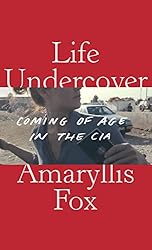
Life Undercover: Coming of Age in the CIA
Amaryllis Fox, 2019
Knopf Doubleday
240 pp.
ISBN-13: 9780525654971
Summary
Amaryllis Fox's riveting memoir tells the story of her ten years in the most elite clandestine ops unit of the CIA, hunting the world's most dangerous terrorists in sixteen countries while marrying and giving birth to a daughter.
Amaryllis Fox was in her last year as an undergraduate at Oxford studying theology and international law when her writing mentor Daniel Pearl was captured and beheaded.
Galvanized by this brutality, Fox applied to a master's program in conflict and terrorism at Georgetown's School of Foreign Service, where she created an algorithm that predicted, with uncanny certainty, the likelihood of a terrorist cell arising in any village around the world.
At twenty-one, she was recruited by the CIA. Her first assignment was reading and analyzing hundreds of classified cables a day from foreign governments and synthesizing them into daily briefs for the president. Her next assignment was at the Iraq desk in the Counterterrorism center.
At twenty-two, she was fast-tracked into advanced operations training, sent from Langley to "the Farm," where she lived for six months in a simulated world learning how to use a Glock, how to get out of flexicuffs while locked in the trunk of a car, how to withstand torture, and the best ways to commit suicide in case of captivity.
At the end of this training she was deployed as a spy under non-official cover—the most difficult and coveted job in the field as an art dealer specializing in tribal and indigenous art and sent to infiltrate terrorist networks in remote areas of the Middle East and Asia.
Life Undercover is exhilarating, intimate, fiercely intelligent—an impossible to put down record of an extraordinary life, and of Amaryllis Fox's astonishing courage and passion. (From the publisher.)
Author Bio
• Birth—ca. 1980-81
• Where—New York, New York, USA
• Education—B.A., Oxford University; M.S. (?), Georgetown University
• Currently—lives in Los Angeles, California
Amaryllis Fox was born in New York City to an English actress and American economist. Due to her father's work in the developing world, the family moved yearly to places in Africa, South East Asia, Europe, and the former Soviet Union. Those childhood experiences instilled in Fox both a calling and a feeling of being at home in far flung corners of the world.
Before heading to college, Fox volunteered in the Mai Laa refugee camp on the Thai-Burmese border; she ended up deferring her entrance to school, remaining in Burma to work with the Burmese democracy movement. A BBC interview she conducted with Burmese human rights activist (and 1991 Nobel laureate), Aung San Suu Kyi, landed her in prison at the age of 18.
In 1991, Fox entered Oxford University where she studied international law. She spent much of the following three years in East Timor, helping to settle displaced persons in the world's newest country. She also worked in war-torn Bosnia, helping to rebuild community trust in the aftermath of the 1995 massacre.
In 2002, Fox began graduate work in international security at Georgetown University. There she developed an algorithm to predict terrorist activity. Learning of her work, the CIA asked her to share the algorithm with the Agency.
Soon after, Fox began work as a political and terrorism analyst for South East Asia, requiring her to commute between Langley and Georgetown to finish her degree. Following graduation (with honors) in 2004, she moved into the CIA's operational training program, eventually serving as a Clandestine Service officer overseas until 2009.
Her work with the CIA became the subject of her 2019 memoir, Life Undercover: Coming of Age in the CIA.
Following her CIA career in the field, Amaryllis Fox has covered current events and offered analysis for CNN, National Geographic, Al Jazeera, the BBC, and other global news outlets. She speaks at events and universities around the world on the topic of peacemaking.
She is the co-host of History Channel's series American Ripper and lives in Los Angeles, California, with her husband and daughter. And, yes, she married a Kennedy. (Adapted from the publisher and WME Speakers.)
Book Reviews
Genius…. Fascinating…. [A]long with the cloak-and-dagger action, Fox writes movingly of trying to reconcile a career in espionage with family life…. A look inside the CIA that the agency isn’t ready for you to see…. [A] great read.
Washington Post
A timely, compelling story. As fellow citizens, we’d all do well to better understand what that vital work entails.
LA Times
Gripping…reads like a true-life thriller.
San Francisco Chronicle
Gripping…. Life Undercover sets aside high-octane street chases and gunfights for an equally riveting narrative of compassion, revealing that the path to peace is through understanding the common humanity in us all.
Paste Magazine
A riveting account of the decade the author spent risking her life in the CIA’s most clandestine unit.
People
(Starred review) Fox delivers a gripping memoir about the near decade she spent working for the CIA to help stop terrorism.… [She] masterfully conveys the exhilaration and loneliness of life undercover, and her memoir reads like a great espionage novel.
Publishers Weekly
(Starred review) [R]riveting…. Fans of Showtime's Homeland and espionage novels will devour this highly recommended memoir, as will readers interested in counterterrorism, nonprofileration, and peacemaking. —Barrie Olmstead, Lewiston P.L., ID
Library Journal
(Starred review) With loads of suspense and adrenaline,… this insider’s view into how the CIA functions and what life is like for a covert agent will appeal to many, including readers who don’t normally stray from fiction thrillers.
Booklist
Fox [writes] engagingly—and transparently…. Throughout much of her remarkable life, secrecy was the norm, but by the time she left the agency, she'd had enough. A well-written account of a life lived under exceptional secrecy and pressure.
Kirkus Reviews
Discussion Questions
We'll add publisher questions if and when they're available; in the meantime, use our LitLovers talking points to help start a discussion for LIFE UNDERDOVER … then take off on your own:
1. How did Amaryllis's childhood experiences and family life prepare her for life as a spy? Take into account the family's yearly moves, the secrets within her parents' marriage, and her genius, older brother—what role did each of those factors play?
2. Her best friends' death in the downing of the Pan Am flight had a powerful impact on Fox's life. Her father offered his eight-year-old daughter this response: "You have to understand the forces that took her. It will seem less scary if you do." What do you think of that advice? How would you have responded in his stead?
3. Even before she begins college, Fox strikes out on a mission, heading to Thailand and Burma to volunteer in a refugee camp and, later, to work for an underground newspaper. What enables someone so young—or a person of any age, really—to act with such idealism and courage? How do you account for such determination?
4. What were some of the greatest challenges in Fox's life as an undercover agent? Consider the physical danger inherent in covert operations, as well as the emotional toll it took on her.
5. (Follow-up to Question 4) Ultimately, what prompted her decision to leave the agency? What price did she realize she had paid after a decade of undercover work?
6. Finally, what lessons did Fox take away from her undercover work?
7. How does Amaryllis Fox's memoir compare with the HBO series Homeland?
(Questions by LitLovers. Please feel free to use them, online and off, with attribution. Thanks.)
Lilla's Feast: One Woman's Story of Love and War in the Orient
Frances Osborne, 2004
Random House
320 pp.
ISBN-13: 9780345472380
Summary
At the end of her life, Frances Osborne's one-hundred-year-old great-grandmother Lilla was as elegant as ever-all fitted black lace and sparkling-white diamonds. To her great-grandchildren, Lilla was both an ally and a mysterious wonder. Her bedroom was filled with treasures from every exotic corner of the world. But she rarely mentioned the Japanese prison camps in which she spent much of World War II, or the elaborate cookbook she wrote to help her survive behind the barbed wire.
Beneath its polished surface, Lilla's life had been anything but effortless. Born in 1882 to English parents in the beautiful North China port city of Chefoo, Lilla was an identical twin. Growing up, she knew both great privilege and deprivation, love and its absence. But the one constant was a deep appreciation for the power of food and place. From the noodles of Shanghai to the chutney of British India and the roasts of England, good food and sensuous surroundings, Lilla was raised to believe, could carry one a long way toward happiness. Her story is brimming with the stuff of good fiction: distant locales, an improvident marriage, an evil mother-in-law, a dramatic suicide, and two world wars. Lilla's remarkable cookbook, which she composed while on the brink of starvation, makes no mention of wartime rations, of rotten vegetables and donkey meat. In the world this magical food journal, now housed in the Imperial War Museum in London, everyone is warm and safe in their homes, and the pages are filled with cream puffs, butterscotch, and comforting soup. In its writing, Lilla was able to transform the darkest moments into scrumptious escape.
Lilla's Feast is a rich evocation of a bygoneworld, the inspiring story of an ordinary woman who tackled the challenges life threw in her path with an extraordinary determination. (From the publisher.)
Author Bio
Frances Osborne is a former lawyer, stockbroker, and freelance journalist turned full-time writer. She lives in London with her husband, George Osborne, the youngest Member of Parliament, and her two young children.
Book Reviews
Osborne is amazed by her great-grandmother Lilla, whose remarkable life took her from her birth in 1882 in Chefoo, China, to a "not quite prudent" marriage in India, a WWII Japanese internment camp and the end of her life in an England that didn't want her. Regardless of her surroundings, Lilla created a cozy home for her family, excelling in culinary delights. Osborne, who was 13 when Lilla died at 100, wanted to learn more about the mysteries of her great-grandmother's life: "There was an allusion to a `real father,' who had shot himself.... [T]here was the unheard-of child whom, in a whispered confession, she said she had made herself miscarry." Osborne's research is comprehensive: she draws on family letters, interviews with former colonialists and camp prisoners, historical references and even a recipe book Lilla wrote while interned, and she seamlessly entwines historical events into the narrative. But what stops this biography from being a Far East Out of Africa is the clunky writing. Osborne injects cliched drama into situations and frequently uses sentence fragments to jarring effect. Furthermore, her conjecture and awkward language weaken the memoir's authoritativeness. Lilla, though, is a captivating character; her story rises above the writing's mediocrity. Forecast: Ballantine will target literary and cooking communities; it's possible they'll embrace this.
Publishers Weekly
A bright if modest tale of stiff-upper-lip indomitability against deadly odds. "This is a story of what large-scale history does to the small-scale people caught up in its events," writes London-based journalist Osborne by way of introducing the saga of her great-grandmother Lilla. Born to colonial parents in China in the glory days of the empire, Lilla learned of the tragic side of life early on: her father killed himself when she was just short of three, ostensibly because he had been bitten by a rabid dog, more likely because his wife was in love with another man. Lilla married young and moved with her army officer husband, Ernest Howell, to India, only to learn that the match wasn't quite heaven-made; even so, "in an almost childish way, she seems to have loved Ernie most when he wasn't interested in her." He died when his troop ship was sunk by a German submarine in 1915, and, Osborne writes rather archly, Lilla "played at being Ernie's widow just as she had played at being his wife." Returning to China, she lived comfortably until December 1941, when Japanese troops interned the European residents of Chefoo. Just shy of 60, Lilla had begun writing a cookbook some time earlier; now, imprisoned in Chefoo and later in the frozen northern Chinese city of Weihsien, she returned to it just to have something to do. The recipes aren't much, notable mostly for their absence of any kind of spice, but they clearly must have been challenging to write; as the camp rations were systematically cut as the Japanese began to lose the war, as meat and flour and oil went by the wayside, "bringing herself to type out these recipes must have begun to feel like self-torture," but also a curious exercisein hope. In all events, doing the work kept Lilla alive-indeed, she lived to be 100. A minor story, to be sure, but very well told.
Kirkus Reviews
Discussion Questions
1. Lilla spends her childhood as a "little princess," but she ends up a strong, independent woman. How much of this change do you attribute to the characteristics she was born with, and how much to the circumstances that she found herself in? To what extent do you think our personalities can be shaped by our experiences rather than what we inherit? Can you identify which traits of your own personality you have inherited, and which have been formed by your experiences?
2. "It is not often that lovers swap roles," writes Osborne. How do Ernie and Lilla change roles in their marriage? Does the love between them change? Lilla has three significant sexual relationships in her life. How do her feelings for each lover—and each for her—differ? Do her relationships improve or worsen? Do you think she was ever really in love?
3. Lilla's Feastis a family memoir. How does the fact that the author both knew and is related to Lilla affect the narrative? And what can the biography of an ordinary woman caught up in world eventsrather than a biography of a famous person orchestrating those events teach us? How different is history when seen from an eye-level point of view, rather than the political point ofview?
4. "Down by the waterfront," writes Osborne of nineteenth-century Shanghai, "the smells of steaming rice and charring meat mingled with traces of opium smoke." Lilla's Feast is marked by its descriptive passages, taking the reader to, inter alia, the mountains of India, Edwardian England, and a Japanese concentration camp. Where do you find Osborne's descriptive style most evocative? How does Osborne primarily create this effect in your chosen passage—through the context of physical surroundings, or calling on the senses? Which ones?
5. Food, to Lilla, is more than nutrition. She "dreams of peeling apples with insides like half-frozen snow." What role, or roles, does food play in the story? How do the attitudes of Alice Eckford, Ernie, and Papa Howell to food reflect their attitudes to life? In the prison camp, how do the inmates' changing circumstances affect their relationship with food? Has your own relationship with food ever been altered by events in your life?
6. Lilla was brought up "to be a wife and nothing else." How do the choices open to Lilla as a woman change during her lifetime? Do you think she takes full advantage of them? What do these changes reveal about the choices available to women today?
7. There is an old Chinese curse, "May you live in interesting times." Lilla's life took her through world wars and across the world in a time of great political upheaval, leading her to have to turn her life around and start over again and again. Which of her turnarounds do you find the most inspirational? Why?
8. "At the end of 1907, a long-awaited great hand reached down from the sky and plucked Ernie from his dusty desk," writes Osborne, making the point that people's lives can be turned this way or that by events over which they have little control. How much do external circumstances and chance—as opposed to the characters' own choices—change the lives of Lilla and her family members? How might Lilla's life have turned out if her husband's troopship had not been sunk by a U-boat in the Second World War? If she had married Malcolm Rattray, or another man, before the Great Depression of the early thirties? Or if the family firm had not gone bankrupt? At what other points could Lilla's life have gone in another direction—and how? Can you identify any similar turning points for yourself where an external event, or your own choice, has fundamentally changed the course of your life?
9. To what extent do the forceful characters of Lilla's and Ernie's mothers affect their lives? What does the interaction between the Howells and the Eckfords reveal about social and intellectual snobbery between older, educated families and new money at the turn of the twentieth century? Does the same pattern hold true in any way today?
10. What prompted Lilla to start writing her cookbook? What added symbolism did it take on once she had been marched out of her home and imprisoned? How did her relationship to her cookbook change during her years in the camp? Why do you think she hid the book when she was released?
11. "Every aspect of the inmates' lives in Weihsien [prison camp] was ordered by layer upon layer of ruthlessly efficient committees," writes Osborne. What does the formation of these committees reveal about humans' innate desire to organize themselves into hierarchies? Why do you think this is? Have you ever been a founding member of any club or organization? How did its hierarchy evolve?
12. Even though none of Lilla's family had any Chinese ancestry, and they had come to China as "colonials," many of her family felt that China was their real home, the only place to which they belonged. What was it about China that made it home to Lilla? What does this tell us about the meaning of home? What made Lilla turn down the chance to escape after Pearl Harbor? Does this help to explain why, even today, people living in war zones appear to fail to flee until it is too late?
(Questions issued by publisher.)
top of page

The Lincoln Conspiracy: The Secret Plot to Kill America's 16th President—and Why It Failed
Brad Meltzer, Josh Mensch, 2020
Flatiron Books
448 pp.
ISBN-13: 9781250317483
Summary
The bestselling authors of The First Conspiracy, which covers the secret plot against George Washington, now turn their attention to a little-known, but true story about a failed assassination attempt on President Lincoln.
Everyone knows the story of Abraham Lincoln’s assassination in 1865, but few are aware of the original conspiracy to kill him four years earlier in 1861, literally on his way to Washington, D.C., for his first inauguration.
The conspirators were part of a pro-Southern secret society that didn’t want an antislavery President in the White House. They planned an elaborate scheme to assassinate the brand new President in Baltimore as Lincoln’s inauguration train passed through en route to the Capitol.
The plot was investigated by famed detective Allan Pinkerton, who infiltrated the group with undercover agents, including one of the first female private detectives in America.
Had the assassination succeeded, there would have been no Lincoln Presidency, and the course of the Civil War and American history would have forever been altered. (From the publisher.)
Author Bio
Brad Meltzer
• Birth—April 1, 1970
• Raised—Brooklyn, New York City, New York; Miami, Florida, USA
• Education—B.A., University of Michigan; J.D., Columbia University
• Currently—lives in Florida
Brad Meltzer is the #1 New York Times bestselling author of The Escape Artist (2018) The Inner Circle (2011), and many other bestselling thrillers, as well as the "Ordinary People Change the World" series. He is also the host of the History Channel TV shows Brad Meltzer’s Decoded and Brad Meltzer’s Lost History, which he used to help find the missing 9/11 flag that the firefighters raised at Ground Zero. (From the Publisher.)
Josh Mensch is a New York Times bestselling author and documentary television producer with a focus on American history and culture. He is coauthor with Brad Meltzer of The First Conspiracy: the Secret Plot to Kill George Washington (2019).
For television Mensch has written, directed, and been a showrunner on nonfiction series for PBS, the History Channel, National Geographic, and many other networks. He lives in Brooklyn, NY with his wife and children. (From the publisher.)
Book Reviews
[F]ascinating and extremely readable… like an expertly crafted thriller.… [The authors] have clearly done their homework, and they prove to be experts at rendering history in an urgent, exciting way… [Yet] despite its dark subject matter, [The Lincoln Conspiracy is] relentlessly fun to read.… It's an expertly crafted book that seems sure to delight readers with an interest in lesser-known episodes of American history.
Michael Schaub - NPR
[A] solid recounting of the conspiracy to assassinate president-elect Abraham Lincoln…. Meltzer and Mensch maintain suspense despite the known outcome of the story, and convincingly counter claims that Pinkerton made the whole thing up for publicity purposes.
Publishers Weekly
[The] authors follow the trail of intrigue, disguises, deceptions, and countermoves…. [This] instructive accounting of the mentality, movements, and means of Pinkerton and his agents makes for a revealing look inside the world of secessionist fanaticism. —Randall M. Miller, St. Joseph's Univ., Philadelphia
Library Journal
[The] discussion of how the newly founded Pinkerton Agency infiltrated the conspiracy includes unexpected details of undercover work, 1860s-style—including by pathbreaking women detectives. A delightful addition to popular literature on the Civil War era.–
Booklist
[S]hort, energetic chapters… fashion a brisk political thriller…. [T]he authors vividly convey the virulent racism endemic in the South. A sharply drawn episode from a regrettable part of America's past. (b/w illustrations).
Kirkus Reviews
Discussion Questions
We'll add publisher questions if and when they're available; in the meantime, use our LitLovers Book Club Resources. They can help with discussions for any book:
• How to Discuss a Book (helpful discussion tips)
• Generic Discussion Questions—Fiction and Nonfiction
• Read-Think-Talk (a guided reading chart)
(Resources by LitLovers. Please feel free to use them, online and off, with attribution. Thanks.)


Lit: A Memoir
Mary Karr, 2009
HarperCollins
368 pp.
ISBN-13: 9780060596996
Summary
Mary Karr’s bestselling, unforgettable sequel to her beloved memoirs The Liars’ Club and Cherry—and one of the most critically acclaimed books of the year—Lit is about getting drunk and getting sober; becoming a mother by letting go of a mother; learning to write by learning to live.
The Boston Globe calls Lit a book that “reminds us not only how compelling personal stories can be, but how, in the hands of a master, they can transmute into the highest art." The New York Times Book Review calls it “a master class on the art of the memoir” in its Top 10 Books of 2009 Citation. Michiko Kakutani calls it “a book that lassos you, hogties your emotions and won’t let you go” in her New York Times review. And Susan Cheever states, simply, that Lit is “the best book about being a woman in America I have read in years."
In addition to the New York Times, Lit was named a Best Book of 2009 by the New Yorker (Reviewer Favorite), Entertainment Weekly (Top 10), Time (Top 10), the Washington Post, the San Francisco Chronicle, the Chicago Tribune, the Christian Science Monitor, Slate, the St. Louis Post Dispatch, the Cleveland Plain Dealer, and the Seattle Times. (From the publisher.)
Author Bio
• Birth—January 16, 1955
• Where—Groves, Texas, USA
• Education—M.F.A., Goddard College
• Awards—(see below)
• Currently—teaches English at Syracuse University.
Mary Karr is an American poet, essayist, and memoirist. She rose to fame in 1995 with the publication of her bestselling memoir The Liars' Club. She is the Jesse Truesdell Peck Professor of English Literature at Syracuse University and, in 2015, was chosen to deliver the commencement speech at the university.
Memoirs
Her memoir The Liars' Club, published in 1995, was a New York Times bestseller for over a year and was named one of the year's best books. It delves vividly and often humorously into her deeply troubled childhood, most of which was spent in a gritty industrial section of Southeast Texas in the 1960s. She was encouraged to write her personal history by her friend Tobias Wolff, but has said she only took up the project when her marriage fell apart.
She followed the book with another memoir, Cherry (2000), about her late adolescence and early womanhood.
A third memoir Lit details her "journey from blackbelt sinner and lifelong agnostic to unlikely Catholic," came out in 2009. She writes about her time as an alcoholic and the salvation she found in her conversion to Catholicism. She does, however, describe herself as a cafeteria Catholic.
In 2015 Karr published The Art of Memoir. Based on her writing class syllabus at Syracuse, the book is aimed at novice writers yet may also appeal to the general public for its humor and for its insights into the writing process. The book includes an extensive list of Karr's recommended memoirs in the appendix.
Poetry and essays on poetry
Karr won a 1989 Whiting Award for her poetry. She was a Guggenheim Fellow in poetry in 2005 and has won Pushcart prizes for both her poetry and her essays. Karr has published four volumes of poetry: Abacus (1987), The Devil's Tour (1993), Viper Rum (1998), and Sinners Welcome (2006). Her poems have appeared in major literary magazines such as Poetry, New Yorker, and Atlantic Monthly.
Karr's Pushcart Award winning essay, "Against Decoration." was published in the quarterly review Parnassus (1991). The essay argues for content over poetic style—insisting that emotions need to be expressed directly and with clarity. She criticized the use of obscure characters, imprecise or "foggy" descriptions of the physical world, and "showy, over-used references. She also holds that abstruse language—polysyllables, archaic words, intricate syntax, "yards of adjectives"—serve only as an obstacle to readers' understanding.
Karr directly criticized well-known, well-connected, and award-winning poets such as James Merrill, Amy Clampitt, Vijay Seshadri, and Rosanna Warren (daughter of Pulitzer Prize winner Robert Penn Warren). Karr favors controlled elegance to create transcendent poetic meaning out of not-quite-ordinary moments, presenting James Merrill's "Charles on Fire" as a successful example.
Another essay, "Facing Altars: Poetry and Prayer," was published in Poetry (2005). Karr tells of her move from agnostic alcoholic to baptized Catholic of the decidedly "cafeteria" kind, yet one who prays twice daily with loud fervor from her "foxhole." In the essay Karr argues that poetry and prayer arise from the same sources within us.
Personal life
In the 90s, Karr dated David Foster Wallace, who once tried to push her out of a moving car.
Awards and honors
1989 - Whiting Award
1995 - PEN/Martha Albrand Award for The Liars' Club
2005 - Guggenheim Fellowship. (Adapted from Wikipedia. Retrieved 9/30/2015.)
Book Reviews
Searing.... [Karr] has written a book that lassos you, hogties your emotions and won't let you go. It's a memoir that traces the author's descent into alcoholism and her conflicted, piecemeal return from that numb hell—a memoir that explores the subjectivity of memory even as it chronicles with searching intelligence, humor and grace the author's slow, sometimes exhilarating, sometimes painful discovery of her vocation and her voice as a poet and writer…the book is every bit as absorbing as Ms. Karr's devastating 1995 memoir, The Liars' Club, which secured her place on the literary map.
Michiko Kakutani - New York Times
You always knew Mary Karr wasn't telling you everything. There were tantalizing hints of adult life in her two coming-of-age memoirs, The Liars' Club and Cherry. But Lit is the book in which she grows up and gets serious, as serious as motherhood, as serious as alcoholism, as serious as God. And it just makes her funnier. In a gravelly, ground-glass-under-your-heel voice that can take you from laughter to awe in a few sentences, Karr has written the best book about being a woman in America I have read in years.
Susan Cheever - New York Times Book Review
If the first two volumes of her memoirs strutted, this one proceeds more modestly: Karr is full of regret, but she's also as funny as ever on the subject of her own sinning. Although these pages sometimes strain for effect…the language often captures, precisely, the tension between the intellectual and the emotional, the artistic and the spiritual. This is a story not just of alcoholism but of coming to terms with families past and present, with a needy self, with a spiritual longing Karr didn't even know she possessed. It sounds as if she was hellish to be around for much of the time she describes here, but she is certainly good company now.
Valier Sayers - Washington Post
Karr performs her brave memoir about alcoholism, getting sober, and getting God in a confident Texas drawl. Readers familiar with The Liar's Club, Karr's account of her childhood will find parallels—her descent into alcoholism differs from her mother's addiction only in the details. Karr revisits her past with rare candor and humor, recounting her role in the disintegration of her marriage to “Warren Whitbread,” the reserved scion of a fabulously wealthy family (whose other members are deliciously skewered here), and her most shameful moments (leaving her feverish toddler to take a long swig from the bottle of Jack Daniels stashed in the oven). When Karr undergoes a hard-won spiritual awakening through the combined efforts of AA; her spiritual director, Joan the Bone; and a stay in the “Mental Marriott,” listeners will be cheering.
Publishers Weekly
Currently an award-winning, best-selling memoirist who described herself as an "on-my-knees [Catholic] spouter of praise" in a 2007 New York Times blog interview, Karr (The Liars' Club; Cherry) narrowly escaped a troubled upbringing and early adulthood that included alcoholic, psychotic parents, being raped as a child, and her own descent into alcoholism. She describes hitting rock bottom—an event that marked her transformation into the mother she was trying to escape—and her subsequent conversion to Catholicism in addition to the maturation of her writing style. The writing here sometimes seems affected, but her tale is riveting, her style clear-eyed and frank. That Karr survived the emotional and physical journey she regales her readers with to become the evenhanded, self-disciplined writer she is today is arguably nothing short of a miracle, and readers of her previous two books won't be disappointed. Verdict: This latest installment of Karr's autobiographical saga is essential for fans of lurid, meaty memoirs. —Megan Hodge, Randolph-Macon Coll. Lib., Ashland, VA
Library Journal
Acclaimed poet and bestselling memoirist Karr (English Literature/Syracuse Univ.; Sinners Welcome: Poems, 2006, etc.) deftly covers a vast stretch of her life-age 17 to her present 50. The author picks up where her 2000 memoir Cherry left off-escaping her toxic childhood in small-town Texas for the California coast. Quickly bored, and realizing it was a mistake to turn her back on higher education, Karr secured loans and sought the book-lined security of the college campus. Most of the scenes that unfold from here, unlike those from her eccentric childhood, are more familiar: the college student desperate to manifest her intellect; the poor country girl trying to prove to her rich WASP dinner hosts that she's worthy of their son; a sleep-deprived new mom with a pot roast to cook; the AA newcomer who thinks she doesn't really have a problem; the sinful skeptic arriving at faith. The difference, though, is the way in which Karr renders these stories. She still writes with a singular combination of poetic grace and Texan verve, which allows her to present the experiences as fresh, but she also brings a potent, self-condemning honesty and a palpable sense of responsibility and regret to the narrative. These elements were necessarily absent from her previous memoirs, in which there were plenty of adults to blame; she is writing from a significantly different place now. Her confessional of outrunning her past only to encounter the same monsters, before being saved by prayer and love for her son, is richer for it. Karr also provides fascinating anecdotes from her experiences as a writer, especially her time at Harvard and the emotional publication of her universally praised debut memoir, The Liars' Club (1995). Will ring as true in American-lit classrooms as in church support groups-an absolute gem that secures Karr's place as one of the best memoirists of her generation.
Kirkus Reviews
Discussion Questions
1. The first sentence of Lit is "Any way I tell this story is a lie." What does Mary mean by this? Is she a reliable storyteller? Is there a story in your family famous for its different versions? Is there a story you can't tell without "feeling" like it's partially untrue?
2. Mary refers to her mother as "a shadow stitched" to her feet, and to herself and her mother as "dovetailing drunks" and as facing off "like a pair of mirrors". What does this say about Mary's relationship with her mother? Do all women feel this way about their moms? At what age is it most painful? At what age—if any—does it end?
3. Mary writes, "I sense the oppressive weight of my old self inside me pressing to run wild again. My old mother I'm trying to keep in." Have you ever found yourself wincing at how you resemble your mother?
4. How is Mary's trip to college with Mother the "hairpin", as she describes it, in her early life? This trip marks her introduction to real drinking, but it's also the point at which Mary would "start furnishing [Mother] with reading instead of the other way around." What does Mary mean by this, and what's the significance of this transition? Was there an "official" transition to adulthood in your life? Was it marked by college, marriage, parenthood, career success, or something else?
5. "Words shape our realities," Mary concludes when she registers the meaning of the Ernst Cassirer quote: "The same function which the image of God performs, the same tendency to permanent existence, may be ascribed to the uttered sound of language". How does this realization frame Mary's determination to become a poet? At what times do religion and poetry seem to do the same things for her?
6. Mary calls poetry "one of the sole spiritual acts in our mostly godless household" and poets "the gods I worshipped all my life" Has literature ever substituted for spirituality with you? In what ways has it done so?
7. Mary describes Daddy as a silent fixture of her adolescence. How does her father's silence emerge, later, as a threatening force? How does her father's silence compare to the silence of the Whitbread's, and to Warren's characteristic reserve? If Mary understood early on that "words would define me, govern and determine me", then in what way is "wordlessness" her enemy?
8. Why does Mary call her time in recovery a "nervous breakthrough"? Have the darker times in your own life preceded or manifested similar changes or moments of clarity?
9. Mary has "mysterious blanks" in her memory of fights with Warren. What are the glaring blanks in your own memory? Do you think these are genuine blanks of memories or memories that you have chosen to block out?
10. In what ways does Mary's son Dev save her? If she had lost custody of him in a divorce, would she still have gotten sober? How have your children made you better, at time, or ground you to a nub in others?
(Questions issued by publisher.)


Little Demon in the City of Light: A True Story of Murder in Belle Epoque Paris
Steven Levingston, 2014
Knopf Doubleday
352 pp.
ISBN-13: 9780307950307
Summary
In 1889, the gruesome murder of a lascivious court official at the hands of a ruthless con man and his pliant mistress launched the trial of the century.
When Toussaint-Augustin Gouffe entered 3, rue Tronson du Coudray, expecting a delightful assignation with the comely Gabrielle Bompard, he was instead murdered by Gabrielle and her lover, Michel Eyraud.
An international manhunt chased the infamous couple from Paris to America’s West Coast, culminating in a sensational trial that investigated the power of hypnosis to possess, control, and even kill.
As the inquiry into the guilt or innocence of the woman the French tabloids dubbed the "Little Demon" intensified, the most respected minds in France vehemently debated: Was Gabrielle Bompard the pawn of her mesmerizing lover or simply a coldly calculating murderess capable of killing a man in cold blood? (From the publisher.)
Author Bio
• Birth—1956
• Rasied—California, USA
• Education—B.A., University of California-Berkeley; M.A., Stanford University
• Currently—lives in Bethesda, Maryland
Steven Levingston is the nonfiction editor of the Washington Post. He also writes books and plays and does some book reviewing. Most recently, he is author of Little Demon in the City of Light: A True Story of Murder and Mesmerism in Belle Époque Paris (2014) and The Kennedy Baby: The Loss that Transformed JFK (2013).
Before taking on the greatest job in the world as nonfiction editor, he worked for the Wall Street Journal, International Herald Tribune, Associated Press and China Daily, with stints in Beijing, Hong Kong and Paris. He grew up in California and graduated from the University of California at Berkeley and Stanford University. He now lives in Bethesda, Maryland with his wife and two children. (Adapted from the publisher and from the author's website.)
Book Reviews
Levingston has unearthed a whopper of a story, and lovingly crafted a dense, lyrical yarn that hits the true-crime trifecta of setting, story and so-what. Such books remind us that times may change, but the human animal does not.
New York Times
Levingston, who is nonfiction book editor of the Washington Post and knows a good story when he sees one, has given it a richly enjoyable telling. Its lurid and improbable plot twists are expertly transposed into a breathless true-crime thriller set against a sumptuous evocation of the boulevards, nightclubs and boudoirs of Belle Epoque Paris."
Wall Street Journal
An engaging—and finally chilling—portrait of an uneasy era and a city of more shadow than light.
Washington Post
Fascinating.... A rich portrait of the period, as well as the intriguing story of a notorious murder case, with its strange (and often amusing) cast of characters.
Boston Globe
Equal parts period piece, forensic manual, and legal thriller, the book is a strong entry in the 'fascinating case in a fascinating time' genre.
Daily Beast
A terrific story well told.
Seattle Times
Readers are well-served by his reimagining of this amazing true story.
Minneapolis Star-Tribune
[T]he book is lovingly constructed from available sources, including newspapers, memoirs, and secondary histories, and immerses the reader in a period whose newfound obsessions—science and pseudo-science of the mind, criminal forensics, mass media, the macabre, and fame—have a seminal connection to our own time.
Publishers Weekly
[A] fascinating and easy-to-read true crime story about a sensational murder connected with hypnotism in late 19th-century Paris. [Levingston] weaves historical details of the grisly murder of a court official by a con man and his mistress...with background information about the rise of hypnotism in the scientific world.... Levingston's writing is entertaining yet informative, and clearly produced from years of research. —Amelia Osterud, Carroll Univ. Lib., Waukesha, WI
Library Journal
Levingston's smartly chipper prose and fine attention to detail...add an entertaining and authentic sensibility to this re-creation of a culture, a crime, and "the first time an accused murderer had put forward a hypnotism defense. —Eloise Kinney
Booklist
[Steven] Levingston uses the story of a murder by a foolish girl and her lover to illustrate another side of belle epoque Paris. The author foregoes the tabloid excesses and exploitation of lurid details from that time and focuses on the debate as to whether a person is capable of committing a crime under hypnosis or even post-hypnotic suggestion.... [A] well-constructed, informative work by a talented author.
Kirkus Reviews
Discussion Questions
1. Paris in the Belle Epoque was a strange and sensational place. What were some of the signs of its bizarre city life? Would you have liked to be alive then?
2. Do you think hypnotism has the powers that the French in the 19th century believed it had, even to the point that someone could be hypnotized to commit murder?
3. Women in the Belle Epoque were sometimes perceived as "hysterics." How did doctors and scientists treat women like that? And was it right?
4. The Paris newspapers played up the Gabrielle Bompard murder case. Consider the hunger of the press for the latest morsels about the little demon and her behavior. Were you surprised by the extent of the media hype more than a century ago? Discuss how this hype foreshadows the intense coverage of cases like the story of OJ Simpson.
5. Chief detective Goron was a classic, indefatigable gumshoe. What did you think of his style of police work?
6. Programs like CSI feature cutting edge forensics. But in the Belle Epoque, Dr. Alexandre Lacassagne was a pioneer in forensic science and his revolutionary techniques helped solve the case. How did early forensics figure in the story?
7. Putting the bloody trunk on display at the morgue for thousands of Parisians to see was just as much a spectacle as a night at the Moulin Rouge. Sigmund Freud, who was a medical student in Paris in 1885, wrote home: "Suffice it to say that the city and its inhabitants strike me as uncanny; the people seem to me of a different species from ourselves; I feel they are all possessed of a thousand demons." What did you think of the public’s eagerness to embrace the ghoulish?
8. Inspector Jaume felt that Gabrielle had become too popular and was disgusted by the public’s excitement over a murder suspect. "There is truly hypnotism in the air," he said. "Only it’s Gabrielle who magnetizes public opinion." Did you believe Gabrielle’s testimony?
9. What do you think of the sentencing of Gabrielle Bompard and Michel Eyraud. Fair or not?
10. Did this book change or inform your perception of Paris in the Belle Epoque?
(Questions courtesy of the author.)

Live, Love, Explore: Discover the Way of the Traveler, a Roadmap to the Life You Were Meant to Live
Leon Logothetis, 2016
Reader's Digest
256 pp.
ISBN-13: 9781621453239
Summary
Part travel memoir, part self-help book, Live, Love, Explore is a guide to finding meaning and adventure in your everyday life and discovering the road you were always meant to walk.
Leon Logothetis’s life was well plotted out for him. He was to do well in school, go to university, get a job in finance, and spend the next fifty years of his life sitting behind a slab of wood, watching the rain-slicked streets of London from thirty floors above.
For a long time, he followed that script, until one day, he finally realized he was living someone else’s life—a good one—but not one of his own choosing.
So he walked out of that life, and discovered the one that took him around the world. Since then, Leon has driven a broken-down English taxicab across America, offering people free rides; ridden a vintage motorbike around the world, relying solely on the kindness of strangers; and followed a fellow traveler through India without ever knowing where he was going.
He has visited more than 90 countries on every continent.
Along the way, he learned something about the human spirit and about the heart of this world. He learned that he needed to shed his old ideas about who he was supposed to be in order to feel his soul rise to the surface and become the person he always longed to be.
The wisest words he heard, and the greatest lessons he learned, came from everyday people he met on his travels. He became their accidental student, and after years of sharing those lessons through TV shows, college tours, books, and in the media, he realized that he had also become an accidental teacher. His experiences are more than a collection of stories, they have become a way of life—the Way of the Traveler.
So, what is the Way of the Traveler? It’s a roadmap to living your best life, loving with all your heart, and exploring the world—both the great and adventurous one waiting outside your door, and the even greater, more adventurous one waiting within your soul.
Weaving together Leon’s hilarious and heartwarming stories of his misadventures on the road with simple but profound exercises to help you uncover your true path, Live, Love, Explore will teach you how to live fully and without regrets.
It’s not to say that everyone who reads it will have to go to the ends of the world. Because you don’t have to go to Mongolia to discover the truths that lie inside. No, those life lessons can just as easily be learned from the people all around you—the chap serving you coffee at Starbucks, the woman sitting next to you on a plane, your co-workers, family, and friends.
There’s an entire world of people willing to teach you their lessons if you’re willing to learn.
And by opening yourself up to new adventures, by recognizing that you have the freedom to choose your own road, you’ll find something else that has been hiding in plain sight: you’ll find the life of which you have always dreamed… and the curiosity and courage it takes to make that life happen. (From the publisher.)
Author Bio
Leon Logothetis is a global adventurer, motivational speaker, and philanthropist.
Formerly a broker in the city of London, he gave it all up to travel and find real human connections. Author of The Amazing Adventures of a Nobody and The Kindness Diaries, Leon also hosted television series of the same names, which have aired in more than 100 countries.
He has documented his travels for numerous media outlets including Good Morning America, Los Angeles Times, San Francisco Chronicle, Outside, and Good.
In addition, Leon is the founder of the Human Interaction Project (HIP), which provides interactive learning opportunities for youth and adults alike by combining volunteerism with self-growth. He lives in Los Angeles, California. (From the author.)
Visit the author's website.
Book Reviews
It took me at least ten years to understand the connection between my travels and the life lessons that got me through tough times. Live, Love, Explore gets you there quicker to celebrate the wonderful, frightening, unexpected journey of life.
Samantha Brown, Travel Channel host
[A] bona fide page-turner—full of inspiring personal stories, charming anecdotes, and thought-provoking questions. You won’t want to put it down!
Light Watkins, Founder of the Shine Movement
[A] must-read for anyone searching for their true purpose in life. Inspiring and insightful, it outlines the lessons of the Way of the Traveler, a way of life to which we can all aspire.
Mark Divine, Commander, US Navy SEALs (ret.), founder of SEALFIT, and bestselling author of The Way of the SEAL
[An] instant classic. It reminds all of us that the big dreams we have in our hearts are within reach.
Shane Jeremy James, Founder of Actions of Compassion
[D]eserves my highest high kick! Leon's book has helped me find the adventure in my crazy life and can help you too!
Fredrik Eklund, Star of BRAVO’s Million Dollar Listing New York and bestselling author of The Sell
The life I was meant to live has always revolved around travel and media. To read real tips from Leon Logothetis, one of the travel industry's most inspiring figures, made me move beyond the mundane and dream of magical moments and big dreams.
Annie Fitzsimmons, Editor-at-Large, National Geographic Traveler
Leon has nailed it. It's rare that one so young gets what we all eventually find out; that the grandest and most difficult of journeys is to find and make peace with ourselves. He not only speaks so eloquently of it, he shows us the way.
Ted Klontz, Co-author of The Financial Wisdom of Ebenezer Scrooge
In Leon's latest book, the reader is taken on yet another journey of self-exploration and enlightenment. Leon truly represents the nomadic soul of a traveler seeking answers.
Dane Steele Green, CEO, Steele Luxury Travel, Huffington Post blogger
Leon shares wonderful real-life experiences that are bound to rejuvenate your soul—often from the most unlikely people and places. Live, Love, Explore is entertaining, insightful, and inspiring.
J.P. Hansen, Success coach, inspirational speaker and bestselling, award-winning author of The Bliss List and Find Your Bliss
Leon does it again! In his newest book, Leon so generously shares his experiences which has provided me invaluable guidance on living my best life.
Brad Jamison, Founder of Good Citizen
Leon shares his hilarious and heartwarming stories of his adventures on the road. Through his wonderful gift of story, I've learned to live my life more fully and without regrets. Thank you!
Lyss Stern, Founder and CEO, Divalysscious Moms, bestselling author and columnist
Leon sets himself apart with his powerful message paired with such authentic delivery. His insights from his personal experiences have helped me have a more clear vision for a more happy and fulfilling life. Live, Love, Explore is funny, deeply moving and beyond inspiring.
Margie Warrell, Life coach and bestselling author
Discussion Questions
1. What Are Your Key Life Events? As you look at your own life, what are the five key events that have made you who you are today, either connecting you to your sense of purpose or preventing you from realizing it? Think back to your early childhood, and review the challenges of adolescence. Maybe some of these moments took place in your early years of work, marriage, or child rearing. What five life events have shaped you?
2. What Makes Up Your Creative DNA? Your themes might be rooted in creativity: being a writer or actor or sculptor. For others, the themes might have to do with science or math or engineering. For me, it was travel and connectivity and being of service. Discuss the three themes that run through your life, and how you can begin dedicating more time to them.
3. What Are Your Accidental Opportunities? Take a look at your own life history and identify three accidental opportunities and discuss.
4. Who have been the accidental heroes in your life? The ones that sometimes gently, sometimes with greater force, have pulled you out of the muck, and reminded you that you are not alone. Discuss three of them.
6. How Can You Throw Yourself Off Balance? Discuss three things that sound incredibly uncomfortable to you, and pick one to actually do…
7. Where are the miracles in your life today? Discuss three moments where you saw the magic in your everyday existence.
8. What are your gifts and how could you start sharing them? Discuss what you can do today to share your gifts with the world?
9. Which personal stories you tell yourself should you question? What expectations did others put upon you? Think back through those belief systems you were raised with. What values were considered most important? What type of life were you expected to lead? Discuss three of these expectations and how they have affected your life?
10. When Can You Stop and See the Magic of life? Where do you need to slow down today? Is it spending more time with your kids or family? Is it watching the sunrise in the morning or the sunset at night? What activities can you begin doing that will reconnect you to the magic in your life?
(Questions issued by the publisher.)


Living with a Wild God: A Nonbeliever's Search for the Truth about Everything
Barbara Ehrenreich, 2014
Grand Central Publishing
256 pp.
ISBN-13: 9781455501762
Summary
In middle age, Ehrenreich came across the journal she had kept during her tumultuous adolescence and set out to reconstruct that quest, which had taken her to the study of science and through a cataclysmic series of uncanny-or as she later learned to call them, "mystical"-experiences. A staunch atheist and rationalist, she is profoundly shaken by the implications of her life-long search.
Part memoir, part philosophical and spiritual inquiry, Living with a Wild God brings an older woman's wry and erudite perspective to a young girl's uninhibited musings on the questions that, at one point or another, torment us all. Ehrenreich's most personal book ever will spark a lively and heated conversation about religion and spirituality, science and morality, and the "meaning of life."
Certain to be a classic, Living with a Wild God combines intellectual rigor with a frank account of the inexplicable, in Ehrenreich's singular voice, to produce a true literary achievement. (From the publisher.)
Author Bio
• Birth—August 26, 1941
• Where—Butte, Montana, USA
• Education—B.A., Reed College; Ph.D., Rockefeller University
• Currently—lives in Alexandria, Virginia
Barbara Ehrenreich an American author best known for Nickle and Dimed: On (Not) Getting By in America (2001). She is also the author of Bait and Switch: The (Futile) Pursuit of the American Dream (2005), This Land Is Their Land: Reports From a Divided Nation (2008), Living with a Wild God: A Nonbeliever's Search for the Truth about Everything (2014) and numerous other books. A frequent contributer to Time, Harper's, Esquire, The New Republic, Mirabella, Nation, and New York Times Magazine, she lives near Key West, Florida.
More
Ehrenreich was born Barbara Alexander to Isabelle Oxley and Ben Alexander. Her father was a copper miner who went on to study at Carnegie Mellon University and who eventually became an executive at the Gillette Corporation. Ehrenreich studied physics at Reed College, graduating in 1963. Her senior thesis was entitled Electrochemical oscillations of the silicon anode. In 1968, she received a Ph.D in cellular biology from Rockefeller University.
Citing her interest in social change, she opted for political activism instead of pursuing a scientific career. She met her first husband, John Ehrenreich, during an anti-war activism campaign in New York City.
In 1970, her first child, Rosa (now Rosa Brooks), was born. Her second child, Benjamin, was born in 1972. Barbara and John divorced and in 1983 she married Gary Stevenson, a warehouse employee who later became a union organizer. She divorced Stevenson in the early 1990s.
From 1991 to 1997, Ehrenreich was a regular columnist for Time magazine. Currently, she contributes regularly to The Progressive and has also written for the New York Times, Mother Jones, The Atlantic Monthly, Ms, The New Republic, Z Magazine, In These Times, Salon.com, and other publications.
In 1998, the American Humanist Association named her the Humanist of the Year.
In 1998 and 2000, she taught essay writing at the Graduate School of Journalism at the University of California, Berkeley.
In 2004, Ehrenreich wrote a month-long guest column for the New York Times while regular columnist Thomas Friedman was on leave and she was invited to stay on as a columnist. She declined, saying that she preferred to spend her time more on long-term activities, such as book-writing.
Ehrenreich was diagnosed with breast cancer shortly after the release of her book, Nickel and Dimed: On (Not) Getting By in America. In her article "Welcome to Cancerland," published in the November 2001 issue of Harper's Magazine, she describes her breast cancer experience and debates the medical industry's problems with the issue of breast cancer.
In 2006, Ehrenreich founded United Professionals, an organization described as "a nonprofit, non-partisan membership organization for white-collar workers, regardless of profession or employment status. We reach out to all unemployed, underemployed, and anxiously employed workers—people who bought the American dream that education and credentials could lead to a secure middle class life, but now find their lives disrupted by forces beyond their control."
Ehrenreich is currently an honorary co-chair of the Democratic Socialists of America. She also serves on the NORML Board of Directors and The Nation's Editorial Board. ("More" from Wikipedia.)
Book Reviews
Using her [girlhood] journal extracts as a point of departure, Ehrenreich returns with vigor to her youthful quest, enlisting all of her subsequent scientific training to find an explanation for what had occurred to her as a girl, yet offering only a glimmer in her wise and tolerant later years of a possibility of a “living, breathing Other.”
Publishers Weekly
The New York Times best-selling author of Nickeled and Dimed, Ehrenreich set out to reconstruct an adolescent quest detailed in an old journal she discovered. Her youthful goal of understanding the truth of the universe—ambitious plan—took her through the study of science and several heightened experiences that now seem mystical. There's much for the adult Ehrenreich, an atheist and rationalist, to ponder.
Library Journal
In 1959, the 16-year-old author had an ineffable vision, which she here contextualizes and attempts to understand. Ehrenreich returns with a personal chronicle, a coming-of-age story with an edge and a focus: Who am I? ... A powerful, honest account of a lifelong attempt to understand that will please neither theists nor atheists.
Kirkus Reviews
Discussion Questions
Use our LitLovers Book Club Resources; they can help with discussions for any book:
• How to Discuss a Book (helpful discussion tips)
• Generic Discussion Questions—Fiction and Nonfiction
• Read-Think-Talk (a guided reading chart)
(We'll add specific questions if and when they're made available by the publisher.)


A Long Way from Paris
E.C. Murray, 2014
Plicata Press
280 pp.
ISBN-13: 9780990310211
Summary
IIn this searing true story named one of KIRKUS BEST BOOKS of 2014, EC Murray discards her dream of being a famous writer in Paris and hitchhikes by herself to the south of France where she winds up herding goats on a remote mountain farm.
Living with a non-English speaking family (she speaks little French) she carves a life without running water, heat, and only two electric light bulbs. Struggling under the watchful eye of the harsh matriarch, this city girl fails at farm chores. She can’t carry buckets of water, milk goats, or work fast enough making goat cheese.
Murray recently lost sixty pounds, so her body is stiff and unused to the rigor of mountain life. Still, she feels a spiritual calling to this remote Languedoc farm, west of the Mediterranean, north of the Pyrenees. Life eases when a young English speaking shepherd joins the family.
Together, Murray and Randy laugh and eke fun where they can. He teaches Murray how to tend the goats, sheep, and ornery pregnant cow. As Elizabeth slides into her role as goatherd, she spends hours at a time alone with her animals, reading, meditating, and mulling over the classic books she never read in school—Anna Karenina, Pride and Prejudice, The Reivers.
Murray yearns for the boy she left behind, her first love. He captured her heart, but lived a self-destructive lifestyle. She remembers her days doing drugs and partying, and in contrast, relishes the clarity she finds up in the fresh air and open sky of the countryside.
Throughout this riveting book, Elizabeth reflects on her days at an elite New England prep school, her wilder days as an Oregon hippie, and her student days as a philosophy major. When tragedy strikes the family and the matriarch departs, Murray realizes her metamorphous as she runs the farm with new strength, confidence and competence.
Author Bio
• Birth—N/A
• Where—Holyoke, Massachusetts, USA
• Education—B.S., University of Oregon, Washington; M.S.W., University of Washington
• Currently—lives near Seattle, Washington
Although EC Murray wrote her first play, Lilly and Milly Go to Mars, in second grade, decades passed before she returned to writing. In the interim, she roamed from her conservative New England home to the west coast, and on to Europe, Asia, Africa, South America, and Australia. Her jobs ranged from being a cocktail waitress to telephone book deliverer; from wedding hostess and to goatherd; from retail clerk to bureaucrat. Eventually, she earned a Masters in Social Work, and worked with people with developmental disabilities. Romance struck, then marriage, child, and all the accoutrements: soccer tournaments, dance recitals, cross country meets, family fun.
As empty nesting approached, she returned to school to learn the craft of writing: the University of Washington, Richard Hugo House, and Southampton Writers Conference. She founded and publishes The Writers Connection, a newsletter and Web site for readers and writers, and today, writes, tutors, and teaches at Tacoma Community College.
Works
- The Paralympic Games, Vancouver—2012 Strokes and Spokes
- Be a Tourist in Tacoma – Seattle’s Child
- Lady Gaga’s Bus Tour; Bus Reduction – Tacoma Volcano
- When Mom is Puking – Hybrid Mom
- Be a Tourist in Gig Harbor – Seattle’s Child
- Transit Cuts for People with Disabilities—Tacoma Volcano
- Paralympics Vancouver – ABILITY magazine
- Life Kind of Sucks—Published by The Writers Connection, 2014
- "The Urban Goatherd" –Wilderness Literary House Review (nominated for a Pushcart
Award award and Honorable Mention for New Millenium Writings.)
(Author bio from the author).
Visit the author's website and The Writers' Connection.
Book Reviews
A riveting read. Murray engages the senses every step of the way.
Scott Driscoll, University of Washington, author of Better You Go Home
Murray is both a sharp observer of the local color and a cartographer of her own internal geography, making A Long Way from Paris as richly textured as fromage de chèvre.
Langdon Cook, author of The Mushroom Hunters
[EC Murray] beautifully explores her deep awareness of the land, an unfolding appreciation of hard work and the importance of family. The result is a fascinating journey filled with wisdom, grace and compassion.
Carlene Cross, author of The Undying West, Fleeing Fundamentalism
EC Murray brings the reader to the haunting, godforsaken beauty of the French Pyrenees…living a life stripped down to the basics, her senses, intuition, and heart must take over. It is a thoughtful, heartwarming journey…that leads…to the core of life.
Beth Corcoran, Lévis-Lauzon College
Written with beauty, candor and wit.
Wendy Hinman, author of Tightwads on the Loose
Totally engrossing and imbued with both humor and heartbreak. Murray has infused the everyday with meaning and adventure.
Carol Wissmann, Freelance writer, editor, and speaker.
Anyone who’s struck out on the road to find themselves (and those who’ve wanted to!) will surely see themselves in E.C. Murray’s lovely and nicely rendered A Long Way from Paris.
Theo Pauline Nestor, author of Writing is My Drink.
Every woman—and her daughter—should read this book, brimming with gentle insights and strength of spirit, as sometimes we, like the author, mistakenly believe ourselves bereft of both.
Carol Wissmann, Freelance writer, editor, and speaker.
[A] young American woman backpacking through Europe.... A Long Way from Paris recounts [the author's] jarring transformation from footloose vagabond to live-in, language-deficient goatherd for a family in the mountains of Languedoc.... Flecked with humor and bittersweet candor, this account captures the essence of coming of age.
Bellingham and Kitspa Sun
A rich, lucid debut memoir of an American hippie’s adventures on a goat farm in southern France in the early 1980s, pieced together from the author’s journals.... A welcome memoir of France that offers a complex mosaic of memories (a Kirkus Best Book for 2014).
Kirkus Reviews
Discussion Questions
1. Murray is shocked at Jacques eating like "an eagle coming in for the kill" because she grew up with a rigid idea of acceptable table manners. How important are manners and etiquette? Do you adhere to the manners you grew up with or have you incorporated new ones?
2. How did Murray’s relationship with her herd change and foster her growth? As Murray reflects on her family’s behaviors, she sees some she values, some she shuns. In what way is she "re-parenting" or "reinventing" herself out on the hillside?
3. Murray writes, "when you have 'it'—a true spiritual connection, there’s no need to broadcast it or put it on bumper stickers." Do you think it’s important to reveal to others your spiritual beliefs? Why or why not?
4. George Eliot writes in Adam Bede that "people living closest to nature are the ‘purest,’" a phrase Murray mulls over. Do you think this is true? Why? How did the books Elizabeth read influence her understanding of life with the Fontaines?
5. Murray reflects on losing weight saying, "I lost weight in my body, but not my mind." What does she mean by this? Do you think this is why many people gain their weight back after losing it?
6. A Long Way from Paris is filled with many courageous moments. What took more courage—withstanding the physical isolation; learning a new way of life; being far from friends and family? In what ways was Murray courageous and what ways was she reckless?
7. Murray describes her relationship with Garner as being fraught with contradictions. Have you ever found yourself in an unhealthy relationship? What did you do?
8. What do you think of the "back to nature" movement which captured the imagination of so many people in the seventies? How would you do living in such primitive conditions?
(Questions courtesy of the author.)
A Long Way Gone: Memoirs of a Boy Soldier
Ishmael Beah, 2007
Farrar, Straus and Giroux
229 pp.
ISBN-13: 9781616826543
Summary
My new friends have begun to suspect I haven't told them the full story of my life.
“Why did you leave Sierra Leone?”
“Because there is a war.”
“You mean, you saw people running around with guns and shooting each other?”
“Yes, all the time.”
“Cool.”
I smile a little.
“You should tell us about it sometime.”
“Yes, sometime.”
This is how wars are fought now: by children, hopped-up on drugs and wielding AK-47s. Children have become soldiers of choice. In the more than fifty conflicts going on worldwide, it is estimated that there are some 300,000 child soldiers. Ishmael Beah used to be one of them.
What is war like through the eyes of a child soldier? How does one become a killer? How does one stop? Child soldiers have been profiled by journalists, and novelists have struggled to imagine their lives. But until now, there has not been a first-person account from someone who came through this hell and survived.
In A Long Way Gone, Beah, now twenty-five years old, tells a riveting story: how at the age of twelve, he fled attacking rebels and wandered a land rendered unrecognizable by violence. By thirteen, he'd been picked up by the government army, and Beah, at heart a gentle boy, found that he was capable of truly terrible acts.
This is a rare and mesmerizing account, told with real literary force and heartbreaking honesty. (From the publisher.)
Author Bio
• Birth—November 23, 1980
• Where—Mogbwemo, Sierra Leone
• Education—B.A., Oberlin College
• Currently—lives in New York New York
Ishmael Beah is a former Sierra Leonean child soldier and the author of the 2007 published memoir, A Long Way Gone: Memoirs of a Boy Soldier. His first novel, Radiance of Tomorrow, about the aftermath of that war was published in 2014.
Civil War
Beah was 11 years old when civil war overtook Sierra Leone in 1991. Rebels invaded his hometown of Mogbwemo in the Southern Province of Sierra Leone, forcing Beah to flee. Separated from his family, he spent months wandering south with a group of other boys. At the age of 13, he was forced to become a child soldier, spending the next three years fighting for the government army against the rebels.
Beah says he doesn't remember how many people he killed. He and other soldiers smoked marijuana and sniffed amphetamines and "brown-brown," a mix of cocaine and gunpowder. He blames the addictions and the brainwashing for his violence and cites them and the pressures of the army as reasons for his inability to escape on his own: "If you left, it was as good as being dead."
Rescue and transition
Rescued in 1996 by a coalition of UNICEF and NGOs, Beah went to live with an uncle in Freetown, Sierra Leone, where he attended school. That year he was invited to speak at the United Nations in New York. He returned to Sierra Leone, but in 1997 Freetown was overrun by both rebels and the Army, who had since joined forces. With the violence escalating, Beah contacted Laura Simms, whom he had met the year before in New York.
Again, with the help of UNICEF, Beah made his way back to the US. There he lived in New York City with Simms, who became his foster mother, and attended the United Nations International School. He later enrolled in Ohio's Oberlin College, graduating with a Political Science degree in 2004.
Following his 2007 publication of A Long Way Gone, Beah appeared on The Daily Show, telling Jon Stewart that he had found the transition back to civilian life difficult. It was harder to return to society than to become a child soldier, he claimed—because dehumanizing children is a relatively easy task.
Beah credits Nurse Esther, a UNICEF volunteer, with having the patience and compassion required to bring him through the difficult period. She recognized his interest in American rap music and reggae, gave him a Walkman and a Run DMC cassette, and used music as his bridge to his past, his childhood prior to the violence. Slowly, he accepted Esther's assurances that "it's not your fault."
If I choose to feel guilty for what I have done, I will want to be dead myself. I live knowing that I have been given a second life, and I just try to have fun, and be happy and live it the best I can.
Books and recognition
A Long Way Gone was nominated for a Quill Award in the Best Debut Author category for 2007. Time magazine's Lev Grossman named it one of the Top 10 Nonfiction Books of 2007, ranking it at #3, and praising it as "painfully sharp", and its ability to take "readers behind the dead eyes of the child-soldier in a way no other writer has."
In 2009, as a 29-year-old, Beah traveled home to Sierra Leone with an ABC News camera, a return that he describes as bittersweet. Later in February, 2013, he traveled to Calgary and spoke at the My World Conference.|
Beah published his first novel in 2014. Radiance of Tomorrow tells of the difficulty of rebuilding a war-torn community for both the victims of violence and its perpetrators. The novel has received wide praise for its compassion and elegant, nuanced style.
Controversy
The accuracy of the events and chronology presented in A Long Way Gone have been called into question, particularly the claim that Beah became a child soldier in 1993, rather than in 1995 as the timeline of events in Sierra Leone's civil war suggests. (Adapted from Wikipedia. 1/12/2014.)
Book Reviews
Beah’s memoir joins an elite class of writing: Africans witnessing African wars. I think of Sozaboy, Ken Saro-Wiwa’s masterly novel about a young soldier during the Biafran war, or Machete Season, Jean Hatzfeld’s book of blood-chilling interviews with Rwandan killers. A Long Way Gone makes you wonder how anyone comes through such unrelenting ghastliness and horror with his humanity and sanity intact. Unusually, the smiling, open face of the author on the book jacket provides welcome and timely reassurance. Ishmael Beah seems to prove it can happen.
William Boyd - New York Times
Everyone in the world should read this book. Not just because it contains an amazing story, or because it's our moral, bleeding-heart duty, or because it's clearly written. We should read it to learn about the world and about what it means to be human.
Carolyn See - Washington Post
In 1993, when the author was twelve, rebel forces attacked his home town, in Sierra Leone, and he was separated from his parents. For months, he straggled through the war-torn countryside, starving and terrified, until he was taken under the wing of a Shakespeare-spouting lieutenant in the government army. Soon, he was being fed amphetamines and trained to shoot an AK-47 (“Ignore the safety pin, they said, it will only slow you down”). Beah’s memoir documents his transformation from a child into a hardened, brutally efficient soldier who high-fived his fellow-recruits after they slaughtered their enemies—often boys their own age—and who “felt no pity for anyone.” His honesty is exacting, and a testament to the ability of children “to outlive their sufferings, if given a chance.
New Yorker Magazine
Beah's harrowing story of a boy caught up in the civil strife in Sierra Leone is not an audio to curl up with before bedtime. Beah's even-toned narrative is particularly disturbing because it's almost exactly the same whether he is enjoying the company of a newly found uncle or busy shooting and maiming rebels and even burying them alive. His monotone works particularly well when he is recounting his dreams, for he cannot distinguish his nightmares from his waking life. Beah speaks with a thick accent that omits "th" sounds. Many words are understandable in their context, but a few are not. He also stumbles over some longer and more complex words. Despite these drawbacks, Beah's tale is a riveting snapshot of childhoods stolen from all too many, not just in Sierra Leone but in Somalia, Iraq, Palestine and other places ravaged by civil wars.
Publishers Weekly
Rarely does one encounter anything but outrage, sadness, and pain when reading about the exploitation of child soldiers, but Beah's account also offers hope, humility, bravery, and, yes, peace. Beah was 13 years old when rebels attacked nearby villages in his native Sierra Leone. He was separated from his family (he learned later that they perished) and was on the run from both the rebels and the Sierra Leone Military Forces for over a year. Eventually captured by the military, which could behave as horrendously as the rebels, the boy was forced to join the army, carrying guns or grenade launchers. Like the thousands of other children traumatized by these events, Beah needed rehabilitation when his "tour of duty" was over. A former juvenile center turned counseling house afforded him a safe haven. After being chosen to speak at a UN conference in New York, he began the long process of relocating to the United States. The brutality of war is brought out early in this narrative, and just to have survived is amazing. Beah writes with frankness and honesty about his experiences but also with other people in mind; his account of the healing process after the horrors he saw is remarkable. His book, especially relevant in today's world, should be in all high school, public, and academic libraries.
James Thorsen - Library Journal
The survivor of a dirty war in starkest Africa recounts his transition from 12-year-old orphan to killing machine. To emerge from Sierra Leone's malignant civil conflict and eventually graduate from college in the U.S. marks Beah as very unusual, if not unique. His memoir seeks to illuminate the process that created, and continues to create, one of the most pitiable yet universally feared products of modern warfare: the boy soldier. It illustrates how, in African nations under the stress of open civil war, youthful males cluster in packs for self-protection, fleeing the military forces of all sides, distrusted and persecuted by strangers they encounter, until they are killed or commandeered as recruits. Nearly half the text deals with Beah's life as a fugitive after marauding rebel troops ravaged his home village. He fled with several other boys, but they were separated during another attack and he was forced to spend several weeks alone in the bush; the loneliness there instilled a craving for human companionship of any type. The regular military finally snared Beah and some new companions, telling them they must train as soldiers or die. The rebels, they were assured, were responsible for killing their families and destroying their homes; as soldiers, they would exact manly revenge and serve the nation. Cocaine, marijuana and painkillers became the boys' mind-numbing daily diet. They were indoctrinated by practicing mayhem on tethered prisoners and became willing experts at lying in ambush with their aging AK-47 rifles. For them, killing human beings had replaced ordinary child's play. Beah's halting narrative has confusing time shifts, but it's hideously effective in conveying the essential horror of his experiences.
Kirkus Reviews
Discussion Questions
1. How familiar were you with the civil wars of Sierra Leone prior to reading A Long Way Gone? How has Ishmael’s story changed your perception of this history, and of current wars in general?
2. Chapter seven begins with the story of the imam’s death, followed by Ishmael’s recollections of his father and an elder blessing their home when they first moved to Mogbwemo. How do the concepts of faith and hope shift throughout this memoir? What sustains Ishmael emotionally and spiritually?
3. Chapter eight closes with the image of villagers running fearfully from Ishmael and his friends, believing that the seven boys are rebels. How do they overcome these negative assumptions in communities that have begun to associate the boys’ appearance with evil? What lessons could world leaders learn from them about overcoming distrust, and the importance of judging others individually rather than as stereotypes?
4. What did Ishmael’s parents teach him about being a man? How did he define manhood once he began his long walk west? What general life lessons were his parents able to teach him that sustained him during his brutal passage from boyhood, and that he carries with him to this day?
5. Discuss the role of American hip-hop culture in creating a “soundtrack” for Ishmael’s life. Why are rappers so appealing to him?
6. The boys’ discovery of the Atlantic Ocean and their encounter with a cheerful fisherman who heals and feeds them is followed by the tragedy of Saidu’s death after a bird falls ominously from the sky. Discuss Ishmael’s relationship with the natural world. In what way is he guided by the constancy of the earth and sky?
7. When Ishmael arrives at the fortified village of Yele in chapter twelve, what do you discover about the way he began his military career? Was his service, and that of his equally young friends, necessary? What made his conscription different from that of drafted American soldiers serving in previous wars?
8. Ishmael tells us that some of the boys who had been rehabilitated with him later became soldiers again. What factors ensured that he could remain a civilian?
9. Storytelling is a powerful force in Ishmael’s life, even providing a connection to his future mother, Laura Simms. What traits make Ishmael a memorable and unique storyteller? How does his perspective compare to the perspectives of filmmakers, reporters, or other authors who have recently tried to portray Africa’s civil wars?
10. Ishmael describes his use of Krio and many tribal languages to communicate, as well as his ability to quote Shakespeare’s Elizabethan English. What communities and empires are represented in his many speech styles? In which “villages,” from the relatively new UN to the centuries-old Mende and Temne settlements, does the greatest wisdom lie?
11. How does Ishmael’s concept of family change throughout the memoir, from his early life in Mattru Jong, to the uncle with whom he is reunited, to his American family with Laura?
12. It takes many weeks before Ishmael feels comfortable with the relief workers’ refrain that these events are not his fault. What destructive beliefs had he become addicted to? What states of deprivation and euphoria had his body become addicted to?
13. What universal truths does Ishmael teach us about surviving loss and hunger, and overcoming isolation?
14. Ishmael’s dramatic escape during the later waves of revolution concludes with the riddle of the monkey. Is his dream of obliterating the monkey—and its violent endgames—closer to being fulfilled in these early years of the twenty-first century? What would it take for all of humanity to adopt Ishmael’s rejection of vengeance?
15. Ishmael gives credit to relief workers such as Esther, in conjunction with organizations such as UNICEF, for rescuing him. He has dedicated his life to their cause, studying political science and speaking before a broad variety of groups, ranging from the Council on Foreign Relations to the Center for Emerging Threats and Opportunities at the Marine Corps Warfighting Laboratory. What steps has he inspired you to take to help end the use of child soldiers? How can each of us join Ishmael’s cause?
16. After reading the chronology of Sierra Leone’s history, what reasons can you propose for the coups in Ishmael’s homeland? Did the arrival of Portuguese slave traders, or the later colonization by the British, contribute to Sierra Leone’s twentieth-century woes? What did you discover about the motivations of the army soldiers versus those of the rebels? In your opinion, what made the leaders of the RUF so ruthless for so long?
(Questions issued by publisher.)
Look Alive Out There: Essays
Sloane Crosley, 2018
Farrar, Straus & Giroux
256 pp.
ISBN-13: 9780374279844
Summary
Sloane Crosley returns to the form that made her a household name in really quite a lot of households—her essays!
From the bestselling author Sloane Crosley comes a brand-new collection of essays filled with her trademark hilarity, wit, and charm. The characteristic heart and punch-packing observations are back, but with a newfound coat of maturity. A thin coat. More of a blazer, really.
Fans of I Was Told There’d Be Cake and How Did You Get This Number know Sloane Crosley’s life as a series of relatable but madcap misadventures.
In Look Alive Out There, whether it’s scaling active volcanoes, crashing shivas, playing herself on Gossip Girl, befriending swingers, or staring down the barrel of the fertility gun, Crosley continues to rise to the occasion with unmatchable nerve and electric one-liners.
And as her subjects become more serious, her essays deliver not just laughs but lasting emotional heft and insight. Crosley has taken up the gauntlets thrown by her predecessors—Dorothy Parker, Nora Ephron, David Sedaris—and crafted something rare, affecting, and true.
Look Alive Out There arrives on the tenth anniversary of I Was Told There’d be Cake, and Crosley’s essays have managed to grow simultaneously more sophisticated and even funnier. And yet she’s still very much herself, and it’s great to have her back—and not a moment too soon (or late, for that matter). (From the publisher.)
Author Bio
• Birth—August 3, 1978
• Where—New York City, New York, USA
• Education—B.A., Connecticut College
• Currently—lives in New York City, New York
Sloane Crosley, a journalist, essayist, and novelist, was born in New York City where she still lives. She graduated from Connecticut College in 2000 and has worked as a publicist at Random House as well as an adjunct professor at Columbia University in the Master of Fine Arts program.
Writing
Crosley's first collection of essays, I Was Told There'd Be Cake (2008), became a New York Times bestseller and a finalist for The Thurber Prize. It was also one of Amazon's Best Books of the Year.
Her second collection, How Did You Get This Number (2010) also became a New York Times bestseller. Her third book of essays is Look Alive Out There (2018). Her debut novel, The Clasp (2015), has been optioned by Universal Pictures.
In addition to her novel and essay collections, Crosley is a contributing editor at Vanity Fair and was the founding columnist for The New York Times "Townies" Op-Ed series. She has written columns for The New York Observer Diary and The Village Voice and has has been a regular contributor to The New York Times, GQ, Elle and NPR. Her frequent contributions include cover stories and features for Salon, Spin, Bon Appetit, Vogue, Esquire, Playboy, and W Magazine. She co-wrote the song "It Only Gets Much Worse" with Nate Ruess.
Crosley was also a weekly columnist for The Independent in the UK and editor of The Best American Travel Writing 2011.
Aside from writing, Crosley serves as co-chair of The New York Public Library's Young Lions Committee and on the board of Housingworks Bookstore.
In 2011, she appeared on the TV series Gossip Girl as herself and she has been a regular fixture on The Late Late Show With Craig Ferguson. (From Wikipedia. Retrieved 4/18/2018.)
Book Reviews
[S]o what if you don’t read Crosley’s essays for universal human truths? Read them because, when life is like a long drive on I-80 west of Omaha, you want a clever, funny friend along for the ride.
Minneapolis Star Tribune
Look Alive Out There is a delightful collection of hilarious essays that manage, in some cases, to point to relatable life lessons. It's equally smart, creative and hilarious.
Associated Press
Crosley’s best essays combine her sparkling verbal facility with a willingness to expose and explore more personal issues.… She has that rare ability to treat scrapes with sardonic humor and inject serious subjects with levity and hijinks with real feeling—a sort of unlicensed nurse to our souls.
NPR
Crosley wields her wit and commands all of your attention in her third collection of insightful and hilarious personal essays.
Esquire
(Starred review) Crosley… continues her tradition of hilarious insight into the human condition…. Crosley is exceedingly clever and has a witticism for all occasions, but it is her willingness to confront some of life’s darker corners with honesty and vulnerability that elevates this collection.
Publishers Weekly
Whatever their experiences, readers can readily relate when she describes the frisson of climbing an active volcano and playing herself on Gossip Girl.
Library Journal
(Starred review) Laugh-out-loud funny seems too trite a phrase for a writer whose takes are so addictively original and unexpected, but it’s also true: dear readers, you will laugh. Whether 2 or 20 pages in length, Crosley’s essays are complete and stop-you-in-your-tracks clever.
Booklist
(Starred review) The latest collection from the Manhattan-based essayist suggests she can write engagingly about nearly anything.… A smart, droll essay collection that is all over the map but focused by Crosley's consistently sharp eye.
Kirkus Reviews
Discussion Questions
We'll add publisher questions if and when they're available; in the meantime, use our LitLovers talking points to help start a discussion for LOOK ALIVE OUT THERE … then take off on your own:
1. "Outside Voices" is ostensibly about the challenges of living in New York and learning to cope with the outfall of one of the most densely populated cities in the country. But what really bothers Crosley about the teenage boy who lives next door? Is it the frequent noise that disturbs her personal space … or something else?
2. In "If You Take the Canoe Out," what surprised you most about the pot-growing swingers the author stumbles into?
3. How does Crosley view her vertigo in "Cinema of the Confined"? She says "This was not some exotic destination that I would one day leave and report back on. This was my home now." What does she mean by that … and what are the emotional implications of her illness?
4. Is there a unifying thematic concern that link the 16 essays in Crosley's collection?
5. Make note of the author's narrative strategy in a number (if not all) of her essays: the essay opens with one particular topic/idea but gradually morphs into something different, often taking a completely unexpected direction. Talk about how that narrative tactic plays out in some of your favorite pieces.
6. In "The Doctor is a Woman," Crosley writes about her frozen eggs: "They are just floating fractions of an idea,” she writes. “I know that. But I had never seen a part of my body exist outside my body before. I felt such gratitude." Care to unpack that observation?
7. Crosley is a self-effacing writer. Give some examples of how her jokes (many, if not most) are mostly at her own expense. Do you appreciate her self-deprecation, finding it refreshing and honest? Or do you tire of it, finding it overdone?
8. How do you view Crosley's essays? Do they point to deeper meanings: serious epiphanies about today's culture or about her own personal failings? Or do you see them as ironically humorous commentaries about the idiosyncrasies of living in the 21st century? Perhaps, the essays do both.
9. How would you describe Sloane Crosley? Is she someone with whom you could be friends? Do you admire her? If so, why? Or if not … why?
10. Consider both the book's title … and the arresting cover photo with its finch perched on a white-gloved finger. Why?
(Questions by LitLovers. Please feel free to use them, online and off, with attribution. Thanks.)


Look Me in the Eye: My Life with Asperberg's
John Elder Robison, 2007
Random House
320 pp.
ISBN-13: 9780307396181
Summary
Ever since he was young, John Robison longed to connect with other people, but by the time he was a teenager, his odd habits—an inclination to blurt out non sequiturs, avoid eye contact, dismantle radios, and dig five-foot holes (and stick his younger brother, Augusten Burroughs, in them)—had earned him the label “social deviant.”
It was not until he was forty that he was diagnosed with a form of autism called Asperger’s syndrome. That understanding transformed the way he saw himself—and the world.
A born storyteller, Robison has written a moving, darkly funny memoir about a life that has taken him from developing exploding guitars for KISS to building a family of his own. It’s a strange, sly, indelible account—sometimes alien yet always deeply human. (From the publisher.)
Author Bio
• Birth—1957
• Where—Athens, Georgia, USA
• Currently—lives in Amherst, Massachusetts
John Elder Robison is the author of the 2007 memoir Look Me in the Eye, detailing his life living with Asperger syndrome. He is the elder brother of memoirist Augusten Burroughs, who also wrote about his childhood in the memoir Running with Scissors.
Robison was born in Athens, Georgia while his parents were attending the University of Georgia. He is the son of poet Margaret Robison and late John G. Robison, former head of the philosophy department at the University of Massachusetts Amherst. After John Elder's birth, the family lived in Philadelphia, Seattle, and Pittsburgh, where his brother Augusten Burroughs (born Christopher) was born. In 1966 he and his family settled in Amherst, Massachusetts where he spent most of his childhood.
Robison dropped out of Amherst High School in the tenth grade, to join the Amherst-based rock band, Fat. Robison would later receive an honorary diploma from The Monarch School in Houston in May 2008. “It is unconscionable to me as an educator,” said Dr. Marty Webb, founder and head of The Monarch School, “that someone of John's intelligence, competence and life achievement is walking around without a high school diploma.” Monarch, dedicated to providing an innovative, therapeutic education for individuals with neurological differences, has collaborated with Robison on the development of teacher guides for his best seller, Look Me in the Eye as well as the sequel, Be Different.
Several years later his ability to design electronic circuits allowed him to work for Britro sound company. He later became a sound adviser for Pink Floyd and KISS, for whom he created their signature illuminated, fire-breathing, and rocket launching guitars. He subsequently designed electronic games at toy maker Milton Bradley. Robison then worked for Simplex Time Recorder, Isoreg Corporation and Candela Laser of Wayland, Massachusetts.
He later managed J E Robison Service Co from his backyard. He became successful from the venture, the business being one of the largest independent Land Rover, Rolls-Royce and Bentley specialty shops in the country, and becoming one of only 20 four-star service agents for Robert Bosch GmbH of Germany.
Asperger Syndrome
Like many people his age, Robison was unaware that he had Asperger syndrome, first learning of his condition when he was 40 years old. As of 2009, Robison serves as a volunteer spokesman for the Graduate Autism Program at the College of Our Lady of the Elms in Chicopee, Massachusetts.
He has also worked with Dr. Alvaro Pascual-Leone of Harvard Medical School and Boston's Beth Israel Deaconess Medical Center on the use of Transcranial Magnetic Stimulation as an experimental autism treatment.
Robison has written about that work on his blog and elsewhere. He has been interviewed by Diane Rehm on NPR, Leonard Lopate of WNYC, and Erin Moriarty of CBS Sunday Morning. He has appeared on CBS News, The Today Show, and other news programs.
Recent life
In June 2009, Robison served as a public reviewer for the National Institute of Mental Health when they reviewed applications for autism research that are to be funded as part of the economic stimulus package of 2009.
In early 2011, Robison's guide for people with Autism and Asperger Syndrome, Be Different, was published. It includes what things to say in social situations, how to fit in, and some of his experiences that were not expressed in Look Me in the Eye.
Robison currently lives in Amherst, Massachusetts and is still continuing his activism across the country. (From Wikipedia.)
Book Reviews
There's an endearing quality to Robison and his story that transcends the "Scissors" connection … Look Me in the Eye is often drolly funny and seldom angry or self-pitying. Even when describing his fear that he'd grow up to be a sociopathic killer, Robison brings a light touch to what could be construed as dark subject matter…Robison is also a natural storyteller and engaging conversationalist.
Boston Globe
Robison’s lack of finesse with language is not only forgivable, but an asset to his story.... His rigid sentences are arguably more telling of his condition than if he had created the most graceful prose this side of Proust.
Chicago Sun-Times
(Critics Choice) Deeply felt and often darkly funny, Look Me in the Eye is a delight.
People
It's a fantastic life story (highlights include building guitars for KISS) told with grace, humor, and a bracing lack of sentimentality.
Entertainment Weekly
(Starred review.) Robison's thoughtful and thoroughly memorable account of living with Asperger's syndrome is assured of media attention (and sales) due in part to his brother Augusten Burroughs's brief but fascinating description of Robison in Running with Scissors. But Robison's story is much more fully detailed in this moving memoir, beginning with his painful childhood, his abusive alcoholic father and his mentally disturbed mother. Robison describes how from nursery school on he could not communicate effectively with others, something his brain is not wired to do, since kids with Asperger's don't recognize common social cues and body language or facial expressions. Failing in junior high, Robison was encouraged by some audiovisual teachers to fix their broken equipment, and he discovered a more comfortable world of machines and circuits, of muted colors, soft light, and mechanical perfection. This led to jobs (and many hilarious events) in worlds where strange behavior is seen as normal: developing intricate rocket-shooting guitars for the rock band Kiss and computerized toys for the Milton Bradley company. Finally, at age 40, while Robison was running a successful business repairing high-end cars, a therapist correctly diagnosed him as having Asperger's. In the end, Robison succeeds in his goal of helping those who are struggling to grow up or live with Asperger's to see how it is not a disease but a way of being that needs no cure except understanding and encouragement from others.
Publishers Weekly
First-time writer Robison diagnosed himself with Asperger's syndrome after receiving Tony Attwood's groundbreaking work on the subject from a therapist friend ten years ago. In his well-written and fascinating memoir, the fifty-something brother of Augusten Burroughs (Running with Scissors) addresses the difficultly of growing up in a household with an abusive and alcoholic father, the social problems he encountered at school, and his great affinity for mechanics. It made no difference that he lacked a high school diploma-Robison's natural skills landed him work as an automobile restorer, Milton Bradley engineer, and stagehand responsible for the pyrotechnic guitars used by rock band KISS in the late 1970s. Despite these successes, the author suffered social difficulties while developing his ability to connect with and understand machines, a thread that is explored in great detail. If there is a drawback here, it is that readers do not get a strong sense of how his self-diagnosis impacted his life. But even among the growing number of books written by those diagnosed later in life, this entry is easily recommended for public and academic libraries with autism collections. —Corey Seeman.
Library Journal
(Starred review.) Robison's memoir is must reading for its unblinking (as only an Aspergian can) glimpse into the life of a person who had to wait decades for the medical community to catch up with him. —Donna Chavez
Booklist
Affecting, on occasion surprisingly comic memoir about growing up with Asperger’s syndrome....The view from inside this little-understood disorder offers both cold comfort and real hope, which makes it an exceptionally useful contribution to the literature.
Kirkus Reviews
Discussion Questions
1. Recent studies indicate that autism affects 1 of every 150 people, or 1 of every 50 families. Do you know people who exhibit any of the traits Robison describes in his book? What do you notice about the way they interact with the world?
2. As a child growing up without a diagnosis, Robison was sometimes called names or labeled “deviant.” Knowing why he was different than others might have helped smooth his way. Today, more children are being diagnosed with Asperger’s than ever before. Discuss the advantages of early diagnosis. Might there also be disadvantages? How does a label affect how we treat someone? How does it affect the way we see ourselves?
3. “Different” kids like Robison are often teased or bullied at school. Does Robison’s story give you any ideas for preventing or stopping that behavior?
4. How would you describe Robison’s childhood? How did his parents contribute to the feelings of loneliness he suffered? How did the birth of his brother change his life?
5. Describe logical empathy. Does it differ from the kind of empathy that most people who don’t have Asperger’s syndrome feel? In Chapter 3, on page 32, Robison writes, “I cannot help thinking, based on the evidence, that many people who exhibit dramatic reactions to bad news involving strangers are hypocrites.” Do you think that’s true?
6. Robison describes the way his Asperger’s sometimes causes him to display inappropriate expressions. For example, he might smile when many people would frown. Have you known people whose facial expressions struck you as odd or overly blank? How did it make you feel, and how did you interpret their behavior?
7. In Chapter 6, “The Nightmare Years,” Robison writes about the new names he chooses for his parents with Dr. Finch’s help. What do they reveal about the family dynamic?
8. Robison describes his struggles in school, which culminated in his being invited to drop out. How might the school system have accommodated him?
9. As a teenager, Robison listened to older people ridicule his dreams of joining a band, yet he did it anyway and became very successful. What might have caused Robison to follow his heart despite contrary advice from friends and family? Did he know something they didn’t, or was it just luck that he succeeded?
10. Why does Robison pull what he calls “pranks”? Did any of them make you uncomfortable? In general, do you think pranks are a legitimate way for children or teenagers to express excess energy or frustration?
11. In Chapter 16, “One with the Machine,” Robison says, “Sometimes I think I can relate better to a good machine than any kind of person.” Discuss the reasons he gives for his affinity. Why might a person find comfort in machinery but not in people?
12. In the same chapter, Robison describes being “the brain of the lighting system” at a rock concert, which requires intense focus and concentration. “You must develop a sixth sense for your system, to feel how it’s doing, to be really great,” he writes. When you engage in an activity you love or at which you excel, are there times when you feel the almost magical sense of focus Robison describes? How is that state of mind different from ordinary consciousness?
13. Despite career advice from music industry insiders, Robison doesn’t want to move to a city. Compare the life he experiences when he’s on tour with KISS to his life back in Shutesbury. Why might the idea of living in a city be intimidating to someone with Asperger’s?
14. Robison describes life on the road with bands in the 1970s. Do you think the experience of traveling with a band would be the same today? Would the experience of traveling with a band be similar to that of traveling with another performing group like a theater company or circus?
15. bison writes that he can’t smile on command. How often do you smile “on command” whether you want to or not? How would not being able to automatically produce the expected facial expression make your work life more difficult? Your personal life?
16. As he explains in Chapter 20, “Logic vs. Small Talk,” Robison is also unable to perform the little verbal niceties that often pass for conversation. Questions like “How’s your wife?” or “Have you lost weight?” don’t occur to him when speaking with friends or acquaintances. Do you remember how you first learned to make small talk? Have you ever struggled with it? Are there any conventions of small talk that strike you as peculiar?
17. Robison describes himself as being very direct, and indeed that is a trait of people with Asperger’s. He says that’s both good and bad because some people appreciate directness while others are offended. What are some situations where directness would be of benefit, and where might it be a disadvantage? Why?
18. After his time with KISS and other rock ’n’ roll bands, Robison moved into the corporate world.What did he like about his job with Milton Bradley? What didn’t he like? How did he feel about his position in management? What made him decide to leave a financially comfortable life as an executive for the uncertainty of starting his own business?
19. Robison has described a number of ways in which he differs from other people. In Chapter 22, “Becoming Normal,” he writes about his transition from “Aspergian misfit” to “seeming almost normal.” How did his differences help him in operating his car business? How might they have hampered him?
20. What kind of father is Robison? How is he different from his own parents? Did anything in Chapter 23, “I Get a Bear Cub,” strike you as funny? How is “Cubby” like his father? How is he different?
21. In Chapter 24, “A Diagnosis at Forty,” Robison meets an insightful therapist who helps him realize that he has Asperger’s syndrome. What effect does this discovery have on Robison?
22. t times Robison calls his little brother Varmint and his wife Unit Two. Discuss Robison’s habit of renaming people. Why do you think he sometimes avoids people’s given names?
23. Discuss Robison’s relationship with his wife, Martha. What special challenges might exist in a marriage to someone with Asperger’s? What benefits?
24. In Chapter 26, “Units One Through Three,” Robison writes about choosing Martha over her two sisters, and about the impossibility of being certain that one has made the best possible choice in life. Do you think there is such a thing as a “best sister”? In the book, Martha answers with “depends what you want her for.” How would you answer that question?
25. When choosing a mate, we confront many pieces of folk wisdom, one of which is: Marry someone who’s similar to you; your shared interests will keep you together. An equally popular piece of advice is: Marry someone who’s different from you. Variety is the spice of life and opposites attract. Do you think a person with Asperger’s would do well to find a spouse who has Asperger’s too? Or would that person fare better with a spouse who doesn’t have Asperger’s? What might be the advantages and disadvantages of each?
26. What do you think of Robison’s writing style? Do you notice any quirks in the way he expresses himself that might have to do with Asperger’s syndrome
27. If you met someone tomorrow who acted a bit strange or eccentric, how might the insights from this story affect how you responded to that person?
(Questions issued by publisher.)
The Lost City of the Monkey God: A True Story
Douglas Preston, 2017
Grand Central Publishing
336 pp.
ISBN-13: 9781455540013
Summary
A five-hundred-year-old legend. An ancient curse. A stunning medical mystery. And a pioneering journey into the unknown heart of the world's densest jungle.
Since the days of conquistador Hernán Cortés, rumors have circulated about a lost city of immense wealth hidden somewhere in the Honduran interior, called the White City or the Lost City of the Monkey God.
Indigenous tribes speak of ancestors who fled there to escape the Spanish invaders, and they warn that anyone who enters this sacred city will fall ill and die.
In 1940, swashbuckling journalist Theodore Morde returned from the rainforest with hundreds of artifacts and an electrifying story of having found the Lost City of the Monkey God-but then committed suicide without revealing its location.
Three quarters of a century later, bestselling author Doug Preston joined a team of scientists on a groundbreaking new quest.
In 2012 he climbed aboard a rickety, single-engine plane carrying the machine that would change everything: lidar, a highly advanced, classified technology that could map the terrain under the densest rainforest canopy. In an unexplored valley ringed by steep mountains, that flight revealed the unmistakable image of a sprawling metropolis, tantalizing evidence of not just an undiscovered city but an enigmatic, lost civilization.
Venturing into this raw, treacherous, but breathtakingly beautiful wilderness to confirm the discovery, Preston and the team battled torrential rains, quickmud, disease-carrying insects, jaguars, and deadly snakes.
But it wasn't until they returned that tragedy struck: Preston and others found they had contracted in the ruins a horrifying, sometimes lethal-and incurable-disease.
Suspenseful and shocking, filled with colorful history, hair-raising adventure, and dramatic twists of fortune, The Lost City of the Monkey God is the absolutely true, eyewitness account of one of the great discoveries of the 21st Century. (From the publisher.)
Author Bio
• Birth—May 31, 1956
• Raised—Wellesley, Massachusetts, USA
• Education—B.A., Pomona College
• Currently—lives in Maine
Douglas Jerome Preston is an American journalist and author. Although he is best known for his thrillers in collaboration with Lincoln Child (including the Agent Pendergast series and Gideon Crew series), he has also written six solo novels, including the Wyman Ford series and a novel entitled Jennie, which was made into a movie by Disney. He has authored a half-dozen non-fiction books on science and exploration and writes occasionally for The New Yorker, Smithsonian, and other magazines.
Life and career
Preston was born in Cambridge, Massachusetts and grew up in Wellesley, Massachusetts. A graduate of Pomona College in Claremont, California, Preston began his writing career at the American Museum of Natural History in New York.
From 1978 to 1985, Preston worked for the American Museum of Natural History as a writer, editor, and manager of publications. He served as managing editor for the journal Curator and was a columnist for Natural History magazine. In 1985 he published a history of the museum, Dinosaurs In The Attic: An Excursion into the American Museum of Natural History, which chronicled the explorers and expeditions of the museum's early days. The editor of that book at St. Martin's Press was his future writing partner, Lincoln Child. They soon collaborated on a thriller set in the museum titled Relic. It was subsequently made into a motion picture by Paramount Pictures starring Penelope Ann Miller, Tom Sizemore, and Linda Hunt.
In 1986, Preston moved to New Mexico and began to write full-time. Seeking an understanding of the first moment of contact between Europeans and Native Americans in America, he retraced on horseback Francisco Vasquez de Coronado's violent and unsuccessful search for the legendary Seven Cities of Gold. That thousand mile journey across the American Southwest resulted in the book Cities of Gold: A Journey Across the American Southwest.
Since then, Preston has undertaken many long horseback journeys retracing historic or prehistoric trails, for which he was inducted into the Long Riders' Guild. He has also participated in expeditions in other parts of the world, including a journey deep into Khmer Rouge-held territory in the Cambodian jungle with a small army of soldiers, to become the first Westerner to visit a lost Angkor temple.
He was the first person in 3,000 years to enter an ancient Egyptian burial chamber in a tomb known as KV5 in the Valley of the Kings. Preston participated in an expedition that led to the discovery of an ancient city in an unexplored valley in the Mosquitia mountains of Eastern Honduras, which he chronicled in a nonfiction book, The Lost City of the Monkey God: A True Story. On that expedition he and other expedition members contracted an incurable tropical disease known as mucocutaneous leishmaniasis, for which he received treatment at the National Institutes of Health.
In 1989 and 1990 he taught nonfiction writing at Princeton University. Currently, he's an active member of the Authors Guild, as well as the International Thriller Writers organization.
Writing
With his frequent collaborator Lincoln Child, he created the character of FBI Special Agent Pendergast, who appears in many of their novels, including Relic, The Cabinet of Curiosities, Brimstone, and White Fire. Additional novels by the Preston and Child team include Mount Dragon, Riptide, Thunderhead, and The Ice Limit. Later, the duo created the Gideon Crew series, which consists of Gideon's Sword, Gideon's Corpse, and The Lost Island.
For his solo career, Preston's fictional debut was Jennie, a novel about a chimpanzee who is adopted by an American family. His next novel was The Codex, a treasure hunt novel with a style that was much closer to the thriller genre of his collaborations with Child. The Codex introduced the characters of Tom Broadbent and Sally Colorado. Tom and Sally return in Tyrannosaur Canyon, which also features the debut of Wyman Ford, an ex-CIA agent and (at the time) a monk-in-training. Following Tyrannosaur Canyon, Ford leaves the monastery where he is training, forms his own private investigation company, and replaces Broadbent as the main protagonist of Preston's solo works. Ford subsequently returns in Blasphemy, Impact, and The Kraken Project.
In addition to his collaborations with Child and his solo fictional universe, Preston has written several non-fiction books of his own, mainly dealing with the history of the American Southwest. He has written about archaeology and paleontology for The New Yorker and has also been published in Smithsonian, Harper's, Atlantic, Natural History, and National Geographic.
In May, 2011, Pomona College conferred on Preston the degree of Doctor of Letters (Honoris Causa). He is the recipient of writing awards in the United States and Europe.
Monster of Florence
In 2000, Preston moved to Florence, Italy with his young family and became fascinated with an unsolved local murder mystery involving a serial killer nicknamed the "Monster of Florence." The case and his problems with the Italian authorities are the subject of his 2008 book The Monster of Florence, co-authored with Italian journalist Mario Spezi. The book spent three months on the New York Times bestseller list. It is being developed into a movie by 20th Century Fox, produced by George Clooney, who will also play the role of Preston.
The Amanda Knox case
Preston has criticized the conduct of Italian prosecutor Giuliano Mignini in the trial of American student Amanda Knox, one of three convicted, and eventually cleared, of the murder of British student Meredith Kercher in Perugia in 2007. In 2009, Preston argued on CBS's 48 Hours that the case against Knox was "based on lies, superstition, and crazy conspiracy theories." In December 2009, after the verdict had been announced, he described his own interrogation by Mignini on CNN's Anderson Cooper 360°. Preston said of Mignini, "this is a very abusive prosecutor. He makes up theories. He's ... obsessed with satanic sex."
Operation Thriller USO Tour
In 2010, Preston participated in the first USO tour sponsored by the International Thriller Writers organization, along with authors David Morrell, Steve Berry, Andy Harp, and James Rollins. After visiting with wounded warriors and giving away books at National Navy Medical Center and Walter Reed Army Medical Center, the group spent over a week in Kuwait and Iraq, marking "the first time in the USO’s 69-year history that authors visited a combat zone." Of the experience, Preston said, "As always, we learn a great deal from all of the amazing and dedicated people we meet."
Authors United
In 2014, during a disagreement over terms between publisher Hachette Book Group and Amazon, Preston initiated an effort which became known as Authors United. During the contract dispute, books by Hachette authors faced significant shipment delays, blocked availability, and reduced discounts on the Amazon website.
Frustrated with tactics he felt unjustly injured authors who were caught in the middle, Preston garnered support from authors from a variety of publishers. In the first open letter from Authors United, over 900 signatories urged Amazon to resolve the dispute and end the policy of sanctions, while calling on readers to contact CEO Jeff Bezos to express their support of authors. Not long after, a second open letter, signed by over 1100 authors, was sent to Amazon's board of directors asking if they personally approved the policy of hindering the sale of certain books.
Describing the motivation behind the campaign, Preston explained:
This is about Amazon’s bullying tactics against authors. Every time they run into difficulty negotiating with a publisher, they target authors’ books for selective retaliation. The authors who were first were from university presses and small presses.…Amazon is going to be negotiating with publishers forever. Are they really going to target authors every time they run into a problem with a publisher?
The Lost City of the Monkey God expedition
In 2015, Preston took part in an expedition into the Mosquitia mountains of Honduras that penetrated one of the last scientifically unexplored areas on the surface of the earth. The expedition, led by Steve Elkins and sponsored by Benenson Productions, the Honduran government, and National Geographic magazine, explored a previously unknown pre-Columbian city built by a mysterious civilization that had been influenced by the Maya, but was not Maya itself.
The city was discovered in an area long rumored to contain a legendary "lost city" known as La Ciudad Blanca, the White City, or the Lost City of the Monkey God. The extensive archaeological site, in a remote valley ringed by mountains, had been discovered in 2012 in an aerial overflight by a team using the powerful technology of lidar (Light Detection and Ranging), able to map the terrain under dense, triple-canopy jungle.
The 2015 expedition explored and mapped the city’s plazas, pyramids, and temples. It also discovered a cache of stone sculptures at the base of the city’s central earthen pyramid. When excavated in 2016 and 2017, the cache revealed over 500 sacred objects which appeared to have been ceremonially broken and left as an offering at the time the city was abandoned.
Preston wrote about that discovery in his 2017 nonfiction book, The Lost City of the Monkey God: A True Story, which became a #1 New York Times bestseller.[34] Preston was one of many on the expedition who contracted an incurable tropical disease, called mucocutaneous leishmaniasis, in the lost city. (From Wikipedia. Retrieved 10/8/2018.)
Book Reviews
Preston builds a compelling case for the scientific significance of what the expedition unearthed.… The year may still be young, but I would wager a small fortune that Douglas Preston has already written the best snake-decapitation scene of 2017.… The book's most affecting moments [center] on the otherworldly nature of the jungle itself.… Memoirs of jungle adventures too often devolve into lurid catalogs of hardships [but] Preston proves too thoughtful an observer and too skilled a storyteller to settle for churning out danger porn. He has instead created something nuanced and sublime: a warm and geeky paean to the revelatory power of archaeology.… Few other writers possess such heartfelt appreciation for the ways in which artifacts can yield the stories of who we are.
Brendon Koerner - New York Times Book Review
Breezy, colloquial and sometimes very funny.… A very entertaining book.
Wall Street Journal
Deadly snakes, flesh-eating parasites, and some of the most forbidding jungle terrain on earth were not enough to deter Douglas Preston from a great story.
Boston Globe
A swift and often hair-raising account.… Preston pushes The Lost City of the Monkey God well beyond the standard adventure narrative.
Chicago Tribune
A well-documented and engaging read.… The author's narrative is rife with jungle derring-do and the myriad dangers of the chase.
USA Today
This nonfiction thriller about plunging into the interior of the Honduran jungle is actually true and a perfect read for armchair travelers or would-be adventurers who bemoan the fact that there's nothing left to discover...Douglas Preston's true-life tale includes everything from the latest technology to ancient curses to scientific backbiting and a mysterious illness that came out of the jungle and is headed your way.
Huffington Post
The Lost City of the Monkey God is a superior example of narrative nonfiction, an exciting, immersive tale of modern science and ancient mythology. Preston captures the complexity of his subject without bogging down in the details, presenting scenes with clarity, purposefulness and wit. It's a great story for a snowy day, an action-packed journey into a hot zone of scientific intrigue.
Portland Press Herald
(Starred review) Irresistibly gripping… [and] reads like a fairy tale minus the myth.… Preston explains the legendary abandonment of the [city]… and provides scientific reasoning behind its reputation as life-threatening.
Publishers Weekly
(Starred review) This modern-day archeological adventure and medical mystery reads as rapidly as a well-paced novel, but is a heart-pounding true story.
Shelf Awareness
Replete with informative archaeology lessons and colorful anecdotes about the… expedition, including torrential rains and encounters with deadly snakes, Preston's uncommon travelogue is as captivating as any of his more fanciful fictional thrillers.
Booklist
(Starred review) [A]nother perilous Preston prestidigitation.… A story that moves from thrilling to sobering, fascinating to downright scary—trademark Preston, in other words, and another winner.
Kirkus Reviews
Discussion Questions
1. The legend of the Ciudad Blanca has been around for more than five centuries, and in that time, generations of adventurers have risked their lives in search of it. What do you think the appeal is of this kind of quest? What is it about the idea of discovering a lost city that maintains such a perennial grip on the human imagination?
2. Preston offers a colorful history of the men who had tried to find the Ciudad Blanca over the centuries—many of whom came back with vivid accounts of their discoveries. Do you believe that any of them came across the same city that Preston and Elkins and the expedition found in T1, and if so, who?
3. In 1940, The New York Times ran a front-page article announcing that "City of Monkey God Is Believed Located" by swashbuckling explorer Theodore Morde. However, Preston’s research reveals a shocking new twist to this seventy-five-year-old story. How does this new information change our understanding of the history of the legend of the lost city? Why do you think Morde’s original account remained unchallenged so long?
4. Do you think the team underestimated the challenges that they would face, by themselves in the jungle? Why or why not? If offered the opportunity to go on a similar adventure, would you want go yourself?
5. After Elkins, Preston, and the team emerge from the jungle and announce their findings, a conflict breaks out in the archeological community. What is the source of the disagreement, and do you think either side is correct?
6. What can the discovery of the city at T1 teach modern-day archeologists about the past? What are the biggest surprises that surround this discovery? Does it change the way we understand any of the history of the New World?
7. Do you believe in the curse of the Lost City of the Monkey God? Why or why not?
(Questions issued by the publisher.)
top of page (summary)

The Lost City of Z
David Grann, 2005, 2009
Knopf Doubleday
352 pp.
ISBN-13: 9781400078455
Summary
In 1925, the legendary British explorer Percy Fawcett ventured into the Amazon jungle, in search of a fabled civilization.
He never returned. Over the years countless perished trying to find evidence of his party and the place he called “The Lost City of Z.”
In this masterpiece of narrative nonfiction, journalist David Grann interweaves the spellbinding stories of Fawcett’s quest for “Z” and his own journey into the deadly jungle, as he unravels the greatest exploration mystery of the twentieth century. (From the publisher.)
The Lost City of Z was adapted to film in 2016 and stars Charlie Hunnam, Robert Pattinson and Sienna Miller.
Author Bio
• Birth—March 10, 1967
• Where—New York, New York, USA
• Education—B.A., Connecticut College; M.A., Tufts University; M.A., Boston University
• Currently—lives in New York, New York
David Grann is a staff writer at The New Yorker. Grann's first book, The Lost City of Z, was a New York Times bestseller and has been translated into more than twenty-five languages. Shortlisted for the Samuel Johnson Prize, England's most prestigious nonfiction award, The Lost City of Z was chosen as one of the best books of 2009 by countless newspapers and magazines, including the New York Times, Washington Post, Entertainment Weekly, Bloomberg, Publisher's Weekly, and Christian Science Monitor. The book was adapted to film in 2016.
Killers of the Flower Moon, about the murder of the Osage Indians during the 1920s and the birth of the modern F.B.I. under J. Edgar Hoover.
At The New Yorker, Grann has written about everything from the mysterious death of the world's greatest Sherlock Holmes expert to the hunt for the giant squid, from the perilous maze of water tunnels under New York to a Polish writer who may have left clues to a real murder in his postmodern novel. Grann is also author of a 2010 collection of stories, The Devil and Sherlock Holmes: Tales of Murder, Madness, and Obsession.
Grann’s stories have also appeared in The Best American Crime Writing (2004, 2005, and 2009), The Best American Sports Writing (2003 and 2006) and The Best American Nonrequired Reading (2009). As a finalist for the Michael Kelly award for the “fearless pursuit and expression of truth,” Grann has also written for the New York Times Magazine, The Atlantic, Washington Post, Boston Globe, Wall Street Journal, Weekly Standard, and New Republic.
Before joining The New Yorker in 2003, Grann was a senior editor at The New Republic, and, from 1995 until 1996, the executive editor of the newspaper The Hill. He holds master’s degrees in international relations from the Fletcher School of Law & Diplomacy as well as in creative writing from Boston University. After graduating from Connecticut College in 1989, he received a Thomas Watson Fellowship and did research in Mexico, where he began his career in journalism. He currently lives in New York with his wife and two children. (From the author's website.)
Book Reviews
[A]t once a biography, a detective story and a wonderfully vivid piece of travel writing that combines Bruce Chatwinesque powers of observation with a Waugh-like sense of the absurd...it reads with all the pace and excitement of a movie thriller and all the verisimilitude and detail of firsthand reportage, and it seems almost surely destined for a secure perch on the best-seller lists.
Michiko Kakutani - New York Times
[O]utstanding....The book is screwball...a hybrid in which the weak, fear-wracked reporter from the present age confronts the crazed iron men of yore, citizens of a country as grand and gone as the kingdom of the Incas. The result is a powerful narrative, stiff lipped and Victorian at the center, trippy at the edges, as if one of those stern men of Conrad had found himself trapped in a novel by Garcia Marquez
Rich Cohen - New York Times Book Review
The Lost City of Z...recounts Fawcett's expeditions with all the pace of a white-knuckle adventure story. The book is a model of suspense and concision…Although Fawcett's story cuts through 100 years of complicated history, Grann follows its twists and turns admirably. Thoroughly researched, vividly told, this is a thrill ride from start to finish.
Marie Arana - Washington Post
In 1925, renowned British explorer Col. Percy Harrison Fawcett embarked on a much publicized search to find the city of Z, site of an ancient Amazonian civilization that may or may not have existed. Fawcett, along with his grown son Jack, never returned, but that didn't stop countless others, including actors, college professors and well-funded explorers from venturing into the jungle to find Fawcett or the city. Among the wannabe explorers is Grann, a staff writer for The New Yorker, who has bad eyes and a worse sense of direction. He became interested in Fawcett while researching another story, eventually venturing into the Amazon to satisfy his all-consuming curiosity about the explorer and his fatal mission. Largely about Fawcett, the book examines the stranglehold of passion as Grann's vigorous research mirrors Fawcett's obsession with uncovering the mysteries of the jungle. By interweaving the great story of Fawcett with his own investigative escapades in South America and Britain, Grann provides an in-depth, captivating character study that has the relentless energy of a classic adventure tale.
Publishers Weekly
Grann, a staff writer at The New Yorker, gives a gripping, detailed account of the fate of English explorer Percy Fawcett. Fawcett disappeared into the jungles of Brazil in 1925 with his son and his son's best friend. It was not the first time that Fawcett had plunged into Amazonia or confronted pestilence and natives not keen on receiving trespassers. Colonel Fawcett was a soldier, sometime spy, and expert surveyor and explorer who helped define the border between Bolivia and Brazil. But he was primarily obsessed with finding a rumored great city in the jungles of South America, which he simply called Z partly because it did not have a name and partly to throw off others who were looking for it. Grann's experience following this mystery to England and Brazil was an adventure in its own right. He alternates chapters on Fawcett's adventures, based on his diaries and contemporary accounts, with his own and others' efforts to find Fawcett or at least the truth about his demise. Like the books of Simon Winchester (e.g., The Man Who Loved China), this is a compelling and entertaining read. Recommended for all public and academic libraries.
Library Journal
A stirring tale of lost civilizations, avarice, madness and everything else that makes exploration so much fun. As New Yorker staff writer and debut author Grann notes, the British explorer Percy Fawcett's exploits in jungles and atop mountains inspired novels such as Arthur Conan Doyle's The Lost World, and his character is the tutelary spirit of the Indiana Jones franchise. Fawcett in turn was nurtured by his associations with fabulists such as Doyle and H. Rider Haggard, whose talisman he bore into the Amazonian rainforest. Working from a buried treasure in the form of long-lost diaries, Grann reconstructs the 1925 voyage Fawcett undertook with his 21-year-old son to find the supposed Lost City of Z, which, by all accounts, may have been El Dorado, the fabled place of untold amounts of Inca gold. Many a conquistador had died looking for the place, though in their wake, "after a toll of death and suffering worthy of Joseph Conrad, most archaeologists had concluded that El Dorado was no more than a delusion." Fawcett was not among them, nor was his rival, a rich American doctor named Alexander Hamilton Rice, who was hot on the trail. Fawcett determined that a small expedition would be more likely to survive than a large one. Perhaps so, but the expedition notes record a hell of humid swamps and "flesh and carrion-eating bees [and] gnats in clouds...rendering one's food unpalatable by filling it with their filthy bodies, their bellies red and disgustingly distended with one's own blood." It would get worse, we imagine, before Fawcett and his party disappeared, never to be seen again. Though, as Grann writes, they were ironically close to the object of their quest. A colorful tale of true adventure, marked by satisfyingly unexpected twists, turns and plenty of dark portents.
Kirkus Reviews
Discussion Questions
Use our LitLovers Book Club Resources; they can help with discussions for any book:
• How to Discuss a Book (helpful discussion tips)
• Generic Discussion Questions—Fiction and Nonfiction
• Read-Think-Talk (a guided reading chart)
Also consider these LitLovers talking points to help get a discussion started for The Lost City of Z:
1. What inspired Col. Percy Harrison Fawcett's obsessive search for Z...what evidence led him to believe the city was more than legend?
2. How does Grann portray Fawcett? What kind of a man was he? Would you describe him as a victim of his own obsession...as a romantic...a fool bent on his own destruction...a rational man of science...?
3. What are some of the legends that have surrounded Fawcett himself? To what do you attribute his place in popular culture over the years—and what does it say, both about Fawcett and ourselves, that he has maintained a hold on our collective imagination?
4. How did Fawcett differ from his rival, Alexander Hamilton Rice—especially in the approach to exploration? Were the two men evenly matched in skill and technology...or not? In what way did Rice, perhaps, represent the future of modern exploration?
5. What draws David Grann into the search for Fawcett—what initially sparks the author's fascination? Consider Grann's own difficulty in the Amazon, especially for a man who delights in air conditioning and fast food. Finally, what new information does Grann contribute to solving the mystery surrounding Fawcett's disappearance?
6. Where does Grann stand with regard to the existence of Z? What conclusions does he reach? Where do you stand?
7. What are some of the more surprising, even shocking, accounts of jungle exploration you found in this work?
8. Does this book remind you of other stories of those obsessed with adventure or other cultures: The Man Who Loved China...or Bill Bryson's misguided but humorous adventure on the Appalachian Trail? Any resemblance to fictional works ... say, Conrad's Heart of Darkness...or Garcia Marquez's One Hundred Years of Solitude?
9. Brad Pitt has brought production rights to the book. So, will he play Grann...or Fawcett?
(Questions by LitLovers. Please feel free to use them, online or off, with attribution. Thanks.)
top of page (summary)


Lost Girls: An Unsolved American Mystery
Robert Kolker, 2013
HarperCollins
416 pp.
ISBN-13: 9780062183637
Summary
Award-winning investigative reporter Robert Kolker delivers a haunting and humanizing account of the true-life search for a serial killer still at large on Long Island, in a compelling tale of unsolved murder and Internet prostitution.
One late spring evening in 2010, Shannan Gilbert, after running through the oceanfront community of Oak Beach screaming for her life, went missing. No one who had heard of her disappearance thought much about what had happened to the twenty-four-year-old: she was a Craigslist prostitute who had been fleeing a scene—of what, no one could be sure. The Suffolk County Police, too, seemed to have paid little attention—until seven months later, when an unexpected discovery in a bramble alongside a nearby highway turned up four bodies, all evenly spaced, all wrapped in burlap. But none of them Shannan's.
There was Maureen Brainard-Barnes, last seen at Penn Station in Manhattan three years earlier, and Melissa Barthelemy, last seen in the Bronx in 2009. There was Megan Waterman, last seen leaving a hotel in Hauppage, Long Island, just a month after Shannan's disappearance in 2010, and Amber Lynn Costello, last seen leaving a house in West Babylon a few months later that same year. Like Shannan, all four women were petite and in their twenties, they all came from out of town to work as escorts, and they all advertised on Craigslist and its competitor, Backpage.
In a triumph of reporting—and in a riveting narrative—Robert Kolker presents the first detailed look at the shadow world of escorts in the Internet age, where making a living is easier than ever and the dangers remain all too real. He has talked exhaustively with the friends and family of each woman to reveal the three-dimensional truths about their lives, the struggling towns they came from, and the dreams they chased. And he has gained unique access to the Oak Beach neighborhood that has found itself the focus of national media scrutiny—where the police have flailed, the body count has risen, and the neighbors have begun pointing fingers at one another.
There, in a remote community, out of sight of the beaches and marinas scattered along the South Shore barrier islands, the women's stories come together in death and dark mystery. Lost Girls is a portrait not just of five women, but of unsolved murder in an idyllic part of America, of the underside of the Internet, and of the secrets we keep without admitting to ourselves that we keep them. (From the publisher.)
Author Bio
Robert Kolker is the New York Times bestselling author of Lost Girls, named one of the Times's 100 Notable Books and one of Publishers Weekly's Top Ten Books of 2013. It was released as a 2020 Netflix film.
As a journalist, his work has appeared in New York Magazine, Bloomberg Businessweek, The New York Times Magazine, Wired, GQ, O Magazine,and Men's Journal.
He is a National Magazine Award finalist and a recipient of the 2011 Harry Frank Guggenheim Award for Excellence in Criminal Justice Reporting from the John Jay College of Criminal Justice in New York. (From the publisher.)
Book Reviews
Robert Kolker's Lost Girls: An Unsolved American Mystery is, physically, a well-made book. Its cover image is crisp and haunting. Someone has paid close attention to this volume's many maps. They are stylish and, a rarity, actually helpful. This sense of mastery carries over into Mr. Kolker's lean but ductile prose. Reading this true-crime book, you're reminded of the observation that easy reading is hard writing.
New York Times - Dwight Garner
Kolker indulges in zero preaching and very little sociology; his is the lens of a classic police reporter. And often in Lost Girls, the facts are eloquent in themselves.
Newsday
Some true crime books are exploitative…others grasp at serious literature. Robert Kolker’s new book falls into the latter category.
New York Observer
Rich, tragic...monumental...true-crime reporting at its best.
Washington Post
Kolker is a careful writer and researcher...[he paints] a far more nuanced picture of each young woman than any screaming headline could.
Miami Herald
Through extensive interviews with the victims’ families and friends, Kolker creates compassionate portraits of the murdered young women, and uncovers the forces that drove them from their respective home towns into risky, but lucrative, careers as prostitutes in a digital age.
New Yorker
In stark contrast to the ugliness of the story, Kolker’s sad tale of five young women linked by the tragic circumstances of their disappearances is beautifully and provocatively written.... Just the right amount of detail will make all but the hardest-hearted empathetic. Add a baffling whodunit that remains, as the subtitle indicates, unsolved, and you have a captivating true crime narrative that’s sure to win new converts and please longtime fans of the genre.
Publishers Weekly
Kolker's portrait of the young women and their families will draw readers in despite the frustration they will feel at the book's end. Although all five of the victims profiled were sex workers, Kolker does not condescend or dismiss the women as lost causes.... Verdict: Readers may find themselves checking in with the case in the future, hoping for some justice for the lost girls. —Kate Sheehan, Waterbury, CT
Library Journal
What sets his investigation apart from many true-crime tomes, however, is the attention he pays to the girls' back stories.... Kolker also does a fine job of describing the girls' lives without patronizing their decisions.... Most commendably, he points out inconsistencies and dubious motives on the part of some of his interviewees; one mother, who had little to do with her daughter while she was alive, reinvented herself as a crusader for justice.... An important examination of the socioeconomic and cultural forces that can shape a woman's entry into prostitution.
Kirkus Reviews
Discussion Questions
Use our LitLovers Book Club Resources; they can help with discussions for any book:
• How to Discuss a Book (helpful discussion tips)
• Generic Discussion Questions—Fiction and Nonfiction
• Read-Think-Talk (a guided reading chart)
Also, consider these LitLovers broad talking points to help start a discussion for Lost Girls:
1. Does the fact that the young women were call girls, sex workers, affect how you feel about their loss?
2. Kolker does an extraordinary job of elucidating the girls' backgrounds. Which backstory do you find most sympathetic? Discuss the forces that drove each of them into the dubious profession she pursued.
3. Talk about the communication devices that facilitated the girls' entry into the world of prostitution. How can society protect its young women given the ease and anonymity of modern technology?
4. Discuss the numerous theories put forth by law enforcement officials, the community, and even some of the suspsects. Which, if any of them, do you find credible?
(Questions by LitLovers. We'll add specific ones if and when they're made available by the publisher.)


Lots of Candles, Plenty of Cake: A Memoir
Anna Quindlen, 2012
Random House
208 pp.
ISBN-13: 9780812981667
Summary
In this irresistible memoir, the New York Times bestselling author and winner of the Pulitzer Prize Anna Quindlen writes about looking back and ahead—and celebrating it all—as she considers marriage, girlfriends, our mothers, faith, loss, all the stuff in our closets, and more.
As she did in her beloved New York Times columns, and in A Short Guide to a Happy Life, Quindlen says for us here what we may wish we could have said ourselves. Using her past, present, and future to explore what matters most to women at different ages, Quindlen talks about. . .
Marriage: “A safety net of small white lies can be the bedrock of a successful marriage. You wouldn’t believe how cheaply I can do a kitchen renovation.”
Girlfriends: “Ask any woman how she makes it through the day, and she may mention her calendar, her to-do lists, her babysitter. But if you push her on how she really makes it through her day, she will mention her girlfriends. Sometimes I will see a photo of an actress in an unflattering dress or a blouse too young for her or with a heavy-handed makeup job, and I mutter, ‘She must not have any girlfriends.’ ”
Stuff: “Here’s what it comes down to, really: there is now so much stuff in my head, so many years, so many memories, that it’s taken the place of primacy away from the things in the bedrooms, on the porch. My doctor says that, contrary to conventional wisdom, she doesn’t believe our memories flag because of a drop in estrogen but because of how crowded it is in the drawers of our minds. Between the stuff at work and the stuff at home, the appointments and the news and the gossip and the rest, the past and the present and the plans for the future, the filing cabinets in our heads are not only full, they’re overflowing.”
Our bodies: “I’ve finally recognized my body for what it is: a personality-delivery system, designed expressly to carry my character from place to place, now and in the years to come. It’s like a car, and while I like a red convertible or even a Bentley as well as the next person, what I really need are four tires and an engine.”
Parenting: “Being a parent is not transactional. We do not get what we give. It is the ultimate pay-it-forward endeavor: We are good parents not so they will be loving enough to stay with us but so they will be strong enough to leave us.”
From childhood memories to manic motherhood to middle age, Quindlen uses the events of her own life to illuminate our own. Along with the downsides of age, she says, can come wisdom, a perspective on life that makes it satisfying and even joyful. Candid, funny, moving, Lots of Candles, Plenty of Cake is filled with the sharp insights and revealing observations that have long confirmed Quindlen’s status as America’s laureate of real life. (From the publisher.)
Author Bio
• Birth—July 8, 1952
• Where—Philadelphia, PA, USA
• Education—B.A., Barnard College
• Awards—Pulitzer Prize for her New York Times column
• Currently—New York, New York
Anna Quindlen could have settled onto a nice, lofty career plateau in the early 1990s, when she had won a Pulitzer Prize for her New York Times column; but she took an unconventional turn, and achieved a richer result.
Quindlen, the third woman to hold a place among the New York Times' Op-Ed columnists, had already published two successful collections of her work when she decided to leave the paper in 1995. But it was the two novels she had produced that led her to seek a future beyond her column.
Quindlen had a warm, if not entirely uncritical, reception as a novelist. Her first book, Object Lessons, focused on an Irish American family in suburban New York in the 1960s. It was a bestseller and a New York Times Notable Book of 1991, but was also criticized for not being as engaging as it could have been. One True Thing, Quindlen's exploration of an ambitious daughter's journey home to take care of her terminally ill mother, was stronger still—a heartbreaker that was made into a movie starring Meryl Streep. But Quindlen's fiction clearly benefited from her decision to leave the Times. Three years after that controversial departure, she earned her best reviews yet with Black and Blue, a chronicle of escape from domestic abuse.
Quindlen's novels are thoughtful explorations centering on women who may not start out strong, but who ultimately find some core within themselves as a result of what happens in the story. Her nonfiction meditations—particularly A Short Guide to a Happy Life and her collection of "Life in the 30s" columns, Living Out Loud—often encourage this same transition, urging others to look within themselves and not get caught up in what society would plan for them. It's an approach Quindlen herself has obviously had success with.
Extras
• To those who expressed surprise at Quindlen's apparent switch from columnist to novelist, the author points out that her first love was always fiction. She told fans in a Barnes & Noble.com chat, "I really only went into the newspaper business to support my fiction habit, but then discovered, first of all, that I loved reporting for its own sake and, second, that journalism would be invaluable experience for writing novels."
• Quindlen joined Newsweek as a columnist in 1999. She began her career at the New York Post in 1974, jumping to the New York Times in 1977.
• Quindlen's prowess as a columnist and prescriber of advice has made her a popular pick for commencement addresses, a sideline that ultimately inspired her 2000 title A Short Guide to a Happy Life Quindlen's message tends to be a combination of stopping to smell the flowers and being true to yourself. Quindlen told students at Mount Holyoke in 1999, "Begin to say no to the Greek chorus that thinks it knows the parameters of a happy life when all it knows is the homogenization of human experience. Listen to that small voice from inside you, that tells you to go another way. George Eliot wrote, 'It is never too late to be what you might have been.' It is never too early, either. And it will make all the difference in the world."
• Studying fiction at Barnard with the literary critic Elizabeth Hardwick, Quindlen's senior thesis was a collection of stories, one of which she sold to Seventeen magazine. (From Barnes & Noble.)
Book Reviews
Quindlen is too good a writer to be falling back on cliches and old sampler sayings like: “Work like you don’t need the money. Love like you’ve never been hurt. Dance like no one’s looking.” Where Lots of Candles, Plenty of Cake succeeds is in Quindlen's warm yet pithy discussions about feminism, aging, the uselessness of stuff and the importance of girlfriends—"the joists that hold up the house of our existence."
Yvonne Zipp - Washington Post
Lots of Candles, Plenty of Cake serves up generous portions of her wise, commonsensical, irresistibly quotable take on life in the 50s—and beyond. And here's the icing: Her view of late middle age is so enthusiastic, some might accuse her of flirting with smugness.
Heller McAlpin - NPR
Before she published six best-selling novels (e.g., Every Last One); wrote her million-copy best seller, A Short Guide to the Happy Life; and won a Pulitzer Prize for her New York Times column "Public and Private," Quindlen attracted eager readers with her Times column "Life in the 30s." Now she's in her fifties and ready to talk about women's lives as a whole.
Library Journal
Like having an older, wiser sister or favorite aunt over for a cup of tea, Quindlen's (Every Last One, 2010, etc.) latest book is full of the counsel and ruminations many of us wish we could learn young.... A graceful look at growing older from a wise and accomplished writer--sure to appeal to her many fans, women over 50 and readers of Nora Ephron and similar authors.
Kirkus Reviews
Discussion Questions
1. In the opening lines of the book, Anna Quindlen says about the arc of her life: “First I was who I was. Then I didn’t know who I was. Then I invented someone, and became her.” Looking back over your own life, do you identify with Quindlen’s experience? Do you think you’ve “invented” yourself as you’ve grown older, or become who you always were? And how would you differentiate between the two?
2. Anna Quindlen loves everything about books—from the musty smell of old bookstores, to the excuse reading provides to be alone. Books, she writes, “make us feel as though we’re connected, as though the thoughts and feelings we believe are singular and sometimes nutty are shared by others, that we are all more alike than different.” What do you most love about books? Be specific: Is it the entertainment, the escape, the sense of connection? Something else entirely?
3. Anna writes hilariously about the small white lies—the cost of a kitchen renovation, for example—that can keep a marriage healthy. Do you agree? If so, fess up: Which of your innocent fibs do you think has spared your relationship the most grief?
4. Anna tells her children that “the single most important decision they will make…[is] who they will marry.” Do you agree? Why or why not?
5. Anna calls girlfriends “the joists that hold up the house of our existence,” and believes that they become more and more important to us as we grow older. Have you found this to be true? If so, why do you think that’s the case? What do you think close girlfriends offer that a spouse cannot?
6. The difference between male friendships and female friendships, Anna writes, is that “all male phone conversations were designed to make plans,” while phone calls between girlfriends “were intended to deconstruct the world.” What other differences between male and female friendships does Anna illuminate in the chapter “Girlfriends”? What other differences and/or similarities do you think exist between male friendships and female friendships?
7. In the chapter “Older”, Anna writes: “Perhaps if we think of life as a job, most of us finally feel that after fifty we’ve gotten good at it.” Do you think you’ve gotten good at life? What aspects do you think you could improve? And better yet, which have you nailed?
8. “One of the amazing, and frightening things about growing older,” Anna writes, is that you become aware of “how many times it could have gone a different way, the mistakes that you averted, not because you were wise, perhaps, but because you were lucky.” Can you think of an example in your own life, of when you might have gone another way? How might things have been different? Are you grateful you ended up on the path you’re on?
9. Anna writes about our attitude toward aging and our looks: “Women were once permitted a mourning period for their youthful faces; it was called middle age. Now we don’t even have that. Instead we have the science of embalming disguised as grooming.” How does she think that our society’s love of youth, and youthful looks, affect the way women lead their lives? Do you agree?
10. At her age, Anna writes, she’s stopped trying to figure out why she does what she does. “I fear heights, love liver and onions, prefer big dogs over small ones, work best between the hours of ten and two. Who knows why? Who cares?” What are some of the quirks you’ve stopped fighting, the eccentricities you’ve come to embrace in yourself? In your friends, your family?
11. “Those little stories we tell ourselves,” Anna writes, “make us what we are, and, too often, what we’re not. … I can’t cook. I’m not smart. I’m a bad driver. I’m no jock.” Anna recounts her own story of overcoming one of these “little stories,” and doing something she once thought impossible: a headstand. Do you have “little stories you tell yourself” about who you are, and what you can do? Are there times when you, or a friend or family member, have overcome one of these “mythic” obstacles and done something you thought impossible?
12. Anna calls her body a “personality-delivery system.” She doesn’t require a “hood ornament”—what she really needs “are four tires and an engine.” Do you find this notion comforting? Or do you feel appearance is more important than that? Discuss.
13. Anna draws some meaningful distinctions between parenting young children and parenting young adults. As she puts it, “It is one thing to tell a ten-year-old she cannot watch an R-rated movie; it is another to watch her, at age 30, preparing to marry a man you are not convinced will make her happy.” What do you think are some of the biggest challenges in parenting young and older children? Some of the greatest joys? What has parenting taught you about yourself?
14. The “alchemy of parenthood” is watching “so much scut work”—dinners, sports, school, doctors’ offices—manifest itself in “unique and remarkable human beings.” Why do you think it’s so difficult to see the end product on the horizon—the “Sistine Chapel,” as Anna writes—during the day-to-day routines? Or, do you think there are moments within the daily routines when parents can catch glimpses of the larger thing they are helping to build?
15. In the beginning of Part I, Anna’s daughter asks her what message she would give to her 22-year-old self. Anna has two answers: first, that her younger self should “stop listening to anyone who wanted to smack her down,” and second, that the bad news was that “she knew nothing, really, about anything that mattered. Nothing at all.” Did this advice ring true to you, too? If you were to give a message to your younger self, what would you say?
(Questions issued by publisher.)


Louisa May Alcott: The Woman Behind Little Women
Harriet Reisen, 2009
Picador:Macmillan
464 pp.
ISBN-13: 9780312658878
Summary
A vivid, energetic account of the life of Louisa May Alcott, whose work has delighted millions of readers
Louisa May Alcott portrays a writer as worthy of interest in her own right as her most famous character, Jo March, and addresses all aspects of Alcott’s life: the effect of her father’s self-indulgent utopian schemes; her family’s chronic economic difficulties and frequent uprootings; her experience as a nurse in the Civil War; the loss of her health and frequent recourse to opiates in search of relief from migraines, insomnia, and symptomatic pain. Stories and details culled from Alcott’s journals; her equally rich letters to family, friends, publishers, and admiring readers; and the correspondence, journals, and recollections of her family, friends, and famous contemporaries provide the basis for this lively account of the author’s classic rags-to-riches tale.
Alcott would become the equivalent of a multimillionaire in her lifetime based on the astounding sales of her books, leaving contemporaries like Nathaniel Hawthorne, Herman Melville, and Henry James in the dust. This biography explores Alcott’s life in the context of her works, all of which are to some extent autobiographical. A fresh, modern take on this remarkable and prolific writer, who secretly authored pulp fiction, harbored radical abolitionist views, and completed heroic service as a Civil War nurse, Louisa May Alcott is in the end also the story of how the all-time beloved American classic Little Women came to be. This revelatory portrait will present the popular author as she was and as she has never been seen before. (From the publisher.)
Author Bio
Harriet Reisen’s diverse credits include: in media; scripting dramatic and historical documentaries for PBS and HBO, co-producing National Public Radio (NPR) series Blacklisted [for Tony Kahn], and contributing radio commentary to Morning Edition, Marketplace, and Morning Stories. Music: two regional Emmy nominations for Best Song (with Jeanie Stahl) and Best Composer. Lyrics: songs on Rounder Records (Mason Daring, producer), and award-winning video, “Jersey Shore” (with Jeanie Stahl and Tony Kahn). Teaching: film history and criticism at Stanford University, and screenwriting at Harvard Summer School. Journalism: articles about Mexican language schools, Mexican Art, Mexican margaritas, and international adoption in Travel and Leisure, Provincetown Arts, Tin House, and the Philadelphia Inquirer. (From the author's website.)
Book Reviews
At last, Louisa May Alcott has the biography that admirers of Little Women might have hoped for.
Wall Street Journal's Best 10 Books of the Year
Fans will adore Harriet Reisen's sympathetic biography.... With charming verve, she details Alcott's remarkable if difficult life.
USA Today
Superb.... Punctuates the myths of the Alcott family, rendering Louisa May with nuance.
Chicago Tribune
If Beth, Meg, Amy, and Jo are forever fixed in your memory, you’ll be fascinated by this well-researched and well-written biography of the author of Little Women. But Reisen is only an adequate reader of her own work. She has a lovely low-pitched voice, but a narrow vocal range and little ability to provide dramatic energy or diversity to her narrative and characters. This diminishes the listener’s emotional connection to members of the Alcott family and the famous transcendentalists and feminists who peopled Louisa’s very turbulent life.
Publishers Weekly
Public television writer and producer Reisen's biography is the result of a deeply held, lifelong affection for Louisa May Alcott; it's a substantial by-product of the research undertaken to write and produce a documentary film biography of the same title to air December 2009 as part of the PBS "American Masters" series. Reisen's writing is lively and appealing. She analyzes Alcott's best-known works—Little Women, Little Men, and Jo's Boys—as well as Pauline's Passion and Punishment, Behind a Mask, and Perilous Play, the pulp fiction Alcott wrote anonymously or as A.M. Barnard. Drawing extensively from Alcott's journals and letters as well as those of her family members, Reisen portrays Alcott's life with precision and sympathy yet does not hide her flaws. This compelling biography allows readers to know Alcott and appreciate her as "her own best character." VerdictL Highly recommended for Alcott fans as well as readers interested in American women writers and women's studies. —Kathryn R. Bartelt, Univ. of Evansville Libs., IN
Library Journal
A deliciously palatable biography of the iconic writer whose life was "as full of plot and character as any [she] invented."Inspired by research from her documentary of Alcott (1832-1888) for the PBS series American Masters, Reisen delivers an in-depth portrait of the spirited, sentimental, imaginative, realistic woman whose childhood vow was to "be rich, famous, and happy." Reisen draws extensively from Alcott's prodigious output of literary works, travel sketches, articles, journals and letters, as well as the recollections of her contemporaries. Born to bohemian intellectuals, the young Alcott grew into a moody, passionate girl much like her famous character, Jo March. Her parents kept the company of transcendental luminaries like Emerson, Thoreau, Fuller and Hawthorne, but experienced material poverty. The utopian nightmare of her father's experiment in communal living, her youngest sister's death and her older sister's engagement became defining events in Alcott's life, leaving her determined to shoulder family financial and household burdens. Under the pseudonym A.M. Barnard, Alcott churned out pulp-fiction thrillers, generating income and sating her thirst for adventure. She followed the phenomenal success of Little Women in 1868 with six other popular children's novels, but was tormented by a culture of celebrity and ill health until her death. Reisen deftly weaves the story of Alcott's life into the rich social, cultural and historical fabric of mid-19th-century New England. The author's insightful examination reveals Alcott as a compulsive writer who peppered her stories with external details and internal currents of her life; an ardent abolitionist who served as a Civil War army nurse; a self-espoused spinster who cherished her independence but harbored a schoolgirl romantic attachment to Thoreau and a midlife crush on a young Polish pianist; a thoroughly modern feminist who wrote about the power struggle between the sexes and championed women's suffrage; and a middle-aged woman who relied on opiates to cope with her failing health. An absorbing portrait of the protean author whose "life was no children's book."
Kirkus Reviews
Discussion Questions
1. What was your first experience with Little Women? How old were you? Who introduced you to the story? Which of the sisters did you relate to the most? What scenes do you remember most vividly today?
2. Louisa May Alcott describes the realization of her artistic ambitions as “a long-held dream.” Reisen borrows the phrase to describe her own passion for literary biography. Do you believe that Louisa completely fulfilled her long-held dream, or is her work unfinished? Does Reisen fulfill her dream? Can a biography of someone as complex and influential as Louisa ever be finished?
3. In what ways is Louisa a quintessential American figure?
4. In what ways was Louisa far ahead of her time?
5. What traits did Louisa adopt or inherit from her mother? How do those traits contribute to her survival and success? See her mother's letter to her on page 118. How does her advice become central to Louisa's lifelong “creed” on page 332:“Work is such a beautiful & helpful thing & independence so delightful”?
6. Reisen portrays the relationship between Louisa and Bronson as the most complicated of her life, beginning with their shared birthdays and ending with their near-simultaneous deaths. See Bronson’s birthday letters to the child Louisa (52, 79)— how does Reisen characterize Bronson? Does Louisa’s desire to remain unattached stem from her view of her parents’ marriage? Do Reisen’s speculations about Bronson’s likely mental illness affect your impression of him? Do your feelings about him change throughout the book?
7. Under the pen name and alter ego A. M. Barnard, Louisa wrote work that is a far cry from the sweet, domestic stories for which she was popularly known. Is it possible to write well about subjects or places one has never experienced, as when Louisa writes about prostitutes, murder, and sexual relationships? Did she in fact have dark knowledge to draw upon as inspiration?
8. Thoreau and Emerson were ever-present forces in Louisa’s life. How might she have fared without their help and influence? What are some of the roles they played for her and Bronson?
9. In what ways do the Marches live a rosier life than the Alcotts? Did Louisa create the Little Women version of her family in order to explore and work out negative feelings about her childhood? Do you think the book would have been as commercially successful if it were more closely autobiographical?
10. Louisa worked on Moods at different times throughout her career, but seems never to have been happy with it (234). Why did she return to it again at the age of 50 rather than starting a new project? Why did she feel the need to write a great “adult” novel, after achieving such honor and success with Little Women?
11. Louisa’s poems reveal much about her various emotional and mental states throughout her life. Yet, her response to the publication of the heartfelt “Thoreau’s Flute” (226) was that she was a “mercenary creature” who enjoyed the 10 dollars it brought. Does Louisa seem to take refuge in art perhaps as the only place where she can reveal her vulnerabilities?
12. Would Louisa have been happier had she chosen to be more “selfish” after her success, choosing relaxation and pleasure like May? Why does Louisa believe that May’s near-perfect happiness after her marriage was too good to last? Was May’s untimely death a symbolic blow for Louisa as well in terms of her view of life?
13. Louisa moved countless times in her life, hardly staying in the same place for longer than a year. Why was it so difficult for her to settle in any location? What were the effects of her vagabond lifestyle?
14. Money was Louisa’s greatest motivation for her relentless pace of writing, but fame was an inevitable consequence. Was she ever able to truly enjoy the fruits of her labors? Why did she either dismiss or hide from her fans—with the exception of the Lukens sisters (322)? Why did she wish all her letters to be burned after her death? And why do you think she was so especially careful not to disclose the nature of her relationship with Laddie?
15. Louisa seems to take solace in work and a sense of sacrifice for her family. Was she justified in thinking of herself as a martyr for her family, beginning with Reisen’s oft-mentioned incident with the plumcakes? Does Louisa take up this role independently, or is it forced upon her? Why does it especially bother her not to receive presents for Christmas or birthdays? Consider the tragedy that she died utterly alone on her sickbed.
16. How does this biography affect your previous impressions of Louisa? Of mid-19th century America? Of your own attitudes toward familial responsibility and independence?
(Questions issued by publisher.)


The Love Mindset: An Unconventional Guide to Healing and Happiness
Vironika Tugaleva, 2013
Soulux Press
250 pp.
ISBN-13: 9780992046804
Summary
After a decade-long struggle with addiction, eating disorders, and profound self-hatred, Vironika Tugaleva had to make a choice: change or die.
In choosing to change, she meant to heal herself, and accidentally stumbled upon a deep spiritual truth about why she was suffering in the first place. As a former cynic, she was surprised to find herself having a spiritual awakening.
Drawing from first-hand experience, what has to say in this important and timely book isn't fanciful fluff or indoctrinating dogma. Her approach to spirituality is unconventional, deep, and refreshingly real.
The Love Mindset offers a surprisingly simple look at how we can heal our relationship with ourselves, each other, and life itself.
If you feel like you're too broken to fix, hold out your last shred of hope and give Vironika a try. She won't disappoint you. She will teach you about the power of love, the purpose of life, and the potential of people united. She will show you to yourself.
Author Bio
• Birth—June 1, 1988
• Where—Donestk, Ukraine
• Education— Experience and Recovery, University of Life
• Currently—Toronto, Ontario, Canada
Vironika is a people lover, inspirational speaker, reformed cynic, coach, and bestselling author of The Love Mindset. She helps people suffering from mental and emotional distress heal their minds and discover their inner strength.
Vironika is a teacher and lifelong learner of the human mind and the nature of change, healing, and happiness. Her journey into the depths of human nature did not begin in any university, organization, church, or school of thought. Her wisdom flowered out of her recovery from a decade-long struggle with addiction, eating disorders, and profound self-hatred. She healed herself and now she helps heal others. She says, "I just want to be the light I wish I’d had in my times of darkness."
Whether she's speaking on a stage or coaching one-on-one, she uses her youthful energy and down-to-earth wisdom to help people radically transform their relationships with themselves, each other, and life itself. She is a new breed of people-helper who won't call herself an expert or a guru. She'll help you become the expert on yourself.
You’re invited to read more about Vironika and get a free sneak preview of The Love Mindset. Finally, you can follow Vironika on Facebook. (From the author.)
Book Reviews
For anyone who's tired of feeling angry, depressed, or hurt, this book is a beacon of hope! The Love Mindset is a guide to healing yourself, no matter how hopeless and complicated things seem to be!
Christina Rasmussen, author of Second Firsts
As Vironika shared her own story, I saw pieces of myself and pieces of the people I care about. Many times the book brought me to tears and I had to put it down. It was like looking in the mirror and there was a part of me that was used to not looking.
Elephant Journal
If I had two words to describe The Love Mindset, they would be: fresh and powerful. This is because when I read it, something grabbed hold of me like it was the first time I'd seen a book in 5 years!"
Reuben Lowe - Mindful Creation
Vironika Tugaleva's The Love Mindset is an authentic, brave and beautiful guide to a more loving self and a more loving world. A great gift of words for anyone searching for the sacred place of self-acceptance, self-understanding and self-love.
Howard Falco, spiritual teacher and author of I AM: The Power of Discovering Who You Really Are
In the midst of turmoil, this book comes as a breath of fresh air. It shows us how to have a peaceful life filled with long-lasting happiness.
Readers' Favorite
Discussion Questions
1. How is the "love" described in this book different from how people typically talk about "love"? What other words have you heard used to describe what she is naming as "love" in this book?
2. Have you ever suffered from love deprivation? Are you suffering from it now? What are your typical symptoms of love hunger?
3. Summarize, in your own understanding, the relationship between thoughts, emotions, and actions.
4. Which triggers have you been using to experience love thus far? Which are you still using? In your own words, why is it dangerous to rely on triggers?
5. How has your understanding of your true identity changed from reading this book?
6. Why does Vironika call fear an autoimmune disease?
7. What is the relationship between healing and self-knowledge? How can this relationship help you with your own journey?
8. Are there specific ideas or passages in the book that turned into "Aha!" moments for you? Which ones? What major epiphanies did you have about your life?
9. How applicable are Vironika's journey and teachings to your own life?
10. How will you take Vironika up on her "challenge" in the final chapter? Do you share her dream for humanity?
(Questions issued by the author.)


A Lucky Life Interrupted: A Memoir of Hope
Tom Brokaw, 2015
Random House
256 pp.
ISBN-13: 9780812982084
Summary
A powerful memoir of a year of dramatic change—a year spent battling cancer and reflecting on a long, happy, and lucky life.
Tom Brokaw has led a fortunate life, with a strong marriage and family, many friends, and a brilliant journalism career culminating in his twenty-two years as anchor of the NBC Nightly News and as bestselling author.
But in the summer of 2013, when back pain led him to the doctors at the Mayo Clinic, his run of good luck was interrupted. He received shocking news: He had multiple myeloma, a treatable but incurable blood cancer. Friends had always referred to Brokaw’s "lucky star," but as he writes in this inspiring memoir, "Turns out that star has a dimmer switch."
Brokaw takes us through all the seasons and stages of this surprising year, the emotions, discoveries, setbacks, and struggles—times of denial, acceptance, turning points, and courage. After his diagnosis, Brokaw began to keep a journal, approaching this new stage of his life in a familiar role: as a journalist, determined to learn as much as he could about his condition, to report the story, and help others facing similar battles.
That journal became the basis of this wonderfully written memoir, the story of a man coming to terms with his own mortality, contemplating what means the most to him now, and reflecting on what has meant the most to him throughout his life.
Brokaw also pauses to look back on some of the important moments in his career: memories of Nelson Mandela, the Dalai Lama, the fall of the Berlin Wall, the morning of September 11, 2001, in New York City, and more. Through it all, Brokaw writes in the warm, intimate, natural voice of one of America’s most beloved journalists, giving us Brokaw on Brokaw, and bringing us with him as he navigates pain, procedures, drug regimens, and physical rehabilitation. Brokaw also writes about the importance of patients taking an active role in their own treatment, and of the vital role of caretakers and coordinated care.
Generous, informative, and deeply human, A Lucky Life Interrupted offers a message of understanding and empowerment, resolve and reality, hope for the future and gratitude for a well-lived life. (From the publisher.)
Author Bio
• Birth—February 6, 1940
• Where—Webster, South Dakota, USA
• Education—B.A., University of South Dakota
• Currently—lives in New York City, New York
Thomas John Brokaw is an American television journalist and author, best known as the anchor and managing editor of NBC Nightly News from 1982 to 2004. He is the author of The Greatest Generation (1998), A Lucky Life Interrupted (2015), and other books, as well as the recipient of numerous awards and honors. He is the only person to host all three major NBC News programs: The Today Show, NBC Nightly News, and, briefly, Meet the Press. He now serves as a Special Correspondent for NBC News and works on documentaries for other outlets.
Along with Peter Jennings at ABC News and Dan Rather at CBS News, Brokaw was one of the "Big Three" news anchors in the U.S. during the 1980s and 1990s. The three all hosted their network's flagship nightly news programs for over 20 years, and all three started and retired within a year of each other.
Early life
Brokaw is the son of Eugenia (nee Conley), who worked in sales and as a post-office clerk, and Anthony Orville "Red" Brokaw, a construction foreman for the Army Corps of Engineers. His paternal great-grandfather, Richard P. Brokaw, founded the town of Bristol, South Dakota, and the Brokaw House, a small hotel and the first structure in Bristol.
Brokaw's father worked at the Black Hills Ordnance Depot and helped construct Fort Randall Dam; his job often required the family to move around South Dakota in Brokaw's early childhood, but they eventually settled in Yankton, where Brokaw attended high school.
While in high school, Brokaw was governor of South Dakota American Legion Boys State and accompanied then-South Dakota Governor Joe Foss to New York City for a joint appearance on a TV game show. It was to be the beginning of a long relationship with Foss, whom Brokaw would later feature in his 1998 book about World War II veterans, The Greatest Generation.
Brokaw enrolled at the University of Iowa in Iowa City, Iowa, but majoring in "beer and co-eds," as he later said, dropped out after a year. In tribute to his fun-loving freshman year, the Airliner Bar has named a booth in his honor. Brokaw later returned to school, this time to the University of South Dakota where, in 1964, he received a B.A. in Political Science.
Early career
Brokaw's television career began at KTIV in Sioux City, Iowa, followed by stints at KMTV in Omaha, Nebraska, and WSB-TV in Atlanta, Georgia. In 1966, he joined NBC News, reporting from California and anchoring the 11 p.m. news for KNBC-TV in Los Angeles. In 1973, NBC named Brokaw White House correspondent, covering the Watergate scandal, and anchor of the Saturday editions of Nightly News. He became host of NBC's Today Show in 1976 and remained in the job until 1982.
In April, 1982, he began co-anchoring NBC's Nightly News from New York with Roger Mudd in Washington, D.C. After a year, NBC News president Reuven Frank concluded that the dual-anchor program was not working and selected Brokaw to be sole anchor—NBC Nightly News with Tom Brokaw began on September 5, 1983.
Nightly News highlights
On November 9, 1989, Brokow scored a major coup as the first English-language broadcast journalist to report the opening of the Berlin Wall. He had attended a televised press conference in East Berlin in which the East German Politburo announced its decision to allow East Berliners to cross to the West without prior approval. Asked when the wall would be open, the spokesman glanced through his notes and said, "immediately, without delay." That comment touched off a stampede of East Berliners to the Wall. Later that evening, while stationed on the west side of the Brandenburg Gate, Brokaw reported on the announcement and the resulting pandemonium in East Berlin.
As anchor, Brokaw conducted the first one-on-one American television interviews with Soviet leader Mikhail Gorbachev and Russian President Vladimir Putin. He and Katie Couric hosted a prime-time news magazine, Now, that aired from 1993–94 before being folded into the multi-night Dateline NBC.
On September 11, 2001, Brokaw joined Katie Couric and Matt Lauer around 9:30 a.m., following the live attack on the South Tower of the World Trade Center, and continued anchoring all day, until after midnight. On the collapse of the second tower, Brokaw observed, "This is war. This is a declaration and an execution of an attack on the United States."
He continued to anchor coverage to midnight on the following two days. Later that month, he received one of the mailed letters containing anthrax as part of the 2001 anthrax attacks. Brokaw was unharmed, but two NBC News employees were infected.
In 2002, NBC announced that Brokaw would retire as anchor of the NBC Nightly News following the 2004 Presidential election. He would be succeeded by Brian Williams but would remain as part-time analyst, anchor and producer of documentary programs. Nearly 16 million viewers watched his final Nightly News broadcast on December 1, 2004. He closed the show with
That's Nightly News for this Wednesday night. I'm Tom Brokaw. You'll see Brian Williams here tomorrow night, and I'll see you along the way.
Brokaw was considered the most popular news personality in the U.S. He moved Nightly News to first place in the Nielsen ratings in late 1996 and held on to the top spot for the remainder of his tenure, placing him ahead of ABC's Peter Jennings and CBS's Dan Rather.
Together the three anchors ushered in the era of the TV news anchor as a lavishly compensated, globe-trotting star in the 1980s. The magnitude of any event could be measured by whether Brokaw and his counterparts showed up on the scene. Brokaw's retirement in December, 2004, followed by Rather's ouster in March, 2005, and Jennings' death in August, 2005, brought that era to a close.
After Nightly News
After leaving the anchor chair, Brokaw remained at NBC as Special Correspondent, providing periodic reports for Nightly News. He served as an NBC analyst during the 2008 presidential election campaign and moderated the second presidential debate between Barack Obama and John McCain at Belmont University. He reported documentaries for the Discovery Channel and the History Channel and in 2006 delivered one of the eulogies during the state funeral of former President Gerald R. Ford.
When Meet the Press moderator Tim Russert died in June, 2008, Brokaw served as interim host until December when David Gregory was named Russert's replacement.
On May 29, 2011, Brokaw began hosting The Boys in the Hall, a baseball documentary series for Fox Sports Net.
In December 2012, Brokaw starred in the Mormon Tabernacle Choir's annual Christmas concert, with live audiences of 84,000 and a nationally televised broadcast titled Home for the Holidays.
In April 2014, a new broadcast facility opened on the Universal Studios Hollywood lot and was named the Brokaw News Center. The facility houses KNBC, Telemundo owned-and-operated station KVEA, and the Los Angeles bureau of NBC News.
Personal life
Since 1962, Brokaw has been married to author and 1959 Miss South Dakota Meredith Lynn Auld. They have three daughters: Jennifer, Andrea, and Sarah Brokaw and his wife spend considerable time at their ranch near Livingston, Montana, which they bought in 1989.
In August, 2013, Brokaw was diagnosed with multiple myeloma at the Mayo Clinic. Following a treatment regime, Brokaw and his physicians announced that they were "very encouraged with his progress." Brokaw has continued to work for NBC throughout his treatments and announced in December, 2014, that his cancer was in full remission. His treatment is the subject of his 2015 memoir A Lucky Life Interrupted. (Adapted from Wikipedia. Retrieved 8/1/2016.)
Book Reviews
Brokaw doesn’t paste a smiley face on his story. Again and again, the book returns to stories of loss but also of grace, luck and the beauty of having another swing at bat.
Washington Post
Engaging...[with] the kind of insight that is typical of Mr. Brokaw’s approach to life and now to illness.
Wall Street Journal
It’s impossible not to be inspired by Brokaw’s story, and his willingness to share it.
Los Angeles Times
The former NBC News anchor has applied the fact-finding skills and straightforward candor that were his stock in trade during his reporting days to A Lucky Life Interrupted.
USA Today
(Starred review.) A powerful memoir of battling cancer and facing mortality . . . Through the prism of his own illness, Brokaw looks at the larger picture of aging in America.
Booklist
Brokaw’s account lacks the depth and fire of Christopher Hitchens’ Mortality (2013), but it belongs on the same shelf as a wise and oddly comforting look at the toughest news of all.
Kirkus Reviews
Discussion Questions
This set of questions has been generously submitted to LitLovers by Angela Scott, better known as "Library Princess." Many thanks, Angela.
1. Tom Brokaw is a man who does not slow down, until that is, he is diagnosed with cancer. How does the title A Lucky Life Interrupted reflect this?
2. As a well known public persona, do you feel that Tom Brokaw was a recipient of privileged healthcare due to who he is? Do you feel he received a better quality of treatment than an average person who would go into the Mayo facilities?
3. As a reporter, Tom Brokaw’s job is report on other people’s lives. What do you think of the fact that he kept his diagnosis quiet and hidden for such a long period of time, including from close friends and even his employers?
4. What were your thoughts on the flashbacks of his life throughout the book? Did you enjoy a particularly one over the others? Were they distracting from the story?
5. Tom Brokaw has to deal with mortality as he takes this journey, through the deaths of others who have suffered from multiple myeloma and other various cancers to the death of his brother through Alzheimer’s. How do you think this changed his perspective on life? Which deaths affected him the most?
6. What are your thoughts on cancer? Do you know anyone close who has suffered through it? Would you recommend this book to someone who was going through this disease or their families?
7. He says, "It was a personal goal to remain-to remain unbroken." How did his approach to cancer keep him going? How can a determination to fight make or break a person?
(Questions courtesy of Angela Scott. Please feel free to use them, online of off, with attribution to both Angela and LitLovers. Thanks.)


Magnificent Obesity: My Search for Wellness, Voice and Meaning in the Second Half of Life
Martha M. Moravec, 2014
Hatherleigh Press / Random House
239 pp.
ISBN-13: 9781578265053
Summary
Lose weight, calm down, find God.
Priorities fall quickly into place for a 55-year-old compulsive overeater with a panic disorder when a mild heart attack accelerates her midlife crisis into a furious race to close the gap between where she appears to be going in life and the very different place she wants to be.
Hindered by numerous, longstanding obstacles to wellness and wholeness—from an obsessive fear of death to a two-pack-a-day smoking habit—writer Martha Moravec turns crisis into opportunity, loss into insight and the pain of her past into a means for growing up in time to grow old with grace.
A diabetic weighing in at 324 pounds, Martha pulls together a support team of doctors, therapists and priests, helpers, healers and friends from the grid of small town life in southern Vermont. The patience and dedication of the people she calls "the angels we can see" prove that it takes a village to make a self-actualized adult as she addresses childhood developmental trauma, panic attacks and phobias, addictive behaviors and debilitating symptoms in an often painful but always illuminating fight toward recovery, reinvention and rebirth.
Magnificent Obesity depicts one woman’s effort to look honestly and compassionately at her obesity through a kaleidoscopic lens of anxiety disorder, addictive behavior, agnosticism and the onset of aging. Her conviction that it’s never too late to grow up, that it is possible to feel born again at any age and that there is no expiration date on dreams will inspire anyone who yearns to rewrite their story and take their own magnificent leap into a life lived with passion, purpose and authentic power. (From the publisher.)
Author Bio
• Birth—June 11 1952
• Raised—New York City, New York, USA
• Education—B.A., Smith College
• Currently—lives in Brattleboro, Vermont
Martha is also the author of two novels: an epic historical fantasy, The Secret Name of God; and a sci-fi fantasy for young adults, The Odd Body Vanity Squad. Before committing to prose, she wrote the book and lyrics for five original full-length musicals, all of which were successfully produced in southern Vermont and Boston.
She blogs at "Mad Genius Bohemians" about the mysteries of the creative life and the legacy of family. She also blogs at "Growing Up in Time to Grow Old with Grace" about the hazards posed by anxiety, addiction, aging and agnosticism to personal growth and transformation. She can usually be found at home in Vermont working on her next seven novels, four novellas, second memoir and a revision of the five musicals. (From the publisher.)
Visit the author's webpage.
Follow Martha on Facebook.
Discussion Questions
1. What was your first impression of the title Magnificent Obesity? What sort of book did it suggest to you? Did you find the use of the word obesity uncomfortable or off-putting? What is your impression of the title now? (Return to this question when done.)
2. Anxiety has been described as an existential fear of self, of who we are and how we feel as human beings. Have you experienced anxiety as this fear of self?
3. Discuss and share your own anxiety attacks, panic attacks and phobias. Did you ever wonder if they were trying to protect you and if so, from what? How much of your anxiety would you attribute to nature and how much to nurBture? What methods do you find most effective in managing your stress?
4. Much has been made of the distinction between being religious and being spiritual. What does the distinction mean to you?
5. How do your spiritual beliefs shape your life, from living day-to-day to experiencing overall purpose and meaning?
6. What does Martha mean when she says she is fighting for her soul?
7. How does Martha’s fear of abandonment contribute to her addictions?
8. If you feel comfortable doing so, discuss your own addictions, past and present. How have they affected your ability to achieve your goals or to be the person you want to be?
9. Discuss our culture’s war on obesity, its unrealistic ideals of beauty and its interference with the development of one’s body image. Discuss how one’s body image effects self-esteem, behaviors and performance in life.
10. What does Alec mean when he tells Martha, "The food is your way of keeping God out?"
11. Do you agree with Martha that the only way to truly heal and become whole is to grieve, to fully experience the pain of one’s past and that the best way out is through?
12. How has Martha’s obsessive fear of death shaped her life?
13.The book’s key relationship is that between Martha and her mother. How does it resemble your relationship with your mother/parent; how does it differ? How do these relationships change over time?
14. Do you consider the baptism a fitting way for Martha to celebrate her sixtieth birthday?
(Questions courtesy of the author.)

Maid: Hard Work, Low Pay, and a Mother's Will to Survive
Stephanie Land, 2019
Hachette
288 pp.
ISBN-13: 9780316505116
Summary
At 28, Stephanie Land's plans of breaking free from the roots of her hometown in the Pacific Northwest to chase her dreams of attending a university and becoming a writer, were cut short when a summer fling turned into an unexpected pregnancy.
She turned to housekeeping to make ends meet, and with a tenacious grip on her dream to provide her daughter the very best life possible, Stephanie worked days and took classes online to earn a college degree, and began to write relentlessly.
She wrote the true stories that weren't being told: the stories of overworked and underpaid Americans. Of living on food stamps and WIC (Women, Infants, and Children) coupons to eat. Of the government programs that provided her housing, but that doubled as halfway houses.
The aloof government employees who called her lucky for receiving assistance while she didn't feel lucky at all. She wrote to remember the fight, to eventually cut through the deep-rooted stigmas of the working poor.
Maid explores the underbelly of upper-middle class America and the reality of what it's like to be in service to them.
"I'd become a nameless ghost," Stephanie writes about her relationship with her clients, many of whom do not know her from any other cleaner, but who she learns plenty about. As she begins to discover more about her clients' lives-their sadness and love, too-she begins to find hope in her own path.
Her compassionate, unflinching writing as a journalist gives voice to the "servant" worker, and those pursuing the American Dream from below the poverty line. Maid is Stephanie's story, but it's not her alone. It is an inspiring testament to the strength, determination, and ultimate triumph of the human spirit. (From the publisher.)
Author Bio
• Birth—ca. 1979
• Where—Pacific Northwest, USA
• Education—B.A., University of Montana
• Currently—lives in Missoula, Montana
Journalist Stephanie Land's work has been featured in the New York Times, Washington Post, Guardian, Vox, Salon, and many other outlets. She focuses on social and economic justice as a writing fellow through both the Center for Community Change and the Economic Hardship Reporting Project.
Her memoir, Maid (2019) is the story of her struggle to raise her daughter as a single woman while working and living in poverty. (From the publisher.)
Book Reviews
(Starred Review) [H]eartfelt and powerful debut memoir…. Land’s love for her daughter (“We were each other’s moon and sun”) shines brightly through the pages of this beautiful, uplifting story of resilience and survival.
Publishers Weekly
[V]ivid and visceral yet nearly unrelenting memoir…. Land has perhaps succeeded in having her story told by virtue of her eventual triumph in escaping the grind of poverty. Her journey offers an illuminating read that should inspire outrage, hope, and change. —Janet Ingraham Dwyer, State Lib. of Ohio, Columbus
Library Journal
(Starred Review) [D]etailed and insightful…. Some of the most memorable scenes recount the shaming Land received when using the food stamps to purchase groceries.… An important memoir that should be required reading for anyone who has never struggled with poverty.
Kirkus Reviews
Discussion Questions
We'll add publisher questions if and when they're available; in the meantime, use our LitLovers talking points to help start a discussion for MAID … then take off on your own:
1. What do you think of Stephanie Land?
2. What was Land's family background? How, in particular, would you describe her parents and the affect they may have had (or not have had) on the direction of her life?
3. What does this memoir reveal to you about life on the edge—or smack in the middle—of poverty? Consider the humiliations, the fears and anxieties, even hoplessness, and the exhaustion, both physical and mental, of Land's situation. How common do you think her experiences are? To what extent do you believe her poverty was due to her own poor choices?
4. Talk about the rules of the bureaucracy that poor people face when attempting to find assistance. Should those rules be made intentionally difficult in order to discourage their abuse? Or do the rules appear designed purposely to keep poor people mired in poverty?
5. What do you think of Jamie and his threats to apply for custody of Mia?
6. Talk about the ways in which Maid highlights the discrepancies between rich and poor?
7. What is your take-away from reading Land's memoir? Is it an eye-opener, or does it confirm your ideas of life under the poverty?
(Questions by LitLovers. Please feel free to use them, online and off, with attribution. Thanks.)


The Maid Narrative: Black Domestics and White Families in the Jim Crow South
Katherine van Wormer, David Walter Jackson III, Charletta Sudduth, 2012
Louisiana State University Press
384 pp.
ISBN-13: 9780807149683
Summary
The past is a foreign country; they do things different there.
With this well-known quote from a British novel, the book begins. In the historic descriptions of the norms and culture of the day, the reader is taken on a journey to another time and another place that only exists in the memories of older southerners who dare to remember. In the Deep South of the 1930s through the 1950s, the races were defined in terms of a caste, not class, and as the narrators of this book reveal, most people knew “their place.” For those (the boys and men) who did not, the consequences could be fatal.
The opening chapters of The Maid Narratives draw from studies by anthropologists, historians, and novelists to depict a society that was feudalistic and a clear legacy of slave days. The purpose of The Maid Narratives, as stated by the authors, was to capture these stories and record them in the same way as the slave narratives had been captured and recorded before the last of the survivors were gone.
The official documents do not tell us what these older women can tell us of what daily life was like for the common people, any more than the published records can tell us of what it felt like to abide by the norms and contradictions of an incomplete racial segregation in which the closest intimacy coincided with rules of strict separation. As the white narrators tell their stories to explain and perhaps to relieve their consciences, the black narrators who view themselves far more as survivors than as victims tell their stories to share. In the words of one of the narrators, Irene Williams:
You know sometimes I set up here and I tell my grandbabies how we used to have to do. You know what they tell me? ‘That was back in the olden days.’ I say, ‘No. Honey, you just don’t understand. This was real.’….I hope they will hear our stories and learn the truth..
The history of the Great Migration from the Deep South to Iowa is described briefly in chapter 3. Then we hear directly from the women themselves, from the oldest to the youngest, the stories of growing up as children of the cotton fields, and of the childhoods spent not in the schoolhouse, but in the fields.
The rules of southern etiquette come alive in these narratives in fascinating detail relating to the idiosyncrasies of the individual white families for whom these women worked. Menfolk forced to go into hiding, sexual attacks on the girls and women, grown women forced to address young white children as “Miss” or “Mr.,” the custom of toting or gift giving that was often appreciated—these are among the situations that come to light by these storytellers.
Common to all these stories is a turning point of sorts, because these black narrators all had made the decision to migrate northward, some to continue in domestic service but at much higher pay, others to seek the educational and vocational training they were denied previously. The lives they found there were variously disappointing and fulfilling.
These narratives are complemented by the voices of white women, such as Flora Templeton Stuart from New Orleans, who remembers her maid fondly but realizes that she knew little about her life, and Elise Talmage who wrote a poem called “The Dark Past.” Like these women, many of the white narrators remain haunted by their memories of how they abided by the racial norms of the time; some chose not to use their real names.
Viewed as a whole, The Maid Narratives reveals shared hardships, strong emotional ties across racial lines, and inspiring resilience in the face of mass oppression. (From the publisher.)
Author Bios
Katherine Stuart van Wormer, MSSW, Ph.D.,
Van Wormer, who grew up in New Orleans, is a sociologist and professor of social work at the University of Northern Iowa. As a student she was actively involved in two civil rights movements, one in North Carolina and one in Northern Ireland. She is the author or coauthor of 20 books on various aspects of human behavior, criminal justice, and oppression. Visit her website.
David W. Jackson III, M.A., Ph.D.,
Jackson, who was born in Des Moines, Iowa, is assistant professor in the department of African and African-American Studies at Metropolitan State College of Denver. He is co-producer of the oral video history project “African-American Voices of the Cedar Valley.” In 2006, he received the Trio Achiever of the Year award for the State of Iowa.
Charletta Sudduth, MSW, Ed.D.,
Sudduth, who was born in Waterloo, Iowa, is Title I early childhood coordinator for the Waterloo Community School District. She teaches a class in American racial and ethnic studies at the University of Northern Iowa and has delivered several keynote
addresses on educational issues. (Bios proviced by authors.)
Book Reviews
In The Maid Narratives: Black Domestics and White Families in the Jim Crow South (Louisiana State University Press), the real “Help” talk to authors Jan van Wormer, David W. Jackson III, Charletta Sudduth about what it was like to work for white families during that same era in Arkansas, Louisiana and Mississippi. Of the 17 women interviewed, the oldest was born in 1906; the youngest in 1953. None of them hold back. Backdoor entrances, separate eating quarters, outside bathrooms, sexual overtures from their male employers—it’s all here, as well as memories of the murder of Emmett Till, visits from the Ku Klux Klan, and the dawn of the civil rights movement. They talk of walking miles to school, of sharecropping and cooking and cleaning from the age of seven. Read this fair-minded study for the reasons the maid themselves give: “…kids need to hear it. They need to know the struggles that black people have gone through to get to the point where we are today because our children are a lost generation. They don’t know the history of the struggle and they need a better appreciation of what they have so they don’t take it for granted.” The book also includes narratives from 15 white women whose contributions, the authors say, “inform in both what they say and in what they do not.”
Gina Webb - Atlanta Journal-Constitution
Long before The Help became a popular book-turned-movie, researchers in Iowa were already hard at work on the real-life version. LSU Press recently published The Maid Narratives, which chronicles the lives of black maids and white employers in Civil Rights-era Louisiana and Mississippi. [The book] contains the stories of black maids and their white employers in the Civil Rights-era South. "We wanted to preserve this history before it died off. Black people say they see the love and healing in the book, but I was struck by some of the negative things," said Katherine Van Wormer, professor of social work at the University of Northern Iowa and one of the book's three authors. "I was very interested in the close bonds that I remember ... between the maids, cooks and the children—very close bonds across racial lines."
Chelsea Brasted - New Orleans Times Picayune
Long before last year’s popular film The Help, scholars in Cedar Falls began interviewing black domestic workers in Iowa...who had their own remarkable stories to tell. The authors of The Maid Narratives...were surprised at what they found. “The white people were just horrible in the movie, and silly,” said [co-author] van Wormer, a white woman who grew up in New Orleans. “The stories were more positive than we thought they would be. All of the interviewees were very forgiving. They weren’t consumed by bitterness, as you expect they might be.” Van Wormer’s own mother grew up with a black maid, although they were so poor during the Depression that the maid had to bring over her own pans to cook. Having a maid was the custom. So was racism, discrimination and cruelty that were also found in the stories of black maids from the 1920s to the 1960s. The domestics were often paid as little as $3 a day, were yelled at or abused, couldn’t use the front door or the bathroom, and were made to feel inferior to whites. Yet a close bond grew between some white and black women that lasted a lifetime.
Mike Kilen - Moines Register
“I wish I was like you—easily amused.”—Kurt Cobain This line from “All Apologies” by Nirvana could easily be used to describe anyone who thought The Help was an accurate depiction of what it was like to be an African-American “domestic” during the late ’50s and early ’60s. For the most part, the film was pure fiction. If you want the real story, you’ll need to pick up a copy of The Maid Narratives: Black Domestics and White Families in the Jim Crow South by Katherine van Wormer, David W. Jackson III and Charletta Sudduth. “Aligning themselves with whites of the professional class, black women often earned the respect of members of the white community and formed alliances that could render them and their families a certain degree of protection,” the authors note. “Black domestic workers moved freely between the white and black communities. Dressed in a maid’s uniform, they had a mobility denied to others of their race. Domestic workers often fell into the role of go-betweens, as interpreters of black life to white people and of white life to black people.”
Bowling Green Daily News
Discussion Questions
1. How were the situations different for black maids who worked in Mississippi versus those in the Louisiana / New Orleans area?
2. What, if anything, surprised you about the stories of the women of the Great Migration?
3. Compare the work conditions as described in the book of sharecropping versus domestic service?
4. Consider the power dynamics in the 1950s and earlier as experienced by the white woman who ran the home and by her servant. How were they alike and different?
5. What did the black narrator (Annie Victoria Johnson) mean by her statement that if the black men kept their women from working in the white homes, when they needed help, there was no one to help?
6. From the black narratives viewed as a whole, how did domestic service in the North differ from domestic service in the South?
7. What did you learn about the norms of segregation from reading these stories?
8. How did the whites who were raised by black maids describe their relationship with them? Choose some examples of differences among the whites referring to the final chapter with the themes.
9. Did you find that whites who were nurtured by black maids were more comfortable around black people when they grew up and moved out in the world?
10. What did you learn of the mistress/maid relationships from the descriptions provided by the white narrators?
11. One of the authors whose mother worked as a maid has described her response to reading The Maid Narratives as a healing experience. What do you think she meant? How about resilience and resistance as revealed in some of the stories?
12. If you were making a movie of this book, which of the episodes described in this book might you use?
13. If you read The Help or saw the movie, how did the real situations described in The Maid Narratives compare with those in the fictional account? (Questions courtesy of authors.)


Make a Wish for Me: A Family's Recovery from Autism
LeeAndra M. Chergey, 2015
She Writes Press
300 pp.
ISBN-13: 9781631528286
Summary
By the age of two, Ryan has lost his ability to speak—twice.
Sensing it is more than typical "second child" behaviors, his mother, LeeAndra, embarks upon a mission to understand why Ryan has become withdrawn and violent, and is met with a devastating answer: her son is autistic.
After a few months of behavioral treatment, Ryan experiences remarkable success. He begins to communicate, learns to adapt to his surroundings, and after attending a special educational preschool, where he thrives, he seems ready to be mainstreamed into a regular classroom for kindergarten—an exciting prospect for LeeAndra and her husband Dan, since until this point they have been reluctantly resigned to the idea that he will continue indefinitely in special education.
But, Ryan’s success is rapidly derailed as he swiftly learns how to manipulate his inexperienced aides through violence and begins to flee school grounds, and LeeAndra and Dan must make a choice: agree with what the system dictates or listen to their hearts and make a drastic change? (From the publisher.)
Author Bio
• Birth—1969
• Raised—Rancho Palos Verdes, California, USA
• Education—B.A., California Polytechnic State University
• Currently—Simi Valley, California
LeeAndra Chergey was born in the Midwest, but grew up in a pastoral area south of Los Angeles. She holds a BA from Cal Poly, San Luis Obispo. She runs her own home staging business.
When she’s not writing, you can find her, running, knitting, or reading. Married for twenty years to college sweetheart, Dan, they have two children Jenna, Ryan, and a black lab, Ranger. (From the author.)
Learn more about the book.
Follow LeeAndra on Facebook.
Book Reviews
A powerful, moving and honest expression of a mother’s journey towards embracing her son.
Elaine Hall, best selling author and founder of the Miracle Project
What LeeAndra represents for me is the collective us that should be out there doing anything and everything we can to make sure that those without a voice are heard. Powerfully written and one of those books that allows us to remember the human side of the word Autism, MAKE A WISH FOR ME really speaks to the heart.
Cyrus Webb, Conversations LIVE! Radio - Amazon Customer Review
[A] family’s journey of positively and healthily incorporating their son’s Autism into their lives; a phrase that meant more than simply accepting Autism as part of who their son is. LeeAndra writes a heartfelt, genuine story.... The messaging is "the earlier a child receives therapy, the better."
Autism Mom - Amazon Customer Review
Discussion Questions
1. How would a diagnosis (of any kind) for your child affect you or your family?
2. The author uses the word "recovery" in the title, do you think this was intended as recovered from autism or recovered from the diagnosis?
3. How important do you think it is for a child with special needs to have a sibling? How could it be negative?
4. Prior to reading the book, what was your understanding of Autism?
5. If you take away the autism, do you feel this could stand as a universal story of motherhood?
(Questions courtesy of the author.)


Making Masterpiece: 25 Years Behind the Scenes at Masterpiece Theatre and Mystery!
Rebecca Eaton, 2013
Viking Press
320 pp.
ISBN-13: 9780670015351
Summary
The Emmy Award-winning producer of PBS’s Masterpiece Theatre and Mystery! reveals the secrets to Downton Abbey, Sherlock, and its other hit programs
For more than twenty-five years and counting, Rebecca Eaton has presided over PBS’s Masterpiece Theatre, the longest running weekly prime time drama series in American history. From the runaway hits
Upstairs, Downstairs and The Buccaneers, to the hugely popular Inspector Morse, Prime Suspect, and Poirot, Masterpiece Theatre and its sibling series Mystery! have been required viewing for fans of quality drama.
Eaton interviews many of the writers, directors, producers, and other contributors and shares personal anecdotes—including photos taken with her own camera—about her decades-spanning career. She reveals what went on behind the scenes during such triumphs as Cranford and the multiple, highly-rated programs made from Jane Austen’s novels, as well as her aggressive campaign to attract younger viewers via social media and online streaming.
Along the way she shares stories about actors and other luminaries such as Alistair Cooke, Maggie Smith, Diana Rigg, Benedict Cumberbatch and Daniel Radcliffe, whose first TV role was as the title character in David Copperfield.
Readers will also get to know Eaton on a personal level. With a childhood steeped in theater, an affinity for nineteenth century novels and culture, and an “accidental apprenticeship” with the BBC, Eaton was practically born to lead the Masterpiece and Mystery! franchises. Making Masterpiece marks the first time the driving force behind the enduring flagship show reveals all. (From the publisher.)
Author Bio
• Birth—November 7, 1947
• Where—Boston, Massachusetts, USA
• Raised—Passadena, California
• Education—B.A., Vassar College
• Awards—44 Primetime Emmy Awards, 15 Peabody Awards,
4 Golden Globes
• Currently—lives in Boston, Massachusetts
Rebecca Eaton is an American television producer best known for introducing American audiences to British costume and countryside dramas as executive producer of the PBS Masterpiece series.
Eaton was born in Boston and raised in Pasadena, California, her father a Caltech English literature professor, and her mother, Katherine Emery, an actress both on Broadway (in Lillian Hellman's The Children's Hour) and in film. Eaton recalls visiting New York every summer to see Broadway shows, as well as spending her junior high school days lost in Jane Eyre.
Eaton attended Vassar, graduating in 1969 with a BA in English literature. Her senior thesis was on James Joyce's The Dubliners. In 1969-1970, she was a production assistant for the BBC World Service in London. Returning to the U.S., she was in 1972 hired by WGBH in Boston, there producing Pantechnicon (a radio arts magazine) and the television programs Zoom and Enterprise.
Eaton became the third executive producer of Masterpiece Theatre. Christopher Sarson was at the helm from its inception in 1971. Sarson had bought Upstairs, Downstairs from ITV. Eaton succeeded the series' second executive producer, Joan Wilson, in 1985.
Under Eaton, Masterpiece extended its reach into feature film co-production, for such films as Jane Austen's Persuasion and Mrs. Brown, starring Dame Judi Dench.
By 2011, she had been executive producer of the show for more than 25 of its 40 years on the air.
Personal life
Eaton married in 1984 sculptor Paul Robert Cooper. The couple's daughter was born shortly before Eaton was named executive producer of Masterpiece. She credits her husband's willingness to stay at home with having advanced her career.. (FromWikipedia. Retrieved 10/10/2013.)
Book Reviews
[T]he author's career path to executive producer of Masterpiece seems to have been predestined.... Eaton explores the possible explanations for the remarkable success of Downton, which "has catapulted Masterpiece into a whole new orbit of publicity, visibility, and popularity." A delightful trek into the world of TV production and a substantive treat for the truly addicted PBS fan.
Kirkus Reviews
Discussion Questions
Use our LitLovers Book Club Resources; they can help with discussions for any book:
• How to Discuss a Book (helpful discussion tips)
• Generic Discussion Questions—Fiction and Nonfiction
• Read-Think-Talk (a guided reading chart)
Also, consider these LitLovers talking points to help start a discussion for Making Masterpiece:
1. Rebecca Eaton says, "Brought up on a steady diet of classic British literature, I'm amazed at the inevitability that my life's work has turned out to be as a purveyor of this particular opiate."
How did Rebecca Eaton's upbringing shape her role as executive producer of Masterpiece Theatre and Mystery?
2. Oh, and what does she mean by "opiate"?! (See question 1.)
3. Does her job sound enviable to you...or difficult and anxiety-provoking?
4. Do you agree with Eaton's assessment of the hyper-popularity of Downton Abbey? What are the reasons you think it has become a such a mega-hit?
5. Eaton talks about the need to bring in younger audiences. What is her plan...and do you think it will work? In other words, what do you think the future holds for MpT and Msytery?
6. Are your suprised at the myriad technical details that go into making a TV show?
7. Which episodes in Eaton's book, which behind the scenes incidents, do you find most fascinating?
8. Whom would you most like to meet among all the individuals Eaton writes about?
9. Which are your favorite MpT or Mystery! programs...and why?
10. Why do the shows all come from the U.K.? Do MpT and Msytery! have any relevance to U.S. culture? Or do they feed into a segment of Anglophiles who love anything British while disdaining American culture? If so, should U.S. taxpayers foot the bill? Why do YOU watch MPT and Mystery? Why do ANY of us?
(Questions by LitLovers. Please feel free to use them, online or off, with attribution. Thanks.)
Mamalita: An Adoption Memoir
Jessica O'Dwyer, 2010
Seal Press
312 pp.
ISBN-13: 9781580053341
Summary
This gripping memoir details an ordinary American woman’s quest to adopt a baby girl from Guatemala in the face of overwhelming adversity. At only 32 years old, Jessica O’Dwyer experiences early menopause, seemingly ending her chances of becoming a mother.
Years later, married but childless, she comes across a photo of a two-month-old girl on a Guatemalan adoption website — and feels an instant connection. From the get-go, Jessica and her husband face numerous and maddening obstacles. After a year of tireless efforts, Jessica finds herself abandoned by her adoption agency; undaunted, she quits her job and moves to Antigua so she can bring her little girl to live with her and wrap up the adoption, no matter what the cost.
Eventually, after months of disappointments, she finesses her way through the thorny adoption process and is finally able to bring her new daughter home. Mamalita is as much a story about the bond between a mother and child as it is about the lengths adoptive parents go to in their quest to bring their children home. At turns harrowing, heartbreaking, and inspiring, this is a classic story of the triumph of a mother’s love over almost insurmountable odds. (From the publisher.)
Author Bio
• Birth—N/A
• Raised—New Jersey, USA
• Education—University of Delaware
• Awards—National League of American Pen
Women
• Currently—lives outside San Francisco, California, USA
Jessica O’Dwyer is the adoptive mother to two children born in Guatemala. Her essays have been published in the San Francisco Chronicle Magazine, Adoptive Families, and the Marin Independent Journal; aired on radio; and won awards from the National League of American Pen Women.
She has worked in public relations and marketing at the San Francisco Museum of Modern Art, the Los Angeles County Museum of Art, and the Museum of Contemporary Art San Diego, and has also taught jazz dance and high school English.
Jessica is a member of the Left Coast Writers and Writing Mamas, sponsored by Book Passage. A graduate of the University of Delaware, Jessica lives with her husband and children in the San Francisco Bay Area. Mamalita is her first book. (From the publisher.)
Book Reviews
Richly written book, part thriller, part love story, part exposé.... [A] cautionary tale.
Adoptive Families Magazine
O'Dwyer's harrowing and moving journey to adopt a Guatemalan baby offers a look into one person's experience in the frustratingly convoluted process of adopting from unscrupulous "facilitators." O'Dwyer had gone through an early divorce and menopause at age 32 before marrying Tim, a divorced dermatologist over 50. They put together an adoption dossier and found an L.A. agency that promised a quick adoption while cutting the bureaucratic red tape. Intent on adopting a certain "Stefany Mishell" (they fell in love with from her online photo), the desperate couple soon discovered that the agency's methods were dilatory and sloppy, neglecting the important legal paperwork, such as filing the requisite DNA test, and using shady notarios (private attorneys), so that in the end the promised six-month adoption extended over a year. Moreover, O'Dwyer's occasional visits to Guatemala, where she met Stefany's foster family and spent a weekend with the baby at the Camino Real hotel in Guatemala City, turned into a permanent residency, as she moved to a city north of the capital, Antiqua, to live with Stefany (now Olivia) until family court finalized the adoption. Dealing with the greedy foster family, managing the baby's early separation anxiety, navigating the middlemen and interminable waiting are all deftly handled in O'Dwyer's somber tale.
Publishers Weekly
Debut memoir about trying to adopt a Guatemalan child amid the adversity of a corrupt system. "I've never given birth," writes O'Dwyer, "but I know the exact moment when I became a mother: 10:00A.M., September 6, 2002"—the moment she and her husband sat in a hotel lobby, awaiting the infant girl they hoped to adopt. Yet this celebratory moment was soon overshadowed by the corrupt Guatemalan adoption system. The author recounts her initial naiveté, how she and her husband shelled out vast amounts of money to adoption facilitators and notarios in order to assist them in wading through the red tape of a foreign adoption. Yet nearly two years and thousands of dollars later, O'Dwyer and her husband remained no closer to their goal. Rather than continue her transcontinental flights, the author quit her job and moved to Antigua to focus on her daughter's adoption full time. This decision led her into the dark side of adoption, a seedy terrain in which she was forced to weave through the barbs of a system set up to exploit the most money and resources from potential parents. Armed only with her elementary-level Spanish, she was forced to rely on a small band of trustworthy Guatemalan officials and potential American mothers struggling through the same experience. Her obsessive quest was constantly hampered by paperwork, signatures, DNA tests and countless other bureaucratic pitfalls. But despite the tragic circumstances, the optimistic author tells a hopeful tale in which she viewed every procedural misstep as a step leading her closer to her daughter. A scathing critique on a foreign adoption system and the harrowing account of one woman's attempt to fight it.
Kirkus Reviews
Discussion Questions
(Author Jessica O'Dwyer kindly provided the following Discussion Questions to LitLovers.)
1. The first scene opens in a hotel lobby in Guatemala City, when Jessica is handed her baby for the first time. She claims to have become a mother at that moment. Do you think that’s possible? When do we become parents? Can you name that moment for yourself?
2. Jessica went through early menopause, which prevented her from creating children “of her own.” For Jessica, adoption was the right choice. If faced with a similar diagnosis, what choice would you make?
3. The country of Guatemala plays an important role in the book. How do you feel about the way Jessica represents the country? Is she balanced in her observations? What did you learn about Guatemala from reading the book? Do you feel you understand it better?
4. Jessica and her husband, Tim, proceed with the adoption despite their growing distrust of Yolanda and Theodore. Were they naïve to trust their facilitators? Should they have abandoned the process and started over with a new agency, and therefore a different baby? How loyal should an adoptive parent be? At what point should they walk away? What would you do?
5. When the foster family invites Jessica and Tim to their home, they are able to see their daughter in her familiar setting, with a family she has lived with for nearly a year and has grown to love, and who loves her. Seeing Olivia with her foster mother is extremely painful for Jessica, because she understands they have developed a strong bond. At the same time, the foster family asks Jessica and Tim for shoes, blue jeans, a new car. What do you think of that relationship? Later in the book, Jessica says, “There is no map for the road on which we are traveling.” Would you navigate the foster family relationship the same way as Jessica, or differently?
6. Jessica and Tim decide to change their baby’s name from “Stefany” to “Olivia” when they learn Yolanda named all the babies “Caitlyn or Emily or Stefany, because those are names Americans like.” How do you feel about their decision? How important is name to our identity?
7. When Jessica sees the DNA photo of Olivia on her birth mother’s lap, she says she grasped the enormity of adoption: “That for one woman to become a mother, another mother had to give up her child.” How do you feel about adoption? Has reading the book changed your feelings? Enlarged them? What have you learned about the process?
8. Jessica and Tim were newlyweds when Jessica made the decision to quit her job and move to Antigua, Guatemala, to live with her daughter and fight to complete the adoption. Was that the right decision? Is it right to potentially sacrifice a marriage in order to become a mother?
9. What defines a mother? Or father. What does it mean to be a parent?
10. Imagine your reaction if, like Jessica, you saw your adoption facilitator caught on hidden camera on national TV, accused of being an “adoption broker.” Jessica decided to hire a professional searcher in Guatemala to find her daughter’s birth mother, Ana, to confirm that the adoption was Ana’s decision, made with free will. Did you agree with Jessica’s decision to search?
11. Most adoptions in the U.S. are “open,” meaning the birth mother and adoptive family maintain contact. In general, international adoptions are “closed,” with no contact. Jessica went against this trend by finding Olivia’s birth mother. Do parents have the “right” to make contact with birth family? Or should the decision to search be left up to children themselves, when they are older? What are the benefits and hazards of each?
12. How important is it to connect with biological family? Has reading the book influenced your opinion on the subject? If so, how?
13. Guatemala endured a 36-year civil war and is now a country in chaos, wracked by violence, unemployment, and drug trafficking. Jessica calls it “the beautiful and flawed country.” Adoptions closed in Guatemala in December 2007. Should efforts be made to reopen the system? Or is the system beyond repair? Is it better for children to remain in their country of origin, even if that means growing up in an orphanage? Families in Guatemala very rarely adopt non-blood relatives. How do you feel about international adoption, in general?
14. In the final scene, Jessica is about to introduce Olivia to Ana. Can you visualize the meeting? How would feel as Olivia’s adoptive mother, witnessing Olivia meeting her birth mother for the first time.
15. Did reading the book change you in any way?
(Questions courtesy of author)
top of page (summary)


The Man in the White Sharkskin Suit: A Jewish Family's Exodus from Old Cairo to the New World
Lucette Lagnado, 2007
HarperCollins
368 pp.
ISBN-13: 9780060822187
Summary
In vivid and graceful prose, Lucette Lagando recreates the majesty and cosmopolitan glamour of Cairo in the years between WWII and Nasser's rise to power.
Her father, Leon, was a boulevardier who bore a striking resemblance to Carry Grant and conducted his business in the elaborate lobby of the Nile Hilton, dressed in his signature white sharkskin suit. Lagnado brings to life the color and culture of Cairo's sidewalk cafes and nightclubs, the markets and the quiet Jewish homes of the ancient city.
But with Nasser's nationalization of Egyptian industry, Leon and his family lose everything. As streets are renamed and neighborhoods of their fellow Jews are disbanded, they, too, must make their escape. Packed into 26 suitcases, their jewels hidden in sealed tins of anchovies, Leon and his family depart for any land that will take them.
From Cairo to Paris to New York, the poverty and hardships they encounter make a striking contrast to the beauty and comfort of old Cairo. As their lives become an inversion of the American dream, though, "The resilient dignity of Lucette's family transcends the fiercest of obstacles," writes the Los Angeles Times Book Review.
Set against the stunning portraits of three world cities, this memoir offers a grand and sweeping story of family, tradition, tragedy and triumph in their epic exodus from paradise. (From the publisher.)
Author Bio
• Birth—January 1, 1958
• Where—Cairo, Egypt
• Education—B.A., Vassar College
• Awards—Sami Rohr Prize
• Currently—New York City, and Sag Harbor, New York
Lucette Lagnado is an Egyptian-born American journalist and memoirist. She is a reporter for the Wall Street Journal.
Lagnado attended P.S. 205 in Bensonhurst Brooklyn, New York City, and is a graduate of Vassar College. She is married to journalist Douglas Feiden, and lives in New York City and Sag Harbor on the East End of Long Island.
She was born to a Jewish family in Cairo, Egypt, and wrote a prize-winning memoir about her childhood, The Man in the White Sharkskin Suit: My Family's Exodus from Old Cairo to the New World. The book was awarded the 2008 Sami Rohr Prize for Jewish Literature.
In September, 2011, she published a companion volume to Sharkskin that tells the story of Lagnado's mother, Edith. The Arrogant Years: One Girl's Search for Her Lost Youth, from Cairo to Brooklyn juxtaposes the author's own coming of age in New York with that of her mother in Cairo, revealing how the choices she made meant both a liberation from Old World traditions and the loss of a comforting and familiar community. Described by the publisher as an epic family saga of faith and fragility, the book was published in 2011. (Adapted from Wikipedia. Retrieved 4/27/2014.)
Book Reviews
In The Man in the White Sharkskin Suit Ms. Lagnado—an investigative reporter at the Wall Street Journal—gives us a deeply affecting portrait of her family and its journey from wartime Cairo to the New World. Like Andre Aciman in his now classic memoir, Out of Egypt (1994), she conjures a vanished world with elegiac ardor and uncommon grace, and like Mr. Aciman she calculates the emotional costs of exile with an unsentimental but forgiving eye. This is not simply the story of a well-to-do family’s loss of its home, its privileges and its identity. It is a story about how exile indelibly shapes people’s views of the world, a story about the mathematics of familial love and the wages of memory and time.
Michiko Kakutani - New York Times
[T]he reality of the Lagnados' fate is so far from the triumphalism that Americans have come to expect from immigrant narratives—is one of many reasons to read this crushing, brilliant book.... In this book, she so effortlessly captures the characters in her family, and the Egyptian metropolis around them, that the reader may fail to notice the overwhelming research buttressing this story. But then you stumble upon a wonderfully vivid detail: the kind of stove used by her grandmother, what her mother was drinking when she met Leon, the exact menu of the elaborate meals served to a relative struck with pleurisy.
Alana Newhouse - New York Times Sunday Book Review
Lagnado, a reporter for the Wall Street Journal, wrote eloquently about her family's exodus from Cairo to New York, exposing an untold story of almost a million Jewish refugees forced to leave their homes and striking a chord with readers across the world.
Connie Ogle - Miami Herald
This memoir of an Egyptian Jewish family’s gradual ruin is told without melodrama by its youngest survivor, now a reporter at the Wall Street Journal. Lagnado’s story hinges on her father, "the Captain," who cut a dashing figure in mid-century Cairo.... [When] the family escapes to Paris and then Brooklyn... Lagnado’s father fades, but he never loses his air of chivalry.
New Yorker
The strength of this memoir is in the writer's prose, at once graceful and powerful. Reporting on her father with the awe of a child and the wisdom of a grown-up, she manages to make the reader understand his charm and foibles and her love for him, and to feel his loss deeply. She also captures her extended family and the complexities of their lives and longings with depth and compassion. She joins memoirists Andre Aciman (Out of Egypt) and Gini Alhadeff (The Sun at Midday) in writing lyrical, personal books that are important documents of communities that have been extinguished.
Sandee Brawarksy - Jewish Week
We have a writer who looks at old Egypt from a unique point of view that combines the insiderishness and deeply felt insights of the native with the hard-edged realism of the probing, intelligent outsider...It is the splendid achievement of The Man in the White Sharkskin Suit that it does not stop at being the loving evocation of a family that it indubitably is. Ms. Lagnado has also given us a timely and important reminder about the unwillingness of Arab nationalism to tolerate non-Arab communities.
Washington Times
Lagnado's captivating account of her family's life in cosmopolitan Cairo and painful relocation to America centers on her beloved father.... In Lagnado's accomplished hands, this personal account illuminates its places and times, providing indelible individual portraits and illustrating the difficulty of assimilation. An exceptional memoir. —Leber, Michel
Boolist
Bittersweet memoir unveils a nearly forgotten era of Jewish-Muslim affinity in the streets of Egypt's capital.... The author documents her almost fairy-tale upbringing in a Syrian family that fled to Egypt at the turn of the 20th century.... Nostalgic but objectively tempered portrait of a family at the heart of social and cultural upheaval.
Kirkus Reviews
Discussion Questions
1. Author Lagnado dedicates her book in part to the memory of her parents yet does Leon emerge as a sympathetic character at the end—in spite of his flaws—or are his trespasses and libertine ways—not to mention his ill-treatment of his wife—simply unforgivable to any enlightened reader? Is it clear how the author feels about her father and in particular his womanizing ways? If you do find Leon to be likable, how come? How does the author make you appreciate Leon even as you become painfully aware of his shortcomings?
2. Is Edith given her due or is she given short-shrift? Should we know about her much much more than we do...why, for example, does she turn down the publishing job at Grolier, a position that would have given the family needed income and given her a sense of self-worth, an identity beyond that of wife and mother? Is she a shadowy figure, at the end? Is Edith ultimately sacrificed—as she was in the marriage to some degree—to the more charismatic Leon, The Man in the White Sharkskin Suit?
3. What became of the Wayward Daughter, Suzette, and of the two brothers; should there have been a postscript to tell us how each ended up? Are readers cheated in a way because they don't know their fates and are forced to speculate in effect on what happened to them?
4. Loulou seems wistful about the life she left behind, and she casts a sentimental eye on the relations between Jews and Moslems in this corner of the Arab world, certainly as they co-existed in her parents' era; and even when she returns, while she notes the physical decay in Egypt, she sees only love and sweetness in the Egyptians that she meets. Is this a credible portrait of Arab-Jewish relations in post-9/11 world and also why is she not acknowledging the bitterness and anger that her family almost surely felt and continued to feel after being pushed to leave Egypt?
5. Illness is the running subtext of this book—as is the search for the miraculous, the supernatural. What is the role of superstition for Loulou and her family and do they ever shed their superstitious ways when they come to this country?
6. Lagnado casts a cold eye on the American Dream—perhaps her least sympathetic figure in the book is the social worker, Silvia Kirschner, who is trying to urge the family to assimilate. Yet in the eyes of the author, her family's experience is an unremitting nightmare. Does Kirschner have redemptive qualities that ought to have been underscored? Is this a fair portrayal of the shattered hopes of an immigrant family, and is it fair on Lagnado's part to dismiss what America has given her and her family.
7. Similarly, she is not especially kind to the feminist movement, either—at one point she lovingly recalls her father suggesting she become a flower-vendor...and at another she remarks on how self-absorbed she and her siblings became in their work, to the detriment of Leon and Edith—is this a fair indictment of the movement? Or is it ironic for her to condemn it even as she has clearly profited from the movement which enabled her to pursue her professional goals to become a journalist and ultimately the author of Sharkskin.
8. Lagnado casts a ruthless eye on the American health system, its hospitals and in particular its nursing homes. The Jewish Home and Hospital is seen as a cruel uncaring facility that devotes more love on its fish than its patients; Mt. Sinai Medical Center in New York is seen as inferior to the Demerdash Hospital in Cairo. How do the author's experiences and her ordeal navigating these facilities compare with yours? Could you identify with her struggles or did you find the world as she portrayed it as foreign as WW2 Cairo?
(Questions issued by the publisher.)


The Man Who Couldn't Stop: OCD and the True Story of a Life Lost in Thought
David Adam, 2015
Farrar, Straus and Giroux
336 pp.
ISBN-13: 9780374223953
Summary
An intimate look at the power of intrusive thoughts, how our brains can turn against us, and living with obsessive compulsive disorder
Have you ever had a strange urge to jump from a tall building or steer your car into oncoming traffic? You are not alone. In this captivating fusion of science, history, and personal memoir, David Adam explores the weird thoughts that exist within every mind, and how they drive millions of us toward obsession and compulsion.
Adam, an editor at Nature and an accomplished science writer, has suffered from obsessive-compulsive disorder for twenty years, and The Man Who Couldn’t Stop is his unflinchingly honest attempt to understand the condition and his experiences. What might lead an Ethiopian schoolgirl to eat a wall of her house, piece by piece, or a pair of brothers to die beneath an avalanche of household junk that they had compulsively hoarded?
At what point does a harmless idea, a snowflake in a clear summer sky, become a blinding blizzard of unwanted thoughts? Drawing on the latest research on the brain, as well as historical accounts of patients and their treatments, this is a book that will challenge the way you think about what is normal and what is mental illness.
Told with fierce clarity, humor, and urgent lyricism, this extraordinary book is both the haunting story of a personal nightmare and a fascinating doorway into the darkest corners of our minds. (From the publisher.)
Author Bio
Dr. David Adam is a writer and editor at Nature, the world’s leading scientific journal. Before that he was a specialist correspondent for The Guardian for several years, writing on science, medicine, and the environment. He earned his Ph.D. in chemical engineering from Leeds University in the UK. Named feature writer of the year by the Association of British Science Writers, Adam has reported from Antarctica, the Arctic, China, and the depths of the Amazon jungle.
In 2015 Adam published The Man Who Couldn't Stop: OCD and the True Story of a Life Lost in Thought. The book is more than an objective study of a brain disorder. Although not a memoir, the book draws from the author's own life experiences with OCD, the first symptoms of which he experienced as a college student in 1991. (Adapted from the publisher.)
Book Reviews
Adam's case history conveys a palpable sense of what it's like to live in a brain possessed by obsessive thoughts, but it mainly serves as the launching point for a broad-ranging odyssey across the history and science of O.C.D.… Adam is a companionable Virgil, guiding the reader through the hellish circles of the disorder, explaining scientific concepts in clear, nontechnical prose…. For sufferers, the thirst for relief from intrusive thoughts and compulsions can be unending and, ultimately, unquenchable. David Adam's book should provide them with consolation (you are not alone) and hope (he's much better now)—and it provides all readers with a fascinating glimpse of an unusual but enduring form of psychopathology that sheds light on how our elegantly evolutionarily designed brains can give rise to minds that sometimes work in painful, maladaptive ways.
Scott Stossel - New York Times Book Review
[A] searing account.... The mental-disorder memoir...has become its own genre, and works such as Elizabeth Wurtzel’s Prozac Nation, Andrew Solomon’s The Noonday Demon and most recently Scott Stossel’s My Age of Anxiety set a high standard. In The Man Who Couldn’t Stop, Adam more than meets it, writing with honesty, compassion and even humor about a malady so often stigmatized and caricatured.
Washington Post
A compelling portrait.... This is the most comprehensive and compassionate book on OCD to date, and it offers hope that our thinking and behavior—both individual and collective—can change.
Los Angeles Times
Adam provides a compelling, often frightening, description of the havoc OCD can wreak. He also provides hope that while OCD can derail even the most placid life, it can be overcome.
USA Today
[A] fascinating study of the living nightmare that is obsessive compulsive disorder . . . [David Adam] has written one of the best and most readable studies of a mental illness to have emerged in recent years.... [The Man Who Couldn’t Stop is] a wide-ranging exploration of the illness, looking at possible causes and cures. It takes in traditional psychiatry..., evolutionary psychology, genetics, aversion therapy, philosophy, social history, religion, neuroscience, anthropology and even zoology.... An honest and open and, yes, maybe life-changing work.
Matt Haig - Observer (UK)
Adam, an award-winning science writer and editor at the journal Nature, is uniquely placed to examine the genetic, evolutionary, psychological, medical and "just plain unfortunate" possible causes of OCD. He does so with vigour, sharp analysis, compassion and occasional humor.... A clear-sighted and eminently accessible account.... The Man Who Couldn’t Stop is a fundamentally important book.
Helen Davis - Sunday Times (UK)
[An] engaging, exhaustively researched neuro memoir, a blend of brain science and personal history.
Melanie McGrath - Evening Standard (UK)
A captivating first-person account of how a blizzard of unwanted thoughts can become a personal nightmare. At times shocking, at times tragic, at times unbelievably funny, it is a wonderful read.
James Lloyd - BBC Focus (UK)
This blew me away. Stunning.
Ian Sample - Guardian (UK)
The greatest strength of his book—part memoir, part scientific treatise on obsessive-compulsive disorder—is that it meets [people who call themselves "a little OCD"] on their level: "Imagine you can never turn it off." Adam's personal insights, and case studies from the famous (Winston Churchill, Nikola Tesla) to the obscure (an Ethiopian schoolgirl who ate a wall of mud bricks), make that feat of imagination both possible and painful.
Mother Jones
In a wide-reaching discussion that spans the spectrum of obsession, Nature editor David Adam strikes an impressive balance between humor and poignancy, and between entertaining and informing. Adam seamlessly moves between personal stories of his own struggles with OCD and case studies of other people with the disorder...while his smooth prose ensures an enjoyable read.
Publishers Weekly
(Starred review.) Riveting, at times disturbing, but always enlightening.... For all the impressive marshaling of information, it is Adam’s own story of his struggles with the condition...that is the most captivating aspect of this impressive work. Adam clearly shows both the devastating impact our thoughts can have when they turn against us, and how science is helping us fight back.
Booklist
(Starred review.) An engrossing first-person study of obsessive-compulsive disorder from within and without."... Adam delves deeply into OCD's possible causes, its varieties...and treatments, breaking down this complex condition in easily accessible layman's terms. Well-researched, witty, honest and irreverent, Adam's account proves as irresistible as his subject.
Kirkus Reviews
Discussion Questions
Use our LitLovers Book Club Resources; they can help with discussions for any book:
• How to Discuss a Book (helpful discussion tips)
• Generic Discussion Questions—Fiction and Nonfiction
• Read-Think-Talk (a guided reading chart)
(We'll add specific questions if and when they're made available by the publisher.)
The Man Who Loved Books Too Much: The True Story of a Thief, a Detective and a World of Literary Obsession
Allison Hoover Bartlett, 2009
Penguin Group USA
288 pp.
ISBN-13: 9781594484810
Summary
The thrilling tale of the ultimate literary cat-and-mouse game, The Man Who Loved Books Too Much centers on the exploits of one man, rare book thief and compulsive collector John Charles Gilkey, and his brilliant crimes lifting some of the world's most valuable and vulnerable works from dealers across the country. Driven to catch him is Ken Sanders, a self-appointed "bibliodick" and respected bookseller and watchdog, who acts to reunite the works with their rightful owners.
Journalist Allison Hoover Bartlett's journey to understand what drives both men (as she tries to stay out of the middle) is not only an insightful tale of high suspense and high stakes, but is also an exploration of what makes us crave and treasure the books we do, and the fine line between a love for books and a dangerous obsession. (From the publisher.)
Author Bio
Allison Hoover Bartlett's writing has appeared in the New York Times, the Washington Post and in the San Francisco Chronicle Magazine, among other publications. Her original article on John Gilkey was included in the Best American Crime Reporting 2007. (From the publisher.)
Book Reviews
The ways of criminals are mean and manifold, yet few acts of thievery are more confounding than book theft. If you know how to steal with impunity, why waste that precious expertise on a book when you can filch a purse or a bike or a laptop? The Man Who Loved Books Too Much explores the riddle with charm and smarts.
Chicago Tribune
Tautly written, wry, and thoroughly compelling.Bartlett is an appealing storyteller who becomes more personally entangled in her narrative than she had wished, which adds to the drama.
Los Angeles Times
Tautly written, wry, and thoroughly compelling. Bartlett is an appealing storyteller who becomes more personally entangled in her narrative than she had wished, which adds to the drama.
San Francisco Chronicle
Bartlett delves into the world of rare books and those who collect—and steal—them with mixed results. On one end of the spectrum is Salt Lake City book dealer Ken Sanders, whose friends refer to him as a book detective, or “Bibliodick.” On the other end is John Gilkey, who has stolen over $100,000 worth of rare volumes, mostly in California. A lifelong book lover, Gilkey's passion for rare texts always exceeded his income, and he began using stolen credit card numbers to purchase, among others, first editions of Beatrix Potter and Mark Twain from reputable dealers. Sanders, the Antiquarian Booksellers' Association's security chair, began compiling complaints from ripped-off dealers and became obsessed with bringing Gilkey to justice. Bartlett's journalistic position is enviable: both men provided her almost unfettered access to their respective worlds. Gilkey recounted his past triumphs in great detail, while Bartlett's interactions with the unrepentant, selfish but oddly charming Gilkey are revealing (her original article about himself appeared in The Best Crime Reporting 2007). Here, however, she struggles to weave it all into a cohesive narrative.
Publishers Weekly
In her first book, freelance writer Bartlett lifts the veil on the methods of John Charles Gilkey, a thief whose prey of choice was rare books (between 1999 and 2003 he stole approximately $100,000 worth of books from dealers nationwide). Equally fascinating is Gilkey's pursuer, Ken Sanders, a rare-books dealer-turned-amateur detective. Listeners are drawn into the convoluted mind of the thief, the determination of the dealer, and the author's own ambivalence as she becomes involved with both figures and begins to question her journalistic impartiality. Narrator Judith Brackley, who has a long career as a voice artist, brings the appropriate degree of calm and matter-of-fact narration to this engaging material. For all book lovers, book collectors, and readers of true crime. —J. Sara Paulk, Fitzgerald-Ben Hill Cty. Lib., GA
Library Journal
A Janet Malcolm-style reflection on the ramifications of a reporter's interaction with a criminal, in this case one with a bibliomania shared by the antiquarian book dealer pursuing him. Over four years, John Charles Gilkey pilfered hundreds of thousands of dollars worth of rare books, often with credit-card numbers obtained from his part-time job at Saks Fifth Avenue. As freelance journalist Bartlett points out, antiquarian-book theft occurs more frequently than that of fine art. Rather than advertise a theft that would inflame fears of lax security, dealers often prefer to stay quiet about losses. Gilkey's passion-but not his larcenous instinct-was shared by Ken Sanders, a rare-book dealer and volunteer security chair of the Antiquarian Booksellers' Association of America, who doggedly tracked the con man, sometimes at the expense of his own business. Sanders is part of a profession often composed of obsessives who do the work as a labor of love, barely making ends meet. Though she misses a few aspects of the business—e.g., does the Internet secure or tighten dealers' control over their collections?—Bartlett is adept at explaining the mindset required for this trade. But as she interviews Gilkey and accompanies him on a few of his rounds, she finds herself asking questions about her project. Is she giving this narcissist attention that his crimes don't merit? Is she responsible for reporting his crimes to police and unsuspecting book dealers? Many readers will disagree that Gilkey had "come to seem a happy man with goals, ambition, and some measure of success," while supporting the opposite conclusion, that he was "greedy, selfish, criminal." Not only a "cautionary tale for those who plan to deal in rare books in the future," but a demonstration of how a seasoned reporter can disregard the ethics of objectivity.
Kirkus Reviews
Discussion Questions
1. What are the subtleties of stealing for profit versus stealing out of a love for books themselves? Is one more justified than the other?
2. What motivates Bartlett's quest to uncover the stories behind the mysterious misdeeds and high profile book thefts? How does this motivation change over the course of the book? Did you find yourself at times sympathizing with or feeling pity for Gilkey? Why or why not?
3. Why do people collect books? What makes certain titles more valuable? The author notes that our books are often "repositories for memories" (p. 20), so given that criteria, what might be your most "valuable" books, and why?
4. In an age of digital book formats do you think there is any steam left in modern book collecting? What effect might this shift to ebooks have? What might be in store for collectors in the future? What do you think our relationship to the "book" will be? Has a shift already begun?
5. Has learning some of the tricks of the book collecting trade-smelling books for signs of mildew encroachment, the flawed nature of "certificates of authenticity," the joy of finding fore edged paintings altered or newly inspired your relationship to books? What insights from this story have had the most impact on you and your collection?
6. Why do some collectors (like Gilkey) risk it all—fortune, freedom, and reputation—to steal to add to their collections? What might prevent others, though equally obsessive, from acting in the same way?
7. From the lens of our culture, what does a library full of old and collectable books say about us (our identities)? Why might we be willing to buy into this projection? Why might we still cling to the idea of personal libraries equating to genteel status or wealth?
8. Why is Gilkey so eager to share his story, including his motivations and theft strategy, with Bartlett? Though it would only increase his profile and make it harder for him to remain anonymous as a thief, what does he stand to gain by telling all?
9. Within the story we get a glimpse into the relationships between Sanders and his father, and Gilkey and his father. Compare and contrast their early lives and the involvement of their fathers in Sanders's and Gilkey's collecting activities. What behaviors were cultivated and encouraged by each? Though both started young with their passions, what factors contributed to their divergent paths?
10. The author notes that the monetary value in literary classics has outpaced stock and bond markets for the past 20 years but notes Sanders's opinion that "it wasn't necessarily a good thing. Books should always be acquired for the sheer love and joy of it" (p. 117). Do you agree? What would be the dangers of rare books being treated like fine art commodities?
11. Why does Gilkey look at his fellow book collectors as his enemies rather than fellow connoisseurs or friends? Contrast his antagonistic, predatory relationship with them to the cordial, extended family-like treatment other collectors extend to each other at book fairs and other gatherings.
12. The Northern California bookselling community is a highly unique and close-knit group. Do you think another merchant group could be capable or willing to go to the lengths that they do to catch a serial thief? Why might they have felt so compelled to act outside of the monetary loss? What is lost if they fail?
13. What ultimately drives Ken Sanders to take on the crusade to nail Gilkey? How would you answer the author who seeks to understand why Gilkey is "so passionate about books...he would put his freedom on the line for them" and why Sanders is "so determined to catch him...[he'd put] the financial stability of his store on the line for it"?
14. Do you think Bartlett had an ethical obligation to share the details Gilkey revealed to her with the authorities or other booksellers? Do you agree with her rationalization as she shifted "from an observer to participant in Gilkey's story" (p. 241)?
(Questions issued by publisher.)
The Man Who Loved China
Simon Winchester, 2008
HarperCollins
336 pp.
ISBN-13: 9780060884611
Summary
In sumptuous and illuminating detail, Simon Winchester, the bestselling author of The Professor and the Madman and Krakatoa brings to life the extraordinary story of Joseph Needham, the brilliant Cambridge scientist who unlocked the most closely held secrets of China, long the world's most technologically advanced country.
No cloistered don, this tall, married Englishman was a freethinking intellectual, who practiced nudism and was devoted to a quirky brand of folk dancing. In 1937, while working as a biochemist at Cambridge University, he instantly fell in love with a visiting Chinese student, with whom he began a lifelong affair.
He soon became fascinated with China, and his mistress swiftly persuaded the ever-enthusiastic Needham to travel to her home country, where he embarked on a series of extraordinary expeditions to the farthest frontiers of this ancient empire. He searched everywhere for evidence to bolster his conviction that the Chinese were responsible for hundreds of mankind's most familiar innovations—including printing, the compass, explosives, suspension bridges, even toilet paper—often centuries before the rest of the world. His thrilling and dangerous journeys, vividly recreated by Winchester, took him across war-torn China to far-flung outposts, consolidating his deep admiration for the Chinese people.
After the war, Needham was determined to tell the world what he had discovered, and began writing his majestic Science and Civilisation in China, describing the country's long and astonishing history of invention and technology. By the time he died, he had produced, essentially single-handedly, seventeen immense volumes, marking him as the greatest one-man encyclopedist ever.
Both epic and intimate, The Man Who Loved China tells the sweeping story of China through Needham's remarkable life. Here is an unforgettable tale of what makes men, nations, and, indeed, mankind itself great—related by one of the world's inimitable storytellers. (From the publisher.)
Author Bio
• Birth—September 28, 1944
• Where—England, UK
• Education—B.A., M.A., Oxford University
• Awards—Order of the British Empire (OBE)
• Currently—lives in Massachusetts, USA and Western Isles,
Scotland
Simon Winchester was a geologist at Oxford and worked in Africa and on offshore oil rigs before becoming a full-time globe-trotting foreign correspondent and writer. He is the author of Krakatoa, The Map that Changed the World, The Professor and the Madman, and The Fracture Zone, among many other titles. He currently lives on a small farm in the Berkshires in Massachusetts and in the Western Isles of Scotland.
Back in the spring of 2001, Simon Winchester was annoyed that readers had hijacked Roget's Thesaurus and turned it into a catalog of synonyms. Or was it that he was vexed?
He was fairly cheesed off, at any rate, taking both to the pages of the Atlantic Monthly and the studios of National Public Radio to decry how Peter Mark Roget's project to classify and organize the English language has turned into little more than a crutch for students hoping to impress their teachers with 10-cent words. Winchester's suggestion? Burn it.
"We think of Roget as an omnium-gatherum, if you like, an olla podrida, a gallimaufry, a collection of synonyms," he told NPR's Bob Edwards, "whereas it has to be said that the English language—now I know that people will ring up with howls of derision and say this isn't true, but the English language is so precise a collection of words that there really is no synonym."
Winchester certainly has the standing to make such an argument. A writer and adventurer for more than 30 years—with articles in such publications as the National Geographic and Condé Nast Traveler and more than a dozen books on travel and history—Winchester is today best known for The Professor and the Madman: A Tale of Murder, Insanity and the Oxford English Dictionary.
His 1998 book was the unlikeliest of best sellers, a book about a book, the world's first and still most comprehensive dictionary. With more than 400,000 definitions and almost 2 million usage examples, the OED was quite an undertaking, a more than seven-decade effort. Winchester takes great care to illustrate how mammoth and meticulously organized the process was: contributions from more than 2,000 of volunteers pouring in through the mail, carefully filed away into cubbyholes for future use. It may have been a labor of love over the English language, but it was also an excellent example of effective project management.
Winchester's book wasn't supposed to be one that would stay on the New York Times hardcover best seller list for more than a year. In fact, when it came time to publish book in the United States (it had already come out in the U.K.), Winchester's regular U. S. publisher passed, saying this was the subject of magazine articles, not books. Take it to the Atlantic Monthly.
It shows, I think, that there is deep, deep down—but underserved for a long time—an eagerness for real stories, real narratives, about rich and interesting things. We—writers, editors—just ignored this, by passed this. Now we are tapping into it again."
Winchester was heralded for his precise language, his brisk storytelling and re-creation of the fascinating relationship between the OED editor and his most prolific contributor, a murderer and asylum resident who complained of demons who would whisk him away to Constantinople brothels in the middle of the night.
Winchester, who, before his Madman success, had already filled bookshelves with tales from the Yangtze River, the Balkans, Argentina and Ulster, has now become publishing's king of what the New York Times calls "cocktail-party science." Reviewing Winchester's 2002 book, Krakatoa: The Day the World Exploded, August 27, 1883, the Times said:
This manner of amplifying science or history with odd, figurative footnotes has become extremely popular; just read a full-length book about salt, for example.... But since The Professor and the Madman...Mr. Winchester has emerged as the leading practitioner of the method.... The rich and fascinating Krakatoa confirms his pre-eminence.
Winchester himself has said he simply likes to be precise. In fact, when NPR's Bob Edwards said that the author's pro-precision/anti-thesaurus position might live him open to charges of anti-populism, even elitism, Winchester shrugged it off.
I have to say that I'm not against elitism in writing," he responded. "Not at all. I'm going to attempt till I go to my grave, I think, to write in as precise and evocative and romantic way as I can and to care about the language. So maybe the readers won't like it. So maybe I am elitist. So suck it up.
Extras
• Winchester once spent three months looking at whirlpools on assignment for Smithsonian magazine.
• He once wrote a letter to the editor of the New York Times to correct a factual error in an article about where the millennium would first hit land on the morning of Jan. 1, 2000. (It was the island of Tafahi, not the coral atoll Kirabati.)
• He reportedly loves the words "butterfly" and "dawn." (From Barnes & Noble.)
Book Reviews
In The Man Who Loved China, Simon Winchester, author of The Professor and the Madman, builds on his success in writing about eccentric British intellectuals. Needham makes a great subject. A Cambridge University polymath who made his youthful mark as a biochemist, he was also a nudist, a performer of English folk dances involving ankle bells and sticks, an accordion player and an active Communist.... In retelling Needham's story, Winchester focuses on the inventiveness of the Chinese people, whose creativity once surpassed that of all other civilizations. If this resourcefulness can be renewed and harnessed in the service of sustainability, then perhaps there is hope not only for China but for the planet.
Judith Shapiro - Washington Post
(Audio version) Simon Winchester's reading, like his clear, concise, graceful writing, reflects his endless fascination with his subject—the British scientist Joseph Needham—and with his subject's subject: Chinese scientists' every invention and contribution to every field of science over five centuries (before the West began to think of such things as the printing press and gunpowder). Winchester reads rapidly, but his diction is so precise (yet never stuffy) that not a word is lost. The vocal warmth and charm mirror his endless awe of Needham's lifetime work on his multivolume magnum opus on Chinese scientific thought. Winchester's tone reveals his delight with Needham's love affairs, his unconventional marriage and relation to his lifelong inamorata who first inspired his love of Chinese language, people and thought. As with every book he's written and narrated, Winchester makes abstruse subjects available and fascinating for every reader and listener.
Publishers Weekly
The masterpiece of the subtitle is Joseph Needham's Science and Civilization in China, a multivolume unfinished work documenting China's stupendous early achievements in science and technology. Winchester, the prolific British author of many acclaimed books (e.g., The Professor and the Madman), loses no momentum here. Needham (1900-95), a brilliant and somewhat eccentric Cambridge biochemist who became entranced with the study of China's early scientific advances, is well worth a biography, and Winchester is just the writer to undertake it. He explores Needham's fascinating and sometimes controversial personal life, his travels to China, and especially the significance and topicality of his scholarship on the early accomplishments of Chinese science and technology: why did China achieve so much so early, and why did it cease doing so for several centuries? Winchester carries the exploration further: now that China has resumed its technological advances, where will it take itself and the world? These are major questions superbly posed in an accessible and provocative book. Essential for all libraries.
Library Journal
Reminiscent of Winchester’s best-selling account of the OED (The Professor and the Madman, 1998), the capacious life of an academic comes alive in Winchester’s skilled, insightful portrait. —Gilbert Taylor
Booklist
Another formidable, absorbing reading experience by versatile Winchester (A Crack in the Edge of the World: America and the Great California Earthquake of 1906, 2005, etc.), this one about the British scholar who made China's contributions to civilization known in the West. Displaying the author's habitual ability to make any subject seem urgently momentous, this admiring biography of Joseph Needham (1900-95) will send many readers rushing off to read Needham's magnum opus, Science and Civilization in China, which catalogued the ancient empire's many inventions and discoveries in an ever-expanding series of volumes beginning in 1954. When the Cambridge biochemist first visited in 1943, most outsiders viewed civil-war-torn, Japanese-occupied China with what Winchester describes as "a mixture of disdain, contempt, and utter exasperation." Invited on an official mission to bolster the beleaguered scientific community, Needham already had a very different attitude, fostered by his lover and fellow biochemist, Lu Gwei-djen. She had come to Cambridge from Nanjing in 1937, just after the Japanese invasion, and "in falling headlong for Gwei-djen, Needham found that he also became enraptured by her country." She taught him to read, write and speak her language, which stood Needham in good stead during his three years traveling to some of the country's remotest regions, reveling in such marvels as the man-made cave in the Turkestan desert where the world's oldest printed book had been found in 1907. This adventurous period ended with his departure for England to help establish the United Nations Educational, Scientific and Cultural Organization, intended to promote the kind of international cooperation in which he fervently believed. Cold War strictures soon led the staunchly socialist Needham to resign and return to Cambridge, where he devoted the next five decades to detailing China's historic innovations (gun powder, printing and the compass, to name a few) and asking why these astonishing accomplishments failed to develop a modern, industrial state. Reflects its subject's passionate interests and makes scholarship positively sexy.
Kirkus Reviews
Discussion Questions
Use our LitLovers Book Club Resources; they can help with discussions for any book:
• How to Discuss a Book (helpful discussion tips)
• Generic Discussion Questions—Fiction and Nonfiction
• Read-Think-Talk (a guided reading chart)
Also consider these LitLovers talking points to help get a discussion started for The Man Who Loved China:
1. What kind of fellow was Joseph Needham? Talk about his genius and his unusual life-time interests. Does genius go hand-in-hand with eccentricity?
2. The Needhams' marriage survived intact until Dorothy died at the age of 92. How is it possible that Needham's marriage survived his life-long love affair with Lu-Gwei-djen?
3. Talk about Needham's heroic efforts behind the Japanese lines in China during World War II. Consider his travels to the Dunhuang Caves (where the world's first printed book had been discovered) and to Dujiangyan (the site of the ancient dam project). What part of his Chinese journey do you find most remarkable?
4. As a group, try to identify the many scientific and technological advances made by the Chinese. When were they developed...and how many years passed before their general adoption by Western society? What surprised you most?
5. Talk about Needham's disgrace during the 1950's. Was it deserved or not? What led Needham to believe that U.S. forces had dropped plague infested rodents on China during the Korean War? Why does Winchester believe Needham was wrong? Do you think it's possible that Needham was correct?
6. The first main question that arises from Needham's work is this: historically, what forces were at work in Chinese society that enabled it to invent so much so early on—and why did it stop for centuries?
7. The second question is what has prompted China's re-entry into the technological and industrial world—and what will the consequences be for the Chinese and the world? What does Winchester suggest...and what are your opinions?
8. In what way (if at all) does Winchester's book change your understanding of Chinese history and culture? What did you find most intriguing about this book?
(Questions by LitLovers. Please feel free to use them, online or off, with attribution. Thanks.)
top of page
The Man Who Made Vermeers: UnVarnishing the Legend of Master Forger Han van Meegeren
Jonathan Lopez, 2008
Houghton Mifflin Harcourt
352 pp.
ISBN-13: 9780547247847
Summary
t's a story that made Dutch painter Han van Meegeren famous worldwide when it broke at the end of World War II: A lifetime of disappointment drove him to forge Vermeers, one of which he sold to Hermann Goering in mockery of the Nazis. And it's a story that's been believed ever since. Too bad it isn't true.
Jonathan Lopez has drawn on never-before-seen documents from dozens of archives to write a revelatory new biography of the world’s most famous forger. Neither unappreciated artist nor antifascist hero, Van Meegeren emerges as an ingenious, dyed-in-the-wool crook—a talented Mr. Ripley armed with a paintbrush.
Lopez explores a network of illicit commerce that operated across Europe: Not only was Van Meegeren a key player in that high-stakes game in the 1920s and '30s, landing fakes with famous collectors such as Andrew Mellon, but he and his associates later cashed in on the Nazi occupation.
The Man Who Made Vermeers is a long-overdue unvarnishing of Van Meegeren’s legend and a deliciously detailed story of deceit in the art world. (From the publisher.
Author Bio
• Birth—1969
• Where—New York City, New York, USA
• Education—Harvard University
• Currently—lives in New York City
Jonathan Lopez is an American writer and art historian. Born in 1969 in New York City, he was educated there and at Harvard.
He writes a monthly column for Art & Antiques called "Talking Pictures" and is a frequent contributor to London-based Apollo: The International Magazine of the Arts. His noted December 2007 Apollo article "Gross False Pretences" related the details of an acrimonious 1908 dispute between the art dealer Leo Nardus and the wealthy industrialist P. A. B. Widener of Philadelphia.
Lopez has also written for ARTnews, the Associated Press, U.S. News & World Report, Boston Globe, International Herald Tribune, and Dutch newsweekly De Groene Amsterdammer. His book, The Man Who Made Vermeers is a biography of the Dutch art forger Han van Meegeren.
Lopez has written extensively on Van Meegeren in both Dutch and English, including an Apollo article entitled "Han van Meegeren's Early Vermeers," which revealed that Van Meegeren was behind three Vermeer forgeries of the 1920s that had been floated on the international market by an organized ring of art swindlers based in London and Berlin. Two of the three forgeries in question were purchased by the art dealer Joseph Duveen who then sold them in good faith to the great Pittsburgh banker Andrew Mellon.
At the time, Mellon was serving as secretary of the Treasury in the administration of President Calvin Coolidge. Unaware of his error, Mellon ultimately donated these two "Vermeers" as part of his founding gift to the National Gallery of Art in Washington, D.C. They hung there through the 1960s as genuine works by Johannes Vermeer, until technical analysis revealed them to be modern forgeries.
These works are now kept in storage, and although rumors have existed about their true origins for many years, they have never before been traced back definitively to Van Meegeren, a figure far better known for his later exploits, which included selling a fake Vermeer to Hermann Göring at the height of World War II. (From Wikipedia.)
Book Reviews
Profoundly researched, focussed, absorbing...The Man Who Made Vermeers brings hard light to van Meegeren's machinations and (very bad) characgter.
New Yorker
Lpez's work...will draw in even the well informed with its new details. His pioneering research on van Meegeren's early life gives us further insight into what motivates deception, a subject that will never cease to fascinate as long as art is bought and sold.
Art News
In this engaging study, art historian Lopez examines—as did Edward Dolnick's Forger's Spell, published in June—the fascinating case of Han van Meegeren, a notorious Dutch art forger. Van Meegeren, who sold Hermann Goering a fake Vermeer, was convicted of collaboration; he became a folk hero for duping the Nazi leader. But according to Lopez, Van Meegeren was a successful forger long before WWII, and contrary to Van Meegeren's claim that he was avenging himself on the art critics who had scorned his own work, Lopez says he was motivated by financial gain and Nazi sympathies: "What is a forger if not a closeted Übermensch, an artist who secretly takes history itself for his canvas?" Lopez asks provocatively. The author gives a vivid portrait of the 1920s Hague, a stylish place of "mischief and artifice" where Van Meegeren learned his trade, and brilliantly examines the influence of Nazi Volksgeist imagery on Van Meegeren's The Supper at Emmaus, part of his forged biblical Vermeer series. Lopez's writing is witty, crisp and vigorous, his research scrupulous and his pacing dynamic.
Publishers Weekly
Lopez's astute portrait of forger Han van Meegeren...detects the vocabulary of fascistic artwork in certain of van Meegeren’s bogus Old Masters, which relates his political sympathies and connections with functionaries of the Nazi art-looting operation. While duping Hermann Göring with an imitation Vermeer has its comedic aspect, Lopez shows how dangerous the swindle was. —Gilbert Taylor
Booklist
Art journalist Lopez shows a Dutch painter who enriched himself by faking Old Masters emerging as a folk hero at the end of World War II. Not much of a hero, the author convincingly demonstrates in his closely argued and generously illustrated debut. Han van Meegeren was a sorely sullied character at best, a perfidious crypto-fascist and Nazi collaborator at worst. A longtime art forger (he'd begun with fakes of Franz Hals), he married twice, dallied often, lived like a prince in occupied Amsterdam while his fellow citizens starved in the streets, sent felicitations to Hitler, painted pro-Aryan images, lied, manipulated old friends and betrayed both calling and country. Lopez meticulously reconstructs the edifice of Van Meegeren's life. We learn about his parents, his education and training, his early leftist leanings and his eventual relationship with the right. Because his portrait paintings didn't enable him to live in the style to which he hoped to become accustomed, he soon embraced forgery, inventing new techniques that fooled experts (chemists included) and employing to his advantage a lacuna in Johannes Vermeer's biography. Van Meegeren knew that Vermeer had done some early paintings with religious themes, so he decided to plug the gap with more. For a few years he fooled the art establishment. Collectors and museums bought his Vermeers and displayed them proudly and prominently; rapacious art lover Hermann Goering ponied up mega-guilders for the bogus Christ and the Adulteress. Although Van Meegeren was quickly nabbed after the war, he convinced arresting officer Joseph Piller that he'd been duping the Nazis, not collaborating with them. Piller became a friend and advocate; the press loved the story. Van Meegeren eventually was convicted of forgery and sentenced to a year in prison, but he died before serving a day. First-rate research and narrative skill propel this tale of greed, war and skillful manipulation of the popular imagination. For more, see also Edward Dolnick's authoritative The Forger's Spell (2008).
Kirkus Reviews
Discussion Questions
Use our LitLovers Book Club Resources; they can help with discussions for any book:
• How to Discuss a Book (helpful discussion tips)
• Generic Discussion Questions—Fiction and Nonfiction
• Read-Think-Talk (a guided reading chart)
Also consider these LitLovers talking points to help get a discussion started for The Man Who Made Vermeers:
1. Is Van Meegeren a sympathetic character? How did he explain his motivation to become a forger? Is his explanation reliable? Take a look at the book's 1918 photograph of Van Meegeren. Does it affect how you think of him?
2. In what way did Van Meegeren's forgeries capture the attitudes of the time? How did he bend history in his paintings to reflect his personal ideological beliefs? What were his beliefs?
3. Lopez writes that "slowly but surely, the imitative logic of forgery condemned Van Meegeren to a state of arrested development." What does he mean by that statement?
4. What about Van Meergeren's patron, the man who backed him—British art collector Theodore Ward? What kind of character was he, and what was his motivation?
5. Is there a sort of Robin Hood quality to Van Meergeren's forgeries, on the parts of both Ward and Van Meegeren?
6. After his arrest, when he revealed that the masterpieces he had sold to Hermann Goering were fake, Van Meegeren became a folk hero for having duped the villains of Europe. Did he deserve this new found reputation?
7. Why did Van Meegeren not reveal the true extent of his forgeries to the authorities?
8. What questions does this book reveal about the definition of "art"? Is it possible for Van Meegeren's works to stand on their own as actual works of art? If the paintings appeared to be real and fooled so many authoritative art experts, why can't Van Meegeren's work be valued on its creativity, competency, and beauty?
9. How did Van Meegeren get away with his scam for so long?
10. Follow-up to Question 9: In what way was Van Meergeren a product of his era? In other words, how does the author present the specific cultural environment that allowed the Vermeer swindles to occur?
11. What finally precipitated the discovery of the Vermeer forgeries?
12. What suprised...or intrigued you most about Lopez's book?
13. Have you read Edward Dolnick's book, The Forger's Spell, on the same subject? If so, how do these two books compare?
(Questions by LitLovers. Please feel free to use them, online or off, with attribution. Thanks.)
top of page


The Man Who Tried to Save the World: The Dangerous Life and Mysterious Disappearance of Fred Cuny
Scott Anderson, 1999
Knopf Doubleday
400 pp.
ISBN-13: 9780385486668
Summary
A swashbuckling Texan, a teller of tall tales, a womanizer, and a renegade, Fred Cuny spent his life in countries rent by war, famine, and natural disasters, saving many thousands of lives through his innovative and sometimes controversial methods of relief work.
Cuny earned his nickname "Master of Disaster" for his exploits in Kurdistan, Somalia, and Bosnia. But when he arrived in the rogue Russian republic of Chechnya in the spring of 1995, raring to go and eager to put his ample funds from George Soros to good use, he found himself in the midst of an unimaginably savage war of independence, unlike any he had ever before encountered. Shortly thereafter, he disappeared in the war-rocked highlands, never to be seen again.
Who was Cuny really working for? Was he a CIA spy? Who killed him, and why? In search of the answers, Scott Anderson traveled to Chechnya on a hazardous journey that started as as a magazine assignment and ended as a personal mission. The result is a galvanizing adventure story, a chilling picture of "the new world order," and a tour de force of literary journalism. (From the publisher.)
Author Bio
• Birth—1959
• Where—Taiwan and Korea
• Education—did not attend college
• Currently—lives in Brooklyn, New York City, New York, USA
Scott Anderson is an American novelist, journalist, and a veteran war correspondent. He wrote two novels, Triage (1999) and Moonlight Hotel (2006), and five works of nonfiction, most recently, Lawrence in Arabia (2013). He is a frequent contributor to for the New York Times Magazine, GQ, Esquire, Men’s Journal, Vanity Fair and other publications.
Anderson grew up in East Asia, primarily in Taiwan and Korea, where his father was an agricultural advisor for the American government. His career began with a 1994 article in Harper's Magazine on the Northern Ireland events. The 2007 movie The Hunting Party starring Richard Gere and Terrence Howard, is partially based on his work in Bosnia. The 2009 drama film Triage starring Colin Farrell, Paz Vega and Sir Christopher Lee, is based on his novel. Lawrence in Arabia, his latest book, narrates the experiences of T. E. Lawrence in Arabia and explores the complexity of the Middle East.
Anderson currently lives in Brooklyn, New York.
GQ article controversy
In a September 2009 issue of GQ, Anderson wrote an article on Putin's role in the Russian apartment bombings, based in part on his interviews with Mikhail Trepashkin. The journal owner, Condé Nast, then took extreme measures to prevent an article by Anderson from appearing in the Russian media, both physically and in translation. According to the NPR, Anderson was asked not to syndicate the article to any Russian publications, but told GQ he would refuse the request.
Non-Fiction
• The 4 O'Clock Murders (1992)
• The Man who Tried to Save the World: The Dangerous Life and Mysterious
Disappearance of an American Hero (1999)
• Inside the League:The Shocking Expose of How Terrorists, Nazis, and Latin American
Death Squads Have Infiltrated the World Anti-Communist League
(with Jon Lee Anderson) (1986)
• War Zones (with Jon Lee Anderson) (1988)
• Lawrence in Arabia (2013)
Fiction
• Triage (1999)
• Moonlight Hotel (2006)
(From Wikipedia. Retrieved 11/10/2013).
Book Reviews
Scott Anderson has used the disappearance to write a mystery story, straight out of a plot from a novel by John le Carre, whose Caucasus thriller, Our Game, Cuny happened to be reading when he disappeared. The Man Who Tried to Save the World works best, though, as biography, the story of a man whose youthful ambition to become a Marine pilot was thwarted and who instead turned his energies to helping victims of war. Finally, it is a chronicle of one of the bloodiest conflicts of our times, where Russia's 150-year grip on the Caucasus finally slipped
Richard Beeston - New York Times Book Review
Forget Mount Everest. Forget the perfect storm. For pure adrenaline, there's nothing like the war zone.
Time Out New York
One of the most important books to be published since the fall of the Berlin Wall...A great, epic mystery of our day.
New York Observer
Not even Anderson's intrepid reporting and formidable storytelling skills can bring clarity to the case of Fred Cuny.... [B]y the book's end, when Anderson advances his own theory...readers will be hard-pressed to judge whether it's more plausible than any of the conspiracy theories that precede it. And yet, confronted with a Gordian knot of facts and a succession of unreliable sources, Anderson does an admirable job of searching for the truth in a land that truth forgot.
Publisher Weekly
Anderson helps us distinguish Cuny's "myth" from his remarkable life. In his personal quest to penetrate the "fog of intrigue" surrounding his subject, Anderson delivers a plausible explanation of Cuny's death and reveals the unique terrorism of Russia's Chechnyan war. As a biography, this book begs questions, but as a nonfiction mystery it is gripping. —Zachary T. Irwin, Pennsylvania State Univ., Erie
Library Journal
Anderson's assignment to write a newspaper article about Cuny's disappearance turned into a three-year quest to learn the truth about Cuny's amazing, mysterious life. This is an intensely moving portrait of a man who is impossible to pin down.... A fascinating book. —David Pitt
Booklist
A masterful portrait of Fred Cuny.... It's hard to name a major disaster in the last 20 years that didn't find Cuny at the helm of the rescue effort.... Was Cuny a CIA operative? Was he killed by Chechan rebels...? We may never know, but this much is certainly obvious: Cuny was a man whose humanitarian impact cannot be denied and who will be missed.
Kirkus Reviews
Discussion Questions
(The following questions were generously submitted by a LitLover reader and contributor. Many thanks!)
1. At the beginning and end of his narrative Anderson recounts two near death encounters – one at the hands of rebels and one at the hands of Russian troops. They form interesting bookends to the narrative. How do these encounters symbolize everything sandwiched between them? What was different and what was similar about the experiences?
2. He speaks of the “shattered sadness” and “crushing apathy” of those facing death at the hands of another. What reaction does that provoke in you?
3. How would you describe Fred Cuny’s character? What motivated him as a man? Were there any clues in his youth that might explain his passion?
4. How would you respond to his assertion that humanity was inherently good in light of all that he saw and dealt with throughout his career?
5. He left his son for extended periods of time and was never able to maintain a relationship with one woman because of his work and yet he seemed troubled by this. Could he have achieved a better balance in life and still accomplished what he did? What are the trade-offs for such a man?
6. Beginning in Chapter 4 Anderson lists Cuny’s goals that he created around his thirtieth birthday. How realistic were these goals (given his busy life) and did he achieve any of them? Is there a point to making a list of goals (that are perhaps unachievable) like this? If so, what does it accomplish?
7. Would you agree with the author that “life’s disappointments have a way of tempering youthful dreams”? Why, do you think, did they have the opposite effect for Fred Cuny?
8. Why would Cuny have placed the poem to his son in a sealed envelope taped to the back panel of his desk? At what point in time do you think he wrote it?
9. George Soros is introduced as the wealthy financier who bank-rolled much of the relief work that Cuny became involved in. What do you know of Soros and his foundations? What was his motivation for pouring money into these projects?
10. In the era when US foreign policy was to prop up dictators who positioned themselves as ‘Anti-Communist’, how was Cuny’s philosophy of using disasters as a catalyst for social and political reform—his talk of agrarian reform and wealth redistribution—viewed by “The Establishment”?
11. What did you find most remarkable about Cuny’s work in Sarajevo and Kurdistan?
12. What, do you think, drew Cuny to Chechnya in the first place?
13. Relating to Chechnya, Anderson states there are three mistakes you can make:
- That there is any pattern or logic to the conflict.
- That one side is better (more compassionate, less vicious) than the other.
- The belief that you can change things or make a difference.
Was Cuny blinded by his own belief system to the reality of Chechnya?
14. It would appear that the US Administration had an agenda in supporting Boris Yeltsin’s prosecution of the war in Chechnya. What concerns were driving their agenda?
15. While there is no evidence to suggest Cuny’s involvement with the CIA, he seemed to revel in the aura of suspicion that it placed around him. In what way could that have back-fired on him? Is it conceivable that in some way he was willing to pass information back to the CIA on what he saw while on the ground?
16. What do you make of Anderson’s assessment that to the Russians and Chechens, lying was first nature not second nature? Would you agree with his rationale for that statement?
17. Given the events that had recently transpired with his team at the Russian checkpoint and his own apprehensions, what do you think motivated him to go back into Chechnya in general and to Bamut in particular?
18. With all of the disinformation and lies surrounding the disappearance of Cuny and his party, how would you characterize the conclusions reached by Anderson?
19. According to a Wikipedia article, the smart bombs that killed Dzhokhar Dudayev, the Chenchen Rebel leader, were American technology – something the Russians didn’t possess at that time. In what way would it benefit the US Government to assist Yeltsin in eliminating this man?
20. In the afterword (to the 2000 publication), Anderson recounts the rise to power of Vladimir Putin who was responsible for the slaughter of many Chechens during the second Chechen war. He says it is likely that the West will have to deal for many years with Putin who he calls “an extremely cunning leader”. How have you seen that played out over the last decade and a half?
21. In conclusion, how would you sum up the life and work of Fred Cuny?
(Questions developed by a LitLovers contributor.)
top of page (summary)
Man's Search for Meaning
Viktor E. Frankl, 1946
Beacon Press
165 pp.
ISBN-13: 9780807014295
Summary
Psychiatrist Viktor Frankl's memoir has riveted generations of readers with its descriptions of life in Nazi death camps and its lessons for spiritual survival. Between 1942 and 1945 Frankl labored in four different camps, including Auschwitz, while his parents, brother, and pregnant wife perished. Based on his own experience and the experiences of those he treated in his practice, Frankl argues that we cannot avoid suffering but we can choose how to cope with it, find meaning in it, and move forward with renewed purpose. Frankl's theory—known as logotherapy, from the Greek word logos ("meaning")—holds that our primary drive in life is not pleasure, as Freud maintained, but the discovery and pursuit of what we personally find meaningful.
At the time of Frankl's death in 1997, Man's Search for Meaning had sold more than 10 million copies in twenty-four languages. A 1991 reader survey by the Library of Congress and the Book-of-the-Month Club that asked readers to name a "book that made a difference in your life" found Man's Search for Meaning among the ten most influential books in America. (From the publisher.)
Author Bio
• Birth—March 26, 1905
• Where—Vienna, Austria
• Death—September 2, 1997
• Where—Austria, Austria
• Education—M.D., Ph.D., University of Vienna
Viktor E. Frankl was a professor of neurology and psychiatry at the University of Vienna Medical School until his death in 1997. His 29 books have been translated into 21 languages. During World War II, he spent three years as Auschwitz, Dachau, and other concentration camps. (From the publisher.)
More
Viktor Emil Frankl was an Austrian neurologist and psychiatrist as well as a Holocaust survivor. Frankl was the founder of logotherapy, which is a form of Existential Analysis. His book Man's Search for Meaning (first published in 1946) chronicles his experiences as a concentration camp inmate and describes his psychotherapeutic method of finding meaning in all forms of existence, even the most sordid ones, and thus a reason to continue living. He was one of the key figures in existential therapy.
Frankl was born in Vienna into a Jewish family of civil servants. His interest in psychology surfaced early. For the final exam in Gymnasium (secondary school), he wrote a paper on the psychology of philosophical thinking. After graduating from Gymnasium in 1923, he studied medicine at the University of Vienna and later specialized in neurology and psychiatry, concentrating on the topics of depression and suicide. He had personal contact with Sigmund Freud and Alfred Adler.
1924 he became the president of the Sozialistische Mittelschüler Österreich. In this position he offered a special program to counsel students during the time they were to receive their grades. During his tenure, not a single Viennese student committed suicide. The success of this program grabbed the attention of the likes of Wilhelm Reich who invited him to Berlin.
From 1933 to 1937 he headed the so-called Selbstmörderpavillon, or "suicide pavilion", of the General Hospital in Vienna. Here, he treated over 30,000 women prone to suicide. Yet, starting in 1938, he was prohibited from treating Aryan patients due to his Jewish ethnicity.
He moved into private practice until starting work in 1940 at the Rothschild Hospital, where he headed its neurological department, and practiced as a brain surgeon. This hospital, at the time, was the only one in Vienna in which Jews were still admitted. Several times, his medical opinions saved patients from being euthanised via the Nazi euthanasia program. In December 1941 he married Tilly Grosser.
The Holocaust
On September 25, 1942 he, along with his wife and his parents were deported to the Theresienstadt concentration camp. Though assigned to ordinary labor details until the last few weeks of the war, Frankl (assisted by Dr. Leo Baeck and Regina Jonas among others) tried to cure fellow prisoners from despondency and prevent suicide.
He worked in the psychiatric care ward, headed the neurological clinic in block B IV, established and maintained a camp service of psychic hygiene and mental care for sick and those who were weary of life. Frankl also gave lectures on topics like "Sleep and Its Disturbances," "Body and Soul," and "Medical Care of Soul".
Since it was forbidden to actively intervene in a suicide attempt, such activity had to be both preventative and clandestine. Then, on October 19, 1944, he was transported to Auschwitz, and some days later to Türkheim, a concentration camp not far from Dachau where he arrived the 25th of October 1944. Meanwhile, his wife had been transferred to the Bergen-Belsen concentration camp, where she died; his father and mother had been sent to Auschwitz from Theresienstadt and died there as well.
On April 27, 1945, Frankl was liberated by the Americans. Among his immediate relatives, the only survivor was his sister, who had escaped by emigrating to Australia.
It was due to his and others' suffering in these camps that he came to his hallmark conclusion that even in the most absurd, painful and dehumanized situation, life has potential meaning and that therefore even suffering is meaningful. This conclusion served as a strong basis for Frankl's logotherapy. Another important conclusion of Frankl was that...
...if a prisoner felt that he could no longer endure the realities of camp life, he found a way out in his mental life—an invaluable opportunity to dwell in the spiritual domain, the one that the SS were unable to destroy. Spiritual life strengthened the prisoner, helped him adapt, and thereby improved his chances of survival.
Liberated after three years of life in concentration camps, he returned to Vienna. During 1945 he wrote his world-famous book, known in English by the title Man's Search for Meaning. In this book, he described the life of an ordinary concentration camp inmate from the objective perspective of a psychiatrist.
Post-war
In 1946 he was appointed to run the Vienna Poliklinik of Neurology. He remained there until 1971. In 1947 he married his second wife Eleonore Katharina Schwindt. She gave birth to one daughter, Gabriele. In 1955 he was awarded a professorship of neurology and psychiatry at the University of Vienna, and as visiting professor, he resided at Harvard University.
In the post-war years, Frankl published more than 32 books (many were translated into 10 to 20 languages) and is most notable as the founder of logotherapy. (Logos, λόγος, is Greek for word, reason, principle; therapy, Θεραπεύω, means I heal.) He lectured and taught seminars all over the world and received 29 honorary doctorate degrees. Frankl died September 2, 1997, in Vienna. (From Wikipedia.)
Book Reviews
(Older works have few, if any, mainstream press reviews online. Check Amazon and Barnes & Noble for helpful customer reviews.)
One of the great books of our time.
Harold S. Kushner (author, When Bad Things Happen to Good People)
One of the outstanding contributions to psychological thought in the last fifty years.
Carl R. Rogers (1959)
An enduring work of survival literature.
New York Times
Discussion Questions
1. What do you think Frankl’s views of religion are and how are these reflected through his experiences and/or theories?
2. Throughout the book, particularly Part One, Frankl does not identify himself as Jewish. Why do you think this is?
3. Explain Frankl’s theory of success. Do you agree or disagree with him?
4. What is "barbed wire sickness" (p. 7)?
5. What is the significance of Frankl’s reasons for staying in Austria?
6. Identify some "‘Frankl-isms"that you find inspirational or with which you identify.
7. According to Frankl, “An abnormal reaction to an abnormal situation is normal.” What is does he mean by this paradox? How can you relate it to a time in your own life?
8. What is the "ultimate freedom" according to Frankl?
9. Frankl says that to be alive in the camp meant that one had lost his scruples: "The best of us did not return." What does he mean by this? How does the statement reflect life in the concentration camps during the Holocaust?
10. Why do you think that cigarettes and smoking were the last pleasures enjoyed before death? Why or how would they signal imminent death to other prisoners?
11. What were the "phase 1" reactions following entry into the concentration camp scene? What were the "“phase 2" reactions to being well-entrenched in the concentration camp routine?
12. What were the "phase 3" reactions to being released and liberated from a concentration camp? Explain your understanding of the gradual shift in reactions.
13. What do you think Frankl’s definition of love is? Does it fit into Frankl’s philosophy of existentialism?
14. How does Frankl’s wife give his life meaning?
15. Read pp. 37–41 passage about Frankl’s wife. How do these passages explain or exemplify the separation of the mind from the body?
Read p. 29 passage. Compare and contrast to this famous passage from Elie Wiesel’s Night:
Never shall I forget that night, the first night in camp, which has turned my life into one long night, seven times cursed and seven times sealed. Never shall I forget that smoke. Never shall I forget the little faces of the children, whose bodies I saw turned into wreaths of smoke beneath a silent blue sky. Never shall I forget those flames which consumed my faith forever. Never shall I forget that nocturnal silence which deprived me, for all eternity, of the desire to live. Never shall I forget those moments which murdered my God and my soul and turned my dreams to dust. Never shall I forget these things, even if I am condemned to live as long as God Himself. Never.
16. Talk about the passage on pp. 86–87 that questions the over-simplification of decent vs. indecent or good vs. evil among human beings in the Holocaust.
17. According to Frankl, how do suffering and death complete life and give it meaning?
18. Twice Frankl mentions the fear that "we were heading to Mauthausen." What does he mean?
19. What is Frankl’s advice to the hut/block for staying alive?
20. Explain how responsibility is a crucial component of logotherapy?
21. How does Frankl explain survival in the camps with regard to logotherapy?
22. Do you agree or disagree with Frankl that " mass neurotic syndrome" is pervasive in the young generation of today? How can it be combated through logotherapy then?
23. Regarding the movie analogy on p. 143: Discuss the relevance/analogy of this passage to your own life. Do you think that the movie analogy is a good example for Frankl’s view of existentialism?
24. How do you know if or when any single situation or event in your life has been actualized? How does this movie analogy force you to reflect upon your own life?
25. According to Frankl, what are the three main avenues for reaching meaning in life?
(Questions adapted from publishers.)
top of page (summary)
The Manchurian Candidate
Richard Condon, 1959
Simon & Schuster
311 pp.
ISBN-13: 9780743482974
Summary
As compelling and disturbing as when it was first published in the midst of the Cold War, The Manchurian Candidate continues to enthrall readers with its electrifying action and shocking climax.
Sgt. Raymond Shaw is a hero of the first order. He's an ex-prisoner of war who saved the life of his entire outfit, a winner of the Congressional Medal of Honor, the stepson of an influential senator...and the perfect assassin. Brainwashed during his time as a P.O.W., he is a "sleeper"—a living weapon to be triggered by a secret signal. He will act without question, no matter what order he is made to carry out.
To stop Shaw and those who now control him, his former commanding officer, Bennett Marco, must uncover the truth behind a twisted conspiracy of torture, betrayal, and power that will lead him to the highest levels of the government—and into the darkest recesses of his own mind. (From the publisher.)
Author Bio
• Birth—March 18, 1915
• Where—New York, New York
• Death—April 9, 1996
• Where—Dallas Texas
Richard Thomas Condon was a satirical writer and thriller novelist best known for conspiratorial books such as The Manchurian Candidate.
After moderate success as an ad writer and Hollywood agent, Condon turned to writing in 1957. His second novel, The Manchurian Candidate (1959), and the movie made from it in 1962, made him famous. Prizzi's Honor (1982) was likewise made into a successful movie.
Condon's writing was known for its complex plotting, fascination with trivia, and loathing for those in power; at least two of his books featured thinly disguised versions of Richard Nixon. His characters tend to be driven by obsession, usually sexual or political, and by family loyalty. His plots often have elements of classical tragedy, with protagonists whose pride leads them to a place to destroy what they love. Some of his books, most notably Mile High (1969), are perhaps best described as secret history. And Then We Moved to Rossenara is a humorous, autobiographical recounting of various places in the world where he had lived and his family's 1970s move to Rossenarra, Co. Kilkenny, Ireland. (From Wikipedia.)
Book Reviews
(Older works have few, if any, mainstream press reviews online. Check Amazon and Barnes & Noble for helpful customer reviews.)
In The Manchurian Candidate [Condon]...compresses a breathlessly up-to-date-thriller, gimmicked to the gills, from judo to narcohypnosis. [The novel is also] a psychoanalytic horror tale about...a mother and son, and an irate socio-political satire that tries to flay our shibboleths.... Unfortunately, he is least adept in pursuing the psychological strand central to the book.... His style seems quite foreign to the slow, cumulative playing out of motivations such a task demands.
Frederic Morton - New York Times (4/26/1959)
Discussion Questions
Use our LitLovers Book Club Resources; they can help with discussions for any book:
• How to Discuss a Book (helpful discussion tips)
• Generic Discussion Questions—Fiction and Nonfiction
• Read-Think-Talk (a guided reading chart)
Also consider these LitLovers talking points to help get a discussion started for The Manchurian Candidate:
1. Do a little research into "brainwashing." Does the process it actually exist? If so, how does it work, how effective is it?
2. Talk about the role of Condon's mother. In what way is Raymond susceptible psychologically because of his relationship with her? Is her character convincing?
3. What or whom is Condon criticizing? As the New York Times critic says above, Condon is writing "political satire that tries to flay our shibboleths." So...once we figure out what a shibboleth is...what does the critic mean? Where does Condon aim his satirical eye?
4. Does this story have relevance to the 21st century? If so, how? Are you paranoid?
(Questions by LitLovers. Please feel free to use them, online or off, with attribution. Thanks.)
top of page
Manhunt: The 12-Day Chase for Lincoln's Killer
James L. Swanson, 2005
HarperCollins
448 pp.
ISBN-13: 9780060518509
Summary
The murder of Abraham Lincoln set off the greatest manhunt in American history—the pursuit and capture of John Wilkes Booth. From April 14 to April 26, 1865, the assassin led Union cavalry and detectives on a wild twelve-day chase through the streets of Washington, D.C., across the swamps of Maryland, and into the forests of Virginia, while the nation, still reeling from the just-ended Civil War, watched in horror and sadness.
At the very center of this story is John Wilkes Booth, America's notorious villain. A Confederate sympathizer and a member of a celebrated acting family, Booth threw away his fame and wealth for a chance to avenge the South's defeat. For almost two weeks, he confounded the manhunters, slipping away from their every move and denying them the justice they sought.
Based on rare archival materials, obscure trial transcripts, and Lincoln's own blood relics, Manhunt is a fully documented work, but it is also a fascinating tale of murder, intrigue, and betrayal. A gripping hour-by-hour account told through the eyes of the hunted and the hunters, this is history as you've never read it before. (From the publisher.)
Author Bio
James L. Swanson is an attorney who has written about history, the Constitution, popular culture, and other subjects for a variety of publications, including the Wall Street Journal, American Heritage, Smithsonian, and the Los Angeles Times. Mr. Swanson serves on the advisory council of the Ford's Theatre Abraham Lincoln Bicentennial Campaign and is a member of the advisory committee of the Abraham Lincoln Bicentennial Commission. (From the publisher.)
His own words
From an interview with the Washingtonian (Feb. 2006):
Q: You say a mythology has elevated Lincoln's assassin, the actor John Wilkes Booth, to a "fascinating antihero" and that a similar reverence toward Lee Harvey Oswald would be deemed obscene. How do you explain that?
First, Lincoln's assassination happened 140 years ago, and a lot of the emotional impact has withered. Second, it's partly due to Booth's excellence as an actor. He performed the assassination in such a dramatic way that we perceive it not just as a horrible crime but as theater. In part, we've bought what he was selling.
Q: Does your style of storytelling, largely from Booth's point of view, risk perpetuating that myth?
I certainly didn't want the reader to sympathize with Booth. He was a racist, and he was a murderer. It was very important to me to write in the epilogue what I think his legacy really was.
Q: What does Lincoln mean to you?
One of the great things about Lincoln is that he truly empathized with other people. He once said, "I shall do nothing through malice; what I deal with is too vast for malice." He had an uncanny ability to see problems through the eyes of others. When you came to him and wanted something, he already knew what you wanted, he knew why you wanted it, he knew what he could give and what he couldn't.
He saw it all when he was a lawyer—divorce, murder, property disputes, slander. He saw the heights and depths to which people could go, how they could tell the truth and how they could lie. In many ways, he was an amateur psychologist.
Q: Movie rights to your book have been sold, with Harrison Ford slated to play one of Booth's hunters. If it were up to you, who would play Booth?
Johnny Depp would make a terrific Booth. There's a trick in casting, because Booth was considered one of the handsomest, most popular men of his time. You'd have to cast a Booth-like person who would exude the same characteristics. (Interview found on author's website.)
Book Reviews
Nearly 141 years later, the body of literature about Lincoln's death is immense and seemingly exhaustive. Yet James L. Swanson's Manhunt has found a reasonably new angle from which to approach its material.... He has successfully streamlined the assassination's aftermath into an action-adventure version of these events. He makes Manhunt very accessible and infuses it with high drama.
Janet Maslin - New York Times
Told expertly...Swanson’s moment by moment account of the 12-day chase is compulsively readable.
Wall Street Journal
Extraordinary.... Brilliant.... As gripping as any tightly scripted crime drama.
Boston Globe
(Starred review.) In the early days of April 1865, with the bloody war to preserve the union finished, Swanson tells us, Abraham Lincoln was "jubilant." Elsewhere in Washington, the other player in the coming drama of the president's assassination was miserable. Hearing Lincoln's April 10 victory speech, famed actor and Confederate die-hard John Wilkes Booth turned to a friend and remarked with seething hatred, "That means nigger citizenship. Now, by God, I'll put him through." On April 14, Booth did just that. With great power, passion and at a thrilling, breakneck pace, Swanson (Lincoln's Assassins: Their Trial and Execution) conjures up an exhausted yet jubilant nation ruptured by grief, stunned by tragedy and hell-bent on revenge. For 12 days, assisted by family and some women smitten by his legendary physical beauty, Booth relied on smarts, stealth and luck to elude the best detectives, military officers and local police the federal government could muster. Taking the reader into the action, the story is shot through with breathless, vivid, even gory detail. With a deft, probing style and no small amount of swagger, Swanson, a member of the Lincoln Bicentennial Commission, has crafted pure narrative pleasure, sure to satisfy the casual reader and Civil War aficionado alike. (Includes 11 b&w photos.)
Publishers Weekly
Small wonder that Manhunt has been optioned as a major motion picture. In this fast-paced, hour-by-hour account of the 12 days following Lincoln's assassination at Ford's Theatre on April 14, 1865, Swanson (coauthor, with Daniel R. Weinberg, of Lincoln's Assassins: Their Trial and Execution) allows the reader to ride along with the Union cavalry and federal agents through the streets of the nation's capital and the wilds of Maryland and Virginia in pursuit of John Wilkes Booth, his coconspirators, and the host of rebel enablers who constituted a viable Confederate underground railroad. Swanson's eye for detail and his excellent thumbnail sketches of the figures involved bring the chronicle alive. There was the simultaneous assassination attempt on Secretary of State William Seward, and Secretary of War Stanton's pivotal role in keeping the nation together during the unrest, stoked by an irresponsible press, following Lincoln's death. Swanson details the conditions endured by Booth while on the run and the foolish mistakes committed by him and his pursuers during the long chase until the last stand at a farm near Port Royal, VA, on April 26. Swanson concludes with discussions of the trial and execution of the four secondary conspirators, the subsequent squabbling over reward money, and the unfolding of the post-assassination lives of the drama's major personalities. Ably researched and seamlessly written, this engrossing book is recommended for all Civil War and Lincoln collections—and all libraries. —John Carver Edwards, Univ. of Georgia Libs.
Library Journal
[T]his nonfiction account of Booth's getaway as compelling as the best thrillers.... With a surfeit of detail at his disposal, Swanson weaves an absorbing tale in unadorned prose that critics greeted with unanimous approval.
Bookmarks Magazine
One of the more kinetic renderings of the Lincoln assassination, Swanson's synthesis of the sources is bound to be a cover-to-cover reading hit with history lovers.... Artfully arranging Booth's flight with the frantic federal dragnet that sought him, Swanson so tensely dramatizes the chase, capture, and killing of Booth that serious shelf-life (plus a movie version) awaits his account of the assassination. —Gilbert Taylor
Booklist
Discussion Questions
Use our LitLovers Book Club Resources; they can help with discussions for any book:
• How to Discuss a Book (helpful discussion tips)
• Generic Discussion Questions—Fiction and Nonfiction
• Read-Think-Talk (a guided reading chart)
Also consider these LitLovers talking points to help get a discussion started for Manhunt:
1. Swanson tells part of his story through Booth's voice, which as a novelistic technique encourages readers to identify with a character. Do you think that Swanson makes Booth a sympathetic antihero?
2. In the above interview (under Author Bio), Swanson suggests that we have gained enough distance from Lincoln's assasination to create a certain "myth" surrounding Booth. Will that ever be true for Lee Harvey Oswald...or the 9/11 perpetrators? Does distance from an event create a certain mythology? Does it create a more objective lens through which to view an event?
(Questions by LitLovers. Please feel free to use them, online or off, with attribution. Thanks.)
top of page (summary)
Mao's Last Dancer
Li Cunxin, 2003
Penguin Group USA
451 pp.
ISBN-13: 9780425240304
Summary
From a desperately poor village in northeast China, at age eleven, Li Cunxin was chosen by Madame Mao's cultural delegates to be taken from his rural home and brought to Beijing, where he would study ballet. In 1979, the young dancer arrived in Texas as part of a cultural exchange, only to fall in love with America—and with an American woman. Two years later, through a series of events worthy of the most exciting cloak-and-dagger fiction, he defected to the United States, where he quickly became known as one of the greatest ballet dancers in the world. This is his story, told in his own inimitable voice. (From the publisher.)
Author Bio
• Birth—1961
• Where—Qingdao, Shandong Province, China
• Education—Beijing Dance Academy
• Currently—Melbourne, Australia
Li Cunxin was born in a village near the city of Qingdao, in northern China. At the age of eleven, he was selected by Madame Mao's cultural advisers to become a student at the Beijing Dance Academy. When he was eighteen, he was chosen to perform with the Houston Ballet, leading to his dramatic defection to the United States. Li performed as a principal dancer with the Houston Ballet for 16 years, becoming one of the world's top male ballet dancers. In 1995 he moved to Melbourne Australia, where he became principal artist with the Australian Ballet, He lives in Australia with his wife, ballet dancer Mary McKendry, and their three children. (Adapted from the publisher and Wikipedia.)
More
At age thirty-four, Li started to plan his next career after dancing. He enrolled in accounting and financial courses. In 1997 he began his study at the Australian Securities Institute by correspondence with a view to becoming a stockbroker. For his final two years with the Australian Ballet, he rose at 5am to start ballet training, then racing to the stock exchange by 8am to work as a stockbroker until noon. By the time he joined the rest of the Australian Ballet dancers for rehearsals, he had already put in a full day's work (Li is now a senior manager at one of the biggest stockbroking firms in Australia).
Mao's Last Dancer, published in 2003, immediately hit the top of Australia’s best sellers list—eventually taking the #1 slot for non-fiction and winning Australia's Book of the Year Award and the US's Christopher Award. It was also short-listed for the National Biography Award. With over 30 printings, Mao's Last Dancer remained on the top-10 bestseller List for over 18 months, was sold in over 20 countries, and in 2009 became the basis for a feature film. (Adapted from the author's website.)
Book Reviews
This is the heartening rags-to-riches story of Li, who achieved prominence on the international ballet stage. Born in 1961, just before the Cultural Revolution, Li was raised in extreme rural poverty and witnessed Communist brutality, yet he imbibed a reverence for Mao and his programs. In a twist of fate worthy of a fairy tale (or a ballet), Li, at age 11, was selected by delegates from Madame Mao's arts programs to join the Beijing Dance Academy. In 1979, through the largesse of choreographer and artistic director Ben Stevenson, he was selected to spend a summer with the Houston Ballet—the first official exchange of artists between China and America since 1949. Li's visit, with its taste of freedom, made an enormous impression on his perceptions of both ballet and of politics, and once back in China, Li lobbied persistently and shrewdly to be allowed to return to America. Miraculously, he prevailed in getting permission for a one-year return. In an April 1981 spectacle that received national media attention, Li defected in a showdown at the Chinese consulate in Houston. He married fellow dancer Mary McKendry and gained international renown as a principal dancer with the Houston Ballet and later with the Australian Ballet; eventually, he retired from dance to work in finance. Despite Li's tendency toward the cloying and sentimental, his story will appeal to an audience beyond Sinophiles and ballet aficionados-it provides a fascinating glimpse of the history of Chinese-U.S. relations and the dissolution of the Communist ideal in the life of one fortunate individual.
Publishers Weekly
The life of a poverty-stricken 11-year-old Chinese boy was changed forever when he was selected to attend the dance academy of Madame Mao in Beijing. One of a few youngsters chosen, based upon a suitable physique, he did not even know the meaning of the word ballet. Yet a decade later, Li Cunxin (as former principal dancer of the Houston Ballet and now a stockbroker in Melbourne) would begin his rise to international fame as a ballet star. Li endured seven years of often harsh training as well as academics grounded in Chairman Mao's Communist philosophy, gradually adapting to the regimen and setting the goal of becoming the best dancer possible. He is an expert storyteller, and his memoir-which includes his struggles to perfect his art in the tense political framework, the complex events surrounding his defection, and the heartbreaks and joys of his professional and personal lives makes for fascinating reading. The portions dealing with his childhood and loving family in Quingdao are especially poignant, and the work as a whole unfolds with honesty, humor, and a quiet dignity. This book has wide appeal, for it concerns not only a dancer's coming of age in a turbulent time but also individual strength, self-discovery, and the triumph of the human spirit. For circulating libraries. —Carol J. Binkowski, Bloomfield, NJ
Library Journal
A prominent ballet dancer revisits the strange course that led him from a Chinese hamlet to the world stage. Mix Billy Elliott with Torn Curtain and you'll have some of the tale in very broad outline. Born in 1961, Li lived his early years under the shadow of Mao's Great Leap Forward, which had impoverished the already poor countryside to an almost unbelievable extent. "Dried yams were our basic food for most of the year," Li writes. "We occasionally had flour and corn bread for a treat, but those were my [mother's] special reserves for relatives or important visitors.... Dried yams were the most hated food in my family, but there were others in the commune that could not even afford dried yams. We were luckier than most." Luck came in another form when Madame Mao decided that recruiting ballet dancers from the provinces would prove to the world that Chinese Communism was truly egalitarian, whereupon Li was packed off to dance school. "The officials mentioned ballet," he writes, "but all I knew about ballet was what I'd seen in the movie The Red Detachment of Women." Willing but slow to learn ("I was considered a laggard by most of my teachers," he writes with characteristic modesty), Li eventually found his feet, at the same time finding a purpose: "to serve glorious communism." One exchange trip to Texas, though, and Li, now in his late teens, was ready for something else. Li's well-paced account of the ensuing cloak-and-dagger episodes that led to his defection to the West adds suspense to a tale already full of adventures, but there are no conventional bad guys to be found in it. Indeed, he writes with fine compassion for the Chinese consul who attempts to dissuade him from becoming an outcast; "unlike me, he had to go back and would probably never manage to get out again." Nicely written and humane: for anyone interested in modern Chinese history or for fans of dance.
Kirkus Reviews
Discussion Questions
Use our LitLovers Book Club Resources; they can help with discussions for any book:
• How to Discuss a Book (helpful discussion tips)
• Generic Discussion Questions—Fiction and Nonfiction
• Read-Think-Talk (a guided reading chart)
Also consider these LitLovers talking points to help get a discussion started for Mao's Last Dancer:
1. Discuss Li's decision to defect to the US: his motivations (falling in love, exposure to freedom). What personal price was paid, and what was gained? Also, whoever leads the book discussion might dig up information on another famous ballet defection: Rudolph Nureyev, who defected from the former Soviet Union in 1961—ironically, the same year that Li was born.
2. Did Li marry Elizabeth Mackey out of love...or out of a desire to stay in the US? Why did the marriage end?
3. An interesting discussion might consider the roles of talent vs. discipline and perseverence. What about the role of an inspiring teacher?
4. You might also talk about the vast cultural differences Li had to surmount—language, the fact that ballet is not a Chinese art form, and the values of individuality and self-fulfillment vs. collectivity.
5. In a New York Times interview (9/26/04), Li says that in returning to teach at the Beijing Academy he has found "people have a lot more opportunities. So if it gets too hard they just back off." He also says that had he grown up elsewhere and been presented with the West's "enormous opportunities," he "certainly would not volunteer to do a ballet class." I'm not sure what the question is...but it's an interesting observation.
6. If you've seen the 2009 film version, how does it compare with the book? Is the movie well casted?
(Questions by LitLovers. Please feel free to use them, online or off, with attribution. Thanks.)
top of page (summary)


March: Book One
John Lewis, Andrew Aydin, Nate Powell (artist), 2013
Top Shelf
128 pp.
ISBN-13: 9781603093002
Summary
Volume one of March, a graphic novel trilogy co-authored by Congressman John Lewis (Georgia-5) and Andrew Aydin, with art by Nate Powell (a New York Times bestseller, Eisner Award winner, and finalist for the LA Times Book Prize).
March is a vivid, first-hand account of John Lewis' lifelong struggle for civil and human rights (including his key roles in the historic 1963 March on Washington and the 1965 Selma-Montgomery March), meditating in the modern age on the distance traveled since the days of Jim Crow and segregation.
In March, a true American icon teams up with one of America's most acclaimed graphic novelists. Together, they bring to life one of our nation's most historic moments, a period both shameful and inspiring, and a movement whose echoes will be heard for generations. (From the publisher.)
Author Bio
• Birth—February 21, 1940
• Where—Troy, Alabama, USA
• Education—American Baptist Theological Seminary, Fisk University
• Currently—lives in Atlanta, Georgia
Congressman John Lewis first joined the civil rights movement as a college student in Nashville, organizing sit-ins and participating in the first Freedom Rides. He soon became the chairman of the Student Nonviolent Coordinating Committee (SNCC) and one of the “Big Six” national leaders of the movement, alongside such figures as Martin Luther King, Jr. and A. Philip Randolph.
He was the youngest speaker at the 1963 March on Washington and a leader of the 1965 Selma–Montgomery March (known as “Bloody Sunday”), where police brutality spurred national outrage and hastened passage of the Voting Rights Act of 1965. His subsequent career has included voter registration activism, service on the Atlanta City Council, and over 25 years in Congress.
Lewis received the Presidential Medal of Freedom in 2011, and was the first recipient of the John F. Kennedy “Profile in Courage” Lifetime Achievement Award.
His 1998 book Walking with the Wind: A Memoir of the Movement, called “the definitive account of the civil rights movement” (Washington Post), won numerous honors, including the Robert F. Kennedy, Lillian Smith, and Anisfield-Wolf Book Awards, and was named “Top of the List” by the American Library Association’s Booklist.
His most recent book, Across that Bridge: Life Lessons and a Vision for Change, received the NAACP Image Award. (From the publisher and Wikipedia. Retrieved 2/21/2014.)
ANDREW AYDIN, an Atlanta native, currently serves in Rep. John Lewis' Washington, D.C. office handling telecommunications and technology policy as well as new media. Previously, he served as communications director and press secretary during Rep. Lewis' 2008 and 2010 re-election campaigns, as district aide to Rep. John Larson, and as special assistant to Connecticut Lt. Governor Kevin Sullivan. Andrew is a graduate of the Lovett School in Atlanta, Trinity College in Hartford, and Georgetown University in Washington, D.C.
His first graphic novel, March: Book One—co-authored with Congressman John Lewis—was published in 2013. (From the publisher.)
NATE POWELL is a New York Times best-selling graphic novelist born in Little Rock, Arkansas in 1978. He began self-publishing at age 14, and graduated from the School of Visual Arts in 2000.
His work includes March: Book One, the graphic novel autobiography of Congressman and civil rights icon John Lewis (2013); the critically acclaimed Any Empire (2011); Swallow Me Whole (2008, Eisner Award winner for Best Graphic Novel, two-time Ignatz Award winner, YALSA selection, and LA Times Book Prize finalist); The Silence Of Our Friends (2012, YALSA selection); The Year Of The Beasts (2012); and Sounds Of Your Name (2006).
Powell appeared at the United Nations in 2011, discussing his contribution to the fundraising fiction anthology What You Wish For: A Book For Darfur alongside some of the world's foremost writers of young adult fiction.
He's currently working as the artist on two high-profile projects: March, the three-part graphic novel memoir of Congressman John Lewis, and the graphic novel adaptation of Rick Riordan's #1 international bestseller Heroes of Olympus: The Lost Hero. In addition, he is writing and drawing his own forthcoming graphic novel Cover and assembling the short story collection You Don't Say.
From 1999 to 2009, Nate worked full-time supporting adults with developmental disabilities. He managed DIY punk record label Harlan Records for 16 years, and has performed in the bands Universe, Divorce Chord, Soophie Nun Squad, Wait, and Boomfancy. He lives in Bloomington, Indiana (From Wikipedia. Retrieved 2/21/2014.)
Book Reviews
Lewis sees no need to overdramatize his thoughts and actions; he knows that he and the fellow participants in the march from which this book takes its title were committing brave acts of civil disobedience during an era that is absent from the memories of many young Americans. This lends March its educational value even as Powell's drawings give Lewis's crisp narration an emotional power.
Ken Tucker - New York Times Book Review
A riveting and beautiful civil-rights story… Lewis's gripping memoir should be stocked in every school and shelved at every library.
Washington Post
When a graphic novel tries to interest young readers in an important topic, it often feels forced. Not so with the exhilarating March: Book One... Powerful words and pictures.
Boston Globe
Essential reading for just about anyone... March is a moving and important achievement. While it looks a little different than your average comic, it does tell the story of a true American superhero.
USA Today
An astonishingly accomplished graphic memoir that brings to life a vivid portrait of the civil rights era, Lewis' extraordinary history and accomplishments, and the movement he helped lead... its power, accessibility and artistry destine it for awards, and a well-deserved place at the pinnacle of the comics canon.
NPR
March offers a poignant portrait of an iconic figure that both entertains and edifies, and deserves to be placed alongside other historical graphic memoirs like Persepolis and Maus.
Entertainment Weekly
(Starred review.) March tracks Lewis from his hardscrabble childhood on a remote Georgia farm to...his growing leadership role in Martin Luther King Jr.’s nonviolent resistance movement. If the book strays too far from Lewis himself at times, that’s because the momentousness of what’s happening around him cannot be ignored. Superbly told history.
Publishers Weekly
(Starred review.) Segregation's insult to personhood comes across here with a visual, visceral punch. Suitable for tweens through teens and adults, this version of Lewis's life story belongs in libraries to teach readers about the heroes of America. Two more volumes are forthcoming, and a teacher's guide is available. —M.C.
Library Journal
(Grade 8-up.) The narration feels very much like a fascinating firsthand anecdote and, despite a plethora of personal details and unfamiliar names, it never drags.... [D]efinitive record of a key eyewitness to significant social change, and that leaves readers demanding the second volume. —Benjamin Russell, Belmont High School, NH
School Library Journal
(Starred review.) The kineticism of his art rivals that of the most exuberant DC and Marvel adventure comics—and in black-and-white only, yet! Books Two and Three may not surpass Book One, but what a grand work they’ll complete. —Ray Olson
Booklist
(Starred review.) A powerful tale of courage and principle igniting sweeping social change, told by a strong-minded, uniquely qualified eyewitness... the heroism of those who sat and marched... comes through with vivid, inspiring clarity.
Kirkus Reviews
Discussion Questions
1. Why might this trilogy be entitled "March"? How many marches can you find depicted or mentioned in March: Book One (front and back covers, pp. 5–9, 19–20, 88, 90–91, 96, 110, 116, 117)? Analyze the multiple meanings, and connotations, of the word march with respect to the “how far we’ve come” theme (p. 19) that runs throughout the frame story. Specifically, how do the actions of Lewis and his comrades exemplify the defining characteristics of marching, such as being resolute, unified, and steady? If the word is usually used to describe the movement of an army, what is the significance of nonviolent groups doing the same? Finally, how might John Lewis’ line “We have to march,” in response to the bombing of the Loobys’ house (p. 116), signal the climax of the book?
2 How does nonviolent resistance as espoused by Gandhi, King, and Lawson (pp. 76–77) work to bring about social change, and how does it compare to other methods? Contrast the violence which opens the book with the emphasis on the “peaceful transition to power” in the 2009 television’s broadcast (p. 14) and the similarly peaceful, largely silent pages (pp. 10-12) that precede it. What is the historical message implied by this contrast?
3. In what ways do Lewis’s religious background and values influence his approach to the struggle for civil rights as well as the movement as a whole (e.g., pp. 8, 27–28, 56, 104)? Do you feel that love of one’s attacker is a requirement for effective nonviolent resistance (p.82), and are there any signs of it in the book (p. 95)?
4. History is often considered to be made up of recorded facts. In contrast, what important role might subjective factors such “dreams” and “fate” play in history, according to March? Trace the theme of wishes, dreams, and the “spirit of history” during the course of the book (pp. 19, 25–26, 50, 73, 87, 113). When the alarm clock on page 13 goes off, in what ways might it signify the end of a nightmare, or the transition from a dream to a reality, in terms of national race relations? Does the inauguration of Barack Obama represent the complete fulfillment of Dr. King’s dream, or merely a step?
5. The phrase “law and order” seems to imply that maintaining social order is an important function of police and other law enforcement authorities. But what happens when preserving the existing status quo makes such authorities the instigators of violence rather than those who protect citizens from it (pp. 6, 101)? How should individuals and groups respond when the justice system itself is bent to serve certain positions and interests (p. 107)?
6. What is the relationship between geography, community, and politics in March? As just one example, how does the isolation of the chickens in their henhouse reflect the isolation of Lewis’s family on their farm (pp. 20–22, 28)? What visual elements help convey these ideas? Similarly, how does the trip to Buffalo, with its bright lights and vertical heights (p. 42) that mirror the scale of Lewis’s aspirations for himself and society, illustrate his dawning sense of possibilities both figuratively and literally (as a Northern city free of the everyday prejudices of the South)? On the other hand, in what ways does the rural community of Alabama exemplify the notion of a tight-knit community despite being spread out geographically (pp. 58, 72)?
7. To practice a crucial skill when reading the memoir form, identify and analyze the “turning points” in John Lewis’s life. Some of these the text’s language highlights for us, as in “home never felt the same” (p. 66), Jim Lawson’s words signaling a “way out” (p. 78) and “my first arrest” (p. 103). What would you add to such a group? For example, is the attempt to transfer to Troy State (p. 66) a turning point even if does not work out? How do the authors use the visual layout of their pages to emphasize important moments and emotions (for example, by giving a large amount of space to a single image, up to a full page or “splash page”)?
8. The phrase “law and order” seems to imply that maintaining social order is an important function of police and other law enforcement authorities. But what happens when preserving the existing status quo makes such authorities the instigators of violence rather than those who protect citizens from it (pp. 6, 101)? How should individuals and groups respond when the justice system itself is bent to serve certain positions and interests (p. 107)?
10. What role did economic factors play in the process of desegregation? Specifically, if African Americans had represented a far smaller part of the buying public, do you think tactics such as boycotts and sit-ins would have been as effective? (pp. 59, 83–84, 92–93, 96, 110) What example of economic freedom early in March may have inspired Lewis by providing a model of what racially integrated commerce looks like in practice (pp. 42-45)? 7
11. How do the events depicted in March connect to your life personally? Discuss with an older family member or friend their memories of the early 1960s and the civil rights movement. Alternatively, is there a modern-day issue for which you might be willing to take a stand? Would you use the same techniques as the Nashville Student Movement, or a different strategy? Has reading March changed your perspective, and if so, how?
(Questions issued by the publisher.)
Marie Antoinette: The Journey
Antonia Fraser, 2001
Knopf Doubleday
544 pp.
ISBN-13: 9780385489492
Summary
France’s iconic queen, Marie Antoinette, wrongly accused of uttering the infamous "Let them eat cake," was alternately revered and reviled during her lifetime. For centuries since, she has been the object of debate, speculation, and the fascination so often accorded illustrious figures in history.
Antonia Fraser’s lavish and engaging portrait excites compassion and regard for the queen, immersing the reader not only in the coming-of-age of a graceful woman, but in the culture of an unparalleled time and place.
Brilliantly written, Marie Antoinette is a work of impeccable scholarship. Drawing on a wealth of family letters and other archival materials, Antonia Fraser successfully avoids the hagiography of some the French queen s admirers and the misogyny of many of her critics. The result is an utterly riveting and intensely moving book by one of our finest biographers. (From the publisher.)
The book was adapted to film in 2006 with Kirsten Dunst and Jacob Schwartzman.
Author Bio
• Birth—August 27, 1932
• Where—London, England, UK
• Education—Oxford University (degree?)
• Awards—see below
• Currently—lives in London, England
Lady Antonia Margaret Caroline Fraser, DBE, née Pakenham, is an Anglo-Irish author of history, novels, biographies and detective fiction, best known as Antonia Fraser. She is the widow of Harold Pinter (1930–2008), the 2005 Nobel Laureate in Literature, and, prior to her husband's death, was also known as Antonia Pinter.
Fraser is the daughter of Frank Pakenham, 7th Earl of Longford (1905–2001), and his wife, Elizabeth Pakenham, Countess of Longford, née Elizabeth Harman (1906–2002). As the daughter of an Earl, she is accorded the honorific courtesy title "Lady" and thus customarily addressed formally as "Lady Antonia."
As a teenager, she and her siblings converted to Catholicism, following the conversions of their parents. Her "maternal grandparents were Unitarians—a non-conformist faith with a strong emphasis on social reform...". In response to criticism of her writing about Oliver Cromwell, she has said: "I have no Catholic blood." Before his own conversion in his thirties following a nervous breakdown in the Army, as she explains, "My father was Protestant Church of Ireland, and my mother was Unitarian up to the age of 20 when she abandoned it." She was educated at St Mary's School, Ascot and Dragon School, Oxford and Lady Margaret Hall, Oxford; the last was also her mother's alma mater.
From 1956 until their divorce in 1977, she was married to Sir Hugh Fraser (1918–1984), a descendant of Scottish aristocracy 14 years her senior and a Roman Catholic Conservative Unionist MP in the House of Commons (sitting for Stafford), who was a friend of the American Kennedy family. They had six children: three sons, Benjamin, Damian, and Orlando; and three daughters, Rebecca Fitzgerald, wife of barrister Edward Fitzgerald, QC, Flora Fraser and Natasha Fraser-Cavassoni. All three daughters are writers and biographers. Benjamin Fraser works for JPMorgan, Damian Fraser is the managing director of the investment banking firm UBS AG (formerly S. G. Warburg) in Mexico, and Orlando Fraser is a barrister specializing in commercial law (Wroe). Antonia Fraser has 18 grandchildren.
On 22 October 1975, Hugh and Antonia Fraser, together with Caroline Kennedy, who was visiting them at their Holland Park home, in Kensington, west London, were almost blown up by an IRA car bomb placed under the wheels of his Jaguar, which had been triggered to go off at 9 am when he left the house; the bomb exploded killing a noted cancer researcher, Dr. Gordon Hamilton-Fairley (1930–1975). Hamilton-Fairley, a neighbour of the Frasers, had been walking his dog, when he noticed something amiss and approached the vehicle when the bomb went off.
In 1975 Antonia Fraser began an affair with playwright Harold Pinter, who was then married to the actress Vivien Merchant. In 1977, after she had been living with Pinter for two years, the Frasers' union was legally dissolved. Merchant spoke about her distress publicly to the press, which quoted her cutting remarks about her rival, but she resisted divorcing Pinter.
In 1980, after Merchant signed divorce papers, Fraser and Pinter married. After the deaths of both their spouses, Fraser and Pinter were married by a Jesuit priest, Fr. Michael Campbell-Johnson, in the Roman Catholic Church. Harold Pinter died from cancer on 24 December 2008, aged 78.
Lady Antonia Fraser lives in the London district of Holland Park, within the Royal Borough of Kensington and Chelsea, south of Notting Hill Gate, in the Fraser family home, where she still writes in her fourth-floor study.
Commentators have stated that, "more than just a pretty face", Antonia Fraser is an accomplished historian and "an intellectual."
A Commander of the Order of the British Empire (CBE), she was elevated to Dame Commander of the Order of the British Empire (DBE) in the 2011 New Year Honours for services to literature.
Career
She began work as an "all-purpose assistant" for George Weidenfeld at Weidenfeld & Nicolson (her "only job"), which later became her own publisher and part of Orion Publishing Group, which publishes her works in the UK.
Her first major work, published by Weidenfeld & Nicolson, was Mary, Queen of Scots (1969), which was followed by several other biographies, including Cromwell, Our Chief of Men (1973). She won the Wolfson History Award in 1984 for The Weaker Vessel, a study of women's lives in 17th century England. From 1988 to 1989, she was president of English PEN, and she chaired its Writers in Prison Committee.
She also has written detective novels; the most popular involved a character named Jemima Shore were adapted into a television series which aired in the UK in 1983.
In 1983 to 1984, she was president of Edinburgh's Sir Walter Scott Club.
More recently, Fraser published The Warrior Queens, the story of various military royal women since the days of Boadicea and Cleopatra. In 1992, a year after Alison Weir's book The Six Wives of Henry VIII, she published a book with the same title, which British historian Eric Ives cites in his study of Anne Boleyn.
She chronicled the life and times of Charles II in a well-reviewed 1979 eponymous biography. The book was cited as an influence on the 2003 BBC/A&E mini-series, Charles II: The Power & the Passion, in a featurette on the DVD, by Rufus Sewell who played the title character. Fraser has also served as the editor for many monarchical biographies, including those featured in the Kings and Queens of England and Royal History of England series, and, in 1996, she also published a book entitled The Gunpowder Plot: Terror and Faith in 1605, which won both the St Louis Literary Award and the Crime Writers' Association (CWA) Non-Fiction Gold Dagger.
Two of the most recent of her thirteen non-fiction books are Marie Antoinette: The Journey (2001, 2002), which has been made into the film Marie Antoinette (2006), directed by Sofia Coppola, with Kirsten Dunst in the title role, and Love and Louis XIV: The Women in the Life of the Sun King (2006). (From Wikipedia.)
Awards
• James Tait Black Memorial Prize (1969)—Mary, Queen of Scots.
• Wolfson History Prize (1984)—The Weaker Vessel.
• Crime Writers' Assn. Macallan Gold Dagger/Non-Fiction (1996)—The Gunpowder Plot.
• St Louis Literary Award (1996)—The Gunpowder Plot.
• Historical Association Norton Medlicott Medal (2000).
• Enid McLeod Literary Prize (2001) from the Franco-British Society—Marie Antoinette.
Book Reviews
A child-princess is married off to a husband of limited carnal appetite. Her indiscretions and na vet , scorned by elderly dowagers, are coupled with charity, joie de vivre and almost divine glamour but her life is cut brutally short. The queen of France's life is rich in emotional resonance, riddled with sexual subplots and personal tragedies, and provides fertile ground for biographers. Fraser's sizable new portrait avoids the saccharine romance of Evelyne Lever's recent Marie Antoinette, balancing empathy for the pleasure-loving queen with an awareness of the inequalities that fed revolution after all, Marie herself was fully conscious of them. Her subject shows no let-them-eat cake arrogance, but is deeply (even surprisingly) compassionate, with a "public reputation for sweetness and mercy" that is only later sullied by vituperative pamphleteers and bitter unrest. She would sometimes be trapped by ingenuousness, and later by a fatal sense of duty. Yet her graceful bearing, acquired under the tutelage of her demanding mother, the empress Maria Teresa, made her an unusually popular princess before she was scapegoated as "Madame Deficit" and much, much worse. The portrait is drawn delicately, with pleasant touches of humor (a long-awaited baby is conceived around the time of Benjamin Franklin's visit: "Perhaps the King found this first contact with the virile New World inspirational"). Fraser's approach is controlled and thoughtful, avoiding the extravagance of Alison Weir's royal biographies. Her queen is neither heroine nor villain, but a young wife and mother who, in her journey into maturity, finds herself caught in a deadly vise.
Publishers Weekly
Fraser (Mary Queen of Scots) has written an exciting biography of a young Austrian woman named Marie Antoinette, the future bride of a future king of France, during a period of increasing political unrest. This volume moves quickly, but not without the most interesting of historical detail, through the courts of Austria and France. Marie Antoinette was the bride at 14 to Louis Auguste, her senior by just over a year; they both lacked the maturity for marriage, let alone the political leadership to command a European power. Fraser leads us through the daily lives of the two young people constantly before the public eye; from the planned marriage we move into an era of political and social revolution, knowing what the final violent outcome will be yet hoping for a different end. A well-researched biography that may cause one to rethink the role in which history has cast Marie Antoinette, this complements but doesn't replace Evelyne Lever's slightly less sympathetic Marie Antoinette: The Last Queen of France. Highly recommended for academic and public libraries. —Bruce H. Webb, Clarion Univ. of Pennsylvania Lib.
Library Journal
Novelist and historian Fraser (Faith and Treason) manages to turn this spoiled, not-too-bright princess into a likable character.... Antoinette did have a heyday, though. After the birth of her son, she made a splash by abandoning the elaborate dresses and makeup that marked Versailles, a bold move for the leading figure of worldfashion in the late-18th century. While Antoinette never made the oft-repeated line to peasants seeking bread, she was a spendthrift, a trait that helped do her in when the revolutionary lawyers made their case against her. Antoinette's story isn't really a tragedy—but Fraser somehow makes it seem like one.
Kirkus Reviews
Discussion Questions
1. How important was Marie Antoinette's childhood in Austria–historical enemy of France–in influencing her career? Would it ever have been possible for an Austrian princess to have a satisfactory life in France?
2. Was Marie Antoinette's relationship with her mother, the Empress Maria Teresa, a damaging or a supportive element of her life?
3. Marie Antoinette's marriage to the Dauphin, later Louis XVI, remained unconsummated for seven and a half years. What effect did this have on her character—and her relationship wth her husband?
4. Were the accusations of extravagance and frivolity leveled against Marie Antoinette justified–both during her own lifetime and since? Marie Antoinette was also the target of numerous vicious libels about her sexuality. What part did these libels played in blackening the image of royalty in France, and how valid were they?
5. Assess the political role of Marie Antoinette in the years shortly before the French Revolution: Should she have tried to influence Louis XVI more or was she correct to let history take its own course?
6. Marie Antoinette was a patron of the arts and a nature enthusiast. Is philanthropy an essential part of the royal role?
7. Once the French Revolution started, Marie Antoinette could probably have escaped by herself, or with her little son disguised as a girl. Instead she saw it asher duty to remain at the King's side. Knowing that she was an unpopular queen, why did she make that decision?
8. Marie Antoinette's courage and composure at her trial and execution aroused widespread admiration at the time, even from her enemies. How much had her character changed since her youth? Or were such qualities always latent in her personality?
(Questions issued by publisher.)
top of page (summary)


Marley and Me: Life and Love with the World's Worst Dog
John Grogan, 2005
HarperCollins
305 pp.
ISBN-13: 9780060817091
Summary
Is it possible for humans to discover the key to happiness through a bigger-than-life, bad-boy dog? Just ask the Grogans. John and Jenny were just beginning their life together. They were young and in love, with not a care in the world. Then they brought home Marley, a wiggly yellow furball of a puppy. Life would never be the same.
Marley grew into a barreling, ninety-seven-pound streamroller of a Labrador retriever. He crashed through screen doors, gouged through drywall, and stole women's undergarments. Obedience school did no good—Marley was expelled. But just as Marley joyfully refused any limits on his behavior, his love and loyalty were boundless, too. Marley remained a model of devotion, even when his family was at its wit's end.
Unconditional love, they would learn, comes in many forms. Marley & Me is John Grogan's funny, unforgettable tribute to this wonderful, wildly neurotic Lab and the meaning he brought to their lives. (From the publisher.)
Author Bio
• Birth—March 20, 1957
• Where—Detroit, Michigan, USA
• Education—B.A., Central Michigan University;M.A., Ohio
State University
• Awards—Quill Award for Biography/Memoir
• Currently—lives in Emmaus, Pennsylvania
John Grogan is a columnist for the Philadelphia Inquirer and former editor in chief of Rodale's Organic Gardening magazine. He lives near Philadelphia, Pennsylvania.
More
Classifying a writer as an "overnight success years in the making" is something of a cliché, but in John Grogan's case, that designation is undeniably accurate. In fact, his claim that it took him twenty-five years to get to the point where his debut novel hit #10 on the coveted New York Times Bestseller List in its first week and amazingly was already in its twelfth printing after a mere seven weeks on the shelves, doesn't even provide the complete picture. If one takes into account the fact that Grogan has been a devoted and disciplined writer since he began keeping a journal as a young boy, his tale reads more like an overnight success story a lifetime in the making.
Perhaps most impressive of all is the book that became a whirlwind sensation as soon as it was released. Marley & Me: Life and Love with the World's Worst Dog is a simple, lovingly rendered memoir about a man and his dog—not exactly the stuff of lurid controversy. However, it is a testament to the universal power of a personal, witty, honest remembrance that Marley & Me has become such a smash success. It's not just any book that manages to get a "thumbs up" from Janet Maslin, famed literary critic of the New York Times. "Mr. Grogan knew the workings of Marley's mind," she observed in her career-making write up. "He makes that abundantly clear in Marley & Me, a very funny valentine to all those four-legged big, dopey, playful galumphs that seemed to love life with a passion not often seen in this world.'"
Throughout the memoir, Marley manages to get into all manners of mischief—from smashing and trashing the Grogan home in a variety of ways, to ruining friendly get togethers with his excessive drooling, to embarking on canine panty raids. Throughout it all, the 97-pound Labrador retriever is never anything less than lovable, and Grogan and his wife Jenny display nearly saint-like patience for Marley's rowdy tendencies—well, they do at least most of the time.
Although humor plays a tremendous role in Grogan's immensely entertaining shaggy dog story (sorry about that, folks), he also uses Marley's misadventures as a means for relating his own story, which isn't always a delightful romp. The reader is carried through tough times in the Grogan household, such as the miscarriage of their first child. However, Marley's presence makes such moments of heartache a bit more bearable for both the young couple and the reader.
Grogan credits his ability to vividly recount such key moments in his life to his decades of devoted journal keeping. "I've been a faithful journal keeper since grade school," Grogan confided, "and many of my published pieces got their start as rough journal entries... Many readers have asked how I remembered detailed moments and dialogue in Marley & Me. I didn't. Many of those scenes came directly out of lengthy journal entries I had written within hours of the event, and that's what I credit for giving those scenes their immediacy."
Marley & Me has undeniably struck a massive chord with dog lovers and critics alike. The accolades this modest memoir has received are truly impressive; Booklist deemed it "A warm, friendly memoir-with-dog" and Publishers Weekly concurred that "Dog lovers will love this account of Grogan's much loved canine." And let us not forget about that crucial blessing from the New York Times. Not bad for a first-effort that is essentially the story of a "boy" and his dog.
"It took me 25 years to find my way here, but the last few months have been like a rollercoaster ride," says Grogan. "I'm holding on for dear life and watching, with equal parts exhilaration and terror, where it will take me."
Extras
From a 2005 Barnes & Noble interview:
• Before moving to Pennsylvania in 1999, I played bass in a newsroom rock band in South Florida for several years. The band was comprised of reporters and writers from my paper, the Sun-Sentinel, and the Miami Herald. Fortunately for me, everyone else was considerably better than I was, which allowed us to get paying gigs in clubs and bars. On many nights we sounded pretty bad, but occasionally, when all the pistons were firing in unison, when the gods of rhythm and harmony were smiling down, we actually rocked. It was enough to make me believe in magic. Those moments remain some of the best and most fun of my life."
• Along with my technology-suspicious friend, Dave, I'm a Luddite in Training. Even though I'm totally dependent on modern electronic gizmos, from my laptop to my iPod to my cell phone, I love to embrace old technology or no technology at all. I collect old rusty hand tools and sharpen and polish them, then use them to build things out of walnut and cherry that I harvest from fallen trees in the woods. I keep chickens in the backyard for their fresh eggs and would have a goat instead of a lawnmower if I thought I could get away with it. I garden without synthetic inputs and take great joy in turning old potato peelings and coffee grinds into compost. I'm the crazy man in the neighborhood who favors a scythe (you know, like the grim reaper carries) over a gasoline-powered weed whacker. Besides being an efficient cutting tool, the scythe is great for scaring away nettlesome youngsters on Devil's Night."
• I'm pathologically incapable of making decisions. Just ask my wife how long it took me to propose—on second thought, best not to bring it up. You don't want to be with me while I'm trying to order at a Chinese restaurant. Sometimes, a guy just can't choose between the cashew chicken and the sweet and sour."
• In my first week in my first newspaper job out of college, I was a green-as-could-be 21-year-old, I was sent out to write about a murder victim whose body was found several days after it had been dumped in the woods. It was a hot June and the smell was horrendous. Flies were buzzing everywhere. I grew up in a quiet little suburban town on a lake outside Detroit; I'd never seen anything more horrific than a flattened chipmunk, and now here in front of me was this poor, decomposing man. I stood around with the cops, waiting for the coroner to show up and trying to look nonchalant. A veteran state trooper looked down at my brand-new suede shoes I had bought for the new job, and said, ‘You can kiss those goodbye. They'll never lose this smell.' And he was right. I don't know how or when or where, but with all of you as my witnesses, I vow that scene will someday end up in a book. (From Barnes & Noble.)
Book Reviews
On the surface, the book is about a man and his dog, a giant, unruly yellow lab, what may be "the worst dog in the world." On another level, though, the book becomes a meditation on love, loyalty, unbridled joy, and intense devotion to life even in the face of adversity. These are the book’s lessons for our own species.
A LitLovers LitPick (Jan. '07)
Mr. Grogan knew the workings of Marley's mind. He makes that abundantly clear in Marley and Me, a very funny valentine to all those four-legged "big, dopey, playful galumphs that seemed to love life with a passion not often seen in this world." It's a book with intense but narrow appeal, strictly limited to anyone who has ever had, known or wanted a dog.
Janet Maslin - The New York Times
Labrador retrievers are generally considered even-tempered, calm and reliable-and then there's Marley, the subject of this delightful tribute to one Lab who doesn't fit the mold. Grogan, a columnist for the Philadelphia Inquirer, and his wife, Jenny, were newly married and living in West Palm Beach when they decided that owning a dog would give them a foretaste of the parenthood they anticipated. Marley was a sweet, affectionate puppy who grew into a lovably naughty, hyperactive dog. With a light touch, the author details how Marley was kicked out of obedience school after humiliating his instructor (whom Grogan calls Miss Dominatrix) and swallowed an 18-karat solid gold necklace (Grogan describes his gross but hilarious "recovery operation"). With the arrival of children in the family, Marley became so incorrigible that Jenny, stressed out by a new baby, ordered her husband to get rid of him; she eventually recovered her equilibrium and relented. Grogan's chronicle of the adventures parents and children (eventually three) enjoyed with the overly energetic but endearing dog is delivered with great humor. Dog lovers will love this account of Grogan's much loved canine. —Laurie Abkemeier
Publishers Weekly
Okay, maybe he chewed things and ran into screen doors, but Marley also taught Philadelphia Inquirer columnist Grogan the meaning of love.
Library Journal
Maudlin, embarrassing ode to a pooch. The author and his wife still qualified as newlyweds-they'd been married just over a year—when they decided to adopt a dog. Jenny, who had recently killed a houseplant (a "lovely large dieffenbachia with emerald-and-cream variegated leaves"), thought she needed to brush up on her maternal skills before she tried to have a baby. Hence Marley, a lovable Labrador retriever. John adores the reggae tempo of Marley's tail-wagging and enjoys playing tug-of-war with him. Within a few weeks, the Grogans felt confident about their caretaking ability and tossed their birth control in the trash. Jenny got pregnant, but miscarried; she embraced not only John but also Marley in her grief. And on it went: Marley got kicked out of obedience class. He developed a fear of thunder, which the Grogans discussed seriously with a vet. When the Grogans went on a trip, they left a six-page memo about Marley's care with the colleague who agreed to dog-sit. (Blessedly, the author only reproduces three-and-a-half of those pages here.) Marley appeared in a movie, The Last Home Run. Jenny got pregnant again—maybe it was because Marley sometimes lolled around in bed with the Grogans during their basal-temperature-ovulation-calendar-we-must-have-sex-right-this-second drill-sessions-and ultimately carried two pregnancies to term. But it feels as if Grogan has mistaken Marley for his first baby. He's like those people who prattle on about every single blessed thing their kids do—except in this case, it's a dog. Marley died at age 13, and the book ends with the Grogans thinking of adopting another puppy. Please, no sequels! Only the most alarmingly devoted dog lovers should bother withthis one.
Kirkus Reviews
Discussion Questions
Use our LitLovers Book Club Resources; they can help with discussions for any book:
• How to Discuss a Book (helpful discussion tips)
• Generic Discussion Questions—Fiction and Nonfiction
• Read-Think-Talk (a guided reading chart)
Also consider these LitLovers talking points to help get a discussion started for Marley and Me:
1. What does John Grogan suggest our pets teach us about life and living? What lessons can we learn from them?
2. What is it that allows 4-legged creatures to burrow into our human affection? Why does this cross-species devotion exist —on our part and theirs? What do humans, in particular, gain from it?
3. For cat lovers, do humans have the same relationship with or devotion to—and from—their feline pets?
4. What parts of the book did you find particularly funny, even laugh-out-loud (LOL) funny?
5. Did you find Marley endearing, annoying...or what?
6. Use your discussion for personal stories and Show & Tell photographs. Everyone's got a great story to share!
(Questions by LitLovers. Please feel free to use them, online or off, with attribution. Thanks.)
top of page (summary)

Maus: A Survivor's Tale: My Father Bleeds (Maus Series, 1)
Art Spiegleman, 1986
Knopf Doubleday
160 pp.
ISBN-13: 9780394747231
Summary
The first installment of the Pulitzer Prize-winning graphic novel acclaimed as “the most affecting and successful narrative ever done about the Holocaust” (Wall Street Journal) and “the first masterpiece in comic book history” (The New Yorker).
A brutally moving work of art — widely hailed as the greatest graphic novel ever written — Maus recounts the chilling experiences of the author’s father during the Holocaust, with Jews drawn as wide-eyed mice and Nazis as menacing cats.
Maus is a haunting tale within a tale, weaving the author’s account of his tortured relationship with his aging father into an astonishing retelling of one of history's most unspeakable tragedies. It is an unforgettable story of survival and a disarming look at the legacy of trauma. (From the publisher.)
Author Bio
• Birth—February 15, 1948
• Where—Stockholm, Sweden
• Raised—Queens Borough, New York, New York USA
• Education—Harpur College
• Currently—lives in New York, New York
Art Spiegelman is a Swedish-born American cartoonist, editor, and comics advocate best known for his graphic novel Maus. His work as co-editor on the comics magazines Arcade and Raw has been influential, and from 1992 he spent a decade as contributing artist for The New Yorker, where he made several high-profile and sometimes controversial covers. He is married to designer and editor Francoise Mouly and is the father of writer Nadja Spiegelman.
Family background
Art Spiegelman's parents were Polish Jews. In Spiegelman's Maus, from which the couple are best known, Spiegelman used the spellings "Vladek" and "Anja", which he believed would be easier for Americans to pronounce. The surname Spiegelman is German for "mirror man."
In 1937, the Spiegelmans had one other son, Rysio (spelled "Richieu" in Maus), who died at the age of five or six. before Art was born. During the Holocaust, Spiegelman's parents sent Rysio to stay with an aunt with whom they believed he would be safe. In 1943, the aunt poisoned herself, along with Rysio and two other young family members in her care, so that the Nazis would not take them to the extermination camps.
After the war, the Spiegelmans, unable to accept that Rysio was dead, searched orphanages all over Europe in the hope of finding him. Spiegelman talked of having a sort of sibling rivalry with his "ghost brother"—he felt unable to compete with an "ideal" brother who "never threw tantrums or got in any kind of trouble." Of 85 Spiegelman relatives alive at the beginning of World War II, only 13 are known to have survived the Holocaust.
Early life
Spiegelman was born Itzhak Avraham ben Zeev in Stockholm, Sweden, on February 15, 1948. He immigrated with his parents to the US in 1951. Initially the family settled in Norristown, Pennsylvania, and then relocated to Rego Park in Queens, New York City, in 1957.
Spiegleman began cartooning in 1960 and imitated the style of his favorite comic books, such as Mad. At Russell Sage Junior High School, where he was an honors student, he produced the Mad-inspired fanzine Blase. He was earning money from his drawing by the time he reached high school and sold artwork to the original Long Island Press and other outlets.
His talent was such that he caught the eyes of United Features Syndicate, who offered him the chance to produce a syndicated comic strip. Dedicated to the idea of art as expression, he turned down this commercial opportunity. He attended the High School of Art and Design in Manhattan beginning in 1963. He met Woody Gelman, the art director of Topps Chewing Gum Company, who encouraged Spiegelman to apply to Topps after graduating from high school.
After he graduated in 1965, Spiegelman's parents urged him to pursue the financial security of a career such as dentistry, but he chose instead to enroll at Harpur College to study art and philosophy. While there, he got a freelance art job at Topps, which provided him with an income for the next two decades.
Spiegelman attended Harpur College from 1965 until 1968, where he worked as staff cartoonist for the college newspaper and edited a college humor magazine. After a summer internship when he was 18, Topps hired him for Gelman's Product Development Department as a creative consultant making trading cards and related products in 1966, such as the Wacky Packages series of parodic trading cards begun in 1967.
In late winter 1968 Spiegelman suffered a brief but intense nervous breakdown, which cut his university studies short. He has said that at the time he was taking LSD with great frequency. He spent a month in Binghamton State Mental Hospital, and shortly after he got out his mother committed suicide following the death of her only surviving brother.
Career
Spiegelman began his career with the Topps bubblegum card company in the mid-1960s, which was his main financial support for two decades; there he co-created parodic series such as Wacky Packages in the 1960s and the Garbage Pail Kids in the 1980s.
He gained prominence in the underground comix scene in the 1970s with short, experimental, and often autobiographical work. A selection of these strips appeared in the collection Breakdowns in 1977, after which Spiegelman turned focus to the book-length Maus, about his relation with his father, a Holocaust survivor.
The postmodern book depicts Nazis as cats, Jews as mice, and ethnic Poles as pigs, and took thirteen years until its completion in 1991. It won a special Pulitzer Prize in 1992 and has gained a reputation as a pivotal work, responsible for bringing scholarly attention to the comics medium.
Spiegelman advocates for greater comics literacy. As an editor, a teacher at the School of Visual Arts in New York City, and a lecturer, Spiegelman has promoted better understanding of comics and has mentored younger cartoonists.
Personal
Spiegelman married Françoise Mouly, and the couple has two children together: a daughter Nadja, born in 1987, and a son Dashiell, born in 1992. (Adapted from Wikipedia. Retrieved 9/27/2017.)
Book Reviews
Maus: A Survivor's Tale is a Holocaust memoir with a remarkable difference.… Mr. Spiegelman brings considerable humor to the telling of his story.… Maus is a comic book! Yes, a comic book complete with word balloons, speed lines, exclamations such as "sob," "wah," "whew" and "?!," and dozens of techniques for which I simply lack the terminology.… The style is eclectic, echoing everything from "Krazy Kat" to "Gasoline Alley." Naturally, the effect of treating such a subject this way is shocking at first. But with a speed that is almost embarrassing to confess, this reader was transported back to the experience of reading World War II comics such as "Blackhawk" or "Captain Marvel."… But the impact of what Mr. Spiegelman has done here is so complex and self-contradictory that it nearly defies analysis.
Christopher Lehmann Haupt - New York Times
Discussion Questions
The questions below have been submitted to LitLovers by our Associate, Jennifer Johnson, M.A., M.L.I.S. a Reference Librarian at the Springdale (Arkansas) Public Library. Thanks, as always, Jennifer.
1. After reading Maus, what did you think of the story? How did the format assist in telling of the narrative? Do you think the story could have been told without the visual component? If so, in what way?
2. The narrative is told through the voice and drawings of Art Spiegelman. What differences can we see between the younger and older Vladek Spiegelman? Consider the differences in dialect, communication, and body language.
3. Consider the graphic novel format — how does Art utilize the format to the best of his ability? What cultural cliches can be identified throughout the book?
4. Spiegelman decided to dehumanize the story by representing the people with animals — Germans were cats, Jewish persons were mice, Polish persons were pigs, French persons were frogs, British persons were fish, and Swedish persons were reindeer. How does Spiegelman ensure these animal representations have human characteristics?
5. For many, we know that the Holocaust consisted of disbelief and rumors of what the Nazis were doing, Jewish persons assisted the Nazis in hope of being saved, and many hid in hopes of being safe. What known facts are discussed in Maus and, as a result, provide the academic community with more proof of the horrifying, unimaginable tragedies that occurred during WWII?
6. Consider the main relationships that occur throughout the narrative — how can those relationships be reflective of each other, both in past and present?
Vladek and Anja and Vladek and Mala?
Vladek and Richieu and Vladek and Art?
7. Even in the most difficult parts of the narrative, does Vladek and the other Holocaust victims find ways to survive and hold on to hope? If yes, give examples.
8. Throughout the book, the reader experiences various story parallels — consider the health of Vladek? Is there any foreshadowing that occurs early in the narrative to suggest the outcomes for both the young and old Vladek?
9. What is the role of family in the narrative? How does the familial structure change as the War and Holocaust progress? What all do they lose?
10. What is the role of the "Prisoner on the Hell Planet"? Why do you think the author choose to include this in his father’s narrative?
11. Spiegelman includes various moments of humor throughout his graphic novel. Was the humor used appropriately? What do you think was the purpose of the humor?
12. What did you think of the role of Anja in the narrative? How does her presence in the story compare / contrast to the role of Mala?
13. How did the actions of Vladek during the War change him into the difficult and combative parent known by his son?
(Questions submitted to LitLovers by Jennifer Johnson, M.L.A., M.L.I.S., Reference Librarian, Springdale Public Library. Please feel free to use them, online or off, with attribution. Thanks.)
Maybe You Should Talk to Someone: A Therapist, HER Therapist, and Our Lives Revealed
Lori Gottlieb, 2019
Houghton Mifflin Harcourt
432 pp.
ISBN-13: 9781328662057
Summary
From a New York Times best-selling author, psychotherapist, and national advice columnist, a hilarious, thought-provoking, and surprising new book that takes us behind the scenes of a therapist’s world—where her patients are looking for answers (and so is she).
One day, Lori Gottlieb is a therapist who helps patients in her Los Angeles practice. The next, a crisis causes her world to come crashing down.
Enter Wendell, the quirky but seasoned therapist in whose office she suddenly lands.
With his balding head, cardigan, and khakis, he seems to have come straight from Therapist Central Casting. Yet he will turn out to be anything but.
As Gottlieb explores the inner chambers of her patients’ lives—a self-absorbed Hollywood producer, a young newlywed diagnosed with a terminal illness, a senior citizen threatening to end her life on her birthday if nothing gets better, and a twenty-something who can’t stop hooking up with the wrong guys—she finds that the questions they are struggling with are the very ones she is now bringing to Wendell.
With startling wisdom and humor, Gottlieb invites us into her world as both clinician and patient, examining the truths and fictions we tell ourselves and others as we teeter on the tightrope between love and desire, meaning and mortality, guilt and redemption, terror and courage, hope and change.
Maybe You Should Talk to Someone is revolutionary in its candor, offering a deeply personal yet universal tour of our hearts and minds and providing the rarest of gifts: a boldly revealing portrait of what it means to be human, and a disarmingly funny and illuminating account of our own mysterious lives and our power to transform them. (From the publisher.)
Author Bio
• Birth—December 20, 1966
• Where—Los Angeles, California, USA
• Education—Yale; Stanford University; Pepperdine University
• Currently—lives in Los Angeles, California
Lori Gottlieb is an American writer and psychotherapist, who is best known for her weekly "Dear Therapist" advice column in The Atlantic. She was born in Los Angeles, California, and studied language and culture at both Yale and Stanford University.
While in her 20s, Gottlieb worked as a film and TV executive until she decided to return to Stanford to study medicine. It was during medical school that she published her first book, an experience that inspired her to pursue a career in writing. Since then, Gottlieb has published New York Times bestsellers, which have been translated into 20 languages.
Gottlieb went on to become a commentator for National Public Radio and a contributing editor for The Atlantic. She has written for many publications, including The New York Times, Time, Slate, People, Elle, Glamour, Cosmopolitan, and O, The Oprah Magazine. She frequently appears as an expert on mental health topics on television and radio such as The Today Show, Good Morning America, The CBS Early Show, CNN, the BBC, and NPR.
After her child was born, Gottlieb went back to school again, this time to Pepperdine University, where she earned a graduate degree in clinical psychology. As she writes in her website:
As both therapist and writer, I’m interested in going inside ourselves in order to get outside of ourselves—to experience the ways in which connection reveals our humanity and, ultimately, transforms us.
Books
2000 - Stick Figure: A Diary of My Former Self
2010 - Marry Him: The Case for Settling for Mr. Good Enough
2019 - Maybe You Should Talk to Someone: A Therapist, Her Therapist, and Our Lives Revealed
(Author bio adapted from publisher and author website.)
Book Reviews
Gottlieb’s book is perhaps the first I’ve read that explains the therapeutic process in no-nonsense terms while simultaneously giving hope to therapy skeptics like me who think real change through talk is elusive.
Judith Newman - New York Times
Who could resist watching a therapist grapple with the same questions her patients have been asking her for years? Gottlieb, who writes the Atlantic’s "Dear Therapist" column, brings searing honesty to her search for answers.
Washington Post
An addictive book that's part Oliver Sacks and part Nora Ephron. Prepare to be riveted.
People
The Atlantic's "Dear Therapist" columnist offers a startlingly revealing tour of the therapist’s life, examining her relationships with her patients, her own therapist, and various figures in her personal life.
Entertainment Weekly
A psychotherapist and advice columnist at The Atlantic shows us what it’s like to be on both sides of the couch with doses of heartwarming humor and invaluable, tell-it-like-it-is wisdom.
Oprah Magazine
A no-holds-barred look at how therapy works.
Parade
[S]parkling.… Gottlieb portrays her patients… with compassion, humor, and grace. For someone considering but hesitant to enter therapy, Gottlieb’s thoughtful and compassionate work will calm anxieties about the process.
Publishers Weekly
Written with grace, humor, wisdom, and compassion, this [is a] heartwarming journey of self-discovery.
Library Journal
The coup de grace is Gottlieb’s vulnerability with her own therapist. Some readers will know Gottlieb from her many TV appearances or her "Dear Therapist" column, but even for the uninitiated-to-Gottlieb, it won’t take long to settle in with this compelling read.
Booklist
(Starred review) [V]ivacious.… Throughout, the author puts a very human face on the delicate yet intensive process of psychotherapy while baring her own demons. Saturated with self-awareness and compassion, this is an irresistibly addictive tour of the human condition.
Kirkus Reviews
Discussion Questions
1. In her author’s note, Gottlieb explains why she uses the term "patients" rather than "clients" in the book, though neither quite satisfies her. What does each term suggest about the person described and the therapeutic relationship?
2. Revisit the four epigraphs that introduce each part of the book, and consider how they resonate with the stories of the patients we follow: John, Julie, Charlotte, Rita, and Lori herself. Which patient’s arc resonates most for you?
3. What does Gottlieb learn from each of her patients? In what ways does she identify with them? In what ways do you?
4. If you have a therapist, what do you think you want from him/her? Have you ever shared Lori’s experience, and that of her patients, of wanting to specific advice, or wondering what the therapist is thinking about you?
5. Is it reassuring or uncomfortable to see inside a therapist’s head? What was it like peering inside Gottlieb’s consultation group, when she and her colleagues are discussing a patient that the group suggests she "break up with"?
6. When Lori asks Wendell whether he likes her, he says that he does but not for the reasons she’s asking to be liked: he likes her neshama (Hebrew for "spirit" or "soul"). When do you see glimpses of someone’s soul? Given how much all of us share deep down in our psyches, how much do you think our souls differ? Could it be Lori’s very humanity—the parts of her that he himself relates to—that Wendell feels affection for?
7. In a funny moment in the book, Lori explains that while she’s surrounded by therapists—in her office, in her consultation group, in her friendships—she can’t find a therapist for herself because she needs the space of the therapy room to be "separate and distinct." How does Wendell’s reaction to Lori’s crisis differ from that of her close friends, including Jen, who’s also a therapist? How might our friends’ love for us make their way of soothing us less helpful in the long run?
8. Gottlieb writes: "It’s Wendell’s job to help me edit my story"(115). How was her story about herself holding her back and how does she revise it by the end of the book? How do her patients revise their stories about themselves? Have you ever had to rewrite your own self-narrative in order to move forward?
9. Compare Lori’s and Wendell’s styles as therapists. Would you prefer one to the other? What does Lori learn from Wendell? How does her interaction with him change her own practice?
10. The ultimate concerns the psychiatrist Irvin Yalom identifies—death, isolation, freedom, and meaninglessness—are theological and philosophical concerns as well. Would you turn to therapy, religion, or another wisdom source to explore them? How might the guidance you receive from each source differ?
11. Gottlieb notes that contemporary culture is rendering the ingredients for emotional health more elusive, such as real connection with others, time and patience for processing our experiences, and enough silence to hear ourselves. Have you noticed a change in your own emotional health (or that of your loved ones) as our lives become increasingly digitalized? What do you do to offset the damaging effects of an online age?
12. Lori Google-stalks Boyfriend and also Wendell—what problems does this cause in each case? Think about the Google-stalking you’ve done. How do you feel after you’ve learned something about someone in this way? Has it helped or hurt your relationships? What does this use of the internet reveal about us?
13. In Chapter 39, "How Humans Change," Gottlieb outlines one model of behavioral change and applies its stages to Charlotte’s case. Think about changes you’ve made in your own life. What helped you to make them? Do you recognize these stages?
14. After reading about Julie’s preparations for death, did you look up from the book and see the world any differently? Do you have a bucket list? Have you ever tried writing your own obituary? What have you learned from these exercises?
15. By the end of the book, do you feel you’ve internalized Gottlieb’s voice? Pick one of your current dilemmas and imagine what she might say about it. Are you conscious of carrying inside you the voices of people you’ve been close to? Has your conversation with those voices evolved over time?
16. What do you learn from this book that you can apply to your relationship with yourself? With others? Gottlieb introduces several psychological terms, such as projective identification (204) and displacement (367)—do you find it useful to have names and definitions for behaviors you recognize in yourself or others? If you were to put something you learned from this book into practice, what would that look like?
(Questions issued by the publisher.)
top of page (summary)


Me Talk Pretty One Day
David Sedaris, 2000
Little, Brown & Company
288 pp.
ISBN-13: 9780316776967
Summary
Me Talk Pretty One Day contains far more than just the funniest collection of autobiographical essays—it quite well registers as a manifesto about language itself. Wherever there's a straight line, you can be sure that Sedaris lurks beneath the text, making it jagged with laughter; and just where the fault lines fall, he sits mischievously perched at the epicenter of it all.
No medium available to mankind is spared his cultural vision; no family member (even the dynasties of family pets) is forgotten in these pages of sardonic memories of Sedaris's numerous incarnations in North Carolina, Chicago, New York, and France.
One essay, punctuated by a conspicuous absence of s's and plurals, introduces the lisping young fifth-grader David "Thedarith," who arms himself with a thesaurus, learns every nonsibilant word in the lexicon, eludes his wily speech therapy teacher, and amazes his countrified North Carolina teachers with his out-of-nowhere and man-size vocabulary.
By an ironic twist of fate, readers find present-day Sedaris in France, where only now, after all these years, he must cling safely to just plural nouns so as to avoid assigning the wrong genders to French objects. (Never mind that ordering items from the grocer becomes rather expensive.) Even the strictest of grammarians won't be able to look at the parts of speech in the same way after exposing themselves to the linguistic phenomena of Sedarisian humor. Just why is a sandwich masculine, and yet, say, a belt is feminine in the French language? As he stealthily tries to decode French, like a cross between a housewife and a shrewddetective, he earns the contempt of his sadistic French teacher and soon even resorts to listening to American books on tape for secret relief.
What David Sedaris has to say about language classes, his brother's gangsta-rap slang, typewriters, computers, audiobooks, movies, and even restaurant menus is sure to unleash upon the world a mad rash of pocket-dictionary-toting nouveau grammarians who bow their heads to a new, inverted word order. (From the publisher.)
Author Bio
• Birth—December 26, 1956
• Where—Johnson City, New York, USA
• Education—B.F.A., Art Institute of Chicago
• Awards—Thurber Prize; Time Humorist of the Year;
Advocate Lambda Award.
• Currently—lives in London, England, UK
According to Time Out New York, "David Sedaris may be the funniest man alive." He's the sort of writer critics tend to describe not in terms of literary influences and trends, but in terms of what they choked on while reading his latest book. "I spewed a mouthful of pastrami across my desk," admitted Craig Seligman in his New York Times review of Naked.
Sedaris first drew national attention in 1992 with a stint on National Public Radio, on which he recounted his experiences as a Christmas elf at Macy's. He discussed "the code names for various posts, such as 'The Vomit Corner,' a mirrored wall near the Magic Tree" and confided that his response to "I'm going to have you fired" was the desire to lean over and say, "I'm going to have you killed." The radio pieces were such a hit that Sedaris, then working as a house cleaner, started getting offers to write movies, soap operas and Seinfeld episodes.
In subsequent appearances on NPR, Sedaris proved he wasn't just a velvet-clad flash in the pan; he's also wickedly funny on the subjects of smoking, speed, shoplifting and nervous tics. His work began appearing in magazines like Harper's and Mirabella, and his first book Barrel Fever, which included "SantaLand Diaries," was a bestseller. "These hilarious, lively and breathtakingly irreverent stories...made me laugh out loud more than anything I've read in years," wrote Francine Prose in the Washington Post Book World.
Since then, each successive Sedaris volume has zoomed to the top of the bestseller lists. In Naked, he recounts odd jobs like volunteering at a mental hospital, picking apples as a seasonal laborer and stripping woodwork for a Nazi sympathizer. The stocking stuffer-sized Holidays on Ice collects Sedaris' Christmas-themed work, including a fictional holiday newsletter from the homicidal stepmother of a 22-year-old Vietnamese immigrant ("She arrived in this house six weeks ago speaking only the words 'Daddy,' 'Shiny' and 'Five dollar now'. Quite a vocabulary!!!!!").
But Sedaris' best pieces often revolve around his childhood in North Carolina and his family of six siblings, including the brother who talks like a redneck gangsta rapper and the sister who, in a hilarious passage far too dirty to quote here, introduces him to the joys of the Internet. Sedaris' recent book Me Talk Pretty One Day describes, among other things, his efforts to learn French while helping his boyfriend fix up a Normandy farmhouse; he progresses "from speaking like an evil baby to speaking like a hillbilly. 'Is thems the thoughts of cows?' I'd ask the butcher, pointing to the calves' brains displayed in the front window."
Sedaris has been compared to American humorists such as Mark Twain, James Thurber and Dorothy Parker; Publisher's Weekly called him "Garrison Keillor's evil twin." Pretty heady stuff for a man who claims there are cats that weigh more than his IQ score. But as This American Life producer Ira Glass once pointed out, it would be wrong to think of Sedaris as "just a working Joe who happens to put out these perfectly constructed pieces of prose." Measured by his ability to turn his experiences into a sharply satirical, sidesplittingly funny form of art, David Sedaris is no less than a genius.
Extras
• Sedaris got his start in radio after This American Life producer Ira Glass saw him perform at Club Lower Links in Chicago. In addition to his NPR commentaries, Sedaris now writes regularly for Esquire.
• Sedaris's younger sister Amy is also a writer and performer; the two have collaborated on plays under the moniker "The Talent Family." Amy Sedaris has appeared onstage as a member of the Second City improv troupe and on Comedy Central in the series Strangers with Candy.
• If I weren't a writer, I'd be a taxidermist," Sedaris said in a chat on Barnes and Noble.com. According to the Boston Phoenix, his collection of stuffed dead animals includes a squirrel, two fruit bats, four Boston terriers and a baby ostrich.
• When asked what book most influenced his career as a writer, he's what he said:
I guess it would be Cathedral by Raymond Carver. His sentences are very simple and straightforward, and he made writing seem deceptively easy—the kind of thing anyone could do if they put their mind to it. (From Barnes & Noble.)
Book Reviews
Mr. Sedaris comes across, much as he did in Naked, as a self-dramatizing narcissist, by turns egomaniac and self-deprecating, needy and judgmental. He cannot abide people who smoke Merit cigarettes, wear cowboy boots or ''consider the human scalp an appropriate palette for self-expression.'' .... Mr. Sedaris's bitchiness can easily wear thin..., and in the slighter pieces—like one about his brief stint as a writing teacher—his efforts to send up himself and his supporting cast are neither comical nor convincing, merely petulant. Indeed, the stronger chapters in this book tend to be the ones that mix satire with sentiment, brazenness with rumination. Those pieces reveal a writer who is capable not only of being funny, but touching, even tender, too.
Michiko Kakutani - New York Time
[Sedaris's] need to hang onto his neuroses permeates his fourth collection of comic pieces...an assortment of frequently very funny, too-often bland and ultimately frustrating essays. This is not to say that Sedaris is not a very funny writer. Many lines and several of the premises are brilliant, worthy of our best comic essayists—Calvin Trillin, Woody Allen, Christopher Buckley, Dave Barry. At his best, he makes you laugh out loud, which indeed may be worth the price of admission.
Jonathan Reynolds - New York Times Book Review
His brilliance resides in a capacity to surprise, associate, and disassociate, and the result is something like watching lightning strike in slow motion.
Boston Book Review
Deftly navigates some unsettling subject matter.... Ultimately, it's his notes of rapture that leave the strongest impressions.
Seattle Times
If wit were measured in people, Sedaris would be China...his talent is that huge.... Sedaris' wit should be regulated. Experiences this enjoyable are usually illegal.
Denver Rocky Mountain News
Sedaris is Garrison Keillor's evil twin: like the Minnesota humorist, Sedaris focuses on the icy patches that mark life's sidewalk, though the ice in his work is much more slippery and the falls much more spectacularly funny than in Keillor's.... "Reliable sources" have told Sedaris that he has "tended to exhaust people," and true to form, he will exhaust readers of this new book, too—with helpless laughter.
Publishers Weekly
Sedaris, noted essayist and NPR radio commentator, is a master at turning his life experiences into witty vignettes that both entertain and comment on the human condition.... A little sadder at times and overall a little less uproariously funny than in previous works, Sedaris remains the champion of the underdog. —Gloria Maxwell, Penn Valley Community Coll., Kansas City, MO
Library Journal
The undisputed champion of the self-conscious and the self-deprecating returns with yet more autobiographical gems from his apparently inexhaustible cache. Sedaris...approaches comic preeminence as he details his futile attempts, as an adult, to learn the French language.... [F]rom an impossibly sardonic rogue, quickly rising to Twainian stature.
Kirkus Reviews
Discussion Questions
Use our LitLovers Book Club Resources; they can help with discussions for any book:
• How to Discuss a Book (helpful discussion tips)
• Generic Discussion Questions—Fiction and Nonfiction
• Read-Think-Talk (a guided reading chart)
Also consider these LitLovers talking points to help get a discussion started for Me Talk Pretty One Day:
1. What better place to start a discussion of a Sedaris book than with the parts you find the funniest? Which parts make you LOL (laugh out loud)? Go around the room and share your belly laughs with others.
2. Are there sections of the book you feel are snide or mean-spirited? Perhaps his criticism of Americans who visit Europe dressed "as if you've come to mow its lawns." Or perhaps the piece about his stint as a writing teacher. Is petulance a part of Sedaris's schtick...his charm?
3. Talk about the Sedaris family, in particular his parents. How do they come across? Whom does he feel closest to? Sedaris makes an interesting statement about his father: it was a mystery that "a man could father six children who shared absolutely none of his interests." Is that unusual?
4. David Sedaris is a descendant of Woody Allen's brand of humor—personal idiosyncrasies or neuroses raised to an art form. What does Sedaris reveal about himself, his insecurities, angst, secret hostilities, and do you find those parts funny or somewhat touching, even sad? Actually, do you like Sedaris as he reveals himself in his book?
5. Are there parts of Me Talk Pretty that you disliked, didn't find funny, found overworked or contrived?
6. For a book club meeting: it would be fun to get the audio version and listen to selected segments. I especially recommend the French lessons in Paris.
(Questions by LitLovers. Please feel free to use them, online or off, with attribution. Thanks.)
top of page (summary)

Me: Elton John Official Biography
Elton John, 2019
Henry Holt Co.
384 pp.
ISBN-13: 9781250147608
Summary
In his first and only official autobiography, music icon Elton John reveals the truth about his extraordinary life, from his rollercoaster lifestyle as shown in the film Rocketman, to becoming a living legend.
Christened Reginald Dwight, he was a shy boy with Buddy Holly glasses who grew up in the London suburb of Pinner and dreamed of becoming a pop star. By the age of twenty-three he was performing his first gig in America, facing an astonished audience in his bright yellow dungarees, a star-spangled T-shirt, and boots with wings.
Elton John had arrived and the music world would never be the same again.
His life has been full of drama…
• From the early rejection of his work with song-writing partner Bernie Taupin to spinning out of control as a chart-topping superstar…
• From half-heartedly trying to drown himself in his LA swimming pool to disco-dancing with Princess Diana and Queen Elizabeth…
• From friendships with John Lennon, Freddie Mercury, and George Michael to setting up his AIDS Foundation and conquering Broadway with Aida, The Lion King, and Billy Elliot the Musical.
All the while Elton was hiding a drug addiction that would grip him for over a decade.
In Me, Elton also writes powerfully about getting clean and changing his life, about finding love with David Furnish and becoming a father.
In a voice that is warm, humble, and open, this is Elton on his music and his relationships, his passions and his mistakes. This is a story that will stay with you by a living legend. (From the publisher.)
Author Bio
• Birth—March 25, 1947
• Where—Pinner, Middlesex, England, UK
• Education—N/A
• Awards—Musical (see below)
• Currently—lives in London, England
Sir Elton John, CBE, is a multi-award winning solo artist who has achieved 38 gold and 31 platinum or multi-platinum albums, has sold more than 300 million records worldwide, and holds the record for the biggest-selling single of all time, "Candle in the Wind 1997."
In August 2018 Elton was named the most successful male solo artist in the Billboard Hot 100 chart history, having logged 67 entries, including nine Number 1s and 27 Top 10s. Elton launched his first tour in 1970 and since then has performed over 4,000 times in more than 80 countries.
When not recording or touring, Elton devotes his time to a number of charities, including his own Elton John AIDS Foundation, which has raised over $300 million and funded programmes across four continents in the twenty-four years it has existed. He is married to David Furnish, and they have two sons.
Me is his first and only official autobiography. (From the publisher.)
Book Reviews
[Me] pushes the envelope.… The movie Rocketman gave a reasonably accurate overview of the Elton John story—but it barely scratched the surface of what’s in this memoir. The lurid parts will get all the headlines. But [it is really about] the man’s hard-won self-knowledge.
New York Times
Thought you got all of Elton John's story in the rollicking biopic, Rocketman? Well, consider that merely a tasty appetizer ahead of this ultra-rich and heavy dinner.
NBC News
Magnificent…. While Me is as colorful as you’d expect from an artist famous for his outlandish stage costumes and outsize temper tantrums, it is also so much more…. Fans who think seeing Rocketman was enough and can "eventually" read his memoir, we can tell you: do not wait a long, long time. Me is a riveting, laugh-til-you-cry, heartfelt page-turner.
Entertainment Weekly
[Elton] proves himself an engrossing, fluid and alarmingly forthcoming writer…. Like [his] songs, Me overflows with whimsical characters, twisted humor, winking self-aggrandizement and stark pathos…. An absorbing and unfettered joy.
Time
By turn hilarious, touching, and surprising…. In between the countless anecdotes with stars from across the decades, John’s enthusiasm for music continues to shine through…. It's wonderful to read [and] compelling evidence that Elton John was born to be [a star].
Independent (UK)
Outrageously enjoyable…. [Elton] is utterly, astonishingly, hilariously self-lacerating…. His clear-eyed honesty and his ear for the comic line make him a deeply appealing memoirist.
Guardian (UK)
Excellent…. [Me] mines a rich seam of salacious and self-deprecating anecdote, heady scandal, personal struggle, and ultimate redemption, all delivered with a total lack of self-consciousness.
Wall Street Journal
A uniquely revealing pop star autobiography…. Me is essential reading for anyone who wants to know the difficult road that [Elton has] walked.
Rolling Stone
(Starred review) John keeps his good humor throughout, treating even his suicide attempts as farces and poking fun at his own vanity. [His] fans will love this funny, down-to-earth, and openhearted self-portrait. Photos included.
Publishers Weekly
(Starred review) [A]self-aware, revealing memoir.… Intimate, with brushes of gossip and hard-won wisdom, this compelling work joins the ranks of other masterly rock memoirs. A must-read for John's many devotees, it will also make fans out of those new to his music. —James Collins, Morristown-Morris Twp. P.L., NJ
Library Journal
(Starred review) The legendary piano master tells all, and delightfully.… Sir Elton looks back at it all with grace and good humor.… [H]is memoir is a terrific read. One of the best rock memoirs of recent years and a revelation for fans.
Kirkus Reviews
Discussion Questions
We'll add publisher questions if and when they're available; in the meantime, use our LitLovers talking points to help start a discussion for ME: ELTON JOHN'S OFFICIAL AUTOBIOGRAPHY … then take off on your own:
1. What role did Elton John's upbringing play in the adult—and the star—he became? How would you describe his parents? Talk about his family, especially his parents and their foul temper. How did it all affect him?
2. Despite his family and the suburb he grew up in—also that it was the rebellious 1960s—John liked his life, continuing to live with his extended family into young adulthood. What do you think made him stay?
3. (Follow-up to Question 2) It has been said by a reviewer that despite his wild, profligate behavior as a rock star, deep down Elston John had the heart of a bourgeois. Do you see that? Or not.
4. Talk about John's relationship, personal and professional, with Bernie Taupin—and the influence the two had on one another.
5.As he climbed his way to fame, what was John's relationship with other rock stars—Brian Wilson, Keith Richards, or David Bowie? Consider, too, his particular friendships with Freddie Mercury and Rod Stewart.
6. Talk about John's love life—his path toward coming out as a gay man, as well as his tendency toward jealousy and possessiveness.
7. How does John believe he kept from contracting AIDs?
8. There's a great deal of humor in this book. What in particular do you find funny in John's account of his life?
9. Did you find the book satisfying in terms of getting to know Elton John? Did you wish for more, for instance, his inspiration for some of his songs?
10. Overall, what do you think of Elton John—not the music but the man? What does John reveal about himself in this autobiography? In what way does he surprise you? What episodes in the book do you find most remarkable, most sensational, most intimate, or most off-putting?
(Questions by LitLovers. Please feel free to use them, online and off, with attribution. Thanks.)


The Meaning of Human Existence
Edward O. Wilson, 2014
Liveright Publishing
208 pp.
ISBN-13: 9780871401007
Summary
How did humanity originate and why does a species like ours exist on this planet? ... Do we have a special place, even a destiny in the universe? ... Where are we going, and perhaps, the most difficult question of all, "Why?"
In The Meaning of Human Existence, his most philosophical work to date, Pulitzer Prize–winning biologist Edward O. Wilson grapples with these and other existential questions, examining what makes human beings supremely different from all other species.
Searching for meaning in what Nietzsche once called "the rainbow colors" around the outer edges of knowledge and imagination, Wilson takes his readers on a journey, in the process bridging science and philosophy to create a twenty-first-century treatise on human existence—from our earliest inception to a provocative look at what the future of mankind portends.
Continuing his groundbreaking examination of our "Anthropocene Epoch," which he began with The Social Conquest of Earth, described by the New York Times as "a sweeping account of the human rise to domination of the biosphere," here Wilson posits that we, as a species, now know enough about the universe and ourselves that we can begin to approach questions about our place in the cosmos and the meaning of intelligent life in a systematic, indeed, in a testable way.
Once criticized for a purely mechanistic view of human life and an over-reliance on genetic predetermination, Wilson presents in The Meaning of Human Existence his most expansive and advanced theories on the sovereignty of human life, recognizing that, even though the human and the spider evolved similarly, the poet's sonnet is wholly different from the spider's web.
Whether attempting to explicate "The Riddle of the Human Species," "Free Will," or "Religion"; warning of "The Collapse of Biodiversity"; or even creating a plausible "Portrait of E.T.," Wilson does indeed believe that humanity holds a special position in the known universe.
The human epoch that began in biological evolution and passed into pre-, then recorded, history is now more than ever before in our hands. Yet alarmed that we are about to abandon natural selection by redesigning biology and human nature as we wish them, Wilson soberly concludes that advances in science and technology bring us our greatest moral dilemma since God stayed the hand of Abraham. (From the publisher.)
Author Bio
• Birth—June 10, 1929
• Where—Birmingham, Alabama, USA
• Education—B.S., M.S., University of Alabama; Ph.D. Harvard University
• Awards—Pulitzer Prize (twice)
• Currently—lives in Lexington, Massachusetts
Edward Osborne Wilson is an American biologist, researcher, theorist, conservationist, and author. His biological specialty is myrmecology, the study of ants, on which he is considered to be the world's leading expert.
He is known for his scientific career, his role as the "father" of both sociobiology and biodiversity," his environmental advocacy, and his secular-humanist and deist ideas pertaining to religious and ethical matters.
He is currently Professor Emeritus in Entomology at Harvard University, a lecturer at Duke University, and a Fellow of the Committee for Skeptical Inquiry. He is a Humanist Laureate of the International Academy of Humanism, a two-time winner of the Pulitzer Prize (for General Non-Fiction), and a New York Times bestseller for The Social Conquest of Earth and Letters to a Young Scientist.
Early life
Wilson was born in Birmingham, Alabama. According to his autobiography Naturalist, he moved around with his father and his stepmother, growing up in several cities and towns, mostly around Washington, D.C. and Mobile, Alabama. From an early age, he was interested in natural history.
As a boy, he blinded himself in his right eye in a fishing accident, eventually undergoing surgery, which left him with full sight in only his left eye. In his autobiography, Naturalist, he recalls that, even though he had lost his stereoscopy, he could see fine print and the hairs on the bodies of small insects. His reduced ability to observe mammals and birds prompted him to concentrate on insects: "I noticed butterflies and ants more than other kids did, and took an interest in them automatically."
At the age of 18, intent on becoming an entomologist, he began by collecting flies, but the shortage of insect pins caused by World War II caused him to switch to ants, which could be stored in vials. With the encouragement of Marion R. Smith, a myrmecologist from the National Museum of Natural History in Washington, Wilson began a survey of all the ants of Alabama. This study led him to report the first colony of fire ants in the US, near the port of Mobile.
Wilson earned an B.S. and M.S. degrees in biology from the University of Alabama and, in 1955, a Ph.D. from Harvard University. He remained at Harvard, first as a Fellow then associate professor and eventually full professor. In 1996 he officially retired from teaching at Harvard though continues to hold the positions of Professor Emeritus and Honorary Curator in Entomology.
He and his wife Irene now reside in Lexington, Massachusetts.
Theories and beliefs
"The evolutionary epic," Wilson wrote in his book On Human Nature (1978), "is probably the best myth we will ever have." Wilson's use of "myth" means not a falsehood but a narrative that provides people with extraordinary moments of shared heritage. For Wilson his use of the word epic, "retold as poetry, is as intrinsically ennobling as any religious epic."
Human beings must have an epic, a sublime account of how the world was created and how humanity became part of it.... Religious epics satisfy another primal need. They confirm we are part of something greater than ourselves.... The way to achieve our epic that unites human spirituality, instead of cleaves it, it is to compose it from the best empirical knowledge that science and history can provide.
(Author bio adapted from Wikipedia. Retrieved 10/19/2014.)
Book Reviews
The sections about ants remind you what a lively writer Mr. Wilson can be. This two time winner of the Pulitzer Prize in nonfiction stands above the crowd of biology writers the way John le Carre stands above spy writers. He's wise, learned, wicked, vivid, oracular…Mr. Wilson remains a warmly skeptical and provocative figure on the page.... The Meaning of Human Existence is not always this good. At times, it sounds like a commencement speech or a lesser Bill Moyers special. (“In this part of our journey, I propose to come full circle....”) Mr. Wilson’s prose has, over time, lost a bit of its elastic snap.
Dwight Garner - New York Times
In his typically elegant style, two-time Pulitzer Prize–winner Wilson...probes the nature of human existence.... Wilson pleads that we show tolerance to our fellow humans and mercy to the world around us:... “We alone have measured the quality of mercy among our own kind. Might we now extend the same concern to the living world that gave us birth?”
Publishers Weekly
Wilson...asks the question that is the logical extension of his life's work: What does it mean to be human?... [He cautions] us against engineering the planet exclusively to serve human needs, a gloomy dystopia he refers to as the "Age of Loneliness." This book will be of interest to the general reader. —Jeffrey J. Dickens, Southern Connecticut State Univ.
Library Journal
According to Wilson our species was created not by a supernatural intelligence but by chance and necessity.... For readers wondering where religion fits into this, the author....[concedes] that a religious instinct does exist...[but] tribalism is far stronger. A little book with a big message, bound to produce discussion among scientists and discomfort in devout churchgoers.
Kirkus Reviews
Discussion Questions
Use our LitLovers Book Club Resources; they can help with discussions for any book:
• How to Discuss a Book (helpful discussion tips)
• Generic Discussion Questions—Fiction and Nonfiction
• Read-Think-Talk (a guided reading chart)
Also, consider these LitLovers talking points to help get a discussion started for The Meaning of Human Existence:
1. For Wilson, science and evolution are the bedrocks for understanding "the meaning of human existence"—this is the book's basic premise. Does Wilson make his case? How so...or why not?
2. According to Wilson, our propensity for social integration—"to communicate, recognize, evaluate, bond, cooperate, compete, and from all these the deep warm pleasure of belonging to [our] own special group”—is hard-wired within us. How have those tendencies given us dominance over earth's other creatures?
3. Wilson writes that "the great religions are sources of ceaseless and unnecessary suffering. They are impediments to the grasp of reality needed to solve most social problems in the real world." How do you take Wilson's assertion? Do you agree with him...or disagree? Do you see a more positive role for religion?
4. Critics have called Wilson a genetic determinist, a view of human life as mechanistic with little room for free will. After reading The Meaning of Human Existence, do see him as such? Or would you describe his views as more complicated and nuanced? Where would you place yourself on the spectrum of genetic vs. environmental determinism (i.e., nature vs. nurture)?
5. Talk about the role Wilson sees for the humanities and their relationship to science.
6. We are "the mind of the planet," Wilson posits. What does he mean by that statement...and what does he see as the responsibilities that follow from that position?
7. Where does Wilson stand on the possibility of "life" (in some form) on other planets or in other galaxies? What threat would earth face from aliens?
8. Is this book pessimistic...or realistic? What vision of hope, if any, does it offer for the future?
(Questions by LitLovers. Please feel free to use them, online or off, with attribution. Thanks.)
The Measure of a Man: A Spiritual Autiobiography
Sidney Poitier, 2000
HarperCollins
272 pp.
ISBN-13: 9780061357909
Summary
I have no wish to play the pontificating fool, pretending that I've suddenly come up with the answers to all life's questions. Quite that contrary, I began this book as an exploration, an exercise in self-questing. In other words, I wanted to find out, as I looked back at a long and complicated life, with many twists and turns, how well I've done at measuring up to the values I myself have set.
In this luminous memoir, a true American icon looks back on his celebrated life and career. His body of work is arguably the most morally significant in cinematic history, and the power and influence of that work are indicative of the character of the man behind the many storied roles. Sidney Poitier here explores these elements of character and personal values to take his own measure—as a man, as a husband and a father, and as an actor.
Poitier credits his parents and his childhood on tiny Cat Island in the Bahamas for equipping him with the unflinching sense of right and wrong and of self-worth that he has never surrendered and that have dramatically shaped his world. "In the kind of place where I grew up," recalls Poitier, "what's coming at you is the sound of the sea and the smell of the wind and momma's voice and the voice of your dad and the craziness of your brothers and sisters...and that's it." Without television, radio, and material distractions to obscure what matters most, he could enjoy the simple things, endure the long commitments, and find true meaning in his life.
Poitier was uncompromising as he pursued a personal and public life that would honor his upbringing and the invaluable legacy of his parents. Just a few years after his introduction to indoor plumbing and the automobile, Poitier broke racial barrier after racial barrier to launch a pioneering acting career. Committed to the notion that what one does for a living articulates to who one is, Poitier played only forceful and affecting characters who said something positive, useful, and lasting about the human condition.
Here is Poitier's own introspective look at what has informed his performances and his life. Poitier explores the nature of sacrifice and commitment, price and humility, rage and forgiveness, and paying the price for artistic integrity. What emerges is a picture of a man in the face of limits—his own and the world's. A triumph of the spirit, The Measure of a Man captures the essential Poitier. (From the publisher.)
Author Bio
• Birth—February 20, 1927
• Where—Miami, Florida, USA
• Reared— in Cat Island, The Bahamas
• Awards—Academy Award for Best Actor; Life Achievement
Award, Screen Actors Guild
Sidney Poitier was the first black actor to win the Academy Award for best actor for his outstanding performance in Lilies of the Field in 1963. His landmark films include The Defiant Ones, A Patch of Blue, Guess Who's Coming to Dinner, and To Sir, With Love. He has starred in over forty films, directed nine, and written four. He is the author of two autobiographies: This Life and the "Oprah's Book Club" pick and New York Times bestseller The Measure of a Man. Among many other accolades, Poitier has been awarded the Screen Actors Guild's highest honor, the Life Achievement Award, for an outstanding career and humanitarian accomplishment. He is married, has six daughters, four grandchildren, and one great-granddaughter. (From the publisher.)
Book Reviews
Poitier's second autobiography—reflective, generous, humane —is moving, as Poitier's memory keeps returning to the values and struggles of his parents.
New York Times Book Review
Reading The Measure of a Man is somewhat akin to having a worthwhile conversation with a revered older relative; he doesn’t always tell you what you want to hear, but you appreciate it just the same.
Washington Post
With the unwavering sense of dignity and worth.... This man’s authenticity is earned by the life he describes.
Los Angeles Times
Sidney Poitier's The Measure Of A Man is the autobiography of the only black actor to win the Academy Award for Best Actor for his outstanding performance in Lilies of the Field in 1963. He is also the thirty-sixth recipient of the Screen Actors Guild's Life Achievement Award for his outstanding career and humanitarian accomplishments. In The Measure Of A Man, a complete and unabridged eight-hour, 6 cassette audiobook edition narrated by Poitier, we are presented with the elements of his character and personal values that are key to his international renown both professionally and personally. His introspective examination of what the life experiences which informed his performances we are gifted with a picture of a man of truth, passion, balance, and a triumph of the spirit over a multitude of hardships and obstacles. Flawlessly produced and performed, The Measure Of A Man is "must" listening for all Sidney Poitier fans.
Internet Book Watch
(Audio version.) Given the personal nature of this narrative, it's impossible to imagine hearing anyone other than Poitier, with his distinctive, resonant voice and perfect enunciation, tell the story. In his second memoir Poitier talks about his childhood in the Caribbean, where he was terribly poor by American standards, but quite happy, swimming and climbing all he could. One of eight kids, Poitier was sent to live with an older brother in Miami when he started to get into difficulties as a teen. But frustrated by his inability to earn a living and by the disparaging way whites treated him, Poitier left Miami for New York. There he worked as a dishwasher, started a drama class and launched a celebrated acting career that led to starring roles in such classics as To Sir, with Love and Raisin in the Sun. Poitier's rendition of these events is so moving that listeners will wish this audio adaptation were twice as long.
Publishers Weekly
Winner of this year's Grammy for Best Spoken Word Album, this production is a delight in every way, with the narration by Poitier appropriately dramatic and mellifluous. The story of his meteoric and fated rise to fame as a successful actor respected by his peers almost belies his hardscrabble beginnings on Cat Island off the coast of the Bahamas. And the "lucky star" Poitier falls under is actually the common denominator among all successful people: a willingness to work harder, and an innate resourcefulness, including the ability to listen to one's own instincts and to move when the time is right. If this sounds philosophical, it is; the book is much more than another celebrity memoir. It is not only Poitier's reflection on a long life in the world of arts and entertainment but also a statement of his personal views on what it means to be a good man, honed in discussions with friends and fellow travelers on life's journey who were themselves of a philosophical frame of mind. Highly recommended. —Mark Pumphrey, Polk Cty. P.L., Columbus, NC
Library Journal
Discussion Questions
Use our LitLovers Book Club Resources; they can help with discussions for any book:
• How to Discuss a Book (helpful discussion tips)
• Generic Discussion Questions—Fiction and Nonfiction
• Read-Think-Talk (a guided reading chart)
Also consider these LitLovers talking points to help get a discussion started for The Measure of a Man:
1. Talk about Poitier's role in changing American's film treatment of African Americans—from passive servants and bunglers to doctors, dectives and teachers. How effective, if at all, do you think Hollywood has been in lowering racial barriers in the larger American society? Can film create a change in attitudes...or do they simply reflect a change already taking place?
2. At some point, Poiter acknowledges that hope is irrational yet necessary for survival, a statement that seems a contradiction in terms. What does he mean?
3. Talk about the struggles of Poitier's parents? To what degree, if any, did his parents' resilience shape Poitier's life?
4. Attitudes changed in the late '60's, by which time Poitier was villified as Hollywood's Uncle Tom. What was meant by that criticism? What drove it, how fair or unfair was it, and how has Poitier reacted to it—then and now?
5. Do you sense an underlying anger in Poitier's memoir? Does it affect how you view Poitier or American society?
6. Talk about Poitier's statement that fear of failure can be even more destructive than failure itself. What does he mean?
7. How does Poitier's personal history reflect America's history? For starters, consider the conditions African-American actors faced when Poitier took to the stage in the 1940's and 1950's.
8. Overall, has this book changed, or reconfirmed, your ideas of Sidney Poitier and/or race in America?
9. Who are some of the other African-American figures who stood on the shoulders of Poitier and who, in turn, offered their shoulders for others to stand on—in other words, what other black individuals made a difference in changing racial attitudes?
(Questions by LitLovers. Please feel free to use them, online or off, with attribution. Thanks.)
top of page