
Skeletons on the Zahara: A True Story of Survival
Dean King, 2004
Little, Brown & Co.
384 pp.
ISBN-13: 9780316159357
Summary
Everywhere hailed as a masterpiece of historical adventure, this enthralling narrative recounts the experiences of twelve American sailors who were shipwrecked off the coast of Africa in 1815, captured by desert nomads, sold into slavery, and subjected to a hellish two-month journey through the bone-dry heart of the Sahara.
The ordeal of these men—who found themselves tested by barbarism, murder, starvation, death, dehydration, and hostile tribes that roamed the desert on camelback—is made indelibly vivid in this gripping account of courage, brotherhood, and survival. (From the publisher.)
Author Bio
• Birth—N/A
• Where—Richmond, Virginia, USA
• Education—B.A., University of North Carolina; M.A., New
York University
• Currently—lives in Richmond, Virginia
Dean King is the author of numerous books, including Unbound: A True Story of Love, War, and Survival (2010), and the highly acclaimed biography Patrick O'Brian: A Life Revealed. King has also written for many publications, including Men's Journal, Esquire, Outside, New York magazine, and the New York Times. He lives in Richmond, Virginia. (From the pubisher and Wikipedia.)
More
The award winning author of ten books and dozens of stories in national magazines, Dean King has a deep and abiding passion for historical and adventure narratives. His earliest works—A Sea of Words; Harbors and High Seas; and Every Man Will Do His Duty—are companion books to Patrick O'Brian's monumental Aubry-Maturin novel series and are the first and most popular companion books to the 20-novel series.
King wrote a groundbreaking biography of O'Brian, published just three month's after O'Brian's death in Dublin—Patrick O'Brian: A Life Revealed (2000). King appeared in a BBC documentary about O'Brian and on ABC World News Tonight and NPR's Talk of the Nation.
King followed this biography with the national bestseller Skeletons on the Zahara (2004), which tells the true story of the shipwreck of a Connecticut merchant brig Commerce on the west coast of Africa in 1815. The crew was enslaved on the desert by nomadic Arabs and had to travel 800 miles across the Sahara to reach freedom. Based on the memoirs of Captain James Riley and sailor Archibald Robbins, which King discovered in the New York Yacht Club library, and translated into ten languages, Skeletons was a multiple book of the year selection, the basis of a feature in National Geographic Adventure and a two-hour special documentary on the History Chanel. It is currently being developed as a feature film in London.
Unbound: A True Story of War, Love, and Survival, about the 30 courageous women who walked 4,000 miles across China with Mao Zedong, in 1934, was published in 2010. While crossing eleven provinces, the 30 women forded dozens of raging rivers, scaled ice-covered peaks on the Tibetan Plateau, and survived ambushes, bombings, severe hunger and thirst, typhoid fever, and the births of half a dozen children. Their epic march helped reshape China forever. Daniel A. Metraux, professor of Asian Studies at Mary Baldwin College wrote that "Unbound is a must read for any student of modern Chinese history and ranks with Red Star Over China as one of the classic narratives of the early days of the CCP.”
In addition to his books, King is a past director of book publishing at National Review, an original contributing editor to Men's Journal, and the founder of Bubba Magazine. He has contributed stories to Book Marks, Esquire, Men's Journal, National Geographic Adventure, New York, New York Times, Outside, Travel + Leisure, and the Daily Telegraph.
An avid hiker, King likes to clear his mind on cross-country treks. He writes:
I took my first major walk—190 miles coast to coast in England—in 1986 after escaping a tedious temporary job as sales clerk in a London Tie-Rack. The job made the open air all the more glorious, even if the cloud ceiling was about head high almost every day. Ever since then, my friend, Rob, an English investment banker, and I plan walks whenever we can. Various friends sign on for these no-frills holidays. On our first journey, we followed Alf Wainwright’s route through the North York Moors (stark and lovely like the end of the world), the Yorkshire Dales (where we encountered horizontal sheets of rain), and the Lake District (lush hills with rocky tops ringing with their literary inspiration). It was so much fun, we did it again in 2000.
In between, we walked Offa’s Dyke (160 rugged and breathtaking miles along the Welsh-English border) in 1987; Pilgrim’s Way, from Winchester, once the political center of England, to Canterbury, then the ecclesiastical center of England, with my wife and a friend in 1989; and the Tour du Mont Blanc, which takes you through Switzerland, France and England, in 1993. The toughest walk we have tackled was the Walkers' Haute Route, from Zermatt to Chamonix, in 1996. Each morning began with a brutal uphill stretch. One friend finally had to take a bus and meet us ahead."
In 1987, King and his wife, Jessica King, and some friends tackled the one-day Round Manhattan Walk (about 36 miles), about which King says, “The battering of walking on the pavement all day left me sorer than the New York Marathon would a few years later.” Other favorite journeys include the Mont Ventoux midnight climb, in France, the Na Pali Coast, in Kauai, Hawaii, and a series of inn-to-inn walks that Dean did for Mid-Atlantic Country Magazine: From Back Bay, Virginia, to the Outer Banks of North Carolina along the Allegheny Trail in West Virginia"; and on the Delaware River Trail, 1994.
In 1999, Dean sailed as a sailor trainee on board the tallship HMS Rose from New York to Bermuda. And in 2001, he retraced Captain James Riley’s route on foot and on camelback through Western Sahara, which informed his book Skeletons on the Zahara.
Dean is a founder, past co-chair, and advisory board member of the James River Writers organization, which sponsors the annual James River Writers Conference in Richmond, Virginia. Held on the first weekend of October at the Library of Virginia in historic downtown Richmond, the conference is known for its relaxed and collegial atmosphere as well as for its noteable guests. (Excerpted from the author's website.)
Book Reviews
Skeletons is a page-turner, replete with gruesome details about thirst, a diet of dried locusts and animal bone marrow, relentless exposure to the sun and the changes in bodily functions that result. King's plot is right out of Homer: Will the stalwart captain and his mates ever see home again? ... Even armchair adventurers satiated with exotic travelogues will appreciate heroism amid adversity in this fast-paced account of slow torture—and an almost-happy ending.
Grace Lechenstein - Washington Post
When the American cargo ship Commerce ran aground on the northwestern shores of Africa in 1815 along with its crew of 12 Connecticut-based sailors, the misfortunes that befell them came fast and hard, from enslavement to reality-bending bouts of dehydration. King's aggressively researched account of the crew's once-famous ordeal reads like historical fiction, with unbelievable stories of the seamen's endurance of heat stroke, starvation and cruelty by their Saharan slavers. King (Patrick O'Brian: A Life Revealed), who went to Africa and, on camel and foot, retraced parts of the sailors' journey, succeeds brilliantly at making the now familiar sandscape seem as imposing and new as it must have been to the sailors. Every dromedary step thuds out from the pages with its punishing awkwardness, and each drop of brackish found water reprieves and tortures with its perpetual insufficiency. King's leisurely prose style rounds out the drama with well-parceled-out bits of context, such as the haggling barter culture of the Saharan nomadic Arabs and the geological history of Western Africa's coastline. Zahara (King's use of older and/or phonetic spellings helps evoke the foreignness of the time and place) impresses with its pacing, thoroughness and empathy for the plight of a dozen sailors heaved smack-hard into an unknown tribalism. By the time the surviving crew members make it back to their side of civilization, reader and protagonist alike are challenged by new ways of understanding culture clash, slavery and the place of Islam in the social fabric of desert-dwelling peoples. Maps, illus.
Publishers Weekly
In 1815, 12 men boarded the merchant ship Commerce in Connecticut, bound for the Cape Verde Islands after a brief stopover in Gibraltar. Weather and unfamiliar surroundings, however, caused the ship to wreck on the inhospitable coast of what is now Mauritania. Taken as slaves by regional nomads and separated (some never to be seen again), the dozen sailors endured great hardships. King (Patrick O'Brian: A Life Revealed) rivets with this account of Captain Riley's nine weeks of captivity: traveling inland nearly 800 miles, then back west, and finally north to Morocco, where he was luckily ransomed by an American consul. Referencing Riley's journals and those of crewman Robbin (which became best sellers in their day), King writes an astoundingly researched treatise on Islamic customs, nomadic life, and desert natural history, as well as detailed descriptions of dehydration, starvation, and caloric intake. Included are an 85-title bibliography, detailed maps of the northwest coast of Mauritania and Morocco, a glossary of Arabic terms, and wonderful photographs of King's own trip as he retraced Captain Riley's journey of enslavement. A wonderful, inspiring story of humankind's will to survive in spite of inhospitable conditions and inhumane treatment, this work should be in all public libraries, maritime libraries, and African collections. —Jim Thorsen, Weaverville, NC
Library Journal
The horrendous ordeal of 11 American seamen, shipwrecked on the Atlantic coast of North Africa and then sold into slavery, grippingly chronicled by adventure writer King. The War of 1812 had just ended, and Captain James Riley was hungry to get back to work on the brig Commerce, sailing out of Connecticut to buy cheap and sell dear in the wake of the British wartime blockade. But strange weather and bad luck sent Riley's ship onto the rocks of Atlantic Africa, then more bad luck put him and ten shipmates in the hands of nomads who took them into slavery. What happened over the next two months was so extraordinary that the narrative flies under its own steam, though King ably guides its progression and the reader's absorption, using two firsthand accounts published after the event as his source material. The degree of privation the men suffered was so absurd it's a wonder the nomads kept them at all, for their work value as slaves was scant. Yet there they are: sun-blasted, sand-blasted, wind-blasted, thighs chafed to bleeding ribbons from riding camels, feet shredded to the bone by sharp rocks, so thirsty that drinking urine was a comfort, so hungry they ate pieces of infected flesh that had been cut off the camels and the skin peeling off their own bodies. The men were split up, briefly reunited, then rudely separated; King plays these episodes like stringed instruments upon the reader's taut occupation with the proceedings. A lifetime of misery was packed into two months, after which six of the seamen, led by the worthy Riley, managed to convince a trader to buy them for the bounty he will receive from the European consul in Morocco. A jaw-dropping story kept on edge, along with the reader: exquisite and excruciating screw-turning.
Kirkus Reviews
Discussion Questions
1. Just before the crew of the Commerce was captured by desert nomads, Riley stole some water from Dick Deslisle, the only black crew member. In his notes, the author observes that, although this theft might possibly be construed as an act of racism, Riley was, for a man of the early nineteenth century, "remarkably free of bigotry." Do you agree with this assessment of Riley's character? Why or why not?
2. In North America the discourse on slavery is nderstandably dominated by the paradigm of white plantation owners and black slaves. Throughout history, however, slavery has existed in a number of different forms on almost every continent in the world. How did reading Skeletons on the Zahara broaden your understanding of the institution of slavery?
3. Sidi Hamet is one of the most complex individuals in Skeletons on the Zahara. Even Riley "could never fully understand his ways." To what degree was Sidi Hamet's decision to help the sailors motivated by kindness? To what degree was his decision motivated by the prospect of financial gains?
4. Dean King notes that many an outsider has been perturbed by what T. E. Lawrence called the"crazed communism" of the desert. Indeed, Riley was shocked when a horde of Sahrawis descended freely upon a camel that Sidi Hamet had slaughtered to eat. Later, however, Riley and his men benefited from the hospitality of friendly Sahrawi tribes and must have begun to realize the value of sharing resources in the harsh desert. Can you name other examples in the book of desert customs that seemed peculiar at first but later revealed their value? Have you ever found a custom strange upon first glance, recognizing its beauty only later?
5. After the shipwreck, Riley "felt a swell of regret at the unfettered pursuit of wealth" practiced in the United States. Indeed, in Riley's era, men routinely risked their lives in order to eke out a living—and often paid the ultimate price. Can you think of any modernday equivalents to this scenario?
6. Under U.S. law, Riley was allowed to command the crew of the Commerce as a father would his children. Do you think Riley was a good leader? Did he make any decisions that you consider misguided or questionable? Did his authority over his men ever break down? Offer examples from the text to support your answers.
7. Although it may seem somewhat difficult to believe—especially since Riley and his men were often spat upon for being "Christian dogs"—the Quran holds Christians and Jews in relatively high regard. Were the men of the Commerce ever treated with the respect traditionally afforded to "People of the Book"?
8. The camel is essential to the survival of the Sahrawis. It is a means of transportation, a source of meat and nutrient rich milk, and a signifier of status. Can you think of another example in which the lives of a people are or were so dependent on a single natural resource or geographic feature? The ancient Egyptians and the Nile River is one example.
9. What do you think about Riley's sacrifice of Antonio Michel? Was it, as Dean King asserts,"best for his men, preserving for them an indisputable leader rather than an outsider, and an old man at that"? Or was it a cowardly act?
10. During World War I, soldiers in opposing trenches shared a bond forged in the fire of brutal common experience. At the same time, they felt disconnected from the people who remained at home, who they believed could never understand the horror of war. Did the Commerce crew, who shared the hardship of the desert with the Sahrawis, ever yield to the same psychology?
(Questions issued by publisher.)
top of page
Slave: My True Story
Mende Nazer, Damian Lewis, 2003
PublicAffairs
368 pp.
ISBN-13: 97815863180
Summary
Mende Nazer lost her childhood at age twelve, when she was sold into slavery. It all began one horrific night in 1993, when Arab raiders swept through her Nuba village, murdering the adults and rounding up thirty-one children, including Mende.
Mende was sold to a wealthy Arab family who lived in Sudan's capital city, Khartoum. So began her dark years of enslavement. Her Arab owners called her "Yebit," or "black slave." She called them "master." She was subjected to appalling physical, sexual, and mental abuse. She slept in a shed and ate the family leftovers like a dog. She had no rights, no freedom, and no life of her own.
Normally, Mende's story never would have come to light. But seven years after she was seized and sold into slavery, she was sent to work for another master—a diplomat working in the United Kingdom. In London, she managed to make contact with other Sudanese, who took pity on her. In September 2000, she made a dramatic break for freedom.
Slave is a story almost beyond belief. It depicts the strength and dignity of the Nuba tribe. It recounts the savage way in which the Nuba and their ancient culture are being destroyed by a secret modern-day trade in slaves. Most of all, it is a remarkable testimony to one young woman's unbreakable spirit and tremendous courage. (From the publisher.)
Author Bios
• Birth—ca. 1979 to 1982
• Where—Nuba Mountains, Sudan, Africa
• Currently—lives in London, England, UK
Mende Nazer [as of 2004, the time of the book's U.S. printing] was approximately twenty-five years old (the Nuba do not record exact dates of birth). She was granted political asylum by the British government in 2003. She currently lives in London.
Damien Lewis is a British journalist who helped Mende escape and transcribed her story. A Sudan expert, he is an anti-slavery activist. (From the publisher.)
Book Reviews>
The Nuba Mountains of Sudan ... serve as the backdrop to the early chapters of Mende Nazer's harrowing tale, Slave. Nazer's book describes her oddly idyllic childhood; her subsequent capture and rape during an Arab raid on her village; her years of enslavement in the home of a well-to-do Arab family in the capital of Khartoum; and later, her life in London, where she served as the slave of a high-ranking Sudanese diplomat, also an Arab, before her ultimate escape, with the help of co-author Damien Lewis, a British journalist, in September 2000.
One of Britain's leading newspapers, the Sunday Telegraph, reported the story ... without speaking with Nazer. The former diplomat filed a libel suit against the paper, and even claimed to have letters written by Nazer to her family that refuted her story. The paper eventually paid damages and published an apology declaring Nazer's story false....
The Sudanese government has been extremely reluctant to investigate Nazer's claims, however, and given its obvious stake in wanting damning evidence of the country's slave trade refuted, this silence certainly lends credence to Nazer's story. If the experiences Nazer recounts here prove true, they will stand as an important reminder of the real, lived terrors of thousands of black southern Sudanese whose stories will never be told, and whose freedom may never be won.
Alex P. Kellogg - Washington Post
(Starred review.) The shock of this title is that it refers to what is happening right now, in Sudan, Africa, and also in the West.... The details are unforgettable, capturing both the innocence of the child and the world-weariness of one who has endured the worst.
Booklist
Born into the Karko tribe in the Nuba mountains of northern Sudan, Nazer has written a straightforward, harrowing memoir that's a sobering reminder that slavery still needs to be stamped out. The first, substantial section of the book concentrates on Nazer's idyllic childhood, made all the more poignant for the misery readers know is to come. Nazer is presented as intelligent and headstrong, and her people as peaceful, generous and kind. In 1994, around age 12 (the Nuba do not keep birth records), Nazer was snatched by Arab raiders, raped and shipped to the nation's capital, Khartoum, where she was installed as a maid for a wealthy suburban family. (For readers expecting her fate to include a grimy factory or barren field, the domesticity of her prison comes as a shock.) To Nazer, the modern landscape of Khartoum could not possibly have been more alien; after all, she had never seen even a spoon, a mirror or a sink, much less a telephone or television set. Nazer's urbane tormentors—mostly the pampered housewife—beat her frequently and dehumanized her in dozens of ways. They were affluent, petty and calculatedly cruel, all in the name of "keeping up appearances." The contrast between Nazer's pleasant but "primitive" early life and the horrors she experienced in Khartoum could hardly be more stark; it's an object lesson in the sometimes dehumanizing power of progress and creature comforts. After seven years, Nazer was sent to work in the U.K., where she contacted other Sudanese and eventually escaped to freedom. Her book is a profound meditation on the human ability to survive virtually any circumstances
Publishers Weekly
Nazer heart-wrenchingly describes the ragged unpredictability of beatings, the crowding thoughts of home, the repulsive food, and the drear of daily toil. Sent to London to work for her mistress's sister, the wife of a Sudanese diplomat, Nazer manages to contact a fellow Nuban who helps her to escape and gets her a lawyer.... Revelatory in the truest sense of the word told with a child-pure candor that comes like a bucket of cold water in the lap.
Kirkus Reviews
Discussion Questions
Use our LitLovers Book Club Resources; they can help with discussions for any book:
• How to Discuss a Book (helpful discussion tips)
• Generic Discussion Questions—Fiction and Nonfiction
• Read-Think-Talk (a guided reading chart)
Also consider these LitLovers talking points to help get a discussion started for Slave: My True Story—
1. How does the controversy surrounding Nazer's accounts of her enslavement affect your view the book? (See the Washington Post review above.) Does her story, even if embellished or patently untrue, help focus attention on the practice of slavery in the Sudan and surrounding nations? Or does it weaken the cause for putting a halt to slavery?
2. Talk about the disparity of Nazer's idyllic childhood in a primative culture and the cruelty she experienced at the hands of her captors in the more affluent culture of Khartoum. In what way does her dehumanization call into question the idea of progress?
3. What are the ways in which Nazer coped with the inspeakable cruelty and beatings? To what degree did her personality or inner strength enable her to remain intact?
4. Also imagine what it would be like—how disorienting, bewildering, awe-inspiring—to be exposed for the first time, as Nazer was, to all the comforts and trappings of a modern society—plumbing, tv, phones, mirrors, even silverware.
5. Discuss Nazer's first-person-narrative voice in Slave. Do you find her open, almost childlike, candor appealing ... authentic ... or disingenuous? After all, the book was written by a man.
(Questions by LitLovers. Please feel free to use them, online or off, with attribution. Thanks.)
top of page (summary)


Sleeping with the Enemy: Coco Chanel's Secret War
Hal Vaughan, 2011
Knopf Doubleday
304 pp.
ISBN-13: 9780307592637
Summary
Coco Chanel created the look of the modern woman and was the high priestess of couture.
She believed in simplicity, and elegance, and freed women from the tyranny of fashion. She inspired women to take off their bone corsets and cut their hair. She used ordinary jersey as couture fabric, elevated the waistline, and created bell-bottom trousers, trench coats, and turtleneck sweaters.
In the 1920s, when Chanel employed more than two thousand people in her workrooms, she had amassed a personal fortune of $15 million and went on to create an empire.
Jean Cocteau once said of Chanel that she had the head of “a little black swan.” And, added Colette, “the heart of a little black bull.”
At the start of World War II, Chanel closed down her couture house and went across the street to live at the Hotel Ritz. Picasso, her friend, called her “one of the most sensible women in Europe.” She remained at the Ritz for the duration of the war, and after, went on to Switzerland.
For more than half a century, Chanel’s life from 1941 to 1954 has been shrouded in vagueness and rumor, mystery and myth. Neither Chanel nor her many biographers have ever told the full story of these years.
Now Hal Vaughan, in this explosive narrative—part suspense thriller, part wartime portrait—fully pieces together the hidden years of Gabrielle “Coco” Chanel’s life, from the Nazi occupation of Paris to the aftermath of World War II.
Vaughan reveals the truth of Chanel’s long-whispered collaboration with Hitler’s high-ranking officials in occupied Paris from 1940 to 1944. He writes in detail of her decades-long affair with Baron Hans Günther von Dincklage, “Spatz” (“sparrow” in English), described in most Chanel biographies as being an innocuous, English-speaking tennis player, playboy, and harmless dupe—a loyal German soldier and diplomat serving his mother country and not a member of the Nazi party.
In Vaughan’s absorbing, meticulously researched book, Dincklage is revealed to have been a Nazi master spy and German military intelligence agent who ran a spy ring in the Mediterranean and in Paris and reported directly to Nazi propaganda minister Joseph Goebbels, right hand to Hitler.
The book pieces together how Coco Chanel became a German intelligence operative; how and why she was enlisted in a number of spy missions; how she escaped arrest in France after the war, despite her activities being known to the Gaullist intelligence network; how she fled to Switzerland for a nine-year exile with her lover Dincklage. And how, despite the French court’s opening a case concerning Chanel’s espionage activities during the war, she was able to return to Paris at age seventy and triumphantly resurrect and reinvent herself—and rebuild what has become the iconic House of Chanel. (From the publisher.)
Author Bio
Hal Vaughan has been a newsman, foreign correspondent, and documentary film producer working in Europe, the Middle East, and Southeast Asia since 1957. He served in the U.S. military in World War II and Korea and has held various posts as a U.S. Foreign Service officer.
Vaughan is the author of Doctor to the Resistance: The Heroic True Story of an American Surgeon and His Family in Occupied Paris and FDR’s 12 Apostles: The Spies Who Paved the Way for the Invasion of North Africa. He lives in Paris. (From the publisher.)
Book Reviews
Too many diplomatic documents are reproduced at too much length. Contradictions are not clearly sorted out. Vaughan seems to have felt as though his rich source materials could speak for themselves, but they don’t — and he doesn’t succeed in lending authority to the accounts of contemporary witnesses who were, undoubtedly, unreliable.
Judith Warner - New York Times Book Review
[A] compelling chronicle of Coco Chanel...a different Chanel from any you'll find at the company store...by no means the account of an emerging style but a tale of how a single-minded woman faced history, made hard choices, connived, lied, collaborated and used every imaginable wile to survive and see that the people she cared about survived with her.... Vaughan has gleaned many of the details of Chanel's collaboration from documents that were scattered for years throughout European archives.... It's an astonishing story...gripping...provocative...riveting history.
Marie Arana - Washington Post
Chanel's war years, as explored by Hal Vaughan, are as camera-ready and as neck-deep in melodrama as Quentin Tarantino's Inglorious Bastards, and just as hard to forget now that they're exposed.
David Darcy - San Francisco Chronicle
[Hal Vaughan] ably demonstrates that Chanel was far from an innocent victim of circumstance during the second world war but a fully fledged Abwehr (German secret service) agent with her own number and codename: Westminster (no doubt a nod to her one-time lover, the Duke of Westminster).... Vaughan, who writes with welcome economy and flair, deserves a lot of credit for finally unraveling the strands of Chanel’s deeply deceptive personality.
Tobias Grey - Financial Times
Sleeping with the Enemy sheds new light on Chanel's dealings with the famously tight-lipped Wertheimer family.... To this day, the family refuses to discuss Coco Chanel with the media, but Vaughan still manages to paint an engrossing portrait of the dealings between the two.
New Yorker.com
[Sleeping with the Enemy] distinguishes itself from the many other Chanel biographies by tackling the dicey subject of Gabrielle Chanel’s activities during World War II.... This is a frank and unsentimental portrait of a figure that fashion writers are nearly incapable of criticizing.... While Vaughan’s discussions of Chanel’s contributions to fashion add nothing new to the extensive literature on her, he more than makes up for it with his impressive research and the never-before-seen information that he has unearthed about her wartime activities... What Sleeping with the Enemy offers is a more rounded look at a figure who has been over-studied and under-examined.
Isabel Schwab - New Republic
Hal Vaughan has done a stupendous job of research.... Vaughan draws a brilliant portrait...a terrific and fascinating story...wonderfully told, and full of great characters.... Vaughan brings her to life so vividly that we understand why no less a judge than Andre Malraux said that "from this century in France only three names will remain: de Gaulle, Picasso, and Chanel."... It is that rarest of good reads, a biography about a famous person with a surprise on every page. Nancy Mitford, I think, would have loved it, and written a wonderful letter to Evelyn Waugh about it!
Mchael Korda - Daily Beast
Tenacious digging into secret wartime records reveals a worsening case for the legendary French designer. Well rendered by Vaughan...a sorry story of war-time collaboration, exacerbated by the lack of reckoning during her lifetime.
Kirkus Reviews
Discussion Questions
Use our LitLovers Book Club Resources; they can help with discussions for any book:
• How to Discuss a Book (helpful discussion tips)
• Generic Discussion Questions—Fiction and Nonfiction
• Read-Think-Talk (a guided reading chart)
Also consider these LitLovers talking points to help get a discussion started for Sleeping with the Enemy:
1. What do you make of Coco Chanel? What kind of portrait does Hal Vaughan paint of her? How does this book's view of Chanel differ from the generally accepted one ? What did you know of Chanel before reading Sleeping with the Enemy...and how, if at all, were your views altered after finishing it?
2. What other individuals stand out, as either unlikeable or admirable, in Vaughan's account?
3. Talk about Paris as Vaughan describes it during the 1920s and 30s? What kind of place was it?
4. How well did the Parisian upper classes fare during the war, as compared with Parisians at large? Were you surprised at the disparity?
5. Talk about Chanel's activities during the war. What surprised—or shocked—you most?
6. The author quotes Chanel as saying, “from my earliest childhood I’ve been certain that they have taken everything away from me, that I’m dead.” What is the author's tone as he writes about Chanel? Does Vaughan seem, in some way, to exculpate Chanel—suggesting that she acted out of concern for her nephew or because of her sense of childhood abandonment? Do these reasons justify her actions? Do you wish Vaughan were more judgmental toward Chanel...or do you appreciate his detached, more objective stance?
7. What do you make of Chanel's anti-semitism? Were her views extreme for the time? Or did they reflect the prevailing atitudes of many, if not most, Europeans? (Does that make any difference?)
8. Does Vaughan make a convincing case that Chanel was a Nazi spy? For whom did she spy...on whom was she spying...and what specific information did she turn over?
9. Some critics have claimed that Vaughan offers an over-abundance of documents and leaves too many contradictions unresolved for readers to be able to sort things out clearly? Do you agree or disagree?
10. After the war, why was Chanel never punished for her activities? Who protected her...and why? Should she have been brought to account?
Slow Love: How I Lost My Job, Put on My Pajamas, and Found Happiness
Dominique Browning
Atlas & Co.
271 pp.
ISBN-13:
Summary
In November 2007, former editor in chief of House & Garden magazine Dominique Browning experienced what thousands have since experienced. She lost her job.
Overnight, her driven, purpose-filled days vanished. With her children leaving home and a long relationship ending, the structure of her days disappeared. She fell into a panic of loss but found humor despite everything, discovering a deeper joy than any she had ever known. It was a life she had not sought, but one that offered pleasures and surprises she didn’t know she lacked.
Slow Love is about wearing your pajamas to the farmers’ market, packing up a beloved home and moving to a more rural setting, making time to play the piano and go kayaking, reinventing yourself, and not cutting corners when it comes to love, muffins, or gardening. This elegant, graceful—and yet funny—book inspires us to dance in the kitchen and seize new directions. (From the publisher.)
Author Bio
Dominique Browning was the last editor-in-chief of the shelter magazine House & Garden (from 1995 to 2007) published by Conde Nast. Currently, she contributes to various newspapers and magazines and writes a monthly column for the Environmental Defense Fund website.
As an author, Browning has written books related to her work: Around the House and In the Garden: a Memoir of Heartbreak, Healing, and Home Improvement and Paths of Desire: the Passion of a Suburban Gardener. Her third book, Slow Love: How I Lost my Job, Put on My Pajamas, and Found Happiness was published in 2010.
Apart from these three books, Browning also wrote books under the House & Garden brand: The House & Garden Book of Style, The Well-Lived Life, Gardens of Paradise and House of Worship. (From Wikipedia.)
Book Reviews
Losing a job without just reason can cause the victim to become very angry. And wrath provides the one ingredient that had previously been absent from Browning’s writing. Fueled by rage, she has become not only an elegant and meditative writer but a pungently witty one, spinning out one-liners with throwaway ease. (“I began to knit him a scarf,” she discloses of a certain recalcitrant man. “Yes, I wanted to strangle him.”)....The most sensitive parts of Slow Love describe the triumph of spirit over circumstance.
Miranda Seymour - New York Times Book Review
Browning's 13-year-job as editor-in-chief of House & Garden fulfillingly defined her days and her identity; when the magazine folded two years ago, she was shaken to the core of her being. Having maintained her Westchester house, family of two grown sons, extensive garden, and frequent dining out, her life and general sense of self was radically shaken over the next year, and in this enchanting, funny, deeply gracious memoir, Browning, many years divorced, recounts how she found enlightenment at the other end. Writing was one way to absorb the panic; she went on a muffin-baking binge and gained 15 pounds; lost track of days, remaining comfortingly in her pjs and yearning perilously to reconnect to a former lover she calls Stroller, who was deemed wrong for her by everyone she knew. A few small decisions had enormous impact, such as when insomnia compelled her to tackle Bach's Goldberg Variations on the piano, and poignantly she refocused on her artistic nature. There is such feeling and care on each page of Browning's well-honed memoir—her rediscovery of nature, her avowal to let love find her rather than seek it, tapping satisfying work at her own keyboard—that the reader is swept along in a pleasant mood of transcendence.
Publishers Weekly
Discussion Questions
1. How does Dominique ultimately define slow love? What does “slow love” mean to you, and how can you maintain it throughout all walks of life, regardless of employment?
2. Have you or a loved one lost a job? How did you get or give support? How did you adapt your lifestyle as a consequence? How does the structure of the work day shape the way you live your life?
3. While at Condé Nast, Dominique often spent more time with her “office family” than her own. How do you reconcile your work life and your home life? Does one role overwhelm the other? How do you shift between the two?
4. After House & Garden folded, Dominique discovers that some friends are much less friendly once she loses her powerful status. How have you dealt with fair-weather friends? How can we cultivate enduring friendships?
5. Dominique calls her house a Museum of Happiest Memories: so much of her family life revolves around the house. How does a family change when the house that unifies it is no longer present? What makes a house a home, and how can you carry your“happiest memories” with you when it’s gone?
6. Dominique often turns to food for comfort, especially eggs, cookies, and the deluge of muffins. What are your comfort foods, and why is food so comforting for us? How does your relationship with food change based on your daily routine?
7. Dr. Pat recommended a strict diet for Dominique, complete with a daily meal schedule. How does the structure of this diet reflect the structure of a work day? How can we balance our need for structure with the idea of slow love?
8. Dominique makes multiple attempts to integrate herself into Stroller’s life, from bringing her clothes into his closet to planting mint in his yard. How do you share a life with someone? When those efforts are thwarted, what keeps you in a relationship past its expiration date?
9. One of Dominique’s preferred ways to slow down is by gardening and communing with nature. Where do you find natural beauty? How do you bring that outdoor serenity into your home?
10. Dominique calls the period of mid-life her “intertidal years.” How are transitional states featured throughout the book? What distinguishes this time of life from that which precedes it?
(Questions issued by publisher.)
top of page
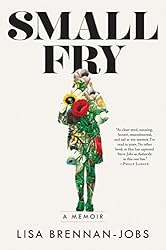

Small Fry: A Memoir
Lisa Brennan-Jobs, 2018
Grove/Atlantic
400 pp.
ISBN-13: 9780802128232
Summary
A frank, smart and captivating memoir by the daughter of Apple founder Steve Jobs.
Born on a farm and named in a field by her parents—artist Chrisann Brennan and Steve Jobs—Lisa Brennan-Jobs’s childhood unfolded in a rapidly changing Silicon Valley.
When she was young, Lisa’s father was a mythical figure who was rarely present in her life. As she grew older, her father took an interest in her, ushering her into a new world of mansions, vacations, and private schools.
His attention was thrilling, but he could also be cold, critical and unpredictable. When her relationship with her mother grew strained in high school, Lisa decided to move in with her father, hoping he’d become the parent she’d always wanted him to be.
Small Fry is Lisa Brennan-Jobs’s poignant story of childhood and growing up.
Scrappy, wise, and funny, young Lisa is an unforgettable guide, marveling at the particular magic of growing up in this family, in this place and time, while grappling with her feelings of illegitimacy and shame.
Part portrait of a complex family, part love letter to California in the seventies and eighties, Small Fry is an enthralling story by an insightful new literary voice. (From the publisher.)
Author Bio
• Birth— May 17, 1978
• Where—Portland, Oregon, USA
• Education—B.A., Harvard University
• Currently—lives in Brooklyn, New York City, New York
Lisa Nicole Brennan-Jobs is the daughter of Apple co-founder Steve Jobs and artist Chrisann Brennan. She has worked as a journalist and magazine writer and, in 2018, published her memoir, Small Fry, the story of her childhood and coming-of-age in Silicon Valley in the 1970s and 80s.
Brennan-Jobs has been depicted in a number of films and biographies of Steve Jobs, including three biopics—Pirates of Silicon Valley (1999, made for TV), Jobs (2013, with Ashton Kutcher as Steve Jobs ), and Steve Jobs (2015, based on Walter Isaacson's bestselling biography). A major character in her aunt Mona Simpson's novel A Regular Guy (1998) is based on her.
Birth and the Apple Lisa
Brennan-Jobs was born in 1978 on Robert Friedland's All One Farm commune outside of Portland, Oregon. Her mother, Chrisann Brennan, and her father, Steve Jobs, first met in high school in 1972 and had an on-off relationship for the next five years.
In 1977, after Jobs had co-founded Apple Inc., he and Brennan moved into a house with a friend near the company's office in Cupertino, California, where they all worked. It was during this period that Brennan became pregnant with Lisa.
Jobs, however, denied responsibility for the pregnancy, and Brennan ended the relationship, walking out of their shared home. She supported herself by cleaning houses and later moved to the Portland commune where Lisa was born: Jobs was not present at the birth.
Robert Friedland, the farm's owner and a friend of Jobs' from Reed College, called Jobs, persuading him to drive up to see the baby, and three days later Jobs appeared. Brennan and Jobs chose the name Lisa.
Jobs also named the computer project he was working on—the Apple Lisa—for his new daughter. Shortly after, however, he denied paternity, claiming the name "Apple Lisa" was devised by his team—as an acronym for "Local Integrated Systems Architecture." (It wasn't until decades later that Jobs admitted the computer was "obviously" named for his daughter.")
Paternity
Jobs continued to deny he was Lisa's father—even after a DNA test established his paternity within a 94% probability. Nonetheless, the resolution of a legal case required him to provide Brennan with $385 per month and to reimburse the state for the money she had received from welfare.
After Apple went public and Jobs became a multimillionaire, he increased the payment to $500 a month.
When Lisa was nine, Jobs acknowledged his fatherhood and worked at reconciliation, legally altering Lisa's birth certificate—at her request—from Brennan to Brennan-Jobs. Crissan Brennan credits the change in Jobs to author Mona Simpson, Jobs' newly found biological sister, who worked to repair the relationship between father and daughter.
According to Fortune magazine, Jobs left Lisa a multimillion-dollar inheritance.
Education and career
Brennan-Jobs lived with her mother until sometime in high school; then she moved in with her father, attending Palo Alto High. She received her B.A. from Harvard University, where she wrote for the Harvard Crimson. After graduation in 2000, Brennan-Jobs worked in finance in the UK (she had spent a year abroad studying at King's College-London) and Italy; she later shifted to design.
Eventually, Brennan-Jobs turned to writing and moved to New York, where she freelanced for magazines and literary journals. She has written for Southwest Review, Massachusetts Review, Harvard Advocate, Spiked, Vogue, and Oprah Magazine.
In 2018, Brennan-Jobs published her memoir, Small Fry, to positive reviews, including the New York Times Book Review, which called her a "deeply gifted writer." The book details her childhood and complex, often difficult, relationship with her father.
Personal life
Brennan-Jobs resides in Brooklyn, New York City, with her husband, their son, and her two stepdaughters. (Adapted from Wikipedia. Retrieved 9/18/2018.)
Book Reviews
Entrancing.… Brennan-Jobs is a deeply gifted writer.… Her inner landscape is depicted in such exquisitely granular detail that it feels as if no one else could have possibly written it. Indeed, it has that defining aspect of a literary work: the stamp of a singular sensibility.… Beautiful, literary, and devastating.
Melanie Thernstro - New York Times Book Review
It’s gratifying to see [Ms. Brennan-Jobs] assert her authority as the owner of her narrative. Writing with enlightened panache and dry humor, she’s as keen a witness to the ambience of the Bay Area in the 1980’s and 1990’s …as she is to the behavior of the adults around her.… Never having felt safe in any of her father’s houses, [she] has built her own house in memoir form, a repository of her love and anger and mourning.… It’s alive in all the rough edges of its feelings, and it’s home.
Wall Street Journal
[The] story of a girl growing up in 1980s and ’90s California trying to fit into two very different families and not belonging in either. It’s the story of her single mother trying to keep it together and often not succeeding. It’s the story of a family that is as imperfect as every family, things complicated by wealth, fame and, in the end, illness and death.
Associated Press
An intimate, richly drawn portrait.… Small Fry is a memoir of uncommon grace, maturity, and spare elegance.… The reader of this exquisite memoir is left with a loving, forgiving remembrance and the lasting impression of a resilient, kindhearted and wise woman who is at peace with her past.
San Francisco Chronicle
Mesmerizing, discomfiting reading.… [Small Fry is] a book of no small literary skill.
New Yorker
Extraordinary.… An aching, exquisitely told story of a young woman’s quest for belonging and love.
People
Revelatory.… Her exquisitely written prose allows Brennan-Jobs to—painfully, complexly, heroically—reclaim her own story.
Entertainment Weekly
A masterly Silicon Valley gothic.… The bohemian landscape she captures will be virtually unrecognizable to anyone who equates this slice of Northern California with Teslas and tiger moms.… Of the book’s myriad achievements, the greatest might be making [this] story her own.
Vogue
(Starred review) Bringing the reader into the heart of the child who admired Jobs’s genius, craved his love, and feared his unpredictability, Brennan-Jobs writes lucidly of happy times… [and] loneliness.… [A] sincere and disquieting portrait.
Publishers Weekly
[Lisa's father,] Steve Jobs, [was] barely there until he decided to swoop in to show her the wealthy world of private schools and big vacations. But it wasn't easy. A singular life and California in the Seventies and Eighties.
Library Journal
(Starred review) Bennan-Jobs skillfully relays her past without judgement… [and] never turns maudlin or gossipy.… [An ]authentic story of growing up in two very different environments, neither of which felt quite like home.
Booklist
(Starred review) An epic, sharp coming-of-age story…. In a lesser writer's hands, the narrative could have devolved into literary revenge. Instead, Brennan-Jobs offers [an] exquisitely rendered story of family, love, and identity.
Kirkus Reviews
Discussion Questions
We'll add publisher questions if and when they're available; in the meantime, use our LitLovers talking points to start a discussion for SMALL FRY … then take off on your own:
1. How does Steve Jobs come across in his daughter's memoir? What were your expectations of him before you read Small Fry? Were they altered or confirmed after having finished the book?
2. When she was only a little girl, Jobs told his daughter that he hadn't named the Apple Lisa computer after her. As an adult, she writes that he wasn't being cruel but teaching her a lesson—"not to ride on his coattails." What is your take on that episode? Was it a good lesson? How do you think young Lisa might have felt that at the time it took place, as opposed to looking back 30-some years later with the cushion of hindsight? What other incidents does the author point to as examples of Steve Jobs' life lessons?
3. Follow-up to Question 2: The author wants readers to forgive her father—as she herself has. Is it easy for you to do so, to put aside his seeming cruelty? She herself wonders whether she has conveyed his true nature: "Have I failed in fully representing the dearness and the pleasure …of being with him when he was in good form?" What do you think?
4. Follow-up to Question 3: What are the moments in the memoir that capture Jobs when he was in "good form"? Consider the time he showed up unexpectedly in Japan, pulled her out of school, and talked with her about the nature of God and consciousness. "I was afraid of him and, at the same time, I felt a quaking, electric love," she writes. Does that description of Jobs capture his charisma, his "true nature," or warmth?
5. How does Brennan-Jobs portray her mother, Chrisann Brennan? Why did Lisa leave her mother's home to live with her father? How would you have fared as a child or teen under either parent?
6. Once Lisa moved in with him, her father forbade her to see her mother for six months. He objected to her school extracurricular activities, and accused her of not "succeeding as a member of this family." She needed to be around more, he told her, "to put in the time." What do you think of Jobs' criticism?
7. How does Brennan-Jobs herself come across in her memoir? How would you describe her? Do you see her as traumatized? As resilient? As both?
8. What do you think of the neighbors who moved Lisa out of her father's house into their house—and even paid for her to finish her college degree? Were they right to interfere?
9. All of the people Brennan-Jobs writes about in this book are still alive except Steve Jobs, of course. Do some research to find out their various reactions to Small Fry. What do you think, overall, of the author's presentation of her family? What was her motive to write this book? Do you see it as a standard celebrity "tell-all" story? Is it vengeful? Is it putting the record straight? Is it a working out of the author's own identity? How do you see Lisa Brennan-Job's memoir?
(Questions by LitLovers. Please feel free to use them, online and off, with attribution. Thanks.)
Small is Beautiful: Economics as if People Mattered
E.F. Schumacher, 1973
HarperCollins
352 pp.
ISBN-13: 9780061997761
Summary
Noted British economist E.F. Schumacher proposed the idea of "smallness within bigness": a specific form of decentralization. For a large organization to work, according to Schumacher, it must behave like a related group of small organizations. Schumacher's work coincided with the growth of ecological concerns and with the birth of environmentalism and he became a hero to many in the environmental movement.
The book is divided into four parts: "The Modern World," "Resources," "The Third World," and "Organization and Ownership."
Schumacher argues that the modern economy is unsustainable. Natural resources (like fossil fuels), are treated as expendable income, when in fact they should be treated as capital, since they are not renewable and, thus, subject to eventual depletion. He further argues that nature's resistance to pollution is limited as well. He concludes that government effort must be concentrated on sustainable development, because relatively minor improvements—for example, technology transfer to Third World countries—will not solve the underlying problem of an unsustainable economy.
Schumacher's philosophy is one of "enoughness," appreciating both human needs, limitations and appropriate use of technology. It grew out of his study of village-based economics, which he later termed "Buddhist economics."
He faults conventional economic thinking for failing to consider the most appropriate scale for an activity, blasts notions that "growth is good," and that "bigger is better," and questions the appropriateness of using mass production in developing countries, promoting instead "production by the masses." Schumacher was one of the first economists to question the appropriateness of using GNP to measure human well being, emphasizing that "the aim ought to be to obtain the maximum amount of well being with the minimum amount of consumption. (From Wikipedia.)
Author Bio
• Birth—August 16, 1911
• Where—Bonn, Germany
• Died—September 4, 1977
• Where—Romont, Fribourg Canton, Switzerland
• Education—schooled in Bonn and Berlin, Germany; Rhodes
Scholar at Oxford University, UK; Columbia University, USA.
Schumacher was a respected economist who worked with John Maynard Keynes and John Kenneth Galbraith. For twenty years he was the Chief Economic Advisor to the National Coal Board in the United Kingdom, opposed the neo-classical economics by declaring that single-minded concentration on output and technology was dehumanizing. He held that one's workplace should be dignified and meaningful first, efficient second, and that nature (and the world's natural resources) is priceless.
Schumacher proposed the idea of "smallness within bigness": a specific form of decentralization. For a large organization to work, according to Schumacher, it must behave like a related group of small organizations. Schumacher's work coincided with the growth of ecological concerns and with the birth of environmentalism and he became a hero to many in the environmental movement.
E.F. Schumacher was an internationally influential economic thinker with a professional background as a statistician and economist in Britain. He served as Chief Economic Advisor to the UK National Coal Board for two decades. His ideas became well-known in much of the English-speaking world during the 1970s. He is best known for his critique of Western economies and his proposals for human-scale, decentralized and appropriate technologies.
According to London's Times Literary Supplement, his 1973 book Small Is Beautiful is among the 100 most influential books published since World War II. It was quickly translated into many languages and brought international fame to Schumacher, after which he was invited to numerous international conferences, university guest speaker lectures and consultations.
Early years
Schumacher was born in Bonn, Germany in 1911. His father was a professor of political economy. The younger Schumacher studied in Bonn and Berlin, then afterwards in England as a Rhodes Scholar at New College, Oxford in the 1930s, and later at Columbia University in New York City, earning a diploma in economics. He became a professional economist, but his wide-ranging mind never confined itself to a single discipline.
Schumacher moved back to England from Germany before World War II, as he had no intention of living under Nazism. For a period during the War, he was interned on an isolated English farm as an "enemy alien." In these years, Schumacher captured the attention of John Maynard Keynes with a paper entitled "Multilateral Clearing" that he had written between sessions working in the fields of the internment camp. Keynes recognised the young German's understanding and abilities, and was able to have Schumacher released from internment. Schumacher helped the British government mobilise economically and financially during World War II, and Keynes found a position for him at Oxford University.
According to Leopold Kohr's obituary for Schumacher, when his paper "was published in the spring of 1943 in Economica, it caused some embarrassment to Keynes who, instead of arranging for its separate publication, had incorporated the text almost verbatim in his famous "Plan for an International Clearing Union," which the British government issued as a White Paper a few weeks later."
Coal Board
After the War, Schumacher worked as an economic advisor to, and later Chief Statistician for, the British Control Commission which was charged with rebuilding the German economy. From 1950 to 1970 he was Chief Economic Adviser to the National Coal Board, one of the world's largest organisations, with 800,000 employees. In this position, he argued that coal, not petroleum, should be used to supply the energy needs of the world's population. He viewed oil as a finite resource, fearing its depletion and eventually prohibitive price, and viewing with alarm the fact that, as Schumacher put it, "the richest and cheapest reserves are located in some of the world's most unstable countries" (Daniel Yergin, The Prize [1991], p. 559).
His position on the Coal Board was often mentioned later by those introducing Schumacher or his ideas. It is generally thought that his farsighted planning contributed to Britain's post-war economic recovery. Schumacher predicted the rise of OPEC and many of the problems of nuclear power.
1955 Schumacher traveled to Burma as an economic consultant. While there, he developed the set of principles he called "Buddhist economics," based on the belief that individuals needed good work for proper human development. He also proclaimed that "production from local resources for local needs is the most rational way of economic life." He traveled throughout many Third World countries, encouraging local governments to create self-reliant economies.
Schumacher's experience led him to become a pioneer of what is now called appropriate technology: user-friendly and ecologically suitable technology applicable to the scale of the community. He founded the Intermediate Technology Development Group (now Practical Action) in 1966. His theories of development have been summed up for many in catch phrases like "intermediate size," and "intermediate technology." He was a trustee of Scott Bader Commonwealth and in 1970 the president of the Soil Association.
By the end of his life, it can be said that Schumacher's personal development had led him very far afield from the ideas of John Maynard Keynes. Keynes, second only to Adam Smith, is widely regarded as the most influential modern orthodox economist. In contrast, Schumacher is one of the most widely recognized heterodox economists.
Writings
Schumacher wrote on economics for London's The Times and became one of the paper's chief editorial writers. At this post he was assigned the somewhat uncomfortable task of compiling information for the obituary of John Keynes many years before the event of his death. He also wrote for The Economist and Resurgence. He served as adviser to the India Planning Commission, as well as to the governments of Zambia and Burma — an experience that led to his much-read essay on "Buddhist Economics."
The 1973 publication of Small is Beautiful, a collection of essays, brought his ideas to a wider audience. Schumacher's work coincided with the growth of ecological concerns and with the birth of environmentalism and he became a hero to many in the environmental movement and community movement.
His 1977 work A Guide For The Perplexed is both a critique of materialistic scientism and an exploration of the nature and organization of knowledge.
Philosophy
Schumacher's rejection of materialist, capitalist, agnostic modernity was paralleled by a growing fascination with religion. His interest in Buddhism has been noted. However, from the late 1950s on, Catholicism heavily influenced his thought. He noted the similarities between his own economic views and the teaching of papal encyclicals on socioeconomic issues, from Leo XIII's "Rerum Novarum" to Pope John XXIII's "Mater et Magistra", as well as with the distributism supported by the Catholic thinkers G. K. Chesterton, Hilaire Belloc and Vincent McNabb.
Philosophically, he absorbed much of Thomism, which provided an objective system in contrast to what he saw as the self-centered subjectivism and relativism of modern philosophy and society. He also was greatly interested in the tradition of Christian mysticism, reading deeply such writers as St. Teresa of Avila and Thomas Merton. These were all interests that he shared with his friend, the Catholic writer Christopher Derrick. In 1971, he converted to Catholicism.
Schumacher gave interviews and published articles for a wide readership in his later years. He also pursued one of the loves of his life: gardening. He died during a lecture tour of a heart attack on 4 September 1977, in Switzerland. (Author bio from Wikipedia.)
Book Reviews
E.F. Schumacher...is among the small number of writers whose ideas influence opinion and eventual public policy.... It is not at all difficult to comprehend Schumacher's immediate and enduring appeal. He asks us to start where we are—with ourselves and our immediate environment.... However much one may doubt the possibility of checking the momentum of modern technology, it is hard to deny Schumacher's anguished warning that at present rates of consumption, the world's inhabitants will soon exhaust existing stocks of nonrenewable resources and in the process poison the thin layer of atmosphere within which we subsist.
New York Times (5/20/1979)
Enormously broad in scope, pithily weaving together threads from Galbraith and Gandhi, capitalism and Buddhism, science and psychology.
The New Republic
Discussion Questions
Use our LitLovers Book Club Resources; they can help with discussions for any book:
• How to Discuss a Book (helpful discussion tips)
• Generic Discussion Questions—Fiction and Nonfiction
• Read-Think-Talk (a guided reading chart)
Also consider these LitLovers talking points to help get a discussion started for Small is Beautiful:
1. It has been over 35 years since Schumacher posited the central tenet of his work—that infinite economic growth is impossible within a finite system. Do you believe he has been vindicated?
2. Just how relevant are Schumacher's ideas today? Some argue Schumacher was a visionary—that his ideas are as important today as when he wrote them; others say his views are outdated and no longer apply to 21st-century conditions. Where do you stand—and on which ideas in particular?
3. Most economists and politicians believe that our consumption-based society has created unprecedented wealth in the West and, therefore, justifies a degree of inequality. How does Schumacher view consumption-based economies? What kind of alternative system or reforms does he propose?
4. Some of the book's insights are aimed at the scientific community, with Schumacher asserting that scientists are incapable of ethical decision-making regarding the direction of their research. Consider his arguments in light of recent advances in stem cell research, cloning, and bio-engineered agricultural products. Do you agree with Schumacher...or are scientists as capable as anyone else, perhaps even more so, to explore the consequences of their work?
5. Schumacher asks a simple but penetrating question: what is progress? How does he answer that question...and how do you? Do you agree or disagree with Schumacher?
6. What are Schumacher's views on assisting developing countries?
(Questions by LitLovers. Please feel free to use, online or off, with attribution. Thanks.)
top of page
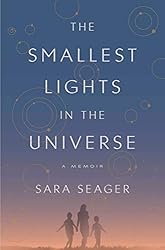
The Smallest Lights in the Universe: A Memoir
Sara Seager, 2020
Crown Publishing
320 pp.
ISBN-13: 9780525576259
Summary
An MIT astrophysicist searches for meaning in the wake of her husband's death, even as she scours the universe for an Earth-like exoplanet, in this powerful memoir of cutting edge science, unexpected discoveries, and new beginnings.
Sara Seager has made it her life's work to peer into the spaces around stars—looking for exoplanets outside our solar system, hoping to find the one-in-a-billion world enough like ours to sustain life.
But with the unexpected death of her husband, Seager's life became an empty, lightless space.
Suddenly she was a widow at forty and the single mother of two young boys, clinging to three crumpled pages of instructions her husband had written for things like grocery shopping—tasks he had done while she did pioneering work as a planetary scientist at MIT.
She became painfully conscious of her Asperger's, which before losing her husband had felt more like background noise. She felt, for the first time, alone in the universe.
In this probing, invigoratingly honest memoir, Seager tells the story of how, as she stumbled through the world of grief, she also kept looking for other worlds.
She continues to develop groundbreaking projects, such as the Starshade, a sunflower-shaped instrument that, when launched into space, unfurls itself to block planet-obscuring starlight, and she takes comfort in the alien beauty of exoplanets.
At the same time, she discovers what feels every bit as wondrous: other people, reaching out across the space of her grief. Among them are the Widows of Concord, a group of women offering consolation and advice; and her beloved sons, Max and Alex.
Most unexpected of all, there is another kind of one-in-a-billion match with an amateur astronomer, with whom she finds renewed hope and love.
Equally attuned to the wonders of deep space and human connection, The Smallest Lights in the Universe is a light in the dark for anyone seeking meaning and solace. (From the publisher.)
Author Bio
• Birth—July 21, 1971
• Where—Toronto, Ontario, Canada
• Education—B.S., University of Toronto; Ph.D., Harvard University
• Awards—Sackler International Prize in Physics
• Currently—lives in Concord, Massachusetts, USA
Sara Seager is an astrophysicist and a professor of physics and planetary science at The Massachusetts Institute of Technology (MIT). She currently chairs NASA's Probe Study Team for the Starshade project.
Seager's research is focused on exoplanets and the search for the first Earth-like twin, and she has introduced many new ideas to the field of exoplanet characterization, including work that led to the first detection of an exoplanet atmosphere.
Seager won the prestigious Sackler International Prize in Physics, as well as a MacArthur fellowship, and she was named by Time as "one of the twenty-five most influential people in space."
In 2011 Seager's husband Mike was diagnosed with colon cancer and died not long after, which is the subject of her 2020 memoir, The Smallest Lights in the Sky. She lives with her sons in Concord, Massachusetts. (Adapted from the publisher.)
Book Reviews
[S]tark, bewitching…. The merciless seesaw of [Seager's] grief makes for harrowing reading… [but also] gleams with insights into what it means to lose a partner in midlife…. [The book] beautifully dramatize[s] …the challenges of being female physical scientists in a male-dominated field, and convey[s] the struggle of operating in the vast scales of the universe at work, then commuting home to operate in the humbler scales of the domestic sphere…. [Seager] exemplifies the humanity of science.
(Starred review) [B]rilliant, emotionally wrought ... Seager’s openhearted prose is clean and exact, and her observations illuminate the human drive to connect with others. This wondrous tale of discovery, loss, and love is both expansive intimate.
Publishers Weekly
(Starred review) Seager… has intertwined her lifelong love of the stars with her personal story of love and loss and renewal.… This thoughtful and affecting memoir… reads like a comforting novel, inspiring others to follow their dreams and never give up on the possibilities of discovery and self-reflection. —Donna Marie Smith, Palm Beach Cty. Lib. Syst., FL
Library Journal
(Starred review) Seager’s writing is unfailingly accessible and compelling. Sometimes the chapters alternate between biographical and scientific developments, other times events are intertwined, but again, readers will remain fully engaged throughout.… Readers will cheer for the happy ending.
Booklist
(Starred review) For someone who has devoted so much of her life to exploring the possibility of life on other planets,… it was a more personal discovery—that she was autistic—that made her feel like "I’d been struck by something, a physical impact." … A singular scientist has written a singular account of her life and work.
Kirkus Reviews
Discussion Questions
1. The author opens the book by describing rogue planets; she uses them as a metaphor for her children, who she says have gone "halfway to rogue" following the death of their father. What else in her life appears "rogue"? Who or what in your life could be described as a "rogue planet," with no star to orbit?
2. Throughout the book, the author talks about the power of belief and of positive thought. Do you feel that belief is a type of magic? Why or why not?
3. The author is an extremely successful woman in a field dominated by men. Was there a point in the book when you thought this circumstance was especially affecting her? Do you think the fact that she’s a woman has had an impact on her career trajectory, for better or for worse? Why?
4. Is there anything in your life that you’ve pursued with blind faith despite opposition, in the way that the author is driven to find exoplanets in the face of backlash from her scientific community? What kept the author moving toward her goal? What keeps you moving toward your goal?
5. Later in her life, the author discovers something about herself that she had never considered before—she realized it only after she was featured in a major publication and a friend pointed out certain aspects of her personality that came through on the page. How might you have reacted to a surprise like this? Have you ever realized something about yourself only after seeing yourself from another person’s perspective?
6. The author relied on a dark sense of humor to cope when her husband was first diagnosed and throughout his illness. What do you make of this? Why is this her instinct? Does this form of humor appeal to you, or not?
7. When her husband passed away at home, unhindered by tubes and machines, the author says she felt she was able to help "build something beautiful." Do you agree that death can be beautiful? Why or why not?
8. What do you make of the use of metaphors throughout the book such as dark and light or the sun and stars? Was there a particular metaphor that was the most powerful to you?
9. The Widows of Concord become a supportive community for the author after her loss. Why do you think the author initially resisted their friendship? What did she ultimately gain from those relationships?
10. In her recurring dreams of her husband following his death, the author sees him return to her after long absences: he has been in a coma, missing, on long trips, and so on. What do you think is the meaning of this recurring dream?
11. Do you feel that the scene with the Green Flash is a moment of rebirth or closure for the author? Is it—or can it be—both?
12. The author has focused her life’s work on detecting life on other planets, only to find herself searching for new life after death. How are these pursuits related? How are they dissimilar?
(Questions issued by the publisher.)


Smoke Gets in Your Eyes: And Other Lessons from the Crematory
Caitlin Doughty, 2014
W.W. Norton & Co.
272 pp.
ISBN-13: 9780393240238
Summary
A young mortician goes behind the scenes, unafraid of the gruesome (and fascinating) details of her curious profession.
Most people want to avoid thinking about death, but Caitlin Doughty—a twenty-something with a degree in medieval history and a flair for the macabre—took a job at a crematory, turning morbid curiosity into her life’s work. Thrown into a profession of gallows humor and vivid characters (both living and very dead), Caitlin learned to navigate the secretive culture of those who care for the deceased.
Smoke Gets in Your Eyes tells an unusual coming-of-age story full of bizarre encounters and unforgettable scenes. Caring for dead bodies of every color, shape, and affliction, Caitlin soon becomes an intrepid explorer in the world of the dead. She describes how she swept ashes from the machines (and sometimes onto her clothes) and reveals the strange history of cremation and undertaking, marveling at bizarre and wonderful funeral practices from different cultures.Her eye-opening, candid, and often hilarious story is like going on a journey with your bravest friend to the cemetery at midnight.
She demystifies death, leading us behind the black curtain of her unique profession. And she answers questions you didn’t know you had: Can you catch a disease from a corpse? How many dead bodies can you fit in a Dodge van? What exactly does a flaming skull look like? Honest and heartfelt, self-deprecating and ironic, Caitlin's engaging style makes this otherwise taboo topic both approachable and engrossing.
Now a licensed mortician with an alternative funeral practice, Caitlin argues that our fear of dying warps our culture and society, and she calls for better ways of dealing with death (and our dead). (From the publisher.)
Author Bio
• Birth—ca. 1984-85
• Where—Oahu, Hawaii, USA
• Education—B.A., University of Chicago; Cypress College of Mortuary Science
• Currently—lives in Los Angeles, California
Caitlin Doughty is a licensed mortician and the host and creator of the "Ask a Mortician" web series. She founded the death acceptance collective The Order of the Good Death and cofounded Death Salon. She lives in Los Angeles. (From the publisher.)
See full bio on Caitlin's blog.
Book Reviews
Doughty...uses her work as a crematorium operator...to challenge the way we view death.... Her descriptions about picking dead babies up from the hospital prove particularly difficult to read. Nonetheless, Doughty does stare death in the face by tracking down numerous ancient rituals...and celebrating the natural function of decomposition.
Publishers Weekly
(Starred review.) [Doughty’s] sincere, hilarious, and perhaps life-altering memoir is a must-read for anyone who plans on dying.
Booklist
For the author, the way forward to a healthier relationship with the end-of-life experience is to reclaim "the process of dying" by ending the ignorance and fear attached to it.... A witty, wise and mordantly wise-cracking memoir and examination of the American way of death.
Kirkus Reviews
Discussion Questions
Use our LitLovers Book Club Resources; they can help with discussions for any book:
• How to Discuss a Book (helpful discussion tips)
• Generic Discussion Questions—Fiction and Nonfiction
• Read-Think-Talk (a guided reading chart)
(We'll add specific questions if and when they're made available by the publisher.)


So We Read On: How The Great Gatsby Came to Be and Why It Endures
Maureen Corrigan, 2014
Little, Brown & Co.
352 pp.
ISBN-13: 9780316230070
Summary
It's a revered classic and a rite of passage in the reading lives of millions. But how well do we really know The Great Gatsby? As Fresh Air book critic Maureen Corrigan points out, many of us first read Fitzgerald's masterpiece when we were too young to comprehend its power.
Offering a fresh perspective on Gatsby, So We Read On takes readers into archives, high school classrooms, and onto the Long Island Sound to explore the novel's hidden depths, revealing its surprising debt to noir, its rocky path to recognition as a "classic," and its profound commentaries on race, class, and gender.
With rigor, wit, and infectious enthusiasm, Corrigan inspires us to re-experience Gatsby and, along the way, spins a fascinating story of her own. (From the publisher.)
Author Bio
• Birth—N/A
• Where—N/A
• Education—B.A. from Fordham University; M.A., Ph.D, University of Pennsylvania
• Awards—Edgar Award for Criticism
• Currently—lives in Washington, D.C.
Maureen Corrigan is an American journalist, author and literary critic. She writes for the "Book World" section of the Washington Post, and has been a book critic on the NPR radio program Fresh Air for nearly 20 years. She is the author of So We Read On: How The Great Gatsby Came to Be and Why It Endures (2014) and Leave Me Alone, I'm Reading: Finding and Losing Myself in Books (2005).
Corrigan holds a B.A. from Fordham University as well as an M.A. and Ph.D from the University of Pennsylvania and is Critic in Residence and a lecturer in English at Georgetown University. Her specialist subjects include 19th-century British literature, women's literature (with a special focus on autobiographies), popular culture, detective fiction, contemporary American literature, and Anglo-Irish literature.
In addition to her work with the Washington Post and Fresh Air, Corrigan's essays and reviews have appeared in the Village Voice, New York Times, Philadelphia Inquirer, The Nation, New York Observer, and Salon.
Along with Robin Winks, she was an associate editor of and contributor to Mystery & Suspense Fiction (1999), a work which won the Edgar Award for Criticism from Mystery Writers of America in 1999.
Corrigan lives in Washington, DC with her husband and daughter.
Books
So We Read On
Corrigan investigates what has made Fitzgerald's The Great Gatsby endure over the years. She explores archives, high school classrooms, even the Long Island Sound. Her revelations include Gatsby's surprising debt to hard-boiled crime fiction, Gatsby's rocky path to recognition as a "classic," and the book's profound commentaries on the national themes of race, class, and gender.
Leave Me Alone, I'm Reading
Corrigan reviews the books that most influenced her personally, books that fall into three non-canonical genres—female extreme-adventure tales (narratives recounting "private tests of endurance" in women's lives), hard-boiled detective novels, and Catholic-martyr narratives. (Adapted from Wikipedia. Retrieved 10/29/2014.)
Book Reviews
Mixing criticism with memoir...Corrigan contends that F. Scott Fitzgerald’s Great American Novel is greater than we think.... Corrigan asserts, Gatsby still doesn’t get its due.... She makes a good case...that our very familiarity with Gatsby’s Great American qualities has caused us to underrate it—and she does much to restore its stature.
Publishers Weekly
(Starred review.) [A] literary love letter...information-packed, entertaining.... The Great Gatsby...is examined from many angles—literary, sociological, cultural, personal, and historical.... Bursting with intellectual energy and fun facts —Liz French
Library Journal
(Starred review.) Corrigan's research was as intrepid as her analysis is ardent and expert, and she brings fact, thought, feelings, and personal experiences together in a buoyant, illuminating, and affecting narrative about one depthless novel, the transforming art of reading, and the endless tides that tumble together life and literature.
Booklist
[A]n occasionally self-indulgent but mostly spot-on reading of F. Scott Fitzgerald’s greatest novel....[Corrigan] does a good job of pointing out what we should be paying attention to,... [and her] close reading is welcome, though one hopes that readers will first revisit Fitzgerald’s pages before dipping into hers.
Kirkus Reviews
Discussion Questions
Use our LitLovers Book Club Resources; they can help with discussions for any book:
• How to Discuss a Book (helpful discussion tips)
• Generic Discussion Questions—Fiction and Nonfiction
• Read-Think-Talk (a guided reading chart)
(We'll add specific questions if and when they're made available by the publisher.)

So You've Been Publicly Shamed
Jon Ronson, 2015
Penguin Books
304 pp.
ISBN-13: 9781594634017
Summary
"It's about the terror, isn't it?"
"The terror of what?" I said.
"The terror of being found out."
For the past three years, Jon Ronson has travelled the world meeting recipients of high-profile public shamings. The shamed are people like us—people who, say, made a joke on social media that came out badly, or made a mistake at work.
Once their transgression is revealed, collective outrage circles with the force of a hurricane and the next thing they know they're being torn apart by an angry mob, jeered at, demonized, sometimes even fired from their job.
A great renaissance of public shaming is sweeping our land. Justice has been democratized. The silent majority are getting a voice. But what are we doing with our voice? We are mercilessly finding people's faults. We are defining the boundaries of normality by ruining the lives of those outside it. We are using shame as a form of social control.
Simultaneously powerful and hilarious in the way only Jon Ronson can be, So You've Been Publicly Shamed is a deeply honest book about modern life, full of eye-opening truths about the escalating war on human flaws—and the very scary part we all play in it. (From the publisher.)
Author Bio
• Birth—May 10, 1967
• Where—Cardiff, Wales, UK
• Education—University of Westminster (London)
• Currently—lives in London, England, and New York City, New York
Jon Ronson is a Welsh journalist, author, documentary filmmaker, and radio presenter, whose works include the best-selling The Men Who Stare at Goats (2004), The Psychopath Test (2011), and So You've Been Publicly Shamed (2015).
He has been described as a "gonzo journalist" (a first-person style of journalism in which the reporter is part of the story) and is known for his informal, but skeptical, investigations of controversial fringe politics and science.
As the author of nine books, Jonson's work has appeared in British publications such as The Guardian, City Life and Time Out. He has made several BBC Television documentary films and two documentary series for Channel 4. He is also a regular contributor to public radio's This American Life.
Personal life
Ronson was born in Cardiff, Wales, and studied for a degree in Media Studies at the University of Westminster. Ronson is a distinguished supporter of the British Humanist Association. He is married to Elaine Patterson, and the couple has a son, Joel.
Writing career
Ronson's first book, Clubbed Class, was published in 1994. The book is a travelogue in which Ronson bluffs his way into a jet set lifestyle, in search of the world's finest holiday.[8]
His second book, Them: Adventures with Extremists, was published in 2001 and chronicles his experiences with people labelled as extremists. Subjects in the book include David Icke, Randy Weaver, Omar Bakri Muhammad, Ian Paisley, Alex Jones, and Thom Robb. Ronson also follows independent investigators of secretive groups such as the Bilderberg Group. The narrative tells of Ronson's attempts to infiltrate the "shadowy cabal" fabled, by these conspiracy theorists, to rule the world. The book, a bestseller, was described by Louis Theroux as "funny and compulsively readable picaresque adventure through a paranoid shadow world."
Ronson's 2004 book, The Men Who Stare at Goats, deals with the secret New Age unit within the United States Army called the First Earth Battalion. Ronson investigated people who believed that, with the right mental preparation, people can walk through walls and goats can be killed simply by staring at them. A film adaptation was released in 2009, in which Ronson's investigations were fictionalised and structured around a journey to Iraq. Ronson is played by the actor Ewan McGregor in the film.
Ronson's fourth book, Out of the Ordinary: True Tales of Everyday Craziness, was published in 2006. It is a collection of Ronson's Guardian articles, mostly those concerning his domestic life. A companion volume, What I Do: More True Tales of Everyday Craziness, was published in 2007.
The Psychopath Test: A Journey Through the Madness Industry is Ronson's fifth book, published in 2011. In it, he explores the nature of psychopathic behaviour, investigating the reliability of the Hare Psychopathy Checklist and learning how to apply it. He interviews people in facilities for the criminally insane as well as potential psychopaths in corporate boardrooms. The book has been criticized by Robert D. Hare, creator of the Hare Psychopathy Checklist, who called it "frivolous, shallow, and professionally disconcerting."
Lost at Sea: The Jon Ronson Mysteries is Ronson's sixth book, published in 2012. So You've Been Publicly Shamed, a book about public shaming, came out in 2015. It considers social media's role in escalating high-profile public scandals. (Adapted from Wikipedia. Retrieved 4/15/2015.)
Book Reviews
The choice of subject for So You've Been Publicly Shamed turns out to be gutsy and smart. Without losing any of the clever agility that makes his books so winning, [Ronson] has taken on truly consequential material and risen to the challenge. His overall point is something we already understand: Public shaming in the age of social media has the kind of power that no form of shaming ever had before.
Janet Maslin - New York Times
An irresistibly gossipy cocktail with a chaser of guilt.
Newsday
A diligent investigator and a wry, funny writer, Ronson manages to be at once academic and entertaining.
Boston Globe
A work of original, inspired journalism.
Financial Times
A sharp-eyed and often hilarious book…Jon Ronson has written a fresh, big-hearted take on an important and timely topic. He has nothing to be ashamed of.
NPR.org
This book really needed to be written.
Salon.com
It’s sharply observed, amusingly told, and, while its conclusions may stop just short of profound, the true pleasure of the book lies in arriving at those conclusions.”
Onion, AV Club
[A] simultaneously lightweight and necessary book.
Esquire
Ronson is an entertaining and provocative writer, with a broad reach …[So You’ve Been Publicly Shamed] is a well-reported, entertainingly written account of an important subject.
Oregonian
I was mesmerized. And I was also disturbed.
Forbes
[H]igh-profile shaming in the social-media age in this witty work.... Ronson is self-reflective and honest about his own complicity in the cultural piling-on.... Clever and thought-provoking, this book has the potential to open an important dialogue about faux moral posturing online and its potentially disastrous consequences.
Publishers Weekly
In 2012, Ronson's online identity was stolen by three academics.... [H]e chastised them publicly, but...began considering how much public shaming as social control is still with us, even if those scarlet letters have been pitched in the wastebasket.
Library Journal
With confidence, verve, and empathy, Ronson skillfully informs and engages the reader without excusing those caught up in the shame game. As he stresses, we are the ones wielding this incredible power over others' lives, often with no regard for the lasting consequences of our actions.
Booklist
[A] hard look at the dark side of shaming on social media.... Ronson believes that via social media, we are creating a contemporary version of...awarding scarlet letters with gleeful viciousness to people who often are more guilty of silliness and indiscretion than they are of any...felony.
Kirkus Reviews
Discussion Questions
Use our LitLovers Book Club Resources; they can help with discussions for any book:
• How to Discuss a Book (helpful discussion tips)
• Generic Discussion Questions—Fiction and Nonfiction
• Read-Think-Talk (a guided reading chart)
Also, consider these LitLovers talking points to help get a discussion started for So You've Been Publicly Shamed:
1. One of the overriding questions posed by Ronson's book is whether or not anyone of us might become the butt of a public shaming scandal. Are any of us immune? Are you?
2. Can you come up with your own examples of someone who received a highly public shaming through social media? Did that individual deserve the attention and attendant disgrace?
3. How easy is it for someone to put his or her life back together after being publicly shamed?
4. To what degree does someone, who is object of social media frenzy, deserve the disapprobation he or she receives?
5. What role does—and ideally should—blame and shame play in maintaining society's moral standards? How do we hold people accountable for their transgressions—and what kind of transgressions deserve public shaming?
6. Which, if any, of Ronson's subjects do you have sympathy for? Was there anyone you felt who deserved the high-profile blame?
7. Is there anything positive, any societal good, that results from social media's blame-and shame potential?
(Questions by LitLovers. Please feel free to use them, online or off, with attribution.)
The Social Animal: The Hidden Sources of Love, Character, and Achievement
David Brooks, 2011
Random House
448 pp.
ISBN-13: 9781400067602
Summary
With unequaled insight and brio, David Brooks, the New York Times columnist and bestselling author of Bobos in Paradise, has long explored and explained the way we live. Now, with the intellectual curiosity and emotional wisdom that make his columns among the most read in the nation, Brooks turns to the building blocks of human flourishing in a multilayered, profoundly illuminating work grounded in everyday life.
This is the story of how success happens. It is told through the lives of one composite American couple, Harold and Erica—how they grow, push forward, are pulled back, fail, and succeed. Distilling a vast array of information into these two vividly realized characters, Brooks illustrates a fundamental new understanding of human nature.
A scientific revolution has occurred—we have learned more about the human brain in the last thirty years than we had in the previous three thousand. The unconscious mind, it turns out, is most of the mind—not a dark, vestigial place but a creative and enchanted one, where most of the brain’s work gets done. This is the realm of emotions, intuitions, biases, longings, genetic predispositions, personality traits, and social norms: the realm where character is formed and where our most important life decisions are made. The natural habitat of The Social Animal.
Drawing on a wealth of current research from numerous disciplines, Brooks takes Harold and Erica from infancy to school; from the “odyssey years” that have come to define young adulthood to the high walls of poverty; from the nature of attachment, love, and commitment, to the nature of effective leadership. He reveals the deeply social aspect of our very minds and exposes the bias in modern culture that overemphasizes rationalism, individualism, and IQ. Along the way, he demolishes conventional definitions of success while looking toward a culture based on trust and humility.
The Social Animal is a moving and nuanced intellectual adventure, a story of achievement and a defense of progress. Impossible to put down, it is an essential book for our time, one that will have broad social impact and will change the way we see ourselves and the world. (From the publisher.)
Author Bio
• Birth—August 11, 1961
• Where—Toronto, Ontario, Canada
• Raised—New York City, New York, USA
• Education—B.A., University of Chicago
• Currently—lives in Bethesda, Maryland
David Brooks is a Canadian-born political and cultural commentator. He was born into a Jewish family in Toronto, Canada and grew up in New York City in Stuyvesant Town. In 1979 he graduated from Radnor High School (a suburb of Philadelphia, Pa.) and, in 1983, received his B.A. in history from the University of Chicago.
He worked as an editorial writer and film reviewer for the Washington Times; a reporter and later op-ed editor for the Wall Street Journal; a senior editor at the Weekly Standard from its inception; and a contributing editor at Newsweek and Atlantic Monthly
Although Brooks considers himself a moderate, he currently writes for the New York Times as a conservative columnist. He is also a commentator on National Public Radio and the PBS NewsHour. Brooks was a visiting professor of public policy at Duke University, teaching an undergraduate seminar there in the fall of 2006.
He and his wife live in Bethesda, Maryland.
Books
In 1966 he edited an anthology of writings by new conservative writers, Backward and Upward: The New Conservative Writing. In 2000 he published his cultural commentary, Bobos in Paradise: The New Upper Class and How They Got There, following it up four years later with On Paradise Drive: How We Live Now (And Always Have) in the Future Tense. The Social Animal: The Hidden Sources of Love, Character and Achievement came out in 2011.
Political views
Brooks describes himself as being originally a liberal before "coming to my senses." In 1983, he wrote a parody of conservative pundit William F. Buckley, Jr., which said "In the afternoons he is in the habit of going into crowded rooms and making everybody else feel inferior. The evenings are reserved for extended bouts of name-dropping." Buckley admired the parody and offered Brooks a job with National Review. A turning point in Brooks's thinking came later that year in a televised debate with Milton Friedman, which, as Brooks describes it, "was essentially me making a point, and he making a two-sentence rebuttal which totally devastated my point."
Before the 2003 invasion of Iraq, Brooks argued forcefully for American military intervention, echoing the belief of commentators and political figures that American and British forces would be welcomed as liberators. In the spring of 2004, some of his opinion pieces suggested that he had tempered his earlier optimism about the war.
Brooks' public writing about the U.S. wars in Afghanistan and Iraq closely identifies him with the neoconservative political movement in the United States. His angry dismissal of the conviction of Scooter Libby as being "a farce" and having "no significance" was derided by political blogger and editor Andrew Sullivan.
On August 10, 2006, Brooks wrote a column for the New York Times titled "Party No. 3". The column proposed the idea of the McCain-Lieberman Party, or the fictional representation of the moderate majority in America.
Ottawa Citizen commentator David Warren has identified Brooks as the sort of conservative pundit that liberals like, someone who is "sophisticated" and "engages with" the liberal agenda, in contrast to a "real conservative" like Charles Krauthammer. Brooks has long been a supporter of John McCain; however, he did not show a liking for McCain's former running mate Sarah Palin, saying she represented a "cancer" on the Republican Party. He has referred to her as a "joke," unlikely to ever win the Republican nomination.
In a March 2007 article published in the New York Times titled "No U-Turns," Brooks explains that the Republican Party must distance itself from the minimal-government conservative principles that had arisen during the Barry Goldwater and Ronald Reagan eras. He claims that these outdated concepts had served their purposes and should no longer be embraced by Republicans in order to win elections.
Brooks has been a frequent admirer of President Barack Obama. In an August, 2009 profile of Brooks, the New Republic describes his first encounter with Obama, in the spring of 2005: "Usually when I talk to senators, while they may know a policy area better than me, they generally don’t know political philosophy better than me. I got the sense he knew both better than me. [...] I remember distinctly an image of—we were sitting on his couches, and I was looking at his pant leg and his perfectly creased pant, and I’m thinking, a) he’s going to be president and b) he’ll be a very good president.” Two days after Obama’s second autobiography, The Audacity of Hope, hit bookstores, Brooks published a column in the New York Times, entitled "Run, Barack, Run", urging Obama to run for president.
In writing for the New York Times in January 2010, Brooks described Israel as "an astonishing success story." He wrote that "Jews are a famously accomplished group," who, because they were "forced to give up farming in the Middle Ages...have been living off their wits ever since." In Brooks' view, "Israel’s technological success is the fruition of the Zionist dream. The country was not founded so stray settlers could sit among thousands of angry Palestinians in Hebron. It was founded so Jews would have a safe place to come together and create things for the world."
Social views
Brooks opposes what he sees as self-destructive behavior like teenage sex and divorce. His view is that "sex is more explicit everywhere barring real life. As the entertainment media have become more sex-saturated, American teenagers have become more sexually abstemious" by "waiting longer to have sex...[and] having fewer partners." He sees the culture war as nearly over, because "today's young people...seem happy with the frankness of the left and the wholesomeness of the right." As a result, he is optimistic about the US' social stability, which he considers to be "in the middle of an amazing moment of improvement and repair."
Brooks also broke with many in the conservative movement when, in late 2003, he came out in favor of same-sex marriage in his New York Times column. He equated the idea with traditional conservative values: "We should insist on gay marriage. We should regard it as scandalous that two people could claim to love each other and not want to sanctify their love with marriage and fidelity.... It's going to be up to conservatives to make the important, moral case for marriage, including gay marriage."
Regarding abortion, Brooks has advocated for pro-choice government regulations: abortion would be legal, with parental consent for minors, during the first four or five months, and illegal except in extremely rare circumstances afterward. (New York Times, April 22, 2002.) (From Wikipedia.)
Book Reviews
The book is really a moral and social tract, but Brooks has hung it on the life stories of two imaginary people, Harold and Erica, who are used to illustrate his theory in detail and to provide the occasion for countless references to the psychological literature and frequent disquisitions on human nature and society.... One doesn’t care what happens to them because in spite of Brooks’s earnest attempt to describe their psychological depths, they do not come to life; they and their supporting cast are mannequins for the display of psychological and social generalizations.
Thomas Nagel - New York Times Book Review
[S]harp, clear and often very funny.... Many of us, Brooks believes, are in the grip of an outdated theory of human nature. We give priority to cold-blooded reason, to deliberative, conscious, logical and linear thought...but] Brain research, Brooks tells us, "reminds us of the relative importance of emotion over pure reason, social connections over individual choice, character over IQ." Brooks is right that many psychologists, philosophers and neuroscientists believe this to be true. The Social Animal is a savvy, accessible and enthusiastic defense of their position—they are lucky to have him on their side.
Paul Bloom - Washington Post
Mr. Brooks is at his best as a social observer, documenting the changing patterns of contemporary life.... he shows genius in sketching archetypes and coining phrases. Here we learn of the "composure class" (who earn their money "by climbing the meritocratic ladder of success").... There is plenty of Mr. Brooks's vintage comic sociology here, too...[b]ut Mr. Brooks is after much more than witty aperçus about life's winners. He wants to explain what makes the "composure class" tick.
Chistopher F. Chabris - Wall Street Journal
The Social Animal is an odd beast of a book with a slightly arbitrary quality. It is never quite clear on what grounds Brooks has decided to explore the implications of some new ideas and not others, other than that they confirm his own views and can be worked into his narrative. Indeed, his rather casual use of academic research sits strangely with his avowed respect for science. There are other tensions. Brooks is impressed by the evidence marshalled in Wilkinson and Pickett's The Spirit Level, and elsewhere, that "the mere fact of being low on the status totem pole brings its own deep stress and imposes its own psychic costs". Yet he remains an almost unqualified meritocrat, arguing that the great challenge for government is not to promote greater equality but to make it easier for people to rise from one class to another.
Ben Rogers - Guardian (UK)
New York Times columnist Brooks (Bobos in Paradise) raids Malcolm Gladwell's pop psychology turf in a wobbly treatise on brain science, human nature, and public policy. Essentially a satirical novel interleaved with disquisitions on mirror neurons and behavioral economics, the narrative chronicles the life cycle of a fictional couple—Harold, a historian working at a think tank, and Erica, a Chinese-Chicana cable-TV executive—as a case study of the nonrational roots of social behaviors, from mating and shopping to voting. Their story lets Brooks mock the affluent and trendy while advancing soft neoconservative themes: that genetically ingrained emotions and biases trump reason; that social problems require cultural remedies (charter schools, not welfare payments); that the class divide is about intelligence, deportment, and taste, not money or power. Brooks is an engaging guide to the "cognitive revolution" in psychology, but what he shows us amounts mainly to restating platitudes. (Women like men with money, we learn, while men like women with breasts.) His attempt to inflate recent research on neural mechanisms into a grand worldview yields little except buzz concepts—"society is a layering of networks"—no more persuasive than the rationalist dogmas he derides.
Publishers Weekly
(Starred review.) An uncommonly brilliant blend of sociology, intellect and allegory.
Kirkus Reviews
Discussion Questions
Use our LitLovers Book Club Resources; they can help with discussions for any book:
• How to Discuss a Book (helpful discussion tips)
• Generic Discussion Questions—Fiction and Nonfiction
• Read-Think-Talk (a guided reading chart)
Also consider these LitLovers talking points to help get a discussion started for The Social Animal:
1. What is David Brooks's over-arching argument in this book? What does he point to as the determinants of individual success or failure? Do you agree...or disagree with him?
2. Brooks writes that he wants to "counteract the bias in our culture":
The conscious mind writes the autobiography of our species. Unaware of what is going on deep down inside, the conscious mind assigns itself the starring role. It gives itself credit for performing all sorts of tasks it doesn’t really control.
Talk about that statement. First, what does Brooks mean? Second, how does he define the difference between the unconscious and the conscious? In what ways is the former more important than the latter? Finally, how would you write your own narrative—and would it be truly descriptive of your life—inner and outer?
3. What does Brooks mean when he says "the adult personality—including political views—is forever defined in opposition to one’s natural enemies in high school"? Does his statement have relevance to your own experience?
4. What does Brooks mean by his term, the "underdebates" in American politics?
5. To what does Brooks attribute the class divide? Given the Congressional Budget Office's 2011 findings regarding the top one percent of the income tier vs. the lower 99%, do his theories hold up? Can an economic view and a cultural-behavioral view both be correct? Or does one have precedence over the other?
6. What does Brooks point to as examples of our social policy failures? Why have so many well-meaning initiatives failed? What are his solutions? Are they workable?
7. Describe some of the findings by cognitive scientists, such as priming ... or framing? Have you experienced, or used, either mental phenomena?
8. Is this book funny? What does Brooks poke fun at? Does the book's satire capture the way we live and what we value as a society? Or is Brooks off base? Talk about his coinage of new words and phrases: "composure class," "sanctimommies," "extracurricular sluts," and "misbagged."
9. Do Erica and Harold work as fictional characters? Do they come alive for you? Do you care about them? Do they work well as the fictional embodiment of Brooks's theories? Or do they come off as clumsy and unworkable? (Critics are all over the map on this...so there is no "correct" answer.)
(Questions by LitLovers. Please feel free to use them, online or off, with attribution. Thanks.)
top of page (summary)


Soldier Girls: The Battles of Three Women at Home and at War
Helen Thorpe, 2014
Scribner
416 pp.
ISBN-13: 9781451668100
Summary
A groundbreaking account of three women deployed to Afghanistan and Iraq, and how their military service affected their friendship, their personal lives, and their families.
America has been continuously at war since the fall of 2001. This has been a matter of bitter political debate, of course, but what is uncontestable is that a sizeable percentage of American soldiers sent overseas in this era have been women.
The experience in the American military is, it’s safe to say, quite different from that of men. Surrounded and far outnumbered by men, imbedded in a male culture, looked upon as both alien and desirable, women have experiences of special interest.
In Soldier Girls, Helen Thorpe follows the lives of three women over twelve years on their paths to the military, overseas to combat, and back home…and then overseas again for two of them. These women, who are quite different in every way, become friends, and we watch their interaction and also what happens when they are separated. We see their families, their lovers, their spouses, their children.
We see them work extremely hard, deal with the attentions of men on base and in war zones, and struggle to stay connected to their families back home. We see some of them drink too much, have illicit affairs, and react to the deaths of fellow soldiers. And we see what happens to one of them when the truck she is driving hits an explosive in the road, blowing it up. She survives, but her life may never be the same again.
Deeply reported, beautifully written, and powerfully moving, Soldier Girls is truly groundbreaking. (From the publisher.)
Author Bio
• Birth—1963
• Where—London, England, UK
• Raised—Medford, New Jersey, US
• Education—B.A., Princeton University; M.A., Columbia University
• Currently—lives in Denver, Colorado
Helen Thorpe is an author and freelance journalist living in Denver, Colorado, who has written for major American newspapers and magazines, and has authored two books.
Thorpe attended Princeton University, graduating Magna Cum Laude. In 1989, she attended Columbia University as a gradudate student, receiving a Master's degree in English literature.
Some of her first jobs following following her graduation from Princeton were in Boston, working as a waitress and as an unpaid intern at the Atlantic Monthly. She then worked for a short time at both the New York Observer as a staff writer, and then, having caught the attention of editor Tina Brown, for The New Yorker. In 1994, she was hired by Texas Monthly and moved to Austin. She left the magazine in 1999.
Her stories have also been published in George, New York, Westword, New York Times Magazine, and 5280. She wrote "Talk of the Town" for the The New Yorker, and has written for Slate and Harper's Bazaar.
Thorpe also published two books entitled Soldier Girls: The Battles of Three Women at Home and at War (2014), and Just Like Us: The True Story of Four Mexican Girls Coming of Age in America (2011), which deals heavily with aspects of immigration into the United States.
She worked in radio, producing stories that were broadcast on This American Life and Soundprint, and is a board member of the Women’s Foundation of Colorado.
Personal life
She was born in London, England and was raised in Medford, New Jersey.[10]
Thorpe's father, Larry, was born in Dublin, Ireland and was an engineer for the BBC Radio in London. Her mother is Marie Brady from Virginia, County Cavan. When she was 18, she left home to study nursing in London, where they met.
When Thorpe was one, the family moved to New Jersey so that Larry could accept a job for RCA. Thorpe remained on her mother's Irish passport holding dual Irish/British citizenship. She became a US citizen when she was 21.
Her husband was John Hickenlooper, the Governor of Colorado. The two met in 2000 at her 37th birthday party while she was living in Texas. Not yet Mayor of Denver, he and had accompanied a mutual friend to the party. The couple married in January 2002 with a Quaker wedding ceremony in Austin. Their son, Teddy, was born in 2002; however, in 2012, the couple announced plans to separate amicably after 10 years of marriage. (Adapted from Wikipedia. Retrieved 9/4/2014.)
Book Reviews
…compelling…The debate over women in combat; the difficulties faced by women in the military (from sexual harassment within their units to service in countries where women lead highly circumscribed lives); the stress that the Iraq and Afghanistan wars placed on the American armed services and on individual soldiers with multiple deployments—such highly complex matters are all made palpably real through the prism of this book's three heroines' lives…Ms. Thorpe's sharply drawn portraits are novelistic in their emotional detail and candor.
Michiko Kakutani - New York Times
Helen Thorpe's comprehensively researched new book…is a breakthrough work that spans 12 years of these women's lives, beginning just before the attacks on the twin towers…Through minute, almost claustrophobic, detail—using military and medical records, as well as therapists' notes and personal correspondence—Thorpe achieves a staggering intimacy with her subjects…What Thorpe accomplishes in Soldier Girls is something far greater than describing the experiences of women in the military. The book is a solid chunk of American history—detailing the culture's failings, resilience and progress.
Cara Hoffman - New York Times Book Review
In the tradition of Adrian Nicole LeBlanc, Richard Rhodes, and other masters of literary journalism, Soldier Girls is utterly absorbing, gorgeously written, and unforgettable.
Boston Globe
A thoughtful, fascinating and often heartbreaking account... Thorpe manages to burrow deeply into the lives of these women...incredibly intimate.
Miami Herald
(Starred review.) Moving... Highlighting how profoundly military service changed their lives--and the lives of their families--this visceral narrative illuminates the role of women in the military, the burdens placed on the National Guard, and the disproportionate burden of these wars borne by the poor.
Publishers Weekly
Thorpe provides a mass of detail on daily life, so much that it becomes almost mind-numbing despite the appealing humanity of these women. Verdict: [An] intimate narrative...[and] great insight into military life. —Edwin Burgess, U.S. Army Combined Arms Research Lib., Fort Leavenworth, KS
Library Journal
(Starred review.) Thorpe fills this gripping tale with the women’s own words, texts, and letters (from friends and their children, as well), and the story is engrossing and heartbreaking at once.
Booklist
(Starred review.) [A]bsorbing...how wartime experiences shaped the lives and friendships of three female soldiers.... The women would disagree about the value of the time they spent swept up in unexpected wars, yet...none would ever question the ...love and support they gave to each other.... Intensely immersive.
Kirkus Reviews
Discussion Questions
Use our LitLovers Book Club Resources; they can help with discussions for any book:
• How to Discuss a Book (helpful discussion tips)
• Generic Discussion Questions—Fiction and Nonfiction
• Read-Think-Talk (a guided reading chart)
(We'll add specific questions if and when they're made available by the publisher.)
Soldier's Heart: Reading Literature Through Peace and War at West Point
Elizabeth D. Samet, 2007
Macmillan Picador
288 pp.
ISBN-13: 9780312427825
Summary
In 1997 Elizabeth D. Samet began teaching English at the United States Military Academy at West Point after completing her doctorate at Yale University. She encountered stark contrasts and surprising similarities between the two campuses, but nothing fully prepared her for the experience of watching her students and colleagues deploy to Iraq, Afghanistan, and other turbulent corners of the world.
What does literature—particularly the literature of war—mean to a student who is likely to encounter its reality? What is the best way to stir uninhibited classroom discussions in a setting that is designed to train students to follow orders, respect authority, and survive grueling physical and mental experiences? This is the terrain Samet traverses each semester, a challenge beautifully captured in Soldier’s Heart.
Taking its name from a World War I term for a condition akin to post-traumatic stress disorder (PTSD), Samet’s memoir offers insights into America’s newest generations of cadets. In each chapter she reflects on a rich trove of literature, from Homer’s ancient epics to the work of modern and contemporary authors such as Wilfred Owen, Virginia Woolf, Randall Jarrell, E.L. Doctorow, and Tim O’Brien.
For many of her students, reading brings solace and inspiration. For others, it sparks an examination of doubts or fears. In all cases, Samet’s courses provide exhilarating arenas for the young men and women of West Point to explore life and language. (From the publisher
Author Bio
• Birth—ca. 1969-70
• Education—B.A., Harvard University; Ph.D. Yale University
• Currently—lives in New York, New York
Elizabeth D. Samet earned her BA from Harvard and her PhD in English literature from Yale. An English professor at West Point, she has written about authority, democracy, and the relationship between literature and leadership in the military world. (From the publisher.)
Extras
From a 2008 Barnes & Noble interview:
• My first job— if you don't count a long list of part-time and summer jobs such as cleaning pools and tennis courts, working in a bookstore, teaching unhappy day-campers how to sail, and extracting DNA from corn plants in a genetics lab —is my current job: teaching English. It is one I greatly love.
• When ased what book most influenced her life as a writer, here is what she said:
A "most" question is almost impossible to answer, but certainly no work has influenced me more than Hamlet. Shakespeare's play helped me to grow as a reader and altered my worldview by revealing a character unafraid to think until it hurt. Hamlet offers insights into the nature of seeming and being, the dynamic of thought and action, the relationship between self and world. Many of the problems it dramatizes have long preoccupied me; they also seem to be of great moment to my students. Moreover, Hamlet—and maybe this is the true source of the influence—is a work that seems somehow to change, to yield new ideas, each time I read it. (Author interview from Barnes & Noble.)
Book Reviews
To her great credit, Samet does not draw easy conclusions in Soldier's Heart. By writing a thoughtful, attentive, stereotype-breaking book about her 10 years as a civilian teacher of literature at the Military Academy, she offers a significant perspective on the crucial social and political force of honor: a principle of behavior at the intersection of duty and imagination.
Robert Pinsky - New York Times Book Review
Soldier's Heart is an exhilarating read. It seats you in the classroom of a feisty professor who commands several fronts with easy expertise: classic film, ancient Greece, Shakespearean tragedy, modern poetry. And it seats you elbow-to-elbow with an elite crop of students whose intelligence and imagination match their courage.
John Beckman - Washington Post
Azar Nafisi meets David Lipsky in this memoir/meditation on crossing the border between the civilian world of literature and the world of the military during 10 years of teaching English at West Point. Samet's students sometimes respond to literature in ways that trouble her, but she lauds their intellectual courage as they "negotiate the multiple contradictions" of military life. Considering the link between literature and war, Samet insightfully explores how Vietnam fiction changed American literary discourse about the heroism of military service. Beyond books, Samet also examines how televised accounts of the Iraq War have turned American civilians "into war's insulated voyeurs," and discusses the gap separating her from the rest of the audience watching a documentary on Iraq. Lighter, gently humorous sections reveal Samet's feelings about army argot. She has been known to ask her mother to meet her "at 1800 instead of at 6:00 p.m.," but she forbids the use of the exclamation "Hooah!"("an affirmative expression of the warrior spirit") in her classroom. Samet is prone to digressions that break the flow of great stories, like an account of her West Point job interview. But this meditation on war, teaching and literature is sympathetic, shrewd and sometimes profound.
Publishers Weekly
In a time when words like patriotismand sacrificeare tossed about with alarming casualness, Samet (Willing Obedience: Citizens, Soldiers, and the Progress of Consent in America, 1776-1898) offers an illuminating exploration of what these terms mean to the modern soldier. In the late 1990s, Samet left graduate school at Yale to become a literature instructor at West Point, where she has for the last decade taught the humanities to young men and women preparing to lead others into combat. Here, she illustrates how literature can transform raw cadets into reflective, conscientious leaders. She and her students struggle with the relationship between art and life as well as the true meaning of sacrifice and honor and their place in a world of peace and a world at war. Samet also reflects on the dramatic changes to the academy, its cadets, and herself over the past ten years. She focuses on the post-9/11 change in attitudes and the juxtaposition between leadership and obedience in the lives of military officers. The inevitable comparison to Azar Nafisi's Reading Lolita in Tehran is apt owing to both books' realistic description of the transformative power of literature. Recommended for all libraries.
Shedrick Pittman-Hassett - Library Journal
Discussion Questions
1. Discuss the book’s title. What are the different meanings of “soldier’s heart”? In what ways does literature address the ailments of what Wilfred Owen calls, in his poem “Insensibility” (epigraph), a heart “small drawn”?
2. Although much has been written about West Point and military life in America, an English professor’s point of view on the subject is rare. What specific insights on this world does Samet offer as a civilian and a humanities professor at a military academy? How is her portrait of military life different from others you have read?
3. How does Samet’s description of her students and former students compare to your stereotypes of soldiers? What are those stereotypes? How does Soldier’s Heart confirm or challenge them?
4. Chapter 1, “Not Your Father’s Army,” touches on the myths and traditions that define West Point, and military life more generally, by alluding to the literature that shaped the experiences of past cadets. Which aspects of the past remain vibrant on campus? Which aspects are radically different in the twenty-first century?
5. Samet writes that she hears the term relevance more and more in informal conversations about the education and training of cadets. How are humanities courses different from military training at West Point? What do such courses contribute to the preparation of cadets? What is the difference between education and training? How do you view the purpose of higher education in general, and the role of literature and the arts within it?
6. How has teaching at West Point changed Samet’s experience of literature? How might her relationship to literature and teaching have been different if she had taken a position at a liberal-arts college instead of at West Point? How does her teaching style compare to that of English teachers from your past?
7. Samet’s deployed colleagues and former students write to her with rich observations about their favorite literary works. In what ways does literature help them understand their experience of war? What do their reading choices reveal about that experience?
8. The author’s previous book explores the tension between liberty and obedience in nineteenth-century America, a dynamic she also explores in Soldier’s Heart. How do soldiers reconcile the military’s demand for conformity with the need for innovative minds—in an all-volunteer military, no less? How do literature and creative writing serve or under-mine the need for obedience and innovative thinking? What role does literature play in forging what West Point alumnus Ulysses S. Grant called moral courage?
9. Why is writing about war one of the oldest forms of literature? What was the significance of epic poems such as Homer’s Iliad or Beowulf to the warriors of earlier ages? What will characterize the artistic legacy of war in the twentieth and twenty-first centuries? What is the relationship between writing and film when it comes to describing the contemporary war experience? Is your own understanding of war shaped more by literature or by film?
10. Some of Samet’s students gravitate toward war literature, while others prefer to read about nonmilitary topics. Does their reading seem more specialized than that of their counter- parts at civilian colleges? What works would you include on a syllabus of assignments for cadets? What classics would you like to see distributed today in an Armed Services Edition?
11. How is the experience of a West Point cadet different from that of a college student at a typical liberal-arts college?
12. What surprised you most about the culture of West Point? How does military hierarchy influence educational practice? Do other American college campuses have comparable hierarchies? Should civilian colleges do more to emphasize the self-discipline of students?
13. Chapter 3, “Becoming Penelope, the Only Woman in the Room,” describes the ways in which gender is sometimes a factor in Samet’s teaching experience. What advantages and disadvantages come with being a woman at a male-dominated institution? What specific challenges do women at West Point face? To what degree does West Point’s recent history as a coed institution reflect the changing nature of the American military and American society? What are the effects of the stereotype associated with Penelope, a woman waiting for the warrior’s return? What role does literature play in helping the cadets think about these issues?
14. How was the author’s worldview shaped by her upbringing—by a father who enlisted in the Army Air Corps during World War II, as well as by her years at the Winsor School? How did these experiences influence her teaching?
15. Chapter 5, “Bibles, Lots of Bibles,” explores the blend of religion and politics that permeates some segments of military life. How would you describe religion’s role in the personal experiences of soldiers—at West Point and elsewhere—and its influence on national politics decisions about war and peace?
16. How did 9/11 change the role of Samet and other professors at West Point? What were your reactions to the scenes in the closing pages, which captures the difficult debates about the United States’ current and future military responsibilities?
(Questions issued by publisher.)
top of page (summary)
The Soloist: A Lost Dream, an Unlikely Friendship, and the Redemptive Power of Music
Steve Lopez, 2008
Penguin Group USA
304 pp.
ISBN-13: 9780425238363
Summary
When Steve Lopez saw Nathaniel Ayers playing his heart out on a two-string violin on Los Angeles' skid row, he found it impossible to walk away. More than thirty years earlier, Ayers had been a promising classical bass student at Juilliard—ambitious, charming, and also one of the few African-Americans—until he gradually lost his ability to function, overcome by schizophrenia. When Lopez finds him, Ayers is homeless, paranoid, and deeply troubled, but glimmers of that brilliance are still there.
Over time, Steve Lopez and Nathaniel Ayers form a bond, and Lopez imagines that he might be able to change Ayers's life. Lopez collects donated violins, a cello, even a stand-up bass and a piano; he takes Ayers to Walt Disney Concert Hall and helps him move indoors. For each triumph, there is a crashing disappointment, yet neither man gives up. In the process of trying to save Ayers, Lopez finds that his own life is changing, and his sense of what one man can accomplish in the lives of others begins to expand in new ways.
Poignant and ultimately hopeful, The Soloist is a beautifully told story of friendship and the redeeming power of music. (From the publisher.)
The 2009 film version of The Soloist stars Jamie Foxx and Robert Downey Jr.
Author Bio
• Birth—1953
• Where—California, USA
• Education—San Jose State University
• Currently—Los Angeles, California
Steve Lopez is a columnist for the Los Angeles Times, where he first wrote a series of enormously popular columns about Nathaniel Ayers.
Before joining the L.A. Times, Lopez wrote for Time, Sports Illustrated, Life, and Entertainment Weekly. Prior to working for Time, Inc., Lopez was a columnist at the Philadelphia Inquirer, San Jose Mercury News and Oakland Tribune. His work has won numerous national journalism awards for column writing and magazine reporting.
A California native, Lopez is the author of three novels and a book of non-fiction, The Soloist: A Lost Dream, An Unlikely Friendship, and The Redemptive Power of Music. The book is based on columns Lopez wrote for the Times about his friendship with a downtown Los Angeles musician.
Lopez is married and has two sons and a daughter. (Adapted from the publisher and L.A. Times.)
Book Reviews
Lopez is a natural storyteller, giving us a close-up view of the improbable intersection of musicianship, schizophrenia, homelessness and dignity. The result is a surprisingly lively page-turner, propelled by the close friendship developing between these two men and filled with eloquent passages.... The Soloist goes a long way toward explaining the workings of the musical mind, albeit one tragically touched by madness. It doesn't shy away from exploring the failures of governmental programs and mental health services for the needy, but it does so without preaching and finger-pointing. It doesn't editorialize; like good music, it just is.
Daniel J. Levitin - Washington Post
Compelling and gruffly tender...Lopez deserves congratulations for being the one person who did not avert his eyes and walk past the grubby man with the violin.
Edward Humes - Los Angeles Times
(Starred review.) Scurrying back to his office one day, Lopez, a columnist for the L.A. Times, is stopped short by the ethereal strains of a violin. Searching for the sound, he spots a homeless man coaxing those beautiful sounds from a battered two-string violin. When the man finishes, Lopez compliments him briefly and rushes off to write about his newfound subject, Nathaniel Ayers, the homeless violinist. Over the next few days, Lopez discovers that Nathaniel was once a promising classical bass student at Juilliard, but that various pressures—including being one of a few African-American students and mounting schizophrenia—caused him to drop out. Enlisting the help of doctors, mental health professionals and professional musicians, Lopez attempts to help Nathaniel move off Skid Row, regain his dignity, develop his musical talent and free himself of the demons induced by the schizophrenia (at one point, Lopez arranges to have Ayers take cello lessons with a cellist from the L.A. Symphony). Throughout, Lopez endures disappointments and setbacks with Nathaniel's case, questions his own motives for helping his friend and acknowledges that Nathaniel has taught him about courage and humanity. With self-effacing humor, fast-paced yet elegant prose and unsparing honesty, Lopez tells an inspiring story of heartbreak and hope.
Publishers Weekly
By turns harrowing, winsome, and inspiring, this work by novelist (In the Clear) and Los Angeles Times columnist Lopez relates the first two years of his friendship with Nathaniel Anthony Ayers. A budding string genius at Juilliard in the early 1970s, Ayers succumbed to paranoid schizophrenia and became homeless, yet he continued to play the violin as a way to keep the demons at bay. With the help of Lopez and others who responded to his columns, Ayers took steps to recovery, residing in a group facility, making trips to Disney Hall for concerts, and achieving the dream of having his own music studio. The tangle of mental health policies and government priorities comes in for a thorough drubbing, as does the callous disregard for students' personal situations at many elite institutions, at least at the time Ayers was enrolled. Lopez's newspaper experience serves him well, and both he and his subject come across as fully developed individuals. A deeply moving story; highly recommended for all collections and of special interest to those dealing with the intersections of music and psychology or therapy.
Library Journal
Los Angeles Times columnist Lopez (In The Clear, 2001, etc.) brings empathy, intelligence and humor to his poignant portrait of a homeless man who once studied at Juilliard. The author first encountered Nathaniel Ayers, a longtime resident of Los Angeles's Skid Row, while en route to work. A Cleveland native who was among a handful of blacks enrolled in Juilliard in the early 1970s, Ayers developed schizophrenia while at the school. After unsuccessful treatment in psychiatric facilities, he landed on the streets of L.A. where, drawn by a statue of Beethoven in a local park, he began to play classical music on a battered violin. Lopez wrote a series of newspaper articles about Ayers that highlighted the plight of the homeless and brought the mentally unstable man donations of numerous violins, a cello and a string bass. Bedraggled and often spewing invectives, Ayers stored the instruments in a shopping cart that he wheeled through town. At night, he fended off sewer rats that scurried across the litter-strewn sidewalk on which he'd slept for years. Outraged, Lopez helped Ayers secure housing in a facility for the homeless and arranged for him to attend concerts at Disney Hall. By the book's end, Ayers has met cellist Yo-Yo Ma, a former classmate at Juilliard. But this is not a feel-good memoir. Determined to understand the evolution of Ayers's illness, Lopez probes his family history, revisits his painful past at Juilliard and seeks advice from mental-health professionals. He also details the myriad complications of forging a bond with a gifted musician whose schizophrenia continues to rage. Energetic prose delivers powerful insights on homelessness and mental illness.
Kirkus Reviews
Discussion Questions
1. When they first meet, Steve looks at Nathaniel as a compelling story for his newspaper, one that has the potential to bring attention to the inhabitants of Los Angeles’s Skid Row. What do you think compels him to continue to take on responsibility for Nathaniel’s wellbeing following the initial article?
2. Although Steve didn’t enter into his relationship with Nathaniel looking for either a friend or a musical teacher, he winds up with both. Discuss how their relationship progressed from writer-subject to the friendship the two men now enjoy. Is there a turning point in their relationship that you can identify? Have you experienced something similar in your own life?
3. Classical music is a much a ‘character’ throughout the book as any of the people. For Nathaniel, the music he plays at times can help to keep his illness at bay. Do you believe that these creative kinds of therapy can ever be a replacement for anti-psychotic drugs? How does Nathaniel’s love of music eventually begin to influence Steve?
4. From their first meeting, Steve and Nathaniel both have an impact on each others’ lives that is almost palpable and touches the lives of the people around them. Discuss the ways in which their relationship becomes not only a catalyst for change in their lives but also the lives of others.
5. Upon visiting Disney Hall for the first time, Nathaniel comments “It’s like a dream. I don’t know if it’s a dream or purgatory (p. 114)”. Steve ruminates upon this comment for a moment, finally accepting it as is. Discuss what you think Nathaniel means by this. Do you think there’s any deeper meaning to it, or do you agree with Steve’s assessment?
6. One of Steve’s goals in the book is to shed light on the homeless situation on Skid Row and the mental health problems that most of the people there suffer, going into some depth regarding different forms of therapy and medication. How do you think families should handle a mentally ill relative? Do you think it is okay to force treatment on a person? Are there any instances that could change your mind?
7. Readers begin to donate instruments and money almost immediately following Steve’s first article. What do you think compels people to help a stranger? Do you believe that people would have been as eager to help Nathaniel had Steve not written about him and his plight? Why or why not? What do you think this says about human nature in general?
8. Nathaniel attended Julliard during the 1960s, when its students were predominately white. How much do you think the pressures of being one of the only African-American students at Julliard contributed to Nathaniel’s breakdown?
9. After Steve’s articles are published, the mayor of Los Angeles visits Skid Row with him to see it firsthand. Discuss whether or not you think he’d have made this visit without Nathaniel’s story as a catalyst. Would a series of articles that simply focused on the homeless in Los Angeles as a group been as effective?
10. On page 139, Nathaniel states “I can’t survive if I can’t hear the orchestra the way I like to hear it.” Do you agree with Steve’s assessment that, in a variety of ways, Nathaniel is freer as a man than most "regular" people? Do you think it’s possible for people to live unfettered by society without living outside of its confines?
(Questions issued by publisher.)
top of page (summary)


The Songlines
Bruce Chatwin, 1987
Penguin Group USA
320 pp.
ISBN-13: 9780142422571
Summary
For its 25th anniversary, a new edition of Bruce Chatwin's classic work with a new introduction by Rory Stewart
Part adventure, part novel of ideas, part spiritual autobiography, The Songlines is one of Bruce Chatwin's most famous books. Set in the desolate lands of the Australian Outback, it tells the story of Chatwin's search for the source and meaning of the ancient "dreaming tracks" of the Aborigines—the labyrinth of invisible pathways by which their ancestors "sang" the world into existence.
This singular book, which was a New York Times bestseller when it was published in 1987, engages all of Chatwin's lifelong passions, including his obsession with travel, his interest in the nomadic way of life, and his hunger to understand man's origins and nature. (From the publisher.)
Author Bio
• Birth—May 13, 1940
• Where—Sheffield, England, UK
• Death—January 18, 1989
• Where—Nice, France
• Education—Marlborough College; University
of Edinburgh (no degree)
• Awards—James Tait Black Memorial Prize
Charles Bruce Chatwin was an English novelist and travel writer. Married and bisexual, he was one of the first prominent men in Britain known to have contracted HIV and died of AIDS, although he hid the facts of his illness.
Bruce Chatwin was born in 1940 in the Shearwood Road nursing home in Sheffield, England, and his first home was his grandparents' house in Dronfield, near Sheffield. His mother, Margharita (nee Turnell), had moved back to her parents' home when Chatwin's father, Charles Chatwin, went away to serve with the Royal Naval Reserve. They had been living at Barnt Green, Worcestershire.
Chatwin spent his early childhood living with his parents in West Heath in Birmingham (then in Warwickshire), where his father had a law practice. He was educated at Marlborough College, in Wiltshire.
Art and archaeology
After leaving Marlborough in 1958, Chatwin reluctantly moved to London to work as a porter in the Works of Art department at the auction house Sotheby's. Thanks to his sharp visual acuity, he quickly became Sotheby's expert on Impressionist art. He later became a director of the company.
In late 1964 he began to suffer from problems with his sight, which he attributed to the close analysis of artwork entailed by his job. He consulted eye specialist Patrick Trevor-Roper, who diagnosed a latent squint and recommended that Chatwin take a six-month break from his work at Sotheby's. Trevor-Roper had been involved in the design of an eye hospital in Addis Ababa, and suggested Chatwin visit east Africa. In February 1965, Chatwin left for the Sudan. On his return, Chatwin quickly became disenchanted with the art world, and turned his interest to archaeology. He resigned from his Sotheby's post in the early summer of 1966.
Chatwin enrolled at the University of Edinburgh to study archaeology in October, 1966. Despite winning the Wardrop Prize for the best first year's work, he found the rigour of academic archaeology tiresome. He spent only two years there and left without taking a degree.
Travel and writing
In 1972, Chatwin was hired by the Sunday Times Magazine as an adviser on art and architecture. His association with the magazine cultivated his narrative skills. Chatwin travelled on many international assignments, writing on such subjects as Algerian migrant workers and the Great Wall of China, and interviewing such diverse people as Andre Malraux in France, and the author Nadezhda Mandelstam in the Soviet Union.
In 1972, Chatwin interviewed the 93-year-old architect and designer Eileen Gray in her Paris salon, where he noticed a map of the area of South America called Patagonia, which she had painted. "I've always wanted to go there," Bruce told her. "So have I," she replied, "go there for me." Two years later in November 1974, Chatwin flew out to Lima in Peru, and reached Patagonia a month later. When he arrived, he left the newspaper with a telegram: "Have gone to Patagonia." He spent six months in the area, a trip which resulted in the book In Patagonia (1977). This work established his reputation as a travel writer. Later, however, residents in the region contradicted the account of events depicted in Chatwin's book. It was the first, but not the last time in his career, that conversations and characters which Chatwin presented as fact were alleged to have been fictionalized.
Later works included a novel based on the slave trade, The Viceroy of Ouidah, which he researched with extended stays in Benin, West Africa. For The Songlines (1987), a work combining fiction and non-fiction, Chatwin went to Australia. He studied the culture to express how the songs of the Aborigines are a cross between a creation myth, an atlas and an Aboriginal man's personal story. He also related the travelling expressed in The Songlines to his own travels and the long nomadic past of humans.
Winner of the James Tait Black Memorial Prize, his novel On the Black Hill (1982) was set closer to home, in the hill farms of the Welsh Borders. It focuses on the relationship between twin brothers, Lewis and Benjamin, who grow up isolated from the course of twentieth century history. Utz (1988), was a novel about the obsession that leads people to collect. Set in Prague, the novel details the life and death of Kaspar Utz, a man obsessed with his collection of Meissen porcelain. Chatwin was working on a number of new ideas for future novels at the time of his death in 1989, including a transcontinental epic, provisionally titled Lydia Livingstone.
Chatwin is admired for his spare, lapidary style and his innate story-telling abilities. However, he has also been criticised for his fictionalised anecdotes of real people, places, and events. Frequently, the people he wrote about recognised themselves and did not always appreciate his distortions of their culture and behaviour. Chatwin was philosophical about what he saw as an unavoidable dilemma, arguing that his portrayals were not intended to be faithful representations. As his biographer Nicholas Shakespeare argues: "He tells not a half truth, but a truth and a half."
Personal life
Much to the surprise of many of his friends, Chatwin married Elizabeth Chanler (a descendant of John Jacob Astor) in 1965. He had met Chanler at Sotheby's, where she worked as a secretary. Chatwin was bisexual throughout his married life, a circumstance his wife knew and accepted. They had no children. After fifteen years of marriage, she asked for a separation and sold their farmhouse at Ozleworth in Gloucestershire. Toward the end of his life, they reconciled. According to Chatwin's biographer Nicholas Shakespeare, the Chatwins' marriage seems to have been celibate. He describes Chatwin as homosexual rather than bisexual.
Chatwin was known as a socialite in addition to being a recognised travel author. His circle of friends extended far and wide. He was renowned for accepting hospitality and patronage from a powerful set of friends and allies. Penelope Betjeman—wife of the poet laureate John Betjeman—showed him the border country of Wales. She helped in the gestation of the book that would become On the Black Hill. Tom Maschler, the publisher, was also a patron to Chatwin during this time, lending him his house in the area as a writing retreat.
He extensively used moleskines, a particular style of notebooks manufactured in France. When production stopped in 1986, he bought up the entire supply at his stationery store.
German filmmaker Werner Herzog relates a story about meeting Chatwin in Australia while Herzog was working on his 1984 film, Where the Green Ants Dream. Finding out that Chatwin was in Australia researching a book (The Songlines), Herzog sought him out. Herzog states that Chatwin professed his admiration for him, and when they met was carrying one of Herzog's books, On Walking In Ice. The two hit it off immediately, united by a shared love of adventure and telling tall tales. Herzog states that he and Chatwin talked almost nonstop over two days, telling each other stories. He said that Chatwin "told about three times as many as me." Herzog also claims that when Chatwin was near death, he gave Herzog his leather rucksack and said, "You're the one who has to wear it now, you're the one who's walking."
In 1987, Herzog made Cobra Verde, a film based on Chatwin's 1980 novel The Viceroy of Ouidah, depicting the life of Francisco Manoel da Silva, a fictional Brazilian slave trader working in West Africa. Locations for the film included Brazil, Colombia and Ghana.
Death
Illness and death
Around 1980, Chatwin contracted HIV. Chatwin told different stories about how he contracted the virus, such as that he was gang-raped in Dahomey, and that he believed he caught the disease from Sam Wagstaff, the patron and lover of photographer Robert Mapplethorpe. He was one of the first high-profile people in Britain to have the disease. Although he hid the illness—passing off his symptoms as fungal infections or the effects of the bite of a Chinese bat, a typically exotic cover story—it was a poorly kept secret. He did not respond well to AZT, and suffered increasing bouts of psychosis. With his condition deteriorating rapidly, Chatwin and his wife went to live in the South of France at the house belonging to Shirley Conran, the mother of his one-time lover, Jasper Conran. There, during his final months, Chatwin was nursed by both his wife and Shirley Conran. He died in Nice in 1989 at age 48.
A memorial service was held in the Greek Orthodox Church of Saint Sophia in West London. It happened to be the same day that a fatwa was announced on Salman Rushdie, a close friend of Chatwin's who attended the service. Paul Theroux, a one-time friend who also attended the service, later commented on it and Chatwin in a piece for Granta. The novelist Martin Amis described the memorial service in the essay "Salman Rushdie," included in his anthology Visiting Mrs. Nabokov.
Chatwin's ashes were scattered near a Byzantine chapel above Kardamyli in the Peloponnese. This was close to the home of one of his mentors, the writer Patrick Leigh Fermor. (From Wikipedia.)
Book Reviews
A blend of travelogue, memoir, history, philosophy, science, meditation, and commonplace book...Chatwin's astonishing style captures the metamorphoses of his own "'Walkabout".... He takes the travel genre beyond exoticism and the simple picturesque into the metaphysical.
Boston Globe
No ordinary book ever issues from Bruce Chatwin. Each bears the imprint of a dazzingly original mind.
Newsday
The riches of The Songlines are varied and artfully stashed. Chatwin's physical journey over Australia's parched hide corresponds to his intellectual excursions, which are full of surprising turns.
Time
In his new book, Chatwin (In Patagonia, etc.) explores the area around Alice Springs, in central Australia, where he ponders the source and meaning of nomadism, the origins of human violence and the emergence of mankind amid arid conditions. Searching for "Songlines" the invisible pathways along which aboriginal Australians travel to perform their central cultural activities, Chatwin is accompanied by Arkady Volchok, a native Australian and tireless bushwalker who is helping the aboriginals protect their sacred sites through the provisions of the Land Rights Act. Chatwin's description of his adventures in the bush forms the most entertaining part of the book, but he also includes long quotations from other writers, anthropologists, biologists, even poets. These secondary materials provide a resonant backdrop for the author's reflections on the distinctions between settled people and wanderers, between human aggression and pacifism.
Publishers Weekly
For Australian aborigines, "songlines" are the string of sites of significant cultural events, such as marriage, song, trades, dances, a hunt, etc., in an individual's and group's history. They are the invisible means by which a man indicates and keeps track of his territory. British author Chatwin (In Patagonia) organizes his book around the Australian aboriginal's notion of songlines, although the writing is more often than not on the periphery of this theme. Interspersed with the explanation of songlines are a narrative of a mild adventure, sometimes with novelistic dialogue, and jottings from Chatwin's notebooks (making up a considerable portion of the book), which include his own musings and observations, proverbs, and quotes from famous people, most of which concern travel and wandering and theory about instinct, myth, etc. A curious work. —Roger W. Fromm, Bloomsburg Univ. of Pennsylvania Lib.
Library Journal
Discussion Questions
Use our LitLovers Book Club Resources; they can help with discussions for any book:
• How to Discuss a Book (helpful discussion tips)
• Generic Discussion Questions—Fiction and Nonfiction
• Read-Think-Talk (a guided reading chart)
Also consider these LitLovers talking points to help get a discussion started for The Songlines:
1. Would you describe Chatwin's book as a travelogue...or something else?
2. What do you think of Bruce Chatwin; how would describe his personality and character traits? Would you yourself have found him a good companion?
3. Chatwin contemplates on the human race, reflecting on where we came from and where we're headed. Can you summarize his thinking? What are your thoughts?
4. What are "songlines" and how do they function in the aboriginal culture? How does Chatwin broaden the concept of songlines as a metaphor for all of us?
5. Chatwin believes that humans are not an aggressive species—we are programmed not to fight for power (as others have proposed), but rather to defend the tribe. What do you think? Is his view realistic...or overly sanguine? Do his ideas have validity—are they based on empirical evidence and research...or the result of philosophical and spiritual thinking? Is one approach more or less valid than the other?
6. What have you learned about Aborigines from reading Chatwin's book? How does Chatwin present the Aboriginal culture and people? Do his views confirm—or are they at odds with—any previous understanding you may have had?
7. When Chatwin was traveling and writing his book, he was aware that he was dying of AIDS. How would this knowledge have affected the way Chatwin both experienced his travels and wrote about them in this book? How does this knowledge color your own reading of The Songlines?
8. Chatwin is a disciple of Heraclitus. Talk about the ancient philosopher's view of life and change. How does Chatwin see the Aborigines as the exemplar of Heraclitus's philosophy?
9. What do you think Chatwin means in the final pages of his book where he writes:
[T]he mystics believe the ideal man shall walk himself to a "right death." He who has arrived "goes back." In Aboriginal Australia, there are specific rules for "going back" or, rather, for singing your way to where you belong: to your "conception site," to the place where your tjuringa is stored. Only then can you become—or re-become—the Ancestor. The concept is quite similar to Heraclitus's mysterious dictum, "Mortals and immortals, alive in their death, dead in each other's life."
What other passages in The Songlines struck you as interesting ... controversial ... tiresome ... preposterous ... or insightful, even profound?
10. What parts of The Songlines did you enjoy most—the travelogue portions and descriptions of the Australian outback...or the philosophical, metaphysical reflections? Did you, in fact, enjoy the book?
(Questions by LitLovers. Please feel free to use them, online or off, with attribution. Thanks.)

Sons and Soldiers: The Untold Story of the Jews Who Escaped the Nazis and Returned with the U.S. Army to Fight Hitler
Bruce Henderson, 2017
HarperCollins
448 pp.
ISBN-13: 9780062419095
Summary
Joining the ranks of Unbroken, Band of Brothers, and Boys in the Boat, the little-known saga of young German Jews, dubbed The Ritchie Boys, who fled Nazi Germany in the 1930s, came of age in America, and returned to Europe at enormous personal risk as members of the U.S. Army to play a key role in the Allied victory.
In 1942, the U.S. Army unleashed one of its greatest secret weapons in the battle to defeat Adolf Hitler: training nearly 2,000 German-born Jews in special interrogation techniques and making use of their mastery of the German language, history, and customs.
Known as the Ritchie Boys, they were sent in small, elite teams to join every major combat unit in Europe, where they interrogated German POWs and gathered crucial intelligence that saved American lives and helped win the war.
Though they knew what the Nazis would do to them if they were captured, the Ritchie Boys eagerly joined the fight to defeat Hitler. As they did, many of them did not know the fates of their own families left behind in occupied Europe.
Taking part in every major campaign in Europe, they collected key tactical intelligence on enemy strength, troop and armored movements, and defensive positions. A postwar Army report found that more than sixty percent of the credible intelligence gathered in Europe came from the Ritchie Boys.
Bruce Henderson draws on personal interviews with many surviving veterans and extensive archival research to bring this never-before-told chapter of the Second World War to light.
Sons and Soldiers traces their stories from childhood and their escapes from Nazi Germany, through their feats and sacrifices during the war, to their desperate attempts to find their missing loved ones in war-torn Europe. Sons and Soldiers is an epic story of heroism, courage, and patriotism that will not soon be forgotten. (From the publisher.)
Author Bio
Bruce Henderson is an American journalist and author of more than 20 nonfiction books. He served in Vietnam with the U.S. Navy from 1965-67, after which he headed to college on the G.I. Bill. After graduating, Henderson worked as an investigative reporter for several newspapers, including the Los Angeles Herald-Examiner and, as an associate editor, for New West and California Magazine.
In 1991 Henderson co-wrote And the Sea Will Tell with Vincent Bugliosi, prosecutor of Charles Manson. The book reached #1 on the New York Times bestseller list and later became a CBS miniseries.
Most recently, Henderson published his 2017 Sons and Soldiers: The Untold Story of the Jews Who Escaped the Nazis and Returned with the U.S. Army to Fight Hitler.
In between those two books, he published other bestsellers, including his 2015 Rescue at Los Baños: The Most Daring Prison Camp Raid of World War II. The book is an account of the February 23, 1945, raid that freed more than 2,000 civilian prisoners of war — American men, women and children, as well as other Allied nationalities — from an Japanese internment camp in the Philippines.
In 2010 Henderson released Hero Found: The Greatest POW Escape of the Vietnam War, the story of Dieter Dengler. A U.S. Navy pilot, Dengler was shot down over Laos in January, 1966, escaping from a POW camp six months later. Henderson and Dengler served on the same aircraft carrier USS Ranger (CVA-61) in 1965–66.
True North: Peary, Cook, and The Race to the Pole, out in 2005, examines the ongoing controversy regarding the race to the North Pole—who reached it first: Robert Peary in 1909 or Frederick Cook in 1908? Henderson's other Arctic title, Fatal North: Murder and Survival on the First North Pole Expedition, released in 2001, tells the story of the ill-fated Charles Francis Hall expedition to the North Pole.
An experienced collaborative writer, Henderson co-authored Time Traveler: A Scientist's Personal Mission to Make Time Travel a Reality, the autobiography of African-American theoretical physicist Ronald Mallett. That was in 2006. Working with Dean Allison in 2014, he published Ring of Deceit: Inside the Biggest Sports and Bank Scandal in History, which chronicles the meteoric rise and fall of boxing promoter and convicted swindler, Harold Smith.
Henderson has taught writing courses at University of Southern California School of Journalism and Stanford University. He lives in Melo Park, California. (Adapted from Wikipedia. Retrieved 8/4/2017.)
Book Reviews
Riveting.… Richly detailed.… Puts readers alongside the Ritchie Boys in some of the darkest moments of history. ... A spellbinding account of extraordinary men at war.
USA Today
Highly compelling.… The Ritchie Boys… are the unsung heroes who saved so many American lives and helped win the war.
Daily Mail (UK)
Harrowing.… No small amount of courage was needed for [the Ritchie Boys’] work.… Their contribution to victory is undeniable.
New York Post
An irresistible history of the WWII Jewish refugees who returned to Europe to fight the Nazis.
Newsday
Henderson does well to humanize the story of the boys, although he occasionally gets bogged down in the details of particular battles.… [Still] this is an ably researched and written account of a previously unknown facet of the American-Jewish dimension of WWII.
Publishers Weekly
According to an army estimate, 60 percent of all credible intelligence during World War II resulted from work done by the Camp Ritchie boys. Verdict: An inspiring story about a group of men who took up arms for their adopted country against their former countrymen. —Chad E. Statler, Lakeland Community Coll., Kirtland, OH
Library Journal
An inspiring account. … Chronicles how, despite great personal risk if their Jewish identity was discovered, these soldiers were on the front lines in Europe, gathering crucial intelligence.
Booklist
(Starred review.) The inspiring story of the "Ritchie Boys" and their unique contribution to the Allied victory in World War II.… A gripping addition to the literature of the period and an overdue tribute to these unique Americans.
Kirkus Reviews
Discussion Questions
We'll add publisher questions if and when they're available; in the meantime, please use our LitLovers talking points to help start a discussion for Soldiers and Sons … then take off on your own:
1. How much of the history of the Ritchie Boys was known to you before reading this book? If the answer is "some," what new information did you come away having learned by reading Sons and Solders? What surprised you, or resonated with you, the most?
2. Talk about the reasons many of the young men were sent to the U.S. in the first place, some of them without their parents. Consider, in particular, the stories of Martin Selling and Stephan Lewy.
3. What made the Ritchie Boys so valuable to the Allied effort? What particular dangers, over and above other Allied soldiers, did they face in returning to Germany?
4. Discuss some of the information they provided U.S. intelligence, as well as the various subterfuges they carried out.
5. Talk about the horrors that Bruce Henderson reports in Sons and Soldiers—soldiers using bloated cows for cover, the young German soldier laying under the apple tree in obvious agony, or scorched crews crawling out of their burning tanks. What else?
6. Werner Anagress wrote the following in his journal:
The longer this war lasts, the more ugly sights I see and the more I get to know what death looks like, the more I am convinced that it will be our first duty after this war to prevent a second one.
Are you ever concerned that the farther we move away from the men Tom Brokaw called "the greatest generation," the more we risk forgetting the horrors of war?
7. Was World War II the last good war—a war in which the cause was just and enemy so evil?
8. Talk about some of the ironies inherent in German Jewish men returning to their homeland to kill their compatriots. Also, consider this ironic episode: "On the long walk across the valley, with the German Jew leading the blindfolded SS officer by the crook of his arm and telling him when to watch his step, the two began to talk." What other ironies can you discern?
(Questions by LitLovers. Please feel free to use them, online or off, with attribution. Thanks.)


The Sound of Gravel: A Memoir
Ruth Wariner, 2016
Flatiron Books
352 pp.
ISBN-13: 9781250077691
Summary
A riveting, deeply affecting true story of one girl’s coming-of-age in a polygamist family.
Ruth Wariner was the thirty-ninth of her father’s forty-two children. Growing up on a farm in rural Mexico, where authorities turn a blind eye to the practices of her community, Ruth lives in a ramshackle house without indoor plumbing or electricity.
At church, preachers teach that God will punish the wicked by destroying the world and that women can only ascend to Heaven by entering into polygamous marriages and giving birth to as many children as possible.
After Ruth’s father—the man who had been the founding prophet of the colony—is brutally murdered by his brother in a bid for church power, her mother remarries, becoming the second wife of another faithful congregant.
In need of government assistance and supplemental income, Ruth and her siblings are carted back and forth between Mexico and the United States, where Ruth’s mother collects welfare and her stepfather works a variety of odd jobs. Ruth comes to love the time she spends in the States, realizing that perhaps the community into which she was born is not the right one for her.
As she begins to doubt her family’s beliefs and question her mother’s choices, she struggles to balance her fierce love for her siblings with her determination to forge a better life for herself.
Recounted from the innocent and hopeful perspective of a child, The Sound of Gravel is the remarkable memoir of one girl’s fight for peace and love. This is an intimate, gripping tale of triumph, courage, and resilience. (From the publisher.)
Author Bio
• Birth—1972
• Where—Colonia LeBaron, Chihuahua, Mexico
• Education—Southern Oregon University
• Currently—lives in Portland, Oregon
Ruth Wariner lives in Portland, Oregon. After Wariner left Colonia LeBaron in Mexico, the polygamist Mormon colony where she grew up, she moved to California, where she raised her three youngest sisters. After earning her GED, she put herself through college and graduate school, eventually becoming a high school Spanish teacher. She remains close to her siblings and is happily married. The Sound of Gravel is her first book. (From the publisher.)
Book Reviews
(Starred review.) [An] intense memoir of growing up in a sect of polygamous Mormons.... Fed up with hearing "It’s God’s will" whenever something goes wrong, [Wariner] rescues herself and then eventually writes this memoir, which condemns using religion to evade moral responsibility. This well-written book is hard to put down and hard to forget.
Publishers Weekly
Haunting. Rather than delving into the particulars of the community’s beliefs, Wariner reveals them as they arise. This gives great depth to the portrayal of her situation. With power and insight, Wariner’s tale shows a road to escape from the most confining circumstances.
Booklist
Engrossingly readable from start to finish, the book not only offers a riveting portrayal of life in a polygamist community. It also celebrates the powerful bond between siblings determined to not only survive their circumstances, but also thrive in spite of them. An unsentimental yet wholly moving memoir.
Kirkus Reviews
Discussion Questions
1. What does the title, "The Sound of Gravel" mean? How many references to it did you find, and what affect did the sound of gravel have on some of the characters?
2. What did you think of Ruth’s decision to narrate her story from her childhood perspective? Do you think it would’ve been a different experience to read about these events if they had been written in an adult’s voice? Why or why not?
3. From the very beginning, Ruth’s life was dictated by tradition. Traditions can give a child comfort and stability, but for Ruth and her siblings, even the traditions of their religion couldn’t instill much stability. How do you decide when a tradition is doing more harm than good? What traditions and familial expectations have shaped your life, and how have you reshaped some of them upon reaching adulthood?
4. Growing up, Ruth was surrounded by women who could be considered to be both strong and weak at the same time. In what ways were the women in Ruth’s life strong? In which ways were they weak? How did their role affect family dynamics? How did it affect your opinion of Ruth’s mother’s choices in particular?
5. Ruth writes of her mom receiving a special Christmas card from Matt: "Her tears that day were joyful, like the tears she cried when we sang "Happy Birthday" to her each year. I cried too, but only much later, when I realized how little she had asked of the world, and how even that had been too much for the world to give." Have you ever felt that way at times in your own life?
6. What characteristics of Ruth’s early life gave you glimpses of the young woman she would become? Did you notice signs of strength and survival in her early on? What elements from your own childhood do you still carry within you today?
7. How did Ruth navigate deciding whom she could trust as a child? How important is the ability to trust? How did Ruth’s ability to trust evolve as she grew up?
8. Think about a time when you made a decision that was contrary to your family’s wishes—as Ruth’s mom did when she left California to re-join Lane in New Mexico. She seemed blinded by love. Have you ever been in a similar situation where you were blinded by an emotion and made a choice? In hindsight, what would you have done differently?
9. Many people say they would do "anything" for their siblings. Putting yourself in Ruth’s shoes, do you think you would have made the same dramatic decision she did, regarding her younger siblings, at the end of the book?
10. Ruth writes of the women of LeBaron: "People talked about happiness and love, but I witnessed precious little evidence of it." How could people speak of love and happiness if they’ve never known it? After reading this memoir, do you think it’s possible for polygamous marriages to produce healthy, happy children and families? Do you think Ruth’s perception of love is forever tainted?
11. Ruth’s older brother, Matt, ended up living polygamy back at Colonia LeBaron. What do you think changed his mind since he seemed so strongly against it when he first left the Colony?
12. How did this memoir make you reflect on your own life? Were there any parts of it that you were surprised to be able to identify with?
(Questions courtesy of the author.)


Sous Chef: 24 Hours on the Line
Michael Gibney, 2014
Random House
210 pp.
ISBN-13: 9780804177870
Summary
The back must slave to feed the belly....
In this urgent and unique book, chef Michael Gibney uses twenty-four hours to animate the intricate camaraderie and culinary choreography in an upscale New York restaurant kitchen. Here readers will find all the details, in rapid-fire succession, of what it takes to deliver an exceptional plate of food—the journey to excellence by way of exhaustion.
Told in second-person narrative, Sous Chef is an immersive, adrenaline-fueled run that offers a fly-on-the-wall perspective on the food service industry, allowing readers to briefly inhabit the hidden world behind the kitchen doors, in real time. This exhilarating account provides regular diners and food enthusiasts alike a detailed insider’s perspective, while offering fledgling professional cooks an honest picture of what the future holds, ultimately giving voice to the hard work and dedication around which chefs have built their careers.
In a kitchen where the highest standards are upheld and one misstep can result in disaster, Sous Chef conjures a greater appreciation for the thought, care, and focus that go into creating memorable and delicious fare. With grit, wit, and remarkable prose, Michael Gibney renders a beautiful and raw account of this demanding and sometimes overlooked profession, offering a nuanced perspective on the craft and art of food and service. (From the publisher.)
Author Bio
• Birth—ca. 1986
• Where—Brooklyn New York City, New York, USA
• Education—B.F.A., Pratt Institute; M.A.F., Columbia University
• Currently—lives in Brooklyn, New York City, New York
Michael Gibney began working in restaurants at the age of sixteen and assumed his first sous chef position at twenty-two. He ascended to executive sous chef at Tavern on the Green, where he managed an eighty-person staff. He has worked in the kitchens of Morgans Hotel Group, 10 Downing in Manhattan, and Governor in Brooklyn’s DUMBO, among many others. Over the course of his career, he has had the opportunity to work alongside cooks and chefs from many of the nation’s best restaurants, including Alinea, Per Se, Eleven Madison Park, Daniel, Jean Georges, Le Bernardin, Bouley, Ducasse, Corton, wd~50, and Momofuku.
In addition to his experience in the food service industry, Gibney also holds a BFA in painting from Pratt Institute and an MFA in nonfiction writing from Columbia University. He lives in Brooklyn, New York.. (From .)
Book Reviews
(Starred review.) Gibney writes about what it’s actually like to work in the kitchen of a fine dining restaurant.... [T[he narrative wonderfully captures a single day’s events...[and] Gibney is as skilled with words as he is with his 11-inch Sujihiki knife....This love of language permeates the whole book.
Publishers Weekly
(Starred review.) An experienced sous chef and first-time author skillfully deconstructs a 24-hour work cycle of a sous chef in a New York kitchen. Gibney builds his narrative around the intimate, intense and demanding dance occurring within the kitchen of a busy NYC restaurant... [and] ably relays mountains of information in this remarkable trek through his storehouse of knowledge. Sumptuously entertaining fare.
Kirkus Reviews
Discussion Questions
Use our LitLovers Book Club Resources; they can help with discussions for any book:
• How to Discuss a Book (helpful discussion tips)
• Generic Discussion Questions—Fiction and Nonfiction
• Read-Think-Talk (a guided reading chart)
(We'll add specific questions if and when they're made available by the publisher.)

Southern Lady Code: Essays
Helen Ellis, 2019
Knopf Doubleday
230 pp.
ISBN-13: 9780385543897
Summary
A fiercely funny collection of essays on marriage and manners, thank-you notes and three-ways, ghosts, gunshots, gynecology, and the Calgon-scented, onion-dipped, monogrammed art of living as a Southern Lady.
Helen Ellis has a mantra: "If you don't have something nice to say, say something not-so-nice in a nice way."
Say "weathered" instead of "she looks like a cake left out in the rain." Say "early-developed" instead of "brace face and B cups." And for the love of Coke Salad, always say "Sorry you saw something that offended you" instead of "Get that stick out of your butt, Miss Prissy Pants."
In these twenty-three raucous essays Ellis transforms herself into a dominatrix Donna Reed to save her marriage, inadvertently steals a $795 Burberry trench coat, witnesses a man fake his own death at a party, avoids a neck lift, and finds a black-tie gown that gives her the confidence of a drag queen.
While she may have left her home in Alabama, married a New Yorker, forgotten how to drive, and abandoned the puffy headbands of her youth, Helen Ellis is clinging to her Southern accent like mayonnaise to white bread, and offering readers a hilarious, completely singular view on womanhood for both sides of the Mason-Dixon. (From the publisher.)
Author Bio
• Birth—1970
• Raised—Tuscaloosa, Alabama, USA
• Education—M.A., New York University
• Currently—lives in New York City, New York
Helen Ellis is the author of two novels, a collectiion of short stories, and one of essays. She is also a world class poker player.
Her first novel, Eating the Cheshire Cat (2001), is a dark comedy written in Southern Gothic fiction style. It tells the story of three girls raised in the South and the odd, sometimes macabre, tribulations they endure.
Her second novel, The Turning Book: What Curiosity Kills (2010), is a "teen vampire" story about a 16-year-old girl from the South adopted into a wealthy New York City family. The book's plot includes shape-shifting, teen romance, and the supernatural.
Ellis's story collection, American Housewife (2016) contains 12 stories that turn the stereotypical housewife ideal on its head. Each one centers on the trials and tribulations of a particular housewife.
In addition to writing, Ellis also competes in high-stakes poker tournaments. Passionate about poker from the time her father first taught her the game when she was six, she began playing in tournaments in 2008. Two years later, she won $20,000 at the World Series of Poker in Las Vegas.
A year later, fellow author Colson Whitehead (Sag Harbor, etc.) hired her as his coach in the World Series of Poker. He wrote about the expperience in his book The Noble Hustle: Poker, Beef Jerky and Death (2014).
(Author bio adapted from Wikipedia. Retrieved 2/3/2016. Also from a 12/22/2015 New York Times article.)
Book Reviews
Helen Ellis returns with an essay collection about shifting moral codes as seen through the lens of her Southern upbringing.… [Her] sense of humor and honesty never fail to charm.
Wall Street Journal
Prepare yourself for some off-the-wall hilarity… Ellis is fun—like the Nutter Butter snowmen she serves at her retro holiday parties.
NPR
Good advice and great reading.… Ellis kills, whether on the page or at the poker table.
St. Louis Post-Dispatch
Expecting out-of-town guests who need schooling in the ways of the South? Hand them a copy of Southern Lady Code by Helen Ellis.
Augusta Chronicle
With a voice that’s equal parts Nora Ephron and David Sedaris, this Alabama-raised, NYC-honed author should be your new woman crush.… Full of piss and vinegar and hilarious one-liners that beg to be read aloud. Best of all, Ellis—a woman of spiky, unrepentant complexity—makes the case for living according to no one’s rules but your own.
Family Circle
It’s hard to adequately describe these delightful autobiographical essays. Maybe that’s because Alabama-born Ellis’s take on Southern manners and mores is a unique blend of sardonic and sincere. More likely because it’s difficult to formulate sentences when you’re laughing this hard.
People
A vibrant storyteller with a penchant for the perverse… Ellis shares her mother’s etiquette advice for handling street crime… and tells of her father staging pretend gun violence to liven up a birthday party. Ellis is a strong, vivid writer—and this book is gut-busting funny.
Publishers Weekly
(Starred review) By turns lighthearted and heart-wrenching.… Reminiscent of each character from the TV sitcom Designing Women, Ellis’s wonderfully amusing writing is hard to put down, and this book is no exception.
Library Journal
Ellis is a hoot and a half, which, as she might say, is Southern Lady Code for "laughing 'til the tears flow" funny. In nearly two-dozen essays filled with belly laughs and bits of hard-won wisdom, Ellis’ self-deprecating wit and tongue-in-cheek charm provide the perfect antidote to bad-hair, or bad-news, days.
Booklist
Humorous essays from a sassy Southern gal.… The author's brand of humor is subtle and mostly unforced. Her one-liners… and consistently droll remarks keep the amusement factor high and the pages turning. Feisty, funny, lightweight observations on life Southern-style.
Kirkus Reviews
Discussion Questions
We'll add publisher questions if and when they're available; in the meantime, use our LitLovers talking points to help start a discussion for SOUTHERN LADY CODE … then let the conversation roll:
1. Begin by talking about Helen Ellis. How would you describe her? Funny, yes. But what else?
2. Which of the essays did you enjoy the most? Let everyone select a favorite and talk about why.
3. Does Ellis's conception of life, the manner in which one treats others, her depiction of Southern etiquette, her attitude toward marriage (and her husband) ring true … have resonance to you? Do you find semblances to your own life in any of her essays… or not? Are there points which you found yourself disagreeing with her?
4. What is Ellis's attitude toward Southern women and their "code"? Does she defend the Southern way of life ... make fun of it? Is her tone one of affection or is it critical and demeaning?
5. And of course, talk about her humor, pointing out some of the funniest lines or situations.
(Resources by LitLovers. Please feel free to use them, online and off, with attribution. Thanks.)


The Spirit Catches You and You Fall Down: A Hmong Child, Her American doctors, and the Collision of Two Cultures
Anne Fadiman, 1997
Farrar, Straus and Giroux
368 pp.
ISBN-13: 9780374533403
Summary
1997 Winner, National Book Critics Circle Award - Nonfiction
Brilliantly reported and beautifully crafted, The Spirit Catches You and You Fall Down explores the clash between the Merced Community Medical Center in California and a refugee family from Laos over the care of Lia Lee, a Hmong child diagnosed with severe epilepsy. Lia's parents and her doctors both wanted what was best for Lia, but the lack of understanding between them led to tragedy. (From the publisher.)
More
When three-month-old Lia Lee Arrived at the county hospital emergency room in Merced, California, a chain of events was set in motion from which neither she nor her parents nor her doctors would ever recover. Lia's parents, Foua and Nao Kao, were part of a large Hmong community in Merced, refugees from the CIA-run "Quiet War" in Laos. The Hmong, traditionally a close-knit and fiercely people, have been less amenable to assimilation than most immigrants, adhering steadfastly to the rituals and beliefs of their ancestors. Lia's pediatricians, Neil Ernst and his wife, Peggy Philip, cleaved just as strongly to another tradition: that of Western medicine. When Lia Lee Entered the American medical system, diagnosed as an epileptic, her story became a tragic case history of cultural miscommunication.
Parents and doctors both wanted the best for Lia, but their ideas about the causes of her illness and its treatment could hardly have been more different. The Hmong see illness aand healing as spiritual matters linked to virtually everything in the universe, while medical community marks a division between body and soul, and concerns itself almost exclusively with the former. Lia's doctors ascribed her seizures to the misfiring of her cerebral neurons; her parents called her illness, qaug dab peg—the spirit catches you and you fall down—and ascribed it to the wandering of her soul. The doctors prescribed anticonvulsants; her parents preferred animal sacrifices. (Also from the publisher.)
Author Bio
• Birth—August 7, 1953
• Where—New York, New York, USA
• Education—Harvard University
• Awards—National Book Critics Circle Award, 1997; National
Magazine Award - Reporting
• Currently—New York City
Anne Fadiman is the recipient of a National Magazine Award for Reporting, she has written for Civilization, Harper's, Life, and the New York Times, among other publications. She lives in New York City. (From the publishers.)
More
Anne Fadiman is an American author, editor and teacher. She is the daughter of the renowned literary, radio and television personality Clifton Fadiman and World War II correspondent and author Annalee Jacoby Fadiman. She attended Harvard University, graduating in 1975 from Radcliffe College at Harvard.
Researched in California, her 1997 book, The Spirit Catches You, examines Hmong family with a child with epilepsy, and their cultural, linguistic and medical struggles in America.
She's written two books of essays, Ex Libris: Confessions of a Common Reader (1998) and At Large and At Small: Familiar Essays (2007), and edited Rereadings: Seventeen Writers Revisit Books They Love (2005).
Fadiman was a founding editor of the Library of Congress magazine Civilization, and was the editor of the Phi Beta Kappa quarterly The American Scholar. She was forced out of her position at The American Scholar in 2004 in a dispute over budgetary and other issues.
As of January 2005, in a program established by Yale alumnus Paul E. Francis, Anne Fadiman became Yale University's first Francis Writer in Residence, a three-year position which allows her to teach a non-fiction writing seminar, and advise, mentor and interact with students and editors of undergraduate publications. Fadiman is married to the American author George Howe Colt. (From Wikipedia.)
Book Reviews
Ms. Fadiman tells her story with a novelist's grace, playing the role of cultural broker, comprehending those who do not comprehend each other and perceiving what might have been done or said to make the outcome different.
Richard Bernstein - New York Times
This fine book recounts a poignant tragedy.... It has no heroes or villains, but it has an abunance of innocent suffering, and it most certainly does have a mora.... [A] sad, excellent book.
Melvin Konner - New York Times Book Review
An intriguing, spirit-lifting, extraordinary exploration of two cultures in uneasy coexistence.... A wonderful aspect of Fadiman's book is her evenhanded, detailed presentation of these disparate cultures and divergent views—not with cool, dispassionate fairness but rather with a warm, involved interest.... Fadiman's book is superb, informal cultural anthropology—eye-opening, readable, utterly engaging.
Carole Horn - Washington Post Book World
I cannot think of a book by a non-physician that is more understanding of the difficulties of caring for people...or of the conditions under which today's medicine is practiced.
Sherwin B. Nuland - New Republic
When two divergent cultures collide, unbridgable gaps of language, religion, social customs may remain between them. This poignant account by Fadiman, editor of The American Scholar, of the clash between a Hmong family and the American medical community reveals that among the gaps yawns the attitude toward medicine and healing. The story focuses on Lia Lee, whose family immigrated to Merced, Calif., from Laos in 1980. At three months of age, Lia was diagnosed with what American doctors called epilepsy, and what her family called quag dab peg or, 'the spirit catches you and you fall down.' Fadiman traces the treatments for Lia's illness, observing the sharp differences between Eastern and Western healing methods. Whereas the doctors prescribed Depakene and Valium to control her seizures, Lia's family believed that her soul was lost but could be found by sacrificing animals and hiring shamans to intervene. While some of Lia's doctors attempted to understand the Hmong beliefs, many interpreted the cultural difference as ignorance on the part of Lia's parents. Fadiman shows how the American ideal of assimilation was challenged by a headstrong Hmong ethnicity. She discloses the unilateralness of Western medicine, and divulges its potential failings. In Lia's case, the two cultures never melded and, after a massive seizure, she was declared brain dead. This book is a moving cautionary tale about the importance of practicing "cross-cultural medicine,' and of acknowledging, without condemning, differences in medical attitudes of various cultures.
Publishers Weekly
Award-winning reporter Fadiman has turned what began as a magazine assignment into a riveting, cross-cultural medicine classic in this anthropological exploration of the Hmong population in Merced County, California. Following the case of Lia (a Hmong child with a progressive and unpredictable form of epilepsy), Fadiman maps out the controversies raised by the collision between Western medicine and holistic healing traditions of Hmong immigrants. Unable to enter the Laotian forest to find herbs for Lia that will "fix her spirit," her family becomes resigned to the Merced County emergency system, which has little understanding of Hmong animist traditions. Fadiman reveals the rigidity and weaknesses of these two ethnographically separated cultures. In a shrinking world, this painstakingly researched account of cultural dislocation has a haunting lesson for every healthcare provider. —Rebecca Cress-Ingebo, Fordham Health Sciences Library, Wright State University, Dayton, OH
Library Journal
A compelling anthropological study. The Hmong people in America are mainly refugee families who supported the CIA militaristic efforts in Laos. They are a clannish group with a firmly established culture that combines issues of health care with a deep spirituality that may be deemed primitive by Western standards. In Merced, CA, which has a large Hmong community, Lia Lee was born, the 13th child in a family coping with their plunge into a modern and mechanized way of life. The child suffered an initial seizure at the age of three months. Her family attributed it to the slamming of the front door by an older sister. They felt the fright had caused the baby's soul to flee her body and become lost to a malignant spirit. The report of the family's attempts to cure Lia through shamanistic intervention and the home sacrifices of pigs and chickens is balanced by the intervention of the medical community that insisted upon the removal of the child from deeply loving parents with disastrous results. This compassionate and understanding account fairly represents the positions of all the parties involved. The suspense of the child's precarious health, the understanding characterization of the parents and doctors, and especially the insights into Hmong culture make this a very worthwhile read. —Frances Reiher, Fairfax County Public Library, VA
School Library Journal
A vivid, deeply felt, and meticulously researched account of the disastrous encounter between two disparate cultures: Western medicine and Eastern spirituality, in this case, of Hmong immigrants from Laos. Fadiman, a columnist for Civilization and the new editor of The American Scholar, met the Lees, a Hmong refugee family in Merced, Calif., in 1988, when their daughter Lia was already seven years old and, in the eyes of her American doctors, brain dead. In the Lees' view, Lia's soul had fled her body and become lost. At age three months Lia had had her first epileptic seizure—as the Lees put it, "the spirit catches you and you fall down." Lia's treatment was complex—her anti-convulsant prescriptions changed 23 times in four years—and the Lees were sure the medicines were bad for their daughter. Believing that the family's failure to comply with his instructions constituted child abuse, Lia's doctor had her placed in foster care. A few months after returning home, Lia was hospitalized with a massive seizure that effectively destroyed her brain. With death believed to be imminent, the Lees were permitted to take her home. Two years later, Fadiman found Lia being lovingly cared for by her parents. Still hoping to reunite her soul with her body, they arranged for a Hmong shaman to perform a healing ceremony featuring the sacrifice of a live pig in their apartment. Into this heart-wrenching story, Fadiman weaves an account of Hmong history from ancient times to the present, including their work for the CIA in Laos and their resettlement in the U.S., their culture, spiritual beliefs, ethics, and etiquette. While Fadiman is keenly aware of the frustrations of doctors striving to provide medical care to those with such a radically different worldview, she urges that physicians at least acknowledge their patients' realities. A brilliant study in cross-cultural medicine.
Kirkus Reviews
Discussion Questions
1. What do you think of traditional Hmong birth practices (pp. 3-5)? Compare them to the techniques used when Lia was born (p. 7). How do Hmong and American birth practices differ?
2. Over many centuries the Hmong fought against a number of different peoples who claimed sovereignty over their lands; they were also forced to emigrate from China. How do you think these up-heavals have affected their culture? What role has history played in the formation of Hmong culture?
3. Dr. Dan Murphy said, "The language barrier was the most obvious problem, but not the most important. The biggest problem was the cultural barrier. There is a tremendous difference between dealing with the Hmong and dealing with anyone else. An infinite difference" (p. 91). What does he mean by this?
4. The author says, "I was struck...by the staggering toll of stress that the Hmong exacted from the people who took care of them, particularly the ones who were young, idealistic, and meticulous" (p. 75). Why do you think the doctors felt such great stress?
5. Dr. Neil Ernst said, "I felt it was important for these Hmongs to understand that there were certain elements of medicine that we understood better than they did and that there were certain rules they had to follow with their kids' lives. I wanted the word to get out in the community that if they deviated from that, it was not acceptable behavior" (p. 79). Do you think the Hmong understood this message? Why or why not? What do you think of Neil and Peggy?
6. Dr. Roger Fife is liked by the Hmong because, in their words, he "doesn't cut" (p. 76). He is not highly regarded by some of the other doctors, however. One resident went so far as to say, "He's a little thick." What do you think of Dr. Fife? What are his strengths and weaknesses? The author also speaks of other doctors who were able to communicate with the Hmong. How were they able to do so? What might be learned from this?
7. How did you feel about the Lees' refusal to give Lia her medicine? Can you understand their motivation? Do you sympathize with it?
8. How did you feel when Child Protective Services took Lia away from her parents? Do you believe it was the right decision? Was any other solution possible in the situation?
9. Were you surprised at the quality of care and the love and affection given to Lia by her foster parents? How did Lia's foster parents feel about Lia's biological parents? Was foster care ultimately to Lia's benefit or detriment?
10. How did the EMT's and the doctors respond to what Neil referred to as Lia's "big one"? Do you think they performed as well as they could have under the circumstances?
11. How does the greatest of all Hmong folktales, the story of how Shee Yee fought with nine evil dab brothers (p. 170), reflect the life and culture of the Hmong?
12. Discuss the Lees' life in Laos. How was it different from their life in the United States? Foua says, "When we were running from Laos at least we hoped that our lives would be better. It was not as sad as after Lia went to Fresno and got sick" (p. 171). What were the Lees running from? What were they hoping to find in the United States?
13. When polled, Hmong refugees in America stated that "difficulty with American agencies" was a more serious problem than either "war memories" or "separation from family." Why do you think they felt this way? Could this have been prevented? If so, how? What does the author believe?
14. The Hmong are often referred to as a "Stone Age" people or "low-caste hill tribe." Why is this? Do you agree with this assessment of Hmong culture? Does the author?
15. What was the "role loss" many adult Hmong faced when they came to the United States? What is the underlying root cause? How does this loss affect their adjustment to America?
16. What are the most important aspects of Hmong culture? What do the Hmong consider their most important duties and obligations? How did they affect the Hmong's transition to the United States?
17. What does Dan Murphy mean by, "When you fail one Hmong patient, you fail the whole community" (p. 253)?
18. The author gives you some insight into the way she organized her notes (p. 60). What does it say about the process of writing this book? She chooses to alternate between chapters of Lia's story and its larger background-the history of the Lee family and of the Hmong. What effect does this create in the book?
19. The concept of "fish soup" is central to the author's understanding of the Hmong. What does it mean, and how is it reflected in the structure of the book?
20. It is clear that many of Lia's doctors, most notably Neil Ernst and Peggy Philp, were heroic in their efforts to help Lia, and that her parents cared for her deeply, yet this arguably preventable tragedy still occurred. Can you think of anything that might have prevented it?
21. What did you learn from this book? Would you assign blame for Lia's tragedy? If so, to whom? What do you think Anne Fadiman feels about this question?
(Questions from the publisher.)
top of page (summary)

The Splendid and the Vile: A Saga of Churchill, Family, and Defiance During the Blitz
Erik Larson, 2020
Crown Publishing
608 pp.
ISBN-13: 9780385348713
Summary
On Winston Churchill’s first day as prime minister, Adolf Hitler invaded Holland and Belgium. Poland and Czechoslovakia had already fallen, and the Dunkirk evacuation was just two weeks away.
For the next twelve months, Hitler would wage a relentless bombing campaign, killing 45,000 Britons.
It was up to Churchill to hold his country together and persuade President Franklin Roosevelt that Britain was a worthy ally—and willing to fight to the end.
In The Splendid and the Vile, Erik Larson shows, in cinematic detail, how Churchill taught the British people “the art of being fearless.”
It is a story of political brinkmanship, but it’s also an intimate domestic drama, set against the backdrop of Churchill’s prime-ministerial country home, Chequers; his wartime retreat, Ditchley, where he and his entourage go when the moon is brightest and the bombing threat is highest; and of course 10 Downing Street in London.
Drawing on diaries, original archival documents, and once-secret intelligence reports—some released only recently—Larson provides a new lens on London’s darkest year through the day-to-day experience of Churchill and his family: his wife, Clementine; their youngest daughter, Mary, who chafes against her parents’ wartime protectiveness; their son, Randolph, and his beautiful, unhappy wife, Pamela; Pamela’s illicit lover, a dashing American emissary; and the advisers in Churchill’s “Secret Circle,” to whom he turns in the hardest moments.
The Splendid and the Vile takes readers out of today’s political dysfunction and back to a time of true leadership, when, in the face of unrelenting horror, Churchill’s eloquence, courage, and perseverance bound a country, and a family, together. (From the publisher.)
Author Bio
• Birth—January 3, 1954
• Where—Brooklyn, New York, USA
• Raised—Freeport (Long Island), New York
• Education—B.A., University of Pennsylvania; M.S., Columbia University
• Awards—Edgar Award for Best Fact Crime, 2004
• Currently—lives in New York City and Seattle, Washington
Erik Larson is an American journalist and nonfiction author. Although he has written several books, he is particularly well-know for three: The Devil in the White City (2003), a history of the 1893 World's Columbian Exposition and serial killer H. H. Holmes, In the Garden of Beasts: Love, Terror, and An American Family in Hitler's Berlin (2011), a portrayal of William E. Dodd, the first American ambassador to Nazi Germany, and his daughter Martha, and Dead Wake: The Last Crossing of the Lusitania (2015).
Early life
Born in Brooklyn, Larson grew up in Freeport, Long Island, New York. He studied Russian history at the University of Pennsylvania and graduated summa cum laude in 1976. After a year off, he attended the Columbia University Graduate School of Journalism, graduating in 1978.
Journalism
Larson's first newspaper job was with the Bucks County Courier Times in Levittown, Pennsylvania, where he wrote about murder, witches, environmental poisons, and other "equally pleasant" things. He later became a features writer for the Wall Street Journal and Time magazine, where he is still a contributing writer. His magazine stories have appeared in The New Yorker, Atlantic Monthly, Harper's, and other publications.
Books
Larson has also written a number of books, beginning with The Naked Consumer: How Our Private Lives Become Public Commodities (1992), followed by Lethal Passage: The Story of a Gun (1995). Larson's next books were Isaac's Storm (1999), about the experiences of Isaac Cline during the Galveston Hurricane of 1900, and The Devil in the White City (2003), about the 1893 World's Columbian Exposition in Chicago and a series of murders by H. H. Holmes that were committed in the city around the time of the Fair.
The Devil in the White City won the 2004 Edgar Award in the Best Fact Crime category. Next, Larson published Thunderstruck (2006), which intersperses the story of Hawley Harvey Crippen with that of Guglielmo Marconi and the invention of radio. His next book, In the Garden of Beasts (2011), concerns William E. Dodd, the first American ambassador to Nazi Germany and his daughter. Dead Wake, published in 2015, is an account of the sinking of the Lusitania, which led to America's intervention in World War I.
Teaching and public speaking
Larson has taught non-fiction writing at San Francisco State University, the Johns Hopkins Writing Seminars, and the University of Oregon, and he has spoken to audiences from coast to coast.
Personal
Larson and his wife have three daughters. They reside in New York City, but maintain a home in Seattle, Washington. (From Wikipedia. Retrieved 2/17/2015.)
Book Reviews
Through the remarkably skillful use of intimate diaries as well as public documents, some newly released, Larson has transformed the well-known record of 12 turbulent months, stretching from May of 1940 through May of 1941, into a book that is fresh, fast and deeply moving.… These small, forgotten stories, which Larson uses to such moving effect, make it possible for us to understand, even 80 years later, what made hearts race and break.… The Blitz its tense, terror-filled days, the horrors it inflicted—is palpable throughout… [and] make a reader stop, look up and say to whoever happens to be nearby, "Listen to this."
Candace Millard - New York Times Book Review
[F]ascinating and accessible.… [A] broad panorama, encompassing everything from Churchill’s lavish personal spending habits to the squalor of bomb shelters in the London Underground to the fast-paced development of military technology.… The entire book comes at the reader with breakneck speed. So much happened so quickly in those 12 months, yet Larson deftly weaves all the strands of his tale into a coherent and compelling whole.… [The Blitz] year, when Britain was staggering on the ropes, only to gather itself and push on, makes for a lively and urgent read.
John Reinan - Minneapolis Star Tribune
[A] sprawling, gripping account of Winston Churchill's first year as prime minister…, and it's nearly impossible to put down.… [B]y expanding the scope of his book, Larson provides an even deeper understanding of the legendary politician.… And although he doesn't at all neglect Churchill's actions and policies, he also paints a vivid portrait of the politician's personality.… There are many things to admire about The Splendid and the Vile, but chief among them is Larson's electric writing. The book reads like a novel… [and] keeps the reader turning the pages with [its] gripping prose.… [A] bravura performance by one of America's greatest storytellers.
Michael Schaub - NPR
(Starred review) [P]ropulsive, character-driven account of Winston Churchill’s first year as British prime minister.… Larson highlights little-known but intriguing figures,… while the story… [has] been told in greater historical depth, [it has] rarely been rendered so vividly. Readers will rejoice.
Publishers Weekly
[I]lluminating.… Blending a gripping narrative and a well-researched examination of personal and news archives, Larson's distinctive history of Britain's "darkest hour" offers a new angle for those already familiar with this era, while attracting readers who wish to learn more. —David Miller, Farmville P.L., NC
Library Journal
(Starred review) Larson brilliantly…focuses on the family and home of its dynamic, idiosyncratic, and indefatigable leader.…Larson’s skill at integrating vast research and talent for capturing compelling human dramas culminate in an inspirational portrait of one of history’s finest, most fearless leaders.
Booklist
(Starred review) Larson employs a mildly unique strategy, combining an intense, almost day-to-day account of Churchill’s actions with those of his family, two of his officials, and staff…. A captivating history of Churchill’s heroic year, with more than the usual emphasis on his intimates.
Kirkus Reviews
Discussion Questions
1. The book’s title comes from a line in John Colville’s diary about the peculiar beauty of watching bombs fall over his home city: “Never was there such a contrast of natural splendor and human vileness.” How do you think a tragedy like this could be considered beautiful? Why do you think Larson chose this title?
2. The Splendid and the Vile covers Winston Churchill’s first year in office. What are the benefits of focusing on this truncated time period?
3. Larson draws on many sources to provide a vivid picture of Churchill’s home and family life in his first year as prime minister. What struck you most about his family dynamic? Considering how powerful he was at the time, was his relationship with his family what you would have expected it to be? Why or why not?
4. Churchill’s most trusted advisers spent many long days and nights with the prime minister, so much so that they became like members of his family. Why do you think Churchill had such close relationships with his political advisers? What do you see as being the key advantages and disadvantages of running a government office in this way? Which of Churchill’s political relationships was the most interesting to you?
5. Larson provides various perspectives in the book, from diaries by Mary Churchill and Mass-Observation participants to the inner workings of both Churchill’s and Hitler’s cabinets. How did these different perspectives enhance your understanding of life in 1940 and 1941?
6. Reading about how war was waged and discussed by the public in 1940, do you see any similarities to how we talk about warfare today?
7. How did you feel reading about the raids? How would your daily life and your priorities change if your country were experiencing similar attacks with such frequency?
8. The book includes anecdotes about a vast array of characters around Churchill, such as his daughter-in-law Pamela, his children Randolph and Mary, and his wife, Clementine. What are the benefits of including various stories about the people related to Churchill—like Pamela’s affair, or Randolph’s gambling habits—in a book discussing his first year in office? Which of these characters did you find to be the most interesting? The most surprising?
9. Mary Churchill recounts the evening when the Cafe de Paris—where she and her friends had planned to go dancing—was bombed. After the initial shock, her group decides that the dead would have wanted them to continue their evening of gaiety and dancing elsewhere, and they move on to another location. What did you think about this choice? What do you think you would have done in their situation?
10. Discuss Mary Churchill’s portrayal in the book. Do you feel she grows and matures throughout this tumultuous year? Why or why not?
11. What was the most surprising thing you learned about Churchill? Why did it surprise you?
12. While England rationed food, gasoline, and other supplies during the war, Churchill and his cabinet received extra provisions. What did you think about this policy? Do you think government officials are justified in implementing such measures during a time of crisis? Why or why not?
13. Were there any decisions Churchill made over the course of his first year as prime minister that you disagreed with? If so, which? Which of his decisions were you most impressed with?
14. Do you think there has been another leader as universally beloved in their day as Churchill was in his? If so, who? If not, why not?
(Questions issued by the publishers.)


The Splendid Things We Planned: A Family Portrait
Blake Bailey, 2014
W.W. Norton
272 pp.
ISBN-13: 9780393239577
Summary
The renowned biographer’s unforgettable portrait of a family in ruins—his own.
Meet the Baileys—Burck, a prosperous lawyer once voted the American Legion’s "Citizen of the Year" in his tiny hometown of Vinita, Oklahoma; his wife Marlies, who longs to recapture her festive life in Greenwich Village as a pretty young German immigrant, fresh off the boat; their addled son Scott, who repeatedly crashes the family Porsche; and Blake, the younger son, trying to find a way through the storm. "You’re gonna be just like me," a drunken Scott taunts him. "You’re gonna be worse.v
Winner of the National Book Critics Circle Award and finalist for the Pulitzer Prize, Blake Bailey has been hailed as "addictively readable" (New York Times) and praised for his ability to capture lives "compellingly and in harrowing detail" (Time). The Splendid Things We Planned is his darkly funny account of growing up in the shadow of an erratic and increasingly dangerous brother, an exhilarating and sometimes harrowing story that culminates in one unforgettable Christmas. (From the publisher.)
Author Bio
• Birth—July 1, 1963
• Where—Oklahoma City, Oklahoma
• Education—B.A., Tulane University
• Awards—National Book Critics Circle Award
• Currently—lives in Norfolk, Virginia
Blake Bailey is an American writer widely known for his literary biographies of John Cheever, Richard Yates, and Charles Jackson. He is the editor of the Library of America omnibus editions of Cheever's stories and novels—and was a 2009 Pulitzer Prize finalist.
Early years and career
Bailey grew up in Oklahoma City and went to college at Tulane University, from which he graduated in 1985. Following graduation, he wrote occasional free-lance pieces and taught gifted eighth-graders at a magnet school in New Orleans.
After publishing a long critical profile of Richard Yates, Bailey contracted to write a full-length biography of the novelist, A Tragic Honesty: The Life and Work of Richard Yates. Published in 2003, the biography became a finalist for the National Book Critics Circle Award.
In 2005, Bailey was awarded a Guggenheim Fellowship to work on his biography, Cheever: A Life, which then won the 2009 National Book Critics Circle Award, the Francis Parkman Prize, and was a finalist for the Pulitzer and the James Tait Black Memorial Prize. He also edited a two-volume edition of Cheever's work for the Library of America.
In 2010, Bailey received an Academy Award in Literature from the American Academy of Arts and Letters. That year he also served as a judge for the National Book Award in Nonfiction and, in 2012, for the PEN/Jacqueline Bograd Weld Award for Biography.
In an interview with the New York Times (11/17/2012), Philip Roth said that Bailey was his official biographer and at work on that project. Recently Bailey published his biography of the novelist Charles Jackson, Farther & Wilder: The Lost Weekends and Literary Dreams of Charles Jackson, as well as a 2014 memoir of his own growing up years, The Splendid Things We Planned.
He is married to Mary Brinkmeyer, a psychologist at Naval Medical Center Portsmouth. Together they have a daughter. The family lost their house and most of their possessions in the 2005 Hurricane Katrina, an experience he wrote about in a series of articles for Slate, the online magazine.
Bailey is currently the Mina Hohenberg Darden Professor of Creative Writing at Old Dominion University in Norfolk, Virginia. (Adapted from Wikipedia. Retrieved 4/15/2014.)
Book Reviews
This is a slender book, one that relies only on memory and acknowledges memory's weakness, especially when alcoholism is involved. And however painful the process of putting it together might have been, [Blake] gives it a novelist's flair. This narrative begins slowly, but it quickly picks up steam and becomes a sleek, dramatic, authentically lurid story fueled by candid fraternal rivalry…The takeaway from this vivid, tender book is that it can be as valuable for a reader to know a biographer as it is for a biographer to know his or her subject. Anyone who reads Blake Bailey's future work…will find it illuminating to know who's telling the story.
Janet Maslin - New York Times
Think of the opening sections of The Splendid Things We Planned, Blake Bailey's achingly honest memoir, as a kind of personality test or perhaps an obstacle course. Not every reader is going to pass, but then again, not every reader is entitled to such a fearless, deeply felt and often frightening book…what lies ahead is a difficult and often remarkable tale of an unhappy family unlike any other…[Bailey] never panders for a reader's sympathy. His prose is clean and graceful without being overwrought, and he often finds unexpected places for deft turns of phrase…it is a testament to his courage that he decided to share this tale at all. It doesn't strive for any false or overreaching profundity, and yet it arrives at a certain undeniable truth about how we are capable of feeling love for people we would never choose to be around.
Dave Itzkoff -New York Times Book Review
Bailey maintains an almost impossible balance between stringent assessment…and a kind of unflappable empathy… The book is as clear-eyed and heartbreaking as any of his acclaimed biographies…yet every bit as compelling.
Kate Tuttle - Boston Globe
Manages to do justice to the tedium of chronic dysfunction without becoming tedious itself…Compelling because of Bailey's emotional acuity as well as his wit, which emerges as an adaptive coping mechanism—a way to survive despair by streaking it with light.
Leslie Jamison - San Francisco Chronicle
[Told with] scathing honesty…grotesque and grimly funny…[Bailey's] struggle as a writer looking for truth and as a brother and son looking for catharsis gives the book an unsettling urgency…its specific story, about a family spinning out of control, naturally points to wider, shared experience, and pushes us to consider what we owe our parents, siblings, and children—and what they owe us in return.
Ian Crouch - newyorker.com
Very entertaining [and] immensely enjoyable—but also profoundly, persuasively sad. Like Mary Karr or David Sedaris, Bailey doesn't try to manufacture an answer to the questions posed by his family's failings.
Elyse Moody - Elle
Vibrantly evocative and car-crash engrossing.
Clark Collis - Entertainment Weekly
It seems fitting that biographer Bailey tells the story of his own life by chronicling his brother Scott’s alcoholism and drug addiction.... Bailey’s story captures the contradictions and tensions that simmer just below the surface of the family, as they try to live a normal suburban life in Oklahoma...and Bailey tells it wonderfully, in a tragicomic tone that slowly reveals the true depths to which his older brother has sunk.
Publishers Weekly
(Starred review.) The Bailey family...live[s] the American dream.... Or so it seems. But Scott—handsome, impetuous, and selfish—allows his demons to take over..... [A] maddening portrait of Scott—and the rest of the Baileys, seen through the lens of Scott's descent—takes shape. The effect of the writing and Bailey's own wrestling with time, memory, and loss lingers after the final passages. —Patrick A. Smith, Bainbridge Coll., GA
Library Journal
(Starred review.) Goofy and affectionate but deeply self-destructive, Bailey’s older brother, Scott, careened from one disaster to the next.... The result is a haunting portrait of more than one tortured soul and a heartfelt probing of the limits of brotherly love. As the memoir’s epigraph achingly reminds us, “You can hate a person with all your heart and soul and still long for that person.” —Brendan Driscoll
Booklist
[A] bleak, repetitious memoir.... The title...comes from a song Scott liked, Roy Clark's 1969 "Yesterday When I was Young": "…The thousand dreams I dreamed, the splendid things I planned/ I always built to last on weak and shifting sand." Bailey gives no evidence of his or his brother's splendid plans, only decades of depression, isolation and insidious self-absorption.
Kirkus Reviews
Discussion Questions
Use our LitLovers Book Club Resources; they can help with discussions for any book:
• How to Discuss a Book (helpful discussion tips)
• Generic Discussion Questions—Fiction and Nonfiction
• Read-Think-Talk (a guided reading chart)
(We'll add specific questions if and when they're made available by the publisher.)
Spoken from the Heart
Laura Bush, 2010
Simon & Schuster
464 pp.
ISBN-13: 9781439155202
Summary
Born in the boom-and-bust oil town of Midland, Texas, Laura Welch grew up as an only child in a family that lost three babies to miscarriage or infant death. She vividly evokes Midland's brash, rugged culture, her close relationship with her father, and the bonds of early friendships that sustain her to this day. For the first time, in heart-wrenching detail, she writes about the devastating high school car accident that left her friend Mike Douglas dead and about her decades of unspoken grief.
When Laura Welch first left West Texas in 1964, she never imagined that her journey would lead her to the world stage and the White House. After graduating from Southern Methodist University in 1968, in the thick of student rebellions across the country and at the dawn of the women's movement, she became an elementary school teacher, working in inner-city schools, then trained to be a librarian. At age thirty, she met George W. Bush, whom she had last passed in the hallway in seventh grade. Three months later, "the old maid of Midland married Midland's most eligible bachelor."
With rare intimacy and candor, Laura Bush writes about her early married life as she was thrust into one of America's most prominent political families, as well as her deep longing for children and her husband's decision to give up drinking. By 1993, she found herself in the full glare of the political spotlight. But just as her husband won the Texas governorship in a stunning upset victory, her father, Harold Welch, was dying in Midland.
In 2001, after one of the closest elections in American history, Laura Bush moved into the White House. Here she captures presidential life in the harrowing days and weeks after 9/11, when fighter-jet cover echoed through the walls and security scares sent the family to an underground shelter. She writes openly about the White House during wartime, the withering and relentless media spotlight, and the transformation of her role as she began to understand the power of the first lady.
One of the first U.S. officials to visit war-torn Afghanistan, she also reached out to disease-stricken African nations and tirelessly advocated for women in the Middle East and dissidents in Burma. She championed programs to get kids out of gangs and to stop urban violence. And she was a major force in rebuilding Gulf Coast schools and libraries post-Katrina. Movingly, she writes of her visits with U.S. troops and their loved ones, and of her empathy for and immense gratitude to military families.
With deft humor and a sharp eye, Laura Bush lifts the curtain on what really happens inside the White House, from presidential finances to the 175-year-old tradition of separate bedrooms for presidents and their wives to the antics of some White House guests and even a few members of Congress.
She writes with honesty and eloquence about her family, her public triumphs, and her personal tribulations. Laura Bush's compassion, her sense of humor, her grace, and her uncommon willingness to bare her heart make this story revelatory, beautifully rendered, and unlike any other first lady's memoir ever written. (From the publisher.)
Author Bio
• Birth—November 4, 1946
• Where—Midland, Texas, USA
• Education—B.A., Southern Methodist University; M.A.,
University of Texas, Austin
• Currently—lives in Crawford, Texas
Laura Bush was First Lady of the United States, the wife of George W. Bush, the 43rd President.
Bush has had a love for books and reading since childhood, and her life and education have reflected that interest. She graduated from Southern Methodist University in 1968 with a bachelor's degree in education, and soon took a job as a second grade school teacher. After attaining her Master's degree in Library Science at the University of Texas at Austin, she was employed as a librarian. She met George Walker Bush in 1977, and they were married later that year. In 1981, the couple had twin daughters.
Bush's political involvement began with her marriage. She campaigned in her husband's unsuccessful 1978 run for the United States Congress and later his successful Texas gubernatorial campaign. As First Lady of Texas, Bush implemented many initiatives focused on health, education, and literacy. In 1999, she aided her husband in campaigning for the presidency of the United States in a number of ways, most notably delivering a keynote address at the 2000 Republican National Convention; this gained her national attention. She became first lady after her husband defeated Democrat Al Gore in the 2000 election.
Polled by Gallup as one of the most popular first ladies, Laura Bush was involved in topics of both national and global concern during her tenure. She continued to advance her trademark interests of education and literacy by establishing the annual National Book Festival in 2001 and encouraged education on a worldwide scale. She also advanced women's causes through The Heart Truth and Susan G. Komen for the Cure. She represented the United States during her foreign trips, which tended to focus on HIV/AIDS and malaria awareness. (From Wikipedia.)
Book Reviews
A deeply felt, keenly observed account of her childhood and youth in Texas—an account that captures a time and place with exacting emotional precision and that demonstrates how Mrs. Bush's lifelong love of books has imprinted her imagination.
New York Times
Mrs. Bush's delicate rendering...sets this book far apart from the typical score-settling reminiscences of politicians or their spouses... Spoken from the Heart reveals Laura Bush to be a beautiful writer, a keen observer and a tender soul who drew on her roots to live a life in the public eye with compassion and grace.
Wall Street Journal
Laura Bush's autobiography, Spoken From the Heart, begins promisingly enough for anyone hoping to penetrate [the] surface.... It is a shame that [it] was, in the end, overly edited by the head. Because Laura Bush, with an ear trained by all those hours curled up with novels, clearly has more to tell, if she so chooses.
Washington Post
Discussion Questions
Use our LitLovers Book Club Resources; they can help with discussions for any book:
• How to Discuss a Book (helpful discussion tips)
• Generic Discussion Questions—Fiction and Nonfiction
• Read-Think-Talk (a guided reading chart)
Also consider these LitLovers talking points to help get a discussion started for Spoken from the Heart:
1. Laura Welch learned that her grandmother had lost two children, but no one new the entire story—because it was never discussed. "You might talk about the wind and the weather, but troubles you swallowed deep down inside." In what way does this training—suppressing unpleasant information—prepare her for the life ahead?
2. How does Laura describe her growing up as an only child? What was it like for her eventually to marry into the large, boisterous Bush family? How hard do you think it was for the once shy girl who went on "solo picnics" to fit in?
3. How does Laura Bush frame the terrible car accident that happened when she was 17? She writes that so many lives were wrecked that night at that corner." Talk about the accident and its aftermath.
4. If you are "of an age," how well does Laura capture the tone and tenor of the 1950s and '60s? She grew up in Texas, but are there similarities to your childhood years?
5. Laura Bush doesn't talk about how she felt watching so many of her friends marry...and she, herself, not marrying until the day after her 31th birthday. She learned of a friend's remark that "the most eligible bachelor in Midland" married "the old maid of Midland." She says she thought it was funny. Do you believe her?
6. How does she explain the whirlwind courtship with her future husband? Does she discuss what drew her—a once shy, bookish young woman who read Tolstoy by the poolside—to an outgoing jock-turned-oil-man? How does she talk about their differences...and what holds their marriage together?
7. What does she mean that she and George, as a young married couple, "were the outliers on the Bush family curve"?
8. How does Laura talk about her relationship with her mother-in-law, Barbara Bush? How did the relationship evolve?
9. In what ways did Laura's life change from being first lady of Texas to being First Lady of the United States? Did you/do you ever envy her positions? Would you find it exciting...or terrifying...to be the wife of the President of the United States?
10. How does Laura defend the her husband's decision to declare war on Iraq? And his response to hurricane Katrina?
11. Talk about how she felt on her return to private life in Texas in 2009. What does she mean when she says, "I could at last exhale"?
12. Laura Bush has always been described as a deeply private individual. Do you feel she reveals her inner self in this memoir? Do you feel you know who she is, more so than when you started the book? Or do you feel she revealed very little, especially after her childhood?
(Questions by LitLovers. Please feel free to use them, online or off, with attribution. Thanks.)
top of page (summary)


The Spoon from Minkowitz: A Bittersweet Roots Journey to Ancestral Lands
Judith Fein, 2014
GlobalAdventure.us
256 pp.
ISBN-13: 9780988401938
Summary
Obsessed with her grandmother's mysterious village in Russia from the time she was a child, Judith Fein knew only six facts, and her life became a detective story as she tried to track those facts down.
An award-winning travel journalist with an insatiable curiosity, Judith Fein embarks on an “emotional genealogy quest” to connect to her ancestors in The Spoon from Minkowitz: A Bittersweet Roots Journey to Ancestral Lands. Like a latter-day Marco Polo, Judith follows “arrows” of opportunity in her search for the shtetl her Jewish grandmother left behind in what is now Ukraine. Accompanied by photojournalist husband, Paul Ross, whose roots also lie in Minkowitz, Fein not only solves the mystery of where she came from, but strengthens her marriage and her life.
A chronically “rootless” traveler, Judith Fein finds her roots in Minkowitz, and comes to realize how ancestors influence every aspect of our lives and how pain, rage and fear are passed down from generation to generation. Understanding the ancestors is a stepping stone to transformation.
She leaves her grandmother’s homeland with a new goal: to encourage others to dig deep into family roots to find out who they are and where they came from—and take their own “roots journey.” This compelling historical and cultural travel memoir will provoke deep emotions and personal memories of family and ancestors. (From the publisher.)
Author Bio
• Birth—N/A
• Where—New York, New York, USA
• Education—B.A., Cornell University; graduate
work, City University of NewYork
• Currently—lives in Santa Fe, New Mexico
A communicator since birth, Judith Fein is a dynamic public speaker, workshop presenter, as well as author of the popular travel memoir, Life Is a Trip: The Transformative Magic of Travel, which focuses on encounters with different cultures and new ways of dealing with life issues. She specializes in off-the-beaten track, culturally-rich destinations and people. She is the co-founder and executive editor of the award-garnering experiential travel blog, Your Life Is a Trip. Fein was a contributor to Rudy Maxa's public radio show, “The Savvy Traveler," for six years. She has been a guest on public radio stations all over the U.S., talking on how to travel deeply, even if your trip is to the next town.
Fein has written for over 100 publications, including the L.A. Times, Boston Globe, Dallas Morning News, Jerusalem Post, and National Geographic Traveler. She also blogs about travel for Psychology Today and the Huffington Post. She has swum with Beluga whales, consulted with a Zulu sangoma in South Africa, eaten porcupine in Vietnam (“not with relish”), and reported on which bugs to eat in Thailand.
Recently, Judith Fein won prestigious Society of American Travel Writers gold awards for the best magazine and newspaper articles of the year. Paul Ross won a Travel Classics award for best article written by a travel journalist. Judith and Paul give acclaimed, humorous, engaging multimedia talks, conduct workshops, and occasionally take the curious with them to exotic locales. (From the author.)
Visit the author's website.
Book Reviews
As tense as a thriller and as tender as a love story, Judith Fein’s story of her quest to connect the dots of her life will have readers laughing, crying and, most of all, cheering her on.
Catharine Hamm - Los Angeles Times
It's as if Joseph Conrad took his journey up the river into deepest darkest Minkowitz. And the best part: for many of us, this is our story, too.
Danny Rubin, screenwriter, Groundhog Day
Unlike any other back-to-roots book…driven by the author's almost mystical quest to recover the past…Her curiosity, openness and passion take us along on a journey that turns out to be ours as well.
Zelda Shluker - Hadassah Magazine
This is a book for all cultures...Fein is a natural storyteller. There is mystery, history, revelation, laughter and tears in every chapter.
Charmaine Coinbra - Charmaine’s Muse Pallet Blog
A travel writer of the soul...Fein takes us on a journey that calls forth our own inner travels. In her intimate voice that challenges us to explore the hidden landscapes within, we hear how one’s story encourages all stories. Fasten your seatbelt and get ready to discover unexplored territory for her and for you.
Rabbi Malka Drucker, author (White Fire: A Portrait of Women Spiritual Leaders in America)
A primer for travelers on how to get beneath the surface of the place you are visiting. The lovely writing –moving and amusing by turn–pulled me through the story and I was sorry to see it end.
Vera Marie Badertscher - A Traveler's Library Blog
Judith Fein works tidbits of her life and the lives of her family into the larger history of the Jews in the Ukraine—not just the pain and devastation, but also the hope and joy in rebuilding and reconnecting in the now. By the end, she realizes it is not just about Minkowitz; it is about the total experience of the people from whom she came.
Bennett Greenspan, President, Family Tree DNA
Discussion Questions
1. Why do you think the author was so interested in Minkowitz when she was a child?
2. Was there something that intrigued you when you were young? If so, were you encouraged or discouraged from pursuing your interest?
3. Do you have a sense that you have a mission or destiny in life?
4. People seem to show up when the author needs them. How do you explain this?
5. Is there a particular ancestor to whom you feel drawn? Do you know why?
6. Do you think we owe anything to our ancestors?
7. What is your legacy as a future ancestor?
8. What are the different kinds of love explored in the book?
9. What behaviors or traits have been passed down in your family and how did they impact you?
10. Why do you think the author didn't give up her quest?
11. Have you ever been on a quest? Did you find what you were looking for?
12. Did you have the kinds of parents you needed?
13. If you could say one thing to your ancestors, what would it be?
14. Would you want to visit the place your ancestors came from?
15. Do you think it is possible to communicate with those who are deceased?
(Questions courtesy of the author.)


SPQR: A History of Ancient Rome
Mary Beard, 2015
Liveright
608 pp.
ISBN-13: 9780871404237
Summary
A sweeping, revisionist history of the Roman Empire from one of our foremost classicists.
Ancient Rome was an imposing city even by modern standards, a sprawling imperial metropolis of more than a million inhabitants, a "mixture of luxury and filth, liberty and exploitation, civic pride and murderous civil war" that served as the seat of power for an empire that spanned from Spain to Syria.
Yet how did all this emerge from what was once an insignificant village in central Italy? In S.P.Q.R., world-renowned classicist Mary Beard narrates the unprecedented rise of a civilization that even two thousand years later still shapes many of our most fundamental assumptions about power, citizenship, responsibility, political violence, empire, luxury, and beauty.
From the foundational myth of Romulus and Remus to 212 ce—nearly a thousand years later—when the emperor Caracalla gave Roman citizenship to every free inhabitant of the empire, S.P.Q.R. (the abbreviation of "The Senate and People of Rome") examines not just how we think of ancient Rome but challenges the comfortable historical perspectives that have existed for centuries by exploring how the Romans thought of themselves: how they challenged the idea of imperial rule, how they responded to terrorism and revolution, and how they invented a new idea of citizenship and nation.
Opening the book in 63 bce with the famous clash between the populist aristocrat Catiline and Cicero, the renowned politician and orator, Beard animates this “terrorist conspiracy,” which was aimed at the very heart of the Republic, demonstrating how this singular event would presage the struggle between democracy and autocracy that would come to define much of Rome’s subsequent history.
Illustrating how a classical democracy yielded to a self-confident and self-critical empire, S.P.Q.R. reintroduces us, though in a wholly different way, to famous and familiar characters—Hannibal, Julius Caesar, Cleopatra, Augustus, and Nero, among others—while expanding the historical aperture to include those overlooked in traditional histories: the women, the slaves and ex-slaves, conspirators, and those on the losing side of Rome’s glorious conquests.
Like the best detectives, Beard sifts fact from fiction, myth and propaganda from historical record, refusing either simple admiration or blanket condemnation. Far from being frozen in marble, Roman history, she shows, is constantly being revised and rewritten as our knowledge expands.
Indeed, our perceptions of ancient Rome have changed dramatically over the last fifty years, and S.P.Q.R., with its nuanced attention to class inequality, democratic struggles, and the lives of entire groups of people omitted from the historical narrative for centuries, promises to shape our view of Roman history for decades to come. (From the publisher.)
Author Bio
• Birth—January 1, 1955
• Where—Much Wenlock, Shopshire, England, U.K.
• Education—B.A., M.A., Ph.D., Cambridge University
• Awards—(See "Honors" below)
• Currently—lives in England
Winifred Mary Beard is an English Classical scholar. She is Professor of Classics at the University of Cambridge a fellow of Newnham College, and Royal Academy of Arts Professor of ancient literature. She is also the classics editor of The Times Literary Supplement, and author of the blog, "A Don's Life," which appears in The Times as a regular column. Her frequent media appearances and sometimes controversial public statements have led to her being described as "Britain's best-known classicist."
Youth and education
Beard, an only child, was born in Much Wenlock, Shropshire, England. Her mother, Joyce Emily Beard, was a headmistress and an enthusiastic reader. Her father, Roy Whitbread Beard worked as an architect in Shrewsbury. She recalled him as "a raffish public-schoolboy type and a complete wastrel, but very engaging."
Beard attended Shrewsbury High School, a private school for girls. During the summer she participated in archaeological excavations; this was to earn money for recreational spending.
At the age of eighteen she was interviewed for a place at Newnham College, Cambridge, and sat for the then-compulsory entrance exam. She had thought of going to King's, but rejected it when she discovered the college did not offer scholarships to women.
Beard received a BA (Honors) at Newnham, which in time was converted to an MA. She remained at Cambridge for her 1982 Ph.D. thesis entitled, The state religion in the late Roman Republic: a study based on the works of Cicero.
Feminism
Beard discovered during her first year at Newnham, an all woman's school, that some men in the university held dismissive attitudes toward the academic potential of women. It was an attitude that served to strengthen her determination to succeed. She also developed feminist views that have remained "hugely important" in her later life. Although she later described "modern orthodox feminism" as partly cant, she has also said that should could not "understand what it would be to be a woman without being a feminist."
Career
From 1979 to 1983 Beard lectured in Classics at King's College London. She returned to Cambridge in 1984 as a Fellow of Newnham College—the only woman lecturer in the Classics faculty. That same year she published, with Michael Crawford, Rome in the Late Republic.
In 1992 she became Classics editor of The Times Literary Supplement.
In 2004, Beard became Professor of Classics at Cambridge. She also was elected Visiting Sather Professor of Classical Literature for 2008–2009 at the University of California, Berkeley, where she delivered a series of lectures on "Roman Laughter."
In 2010, on BBC Two, Beard presented the graphic historical documentary, Pompeii: Life and Death in a Roman Town, submitting remains from the town to forensic tests, aiming to show a snapshot of the lives of the residents prior to the eruption of Vesuvius.
In 2011 she took part in a television series, Jamie's Dream School on Channel 4, and for BBC Two in 2012 she wrote and presented the three part television series, Meet the Romans with Mary Beard, a series which attempted to show how ordinary people lived in Rome, what she called "the world's first global metropolis."
In 2013, Beard became the pin-up girl for The Oldie, the UK's version of the US's AARP magazine.
In August 2014, Beard was one of 200 public figures who were signatories to a letter to The Guardian opposing Scottish independence in the run-up to the September referendum on that issue.
Controversy
Shortly after the 11 September 2001 attacks on the World Trade Center, Beard was one of several authors invited to contribute articles on the topic to the London Review of Books. She wrote that once "the shock had faded," many people thought "the United States had it coming," and that "[w]orld bullies, even if their heart is in the right place, will in the end pay the price" (the so-called "Roosting Chickens argument"). In a November 2007 interview, she stated that the hostility these comments provoked had still not subsided, although she believed it had become a standard viewpoint that terrorism was associated with American foreign policy.
Personal
In 1985 Beard married Robin Cormack. She had a daughter called Zoe in 1985 and a son called Raphael in 1987.
Honors
2014 - Royal Academy of Arts, Professor of Aancient Literture
2013 - Officer of the Order of the British Empire (OBE)
2013 - National Book Critics Circle Award (Criticism) shortlist for Confronting the Classics
2008 - Wolfson History Prize for Pompeii: Life of a Roman Town
2005 - Fellow of the Society of Antiquaries
Books
1985 - Rome in the Late Republic (with Michael Crawford)
1989 - The Good Working Mother's Guide
1990 - Pagan Priests: Religion and Power in the Ancient World (editor with John North)
1995 - Classics: A Very Short Introduction (with John Henderson)
1998 - Religions of Rome (with John North and Simon Price)
2000 - The Invention of Jane Harrison
2001 - Classical Art from Greece to Rome (with John Henderson)
2005 - The Colosseum (with Keith Hopkins)
2007 - The Roman Triumph
2008 - Pompeii: The Life of a Roman Town
2013 - Confronting the Classics: Traditions, Adventures and Innovations
2014 - Laughter in Ancient Rome: On Joking, Tickling, and Cracking Up
2015 - SPQR: A History of Ancient Rome
(Authior bio adapted from Wikipedia. Retrieved 1/3/2016.)
Book Reviews
[A] sprawling but humane volume that examines nearly 1,000 years in the early history of that teeming city and empire…[Beard] is a debunker and a complicatof...and charming company. In SPQR she pulls off the difficult feat of deliberating at length on the largest intellectual and moral issues her subject presents (liberty, beauty, citizenship, power) while maintaining an intimate tone.... Ms. Beard's prose is never mandarin, yet she treats her readers like peers. She pulls us into the faculty lounge and remarks about debates that can make or end academic careers.... You come to Ms. Beard's books to meet her as much as her subjects. They are idiosyncratic and offbeat, which is to say, pleasingly hers.
Dwight Garner - New York Times
In SPQR, her wonderful concise history, Mary Beard unpacks the secrets of the city’s success with a crisp and merciless clarity that I have not seen equaled anywhere else…. We tend to think of the Romans as coarser successors to the Greeks. Yet Beard, who doubles as a Cambridge professor and a television lecturer of irresistible salty charm, shows us how the Roman Republic got underway at almost the same time as the Athenian democracy. And it evolved into just the kind of mixed system that sophisticated commentators like Aristotle and Polybius approved of.
Ferdinand Mount - New York Times Book Review
Where SPQR differs most from the standard history is in its clear-sighted honesty…. Beard tells this story precisely and clearly, with passion and without technical jargon…. SPQR is a grim success story, but one told with wonderful flair.
Greg Woolf - Wall Street Journal
Beard does precisely what few popularizers dare to try and plenty of dons can’t pull off: She conveys the thrill of puzzling over texts and events that are bound to be ambiguous, and she complicates received wisdom in the process. Her magisterial new history of Rome, SPQR…is no exception…. The ancient Romans, Beard shows, are relevant to people many centuries later who struggle with questions of power, citizenship, empire, and identity.
Emily Wilson - Atlantic
[Fun] helps define what sets Beard apart as commentator and what sets SPQR apart from other histories of Rome. Though she here claims that 50 years of training and study have led up to SPQR, Beard wears her learning lightly. As she takes us through the brothels, bars, and back alleys where the populus Romanus left their imprint, one senses, above all, that she is having fun.
James Romm - New Republic
A masterful new chronicle…. Beard is a sure-footed guide through arcane material that, in other hands, would grow tedious. Sifting myth from fact in dealing with the early history of the city, she enlivens—and deepens—scholarly debates by demonstrating how the Romans themselves shaped their legendary beginnings to short-term political ends…. Exemplary popular history, engaging but never dumbed down, providing both the grand sweep and the intimate details that bring the distant past vividly to life.
Economist
(Starred review.) The first millennium of Rome is Beard's topic in this delightful and extensive examination of what made Rome, and why we should care. Since the author is a well-known popularizer of classical studies, it is no surprise that this is a humorous and accessible work, but it is also extremely rigorous. —Margaret Heller, Loyola Univ. Chicago Libs.
Library Journal
(Starred review.) The acclaimed classicist delivers a massive history of ancient Rome...[writing] fascinatingly about how Rome grew and sustained its position.... Beard's enthusiasm for her subject is infectious and is well-reflected in her clever, thoroughly enjoyable style of writing. Lovers of Roman history will revel in this work, and new students will quickly become devotees.
Kirkus Reviews
Discussion Questions
Use our LitLovers Book Club Resources; they can help with discussions for any book:
• How to Discuss a Book (helpful discussion tips)
• Generic Discussion Questions—Fiction and Nonfiction
• Read-Think-Talk (a guided reading chart)
Also, consider these LitLovers talking points to start a discussion for SPQR:
1. What are some parallels you noticed between the culture and politics of ancient Rome and our own society?
2. Mary Beard refers to exploring ancient Rome as "walking a tight rope, a very careful balancing act." What does she mean?
3. Talk about the city's double nature: its impressive achievements (e.g, architecture, legal system) versus its squalid aspects (e.g., filth, slavery).
4. Beard, in writing about Edward Gibbon's 18th-century Decline and Fll of the Roman Empire, comments that Gibbons "lived in an age when historians made judgments." She assures us, however that she will not be making judgments. Does she adhere to this promise—is she judgment-free? Whatever your answer, is it a weakness or a strengtth of her writing?
5. Why does our understanding of Roman history matter?
6. Beard says that the rulers of Rome never planned to build an empire (they didn't even have maps). What, then, was the impetus to continue conquering more land and subjugating more people until it controlled what seemed to be the whole of the inhabited world? What was the secret of its success?
7. Follow-up to Question 6: Perhaps a better question than the above is what made Rome great?
8. What was Rome's stance on immigration? Did it's openness to foreign people weaken or strengthen the empire? Any parallels to today?
9. What happened to the Roman Republic? How did it fall and lead to the rise of autocracy, to Octavian and dynastic rule?
10. Talk about e a few of the longstanding myths that Beard debunks. What about Cleopatra's suicide, for instance?
11. How much did you know about Rome before reading SPQR? What have you learned that surprised you or, perhaps, supported what you already understood about the ancient world? What struck you most in reading Beard's history?
12. Much is made about Beard's humorous approach to the history of Rome. What did you find funny?
(We'll add specific questions if and when they're made available by the publisher.)


A Spy Among Friends: Kim Philby and the Great Betrayal
Ben Macintyre, 2014
Crown Publishing
384 pp.
ISBN-13: 9780804136655
Summary
Kim Philby was the greatest spy in history, a brilliant and charming man who rose to head Britain’s counterintelligence against the Soviet Union during the height of the Cold War—while he was secretly working for the enemy.
And nobody thought he knew Philby like Nicholas Elliott, Philby’s best friend and fellow officer in MI6. The two men had gone to the same schools, belonged to the same exclusive clubs, grown close through the crucible of wartime intelligence work and long nights of drink and revelry. It was madness for one to think the other might be a communist spy, bent on subverting Western values and the power of the free world.
But Philby was secretly betraying his friend. Every word Elliott breathed to Philby was transmitted back to Moscow—and not just Elliott’s words, for in America, Philby had made another powerful friend: James Jesus Angleton, the crafty, paranoid head of CIA counterintelligence. Angleton's and Elliott’s unwitting disclosures helped Philby sink almost every important Anglo-American spy operation for twenty years, leading countless operatives to their doom.
Even as the web of suspicion closed around him, and Philby was driven to greater lies to protect his cover, his two friends never abandoned him—until it was too late. The stunning truth of his betrayal would have devastating consequences on the two men who thought they knew him best, and on the intelligence services he left crippled in his wake.
Told with heart-pounding suspense and keen psychological insight, and based on personal papers and never-before-seen British intelligence files, A Spy Among Friends is Ben Macintyre’s best book yet, a high-water mark in Cold War history telling. (From the publisher.)
Author Bio
• Birth—1963
• Where—England, UK
• Education—N/A
• Currently—lives in London, England, UK
Ben Macintyre is a British author, historian, and columnist writing for The Times (London) newspaper. His columns range from current affairs to historical controversies.
Books
MacIntyre is the author of a book on the gentleman criminal Adam Worth, The Napoleon of Crime: The Life and Times of Adam Worth, Master Thief (1992). He also wrote The Man Who Would Be King: The First American in Afghanistan (2004). In 2008 MacIntyre released an informative illustrated account of Ian Fleming, creator of the fictional spy James Bond, to accompany the For Your Eyes Only exhibition at London's Imperial War Museum, which was part of the Fleming Centenary celebrations.
Three of his most recent books center on World War II and have become international bestsellers. In 2007, he published Agent Zigzag: The True Wartime Story of Eddie Chapman: Lover, Betrayer, Hero, Spy. The story centers on Chapman, a real-life double agent during the Second World War. Operation Mincemeat: How a Dead Man and a Bizarre Plan Fooled the Nazis and Assured an Allied Victory, issued in 2010, recounts the Allied deception their impending invasion of Italy. Double Cross: The True Story of the D-Day Spies, released in 2012, is about the Allies' D-Day spy network.
All three books have been made into BBC documentaries—Operation Mincemeat (in 2010), Double Agent: The Eddie Chapman Story (in 2011), and Double Cross (in 2012). His most recent book, published in 2014, is A Spy Among Friends: Phil Kilby and the Great Betrayal. (From Wikipedia.)
Book Reviews
Macintyre has produced more than just a spy story. He has written a narrative about that most complex of topics, friendship...When devouring this thriller, I had to keep reminding myself it was not a novel. It reads like a story by Graham Greene, Ian Fleming, or John Le Carre, leavened with a dollop of P.G. Wodehouse...[Macintyre] takes a fresh look at the grandest espionage drama of our era.
Walter Isaacson - New York Times Book Review
By now, the story of British double agent Harold "Kim" Philby may be the most familiar spy yarn ever, fodder for whole libraries of histories, personal memoirs and novels. But Ben Macintyre manages to retell it in a way that makes Philby’s destructive genius fresh and horridly fascinating.
David Ignatius - Washington Post
Macintyre writes with the diligence and insight of a journalist, and the panache of a born storyteller, concentrating on Philby's friendship with and betrayal of Elliott and of Angleton, his pathetically dedicated admirer at the top of the CIA. Macintyre's account of the verbal duel between Elliott and Philby in their final confrontation in Beirut in 1963 is worthy of John le Carré at his best.
Guardian (UK)
A Spy Among Friends, a classic spookfest, is also a brilliant reconciliation of history and entertainment…An unputdownable postwar thriller whose every incredible detail is fact not fiction…[a] spellbinding narrative…Part of the archetypal grip this story holds for the reader is as a case study in the existential truth that, in human relations, the Other is never really knowable. For both, the mask became indistinguishable from reality…A Spy Among Friends is not just an elegy, it is an unforgettable requiem.
Observer (UK)
Ben Macintyre’s bottomlessly fascinating new book is an exploration of Kim Philby’s friendships, particularly with Nicholas Elliott… Other books on Philby may have left one with a feeling of grudging respect, but A Spy Among Friends draws out his icy cold heart…This book consists of 300 pages; I would have been happy had it been three times as long.
Mail on Sunday (UK)
Such a summary does no justice to Macintyre's marvellously shrewd and detailed account of Philby's nefarious career. It is both authoritative and enthralling... The book is all the more intriguing because it carries an afterward by John le Carre.
New Statesman (UK)
No one writes about deceit and subterfuge so dramatically, authoritatively or perceptively [as Ben Macintyre]. To read A Spy Among Friends is a bit like climbing aboard a runaway train in terms of speed and excitement–except that Macintyre knows exactly where he is going and is in total control of his material.
Daily Mail (UK)
Philby's story has been told many times before–both in biography and most notably in John le Carre's fictional masterpiece Tinker Tailor Soldier Spy—but never in such exhaustive detail and with such panache as in Ben MacIntyre's brilliant, compulsive A Spy Among Friends… Reads like fiction, which is testament to the extraordinary power of the story itself but also to the skills of the storyteller…One of the best real-life spy stories one is ever likely to read.
Express (UK)
(Starred review.) Working with colorful characters and an anything-can-happen attitude, Macintyre builds up a picture of an intelligence community chock-full of intrigue and betrayal, in which Philby was the undisputed king of lies…Entertaining and lively, Macintyre’s account makes the best fictional thrillers seem tame.
Publishers Weekly
(Starred review.) Ben Macintyre offers a fresh look at master double agent Kim Philby…Fans of James Bond will enjoy this look into the era that inspired Ian Fleming's novels, but any suspense-loving student of human nature will be shocked and thrilled by this true narrative of deceit.
Shelf Awareness
(Starred review.) A tale of espionage, alcoholism, bad manners and the chivalrous code of spies—the real world of James Bond, that is, as played out by clerks and not superheroes.... Gripping and as well-crafted as an episode of Smiley's People, full of cynical inevitability, secrets, lashings of whiskey and corpses.
Kirkus Reviews
Discussion Questions
Use our LitLovers Book Club Resources; they can help with discussions for any book:
• How to Discuss a Book (helpful discussion tips)
• Generic Discussion Questions—Fiction and Nonfiction
• Read-Think-Talk (a guided reading chart)
Also, consider these talking points to help start a discussion for A Spy Among Friends (Spoiler Alert in effect—beware if you've not read the book.):
1. The central question raised by Macintyre's book, and by Nicholas Elliot, is how could—and why did—a man as Kim Philby, with a decidedly English upbringing and all of its prequisites, undertake a life of deception on such a grand scale? And why would he choose communism over capitalism? Talk about Philby: how would you describe him? What kind of person was he? What motivated him?
2. Talk about MI-6's Nicholas Elliot and the CIA's James Angleton, two of the sharpest, most wizened spies in the West. What about their personalities, backgrounds, or world views enabled both to be so thoroughly duped by Philby?
3. Philby himself says, in his own mind, he didn't betray Britain so much as remain intensely loyal to the USSR, an ideology he was firmly committed to. What do you think?
4. What about the Vermehrens, Erich and Elisabeth, the couple Elliot recruited in Turkey during the war? What motivated them...and how was their motivation different from Kim Philby's? Consider, too, that their defection ended up destroying the members of their families by both Nazis (during the war) and Soviets (after the war). The bigger questions here is where does one's loyalties lie...or where should they lie?
5. One of the many ironies of the Philby's double agentry is that the better the information was that he provided his Soviet overseers, the less they trusted him. Why did Moscow distrust Philby during the early war years? Were the Soviets paranoid, an extension of Stalin's paranoia? Or did their mistrust make sense? What changed their minds?
6. What kind of individual does it take to be a spy, keeping secrets from everyone, including those you are most intimate with—spouses, family, and close friends? Could you ever work in intelligence, particularly undercover operations?
7. Talk about the role that social class played in this story. How did it aid Philby's ability to deceive his close friends and associates?
(Questions by LitLovers. Feel free to use them, online or off, with attribution. Thanks.)


The Spy Who Loved: The Secrets and Lives of Christine Granville
Clare Mulley, 2012
St. Martin's Press
448 pp.
ISBN-13: 9781250030320
Summary
The Untold Story of Britain’s First Female Special Agent of World War II
In June 1952, a woman was murdered by an obsessed colleague in a hotel in the South Kensington district of London. Her name was Christine Granville. That she died young was perhaps unsurprising; that she had survived the Second World War was remarkable.
The daughter of a feckless Polish aristocrat and his wealthy Jewish wife, Granville would become one of Britain’s most daring and highly decorated special agents. Having fled to Britain on the outbreak of war, she was recruited by the intelligence services and took on mission after mission. She skied over the hazardous High Tatras into occupied Poland, served in Egypt and North Africa, and was later parachuted behind enemy lines into France, where an agent’s life expectancy was only six weeks.
Her courage, quick wit, and determination won her release from arrest more than once, and saved the lives of several fellow officers—including one of her many lovers—just hours before their execution by the Gestapo. More importantly, the intelligence she gathered in her espionage was a significant contribution to the Allied war effort, and she was awarded the George Medal, the OBE, and the Croix de Guerre.
Granville exercised a mesmeric power on those who knew her. In The Spy Who Loved acclaimed biographer Clare Mulley tells the extraordinary history of this charismatic, difficult, fearless, and altogether extraordinary woman. (From the publisher.)
Author Bio
• Birth—1969
• Where—Luton, England, UK
• Education—M.A., University of London
• Currently—lives in Saffron Walden, Essex
Clare Mulley is a British biographer, known for documenting the life of Eglantyne Jebb, the founder of Save the Children, and has received the Daily Mail Biographers' Club Prize for The Woman Who Saved the Children: A Biography of Eglantyne Jebb (2009).
In 2012 her biography of World War II SOE agent Krystyna Skarbek, aka Christine Granville: The Spy Who Loved: the Secrets and Lives of Christine Granville, Britain's First Female Special Agent of World War II was published to critical acclaim.
Life
Clare Mulley was born in 1969 in Luton, England. In 2006 she graduated from the University of London with a Masters degree in Social and Cultural History. She lives in Saffron Walden, Essex, England, with her family.
Mulley has worked with Save the Children and Sightsavers International, raising charitable donations on behalf of the organizations. She has also served as a member of the financial advisory board of the World Development Movement, a membership organization in the UK that campaigns on issues of global justice and development in southern countries identified according to the global north-south divide. She was most recently a trustee of the national charity, Standing Together against Domestic Violence.
Mulley is a public speaker, with experience making presentations and lecturing in academic conferences, literary festivals and museums throughout the UK. She continues to serve as a Campaigns Ambassador with Save the Children.
Biographies
• Eglantyne Jebb
In 1999, while working with Save the Children, Mulley was introduced to the life of Victorian-era British social reformer Eglantyne Jebb, and became intrigued with her life and career.[3] When Mulley took a maternity leave of absence, in order to have her first child, she began researching the life of Jebb, compiled her notes, and began writing the biography, The Woman Who Saved the Children: A Biography of Eglantyne Jebb.
Jebb was an unlikely children's champion; she privately confessed that she was not fond of children, once referring to them as "the little wretches" and laughing that "the dreadful idea of closer acquaintance never entered my mind." She never married or had children of her own. She was a noted humanitarian whose visionary ideas permanently changed the way that the world regards and treats children.
Jebb had soon won huge public support. Motivated by humanitarian compassion, the belief in the need to invest in the next generation to secure international peace, and her very personal, spiritual, Christian faith, Jebb quickly grew the one-off fund into an international development organization, supported by the Pope and the miners, the British establishment and the Bolshevik Government, European royalty and the fledgling League of Nations in Geneva.
Five years later, Jebb wrote the pioneering statement of children's human rights that has since evolved into the UN Convention on the Rights of the Child, the most universally accepted human-rights instrument in history. She noted:
It is not impossible to save the children of the world. It is only impossible if we make it so by our refusal to attempt it.
The biography was published in 2009 to coincide with the 90th anniversary of Save the Children and the 20th anniversary of the UN Convention on the Rights of the Child. As noted on the copyright page of the book, all of the author's royalties are donated to Save the Children's international programs.
• Christine Granville
In 2012 Mulley published the biography The Spy Who Loved: The Secrets and Lives of Christine Granville. Granville was Britain's first female special agent of World War II. The book has received solid reviews in the British press and in 2013 was released in the U.S. (From Wikipedia. Retrieved 6/5/2013.)
Book Reviews
Compulsively readable… Clare Mulley has done a dogged piece of detective work piecing together Christine’s ultimately tragic life… She has written a thrilling book, and paid overdue homage to a difficult woman who seized life with both hands
Sunday Telegraph (UK)
Brings alive a glamorous, swashbuckling heroine
Sunday Times (UK)
Engrossing biography details the high-voltage life of one of Britain's most remarkable female spies... Fascinating
Mail on Sunday (UK)
Mulley's fastidiously researched tome provides the most detailed picture yet.
Sunday Express (UK)
(Five stars.) The brutal end of Christine Granville’s short life—told with terrific élan and mesmerising detail by Clare Mulley—came when the last of a multitude of spellbound lovers stabbed her through the heart in the bedroom of a Kensington hotel…. [a] splendid book… [a] captivating female version of the Scarlet Pimpernel… Christine Granville remains as alive, well and compelling as ever: a figure of radiant magnetism, ruthless determination and a courage that—as several of them attested—could make a strong man shudder.
Telegraph (UK)
Drawing on an unprecedented range of sources, Clare Mulley’s The Spy Who Loved is a fine account of Christine Granville’s extraordinary war, told with skill and care... Mulley succeeds in making her human... What is quite clear from this inspiring biography is that Granville was as charismatic as she was courageous.
Roderick Bailey - Literary Review
This is the first book about [Granville] for more than 30 years—and it painstakingly disentangles her complex story and equally complex character. Clare Mulley has made a fine and soberly thrilling addition to the literature of the undercover war—the sort that does not exaggerate or mythologize.... Christine did not want a normal life: all she cared for was freedom, independence and adventure—the more dangerous, the better. This book, massively researched and excitingly told, brings an extraordinary heroine back to life.
Daily Mail (UK)
This is a meticulously researched but also highly readable account of [Granville’s] heroic but unfulfilled and deeply tragic life, without any attempt at gloss. It is one of the most exciting books I’ve read this year.
Alistair Horne - Spectator (UK)
Assiduously researched, passionately written and highly atmospheric biography… Not just the story of a uniquely brave and complicated patriot, but also a scholarly and tautly written account of secret operations in occupied Europe.
Economist
Apocryphally dubbed Churchill’s favorite spy and possibly the inspiration for Ian Fleming’s Vesper Lynd, Warsaw-born Christine Granville (1908–1952) was the “willfully independent” daughter of a charming but dissolute and caddish Polish aristocrat and a Jewish banking heiress. In England, following Germany’s invasion of Poland in 1939, Granville, armed with “her gift for languages, her adroit social skills, formidable courage and lust for life,” volunteered for the British Secret Intelligence Service and hatched a bold plan to ski into Poland from Hungary, via the Carpathian mountains, in order to deliver British propaganda to Warsaw and return with intelligence on the Nazi occupation. In other heroic feats, Granville parachuted into occupied France to join a Resistance sabotage network, bribed the Gestapo for the release of three of her comrades just two hours before their execution, and persuaded a Polish garrison conscripted into the Wehrmacht to switch allegiances. Getting short shrift from Britain after the war, Granville supported herself with odd jobs before becoming a stewardess on an ocean liner, where she met the man who would fall for her and become her murderer. Mulley (The Woman Who Saved the Children) gives a remarkable, charismatic woman her due in this tantalizing biography.
Publishers Weekly
Discussion Questions
1. What did you learn from the book, and how much did you find surprising?
- How much did you know about the role of Poland in WWII? Does this change the way you think about Europe?
- Did you already have an image of female special agents inWWII? Did Christine fit this image?
- How does the story reflect on Britain’s conduct of the warand post-war period?
2. It has been argued that history, more than most subjects, is required to have modern resonance, to give it value. Do you think this story helps to enlighten us today? Do you think that this is important?
3. How valid are biographies as a way of learning about our past? What are the advantages and limitations of this genre?
4. The author wrote that Christine "lived boundlessly, as generous as she could be cruel." What were Christine’s great strengths, and what were her weaknesses?
5. Do you think the way we judge Christine has changed over time?
6. What motivated Christine?
7. What do you think Christine would have done with her life, had WWII not taken place, and what do you think she would have gone on to do with the rest of her life, were it not for her untimely death in 1952?
8. Does Christine deserve a place in history?
9. How readable did you find the book?
10. How does it manage the balance between telling a thrilling story and presenting well-researched history?
11. Did you read the appendices at the end of the book? What did they add? Why were they not included in the main chapters, and do you think this was the right decision?
12. Would the story make a good film or TV series? Who would play the part of Christine Granville?
13. Watch Clare Mulley talk about Christine Granville in this YouTube film.
14. Find the Wikipedia entries for Christine Granville, and other female SOE agents. How do they compare?
15. Use Googlemaps with Streetview to see some of the locations mentioned in the book.
(Questions from the author's website.)

Stay Sexy & Don't Get Murdered: The Definitive How To Guide
Karen Kilgariff, Georgia Hardstack, 2019
Tom Doherty Assoc.
304 pp.
ISBN-13: 9781250178954
Summary
Sharing never-before-heard stories ranging from their struggles with depression, eating disorders, and addiction, Karen and Georgia irreverently recount their biggest mistakes and deepest fears, reflecting on the formative life events that shaped them into two of the most followed voices in the nation.
In Stay Sexy & Don’t Get Murdered, Karen and Georgia focus on the importance of self-advocating and valuing personal safety over being "nice" or "helpful."
They delve into their own pasts, true crime stories, and beyond to discuss meaningful cultural and societal issues with fierce empathy and unapologetic frankness. (From the publisher.)
Author Bio
Karen Kilgariff
Known for her biting wit and musical prowess, Karen has been a staple in the comedy world for decades. As a performer, she has appeared on Mr. Show, The Book Group and Conan. She was the head writer for the first five years of The Ellen DeGeneres Show, then transitioned to scripted, writing for shows like Other Space, Portlandia, and Baskets. Her musical comedy album Live At The Bootleg was included in Vulture's Top 9 of 2014 and in Stitcher's Top 11 of 2014.
Georgia Hardstark
Georgia has enjoyed a successful career as a food writer and Cooking Channel on-camera personality, including co-hosting a travel/adventure/party show called Tripping Out, and a regular gig on Cooking Channel’s #1 show, Unique Sweets. She caps that off as a frequent guest narrator on Comedy Central’s hit show Drunk History. (From the publisher.)
Book Reviews
Karen Kilgariff and Georgia Hardstark share practical wisdom in Stay Sexy and Don’t Get Murdered, which is a No. 1 debut on our advice, how-to and miscellaneous best-seller list.
New York Times
Hardstark and Kilgariff’s podcast takes on crime, death and other gory subjects, all filtered through the pair’s subversive wit as they riff on life’s craziness, often sharing details from their own mental health and substance abuse struggles. This openness translates onto the page. A kind of life guide…the book is just as funny as the podcast but often goes deeper into painful subjects.
Los Angeles Times
In many respects, Stay Sexy & Don’t Get Murdered distills the My Favorite Murder podcast into its most essential elements: Georgia and Karen. They lay themselves bare on the page, in all of their neuroses, triumphs, failures, and struggles. From eating disorders to substance abuse and kleptomania to the wonders of therapy, Kilgariff and Hardstark recount their lives with honesty, humor, and compassion, offering their best unqualified life-advice along the way.
Entertainment Weekly
Discussion Questions
We'll add publisher questions if and when they're available; in the meantime, use our LitLovers talking points to help start a discussion for STAY SEXY AND DON'T GET MURDERED … then take off on your own.
1. The authors' past mistakes encompass a not uncommon list: parents, boys, drugs, and alcohol, mood and eating disorders, and a few more. Have any of these ever pertained to your own life or to someone's you know? How have they affected you even (say, if a family member) at a distance?
2. If there is one thing the authors recommend—strongly—it is counseling. What are your thoughts? What do you think of the 10-step breakdown of what to expect in therapy?
3. Kilgariff recounts how at 14, fresh out of rehab, she fell in love with Ray Bradbury's The Martian Chronicles and then kept on reading. During periods of turmoil in you life, what offered you solace? Books? If so, which one(s), and why—why reading and why the particular books you chose?
4. Talk about chapter in which Kilgariff recreates the afternoon of a latchkey kid. What about her slightly sadistic older sister? Did you laugh… or want to cry… or both?
5. What about the phrase, "stay out of the forest." What do the authors mean, and how does one avoid the forest? What do you think of their warnings and advice? What advice would you give… and to whom?
6. Talk about the how the authors view "niceness" and "helpfulness". What are your thoughts? What's the point of being nice or helpful? What's the danger?
7. Overall, what are your impressions of Stay Sexy and Don't Get Murdered? Did you find it helpful… wise… insightful… off-the mark… shallow… funny… poignant? What about the book's tone and language?
(Questions by LitLovers. Please feel free to use them, online and off, with attribution. Thanks.)

Steve Jobs
Walter Isaacson, 2011
Simon & Schuster
656 pp.
ISBN-13: 9781451648539
Summary
Based on more than forty interviews with Jobs conducted over two years—as well as interviews with more than a hundred family members, friends, adversaries, competitors, and colleagues—Walter Isaacson has written a riveting story of the roller-coaster life and searingly intense personality of a creative entrepreneur whose passion for perfection and ferocious drive revolutionized six industries: personal computers, animated movies, music, phones, tablet computing, and digital publishing.
At a time when America is seeking ways to sustain its innovative edge, and when societies around the world are trying to build digital-age economies, Jobs stands as the ultimate icon of inventiveness and applied imagination.
He knew that the best way to create value in the twenty-first century was to connect creativity with technology. He built a company where leaps of the imagination were combined with remarkable feats of engineering. Although Jobs cooperated with this book, he asked for no control over what was written nor even the right to read it before it was published.
He put nothing off-limits. He encouraged the people he knew to speak honestly. And Jobs speaks candidly, sometimes brutally so, about the people he worked with and competed against. His friends, foes, and colleagues provide an unvarnished view of the passions, perfectionism, obsessions, artistry, devilry, and compulsion for control that shaped his approach to business and the innovative products that resulted. Driven by demons, Jobs could drive those around him to fury and despair.
But his personality and products were interrelated, just as Apple’s hardware and software tended to be, as if part of an integrated system. His tale is instructive and cautionary, filled with lessons about innovation, character, leadership, and values. (From the publisher.)
Author Bio
• Birth—May 20, 1952
• Where—New Orleans, Louisiana, USA
• Education—B.A., Harvard University; M.A., Oxford University
• Awards—(see below)
• Currently—Washington, D.C. area
Walter Isaacson is an American writer and journalist. He was the President and CEO of the Aspen Institute, a nonpartisan educational and policy studies organization based in Washington, D.C. He has been the chairman and CEO of Cable News Network (CNN) and the Managing Editor of Time. He has written biographies of Steve Jobs, Benjamin Franklin, Albert Einstein, Henry Kissinger, and Leonardo da Vinci.
Early life and education
Isaacson was born in New Orleans, Louisiana, the son of Irwin and Betty Lee (Seff) Isaacson. His father was a "kindly Jewish distracted humanist engineer with a reverence for science," and his mother was a real estate broker.
Isaacson graduated from Harvard University in 1974, where he earned an A.B. cum laude in history and literature. He later attended the Oxford University as a Rhodes scholar, where he studied Philosophy, Politics, and Economics (PPE) and graduated with first-class honors.
Journalism
Isaacson began his career in journalism at The Sunday Times of London, followed by a position with the New Orleans Times-Picayune. He joined Time magazine in 1978, serving as the magazine's political correspondent, national editor, and editor of new media before becoming the magazine's 14th editor in 1996.
Isaacson became chairman and CEO of CNN in July 2001, two months later guided CNN through the events of 9/11. Shortly after his appointment at CNN, Isaacson attracted attention for seeking the views of Republican Party leaders on Capitol Hill regarding criticisms that CNN broadcast content that was unfair to Republicans or conservatives.
He was quoted in Roll Call magazine as saying: "I was trying to reach out to a lot of Republicans who feel that CNN has not been as open to covering Republicans, and I wanted to hear their concerns." The CEO's conduct was criticized by the left-leaning Fairness & Accuracy in Reporting (FAIR) organization, which said that Isaacson's "pandering" behavior was endowing conservative politicians with power over CNN.
In 2003, Isaacson stepped down as president at CNN to become president of the Aspen Institute. Isaacson served as the president and CEO of the Aspen Institute from 2003 until 2017, when he announced that he would leave to become a professor of history at Tulane University and an advisory partner at the New York City financial services firm Perella Weinberg Partners.
Writing
Isaacson is the co-author, with Evan Thomas, of The Wise Men: Six Friends and the World They Made (1986). He is the author of Kissinger: A Biography (1992), Benjamin Franklin: An American Life (2003), Einstein: His Life and Universe (2007), and American Sketches (2009).
In 2011, Steve Jobs, Isaacson's authorized biography was published, becoming an international best-seller and breaking all sales records for a biography. The book was based on over forty interviews with Jobs over a two-year period up until shortly before his death, and on conversations with friends, family members, and business rivals of the entrepreneur.
Next came another bestseller, The Innovators: How a Group of Inventors, Hackers, Geniuses, and Geeks Created the Digital Revolution (2014), which explores the history of key technological innovations — notably the parallel developments of the computer and the Internet.
Isaacson's biography, Leonardo da Vinci, came out in 2017 to great fanfare and, even before it's actual publication, became the object of a Hollywood bidding war. Leonardo DiCaprio's production company won the film rights with DiCaprio planning to play the title role of da Vinci.
Government positions
In 2005, Louisiana Governor Kathleen Blanco appointed Isaacson vice chairman of the Louisiana Recovery Authority to oversee spending on the recovery from Hurricane Katrina.
In 2007, President George W. Bush appointed him as chairman of the U.S.-Palestinian Partnership, which seeks to create economic and educational opportunities in the Palestinian territories.
He also served as the co-chair of the U.S.-Vietnamese Dialogue on Agent Orange, which in January 2008 announced completion of a project to contain the dioxin left behind by the U.S. at the Da Nang air base and plans to build health centers and a dioxin laboratory in the affected regions.
During the Obama administration, Secretary of State Hillary Clinton appointed him vice-chair of the Partners for a New Beginning, which encourages private-sector investments and partnerships in the Muslim world.
In 2009, President Obama appointed him as chairman of the Broadcasting Board of Governors, which runs Voice of America, Radio Free Europe, and the other international broadcasts of the U.S. government; he served until January 2012.
In 2014, he was appointed by New Orleans Mayor Mitch Landrieu to be the co-chair of the New Orleans Tricentennial Commission, charged with planning the city's 300th-anniversary commemoration in 2018.
In 2015, he was appointed to the board of My Brother's Keeper Alliance, which seeks to carry out President Obama's anti-poverty and youth opportunity initiatives.
Isaacson is the chairman emeritus of the board of Teach for America.
Honors
Time magazine selected Isaacson in 2012 to be on its list of the 100 most influential people in the world. Isaacson is a fellow of the Royal Society of Arts and was awarded its 2013 Benjamin Franklin Medal. He is also a member of the American Academy of Arts and Sciences, the American Philosophical Society and an Honorary Fellow of Pembroke College, Oxford.
In 2014, the National Endowment for the Humanities selected Isaacson for the Jefferson Lecture, the U.S. federal government's highest honor for achievement in the humanities. The title of Isaacson's lecture was "The Intersection of the Humanities and the Sciences." (Adapted from Wikipedia. Retrieved 10/3/2017.)
Book Reviews
[Jobs's] story calls for a book that is clear, elegant and concise enough to qualify as an iBio. Mr. Isaacson's Steve Jobs does its solid best to hit that target…[It] greatly admires its subject. But its most adulatory passages are not about people. Offering a combination of tech criticism and promotional hype, Mr. Isaacson describes the arrival of each new product right down to Mr. Jobs's theatrical introductions and the advertising campaigns. But if the individual bits of hoopla seem excessive, their cumulative effect is staggering. Here is an encyclopedic survey of all that Mr. Jobs accomplished, replete with the passion and excitement that it deserves.
Janet Maslin - New York Times
Isaacson's biography can be read in several ways. It is on the one hand a history of the most exciting time in the age of computers, when the machines first became personal and later, fashionable accessories. It is also a textbook study of the rise and fall and rise of Apple and the brutal clashes that destroyed friendships and careers. And it is a gadget lover's dream, with fabulous, inside accounts of how the Macintosh, iPod, iPhone and iPad came into being. But more than anything, Isaacson has crafted a biography of a complicated, peculiar personality—Jobs was charming, loathsome, lovable, obsessive, maddening—and the author shows how Jobs's character was instrumental in shaping some of the greatest technological innovations of our time.
Michael S. Rosenwald - Washington Post
Discussion Questions
Use our LitLovers Book Club Resources; they can help with discussions for any book:
• How to Discuss a Book (helpful discussion tips)
• Generic Discussion Questions—Fiction and Nonfiction
• Read-Think-Talk (a guided reading chart)
Also consider these LitLovers talking points to help get a discussion started for Steve Jobs:
1. Talk about Steve Jobs as a human being, the man beneath the myth and the hype. What kind of person was he—in his private as well as professional life? Jobs told his Isaacson to leave out nothing, to lay bare his flaws. He also told his friends to stint on nothing. Does Isaacson lean too far in any one direction: or does he steer a steady course between Jobs's Jekyll and Hyde?
2. What aspects of Steve Jobs's life disburbed you and /or impressed you most? Did Jobs's dark side overwhelm his good side?
3. Isaacson raises the question of whether feelings of abandonment in childhood shaped Jobs's personality. Is his argument convincing?
4. At the end of the book, Jobs answers the bedeviling question "What drove me?" Do you find his answer satisfying ... thoughtful ... self-serving ... or incomplete?
5. What would Jobs have been like to work with...or for? He was clearly a demanding boss. Was he unfairly so—abrasive and unrealistic in his demands? Or was he simply a strict task master who had a vision to be communicated? How might you have fared as a colleague or employee?
6. What was Steve Jobs's concept of beauty—what was his aesthetic vision? Why were aesthetics such a crucial part of his life?
7. Jobs was eliminated from Apple, the company he founded, and in his absence the company foundered. Why? And when Jobs returned to Apple, he guided its meteoric comeback. Why was Jobs so critical to the company? Why was its performance lackluster without his leadership?
8. How would you characterize Isaacson's book: as an intimate study of a visionary or a treatise on the rise and fall of one of the world's most successful companies? Were your expectations, either way, fulfilled by the book?
9. Can you describe the Reality Distortion Field? What exactly is it, and how did it serve Jobs?
10. Talk about the way in which Jobs wrestled with his contradictions—a counterculture rebel who became a millionaire; a disdain for objects yet someone who shaped others' desires for the products he made? Was he ever able to resolve those dilemmas?
11. Talk about Steve Jobs's legacy. On what do you believe he will he have a lasting impact? How much did he change the landscape—in technology, design, or gadgetry?
12. In his "Think Different" ad, Jobs wanted to convey his belief that the ones who are crazy enough to think they might change the world are the ones who end up doing so. Do you agree? Can you think of other examples of singular individuals whose vision changed the world? Does that statement apply to all of us...or to the very talented few?
(Questions by LitLovers. Please feel free to use them, online or off, with attribution. Thanks.)


Stiff: The Curious Lives of Human Cadavers
Mary Roach, 2003
W.W. Norton & Company
320 pp.
ISBN-13: 9780393324822
Summary
Outrageously funny, irreverent . . . (Denver Post)
For 2,000 years, cadavers—some willingly, some unwittingly—have been involved in science's boldest strides and weirdest undertakings.
In this fascinating, ennobling account, Mary Roach visits the good deeds of cadavers over the centuries and, in so doing, tells the engrossing story of our bodies when we are no longer with them. (From the publisher.)
Author Bio
• Birth—March 20, 1959
• Rasied—Etna, New Hampshire, USA
• Education—B.A., Weslyan University
• Awards—see below
• Currently—lives in Oakland, California
Mary Roach is an American author, specializing in popular science. To date, she has published five books: Stiff: The Curious Lives of Human Cadavers (2003), Spook: Science Tackles the Afterlife (2005) (published in some markets as Six Feet Over: Adventures in the Afterlife), Bonk: The Curious Coupling of Science and Sex (2008), Packing for Mars: The Curious Science of Life in the Void (2010), and Gulp: Adventures on the Alimentary Canal (2013).
Roach was raised in Etna, New Hampshire. She received a bachelor's degree in psychology from Wesleyan University in 1981. After college, Roach moved to San Francisco, California and spent a few years working as a freelance copy editor. She worked as a columnist and also worked in public relations for a brief time. Her writing career began while working part-time at the San Francisco Zoological Society, producing press releases on topics such as elephant wart surgery. On her days off from the SFZS, she wrote freelance articles for the San Francisco Chronicle's Sunday Magazine.
From 1996 to 2005 Roach was part of The Grotto, a San Francisco-based project and community of working writers and filmmakers. It was in this community that Roach would get the push she needed to break into book writing. While being interviewed by Alex C. Telander of BookBanter, Roach answers the question of how she got started on her first book:
A few of us every year [from The Grotto] would make predictions for other people, where they'll be in a year. So someone made the prediction that, "Mary will have a book contract." I forgot about it and when October came around I thought, I have three months to pull together a book proposal and have a book contract. This is what literally lit the fire under my butt.
Early career
In 1986, she sold a humor piece about the IRS to the San Francisco Chronicle. That piece led to a number of humorous, first-person essays and feature articles for such publications as Vogue, GQ, The New York Times Magazine, Discover Magazine, National Geographic, Outside Magazine, and Wired. She has also written articles for Salon.com and tech-gadget reviews for Inc.com. An article by Roach, entitled "The C word: Dead man driving," was published in the Journal of Clinical Anatomy. Roach has had monthly columns in Reader's Digest (“My Planet”) and Sports Illustrated for Women (“The Slightly Wider World of Sports”).
Besides being a best selling author, Roach is involved in many other projects on the side. Roach reviews books for The New York Times and was the guest editor of the Best American Science and Nature Writing's 2011 edition. She also serves as a member of the Mars Institute's Advisory Board and was recently asked to join the Usage Panel of the American Heritage Dictionary.
Personal life
Roach has an office in downtown Oakland and lives in the Glenview neighborhood of Oakland with her husband Ed Rachles, an illustrator and graphic designer. She also has two step-daughters.
While Roach has often been quoted saying that she does not have much free time between writing books, she is very fond of backpacking and travel. The latter she has been able to do a great deal of while doing research for her articles and books. Roach has visited all seven continents twice. She has been to Antarctica a few times as part of the National Science Foundation's Polar Program. In 1997, she visited Antarctica to write an article for Discover Magazine on meteorite hunting with meteorite hunter Ralph Harvey.
Recognition
In 1995, Roach's article "How to Win at Germ Warfare" was a National Magazine Award Finalist. In the article, Roach conducts an interview with microbiologist Chuck Gerba of the University of Arizona who describes a scientific study where bacteria and virus particles become aerosolized upon flushing a toilet: "Upon flushing, as many as 28,000 virus particles and 660,000 bacteria [are] jettisoned from the bowl."
In 1996, her article on earthquake-proof, bamboo houses, "The Bamboo Solution", took the American Engineering Societies' Engineering Journalism Award in the general interest magazine category. In this article the reader learns from Jules Janssen, a civil engineer, that bamboo is "stronger than wood, brick, and concrete...A short, straight column of bamboo with a top surface area of 10 square centimeters could support an 11,000-pound elephant."
Stiff: The Curious Lives of Human Cadavers was a New York Times Bestseller, a 2003 Barnes & Noble Discover Great New Writers pick, and one of Entertainment Weekly's Best Books of 2003. Stiff also won the Amazon.com Editor's Choice award in 2003, was voted as a Borders Original Voices book, and was the winner of the Elle Reader's Prize. The book has been translated into 17 languages, including Hungarian (Hullamerev) and Lithuanian (Negyveilai).[6] Stiff was also selected for Washington State University's Common Reading Program in 2008-09.
Roach's column "My Planet" (Reader's Digest) was runner-up in the humor category of the 2005 National Press Club awards. Roach's second book, Spook: Science Tackles the Afterlife, was the recipient of the Elle Reader's Prize in October 2005. Spook was also listed as a New York Times Notable Books pick in 2005, as well as a New York Times Bestseller. In 2008, Roach's book, Bonk: The Curious Coupling of Science and Sex, was chosen as the New York Times Book Review Editor's Choice, it was in The Boston Globe's Top 5 Science Books, and it was listed as a bestseller in several other publications.
In 2011, Roach's book, Packing for Mars: The Curious Science of Life in the Void, was chosen as the book of the year for the 7th annual One City One Book: San Francisco Reads literary event program. Packing for Mars was also 6th on the New York Times Best Seller list.[22]
In 2012, Roach was the recipient of the Harvard Secular Society's Rushdie Award for her outstanding lifetime achievement in cultural humanism. The same year, she received a Special Citation in Scientific inquiry from Maximum Fun.
Style
The common theme throughout all of Roach's books is a literary treatment of the human body. Roach says of her publication history,
My books are all [about the human body], Spook is a little bit of departure because it's more about the soul rather than the flesh and blood body, but most of my books are about human bodies in unusual circumstances.
When asked by Peter Sagal, of NPR, specifically how she picks her topics, she replied, "Well, its got to have a little science, it's got to have a little history, a little humor—and something gross."
While Roach does not possess a science degree, she attempts to take complex ideas and turn them into something that the average reader can understand. She takes the reader with her through the steps of her research, from learning about the material to getting to know the people who study it, as she described in a public dialog with Adam Savage:
Make no mistake, good science writing is medicine. It is a cure for ignorance and fallacy. Good science writing peels away the blindness, generates wonder, and brings the open palm to the forehead: "Oh! Now I get it!"
Regarding her skepticism about the world around her, Roach states in her book Spook,
Flawed as it is, science remains the most solid god I've got. And so I've decided to turn to it, to see what it had to say on the topic of life after death. Because I know what religion says, and it perplexes me. It doesn't deliver a single, coherent, scientifically sensible or provable scenario… Science seemed the better bet. (Author bio from Wikipedia.)
Book Reviews
Our own instinctive discomfort with death provides fodder for Roach's dry sense of humor throughout the book .
Ana Marie Cox - Washington Post
It's a rare talent that can make people want to throw up and laugh at the same time.
Roy Rivenberg - Los Angeles Times Book Review
Outrageously funny, irreverent—but respectful....so delightfully written, this book is difficult to put down.
Brian Richard Boylan - Denver Post
"Uproariously funny" doesn't seem a likely description for a book on cadavers. However, Roach, a Salon and Reader's Digest columnist, has done the nearly impossible and written a book as informative and respectful as it is irreverent and witty. From her opening lines ("The way I see it, being dead is not terribly far off from being on a cruise ship. Most of your time is spent lying on your back"), it is clear that she's taking a unique approach to issues surrounding death. Roach delves into the many productive uses to which cadavers have been put, from medical experimentation to applications in transportation safety research (in a chapter archly called "Dead Man Driving") to work by forensic scientists quantifying rates of decay under a wide array of bizarre circumstances. There are also chapters on cannibalism, including an aside on dumplings allegedly filled with human remains from a Chinese crematorium, methods of disposal (burial, cremation, composting) and "beating-heart" cadavers used in organ transplants. Roach has a fabulous eye and a wonderful voice as she describes such macabre situations as a plastic surgery seminar with doctors practicing face-lifts on decapitated human heads and her trip to China in search of the cannibalistic dumpling makers. Even Roach's digressions and footnotes are captivating, helping to make the book impossible to put down. Agent, Jay Mandel. (Apr.) Forecast: Do we detect a trend to necrophilia? Two years ago it was mummies; in the last few months we have seen an account of the journeys of the corpse of Elmer McCurdy and a defense of undertakers; and now comes Roach's disquisition on cadavers. But death is, after all, a subject that just won't go away.
Publishers Weekly
Roach writes in an insouciant style and displays her metier in tangents about bizarre incidents in pathological history. Death may have the last laugh, but, in the meantime, Roach finds merriment in the macabre. —Gilbert Taylor
Booklist
Despite the irreverent, macabre title, this is a respectful and serious examination of what happens to cadavers, past and present. Salon columnist Roach explains how surgeons and doctors use cadavers donated for research purposes to help the living, and also examines potential new variations on how we bury the dead. She explores some interesting historical side avenues as well: the use of corpses to test the guillotine, earlier anatomical beliefs, grave robbers, the elixirs various civilizations concocted out of corpses for medicinal purposes, and, most important, how cadavers provided valuable information to us for understanding such plane crashes as TWA Flight 800. Roach also addresses philosophical issues. —Michael D. Cramer, Schwarz BioSciences, RTP, NC
Library Journal
Fascinating, unexpectedly fresh and funny look at the multiplicity of ways in which cadavers benefit the living. Author of the "My Planet" column in Reader s Digest and a regular contributor to Salon.com s "Health and Body" section, Roach displays here a knack for persuading morticians, scientists, engineers, and others whose work involves corpses to let her watch them at their labors. From the opening chapter, in which 40 severed human heads are prepped for a plastic-surgery seminar, to the final one, in which whole bodies are plastinated with liquid polymers for a museum exhibit, she proves herself a keen observer and unflagging questioner. Roach watches an embalming at a college for morticians and visits a university study of human decomposition. She shows the value of cadavers in car-crash testing, in weapons research by the US Army, in investigations into airline disasters, in studies of the crucifixion and the guillotine. Not only do dead bodies provide organ transplants for fellow humans but they may, Roach reports, soon be transformed into compost--at least in ecologically aware Sweden. As for other exotic uses, a chapter subtitled "Medical Cannibalism and the Case of the Human Dumplings" tells it all. While Roach provides a vivid picture of the macabre activities she witnesses, it s her offbeat musings, admissions, and reactions that give such life to her tales of the dead. She also provides history, mostly focusing on body-snatchers and the anatomists who used their services. Roach delights in imparting odd information, such as the fact that 18th-century students at certain Scottish medical schools could pay their tuition in corpses rather than cash, and when the curious factsunearthed by her research don t fit neatly into her narrative, she slips them into droll footnotes. Informative, yes; entertaining, absolutely.
Kirkus Reviews
1. In her introduction to Stiff, Mary Roach remarks that "death makes us helplessly polite." Why is it that we're compelled to use polite language when discussing death? Why are we often afraid to discuss it in the way Roach has done here?
2. Roach discovered that students in anatomy classes tend not to enjoy touching and smelling cadavers, even though they relish the opportunity to study them. Does this surprise you? Why might someone want to work with cadavers?
3. Could one remain more psychologically and emotionally balanced in their dealings with cadavers by humanizing them, as Roach frequently does, or by objectifying them? Explain.
4. Roach describes the smell of a decomposing human: "It is dense and cloying, sweet but not flower-sweet. Halfway between rotting fruit and rotting meat." But modern embalming methods allow us to present odorless, good-looking corpses at funerals. Has modern mortuary science made death more aesthetically pleasing?
5. Dennis Shanahan, who investigated the grisly human wreckage of downed TWA Flight 800, told Roach that the hardest thing about examining Flight 800 was that most of the bodies were relatively whole. He said, "Intactness bothers me much more than the lack of it." Why might he feel this way? Do you agree or disagree?
6. Many research studies that make use of cadavers raise questions about maintaining the dignity of the deceased. For example, a ballistics study might involve decapitating a cadaver or shooting one in the face—all for the sake of gathering data to ensure that innocent civilians who are hit in the face with nonlethal bullets won't suffer disfiguring fractures. Do you think that the humanitarian benefits of experimenting on cadavers can outweigh any potential breach of respect for the dead? Why or why not?
7. The heart, cut from the chest, can keep beating on its own for as long as a minute or two. This, Roach says, reflects centuries of confusion over how exactly to define death. Have modern scientific experiments on cadavers helped us to pinpoint the precise moment when life ceases to exist and all that's left is a corpse? Explain.
8. Roach says, "On a rational level, most people are comfortable with the concept of brain death and organ donation. But on an emotional level, they may have a harder time accepting it." Some organ recipients even worry that they will take on certain characteristics of their donors. What might this say about how we link the physical human body to the human soul?
9. In Chapter 10, Roach takes us on a grand tour of cannibalism across cultures. She's compelled by the idea that economics accounts for why people throughout history have never dined regularly on each other. Humans, she says, turn out to be lousy livestock, because you have to give them more food to feed them than you'd gain in the end by eating them. How do you react to this idea?
10. In Chapter 11, Roach journeys to an island in Sweden, where a forty-seven-year-old biologist-entrepreneur has made a business of producing compost from cadavers. This business has major corporate backing and an international patent, and mortuary professionals in many countries, including the United States, are interested in representing the new technology. Do you think that the "human compost movement" could gain traction where you live?
11. Roach concludes that "it makes little sense to try to control what happens to your remains when you are no longer around to reap the joys or benefits of that control." Do you agree with her?
(Questions issued by publisher.)
top of page


The Still Point of the Turning World
Emily Rapp, 2013
Penguin Group USA
272 pp.
ISBN-13: 9781594205125
Summary
Like all mothers, Emily Rapp had ambitious plans for her first and only child, Ronan. He would be smart, loyal, physically fearless, and level-headed, but fun. He would be good at crossword puzzles like his father. He would be an avid skier like his mother. Rapp would speak to him in foreign languages and give him the best education.
But all of these plans changed when Ronan was diagnosed at nine months old with Tay-Sachs disease, a rare and always-fatal degenerative disorder. Ronan was not expected to live beyond the age of three; he would be permanently stalled at a developmental level of six months.
Rapp and her husband were forced to re-evaluate everything they thought they knew about parenting. They would have to learn to live with their child in the moment; to find happiness in the midst of sorrow; to parent without a future.
The Still Point of the Turning World is the story of a mother’s journey through grief and beyond it. Rapp’s response to her son’s diagnosis was a belief that she needed to "make my world big"—to make sense of her family’s situation through art, literature, philosophy, theology and myth.
Drawing on a broad range of thinkers and writers, from C.S. Lewis to Sylvia Plath, Hegel to Mary Shelley’s Frankenstein, Rapp learns what wisdom there is to be gained from parenting a terminally ill child. In luminous, exquisitely moving prose she re-examines our most fundamental assumptions about what it means to be a good parent, to be a success, and to live a meaningful life. (From the publisher.)
Author Bio
• Birth—July 12, 1974
• Where—Grand Island, Nebraska, USA
• Raised—Nebraska, Wyoming, and Colorado
• Education—B.A., St. Olaf College; M.A., Harvard
University; M.F.A., University of Texas, Austin
• Currently—lives in Sante Fe, New Mexico
Emily Susan Rapp is an American memoirist. When she was six years old, she was chosen as the poster child for the March of Dimes, due to a congenital birth defect that resulted in the amputation of her leg.
As of 2013, she has written two memoirs: Poster Child (2007), which presents her life as an amputee, and The Still Point of the Turning World (2013), the story of the birth of her child and his diagnoses of Tay-Sachs disease.
Rapp is a former Fulbright scholar and recipient of the James A. Michener Fellowship. As of 2013, she is a professor of Creative Writing and Literature at the Santa Fe University of Art and Design in Santa Fe, New Mexico.
Childhood
Emily Susan Rapp was in Grand Island, Nebraska but was raised in Laramie, Wyoming; Kearney, Nebraska and Denver, Colorado. She and her older brother were the children of a Lutheran pastor (their father) and a school nurse (their mother). At age four, her left leg was amputated above the knee as the result of a congenital birth defect called proximal femoral focal deficiency. She has worn a prosthetic leg ever since. At age six, she was named as the poster child for the March of Dimes in Wyoming. She was trained as a downhill skier at the Center for Disabled Sports in Winter Park, Colorado.
Education
Rapp received her B.A. in Religion and Women's Studies from Saint Olaf College. She has an M.A. in Theological Studies from Harvard University and an M.F.A. in Creative Writing from the University of Texas at Austin, where she was a James A. Michener Fellow. She has attended Trinity College in Ireland. In 1996 she received a Fulbright Fellowship to Seoul, South Korea.
Personal
In January 2011, Rapp and her husband, Rick Louis, learned that their son, Ronan Christopher Louis, had classic infantile Tay-Sachs disease. Babies with this disease, according to the National Tay-Sachs and Allied Diseases Association, "the first signs of Tay-Sachs disease can vary and are evident at different ages in affected children. Initially, development slows, there is a loss of peripheral vision, and the child exhibits an abnormal startle response. By about 2 years of age, most children experience recurrent seizures and diminishing mental function....
Rapp began the blog Little Seal to chronicle her life with Ronan and dealing with the disease. She writes in this first post...
The narrative is empty. There is only a sense of hollowness, blackness, void, of wanting to literally crawl out of my own skin. Even this description is not sufficient. But I am a writer. I write. And just as I have written through every experience, euphoric or horrific, throughout my life, I will write my way through this, and I hope those of you who know and love Rick and me and Ronan will be a part of this record of his time here, on this blog ...
On February 15, 2013, her son Ronan passed away in Sante Fe, New Mexico, where the family resides.
Professional background
Writing
Rapp published her first memoir Poster Child in 2007, detailing her life as an amputee. She has written,
[The] notion, that happiness and fulfillment hinge upon radical transformation, has followed me throughout my life. From an early age, I had fantasies of being "healed" of my disability, a miracle I envisioned as rather more Disney than biblical.
Her 2013 memoir, The Still Point of the Turning World, shares shares the author's life and experiences following her son's diagnosis at nine months old with a degenerative disorder known as Tay-Sachs
Rapp has received awards and recognition for her short stories, poems and essays from The Atlantic Monthly, StoryQuarterly, the Mary Roberts Rinehart Foundation, the Jentel Arts Foundation, the Corporation of Yaddo, the Fine Arts Work Center in Provincetown, Rhode Island, and the Valparaiso Foundation.
Her work has appeared in the Los Angeles Times, salon.com, The Sun, Texas Observer, and Body & Soul. She has taught writing in the MFA program at Antioch University, Los Angeles; The Taos Writers' Workshop in New Mexico; the MFA program at the University of California, Riverside; and the Gotham Writers' Workshop.
As of 2013, she is a professor of Creative Writing and Literature at the Santa Fe University of Art and Design in Santa Fe, New Mexico. She travels frequently to schools and universities to talk about issues of the body, illness, and the creative process. (Author bio adapted from Wikipedia.)
Book Reviews
Rapp has an emotional accessibility reminiscent of Wild author Cheryl Strayed; her unique experiences have a touch of the universal. She comes across as open, midthought. In her book, she wrestles with the ideas of luck and sentimentality and life and love and often circles back, unresolved. Despite being a former divinity student, she bypasses religion for literature, seeking meaning in poetry, myth and, especially, Frankenstein and its author, Mary Shelley.... Her kind of parent? The dragon mother: powerful, sometimes terrifying, full of fire and magic.
Carolyn Kellogg - Los Angeles Times
Rapp...delineates a bracing, heartbreaking countdown in the life of her terminally ill son. At age nine months, Ronan was diagnosed with Tay-Sachs.... Ronan's "death sentence" was for Rapp and her husband, Rick, living in Santa Fe, a time of grief, reckoning, and learning how to live, and her elegant, restrained work flows with reflections.... Her narrative does not follow Ronan as far as his death, but gleans lessons from Buddhism.... Unflinching and unsentimental, Rapp's work lends a useful, compassionate, healing message for suffering parents and caregivers.
Publishers Weekly
A passionate, potent chronicle of the author's last months with her son..... The author describes her moving struggle to make each day spent with her son memorable and to savor her ability to mother during the time remaining. She also considers her son's disability in light of her own congenital deformity that led to the amputation of her left leg.... Searching for spiritual solace, Rapp and her husband attended a Buddhist retreat and cherished the words of one of the teachers: "Remember there's a whole person behind whatever physical affect presents itself." A beautiful, searing exploration of the landscape of grief and a profound meditation on the meaning of life.
Kirkus Reviews
Discussion Questions
1. A topic Rapp discusses is the idea of wellness versus health—what is the difference between the two? Do you believe we tend to associate wellness with wholeness, and is this a fallacy?
2. In making decisions for Ronan’s palliative care, Rapp brings up the case of Baby Joseph and contends that the concept of life’s "value" should be replaced with the word "quality." What is the difference between the "value of life" and the "quality of life" and what do you think we prioritize in contemporary society?
3. Rapp refers to her and the other mothers of children with Tay-Sachs as "Dragon Mothers." What are the characteristics of a Dragon Mother and how do their priorities differ from those of other mothers?
4. In the days after Ronan’s diagnosis, Rapp has trouble with the one activity that she has always found solace in—reading. She can’t find any solace in books until she picks up a collection of myths. What about myths does Rapp find so appealing? How do they differ from the other forms of literature she discusses throughout the book?
5. At one point Rapp tells her husband, Rick, "It’s as if there’s another baby right behind this baby, and we’ll never get to meet him" (p. 75). What does she mean by this? And how does she reconcile this feeling with the baby she does have?
6. How is Ronan described in The Still Point of the Turning World? What language does Rapp use to describe him? What are the challenges of writing a portrait of a person without language? Does Rapp overcome them or embrace them?
7. Rapp writes that traditional parenting guides are of no help when it comes to being a mother to Ronan and in the end the only guide was her imagination (p. 176). What does this mean? In what ways do we see Rapp using her imagination as a guide throughout her memoir?
8. What are some examples of how Rapp’s own disability (the loss of her leg) teaches her how to be a mother to Ronan?
9. On page 54, Rapp suggests that there is a leap "from experience to meaning" and that we often let other people make it for us. What is the benefit of making this leap on our own, as Ronan must?
10. What is the role of Rapp’s husband, Rick, in the narrative? What are some moments in the memoir where Rapp describes their partnership? Would you say that they go through this experience alone, together, or both?
11. At one point, Rapp and her husband visit an animal hospice with Ronan. How does Rapp compare Ronan’s experience of life with those of the animals?
12. What is Rapp’s opinion of "future-focused" parenting?
13. With all the vocabulary at her disposal, why is the single, simple word "Gee" so meaningful to Rapp? (Questions issued by the publisher.)

Sting-Ray Afternoons: A Memoir
Steve Rushin, 2017
Little, Brown and Company
336 pp.
ISBN-13: 9780316392235
Summary
A wild and bittersweet memoir of a classic '70s childhood
It's a story of the 1970s. Of a road trip in a wood-paneled station wagon, with the kids in the way-back, singing along to the Steve Miller Band.
Brothers waking up early on Saturday mornings for five consecutive hours of cartoons and advertising jingles that they'll be humming all day. A father—one of 3M's greatest and last eight-track-salesman—traveling across the country on the brand-new Boeing 747, providing for his family but wanting nothing more than to get home.
It's Steve Rushin's story: of growing up within a '70s landscape populated with Bic pens, Mr. Clean and Scrubbing Bubbles, lightsabers and those oh-so-coveted Schwinn Sting-Ray bikes.
Sting-Ray Afternoons paints an utterly fond, psychedelically vibrant, laugh-out-loud-funny portrait of an exuberant decade. With sidesplitting commentary, Rushin creates a vivid picture of a decade of wild youth, cultural rebirth, and the meaning of parental, brotherly, sisterly, whole lotta love. (From the publisher.)
Author Bio
• Birth—September 22, 1966
• Raised—Bloomington, Minnesota, USA
• Education—Marquette University
• Awards—National Sportswriter of the Year
• Currently—lives in western Connecticut
Steve Rushin is an American journalist, sportswriter, memoirist, and novelist. He was named the 2005 National Sportswriter of the Year by the National Sportscasters and Sportswriters Association, and is a four-time finalist for the National Magazine Award.
Early life
Rushin grew up in Bloomington, Minnesota, the third in a family of five kids. He was steeped in sports and sports lore from an early age, watching baseball and football games at the town's Metropolitan Stadium while selling hot dogs and soda to Twins and Vikings fans. Even more, he comes from a long line of talented sports players, including three big-league baseball players from his mother's side.
♦ His great-great uncle, Jack Boyle, had a long career with the Phillies.
♦ His grandfather, Jimmy Boyle, played catcher for the New York Giants.
♦ His great-uncle, Buzz Boyle, was an outfielder for the Brooklyn Dodgers.
♦ His father, Don, was a blocking back for Johnny Majors at the University of Tennessee.
♦ His older brother, Jim, was a forward on the Providence hockey team that reached the Frozen Four in 1983.
Words and literacy were emphasized in his household: his mother was a teacher and was certain that her son's love of reading (books along with cereal boxes) and writing meant he would become a lawyer, while his businessman father had him look up words in the big red family dictionary and report back on their definitions.
Journalism
Rushin graduated from Marquette University and two weeks later went to work for Sports Illustrated. Within three years, at age 25, he was made a Senior Staff Writer, the youngest ever at SI. In 1994, Rushin wrote a major feature for the magazine's 40th anniversary issue, "How We Got There." Based on different facets of sports and sports history, the article reached 24 pages, longer than any other article published in a single SI issue. From 1998 Rushin penned the "Air & Space" column, eventually departing the magazine in early 2007. Three years later he returned as a contributing writer, and in 2011 wrote his column "Rushin Lit."
Rushin also contributed to Golf Digest and Time magazine. He has written numerous essays for The New York Times with memoirist and former Sports Illustrated colleague Franz Lidz.
Books
Rushin is the author of Pool Cool (1990, a billiards guide), Road Swing: One Fan's Journey Into the Soul of America's Sports (1998, a travelogue ), The Caddie Was a Reindeer (2004, a collection), The Pint Man (2010, a novel), The 34-Ton Bat: The Story of Baseball as Told Through Bobbleheads, Cracker Jacks, Jockstraps, Eye Black, and 375 Other Strange and Unforgettable Objects (2013, baseball history ), and Sting-Ray Afternoons (2017, a memoir).
Personal
Rushin and his wife, Rebecca Lobo, live with their four children in Western Connecticut. Lobo is a college basketball analyst and former basketball player. The couple met in a Manhattan bar one night after Rushin had written in Sports Illustrated about sleeping with 10,000 women one night—referring to a WNBA game he had been watching when he fell asleep. Rushin recalled their meeting:
She asked if I was the scribe who once mocked…women's professional basketball. Reluctantly, I said that I was. She asked how many games I'd actually attended. I hung my head and said, "None." And so Rebecca Lobo invited me to watch her team, the New York Liberty, play at Madison Square Garden.… It was—for me, anyway—love at first slight.
In May, 2007, he was the Commencement Day speaker at Marquette, where he was awarded a Doctor of Humane Letters for "his unique gift of documenting the human condition through his writing." He said to the graduating class:
Sometimes it pays to think inside a box. And so my daughter and I lay in that box and gazed out at the dozens upon dozens of tulips my wife planted in rows last fall. They bloomed this month, tilting ever so slightly the sun. And I thought how remarkable it is that in nature, life wants to grow towards the light.
(Author bio adapted from Wikipedia. Retrieved 7/31/2017.)
Book Reviews
In his funny, elegiac memoir Sting-Ray Afternoons, Rushin mines…ineffably familiar terrain with a sense of irony and deep affection, working hard to capture the look and feel of the 1970s.… Much of what Rushin writes about—the Sears Christmas Wish Book, leaded gasoline, Johnny Carson's many vacations—will strike a chord with anyone who, like me, grew up in that era. What makes the book more than just late-baby-boomer nostalgia is the writing, which is knowing and funny.
Jim Zarroli - NPR
Magnificent... You will not read a better book this summer - and maybe well into the fall and winter, too.
New York Post
Sting-Ray Afternoons is [Rushin's] story of growing up in Bloomington in the 1970s. It's a lighthearted, sentimental look back at a Minnesota childhood with a twist of wryness.… Rushin's told-with-a-smile stories of childhood are worth the trip: bundling into a snowmobile suit in winter, piling into the Ford LTD Country Squire for a cross-country summer vacation, making mild mischief with neighborhood friends, and one memorable disaster when nature called and wouldn't be kept waiting. All seen through that gauzy, yellowish filter that blurs memory with Dad's Super 8 movies.
Casey Common - Minneapoolis Star Tribune
Whether quoting his father as he describes his five kids (“I have one redhead and four shitheads”) or retelling stories about him being drunk on what was the then new Boeing 747, it’s through his father that Rushin captures the mystery and magic of childhood.
Publishers Weekly
(Starred review.) Rushin approaches his passion with a mischievous gleam in his eye, a point of view captured perfectly in this anecdote-filled account of the sport's odd corners.... In an era of sports literature when societal significance and statistical algorithms aren't always as fun as we'd hoped, Rushin has reintroduced readers to silliness. Read it with a smile.
Booklist
Although frequent sidetracks into generic comments on life in middle America … sometimes detract from the author's personal story, the nostalgic sweetness of his memories carries the book along comfortably. Rushin provides convincing evidence that life in the '70s wasn't as chaotic as it's often made out to be.
Kirkus Reviews
Discussion Questions
We'll add publisher questions if and when they're available; in the meantime, please use our LitLovers talking points to help start a discussion for Sting-Ray Afternoons ... then take off on your own:
1. Begin your discussion by talking about the Rushin family—Steve's parents and siblings. What kind of family life did his mother and father provide? Does it seem familiar to you? Do you find it different from the way parents approach raising a family today?
2. If you're about Steve Rushin's age, growing up in the same era—the 1970s—was your upbringing similar? Do you recognize or have affection for some of the same cultural icons, or even just simple everyday objects, that he seems to have? What else would you add?
3. Rushin also talks about childhood terrors, in things as simple as a Christmas special or a pop song. Did you have similar fears?
4. The author writes glowingly about the Midwest, which he says was comprised of "unfailingly decent and generous people," who were modest, lived with a sense of humility, and found it unseemly to toot their own horns. Is Rushin's a case of looking through rose-colored glasses or an clear-eyed assessment? Are those virtues similar to those where you grew up?
?
5. Follow-up to Question 4: Rushin says the kindnesses "don't seem to recede at all with the passage of time but follow me, the way the moon always followed our car at night." What do you think? Have those traits he describes stayed the same in your life, where you live now or once lived?
6. What statements, or observations do you find particularly funny? How about Rushin's description of Sister Mariella in her "full-penguin habit" with the look of "a woman perpetually caught between elevator doors"? Are there other sections that strike you because of their nostalgia or their particular insights?
7. What about Rushin's inclusion of short histories of consumer products like the Weber Grill or his beloved Sting-Ray bike? Are they interesting?
(Questions by LitLovers. Please feel free to use them, online or off, with attribution. Thanks.)


Stokely: A Life
Peniel E. Jospeh, 2014
Basic Books
424 pp.
ISBN-13: 9780465033133
Summary
Stokely Carmichael, the charismatic and controversial black activist, stepped onto the pages of history when he called for “Black Power” during a speech one Mississippi night in 1966. A firebrand who straddled both the American civil rights and Black Power movements, Carmichael would stand for the rest of his life at the center of the storm he had unleashed that night. In Stokely, preeminent civil rights scholar Peniel E. Joseph presents a groundbreaking biography of Carmichael, using his life as a prism through which to view the transformative African American freedom struggles of the twentieth century.
During the heroic early years of the civil rights movement, Carmichael and other civil rights activists advocated nonviolent measures, leading sit-ins, demonstrations, and voter registration efforts in the South that culminated with the passage of the Voting Rights Act in 1965. Still, Carmichael chafed at the slow progress of the civil rights movement and responded with Black Power, a movement that urged blacks to turn the rhetoric of freedom into a reality through whatever means necessary. Marked by the assassinations of Malcolm X and Martin Luther King, Jr., a wave of urban race riots, and the rise of the anti-war movement, the late 1960s heralded a dramatic shift in the tone of civil rights.
Carmichael became the revolutionary icon for this new racial and political landscape, helping to organize the original Black Panther Party in Alabama and joining the iconic Black Panther Party for Self Defense that would galvanize frustrated African Americans and ignite a backlash among white Americans and the mainstream media. Yet at the age of twenty-seven, Carmichael made the abrupt decision to leave the United States, embracing a pan-African ideology and adopting the name of Kwame Ture, a move that baffled his supporters and made him something of an enigma until his death in 1998.
A nuanced and authoritative portrait, Stokely captures the life of the man whose uncompromising vision defined political radicalism and provoked a national reckoning on race and democracy. (From the publisher.)
Author Bio
• Birth—ca. 1971 ?
• Where—New York City, New York, USA
• Education—B.A., State University of New York, Stony Brook'
Ph.D., Temple University
• Currently—lives in Sommerville, Massachusetts
Peniel E. Joseph is Professor of History at Tufts University and the author of the award-winning Waiting ‘Til the Midnight Hour, as well as editor of The Black Power Movement and Neighborhood Rebels. The recipient of fellowships from Harvard University's W.E.B. Du Bois Institute and its Charles Warren Center, the Woodrow Wilson International Center for Scholars, and the Ford Foundation, his essays have appeared in the New York Times, Washington Post, Journal of American History, Chronicle Review, Bookforum, and American Historical Review. (From the publisher.)
Book Reviews
[A]n insightful, highly engaging and fluently written biography…[Carmichael's] life, as this biography so adroitly establishes, is central to understanding the primary lesson of the 1960s for black America. It was the point at which the country came to a moral fork in the road and opted to go straight.
William Jelani Cobb - New York Times Book Review
Joseph’s account of Carmichael’s life is well-written and well-researched, providing persuasive explanations for his appeal. Carmichael was handsome, articulate, brilliant at times, young, reckless yet disciplined. Joseph also adeptly chronicles his subject’s transformation into a revolutionary, driven by U.S. government harassment and the trauma of seeing several friends die at the hands of hard-core segregationists. But he was, too, a product of the 1960s zeitgeist of liberation begetting liberation, the youthfully immature combination of cynicism and utopianism that characterized the radical politics of the time.... Joseph’s biography fills a huge void and is a welcome addition to the scholarly literature on the civil rights movement.
Gerald Early - Washington Post
This is at its heart a book of ideas—ideas about power, freedom, and identity—and of a life, the author writes, that "took shape against the backdrop of a domestic war for America’s very soul."
Boston Globe
Peniel Joseph's vivid portrait of the charismatic man who coined the term "Black Power" is not only a masterful biography of one of the leading black radical heirs to Malcolm X, it is also a compelling 'biography' of the final phase of the Civil Rights Movement and the birth and demise of the Black Power Era. Joseph brings to his subject his characteristically careful research and a wonderful capacity to weave a gripping tale. His biography will restore Stokely Carmichael to his rightful place as a major leader of two movements in the history of the African American's struggle for equal rights.
Henry Louis Gates, Jr.
This stunningly thorough appraisal of this radical activist, 50 years after the "heroic period" of the civil rights movement, is both timely and relevant.... Joseph presents an analysis of Carmichael's lifelong international political career.... should surely be considered required material for a fuller understanding of a critical, and ongoing, American struggle.
Publishers Weekly
A
nuanced portrait of this activist, who started as a community organizer fighting for and with the underclass and who jolted the racist core of the American consciousness.
Booklist
Joseph introduces a Stokely Carmichael (1941–1998) few white people ever knew in the 1960s, a man who dared to speak truth to power.... This is a man who stood out in the civil rights movement, the man who defined Black Power and who... frightened the powers that be. Joseph showcases the brilliance of the man, his exceptional ideals and his pursuit of an equality that was years ahead of his time.
Kirkus Reviews
Discussion Questions
Use our LitLovers Book Club Resources; they can help with discussions for any book:
• How to Discuss a Book (helpful discussion tips)
• Generic Discussion Questions—Fiction and Nonfiction
• Read-Think-Talk (a guided reading chart)
(We'll add specific questions if and when they're made available by the publisher.)
Stolen Innocence: My Story of Growing Up in a Polygamous Sect, Becoming a Teenage Bride, and Breaking Free of Warren Jeffs
Elissa Wall, 2008
HarperCollins
448 pp.
ISBN-13: 9781616839499
Summary
In September 2007, a packed courtroom in St. George, Utah, sat hushed as Elissa Wall, the star witness against polygamous sect leader Warren Jeffs, gave captivating testimony of how Jeffs forced her to marry her first cousin at age fourteen. This harrowing and vivid account proved to be the most compelling evidence against Jeffs, showing the harsh realities of this closed community and the lengths to which Jeffs went in order to control the sect's women.
Now, in this courageous memoir, Elissa Wall tells the incredible and inspirational story of how she emerged from the confines of the Fundamentalist Church of Latter Day Saints (FLDS) and helped bring one of America's most notorious criminals to justice. Offering a child's perspective on life in the FLDS, Wall discusses her tumultuous youth, explaining how her family's turbulent past intersected with her strong will and identified her as a girl who needed to be controlled through marriage. Detailing how Warren Jeffs's influence over the church twisted its already rigid beliefs in dangerous new directions, Wall portrays the inescapable mind-set and unrelenting pressure that forced her to wed despite her repeated protests that she was too young.
Once she was married, Wall's childhood shattered as she was obligated to follow Jeffs's directives and submit to her husband in "mind, body, and soul." With little money and no knowledge of the outside world, she was trapped and forced to endure the pain and abuse of her loveless relationship, which eventually pushed her to spend nights sleeping in her truck rather than face the tormentor in her bed.
Yet even in those bleak times, she retained a sliver of hope that one day she would find a way out, and one snowy night that came in the form of a rugged stranger named Lamont Barlow. Their chance encounter set in motion a friendship and eventual romance that gave her the strength she needed to break free from her past and sever the chains of the church.
But though she was out of the FLDS, Wall would still have to face Jeffs—this time in court. In Stolen Innocence, she delves into the difficult months on the outside that led her to come forward against him, working with prosecutors on one of the biggest criminal cases in Utah's history, so that other girls still inside the church might be spared her cruel fate.
More than a tale of survival and freedom, Stolen Innocence is the story of one heroic woman who stood up for what was right and reclaimed her life. (From the publisher.)
Author Bio
Elissa Wall is a former member of the Fundamentalist Church of Latter-Day Saints (FLDS) who was forced into marriage at age fourteen. She left the FLDS at age eighteen and currently resides in Utah with her two children and her husband, Lamont. (From the publisher.)
Book Reviews
Wall’s story couldn’t be more timely. Her descriptions of the polygamous sect’s rigidity are shocking, but what’s most fascinating is the immensely likeable author’s struggle to reconcile her longing for happiness with her terror of it’s consequences.
People
(Audio version.) Elissa Wall tells of her escape from the controversial polygamist sect the Fundamentalist Church of Latter Day Saints (FLDS) and its totalitarian leader, Warren Jeffs. After much soul-searching, Wall was instrumental in getting Jeffs imprisoned for his involvement in the marriages of underage girls, including her own forced marriage at the age of 14. Narrator Renee Raudman speaks in an immature-sounding voice as one would read to a child. Her soft and sometimes whispered tones contrast with the horrific experiences being described. Assuming the role of the young girl, Raudman recounts traumatic psychological insults such as familial dismemberments and the sexual violation of children. The juxtaposition of Raudman's narrative equanimity and the young girl's shocking experiences creates an arresting audio experience.
AudioFile
Discussion Questions
Use our LitLovers Book Club Resources; they can help with discussions for any book:
• How to Discuss a Book (helpful discussion tips)
• Generic Discussion Questions—Fiction and Nonfiction
• Read-Think-Talk (a guided reading chart)
Also consider these LitLovers talking points to help get a discussion started for Stolen Innocence:
1. If you've read Escape by Carolyn Jessop, compare the experiences of the two women in the FLDS.
2. One of the reasons women stay in the FLDS is because they are told from birth that the wicked will be destroyed and that only those who are members will be saved. Additionaly, should they die before the final apocalypse, the only path to heaven and eternal life is to be invited by their husband—who must have at least three wives. While this may seem outrageous to non-believers, consider your own relgious beliefs. Are there beliefs that those outside your faith might find difficult to accept?
3. Polygamy is outlawed in the US, yet accepted in other countries around the world as part of a religious practice. Should our government be involved in regulating marriage—between consenting adults—even if it is polygamous? Why...or why not?
4. After the publication of Stolen Innocence, some members of the FLDS have said that Walls was not as "innocent" as she claims in the memoir. According to Wall's own admissions, they say, she listened to rock music, watched TV, snuck out of the house, slept in her truck without the permission of her husband, and attended beer parties. She also became pregnant by someone other than her husband. How might those charges affect your understanding of the book? Is Walls' account overly self-serving, or does her book achieve credible objectivity?
5. What is your opinion of Sharon, Elissa's mother? Are you sympathetic to her...or not? Were she to write one, what do you think Sharon's memoir would contain?
6. What about Elissa's father, who was never fully committed to the church or her family? Why might he have remained in FLDS?
7. Although many members of the FLDS left the church, many devoted followers remain, fully believing in the teachings. Is it fair to require the sect to live by laws that their faith does not necessarily adhere to? How does living in a non-FDLS culture affect their religious beliefs?
(Questions by LitLovers. Please feel free to use them, online or off, with attribution. Thanks.)
top of page


A Stolen Life: A Memoir
Jaycee Dugard, 2011
Simon & Schuster
288 pp.
ISBN-13: 9781451629187
Summary
In the summer of 1991 I was a normal kid. I did normal things. I had friends and a mother who loved me. I was just like you. Until the day my life was stolen.
For eighteen years I was a prisoner. I was an object for someone to use and abuse.
For eighteen years I was not allowed to speak my own name. I became a mother and was forced to be a sister. For eighteen years I survived an impossible situation.
On August 26, 2009, I took my name back. My name is Jaycee Lee Dugard. I don’t think of myself as a victim. I survived.
A Stolen Life is my story—in my own words, in my own way, exactly as I remember it. (From the publisher.)
Author Bio
• Birth—May 3, 1980
• Raised —South Lake Tahoe, California, USA
• Education—elementary school
• Currently—lives in Northern California
The kidnapping of Jaycee Lee Dugard occurred on June 10, 1991, when she was 11 years old. Dugard was abducted from a school bus stop within sight of her home in South Lake Tahoe, California. Searches began immediately after the kidnapping, but no reliable leads were generated. She remained missing for more than 18 years.
On August 25, 2009, convicted sex offender Phillip Craig Garrido visited the campus of UC Berkeley accompanied by two young girls. Their unusual behavior there sparked an investigation that led to his bringing the two girls to a parole office on August 26, accompanied by a woman who was then identified as Dugard.
Garrido, 58, and his wife Nancy Garrido, 54, of Antioch, California, were arrested for kidnapping and other charges; they pleaded guilty on April 28, 2011 to Dugard's kidnapping and sexual assault. Law enforcement officers believe Dugard was kept in a concealed area behind Garrido's house in Antioch for 18 years. During this time Dugard bore two daughters who were aged 11 and 15 at the time of her reappearance.
On June 2, 2011, Phillip Garrido was sentenced to 431 years' imprisonment; his wife received 36 years to life. (From Wikipedia.)
Book Reviews
There are novelists, most notably Emma Donoghue in Room, who have tried to imagine what a plight like this is like. There are tabloids that have capitalized on its obscenity. And there are far too many survivors of ghastly crimes who have told their stories in lurid terms laced with self-pity. But Ms. Dugard is different. Her book is brave, dignified and painstakingly honest, even when it comes to the banal particulars of how she stayed afloat.
Janet Maslin - New York Times
It's a tough read. But work through it, and you'll find more than the stomach-churning details that make you put it down the first night. This little memoir…was written plainly and simply by Dugard herself, without the help of a ghostwriter. And in that, it is powerful beyond its voyeurism…reading the experience in her own words is a revelation. It allows us to understand who [Dugard] was before she was snatched and how Garrido controlled her.
Petula Dvorak - Washington Post
A Stolen Life, gives a detailed account of Dugard’s despair and loneliness during her captivity. It also describes how Dugard came to depend on her kidnappers Phillip Garrido and wife Nancy....The book describes how Dugard, now 31, had to endure regular physical abuse from Garrido and how she managed to keep going despite repeatedly being raped by him.
Daniel Blake - Christian Post
Discussion Questions
Use our LitLovers Book Club Resources; they can help with discussions for any book:
• How to Discuss a Book (helpful discussion tips)
• Generic Discussion Questions—Fiction and Nonfiction
• Read-Think-Talk (a guided reading chart)
Also consider these LitLovers talking points to help get a discussion started for A Stolen Life:
1. Why did Jaycee write her book? In the "Author's Note," she says...
[T]his book is my attempt to convey the overwhelming confusion I felt during those years and to begin to unravel the damage that was done to me and my family.
Do you think this memoir will help her? If so, in what way? For what other reasons might she have written A Stolen Life?
2. What effect do you think her book will have on the reading public—beneficial, prurient, neutral? What effect has it had on you? Why have you chosen to read Jaycee's memoir? Should younger girls read this memoir as a cautionary story...or should it be read by adults only?
3. Jaycee says of her confinement that "with time I grew used to all kinds of things." How would it be possible to grow used to such a horrific ordeal? Do you see her attitude as an acceptance, a shutting down, a giving up...or something else?
4. Talk about the birth of Jaycee's first daughter, the manner in which she gave birth, and how it changed her.
5. Parts of Jaycee's memoir contain graphic descriptions of her abuse at the hands of her captor. Why might she have included such frank passages? Are those descriptions a necessary part of her memoir? If so, why? If not, why not? Consider the words "rape," "molestation," and "abuse" and how frequently the are used in public discourse. As a society, do we understand those words? Does Jaycee's book help us gain a greater insight into the brutality behind those words?
6. Talk about Garrido. What is his sickness? Would you even describe it a sickness? Why did psychotherapy prove ineffective for him? Consider, also what angels mean to him.
7. In what way does Jaycee's relationship with Garrido change over the course of her 18-year captivity?
8. What is Jaycee's attitude toward her numerous pets? Do you find her concerns for their welfare ironic?
9. Do you find Jaycee an inspirational figure? Why or why not?
10. Jaycee was not allowed to use her real neame but forced to use the name, Allisa, given to her by Garrido. Why did he demand she put aside her true name? What is the significance of one's name?
11. How does our society, with all its law enforcement power and child abuse protections, allow someone like Garrido to continue operating? What do you make of the fact that police had visited Garrido's house 60 times during her captivity? What needs to be done?
12. Have you read Emma Donoghue's Room? If so, how do the two books compare?
13. What struck you most while reading Jaycee's account—what did you find most disturbing...surprising...or impressive? Also, what have you come away with after having read the book? Have you been changed in any way by this book?
14. Perhaps the most interesting question of all—how would YOU have survived Jaycee's ordeal? Or how would you have survived as her parent?
(Questions by LitLovers. Please feel free to use it, online or off, with attribution. Thanks.)h
Stones into Schools: (Promoting Peace with Books, Not Bombs, in Afghanistan and Pakistan)
Greg Mortenson, 2009
Penguin Group USA
448 pp.
ISBN-13: 9780670021154
Summary
Just as Three Cups of Tea began with a promise—to build a school in Korphe, Pakistan—so too does Mortenson's new book. In 1999, Kirghiz horsemen from Afghanistan's Wakhan Corridor rode into Pakistan and secured a promise from Mortenson to construct a school in an isolated pocket of the Pamir Mountains known as Bozai Gumbaz. Mortenson could not build that school before constructing many others, and that is the story he tells in this dramatic new book.
Picking up where Three Cups of Tea left off in late 2003, Stones into Schools traces the CAI's efforts to work in a whole new country, the secluded northeast corner of Afghanistan. Mortenson describes how he and his intrepid manager, Sarfraz Khan, barnstormed around Badakshan Province and the Wakhan Corridor, moving for weeks without sleep, to establish the first schools there. Those efforts were diverted in October 2005 when a devastating earthquake hit the Azad Kashmir region of Pakistan. Under Sarfraz's watch the CAI helped with relief efforts by setting up temporary tent schools and eventually several earthquakeproof schools.
The action then returns to Afghanistan in 2007, as the CAI launches schools in the heart of Taliban country and as Mortenson helps the U.S. military formulate new strategic plans in the region.
Stones into Schools brings to life both the heroic efforts of the CAI's fixers on the ground—renegade men of unrecognized and untapped talent who became galvanized by the importance of girls' education—and the triumphs of the young women who are now graduating from the schools. (From the publisher.)
Author Bio
• Birth—December 27, 1957
• Reared—in Tanzania, Africa
• Education—A.A., B.A., University of South Dakota (USA)
• Awards—numerous humanitarian awards (see below)
• Currently—lives in Bozeman, Montana, USA
Greg Mortenson is an American humanitarian, writer, and former mountaineer. Mortenson is the co-founder (with Dr. Jean Hoerni) and director of the non-profit Central Asia Institute, and founder of the educational charity Pennies For Peace. He is the protagonist and co-author of the #1 New York Times bestseller Three Cups of Tea: One Man's Mission To Promote Peace... One School At A Time (2007). He published a a sequel, Stones Into Schools: Promoting Peace with Books, Not Bombs, in Afghanistan and Pakistan in 2009.
From 1958-1973, Mortenson grew up in Africa near Mount Kilimanjaro in northern Tanzania. His father, Irvin "Dempsey" Mortenson, was the founder/development director of the Kilimanjaro Christian Medical Center, Tanzania's first teaching hospital. His mother, Dr. Jerene Mortenson, founded the International School Moshi.
Mortenson served in the U.S. Army in Germany from 1975 to 1977 as a medic, and received the Commendation Medal. He attended Concordia College, Moorhead, from 1977 to 1979, and later graduated from the University of South Dakota in Vermillion, South Dakota, in 1983 with an Associate Degree in Nursing and a Bachelor's Degree in Chemistry.
In July 1992, Mortenson's young sister, Christa Mortenson, died from a life-long struggle with severe epilepsy on the morning she had planned to visit the cornfield in Dyersville, Iowa, where the iconic baseball movie Field of Dreams was filmed.
In 1993, to honor his deceased sister's memory, Mortenson went to climb K2, the world's second highest mountain, in the Karakoram range of northern Pakistan. After more than 70 days on the mountain, Mortenson and three other climbers completed a life-saving rescue of a fifth climber that took more than 75 hours. The time and energy devoted to this rescue prevented him from attempting to reach the summit. After the rescue, he began his descent of the mountain and became weak and exhausted. Mortenson set out with one local Balti porter by the name of Mouzafer Ali to the nearest city, but he took a wrong turn along the way and ended up in Korphe, a small village, where Mortenson was cared for by the villagers while he recovered.
To pay the remote community back for their compassion, Mortenson said he would build a school for the village. After a frustrating time trying to raise money, Mortenson convinced Jean Hoerni, a Silicon Valley pioneer, to fund the Central Asia Institute. The mission of CAI—a non-profit organization—is to promote education and literacy, especially for girls, in remote mountain regions of Pakistan and Afghanistan. Hoerni named Mortenson as CAI's first Executive Director.
In the process of building schools, Mortenson has survived an eight-day armed 1996 kidnapping in the tribal areas of Waziristan, in Pakistan's North-West Frontier Province; escaped a 2003 firefight between Afghan opium warlords; endured two fatwās by angry Islamic clerics for educating girls; and received hate mail and threats from fellow Americans for helping educate Muslim children.
Mortenson believes that education and literacy for girls globally is the most important investment all countries can make to create stability, bring socio-economic reform, decrease infant mortality, decrease the population explosion, and improve health, hygiene, and sanitation standards globally. Mortenson believes that "fighting terrorism" only perpetuates a cycle of violence and that there should be a global priority to "promote peace" through education and literacy, with an emphasis on girls' education. "You can drop bombs, hand out condoms, build roads or put in electricity, but unless the girls are educated, a society won't change," is an often-quoted statement made by Mortenson. Because of community "buy-in," which involves getting villages to donate land, subsidized or free labor ("sweat equity"), wood and resources, the schools have local support and have been able to avoid retribution by the Taliban or other groups opposed to girls' education.
Extras
• Mortenson and David Oliver Relin are co-authors of the New York Times bestselling book Three Cups of Tea.
• The Government of Pakistan announced on its Independence Day of August 14, 2008, that Mortenson will receive Pakistan’s highest civilian award, the Sitara-e-Pakistan (The Star of Pakistan), in a Islamabad civil ceremony during Pakistan Day on March 23, 2009.
• In August 2008, Mortenson met with then-President of Pakistan, Pervez Musharraf over tea, and in March 2009, Mortenson met with new President Asif Zardari for a cup of tea, upon receiving the Sitara-e-Pakistan award.
• On July 15, 2009, Admiral Mike Mullen, U.S. Chairman of the Joint Chiefs of Staff paid a visit to Pushgur school, in a remote valley of Afghanistan, to inaugurate one of Mortenson’s new schools, to highlight the military’s new strategy to advocate empowering local communities, build relationships and the significance of education to promote peace. Thomas Friedman, New York Times columnist, wrote about the visit in his column.
• Mortenson was nominated for the Nobel Peace Prize in 2009 and in 2010, by several bi-partisan members of U.S. Congress. According to Norwegian odd-makers, he was believed to have been in a handful of finalists of the Peace Prize that was eventually awarded to Barack Obama on October 10, 2009.
• In November 2009, U.S. News & World Report magazine featured Greg Mortenson as one of America's Top Twenty Leaders in 2009.
• Mortenson was featured on a Bill Moyers PBS TV Journal 30-minute interview on Sunday, January 15, 2010, discussing the role of the U.S. military and Obama troop surge in Afghanistan, and significant role of girls' education as a determinant of peace. (From Wikipedia
Book Reviews
Much of Stones Into Schools hinges on the logistical challenges, but this book is also suffused with its author's unorthodox tactics and distinctive personal style.... It also colorfully describes the local sidekicks and power brokers without whom, [Mortenson] says, "I would still be nothing more than a dirtbag mountaineer subsisting on ramen noodles and living in the back of his car." And it offers some all-important insight into how, exactly, they cut through bureaucratic red tape and accomplish miracles with very little money.... As Stones Into Schools chronicles the institute's work, it captures the physical and political landscapes of Afghanistan in ways that make it exceptionally timely and compelling.
Janet Maslin - New York Times
If the first book was inspirational, the second sometimes reads like an infomercial. Mortenson recounts in detail all the good that has been done because of the notoriety and generosity inspired by the first book, and how much more money he needs to keep his remote schools going.... Mortenson may be unrealistic, but the past decade of his life has been one improbability after another.... He's on a roll, and he doesn't see why he can't carry everyone with him.
Jay Mathews - Washington Post.com
Sometimes the acts of one individual can illuminate how to confront a foreign-policy dilemma more clearly than the prattle of politicians. Such is the case with Greg Mortenson, whose work gives insights into an essential element of fighting terrorism.
Trudy Rubin - Philadelphia Inquirer
(Starred review.) To blandly call this book inspiring would be dismissive of all the hard work that has gone into the mission in Afghanistan as well as the efforts to fund it. Mortenson writes of nothing less than saving the future, and his adventure is light years beyond most attempts. Mortenson did not reach the summit of K2, but oh, the heights he has achieved. —Colleen Mondor
Booklist
A heartening follow-up to the bestselling Three Cups of Tea (2003). Mortenson and his NGO Central Asia Institute (CAI) have been committed to building schools in the most remote corners of Pakistan and Afghanistan for the last 16 years. Here he resumes where he left off in his previous book and spotlights the extraordinary efforts to make good on a promise he made in 1999 to villagers of the Wakhan Corridor, a rugged, isolated area of northeastern Afghanistan. The Wakhan is occupied by the Kirghiz, who had been forced out of their land with the coming of the Soviets before returning to restricted migratory patterns, and are cut off from basic, life-sustaining government services. For Mortenson and his well-meaning, multiethnic crew he calls his "Dirty Dozen," the village of Bozai Gumbaz proved to be "the definition of our last-place-first philosophy." By enlisting the help of the local leaders and supplying the Kirghiz with necessary building materials (hauled by yak), the CAI fulfilled one of its main goals: to get the people to build a school on their own. Based in Bozeman, Mont., Mortenson tells the remarkable story of how his group operates. He travels America giving talks, raising awareness and enormous sums of money ($900,000 poured in after a 1993 Parade article), considering proposals about where next to build a school (it must be at least 50 percent girls) and courting local commandhans, or warlords. The organization had to contend with threats of kidnapping, Taliban violence, the Kashmir earthquake of 2005 and ingrained injunctions against educating girls. In his humble, winning style, the author writes of making peace with the U.S. Army, whose bombing caused enormous civilian bloodshed. Three Cups of Tea is now required reading for counterinsurgency officers, and Mortenson effectively demonstrates the "cascade of positive changes triggered by teaching a single girl how to read and write." Inspiring evidence of the tsunami effects of a committed humanitarian.
Kirkus Reviews
Discussion Questions
Use our LitLovers Book Club Resources; they can help with discussions for any book:
• How to Discuss a Book (helpful discussion tips)
• Generic Discussion Questions—Fiction and Nonfiction
• Read-Think-Talk (a guided reading chart)
Also consider these LitLovers talking points to help get a discussion started for Stones into Schools:
1. If you've read Three Cups of Tea, Mortenson's first book, how does this compare? Do you find it as inspiring or as dramatic as the first book?
2. Again, if you've read Three Cups, in what ways does Mortenson seem to have changed. Consider, for instance, the effect that becoming a celebrity has had on his efforts. How would you say Mortenson comes across in this book?
3. Mortenson talks about the Taliban as a "ring of men with Kalashnikovs who help to sustain the grotesque lie that flinging battery acid into the face of a girl who longs to study arithmetic is somehow in keeping with the teachings of the Koran." Talk about the ways in which Mortenson's schools— especially his belief in educating girls—challenges that repressive culture. Why in his view is it important to educated girls?
4. What role does the US military play in the book? How—and why—does Mortenson change his views about the US war effort in Afghanistan?
5. How has Mortenson's work affected US foreign policy and military strategy in Afghanistan and elsewhere? What have we as a nation, as a world community, learned from him?
6. Why is Mortenson angered by both Pervez Musharraf (then-president of Pakistan) and Hamid Karzai, Afghanistan's president, when both praise his work?
7. Talk about how Mortenson and his local compeers cut through bureaucracy to accomplish their goals.
8. Although deeply inspiring, is Mortenson's vision for peace—through education and literacy—realistic or naive?
(Questions by LitLovers. Please feel free to use them, online or off, with attribution. Thanks.)
top of page (summary)


The Straight-A Conspiracy: A Student's Secret Guide to Ending the Stress of High School and Totally Ruling the World
Hunter Maats, Katie O'Brien, 2012
CreativeSpace
336 pp.
ISBN-13: 9781456477141
Summary
What if the only reason you aren’t doing well in school is that you’ve been lied to about your own brain?
For centuries, students worldwide have been tricked into making school more difficult, more stressful, and less successful than it needs to be. In reality, you already have the ability to make anything that you do in school easy. From writing essays to mastering any math concept to acing even your most difficult final exam, The Straight-A Conspiracy takes you through the simple, stress-free ways to conquer any class in school.
The truth about straight-A’s has been kept from you. It’s time you knew about The Straight-A Conspiracy. (From the publisher.)
Author Bio
• Katie O’Brien
A native New Englander, Katie graduated first in her class from Pinkerton Academy, a New Hampshire regional public school of 3200 students, nestled in the most Norman Rockwell-y part of small-town America that you can imagine. She arrived at Harvard College in the fall of 2000 and majored in English and American Literature and Language, ultimately graduating magna cum laude.
At Harvard, she also co-directed CityStep—a program that integrates arts education into the Cambridge public middle schools—and after graduating and moving to New York, she continued that work with high schoolers in NYC, Oxford, London, and Edinburgh. During this time, Katie also teamed up with Hunter and two other Harvard classmates to form Overqualified Tutoring, a NYC- and LA-based educational services company. She has spent thousands of hours tutoring and home-schooling students of all ages, and in all subject areas. Katie currently resides in Los Angeles…but still roots for the Red Sox from afar.
• Hunter Maats
Hunter isn’t really a native of anywhere. Born in Saudi Arabia, he’d lived in Brazil, Greece and New York before his family moved to England when he was eight years old. There he attended Eton College, England’s most stodgy and prestigious all-boys boarding school. After high school, he pursued his love of science by spending a year doing tumor virus research at Cold Spring Harbor laboratory, where he lived in the basement of the home of James Watson, Nobel Laureate and co-discoverer of the double helical structure of DNA.
It was a no-brainer for Hunter to major in Biochemistry when he enrolled at Harvard College in the fall of 2000. While at Harvard, Hunter devoted his spare time and his electives to a mixture of pranks and foreign languages. Occasionally, he mixed the two. After graduating, Hunter moved to Los Angeles and helped to found Overqualified Tutoring. A current owner of comically overstuffed bookshelves, Hunter has enjoyed tackling the one aspect of science that he has always found unsettling: the gap between the research that exists and the public’s knowledge.
Today, Hunter spends his time finding more and more ways to bring those two together. When he’s away from the aforementioned bookshelves, Hunter can be found at cross-fit, eating Nicole’s food, or dreaming of Kansas City. (From the authors' website.)
Book Reviews
[Katie O'Brien and Hunter Maats] destroy the notion that you have to be born smart to understand complex concepts and get good grades.
GeekDad - Wired.com
Discussion Questions
1. When you were in school, did you feel like you were naturally bad at a certain subject? Do you still feel that way today?
2. Are there areas in which you feel that you are naturally better or more talented than most people? Has that belief made you confident or complacent?
3. Who was the person in your school that always seemed to “get it” right away?
4. When you read Part 3 of this book, did you find any study techniques that you used...or definitely didn’t use? How did your approach to work go?
5. Are there any skills that you still view as “beyond you?” Are there skills that you believe are mostly the product of natural talent, such as drawing, writing, or even being good with computers?
6. What, other than bad feelings, have you gotten from harboring these beliefs about your brain and its potential?
7. What do you do best? It can be anything from telling stories to baking to competing in your fantasy football league. What do you believe about yourself in that area? How does your approach in that area compare to your approach in the areas in which you do less well?
(Questions courtesy of the authors.)


A Street Cat Named Bob: And How He Saved My Life
James Bowen, 2012
St. Martin's Press
279 pp.
ISBN-13: 9781250029461
Summary
James is a street musician struggling to make ends meet. Bob is a stray cat looking for somewhere warm to sleep.
When James and Bob meet, they forge a never-to-be-forgotten friendship that has been charming readers from Thailand to Turkey.
A Street Cat Named Bob is an international sensation, landing on the bestseller list in England for 52 consecutive weeks and selling in 26 countries around the world. Now, James and Bob are ready to share their true story with the U.S. in this tale unlike any you’ve ever read of a cat who possesses some kind of magic.
When street musician James Bowen found an injured cat curled up in the hallway of his apartment building, he had no idea how much his life was about to change. James was living hand to mouth on the streets of London, barely making enough money to feed himself, and the last thing he needed was a pet. Yet James couldn't resist helping the strikingly intelligent but very sick animal, whom he named Bob. He slowly nursed Bob back to health and then sent the cat on his way, imagining that he would never see him again. But Bob had other ideas.
Perfect for fans of Marley & Me and Dewey: The Small-Town Library Cat, this instant classic about the power of love between man and animal has taken the world by storm and is guaranteed to be a huge hit with American fans as well. (From the publisher.)
Author Bio
• Birth— March 15, 1979
• Where—Surrey, England, UK
• Education—N/A
• Currently—lives in London, England
James Bowen is an author and busker currently based in London. James was interviewed by journalist Garry Jenkins, resulting in him writing the 2012 autobiography, A Street Cat Named Bob. The title is a play on the title of Tennessee Williams' A Streetcar Named Desire.
Early life
James Bowen was born in Surrey, England, in 1979. Following his parents’ divorce, he moved to Australia with his mother and stepfather. Home life was tense and, because the family moved frequently, James was unsettled at school. He was frequently bullied, and began sniffing glue while still in education, becoming a self-confessed “tearaway kid” who would later be diagnosed with ADHD, schizophrenia and manic depression.
In 1997, he returned to the U.K. and lived with his half-sister, but this arrangement did not last; in time, he became homeless and began sleeping on the streets. From this point, James spent almost 10 years either sleeping rough or staying briefly in charity-run shelters; it was during this time that he began to use heroin in an attempt to escape the realities of homelessness.
Meeting Bob
In Spring 2007, James was enrolled on a methadone programme, busking in Covent Garden, and living in sheltered accommodation in Tottenham, London. One evening he returned home to find a ginger cat in the hallway of his building; assuming it belonged to another resident, he simply returned to his flat. When the cat was still there the following day, and the day after that, James became concerned and discovered the cat was wearing no collar or ID tag, and had an infected wound on his leg. James checked with other residents to see if the stray belonged to any of them, and when none of them claimed ownership of the animal James decided to help the cat himself.
He took the cat to a nearby veterinary surgery run by an animal charity, which provided antibiotics to treat the infected wound. In order to make sure he received the full two-week course of medication, James decided to take him in for a time while he continued to look for the stray’s owner. When he couldn’t find any information, he released the cat back on to the street, hoping he’d find his own way home. Instead, he began to follow James around, even following him onto the bus when he left to go busking. Concerned that the cat had nowhere else to go, James took him in on a permanent basis, naming him Bob after a character from the television drama Twin Peaks.
Since Bob seemed keen to accompany James to work, he constructed a harness from shoelaces and began to bring him along to his regular spots in Covent Garden and Piccadilly, travelling in the window seat of the number 73 bus. The public reaction was positive and the pair became popular, their visibility increasing still further when James began selling the Big Issue.
Soon the public began uploading videos of James and Bob to YouTube, and tourists from across the world would visit Covent Garden to see them. During this time, James decided to withdraw the methadone treatment; he credits his success to Bob, saying “I believe it came down to this little man. He came and asked me for help, and he needed me more than I needed to abuse my own body. He is what I wake up for every day now... he’s definitely given me the right direction to live my life.”
Books
Currently, three books have been published about James and Bob.
• A Street Cat Named Bob was first published in 2012. It began with the Islington Tribune, which printed his story in September, 2010. Mary Pachnos, the literary agent responsible for the UK rights to John Grogan’s Marley and Me, read the story and subsequently secured the pair a book deal with U.K. publishers Hodder & Stoughton. Co-written by Garry Jenkins, the book sold over 1,000,000 copies, been translated into 29 languages, and spent over 76 weeks at the top of the Sunday Times’ bestseller list in both its hardback and paperback format. In 2013, St. Martin's Press issued the book in the U.S.
• The World According to Bob is the follow-up to A Street Cat Named Bob. It was released in 2013. It has now spent every week in the top 10 of the London Sunday Times' bestseller list with only two of those weeks not at No.1
• Bob: No Ordinary Cat is a version of the book A Street Cat Named Bob re-written specifically for children. It was released on Valentine's day in 2013.
James and his literary agent are in talks with a producer for a possible film adaptation of the book. (From Wikipedia. Retrieved 10/22/2013.)
Book Reviews
Move over, Marley. A stray cat from north London could be heading for the lap of luxury as the cinema’s next box office pet sensation.
(London) Times
A simple, sweet and ridiculously heartwarming story.
Huffington Post
A book with the strong ingredients that made Marley and Me and Dewey big successes…A warm and poignant memoir.
Guardian (UK)
Fans...queued around the block at James and Bob's first signing. The purrfectly behaved Bob signed an impressive 180 books in just two hours.
Bookseller (UK)
Bowen isn’t exaggerating; when he met a stray ginger tomcat...he was estranged from his family and recovering from heroin addiction.... His chance encounter with Bob in 2007 changed everything. The injured animal attached himself to Bowen, and quickly proved more than just an emotional asset.... Given Bowen’s inherent decency, he might well have turned things around even without his feline friend, but he convincingly makes the case that Bob was the cat-alyst.
Publishers Weekly
A heartwarming, insightful read about two lost souls who find each other, this book, a No. 1 London Times best seller, is not to be missed for fans of Lisa J. Edwards's A Dog Named Boo and Gwen Cooper's Homer's Odyssey. An inspiring story of healing, redemption, and, perhaps most important, the transformative powers of friendship. —Melissa Culbertson, Homewood, IL
Library Journal
(Starred review.) Stellar...A beautiful, never maudlin story of second chances for both man and beast and a poignant testimony to how much caring for someone—or some feline—can give you renewed direction where you're down and out. Understandably, this was a best-seller in England.
Booklist
How a cat helped one man on the road to recovery from drugs.... The author describes delightful moments spent with Bob as well as a harrowing instance when the cat streaked off into the city streets after being threatened by a dog. With confidence gained through his ability to earn money and to tend to Bob's needs, Bowen was finally able to kick his drug dependency and make amends with his estranged mother. A rich, moving story of the link between a street-wise cat and a man who earns his living on the streets--perfect for cat lovers.
Kirkus Reviews
Discussion Questions
Use our LitLovers Book Club Resources; they can help with discussions for any book:
• How to Discuss a Book (helpful discussion tips)
• Generic Discussion Questions—Fiction and Nonfiction
• Read-Think-Talk (a guided reading chart)
Also, consider these LitLovers talking points to start a discussion for A Street Cat Names Bob:
1. Talk about the strange connection that exists between humans and animals. What makes us bond with one another? James was barely able to care for himself, as he admits, so what prompted him to undertake the care and added expense of a sick animal?
2. Bowen says that Bob attracted people and motivated them to offer money, far more generously than when he was playing on his own. What is it about animals—but not people—that brings out people's kindness charity? is there something strange about that? Isn't that backwards?
3. On the publisher's book trailer one man says that James and Bob's story changed his perception of homeless people. He came to see them differently than he had in the past. How do you react to the homeless? Do you ever stop to talk, learn their story, offer money, a word of encouragement, a cup of coffee? Has this book made you see homeless people differently?
4. Bowen's story, of an animal that changes one's life, is exceptional but not unique. What is it about animals that can heal the human soul?
5. Talk about the trajectory of young James's life. How did he end up on the streets of London? What part did his mental health and/or his family history play? How responsible is/was James for his troubled life? To what degree are any of us responsible for the path our lives take?
6. Talk about your own relationships with your pets. Perhaps not as dramatically as Bob has done for James Bowen, but have animals in any way shaped your life?
(Questions by LitLovers. Please feel free to use them, online or off, with attribution. Thanks.)
Strength in What Remains: A Journey of Remembrance and Forgiveness
Tracy Kidder, 2009
Random House
304 pp.
ISBN-13: 9780812977615
Summary
Tracy Kidder, winner of the Pulitzer Prize and author of the bestsellers The Soul of a New Machine, House, and the enduring classic Mountains Beyond Mountains, has been described by the Baltimore Sun as the “master of the non-fiction narrative.” In this new book, Kidder gives us the superb story of a hero for our time. Strength in What Remains is a wonderfully written, inspiring account of one man’s remarkable American journey and of the ordinary people who helped him—a brilliant testament to the power of will and of second chances.
Deo arrives in America from Burundi in search of a new life. Having survived a civil war and genocide, plagued by horrific dreams, he lands at JFK airport with two hundred dollars, no English, and no contacts. He ekes out a precarious existence delivering groceries, living in Central Park, and learning English by reading dictionaries in bookstores. Then Deo begins to meet the strangers who will change his life, pointing him eventually in the direction of Columbia University, medical school, and a life devoted to healing. Kidder breaks new ground in telling this unforgettable story as he travels with Deo back over a turbulent life in search of meaning and forgiveness.
An extraordinary writer, Tracy Kidder once again shows us what it means to be fully human by telling a story about the heroism inherent in ordinary people, a story about a life based on hope. (From the publisher.)
Author Bio
• Birth—November 12, 1945
• Where—New York, New York, USA
• Education—B.A., Harvard; M.A., University of Iowa, Writers'
Workshop
• Awards—Pulitizer Prize and American Book Award, 1992
• Currently—lives in Massachusettes and Maine
Tracy Kidder has won the Pulitzer Prize, the National Book Award, and the Robert F. Kennedy Award, among other literary prizes. The author of Strength in What Remains, The Soul of a New Machine, House, Among Schoolchildren, Old Friends, and Home Town, Kidder lives in Massachusetts and Maine.
More
Tracy Kidder is an American author and Vietnam War veteran. Kidder may be best known, especially within the computing community, for his Pulitzer Prize-winning The Soul of a New Machine, an account of the development of Data General's Eclipse/MV minicomputer. The book typifies his distinctive style of research. He began following the project at its inception and, in addition to interviews, spent considerable time observing the engineers at work and outside of it. Using this perspective he was able to produce a more textured portrait of the development process than a purely retrospective study might.
Kidder followed up with House, in which he chronicles the design and construction of the award-winning Souweine House in Amherst, Massachusetts. House reads like a novel, but it is based on many hours of research with the architect, builders, clients, in-laws, and other interested parties
In 2003, Kidder published Mountains Beyond Mountains: The Quest of Dr Paul Farmer, A Man Who Would Cure The World after a chance encounter with Paul Farmer. The book was held to wide critical acclaim and became a New York Times bestseller.
A number of colleges and universities have used Mountains Beyond Mountains as their common reading book: University of Florida; Gustavus Adolphus College in St. Peter, Minnesota;, Carleton College; Illinois Wesleyan University; Pellissippi State Technical Community College in Knoxville, Tennessee; and Case Western Reserve University.
Mr. Kidder published Strength in What Remains in 2009. (From Wikipedia.)
Book Reviews
That 63-year-old Tracy Kidder may have just written his finest work—indeed, one of the truly stunning books I've read this year—is proof that the secret to memorable nonfiction is so often the writer's readiness to be surprised…Kidder's approach is a reminder of what can make American nonfiction so exceptional although, of late, it is rare. It's that bottom-up quality that defies big-budget marketing and calculation, the search from on high for a "sure thing." In this connected age, disruptive change—and transforming insights—bubble up furiously from the least likely places. Kidder saw that bottom-up flash of energy in the smile of a peripheral man. And we are lucky he did.
Ron Suskind - New York Times Book Review
Extraordinarily stirring.... It's certainly not the first time we've heard heartbreaking accounts of the civil wars in Africa. But there is a touching intimacy about Deogratias's tale, and it forces us to look hard at the baffling history of the region.
Marie Arana - Washington Post
Kidder tells Deo's story with characteristic skill and sensitivity in a complex narrative that moves back and forth through time to build a richly layered portrait. One of the pleasures of reading Kidder is that sooner or later, in most of his books, someone puts us in mind of the closing lines from Middlemarch: "For the growing good of the world is partly dependent on unhistoric acts; and that things are not so ill with you and me as they might have been, is half owing to the number who lived faithfully a hidden life, and rest in unvisited tombs."
Boston Globe
Tracy Kidder’s kind of literary journalism...involves seeing the world through the eyes of those he writes about; not judging them, simply presenting them as they move through life.... Kidder is one of the best, if not the best, at it, garnering a Pulitzer, a National Book Award and generations of grateful readers.
Susan Salter Reynolds - Los Angeles Times
Tracy Kidder's new book Strength in What Remains is...a narrative infused with a broad, universal appeal and occasional touches of brilliance. He offers us fine prose, complex characters, and realistic portrayals. Deo's resilience, his struggle to overcome adversity strikes a chord in all of us. His story reaffirms our hope that one person can make a difference.
Seattle Times
Kidder uses Deo’s experiences to deliver a very personal and harrowing account of the ethnic genocide in East Central Africa. —Vanessa Bush
Booklist
With an anthropologist's eye and a novelist's pen, Pulitzer Prize-winning Kidder (Mountains Beyond Mountains) recounts the story of Deo, the Burundian former medical student turned American emigre at the center of this strikingly vivid story. Told in flashbacks from Deo's 2006 return visit to Burundi to mid-1990s New York and the Burundi of childhood memory and young adulthood—as the Rwandan genocide spilled across the border following the same inflamed ethnic divisions—then picking up in 2003, when author and subject first meet, Deo's experience is conveyed with a remarkable depth of vision and feeling. Kidder renders his subject with deep yet unfussy fidelity and the conflict with detail and nuance. While the book might recall Dave Eggers's novelized version of a real-life Sudanese refugee's experience in What Is the What, reading this book hardly covers old ground, but enables one to walk in the footsteps of its singular subject and see worlds new and old afresh. This profoundly gripping, hopeful and crucial testament is a work of the utmost skill, sympathy and moral clarity.
Publishers Weekly
A tale of ethnocide, exile and healing by a master of narrative nonfiction. Deogratias, Deo for short, is a young African man who would be easy to lose in the busy streets of New York—timid, unsure of which subway goes where, speaking only halting English. So he arrived more than a decade ago, one of many with a sobering story. From Burundi, he narrowly escaped being massacred for being Tutsi, then fled across the border to Rwanda, where he narrowly escaped death in many guises. In New York, he was befriended by a kindhearted Senegalese who invited him to join a community of squatters from West Africa, Jamaica and other foreign lands. But when his friend returned to Africa—"it's so hard here," he told Deo—the young Burundian was on his own, living on the streets, sleeping in parks and libraries. From there, by virtue of hard work and personal charm, he steadily rose in a way that would do Horatio Alger proud. He gained admission to Columbia and worked to finish the medical degree he was earning back home, all the while sending hard-earned money to relatives and taking elective courses in literature and the humanities. When Kidder (My Detachment, 2005, etc.) picks up the tale in the first person, he accompanies Deo on a return trip to a remote part of Burundi, where the former refugee built a hospital. Upon seeing this place, called Village Health Works, one Hutu man who had pledged to killing Tutsis remarks, "I wish I had spent my life trying to do something like this." The moment, Kidder makes clear, does not portend forgiveness, for the graves of untold hundreds of thousands are still too fresh-but it does speak to the possibility of remembrance and, one hopes, reconciliation.Terrifying at turns, but tremendously inspiring-like Andrew Rice's The Teeth May Smile But the Heart Does Not Forget (2009), a key document in the growing literature devoted to postgenocidal justice.
Kirkus Reviews
Discussion Questions
The following questions are adapted by LitLovers from the Teachers Guide at Random House publishers.
1. The first section of the book entitled "Flights" describes two kinds of flights: those in Africa, which are obvious flights for physical survival; and those in New York City. What kind of "flights" does the New York part of the book refer to?
2. How does Deo derive his name? What is the irony in his name...or is there irony? What are the meanings of some of the other names of those he meets along his journey?
3. How does Deo think about his experiences in New York City as compared to his growing-up years in Burundi? Does he change his views over time?
4. The manager of the food store where Deo works humiliates him. Why does this treatment sting more than the other humiliations he has received before?
5. What does Deo feel about Sharon McKenna and her personal quest for his redemption? How do you feel about her McKenna's? Why is McKenna so insistent?
6. Talk about the meaning of this observation from Chapter 7 regarding history: "...history, even more than memory, distorts the present of the past by focusing on big events and making one forget that most people living in the present are otherwise preoccupied, that for them omens often don't exist."
7. Also consider this passage in Chapter 8 from the W.E.B. Dubois poem, "The Souls of Black Folk": "To be a poor man is hard, but to be a poor race in a land of dollars is the very bottom of hardships." How does this reflect Deo's life in New York?
8. Kidder conducts numerous interviews about Deo— Drs. Joia Mukherjee and Paul Farmer, Sharon McKenna, Charlie and Nancy Wolff. What are their various interpretations of Deo? Do you agree or not with any (or all?) of their assessments?
9. How does Deo's involvement in Partners in Health open up a new world for him?
10. What is Deo's reason for refusing psychiatric treatment? Do you agree with his decision and reasoning? Could he benefit from therapy?
11. Upon hearing Deo's account of his life, Kidder admits that he himself would not have survived. What qualities does Deo possess that enabled his survival? How do you think you might have fared under the same circumstances?
12. How and why does Kidder's relationship with Deo change during his trip with Deo to Burundi?
13. Describe Deo's reaction upon visiting the Muhato hospital. What is the significance of the left open door? How does the hospital visit compare to Deo's visit to the Murambi memorial?
14. Talk about Deo's belief that the primary cause of genocide is misery. Do you agree with his observation?
15. Deo laughs while recounting the suicide of a Belgian colonial. He also laughed earlier, in Chapter 9, while hiding among the corpses. Talk about this strange reaction and what it suggests about Deo's state of mind, personality or the culture in which he grew up.
16. In the epilogue, Deo talks about the Burundian volunteers who are building a road to his clinic. Talk about why they are so committed to bringing Deo's dream to fruition.
16. In what way, if at all, has this book changed your understanding of genocide? What other books or films have you seen that have focused on this problem, not just in Africa but in other parts of the world? Do you see genocide as a localized problem or a global issue?
17. If you've read Kidder's Mountains Beyond Mountains, discuss the two men at the heart of both books: in what ways are they similar? Did Mountains affect your reading of this work?
(These questions are adapted by LitLovers from the Teachers Guide at Random House. Please feel free to use them, online or off, with attribution. Thanks.)
top of page (summary)


Stuff Matters: Exploring the Marvelous Materials That Shape Our Man-Made World
Mark Miodownik, 2014
Houghton Mifflin Harcourt
272 pp.
ISBN-13: 9780544236042
Summary
Why is glass see-through? What makes elastic stretchy? Why does a paperclip bend? Why does any material look and behave the way it does?
With clarity and humor, world-leading materials scientist Mark Miodownik answers all the questions you’ve ever had about your pens, spoons, and razor blades, while also introducing a whole world full of materials you’ve never even heard of: the diamond five times the size of Earth; concrete cloth that can be molded into any shape; and graphene, the thinnest, strongest, stiffest material in existence—only a single atom thick.
Stuff Matters tells enthralling stories that explain the science and history of materials. From the teacup to the jet engine, the silicon chip to the paper clip, the plastic in our appliances to the elastic in our underpants, Miodownik reveals the miracles of engineering that permeate our lives. As engaging as it is incisive, Stuff Matters will make you see the materials that surround you with new eyes. (From the publisher.)
Author Bio
• Birth—April 25, 1969
• Where—N/A
• Education—B.A., Ph. D., Oxford University
•• Currently—lives in London, England
Professor Mark Andrew Miodownik is a British materials scientist, engineer, broadcaster and writer at University College London. Previously, he was the head of the Materials Research Group at King's College London, and a co-founder of Materials Library. He recently appeared in The Times' (UK) inaugural list of the 100 most influential scientists in the UK. His book, Stuff Matters: Exploring the Marvelous Materials That Shape Our Man-Made World, appeared in 2014.
Miodownik attended Emanuel School and graduated with a Bachelor of Arts degree in metallurgy from St Catherine's College at the University of Oxford in 1992, and a D.Phil in turbine jet engine alloys from Oxford in 1996, specifically oxide dispersion strengthened (ODS) alloys. He says that his interest in materials came from an incident when he was stabbed in the back with a razor, on his way to school. Realising that a small piece of steel had done him so much harm started his interest in materials.
Research
Miodownik's scientific research is primarily in Materials Science, Metallurgy and Biomechanics. He has also been key to the development of the concept of Sensoaesthetics, which is the "application of scientific methodology to the aesthetic, sensual and emotional side" of materials.
Science outreach
Miodownik is widely known for his broadcasting and outreach work. In 2001 he gave a series of talks at the Institute of Contemporary Arts (ICA) on aesthetics in the arts and sciences. In 2003 he co-founded the Materials Library, a website for people working in materials science, with a grant from NESTA.
In 2005 he organised two talks at Tate Modern on the influence of new materials on the arts. In 2006 he and two other scientists produced AfterImage, an installation that explores light and colour perception, which was exhibited at the Hayward Gallery. In 2007 the Materials Library made a podcast "What can the matter be?" hosted by the Tate. He appeared on Jim Al-Khalili's "The Life Scientific" in March 2014.
He was one of the judges of the 2008 Art Fund Prize. He often gives talks at the Cheltenham Science Festival, of which he is a member of the advisory group. In 2010 he placed 89 in a Times list of the 100 most influential people in science and delivered that year's Royal Institution Christmas Lectures. The three-part series, "Size Matters," looked at how size influences everything, including the shape of the universe, and aired on BBC Four in late December 2010.
Miodownik has done work with the Tate Modern, the Hayward Gallery, and the Wellcome Collection. He has close ties to the Royal Institution of Great Britain and presented a Friday Evening Discourse in February 2013 entitled "Strange Material." His television appearances include Wonderstuff on BBC Two in August 2011, The How it Works series on BBC Four in 2012 and The Genius of Invention on BBC Two in early 2013. He also appeared as a regular guest on Dara O'Briain's Science Clubon BBC Two in late 2012. (Adapted from Wikipedia. Retrieved 6/9/2014.)
Book Reviews
Materials, Miodownik concludes, are so much more than "blobs of differently colored matter." They are wonders—"self-healing concrete," a jelly that catches stars. I now know to read up on concrete, a previously unthinkable activity, and I'll never think of Tutankhamen without remembering that he was found wearing a scarab with a piece of natural glass 26 million years old that was probably forged by a meteor that struck the white sands of the Libyan desert. It's possible this science and these stories have been told elsewhere, but like the best chocolatiers, Miodownik gets the blend right
Rose George - New York Times Book Review
Superb storytelling...fascinating...a delightful book on a subject that is relatively rarely written about.
Popular Science
[A] wonderful account of the materials that have made the modern world…Miodownik writes well enough to make even concrete sparkle.
Financial Times
A deftly written, immensely enjoyable little book.
Observer (UK)
[Miodownik] makes even the most everyday seem thrilling.
Sunday Times (UK)
Enthralling...a mission to re-acquaint us with the wonders of the fabric that sustains our lives.
Guardian
(Starred review.) [H]umor helps highlight such facts as we are one of the first generations to not taste our cutlery, due to the properties of stainless steel, or that “the biggest diamond yet discovered... is orbiting a pulsar star”.... Miodownik’s infectious curiosity and explanatory gifts will inspire readers to take a closer look at the materials around them.
Publishers Weekly
University professor Miodownik accomplishes a bit of a miracle here by making a discussion of materials science not only accessible but witty as well.... At a time when science is maligned, first-rate storyteller Miodownik entertains and educates with pop-culture references [and] scholarly asides.... A delight for the curious reader. —Colleen Mondor
Booklist
A compact, intense guided tour through a handful of physical materials...revealing what makes them profoundly affect our lives.... The author writes with enthusiasm, empathy and gratitude [and] helps us understand the complexity of inner structures. Puts the wonder and strangeness back into all the truly magical stuff that comprises our everyday reality.
Kirkus Reviews
Discussion Questions
Use our LitLovers Book Club Resources; they can help with discussions for any book:
• How to Discuss a Book (helpful discussion tips)
• Generic Discussion Questions—Fiction and Nonfiction
• Read-Think-Talk (a guided reading chart)
(We'll add specific questions if and when they're made available by the publisher.)
top of page (summary)

Sully: My Search for What Really Matters
Chesley B. Sullenberger, III and Jeffrey Zaslow, 2009
HarperCollins
368 pp.
ISBN-13: 978-0062564320
Summary
Now a major motion picture from Clint Eastwood, starring Tom Hanks—the inspirational autobiography by one of the most captivating American heroes of our time, Capt. "Sully" Sullenberger—the pilot who miraculously landed a crippled US Airways Flight 1549 in New York’s Hudson River, saving the lives of all 155 passengers and crew.
On January 15, 2009, the world witnessed a remarkable emergency landing when Captain "Sully" Sullenberger skillfully glided US Airways Flight 1549 onto the Hudson River, saving the lives of all 155 passengers and crew.
His cool actions not only averted tragedy but made him a hero and an inspiration worldwide. His story is now a major motion picture from director / producer Clint Eastwood and stars Tom Hanks, Laura Linney and Aaron Eckhart.
Sully's story is one of dedication, hope, and preparedness, revealing the important lessons he learned through his life, in his military service, and in his work as an airline pilot. It reminds us all that, even in these days of conflict, tragedy and uncertainty, there are values still worth fighting for—that life's challenges can be met if we're ready for them. (From the publisher.)
Author Bios
Chester B. "Sully" Sullenberger, III
• Birth—January 23, 1951
• Where—Denison, Texas, USA
• Education—B.A., U.S. Air Academy; M.S., Purdue; M.S., University of Northern Colorado
• Currently—lives in the San Francisco Bay Area of California
Chesley Burnett "Sully" Sullenberger III is an American retired airline captain who works as an aviation safety consultant. He was hailed as a national hero in the United States when he successfully executed an emergency water landing of US Airways Flight 1549 in the Hudson River off Manhattan, New York City, on January 15, 2009, after the aircraft was disabled by striking a flock of Canada geese during its climb out from LaGuardia Airport. All 155 people aboard the aircraft survived and there were no personal injuries.
He is the co-author, with Jeffrey Zaslow, of the New York Times best-seller Highest Duty: My Search for What Really Matters (2009), a memoir of his life and of the events surrounding Flight 1549. His second book is Making a Difference: Stories of Vision and Courage from America's Leaders (2012). He was ranked second in Time's "Top 100 Most Influential Heroes and Icons of 2009," after Michelle Obama.
Background
Chesley Sullenberger was born in Denison, Texas. As a a child, according to his sister, he built model planes and aircraft carriers, and say his high school classmates developed a passion for flying from watching jets based out of Perrin Air Force Base. At 16, Sully learned to fly in an Aeronca 7DC from a private airstrip near his home—training, which he would later say, grounded his aviation career for the rest of his life.
Sullenberger entered to the United States Air Force Academy, where as a freshman, he was selected for a cadet glider program and, by the end of that year, became an instructor pilot. In 1973, his graduation year, he received the Outstanding Cadet in Airmanship award, as the class "top flyer."
Upon graduation, the Air Force immediately sent Sullenberger to Purdue University, where he obtained a Master's in industrial psychology. He later received another Master's, in public administration, at the University of Northern California.
In 1975, Sully earned his USAF Pilot wings. During the next five years—in Arizona, the UK, and Nevada—he served as a fighter pilot, a flight leader, and a training officer. He attained the rank of Captain and worked on his first aircraft accident investigation.
In 1980 he left the military and joined the civilian world where, for the next 30 years, he flew commercial airliners for US Airways. All told, over the span of his military and commercial piloting career, Sully has more than 40 years—clocking in at 20,000 hours—of flying experience. In 2007 he founded his own company, Safety Reliability Methods, Inc. a firm that consults on organizational safety, performance, and reliability.
Sully has also served as a member of investigations of aircraft accidents for both the USAF and National Transportation Safety Board (NTSB). He has also been instrumental in developing and implementing the Crew Resource Management course used by US Airways, and he has taught the course to hundreds of airline crew members.
Flight 1549
On January 15, 2009, Sullenberger was piloting an Airbus A320 from New York's LaGuardia Airport to Charlotte, North Carolina, when it struck a large flock of birds, disabling both engines. Unable to return safely to any nearby airport, he landed the plane in Hudson River.
The last to leave the aircraft, Sully made certain everyone had been evacuated before retrieving the maintenance logbook and leaving the plane. All passengers and crews survived uninjured.
Though he became an instant hero, Sullenberger was required to testify in an NTSB investigation. Amid questions as to whether he might have been able to return the plane to LaGuardia, Sully maintained there had been no time to execute the necessary maneuvers, which might have killed all on board as well as many more on the ground. The NTSB ultimately ruled that Sullenberger made the correct decision.
Accolades from every corner of the nation flowed in—a phone call from then President George W. Bush, an invitation to the inauguration of new President Barack Obama, resolutions by both houses of Congress, parades, medals, TV appearances, TV episodes, standing ovations at sports events, honorary memberships, keys to cities, baseball season's first pitch, and even songs.
Retirement
After 30 years service with US Airways and its predecessor, Sullenberger retired on March 3, 2010. His final flight was US Airways Flight Number 1167 from Fort Lauderdale, Florida, to Charlotte, North Carolina, where he was reunited with his co-pilot Jeff Skiles and a half dozen of the passengers on Flight 1549. Sullenberger said that his advocacy for aviation safety and the piloting profession would continue.
Yet before he went, Sullenberger testified before the U.S. House of Representatives that his salary had been cut by 40 percent, and that his pension—like most airline pensions—was terminated and replaced by a "PBGC" guarantee worth only pennies on the dollar. He went on to caution that airlines were under pressure to hire people with less experience."
Their salaries are so low that people with greater experience will not take those jobs. We have some carriers that have hired some pilots with only a few hundred hours of experience.... There’s simply no substitute for experience in terms of aviation safety.
Personal
Sullenberger is married to fitness instructor Lorraine "Lorrie" Sullenberger, with whom he has two daughters. The Sullenbergers reside in the San Francisco Bay Area. (From Wikipedia. Retrieved 1/15/2017.)
Jeffrey Zaslow
• Birth—October 6, 1958
• Where—Broomall, Pennsylvania, USA
• Death—February 10, 2012
• Where—Warner Twp., Michigan
• Education—B.A., Carnegie Mellon University
• Awards—Best Columnist Award; Distinguished Column Writing Award
Jeffrey Lloyd Zaslow was an American author and journalist and a columnist for The Wall Street Journal.
Zaslow was widely known as coauthor of best-selling books including The Last Lecture (2008) with Randy Pausch; Highest Duty: My Search for What Really Matters (2009) with Capt. Chesley "Sully" Sullenberger; as well as Gabby: A Story of Courage and Hope (2011) with Gabrielle Giffords and her husband, astronaut Mark Kelly. He was the sole author of numerous books, including Tell Me All About It (1990), The Girls from Ames (2009), and The Magic Room.
Early life
Zaslow was born in 1958 in Broomall, Pennsylvania, a suburb of Philadelphia, one of the four children of Naomi and Harry Zaslow. His father was a real estate investor. After graduating from Carnegie Mellon University in 1980 with a degree in creative writing, Zaslow began his professional writing career at the Orlando Sentinel.
Career
When he was 29, Zaslow won a competition (with 12,000 applicants) held by the Chicago Sun-Times to replace the Ann Landers advice column. Later, he gained recognition as the for his own advice column called "All That Zazz" at the Wall Street Journal.
He was twice named Best Columnist (in a newspaper with more than 100,000 circulation) by the National Society of Newspaper Columnists as. He also received the Distinguished Column Writing Award from the New York Newspaper Publishers Association. While working at the Sun-Times in Orlando, Zaslow received the Will Rogers Humanitarian Award. He appeared on such television programs as The Tonight Show, The Oprah Winfrey Show, Larry King Live, 60 Minutes, The Today Show and Good Morning America.
Personal
Zaslow married Sherry Margolis, a TV news anchor with WJBK television in Detroit, and together lived with their three daughters in West Bloomfield, Michigan.
Zaslow died on February 10, 2012, at age 53 in a car accident in Michigan while on tour for his non-fiction book The Magic Room. Former co-author Chesley Sullenberger was among those who eulogized Zaslow at his funeral on February 13.
Following his death, Zaslow was the subject of a number of written tributes, including an essay by columnist Bob Greene, titled Jeff Zaslow's last lesson, pieces by fellow journalists and by bloggers, posts on the Wall Street Journal remembrance page, and eulogies by family members on the family's remembrance page. (Adapted from Wikipedia. Retrieved 1/15/2017.)
Book Reviews
Lorem ipsum dolor sit amet, nascetur neque iaculis vestibulum, sed nam arcu et, eros lacus nulla aliquet condimentum, mauris ut proin maecenas, dignissim et pede ultrices ligula elementum. Sed sed donec rutrum, id et nulla orci. Convallis curabitur mauris lacus, mattis purus rutrum porttitor arcu quis
Publishers Weekly
Lorem ipsum dolor sit amet, nascetur neque iaculis vestibulum, sed nam arcu et, eros lacus nulla aliquet condimentum, mauris ut proin maecenas, dignissim et pede ultrices ligula elementum. Sed sed donec rutrum, id et nulla orci. Convallis curabitur mauris lacus, mattis purus rutrum porttitor arcu quis
Library Journal
Lorem ipsum dolor sit amet, nascetur neque iaculis vestibulum, sed nam arcu et, eros lacus nulla aliquet condimentum, mauris ut proin maecenas, dignissim et pede ultrices ligula elementum. Sed sed donec rutrum, id et nulla orci. Convallis curabitur mauris lacus, mattis purus rutrum porttitor arcu quis
Kirkus Reviews
Discussion Questions
Use our LitLovers Book Club Resources; they can help with discussions for any book:
• How to Discuss a Book (helpful discussion tips)
• Generic Discussion Questions—Fiction and Nonfiction
• Read-Think-Talk (a guided reading chart)
(We'll add specific questions if and when they're made available by the publisher.)
The Suspicions of Mr. Whicher: Murder and the Undoing of a Great Victorian Detective
Kate Summerscale, 2008
Walker & Co.
384 pp.
ISBN-13: 9780802715357
Summary
The dramatic story of the real-life murder that inspired the birth of modern detective fiction. In June of 1860 three-year-old Saville Kent was found at the bottom of an outdoor privy with his throat slit. The crime horrified all England and led to a national obsession with detection, ironically destroying, in the process, the career of perhaps the greatest detective in the land. At the time, the detective was a relatively new invention; there were only eight detectives in all of England and rarely were they called out of London, but this crime was so shocking, as Kate Summerscale relates in her scintillating new book, that Scotland Yard sent its best man to investigate, Inspector Jonathan Whicher.
Whicher quickly believed the unbelievable—that someone within the family was responsible for the murder of young Saville Kent. Without sufficient evidence or a confession, though, his case was circumstantial and he returned to London a broken man. Though he would be vindicated five years later, the real legacy of Jonathan Whicher lives on in fiction: the tough, quirky, knowing, and all-seeing detective that we know and love today...from the cryptic Sgt. Cuff in Wilkie Collins’s The Moonstone to Dashiell Hammett’s Sam Spade. The Suspicions of Mr. Whicher is a provocative work of nonfiction that reads like a Victorian thriller, and in it Kate Summerscale has fashioned a brilliant, multilayered narrative that is as cleverly constructed as it is beautifully written. (From the publisher.)
Author Bio
• Birth—1965
• Raised—Japan, England, and Chile
• Education—B.A., Oxford University; M.A., Stanford University
• Awards—Samuel Johnson Prize for nonfiction; Somerset
Maugham Award
• Currently—lives in London, England, UK
Kate Summerscale is the former literary editor for the Daily Telegraph and author of The Queen of Whale Cay, which won the Somerset Maugham Award and was shortlisted for the Whitbread biography award. Summerscale lives in London (From the publisher.)
More
Kate Summerscale is an award-winning English writer and journalist. She is the author of The Suspicions of Mr. Whicher or The Murder at Road Hill House (about the Constance Kent case), which won the Samuel Johnson Prize for Non-fiction 2008, and the bestselling The Queen of Whale Cay, about Joe Carstairs, 'fastest woman on water', which won a Somerset Maugham Award in 1998 and was shortlisted for the 1997 Whitbread Awards for biography.
She worked for The Independent and from 1995 to 1996 she wrote and edited obituaries for the Daily Telegraph. She is the former literary editor of the Daily Telegraph. Her articles have appeared in the Guardian, Daily Telegraph and Sunday Telegraph. She has also judged various literary competitions, including the Booker Prize in 2001. (From Wikipedia.)
Book Reviews
Summerscale has done excellent research in ferreting out the details of this curious case. [She] has come up with a new solution to the puzzle and in doing so has produced a book that deepens and expands the knowledge of what one would have thought was an already over-examined case: a remarkable achievement.
Sunday Times (London)
A fastidious reconstruction and expansive analysis of the Road Hill murder case.... Summerscale smartly uses an energetic narrative voice and a suspenseful pace, among other novelistic devices, to make her factual material read with the urgency of a work of fiction. What she has constructed, specifically, is a traditional country-house mystery, more brutal than cozy, but presenting the same kind of intellectual puzzle as her fictional models and adorned, as such books once were, with wonderfully old-fashioned maps, diagrams, engravings, courtroom sketches and other illustrations.... More important, Summerscale accomplishes what modern genre authors hardly bother to do anymore, which is to use a murder investigation as a portal to a wider world. When put in historical context, every aspect of this case tells us something about mid-Victorian society.... The author's startling final twist both vindicates her fallen hero and advances an ‘aggressive’ attack on moral hypocrisy in his day and ours.
Marilyn Stasio - New York Times Book Review
Kate Summerscale's The Suspicions of Mr. Whicher is not just a dark, vicious true-crime story; it is the story of the birth of forensic science, founded on the new and disturbing idea that innocent, insignificant domestic details can reveal unspeakable horrors to those who know how to read them.
Lev Grossman - Time
Kate Summerscale’s book is a tour de force. It sweeps us irresistibly into the investigation, turning us into armchair detectives.... Under the spell of [her] scrupulous intelligence and mesmerizing research, we are drawn into a detective story within a detective story that takes us halfway into the 20th century and across the sea to Tasmania before the clues finally add up to what surely must be the last word on the Road Hill Murder.
Daily Mail (UK)
(Starred review.) Summerscale delivers a mesmerizing portrait of one of England's first detectives and the gruesome murder investigation that nearly destroyed him. In 1860, three-year-old Saville Kent was found murdered in the outdoor privy of his family's country estate. Local police scrambled for clues, but to no avail. Scotland Yard Det. Insp. Jonathan Jack Whicher was called in and immediately suspected the unthinkable: someone in the Kent family killed Saville. Theories abounded as everyone from the nursemaid to Saville's father became a suspect. Whicher tirelessly pursued every lead and became convinced that Constance Kent, Saville's teenage half-sister, was the murderer, but with little evidence and no confession, the case went cold and Whicher returned to London, a broken man. Five years later, the killer came forward with a shocking account of the crime, leading to a sensational trial. Whicher is a fascinating hero, and readers will delight in following every lurid twist and turn in his investigation.
Publishers Weekly
An English country house, a ghastly child murder, family secrets, a brilliant detective—all the elements of a Victorian crime novel are here in this true account of a celebrated murder in 1860. On June 29, three-year-old Saville Kent was found with his throat slashed in the servant's privy at Road Hill House. An incompetent police investigation proved fruitless, so the magistrate called in London detective James Whicher. Detectives, who investigated crimes across different police districts, were viewed with both awe and suspicion; their investigations often threatened the sacred privacy of the home. Whicher was certain that a member of the family had murdered the child, but a flat denial and the outrage of the community sent him back to London in disgrace. Later developments proved him right, but Whicher's real claim to fame was as the template for fictional detectives, particularly Sgt. Cuff in Wilkie Collins's The Moonstone. Summerscale organizes the book like a period novel, with a denouement that suggests that full justice was never done. Erik Larson (The Devil in the White City) fans will be enthralled. For public and academic libraries. —Deirdre Bray Root, Middletown P.L.
Library Journal
Painstaking but never boring recreation of a sensational 1860 murder brings to shivering life the age of the Victorian detective. The Road Hill case served as fodder for the emerging detective genre taken up with relish by such authors as Dickens, Poe and Wilkie Collins. It perplexed detectives at the time and was resolved five years after the deed-and then only partially and unsatisfactorily, avers British journalist and biographer Summerscale (The Queen of Whale Cay: The Eccentric Story of ‘Joe' Carstairs, Fastest Woman on Water, 1997, etc.). She models this engaging true-crime tale on the traditional country-house murder mystery, packed with secretive family members moving about with hidden motives in a commodious old manor house. On June 30, 1860, in the Wiltshire village of Road, three-year-old Saville Kent was removed in the dead of night from his cot in the room he shared with his nursemaid, suffocated, stabbed and dumped in the privy outside the kitchen. In addition to his parents, Samuel and Mary Kent, the inhabitants of Road Hill House included numerous servants and Samuel's four children from his previous marriage, each harboring various grievances since their mother's untimely death. After the local constable made a mess of the investigation, authorities called in Scotland Yard's "prince of detectives," Jonathan Whicher, then at the height of his career at age 45. The author dispassionately presents highlights from the record of Whicher's interviews with servants and family members, allowing readers to fill in the blanks much as the detective had to do. On largely circumstantial evidence, he arrested Samuel's 16-year-old daughter Constance, but she was soon released, and the press ridiculed Whicher for accusing an innocent girl. In 1865, however, she confessed to the crime and after a sensational trial served a 20-year prison sentence. Summerscale pursues the story over decades, enriching the account with explanations of the then-new detective terminology and methods and suggesting a convincing motive for Constance's out-of-the-blue confession. A bang-up sleuthing adventure.
Kirkus Reviews
Discussion Questions
1. This book is modelled on the country-house murder mystery, the form that the Road Hill case inspired, and uses some of the devices of detective fiction,” Summerscale writes in her introduction (xiii). How does the form of The Suspicions of Mr. Whicher complement its subject? What are some of the “devices” that Summerscale borrows from fiction?
2. Summerscale delves into the vocabulary of detection, from “coppers” (46) to “clue” (68) to “detect” (157). Which word origins were the most surprising and interesting, and why?
3. What role did privacy play in the Road Hill case? How did notions of privacy impede or advance the case? How do Victorian ideas of privacy and domesticity compare to today’s concept of the home?
4. Summerscale lists some of “Whicher’s detective qualities: an excellent memory, an eye for the incongruous, psychological acuity, and confidence” (50). Which of these qualities were apparent in Whicher’s investigation of the Road Hill murder? Which qualities seemed to fail him as the case unraveled?
5. Discuss the importance of class relations to the Road Hill case. What was the relationship between the Kent family and the villagers of Road? What were the sources of class tension between Whicher and the local police?
6. How was the Road Hill murder case a product of its time? What features of the Victorian era were especially prominent in the case? What was the influence of Charles Darwin’s emerging theories?
7. Summerscale observes an aspect that Whicher and Samuel Kent have in common: “Factory inspectors, like police inspectors, were agents of surveillance” (61). What is the significance of this similarity? Did Whicher and Kent seem aware of what their occupations have in common? Might Whicher have had a bias toward Kent? Why or why not?
8. What role did gender play in the case? How were the female suspects, Elizabeth Gough and Constance Kent, treated by the police, the press, and the public? How might the case have proceeded differently with a male primary suspect, such as Samuel Kent, William Kent, or a male servant?
9. “Whicher’s job was not just to find things out, but to put them in order. The real business of detection was the invention of a plot” (94). How does the chronology of The Suspicions of Mr. Whicher parallel the order of detection? When does Summerscale deviate from chronological order, and why?
10. “The Road Hill case was dense with fabric” (70). How did the material evidence shape or unravel the case? How would a murder investigation today handle these bits of fabric?
11. Summerscale recounts, “In the early 1860s the emotions aroused by the Road Hill murder went underground, leaving the pages of the press to reappear, disguised and intensified, in the pages of fiction” (217). What was the relationship between fiction and nonfiction in the Road Hill case? Which genre came closer to the truth of the murder and its motives?
12. To the public, Constance’s confession was a sign that “God had triumphed where man—and science, and detection—had failed” (236). What role did religion play in the unraveling of the Road Hill murder case? Why might the public have credited religion over detection in the resolution of the case?
13. Summerscale points out Constance Kent’s own “impulse to detect,” dating from her childhood (296). What did Constance and Whicher have in common? Where did their “detection” methods differ? In the end, how was Constance an “imperfect detective” (299)? Could the same label also be applied to Whicher? Why or why not?
14. Summerscale identifies a pitfall of investigation: “The danger, in a real murder case, was that the detective might fail to solve the crime he had been sent to investigate. He might instead get lost in the tangle of the past, mired in the mess he had dug up” (75). In the end, which secrets of the Kent family seem irrelevant to the murder?
15. William Kent is a shadowy figure for much of the book, emerging as a distinct personality mostly in Part Three. Why is so little recounted of William in the beginning? What aspects of his personality emerge as most interesting—and most suspicious—in the final pages of the book? Is Whicher’s accomplice theory the most plausible? Why or why not?
16. Summerscale writes of Saville Kent in her afterword, “In unravelling the story of his murder, I had forgotten him” (303). Is this forgetting apparent in the book? Is this work of nonfiction “a tragedy with a happy ending,” as Raymond Chandler deemed the detective story (304)? Why or why not?
17. Which recent murder cases have caused as great a sensation as the murder at Road Hill of 1860? Why might murder prove so riveting in the press and in fiction, both in the Victorian era and today?
(Questions issued by publisher.)
top of page (summary)


Take This Man: A Memoir
Brando Skyhorse, 2014
Simon & Schuster
272 pp.
ISBN-13: 9781439170878
Summary
The true story of a boy’s turbulent childhood growing up with five stepfathers and the mother who was determined to give her son everything but the truth.
When he was three years old, Brando Kelly Ulloa was abandoned by his Mexican father. His mother, Maria, dreaming of a more exciting life, saw no reason for her son to live his life as a Mexican just because he started out as one. The life of “Brando Skyhorse,” the American Indian son of an incarcerated political activist, was about to begin.
Through a series of letters to Paul Skyhorse Johnson, a stranger in prison for armed robbery, Maria reinvents herself and her young son as American Indians in the colorful Mexican-American neighborhood of Echo Park, California. There Brando and his mother live with his acerbic grandmother and a rotating cast of surrogate fathers. It will be over thirty years before Brando begins to untangle the truth of his own past, when a surprise discovery online leads him to his biological father at last.
From an acclaimed, prize-winning novelist celebrated for his “indelible storytelling” (O, The Oprah Magazine), this extraordinary literary memoir captures a son’s single-minded search for a father wherever he can find one, and is destined to become a classic. (From the publisher.)
Author Bio
• Birth—ca. 1973-74
• Where—Los Angeles (Echo Park), California, USA
• Education—B.A., Stanford University; M.F.A., University of
California, Irvine
• Awards—PEN/Hemingway Award; Sue Kaufman Prize (American
Academy of Arts and Letters)
• Currently—lives in Jersey City, New Jersey
Brando Skyhorse grew up in the 1970s and '80s mostly with Vietnamese and Mexican immigrants the Echo Park, section of Los Angeles, California. He channeled those memories into his 2010 novel, The Madonnas of Echo Park.
Skyhorse says he always felt like an outsider in the neighborhood.
I was definitely the nerdy kid with the book bag, with the glasses and the whole thing. I didn't hang out with gangs, or anything. I don't even think I even considered it an option because I wasn't cool enough for that. I wasn't even worthy enough to be hassled by them. I was just totally invisible.
When Skyhorse was three, his father left, and he had a revolving door of stepfathers, never realizing till much older that most of what his mother told him about himself was simply made up, including his name. His mother was so involved in the American Indian movement of the 1970s that she identified herself as Native American even though she was Mexican American.
Corresponding with an American Indian man jailed for armed robbery, she took his last name, Skyhorse, as her own and her son's. She then changed her first name to "Running Deer" and her son's to "Brando" in honor of Marlon Brando's 1970s involvement in Native American activities.
Skyhorse graduated from Stanford University and received his M.F.A. from the writers' program from the University of California at Irvine's writing program. He worked in publishing for ten years as an editor and writer of both fiction and non-fiction.
His first novel, The Madonnas of Echo Park, ws released in 2010. The novel follows the intersections of its characters and cultures in Los Angeles, giving voice to the Echo Park neighborhood with an astonishing—and unforgettable—lyrical power. The book received the 2011 PEN/Hemingway award and the Sue Kaufman Prize for First Fiction from the American Academy of Arts and Letters.
His second book, Take This Man, a memoir, recounts his childhood years with his mother and her five husbands. It came out in 2014.
Skyhorse currently lives in Jersey City, New Jersey. He has been appointed the 2014 Jenny McKean Moore Writer-In-Washington at George Washington University. (Author bio compiled with information from the publisher and other online sources.)
Book Reviews
This isn’t a predictable tale of irresponsible parenting.... For most of the book, the subject seems to be a fatherless young man on the proverbial quest for identity.... Then Skyhorse pulls a neat switch.... Thirty years later, Skyhorse does indeed track down the biological father who abandoned him, but in the intervening years he understands that the absent Father is unrecoverable.... So this memoir isn’t about absence. It’s about presence. Skyhorse’s subject isn’t what he’ll never have. It’s what he’ll always have, what he can’t get rid of.
Rhoda Janzen - New York Times Book Review
(Starred review.) [A] vivid and idiosyncratic family memoir .... Skyhorse's upbringing has had lasting effects on his romantic relationships and mental health, but he manages to write about his experiences and those who shaped them with grace. By turns darkly comical and moving, this powerful memoir of a family in flux will stick with readers well after they’ve put it down.
Publishers Weekly
[A]n account of [Skyhorse's] own Los Angeles childhood in the Echo Park neighborhood in a family so dysfunctional it seems to be fictional.... At 33, he finally searches for [his father] and gradually becomes part of a new, blessedly normal family. A harrowing, compulsively readable story of one man’s remarkable search for identity. —Deborah Donovan
Booklist
(Starred review.) [A] wickedly compelling account of a dysfunctional childhood growing up "a full blooded American Indian brave" with five different fathers.... As he gathered up the shards of his life...Skyhorse realized the one truth that his storytelling mother and grandmother had known instinctively: that "stories [could] help you survive"…. By turns funny and wrenching, the narrative is an unforgettable tour de force of memory, love and imagination.
Kirkus Reviews
Discussion Questions
2. What motivated Maria to fabricate a Native American identity for herself and Brando? How did the phrase she repeated (“At least it’s never boring”) shed light on her extreme, often outrageous behavior? Why was Maria able to get away with the lies and stories she told?
3. Discuss the cultural identity issues that Maria’s charade caused Brando. Why did he defy his mother and “come out” as a Mexican when he was in his teens? Was Sofie right or wrong to accuse Brando of lying to her?
4. Grandma June was supportive of Brando—encouraging his love of reading, for example—and at other times was cruel to him. How would you describe their relationship? Was she more of a positive or a negative influence in her grandson’s life?
5. Discuss the atmosphere inside the Echo Park house. How did June and Maria’s relationship impact Brando? What conclusions are there to be drawn from the fact that being on the road, away from the house, “stripped away [Maria’s] characteristic fear and disappointment” (page 58)?
6. How did Brando’s view of his mother, and his relationship with her, change as he got older? How about after he went away to Stanford? Why does he wish he could go back and warn his younger self after arriving on campus? What advice would he give him?
7. Discuss Brando’s relationships with each of his stepfathers—Robert, Paul, Pat, and Rudy—and the impact they had on him. What did he most want from a father figure? How did this shift over time?
8. Discuss the role Frank has played in Brando’s life. What has kept the two of them connected for decades? Why was it Frank, never married to Maria, who became most like a father to Brando?
9. Brando admits that by the time he contacted Candido he’d “had so many fathers that even the idea of a father—the very word father—seemed absurd” (page 3). Why then did he finally decide to reach out to him? Did he get what he had hoped to from Candido?
10. Candido cited the circumstances of his tempestuous parting with Maria and her threats to have him deported as the reasons why he never contacted Brando. Did he give up too easily on trying to be involved in his son’s life? Were his actions justifiable in any way? Why or why not?
11. In what ways are Candido’s daughters “so unlike” the women Brando grew up with, and why is this glaringly apparent to him (page 230)? Why is he able to connect more with his sisters than with Candido?
12. Why didn’t Brando return home for Maria’s funeral? Is his decision understandable? When he was finally able to cry after his mother’s death, what was he really mourning?
13. The book’s title, Take This Man, draws attention to the men in Brando’s life. Why do you suppose this title was selected? Do you think it’s an accurate reflection of the book? Overall, how are men presented in the memoir?
14. What lasting effects has Brando’s upbringing had on him as an adult? In what ways has it impacted his romantic relationships, his emotional well-being, and other aspects of his life?
15. What is your overall opinion of Take This Man, including your thoughts on Brando as a narrator? Which aspects of the book particularly resonated with you? How does it compare to other memoirs your group has read?
top of page (summary)
The Tangled Tree: A Radical New History of Life
David Quammen, 2018
Simon & Schuster
480 pp.
ISBN-13: 9781476776620
Summary
Nonpareil science writer David Quammen explains how recent discoveries in molecular biology can change our understanding of evolution and life’s history, with powerful implications for human health and even our own human nature.
In the mid-1970s, scientists began using DNA sequences to reexamine the history of all life.
Perhaps the most startling discovery to come out of this new field—the study of life’s diversity and relatedness at the molecular level—is horizontal gene transfer (HGT), or the movement of genes across species lines.
It turns out that HGT has been widespread and important. For instance, we now know that roughly eight percent of the human genome arrived not through traditional inheritance from directly ancestral forms, but sideways by viral infection—a type of HGT.
In The Tangled Tree David Quammen, "one of that rare breed of science journalists who blends exploration with a talent for synthesis and storytelling" (Nature), chronicles these discoveries through the lives of the researchers who made them—such as
♦ Carl Woese, the most important little-known biologist of the twentieth century;
♦ Lynn Margulis, the notorious maverick whose wild ideas about "mosaic" creatures proved to be true;
♦ Tsutomu Wantanabe, who discovered that the scourge of antibiotic-resistant bacteria is a direct result of horizontal gene transfer, bringing the deep study of genome histories to bear on a global crisis in public health.
Now, in The Tangled Tree, he explains how molecular studies of evolution have brought startling recognitions about the tangled tree of life—including where we humans fit upon it.
Thanks to new technologies such as CRISPR, we now have the ability to alter even our genetic composition—through sideways insertions, as nature has long been doing.
The Tangled Tree is a brilliant guide to our transformed understanding of evolution, of life’s history, and of our own human nature. (From the publisher.)
Author Bio
• Birth—February, 1948
• Where—Cincinnati, Ohio, USA
• Education—B.S., Yale University; Oxford University (Rhodes Scholar)
• Awards—(see below)
• Currently—lives in Bozeman, Montana
David Quammen is an American science, nature and travel writer and the author of fifteen books. He wrote a column called "Natural Acts" for Outside magazine for fifteen years. His articles have also appeared in National Geographic, Harper's, Rolling Stone, the New York Times Book Review and other periodicals.
Born in Cincinnati, Ohio, Quammen graduated from Yale. He won a Rhodes scholarship to Oxford where he studied literature, concentrating on the works of William Faulkner. Trout fishing drew Quammen to Montana in the early '70s, and he has lived there ever since—although he still maintains a heavy travel schedule, writing for National Geographic and researching his books.
During autumn 2014, his extensive research involved Quammen in the public discussion of the 2014 Ebola virus outbreak in West Africa and its spread overseas. In 2016 he wrote the entire issue of that year's May National Geographic on the Greater Yellowstone ecosystem. It was the first time in the history of the magazine that an issue was single-authored.
Quammen’s fifteen books include The Tangled Tree, The Song of the Dodo, The Reluctant Mr. Darwin, and Spillover, a finalist for the National Book Critics Circle award.
Quammen shares a home in Bozeman, Montana, with his wife, Betsy Gaines Quammen, an environmental historian, along with two Russian wolfhounds and a cross-eyed cat.
Awards
National Magazine Awards (1987, 1994, 2005)
Academy of Arts & Letters (Literature)
Natural World Book Prize
Helen Bernstein Book Award (Journalism)
John Burroughs Medal (Nature Writing)
PEN/Spielvogel-Diamonstein Award (Essay)
Stephen Jay Gould Prize
Andrew Carnegie Medal (Nonfiction, Finalist)
(Author bio adapted from the publisher and Wikipedia.)
Book Reviews
[Quammen] is our greatest living chronicler of the natural world …[and] an exemplary guide; there are few writers so firmly on the side of the reader, who so solicitously request your patience …and delightedly hack away at jargon.… He keeps the chapters short, the sentences spring-loaded. There are vivacious descriptions on almost every page…Each section ends with a light cliffhanger. Quammen has the gift of Daedalus; he gets you out of the maze. And maybe to a bar. When not in the field, you can find Quammen and his subjects talking over a drink or two, over a combo sushi platter, over Turkish food, Chilean steaks and beers or just over a coke and pizza. It's a book born out of appetite and conviviality, an unpretentious delight in food and conversation—in being and thinking with others.
Parul Sehgal - New York Times
David Quammen proves to be an immensely well-informed guide to a complex story.… Indeed he is, in my opinion, the best natural history writer currently working. Mr. Quammen’s books… consistently impress with their accuracy, energy and superb, evocative writing.
David Barash - Wall Street Journal
Quammen has written a deep and daring intellectual adventure.… The Tangled Tree is much more than a report on some cool new scientific facts. It is, rather, a source of wonder
Thomas Levenson - Boston Globe
In The Tangled Tree, celebrated science writer David Quammen tells perhaps the grandest tale in biology.… He presents the science—and the scientists involved—with patience, candour and flair.
John Archibald - Nature
In David Quammen’s new page turner, The Tangled Tree: A Radical New History of Life, the author reveals how new molecular techniques have come to revolutionize the way we understand evolutionary processes and how we classify life into coherent groups. In an accessible style that has won him accolades in the past, Quammen does a marvelous job of weaving together the scientific and human story of this revolution.… Quammen has once again crafted a delightful read on a complex and important subject.
Ivor T. Knight - Science
(Starred review) [E]xplores important [genetic] questions and …proves its author’s mastery in weaving various strands of a complex story into an intricate, beautiful, and gripping whole.
Publishers Weekly
Scientists are at the beginning of understanding the implications of [genetic] discoveries for human health. Verdict: Written in an accessible style, this book will interest… those curious about evolutionary history. —Caren Nichter, Univ. of Tennessee at Martin
Library Journal
(Starred review) With humor, clarity, and exciting accounts of breakthroughs and feuds, Quammen traces the painstaking revelation of life’s truly spectacular complexity.
Booklist
(Starred review) A masterful history of a new field of molecular biology…. A consistently engaging collection of vivid portraits of brilliant, driven, quarrelsome scientists in the process of dramatically altering the fundamentals of evolution, illuminated by the author's insightful commentary.
Kirkus Reviews
Discussion Questions
We'll add publisher questions if and when they're available; in the meantime, use our LitLovers talking points to help start a discussion for THE TANGLED TREE … and then take off on your own:
1. Talk about Darwin's rudimentary idea of a family tree, and how, over the years, biologists have worked to delineate the limbs and branches of that tree. First scientists used physical similarities …and eventually DNA structure.
2. Follow-up to Question 1: How has our increased knowledge of genetics changed the understanding of the tree of life?
3. In what way is the tree more tangled? In other words, what is the significance of the book's title? How has our understanding of those once separate "branches" changed? In other words, is Darwin's "tree" a seriously flawed conception, or is it merely in need of revision?
4. Consider Carl Woese. How have his findings—on how cells translate genetic information into proteins— altered our view of Darwin's tree and, thus, our understanding of the evolution of life? Talk about how Woese's views differed from the group of 20 scientists known as the RNA Tie Club. Quammen writes that Woese "was a loner by disposition. He took a separate path. Not in the club. No RNA tie." What did Woese propose instead? Did his personality shape his ability to challenge the standing theories of Darwinism?
5. What are the archaea?
6. Woese's discovery led to a new scientific field called "molecular phylogeny." What are some of the astonishing insights this branch of inquiry has revealed about evolutionary history?
7. Consider Tsutomu Wantanabe's discovery. Can you explain (to one another in your discussion group, or even to yourself!) what "horizontal gene transfer" is and how it differs from "vertical gene transfer"? How does horizontal gene transfer explain antibiotic resistance?
8. Follow-up to Question 7: How does gene swapping change our Darwinian understanding of the pace of evolution—as well as the "shape" of the tree of life and its separate branches? What are the implications of gene swapping for the future of human existence?
9. Why, according the the author, did Woese disagree with the Human Genome Project?
10. Talk about the end of Woese's life—his disappointments, his disgruntlement against the scientific community, and even his resentment against Darwin himself.
11. The author discusses Lynn Margulis's role in eukaryote evolution, although he spends considerable time on her personal life (marriages, pregnancies, and motherhood)--concerns absent in his treatment of his male subjects. Does the attention to Margulis' family issues irritate you … or do you find it interesting in terms of the challenges female scientists face?
12. What is Margulis's theory of mosaic creatures?
13. In the end, does Quammen decide that Darwin was wrong about his tree of life?
14. David Quammen is considered one of the most lucid writers about the complex world of science. What was your experience reading The Tangled Tree? Were you engaged, bored, confused, enlightened …? Does Quammen live up to his reputation in this book?
15. What did you learn reading The Tangled Tree? What was your understanding of Darwinism before you began David Quammen's work, and to what degree has your understanding been enlarged or otherwise altered?
(Questions by LitLovers. Please feel free to use them, online and off, with attribution. Thanks.)


Tattoos on the Heart: The Power of Boundless Compassion
Gregory Boyle, 2010
Simon & Schuster
217 pp.
ISBN-13: 9781439153024
Summary
How do you fight despair and learn to meet the world with a loving heart? How do you overcome shame? Stay faithful in spite of failure? No matter where people live or what their circumstances may be, everyone needs boundless, restorative love. Gorgeous and uplifting, Tattoos on the Heart amply demonstrates the impact unconditional love can have on your life.
As a pastor working in a neighborhood with the highest concentration of murderous gang activity in Los Angeles, Gregory Boyle created an organization to provide jobs, job training, and encouragement so that young people could work together and learn the mutual respect that comes from collaboration. Tattoos on the Heart is a breathtaking series of parables distilled from his twenty years in the barrio.
Arranged by theme and filled with sparkling humor and glowing generosity, these essays offer a stirring look at how full our lives could be if we could find the joy in loving others and in being loved unconditionally. From giant, tattooed Cesar, shopping at JCPenney fresh out of prison, we learn how to feel worthy of God’s love. From ten-year-old Lula we learn the importance of being known and acknowledged. From Pedro we understand the kind of patience necessary to rescue someone from the darkness. In each chapter we benefit from Boyle’s wonderful, hard-earned wisdom. Inspired by faith but applicable to anyone trying to be good, these personal, unflinching stories are full of surprising revelations and observations of the community in which Boyle works and of the many lives he has helped save.
Erudite, down-to-earth, and utterly heartening, these essays about universal kinship and redemption are moving examples of the power of unconditional love in difficult times and the importance of fighting despair. With Gregory Boyle’s guidance, we can recognize our own wounds in the broken lives and daunting struggles of the men and women in these parables and learn to find joy in all of the people around us. Tattoos on the Heart reminds us that no life is less valuable than another. (From the publisher.)
See our glossary of Spanish-to-English words.
Author Bio
• Birth—May 19, 1954
• Where—Los Angeles, California, USA
• Education—B.A., Gonzaga University; M.A., Loyola
Marymount University; M.Div., Western School of Theology;
M.A., Jesuit School of Theology
• Awards—numerous humanitarian awards (below)
• Currently—lives in Los Angeles, California
Father Gregory Boyle was ordained a Jesuit priest in 1982. He received his Master of Divinity from the Weston School of Theology; and a Sacred Theology Masters degree from the Jesuit School of Theology. In 1988, Father Boyle began what would become Homeboy Industries, now located in downtown Los Angeles. Fr. Greg received the California Peace Prize, the “Humanitarian of the Year” Award from Bon Appetit; the Caring Institute’s 2007 Most Caring People Award; and received the 2008 Civic Medal of Honor from the Los Angeles Chamber of Commerce.
Since 1986, Father Gregory has been the pastor of Dolores Mission in the Boyle Heights neighborhood of Los Angeles. The church sits between two large public housing projects, Pico Gardens and Aliso Village, known for decades as the gang capital of the world. There are 1,100 gangs encompassing 86,000 members in Los Angeles, and Boyle Heights has the highest concentration of murderous gang activity in the city. Since Father Greg—also known affectionately as G-dog, started Homeboy Industries nearly twenty years ago, it has served members of more than half of the gangs in Los Angeles. In Homeboy Industries’ various businesses—baking, silkscreening, landscaping—gang affiliations are left outside as young people work together, side by side, learning the mutual respect that comes from building something together. (From the publisher.)
Book Reviews
Destined to become a classic of both urban reportage and contemporary spirituality.
Los Angeles Times
Incandescent, always hope-filled and often hilarious. Boyle somehow maintains an exuberant voice that celebrates the strength, compassion and humanity of people often demonized. He simply highlights charity and goodness wherever they are found. Boyle intersperses his narratives about gang members and his work with them with theological and spiritual reflections from a variety of theologians, poets and other writers. By introducing book-buying, highly educated readers to people we may never otherwise encounter, Boyle aspires to "broaden the parameters of our kinship."
Christian Century
Father Boyle reminds us all that every single child and youth is a part of God’s ‘jurisdiction’—and when they know that we are seeing them.
Marian Wright Edelman - Children's Defense Fund
In this artful, disquieting, yet surprisingly jubilant memoir, Jesuit priest Boyle recounts his two decades of working with “homies” in Los Angeles County, which contains 1,100 gangs with nearly 86,000 members. Boyle’s Homeboy Industries is the largest gang intervention program in the country, offering job training, tattoo removal, and employment to members of enemy gangs. Effectively straddling the debate regarding where the responsibility for urban violence lies, Boyle both recounts the despair of watching “the kids you love cooperate in their own demise” and levels the challenge to readers to “stand in awe at what the poor have to carry rather than stand in judgment at how they carry it.” From moving vignettes about gangsters breaking into tears or finding themselves worthy of love and affirmation, to moments of spiritual reflection and sidesplittingly funny banter between him and the homies, Boyle creates a convincing and even joyful treatise on the sacredness of every life. Considering that he has buried more than 150 young people from gang-related violence, the joyful tenor of the book remains an astounding literary and spiritual feat.
Publishers Weekly
Discussion Questions
Use our LitLovers Book Club Resources; they can help with discussions for any book:
• How to Discuss a Book (helpful discussion tips)
• Generic Discussion Questions—Fiction and Nonfiction
• Read-Think-Talk (a guided reading chart)
Also consider these LitLovers talking points to help get a discussion started for Tattoos on the Heart:
1. Begin with a discussion of the book's title: "Tattoos on the Heart." What does it mean...or refer to? And what is the purpose of tattoo removal?
2. How would you define, or describe, the central lesson that Father Boyle passes on—both to the young men in gangs...and to us, his readers?
3. How do inadequacy and shame function as barriers to giving and receiving love?
3. Does Father Boyle's approach to gang violence offer a realistic solution to a nationwide epidemic of poverty-violence-despair? Can it be (has it been) replicated in other areas, other cities? Or is his project too idealistic to work on a national scale? What do you think?
4. Talk about the book's individual stories: which are your favorites...which ones made you want to weep? Which made you laugh? Do you have a favorite?
5. What has made Boyle so successful in reaching the gang members? Is it his message...or is it his personal charisma...or what?
6. Discuss the role of faith in the men's transformation? Talk also about Boyle's inclusive philosophy—drawing on the wisdom of diverse faiths, as well as on history, philosophy, poetry.
7. How does Boyle interpret the Biblical parable about the paralyzed man being lowered through the roof of the house? Boyle agrees that the story is about the hearling power of Jesus. But he also sees "something more significant happening. They're ripping the roof off the place, and those outside are being let in." In what way does the parable apply to the work of Homeboys?
8. What does this sentence mean—"We are all trying to learn how to bear the beams of love"?
9. In what way were you changed by this book? What surprised you most...moved you...angered you? What did you learn by reading Tattoos on the Heart?
10. Boyle challenges readers to "stand in awe at what the poor have to carry rather than stand in judgment at how they carry it." Is he successful in challenging you?
See our glossary of Spanish-to-English words.
(Questions by LitLovers. Please feel free to use them, online or off, with attribution. Thanks.)
top of page (summary)
Teacher Man
Frank McCourt, 2005
Simon & Schuster
272 pp.
ISBN-13: 9780743243780
Summary
Since the publication of Angela's Ashes nearly a decade ago, Frank McCourt has become one of literature's superstars. He is the recipient of the Pulitzer Prize, the National Book Critics Circle Award, the American Booksellers Association ABBY Award, and the Los Angeles Times Book Award. More than four million copies of Angela's Ashes are now in print; its sequel, 'Tis, has sold more than two million in America; and the books have been published in more than twenty countries and languages.
In Teacher Man Frank turns his attention to the subject that he most often talks about in his lectures—teaching: why it's so important, why it's so undervalued. He describes his own coming of age—as a teacher, a storyteller, and, ultimately, a writer. He is alternately humble and mischievous, downtrodden and rebellious. He instinctively identifies with the underdog; his sympathies lie more with students than administrators. It takes him almost fifteen years to find his voice in the classroom, but what's clear in the thrilling pages of Teacher Man is that from the beginning he seizes and holds his students' attention by telling them memorable stories. And then it takes him another fifteen years to find his voice on the page.
With all the wit, charm, irreverence, and poignancy that made Angela's Ashes and 'Tis so universally beloved, Frank McCourt tells his most exhilarating story yet-how he became a writer. (From the publisher.)
Author Bio
• Birth—August 19, 1930
• Death—July 19, 2009
• Where—Brooklyn, NY, USA
• Education—B.A., New York University; M.A. Brooklyn College
• Awards—Pulitzer Prize, 1997; National Book Critics Circle
Award, 1996
• Currently—New York, NY
Francis "Frank" McCourt was an Irish-American teacher and Pulitzer Prize-winning author, best known as the author of Angela’s Ashes.
Frank McCourt was the eldest son of Malachy McCourt (1901-1986) and Angela Sheehan (1908-1981). Frank McCourt lived in New York with his parents and four younger siblings: Malachy, born in 1931; twins Oliver and Eugene, born in 1932; and a younger sister, Margaret, who died just a few weeks after birth, in 1935. Following this first tragedy, his family moved back to Ireland, where the twin brothers died within a year of the family's arrival and where Frank's youngest brothers, Michael (b. 1936) and Alphie (b. 1940), were born.
Unable to find steady work, in the depths of the depression, McCourts returned to their mother's native Limerick, Ireland in 1934, where they sank deeper into poverty. McCourt's father, from Toome in County Antrim, was often without work, but drank with the little money he did earn. When McCourt was eleven, his father left with other Irishmen to find work in the factories of wartime Coventry in England. His brothers Malachy McCourt and Alphie McCourt are also autobiographical writers. In the mid-1980s Francis and Malachy created the stage play A Couple of Blaguards, a two-man show about their lives and experiences.
He sent little money to the family, leaving Frank's mother to raise four surviving children, often by begging. Frank's public education ended at age 13, when the Congregation of Christian Brothers rejected him, despite a recommendation from his teacher. Frank then held odd jobs and stole bread and milk in an effort to provide for his mother and three surviving brothers, Malachy, Michael (who now lives in San Francisco), and Alphonsus ("Alphie") (who lives in Manhattan); the other three siblings had died in infancy or early childhood in the squalor of the family circumstances. Frank McCourt himself nearly died of typhoid fever when he was ten. In Angela's Ashes, McCourt described an entire block of houses sharing a single outhouse, flooded by constant rain, and infested with rats and vermin.
At age nineteen he left Ireland, returning to the United States where, after a stint working in New York City's Biltmore Hotel, he was drafted during the Korean War and was sent to Germany. Upon his discharge from the US Army, he returned to New York City, where he held a series of jobs.
He graduated in 1956 from New York University with an MA degree in English. He taught English at McKee High School in Staten Island. Frank McCourt taught across a range of five New York schools, including McKee Technical and Vocational High School and Stuyvesant High School. He also taught in the English department of New York City Technical College of the City University of New York. In a 1997 New York Times Op-Ed essay, Mr. McCourt wrote about his experiences teaching immigrant mothers there.
He received the Pulitzer Prize (1997) and National Book Critics Circle Award (1996) for his memoir Angela's Ashes (1996), which details his impoverished childhood in Limerick. He also authored 'Tis (1999), which continues the narrative of his life, picking up from the end of the previous book and focusing on life as a new immigrant in America. Teacher Man (2005) detailed the challenges of being a young, uncertain teacher.
McCourt was a member of the National Arts Club and was a recipient of the Award of Excellence from The International Center in New York. In 2002 he was awarded an honorary degree from the University of Western Ontario.
It was announced in May 2009 that he had been treated for melanoma and that he was in remission, undergoing home chemotherapy. On 19 July 2009, he died from the cancer, with meningeal complications, at a hospice in Manhattan.
Extras
• McCourt was first married in August 1961 (div. 1979), to Alberta Small, with whom he had a daughter, Margaret. He married again, in August 1984 (div. 1985) to psychotherapist Cheryl Ford. He married his third wife, Ellen Frey McCourt, in August 1994, and they lived in New York City and Roxbury, Connecticut. He is survived by Ellen, his daughter Maggie, a granddaughter Chiara, grandsons Frank and Jack, and his three brothers and their families.
• In his free time, McCourt took up the casual sport of rowing. He once sank his Wintech recreational single scull on the Mohawk River in New York, and had to be rescued by a local rowing team. (Author bio from Wikipedia.)
Book Reviews
McCourt has produced a collection of aphorisms that will grace classroom posters till the last red pen runs dry. ("You'd be better off as a cop. At least you'd have a gun or a stick to defend yourself. A teacher has nothing but his mouth.") And at most, he's described the teacher we all wish we'd had.
Ron Charles - Washington Post
This final memoir in the trilogy that started with Angela's Ashes and continued in 'Tis focuses almost exclusively on McCourt's 30-year teaching career in New York City's public high schools, which began at McKee Vocational and Technical in 1958. His first day in class, a fight broke out and a sandwich was hurled in anger. McCourt immediately picked it up and ate it. On the second day of class, McCourt's retort about the Irish and their sheep brought the wrath of the principal down on him. All McCourt wanted to do was teach, which wasn't easy in the jumbled bureaucracy of the New York City school system. Pretty soon he realized the system wasn't run by teachers but by sterile functionaries. "I was uncomfortable with the bureaucrats, the higher-ups, who had escaped classrooms only to turn and bother the occupants of those classrooms, teachers and students. I never wanted to fill out their forms, follow their guidelines, administer their examinations, tolerate their snooping, adjust myself to their programs and courses of study." As McCourt matured in his job, he found ingenious ways to motivate the kids: have them write "excuse notes" from Adam and Eve to God; use parts of a pen to define parts of a sentence; use cookbook recipes to get the students to think creatively. A particularly warming and enlightening lesson concerns a class of black girls at Seward Park High School who felt slighted when they were not invited to see a performance of Hamlet, and how they taught McCourt never to have diminished expectations about any of his students. McCourt throws down the gauntlet on education, asserting that teaching is more than achieving high test scores. It's about educating, about forming intellects, about getting people to think. McCourt's many fans will of course love this book, but it also should be mandatory reading for every teacher in America. And it wouldn't hurt some politicians to read it, too.
Publishers Weekly
Here is the long-anticipated final installment in the trilogy of memoirs by Pulitzer Prize winner McCourt (Angela's Ashes). His previous volumes told the tale of his life through many categories of struggle and triumph, from a poverty-stricken childhood in Limerick to a return to his birthplace, New York City, and his quest there for a better existence. In Teacher Man, however, McCourt focuses upon his particular journey as a teacher in New York City public school classrooms, from his first day in front of a class at a vocational high school in Staten Island-he had not graduated from high school himself but had talked his way into NYU for a college degree covered by the GI Bill—to his accomplishments as a veteran instructor, skilled in unorthodox methods of teaching English and creative writing to exceptional students. McCourt's characteristically vivid storytelling, with his rendering of the distinct and searing voices of particular students, enables his readers to see, hear, and feel this story, a voyage of discovery for students and teacher and, ultimately, all who read this marvelous book. A particular interest in the teaching profession is not required: Teacher Man relates to us all. Every bit as good as Angela's Ashes and 'Tis, this is highly recommended. —Mark Bay, Cumberland Coll. Lib., Williamsburg, KY
Library Journal
The pathos McCourt created in his first two memoirs just may be wearing thin. While some critics thought Teacher Man focused, fresh, and exciting, others saw a self-deprecating author at work, his prose littered with clichés.... Still, the memoir rings true for teachers in its depictions of daily classroom trials, and McCourt’s honesty and storytelling gifts remain unsurpassed.
Bookmarks Magazine
His new book is hardly a teaching manual; however, what it is on one level is a tough but poignant and certainly eloquent defense of the sacrifices and honorableness of those in the teaching profession ("Teaching is the downtown maid of professions. Teachers are told to use the service door or go round the back") and a lesson itself in taking yourself seriously—but not too. —Brad Hooper
Booklist
Discussion Questions
Use our LitLovers Book Club Resources; they can help with discussions for any book:
• How to Discuss a Book (helpful discussion tips)
• Generic Discussion Questions—Fiction and Nonfiction
• Read-Think-Talk (a guided reading chart)
Also consider these LitLovers talking points to help get a discussion started for Teacher Man:
1. Talk about the tension, described by McCourt, between the teachers and school administrators. How do the bureaucrats interfere with, even hinder, McCourt's efforts in the classroom? Does this tension exist in today's classrooms? Are teachers always right, especially in using unorthodox teaching methods? Or should administrators have powers of oversight to ensure students recieve quality or standardized instruction? At what point does interference become inhibiting to classroom creativity?
2. Discuss some of the ways in which McCourt motivated his students? What goes into making an inspired teacher?
3. This book has been seen as a "coming-of-age" story—in that it traces McCourt's development from an inexperienced teacher to a fully competent and confident one, capable of dealing both with recalcitrant students and interfering administrators. Can you trace the stages of McCourt's professional growth? In other words—what does he learn, how and when does he learn it?
4. What lesson did McCourt learn from the incident with the African-American girls at Seward Park High School and the Hamlet theater production?
5. McCourt believes that teachers are not given their proper due in society—they're the "downtown maid of professions." Do you agree with his assessment? Should teachers be valued more and, if so, how do we go about doing so?
6. For McCourt teaching is about forming intellects, not simply "teaching to the test." But in reality, students need to score well on assessment/achievement tests in order to do well in life. Can this ongoing contradiction ever be resolved?
(Questions by LitLovers. Please feel free to use them, online or off, with attribution. Thanks.)
top of page (summary)
Team of Rivals: The Political Genius of Abraham Lincoln
Doris Kearns Goodwin, 2005
Simon & Schuster
944 pp.
ISBN-13: 9780743270755
Summary
Acclaimed historian Doris Kearns Goodwin illuminates Lincoln's political genius in this highly original work, as the one-term congressman and prairie lawyer rises from obscurity to prevail over three gifted rivals of national reputation to become president.
On May 18, 1860, William H. Seward, Salmon P. Chase, Edward Bates, and Abraham Lincoln waited in their hometowns for the results from the Republican National Convention in Chicago. When Lincoln emerged as the victor, his rivals were dismayed and angry.
Throughout the turbulent 1850s, each had energetically sought the presidency as the conflict over slavery was leading inexorably to secession and civil war. That Lincoln succeeded, Goodwin demonstrates, was the result of a character that had been forged by life experiences that raised him above his more privileged and accomplished rivals. He won because he possessed an extraordinary ability to put himself in the place of other men, to experience what they were feeling, to understand their motives and desires.
It was this capacity that enabled Lincoln as president to bring his disgruntled opponents together, create the most unusual cabinet in history, and marshal their talents to the task of preserving the Union and winning the war.
We view the long, horrifying struggle from the vantage of the White House as Lincoln copes with incompentent generals, hostile congressmen, and his raucous cabinet. He overcomes these obstacles by winning the respect of his former competitors, and in the case of Seward, finds a loyal and crucial friend to see him through.
This brilliant multiple biography is centered on Lincoln's mastery of men and how it shaped the most significant presidency in the nation's history. (From the author's website.)
Author Bio
• Birth—January 4, 1943
• Where—Brooklyn, New York, USA
• Education—B.A., Colby College; Ph.D., Harvard University
• Awards—Pulitzer Prize, 1995 for No Ordinary Time
• Currently—lives in Concord, Massachusetts
Doris Kearns Goodwin is an award-winning American author, historian, and political commentator. She won the Pulitzer Prize for History in 1995. She is the author of biographies of U.S. Presidents, including Team of Rivals: The Political Genius of Abraham Lincoln; Lyndon Johnson and the American Dream; The Fitzgeralds and the Kennedys: An American Saga; and her Pulitzer Prize winning book No Ordinary Time: Franklin and Eleanor Roosevelt: The American Homefront During World War II.
Born in Brooklyn, New York, Goodwin actually grew up in Rockville Centre on Long Island. She attended Colby College in Maine where she was a member of Phi Beta Kappa; graduating magna cum laude in 1964 with a Bachelor of Arts degree. She was awarded a Woodrow Wilson Fellowship in 1964 to pursue her doctoral studies. She earned her Ph.D. in government from Harvard University.
In 1967, Goodwin went to Washington, D.C., as a White House Fellow during the Lyndon B. Johnson (LBJ) administration, working as his assistant. After Johnson left office, she assisted Johnson in drafting his memoirs. After LBJ's retirement in 1969, Goodwin taught government at Harvard for ten years, including a course on the American Presidency. In 1977, her first book, Lyndon Johnson & the American Dream, was published in which she drew on her conversations with the late president. The book became a New York Times bestseller and provided a launching pad for her literary career.
Goodwin won the Pulitzer Prize in 1995 for No Ordinary Time: Franklin and Eleanor Roosevelt: The American Homefront During World War II. In 1998 she received an honorary L.H.D. from Bates College. In 2005, she won the 2005 Lincoln Prize (for best book about the American Civil War) for Team of Rivals.
In 1975, Kearns married Richard N. Goodwin, who had worked in the Johnson and Kennedy administration as an adviser and a speechwriter. They have three sons, Richard, Michael and Joseph. One of her sons is heading to Iraq for a second tour of duty. As of 2007, the Goodwins live in Concord, Massachusetts.
Goodwin was the first female journalist to enter the Boston Red Sox locker room. She consulted on and appeared in Ken Burns' 1994 award-winning documentary Baseball and is a life-long supporter of both the Dodgers and the Boston Red Sox. (From Wikipedia.)
Book Reviews
Ms. Goodwin's narrative abilities, demonstrated in her earlier books, are on full display here, and she does an enthralling job of dramatizing such crucial moments in Lincoln's life as his nomination as the Republican Party's presidential candidate, his delivery of the Gettysburg address, his shepherding of the 13th Amendment (abolishing slavery) through Congress, and his assassination, days after General Lee's surrender. She shows how Lincoln's friendships with Seward and his secretary of war, Edwin M. Stanton, indelibly shaped his presidency, and how his masterly ability to balance factions within his own administration helped him to keep radicals and moderates, abolitionists and northern Democrats behind the Union cause.
Michiko Kakutani - New York Times
More books about Abraham Lincoln line the shelves of libraries than about any other American. Can there be anything new to say about our 16th president? Surprisingly, the answer is yes. Having previously offered fresh insights into Lyndon Johnson, the Kennedys and Franklin and Eleanor Roosevelt, Doris Kearns Goodwin has written an elegant, incisive study of Lincoln and leading members of his cabinet that will appeal to experts as well as to those whose knowledge of Lincoln is an amalgam of high school history and popular mythology.
James M. McPherson - New York Times Book Review
The task the popular historian Doris Kearns Goodwin has set for herself in writing the history of Abraham Lincoln and his cabinet in Team of Rivals is neither easy nor immediately attractive. But this immense, finely boned book is no dull administrative or bureaucratic history; rather, it is a story of personalities—a messianic drama, if you will—in which Lincoln must increase and the others must decrease.
Allen G. Guelzo - Washington Post
(Audio version.) While Goodwin's introduction is a helpful summary and explanation for why another book about Lincoln, her reading abilities are limited: Her tone is flat and dry, and her articulation is overly precise. But the introduction isn't long and we soon arrive at Richard Thomas's lovely and lively reading of an excellent book. The abridgment (from 944 pages) makes it easy to follow the narrative and the underlying theme. Pauses are often used to imply ellipses, and one is never lost. But the audio version might have been longer, for there is often a wish to know a little more about some event or personality or relationship. Goodwin's writing is always sharp and clear, and she uses quotes to great effect. The book's originality lies in the focus on relationships among the men Lincoln chose for his cabinet and highest offices: three were his rivals for the Republican presidential nomination in 1860, and each considered himself the only worthy candidate. One is left with a concrete picture of Lincoln's political genius—derived from a character without malice or jealousy—which shaped the history of our nation. One is also left with the painful sense of how our history might have differed had Lincoln lived to guide the Reconstruction.
Publishers Weekly
In an 1876 eulogy, Frederick Douglass famously—and foolishly-asserted that "no man can say anything that is new of Abraham Lincoln." Thirteen decades and hundreds of books later, that statement appears no closer to the truth than when Douglass uttered it. Although Lincoln may be the most studied figure in American history, there is no end to new interpretations of the man.... Goodwin's engaging new book ....argues that Lincoln's success in winning the election and in building an exceptionally effective administration lay in his extraordinary ability to empathize with his rivals. Much more than a biography of Lincoln, historian Goodwin's book also closely examines the lives of Lincoln's chief opponents for the Republican nomination—Edward Bates, Salmon P. Chase, and William H. Seward—all of whom appeared better qualified to be President than he. After Lincoln persuaded the three men-as well as other strong figures—to join his cabinet, it was expected that his former rivals would dominate him. Instead, the exact opposite occurred. —R. Kent Rasmussen, Thousand Oaks, CA
Library Journal
Well-practiced historian Goodwin, winner of the Pulitzer Prize in history for No Ordinary Time (1994), examines Abraham Lincoln as a practical politician, focusing on his conversion of rivals to allies. Was Lincoln gay? It doesn't matter, though the question has exercised plenty of biographers recently. Goodwin, an old-fashioned pop historian of the Ambrose-McCullough vein, quotes from his law partner, William Herndon: "Lincoln had terribly strong passions for women—could scarcely keep his hands off them." End of discussion. Lincoln was, if anything, melancholic—possibly as the result of abuse on the part of his father—and sometimes incapacitated by depression. Thus it was smart politicking to recruit erstwhile opponents Salmon Chase and William Seward, who had very different ideas on most things but who nonetheless served Lincoln loyally to the point of propping him up at times during the fraught Civil War years. Goodwin indicates that Lincoln knew that war was coming, and he knew why: He'd been vigorously opposed to slavery for his entire public career, and even if "many Northerners...were relatively indifferent to the issue" of slavery and the westward expansion of the slave states, Lincoln was determined to settle it, even at catastrophic cost. Chase, Seward and his other lieutenants did not always fall immediately into step with Lincoln, and some pressed for compromise; when he declared the Emancipation Proclamation, writes Goodwin, he assembled the Cabinet and said that while he recognized their differences, he "had not called them together to ask their advice." They acceded, though by the end of the first term, enough divisions obtained within and without the White House that it looked as if Lincoln would not be reelected—whereupon he demanded that his secretaries sign a resolution "committing the administration to devote all its powers and energies to help bring the war to a successful conclusion," the idea being that only a Democrat would accept a negotiated peace. Illuminating and well-written, as are all of Goodwin's presidential studies; a welcome addition to Lincolniana.
Kirkus Reviews
Discussion Questions
We offer two sets of Questions: from a LitLovers reader...and from Simon & Schuster.
This superb set of questions was submitted by Maggie Bailey, avid reader and LitLover user, who generously offered her list. Much appreciated, Maggie. Thanks!
1. President Lincoln and his wife, Mary, seemed to have different relationships with their sons Will and Tad than they did with Robert. What role did their children’s lives play in the fabric of Lincoln’s presidency?
2. Many times in the book, Lincoln was present in the telegraph office waiting for news. Timely communication and information has been important to our political leaders. Can you draw parallels to current American leaders?
3. How did the issues described in the book affect the lives of everyday Americans? Were their lives significantly changed by the events that occurred during Lincoln’s presidency? Were these changes, if any, immediate or long term?
4. Was there a different solution to the resolution of the slavery problem that, in retrospect, may have been preferable to the one employed?
5. Lincoln and his cabinet’s solution to the slavery issue was controversial. Which of President Obama’s solutions to our current problems seem to carry the same divisive risks?
6. Could Seward or one of the other presidential possibilities have kept the country out of war or at least delayed it?
7. Are there parallels that can be drawn between Fort Sumter and the Iraqi War beginnings?
8. Kearns made a point occasionally of denying homosexual activity between men who slept together, often for several years. Given the talk of the great love some of these men felt for each other, do you agree with her assessment? How is that level of love for another man usually expressed today?
9. Did Mary Todd Lincoln help or hinder her husband in his role as President? How?
10. Can she (Mary Lincoln) be compared to any first ladies of the last one hundred years?
11. Which of the other women in the book seemed to play significant roles? Were you particularly fond of any of them? Who?
12. How did Lincoln handle his appointment mistakes? Were you surprised by some of Obama’s initial appointments?
13. Lincoln and Stanton seemed to feel the deaths of the soldiers deeply. Can you compare their reactions to Obama’s and Bush’s?
14. Obama and Lincoln began their first terms with very different public perceptions. Some Americans saw each of them as a kind of Messiah who would save the country from its woes. To others they were the carriers of doom and destruction. In which role did you place them?
15. Security and accessibility to the President were very different a century and a half ago. Would Lincoln have been the same kind of president under today’s security strictures?
16. Race is still an issue in the United States 144 years after the final battle of the Civil War, in spite of the legislation and proactive programs initiated in the 1960’s. Why do you think our country still battles with this issue?
17. References to poets and poems are interspersed throughout the book. Lines from poems were often used in speeches and writings from that era. Do you think that poetry is still integrated as strongly into our everyday lives or has it left us?
(Questions submitted to LitLovers by Maggie Bailey. Please feel free to use them, online or off, with attribution. Thanks.)
More Questions (from the publisher)
1. Letters and diaries provided the greatest resource for Doris Kearns Goodwin in recreating the emotional lives of Lincoln and his cabinet. What will historians 200 years from now use to recreate our inner lives?
2. What are the leadership lessons that our new president can learn from a study of Lincoln’s emotional intelligence and political skills?
3. How was Abraham Lincoln able to win the Republican nomination in 1860 over his three chief rivals–Seward, Chase, and Bates–all of whom were more experienced, better educated and better known?
4. The night before his election as president, Lincoln made the decision to put each of these three rivals into his cabinet. What led him to this decision? What does it say about his temperament?
5. Lincoln has often been portrayed as suffering from depression all his life. Yet, Goodwin suggests that while he had a melancholy temperament, he developed constructive resources to combat his spells of sorrow. By the time he reached the presidency, Lincoln was the one who could sustain everyone else’s spirits. What were the means he used to shake off his sorrow?
6. How different would the course of the War been if Seward had won the nomination and the presidency?
7. President Barack Obama has said he would like to follow Lincoln’s example and surround himself with rivals and people who can question him and argue with him. What are the factors in our modern media and political culture that make it more difficult for a president to create and maintain a true team of rivals?
8. How did Lincoln stay connected with ordinary people during his presidency?
9. How and why did Seward’s attitude toward Lincoln shift?
10. What role did Lincoln’s sense of humor play? Where did he develop his storytelling ability? What are a few of the most memorable stories he liked to tell?
11. How did Lincoln’s thinking about slavery evolve over time? What led him to issue his Emancipation Proclamation? How would he answer complaints that the Proclamation did not free the slaves in the border states? How did Seward contribute to the timing of the Proclamation?
12. How would you characterize the complex relationship between Mary and Abraham Lincoln? When they first met they seemed well suited, yet their relationship deteriorated over time. To what extent did each partner contribute to their troubles; what role did external events play?
13. What role did Lincoln’s debates with Stephen Douglas play in his rise to prominence? How would you describe Lincoln’s attitudes toward the prospect of black equality as revealed in the debates? Why did Lincoln favor the idea of encouraging blacks to emigrate back to Africa?
14. Why did Lincoln put up with Chase for so long, knowing that he was maneuvering against him to win the nomination in 1864? What finally undid Chase? Why did Lincoln appoint him Chief Justice?
15. How would you describe the change in Stanton’s attitudes toward Lincoln from the time they first met as lawyers to the end? How did their opposing styles lead to positive results in the cabinet?
16. What is the picture that emerges of George McClellan? Why did Lincoln not fire him earlier? Compare and contrast McClellan’s style with that of General Grant.
17. Lincoln took great pride in the fact that 9 out of 10 soldiers voted for his reelection, even knowing that a vote for him meant lengthening the War since McClellan was promising a peace compromise. How did he develop such a rapport with the soldiers?
18. How did the women in the story affect the lives and careers of the men surrounding Lincoln–Frances Seward, Kate Chase, and Julia Bates?
19. How would you describe the complex relationship between Lincoln and Frederick Douglass?
20. How might reconstruction have been handled differently if Lincoln had not been killed?
(Questions issued by publisher.)
top of page (summary)
Ten Green Bottles: The True Story of One Family's Journey From Worn-Torn Austria to the Ghettos of Shanhai
Vivian Jeanett Kaplan, 2004
St. Martin's Press
304 pp.
ISBN-13: 9780312330545
Summary
To Nini Karpel, growing up in Vienna during the 1920s was a romantic confection. Whether schussing down ski slopes or speaking of politics in coffee houses, she cherished the city of her birth. But in the 1930s an undercurrent of conflict and hate began to seize the former imperial capital. This struggle came to a head when Hitler took possession of neighboring Germany. Anti-Semitism, which Nini and her idealistic friends believed was impossible in the socially advanced world of Vienna, became widespread and virulent.
The Karpel's Jewish identity suddenly made them foreigners in their own homeland. Tormented, disenfranchised, and with a broken heart, Nini and her family sought refuge in a land seven thousand miles across the world.
Shanghai, China, one of the few countries accepting Jewish immigrants, became their new home and refuge. Stepping off the boat, the Karpel family found themselves in a land they could never have imagined. Shanghai presented an incongruent world of immense wealth and privilege for some and poverty for the masses, with opium dens and decadent clubs as well as rampant disease and a raging war between nations.
Ten Green Bottles is the story of Nini Karpel's struggles as she told it to her daughter Vivian so many years ago. This true story depicts the fierce perseverance of one family, victims of the forces of evil, who overcame suffering of biblical proportion to survive. It was a time when ordinary people became heroes. (From the publisher.
Author Bio
• Birth—June, 17, 1946
• Where—Shanghai, Peoples' Republic of China
• Raised—Toronto, Canada
• Education—University of Toronto
• Awards—Canadian Jewish Book Award; Adei-Wizo Literary
Award (Italy)
• Currently—lives in Canada
Vivian Jeanette Kaplan was born in Shanghai, where her parents were married. As her family originated in Vienna, her mother tongue is German. When she was two years old, her parents arrived in Canada, settling in Toronto. She graduated from the University of Toronto, where she studied English, French, and Spanish. She is married and has three sons.
For a number of years the family owned and ran a lakeside lodge in Muskoka, north of Toronto. For twenty years she had her own business, Vivian Kaplan Oriental Interiors, an import-export firm with interior design showrooms specializing in decor from the Far East.
Ten Green Bottles, which tells her own true family saga, is her first book. (From the publisher.)
Book Reviews
Her powerful, harrowing story grips the reader. In an odyssey of horrors that takes place over a decade...what shines through is the family's indomitable will to survive.
Ottawa Citizen
Kaplan's prose is simply stunning . . . Kaplan's descriptions bring wartime Shanghai, its people and smells, to life... Although nonfiction, Ten Green Bottles reads like a novel. Kaplan captures the mood and feelings of her mother experiences as if they were her own.
Canadian Jewish News
For a brief period between 1938 and 1941, roughly 20,000 Jews found refuge from the Nazis in the one place not requiring visas, police certificates or proofs of financial independence: Shanghai. In this spellbinding memoir, Kaplan recounts her family's transition from the "delight" of Vienna to "a mysterious blob on the map, China." Writing in a fictional present tense, Kaplan narrates this evocative, moving saga in the voice of her mother, Nini. The halcyon early years of cafes and skiing end as the Nazis rise to power. Still, in 1936 when Nini meets her future husband, Poldi, a Polish refugee, she is "adamant that [persecution of Jews] could never happen here." It does. By 1939, her family will make the month-long, 7,000-mile journey to Shanghai. Amid "pervasive poverty... overpowering heat... [and] strange faces," Nini and Poldi find an anxious and precarious normality, but after Pearl Harbor, they struggle terribly. With the war's end comes the shock of learning what became of family and friends left behind in Europe. Although Vienna is rebuilt and a daughter (the author) is born, Communist troops arrive, and Nini and Poldi move again, this time to Canada. Kaplan's intimate knowledge of her parents' story makes it seem as if she experienced it herself, and her remarkable achievement will make readers feel that way, too. Agent, Barry Kaplan. Although there is a ton of Holocaust literature, the China experience is not as well mined, which sets this book winner of the Canadian Jewish Book Award apart.
Publishers Weekly
One of the great, tragic epics of the last century was the odyssey of Jewish families from Hitler's Europe to relative safety in Japanese-occupied Shanghai in the late 1930s. (The Japanese were not anti-Semites, though when war broke out they were happy enough to accommodate their Fascist allies.) This beautifully composed and engrossing memoir relates the story of the author's mother, who traveled from 1920s Austria to Shanghai and eventually settled in Canada. Kaplan, winner of the Canadian Jewish Book Award in Biography/Memoir, brings the history of the period to life as she shows how the family adapted to each development. Somehow, as in The Diary of Anne Frank, the outcome of this tale is uplifting and instructive, showing us that nobility endures despite political oppression, war, poverty, disease, and human pettiness. Although the general historical facts are well known, this is a worthwhile retelling of a story that each new generation should hear. Recommended for larger public libraries. —Charles W. Hayford, Northwestern Univ., Evanston, IL
Library Journal
Riveting account of a family who fled the Nazis only to endure further persecution in Shanghai. Characterizing her work-winner of the Canadian Jewish Book Award-as "a memoir in the creative non-fiction genre," the author, who was born in Shanghai and now lives in Canada, tells the story in the voice of her mother, Nini Karpel, the youngest daughter of a prosperous and patriotic Viennese department-store owner. Her father died suddenly in 1922 when Nini was six, leaving her mother responsible for the business as well as their four children. Life went on more or less as usual, but the political situation was of increasing concern. In 1936, Nini fell in love with Poldi Kosiner, the son of Polish refugees, but he could find work only in Italy, and they had to continue their romance by correspondence. When the Nazis annexed Austria in 1938, the Karpels were immediately affected by the new anti-Jewish laws; their business and assets were seized, relatives were beaten, and they feared for their lives. Learning that refugees were welcome in Shanghai, Nini, acting on her own, approached a gentile lawyer, who bought their tickets for the long voyage to China. Her courageous initiative helped save her mother and siblings; with travel arrangements in place, the Karpels were able to obtain exit visas. Once in Shanghai, a place quite unlike any they had ever known, they were joined by Poldi, who came overland. Richly evoking the city's sights and smells, Nini's narrative details their struggle to find work; the arrival of the Japanese, who made Jews live in Shanghai's rundown Hongkew section; the brief interlude of peace and prosperity when the war finally ended; and then the Communist takeover that made it impossible for the family to remain in China. Kaplan closes with their 1949 arrival in Toronto. A moving and memorable portrayal of a less familiar aspect of the Jewish plight during WWII.
Kirkus Reviews
Discussion Questions
1. In many ways Nini was a typical Austrian in her upbringing. What did she especially love about her youth in Vienna?
2. What Jewish cultural teachings impacted on her during childhood and adolescence that lay a foundation for her feelings towards her religion?
3. Nini's journey took her to self-discovery. From isolation to a world-view how did her outlook on the rest of humanity change because of the events of her life?
4. Nini attended a seder at Poldi's family's home. During the reading of the Haggadah she had a feeling of impending doom. The Passover tale is a foreshadowing of events that will take place. Consider the similarities between her life and the Exodus story. How many can you think of?
5. The book is written in a visual way. Words are used as pigments to depict the events that take place. Think of the story in terms of light and dark as a painter or film-maker might do. If light represents hope and dark is sadness what has the writer done to express the mood in descriptive terms?
6. The title "Ten Green Bottles" is enigmatic. It can be interpreted in various ways. Thinking of the actual words of the song that it is derived from, what other aspects of the title are present in the book? Think of the number ten, significant in various ways and then of the idea of broken glass. Even the color green is important. How are the words of the title evident throughout the book?
7. The book has been written as an exploration of the senses. How many can you find? Give examples of ways that the reader is invited into the pages to relive the experiences of the protagonist.
8. One aspect of the book is that of the strong female heroine. How is Nini the central figure in the survival of the family? Are there other strong women in the book? How do they take control of their destinies?
9. There are inanimate objects that play important roles in the story. What are they and what do they have to "say"?
10. Between them Nini and Poldi are hinges by which the Axis powers swung. They were involved with each of the three: Germany, Italy and Japan. How were these seemingly average people affected by the grand scheme of the waring nations? What did they do to take control of their own lives when they seemed destined to become victims?
11. Nini and Poldi looked for help to get them through the most difficult of their ordeals. How did Herr Berger, Herta Weinstein, Leon Druck, and Mother Laula influence them and change their outlook on life?
12. Nini's father wrote a poem that had eerie foreshadowing elements. How did the words that he wrote years before the Nazi takeover and the war years provide comfort and advice to Nini when she needed guidance?
(Questions issued by publisher.)
Tender at the Bone
Ruth Reichl, 1998
Random House
243 pp.
ISBN-13: 9780812981117
Summary
At an early age, Ruth Reichl discovered that "food could be a way of making sense of the world.... If you watched people as they ate, you could find out who they were." Her deliciously crafted memoir, Tender at the Bone, is the story of a life determined, enhanced, and defined in equal measure by a passion for food, unforgettable people, and the love of tales well told.
Beginning with Reichl's mother, the notorious food-poisoner known as the Queen of Mold, Reichl introduces us to the fascinating characters who shaped her world and her tastes, from the gourmand Monsieur du Croix, who served Reichl her first soufflé, to those at her politically correct table in Berkeley who championed the organic food revolution in the 1970s.
Spiced with Reichl's infectious humor and sprinkled with her favorite recipes, Tender at the Bone is a witty and compelling chronicle of a culinary sensualist's coming-of-age. (From the publisher.)
Author Bio • Birth—January 16, 1948
• Where—New York City, USA
• Education—B.A., University of Michigan
• Awards—4 James Beard Awards
• Currently—lives in New York City
Ruth Reichl is an American food writer, perhaps best known as the editor-in-chief of the former Gourmet magazine. She has written more than 10 books, including several best-selling memoirs. These include Tender at the Bone: Growing Up at the Table (1998); Comfort Me with Apples: More Adventures at the Table (2001); Garlic and Sapphires: The Secret Life of a Critic in Disguise (2005); Save Me the Plums: My Gourmet Memoir (2019). Her first novel, Delicious!, was published in 2014.
Born to parents Ernst and Miriam (nee Brudno), Reichl was raised in Greenwich Village in New York City and spent time at a boarding school in Montreal as a young girl. She attended the University of Michigan, where she met her first husband, the artist Douglas Hollis. He graduated in 1970 with a M.A. in Art History.
She and Hollis moved to Berkeley, California, where her interest in food led to her joining the collectively-owned Swallow Restaurant as a chef and co-owner from 1973 to 1977, and where she played an important role in the culinary revolution taking place at the time.
Reichl began her food-writing career with Mmmmm: A Feastiary, a cookbook, in 1972. She moved on to become food writer and editor of New West magazine from 1973 to 1977, then to the Los Angeles Times as its restaurant editor from 1984 to 1993 and food editor and critic from 1990 to 1993. She returned to her native New York City in 1993 to become the restaurant critic for the New York Times before leaving to assume the editorship of Gourmet in 1999.
She is known for her ability to "make or break" a restaurant with her fierce attention to detail and her adventurous spirit. For Reichl, her mission has been to "demystify the world of fine cuisine" (CBS News Online). She has won acclaim with both readers and writers alike for her honesty about some of the not-so-fabulous aspects of haute-couture cuisine.
Though an outsider's perspective, she harshly criticized the sexism prevalent toward women in dine-out experiences, as well as the pretentious nature of the ritziest New York restaurants and restaurateurs alike.
Despite her widely-celebrated success, and hilarious tales of how she used to disguise herself to mask her identity while reviewing, she is quite open about why she stopped. "I really wanted to go home and cook for my family," she says. "I don't think there's one thing more important you can do for your kids than have family dinner" (CBS News Online).
She has been the recipient of four James Beard Awards: in 1996 and 1998 for restaurant criticism, one in 1994 for journalism and in 1984 for Who's Who of Food and Beverage in America; as well as several awards granted by the Association of American Food Journalists. She was also the recipient of the YWCA's Elizabeth Cutter Morrow Award, celebrating the accomplishments of strong, successful women.
Reichl served as host for three Food Network Specials titled "Eating Out Loud" which covered cuisine from each coast and corner of the United States, in New York in 2002, and Miami and San Francisco in 2003. She is also frequents Leonard Lopate's monthly food radio show on WNYC in New York. (Adapted from Wikipedia. Retrieved 2014.)
Book Reviews
Reichl writes with such simplicity...even the recipes included in this memoir are stripped down to their bare goodness.
New York Times Book Review
Reading Ruth Reichl on food is almsot as good as eating it.
Washington Post
A prominent food critic, Reichl writes memorably about food. But her real gift is making the people who taught her about food live on in the pages of this funny and moving memoir.... You can read this book anywhere.
USA Today
A poignant, yet hilarious, collection of stories about people [Reichl] has known, and loved and who...steered her on the path to fulfill her destiny as one of the world's leading food writers.
Chicago Sun-Times
Reichl discovered early on that since she wasn't "pretty or funny or sexy," she could attract friends with food instead. But that initiative isn't likely to secure her an audience for her chaotic, self-satisfied memoirs, although her restaurant reviews in the New York Times are popular. Reichl's knack for describing food gives one a new appreciation for the pleasures of the table, as when she writes here: "There were eggplants the color of amethysts and plates of sliced salami and bresaola that looked like stacks of rose petals left to dry." But when she is recalling her life, she seems unable to judge what's interesting. Raised in Manhattan and Connecticut by a docile father who was a book designer and a mother who suffered from manic depression, Reichl enjoyed such middle-class perks as a Christmas in Paris when she was 13 and high school in Canada to learn French. But her mother was a blight, whom Reichl disdains to the discomfort of the reader who wonders if she exaggerates. The author studied at the University of Michigan, earned a graduate degree in art history, married a sculptor named Doug, lived in a loft in Manhattan's Bowery and then with friends bought a 17-room "cottage" in Berkeley, Calif., which turned into a commune so self-consciously offbeat that their Thanksgiving feast one year was prepared from throwaways found in a supermarket dumpster. Seasoning her memoir with recipes, Reichl takes us only through the 1970s, which seems like an arbitrary cutoff, and one hopes the years that followed were more engaging than the era recreated here.
Publishers Weekly
The [fomer] restaurant critic of the New York Times whips up a savory memoir of her apprentice years. Growing up in New York City and Connecticut during the 1950s, Reichl learned early"that food could be dangerous." Her manic-depressive mother favored weird melanges crafted from culinary bargains of dubious freshness; throwing an engagement party for Reichl's half-brother, Mom served spoiled leftovers from Horn and Hardart that sent 26 people to the hospital. Reichl enjoyed safer food elsewhere: at her Aunt Birdie's, the apple dumplings of an African-American cook; at the home of a wealthy classmate from her Montreal boarding school, classic French cuisine. The descriptions of each sublime taste are mouthwateringly precise, and the recipes scattered throughout nicely reflect the author's personal odyssey. After a disorderly adolescence, she attended the University of Michigan at Ann Arbor. The education of her taste buds continued during trips to North Africa and Europe, a waitressing stint at a doomed French restaurant in Michigan, and impoverished early married life on New York's Lower East Side. In Berkeley, Calif., she worked at a collectively owned restaurant whose entire staff cooked, cleaned, and served such vintage '70s dishes as quiche and Indonesian fishball soup. Reichl describes these experiences with infectious humor, then achieves a deeper level of emotion and maturity when her story reaches the year 1977. That summer, she returned to New York and for the first time successfully rescued one of her mother's manic party efforts. In the fall, she became restaurant critic for a San Francisco magazine and found the voices of various people who had taught her about food echoing in her ears as she discovered the work her editor told her "you were born to do.'' The book closes with a moving scene in which Reichl eats a sumptuous lunch with two women as forceful and resilient as she has finally become. A perfectly balanced stew of memories: not too sweet, not too tart.
Kirkus Reviews
Discussion Questions
1. The first two chapters of Tender at the Bone feature the culinary shortcomings of Ruth Reichl’s relatives, particularly her mother. To what do you attribute prowess in the kitchen? Is the ability (or inability) to cook a reflection of other traits? Who are the most notorious cooks in your family?
2. Besides a perfect recipe for Wiener Schnitzel, what other gifts did Mrs. Peavey impart to Reichl?
3. How was Reichl affected by her three years at boarding school in Montreal? What do you think her mother’s true motivation was in enrolling her there?
4. In the absence of parents, what role did cooking take while Reichl was a teenager? Why did feeding her friends become her primary joy? Does chapter 5, “Devil’s Food,” express unique or universal notions about adolescence and self-image?
5. In what way does the topic of mental illness shape the memoir overall, particularly the bipolar disorder that afflicted Reichl’s mother? What do the book’s images evoke regarding the psychology of indulgence and hunger?
6. How does the tenderness mentioned in the title manifest itself throughout the book? How do Reichl’s sense of humor and her wry honesty play off one another?
7. What were Reichl’s early impressions of France, including her summer on the Île d’Oléron? How did her casual immersions in French cooking shape her attitudes toward cuisine in general? How did they help her on the job at L’Escargot and when she later embarked on the vineyard tour?
8. At the end of chapter 7, Serafina writes “I hope you find your Africa” in a note to Reichl. How was Reichl’s view of humanity being transformed by Serafina and Mac?
9. Did traveling in North Africa bring Reichl closer to or farther from a sense of fulfillment? How did this travel experience compare to her previous ones?
10. As Reichl watched Doug bond with her parents (he even elicited previously unknown details about her father’s life) she felt a new level of exasperation with her family. What models for marriage did she have? Was winter in Europe, with Milton often at the helm, a good antidote?
11. Reichl writes that in 1971, lower Manhattan was a cook’s paradise. What did life on the Lower East Side, from the gefilte fish episode to Mr. Bergamini’s Veal Breast recommendation, teach Reichl about how she would define a successful meal? Why was the Superstar so insistent that great cooking was the sure way to seduce a man? With Mr. Izzy T. as navigator, what did the Superstar and Reichl both learn about themselves?
12. How does the idealism of Channing Way compare to the organic food movement of today? Have any of Nick’s tenets become part of mainstream life in the 21st century?
13. The now-legendary Swallow Collective was as innovative in its management style as in its menus. What chapters in culinary history are captured in Reichl’s recollections of working there?
14. Tender at the Bone ends with an image of Reichl conquering her bridge phobia while accompanied by Marion Cunningham, who says, “Nobody knows why some of us get better and others don’t.” What ingredients in Reichl’s life may have helped her to “get better” and achieve such tremendous success in the years that would follow this scene?
15. Food writing presents the unusual challenge of conveying distinct, intangible flavors through mere words. How would you characterize Reichl’s approach to the task? Does she approach haute cuisine and comfort food in the same way? How would you have responded to her mother’s comment that by developing a career as a food writer Reichl was “wasting her life”?
16. How would you characterize the recipes Reichl selected for Tender at the Bone? Do they possess a common “personality”? What recipes represent the most significant turning points in your life?
(Questions issued by publishers.)
top of page (summary)


Thank You for Your Service
David Finkel, 2013
Farrar, Straus and Giroux
272 pp.
ISBN-13: 9780374180669
Summary
A profound look at life after war.
The wars of the past decade have been covered by brave and talented reporters, but none has reckoned with the psychology of these wars as intimately as the Pulitzer Prize-winning journalist David Finkel.
For The Good Soldiers, his bestselling account from the front lines of Baghdad, Finkel embedded with the men of the 2-16 Infantry Battalion during the infamous “surge,” a grueling fifteen-month tour that changed them all forever. In Finkel’s hands, readers can feel what these young men were experiencing, and his harrowing story instantly became a classic in the literature of modern war.
In Thank You for Your Service, Finkel has done something even more extraordinary. Once again, he has embedded with some of the men of the 2-16—but this time he has done it at home, here in the States, after their deployments have ended. He is with them in their most intimate, painful, and hopeful moments as they try to recover, and in doing so, he creates an indelible, essential portrait of what life after war is like—not just for these soldiers, but for their wives, widows, children, and friends, and for the professionals who are truly trying, and to a great degree failing, to undo the damage that has been done.
The story Finkel tells is mesmerizing, impossible to put down. With his unparalleled ability to report a story, he climbs into the hearts and minds of those he writes about. Thank You for Your Service is an act of understanding, and it offers a more complete picture than we have ever had of these two essential questions: When we ask young men and women to go to war, what are we asking of them? And when they return, what are we thanking them for?. (From the publisher.)
Author Bio
• Birth—1955
• Where—N/A
• Education—B.A., University of Florida
• Awards—Pulitzer Prize; J. Anthony Lukas Book Prize;
Robert F. Kennedy Awards for Excellence in Journalism
• Currently—lives in the Washington, D.C. area
David Louis Finkel is an American journalist. He won a Pulitzer Prize in 2006 as a staff writer at the Washington Post. He wrote The Good Soldiers and Thank You for Your Service. He is a 2012 MacArthur Fellow.
Finkel's book The Good Soldiers describes several months he spent in 2007 as an embedded reporter with 2nd Battalion, 16th Infantry Regiment of the 4th Infantry Brigade Combat Team, 1st Infantry Division, also known as the "2-16 Rangers," as they worked to stabilize a portion of Baghdad.
The logs of Bradley Manning's IM chats with Adrian Lamo state that Finkel had the video which was released as Collateral Murder by Wikileaks but did not release it. Finkel has never publicly disclosed whether he had the video or not. In a washingtonpost.com webchat, he said, "I based the account in my book The Good Soldiers on multiple sources, all unclassified. Without going into details, I'll say the best source of information was being there [in Iraq]." (From Wikipedia. Retrieved 10/20/2013.)
Book Reviews
This is a heartbreaking book powered by the candor with which these veterans and their families have told their stories, the intimate access they have given Mr. Finkel…into their daily lives, and their own eloquence in speaking about their experiences…The stories of the soldiers and their families portrayed in Thank You for Your Service possess a visceral and deeply affecting power…that will haunt readers long after they have finished this book
Michiko Kakutani - New York Times.
As he did in The Good Soldiers, Finkel absents himself from the narrative, immersing the reader in the quotidian life of soldiers and their families. Thank You for Your Service is elegantly reported, free of the entanglements of crusading self-aggrandizement on the one hand and, on the other, an overidentification with its subjects. Finkel refuses to pathologize soldiers, even as he concentrates on the 20 to 30 percent who have been psychologically damaged to some degree by their service in Iraq or Afghanistan…This is not—nor should it be—an easy book. But it is an essential one. Finkel refuses to gild the misery and ugliness of the last decade and the unpoetic aftermath of war with the kind of sentimentality that has so often clouded our thinking, not only about our military commitments but also about the veterans they produce
Elizabeth D. Samet - New York Times Book Review
(Starred review.) These soldiers have names and daughters and bad habits and hopes, and though they have left the war in Iraq, the Iraq War has not left them. Now the battle consists of readjusting to civilian and family life, and bearing the often unbearable weight of their demons.... [T]heir stories give new meaning to the costs of service.
Publishers Weekly
Finkel did an extraordinary job of explaining the Iraq War in The Good Soldiers.... Now he brings the war home, following many of the same men as they try to figure out how to engage again with both family and society.
Library Journal
(Starred review.) Finkel delivers one of the most morally responsible works of journalism to emerge from the post-9/11 era.... [T]he breadth and depth of his portraits of the men and women scarred by the 21st century's conflicts are startling.... The truly astonishing aspect of Finkel's work is that he remains completely absent from his reportage; he is still embedded. A real war story with a jarring but critical message for the American people.
Kirkus Reviews
Discussion Questions
Use our LitLovers Book Club Resources; they can help with discussions for any book:
• How to Discuss a Book (helpful discussion tips)
• Generic Discussion Questions—Fiction and Nonfiction
• Read-Think-Talk (a guided reading chart)
Also, consider these LitLovers talking points to get a discussion started for Thank You for Your Service:
1. What kind of hope do these soldiers have to develop a reasonably "normal" life given their lingering physical and psychological wounds?
2. What was the emotional impact this book had on you? What were your primary and secondary responses: sadness, anger, frustration, a sense of unfairness, guilt? Anything else?
3. Talk about the individual soldiers whose stories most struck you. Adam Schumann, for example: how did he change over the course of the war? What was his attitude going in and, after three combat tours, coming back about? Or Tausolo Aieti—what hope does he have in life?
4. What do we owe the men and women who return from the wars? In what way is society living up to its obligations...and in what way is it failing to do so?
5. What could be done better to help these veterans readjust to civilian life?
6. Are you related to any veterans? Are you yourself a veteran? How does Finkel's book resonate with your experiences?
7. Nic DeNinno continues to be haunted by the memory of breaking into a house, throwing a man downstairs, hearing a woman scream and seeing a baby covered with shards of glass—only to be teold later by his lieutenant that they'd "hit the wrong house." Nic feels, he says, "like a monster." Should he feel responsible for that mistake or others like it? What would you say to him if you were called upon to counsel him?
8. Talk about the urge many veterans have to commit suicide? What would you say to someone to dissuade him or her from taking his own life?
9. Are the two current wars, in Iraq and Afghanistan, different from the other wars this country has fought? Why does it seem that so many veterans are returning emotionally or mentally shattered from these confrontations? Or are we simply more aware this time round of the damage that combat can do to the psyche?
10. What is Peter Chiarelli, vice chief of staff, told about the state of brain/neuroscience when it comes to helping victims of PSTD? How well does the underlying ethos of the military, its CAN DO! orientation, cope with the slow, even passive, pace of mental health recovery?
11. What do you predict for Adam and Saskia Schumann?
(Questions by LitLovers. Please feel free to use them, online or off, with attribution. Thanks.)