


That Woman: The Life of Wallis Simpson, Duchess of Windsor
Anne Sebba, 2012
St. Martin's Press
268 pp.
ISBN-13: 9781250002969
Summary
Twenty-five years after her death, Wallis Simpson exerts a more powerful fascination than ever. She became one of the most glamorous and vilified woman of the last century yet who was the real person behind the iconic image?
In the first full biography of the Duchess of Windsor by a woman, Anne Sibbe have tried to explore the mind and motivations of this enigmatic American divorcée who nearly became Queen of England and provide a new interpretation of what really happened during the abdication crisis.
Those who know only one thing about British history in the 1930s know about the King who abdicated because he could not continue "without the help and support of the woman I love." Yet many people cannot imagine who such a woman could be to exert such a powerful magnetic force on a man groomed from birth to do his duty as head not just of Britain but of a great Empire.
"That Woman," as she was referred to by the Queen Mother and other members of the Royal Family, became a hate figure for allegedly ensnaring a British king. Born in 1896 in Baltimore, Bessiewallis Warfield endured an impoverished and comparatively obscure childhood which inflamed a burning desire to rise above her circumstances. Neither beautiful nor brilliant and over 40 when she married the former King, she became one of the most talked about woman of her generation for inspiring such deep love and slavish adoration in Edward V111 that even renouncing a throne and an Empire for her was not enough to prove his total devotion.
Wallis lived by her wit and her wits, while both her apparent and alleged moral transgressions added to her aura and dazzle. Accused of fascist sympathies, having Nazi lovers and learning bizarre sexual techniques in China, she was the subject of widespread gossip and fascination that has only increased with the years. In death the duchess became a symbol of empowerment and a style icon often pitted against her assumed rival, the Queen Mother. Wallis Simpson was a woman whose unequivocal aim was to win in the game of life.
Based on new archives, interviews and material never before seen it is only now possible to write a biography with real understanding of the character and motivations of this complex woman at the heart of a key moment in history and to question: Was this really the romantic love story of the century? (From the publisher.)
Author Bio
• Birth—1951
• Where—London, England, UK
• Education—King's College, London
• Currently—lives in London, England
Anne Sebba is a British biographer, writer, lecturer and journalist. She is the author of eight non-fiction books for adults, two biographies for children and several introductions to reprinted classics.
Anne Sebba (nee Rubinstein) was born in London in 1951. She read History at King’s College, London (1969-72) and after a brief spell at the BBC World Service in Bush House joined Reuters as a graduate trainee, working in London and Rome, from 1972-8. She wrote her first book while living in New York and now lives in London.
Her discovery of an unpublished series of letters from Wallis Simpson to her second husband Ernest Simpson, shortly before her eventual marriage to the ex- King, Edward Vlll, later Duke of Windsor, formed the basis of a Channel 4 film, The Secret Letters, first shown on UK television in August 2011, and also a biography of Simpson, That Woman: The Life of Wallis Simpson Duchess of Windsor. The letters have led to a reappraisal of The Abdication Crisis. Sebba’s books have been translated into several languages including French, Spanish, Portuguese, Japanese, Russian and Polish.
Since working as a correspondent for Reuters, Sebba has written for the (London) Times, Guardian, Daily Telegraph, Spectator, Times Higher Educational Supplement and the Independent.
In 2009 Sebba wrote and presented The Daffodil Maiden on BBC Radio 3, the story of the pianist Harriet Cohen. Cohen inspired the composer Arnold Bax when she wore a dress adorned with a single daffodil and became his mistress for the next 40 years. Gillian Reynolds, in the Daily Telegraph described it as a “frank and moving account...beautifully produced.” In 2010 she wrote and presented the documentary Who was Joyce Hatto? for BBC Radio 4.
In September 2009 Sebba joined the Management Committee of the Society of Authors. She is a longstanding member of English PEN and after several years on the Writers in Prison Committee served twice on the PEN Management Committee. She went to Turkey twice as an official observer for PEN for the trial of journalist Asiye Guzel Zeybeck. She has served on the judging panel of the Jewish Quarterly-Wingate Literary Prize and has twice been a judge for the Biographers’ Club awards. In 2012, Sebba spoke at the Beijing and Shanghai Literary Festivals and the Sydney Writers' Festival. (From Wikipedia.)
Book Reviews
Anne Sebba cuts through decades of rumor and mythology to try to reveal the truth about this woman and her extraordinary journey from upper-middle-class Baltimore girl to jet-setting royal mistress to lonely outcast.... The book's strength is that Sebba remains objective in telling the story of such a polarizing figure as Simpson. The king's paramour elicits empathy for the media scrutiny she had to endure and for the dilemma she faced as she realized she was trapped in a suffocating relationship. But Sebba doesn't skimp on unflattering details that reveal Simpson's cruel verbal abuse of her husband and her shallow fixation on her weight and wealth.
Sarah Halzack - Washington Post
In contrast to most British assessments of Wallis Warfield Spencer Simpson, later the Duchess of Windsor, this book is clear-sighted and unsentimental about, but relatively sympathetic to, the woman for whom King Edward VIII gave up his throne in 1936, shaking Britain and its royal family to the core.
And amazingly, after 75 years, there is new material to assess. Sebba has gained access to previously unexamined Simpson letters that reveal more about who she was, her fears and regrets during the abdication crisis, how she tried to prevent it and the marriage, and how she was nearly destroyed when the “romance of the century” was near universally condemned.
Maria Puente - USA Today
“I hope to humanize rather than demonize” the woman for whose sake King Edward VIII abdicated the British throne, writes Sebba (Jennie Churchill: Winston’s American Mother) in this controversial biography that was a bestseller in Britain. The author, using interviews, previously unavailable letters, and media accounts, explores how Simpson, a spunky Southern belle, changed her life after two divorces and numerous love affairs on two continents, seized the heart of then prince of Wales, and weathered the wrath of the royals and the hostile British press. Two startling speculations concerning Simpson’s medical and psychological state attribute her sexual fierceness and flirtatiousness to a possible form of hermaphroditism and the need to emphasize her femininity. Sebba discloses the tremendous pressure from the royal family and high society on the new king to place English tradition above his bond to the American divorcee with her dubious background. Sebba details the life after the abdication, in which the duchess proved herself a resourceful survivor. This accomplished biography is smart, eloquent, and unafraid to go beyond the myth of the duchess of Windsor.
Publishers Weekly
While the allure of Wallis Simpson and Edward VIII's story has lasted over 70 years, Sebba...presents the complex woman behind that relationship, who was not merely a social climber/seductress.... Verdict: Sebba dispels the myths that surround the pair (such as that theirs was a love story for the ages). Charles Higham's The Duchess of Windsor: The Secret Life spends more time on their alleged Nazi sympathies. Greg King's The Duchess of Windsor: The Uncommon Life of Wallis Simpson supports the love story and defends Wallis Simpson. Sebba's more nuanced biography should be included in any collection covering this subject. —Maria Bagshaw, West Dundee, IL
Library Journal
The story has been told many times but never seems to get old. Wallis Simpson, a twice-divorced American, took up with King Edward VIII of England, and, in 1936, he abdicated to marry her.... The author makes it clear that Wallis never intended to become the queen, but once she embarked on her affair, she found it impossible to back out, and when the prince suddenly became king, marriage was not what she had planned. Sexual proclivities and domineering personality traits all factor into Sebba’s picture of the Windsor relationship. For popular biography collections. —Brad Hooper
Booklist
An in-depth biography of the notorious Wallis Simpson, Duchess of Windsor....pulls no punches in revealing the secrets of its subject.... It's impossible to know definitively, but Sebba's extensive research has led her to conclude that Wallis may have been born genetically male, but developed outwardly as a female, or, alternatively, that she was a pseudo-hermaphrodite.... Derisively referred to as "that woman" by the Queen Mother, Wallis is depicted, in grand detail, as cunning yet "irresistible" for her charismatic "personal sparkle." Salacious and consuming, this well-researched biography will appeal to readers interested in British political and women's history.
Kirkus Reviews
Discussion Questions
1. Why has Wallis been demonised for so long? What factors have contributed to a reassessment? Do you think revisionism is justified
2. Why might Wallis have been seen as pro- Nazi?
3. To what extent was her Americanism part of the problem? Can you understand why for some in America Wallis has always been a heroine? What characteristics of Wallis’s personality do you find admirable?
4. How do you explain the attitude of the Queen Mother towards Wallis and towards Wallis and Edward?
5. Was the denial of royal honours for Wallis justified in the circumstances or vindictive?
6. Why has Edward V111 been so little criticised?
7. Why are duty and pluck no longer revered compared with today’s goals such as ambition and personal fulfilment?
8. Has our attitude towards divorce changed for the better?
9. What about some of the other characters in my story: Why do you think Winston Churchill behaved as he did? Was Mary an admirable character?
10. What role do you think was played by the wives of politicians such as Lucy Baldwin, Nancy Dugdale Helen Hardinge and Hilda Runciman and why do you think their views have not been taken into account before?
11. Which of the characters do you feel most sympathy for: Mary, Ernest, Henry/Aharon, Aunt Bessie, Alan "Tommy"Lascelles? Which of the characters do you feel should have done more to understand or guide Edward earlier in his life e.g. his parents, his private secretaries, the Archbishop of Canterbury and other church leaders or his girlfriends?
12. Do you agree that Wallis performed a useful service by delivering a new monarch for such critical times?
13. How should she be remembered? As a style icon and if so why? Describe her style. Or as a victim and if so why?
14. Do you believe every generation has a different attitude to key personalities according to historical context?
(Questions from author's website.)
top of page (summary)


The Body: A Guide for Occupants
Bill Bryson, 2019
Knopf Doubleday
464 pp.
ISBN-13: 9780385539302
Summary
Bill Bryson, bestselling author of A Short History of Nearly Everything, takes us on a head-to-toe tour of the marvel that is the human body. As addictive as it is comprehensive, this is Bryson at his very best, a must-read owner's manual for everybody.
Bill Bryson once again proves himself to be an incomparable companion as he guides us through the human body…
—How it functions
—Its remarkable ability to heal itself
—The ways (unfortunately) it can fail
Full of extraordinary facts (your body made a million red blood cells since you started reading this) and irresistible Bryson-esque anecdotes, The Body will lead you to a deeper understanding of the miracle that is life in general and you in particular.
As Bill Bryson writes, "We pass our existence within this wobble of flesh and yet take it almost entirely for granted." The Body will cure that indifference with generous doses of wondrous, compulsively readable facts and information. (From the publisher.)
Author Bio
• Birth—December 8 1951
• Where—Des Moines, Iowa, USA
• Education—B.A., Drake University
• Awards—(see below)
• Currently—lives in Norfolk, England, UK
William McGuire "Bill" Bryson is a best-selling American author of humorous books on travel, as well as books on the English language and on science. Born an American, he was a resident of North Yorkshire, UK, for most of his professional life before moving back to the US in 1995. In 2003 Bryson moved back to the UK, living in Norfolk, and was appointed Chancellor of Durham University.
Early years
Bill Bryson was born in Des Moines, Iowa, the son of William and Mary Bryson. He has an older brother, Michael, and a sister, Mary Jane Elizabeth.
He was educated at Drake University but dropped out in 1972, deciding to instead backpack around Europe for four months. He returned to Europe the following year with a high school friend, the pseudonymous Stephen Katz (who later appears in Bryson's A Walk in the Woods). Some of Bryson's experiences from this European trip are included as flashbacks in a book about a similar excursion written 20 years later, Neither Here Nor There: Travels in Europe.
Staying in the UK, Bryson landed a job working in a psychiatric hospital—the now defunct Holloway Sanatorium in Virginia Water in Surrey. There he met his wife Cynthia, a nurse. After marring, the couple moved to the US, in 1975, so Bryson could complete his college degree. In 1977 they moved back to the UK where they remained until 1995.
Living in North Yorkshire and working primarily as a journalist, Bryson eventually became chief copy editor of the business section of The Times, and then deputy national news editor of the business section of The Independent.
He left journalism in 1987, three years after the birth of his third child. Still living in Kirkby Malham, North Yorkshire, Bryson started writing independently, and in 1990 their fourth and final child, Sam, was born.
Books
Bryson came to prominence in the UK with his 1995 publication of Notes from a Small Island, an exploration of Britain. Eight years later, as part of the 2003 World Book Day, Notes was voted by UK readers as the best summing up of British identity and the state of the nation. (The same year, 2003, saw Bryson appointed a Commissioner for English Heritage.)
In 1995, Bryson and his family returned to the US, living in Hanover, New Hampshire for the next eight years. His time there is recounted in the 1999 story collection, I'm A Stranger Here Myself: Notes on Returning to American After 20 Years Away (known as Notes from a Big Country in the UK, Canada and Australia).
It was during this time that Bryson decided to walk the Appalachian Trail with his friend Stephen Katz. The resulting book is the 1998 A Walk in the Woods: Rediscovering America on the Appalachian Trail. The book became one of Bryson's all-time bestsellers and was adapted to film in 2015, starring Robert Redford and Nick Nolte.
In 2003, the Brysons and their four children returned to the UK. They now live in Norfolk.
That same year, Bryson published A Short History of Nearly Everything, a 500-page exploration, in nonscientific terms, of the history of some of our scientific knowledge. The book reveals the often humble, even humorous, beginnings of some of the discoveries which we now take for granted.
The book won Bryson the prestigious 2004 Aventis Prize for best general science book and the 2005 EU Descartes Prize for science communication. Although one scientist is alleged to have jokingly described A Brief History as "annoyingly free of mistakes," Bryson himself makes no such claim, and a list of nine reported errors in the book is available online.
Bryson has also written two popular works on the history of the English language—Mother Tongue: English and How It Got That Way (1990) and Made in America: An Informal History of the English Language in the United States (1994). He also updated of his 1983 guide to usage, Bryson's Dictionary of Troublesome Words. These books were popularly acclaimed and well-reviewed, despite occasional criticism of factual errors, urban myths, and folk etymologies.
In 2016, Bryson published The Road to Little Dribbling: Adventures of an American in England, a sequel to his Notes from a Small Island.
Honors
In 2005, Bryson was appointed Chancellor of Durham University, succeeding the late Sir Peter Ustinov, and has been particularly active with student activities, even appearing in a Durham student film (the sequel to The Assassinator) and promoting litter picks in the city. He had praised Durham as "a perfect little city" in Notes from a Small Island. He has also been awarded honorary degrees by numerous universities, including Bournemouth University and in April 2002 the Open University.
In 2006, Frank Cownie, the mayor of Des Moines, awarded Bryson the key to the city and announced that 21 October 2006 would be known as "Bill Bryson, The Thunderbolt Kid, Day."
In November 2006, Bryson interviewed the then Prime Minister of the United Kingdom Tony Blair on the state of science and education.
On 13 December 2006, Bryson was awarded an honorary OBE for his contribution to literature. The following year, he was awarded the James Joyce Award of the Literary and Historical Society of University College Dublin.
In January 2007, Bryson was the Schwartz Visiting Fellow of the Pomfret School in Connecticut.
In May 2007, he became the President of the Campaign to Protect Rural England. His first area focus in this role was the establishment of an anti-littering campaign across England. He discussed the future of the countryside with Richard Mabey, Sue Clifford, Nicholas Crane and Richard Girling at CPRE's Volunteer Conference in November 2007. (From Wikipedia. Adapted 2/1/2016.)
Book Reviews
Delightful…. Reveals the thousands of rarely acknowledged tasks our body takes care of as we go about our day.… Informative, entertaining and often gross (kissing, according to one study, transfers up to one billion bacteria from one mouth to another, along with 0.2 micrograms of food bits)…. Bryson, who gives off a Cronkite-like trustworthy vibe, is good at allaying fears and busting myths.
New York Times Book Review
Glorious…. Having described the physical nature of our world and beyond… [Bryson] now turns inward to explain—in his lucid, amusing style—what we’re made of.… Astonishing…. [He] draws on dozens of experts and a couple hundred books to carry the reader from outside to inside… and from miraculous operational efficiencies to malignant mayhem when things go awry.… You will marvel at the brilliance and vast weirdness of your design.
Washington Post
A witty, informative immersion…. The Body—a delightful, anecdote-propelled read—proves one of his most ambitious yet, as he leads us on a head-to-toe tour of a physique that’s terra incognita to many of us…. Playful, lucid… [Bryson] cover[s] a remarkably large swathe of human corporeal and cerebral experience.
Boston Globe
A directory of wonders…. Extraordinary…. A tour of the minuscule; it aims to do for the human body what his A Short History of Nearly Everything did for science.… The prose motors gleefully along, a finely tuned engine running on jokes, factoids and biographical interludes…. Wry, companionable, avuncular and always lucid… [The Body] could stand as an ultimate prescription for life.
Guardian (UK)
Mr. Bryson’s latest book is a Baedeker of the human body, a fact-studded survey of our physiques, inside and out. Many authors have produced such guides in recent years, and some of them are very good. But none have done it quite so well as Mr. Bryson, who writes better, is more amusing and has greater mastery of his material than anyone else.
Wall Street Journal
Bryson launches himself into the wilderness of the human anatomy armed with his characteristic thoroughness and wit. He ably dissects the knowns and unknowns of how we live and die and all the idiosyncrasies of our shared infrastructure.… This book is full of such arresting factoids and, like a douser hunting water, Bryson is adept at finding the bizarre and the arcane in his subject matter.… Amazing.
USA Today
(Starred review) Bryson’s tone is both informative and inviting, encouraging the reader, throughout this exemplary work, to share the sense of wonder he expresses at how the body is constituted and what it is capable of.
Publishers Weekly
[Bryson] keeps the science lively by interweaving facts and statistics with anecdotes, interviews with scientists and doctors, and his trademark dry humor.… Bryson has shaped an enormous amount of anatomy and physiology into an informative and entertaining biostory. —Cynthia Lee Knight, Hunterdon Cty. Historical Soc., Flemington, NJ
Library Journal
(Starred review) A delightful tour guide…. Bryson's stroll through human anatomy, physiology, evolution, and illness (diabetes, cancer, infections) is instructive, accessible, and entertaining.
Booklist
A narrative by Bryson rarely involves the unfolding of a grand thesis; instead, it's a congeries of anecdotes, skillfully strung, always a pleasure to read but seldom earthshakingly significant. So it is here.… A pleasing, entertaining sojourn into the realm of what makes us tick.
Kirkus Reviews
Discussion Questions
We'll add publisher questions if and when they're available; in the meantime, use our LitLovers talking points to help start a discussion for THE BODY … then take off on your own:
1. Were you surprised by the myriad physical processes that your body performs as you go about your daily life? How about things like the number of oxygen molecules you breathe in and out every so many minutes … or those cute little mites that dine on your eyebrows? (Oh yum.)
2. If we're lucky enough, we take our bodies for granted. Has reading Bill Bryson's book opened your eyes to just how remarkable these large clusters of cells actually are, how well (for the most part) they perform their jobs?
3. (Follow-up to Question 2) Unfortunately, our bodies aren't always in good health, yet over the years science has developed treatments for disease and physical dysfunction. Sometimes they have been legendary cures, like Jonas Falk's vaccine for polio. Other times they have been the seemingly insignificant things like, say, the use of agar in petrie dishes. Talk about some of the unsung heroes—those who never became household names but whose work resulted in important discoveries.
4. What are some of the myths about health that Bryson says have been debunked by science. What surprised you: perhaps the information antioxidants or how often men think about sex?
5. What does Bryson have to say about the overuse of antibiotics? How have we gotten ourselves to the point where we find ourselves in a bacterial "arms race"? How do we win? Can we win?
6. Overall, what do you think of Bill Bryson's The Body? Do you feel informed, that you've learned something valuable after reading it? Is it engaging? Does it offer a good balance of science and technology with readable prose for the non-expert? Is it funny?
(Questions by LitLovers. Please feel free to use them, online and off, with attribution. Thanks.)

The Gene: An Intimate History
Siddhartha Mukherjee, 2016
Scribner
608 pp.
ISBN-13: 9781476733500
Summary
From the Pulitzer Prize-winning, bestselling author of The Emperor of All Maladies—a magnificent history of the gene and a response to the defining question of the future: What becomes of being human when we learn to “read” and “write” our own genetic information?
Siddhartha Mukherjee has a written a biography of the gene as deft, brilliant, and illuminating as his extraordinarily successful biography of cancer.
Weaving science, social history, and personal narrative to tell us the story of one of the most important conceptual breakthroughs of modern times, Mukherjee animates the quest to understand human heredity and its surprising influence on our lives, personalities, identities, fates, and choices.
Throughout the narrative, the story of Mukherjee’s own family—with its tragic and bewildering history of mental illness—cuts like a bright, red line, reminding us of the many questions that hang over our ability to translate the science of genetics from the laboratory to the real world.
In superb prose and with an instinct for the dramatic scene, he describes the centuries of research and experimentation—from Aristotle and Pythagoras to Mendel and Darwin, from Boveri and Morgan to Crick, Watson and Franklin, all the way through the revolutionary twenty-first century innovators who mapped the human genome.
Riveting, revelatory, and magisterial history of a scientific idea coming to life, and an essential preparation for the moral complexity introduced by our ability to create or “write” the human genome, The Gene is a must-read for everyone concerned about the definition and future of humanity. This is the most crucial science of our time, intimately explained by a master. (From the publisher.)
Author Bio
• Birth—1970
• Where—New Dehli, India
• Education—B.A., Stanford; Ph. D, Oxford; M.D., Harvard
• Awards—Pulitzer Prize
• Currently—teaches at Columbia Medical School in New York City, New York
Siddhartha Mukherjee (born 1970) is an Indian-born American doctor and non-fiction writer. He is the author of the Pulitizer Prize winner The Emperor of All Maladies: A Biography of Cancer (2010). In 2016 he published The Gene: An Intimate History.
Mukherjee was born in New Delhi, India. He went to school at St. Columba's School. He majored in biology at Stanford University, then won a Rhodes scholarship to Oxford University where he earned a Ph.D. in immunology. After graduation, he attended Harvard Medical School to train as an internist and won an oncology fellowship at Massachusetts General Hospital.
He is currently serving as Assistant Professor of Medicine at Columbia University in New York City. He is also a staff cancer physician at Columbia University Medical Center.[3] He lives in New York and is married to the MacArthur award-winning artist Sarah Sze. They have two daughters.
HIs 2010 higly-regarded book, The Emperor of All Maladies: A Biography of Cancer, details the evolution of diagnosis and treatment of human cancers from ancient Egypt to the latest developments in chemotherapy and targeted therapy. In addition to winning the 2011 Pulitzer Prize, it was listed in "The 10 Best Books of 2010" by the and the "Top 10 Nonfiction Books by Time magazine. In 2016 Mukherjee published The Gene: An Intimate History, which quickly reached the top of the New York Times Bestseller list. (Adapted from Wikipedia.)
Book Reviews
The story of [the gene]…has been told, piecemeal, in different ways, but never before with the scope and grandeur that Siddhartha Mukherjee brings to his new history, The Gene. He fully justifies the claim that it is "one of the most powerful and dangerous ideas in the history of science." As he did in his Pulitzer Prize-winning history of cancer, The Emperor of All Maladies (2010), Mukherjee views his subject panoptically, from a great and clarifying height, yet also intimately…The books form a magnificent pair. The Emperor of All Maladies is, as Mukherjee notes, the story of the genetic code corrupted, tipping into malignancy. The new book, then, serves as its prequel.... Mukherjee arranges his history not just chronologically but thematically. This is necessary. Science seldom progresses in a neat logical order anyway, but genetics, especially, encompasses and influences many subjects at once…Mukherjee's analysis…is clarifying and, in my view, definitive.
James Gleick - New York Times Book Review
[D]estined to soar into the firmament of the year's must reads, to win accolades and well-deserved prizes, and to set a new standard for lyrical science writing…Dr. Siddhartha Mukherjee dazzled readers with his Pulitzer-winning The Emperor of All Maladies in 2010. That achievement was evidently just a warm-up for his virtuoso performance in The Gene: An Intimate History, in which he braids science, history and memoir into an epic with all the range and biblical thunder of Paradise Lost…Thanks to Dr. Mukherjee's remarkably clear and compelling prose, the reader has a fighting chance of arriving at the story of today's genetic manipulations with an actual understanding of the immensely complicated science and the even more complicated moral questions.
Abigail Zuger M.D. - New York Times
Many of the same qualities that made The Emperor of All Maladies so pleasurable are in full bloom in The Gene. The book is compassionate, tautly synthesized, packed with unfamiliar details about familiar people.
Jennifer Senior - New York Times
[Mukherjee] nourishes his dry topics into engaging reading, expresses abstract intellectual ideas through emotional stories....[and] swaddles his medical rigor with rhapsodic tenderness, surprising vulnerability, and occasional flashes of pure poetry.... With a marriage of architectural precision and luscious narrative, an eye for both the paradoxical detail and the unsettling irony, and a genius for locating the emotional truths buried in chemical abstractions, Mukherjee leaves you feeling as though you've just aced a college course for which you'd been afraid to registe—and enjoyed every minute of it.
Andrew Solomon - Washington Post
His topic is compelling. . . . And it couldn’t have come at a better time.
Courtney Humphries - Boston Globe
Mukherjee is an assured, polished wordsmith . . . who displays a penchant for the odd adroit aphorism and well-placed pun. . . . A well-written, accessible, and entertaining account of one of the most important of all scientific revolutions, one that is destined to have a fundamental impact on the lives of generations to come. The Gene is an important guide to that future.
Robin McKie - Guardian (UK)
[The Emperor of All Maladies and The Gene] both beautifully navigate a sea of complicated medical information in a way that is digestible, poignant, and engaging.... [The Gene] is a book we all should read. I shook my head countless times while devouring it, wondering how the author—a brilliant physician, scientist, writer, and Rhodes Scholar—could possibly possess so many unique talents. When I closed the book for the final time, I had the answer: Must be in the genes.
Matt McCarthy - USA Today
[A]uthoritative...building on extensive research and erudition, and examining the Gordian knots of genes through the prism of his own family’s struggle with a disease. He renders complex science with a novelist’s skill for conjuring real lives, seismic events.
Hamilton Cain - Minneapolis Star Tribune
A fascinating and often sobering history of how humans came to understand the roles of genes in making us who we are—and what our manipulation of those genes might mean for our future.... The Gene captures the scientific method—questioning, researching, hypothesizing, experimenting, analyzing—in all its messy, fumbling glory, corkscrewing its way to deeper understanding and new questions.
Jim Higgins - Milwaukee Journal-Sentinel
The Gene is excellent preparation for all the quandaries to come.
Mary Ann Gwinn - Seattle Times
Inspiring and tremendously evocative reading....both expansive and accessible.... Mukherjee spends most of his time looking into the past, and what he finds is consistently intriguing. But his sober warning about the future might be the book’s most important contribution.
Kevin Canfield - San Francisco Chronicle
As compelling and revealing as [The Emperor of All Maladies].... On one level, The Gene is a comprehensive compendium of well-told stories with a human touch. But at a deeper level, the book is far more than a simple science history.
Fred Bortz - Dalls Morning News
Dr Mukherjee uses personal experience to particularly good effect.... Perhaps the most powerful lesson of Dr Mukherjee’s book [is]: genetics is starting to reveal how much the human race has to gain from tinkering with its genome, but still has precious little to say about how much we might lose.
Economist (UK)
(Starred review.) Mukherjee deftly relates the basic scientific facts...while making clear the aspects of genetics that remain unknown. He offers insight into both the scientific process and the sociology of science.... Mukherjee grounds the abstract in the personal to add power and poignancy to his excellent narrative.
Publishers Weekly
(Starred review.) The development of the concept of the gene as the primary unit of heredity is comparable in terms of impact and importance to that of the atom and the byte to physics and information science, respectively, argues Mukherjee.... This highly accessible and thoughtful volume on a cornerstone of modern biology will have broad appeal.— Evan M. Anderson, Kirkendall P.L., Ankeny, IA
Library Journal
(Starred review.) Sobering, humbling, and extraordinarily rich reading from a wise and gifted writer who sees how far we have come—but how much farther far we have to go to understand our human nature and destiny.
Kirkus Reviews
Discussion Questions
Use our LitLovers Book Club Resources; they can help with discussions for any book:
• How to Discuss a Book (helpful discussion tips)
• Generic Discussion Questions—Fiction and Nonfiction
• Read-Think-Talk (a guided reading chart)
(We'll add specific questions if and when they're made available by the publisher.)


The Great Bridge: The Epic Story of the Building of the Brooklyn Bridge
David McCullough, 1972
Simon & Schuster
562 pp.
ISBN-13: 9780671457112
Summary
First published in 1972, The Great Bridge is the classic account of one of the greatest engineering feats of all time.
Winning acclaim for its comprehensive look at the building of the Brooklyn Bridge, this book helped cement David McCullough's reputation as America's preeminent social historian. Now, The Great Bridge is reissued as a Simon & Schuster Classic Edition with a new introduction by the author.
This monumental book brings back for American readers the heroic vision of the America we once had. It is the enthralling story of one of the greatest events in our nation's history during the Age of Optimism—a period when Americans were convinced in their hearts that all great things were possible. In the years around 1870, when the project was first undertaken, the concept of building a great bridge to span the East River between the great cities of Manhattan and Brooklyn required a vision and determination comparable to that which went into the building of the pyramids.
Throughout the fourteen years of its construction, the odds against the successful completion of the bridge seemed staggering. Bodies were crushed and broken, lives lost, political empires fell, and surges of public emotion constantly threatened the project.
But this is not merely the saga of an engineering miracle: it is a sweeping narrative of the social climate of the time and of the heroes and rascals who had a hand in either constructing or obstructing the great enterprise. Amid the flood of praise for the book when it was originally published, Newsday said succinctly "This is the definitive book on the event. Do not wait for a better try: there won't be any." (From the publisher.)
Author Bio
• Birth—July 7, 1933
• Where—Pittsburgh, Pennsylvania, USA
• Education—B.A., Yale University
• Awards—National Book Award (twice); Pulitzer Prize (twice); Presidential Medal of Honor
• Currently—lives in Boston, Massachusetts
David McCullough is an American author, narrator, historian, and lecturer. He is a two-time winner of the Pulitzer Prize and the National Book Award and a recipient of the Presidential Medal of Freedom, the United States' highest civilian award.
McCullough's first book was The Johnstown Flood (1968), and he has since written nine more on such topics as Harry S. Truman, John Adams, the Brooklyn Bridge, and the Wright Brothers. McCullough has also narrated numerous documentaries, such as The Civil War by Ken Burns, as well as the 2003 film Seabiscuit, and he hosted American Experience for twelve years.
McCullough's two Pulitzer Prize-winning books, Truman (1992) and John Adams (2001), have been adapted by HBO into a TV film and a mini-series, respectively. McCullough's history, The Greater Journey (2011), is about Americans in Paris from the 1830s to the 1900s.
Youth and education
McCullough was born in Pittsburgh, Pennsylvania, the son of Ruth (nee Rankin) and Christian Hax McCullough. He is of Scots-Irish descent. He was educated at Linden Avenue Grade School and Shady Side Academy, in his hometown of Pittsburgh.
One of four sons, McCullough had a "marvelous" childhood with a wide range of interests, ranging from sports to drawing cartoons. McCullough's parents and his grandmother, who read to him often, introduced him to books at an early age. His parents often talked about history, a topic he says should be discussed more often. McCullough "loved school, every day"; he contemplated many career choices, everything from architect, actor, painter, writer, to lawyer, and contemplated attending medical school for a time.
McCullough attended Yale University, graduating with honors in English in 1955. He considered it a "privilege" to study at Yale because of faculty members such as John O'Hara, John Hersey, Robert Penn Warren, and Brendan Gill. He occasionally ate lunch with the Pulitzer Prize-winning novelist and playwright Thornton Wilder. Wilder, says McCullough, taught him that a competent writer maintains "an air of freedom" in the storyline, so that a reader will not anticipate the outcome, even if the book is non-fiction.
While at Yale, he became a member of Skull and Bones. He served apprenticeships at Time, Life, the United States Information Agency, and American Heritage, where he enjoyed research. "Once I discovered the endless fascination of doing the research and of doing the writing, I knew I had found what I wanted to do in my life."
Early career
After graduation, McCullough moved to New York City, where Sports Illustrated hired him as a trainee. He later worked as an editor and writer for the United States Information Agency in Washington, D.C. After working for twelve years, including a position at American Heritage, in editing and writing, McCullough reached a point where he believed he "could attempt something" on his own.
Although he had no idea that he would end up writing history, McCullough "stumbled upon" a story that he felt was "powerful, exciting, and very worth telling." After three years of writing in his spare time (while still at American Heritage), he published The Johnstown Flood. The book, a chronicle of one of the worst flood disasters in United States history, was published in 1968 to high praise. John Leonard, of the New York Times, said of McCullough, "We have no better social historian." Despite precarious financial times, but encouraged by his wife Rosalee, he decided to become a full-time writer.
People often ask me if I'm working on a book. That's not how I feel. I feel like I work in a book. It's like putting myself under a spell. And this spell, if you will, is so real to me that if I have to leave my work for a few days, I have to work myself back into the spell when I come back. It's almost like hypnosis.
Recognition
After the success of The Johnstown Flood, two new publishers offered him contracts, one to write about the Great Chicago Fire and another about the San Francisco earthquake. Not wishing to become "Bad News McCullough," he decided to write about people who "were not always foolish and inept or irresponsible." He also remembered Thornton Wilder telling told him that "he got an idea for a book or a play when he wanted to learn about something. Then, he'd check to see if anybody had already done it, and if they hadn't, he'd do it."
McCullough decided to write a history of the Brooklyn Bridge, which he had walked across many times.
To me history ought to be a source of pleasure. It isn't just part of our civic responsibility. To me it's an enlargement of the experience of being alive, just the way literature or art or music is.
Published in 1972, critics hailed The Great Bridge (1972) as "the definitive book on the event."
Five years later, The Path Between the Seas: The Creation of the Panama Canal was released, gaining McCullough widespread recognition. The book won the National Book Award in History, the Samuel Eliot Morison Award, the Francis Parkman Prize, and the Cornelius Ryan Award.
In 1977, McCullough traveled to the White House to advise Jimmy Carter and the United States Senate on the Torrijos-Carter Treaties, which would give Panama control of the Canal. Carter later said that the treaties, which were agreed upon to hand over ownership of the Canal to Panama, would not have passed, had it not been for the book.
Other works
McCullough's fourth work was his first biography, reinforcing his belief that "history is the story of people." Released in 1981, Mornings on Horseback tells the story of seventeen years in the life of Theodore Roosevelt, the 26th President of the United States. The work ranged from 1869, when Roosevelt was ten years old, to 1886, and tells of a "life intensely lived." The book won McCullough's second National Book Award, his first Los Angeles Times Prize for Biography, and New York Public Library Literary Lion Award.
Next, he published Brave Companions, a collection of essays written over a period of twenty years. Essays cover historical or literary figures such as Louis Agassiz, Alexander von Humboldt, John and Washington Roebling, Harriet Beecher Stowe, Conrad Aiken, and Frederic Remington.
McCullough's next book, his second biography, Truman (1993), was about the 33rd president. That book won McCullough his first Pulitzer Prize for "Best Biography or Autobiography" and his second Francis Parkman Prize. Two years later, the book was adapted as an HBO television movie by the same name, with Gary Sinise in the role of Truman. Commenting on his subject, Truman said
I think it's important to remember that these men are not perfect. If they were marble gods, what they did wouldn't be so admirable. The more we see the founders as humans the more we can understand them.
Seven years later, in 2001, McCullough published his third biography John Adams, about the life of the second US president. One of the fastest-selling non-fiction books in history, it won McCullough's second Pulitzer Prize for "Best Biography or Autobiography." He intended the book to be about the two founding fathers and back-to-back presidents, John Adams and Thomas Jefferson, but he became so intrigued with Adams that he decided to focus on Adams alone. In 2008 HBO adapted the book as a seven-part miniseries by the same name, with Paul Giamatti in the title role.
Published in 2005, McCullough's 1776, tells the story of the founding year of the US, focusing on George Washington, the amateur army, and other struggles for independence. Because of McCullough's popularity, its initial printing was 1.25 million copies, many more than the average history book. Upon its release, the book became a number-one bestseller in the US.
McCullough considered writing a sequel to 1776 but instead wrote about Americans in Paris between 1830 and 1900. The Greater Journey, published in 2011, covers 19th-century Americans, including Mark Twain and Samuel Morse, who migrated to Paris and went on to achieve importance in culture or innovation. Others included in the book are Elihu Washburne, the American ambassador to France during the Franco-Prussian War, and Elizabeth Blackwell, the first female doctor in the US.
Personal life
David McCullough lives in Boston, Massachusetts, and is married to Rosalee Barnes McCullough, whom he met at age 17 in Pittsburgh. The couple has five children and nineteen grandchildren. He enjoys sports, history and art, including watercolor and portrait painting.
His son David Jr., an English teacher at Wellesley High School in the Boston suburbs, achieved sudden fame in 2012 with his commencement speech. He told graduating students, "you're not special" nine times, and his speech went viral on YouTube. (Adapted from Wikipedia. Retrieved 9/2/2015.)
Book Reviews
The impact of the soaring structure [of the Brooklyn Bridge] upon the American imagination and American life has now been measured with sagacity and style by David McCullough...a writer with a sound sense of what to put in and what to leave out of his narrative. The acount...is supplemented by deft portraits of the heroes and anti-heroes who helped to construct, or obstruct, the enterprise.
Gerald Carson - New York Times Book Review
The Great Bridge is a book so compelling and complete as to be a literary monument...McCullough has written that sort of work which brings us to the human center of the past.
Los Angeles Times
(Audio version.) This outstanding audio adaptation brings to life the Herculean struggles behind the creation of one of this country's most recognizable and enduring landmarks. Herrmann's rich, expressive voice perfectly complements McCullough's stately language, and the combination of their talents coupled with the impressiveness of the engineering marvel that is the Brooklyn Bridge makes this a compulsive listen. Subtle changes in Herrmann's tone clearly set off quotations without interrupting the flow, and though this audiobook is abridged, the deleted segments are briefly summarized by an unobtrusive second narrator so that listeners never feel as if they're missing part of the story. While there are some descriptions of the 13-year construction process that would have benefited from illustrations, the production as a whole is superb. Listeners cannot help being moved by the grandeur of the structure and by the spectacular risks taken by the men who worked on it, particularly chief engineer Washington Roebling, who remained the driving force behind the bridge despite being crippled by the bends and bedridden for many years. Drama of every kind can be found here: political scandals, intense rivalries, extreme loyalty, a charming love story, heroism, spectacular near-disasters, death, illness and war. Once called the eighth wonder of the world, the Brooklyn Bridge still inspires artists and photographers, tourists and natives alike, and it is the only stone-towered, steel-cabled bridge in the world.
Publishers Weekly
Discussion Questions
1. In 1869, conversations about the Brooklyn Bridge took a more serious tone and there was much opposition. "The bridge... was a monumental extravagance, a wild experiment, nothing but an exercise in vanity." If a less expensive medium for transportation, such as a tunnel, would adequately increase transportation between Brooklyn and Manhattan, why build a bridge of this magnitude? Is there something to be said for grandiose monuments and landmarks?
2. John A. Roebling did not practice organized religion. Like many intellectuals of the time his beliefs were based in spiritualism. Why do you think spiritualism appealed to "practical men of learning"? Do you feel that science and religion is mutually exclusive? How does spiritualism relate to Scientology and other alternative forms of spiritual practice?
3. Prior to the completion of the bridge, you get a sense that Brooklyn is a strong, self-sufficient town. "New York [City] employed considerably less than half of Brooklyn's wage earners, perhaps even as few as one in three." If that is the case, what is the strongest argument for building the bridge? What are the pros and cons of further developing Brooklyn into the "biggest city in the world"?
4. William Tweed was arguably the most powerful and influential man in New York politics. His "Tweed Ring" was built on a system that exorbitantly inflated public expenditures on construction contracts. How were Tweed and the Tweed Ring brought to justice? Can you site similar examples of his organized embezzlement in current local and national politics?
5. The "bends", drastically took its toll on the bridge workers who sunk the New York caisson. What explanations of the disease were the most far-fetched? After the New York caisson was dropped, Colonel Roebling claimed that, "just two deaths could be charged directly to the effects of pressure." Why do you think Roebling botched his final report? If you were in Roebling's position would you have interrupted the project until developing a mechanism such as the "hospital lock" to ensure the safety of the bridge workers?
6. In January of 1875, Henry Ward Beecher, pastor of Plymouth Church was accused of committing adultery with Theodore Tilton's wife. Although it was clear to the general public that Beecher was guilty, the functions of the church continued as usual, and no one was reported to have abandoned the church. McCullough writes, "a great many people who thought Beecher might be guilty after all would continue to regard him as an extraordinary human being and felt he suffered more than enough." What is your opinion on the sexual misconduct of political and/or religious figures, and the public's treatment of such scandal? Should political and/or religious figures be held to a higher standard of morality? Explain.
7. William Roebling's health began to deteriorate to the extent that he rested at home and conducted his responsibilities as Engineer-in-Chief through correspondence via his wife. With mounting medical and person expenses that outweighed his $10,000 salary, what is Roebling's driving motivation and commitment to the bridge? Have you or anyone you know been so dedicated to a passion that hard work led to the denial of health and personal wellbeing? Share your experience. Is that kind of dedication frowned upon or encouraged by today's culture?
8. After E.F. Farrington was the first to cross the Brooklyn Bridge, his pioneering effort became a huge spectacle and he became a media sensation. Do you think he felt guilty receiving so much attention when Roebling was working from his sickbed? Why did the act of being the first to cross the bridge garner more media attention than the individual whose expertise carried the bridge to fruition?
9. In a dispute over the Bessimer steel contract, why was Hewitt personally invested in discrediting Roebling despite his attempt to remain out of the public arena?
10. When workmen were digging foundations for the Brooklyn approach, the Eagle published an essay on the bridge as "the coming place for the truly artistic suicide." During this time, what did the bridge symbolize in terms of birth, death, triumph, and spectacle?
11. In 1882, the bridge was just about complete. McCullough writes, "for the first time since his father's death... Roebling could relax a little... his services were no longer vital." At this point, why didn't Roebling step down from his position as Engineer-in-Chief, and name a successor to complete the bridge? What did he have to loose?
12. In 1883, the bridge was finally complete. As a response to Hewitt's presentation of the bridge as a great symbol of progress, Roebling writes, "the advantages of modern engineering are in many ways balanced by the disadvantages of modern civilization." What are those disadvantages? Do you agree with this statement? Explain.
(Questions issued by publisher.)
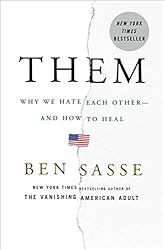
Them: Why We Hate Each Other—and How to Heal
Ben Sasse, 2018
St. Martin's Press
288 pp.
ISBN-13: 9781250193681
Summary
An intimate and urgent assessment of the existential crisis facing our nation.
Something is wrong.
We all know it.
American life expectancy is declining for a third straight year. Birth rates are dropping. Nearly half of us think the other political party isn’t just wrong; they’re evil. We’re the richest country in history, but we’ve never been more pessimistic.
What’s causing the despair?
In Them, bestselling author and U.S. senator Ben Sasse argues that, contrary to conventional wisdom, our crisis isn’t really about politics. It’s that we’re so lonely we can’t see straight—and it bubbles out as anger.
Local communities are collapsing. Across the nation, little leagues are disappearing, Rotary clubs are dwindling, and in all likelihood, we don’t know the neighbor two doors down. Work isn’t what we’d hoped: less certainty, few lifelong coworkers, shallow purpose. Stable families and enduring friendships—life’s fundamental pillars—are in statistical freefall.
As traditional tribes of place evaporate, we rally against common enemies so we can feel part of a team. No institutions command widespread public trust, enabling foreign intelligence agencies to use technology to pick the scabs on our toxic divisions.
We’re in danger of half of us believing different facts than the other half, and the digital revolution throws gas on the fire.
There’s a path forward—but reversing our decline requires something radical: a rediscovery of real places and human-to-human relationships. Even as technology nudges us to become rootless, Sasse shows how only a recovery of rootedness can heal our lonely souls.
America wants you to be happy, but more urgently, America needs you to love your neighbor and connect with your community. Fixing what's wrong with the country depends on it. (From the publisher.)
Author Bio
• Birth—February 22, 1972
• Where—Plainview, Nebraska, USA
• Education—B.A., Harvard University; M.A., St. John's College; M.A., M.Phil, Ph.D., Yale University
• Currently—lives in Washington, D.C., and Fremont, Nebraskas
U.S. Senator Ben Sasse is a fifth-generation Nebraskan. The son of a football and wrestling coach, he attended public school in Fremont, Nebraska., and spent his summers working soybean and corn fields.
He was recruited to wrestle at Harvard before attending Oxford and later earning a Ph.D. in American history from Yale. Prior to the Senate, Sasse spent five years as president of Midland University back in his hometown.
As perhaps the only commuting family in the U.S. Senate, Ben and his wife, Melissa, live in Nebraska but are homeschooling their three children as they commute weekly back and forth to Washington, DC. (From the publisher.)
For a more in depth bio, visit the Senator's website.
Book Reviews
Sasse emphasizes the importance of civil debate …and laments the extreme partisanship that characterizes public life in the Trump era. But "the dysfunction in D.C.," he says, stems from something "deeper than economics," and "deeper and more meaningful" than politics. "What’s wrong …is loneliness." … [A] little cloying …but what's curious …is not so much the careful avoidance of politics—politicians are really good at this—but Sasse’s repeated assertions that political solutions are meaningless.
Jennifer Szalai - New York Times
If Sen. Ben Sasse is right—he has not recently been wrong about anything important— the nation’s most-discussed political problem is entangled with the least-understood public health problem. The political problem is furious partisanship. The public health problem is loneliness. Sasse’s new book argues that Americans are richer, more informed and “connected” than ever—and unhappier, more isolated and less fulfilled.
George Will - Washington Post
Mr. Sasse’s experience as a senator in a time of hyperpartisanship gives his analysis a special poignancy… [his] remedies are wise and well-expressed… his prose has a distinctively cheerful warmth throughout. Perhaps at last we have a politician capable of writing a good book rather than having a dull one written for him.
Wall Street Journal
Sasse is highly attuned to the cultural sources of our current discontents and dysfunctions.… Them is not so much a lament for a bygone era as an attempt to diagnose and repair what has led us to this moment of spittle-flecked rage …a step toward healing a hurting nation.
National Review
Sasse is an excellent writer, unpretentious, thoughtful, and at times, quite funny …even if you disagree with some or all of what Sasse writes, it's an interesting book and his arguments are worth reading—as are his warnings about what our country might become.
NPR
An eloquent appeal for healing …what makes Them worth the read is Sasse's amalgam of realistic alarm and warning.
Guardian (UK)
Mr. Sasse’s strongly written analysis of our current existential unease should hit a national nerve.
Washington Times
The solutions [Sasse] proposes …are overwhelmingly social and personal, rather than political. Sasse’s philosophical musings are unlikely to convert many skeptics.
Publishers Weekly
Sasse presents a compelling, well-supported look at why… in our constantly expanding, internet-driven world, so many people feel lonely.… [W]hether readers agree… Them is a crucial contribution to a more open and productive social dialogue.
Booklist
The future of the republic depends on humility, empathy, and respect for pluralism.… Sasse offers a… recommendation for healing: identifying and nurturing common bonds. A sensible and thoughtful yet hardly groundbreaking political analysis.
Kirkus Reviews
Discussion Questions
We'll add publisher questions if and when they're available; in the meantime, use our LitLovers Talking Points to help start a discussion for THEM by Ben Sasse … then take off on your own:
1. Does it feel to you that America is coming apart—that we need a re-set? Considering the book's title, do we "hate each other"?
2. Do you agree with the premise of Ben Sasse's book: that the root of our country's divisiveness goes deeper than economics and deeper than the dysfunction in Washington—that our troubles stem from loneliness and a lack of connectedness to our local communities? Other writers, including Robert Putnam in his well-known 2000 book, Bowling Alone, have made similar observations. What do you think? Is loneliness at the heart of American anger and angst?
3. In the section called "Civics 101," Sasse writes, "Citizens in a republic must cultivate humility. It’s the only way to preserve sufficient space for true community and for meaningful, beautiful human relationships." First, define what Sasse means by humility and why it's important. In what …and where …and in whom …do we witness a lack of humility? How do we recover our individual and collective humility?
4. Sasse says that public servants "simply need to allow the space for communities of different belief and custom to flourish." What communities is he referring to? How do we ensure that different communities will indeed thrive—what steps need to be taken? What happens if those on the outside come to resent those on the inside of the communities? What protections can be offered?
5. Of our self-contained bubbles, Sasse writes that today what matters—more than actual content—is who does the reporting. "It isn’t just that living in ideological bubbles makes it harder to criticize one’s own side," Sasse writes. "It’s also that it actually becomes harder to believe credible charges against one’s own tribe." Is Sasse correct in pointing out that the messenger is more important than the message? Do you find yourself caught up in a bias bubble? Are you part of a "tribe" of like-minded thinkers? Is there a way to escape our biases, to move beyond them?
6. Sasse points to the fact that "America is being split into the "haves" and the "have-nots" and that the gap between them is growing. He admits that "it's increasingly difficult to move up" the economic ladder—"a stark departure" from the expectations of the past several generations. How important do you feel the income gap is? What solutions would go a long way toward closing the income gap?
7. Talk about the other societal ills Sasse identifies—opioid use, lower birth rate, pregnancy decoupled from marriage…. What are some others? Does Sasse's depiction of a country-in-trouble" ring true to you? Is he overly pessimistic? Is he realistic?
8. Consider Ben Sasse's background. How did it prepare him for a life in Washington and as a spokesman for the nation?
9. What do you know about Ben Sasse and his time as a U.S. Senator? As a Republican from Kansas, where do his allegiances (and votes) lie?
10. Ultimately, after reading Them, does Ben Sasse correctly diagnose the problems of this country, and does he offer us a viable solution or solutions?
(Questions by LitLovers. Please feel free to use them, online and off, with attribution. Thanks.)


Then Again
Diane Keaton, 2012
Random House
336 pp.
ISBN-13: 9780812980950
Summary
Mom loved adages, quotes, slogans. There were always little reminders pasted on the kitchen wall. For example, the word THINK. I found THINK thumbtacked on a bulletin board in her darkroom. I saw it Scotch-taped on a pencil box she’d collaged. I even found a pamphlet titled THINK on her bedside table. Mom liked to THINK.
So begins Diane Keaton’s unforgettable memoir about her mother and herself. In it you will meet the woman known to tens of millions as Annie Hall, but you will also meet, and fall in love with, her mother, the loving, complicated, always-thinking Dorothy Hall. To write about herself, Diane realized she had to write about her mother, too, and how their bond came to define both their lives.
In a remarkable act of creation, Diane not only reveals herself to us, she also lets us meet in intimate detail her mother. Over the course of her life, Dorothy kept eighty-five journals—literally thousands of pages—in which she wrote about her marriage, her children, and, most probingly, herself. Dorothy also recorded memorable stories about Diane’s grandparents. Diane has sorted through these pages to paint an unflinching portrait of her mother—a woman restless with intellectual and creative energy, struggling to find an outlet for her talents—as well as her entire family, recounting a story that spans four generations and nearly a hundred years.
More than the autobiography of a legendary actress, Then Again is a book about a very American family with very American dreams. Diane will remind you of yourself, and her bonds with her family will remind you of your own relationships with those you love the most. (From the publisher.)
Author Bio
• Birth—January 5, 1946
• Where—Los Angeles, California, USA
• Education—Santa College and Orange College (no degrees)
• Currently—lives in Los Angeles, California
Diane Keaton is an American film actress, director, producer, and screenwriter. Keaton began her career on stage, and made her screen debut in 1970. Her first major film role was as Kay Adams-Corleone in The Godfather (1972), but the films that shaped her early career were those with director and co-star Woody Allen, beginning with Play It Again, Sam in 1972. Her next two films with Allen, Sleeper (1973) and Love and Death (1975), established her as a comic actor. Her fourth, Annie Hall (1977), won her the Academy Award for Best Actress.
Keaton subsequently expanded her range to avoid becoming typecast as her Annie Hall persona. She became an accomplished dramatic performer, starring in Looking for Mr. Goodbar (1977) and received Academy Award nominations for Reds (1981) and Marvin's Room (1996). Some of her popular later films include Baby Boom (1987), Father of the Bride (1991), The First Wives Club (1996), Something's Gotta Give (2003), and The Family Stone (2005). Keaton's films have earned a cumulative gross of over US$1.1 billion in North America.[1] In addition to acting, she is also a photographer, real estate developer, author, and occasional singer.
Background
Keaton was born as Diane Hall in Los Angeles, California. Her mother, Dorothy Deanne (née Keaton; 1921–2008), was a homemaker and amateur photographer; her father, John Newton Ignatius "Jack" Hall (1921–1990), was a real estate broker and civil engineer. Her father, from Nebraska, came from an Irish-American Catholic background, and her mother, originally from Kansas, came from a Methodist family, and had English, German, and more distant Austrian, ancestry.
Keaton was raised a Free Methodist by her mother. Her mother won the "Mrs. Los Angeles" pageant for homemakers; Keaton has said that the theatricality of the event inspired her first impulse to be an actress, and led to her wanting to work on stage. She has also credited Katharine Hepburn, whom she admires for playing strong and independent women, as one of her inspirations.
Keaton is a 1963 graduate of Santa Ana High School in Santa Ana, California. During her time there, she participated in singing and acting clubs at school, and starred as Blanche DuBois in a school production of A Streetcar Named Desire. After graduation, she attended Santa Ana College, and later Orange Coast College as an acting student, but dropped out after a year to pursue an entertainment career in Manhattan.
Upon joining the Actors' Equity Association, she adopted the surname of Keaton, her mother's maiden name, as there was already a registered Diane Hall. For a brief time, she also moonlighted at nightclubs with a singing act. She would later revisit her nightclub act in Annie Hall (1977) and a cameo in Radio Days (1987).
Early career
Keaton began studying acting at the Neighborhood Playhouse in New York City. She initially studied acting under the Meisner technique, an ensemble acting technique first evolved in the 1930s by Sanford Meisner, a New York stage actor/acting coach/director who had been a member of The Group Theater (1931–1940). She has described her acting technique as...
[being] only as good as the person you're acting with.... As opposed to going it on my own and forging my path to create a wonderful performance without the help of anyone. I always need the help of everyone!
According to her Reds co-star Warren Beatty, "She approaches a script sort of like a play in that she has the entire script memorized before you start doing the movie, which I don't know any other actors doing that.
In 1968, Keaton became an understudy to Sheila in the original Broadway production of Hair. She gained some notoriety for her refusal to disrobe at the end of Act I when the cast performs nude, even though nudity in the production was optional for actors (Those who performed nude received a $50 bonus). After acting in Hair for nine months, she auditioned for a part in Woody Allen's production of Play It Again, Sam. After nearly being passed over for being too tall (at 5 ft 8 in./1.73 m she is two inches/5 cm taller than Allen), she won the part. The rest is history.
Personal life
Keaton has had several romantic associations with noted entertainment industry personalities starting with her time with the Broadway production of Play It Again, Sam when she auditioned for director Woody Allen. Their association became personal following a dinner after a late night rehearsal. It was her sense of humor that attracted Allen. They briefly lived together during the Broadway production but by the time of the film release of the same name in 1972 their living arrangements became informal. They worked together on eight films between 1971 and 1993, remain friends and was said by Keaton to be one of her closest friends.
She was already dating Warren Beatty from 1979 when they had co-lead roles in the film Reds. Beatty was a regular subject in tabloid magazines and media coverage to which she was included much to her bewilderment. Her avoidance of the spotlight earned her in 1985 from Vanity Fair the attribution as "the most reclusive star since Garbo." This relationship ended, as had with Allen, shortly after Reds wrapped. Troubles with the production are thought to have caused strain on the relationship, including numerous financial and scheduling problems. Keaton remains friends with Beatty.
Keaton also had a relationship with fellow cast member Al Pacino in The Godfather Trilogy. The on-again, off-again relationship ended following the filming of The Godfather Part III. Keaton said of Pacino,
Al was simply the most entertaining man... To me, that's, that is the most beautiful face. I think Warren was gorgeous, very pretty, but Al's face is like whoa. Killer, killer face.
Pacino, who seems to have been the love of Keaton's life, never agreed to her marriage ultimatums, and their lengthy relationship ended during the time her father was dying of brain cancer.
In July 2001, Keaton revealed her thoughts on being older and unmarried, "I don't think that because I'm not married it's made my life any less. That old maid myth is garbage."
Keaton has two adopted children, daughter Dexter (adopted 1996) and son Duke (2001). Her father's death made mortality more prevalent and she decided to become a mother at age 50. She later said of having children, "Motherhood has completely changed me. It's just about the most completely humbling experience that I've ever had." (Adapted from Wikipedia. Retrieved 5/15/2014.)
Book Reviews
[A] far-reaching, heartbreaking, absolutely lucid book about mothers, daughters, childhood, aging, mortality, joyfulness, love, work and the search for self-knowledge. Show business too…this book manages to present the full spectrum of women's experiences, from babyhood to adolescence, youthful insecurity…to liberating adulthood to slow, lingering death. Its power as a collage has been greatly enhanced by tight, punchy editing of the fragments that Ms. Keaton variously writes or excerpts. Some of its stories are universal and painful, yet this book is not mired in melancholy. Instead it's inspiring in its empathy, wisdom and self-knowledge.
Janet Maslin - New York Times
[R]ich and ruminative, provocatively honest, jumbled and jittery and textured. It speaks in two voices: Keaton is bitingly wry, ironic and tough about herself, but pleadingly earnest and passionate when writing of her mother, to whom she feels she owes her success, her self-esteem—just about everything. It's as if she's bargaining with her readers: she'll open her life to view and dish the dirt she knows we want, as long as we love her mother as she did. It's worth taking her up on it.
Sheila Weller -New York Times Book Review
Although peek-behind-the-curtain moments are delicious—Woody Allen! Warren Beatty! Jack Nicholson!...this is a [memoir] about a mother and a daughter, with insights and confessions and lessons to which all readers can relate.
Wall Street Journal
Then Again reads like the diary of an ordinary woman who suddenly became a movie star, who doesn’t quite believe any of it happened, but it did.
Los Angeles Times
Both heartbreaking and joyful, [Then Again] covers the gamut of life experiences facing all women.
Chicago Sun-Times
For anyone looking to join one woman’s—albeit a famous woman’s—touching and funny journey into the vortex that is the parent-child relationship, Then Again features an especially honest tour guide.
USA Today
A poem about women living in one another’s not uncomplicated memories.... Part of what makes Diane Keaton’s memoir, Then Again, truly amazing is that she does away with the star’s ‘me’ and replaces it with a daughter’s ‘I.’
Hilton Als - New Yorker
As warm, funny, and self-deprecating as Keaton’s onscreen persona—[Then Again] traces a profound dramatic arc: that of a young woman coming into her own as an artist, and of a daughter becoming a mother.
Vogue
This book feels like Diane Keaton. Which means it’s lovable.
Entertainment Weekly
This audio production of Keaton’s memoir delivers something you won’t get in the print edition: Diane Keaton herself. As a narrator, Keaton’s personality, talent, and vulnerability shine through.... This audio weaves Hall’s journal entries, by turns joyous and painful, with Keaton’s memories from her childhood and adult life. Entertaining and a must for fans.
Publishers Weekly
Discussion Questions
Use our LitLovers Book Club Resources; they can help with discussions for any book:
• How to Discuss a Book (helpful discussion tips)
• Generic Discussion Questions—Fiction and Nonfiction
• Read-Think-Talk (a guided reading chart)
(We'll add specific questions if and when they're made available by the publisher.)

There Will Be No Miracles Here: A Memoir
Casey Gerald, 2018
Penguin Publishing
400 pp.
ISBN-13: 9780735214200
Summary
The testament of a boy and a generation who came of age as the world came apart—a generation searching for a new way to live.
Casey Gerald comes to our fractured times as a uniquely visionary witness whose life has spanned seemingly unbridgeable divides.
His story begins at the end of the world: Dallas, New Year's Eve 1999, when he gathers with the congregation of his grandfather's black evangelical church to see which of them will be carried off. His beautiful, fragile mother disappears frequently and mysteriously; for a brief idyll, he and his sister live like Boxcar Children on her disability checks.
When Casey—following in the footsteps of his father, a gridiron legend who literally broke his back for the team—is recruited to play football at Yale, he enters a world he's never dreamed of, the anteroom to secret societies and success on Wall Street, in Washington, and beyond.
But even as he attains the inner sanctums of power, Casey sees how the world crushes those who live at its margins. He sees how the elite perpetuate the salvation stories that keep others from rising.
And he sees, most painfully, how his own ascension is part of the scheme.
There Will Be No Miracles Here has the arc of a classic rags-to-riches tale, but it stands the American Dream narrative on its head. If to live as we are is destroying us, it asks, what would it mean to truly live?
Intense, incantatory, shot through with sly humor and quiet fury, There Will Be No Miracles Here inspires us to question—even shatter—and reimagine our most cherished myths. (From the publisher.)
Author Bio
• Birth—1987
• Where—Oak Cliff, Texas, USA
• Education—B.A., Yale University; M.B.A., Harvard University
• Currently—lives in Los Angeles, California
Casey Gerald grew up in Oak Cliff, Texas and went to Yale, where he majored in political science and played varsity football. After receiving an MBA from Harvard Business School, he cofounded MBAs Across America. He has been featured on MSNBC, at TED and SXSW, on the cover of Fast Company, and in The New York Times, Financial Times, and The Guardian, among others (From the publisher.)
See the author's TED talk.
Book Reviews
A deeply spiritual memoir about growing up black, poor, and gay in evangelical Texas; Gerald has become a superstar as a TED talker and MBA powerhouse, but this book is quiet and reflective, a document of fearless humility.
Boston Globe
A memoir of lacerating honesty and self-awareness, a book that lets you feel how badly the author needed to write it.… There Will Be No Miracles Here is a portrait of a man looking for what's real, within and for himself. It's also a testament to the power of written words and the role they play in personal transformation. Reading Gerald's book is to see the author come alive, and to look in wonder at the process.
Dallas Morning News
Stunningly original.… By breaking every rule of the… genre, [Gerald has] created something unique and sublime: a beautiful chronicle of a life as yet unfinished.… [A] shining and sincere miracle of a book.
NPR
[Gerald] take[s] on the important work of exposing the damage done to America, especially its black population, by the failure to confront the myths, half-truths, and lies at the foundation of the success stories that the nation worships.
Atlantic
At first glance, Gerald’s story might read as inspirational: A gay black boy born into poverty goes on to Yale, a Harvard M.B.A., and Wall Street. But this memoir is light on triumph and heavy on fatalism, complicating the bootstrap narrative of his life.
New York Magazine
A formally inventive and lyrical memoir about boyhood, blackness, masculinity, faith, privilege, and the search for self that investigates the idea of the American dream, and how the myth of ascension–including the author’s own—is what can ultimately undo us.
Poets & Writers
[A] compulsively readable memoir… about coming into the light of reality in a world filled with deceit and loss, love and hope.… Gerald’s staccato prose and peripatetic storytelling combine the cadences of the Bible with an urgency reminiscent of James Baldwin.
BookPage
A wide-ranging, hard-to-define memoir of family, identity, and belonging.
Library Journal
(Starred review) Gerald pulls no punches in telling his extraordinary story, which he relates with unsparing truth, no small amount of feeling, and a complete lack of sentimentality.… Richly layered writing on poverty, progress, race, belief, and the… American Dream.
Booklist
(Starred review) A memoir of a religious, gay black man coming to terms with his own nuanced achievement of the American dream.… Hardly a by-the-numbers memoir, this is a powerful book marked by the author's… insightful storytelling.
Kirkus Reviews
Discussion Questions
We'll add publisher questions if and when they're available; in the meantime, use our LitLovers talking points to help start a discussion for THERE WILL BE NO MIRACLES HERE … then take off on your own:
1. What are the influences in Casey Gerald's early life that shaped the kind of man who would come to write There Will Be No Miracles Here? Consider his mother's disappearance, his father's struggle with addiction, and his grandfather as leader of a megachurch.
2. Why was the idea of perfection so important to Casey? He feels he should have been more nonconforming, that he should have resisted expectations. What does he mean, and why does he believe in the importance of nonconformity? What do you think?
3. Talk about the meaning of book's title and its relationship to the first pages. Gerald's memoir opens with his 12-year-old-self praying: "Lord, please take me with You when You come." In what way was Gerald's faith shaken when his savior didn't come for him?
4. Follow-up to Question 3: Consider the title once again: how does its meaning continue to follow Gerald during the next decade or so of his life: Yale, Lehman Brothers, Harvard?
5. How did Gerald experience Yale University as black 18-year-old?
6. How does Gerald define the American Dream? By all measures, it would seem that he himself has achieved the pinnacle of the dream. Yet he rejects its truth. Why?
7. Why did Gerald write this memoir—for what purpose—to point out injustices, to propose solutions, to urge reform, to help others, or to examine his own sense of self?
8. Gerald says it would be easier to have a mother die rather than disappear. Where you shocked, or do you understand why he might make such a statement?
9. Gerald was "just a boy defined by his circumstances," as he writes. He continues…
Perhaps we all are …but why do we lie about it? Why don’t we want to believe it? Is it that it shames us to admit how limited our power is, how much we can submit—have submitted—to the things we did not choose?
What is your response to that question? Are we the sum of our circumstances? Or are we "the captains of our fate"?
10. Watch Casey Gerard's TED talk. How does compare with his memoir? How do the two, the talk and the book, complement one another?
https://www.ted.com/talks/casey_gerald_the_gospel_of_doubt
(Questions by LitLovers. Please feel free to use them, online and off, with attribution. Thanks.)
These Truths: A History of the United States
Jill Lepore, 2018
W.W. Norton
900 pp. (seriously)
ISBN-13: 9780393635249
Summary
In the most ambitious one-volume American history in decades, award-winning historian and New Yorker writer Jill Lepore offers a magisterial account of the origins and rise of a divided nation, an urgently needed reckoning with the beauty and tragedy of American history.
Written in elegiac prose, Lepore’s groundbreaking investigation places truth itself—a devotion to facts, proof, and evidence—at the center of the nation’s history.
The American experiment rests on three ideas—"these truths," Jefferson called them—political equality, natural rights, and the sovereignty of the people.
And it rests, too, on a fearless dedication to inquiry, Lepore argues, because self-government depends on it. But has the nation, and democracy itself, delivered on that promise?
These Truths tells this uniquely American story, beginning in 1492, asking whether the course of events over more than five centuries has proven the nation’s truths, or belied them.
To answer that question, Lepore traces the intertwined histories of American politics, law, journalism, and technology, from the colonial town meeting to the nineteenth-century party machine, from talk radio to twenty-first-century Internet polls, from Magna Carta to the Patriot Act, from the printing press to Facebook News.
Along the way, Lepore’s sovereign chronicle is filled with arresting sketches of both well-known and lesser-known Americans, from a parade of presidents and a rogues’ gallery of political mischief makers to the intrepid leaders of protest movements, including Frederick Douglass, the famed abolitionist orator; William Jennings Bryan, the three-time presidential candidate and ultimately tragic populist; Pauli Murray, the visionary civil rights strategist; and Phyllis Schlafly, the uncredited architect of modern conservatism.
Americans are descended from slaves and slave owners, from conquerors and the conquered, from immigrants and from people who have fought to end immigration.
"A nation born in contradiction will fight forever over the meaning of its history," Lepore writes, but engaging in that struggle by studying the past is part of the work of citizenship. "The past is an inheritance, a gift and a burden," These Truths observes. "It can’t be shirked. There’s nothing for it but to get to know it." (From the publisher.)
Author Bio
• Birth—August 27, 1966
• Where—Worcester, Massachusetts, USA
• Education—B.A., Tufts University; M.A., University of Michigan; Ph.D., Yale University
• Awards—Bancroft Prize (more below)
• Currently—lives in Cambridge, Massachusetts
Jill Lepore is an American historian. She is the David Woods Kemper ’41 Professor of American History at Harvard University and author of These Truths: A History of the United States (2018). She is also a staff writer at The New Yorker, where she has contributed since 2005. She writes about American history, law, literature, and politics.
Early life
Lepore was born and grew up in West Boylston, a small town outside Worcester, Massachusetts, the daughter of a junior high school principal and an art teacher. Lepore had no early desire to become a historian, but claims to have wanted to be a writer from the age of six. She entered college with a Reserve Officers' Training Corps (ROTC) scholarship, starting as a math major. Eventually she left ROTC and changed her major to English.
Lepore earned her B.A. in English from Tufts University in 1987, an M.A. in American Culture from the University of Michigan in 1990, and a Ph.D. in American Studies from Yale University in 1995, where she specialized in the history of early America.[4]
Career
Lepore taught at the University of California-San Diego from 1995 to 1996 and at Boston University from 1996 before starting her Ph.D. at Harvard in 2003. She now teaches American political history, focusing on missing evidence in historical records and articles.
Lepore has defined history as "the art of making an argument about the past by telling a story accountable to evidence." To that end, she gathers historical evidence that allows scholars to study and analyze political processes and behaviors.
Non-academic writings
Her essays and reviews have also appeared in the New York Times, Times Literary Supplement, Th Journal of American History, Foreign Affairs, Yale Law Journal, American Scholar, and American Quarterly.
Three of her books derive from her New Yorker essays: The Mansion of Happiness: A History of Life and Death (2012), a finalist for the Carnegie Medal for Excellence in Nonfiction; The Story of America: Essays on Origins (2012), shortlisted for the PEN Literary Award for the Art of the Essay; and The Whites of Their Eyes: The Tea Party's Revolution and the Battle for American History (2010). The Secret History of Wonder Woman (2014) is a winner of the 2015 American History Book Prize.
Awards and honors
1999 Bancroft Prize for The Name of War
1999 Ralph Waldo Emerson Award of the Phi Beta Kappa Society for The Name of War
1999 Berkshire Prize for The Name of War
2006 Anisfield-Wolf Book Award (nonfiction) for New York Burning
2006 Pulitzer Prize for History finalist for New York Burning
2012 Sarah Josepha Hale Award
2013 PEN/Diamonstein-Spielvogel Award for the Art of the Essay runner-up
2013 National Book Award for Nonfiction finalist for Book of Ages
2013 Andrew Carnegie Medal for Excellence in Nonfiction finalist for The Mansion of Happiness
2014 Elected fellow of the American Academy of Arts and Sciences
2014 Mark Lynton History Prize for Book of Ages
2015 American History Book Prize for The Secret History of Wonder Woman
2016 John P. McGovern Award, Cosmos Club Foundation
(Author bio adapted from Wikipedia. Retrieved 1/4/2019.)
Book Reviews
[Lepore's] one-volume history is elegant, readable, sobering…The size of the project is liberating and constraining at once. A book like this is both very long and very short…Keeping everything contained between two covers risks compressing the historical sprawl into one of those dense slabs more suitable for gift-giving than reading—the print equivalent of a holiday fruitcake. But in Lepore's hands, the history gets some room to breathe. She begins in 1492, with Columbus's arrival, wending her way through the next five centuries…leavening some of the essential textbook material with stories that are lesser known…Which isn't to say These Truths is an update of A People's History of the United States, Howard Zinn's radically revisionist book from 1980. Yes, Lepore pays heed to Frederick Douglass and Cesar Chavez and the African-American lawyer and civil rights activist Pauli Murray, among others. But her book is less about a struggle between heroes and villains than it is about the country's often tortured approach to political equality and natural rights—truths that were supposed to be self-evident but have been treated as if they were anything but.
Jennifer Szalai - New York Times
It isn't until you start reading it that you realize how much we need a book like this one at this particular moment. These Truths…tries to take in almost everything, an impossible task, but I'd be hard-pressed to think [Lepore] could have crammed more into these 932 highly readable pages. It covers the history of political thought, the fabric of American social life over the centuries, classic "great man" accounts of contingencies, surprises, decisions, ironies and character, and the vivid experiences of those previously marginalized: women, African-Americans, Native Americans, homosexuals. It encompasses interesting takes on democracy and technology, shifts in demographics, revolutions in economics and the very nature of modernity. It's a big sweeping book, a way for us to take stock at this point in the journey, to look back, to remind us who we are and to point to where we're headed…There wasn't a moment when I struggled to keep reading…We need this book. Its reach is long, its narrative fresh and the arc of its account sobering to say the least.
Andrew Sullivan - New York Times Book Review
Gutsy, lyrical, and expressive…[These Truths] is a perceptive and necessary contribution to understanding the American condition of late.…It captures the fullness of the past, where hope rises out of despair, renewal out of destruction, and forward momentum out of setbacks.
Jack E. Davis - Chicago Tribune
ill Lepore is an extraordinarily gifted writer, and These Truths is nothing short of a masterpiece of American history. By engaging with our country's painful past (and present) in an intellectually honest way, she has created a book that truly does encapsulate the American story in all its pain and all its triumph.
Michael Schaub - NPR
In her epic new work, Jill Lepore helps us learn from whence we came.
Oprah Magazine
"An old-fashioned civics book," Harvard historian and New Yorker contributor Jill Lepore calls it, a glint in her eye. This fat, ludicrously ambitious one-volume history is a lot more than that. In its spirit of inquiry, in its eager iconoclasms, These Truths enacts the founding ideals of the country it describes.
Huffington Post
The principles of the Declaration of Independence get betrayed, fought over, and sometimes fulfilled in this probing political history.… [Lepore] unifies a complex and conflicted history into [an]…engrossing narrative with insights that resonate for modern readers.
Publishers Weekly
[As] Harvard historian …Lepore notes, "A nation born in contradiction, liberty in a land of slavery, sovereignty in a land of conquest, will fight, forever, over the meaning of its history." [Lepore] finds meaning in the contradictions.
Library Journal
(Starred Review) An ambitious and provocative attempt to interpret American history as an effort to fulfill and maintain certain fundamental principles…. Lepore is a historian with wide popular appeal, [who poses] questions about who we are as a nation.
Booklist
(Starred Review) [A] mammoth, wonderfully readable history of the United States from Columbus to Trump…. A splendid rendering—filled with triumph, tragedy, and hope—that will please Lepore's readers immensely and win her many new ones.
Kirkus Reviews
Discussion Questions
We'll add publisher questions if and when they're available; in the meantime, use our LitLovers Talking Points to help start a discussion for THESE TRUTHS … then take off on your own:
1. In a New York Times review, Jill Lepore said she wanted to write this lengthy volume of U.S. history because "it hasn't been attempted in a long time, and it's important, and it seemed worth a try." Do you think it's important, and if so why? What light does today's political climate shed on this book's importance or relevance?
2. The thrust of much of the book is about the country's struggle with political equality and natural rights. What are "natural rights." And why has the struggle been so long and so hard-fought?
3. Talk about the way in which women and people of color were excluded from the Constitution. How did the founders' own lives reflect the jarring discrepancies between their exalted language in favor of rights-for-all but ultimately settling for rights-for-some?
4. Talk about the various politicians/statesmen Lepore includes in her telling. On whom in particular does she turn a sharp eye (and pen)? Whom does she admire?
5. In what way has Jill Lepore's book enlightened you? Even if you're a history buff and fairly well versed in the discipline, was there something in particular that surprised you in her volume? What areas of history have you already been familiar with … and has These Truths added to your understanding or altered it?
6. When it comes to contemporary politics, what does Lepore have to say about both conservatives and liberals? What is her beef with the rise of technology and Silicon Valley?
7. What do you think of the book's final metaphor: the U.S. as a troubled, weakened ship on a "doom-black sea"?
(Questions by LitLovers. Please feel free to use them, online and off, with attribution. Thanks.)


Think: Straight Talk for Women to Stay Smart in a Dumbed-Down World
Lisa Bloom, 2011
Vanguard Press
288 pp.
ISBN-13: 9781593157098
Summary
In Think, Lisa Bloom examines the stark paradoxes that American girls and women live today, including excelling in education but obsessing over celebrities and tabloid media, in outperforming male counterparts in employment yet spending more time and money on appearances.
Bloom wonders: How did we get from the Equal Pay Act and Title IX to celebutainment and Botox, and what can we do about it? Bloom proffers the solution: one simple word, Think.
In this provocative, entertaining, and thoroughly researched book, Bloom illuminates specific steps for women to take to reclaim their brains, regain their focus, and take charge of their lives. Think is delivered in a no-nonsense, straight-talk manner that will make you laugh, question yourself, and start thinking again. (From the publisher.)
Author Bio
• Birth—Setember 26, 1961
• Where—California, USA
• Education—B.A., University of California, Los Angeles;
J.D., Yale University
• Currently—lives in Los Angeles, California
Lisa Bloom is a prominent American civil rights attorney, best known as anchor of Lisa Bloom: Open Court - a two-hour live legal news program—on truTv's In Session, formerly Court TV, from 2001 to 2009. She is the only child of famed attorney Gloria Allred.
Bloom received a bachelor's degree from UCLA and a Juris Doctor (J.D.) from Yale Law School. Early on in her career, she earned a reputation as a champion of victims' rights. Among Bloom's many high-profile lawsuits, she unsuccessfully sued the Boy Scouts of America for sex discrimination on behalf of Katrina Yeaw, a girl who wanted to join the organization. She also filed a child sexual abuse case suit against the Catholic Church, and sued the Los Angeles Police Department on several occasions.
Bloom is a television legal analyst on CBS News, CNN and HLN, who also makes frequent appearances on The Early Show, The Insider, Dr. Phil, Dr. Drew, The Situation Room, Reliable Sources, The Joy Behar Show and Issues with Jane Velez-Mitchell.
Bloom is licensed to practice law in both New York and California.
Book
Bloom's book Think: Straight Talk for Women to Stay Smart in a Dumbed-Down World, published in 2011, encourages women of all ages to eschew celebrity culture with its focus on the superficial, and instead to spend time reading and thinking. Think has been critically acclaimed and spent weeks on the New York Times Bestseller List. A promotional article for the book, "How to Talk to Little Girls," was published on The Huffington Post. Over 800 comments were posted in response. The article ranked #12 on Facebook's Most Shared Articles on Facebook in 2011 ranking. (From Wikipedia.)
Book Reviews
Think is a real eye-opener. Lisa Bloom brings her extraordinary passion, humor, and intelligence to the important subject of how women and girls can fight being drowned in a sea of pop culture, and lead lives that are fuller, richer, and more connected. Think educates, informs, and—thanks to Lisa’s wit and sense of humor—keeps us smiling along the way. Think is a must-read for all mothers and daughters.
Dr. Phil
Bloom’s manifesto mixes advice with insights backed up by examples, studies, anecdotes, and polls about our current kingdom of dumbdom, where “young women would rather be hot than smart.... The book offers step-by-step solutions in the chapter “Reclaiming the Brains God Gave Ya.” The most daunting challenge for many women, Bloom claims, is simply clawing back the time to think. How? Downsize your relationship to housework, for example, and don’t worry about your child’s every emotional upheaval. For single women, she’s equally blunt: Stop obsessing over your love life. Be busy. Be happy.
Elle
Think reads like a conversation with that best friend we all need. Funny, wise, opinionated, Lisa Bloom covers everything from Angelina Jolie to precut veggies in this how-to, what-for, this-matters guide to a meaningful and honorable life.
Jeffrey Toobin - CNN legal analyst; New Yorker writer
TV host, commentator and lawyer Bloom felt compelled to write her debut after becoming disgruntled with society's intellectual decline. Appalled by the fact that 23 percent of American women would rather lose their ability to read than their figures, the author writes with frantic urgency about the ignorance that is infecting the country and how this epidemic affects American women. A journalist whose career highlights include covering the Saddam Hussein trail, Bloom is dismayed that women are most interested in celebrity scandals, which make up more than 95 percent of the cases she is currently assigned to cover. The author urges women to reassess their priorities, put down the tabloid magazines and become more aware of world issues, many of which she indulges in detailing. Acknowledging that she would be taking cheap shots if she didn't offer solutions, the second half of the book suggests ways women can make a positive impact in their communities—e.g., volunteering and donating to worthy causes. The author also includes a list recommended reading and recipes that save time in the kitchen. While clearly written out of genuine concern, readers who are sensitive to criticism of American culture may take offense to the use of terms such as "Dumb American Syndrome." A wake-up call for women who have succumbed to a culture of mediocrity.
Kirkus Reviews
Discussion Questions
Use our LitLovers Book Club Resources; they can help with discussions for any book:
• How to Discuss a Book (helpful discussion tips)
• Generic Discussion Questions—Fiction and Nonfiction
• Read-Think-Talk (a guided reading chart)
Also consider these LitLovers talking points to help get a discussion started for Think:
1. What has happened to American culture, according to Lisa Bloom? What studies, examples, and anecdotes does she site to support her assessment? Do you agree with Bloom? if so, what evidence can you add to hers?
2. Why are smart women playing stupid? Have you known girls or women who have done so? Have you ever found yourself playing down your own intelligence or talent (come on: be honest)?
3. What happened to the women's movement, according to Bloom, which once fought for equal pay and Title Ix? What undermined the fervor for women's rights?
4. What do you know of Bloom's personal background that would spur her to speak out as she has? Who, or what, were her early influences? Is there any contradiction in the fact that many of Bloom's legal clients are celebrities, the very people she warns women against becoming obsessed with?
5. Bloom extends the repercussions America's dumbing down to the third world where women's problems are truly stark. Do you think her assessment is correct...or does she overstate her case when it comes to international consequences of American culture?
6. What solutions does Bloom offer to women and girls, married and single? Do they make sense? Can you offer any of your own advice? How would you counsel a young woman today?
7. Are women the only ones affected by the dumbing down of American culture?
8. What did you find that surprised you in Bloom's book? What about humor—anything funny in Think?
(Questions by LitLovers. Please feel free to use them, online or off, with attribution. Thanks.)
This House of Sky: Landscapes of a Western Mind
Ivan Doig, 1979
Houghton Mifflin Harcourt
336 pp.
ISBN-13: 9780156899826
Summary
Memoir. This work introduced a major modern author to the reading public. Ivan Doig grew up along the rugged rims of the Rocky Mountains in Montana with his father, Charlie, and his grandmother, Bessie Ringer. His life was formed among the sheepherders and characters of small-town saloons and valley ranches as he wandered beside his restless father. The prose of this memoir is as resonant of the landscape of the American West as it is of those moments in memory which determine our lives.
What Doig deciphers from his past is not only a sense of the land and how it shapes us, but also of our inextricable connection to those who shape our values in the search for intimacy, independence, love and family. This magnificently told story is at once especially American and quietly universal in its ability to awaken a longing for an explicable past. (From the author's website.)
Author Bio
• Birth—June 27, 1939
• Where—White Sulphur Springs, Montana, USA
• Death—April 9, 2015
• Where—Seattle, Washington
• Education—B.A., M.A., Northwestern University; Ph.D., University of Washington
Ivan Doig was born in Montana to a family of home-steaders and ranch hands. After the death of his mother Berneta, on his sixth birthday, he was raised by his father Charles "Charlie" Doig and his grandmother Elizabeth "Bessie" Ringer. After several stints on ranches, they moved to Dupuyer, Pondera County, Montana in the north to herd sheep close to the Rocky Mountain front.
After his graduation from Valier high school, Doig attended Northwestern University, where he received a bachelor's degree and a master's degree in journalism. He later earned a Ph.D. in American history at the University of Washington, writing his dissertation about John J. McGilvra (1827-1903). He now lives with his wife Carol Doig, nee Muller, a university professor of English, in Seattle, Washington.
Before he became a novelist, Doig wrote for newspapers and magazines as a free-lancer and worked for the United States Forest Service. He has also published two memoirs—This House of Sky (1979) and Heart Earth (1993).
Much of his fiction (more than 10 novels) is set in the Montana country of his youth. His major theme is family life in the past, mixing personal memory and regional history. As the western landscape and people play an important role in his fiction, he has been hailed as the new dean of western literature, a worthy successor to Wallace Stegner. (From Wikipedia.)
Extras
His own words:
• Taking apart a career in such summary sentences always seems to me like dissecting a frog—some of the life inevitably goes out of it—and so I think the more pertinent Ivan Doig for you, Reader, is the red-headed only child, son of ranch hand Charlie Doig and ranch cook Berneta Ringer Doig (who died of her lifelong asthma on my sixth birthday), who in his junior year of high school (Valier, Montana; my class of 1957 had 21 members) made up his mind to be a writer of some kind.
• No one is likely to confuse my writing style with that of Charlotte Bronte, but when that impassioned parson’s daughter lifted her pen from Jane Eyre and bequeathed us the most intriguing of plot summaries—"Reader, I married him"—she also was subliminally saying what any novelist ... must croon to those of you with your eyes on our pages: "Reader, my story is flirting with you; please love it back."
• One last word about the setting of my work, the American West. I don’t think of myself as a "Western" writer. To me, language—the substance on the page, that poetry under the prose—is the ultimate "region," the true home, for a writer. Specific geographies, but galaxies of imaginative expression —we’ve seen them both exist in William Faulkner’s postage stamp-size Yoknapatawpha County, and in Gabriel Garcia Marquez’s nowhere village of Macondo, dreaming in its hundred years of solitude. If I have any creed that I wish you as readers, necessary accomplices in this flirtatious ceremony of writing and reading, will take with you from my pages, it’d be this belief of mine that writers of caliber can ground their work in specific land and lingo and yet be writing of that larger country: life. (From the author's website.)
Book Reviews
(Preinternet books have few, if any, mainstream press reviews online. See Amazon and Barnes & Noble for helpful customer reviews.)
(Audio version.) This is the endearing story of a Montana man's reflections of growing up during a tumultuous, yet enlightening, time in history when life was slower, the landscape was environmentally protected, neighbors more supportive, and a boy's imagination could flourish. Doig describes in detail his mother and father's devotion for him and each other, and paints vivid portraits of a tightly knit family living in a rugged terrain and struggling for survival. After his mother's death, times got tougher, and Doig's portrayal of his dad's difficulties are touching. Poetic interludes are charming and contrast interestingly with Doig's portrayal of a wild and rugged Montana and its curious inhabitants. This unusual and beautifully expressed autobiography is a stunning work of art.
AudioFile
Discussion Questions
1. Doig has criticized much of the fiction that has arisen from the cowboy myth. In most of these formulaic stories, the hero is strong and predictably invincible against the enemy, be they forces of nature or forces of evil. How does Charlie Doig defy our stereotypical notions about the Western hero? How do his struggles raise him above the standard masculinity of the common Western man?
2. Describe how Doig's realistic sense of place broadens when he describes town life in Montana and the characters he and his father encountered at the Stockman Bar. Why are these trips to the Stockman so important to Charlie?
3. Charlie once tells Ivan, "Scotchmen and coyotes was the only ones that could live in the Basin, and pretty damn soon the coyotes starved out." Do these words explain why Charlie is able to survive his tenuous existence? How does he cope with the death of his first wife and the divorce of his second?
4. The discord between Charlie and Ruth brings for Ivan a mix of "apprehension and interestedness." Contrast Ruth with Berneta, and explore why Ivan might view his second mother in the way that he does.
5. Why does Doig call the reunion of Charlie and Bessie Ringer a "truce" and their relationship an "alliance"? Trace the development of Charlie and Bessie's relationship from the time of Charlie's divorce up until Charlie's death. How does it change? How does it stay the same?
6. Discuss the scene in which Ivan tells his father he is going to leave Montana for good. What makes it so poignant? Does Charlie understand his son's ambitions, or does he merely accept them? Does Ivan's decision to leave simply reinforce the idea of "absence across distance" for Charlie, an absence he has reluctantly grown accustomed to?
7. Bessie Ringer emerges from a generation of women still reeling under the influence of what feminist critics call "The Cult of True Womanhood," whose values (purity, piety, submissiveness, and domesticity) were often misunderstood and thus misapplied. Does Bessie, in some sense, break free from the rigid expectations for women of her time? Describe her personality and compare it to some of our classical notions of women on the plains.
8. In "North," Charlie, Bessie, and Ivan fight to save their sheep from an attack of ticks and a subsequent storm, which sends the herd bawling toward a steep precipice. Discuss the artistic elements of this scene.
9. Study Bessie's language patterns. Find instances of the humorous, often proverbial words that add spice to the memoir, making her come alive as a character. Is she, in some simple way, a mentor to Ivan with regards to the "mystery and meaning in the world around him?" Contrast Ivan's book learning with her more practical wisdom.
10. The vaulted symmetry in the mountain peaks, the "walls of high country," and the windswept floor where shadows accent deep valleys, all these provide the dimensions in the "house of sky" which would become part of Doig's heart and soul. How does the landscape shape Doig's recollective voice?
(Questions courtesy of the author's website.)
top of page (summary)

This Is the Story of a Happy Marriage
Ann Patchett, 2013
HarperCollins
320 pp.
ISBN-13: 9780062236685
Summary
A resonant portrait of a life in this collection of writings on love, friendship, work, and art.
The tricky thing about being a writer, or about being any kind of artist, is that in addition to making art you also have to make a living.
So begins This Is the Story of a Happy Marriage, an examination of the things Ann Patchett is fully committed to—the art and craft of writing, the depths of friendship, an elderly dog, and one spectacular nun. Writing nonfiction, which started off as a means of keeping her insufficiently lucrative fiction afloat, evolved over time to be its own kind of art, the art of telling the truth as opposed to the art of making things up. Bringing her narrative gifts to bear on her own life, Patchett uses insight and compassion to turn very personal experiences into stories that will resonate with every reader.
These essays twine to create both a portrait of life and a philosophy of life. Obstacles that at first appear insurmountable—scaling a six-foot wall in order to join the Los Angeles Police Department, opening an independent bookstore, and sitting down to write a novel—are eventually mastered with quiet tenacity and a sheer force of will. The actual happy marriage, which was the one thing she felt she wasn't capable of, ultimately proves to be a metaphor as well as a fact: Patchett has devoted her life to the people and ideals she loves the most.
An irresistible blend of literature and memoir, This Is the Story of a Happy Marriage is a unique examination of the heart, mind, and soul of one of our most revered and gifted writers.. (From the publisher.)
Author Bio
• Birth—December 2, 1963
• Where—Los Angeles, California, USA
• Raised—Nashville, Tennessee
• Education—B.A., Sarah Lawrence College; M.F.A., University of Iowa
• Awards—Guggenheim Fellowship; PEN/Faulkner Award; Orange Prize
• Currently—lives in Nashville, Tennessee
Ann Patchett is an American author of both fiction and nonfiction. She is perhaps best known for her 2001 novel, Bel Canto, which won her the Orange Prize and PEN/Faulkner Award and brought her nationwide fame.
Patchett was born in Los Angeles, California, and raised in Nashville, Tennessee. Her mother is the novelist Jeanne Ray. Her father, Frank Patchett, who died in 2012 and had been long divorced from her mother, served as a Los Angeles police officer for 33 years, and participated in the arrests of both Charles Manson and Sirhan Sirhan. The story of Patchett's own family is the basis for her 2016 novel, Commonwealth, about the individual lives of a blended family spanning five decades.
Education and career
Patchett attended St. Bernard Academy, a private Catholic school for girls run by the Sisters of Mercy. Following graduation, she attended Sarah Lawrence College and took fiction writing classes with Allan Gurganus, Russell Banks, and Grace Paley. She managed to publish her first story in The Paris Review before she graduated. After college, she went on to the Iowa Writers' Workshop at the University of Iowa
For nine years, Patchett worked at Seventeen magazine, writing primarily non-fiction; the magazine published one of every five articles she wrote. She said that the magazine's editors could be cruel, but she eventually stopped taking criticism personally. She ended her relationship with the magazine following a dispute with one editor, exclaiming, "I’ll never darken your door again!"
In 1990-91, Patchett attended the Fine Arts Work Center in Provincetown, Massachusetts. It was there she wrote The Patron Saint of Liars, which was published in 1992 (becoming a 1998 TV movie). It was where she also met longtime friend Elizabeth McCracken—whom Patchett refers to as her editor and the only person to read her manuscripts as she is writing.
Although Patchett's second novel Taft won the Janet Heidinger Kafka Prize in fiction in 1994, her fourth book, Bel Canto, was her breakthrough novel. Published in 2001, it was a National Book Critics Circle Award Finalist and won the PEN/Faulkner Award and Britain's Orange Prize.
In addition to her other novels and memoirs, Patchett has written for publications such as The New York Times Magazine, Washington Post, Oprah Magazine, ELLE, GQ, Gourmet, and Vogue. She is the editor of the 2006 volume of the anthology series The Best American Short Stories.
Personal
Patchett was only six when she moved to Nashville, Tennessee, and she lives there still. She is particularly enamored of her beautiful pink brick home on Whitland Avenue where she has lived since 2004 with her husband and dog. When asked by the New York Times where would she go if she could travel anywhere, Patchett responded...
I've done a lot of travel writing, and people like to ask me where I would go if I could go anyplace. My answer is always the same: I would go home. I am away more than I would like, giving talks, selling books, and I never walk through my own front door without thinking: thank-you-thank-you-thank-you.... [Home is] the stable window that opens out into the imagination.
In 2010, when she found that her hometown of Nashville no longer had a good book store, she co-founded Parnassus Books with Karen Hayes; the store opened in November 2011. In 2012, Patchett was on Time magazine's list of the 100 most influential people in the world. She is a vegan for "both moral and health reasons."
In an interview, she once told Barnes and Noble that the book that influenced her writing more than any other was Humboldt's Gift by Saul Bellow.
I think I read it in the tenth grade. My mother was reading it. It was the first truly adult literary novel I had read outside of school, and I read it probably half a dozen times. I found Bellow's directness very moving. The book seemed so intelligent and unpretentious. I wanted to write like that book.
Books
1992 - The Patron Saint of Liars
1994 - Taft
1997 - The Magician's Assistant
2004 - Truth and Beauty: A Friendship
2001 - Bel Canto
2007 - Run
2008 - What Now?
2011 - State of Wonder; The Getaway Car: A Practical Memoir About Writing and Life
2013 - This Is the Story of a Happy Marriage
2016 - Commonwealth
2019 - The Dutch House
(Author bio adapted from Wikipedia. Retrieved 9/5/2016.)
Book Reviews
A collection of 22 essays...offer generous glimpses of [Patchett's] rural, divorced Catholic, Tennessee background and winding but determined route to becoming a writer. Writing nonfiction...was her bread and butter in the early days, and she has an authoritative, straightforward voice in exploring some of the milestones of her life.... Early on, her writing teacher Russell Banks had warned Patchett of being too “polished” and “just getting by,” urging her to take risks, and certainly many of these selections reveal a candid, evolved self-reflection.
Publishers Weekly
[A]n eclectic group [of essays] covering a wide range of events on the topic of commitment, from training to get into the Los Angeles Police Department academy to Patchett's career as an author.... In sharing her struggles as a writer and creating the life she wanted for herself, Patchett offers words that gently advise without imposing. Her experiences, large and small, create a connection with the reader in prose that is thoughtful, warm, and encouraging. —Catherine Gilmore, MLS, Portland, OR
Library Journal
A well-organized collection of a beloved, award-winning writer's nonfiction essays about her personal and literary lives.... What she ultimately produces is a text that is part meditation on the writing life and part literary memoir.... Readable and candid, Patchett's collection is a joyful celebration of life, love and the written word. Wise, humane and always insightful.
Kirkus Reviews
Discussion Questions
Use our LitLovers Book Club Resources; they can help with discussions for any book:
• How to Discuss a Book (helpful discussion tips)
• Generic Discussion Questions—Fiction and Nonfiction
• Read-Think-Talk (a guided reading chart)
We'll add specific questions if and when they're made available by the publisher.
This Time Together: Laughter and Reflection
Carol Burnett, 2010
Crown Publishing
267 pp.
ISBN-13: 9780307461186
Summary
This Time Together is 100 percent Carol Burnett—funny, irreverent, and irresistible.
Carol Burnett is one of the most beloved and revered actresses and performers in America. The Carol Burnett Show was seen each week by millions of adoring fans and won twenty-five Emmys in its remarkable eleven-year run. Now, in This Time Together, Carol really lets her hair down and tells one funny or touching or memorable story after another—reading it feels like sitting down with an old friend who has wonderful tales to tell.
In engaging anecdotes, Carol discusses her remarkable friendships with stars such at Jimmy Stewart, Lucille Ball, Cary Grant, and Julie Andrews; the background behind famous scenes, like the moment she swept down the stairs in her curtain-rod dress in the legendary “Went With the Wind” skit; and things that would happen only to Carol—the prank with Julie Andrews that went wrong in front of the First Lady; the famous Tarzan Yell that saved her during a mugging; and the time she faked a wooden leg to get served in a famous ice cream emporium. This poignant look back allows us to cry with the actress during her sorrows, rejoice in her successes, and finally, always, to laugh. (From the publisher.)
Author Bio
• Birth—April 26, 1933
• Where—San Antonio, Texas
• Education—University of California, Los Angeles
• Awards—Six-time Emmy Award winner
• Currently—lives in Los Angeles, California
Carol Creighton Burnett is an American actress, comedienne, singer, dancer and writer.
Burnett started her career in New York. After becoming a hit on Broadway, she debuted on television. After successful appearances on The Garry Moore Show, Carol moved to Los Angeles and began an eleven-year run on the The Carol Burnett Show which was aired on CBS television from 1967 to 1978.
With roots in vaudeville, The Carol Burnett Show was a variety show combining comedy sketches, song, and dance. The comedy sketches ranged from film parodies to character pieces which featured the many talents of Burnett herself who created and played several well-known and distinctive characters. (From Wikipedia.)
Book Reviews
These short memories, of the people Burnett met and interviewed over the years, on- and off-camera, bring it back—the golden age of variety shows.... Burnett has a writer's eye for the moment, the detail, the slip that reveals character. She's never mean and always grateful.
Los Angeles Times
A disappointment.... Burnett, 76, is a consummate storyteller, and there are enough gems amid the dross in This Time Together to keep a tolerant reader interested.... Fans will probably love Burnett’s new book. But if you really want to know about her, read One More Time.
St. Petersburg Times
In short, there’s a lot of humor in this book, and many of the funny stories are told at the teller’s own expense. What you won’t find here is very much beneath the surface about the heartaches Burnett had to deal with in her life.... In the end, the memoir gives us what we want most of all: another chance to spend just a little time with a woman who still makes us laugh.
San Francisco Chronicle
Fans of both the show and the actress will enjoy this mostly lighthearted though sometimes poignant look back at Burnett’s career.
Booklist
Discussion Questions
Use our LitLovers Book Club Resources; they can help with discussions for any book:
• How to Discuss a Book (helpful discussion tips)
• Generic Discussion Questions—Fiction and Nonfiction
• Read-Think-Talk (a guided reading chart)
Also consider these LitLovers talking points to help get a discussion started for This Time Together:
1. Has your opinion of Carol Burnett changed after reading This Time Together—or has it confirmed your prior opinion of Carol. What kind of person is she...how does she come across in this book? Is she someone you would like to have dinner with?
2. What was the overall tone of this book—humorous and lighthearted as you would expect in a Carol Burnett memoir? Or sadder, more poignant than expected? What do you make of the fact that Burnett rarely, if ever, takes aim at others, that she speaks well of almost everyone? (Okay, be honest — were you hoping for more Hollywood gossip?)
3. Burnett maintains a bewildered attitude toward her fame, going so far as to claim that her success is due, in large part, to luck. Would you say she's too modest, even hard on herself? Is her success due to talent, hard work, and perseverance? Or would you agree that her success is, in fact, a matter of luck?
4. Many of the stories related in the book are funny, some laugh-out-loud hilarious—especially the ones with Lucille Ball. What other anecdotes made you laugh? Do you have any favorites in the book?
5. This is Burnett's second memoir. If you've read her 1986 memoir One More Time—about her years growing up in Texas and her start in show biz—how the two compare? Is there enough new information to fill out a second memoir? If you haven't read her first one, does This Time Together inspire you to do so?
6. Are you surprised about the clashes offstage with Harvey Korman? Is there anything else in the book that surprises you?
7. You could describe Carol Burnett as earthy, loud, and rambunctious. Does her friendship with Julie Andrews, whose public personae might be called "prim"—surprise you? The two seem such opposites.
8. What does it reveal about Burnett that she was over-awed, even intimidated, upon meeting Cary Grant—even though, by then, she herself was a star? What accounts for her tendency to become awestruck?
9. How does Carol describe her marriage to Brian Miller? What makes her marriage work, especially with a husband 20 years her junior? (So, like, could that even happen outside Hollywood?)
10.One reviewer said This Time Together is "anything but a tell-all book. In fact, it's barely a 'tell-some' book." Do you agree? Are important stories skimmed over—especially, perhaps, the death of her daughter Carrie and how Carol marshaled the strength to cope with her grief? Why do you suppose readers learn of Carrie's death through a reprint of her New York Times obituary? What more would you have liked to have learned? Or is the book revealing enough as is?
11. In the era of off-color television sitcoms and YouTube videos, would The Carol Burnett Show be successful on prime time today? Or is it a cultural relic from one of TV's golden eras?
12. What were some of your favorite Carol Burnett shows? Which skits stick in your mind? (How about the one with Tim Conway as an incompetent dentist...and Harvey Korman as the patient. Catch it on YouTube—it's worth seeing...over and over...!)
(Questions issued by LitLovers. Please feel free to use them, online or off, with attribution. Thanks.)
top of page


This Town: Two Parties and a Funeral—Plus, Plenty of Valet Parking!—in America's Gilded Capital
Mark Liebovich, 2013
Penguin Group USA
400 pp.
ISBN-13: 9780399170683
Summary
Tim Russert is dead. But the room was alive.
Big Ticket Washington Funerals can make such great networking opportunities. Power mourners keep stampeding down the red carpets of the Kennedy Center, handing out business cards, touching base. And there is no time to waste in a gold rush, even (or especially) at a solemn tribal event like this.
Washington—This Town—might be loathed from every corner of the nation, yet these are fun and busy days at this nexus of big politics, big money, big media, and big vanity. There are no Democrats and Republicans anymore in the nation’s capital, just millionaires. That is the grubby secret of the place in the twenty-first century. You will always have lunch in This Town again. No matter how many elections you lose, apologies you make, or scandals you endure.
In This Town, Mark Leibovich, chief national correspondent for The New York Times Magazine, presents a blistering, stunning—and often hysterically funny—examination of our ruling class’s incestuous “media industrial complex.” Through his eyes, we discover how the funeral for a beloved newsman becomes the social event of the year.
How political reporters are fetishized for their ability to get their names into the predawn e-mail sent out by the city’s most powerful and puzzled-over journalist. How a disgraced Hill aide can overcome ignominy and maybe emerge with a more potent “brand” than many elected members of Congress.
And how an administration bent on “changing Washington” can be sucked into the ways of This Town with the same ease with which Tea Party insurgents can, once elected, settle into it like a warm bath. (From the publisher.)
Author Bio
• Birth—May 9, 1965
• Where—Boston, Massachusetts, USA
• Education—University of Michigan
• Awards—National Magazine Award
• Currently—lives in Washington, D.C.
Mark Leibovich is an American journalist and author. He is the chief national correspondent for the New York Times Magazine, based in Washington, D.C. He is known for his profiles on political and media figures.
Career
Leibovich was previously a national political correspondent in the New York Times' Washington Bureau. He came to the Times in 2006 from the Washington Post, where he spent nine years, first covering the national technology sector for the Post's business section, then serving as the lead political writer for the paper's style section. Leibovich previously worked at the the San Jose Mercury News.
He is also the author of the 2013 This Town: Two Parties and a Funeral-Plus, Plenty of Valet Parking!-in America's Gilded Capital. Politico published an article describing This Town as a "chronicle" of the "incestuous ecology of insider Washington." Leibovich, according to the story, is nicknamed "Leibo," and the book's original sub-title was "The Way it Works in Suck Up City." Fareed Zakaria as reviewer for Washington Post praises it as "hottest political book of the summer," containing " juicy anecdotes" and a tell-tale core of "corruption and dysfunction."
The book attracted controversy in 2011 when an aide to Representative Darrell Issa was fired for sharing reporters’ e-mails with Leibovich without their knowledge. In addition to his political writing, Leibovich also authored The New Imperialists, a collection of profiles of technology pioneers.
Awards and Recognition
Leibovich has won a number of journalism awards, including a 2011 National Magazine Award for his profile of Politico's Michael Allen and the changing media culture of Washington. The New Republic described Leibovich as “brutally incisive yet not without pathos” in naming him one of Washington’s 25 Most Powerful, Least Famous People. Washingtonian Magazine has called him the "reigning master of the political profile” and the Atlantic’s Jeffrey Goldberg nominated Leibovich as Washington’s “most important journalist” for his “ability to make his profile subjects look like rock stars, on the one hand, and to make others look like complete idiots, on the other.” This Town has been featured in the New York Times, Washington Post, Slate, and Daily Beast. (From Wikipedia. Retrieved 9/10/13.)
Book Reviews
Holt, the fictional Colorado town where all of Haruf’s novels are set, longtime resident Dad Lewis is dying of cancer. Happily married (he calls his wife “his luck”), Dad spends his last weeks thinking over his life, particularly an incident that ended badly with a clerk in his store, and his relationship with his estranged son. As his wife and daughter care for him, life goes on: one
Publishers Weekly
Haruf made his name with the heartfelt Plainsong, a best seller and a finalist for the National Book Award and the Los Angeles Times Book Award. The subsequent Eventide, also a best seller, revisited Plainsong's setting, high-plains Holt, CO. Haruf again returns to Holt but with a new cast, among them Dad Lewis, dying of cancer and comforted by his wife and daughter though
Library Journal
A meditation on morality returns the author to the High Plains of Colorado, with diminishing returns for the reader.... With his third novel with a one-word title set in Holt, the narrative succumbs to melodrama and folksy wisdom as it details the death of the owner of the local hardware store, a crusty feller who has seen his own moral rigidity soften over the year epiphanies seem like reheated leftovers
Kirkus Reviews
Discussion Questions
Use our LitLovers Book Club Resources; they can help with discussions for any book:
• How to Discuss a Book (helpful discussion tips)
• Generic Discussion Questions—Fiction and Nonfiction
• Read-Think-Talk (a guided reading chart)
Also, consider using these LitLovers talking points for start a discussion for This Town:
1. Liebovich opens his book by taking us inside the Kennedy Center for the funeral of TV's Meet the Press anchor Tim Russert. What do you think of his coverage of what should be a rather solemn event? Is it inappropriate? Is it too irreverent...or is it spot-on?
2. What were your personal observations after reading the first chapter, especially of the guests? Why do you think that Liebovich began his book with the Russert event?
3. Liebovich says of the news: "It is no longer enough just to follow the unsexy business of governance in the seat of power. No more boring and stodgy in This Town." What are the implications that serious analysis of public policy and governmental action is considered "boring and stodgy"? What is the purpose of "news"? Is the public interested in serious policy discussions? Are the news media merely giving the voters what they want (entertainment)? Or are the media seriously underestimating public intelligence and interest in governance? What do you think?
4. What are the changes over the past 30 years which Liebovich believes have altered broadcast and print news? Is it for the better...or worse?
5. Talk about the often referred to "democratization" of news on the web vs. the control the old media once exercised over the flow of information. Is there more openness...and if so, is that better or worse? Or do you think the reporting of news still a closed system?
5. Liebovich says that almost no one leaves Washington anymore.
Quaint is the notion of a citizen-politician humbly returning to his farm, store, or medical practice back home after his time in public office is complete.
However, given complicated issues those in government must grapple with—legal, financial, technical and scientific—isn't it preferable to have people with years of experience who can master the complexities?
6. What does Liebovich mean by people who "brand" or "monetize" themselves? Who comes to your mind as a Washington "brand"?
7. How is D.C. is rife with conflicts of interest? Talk about Bob Barnett, which Liebovich uses as his prime example. In what way is Barnett "a walking self-interest"? What are the implications for policy if everyone is connected in someway to everyone else?
8. Senator Coburn of Oklahoma talked to Liebovich about partisanship in today's Washington: "the easiest way to remain in office is to embrace rigid partisanship...[which] usually signals a deeper faith in careerism than in conservatism or liberalism." Do you agree...or disagree? Is this the root of what today we consider D.C.'s "gridlock"? Or are politicians right to stand by their principles, especially if those principles represent the values of their voters?
9. What most shocked...or maddened you in reading Liebovich's book? Has reading This Town altered your opinion of the people who run our government or live in the nation's capital? Or has it confirmed what you already suspected?
10. After reading This Town, what do you think is the most serious problem facing those who run our government? More importantly, what do you think can be done about it?
(Questions by LitLovers. Please feel free to use them, online of off, with attribution. Thanks!)
A Thousand Days in Venice
Marlena de Blasi, 2002
Random House
304 pp.
ISBN-13: 9780345457646
Summary
He saw her across the Piazza San Marco and fell in love from afar. When he sees her again in a Venice café a year later, he knows it is fate. He knows little English; and she, a divorced American chef, speaks only food-based Italian.
Marlena thinks she is incapable of intimacy, that her heart has lost its capacity for romantic love. But within months of their first meeting, she has packed up her house in St. Louis to marry Fernando—“the stranger,” as she calls him—and live in that achingly lovely city in which they met.
Vibrant but vaguely baffled by this bold move, Marlena is overwhelmed by the sheer foreignness of her new home, its rituals and customs. But there are delicious moments when Venice opens up its arms to Marlena. She cooks an American feast of Mississippi caviar, cornbread, and fried onions for the locals...and takes the tango she learned in the Poughkeepsie middle school gym to a candlelit trattoría near the Rialto Bridge. All the while, she and Fernando, two disparate souls, build an extraordinary life of passion and possibility.
Featuring Marlena’s own incredible recipes, A Thousand Days in Venice is the enchanting true story of a woman who opens her heart—and falls in love with both a man and a city. (From the publisher.)
Author Bio
• Birth—N/A
• Where—Schenectady, New York, USA
• Education—B.A., State University of New York, Albany
• Currently—lives in Orvieto, Umbria, Italy
Marlena de Blasi, who has worked as a chef and as a food and wine consultant, lives in Italy, where she plans and conducts gastronomic tours of its various regions. She is the author of four previous memoirs—That Summer in Sicily, A Thousand Days in Venice, A Thousand Days in Tuscany, and The Lady in the Palazzo—as well as three books on the foods of Italy. (From the publisher.)
Extras
From a 2003 Barnes & Noble interview:
• Everything is inspiration to write. A writer never stops writing, even if it's in his head or on paper napkins. I've been desperate enough to scratch half phrases on my bedsheets, not finding paper and fearing to lose a thought should I get up to look for such.
• I don't think writers can be raised up in a creative writing class. I think it's a bold, bad lie to convince someone he should—or can—be taught to write. I think writers' groups can sometimes be helpful, but I'm mostly wary even of them. Writing is a private, solo, isolating, and very lonely job. But if you're a writer, it's all you ever want to do.
• [My first job] was as a radio voice and TV voice and face. My best contracts were with Peugeot—(‘the best-kept automotive secret in America—Peugeot')—and Coty perfumes—(‘if you want to capture someone's attention, whisper') and other sort of soft-sell products.
• I taught cooking on a PBS channel for a few years. I was very passionate about this opportunity and wanted the audience to not just learn formula, but to be inspired by the beauty and sensuality of the raw food itself. My first show was live. And not understanding my gaffe until the producer explained it to me, I opened by holding up a single, great, and splendid leek. Camera in for a close-up. I smiled my TV model smile and said: ‘First, you take a leek.' I know someone has since written a book with that title, but I can assure you my traffic with those words came long before it.
• Since I live in a 14th-century palazzo on the via del Duomo in an Umbrian hill town, there's not such a great deal from which to unwind. Our life is simple and full of rituals such as sidling up to the bar in our favorite caffè—Montanucci—at least four times a day for cappuccini, aperitivi, pastry, chocolate, and sympathy; I write very early in the morning for a few hours, and then at about nine we go to the morning markets, shop for lunch, sit in the caffè and talk to our friends, come home to cook and put our bread in the oven. We sit down to lunch at one, get up from the table at about two-thirty or three, nap for an hour. I write until about seven-thirty, when we take the passeggiata—the evening stroll—the moment when the whole town is out and about. We pick up a few things for supper, take an aperitivo with our friends, head back home, where we'll dine at about nine-thirty, or go out to dine at one of the typical, tiny osterie for which Orvieto is famous.
• How wonderful you ask about dislikes, though I'm not certain this sits in that category or in the one labeled "things that hurt." But I find readers who judge style—my style—tiresome, presumptuous, often using the critical forum to air barely disguised ‘issues' of their own. And is there some glint of jealousy in their criticism? I'm not sure. That I see and feel life in a certain way and then write about it in my own voice, well, that belongs to me. Also I think it's that I find sarcasm, in all its tortured forms, to be simply naked insecurity. It's grand whenever a person states their sentiments. Better, if done so with a fine set of civil manners.
• When asked what book most influenced her life, her is her response:
I really don't think there was a single epiphanous book. I cherished and was touched by so many. But I was still in my teens when I first read Man of La Mancha, and I suppose because it resonated how I was already looking at life, it took on a certain sacredness which it's managed to sustain. The chivalric approach of it still appeals. ("Extras" from Barnes & Noble.)
Book Reviews
On a visit to Venice, de Blasi meets a local bank manager who falls in love with her at first sight. After "the stranger" (as she coyly calls him throughout the book) pursues her back to her home in St. Louis, Mo., she agrees to return to Italy and marry him, leaving behind her grown children and her job as chef and partner in a cafe. Although the banker, Fernando, lives in a bunkerlike postwar condominium on the Lido rather than the Venetian palazzo of her dreams, and some of his European ideas about women clash with her American temperament, the relationship works. She survives his criticism of her housekeeping and his displeasure at her insistence on remaining a serious cook (in modern Italy "No one bakes bread or dolci or makes pasta at home," he tells her), and they marry. Then one day Fernando surprises her by announcing that he is quitting his job at the bank where he has worked for 26 years. They leave Venice, he espouses her interest in food and they now direct gastronomic tours of Tuscany and Umbria. De Blasi's breathless descriptions of her improbable love affair can be cloying, but she makes up for these excesses with her enchanting accounts of Venice, especially of the markets at the Rialto. She conjures up vivid images of produce "so sumptuously laid as to be awaiting Caravaggio" and picturesque scenes of the vendors, such as the egg lady who keeps her hens under her table, collects the eggs as soon as they are laid and wraps each one in newspaper, "twisting both ends so that the confection looks like a rustic prize for a child's party." In a final section entitled "Food for a Stranger," de Blasi (Regional Foods of Northern Italy) includes recipes for a few of the dishes with which she charmed the stranger.
Publishers Weekly
Venice is almost synonymous with romance, and in this charming account de Blasi spares no detail in telling us how she fell under its spell. A journalist, restaurant critic, and food consultant, de Blasi left her home, her grown children, and her job as a chef in St. Louis to marry Fernando, a Venetian she barely knew. In defiance of the cynics who think true love in middle age is crazy, her marriage flourished, as these two strangers made a life together. Food comforted the newlyweds when their conflicting cultures almost divided them, and in the end marital harmony reigns. Is this book a romance, a food guide, or an exhortation for us to come to Venice and experience the magic? Ultimately, it is all three, and there is even an appendix that includes recipes for dishes described in the text. Recommended for larger travel, biography, or cooking collections. —Olga B. Wise, Compaq Computer Corp., Austin, TX
Library Journal
A luxurious story of sudden love, done properly, from cook/journalist de Blasi (Regional Foods of Northern Italy). Middle-aged and divorced, with two grown children, living in St. Louis (Missouri, that is), de Blasi goes to Venice and meets the gaze of a man while having a drink in a restaurant with friends. He asks her for a rendezvous, and she agrees, unexpectedly, touched by the same whatever that has moved him. The rest is history, and a great story. The man, Fernando-no smooth-talker, a bit of a frump, awkward, yet a romantic-comes for a weeklong visit to St. Louis, and by the time he leaves, de Blasi has promised to move to Venice to be with him. She has few second thoughts, and her friends urge her on: "If there is even the possibility that this is real love," one of them asks her, "could you dare to imagine turning away from it?" She doesn't, and what follows are the next 1,000 days, her game immersion in Italian culture to her wedding to their move south to Tuscany. De Blasi relates it all in a voice at once worldly and sensuous, unsentimental and aware of what it means to have such good fortune. Not all is as rosy as the Venetian morning light, though; she suffers a loss of her natural ebullience, "the quick strangling of spontaneity for the sake of a necessary deception that Italians call 'elegance'," though she doesn't allow it to dampen her vitality, nor does she let Fernando—who eats like a bird and whose kitchen is "a cell with a Playskool stove"—diminish her love of food. Rather, she binds her love of Fernando to her love of food, like a bouquet garni, in one long delicious engagement running throughout this ode, from cappuccino and apricot pastry to pumpkin gnocchi in cream and sage. Love stories are easy targets, but no one will scoff at the genuine and cheering affection depicted so generously here.
Kirkus Reviews
Discussion Questions
1. “Even as I am drawn to Venice, so I am suspicious of her.” Why did this well-traveled author deliberately shun Venice for so long? Why was she so suspicious?
2. The author’s family and friends respond in many different ways to her decision to move to Venice and marry Fernando. Without the benefit of hindsight, what do you think your initial response would be to a friend or a relative planning such a drastic life change?
3. When she and Fernando first kiss, de Blasi recognizes that they “are not too old” for love. Yet her love affair inspires awkwardness, suspicion, and even embarrassment in many of those around her. Discuss the internal and external barriers to love found later in life.
4. In the midst of a quarrel with Fernando, the author wonders “why there always hovers, just an inch or two above love, some small itch for revenge.” Discuss this statement. What other emotions and reactions hover just above love?
5. Throughout the novel, de Blasi refers to her partner and then husband as “the stranger.” How well do you know those you love? Do you ever consider them strangers?
6. The author and her husband both struggle to keep their personal demons in check to make their relationship work. Do you agree with de Blasi that this can be easier to do later in life? Why or why not?
7. Why does de Blasi move to Italy as opposed to Fernando moving to the United States?
8. The author is forced to jettison most of her material possessions upon her move to Italy, which she finds liberating. Could you or would you do the same? If you could keep only what could be shipped overseas at a reasonable cost, what would you choose?
9. The author’s friend Misha warns her that she will “neither understand nor be understood” in Italy. How does she navigate the cultural barriers that threaten to isolate and overwhelm her? What role does her love of food play?
10. In the end, do you think de Blasi has found a satisfactory means of communication in her new culture?
11. Discuss what places in the world inspire you the way Venice inspires de Blasi. Is there a culture different from your own you can imagine immersing yourself in? If you have done so, how does your experience compare with de Blasi’s?
12. The author chooses to embrace the complications involving her wedding. Discuss the expectations surrounding such special events and the potential for disaster.
13. On the impact of her life-changing decision on her adult children, de Blasi muses “that their childhood was ending and…in a strange way, my childhood was beginning.” Discuss the meaning of this statement.
14. Like Fernando, have you ever felt imprisoned by the expectations of others? Have you lost track of dreams you once had?
15. De Blasi makes her husband feel connected to the world. Who or what makes you feel connected to the world?
16. Cooking for a crowd, real or imagined, helps the author stave off the loneliness that plagues and frightens her. What staves off loneliness for you?
17. The author argues, “Too often it is we who won’t let life be simple.” Do you agree or disagree?
18. Do you think “a little suffering sweetens things”?
19. How do you think this narrative would unfold if told in Fernando’s voice? How might it differ and how might it remain the same?
20. How do you think Fernando would describe his wife in his own words?
21. In the final line of her acknowledgments, de Blasi hints that another memoir might be forthcoming. Would your group be interested in reading another installment of this memoir? Do you want to learn about her life in the Tuscan village of San Casciano dei Bagni?
22. Did you find this memoir to be a satisfying read? What are the benefits and drawbacks of this literary genre?
23. How would you describe this book to prospective readers?
24. If you were to write your own memoirs, what story would you tell?
25. Is your group satisfied with this selection? Why or why not? What is your next selection?
26. Have you or will you try any of the recipes found at the end of this novel?
(Questions issued by publishser.)
top of page
Three Cups of Tea: One Man's Mission to Promote Peace...One School at a Time
Greg Mortenson and David Oliver Relin, 2006
Penguin Group USA
368 pp.
ISBN-13: 9780143038252
Summary
The astonishing, uplifting story of a real-life Indiana Jones and his humanitarian campaign to use education to combat terrorism in the Taliban's backyard.
Anyone who despairs of the individual's power to change lives has to read the story of Greg Mortenson, a homeless mountaineer who, following a 1993 climb of Pakistan's treacherous K2, was inspired by a chance encounter with impoverished mountain villagers and promised to build them a school. Over the next decade he built fifty-five schools-especially for girls-that offer a balanced education in one of the most isolated and dangerous regions on earth. As it chronicles Mortenson's quest, which has brought him into conflict with both enraged Islamists and uncomprehending Americans, Three Cups of Tea combines adventure with a celebration of the humanitarian spirit. (From the publisher.)
More
Three Cups of Tea is the true story of one of the most extraordinary humanitarian missions of our time. In 1993, a young American mountain climber named Greg Mortenson stumbles into a tiny village high in Pakistan’s beautiful and desperately poor Karakoram Himalaya region. Sick, exhausted, and depressed after a failing to scale the summit of K2, Mortenson regains his strength and his will to live thanks to the generosity of the people of the village of Korphe. Before he leaves, Mortenson makes a vow that will profoundly change both the villagers’ lives and his own—he will return and build them a school.
The book traces how Mortenson kept this promise (and many more) in the high country of Pakistan and Afghanistan, despite considerable odds. The region is remote and dangerous, a notorious breeding ground for Al Qaeda and Taliban terrorists. In the course of his work, Mortenson was kidnapped and threatened with death. He endured local rivalries, deep misunderstandings, jealousy, and corruption, not to mention treacherous roads and epic weather. But he believed passionately that balanced, non-extremist education, for boys and girls alike, is the most effective way to combat the violent intolerance that breeds terrorism. To date, Mortenson’s Central Asia Institute has constructed fifty-five schools, and his work continues.
Mortenson initially approached Karakoram as a climber and he never lost the mountaineer’s appreciation for the region’s austere beauty and incredible physical challenges. His coauthor David Oliver Relin deftly evokes high-altitude landscapes haunted by glaciers, snow leopards, and the deaths of scores of climbers. As Mortenson transformed himself from down-and-out climbing bum to the director of a humanitarian enterprise, he came to appreciate more and more deeply the struggles that people of the region endure every day—struggles that have intensified with the recent explosion of war and sectarian violence.
In the course of this narrative, readers come to know Mortenson as a friend, a husband and father, a traveling companion, a son and brother, and also as a flawed human being. Mortenson made enemies along the way and frustrated his friends and family. Relin does not shy away from depicting the man’s exasperating qualities—his restlessness, disorganization, sleeplessness, and utter disregard for punctuality. But Mortenson never asks others to make sacrifices that he has not already made himself time and time again.
The war-torn mountains of Pakistan and Afghanistan appear in the news as the breeding grounds of terrorist training camps, Al Qaeda hide-outs, and fierce religious extremism. In Three Cups of Tea, Mortenson and Relin take readers behind the headlines to reveal the true heart and soul of this explosive region and to show how one man’s promise might be enough to change the world. (Also from the publisher.)
In 2009, Mortenson published Stones into Schools, a sequel to Three Cups.
Author Bio
• Birth—December 27, 1957
• Reared—in Tanzania, Africa
• Education—A.A., B.A., University of South Dakota (USA)
• Awards—numerous humanitarian awards (see below)
• Currently—lives in Bozeman, Montana, USA
Greg Mortenson is an American humanitarian, writer, and former mountaineer. Mortenson is the co-founder (with Dr. Jean Hoerni) and director of the non-profit Central Asia Institute, and founder of the educational charity Pennies For Peace. He is the protagonist and co-author of the #1 New York Times bestseller Three Cups of Tea: One Man's Mission To Promote Peace... One School At A Time (2007). He published a a sequel, Stones Into Schools: Promoting Peace with Books, Not Bombs, in Afghanistan and Pakistan in 2009.
From 1958-1973, Mortenson grew up in Africa near Mount Kilimanjaro in northern Tanzania. His father, Irvin "Dempsey" Mortenson, was the founder/development director of the Kilimanjaro Christian Medical Center, Tanzania's first teaching hospital. His mother, Dr. Jerene Mortenson, founded the International School Moshi.
Mortenson served in the U.S. Army in Germany from 1975 to 1977 as a medic, and received the Commendation Medal. He attended Concordia College, Moorhead, from 1977 to 1979, and later graduated from the University of South Dakota in Vermillion, South Dakota, in 1983 with an Associate Degree in Nursing and a Bachelor's Degree in Chemistry.
In July 1992, Mortenson's young sister, Christa Mortenson, died from a life-long struggle with severe epilepsy on the morning she had planned to visit the cornfield in Dyersville, Iowa, where the iconic baseball movie Field of Dreams was filmed.
In 1993, to honor his deceased sister's memory, Mortenson went to climb K2, the world's second highest mountain, in the Karakoram range of northern Pakistan. After more than 70 days on the mountain, Mortenson and three other climbers completed a life-saving rescue of a fifth climber that took more than 75 hours. The time and energy devoted to this rescue prevented him from attempting to reach the summit. After the rescue, he began his descent of the mountain and became weak and exhausted. Mortenson set out with one local Balti porter by the name of Mouzafer Ali to the nearest city, but he took a wrong turn along the way and ended up in Korphe, a small village, where Mortenson was cared for by the villagers while he recovered.
To pay the remote community back for their compassion, Mortenson said he would build a school for the village. After a frustrating time trying to raise money, Mortenson convinced Jean Hoerni, a Silicon Valley pioneer, to fund the Central Asia Institute. The mission of CAI—a non-profit organization—is to promote education and literacy, especially for girls, in remote mountain regions of Pakistan and Afghanistan. Hoerni named Mortenson as CAI's first Executive Director.
In the process of building schools, Mortenson has survived an eight-day armed 1996 kidnapping in the tribal areas of Waziristan, in Pakistan's North-West Frontier Province; escaped a 2003 firefight between Afghan opium warlords; endured two fatwās by angry Islamic clerics for educating girls; and received hate mail and threats from fellow Americans for helping educate Muslim children.
Mortenson believes that education and literacy for girls globally is the most important investment all countries can make to create stability, bring socio-economic reform, decrease infant mortality, decrease the population explosion, and improve health, hygiene, and sanitation standards globally. Mortenson believes that "fighting terrorism" only perpetuates a cycle of violence and that there should be a global priority to "promote peace" through education and literacy, with an emphasis on girls' education. "You can drop bombs, hand out condoms, build roads or put in electricity, but unless the girls are educated, a society won't change," is an often-quoted statement made by Mortenson. Because of community "buy-in," which involves getting villages to donate land, subsidized or free labor ("sweat equity"), wood and resources, the schools have local support and have been able to avoid retribution by the Taliban or other groups opposed to girls' education.
Extras
• Mortenson and David Oliver Relin are co-authors of the New York Times bestselling book Three Cups of Tea.
• The Government of Pakistan announced on its Independence Day of August 14, 2008, that Mortenson will receive Pakistan’s highest civilian award, the Sitara-e-Pakistan (The Star of Pakistan), in a Islamabad civil ceremony during Pakistan Day on March 23, 2009.
• In August 2008, Mortenson met with then-President of Pakistan, Pervez Musharraf over tea, and in March 2009, Mortenson met with new President Asif Zardari for a cup of tea, upon receiving the Sitara-e-Pakistan award.
• On July 15, 2009, Admiral Mike Mullen, U.S. Chairman of the Joint Chiefs of Staff paid a visit to Pushgur school, in a remote valley of Afghanistan, to inaugurate one of Mortenson’s new schools, to highlight the military’s new strategy to advocate empowering local communities, build relationships and the significance of education to promote peace. Thomas Friedman, New York Times columnist, wrote about the visit in his column.
• Mortenson was nominated for the Nobel Peace Prize in 2009 and in 2010, by several bi-partisan members of U.S. Congress. According to Norwegian odd-makers, he was believed to have been in a handful of finalists of the Peace Prize that was eventually awarded to Barack Obama on October 10, 2009.
• In November 2009, U.S. News & World Report magazine featured Greg Mortenson as one of America's Top Twenty Leaders in 2009.
• Mortenson was featured on a Bill Moyers PBS TV Journal 30-minute interview on Sunday, January 15, 2010, discussing the role of the U.S. military and Obama troop surge in Afghanistan, and significant role of girls' education as a determinant of peace. (From Wikipedia.)
Book Reviews
Greg Mortenson’s dangerous and difficult quest...is not only a thrilling read, it’s proof that one ordinary person, with the right combination of character and determination, really can change the world.
Tom Brokaw
Mortenson is surely right that education is key to the battle with jihadists for Muslim minds. But ... [his] book is full of self-indulgent digressions, clunky prose and odd, hagiographic references to himself.... The problem stems in part from the awkward construction of the book, which is written as an admiring, extended third-person interview by its co-author, journalist [David Oliver Relin]. He acknowledges being in awe of Mortenson, [who is not] nearly as interesting as the characters and situations Mortenson encounters in the remote tribal regions of northern Pakistan and Afghanistan. Here, Relin's prose gains both altitude and insight.... Mortenson's mission is admirable, his conviction unassailable, his territory exotic and his timing excellent. His story would have been better served, though, by a tougher editor and a book that was shorter, leaner and freer of fawning.
Pamela Constable - Washington Post
Laced with drama, danger, romance, and good deeds, Mortenson's story serves as a reminder of the power of a good idea and the strength inherent in one person's passionate determination to persevere against enormous obstacles.
Christian Science Monitor
Some failures lead to phenomenal successes, and this American nurse's unsuccessful attempt to climb K2, the world's second tallest mountain, is one of them. Dangerously ill when he finished his climb in 1993, Mortenson was sheltered for seven weeks by the small Pakistani village of Korphe; in return, he promised to build the impoverished town's first school, a project that grew into the Central Asia Institute, which has since constructed more than 50 schools across rural Pakistan and Afghanistan. Coauthor Relin recounts Mortenson's efforts in fascinating detail, presenting compelling portraits of the village elders, con artists, philanthropists, mujahideen, Taliban officials, ambitious school girls and upright Muslims Mortenson met along the way. As the book moves into the post-9/11 world, Mortenson and Relin argue that the United States must fight Islamic extremism in the region through collaborative efforts to alleviate poverty and improve access to education, especially for girls. Captivating and suspenseful, with engrossing accounts of both hostilities and unlikely friendships, this book will win many readers' hearts.
Publisher's Weekly
An unlikely diplomat scores points for America in a corner of the world hostile to all things American-and not without reason. Mortenson first came to Pakistan to climb K2, the world's second-tallest peak, seeking to honor his deceased sister by leaving a necklace of hers atop the summit. The attempt failed, and Mortenson, emaciated and exhausted, was taken in by villagers below and nursed back to health. He vowed to build a school in exchange for their kindness, a goal that would come to seem as insurmountable as the mountain, thanks to corrupt officials and hostility on the part of some locals. Yet, writes Parade magazine contributor Relin, Mortenson had reserves of stubbornness, patience and charm, and, nearly penniless himself, was able to piece together dollars enough to do the job; remarks one donor after writing a hefty check, "You know, some of my ex-wives could spend more than that in a weekend," adding the proviso that Mortenson build the school as quickly as possible, since said donor wasn't getting any younger. Just as he had caught the mountaineering bug, Mortenson discovered that he had a knack for building schools and making friends in the glacial heights of Karakoram and the remote deserts of Waziristan; under the auspices of the Central Asia Institute, he has built some 55 schools in places whose leaders had long memories of unfulfilled American promises of such help in exchange for their services during the war against Russia in Afghanistan. Comments Mortenson to Relin, who is a clear and enthusiastic champion of his subject, "We had no problem flying in bags of cash to pay the warlords to fight against the Taliban. I wondered why we couldn't do the same thing to build roads, and sewers, and schools." Answering by delivering what his country will not, Mortenson is "fighting the war on terror the way I think it should be conducted," Relin writes. This inspiring, adventure-filled book makes that case admirably.
Kirkus Reviews
Discussion Questions
1. There is a telling passage about Mortenson’s change of direction at the start of the book: “One evening, he went to bed by a yak dung fire a mountaineer who’d lost his way, and one morning, by the time he’d shared a pot of butter tea with his hosts and laced up his boots, he’d become a humanitarian who’d found a meaningful path to follow for the rest of his life.” What made Mortenson particularly ripe for such a transformation? Has anything similar happened in your own life?
2. Relin gives a “warts and all” portrait of Mortenson, showing him as a hero but also as a flawed human being with some exasperating traits. Talk about how Relin chose to write about Mortenson’s character—his choice of details, his perspective, the way he constructs scenes. Is Mortenson someone you’d like to get to know, work with, or have as a neighbor or friend?
3. At the heart of the book is a powerful but simple political message: we each as individuals have the power to change the world, one cup of tea at a time. Yet the book powerfully dramatizes the obstacles in the way of this philosophy: bloody wars waged by huge armies, prejudice, religious extremism, cultural barriers. What do you think of the “one cup of tea at a time” philosophy? Do you think Mortenson’s vision can work for lasting and meaningful change?
4. Have you ever known anyone like Mortenson? Have you ever had the experience of making a difference yourself through acts of generosity, aid, or leadership?
5. The Balti people are fierce yet extremely hospitable, kind yet rigid, determined to better themselves yet stuck in the past. Discuss your reactions to them and the other groups that Mortenson tries to help.
6. After Haji Ali’s family saves Greg’s life, he reflects that he could never “imagine discharging the debt he felt to his hosts in Korphe.” Discuss this sense of indebtedness as key to Mortenson’s character. Why was Mortenson compelled to return to the region again and again? In your opinion, does he repay his debt by the end of the book?
7. References to paradise run throughout the book—Mortenson’s childhood home in Tanzania, the mountain scenery, even Berkeley, California, are all referred to as “paradise.” Discuss the concept of paradise, lost and regained, and how it influences Mortenson’s mission.
8. Mortenson’s transition from climbing bum to humanitarian hero seems very abrupt. However, looking back, it’s clear that his sense of mission is rooted in his childhood, the values of his parents, and his relationship with his sister Christa. Discuss the various facets of Mortenson’s character—the freewheeling mountain climber, the ER nurse, the devoted son and brother, and the leader of a humanitarian cause. Do you view him as continuing the work his father began?
9. “I expected something like this from an ignorant village mullah, but to get those kinds of letters from my fellow Americans made me wonder whether I should just give up,” Mortenson remarked after he started getting hate mail in the wake of September 11. What was your reaction to the letters Mortenson received?
10. Mortenson hits many bumps in the road—he’s broke, his girlfriend dumps him, he is forced to build a bridge before he can build the school, his health suffers, and he drives his family crazy. Discuss his repeated brushes with failure and how they influenced your opinion of Mortenson and his efforts.
11. The authors write that “the Balti held the key to a kind of uncomplicated happiness that was disappearing in the developing world.” This peaceful simplicity of life seems to be part of what attracts Mortenson to the villagers. Discuss the pros and cons of bringing “civilization” to the mountain community.
12. Much of the book is a meditation on what it means to be a foreigner assimilating with another culture. Discuss your own experiences with foreign cultures—things that you have learned, mistakes you have made, misunderstandings you have endured.
13. Did the book change your views toward Islam or Muslims? Consider the cleric Syed Abbas, and also the cleric who called a fatwa on Mortenson. Syed Abbas implores Americans to “look into our hearts and see that the great majority of us are not terrorists, but good and simple people.” Discuss this statement. Has the book inspired you to learn more about the region?
(Questions issued by publisher.)
top of page (summary)
Three Weeks with My Brother
Nicholas Sparks and Micah Sparks, 2004
Time Warner Books
368 pp.
ISBN-13: 9780446694858
Summary
The day the brochure came was a typical one. With a wife and five small children, a hectic schedule, and a new book due to his publishers, Nicholas Sparks was busy with his usual routine.
The colorful mailer, however, described something very different: a tour to some of the most exotic places on Earth. Slowly, an idea took hold in Nicholas's mind and heart. In January 2003, Sparks and his brother, Micah, set off on a three-week trip around the globe. It was to mark a milestone in their lives, for at thirty-seven and thirty-eight respectively, they were now the only surviving members of their family.
As they voyaged to the lost city of Machu Picchu high in the Andes...to mysterious Easter Island...to Ayers Rock in the Australian outback...and across the vast Indian subcontinent, the ultimate story of their lives would unfold. Against the backdrop of the wonders of the world and often overtaken by their feelings, daredevil Micah and the more serious, introspective Nicholas recalled their rambunctious childhood adventures and the tragedies that tested their faith.
In the process, they discovered startling truths about loss, love and hope. Narrated with irrepressible humor and rare candor, and including personal photographs, Three Weeks with My Brother reminds us to embrace life with all its uncertainties...and most of all, to cherish the joyful times, both small and momentous, and the wonderful people who make them possible. (From Nicholas Sparks' website.)
Author Bio
• Birth—December 31. 1965
• Where—Omaha, Nebraska, USA
• Education—B.A., University of Notre Dame
• Currently—lives in New Bern, North Carolina
Nicholas Charles Sparks is an American novelist, screenwriter and producer. He has published some 20 novels, plus one non-fiction. Ten have been adapted to films, including Message in a Bottle, A Walk to Remember, The Notebook, Nights in Rodanthe, Dear John, The Last Song, The Lucky One, and most recently The Longest Ride.
Background
Sparks was born to Patrick Michael Sparks, a professor of business, and Jill Emma Marie Sparks (nee Thoene), a homemaker and an optometrist's assistant. He was the middle of three children, with an older brother and a younger sister, "Dana", who died at the age of 33 from a brain tumor. Sparks said that she is the inspiration for the main character in his novel A Walk to Remember.
His father was pursuing graduate studies at University of Minnesota and University of Southern California, and the family moved a great deal, so by the time Sparks was eight, he had lived in Watertown, Minnesota, Inglewood, California, Playa del Rey, California, and Grand Island, Nebraska, which was his mother's hometown during his parents' one year separation.
In 1974 his father became a professor of business at California State University, Sacramento teaching behavioral theory and management. His family settled in Fair Oaks, California, and remained there through Nicholas's high school days. He graduated in 1984 as valedictorian from Bella Vista High School, then enrolled at the University of Notre Dame under a full track and field scholarship. In his freshman year, his team set a record for the 4 x 800 relay.
Sparks majored in business finance and graduated from Notre Dame with honors in 1988. He also met his future wife that year, Cathy Cote from New Hampshire, while they were both on spring break. They married in 1989 and moved to New Bern, North Carolina.
Writing career
While still in school in 1985, Sparks penned his first (never published) novel, The Passing, while home for the summer between freshman and sophomore years at Notre Dame. He wrote another novel in 1989, also unpublished, The Royal Murders.
After college, Sparks sought work with publishers or to attend law school, but was rejected in both attempts. He then spent the next three years trying other careers, including real estate appraisal, waiting tables, selling dental products by phone and starting his own manufacturing business.
In 1990, Sparks co-wrote with Billy Mills Wokini: A Lakota Journey to Happiness and Self-Understanding. The book was published by Random House sold 50,000 copies in its first year.
In 1992, Sparks began selling pharmaceuticals and in 1993 was transferred to Washington, DC. It was there that he wrote another novel in his spare time, The Notebook. Two years later, he was discovered by literary agent Theresa Park, who picked The Notebook out of her agency's slush pile, liked it, and offered to represent him. In October 1995, Park secured a $1 million advance for The Notebook from Time Warner Book Group. The novel was published in 1996 and made the New York Times best-seller list in its first week of release.
With the success of his first novel, he and Cathy moved to New Bern, NC. After his first publishing success, he began writing his string of international bestsellers.
Personal life and philanthropy
Sparks continues to reside in North Carolina with his wife Cathy, their three sons, and twin daughters. A Roman Catholic since birth, he and his wife are raising their children in the Catholic faith.
In 2008, Entertainment Weekly reported that Sparks and his wife had donated "close to $10 million" to start a private Christian college-prep school, The Epiphany School of Global Studies, which emphasizes travel and lifelong learning.
Sparks also donated $900,000 for a new all-weather tartan track to New Bern High School. He also donates his time to help coach the New Bern High School track team and a local club track team as a volunteer head coach.
In addition to track, he funds scholarships, internships and annual fellowship to the Creative Writing Program (MFA) at the University of Notre Dame. (Adapted from Wikipedia.)
Book Reviews
A moving tale of familial solidarity. Sparks’s side story of commitment to ameliorating his son’s autism is downright inspiring.
Washington Post Book World
When bestselling author Sparks (The Notebook; Message in a Bottle; etc.) receives a brochure offering a three-week trip around the world, it's not hard for him to persuade Micah, his older brother, to join him in touring Guatemala's Mayan ruins, Peru's Incan temples, Easter Island, the killing fields in Cambodia, the Taj Mahal and Ethiopian rock cathedrals. His account of the trip is refreshingly honest and perceptive. At each stop, the brothers, both deeply committed to their families, cover the crucial moments in a life full of familial love and tragedy: Nick's role as the middle child always feeling left out; his marriage in 1989; the loss of Nick and Micah's mother two months later after a horseback riding accident; the death of Nick's first baby and the physical problems of his second son; the death of their father in a car accident; and the passing of their younger sister from a brain tumor. As the brothers travel together through these mythical sites and share candid thoughts, they find themselves stunned by fate's turns, realizing that a peaceful moment may be shattered at any time. Weaving in vignettes of tenderness and loss with travelogue-like observations, Sparks's account shows how he and his brother both evolved on this voyage. "Somehow there was a chance we could help each other, and in that way, I began to think of the trip less as a journey around the world than a journey to rediscover who I was and how I'd developed the way I did."
Publishers Weekly
This is a rare opportunity for readers to get to know a favorite author as Nicholas reveals the inspirations for his fiction. A must-read for Sparks fans as well as a treat for those who want to find out what makes a family strong.
Booklist
Sparks, the best-selling author of several novels (The Notebook; Message in a Bottle), turns his hand to nonfiction in a hybrid that mixes personal memoir with travel narrative. Chapters alternate between descriptions of the exotic locales visited on an around-the-world excursion with his brother and incidents from their shared childhood and Nicholas's adult life. The greater part of the book is devoted to memoirs that read like Sparks's novels; indeed, it would appear that he has drawn much of the inspiration for his fiction from personal experience. The travel chapters are disappointing at best. Sparks drones on about the minutiae of the trip while offering little description of the famous landmarks he visits (Machu Picchu, Taj Mahal, Easter Island) beyond the usual postcard writer's platitudes. In fact, the entire book is clich -ridden, with short, choppy sentences, unexciting dialog, and a dearth of modifiers. However, Sparks's legion of readers will undoubtedly find the details of his personal life appealing, and there is certain to be strong interest in this title. Public libraries should purchase it strictly to meet demand. —Rita Simmons, Sterling Heights P.L., MI
Library Journal
Discussion Questions
1. The authorship of Three Weeks with My Brother, at least as far as the cover is concerned, is split equally between Nicholas and Micah. Yet the book, for the most part, is written in first-person by Nicholas. Why? In your opinion, would it have been better to have split the authorial voice, and if so, why?
2. Which sections seem most likely to have come from Nicholas’s memories? Which from Micah’s? Why?
3. Jill, their mother, is largely canonized in the novel, and both brothers claim a profound love and respect for her, and further describe her as an ideal mother. Did she strike you as ideal? In what way? Has the memory of Jill been romanticized over the years by both Micah and Nicholas?
4. At the same time, however, Jill seems to be almost neglectful as a parent, allowing the boys too much freedom at too young an age and forcing a maturity upon them that is far beyond their years. Is this inconsistency adequately explained? Would you allow this as a parent? In what ways did this freedom to roam as children—complete with injuries, brushes with the law, and wrong choices—seem to affect Micah now? How does it seem to affect Nicholas now?
5. Mike, their father, is perhaps least understood by both Micah and Nicholas of all their family members. Why? What were Mike’s strongest attributes as a father in your opinion? His weakest?
6. As Micah and Nicholas grew older, their thoughts about their mother remained largely unchanged, while their view of their father changed over time, from one of simple awe to one of sympathy and worry. Was this because their mother died first, when the boys were still relatively young, and before Micah and Nicholas faced the realities of adulthood? Or was it a reaction to the struggles that Mike faced in the aftermath of Jill’s death? Is Micah still angry with Mike? Is Nicholas?
7. Dana, like Jill, is described almost reverently by both Micah and Nicholas. Is this view realistic? Describe the ways in which Dana seems similar to Micah. Describe the ways in which she seems similar to Nicholas. How is she different?
8. Dana, both brothers profess, was treated differently than her brothers. Was she? Does this explain the apparent differences?
9. Nicholas claims that in the novel A Walk to Remember, the character of Jamie was inspired by his sister. How is Jamie similar to Dana? How is she different? Did the characters strike you as similar?
10. The book was structured around a trip around the world the brothers took in 2003. Did the travel add anything to the book? Or could the book have been written without it? Why do you think the authors choose to do it this way?
11. A memoir is always based on memories and perception. At the same time, it attempts to describe events as they truly happened. Is it possible to do both, or are these goals contradictory? How does the extended family feel about the story?
12. Nicholas’s writing career is discussed in much abbreviated form, only a few sentences here and there. There is little description of any struggles or how the success has affected him. Why was this area of his life largely omitted? Should it have been? Would the book have had more or less impact had he included this information?
13. Memoirs provide glimpses into character, but only those glimpses that the authors are willing to reveal. It’s as if a window is opened, but only so far. After finishing the novel, do you feel as if you know Micah? Do you feel as if you know Nicholas?
14. The structure of the novel is circular, in that it largely ends in the same place where it begins: with the brochure arriving in the mail. Did you realize this? Can you think of another book that has been written in this way? What is the symbolism of this ending?
(Questions from Nicholas Sparks' website.)
Three Women
Lisa Taddeo, 2019
Simon & Schuster
320 pp.
ISBN-13: 9781451642292
Summary
A riveting true story about the sex lives of three real American women, based on nearly a decade of reporting.
In suburban Indiana we meet Lina, a homemaker and mother of two whose marriage, after a decade, has lost its passion. Starved for affection, Lina battles daily panic attacks and, after reconnecting with an old flame through social media, embarks on an affair that quickly becomes all-consuming.
In North Dakota we meet Maggie, a seventeen-year-old high school student who allegedly has a clandestine physical relationship with her handsome, married English teacher; the ensuing criminal trial will turn their quiet community upside down.
Finally, in an exclusive enclave of the Northeast, we meet Sloane—a gorgeous, successful, and refined restaurant owner—who is happily married to a man who likes to watch her have sex with other men and women.
Based on years of immersive reporting and told with astonishing frankness and immediacy, Three Women is both a feat of journalism and a triumph of storytelling, brimming with nuance and empathy.
"A work of deep observation, long conversations, and a kind of journalistic alchemy" (Kate Tuttle, NPR), Three Women introduces us to three unforgettable women—and one remarkable writer—whose experiences remind us that we are not alone. (From the publisher.)
Author Bio
• Birth—ca. 1979-80
• Where—Short Hills, New Jersey, USA
• Education—B.A., Rutgers University; M.F.A., Boston University
• Awards—Pushcart Prize (2)
• Currently—lives in Litchfield County, Connecticut
Lisa Taddeo is the author of Three Women, published in 2019. Additionally, she has contributed to New York magazine, Esquire, Elle, Glamour, and many other publications. Her nonfiction has been included in the Best American Sports Writing and Best American Political Writing anthologies, and her short stories have won two Pushcart Prizes. She lives with her husband and daughter in New England. (From the publisher and Wikipedia. Retrieved 3/21/20.)
Book Reviews
[A]n immersive look at a particular story of female sexuality, albeit refracted three ways. It's florid…but also bracing, bleak and full of nagging questions about why it remains so difficult for some women to access their secret lives, to name—let alone pursue—their desires.… The boldness in Three Women—and its missteps—are both born of the risks Taddeo takes; she is a writer who knows "there's nothing safer than wanting nothing.
Parul Sehgal - New York Times
Searing.… The stories of Taddeo’s subjects, Sloane, Lina and Maggie, all feature the illicit—threesomes, dominance and submission, underage sex—and each includes a hefty dose of good old-fashioned adultery.… The result is effective and affecting..… Taddeo reveals an avalanche of evidence, as if we needed more, that the cozy comforts of marriage and its defining, confining attribute, monogamy, provide the perfect petri dish for combustible sex—with someone other than your spouse.
Toni Bentley - New York Times Book Review
Taddeo is stellar at embodying the women, taking on the voice of each in turn. It produces a feeling that the reader is sitting down over coffee to listen to the deeply personal and frequently painful stories of Maggie, Lina, and Sloane.…. With the disparate threads of these stories, Taddeo weaves complex connections between her subjects' desires.
Bryn Greenwood - Washington Post
An extraordinary study of female desire.… To write this kind of nonfiction—it’s true, but reads like a novel—Taddeo smartly employs not only interviews but also diary entries, legal documents, letters, emails and text messages. The result is a book as exhaustively reported and as elegantly written.… Taddeo’s language is at its best—sublime, even—when she describes the pain of desire left unfulfilled.
Elizabeth Flock - Washington Post
A dazzling achievement.…. Three Women burns a flare-bright path through the dark woods of women’s sexuality. In sentences that are as sharp—and bludgeoning, at times—as an ax, she retains the accuracy and integrity of nonfiction but risks the lyrical depths of prose and poetry.
Los Angeles Times
[The three women] are not unusual in their complicated sexual histories; what makes their stories revolutionary is the exquisite candor with which Taddeo gives them voice.…. Taddeo narrates [the storoes] with a magically light touch, inhabiting each so fully we feel as if we’re living alongside them. The book is sexually explicit… but it never feels gratuitous or clinical. Its prose is gorgeous, nearly lyrical as it describes the longings and frustrations that propel these ordinary women.
NPR
An astonishing work of literary reportage..… As Lisa Taddeo writes about her subjects, the women she uses to map out an anthropological, humane, passionate study of female desire, she seems almost to inhabit them..… A fascinating appraisal of a subject few writers have approached so intently.
Atlantic
Taddeo takes readers inside the lives of three women whose lives were profoundly influenced by choices they made regarding sexuality. Written in beautiful prose, Taddeo’s take makes the nonfiction stories come alive in a collection you won’t be able to put down.
Newsweek
The hottest book of the summer.… Taddeo spent eight years reporting this groundbreaking book, moving across the country and back again in her staggeringly intimate foray into the sexual lives and desires of three "ordinary" women. Tragedy and despair lurk in each of their stories, but Taddeo’s dynamic writing brings them all to breathtaking life.
Entertainment Weekly
Taddeo spent a decade immersed in the sex lives of three ordinary American woman.… The result is the most in-depth look at the female sex drive and all its accompanying social, emotional, reproductive, and anthropological implications that’s been published in decades. But it’s also fully immersive.
New York Magazine
A revolutionary look at women’s desire, this feat of journalism reveals three women who are carnal, brave, and beautifully flawed.
People
[A]mbitious, if flawed, debut…. Unfortunately, all three [women] feel underdeveloped, with no real insight into them or their lives outside of their sexual histories…. Taddeo’s immersive narrative is intense, but more voyeuristic than thoughtful.
Publishers Weekly
(Starred review) Taddeo braids together the women’s narratives, which adds both suspense and heft as their desire-biographies echo and diverge…. She allows them to be defined not by… the men in their lives, but by a deep and essential part of themselves.
Booklist
Dramatic, immersive…. Instead of sensationalizing, the author illuminates Maggie’s, Lina’s, and Sloane’s erotic experiences in the context of their human complexities and personal histories, revealing deeper wounds and emotional yearnings.
Kirkus Reviews
Discussion Questions
1. In the author’s note, Taddeo explains the mechanics of her reporting and writing process for Three Women. How did knowing this information affect the way you read the book? Did it help to know how the book was researched before you started reading?
2. Why do you think we have such a difficult—or uncomfortable—time talking about women’s desire and women’s bodies, even in today’s otherwise open cultural discussions?
3. In the prologue, the author writes, "One inheritance of living under the male gaze for centuries is that heterosexual women often look at other women the way a man would" (page 2). Discuss this statement. In your experience, have you found this to be true or false? Assuming you believe this statement to be true or at least partially true, how does the notion of the inherited male gaze affect Lina, Sloane, and Maggie’s desire and the actions they take to seize their desire?
4. The author spent a considerable amount of time speaking with men about desire before becoming so intrigued by the "complexity and beauty and violence" of female desire that she turned her focus exclusively to women. How would the book be different if men’s voices were included? Did you find yourself wondering what Lina or Sloane’s husbands were thinking, or what Maggie’s teacher taught? Discuss with your group whether men and women will read and respond to Three Women differently and, if so, how?
5. After years of research, interviews, and embedding, the author made the decision to narrate much of Three Women in the third person and uses only the first person in the prologue and epilogue. At times during Maggie’s sections, she even switches to the second person ("you"), directly addressing the readers as if they are involved. How did the author’s decisions about point of view enhance or alter your understanding of these women and their stories? How would the book have been different if the author had chosen to insert herself into the women’s stories?
6. One thing that Lina, Sloane, and Maggie have in common is the way they modify their behavior to fit the needs and desires of the partners they desire. How did it make you feel that these women had to change parts of themselves to try to gain love and acceptance from the ones they are with or the ones they desire? What does this say about power in relationships and the dynamics between men and women that we inherit and invent for ourselves? Have you ever experienced this in a relationship?
7. While Lina and Sloane are adults when they realize and act on their desires, Maggie is a high school student involved in an alleged relationship with a married teacher. Did you view Maggie’s story differently from those of her counterparts? What struck you most about her experience?
8. Maggie’s experiences not only upend her own life but also that of her entire community. Were you surprised by the outcome of the trial and the varying ways in which Maggie and her teacher each have to deal with the fallout from it? How did you feel about how strongly the community supported Maggie’s teacher?
9. At one point in her narrative, Lina explains that she fears being alone more than she fears death, which seems to inform a lot of her decisions. Do you agree with her? Why do you think that loneliness and not experiencing love frighten us so much?
10. Something that seems to follow Sloane are the expectations that others put upon her when it comes to her job, life partner, appearance, status, and so on, which create a line she has to straddle. How does accommodating other people interfere with Sloane’s own needs and desires? Is there an overlap between her accommodation and her desires?
11. To some extent, the author’s goal in Three Women is to restore agency and power to women as they tell their stories. Do you think she succeeds? Why is it important that women feel empowered to tell their truths?
12. In your opinion, what shapes our views of sex and relationships most? Is it environment, past experience, the media, our families, our friends, or something else? How does each of the three women’s lives influence her mind-set? How have experiences from your past informed your adult life?
13. In the beginning and at the end of the book, the author recounts a story about her Italian mother and the man who used to follow her inappropriately. How does that anecdote set the tone for the book and carry throughout? What is the legacy of mothers and daughters when it comes to relationships, sex, and desire, both in this book and in your own experiences?
14. In the prologue of Three Women, the author explains, "It’s relatability that moves us to empathize" (page 7). After reading the book, do you agree? How did you relate, or not, to Lina, Sloane, and Maggie’s stories? Discuss as a group whether you empathize more or less with people you can relate to. Was your reading of the book affected by an ability to connect with Lina, Sloane, or Maggie?
(Questions issued by the publisher.)


The Tiger: A True Story of Vengeance and Survival
John Valliant, 2010
Knopf Doubleday
352 pp.
ISBN-13: 9780307389046
Summary
A gripping story of man pitted against nature’s most fearsome and efficient predator.
Outside a remote village in Russia’s Far East a man-eating tiger is on the prowl. The tiger isn’t just killing people, it’s murdering them, almost as if it has a vendetta. A team of trackers is dispatched to hunt down the tiger before it strikes again. They know the creature is cunning, injured, and starving, making it even more dangerous. As John Vaillant re-creates these extraordinary events, he gives us an unforgettable and masterful work of narrative nonfiction that combines a riveting portrait of a stark and mysterious region of the world and its people, with the natural history of nature’s most deadly predator. (From the publisher.)
Author Bio
John Vaillant’s first book was the national bestseller The Golden Spruce, which won the Governor General's Literary Award for Non-Fiction, as well as several other awards. He has written for The New Yorker, The Atlantic, Outside, National Geographic and The Walrus, among other publications. He lives in Vancouver, British Columbia, with his wife and children. (From the publisher.)
Book Reviews
Riveting, often chilling.... A remarkable, thoroughly researched, informative chronicle that will appeal to readers interested in the conservation of wildlife.
Providence Journal
Mesmerizing.... A blistering good tale, stocked with fascinating characters, none more compelling than the tiger itself.... The adventure book of the year.
Cleveland Plain Dealer
[A] riveting story.... Vaillant’s book teaches a lesson that humankind desperately needs to remember: When you murder a tiger, you not only kill a strong and beautiful beast, you extinguish a passionate soul.
Washington Post
An extraordinary book, bringing vividly to life this rare and terrifying creature and the men who are setting their lives at stake every day in a barely civilized part of the world. This is a real-life adventure story that is rarely encountered.
Washington Times
A remarkable and thoughtful account of a distant place where man and animal meet with fatal consequences.
Richmond Times Dispatch
If ever a nonfiction author has used the techniques of fiction any better to recount a real-life narrative, it is difficult to imagine who that author would be.... Think of Vaillant as a younger version of John McPhee, but on steroids.
Seattle Times
Brilliant.... A tale of astonishing power and vigor.... Read this fine, true book in the warmth, beside the flicker of the firelight. Read it and be afraid. Be very afraid.
Simon Winchester - Toronto Globe and Mail
Nonfiction as riveting as any detective story.... Vaillant sets the stage for an epic encounter that unfolds dramatically and inexorably, climaxing in a stunning encounter.
Christian Science Monitor
The grisly rampage of a man-eating Amur, or Siberian, tiger and the effort to trap it frame this suspenseful and majestically narrated introduction to a world that few people, even Russians, are familiar with. Northeast of China lies Russia's Primorye province, "the meeting place of four distinct bioregions"–taiga, Mongolian steppes, boreal forests, and Korean tropics-and where the last Amur tigers live in an uneasy truce with an equally diminished human population scarred by decades of brutal Soviet politics and postperestroika poverty. Over millennia of shared history, the indigenous inhabitants had worked out a tenuous peace with the Amur, a formidable hunter that can grow to over 500 pounds and up to nine feet long, but the arrival of European settlers, followed by decades of Soviet disregard for the wilds, disrupted that balance and led to the overhunting of tigers for trophies and for their alleged medicinal qualities. Vaillant (The Golden Spruce) has written a mighty elegy that leads readers into the lair of the tiger and into the heart of the Kremlin to explain how the Amur went from being worshipped to being poached..
Publishers Weekly
In the bitter cold, as night claims the forest, a man and his dog make their laborious way home. In only a few hours all that remains of the man is the smear his blood leaves on the white ground and a few tattered bones. The man has been eaten by an Amur (Siberian) tiger. Or rather, not just eaten, as Vaillant tells us in his fascinating examination of visceral fear, history, and ecology, but studied, tracked, and hunted. Arriving to take down the tiger is Yuri Trush, the leader of a squad that is a cross between game wardens and Jack Reacher-style cops. Vaillant uses this core story of atavistic thrill to explore the landscape, ecology, history, and culture of the Primorye province, a remote region of Russia, and home to the tiger. His story frequently leaves Trush and his team to explore the impact of poaching, recount the history of European explorers, and examine the precarious fate of Amur tigers. The book is a treat, full of gripping and lyrical prose, a richly created world, and a sensibility that invites readers to sink into the landscape of the Primorye.
Library Journal
Discussion Questions
1. The Tiger is a riveting book, with the momentum of a thriller and the depth of insight of an extended philosophical meditation. How does Vaillant create suspense throughout the book? What are the major insights he offers about tigers and the larger issues that come into focus through his investigation of the killing of Vladimir Markov?
2. What historical forces have contributed to the desperate conditions facing the people of the Primorye? How understandable/forgivable is their poaching?
3. Vaillant writes: “What is amazing—and also terrifying about tigers—is their facility for what can only be described as abstract thinking. Very quickly, a tiger can assimilate new information...ascribe it to a source, and even a motive, and react accordingly” [p. 136]. In what ways does the tiger that kills Markov engage in abstract thinking?
4. Does Markov deserve the fate that befalls him? Is it fair to say that he brought on his own death by stealing the tiger’s kill or by shooting at the tiger?
5. What kind of man is Yuri Trush? In what ways is he both fierce and thoughtful, authoritarian and at the same time sensitive to the desperation that makes people of the Primorye break the law? How does his experience with the tiger change him?
6. Vaillant attributes the attitude of entitlement of Russian homesteaders, at least in part, to biblical injunctions: “1: Be fruitful and multiply, and replenish the earth. 2: And the fear of you and the dread of you shall be upon every beast of the earth.... 3: Every moving thing that liveth shall be meat for you; even as the green herb have I given you all things” [p. 150]. What are the consequences of this way of viewing our relationship to the earth and other animals?
7. Chapter 18 begins with a epigraph from Moby-Dick. What are the parallels between Trush’s hunt for the tiger and Ahab’s pursuit of the whale and between the behavior of the tiger and that the whale in these stories?
8. After he helps to kill the tiger, native people tell Trush he’s now marked by it, that he now bears, as Vaillant puts it, “some ineffable taint, discernible only to tigers” [p. 290]. When an otherwise tame and placid tiger tries to attack him at a wildlife rehabilitation center, Trush wonders if “some sort of a bio field exists.... Maybe tigers can feel some connection through the cosmos, or have some common language. I don’t know. I can’t explain it” [p. 291]. Is this merely a fanciful conjecture, or could it be true that tigers can sense the presence of someone who has killed one of their kind? If true, how would it change our views of animal consciousness?
9. Vaillant suggests that, like captive tigers, most of us “live how and where we do because, at some point in the recent past, we were forced out of our former habitats and ways of living by more aggressive, if not better adapted, humans. Worth asking here is: Where does this trend ultimately lead? Is there a better way to honor the fact that we survived?” [p. 298]. How might these questions be answered?
10. Vaillant argues that “by mass-producing food, energy, material goods, and ourselves, we have attempted to secede from, and override, the natural order” [p. 304]. What are the consequences of this desire to separate ourselves from nature?
11. What makes tigers both so frightening and so fascinating? What mythic value do they have for humans? In what ways are they an important part of the ecosystem?
12. What does the book as a whole suggest about our relationship to nature, particularly to the animals that share the earth with us?
13. It is a precarious time, not just for the Amur tiger, but for all tigers. Poaching and the destruction of tiger habitat pose major challenges to the survival of the species. What would be the significance of the loss of the tiger? What positive steps have been taken to protect it?
14. What changes in human behavior need to happen in order to preserve the (Amur) tiger and similar species? How likely is it that humans will make such changes?
(Questions issued by publisher.)


Time Out for a Better Marriage: The Husband Guide, Vol. I
Ford Baker, 2012
LifeSystems Press
96 pp.
ISBN-13: 9780615687599
Summary
Do you know any women with struggling husbands?
Husbands looking to step up their game will welcome the arrival of Time Out for a Better Marriage: The Husband Guide Volume I. Therapist Ford Baker, LCSW wrote this concise guide for husbands struggling in their marriage, and it is presented in a straight-talking format that men will relate to, using charts, graphs and problem-solving strategies. It is designed to help men make sense of the difficulties that occur in marriage.
Both spouses share responsibility for marital discord, and there are excellent books that are helpful to women. Not so, for men Time out for a Better Marriage is a starting point and how-to manual for guys feeling overwhelmed in a strained marriage. Many men were not taught effective relationship skills, often leaving them feeling lost or confused. This book helps guys when the marriage begins to falter and the relationship is important enough for them to begin considering a different approach.
In many cases, before a woman gives up on her man, Time out for a Better Marriage is one way to communicate some of what she has been trying to say in a way he may hear it. (From the publisher.)
Author Bio
• Birth—N/A
• Where—Terrebonne Parish, Louisiana, USA
• Education—B.S., Nicholls State University; M.S.W., Louisiana State
University
• Currently—lives north of Baton Rouge, Louisiana
Ford Baker was born in Terrebonne Parish, Louisiana. His family moved several times while growing up, eventually returning to South Louisiana, where he graduated from Nicholls State University. He attended medical school, leaving during his first year to pursue a different path.
For almost a decade, he worked for the Louisiana State Police as a Forensic Scientist in their crime lab, testifying as an expert witness in state and federal cases involving firearms and tool mark examinations, arson debris and accelerant analysis, and forensic drug analysis.
After leaving the crime lab, Baker attended graduate school at LSU, earned a master's degree in social work and licensure as a licensed clinical social worker. He has experience in outpatient, inpatient, and residential behavioral health and substance abuse treatment. Baker has been in private practice for 13 years, specializing in marital therapy and working with clients and families in recovery from substance abuse. His family enjoys living on the edge of the tranquil Felicianas north of Baton Rouge.
Time Out for a Better Marriage is the first volume of Baker’s new series, The Husband Guide. (From the author.)
Visit the author's website.
Book Reviews
Just released in October 2013, Baker's book is also beginning to be noticed professionally. Judith Barnett PhD, a therapist and speaker from Chapel Hill, NC has added Time Out for a Better Marriage to her list of recommended books on her website, http://www.judithbarnett.com
Discussion Questions
1. Do you know any women with husbands who struggle in their relationship? Do you know any men who think their way of being a husband is working and the wife is on the fence, not sure what to do? Do you know of marriages where the husband does not seem to get it? How about women who have tried to explain time, and time again, what they are upset about to no avail? And the husband just wants to get away?
2. Do you know any wives who expect their husbands to read their minds? Do you know any wives who expect their husbands to think like they do? Do wives sometimes expect husbands to have more relationship skills than they actually do? How many wives only want to blame their husbands for the state of the marriage? How fair is that?
3. What is a wife to do when her husband is repeatedly ignoring her complaints?
4. How many women bail on marriages too quickly? Do you know any women who regret getting divorced?
5. Do you know of any good books on marriage for women? How about for men? A book to explain all of this in a way men can relate to, and understand?
6. What evidence does Baker base his book on? What are his credentials? Is this book just one man’s opinion, or does he back it up with credible theory and suggestions?
7. Is this book about bashing men, absolving women of any responsibility for the state of their marriage, or is it about bringing clarity to men in the muddy waters of relationships, a seemingly alien topic for most guys?
8. Is the book full of jargon? Is it written for professionals or for regular folks? Is this a book a husband may actually read?
9. What makes Time Out for a Better Marriage different or better than other books for men on relationships?
10. Is this book just for men or is the information useful to women as well? Even though it is geared toward men, what specifically is helpful for women?
11.What from the book was most helpful for you as a person, or as a spouse?
12. What is The Husband Guide series and where can we find information on the next book?
(Questions provided courtesy of the author.)
The Tipping Point
Malcolm Gladwell, 2000
Little, Brown & Co.
304 pp.
ISBN-13: 9780316346627
Summary
Defining that precise moment when a trend becomes a trend, Malcolm Gladwell probes the surface of everyday occurrences to reveal some surprising dynamics behind explosive social changes. He examines the power of word-of-mouth and explores how very small changes can directly affect popularity. Perceptive and imaginative, The Tipping Point is a groundbreaking book destined to overturn conventional thinking in business, sociological, and policy-making arenas. (From the publisher.)
Author Bio
• Birth—September 3, 1963
• Where—Fareham, Hampshire, England, U.K.
• Raised—Elmira, Ontario, Canada
• Education—B.A., University of Toronto
• Currently—New York, New York, USA
Malcolm T. Gladwell is an English-Canadian journalist, bestselling author, and speaker. He has been a staff writer for The New Yorker since 1996. He has written five books, The Tipping Point: How Little Things Make a Big Difference (2000), Blink: The Power of Thinking Without Thinking (2005), Outliers: The Story of Success (2008), What the Dog Saw: And Other Adventures (2009), and David and Goliath: Underdogs, Misfits, and the Art of Battling Giants (2013). The first four books were on the New York Times Best Seller list.
Gladwell's books and articles often deal with the unexpected implications of research in the social sciences and make frequent and extended use of academic work, particularly in the areas of sociology, psychology, and social psychology. Gladwell was appointed to the Order of Canada 1n 2011.
Early life
Gladwell was born in Fareham, Hampshire, England. His mother is Joyce (Nation) Gladwell, a Jamaican-born psychotherapist. His father, Graham Gladwell, is a British mathematics professor. Gladwell has said that his mother is his role model as a writer. When he was six, his family moved to Elmira, Ontario, Canada.
Gladwell's father noted that Malcolm was an unusually single-minded and ambitious boy. When Malcolm was 11, his father allowed him to wander around the offices at his university, which stoked the boy's interest in reading and libraries. During his high school years, Gladwell was an outstanding middle-distance runner and won the 1,500 meter title at the 1978 Ontario High School 14-year-old championships in Kingston, Ontario. In the spring of 1982, Gladwell interned with the National Journalism Center in Washington, D.C. He graduated with a degree in history from the University of Toronto's Trinity College in 1984.
Career
Gladwell's grades were not good enough for graduate school (as Gladwell puts it, "college was not an... intellectually fruitful time for me"), so he decided to go into advertising. After being rejected by every advertising agency he applied to, he accepted a journalism position at The American Spectator and moved to Indiana. He subsequently wrote for Insight on the News, a conservative magazine owned by the Rev. Sun Myung Moon's Unification Church.
In 1987, Gladwell began covering business and science for the Washington Post, where he worked until 1996. In a personal elucidation of the 10,000 hour rule he popularized in Outliers, Gladwell notes, "I was a basket case at the beginning, and I felt like an expert at the end. It took 10 years—exactly that long."
When Gladwell started at The New Yorker in 1996 he wanted to "mine current academic research for insights, theories, direction, or inspiration." His first assignment was to write a piece about fashion. Instead of writing about high-class fashion, Gladwell opted to write a piece about a man who manufactured T-shirts, saying
...it was much more interesting to write a piece about someone who made a T-shirt for $8 than it was to write about a dress that costs $100,000. I mean, you or I could make a dress for $100,000, but to make a T-shirt for $8 – that's much tougher.
Gladwell gained popularity with two New Yorker articles, both written in 1996: "The Tipping Point" and "The Coolhunt." These two pieces would become the basis for Gladwell's first book, The Tipping Point, for which he received a $1 million advance. He continues to write for The New Yorker and also serves as a contributing editor for Grantland, a sports journalism website founded by ESPN's Bill Simmons.
Works
When asked for the process behind his writing, Gladwell has said...
I have two parallel things I'm interested in. One is I'm interested in collecting interesting stories, and the other is I'm interested in collecting interesting research. What I'm looking for is cases where they overlap.
The title for his first book, The Tipping Point (2000), came from the phrase "tipping point"—the moment in an disease epidemic when the virus reaches critical mass and begins to spread at a much higher rate.
Gladwell published Blink (2005), a book explaining how the human subconscious interprets events or cues and how past experiences can lead people to make informed decisions very rapidly.
Gladwell's third book, Outliers (2008) examines the way a person's environment, in conjunction with personal drive and motivation, affects his or her possibility and opportunity for success.
What the Dog Saw: And Other Adventures (2009) bundles together Gladwell's favorite articles from The New Yorker since he joined the magazine as a staff writer in 1996. The stories share a common idea, namely, the world as seen through the eyes of others, even if that other happens to be a dog.
David and Goliath (2013) explores the struggle of underdogs versus favorites. The book is partially inspired by a 2009 article Gladwell wrote for The New Yorker, "How David Beats Goliath."
Reception
The Tipping Point and Blink became international bestsellers, each selling over two million copies in the US.
David Leonhardt wrote in the New York Times Book Review: "In the vast world of nonfiction writing, Malcolm Gladwell is as close to a singular talent as exists today" and that Outliers "leaves you mulling over its inventive theories for days afterward." Ian Sample of The Guardian (UK) also wrote of Outliers that when brought together, "the pieces form a dazzling record of Gladwell's art. There is depth to his research and clarity in his arguments, but it is the breadth of subjects he applies himself to that is truly impressive."
Criticism of Gladwell tends to focus on the fact that he is a journalist and not a scientist, and as a result his work is prone to oversimplification. The New Republic called the final chapter of Outliers, "impervious to all forms of critical thinking" and said that Gladwell believes "a perfect anecdote proves a fatuous rule."
Gladwell has also been criticized for his emphasis on anecdotal evidence over research to support his conclusions. Steven Pinker, even while praising Gladwell's attractive writing style and content, sums up Gladwell as "a minor genius who unwittingly demonstrates the hazards of statistical reasoning." Pinker accuses him of using "cherry-picked anecdotes, post-hoc sophistry and false dichotomies" in Outliers.
Despite these criticisms Gladwell commands hefty speaking fees: $80,000 for one speech, according to a 2008 New York magazine article although some speeches he makes for free. (Adapted from Wikipedia. Retrieved 10/02/2013.)
Book Reviews
The Tipping Point, by Malcolm Gladwell, is a lively, timely and engaging study of fads... Gladwell, who made his career in journalism as a science writer, has a knack for explaining psychological experiments clearly; The Tipping Point is worth reading just for what it tells us about how we try to make sense out of the world.
Alan Wolfe - New York Times Book Review
An imaginative...treatise that's likely...to generate some buzz...it's hard not to be persuaded by Gladwell's thesis. Not only does he assemble a fascinating mix of facts in support of his theory...but he also manages to weave everything into a cohesive explanation of human behavior. What's more, we appreciate the optimism of a theory that supports, as another pundit once called it, the power of one...there's little doubt that the material will keep you awake.
Business Week
The Tipping Point is propelled by its author's voracious but always amiable curiosity.... Gladwell has a knack for rendering complex theories in clear, elegant prose, and he makes a charismatic tour guide. As a result, the book's constant movement from one cultural realm to the next...never produces any literary motion sickness.
San Francisco Chronicle Book Review
When it was first published in 2000, Malcolm Gladwell's book about social epidemics "tipped." It made the bestseller lists both here and abroad. It became a popular phenomenon. This is what The Tipping Point is all about. Gladwell's concept, the topic of sociologists since the 1970s, is that trends and ideas take off—reach the tipping point—for some reason, usually because of the influence of a small group or even one individual. He offers as his first example the resurgence in popularity among the cool people of Hush Puppies, the brushed-suede shoes that were down to sales of a mere 30,000 pairs a year. Suddenly in 1995 they became a hot property and they sold 430,000 pairs a year. The same phenomenon occurs with crimes, children's television (Sesame Street and Blue's Clues), smoking among the young, direct mail, and Paul Revere's famous ride. Gladwell says that the best way to think of these trends is to see them as epidemics; they spread like viruses do. And in that spread some people are more influential than others. He posits three rules: the Law of the Few, the Stickiness Factor, and the Power of Context. His explanations are persuasive. His ideas on smoking among youngsters and how to slow it should be required reading by government officials at all levels. In his new afterword, Gladwell touches on the AIDS epidemic, improving public schools in tough neighborhoods, the massacre at Columbine High School, and finding Mavens, those influential people who make things happen. Highly recommended for its clear exposition of important issues. Recommended for senior high school students, advanced students, and adults.
Janet Julian - KLIATT
The premise of this facile piece of pop sociology has built-in appeal: little changes can have big effects; when small numbers of people start behaving differently, that behavior can ripple outward until a critical mass or "tipping point" is reached, changing the world. Gladwell's thesis that ideas, products, messages and behaviors "spread just like viruses do" remains a metaphor as he follows the growth of "word-of-mouth epidemics" triggered with the help of three pivotal types. These are Connectors, sociable personalities who bring people together; Mavens, who like to pass along knowledge; and Salesmen, adept at persuading the unenlightened. (Paul Revere, for example, was a Maven and a Connector). Gladwell's applications of his "tipping point" concept to current phenomena—such as the drop in violent crime in New York, the rebirth of Hush Puppies suede shoes as a suburban mall favorite, teenage suicide patterns and the efficiency of small work units—may arouse controversy. For example, many parents may be alarmed at his advice on drugs: since teenagers' experimentation with drugs, including cocaine, seldom leads to hardcore use, he contends, "We have to stop fighting this kind of experimentation. We have to accept it and even embrace it." While it offers a smorgasbord of intriguing snippets summarizing research on topics such as conversational patterns, infants' crib talk, judging other people's character, cheating habits in school children, memory sharing among families or couples, and the dehumanizing effects of prisons, this volume betrays its roots as a series of articles for The New Yorker, where Gladwell is a staff writer: his trendy material feels bloated and insubstantial in book form.
Publishers Weekly
This genial book by The New Yorker contributor Gladwell considers the elements needed to make a particular idea take hold. The "tipping point" (not a new phrase) occurs when something that began small (e.g., a few funky kids in New York's East Village wearing Hush Puppies) turns into something very large indeed (millions of Hush Puppies are sold). It depends on three rules: the Law of the Few, the Stickiness Factor, and the Power of Context. Episodes subjected to this paradigm here include Paul Revere's ride, the creation of the children's TV program Sesame Street, and the influence of subway shooter Bernie Goetz. The book has something of a pieced-together feel (reflecting, perhaps, the author's experience writing shorter pieces) and is definitely not the stuff of deep sociological thought. It is, however, an entertaining read that promises to be well publicized. Recommended for public libraries. —Ellen Gilbert, Rutgers Univ. Lib., New Brunswick, NJ
Library Journal
Discussion Questions
1. The Tipping Point is that magic moment when an idea, trend or social behavior crosses a threshold, tips, and spreads like wildfire. At what point does it become obvious that something has reached a boiling point and is about to tip?
2. The possibility of sudden change is at the center of the idea of the "Tipping Point"—big changes occurring as a result of small events. If we agree that we are all, at heart, gradualists, our expectations set by the steady passage of time, is it reassuring to think that we can predict radical change by pinning their tipping points? Can we really ensure that the unexpected becomes the expected?
3. The 80/20 Principle states that in any situation roughly 80 percent of the 'work' will be done by 20 percent of the participants. This idea is central to the Law of the Few theory where a tiny percentage of people do the majority of work. But say you took those 20 people who do all the "work" away, would changes or epidemics never occur or would the next 20 people step into that role and assume the position of "workers"? Is one born an exceptional person, a 'one of the few,' or could someone eventually learn how to become a member of this exceptional group?
4. Stickiness means that a message makes an impact and doesn't go in one ear and out the other. Take a simple, every day example of this. Think about a song that you couldn't get out of your head or that television commercial you still remember from when you were a kid. Could you pinpoint what it is you think makes them "sticky?"
5. This says that human beings are a lot more sensitive to their environment than they may seem. How attuned are you to your environment and its effect on you? Have you felt your mood change because of the surroundings even if it's as subtle as standing near a couple in a bitter argument or being in a cluttered, messy bedroom?
6. Would you rather see a film, eat at a restaurant or shop at a store on hearing from a friend that it's good or do you prefer to go in 'blind' with no expectations? Is the word-of-mouth phenomenon a strictly organic process or can it be manipulated? By this, I mean, do products circulate via word-of-mouth solely based on their merit and impact on the consumer or is it possible for marketers to create buzz from people paid to do so? Would this work or would this fail as soon as the 'word' got beyond the 'fixed' transmitters?
7. Connectors—the kinds of people who know everyone and possess special gifts for bringing the world together. What kind of careers and job titles would you expect Connectors to have? Connectors are defined by having many acquaintances, a sign of social power, but do you think a Connector privileges quantity over quality? How do Connectors embody the maxim "it's not what you know but who you know?"
8. Maven—means one who accumulates knowledge and who has information on a lot of different products or prices or places. Could anyone be a maven if they just have the diligence and desire to learn a specific craft or area of knowledge?
9. Salesmen—are the select group of people with the skills to persuade us when we are unconvinced of what we are hearing. Discuss what you think makes a good salesman? Think about the last time you were in a store and what you liked or didn't like about the retail person assisting you? Have you ever felt suckered into buying something or recognized the only reason you bought an item (or even one in ever color) was because of the person selling it to you?
10. What happens when two people talk? They engage in a kind of dance. Their volume and pitch fall into balance and they fall into physical and conversational harmony? So, when we 'click' with someone, is this harmony immediately established without effort or can it be created and fine-tuned with practice or over time? Is it this synchronicity that leads to attraction? Does the way people 'dance' with each other indicate the presence of chemistry?
11. What would you describe yourself as—a connecter, maven or salesman? Think of the people you know and who out of them best exemplifies these categories and why?
12. Sesame Street was an example of how an agent of infection (television) was able to infect a positive virus (literacy). What are some other examples of sticky messages that aren't as beneficial in culture?
13. What makes a message memorable? What about the commercial we dislike and we only recall because it irritated us so intensely? Haven't the advertisers fulfilled their purpose by the sheer fact you remember their commercial? Does this mean that the cliché "even bad publicity is good publicity" is right? If something gets noticed and sticks in the viewer's mind then does the nature of the message not matter?
14. We have become, in our society, overwhelmed by people clamoring for our attention. This information age has created a stickiness problem. Has the excessive amount of choice proved counter-productive for American consumerism? For instance, walking down the cereal aisle at the supermarket do you...
- Buy way more than you need after spotting 3 new attractive, discounted products?
- Head straight to your regular brand, walking out with the same cereal you have had since you were a kid?
- Become paralyzed with indecision and leave after 2 hours with a loaf of bread?
15. What are some of the desperate measures taken by advertisers, publicists and celebrities to get noticed and stay in the limelight? How has the level of shock tactics used to grab public attention escalated and changed over time? Do we risk become totally desensitized as a culture, immune to the eyebrow-raising, attention-grabbing ploys of marketers?
16. Do you think that children's television shows like Sesame Street and Blues Clues are more educational and 'stickier' than books?
17. The Ya-Ya Sisterhood epidemic reveals the critical role that groups play in social epidemics. Psychologists tell us much the same thing: that when people are asked to consider evidence or make decisions in a group, they come to very different conclusions than when they are asked the same questions by themselves. Can we ever really make a decision in a vacuum, solely based on our own feelings, or do our peers or surroundings always influence us somehow?
18. The Rule of 150 suggests that the size of the group is another one of those subtle contextual factors that can make a big difference. Groups under the size of 150 are more effective as they can exploit the bonds of memory and peer pressure. Is there a particular group or organization that you consider successful and if so, what do you think makes them so effective?
19. If peer pressure is more powerful than the concept of a boss would you work harder for a boss whom you are friendly with because you care more what they think?
20. Do you believe that it was essentially the 'cool' marketing campaign that tipped the Airwalk trend? Can you think of other more current products that have exploded onto the market with an equally impressive advertising assault? Would Apple computers and the iPod phenomenon, for example, be as popular if it didn't have it's signature marketing campaign?
21. All kinds of high-tech products fail, never making it beyond the Early Adopters, because companies fail to transform an idea that makes perfect sense to an Early Adopter to one that makes perfect sense to a member of the Early Majority. Do you know of any examples of products or ideas that looked like they had great potential but never seemed to make it to the mainstream?
22. How do weird, idiosyncratic things that really cool kids do end up in the mainstream? They are translated from a highly specialized world into a language the rest of us can understand. So, when we judge things as being weird and idiosyncratic are we really saying that we just don't understand it? It's not the product but our interpretation of it that is limited? Could everything, if 'sugarcoated' in a way we recognize, ultimately, become palatable and even enjoyable?
23. The epidemics of suicide and smoking are complex and largely unconscious contagions with far more subtle undercurrents at work. One explanation beyond rationale is that as humans we get permission to act by seeing others engage in deviant acts. When we engage in dangerous or reckless behavior of any kind, how much of our decision to do so is conscious versus unintentional?
24. Are you a smoker or have you ever been? What do you think makes some people pick up the habit while others steer clear of it their whole lives?
25. What are your opinions on the nature vs. nurture debate? Do you agree that environment plays a bigger role in shaping and influence children than genetics and personality?
26. "Telling teenagers about the health risks of smoking—it will make you wrinkled! It will make you impotent! It will make you dead!—is useless," says Judith Harris. Is this morally incomprehensible advice or the sad truth? What do you think about the psychologist David Rowe's theory that "the role of parents is a passive—providing a set of genes at loci relevant to smoking risk, but not socially influencing their offspring?" Should parents spend more time trying to monitor and shape their children's peer group than correcting and disciplining them in the home?
27. Do you agree that instead of fighting experimentation, which is a natural and unavoidable fate of growing up, we should be rather focusing on diminishing the consequences of that experimentation? For example instead of forbidding your child from consuming alcohol when he goes out or proselytizing about the dangers of under-age drinking, should parents rather ensure there is a sober, designated driver at one of their parties? What other examples can you come up with based in this approach?
28. What underlies successful epidemics, in the end, is a bedrock belief that change is possible, that people can radically transform their behavior or beliefs in the face of the right kind of impetus. Can leopards really change their spots and do you agree that it only takes the smallest infractions to cause the greatest changes? With the slightest push in the right place, can the world around us be tipped?
(Questions from author's website.)
top of page (summary)


To End All Wars: A Story of Loyalty and Rebellion, 1914-1918
Adam Hochschild, 2011
Houghton Mifflin Harcourt
464 pp.
ISBN-13: 9780547750316
Summary
World War I stands as one of history’s most senseless spasms of carnage, defying rational explanation. In a riveting, suspenseful narrative with haunting echoes for our own time, Adam Hochschild brings it to life as never before.
Hochschild focuses on the long-ignored moral drama of the war’s critics, alongside its generals and heroes. Thrown in jail for their opposition to the war were Britain’s leading investigative journalist, a future winner of the Nobel Prize for Literature, and an editor who, behind bars, published a newspaper for his fellow inmates on toilet paper.
These critics were sometimes intimately connected to their enemy hawks: one of Britain’s most prominent women pacifist campaigners had a brother who was commander in chief on the Western Front. Two well-known sisters split so bitterly over the war that they ended up publishing newspapers that attacked each other.
Today, hundreds of military cemeteries spread across the fields of northern France and Belgium contain the bodies of millions of men who died in the “war to end all wars.” Can we ever avoid repeating history? (From the publisher.)
Author Bio
• Birth—October 5, 1942
• Where—New York, New York, USA
• Education—A.B., Harvard College
• Awards—J. Anthony Lukas Prize; Mark Lynton History Award;
Lionel Gelber Prize (Canada); Duff Cooper Prize (Britain)
• Currently—lives in San Francisco, California
Adam Hochschild was born in New York City in 1942. As a college student, he spent a summer working on an anti-government newspaper in South Africa and subsequently worked briefly as a civil rights worker in Mississippi in 1964. Both were politically pivotal experiences about which he would later write in his book Finding the Trapdoor. He later was part of the movement against the Vietnam War, and, after several years as a daily newspaper reporter, worked as a writer and editor for the leftwing Ramparts magazine. In the mid-1970s, he was one of the co-founders of Mother Jones.
His first book, Half the Way Home: A Memoir of Father and Son, was published in 1986. It was followed by The Mirror at Midnight: A South African Journey (1990) and The Unquiet Ghost: Russians Remember Stalin (1994). Finding the Trapdoor: Essays, Portraits, Travels won the 1998 PEN/Spielvogel-Diamonstein Award for the Art of the Essay.
Hochschild's books have been translated into five languages and have won prizes from the Overseas Press Club of America, the World Affairs Council, the Eugene V. Debs Foundation, and the Society of American Travel Writers. Three of his books—including King Leopold's Ghost—have been named Notable Books of the Year by the New York Times Book Review and Library Journal. King Leopold's Ghost was also awarded the 1998 California Book Awards gold medal for nonfiction.
Hochschild has also written for The New Yorker, Harper's magazine, New York Review of Books, New York Times Magazine, Mother Jones, Nation, and many other magazines and newspapers. A former commentator on National Public Radio's "All Things Considered," he teaches writing at the Graduate School of Journalism at the University of California at Berkeley. In 1997-98 he was a Fulbright Lecturer in India.
He lives in San Francisco with his wife, Arlie, the sociologist and author. They have two sons. (From the publisher and Wikipedia.)
Book Reviews
In his previous works, on subjects as diverse as the Belgian Congo and the victims of Stalinism, Hochschild has distinguished himself as a historian “from below,” as it were, or from the viewpoint of the victims. He stays loyal to this method in “To End All Wars,” concentrating on the appalling losses suffered by the rank and file and the extraordinary courage of those who decided that the war was not a just one.... We read these stirring yet wrenching accounts, of soldiers setting off to battle accompanied by cheers, and shudder because we know what they do not. We know what is coming, in other words.... This is a book to make one feel deeply and painfully, and also to think hard.
Christopher Hitchens - New York Times Book Review
Hochschild writes sharp portraits of the many men and women, some of them warriors and some of them doves, who come under his microscope, and he is fair to them all. His depiction of life in the trenches is so vivid that some readers may have difficulty stomaching it, as is also true of his account of the awful battles at the Somme and Passchendaele; his ultimate judgment of “the war’s madness” is fully earned by the evidence he presents. “To End All Wars” is exemplary in all respects.
Jonathan Yardley - Washington Post
(Starred review.) WWI remains the quintessential war-unequaled in concentrated slaughter, patriotic fervor during the fighting, and bitter disillusion afterward, writes Hochschild. Many opposed it and historians mention this in passing, but Hochschild, winner of an L.A. Times Book Award for Bury the Chains: Prophets and Rebels in the Fight to Free an Empire's Slaves, has written an original, engrossing account that gives the war's opponents (largely English) prominent place. These mostly admirable activists include some veteran social reformers like the formidable Pankhursts, who led violent prosuffrage demonstrations from 1898 until 1914, and two members of which enthusiastically supported the war while one, Sylvia, opposed it, causing a permanent, bitter split. Sylvia worked with, and was probably the lover of, Keir Hardie, a Scotsman who rose from poverty to found the British Labor party. Except for Bertrand Russell, famous opponents are scarce because most supported the war. Hochschild vividly evokes the jingoism of even such leading men of letters as Kipling, Conan Doyle, H.G. Wells, and John Galsworthy. By contrast, Hochschild paints equally vivid, painful portraits of now obscure civilians and soldiers who waged a bitter, often heroic, and, Hochschild admits, unsuccessful antiwar struggle.
Publishers Weekly
Mary is a serious lawyer, married with two kids, whose husband is a perennial mama's boy incapable of grocery shopping on his own. Mixed in with the trials and tribulations of the protagonists are humorous vignettes from the lives of some of their other friends and acquaintances—many of whom
Library Journal
The lives of the author’s many characters dovetail elegantly in this moving, accessible book.... An ambitious narrative that presents a teeming worldview through intimate, human portraits.
Kirkus Reviews
Discussion Questions
Use our LitLovers Book Club Resources; they can help with discussions for any book:
• How to Discuss a Book (helpful discussion tips)
• Generic Discussion Questions—Fiction and Nonfiction
• Read-Think-Talk (a guided reading chart)
Also consider these LitLovers talking points to help get a discussion started for To End All Wars:
1. What is the irony inherent in the book's title. Why did Woodrow Wilson affix that epithet to World War I? What did he mean by it?
2. Why did many of the upper classes oppose the war, considering it unjust? Hochschild memorializes what he considers their courage. Do you consider them courageous...or disloyal or cowardly?
3. The Earl of Lansdowne's opposition to the war stemmed from differing concerns than those held by individuals like Fenner Brockway, Alice Wheeldon, and John S. Clarke. In what way was their underlying opposition different?
4. Talk about the class system in Britain and other countries of Europe? How did the onset of war delineate and exacerbate class divisiveness?
5. How does Hochschild portray the British generals who prosecuted the war? What was their attitude toward casualty numbers?
6. In what ways was the First World War different from all previous wars? Why was its destructive power so terrible—so "astonishingly lethal" in Hochschild's words?
7. What does Hochschild mean when he says that the war "forever shattered the self-assured, sunlit Europe." How was the world changed by the war—culturally, philosophically, as well as geopolitically?
8. How does Hochschild link the first with the second World War?
9. Hochschild indicates that American intervention actually helped to prolong the war and lead to a more vindictive armistice. Do you agree with his assessment?
10. Hochschild tells much of the history of the war through the side of the British and, especially, those who opposed the war. In doing so, he calls into question the meaning of "loyalty" and the conflicts that arise in defining which loyalty takes precedence. Where does one's true loyalty lie—with country, military duty, or family...or as Hochsfield puts it:
Was loyalty to one’s country in wartime the ultimate civic duty, or were there ideals that had a higher claim?”
Where do you think loyalty lies? Where would your loyalty be?
11. How does Hochschild portray Bertrand Russell? Do you agree with his portrait of Russell? What does Russell mean when he claims in 1914 that he was "tortured by patriotism"?
12. Talk about the role of propaganda in the war effort. How do our attempts to build support for a war today compare with the techniques used during World War I?
13. Lord Lansdowne published a paper in which he pointed out that the war led to "the prostitution of science for the purposes of pure destruction." Was he right? Historically, science has always been put to use in wartime in order to gain defensive as well as offensive advantage? What then is the proper use of science?
14. What have you learned about World War I from reading Hochschild's book? Have your views of war, the conduct of war, patriotism, or heroism been confirmed...or altered in any way?
15. Does this work have relevance to the 21st century? Are there lessons we can gain from reading Hochschild's account of a war that took place a century ago?
(Questions by LitLovers. Please feel free to use them, online or off, with attribution. Thanks.)
Too Close to the Falls: A Memoir
Catherine Gildiner, 2001
Penguin Group USA
400 pp.
ISBN-13: 9780142000403
Summary
Heartbreaking and wicked: a memoir of stunning beauty and remarkable grace. Improbable friendships and brushes with death. A schoolgirl affecting the course of aboriginal politics. Elvis and cocktails and Catholicism and the secrets buried deep beneath a place that may be another, undiscovered Love Canal—Lewiston, New York.
Too Close to the Falls is an exquisite, haunting return, through time and memory, to the heart of Catherine Gildiner’s childhood. And what a childhood it was! (From the publisher.)
Author Bio
• Birth—November 29, 1948
• Where—Lewistown, New York, USA
• Raised—Niagara Falls, New York
• Education—B.A., Ohio State University; Oxford University (UK);
M.A., English, University of Toronto; M.A. and Ph.D., Psychology,
York University (Canada)
• Currently—lives in Toronto, Ontario, Canada
Catherine Gildiner has been in private practice in clinical psychology 20 years. She writes a monthly advice column for Chatelaine, a popular Canadian magazine, and contributes regularly to countless other Canadian newspapers and magazines. She lives in Toronto with her husband and three sons. (From the publisher.)
Book Reviews
Both funny and true, TCTTF depicts the formative years of an extraordinary child, but it also captures the essence of childhood itself. The combination is altogether compelling; I cannot recommend this book highly enough! A fascinating childhood is no guarantee of a fascinating memoir. It still takes a gifted writer to translate the past into a work of art, and Gildiner is a gifted writer. Her prose is intensely colorful, like a concentrate, but never overwhelming or laborious in its details. Against a vivid backdrop, she brings into focus those moments when the child's world and the adult world intersect, when illusions are shattered and understanding begins.
Toronto Star
[S]himmies and shakes with Gildiner's hilarious antics!Her writing sparkles on the page and the episodes she recounts have the clarity of ice after a winter storm in Lewiston. This is a memoir that makes the world seem fresh again, and worthwhile.
Literary Review of Canada
The writing is spot-on, Gildiner at her best and funniest describing the palpable happiness of her chaotic childhood!and escapades so incredible that I turned back several times to make sure this really was a memoir.
Laurie Graham - Daily Mail (UK)
Now a successful clinical psychologist with a monthly advice column in the popular Canadian magazine Chatelaine, Gildiner tells of her childhood in 1950s Lewiston, N.Y., a small town near Niagara Falls, in this hilarious and moving coming-of-age memoir. Deemed hyperactive by the town's pediatrician, at age four Gildiner was put to work at her father's pharmacy in an effort to harness her energy. Her stories of delivering prescriptions with her father's black deliveryman, Roy, are the most affecting parts of this book, with young Cathy serving as map reader for the illiterate but streetwise fellow, who acted as both protector and fellow adventurer. In a style reminiscent of the late Jean Shepherd, Gildiner tells her tales with a sharp humor that rarely misses a beat and underscores the dark side of what at first seems a Norman Rockwell existence. Mired in a land dispute, the local Native American population has a chief who requires sedatives to subdue his violent moods. Meanwhile, the feared "monster" who maintains the town dump is simply afflicted with "Elephant Man" syndrome. And Cathy's mother—with her intellectual preoccupations and aversion to housework and visiting neighbors—is an emblem of prefeminist frustration. The book's vaunted celebrity dish—Gildiner delivered sleeping pills to Marilyn Monroe on the set of Niagara--pales in comparison to such ordinary adult pathos. By book's end, Cathy, too, gets her share, as beloved Roy mysteriously exits and an entanglement with a confused young priest brings her literally and figuratively "too close to the falls."
Publishers Weekly
Clinical psychologist Gildiner's well-crafted memoir describes her 1950s childhood in Lewiston, "a small town in western New York, a few miles north of Niagara Falls." Hers was no ordinary childhood but that of a precocious, headstrong, and intelligent girl whose parents provided a uniquely unconventional upbringing. Because of her lively temperament, her pediatrician recommended to her older and devoutly Catholic parents that she work in her father's pharmacy to channel her energies. Thus, at the age of four, she was teamed with a black male employee to deliver prescription drugs when not in school. She had a wide range of experiences with her co-worker, stopping in bars and making deliveries to both the wealthiest and the poorest members of the community. In each eventful chapter, Gildiner focuses on a particular adult who strongly influenced her understanding of the world. Often dangerous, her experiences, as related here, are also amusing, charming, and relevant. Highly recommended. —Sue Samson, Univ. of Montana Lib., Missoula
Library Journal
A Canadian psychologist reconstructs her precocious girlhood near Niagara Falls. The author immediately establishes that the Niagara River is more than mere water. It is Life:"While it seems calm, rarely making waves, it has deadly whirlpools swirling on its surface which can suck anything into their vortices in seconds." Throughout this uneven memoir, the river and its celebrated cataract reappear to remind us that life is both capricious and dangerous.
Kirkus Reviews
Discussion Questions
1. Discuss what makes a good memoir. How does Too Close to the Falls incorporate these qualities?
2. How did you feel about Catherine's childhood "career"? Did it place her in situations that were inappropriate for a child of her age? Elaborate. How do you think being exposed to these realities affected her?
3. If Roy were to describe young Catherine McClure, what do you think he would say? What about Mother Agnes? Father Rodwick?
4. Early on in the book, the reader understands that Catherine feels she is a misfit. How much of that can be attributed to her natural character? Should her parents have made more of an attempt to force Catherine to conform? More importantly, is it wrong for a child to feel "different" from everyone else? Can it build character?
5. Catherine struggles throughout Too Close to the Falls with double standards and issues of moral hypocrisy. In which scenarios did you find these themes especially pronounced?
6. Did Catherine experience a loss of innocence? If so, when? Do you remember a particular moment in your life that contributed to a "loss of innocence"? Is that moment an unavoidable part of growing older?
7. Is the spirit of rebellion evident in Catherine's character simply innate in certain individuals, or does growing up among particularly restrictive institutions (a strict Catholic school, a small conservative town, for instance) incite rebellion where there may otherwise have been none? Are there any people or institutions that you rebelled against as a teenager, but later embraced?
8. Consider the women Catherine comes into contact with: her mother, Miranda, Marie Sweeny, Marilyn Monroe, Warty, and Mother Agnes. What did she learn from each of them?
9. How did you react to the last scene in the book, the evening that Catherine spent with Father Rodwick? Was is surprising that Catherine—the adult looking back—seemed not to be judging the priest's actions? Do you think that the time they spent together was inappropriate? Might she have drawn something positive from that night?
10. "There is always one moment in childhood when the door opens and lets the future in."—Graham Greene, The Power and the Glory. If you could choose that significant moment in Too Close to the Falls, what would it be? What about in your own life?
(Questions issued by publisher.)
top of page (summary)
Trail of Crumbs
Kim Sunee, 2008
Grand Central Publishing
400 pp.
ISBN-13: 9780446697903
Summary
Already hailed as "brave, emotional, and gorgeously written" by Frances Mayes and "like a piece of dark chocolate—bittersweet, satisfying, and finished all too soon" by Laura Fraser, author of An Italian Affair, this is a unique memoir about the search for identity through love, hunger, and food.
Jim Harrison says, Trail of Crumbs reminds me of what heavily costumed and concealed waifs we all are. Kim Sunee tells us so much about the French that I never learned in 25 trips to Paris, but mostly about the terrors and pleasure of that infinite octopus, love. A fine book."
When Kim Sunee was three years old, her mother took her to a marketplace, deposited her on a bench with a fistful of food, and promised she'd be right back. Three days later a policeman took the little girl, clutching what was now only a fistful of crumbs, to a police station and told her that she'd been abandoned by her mother.
Fast-forward almost 20 years and Kim's life is unrecognizable. Adopted by a young New Orleans couple, she spends her youth as one of only two Asian children in her entire community. At the age of 21, she becomes involved with a famous French businessman and suddenly finds herself living in France, mistress over his houses in Provence and Paris, and stepmother to his eight year-old daughter.
Kim takes readers on a lyrical journey from Korea to New Orleans to Paris and Provence, along the way serving forth her favorite recipes. A love story at heart, this memoir is about the search for identity and a book that will appeal to anyone who is passionate about love, food, travel, and the ultimate search for self. (From the publisher.)
Author Bio
• Birth—1970 or 1971
• Where—South Korea
• Reared—New Orleans, Louisiana, USA
• Currently—lives in Birmingham, Alabama
Kim Sunee is the founding food editor of Cottage Living. She was born in South Korea and adopted and raised in New Orleans, and lived in Europe for ten years. She now resides in Birmingham, Alabama. (From the publisher.)
Book Reviews
Ms. Sunee’s memoir chronicles her life so far—its physical and emotional hungers and the rapturous meals she has eaten or cooked while searching the world for love, a convincing identity and a sense, still elusive, of being at home.... Most chapters of Trail of Crumbs end with evocative recipes gleaned from places she has traveled or lived, including Korea, Sweden, Louisiana and France. "The French food in her book is so distinctive and sensuous that the recipes seem like sonnets or odes,” said Frances Mayes, a friend of Ms. Sunee and the author of Under the Tuscan Sun.
Mimi Read - New York Times
A satisfying blend of travelog and cookbook.... Her introspective prose conveys the uneasy limbo of a journey that is arduous and ongoing—but always delicious.
People
On making Sunee's acquaintance in the introduction to this charming memoir, it's hard not to envy the young woman swimming laps in the pool overlooking the orchard of her petit ami's vast compound in the High Alps of Provence, but below the surface of this portrait is a turbulent quest for identity. Abandoned at age three in a Korean marketplace, Sunee is adopted by an American couple who raise her in New Orleans. In the 1990s she settles, after a fashion, in France with Olivier Baussan, a multimillionaire of epicurean tastes and—at least in her depiction—controlling disposition. She struggles to create a home for herself in the kitchen, cooking gargantuan meals for their large circle of friends, until her restive nature and Baussan's impatience with her literary ambitions compel her to move on. The gutsy Cajun and ethereal French recipes that serve as chapter codas are matched by engaging storytelling. Alas, for all Sunée's preoccupation with the geography of home, her insights on the topic are disappointingly slight, and the facile wrapup offered in the form of resolution seems a shortcut in a book that traverses so much rocky terrain
Publishers Weekly
Sunee serves up mouthwatering descriptions of food and a generous helping of recipes. But her narrative, attempting to mix personal memoir and foodie lit, lacks the subtlety and sophistication of M. F. K. Fisher and Frances Mayes, both masters of the form. —Allison Block
Booklist
A restless young woman's poignant search for identity, accompanied by dozens of recipes. The founding food editor of Cottage Living magazine, Sunee was abandoned in a South Korean market at age three, adopted by a young American couple and raised in New Orleans. Uncertain of her exact age and ethnicity, she describes herself as a fish swimming upstream, someone who has been lost her whole life. She moved to Europe in her early 20s and met a wealthy French businessman, Olivier, who took over her life. He was older, not quite divorced and-though Sunee doesn't use the words—clearly a control freak. As Olivier's mistress, she wanted for nothing—except independence and her own identity. He planned all the details of their lives, arranged their travels and chose their friends. She tried to mother his young daughter and prepared sumptuous meals for his frequent guests. Almost every chapter ends with at least one and sometimes three or four recipes: crab, crawfish and po-boy sandwiches she learned to make from her New Orleans grandfather; directions for kimchi, a Korean salad; and many French dishes, including gratin de salsify, creme caramel and figs roasted in red wine with cream and honey. (Recipes may or may not be linked to the chapter that precedes them.) Sunee eventually left Olivier, lived alone and supported herself in Paris. She made her own friends and had an unhappy love affair, again with a married man. The mouthwatering recipes taper off at this point in her memoir, but there is still much about food and drink. The author closely observes and skillfully records all the nuances of texture, color, aroma and taste. From the crumbs in the fist of an abandoned three-year-old to bowls of richly sauced pasta, her text chronicles the entwining of food with security and love. At the end, Sunee is still restless, still seeking, still hungry. Vivid writing-and an inspiration to head to the kitchen.
Kirkus Reviews
Discussion Questions
1. In what ways is this a universal story, despite its unique circumstances?
2. "My early memories are always related to hunger," Kim says early in her story. Discuss the metaphorical hunger that is at the heart of her memoir.
3. One of the first identities given Kim in her adopted life is that of "official taster" by her beloved Poppy. What impact do you see on her subsequent understanding of self?
4. What is the importance of recipes throughout the book? What do they reveal about the author's journey of discovery?
5. How does geography affect Kim's developing identity? Why does she feel she belongs in some places and not in others?
6. What do Kim and Olivier offer each other? What can they never give each other? Why must Kim ultimately leave him?
7. Madame Song tells Kim that she's not abandoned but "very, very lost." What does she mean, and what is the distinction? How does Kim's sense of being lost manifest itself?
8. Is it true, as one of Kim's friends asserts, that "you can't be from nowhere"? Where, in the end, does Kim find "home"?
9. Was there any point during the book at which you wanted to tell Kim something? Words of advice, warning, or reassurance, for example? When?
10. What did you expect to come out of Kim's trip to Korea? Were you surprised? Disappointed?
11. Throughout the book, Kim's writing engages and involves all five senses. Which of these was most compelling for you? Why?
(Questions issued by publisher.)


Traveling at the Speed of Life
David Hale Sylvester, 2012
Contributor 2
376 pp.
ISBN-13: 9780983710011
Summary
After his friend was killed on 9/11, David Sylvester wanted to do something to make the world a better place.
He adopted a life-mission to enhance the world one interaction, one hug and one high5 at a time and, to that end, bicycled across Africa, Asia and North America making stops at local charities.
David never imagined his becoming a cross continental bicyclist-author-filmmaker . . . Now, he can’t imagine ever stopping.
Traveling at the Speed of Life is a powerfully inspiring book because it clearly shows what one can do on, off and beyond the bike. (From the publisher.)
Author Bio
• Birth—May 18, 1965
• Where—Philadelpha, Pennsylvania, USA
• Education—Temple University
• Awards—
• Currently—Philadelphia, Pennsylvania
Growing up, David Sylvester always had a willingness to participate in any activity that came his way, “…just for the experience of it all.”
Initially, David’s “experience hunting” nature drove him to become an accomplished athlete but later he used that learned will and discipline to bicycle across continents, write articles, make an award-winning documentary and give back by volunteering at charities.
Still very much a free spirit, you can always find Dave either in the gym with a personal training client, motivating university/conference audiences or simply in a café smiling, high5’ing and making friends. (From the author.)
Visit the author's website.
Book Reviews
He’s big. He’s loud. He curses a lot and hugs strangers. And if you read his book, he might just be your new best friend.
Dan Cavalari - Drunk Cyclicst Book Review
Discussion Questions
1. How would you entitle your life story?
2. What would you do to directly impact the world? What’s stopping from doing it?
3. If you were going on a 5 month long trip AND had to carry all of your gear, what would you take?
4. After reading chapter entitled “What are you gonna do when you’re big. black and scary?” have you ever been the big, black and scary one? What did you do? How did it feel?
5. What’s your road trip playlist?
6. David has now volunteered at charities all over the planet, do you want him to give service with you at your favorite organization?
(Questions provided courtesy of the author.)
top of page (summary)


Travels with Charley: In Search of America
John Steinbeck, 1962
Penguin Group USA
224 pp.
ISBN-13: 9780140053203
Summary
To hear the speech of the real America, to smell the grass and the trees, to see the colors and the light—these were John Steinbeck's goals as he set out, in September 1960, at the age of fifty-eight, to rediscover the country he had been writing about for so many years.
With Charley, his French poodle, Steinbeck drives through scenic backroads and speeds along anonymous super high-ways. This chronicle of their trip, a picaresque tale, follows the two as they meander from small towns to growing cities to glorious wilderness oases.
Travels with Charley is animated by Steinbeck’s attention to the specific details of the natural world and his sense of how the lives of people are intimately connected to the rhythms of nature—to weather, geography, the cycle of the seasons. His keen ear for the transactions among people is evident, too, as he records the interests and obsessions that preoccupy the Americans he encounters along the way. He dines with truckers, encounters bears at Yellowstone and old friends in San Francisco. And he reflects on the American character, racial hostility, on a particular form of American loneliness he finds almost everywhere, and on the unexpected kindness of strangers that is also a very real part of our national identity.
Originally published in 1962, Travels provides an intimate and personal look at one of America’s most beloved writers in the later years of his life—a self-portrait of a man who never wrote an explicit autobiography. It was written during a time of upheaval and racial tension in the South—which Steinbeck witnessed firsthand—and is a stunning evocation of America on the eve of a tumultuous decade. (Adapted from the publisher.)
Author Bio
• Birth—February 27, 1902
• Where—Salinas, California USA
• Death—December 20, 1968
• Where—New York, NY
• Education—Studied marine biology at Stanford University,
1919-25
• Awards—Pulitzer Prize and National Book Award, 1940;
Nobel Prize, 1962.
John Ernst Steinbeck, Nobel and Pulitzer Prize winner, was born in Salinas, California February 27, 1902. His father, John Steinbeck, served as Monterey County Treasurer for many years. His mother, Olive Hamilton, was a former schoolteacher who developed in him a love of literature. Young Steinbeck came to know the Salinas Valley well, working as a hired hand on nearby ranches in Monterey County.
In 1919, he graduated from Salinas High School as president of his class and entered Stanford University majoring in English. Stanford did not claim his undivided attention. During this time he attended only sporadically while working at a variety jobs including on with the Big Sur highway project, and one at Spreckels Sugar Company near Salinas.
Steinbeck left Stanford permanently in 1925 to pursue a career in writing in New York City. He was unsuccessful and returned, disappointed, to California the following year. Though his first novel, Cup of Gold, was published in 1929, it attracted little literary attention. Two subsequent novels, The Pastures of Heaven and To A God Unknown, met the same fate.
After moving to the Monterey Peninsula in 1930, Steinbeck and his new wife, Carol Henning, made their home in Pacific Grove. Here, not far from famed Cannery Row, heart of the California sardine industry, Steinbeck found material he would later use for two more works, Tortilla Flat and Cannery Row.
With Tortilla Flat (1935), Steinbeck's career took a decidedly positive turn, receiving the California Commonwealth Club's Gold Medal. He felt encouraged to continue writing, relying on extensive research and personal observation of the human drama for his stories. In 1937, Of Mice and Men was published. Two years later, the novel was produced on Broadway and made into a movie. In 1940, Steinbeck won the Pulitzer Prize for fiction for Grapes of Wrath, bringing to public attention the plight of dispossessed farmers.
After Steinbeck and Henning divorced in 1942, he married Gwyndolyn Conger. The couple moved to New York City and had two sons, Thomas and two years later, John. During the war years, Steinbeck served as a war correspondent for the New York Herald Tribune. Some of his dispatches reappeared in Once There Was A War. In 1945, Steinbeck published Cannery Row and continued to write prolifically, producing plays, short stories and film scripts. In 1950, he married Elaine Anderson Scott and they remained together until his death.
Steinbeck received the Nobel Prize for Literature in 1962 "for his realistic as well as imaginative writings, distinguished by a sympathetic humor and keen social perception." In his acceptance speech, Steinbeck summarized what he sought to achieve through his works:
Literature is as old as speech. It grew out of human need for it and it has not changed except to become more needed. The skalds, the bards, the writers are not separate and exclusive. From the beginning, their functions, their duties, their responsibilities have been decreed by our species.... Furthermore, the writer is delegated to declare and to celebrate man's proven capacity of greatness of heart and spirit—gallantry in defeat, for courage, compassion and love. In the endless war against weakness and despair, these are the bright rally flags of hope and emulation. I hold that a writer who does not passionately believe in the perfectibility of man has no dedication nor any membership in literature...
Steinbeck remained a private person, shunning publicity and moving frequently in his search for privacy. He died on December 20, 1968 in New York City, where he and his family made a home. But his final resting place was the valley he had written about with such passion. At his request, his ashes were interred in the Garden of Memories cemetery in Salinas. He is survived by his son, Thomas. (Author bio from Barnes & Noble, courtesy of the National Steinbeck Center.)
Book Reviews
(Older books have few, if any, mainstream press reviews online. See Amazon and Barnes & Noble for helpful customer reviews.)
Discussion Questions
Use our LitLovers Book Club Resources; they can help with discussions for any book:
• How to Discuss a Book (helpful discussion tips)
• Generic Discussion Questions—Fiction and Nonfiction
• Read-Think-Talk (a guided reading chart)
Also consider these LitLovers talking points to help get a discussion started for Travels with Charley:
1. What anxieties do people express to Steinbeck, and how do those fears affect the political atmosphere? Are there similarities between that time and ours—the nuclear vs. terrorist threat?
2. Steinbeck considers that radio and teen popular music will minimize regional differences. Fifty years later, was he right? And is this good or badt?
3. Compare Steinbeck's assessment of technology in the 1960's with new technologies of today. What are the impacts, in his day and ours? Are they similar or different; good or harmful?
4. How has car travel changed over the past 50 years? (Think local vs. chain motels and restaurants, country roads v. the Interstate.)
5. To what extent does geography reflect (or cause?) Americans' attitudes then...and now. What regional attitudes did Steinbeck encounter? Are they different or similar today.
6. Talk about Lonesome Harry and what he represents.
7. What is Steinbeck's attitude toward immigration and idea of America as a "melting-pot"? What did it mean to be an American in the 1960's vs. today?
8. If you could change one thing in America, what would it be?
(Questions by LitLovers. Please feel free to use them, online or off, with attribution. Thanks.)
top of page (summary)


The Triple Package: How Three Unlikely Traits Explain the Rise and Fall of Cultural Groups in America
Amy Chua, Jed Rubenfeld, 2014
Penguin Group (USA)
304 pp.
ISBN-13: 9781594205460
Summary
That certain groups do much better in America than others—as measured by income, occupational status, test scores, and so on—is difficult to talk about. In large part this is because the topic feels racially charged. The irony is that the facts actually debunk racial stereotypes. There are black and Hispanic subgroups in the United States far outperforming many white and Asian subgroups.
Moreover, there’s a demonstrable arc to group success—in immigrant groups, it typically dissipates by the third generation—puncturing the notion of innate group differences and undermining the whole concept of "model minorities." Mormons have recently risen to astonishing business success. Cubans in Miami climbed from poverty to prosperity in a generation. Nigerians earn doctorates at stunningly high rates. Indian and Chinese Americans have much higher incomes than other Americans; Jews may have the highest of all.
Why do some groups rise? Drawing on groundbreaking original research and startling statistics, The Triple Package uncovers the secret to their success. A superiority complex, insecurity, impulse control—these are the elements of the Triple Package, the rare and potent cultural constellation that drives disproportionate group success. The Triple Package is open to anyone.
America itself was once a Triple Package culture. It’s been losing that edge for a long time now. Even as headlines proclaim the death of upward mobility in America, the truth is that the oldfashioned American Dream is very much alive—but some groups have a cultural edge, which enables them to take advantage of opportunity far more than others.
- Americans are taught that everyone is equal, that no group is superior to another. But remarkably, all of America’s most successful groups believe (even if they don’t say so aloud) that they’re exceptional, chosen, superior in some way.
- Americans are taught that self-esteem—feeling good about yourself—is the key to a successful life. But in all of America’s most successful groups, people tend to feel insecure, inadequate, that they have to prove themselves.
- America today spreads a message of immediate gratification, living for the moment. But all of America’s most successful groups cultivate heightened discipline and impulse control.
But the Triple Package has a dark underside too. Each of its elements carries distinctive pathologies; when taken to an extreme, they can have truly toxic effects. Should people strive for the Triple Package? Should America? Ultimately, the authors conclude that the Triple Package is a ladder that should be climbed and then kicked away, drawing on its power but breaking free from its constraints.
Provocative and profound, The Triple Package will transform the way we think about success and achievement. (From the publisher.)
Author Bios
Amy Chua
• Birth—1962
• Where—Champaign, Illinois, USA
• Education—B.A., J.D., Harvard University
• Currently—lives in New Haven, Connecticut
Amy L. Chua is the John M. Duff, Jr. Professor of Law at Yale Law School. She joined the Yale faculty in 2001 after teaching at Duke Law School. Prior to starting her teaching career, she was a corporate law associate at Cleary, Gottlieb, Steen & Hamilton. She specializes in the study of international business transactions, law and development, ethnic conflict, and globalization and the law. She is widely known for her parenting memoir, Battle Hymn of the Tiger Mother (2011), and The Triple Package (2014), co-authored with her husband Jed Rubenfeld.
Background
Chua was born in Champaign, Illinois. Her parents were ethnic Chinese from the Philippines who emigrated to the United States. Amy's father, Leon O. Chua, is an Electrical Engineering and Computer Sciences professor at the University of California, Berkeley and is known as the father of nonlinear circuit theory, cellular neural networks, and discovered the memristor. She was raised as a Roman Catholic and lived in West Lafayette, Indiana.
When she was eight years old, her family moved to Berkeley, California. Chua went to El Cerrito High School and graduated magna cum laude with an A.B. in Economics from Harvard College in 1984. She obtained her J.D. cum laude in 1987 from Harvard Law School, where she was an Executive Editor of the Harvard Law Review.
Books
Chua has written four books: two studies of international affairs, a memoir and her latest on Ethnic-American culture.
• World on Fire: How Exporting Free Market Democracy Breeds Ethnic Hatred and Global Instability (2003), explores the ethnic conflict caused in many societies by disproportionate economic and political influence of "market dominant minorities" and the resulting resentment in the less affluent majority. The book—a New York Times Bestseller, was selected by The Economist as one of the Best Books of 2003 and was named in The Guardian as one of the "Top Political Reads of 2003"—examines how globalization and democratization since 1989 have affected the relationship between market dominant minorities and the wider population.
• Day of Empire: How Hyperpowers Rise to Global Dominance—and Why They Fall (2007), examines seven major empires and posits that their success depended on their tolerance of minorities.
• Battle Hymn of the Tiger Mother (2011), is a memoir that ignited a global parenting debate with its story of one mother’s journey in strict parenting techniques.
• The Triple Package: How Three Unlikely Traits Explain the Rise and Fall of Cultural Groups in America (2014) outlines three personal traits that make for individual success. It is co-authored with Jed Rubenfeld, her husband.
Personal
Chua lives in New Haven, Connecticut and is married to Yale Law School professor Jed Rubenfeld. She has two daughters, Sophia and Louisa ("Lulu"). She is the eldest of four sisters: Michelle, Katrin, and Cynthia. Katrin is a physician and a professor at Stanford University School of Medicine. Cynthia, who has Down Syndrome, holds two International Special Olympics gold medals in swimming. (Adapted from Wikipedia. Retrieved 2/18/2014.)
Jed Rubenfeld
• Birth—1959
• Where—Washington, D.C., USA
• Education—B.A., J.D., Harvard University
• Currently—lives in New Haven, Connecticut
Jed Rubenfeld, (born 1959 in Washington, D.C.), is the Robert R. Slaughter Professor of Law at Yale Law School. He is an expert on constitutional law, privacy, and the First Amendment. He joined the Yale Law School faculty in 1990 and was appointed to a full professorship in 1994. Rubenfeld has also taught as a visiting professor at both the Stanford Law School and the Duke University School of Law. He is also the author of two novels and a nonfiction work, co-authored with his wife, Amy Chu.
Education
Rubenfeld was a summa cum laude graduate of Princeton University (A.B., 1980) and a magna cum laude graduate of Harvard Law School (J.D., 1986). He also studied theater in the Drama Division of the Juilliard School between 1980-1982. Rubenfeld clerked for Judge Joseph T. Sneed on the United States Court of Appeals for the Ninth Circuit in 1986-1987.
After his clerkship, he worked as an associate at Wachtell, Lipton, Rosen & Katz and as an assistant U.S. Attorney in the Southern District of New York.
Books
2001 - Freedom and Time: A Theory of Constitutional Self-Government
2005 - Revolution by Judiciary: The Structure of American Constitutional Law
2006 - The Interpretation of Murder, a novel
2010 - The Death Instinct, a novel
2014 - The Triple Package: How Three Unlikely Traits Explain the Rise and Fall of
Cultural Groups in America (with Amy Chua)
Personal
Rubenfeld is Jewish. He lives in New Haven, Connecticut and is married to Yale Law School professor Amy Chua, author of several nonfiction works, the most well-known of which is her 2011 memoir on parenting, Battle Hymn of the Tiger Mother (2011). They have two daughters. (Adapted from Wikipedia. Retrieved 2/18/2014.)
Book Reviews
The Triple Package as a book is a real head-scratcher.... It’s part sociological study, part national call to arm...and even part self-help book.... Connecting these far-flung dots seems to require, first of all, a lot of repetition of the phrase “Triple Package” (on one page it appears seven times). What’s curious...is how dull the prose is.... The continual restatement of the thesis (which is a kind of truism—who actually expects addiction and complacency to be success markers?), and the winners-versus-losers emphasis, makes reading this book feel like being slugged over and over again by a bully wearing kid gloves.
Sandra Tsing Loh - New York Times Book Review
The problem with the The Triple Package is that its fundamental argument is half-baked. The question of how cultural, societal, economic, and historical factors interact, and how this interaction gives rise to problems like inequality, is one of the trickiest in the social sciences, and Chua and Rubenfeld fail to give it its intellectual due. .... It’s also worth pointing out that The Triple Package isn’t without its charms. Chua and Rubenfeld’s recountings of how various ethnic groups carved out chunks of the American dream are engaging and concise.
Jesse Singal - Boston Globe
This book has stirred up a storm of controversy. But why shouldn't Tiger Mother Amy Chua and her husband investigate the success of certain cultural and ethnic groups? The question is: are they right in their explanation of it?... Whether the authors' explanation as to why some groups thrive is valid is another question, and it's a problem with this kind of book that the marketing hook, in this case the "triple package"—a clunky formulation the authors have chosen "for lack of a less terrible name" —is often too flimsy or too broad to be meaningful.
Emma Brockes - Guardian (UK)
(Starrerd review.) In their provocative new book, Chua (Battle Hymn of the Tiger Mother) and Rubenfeld (The Interpretation of Murder)—Yale Law professors and spouses—show why certain groups in the U.S. perform better than others.... This comprehensive, lucid sociological study balances its findings with a probing look at the downsides of the triple package..
Publishers Weekly
Some ethnic or religious groups seem disproportionately successful.... Chua (Battle Hymn of the Tiger Mother) and Rubenfeld (The Interpretation of Murder), professors at Yale Law School and wife and husband, researched the question.... This is popular sociology at its best: well researched, heavily noted, and clearly written.... [L]ikely to promote debate. —David Azzolina, Univ. of Pennsylvania Libs., Philadelphia
Library Journal
This book explores why...Asian-Americans dominate admissions at the Ivy League..? Why are so many Nobel Prize winners Jewish? Why are there so many Mormon CEOs? Why are Nigerian-born Americans overrepresented among doctorates and MDs? Though coolly and cogently argued, this book is bound to be the spark for many potentially heated discussions
Kirkus Reviews
Discussion Questions
Use our LitLovers Book Club Resources; they can help with discussions for any book:
• How to Discuss a Book (helpful discussion tips)
• Generic Discussion Questions—Fiction and Nonfiction
• Read-Think-Talk (a guided reading chart)
(We'll add specific questions if and when they're made available by the publisher.)
The True Believer: Thoughts on the Nature of Mass Movements
Eric Hoffer, 1951
HarperCollins
177 pp.
ISBN-13: 9780060505912
Summary
This best-selling analysis of fanaticism and mass movements is an important addition to the field of sociology.
A stevedore on the San Francisco docks in the 1940s, Eric Hoffer wrote philosophical treatises in his spare time while living in the railroad yards. The True Believer—the first and most famous of his books—was made into a bestseller when President Eisenhower cited it during one of the earliest television press conferences. Completely relevant and essential for understanding the world today, The True Believer is a visionary, highly provocative look into the mind of the fanatic and a penetrating study of how an individual becomes one. (From the publisher.)
Author Bio
• Birth—July 25, 1902
• Where—New York City, New York, USA
• Death—May 21, 1983
• Where—San Francisco, California
• Awards—Presidential Medal of Freedom—February, 1983
Eric Hoffer was an American social writer and philosopher. He produced ten books and was awarded the Presidential Medal of Freedom in February 1983 by President of the United States Ronald Reagan. His first book, The True Believer, published in 1951, was widely recognized as a classic, receiving critical acclaim from both scholars and laymen, although Hoffer believed that his book The Ordeal of Change was his finest work. In 2001, the Eric Hoffer Award was established in his honor with permission granted by the Eric Hoffer Estate in 2005.
Early life
Hoffer was born in the Bronx, New York City in 1902 (or possibly 1898), the son of Knut and Elsa Hoffer, immigrants from Alsace. By the age of five, he could read in both German and English. When he was age five, his mother fell down a flight of stairs with Eric in her arms. Hoffer went blind for unknown medical reasons two years later, but later in life he said he thought it might have been due to trauma. ("I lost my sight at the age of seven. Two years before, my mother and I fell down a flight of stairs. She did not recover and died in that second year after the fall. I lost my sight and for a time my memory"). After his mother's death he was raised by a live-in relative or servant, a German woman named Martha. His eyesight inexplicably returned when he was 15. Fearing he would again go blind, he seized upon the opportunity to read as much as he could for as long as he could. His eyesight remained, and Hoffer never abandoned his habit of voracious reading.
Hoffer was a young man when his father, a cabinetmaker, died. The cabinetmaker's union paid for the funeral and gave Hoffer a little over three hundred dollars. Sensing that warm Los Angeles was the best place for a poor man, Hoffer took a bus there in 1920. He spent the next 10 years on Los Angeles' skid row, reading, occasionally writing, and working odd jobs. On one such job, selling oranges door-to-door, he discovered he was a natural salesman and could easily make good money. Uncomfortable with this discovery, he quit after one day
In 1931, he attempted suicide by drinking a solution of oxalic acid, but the attempt failed as he could not bring himself to swallow the poison. The experience gave him a new determination to live adventurously. It was then he left skid row and became a migrant worker. Following the harvests along the length of California, he collected library cards for each town near the fields where he worked and, living by preference, "between the books and the brothels." A seminal event for Hoffer occurred in the mountains where he had gone in search of gold. Snowed in for the winter, he read The Essays by Michel de Montaigne. Montaigne's book impressed Hoffer deeply, and he often made reference to its importance for him. He also developed a great respect for America's underclass, which, he declared, was "lumpy with talent."
Hoffer was in San Francisco by 1941. He attempted to enlist in the Armed forces there in 1942 but was rejected because of a hernia. Wanting to contribute to the war effort, he found ample opportunity as a longshoreman on the docks of The Embarcadero. It was there he felt at home and finally settled down. He continued reading voraciously and soon began to write while earning a living loading and unloading ships. He continued this work until he retired at age 65.
Writings
Hoffer's first work was The True Believer, a landmark explanation of fanaticism and mass movements. The Ordeal of Change is also a literary favorite. In 1970 he endowed the Lili Fabilli and Eric Hoffer Laconic Essay Prize for students, faculty, and staff at the University of California, Berkeley.
Hoffer was a charismatic individual and persuasive public speaker. Despite authoring 10 books and a newspaper column, in retirement Hoffer continued his robust life of the mind, thinking and writing alone, in an apartment near San Francisco’s waterfront. A longtime smoker, Hoffer developed emphysema towards the end of his life.
Hoffer drew confidence and inspiration from his modest roots and working-class surroundings, seeing in it vast human potential. In a letter to Margaret Anderson in 1941, he wrote:
My writing is done in railroad yards while waiting for a freight, in the fields while waiting for a truck, and at noon after lunch. Towns are too distracting.
Hoffer also took solace in being an outcast, believing that the outcasts have always been the pioneers of society. He did not consider himself an "intellectual", and scorned the term as descriptive of the allegedly anti-American academics of the West. He believed academics craved power but were denied it in the democratic countries of the West (though not in totalitarian countries, which Hoffer understood to be an intellectual's dream). Instead, Hoffer believed academics chose to bite the hand that fed them in their quest for power and influence.
Although his writings were often likened to the centrist political philosophies of mid 20th century liberals such as Arthur Schlesinger, Jr., his structural approach to analyzing and understanding mass movements and their ideologies often led Hoffer to consistently non-ideological positions. He said, "my writing grows out of my life just as a branch from a tree." When called an intellectual, he insisted that he was a long-shoreman. Hoffer has been dubbed by some authors as "longshoreman philosopher."
Ideas
Hoffer was among the first to recognize the central importance of self-esteem to psychological well-being. Hoffer focused on the consequences of a lack of self-esteem. Concerned about the rise of totalitarian governments, especially those of Adolf Hitler and Joseph Stalin, he tried to find the roots of these "madhouses" in human psychology. He postulated that fanaticism and self-righteousness are rooted in self-hatred, self-doubt, and insecurity. As he describes in The True Believer, he believed a passionate obsession with the outside world or with the private lives of other people is merely a craven attempt to compensate for a lack of meaning in one's own life.
The mass movements discussed in The True Believer include religious mass movements as well as political, including extensive discussions of Islam and Christianity. They also include seemingly benign mass movements that are neither political nor religious. A core principle in the book is Hoffer's insight that mass movements are interchangeable; he notes fanatical Nazis later becoming fanatical Communists, fanatical Communists later becoming fanatical anti-Communists, and Saul, persecutor of Christians, becoming Paul, a fanatical Christian. For the true believer the substance of the mass movement isn't so important as that they are part of that movement. Hoffer furthermore suggests that it is possible to head off the rise of an undesirable mass movement by substituting a benign mass movement, which will give those prone to joining movements an outlet for their insecurities.
Hoffer's work was original, staking out new ground largely ignored by dominant academic trends of his time. In particular, Hoffer's work was completely non-Freudian, at a time when almost all American psychology was informed by the Freudian paradigm. Many argue[who?] Hoffer's lack of a formal college education contributed to his independent thought, with his book remaining an insightful classic today. Hoffer appeared on public television in 1964 and then in two one-hour conversations on CBS with Eric Sevareid in the late 1960s. Both times he drew wide response for his patiently considered but unorthodox views. (All biographical information from Wikipedia.)
Book Reviews
Some of the world's most provocative, controversial and influential books have been written by shrewd and learned men...Machiavelli, Marx, Spengler, Ortega y Gasset, Sorokin, Toynbee.... A new candidate for inclusion in their company has volunteered this week...Eric Hoffer.
Orville Prescott - New York Times (1951)
It is in the cards, as surely as weeds outnumber nutritious plants, that many souls are doomed to suffer pangs of self-disgust engendered by frustration. This searching pain drives the victim to seek release in politico-religious identification.
E.B. Garside - New York Times (1951)
If you want concise insight into what drives the mind of the fanatic and the dynamics of a mass movement at their most primal level, may I suggest an evening with Eric Hoffer.... It’s an odd coincidence that the 50th anniversary of its publication should coincide so precisely with the renewed and remarkable relevance of its ideas.
New York Herald Tribune (now defunct)
Its theme is political fanaticism, with which it deals severely and brilliantly.... It owes its distinction to the fact that Hoffer is a born generalizer, with a mind that inclines to the wry epigram and icy aphorism as naturally as did that of the Duc de La Rochefoucauld.
John McDonough - Wall St. Journal
[Hoffer] is a student of extraordinary perception and insight. The range of his reading and research is vast, amazing. He has written one of the most provocative books of our immediate day.
Christian Science Monitor
Its theme is political fanaticism, with which it deals severely and brilliantly.... It owes its distinction to the fact that Hoffer is a born generalizer, with a mind that inclines to the wry epigram and icy aphorism as naturally as did that of the Duc de La Rochefoucauld.
The New Yorker
Discussion Questions
Use our LitLovers Book Club Resources; they can help with discussions for any book:
• How to Discuss a Book (helpful discussion tips)
• Generic Discussion Questions—Fiction and Nonfiction
• Read-Think-Talk (a guided reading chart)
Also consider these LitLovers talking points to help get a discussion started for The True Believer:
1. What is Hoffer's central thesis regarding mass movements? To what does he attribute their formation? What are the specific ingredients necessary to create a movement?
2. How does he describe or define the True Believer? What is the appeal of a mass movement to its followers?
3. Overall, how would you say Hoffer views human nature? Do you agree with his view or not?
4. Hoffer sees similarities in all mass movements despite their ideological content. They are, he believes, interchangeable. Do you agree with his lumping together of, say, the nazi-fascist movement with the early Christian or Jewish religion?
5. Hoffer writes, "We are less ready to die for what we have or are than for what we wish to have and to be. It is a perplexing and unpleasant truth that when men already have 'something worth fighting for' they do not feel like fighting." Do you agree with this passage, or disagree? Or somewhere in between?
6. What roles (and why) do make-believe, play-acting, ceremonies and pageantry play in mass movements? Why are they important? What about fear-mongering and hatred of outsiders...or the world at large...? What role do they play?
7. Some readers have talked about the timelessness of Hoffer's book—that it is as relevant now as it was nearly 60 years ago when first issued. Do you agree or disagree...and for what reasons? What, if any, parallels do you see today?
8. Identify some mass movements that have developed after 1951, the year this book was published?
9. Do you agree, or not, with this statement by Hoffer: "Faith in a holy cause is to a considerable extent a substitute for the lost faith in ourselves."
10. In what ways does a mass movement, according to Hoffer, improve participants' self-esteem? What does he mean when he says, "the vanity of the selfless, even those who practice utmost humility, is boundless"? (A side question: Does that vanity also apply to individual acts of charity—do we feel proud of ourselves when we donate to a cause? Is that the reason we give, even when we're not part of a movement?)
11. Here is another comment by Hoffer: "Self-righteousness is a loud din raised to drown the voice of guilt within us." First of all, define self-righteousness. Then consider the meaning of Hoffer's passage...and whether or no you agree with him.
12. Is Hoffer's book a dispassionate (objective) work? Or is it a polemical statement that makes judgments on mass movements and their members?
13. Hoffer claims that the success of a movement doesn't depend on the truth of its claims but by how well its organization and management deliver fulfillment to their followers. Agree? Give examples? Disagree?
14. Does Hoffer believe that mass moments are bad? What do you think?
(Questions by LitLovers. Please feel free to use them, online or off, with attribution. Thanks.)
top of page
 The True Story: Kenneth Tricky Williams
Kenneth Williams, 2014
Minister of God and Christ Jesus Foundation
260 pp.
ISBN-13: 9780692212196
Summary
The elements of Kenneth Tricky Williams (the conscious of a black nigger) specific biographical portrait are revealed and the people who influenced his life in a negative manner, as well as, in a positive manner.
This read brings together in a narrative format all the information and references about the character of Kenneth Tricky Williams, his biography is a coherent and continuous story. Also for the purposes for this book, it is written for moral purposes (understanding ignorance). This story is very urban-Ghetto from a street projects of the East Coast within the African American Poverty Stricken Culture that is an offspring from the “black slave nigger” to
Negro generations. At the turn of the life of Kenneth Tricky Williams realizing, he was “sick and tired of being sick and tired”, he found his consciousness with God and ultimately became called by God’s choice a “minister, preacher and teacher” of the Gospel of Jesus Christ.
Author Bio
• Birth—March 10, 1966
• Where—Wilmington, Delaware, USA
• Education—N/A
• Currently—Southern California
Pastor Kenneth Williams is the Executive Radio Broadcast Producer of Faith The Power Tool Christian Radio Show at KTYM 1460 AM – Inglewood, CA, he has served as the Executive Television Producer of Minister of God and Christ Jesus Foundation Broadcasting through Charter Communications, Inc. –Long Beach, CA, he has served as President of Development Officer Training/National Field Representative in Religious Philanthropy at Mega International & Associates Proposals & Grants/Non-Profit Tax Exempt – El Segundo, CA, and Chairman/Director for his Civic Engagement Humanitarian USDA Emergency Food Commodities Program, Independent Agency Food Distribution Program, and Gifts In Kind Program, which provides food, drinks, and clothing in the Urban Los Angeles Communities, feeding the hungry, feeding the poor, feeding the homeless and the needy.
Pastor Williams is also Chief Principle of Minister of God and Christ Jesus Foundation, a Public Benefit & Public Charity Corporation, established to lessen the burden of Government in partnership with the United States Federal Government as a 501 © 3 Tax Exempt Non-Profit Corporation, also, Exempt from the Franchise Tax Board in the State of California. Before Pastor Williams was led into Public Ministry and Humanitarian Service, he held numerous positions ranging in scope from the United States Entertainment and Recording Industry in the Production Sector, the Distribution Sector, and the Retail Sector as President/CEO of his Anaheim, CA based Record Company (1992), to a internationally known role, as Entertainment Law & Business Department Head/Head Administrator of the World Famous V.I.P Records(1995)-Long Beach, CA. In addition as, Theme Song Writer/Music Publisher & Vocal Performer to Walt Disney Television Motion Picture and Film, UPN Sitcom-series “Social Studies” (1997), and Cue-sheet Song Writer/Music Publisher to Wilshire Film Ventures, Beverly Hills, CA Motion Picture Film “Animal Instincts 2” (1994), Also, he ranked no. #1 as the Major Advertiser in the Urban Los Angeles Markets for Ten(10) consecutive years(1995-2005) owning & controlling the BET(Black Entertainment Television) Network Commercial Distribution Inventory, securing business relationships with Sony Music, The Gary Group Agency(Universal Music Group, Warner Atlantic Group, and Several Independents). Pastor Williams administrated the Two Million, Four Hundred Thousand Dollar Anti-Piracy Campaign with the APD/RIAA in Washington, D.C. (2003) for Bootleg, Counterfeit, Pirating, and Piracy in Los Angeles.
Pastor Williams held an esteemed position as Director of New Product Development for California Entrepreneur Billionaire, Lawrence J. Winslow and Jeff Bond, introducing resources and capabilities to the busiest deep-water port in the United States, The Port of Long Beach, also, through the U.S. Department of Commerce, Pastor Williams spear-headed the Multilateral Development World Bank Opportunities for the International Law Center(1998-1999), and bridged sound relationships with the U.S Treasury Department, U.S. Customs Service, U.S. Customs Management Center and the National Headquarters for Procurement and Contracts, and Seizers Penalty Division-Washington, D.C.
Pastor Williams mastered Intellectual Media and Property as a Counter Intelligence Due-Diligence Research Specialist, and introduced the Method of the Entertainment Industry Structure through the combination of legal principles and business practices(1991-2007), also, he worked in the practice of CD Brokers/ and the Method of Investment of Wellington Management/Financial Portfolio’s for Retail Investments and Major Multi-Million Dollar Investment Distribution with Financial Institutions, regulated through The Securities and Exchange Commission for his Principles in Seal Beach, CA and Laguna Nigel, CA (1995-1996).
Pastor Williams was Awarded Certificate of License to Preach the Gospel Ministry (2003), Awarded Certificate of Ordination and was solemnly and publicly set apart to the work of the Gospel Ministry (2005), and Awarded Bachelors of Arts in Christian Education (2005) at Shekinah Glory College of the Bible/Messiah Full Gospel Bible Fellowship Church/Philadelphia Assemblies of Full Gospel Churches and Apostle Kenneth L. Green, Sr., Ph.D., D.D. Awarded Certificate of Appreciation from the City of Los Angeles in recognition of commitment and dedication to Community Service in Food Distribution/Humanitarian Service.(2009) and became a certified member of Cottonwood Church, Los Alamitos, CA (2010).
Pastor Williams is an esteemed spiritual foundation teacher, public speaker, Author/Writer of 50+ published Christian spirituality books available online @ MINISTER OF GOD AND CHRIST JESUS’ BOOKSTORE , and has written thousands of prayer devotionals and lessons in series( over 15 years), including his signature entertainment independent book “The Trade Secrets” 100%. Pastor Williams has released his first Spoken Word Gospel CD entitled “Faith The Power Tool” on Born Again Records (March 2010), and his second Spoken Word Gospel CD entitled “The Realm of Belief” (October 2010). Since then, he has produced six of his signature “spoken word CD’s.”
Pastor Williams has expanded his humanitarian community service through his Senior Citizen HUD-Qualified Brown Bag Emergency Food Program with distribution and transportation to three Senior Citizen Apartment Complex Properties (2011), Bellflower, CA.
Currently (2014), Ambassador for Christ Kenneth Jerome Williams is a United States Publisher/Printer/Writer/Editor/Author/Vendor with over 25-ISBN and EAN's Pending in the U.S. Agency and for Books in Print through his Kingdom Work @ Minister of God and Christ Jesus Foundation. (From the author.)
Discussion Questions
1. What do you think about this book?
2. Do you know someone who has experienced the life of the character in this book?
3. How do you feel about what his mother said to him when he was a child?
4. Do you feel the pressure and the pain and the victory from his struggles in your reading?
5. Would you tell others about this book and if so, why?
(Questions courtesy of the author.)

Truevine: Two Brothers, a Kidnapping, and a Mother's Quest: A True Story of the Jim Crow South
Beth Macy, 2016
Little, Brown
432 pp.
ISBN-13: 9780316337540
Summary
The true story of two African-American brothers who were kidnapped and displayed as circus freaks, and whose mother endured a 28-year struggle to get them back.
The year was 1899 and the place a sweltering tobacco farm in the Jim Crow South town of Truevine, Virginia. George and Willie Muse were two little boys born to a sharecropper family.
One day a white man offered them a piece of candy, setting off events that would take them around the world and change their lives forever.
Captured into the circus, the Muse brothers performed for royalty at Buckingham Palace and headlined over a dozen sold-out shows at New York's Madison Square Garden. They were global superstars in a pre-broadcast era. But the very root of their success was in the color of their skin and in the outrageous caricatures they were forced to assume: supposed cannibals, sheep-headed freaks, even "Ambassadors from Mars."
Back home, their mother never accepted that they were "gone" and spent 28 years trying to get them back.
Through hundreds of interviews and decades of research, Beth Macy expertly explores a central and difficult question: Where were the brothers better off? On the world stage as stars or in poverty at home? Truevine is a compelling narrative rich in historical detail and rife with implications to race relations today. (From the publisher.)
Author Bio
• Birth—ca. 1964
• Raised—Ubana, Ohio, USA
• Education—B.A., Bowling Green University
• Awards—Casey Medal for Meritorious Journalism (more below)
• Currently—lives in Roanoke, Virginia
Beth Macy is an American journalist and author of two works of non-fiction: Factory Town: How One Furniture Maker Battled Offshoring, Stayed Local—and Helped Save an American Town (2014) and Truevine: Two Brothers, a Kidnapping, and a Mother's Quest: A True Story of the Jim Crow South (2016).
Raised in Urbana, Ohio, an industrial town, Macy's mother was a line worker in an airplane factory and watched other people’s children while the parents worked. As Macy has pointed out, this was a time, back in the '70s and early '80s, when one it was still possible to raise a family on working wages and, with a little Federal aid, manage to send your children to college.
Macy attended Bowling Green University (on a Pell Grant) and graduated in 1986 with a degree in journalism. Following brief stints in Columbus, Ohio, and Savannah, Georgia, in 1989 Macy found herself in Roanoke, Virginia, where she began a 25-year career at the Roanoke Times. She won countless awards for stories that highlighted teen pregnancy, immigrant populations, and other often overlooked topics in the Roanoke area.
Journalism awards
Macy's 2006 series on immigrant families won several national honors, including a Casey Medal for Meritorious Journalism, a Columbia University race reporting prize and inclusion in "The Best Newspaper Writing: 2007-2008."
In 2008, Macy produced a multi-media presentation about the challenges facing the area's seniors and caregivers. The series won a Documentary Project of the Year (from Pictures of the Year International), the Associated Press Managing Editors' Award for online convergence, a Casey Medal and, the Virginia Press Association's top prize for public-service reporting.
In 2010, Macy won a Nieman Fellow in Journalism at Harvard University. Her November 2010 story about cholera in Haiti won the 2011 Associated Press Managing Editors award for international reporting. (Author bio adapted by LitLovers from various sources.)
Book Reviews
[An] expert work of nonfiction…. Ms. Macy gives herself several objectives for the strange story told in Truevine. First and foremost, she wants to examine the story that members of the Muse family believed for 100 years, even though Ms. Macy could quickly tell that it couldn't withstand scrutiny. Second, at a time when Roanoke remains a city that "demographers still consider among the most segregated in the South" and racial tensions have been aroused throughout the nation, she means to provide an eerily resonant vision of the past. And last, though hardly least, she wants to try to understand what happened to the Muses…. Ms. Macy's…reportorial methods are inspiringly persistent.
Janet Maslin - New York Times
Macy’s conscientious reporting (affirming the story's accuracy) and her vigorous storytelling make the saga of George and Willie Muse even more enthralling than fiction. It is also by turns infuriating, heartbreaking and, ultimately, inspiring in recounting a mother’s struggle, through daunting odds, to not only find her lost children, but to secure their proper treatment by the people exploiting them.
USA Today
There’s a page-turner buried in Macy’s meandering account, but multiple backstories—circus history, Roanoke history, Jim Crow life for blacks and whites, Macy’s personal memoir..., and snippets from scholarly writing—disrupt the reader’s focus.
Publishers Weekly
Macy's exploration of the long-hidden fate of two young African Americans and how that fate illuminates the atrocities of the Jim Crow South is as compelling as Rebecca Skloot's The Immortal Life of Henrietta Lacks...both are absolutely stunning examples of narrative nonfiction at its best...Certain to be among the most memorable books of the year. ―Connie Fletcher
Booklist
[S]ituates so-called circus "curiosities" firmly in U.S. history.... A rambling, colorful, and thought-provoking medley of human stories intersecting with one another...has much to offer. —Michael Rodriguez, Univ. of Connecticut
Library Journal
(Starred review.) Macy absorbed...individual (and often conflicting) interpretations of the Muse kidnappings...into a sturdy, passionate, and penetrating narrative. This first-rate journey into human trafficking, slavery, and familial bonding is an engrossing example of spirited, determined reportage.
Kirkus Reviews
Discussion Questions
Use our LitLovers Book Club Resources; they can help with discussions for any book:
• How to Discuss a Book (helpful discussion tips)
• Generic Discussion Questions—Fiction and Nonfiction
• Read-Think-Talk (a guided reading chart)
(We'll add specific questions if and when they're made available by the publisher.)

Truth & Beauty
Ann Patchett, 2004
HarperCollins
257 pp.
ISBN-13: 9780060572150
Summary
A moving chronicle of her decades-long friendship with the critically acclaimed and recently deceased author, Lucy Grealy.
What happens when the person who is your family is someone you aren't bound to by blood? What happens when that person is not your lover, but your best friend?
In her frank and startlingly intimate first work of nonfiction, Truth & Beauty, Ann Patchett shines light on the little-explored world of women's friendships and shows us what it means to stand together.
Ann Patchett and Lucy Grealy met in college in 1981, and after enrolling in the Iowa Writer's Workshop began a friendship that would be as defining to both of their lives as their work. In her critically acclaimed memoir, Autobiography of a Face, Lucy Grealy wrote about the first half of her life.
In Truth & Beauty, the story isn't Lucy's life or Ann's life but the parts of their lives they shared together. This is a portrait of unwavering commitment that spans 20 years, from the long cold winters of the Midwest to surgical wards to book parties in New York. Through love, fame, drugs and despair, this is what it means to be part of two lives that are intertwined.
This is a tender, brutal book about loving the person we cannot save. It is about loyalty and about being lifted up by the sheer effervescence of someone who knew how to live life to the fullest. (From the publisher.)
Author Bio
• Birth—December 2, 1963
• Where—Los Angeles, California, USA
• Raised—Nashville, Tennessee
• Education—B.A., Sarah Lawrence College; M.F.A., University of Iowa
• Awards—Guggenheim Fellowship; PEN/Faulkner Award; Orange Prize
• Currently—lives in Nashville, Tennessee
Ann Patchett is an American author of both fiction and nonfiction. She is perhaps best known for her 2001 novel, Bel Canto, which won her the Orange Prize and PEN/Faulkner Award and brought her nationwide fame.
Patchett was born in Los Angeles, California, and raised in Nashville, Tennessee. Her mother is the novelist Jeanne Ray. Her father, Frank Patchett, who died in 2012 and had been long divorced from her mother, served as a Los Angeles police officer for 33 years, and participated in the arrests of both Charles Manson and Sirhan Sirhan. The story of Patchett's own family is the basis for her 2016 novel, Commonwealth, about the individual lives of a blended family spanning five decades.
Education and career
Patchett attended St. Bernard Academy, a private Catholic school for girls run by the Sisters of Mercy. Following graduation, she attended Sarah Lawrence College and took fiction writing classes with Allan Gurganus, Russell Banks, and Grace Paley. She managed to publish her first story in The Paris Review before she graduated. After college, she went on to the Iowa Writers' Workshop at the University of Iowa
For nine years, Patchett worked at Seventeen magazine, writing primarily non-fiction; the magazine published one of every five articles she wrote. She said that the magazine's editors could be cruel, but she eventually stopped taking criticism personally. She ended her relationship with the magazine following a dispute with one editor, exclaiming, "I’ll never darken your door again!"
In 1990-91, Patchett attended the Fine Arts Work Center in Provincetown, Massachusetts. It was there she wrote The Patron Saint of Liars, which was published in 1992 (becoming a 1998 TV movie). It was where she also met longtime friend Elizabeth McCracken—whom Patchett refers to as her editor and the only person to read her manuscripts as she is writing.
Although Patchett's second novel Taft won the Janet Heidinger Kafka Prize in fiction in 1994, her fourth book, Bel Canto, was her breakthrough novel. Published in 2001, it was a National Book Critics Circle Award Finalist and won the PEN/Faulkner Award and Britain's Orange Prize.
In addition to her other novels and memoirs, Patchett has written for publications such as The New York Times Magazine, Washington Post, Oprah Magazine, ELLE, GQ, Gourmet, and Vogue. She is the editor of the 2006 volume of the anthology series The Best American Short Stories.
Personal
Patchett was only six when she moved to Nashville, Tennessee, and she lives there still. She is particularly enamored of her beautiful pink brick home on Whitland Avenue where she has lived since 2004 with her husband and dog. When asked by the New York Times where would she go if she could travel anywhere, Patchett responded...
I've done a lot of travel writing, and people like to ask me where I would go if I could go anyplace. My answer is always the same: I would go home. I am away more than I would like, giving talks, selling books, and I never walk through my own front door without thinking: thank-you-thank-you-thank-you.... [Home is] the stable window that opens out into the imagination.
In 2010, when she found that her hometown of Nashville no longer had a good book store, she co-founded Parnassus Books with Karen Hayes; the store opened in November 2011. In 2012, Patchett was on Time magazine's list of the 100 most influential people in the world. She is a vegan for "both moral and health reasons."
In an interview, she once told Barnes and Noble that the book that influenced her writing more than any other was Humboldt's Gift by Saul Bellow.
I think I read it in the tenth grade. My mother was reading it. It was the first truly adult literary novel I had read outside of school, and I read it probably half a dozen times. I found Bellow's directness very moving. The book seemed so intelligent and unpretentious. I wanted to write like that book.
Books
1992 - The Patron Saint of Liars
1994 - Taft
1997 - The Magician's Assistant
2004 - Truth and Beauty: A Friendship
2001 - Bel Canto
2007 - Run
2008 - What Now?
2011 - State of Wonder; The Getaway Car: A Practical Memoir About Writing and Life
2013 - This Is the Story of a Happy Marriage
2016 - Commonwealth
2019 - The Dutch House
(Author bio adapted from Wikipedia. Retrieved 9/5/2016.)
Book Reviews
The beauty of this book is in the details, and in the anecdotes so colorfully recalled. There is Lucy's blind date with George Stephanopoulos, who answered her personal ad in the New York Review of Books. There is the time the two aspiring authors watched "Glengarry Glen Ross" in horror, wondering what life would be like if they held David Mamet-style jobs. And there is the way Ms. Grealy could move down the street, "everyone waving as if she were gliding past on a rose-covered float." The drive-in bank teller would say hello. Ms. Grealy, however much she loved attention, sighed and told Ms. Patchett: "That's not even my bank."
Janet Maslin - New York Times
Truth & Beauty is a harrowing document, composed in a spare, forthright style very different from the elegant artifice of Patchett's best-known novels.... It can be no surprise that the memoir of a friendship that ends in the premature death of a gifted writer does not make for cheerful reading. And yet there is much in Truth & Beauty that is uplifting, a testament to the perennial idealism and optimism of the young.
Joyce Carol Oates - New York Times Book Review
Lucy Grealy attained prominence, in 1994, with Autobiography of a Face, a restrained account of acute disfigurement and continual surgery after a childhood tumor required the removal of much of her lower jaw. Grealy died of a heroin overdose in 2002, at the age of thirty-nine, and Patchett’s memoir of her friend, whom she first met in college, reveals a level of anguish that was submerged in Grealy’s book. Patchett sees herself as the hardworking ant to Lucy’s glamorous grasshopper, with her life in New York, countless friends, and a habit of finishing work at the last minute. But Grealy’s tremendous gift for friendship signalled a deep neediness and an inability to be alone that also made it difficult for her to sit down and write. If Patchett’s book doesn’t quite stand on its own, it is a moving companion to Grealy’s.
The New Yorker
Truth & Beauty (the title comes from a chapter in Grealy's Autobiography) is heartbreaking, funny, disturbing, at times infuriating—just like the odd but endearing Lucy.
Jocelyn McClurg - USA Today
This memoir of Patchett's friendship with Autobiography of a Face author Lucy Grealy shares many insights into the nature of devotion. One of the best instances of this concerns a fable of ants and grasshoppers. When winter came, the hard-working ant took the fun-loving grasshopper in, each understanding their roles were immutable. It was a symbiotic relationship. Like the grasshopper, Grealy, who died of cancer at age 39 in 2002, was an untethered creature, who liked nothing more than to dance, drink and fling herself into Patchett's arms like a kitten. Patchett (The Patron Saint of Liars; Bel Canto) tells this story chronologically, in bursts of dialogue, memory and snippets of Grealy's letters, moving from the unfolding of their deep connection in graduate school and into the more turbulent waters beyond. Patchett describes her attempts to be a writer, while Grealy endured a continuous round of operations as a result of her cancer. Later, when adulthood brought success, but also heartbreak and drug addiction, the duo continued to be intertwined, even though their link sometimes seemed to fray. This gorgeously written chronicle unfolds as an example of how friendships can contain more passion and affection than any in the romantic realm. And although Patchett unflinchingly describes the difficulties she and Grealy faced in the years after grad school, she never loses the feeling she had the first time Grealy sprang into her arms: "[She] came through the door and it was there, huge and permanent and first."
Publishers Weekly
Mourning her best friend, Lucy Grealy, Patchett relies on memory and selections from Grealy's letters to write of their shared lives in this moving tribute and eulogy. Ironically, Grealy (Autobiography of a Face) succumbed to a heroin overdose at age 39 after surviving Ewings Sarcoma as a child and multiple facial surgeries throughout her life. Alumnae of Sarah Lawrence College, the women met at the University of Iowa while working on their MFA degrees and became lifelong friends. Patchett's loneliness and love for her friend is heard in her voice; tonal variations aid the listener in identifying the speaker at any given moment. This program will be of interest to fans of both women. Recommended for public and academic libraries.—Laurie Selwyn, Grayson Cty. Law Lib., Sherman, TX
Library Journal
(Adult/High School) Lucy Grealy, whose Autobiography of a Face (1995) found critical acclaim as well as a popular readership, died two years ago. Patchett first met the poet in college, became her roommate in graduate school, and remained devoted to her through years of artistic, medical, economic, and emotional upheavals. The ties binding these two women included resolve to meet physical adversity with energy and to place friendship beyond the reaches of either habit or convenience. Patchett moves the story from their acclimation to one another through her friend's lifelong desire to gain a reconstructed face and the lengths to which she went in search of what she'd lost to childhood cancer, to Grealy's ultimate slide into drugs and suicidal ideations. Patchett's own self-perception as the straight arrow to her friend's daredevilry is disclosed across time, as is Grealy's increasingly frenetic chase for a reconstructed face and, as important, for fame earned through writing. In spite of the story unfolding through the years between college and near middle age, teenage girls will find it accessible and engaging. The author's clear-eyed depiction of the writer's life as requiring gigs waiting tables and suburban tract housing is refreshingly honest. She includes details of more glamorous moments as well; this is no cautionary tale, but a celebration of friendship and of craft.—Francisca Goldsmith, Berkeley Public Library, CA
School Library Journal
In her first nonfiction, novelist Patchett (Bel Canto, 2001, etc.) paints a deeply moving portrait of friendship between two talented writers, illuminating the bond between herself and poet Lucy Grealy. Although they were undergraduates together at Sarah Lawrence, it was not until 1981, when both were teaching and writing at the Iowa Writers' Workshop, that the young women's lives collided. As Patchett recounts it, the tiny Grealy (Autobiography of a Face, 1994) leaped into her arms. "It was not so much a greeting as it was a claim: she was staking out this spot on my chest and I was to hold her for as long as she wanted to stay." That image persists in their 20-year friendship; Grealy had a powerful hold on her many friends, Patchett included. A survivor of childhood cancer with a badly disfigured face and a frail body, Grealy struggled with enormous physical difficulties, bouts of depression, and money problems; she was also given to reckless sexual adventures. Early in their friendship, Patchett decided that she would not spend her time worrying about her friend; instead, she would show her love in actions. And she did so for the rest of Grealy's short life, providing shelter, paying bills, giving post-surgery care, cleaning up the messes. After Iowa, their lives took different paths, but their friendship remained strong. Patchett saved Grealy's letters to her and includes generous excerpts that make it easier to understand her commitment to her demanding friend. The letters reveal Grealy's warmth, her captivating intellect, her poet's eye. After her last round of surgery failed, she went from prescription painkillers to street heroin, and her life spiraled downward, but even when Grealy was most devastated and difficult, Patchett still found her the person she knew best and was most comfortable with, the friend like no other to whom she could speak with "complexity and nuance." A tough and loving tribute, hard to put down, impossible to forget.
Kirkus Reviews
Discussion Questions
1. Ann and Lucy shared a deep and intimate bond. Is it only possible to form a relationship like that in early adulthood—before careers are fully formed and long-term romantic relationships and children enter the picture? In what ways are our relationships with friends different than ones with our family members? Are they always different?
2. How does Lucy's struggle with illness and her own body shape her way of dealing with life and with the people around her? Lucy was an enormously talented writer. Did she use that gift as a way to make sense of life? Do you think writers and artists see the world differently, or more clearly, than other people?
3. Ann chose to write about their friendship in a very frank and intimate way—to pay tribute to Lucy's life and their whole relationship by recording the moments of triumph and joy, as well as the times of anguish and despair. Would you have the courage to be so honest?
4. The writer's life seems to require a magical gift or creative spirit and incredible drive and focus. Are these qualities contradictory or complementary? What do you think enables writers to persevere through the years of "night jobs" in restaurants and bakeries while they work to realize their dream?
(Questions issued by publisher.)
top of page


Tuedays with Morrie: An Old Man, a Young Man, and Life's Greatest Lesson
Mitch Albom, 1997
Crown Publishing
208 pp.
ISBN-13: 9780767905923
Summary
Maybe it was a grandparent, or a teacher. Someone older who understood you when you were young and searching, who helped you see the world as a more profound place, and gave you advice to help you make your way through it. For Mitch Albom, that person was Morrie Schwartz, his college professor from nearly twenty years ago.
Maybe, like Mitch, you lost track of your mentor as you made your way, and the insights faded, and the world seemed colder. Wouldn't you like to see that person again, ask the bigger questions that still haunt you?
Mitch Albom had that second chance. He rediscovered Morrie in the last months of the older man's life. Knowing he was dying, Morrie visited with Mitch in his study every Tuesday, just as they used to back in college.
Tuesdays With Morrie is a magical chronicle of their time together, through which Mitch shares Morrie's lasting gift to the world. (From the publisher.)
Author Bio
• Birth—May 23, 1958
• Raised—Oaklyn, New Jersey
• Education—B.A., Brandeis University; M.J., Columbia
University; M.B.A., Columbia University
• Currently—lives in Detroit, Michigan
Mitchell David "Mitch" Albom is an American best-selling author, journalist, screenwriter, dramatist, radio, television broadcaster and musician. His books have sold over 30 million copies worldwide. Having achieved national recognition for sports writing in the earlier part of his career, he is perhaps best known for the inspirational stories and themes that weave through his books, plays and films.
Early life
Mitch Albom was born May 23, 1958 in Passaic, New Jersey. He lived in Buffalo for a little bit but then settled in Oaklyn, New Jersey which is close to Philadelphia. He grew up in a small, middle-class neighborhood from which most people never left. Mitch was once quoted as saying that his parents were very supportive and always used to say, “Don’t expect your life to finish here. There’s a big world out there. Go out and see it.”
His older sister, younger brother and he himself, all took that message to heart and traveled extensively, His siblings are currently settled in Europe. Albom once mentioned that how his parents presently say, “Great. All our kids went and saw the world and now no one comes home to have dinner on Sundays.”
Sports journalism
While living in New York, Albom developed an interest in journalism. Supporting himself by working nights in the music industry, he began to write during the day for the Queens Tribune, a weekly newspaper in Flushing, New York. His work there helped earn him entry into the Graduate School of Journalism. During his time there, to help pay his tuition he took work as a babysitter. In addition to nighttime piano playing, Albom took a part-time job with SPORT magazine.
Upon graduation, he freelanced in that field for publications such as Sports Illustrated, GEO, and the Philadelphia Inquirer, and covered several Olympic sports events in Europe, paying his own way for travel and selling articles once he was there. In 1983, he was hired as a full-time feature writer for the Fort Lauderdale News and Sun Sentinel, and eventually promoted to columnist. In 1985, having won that year’s Associated Press Sports Editors award for best Sports News Story, Albom was hired as lead sports columnist for the Detroit Free Press.
During his years in Detroit he became one of the most award-winning sports writers of his era; he was named best sports columnist in the nation a record 13 times by the Associated Press Sports Editors, and won best feature writing honors from that same organization a record seven times. No other writer has received the award more than once.
He has won more than 200 other writing honors from organizations including the National Headliner Awards, the American Society of Newspaper Editors, the National Sportscasters and Sportswriters Association, and National Association of Black Journalists. In 2010, Albom was awarded the APSE's Red Smith Award for lifetime achievement, presented at the annual APSE convention in Salt Lake City, Utah. Many of his columns have been collected into a series of four anthologies—the Live Albom books—published from 1988-1995.
Sports books
Albom's first non-anthology book was Bo: Life, Laughs, and the Lessons of a College Football Legend (1998), an autobiography of football coach Bo Schembechler co-written with the coach. The book became Albom's first New York Times bestseller.
Albom's next book was Fab Five: Basketball, Trash Talk, The American Dream (1993), a look into the starters on the University of Michigan men's basketball team who, as freshman, reached the NCAA championship game in 1992 and again as sophomores in 1993. The book also became a New York Times bestseller.
Tuesdays with Morrie
Albom's breakthrough book came about after a friend of his viewed Morrie Schwartz's interview with Ted Koppel on ABC News Nightline in 1995, in which Schwartz, a sociology professor, spoke about living and dying with a terminal disease, ALS (amyotrophic lateral sclerosis, or Lou Gehrig's disease).
Albom, who had been close with Schwartz during his college years at Brandeis, felt guilty about not keeping in touch so he reconnected with his former professor, visiting him in suburban Boston and eventually coming every Tuesday for discussions about life and death. Albom, seeking a way to pay for Schwartz's medical bills, sought out a publisher for a book about their visits. Although rejected by numerous publishing houses, the idea was accepted by Doubleday shortly before Schwartz's death, and Albom was able to fulfill his wish to pay off Schwartz's bills.
The book, Tuesdays with Morrie (1997) is a small volume that chronicles Albom's time spent with his professor. The initial printing was 20,000 copies. Word of mouth grew the book sales slowly and a brief appearance on "The Oprah Winfrey Show" nudged the book onto the New York Times bestseller's list in October 1997. It steadily climbed, reaching the No. 1 position six months later. It remained on the New York Times bestseller list for 205 weeks. One of the top selling memoirs of all time, Tuesdays With Morrie has sold over 14 million copies and been translated into 41 languages.
Oprah Winfrey produced a television movie adaptation by the same name for ABC, starring Hank Azaria as Albom and Jack Lemmon as Morrie. It was the most-watched TV movie of 1999 and won four Emmy Awards. A two-man theater play was later co-authored by Albom and playwright Jeffrey Hatcher and opened Off Broadway in the fall of 2001, starring Alvin Epstein as Morrie and Jon Tenney as Albom.
The Five People You Meet in Heaven
Albom's next foray was in fiction with The Five People You Meet in Heaven (2003). The book was a fast success and again launched Albom onto the New York Times bestseller list, selling over 10 million copies in 35 languages. In 2004, it was turned into a television movie for ABC, starring Jon Voight, Ellen Burstyn, Michael Imperioli, and Jeff Daniels. The film was critically acclaimed and the most watched TV movie of the year, with 18.6 million viewers.
The Five People You Meet in Heaven is the story of Eddie, a wounded war veteran who lives what he believes is an uninspired and lonely life fixing rides at a seaside amusement park. On his 83rd birthday, Eddie is killed while trying to save a little girl from a falling ride. He awakes in the afterlife, where he learns that heaven is not a location but a place in which your life is explained to you by five people who were in, who affected, or were affected by, your life.
Albom has said the book was inspired by his real life uncle, Eddie Beitchman, who, like the character, served during World War II in the Philippines, and died when he was 83. Eddie told Albom, as a child, about a time he was rushed to surgery and had a near-death experience, his soul floating above the bed. There, Eddie said, he saw all his dead relatives waiting for him at the edge of the bed. Albom has said that image of people waiting when you die inspired the book's concept.
For One More Day
Albom's third novel, For One More Day (2006), spent nine months on the New York Times bestseller list after debuting at the top spot. It also reached No. 1 on USA Today and Publishers Weekly bestseller lists. It was the first book to be sold by Starbucks in the launch of the Book Break Program in the fall of 2006. It has been translated into 26 languages. On December 9, 2007, the ABC aired the 2-hour television event motion picture Oprah Winfrey Presents: Mitch Albom's For One More Day, which starred Michael Imperioli and Ellen Burstyn. Burstyn received a Screen Actors Guild Award nomination for her role as Posey Benetto.
For One More Day is “Chick” Benetto, a retired baseball player who, facing the pain of unrealized dreams, alcoholism, divorce, and an estrangement from his grown daughter, returns to his childhood home and attempts suicide. There he meets his long dead mother, who welcomes him as if nothing ever happened. The book explores the question, “What would you do if you had one more day with someone you’ve lost?”
Albom has said his relationship with his own mother was largely behind the story of that book, and that several incidents in For One More Day are actual events from his childhood.
Have a Little Faith
His first nonfiction book since Tuesdays was published, Have a Little Faith (2009) recounts Albom's experiences which led to him writing the eulogy for Albert L. Lewis, a Rabbi from his hometown in New Jersey. The book is written in the same vein as Tuesdays With Morrie, in which the main character, Mitch, goes through several heartfelt conversations with the Rabbi in order to better know and understand the man that he would one day eulogize. Through this experience, Albom writes, his own sense of faith was reawakened, leading him to make contact with Henry Covington, the African-American pastor of the I Am My Brother's Keeper church, in Detroit, where Albom was then living. Covington, a past drug addict, dealer, and ex-convict, ministered to a congregation of largely homeless men and women in a church so poor that the roof leaked when it rained. From his relationships with these two very different men of faith, Albom writes about the difference faith can make in the world.
The Time Keeper
Albom's third work of fiction, The Time Keeper (2012) is fablistic tale about the inventor of the world's first clock who is punished for trying to measure God's greatest gift. He is banished to a cave for centuries and forced to listen to the voices of all who come after him seeking more days, more years. Eventually, with his soul nearly broken, Father Time is granted his freedom, along with a magical hourglass and a mission: a chance to redeem himself by teaching two earthly people the true meaning of time.
The First Phone Call from Heaven
Albom's fourth work of fiction, The First Phone Call from Heaven (2013) tells the story of a small town on Lake Michigan that gets worldwide attention when its citizens start receiving phone calls from the afterlife.
The Magic Strings of Frankie Presto
Told from the point of view of the Spirit of Music, Albom's fifth novel (2015) traces the life of the legendary (and fictional) super guitarist Frankie Presto and his extraordinary impact on the music of his time.
Charity work
Albom has founded a number of charitable organizations whose missions are to aid disadvantaged and homeless people. The groups have raised funds to pay for resuce services, youth programs, beds, kitchen, food, and daycare.
• The Dream Fund at the College for Creative Studies (CCS) was started by Albom in 1992. Its purpose is to provide funding for under-served children to participate in the arts and to instill confidence in our youth. Since its founding, CCS has used the Dream Fund to support visual, performing, summer “Week at a Time” youth scholarships, community art programs, and even the Detroit 300 project in 2001. The Dream Fund has raised over $115,000 in scholarships since its inception.
• S.A.Y. Detroit (which stands for Super All Year Detroit) is an umbrella organization for charities dedicated to improving the lives of the neediest—including A Time to Help, S.A.Y. Detroit Family Health Clinic, and A Hole in the Roof Foundation. S.A.Y. distributes money to shelters in Detroit for projects specifically designed to help the plight of those in need. Its projects to date include the building of a state-of-the-art kitchen at the Michigan Veterans Foundation shelter and a day-care center at COTS for children of homeless women
• A Time To Help was established in 1997 as a means of galvanizing the people of Detroit to volunteer on a regular basis. The group has staged more than 100 monthly projects ranging from building houses, delivering meals, beautifying city streets, running adoption fairs, repairing homeless shelters, packing food, and hosting an annual Christmas party to a shelter for battered women.
• A Hole in the Roof Foundation helps faith groups of any denomination, who care for the homeless, to repair the spaces in which they carry out their work and offer their services. The seed that gave root to the Foundation—and also inspired its name—is the I Am My Brother's Keeper church in Detroit, MI. Here, despite a gaping hole in the roof, and no matter how harsh the weather, the pastor tends to his community to provide spiritual nourishment and a sanctuary for the homeless. (Adapted from Wikiipedia. First retrieved 9/18/2013.)
Book Reviews
What keeps this uplifting book from being maudlin is Albom's crisp writing and Schwartz's generous heart.
Jim Bencivenga - The Christian Science Monitor
As a student at Brandeis University in the late 1970s, Albom was especially drawn to his sociology professor, Morris Schwartz. On graduation he vowed to keep in touch with him, which he failed to do until 1994, when he saw a segment about Schwartz on the TV program Nightline, and learned that he had just been diagnosed with Lou Gehrig's disease. By then a sports columnist for the Detroit Free Press and author of six books, including Fab Five, Albom was idled by the newspaper strike in the Motor City and so had the opportunity to visit Schwartz in Boston every week until the older man died. Their dialogue is the subject of this moving book in which Schwartz discourses on life, self-pity, regrets, aging, love and death, offering aphorisms about each e.g., "After you have wept and grieved for your physical losses, cherish the functions and the life you have left." Far from being awash in sentiment, the dying man retains a firm grasp on reality. An emotionally rich book and a deeply affecting memorial to a wise mentor, who was 79 when he died in 1995.
Publishers Weekly
Award-winning sportswriter Albom was a student at Brandeis University, some two decades ago, of sociologist Morrie Schwartz. Here Albom recounts how, recently, as the old man was dying, he renewed his warm relationship with his revered mentor. This is the vivid record of the teacher's battle with muscle-wasting amyotrophic lateral sclerosis, or Lou Gehrig's disease. The dying man, largely because of his life-affirming attitude toward his death-dealing illness, became a sort of thanatopic guru, and was the subject of three Ted Koppel interviews on Nightline. That was how the author first learned of Morrie's condition. Albom well fulfilled the age-old obligation to visit the sick. He calls his weekly visits to his teacher his last class, and the present book a term paper. The subject: The Meaning of Life. Unfortunately, but surely not surprisingly, those relying on this text will not actually learn The Meaning of Life here. Albom does not present a full transcript of the regular Tuesday talks. Rather, he expands a little on the professor's aphorisms, which are, to be sure, unassailable. 'Love is the only rational act,' Morrie said. 'Love each other or perish,' he warned, quoting Auden. Albom learned well the teaching that 'death ends a life, not a relationship.' The love between the old man and the younger one is manifest. This book, small and easily digested, stopping just short of the maudlin and the mawkish, is on the whole sincere, sentimental, and skillful. (The substantial costs of Morrie's last illness, Albom tells us, were partly defrayed by the publisher's advance). Place it under the heading 'Inspirational.' Death,' said Morrie, 'is as natural as life. It's part of the deal we made.' If that is so (and it's not a notion quickly gainsaid), this book could well have been called 'The Art of the Deal.'
Kirkus Reviews
Discussion Questions
1. Did your opinion about Mitch change as book went on? In what way?
2. Who do you think got more out of their Tuesday meetings, Mitch or Morrie? In what ways? How do you think each would answer this question?
3. Do you think Mitch would have come back to Morrie's house the second time if he hadn't been semi-idled by the newspaper strike?
4. Discuss Morrie's criticisms of Mitch throughout the book. Do you think Morrie should have been tougher on him? Easier?
5. Do you think Mitch would have listened if Morrie hadn't been dying? Does impending death automatically make one's voice able to penetrate where it couldn't before?
Let's Talk About Death
6. Does this book make Morrie's death a public event? If so, how is it similar to other public deaths we've experienced as a society? How is it different?
7. Morrie referred to himself as a bridge, a person who is in between life and death, which makes him useful to others as a tool to understand both. Talk about other literary, historical, political, or religious figures who have also served this purpose.
8. Most of us have read of people discussing the way they'd like to die, or, perhaps, have been a part of that conversation. One common thought is that it would be best to live a long, healthy life and then die suddenly in one's sleep. After reading this book, what do you think about that? Given a choice, would Morrie have taken that route instead of the path he traveled?
9. On Nightline, Morrie spoke to Ted Koppel of the pain he still felt about his mother's death seventy years prior to the interview. Is your experience with loss similar or different? Does what you've read in this book help ease any of that pain?
10. Morrie was seventy-eight years old when diagnosed with ALS. How might he have reacted if he'd contracted the disease when he was Mitch's age? Would Morrie have come to the same conclusions? The same peace and acceptance? Or is his experience also a function of his age?
Let's Talk About Meaning
11. Try the "effect of silence" exercise that Mitch described in your class or in your group. What do you learn from it?
12. Talk about the role of meaningful coincidence, synchronicity, in the book and in Mitch and Morrie's friendship.
13. Morrie told Mitch about the "tension of opposites" (p. 40). Talk about this as a metaphor for the book and for society.
14. Mitch made a list of topics about which he wanted Morrie's insight and clarity. In what ways would your list be the same or different?
15. Discuss the book in terms of structure, voice, and tone, paying attention to Mitch's use of flashbacks and other literary devices. How do his choices add to the meaning?
16. Are college students today missing out because they don't have the meaningful experiences that students in the 1960s had? Do you think Morrie thought they were?. Morrie said, "If you've found meaning in your life, you don't want to go back. You want to go forward" (p. 118). Is this true in your experience?
Let's Talk About Religion, Culture, and Ritual
18. Morrie believed, "You have to be strong enough to say if the culture doesn't work, don't buy it. Create your own" (pp. 35-36). How can people do this? How can this book help?
19. As his visits with Morrie continued, Mitch explored some other cultures and religions and how each views death. Discuss these and others that you've studied.
20. To the very end, Mitch arrived at Morrie's house with food. Discuss the importance of this ritual.
Let's Talk About Relationships
21. Was Morrie making a judgment on people who choose not to have kids with his statement: "If you want the experience of having complete responsibility for another human being, and to learn how to love and bond in the deepest way, then you should have children" (p. 93)? Whether or not he was, do you agree?
22. Mitch wrote, "Perhaps this is one reason I was drawn to Morrie. He let me be where my brother would not" (p. 97). Discuss Mitch's relationship with Peter.
23. Discuss the practical side of Morrie's advice: "Only an open heart will allow you to float equally between everyone" (p. 128). How could this advice be useful the next time you're in a social or other situation where you feel out of place or uncomfortable?
24. Morrie said that in marriage, "Your values must be alike" (p. 149). In what ways do you agree or disagree?
25. Would Morrie's lessons have carried less weight if Mitch and Peter hadn't resumed contact by book's end?
(Questions issued by publisher.)
top of page (summary)


The Turner House
Angela Flournoy, 2015
Houghton Mifflin Harcourt
352 pp.
ISBN-13: 9780544705166
Summary
The Turners have lived on Yarrow Street for over fifty years. Their house has seen thirteen children grown and gone—and some returned; it has seen the arrival of grandchildren, the fall of Detroit’s East Side, and the loss of a father.
The house still stands despite abandoned lots, an embattled city, and the inevitable shift outward to the suburbs.
But now, as ailing matriarch Viola finds herself forced to leave her home and move in with her eldest son, the family discovers that the house is worth just a tenth of its mortgage.
The Turner children are called home to decide its fate and to reckon with how each of their pasts haunts—and shapes—their family’s future.
Praised by Ayana Mathis as “utterly moving” and “un-putdownable,” The Turner House brings us a colorful, complicated brood full of love and pride, sacrifice and unlikely inheritances. It’s a striking examination of the price we pay for our dreams and futures, and the ways in which our families bring us home. (From the publisher.)
Author Bio
• Birth—ca. 1984-85
• Rasised—southern Califonia, USA
• Education—B.A., University of Southern California; M.F.A., Iowa Writers' Workshop
• Currently—N/A
Angela Flourny is the author of The Turner House, which was a finalist for the National Book Award and the Center for Fiction First Novel Prize, a Summer 2015 Barnes & Noble Discover Great New Writers selection, and a New York Times Sunday Book Review Editors' Choice.
She is a National Book Foundation "5 Under 35" Honoree for 2015. Her fiction has appeared in the Paris Review, and she has written for the New York Times, New Republic and Los Angeles Times.
Flournay was raised in southern California by a mother from Los Angeles and a father from Detroit where she spent summers visiting her grandparents. She received her B.A. from the University of Southern California and her M.F.A. from the Iowa Writers' Workshop. She has taught at the University of Iowa and The Writer's Foundry at St. Joseph's College in Brooklyn. She is joining the faculty at Southern New Hampshire University's low-residency MFA program in Spring 2016. (From the author's website.)
Book Reviews
[A]n engrossing and remarkably mature first novel…Flournoy's prose is artful without being showy. She takes the time to flesh out the world…In her accretion of resonant details, Flournoy recounts the history of Detroit with more sensitivity than any textbook could…That Flournoy's main characters are black is central to this book, and yet her treatment of that essential fact is never essentializing. Flournoy gets at the universal through the patient observation of one family's particulars. In this assured and memorable novel, she provides the feeling of knowing a family from the inside out, as we would wish to know our own.
Matthew Thomas - New York Times Book Review
An elegant and assured debut.
Washington Post
With The Turner House, Flournoy has written an utterly unsentimental love story that, rather like the house on Yarrow Street, manages to make room for everyone.
Christian Science Monitor
One of the many strengths of this book—entertaining, well-written and keenly insightful without calling attention to itself—is its clear-eyed, unsentimental vision. Flournoy never ignores the problems afflicting family and place—a 13-child clan and Detroit—even as she pays homage to both.
Milwaukee Journal Sentinel
The Turner House [is] not only a first novel but a lamentation for and a paean to Detroit, from the mid-1940s to the present day, a funny yet heart-wrenching book, both beautiful and revealing of all the ways close human beings relate to one another (and to places and things) over time.
Buffalo News
Nobody can take you from joyful to infuriated as fast as your brother or sister. Similarly, the ups and downs of the 13 siblings that populate The Turner House, the first novel by Angela Flournoy, whip from laugh-out-loud to heart-crushing. Still, she proves even bonds that have stretched a mile long have the ability to snap back.
Essence Magazine
The Turner House speeds along like a page-turner. Flournoy’s richly wrought prose and intimate, vivid dialogue make this novel feel like settling deeply into the family armchair.
Entertainment Weekly
Flournoy has written an epic that feels deeply personal...Flournoy’s finely tuned empathy infuses her characters with a radiant humanity.
Oprah Magazine
Epic, ambitious and strikingly executed, The Turner House is an impressive debut novel. In the grand tradition of family dramas by the late Bebe Moore Campbell, it is lively and entertaining, with subtle humor and engaging voice. Flournoy manages the difficult feat of skillfully telling the stories of 13 children, their parents and accompanying spouses and love interests in an irresistible style. Here we have a deeply satisfying portrayal of relationships among those to whom we, for better or worse, are related by blood.
The Root
[A] dynamite Detroit debut.... The Turner House belongs on the shelf with the very finest books about one of America’s most dynamic, tortured, and resilient cities.... There are cracklingly alive scenes inside pawn shops and factories, casinos and living rooms. Flournoy has a deft touch with the verbal and psychological sparring between spouses, siblings, and parents and children.... One of Flournoy’s great achievements is that she doesn’t draw attention to the fact that virtually every one of her characters is black. This is just part of the novel’s oxygen and furniture, a Detroit given. Therein lies its quiet strength...Angela Flournoy is an exciting new talent whose debut has enriched Detroit’s flowering literature. Read The Turner House, and I’m sure you’ll join me in waiting, eagerly, to see what its gifted author comes up with next.
Millions
What is rarer, and much more difficult, in a story is to involve numerous family members as point-of-view characters. Faulkner set the standard with As I Lay Dying, and contemporary incarnations like A Visit from the Goon Squad by Jennifer Egan and The Middlesteins by Jami Attenberg have run the spectrum. This is exactly the challenge that Angela Flournoy takes on in her debut novel The Turner House, with admirable success.... The Turner House is a wonderfully crafted glimpse into the intimacy of family, and shows immense promise for Flournoy.
Bustle
(Starred review.) Flournoy’s debut is a lively, thoroughly engaging family saga with a cast of fully realized characters.... [She] evokes the intricacies of domestic situations and sibling relationships, depicting how each of the Turners’ lives has been shaped by the social history of their generation. She handles time and place with a veteran’s ease as the narrative swings between decades....absorbing.
Publishers Weekly
Debut novelist Flournoy limns the fate of African Americans who have seen their hard-won success in reaching the middle class in a single generation blown to bits by our continuing economic malaise.
Library Journal
(Starred review.) Encompassing a multitude of themes, including aging and parenthood, this is a compelling read that is funny and moving in equal measure.
Booklist
What makes The Turner House profound is its reality, its observation of a family so diverse and well-drawn that they seem real.... We rarely find such an honest portrait of what it means to be a sibling—defined by your differences as much as your similarities—as the one Flournoy gives us.
BookPage
A complicated portrait of the modern American family emerges in Flournoy's debut novel.... Flournoy's writing is precise and sharp, and despite several loose ends...the novel draws readers to the Turner family almost magnetically. A talent to watch.
Kirkus Reviews
Discussion Questions
1. Throughout the book, characters struggle with the concept of belonging—to blood relations, in-laws, and even the city of Detroit. What does it mean to “belong” in a group? How do characters come to terms with their own feelings of belonging by the end of the novel?
2. The city of Detroit plays a large role in the way characters see themselves, particularly for Francis Turner in the 1940s. How does the city itself contribute to the story of the Turner family? Can you imagine a similar story taking place elsewhere, or is the story inextricably tied to Detroit?
3. Cha-Cha sees himself as the patriarch of the family, but he also has trouble getting his siblings to listen to him. In what ways does Cha-Cha’s view of himself as the leader prevent his siblings from trusting or respecting him?
4. In their final meeting (p. 241), Alice tells Cha-Cha that she thinks his haint has made him feel extraordinary, and that she doesn’t think he really wants to let it go. Do you agree with her observation? What might the haint provide to Cha-Cha that he otherwise lacks in his life?
5. Alice describes Cha-Cha as the prime minister of his family, and Viola as the queen; she has the title, but is not concerned with day-to-day governance. What is your impression of Viola when you first meet her in the novel, and how does that impression change over time?
6. As the baby, Lelah thinks she has missed out on many of the best moments and secrets in Turner family history. How might her role as the youngest have contributed to her addiction to gambling? Do you think she has truly turned a corner by the novel’s end?
7. Lelah and David become close very quickly. Why do you think Lelah is drawn to David, and why does David not break things off when he finds out about Lelah staying on Yarrow Street?
8. Troy is the only sibling not present at the party that takes place the end of the novel. Did you get the impression that he is on the path to change? Why or why not?
9. Both Francis and Cha-Cha have a precarious relationship with belief, both in religion and the supernatural. How does each character’s beliefs shift over time, and what effect do those changes have on their relationship to others?
10. Compare and contrast Lelah and Cha-Cha’s reactions to the news of Viola’s worsened condition. What do their reactions tell us about their similarities and differences? What do we learn about their roles in the family?
11. The move from Arkansas to Detroit is very important to Turner family history, and it places them among the hundreds of thousands of African Americans who moved North during the Great Migration. How is Francis and Viola’s relationship changed by the move? How do the challenges they face in Detroit contribute to the way they raise their children?
12. At its core, do you see the Turners as a strongly bonded family? What does it mean for a family to be bonded, especially when people move further away from one another and start their own families?
(Questions from the author's website.)


Twinkle: A Memoir
Angela K. Durden, 2015
Self-published
218 pp.
ISBN-13: 9781500966638
Summary
One, lone double agent in the unrelenting cold war that was her family.
Analyzing strengths and eccentricities of the enemy while offering herself to evil to save a weak mother and younger siblings.
Twinkle is the exceptional telling of an all too common story of one girl’s unrelenting pursuit of survival, her self-sacrifice, and the need to feel God’s love.
Author Bio
• Birth—1957
• Raised—in the states of Georgia and Texas, USA
• Education—N/A
• Currently—lives in Decatur, Georgia
Author of 6 published books. Working on series of novels featuring recurring characters. Editing and writing screenplays. Ghostwriting. Editing of others works. Songwriter. Also, through her music publishing companies, Durden is representing works by domestic and international singer/songwriters and songwriting teams to other artists, record labels, film production companies, and advertising agencies. The Recording Academy, Georgia Music Partners, and Georgia Production Partnership. SESAC affiliate, and member of ASCAP and BMI.
Since 1992, owner of WRITER for HIRE!, managing the life cycle of words from picking to placing to producing. Since 2013, founder and CEO of technology startup Notes2Bucks LLC. Dale M. Sizemore, COO and co-founder. Member of ATDC (Advanced Technology Development Center) in Atlanta, Georgia. (From the author.)
Visit the author's website.
Follow Angela on Faebook.
Book Reviews
Let this review serve as this book's warning label. In a series of in-the-moment snapshots covering decades, Twinkle tells a larger tale of incredible and unrelenting cruelty. It also tells a larger story of an exceptionally bright little girl who survived appalling abuse to become an incredible woman. The writing proves Angela K. Durden is unbelievably talented as well. She probably did not set out to create an inspirational book, but that's what came out. Reading this will change your life.
Tom Whitfield - Amazon Customer Review
Angela Durden tells her incredible life story in the pages of Twinkle. She holds nothing back in this moving story of her far less-from-perfect childhood and proves—to all willing to read and learn—that where there is faith, there is the ability to overcome even the worst actions inflicted upon us by humanity.
Kimberly Williams - Amazon Customer Review
Angela is my hero! She survived a hidden war that most of us never see or have to endure! Her prose lands you smack in the middle and won't let go. By the last page, you will feel her pain and triumph and see the world around us with clearer eyes!
William Farmer - Amazon Customer Review
Discussion Questions
1. How effective is the author in drawing the reader into her world with descriptions of scenes, including internal thought processes? Do you find her writing style unique? If yes, in what way?
2. Think about your most memorable vignette in the book. How would you have responded or handled the situation?
3. When you first saw the book and read its description, did you feel a disconnect between the description and title/cover picture? Did that disconnect resolve itself upon reading?
4. How did Durden’s omniscient narrator’s telling of her story alter your perceptions of the scenes?
5. What is your opinion of Beloved Mother’s role in the girl’s life? Why?
6. How do you feel about the girl’s need to be remembered?
7. After you read the Afterword, did your opinion of the author change? If yes, how? Why?
8. What is your opinion about why the author wrote her story?
9. If you were to write your own life’s story, what would you hope to learn about yourself?
(Questions courtesy of the author.)

Unbelievable: My Front-Row Seat to the Craziest Campaign in American History
Katy Tur, 2017
HarperCollins
304 pp.
ISBN-13: 9780062684929
Summary
Called "Disgraceful," "third-rate," and "not nice" by Donald Trump, NBC News correspondent Katy Tur reported on—and took flak from—the most captivating and volatile presidential candidate in American history.
Tur lived out of a suitcase for a year and a half, following Trump around the country, powered by packets of peanut butter and kept clean with dry shampoo. She visited forty states with the candidate, made more than 3,800 live television reports, and tried to endure a gazillion loops of Elton John’s "Tiny Dancer" —a Trump rally playlist staple.
From day 1 to day 500, Tur documented Trump’s inconsistencies, fact-checked his falsities, and called him out on his lies. In return, Trump repeatedly singled Tur out. He tried to charm her, intimidate her, and shame her. At one point, he got a crowd so riled up against Tur, Secret Service agents had to walk her to her car.
None of it worked. Facts are stubborn. So was Tur. She was part of the first women-led politics team in the history of network news. The Boys on the Bus became the Girls on the Plane. But the circus remained. Through all the long nights, wild scoops, naked chauvinism, dodgy staffers, and fevered debates, no one had a better view than Tur.
Unbelievable is her darkly comic, fascinatingly bizarre, and often scary story of how America sent a former reality show host to the White House.
It’s also the story of what it was like for Tur to be there as it happened, inside a no-rules world where reporters were spat on, demeaned, and discredited. Tur was a foreign correspondent who came home to her most foreign story of all. Unbelievable is a must-read for anyone who still wakes up and wonders, Is this real life? (From the publisher.)
Author Bio
• Birth—October 26, 1983
• Where—Los Angeles, California, USA
• Education—B.A., University of California-Santa Barbara
• Awards—AP Best Spot Coverage; Walter Cronkite Award
• Currently—lives in New York, New York
Katharine Bear Tur is an American author and broadcast journalist. Following her year-and-a-half-long coverage on the presidential campaign trail of Donald Trump, Tur published her memoir, Unbelievable: My Front-Row Seat to the Craziest Campaign in American HIstory (2017), which almost immediately became a New York Times bestseller.
Early life and education
Tur was born in Los Angeles, California, the daughter of journalists Hanna Zoey Tur and Marika Gerrard. She graduated from Brentwood School in 2001 and from the University of California-Santa Barbara in 2005 with a BA, Philosophy.
Career
Tur has reported for KTLA, HD News/Cablevision, News 12 Brooklyn, WPIX-TV, and Fox 5 New York. Later on, Tur worked as a storm chaser for The Weather Channel on the network's VORTEX2 team.
In 2009, Tur joined NBC's local station in New York City, WNBC-TV, and then rose to the flagship NBC News at the national network level, becoming the network's embedded reporter for the Donald Trump presidential campaign. She was responsible for informing the Trump campaign about the Access Hollywood tape that NBC possessed.
Several times during his campaign rallies, Trump singled out Tur in his criticism of the press. At an event in Florida, Tur was booed by Trump supporters and, according to other journalists, was subjected to verbal harassment. According to Trump campaign manager Kellyanne Conway, "[Trump] didn't mean it in any malicious way," nor did he intend for anyone to attack or harass her.
In an article for Marie Claire, Tur reflected on covering the Trump campaign and his treatment of her at campaign rallies. She expanded that account into a full-length book, Unbelievable: My Front-Row Seat to the Craziest Campaign in American History.
Personal life
From 2006 to 2009, Tur dated then MSNBC political commentator and sportscaster Keith Olbermann. In 2017, she became engaged to Tony Dokoupil, a correspondent at CBS News.
Awards
2009 - AP’s Best Spot News Award for coverage of the March 2008 crane collapse on the Upper East Side of Manhattan
2017 - Walter Cronkite Award for Excellence in Journalism
(Author bio from Wikipedia. Retrieved 10/12/2017.)
Book Reviews
Tur's short and breezy campaign memoir is the story of how she soldiered on. It is also the familiar tale of how a relatively inexperienced woman is looked down on and underestimated, both by the candidate she covered and by her network superiors. By the end of Unbelievable it's clear how wrong they all were in thinking they could run over "Little Katy" (Trump's snide name for Tur).… Like a plucky Jean Arthur character in a '30s screwball comedy, Tur evolved into a seasoned campaign reporter and never let Trump get under her skin. Meanwhile, in between the personal blasts — and in a pattern typical of his love/hate relationship with the press — Trump granted her interviews. He hated what reporters wrote about him but he could not exist without their attention. Tur does a good job explaining the dynamics of this weird, symbiotic relationship. The more personal story Tur tells in Unbelievable is also compelling.
Jill Abramson - New York Times Book Review
A must-ride roller coaster of a memoir.… Unbelievable is best read as a reminder that it really did happen that way, we aren’t all crazy, it was that crazy.
Hugh Hewitt - Washington Post
The razor-sharp observations of Tur’s book …are the sort of thing you hear nowadays on The Daily Show or Stephen Colbert’s Late Show and never, ever, on any of the networks’ evening news broadcasts.
Guardian (UK)
A quick and enjoyable read.… The chapters switch between key points in the campaign and Election Day, enhancing the feel of chaos that must have been a big part of covering the Trump campaign.
Associated Press
Tur’s narrative is light on political analysis… [but her] brisk behind-the-scenes account …delivers on its promise: "I won’t pretend to explain it," …but "I will tell you what I saw."
Publishers Weekly
On the potholed presidential trail during 2015–16, NBC reporter Tur was routinely scorned by Republican candidate Donald Trump…. Incensed viewers responded vigorously by tweeting #imwithtur.
Library Journal
[H]er own back-of-the-envelope analyses are borne out by subsequent events, as when she writes, "Trump is crude, and in his halo of crudeness other people get to be crude as well." A thoughtful account.
Kirkus Reviews
Discussion Questions
We'll add publisher questions if and when they're available; in the meantime, use our LitLovers talking points to help start a discussion for Unbelievable … then take off on your own:
1. Why was Katy Tur, a self-described "political novice," chosen from the NBC press pool to cover the Donald Trump campaign?
2. Why did her bosses tell Tur the campaign stint would last "six weeks, tops." What did she begin to see and understand about the campaign and Trump's supporters that many missed? What were your own predictions when he first announced his candidacy?
3. Talk about Trump's treatment of Tur? Why did he single her out? What was his attitude toward her?
4. What revelation most surprised you in Tur's account?
5. What was life like on the press trail, physically and mentally? How would you hold up under such a grueling schedule?
6. Tur writes that "Trump is crude, and in his halo of crudeness other people get to be crude as well." What does she mean by that observation?
7. Has this book changed or confirmed your attitude toward the media? Have you come away with a different attitude or new understanding of the media's role in political coverage?
8. How would you describe both candidate and President Donald Trump's relationship with the media?
(Questions by LitLovers. Please feel free to use them, online or off, with attribution. Thanks.)
Unbound: A True Story of War, Love, and Survival
Dean King, 2010
Little, Brown & Co.
399 pp.
ISBN-13: 9780316167086
Summary
In October 1934, the Chinese Communist Army found itself facing annihilation, surrounded by hundreds of thousands of Nationalist soldiers. Rather than surrender, 86,000 Communists embarked on an epic flight to safety. Only thirty were women. Their trek would eventually cover 4,000 miles over 370 days.
Under enemy fire they crossed highland awamps, climbed Tibetan peaks, scrambled over chain bridges, and trudged through the sands of the western deserts. Fewer than 10,000 of them would survive, but remarkably all of the women would live to tell the tale.
Unbound is an amazing story of love, friendship, and survival written by a new master of adventure narrative. (From the publisher.)
Author Bio
• Birth—N/A
• Where—Richmond, Virginia, USA
• Education—B.A., University of North Carolina; M.A., New
York University
• Currently—lives in Richmond, Virginia
Dean King is the author of numerous books, including Unbound: A True Story of Love, War, and Survival (2010), and the highly acclaimed biography Patrick O'Brian: A Life Revealed. King has also written for many publications, including Men's Journal, Esquire, Outside, New York magazine, and the New York Times. He lives in Richmond, Virginia. (From the pubisher and Wikipedia.)
More
The award winning author of ten books and dozens of stories in national magazines, Dean King has a deep and abiding passion for historical and adventure narratives. His earliest works—A Sea of Words; Harbors and High Seas; and Every Man Will Do His Duty—are companion books to Patrick O'Brian's monumental Aubry-Maturin novel series and are the first and most popular companion books to the 20-novel series.
King wrote a groundbreaking biography of O'Brian, published just three month's after O'Brian's death in Dublin—Patrick O'Brian: A Life Revealed (2000). King appeared in a BBC documentary about O'Brian and on ABC World News Tonight and NPR's Talk of the Nation.
King followed this biography with the national bestseller Skeletons on the Zahara (2004), which tells the true story of the shipwreck of a Connecticut merchant brig Commerce on the west coast of Africa in 1815. The crew was enslaved on the desert by nomadic Arabs and had to travel 800 miles across the Sahara to reach freedom. Based on the memoirs of Captain James Riley and sailor Archibald Robbins, which King discovered in the New York Yacht Club library, and translated into ten languages, Skeletons was a multiple book of the year selection, the basis of a feature in National Geographic Adventure and a two-hour special documentary on the History Chanel. It is currently being developed as a feature film in London.
Unbound: A True Story of War, Love, and Survival, about the 30 courageous women who walked 4,000 miles across China with Mao Zedong, in 1934, was published in 2010. While crossing eleven provinces, the 30 women forded dozens of raging rivers, scaled ice-covered peaks on the Tibetan Plateau, and survived ambushes, bombings, severe hunger and thirst, typhoid fever, and the births of half a dozen children. Their epic march helped reshape China forever. Daniel A. Metraux, professor of Asian Studies at Mary Baldwin College wrote that "Unbound is a must read for any student of modern Chinese history and ranks with Red Star Over China as one of the classic narratives of the early days of the CCP.”
In addition to his books, King is a past director of book publishing at National Review, an original contributing editor to Men's Journal, and the founder of Bubba Magazine. He has contributed stories to Book Marks, Esquire, Men's Journal, National Geographic Adventure, New York, New York Times, Outside, Travel + Leisure, and the Daily Telegraph.
An avid hiker, King likes to clear his mind on cross-country treks. He writes:
I took my first major walk—190 miles coast to coast in England—in 1986 after escaping a tedious temporary job as sales clerk in a London Tie-Rack. The job made the open air all the more glorious, even if the cloud ceiling was about head high almost every day. Ever since then, my friend, Rob, an English investment banker, and I plan walks whenever we can. Various friends sign on for these no-frills holidays. On our first journey, we followed Alf Wainwright’s route through the North York Moors (stark and lovely like the end of the world), the Yorkshire Dales (where we encountered horizontal sheets of rain), and the Lake District (lush hills with rocky tops ringing with their literary inspiration). It was so much fun, we did it again in 2000.
In between, we walked Offa’s Dyke (160 rugged and breathtaking miles along the Welsh-English border) in 1987; Pilgrim’s Way, from Winchester, once the political center of England, to Canterbury, then the ecclesiastical center of England, with my wife and a friend in 1989; and the Tour du Mont Blanc, which takes you through Switzerland, France and England, in 1993. The toughest walk we have tackled was the Walkers' Haute Route, from Zermatt to Chamonix, in 1996. Each morning began with a brutal uphill stretch. One friend finally had to take a bus and meet us ahead.
In 1987, King and his wife, Jessica King, and some friends tackled the one-day Round Manhattan Walk (about 36 miles), about which King says, “The battering of walking on the pavement all day left me sorer than the New York Marathon would a few years later.” Other favorite journeys include the Mont Ventoux midnight climb, in France, the Na Pali Coast, in Kauai, Hawaii, and a series of inn-to-inn walks that Dean did for Mid-Atlantic Country Magazine: From Back Bay, Virginia, to the Outer Banks of North Carolina along the Allegheny Trail in West Virginia"; and on the Delaware River Trail, 1994.
In 1999, Dean sailed as a sailor trainee on board the tallship HMS Rose from New York to Bermuda. And in 2001, he retraced Captain James Riley’s route on foot and on camelback through Western Sahara, which informed his book Skeletons on the Zahara.
Dean is a founder, past co-chair, and advisory board member of the James River Writers organization, which sponsors the annual James River Writers Conference in Richmond, Virginia. Held on the first weekend of October at the Library of Virginia in historic downtown Richmond, the conference is known for its relaxed and collegial atmosphere as well as for its noteable guests. (Excerpted from the author's website.)
Book Reviews
Unbound recounts the amazing journey that 30 women and 86,000 men took in an effort to escape Chaing Kai-shek's advancing soldiers...Threading the narratives of the women's individual stories, women's place in China at the time, and the progress of the March with an overall picture of modern Chinese history, King gives readers a unique look at a turning point for [China].
Olivia Flores Alvarez - Houston Press
Dean King's book is deeply researched, drawing from first-person accounts of survivors, Chinese historians and a range of historical scholarship, much of it never before translated into English...Never idealizing the story of the soldiers, Unbound renders, with thrilling precision, their fear and uncertainty.
Nora Nahid Khan - New Haven Advocate
Fascinating.... King, the best-selling author of Skeletons on the Zahara, has done brilliant work bringing the march to life with a plethora of vivid, well-researched details.... Unbound is an authoritative account of the Long March, but its evocations of the marchers' experiences will linger long after the historical details slip from readers' memories.
Doug Childers - Richmond Times-Dispatch
China has always been a mysterious and secretive empire, but Unbound peels back the curtain to reveal a story of strength and survival.
John T. Slania - Bookpage
In 1934, following threats by the Chinese Nationalists to destroy their village in remote southeastern China, 30 women fled with Mao Tse-tung’s Red Army.... King spent five years retracing their trek and interviewing survivors and historians to offer a very human account of an event that has loomed large in Chinese history. —Vanessa Bush
Booklist
King (Skeletons on the Zahara: A True Story of Survival), a prolific writer of adventure and exploration stories, here transports readers to Mao Zedong's 1934–35 Long March, a trek to escape Chiang Kai-shek's superior forces. The arduous but successful march is a heroic founding myth of the People's Republic of China, perhaps comparable with Washington at Valley Forge. Some have recently challenged its truth, but most scholars accept the basic story even while doubting parts. There are many books on the subject, but King focuses on the women marchers (several other books have done the same, however). King uses English-language scholarship, translations by research assistants, interviews, and his own travels along the route to tell lively stories, but since there were comparatively few of these women, the narrative strains and jumps back and forth between their individual stories, women in China, the progress of the march, and the big picture of modern Chinese history. Verdict: This energetic book will appeal most to readers with less initial knowledge of China. —Charles Hayford, Northwestern Univ., Evanston, IL
Library Journal
Journalist King (Skeletons on the Zahara: A True Story of Survival, 2004) follows the 30 remarkable women who endured the Red Army's legendary Long March. The word "unbound" in the title reflects the radical communist message espoused by early leaders like Mao Zedong that women long suppressed in Chinese society—their feet broken and bound, married off as children, reduced to lives as chattel and servants—had important roles as soldiers and reformers in the new revolutionary movement. The Communists effectively infiltrated the peasant villages with their message, and girls leaped at the chance to flee their blunted status. When Mao masterminded the movement of the hugely unwieldy 86,000-man guerrilla army from its encirclement by the Nationalists in Jiangxi in October 1934, 30 of the strongest women—some teenagers—were selected to accompany the men. Their job was largely to care for the convalescents in the mobile hospital unit. King traces their yearlong trek from Ruijin, across southwestern China, then northward, within the First Army, which was headed by Mao and later splintered into other units such as the Fourth Army, headed by the renegade Zhang Guotao. Eventually the armies converged in Sichuan in June 1935. After nearly 4,000 miles, decimated by disease, lack of adequate food, exposure and attrition, many of the group perished. Some of the women had to give birth along the way, then abandon their children to peasant families. The terrain was unbelievably harsh, and they faced Nationalist and Tibetan skirmishes along the way. King pursues the sad irony of these women's fates through the Cultural Revolution, when many of the early heroines—whom he depicts in photos and mini-biographies—were persecuted and destroyed. A terrific feminist story and a significant document of this incredible human feat.
Kirkus Reviews
Discussion Questions
Use our LitLovers Book Club Resources; they can help with discussions for any book:
• How to Discuss a Book (helpful discussion tips)
• Generic Discussion Questions—Fiction and Nonfiction
• Read-Think-Talk (a guided reading chart)
Also consider these LitLovers talking points to help get a discussion started for Unbound:
1. How would you describe the condition of women—rich or poor—in China prior to the Communist revolution? Talk about the ways in which the communists changed the lives of Chinese women.
2. If you've you read Snow Flower and the Secret Fan, does Lisa See's book provide a backstory for the real historical events in Unbound?
3. How did you feel about the fact that these marchers underwent bombing by Americans? What was the American position toward Mao Zedong?
4. What aspects of Long March did you find most horrific—the terrain, the weather, the constant attacks? What deprivations were hardest to read about?
5. If you had been one of the women, would you have been able to leave your newborn behind?
6. Is there one particular woman, whose story...or voice... you find more compelling than the others?
7. What roles did the women play during their march? What did you find most admirable? To what do you attribute their remarkable feat of endurance—what is the foundation of their strength?
8. Care to make a comment on the fact that by the end of the trek, all 30 women were still alive...while only 1 out of 10 men survived? Any comparisons to those of us living in the 21st century—would any among us have the commitment or strength to endure such hardship?
9. In what way does King show that the problems (suspicion and paranoia) that plagued the later Communists were already present during the 1934-35 march?
10. Talk about the terrible irony of the Cultural Revolution and how it affected the lives of these 30 women?
11. What have you learned about Chinese history that you were unaware of before reading Unbound? Have you gained a different perspective on China, its history, government, and people after having read the book?
12. Author Dean King has said that in the book he...
wants the reader to walk down the trails with these women, to witness the challenges they faced, to cross the rivers, to climb the mountains, nursing one another and nursing the men.
Does King achieve that goal? Does he bring this brutal trek alive for readers, sitting in the comfort of our armchairs?
(Questions by LitLovers. Please feel free to use them, online or off, with attribution. Thanks.)
top of page
Uncanny Valley: A Memoir
Anna Wiener, 2020
Farrar, Straus and Giroux
288 pp.
ISBN-13: 9780374278014
Summary
In her mid-twenties, at the height of tech industry idealism, Anna Wiener—stuck, broke, and looking for meaning in her work, like any good millennial—left a job in book publishing for the promise of the new digital economy.
She moved from New York to San Francisco, where she landed at a big-data startup in the heart of the Silicon Valley bubble: a world of surreal extravagance, dubious success, and fresh-faced entrepreneurs hell-bent on domination, glory, and, of course, progress.
Anna arrived amidst a massive cultural shift, as the tech industry rapidly transformed into a locus of wealth and power rivaling Wall Street.
But amid the company ski vacations and in-office speakeasies, boyish camaraderie and ride-or-die corporate fealty, a new Silicon Valley began to emerge: one in far over its head, one that enriched itself at the expense of the idyllic future it claimed to be building.
Part coming-of-age-story, part portrait of an already-bygone era, Anna Wiener’s memoir is a rare first-person glimpse into high-flying, reckless startup culture at a time of unchecked ambition, unregulated surveillance, wild fortune, and accelerating political power.
With wit, candor, and heart, Anna deftly charts the tech industry’s shift from self-appointed world savior to democracy-endangering liability, alongside a personal narrative of aspiration, ambivalence, and disillusionment.
Unsparing and incisive, Uncanny Valley is a cautionary tale, and a revelatory interrogation of a world reckoning with consequences its unwitting designers are only beginning to understand. (From the publisher.)
Author Bio
Anna Wiener is a contributing writer to The New Yorker online, where she writes about Silicon Valley, startup culture, and technology. Her work has appeared in The Atlantic, New York, New Republic, and n+1, as well as in Best American Nonrequired Reading 2017. She lives in San Francisco. Uncanny Valley is her first book. (From the publisher.)
Book Reviews
[Wiener] is here to fill out our worst-case scenarios with shrewd insight and literary detail.… Wiener is a droll yet gentle guide.… The real strength of Uncanny Valley comes from her careful parsing of the complex motivations and implications that fortify this new surreality at every level, from the individual body to the body politic (Cover review).
New York Times Book Review
[Uncanny Valley] defamiliarize[s] us with the Internet as we now know it, reminding us of the human desires and ambitions that have shaped its evolution.… Wiener's book is studded with sharp assessments.
Washington Post
The entrenched sexism of Silicon Valley is one of several endemic ills that Anna Wiener examines at unsparingly close range in Uncanny Valley, her absorbing, unsettling, gimlet-eyed memoir of time served in tech…. [T]he world the tech bros are molding is the one we’re all living in. The most valuable question Wiener asks is why we are allowing that to happen.
Boston Globe
The quality of Weiner's on-the-ground observations, coupled with acuity she brings to understanding the psychology at work, makes the book illuminating on a page-by-page basis.… [Wiener's] empathy makes the portrait all the more damning.… [Her] book isn't a warning so much as a lament over the damage done and the damage still to come.
Chicago Tribune
Hyper-self-aware.… Wiener's book transcends the model of a tech-work memoir.… Throughout the memoir, Wiener sustains a piercing tone of crisp, arch observation. It's revelatory to see her navigate the subjects one generally reads about in newspaper headlines, about sexism at Google or the unregulated forums behind events such as Pizzagate.
San Francisco Chronicle
Biting and funny.… Uncanny Valley will speak to you as well as any book about millennial culture. Its humor is a proxy for the despair Wiener feels about tech culture's predicament and her helplessness at doing anything about it.… Uncanny Valley ought to be read by policymakers just as closely as any set of statistics.
Los Angeles Times
Uncanny Valley is a different sort of Silicon Valley narrative, a literary-minded outsider's insider account of an insulated world that isn't as insular or distinctive as it and we assume.… Through [Wiener's] story, we begin to perceive how much tech owes its power, and the problems that come with it, to contented ignorance.
Atlantic
Equal parts enchanting and subversive.… [Wiener's] account of living inside the Bay Area bubble reads like HBO's Silicon Valley filtered through Renata Adler; Wiener is a trenchant cultural cartographer, mapping out a foggy world whose ruling class is fueled by empty scripts: "People were saying nothing, and saying it all the time." The book's author does the very opposite.
Vogue
Beautifully observed.… Someone like Wiener makes for a good spy in the house of tech.… Wiener excels at… the texture of life for people in a particular and pivotal time and place.
Slate
An achingly relatable and sharply focused firsthand account.… [T]he literary texture of Wiener's narrative makes it particularly valuable as a primary document of this moment. Her voice, alternating between cool and detached and impassioned and earnest, boasts an observational precision that is devastating. It is whip smart and searingly funny, too… a feat.
Nation
[A] hyper-detailed, thoroughly engrossing memoir.… At the intersection of exploitative labor, entitled men, and ungodly amounts of money, Wiener bears witness to the fearsome future as it unfolds.
Esquire
[An] insider-y debut memoir that sharply critiques start-up culture and the tech industry.… Wiener is an entertaining writer, and those interested in a behind-the-scenes look at life in Silicon Valley will want to take a look.
Publishers Weekly
[A]bsorbing, fast-paced…. Wiener is a talented writer, and her story will engage fellow millennials…. Insight into the history of Silicon Valley, and the ideologies transforming society, are a bonus that will ensure the book's longevity.
Library Journal
A compelling takedown of the pitfalls of start-up culture, from sexism to the lack of guardrails,Uncanny Valley highlights the maniacal optimism of the twentysomethings behind the screens and the pitfalls of the culture they are building
Booklist
(Starred review) Equal parts bildungsroman and insider report, this book reveals not just excesses of the tech-startup landscape, but also the Faustian bargains and hidden political agendas embedded in the so-called "inspiration culture" underlying a too-powerful industry. A funny, highly informative, and terrifying read.
Kirkus Reviews
(Starred review) [Wiener] is an extremely gifted writer and cultural critic. Uncanny Valley may be a defining memoir of the 2020s, and it's one that will send a massive chill down your spine.
BookPage
Discussion Questions
1. Why does Anna Wiener leave New York and a career in publishing? What are her first impressions of San Francisco and the people who live and work there? What qualifications does she bring to the job in customer support at a data analytics startup? What are her goals?
2. What is the "uncanny valley"? Why does Wiener choose this term for the title of her memoir? What are examples of her experiences that ft the definition?
3. What kind of manager is the CEO of the analytics startup? How does he treat Wiener? How do his employees treat him? What signals does he send with his weekly all-hands meetings? With his insistence on the slogan "Down for the Cause"? What message might the CEO be meaning to send by firing Noah, one of his earliest and most talented hires?
4. Wiener writes, "What was anyone ever talking about? People said things like 'coexecute' and 'upleveling'; they used 'ask' and 'attach' and 'fail' as nouns. They joked about 'adulting.'" How does the language of a workplace reveal its culture and attitudes? How has the language and business culture of Silicon Valley spread?
5. Late one Friday afternoon, Wiener is summoned into a surprise meeting with the CEO of the analytics startup. He questions her abilities and loyalty and tells her, "I don't think we have the same values. I don't even know what your values are." Though it seems like she will be fired, she is given a promotion soon after the meeting. What might have been the CEO's motive? What are his values? How does Wiener come to realize what she values? Can it be said that there are common values among the workers of Silicon Valley?
6. At a company where most employees work remotely, Wiener often feels isolated or lonely. How does she cope with this? How is the life she lives online representative of the impact of the internet and social networks on all our lives? How have relationships, socializing, learning, creating, shopping, et cetera, been changed?
7. What is a meritocracy? What are its benefits and pitfalls? As Wiener explains to a New York friend why she stays at her job, she realizes that there are some things that "Silicon Valley got right." What does she find satisfying and fun about her work?
8. What is the new hire Danilo's vision for technology? Why is it significant? When the secretary of Housing and Urban Development visits the open-source startup to discuss broadening access to home computers and closing the digital literacy gap, Danilo introduces his presentation by saying, "The internet is an accelerant for growth and a dissolver of class walls…. Most of all, it is the ticket to twenty-first century prosperity." Is there evidence that this is true at every level of society?
9. During Wiener's time with the analytics startup, an NSA contractor leaks information that shows the United States government has been spying on private citizens. How does her employer respond to this? Why does her manager tell her, "We're the good guys? "What happened during the 2016 presidential campaign that brought big data's flaws and its power into the open?
10. What is it like for Wiener and other women working at mostly male tech companies ?How do her employers respond when Wiener asks for higher pay and more equity? When she reported blatant sexual harassment? How do men and women differ in their explanations of why there aren't more women working in Silicon Valley startups? What attributes might women bring to these workplaces that would improve both profits and quality of life?
11. Who are the people who support Wiener or influence her decisions? How do her friendships with men, as well as her relationship with Ian, help her become acclimated to Silicon Valley and the culture of tech startups? What does she learn from Noah? From Patrick?
12. How is work-life balance defined and practiced at the open-source startup? What are the mandatory parties, trips, and other, sometimes silly, team-building and social events meant to accomplish? How is freedom defined and achieved? Is the corporate environment at each of Wiener's companies more culture or cult?
13. What do many tech startups have in common with regard to their origins? Who are the founders? How are they initially funded? Who are early hires and what incentives are they offered? How do these companies respond to setbacks? To success? To critical issues like diversity, privacy, security, and abuse of their platforms?
14. What have been the consequences of "scale" for the corporations of Silicon Valley? For the city of San Francisco and its long time residents? What solutions have been proposed for problems with housing and homelessness, transportation, and so on, caused by explosive growth and imbalance of wealth?
15. In 2018, after five years in Silicon Valley, Wiener exercises her stock options and resigns from the open-source startup. What is the basis for this decision? How does the aftermath of the 2016 election affect her and the corporations of Silicon Valley? As she reflects on her time spent working at tech startups, what does she see as the highs and lows? What are issues she believes need to be addressed? What might she see as the future of silicon valley as represented by her former CEO, her coworkers, and her managers?
(Questions issued by the publisher.)
top of page (summary)
Undaunted: Surviving Jonestown, Summoning Courage, and Fighting Back
Jackie Speier, 2018
Amazon Publishing
240 pp.
ISBN-13: 9781503903593
Summary
An inspiring and powerful memoir of surviving the Jonestown massacre and becoming a fearless voice against injustice and inequality by California congresswoman Jackie Speier.
Jackie Speier was twenty-eight when she joined Congressman Leo Ryan’s delegation to rescue defectors from cult leader Jim Jones’s Peoples Temple in Jonestown, Guyana.
Ryan was killed on the airstrip tarmac. Jackie was shot five times at point-blank range.
While recovering from what would become one of the most harrowing tragedies in recent history, Jackie had to choose: Would she become a victim or a fighter? The choice to survive against unfathomable odds empowered her with a resolve to become a vocal proponent for human rights.
From the formative nightmare that radically molded her perspective and instincts to the devastating personal and professional challenges that would follow, Undaunted reveals the perseverance of a determined force in American politics.
Deeply rooted in Jackie’s experiences as a widow, a mother, a congresswoman, and a fighter, hers is a story of true resilience, one that will inspire other women to draw strength from adversity in order to do what is right—no matter the challenges ahead. (From the publisher.)
Author Bio
• Birth—May 14, 1950
• Where—San Francisco, California, USA
• Education—B.A., University of California-Davis; J.D., University of California-Hastings
• Currently—lives in Washington, DC., and the San Francisco Bay Area
Jackie Speier (as in "spear") is a California congresswoman and author. She is a recognized champion of women’s rights, privacy, and consumer safety—as well as an avowed opponent of government inefficiency and waste.
She is co-author, along with Deborah Collins Stephens and others of the advice book, This Is Not the Life I Ordered: 60 Ways to Keep Your Head Above Water When Life Keeps Dragging You Down (2007), and a memoir Undaunted: Surviving Jonestown, Summoning Courage, and Fighting Back (2018).
In 2012, she was named to Newsweek’s list of 150 “Fearless Women” in the world and is included in the 2018 “Politico 50” list of top influencers transforming American politics.
Jackie received a BA in political science from the University of California at Davis, and a JD from UC Hastings College of the Law.
Along with her husband, Barry Dennis; her children, Jackson and Stephanie; and Buddy, their yellow Lab, she is a proud fan of the San Francisco Giants and the Golden State Warriors. (Adapted from the publisher.)
Visit the author's Congressional website.
Book Reviews
As of this posting, no mainstream reviews media exist for UNDAUNTED. See Amazon, and Barnes and Noble customer reviews, as well as Goodreads member reviews.
Jackie Speier embodies courage in every sense of the word. No matter the challenges that lay before her, she never stops putting her country and her constituents first. In Congress, I was proud to call Jackie my colleague—and I am even more proud to call her my friend. Jackie’s story of survival, hard work, and public service will be an inspiration for all who read it.
Garbiele Giffords, former U.S. Congresswoman
Jackie Speier’s life has been nothing short of harrowing and triumphant. Undaunted will move women to persist and have their voices heard in government. It will inspire young women to be our future leaders who serve with conviction and compassion.
Amy Tan, author
Discussion Questions
We'll add publisher questions if and when they're available; in the meantime, use our LitLovers Book Club Resources. They can help with discussions for any book:
1. How would you describe Jackie Speier? Do you find her admirable, inspiring..."undaunted"?
2. How did the Jonestown shooting and consequent months of recovery affect Speier? How do you think you might have responded to those events?
3. How familiar were you before reading Speier's memoir with the Jonestown cult and subsequent massacre? What are your thoughts on cults, like that on Jim Jones.
4. How might Speier's childhood have prepared her, or at least given her the strength, to survive the Jonestown tragedy and to persevere in spite of it all? Talk, also, about her Catholic schooling and the influence it had on her life's direction.
5. Her high school years were fairly impressive: working part-time for the Red Cross and with then California Assemblyman Ryan.
6. Reader/reviewers describe Jackie Speier as a leader. How would you define "leadership" and what qualities does Speier possess that would make her a leader?
7. Speier wanted to break the feminine mold she grew up with (the 1950s-60s-70s). What was expected of young women during those years, what were the stereotypes she went up against? Talk about the steps Speier took to establish herself as both a feminist and champion of women's causes.
(Questions by LitLovers. Please feel free to use them, online and off, with attribution. Thanks.)


Under Magnolia: A Southern Memoir
Frances Mayes, 2014
Crown Publishing
336 pp.
ISBN-13: 9780307885913
Summary
A lyrical and evocative memoir from Frances Mayes, the Bard of Tuscany, about coming of age in the Deep South and the region’s powerful influence on her life.
The author of three beloved books about her life in Italy, including Under the Tuscan Sun and Every Day in Tuscany, Frances Mayes revisits the turning points that defined her early years in Fitzgerald, Georgia. With her signature style and grace, Mayes explores the power of landscape, the idea of home, and the lasting force of a chaotic and loving family.
From her years as a spirited, secretive child, through her university studies—a period of exquisite freedom that imbued her with a profound appreciation of friendship and a love of travel—to her escape to a new life in California, Mayes exuberantly recreates the intense relationships of her past, recounting the bitter and sweet stories of her complicated family: her beautiful yet fragile mother, Frankye; her unpredictable father, Garbert; Daddy Jack, whose life Garbert saved; grandmother Mother Mayes; and the family maid, Frances’s confidant Willie Bell.
Under Magnolia is a searingly honest, humorous, and moving ode to family and place, and a thoughtful meditation on the ways they define us, or cause us to define ourselves. With acute sensory language, Mayes relishes the sweetness of the South, the smells and tastes at her family table, the fragrance of her hometown trees, and writes an unforgettable story of a girl whose perspicacity and dawning self-knowledge lead her out of the South and into the rest of the world, and then to a profound return home. (From the publisher.)
Author Bio
• Birth—1940
• Where—Fitzgerald, Georgia, USA
• Education—B.A., University of Florida; M.A., San Francisco
State University;
• Currently—lives in Hillsborough, North Carolina, and Corona, Italy
Frances Mayes is the author of several books about Tuscany. The now-classic Under the Tuscan Sun–which was a New York Times bestseller for more than two and a half years and became a Touchstone movie starring Diane Lane. It was followed by Bella Tuscany and two illustrated books, In Tuscany and Bringing Tuscany Home. She is also the author of the novel, Swan, six books of poetry, The Discovery of Poetry, and her most recent, Under Magnolia: A Southern Memoir (2014). Her books have been translated into more than twenty languages (From the publisher.)
More
Frances Mayes is an American university professor, poet, memoirist, essayist, and novelist. Born in Fitzgerald, Georgia, and raised in south central Georgia, Mayes attended Randolph-Macon Woman's College in Lynchburg, Virginia, and obtained her BA from the University of Florida. In 1975 she earned her MA from San Francisco State University, where she eventually became Professor of Creative Writing, director of The Poetry Center, and chair tof the Department of Creative Writing.
Mayes has published several works of poetry: Climbing Aconcagua (1977), Sunday in Another Country (1977), After Such Pleasures (1979), The Arts of Fire (1982), Hours (1984), and Ex Voto (1995). In 1996 she published the book Under the Tuscan Sun: At Home in Italy. The book is a memoir of Mayes buying, renovating, and living in an abandoned villa in rural Cortona in Tuscany, a region of Italy. It went to Number One on the New York Times Best Seller list and remained on the list for over two years.
In 2003 the film Under the Tuscan Sun was released. Adapted to the screen by director Audrey Wells, the movie was loosely based on Mayes's book. In 1999, Mayes followed this literary success with another international bestseller, Bella Tuscany: The Sweet Life in Italy, and in 2000 with In Tuscany. Mayes's first novel, Swan, was published in 2002. Her memoir, Under Magnolia, about growing up in a Southern family, came out in 2014,
Also a food-and-travel writer, Mayes is the editor of The Best American Travel Writing 2002 and the author of A Year in the World: Journeys of A Passionate Traveller (2006), tales of her and her husband's travels.
Now writing full time, she and her poet husband divide their time between homes in Hillsborough, North Carolina and Cortona, Italy, where she serves as the artist director of the annual Tuscan Sun Festival. (From Wikipedia. Updated 2/21/2014.)
Book Reviews
(This book is too recent to have garnered mainstream media reviews. We will add them as they become available.)
[A] gutsy, honest portrait of the artist as a young girl.
Atlanta Journal-Constitution
Discussion Questions
1. Frances Mayes begins Under Magnolia by recalling a chance weekend in Oxford, Mississippi, where she stood “on the X, not knowing it’s time to leap, when, really, I’d only meant to pause.” When have you experienced a similar crossroad? What did it take to make you leap?
2. As Mayes describes surreptitiously touring William Faulkner's house, what truths emerge about the humanity of great writers? Why has the South produced so much enduring literature?
3. How did Willie Bell help Mayes master the art of endurance? What prevented Mayes’s mother, Frankye, from being more self-sufficient? What did both women teach Mayes about her role in the world?
4. As Mayes describes attending college both at Randolph-Macon and the University of Florida, before the easy availability of the Pill, what can we discover about the impact of the 1960s on young women in America? How does Mayes's college experience compare to yours?
5. Mayes describes her young self as a free spirit with an independent mind, transfixed by literature and disinterested in other subjects in school. How did these attributes feed her highly successful career, first as a professor and then as a bestselling author? What does her story tell us about the keys to success and fulfillment?
6. From reading this background story, what future would you have predicted for this child?
7. What does Under Magnolia tell us about Mayes' early perceptions of home? What spurred her to move to California? What called her home to the South so many years later?
8. Discuss the freedoms and restrictions Mayes experienced throughout her youth. How did her family manage resources, particularly Daddy Jack’s assistance? How did Mayes define "fortunate"?
9. How did the presence and absence of Mayes's father influence her life? How did she heal the scars of his anger, and the trauma of his early death?
10. Discuss the similarities Mayes observes between Tuscany and the South, both her native Georgia and her current homeland of North Carolina. What draws her to these locales? Is the sense of community so strong in these places because of history and landscape, or are there other factors?
11. How has Mayes’s experience of love and relationships evolved since she was a young woman? How did her experiences with Paul and Frank shape her sense of self? How did her parents' marriage affect her expectations for happiness in a relationship?
12. What did you discover about Mayes's literary approach as you read her descriptions of her earliest memories? If you’ve read other works by Frances Mayes, how does Under Magnolia enrich your experience of them, including her fiction and poetry?
13. What are the defining traits of the town where you were raised, especially the food and the customs as well as architecture, history, or even special words or phrases? Would you like to return to your birthplace?
14. Southern writers are especially strong on conveying a sense of place. In Under Magnolia, how is Mayes shaped by the landscape?
(Questions issued by the publisher.)
Under the Banner of Heaven: A Story of Violent Faith
Jon Krakauer, 2003
Knopf Doubleday
400 pp.
ISBN-13: 9781400032808
In Brief
Jon Krakauer’s literary reputation rests on insightful chronicles of lives conducted at the outer limits.
He now shifts his focus from extremes of physical adventure to extremes of religious belief within our own borders, taking readers inside isolated American communities where some 40,000 Mormon Fundamentalists still practice polygamy.
Defying both civil authorities and the Mormon establishment in Salt Lake City, the renegade leaders of these Taliban-like theocracies are zealots who answer only to God. At the core of Krakauer’s book are brothers Ron and Dan Lafferty, who insist they received a commandment from God to kill a blameless woman and her baby girl.
Beginning with a meticulously researched account of this appalling double murder, Krakauer constructs a multi-layered, bone-chilling narrative of messianic delusion, polygamy, savage violence, and unyielding faith. Along the way he uncovers a shadowy offshoot of America’s fastest growing religion, and raises provocative questions about the nature of religious belief. (From the publisher.)
Author Bio
• Birth—April 2, 1954
• Where—Brookline, Massachusetts, USA
• Reared—Corvalis, Oregon
• Education—B.S., Hampshire College (Massachusetts)
• Awards—American Academy of Arts and Letters, 1999
• Currently—lives in Seattle, Washington
Krakauer was born as the third of five children. He competed in tennis at Corvallis High School and graduated in 1972. He went on to study at Hampshire College in Massachusetts, where in 1976 he received his degree in Environmental Studies. In 1977, he met former climber Linda Mariam Moore; they married in 1980 and now live in Seattle, Washington.
More
In 1974, Krakauer was part of a group of seven friends pioneering the Arrigetch Peaks of the Brooks Range in Alaska and was invited by American Alpine Journal to write about those experiences. Though he neither expected nor received a fee, he was excited when the Journal published his article. A year later, he and two others made the second ascent of The Moose's Tooth, a highly technical peak in the Alaska Range.
One year after graduating from college (1977), he spent three weeks by himself in the wilderness of the Stikine Icecap region of Alaska and climbed a new route on the Devils Thumb, an experience he described in Eiger Dreams and in Into the Wild.
Much of Krakauer's early popularity as a writer came from being a journalist for Outside magazine. In 1983, he was able to abandon part-time work as a fisherman and a carpenter to become a full-time writer. His freelance writing appeared in Smithsonian, National Geographic Magazine, Rolling Stone, Playboy, and Architectural Digest.
Into the Wild was published in 1996 and secured Krakauer's reputation as an outstanding adventure writer, spending more than two years on the New York Times bestseller list, which was adapted for film (director Sean Penn) and released in 2007.
In 2003, Under the Banner of Heaven became Krakauer's third non-fiction bestseller. The book examines extremes of religious belief, particularly fundamentalist offshoots of Mormonism. The book inspired the documentary, Damned to Heaven.
2010 saw the publication of Where Men Win Glory, about former NFL football player Pat Tillman, who became a US Army Ranger after 9/11. Tillman was eventually killed in action under suspicious circumstances in Afghanistan. (Adapated from Wikipedia.)
Book Reviews
In collecting evidence, Mr. Krakauer ventures out to a lunatic fringe of polygamous self-appointed prophets, where the Mormons and the Martians are almost interchangeable.
Janet Maslin - New York Times
Dan and Ron Lafferty saw their quest for security and stature frustrated and then found someone to blame—a description that, in one sense or another, applies to Mohamed Atta, Timothy McVeigh and the Columbine killers. Under the Banner of Heaven is an arresting portrait of depravity that may have broader relevance than the author intended.
Robert Wright - New York Times Book Review
Under the Banner of Heaven is not likely to be popular in Utah or other LDS sanctuaries. Perhaps it will inspire backlash books highlighting the violent and tawdry details of Gentile (non-Mormon) faiths. None has a pristine history. This is a chilling book, slowed occasionally by the sheer number of names to recall and relationships to connect, and the somewhat awkward juxtaposition of current events and remote history—not a beach book but rather a tour de force that must be read carefully and savored.
Ann Rule - Washington Post
The split between the Fundamentalists and the official Mormon church is the backdrop for Jon Krakauer's new book, Under the Banner of Heaven, in which he explores the fanatical fringe of Mormonism and the nexus between extremist faith and predatory violence through the story of a bone-chilling double murder committed in 1984 in the heart of Mormon country.
Emily Bazelon - Los Angeles Times
Using as a focal point the chilling story of offshoot Mormon fundamentalist brothers Dan and Ron Lafferty, who in 1984 brutally butchered their sister-in-law and 15-month-old niece in the name of a divine revelation, Krakauer explores what he sees as the nature of radical Mormon sects with Svengali-like leaders. Using mostly secondary historical texts and some contemporary primary sources, Krakauer compellingly details the history of the Mormon church from its early 19th-century creation by Joseph Smith (whom Krakauer describes as a convicted con man) to its violent journey from upstate New York to the Midwest and finally Utah, where, after the 1890 renunciation of the church's holy doctrine sanctioning multiple marriages, it transformed itself into one of the world's fastest-growing religions. Through interviews with family members and an unremorseful Dan Lafferty (who is currently serving a life sentence), Krakauer chronologically tracks what led to the double murder, from the brothers' theological misgivings about the Mormon church to starting their own fundamentalist sect that relies on their direct communications with God to guide their actions. According to Dan's chilling step-by-step account, when their new religion led to Ron's divorce and both men's excommunication from the Mormon church, the brothers followed divine revelations and sought to kill, starting with their sister-in-law, those who stood in the way of their new beliefs. Relying on his strong journalistic and storytelling skills, Krakauer peppers the book with an array of disturbing firsthand accounts and news stories (such as the recent kidnapping of Elizabeth Smart) of physical and sexual brutality, which he sees as an outgrowth of some fundamentalists' belief in polygamy and the notion that every male speaks to God and can do God's bidding. While Krakauer demonstrates that most nonfundamentalist Mormons are community oriented, industrious and law-abiding, he poses some striking questions about the closed-minded, closed-door policies of the religion-and many religions in general.
Publishers Weekly
In 1984, Brenda Lafferty and her baby daughter Erica were found murdered in their Utah home, victims of a "removal revelation" that her Mormon brother-in-law had supposedly received from God. Krakauer (Into Thin Air) aims to explain why and how this crime happened by recounting the history of Mormonism from its conception by Joseph Smith in the 19th century and tracing the origins of its extremist sects through to the present day. Using current examples, Krakauer reveals that there are fundamentalist communities throughout North America and that although these sects are not recognized by the accepted Latter-day Saints (LDS) church (mainly because they still practice polygamy), they are able to exist unchecked by both the church and the U.S. government. The author's chronicle of the Mormon religion and its extremist offshoot is tempered by the very real and tangible story of Lafferty and her baby, whose lives were, in effect, taken by a fundamentalist faith. Krakauer, admittedly just trying to get to the heart of religious extremism, remains as impartial as possible toward his elusive and controversial subject, but the result is still unnerving. A thoroughly engrossing and ultimately startling comment on all fundamentalist ideas; for public libraries. — Rachel Collins.
Library Journal
The jarring story of a double murder committed by fundamentalist Mormons, told with raw narrative force and tight focus. Yet this is far more than just the retelling of a grisly murder, for Krakauer (Into Thin Air, 1997) would like to know what was going on in the heads of the men, Dan and Ron Lafferty, when they killed Brenda Lafferty and her 15-month-old daughter Erica (who happened to be their sister-in-law and niece, respectively), and why Dan, in particular, could be so equi-poised when talking of the event as to display an utter lack of remorse. Finding out requires an extended journey through the world of Mormonism, its history and schisms, and by extension the history of its expansion over the western half of the country. Fundamentalist Mormons differ from mainstream Latter-day Saints in many ways, but their practice of polygamy, notions of blood atonement (revenge), and belief in the importance of personal revelation-their listening to that "still small voice" of God, once a hallmark of Joseph Smith's religion, until he realized it would compromise his authority in matters of church doctrine-made them outlaws in the eyes of the establishment Mormons. Dan's "yearning to return to the mythical order and perfection of the original church," one that had been corrupted by the church hierarchy for years now, led him to fundamentalism, which in turn led him to believe his brother Ron's revelations: that Brenda and Erica must die for the good of the Lord's work (that Brenda encouraged Ron's wife to leave him may have played, let's say, a small role in the revelation). Krakauer worms deeply into the Mormon religious experience, its fractures, violence, and fight against the growing power of the central government. At the moment "when religious fanaticism supplants ratiocination," then "all bets are suddenly off." Krakauer lays the portent on beautifully, building his tales carefully from the ground up until they irresistibly, spookily combust.
Kirkus Reviews
Discussion Questions
1. In his prologue, Jon Krakauer writes that the aim of his book is to "cast some light on Lafferty and his ilk," which he concedes is a daunting but useful task for what it may tell us "about the roots of brutality, perhaps, but even more for what might be learned about the nature of faith" [p. XXIII]. What does the book reveal about fanatics such as Ron and Dan Lafferty? What does it reveal about brutality and faith and the connections between them?
2. Why does Krakauer move back and forth between Mormon history and contemporary events? What are the connections between the beliefs and practices of Joseph Smith and his followers in the nineteenth century and the behavior of people like Dan and Ron Lafferty, Brian David Mitchell, and others in the twentieth?
3. Prosecutor David Leavitt argued that "People in the state of Utah simply do not understand, and have not understood for fifty years, the devastating effect that the practice of polygamy has on young girls in our society" [p. 24]. How does polygamy affect young girls? Is it, as Leavitt claims, pedophilia plain and simple?
4. Joseph Smith claimed that the doctrine of polygamy was divinely inspired. What earthly reasons might also explain Smith's attraction to having plural wives?
5. When Krakauer asks Dan Lafferty if he has considered the parallels between himself and Osama bin Laden, Dan asserts that bin Laden is a "child of the Devil" and that the hijackers were "following a false prophet," whereas he is following a true prophet [p. 321]. No doubt, bin Laden would say much the same of Lafferty. How are Dan Lafferty and Osama bin Laden alike? In what ways are all religious fundamentalists alike?
6. Krakauer asks: "if Ron Lafferty were deemed mentally ill because he obeyed the voice of God, isn't everyone who believes in God and seeks guidance through prayer mentally ill as well?" [p. 297] Given the nature of, and motive for, the murders of Brenda Lafferty and her child, should Ron Lafferty be considered mentally ill? If so, should all others who "talk to God" or receive revelations--a central tenant of Mormonism—also be considered mentally ill? What would the legal ramifications be of such a shift in thought?
7. Krakauer begins part III with a quote from Bertrand Russell, who asserts that "every single bit of progress in humane feeling, every improvement in the criminal law, every step toward the diminution of war, every step toward better treatment of the colored races, or every mitigation of slavery, every moral progress that there has been in the world, has been consistently opposed by the organized churches of the world" [p. 191]. Is this a fair and accurate statement? What historical examples support it? What improvements in humane feeling and social justice has the Mormon church opposed?
8. How are mainstream and fundamentalist Mormons likely to react to Krakauer's book?
9. Much of Under the Banner of Heaven explores the tensions between freedom of religion and governmental authority. How should these tensions be resolved? How can the state allow religious freedom to those who place obedience to God's will above obedience to secular laws?
10. Joseph Smith called himself "a second Mohammed," and Krakauer quotes George Arbaugh who suggests that Mormonism's "aggressive theocratic claims, political aspirations, and use of force, make it akin to Islam" [p. 102]. What other similarities exist between the Mormon and Islamic faiths?
11. How should Joseph Smith be understood: as a delusional narcissist, a con man, or "an authentic religious genius" [p. 55], as Harold Bloom claims?
12. Krakauer suggests that much of John Wesley Powell's book, The Exploration of the Colorado River and Its Canyons, particularly his account of his dealings with the Shivwit Indians, should be regarded with a "healthy dose of skepticism," and that it embellishes and omits important facts [p. 245]. Is Krakauer himself a trustworthy guide to the events he describes in Under the Banner of Heaven? Are his writing and his judgments fair and reasonable? What makes them so?
13. What patterns emerge from looking at Mormon history? What do events like the Mountain Meadow massacre and the violence between Mormons and gentiles in Missouri and Illinois suggest about the nature of Mormonism? Have Mormons been more often the perpetrators or the victims of violence?
14. At the very end of the book, former Mormon fundamentalist DeLoy Bateman says that while the Mormon fundamentalists who live within Colorado City may be happier than those who live outside it, he believes that "some things in life are more important than being happy. Like being free to think for yourself" [p. 334]. Why does Krakauer end the book this way? In what ways are Mormons not free to think for themselves? Is such freedom more important than happiness?
(Questions provided by publisher.)
top of page
<br >
Under the Tuscan Sun: At Home in Italy
Frances Mayes, 1996
Crown Publishing
280 pp.
ISBN-13: 9780767900386
Summary
Frances Mayes entered a wondrous new world when she began restoring an abandoned villa in the spectacular Tuscan countryside. There were unexpected treasures at every turn: faded frescos beneath the whitewash in her dining room, a vineyard under wildly overgrown brambles in the garden, and, in the nearby hill towns, vibrant markets and delightful people.
In Under the Tuscan Sun, she brings the lyrical voice of a poet, the eye of a seasoned traveler, and the discerning palate of a cook and food writer to invite readers to explore the pleasures of Italian life and to feast at her table. (From the publisher.)
Author Bio
• Birth—1940
• Where—Fitzgerald, Georgia, USA
• Education—B.A., University of Florida; M.A., San Francisco
State University;
• Currently—lives in Hillsborough, North Carolina, USA, and
Corona, Italy
Frances Mayes is the author of several books about Tuscany. The now-classic Under the Tuscan Sun–which was a New York Times bestseller for more than two and a half years and became a Touchstone movie starring Diane Lane. It was followed by Bella Tuscany and two illustrated books, In Tuscany and Bringing Tuscany Home. She is also the author of the novel, Swan, six books of poetry, The Discovery of Poetry, and her most recent, Under Magnolia: A Southern Memoir (2014). Her books have been translated into more than twenty languages (From the publisher.)
More
Frances Mayes is an American university professor, poet, memoirist, essayist, and novelist. Born in Fitzgerald, Georgia, and raised in south central Georgia, Mayes attended Randolph-Macon Woman's College in Lynchburg, Virginia, and obtained her BA from the University of Florida. In 1975 she earned her MA from San Francisco State University, where she eventually became Professor of Creative Writing, director of The Poetry Center, and chair tof the Department of Creative Writing.
Mayes has published several works of poetry: Climbing Aconcagua (1977), Sunday in Another Country (1977), After Such Pleasures (1979), The Arts of Fire (1982), Hours (1984), and Ex Voto (1995). In 1996 she published the book Under the Tuscan Sun: At Home in Italy. The book is a memoir of Mayes buying, renovating, and living in an abandoned villa in rural Cortona in Tuscany, a region of Italy. It went to Number One on the New York Times Best Seller list and remained on the list for over two years.
In 2003 the film Under the Tuscan Sun was released. Adapted to the screen by director Audrey Wells, the movie was loosely based on Mayes's book. In 1999, Mayes followed this literary success with another international bestseller, Bella Tuscany: The Sweet Life in Italy, and in 2000 with In Tuscany. Mayes's first novel, Swan, was published in 2002. Her memoir, Under Magnolia, about growing up in a Southern family, came out in 2014,
Also a food-and-travel writer, Mayes is the editor of The Best American Travel Writing 2002 and the author of A Year in the World: Journeys of A Passionate Traveller (2006), tales of her and her husband's travels.
Now writing full time, she and her poet husband divide their time between homes in Hillsborough, North Carolina and Cortona, Italy, where she serves as the artist director of the annual Tuscan Sun Festival. (From Wikipedia. Updated 2/21/2014.)
Book Reviews
Under the Tuscan Sun, Frances Mayes memoir of buying, renovating and settling into an abandoned villa on the outskirts of Cortona, Italy, [is] what the novelist Laurie Colwin used to call a domestic sensualist. Ms. Mayes will tell you all about making olive oil and rebuilding an Etruscan wall, but you'll never confuse her with Martha Stewart. (One of the things she likes about Italy is that it's ''the only place in the world I've ever taken a nap at nine in the morning.'') She'll tell you lots of charming stories about the locals, but she won't make you wonder—as I sometimes do, reading Peter Mayle— what she'd say about you behind your back. She'll give you a recipe for marmalade from Elizabeth David, one of the doyennes of the cookery business, but add that she probably ''just dishes it up into the jars'' and ''then forgets it, scraping off mold with impunity before spreading some on her toast"... An intense celebration of what [Mayes] calls "the voluptuousness of Italian life"
Alida Becker - New York Times
This beautifully written memoir about taking chances, living in Italy. loving a house and, always, the pleasures of food, would make a perfect gift for a loved one. But it's so delicious, read it first yourself.
USA Today
A poet, food-and-travel writer, Italophile and chair of the creative writing department at San Francisco State University, Mayes is a fine wordsmith and an exemplary companion whose delight in a brick floor she has just waxed is as contagious as her pleasure in the landscape, architecture and life of the village.
Publishers Weekly
Armchair travel at its most enticing. Can we really blame ourselves for wanting to strap Mayes down in some ratty armchair while we go live in her farmhouse.
Booklist
Discussion Questions
1. "What are you growing here?" is the first line of Under the Tuscan Sun. In what ways does that question symbolize how the book came about? What does it say about Frances Mayes's life in Italy, and about her life in general?
2. Mayes writes of the traumatic experience of selling one house and purchasing another on various occasions in the United States. Why is the purchase of her house in Italy so qualitatively different from her other experiences with home ownership?
3. "The house is a metaphor for the self," Frances Mayes writes. Discuss some examples of this, both in her life and in your own.
4. What makes Mayes's writing style effective? How does her particular voice make her descriptions come alive? What images did you find to be particularly striking?
5. What are some of the qualities of Italian life that contrast most sharply with American culture? Which aspects of Italian life did Frances and Ed find it important to incorporate into their own lives? Which aspects would you have been drawn to?
6. How does the experience of purchasing and renovating Bramasole impact Frances and Ed's relationship, and how does their interaction affect their shared experience of buying, owning, and living in Bramasole?
7. How does the author change as the book progresses? How are her changes reflected in her tone and in her writing?
8. Mayes's house is called "Bramasole," which literally means "yearning for the sun." However, soon after she purchases the house, Mayes dreams that its real name is "Centi Angeli," or "one hundred angels." Discuss the ways in which this proves to be a premonitory dream. What are some of the other discoveries made throughout Bramasole and its grounds that lend a magical feeling to the house?
9. What role does food play, both metaphorically and literally, in the sense of delight that deepens Mayes's relationship to Tuscany and the house itself?
10. Mayes often portrays life in Cortona as timeless. How does she also convey that the timelessness is in many ways just an illusion? How does the "sense of endless time" affect her household?
11. What is Mayes's philosophy about the friend who speaks disparagingly of contemporary Italy and says it's "getting to be just like everywhere else—homogenized and Americanized" (p. 110)? How does Mayes's response address globalization in general?
12. Mayes's loving descriptions of food, her recipes, and her gardening tips add sensuality to the book, but what are some of their other functions in Under the Tuscan Sun?
13. What is Mayes's advice to readers who have "the desire to surprise your own life" (p. 191)? How would you respond to this impulse? What are some of the benefits and drawbacks to the time of life Mayes chose for embarking on a major change? Discuss some of your own turning points and "forks in the road."
14. Although Under the Tuscan Sun isn't a novel, would you say that in many ways it reads like one? If so, what is the spring, the inner tension, that propels the book forward and shapes its form? 15. Besides presenting us with wonderful descriptions of food, scenery, and people, what is the other major impetus of Under the Tuscan Sun? 16. As the book draws to a close, Mayes asks rhetorically, "Doesn't everything reduce in the end to a poetic image—one that encapsulates an entire experience in one stroke?" (p. 256). In your opinion, which image or scene best "encapsulates the entire experience" of Mayes's time in Italy?
(Questions issued by publisher.)
top of page (summary)

The Underground Girls of Kabul: In Search of a Hidden Resistance in Afghanistan
Jenny Nordberg, 2014
Crown Publishing
368 pp.
ISBN-13: 9780307952493
Summary
An investigative journalist uncovers a hidden custom that will transform your understanding of what it means to grow up as a girl.
In Afghanistan, a culture ruled almost entirely by men, the birth of a son is cause for celebration and the arrival of a daughter is often mourned as misfortune. A bacha posh (literally translated from Dari as "dressed up like a boy") is a third kind of child—a girl temporarily raised as a boy and presented as such to the outside world.
Jenny Nordberg, the reporter who broke the story of this phenomenon for the New York Times, constructs a powerful and moving account of those secretly living on the other side of a deeply segregated society where women have almost no rights and little freedom.
The Underground Girls of Kabul is anchored by vivid characters who bring this remarkable story to life: Azita, a female parliamentarian who sees no other choice but to turn her fourth daughter Mehran into a boy; Zahra, the tomboy teenager who struggles with puberty and refuses her parents’ attempts to turn her back into a girl; Shukria, now a married mother of three after living for twenty years as a man; and Nader, who prays with Shahed, the undercover female police officer, as they both remain in male disguise as adults.
At the heart of this emotional narrative is a new perspective on the extreme sacrifices of Afghan women and girls against the violent backdrop of America’s longest war. Divided into four parts, the book follows those born as the unwanted sex in Afghanistan, but who live as the socially favored gender through childhood and puberty, only to later be forced into marriage and childbirth.
The Underground Girls of Kabul charts their dramatic life cycles, while examining our own history and the parallels to subversive actions of people who live under oppression everywhere. (From the publisher.)
Author Bio
• Birth—
• Where—
• Education—B.A., Stockholm University; M.A., Columbia University
• Awards—Pulitizer (contributing journalist to series)
• Currently—lives in New York, New York
Jenny Nordberg, Sweden and the United States, is a New York-based foreign correspondent and a columnist for Swedish national newspaper Svenska Dagbladet.
In 2010, she broke the story of "bacha posh"—how girls grow up disguised as boys in gender-segregated Afghanistan. The front page story was published in the New York Times and the International Herald Tribune, and Nordberg's original research was used for opinion pieces around the world and inspired several works of fiction.
Her book, The Underground Girls of Kabul, published in 2014, reveals entirely new aspects of the practice and goes deep into the gender segregation and resistance among women in Afghanistan. Five years in the making, this cross-border investigation is described by Publisher's Weekly as "one of the most convincing portraits of Afghan culture in print.” She is also developing bachaposh.com as an online resource for girls who have grown up as boys due to segregation.
Together with the Times' investigative unit, Nordberg previously worked on projects such as an examination of the American freight railroad system; a series that won the Pulitzer Prize for National Reporting, and U.S. efforts at exporting democracy to Haiti. She has also produced and written several documentaries for American television, about Iraqi refugees, Pakistan's nuclear proliferation and the impact of the global financial crisis in Europe.
In Sweden, Nordberg was a member of the first investigative team at Swedish Broadcasting's national radio division, where she supervised projects on terrorism and politics. Nordberg has won awards from Investigative Reporters and Editors, The Robert F. Kennedy Center for Justice and Human Rights and Foreningen Gravande Journalister.
Jenny Nordberg holds a B.A. in Law and Journalism from Stockholm University, and an M.A. from Columbia University's Graduate School of Journalism. (Bio courtesy of International Consortium of Investigative Journalists.)
Book Reviews
(Starred review.) Nordberg’s subtle, sympathetic reportage makes this one of the most convincing portraits of Afghan culture in print; through a small breach in the wall of gender apartheid, she reveals the harsh ironies of a system that so devalues women that it forces them to become men.
Publishers Weekly
(Starred review.) A stunning book… Nordberg has done some staggering work in this unique, important, and compelling chronicle. Book clubs will be riveted, and will talk for hours.
Booklist
A journalist’s fascinating study of the Afghan subculture of young girls raised to be boys.... As affecting as the stories of these women are, Nordberg’s conclusion—that women’s rights are essential to "building peaceful civilizations"—is the most powerful message of this compelling book. An intelligent and timely exploration into contemporary Afghanistan.
Kirkus Reviews
Discussion Questions
1. The Underground Girls of Kabul features several women who find ways to resist and subvert power—including Azita, whose status is elevated by disguising her daughter as a son; Mehran, who is able to confidently roughhouse with boys her own age; and Zahra, who fights her parents to maintain her male identity after puberty. Which woman’s story did you find most interesting? Why?
2. Although Afghanistan and its conflicts have been well-covered, the book offers a different entry point into the lives of people there. Before reading this book what (if anything) did you know about Afghanistan? What did you find surprising about the country and its history in reading this book?
3. Do you think the practice of bacha posh is subversive, with the potential to change the strict gender culture of Afghanistan? Or do you see it as women capitulating to and reinforcing a system of segregation?
4. Some of the girls who are raised as bacha posh do not want to go back to living as women. How do you think you would react if you were in their position?
5. After reading the book, does the practice of bacha posh make sense to you or is it entirely foreign? How would you explain why this happens?
6. The author outlines a pervasive culture of violence and extreme segregation. Which part of the story, if any, made you angry? Why?
7. What historical and current-day parallels to bacha posh, pretending to be someone or something else due to segregation or oppression can you think of: real or fictional, in different countries, for different reasons?
8. Are the lives of Afghan women entirely different from those of women in the West, or do you see similarities in how we behave and how we live? What are those?
9. Do you agree that there is also a “culture of honor” in our society, where girls should be pure and boys should be aggressive and protective? Where do you see examples of that in the reporting of daily news or in your own life?
10. Many of the women in this book experience the limits of female freedom, even if they have had success. For example, Azita has risen from a small Afghan village to occupy a place in parliament, but she is still very limited in what she can do and how far she can reach. Is there a limit to how far most women can get in our own society today? Why is that?
11. In an interview about the book, Jenny Nordberg said that the story of the bacha posh “cuts right to the most difficult questions of human existence: war, oppression, and the difference between men and women.” Do you agree? Why are the differences between men and women so important to us?
12. Jenny Nordberg raises questions about whether or not gender is dichotomous, and she even calls bacha posh “a third kind of child”—neither boy nor girl. What do you think: Are we born a certain way or do we become our gender?
13. Under what circumstances would you consider raising a daughter as a son? And in what situation or circumstance could you imagine disguising yourself in exchange for greater freedom?
14. Did you ever wonder how things would have been different had you been born a child of the other gender? Did you ever wish, at any stage in your life or in a particular circumstance, that you could be a different gender?
15. For the female reader: Did you ever dress in a less feminine and more traditionally male or conservative way to be taken seriously? Why is that important?
16. For the male reader: What traits that are considered traditionally female have you ever wished you could display more openly, if any? Do you feel a pressure to appear manly in the sense of protecting one’s family; to appear capable; et cetera?
17. In what way were you treated like a boy or a girl, respectively, when you were little? Were there things you absolutely couldn’t do due to your gender? Do you see a future in which gender roles will be less strict, and how is that a good or a bad thing for men and women?
18. Do you agree with the author’s conclusion that women’s rights are essential to human rights and to building peaceful civilizations? Why or why not?
19. What would you tell the author or any of these women? She would love to hear from you. Crown Publishing invites you to continue the conversation on bachaposh.com or to connect with Jenny Nordberg on Twitter: @nordbergj.
(Questions issued by the publisher.)

Underland: A Deep Time Journey
Robert MacFarlane, 2019
W.W. Norton & Co.
384 pp.
ISBN-13: 9780393242140
Summary
A haunting voyage into the planet’s past and future.
Hailed as "the great nature writer of this generation" (Wall Street Journal), Robert Macfarlane is the celebrated author of books about the intersections of the human and the natural realms. In Underland, he delivers his masterpiece: an epic exploration of the Earth’s underworlds as they exist in myth, literature, memory, and the land itself.
In this highly anticipated sequel to his international bestseller The Old Ways, Macfarlane takes us on an extraordinary journey into our relationship with darkness, burial, and what lies beneath the surface of both place and mind.
Traveling through "deep time"—the dizzying expanses of geologic time that stretch away from the present—he moves from the birth of the universe to a post-human future, from the prehistoric art of Norwegian sea caves to the blue depths of the Greenland ice cap, from Bronze Age funeral chambers to the catacomb labyrinth below Paris, and from the underground fungal networks through which trees communicate to a deep-sunk "hiding place" where nuclear waste will be stored for 100,000 years to come.
Woven through Macfarlane’s own travels are the unforgettable stories of descents into the underland made across history by explorers, artists, cavers, divers, mourners, dreamers, and murderers, all of whom have been drawn for different reasons to seek what Cormac McCarthy calls "the awful darkness within the world."
Global in its geography and written with great lyricism and power, Underland speaks powerfully to our present moment. Taking a deep-time view of our planet, Macfarlane here asks a vital and unsettling question: "Are we being good ancestors to the future Earth?"
Underland marks a new turn in Macfarlane’s long-term mapping of the relations of landscape and the human heart. From its remarkable opening pages to its deeply moving conclusion, it is a journey into wonder, loss, fear, and hope.
At once ancient and urgent, this is a book that will change the way you see the world. (From the publisher.)
Author Bio
• Birth—August 15, 1976
• Where—Nottinghamshire, England, UK
• Education—Pembroke College, Cambridge; Magdalen College, Oxford.
• Awards—EM Forster Award
• Currently—lives in Cambridge, England
Robert Macfarlane is a British writer and Fellow of Emmanuel College, Cambridge. He is best known for his books on landscape, nature, place, people and language, which include The Old Ways (2012), Landmarks (2015), The Lost Words (2017) and Underland (2019). In 2017 he received The EM Forster Award for Literature from the American Academy of Arts and Letters. He is married to China scholar Julia Lovell.
Early life and education
Macfarlane was born in rural Nottinghamshire and attended Nottingham High School. He was educated at Pembroke College, Cambridge, and Magdalen College, Oxford. He began a PhD at Emmanuel College, Cambridge in 2000, and in 2001 he was elected a Fellow of the College. (From Wikipedia. Retrieved 3/21/2020.)
Book Reviews
[MacFarlane] can ladle on that BBC/PBS gently-eat-your-peas earth-show narration…. More often [he] is superb. He is so good at what he does, and has won so many awards for his books, that there has begun to be pushback in England, just to keep his career in perspective…. [T]his is an excellent book fearless and subtle, empathic and strange. It is the product of real attention and tongue-and-groove workmanship.
Dwight Garner - New York Times
You know a book has entered your bloodstream when the ground beneath your feet, once viewed as bedrock, suddenly becomes a roof to unknown worlds below ... If writing books is a form of making maps to guide us through new intellectual territory, Macfarlane is a cartographer of the first order ... Macfarlane’s writing is muscular, meticulously researched and lyrical…. Underland is a portal of light in dark times. I needed this book of beauty below to balance the pain we’re witnessing aboveground.
Terry Tempest Williams - New York Times Book Review
Mr. Macfarlane is above all a poet, evoking place and mood with astounding economy.… [H]is description of encountering the indescribable is gorgeous and evocative ... At times when this multivalent book feels as if it might not cohere, the power of the writing holds it together like a force field.… Mr. Macfarlane in fact seems a bit self-conscious about the narrative’s gender lopsidedness… [with] the pallid depictions and limited speaking parts that this virtuosic writer allots to women in his stories.… Mr. Macfarlane’s prose is almost always enchanting, but on occasion the spell is broken.
Wall Street Journal
[A] masterly and mesmerising exploration of the world below us.… We exit, utterly, beautifully changed…. At one point, a taciturn potholer in the Carso, Sergio, offers up a halting explanation of why he seeks to map the underland: "Here in the abyss we make… romantic science." It’s a fitting description of this extraordinary book, at once learned and readable, thrilling and beautifully written.
Guardian (UK)
Few writers come as well-equipped for the subterranean task as Macfarlane…. It’s a tangled journey—part science fiction, part ancient myth—and Macfarlane narrates it elegantly. He’s a precise, tart, luminous writer, whose descriptions throw off sparks…. It’s also true that toward its middle, Underland lags a bit…. [b]ut his story gathers power as he descends into subterranean spaces linked to humanity’s grimmest moments.… [A] remarkable book.
San Francisco Chronicle
[W]ide-ranging but uneven… a worthy project, going deep, making the space beneath us come alive, and it’s one Macfarlane seems uniquely suited to dispatch with aplomb…. Macfarlane… starts strong, and any reader familiar with Macfarlane’s prose will find that precise and underloved stash of fabulous words.… [But] astonishingly, the previously stoic, ageless and gifted Macfarlane feels corny, too sure, unedited.… Considering the book as a whole, you might say that Macfarlane is best when he’s honest, humble and specific… [an] unbelievably talented but imperfect writer.
Los Angeles Times
Macfarlane explores subterranean spaces with the yearning of a man who feels awe ... Action sequences mean the pages of Underland fly fast.… The beauty is immense…. Reading Macfarlane connects us to dazzling new worlds. It's a connection that brings, more than anything else, joy. And that joy in turn connects us to the artists who depicted, thousands of years ago, dancing red figures in Norway's caves.
Barbara J. King - NPR
It’s a travelogue… a big, brave book that asks the vital question of our time: are we being good ancestors for our descendants here on Earth?… [E]xperts, including geologists and glaciologists, are roped in, yet the book avoids indulging in too much beard-stroking…. Underland can get abstract while losing itself in the dark in search of an almost Zen-like divinity. It’s beautiful nonetheless…. Underland speaks to our era’s solastalgia—our existential distress at what we’re doing to our planet. Is it a retreat underground away from the horrors of the natural world changing irreversibly around us? Yes. But it simultaneously looks at them square on, too. And it can be utterly joyful.
National Geographic
(Starred review) [E]ye-opening, lyrical, and even moving.… Macfarlane’s rich, evocative survey enables readers to view themselves "as part of a web... stretching over millions of years past and millions to come," and deepen their understanding of the planet.
Publishers Weekly
(Starred review) [E]xplores the connections between humans and landscape, this time revealing our complex relationship to what lies beneath.… A sterling book by one of the most important nature writers working today. —Robert Eagan, Windsor P.L., Ont.
Library Journal
(Starred review) [A]stonishing… Underland… argues the necessity… to dive into deep time and grasp the greater context of life on Earth.… A powerful, epic journey for anyone wondering about the world below and all around us and, perhaps more important, for those who aren’t.
Booklist
(Starred review) Wherever [MacFarlae] travels, he enhances our sense of wonder‚ which, after all, is the whole point of storytelling. A treasure all its own. Anyone who cares to ponder the world beneath our feet will find this to be an essential text.
Kirkus Reviews
Discussion Questions
We'll add publisher questions if and when they're available; in the meantime, use our LitLovers Book Club Resources. They can help with discussions for any book:
• How to Discuss a Book (helpful discussion tips)
• Generic Discussion Questions—Fiction and Nonfiction
• Read-Think-Talk (a guided reading chart)
(Resources by LitLovers. Please feel free to use them, online and off, with attribution. Thanks.)

The Undoing Project: A Friendship That Changed Our Minds
Michael Lewis, 2016
W.W. Northon
368 pp.
ISBN-13: 9780393634372
Summary
How a Nobel Prize–winning theory of the mind altered our perception of reality.
Forty years ago, Israeli psychologists Daniel Kahneman and Amos Tversky wrote a series of breathtakingly original studies undoing our assumptions about the decision-making process.
Their papers showed the ways in which the human mind erred, systematically, when forced to make judgments in uncertain situations. As a result, they created the field of behavioral economics, revolutionized Big Data studies, advanced evidence-based medicine, led to a new approach to government regulation, and made much of Michael Lewis’s own work possible.
Kahneman and Tversky are more responsible than anybody for the powerful trend to mistrust human intuition and defer to algorithms.
The Undoing Project is about a compelling collaboration between two men who have the dimensions of great literary figures. They became heroes in the university and on the battlefield—both had important careers in the Israeli military—and their research was deeply linked to their extraordinary life experiences.
Amos Tversky was a brilliant, self-confident warrior and extrovert, the center of rapt attention in any room; Kahneman, a fugitive from the Nazis in his childhood, was an introvert whose questing self-doubt was the seedbed of his ideas.
They became one of the greatest partnerships in the history of science, working together so closely that they couldn’t remember whose brain originated which ideas, or who should claim credit. They flipped a coin to decide the lead authorship on the first paper they wrote, and simply alternated thereafter.
This story about the workings of the human mind is explored through the personalities of two fascinating individuals so fundamentally different from each other that they seem unlikely friends or colleagues. In the process they may well have changed, for good, mankind’s view of its own mind. (From the publisher.)
Author Bio
• Birth—October 15, 1960
• Where—New Orleans, Louisiana, USA
• Education—B.A., Princeton; M.B.A., London School of Economics
• Currently—Currently—lives in Berkeley, California
Michael Lewis is an American contemporary non-fiction author and financial journalist. His bestselling books include Flash Boys: A Wall Street Revolt (2014); The Big Short: Inside the Doomsday Machine (2010); The Blind Side: Evolution of a Game (2006); Moneyball: The Art of Winning an Unfair Game (2003); and Liar's Poker (1989).
Background
Lewis was born in New Orleans to corporate lawyer J. Thomas Lewis and community activist Diana Monroe Lewis. He attended the private, nondenominational, co-educational college preparatory Isidore Newman School in New Orleans. Later, he attended Princeton University where he received a BA in art history in 1982 and was a member of the Ivy Club.
After graduating from Princeton, he went on to work with New York art dealer Daniel Wildenstein. Despite his degree in art history, he nonetheless wanted to break into Wall Street to make money. After leaving Princeton, he tried to find a finance job, only to be roundly rejected by every firm to which he applied. He then enrolled in the London School of Economics to pursue a Master's degree in economics.
While still in England, Lewis was invited to a banquet hosted by the Queen Mother at St. James's Palace. His cousin, Baroness Linda Monroe von Stauffenberg, one of the organizers of the banquet, purposely seated him next to the wife of the London Managing Partner of Salomon Brothers. The hope was that Lewis, just having obtained his master's degree, might impress her enough for her to suggest to her husband that Lewis be given a job with Salomon Bros.—which had previously turned him down. The strategy worked: Lewis was granted an interview and landed a job.
As a result of the job offer, Lewis moved to New York City for Salomon's training program. There, he was appalled at the sheer bravado of most of his fellow trainees and indoctrinated into the money culture of Salomon and Wall Street in general.
After New York, Lewis was shipped to the London office of Salomon Brothers as a bond salesman. Despite his lack of knowledge, he was soon handling millions of dollars in investment accounts. In 1987, he witnessed a near-hostile takeover of Salomon Brothers but survived with his job. However, growing disillusioned with his work, he eventually quit to write Liar's Poker and become a financial journalist.
Writing
Lewis described his experiences at Salomon and the evolution of the mortgage-backed bond in Liar's Poker (1989). In The New New Thing (1999), he investigated the then-booming Silicon Valley and discussed obsession with innovation.
Four years later, Lewis wrote Moneyball (2003), in which he investigated the success of Billy Beane and the Oakland A's. In August 2007, he wrote an article about catastrophe bonds entitled "In Nature's Casino" that appeared in the New York Times Magazine.
The Big Short, about a handful of scrappy investors who foresaw the 2007-08 subprime mortgage debacle, came out in 2010. Flash Boys, detailing high-speed trading in stock and other markets, was published in 2014. Like both The Big Short and Moneyball, the book features an underdog type who is ahead of the pack in understanding his industry.
Lewis has worked for The Spectator, New York Times Magazine, as a columnist for Bloomberg, as a senior editor and campaign correspondent to The New Republic, and a visiting fellow at the University of California, Berkeley. He wrote the "Dad Again" column for Slate. Lewis worked for Conde Nast Portfolio but in February 2009 left to join Vanity Fair, where he became a contributing editor.
Film
The film version of Moneyball, starring Brad Pitt, was successfully released in 2011. The Big Short, with its all-star cast—Christian Bale, Steve Carell, Ryan Gossling, and Brad Pitt—came out in 2015 to top reviews.
Personal life
Lewis married Diane de Cordova Lewis, his girlfriend prior to his Salomon days. After several years, he was briefly married to former CNBC correspondent Kate Bohner, before marrying the former MTV reporter Tabitha Soren in 1997. Lewis lives with Tabitha, two daughters, and one son (Quinn, Dixie, and Walker) in Berkeley, California. (Adapted from Wikipedia. Retrieved 1/11/2016.)
Book Reviews
[The Undoing Project,] which focuses on the enchanted collaboration between Dr. Kahneman and Amos Tversky, leaves a lovely afterimage. At its peak, the book combines intellectual rigor with complex portraiture. (Mr. Lewis keeps a number of single-haired paintbrushes on hand for when fine detail is required.) During its final pages, I was blinking back tears, hardly your typical reaction to a book about a pair of academic psychologists. The reason is simple. Mr. Lewis has written one hell of a love story.
Jennifer Senior - New York Times
Lewis is the ideal teller of [Tversky and Kahneman’s] story…. You see his protagonists in three dimensions―deeply likable, but also flawed, just like most of your friends and family.
David Leonhardt - New York Times Book Review
Brilliant.... Lewis has given us a spectacular account of two great men who faced up to uncertainty and the limits of human reason.
William Easterly - Wall Street Journal
Compelling… The Undoing Project is a history of the birth of behavioral economics, but it’s also Lewis’s testament to the power of collaboration.
Peter Coy - Bloomberg Businessweek
Intellectually mesmerizing and inspiring.
Harper's Bazaar
Mind-blowing…. [The Undoing Project] will raise doubts about how you personally perceive reality.
Don Oldenburg - USA Today
A fantastic read.
Jesse Singal - New York Magazine
Lewis deftly explores a timeless and fascinating subject—human decision-making.... [A] joy to read, packed with "aha!" moments, telling and at times hilarious details, and elegant explanations of complex experiments and theories.
Publishers Weekly
As always, Lewis’ writing style is engaging and mostly irresistible.... [A]fter Lewis eases into the main subjects, he ably captures their outsized personalities.... At times, [the] details about the unlikely coupling overwhelm the larger narrative, but that is a minor complaint in another solid book from this gifted author
Kirkus Reviews
Discussion Questions
We'll add publisher questions if and when they're available; in the meantime, consider these LitLovers talking points to help start a discussion for The Undoing Project...then take off on your own:
1. Talk about the two men at the center of Michael Lewis's book: Daniel Kahneman and Amos Tversky. How alike were they and how different—in temperament, personality, and background? What effect did their past(s) have on their work together? Consider, for example, their service in the Israeli military.
2. Follow-up to Question 1: Consider the unusually close collaboration between the two men—how it worked and what made it possible. What does it mean, as one of them said, "we were sharing a mind"?
3. What happened to dislodge their trust in and cooperation with one another? Given their differences, was their breakup inevitable? Is one more at fault than the other?
4. In what way do our minds constantly fool us? What are the rules of thumb that often lead us astray? What, for instance, is the "halo effect"? What is "representativeness"? Can you think of instances in your own life when your mind fooled you?
5. Talk about the spillover that the psychologist's work has had into ... economics ... medical diagnostics ... eating habits ... even cellphone use by drivers.
6. Can you identify examples in your own life of Tversky's theory of socializing? Because, say, behaving generously makes us happier, we should, therefore, surround ourselves with generous people.
7. How has Kahneman and Tversky's work affected team sports? Talk about Theo Epstein and the Boston Red Sox or Chicago Cubs.
8. How does this book controvert most of our longest held beliefs regarding data and observation? In reading The Undoing Project, what surprised you most? Are you skeptical of some of the findings Lewis writes about? Do you see the effects of our knew understanding in your own life?
9. Have you read Daniel Kahneman's Thinking, Fast and Slow (2011)? Have you read other books by Michael Lewis? If so, how does this compare?
(Questions by LitLovers. Please feel free to use them, online or off, with attribution. Thanks.)


Unearthing Venus: My Search For the Woman Within
Cate Montana, 2013
Watkins
300 pp.
ISBN-13: 9781780285979
Summary
Network TV editor and journalist Cate Montana was raised in a man's world to be “one of the guys." Then, while on a writing assignment, a chance encounter with a shaman set her on the path of understanding the illusive power of the feminine.
In a riveting recapitulation of her life Cate discovers the devastating absence of feminine qualities within herself and the withering personal and global consequences of having only one paradigm available for her to express through: the masculine "P" values of Power, Possessions, Profit, and Progress.
An intelligent, compellingly honest and frequently funny memoir of a modern woman's search for her unrecognized feminine spirit, Unearthing Venus is both a visionary and everywoman story that brilliantly captures what it is to be a woman today and everyday.
Author Bio
• Birth—August 4, 1951
• Where—Middleburg, Virginia, USA
• Education—B.A., University of Virginia; M.A., University of West Georgia
• Currently—lives in Olympia, Washington
Author of Unearthing Venus: My Search for the Woman Within (Watkins) co-author of The Heart of the Matter: Discovering Gifts in Strange Wrapping Paper (Hay House) with Dr. Darren Weissman, and co-author of GhettoPhysics with “What the Bleep Do We Know!?” creator Will Arntz, Cate Montana’s work focuses on self-realization and the resurrection and implementation of feminine life values and sustainable lifestyles.
As one of the West’s emerging spokespersons expanding our understanding of sexuality and the Divine Feminine and Divine Masculine forces, Cate’s insights and powerfully engaging talks and guest appearances have hosts of such shows as the Virtual Light Broadcast and Voice America’s “Awakening to Consciousness” rebooking and asking for more. And as a former spokesperson and marketing writer for the film “What the Bleep Do We Know!? and editor of the film’s vastly popular, consciousness-raising newsletter, "The Bleeping Herald," she has an excellent grasp on the physics of consciousness and human potential.
As a journalist, Cate has published hundreds of articles in the mainstream media. Prior to her writing and publishing career she freelanced as a TV editor for ABC, CBS, NBC, CNN, ESPN and the BBC. Currently she is conducting feminine power and gender awareness seminars and writing the second book in the Unearthing series called Beyond Perfection: Healing Religious Trauma Syndrome and the Old Story of Unworthiness. She lives in the Pacific Northwest—for now! (From the author.)
Visit the book website.
Follow Cate on Facebook.
Read Cate on Huffington Post.
Book Reviews
I’m not easily impressed by many books, but I regard this book as possibly delivering the most important message of our time.
Sandie Sedgebeer - Virtual Light Broadcast
A literary masterpiece and a compelling everywoman’s story
Regina Meredith - Gaiam TV co-founder and host of “Open Minds"
The revelations are incredibly impressive and stimulating.
Grady Harp - TOP 50 Amazon reviewer
A compelling view of a woman coming into her power, it’s inspired compassion and given me a clearer view of how easy I’ve had it as a man in a man’s world.
Bruce Smith, ed. - Mountain News
A true tale, Unearthing Venus reads like a gripping novel filled with outlandish characters and circumstances, interesting locales, and astonishing bravery by an everyday heroine. Readers will be captivated by the humor, raw honesty, heartwarming tone, and unexpected insights along this unconventional journey, which eventually yields personal awakenings but also universal lessons about the struggles that women in particular, but humanity in totality endures as a consequence of the feminine values being denied, denigrated and violated.
Julie Clayton - New Consciousness Review
Discussion Questions
1. You say that Western women are not truly liberated. Could you explain this?
2. A newspaper interview with a shaman triggered your exploration of the Feminine and the writing of this book. What was the story and why was it so powerful?
3. You speak about the shame patriarchal religions such as Christianity, Judaism and Islam have instilled in women. Do you think religion still affects women’s view of themselves and their health and general happiness?
4. Alcoholism and drug use rates have sharply risen amongst women in the last 30 years. In your view what are the main contributing factors to this trend?
5. You’ve been quoted as saying, “The feminine is not a gender. Neither is the masculine. Feminine and masculine are archetypes, patterns and ways of being… specific qualities inherent in man and woman.” Could you please explain this?
6. You talk about the “Penis Values” of Power, Possessions, Profit and Progress and how they mold Western culture. Can you really ascribe these values to men only?
7. What are the “Vagina Values” you speak of?
8. How has Western spirituality been affected by the current masculine social model? How have these masculine values affected modern spiritual movements such as Unity and the New Age/New Thought movements?
9. In your view, women’s liberation has translated into an unnatural over-sexualizing of women, with men as the primary benefactors. Could you please talk about this?
10. How can women and men come into better relationship balance?
(Questions courtesy of the author.)


Unfamiliar Fishes
Sarah Vowell, 2011
Penguin Group USA
256 pp.
ISBN-13: 9781594485640
Summary
From the bestselling author of The Wordy Shipmates, an examination of Hawaii, the place where Manifest Destiny got a sunburn.
Many think of 1776 as the defining year of American history, when we became a nation devoted to the pursuit of happiness through self- government. In Unfamiliar Fishes, Sarah Vowell argues that 1898 might be a year just as defining, when, in an orgy of imperialism, the United States annexed Hawaii, Puerto Rico, and Guam, and invaded first Cuba, then the Philippines, becoming an international superpower practically overnight.
Among the developments in these outposts of 1898, Vowell considers the Americanization of Hawaii the most intriguing. From the arrival of New England missionaries in 1820, their goal to Christianize the local heathen, to the coup d'etat of the missionaries' sons in 1893, which overthrew the Hawaiian queen, the events leading up to American annexation feature a cast of beguiling, and often appealing or tragic, characters: whalers who fired cannons at the Bible-thumpers denying them their God-given right to whores, an incestuous princess pulled between her new god and her brother-husband, sugar barons, lepers, con men, Theodore Roosevelt, and the last Hawaiian queen, a songwriter whose sentimental ode "Aloha 'Oe" serenaded the first Hawaiian president of the United States during his 2009 inaugural parade.
With her trademark smart-alecky insights and reporting, Vowell lights out to discover the off, emblematic, and exceptional history of the fiftieth state, and in so doing finds America, warts and all. (From the publisher.)
Author Bio
• Birth—December 27, 1969
• Where—Muskogee, Oklahoma, USA
• Education—B.A., Montana State University; M.A.,
School of the Art Institute of Chicago
• Currently—lives in New York, New York
Sarah Jane Vowell is an American author, journalist, essayist and social commentator. Often referred to as a "social observer," Vowell has written six nonfiction books on American history and culture, and was a contributing editor for the radio program This American Life on Public Radio International from 1996–2008, where she produced numerous commentaries and documentaries and toured the country in many of the program’s live shows. She was also the voice of Violet in the animated film The Incredibles.
Vowell was born in Muskogee, Oklahoma and moved to Bozeman, Montana with her family when she was 11. She has a fraternal twin sister, Amy. She earned a B.A. from Montana State University in 1993 in Modern Languages and Literatures and an M.A. in Art History at the School of the Art Institute of Chicago in 1996. Vowell received the Music Journalism Award in 1996.
Writings
Vowell is a New York Times’ bestselling author of six nonfiction books on American history and culture. Her 2011 book, Unfamiliar Fishes, reviews the growing influence of American missionaries in Hawaii in the 1800s and the subsequent takeover of Hawaii's property and politics by American sugar plantation owners, eventually resulting in a coup d'état, restricted voting rights for nonwhites, and annexation by the United States. A particular focus is on 1898, when the U.S. "annexed Hawaii, Puerto Rico, and Guam, and invaded Cuba, and then the Philippines, becoming a meddling, self-serving, militaristic international superpower practically overnight." [from the dust jacket] The title of the book is an allusion to a quotation from the aged David Malo, who had been the first Native Hawaiian ordained to preach and Hawaii's first superintendent of schools:
If a big wave comes in, large and unfamiliar fishes will come from the dark ocean, and when they see the small fishes of the shallows they will eat them up. The white man's ships have arrived with clever men from the big countries. They know our people are few in number and our country is small, they will devour us. [pp. 138-139]
Vowell's earlier book, The Wordy Shipmates (2008), examines the New England Puritans and their journey to and impact on America. She studies John Winthrop’s 1630 sermon “A Model of Christian Charity”—and the bloody story that resulted from American exceptionalism. And she also traces the relationship of Winthrop, Massachusetts’ first governor, and Roger Williams, the Calvinist minister who founded Rhode Island—an unlikely friendship that was emblematic of the polar extremes of the American foundation. Throughout, she reveals how American history can show up in the most unexpected places in modern American culture, often in unexpected ways.
Her book Assassination Vacation (2005) describes a road trip to tourist sites devoted to the murders of presidents Lincoln, Garfield and McKinley. Vowell examines what these acts of political violence reveal about American national character and contemporary society.
She is also the author of two essay collections, The Partly Cloudy Patriot (2002) and Take the Cannoli (2000). Her first book Radio On: A Listener's Diary (1997), is her year-long diary of listening to the radio in 1995.
Her writing has been published in the Village Voice, Esquire, GQ, Spin, New York Times, Los Angeles Times, and the SF Weekly, and she has been a regular contributor to the online magazine Salon. She was one of the original contributors to McSweeney’s, also participating in many of the quarterly’s readings and shows.
In 2005, Vowell served as a guest columnist for the New York Times during several weeks in July, briefly filling in for Maureen Dowd. Vowell also served as a guest columnist in February 2006, and again in April 2006.
In 2008, Vowell contributed an essay about Montana to the book State by State: A Panoramic Portrait of America.
Appearances, voice and acting
Vowell has appeared on television shows such as Nightline, The Daily Show with Jon Stewart, The Colbert Report, Jimmy Kimmel Live, and The Late Show with David Letterman. She also appeared several times on Late Night with Conan O'Brien.
In April 2006, Vowell served as the keynote speaker at the 27th Annual Kentucky Women Writers Conference. In August and September 2006, she toured the United States as part of the Revenge Of The Book Eaters national tour, which benefits the children's literacy centers 826NYC, 826CHI, 826 Valencia, 826LA, 826 Michigan, and 826 Seattle.
Vowell also provided commentary in Robert Wuhl's 2005 Assume the Position HBO specials.
Vowell's first book, which had radio as its central subject, caught the attention of This American Life host Ira Glass, and it led to Vowell's becoming a frequent contributor to the show. Many of Vowell's essays have had their genesis as segments on the show.
In 2004, Vowell provided the voice of Violet Parr, the shy teenager in the Brad Bird-directed Pixar animated film The Incredibles and reprised her role for the various related video games and Disney on Ice presentations featuring The Incredibles. The makers of The Incredibles discovered Vowell from episode 81 – "Guns" of This American Life, where she and her father fire a homemade cannon. Pixar made a test animation for Violet using audio from that sequence, which is included on the DVD version of The Incredibles. She also wrote and was featured in "Vowellet: An Essay by Sarah Vowell" included on the DVD version of I, where she reflects on the differences between being super hero Violet and being an author of history books on the subject of assassinated presidents, and what it means to her nephew Owen.
Vowell provided commentary in "Murder at the Fair: The Assassination of President McKinley", which is part of the History Channel miniseries, 10 Days That Unexpectedly Changed America.
She is featured prominently in the They Might Be Giants documentary Gigantic (A Tale of Two Johns). She also participated on the DVD commentary for the movie, along with the film's director and They Might Be Giants' John Linnell and John Flansburgh.
In September 2006, Vowell appeared as a minor character in the ABC drama Six Degrees. She appeared on an episode of HBO's Bored to Death, as an interviewer in a bar. In 2010, Vowell appeared briefly in the film Please Give, as a shopper.
On November 17, 2011, Vowell joined The Daily Show as the new Senior Historical Context Correspondent.
Personal life
Vowell is part Cherokee (about 1/8 on her mother’s side and 1/16 on her father’s side). According to Vowell, “Being at least a little Cherokee in northeastern Oklahoma is about as rare and remarkable as being a Michael Jordan fan in Chicago.” She retraced the path of the forced removal of the Cherokee from the southeastern United States to Oklahoma known as the Trail of Tears with her twin sister Amy. This American Life chronicled her story on July 3, 1998, devoting the entire hour to Sarah's work.
Vowell is the president of the board of 826NYC, a nonprofit tutoring and writing center for students aged 6–18 in Brooklyn. (From Wikipedia.)
Book Reviews
Its scintillating cast includes dour missionaries, genital-worshiping heathens, Teddy Roosevelt, incestuous royalty, a nutty Mormon, a much-too-merry monarch, President Obama, sugar barons, an imprisoned queen and Vowell herself, in a kind of 50th-state variety show. It’s a fun book...[a] playful, provocative, stand-up approach to history.
Kaui Hart Hemmings - New York Times Book Review
[Vowell's] prose is conversational but clever, her anecdotes quirky yet highly crafted.... It's the kind of writing performed so well on National Public Radio, journalism as human interest, history as found poetry, monologue casting a spell of public intimacy...this is a book aimed at a wide audience, and Vowell tells a good tale. Forgive her journalistic excesses, consider her shrewd observations, and enjoy her comic turns of phrase. If you feel compelled after reading to journey to the Bishop Museum or devour the journals of Captain Cook or see some real hula, so much the better.
Allegra Goodman - Washington Post
Sarah Vowell is for my money, the best essayist/radio commentator/sit-down comic and pointy headed history geek in the business.
Seattle Times
Recounting the brief, remarkable history of a unified and independent Hawaii, Vowell, a public radio star and bestselling author (The Wordy Shipmates), retraces the impact of New England missionaries who began arriving in the early 1800s to remake the island paradise into a version of New England. In her usual wry tone, Vowell brings out the ironies of their efforts: while the missionaries tried to prevent prostitution with seamen and the resulting deadly diseases, the natives believed it was the missionaries who would kill them: "they will pray us all to death." Along the way, and with the best of intentions, the missionaries eradicated an environmentally friendly, laid-back native culture (although the Hawaiians did have taboos against women sharing a table with men, upon penalty of death, and a reverence for "royal incest"). Freely admitting her own prejudices, Vowell gives contemporary relevance to the past as she weaves in, for instance, Obama's boyhood memories. Outrageous and wise-cracking, educational but never dry, this book is a thought-provoking and entertaining glimpse into the U.S.'s most unusual state and its unanticipated twists on the familiar story of Americanization.
Publishers Weekly
(Audio version.) Displaying her trademark wry, smart-alecky style, author/historian Vowell (contributing editor, NPR's This American Life; The Wordy Shipmates) tells the story of the Americanization of the formerly independent nation of Hawaii, beginning in the early 1820s with the New England missionaries who remade the island paradise to conform to their own culture. The diverse characters about whom she writes include an incestuous princess torn between her new god and her brother-husband, sugar barons, lepers, con men, Theodore Roosevelt, and the last Hawaiian queen. Unfortunately, listeners' enjoyment of this otherwise compelling material is diminished by Vowell's staccato, monotone reading of it, and brief cameos by various entertainment industry personalities are not enough to recommend it over the print version. —Dale Farris, Groves, TX
Library Journal
[A] quick, idiosyncratic account of Hawaii from the time Capt. James Cook was dispatched to the then–Sandwich Islands to the end of the 19th century, when the United States annexed the islands. The author [is] especially sharp in her considerations of the baleful effect of imposed religion as missionaries tried to turn happy Polynesians into dour Yankees.... The author presents the views of the islanders as well as the invaders, as she delves into journals and narratives and takes field trips with local guides. Her characteristic light touch is evident throughout. Lively history and astute sociology make a sprightly chronicle of a gorgeous archipelago and its people.
Kirkus Reviews
Discussion Questions
Use our LitLovers Book Club Resources; they can help with discussions for any book:
• How to Discuss a Book (helpful discussion tips)
• Generic Discussion Questions—Fiction and Nonfiction
• Read-Think-Talk (a guided reading chart)
Also consider these LitLovers talking points to help get a discussion started for Unfamiliar Fishes:
1. How does Sarah Vowell portray the missionaries and their efforts to convert Hawaiians to Christianity? Was their intervention into Hawaiian culture for the better or worse?
2. What about the whalers who appeared later? Vowell describes their clash with the missionaries as "representing opposing sides of America's schizophrenic divide—Bible-thumping prudes and sailors on leave." Is that an adequate description? Was that kind of "divide" endemic only to America...or did it exist elsewhere? Does Vowell's "schizophrenic divide" exist today?
3. Talk about this statement by Vowell in her book:
In America, on the ordinate plane of faith versus reason, the x axis of faith intersects with the y axis of reason at the zero point of 'I don't give a damn what you think.'"
What exactly does Vowell mean? Is this a fair assessment of the age-old argument of faith vs. reason? Does it hold true even today...or has the discussion changed?
4. Vowell writes that the missionaries "sort of kind of had a point. If Kalakaua had taken better care of his charge...then his enemies would have been unable to swaddle themselves...in the mantle of...1776." To what extent, then, does Vowell see Hawaii's history a result of poor governance by its ruling class? Or was its annexation by America inevitable given its location and geography.
5. Were you shocked...intrigued...or amused by some of the indigenous practices of incest, genital worship, and the taboos against women?
6. What do you think of Sarah Vowell's tone, which many find refreshingly funny and others find forced and tiresome. How would you describe her narrative voice?
7. What is the significance of the book's title, "Unfamiliar Fishes"?
8. What was "Manifest Destiny"? How does it tie into the belief in American exceptionalism?
9. Grover Cleveland called the Hawaiian affair "a miserable business" and said he was ashamed. His successors as president, William McKinley and Theodore Roosevelt, were delighted. Where does your opinion fall—do you believe the United States had the right to Americanize and annex the Hawaiian Islands?
10. What have you learned about Hawaii after reading Unfamiliar Fishes? What surprised you most?
11. Are there any heroes in this story of the Hawaiian Islands? Any villains? Is the history of the Islands a tragic story...a redemptive one...or something else?
(Questions by LitLovers. Please feel free to use them, online or off, with attribution. Thanks.)
The Unheard: A Memoir of Deafness and Africa
Josh Swiller, 2007
Macmillan Henry Holt
288 pp.
ISBN-13: 9780805082104
Summary
These are hearing aids. They take the sounds of the world and amplify them.” Josh Swiller recited this speech to himself on the day he arrived in Mununga, a dusty village on the shores of Lake Mweru. Deaf since a young age, Swiller spent his formative years in frustrated limbo on the sidelines of the hearing world, encouraged by his family to use lipreading and the strident approximations of hearing aids to blend in. It didn't work. So he decided to ditch the well-trodden path after college, setting out to find a place so far removed that his deafness would become irrelevant.
That place turned out to be Zambia, where Swiller worked as a Peace Corps volunteer for two years. There he would encounter a world where violence, disease, and poverty were the mundane facts of life. But despite the culture shock, Swiller finally commanded attention—everyone always listened carefully to the white man, even if they didn't always follow his instruction. Spending his days working in the health clinic with Augustine Jere, a chubby, world-weary chess aficionado and a steadfast friend, Swiller had finally found, he believed, a place where his deafness didn't interfere, a place he could call home. Until, that is, a nightmarish incident blasted away his newfound convictions.
At once a poignant account of friendship through adversity, a hilarious comedy of errors, and a gripping narrative of escalating violence, The Unheard is an unforgettable story from a noteworthy new talent. (From the publisher.)
Author Bio
• Birth—1970
• Where— New York, New York, USA
• Education—B.A. Yale University; M.S. Lexington School for
the Deaf and League for the Hard of Hearing (both in NYC).
• Currently—lives in New York
A graduate of Yale University, Josh Swiller has had a wide variety of careers: forest ranger, carpenter, slipper salesman, raw food chef, Zen monk, journalist, and teacher, among other things. In August 2005, he had successful surgery for a cochlear implant and partially recovered his hearing. Swiller now speaks often on issues facing mainstreamed deaf individuals, and works at a hospice in Brooklyn, New York, where he lives. (From the publisher.)
Book Reviews
Swiller doesn't deceive either himself or us about the utility of his work…His appealing, intelligent narrative serves both as a coming of age story and as a penetrating light into one corner of a tormented continent.
Juliet Wittman - Washington Post
Unheard takes readers into several different worlds: a young deaf man's individualized perceptions, as well as the violence and poverty of a remote African village. It questions the usefulness of outsiders lending a hand to Third World cultures and is a heartfelt description of friendship and personal growth. The prologue describes Swiller and a friend cowering on the living room floor in the dark, armed with nail-encrusted two-by-fours and fighting for their lives. Chapter one, "First Day," flashes back to the beginning of the author's journey, when he joined the Peace Corps to become "an ambassador" to people who may never have seen or met a person from outside their community. His mission was to encourage the locals of Mununga, a village on the shores of Lake Mweru, Zambia, to dig wells and help improve their sanitation and health. Swiller attempted to follow the guidelines provided in his training, but soon discovered that reality and idealism were at odds. As his story progresses, corruption, dishonest village leaders, and a culture he didn't entirely understand all play a part in his coming to terms with his deafness and his understanding of who he was and just what he intended to do with his life. Swiller's experiences come to life in a way that teens can and will hear, however metaphorically. —Joanne Ligamari, Rio Linda School District, Sacramento, CA
School Library Journal
A former Peace Corps volunteer recalls his battles with deafness, bureaucracy, sex, violence and hopelessness during his mid-1990s tour in Zambia. Swiller's debut recounts adventures most extraordinary in language most ordinary. Even at moments of high emotion, danger or revulsion, he cannot seem to venture outside the tent of convention to say something novel. When, for example, an angry man chops off the leg of a boy who has stolen a single fish, Swiller can manage only, "I couldn't get my mind around it." These and other inanities decorate just about every significant moment-and there are many, for his tale is harrowing and ominous. He begins near the end, holed up in the dark at the home of his best friend Jere, both of them feebly armed, while on the other side of the door a mob of angry villagers led by a baddie named Boniface threatened to kill them. The fairly innocuous resolution comes 200 pages later, but first Swiller cuts away to fill in background about his lifelong struggles with deafness, his desultory pathway through high school, Yale and Gallaudet and his decision to join the Peace Corps. He went to Zambia to help the villagers in Mununga dig wells, but the local mores and politics were almost too much to cope with, particularly for someone who had to read lips to supplement his powerful hearing aids. He accomplished little—perhaps all that was possible. He was (falsely) accused of deflowering a local lovely, got involved with a nurse (it didn't work out), drank a lot, learned the local language, met Jere, who worked in the clinic, fended off fathers who wanted him to marry their daughters, was mugged, threatened, hit with a rock and eventually went back to America. Mediocre prose effectively blunts the powerful blows that these often shocking experiences could have delivered.
Kirkus Reviews
Discussion Questions
Use our LitLovers Book Club Resources; they can help with discussions for any book:
• How to Discuss a Book (helpful discussion tips)
• Generic Discussion Questions—Fiction and Nonfiction
• Read-Think-Talk (a guided reading chart)
Also consider these LitLovers talking points to help get a discussion started for The Unheard:
1. Josh's experiences in Zambia put the purposes and goals of the Peace Corp to test. You might talk about the usefulness of the Corp, which has recently come under scrutiny nationally. Consider the idealism of the young people who go into the Corps and the reality they usually end up confronting.
2. This has been referred to as a coming-of-age story, in which a young man comes to grips with the adult world. What did Josh Swiller learn in Africa about the so-called adult world—and how was he changed by his experiences.
3. Deafness is certainly a hardship, but Josh Swiller seems to have a remarkable ability to communicate—even in a foreign culture. To what extent did his deafness hinder him...or, perhaps, even help him in his work? What would it be like to be in his shoes? How well would any of us cope?
4. You might even discuss the culture of small African villages and the manner in which the leaders accomplish things— through what we consider corrupt means. How well prepared was Josh for the workings of village politics?
(Questions by LitLovers. Please feel free to use them, online or off, with attribution. Please.)
top of page

Unknown Valor: A Story of Family, Courage, and Sacrifice from Pearl Harbor to Iwo Jima
Martha MacCallum, with Ronald J. Drez, 2020
HarperCollins
336 pp.
ISBN-13: 9780062853851
Summary
In honor of the 75th Anniversary of one of the most critical battles of World War II, Martha MacCallum pays tribute to the heroic men who sacrificed everything at Iwo Jima to defeat the Armed Forces of Emperor Hirohito—among them, a member of her own family, Harry Gray.
Admiral Chester Nimitz spoke of the "uncommon valor" of the men who fought on Iwo Jima, one of the bloodiest and most brutal battles of World War II. In thirty-six grueling days, nearly 7,000 Marines were killed and 22,000 were wounded.
Martha MacCallum takes us from Pearl Harbor to Iwo Jima through the lives of these men of valor, among them Harry Gray, a member of her own family.
In Unknown Valor, she weaves their stories—from Boston, Massachusetts, to Gulfport, Mississippi, as told through letters and recollections—into the larger history of what American military leaders rightly saw as an eventual showdown in the Pacific with Japan.
In a relentless push through the jungles of Guadalcanal, over the coral reefs of Tarawa, past the bloody ridge of Peleliu, against the banzai charges of Guam, and to the cliffs of Saipan, these men were on a path that ultimately led to the black sands of Iwo Jima, the doorstep of the Japanese Empire.
Meticulously researched, heart-wrenching, and illuminating, Unknown Valor reveals the sacrifices of ordinary Marines who saved the world from tyranny and left indelible marks on those back home who loved them. (From the publisher.)
Author Bio
Martha MacCallum is anchor and executive editor of The Story with Martha MacCallum, seen Monday through Friday on Fox News. She is also co-anchor of Fox News election coverage, moderating town halls and debates with the presidential candidates, alongside Bret Baier and Chris Wallace.
Prior to becoming anchor of The Story, MacCallum anchored, "The First 100 Days," reporting nightly on the first months of the Trump administration and interviewing the President on his 100th Day. She has covered presidential and mid-term elections for Fox News since 2004, as well as extensive reporting from the field on the primary races across the country.
MacCallum has reported from Normandy, France during the 75th Anniversary of D-Day, and from Iwo Jima’s "Reunion of Honor." Prior to Fox News, MacCallum was an award winning reporter for CNBC, covering homeland security and the US economy, and a reporter/producer for Wall Street Journal Television. (From the publisher.)
Book Reviews
Martha MacCallum has written a magnificent history, at once a sweeping and fresh account of one of the most dramatic chapters in our past—and an intimate portrait of all that’s best and most heroic in the American spirit
Sohrab Ahmari
Martha is magnificent and so is this book. This is a story of love and military battle told with clarity and heart.
Peggy Noonan
If you want your faith in America restored, you simply must read this book.
Marc Thiessen
Martha MacCallum has written a wonderful book on the bravery and sacrifices of those who "island-hopped" from Guadalcanal to Iwo Jima. Part family memoir, part personal history of small-town America at war, and part chronicle of Marine amphibious landings from 1942 to 1945, Unknown Valor is a beautifully written and stirring reminder to present generations that much of what we now take for granted was given to us by the sacrifices of those whom we must never forget.
Victor Davis Hanson
Unknown Valor is at once so gripping and moving about the war in the Pacific that I lost several nights sleep, refusing to go to bed until I’d read it all. The book blends fascinating details of Martha MacCallum's family’s personal story and sacrifice, and the touching moments of hope and family life add a special flavor to the story. Even though we all know how the war ends, what we gain from the book is a deeper appreciation for the scope and scale of the patriotism, dreams, and heartache that lived on. Unknown Valor is a triumph.
Dana Perino
Martha MacCallum’s Unknown Valor is an elegantly written and deeply researched history of how the U.S. Army and Marines won the Pacific theater island-hopping campaign in the Second World War. The sheer heroism of these American fighters on the battlefield is staggering. Every page soars with gritty realism and patriotic perseverance. A powerful saga about the greatest generation!
Douglas Brinkley
Discussion Questions
We'll add publisher questions if and when they're available; in the meantime, use our LitLovers talking points to help start a discussion for UNKNOWN VALOR … then take off on your own:
1. Most of what most of us know about World War II centers on the European theater of operations, especially D-Day. How familiar were you, before reading Unknown Valor, with the brutal battles fought in the Pacific? Why is our understanding, even historical interest, centered so heavily on Europe as opposed to the Pacific?
2. What did you find most surprising about Martha MacCallum's account? What was most heart- or gut-wrenching about the island battles?
3. Discuss some of the harrowing examples of heroism on the battlefield. Is it possible for you to imagine yourself on any one of the beaches or jungles? Had you lived through it, how do you think you might have fared?
4. How does Martha MacCullum's own family history color her telling, and your reading, of Unknown Valor?
5. Which of the letters and personal recollections did you find most moving or most memorable?
6. Do you have a personal connection with the Pacific war—anyone in your family, or a friend of your family, who served? Have those marines or their family members ever opened up to you about their experiences? What about the parents, siblings, and spouses left back home—have any shared their recollections, their worries and fears about the dangers faced by the men they loived?
7. To gain an eye-opening, visual sense of the Pacific war, consider spending part of your meeting watching the Japanese episodes in Ken Burns's War, his 2007 series on World War II.
(Questions by LitLovers. Please feel free to use them, online and off, with attribution. Thanks.)


Unorthodox: The Scandalous Rejection of My Hasidic Roots
Deborah Feldman, 2012
Simon & Schuster
272 pp.
ISBN-13: 9781439187012
Summary
In the tradition of Ayaan Hirsi Ali’s Infidel and Carolyn Jessop’s Escape, Deborah Feldman's Unorthodox is a captivating story about a young woman determined to live her own life at any cost.
The Satmar sect of Hasidic Judaism is as mysterious as it is intriguing to outsiders. In this arresting memoir, Feldman reveals what life is like trapped within a religious tradition that values silence and suffering over individual freedoms.
The child of a mentally disabled father and a mother who abandoned the community while her daughter was still a toddler, Deborah was raised by her strictly religious grandparents, Bubby and Zeidy. Along with a rotating cast of aunts and uncles, they enforced customs with a relentless emphasis on rules that governed everything from what Deborah could wear and to whom she could speak, to what she was allowed to read.
As she grew from an inquisitive little girl to an independent-minded young woman, stolen moments reading about the empowered literary characters of Jane Austen and Louisa May Alcott helped her to imagine an alternative way of life. She had no idea how to seize this dream that seemed to beckon to her from the skyscrapers of Manhattan, but she was determined to find a way.
The tension between Deborah’s desires and her responsibilities as a good Satmar girl grew more explosive until, at the age of seventeen, she found herself trapped in a sexually and emotionally dysfunctional marriage to a man she had met for only thirty minutes before they became engaged. As a result, she experienced debilitating anxiety that was exacerbated by the public shame of having failed to immediately consummate her marriage and thus serve her husband.
But it wasn’t until she had a child at nineteen that Deborah realized more than just her own future was at stake, and that, regardless of the obstacles, she would have to forge a path—for herself and her son—to happiness and freedom. (From the publisher.)
Author Bio
Book Reviews
Born into the insular and exclusionary Hasidic community of Satmar in Brooklyn to a mentally disabled father and a mother who fled the sect, Feldman, as she recounts in this nicely written memoir, seemed doomed to be an outsider from the start. Raised by devout grandparents who forbade her to read in English, the ever-curious child craved books outside the synagogue teaching. Feldman’s spark of rebellion started with sneaking off to the library and hiding paperback novels under her bed. Her boldest childhood revolution: she buys an English translation of the Talmud, which would otherwise be kept from her, so that she might understand the prayers and stories that are the fabric of her existence. At 17, hoping to be free of the scrutiny and gossip of her circle, she enters into an arranged marriage with a man she meets once before the wedding. Instead, having received no sex education from a culture that promotes procreation and repression simultaneously, she and her husband are unable to consummate the relationship for a year. The absence of a sex life and failure to produce a child dominate her life, with her family and in-laws supplying constant pressure. She starts to experience panic attacks and the stirrings of her final break with being Hasidic. It’s when she finally does get pregnant and wants something more for her child that the full force of her uprising takes hold and she plots her escape. Feldman, who now attends Sarah Lawrence College, offers this engaging and at times gripping insight into Brooklyn’s Hasidic community.
Publishers Weekly
It's hard to imagine life in any strict religious community, and the Satmar Hasidim seem particularly remote from the experiences of many Americans. Raised in a Satmar Hasidim community in Brooklyn, Feldman gives us special insight into a closed and repressive world. Abandoned by her mother and married off at 17 to a man she had known for less than an hour, Feldman started taking classes at Sarah Lawrence College and soon determined that she had to leave the community, together with her young son. At first glance, her memoir is fresh and tart and quite absorbing.
Library Journal
In her debut memoir, Feldman recounts the many struggles endured while growing up within a particularly orthodox branch of Hasidic Judaism.... As she continued to question her faith, she soon recognized the tyrannical aspects of the traditions, the culmination of which led to an arranged marriage.... Having endured her second-class citizenship long enough, she took her child and fled to the outside world, basking in her newfound liberty. It was a bold move, but Feldman doesn't fully capture the significance of her departure. A remarkable tale told somewhat unremarkably.
Kirkus Reviews
Discussion Questions
1. The heroines in the books Deborah read as a girl were her first inspirations, the first to make her consider her own potential outside of her community. Which literary characters have inspired you?
2. As a girl, with two absentee parents and an outspoken nature, Deborah was systematically made to feel different or “bad.” How did the structure of Satmar Hasidic culture make her feel such shame, and how did this shame serve to subjugate her?
3. When Deobrah learns that King David—a sainted historical figure who supposedly did no wrong—is a murderer and a hypocrite, she writes, “I am not aware at this moment that I have lost my innocence. I will realize it many years later.” What is the line between innocence and willful ignorance? How did Deborah’s ability and willingness to question authority and think for herself change the course of her life?
4. The cloistered Satmar community is located on the outskirts of New York City, one of the most racially, spiritually and culturally diverse places in America. How do aspects of the outside world enter Deborah’s consciousness, and how do you think these glimpses of life outside her insular community impacted her development?
5. Deborah writes of the various ways she was restricted and constrained by her religion, but her grandparents found solace in the strict Hasidic community after the Holocaust. Were there any positive aspects of her tightly knit sect?
6. How was Deborah’s life affected by gossip and the fear of scrutiny from her friends and neighbors? How have other people’s judgments and criticisms affected your own life?
7. How much were Deborah’s Bubby and her aunts responsible for the unhappiness in her life? How much free will did they have, given their cultural restrictions?
8. When it is time for Deborah to find a husband, her ordinarily stingy Zeidy starts spending money. How does this rampant materialism conflict with the community’s values of modesty and simplicity? How does this kind of materialism differ from and how is it similar to materialism in secular life?
9. Discuss your reaction to the fact that Deborah’s mother fled the community. How different do you think Deborah’s life would have been if her mother had not left?
10. Even though her marriage is arranged and she has very little say in the matter, Deborah originally views her impending nuptials as an opportunity for freedom. Was she naïve? Did her marriage with Eli constrain her even more than she already was?
11. Deborah’s description of going to the mikvah is one of the most harrowing of the book. How did her experience at the ritual baths expose the most glaring hypocrisies of her religion?
12. How did Deborah’s responsibilities shift when her son was born? What do you think ultimately led her to summon the courage to leave her community?
13. Deborah writes about the abuses that are allowed to run rampant in the Satmar community—from her own father’s untreated mental illness to pedophilia. From Deborah’s account of life in the Satmar Hasidic religion, do you think the community will ever be able to change or be reformed?
(Questions issued by publisher.)


An Unquenchable Thirst
Mary Johnson, 2012
Speigel & Grau (Random)
560 pp.
ISBN-13: 9780385527484
Summary
At seventeen, Mary Johnson experienced her calling when she saw a photo of Mother Teresa on the cover of Time magazine; eighteen months later she began her training as a Missionary of Charity, a nun in Mother Teresa’s order.
Not without difficulty, this boisterous, independent-minded teenager eventually adapted to the sisters’ austere life of poverty and devotion, but beneath the white-and-blue sari beat the heart of an ordinary young woman who faced daily the simple and profound struggles we all share, the same desires for love and connection.
Eventually, after twenty years of service, Johnson left the church to find her own path, but her magnificently told story holds universal truths about the mysteries of faith and how a woman discovers herself. (From the publisher.)
Author Bio
• Birth—1958
• Where—Texas, USA
• Education—diploma, Gregorian University (Rome);
B.A., Lamar University; M.F.A. Goddard University
• Currently—lives in Nashua, New Hampshire
At the age of 19, Mary Johnson joined the Missionaries of Charity, the group commonly known as the Sisters of Mother Teresa of Calcutta. Trusted by Mother Teresa, she rose quickly in the ranks and was sent to study theology at Regina Mundi, a pontifical institute aggregated to the Gregorian University in Rome.There she received a diploma in religious studies, summa cum laude.
For fifteen of Mary Johnson's twenty years as a sister, she was stationed in Rome and often lived with Mother Teresa for weeks at a time.
After leaving the sisters in 1997, Johnson completed a BA in English, summa cum laude. She subsequently received an MFA in Creative Writing. She also married.
A well-respected teacher and public speaker, she has led retreats, workshops, classes, and training sessions of various kinds for nearly thirty years. She currently teaches creative writing and Italian to adults and is Creative Director of A Room of Her Own Foundation's retreats for women writers. (From the publisher.)
Book Reviews
A wonderful achievement.... Johnson opens the window on a horizon of spiritual questions [and] takes an unflinching look inside her own heart.
Christian Science Monitor
An incredible coming-of-age story.... [It] has everything a memoir needs: an inside look at a way of life that most of us will never see, a physical and emotional journey, and suspense.
Slate
Reads like a novel...an exacting account of a woman growing into her own soul.
Marcia Mentor - More Magazine
Engaging, heartfelt and entertaining.... [Johnson] articulates her struggles with her God in words that will hit home.
Shari Roan - Los Angeles Times
An inspiration that transcends any particular religious belief.... An Unquenchable Thirst is a journey that captivates, but its resonance lies in the life examined.
Robin Vidimos - Denver Post
Johnson, a writer and Fellow of the MacDowell Colony, left the Missionaries of Charity in 1997. She overshares the 20 years she spent as a nun under the direction of Mother Theresa.... Johnson writes candidly of self-flagellation, humiliation, and her furtive exploration of her sexuality.... The epilogue, covering her life after she left the order, teases with riches never mined.
Publishers Weekly
Johson presents a remarkable, elegant spirital memoir showcasing her journey, and a fascinating view inside of Mother Theresa's organization. —Nancy Richey
Library Journal
(A Best Book of the Year.) Beautifully crafted memoir of one woman's experience in Mother Teresa's order, the Missionaries of Charity. Early on, Johnson compares prayer to immersion in water: "I could close my eyes and float on the river of God's Love almost at will." Readers, too, will find themselves transported into another world by this powerful, revealing memoir.... [But as] it became increasingly clear to Johnson that the Missionaries of Charity's vision and management were diverging from her own beliefs and values, she struggled with her place in the order and eventually made the decision to leave after two decades of service.... [L]likely to be controversial; her memoir is exceptional.
Kirkus Reviews
Discussion Questions
1. An Unquenchable Thirst is a spiritual memoir, but it is also a coming-of-age story. How does the book mirror the traditional story of a feminist awakening? Do you consider Mary Johnson a feminist?
2. The narrative of An Unquenchable Thirst pulls the reader through extreme situations, intense emotions, and quietly fought battles. When did you empathize most with Sister Donata? What experiences in your life allowed you to understand some of what Sister Donata went through? Were there also times when you found her hard to relate to?
3. Discuss the book’s title. What do you think Mary Johnson was really thirsting for all along? Does she succeed in finding what she was looking for, or is her thirst inherently “unquenchable”?
4. Mary Johnson believed, as a teenager, that she was “too ugly to have a boyfriend,” then goes through a sexual awakening during her years with the MCs. Discuss the trajectory of each of her affairs, the motivating force behind them, and how they represented different aspects of romance, lust, and mature love. Can you relate to her experiences?
5. Mary Johnson chooses to join the Missionaries of Charity—and stays even when she experiences doubts—because she believes it is her calling. Discuss the concept of a having a “calling” in life. Do you believe there is such a thing? Is there a secular equivalent? Is experiencing a “calling” freeing, or can it inhibit growth? Discuss the implications of the concept as it relates to Mary’s story and to your own experiences.
6. For Mary, the lack of stimulating reading material and the lack of value placed on scholarship was one of the most challenging constraints of being an MC, and she seizes any opportunity for intellectual development and creativity. Discuss the different outlets for intellectual stimulation that Mary encounters. What does she learn from each of them, and which had the greatest effect on her personal development?
7. Mary Johnson’s trip to Sweden with Mother Teresa is a turning point in Mary’s development. How does that trip change Mary’s perspective? What does she learn about Mother Teresa, and what does she learn about herself?
8. Among the reasons for Mary’s decision to leave the MCs is her desire for intimacy and connection. Are those feelings universal? Do you think the other sisters were suppressing similar desires?
9. Mary has doubts about the way the MCs minister to the poor, questioning whether the order makes the best use of their resources and funds. What do you think the best way of giving is?
(Questions issued by publisher.)


Unrequited: Women and Romantic Obsession
Lisa A. Phillips, 2015
HarperCollins
304 pp.
ISBN-13: 9780062114013
Summary
Unrequited is a powerful, surprising, and empathetic exploration of one-sided romantic obsession.
The summer Lisa A. Phillips turned thirty, she fell in love with someone who didn’t return her feelings. She soon became obsessed. She followed him around, called him compulsively, and talked about him endlessly. One desperate morning, after she snuck into his apartment building, he picked up a baseball bat to protect himself and began to dial 911. Her unrequited love had changed her from a sane, conscientious college teacher and radio reporter into someone she barely recognized—someone who was taking her yearning much too far.
In Unrequited, Phillips explores the tremendous force of obsessive love in women’s lives. She argues that it needs to be understood, respected, and channeled for personal growth—yet it also has the potential to go terribly awry. Interweaving her own story with frank interviews and in-depth research in science, psychology, cultural history, and literature, Phillips describes how romantic obsession takes root, grows, and strongly influences our thoughts and behaviors.
Going beyond images of creepy, fatally attracted psychos, male fantasies of unbridled female desire, and the platitudes of self-help books, Phillips reveals a powerful, troubling, and surprisingly common phenomenon. As she illuminates this mysterious psychological experience, placing it in a rich and nuanced context, she offers compelling insights to help any woman who has experienced unrequited obsessive love and been mystified and troubled by its grip. (From the publisher.)
Author Bio
• Birth—August 9, 1968
• Raised—Newtown, Connecticut, USA
• Education—B.A., Oberlin college; M.F.A., University of Pittsburgh
• Currently—lives in Woodstock, New York
Lisa A. Phillips is the author of Unrequited: Women and Romantic Obsession (2015) and Public Radio: Behind the Voices (2006). Her articles have appeared in many national publications, including The New York Times, Psychology Today, Cosmopolitan, Salon, Washington Post, and Boston Globe. A former radio reporter, she has contributed stories to NPR, Marketplace, and other radio programs. She is a journalism professor at State University of New York, New Paltz.
Phillips has received many reporting awards, including several regional Edward R. Murrow awards and a New York State Coalition Against Sexual Assault Media Excellence Award. She is the recipient of a New York Foundation for the Arts grant and writing residencies at Yaddo, the Virginia Center for the Creative Arts, Ucross, and Jentel. (From the author's website.)
Visit the author's website.
Follow Lisa on Facebook...and on Twitter.
Book Reviews
I hope they make this required reading not only for every teenage girl in America but for every boy, man and woman,whether partnered or not, because we could all use a dose of its well-researched wisdom.
Washington Post
Unfortunately, there is no cure for the pain of rejection, although researchers are working on it. Until then, Phillips suggests we "honor passion by confining and using it instead of letting it diminish us."
Chicago Tribune
Phillips explains the psychology and biology of extreme love—not so different from OCD or addiction—and notes the damaging tendency to excuse stalkers if they are women.
Pacific Standard
Phillips writes of the obsession that "changed me from a sane, conscientious college teacher and radio reporter into someone I barely knew—someone who couldn't realize that she was taking her yearning much, much too far.
Chronogram Magazine
Phillips is a fluid storyteller, incorporating her own experience with unrequited love into a cross-disciplinary journey through changing ideas of desire.
Publishers Weekly
Lisa A. Phillips tackles a timely, deeply personal topic....This is a compellingly written, eye-opening guide.
BookPage
The heart, indeed, is a lonely hunter. As Phillips shows, the hunt may be more engrossing, more thrilling, but more disappointing than the catch. Unrequited lovers will learn they are not alone, and they will also acquire useful tips on ways of letting go for good.
Booklist
A sympathetic exploration of the misunderstood phenomenon of women and "the stubbornness of romantic obsession."
Kirkus Reviews
Discussion Questions
1. In Unrequited, Lisa A. Phillips argues that loving someone who doesn't love you back is not necessarily a waste of time—rather, it can be a powerful, revealing, and life changing experience. Do you agree? Has the pain of unrequited love ever changed you in surprising ways?
2. Phillips also cautions that unrequited love in its most extreme form can go awry, becoming destructive and invasive—and that society more likely to give women a "gender pass" for this kind of behavior and see it as more of a joke than a problem. Do we view stalking and other forms of relationship aggression differently when women are the perpetrators? Why?
3. Unrequited also looks at self-destructiveness: women who have abandoned their sense of self in the pursuit of an elusive love. Have you witnessed this in others, or experienced it yourself? Why, when love is supposed to be enriching, do people lose themselves to romantic obsession?
4. Teen crushes can be painful experiences, but Phillips argues that, during the emotionally turbulent years of adolescence, crushes are in many ways more beneficial than mutual relationships. In retrospect, do you think your own teen crushes provided any plusses along with all the angst?
5. Phillips reveals a lot about her own experience of unrequited love over the course of the book. How did you connect with her as a narrator? Were there aspects of her story or her approach that rubbed you the wrong way?
6. The case studies she presents are accounts that, in another context, may seem "cringe-worthy" -- stories of women too hung up on people who are "just not that into" them. Which accounts had the greatest impact on you? Did you feel tempted to judge any of the women? Did you identify with anyone? Who seemed most sympathetic? Most empowered? Most dysfunctional?
7. Phillips recounts the stories of women who have been inspired and transformed by unrequited love. Has this ever happened to you? If not, does it seem possible?
8. If tomorrow you began to feel sucked into a passionate attraction to someone you know you could never have a relationship with, how would you deal with it? Would you fight it off or embrace it?
9. At the end of Unrequited, Phillips offers guidance to people who are struggling with a romantic obsession. Did any of her recommendations have an impact on your life, and if so, how?
10. Phillips argues that society should do more to educate young people on the psychological and ethical dimensions of romantic love—a kind of "relationship ed." Do you think this could make a difference in how people cope with unrequited love and romantic rejection? What would a good "relationship ed" program entail?
11. Did Phillips change the way you think about love and relationships? How?
(Questions courtesy of the author.)