
Infidel
Ayaan Hirsi Ali, 2007
Simon & Schuster
361 pp.
ISBN-13: 9780743289696
Summary
In this profoundly affecting memoir from the internationally renowned author of The Caged Virgin, Ayaan Hirsi Ali tells her astonishing life story, from her traditional Muslim childhood in Somalia, Saudi Arabia, and Kenya, to her intellectual awakening and activism in the Netherlands, and her current life under armed guard in the West.
One of today's most admired and controversial political figures, Ayaan Hirsi Ali burst into international headlines following an Islamist's murder of her colleague, Theo van Gogh, with whom she made the movie Submission.
Infidel is the eagerly awaited story of the coming of age of this elegant, distinguished—and sometimes reviled—political superstar and champion of free speech. With a gimlet eye and measured, often ironic, voice, Hirsi Ali recounts the evolution of her beliefs, her ironclad will, and her extraordinary resolve to fight injustice done in the name of religion. Raised in a strict Muslim family and extended clan, Hirsi Ali survived civil war, female mutilation, brutal beatings, adolescence as a devout believer during the rise of the Muslim Brotherhood, and life in four troubled, unstable countries largely ruled by despots.
In her early twenties, she escaped from a forced marriage and sought asylum in the Netherlands, where she earned a college degree in political science, tried to help her tragically depressed sister adjust to the West, and fought for the rights of Muslim immigrant women and the reform of Islam as a member of Parliament. Even though she is under constant threat — demonized by reactionary Islamists and politicians, disowned by her father, and expelled from her family and clan — she refuses to be silenced.
Ultimately a celebration of triumph over adversity, Hirsi Ali's story tells how a bright little girl evolved out of dutiful obedience to become an outspoken, pioneering freedom fighter. As Western governments struggle to balance democratic ideals with religious pressures, no story could be timelier or more significant. (From the publisher.)
Author Bio
• Birth—November 13, 1969
• Where—Mogadishu, Somalia
• Awards—Bellwether of the Year Award (Norway; Freedom
Prize (Denmark), Democracy Prize and Moral Courage
Award(Sweden)
• Education—B.A., M.A., Leiden University, Netherlands
• Currently—lives in the Washington, D.C. area
Ayaan Hirsi Ali was born in Mogadishu, Somalia, was raised Muslim, and spent her childhood and young adulthood in Africa and Saudi Arabia. In 1992, Hirsi Ali came to the Netherlands as a refugee. She earned her college degree in political science and worked for the Dutch Labor party. She denounced Islam after the September 11 terrorist attacks and now serves as a Dutch parliamentarian, fighting for the rights of Muslim women in Europe, the enlightenment of Islam, and security in the West. (From the publisher.)
More
Ayaan Hirsi Ali is a Dutch feminist, writer, and politician. She is the estranged daughter of the Somali scholar, politician, and revolutionary opposition leader Hirsi Magan Isse. She is a prominent critic of Islam, and her screenplay for Theo Van Gogh's movie Submission led to death threats. Since van Gogh's assassination by a Muslim extremist in 2004, she has lived in seclusion under the protection of Dutch authorities.
When she was eight, her family left Somalia for Saudi Arabia, then Ethiopia, and eventually settled in Kenya. She sought and obtained political asylum in the Netherlands in 1992, under circumstances that later became the center of a political controversy. In 2003 she was elected a member of the House of Representatives (the lower house of the Dutch parliament), representing the People's Party for Freedom and Democracy (VVD). A political crisis surrounding the potential stripping of her Dutch citizenship led to her resignation from the parliament, and led indirectly to the fall of the second Balkenende cabinet.
In 2005, she was named by Time magazine as one of the 100 most influential people in the world. She has also received several awards for her work, including Norway's Human Rights Service's Bellwether of the Year Award, the Danish Freedom Prize, the Swedish Democracy Prize, and the Moral Courage Award for commitment to conflict resolution, ethics, and world citizenship. She is currently a fellow at the American Enterprise Institute, a conservative think tank, working in the United States. (From Wikipedia.
Book Reveiws
The circuitous, violence-filled path that led Ms. Hirsi Ali from Somalia to the Netherlands is the subject of Infidel, her brave, inspiring and beautifully written memoir. Narrated in clear, vigorous prose, it traces the author’s geographical journey from Mogadishu to Saudi Arabia, Ethiopia and Kenya, and her desperate flight to the Netherlands to escape an arranged marriage.
William Grimes - New York Times
Even the bare facts of this unusual life would make fascinating reading. But this book is something more than an ordinary autobiography: In the tradition of Frederick Douglass or even John Stuart Mill, Infidel describes a unique intellectual journey, from the tribal customs of Hirsi Ali's Somali childhood, through the harsh fundamentalism of Saudi Arabia and into the contemporary West. Along the way, Hirsi Ali displays what surely must be her greatest gift: the talent for recalling, describing and honestly analyzing the precise state of her feelings at each stage of that journey.
Anne Applebaum - Washington Post
Readers with an eye on European politics will recognize Ali as the Somali-born member of the Dutch parliament who faced death threats after collaborating on a film about domestic violence against Muslim women with controversial director Theo van Gogh (who was himself assassinated). Even before then, her attacks on Islamic culture as "brutal, bigoted, [and] fixated on controlling women" had generated much controversy. In this suspenseful account of her life and her internal struggle with her Muslim faith, she discusses how these views were shaped by her experiences amid the political chaos of Somalia and other African nations, where she was subjected to genital mutilation and later forced into an unwanted marriage. While in transit to her husband in Canada, she decided to seek asylum in the Netherlands, where she marveled at the polite policemen and government bureaucrats. Ali is up-front about having lied about her background in order to obtain her citizenship, which led to further controversy in early 2006, when an immigration official sought to deport her and triggered the collapse of the Dutch coalition government. Apart from feelings of guilt over van Gogh's death, her voice is forceful and unbowed-like Irshad Manji, she delivers a powerful feminist critique of Islam informed by a genuine understanding of the religion.
Publishers Weekly
Hirsi Ali (The Caged Virgin) first came to the world's attention with the gunning down of filmmaker Theo van Gogh in Amsterdam by a Muslim extremist. A note pinned to van Gogh threatened Hirsi Ali's life for collaborating with him on Submission, a short film criticizing Muslims for wife beating and forced marriages. In this memoir, the Somalian-born author tells of her journey to Saudi Arabia, Ethiopia, and Kenya, undergoing genital mutilation, being schooled by strict Muslim teachers, and finally facing shame from her family and clan for turning against Islam. In her early twenties, she sought asylum in the Netherlands after escaping an arranged marriage. In Holland, the cleanliness, order, and freedom amazed her; she couldn't believe that a government could help its people and was not feared. As she adjusted to her new home, learning Dutch, attending university, acquiring citizenship, and eventually working as a translator for social services, she spoke out publicly, criticizing the Muslim treatment of women. She was elected to serve in parliament, where her controversial views brought death threats and an attempt to rescind her Dutch citizenship. During her brief tenure, she warned that radical Islam is often incompatible with modernity and democracy and that its enslavement of women presents a serious threat. A clearly written and fascinating account of exceptional courage, this book is essential for all libraries. Hirsi Ali reads her own words in clear, slightly accented English; strongly recommended.
Nancy R. Ives - Library Journal
Hirsi Ali, internationally acclaimed for her book The Caged Virgin (2006) and her film depicting the oppression of Muslim women, which cost the life of her colleague Theo van Gogh, now offers a compelling memoir of her life.... [Her] spirited recollections and defense of women's rights to independence and self-expression are inspiring to women of all cultures. —Vanessa Bush
Booklist
Somali-born Dutch parliamentarian Hirsi Ali, now in hiding from Muslim militants angered by her outspoken views on Islam's enslavement of women (The Caged Virgin, 2005), offers a forthright, densely detailed memoir of growing up harshly amid revolution and religious restraint. "A woman alone is like a piece of sheep fat in the sun," Hirsi Ali's grandmother warned her frequently when she was a child absorbing the rigorous tenants of Islam in Mogadishu. Hirsi Ali, along with her younger sister, Haweya, and older brother, Mahad, were the children of a political dissenter of the Somalian government of Siad Barre, and frequently moved to safer places. Although their parents did not approve of circumcision, their absences allowed the strict peasant grandmother to arrange for the cutting of the three-Haweya, especially, was "never the same afterward." Their pious mother insisted on an education in the Qur'an, and their move to Saudia Arabia, without the protection of their father, proved disastrous: The mother was largely isolated, the children sent to sadistic religious schools. In Ethiopia, among the "unbelievers," they were treated more kindly, and in Nairobi, Kenya, the children attended British and Muslim schools. Here, Hirsi Ali began to read in English and have contact with Western ideas, especially about love. Recalcitrant and argumentative, she was given a fractured skull by her mother's ma'alim, or religious teacher. Amid civil war, a more conservative strain of Islam moved in, and Hirsi Ali was a convert, wearing full hidjab and practicing submission. She gained a secretarial degree and briefly indulged in a secret, short-lived marriage to her handsome cousin (the only way they could sleep together). Reluctantly, to appease her father, she agreed to an arranged marriage, then bolted to Holland to beg for asylum—her lies about her background caught up with her later when she ran for Dutch office. Crammed with harrowing details, Hirsi Ali's account is a significant contribution to our times.
Kirkus Reviews
Discussion Questions
1. Hirsi Ali tells us that this book is "the story of what I have experienced, what I have seen, and why I think the way I do" (page xii). Which experiences does she highlight as being integral to forming her current views on Islam?
2. "No eyes silently accused me of being a whore. No lecherous men called me to bed with them. No Brotherhood members threatened me with hellfire. I felt safe; I could follow my curiosity" (page 185). This passage refers to Hirsi Ali's initial impression of walking the streets in Germany. What other significant differences between the West and Islamic Africa did she observe during her first days in Europe? Upon arriving in Holland, what were her initial impressions of the Dutch people and the Dutch government? Did these change significantly as she lived there
3. How did Hirsi Ali's immigration experience and integration into Dutch society differ from those of other Somalians?
4. Discuss the differences that Hirsi Ali noticed between raising children in Muslim countries and raising children in the West. In particular, what did she notice about Johanna's parenting? How were Muslim parents different from Dutch parents in their instructions to their children on the playground? (see page 245).
5. In Hirsi Ali's words, "a Muslim girl does not make her own decisions or seek control. She is trained to be docile. If you are a Muslim girl, you disappear, until there is almost no you inside you" (page 94). How do the three generations of women in Hirsi Ali's family differ in their willingness to "submit" to this doctrine?
6. As seen through Hirsi Ali's eyes, what factors contributed to Haweya's death? How mightmembers of her family describe events differently?
7. Although Hirsi Ali mostly refrains from criticizing her father, she publishes the personal letter he wrote her upon her divorce. Why do you think she included this letter? Were you surprised by any other intimate details of her life that she revealed in the book?
8. The events of September 11th caused Hirsi Ali to reread sections of the Quran and to evaluate the role of violence in Islam. Consequently, her interpretation of September 11th differs from those around her. What doe she conclude? Do you agree with her analysis?
9. On page 295, Hirsi Ali lists the three goals she wished to accomplish by joining Parliament. By the book's end has she accomplished all three? How did her views of the Dutch government change over time?
10. Examine Hirsi Ali's relationship with her brother. How did Mahad's and Abeh's reactions to her political work differ?
11. Throughout her political career, Hirsi Ali has made several bold statements challenging the Muslim world. In your opinion, were these declarations worth the risk?
12. Has this book changed the way you view Islam? According to Hirsi Ali, is Islam compatible with Western values and culture? Do you agree with her?
(Questions issued by publisher.)
top of page (summary)
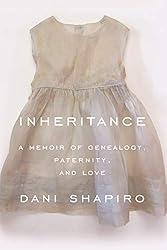

Inheritance: A Memoir of Genealogy, Paternity, and Love
Dani Shapiro, 2018
Knopf Doubleday Publishing
272 pp.
ISBN-13: 9781524732714
Summary
A memoir about the staggering family secret uncovered by a genealogy test: an exploration of the urgent ethical questions surrounding fertility treatments and DNA testing, and a profound inquiry of paternity, identity, and love.
What makes us who we are? What combination of memory, history, biology, experience, and that ineffable thing called the soul defines us?
In the spring of 2016, through a genealogy website to which she had whimsically submitted her DNA for analysis, Dani Shapiro received the stunning news that her father was not her biological father. She woke up one morning and her entire history—the life she had lived—crumbled beneath her.
Inheritance is a book about secrets—secrets within families, kept out of shame or self-protectiveness; secrets we keep from one another in the name of love.
It is the story of a woman's urgent quest to unlock the story of her own identity, a story that has been scrupulously hidden from her for more than fifty years, years she had spent writing brilliantly, and compulsively, on themes of identity and family history.
It is a book about the extraordinary moment we live in—a moment in which science and technology have outpaced not only medical ethics but also the capacities of the human heart to contend with the consequences of what we discover. (From the publisher.)
Author Bio
• Birth—April 10, 1962
• Where—New York, New York, USA
• Education— B.A., M.F.A., Sarah Lawrence College
• Currently—lives in Bethlehem, Connecticut
Dani Shapiro is the author of the memoirs Inheritance (2019) Hourglass (2017), Still Writing (2013), Devotion (2010), and Slow Motion (1998). She has also the author of several novels, including Black & White (2007) and Family History (2004).
Shapiro's short fiction, essays, and journalistic pieces have appeared in The New Yorker, Granta, Tin House, One Story, Elle, Vogue, Oprah Magazine, New York Times Book Review, the op-ed pages of the New York Times, and many other publications.
She has taught in the writing programs at Columbia, NYU, the New School, and Wesleyan University; she is cofounder of the Sirenland Writers Conference in Positano, Italy. In 1997 she married screenwriter Michael Maren. They have one child and live in Litchfield County (Bethlehem), Connecticut. (From the publisher.)
Book Reviews
(Starred Review) Fascinating…. With thoughtful candor, [Shapiro] explores the ethical questions surrounding sperm donation, the consequences of DNA testing…. This beautifully written, thought-provoking genealogical mystery will captivate readers from the very first pages.
Publishers Weekly
Shapiro surprises us again with her latest meditation. [Through DNA, she] discovered that her father was not her biological father. What results is an exploration of family secrets, a painful rebuilding of her sense of self, and an understanding of how we manage whatever life tosses our way.
Library Journal
(Starred Review) Page after page, Shapiro displays a disarming honesty and an acute desire to know the unknowable.
Booklist
(Starred Review) [A]n origin story that puts everything [Shapiro] previously believed and wrote about herself in fresh perspective.… For all the trauma…, Shapiro recognizes that what she had experienced was "a great story"—one that has inspired her best book.
Kirkus Reviews
Discussion Questions
1. The title of this book is Inheritance. What does it mean, in the context of the memoir?
2. Shapiro chose two quotes for her epigraph, one from Sylvia Plath and the other from George Orwell. What do they mean individually, and how does each affect your understanding of the other?
3. "You’re still you," Shapiro reminds herself. What does she mean by this?
4. Much of Shapiro’s understanding of herself comes from what she believes to be her lineage. "These ancestors are the foundation upon which I have built my life," she says on page 12. Would Shapiro feel so strongly if her father’s ancestors weren’t so illustrious? How does Shapiro’s understanding of lineage change over the course of the book?
5. Judaism is passed on from mother to child—the father’s religion holds no importance. So why does Shapiro’s sense of her own Jewishness rely so much on her father?
6. Chapter 7 opens with a discussion of the nature of identity. "What combination of memory, history, imagination, experience, subjectivity, genetic substance, and that ineffable thing called the soul makes us who we are?" Shapiro writes on page 27. What do you believe makes you, you?
7. Shapiro follows that passage with another provocative question: "Is who we are the same as who we believe ourselves to be?" What’s your opinion?
8. Identity is one major theme of the book. Another is the corrosive power of secrets. On page 35, Shapiro writes, "All my life I had known there was a secret. What I hadn’t known: the secret was me." What might have changed if Shapiro had known her origins growing up?
9. On page 43, Shapiro quotes a Delmore Schwartz poem. What does this mean? Why is it significant to Shapiro?
What am I now that I was then?
May memory restore again and again
The smallest color of the smallest day;
Time is the school in which we learn,
Time is the fire in which we burn.
10. Throughout the memoir, Shapiro uses literary extracts to illuminate what she feels or thinks—poems by Schwartz and Jane Kenyon, passages from Moby Dick and a novel by Thomas Mann. How does this help your understanding?
11. All her life, people had been telling Shapiro she didn’t look Jewish. If this hadn’t been part of her life already, how do you think she might have reacted to the news from her DNA test?
12. After Shapiro located her biological father, she emailed him almost immediately—against the advice of her friend, a genealogy expert. What do you imagine you would have done?
13. Why was it so important to Shapiro to believe that her parents hadn’t known the truth about her conception?
14. Her discovery leads Shapiro to reconsider her memories of her parents: "Her unsteady gaze, her wide, practiced smile. Her self-consciousness, the way every word seemed rehearsed. His stooped shoulders, the downward turn of his mouth. The way he was never quite present. Her rage. His sorrow. Her brittleness. His fragility. Their screaming fights." (page 100)
15. On page 107, when discussing her father’s marriage to Dorothy, Rabbi Lookstein tells Shapiro, "We thought your father was a hero." Shapiro comes back to her father’s decision to go through with the marriage several times in the book. Why?
16. At her aunt Shirley’s house, Shapiro sees a laminated newspaper clipping about the poem recited in a Chevy ad. (page 133) Why does Shapiro include this detail in the book? What is its significance?
17. On page 188, Shapiro writes, "In time, I will question how it could be possible that Ben—a man of medicine, who specialized in medical ethics—had never considered that he might have biological children." How do you explain that?
18. How does Shapiro’s experience with contemporary reproductive medicine affect the way she judges her parents? What do you imagine future generations will say about our current approach to artificial insemination?
19. What do you make of the similarities between Shapiro and her half sister Emily?
20. On page 226, Shapiro brings up a psychoanalytic phrase, "unthought known." How does this apply to her story?
21. What prompts Shapiro to legally change her first name?
22. Shapiro ends her book with a meditation on the Hebrew word hineni, "Here I am." Why is this phrase so powerful?
(Questions issued by the publisher.)
The Innocent Man
John Grisham, 2006
Random House
448 pp.
ISBN-13: 9780440243830
Summary
John Grisham's first work of nonfiction, an exploration of small town justice gone terribly awry, is his most extraordinary legal thriller yet.
In the major league draft of 1971, the first player chosen from the State of Oklahoma was Ron Williamson. When he signed with the Oakland A's, he said goodbye to his hometown of Ada and left to pursue his dreams of big league glory.
Six years later he was back, his dreams broken by a bad arm and bad habits drinking, drugs, and women. He began to show signs of mental illness. Unable to keep a job, he moved in with his mother and slept twenty hours a day on her sofa.
In 1982, a 21-year-old cocktail waitress in Ada named Debra Sue Carter was raped and murdered, and for five years the police could not solve the crime. For reasons that were never clear, they suspected Ron Williamson and his friend Dennis Fritz. The two were finally arrested in 1987 and charged with capital murder. With no physical evidence, the prosecution’s case was built on junk science and the testimony of jailhouse snitches and convicts. Dennis Fritz was found guilty and given a life sentence. Ron Williamson was sent to death row.
If you believe that in America you are innocent until proven guilty, this book will shock you. If you believe in the death penalty, this book will disturb you. If you believe the criminal justice system is fair, this book will infuriate you. (From the publisher.)
Author Bio
• Birth—February 8, 1955
• Where—Jonesboro, Arkansas, USA
• Education—B.S., Mississippi State; J.D., University of Mississippi
• Currently—lives in Oxford, Mississippi and Albermarle, Virginia
John Ray Grisham, Jr. is an American lawyer, politician, and author, best known for his popular legal thrillers. He has written more than 25 novels, a short story collection (Ford County), two works of nonfiction, and a children's series.
Grisham's first bestseller was The Firm. Released in 1991, it sold more than seven million copies. The book was later adapted into a feature film, of the same name starring Tom Cruise in 1993, and a TV series in 2012 which "continues the story of attorney Mitchell McDeere and his family 10 years after the events of the film and novel." Eight of his other novels have also been adapted into films: The Chamber, The Client, A Painted House, The Pelican Brief, Skipping Christmas, The Rainmaker, The Runaway Jury, and his first novel, A Time to Kill. His books have been translated into 29 languages and published worldwide.
As of 2008, his books had sold over 250 million copies worldwide. Grisham is one of only three authors to sell two million copies on a first printing; the others are Tom Clancy and J.K. Rowling.
Early life and education
Grisham, the second oldest of five siblings, was born in Jonesboro, Arkansas, to Wanda Skidmore Grisham and John Grisham. His father was a construction worker and cotton farmer; his mother a homemaker. When Grisham was four years old, his family started traveling around the South, until they finally settled in Southaven in DeSoto County, Mississippi. As a child, Grisham wanted to be a baseball player. neither of his parents had advanced education, he was encouraged to read and prepare for college.
As a teenager, Grisham worked for a nursery watering bushes for $1.00 an hour. He was soon promoted to a fence crew for $1.50 an hour. At 16, Grisham took a job with a plumbing contractor. Through a contact of his father, he managed to find work on a highway asphalt crew in Mississippi at the age of 17.
It was during this time that an unfortunate incident made him think more seriously about college. A fight broke out among the crew with gunfire, and Grisham ran to the restroom for safety. He did not come out until after the police had "hauled away rednecks." He hitchhiked home and started thinking about college.
His next work was in retail, as a salesclerk in a department store men's underwear section, which he described as "humiliating." He decided to quit but stayed when he was offered a raise. He was given another raise after asking to be transferred to toys and then to appliances. A confrontation with a company spy posing as a customer convinced him to leave the store. By this time, Grisham was halfway through college.
He went to the Northwest Mississippi Community College in Senatobia, Mississippi and later attended Delta State University in Cleveland. Grisham drifted so much during his time at the college that he changed colleges three times before completing a degree. He graduated from Mississippi State University in 1977, receiving a BS degree in accounting.
He later enrolled in the University of Mississippi School of Law planning to become a tax lawyer. But he was soon overcome by "the complexity and lunacy" of it. He decided to return to his hometown as a trial lawyer, but his interest shifted to general civil litigation. He graduated in 1983 with a JD degree.
Law and politics
Grisham practiced law for about a decade and also won election as a Democrat in the Mississippi House of Representatives from 1983 to 1990 at an annual salary of $8,000. By his second term at the Mississippi state legislature, he was the vice-chairman of the Apportionment and Elections Committee and a member of several other committees.
With the success of his second book The Firm, published in 1991, Grisham gave up practicing law. He returned briefly in 1996 to fight for the family of a railroad worker who had been killed on the job. It was a commitment made to the family before leaving law to become a full-time writer. Grisham successfully argued his clients' case, earning them a jury award of $683,500—the biggest verdict of his career.
Writing
Grisham said that, sometime in the mid-1980s, he had been hanging around the court one day when he overheard a 12-year-old girl telling the jury how she been beaten and raped. Her story intrigued Grisham, so he began to watch the trial, noting how members of the jury wept during her testimony. It was then, Grisham later wrote in the New York Times, that a story was born. Musing over "what would have happened if the girl's father had murdered her assailants," Grisham took three years to complete his first book, A Time to Kill.
Finding a publisher was not easy. The book was rejected by 28 publishers before Wynwood Press, an unknown publisher, agreed to give it a modest 5,000-copy printing. It was published in June 1989. The day after Grisham completed A Time to Kill, he began work on his second novel, the story of an ambitious young attorney "lured to an apparently perfect law firm that was not what it appeared." The Firm remained on the the New York Times' bestseller list for 47 weeks and became the bestselling novel of 1991.
Beginning with A Painted House in 2001, the author broadened his focus from law to the more general rural South, but continued to write legal thrillers. He has also written sports fiction and comedy fiction.
In 2005, Grisham received the Peggy V. Helmerich Distinguished Author Award. The award is presented annually by the Tulsa Library Trust.
In 2010, Grisham started writing legal thrillers for children 9-12 years old. The books featured Theodore Boone, a 13-year-old boy, who gives his classmates legal advice—everything from rescuing impounded dogs to helping their parents prevent their house from being repossessed. His daughter, Shea, inspired him to write the Boone series.
Marriage and family
Grisham married Renee Jones in 1981, and the couple have two grown children together, Shea and Ty. The family spends their time in their Victorian home on a farm outside Oxford, Mississippi, and their other home near Charlottesville, Virginia.
The Innocence Project
Grisham is a member of the Board of Directors of The Innocence Project, which campaigns to free unjustly convicted people on the basis of DNA evidence. The Innocence Project argues that wrongful convictions are not isolated or rare events but instead arise from systemic defects. Grisham has testified before Congress on behalf of the Project and appeared on Dateline on NBC, Bill Moyers Journal on PBS, and other programs. He also wrote for the New York Times in 2013 about an unjustly held prisoner at Guantanamo.
Libel suit
In 2007, former legal officials from Oklahoma filed a civil suit for libel against Grisham and two other authors. They claimed that Grisham and the others critical of Peterson and his prosecution of murder cases conspired to commit libel and generate publicity for themselves by portraying the plaintiffs in a false light and intentionally inflicting emotional distress. Grisham was named due to his publication of the non-fiction book, The Innocent Man. He examined the faults in the investigation and trial of defendants in the murder of a cocktail waitress in Ada, Oklahoma, and the exoneration by DNA evidence more than 12 years later of wrongfully convicted defendants Ron Williamson and Dennis Fritz. The judge dismissed the libel case after a year, saying, "The wrongful convictions of Ron Williamson and Dennis Fritz must be discussed openly and with great vigor."
Misc.
The Mississippi State University Libraries maintains the John Grisham Room, an archive containing materials related to his writings and to his tenure as Mississippi State Representative.
Grisham has a lifelong passion for baseball demonstrated partly by his support of Little League activities in both Oxford, Mississippi, and Charlottesville, Virginia. He wrote the original screenplay for and produced the 2004 baseball movie Mickey, starring Harry Connick, Jr. He remains a fan of Mississippi State University's baseball team and wrote about his ties to the university and the Left Field Lounge in the introduction for the book Dudy Noble Field: A Celebration of MSU Baseball.
In an October 2006 interview on the Charlie Rose Show, Grisham stated that he usually takes only six months to write a book and that his favorite author is John le Carre. (Adapted from Wikipedia. Retrieved 10/6/2013.)
Book Reviews
Compared with other works in its genre, The Innocent Man is less spectacular than sturdy. It is a reminder not only of how propulsively Mr. Grisham's fiction is constructed but of how difficult it is to make messy reality behave in clear, stream-lined fashion.... The Innocent Man is plural, despite its title. It is about “four men, four average white guys from good families, all chewed up and abused by the system and locked away for a combined total of 33 years.” This is a lot for a nonfiction narrative to juggle, and this book sometimes strains under the burden of so much grim, frustrating data. Mr. Grisham’s report on the construction of an underground, completely daylight-deprived prison provides the most egregious chamber of horrors in a book that is figuratively full of them.
Janet Maslin - New York Times
The Innocent Man is a useful companion to Ultimate Punishment (2003), the argument against the death penalty by that other lawyer who writes skillful fiction, Scott Turow. Like Turow, Grisham realizes that the most powerful argument against the death penalty is that it kills the innocent as well as the guilty, a case that he makes simply by telling Williamson and Fritz's story. His prose here isn't as good as it is in his novels...but his reasoning is sound and his passion is contagious.
Jonathan Yardley - Washington Post
A page-turning and chlling descent into one innocent man's Kafkaesque nightmare of injustice and madness.
Boston Globe
(Audio version.) Grisham's first work of nonfiction focuses on the tragedy of Ron Williamson, a baseball hero from a small town in Oklahoma who winds up a dissolute, mentally unstable Major League washout railroaded onto death row for a hometown rape and murder he did not commit. Judging by this author-approved abridgment, Grisham has chosen to present Williamson's painful story (and that of his equally innocent "co-conspirator," Dennis Fritz) as straightforward journalism, eschewing the more familiar "nonfiction novel" approach with its reconstructed dialogues and other adjustments for dramatic purpose. This has resulted in a book that, while it includes such intriguing elements as murder, rape, detection and judicial injustice, consists primarily of objective reportage, albeit shaded by the now-proven fact of Williamson's innocence. The absence of dialogue or character point of view could make for a rather bland audio. Boutsikaris avoids that by reverting to what might be called old-fashioned round-the-campfire storytelling, treating the lengthy exposition to vocal interpretations, subtle and substantial. He narrates the events leading up to the 1982 rape and murder of a young cocktail waitress with a mixture of suspicion and curiosity, moving on to astonishment at the prosecution's use of deceit and false testimony to convict Williamson and Fritz and, eventually, elation at the exoneration of the two innocent men. Throughout, he maintains an appealing conversational tone, an effect made all the more remarkable by the book's nearly total absence of conversation.
Publishers Weekly
Many of the literary skills that have established John Grisham at the forefront of mainstream legal thrillers (The Firm, The Pelican Brief) find their way into his first nonfiction brief: a razor-sharp sense of right and wrong; an eye for the unjustly accused; and a finely tuned legal mind.
Bookmarks Magazine
Discussion Questions
1. What were your initial impressions of Ron Williamson? How did your attitudes toward him shift throughout The Innocent Man?
2. Discuss the setting of Ada, Oklahoma, as if it were one of the characters in the book. What were your opinions as Grisham described Ada's landscape-a vibrant small town dotted with relics of a long-gone oil boom-and the region's history of Wild West justice?
3. In your opinion, why was Glen Gore overlooked as a suspect? Were mistakes made as a result of media pressure to find justice for Debbie Carter and her family? How did Dennis Fritz's knowledge of the drug scandal affect the manhunt? Was injustice in Ada simply due to arrogance?
4. How was Dennis different from Ron? Why didn't Dennis confess, while Tommy Ward and Karl Fotenot did? Did refusing to confess help Dennis in thelong run?
5. As you read about the court proceedings, what reactions did you have to the trial-by-jury process? Have you served on a jury, or been a defendant before a jury? If so, how did your experience compare to the one described in The Innocent Man?
6. What are the most significant factors in getting a fair trial, or an intelligent investigation? Does personality matter more than logic in our judicial system? How would you have voted if you had heard the cases against Ron and Dennis?
7. How does new crime-lab technology make you feel about the history of convictions in America? What might future generations use to replace lie-detector tests or fingerprint databases? What are the limitations of technology in solving crimes?
8. How did the early 1980s time period affect the way Debbie's last day unfolded, and the way her killer was hunted? Would a small-town woman be less likely to trust a Glen Gore today than twenty-five years ago? Were Ron's high-rolling days in Tulsa spurred by a culture of experimentation and excess?
9. How did the descriptions of Oklahoma's death row compare to what you had previously believed? What distinctions in treatment should be made between death-row inmates and the rest of the prison population?
10. What is the status of the death penalty in the state where you live? What have you discovered about the death penalty as a result of reading The Innocent Man?
11. In his author's note, Grisham says that he discovered the Ada saga while reading Ron's obituary. What research did he draw on in creating a portrait of this man he never knew? In what ways does The Innocent Man read like a novel? What elements keep the storytelling realistic?
12. Discuss the aftermath of Ron's and Dennis's exoneration. How did you balance your reaction to the triumph of Ron's large cash settlement (a rare victory in such civil suits) and the fact that it would have to be paid for by local taxpayers?
13. The Dreams of Ada (back in print from Broadway Books) figures prominently in Ron's experience, though the men convicted in that murder are still behind bars. What is the role of journalists in ensuring public safety? Why are they sometimes able to uncover truths that law enforcement officials don't see?
14. Grisham is an avid baseball fan. How did his descriptions of Ron playing baseball serve as a metaphor for Ron's rise and fall, and his release?
15. To what extent do you believe mental health should be a factor in determining someone's competence to stand trial, or in determining guilt or innocence?
16. In his author's note, Grisham writes, "Ada is a nice town, and the obvious question is: When will the good guys clean house?" What are the implications of this question for communities far beyond Ada? What can you do to help "clean house" in America's judicial system?
(Questions issued by publisher.)
top of page (summary)

The Innovators: How a Group of Hackers, Geniuses, and Geeks Created the Digital Revolution
Walter Isaacson, 2014
Simon & Schuster
560 pp.
ISBN-13: 9781476708690
Summary
Following his blockbuster biography of Steve Jobs, The Innovators is Walter Isaacson’s revealing story of the people who created the computer and the Internet. It is destined to be the standard history of the digital revolution and an indispensable guide to how innovation really happens.
What were the talents that allowed certain inventors and entrepreneurs to turn their visionary ideas into disruptive realities? What led to their creative leaps? Why did some succeed and others fail?
In his masterly saga, Isaacson begins with Ada Lovelace, Lord Byron’s daughter, who pioneered computer programming in the 1840s. He explores the fascinating personalities that created our current digital revolution, such as Vannevar Bush, Alan Turing, John von Neumann, J.C.R. Licklider, Doug Engelbart, Robert Noyce, Bill Gates, Steve Wozniak, Steve Jobs, Tim Berners-Lee, and Larry Page.
This is the story of how their minds worked and what made them so inventive. It’s also a narrative of how their ability to collaborate and master the art of teamwork made them even more creative.
For an era that seeks to foster innovation, creativity, and teamwork, The Innovators shows how they happen. (From the publisher.)
Author Bio
• Birth—May 20, 1952
• Where—New Orleans, Louisiana, USA
• Education—B.A., Harvard University; M.A., Oxford University
• Awards—(see below)
• Currently—Washington, D.C. area
Walter Isaacson is an American writer and journalist. He was the President and CEO of the Aspen Institute, a nonpartisan educational and policy studies organization based in Washington, D.C. He has been the chairman and CEO of Cable News Network (CNN) and the Managing Editor of Time. He has written biographies of Steve Jobs, Benjamin Franklin, Albert Einstein, Henry Kissinger, and Leonardo da Vinci.
Early life and education
Isaacson was born in New Orleans, Louisiana, the son of Irwin and Betty Lee (Seff) Isaacson. His father was a "kindly Jewish distracted humanist engineer with a reverence for science," and his mother was a real estate broker.
Isaacson graduated from Harvard University in 1974, where he earned an A.B. cum laude in history and literature. He later attended the Oxford University as a Rhodes scholar, where he studied Philosophy, Politics, and Economics (PPE) and graduated with first-class honors.
Journalism
Isaacson began his career in journalism at The Sunday Times of London, followed by a position with the New Orleans Times-Picayune. He joined Time magazine in 1978, serving as the magazine's political correspondent, national editor, and editor of new media before becoming the magazine's 14th editor in 1996.
Isaacson became chairman and CEO of CNN in July 2001, two months later guided CNN through the events of 9/11. Shortly after his appointment at CNN, Isaacson attracted attention for seeking the views of Republican Party leaders on Capitol Hill regarding criticisms that CNN broadcast content that was unfair to Republicans or conservatives.
He was quoted in Roll Call magazine as saying: "I was trying to reach out to a lot of Republicans who feel that CNN has not been as open to covering Republicans, and I wanted to hear their concerns." The CEO's conduct was criticized by the left-leaning Fairness & Accuracy in Reporting (FAIR) organization, which said that Isaacson's "pandering" behavior was endowing conservative politicians with power over CNN.
In 2003, Isaacson stepped down as president at CNN to become president of the Aspen Institute. Isaacson served as the president and CEO of the Aspen Institute from 2003 until 2017, when he announced that he would leave to become a professor of history at Tulane University and an advisory partner at the New York City financial services firm Perella Weinberg Partners.
Writing
Isaacson is the co-author, with Evan Thomas, of The Wise Men: Six Friends and the World They Made (1986). He is the author of Kissinger: A Biography (1992), Benjamin Franklin: An American Life (2003), Einstein: His Life and Universe (2007), and American Sketches (2009).
In 2011, Steve Jobs, Isaacson's authorized biography was published, becoming an international best-seller and breaking all sales records for a biography. The book was based on over forty interviews with Jobs over a two-year period up until shortly before his death, and on conversations with friends, family members, and business rivals of the entrepreneur.
Next came another bestseller, The Innovators: How a Group of Inventors, Hackers, Geniuses, and Geeks Created the Digital Revolution (2014), which explores the history of key technological innovations — notably the parallel developments of the computer and the Internet.
Isaacson's biography, Leonardo da Vinci, came out in 2017 to great fanfare and, even before it's actual publication, became the object of a Hollywood bidding war. Leonardo DiCaprio's production company won the film rights with DiCaprio planning to play the title role of da Vinci.
Government positions
In 2005, Louisiana Governor Kathleen Blanco appointed Isaacson vice chairman of the Louisiana Recovery Authority to oversee spending on the recovery from Hurricane Katrina.
In 2007, President George W. Bush appointed him as chairman of the U.S.-Palestinian Partnership, which seeks to create economic and educational opportunities in the Palestinian territories.
He also served as the co-chair of the U.S.-Vietnamese Dialogue on Agent Orange, which in January 2008 announced completion of a project to contain the dioxin left behind by the U.S. at the Da Nang air base and plans to build health centers and a dioxin laboratory in the affected regions.
During the Obama administration, Secretary of State Hillary Clinton appointed him vice-chair of the Partners for a New Beginning, which encourages private-sector investments and partnerships in the Muslim world.
In 2009, President Obama appointed him as chairman of the Broadcasting Board of Governors, which runs Voice of America, Radio Free Europe, and the other international broadcasts of the U.S. government; he served until January 2012.
In 2014, he was appointed by New Orleans Mayor Mitch Landrieu to be the co-chair of the New Orleans Tricentennial Commission, charged with planning the city's 300th-anniversary commemoration in 2018.
In 2015, he was appointed to the board of My Brother's Keeper Alliance, which seeks to carry out President Obama's anti-poverty and youth opportunity initiatives.
Isaacson is the chairman emeritus of the board of Teach for America.
Honors
Time magazine selected Isaacson in 2012 to be on its list of the 100 most influential people in the world. Isaacson is a fellow of the Royal Society of Arts and was awarded its 2013 Benjamin Franklin Medal. He is also a member of the American Academy of Arts and Sciences, the American Philosophical Society and an Honorary Fellow of Pembroke College, Oxford.
In 2014, the National Endowment for the Humanities selected Isaacson for the Jefferson Lecture, the U.S. federal government's highest honor for achievement in the humanities. The title of Isaacson's lecture was "The Intersection of the Humanities and the Sciences." (Adapted from Wikipedia. Retrieved 10/3/2017.)
Book Reviews
Mr. Isaacson's gifts as an enthusiast and explicator remain impressive…As this book so clearly demonstrates, he is a kindred spirit to the visionaries and enthusiasts who speed us so thrillingly into the technological future.
Janet Maslin - New York Times
[A] sweeping and surprisingly tenderhearted history of the digital age…[The Innovators] is…absorbing and valuable, and Isaacson's outsize narrative talents are on full display. Few authors are more adept at translating technical jargon into graceful prose, or at illustrating how hubris and greed can cause geniuses to lose their way.
Brendan I. Koerner - New York Times Book Review
A sprawling companion to his best-selling Steve Jobs...this kaleidoscopic narrative serves to explain the stepwise development of 10 core innovations of the digital age—from mathematical logic to transistors, video games and the Web—as well as to illustrate the exemplary traits of their makers.... Isaacson unequivocally demonstrates the power of collaborative labor and the interplay between companies and their broader ecosystems.... The Innovators is the most accessible and comprehensive history of its kind.
Matthew Wisnioski - Washington Post
Isaacson provides a sweeping and scintillating narrative of the inventors, engineers and entrepreneurs who have given the world computers and the Internet. . . . a near-perfect marriage of author and subject . . . an informative and accessible account of the translation of computers, programming, transistors, micro-processors, the Internet, software, PCs, the World Wide Web and search engines from idea into reality.... [A] masterful book.
San Francisco Chronicle
(Starred review.) The history of the computer as told through this fascinating book is not the story of great leaps forward but rather one of halting progress.... Isaacson examines [numerous] figures in lucid, detailed narratives, recreating marathon sessions of lab research, garage tinkering, and all-night coding in which they struggled to translate concepts into working machinery.
Publishers Weekly
(Starred review.) Isaacson is a storyteller of the kind he admires among the people who made the bits and pieces that would become computers,... describing these individuals vividly and succinctly.... [The book] should be on the reading lists of book discussion groups and high school and college courses across the curriculum. —Linda Loos Scarth, Cedar Rapids, IA
Library Journal
(Starred review.) A remarkable overview of the history of computers from the man who brought us biographies of Steve Jobs, Benjamin Franklin, Albert Einstein, and Henry Kissinger . . . Isaacson manages to bring together the entire universe of computing, from the first digitized loom to the web, presented in a very accessible manner that often reads like a thriller.
Booklist
(Starred review.) Throughout his action-packed story, Isaacson reiterates one theme: Innovation results from both "creative inventors" and "an evolutionary process that occurs when ideas, concepts, technologies, and engineering methods ripen together."... [A] vigorous, gripping narrative.
Kirkus Reviews
Discussion Questions
Use our LitLovers Book Club Resources; they can help with discussions for any book:
• How to Discuss a Book (helpful discussion tips)
• Generic Discussion Questions—Fiction and Nonfiction
• Read-Think-Talk (a guided reading chart)
(We'll add specific questions if and when they're made available by the publisher.)


Inside the Dream Palace: The Life and Times of New York's Legendary Chelsea Hotel
Sherill Tippins, 2013
Houghton Mifflin Harcourt
496 pp.
ISBN-13: 9780544334472
Summary
The next best thing to having a room key to the Chelsea Hotel during each of its famous—and infamous—decades
The Chelsea Hotel, since its founding by a visionary French architect in 1884, has been an icon of American invention: a cultural dynamo and haven for the counterculture, all in one astonishing building. Sherill Tippins, author of the acclaimed February House, delivers a masterful and endlessly entertaining history of the Chelsea and of the successive generations of artists who have cohabited and created there, among them...
John Sloan, Edgar Lee Masters, Thomas Wolfe, Dylan Thomas, Arthur Miller, Allen Ginsberg, Bob Dylan, Janis Joplin, Leonard Cohen, Patti Smith, Robert Mapplethorpe, Andy Warhol, Sam Shepard, Sid Vicious, and Dee Dee Ramone.
Now as legendary as the artists it has housed and the countless creative collaborations it has sparked, the Chelsea has always stood as a mystery as well: Why and how did this hotel become the largest and longest-lived artists’ community in the known world? Inside the Dream Palace is the intimate and definitive story.
Today the Chelsea stands poised in limbo between two futures: Will this symbol of New York's artistic invention be converted to a profit-driven business catering to the top one percent? Or will the Chelsea be given a rebirth through painstaking effort by the community that loves it? Set against these two competing possibilities, Inside the Dream Palace could not be more fascinating or timely. (From the publisher.)
Author Bio
Sherill Tippins moved to New York from Austin, Texas, at the age of twenty-two to pursue a career as a screenwriter and author. Ten years later, having settled with her husband and two children in Brooklyn Heights, a quiet neighborhood overlooking Manhattan at the foot of the Brooklyn Bridge, she began volunteering for a neighborhood meal-delivery program to the elderly and infirm. It was from one of these neighbors that she first heard of the extraordinary experiment in communal living—involving a British poet, a southern novelist, one of the world's great opera composers, and a celebrated stripper—that had taken place sixty years earlier just a few blocks from her home.
Her fascination with the house and its residents prompted her to begin collecting facts and anecdotes about their shared life in Brooklyn, and eventually to recreate their experience in February House, published in 2005.
Tippins' second work, published in 2013, tells the story of a century's worth of creative interaction and raucous living—stretching over the decades from Sarah Bernhardt to O. Henry, from Thomas Wolfe to Jackson Pollock, William Burroughs, Andy Warhol, Bob Dylan, Patti Smith, and beyond—all set in New York's famous (and infamous) Victorian-era edifice the Chelsea Hotel. (From the publsiher.)
Book Reviews
Tippins’s doorstop-hefty Inside the Dream Palace...aspires to tell the "definitive story" [of the Chelsea Hotel].... Serious about her mission, Tippins delivers a thoughtful, well-paced chronological account of the New York City landmark’s "shabby caravansary." She synthesizes the many books on the subject into a century-long narrative, no mean feat.... One might expect the book’s vitality to grow as it moves toward the present, given the availability of firsthand sources. But Tippins continues to draw primarily from texts rather than people.... More reporting...would have made Inside the Dream Palace a valuable work of history rather than a timely work of historical synthesis.
Ada Calhoun - New York Times
An inspired investigation into the utopian spirit of the Chelsea Hotel.
Elle
Cool hunters will appreciate Sherill Tippins’s Inside the Dream Palace: The Life and Times of New York’s Legendary Chelsea Hotel, a social history of the city’s sanctuary for postwar artists and It girls.
Vogue
In this wide-ranging history, literary biographer Tippins explores the Chelsea Hotel’s role as a refuge for artists and eccentrics for over a century. Built in 1884...the Chelsea immediately became a center of counter-culture in New York City.... A fascinating account of how a single building in New York City nurtured a community of freaks, dreamers, and outcasts whose rejection of the status quo helped to transform it.
Publishers Weekly
This is an exuberant tale of pop history about a New York landmark. While Tippins may be faulted for providing perhaps too much historical context, her spirited writing effectively illustrates the Chelsea as the unforgettable place it was. Recommended to pop culture enthusiasts, architecture specialists, and fans of celebrityhood. —Richard Drezen, Jersey City
Library Journal
(Starred review.) Zealous, big-picture researcher Tippins not only tells compelling tales, she also weaves them into a strikingly fresh, lucid, and socially anchored history of New York’s world-altering art movements. Though its future is uncertain, Tippins ensures that the Chelsea Hotel, dream palace and microcosm, will live on in our collective memory.
Booklist
A revealing biography of the fabled Manhattan hotel, in which generations of artists and writers found a haven.... Allen Ginsberg, Bob Dylan, Andy Warhol, Janis Joplin, Leonard Cohen, Robert Mapplethorpe, Phil Ochs and Sid Vicious are only a few of the figures populating this entertaining book. A zesty, energetic history, not only of a building, but of more than a century of American culture.
Kirkus Reviews
Discussion Questions
Use our LitLovers Book Club Resources; they can help with discussions for any book:
• How to Discuss a Book (helpful discussion tips)
• Generic Discussion Questions—Fiction and Nonfiction
• Read-Think-Talk (a guided reading chart)
We'll add specific questions if and when they're made available by the publisher.
Into the Wild
Jon Krakauer, 1996
Knopf Doubleday
207 pp.
ISBN-13: 9780307387172
Summary
In April 1992 a young man from a well-to-do family hitchhiked to Alaska and walked alone into the wilderness north of Mt. McKinley. His name was Christopher Johnson McCandless. He had given $25,000 in savings to charity, abandoned his car and most of his possessions, burned all the cash in his wallet, and invented a new life for himself. Four months later, his decomposed body was found by a moose hunter. How McCandless came to die is the unforgettable story of Into the Wild.
Immediately after graduating from college in 1991, McCandless had roamed through the West and Southwest on a vision quest like those made by his heroes Jack London and John Muir. In the Mojave Desert he abandoned his car, stripped it of its license plates, and burned all of his cash. He would give himself a new name, Alexander Supertramp, and , unencumbered by money and belongings, he would be free to wallow in the raw, unfiltered experiences that nature presented. Craving a blank spot on the map, McCandless simply threw the maps away. Leaving behind his desperate parents and sister, he vanished into the wild.
Jon Krakauer constructs a clarifying prism through which he reassembles the disquieting facts of McCandless's short life. Admitting an interst that borders on obsession, he searches for the clues to the dries and desires that propelled McCandless. Digging deeply, he takes an inherently compelling mystery and unravels the larger riddles it holds: the profound pull of the American wilderness on our imagination; the allure of high-risk activities to young men of a certain cast of mind; the complex, charged bond between fathers and sons.
When McCandless's innocent mistakes turn out to be irreversible and fatal, he becomes the stuff of tabloid headlines and is dismissed for his naivete, pretensions, and hubris. He is said to have had a death wish but wanting to die is a very different thing from being compelled to look over the edge. Krakauer brings McCandless's uncompromising pilgrimage out of the shadows, and the peril, adversity , and renunciation sought by this enigmatic young man are illuminated with a rare understanding—and not an ounce of sentimentality. Mesmerizing, heartbreaking, Into the Wild is a tour de force. The power and luminosity of Jon Krakauer's stoytelling blaze through every page. (From the publisher.)
Author Bio
Krakauer was born as the third of five children. He competed in tennis at Corvallis High School and graduated in 1972. He went on to study at Hampshire College in Massachusetts, where in 1976 he received his degree in Environmental Studies. In 1977, he met former climber Linda Mariam Moore; they married in 1980 and now live in Seattle, Washington.
More
In 1974, Krakauer was part of a group of seven friends pioneering the Arrigetch Peaks of the Brooks Range in Alaska and was invited by American Alpine Journal to write about those experiences. Though he neither expected nor received a fee, he was excited when the Journal published his article. A year later, he and two others made the second ascent of The Moose's Tooth, a highly technical peak in the Alaska Range.
One year after graduating from college (1977), he spent three weeks by himself in the wilderness of the Stikine Icecap region of Alaska and climbed a new route on the Devils Thumb, an experience he described in Eiger Dreams and in Into the Wild.
Much of Krakauer's early popularity as a writer came from being a journalist for Outside magazine. In 1983, he was able to abandon part-time work as a fisherman and a carpenter to become a full-time writer. His freelance writing appeared in Smithsonian, National Geographic Magazine, Rolling Stone, Playboy, and Architectural Digest.
Into the Wild was published in 1996 and secured Krakauer's reputation as an outstanding adventure writer, spending more than two years on the New York Times bestseller list, which was adapted for film (director Sean Penn) and released in 2007.
In 2003, Under the Banner of Heaven became Krakauer's third non-fiction bestseller. The book examines extremes of religious belief, particularly fundamentalist offshoots of Mormonism. The book inspired the documentary, Damned to Heaven.
2010 saw the publication of Where Men Win Glory, about former NFL football player Pat Tillman, who became a US Army Ranger after 9/11. Tillman was eventually killed in action under suspicious circumstances in Afghanistan. (Adapated from Wikipedia.)
Book Reviews
At the beginning of Into the Wild, you share the outraged reactions of so many who read the article by Mr. Krakauer in Outside magazine from which this book developed. As one angry Alaskan put it in a letter to the author: "While I feel for his parents, I have no sympathy for him. Such willful ignorance...amounts to disrespect for the land... — just another case of underprepared, overconfident men bumbling around out there and screwing up because they lacked the requisite humility. [Yet] in Mr. Krakauer's eloquent handling... because the story involves overbearing pride, a reversal of fortune and a final moment of recognition, it has elements of classic tragedy. By the end, Mr. Krakauer has taken the tale of a kook who went into the woods, and made of it a heart-rending drama of human yearning.
Christopher Lehmann-Haupt - New York Times
A narrative of arresting force. Anyone who ever fancied wandering off to face nature on its own harsh terms should give a look. It’s gripping stuff.
Washington Post
Engrossing . . . with a telling eye for detail, Krakauer has captured the sad saga of a stubborn, idealistic young man.
Los Angeles Times
After graduating from Emory University in Atlanta in 1992, top student and athlete Christopher McCandless abandoned his possessions, gave his entire $24,000 savings account to charity and hitchhiked to Alaska, where he went to live in the wilderness. Four months later, he turned up dead. His diary, letters and two notes found at a remote campsite tell of his desperate effort to survive, apparently stranded by an injury and slowly starving. They also reflect the posturing of a confused young man, raised in affluent Annandale, Virginia, who self-consciously adopted a Tolstoyan renunciation of wealth and return to nature. Krakauer, a contributing editor to Outside and Men's Journal, retraces McCandless' ill-fated antagonism toward his father, Walt, an eminent aerospace engineer. Krakauer also draws parallels to his own reckless youthful exploit in 1977, when he climbed Devils Thumb, a mountain on the Alaska-British Columbia border, partly as a symbolic act of rebellion against his autocratic father. In a moving narrative, Krakauer probes the mystery of McCandless' death, which he attributes to logistical blunders and to accidental poisoning from eating toxic seed pods
Publishers Weekly
In April 1992, 23-year-old Chris McCandless hiked into the Alaska bush to "live off the land." Four months later, hunters found his emaciated corpse in an abandoned Fairbanks city bus, along with five rolls of film, an SOS note, and a diary written in a field guide to edible plants. Cut off from civilization, McCandless had starved to death. The young man's gruesome demise made headlines and haunted Outside magazine contributing editor Krakauer, who saw "vague, unsettling parallels" between McCandless's life and his own. Expanding on his 1993 Outside article, Krakauer traces McCandless's last two years; after his graduation from Emory University, McCandless abandoned his middle-class family, identity, and possessions in favor of the life of "Alexander Supertramp," wandering the American West in search of "raw, transcendent experience." In trying to understand McCandless's behavior and the appeal that risky activities hold for young men, Krakauer examines his own adventurous youth. However, he never satisfactorily answers the question of whether McCandless was a noble, if misguided, idealist or a reckless narcissist who brought pain to his family. For popular outdoor and adventure collections. —Wilda Williams
Library Journal
Some Alaskans reacted contemptuously to Krakauer's magazine article about a young man who starved to death one summer in the shadow of Denali.... A moving story that reiterates the bewitching attraction of the Far West. —Gilbert Taylor, American Library Association.
Booklist
Discussion Questions
Use our LitLovers Book Club Resources; they can help with discussions for any book:
• How to Discuss a Book (helpful discussion tips)
• Generic Discussion Questions—Fiction and Nonfiction
• Read-Think-Talk (a guided reading chart)
Also consider these LitLovers talking points to help get a discussion started for Into the Wild:
1. Many readers find it hard to have sympathy for young McCandless: his stubborn idealism and lack of preparedness, as someone has pointed out, amount to arrogance. Yet to a one, critics point to Krakauer's power as a writer to evoke sympathy for the young man. Where do you stand?
2. To what extent does Krakauer's own history as a young rebellious risk-taker color his judgment of McCandless? Or does Krakauer's own experience serve to enlighten his—and your— understanding of Chris?
(Questions by LitLovers. Please feel free to use them, online or off, with attribution. Thanks.)
top of page (summary)
Into Thin Air: A Personal Account of the Mt. Everest Disaster
Jon Krakauer, 1997
Knopf Doubleday
368 pp.
ISBN-13: 9780307475251
Summary
A bank of clouds was assembling on the not-so-distant horizon, but journalist-mountaineer Jon Krakauer, standing on the summit of Mt. Everest, saw nothing that "suggested that a murderous storm was bearing down." He was wrong. The storm, which claimed five lives and left countless more--including Krakauer's--in guilt-ridden disarray, would also provide the impetus for Into Thin Air, Krakauer's epic account of the May 1996 disaster.
By writing Into Thin Air, Krakauer may have hoped to exorcise some of his own demons and lay to rest some of the painful questions that still surround the event. He takes great pains to provide a balanced picture of the people and events he witnessed and gives due credit to the tireless and dedicated Sherpas. He also avoids blasting easy targets such as Sandy Pittman, the wealthy socialite who brought an espresso maker along on the expedition. Krakauer's highly personal inquiry into the catastrophe provides a great deal of insight into what went wrong. But for Krakauer himself, further interviews and investigations only lead him to the conclusion that his perceived failures were directly responsible for a fellow climber's death. Clearly, Krakauer remains haunted by the disaster, and although he relates a number of incidents in which he acted selflessly and even heroically, he seems unable to view those instances objectively. In the end, despite his evenhanded and even generous assessment of others' actions, he reserves a full measure of vitriol for himself.
This updated trade paperback edition of Into Thin Air includes an extensive new postscript that sheds fascinating light on the acrimonious debate that flared between Krakauer and Everest guide Anatoli Boukreev in the wake of the tragedy. "I have no doubt that Boukreev's intentions were good on summit day," writes Krakauer in the postscript, dated August 1999. "What disturbs me, though, was Boukreev's refusal to acknowledge the possibility that he made even a single poor decision. Never did he indicate that perhaps it wasn't the best choice to climb without gas or go down ahead of his clients." As usual, Krakauer supports his points with dogged research and a good dose of humility. But rather than continue the heated discourse that has raged since Into Thin Air's denouncement of guide Boukreev, Krakauer's tone is conciliatory; he points most of his criticism at G. Weston De Walt, who coauthored The Climb, Boukreev's version of events. And in a touching conclusion, Krakauer recounts his last conversation with the late Boukreev, in which the two weathered climbers agreed to disagree about certain points. Krakauer had great hopes to patch things up with Boukreev, but the Russian later died in an avalanche on another Himalayan peak, Annapurna I.
In 1999, Krakauer received an Academy Award in Literature from the American Academy of Arts and Letters—a prestigious prize intended "to honor writers of exceptional accomplishment." According to the Academy's citation, "Krakauer combines the tenacity and courage of the finest tradition of investigative journalism with the stylish subtlety and profound insight of the born writer. His account of an ascent of Mount Everest has led to a general reevaluation of climbing and of the commercialization of what was once a romantic, solitary sport; while his account of the life and death of Christopher McCandless, who died of starvation after challenging the Alaskan wilderness, delves even more deeply and disturbingly into the fascination of nature and the devastating effects of its lure on a young and curious mind."(From the publisher.)
Author Bio
• Birth—April 2, 1954
• Where—Brookline, Massachusetts, USA
• Reared—Corvalis, Oregon
• Education—B.S., Hampshire College (Massachusetts)
• Awards—American Academy of Arts and Letters, 1999
• Currently—lives in Seattle, Washington
Krakauer was born as the third of five children. He competed in tennis at Corvallis High School and graduated in 1972. He went on to study at Hampshire College in Massachusetts, where in 1976 he received his degree in Environmental Studies. In 1977, he met former climber Linda Mariam Moore; they married in 1980 and now live in Seattle, Washington.
More
In 1974, Krakauer was part of a group of seven friends pioneering the Arrigetch Peaks of the Brooks Range in Alaska and was invited by American Alpine Journal to write about those experiences. Though he neither expected nor received a fee, he was excited when the Journal published his article. A year later, he and two others made the second ascent of The Moose's Tooth, a highly technical peak in the Alaska Range.
One year after graduating from college (1977), he spent three weeks by himself in the wilderness of the Stikine Icecap region of Alaska and climbed a new route on the Devils Thumb, an experience he described in Eiger Dreams and in Into the Wild.
Much of Krakauer's early popularity as a writer came from being a journalist for Outside magazine. In 1983, he was able to abandon part-time work as a fisherman and a carpenter to become a full-time writer. His freelance writing appeared in Smithsonian, National Geographic Magazine, Rolling Stone, Playboy, and Architectural Digest.
Into the Wild was published in 1996 and secured Krakauer's reputation as an outstanding adventure writer, spending more than two years on the New York Times bestseller list, which was adapted for film (director Sean Penn) and released in 2007.
In 2003, Under the Banner of Heaven became Krakauer's third non-fiction bestseller. The book examines extremes of religious belief, particularly fundamentalist offshoots of Mormonism. The book inspired the documentary, Damned to Heaven.
2010 saw the publication of Where Men Win Glory, about former NFL football player Pat Tillman, who became a US Army Ranger after 9/11. Tillman was eventually killed in action under suspicious circumstances in Afghanistan. (Adapated from Wikipedia.)
Book Reviews
Mr. Krakauer provides the reader with a harrowing account of the disaster as it unfolded hour by hour. An experienced climber himself, Mr. Krakauer gives us both a tactile appreciation of the dangerous allure of mountaineering and a compelling chronicle of the bad luck, bad judgment and doomed heroism that led to the deaths of his climbing companions. His book turns out to be every bit as absorbing and unnerving as his 1996 best seller, Into the Wild, the story of a young man named Christopher Johnson McCandless who left civilization and died mysteriously in the Alaskan wilderness.
Michiko Kakutani - New York Times
What set out to be a magazine article on top-of-the-line tours that promise safe ascents of Mt. Everest to amateur climbers has become a gripping story of a 1996 expedition gone awry and of the ensuing disaster that killed two top guides, a sherpa and several clients. "Climbing Everest was primarily about enduring pain," writes Krakauer (Into the Wild). "And in subjecting ourselves to week after week of toil, tedium and suffering... most of us were probably seeking, above all else, something like a state of grace." High-altitude climbers are an eccentric breedOlympian idealists, dreamers, consummate sportsmen, egomaniacs and thrill-seekers. Excerpts from the writings of several of the best-known of them, including Sir Edmund Hillary, kick off Krakauer's intense reports on each leg of the ill-fated expedition. His own descriptions of the splendid landscape are exhilarating. Survival on Mt. Everest in the "Dead Zone" above 25,000 feet demands incredible self-reliance, responsible guides, supplemental oxygen and ideal weather conditions. The margin of error is nil and marketplace priorities can lead to disaster; and so Krakauer criticizes the commercialization of mountaineering. But while his reports of guides' bad judgments are disturbing, they evoke in him and in the reader more compassion than wrath, for, in the Dead Zone, experts lose their wits nearly as easily as novices. The intensity of the tragedy is haunting, and Krakauer's graphic writing drives it home: one survivor's face "was hideously swollen; splotches of deep, ink-black frostbite covered his nose and cheeks." On the sacred mountain Sagarmatha, the Nepalese name for Everest, the frozen corpses of fallen climbers spot the windswept routes; they will never be buried, but in this superb adventure tale they have found a fitting monument.
Publishers Weekly
On May 19, 1953, Edmund Hillary and Sherpa guide Tenzing Norgay achieved the impossible, becoming the first men to stand on top of Mount Everest. But by May 10, 1996, climbing the 29,000-foot 'goddess of the sky' had become almost routine; commercial expeditions now littered Everest's flanks. Accepting an assignment from Outside magazine to investigate whether it was safe for wealthy amateur climbers to tackle the mountain, Krakauer joined an expedition guided by New Zealander Rob Hall. But Krakauer got more than he bargained for, when on Summit Day a blinding snowstorm caught four groups on the mountain's peaks. While Krakauer made it back to camp, eight others died, including Scott Fischer and Hall, two of the world's best mountaineers. Devastated by the disaster, Krakauer has written this compelling and harrowing account (expanded from his Outside article) as a cathartic act, hoping it "might purge Everest from [his] life." But after finishing this raw, emotionally intense book, readers will be haunted, as Krakauer was, by the tragedy.
Wilda Williams - Library Journal
And onto thin ice—Krakauer's hypnotic, rattling, first-hand account of a commercial expedition up Mt. Everest that went "way wrong. In the spring of 1996, Krakauer took an assignment from Outside magazine to report on the burgeoning industry of commercially guided, high-altitude climbing. Many experienced alpinists were dismayed that the fabled 8,000-meter summits were simply 'being sold to rich parvenues" with neither climbing grace nor talent, but possessed of colossal egos. From childhood, Krakauer had wanted to climb Everest; he was an expert on rock and ice, although he had never sojourned at Himalayan altitudes. While it has become popular to consider climbing Everest a lark and the South Col approach little more than a yak route, Krakauer found the altitude a malicious force that turned his blood to sludge and his extremities to wood, that ate his brain cells. Much of the time he lived in a hypoxic stupor, despite the standard acclimatization he underwent. As he tells of his own struggles, he plaits his tale with stories of his climbing comrades, describes the often outrageous characters on other expeditions, and details the history of Everest exploration. The writing builds eerily, portentously to the summit day, fingering little glitches that were piling up, "a slow accrual, compounding imperceptibly, steadily toward critical mass," when a rogue storm overtook the climbers; typical by Everest standards, it was ferocious in the extreme. Time collapses as, minute-by-minute, Krakauer rivetingly and movingly chronicles what ensued, much of which is near agony to read. Unjustly, Krakauer holds himself culpable for aspects of the disaster, but this book will serve an important purpose if it gives even one person pause before tackling Everest.
Kirkus Reviews
Discussion Questions
Use our LitLovers Book Club Resources; they can help with discussions for any book:
• How to Discuss a Book (helpful discussion tips)
• Generic Discussion Questions—Fiction and Nonfiction
• Read-Think-Talk (a guided reading chart)
Also consider these LitLovers talking points to help get a discussion started for Into Thin Air:
1. Much like Krakauer's other book, Into the Wild, many readers lacked sympathy for the climbers and were angered by their lack of skill and the carelessness of the guides who attempted to get them to the top, letting a hefty fee get in the way of sound judgment. What is your opinion?
2. Discuss Rob Hall's decision not to turn around by 2:00 as he had stipulated but to help Doug Hansen reach the summit. It was a difficult decision because it was Hansen's second attempt, and the men had both an emotional and a monetary stake in Doug's success. If you were in that situation (yeah, right...), would you have been tempted to push to the top, to reach a goal that you'd trained for and wished for...and paid for?
3. Talk about the decision to leave Beck Weathers and Yasuko Namba to die, knowing both were still alive.
There was only one choice, however difficult: let nature take its inevitable course..., and save the group's resources for those who could actually be helped. It was a classic act of triage.
4. Which individual did you find yourself most sympathasizing with ... which did you most admire ... which least admire?
5. Who pays for the expensive search and rescue efforts? Is it right to endanger other lives (helicopter pilots) to transport injured climbers down to hospitals?
6. What did you make of the survivors' attitudes, especially Beck Weather's, when Krakauer later contacted them?
7. How would you feel about a loved one who was passionate about climbing, who felt the pull toward Everest or K2? Would you encourage him/her to pursue the dream...or be more mindful of leaving behind families should something happen?
(Questions by LitLovers. Please feel free to use them, online or off, with attribution. Thanks.)


An Invisible Thread: The True Story of an 11-Year-Old Panhandler, a Busy Sales Executive, and an Unlikely Meeting with Destiny
Laura Schoff with Alex Tresniowski , 2011
Howard Books
272 pp.
ISBN-13: 9781451648973
Summary
Stopping was never part of the plan . . .
She was a successful ad sales rep in Manhattan. He was a homeless, eleven-year-old panhandler on the street. He asked for spare change; she kept walking. But then something stopped her in her tracks, and she went back. And she continued to go back, again and again. They met up nearly every week for years and built an unexpected, life-changing friendship that has today spanned almost three decades.
Whatever made me notice him on that street corner so many years ago is clearly something that cannot be extinguished, no matter how relentless the forces aligned against it. Some may call it spirit. Some may call it heart. It drew me to him, as if we were bound by some invisible, unbreakable thread. And whatever it is, it binds us still. (From the publisher.)
Author Bio
• Born—ca. 1951
• Raised—Huntington (Long Island) New York, USA
• Education—N/A
• Currently—lives in New York City, New York
Laura Schroff is a former advertising executive who has helped launch three of the most successful start-ups in Time Inc. history—InStyle, Teen People, and People StyleWatch. Schroff has also worked as the New York Division Manager at People magazine and Associate Publisher at Brides. She lives in New York City. (From the publisher.)
Alex Tresniowski is the top human-interest writer at People and has written several books, most notably The Vendetta, which was purchased by Universal Studios and used as a basis for the movie Public Enemies. (From the publisher.)
Book Reviews
If you have a beating heart—or if you fear you’re suffering a hardening of the emotional arteries—you really ought to commit to this book at the earliest possible opportunity . . . read this book. And pass it on. And encourage the next reader to do the same.
Huffington Post - Jesse Kornbluth
According to an old Chinese proverb, there's an invisible thread that connects two people who are destined to meet and influence each other's lives..... As Schroff relates Maurice's story, she tells of her own father's alcoholism and abuse, and readers see how desperately these two need each other in this feel-good story about the far-reaching benefits of kindness.
Publishers Weekly
A straightforward tale of kindness and paying it forward in 1980s New York.... Admirably, Schroff notes that she did not seek a role as a "substitute parent," and she does not judge Maurice's mother for her lifestyle. That both main figures experience a few setbacks yet eventually survive is never in question; the story fittingly concludes with an epilogue by Maurice. For readers seeking an uplifting reminder that small gestures matter.
Kirkus Reviews
Discussion Questions
1. An Invisible Thread introduces readers to some of the realities of poor families living in large metropolitan cities. How would you characterize Maurice’s family life? What kind of differences do you think exist between urban and rural poverty?
3. Laura’s grandfather would say “Il solo tempo lei dovrebbe baciare i sue bambini in quango dormono,” or “The only time you should kiss your children is when they are asleep.” What kind of role does love and affection play in Maurice's life? What about Laura’s?
4. Why is Laura so adamant about obtaining permission from Maurice’s mother so he can attend the Mets game?
5. In what ways is privilege evident in An Invisible Thread? What types of privilege can you identify? How would you compare and contrast this privilege in the 1980s with today?
6. Why do you think Laura stayed with Michael, even though he denied her what she wanted more than anything?
7. Laura’s family life growing up had a significant impact on her and her siblings, especially in terms of what they wanted for their own families. Based on Laura’s descriptions, how would you characterize the lives of the siblings’ individual families?
8. Laura writes that, “Sometimes we are drawn to that which is exactly the same” alluding to the impact that familiarity can have on one’s comfort, regardless of how bad the conditions may be. How does Laura’s life stray from this idea? How does she embrace what is different?
9. How did you interpret Michael’s initial rejection of Maurice? What role did this rejection play in Laura’s decision to divorce him?
10. The title, An Invisible Thread suggests several meanings about the bonds that connect us with others. Describe how these themes are reflected in Maurice’s and Laura’s lives, as well as in their relationships with other people.
11. Laura later discovers that Maurice was actually twelve when they first met, not eleven, because he wasn’t even sure himself how old he was. How does this detail signify the importance of identity in An Invisible Thread?
12. Laura was initially careful to maintain boundaries between her and Maurice, ensuring that she was a friend to him and nothing more. At what point do you think their relationship changed from a friendship to something more akin to a mother and a son?
(Questions issued by the publisher.)
top of page (summary)
The Invisible Wall: A Love Story That Broke Barriers
Harry Bernstein, 2007
Random House
352 pp.
ISBN-13: 9780345496102
Summary
There are places that I have never forgotten. A little cobbled street in a smoky mill town in the North of England has haunted me for the greater part of my life. It was inevitable that I should write about it and the people who lived on both sides of its "Invisible Wall."
The narrow street where Harry Bernstein grew up, in a small English mill town, was seemingly unremarkable. It was identical to countless other streets in countless other working-class neighborhoods of the early 1900s, except for the “invisible wall” that ran down its center, dividing Jewish families on one side from Christian families on the other. Only a few feet of cobblestones separated Jews from Gentiles, but socially, it they were miles apart.
On the eve of World War I, Harry’s family struggles to make ends meet. His father earns little money at the Jewish tailoring shop and brings home even less, preferring to spend his wages drinking and gambling. Harry’s mother, devoted to her children and fiercely resilient, survives on her dreams: new shoes that might secure Harry’s admission to a fancy school; that her daughter might marry the local rabbi; that the entire family might one day be whisked off to the paradise of America.
Then Harry’s older sister, Lily, does the unthinkable: She falls in love with Arthur, a Christian boy from across the street.
When Harry unwittingly discovers their secret affair, he must choose between the morals he’s been taught all his life, his loyalty to his selfless mother, and what he knows to be true in his own heart.
A wonderfully charming memoir written when the authorwas ninety-three, The Invisible Wall vibrantly brings to life an all-but-forgotten time and place. It is a moving tale of working-class life, and of the boundaries that can be overcome by love. (From the publisher.)
Bernstein published The Dream, a sequel to The Invisible Wall, in 2008
Author Bio
• Birth—May 30, 1910
• Where—Stockport, England, UK
• Education—N/A
• Currently—lives in Brick Township, New Jersey, USA
Harry Bernstein is the author of The Invisible Wall, which deals with his abusive, alcoholic father, the anti-Semitism he encountered growing up in a Lancashire mill town (Stockport— now part of Greater Manchester) in north west England, and the Romeo and Juliet romance experienced by his sister and her Christian lover. The book was started when he was 93 and published in 2007 when he was 96. The loneliness he encountered following the death of his wife, Ruby, in 2002 after 67 years of marriage was the catalyst for Bernstein to begin work on his book.
According to an article by Associated Press writer, Rebecca Santana, Bernstein first sent the finished manuscript to New York publishers but, having no luck, he sent it to the London office of Random House. There the book sat for about a year until it came across the desk of editor Kate Elton, who described it as "unputdownable."
"I think he's a most fantastic writer," Elton said. "He creates the characters of his family so vividly and tells such a moving story."
He finished writing his second book, The Dream, which centers on his family’s move to the United States when he was twelve. It was published in 2008.
Recently, he published his third book, The Golden Willow, which is the third memoir of his series involving his married life and later years.
Before his retirement at age 62, Bernstein worked for various movie production companies reading scripts and working as a magazine editor for trade magazines, and also wrote freelance articles for such publications as Popular Mechanics, Jewish American Monthly and Newsweek.
Bernstein currently lives in Brick Township, New Jersey. (Adapted from Wikipedia.)
Book Reviews
In a forthright voice and with heartbreaking details, the book is a chronicle of the bigotry the family suffered, their struggles to make ends meet, and a Romeo and Juliet romance involving Bernstein's oldest sister.... The book is filled with rich dialogue, intense political debates and long quotations from letters that no longer exist. Bernstein acknowledges that he took some creative license. "The memoir is not necessarily an accurate day-to-day detailing of your life," he said. But, he continued, "certain scenes are projected in your mind as if they are on a screen and you are looking at it."
Motoko Rich - New York Times
Harry Bernstein grew up in a small world. In the Lancashire mill town of his childhood, during the teens and twenties of the last century, the poor Jews clustered along a single dead-end street, and even that was only half theirs. Christians lived on one side, Jews on the other, separated by a few feet that might as well have been hundreds of miles. The Invisible Wall, Mr. Bernstein’s heart-wrenching memoir, describes two cultures cohabiting uneasily, prey to misunderstandings that distort lives on both sides. It is a world of pain and prejudice, evoked in spare, restrained prose that brilliantly illuminates a time, a place and a family struggling valiantly to beat impossible odds.
William Grimes - New York Times Book Review
Bernstein writes, "There are few rules or unwritten laws that are not broken when circumstances demand, and few distances that are too great to be traveled," about the figurative divide ("geographically... only a few yards, socially... miles and miles") keeping Jews and Christians apart in the poor Lancashire mill town in England where he was raised. In his affecting debut memoir, the nonagenarian gives voice to a childhood version of himself who witnesses his older sister's love for a Christian boy break down the invisible wall that kept Jewish families from Christians across the street. With little self-conscious authorial intervention, young Harry serves as a wide-eyed guide to a world since dismantled-where "snot rags" are handkerchiefs, children enter the workforce at 12 and religion bifurcates everything, including industry. True to a child's experience, it is the details of domestic life that illuminate the tale—the tenderness of a mother's sacrifice, the nearly Dickensian angst of a drunken father, the violence of schoolyard anti-Semitism, the "strange odors" of "forbidden foods" in neighbor's homes. Yet when major world events touch the poverty-stricken block (the Russian revolution claims the rabbi's son, neighbors leave for WWI), the individual coming-of-age is intensified without being trivialized, and the conversational account takes on the heft of a historical novel with stirring success.
Publishers Weekly
At age 93, first-time author Bernstein has crafted a gripping coming-of-age memoir of his childhood in a poverty-stricken and religiously divided mill town in northern England before and during World War I. Home to both Christian and Jewish families, the street where Bernstein grew up was defined by the strict social and vocational segregation of the two religious groups. Bernstein deftly narrates the tale of his sister's forbidden love for a Christian boy from the other side of the street. From the perspective of his boyhood self, Bernstein offers a glimpse into a family riven by poverty, sibling jealousies, and an abusive, alcoholic father yet held together tenaciously by a caring mother. Bernstein's graceful, unsentimental writing depicts fleeting moments of humanity and gentleness in a brutal world. In the tradition of Frank McCourt's Angela's Ashes or Anzia Yezierska's Bread Givers, this harsh yet inspiring memoir will appeal to readers seeking evidence of the power of the human spirit to overcome prejudice and hardship. Recommended for all public libraries
Library Journal
A debut by a nonagenarian who recalls a Romeo-and-Juliet story involving his older, Jewish sister and a Christian boy from across the street. Bernstein demands that readers suspend more than disbelief; they must also disengage all skepticism, all critical thinking. His memoir offers no specific dates (we know only that we are in the era of World War I), no documentation, no photocopies, no way for an interested (or dubious) reader to verify any of this story. And what a story. When he is four years old, living in a Lancashire mill town, the author serves as a sort of Huck Finn intermediary, carrying secret love messages between two local lovers (Jewish girl, Christian boy). The author's father is a sort of Pap Finn, too-drunken, sullen, occasionally violent. When his daughter wins a scholarship, he goes off on a rant about education and drags her by the hair to the tailor's shop where she must labor beside him. The author's mother, by contrast, is archetypal-patient, hardworking, loving, forgiving. When he is 11, the author discovers that his sister, Lily, is secretly meeting with her forbidden boyfriend, Arthur—and that they are planning to elope. He goes along with them, then returns later to inform his family. All in the neighborhood—Christians and Jews—are angry. But then Lily has a baby; there is a block party for the new arrival, and the little child unites the residents. Two things that trouble: (1) much of the story is presented in verbatim dialogue, including, when the narrator is ten, a long debate about Socialism at the dinner table; (2) the author is always where he needs to be. A neighborhood suicide? He's there. Key letters from Mom to relatives? He writes as Mom dictates.Seems less a memoir, more an autobiographical novel. Caveat lector.
Kirkus Reviews
Discussion Questions
1. How would you describe The Invisible Wall? A social history exposing religious prejudice? A story of star-crossed lovers? A young boy’s coming of age?
2. Harry’s sister Rose dreams of one day having a parlor and a piano; why does she consider her mother’s faded fruit shop to be a betrayal?
3. If you were in young Harry’s position, would you have kept Lily’s love affair a secret? What was at stake for Harry in maintaining his silence?
4. Despite all that divides them, there is a level of everyday mutual dependence linking the Jews and Christians of Bernstein’s street– gaps in the invisible wall, so to speak. What examples of this mutual dependence can you think of, and do they work to dismantle the wall or to reinforce it?
5. Harry’s mother is a remarkable woman. Her selfless acts sustain the impoverished family, and yet she disowns her daughter for marrying a Christian boy. Discuss this seeming contradiction in her character, and how she ultimately reconciles it within her own heart.
6. In the accompanying interview, Harry Bernstein states that “wars always bring people face-to-face with reality, causing false barriers to disappear.” Do you agree or disagree?
7. By encouraging Lily to improve herself through education, is her mother sowing the seeds that ultimately lead to Lily’s dissatisfaction with the boundaries of Judaism and her involvement with her Christian neighbor, Arthur?
8. Why do you think Lily’s father prevents her from going to the grammar school after she’s won the scholarship?
9. What does America represent to the Bernstein family?
10. Fatherhood and forgiveness are important themes in Bernstein’s story. Do you think Bernstein has forgiven his father? Do you think his father deserves to be forgiven? On the other hand, what do you think of the rabbi’s son, Max? Does he betray his father and his faith by going to Russia to fight in the revolution?
11. Have you ever experienced living in a divided community, like the street on which Harry lived as a child? Reflect on the religious, class, or racial separations you may encounter in today’s society, both outwardly and self-imposed.
12. Harry Bernstein published his first memoir in his nineties; what are your own dreams, and how does Bernstein’s story inspire you to reach for them?
(Questions issued by publisher.)
top of page (summary)


Is Gwyneth Paltrow Wrong About Everything? How the Famous Sell Us Elixirs of Health, Beauty & Happiness
Timothy Caulfield, 2015
Beacon Press
272 pp.
ISBN-13: 9780807039700
Summary
Winner, 2016 Canadian Science Writers’ Association Award
An exploration of the effect our celebrity-dominated culture has on our ideas of living the good life
What would happen if an average Joe tried out for American Idol, underwent a professional makeover, endured Gwyneth Paltrow’s "Clean Cleanse," and followed the outrageous rituals of the rich and famous?
Health law policy researcher Timothy Caulfield finds out in this thoroughly unique, engaging, and provocative book about celebrity culture and its iron grip on today’s society.
Over the past decade, our perceptions of beauty, health, success, and happiness have become increasingly framed by a popular culture steeped in celebrity influence and ever more disconnected from reality. This isn't just a hyperbolic assertion.
Research tells us the following:
- Our health decisions and goals are influenced by both celebrity culture and celebrity endorsements.
- Our children's ambitions are now overwhelmingly governed by the fantasy of fame.
- The ideals of beauty and success are mediated through a celebrity-dominated worldview.
But while much has been written about the cause of our obsession with the rich and famous, Caulfield argues that not enough has been done to debunk celebrity messages and promises about health, diet, beauty, or the secret to happiness.
From the obvious dangers, to body image of super-thin models and actors, or Gwyneth Paltrow’s enthusiastic endorsement of a gluten free-diet for almost everyone, or Jenny McCarthy’s ill-informed claims of the risks associated with vaccines, celebrity opinions have the power to dominate our conversations and outlooks on our lives and ourselves.
As marketing and social media bring celebrities and their admirers ever closer, celebrity status and lifestyle has become a seemingly more realistic and obtainable goal. Being famous has become the main ambition of an increasing number of average citizens, above being kind, successful, or loved. The celebrity brand is at once the most desired state of being (modern day royalty!. and one of the most socially problematic.
Caulfield provides an entertaining look into the celebrity world, including vivid accounts of his own experiences trying out for American Idol, having his skin resurfaced, and doing the cleanse; interviews with actual celebrities; thought-provoking facts, and a practical and evidence-based reality check on our own celebrity ambitions. (From the publisher.)
Author Bio
• Birth—ca. 1963
• Raised—(from Junior High on) in Edmonton, Alberta, Canada
• Education—B.S., L.L.B., University of Alberta; L.L.M., Dalhousie University
• Awards—Canadian Science Writers’ Association Award
• Currently—lives in Edmonton
Timothy Caulfield is a Chair in Health Law and Policy and a Professor in the Faculty of Law and the School of Public Health at the University of Alberta. He has won numerous academic awards, has appeared in publications such as Time, Newsweek, Wired, National Geographic, and Scientific American, and been involved with a number of national and international policy and research ethics committees.
He is the author of The Cure for Everything: Untangling Twisted Messages about Health, Fitness and Happiness (2012) and Is Gwyneth Paltrow Wrong About Everything? How the Famous Sell Us Elixirs of Health, Beauty & Happiness (2015). (From the publisher.)
Book Reviews
Health and science expert [Timothy Caulfield] debunks the most powerful and persuasive messages being spread by celebrities when it comes to our health and well-being: what works, what doesn't, what is worth our time and money, and what isn't. A fun and informative read.
CBC Books
An exhaustively researched, hilarious take on how celebrity culture influences everyday life, from ill-fated attempts to make it big on reality TV to celebrity-endorsed diets and beauty regimens.
Emma Teitel - Maclean’s
Caulfield dispels the myths of celebrity-endorsed products and the cult of fame that they sell. More than ever, we view celebrities as paragons of success and emulate celebrity lifestyles.... An intelligent mix of research and pop culture, Caulfield's analysis of celebrity trends gets to the heart of America's obsession with the fame monster.
Kirkus Reviews
Discussion Questions
These questions were developed by Jennifer Johnson, Reference Librarian for the Springdale (Arkansas) Public Library. Thank you, Jennifer, for sharing them with LitLovers!
General
1. What did you think of the book?
2. What did you like / dislike about it?
3. Erin Collum (Springdale Library staff member) made this comment regarding the book and its author:
Well, I think he’s too good looking to have an average perspective on beauty trends, but he SAID he is flabby and has the worst skin in the world and I think he is just lying to us so that we will trust him and feel like he has a reason to want beauty fixes to work too. He’s the worst.
Do you agree / disagree with her?
4. Caulfield states that in writing the book...
I have tried to show the degree in which celebrities…are wrong about almost everything, whether in relation to health, beauty, [and] the goals to which we should aspire.
Does his book achieve and complete his thesis statement?
Timothy Caulfield, the Author
1. Does the author present a well-rounded discussion?
2. Does he admire or criticize celebrity culture?
3. How can his experiments, assessments, and conclusions be applied to the particular culture of the area of the country in which you live?
4. How accurate is he in his "scientific" research methodology and assessments?
5. What kind of language does he use? Is it objective and dispassionate or biased and opinionated?
6. What short and long term implications do the book have for the future?
7. Was there a specific passage or part of the book that struck you as significant?
8. What have we learned from reading the book?
9. What professional motives does Timothy Caulfield have for publishing this book?
Timothy Caulfield, the Person
1. Do you think, given his physical appearance, that he has the appropriate knowledge and experience to critic beauty standards? What do you think of his "poor-pore predicament" and "blotchy, clogged Celtic hide"?
2. Timothy Caulfield presents a male’s perspective on celebrity culture, particularly focusing on the female section of that specific culture. Do you think he adequately discusses celebrity culture considering his unspoken target is female celebrities?
3. As a native Canadian, do you think he has the expertise to judge US celebrity culture?
4. What underlining personal motives, biases, and objectives do you think Timothy Caulfield has about celebrity culture?
5. In 2014, Timothy Caulfield was named one of 50 most influential persons in Alberta, Canada. Considering his stardom in Alberta, Canada, how can we trust his research and critical thinking process when this juicy tidbit of information was omitted from the book?
Celebrity Authority
1. What is beauty?
2. How does our view of beauty differ from Caulfield’s idea of beauty?
3. In terms of consumer products, does the author evaluate the products equally?
4. Does the author have preconceived opinions of celebrities? Are these opinions specific to a particular demographic in celebrity culture?
5. What did you think of the "Celebrity Escargot Course" and the "resurfacing" options?
6. What are the relationships between employment and beauty, specifically to the celebrity world?
7. Timothy Caulfield could be considered a "celebrity" in popular authorship. Considering his author celebrity status, do you think he is the appropriate person to judge the male and female celebrity cultures?
8. How do our views of beauty and cosmetic surgery change as we age? Does Caulfield take these changing opinions into consideration? Does he attempt to survey the average person?
Stardom Dreams
1. According to Caulfield, parents
...seeking celebrity [have]…become a central family activity, one that consumes a significant amount of their financial resources and their time.
Is success and fortune the same thing as celebrity success, according to Caulfield?
2. Are cognitive biases of unrealistic optimism exclusively tied to celebrity culture?
3. According to a UN Report, Caulfield has stated
The idea of social mobility, of becoming rich, is core to the American mythology…but, ironically, American performance in this area is consistently one of the worst of the developed nations.
If someone says they want to get rich, according to Caulfield’s arguments, does that automatically mean celebrity status?
4. Do you believe that celebrity culture is a "reflection of our collective values and a manifestation of complex interplay between social expectations and socioeconomic realities"?
5. What are your thoughts on the "Narcissism Epidemic"?
(Questions submitted by Jennifer Johnson. Please feel free to use them, online or off, with attribution both to Jen and LitLovers. Thanks.)


It Was Me All Along: A Memoir
Andie Mitchell, 2015
Clarkson Potter/Ten Speed/Harmony
249 pp.
ISBN-13: 9780770433246
Summary
A heartbreakingly honest, endearing memoir of incredible weight loss by a young food blogger who battles body image issues and overcomes food addiction to find self-acceptance.
All her life, Andie Mitchell had eaten lustily and mindlessly. Food was her babysitter, her best friend, her confidant, and it provided a refuge from her fractured family. But when she stepped on the scale on her twentieth birthday and it registered a shocking 268 pounds, she knew she had to change the way she thought about food and herself; that her life was at stake.
It Was Me All Along takes Andie from working class Boston to the romantic streets of Rome, from morbidly obese to half her size, from seeking comfort in anything that came cream-filled and two-to-a-pack to finding balance in exquisite (but modest) bowls of handmade pasta.
This story is about much more than a woman who loves food and abhors her body. It is about someone who made changes when her situation seemed too far gone and how she discovered balance in an off-kilter world. More than anything, though, it is the story of her finding beauty in acceptance and learning to love all parts of herself. (From the publisher.)
See Andie Mitchell's TEDx Talk.
Author Bio
• Birth—January 25, 1985
• Where—Boston, Massachusetts, USA
• Currently—lives in New York City, New York
Andie Mitchell is a writer, recipe developer, and lover of cake. Her popular blog, CanYouStayForDinner.com, shares the inspiring story of her successful weight loss and continued passion for good food. She lives in New York City, where she is the social media director for ShriverReport.org. (From the publisher.)
Book Reviews
In a moving new memoir, It Was Me All Along, Andie Mitchell describes how her life became a prison of calorie-counting, cravings and self-consciousness until she found a comfortable weight.
Daily Mail
A charming memoir about weight loss and self-discovery.
People
The book’s biggest surprise is how relatable it is: Beneath the extreme eating scenarios Mitchell describes some universal truths about how women connect and clash with food. …It Was Me All Along is the perfect book to read in January, because Mitchell’s total bluntness will inspire you to have a more honest year.
Glamour
Anyone embarking on New Year’s resolutions of eating healthier and losing weight will be humbled by reading Andie Mitchell’s memoir, a poetically written, honest account of her struggles with binging, obesity and the traumatic childhood that led her to seek solace in food.”
StyleBistro.com
[T]he strikingly honest story of one woman’s long journey to self-acceptance. It’s a must-read memoir for anyone who has used food to numb the pain rather than nourish the body.
BookPage
A young blogger shares the story of how she overcame a lifetime of bad eating habits....a symptom of a far deeper problem.... [S]he had to learn to love herself and her body, understand the meaning of life-balance.... A candid and inspiring memoir
Kirkus Reviews
Discussion Questions
Use our LitLovers Book Club Resources; they can help with discussions for any book:
• How to Discuss a Book (helpful discussion tips)
• Generic Discussion Questions—Fiction and Nonfiction
• Read-Think-Talk (a guided reading chart)
Also, use these talking points to help get a discussion started for It Was Me All Along:
1. Does any part of Andie's experience mirror your own struggle with weight? Are there any parallels? If so, which parts of her story do you relate to?
2. What are the ways in which you both connect and clash with food?
3. To what degree is food an addiction? Or is over-eating, especially bingeing, more a matter of self-control?
4. Talk about Andie's depression after her huge weight loss. What does she discover about herself?
5. What role did Andie's particular family dynamics play in her over-eating? What about your own early years?
6. Should society be more accepting of heavy people? Are we wrong to place so much emphasis on food consumption, appetite control, and slender bodies?
(We'll add specific questions if and when they're made available by the publisher.)

It's All Relative: Adventures Up and Down the World's Family Tree
A.J. Jacobs, 2017
Simon & Schuster
352 pp.
ISBN-13: 9781476734491
Summary
A.J. Jacobs undergoes a hilarious, heartfelt quest to understand what constitutes family — where it begins and how far it goes — and attempts to untangle the true meaning of the "Family of Humankind.
A.J. Jacobs has received some strange emails over the years, but this note was perhaps the strangest: "You don’t know me, but I’m your eighth cousin. And we have over 80,000 relatives of yours in our database."
That’s enough family members to fill Madison Square Garden four times over. Who are these people, A.J. wondered, and how do I find them? So began Jacobs’s three-year adventure to help build the biggest family tree in history.
Jacobs’s journey would take him to all seven continents. He drank beer with a US president, found himself singing with the Mormon Tabernacle Choir, and unearthed genetic links to Hollywood actresses and real-life scoundrels. After all, we can choose our friends, but not our family.
Now Jacobs upends, in ways both meaningful and hilarious, our understanding of genetics and genealogy, tradition and tribalism, identity and connection. It’s All Relative is a fascinating look at the bonds that connect us all. (From the publisher.)
Author Bio
• Birth—March 20, 1968
• Where—New York City, New York, USA
• Education—Brown University
• Currently—lives in New York City, New York
Arnold Stephen "A. J." Jacobs Jr. is an American journalist, author, and lecturer best known for writing about his lifestyle experiments. He is the editor at large for Esquire and has worked for Entertainment Weekly.
Early life
Jacobs was born in New York City to Arnold Jacobs Sr., a lawyer, and Ellen Kheel. He has one sister, Beryl Jacobs. He was educated at The Dalton School and Brown University.
Career
Jacobs has said that he sees his life as a series of experiments in which he immerses himself in a project or lifestyle, for better or worse, then writes about what he learned. The genre is often called immersion journalism or "stunt journalism."
In one of these experiments ("stunts") Jacobs read all 32 volumes of the Encyclopædia Britannica. He wrote about it in his humorous book, The Know-It-All: One Man's Humble Quest to Become the Smartest Person in the World (2004). In the book, he also chronicles his personal life along with various endeavors like joining Mensa. The book spent eight weeks on the New York Times Best Seller list. NPR's Weekend Edition ran a series of segments featuring the unusual facts Jacobs learned in each letter. The book received positive reviews in the New York Times, Time magazine, and USA Today. Joe Queenan, however, panned it in his New York Times book review. Queenan called the book "corny, juvenile, smug, tired" and "interminable" and characterized Jacobs as "a prime example of that curiously modern innovation: the pedigreed simpleton." Four months later, Jacobs responded in an essay entitled "I Am Not a Jackass."
In 2005 Jacobs out-sourced his life to India such that personal assistants would do everything for him from answering his e-mails, reading his children good-night stories, and arguing with his wife. Jacobs wrote about it in an Esquire article called "My Outsourced Life" (2005). The article was excerpted in The 4-Hour Workweek by Timothy Ferriss. Jacobs also talked about his outsourcing experiences on a Moth storytelling podcast.
In another experiment Jacobs wrote an article for Esquire called "I Think You're Fat" (2007), about the experiment he conducted with Radical Honesty, a lifestyle of total truth-telling promoted by Virginia therapist Brad Blanton, whom Jacobs interviewed for the article.
Jacobs' book The Year of Living Biblically: One Man's Humble Quest to Follow the Bible as Literally as Possible (2007) chronicles his experiment to live for one year according to all the moral codes expressed in the Bible, including stoning adulterers, blowing a shofar at the beginning of every month, and refraining from trimming the corners of his facial hair (which he followed by not trimming his facial hair at all). The book spent 11 weeks on the New York Times bestseller list, and Jacobs gave a TED talk about what he learned during the project. In May 2017, CBS Television picked up a TV series based on the book. It was renamed By the Book for television.
The Guinea Pig Diaries: My Life as an Experiment (2009) is a series of first person essays about his experiences with various guides for human behavior.
Jacobs is also author of The Two Kings: Elvis and Jesus (1994), an irreverent comedic comparison of Elvis Presley and Jesus; and America Off-Line (1996). He also writes for mental floss, a trivia magazine.
In 2012 he released Drop Dead Healthy: One Man's Humble Quest for Bodily Perfection in which he explores different ways humans can bring their bodies to peak health, from diet to exercise. He wrote the book while walking on a treadmill. Jacobs gave a related TED talk about this health quest entitled "How Healthy Living Nearly Killed Me."
From 2011 to 2012, Jacobs wrote the "Extreme Health" column for Esquire magazine, covering such topics as high-intensity interval training and the quantified self. Since 2012, he has written the "Modern Problems" advice column for mental floss magazine. The column compares modern day life to the horrors of the past.
Starting in May, 2013, Jacobs has written a weekly advice column for Esquire.com called "My Huddled Masses." The column is crowd sourced to Jacobs’s 100,000 Facebook followers, who give etiquette and love advice. He also writes the regular feature "Obituaries" for Esquire, which consists of satirical death notices for cultural trends, such as American hegemony.
As of 2015 Jacobs was working on a project called the Global Family Reunion, where he aims to connect as many people as possible to the global family tree at Geni.com and WikiTree. He hosted the Global Family Reunion, planned to be largest family reunion in history on June 6, 2015, at the New York Hall of Science.
On December 5, 2016, Gimlet Media announced Jacobs as the host of Twice Removed, a podcast focused on genealogy. The project also inspired his book, It's All Relative: Adventures Up and Down the World's Family Tree (2017).
Personal
Jacobs is married to Julie Schoenberg and has three sons. He is a cousin to pop singer Michael Jackson by thirty-three generations. The family lives in New York City, New York.
Jacobs is a member of Giving What We Can and pledges 10% of lifelong earnings to charity. He donates to the Against Malaria Foundation and other effective altruism organizations. (Adapted from Wikipedia. Retrieved 10/25/2017.)
Book Reviews
Whether he’s posing as a celebrity, outsourcing his chores, or adhering strictly to the Bible, we love reading about the wacky lifestyle experiments of author A.J. Jacobs
Entertainment Weekly
[Jacobs] infuses humor throughout the book but relies too heavily on the same gimmick of his unexpected relations (he’s 14 steps removed from Joseph Stalin, and George H.W. Bush is his second cousin’s husband’s eighth cousin three times removed). The result is a somewhat amusing and educational account of the science and culture of families.
Publishers Weekly
[T]he author becomes fascinated with genealogy.… Written with Jacobs's signature humor and warmth, this is a fun, if slightly scattershot, adventure that will interest many. … [E]ngrossing, funny, and optimistic. —Jennifer Stout, Virginia Commonwealth Univ. Lib., Richmond
Library Journal
(Starred review.) Whimsical but also full of solid journalism and eye-opening revelations about the history of humanity, the book is a real treat.
Booklist
(Starred review.) Whether the author is being ruminative or rollicking, he is consistently thought-provoking in his "adventure in helping to build the World Family Tree," and his natural gift for humor lightens the mood of even the most serious discussion. A delightful, easy-to-read, informative book.
Kirkus Reviews
Discussion Questions
We'll add publisher questions if and when they're available; in the meantime, use our LitLovers talking points to help start a discussion for It's All Relative … then take off on your own:
1. What did you find most surprising in A.J. Jacob's It's All Relative?
2. Talk about some of these issues that Jacobs raises in his book:
♦ Why males seem to dominate family trees;
♦ The impact of American slavery on family history;
♦ The difficulties of working with the Mormon archive;
♦ The reliability of DNA testing as a genealogical tool;
♦ How nonhuman creatures fit into the story of our genealogy;
♦ The Biblical creation story of Adam and Eve as the beginning of the human race;
♦ How Neanderthals and homo sapiens are related.
3. Talk about the issues surrounding privacy when it comes to our personal genetics. How concerned is Jacobs and how deeply does he cover this subject? How concerned are you?
4. What do you find particularly entertaining, even humorous, about Jacob's book. In other words, what made you laugh?
5. Have you initiated your own genealogical search for your family history? If so, what have been your results so far?
6. Have you taken away any particular message after reading It's All Relative? Is there a chance for greater respect among different populations? Or do you sense that tribal identities and strife will win out?
(Questions by LitLovers. Please feel free to use them, online or off, with attribution. Thanks.)


It's What I Do: A Photographer's Life of Love and War
Lynsey Addario, 2015
Penguin Publishing Group
368 pp.
ISBN-13: 9781594205378
Summary
War photographer Lynsey Addario’s memoir It’s What I Do is the story of how the relentless pursuit of truth, in virtually every major theater of war in the twenty-first century, has shaped her life.
What she does, with clarity, beauty, and candor, is to document, often in their most extreme moments, the complex lives of others. It’s her work, but it’s much more than that: it’s her singular calling.
Lynsey Addario was just finding her way as a young photographer when September 11 changed the world. One of the few photojournalists with experience in Afghanistan, she gets the call to return and cover the American invasion. She makes a decision she would often find herself making—not to stay home, not to lead a quiet or predictable life, but to set out across the world, face the chaos of crisis, and make a name for herself.
Addario finds a way to travel with a purpose. She photographs the Afghan people before and after the Taliban reign, the civilian casualties and misunderstood insurgents of the Iraq War, as well as the burned villages and countless dead in Darfur. She exposes a culture of violence against women in the Congo and tells the riveting story of her headline-making kidnapping by pro-Qaddafi forces in the Libyan civil war.
Addario takes bravery for granted but she is not fearless. She uses her fear and it creates empathy; it is that feeling, that empathy, that is essential to her work. We see this clearly on display as she interviews rape victims in the Congo, or photographs a fallen soldier with whom she had been embedded in Iraq, or documents the tragic lives of starving Somali children. Lynsey takes us there and we begin to understand how getting to the hard truth trumps fear.
As a woman photojournalist determined to be taken as seriously as her male peers, Addario fights her way into a boys’ club of a profession. Rather than choose between her personal life and her career, Addario learns to strike a necessary balance. In the man who will become her husband, she finds at last a real love to complement her work, not take away from it, and as a new mother, she gains an all the more intensely personal understanding of the fragility of life.
Watching uprisings unfold and people fight to the death for their freedom, Addario understands she is documenting not only news but also the fate of society. It’s What I Do is more than just a snapshot of life on the front lines; it is witness to the human cost of war. (From the publisher.)
Author Bio
• Birth—November 13, 1973
• Where—Norwalk, Connecticut, USA
• Education—University of Wisconsin, Madison
• Awards—(see below)
• Currently—lives in London, England, UK
Lynsey Addario is an American photojournalist living in the UK. Her work often focuses on conflicts and human rights issues, especially the role of women in traditional societies. Her book, It's What I Do: A Photographer's Life of Love and War, was published in 2015.
Life and career
Addario graduated from the University of Wisconsin, Madison, in 1995 and began photographing professionally in 1996. She started with the Buenos Aires Herald in Argentina and then began freelancing for the Associated Press, with Cuba as a focus.
Starting in 2000, she began photographing life in Afghanistan under Taliban control and has since covered conflicts in Afghanistan, Iraq, Darfur, the Congo, and Haiti. She has covered stories throughout the Middle East and Africa, visiting Darfur or neighboring Chad at least once a month from August 2004.
She has photographed for the New York Times, New York Times Magazine, Time, Newsweek, and National Geographic.
In Pakistan on May 9, 2009, Addario was involved in an automobile accident while returning to Islamabad from an assignment at a refugee camp. Her collar bone was broken, another journalist was injured, and the driver was killed.
Addario was one of four New York Times journalists who went missing in Libya from March 16–21, 2011. On March 18, the Times reported that Libya had agreed to free all four: Addario, as well as Anthony Shadid, Stephen Farrell, and Tyler Hicks; they were released three days later. Addario reports that she was threatened with death and mistreated:
Physically, we were blindfolded and bound. In the beginning, our hands and feet were bound very tightly behind our backs, and my feet were tied with shoelaces. I was blindfolded most of the first three days, with the exception of the first six hours. I was punched in the face a few times and groped repeatedly.
She called her treatment "incredibly intense and violent. It was abusive throughout, both psychologically and physically."
Later that year, in November, 2011, the New York Times wrote a letter of complaint on behalf of Addario to the Israeli government, after allegations that Israeli soldiers at the Erez Crossing had strip-searched and mocked her and forced her to go through an X-ray scanner three times despite knowing that she was pregnant. Addario reported that she had "never, ever been treated with such blatant cruelty." The Israeli Defense ministry subsequently issued an apology to both Addario and the New York Times.
Family
Addario is married to Paul de Bendern, a journalist with Reuters. They married in 2009 and have a son, born in 2011.*
Awards
Addario is the recipient of multiple awards, including the MacArthur Fellowship in 2009. Her work in Waziristan, Sept. 7, 2008, was part of work receiving the Pulitzer Prize in 2009 for International Reporting. She won the Getty Images Grant for Editorial photography in 2008 for her work in Darfur. She received the Infinity Award in 2002 by the International Center of Photography. (Author bio from Wikipedia. Retrieved 2/20/2015 .)
* Read Addario's "What Can a Pregnant Journalist Cover? Everything," in the January 28, 2015 New York Times Magazine online.
Book Reviews
[An] unflinching memoir. [Addario’s] book, woven through with images from her travels, offers insight into international events and the challenges faced by the journalists who capture them.
Washington Post
Beautifully written and vividly illustrated with her images—which are stunningly cinematic, often strange, always evocative—the book helps us understand not only what would lead a young woman to pursue such a dangerous and difficult profession, but why she is so good at it. Lens to her eye, Addario is an artist of empathy, a witness not to grand ideas about human sacrifice and suffering, but to human beings, simply being.
Boston Globe
[A] richly illustrated memoir. [Addario] conveys well her unstated mission to stir the emotions of people like herself, born into relative security and prosperity, nudging them out of their comfort zones with visual evidence of horrors they might do something about. It is a diary of an empathetic young woman who makes understanding the wider world around her a professional calling.
Los Angeles Times
Addario’s narrative about growing up as one of four daughters born to hairdressers in Los Angeles and working her way up to being one of the world’s most accomplished photojournalists, male or female, is riveting. [She] thoughtfully shows how exhilarating and demanding it is to cover the most difficult assignments in the world. Addario is a shining example of someone who has been able to "have it all," but she has worked hard and absolutely suffered to get where she is. My hope is that she continues to live the life less traveled with her family, as I will be waiting for her next book with great anticipation.
San Francisco Chronicle
[Addario’s] ability to capture…vulnerability in her subjects, often in extreme circumstances, has propelled Addario to the top of her competitive field.
Associated Press
A rare gift: an intimate look into the personal and professional life of a war correspondent… a powerful read… This memoir packs a punch because of Addario’s personal risks. But some of the power in this book comes from the humanity she holds on to despite the horrors she witnesses. [It’s What I Do] should be read, processed and mulled over in its entirety….in [Addario’s] words and photos, readers will see that war isn’t simply a matter of black and white, of who’s right and who’s wrong. There are as many shades of gray as there are sides to every story.
Dallas Morning News
The opening scene of Lynsey Addario’s memoir sucker punches you like a cold hard fist. She illuminates the daily frustrations of working within the confines of what the host culture expects from a member of her sex and her constant fight for respect from her male journalist peers and American soldiers. Always she leads with her chin, whether she’s on the ground in hostile territory or discussing politics.
Entertainment Weekly
Addario astutely addresses the difficulties of being a woman in a “brutally competitive,” overwhelmingly male profession. She also articulates the passion that compels her and others to continue this difficult and dangerous work.... Addario’s memoir brilliantly succeeds...as an illuminating homage to photojournalism’s role in documenting suffering and injustice.
Publishers Weekly
Addario [is] a recipient of a MacArthur Fellowship and a Pulitzer Prize in International Reporting who came to everyone's attention when she was kidnapped by pro-Qaddafi forces during Libya's civil war. Here, she details the work she's done—photographing the Afghan people before and after the Taliban ascendancy...even as she tells her personal story.
Library Journal
Addario has written a page-turner of a memoir describing her war coverage and why and how she fell into—and stayed in—such a dangerous job. This "extraordinary profession"—though exhilarating and frightening, it "feels more like a commitment, a responsibility, a calling"—is what she does, and the many photographs scattered throughout this riveting book prove that she does it magnificently.
Booklist
(Starred review.) A remarkable journalistic achievement...crystalizes the last 10 years of global war and strife while candidly portraying the intimate life of a female photojournalist. Over the last decade, Addario has been periodically beaten, robbed, kidnapped, shot at and sexually assaulted from one end of the Middle East and North Africa to the other.... [I]nspiring as it is horrific.
Kirkus Reviews
Discussion Questions
Use our LitLovers Book Club Resources; they can help with discussions for any book:
• How to Discuss a Book (helpful discussion tips)
• Generic Discussion Questions—Fiction and Nonfiction
• Read-Think-Talk (a guided reading chart)
(We'll add specific questions if and when they're made available by the publisher.)


John Adams
David McCullough, 2001
Simon & Schuster
752 pp.
ISBN-13: 9780743223133
Summary
Winner, 2002 Pulitizer Prize for Biography
In this powerful, epic biography, David McCullough unfolds the adventurous life-journey of John Adams, the brilliant, fiercely independent, often irascible, always honest Yankee patriot—"the colossus of independence," as Thomas Jefferson called him—who spared nothing in his zeal for the American Revolution; who rose to become the second President of the United States and saved the country from blundering into an unnecessary war; who was learned beyond all but a few and regarded by some as "out of his senses"; and whose marriage to the wise and valiant Abigail Adams is one of the moving love stories in American history.
Like his masterly, Pulitzer Prize-winning biography Truman, David McCullough's John Adams has the sweep and vitality of a great novel. It is both a riveting portrait of an abundantly human man and a vivid evocation of his time, much of it drawn from an outstanding collection of Adams family letters and diaries. In particular, the more than one thousand surviving letters between John and Abigail Adams, nearly half of which have never been published, provide extraordinary access to their private lives and make it possible to know John Adams as no other major American of his founding era.
As he has with stunning effect in his previous books, McCullough tells the story from within—from the point of view of the amazing eighteenth century and of those who, caught up in events, had no sure way of knowing how things would turn out. George Washington, Benjamin Franklin, John Jay, the British spy Edward Bancroft, Madame Lafayette and Jefferson's Paris "interest" Maria Cosway, Alexander Hamilton, James Madison, the scandalmonger James Callender, Sally Hemings, John Marshall, Talleyrand, and Aaron Burr all figure in this panoramic chronicle, as does, importantly, John Quincy Adams, the adored son whom Adams would live to see become President.
Crucial to the story, as it was to history, is the relationship between Adams and Jefferson, born opposites — one a Massachusetts farmer's son, the other a Virginia aristocrat and slaveholder, one short and stout, the other tall and spare. Adams embraced conflict; Jefferson avoided it. Adams had great humor; Jefferson, very little. But they were alike in their devotion to their country.
At first they were ardent co-revolutionaries, then fellow diplomats and close friends. With the advent of the two political parties, they became archrivals, even enemies, in the intense struggle for the presidency in 1800, perhaps the most vicious election in history. Then, amazingly, they became friends again, and ultimately, incredibly, they died on the same day—their day of days—July 4, in the year 1826.
Much about John Adams's life will come as a surprise to many readers. His courageous voyage on the frigate Boston in the winter of 1778 and his later trek over the Pyrenees are exploits that few would have dared and that few readers will ever forget.
It is a life encompassing a huge arc—Adams lived longer than any president. The story ranges from the Boston Massacre to Philadelphia in 1776 to the Versailles of Louis XVI, from Spain to Amsterdam, from the Court of St. James's, where Adams was the first American to stand before King George III as a representative of the new nation, to the raw, half-finished Capital by the Potomac, where Adams was the first President to occupy the White House.
This is history on a grand scale—a book about politics and war and social issues, but also about human nature, love, religious faith, virtue, ambition, friendship and betrayal, and the far-reaching consequences of noble ideas.
Above all, John Adams is an enthralling, often surprising story of one of the most important and fascinating Americans who ever lived. (From the publisher.)
Author Bio
• Birth—July 7, 1933
• Where—Pittsburgh, Pennsylvania, USA
• Education—B.A., Yale University
• Awards—National Book Award (twice); Pulitzer Prize (twice); Presidential Medal of Honor
• Currently—lives in Boston, Massachusetts
David McCullough is an American author, narrator, historian, and lecturer. He is a two-time winner of the Pulitzer Prize and the National Book Award and a recipient of the Presidential Medal of Freedom, the United States' highest civilian award.
McCullough's first book was The Johnstown Flood (1968), and he has since written nine more on such topics as Harry S. Truman, John Adams, the Brooklyn Bridge, and the Wright Brothers. McCullough has also narrated numerous documentaries, such as The Civil War by Ken Burns, as well as the 2003 film Seabiscuit, and he hosted American Experience for twelve years.
McCullough's two Pulitzer Prize-winning books, Truman (1992) and John Adams (2001), have been adapted by HBO into a TV film and a mini-series, respectively. McCullough's history, The Greater Journey (2011), is about Americans in Paris from the 1830s to the 1900s.
Youth and education
McCullough was born in Pittsburgh, Pennsylvania, the son of Ruth (nee Rankin) and Christian Hax McCullough. He is of Scots-Irish descent. He was educated at Linden Avenue Grade School and Shady Side Academy, in his hometown of Pittsburgh.
One of four sons, McCullough had a "marvelous" childhood with a wide range of interests, ranging from sports to drawing cartoons. McCullough's parents and his grandmother, who read to him often, introduced him to books at an early age. His parents often talked about history, a topic he says should be discussed more often. McCullough "loved school, every day"; he contemplated many career choices, everything from architect, actor, painter, writer, to lawyer, and contemplated attending medical school for a time.
McCullough attended Yale University, graduating with honors in English in 1955. He considered it a "privilege" to study at Yale because of faculty members such as John O'Hara, John Hersey, Robert Penn Warren, and Brendan Gill. He occasionally ate lunch with the Pulitzer Prize-winning novelist and playwright Thornton Wilder. Wilder, says McCullough, taught him that a competent writer maintains "an air of freedom" in the storyline, so that a reader will not anticipate the outcome, even if the book is non-fiction.
While at Yale, he became a member of Skull and Bones. He served apprenticeships at Time, Life, the United States Information Agency, and American Heritage, where he enjoyed research. "Once I discovered the endless fascination of doing the research and of doing the writing, I knew I had found what I wanted to do in my life."
Early career
After graduation, McCullough moved to New York City, where Sports Illustrated hired him as a trainee. He later worked as an editor and writer for the United States Information Agency in Washington, D.C. After working for twelve years, including a position at American Heritage, in editing and writing, McCullough reached a point where he believed he "could attempt something" on his own.
Although he had no idea that he would end up writing history, McCullough "stumbled upon" a story that he felt was "powerful, exciting, and very worth telling." After three years of writing in his spare time (while still at American Heritage), he published The Johnstown Flood. The book, a chronicle of one of the worst flood disasters in United States history, was published in 1968 to high praise. John Leonard, of the New York Times, said of McCullough, "We have no better social historian." Despite precarious financial times, but encouraged by his wife Rosalee, he decided to become a full-time writer.
People often ask me if I'm working on a book. That's not how I feel. I feel like I work in a book. It's like putting myself under a spell. And this spell, if you will, is so real to me that if I have to leave my work for a few days, I have to work myself back into the spell when I come back. It's almost like hypnosis.
Recognition
After the success of The Johnstown Flood, two new publishers offered him contracts, one to write about the Great Chicago Fire and another about the San Francisco earthquake. Not wishing to become "Bad News McCullough," he decided to write about people who "were not always foolish and inept or irresponsible." He also remembered Thornton Wilder telling told him that "he got an idea for a book or a play when he wanted to learn about something. Then, he'd check to see if anybody had already done it, and if they hadn't, he'd do it."
McCullough decided to write a history of the Brooklyn Bridge, which he had walked across many times.
To me history ought to be a source of pleasure. It isn't just part of our civic responsibility. To me it's an enlargement of the experience of being alive, just the way literature or art or music is.
Published in 1972, critics hailed The Great Bridge (1972) as "the definitive book on the event."
Five years later, The Path Between the Seas: The Creation of the Panama Canal was released, gaining McCullough widespread recognition. The book won the National Book Award in History, the Samuel Eliot Morison Award, the Francis Parkman Prize, and the Cornelius Ryan Award.
In 1977, McCullough traveled to the White House to advise Jimmy Carter and the United States Senate on the Torrijos-Carter Treaties, which would give Panama control of the Canal. Carter later said that the treaties, which were agreed upon to hand over ownership of the Canal to Panama, would not have passed, had it not been for the book.
Other works
McCullough's fourth work was his first biography, reinforcing his belief that "history is the story of people." Released in 1981, Mornings on Horseback tells the story of seventeen years in the life of Theodore Roosevelt, the 26th President of the United States. The work ranged from 1869, when Roosevelt was ten years old, to 1886, and tells of a "life intensely lived." The book won McCullough's second National Book Award, his first Los Angeles Times Prize for Biography, and New York Public Library Literary Lion Award.
Next, he published Brave Companions, a collection of essays written over a period of twenty years. Essays cover historical or literary figures such as Louis Agassiz, Alexander von Humboldt, John and Washington Roebling, Harriet Beecher Stowe, Conrad Aiken, and Frederic Remington.
McCullough's next book, his second biography, Truman (1993), was about the 33rd president. That book won McCullough his first Pulitzer Prize for "Best Biography or Autobiography" and his second Francis Parkman Prize. Two years later, the book was adapted as an HBO television movie by the same name, with Gary Sinise in the role of Truman. Commenting on his subject, Truman said
I think it's important to remember that these men are not perfect. If they were marble gods, what they did wouldn't be so admirable. The more we see the founders as humans the more we can understand them.
Seven years later, in 2001, McCullough published his third biography John Adams, about the life of the second US president. One of the fastest-selling non-fiction books in history, it won McCullough's second Pulitzer Prize for "Best Biography or Autobiography." He intended the book to be about the two founding fathers and back-to-back presidents, John Adams and Thomas Jefferson, but he became so intrigued with Adams that he decided to focus on Adams alone. In 2008 HBO adapted the book as a seven-part miniseries by the same name, with Paul Giamatti in the title role.
Published in 2005, McCullough's 1776, tells the story of the founding year of the US, focusing on George Washington, the amateur army, and other struggles for independence. Because of McCullough's popularity, its initial printing was 1.25 million copies, many more than the average history book. Upon its release, the book became a number-one bestseller in the US.
McCullough considered writing a sequel to 1776 but instead wrote about Americans in Paris between 1830 and 1900. The Greater Journey, published in 2011, covers 19th-century Americans, including Mark Twain and Samuel Morse, who migrated to Paris and went on to achieve importance in culture or innovation. Others included in the book are Elihu Washburne, the American ambassador to France during the Franco-Prussian War, and Elizabeth Blackwell, the first female doctor in the US.
Personal life
David McCullough lives in Boston, Massachusetts, and is married to Rosalee Barnes McCullough, whom he met at age 17 in Pittsburgh. The couple has five children and nineteen grandchildren. He enjoys sports, history and art, including watercolor and portrait painting.
His son David Jr., an English teacher at Wellesley High School in the Boston suburbs, achieved sudden fame in 2012 with his commencement speech. He told graduating students, "you're not special" nine times, and his speech went viral on YouTube. (Adapted from Wikipedia. Retrieved 9/2/2015.)
Book Reviews
The authentic John Adams has been concealed too long in the glamorous shadows of Jefferson and Washington, and some rectification is past due. McCullough's biography will go far to provide it, for none before it — not even Gilbert Chinard's classic of a generation or more ago — has attained its height of narrative art. But that is only to be expected of the writer who is our historian laureate in waiting.
Edwin M. Yoder - Washington Post
Here a preeminent master of narrative history takes on the most fascinating of our founders to create a benchmark for all Adams biographers. With a keen eye for telling detail and a master storyteller's instinct for human interest, McCullough (Truman; Mornings on Horseback) resurrects the great Federalist (1735-1826), revealing in particular his restrained, sometimes off-putting disposition, as well as his political guile. The events McCullough recounts are well-known, but with his astute marshaling of facts, the author surpasses previous biographers in depicting Adams's years at Harvard, his early public life in Boston and his role in the first Continental Congress, where he helped shape the philosophical basis for the Revolution. McCullough also makes vivid Adams's actions in the second Congress, during which he was the first to propose George Washington to command the new Continental Army. Later on, we see Adams bickering with Tom Paine's plan for government as suggested in Common Sense, helping push through the draft for the Declaration of Independence penned by his longtime friend and frequent rival, Thomas Jefferson, and serving as commissioner to France and envoy to the Court of St. James's. The author is likewise brilliant in portraying Adams's complex relationship with Jefferson, who ousted him from the White House in 1800 and with whom he would share a remarkable death date 26 years later: July 4, 1826, 50 years to the day after the signing of the Declaration..
Publishers Weekly
This life of Adams is an extraordinary portrait of an extraordinary man who has not received his due in America's early political history but whose life work significantly affected his country's future. McCullough is here following his Pulitzer Prize-winning biography, Truman, and his subjects have much in common as leaders who struggled to establish their own presidential identities as they emerged from the shadows of their revered predecessors. The author paints a portrait of Adams, the patriot, in the fullest sense of the word. The reader is treated to engaging descriptions and accounts of Washington, Jefferson, and Franklin, among others, as well as the significant figures in the Adams family: Abigail, John's love and full partner, and son John Quincy. In tracing Adams's life from childhood through his many critical, heroic, and selfless acts during the Revolution, his vice presidency under Washington, and his own term as president, the full measure of Adams a man widely regarded in his time as the equal of Jefferson, Hamilton, and all of the other Founding Fathers is revealed. This excellent biography deserves a wide audience. —Thomas J. Baldino, Wilkes Univ., Wilkes-Barre, PA
Library Journal
A great, troubled, and, it seems, overlooked president receives his due from the Pulitzer-winning historian/biographer McCullough (Truman). John Adams, to gauge by the letters and diaries from which McCullough liberally quotes, did not exactly go out of his way to assume a leadership role in the tumultuous years of the American Revolution, though he was always "ambitious to excel." Neither, however, did he shy from what he perceived to be a divinely inspired historical necessity; he took considerable personal risks in spreading the American colonists' rebellion across his native Massachusetts. Adams gained an admirable reputation for fearlessness and for devotion not only to his cause but also to his beloved wife Abigail. After the Revolution, though he was quick to yield to the rebellion's military leader, George Washington, part of the reason that the New England states enjoyed influence in a government dominated by Virginians was the force of Adams's character. His lifelong nemesis, who tested that character in many ways, was also one of his greatest friends: Thomas Jefferson, who differed from Adams in almost every important respect. McCullough depicts Jefferson as lazy, a spendthrift, always in debt and always in trouble, whereas Adams never rested and never spent a penny without good reason, a holdover from the comparative poverty of his youth. Despite their sometimes vicious political battles (in a bafflingly complex environment that McCullough carefully deconstructs), the two shared a love of books, learning, and revolutionary idealism, and it is one of those wonderful symmetries of history that both died on the same day, the 50th anniversary of the signing of the Declaration of Independence. While McCullough never misses an episode in Adams's long and often troubled life, he includes enough biographical material on Jefferson that this can be considered two biographies for the price of one—which explains some of its portliness. Despite the whopping length, there's not a wasted word in this superb, swiftly moving narrative, which brings new and overdue honor to a Founding Father.
Kirkus Reviews
Discussion Questions
1. John Adams had an insatiable desire to explore human nature. In defending the British soldiers involved in The Boston Massacre, Adams says to the jury, "Facts are stubborn things, and whatever may be our wishes, our inclinations, or the dictums of our passions, they cannot alter the state of facts and evidence." How has his decision to defend the British Army, even under suspicion of political treason, prepared him to draft a strong argument for independence?
2. In Thoughts on Government, Adams begins to formulate thoughts on public education. Adams writes, "Laws for the liberal education of youth, especially for the lower classes of people, are so extremely wise and useful...." When Adams was a young boy he dismissed the idea of education and only wished to be a farmer. How has his background influenced his opinion on education? Why did he see education as essential to the farmer as to the statesman in the pursuit of an independent nation?
3. On slavery, Abigail Adams writes, "It always seed a most iniquitous scheme to me- [to] fight ourselves for what we are daily robbing and plundering from those who have as good a right to freedom as we have." Even Adams with his great display of integrity during The Boston Massacre trial, has managed to omit the issue of slavery from the Declaration of Independence. Who in Congress owned slaves and who did not? How could the abolition of slavery have helped The American Revolution? What stakes were involved?
4. John Adams' voyage to France along with ten-year-old John Quincy took an incredible toll on Abigail. How has Abigail been an inspiration to her"good friend"? Why does their relationship seem an anomaly in this time period? How has his relationship with Abigail influenced his admiration for French women? Would you call john Adams a feminist? Why or why not? Give examples.
5. John Adams led an obstinate quest to gather military and economic support from both the French and Dutch governments with little financial or moral support from Congress. Adams' feels very isolated at this point in the struggle for independence and often feels like he is running a one-man-show despite the fact that his ability to secure a loan from the Dutch was undoubtedly dependent upon the British General Cornwallis' surrender at Virginia. After reviewing the larger picture, what are the events and circumstances in Adams' life during this time that has made him feel politically isolated? Was he in fact running a one-man-show? Explain.
6. In London, Adams publishes, A Defense of the Constitutions of Government of The United States of America. The crux of this pamphlet stresses the necessity for a government to establish a check and balance of political power. Adams writes that there is "a natural aristocracy among mankind.... These were the people who had the capacity to acquire great wealth and make use of political power, and for all they contributed to society, they could thus become the most dangerous element in society..." In the current state of the United States Government, some would argue that it is ruled by the aristocracy, some may even go so far as to argue that the U.S. is currently ruled by a monarchy. What are your thoughts on the government of the United States? Is the United States realizing John Adams' dream? Why or why not?
7. In 1783, the United States is officially recognized by the world as an independent nation upon the signing of the Treaty of Paris. During this time, Adams recognizes a moral shift amongst the American people. James Warren writes that patriotism has been abandoned to money and materialism. How has the institution of slavery influenced the morale of American people? Does the economic value of slavery make creating a unified government more challenging? Why?
8. Adams displays a bit of apprehension toward his nomination for Vice President of the United States. Article I, Section 3, of the Constitution states that "[the Vice President] shall be President of the Senate, but shall have no vote, unless they be equally divided." It would seem as though Adams, a man so firm in his opinions, with the plainness of a teacher and the persuasion of a lawyer would be perfect for the Vice Presidency. Why didn't he think so? Why do you think he won by such a small margin?
9. In 1798, the United States prepares to go to war with France. Adams' initial interactions with France during the Revolutionary War led to his apprehension on entering into a hasty relationship with the French. In a letter to Roger Sherman Adams warned of excessive attention to what the French thought, what France wanted, and writes that there was "too much [French] influence in our deliberations". What was the turning point in the United States relationship with France? What left the United States so vulnerable to the French?
10. On Adams McCullough writes, "...he seems not to have viewed the presidency as an ultimate career objective or crowning life achievement. He was not one given to seeing life as a climb to the top of a ladder or mountain, but more as a journey or adventure... if anything, he was inclined to look back upon the long struggle for independence as the proud defining chapter." What do you think was driving the life of John Adams? What were his motivations?
11. There is still much speculation over Thomas Jefferson's relationship with Sally Hemings. In a letter to Jefferson, Abigail Adams felt that a president should serve as an example on the manners and morals of the nation. What are your thoughts on Abigail's statement?
12. Abigail Adams dies on October 28, 1818. At her beside John Adams says, "I wish I could lie down beside her and die too." To John Adams and his peers Abigail was much more than Adams' wife she was a colleague, and many remarked on her wit. As stateswomen, how has her role in politics paved the way for the first ladies that will succeed her, what do you feel is the role of the President's wife?
(Questions issued by publisher.)
top of page


The Johnstown Flood
David McCullough, 1968
Simon & Schuster
304 pp.
ISBN-13: 9780671207144
Summary
At the end of the last century, Johnstown, Pennsylvania, was a booming coal-and-steel town filled with hardworking families striving for a piece of the nation's burgeoning industrial prosperity. In the mountains above Johnstown, an old earth dam had been hastily rebuilt to create a lake for an exclusive summer resort patronized by the tycoons of that same industrial prosperity, among them Andrew Carnegie, Henry Clay Frick, and Andrew Mellon.
Despite repeated warnings of possible danger, nothing was done about the dam. Then came May 31, 1889, when the dam burst, sending a wall of water thundering down the mountain, smashing through Johnstown, and killing more than 2,000 people. It was a tragedy that became a national scandal.
Graced by David McCullough's remarkable gift for writing richly textured, sympathetic social history, The Johnstown Flood is an absorbing, classic portrait of life in nineteenth-century America, of overweening confidence, of energy, and of tragedy. It also offers a powerful historical lesson for our century and all times: the danger of assuming that because people are in positions of responsibility they are necessarily behaving responsibly.
The bestselling author of The Path Between the Seas and Mornings on Horseback makes available again his classic chronicle of the tragic Johnstown, Pennsylvania flood of 1889. (From the publisher.)
Author Bio
• Birth—July 7, 1933
• Where—Pittsburgh, Pennsylvania, USA
• Education—B.A., Yale University
• Awards—National Book Award (twice); Pulitzer Prize (twice); Presidential Medal of Honor
• Currently—lives in Boston, Massachusetts
David McCullough is an American author, narrator, historian, and lecturer. He is a two-time winner of the Pulitzer Prize and the National Book Award and a recipient of the Presidential Medal of Freedom, the United States' highest civilian award.
McCullough's first book was The Johnstown Flood (1968), and he has since written nine more on such topics as Harry S. Truman, John Adams, the Brooklyn Bridge, and the Wright Brothers. McCullough has also narrated numerous documentaries, such as The Civil War by Ken Burns, as well as the 2003 film Seabiscuit, and he hosted American Experience for twelve years.
McCullough's two Pulitzer Prize-winning books, Truman (1992) and John Adams (2001), have been adapted by HBO into a TV film and a mini-series, respectively. McCullough's history, The Greater Journey (2011), is about Americans in Paris from the 1830s to the 1900s.
Youth and education
McCullough was born in Pittsburgh, Pennsylvania, the son of Ruth (nee Rankin) and Christian Hax McCullough. He is of Scots-Irish descent. He was educated at Linden Avenue Grade School and Shady Side Academy, in his hometown of Pittsburgh.
One of four sons, McCullough had a "marvelous" childhood with a wide range of interests, ranging from sports to drawing cartoons. McCullough's parents and his grandmother, who read to him often, introduced him to books at an early age. His parents often talked about history, a topic he says should be discussed more often. McCullough "loved school, every day"; he contemplated many career choices, everything from architect, actor, painter, writer, to lawyer, and contemplated attending medical school for a time.
McCullough attended Yale University, graduating with honors in English in 1955. He considered it a "privilege" to study at Yale because of faculty members such as John O'Hara, John Hersey, Robert Penn Warren, and Brendan Gill. He occasionally ate lunch with the Pulitzer Prize-winning novelist and playwright Thornton Wilder. Wilder, says McCullough, taught him that a competent writer maintains "an air of freedom" in the storyline, so that a reader will not anticipate the outcome, even if the book is non-fiction.
While at Yale, he became a member of Skull and Bones. He served apprenticeships at Time, Life, the United States Information Agency, and American Heritage, where he enjoyed research. "Once I discovered the endless fascination of doing the research and of doing the writing, I knew I had found what I wanted to do in my life."
Early career
After graduation, McCullough moved to New York City, where Sports Illustrated hired him as a trainee. He later worked as an editor and writer for the United States Information Agency in Washington, D.C. After working for twelve years, including a position at American Heritage, in editing and writing, McCullough reached a point where he believed he "could attempt something" on his own.
Although he had no idea that he would end up writing history, McCullough "stumbled upon" a story that he felt was "powerful, exciting, and very worth telling." After three years of writing in his spare time (while still at American Heritage), he published The Johnstown Flood. The book, a chronicle of one of the worst flood disasters in United States history, was published in 1968 to high praise. John Leonard, of the New York Times, said of McCullough, "We have no better social historian." Despite precarious financial times, but encouraged by his wife Rosalee, he decided to become a full-time writer.
People often ask me if I'm working on a book. That's not how I feel. I feel like I work in a book. It's like putting myself under a spell. And this spell, if you will, is so real to me that if I have to leave my work for a few days, I have to work myself back into the spell when I come back. It's almost like hypnosis.
Recognition
After the success of The Johnstown Flood, two new publishers offered him contracts, one to write about the Great Chicago Fire and another about the San Francisco earthquake. Not wishing to become "Bad News McCullough," he decided to write about people who "were not always foolish and inept or irresponsible." He also remembered Thornton Wilder telling told him that "he got an idea for a book or a play when he wanted to learn about something. Then, he'd check to see if anybody had already done it, and if they hadn't, he'd do it."
McCullough decided to write a history of the Brooklyn Bridge, which he had walked across many times.
To me history ought to be a source of pleasure. It isn't just part of our civic responsibility. To me it's an enlargement of the experience of being alive, just the way literature or art or music is.
Published in 1972, critics hailed The Great Bridge (1972) as "the definitive book on the event."
Five years later, The Path Between the Seas: The Creation of the Panama Canal was released, gaining McCullough widespread recognition. The book won the National Book Award in History, the Samuel Eliot Morison Award, the Francis Parkman Prize, and the Cornelius Ryan Award.
In 1977, McCullough traveled to the White House to advise Jimmy Carter and the United States Senate on the Torrijos-Carter Treaties, which would give Panama control of the Canal. Carter later said that the treaties, which were agreed upon to hand over ownership of the Canal to Panama, would not have passed, had it not been for the book.
Other works
McCullough's fourth work was his first biography, reinforcing his belief that "history is the story of people." Released in 1981, Mornings on Horseback tells the story of seventeen years in the life of Theodore Roosevelt, the 26th President of the United States. The work ranged from 1869, when Roosevelt was ten years old, to 1886, and tells of a "life intensely lived." The book won McCullough's second National Book Award, his first Los Angeles Times Prize for Biography, and New York Public Library Literary Lion Award.
Next, he published Brave Companions, a collection of essays written over a period of twenty years. Essays cover historical or literary figures such as Louis Agassiz, Alexander von Humboldt, John and Washington Roebling, Harriet Beecher Stowe, Conrad Aiken, and Frederic Remington.
McCullough's next book, his second biography, Truman (1993), was about the 33rd president. That book won McCullough his first Pulitzer Prize for "Best Biography or Autobiography" and his second Francis Parkman Prize. Two years later, the book was adapted as an HBO television movie by the same name, with Gary Sinise in the role of Truman. Commenting on his subject, Truman said
I think it's important to remember that these men are not perfect. If they were marble gods, what they did wouldn't be so admirable. The more we see the founders as humans the more we can understand them.
Seven years later, in 2001, McCullough published his third biography John Adams, about the life of the second US president. One of the fastest-selling non-fiction books in history, it won McCullough's second Pulitzer Prize for "Best Biography or Autobiography." He intended the book to be about the two founding fathers and back-to-back presidents, John Adams and Thomas Jefferson, but he became so intrigued with Adams that he decided to focus on Adams alone. In 2008 HBO adapted the book as a seven-part miniseries by the same name, with Paul Giamatti in the title role.
Published in 2005, McCullough's 1776, tells the story of the founding year of the US, focusing on George Washington, the amateur army, and other struggles for independence. Because of McCullough's popularity, its initial printing was 1.25 million copies, many more than the average history book. Upon its release, the book became a number-one bestseller in the US.
McCullough considered writing a sequel to 1776 but instead wrote about Americans in Paris between 1830 and 1900. The Greater Journey, published in 2011, covers 19th-century Americans, including Mark Twain and Samuel Morse, who migrated to Paris and went on to achieve importance in culture or innovation. Others included in the book are Elihu Washburne, the American ambassador to France during the Franco-Prussian War, and Elizabeth Blackwell, the first female doctor in the US.
Personal life
David McCullough lives in Boston, Massachusetts, and is married to Rosalee Barnes McCullough, whom he met at age 17 in Pittsburgh. The couple has five children and nineteen grandchildren. He enjoys sports, history and art, including watercolor and portrait painting.
His son David Jr., an English teacher at Wellesley High School in the Boston suburbs, achieved sudden fame in 2012 with his commencement speech. He told graduating students, "you're not special" nine times, and his speech went viral on YouTube. (Adapted from Wikipedia. Retrieved 9/2/2015.)
Book Reviews
The [Johnstown is] one of the country's greatest and most storied civilian disasters, which, in a few hours, killed more than 2,000 persons and caused millions of dollars in property damages.... It's re-creation now by David G. McCullough...is a superb job, scholarly yet vivid, balanced yet incisive. The flood was not a "natural" disaster nor an act of God, Mr. McCullough finds, but the consequence of misfeasance by the South Fork Fishing and Hunting Club, a collection of Pittsburgh swells that included Andrew Carnegie and Henry Clay Frick. The club's dam gave way, starting the flood on its way. Those responsible were never brought to justice, which was an irony of the flood, but the ethos of that age. Mr. McCullough makes the most of it in a book of interesting social history.
Alden Whitman - New York Times (4/24/1968)
A first rate example of the documentary method.... Mr. McCullough is a good writer and painstaking reporter and he has re-created that now almost mythic cataclysm...with the thoroughness the subject demands.
New Yorker
Discussion Questions
Use our LitLovers Book Club Resources; they can help with discussions for any book:
• How to Discuss a Book (helpful discussion tips)
• Generic Discussion Questions—Fiction and Nonfiction
• Read-Think-Talk (a guided reading chart)
Also consider these LitLovers talking points to help get a discussion started for The Johnstown Flood :
1. What was Johnstown like before the flood—how does David McCullough describe its people and surroundings? Consider, also, what the book reveals about class and ethnic divisions.
2. McCullough insists that the Johnstown flood was not a natural disaster. Is he right? Where McCullough lays the blame? The dam was repaired after its purchase in 1879—why were those repairs not sufficient? Should individuals have been held accountable?
3. Could something of the magnitude of the Johnstown Flood happen today? Why...or why not? Or would you say that we have, in fact, experienced similar kinds of man-made disasters in recent years?
4. Is McCullough able—through his use of only language and imagery—to create a vivid picture of what the wall of water would have looked like? Overall, are McCullough's descriptive powers as a writer up to the task?
5. How did the townspeople cope after the flood? Talk about the administrative, governmental measures they undertook the day after the deluge. Were you impressed by their level-headedness or ingenuity?
6. McCullough presents us with a portrait of one of America's most beloved heroines, Clara Barton. Talk about Barton and her work in Johnstown.
7. Talk about some of the individuals McCullough writes about—those who acted bravely and those who acted foolishly. Who most impressed you...and who least impressed you?
8. After reading The Johnstown Flood, what have you learned about the flood and/or the era? What surprised you...or struck you as particularly interesting...or made the greatest impression on you?
9. Have you read other words by David McCullough? If so, how does this one compare?
10. Overall, how would you describe The Johnstown Flood—in terms of clarity of writing, story-telling power, ability to sustain your interest, and exposition of historical events and people?
(Questions by LitLovers. Please feel free to use them, online or off, with attribution. Thanks.)
top of page (summary)


Joseph Anton
Salman Rushdie, 2012
Random House
656 pp.
ISBN-13: 9780812992786
Summary
On February 14, 1989, Valentine’s Day, Salman Rushdie was telephoned by a BBC journalist and told that he had been “sentenced to death” by the Ayatollah Khomeini. For the first time he heard the word fatwa. His crime? To have written a novel called The Satanic Verses, which was accused of being “against Islam, the Prophet and the Quran.”
So begins the extraordinary story of how a writer was forced underground, moving from house to house, with the constant presence of an armed police protection team. He was asked to choose an alias that the police could call him by. He thought of writers he loved and combinations of their names; then it came to him: Conrad and Chekhov—Joseph Anton.
How do a writer and his family live with the threat of murder for more than nine years? How does he go on working? How does he fall in and out of love? How does despair shape his thoughts and actions, how and why does he stumble, how does he learn to fight back? In this remarkable memoir Rushdie tells that story for the first time; the story of one of the crucial battles, in our time, for freedom of speech. He talks about the sometimes grim, sometimes comic realities of living with armed policemen, and of the close bonds he formed with his protectors; of his struggle for support and understanding from governments, intelligence chiefs, publishers, journalists, and fellow writers; and of how he regained his freedom.
It is a book of exceptional frankness and honesty, compelling, provocative, moving, and of vital importance. Because what happened to Salman Rushdie was the first act of a drama that is still unfolding somewhere in the world every day. (From the publisher.)
Author Bio
• Birth—June 19, 1947
• Where—Bombay, Maharashtra, India
• Education—M.A., King's College, Cambridge, UK
• Awards—Booker Prize, 1981 (named the best novel to win
the Booker Prize in its first twenty-five years in 1993);
Whitbread Prize, 1988 and 1995
• Currently—lives in New York, New York
Sir Ahmed Salman Rushdie is a British Indian novelist and essayist. His second novel, Midnight's Children (1981), won the Booker Prize in 1981. Much of his fiction is set on the Indian subcontinent. He is said to combine magical realism with historical fiction; his work is concerned with the many connections, disruptions and migrations between East and West.
His fourth novel, The Satanic Verses (1988), was the centre of a major controversy, provoking protests from Muslims in several countries, some violent. Death threats were made against him, including a fatwa issued by Ayatollah Ruhollah Khomeini, the Supreme Leader of Iran, on February 14, 1989.
Rushdie was appointed Commandeur de l'Ordre des Arts et des Lettres of France in January 1999. In June 2007, Queen Elizabeth II knighted him for his services to literature. In 2008, The Times ranked him thirteenth on its list of the fifty greatest British writers since 1945.
Since 2000, Rushdie has lived in the United States, where he has worked at the Emory University and was elected to the American Academy of Arts and Letters. His most recent book is Joseph Anton: A Memoir, an account of his life in the wake of the Satanic Verses controversy.
Career
Rushdie's first career was as a copywriter, working for the advertising agency Ogilvy & Mather, where he came up with "irresistibubble" for Aero and "Naughty but Nice" for cream cakes, and for the agency Ayer Barker, for whom he wrote the memorable line "That'll do nicely" for American Express. It was while he was at Ogilvy that he wrote Midnight's Children, before becoming a full-time writer. John Hegarty of Bartle Bogle Hegarty has criticised Rushdie for not referring to his copywriting past frequently enough, although conceding: "He did write crap ads...admittedly."
His first novel, Grimus, a part-science fiction tale, was generally ignored by the public and literary critics. His next novel, Midnight's Children, catapulted him to literary notability. This work won the 1981 Booker Prize and, in 1993 and 2008, was awarded the Best of the Bookers as the best novel to have received the prize during its first 25 and 40 years. Midnight's Children follows the life of a child, born at the stroke of midnight as India gained its independence, who is endowed with special powers and a connection to other children born at the dawn of a new and tumultuous age in the history of the Indian sub-continent and the birth of the modern nation of India. The character of Saleem Sinai has been compared to Rushdie. However, the author has refuted the idea of having written any of his characters as autobiographical, stating...
People assume that because certain things in the character are drawn from your own experience, it just becomes you. In that sense, I’ve never felt that I’ve written an autobiographical character.
After Midnight's Children, Rushdie wrote Shame, in which he depicts the political turmoil in Pakistan, basing his characters on Zulfikar Ali Bhutto and General Muhammad Zia-ul-Haq. Shame won France's Prix du Meilleur Livre Étranger (Best Foreign Book) and was a close runner-up for the Booker Prize. Both these works of postcolonial literature are characterised by a style of magic realism and the immigrant outlook that Rushdie is very conscious of as a member of the Indian diaspora.
Rushdie wrote a non-fiction book about Nicaragua in 1987 called The Jaguar Smile. This book has a political focus and is based on his first-hand experiences and research at the scene of Sandinista political experiments.
His most controversial work, The Satanic Verses, was published in 1988 (see below). Rushdie has published many short stories, including those collected in East, West (1994). The Moor's Last Sigh, a family epic ranging over some 100 years of India's history was published in 1995. The Ground Beneath Her Feet presents an alternative history of modern rock music. The song of the same name by U2 is one of many song lyrics included in the book, hence Rushdie is credited as the lyricist. He also wrote Haroun and the Sea of Stories in 1990.
Rushdie has had a string of commercially successful and critically acclaimed novels. His 2005 novel Shalimar the Clown received, in India, the prestigious Hutch Crossword Book Award, and was, in Britain, a finalist for the Whitbread Book Awards. It was shortlisted for the 2007 International IMPAC Dublin Literary Award.
In his 2002 non-fiction collection Step Across This Line, he professes his admiration for the Italian writer Italo Calvino and the American writer Thomas Pynchon, among others. His early influences included James Joyce, Günter Grass, Jorge Luis Borges, Mikhail Bulgakov, and Lewis Carroll. Rushdie was a personal friend of Angela Carter and praised her highly in the foreword for her collection Burning your Boats.
His latest novel is Luka and the Fire of Life, published in November 2010. Earlier in the same year, he announced that he was writing his memoirs, entitled Joseph Anton: A Memoir, which was published in September 2012.
In 2012, Salman Rushdie became one of the first major authors to embrace Booktrack (a company that synchronises ebooks with customised soundtracks) when he published his short story "In the South" on the platform.
Other Activities
Rushdie has quietly mentored younger Indian (and ethnic-Indian) writers, influenced an entire generation of Indo-Anglian writers, and is an influential writer in postcolonial literature in general. He has received many plaudits for his writings, including the European Union's Aristeion Prize for Literature, the Premio Grinzane Cavour (Italy), and the Writer of the Year Award in Germany and many of literature's highest honours. Rushdie was the President of PEN American Center from 2004 to 2006 and founder of the PEN World Voices Festival.
He opposed the British government's introduction of the Racial and Religious Hatred Act, something he writes about in his contribution to Free Expression Is No Offence, a collection of essays by several writers.
In 2007 he began a five-year term as Distinguished Writer in Residence at Emory University in Atlanta, Georgia, where he has also deposited his archives.
In May 2008 he was elected a Foreign Honorary Member of the American Academy of Arts and Letters.
Though he enjoys writing, Salman Rushdie says that he would have become an actor if his writing career had not been successful. Even from early childhood, he dreamed of appearing in Hollywood movies (which he later realised in his frequent cameo appearances).
Rushdie includes fictional television and movie characters in some of his writings. He had a cameo appearance in the film Bridget Jones's Diary based on the book of the same name, which is itself full of literary in-jokes. On May 12, 2006, Rushdie was a guest host on The Charlie Rose Show, where he interviewed Indo-Canadian filmmaker Deepa Mehta, whose 2005 film, Water, faced violent protests. He appears in the role of Helen Hunt's obstetrician-gynecologist in the film adaptation of Elinor Lipman's novel Then She Found Me. In September 2008, and again in March 2009, he appeared as a panellist on the HBO program Real Time with Bill Maher.
Rushdie is currently collaborating on the screenplay for the cinematic adaptation of his novel Midnight's Children with director Deepa Mehta. The film will be released in October, 2012.
Rushdie is a member of the advisory board of The Lunchbox Fund, a non-profit organisation which provides daily meals to students of township schools in Soweto of South Africa. He is also a member of the advisory board of the Secular Coalition for America, an advocacy group representing the interests of atheistic and humanistic Americans in Washington, D.C. In November 2010 he became a founding patron of Ralston College, a new liberal arts college that has adopted as its motto a Latin translation of a phrase ("free speech is life itself") from an address he gave at Columbia University in 1991 to mark the two-hundredth anniversary of the first amendment to the U.S. Constitution.
The Satanic Verses and the fatwa
The publication of The Satanic Verses in September 1988 caused immediate controversy in the Islamic world because of what was perceived as an irreverent depiction of the prophet Muhammad. The title refers to a disputed Muslim tradition that is related in the book. According to this tradition, Muhammad (Mahound in the book) added verses (sura) to the Qur'an accepting three goddesses who used to be worshipped in Mecca as divine beings. According to the legend, Muhammad later revoked the verses, saying the devil tempted him to utter these lines to appease the Meccans (hence the "Satanic" verses). However, the narrator reveals to the reader that these disputed verses were actually from the mouth of the Archangel Gibreel. The book was banned in many countries with large Muslim communities.
On February 14, 1989, a fatwa requiring Rushdie's execution was proclaimed on Radio Tehran by Ayatollah Ruhollah Khomeini, the spiritual leader of Iran at the time, calling the book "blasphemous against Islam." A bounty was offered for Rushdie's death, and he was thus forced to live under police protection for several years. On March 7, 1989, the United Kingdom and Iran broke diplomatic relations over the Rushdie controversy.
The publication of the book and the fatwa sparked violence around the world, with bookstores firebombed. Muslim communities in several nations in the West held public rallies, burning copies of the book. Several people associated with translating or publishing the book were attacked and even killed.
On September 24, 1998, as a precondition to the restoration of diplomatic relations with Britain, the Iranian government gave a public commitment that it would "neither support nor hinder assassination operations on Rushdie."
Hardliners in Iran have continued to reaffirm the death sentence. In early 2005, Khomeini's fatwa was reaffirmed by Iran's current spiritual leader, Ayatollah Ali Khamenei, in a message to Muslim pilgrims making the annual pilgrimage to Mecca. Additionally, the Revolutionary Guards have declared that the death sentence on him is still valid. Iran has rejected requests to withdraw the fatwa on the basis that only the person who issued it may withdraw it, and the person who issued it – Ayatollah Khomeini – has been dead since 1989.
Rushdie has reported that he still receives a "sort of Valentine's card" from Iran each year on February 14 letting him know the country has not forgotten the vow to kill him. He said, "It's reached the point where it's a piece of rhetoric rather than a real threat."
A memoir of his years of hiding, Joseph Anton, was published in 2012. Joseph Anton was Rushdie's secret alias.
In 2012, following uprisings over an anonymously posted YouTube video denigrating Muslims, a semi-official religious foundation in Iran increased the reward it had offered for the killing of Rushdie from $2.8 million to $3.3 million dollars. Their stated reason: "If the [1989] fatwa had been carried out, later insults in the form of caricature, articles and films that have continued would have not happened."
Knighthood
Rushdie was knighted for services to literature in the Queen's Birthday Honours on June 16, 2007. He remarked, "I am thrilled and humbled to receive this great honour, and am very grateful that my work has been recognised in this way." In response to his knighthood, many nations with Muslim majorities protested. Several called publicly for his death. Some non-Muslims expressed disappointment at Rushdie's knighthood, claiming that the writer did not merit such an honour and there were several other writers who deserved the knighthood more than Rushdie.
Al-Qaeda has condemned the Rushdie honour. The Al-Qaeda leader Ayman al-Zawahiri is quoted as saying in an audio recording that Britain's award for Indian-born Rushdie was "an insult to Islam", and it was planning "a very precise response."
Religious Beliefs
Rushdie came from a Muslim family though he is an atheist now. In 1990, in the "hope that it would reduce the threat of Muslims acting on the fatwa to kill him," he issued a statement claiming he had renewed his Muslim faith, had repudiated the attacks on Islam in his novel and was committed to working for better understanding of the religion across the world. However, Rushdie later said that he was only "pretending".
Personal Life
Rushdie has been married four times. He was married to his first wife Clarissa Luard from 1976 to 1987 and fathered a son, Zafar (born 1980). His second wife was the American novelist Marianne Wiggins; they were married in 1988 and divorced in 1993. His third wife, from 1997 to 2004, was Elizabeth West; they have a son, Milan (born 1999). In 2004, he married the Indian American actress and model Padma Lakshmi, the host of the American reality-television show Top Chef. The marriage ended on July 2, 2007, with Lakshmi indicating that it was her desire to end the marriage.
In 1999 Rushdie had an operation to correct ptosis, a tendon condition that causes drooping eyelids and that, according to him, was making it increasingly difficult for him to open his eyes. "If I hadn't had an operation, in a couple of years from now I wouldn't have been able to open my eyes at all," he said.
Since 2000, Rushdie has "lived mostly near Union Square" in New York City. (Adapted from Wikipedia.)
Book Reviews
[Joseph Anton] reminds us of [Rushdie's] fecund gift for language and his talent for explicating the psychological complexities of family and identity... [A] harrowing, deeply felt and revealing document: an autobiographical mirror of the big, philosophical preoccupations that have animated Mr. Rushdie's work throughout his career, from the collision of the private and the political in today's interconnected world to the permeable boundaries between life and art, reality and the imagination.
Michiko Kakutani - New York Times
Joseph Anton is a splendid book, the finest new memoir to cross my desk in many a year. Some may complain that, at more than 600 pages, it is too long, but it never seemed so to me…To the contrary, the length of the book, and its wealth of quotidian detail, serve to draw the reader into the life that Rushdie was forced to lead, to make his isolation and fear palpable.
Jonathan Yardley - Washington Post
Rushdie’s ideas—about society, about culture, about politics—are embedded in his stories and in the interlocking momentum with which he tells them.... All of Rushdie’s synthesizing energy, the way he brings together ancient myth and old story, contemporary incident and archetypal emotion, transfigures reason into a waking dream.
Los Angeles Times Book Review
Everywhere [Rushdie] takes us there is both love and war, in strange and terrifying combinations, painted in swaying, swirling, world-eating prose that annihilates the borders between East and West, love and hate, private lives and the history they make.
Time
Swift in Gulliver’s Travels, Voltaire in Candide, Sterne in Tristram Shandy.... Salman Rushdie, it seems to me, is very much a latter-day member of their company.
New York Times Book Review
Hailed as a literary martyr and derided as a prima donna, Rushdie emerges as both inspiring and insufferable in this memoir of his life following the 1989 fatwa issued against him by Iran's Ayatollah Khomeini. The British-Indian novelist's third-person account of the firestorm surrounding The Satanic Verses is harrowing as he's hounded, under the pseudonym "Joseph Anton," and moved from one hiding place to another under constant police guard while Islamists everywhere call for his death, and the British government treats him as an undeserving troublemaker. (Bookstore bombings and murderous attacks on a publisher and translators, he notes, show how serious the threat was.) But once Rushdie regains his nerve, his fetters accommodate much jet-setting lionization as he travels the world, collects awards and ovations, and parties with glitterati at the Playboy Mansion. Rushdie mixes stirring defenses of free speech with piquant observations on the subculture of maniacal high-level security, ripostes to detractors and ex-wives—"when he mentioned a pre-nup, the conversation became a quarrel"—sex gossip and incessant name-dropping ("Willie Nelson was there! And Matthew Modine!"). There's preening self-dramatization by the celebrity author— but a persistent edge of real drama, and fear, makes Rushdie's story absorbing.
Publishers Weekly
Discussion Questions
Use our LitLovers Book Club Resources; they can help with discussions for any book:
• How to Discuss a Book (helpful discussion tips)
• Generic Discussion Questions—Fiction and Nonfiction
• Read-Think-Talk (a guided reading chart)
Also consider these LitLovers talking points to help get a discussion started for Joseph Anton:
1. How would you describe Salman Rushdie's personality in this memoir? Do you find him self-effacing...grandiose...self-pitying...or refreshingly honest? How do you see him?
2. The memoir is written in the third-person, an unusual perspective for memoirs, which are usually first-person accounts. Why might Rushdie have used this point-of-view?
3. In the first few pages, Rushdie compares the fatwa against him to the first bird that appears in Alfred Hitchcock's film, The Birds. He sees the fatwa as a harbinger of more violence to come—even a precursor to 9/11. Do you agree? Or is he overstating his case? Was the fatwa against Rushdie the leading edge of Islamic anger at the West...or did violence exist prior to The Satanic Verses?
4. Talk about the extreme security precautions Rushdie had to take and what it was like for him. How well would you have coped under such pressure? What did he find most difficult? What would you have found most difficult?
5. Trace the psychological toll the fatwa took on Rushdie—his fear, anger, despair. What does he mean when he talks about "the divide between what 'Rushdie' needed to do and how 'Salman' wanted to live"? How did the fatwa bring to the surface Rushdie's need for coming to terms with the past, his need for love, his basic assumptions about life?
6. Talk about Rushdie's complicated relationship with his father. How did his father influence the man Salman Rushdie became?
7. What are Rushdie's views on religion? How do his religious view dovetail with—or differ from—your own?
8. How does the Islamic world view The Satanic Verses? Why is it considered blasphemous? What is Rushdie's own view of the book? In what way does he say that the work is a "much more personal, interior exploration" than, say, Midnight's Children?
9. Rushdie considers the fatwa, as "a terrorist act that had to be confronted." He believes the world's leaders had and have an obligation to "defend his right to be a troublemaker." Do you agree?
10. (Follow-up to Question 9) In September, 2012, the very month that Jospeh Anton was published, a film derogatory to Islam and Mohammed, produced by a small group in California, was released on Youtube. Considered blasphemous, the film inflamed Muslim anger throughout the Middle East. Should there be limits to the freedom of artistic speech? Criticism of religions is illegal in Germany, for instance. In the U.S. and other Western countries, however, free speech is granted almost absolute protection. Is it a government's responsibility to protect authors like Rushdie, cartoonists in the Netherlands, or film producers in California, who allegedly blaspheme religions? What do you think?
11. (Follow-up to Questions 3, 9 and 10 ) On September 16, 2012, a semi-official Iranian religious foundation announced it was re-instating the fatwa on Rushdie, offering $3.3 million reward to whoever would assassinate him. Their reasoning for doing so is as follows:
As long as the exalted Imam Khomeini's historical fatwa against apostate Rushdie is not carried out, it won't be the last insult. If the [1989] fatwa had been carried out, later insults in the form of caricature, articles and films that have continued would have not happened.
Did the fact that Rushdie escaped death under the fatwa—and that the fatwa was later rescinded—embolden others to insult Islam?
12. Talk about Salman Rushdie's understanding of the power of literature and its place in the world. Why does he see literature as vital for global peace? Does that place too great a burden on literature?
(Questions by LitLovers. Please feel free to use them, online or off, with attribution. Thanks.)


The Joy of Y'at Catholicism
Earl J. Higgins, 2007
Pelican Publishers
144 pp.
ISBN-13: 9781589804104
Summary
New Orleans culture is a fusion of secular and holy. From the earliest days of the community founded on the banks of the Mississippi River, the Catholic faith has been an influence on, and inspiration for, daily life. To be sure, religious rites such as weddings, funerals, and feast day festivals transpire elsewhere in the country. In New Orleans, however, they are celebrated with a zeal and verve that speaks to the uniqueness of the community.
Earl Higgins amuses us with those quirky, sometimes paradoxical, customs that define modern New Orleans life. He humorously explains why the answer to the question "Where did you go to high school?" is a better identifying characteristic of a New Orleanian than a thumbprint. What's in a name? Many New Orleans streets and one local bayou bear the names of Catholic saints. Louisiana's civil districts are parishes, not counties, bearing testimony to the strong congregational life of the region's founding fathers.
Holidays take a twist as New Orleanians observe Christmas, but just as importantly, Twelfth Night, which ushers in the Carnival season and ultimately Fat Tuesday and Ash Wednesday. Meatless Fridays and the Creole culinary tradition of Holy Thursday's gumbo z'herbes hail from religious observances connected with Lent.
The term y'at is an affectionate nickname proudly worn by some New Orleanians. Higgins, a proud Jesuit High School blue jay and y'at, explains how all these Catholic customs and traditions have blended throughout history to create a unique lifestyle and shorthand language found only in New Orleans. (From the publisher.)
Author Bio
• Birth—October 1941
• Where—New Orleans, Louisiana, USA
• Education—B.A. and J.D., Tulane University
• Currently—lives in River Ridge, Louisiana
Much like royalty ascending a throne, Earl J. Higgins had the markings of a Y’at Catholic from the beginning. He began his physical and spiritual life in bastions of New Orleans’ Catholic culture, having been born October 1941 in Hotel Dieu Hospital and christened in St. Stephen’s Catholic Church. Graduating from Jesuit High School cinched the deal. He is an authentic Y’at, an affectionate term for a local New Orleanian.
Armed with a B.A. in English and a juris doctorate from Tulane University, Higgins compiled an impressive resume of government service. He retired from the United States Navy in 1989 with the rank of commander, U.S. Naval Reserve, and from the United States Court of Appeals, Fifth Circuit, in 2002 as the assistant director of staff attorneys. When questioned about his seemingly dry government service, Higgins points out that there is much humor and creativity among bureaucrats and military people. No doubt Higgins led the charge, instigating his share of humor over the years.
As for his creative leanings, reading has always been a passion. His interests are eclectic, from the twenty Aubrey-Maturin novels of Patrick O’Brian to the spiritual writings of Thomas Merton. If he had to choose one author as his favorite, Higgins would choose Nikos Kazantzakis. The classics have interested him since childhood, and he has read and reread Homer, Aeschylus, Sophocles, Euripides, Virgil, Martial, St. Augustine, and others from time to time. Shakespeare fascinates him. Higgins listens to classical music but is very fond of jazz and rhythm and blues. He plays blues and boogie-woogie on the piano.
“I’m a Y’at, so to say that I’m a Mardi Gras enthusiast is sort of redundant,” says Higgins, who is a proud member of the Krewe du Vieux, a satirical Mardi Gras organization known for its parades lampooning the famous and infamous. Carrying on local traditions in post-Katrina New Orleans is important to Higgins, who humorously displays his affection for his hometown in The Joy of Y’at Catholicism.
Higgins is a ranger at the Jean Lafitte National Historical Park and Preserve and writes a column of humor, satire, and whimsy for the Delta Sierran, a bimonthly publication of the Sierra Club. Higgins is a member of St. Thomas More Parish of Tulane University. He and his wife, Janet, are the parents of three grown children and reside in River Ridge, Louisiana. (From the publisher.)
Book Reviews
(Some books have few mainstream press reviews online. See Amazon and Barnes & Noble for helpful customer reivews.)
Just as all Y'at Orleanians know dat a true miracle is a Catlick family wid less than five kids, and da priest's benediction is da starting block for da mad dash to da parking lot, now dey'll know dat if dere's ever an archbishop of Y'ats, it'll be Earl Higgins—excuse me, Oil Higgins.
Angus Lind - New Orleans Times-Picayune
Book Club Discussion Questions
Use our LitLovers Book Club Resources; they can help with discussions for any book
• How to Discuss a Book (helpful discussion tips)
• Generic Discussion Questions—Fiction and Nonfiction
• Read-Think-Talk (a guided reading chart)
Also consider these LitLovers talking points to help get a discussion started for The Joy of Y'at Catholicism:
1. What makes the New Orleans Catholic tradition so different from other places in the world? Consider the ways in which the city's history shaped its religious identification.
2. Which particular observances do you find most humorous, quirky, or strange?
3. What is Higgins's attitude toward his native city and towards Y'at Catholicism? Is his tone humorous, affectionate, satirical, condescending, or angry?
4. If you're a native of New Orleans (or know it well), do you think Higgins does justice to the city—is his portrayal fair or accurate? What, if anything, has changed about the city's Ya't Catholicism since Katrina?
(Questions by LitLovers. Please feel free to use them, online or off, with attribution. Thanks.)
top of page (summary)
Julie and Julia: My Year of Cooking Dangerously
Julie Powell, 2005
Little, Brown & Co.
400 pp.
ISBN-13: 9780316042512
Summary
With the humor of Bridget Jones and the vitality of Augusten Burroughs, Julie Powell recounts how she conquered every recipe in Julia Child's Mastering the Art of French Cooking and saved her soul.
Julie Powell is 30 years old, living in a tiny apartment in Queens and working at a soul-sucking secretarial job that's going nowhere. She needs something to break the monotony of her life, and she invents a deranged assignment. She will take her mother's worn, dog-eared copy of Julia Child's 1961 classic Mastering the Art of French Cooking, and she will cook all 524 recipes—in the span of one year.
At first she thinks it will be easy. But as she moves from the simple Potage Parmentier (potato soup) into the more complicated realm of aspics and crepes, she realizes there's more to Mastering the Art of French Cooking than meets the eye.
And somewhere along the line she realizes she has turned her outer-borough kitchen into a miracle of creation and cuisine. She has eclipsed her life's ordinariness through spectacular humor, hysteria, and perseverance. (From the publisher.)
The book was adapted to film in 2009 and starred Meryl Streep as Julia Childs with Amy Adams as Julie Powell.
Author Biography
• Birth—April 20, 1973
• Where—Austin, Texas, USA
• Education—B.A., Amherst College
• Awards—2 James Beard Awards, 2004 & 05; First Annual
"Blooker" Award, 2006; Quills Award, Debut Author, 2006
• Currently—lives in Queens, New York
Things were not going very well for Julie Powell. She had moved to a crummy apartment in Long Island City, Queens, with her husband and was working at a succession of even crummier temp jobs rather than fulfilling her dream of becoming a writer. Like so many New Yorkers on the cusp of turning 30, Powell was questioning every aspect of her unfulfilling life. As she told blogger Christopher Lydon, she often lamented, "Why am I in New York? Why am I torturing myself with the commute and the un-air-conditioned apartment and making $50,000 a year but still being unable to pay my bills?"
Unable to reconcile her life or find a constructive outlet for her increasing hostility (particularly irked by that daily commute, she was known to punch and shout at subway cars), Powell turned to a book, which she has described as having "totemic" qualities. The book was her mother's well-worn copy of master-chef Julia Child's Mastering the Art of French Cooking. Powell didn't exactly consider herself to be a great cook, but she began to formulate a seemingly hair-brained project that might give her life some much-needed structure. She decided to tackle all 524 recipes in Child's cookbook in a single year.
The project started relatively easily as she whipped up some potato soup. Soon enough, however, the dishes became increasingly complex and Powell's pet-project became a true test of her mettle (not to mention of a test of her husband's commendable patience).
While diligently working her way through Julia Child's cookbook, Powell chronicled her progress on the Internet via her own blog, appropriately naming the project "Julie & Julia." Much to Powell's surprise, the funny, self-deprecating, often potty-mouthed and completely unpretentious accounts of her trials and triumphs in the kitchen became a big hit with readers. Before she knew it, the project she began as a means of giving herself a bit of direction yielded a whiz-bang memoir with the unwieldy title of Julie & Julia: 365 Days, 524 Recipes, 1 Tiny Apartment Kitchen: How One Girl Risked Her Marriage, Her Job, & Her Sanity to Master the Art of Living (mercifully abbreviated to Julie & Julia: My Year of Cooking Dangerously in its most recent printing). Suddenly, Powell was no longer just another unsuccessful, struggling New York artist. Her book became a smash hit amongst readers and critics. The Library Journal declared it "well-executed" and "entertaining," while Kirkus Reviews applauded "its madness and pleasures." Periodicals including the New York Times Book Review, Washington Post, and Publishers Weekly were also quick to recommend the book, and Powell even snared a James Bean Award and a Quill Award for her efforts. Incidentally, Powell has also discovered that she has become something of a celebrity.
"When I was working on my first draft, in the summer of 2004," she told Powell's.com, "I took my dog Robert up to the Adirondacks, to this primitive cabin all by itself in the middle of nowhere... [I] got to talking to the couple, about how beautiful the country was, and how quiet, and how I like the cabin—the only one on this particular tract of land that had electricity. I offered that I needed electricity to power my laptop, since I was working, so they of course asked me what I was working on. I'd barely gotten out ‘Well, I'm writing this book about how I cooked all the recipes in Mastering—when the wife said, ‘You're Julie Powell! I'm a huge fan. I read your blog all the time!' That was pretty gratifying—if just the teensiest bit creepy."
Extras
From a 2007 Barnes & Noble interview:
• The "Julie & Julia" project was not the first time that Powell has indulged in a bit of ritualistic behavior. When she was a kid, she would read Douglas Adams's entire "Hitchhiker's Guide to the Galaxy" trilogy every two years.
• Aside from housing one bestselling author and one husband, Powell's Queens loft is also home to three cats, one snake, and a 115-pound dog named Robert.
• In working on Julie & Julia, I had the opportunity to rifle through Julia Child's archives. Surprisingly, the most fascinating thing to me was her husband Paul's archives of letters. He was an extraordinary correspondent and a complicated, contradictory, sometimes crabby man. I became far more fascinated by him, and by the nature of his and Julia's marriage, than I would ever imagine. I hope that someone will someday publish his letters.
• I first met David Straithairn, wonderful actor and my secret dangerous boyfriend, while working as an intern at New Dramatists', a fantastic non-profit service organization for developing playwrights in New York City. This incident is described in my book. But I have met (stalked) him several times since. He even knows my name now. It's a very special relationship.
• I'm still living in Long Island City, Queens, albeit in a MUCH superior apartment. Three things I like about it particularly:
a. Sitting in the living room, we can watch the 7 train arc around us like a necklace. Every time we notice it, my husband Eric says, ‘The 7 train to Times Square. You'd like to be on that train, wouldn't you?' and I say in my best Bogey voice, ‘Why? What's in Times Square?' And it's this whole big married moment.
b. I have a dishwasher that isn't my husband.
c. In the summer we can stand on our patio and look down every Saturday at all the hipsters dancing at PS 1 museum's weekly DJ party, and feel quietly superior.
• I hate all bananas. I like Cheetos, occasionally, and Skittles, which I eat like an OCD sufferer, two skittles of the same color at a time, until I only have odds left in the bag.
• Butchery is my new favorite thing to do, and, while tiring, a fantastic way to unwind and get out of my head for awhile. My head can be an annoying place to be.
• A gimlet is worth learning to make well. Very cold vodka (or gin, that would be more authentic, but I like vodka) shaken with about a third of a capfull of Rose's lime juice. NEVER fresh lime juice. Something made with fresh lime juice might be tasty, but it is not a gimlet. That's it. If someone serves you something with an onion in it, that is a Gibson, not a Gimlet. It can be tasty, if a little strange, but is no substitute.
• When asked what book most influenced her career as a writer, her is what she said:
Well, the most obvious impact is clearly Julia Child's Mastering the Art of French Cooking. It reached out to me at a time when I felt like I'd hit the end of the road. A year's immersion in its challenges, and in Julia's exhorting voice, prepared me as nothing before had for transforming myself into a professional writer. (Bio and interview from Barnes & Noble.)
Book Reviews
If this all sounds sort of sitcom-y, it's because Powell has clearly taken cues from Sex and the City and its chick-lit, chick-TV ilk, ... [which is] not a good way to realize the genuine literary potential of the Julie/Julia Project. When she's focused on the cooking itself, Powell shows signs of being one of our better, loopier culinary thinkers, more in the iconoclast mode of M. F. K. Fisher than the rhapsodic, sun-dappled vein of Saveur magazine at its most-perfect-peach fetishizing.
David Kamp - New York Times
Toward the end of the book, unfortunately, Powell's descriptions of the journalists who get interested in the Julie/Julia Project begin to overwhelm the project itself…Still…Powell is offbeat, eccentric and never too self-serious. Moreover, she understands something important. In an era when our bosses expect us to spend our lives at the office, she understands that life can't be all about your job. In an era when hostesses are praised for the food they picked up at Zabar's, she understands that there is something glorious and elemental in cooking. She has introduced ritual and meaning into an ordinary life. Not everyone will find her ritual and meaning with Julia Child, of course, but this book will inspire and encourage readers to find it somewhere.
Lauren F. Winner - Washington Post
Powell became an Internet celebrity with her 2004 blog chronicling her yearlong odyssey of cooking every recipe in Julia Child's Mastering the Art of French Cooking.... Occasionally the diarist instinct overwhelms the generally tight structure and Powell goes on unrelated tangents, but her voice is endearing enough that readers will quickly forgive such lapses.... [F]unny, sharp-tongued but generous writing.
Publishers Weekly
[V]ery funny...but listeners should beware...[of] a hearty smattering of the "f" word, nor is it a dignified tribute to Child. In fact, the strength of the author's humor resides in her blunt, irreverent tone and mordant descriptions of meals consisting of unconventional ingredients such as kidneys, brains, and homemade jelly boiled from calves' hooves.... [An] entertaining memoir —Dawn Eckenrode, Daniel A. Reed Lib., SUNY at Fredonia
Library Journal
Powell is a softy at heart, appreciating Child because, she says, Child "wants you to remember that you are human, and as such are entitled to that most basic of human rights, the right to eat well and enjoy life." Powell clearly enjoyed hers, with all its madness and pleasures. Indulge in this memoir of marrow and butter, knowing there is always a bitter green to balance the taste.
Kirkus Reviews
Book Club Discussion Questions
1. Julie has such a remarkable relationship with Julia Child, despite never having met her. What did you think of the relationship that Julie built in her mind? And why does it not matter, in some sense, when Julie finds out that Julia wasn't an admirer of hers or the Project?
2. Throughout the book, various people become involved with the Project: Julie's husband, her friends, and several of her family members. Discuss the different roles each played in the Project. Which people were most helpful and supportive? Who was occasionally obstructionist?
3. Did you find Julie to be a likeable character? Did you relate to her insecurities, anxieties, and initial discontent? Why do you think it is that she was able to finish the Project despite various setbacks?
4. The Julie/Julia Project is obsessive and chaotic, yet it manages to bring a sort of order to Julie's life. Have you ever gone to obsessive lengths in an attempt to, ironically, make things more manageable? Why do you think Julie does (or doesn't) succeed in this?
5. If someone were to ask you about this book, how would you describe it? Is it a memoir of reinvention? An homage to Julia Child? A rags-to-riches story? A reflection on cooking and the centrality of food in our lives? Or is it all (or none) of these?
6. Did Julie's exploits in her tiny kitchen make you want to cook? Or did they make you thankful that you don't have to debone a duck or sauté a liver? Even if your tastes may not coincide with Julia Child's recipes, did the book give you a greater appreciation of food and cooking?
7. At various points in the book, Julie finds that cooking makes her question her own actions and values. What did you make of her lobster guilt, for example, or her thoughts on extracting bone marrow? Have you ever encountered these issues while cooking, or while going through other everyday motions of life? Have you come to conclusions similar to or different from Julie's?<
8. When Julie began the Project, she knew little to nothing about blogging. What do you think blogging about her experiences offered her? Does writing about events in your life help you understand and appreciate them more? Do you think the project would have gone differently if the blog hadn't gained so much attention? Who was the blog mainly for, Julie or her readers?
(Questions issued by publisher.)
top of page

Juniper: The Girl Who Was Born Too Soon
Kelley and Thomas French, 2016
Little, Brown and Co.
336 pp.
ISBN-13: 9780316324427
Summary
A micro preemie fights for survival in this extraordinary and gorgeously told memoir by her parents, both award-winning journalists.
Juniper French was born four months early, at 23 weeks gestation. She weighed 1 pound, 4 ounces, and her twiggy body was the length of a Barbie doll. Her head was smaller than a tennis ball, her skin was nearly translucent, and through her chest you could see her flickering heart.
Premature babies like Juniper, born at the edge of viability, trigger the question: Which is the greater act of love—to save her, or to let her go?
Kelley and Thomas French chose to fight for Juniper's life, and this is their incredible tale. In one exquisite memoir, the authors explore the border between what is possible and what is right.
They marvel at the science that conceived and sustained their daughter and the love that made the difference. They probe the bond between a mother and a baby, between a husband and a wife. They trace the journey of their family from its fragile beginning to the miraculous survival of their now thriving daughter. (From the publisher.)
Author Bio
Kelley Benham French
• Birth—1974
• Where—N/A
• Education—B.A., University of Florida; M.A., University of Maryland
• Awards—Finalist, Pulitzer Prize
• Currently—lives in Bloomington, Indiana
Kelley Benham French, has been an American journalist, 2013 Pulitzer Prize finalist, and now professor of Journalism at Indiana University. She and her husband are co-authors of Juniper: The Girl Who Was Born Too Soon (2016), the story of their baby daughter's birth at 23 weeks and the couple's decision to fight for her survival. At the time of the book's release, Juniper was a healthy three-year-old.
Career
French received her B.A. from University of Florida and her M.A. from the University of Maryland. From 1998 to 2001, she taught high school journalism, mass media, film, newspaper, yearbook and photo-journalism classes at a magnet journalism high school in Deerfield Beach, Florida. She helped produce the school’s first online newspaper and was named the Florida Scholastic Press Association’s district teacher of the year in 1998.
In 2002 French joined the Tampa Bay Times as reporter, feature writer and, later, editor. As a reporter, she covered several hurricanes and an execution, and she wrote the obituary of Terri Schiavo, a Florida woman with brain damage who died after a right-to-life legal battle that received national attention.
She became a deputy editor in 2006 of the Floridian, the Times’ feature section. Appointed as full editor in 2008, she helped to create and lead the paper's Enterprise Team, editing two stories that became Pulitzer Prize finalists—one of which revealed decades of abuse at a state-run reform school, leading to its closure.
In addition to her work for the Times, she served as a visiting faculty member at the Poynter Institute, a journalism school (and owner of the Tampa Bay Times). She also taught at the University of Florida and spoken about writing at universities, workshops, and conferences around the country.
In 2013 French became a finalist for the Pulitzer Prize in feature writing for "Never Let Go," a series about the premature birth of her and Thomas French's daughter. The series considered the ethical and medical dilemmas involved in saving the lives of premature babies.
In 2014 she joined Indiana University (where her husband Thomas French also teaches) as a professor of journalistic practice. Her position is at the university's Media School, which unites faculty from the School of Journalism and the departments of telecommunications and communication and culture. Upon her appointment, French commented:
I’ve spent my career in a newsroom stocked with brilliant journalists who periodically break out into the IU fight song, so I’m...thrilled to be joining the Media School at this pivotal moment, when the teaching of reporting, writing and thinking has never been more important.
(Adapted from IU Bloomington Newsroom.)
Thomas French
• Birth—January 3, 1958
• Raised—Indianapolis, Indiana, USA
• Education—B.A., Indiana University
• Awards—Pulitzer Prize (journalism)
• Currently—lives in Bloomington, Indianapolis
Thomas French is a Pulitzer Prize-winning American journalist who worked for the St. Petersburg Times (currently the Tampa Bay Times) for 27 years. After his retirement from the Times, he turned to teaching and occupies the Riley Endowed Chair in Journalism at Indiana University School of Journalism and teaches in Goucher College's creative nonfiction MFA program
Personal
French was born in Columbus, Ohio, and raised in Indianapolis, Indiana. While at Indiana University, he was the editor-in-chief of the Indiana Daily Student, the recipient of a Poynter scholarship, the winner of the Hearst Competition for Feature Writing. He graduated in 1980. He has two sons by his first wife Linda and is currently married to Kelley Benham. Benham documented the premature birth of their daughter Juniper in the Tampa Bay Times, for which she was a finalist for the 2013 Pulitzer Prize for Feature Writing.
Career
In 1981 French started at the then St. Petersburg Times, working on the police and courts beats, as well as writing general assignments.
In 1998 he won the Pulitzer Prize-Feature Writing for his piece “Angels and Demons,” the story of the murders of Jo, Michelle and Christe Rogers and the eventual capture of the murderer, Oba Chandler.
French also wrote the series "South of Heaven," with the cooperation of LHS journalism teacher Jan Amburgy. The series, later expanded into a book, focused on students at Largo High School at end of the 1980s. He collaborated on "13," a mini-series that ran in the St. Petersburg Times about middle schoolers at Booker T. Washington Middle Magnet School for International Studies in Tampa. His piece "The Exorcist in Love" is an in-depth investigation into the life and work of Laura Knight (now Laura Knight-Jadczyk).
According to Washington Postreporter Anne Hull, French's work has set the standard for a generation of reporters:
He wrote a seminal piece of journalism called 'A Cry In The Night' that dominated our craft for a long time and made a model for the rest of us to follow.... He's been my teacher since the day I met him. IU will soon get a glimpse of his passion and ferocious belief that journalism should be fair and truthful but also raucous, subversive, emotional and daring.
His 2010 book about Lowry Park Zoo in Tampa, Florida is called Zoo Story: Life in the Garden of Captives. (From Wikipedia. Retrieved 10/2/2016 .)
Book Reviews
(Starred review.) [A] love story about [the French's] daughter, with highs and lows throughout and moments of sheer joy that will keep readers involved until the very last page.... With sharp prose...this book should be in the hands of every parent—indeed, of everyone.
Publishers Weekly
The authors raise questions about the enormous cost of saving a single life when the same funds could provide health care for countless children, and they are aware of the great risks of permanent damage to an extreme preemie.... A fierce and fact-filled love story with few holds barred.
Kirkus Reviews
Discussion Questions
We'll add publisher questions if and when they're available; in the meantime, use these LitLovers talking points to start a discussion for Juniper...then take off on your own:
1. Talk about the serious, often permanent, risks of keeping extremely premature babies alive. What would you have done in the French's case?
2. In their book, the couple discusses the enormous cost of keeping Juniper alive, funds that might have provided health care to many other children. What are your thoughts on this ethical dilemma?
3. Was this child perhaps more precious because of the couple's age and their previous but failed attempts to have a child?
4. What have you learned about the field neonatal care that you were unaware of before reading Juniper?
5. We know the end of the story (the photograph on the cover says it all). Still, did you find the roller coaster story suspenseful? Which parts did you find most harrowing? Which parts brought a lump to your throat or tears to your eyes? Which parts were hopeful...and especially joyful?
7. During your book club meeting, conisder listening to Radio Lab's segment on Juniper and Frenches. The episode is entitled "23 Weeks 6 Days."
(Questions by LitLovers, Please feel free to use them, online or off, with attribution. Thanks.)
Kabul Beauty School
Deborah Rodriguez, 2007
Random House
275 pp.
ISBN-13: 9780812976731
Summary
Soon after the fall of the Taliban, in 2001, Deborah Rodriguez went to Afghanistan as part of a group offering humanitarian aid to this war-torn nation. Surrounded by men and women whose skills—as doctors, nurses, and therapists—seemed eminently more practical than her own, Rodriguez, a hairdresser and mother of two from Michigan, despaired of being of any real use. Yet she soon found she had a gift for befriending Afghans, and once her profession became known she was eagerly sought out by Westerners desperate for a good haircut and by Afghan women, who have a long and proud tradition of running their own beauty salons. Thus an idea was born.
With the help of corporate and international sponsors, the Kabul Beauty School welcomed its first class in 2003. Well meaning but sometimes brazen, Rodriguez stumbled through language barriers, overstepped cultural customs, and constantly juggled the challenges of a postwar nation even as she learned how to empower her students to become their families’ breadwinners by learning the fundamentals of coloring techniques, haircutting, and makeup.
Yet within the small haven of the beauty school, the line between teacher and student quickly blurred as these vibrant women shared with Rodriguez their stories and their hearts: the newlywed who faked her virginity on her wedding night, the twelve-year-old bride sold into marriage to pay her family’s debts, the Taliban member’s wife who pursued her training despite her husband’s constant beatings. Through these and other stories, Rodriguez found the strength to leave her own unhealthy marriage and allow herself to love again, Afghan style.
With warmth and humor, Rodriguez details the lushness of a seemingly desolate region and reveals the magnificence behind the burqa. Kabul Beauty School is a remarkable tale of an extraordinary community of women who come together and learn the arts of perms, friendship, and freedom. (From the publisher
Author Bio
• Birth—N/A
• Where—Holland, Michigan, USA
• Currently—lives in Kabul, Afghanistan
Deborah Rodriguez has been as a hairdresser since 1979, except for one brief stint when she worked as a corrections officer in her hometown of Holland, Michigan. She currently directs the Kabul Beauty School, the first modern beauty academy and training salon in Afghanistan. Rodriguez also owns the Oasis Salon and the Cabul Coffee House. She lives in Kabul with her Afghan husband. (From the publisher.)
Book Reviews
When Deborah Rodriguez, an American hairdresser, decided to contribute to Afghan women's emancipation by establishing a beauty school in Kabul, her project exposed the constraints of conservative tradition and male-ruled culture that still trap many Afghan girls and women into lives of suffering and injustice.... Rodriguez also takes a personal plunge into the minefield of Afghan romance by marrying a man she meets there. The subplot of that tempestuous bicultural relationship is revealing, but it also has a self-indulgently confessional quality. In contrast, her story of the beauty school and the Afghan women who found refuge there is an important testimonial to the stubborn misogyny of a country many earnest Westerners are trying so hard to change.
Pamela Constable - Washington Post's Book World
(Starred review.) A terrific opening chapter—colorful, suspenseful, funny—ushers readers into the curious closed world of Afghan women. A wedding is about to take place, arranged, of course, but there is a potentially dire secret—the bride is not technically a virgin. How Rodriguez, an admirably resourceful and dynamic woman, set to marry a nice Afghan man, solves this problem makes a great story, embellished as it is with all the traditional wedding preparations. Rodriguez went to Afghanistan in 2002, just after the fall of the Taliban, volunteering as a nurse's aide, but soon found that her skills as a trained hairdresser were far more in demand, both for the Western workers and, as word got out, Afghans. On a trip back to the U.S., she persuaded companies in the beauty industry to donate 10,000 boxes of products and supplies to ship to Kabul, and instantly she started a training school. Political problems ensued ("too much laughing within the school"), financial problems, cultural misunderstandings and finally the government closed the school and salon—though the reader will suspect that the endlessly ingenious Rodriguez, using her book as a wedge against authority, will triumph in the end. This witty and insightful (if light) memoir will be perfect for women's reading groups and daytime talk shows.
Publishers Weekly
In 2002, just months after the Taliban had been driven out of Afghanistan, Rodriguez, a hairdresser from Holland, MI, joined a small nongovernmental aid organization on a mission to the war-torn nation. That visit changed her life. In Kabul, she chronicles her efforts to help establish the country's first modern beauty school and training salon; along with music and kite-flying, hairdressing had been banned under the previous regime. This memoir offers a glimpse into a world Westerners seldom see–life behind the veil. Rodriguez was entranced with the delightful personalities that emerged when her students removed their burqas behind closed doors, but her book is also a tale of empowerment–both for her and the women. In a city with no mail service, she went door-to-door to recruit students from clandestine beauty shops, and there were constant efforts to shut her down. She had to convince Afghan men to work side by side with her to unpack cartons of supplies donated from the U.S. The students, however, are the heroines of this memoir. Women denied education and seldom allowed to leave their homes found they were able to support themselves and their families. Rodriguez's experiences will delight readers as she recounts such tales as two friends acting as parents and negotiating a dowry for her marriage to an Afghan man or her students puzzling over a donation of a carton of thongs. Most of all, they will share her admiration for Afghan women's survival and triumph in chaotic times. –Pat Bangs, Fairfax County Public Library, VA
Library Journal
Riveting from the start, Rodriguez's account tells the story of one Michigan woman's quest to help women in Afghanistan after the fall of the Taliban the best way she knows how: by opening a beauty school.... [U]nderneath the culture clash is genuine care, respect, and juicy storytelling. —Emily Cook
Booklist
Discussion Questions
1. We so often think of ourselves as more socially advanced than Middle Eastern nations. What does it say about this assumption that the author was treated by a preacher husband in the US the same way that Nahhida, wife of a Taliban member, is treated in Afghanistan?
2. Did Debbie take a chance of repeating her abusive history by marrying a relatively unknown man from a culture with a reputation for mistreating women?
3. Were you shocked when she revealed that her husband had another wife?
4. Why do you think Debbie was so emotional upon meeting Sam’s father? Would you have been eager to meet him or preferred not to? Were you surprised at his reaction?
5. As a mother of two, was Debbie irresponsible in taking risks like crossing the Khyber pass and confronting her neighbors? Should she have gone to Afghanistan at all, knowing the conditions in the country?
6. Debbie’s “bad” neighbors were potentially dangerous. What would you have done in her situation? How would the ineffectiveness of the local police make you feel?
7. Was it foolish for Debbie to continue running the beauty school in the face of government interference and hostility?
8. Debbie goes to Afghanistan in order to change the lives of women there and give them greater power in their personal lives, a mission that she has fulfilled for many women. How have these women changed her?
9. Does the example of a strong self-sufficient woman Debbie sets for the Afghan women provide them with helpful inspiration or does it set a dangerous precedent, encouraging them to model behaviors and aspirations that might be dangerous to them in their environment?
10. Would you have let a known Taliban member, and opium addict at that, stay under your roof in order to help his wife? How dangerous do you think this decision really was?
11. Why do you think Hama was unable to follow through and accept the generous offer of a place to live and a new life in the US?
12. How would you have reacted if your son offered to marry Hama? Would you have encouraged him? Argued against it?
13. How do you think American women are similar to and, at the same time, different from the Afghan women Debbie befriended and works with?
14. Did it surprise you to read about some of the frank discussions and depictions of sex among the Afghan women at the beauty salon and the wedding that Debbie attended?
15. Do you think it was wise for Debbie to help Roshanna escape detection as a non-virgin on her wedding night? Would you have chosen to interfere? Why or why not?
(Questions issued by publisher.)
top of page (summary)
The Kennedy Debutant
Kerri Maher, 2018
Penguin Publishing
384 pp.
ISBN-13: 9780451492043
Summary
A captivating novel following the exploits of Kathleen "Kick" Kennedy, the forgotten and rebellious daughter of one of America's greatest political dynasties.
London, 1938.
The effervescent "It girl" of London society since her father was named the ambassador, Kathleen "Kick" Kennedy moves in rarified circles, rubbing satin-covered elbows with some of the 20th century's most powerful figures.
Eager to escape the watchful eye of her strict mother, Rose, the antics of her older brothers, Jack and Joe, and the erratic behavior of her sister Rosemary, Kick is ready to strike out on her own and is soon swept off her feet by Billy Hartington, the future Duke of Devonshire.
But their love is forbidden, as Kick's devout Catholic family and Billy's staunchly Protestant one would never approve their match.
When war breaks like a tidal wave across her world, Billy is ripped from her arms as the Kennedys are forced to return to the States. Kick gets work as a journalist and joins the Red Cross to get back to England, where she will have to decide where her true loyalties lie--with family or with love. (From the publisher.)
Author Bio
In addition to The Kennedy Debutante, Kerri Maher is also the author of This Is Not a Writing Manual: Notes for the Young Writer in the Real World under the name Kerri Majors. She holds an MFA from Columbia University and founded YARN, an award-winning literary journal of short-form YA writing.
A writing professor for many years, she now writes full-time and lives with her daughter in Massachusetts, where apple picking and long walks in the woods are especially fine (From the publisher.)
Book Reviews
Maher’s assured debut, set against the backdrop of World War II, explores the life of JFK’s younger sister Kathleen "Kick" Kennedy.… [An] immersive, rich portrait of a complex young woman.
Publishers Weekly
The Catholic-Protestant conflict seems quaint compared to the civil and political unrest in today's world, and the romantic tension fizzles in some places, but this coming-of-age story will attract fans of the Kennedy dynasty. —Tina Panik, Avon Free P.L., CT
Library Journal
An engrossing tale of the importance of family, faith, and love in the life of one remarkable woman.
Booklist
Kick emerges as an immensely likable character, and… Maher shows the true cost of war, both for those fighting and those left behind. A romantic and heartbreaking look at an often forgotten American figure.
Kirkus Reviews
Discussion Questions
1. In these days of Facebook and FaceTime, it is hard to imagine a love like Kick and Billy’s, which endures four years of their being separated by an ocean and a war, with infrequent letters and telegrams their only means of communication. Why do you think their love survives that distance of time and space?
2. Kick often struggles with the relationship between her internal desires and her external image. Where do the internal and external meet for her? Where are they most different? How does Billy deal with the same struggle?
3. Family, religion, and class are powerful forces in Kick’s life. How does she use them to her advantage? In what cases do they undermine her desire for an independent life?
4. Kick makes a number of observations about the differences between her own life and upbringing, and the expectations of her new milieu, English society. How does she use these differences to her advantage? Which ones does she try to minimize?
5. Have you ever been thrown into a new social scene and felt that you had to perform? How did it make you feel? What did you do?
6. Kick has to make a painful decision between her family and her love. Do you think you would make the same choice?
7. In what ways are Kick’s years in England before the war like a "beautiful dream," as she described them in the letter she wrote to her father in 1939? Does the dream continue when she returns during the war?
8. Jack, Joe Jr., and Billy all fight valiantly in World War II, but how are their attitudes toward the war different from one another’s? What do they have in common? What seems to be each man’s primary objective?
9. Kick and her English friends tend to "Keep Calm and Carry On"—or maybe "Party On" is a better description. Why do you think that is possible for them? Do you think the modern sensibility about war would produce the same result today?
10. Kick often envies her older brothers for their independence and freedoms. In what ways have young women today transcended those gender roles? In what ways are they still present?
11. Many women have to reconcile personal desires with the constraints of family and society. What do you think of Kick’s strategy? Do you think she would take the same approach today?
12. How does the Kennedy family as portrayed in the book fit with your own picture of the family? What surprises you?
13. The Kennedy women invest a great deal of time, effort, and money on fashion. What role does fashion play for them?
14. Jack tells John White, "There is Saturday night, and there is Sunday morning. Never the twain shall meet." Do you think Kick agrees?
15. How does the portrayal of Jack as a young man fit or not fit with your image of him as JFK, the man who—as Debo’s mother correctly predicted—became president of the United States?
16. "Some lives are short," Kick writes to Father O’Flaherty from Washington, DC, "and I increasingly feel that it’s essential to live the life it’s in one’s soul to live." In addition to the premature death of Kick’s friend George Mead, what do you think prompts this revelation? Do you think Kick lives the life it’s in her soul to live? Why is she so conflicted about her soul?
(Questions issued by publishers.)

Killers of the Flower Moon: The Osage Murders and the Birth of the FBI
David Grann, 2017
Knopf Doubleday
352 pp.
ISBN-13: 9780385534246
Summary
From best-selling author of The Lost City of Z, a twisting, haunting true-life murder mystery about one of the most monstrous crimes in American history
In the 1920s, the richest people per capita in the world were members of the Osage Indian Nation in Oklahoma. After oil was discovered beneath their land, the Osage rode in chauffeured automobiles, built mansions, and sent their children to study in Europe.
Then, one by one, they began to be killed off. One Osage woman, Mollie Burkhart, watched as her family was murdered. Her older sister was shot. Her mother was then slowly poisoned. And it was just the beginning, as more Osage began to die under mysterious circumstances.
In this last remnant of the Wild West—where oilmen like J. P. Getty made their fortunes and where desperadoes such as Al Spencer, “the Phantom Terror,” roamed — virtually anyone who dared to investigate the killings were themselves murdered. As the death toll surpassed more than twenty-four Osage, the newly created F.B.I. took up the case, in what became one of the organization’s first major homicide investigations.
But the bureau was then notoriously corrupt and initially bungled the case. Eventually the young director, J. Edgar Hoover, turned to a former Texas Ranger named Tom White to try unravel the mystery. White put together an undercover team, including one of the only Native American agents in the bureau. They infiltrated the region, struggling to adopt the latest modern techniques of detection. Together with the Osage they began to expose one of the most sinister conspiracies in American history.
In Killers of the Flower Moon, David Grann revisits a shocking series of crimes in which dozens of people were murdered in cold blood. The book is a masterpiece of narrative nonfiction, as each step in the investigation reveals a series of sinister secrets and reversals.
But more than that, it is a searing indictment of the callousness and prejudice toward Native Americans that allowed the murderers to operate with impunity for so long. Killers of the Flower Moon is utterly riveting, but also emotionally devastating. (From the publisher.)
Author Bio
• Birth—March 10, 1967
• Where—New York, New York, USA
• Education—B.A., Connecticut College; M.A., Tufts University; M.A., Boston University
• Currently—lives in New York, New York
David Grann is a staff writer at The New Yorker. Grann's first book, The Lost City of Z, was a New York Times bestseller and has been translated into more than twenty-five languages. Shortlisted for the Samuel Johnson Prize, England's most prestigious nonfiction award, The Lost City of Z was chosen as one of the best books of 2009 by countless newspapers and magazines, including the New York Times, Washington Post, Entertainment Weekly, Bloomberg, Publisher's Weekly, and Christian Science Monitor. The book was adapted to film in 2016.
Killers of the Flower Moon, about the murder of the Osage Indians during the 1920s and the birth of the modern F.B.I. under J. Edgar Hoover.
At The New Yorker, Grann has written about everything from the mysterious death of the world's greatest Sherlock Holmes expert to the hunt for the giant squid, from the perilous maze of water tunnels under New York to a Polish writer who may have left clues to a real murder in his postmodern novel. Grann is also author of a 2010 collection of stories, The Devil and Sherlock Holmes: Tales of Murder, Madness, and Obsession.
Grann’s stories have also appeared in The Best American Crime Writing (2004, 2005, and 2009), The Best American Sports Writing (2003 and 2006) and The Best American Nonrequired Reading (2009). As a finalist for the Michael Kelly award for the “fearless pursuit and expression of truth,” Grann has also written for the New York Times Magazine, The Atlantic, Washington Post, Boston Globe, Wall Street Journal, Weekly Standard, and New Republic.
Before joining The New Yorker in 2003, Grann was a senior editor at The New Republic, and, from 1995 until 1996, the executive editor of the newspaper The Hill. He holds master’s degrees in international relations from the Fletcher School of Law & Diplomacy as well as in creative writing from Boston University. After graduating from Connecticut College in 1989, he received a Thomas Watson Fellowship and did research in Mexico, where he began his career in journalism. He currently lives in New York with his wife and two children. (From the author's website.)
Book Reviews
[Killers of the Flower Moon]…is close to impeccable. It's confident, fluid in its dynamics, light on its feet…the crime story it tells is appalling, and stocked with authentic heroes and villains. It will make you cringe at man's inhumanity to man. About America's native people, Saul Bellow wrote in a 1957 essay, "They have left their bones, their flints and pots, their place names and tribal names and little besides except a stain, seldom vivid, on the consciousness of their white successors." The best thing about Grann's book is that it stares, hard, at that stain, and makes it vivid indeed.
Dwight Garner - New York Times
A master of the detective form…Killers is something rather deep and not easily forgotten.
Wall St. Journal
A shocking whodunit…What more could fans of true-crime thrillers ask?
USA Today
A marvel of detective-like research and narrative verve.
Financial Times
Extraordinary
Time
Best book of the year, so far.
Entertainment Weekly
(Starred review.) Grann burnishes his reputation as a brilliant storyteller in this gripping true-crime narrative.… [He] demonstrates how the Osage Murders inquiry helped Hoover to make the case for a “national, more professional, scientifically skilled” police force.
Publishers Weekly
(Starred review.) A spellbinding book about the largest serial murder investigation you've never heard of, which will be enjoyed by fans of the Old West as well as true crime aficionados. —Deirdre Bray Root, MidPointe Lib. Syst., OH
Library Journal
(Starred review.) Grann employs you-are-there narrative effects to set readers right in the action, and he relays the humanity, evil, and heroism of the people involved. His riveting reckoning of a devastating episode in American history deservedly captivates. —Annie Bostrom
Booklist
(Starred review.) This page-turner surges forward with the pacing of a true-crime thriller, elevated by Grann's crisp and evocative prose and enhanced by dozens of period photographs. Dogged original research and superb narrative skills come together in this gripping account of pitiless evil.
Kirkus Reviews
Discussion Questions
We'll add publisher questions if and when they're available; in the meantime, use our LitLovers talking points to help start a discussion … then take off on your own:
1. Trace the "path" by which the Osage Indians eventually landed on the swatch of land in what would become the state of Oklahoma. Talk about their treatment at the hands of the U.S. government and others over the years. What angered or shocked you most?
2. Describe the early days of the Bureau of Investigation, its founding under Theodore Roosevelt, its original purpose, structure and operation, as well as its corruption, ineptness and bungled investigation of the Osage murders.
3. What made young J. Edgar Hoover an unlikely choice to head the Bureau of Investigation? What was his vision for the bureau—why, for instance, a nationalized police force rather than the existing patchwork structure?
4. How would you describe Tom White? Talk about how he approached the investigation into the Osage murders? When he solved the crime, were you surprised by the identity of the mastermind? Or had you figured it out along the way.
5. Grann writes that "history is a merciless judge." What does he mean by that?
6. Talk about the last 70 pages of the book, in which Grann writes about working with current tribal members to uncover an even deeper conspiracy. By the book's end, what were your feelings about the Osage nation, its history, and its people?
7. What is the significance of the book's title?
8. Does this story have relevance to current events? Are there parallels regarding the Standing Rock Lakota nation and the Keystone pipeline?
(Questions by LitLovers. Please feel free to use them, online or off, with attribution. Thanks.)
top of page (summary)


Killing Jesus: A History
Bill O'Reilly and Martin Dugard, 2013
Henry Holt
304 pp.
ISBN-13: 9780805098549
Summary
The anchor of The O’Reilly Factor details the events leading up to the murder of the most influential man in history: Jesus of Nazareth.
Nearly two thousand years after this beloved and controversial young revolutionary was brutally killed by Roman soldiers, more than 2.2 billion human beings attempt to follow his teachings and believe he is God. Killing Jesus will take readers inside Jesus’s life, recounting the seismic political and historical events that made his death inevitable—and changed the world forever. (From the publisher.)
Author Bios
Bill O'Reily
• Birth—September 10, 1949
• Raised—Levittown (Long Island), New York, USA
• Education—B.A., Marist College; M.A., Boston University;
M.A., Harvard University
• Awards—2 Emmy Awards (Investigative Journalism); National
Academy of Television Arts and Sciences Governors' Award
• Currently—lives in Manhasset, New York
William James, Jr. is an American television host, author, syndicated columnist and political commentator. He is the host of the political commentary program The O'Reilly Factor on the Fox News Channel, which is the most watched cable news television program on American television. During the late 1970s and 1980s, he worked as a news reporter for various local television stations in the United States and eventually for CBS News and ABC News. From 1989 to 1995, he was anchor of the entertainment news program Inside Edition.
O'Reilly is widely considered a conservative commentator though some of his positions diverge from conservative orthodoxy. He is a registered "Independent" (See: Political views of Bill O'Reilly) and characterizes himself as a "traditionalist." He is the author of ten books, and hosted The Radio Factor until early 2009.
Early life and education
O'Reilly was born in New York City to parents William James, Sr., (deceased) and Winifred Angela Drake O'Reilly from Brooklyn and Teaneck, New Jersey, respectively. His ancestors on his father's side lived in County Cavan, Ireland, since the early eighteenth century, and those on his mother's side were from Northern Ireland. The O'Reilly family lived in a small apartment in Fort Lee, New Jersey, when their son was born. In 1951 his family moved to Levittown, on Long Island. O'Reilly has a sister, Janet.
He attended St. Brigid parochial school in Westbury, and Chaminade High School, a private Catholic boys high school in Mineola. Bill O'Reilly played Little League baseball and was the goalie on the Chaminade varsity hockey team. During his high school years, O'Reilly met future pop-singer icon Billy Joel, whom O'Reilly described as a "hoodlum." O'Reilly recollected in an interview with Michael Kay on the YES Network show CenterStage that Joel...
was in the Hicksville section—the same age as me—and he was a hood. He used to slick it [his hair] back like this. And we knew him, because his guys would smoke and this and that, and we were more jocks.
After graduating from high school in 1967, O'Reilly attended Marist College in Poughkeepsie, New York, his father's choice. While at Marist, O'Reilly played punter in the National Club Football Association and was also a writer for the school's newspaper, The Circle. He played semi-professional baseball during this time as a pitcher for the New York Monarchs. An honors student, he majored in history and spent his junior year of college abroad, attending Queen Mary College at the University of London. Hey received his bachelor of arts degree in history in 1971.
After graduating from Marist College at age 21, O'Reilly moved to Miami, Florida, where he taught English and history at Monsignor Pace High School from 1970 to 1972. He returned to school in 1973 and earned a Master's of Arts degree in broadcast journalism from Boston University. While attending BU, he was a reporter and columnist for various local newspapers and alternative news weeklies, including The Boston Phoenix, and did an internship in the newsroom of WBZ-TV. During his time at BU, O'Reilly also was a classmate of future radio talk show host Howard Stern, whom O'Reilly noticed because Stern was the only student on campus taller than he was. In 1995, having already established himself as a national media personality, O'Reilly was accepted to Harvard University's John F. Kennedy School of Government; he received a Master's Degree in public administration in 1996. At Harvard, he was a student of Marvin Kalb.
Broadcasting career
O'Reilly's early television news career included reporting and anchoring positions at WNEP-TV in Scranton, Pennsylvania, where he also reported the weather. At WFAA-TV in Dallas, O'Reilly was awarded the Dallas Press Club Award for excellence in investigative reporting. He then moved to KMGH-TV in Denver, where he won a local Emmy Award for his coverage of a skyjacking. O'Reilly also worked for KATU in Portland, Oregon, WFSB in Hartford, Connecticut, and WNEV-TV (now WHDH-TV) in Boston.
In 1980 O'Reilly anchored the local news-feature program 7:30 Magazine at WCBS-TV in New York. Soon after, as a WCBS News anchor and correspondent, he won his second local Emmy, for an investigation of corrupt city marshals. In 1982 he was promoted to the network as a CBS News correspondent and covered the wars in El Salvador and the Falkland Islands from his base in Buenos Aires, Argentina. He later left CBS over a dispute concerning the uncredited use in a report by Bob Schieffer of riot footage shot by O'Reilly's crew in Buenos Aires during the Falklands conflict.
O'Reilly delivered a eulogy for his friend Joe Spencer, an ABC News correspondent who died in a helicopter crash on January 22, 1986, en route to covering the Hormel meatpacker strike that day. ABC News president Roone Arledge, who attended Spencer's funeral, decided to hire O'Reilly after hearing his eulogy. At ABC, O'Reilly hosted daytime news briefs that previewed stories to be reported on the day's World News Tonight and worked as a general assignment reporter for ABC News programs, including Good Morning America, Nightline, and World News Tonight.
O'Reilly has stated that his interest and style in media came from several CBS and ABC personalities, including Mike Wallace, Howard Cosell, Dick Snyder and Peter Jennings.
Inside Edition
In 1989 O'Reilly joined the nationally syndicated Inside Edition, a tabloid/gossip television program in competition with A Current Affair. He became the program's anchor three weeks into its run, after the termination of original anchor David Frost. In addition to being one of the first American broadcasters to cover the dismantling of the Berlin Wall, O'Reilly also obtained the first exclusive interview with murderer Joel Steinberg and was the first television host from a national current affairs program on the scene of the 1992 Los Angeles riots.
O'Reilly had expressed a desire to quit the show in July 1994, and in 1995 he enrolled at the John F. Kennedy School of Government at Harvard University, where he received a Master's Degree in public administration. His graduate thesis, which he researched in Singapore, was titled "Theory of Coerced Drug Rehabilitation." In his thesis, O'Reilly asserted that supervised mandatory drug rehabilitation would reduce crime, based on the rate of prison return for criminals in Alabama who enrolled in a such program.
The O'Reilly Factor
After Harvard, he was hired by Roger Ailes, chairman and CEO of the then startup Fox News Channel, to anchor The O'Reilly Report in 1996. The show was renamed The O'Reilly Factor, after O'Reilly's friend and branding expert John Tantillo's remarks upon the "O'Reilly Factor" in any of the stories O'Reilly told. The program is routinely the highest-rated show of the three major U.S. 24-hour cable news television channels and began the trend toward more opinion-oriented prime-time cable news programming. The show is taped late in the afternoon at a studio in New York City and airs every weekday on the Fox News Channel at 8:00 p.m. Eastern Time and is rebroadcast at 11:00 p.m.
O'Reilly's life and career have not been without controversy. Progressive media watchdog organizations such as Media Matters and Fairness and Accuracy in Reporting have criticized O'Reilly's reporting on a variety of issues, accusing him of distorting facts and using misleading or erroneous statistics.
After the September 11 attacks, O'Reilly accused the United Way of America and American Red Cross of failing to deliver millions of dollars in donated money, raised by the organizations in the name of the disaster, to the families of those killed in the attacks. O'Reilly reported that the organizations misrepresented their intentions for the money being raised by not distributing all of the 9/11 relief fund to the victims. Actor George Clooney responded, accusing O'Reilly of misstating facts and harming the relief effort by inciting "panic" among potential donors.
Beginning in 2005, O'Reilly periodically denounced George Tiller, a Kansas-based physician who specialized in second- and third-trimester abortions, often referring to him as "Tiller the baby killer." Tiller was murdered on May 31, 2009, by Scott Roeder, an anti-abortion activist, and critics such as Salon.com's Gabriel Winant have asserted that O'Reilly's anti-Tiller rhetoric helped to create an atmosphere of violence around the doctor. Jay Bookman of the Atlanta Journal-Constitution wrote that O'Reilly "clearly went overboard in his condemnation and demonization of Tiller" but added that it was "irresponsible to link O'Reilly" to Tiller's murder. O'Reilly has responded to the criticism by saying "no backpedaling here...every single thing we said about Tiller was true."
In early 2007, researchers from the Indiana University School of Journalism published a report that analyzed O'Reilly's "Talking Points Memo" segment. Using analysis techniques developed in the 1930s by the Institute for Propaganda Analysis, the study concluded that O'Reilly used propaganda, frequently engaged in name calling, and consistently cast non-Americans as threats and never "in the role of victim or hero." O'Reilly responded, asserting that "the terms conservative, liberal, left, right, progressive, traditional and centrist were considered name-calling if they were associated with a problem or social ill." The study's authors claimed that those terms were only considered name-calling when linked to derogatory qualifiers. Fox News producer Ron Mitchell wrote an op-ed in which he accused the study's authors of seeking to manipulate their research to fit a predetermined outcome. Mitchell argued that by using tools developed for examining propaganda, the researchers presupposed that O'Reilly propagandized.
O'Reilly is the main inspiration for comedian Stephen Colbert's satirical character on the Comedy Central show The Colbert Report, which features Colbert in a "full-dress parody" of The O'Reilly Factor. On the show, Colbert refers to O'Reilly as "Papa Bear." O'Reilly and Colbert exchanged appearances on each other's shows in January 2007.
Speaking on ABC's Good Morning America on March 18, 2003, O'Reilly promised that "[i]f the Americans go in and overthrow Saddam Hussein and it's clean [of weapons of mass destruction] ... I will apologize to the nation, and I will not trust the Bush administration again." In another appearance on the same program on February 10, 2004, O'Reilly responded to repeated requests for him to honor his pledge: "My analysis was wrong and I'm sorry. I was wrong. I'm not pleased about it at all." With regard to never again trusting the current U.S. government, he said, "I am much more skeptical of the Bush administration now than I was at that time."
On May 10, 2008, O'Reilly was presented with the National Academy of Television Arts and Sciences Governors' Award at an Emmy awards show dinner.
Personal life
O'Reilly was married to Maureen E. McPhilmy, a public relations executive. They met in 1992, and their wedding took place in St. Brigid Parish of Westbury on November 2, 1996. They have a daughter, Madeline (born 1998), and a son, Spencer (born 2003).
The O'Reilly couple currently reside in suburban Manhasset, New York, with each of them living in a different house. They separated in April 2, 2010, and were divorced on September 1, 2011.
Books
• The O'Reilly Factor: The Good, the Bad, and the Completely Ridiculous in American Life (2000)
• The No Spin Zone (2001)
• Who's Looking Out For You? (2003)
• The O'Reilly Factor For Kids: A Survival Guide for America's Families (2004) with Charles Flowers
• Culture Warrior (2006)
• Kids Are Americans Too (2007)
• A Bold Fresh Piece of Humanity: A Memoir (2008)
• Pinheads and Patriots: Where You Stand in the Age of Obama (2010)
• Killing Lincoln: The Shocking Assassination that Changed America Forever (2011) with
Martin Dugard
• Lincoln's Last Days: The Shocking Assassination that Changed America Forever (2012) with
Dwight Jon Zimmerman
• Kennedy's Last Days: The Assassination That Defined a Generation (2013)
• Keep It Pithy: Useful Observations in a Tough World (2013)
• Killing Jesus: A History (2013) with Martin Dugard
(Author bio adapted from Wikipedia. Retrieved 8/5/2013)
Michael Dugard
• Birth—June 1, 1961
• Where—state of Maine, USA
• Education—N/A
• Currently—lives in Orange County, California
Michael Dugard is the author of numerous nonfiction works: seven of which he authored alone and three with Bill O'Reilly of Fox News, including Killng Lincoln (2011), Killing Kennedy (2012), and Killing Jesus (2013). His magazine writing has appeared in Esquire, Outside, Sports Illustrated, and GQ, among others.
Dugard regularly immerses himself in his research to understand characters and their motivations better. To better understand Columbus he traveled through Spain, the Caribbean and Central America. He followed Henry Morton Stanley’s path across Tanzania while researching Into Africa (managing to get thrown into an African prison in the process) and swam in the tiger shark-infested waters of Hawaii’s Kealakekua Bay to recreate Captain James Cook’s death for Farther Than Any Man.
On the more personal side of adventure, Dugard competed in the Raid Gauloises endurance race three times, and flew around the world at twice the speed of sound aboard an Air France Concorde. The time of 31 hours and 28 minutes set a world record for global circumnavigation. In 2005, took a walk-on position as head cross-country and track coach at JSerra High School in San Juan Capistrano, a position that he still holds.
Books (sole author)
• Surviving the Toughest Race on Earth (1998)
• Farther Than Any Man: The Rise and Fall of Capt. James Cook (2001)
• Into Africa: The dramatic retelling of the Stanley-Livingstone Story (2003)
• Chasing Lance (2005)
• The Last Voyage of Columbus (2005)
• The Training Ground: Grant, Lee, Sherman, and Davis in the Mexican War, 1846–1848 (2008)
• How to Be a Runner: How Racing Up Mountains, Running with the Bulls, or Just Taking on a
5-K Makes You a Better Person (and the World a Better Place) (2011).
(Author bio adapted from Wikipedia. Retrieved 8/5/2013.)
Book Reviews
There is a reason why [O'Reilly's] books have been best sellers. Bill O’Reilly and Martin Dugard don’t simply discuss these historical figures, they take you there. The important related events of the time period, the other related characters in the story, the detail of the physical surroundings and the culture are described very well. I hope their next book is Killing Socrates.... Bill O’Reilly is upfront in the beginning of the book in regards to the historical challenges of this work compared to his other endeavors. He fully admits to contradictions in the scripture which was refreshing considering the amount of Christians who deny that there are any contradictions from cover to cover. But O’Reilly does partake in picking and choosing what versions of stories are in Killing Jesus and which ones are not.
James Kirk Wall - chicagonow.com
Bill O’Reilly and writing partner Martin Dugard bring us their long-awaited “accurate account of not only how Jesus died, but also the way he lived.” This should settle two millennia of Christian debate. Although it lacks suspense (SPOILER ALERT: he dies), it’s a pretty good read and it’s fleshed out with tidbits about the ancient world.
Candida Moss - Daily Beast
From the outset, the authors make it clear that though they are Roman Catholics, they are not writing a religious book. Rather, they are writing a historical account of a historical figure “and are interested primarily in telling the truth about important people, not converting anyone to a spiritual cause.” They necessarily rely on the four gospels for their source material and often tell their story by directly quoting the Bible.
Tim Challies - challies.com
Discussion Questions
The questions below barely scratch the surface for a good discussion of Killing Jesus. If you have one or two—or more—of your own questions that have helped your group discuss this book, we'd be delighted to add them to our list. Simply email us at
In the meantime, consider these talking points to help start your discussion of Killing Jesus:
1. Bill O'Reilly and Martin Dugard say that their book Killing Jesus book is not a religious book. Do you agree? Is this a strict historical account or is there a spiritual element to the book?
2. The authors portray Jesus as a rebel against Rome? Does that description of Jesus accord with (or differ from) your own understanding of Jesus?
3. From what you know of the Bible, how closely do O'Reilly and Dugard adhere to the gospels? The authors also write that they are aware of contradictions within the Gospels. Many would disagree that contradictions exist. Where do you stand?
4. Have you come away from this book with a different understanding of Biblical times and the figure of Jesus? Did anything surprise you? What have you learned you didn't know before reading Killing Jesus?
5. How does the book present the critical decisions leading up to the arrest and crucification of Jesus? What roles did both Herod and Pontius Pilat play? What motivated their decisions?
6. The book does not dwell on Jesus's miracle work. It covers but does not emphasize his healing powers, for instance. Nor do the authors explore what happened between Jesus and God on the cross. Why do you supposed they don't? Do you wish they had spent more time exploring the spiritual or supernatural aspects of Jesus's life?
(Questions by LitLovers. Please feel free to use them, online of off, with attribution. Thanks.)
Killing Kennedy: The End of Camelot
Bill O'Reilly and Martin Dugard, 2012
Henry Holt
336 pp.
ISBN-13: 9780805096668
Summary
A riveting historical narrative of the shocking events surrounding the assassination of John F. Kennedy, and the follow-up to mega-bestselling author Bill O'Reilly's Killing Lincoln.
Bill O'Reilly recounts in gripping detail the brutal murder of John Fitzgerald Kennedy—and how a sequence of gunshots on a Dallas afternoon not only killed a beloved president but also sent the nation into the cataclysmic division of the Vietnam War and its culture-changing aftermath.
In January 1961, as the Cold War escalates, John F. Kennedy struggles to contain the growth of Communism while he learns the hardships, solitude, and temptations of what it means to be president of the United States. Along the way he acquires a number of formidable enemies, among them Soviet leader Nikita Khrushchev, Cuban dictator Fidel Castro, and Alan Dulles, director of the Central Intelligence Agency. In addition, powerful elements of organized crime have begun to talk about targeting the president and his brother, Attorney General Robert Kennedy.
In the midst of a 1963 campaign trip to Texas, Kennedy is gunned down by an erratic young drifter named Lee Harvey Oswald. The former Marine Corps sharpshooter escapes the scene, only to be caught and shot dead while in police custody.
The events leading up to the most notorious crime of the twentieth century are almost as shocking as the assassination itself. Killing Kennedy chronicles both the heroism and deceit of Camelot, bringing history to life in ways that will profoundly move the reader. This may well be the most talked about book of the year. (From the publisher.)
Author Bios
Bill O'Reily
• Birth—September 10, 1949
• Raised—Levittown (Long Island), New York, USA
• Education—B.A., Marist College; M.A., Boston University;
M.A., Harvard University
• Awards—2 Emmy Awards (Investigative Journalism); National
Academy of Television Arts and Sciences Governors' Award
• Currently—lives in Manhasset, New York
William James, Jr. is an American television host, author, syndicated columnist and political commentator. He is the host of the political commentary program The O'Reilly Factor on the Fox News Channel, which is the most watched cable news television program on American television. During the late 1970s and 1980s, he worked as a news reporter for various local television stations in the United States and eventually for CBS News and ABC News. From 1989 to 1995, he was anchor of the entertainment news program Inside Edition.
O'Reilly is widely considered a conservative commentator though some of his positions diverge from conservative orthodoxy. He is a registered "Independent" (See: Political views of Bill O'Reilly) and characterizes himself as a "traditionalist." He is the author of ten books, and hosted The Radio Factor until early 2009.
Early life and education
O'Reilly was born in New York City to parents William James, Sr., (deceased) and Winifred Angela Drake O'Reilly from Brooklyn and Teaneck, New Jersey, respectively. His ancestors on his father's side lived in County Cavan, Ireland, since the early eighteenth century, and those on his mother's side were from Northern Ireland. The O'Reilly family lived in a small apartment in Fort Lee, New Jersey, when their son was born. In 1951 his family moved to Levittown, on Long Island. O'Reilly has a sister, Janet.
He attended St. Brigid parochial school in Westbury, and Chaminade High School, a private Catholic boys high school in Mineola. Bill O'Reilly played Little League baseball and was the goalie on the Chaminade varsity hockey team. During his high school years, O'Reilly met future pop-singer icon Billy Joel, whom O'Reilly described as a "hoodlum." O'Reilly recollected in an interview with Michael Kay on the YES Network show CenterStage that Joel...
was in the Hicksville section—the same age as me—and he was a hood. He used to slick it [his hair] back like this. And we knew him, because his guys would smoke and this and that, and we were more jocks.
After graduating from high school in 1967, O'Reilly attended Marist College in Poughkeepsie, New York, his father's choice. While at Marist, O'Reilly played punter in the National Club Football Association and was also a writer for the school's newspaper, The Circle. He played semi-professional baseball during this time as a pitcher for the New York Monarchs. An honors student, he majored in history and spent his junior year of college abroad, attending Queen Mary College at the University of London. Hey received his bachelor of arts degree in history in 1971.
After graduating from Marist College at age 21, O'Reilly moved to Miami, Florida, where he taught English and history at Monsignor Pace High School from 1970 to 1972. He returned to school in 1973 and earned a Master's of Arts degree in broadcast journalism from Boston University. While attending BU, he was a reporter and columnist for various local newspapers and alternative news weeklies, including The Boston Phoenix, and did an internship in the newsroom of WBZ-TV. During his time at BU, O'Reilly also was a classmate of future radio talk show host Howard Stern, whom O'Reilly noticed because Stern was the only student on campus taller than he was. In 1995, having already established himself as a national media personality, O'Reilly was accepted to Harvard University's John F. Kennedy School of Government; he received a Master's Degree in public administration in 1996. At Harvard, he was a student of Marvin Kalb.
Broadcasting career
O'Reilly's early television news career included reporting and anchoring positions at WNEP-TV in Scranton, Pennsylvania, where he also reported the weather. At WFAA-TV in Dallas, O'Reilly was awarded the Dallas Press Club Award for excellence in investigative reporting. He then moved to KMGH-TV in Denver, where he won a local Emmy Award for his coverage of a skyjacking. O'Reilly also worked for KATU in Portland, Oregon, WFSB in Hartford, Connecticut, and WNEV-TV (now WHDH-TV) in Boston.
In 1980 O'Reilly anchored the local news-feature program 7:30 Magazine at WCBS-TV in New York. Soon after, as a WCBS News anchor and correspondent, he won his second local Emmy, for an investigation of corrupt city marshals. In 1982 he was promoted to the network as a CBS News correspondent and covered the wars in El Salvador and the Falkland Islands from his base in Buenos Aires, Argentina. He later left CBS over a dispute concerning the uncredited use in a report by Bob Schieffer of riot footage shot by O'Reilly's crew in Buenos Aires during the Falklands conflict.
O'Reilly delivered a eulogy for his friend Joe Spencer, an ABC News correspondent who died in a helicopter crash on January 22, 1986, en route to covering the Hormel meatpacker strike that day. ABC News president Roone Arledge, who attended Spencer's funeral, decided to hire O'Reilly after hearing his eulogy. At ABC, O'Reilly hosted daytime news briefs that previewed stories to be reported on the day's World News Tonight and worked as a general assignment reporter for ABC News programs, including Good Morning America, Nightline, and World News Tonight.
O'Reilly has stated that his interest and style in media came from several CBS and ABC personalities, including Mike Wallace, Howard Cosell, Dick Snyder and Peter Jennings.
Inside Edition
In 1989 O'Reilly joined the nationally syndicated Inside Edition, a tabloid/gossip television program in competition with A Current Affair. He became the program's anchor three weeks into its run, after the termination of original anchor David Frost. In addition to being one of the first American broadcasters to cover the dismantling of the Berlin Wall, O'Reilly also obtained the first exclusive interview with murderer Joel Steinberg and was the first television host from a national current affairs program on the scene of the 1992 Los Angeles riots.
O'Reilly had expressed a desire to quit the show in July 1994, and in 1995 he enrolled at the John F. Kennedy School of Government at Harvard University, where he received a Master's Degree in public administration. His graduate thesis, which he researched in Singapore, was titled "Theory of Coerced Drug Rehabilitation." In his thesis, O'Reilly asserted that supervised mandatory drug rehabilitation would reduce crime, based on the rate of prison return for criminals in Alabama who enrolled in a such program.
The O'Reilly Factor
After Harvard, he was hired by Roger Ailes, chairman and CEO of the then startup Fox News Channel, to anchor The O'Reilly Report in 1996. The show was renamed The O'Reilly Factor, after O'Reilly's friend and branding expert John Tantillo's remarks upon the "O'Reilly Factor" in any of the stories O'Reilly told. The program is routinely the highest-rated show of the three major U.S. 24-hour cable news television channels and began the trend toward more opinion-oriented prime-time cable news programming. The show is taped late in the afternoon at a studio in New York City and airs every weekday on the Fox News Channel at 8:00 p.m. Eastern Time and is rebroadcast at 11:00 p.m.
O'Reilly's life and career have not been without controversy. Progressive media watchdog organizations such as Media Matters and Fairness and Accuracy in Reporting have criticized O'Reilly's reporting on a variety of issues, accusing him of distorting facts and using misleading or erroneous statistics.
After the September 11 attacks, O'Reilly accused the United Way of America and American Red Cross of failing to deliver millions of dollars in donated money, raised by the organizations in the name of the disaster, to the families of those killed in the attacks. O'Reilly reported that the organizations misrepresented their intentions for the money being raised by not distributing all of the 9/11 relief fund to the victims. Actor George Clooney responded, accusing O'Reilly of misstating facts and harming the relief effort by inciting "panic" among potential donors.
Beginning in 2005, O'Reilly periodically denounced George Tiller, a Kansas-based physician who specialized in second- and third-trimester abortions, often referring to him as "Tiller the baby killer." Tiller was murdered on May 31, 2009, by Scott Roeder, an anti-abortion activist, and critics such as Salon.com's Gabriel Winant have asserted that O'Reilly's anti-Tiller rhetoric helped to create an atmosphere of violence around the doctor. Jay Bookman of the Atlanta Journal-Constitution wrote that O'Reilly "clearly went overboard in his condemnation and demonization of Tiller" but added that it was "irresponsible to link O'Reilly" to Tiller's murder. O'Reilly has responded to the criticism by saying "no backpedaling here...every single thing we said about Tiller was true."
In early 2007, researchers from the Indiana University School of Journalism published a report that analyzed O'Reilly's "Talking Points Memo" segment. Using analysis techniques developed in the 1930s by the Institute for Propaganda Analysis, the study concluded that O'Reilly used propaganda, frequently engaged in name calling, and consistently cast non-Americans as threats and never "in the role of victim or hero." O'Reilly responded, asserting that "the terms conservative, liberal, left, right, progressive, traditional and centrist were considered name-calling if they were associated with a problem or social ill." The study's authors claimed that those terms were only considered name-calling when linked to derogatory qualifiers. Fox News producer Ron Mitchell wrote an op-ed in which he accused the study's authors of seeking to manipulate their research to fit a predetermined outcome. Mitchell argued that by using tools developed for examining propaganda, the researchers presupposed that O'Reilly propagandized.
O'Reilly is the main inspiration for comedian Stephen Colbert's satirical character on the Comedy Central show The Colbert Report, which features Colbert in a "full-dress parody" of The O'Reilly Factor. On the show, Colbert refers to O'Reilly as "Papa Bear." O'Reilly and Colbert exchanged appearances on each other's shows in January 2007.
Speaking on ABC's Good Morning America on March 18, 2003, O'Reilly promised that "[i]f the Americans go in and overthrow Saddam Hussein and it's clean [of weapons of mass destruction] ... I will apologize to the nation, and I will not trust the Bush administration again." In another appearance on the same program on February 10, 2004, O'Reilly responded to repeated requests for him to honor his pledge: "My analysis was wrong and I'm sorry. I was wrong. I'm not pleased about it at all." With regard to never again trusting the current U.S. government, he said, "I am much more skeptical of the Bush administration now than I was at that time."
On May 10, 2008, O'Reilly was presented with the National Academy of Television Arts and Sciences Governors' Award at an Emmy awards show dinner.
Personal life
O'Reilly was married to Maureen E. McPhilmy, a public relations executive. They met in 1992, and their wedding took place in St. Brigid Parish of Westbury on November 2, 1996. They have a daughter, Madeline (born 1998), and a son, Spencer (born 2003).
The O'Reilly couple currently reside in suburban Manhasset, New York, with each of them living in a different house. They separated in April 2, 2010, and were divorced on September 1, 2011.
Books
• The O'Reilly Factor: The Good, the Bad, and the Completely Ridiculous in American Life (2000)
• The No Spin Zone (2001)
• Who's Looking Out For You? (2003)
• The O'Reilly Factor For Kids: A Survival Guide for America's Families (2004) with Charles Flowers
• Culture Warrior (2006)
• Kids Are Americans Too (2007)
• A Bold Fresh Piece of Humanity: A Memoir (2008)
• Pinheads and Patriots: Where You Stand in the Age of Obama (2010)
• Killing Lincoln: The Shocking Assassination that Changed America Forever (2011) with
Martin Dugard
• Lincoln's Last Days: The Shocking Assassination that Changed America Forever (2012) with
Dwight Jon Zimmerman
• Kennedy's Last Days: The Assassination That Defined a Generation (2013)
• Keep It Pithy: Useful Observations in a Tough World (2013)
• Killing Jesus: A History (2013) with Martin Dugard
(Author bio adapted from Wikipedia. Retrieved 8/5/2013)
Michael Dugard
• Birth—June 1, 1961
• Where—state of Maine, USA
• Education—N/A
• Currently—lives in Orange County, California
Michael Dugard is the author of numerous nonfiction works: seven of which he authored alone and three with Bill O'Reilly of Fox News, including Killng Lincoln (2011), Killing Kennedy (2012), and Killing Jesus (2013). His magazine writing has appeared in Esquire, Outside, Sports Illustrated, and GQ, among others.
Dugard regularly immerses himself in his research to understand characters and their motivations better. To better understand Columbus he traveled through Spain, the Caribbean and Central America. He followed Henry Morton Stanley’s path across Tanzania while researching Into Africa (managing to get thrown into an African prison in the process) and swam in the tiger shark-infested waters of Hawaii’s Kealakekua Bay to recreate Captain James Cook’s death for Farther Than Any Man.
On the more personal side of adventure, Dugard competed in the Raid Gauloises endurance race three times, and flew around the world at twice the speed of sound aboard an Air France Concorde. The time of 31 hours and 28 minutes set a world record for global circumnavigation. In 2005, took a walk-on position as head cross-country and track coach at JSerra High School in San Juan Capistrano, a position that he still holds.
Books (sole author)
• Surviving the Toughest Race on Earth (1998)
• Farther Than Any Man: The Rise and Fall of Capt. James Cook (2001)
• Into Africa: The dramatic retelling of the Stanley-Livingstone Story (2003)
• Chasing Lance (2005)
• The Last Voyage of Columbus (2005)
• The Training Ground: Grant, Lee, Sherman, and Davis in the Mexican War, 1846–1848 (2008)
• How to Be a Runner: How Racing Up Mountains, Running with the Bulls, or Just Taking on a
5-K Makes You a Better Person (and the World a Better Place) (2011).
(Author bio adapted from Wikipedia. Retrieved 8/5/2013.)
Book Reviews
Killing Kennedy has a momentum problem: it is lively, but not innately suspenseful. The authors combat that by packing in as much volatile language as possible.... However shameless it may be....Mr. O’Reilly and Mr. Dugard...succeed in investing a familiar national tragedy with fresh anguish. Although their sources range from highly reputable... to iffy and presumptuous..., they are all brought together to form a powerful historical precis.
Janet Maslin - New York Times
All the suspense and drama of a popular thriller.
Husna Haq - Christian Science Monitor .
[A] comprehensive account of the John F. Kennedy administration and its untimely end.... [T]his is quick, gossipy and sure to please Kennedy buffs.... By paralleling the period with loner Lee Harvey Oswald's desperate attempts at recognition and his fixation on communism, it's easy to see how the assassin slipped under the radar.... [T]he constant reminders of the few years, months or hours Kennedy had left to live are tedious in the extreme.... A quick-fire, easy-to-read account of the Kennedy years, with some salacious details to spice it up.
Kirkus Reviews
Discussion Questions
1. In the introductory Note to Readers for Killing Kennedy, co-authors Bill O’Reilly and Martin Dugard announce that their narrative will “go only as far as the evidence takes us.” With that in mind, discuss how this work differs from other books, articles, or fi lms you’ve previously encountered on JFK’s assassination?
2. At the outset, we see John F. Kennedy being sworn in by Chief Justice Earl Warren. What distinguished Kennedy from Dwight Eisenhower, the man who immediately preceded him as president? What set them apart? Indeed, what set Kennedy apart from every president that came before him? And what did JFK and Ike actually think of one another? (And how, for that matter, did Jackie diff er from Mamie?)
3. “Lee Harvey Oswald wants to come home,” we learn at the end of the Prologue. Why? Where had he been for the past few years? And why was he there? Do we really know?
4. Much is made of John F. Kennedy’s sexual liaisons and infi delities in these pages; his aff airs and trysts with all manner of women were, literally, far too many to number. In Chapter 2, we read: “As JFK once explained to a friend, he needed to have sex at least once a day or he would suff er awful headaches.” And later, in Chapter 5, JFK’s sexual appetite is described as “beyond the realm of most men’s moral or physical capacities. . . . Sex is [his] Achilles’ heel.” Discuss whether and how JFK’s addiction to sex (if, in fact, that’s what it was) weakened or lessened him as a president. We all have our demons, as they say, but is it fair to suppose that Kennedy would’ve been a better, more eff ective, or more successful Chief Executive if he hadn’t had this particular “need”?
5. “Jackie is assembling a team of top collectors to enhance the décor of the White House in every possible way,” we read in Chapter 2. And in Chapter 4: “Her goal is nothing less than to transform the White House from the very large home of a bureaucrat into a presidential palace.” What did you make of this devotion to all things elegant and gilded? Was it right, or apt, for Jackie to be so focused on issues of style? Who really cares, in other words, if the White House does or doesn’t convey a palatial grandeur to those who visit it? Is it ultimately shallow, or else misleading, to devote so much attention to the glittery surface of things? Explain your views. (And if you can recall seeing Jackie’s historic tour of the White House on CBS, be sure to share with others how that landmark TV special registered with you personally.)
6. In Chapter 5, we read that JFK “has known for years [that] Jacqueline Bouvier Kennedy is [his] number one political asset.” When, then, did he continue to cheat on her? Why was he almost incessantly unfaithful to her? Why the aff air with Marilyn Monroe, or with so many others?
7. Discuss the bitterly acrimonious relationship had by Bobby Kennedy and Lyndon Johnson. Why did these men despise one another? And describe the “shoot a gun like man” exchange, from the fall of 1959, which seems to have originated this feud. Moreover, why did JFK and LBJ likewise not get along?
8. As a group, compare/contrast how John Kennedy handled the Bay of Pigs invasion (in 1961) with how he facilitated the rescue of the crew of PT-109 (in 1943).
9. What was the “Irish Mafia”? Who were the key players in this squad, and why were they important to John Kennedy? What did they do for him?
10. Why was JFK’s decision to stay for a few days at Bing Crosby’s residence in Palm Springs, California—rather than at Frank Sinatra’s residence—so devastating? Why did this last-minute change of venue turn out to be so hurtful, so pivotal? And how did this change come about in the first place?
11. In Chapter 6, we note: “Originally, Johnson fought JFK over being used as a roving ambassador, but now he has come to love this aspect of his job.” What did such ambassadorial work consist of, and why did LBJ like doing it so much?
12. What sorts of questions did FBI Special Agent John Fain have for Lee Harvey Oswald on August 16, 1962? And how, if at all, did Oswald answer them?
13. “The president of the United States is rolling around on the bedroom floor with his children,” we read at the beginning of Chapter 7. What did you glean from Killing Kennedy about JFK as a family man? What sort of father was he?
14. During his typically eloquent, televised speech during the Cuban missile crisis, John F. Kennedy said: “Our goal is not the victory of might, but the vindication of right. Not peace at the expense of freedom, but both peace and freedom—here in this hemisphere and, we hope, and around the world.” Did this remain a paramount “goal” for the U.S. in the years following the early 1960s? And is it still one of America’s primary aims today? Explain.
15. Who is (or was) Lisa Gherardini? Why is JFK so taken with her, at the start of Chapter 8? And why is Jackie, too, even more so? Why is Jackie driven to share Lisa with the whole United States?
16. Isaiah 1:18—“Come now, let us reason together”—was, as we see in Chapter 9, LBJ’s favorite biblical verse. Why?
17. “On April 10, 1963,” O’Reilly and Dugard write ominously, “Oswald decides it’s time to kill someone.” Describe what has brought him to this decision; pinpoint those events that have led up to it. Also, identify Major General Ted Walker.
18. Killing Kennedy maintains that certain Associated Press photographs significantly influenced Jack Kennedy’s ideas and feelings about both the civil rights movement and Viet Nam. Look again at these two photos, as a group, and then discuss why each image had such an impact on the president. Also, discuss how Kennedy’s views on civil rights and Viet Nam were influenced by RFK as well as LBJ.
19. Were you surprised to learn that the famous “I Have a Dream” speech, delivered by Dr. Martin Luther King, Jr., at the March on Washington, was—at least, at the outset—an “unusually stiff ” and “flat” and “dull” piece of oratory? When and why did King’s speech turn the corner? And what did Jack and Bobby, and also Jackie, think of MLK? What were their respective opinions of King, and what were these opinions based on?
20. Talk about the role the City of Dallas plays in this narrative. Describe what Dallas, Texas, was like—as a place, as an American town—in the early 1960s. Why did people (several different people, actually) warn JFK not to travel there? And why did he decide, nevertheless, to do so?
21. “He doesn’t know whether he wants to be an American, a Cuban, or a Russian,” we read of Oswald in Chapter 21. “Still, he longs to be a great man. A significant man. A man whose name will not be forgotten.” And back in Chapter 10, along the same lines, we read of Oswald being “worse than a failure; he is anonymous.” How common is this thirst for lasting famousness—or if not for outright fame, at least for notoriety—among modern assassins? John Wilkes Booth comes immediately to mind, of course, but what about other examples? Discuss this matter, and if necessary, do some additional/outside research into this question.
22. After considering the ways in which Jack and Jackie Kennedy dealt with the death of their infant son, Patrick, reflect on how their marriage changed over the course of their time together in the White House. Why, for example, was JFK so jealous of Aristotle Onassis? And why, conversely, were the First Couple closer and more intimate with one another—and much closer with their two kids—in the wake of the Cuban missile crisis?
23. Having read this book, do you believe Oswald acted alone? Some folks think so, others don’t. (RFK didn’t think so, by the way, as we read in Chapter 26.) Killing Kennedy presents the assassination of JFK as though Lee Harvey Oswald committed the terrible act of and by his own accord, but the book also leaves room for the possible involvement of other events, schemes, or persons. As the authors put it: “The world will never know the answer.” Do you agree with this assertion (especially with the “never” part)? Explain and defend your view(s).
24. Why did JFK’s seated body remain more or less erect in the presidential limo, even after being hit by a bullet—the first of two separate impacts—in the back of the neck? Why didn’t the president fall forward? And what would’ve happened to Kennedy, most likely, if he had fallen forward?
25. Looking again at this book’s subtitle, and also at the last few paragraphs of Chapter 27, explain the “Camelot” allusion that Jackie passed along to journalist and author Theodore White, and that the rest of the nation (no, make that the world) was all too ready to accept as fact. Was this bright and graceful “Camelot” of a White House a mythic place, or did it—if only to some degree—truly exist?
26. Killing Kennedy boasts a memorable cast of incredible-yet-real-life characters, a rich, diverse dramatis personae that’s as colorful and compelling as any other roster in the annals of history. Therefore, reading this book’s Afterword can be a treat. Whatever happened, for instance, to George de Mohrenschildt, Allen Dulles, and Sam Giancana? And how, respectively, might’ve each man had a hand—perhaps, perchance—in the killing of JFK?
27. In the Epilogue, we find a letter that JFK wrote concerning Abraham Lincoln’s Emancipation Proclamation. Conclude your discussion by considering the traits that Kennedy and Lincoln had in common—as presidents, leaders, thinkers, statesmen, fathers, inspirational figures, tragic heroes, and American visionaries. They are sometimes regarded, Lincoln and JFK, as two sides of the same proverbial coin. Would you agree?
(Questions issued by publisher.)


Killng Patton: The Strange Death of World War II's Most Audacious General
Bill O'Reilly and Martin Dugard, 2014
Henry Holt & Co.
368 pp.
ISBN-13: 9780805096682
Summary
Readers around the world have thrilled to Killing Lincoln, Killing Kennedy, and Killing Jesus—riveting works of nonfiction that journey into the heart of the most famous murders in history. Now from Bill O’Reilly, anchor of The O’Reilly Factor, comes the most epic book of all in this multimillion-selling series: Killing Patton.
General George S. Patton, Jr. died under mysterious circumstances in the months following the end of World War II. For almost seventy years, there has been suspicion that his death was not an accident—and may very well have been an act of assassination. Killing Patton takes readers inside the final year of the war and recounts the events surrounding Patton’s tragic demise, naming names of the many powerful individuals who wanted him silenced. (From the publisher.)
Author Bios
Bill O'Reily
• Birth—September 10, 1949
• Raised—Levittown (Long Island), New York, USA
• Education—B.A., Marist College; M.A., Boston University;
M.A., Harvard University
• Awards—2 Emmy Awards (Investigative Journalism); National
Academy of Television Arts and Sciences Governors' Award
• Currently—lives in Manhasset, New York
William James, Jr. is an American television host, author, syndicated columnist and political commentator. He is the host of the political commentary program The O'Reilly Factor on the Fox News Channel, which is the most watched cable news television program on American television. During the late 1970s and 1980s, he worked as a news reporter for various local television stations in the United States and eventually for CBS News and ABC News. From 1989 to 1995, he was anchor of the entertainment news program Inside Edition.
O'Reilly is widely considered a conservative commentator though some of his positions diverge from conservative orthodoxy. He is a registered "Independent" (See: Political views of Bill O'Reilly) and characterizes himself as a "traditionalist." He is the author of ten books, and hosted The Radio Factor until early 2009.
Early life and education
O'Reilly was born in New York City to parents William James, Sr., (deceased) and Winifred Angela Drake O'Reilly from Brooklyn and Teaneck, New Jersey, respectively. His ancestors on his father's side lived in County Cavan, Ireland, since the early eighteenth century, and those on his mother's side were from Northern Ireland. The O'Reilly family lived in a small apartment in Fort Lee, New Jersey, when their son was born. In 1951 his family moved to Levittown, on Long Island. O'Reilly has a sister, Janet.
He attended St. Brigid parochial school in Westbury, and Chaminade High School, a private Catholic boys high school in Mineola. Bill O'Reilly played Little League baseball and was the goalie on the Chaminade varsity hockey team. During his high school years, O'Reilly met future pop-singer icon Billy Joel, whom O'Reilly described as a "hoodlum." O'Reilly recollected in an interview with Michael Kay on the YES Network show CenterStage that Joel...
was in the Hicksville section—the same age as me—and he was a hood. He used to slick it [his hair] back like this. And we knew him, because his guys would smoke and this and that, and we were more jocks.
After graduating from high school in 1967, O'Reilly attended Marist College in Poughkeepsie, New York, his father's choice. While at Marist, O'Reilly played punter in the National Club Football Association and was also a writer for the school's newspaper, The Circle. He played semi-professional baseball during this time as a pitcher for the New York Monarchs. An honors student, he majored in history and spent his junior year of college abroad, attending Queen Mary College at the University of London. Hey received his bachelor of arts degree in history in 1971.
After graduating from Marist College at age 21, O'Reilly moved to Miami, Florida, where he taught English and history at Monsignor Pace High School from 1970 to 1972. He returned to school in 1973 and earned a Master's of Arts degree in broadcast journalism from Boston University. While attending BU, he was a reporter and columnist for various local newspapers and alternative news weeklies, including The Boston Phoenix, and did an internship in the newsroom of WBZ-TV. During his time at BU, O'Reilly also was a classmate of future radio talk show host Howard Stern, whom O'Reilly noticed because Stern was the only student on campus taller than he was. In 1995, having already established himself as a national media personality, O'Reilly was accepted to Harvard University's John F. Kennedy School of Government; he received a Master's Degree in public administration in 1996. At Harvard, he was a student of Marvin Kalb.
Broadcasting career
O'Reilly's early television news career included reporting and anchoring positions at WNEP-TV in Scranton, Pennsylvania, where he also reported the weather. At WFAA-TV in Dallas, O'Reilly was awarded the Dallas Press Club Award for excellence in investigative reporting. He then moved to KMGH-TV in Denver, where he won a local Emmy Award for his coverage of a skyjacking. O'Reilly also worked for KATU in Portland, Oregon, WFSB in Hartford, Connecticut, and WNEV-TV (now WHDH-TV) in Boston.
In 1980 O'Reilly anchored the local news-feature program 7:30 Magazine at WCBS-TV in New York. Soon after, as a WCBS News anchor and correspondent, he won his second local Emmy, for an investigation of corrupt city marshals. In 1982 he was promoted to the network as a CBS News correspondent and covered the wars in El Salvador and the Falkland Islands from his base in Buenos Aires, Argentina. He later left CBS over a dispute concerning the uncredited use in a report by Bob Schieffer of riot footage shot by O'Reilly's crew in Buenos Aires during the Falklands conflict.
O'Reilly delivered a eulogy for his friend Joe Spencer, an ABC News correspondent who died in a helicopter crash on January 22, 1986, en route to covering the Hormel meatpacker strike that day. ABC News president Roone Arledge, who attended Spencer's funeral, decided to hire O'Reilly after hearing his eulogy. At ABC, O'Reilly hosted daytime news briefs that previewed stories to be reported on the day's World News Tonight and worked as a general assignment reporter for ABC News programs, including Good Morning America, Nightline, and World News Tonight.
O'Reilly has stated that his interest and style in media came from several CBS and ABC personalities, including Mike Wallace, Howard Cosell, Dick Snyder and Peter Jennings.
Inside Edition
In 1989 O'Reilly joined the nationally syndicated Inside Edition, a tabloid/gossip television program in competition with A Current Affair. He became the program's anchor three weeks into its run, after the termination of original anchor David Frost. In addition to being one of the first American broadcasters to cover the dismantling of the Berlin Wall, O'Reilly also obtained the first exclusive interview with murderer Joel Steinberg and was the first television host from a national current affairs program on the scene of the 1992 Los Angeles riots.
O'Reilly had expressed a desire to quit the show in July 1994, and in 1995 he enrolled at the John F. Kennedy School of Government at Harvard University, where he received a Master's Degree in public administration. His graduate thesis, which he researched in Singapore, was titled "Theory of Coerced Drug Rehabilitation." In his thesis, O'Reilly asserted that supervised mandatory drug rehabilitation would reduce crime, based on the rate of prison return for criminals in Alabama who enrolled in a such program.
The O'Reilly Factor
After Harvard, he was hired by Roger Ailes, chairman and CEO of the then startup Fox News Channel, to anchor The O'Reilly Report in 1996. The show was renamed The O'Reilly Factor, after O'Reilly's friend and branding expert John Tantillo's remarks upon the "O'Reilly Factor" in any of the stories O'Reilly told. The program is routinely the highest-rated show of the three major U.S. 24-hour cable news television channels and began the trend toward more opinion-oriented prime-time cable news programming. The show is taped late in the afternoon at a studio in New York City and airs every weekday on the Fox News Channel at 8:00 p.m. Eastern Time and is rebroadcast at 11:00 p.m.
O'Reilly's life and career have not been without controversy. Progressive media watchdog organizations such as Media Matters and Fairness and Accuracy in Reporting have criticized O'Reilly's reporting on a variety of issues, accusing him of distorting facts and using misleading or erroneous statistics.
After the September 11 attacks, O'Reilly accused the United Way of America and American Red Cross of failing to deliver millions of dollars in donated money, raised by the organizations in the name of the disaster, to the families of those killed in the attacks. O'Reilly reported that the organizations misrepresented their intentions for the money being raised by not distributing all of the 9/11 relief fund to the victims. Actor George Clooney responded, accusing O'Reilly of misstating facts and harming the relief effort by inciting "panic" among potential donors.
Beginning in 2005, O'Reilly periodically denounced George Tiller, a Kansas-based physician who specialized in second- and third-trimester abortions, often referring to him as "Tiller the baby killer." Tiller was murdered on May 31, 2009, by Scott Roeder, an anti-abortion activist, and critics such as Salon.com's Gabriel Winant have asserted that O'Reilly's anti-Tiller rhetoric helped to create an atmosphere of violence around the doctor. Jay Bookman of the Atlanta Journal-Constitution wrote that O'Reilly "clearly went overboard in his condemnation and democratization of Tiller" but added that it was "irresponsible to link O'Reilly" to Tiller's murder. O'Reilly has responded to the criticism by saying "no backpedaling here...every single thing we said about Tiller was true."
In early 2007, researchers from the Indiana University School of Journalism published a report that analyzed O'Reilly's "Talking Points Memo" segment. Using analysis techniques developed in the 1930s by the Institute for Propaganda Analysis, the study concluded that O'Reilly used propaganda, frequently engaged in name calling, and consistently cast non-Americans as threats and never "in the role of victim or hero." O'Reilly responded, asserting that "the terms conservative, liberal, left, right, progressive, traditional and centrist were considered name-calling if they were associated with a problem or social ill." The study's authors claimed that those terms were only considered name-calling when linked to derogatory qualifiers. Fox News producer Ron Mitchell wrote an op-ed in which he accused the study's authors of seeking to manipulate their research to fit a predetermined outcome. Mitchell argued that by using tools developed for examining propaganda, the researchers presupposed that O'Reilly propagandized.
O'Reilly is the main inspiration for comedian Stephen Colbert's satirical character on the Comedy Central show The Colbert Report, which features Colbert in a "full-dress parody" of The O'Reilly Factor. On the show, Colbert refers to O'Reilly as "Papa Bear." O'Reilly and Colbert exchanged appearances on each other's shows in January 2007.
Speaking on ABC's Good Morning America on March 18, 2003, O'Reilly promised that "[i]f the Americans go in and overthrow Saddam Hussein and it's clean [of weapons of mass destruction] ... I will apologize to the nation, and I will not trust the Bush administration again." In another appearance on the same program on February 10, 2004, O'Reilly responded to repeated requests for him to honor his pledge: "My analysis was wrong and I'm sorry. I was wrong. I'm not pleased about it at all." With regard to never again trusting the current U.S. government, he said, "I am much more skeptical of the Bush administration now than I was at that time."
On May 10, 2008, O'Reilly was presented with the National Academy of Television Arts and Sciences Governors' Award at an Emmy awards show dinner.
Personal life
O'Reilly was married to Maureen E. McPhilmy, a public relations executive. They met in 1992, and their wedding took place in St. Brigid Parish of Westbury on November 2, 1996. They have a daughter, Madeline (born 1998), and a son, Spencer (born 2003).
The O'Reilly couple currently reside in suburban Manhasset, New York, with each of them living in a different house. They separated in April 2, 2010, and were divorced on September 1, 2011.
Books
• The O'Reilly Factor: The Good, the Bad, and the Completely Ridiculous in American Life (2000)
• The No Spin Zone (2001)
• Who's Looking Out For You? (2003)
• The O'Reilly Factor For Kids: A Survival Guide for America's Families (2004) with Charles Flowers
• Culture Warrior (2006)
• Kids Are Americans Too (2007)
• A Bold Fresh Piece of Humanity: A Memoir (2008)
• Pinheads and Patriots: Where You Stand in the Age of Obama (2010)
• Killing Lincoln: The Shocking Assassination that Changed America Forever (2011) with
Martin Dugard
• Lincoln's Last Days: The Shocking Assassination that Changed America Forever (2012) with
Dwight Jon Zimmerman
• Kennedy's Last Days: The Assassination That Defined a Generation (2013)
• Keep It Pithy: Useful Observations in a Tough World (2013)
• Killing Jesus: A History (2013) with Martin Dugard
(Author bio adapted from Wikipedia. Retrieved 8/5/2013)
Michael Dugard
• Birth—June 1, 1961
• Where—state of Maine, USA
• Education—N/A
• Currently—lives in Orange County, California
Michael Dugard is the author of numerous nonfiction works: seven of which he authored alone and three with Bill O'Reilly of Fox News, including Killng Lincoln (2011), Killing Kennedy (2012), and Killing Jesus (2013). His magazine writing has appeared in Esquire, Outside, Sports Illustrated, and GQ, among others.
Dugard regularly immerses himself in his research to understand characters and their motivations better. To better understand Columbus he traveled through Spain, the Caribbean and Central America. He followed Henry Morton Stanley’s path across Tanzania while researching Into Africa (managing to get thrown into an African prison in the process) and swam in the tiger shark-infested waters of Hawaii’s Kealakekua Bay to recreate Captain James Cook’s death for Farther Than Any Man.
On the more personal side of adventure, Dugard competed in the Raid Gauloises endurance race three times, and flew around the world at twice the speed of sound aboard an Air France Concorde. The time of 31 hours and 28 minutes set a world record for global circumnavigation. In 2005, took a walk-on position as head cross-country and track coach at JSerra High School in San Juan Capistrano, a position that he still holds.
Books (sole author)
• Surviving the Toughest Race on Earth (1998)
• Farther Than Any Man: The Rise and Fall of Capt. James Cook (2001)
• Into Africa: The dramatic retelling of the Stanley-Livingstone Story (2003)
• Chasing Lance (2005)
• The Last Voyage of Columbus (2005)
• The Training Ground: Grant, Lee, Sherman, and Davis in the Mexican War, 1846–1848 (2008)
• How to Be a Runner: How Racing Up Mountains, Running with the Bulls, or Just Taking on a
5-K Makes You a Better Person (and the World a Better Place) (2011).
(Author bio adapted from Wikipedia. Retrieved 8/5/2013.)
Book Reviews
Bill O’Reilly and Martin Dugard have written a lively, provocative account of the death of General George S. Patton and the important events in the final year of the Allied victory in Europe, which Patton’s brilliant generalship of the American Third Army did so much to secure.... [The book is] rich in fascinating details, and riveting battle scenes. The authors have written vivid descriptions of a compelling cast of characters, major historical figures such as Eisenhower, Churchill, Roosevelt, Stalin, Hitler, and others, as well as more obscure players in the great drama of the Second World War and the life and death of Patton
Senator John McCain
Careful shoe-leather detective work buttressed by research, access to decades-old correspondence and never-before publicized interrogations of sources from around the world have combined to give readers Killing Patton.... Mr. O'Reilly and Mr. Dugard approach some of the most shocking conversations and revelations in a noninflammatory manner, as if simply dropped (a la “Oh, by the way”) into the midst of some routine report.... Killing Patton is rich in blow-by-blow accounts of some of the most significant battles of World War II, as well as of many off-battlefield lives of its primary movers whose personalities virtually come to life in this well-crafted narrative.
Wes Vernon - Washington Times
Patton [was] responsible for the so-called Displaced Persons camps in Bavaria and elsewhere. Many of these displaced persons were Holocaust survivors. Patton had contempt for them. He called them "animals" and, in letters to his wife and in diary entries, made his anti-Semitism as plain as could be. Here...is a sample diary entry: "Harrison and his ilk believe that the Displaced Person is a human being, which he is not, and this applies particularly to Jews who are lower than animals." When asked on his show how he could have left out these passages, O’Reilly summoned his inner Joe McCarthy: "The far left is desperate, desperate to disparage Killing Patton because they despise General Patton and they despise me. It pains them to see the overwhelming success of the book."
Richard Cohen - Washington Post
Discussion Questions
Use our LitLovers Book Club Resources; they can help with discussions for any book:
• How to Discuss a Book (helpful discussion tips)
• Generic Discussion Questions—Fiction and Nonfiction
• Read-Think-Talk (a guided reading chart)
1. O'Reilly's subtitle to this book refers to Patton as "audacious." Talk about Patton, the kind of man he was and his style of leadership. What was he like? What other adjectives might be used to describe the man and the general?
2. What evidence does O'Reilly present that suggests Patton's death was more sinister than accidental? Is the evidence cited credible? Why, after all these years, does Reilly believe the controversy has never been brought out into the open and resolved?
3. Follow-up to Question 2: Who would have benefited most from Patton's death?
5. This book, as well as the other three in "The Killing" series (Jesus, Kennedy, Lincoln), use a popular, hyped-up narrative style, creating what some reviewers refer to as "you-are-there thrillers." O'Reilly says that he believes that "people who do not necessarily like history will enjoy" his books. And with regards to the titles, O'Reilly refers to himself as "a snappy guy." "I do things," he says," in a flamboyant way. I want to get your attention." Does the O'Reilly style add to, or detract from, the underlying history of this work. Does it engage people who otherwise would not read about Patton and World War II? Or does it's easy-going style leave out, or gloss over, more complex historical facts that may not be as interesting or easy to follw? What do you think?
6. Talk about the numerous world leaders and other less well-known characters, found in Killing Patton. Are there any you find particularly interesting...or admirable...or disagreeable? If so, in what way? Consider (among others) Josef Stalin, Winston Churchill, General Eisenhower, as well as lesser known individuals like PFC Robert Holmund or Horace Woodring, Patton's driver.
7. Talk about Patton's greatest military achievements, in particular his race to relieve the siege of Bastogne during the Battle of the Bulge. What other military (or personal) accomplishments have led to his reputation as one of the great World War II heroes.
8. In your opinion, was Eisenhower wrong to have prevented Patton from reaching Berlin before the Soviet forces? Should Patton have been permitted to close the Falaise Gap in the Fall of 1944? Have you read other sources else on this controversial topic that might shed some light on the issue?
9. What new understanding have you gained—about World War II and General Patton—from reading this book? What did you find most surprising?...or most disturbing?
10. O'Reilly has been accused of inaccuracies and of cherry picking his facts in Killing Patton. Do these charges have any basis in fact that you're aware of? Do the charges make any difference to your reading of this book...or affect its validity as a work of history?
11. Consider watching, as a group, clips from the 1970 film Patton with George C. Scott. Talk about how the movie's portrayal of Patton dovetails with, or diverges from, your understanding of O'Reilly's book. (If you have time, why not watch the entire film!)
12. Have you read the other three books in "The Killing" series? If so, how does this one compare? If you haven't read the others, does Killing Patton inspire you to do so?
(Questions by LitLovers. Please feel free to use them, online or off, with attribution. Thanks.)


A Kim Jong-Il Production: The Extraordinary True Story of a Kidnapped Filmmaker, His Star Actress, and a Young Dictator's Rise to Power
Paul Fischer, 2015
Flatiron
368 pp.
ISBN-13: 9781250054265
Summary
Before becoming the world’s most notorious dictator, Kim Jong-Il ran North Korea’s Ministry for Propaganda and its film studios.
Conceiving every movie made, he acted as producer and screenwriter. Despite this control, he was underwhelmed by the available talent and took drastic steps, ordering the kidnapping of Choi Eun-Hee (Madam Choi)—South Korea’s most famous actress—and her ex-husband Shin Sang-Ok, the country’s most famous filmmaker.
Madam Choi vanished first. When Shin went to Hong Kong to investigate, he was attacked and woke up wrapped in plastic sheeting aboard a ship bound for North Korea. Madam Choi lived in isolated luxury, allowed only to attend the Dear Leader’s dinner parties. Shin, meanwhile, tried to escape, was sent to prison camp, and "re-educated." After four years he cracked, pledging loyalty.
Reunited with Choi at the first party he attends, it is announced that the couple will remarry and act as the Dear Leader’s film advisors. Together they made seven films, in the process gaining Kim Jong-Il’s trust. While pretending to research a film in Vienna, they flee to the U.S. embassy and are swept to safety.
A nonfiction thriller packed with tension, passion, and politics, author Paul Fischer's A Kim Jong-Il Production offers a rare glimpse into a secretive world, illuminating a fascinating chapter of North Korea’s history that helps explain how it became the hermetically sealed, intensely stage-managed country it remains today. (From the publisher.)
Author Bio
• Birth—N/A
• Where—France
• Raised—Saudi Arabia
• Education—Institut d’Etudes Politiques; University of Southern California; New York Film
Academy
• Currently—lives in London, England, and Toronto, Canada
Paul Fischer is a film producer who studied social sciences at the Institut d’Etudes Politiques in Paris and film at the University of Southern California and the New York Film Academy. Paul’s first feature film, the documentary Radioman, won the Grand Jury Prize at the Doc NYC film festival and was released to critical and commercial acclaim. A Kim Jong-Il Production is his first book. (From the publisher.)
Book Reviews
[The abduction of Shin and Choic] seems, from afar, to be this book’s main subject, but Mr. Fischer can’t tell it without providing a lot of other information. Fair enough. Kim Jong-il requires a lot of explaining. In fact, Kim’s part of the book is mostly more interesting than the filmmakers
Janet Maslin - New York Times
[T]here’s no shortage of detail.... Fischer is a fluent writer, clearly knowledgeable about film, and he has a dramatic story to tell. But we end up with a huge number of printed words concerning a case whose outlines remain familiar to many people. Although it’s fair to call the book a nonfiction thriller, I suspect many readers will put it down multiple times before managing to finish it.
Bradley K. Martin - Washington Post
An entertaining new book…details how [Shin and Choi] finally seized their chance to seek asylum…A stupefying, novelistic read.
Boston Globe
Gripping… A Kim Jong-Il Production tells the absurd, harrowing, and true story of Choi and Shin’s ordeal, which reveals the importance of film as propaganda to the North Korean regime.
Esquire.com
North Korea is a nightmarish movie theater without an exit in this gripping true-life thriller.... Fischer’s entertaining narrative paints an arresting portrait of a North Korean "theater state," forced to enact the demented script of a sociopathic tyrant.
Publishers Weekly
(Starred review.) By examining the lives of...two extraordinary people, Fischer sheds light on politics, society, and culture in secretive North Korea. This enjoyable read is highly recommended for North Korea watchers as well as movie aficionados. —Joshua Wallace, Ranger Coll., TX
Library Journal
(Starred review.) Fischer matches keen cinematic analysis with an unusually cogent and vivid brief history of the two postwar Koreas. The most compelling facets of this book of astonishments are Fischer's insights into the relationships between Choi, Sun, and their diabolical captor... Gripping and revelatory, Fischer's true-life thriller provides a portal into the mad tyranny of North Korea.
Booklist
(Starred review.) Exhaustively researched, highly engossing chronicle of the outrageous abduction of a pair of well-known South Korean filmmakers by the nefarious network of North Korea's Kim Jong-Il. Filmmaker Fischer carefully presents a well-documented story of the kidnapping ... A meticulously detailed feat of rare footage inside the DPRK's propaganda machinery.
Kirkus Reviews
Discussion Questions
Use our LitLovers Book Club Resources; they can help with discussions for any book:
• How to Discuss a Book (helpful discussion tips)
• Generic Discussion Questions—Fiction and Nonfiction
• Read-Think-Talk (a guided reading chart)
(We'll add specific questions if and when they're made available by the publisher.)
King Leopold's Ghost: A Story of Greed, Terror, and Heroism in Colonial Africa
Adam Hochschild, 1998
Houghton Mifflin Harcourt
400 pp.
ISBN-13: 9780618001903
Summary
In the 1880's, as the European powers were carving up Africa, King Leopold II of Belgium seized for himself the vast and largely unexplored territory surrounding the Congo River.
Carrying out a genocidal plundering of the Congo, he looted its rubber, brutalized its people, and ultimately slashed the population by ten million—all while shrewdly cultivating his international reputation as a great humanitarian. Heroic efforts to expose this secret crime finally led to the first great international human rights movement of the 20th century in which everyone from Mark Twain to the Archbishop of Canterbury participated.
King Leopold's Ghost is the haunting portrait of a megalomaniac of monstrous proportions, a man as cunning as any of the great Shakespearean villains. It is also the deeply involving story of those who fought Leopold and of the explorers, missionaries, and rubber workers who witnessed the horror.
With a cast of characters richer than any novelist could invent, this book will permanently inscribe these too long forgotten events on the conscience of the West. (From the publisher.)
Author Bio
• Birth—October 5, 1942
• Where—New York, New York, USA
• Education—A.B., Harvard College
• Awards—J. Anthony Lukas Prize; Mark Lynton History Award;
Lionel Gelber Prize (Canada); Duff Cooper Prize (Britain)
• Currently—lives in San Francisco, California
Adam Hochschild was born in New York City in 1942. As a college student, he spent a summer working on an anti-government newspaper in South Africa and subsequently worked briefly as a civil rights worker in Mississippi in 1964. Both were politically pivotal experiences about which he would later write in his book Finding the Trapdoor. He later was part of the movement against the Vietnam War, and, after several years as a daily newspaper reporter, worked as a writer and editor for the leftwing Ramparts magazine. In the mid-1970s, he was one of the co-founders of Mother Jones.
His first book, Half the Way Home: A Memoir of Father and Son, was published in 1986. It was followed by The Mirror at Midnight: A South African Journey (1990) and The Unquiet Ghost: Russians Remember Stalin (1994). Finding the Trapdoor: Essays, Portraits, Travels won the 1998 PEN/Spielvogel-Diamonstein Award for the Art of the Essay.
Hochschild's books have been translated into five languages and have won prizes from the Overseas Press Club of America, the World Affairs Council, the Eugene V. Debs Foundation, and the Society of American Travel Writers. Three of his books—including King Leopold's Ghost—have been named Notable Books of the Year by the New York Times Book Review and Library Journal. King Leopold's Ghost was also awarded the 1998 California Book Awards gold medal for nonfiction.
Hochschild has also written for The New Yorker, Harper's magazine, New York Review of Books, New York Times Magazine, Mother Jones, Nation, and many other magazines and newspapers. A former commentator on National Public Radio's "All Things Considered," he teaches writing at the Graduate School of Journalism at the University of California at Berkeley. In 1997-98 he was a Fulbright Lecturer in India.
He lives in San Francisco with his wife, Arlie, the sociologist and author. They have two sons. (From the publisher and Wikipedia.)
Book Reviews
A vivid, novelistic narrative that makes the reader acutely aware of the magnitude of the horror perpetrated by King Leopold and his minions.
Michiko Kakutani - New York Times
This true story of the Congo is full of fascinating characters, intense drama, high adventure, courageous truth-telling, and splendid moral fervor.... A work of history that reads like a novel.... An enthralling story.
Christian Science Monitor
To an already long list of tyrants which includes Hitler, Stalin, Pol Pot and Idi Amin, a late addition is required. 'Late' only because King Leopold II of Belgium (1835-1909) should always have been there. As 'owner' of the Congo Free State from 1885 to 1908 he was responsible for what Joseph Conrad once called "the vilest scramble for loot that ever disfigured the history of human conscience." It is indeed a ghastly story of greed, lies and murder. And Adam Hochschild retells it well. King Leopold's Ghost last week beat several excellent books to win the Lionel Gelber prize...now the world's most important award for non-fiction.... Around the turn of this century in the depths of the Congo the bonds of humanity were unbound and the trappings of civilisation cast aside, releasing something diabolical which exists within us all. Mr. Hochschild conveys this particularly well.
Economist
This book provides a wonderfully vivid account of an episode in the modern history of Africa that was tragic and terrible.... King Leopold's Ghost is an exemplary piece of history-writing: urgent, vivid and compelling.
Robin Blackburn - Literary Review
Hochschild's superb, engrossing chronicle focuses on one of the great, horrifying and nearly forgotten crimes of the century: greedy Belgian King Leopold II's rape of the Congo, the vast colony he seized as his private fiefdom in 1885. Until 1909, he used his mercenary army to force slaves into mines and rubber plantations, burn villages, mete out sadistic punishments, including dismemberment, and committ mass murder. The hero of Hochschild's highly personal, even gossipy narrative is Liverpool shipping agent Edmund Morel, who, having stumbled on evidence of Leopold's atrocities, became an investigative journalist and launched an international Congo reform movement with support from Mark Twain, Booker T. Washington and Arthur Conan Doyle. Other pivotal figures include Joseph Conrad, whose disgust with Leopold's "civilizing mission" led to Heart of Darkness; and black American journalist George Washington Williams, who wrote the first systematic indictment of Leopold's colonial regime in 1890. Hochschild (The Unquiet Ghost) documents the machinations of Leopold, who won over President Chester A. Arthur and bribed a U.S. senator to derail Congo protest resolutions. He also draws provocative parallels between Leopold's predatory one-man rule and the strongarm tactics of Mobuto Sese Seko, who ruled the successor state of Zaire. But most of all it is a story of the bestiality of one challenged by the heroism of many in an increasingly democratic world. 30 illustrations.
Publishers Weekly
Journalist-memoirist Hochschild (Finding the Trapdoor) recounts the crimes against humanity of Belgium's King Leopold II, whose brutal imperialist regime sparked the creation of Joseph Conrad's Heart of Darkness and the first major human-rights protest movement of this century. Hell-bent on building grandiose state monuments and palaces and on swelling royal coffers, Leopold sought to carve out of central Africa a fiefdom 76 times the size of Belgium. Cagily inveighing against local slave traders and inviting Christian missionaries to spread the Gospel, he transformed a philanthropic organization temporarily under his aegis into the Congo, his own personal colony. He plundered the Congo's bounty of rubber, instituted forced labor, and reduced the population by half (an estimated 10 million deaths from 1880 to 1920). To achieve compliance with rubber-gathering quotas, soldiers in the Force Publique, Leopold's colonial army, committed mass murder, cut off hands, severed heads, took hostages, and burnt villages. His misrule remained undetected for more than a decade because he won U.S. recognition of his claim to the Congo, used explorer Henry Morton Stanley to swindle chiefs out of land, and concealed the colony's budget. If Hochschild depicts Leopold not as a Hitleresque madman but as a liberal bogeyman ready to sacrifice all for the bottom line, he profiles the monarch's opponents in all their complicated humanity. These include George Washington William, an African-American journalist prone to exaggerating his own credentials but not Leopold's atrocities; Roger Casement, a British consul knighted for a damning Congo report, then later executed for participating in Ireland's 1916 rebellion, and exposed as a homosexual; and E.D. Morel, a journalist who, though committed to imperialism, led a decade-long campaign that succeeded in forcing Leopold to turn the Congo over to the citizens of Belgium. A searing history of evil and the heroes who exposed it.
Kirkus Reviews
Discussion Questions
1. Between 1880 and 1920, the population of the Congo was slashed in half: some ten million people were victims of murder, starvation, exhaustion, exposure, disease and a plummeting birth rate. Why do you think this massive carnage has remained virtually unknown in the United States and Europe?
2. Hochschild writes of Joseph Conrad that he “was so horrified by the greed and brutality among white men he saw in the Congo that his view of human nature was permanently changed.” Judging from Hochschild’s account and from Heart of Darkness, in whatway was Conrad’s view changed? How is this true of other individuals about whom Hochschild writes? In what way has this book affected your view of human nature?
3. The death toll in King Leopold’s Congo was on a scale comparable to the Holocaust and Stalin’s purges. Can Leopold II be viewed as a precursor to the masterminds behind the Nazi death camps and the Gulag? Did these three and other twentiethcentury mass killings arise from similar psychological, social, political, economic, and cultural sources?
4. Those who plundered the Congo and other parts of Africa (and Asia) did so in the name of progress, civilization, and Christianity. Was this hypocritical and if so, how? What justifications for colonial imperialism and exploitation have been put forward over the past five centuries?
5. Morel, Sheppard, Williams, Casement, and others boldly spoke out against the Congo atrocities, often at great danger to themselves. Many others rationalized those same atrocities or said nothing. How do you account for Leopold’s, Stanley’s, and others’ murderous rapaciousness, on the one hand, and Morel’s, Casement’s, and others’ outrage and committed activism, on the other?
6. The European conquest and plunder of the Congo and the rest of Africa was brutal, but so was the European settlement of North America and, long before that, the conquest of most of Europe by the Romans. Hasn’t history always proceeded in this way?
7. Hochschild begins his book with what he calls Edmund Morel’s “flash of moral recognition” on the Antwerp docks. What other flashes of moral recognition does Hochschild identify, and what were their consequences? In what ways may Hochschild’s book itself be seen as a flash of moral recognition? What more recent flashes of moral recognition and indignation can you identify?
8. Hochschild quotes the Swedish missionary, C. N. Börrisson: “It is strange that people who claim to be civilized think they can treat their fellow man—even though he is of a different color—any which way.” How may we explain the disregard of “civilized” individuals and groups for the humanity and life of others because of skin color, nationality, religion, ethnic background, or other factors? Why do this disregard and resulting cruelties persist?
9. What are the similarities between the colonial and imperial aspirations of pre- and early twentieth-century nations and the corporate and market aspirations of today’s multinational companies? Whether rapacious or beneficent, most actors in the Congo, and in Africa at large, seem to have been motivated principally by profit. In what ways do business objectives continue to shape the policies and actions of national governments and international organizations?
10. Hochschild writes that Leopold “found a number of tools at his disposal that had not been available to empire builders of earlier times.” What new technologies and technological advances contributed to Leopold’s exploitation of the Congo? What impact have these tools had on both the advancement and degradation of colonial or subject peoples?
11. The “burgeoning hierarchy of imperial rule” in the Congo Free State was, Hochschild writes, reflected in “the plethora of medals” and attendant grades and ranks. What were the reasons for this extensive hierarchy and for the bureaucracy it reflected and maintained? Are there any contemporary parallels? Of what historical examples can we say that the more heinous the political or governmental crimes, the larger and more frequently rewarded the bureaucracy?
12. How does Hochschild answer his own question, “What made it possible for the functionaries in the Congo to so blithely watch the chicotte in action and...to deal out pain and death in other ways as well”? How would you answer this question, in regard to Leopold’s Congo and to other officially sanctioned atrocities?
13. Hochschild quotes Roger Casement as insisting to Edmund Morel, “I do not agree with you that England and America are the two great humanitarian powers.... [They are] materialistic first and humanitarian only a century after.” What evidence supports or refutes Casement’s judgment? Would Casement be justified in making the same statement today?
14. After stating that several other mass murders “went largely unnoticed,” Hochschild asks, “why, in England and the United States, was there such a storm of righteous protest about the Congo?” Do you find his explanation sufficient? Why do some atrocities (the mass murders in Rwanda, for example) prompt little response from the United States and other western nations, while others (the “ethnic cleansing” of Kosovo, for example) prompt military action against the perpetrators?
(Questions issued by publisher.)


Kitchen Confidential: Adventures in the Culinary Underbelly
Anthony Bourdain, 2000
HarperCollins
352 pp.
ISBN-13: 9780060899226
Summary
A deliciously funny, delectably shocking banquet of wild-but-true tales of life in the culinary trade from Chef Anthony Bourdain, laying out his more than a quarter-century of drugs, sex, and haute cuisine—now with all-new, never-before-published material.
New York Chef Tony Bourdain gives away secrets of the trade in his wickedly funny, inspiring memoir/expose. Kitchen Confidential reveals what Bourdain calls "twenty-five years of sex, drugs, bad behavior and haute cuisine." (From the publisher.)
Author Bio
• Birth—June 25, 1956
• Raised—New York City, New York, USA
• Education—Vassar College (2 years); Culinary Institute of America
• Awards—(see below)
• Currently—lives in New York City, New York
Anthony Michael Bourdain is an American chef, author, and television personality. He is known for his 2000 book Kitchen Confidential: Adventures in the Culinary Underbelly, and in 2005 he began hosting the Travel Channel's culinary and cultural adventure programs Anthony Bourdain: No Reservations and The Layover. In 2013, he joined CNN to host Anthony Bourdain: Parts Unknown.
Bourdain is a 1978 graduate of the Culinary Institute of America and a veteran of numerous professional kitchens. Though Bourdain is no longer formally employed as a chef, he maintains a relationship with Brasserie Les Halles in New York, where he was executive chef for many years. He is described by Les Halles as their "chef-at-large".
Early life and family
Bourdain was born in New York City, to Gladys Bourdain (nee Sacksman) and Pierre Bourdain (d. 1987). His father was an executive for Columbia Records in the classical music recording industry Bourdain's paternal grandparents were French: his paternal grandfather emigrated from Arcachon to New York following World War I, and his father grew up speaking French and spent many summers in France. Bourdain's mother worked for the New York Times as a staff editor. Bourdain has said he was raised without religion, and that his ancestors were Catholic on his father's side and Jewish on his mother's side.
He grew up in Leonia, New Jersey, and graduated from the Dwight-Englewood School in 1973. He attended Vassar College before dropping out after two years, but then enrolled in the Culinary Institute of America, from which he graduated in 1978.
Bourdain married his high-school girlfriend, Nancy Putkoski, in the 1980s, and they remained together for two decades before divorcing; Bourdain has cited the inevitable changes that come from traveling widely as the cause of the split. He currently lives with his second wife, Ottavia Busia, whom we married in 2007. Together, they have a daughter, Ariane. Busia has appeared in several episodes of No Reservations—notably the ones in Sardinia (her birthplace), Tuscany (in which she plays a disgruntled Italian diner), Rome, Rio, and Naples.
Culinary training and career
In Kitchen Confidential, Bourdain describes how his love of food was kindled in France, when he tried his first oyster on an oyster fisherman's boat as a youth, while on a family vacation. Later, while attending Vassar College, he worked in the seafood restaurants of Provincetown, Massachusetts, which sparked his decision to pursue cooking as a career. Bourdain graduated from the Culinary Institute of America in 1978, and went on to run various restaurant kitchens in New York City—including the Supper Club, One Fifth Avenue, and Sullivan's—culminating in the position of executive chef at Manhatttan's Brasserie Les Halles, beginning in 1998.
Writing
Bourdain gained immediate popularity from his 2000 New York Times bestselling book Kitchen Confidential: Adventures in the Culinary Underbelly, an outgrowth of his article in The New Yorker called "Don't Eat Before Reading This." The book is a witty and rambunctious expose of the hidden and darker side of the culinary world, as well as a memoir of Bourdain's professional life.
Bourdain subsequently wrote two more New York Times bestselling nonfiction books: A Cook's Tour (2001), an account of his food and travel exploits across the world, written in conjunction with his first television series of the same title, and The Nasty Bits (2006), another collection of essays mainly centered on food. Bourdain's additional books include Anthony Bourdain's Les Halles Cookbook, the culinary mystery novels Bone in the Throat and Gone Bamboo, a hypothetical historical investigation Typhoid Mary: An Urban Historical, and No Reservations: Around the World on an Empty Stomach. His latest book, Medium Raw: A Bloody Valentine to the World of Food and the People Who Cook, the sequel to Kitchen Confidential, was published in 2010.
Bourdain's articles and essays have appeared many places, including in The New Yorker, New York Times, The (London) Times, Los Angeles Times, Observer, Gourmet, Maxim, Esquire (UK), Scotland on Sunday, The Face, Food Arts, Limb by Limb, BlackBook, The Independent, Best Life, Financial Times, and Town & Country. On the Internet, Bourdain's blog for Season 3 of Top Chef was nominated for a Webby Award for best Blog-Cultural/Personal in 2008. In 2012, Bourdain co-wrote the original graphic novel Get Jiro! for DC Comics/Vertigo along with Joel Rose, with art by Langdon Foss.
Television
The acclaim surrounding Bourdain's memoir, Kitchen Confidential, led to an offer by the Food Network to host his own food and world-travel show, A Cook's Tour, which premiered in January 2002. In July 2005, he premiered a new, somewhat similar television series, Anthony Bourdain: No Reservations, on the Travel Channel. As a further result of the immense popularity of Kitchen Confidential, the Fox sitcom Kitchen Confidential aired in 2005, in which the character "Jack Bourdain" is based loosely on the biography and persona of Anthony Bourdain.
In July 2006, Bourdain was in Beirut filming an episode of No Reservations when the Israel-Lebanon conflict broke out. The crew had filmed only a few hours of footage, but the producers compiled behind-the-scenes footage of Bourdain and his production staff, including their eventual escape on July 20, by the United States Marines. The Beirut episode aired on August 21, 2006, and was nominated for an Emmy Award in 2007.
Travel Channel announced in July 2011 that it would be adding a second one-hour ten-episode Bourdain show to be titled The Layover, which premiered November 21, 2011. Each episode features an exploration of a city that can be undertaken within an air travel layover of 24 to 48 hours.
Bourdain has since left the Travel Channel to host a show titled Anthony Bourdain: Parts Unknown for CNN, focusing on other cuisines and cultures; the new show premiered April 14, 2013.
Public personae
Bourdain has labeled by Gothamist as "culinary bad boy." Because of his liberal use of profanity and sexual references in his television show No Reservations, the network placed viewer discretion advisories on each segment of each episode.
He has been known for being an unrepentant drinker and smoker. In a nod to Bourdain's (at the time) two-pack-a-day cigarette habit, renowned chef Thomas Keller once served him a 20-course tasting menu which included a mid-meal "coffee and cigarette": a coffee custard infused with tobacco, together with a foie gras mousse. Bourdain stopped cigarette smoking in the summer of 2007 because of the birth of his daughter.
He is also a former user of cocaine, heroin, and LSD. In Kitchen Confidential he writes of his experience in a trendy SoHo restaurant in 1981:
We were high all the time, sneaking off to the walk-in refrigerator at every opportunity to "conceptualize." Hardly a decision was made without drugs. Cannabis, methaqualone, cocaine, LSD, psilocybin mushrooms soaked in honey and used to sweeten tea, secobarbital, tuinal, amphetamine, codeine and, increasingly, heroin, which we'd send a Spanish-speaking busboy over to Alphabet City to get.
In the same book, Bourdain frankly describes his former addiction, including how he once resorted to selling his record collection on the street in order to raise enough money to purchase drugs.
Bourdain is also noted for his put-downs of celebrity chefs, such as Paula Deen, Bobby Flay, Guy Fieri, Sandra Lee, and Rachael Ray, and appears to be irritated by both the overt commercialism of the celebrity cooking industry and its lack of culinary authenticity. He has voiced a "serious disdain for food demigods like Alan Richman, Alice Waters, and Alain Ducasse."
At the same time, he has recognized the irony of his own transformation into a celebrity chef and has, to some extent, begun to qualify his insults; in the 2007 New Orleans episode of No Reservations, he reconciled with Emeril Lagasse. He has been consistently outspoken in his praise for chefs he admires, particularly Ferran Adria, Juan Mari Arzak, Mario Batali, Fergus Henderson, Jose Andres, Thomas Keller, Martin Picard, Eric Ripert, and Marco Pierre White, as well as his former protege and colleagues at Brasserie Les Halles. Bourdain has also spoken very highly of Julia Child, saying that she "influenced the way I grew up and my entire value system."
Bourdain is also known for his sarcastic comments about vegan and vegetarian activists, saying that their lifestyle is rude to the inhabitants of many countries he visits. Bourdain says he considers vegetarianism, except in the case of religious strictures as in India, a "First World luxury." He has since said that he believes Americans eat too much meat, and admires vegetarians who allow themselves to put aside their vegetarianism when they travel in order to be respectful of their hosts.
Known for consuming exotic local specialty dishes, Bourdain has eaten sheep testicles in Morocco, ant eggs in Puebla, Mexico, a raw seal eyeball as part of a traditional Inuit seal hunt, and a whole cobra—beating heart, blood, bile, and meat—in Vietnam. According to Bourdain, the most disgusting thing he has ever eaten is a Chicken McNugget, though he has also declared that the unwashed warthog rectum he ate in Namibia and the fermented shark he ate in Iceland are among "the worst meals of [his] life.
Bourdain is an advocate for communicating the value and tastiness of traditional or "peasant" foods, including specifically all of the varietal bits and unused animal parts not usually eaten by affluent, 21st-century U.S. citizens. He also consistently notes and champions the high quality and deliciousness of freshly prepared street food in other countries—especially developing countries – as compared to fast food chains in the U.S.
Bourdain frequently champions the industrious Spanish-speaking immigrants—often from Mexico or Ecuador—who are chefs and cooks in many U.S. restaurants, including upscale restaurants, regardless of cuisine. Bourdain considers them to be talented chefs and invaluable cooks, underpaid and unrecognized even though they have become the backbone of the U.S. restaurant industry.
Awards
2001 - Bon Appetit, Food Writer of the Year (Kitchen Confidential)
2002 - British Guild of Food Writers, Food Book of the Year (A Cook's Tour)
2008 - Induction, James Beard Foundation’s Who’s Who
2009 - Creative Arts Emmy Award, Outstanding Cinematography (No Reservations)
2011 - Creative Arts Emmy Award, Outstanding Cinematography (No Reservations)
2010 - Honorary CLIO Award
2012 - Critics' Choice, Best Reality Series Award (No Reservations)
2013 - Emmy Award, Outstanding Informational Series (Parts Uknown)
2014 - Emmy Award, Outstanding Informational Series (Parts Unknown)
2014 - Peabody Award (Parts Unknown)
(Bio adapted from Wikipedia. Retrieved 9/1/2014.)
Book Reviews
The guy is hysterical…in a style partaking of Hunter S. Thompson, Iggy Pop and a little Jonathan Swift, Bourdain gleefully rips through the scenery to reveal private backstage horrors.
New York Times Book Review
Bourdain captures the world of restaurants and professionally cooked food in all its theatrical, demented glory.
USA Today
You’ll laugh, you’ll cry...you’re gonna love it.
Denver Post
A gonzo memoir of whats really going on behind those swinging doors.... Kitchen Confidential by Anthony Bourdain is unique.
Newsweek
Bourdain’s prose is utterly riveting, swaggering with stylish machismo and a precise ear for kitchen patois.
New York magazine
Bourdain pulls no punches in this memoir of his years in the restaurant business. His fast-lane personality and glee in recounting sophomoric kitchen pranks might be unbearable were it not for two things: Bourdain is as unsparingly acerbic with himself as he is with others, and he exhibits a sincere and profound love of good food.... Bourdain has a tender side...[that] elevates this book to something more than blustery memoir.
Publishers Weekly
Discussion Questions
Use our LitLovers Book Club Resources; they can help with discussions for any book:
• How to Discuss a Book (helpful discussion tips)
• Generic Discussion Questions—Fiction and Nonfiction
• Read-Think-Talk (a guided reading chart)
Also consider these talking LitLovers points to help start a discussion about Kitchen Confidential:
1. Talk about Bourdain—as a drug-induced young man working his way up through the ranks and, eventually, as the more mature executive chef of Brasserie Les Halles. Have his essential qualities changed as he's aged, or is he basically the same individual, perhaps with a little mellowing around the edges? Is he someone you admire, like, or find offensive? What do you think of him...then and now?
2. Talk about the restaurant business as Bourdain describes it—the male-dominated, testosterone-drenched atmosphere. What, if any, has your experience been with restaurant kitchens? Do your experiences match Bourdain's, or do they differ? If so, in what way? If you have never worked either as a server or at a food station, would Bourdain's portrayal encourage you to do so?
3. What is Bourdain's attitude toward women, the waitresses and the few female cooks he's worked with?
4. What surprised you most about restaurant dining? What appalled you? Will you EVER order fish on Monday again? What about well-done beef?
5. Talk about the skills required to be a top-notch line cook during a frantic Saturday night dinner service? What are the qualities admired by Bourdain in both line cooks and sous chefs. Do you have the ability, either mental or physical, to work in a kitchen environment? Why does Bourdain prefer to work with talent from Mexico, San Salvador or Ecuador over Americans, especially young American men as he was himself?
6. Were you surprised by Bourdain's frank comparison of Scott Bryan's career path, success, kitchen management, and cuisine to Bourdain's own? What are the differences between the two chefs? Which path (be honest now) would you have chosen (not knowing what you know now, but as you were going through it)?
7. Discuss the second-to-last chapter of the book, the so-called Commencement Address. Is the advice Bourdain offers sound—are they words to live by for anyone in any endeavor? Do you find Bourdain's warnings hypocritical, or his the voice of a man who has gone through it all and learned form his mistakes? Has he learned from his mistakes?
8. Have you watched any of Bourdain's TV serials—No Reservations or Parts Unknown? If so is Bourdain the same or different as he comes across in his books? Have you read any of his other books, A Cook's Tour or Nasty Bits?
9. Finally, you might try to get hold of the few Kitchen Confidential TV episodes with Bradley Cooper that were aired on Fox in 2005 (go to IMDb). What do you think?
(Questions by LitLovers. Please feel free to use them, online or off, with attribution. Thanks.)
Known and Unknown: A Memoir
Donald Rumsfeld, 2011
Penguin Group USA
832 pp.
ISBN-13: 9781595230676
Summary
If you are not criticized, you may not be doing much. —Rumsfeld's Rules
Few Americans have spent more time near the center of power than Donald Rumsfeld. Now he has written an unflinching memoir of his half-century career, sharing previously undisclosed details that will fascinate readers and force historians to rethink many controversies.
Starting from a middle-class childhood in Illinois, Rumsfeld had a rapid rise that won him early acclaim. He shows us what it was like growing up during the Great Depression and World War II, going to Princeton on scholarships, serving as a naval aviator, then getting his first political job on Capitol Hill during the Eisenhower administration. He recalls how he won a seat in the House of Representatives at age thirty and what he experienced as a Republican in Congress during the Kennedy and Johnson years.
We also follow him back to the executive branch as he took on key cabinet positions in the Nixon and Ford administrations, including his service as the youngest-ever secretary of defense, just after the trauma of Vietnam. And we learn about the challenges he later faced as a CEO in the private sector, and during his special assignments for President Reagan, including a face-to-face meeting with Saddam Hussein in 1983.
All of that would have been enough material for a fascinating book. But as 2001 began, Rumsfeld's greatest challenges lay ahead of him. At age sixty-eight he returned to the Pentagon as President Bush's secretary of defense, with a mandate to transform the military for a new century. Just nine months later he would confront the worst acts of terrorism in American history, followed by unexpected wars in Afghanistan and Iraq. And he would be on the firing line for many controversies, from the revelations of abuse at Abu Ghraib prison to allegations of torture at Guantánamo Bay.
Known and Unknownreveals what happened behind the scenes during the critical moments of the Bush years, as the President's inner circle debated how best to defend our country. It is based not only on Rumsfeld's memory but also on hundreds of previously unreleased documents from throughout his career. It also features his blunt, firsthand opinions about some of the world's best-known figures, from Margaret Thatcher to Elvis Presley, from Henry Kissinger to Colin Powell, and about each American president from Dwight D. Eisenhower to George W. Bush.
In a famous press briefing, Rumsfeld once remarked that "there are also unknown unknowns . . . things we do not know we don't know." His book makes us realize just how much we didn't know.
Donald Rumsfeld is donating his proceeds from the sales of Known and Unknownto the military charities supported by the Rumsfeld Foundation.. (From the publisher.)
Author Bio
• Birth—July 9, 1932
• Where—Evanston, Illinois, USA
• Education—B.A., Princeton University
• Currently—lives in St. Michaels, Maryland
Donald Henry Rumsfeld is an American politician and businessman who served as the 13th Secretary of Defense from 1975 to 1977, under President Gerald Ford, and as the 21st Secretary of Defense from 2001 to 2006, under President George W. Bush. Combined, he is the second longest-serving defense secretary after Robert McNamara.
Rumsfeld was White House Chief of Staff during part of the Ford Administration and also served in various positions in the Nixon Administration. He was elected to four terms in the United States House of Representatives, and served as the United States Permanent Representative to NATO.
He was president of G. D. Searle & Company from 1977–1985, CEO of General Instrument from 1990–1993, and chairman of Gilead Sciences from 1997-2001.
Youth
Donald Rumsfeld was born in Evanston, Illinois, to George Donald Rumsfeld and Jeannette (née Huster). His great-grandfather, Johann Heinrich Rumsfeld, emigrated from Weyhe near Bremen in Northern Germany in 1876. Growing up in Winnetka, Illinois, Rumsfeld became an Eagle Scout in 1949 and is the recipient of both the Distinguished Eagle Scout Award from the Boy Scouts of America and its Silver Buffalo Award in 2006. He was a camp counselor at the Northeast Illinois Council's Camp Ma-Ka-Ja-Wan in the late 1940s and a ranger at Philmont Scout Ranch in 1949. Rumsfeld later bought a vacation house 30 miles (48 km) west of Philmont at Taos, New Mexico.
Education
Rumsfeld went to Baker Demonstration School, a private middle school, and later graduated[6] from New Trier High School. He attended Princeton University on academic and NROTC partial scholarships (A.B., 1954). In extracurricular activities he was an accomplished amateur wrestler and a member of the Lightweight Football team playing defensive back, and at Princeton he became captain of both the varsity wrestling team and the lightweight football team. While at Princeton he roomed with another future Secretary of Defense, Frank Carlucci.
His Princeton University senior thesis was titled "The Steel Seizure Case of 1952 and Its Effects on Presidential Powers." That precedent was later used against him in Hamdan v. Rumsfeld.
In 1956 he attended Georgetown University Law Center but did not graduate.
Domestic life
Rumsfeld married Joyce H. Pierson on December 27, 1954. They have three children and six grandchildren. Rumsfeld lives in St. Michaels, Maryland, in a former plantation house, Mount Misery, the site of Frederick Douglass's resistance to the unsuccessful breaking by Edward Covey. (From Wikipedia—where a longer and more indepth biography can be found.)
Book Reviews
Mr. Rumsfeld’s memoir plays a fast and loose game of dodge ball with what are now “known knowns” and “known unknowns” about the wars in Iraq and Afghanistan. The tedious, self-serving volume is filled with efforts to blame others—most notably the C.I.A., the State Department and the Coalition Provisional Authority (in particular George Tenet, Colin L. Powell, Condoleezza Rice and L. Paul Bremer III)—for misjudgments made in the invasion and occupation of Iraq, and the failure to contain an insurgency there that metastasized for years. It is a book that suffers from many of the same flaws that led the administration into what George Packer of The New Yorker has called “a needlessly deadly” undertaking—that is, cherry-picked data, unexamined assumptions and an unwillingness to re-examine past decisions.
Michiko Kakutani - New York Times
A hefty and heavily annotated accounting and defense of [Donald Rumsfeld's] life in public service. "Never much of a handwringer, I don’t spend a lot of time in recriminations, looking back or second-guessing decisions made in real time with imperfect information by myself or others,” he writes. But hand-wring he does, in repeated blasts of Rumsfeldian score-settling that come off as a cross between setting the record straight and doggedly knocking enemies off pedestals.... The book is full of little nuggets..., but at its heart, it is a revenge memoir.... Rumsfeld has careful and consistent praise for only a few — chief among them George W. Bush, Gerald Ford and Richard B. Cheney.
Gwen Ifill - Washington Post
Donald Rumsfeld's Known and Unknown is thus one of the most important contributions to a growing list of remembrances of our most recent wars. The book is crisply written, blending narrative detail with personal judgment and reflection. Mr. Rumsfeld begins by giving us a fine, if compressed, account of his life before becoming George W. Bush's defense secretary in 2001.... But the bulk of Known and Unknown inevitably refers to the events that followed 9/11—that is, to the Bush administration's wars in Afghanistan and, especially, Iraq. From his accounts of various meetings and planning sessions, it is clear that the decision to go to war was not taken lightly, and Mr. Rumsfeld, to this day, does not doubt the wisdom of removing Saddam Hussein from power, even if weapons of mass destruction were never found in Iraq.
Robert H. Scales - Wall Street Journal
It's wearisome always being right, particularly when so many others are so wrong, so often — at least that's the impression a reader is most likely to draw from Rumsfeld's exhaustive, exasperating but vigorously written memoir.... Masterful bureaucratic survivor that he was until he ran out of room to maneuver, Rumsfeld delivers a memoir that is all about shifting blame and settling scores.
Tim Rutten - Los Angeles Times
Discussion Questions
1. What is the meaning of the book's title? It was taken from a well-known, and oft-repeated, statement Rumsfeld made in a 2002 press conference: “Reports that say that something hasn’t happened are always interesting to me because, as we know, there are known knowns; there are things we know we know. We also know there are known unknowns; that is to say we know there are some things we do not know. But there are also unknown unknowns—the ones we don’t know we don’t know.” In what way is his statement relevant to his memoir? Why might Rumsfeld have chosen it as his title?
2. There is disagreement about the tone and purpose of Known and Unknown. Some reviewers believe it is a self-serving, blame-others memoir and scathing attempt to settle scores, especially regarding Colin Powell. John Scales, however, a retired major general, writes in the Wall Street Journal that Rumsfeld is always gracious to his opponents, that he "treats almost everyone with respect and softens his barbs." What is your opinion of the book's tone and thrust?
3. Mr. Rumsfeld writes that...
there is not a persuasive argument to be made that the United States would be in a stronger strategic position or that Iraq and the Middle East would be better off if Saddam were still in power. In short, ridding the region of Saddam’s brutal regime has created a more stable and secure world.
What reasons does he give for this statement? Do you agree or disagree with him?
4. How does Rumsfeld dispute his critics who have said the war in Iraq diverted attention from Afghanistan? Do you agree with Rumsfeld or his critics?
5. How does the author defend himself against his critics who claim that his preoccupation with building a fast, light, and flexible force crippled the military's ability to secure Iraq? Are his arguments convincing to you?
6. Rumsfeld distances himself from the neo-conservatives whose goal was to export democracy and engage in nation-building secure democratic societies. Why doesn't he agree with the neo-cons? What about you?
7. What accomplishments is Rumsfeld most proud of—and why? What are some of the things he regrets having said, done or not done—and why?
8. In writing of then-Vice President Dick Cheney, Rumsfeld says that Cheney could have served George W. Bush as defense secretary and vice president. Why does qualities does Rumsfeld admire in Cheney?
9. What does Rumsfeld think of the former president George H.W. Bush (the then-president's father)? Why was the relationship between the two older men so chilly?
10. Who else in George W's administration does Rumsfeld criticize...and why? What does he say about, for example, Colin Powell and Condoleezza Rice?
11. Why does he dispute Powell's charge that he, Powell, had been misled about the existence of WMD in Iraq, particularly in his presentation of evidence to the United Nations?
12. Discuss Rumsfeld's observations regarding the pernicious in-fighting between the Pentagon and the State Department. How does he say the bad relations underminded the war effort?
13. According to Rumsfeld, what was L. Paul Bremer's role, as head of the provisional government, in stabilizing or destabilizing Iraq? What about the decision to disband the Iraqi army and ban Ba'ath party members from public life? Why were those decisions made, who made them, and what were the consequences?
14. Rumsfeld admires then-President George W. Bush. What presidential qualities ad actions does he praise?
15. Overall, what impressions do you take away from having read Known and Unknown? Do you find yourself agreeing with Rumsfeld? Do you find him honorable, likeable, fair-minded? Do you find him arrogant and defensive? Do you believe he is willing...or unwilling...to accept responsibility for what went wrong in Iraq?
16. What have you learned from reading this memoir? What surprised you? What impressed you? What angered you? Does the book confirm or alter your basic views of former Secretary Rumsfeld and the prosecution of the War in Iraq?
17. Have you read other accounts of the war, and lead-up to the war, in Iraq—Assassin's Gate (Packer), Bush at War and State of Denial (Woodward), Fiasco (Ricks), The Forever War (Filkins), or others. If so, how does this memoir compare?
(Questions by LitLovers. Please feel free to use them, online or off, with attribution. Thanks.)

Lab Girl
Hope Jahren, 2016
Knopf Doubleday
304 pp.
ISBN-13: 9781101873724
Summary
An illuminating debut memoir of a woman in science; a moving portrait of a longtime friendship; and a stunningly fresh look at plants that will forever change how you see the natural world.
Acclaimed scientist Hope Jahren has built three laboratories in which she’s studied trees, flowers, seeds, and soil. Her first book is a revelatory treatise on plant life—but it is also so much more.
Lab Girl is a book about work, love, and the mountains that can be moved when those two things come together.
It is told through Jahren’s remarkable stories: about her childhood in rural Minnesota with an uncompromising mother and a father who encouraged hours of play in his classroom’s labs; about how she found a sanctuary in science, and learned to perform lab work done “with both the heart and the hands”; and about the inevitable disappointments, but also the triumphs and exhilarating discoveries, of scientific work.
Yet at the core of this book is the story of a relationship Jahren forged with a brilliant, wounded man named Bill, who becomes her lab partner and best friend. Their sometimes rogue adventures in science take them from the Midwest across the United States and back again, over the Atlantic to the ever-light skies of the North Pole and to tropical Hawaii, where she and her lab currently make their home.
Jahren’s probing look at plants, her astonishing tenacity of spirit, and her acute insights on nature enliven every page of this extraordinary book. Lab Girl opens your eyes to the beautiful, sophisticated mechanisms within every leaf, blade of grass, and flower petal.
Here is an eloquent demonstration of what can happen when you find the stamina, passion, and sense of sacrifice needed to make a life out of what you truly love, as you discover along the way the person you were meant to be. (From the publisher.)
Author Bio
• Birth— September 27, 1969
• Where—Austin, Minnesota, USA
• Education—B.S., University of Minnesota; Ph.D, University of California-Berkeley
• Awards—(see below)
• Currently—lives in Manoa, Hawaii
Hope Jahren is an American geochemist and geobiologist at the University of Hawaii, known for her work using stable isotope analysis to analyze fossil forests dating to the Eocene. She has won many prestigious awards in the field, including the James B. Macelwane Medal of the American Geophysical Union. Her book Lab Girl (2016) has been applauded as both "a personal memoir and a paean to the natural world" and a literary fusion of memoir and science writing.
Early life and education
Jahren was born in Austin, Minnesota. Her father taught a physics and earth science at a community college and encouraged her play in the laboratory. Her mother, a student of English literature, nurtured in her daughter a love of reading.
Jahren completed her undergraduate education in geology at the University of Minnesota, graduating cum laude in 1991. She earned her Ph.D in 1996 at the University of California-Berkeley in the field of soil science. Her dissertation covered the formation of biominerals in plants and used novel stable isotope methods to examine the processes.
Career and research
From 1996 to 1999, she was an assistant professor at the Georgia Institute of Technology where she conducted pioneering research on paleoatmospheres using fossilized plants. She discovered the second methane hydrate release event that occurred 117 million years ago.
From 1999 to 2008, worked at Johns Hopkins University where she received media attention for her work with the fossil forests of Axel Heiberg Island in Canada's Arctic Ocean. Her studies of the trees allowed her to estimate the environmental conditions on the island 45 million years ago. She and her collaborators analyzed depletion of oxygen isotopes to determine the weather patterns there that allowed large Metasequoia forests to flourish during the Eocene.
Her research at Johns Hopkins also included the first extraction and analysis of DNA found in paleosol (old soil) and the first discovery of stable isotopes existing in a multicellular organism's DNA.
Jahren is currently a full professor at the University of Hawaii. Her research there focuses on using stable isotope analysis to determine characteristics of the environment on different timescales.
Honors and awards
Jahren has received three Fulbright Awards: in 1992 for geology work conducted in Norway, in 2003 for environmental science work conducted in Denmark, and in 2010 for arctic science work conducted in Norway.
In 2001, Jahren won the Donath Medal, awarded by the Geological Society of America. In 2005, she was awarded the Macelwane Medal, becoming the first woman and fourth scientist overall to win both the Macelwane Medal and the Donath Medal. Jahren was profiled by Popular Science magazine in 2006 as one of its "Brilliant 10" scientists. She was a 2013 Leopold Fellow at Stanford University's Stanford Woods Institute for the Environment.
Support for science awareness
Jahren is an advocate in raising public awareness of science. Her interview on MSNBC credits her as one of many scientist working to lift the stereotype surrounding women and girls in science.
She happened upon #ManicureMondays after a laboratory incident, and decided to share it with fellow scientists through a tweet. Seventeen magazine originally came up with the idea, but focused mainly on manicured and painted fingernails. Jahren decided that she wanted to share what she thought was fun, important and most of all involved the use of her hands. She encouraged fellow scientist; specifically girls to tweet pictures of their hands conducting scientific experiments. The idea was to raise awareness of science research as well as of women working in science.
In addition to her deep appreciation of the joys of science Jahren has written compellingly about the sexual harassment of women in science. She recommends that people draw strong professional boundaries, and that they carefully document what occurs, beginning with the first occasion of harassment.
Personal
Jahren is married to Clint Conrad, a fellow scientist. They live in Manoa, Hawaii, and have a son. Their dog Coco is the 2nd place Amateur long-jump Dockdog in the state of Hawaii. (Adapted from Wikipedia. Retrieved 4/17/2016.)
Visit the author's blog.
Book Reviews
This book is an embarrassment of riches; Hope Jahren is a gifted botanist as well as a gifted writer. In Lab Girl the reader gets to experience the stressful, competitive world of a research scientist trying to survive in academia while also navigating becoming a wife and eventually a mother, all while managing what is often a debilitating mental illness.… This is a book you won’t want to miss — her blog is every bit as entertaining and well written as Lab Girl; you can find her at hopejahrensurecanwrite.com.
Cara Kless - LitLovers
Vladimir Nabokov once observed that "a writer should have the precision of a poet and the imagination of a scientist." The geobiologist Hope Jahren possesses both in spades. Her engrossing new memoir, Lab Girl, is at once a thrilling account of her discovery of her vocation and a gifted teacher's road map to the secret lives of plants—a book that, at its best, does for botany what Oliver Sacks's essays did for neurology, what Stephen Jay Gould's writings did for paleontology.
Michiko Kakutani - New York Times
Large numbers amaze; numbers of large numbers amaze even more. Cognitive neuroscience can explain why…but it takes a passionate geobiologist with the soul of a poet to make us really swoon in the face of computational amplitude. Science is in the end a love affair with numbers, and when it comes to botany, the "numbers are staggering," Hope Jahren writes in her spirited account of how she became an eminent research scientist.... Jahren's literary bent renders dense material digestible, and lyrical, in fables that parallel personal history.... [She] deliver[s] a gratifying and often moving chronicle of the scientist's life.
Melissa Holbrook Pierson - New York Times Book Review
Jahren grew up in small-town Minnesota, playing in her father’s science lab and laboring in her mother’s garden. Her first book invites readers to fall in love, as she did, with science and plants. The award-winning scientist travels the world studying trees with her best friend and lab partner, and finds refuge from life’s conflicts in the lab. "There I transformed from a girl into a scientist, just like Peter Parker becoming Spider-Man, only kind of backward," she writes.
Jennifer Maloney - Wall Street Journal
A scientific memoir that’s beautifully human. Jahren, a geochemist, botanist and geobiologist, has spent the better part of the past two decades studying the secret lives of plants. Part memoir, part biology text, part criticism of the status quo of the scientific community, Lab Girl reminds us that, in ways, we are strikingly like our blossoming brethren. Lab Girl is anything but technical. It is full of pleasing turns of phrase, references to literary figures like Genet and Dickens, and a running botany allusion that punctuates the book’s biographical story. Most of all, it’s deeply personal, following Jahren’s battle with manic depression; a harrowing pregnancy; her unending struggle to secure funding in a quickly drying financial desert; and the loving platonic relationship she shares with her protege and lab manager, Bill.
Melissa Cronin - Popular Science
Warm, witty.... Lab Girl is her recounting of the near half century of adventures, setbacks, and detours that brought her from there to here. But even more than that, it’s a fascinating portrait of her engagement with the natural world: she investigates everything from the secret life of cacti to the tiny miracles encoded in an acorn seed, studding her observations with memorable sentences.... Jahren’s singular gift is her ability to convey the everyday wonder of her work: exploring the strange, beautiful universe of living things that endure and evolve and bloom all around us, if we bother to look.
Leah Greenblatt - Entertainment Weekly
Deeply affecting.... a totally original work, both fierce and uplifting: a biologist’s natural history of her subjects, and herself. In Lab Girl, pioneering geobiologist Jahren limns her journey [from] insecure young scientist [to] medals and professional and personal fulfillment. Jahren recognized as an undergrad that science would be her true home—a place of safety, warmth, and light [where] she could be part of something larger than herself. A belletrist in the mold of Oliver Sacks, she is terrific at showing just how science is done. But her prose reaches another dimension when she describes her remarkable relationship with a lab guy, an undergraduate loner named Bill.... Jahren’s writing is precise, as befits a scientist who also loves words. She’s an acute observer, prickly—and funny as hell.
Elizabeth Royte - Elle
(Starred review.) Jahren...recounts her unfolding journey to discover “what it’s like to be a plant” in this darkly humorous, emotionally raw, and exquisitely crafted memoir.... For Jahren, a life in science yields the gratification of asking, knowing, and telling; for the reader, the joy is in hearing about the process as much as the results.
Publishers Weekly
(Starred review.) Jahren's first book is a refreshing mix of memoir about her journey as a woman scientist and musings about plants, the central focus of her successful scientific endeavors. What's most refreshing is the author's openness about her relationship and collaboration with research partner Bill. —Faye Chadwell, Oregon State Univ., Corvallis
Library Journal
(Starred review.) [A] personal memoir and a paean to the natural world.... The author's tenacity, hope, and gratitude are all evident as she and [her lab partner] Bill chase the sweetness of discovery in the face of the harsh economic realities of the research scientist. Jahren transcends both memoir and science writing in this literary fusion of both genres.
Kirkus Reviews
Discussion Questions
We'll add the publisher's questions if and when they're made available. In the meantime, use these LitLovers talking points to start a discussion for Lab Girl...then take off on your own:
1. How did Jahren's upbringing help determine her dedication to science? Consider her father's background as a science teacher and her mother's love of English literature.
2. One of the literary tropes Jahren uses in her memoir is the comparison of plant life with human life. Talk about the parallels she draws between her subjects and herself. In what ways are we all similar to our rooted, blossoming brethren? Do you see those parallels in your own life?
3. What do you find most remarkable in Jahren's descriptions of the wonders of the natural world? Consider, for instance, the sheer numbers of the plant world. Or how the willow tree clones itself...or the symbiotic relationship between trees and fungi...or the airborne signals of trees in their perennial war against insects.
4. Talk about Jahren's struggle with manic depression and how it has affected her life and work.
5. How would you describe Jahren's relationship with her lab partner Bill? What makes both professional and personal relationship work?
6. Describe some of the hardships that make life difficult for any scientist — bucking the status quo, the often endless waiting for results, the grunt work, or the scarcity of funding. Also, talk about the masculine culture Jahren faced as a woman scientist.
7. Will you ever take a tree—or any plant life—for granted again?
(Questions by LitLovers. Please feel free to use them, online or off, with attribution. Thanks.)
The Lady and the Panda: The True Adventures of the First American Explorer to Bring Back China's Most Exotic Animal
Vickie Constantine Croke, 2005
Random House
400 pp.
ISBN-13: 9780375759703
Summary
Here is the astonishing true story of Ruth Harkness, the Manhattan bohemian socialite who, against all but impossible odds, trekked to Tibet in 1936 to capture the most mysterious animal of the day: a bear that had for countless centuries lived in secret in the labyrinth of lonely cold mountains. In The Lady and the Panda, Vicki Constantine Croke gives us the remarkable account of Ruth Harkness and her extraordinary journey, and restores Harkness to her rightful place along with Sacajawea, Nellie Bly, and Amelia Earhart as one of the great woman adventurers of all time.
Ruth was the toast of 1930s New York, a dress designer newly married to a wealthy adventurer, Bill Harkness. Just weeks after their wedding, however, Bill decamped for China in hopes of becoming the first Westerner to capture a giant panda–an expedition on which many had embarked and failed miserably. Bill was also to fail in his quest, dying horribly alone in China and leaving his widow heartbroken and adrift. And so Ruth made the fateful decision to adopt her husband’s dream as her own and set off on the adventure of a lifetime.
It was not easy. Indeed, everything was against Ruth Harkness. In decadent Shanghai, the exclusive fraternity of white male explorers patronized her, scorned her, and joked about her softness, her lack of experience and money. But Ruth ignored them, organizing, outfitting, and leading a bare-bones campaign into the majestic but treacherous hinterlands where China borders Tibet. As her partner she chose Quentin Young, a twenty-two-year-old Chinese explorer as unconventional as she was, who would join her in a romance as torrid as it was taboo.
Traveling across some of the toughest terrain in the world–nearly impenetrable bamboo forests, slick and perilous mountain slopes, and boulder-strewn passages–the team raced against a traitorous rival, and was constantly threatened by hordes of bandits and hostile natives. The voyage took months to complete and cost Ruth everything she had. But when, almost miraculously, she returned from her journey with a baby panda named Su Lin in her arms, the story became an international sensation and made the front pages of newspapers around the world. No animal in history had gotten such attention. And Ruth Harkness became a hero.
Drawing extensively on American and Chinese sources, including diaries, scores of interviews, and previously unseen intimate letters from Ruth Harkness, Vicki Constantine Croke has fashioned a captivating and richly textured narrative about a woman ahead of her time. Part Myrna Loy, part Jane Goodall, by turns wisecracking and poetic, practical and spiritual, Ruth Harkness is a trailblazing figure. And her story makes for an unforgettable, deeply moving adventure. (From the publisher.)
Author Bio
Vickie Constantine Croke has been covering pets and wildlife for more than two decades—and, obviously, has been having a good time doing it.
Now reporting regularly on animal issues for NECN TV, she previously wrote The Boston Globe's "Animal Beat" column for for 13 years. A former writer and producer for CNN, she has been a contributing reporter for the National Public Radio environment show Living on Earth covering everything from gorilla conservation to a coyote vasectomy.
She consults on film and television projects, most recently a two-hour documentary on gorillas for the A&E channel. Croke is the author of The Modern Ark: The Story of Zoos-Past, Present and Future, and has also written for Time, People, the Washington Post, Popular Science, O, The Oprah Magazine, Gourmet, National Wildlife, Discover, International Wildlife, London Sunday Telegraph, and Atlanta Journal-Constitution.
Since Focus Features bought the movie rights to The Lady and the Panda, Vicki has suffered a few delusions of grandeur. She is working on a screenplay—a thriller set in the animal world— that needs a little more thrill.
(From the author's website.)
Book Reviews
The Lady and the Panda is primarily a personal story. And it conveys the unusual blend of imperiousness, caprice and affection with which Ms. Harkness approached her under-taking. At a time when adult pandas were considered too difficult and perpetually hungry to transport alive, she fastened on the idea of finding and nurturing a tiny one. (A newborn panda has the weight of a stick of butter.) She would make a surrogate child out of Su-Lin, the rare panda to leave China as anything better than a pelt.... The Lady and the Panda winds up stranger than fiction but no less poignant.
The New York Times
A real-life Indiana Jones adventure…[that] seems to grab hold of people and refuse to let go … Croke lived her story and it shows.
Chicago Tribune
An ingenious story.... Croke is smart and skillful enough to give us a romantic heroine who can hang on to her louche personality and remain believable.
Newsday
Insightful,a beautifully written work....[deals] with bigger issues: loss, fate, love, and the way animals emotionally can touch human beings.
USA Today
(Starred review.) During the Great Depression, inexpensive entertainment could be had at any city zoo. The exploits of the utterly macho men who bagged the beasts also made good adventure-film fodder. Yet one of the most famous animals ever brought to America—the giant panda—was captured by a woman, Ruth Harkness. Vicki Constantine Croke, the "Animal Beat" columnist for the Boston Globe, became fascinated by bohemian socialite Harkness, who was left alone and in difficult financial straits in 1936 after her husband died trying to bring a giant panda back from China. Instead of mourning, Harkness took on the mission. Arriving in Hong Kong with "a whiskey soda in one hand and a Chesterfield in the other," she soon found herself up against ruthless competitors, bandits, foul weather and warfare. Luckily, she was accompanied by the handsome and capable Quentin Young, her Chinese guide and eventual lover. This gripping book retraces their steps through the isolated and rugged wilderness where pandas hide, and then back to America, where the strange bears took the West by storm. Despite her remarkable journey, Harkness was derided and ignored by male adventurers. In dusting off this exciting tale, Constantine Croke (The Modern Ark: Zoos Past, Present and Future) returns Harkness to her rightful place in the top rank of zoological explorers..
Publishers Weekly
(Starred review.) It was once a story that every school kid knew. Ruth Harkness, a dress-designing socialite, following a trip laid out by her dead husband, captured the first giant panda to ever be seen in the West.... Harkness was a mass of contrasts: sophisticated city dweller and earthy lover of remote places, hard-drinking libertine, and devoted nurturer of infant pandas (yes, she went back and got more), and Croke evokes her character in an evenhanded style that makes her three-dimensional.
Booklist
Discussion Questions
1. It's impossible to know what makes each of us who we are, but what elements of Ruth Harkness's life do you think help explain how she became such a courageous, if unlikely explorer?
2. Who and what were the greatest loves of Ruth Harkness's life?
3. Does any of the Chinese history from that period have a bearing on what we read about the country today?
4. How about the giant panda? What are the things Ruth seemed to know intuitively that took the conservation world decades to realize?
5. What about Ruth's notions of destiny? Do you believe we each are guided by a pre-ordained fate? Mull over the "what ifs" — what if Bill had brought Ruth with him to China in 1934? What if Ruth had stuck with the original plan and had made Floyd Tangier Smith and Gerry Russell her expedition partners?
6. What if she and Quentin Young had come back to the US together? What if she had stayed in China after her third expedition?
7. Ruth is both an inspiration and cautionary tale in one. Has her life made you examine your own? Has her courage and determination made you think about pursuing your own dreams?
(Questions from author's website.)


The Lady in Gold: The Extraordinary Tale of Gustav Klimt's Masterpiece, Portrait of Adele Bloch-Bauer
Anne-Marie O'Connor, 2015
Knopf Doubleday
368 pp.
ISBN-13: 978110187312
Summary
Contributor to the Washington Post Anne-Marie O’Connor brilliantly regales us with the galvanizing story of Gustav Klimt’s 1907 masterpiece—the breathtaking portrait of a Viennese Jewish socialite, Adele Bloch-Bauer.
The celebrated painting, stolen by Nazis during World War II, subsequently became the subject of a decade-long dispute between her heirs and the Austrian government. When the U.S. Supreme Court became involved in the case, its decision had profound ramifications in the art world.
Expertly researched, masterfully told, The Lady in Gold is at once a stunning depiction of fin-de siècle Vienna, a riveting tale of Nazi war crimes, and a fascinating glimpse into the high-stakes workings of the contemporary art world. (From the publisher .)
See the 2015 movie with Helen Mirren. (Retitled "Woman in Gold.")
Listen to the Screen Thoughts podcast as Hollister and O'Toole compare book and film.
Author Bio
Anne-Marie O'Connor is an American journalist and writer who authored the bestselling The Lady in Gold, The Extraordinary Tale of Gustav Klimt’s Masterpiece, Portrait of Adele Bloch-Bauer. The book is the story of the battle by Vienna emigre Maria Altmann to reclaim five Gustav Klimt paintings from her native Austria in an eight-year legal battle by Los Angeles attorney E. Randol Schoenberg. One of the paintings, Portrait of Adele Bloch-Bauer I sold for a record $135 million in 2006.
A longtime journalist in Latin America, O'Connor covered the civil wars in Nicaragua and El Salvador as a Central America bureau chief for Reuters. She was also a staff writer for the Los Angeles Times, Miami Herald, UPI, and the Cox Newspaper chain. She has also written for Esquire, Christian Science Monitor, and The Nation. She is a speaker on the subject of the Nazi plunder of art and restitution. (From Wikipedia.)
O'Connor first became interested in Maria Altman's story almost by chance: in 2001 she noticed a piece in a Los Angeles community paper about a woman seeking the return of stolen Nazi art. Reading on, O'Connor realized the case involved one of the most famous paintings in the world, one she'd even known from her childhood. She tracked Altman down and began interviewing her. Even though O'Connor felt the case was hopeless, she told her editors at the Los Angeles Times it would make for a fascinating story. (Read the full story at Lauren Zuckerman's Paris Web.)
Book Reviews
[A] fascinating work, ambitious, exhaustively researched and profligately detailed…But the book's title does not do justice to O'Connor's scope, which includes the Viennese Belle Epoque, the Anschluss, the diaspora of Viennese Jews, the looting of their artwork and legal battles over its restitution, and thorny questions facing the heirs of reclaimed art…. O'Connor's book is a mesmerizing tale of art and the Holocaust, encased in a profusion of beguiling detail, much as Adele herself is encrusted in Klimt's resplendent portrait.
Kathryn Lang - Washington Post
A celebration of art and persistence.... O’Connor’s book brings Klimt’s exceptional portrait of Adele Bloch-Bauer home, broadening the meaning of homeland at the same time.
Christian Science Monitor
O’Connor traces the multifaceted history of Portrait of Adele Bloch-Bauer (1907) in this intriguing, energetically composed, but overly episodic study of Klimt, Adele Bloch-Bauer, and her niece, Maria Bloch-Bauer who reclaimed five Klimt paintings stolen by the Nazis. 54 photos.
Publishers Weekly
This epic story of a painting begins in the late 19th century, as Gustav Klimt becomes the premier painter of the Vienna Secession and Adele Bloch-Bauer, a renowned salon hostess and patron of the arts, and ends....[when Klimt's painting is] finally won back by Bloch-Bauer’s heirs in an agonizing legal battle. —Molly McArdle
Library Journal
(Starred review.) Writing with a novelist’s dynamism, O’Connor resurrects fascinating individuals and tells a many-faceted, intensely affecting, and profoundly revelatory tale of the inciting power of art and the unending need for justice.
Booklist
O’Connor skillfully filters Austria’s troubled twentieth century through the life of Klimt’s most beloved muse.... A nuanced view of a painting whose story transcends its own time.
Bookforum
The lusciously detailed story of Gustav Klimt’s most famous painting, detailing the relationship between the artist, the subject, their heirs and those who coveted the masterpiece.... Art-history fans will love the deep details of the painting, and history buffs will revel in the facts O’Connor includes as she exposes a deeper picture of World War II.
Kirkus Reviews
Discussion Questions
Use our LitLovers Book Club Resources; they can help with discussions for any book:
• How to Discuss a Book (helpful discussion tips)
• Generic Discussion Questions—Fiction and Nonfiction
• Read-Think-Talk (a guided reading chart)
Also, consider these LitLovers talking points to help start a discussion for The Lady in Gold:
1. Describe Viennese society as portrayed by Anne-Marie O'Connor in The Lady in Gold. Certainly it was "glittering," but what else was it? What role did the Jewish haute bourgeoisie play in that society? How strongly did they identify themselves as Jewish? Was there any hint of the virulent—and violent—antisemitism that was to emerge decades later?
2. Talk about the luminous figures in Vienna at the time—especially Adele Bloch-Bauer, her family, and Gustav Klimt.
3. Where did Klimt find his inspiration for his artistic style, particularly the Portrait of Adele Bloch-Bauer I? Display a copy of the painting for the group, and let members talk about its effect on them personally. What does each find most striking? What was its effect on Viennese society?
4. You might also do some research into the Secessionist movement in art and its founding by Gustav Klimt, as well as the other artists. What were they rebelling against? How would you describe their art?
5. O'Connor mentions the Viennese Academy of Arts' rejection of Adolph Hitler. What is the author's veiled implication by including that piece of information—is it merely to point out a bit of historical irony?
6. The second third of O'Connor's book covers the Nazi takeover of Austria. O'Connor places this chapter immediately after her chapter on the glory of the Viennese Belle Epoque. What effect does this juxtaposition have on your reading? Given everything you've most likely read and seen over the years, were you at all surprised by the Nazi thuggery? Is here a hint that the Nazi pillage of lavish homes and valuable art had more to do with venality than antisemitism?
7. How do you view the Austria's stance regarding the stolen artworks held in their possession well after the end of World War II? The museum claimed the paintings were part of their national heritage. Was there any validity in that claim or was it simply self-serving?
8. A Wall Street Journal review of The Lady in Gold presents an ethical conundrum regarding the return of Nazi-pilfered art, an issue not considered by the book's author. As a result of outsized bidding for the five Klimt paintings, the public has lost access to all but one—Portrait of Adele Bloch-Bauer I, now in New York. In an inflationary art market, public museums cannot compete with the wealth of individual buyers; as a result, paintings of historical significance are now held by private collectors outside the public domain. Is there middle ground, on which both heirs and museums could land, that would foster both fair restitution and public access to important works of art? (You might want to read the complete review here.)
9. What made Maria Altmann and Randol Schoenberg such a good team? What attributes did each of them bring to the partnership.
10. Were you able to follow the legal battle that Altmann and Schoenberg pursued? What legal obstacles were thrown in their path? Were you angered, even disgusted, by Austria's intransigence? Did you feel any degree of sympathy for their position? What legal strategy ultimately prevailed for Altmann/Schoenberg?
11. Many reviewers make reference to the wealth of detail the author has included in her book. Did you find the details superfluous, perhaps distracting? Or did the details enrich and deepen the story for you?
12. Watch the 2015 Helen Mirren movie Woman in Gold and discuss the book vs. film. How well does the film depict the book? Do you prefer one over the other?
16. You might also spend a separate night watching The Monuments Men (2014) with George Clooney and Matt Damon. That film provides a broad overview of the extent of Nazi art plunder.
(Questions by LitLovers. Please feel free to use, online or off, with attribution. Thanks.)

The Last Castle: The Epic Story of Love, Loss, and American Royalty in the Nation's Largest Home
Denise Kiernan, 2017
Touchstone
400 pp.
ISBN-13: 99781476794044
Summary
The fascinating true story behind the magnificent Gilded Age mansion Biltmore—the largest, grandest residence ever built in the United States.
The story of Biltmore spans World Wars, the Jazz Age, the Depression, and generations of the famous Vanderbilt family, and features a captivating cast of real-life characters including F. Scott Fitzgerald, Thomas Wolfe, Teddy Roosevelt, John Singer Sargent, James Whistler, Henry James, and Edith Wharton.
Orphaned at a young age, Edith Stuyvesant Dresser claimed lineage from one of New York’s best known families. She grew up in Newport and Paris, and her engagement and marriage to George Vanderbilt was one of the most watched events of Gilded Age society. But none of this prepared her to be mistress of Biltmore House.
Before their marriage, the wealthy and bookish Vanderbilt had dedicated his life to creating a spectacular European-style estate on 125,000 acres of North Carolina wilderness. He summoned the famous landscape architect Frederick Law Olmsted to tame the grounds, collaborated with celebrated architect Richard Morris Hunt to build a 175,000-square-foot chateau, filled it with priceless art and antiques, and erected a charming village beyond the gates.
Newlywed Edith was now mistress of an estate nearly three times the size of Washington, DC and benefactress of the village and surrounding rural area. When fortunes shifted and changing times threatened her family, her home, and her community, it was up to Edith to save Biltmore — and secure the future of the region and her husband’s legacy.
The Last Castle is the unique American story of how the largest house in America flourished, faltered, and ultimately endured to this day. (From the publisher.)
Author Bio
• Birth—July 31, 1968
• Where—N/A
• Education—M.A., New York University
• Currently—lives in Asheville, North Carolina
Denise Kiernan is an American journalist, producer and author who lives in Asheville, North Carolina. She has authored several history titles, including Signing Their Rights Away (with Joseph D'Agnese, 2011), The Girls of Atomic City (2013), and The Last Castle: The Epic Story of Love, Loss, and American Royalty in the Nation's Largest Home (2017)
Education
Kiernan graduated from the North Carolina School of the Arts with an emphasis in music. She earned a BA degree from the Washington Square and University College of Arts & Science in 1991 and an MA from the Steinhardt School of Culture, Education, and Human Development of New York University in 2002.
Career
Kiernan started out in journalism, and as a freelance writer, her work appeared in the New York Times, Village Voice, Wall Street Journal, and Ms. Magazine among other publications. She served as the head writer for Who Wants to Be a Millionaire during its first season. She has produced pieces for ESPN and MSNBC.
Additionally, she has authored several popular history titles and ghost written books for athletes, entrepreneurs and actresses. Her most recent book, The Girls of Atomic City: The Untold Story of the Women Who Helped Win World War II, traces the story of the women who worked on the Manhattan Project, unknowingly helping to create the fuel for the world's first atomic bomb. The book became a New York Times best seller in its first week of publication.
Personal life
Kiernan is married to author and journalist Joseph D'Agnese, with whom she co-authored several books including Stuff Every American Should Know (2012); Signing Their Rights Away (2011); Signing Their Lives Away (2009). (From Wiipedia. Retrieved 2/21/2014 .)
Book Reviews
In The Last Castle, Denise Kiernan tries to reveal the answer to what is surely the greatest mystery for any of Biltmore's million annual visitors: Who, exactly, conceived of such a huge undertaking? What kind of bachelor really wanted to inhabit a 250-room house, replete with indoor swimming pool and bowling alley? … Kiernan's wider lens on the Gilded Age compensates for her protagonists' insipidness. The book's vitality lies in the details she reveals about the architects, writers, artists and peers of the Vanderbilts who spent time at the Biltmore.
Vicky Ward - New York Times Book Review
Part diary, part journalism, part social critique, the book’s broad narrative humanizes the rich and effectively characterizes an era. Kiernan’s almost 100 pages of meticulous research notes and photos lend a reassuring gravity to the ethereal world to which we are introduced.
Russell J. MacMullan Jr. - Washington Independent Review of Books
Evocative, meticulously researched.… Kiernan brings a deft eye for detail and observation to a very different kind of story.… Her re-creation of Biltmore’s origins hits like a flute of fine champagne while lending social context to the mansion.… The Last Castle is Edith Wharton’s ‘The Age of Innocence sprung to life.… Biltmore is an ideal vessel for an exploration of our worship of affluence and social cachet, and more importantly, the American myth of classlessness. The Last Castle plumbs these themes and history with subtle insight and élan.
Knoxville News-Sentinel
But reading The Last Castle, the flowing novel-like narrative really is "about America." It's about celebrity culture, wealth disparity, the remarkable charity and foresight of a few wealthy people, the urge to create and maintain a family legacy and, in its darker moments, the ever-present potential for personal tragedy. It's grounded in Kiernan's years of globe-trotting research and yet also immediately relevant to the topics that clog social media in 2017.
Asheville Citizen-Times
This thoroughly researched book… [has] plenty of famous characters sprinkled throughout, there is enough action and history to keep readers engaged and eager to turn the pages. —Mattie Cook, Lake Odessa Comm. Lib., MI
Library Journal
The many diverting detours Kiernan takes make the book enticing for even those who will never set foot on Biltmore grounds.
Booklist
Kiernan discloses little about [the Vanderbilts'] personalities and nothing about their courtship or relationship as husband and wife.… One-dimensional characters undermine the potential drama of life within a castle.
Kirkus Reviews
Discussion Questions
1. Why do you think Denise Kiernan chose to title her book The Last Castle? In what ways does Biltmore function like a castle for George Vanderbilt and his family? How does it differ?
2. Edith Vanderbilt’s mother hailed from the Fish-LeRoy and Stuyvesant families. These families were "exceptionally well known in New York circles where names carried the weight of history and bore the shackles of expected romantic pairings" (p. 3). What expectations do Edith; her mother, Susan Fish LeRoy; and their peers face with regard to marriage? Do you think these expectations lead to some disastrous marital pairings among Edith’s peers? If so, give some examples.
3. Describe the origins of the name that George chooses for his Asheville estate. What does "Biltmore" signify? Why do you think it’s important for George to choose a name for his estate? The citizens of Asheville have mixed reactions to the name "Biltmore." Discuss them.
4. Kiernan describes William B. Osgood Field as being "like the Nick Carraway to George’s Gatsby: playing matchmaker, yet unable to keep up with his friend financially" (p. 99). Describe George’s friendship with Field. Do you think Kiernan’s comparison is apt? Why or why not? What other friendships are particularly important to George?
5. When Field accompanies George Vanderbilt to Europe, George’s sisters inform Field that "he should be more than George’s companion on this trip. He should seek to help George land his life’s companion" (p. 81). Why do George’s sisters think that Edith is a good match for him? Do you agree? What considerations must someone of George’s social class take into account when looking for a spouse?
6. During the Gilded Age, being "a son of the Vanderbilt dynasty was to have your every move, dalliance, chance encounter, and passing venture watched and analyzed" (p. 7-8). Why do you think the public is so interested in the lives of the Vanderbilt family? Discuss the impact the constant public scrutiny has on the behavior of members of the Vanderbilt family. Can you think of any modern equivalents that are scrutinized in the same way the Vanderbilt family was in their time? Who are they?
7. In letters, George’s niece, Adele, describes herself as "Biltmore homesick" (p. 46). What does she mean by this expression? Why does Adele enjoy herself so much during her visits to Biltmore? How is life better for women of Adele’s social class on country estates? What freedoms are afforded to them that they do not have while they are in cities?
8. One of Edith’s great strengths was that she "strode deftly between . . . two worlds, one of Victorian elegance, the other of rugged mountain simplicity" (p. 156). How is Edith able to move between these two vastly different realms? What about her upbringing may have prepared her for this balance? In what ways is Edith able to make herself an integral part of the greater community in Asheville?
9. When Cornelia is born, the locals honor her by "conferring the ‘tar heel’ moniker upon [her]" (p. 134). How does Cornelia’s birth connect George and Edith with the community in Asheville? Why do the residents feel a sense of ownership over her? Describe Cornelia’s connection to her birthplace as an adult. Were you surprised by it?
10. In 1873, Mark Twain and coauthor Charles Dudley Warner wrote a book about the age of excess in which they lived titled The Gilded Age: A Tale of Today. Do you think "Gilded Age" is an appropriate title for the time? If so, why? Would you have liked to live during the Gilded Age? Why or why not?
11. Why does George Vanderbilt elect to build Biltmore in Asheville, NC? What is the effect that Biltmore has on the region socially, economically, and in terms of infrastructure? If you could build an estate anywhere, where would you do so? Explain your answer.
12. Kiernan writes that Biltmore "may not have been in New York or Newport, but if this house didn’t make an impression on the Four Hundred, nothing would, acorns or no." (p. 66). Explain this statement. What kind of impression did Biltmore make on visitors? Was there anything you found particularly impressive about the house? If there was, discuss it with your book club, explaining why you were so taken with that particular feature.
13. When President McKinley expresses a desire to visit Biltmore, E. J. Harding, the auditor of Biltmore Estate, specifies that McKinley, his wife, and any cabinet members are welcome to the estate, but the media is not. Why does Harding object to the presence of the press? Is he right in doing so? How does the press interact with members of the Four Hundred and with the president? Why do you think McKinley might want to have press during his visit?
14. Lillian Exum Clement, who became the first female legislator in North Carolina, said, "I know that years from now there will be many other women in politics, but you have to start a thing" (p. 245). Discuss the role that women played in politics prior to the ratification of the Nineteenth Amendment. In what ways were women active before they were granted the right to vote?
15. As a young man, George Vanderbilt tells Field that he wants to see the world before getting married, and that when he does get married, "he imagined she would perhaps be ten years his junior" (p. 85). Contrast George’s philosophy with regard to finding a life partner with Field’s. Do you agree with either of the men? Which one and why? Given the men’s philosophies, were you surprised by the choices they made in choosing their spouses?
(Questions issued by publisher.)
The Last Lecture
Randy Pausch, 2007
Hyperion Books
224 pp.
ISBN-13: 9781401323257
Summary
We cannot change the cards we are dealt, just how we play the hand. —Randy Pausch
A lot of professors give talks titled "The Last Lecture." Professors are asked to consider their demise and to ruminate on what matters most to them. And while they speak, audiences can't help but mull the same question: What wisdom would we impart to the world if we knew it was our last chance? If we had to vanish tomorrow, what would we want as our legacy?
When Randy Pausch, a computer science professor at Carnegie Mellon, was asked to give such a lecture, he didn't have to imagine it as his last, since he had recently been diagnosed with terminal cancer. But the lecture he gave—"Really Achieving Your Childhood Dreams"—wasn't about dying. It was about the importance of overcoming obstacles, of enabling the dreams of others, of seizing every moment (because "time is all you have…and you may find one day that you have less than you think"). It was a summation of everything Randy had come to believe. It was about living.
In this book, Randy Pausch has combined the humor, inspiration and intelligence that made his lecture such a phenomenon and given it an indelible form. It is a book that will be shared for generations to come. (From the publisher.)
Background
Co-author Mr. Zaslow recalled sitting in the audience for the original lecture, laughing and crying along with 400 of Dr. Pausch's friends, colleagues and students
It was the first time Mr. Zaslow had laid eyes on him. As a journalist who writes a column on life transitions, he had heard about the coming lecture and phoned Dr. Pausch the night before. He was so impressed by their talk that he decided to attend, even though his editors had refused to pay for a flight and had told him to do the interview by telephone. "Once I was there, I knew I'd seen something remarkable," Mr. Zaslow said.
After the lecture, the two men met for the first time and Dr. Pausch said he would spend his remaining months with his wife and children.
Later, the men were reportedly paid more than $6-million (U.S.) by Disney-owned publisher Hyperion for their book. At first, Dr. Pausch had been reluctant to take on the project, saying it would take too much time away from his children. As a compromise, Mr. Zaslow interviewed him for one hour every 53 days. That hour was the time Dr. Pausch set aside to ride a bike to keep his strength up.
Mr. Zaslow said he was not surprised that his friend's message, in all its incarnations, struck such a chord. "It's because we're all dying. His fate is our fate and it's just sped up," he said. "So, watching how he approached even his death as an adventure, it just resonates with people. He had a way of turning his own life into lessons. (Fom the Last Lecture website.)
Author Bio
• Birth—October 23, 1960
• Where—Baltimore, Maryland, USA
• Death—July 26, 2008
• Where—Chesapeake, Virginia
• Education—B.S., Brown University; Ph.D. Carnegie Mellon
Randolph Frederick Pausch was an American professor of computer science, human-computer interaction and design at Carnegie Mellon University (CMU) in Pittsburgh, Pennsylvania. Pausch received his bachelor's degree in computer science from Brown University in 1982 and his PhD in computer science from Carnegie Mellon in August 1988. Pausch later became an associate professor at the University of Virginia, before working at Carnegie Mellon as an associate professor.
Pausch was born at Baltimore, Maryland, and grew up in Columbia, Maryland. After graduating from Oakland Mills High School in Columbia, Pausch received his bachelor's degree in computer science from Brown University in May 1982 and his Ph.D. in computer science from Carnegie Mellon University in August 1988. While completing his doctoral studies, Pausch was briefly employed at Xerox Palo Alto Research Center and Adobe
Systems.
Teaching
Pausch was an assistant and associate professor in the Department of Computer Science at the University of Virginia's School of Engineering and Applied Science from 1988 until 1997. While there, he completed sabbaticals at Walt Disney Imagineering and Electronic Arts (EA).
In 1997, Pausch became Associate Professor of Computer Science, Human-Computer Interaction, and Design, at Carnegie Mellon University. He was a co-founder in 1998, along with Don Marinelli, of CMU's Entertainment Technology Center (ETC), and he started the Building Virtual Worlds course at CMU and taught it for 10 years. He consulted with Google on user interface design and also consulted with PARC, Imagineering, and Media Metrix. Pausch is also the founder of the Alice software project.
He was a National Science Foundation Presidential Young Investigator and a Lilly Foundation Teaching Fellow. Pausch was the author or co-author of five books and over 70 articles. He also received two awards from ACM in 2007 for his achievements in computing education: the Karl V. Karlstrom Outstanding Educator Award and the ACM Special Interest Group on Computer Science Education Award for Outstanding Contributions to Computer Science Education. He was also inducted as a Fellow of the ACM in 2007. The Pittsburgh City Council declared November 19, 2007 to be "Dr. Randy Pausch Day". In May 2008, Pausch was listed by Time as one of the World's Top-100 Most Influential People.
His Last Lecture
Pausch was diagnosed with pancreatic cancer and underwent a Whipple procedure on September 19, 2006 in an unsuccessful attempt to halt the cancer. He was told in August 2007 to expect a remaining three to six months of good health. He soon moved his family to Chesapeake, Virginia, a suburb near Norfolk, to be close to his wife's family.
He gave "The Last Lecture" speech on September 18, 2007 at Carnegie Mellon. Pausch conceived the lecture after he learned that his previously known pancreatic cancer was terminal. The talk was modeled after an ongoing series of lectures where top academics are asked to think deeply about what matters to them, and then give a hypothetical "final talk", with a topic such as "what wisdom would you try to impart to the world if you knew it was your last chance?" The talk was later released as a book called The Last Lecture, which became a New York Times best-seller.
On March 13, 2008, Pausch advocated for greater federal funding for pancreatic cancer before the United States Senate Appropriations Subcommittee on Labor, Health and Human Services, Education, and Related Agencies.
Death
On June 26, 2008, Pausch indicated that he was considering stopping further chemotherapy because of the potential adverse side effects. He was, however, considering some immuno-therapy-based approaches. On July 24, on behalf of Pausch, a friend anonymously posted a message on Pausch's webpage stating that a biopsy had indicated that the cancer had progressed further than what was expected from recent PET scans and that Pausch had "taken a step down" and was "much sicker than he had been". The friend also stated that Pausch had then enrolled in a hospice program designed to provide palliative care to those at the end of life. Pausch died from at his family's home in Chesapeake, Virginia on July 25, 2008, having moved there so that his wife and children would be near family after his death. He is survived by his wife Jai, and their three children, Dylan, Logan and Chloe. (From Wikipedia.)
Book Reviews
Dr. Pausch did not omit things that would break just about anybody’s heart. He spoke of his love for his wife, Jai, and had a birthday cake for her wheeled on stage. He spoke of their three young children, saying he had made his decision to speak mostly to leave them a video memory — to put himself in a metaphorical bottle that they might someday discover on a beach. As the video of his lecture spread across the Web and was translated into many languages, Dr. Pausch also became the co-author of a best-selling book and a deeply personal friend, wise, understanding and humorous, to many he never met.
Douglas Martin - New York Times
Randy had always said that his talk was in large measure meant to be a "message in a bottle that would one day wash up on the beach for my children," now ages six, three and two. The fact that tens of millions of other people ended up watching it was thrilling for him, but he was most excited that his kids would one day see it. His last months were part of his continuing process of sharing lessons with them, and finding ways to build memories and show his love. In a sense, every day, he was continuing the lecture he began on stage. He saw the book, also, as a gift mainly for his children. "How do you get 30 years of parenting into three months?" he asked me. "You write it down is what you do. That's all you can do." He approached his illness as an optimist, a scientist, but also as a realist. (See "Background" under Questions, below.)
Jeffrey Zaslow - Wall Street Journal (co-author of The Last Lecture)
As the video of his lecture spread across the Web and was translated into many languages, Dr. Pausch also became the co-author of a best-selling book and a deeply personal friend, wise, understanding and humorous, to many he never met.Made famous by his "Last Lecture" at Carnegie Mellon and the quick Internet proliferation of the video of the event, Pausch decided that maybe he just wasn't done lecturing. Despite being several months into the last stage of pancreatic cancer, he managed to put together this book. The crux of it is lessons and morals for his young and infant children to learn once he is gone. Despite his sometimes-contradictory life rules, it proves entertaining and at times inspirational. Surprisingly, the audiobook doesn't include the reading of Pausch's actual "Last Lecture," which he gave on September 18, 2007, a month after being diagnosed. Erik Singer provides an excellent inflective voice that hints at the reveries of past experiences with family and children while wielding hope and regret for family he will leave behind.
Publishers Weekly
Discussion Questions
Use our LitLovers Book Club Resources; they can help with discussions for any book:
• Generic Discussion Questions
• Read-Think-Talk About a Book
Also consider these LitLovers talking points to get a discussion started for The Last Lecture:
1.How did you feel about Jai's unhappiness over Pausch's decision to give a last lecture—her concern that its preparation would divert precious time away from his children? Did you find yourself sympathisizing or disagreeing with her? How would you have reacted as his wife?
2. Discuss Pausch's statement that "it's not about how to achieve your dreams. It's about how to lead your life. If you lead your life the right way ... the dreams will come to you."
• Do you think he's right? Might the reverse be true—that only by working toward (and achieving) your dreams can you "lead your life the right way"?
• Randy remembers his childhood dreams with clarity. Do you remember your childhood dreams—are they as vivid as his? And how important is it to hold onto your childhood dreams—might not they change over time?
3. Does The Last Lecture make you rethink your own priorities —what you want out of life, your work, your friendships, your marriage? Does it make you re-evaluate—or confirm—the things you thought were important?
4. If you had only 6 months to live (and adequate financial means), how would you spend the time left to you? Would you continue to work? Travel? Spend time with family and friends? Would you make changes in your day-to-day life or continue the life you're living now?
5. Pausch said he gave his lecture (not knowing it would attain such worldlwide acclaim) so his children would have some memory or knowledge of their father. If you were faced with 6 months to live, how would you go about creating lasting memories? Is that an important concern—or is it self-serving or self-indulgent?
6. Why is it that The Last Lecture has struck such a chord with people? Co-writer Zaslow says (in Background above) that "it's because we're all dying," and that Randy's fate is ours. Do you agree? Are there any other reasons?
7. What passages in particular resonated with you? Which struck you—personally—as most profound or meaningful for your own life?
(Questions by LitLovers. Please feel free to use them, online or off, with attribution. Thanks.)
top of page (summary)
The Last Stone: A Masterpiece of Criminal Investigation
Mark Bowden, 2019
Grove/Atlantic
304 pp.
ISBN-13: 9780802147301
Summary
On March 29, 1975, sisters Katherine and Sheila Lyons, age 10 and 12, vanished from a shopping mall in suburban Washington, D.C. As shock spread, then grief, a massive police effort found nothing.
The investigation was shelved, and mystery endured.
Then, in 2013, a cold case squad detective found something he and a generation of detectives had missed. It pointed them toward a man named Lloyd Welch, then serving time for child molestation in Delaware.
As a cub reporter for a Baltimore newspaper, Mark Bowden covered the frantic first weeks of the story. In The Last Stone, he returns to write its ending.
Over months of intense questioning and extensive investigation of Welch’s sprawling, sinister Appalachian clan, five skilled detectives learned to sift truth from determined lies.
How do you get a compulsive liar with every reason in the world to lie to tell the truth? The Last Stone recounts a masterpiece of criminal interrogation, and delivers a chilling and unprecedented look inside a disturbing criminal mind. (From the publisher.)
Author Bio
• Birth—July 17, 1951
• Where—St. Louis, Missouri, USA
• Education—Loyola University of Maryland
• Awards—(see below)
• Currently—lives in Kennett Square, Pennsylvania
Mark Robert Bowden is an American journalist and writer. He is best known for his book Black Hawk Down: A Story of Modern War (1999) about the 1993 U.S. military raid in Mogadishu, Somalia. It was adapted as a motion picture of the same name and received two Academy Awards.
Early life
Born in St. Louis, Missouri, Bowden attended Loyola University Maryland. At college he was inspired to embark on a career in journalism by reading Tom Wolfe's book The Electric Kool-Aid Acid Test.
Career
From 1979 to 2003, Bowden was a staff writer for The Philadelphia Inquirer. In that role he researched and wrote Black Hawk Down (1999) and Killing Pablo (2001), both of which appeared as lengthy serials in the newspaper before being published as books. Two previous books, Doctor Dealer (1987) and Bringing the Heat (1994), were also based on reporting he did for the Inquirer.
All told, over the years, Bowden has published more than a dozen books (see below).
Bowden is a national correspondent for The Atlantic and has contributed to Vanity Fair, Esquire, The New Yorker, Men's Journal, The Atlantic, Sports Illustrated, and Rolling Stone.
He has taught journalism and creative writing at his alma mater, Loyola University Maryland, and was also a Distinguished Writer in Residence at the University of Delaware, from 2013–2017.
He lives in Kennett Square, Pennsylvania.
Books
1987 – Doctor Dealer: The Rise and Fall of an All-American Boy and His Multimillion-Dollar Cocaine Empire
1994 – Bringing the Heat
1999 – Black Hawk Down: A Story of Modern War
2001 – Killing Pablo: The Hunt for the World's Greatest Outlaw
2002 – Our Finest Day: D-Day, June 6, 1944
2002 – Finders Keepers: The Story of a Man Who Found $1 Million
2006 – Road Work: Among Tyrants, Heroes, Rogues, and Beasts
2006 – Guests of the Ayatollah: The First Battle in America's War with Militant Islam
2008 – The Best Game Ever: Giants vs. Colts, 1958, and the Birth of the Modern NFL
2011 – Worm: The First Digital World War
2012 – The Finish: The Killing of Osama bin Laden
2016 – The Three Battles of Wanat and Other True Stories
2017 – Hue 1968
2019 – The Last Stone: A Masterpiece of Criminal Interrogation
Awards
2001 - Overseas Press Club's Cornelius Ryan Award–Best Book, for Killing Pablo
1997 - Overseas Press Club's Hal Boyle Award–Best Reporting from Abroad, on Battle of Mogadishu
1987 - Sunday Magazine Editors Association–Feature Writing Award
1980 - American Association for the Advancement of Science–Science Writing Award
(Author bio adapted from Wikipedia. Retrieved 4/15/2019.)
Book Reviews
Bowden focuses on 21 months of questioning by a revolving cast of detectives, telling a stirring, suspenseful, thoughtful story that, miraculously, neither oversimplifies the details nor gets lost in the thicket of a four-decade case file. This is a cat-and-mouse tale, told beautifully. But like all great true crime, The Last Stone finds its power not by leaning into cliche but by resisting it—pushing for something more realistic, more evocative of a deeper truth. In this case, Bowden shows how even the most exquisitely pulled-off interrogations are a messy business, in which exhaustive strategizing is followed by game-time gut decisions and endless second-guessing and soul-searching.
Robert Kolker - New York Times Book Review
The Last Stone is a rigorous documenting of the 40-year journey taken by Montgomery County detectives and the cold-case team that interrogated Lloyd Welch. It's a riveting, serpentine story about the dogged pursuit of the truth, regardless of the outcome or the cost. And it's a useful reminder that in an age of science, forensics, and video and data surveillance, the ability of one human being to coax the truth from another remains the cornerstone of a successful investigation.
NPR
With its blistering descriptions of an American special-forces operation gone wrong, Mark Bowden’s 1999 nonfiction book Black Hawk Down made for excellent action-movie fare. The story told in his latest work, the deeply unsettling The Last Stone, unfolds more slowly but is no less potent. Bowden displays his tenacity as a reporter in his meticulous documentation of the case.
Alejandro de la Garza - Time
(Starred review) [A] narrative nonfiction masterpiece…. Bowden makes extensive use of taped recordings… to bring the reader inside the interrogation room as the detectives inch closer to the truth. This is an intelligent page-turner.
Publishers Weekly
As a rookie reporter in Maryland, Black Hawk Down author Bowden followed the 1975 disappearance of two preteen sisters. The case died despite a tip from 18-year-old Lloyd Welch. Then in 2013, a detective checking the files noticed that another girl had reported being followed that week by a man who in the police artist's sketch she'd been shown looked like Welch.
Library Journal
Riveting.… Bowden expertly maintains suspense as long as possible…. A keen synthesis of an intricate, decadeslong investigation, a stomach-churning unsolved crime, and a solid grasp of time, place, and character results in what is sure to be another bestseller for Bowden.
Kirkus Reviews
Discussion Questions
We'll add publisher questions if and when they're available; in the meantime, use our LitLovers talking points to help start a discussion for THE LAST STONE … then take off on your own:
1. Start off your discussion, say, by tracing the path that prompted detectives to reopen the Lyon sisters' case nearly 40 years after their disappearance.
2. In 1975 when Lloyd Welch failed the lie detector test, why did the police dismiss him? Was their dismissal understandable at the time (because Welch was such a good liar)? Or was it careless police work?
3. How would you describe Lloyd Welch?
4. During the interrogations, Welch revealed information about his family. How would you describe the family and its impact on Welch—and, more important, how were they involved in the case?
5. How would you describe the detectives' interrogation strategy? Consider their use of deceit and trickery, good-cop-bad-cop role playing, last minute second guessing, and on-the-spot gut decisions. Talk about Dave Davis, for instance, who uses empathy as a tactic, as does Katie Leggett.
6. Follow-up to Question 5: Bowden writes of the interrogation process: "you descend, by necessity, a moral ladder onto slippery ground." Talk about the emotional toll the questioning took on the detectives: their self-doubt, soul-searching, and fears of being morally compromised.
7. According to Bowden, the detectives worried that Welch might be playing to their own biases. Were they "zeroing in on the truth, or was Lloyd just desperately inventing?" How did Welch evade the questioning? How did he toy with the detectives? Do you think he had a strategy? Or was he simply a gifted liar, playing it "by the seat of his pants"? Why, in the first place, does Welch even want to talk with the detectives? Why does he give them any information at all?
8. What do you think about the book's ending?
(Questions by LitLovers. Please feel free to use them, online and off, with attribution. Thanks.)

Late Migations: A Natural History of Love and Loss
Margaret Renkl, 2019
Milkweed Books
248 pp.
ISBN-13: 9781571313782
Summary
An unusual, captivating portrait of a family—and of the cycles of joy and grief that inscribe human lives within the natural world.
Growing up in Alabama, Renkl was a devoted reader, an explorer of riverbeds and red-dirt roads, and a fiercely loved daughter.
Here, in brief essays, she traces a tender and honest portrait of her complicated parents—her exuberant, creative mother; her steady, supportive father—and of the bittersweet moments that accompany a child’s transition to caregiver.
And here, braided into the overall narrative, Renkl offers observations on the world surrounding her suburban Nashville home. Ringing with rapture and heartache, these essays convey the dignity of bluebirds and rat snakes, monarch butterflies and native bees.
As these two threads haunt and harmonize with each other, Renkl suggests that there is astonishment to be found in common things: in what seems ordinary, in what we all share. For in both worlds—the natural one and our own—"the shadow side of love is always loss, and grief is only love’s own twin."
Gorgeously illustrated by the author’s brother, Billy Renkl, Late Migrations is an assured and memorable debut. (From the publisher.)
Author Bio
Margaret Renkl is a contributing opinion writer for The New York Times, where her essays appear weekly. Her work has also appeared in Guernica, Literary Hub, Proximity, and River Teeth, among others.
Renkl was the founding editor of Chapter 16, the daily literary publication of Humanities Tennessee, and is a graduate of Auburn University and the University of South Carolina. She lives in Nashville. (From the publisher.)
Book Reviews
Ms. Renkl crafts graceful sentences that E.B. White would surely have enjoyed.…. We’re left to wonder what drives Ms. Renkl’s fears… [and we] wish… that Ms. Renkl would more fully explore the implications of such disclosures, but Late Migrations treats them only glancingly. Her narrative… patchwork sensibility seems meant to convey the crazy-quilt texture of personal memory, recollection rarely moving in clear sequence…. A liberating lyricism informs [the illustrations]…. [Renkl's] prose often sings…. [It's the] border between lightness and dark is where Ms. Renkl seems most inspired.
Wall Street Journal
This warm, rich memoir might be the sleeper of the summer. [Renkl] grew up in the South, nursed her aging parents, and never once lost her love for life, light, and the natural world. Beautiful is the word, beautiful all the way through.
Philadelphia Inquirer
[A] perfect book to read in the summer.… This is the kind of writing that makes me just want to stay put, reread and savor everything about that moment… a vivid and original essay collection.
Maureen Corrigan - Fresh Air
Magnificent…. Conjure your favorite place in the natural world: beach, mountain, lake, forest, porch, windowsill rooftop? Precisely there is the best place in which to savor this book.
NPR.org
Late Migrations has echoes of Annie Dillard's The Writing Life—with grandparents, sons, dogs and birds sharing the spotlight, it's a witty, warm and unaccountably soothing all-American story.
People
[Renkl] guides us through a South lush with bluebirds, pecan orchards, and glasses of whiskey shared at dusk in this collection of prose in poetry-size bits; as it celebrates bounty, it also mourns the profound losses we face every day.
Oprah Magazine
A lovely collection of essays about life, nature, and family. It will make you laugh, cry—and breathe more deeply.
Parade Magazine
(Starred review) [A] magnificent debut… poetic…. Renkl instructs that even amid life’s most devastating moments, there are reasons for hope and celebration…. Readers will savor each page and the many gems of wisdom they contain.
Publishers Weekly
A captivating, beautifully written story of growing up, love, loss, living, and a close extended family by a talented nature writer and memoirist that will appeal to those who enjoy introspective memoirs and the natural world close to home. —Sue O'Brien, Downers Grove, IL
Library Journal
[Late Migrations] is shot through with deep wonder and a profound sense of loss. It is a fine feat, this book. Renkl intimately knows that "this life thrives on death" and chooses to sing the glory of being alive all the same.
Booklist
Lyrical…. [T]he strength of [Renkl's] narrative is in the descriptions of nature in all its glory and cruelty; she vividly captures "the splendor of decay." Interspersed with the chapters are appealing nature illustrations…. A series of redolent snapshots and memories that seem to halt time.
Kirkus Reviews
Discussion Questions
We'll add publisher questions if and when they're available; in the meantime, use our LitLovers talking points to help start a conversation for LATE MIGRATIONS … then take off on your own:
1. Margaret Renkl writes "[A]ll my life I've turned to woodland paths when the world is too much with me." Does the natural world have a similar affect on you? Do you find solace in nature? In other places? Where do you find comfort when you need it?
2. Although she is a nature writer, Renkl says that she is not a scientist. In fact, she posits that scientific ignorance can be a good thing in that it leads to astonishment. What does she mean? Do you agree that astonishment is a beneficial outcome of scientific ignorance? If you yourself are scientifically knowledgeable, do you lack the ability for awe?
3. The narrative in Late Migrations is studded with stories of Renkl's life. Did you enjoy those episodes, feeling they enhanced the book? Or did you find them interruptive and distracting?
4. Talk about Renkl's childhood family, especially her parents and grandmother. What did you most appreciate about her descriptions each? Do her relationships remind you of your familial connections?
5. Renkl, who nursed both her parents until their deaths, and who also lost her husband, is intimately familiar with personal loss. She says of grief that "this talk of making peace with it," all the talk of "finding a way through, [of] closure. It's all nonsense." What do you think? How have you handled deep, aching grief in your own life? Have you found "a way through"?
6. The author juxtaposes observations of the natural world with family history—as if to remind us that we, too, are biological creatures and that we are shaped by forces beyond our control. What other life lessons does Renkl draw from nature? Do you relate to Renkl's understanding of humanity's position and our role in the natural world? What are the implications of that understanding?
7. Renkl sees in nature "the splendor of decay" and observes that "this life thrives on death." What does she mean? Why, say, is decay filled with "splendor"?
8. Is this a religious or spiritual work? One or the other? Both?
9. Which depictions of the nature world particularly intrigued you: say, the lily pads, dive-bombing blue jays, pecan orchards, thunderstorms? What analogies does she draw between the natural world and we humans. What parallels do you draw? How, for instance does she view creatures' "aggressive territorialism"?
(Questions by LitLovers. Please feel free to use them, online and off, with attribution. Thanks.)
Laughing Without an Accent: Adventures of a Global Citizen
Firoozeh Dumas, 2008
Random House
256 pp.
ISBN-13: 9780345499578
Summary
Mining her rich Persian heritage with dry wit and a bold spirit, Firoozeh Dumas puts her own unique mark on the themes of family, community, and tradition.
Explaining crossover cultural food fare, Dumas says, “The weirdest American culinary marriage is yams with melted marshmallows. I don’t know who thought of this Thanksgiving tradition, but I’m guessing a hyperactive, toothless three-year-old.”
On Iranian wedding anniversaries: “It just initially seemed odd to celebrate the day that ‘our families decided we should marry even though I had never met you, and frankly, it’s not working out so well.’ ” Dumas also documents her first year as a new mother, the experience of taking fifty-one family members on a birthday cruise to Alaska, and a road trip to Iowa with an American once held hostage in Iran.
Droll, moving, and relevant, Laughing Without an Accent shows how our differences can unite us–and provides indelible proof that Firoozeh Dumas is a humorist of the highest order. (From the publisher.)
Author Bio
• Birth—1965
• Where—Abadan, Iran
• Reared—in Tehran, Iran, and Whittier, California, USA
• Education—University of California, Berkeley
• Currently—lives in northern California
Firoozeh Dumas was born in Abadan, Iran. At the age of seven, Dumas and her family moved to Whittier, California. She later moved back to Iran and lived in Tehran and Ahvaz. However, she once again immigrated to the United States; first to Whittier, then to Newport Beach, California.
Kazem, her father, dominates many of her stories throughout her 2004 memoir Funny in Farsi: A Memoir of Growing Up Iranian in America. She takes pride in her Iranian heritage, but at the same time, mocks her dad's fascination with "freebies" at Costco and television shows like Bowling for Dollars.
Growing up, Dumas struggled to mix with her American classmates, who knew nothing about Iran. She also retells firsthand experiences of prejudice and racism from being Iranian in America during the Iranian Revolution. However, throughout hardships, she emphasizes the significance of family strength and love in her life.
Dumas is a wife and mother. She often visits schools and churches (as for example in November 2008 at the Forum at Grace Cathedral) to discuss her book and conduct book talks. As a result of Funny in Farsi's success, Firoozeh Dumas was nominated for the Thurber Prize for American Humor. Not only was she the first Iranian author to be nominated, she was also the first Asian author to hold such an honor.
Firoozeh became a hot topic when she challenged Ayaan Hirsi Ali to a debate on women in Islam.
Funny in Farsi was a finalist for both the PEN/USA Award in 2004 and the Thurber Prize for American Humor, and has been adopted in junior high, high school and college curricula throughout the nation. It has been selected for common reading programs at several universities including: California State Bakersfield, California State University at Sacramento, Fairmont State University in West Virginia, Gallaudet University, Salisbury University, University of Wisconsin–La Crosse and the University of Wisconsin–Madison
She is also the author of Laughing Without An Accent (2008), which is a memoir containing a few stories about her childhood, but mostly stories about her adventures as an adult. (Adapted from the publisher and Wikipedia.)
Book Reviews
There’s such warmth to Dumas’ writing that it invites the reader to pull up a seat at her table and smile right along with her at the quirks of her family and Iranians and Americans in general. —Kristine Huntley
Booklist
Follow-up to Dumas's warm debut, Funny in Farsi: A Memoir of Growing Up Iranian in America (2006), expanding the timeline to span her life from childhood to motherhood, and everything in between. Many of the pieces are nothing more than five-page campfire stories, such as the tale of a monkey who showed up on the balcony of her family's apartment, or the article documenting the difficulty of tracking down somebody to translate her first book into Farsi. A few chapters, most notably the discussion of her uncanny memory for faces and dialogue, are less jokey and more observational. One highlight is a more-or-less direct transcription of a college speech; Dumas loves speaking at schools, "even though most of my invitations are prefaced with Khaled Hosseini was not available.' " The author's fleshed-out, Letterman-like top-ten list ("Write thank-you notes," "Don't get credit cards yet," "Watch less television") doesn't necessarily impart the most important life lessons the youth of America will ever receive, but Dumas isn't about teaching: She's about entertaining the masses. Her gentle, acute observations of human nature are similar at times to those of David Sedaris, albeit with a considerably lower snark factor. In content, her essays recall comedienne Margaret Cho's stand-up routines about her Korean family's attempts to assimilate into the United States without sacrificing their identity. Dumas focuses on the lighter side of fitting in, a tactic that has its merits—she's undeniably entertaining—but a few serious cultural insights a la Marjane Satrapi wouldn't have hurt. Offers a few laughs, but little else.
Kirkus Reviews
Discussion Questions
1. Firoozeh says that humor differs from one culture to the next, but it also varies from person to person. Is there something that you find hilarious that others don’t?
2. In Laughing Without an Accent, Firoozeh uses humor to tackle some very difficult topics–like the death of a loved one in “Seyyed Abdullah Jazayeri,” or Iranian censorship of her previous book in “Funny in Persian.” Do you believe humor is appropriate in all situations? Or are there times when it is not appropriate?
3. Cultural norms are very different from country to country, such as all middle-class families having servants in Iran, unlike in the United States. After reading Laughing Without an Accent, which stood out for you? Are there any from other cultures that you have encountered that surprised you?
4. In “Maid in Iran,” we learn that Firoozeh’s father changed the life of the maid’s son by making sure he had access to education. Do you believe that we each have the power to change the course of someone’s life? Why or why not? Who in this culture, besides Oprah, changes lives?
5. In “The Jester and I,” a slightly misused word causes a great mix-up. Discuss a time when language barriers or mishaps have caused confusion for you.
6. School is very different in Iran than it is in America. Many Americans believe that the educational system in the United States is failing many of its students. If you agree, what changes would you make? Why is it difficult to make changes? What are the obstacles?
7. In “My Achilles’ Meal,” we see that Firoozeh’s parents felt she was too young to deal with the death of her grandmother. Each culture, and each family, deals with death in a particular way. How does your family deal with death?
8. Firoozeh is guilty of being “the boy who cried wolf” in “Me and Mylanta.” Have you ever had a similar experience? Was it difficult to regain the trust of the person involved?
9. Everybody’s family embarrasses them. Discuss family quirks that cause you to cringe.
10. It may be true that both kids and adults rely too much on television to entertain them. Do you think not having a tele- vision would make someone more creative, or unlock some creativity that has been stifled by hours of TV?
11. “In the Closet” proves that Firoozeh’s mother definitely believes that one man’s trash is another’s treasure. Do you believe this is true?
12. Firoozeh writes about the challenges of finding appropriate clothing for her teenage daughter. How do you feel about the clothing choices available for tweens and teens, especially for girls? Do you think the type of clothing one wears affects one’s life?
13. Have you ever falsely accused someone of wrongdoing, as in “Doggie Don’t”? Did the accusation come back to bite you, as in Firoozeh’s case?
14. How would you feel if someone accused you of wrongdoing, or disliked you simply because of where you are from? How does the media’s portrayal of people from different countries shape how people feel about them?
15. Firoozeh describes some foods she finds disgusting, whether maggot cheese, bovine urine, or the unsettling andouillette described in “Last Mango in Paris.” Discuss a time when you were presented with food that you found difficult to eat. How did you react? Was your host offended? Some people travel so that they can try new foods; others do all they can to avoid trying new foods. Which could be said of you?
16. Selling a cross-shaped potato proved not to be the best get-rich-quick scheme for Firoozeh and her son. Have you ever tried a get-rich-quick scheme?
17. If you were to give a graduation speech, what bit of wisdom would you want to impart to the students?
18. Firoozeh made friends with an American once held hostage in Iran. What does this friendship say about the power of the ordinary person to act as a bridge builder? Do you think bridge building between nations is solely the job of politicians?
19. “Most immigrants agree that at some point, we become permanent foreigners, belonging neither here nor there.” If you are an immigrant yourself, or the child of an immigrant, do you agree with that statement? If you are not, what could you do to help the immigrants in your community feel at home?
20. What does the term “global citizen” mean to you? Do we have to lose something to become a global citizen, or do we simply gain? Firoozeh was born in Iran and raised in the United States, and is married to a Frenchman. She considers herself a global citizen. But how can others become global citizens? Does it involve living in another culture, or can we simply learn to think globally?
21. Firoozeh says that she thought guilt was a pillar in parenting. Do you know someone who uses guilt effectively? Have you ever used guilt? Did it work?
(Questions issued by publisher.)


Lawrence in Arabia: War, Deceit, Imperial Folly and the Making of the Modern Middle East
Scott Anderson, 2013
Knopf Doubleday
592 pp.
ISBN-13: 9780385532921
Summary
A thrilling and revelatory narrative of one of the most epic and consequential periods in 20th century history—the Arab Revolt and the secret "great game" to control the Middle East...
The Arab Revolt against the Turks in World War One was, in the words of T.E. Lawrence, "a sideshow of a sideshow." Amidst the slaughter in European trenches, the Western combatants paid scant attention to the Middle Eastern theater. As a result, the conflict was shaped to a remarkable degree by a small handful of adventurers and low-level officers far removed from the corridors of power.
Curt Prufer was an effete academic attached to the German embassy in Cairo, whose clandestine role was to foment Islamic jihad against British rule. Aaron Aaronsohn was a renowned agronomist and committed Zionist who gained the trust of the Ottoman governor of Syria. William Yale was the fallen scion of the American aristocracy, who traveled the Ottoman Empire on behalf of Standard Oil, dissembling to the Turks in order gain valuable oil concessions. At the center of it all was Lawrence. In early 1914 he was an archaeologist excavating ruins in the sands of Syria; by 1917 he was the most romantic figure of World War One, battling both the enemy and his own government to bring about the vision he had for the Arab people.
The intertwined paths of these four men—the schemes they put in place, the battles they fought, the betrayals they endured and committed—mirror the grandeur, intrigue and tragedy of the war in the desert. Prüfer became Germany’s grand spymaster in the Middle East. Aaronsohn constructed an elaborate Jewish spy-ring in Palestine, only to have the anti-Semitic and bureaucratically-inept British first ignore and then misuse his organization, at tragic personal cost. Yale would become the only American intelligence agent in the entire Middle East—while still secretly on the payroll of Standard Oil. And the enigmatic Lawrence rode into legend at the head of an Arab army, even as he waged secret war against his own nation’s imperial ambitions.
Based on years of intensive primary document research, Lawrence in Arabia definitively overturns received wisdom on how the modern Middle East was formed. Sweeping in its action, keen in its portraiture, acid in its condemnation of the destruction wrought by European colonial plots, this is a book that brilliantly captures the way in which the folly of the past creates the anguish of the present. (From the publisher.)
Author Bio
• Birth—1959
• Raised—Taiwan and Korea
• Education—did not attend college
• Currently—lives in Brooklyn, New York City, New York, USA
Scott Anderson is an American novelist, journalist, and a veteran war correspondent. He wrote two novels, Triage (1999) and Moonlight Hotel (2006), and five works of nonfiction, most recently, Lawrence in Arabia (2013). He is a frequent contributor to for the New York Times Magazine, GQ, Esquire, Men’s Journal, Vanity Fair and other publications.
Anderson grew up in East Asia, primarily in Taiwan and Korea, where his father was an agricultural advisor for the American government. His career began with a 1994 article in Harper's Magazine on the Northern Ireland events. The 2007 movie The Hunting Party starring Richard Gere and Terrence Howard, is partially based on his work in Bosnia. The 2009 drama film Triage starring Colin Farrell, Paz Vega and Sir Christopher Lee, is based on his novel. Lawrence in Arabia, his latest book, narrates the experiences of T. E. Lawrence in Arabia and explores the complexity of the Middle East.
Anderson currently lives in Brooklyn, New York.
GQ article controversy
In a September 2009 issue of GQ, Anderson wrote an article on Putin's role in the Russian apartment bombings, based in part on his interviews with Mikhail Trepashkin. The journal owner, Condé Nast, then took extreme measures to prevent an article by Anderson from appearing in the Russian media, both physically and in translation. According to the NPR, Anderson was asked not to syndicate the article to any Russian publications, but told GQ he would refuse the request.
Non-Fiction
• The 4 O'Clock Murders (1992)
• The Man who Tried to Save the World: The Dangerous Life and Mysterious
Disappearance of an American Hero (1999)
• Inside the League:The Shocking Expose of How Terrorists, Nazis, and Latin American
Death Squads Have Infiltrated the World Anti-Communist League
(with Jon Lee Anderson) (1986)
• War Zones (with Jon Lee Anderson) (1988)
• Lawrence in Arabia (2013)
Fiction
• Triage (1999)
• Moonlight Hotel (2006)
(From Wikipedia. Retrieved 11/10/2013).
Book Reviews
Scott Anderson's fine, sophisticated, richly detailed Lawrence in Arabia is filled with invaluably complex and fine-tuned information…Beyond having a keen ear for memorable wording, Mr. Anderson has a gift for piecing together the conflicting interests of warring parties…Lawrence in Arabia is a fascinating book, the best work of military history in recent memory and an illuminating analysis of issues that still loom large today.
Janet Maslin - New York Times
Anderson's setting of Lawrence among other foreign agents is an interesting and creative idea…the multi-character approach has the great virtue of opening up the story's complexity. Through his large cast, Anderson is able to explore the muddles of the early-20th-century Middle East from several distinct and enlightening perspectives. Furthermore, while he maintains an invigorating pace, his fabulous details are given room to illuminate.
Alex von Tunzelmann - New York Times Book Review
Cuts through legend and speculation to offer perhaps the clearest account of Lawrence’s often puzzling actions and personality.... Anderson has produced a compelling account of Western hubris, derring-do, intrigue and outright fraud that hastened—and complicated—the troubled birth of the modern Middle East.
Washington Post
Thrilling....a work as galvanizing and cinematic as Lean’s masterpiece.... It’s a huge assignment, explaining the modern roots of the region as it emerged from the wreckage of war. But it is one that Anderson handles with panache.... Anderson brilliantly evokes the upheavals and head-spinningly complex politics of an era.... His story is character-driven, exhilaratingly so—Prufer, Yale, and Aaronsohn’s stories are richly sketched....shows how individuals both shape history and are, at the same time, helpless before the dictates of great power politics."
Boston Globe
No four-hour movie can do real justice to the bureaucratic fumblings, the myriad spies, heroes and villains, the dense fugue of humanity at its best and worst operating in the Mideast war theater of 1914-17. Thrillingly, Scott Anderson's Lawrence in Arabia (4 out of 4 stars) does exactly that, weaving enormous detail into its 500-plus pages with a propulsive narrative thread”
USA Today
Anderson’s easy prose...makes liberal use of primary sources and research but reads like a political thriller. The central message seems as relevant today as it was a century ago: revolutions whose success is dependent on the patronage of external powers come at a high price—a "loss of autonomy" and an influx of foreign carpetbaggers who show little concern for the inhabitants of the newly "free" land.
Publishers Weekly
(Starred review.) Follows four men, including Aaron Aaronsohn and T.E. Lawrence, in the World War I Middle East as imperialism, revolution, intrigue, and ambition defined the Western role there. Their legacy is still with us.
Library Journal
(Starred review.) Readers seeking to understand why turmoil has been so omnipresent in the Middle East will benefit from Anderson's easy prose, which makes liberal use of primary sources and research, but reads like a political thriller.
Booklist
A well-fleshed portrait of T.E. Lawrence (1888–1935) brought in burnished relief against other scoundrels in the Arabian narrative.... Anderson thoroughly explores the making of the Lawrence legend, from the effortless taking of Aqaba to "the fantasy of the 'clean war' of Arab warriors." A lively, contrasting study of hubris and humility.
Kirkus Reviews
Discussion Questions
Use our LitLovers Book Club Resources; they can help with discussions for any book:
• How to Discuss a Book (helpful discussion tips)
• Generic Discussion Questions—Fiction and Nonfiction
• Read-Think-Talk (a guided reading chart)
We'll add specific questions if and when they're made available by the publisher.


A Layman's Guide to Managing Fear: Using Psychology, Christianity and Non Resistant Methods
Stanley Popovich, October 2003
Treble Heart Books
65 pp.
ISBN-13: 1928602975
Summary
Do your anxieties, fears, and depression get the best of you and interfere with your daily life?
Do you know of a family member who struggles with fear, anxiety, depression or addiction and don’t know what to do?
If so, you don’t have to struggle any more. Help Is Here!!
Stan’s book presents a general overview of various techniques in both the psychological and religious fields to help a person deal with their fears and anxieties. This gives the reader many different ideas on how to overcome their fears along with concrete real life examples.
11 Reasons You Should Read This Popular Book:
- It gives you over 100 techniques for managing your fear.
- Very popular with over 300 book reviews and counting.
- Will save you time and money in finding the answers to your fears.
- It teaches you effective strategies that you can implement today.
- It is a quick, easy, and very effective read.
- All methods are proven and have been reviewed by counselors.Techniques are backed up with real life examples.
- Work through this book with your counselor to help you find peace.
- It gives you immediate relief which means less suffering.
- I have dealt with fear over the last 20 years; I can relate to you.
- It is very affordable.
A Layman’s Guide to Managing Fear has received praise from many counselors and therapists:
A Layman's Guide to Managing Fear is a great self-help book. I have been a Counselor for many years now and I use some of the same suggestions and tactics in my practice and you didn't have to pay $55.00 or more an hour to hear them! —Counselor Mark Myers
A Layman’s Guide to Managing Fear has helped change the lives of thousands of people and is used by many counselors and therapists to help their patients.
If you know of a friend who struggles with fear, anxiety, depression, panic attacks, stress, or addiction have them take a look at Stan’s important book.
Please visit Stan’s website for additional information on his book, sample articles, helpful reviews, media interviews, and where Stan’s articles have been published. You can also do an internet search of Stan’s name for even more information. (From the author.)
Author Bio
• Birth—August 22, 1971
• Where—Pittsburgh, Pennsylvania, USA
• Education—Penn State, B.S.
• Currently—Pittsburgh, Pennsylvania
Visit the author's website.
Book Reviews
Within this book are the answers that so many people so desperately need to hear. There is hope and freedom in the pages of this small life saver, and the power to be set free from the fear that holds so many captive. This is not your typical self help book that spouts out ideas and suggestions on coping with the struggles in one's life. Rather this book offers solid Biblical advice with psychological backing, strategies that are proven true, based on research done with actual professionals and trained counselors and psychologists. Popovich has obviously spent countless hours researching the subject and making certain that the book reflects not only his own experiences but also the experiences of others as well. Don't miss out on this book.
Trisha Bleau
Discussion Questions
1. How Can I find a qualified mental health counselor?
2. How can you help a friend who struggles with their mental health?
3. What is your Main Fear That You Struggle With?
4. What Do you do when Anxiety affects Your personal Life?
5. Do You know of anyone who struggles with fear and anxiety?
6. How can this book help you in managing your fears?
7. When is the last time your fears overwhelmed You?
8. What Is your biggest Fear?
(Questions courtesy of the author.)
Leadership Is an Art
Max De Pree 1989
Random House
176 pp.
ISBN-13: 9780440503248
Summary
Leadership Is an Art has long been a must-read not only within the business community but also in professions ranging from academia to medical practices, to the political arena.
The book has sold more than 800,000 copies in hardcover and paperback. This revised edition brings Max De Pree’s timeless words and practical philosophy to a new generation of readers.
De Pree looks at leadership as a kind of stewardship, stressing the importance of building relationships, initiating ideas, and creating a lasting value system within an organization. Rather than focusing on the “hows” of corporate life, he explains the “whys.” He shows that the first responsibility of a leader is to define reality and the last is to say thank you. Along the way, the artful leader must:
• Stimulate effectiveness by enabling others to reach both their personal potential and their institutional potential
• Take a role in developing, expressing, and defending civility and values
• Nurture new leaders and ensure the continuation of the corporate culture
Leadership Is an Art offers a proven design for achieving success by developing the generous spirit within all of us. Now more than ever, it provides the insights and guidelines leaders in every field need. (From the publisher.)
Author Bio
Max De Pree is the retired chairman of Herman Miller, Inc., the primary innovator in the furniture industry for sixty years. Named one of the hundred best companies to work for in the United States, Herman Miller also ranked ninth in a Fortune survey of the most admired corporations and sixth in management excellence. (From the publisher.)
More
Max De Pree is an American writer. A son of D.J. De Pree, founder of Herman Miller office furniture company, he and his brother Hugh De Pree assumed leadership of the company the early 1960s. He succeeded his brother Hugh as CEO in the mid-1980s and served in that capacity to 1990. His book Leadership Is an Art has sold more than 800,000 copies. In 1992, DePree was inducted into Junior Achievement's U.S. Business Hall of Fame.
He studied at Wheaton College but was interrupted by World War II. He served on the European Theatre of Operations. Still in the Army, he studied at the University of Pittsburgh, Haverford College and the University of Paris. After his military service he attended Hope College, graduating with a Bachelor of Arts degree in 1948. (From Wikipedia.)
Book Review
[Leadership Is an Art] overflows with virtue. Mr. De Pree is the head of his family's furniture company, Herman Miller Inc. Herman Miller is a famously good company to work for and manufactures famously good things to sit in—the various Eames chairs, for example. Mr. De Pree devotes his slim text to the idea of applying decency, charity and common sense to business practice. We can't help but like the man. Therefore, let us say that his opus is as worthy as Scripture, and not say that it's as interesting as the Book of Nehemiah.
P.J. O'Rourke - New York Times
Like the elegant furniture his company makes, De Pree?s book provides a valuable lesson in grace, style, and the elements of success.
Time
Perhaps we should banish all of our management books except Max De Pree?s recent gem, Leadership Is an Art. The successful Herman Miller, Inc., chairman...writes only about trust, grace, spirit, and love...such concerns are the essence of organizations, small or large.
Inc. Magazine
This is a wonderful book. It captures Max's spirit.... He's a truly exceptional person. But it also says more about leadership in clearer, more elegant, and more convincing language than many of the much longer books that have been published on the subject.
Peter F. Drucker
Rather than offering a how-to manual on running a business, DePree, CEO of Herman Miller Inc., a manufacturer of office furniture, details, in deceptively simple but imaginative language, a humanitarian approach to leadership. The artful leader, he argues, should recognize human diversity and make full use of his or her employees' gifts. Further, he believes, a leader is responsible not just for the health of a company's financial assets, but for its ethics. Advocating management through persuasion, and the exercise of democratic participation rather than concentrated power, he favors covenantal relationships with employees that rest on shared purpose, dignity and choice. The author stresses the need for communication, but his only direct guidance concerns the need for job performance reviews and self-evaluation.
Publishers Weekly
Discussion Questions
Use our LitLovers Book Club Resources; they can help with discussions for any book:
• How to Discuss a Book (helpful discussion tips)
• Generic Discussion Questions—Fiction and Nonfiction
• Read-Think-Talk (a guided reading chart)
Also consider these LitLovers talking points to help get a discussion started for Leadership Is an Art:
1. Is De Pree's book different than other business manuels you have read on leadership? If so, how is it different? Overall, can you sum up, concisely, De Pree's approach to leadership? Hint: what does it mean, for instance, to liberate people?
2. What does De Pree mean by a "relational community"? On what is it based...and how does one establish such a culture in a business (or any) environment? Does your organization meet the description of a relational community?
3. De Pree talks about the importance of diversity. How does he define the word in the context of leadership?
4. Discuss the statement, "Trust enables the future." What does De Pree mean?
5. How does De Pree see the role of storytelling in an institution? Comment on the following passage from the book:
Every family, every college, every corporation, every institution needs tribal storytellers. The penalty for failing to listen is to lose' one's history, one's historical context, one's binding values.
6. What is the significance of the book's title? In what way is leadership an art? Are there instances when the analogy of an "art form" makes little sense? What is the difference between leadership and management? Do the two require different skill sets? Is one more critical to an organization than the other?
7. How does the work environment—physical surroundings— affect an organization's culture and productivity? De Pree owns a renowned furniture retail operation; ovbiously surroundings are uppermost in his mind. When he purports that a corporate (or any institutional) facility reflects the values and vision of its organization, is his observation applicable to other types of businesses than his own? In other words, is his observation legitmate?
8. What is your vision of an optimal work environment? How would you rate your own organization?
9. How does De Pree define entropy, and why is it important to an organization that desires growth?
10. Discuss De Pree's vision of the Scanlon Plan. Is it realistic or practical...under some, all or no situations? Would such a plan be effective in your organization? Are your employees sufficiently motivated to undertake a project of that nature? Is management sufficiently receptive? What benefits might accrue to your organization?
11. Have you gone through De Pree's extensive review process, list of workers' rights, and signs of disintegration? Talk about the list...or your own findings as they apply to your organization.
12. What does De Pree see as signs of an organization's impending failure?
13. One of De Pree's insights is that "much of a leader's performance cannot be reviewed until after the fact." How does that observation conflict with today's demand for short-term measurements of performance?
14. This book has sometimes been described as "fluff," "touchy-feely," "abstract," even "repetitive." Others describe it as a "classic," or "a must-read." Where do you stand? Is Leadership Is an Art helpful, or not? Does it offer concrete information on which to build a solid leadership style?
(Questions by LitLovers. Please feel free to use them, online or off, with attribution. Thanks.)
top of page (summary)

Lean In: Women, Work, and the Will to Lead
Sheryl Sandberg, 2013
Knopf Doubleday
240 pp.
ISBN-13: 9780753541647
Summary
Thirty years after women became 50 percent of the college graduates in the United States, men still hold the vast majority of leadership positions in government and industry. This means that women’s voices are still not heard equally in the decisions that most affect our lives.
In Lean In, Sheryl Sandberg examines why women’s progress in achieving leadership roles has stalled, explains the root causes, and offers compelling, commonsense solutions that can empower women to achieve their full potential.
Sandberg is the chief operating officer of Facebook and is ranked on Fortune’s list of the 50 Most Powerful Women in Business and as one of Time’s 100 Most Influential People in the World. In 2010, she gave an electrifying TEDTalk in which she described how women unintentionally hold themselves back in their careers. Her talk, which became a phenomenon and has been viewed more than two million times, encouraged women to “sit at the table,” seek challenges, take risks, and pursue their goals with gusto.
In Lean In, Sandberg digs deeper into these issues, combining personal anecdotes, hard data, and compelling research to cut through the layers of ambiguity and bias surrounding the lives and choices of working women. She recounts her own decisions, mistakes, and daily struggles to make the right choices for herself, her career, and her family.
She provides practical advice on negotiation techniques, mentorship, and building a satisfying career, urging women to set boundaries and to abandon the myth of “having it all.” She describes specific steps women can take to combine professional achievement with personal fulfillment and demonstrates how men can benefit by supporting women in the workplace and at home.
Written with both humor and wisdom, Sandberg’s book is an inspiring call to action and a blueprint for individual growth. Lean In is destined to change the conversation from what women can’t do to what they can. (From the publisher.)
Author Bio
• Birth—August 28, 1969
• Where—Washington, D.C., USA
• Raised—North Miami Beach, Florida
• Education—B.A., M.B.A., Harvard University
• Currently—lives in Northern California
Sheryl Kara Sandberg is an American businesswoman and author, who has served as the chief operating officer of Facebook since 2008. In June 2012, she was also elected to the board of directors by the existing board members becoming the first woman to serve on its board.
She has written one book and co-authored a second: on her own, Lean In: Women, Work, and the Will to Lead (2013) and, with Adam Grant, Option B: Facing Adversity, Building Resilience, and Finding Joy (2017). The latter was written after the death of her husband, David Goldberg. Both books became bestsellers.
Before Facebook, Sandberg was Vice President of Global Online Sales and Operations at Google. She also was involved in launching Google's philanthropic arm Google.org. Before Google, Sandberg served as chief of staff for the United States Department of the Treasury. In 2012, she was named in "Time 100," an annual list of the 100 most influential people in the world assembled by Time.
Background
Sandberg is the daughter of Adele and Joel Sandberg and the oldest of three siblings. Her father, Joel, is an optometrist, and her mother, Adele, has a Ph. D. and worked as a French teacher before concentrating on raising her children. Her family moved to North Miami Beach, Florida when she was two years old. She attended public school and taught aerobics in the 1980s while still in high school.
In 1987, Sandberg enrolled at Harvard College and graduated in 1991 summa cum laude with an A.B. in economics and was awarded the John H. Williams Prize for the top graduating student in economics. While at Harvard, Sandberg met then-professor Larry Summers, who became her mentor and thesis adviser. Summers recruited her to be his research assistant at the World Bank, where she worked on health projects in India dealing with leprosy, AIDS, and blindness.
In 1993, she enrolled at Harvard Business School and in 1995 she earned her M.B.A. with highest distinction. After business school, Sandberg worked as a management consultant for McKinsey & Company. From 1996 to 2001, Sandberg served as Chief of Staff to then United States Secretary of the Treasury Larry Summers under President Bill Clinton where she helped lead the Treasury’s work on forgiving debt in the developing world during the Asian financial crisis.
She joined Google Inc. in 2001 and served as its Vice President of Global Online Sales & Operations, from November 2001 to March 2008. She was responsible for online sales of Google's advertising & publishing products and also for sales operations of Google's consumer products & Google Book Search.
Facebook
Facebook
In late 2007, Mark Zuckerberg, co-founder and chief executive of Facebook, met Sandberg at a Christmas party; at the time, she was considering becoming a senior executive for The Washington Post Company. Zuckerberg had no formal search for a COO but thought of Sandberg as "a perfect fit" for this role. They spent more time together in January 2008 at the World Economic Forum in Davos, Switzerland, and in March 2008 Facebook announced hiring Sheryl Sandberg away from Google.
After joining the company, Sandberg quickly began trying to figure out how to make Facebook profitable. Before she joined, the company was "primarily interested in building a really cool site; profits, they assumed, would follow." By late spring, Facebook's leadership had agreed to rely on advertising, "with the ads discreetly presented"; by 2010, Facebook became profitable. According to Facebook, Sandberg oversees the firm's business operations including sales, marketing, business development, human resources, public policy and communications.
Her executive compensation for FY 2011 was $300,000 base salary plus $30,491,613 in FB shares. According to her Form 3, she also owns 38,122,000 stock options and restricted stock units (worth approx. $1.45 billion as of mid-May 2012) that will be completely vested by May 2022, subject to her continued employment through the vesting date.
In 2012 she became the eighth member (and the first female member) of Facebook's board of directors.
Personal
In 2004, Sandberg married David Goldberg. The couple lived in Northern California with their two children. Tragically, David died from a head injury after falling from a treadmill while the couple was on vacaction in Mexico.
Sandberg's grief inspired her to pair with psychologist Adam Grant in order to write Option B: Facing Adversity, Building Resilience, and Finding Joy. The book, published in 2017, became a New York Times bestseller. (Adapted from Wikipedia. Retrieved, 2013; updated, 2017.)
Book Reviews
Stand up. Step forward. Speak out. Be smart and strong, and don't torpedo your own efforts in the workplace. That's the assertiveness for which Lean In is a landmark manifesto. Writing this book was gutsy.… Lean In will be an influential book. It will open the eyes of women who grew up thinking that feminism was ancient history, who recoil at the word but walk heedlessly through the doors it opened. And it will encourage those women to persevere in their professional lives.
Janet Maslin - New York Times
Sandberg…comes across as compassionate, funny, honest and likable. Indeed, although she refers early on in the book to a study showing that for men success and likability are positively correlated, whereas for women they are inversely correlated, she manages to beat that bum rap.… Sandberg’s advice to young women to be more ambitious…is framed here in more encouraging terms — "What would you do if you weren’t afraid?"— addressing the self-doubt that still holds many women back.
Anne-Marie Slaughter - New York Times Book Review
Sandberg examines the dearth of women in major leadership positions, and what women can do to solve the problem, in this provocative tome.… A new generation of women will learn from Sandberg’s experiences [in] this thoughtful and practical book.
Publishers Weekly
Taking examples from her own experience, Sandberg shows how expected gender roles work against women seeking top jobs.… A compelling case for reforms that support family values in the continuing "march toward true equality."
Kirkus Reviews
Discussion Questions
1. What does “lean in” mean? Why do you think women need to be urged to lean in?
2. The first three words in the book are “I got pregnant.” What does this signal about the kind of business book Lean In will be?
3. When Sandberg says, “The promise of equality is not the same as true equality” (p. 7), what does she mean? Have you found this statement to be accurate?
4. Why is “ambitious” often considered a derogatory word when used to describe a woman but complimentary when used to describe a man?
5. In chapter 2, Sandberg discusses the impostor syndrome: feeling like a fraud, fearing discovery with each success. Why do women feel this way more often than men do? What causes the gender gap?
6. Sandberg believes that there are times when you can reach for opportunities even if you are not sure you are quite ready to take them on—and then learn by doing. Have you ever tried this? What have you tried? What was the result?
7. What did you learn from the anecdote on page 36, about keeping your hand up?
8. Why did Sandberg respond so negatively to being named the fifth most powerful woman in the world?
9. When negotiating, Sandberg tells women to use the word “we” rather than “I.” Why does the choice of pronoun make such a difference?
10. On page 48, Sandberg says, “I understand the paradox of advising women to change the world by adhering to biased rules and expectations.” How do you feel about her advice?
11. What’s your take on Sandberg’s suggestion that we think of the path to a satisfying career as a jungle gym rather than a ladder?
12. Sandberg argues that taking risks can be important in building a career. How have you approached risk-taking in your life?
13. Sandberg argues that mentorship relationships rarely happen from asking strangers to mentor you, but rather from an opportunity to engage with someone in a more substantive way. How has mentorship worked in your own experience?
14. People who believe that they speak “the truth” and not “their truth” can be very silencing of others, Sandberg says on page 79. What does she mean by this?
15. When considering employment after motherhood, Sandberg suggests that women shift the calculations and measure the current cost of child care against their salary ten years from now. Why is this a more effective perspective than just considering current costs? If you’re a parent, would this change your attitude toward employment and money?
16. In chapter 9, Sandberg blasts the myth of “having it all,” or even “doing it all,” and points to a poster on the wall at Facebook as a good motto: “Done is better than perfect.” (p. 125) What perfectionist attitudes have you dropped in order to find contentment?
17. Sandberg and her husband have different viewpoints about parenting: She worries about taking too much time away from their kids, while he’s proud of the time he does spend with them. Would it help women to adopt an attitude more like his?
18. In chapter 10, Sandberg discusses how the term “feminist” has taken on negative connotations. Do you consider yourself a feminist? Why?
19. Discuss this assertion: “Staying quiet and fitting in may have been all the first generations of women who entered corporate America could do; in some cases, it might still be the safest path. But this strategy is not paying off for women as a group. Instead, we need to speak out, identify the barriers that are holding women back, and find solutions” (pp. 146–47).
20. In the book’s final chapter, Sandberg talks about the need to work together to create equality—to allow women to thrive in the workplace, and to allow men to participate proudly in the home and child rearing. What steps can you take right now to begin to make this happen?
(Questions issued by publisher.)
Leap of Faith: Memoirs of an Unexpected Life
Queen Noor, 2003
Miramax Books
496 pp.
ISBN-13: 9781401359485
Summary
The dramatic story of an emancipated young woman who became the fourth wife of a powerful Arab monarch, Leap of Faith is the intriguing autobiography of Jordan’s American-born Queen Noor.
The former Lisa Halaby discusses her late husband, King Hussein I (1935–99), and his tireless quest for peace in the Middle East; her conversion to Islam and her love for the people of Jordan; her difficult adjustment to royal life and her evolving role as a humanitarian activist; and her political and personal views on Islam and the West.
This fascinating memoir provides a unique perspective on three eventful decades of world history and on relations between the United States and the Arab world. (From Barnes and Noble Editors.)
Author Bio
• Name—Lisa Najeeb Halaby
• Birth—Auagust 23, 1951
• Where—Washington, D.C., USA
• Education—B.A. Princeton University
• Currently—lives in Jordan, Washington, D.C., and London
Born in 1951 to a distinguished Arab-American family, Lisa Najeeb Halaby became the fourth wife of King Hussein at age 27. With her husband being not only Jordan's monarch but the spiritual leader of all Muslims, Lisa was unsure what her role would be. (From the publisher.)
Book Reviews
Leap of Faith will not dispel its author's impression that she has often been misunderstood. On one hand, this is a glossy and decorous account of the queen's unusual experiences, with a polite tendency to accentuate the positive. ("I urged everyone I worked with to speak freely and offer honest, constructive criticism.") On the other, it is a fiery account of her husband's frustrations in dealing with international diplomacy in general and the United States and Israel in particular.
Janet Maslin - The New York Times
Anyone who loved The King and I will readily warm to the love story of Queen Noor and the late King Hussein of Jordan. Born in America in 1951 as Lisa Halaby, Noor came from a wealthy, well-connected family and was part of Princeton's first co-ed class. Her father's aviation business produced a chance meeting with King Hussein in 1976, and a year or two later Noor realized the king was courting her. He was 41, she was 26. The rumor mills buzzed: was she the next Grace Kelly? Before long, the king renamed her Noor (light in Arabic), and she converted to Islam. They were married in the summer of 1978. From this point on, her story is mostly his, mainly covering his attempts to broker peace in the Middle East. There are meetings with Arafat, Saddam Hussein, American presidents and other leaders. Noor details Hussein's struggles to create Arab unity and his vision of peaceful coexistence with Israel. Her own activities developing village-based economic self-sufficiency projects and improving Jordan's medical, educational and cultural facilities take second place to her husband's struggles on the world stage. And while she occasionally acknowledges her domestic difficulties, Noor is careful not to allow personal problems to become any more than asides. Her pleasing memoir ends with the king's death after his struggle with cancer, although readers may suspect that this smart, courageous woman will remain a world presence for years to come.
Publishers Weekly
(Audio version.) We love stories about princesses. This particular royal tale is true and shows that being a contemporary princess (or queen) involves a tremendous amount of responsibility and not a little loneliness. Of Jordanian and Swedish descent, American-born and Princeton-educated Lisa Najeeb Halaby was 26 years old when she became the fourth wife of Jordan's King Hussein in 1978. Upon her conversion to Islam he chose Noor Al Hussein as her Arabic name, meaning "Light of Hussein." The Arab-Israeli conflict and Hussein's efforts at peacemaking are a large part of this work, part love story, part political commentary, told naturally from the Jordanian side. Hussein's stance estranged him at times from other Arabs (in particular Egyptians) as well as from Israelis, a point Noor emphasizes perhaps to make him more appealing to American readers. In addition to raising their four children (and his eight from previous marriages) and traveling with her husband, she chaired the board of the Noor Al Hussein Foundation, which promotes culture and development in Jordan, with an emphasis on women's issues. She now works with the International Campaign to Ban Landmines. Noor ably reads the introduction, but the rest of the book is narrated by Suzanne Toren, whose precise, cultured tone is exactly what we expect from a queen. —Nann Blaine Hilyard, Zion-Benton P.L., IL
Library Journal
Discussion Questions
Use our LitLovers Book Club Resources; they can help with discussions for any book:
• How to Discuss a Book (helpful discussion tips)
• Generic Discussion Questions—Fiction and Nonfiction
• Read-Think-Talk (a guided reading chart)
Also consider these LitLovers talking points to help get a discussion started for Leap of Faith:
1. How would you describe this book: as a storybook romance, a glossy celebrity memoir, or an informative account of Jordanian politics and culture? How does Queen Noor come across in her book?
2. Lisa Halaby was raised in the U.S. as a young woman of American/Jordanian descent. What changes did she undergo in becoming "Queen Noor"? How difficult would you have found that adjustment? Would you have accepted King Hussein's proposal (with or without Abba)?
3. How does Noor come to understand the world's views of Arabs? Do you agree with Queen Noor in her assessment? Why does she think it's difficult for the Arab world to receive fair and respectful treatment by the news and entertainment media?
4. What is Noor's perspective on the Arab-Israeli conflict? How does she view her husband's role in that conflict? Criticism has been leveled that the book and writer are anti-semitic. Is that a fair charge?
5. What are some of the efforts made by Noor to improve women's rights in Jordan—and how serious were her efforts? Do you think she helped to empower her countrywomen ... or not?
6. Discuss Noor's account of King Hussein's relationship with Iraq's Saddam Hussein, especially the king's efforts to work with Saddam during the 1991 Iraq war. What does she suggest are the long-term consequences of the king's inability to negotiate a settlement?
7. Although reserved in her comments, what are you able to glean about Noor's relationship with her husband..and with her eight step-children? Consider, also, the time during which the king was ill and dying.
8. In what way did Noor attempt to redefine the role of Jordan's queen? What part, if any, did she was she able to play in the country's governance? Where did her power or influence lie?
9. What have you taken away from Queen Noor's account of her life in Jordan? Has Leap of Faith enlightened you? Has it shed light on the history and relationship between the Muslim world and the U.S., particularly in light of 9/11? Has it altered your perception of the Middle-East, its cultural or political attitudes?
10. What does the book's title refer to? What "leap of faith" ... and whose?
(Questions by LitLovers. Please feel free to use them, online or off, with attribution. Thanks.)
top of page


Leaving Before the Rains Come
Alexandra Fuller, 2015
Penguin Group (USA)
272 pp.
ISBN-13: 9781594205866
Summary
A child of the Rhodesian wars and daughter of two deeply complicated parents, Alexandra Fuller is no stranger to pain. But the disintegration of Fuller’s own marriage leaves her shattered.
Looking to pick up the pieces of her life, she finally confronts the tough questions about her past, about the American man she married, and about the family she left behind in Africa. A breathtaking achievement, Leaving Before the Rains Come is a memoir of such grace and intelligence, filled with such wit and courage, that it could only have been written by Alexandra Fuller.
Leaving Before the Rains Come begins with the dreadful first years of the American financial crisis when Fuller’s delicate balance—between American pragmatism and African fatalism, the linchpin of her unorthodox marriage—irrevocably fails. Recalling her unusual courtship in Zambia—elephant attacks on the first date, sick with malaria on the wedding day—Fuller struggles to understand her younger self as she overcomes her current misfortunes.
Fuller soon realizes what is missing from her life is something that was always there: the brash and uncompromising ways of her father, the man who warned his daughter that "the problem with most people is that they want to be alive for as long as possible without having any idea whatsoever how to live." Fuller’s father—"Tim Fuller of No Fixed Abode" as he first introduced himself to his future wife—was a man who regretted nothing and wanted less, even after fighting harder and losing more than most men could bear.
Leaving Before the Rains Come showcases Fuller at the peak of her abilities, threading panoramic vistas with her deepest revelations as a fully grown woman and mother. Fuller reveals how, after spending a lifetime fearfully waiting for someone to show up and save her, she discovered that, in the end, we all simply have to save ourselves.
An unforgettable book, Leaving Before the Rains Come is a story of sorrow grounded in the tragic grandeur and rueful joy only to be found in Fuller’s Africa. (From the publisher.)
Author Bio
• Birth—March 29, 1969
• Where—Glossop, Derbyshire, UK
• Raised—Central Africa
• Education—B. A., Acadia University, Nova Scotia, Canada
• Awards—Winifred Holtby Memorial Prize; Lettre Ulysses Award
• Currently—lives in Wilson, Wyoming
Alexandra Fuller is an author who was raised in Central Africa and currently lives in the U.S. state of Wyoming. She was born in the town of Glossop, England, but moved with her family to Zimbabwe (then Rhodesia) in 1972 and was educated at boarding schools in Mutare and Harare.
Fuller received a B.A. from Acadia University in Nova Scotia, Canada (receiving an Honorary Doctorate of Letters from the same institution in 2007). She met her American husband, Charlie Ross, in Zambia, where he was running a rafting business for tourists. In 1994, they moved to his home state of Wyoming but eventually divorced in 2012. They have three children. She currently spends much of her time in a yurt near Jackson, Wyoming.
Her first book, Don't Let's Go to the Dogs Tonight, a memoir of her childhood in Africa, won the 2002 Winifred Holtby Memorial Prize. It was a New York Times Notable Book for 2002 and a finalist for the Guardian's First Book Award.
Scribbling the Cat, her second book, was released in 2004. An unflinching account of the repercussions of the Rhodesian Bush War, it won the Lettre Ulysses Award for the Art of Reportage in 2005.
In her third book, The Legend of Colton H. Bryant, Fuller narrates the tragically short life of a Wyoming roughneck who, in 2006, fell to his death at the age of 25. He was working on an oil rig owned by Patterson–UTI Energy.
Her second memoir (and fourth book), Cocktail Hour Under The Tree of Forgetfulness, was published in 2011 and tells the story of her mother, Nicola Fuller.
Her 2015 memoir, Leaving Before the Rains Come, recounts the disintegration of her marriage.
Fuller's articles and reviews have appeared in numerous publications including The New Yorker, National Geographic, Granta, New York Times, Guardian and Financial Times. (Adapted from Wikipedia. Retrieved 1/26/2015.)
Book Reviews
Much of Leaving Before the Rains Come concerns itself with the familial histories of both Fuller and her husband (whose background, amazingly, almost equals Fuller’s in its extraordinariness). Consequently, the book is longer and more diverting than in a sense it ought to be, while at the same time the incompatibility of these two narratives...creates a sense of uneasiness at its core.... Fuller is far from depleted: This book perhaps marks the beginning of her journey toward an unassailable possession of mind, and toward a new kind of freedom.
Rachel Cusk - New York Times Book Review
I've loved Alexandra Fuller's other books, particularly Don't Let's Go to the Dogs Tonight, a rich, marvelous memoir brimming with details of her romantic Rhodesian upbringing, and Cocktail Hour Under the Tree of Forgetfulness, which traced her mother's history. But Leaving Before the Rains Come, the story of her crumbling marriage, is even better than those two books, one of the gutsiest memoirs I've ever read. And the writing—oh my God, the writing. It's more than a little daunting to review a book so gorgeously wrought that you stop, time and again, just to marvel at the language (Grade A).
Entertainment Weekly
In her newest memoir, Fuller insightfully explores the contrasts between the different landscapes [of Africa and America's West] and their corresponding mind-sets.... [T]his book also attempts to tackle...a sad, drawn-out divorce.... [T]he rich narration of Fuller’s upbringing, sensibility, and loneliness make clear that she remains one of the most gifted and important memoirists of our time.
Publishers Weekly
In books like her award-winning debut, Don't Let's Go to the Dogs Tonight, Fuller gives us an indelible portrait of Africa as it has defined her personal life. Here she continues in that vein, detailing the breakup of her marriage to an American she met in Zambia, where he ran a rafting business.
Library Journal
Powerful, raw, and painful, Fuller’s writing is so immediate, so vivid that whether she’s describing the beauty of Zambia or the harrowing hours following a devastating accident, she leaves the reader breathless. Another not-to-be-missed entry from the gifted Fuller.
Booklist
[A] wry, forthright and captivating memoir. The focus is on the slow unraveling of her marriage to a man [Fuller] thought would save her from her family's madness and chaos.... [F]inancial pressures...and her own loneliness gradually took a toll.... To reclaim her life, she insisted on divorce.... Fuller's talent as a storyteller makes this memoir sing.
Kirkus Reviews
Discussion Questions
Use our LitLovers Book Club Resources; they can help with discussions for any book:
• How to Discuss a Book (helpful discussion tips)
• Generic Discussion Questions—Fiction and Nonfiction
• Read-Think-Talk (a guided reading chart)
(We'll add specific questions if and when they're made available by the publisher.)

Leaving the Wild: The Unnatural History of Dogs, Cats, Cows, and Horses
Gavin Ehringer, 2017
Pegasus
336 pp.
ISBN-13: 9781681775562
Summary
A thought-provoking and surprising book that explores the ever-evolving relationship between humans and domesticated animals.
The domestication of animals changed the course of human history. But what about the animals who abandoned their wild existence in exchange for our care and protection?
Domestication has proven to be a wildly successful survival strategy. But this success has not been without its drawbacks. A modern dairy cow’s daily energy output equals that of a Tour de France rider. Feral cats overpopulate urban areas. And our methods of breeding horses and dogs have resulted in debilitating and sometimes lethal genetic diseases.
But these problems and more can be addressed, if we have the will and the compassion.
Human values and choices determine an animal’s lot in life even before he or she is born. Just as a sculptor’s hands shape clay, so human values shape our animals—for good and or ill. The little-examined, yet omnipresent act of breeding lies at the core of Gavin Ehringer's eye-opening book.
You’ll meet cows cloned from steaks, a Quarter horse stallion valued at $7.5 million, Chinese dogs that glow in the dark, and visit a Denver cat show featuring naked cats and other cuddly mutants. Is this what the animals bargained for all those millennia ago, when they first joined us by the fire? (From the publisher.)
Author Bio
Award-winning journalist Gavin Ehringer is a former cowboy, a horseman, and a dog trainer. He’s written for a wide range of animal publications, including Western Horseman, The Chronicle of the Horse, Dog Fancy, and Dogster. He is also the author of five animal-related books over a career that spans thirty years. Ehringer lives in Colorado Springs. (From the publisher.)
Book Reviews
Animal devotees will be eager to explore Ehringer’s interpretative research…. His engrossing study presents ways humans can set and maintain high ethical and moral standards for the breeding and care of our animal partners.
Shelf Awareness
Ehringer explores how dogs, cats, cows, and horses have fared under domestication and human association.… [R]ecommended for those interested in a casual read. —Cynthia Lee Knight, Hunterdon Cty. Historical Soc., Flemington, NJ
Library Journal
Ehringer writes about the different ways dairy cattle are maintained, the 1980s craze for Arabian horses, the problem of feral-cat colonies, and the ongoing issues surrounding the dog known as the pit bull, fodder for Ehringer’s tracing of the part humans have played in the unnatural history of domestic animals.
Booklist
Ehringer chronicles our changing relations — changes mostly not for the better — with the world of familiar animals.… Solid, well-reported popular science for animal lovers.
Kirkus Reviews
Discussion Questions
We'll add publisher questions if and when they're available; in the meantime, use our LitLovers talking points to help start a discusion for Leaving the Wild … then take off on your own:
1. In what way does Gavin Ehringer see animal domestication as a double-edged sword?
2. What does the author suggest we can do to improve the lives of the animals in our care?
3. What do you see as the best and the worst cases in terms of how we have used science in our treatment of animals?
4. Talk about pitbulls. What are some of the ongoing controversies surrounding that breed? Have you known pitbulls — either a pure bred or a mixed breed?
5. How does Ehringer view the future of the cow?
(Resources by LitLovers. Please feel free to use them, online and off, with attribution. Thanks.)
The Lemon Tree: An Arab, a Jew, and the Heart of the Middle East
Sandy Tolan, 2006
Bloomsbury USA
384 pp.
ISBN-13: 9781596913431
Summary
In 1967, not long after the Six Day War, three young Arabs ventured into the town of Ramla, in Jewish Israel. They were on a pilgrimage to see their separate childhood homes, from which their families had been driven out nearly twenty years before during the Israeli war for independence. Only one was welcomed: Bashir Al-Khayri was greeted at the door by a young woman named Dalia.
This act of kindness in the face of years of animosity and warfare is the starting point for a remarkable true story of two families, one Arab, one Jewish; an unlikely friendship that encompasses the entire modern history of Israelis and Palestinians and that holds in its framework a hope for true peace and reconciliation for the region. (From the publisher
Author Bio
• Birth—ca. 1956
• Where—Milwaukee, Wisconsin, USA (?)
• Education—New York University
• Currently—lives in Los Angeles, California
Sandy Tolan has produced hundreds of documentaries and features for NPR and is a lead producer for Working, a monthly series of profiles for Marketplace on workers around the world. He is a co-founder of Homelands Productions, an independent production company specializing in radio documentaries about land, natural resources, indigenous issues, and the global economy.
Sandy has reported from more than 30 countries, mostly in Latin America, the Middle East, the Balkans and Eastern Europe. He is the author of two books, including The Lemon Tree: An Arab, a Jew, and the Heart of the Middle East (Bloomsbury, 2006), which was a finalist for a National Book Critics Circle award, and which won Booklist’s “Top of the List” award in nonfiction. His other book, Me and Hank: A Boy and His Hero, Twenty- Five Years Later (Free Press, 2000), is an exploration of race, sports, and heroism in America.
Sandy was a 1993 Nieman Fellow at Harvard University and has won more than 25 national and international journalism awards, including a duPont-Columbia Silver Baton, three Robert F. Kennedy awards, a United Nations Gold Medal award, and two honors from the Overseas Press Club.
From 2000 to 2008 he taught international reporting and radio at UC-Berkeley’s Graduate School of Journalism, where he was an I.F . Stone fellow. In 2007, the eleven reporters in Sandy’s climate change class at the Berkeley J-School won the prestigious George Polk award, the first time the award has been given to students.
In early 2008, Sandy moved from Berkeley to Los Angeles, where he is Associate Professor of journalism at the Annenberg School for Communication at USC.
His ongoing projects include Working launched in January 2007 as a regular feature on Marketplace, public radio’s daily show about business and economics. Inspired by Studs Terkel’s classic 1974 book Working: People Talk About What They Do All Day and How They Feel About What They Do, the series consists of intimate, sound-rich portraits of workers in the global economy. Sandy is also faculty advisor and editor for the FRONTLINE/World Fellowship program, designed to nurture new voices in international reporting and widen the spectrum of stories available to the public, using this award-winning PBS Web site as a publishing platform for outstanding work from a new generation of journalists. (From Sandy Tolan's website.)
Book Reviews
[An] extraordinary book.... A sweeping history of the Palestinian-Israeli conundrum...Tolan's narrative provides a much-needed, human dimension to the Israeli-Palestinian conflict. But he also skillfully weaves into this tale a great deal of history, all properly sourced. Despite the complex and controversial nature of the story, this veteran journalist has produced a highly readable and evocative history.
Washington Post
The Lemon Tree: An Arab, a Jew, and the Heart of the Middle East is the story of two people trying to get beyond denial, and closer to a truth they can both live with. By its end, Bashir Khairi and Dalia Eshkenazi are still arguing, talking — and mostly disagreeing. But their natures—intellectual, questing, passionate and committed—may represent the best hope of resolving one of the most intractable disputes in human history.... It is very tempting to write off the Israeli-Palestinian standoff as insoluble. But one lesson of The Lemon Tree is the relatively short span of its history. The conflict between the two peoples is little more than a century old.
Seattle Times
No novel could be more compelling...This book...will haunt you long after you put it down. And it will certainly be one of the best works of nonfiction that you will read this year.
Christian Science Monitor
A graceful, compassionate and unmuddied presentation of Israeli-Palestinian conflict through the lives of an Arab and a Jew, strangers who forge a connection and a reconciliation while never veering from their passionate desires for a homeland.
Milwaukee Journal Sentinel
Quite simply the most important book I've read for ages...a handbook to understanding the Israeli-Palestinian conflict through a narrative that captures its essence through tracing the connected lives of two extraordinary individuals. Literally the single work I’d recommend to anyone seeking to understand why the conflict remains unresolved, and why it continues to dominate the region.
Time
The title of this moving, well-crafted book refers to a tree in the backyard of a home in Ramla, Israel. The home is currently owned by Dalia, a Jewish woman whose family of Holocaust survivors emigrated from Bulgaria. But before Israel gained its independence in 1948, the house was owned by the Palestinian family of Bashir, who meets Dalia when he returns to see his family home after the Six-Day War of 1967. Journalist Tolan traces the history of the Israeli-Palestinian conflict through the parallel personal histories of Dalia and Bashir and their families—all refugees seeking a home. As Tolan takes the story forward, Dalia struggles with her Israeli identity, and Bashir struggles with decades in Israeli prisons for suspected terrorist activities. Those looking for even a symbolic magical solution to that conflict won't find it here: the lemon tree dies in 1998, just as the Israeli-Palestinian peace process stagnates. But as they follow Dalia and Bashir's difficult friendship, readers will experience one of the world's most stubborn conflicts firsthand.
Publishers Weekly
Journalist Tolan (Me and Hank: A Boy and His Hero 25 Years Later) captures the Arab-Israeli struggle in this story of a house and the two families, first Palestinian and then Jewish, who successively lived in it. Members of both families came to know one another and to seek dialog between Arabs and Jews. This wonderful human story vividly depicts the depths of attachment to contested ground. An excellent choice for general readers.
Library Journal
(Starred review.) To see in human scale the tragic collision of the Israeli and Palestinian peoples, Tolan focuses on one small stone house in Ramla—once an Arab community but now Jewish.... Tolan opens the prospect of a new beginning in a concluding account of how Jewish and Arab children have together planted seeds salvaged from one desiccated lemon tree planted long ago behind one stone house. A much-needed antidote to the cynicism of realpolitik. —Bryce Christensen
Booklist
The affecting story of an unlikely truce, even a peace, between Palestinians and Israelis in contested territory. The symbolic center of radio documentarian Tolan's (Me and Hank, 2000) latest could not be simpler: In an old garden in the town Arabs call al-Ramla and Jews Ramla (neither name to be confused with the West Bank town of Ramallah, 20 miles away), a family cultivated a lemon tree that provided shade and refreshment for many years. When the Khairi family left al-Ramla, driven out in the Israeli War of Independence—a time Palestinians call Nakba, "the catastrophe"—a family of Bulgarian Jews took over the property, which, as far as they knew, had been "abandoned." Drawing on interviews and oral histories, Tolan reconstructs the stories each family, Khairi and Eshkenazi, told about their respective displacements, the lands they left behind, those who died and were born. His book begins with the arrival of three young Palestinian men in Ramla shortly after the Six Day War; stopping at houses they had once lived in, they asked the new inhabitants whether they could step inside to see them. Only one woman, a Tel Aviv university student named Dalia Eshkenazi, assented. "She knew," writes Tolan, "that it was not advisable in the wake of war for a young Israeli woman to invite three Arab men inside her house"; yet she did, and from that simple act, a sort of friendship evolved, even as events made Dalia more resolute in her defense of Israel and turned the oldest of the men, Bashir Al-Khairi, into a freedom fighter—or terrorist, if you will—in the Palestinian cause. Through broad sweeps of narrative going back and forward in time, Tolan's sensitively told, eminently fair-minded narrative closes with a return to that lemon tree and its promise of reconciliation. Humane and literate—and rather daring in suggesting that the future of the Middle East need not be violent.
Kirkus Reviews
Discussion Questions
1. The book opens with the journey of Bashir and his cousins on a bus to their childhood homes in al-Ramla. What must have been going through their minds during that time? Can you imagine the internal dialogue in their heads, as they rode the bus, then walked around their old hometown? How would you have felt if you were Bashir, approaching the old home, and pressing the bell?
2. Dalia’s very existence, and her arrival as an infant to Israel in November 1948, is the result of remarkable circumstances that combined to save some 47,000 Bulgarian Jews from the Holocaust. How much importance would you put on the actions of Dimitur Peshev, the parliamentarian, or Bishops Kiril and Stephan—and how much to other factors? Finally, the book (p. 43) describes Dalia as carrying “an extraordinary legacy” with her to Israel in 1948. What was that legacy?
3. The Arab-Israeli war of 1948 is known as the “War of Independence” to Israelis, and the “Nakba,” or “Catastrophe,” to Palestinians. Chapter Four describes how Bashir’s family, and Dalia’s cousin, Yitzhak Yitzkaki, experienced the war. Take the point of view of Bashir, during the first several months of 1948, and tell the group how you experienced those times. Now, do the same with Yitzhaki.
4. Bashir and his family kept their focus on the “right of return,” as promised by U.N. Resolution 194, as their exile extended into the 1950s, and then the 1960s. Why was this such a singular focus for Palestinians during this time? If it were you who had been displaced, would you also demand to return home, or would you, at some point, decide it would be easier to live in peace, if also in exile?
5. Dalia describes herself as growing up in the shadow of the Holocaust (pp. 112-115). Even though her family escaped these atrocities, she nevertheless experienced a young Israel as deeply traumatized. At the same time, she grew up among a new community of Jews who were trying to re-form their identity. On pp. 118-120, a discussion of the Sabra, or “New Israeli Man,” describes a desire among many Israelis to “wash off that old Jew” and “stand tall for the first time.” How much of a role do you think the Holocaust, and reaction to it through the crafting of a Sabra identity, played in the formation of Israel’s national psyche?
6. The emerging trust between Dalia and Bashir was shattered in February, 1969, when a bomb exploded in a Jerusalem supermarket, killing three people. Bashir would later be convicted of complicity in the bombing and sentenced to fifteen years. Is your own view of Bashir transformed by the description of these events? How is this tempered, if at all, by the accounts of his torture and imprisonment? In the meantime, Dalia cuts off all contact with the family. Describe her state of mind during this time, and her own ambivalence about contacting Bashir.
7. After Dalia’s parents died, and Bashir got out of prison, Dalia did indeed get in touch with Bashir. Why? Describe her evolution from being “zealous in the defense of Israel” (p. 180) to meeting Bashir at the home of a Christian minister in Ramallah. At that meeting, Dalia offered to share the home in Ramla. What is the meaning of this gesture? What is the meaning of the agreement Dalia and Bashir forged that day?
8. In 1988, near the beginning of the intifada, Bashir was deported to Lebanon. On the eve of his deportation, Dalia wrote an open letter to Bashir that was published in the Jerusalem Post (pp 200-203). Weeks later, Bashir replied (pp. 216-220). Describe your reaction to both letters.
9. Bashir and Dalia finally meet again, in the midst of rising violence and political tensions, in Ramallah in 2004 (256-262). They find that their political differences are as great as ever, but that their personal relations are as warm as ever. How does one explain that?
10. Near the end of the book (p. 262), Dalia says, “Our enemy is the only partner we have.” What does she mean by that?
(Questions from the author's website.)


Let's Just Say It Wasn't Pretty
Diane Keaton, 2014
Random House
224 pp.
ISBN-13: 9780812994261
Summary
From Academy Award winner and bestselling author Diane Keaton comes a candid, hilarious, and deeply affecting look at beauty, aging, and the importance of staying true to yourself—no matter what anyone else thinks.
Diane Keaton has spent a lifetime coloring outside the lines of the conventional notion of beauty. In Let’s Just Say It Wasn’t Pretty, she shares the wisdom she’s accumulated through the years as a mother, daughter, actress, artist, and international style icon. This is a book only Diane Keaton could write—a smart and funny chronicle of the ups and downs of living and working in a world obsessed with beauty.
In her one-of-a-kind voice, Keaton offers up a message of empowerment for anyone who’s ever dreamed of kicking back against the “should”s and “supposed to”s that undermine our pursuit of beauty in all its forms. From a mortifying encounter with a makeup artist who tells her she needs to get her eyes fixed to an awkward excursion to Victoria’s Secret with her teenage daughter, Keaton shares funny and not-so-funny moments from her life in and out of the public eye.
For Diane Keaton, being beautiful starts with being true to who you are, and in this book she also offers self-knowing commentary on the bold personal choices she’s made through the years: the wide-brimmed hats, outrageous shoes, and all-weather turtlenecks that have made her an inspiration to anyone who cherishes truly individual style—and catnip to paparazzi worldwide. She recounts her experiences with the many men in her life—including Warren Beatty, Jack Nicholson, Al Pacino, and Sam Shepard—shows how our ideals of beauty change as we age, and explains why a life well lived may be the most beautiful thing of all.
Wryly observant and as fiercely original as Diane Keaton herself, Let’s Just Say It Wasn’t Pretty is a head-turner of a book that holds up a mirror to our beauty obsessions—and encourages us to like what we see. (From the publisher.)
Author Bio
• Birth—January 5, 1946
• Where—Los Angeles, California, USA
• Education—Santa College and Orange College (no degrees)
• Currently—lives in Los Angeles, California
Diane Keaton is an American film actress, director, producer, and screenwriter. Keaton began her career on stage, and made her screen debut in 1970. Her first major film role was as Kay Adams-Corleone in The Godfather (1972), but the films that shaped her early career were those with director and co-star Woody Allen, beginning with Play It Again, Sam in 1972. Her next two films with Allen, Sleeper (1973) and Love and Death (1975), established her as a comic actor. Her fourth, Annie Hall (1977), won her the Academy Award for Best Actress.
Keaton subsequently expanded her range to avoid becoming typecast as her Annie Hall persona. She became an accomplished dramatic performer, starring in Looking for Mr. Goodbar (1977) and received Academy Award nominations for Reds (1981) and Marvin's Room (1996). Some of her popular later films include Baby Boom (1987), Father of the Bride (1991), The First Wives Club (1996), Something's Gotta Give (2003), and The Family Stone (2005). Keaton's films have earned a cumulative gross of over US$1.1 billion in North America.[1] In addition to acting, she is also a photographer, real estate developer, author, and occasional singer.
Background
Keaton was born as Diane Hall in Los Angeles, California. Her mother, Dorothy Deanne (née Keaton; 1921–2008), was a homemaker and amateur photographer; her father, John Newton Ignatius "Jack" Hall (1921–1990), was a real estate broker and civil engineer. Her father, from Nebraska, came from an Irish-American Catholic background, and her mother, originally from Kansas, came from a Methodist family, and had English, German, and more distant Austrian, ancestry.
Keaton was raised a Free Methodist by her mother. Her mother won the "Mrs. Los Angeles" pageant for homemakers; Keaton has said that the theatricality of the event inspired her first impulse to be an actress, and led to her wanting to work on stage. She has also credited Katharine Hepburn, whom she admires for playing strong and independent women, as one of her inspirations.
Keaton is a 1963 graduate of Santa Ana High School in Santa Ana, California. During her time there, she participated in singing and acting clubs at school, and starred as Blanche DuBois in a school production of A Streetcar Named Desire. After graduation, she attended Santa Ana College, and later Orange Coast College as an acting student, but dropped out after a year to pursue an entertainment career in Manhattan.
Upon joining the Actors' Equity Association, she adopted the surname of Keaton, her mother's maiden name, as there was already a registered Diane Hall. For a brief time, she also moonlighted at nightclubs with a singing act. She would later revisit her nightclub act in Annie Hall (1977) and a cameo in Radio Days (1987).
Early career
Keaton began studying acting at the Neighborhood Playhouse in New York City. She initially studied acting under the Meisner technique, an ensemble acting technique first evolved in the 1930s by Sanford Meisner, a New York stage actor/acting coach/director who had been a member of The Group Theater (1931–1940). She has described her acting technique as...
[being] only as good as the person you're acting with.... As opposed to going it on my own and forging my path to create a wonderful performance without the help of anyone. I always need the help of everyone!
According to her Reds co-star Warren Beatty, "She approaches a script sort of like a play in that she has the entire script memorized before you start doing the movie, which I don't know any other actors doing that.
In 1968, Keaton became an understudy to Sheila in the original Broadway production of Hair. She gained some notoriety for her refusal to disrobe at the end of Act I when the cast performs nude, even though nudity in the production was optional for actors (Those who performed nude received a $50 bonus). After acting in Hair for nine months, she auditioned for a part in Woody Allen's production of Play It Again, Sam. After nearly being passed over for being too tall (at 5 ft 8 in./1.73 m she is two inches/5 cm taller than Allen), she won the part. The rest is history.
Personal life
Keaton has had several romantic associations with noted entertainment industry personalities starting with her time with the Broadway production of Play It Again, Sam when she auditioned for director Woody Allen. Their association became personal following a dinner after a late night rehearsal. It was her sense of humor that attracted Allen. They briefly lived together during the Broadway production but by the time of the film release of the same name in 1972 their living arrangements became informal. They worked together on eight films between 1971 and 1993, remain friends and was said by Keaton to be one of her closest friends.
She was already dating Warren Beatty from 1979 when they had co-lead roles in the film Reds. Beatty was a regular subject in tabloid magazines and media coverage to which she was included much to her bewilderment. Her avoidance of the spotlight earned her in 1985 from Vanity Fair the attribution as "the most reclusive star since Garbo." This relationship ended, as had with Allen, shortly after Reds wrapped. Troubles with the production are thought to have caused strain on the relationship, including numerous financial and scheduling problems. Keaton remains friends with Beatty.
Keaton also had a relationship with fellow cast member Al Pacino in The Godfather Trilogy. The on-again, off-again relationship ended following the filming of The Godfather Part III. Keaton said of Pacino,
Al was simply the most entertaining man... To me, that's, that is the most beautiful face. I think Warren was gorgeous, very pretty, but Al's face is like whoa. Killer, killer face.
Pacino, who seems to have been the love of Keaton's life, never agreed to her marriage ultimatums, and their lengthy relationship ended during the time her father was dying of brain cancer.
In July 2001, Keaton revealed her thoughts on being older and unmarried, "I don't think that because I'm not married it's made my life any less. That old maid myth is garbage."
Keaton has two adopted children, daughter Dexter (adopted 1996) and son Duke (2001). Her father's death made mortality more prevalent and she decided to become a mother at age 50. She later said of having children, "Motherhood has completely changed me. It's just about the most completely humbling experience that I've ever had." (Adapted from Wikipedia. Retrieved 5/15/2014.)
Book Reviews
Let’s Just Say It Wasn’t Pretty could have been a cogent commentary on aging from the perspective of someone fighting a Hollywood system that marginalizes maturity. Instead, it’s an often too-flighty series of essays that la-di-das its way toward obvious conclusions, like the fact that attractiveness comes in many forms and colors, or that “while smiling is lovely...laughing is beautiful.” That may be true, but it’s also something most people knew before they opened Keaton’s book.
Jen Chaney - Washington Post
Relaxing and charming...like a dishy lunch with the movie star you thought you’d never be lucky enough to meet.... This is delicious writing and is full of a positive point of view, exclamations of the beauty of ordinary things and helped turn me from sour to sweet in the few hours that I was reading her book.... Diane Keaton is in a class by herself and this book is good for the soul.
Chicago Tribune
Wise, witty, thoughtful, uplifting, the truth, unvarnished—and very funny.
Toronto Star
Diane has now written a follow-up to her first best-seller, "Then Again." And this book is relaxing and charming, unlike everything else out there in the dark apocalyptic stacks. "Let's Just Say It Wasn't Pretty," well, it made me laugh out loud many times....This book is like a dishy lunch with the movie star you thought you'd never be lucky enough to meet. And Diane isn't coy, but she kind of is forever hiding her own stardom under a top hat or a derby. This is delicious writing and is full of a positive point of view, exclamations of the beauty of ordinary things, and it helped turn me from sour to sweet in the few hours that I was reading her book.
Liz Smith
Discussion Questions
Use our LitLovers Book Club Resources; they can help with discussions for any book:
• How to Discuss a Book (helpful discussion tips)
• Generic Discussion Questions—Fiction and Nonfiction
• Read-Think-Talk (a guided reading chart)
(We'll add specific questions if and when they're made available by the publisher.)


Let's Pretend This Never Happened (A Mostly True Memoir)
Jenny Lawson, 2012
Penguin Group USA
336 pp.
ISBN-13: 9780425261019
Summary
For fans of Tina Fey and David Sedaris—Internet star Jenny Lawson, aka The Bloggess, makes her literary debut.
Jenny Lawson realized that the most mortifying moments of our lives—the ones we’d like to pretend never happened—are in fact the ones that define us. In the #1 New York Times bestseller, Let’s Pretend This Never Happened, Lawson takes readers on a hilarious journey recalling her bizarre upbringing in rural Texas, her devastatingly awkward high school years, and her relationship with her long-suffering husband, Victor.
Chapters include: “Stanley the Magical, Talking Squirrel”; “A Series of Angry Post-It Notes to My Husband”; “My Vagina Is Fine. Thanks for Asking”; “And Then I Snuck a Dead Cuban Alligator on an Airplane.” Pictures with captions (no one would believe these things without proof) accompany the text. (From the publisher.)
Author Bio
• Birth—1973
• Where—Wall, Texas, USA
• Education—B.A., Angelo State University
• Currently—lives in Texas Hill Country
Jennifer Lawson is an American journalist and blogger from Wall, Texas. She is a graduate of Angelo State University. She is the author of The Bloggess and Ill Advised blogs, co-author of Good Mom/Bad Mom on the Houston Chronicle and a columnist for SexIs magazine.
Lawson is best known for her irreverent writing style. She also used to write an advice column named "Ask The Bloggess" for The Personal News Network (PNN.com) until she quit because they stopped paying her. She suffers from rheumatoid arthritis, OCD, depression and an anxiety disorder.
She was recognized by the Nielsen ratings as one of the Top 50 Most Powerful Mom Bloggers and Forbes listed thebloggess.com as one of their Top 100 Websites for Women. She was a finalist in the 2010 Weblog awards for Best Writing and Most Humorous Writer, and a finalist in the 2011 Weblog awards for Best Writing, Most Humorous Writer and Weblog of the Year.
In 2011 The Huffington Post named Lawson the "Greatest Person of the Day" for her work in raising money for struggling families in December 2010. She was also interviewed on CBC News Network's Connect with Mark Kelley during the fundraising campaign.
Lawson's autobiography, Let's Pretend This Never Happened, was released on April 17, 2012, and by May 6th, reached #1 on the New York Times bestseller list. She published her second book, Furiously Happy: A Funny Book About Horrible Things, in 2015. (Adapted from Wikipedia.)
Book Reviews
Lawson relishes revealing plenty about her life, except perhaps just how much she may exaggerate about it. Fall into her writing, though, and she proves that a memoir need not be exact to be enjoyable. She removes the onus of perfectly reported recollections and leads her readers down the rabbit hole of her memories.... The result: a satisfying, blithe tale of a curious adulthood and curiouser childhood. The book skims through a series of comic essays, akin to [David] Sedaris if he were an anxiety-stricken Texas mother with a fascination with the zombie apocalypse.
Melissa Bell - Washington Post
Jenny Lawson is hilarious, snarky, witty, totally inappropriate, and ‘Like Mother Teresa, Only Better.’
Marie Claire
In punchy chapters that cover a fairly uneventful life in the southern Republican regions, blogger Lawson achieves an exaggerated sarcasm that occasionally attains a belly laugh from the reader (“I grew up a poor black girl in New York. Except replace ’black’ with ’white’ and ’New York’ with ’rural Texas’”), but mostly descends into rants about bodily functions and dead animals spiced with profanity. The daughter of a taxidermist whose avid foraging and hunting filled their “violently rural” Wall, Tex., house with motley creatures like racoons and turkeys and later triggered some anxiety disorder, Lawson did not transcend her childhood horrors so much as return to them, marrying at age 22 a fellow student at a local San Angelo college, Victor, and settling down in the town with a job in “HR” while Victor worked “in computers.” In random anecdotal segments Lawson treats the vicissitudes of her 15-year marriage, the birth of daughter Hailey after many miscarriages, some funny insider secrets from the HR office, and an attempt to learn to trust women by spending a weekend in California wine country with a group of bloggers. With little substantive writing on these subjects, however, Lawson’s puerile sniggering and potty mouth gets old fast.
Publishers Weekly
She's famed on the Internet as the Bloggess ("like Mother Teresa, only better") and also writes an (I hope) tongue-in-check parenting column and a self-styled satirical sex column that must be sizzly because my office computer denies me access. Here, Lawson revisits her rural Texas childhood. With lots of media attention expected and comparisons to Chelsea Handler, this book is one to watch.
Library Journal
In this mordant memoir, Lawson, who calls herself “The Bloggess,” displays the wit that’s made her a hit on the Web.... Lawson, whose award-winning website, TheBloggess.com, averages more than half-a-million page-views per month, ... is funny, but her over-the-top tales eventually take their toll, prompting jaded readers to wonder how much of this stuff she’s making up.
Booklist
A mostly funny, irreverent memoir on the foibles of growing up weird. In blogger Lawson's debut book, "The Bloggess" (thebloggess.com) relies entirely on her life stories to drive an unconventional narrative. While marketed as nonfiction, it's a genre distinction the author employs loosely (a point made clear in the book's subtitle).... While Lawson fails to strike the perfect balance between pathos and punch line, she creates a comic character that readers will engage with in shocked dismay as they gratefully turn the pages.
Kirkus Reviews
Discussion Questions
1. What specific aspects of Lawson’s childhood particularly intrigued or repelled you? Is it possible to have both reactions at the same time?
2. What are some ways in which the book explores themes of individuality?
3. Were you surprised by the ending of Stanley the Magical Squirrel? Is it possible to find laughter in such horrific stories?
4. Lawson describes her hometown as “violently rural” and struggles to find a point to its existence. In your opinion, did growing up in this town help or hinder her?
5. Some reviewers have said this book is about individuality, and others feel it’s a book about family. What do you believe is the overall theme of the book?
6. Lawson and her husband have extremely different personalities, beliefs, and political backgrounds, yet they’ve managed to stay happily married. What is behind the success of their relationship? In what ways can being opposites help people in a relationship?
7. Lawson wrote about her OCD, phobias, and other mental struggles. Did this make her more or less relatable to you? Have you or has someone you know had a phobia or mental illness so severe that it affected your life?
8. Lawson made the decision to infuse humor into even her most traumatic stories of dealing with infertility, loss, and arthritis. What do you think of this choice? Have you ever used humor for healing?
9. Lawson had family members read and vet the book before it was published, giving them the opportunity to give their opinions on the writing. Is this a good idea for a memoirist? Is it ultimately stifling or respectful? Are there times when someone’s life story is not his or hers to tell?
10. What did you think about the author’s voice, her use of run–on sentences, stream–of–consciousness narrative, profanity, and invented words to create a unique narrative?
11. In the chapter about infertility, Lawson discusses her struggles with suicidal tendencies. What purpose does this section have in the narrative?
12. This book deals with mental illness, poverty, suicide, miscarriage, disease, and other traumatic subjects, yet most people consider it a humor book. Do you agree with this classification?
13. What was your favorite story? Why?
14. Of all the people described in the book, whom did you most relate to or empathize with, and why?
15. What do you think Lawson was looking for in her life? Do you think she has found it?
(Questions issued by publisher.)
Let's Take the Long Way Home: A Memoir of Friendship
Gail Caldwell, 2010
Random House
208 pp.
ISBN-13: 9781400067381
Summary
It’s an old, old story: I had a friend and we shared everything, and then she died and so we shared that, too.
So begins this gorgeous memoir by Pulitzer Prize winner Gail Caldwell, a testament to the power of friendship, a story of how an extraordinary bond between two women can illuminate the loneliest, funniest, hardest moments in life, including the final and ultimate challenge.
They met over their dogs. Both writers, Gail Caldwell and Caroline Knapp, author of Drinking: A Love Story, became best friends, talking about everything from their shared history of a struggle with alcohol, to their relationships with men and colleagues, to their love of books. They walked the woods of New England and rowed on the Charles River, and the miles they logged on land and water became a measure of the interior ground they covered. From disparate backgrounds but with striking emotional similarities, these two private, fiercely self-reliant women created an attachment more profound than either of them could ever have foreseen.
The friendship helped them define the ordinary moments of life as the ones worth cherishing. Then, several years into this remarkable connection, Knapp was diagnosed with terminal lung cancer.
With her signature exquisite prose, Caldwell mines the deepest levels of devotion and grief in this moving memoir about treasuring and losing a best friend. Let’s Take the Long Way Home is a celebration of life and of the transformations that come from intimate connection—and it affirms, once again, why Gail Caldwell is recognized as one of our bravest and most honest literary voices. (From the publisher.)
Author Bio
• Birth—1951
• Where—Amarillo, Texas, USA
• Education—University of Texas, Austin
• Awards—2001 Pulitizer Prize for Criticism
• Currently—lives in Cambridge, Massachesetts
Gail Caldwell was the chief book critic for the Boston Globe, where she was on staff from 1985 to 2009. Caldwell was the winner of the 2001 Pulitzer Prize for Criticism. The award was for eight Sunday reviews and two other columns written in 2000. According to the Pulitzer Prize board, those columns were noted for “her insightful observations on contemporary life and literature.”
Caldwell was born and raised in Amarillo, Texas, and at the age of 6 months caught polio. After graduating from Tascosa High School, she attended Texas Tech University for a while but transferred to University of Texas at Austin and obtained two degrees in American studies.
She was an instructor at the University of Texas until 1981. Before joining the the Boston Globe, Caldwell taught feature writing at Boston University, worked as the arts editor of the Boston Review and wrote for the publications, New England Monthly and Village Voice.
In 2006 Caldwell published the memoir, A Strong West Wind and in 2010 Let's Take The Long Way Home, a memoir of her friendship with author Caroline Knapp. She lives in Cambridge, Massachusetts, and has a Samoyed named Tula. (From Wikipedia.)
Book Reviews
(Editor's Choice.) Let’s Take the Long Way Home left me intensely moved.... Caldwell’s greatest achievement is to rise above [death and loss] to describe both the very best that women can be together and the precious things they can, if they wish, give back to one another: power, humor, love and self-respect.
Julie Myerson - New York Times Book Review
A tribute to the enduring power of friendship....You can shelve Let’s Take the Long Way Home...next to The Year of Magical Thinking, Joan Didion’s searing memoir about losing her husband to heart failure. But that’s assuming it makes it to your shelf: This is a book you’ll want to share with your own "necessary pillars of life," as Caldwell refers to her nearest and dearest.... A lovely gift to readers.
Washington Post
Stunning...gorgeous...intense and moving.... A book of such crystalline truth that it makes the heart ache.
Boston Globe
(Editor’s Choice.) Their relationship nurtured and inspired Caldwell and Knapp, and in reading about it, we feel enriched as well.
Chicago Tribune
A near-perfect memoir: beautiful, humble, intimate and filled with piercing insights. Meant to be savored and shared.
Time
(Starred review.) Caldwell (A Strong West Wind) has managed to do the inexpressible in this quiet, fierce work: create a memorable offering of love to her best friend, Caroline Knapp, the writer (Drinking: A Love Story) who died of lung cancer at age 42 in 2002. The two met in the mid-1990s: "Finding Caroline was like placing a personal ad for an imaginary friend, then having her show up at your door funnier and better than you had conceived." Both single, writers (Caldwell was then book critic for the Boston Globe), and living alone in the Cambridge area, the two women bonded over their dog runs in Fresh Pond Reservoir, traded lessons in rowing (Knapp's sport) and swimming (Caldwell's), and shared stories, clothes, and general life support as best friends. Moreover, both had stopped drinking at age 33 (Caldwell was eight years older than her friend); both had survived early traumas (Caldwell had had polio as a child; Knapp had suffered anorexia). Their attachment to each other was deeply, mutually satisfying, as Caldwell describes: "Caroline and I coaxed each other into the light." Yet Knapp's health began to falter in March 2002, with stagefour lung cancer diagnosed; by June she had died. Caldwell is unflinching in depicting her friend's last days, although her own grief nearly undid her; she writes of this desolating time with tremendously moving grace.
Publishers Weekly
[This] gripping mix of confession, elegy, and resolve focuses on Caldwell’s profound friendship with sister writer Caroline Knapp...who died unexpectedly at age 42 in 2001.... [W]ith tales sweet and harrowing of her own efforts to overcome fear and embrace life, Caldwell creates an adroitly distilled memoir of trust, affinity, and love. —Donna Seaman
Booklist
A Pulitzer Prize-winning author's heartfelt memoir of her midlife friendship with a fellow writer. Caldwell, then book-review editor for the Boston Globe, and Caroline Knapp, a columnist for the Boston Phoenix, connected in 1996, when their love of their dogs, Clementine and Lucille, brought them together in a meadow near Boston. Besides writing and dogs, the two women had much in common, including athleticism, health problems, a history of alcoholism and belief in the value of psychodynamic therapy. Caldwell, some eight or nine years older than Knapp, devotes a sizable chunk of this volume to an account of her long struggle with alcoholism and her recovery from it. Knapp had previously published a memoir titled Drinking: A Love Story. These two brainy, independent women, both somewhat introverted loners, spent hours outdoors together, walking, talking, exercising their beloved dogs, rowing and swimming. Knapp, a devoted rower, trained Caldwell in that skill, and Caldwell taught Knapp to become a good swimmer. Each admired the prowess of the other and strove to achieve it. When time allowed, they vacationed together, sometimes with Knapp's boyfriend along, sometimes with just their loyal dogs. Caldwell writes with deep feeling, but without sentimentality, about the life-altering friendship they formed. Unfortunately, it was short-lived. In April 2002, Knapp was diagnosed with incurable lung cancer, and less than two months later she died. The story of that final illness and of Caldwell's grief at losing her best friend is a poignant and powerful. Will resonate with women readers of all ages, who, if they are dog lovers, will be doubly moved.
Kirkus Reviews
Discussion Questions
1. The book’s subtitle is “A Memoir of Friendship.” Why it is not simply “A Memoir,” and what does this say about the book as a whole? Whose story, at heart, would you say this is?
2. Caldwell writes, “Finding Caroline was like placing a personal ad for an imaginary friend, then having her show up at your door funnier and better than you had conceived.” She goes on to describe their “tatting center,” and the secret codes that tied their lives together. To what degree do you think the strength of a friendship depends on being able to disappear into an imaginary world together, to develop a secret code that only the friends understand? How do you see this playing out in Let’s Take the Long Way Home? What about in your own life?
3. Gail and Caroline have a great deal in common, but they also have very different personalities. There is a darker edge to their friendship, too: Caldwell calls it a “swampland,” “the world of envy and rivalry and self-doubt,” the competitiveness between the two women in their writing, on the water, and in life. In what ways are they similar, and in what ways different? Do you think these elements strengthen or weaken their bond?
4. Both Gail and Caroline have relationships with men, and yet the core of their friendship seems to contain a singular intimacy of the kind that exists between women. Does that bond call to mind friendships or relationships in your own life?
5. In a scene on the Harvard University sports fields, Caldwell says, “We used to laugh that people with common sense or without dogs were somewhere in a warm restaurant, or traveling, or otherwise living the sort of life that all of us think, from time to time, that we ought to be living or at least desiring.” One of the things Gail and Caroline discuss in the course of their friendship is whether they are “living their lives correctly”—whether they are taking full advantage of the time they have. Do you think there is a “correct” way to live, and if so, what do you think should dictate the priorities? Is it realistic to try to avoid wasting time, or is that necessary to “correct living”? Do you think Let’s Take the Long Way Home offers any kind of answer to this question?
6. “What they never tell you about grief is that missing someone is the simple part.” What do you think Caldwell means by this?
7. In what ways does Clementine’s arrival change Gail’s life, on both a practical and an emotional level? She compares dog ownership to having children, but makes the point that “this mysterious, intelligent animal I had brought into my life seemed to me not a stand-in, but a blessing.”
8. As the author is struggling to overcome her alcoholism, she has two conversations that help change the way she sees the world and her experiences. In one, a therapist tells her that “If…I could keep only one thing about you, it would be your too-muchness.” Later, her alcoholism counselor, Rich, says, “Don’t you know? The flaw is the thing we love.” Do you agree? Can you think of examples, in the book or in your own life, that prove or disprove these ideas?
9. Let’s Take the Long Way Home doesn’t have a memoir’s traditional, chronological narrative structure. How do you think this contributes to the effect and emotional impact of the book overall? Does it reflect the nature of the friendship itself? Could Caldwell have told her story any other way?
10. Do you see Gail, as a character, change in the course of the book—having discovered, and then lost, both Caroline and Clementine? What would you say she has gained?
11. Caldwell tells a moving anecdote about using the “alpha roll” while she is training Clementine. It is a technique meant to establish the dog owner’s authority, but it doesn’t work at all on the mischievous puppy; as she continues to try and fail, Caldwell suddenly sees a parallel between her own childhood relationship with her father and senses that the whole approach is wrong. “From that moment on, everything changed between us. Wherever I danced, she followed.” What lessons might we all learn from this story?
12. Loss is at the center of the book—we know from the first several pages that Caroline will die—and Caldwell writes about the new world without Caroline in it, where she experienced rage and despair and “the violence of time itself.” Does her description of grief mirror any of your own experiences?
13. Caroline and Gail have a private game in which they assign a dog breed to each person they know. For fun, what kind of dog would you be? What about your best friend? Your worst enemy?
(Questions issued by publisher.)
Letter to My Daughter
Maya Angelou, 2008
Random House
176 pp.
ISBN-13: 9780812980035
Summary
I gave birth to one child, a son, but I have thousands of daughters. You are Black and White, Jewish and Muslim, Asian, Spanish speaking, Native Americans and Aleut. You are fat and thin and pretty and plain, gay and straight, educated and unlettered, and I am speaking to you all. Here is my offering to you.
For a world of devoted fans, a much-awaited new volume of absorbing stories and inspirational wisdom from one of our best-loved writers.
Dedicated to the daughter she never had but sees all around her, Letter to My Daughter reveals Maya Angelou’s path to living well and living a life with meaning. Told in her own inimitable style, this book transcends genres and categories: guidebook, memoir, poetry, and pure delight.
Here in short spellbinding essays are glimpses of the tumultuous life that led Angelou to an exalted place in American letters and taught her lessons in compassion and fortitude: how she was brought up by her indomitable grandmother in segregated Arkansas, taken in at thirteen by her more worldly and less religious mother, and grew to be an awkward, six-foot-tall teenager whose first experience of loveless sex paradoxically left her with her greatest gift, a son.
Whether she is recalling such lost friends as Coretta Scott King and Ossie Davis, extolling honesty, decrying vulgarity, explaining why becoming a Christian is a “lifelong endeavor,” or simply singing the praises of a meal of red rice—Maya Angelou writes from the heart to millions of women she considers her extended family.
Like the rest of her remarkable work, Letter to My Daughter entertains and teaches; it is a book to cherish, savor, and share. (From the publisher.)
Author Bio
• Aka— Margeurite Johnson
• Birth—April 04, 1928
• Where—St. Louis, Missouri, USA
• Education—High school in Atlanta and San Francisco
• Awards—Langston Hughes Award 1991; Grammy Award for
Spoken Word Recording, 1993 and 1995; Quill Award, 2006
• Currently—Winston-Salem, North Carolina
An author whose series of autobiographies is as admired for its lyricism as its politics, Maya Angelou is a writer who’s done it all. Angelou's poetry and prose—and her refusal to shy away from writing about the difficult times in her past—have made her an inspiration to her readers. (From the publisher.)
More
As a chronicler of her own story and the larger civil rights movement in which she took part, Maya Angelou is remarkable in equal measure for her lyrical gifts as well as her distinct sense of justice, both politically and personally.
Angelou was among the first, if not the first, to create a literary franchise based on autobiographical writings. In the series’ seven titles—beginning with the classic I Know Why the Caged Bird Sings and followed by Gather Together in My Name, Singin’ and Swingin’ and Gettin’ Merry Like Christmas, Heart of a Woman, All God’s Children Need Traveling Shoes, A Song Flung Up to Heaven, and Mom and Me and Mom—Angelou tells her story in language both no-nonsense and intensely spiritual.
Angelou’s facility with language, both on paper and as a suede-voiced speaker, have made her a populist poet. Her 1995 poem “Phenomenal Woman” is still passed along the Web among women as inspiration:
It's in the reach of my arms
The span of my hips
The stride of my steps
The curl of my lips.
I'm a woman
Phenomenally
Phenomenal woman
That's me.
Her 1993 poem “On the Pulse of the Morning,” written for Bill Clinton’s presidential inauguration, was later released as a Grammy-winning album.
Angelou often cites other writers (from Kenzaburo Oe to James Baldwin) both in text and name. But as often as not, her major mentors were not writers—she had been set to work with Malcolm X and Martin Luther King Jr. before each was assassinated, stories she recounts in A Song Flung Up to Heaven.
Given her rollercoaster existence—from poverty in Arkansas to journalism in Egypt and Ghana and ultimately, to her destiny as a successful writer and professor in the States—it’s no surprise that Angelou hasn’t limited herself to one or two genres. Angelou has also written for stage and screen, acted, and directed. She is the rare author from whom inspiration can be derived both from her approach to life as from her talent in writing about it. Reading her books is like taking counsel from your wisest, favorite aunt.
Extras
• Angelou was nominated for an Emmy for her performance as Nyo Boto in the 1977 miniseries Roots. She has also appeared in films such as How to Make an American Quilt and Poetic Justice, and she directed 1998’s Down in the Delta.
• Angelou speaks six languages, including West African Fanti.
• She taught modern dance at the Rome Opera House and the Hambina Theatre in Tel Aviv.
• Before she became famous as a writer, Maya Angelou was a singer. Miss Calypso is a CD of her singing calypso songs. (From Barnes and Noble.)
Book Reviews
Maya Angelou published her blockbuster memoir, I Know Why the Caged Bird Sings, in 1969.... Nearly 40 years, six (six!) autobiographies, a dozen collections of poetry, a sprinkling of essays, children's books and a cookbook later, Angelou—who turned 80 this spring—has written another book, this one an odd little hodgepodge of sound advice, vivid memory and strong opinion. Despite the slimness of the volume and the randomness of its offerings, I still find myself charmed by her plain talk.... Angelou's generous thoughts on grieving and giving birth alternate with brief sermons on vulgarity and truth telling, and even those disinclined to listen to a preacher may sit down and listen to what Maya Angelou has to say.... What is clear is that Angelou is, all these years later, still a charmer, still speaking her mind.
Valerie Sayers - Washington Post
From the mellifluous voice of a venerable American icon comes her first original collection of writing to be published in ten years, anecdotal vignettes drawn from a compelling life and written in Angelou's erudite prose. Beginning with her childhood, Angelou acknowledges her own inauguration into daughterhood in "Philanthropy," recalling the first time her mother called her "my daughter." Angelou becomes a mother herself at an early age, after a meaningless first sexual experience: "Nine months later I had a beautiful baby boy. The birth of my son caused me to develop enough courage to invent my life." Fearlessly sharing amusing, if somewhat embarrassing, moments in "Senegal," the mature Angelou is cosmopolitan but still capable of making a mistake: invited to a dinner party while visiting the African nation, Angelou becomes irritated that none of the guests will step on a lovely carpet laid out in the center of the room, so she takes it upon herself to cross the carpet, only to discover the carpet is a table cloth that had been laid out in honor of her visit. The wisdom in this slight volume feels light and familiar, but it's also earnest and offered with warmth.
Publishers Weekly
This collection of short essays, most of them two or three pages long, continues Angelou's themes in Even the Stars Look Lonesome and Wouldn't Take Nothing for My Journey Now by combining personal experience with prescriptions for a meaningful life. Dedicating the book to the daughter she never had, Angelou recounts her childhood in Stamps, AR, where she endured the oppression of racism, an experience that has left its indelible mark on her. When she became pregnant during high school, she chose to have the child and raise him herself despite the difficulty, which taught her independence at a young age. She emphasizes the need for cultural tolerance and doesn't hesitate to reveal her own cultural missteps—e.g., in Morocco, mistaking raisins in her coffee for cockroaches and walking on the tablecloth in Senegal. Angelou is at her best when she departs from popular views, as in her chapter on violence, in which she disagrees with those who see rape as solely about power and not about sexual violence. This collection will appeal to Angelou fans and those looking for short essays that offer important truths. Recommended for large collections.
Nancy R. Ives - Library Journal
Life lessons from the celebrated poet. Angelou doesn't have a daughter, per se, but "thousands of daughters," multitudes that she gathers here in a Whitmanesque embrace to deliver her experiences. They come in the shape of memories and poems, tools that readers can fashion to their needs. "Believing that life loves the liver of it, I have dared to try many things," she writes, proceeding to recount pungent moments, stories in which her behavior sometimes backfired, and sometimes surprised even herself. Much of it is framed by the "struggle against a condition of surrender" or submission. She refuses to preach or consider her personal insights as generalized edicts. She is reminded of the charity that words and gestures bring and the liberation that comes with honesty. Lies, she notes, often spring out of fear. She cheated madness by counting her blessings. She is enlivened by those in love. She understands the uses and abuses of violence. Occasionally a bit of old-fashioned advice filters in, as during a commencement address/poem in which she urges the graduates to make a difference, to be present and accountable. The topics are mostly big, raw and exposed. Where is death's sting? "It is here in my heart." Overarching each brief chapter is the vital energy of a woman taking life's measure with every step. A slim volume packed with nourishing nuggets of wisdom.
Kirkus Reviews
Discussion Questions
Use our LitLovers Book Club Resources; they can help with discussions for any book:
• How to Discuss a Book (helpful discussion tips)
• Generic Discussion Questions—Fiction and Nonfiction
• Read-Think-Talk (a guided reading chart)
Also consider these LitLovers talking points to help get a discussion started for Letter to My Daughter:
First: you might start your discussion by having members write down the most important "lesson" or inspiration which they took from Angelou's book. Collect them, and read them out loud, one-by-one, (anonymously, or not) taking time for comments.
1. Which is your favorite episode in the book? The funniest? Which one did you come away from feeling inspired...or enlightened. Is there anything that seems unrealistic or impractical? Does the book offer to you, personally, life-changing wisdom?
2. Angelou says, at one point, "try to be a rainbow in someone's cloud." What does she mean by that...and how might that apply to your own life?
3. In another passage, Angelou says, "Stormy or sunny days, glorious or lonely nights, I maintain an attitude of gratitude." How does one remain grateful in the face of difficult life events. And what precisely does she mean by gratitude?
4. Do you feel Agelou's book is sentimental or that it touches on deep human truths?
5. What does this book reveal about Angelou as a person? What aspects of her character do you most admire?
6. Angelou claims women of all cultures as her daughters. Do you think her wisdom and advice has relevance to women who live in vastly different cultures and whose circumstances are far more restrictive (due to geography, poverty, religious traditions) than those in Western societies?
(Questions by LitLovers. Please feel free to use them, online or off, with attribution. Thanks.)
top of page (summary)

Letters from an Astrophysicist
Neil deGrasse Tyson, 2019
W.W. Norton
272 pp.
ISBN-13: 9781324003311
Summary
A luminous companion to the phenomenal bestseller Astrophysics for People in a Hurry.
Astrophysicist Neil deGrasse Tyson has attracted one of the world’s largest online followings with his fascinating, widely accessible insights into science and our universe.
Now, Tyson invites us to go behind the scenes of his public fame by revealing his correspondence with people across the globe who have sought him out in search of answers.
In this hand-picked collection of 101 letters, Tyson draws upon cosmic perspectives to address a vast array of questions about science, faith, philosophy, life, and of course, Pluto. His succinct, opinionated, passionate, and often funny responses reflect his popularity and standing as a leading educator.
Tyson’s 2017 bestseller Astrophysics for People in a Hurry offered more than one million readers an insightful and accessible understanding of the universe. Tyson’s most candid and heartfelt writing yet, Letters from an Astrophysicist introduces us to a newly personal dimension of Tyson’s quest to explore our place in the cosmos. (From the publisher.)
Author Bio
• Birth—October 5, 1958
• Where—New York City, New York, USA
• Education—B.S., Harvard University; M.S., University of Texas; M.S., Ph.D., Columbia University
• Awards—(see below)
• Currently—lives in New York City, New York
Neil deGrasse Tyson is an American astrophysicist, author, and science communicator. Since 1996, he has been the Frederick P. Rose Director of the Hayden Planetarium at the Rose Center for Earth and Space in New York City. The center is part of the American Museum of Natural History, where Tyson founded the Department of Astrophysics in 1997 and has been a research associate in the department since 2003.
Born and raised in New York City, Tyson became interested in astronomy at the age of nine after a visit to the Hayden Planetarium. After graduating from the Bronx High School of Science, where he was editor-in-chief of the Physical Science Journal, he completed a bachelor's degree in physics at Harvard University in 1980.
After receiving a master's degree in astronomy at the University of Texas at Austin in 1983, he earned his master's (1989) and doctorate (1991) in astrophysics at Columbia University. For the next three years, he was a postdoctoral research associate at Princeton University. In 1994, he joined the Hayden Planetarium as a staff scientist and the Princeton faculty as a visiting research scientist and lecturer. In 1996, he became director of the planetarium and oversaw its $210-million reconstruction project, which was completed in 2000.
From 1995 to 2005, Tyson wrote monthly essays in the "Universe" column for Natural History magazine, some of which were published in his books Death by Black Hole (2007) and Astrophysics for People in a Hurry (2017). During the same period, he wrote a monthly column in Star Date magazine, answering questions about the universe under the pen name "Merlin." Material from the column appeared in his books Merlin's Tour of the Universe (1998) and Just Visiting This Planet (1998).
Tyson served on a 2001 government commission on the future of the U.S. aerospace industry, and on the 2004 Moon, Mars and Beyond commission. He was awarded the NASA Distinguished Public Service Medal in the same year. From 2006 to 2011, he hosted the television show NOVA ScienceNow on PBS. Since 2009, Tyson hosted the weekly podcast StarTalk. A spin-off, also called StarTalk, began airing on National Geographic in 2015.
In 2014, he hosted the television series Cosmos: A Spacetime Odyssey, a successor to Carl Sagan's 1980 series Cosmos: A Personal Voyage. The U.S. National Academy of Sciences awarded Tyson the Public Welfare Medal in 2015 for his "extraordinary role in exciting the public about the wonders of science." (Excerpted from Wikipedia. Retrieved 6/72/2017.)
Book Reviews
Scintillating…. Tyson’s latest is a stimulating companion to his Astrophysics for People in a Hurry and both are recommended for inspiring readers wary of science to give it a chance.
Booklist
Tyson… delivers few surprises and much admirable commentary.… Again and again he defends "science," and his criteria… are not controversial but will remain easy for zealots to dismiss.… [T]he author also discusses philosophy, parenting, and schooling.
Kirkus Reviews
Discussion Questions
We'll add publisher questions if and when they're available; in the meantime, use our LitLovers talking points to help start a discussion for LETTERS FROM AN ASTROPHYSICIST … then take off on your own:
1. Granted the fact that your decision to read this book suggests you have a personal appreciation for, if not perhaps deep knowledge of, science. Nonetheless, has the book challenged, altered, or confirmed your understanding of science itself and/or it's importance in solving issues facing human kind?
2. Consider the criteria required for scientific theories—observation, repeatable experiments, honest discourse, peer review. Then consider how we use the word "theory" in daily parlance: "I have this theory…" or "it's just a theory…" Does Tyson do a good job of explaining the painstaking methodology that under girds our knowledge of the world versus our casual use of the word theory?
3. How does deGrasse Tyson handle the letters that denounce him personally, debunk science, or make claims regarding ghosts, UFOs, or Bigfoot?
4. (Follow-up to Question 3) How do you rate deGrasse Tyson's response to his various correspondents? Which was your favorite response? Were there some in which you think he missed the mark?
5. (Follow-up to Question 4) Which were your favorite letters sent to deGrasse Tyson. If you were to write to him, what question(s) would you want to know?
6. What nuggets of scientific knowledge surprised you most in the book?
7. How does Tyson view the relationship between science and religion? What are the differences? Do those differences rise to the level of conflict … or do the two subjects occupy completely separate realms making it impossible for one to critique the other?
8. Talk about the path Neil deGrasse Tyson took to become a scientist, starting with his youthful inspirations and mentors.
9. Degrasse Tyson says that "True science literacy is less about what you know and more about how your brain is wired for asking questions." What does he mean?
10. The author reveals a great deal about his personal philosophy, the things he loves, and his fear. Having read this collection, how would you describe him? Is he someone you would want to know or spend time with?
(Questions by LitLovers. Please feel free to use them, online and off, with attribution. Thanks.)