


The Bully Pulpit: Theodore Roosevelt, William Howard Taft, and the Golden Age of Journalism
Doris Kearns Goodwin, 2013
Simon & Schuster
928 pp.
ISBN-13: 9781416547860
Summary
One of the Best Books of the Year as chosen by The New York Times, Washington Post, Economist, Time, USA Today, Christian Science Monitor, and more. “A tale so gripping that one questions the need for fiction when real life is so plump with drama and intrigue” (Associated Press).
The gap between rich and poor has never been wider…legislative stalemate paralyzes the country…corporations resist federal regulations…spectacular mergers produce giant companies…the influence of money in politics deepens…bombs explode in crowded streets…small wars proliferate far from our shores…a dizzying array of inventions speeds the pace of daily life.
These unnervingly familiar headlines serve as the backdrop for Doris Kearns Goodwin’s highly anticipated The Bully Pulpit—a dynamic history of the first decade of the Progressive era, that tumultuous time when the nation was coming unseamed and reform was in the air.
The story is told through the intense friendship of Theodore Roosevelt and William Howard Taft—a close relationship that strengthens both men before it ruptures in 1912, when they engage in a brutal fight for the presidential nomination that divides their wives, their children, and their closest friends, while crippling the progressive wing of the Republican Party, causing Democrat Woodrow Wilson to be elected, and changing the country’s history.
The Bully Pulpit is also the story of the muckraking press, which arouses the spirit of reform that helps Roosevelt push the government to shed its laissez-faire attitude toward robber barons, corrupt politicians, and corporate exploiters of our natural resources. The muckrakers are portrayed through the greatest group of journalists ever assembled at one magazine—Ida Tarbell, Ray Stannard Baker, Lincoln Steffens, and William Allen White—teamed under the mercurial genius of publisher S. S. McClure.
Goodwin’s narrative is founded upon a wealth of primary materials. The correspondence of more than four hundred letters between Roosevelt and Taft begins in their early thirties and ends only months before Roosevelt’s death. Edith Roosevelt and Nellie Taft kept diaries. The muckrakers wrote hundreds of letters to one another, kept journals, and wrote their memoirs. The letters of Captain Archie Butt, who served as a personal aide to both Roosevelt and Taft, provide an intimate view of both men.
The Bully Pulpit, like Goodwin’s brilliant chronicles of the Civil War and World War II, exquisitely demonstrates her distinctive ability to combine scholarly rigor with accessibility. It is a major work of history—an examination of leadership in a rare moment of activism and reform that brought the country closer to its founding ideals. (From the publisher.)
Author Bio
• Birth—January 4, 1943
• Where—Brooklyn, New York, USA
• Education—B.A., Colby College; Ph.D., Harvard University
• Awards—Pulitzer Prize, 1995 for No Ordinary Time
• Currently—lives in Concord, Massachusetts
Doris Kearns Goodwin is an award-winning American author, historian, and political commentator. She won the Pulitzer Prize for History in 1995. She is the author of biographies of U.S. Presidents, including Team of Rivals: The Political Genius of Abraham Lincoln; Lyndon Johnson and the American Dream; The Fitzgeralds and the Kennedys: An American Saga; and her Pulitzer Prize winning book No Ordinary Time: Franklin and Eleanor Roosevelt: The American Homefront During World War II.
Born in Brooklyn, New York, Goodwin actually grew up in Rockville Centre on Long Island. She attended Colby College in Maine where she was a member of Phi Beta Kappa; graduating magna cum laude in 1964 with a Bachelor of Arts degree. She was awarded a Woodrow Wilson Fellowship in 1964 to pursue her doctoral studies. She earned her Ph.D. in government from Harvard University.
In 1967, Goodwin went to Washington, D.C., as a White House Fellow during the Lyndon B. Johnson (LBJ) administration, working as his assistant. After Johnson left office, she assisted Johnson in drafting his memoirs. After LBJ's retirement in 1969, Goodwin taught government at Harvard for ten years, including a course on the American Presidency. In 1977, her first book, Lyndon Johnson & the American Dream, was published in which she drew on her conversations with the late president. The book became a New York Times bestseller and provided a launching pad for her literary career.
Goodwin won the Pulitzer Prize in 1995 for No Ordinary Time: Franklin and Eleanor Roosevelt: The American Homefront During World War II. In 1998 she received an honorary L.H.D. from Bates College. In 2005, she won the 2005 Lincoln Prize (for best book about the American Civil War) for Team of Rivals.
In 1975, Kearns married Richard N. Goodwin, who had worked in the Johnson and Kennedy administration as an adviser and a speechwriter. They have three sons, Richard, Michael and Joseph. One of her sons is heading to Iraq for a second tour of duty. As of 2007, the Goodwins live in Concord, Massachusetts.
Goodwin was the first female journalist to enter the Boston Red Sox locker room. She consulted on and appeared in Ken Burns' 1994 award-winning documentary Baseball and is a life-long supporter of both the Dodgers and the Boston Red Sox. (From Wikipedia.)
Book Reviews
[A] revealing portraits of Theodore Roosevelt and his close friend, handpicked successor and eventual bitter rival, William Howard Taft…Ms. Goodwin uses the Roosevelt and Taft presidencies to view timely issues through the prism of the early 20th century, prompting us to reconsider the ways political dynamics have, and have not, changed. She also uses her impressive narrative skills to give us a visceral sense of the world in which Roosevelt and Taft came of age, and the wave of populism that was beginning to sweep the land. She creates emotionally detailed portraits of the two men's families, provides an informed understanding of the political forces…arrayed across the country at the time, and enlivens even highly familiar scenes like Teddy Roosevelt's daring charge up San Juan Hill in Cuba during the Spanish-American War and the "near riot" that broke out between Roosevelt and Taft delegates at the 1912 Republican Convention in Chicago
Michiko Kakutani - New York Times
There are but a handful of times in the history of our country," Goodwin writes in her introduction, "when there occurs a transformation so remarkable that a molt seems to take place, and an altered country begins to emerge." The years covered in this book are such a time. It makes a pretty grand story…Goodwin directs her characters with precision and affection, and the story comes together like a well-wrought novel…Roosevelt and Taft and their wives and siblings and parents and children all wrote each other copious, loving and often eloquent reports. Goodwin seems to have read them all, along with every newspaper and magazine published during those years…and used them to put political intrigues and moral dilemmas and daily lives into rich and elegant language. Imagine The West Wing scripted by Henry James
Bill Keller - New York Times
Goodwin’s evocative examination of the Progressive world is smart and engaging.... She presents a highly readable and detailed portrait of an era. The Bully Pulpit brings the early 20th century to life and firmly establishes the crucial importance of the press to Progressive politics.
Washington Post
Pulitzer Prize-winning author Doris Kearns Goodwin has scored again with The Bully Pulpit, a thorough and well-written study of two presidents, as well as the journalists who covered them and exposed scandals in government and industry….Her genius in this huge volume (750 pages of text) is to take the three narratives and weave them into a comprehensive, readable study of the time ….The Bully Pulpit is a remarkable study of a tumultuous period in our history.
St. Louis Post-Dispatch
These fascinating times deserve a chronicler as wise and thorough as Goodwin. The Bully Pulpit is splendid reading.
Dallas Morning News
In her beautiful new account of the lives of Theodore Roosevelt and William Howard Taft, historian Doris Kearns Goodwin spins a tale so gripping that one questions the need for fiction when real life is so plump with drama and intrigue.
Associated Press Staff
This sophisticated, character-driven book tells two big stories.... This is a fascinating work, even a timely one.... It captures the way a political party can be destroyed by factionalism, and it shows the important role investigative journalists play in political life.
Economist
(Starred review.) [A] narrative around the friendship of two very different Presidents, Roosevelt and William Howard Taft.... Goodwin links both presidents' fortunes to the rise of "muckraking" journalism...and its influence over political and social discussion.... Goodwin manages to make history very much alive and relevant. Better yet—the party politics are explicitly modern.
Publishers Weekly
President Theodore Roosevelt (TR) and his successor William Howard Taft, with a new breed of investigative reporter, took on greedy industrialists and corrupt politicians. Goodwin excels in capturing the essences of TR and Taft.... The best part of this volume is the author's presentation of the muckrakers (investigative reporters), whose research TR, in contrast to Taft, was willing to use..... Verdict: It's a long book, but it marks Goodwin's page-turner trifecta on the evolution of the modern presidency. —William D. Pederson, Louisiana State Univ., Shreveport
Library Journal
(Starred review.) Swiftly moving account of a friendship that turned sour, broke a political party in two and involved an insistent, omnipresent press corps.... A considerable contributor to the split was TR's progressivism, his trust-busting and efforts to improve the lot of America's working people, which Taft was disinclined to emulate. Moreover, Taft did not warm to TR's great talent, which was to enlist journalists to his cause.... It's no small achievement to have something new to say on Teddy Roosevelt's presidency, but Goodwin succeeds admirably. A notable, psychologically charged study in leadership.
Kirkus Reviews
Discussion Questions
1. Talk about the differences in the economic arena between the early 20th century, the historical period of this book, and the early 21st century. How similar are the issues of economic disparity?
2. Define populism...during Rooevelt and Taft's era and during our own? The same...different? What has spurred the growth of the movement then and now?
3. What role did the press play in the Roosevelt and Taft administrations? What role do the media play today? What exactly is muckraking? Can today's journalists be considered modern muckrakers? Do we have anything comparable to McClure's magazine today?
4. This is the first book in Goodwin's oeuvre that focuses prominently on women: especially Ida Tarbell and the wives of the two presidents. Talk about the ways in which those women made a difference...and talk about the times in which they operated. How amenable was society of powerful women?
5. Of the two primary figures, Roosevelt and Taft, which do you feel made the greatest difference? Which one most impressed you—and why? How did the two men differ in personality, as well as in their political view, tactics, and effectiveness?
6. How would you explain the deterioration of the friendship between two presidents?
(Questions by LitLovers. Please feel free to use them, online or off, with attribution. Thanks.)
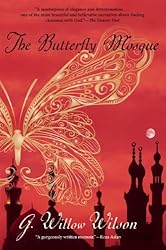

The Butterfly Mosque: A Young American Woman's Journey to Love and Islam
G. Willow Wilson, 2010
Grove Atlantic
320 pp.
ISBN-13: 9780802145338
Summary
The extraordinary story of an all-American girl’s conversion to Islam and her ensuing romance with a young Egyptian man, The Butterfly Mosque is a stunning articulation of a Westerner embracing the Muslim world.
When G. Willow Wilson—already an accomplished writer on modern religion and the Middle East at just twenty-seven—leaves her atheist parents in Denver to study at Boston University, she enrolls in an Islamic Studies course that leads to her shocking conversion to Islam and sends her on a fated journey across continents and into an uncertain future.
She settles in Cairo where she teaches English and submerges herself in a culture based on her adopted religion. And then she meets Omar, a passionate young man with a mild resentment of the Western influences in his homeland. They fall in love, entering into a daring relationship that calls into question the very nature of family, belief, and tradition.
Torn between the secular West and Muslim East, Willow records her intensely personal struggle to forge a “third culture” that might accommodate her own values without compromising the friends and family on both sides of the divide. (From the publisher.)
Author Bio
• Birth—August 31, 1982
• Where—Morris County, New Jersey
• Raised—Boulder, Colorado, USA
• Education—B.A., Boston University
• Awards—(see below)
• Currently—lives in Seattle, Washington, and Cairo, Egypt
Gwendolyn Willow Wilson, known professionally as G. Willow Wilson, is an American comics writer, memoirist, novelist, essayist, and journalist. She is best known for relaunching the Ms. Marvel title for Marvel Comics (which stars a 16-year-old Muslim superhero named Kamala Khan). But she has also received praise for her memoir and novels.
Early life
Wilson was born in Morris County, New Jersey, where she spent the first ten years of her life. She first encountered comics in the fifth grade while reading an anti-smoking pamphlet featuring the X-Men. Fascinated by the characters, she began watching the cartoon X-Men every Saturday.
Two years later she and her family moved to Boulder, Colorado where Wilson continued to pursue her interest in comics and other forms of popular culture such as tabletop role-playing games.
When she turned 27, Wilson decided to leave Colorado and to pursue a degree in history at Boston University. During her sophomore year, while experiencing adrenal problems, she decided to study world religions, including Buddhism, Judaism, Christianity, and Islam.
Having grown up in an unreligious household, Wilson drawn to Judaism's belief in an "indivisible God who is one and whole." Yet, although Judaism "was a near perfect fit," she explained in a 2017 interview, "it was created for a single tribe of people."
Wislon then turned her focus to Islam, which she saw as "a sort of a deal between you and God." The 9/11 terrorist attack set back her religious studies—fearing she had misjudged the religion—but later resumed her studies.[2] After graduation, on the way to Cairo where she had taken a job to teach English, Wilson experienced a converstion to Islam: "I made peace with God. I called him Allah."
Living in Egypt, and struggling to negotiate a new culture, Wilson met Omar, a young physics teacher, who offered to serve as a cultural guide, and within a matter of months, the two became engaged. Later, the couple moved to the United States where Wilson returned to her writing career, and Omar worked as a legal advocate for refugees.
Jouralism
During her time in Cairo, Wilson began contributing articles to the Atlantic Monthly, New York Times Magazine and National Post. She was also a regular contributor to the now-defunct Egyptian opposition weekly Cairo Magazine. Wilson was the first Western journalist to be granted a private interview with Ali Gomaa after his promotion to the position of Grand Mufti of Egypt.
Wilson's experiences in Egypt are the subject of her 2010 memoir, The Butterfly Mosque: A Young American Woman's Journey to Love and Islam, which was named a Seattle Times Best Book the same year.
In 2007, Wilson wrote her first graphic novel, Cairo, with art by M.K. Perker; it was named one of the best graphic novels of 2007 by Publishers Weekly, The Edmonton Journal/CanWest News, and Comics Worth Reading. In 2008 the paperback edition was named one of Best Graphic Novels for High School Students in 2008 by School Library Journal, and one of 2009's Top Ten Graphic Novels for Teens by the American Library Association.
Comics
A year later, in 2008, Wilson launched her first ongoing comic series, "Air." Reunited with her Cairo graphic artist M.K. Perker, "Air" received the Eisner Award for Best New Series of 2009, while NPR named it one of the top comics of 2009.
Wilson also wrote "Superman" fill-in issues #704 and 706 of Superman, the five-issue mini-series "Vixen: Return of the Lion." and "The Outsiders." She then revived "Mystic,"a four-issue miniseries for Marvel Comics (with art by David Lopez)—although a CrossGen revival, Willow's version of "Mystic" bears little resemblance to its previous incarnation.
In 2014, Marvel debuted a new "Ms. Marvel" series written by Wilson. The book stars Kamala Khan, a Muslim teenager living in Jersey City, New Jersey, who takes up the mantle—now that the previous Ms. Marvel, Carol Danvers, has taken the name Captain Marvel.
Although worried about criticism, Wilson did not believe Kamala should wear a hijab because the majority of teenage Muslim Americans do not cover their heads. Yet despite their initial concern, Kamala was received positively—some seeing her as a symbol for equality and religious diversity.
In 2018, Wilson began writing "Wonder Woman" from DC Comics. The character will battle Ares in an arc entitled "The Just War."
Novels
Wilson also turned to novels: 2013 saw the release of her debut, Alif the Unseen. The book won the 2013 World Fantasy Award for best novel.
Wilson's next fantasy novel came out in 2019 —The Bird King, the story of a concubine in the royal court of Granada, the last emirate of Muslim Spain, as the new Christian monarchy begins its rule. (Adapted from Wikipedia. Retrieved 3/18/2019 .)
Book Reviews
[S]atisfying, lyrical memoir…. Arguably, Wilson's decision to take up the headscarf and champion the segregated, protected status of Arab women can be viewed as odd; however, her work proves a tremendously heartfelt, healing cross-cultural fusion.
Publishers Weekly
Moments of clarity and humor thread through this uplifting story of one young American seeking integrity in a fractured world. A first-rate memoir and love story that is a delight to read. —Lisa Klopfer, Eastern Michigan Univ. Lib., Ypsilanti
Library Journal
Debut memoir chronicles Wilson's conversion to Islam…. Enlightening cultural description and analysis blends somewhat awkwardly with self-regard.
Kirkus Reviews
Discussion Questions
We'll add publisher questions if and when they're available; in the meantime, use our LitLovers talking points to help start a discussion for THE BUTTERFLY MOSQUE … then take off on your own:
1. What first drew G. Willow Wilson to Islam? What explanation does she offer for her conversion, and does it satisfy you? In what way did her religious, or non-religious, background influence her decision to convert?
2. Comment on this passage from the book: "Religion was taboo in my family, and Islam was taboo in my society—these pressures are not easily shaken off, and I sometimes felt as guilty as if I had committed a crime." What precisely makes her feel guilty?
3. What are the challenges she has faced, particularly after 9/11, in accepting Islam as her faith?
4. What distinctions does Wilson make between fundamental Islam and "true" Islam? She says that Islam is an "antiauthoritarian sex-positive faith." Did you disagree at the outset of the book… and did you change your mind by the book's end? Or not.
5. Discuss Wilson's struggles to reconcile Egyptian culture, once she has moved to Egypt, with her own values and expectations.
6. How easy would you find it to integrate yourself into another culture, especially one so very different from Western culture as Egypt's?
7. Do you agree—or disagree—with this statement by Wilson:
Cultural habits are by and large irrational, emerge irrationally, and are practiced irrationally. They are independent of the intellect, and trying to fit them into a logical pattern is fruitless; they can be respected or discarded, but not debated.… Culture belongs to the imagination; to judge it rationally is to misunderstand its function.
8. Talk about her condemnation of American and Canadian behavior she witnesses in the marketplace. What most disturbs her about their behavior? Do you think she over-generalizes… or makes an astute observation? As a Westerner, how do her criticisms make you feel?
9. Discuss Wilson's anxieties on becoming engaged to Omar, especially when she writes that she "was terrified. There are few things more overwhelming than love in hostile territory.”
10. What do make of the fact that Wilson dons a headscarf. What are her reasons? What does the headscarf mean to her?
11. How does Wilson defend Islam's patriarchal attitude toward women? What does she find comforting?
12. Follow-up to Question 11: Do you think the following point is valid? Wilson says at one point that a woman in the Middle East …
is far less free than a woman in the West, but far more appreciated. When people wonder why Arab women defend their culture, they focus on the way women who don’t follow the rules are punished, and fail to consider the way women who do follow the rule are appreciated.
13. What new insights into the Middle East, Muslims, and Islamic life does Wilson present? Has reading this book altered your views of Islam? In what way does the book challenge the stereotypes portrayed by the media?
14. Do you feel this is a book that those in government—or anyone involved with foreign relations—should read?
15. What is the significance of the book's title?
(Questions by LitLovers. Please feel free to use them, online or off, with attribution. Thanks.)
top of page (summary)


California Vines, Wines & Pioneers
Sherry Monahan, 2013
The History Press
160 pp.
ISBN-13: 9781609498849
Summary
Grab your glass and take to the wine trail with food genealogist Sherry Monahan as she traces California wine roots in California's Vines, Wines & Pioneers. While cowboys and early settlers were writing the oft-told history of the Wild West, California's wine pioneers were cultivating a delicious industry.
The story begins when Franciscan missionaries planted the first grapes in Southern California in 1769. Almost a century later, news of gold drew thirsty prospectors and European immigrants to California's promise of wealth. From Old World vines sprang a robust and varied tradition of wine cultivation that overcame threats of pests and Prohibition to win global prestige. Journey with Monahan as she uncorks this vintage history and savors the stories of California's historic wineries and vineyards.
Included are over 60 wineries who are still in business and have a historical tie. **Includes 16 pp. color-photo insert** (From the publisher.)
Author Bio
• Birth—N/A
• Where—state of Illinois, USA
• Raised—state of New Jersey
• Education—N/A
• Currently—lives in Raleigh, North Carolina
Sherry has written several non-fiction books on the Victorian West. Her most recent include Mrs. Earp: The Wives and Lovers of the Earp Brothers and California Vines, Wines & Pioneers. She also penned books about Tombstone, Pikes Peak and The Wicked West.
She's currently working on Ethel's Decision, which is the remarkable true story of an upper-class family who settled the rugged land of Lake County, California in the 1880s. Their motive was to gain back the money they lost in England, but these high-society aristocrats preferred cricket, boating, and acting over the chores of farming.
In addition to being an author, she calls herself the Genie with a Bottle because she traces the genealogy of food and wine. She coined the term, Winestry, and likes to say, "History never tasted so good."
You may have seen her on the History Channel in many shows, including Cowboys and Outlaws: Wyatt Earp, Lost Worlds: Sin City of the West (Deadwood), Investigating History and two of the Wild West Tech shows. She was honored with a Wrangler Award in the Western Heritage Awards for her performance in the Cowboys and Outlaws show in 2010.
She has her own column called "Frontier Fare" in (and is a contributing editor) True West magazine. Her "Frontier Fare" column is being turned into a book that will be released in 2015.
Other publications include the Tombstone Times, Tombstone Tumbleweed, Tombstone Epitaph, Arizona Highways, and other freelance works.
She's the incoming President of Western Writers of America and holds memberships in the following organizations: Women Writing the West, the Authors Guild, Wild West History Association, The James Beard Foundation, Association of Professional Genealogists, and SASS. She's also a charter member of the National Women's History Museum.
In addition to writing, she works as a marketing consultant and professional genealogist.
Sherry is also the author of history books on the North Carolina towns of Apex, Cary, and Southport. Each includes 200+ images and historical details and recollections. (From the publisher.)
Book Reviews
California Vines, Wines & Pioneers, a new history of the Golden State's wine industry that began in 1769 when Franciscan friars planted wine grapes in their first mission at San Diego. Author Sherry Monahan profiles more than 50 Old World pioneers who cultivated historic vineyards in Napa, Sonoma and other counties, explaining their contributions and taking the story up through the twin challenges of Prohibition and the Phylloxera pestilence.
Pete Basofin - Sacramento Bee
Discussion Questions
1. What wine history fact surprised you the most? Why?
2. Which winery or wineries did you know were historical? Name them.
3. Which winery or wineries were you surprised to learn were historic? Name them.
4. After reading their history, are there any brands of wine you went out and sampled? Which one(s)?
5. If you sampled "history in a bottle" did you reflect on its history? How?
6. Which recipes, if any, piqued your interest? Why?
7. Did you find yourself getting thirsty or hungry as you read the book? Discuss.
8. Do you think the author did a good job in making California’s wine history fun? Why or why not?
9. Do you feel this book would make a good travel guide if you went to Napa or Sonoma? Why or why not?
(Questions courtesy of the author.)


Can't We Talk About Something More Pleasant?: A Memoir
Roz Chast, 2014
Bloomsbury
240 pp.
ISBN-13: 9781608198061
Summary
In her first memoir, Roz Chast brings her signature wit to the topic of aging parents. Spanning the last several years of their lives and told through four-color cartoons, family photos, and documents, and a narrative as rife with laughs as it is with tears, Chast’s memoir is both comfort and comic relief for anyone experiencing the life-altering loss of elderly parents.
When it came to her elderly mother and father, Roz held to the practices of denial, avoidance, and distraction. But when Elizabeth Chast climbed a ladder to locate an old souvenir from the “crazy closet”—with predictable results—the tools that had served Roz well through her parents’ seventies, eighties, and into their early nineties could no longer be deployed.
While the particulars are Chast-ian in their idiosyncrasies—an anxious father who had relied heavily on his wife for stability as he slipped into dementia and a former assistant principal mother whose overbearing personality had sidelined Roz for decades—the themes are universal: adult children accepting a parental role; aging and unstable parents leaving a family home for an institution; dealing with uncomfortable physical intimacies; managing logistics; and hiring strangers to provide the most personal care.
An amazing portrait of two lives at their end and an only child coping as best she can, Can't We Talk about Something More Pleasant will show the full range of Roz Chast’s talent as cartoonist and storyteller. (From the publisher.)
Author Bio
• Birth—November 26, 1954
• Raised—Brooklyn, New York, New York, USA
• Education—B.F.A., Rhode Island School of Design
• Awards—(see below)
• Currently—lives in Ridgefield, Connecticut
Rosalind "Roz" Chast is an American cartoonist and a staff cartoonist for The New Yorker. She grew up in the Flatbush section of Brooklyn, the only child of an assistant principal and a high school teacher who subscribed to The New Yorker.
Education
She is a graduate of Midwood High School in Brooklyn and first attended Kirkland College (now Hamilton College), and then studied at the Rhode Island School of Design where she received a BFA in painting in 1977.
Career
Her earliest cartoons were published in Christopher Street and The Village Voice. In 1978 The New Yorker accepted one of her cartoons and has since published more than 800. She also publishes cartoons in Scientific American and the Harvard Business Review.
Chast's subjects often deal with domestic and family life. In a 2006 interview with comedian Steve Martin for the New Yorker Festival, Chast revealed that she enjoys drawing interior scenes—often involving lamps and accentuated wall paper—to serve as the backdrop for her comics. Her comics reflect a "conspiracy of inanimate objects," an expression she credits to her mother.
Her first New Yorker cartoon showed a small collection of "Little Things," strangely named, oddly shaped small objects such as "chent," "spak," and "tiv". Chast's drawing style shuns conventional craft in her figure drawing, perspective, shading, etc.; this approach is similar to that of several other female cartoonists, notably Aline Kominsky-Crumb and Lynda Barry. A significant part of the humor in Chast's cartoons appears in the background and the corners of the frames.
Her New Yorker cartoons began as small black-and-white panels, but increasingly she has been using color and her work now often appears over several pages. Her first cover for The New Yorker was on August 4, 1986, showing a lecturer in a white coat pointing to a family tree of ice cream.
Chast's subjects often deal with domestic and family life. In a 2006 interview with comedian Steve Martin for the New Yorker Festival, Chast revealed that she enjoys drawing interior scenes—often involving lamps and accentuated wall paper—to serve as the backdrop for her comics. Her comics reflect a "conspiracy of inanimate objects," an expression she credits to her mother.
She is represented by the Danese/Corey gallery in Chelsea, New York City. She lives in Ridgefield, Connecticut with her husband, humor writer Bill Franzen.
Books
In addition to her 2014 family memoir, Can We Talk About Something More Pleasant?, Chast has written or illustrated more than a dozen books, including Unscientific Americans, Parallel Universes, Mondo Boxo, Proof of Life on Earth, The Four Elements, and The Party After You Left: Collected Cartoons 1995–2003 (Bloomsbury, 2004).
In 2006, Theories of Everything: Selected Collected and Health-Inspected Cartoons, 1978–2006 was published, collecting most of her cartoons from The New Yorker and other periodicals. One characteristic of her books is that the "author photo" is always a cartoon she draws (presumably) of herself. The title page is also hand-lettered by Chast, even including the Library of Congress cataloging information. (Adapted from Wikipedia. Retrieved 8/25/2014.)
Awards/Honors
2013 - Inducted into American Academy of Arts and Sciences
- Reuben Award for Best Gag Cartoon
2012 - New York City Literary Award for Humor
2004 - Art Festival Award, Museum of Cartoon and Comic Art
Honorary Doctorates: 2011, Dartmouth College; 2010, Art Institute of Boston; 1998, Pratt Institute. ("Awards/Honors" from the author's website.)
Book Reviews
By turns grim and absurd, deeply poignant and laugh-out-loud funny. Ms. Chast reminds us how deftly the graphic novel can capture ordinary crises in ordinary American lives.
Michiko Kakutani - New York Times
Very, very, very funny, in a way that a straight-out memoir about the death of one’s elderly parents probably would not be.... Ambitious, raw and personal as anything she has produced.
Alex Witchel - New York Times Book Review
[O]ne of the best memoirs on mortality I’ve ever read, let alone about the difficult specifics of eldercare....an achievement of dark humor that rings utterly true. There is Chast’s gifted ear for the shorthanded, idiosyncratic dialogue that every family develops only over long years.... Mostly, though, this is the humor-leavened portrait of a family saying its long goodbyes, awkwardly and glancingly and painfully, muddling through in the most human of ways.
Washington Post
Better than any book I know, this extraordinarily honest, searing and hilarious graphic memoir captures (and helps relieve) the unbelievable stress that results when the tables turn and grown children are left taking care of their parents.... [A] remarkable, poignant memoir.
San Francisco Chronicle
Devastatingly good.... Anyone who has had Chast’s experience will devour this book and cling to it for truth, humor, understanding, and the futile wish that it could all be different.
St. Louis Post Dispatch
Gut-wrenching and laugh-aloud funny. I want to recommend it to everyone I know who has elderly parents, or might have them someday.
Milwaukee Journal Sentinel
One of the major books of 2014.... Moving and bracingly candid.... This is, in its original and unexpected way, one of the great autobiographical memoirs of our time.
Buffalo News
A tour de force of dark humor and illuminating pathos about her parents’ final years as only this quirky genius of pen and ink could construe them.
Elle
(Starred review.) [P]oignant and funny.... Despite the subject matter, the book is frequently hilarious...a homage that provides cathartic “you are not alone” support to those caring for aging parents.... [A] cartoon memoir to laugh and cry, and heal, with—Roz Chast’s masterpiece.
Publishers Weekly
(Starred review.) Chast's scratchy art turns out perfectly suited to capturing the surreal realities of the death process. In quirky color cartoons, handwritten text, photos, and her mother's poems, she documents the unpleasant yet sometimes hilarious cycle of human doom. the inevitable.
Library Journal
(Starred review.) Revelatory.… So many have faced (or will face) the situation that the author details, but no one could render it like she does. A top-notch graphic memoir that adds a whole new dimension to readers’ appreciation of Chast and her work.
Kirkus Reviews
Discussion Questions
Use our LitLovers Book Club Resources; they can help with discussions for any book:
• How to Discuss a Book (helpful discussion tips)
• Generic Discussion Questions—Fiction and Nonfiction
• Read-Think-Talk (a guided reading chart)
(We'll add specific questions if and when they're made available by the publisher.)


Careless People: Murder, Mayhem, and the Invention of the Great Gatsby
Sarah Churchwell, 2014
Penguin Group USA
432 pp.
ISBN-13: 9781594204746
Summary
The autumn of 1922 found F. Scott Fitzgerald at the height of his fame, days from turning twenty-six years old, and returning to New York for the publication of his fourth book, Tales of the Jazz Age.
A spokesman for America’s carefree younger generation, Fitzgerald found a home in the glamorous and reckless streets of New York. Here, in the final incredible months of 1922, Scott and Zelda Fitzgerald drank and quarreled and partied amid financial scandals, literary milestones, car crashes, and celebrity disgraces.
Yet the Fitzgeralds’ triumphant return to New York coincided with another event: the discovery of a brutal double murder in nearby New Jersey, a crime made all the more horrible by the farce of a police investigation—which failed to accomplish anything beyond generating enormous publicity for the newfound celebrity participants.
Proclaimed the “crime of the decade” even as its proceedings dragged on for years, the Mills-Hall murder has been wholly forgotten today. But the enormous impact of this bizarre crime can still be felt in The Great Gatsby, a novel Fitzgerald began planning that autumn of 1922 and whose plot he ultimately set within that fateful year.
Careless People is a unique literary investigation: a gripping double narrative that combines a forensic search for clues to an unsolved crime and a quest for the roots of America’s best loved novel. Overturning much of the received wisdom of the period, Careless People blends biography and history with lost newspaper accounts, letters, and newly discovered archival materials. With great wit and insight, acclaimed scholar of American literature Sarah Churchwell reconstructs the events of that pivotal autumn, revealing in the process new ways of thinking about Fitzgerald’s masterpiece.
Interweaving the biographical story of the Fitzgeralds with the unfolding investigation into the murder of Hall and Mills, Careless People is a thrilling combination of literary history and murder mystery, a mesmerizing journey into the dark heart of Jazz Age America. (From the publisher.)
Author Bio
• Birth—1970
• Raised—Winnetka, Illinois, USA
• Education—B.A., Vassar College; M.A., Ph.D.,
Princeton University
• Currently—lives near London, England, UK
Sarah Bartlett Churchwell is an American-born academic who is the Professor of American Literature and Public Understanding of the Humanities at the University of East Anglia, UK. She is a writer and literary critic and regularly appears on British television and radio in addition to writing reviews and other articles for many publications in the United Kingdom and United States.
She grew up in Winnetka, near Chicago, Illinois, and was awarded a BA in English Literature from Vassar College and an M.A. and Ph.D. in English and American Literarure from Princeton University.
She then moved to England where she has lectured at the University of East Anglia since 1999. She has written for many publications including; The Times Literary Supplement, New York Times Book Review, Spectator, New Statesman, Guardian and The Observer.
Her publications include a book about Marilyn Monroe entitled The Many Lives of Marilyn Monroe (2004) and one on Scott Fiztgerald, Careless People: Murder, Mayem, and the Invention of The Great Gatsby (2014). Her television appearances include Newsnight, The Review Show, and The Sharp End with Clive Anderson.
Churchwell was appointed a member of the judging panel for the 2014 Man Booker Prize. (From Wikipedia. Retrieved 1/14/2014.)
Book Reviews
Churchwell brings… a lively curiosity, a gift for making connections, and an infectious passion for Fitzgerald and his greatest novel…. A suggestive, almost musical evocation of the spirit of the time.
London Review of Books
The first readers of The Great Gatsby thought it was all about themselves, a book of the moment. Today, we tend to admire its enduring mythology of aspiration and undoing. Churchwell brilliantly brings these two perspectives together as she holds in counterpoint the sprawling stuff of Fitzgerald’s daily life and the gleamingly taut prose poem that emerged from it… Fitzgerald offered the year 1922 as the chief exhibit when he tried to explain the meaning of the jazz age. It is an exhibit worth looking at very carefully. Careless People does so with a mixture of patience and panache and it would take a long time to get bored of that particular cocktail.
New Statesman (UK)
The wonder of Careless People ... is that it rewinds the years and allows the reader to appreciate again just how well Fitzgerald reflected his times.
Sunday Telegraph (UK)
A literary spree, bursting with recherché detail, high spirits and the desperate frisson of the jazz age.
Observer (UK)
A treasury of new material. Churchwell adds considerably to our understanding of the early 1920s, and how life for Fitzgerald played into the development of his art.
Literary Review (UK)
Churchwell evokes the Jazz Age in all its ephemeral glamour and recklessness in her latest book.... "a collage" of Scott and Zelda Fitzgeralds' world and a social history of the times.... Churchwell strains to establish a close connection between the [New Jersey] Mills-Hall murders and Fitzgerald’s work on [Gatsby].
Publishers Weekly
Churchwell [The Great Gatsy] genesis to the Hall-Mills murder case, a notorious 1920s double homicide that occurred in New Jersey. Since the novel is set in 1922, also the year Fitzgerald began plotting the story, Churchwell examines the events...that took place in that important year.... [W]ell-written and entertaining. —Morris Hounion, New York City Coll. of Technology, CUNY, Brooklyn
Library Journal
Churchwell... has written an excellent book.... [S]he even manages to find fresh facts that escaped previous scholars, including one of F. Scott Fitzgerald's own published comments about [The Great Gatsby], a book that, as Churchwell notes, neither sold well nor received uniformly favorable reviews.... Prodigious research and fierce affection illumine every remarkable page.
Kirkus Reviews
Discussion Questions
Use our LitLovers Book Club Resources; they can help with discussions for any book:
• How to Discuss a Book (helpful discussion tips)
• Generic Discussion Questions—Fiction and Nonfiction
• Read-Think-Talk (a guided reading chart)
(We'll add specific questions if and when they're made available by the publisher.)

Caste: The Origins of Our Discontents
Isabel Wilkerson, 2020
Random House
496 pp.
ISBN-13: 9780593230251
Summary
As we go about our daily lives, caste is the wordless usher in a darkened theater, flashlight cast down in the aisles, guiding us to our assigned seats for a performance. The hierarchy of caste is not about feelings or morality. It is about power—which groups have it and which do not.
In this brilliant book, Isabel Wilkerson gives us a masterful portrait of an unseen phenomenon in America as she explores, through an immersive, deeply researched narrative.
She tells us stories about real people, how America today and throughout its history has been shaped by a hidden caste system—a rigid hierarchy of human rankings.
Beyond race, class, or other factors, there is a powerful caste system that influences people’s lives and behavior and the nation’s fate. Linking the caste systems of America, India, and Nazi Germany, Wilkerson explores eight pillars that underlie caste systems across civilizations, including divine will, bloodlines, stigma, and more.
Using riveting stories about people—including Martin Luther King, Jr., baseball’s Satchel Paige, a single father and his toddler son, Wilkerson herself, and many others—she shows the ways that the insidious undertow of caste is experienced every day:
—she documents how the Nazis studied the racial systems in America to plan their out-cast of the Jews;
—she discusses why the cruel logic of caste requires that there be a bottom rung for those in the middle to measure themselves against;
—she writes about the surprising health costs of caste, in depression and life expectancy, and the effects of this hierarchy on our culture and politics.
Finally, Wilkerson points forward to ways America can move beyond the artificial and destructive separations of human divisions, toward hope in our common humanity.
Beautifully written, original, and revealing, Caste: The Origins of Our Discontents is an eye-opening story of people and history, and a reexamination of what lies under the surface of ordinary lives and of American life today. (From the publisher.)
Author Bio
• Birth—N/A
• Where—Washington, D.C., USA
• Education—B.A., Howard University
• Awards—Pulitizer Prize (twice); National Book Critics Circle Award; George S. Polk Award; Journalist of the Year Award from The National Association of Black Journalists.
• Currently—lives in in Boston, Massachusetts
Isabel Wilkerson is a journalist and the author, in 2010, of The Warmth of Other Suns: The Epic Story of America's Great Migration, which won the Pulitizer Prize, as well as the Book Critics Circle Award. In 2020, she published Caste: The Origins of our Discontents, a book that also received wide critical acclaim.
Born in Washington D.C., Wilkerson studied journalism at Howard University, becoming editor-in-chief of the college newspaper The Hilltop. During college, Wilkerson interned at many publications, including the The Los Angeles Times and Washington Post.
In 1994, while Chicago bureau chief of The New York Times, she became the first African-American woman to win the Pulitzer Prize in journalism, winning the feature writing award for her coverage of the 1993 midwestern floods and her profile of a 10-year-old boy who was responsible for his four siblings. Several of Wilkerson's articles are included in the book Pulitzer Prize Feature Stories: America's Best Writing, 1979 - 2003, edited by David Garlock.
Wilkerson has also won a George S. Polk Award, a Guggenheim Fellowship, and a Journalist of the Year award from the National Association of Black Journalists.
She has also held the positions of James M. Cox Professor of Journalism at Emory University, Ferris Professor of Journalism at Princeton University and the Kreeger-Wolf endowed lecturer at Northwestern University. She also served as a board member of the National Arts in Journalism Program at Columbia University.
Wilkerson is now a Professor of Journalism and Director of Narrative Nonfiction in the College of Communications at Boston University.
After fourteen years of research, she has just released a book called The Warmth of Other Suns: The Epic Story of America's Great Migration, which examines the three geographic routes that were commonly used by African Americans leaving the southern states between 1915 and the 1970s, illustrated through the personal stories of people who took those routes.
During her research for the book, Wilkerson interviewed more than 1,000 people who made the migration from the South to Northern and Western cities. The book almost instantly hit number 11 on the NYT Bestseller list for nonfiction and has since been included in lists of best books of 2010 by many reviewers, including Salon.com, Atlanta Magazine, New Yorker, Washington Post, Economist, and The Daily Beast. (From Wikipedia.)
Book Reviews
[A]n extraordinary document…an instant American classic and almost certainly the keynote nonfiction book of the American century thus far. It made the back of my neck prickle from its first pages, and that feeling never went away…. It's a book that seeks to shatter a paralysis of will. It's a book that changes the weather inside a reader.
Dwight Garner - New York Times
[E]legant and persuasive…. [Wilkerson] combines larger historical descriptions with vignettes from particular lives, recounted with the skill of a veteran reporter…. Its vivid stories about the mistreatment of Black Americans… prompt flashes of indignation and moments of sorrow. The result is a book that is at once beautifully written and painful to read.
Kwame Anthony Appiah - New York Times Book Review
Wilkerson’s book is a powerful, illuminating and heartfelt account of how hierarchy reproduces itself, as well as a call to action for the difficult work of undoing it.
Washington Post
Magnificent… a trailblazing work on the birth of inequality…. Caste offers a forward-facing vision. Bursting with insight and love, this book may well help save us.
Oprah Magazine
[Caste] should be at the top of every American’s reading list.
Chicago Tribune
(Starred Review) [A] powerful and extraordinarily timely social history…. Incisive autobiographical anecdotes and captivating portraits…reveal the steep price U.S. society pays for limiting the potential of black Americans. This enthralling expose deserves a wide and impassioned readership.
Publishers Weekly
(Starred Review) [Wilkerson] explains how a rigid social order, or caste, is about power.… Incidents of historical and contemporary violence against African Americans resonate throughout this incisive work. [Caste] is destined to become a classic, and is urgent, essential reading for all.
Library Journal
(Starred Review) This is a brilliant book, well timed in the face of a pandemic and police brutality that cleave along the lines of a caste system.
Booklist
(Starred Review) Wilkerson writes that American caste structures were broadly influential for Nazi theorists when they formulated their racial and social classifications…. A memorable, provocative book that exposes an American history in which few can take pride.
Kirkus Reviews
Discussion Questions
1. At the beginning of Caste, author Isabel Wilkerson compares American racial hierarchy to a dormant Siberian virus. What are the strengths of this metaphor? How does this comparison help combat the pervasive myth that racism has been eradicated in America?
2. Wilkerson begins the book with an image of one lone dissenter amidst a crowd of Germans giving the Nazi salute. What would it mean—and what would it take—to be this man today?
3. What are some of the elements required for a caste system to succeed?
4. Wilkerson uses many different metaphors to explain and help us visualize the concept of the American caste system: the bones inside a body, the beams inside a house, even the computer program in the 1999 film The Matrix. Which of these metaphors helped the concept click for you? Why was it successful?
5. Caste and race are not the same thing. What is the difference between the two? How do casteism and racism support each other?
6. Discuss how class is also different from caste.
7. Who does a caste system benefit? Who does it harm?
8. "Before there was a United States of America," Wilkerson writes, "there was a caste system, born in colonial Virginia." How can Americans reckon with this fact? What does it mean to you to live in a country whose system of discrimination was cemented before the country itself?
9. Did learning about the lens and language of caste change how you look at U.S. history and society? How?
10. Wilkerson discusses three major caste systems throughout the book: India, Nazi Germany, and America. What are some of the differences that stood out to you among these three systems? What are the similarities? How did learning about one help you understand the other? For instance, did the fact that the Nazis actually studied America’s segregation practices and Jim Crow laws help underscore the depth of our own system?
11. Harold Hale, an African-American man, helped his daughter defy the "rules" of their caste in 1970s Texas by naming her Miss. As Wilkerson illustrates throughout the book, the dangers of being seen as defying one’s caste can range from humiliation to death. What do you think of the lengths he felt he needed to go to assure dignity for his daughter? What are the risks he put her in by doing so? Should Miss have had a say in her father’s quietly revolutionary act? Explain.
12. Discuss the differences and similarities between how Miss was treated in the South, where racism and casteism have historically been more overt, and in the North, where they still exist, but can be more subtle. Do you think these various forms of racism and casteism must be fought in different ways?
13. Wilkerson quotes the orator Frederick Douglass, who described the gestures that could incite white rage and violence: "in the tone of an answer; in answering at all; in not answering …" These contradict each other: One could incite rage by answering … or by not answering. Discuss the bind that this contradiction put (and still puts) African-American people in.
14. Wilkerson frequently uses her own experience as an African-American woman to illustrate her points regarding caste—and the confusion when someone "rises above" his or her presumed station. What do readers gain from hearing about Wilkerson’s personal experiences in addition to her deep historical research?
15. "Indians will ask one’s surname, the occupation of one’s father, the village one is from, the section of the village that one is from, to suss out the caste of whoever is standing in front of them," Wilkerson writes. "They will not rest until they have uncovered the person’s rank in the social order." How is this similar to and different from the process of determining caste in America? Have you ever, for instance, asked someone what they did for work or where they lived or went to school, and been surprised? Did you treat them differently upon hearing their answer?
16. Analyze the process of dehumanization and how it can lead to people justifying great acts of cruelty.
17. "Evil asks little of the dominant caste other than to sit back and do nothing," Wilkerson writes. Whether in the dominant caste or not, what are some of the ways that each of us, personally, can stand up to the caste system?
18. Wilkerson gives examples that range from the horrifying (lynching) to the absurd (the Indian woman who walked across an office to ask a Dalit to pour her water from the jug next to her desk) to illustrate caste’s influence on behavior. How do both of these types of examples—and everything in between—help cement her points? Why do we need to see this range to clearly understand caste?
19. Discuss how overt racism subtly transformed into unconscious bias. What are the ways that we can work to compensate for the unconscious biases inherent in a caste system?
20. Wilkerson writes about the "construction of whiteness," describing the way immigrants went from being Czech or Hungarian or Polish to "white"—a political designation that only has meaning when set against something "not white." Irish, Italian … people weren’t "white" until they came to America. What does this "construction of whiteness" tell us about the validity of racial designations and the structure of caste?
21. It is a widely held convention that working-class white Americans may often "act against their own interests" by opposing policies designed to help the working class. Discuss how the logic of caste disproves this concept and redefines that same choice from the perspective of maintaining group dominance.
22. How does the caste system take people who would otherwise be allies and turn them against one another?
23. Wilkerson describes dinner with a white acquaintance who was incensed over the treatment they received from the waitstaff. Why did the acquaintance respond the way that she did, and how did it hurt or help the situation?
24. What do we learn from Albert Einstein’s response to the American caste system upon arrival from Germany?
25. What are some of the steps that society, and each of us, can take toward dismantling the caste system?
(Questions issued by the publisher.)

Catch and Kill: Lies, Spies, and a Conspiracy to Protect Predators
Ronan Farrow, 2019
Little Brown & Company
464 pp.
ISBN-13: 9780316486637
Summary
In a dramatic account of violence and espionage, Pulitzer Prize-winning investigative reporter Ronan Farrow exposes serial abusers and a cabal of powerful interests hell-bent on covering up the truth, at any cost.
In 2017, a routine network television investigation led Ronan Farrow to a story only whispered about: one of Hollywood's most powerful producers was a predator, protected by fear, wealth, and a conspiracy of silence.
As Farrow drew closer to the truth, shadowy operatives, from high-priced lawyers to elite war-hardened spies, mounted a secret campaign of intimidation, threatening his career, following his every move, and weaponizing an account of abuse in his own family.
All the while, Farrow and his producer faced a degree of resistance they could not explain -- until now. And a trail of clues revealed corruption and cover-ups from Hollywood to Washington and beyond.
This is the untold story of the exotic tactics of surveillance and intimidation deployed by wealthy and connected men to threaten journalists, evade accountability, and silence victims of abuse. And it's the story of the women who risked everything to expose the truth and spark a global movement.
Both a spy thriller and a meticulous work of investigative journalism, Catch and Kill breaks devastating new stories about the rampant abuse of power and sheds far-reaching light on investigations that shook our culture. (From the publisher.)
Author Bio
• Birth—December 19, 1987
• Where—New York, New York, USA
• Education—B.A., Bard College, J.D., Yale University, Ph.D., Oxford University
• Awards—Pulitizer Prize
• Currently—lives in New York City
Ronan Farrow is a contributing writer to The New Yorker, where his investigative reporting has won the Pulitzer Prize for public service, the National Magazine Award, and the George Polk Award, among other honors.
He previously worked as an anchor and investigative reporter at MSNBC and NBC News, with his print commentary and reporting appearing in publications including the Wall Street Journal, Los Angeles Times, and Washington Post.
Before his career in journalism, he served as a State Department official in Afghanistan and Pakistan. He is also the author of War on Peace: The End of Diplomacy and the Decline of American Influence (2018) and most recently of Catch and Kill: Lies, Spies, and a Conspiracy to Protect Predators (2019).
The basis for Catch and Kill, Farrow's article published in The New Yorker, won him a Pulitizer for Public Service. He shared the prize with Jodi Kantor and Meghan Twohey for their coverage of the same topic in the New York Times.
Farrow has been named one of Time Magazine's 100 Most Influential People and one of GQ's Men of the Year. He is a graduate of Yale Law School and a member of the New York Bar. He recently completed a Ph.D. in political science at Oxford University, where he studied as a Rhodes Scholar. He lives in New York. (From the publisher.)
Book Reviews
Absorbing.… The behavior documented in Catch and Kill is obviously and profoundly distressing.… But there are some hopeful threads, too.
Jennifer Szalai - New York Times
At the heart of every great noir is a conspiracy of evil that imbues the initial crime uncovered by the hero with a weightier resonance than was immediately obvious. So it goes with Catch and Kill.
Washington Post
Darkly funny and poignant.… [A] winning account of how it feels to be at the centre of the biggest story in the world. It is also, of course, a breathtakingly dogged piece of reporting, in the face of extraordinary opposition.
Guardian (UK)
Must read: Catch and Kill, by Ronan Farrow. How #sexualabuse stories got suppressed, and how deep-diving, fact-gathering reporting blew the lid off, despite threats, intimidation, and cronymongering at the top. Chilling!
Margaret Atwood - author, Handmaid's Tale
The connections between presidents, media moguls, and spies described in Catch and Kill are stranger than fiction. As a novel, it would be a page-turner. As a reported piece of nonfiction, it's terrifying.
Time
The year's best spy thriller is stranger—and more horrifying—than fiction.… [Ronan] weaves a breathless narrative as compelling as it is disturbing.… [Catch and Kill] bracingly exposes the rot that's persisted across elite American institutions for decades.
Entertainment Weekly
Catch and Kill is an important, frightening book.… [I]t's also a propulsive, cinematic page-turner
Salon
A groundbreaking #MeToo journalist finds his own news organization to be the greatest obstacle to the truth in this vivid, labyrinthine memoir.… [Reveals] troubling collusion between the media and the powerful interests they cover. This is a crackerjack journalistic thriller.
Publishers Weekly
This chilling narrative reveals the unequal power dynamic between aspiring actors… and the dominant powerbrokers in Hollywood.… [A] complement to Kantor and Twohey's She Said: Breaking the Sexual Harassment Story That Helped Ignite a Movement. —Karl Helicher, formerly with Upper Merion Twp. Lib., King of Prussia, PA
Library Journal
At times, the book is difficult to read, mainly because Weinstein, Trump, Lauer, and other powerful men victimized so many women while those who knew about the assaults stayed quiet.… A meticulously documented, essential work.
Kirkus Reviews
Discussion Questions
We'll add publisher questions if and when they're available; in the meantime, use our LitLovers talking points to help start a discussion for CATCH AND KILL … then take off on your own:
1. Author Margaret Atwood called Catch and Release "chilling," while Kirkus Reviews said, "at times the book is difficult to read." What was your experience reading Ronan Farrow's account of sexual assault in high places?
2. (Follow-up to Question 1) What revelations in Ronan Farrow's account shocked you … angered you … or pained you most?
3. How did Harvey Weinstein get away with his sexual predation for so long? Who, or more important, what protected him?
4. Talk about the term "catch and kill"—and the ethics, or lack of ethics, reflected in that journalistic practice? Although catch and kill is typically deployed by tabloids, to what extent were the same, or similar, tactics practiced by NBC, Farrow's own employer?
5. In addition to the scare tactics (threats, lawyers, firing) what were some of the hurdles Farrow and Rich McHugh faced in actually reporting. Why, for instance, was it so difficult to get women to talk on the record? Would you have had the courage to open up?
6. A number of the women Farrow spoke to continued to have sexual encounters with the men who assaulted them. How can you explain that? Does that lessen the guilt of the men? Does that make the women complicit? Or is it part and parcel of the coercive powers of high-placed men?
7. Then there is Black Cube. Want to talk about that episode in Farrow's life? What was the purpose of hiring the intelligence firm? What about the other methods of intimidation leveled at Farrow?
8. Farrow's reportage was personalized for Farrow by his sister, Rose McGowan. What is the background of her story, how it has affected her life, and why for so long had Farrow dismissed the truth and seriousness of her claims. Woody Allen, anyone? Thoughts?
9. Talk about one of the most stunning revelations toward the end of the book: Matt Lauer. What is it with powerful men? Tackle that one.
10. Ultimately, will this book, and all the other coverage of sexual harassment, make a difference? Has it already? What about #MeToo? Has it made a lasting difference? In other words, do you foresee effective change—in both male behavior and society's attitude toward female abuse?
11. This question is a late addition the reading guide: In 2020 Weinstein was tried in a court of law and, in late February, found guilty. A month later, he was sentenced to 23 years in prison. A fair sentence? Too harsh? Not harsh enough?
(Questions by LitLovers. Please feel free to use them, online and off, with attribution. Thanks.)


Catherine the Great: Portrait of a Woman
Robert K. Massie, 2011
Random House
656 pp.
ISBN-13: 9780679456728
Summary
The Pulitzer Prize–winning author of Peter the Great, Nicholas and Alexandra, and The Romanovs returns with another masterpiece of narrative biography, the extraordinary story of an obscure young German princess who traveled to Russia at fourteen and rose to become one of the most remarkable, powerful, and captivating women in history.
Born into a minor noble family, Catherine transformed herself into Empress of Russia by sheer determination. Possessing a brilliant mind and an insatiable curiosity as a young woman, she devoured the works of Enlightenment philosophers and, when she reached the throne, attempted to use their principles to guide her rule of the vast and backward Russian empire. She knew or corresponded with the preeminent historical figures of her time: Voltaire, Diderot, Frederick the Great, Empress Maria Theresa of Austria, Marie Antoinette, and, surprisingly, the American naval hero, John Paul Jones.
Reaching the throne fired by Enlightenment philosophy and determined to become the embodiment of the “benevolent despot” idealized by Montesquieu, she found herself always contending with the deeply ingrained realities of Russian life, including serfdom. She persevered, and for thirty-four years the government, foreign policy, cultural development, and welfare of the Russian people were in her hands. She dealt with domestic rebellion, foreign wars, and the tidal wave of political change and violence churned up by the French Revolution that swept across Europe. Her reputation depended entirely on the perspective of the speaker. She was praised by Voltaire as the equal of the greatest of classical philosophers; she was condemned by her enemies, mostly foreign, as “the Messalina of the north.”
Catherine’s family, friends, ministers, generals, lovers, and enemies—all are here, vividly described. These included her ambitious, perpetually scheming mother; her weak, bullying husband, Peter (who left her lying untouched beside him for nine years after their marriage); her unhappy son and heir, Paul; her beloved grandchildren; and her “favorites”—the parade of young men from whom she sought companionship and the recapture of youth as well as sex. Here, too, is the giant figure of Gregory Potemkin, her most significant lover and possible husband, with whom she shared a passionate correspondence of love and separation, followed by seventeen years of unparalleled mutual achievement.
The story is superbly told. All the special qualities that Robert K. Massie brought to Nicholas and Alexandra and Peter the Great are present here: historical accuracy, depth of understanding, felicity of style, mastery of detail, ability to shatter myth, and a rare genius for finding and expressing the human drama in extraordinary lives.
History offers few stories richer in drama than that of Catherine the Great. In this book, this eternally fascinating woman is returned to life. (From the publisher.)
Author Bio
• Birth—1929
• Where—Lexington, Kentucky, USA
• Education—B.A., Yale University; Oxford
University (as a Rhodes Scholar)
• Awards—Pulitzer Prize
• Currently—lives in Irvington, New York
Robert Kinloch Massie III is an American historian, author, Pulitzer Prize recipient. He has devoted much of his career to studying the House of Romanov, Russia's royal family from 1613-1917.
Born in Lexington, Kentucky in 1929, Massie spent much of his youth in Nashville, Tennessee and currently resides in the village of Irvington, New York. He studied United States and modern European history at Yale and Oxford University, respectively, on a Rhodes Scholarship. Massie went to work as a journalist for Newsweek from 1959 to 1962 and then took a position at the Saturday Evening Post.
In 1969—before he and his family moved to France—Massie wrote and published his breakthrough book, Nicholas and Alexandra, a biography of the last Tsar and Tsarina of Russia, Nicholas II and his wife Alexandra of Hesse. Massie's interest in the Imperial family was triggered by the birth of his son, Reverend and politician Robert Kinloch Massie IV, who was born with hemophilia—a hereditary disease that also afflicted Nicholas's son, Alexei. In 1971, the book was the basis of an Academy Award winning film of the same title. In 1995, in his book The Romanovs: The Final Chapter, Massie updated Nicholas and Alexandra with much newly-discovered information.
In 1975 Robert Massie and his then-wife Suzanne Massie chronicled their experiences as the parents of a hemophiliac child and the significant differences between the American and French health-care systems in their jointly-written book, Journey. Massie won the 1981 Pulitzer Prize for Biography for Peter the Great: His Life and World. This book inspired a 1986 NBC miniseries that won three Emmy Awards and starred Maximilian Schell, Laurence Olivier and Vanessa Redgrave. In 2011 Massie published his biography, Catherine the Great: Portrait of a Woman (2011).
Massie was the president of the Authors Guild from 1987 to 1991, and he still serves as an ex officio council member. While president of the Guild, he famously called on authors to boycott any store refusing to carry Salman Rushdie's The Satanic Verses. He is currently married to Deborah Karl. (From Wikipedia.)
Book Reviews
[Massie] has always been a biographer with the instincts of a novelist. He understands plot—fate—as a function of character. The narrative perspective he establishes and maintains, a vision tightly aligned with that of his subject, convinces a reader he’s not so much looking at Catherine the Great as he is out of her eyes.... One of the unexpected pleasures of “Catherine the Great” is that the degree to which Massie invites us to identify with his subject as she grows and changes in a role she began cultivating herself to attain at the age of 14.
Kathryn Harris - New York Times Book Review
This is indeed a "Portrait of a Woman," as the subtitle declares, with plenty of attention paid to Catherine's emotions and psychology. It is also an adept portrait of a ruler, sympathetically assessing Catherine as a worthy successor to Peter the Great in the effort to modernize and westernize the vast Russian empire. Historians may wish Massie had devoted more time to underlying forces in Russian society that defined the limits of Catherine's achievements, but general readers will find this an absorbing, satisfying biography of the old school.
Wendy Smith - Los Angeles Times
As he did in Nicholas and Alexandra and the Pulitzer Prize-winning Peter the Great, Massie immerses the reader in Russian history and culture. The author, 82, is clearly enraptured by his extraordinary heroine and by the end, so is the reader. Even bone-deep anti-monarchists will find themselves cheering on this absolute despot.What a woman, what a world, what a biography.
USA Today
Massie writes a lively account of Catherine's life and her reign. His clearly drawn depictions of the schemes, jealousies and maneuvers of the court, and of Catherine, bring the era and the woman to life. The book is big. It has to be to cover the scope of Catherine's life. But it is so engrossing, it's a quick read.
Mary Foster - Associated Press for Denver Post
In Catherine the Great, Massie has created a sensitive and compelling portrait not just of a Russian titan, but also of a flesh-and-blood woman.
Newsweek
(Starred review.) The Pulitzer-winning biographer of Nicholas and Alexandra and of Peter the Great, Massie now relates the life of a minor German princess, Sophia of Anhalt-Zerbst, who became Empress Catherine II of Russia (1729–1796). She was related through her ambitious mother to notable European royalty; her husband-to-be, the Russian grand duke Peter, was the only living grandson of Peter the Great. As Massie relates, during her disastrous marriage to Peter, Catherine bore three children by three different lovers, and she and Peter were controlled by Peter’s all-powerful aunt, Empress Elizabeth, who took physical possession of Catherine’s firstborn, Paul. Six months into her husband’s incompetent reign as Peter III, Catherine, 33, who had always believed herself superior to her husband, dethroned him, but probably did not plan his subsequent murder, though, Massie writes, a shadow of suspicion hung over her. Confident, cultured, and witty, Catherine avoided excesses of personal power and ruled as a benevolent despot. Magnifying the towering achievements of Peter the Great, she imported European culture into Russia, from philosophy to medicine, education, architecture, and art. Effectively utilizing Catherine’s own memoirs, Massie once again delivers a masterful, intimate, and tantalizing portrait of a majestic monarch.
Publishers Weekly
Discussion Questions
Use our LitLovers Book Club Resources; they can help with discussions for any book:
• How to Discuss a Book (helpful discussion tips)
• Generic Discussion Questions—Fiction and Nonfiction
• Read-Think-Talk (a guided reading chart)
Also consider these LitLovers talking points to help get a discussion started for Catherine the Great:
1. The subtitle of Robert Massie's biography is "Portrait of a Woman." Is the author's attempt to fashion his portrait successful? Does he imbue Catherine with enough color—complexity and depth—to bring her to life?
2. Follow-up to Question 1: What kind of a woman was Catherine? How did her upbringing shape the woman she would later become? Consider, in particular, Catherine's mother, Johanna, and her influence over her daughter, known then as Sophia Augusta Fredericka?
3. How did Johanna, married to a minor German prince, manage to jostle her daughter to the forefront of European princesses in order to catch the eye of the Russian empress? Talk about Johanna's stratagems.
4. Follow-up to Question 3: What was it about Sophia that made the empress take note? Which of sophia's virtues impressed Elizabeth and inspired her to consider Sophia a suitable match for her nephew?
5. Massie says that Sophia understood early on that people preferred "to talk about themselves rather than anything else." How did Catherine use that insight to benefit herself—and ultimately to gain and maintain power over others? Was Catherine's use of this basic human trait cold and calculated? Or was it a result of her own sympathetic personality which she simply put to use? Or...something else?
6. Discuss young Peter and his ineffectual qualities—both as husband and czar? What mistakes did he make in his short reign? Consider, especially his desire to remake both the Russian church and army.
7. How do you view Catherine's coup d'etat and arrest of her husband? Were her actions justified? Regarding Peter's death, what do you make of Massie's assertion that "the circumstances and cause of death, and the intentions and degree of responsibility of those involved, can never be known.” Is Massie exculpating Catherine and her involvement because, as a biographer, he has lost objectivity for his subject? Or is his assessment correct?
8. Catherine made it her practice to appear in uniform at military parades, to wear plain apparel in public, to mingle with her subjects in the park, and to inoculate herself with a new, untried small pox vaccine. Talk about how she used those actionas as symbols in order to secure her position as "the mother of all Russia." Were her actions born of manipulation...or of a genuine understanding of the needs of her subject?
9. Massie writes that Catherine's need for adulation from her subjects grew out of a "permanent wound" as a result of her mother's rejection. Do you agree? Or is it an oversimplification?
10. Talk about the Pugachev revolt and its outcome. What effect did the rebellion have on Catherine's idealism, her desire to end serfdom and relax her hold over her subjects.
11. Overall, how would you describe Catherine's reign as Czarina of the Russian people? What were her greatest accomplishments...and her failures?
12. What did you know about Catherine the Great before you began this biography? Were your views of her altered by the end? If so, in what way?
(Questions by LitLovers. Please feel free to use them, online or off, with attribution. Thanks.)
top of page (summary)


Chanel Bonfire
Wendy Lawless, 2013
Simon & Schuster
295 pp.
ISBN-13: 9781451675368
Summary
With clear-eyed grace, refreshing honesty, and flashing wit, Wendy Lawless tells the true story of her unhinged upbringing—a disjointed fairy tale of a childhood in chaos.
By the time Wendy Lawless turned seventeen, she’d known for quite some time that she didn’t have a normal mother. But that didn’t stop her from wanting one.
Georggann Rea didn’t bake cookies or go to PTA meetings; she wore a mink coat and always had a lit Dunhill plugged into her cigarette holder. She went through men like Kleenex, and didn’t like dogs or children. Georgann had the ice queen beauty of a Hitchcock heroine and the cold heart to match.
In a memoir that reads like a novel, Wendy Lawless deftly charts the highs and lows of growing up with her younger sister in the shadow of an unstable, fabulously neglectful mother. Georgann, a real-life Holly Golightly who constantly reinvents herself as she trades up from trailer park to penthouse, suffers multiple nervous breakdowns and suicide attempts, while Wendy tries to hide the cracks in their fractured family from the rest of the world.
Chanel Bonfire depicts a childhood blazed through the refined aeries of the Dakota and the swinging town houses of London, while the girls’ beautiful but damned mother desperately searches for glamour and fulfillment. Ultimately, Wendy and her sister must choose between living their own lives and being their mother’s warden—the hardest, most painful, yet most important decision each of them will ever make. (From the publisher.)
Watch the video.
Watch the slide show.
Author Bio
Wendy Lawless has published essays on motherhood and Hollywood in the Los Angeles-area press. A stage and television actress, she appeared on Broadway in The Heidi Chronicles and off-Broadway in the Obie Award-winning play All in the Timing. She lives in California with her screenwriter husband and their two children. (From the publisher.)
Book Reviews
Lawless leavens her harrowing story with biting humor and never descends into self-pity—but boy, do we feel for her.
People
[A] darkly comic memoir…[Lawless] chronicles her mother’s decline from sparkling femme fatale to desperate drunk in this simultaneously chilling and hilarious tale, whose unmistakable message is that though Lawless has, in some ways, led a privileged life, she never got the one thing she most wanted: her mother’s love.
O Magazine
[A] quick but powerful read that you can only wish was fiction
USA Today
Lawless’s chronicles of life with her charming, wildly unstable mother could be bleak, but the author’s wit, resilience, and compassion make her story illuminating and inspiring.
Reader's Digest
A dysfunctional mother-daughter relationship grows progressively worse with deepening alcohol use and emotional denial as depicted in L.A. actress Lawless's wrought and engaging memoir of growing up in the late 1960s.... [T]he two sisters had to learn how to be resilient at new schools and in social situations, and, above all, to keep people from knowing the truth about their erratic, suicidal, alcoholic mother.... As the elder, the author acted as her mother's enabler and nurse, and with great hindsight conveys her early despair.
Publishers Weekly
The eldest daughter of a disturbed socialite details a 1970s childhood in the shadow of excess and mental illness. "Even half-dead, Mother was beautiful," writes Lawless, who, as a child, watched her mother....[as she] entertained nonstop bed partners, fired the nanny, alienated her ex-husband and generally showboated herself throughout the elite communities of Manhattan, Europe and Boston.... Lawless and her sister miraculously matured and went on to live fulfilling lives.... Frequently entertaining chronicle of a daughter's sad, detached upbringing--but this story's all about the mother.
Kirkus Reviews
Discussion Questions
1. Why do you suppose Wendy Lawless chose to open Chanel Bonfire with her mother’s first suicide attempt? What does this scene reveal about Georgann, as well as about nine-year-old Wendy and her younger sister, Robin?
2. When Wendy and Robin were children, Georgann told them about her abusive upbringing in the form of a bedtime story. Did knowing about her traumatic past make you more sympathetic? Why or why not? Do you think Georgann had any redeeming qualities as a mother? How do you think Wendy and Robin would answer this question?
3. Why did Wendy decide to contact her father after not seeing him for a decade? Given the circumstances, do you think James Lawless gave up too easily on trying to be involved in his daughters’ lives? Why or why not?
4. Refusing to speak to her daughters for extended periods of time was Georgann’s “most effective tactic.” (pg. 68) Why was this form of punishment even more devastating for Wendy than being spanked with a hairbrush or sent to bed without supper?
5. In what ways is role-playing a theme in Chanel Bonfire? What motivated Georgann to frequently reinvent herself? Why did her transformations typically coincide with a move to a new town or city?
6. Discuss Wendy and Robin’s relationship and how it changed in their teen years. “Robin had fully evolved into the defiant one” (pg. 138), says Wendy. What role did Wendy play in their sibling dynamic? Did their relationship remind you of any of your own personal relationships?
7. “I loved just being at the theater, the way it smelled, looked, and made me feel” (pg. 262), says Wendy. What did the theater and performing represent to Wendy? How much of her desire to act had to do with her father?
8. In hindsight, Wendy had misgivings about leaving Robin alone in the “Snake Pit” with their mother when she moved into the college dorm. Was she right or wrong to leave her sister alone with Georgann? Why did Wendy later decide to move back in with her mother? How did being in the house with Georgann affect her?
9. Dr. Keylor gave Wendy a list of symptoms for a clinical diagnosis called “Cluster B,” which the therapist believed applied to Georgann. Why did having this information give Wendy a sense of relief and make her feel as if she has made an “amazing discovery” (pg.166)?
10. Re-read the scene on page 273 where Michael offered advice to Wendy using salt and peppershakers as props. How did he make her see her relationship with her mother in a different way?
11. Wendy’s high school drama teacher, Mr. Valentine, suggested she audition for university acting programs. Who else offered encouragement to her throughout the years? Why did Pop continue to provide some financial and emotional support to Wendy and Robin even after his divorce from Georgann?
12. Wendy’s college roommate, Julie, once asked if she had “ever tried just talking” to her mother. Before reading Chanel Bonfire, would you have been inclined to offer similar advice to someone in a situation like Wendy’s? How about after reading this book?
13. What is your opinion of Wendy as a narrator and how she tells her story? Why do you think she was able to stay grounded in the midst of such a chaotic and frightening upbringing?
14. Why did you choose Chanel Bonfire for your book club discussion? What are your overall thoughts about the book? How does it compare to other memoirs your group has read?
(Questions issued by publisher.)
top of page (summary)

Chaos Monkey: Obscene Fortune and Random Failure in Silicon Valley
Antonio Garcia Martinez, 2016
HarperCollins
528 pp.
ISBN-13: 9780062458193
Summary
The reality is, Silicon Valley capitalism is very simple:
♦ Investors are people with more money than time.
♦ Employees are people with more time than money.
♦ Entrepreneurs are the seductive go-between.
♦ Marketing is like sex: only losers pay for it.
Imagine a chimpanzee rampaging through a datacenter powering everything from Google to Facebook. Infrastructure engineers use a software version of this chaos monkey to test online services’ robustness—their ability to survive random failure and correct mistakes before they actually occur.
Tech entrepreneurs are society’s chaos monkeys, disruptors testing and transforming every aspect of our lives, from transportation (Uber) and lodging (AirBnB) to television (Netflix) and dating (Tinder). One of Silicon Valley’s most audacious chaos monkeys is Antonio García Martínez.
After stints on Wall Street and as CEO of his own startup, García Martínez joined Facebook’s nascent advertising team, turning its users’ data into profit for COO Sheryl Sandberg and chairman and CEO Mark Zuckerberg. Forced out in the wake of an internal product war over the future of the company’s monetization strategy, García Martínez eventually landed at rival Twitter.
He also fathered two children with a woman he barely knew, committed lewd acts and brewed illegal beer on the Facebook campus (accidentally flooding Zuckerberg's desk), lived on a sailboat, raced sport cars on the 101, and enthusiastically pursued the life of an overpaid Silicon Valley wastrel.
Now, this gleeful contrarian unravels the chaotic evolution of social media and online marketing and reveals how it is invading our lives and shaping our future.
Weighing in on everything from startups and credit derivatives to Big Brother and data tracking, social media monetization and digital privacy, García Martínez shares his scathing observations and outrageous antics, taking us on a humorous, subversive tour of the fascinatingly insular tech industry.
Chaos Monkeys lays bare the hijinks, trade secrets, and power plays of the visionaries, grunts, sociopaths, opportunists, accidental tourists, and money cowboys who are revolutionizing our world. The question is, will we survive? (From the publisher.)
Author Bio
• Birth—ca. 1978-79 (?)
• Raised—Miami, Florida, USA
• Education—B.S., University of California-Berkeley
• Currently—lives in the San Francisco Bay
Antonio García Martínez has been an advisor to Twitter, a product manager for Facebook, the CEO/founder of AdGrok (a venture-backed startup acquired by Twitter), and a strategist for Goldman Sachs. He is still officially on leave from his Berkeley PhD program, and lives on a forty-foot sailboat on the San Francisco Bay. (From the publisher.)
Martinez's profile on his website.
Book Reviews
Chaos Monkeys aims to do...for Silicon Valley [what Michael Lewis's Liars Poker did for Wall Street] and bracingly succeeds. Nothing I’ve ever read conveys better what it actually is like to be in the engine room of the start-up economy. There were moments I laughed out loud, something I never recall doing while reading about Steve Jobs.... There are a few problems with Chaos Monkeys. García Martínez likes footnotes way too much (on one page there are four) and the epigraphs to each chapter are numbingly heavy-handed.... More problematically, there is much more about digital ad technology here than most readers could possibly want.
David Streitfeld - New york Times Book Review
Incisive.... The most fun business book I have read this year.... Clearly there will be people who hate this book—which is probably one of the things that makes it such a great read.
Andrew Ross Sorkin - New York Times
An irresistible and indispensable 360-degree guide to the new technology establishment.... A must-read.
Jonathan A. Knee - New York Times
There are some books that are just too good to miss.... In his insider-tells-all book, Garcia Martinez discusses everything from goofy stories to cultural secrets about some of the country's most powerful and influential businesses.
Atlantic
Unlike most founding narratives that flow out of the Valley, Chaos Monkeys dives into the unburnished, day-to-day realities: the frantic pivots, the enthusiastic ass-kissing, the excruciating internal politics.... [García] can be rude, but he’s shrewd, too.
Bloomberg - Businessweek
An unvarnished account…of Silicon Valley.
CBS This Morning
Traces the evolution of social media and online marketing and reveals how it’s become a part of our daily lives and how it will affect our future.
Leonard Lopate - WNYC
Discussion Questions
The publisher has yet to issue discussion questions, so use these LitLovers talking points to help kick-off a discussion for Chaos Monkeys...then take off on your own:
1. Are the denizens of Silicon Valley doing God's work as some of them claim? If they're not in the tech industry for the money, what are they in it for?
2. After reading Chaos Monkeys, how do you feel about those who work in the Valley? Even the author reflects on his own behavior as caddish: "I was wholly devoid of most human boundaries or morality." Is that hyperbole? Does that descirption apply to others in the industry, especially in the start-up business?
3. Talk about life in the big tech companies. Martinez compares it to life in Cuba or Communist China in 1965. He writes of the "endless toil motivated by lapidary ideas handed down by a revered and unquestioned leader." As you read his account, does his comparison hold up?
4. Talk about Martinez's time at Y Combinator, the industry's start-up accelerator.
5. Is Silicon Valley is a meritocracy, according to the author?
6. What does Martinez suggest are the implications of all the new technology? How is it...and how will it impact our culture? What do you think?
7. Is the book too heavy on technology? Or are Martinez's footnotes and explanations helpful. In other words, do they add to or detract from your enjoyment of the book.
8. What have you come away with after reading Chaos Monkeys? Does the author make you feel as if you're on inside of a start-up? Do you have a greater understanding or appreciation of the industry than you had before?
(Questions by LitLovers. Feel free to use them, online or off, with attribution. Thanks.)
The City of Falling Angels
John Berendt, 2005
Penguin Group USA
414 pp.
ISBN-13: 9780143036937
Summary
The author of Midnight in the Garden of Good and Evil returns after more than a decade to give us an intimate look at the "magic, mystery, and decadence" of the city of Venice and its inhabitants.
It was seven years ago that Midnight in the Garden of Good and Evil achieved a record-breaking four-year run on the New York Times bestseller list. John Berendt's inimitable brand of nonfiction brought the dark mystique of Savannah so startlingly to life for millions of people that tourism to Savannah increased by 46 percent.
It is Berendt and only Berendt who can capture Venice—a city of masks, a city of riddles, where the narrow, meandering passageways form a giant maze, confounding all who have not grown up wandering into its depths. Venice, a city steeped in a thousand years of history, art and architecture, teeters in precarious balance between endurance and decay. Its architectural treasures crumble—foundations shift, marble ornaments fall—even as efforts to preserve them are underway.
The City of Falling Angels opens on the evening of January 29, 1996, when a dramatic fire destroys the historic Fenice opera house. The loss of the Fenice, where five of Verdi's operas premiered, is a catastrophe for Venetians. Arriving in Venice three days after the fire, Berendt becomes a kind of detective-inquiring into the nature of life in this remarkable museum-city—while gradually revealing the truth about the fire.
In the course of his investigations, Berendt introduces us to a rich cast of characters: a prominent Venetian poet whose shocking "suicide" prompts his skeptical friends to pursue a murder suspect on their own; the first family of American expatriates that loses possession of the family palace after four generations of ownership; an organization of high-society, partygoing Americans who raise money to preserve the art and architecture of Venice, while quarreling in public among themselves, questioning one another's motives and drawing startled Venetians into the fray; a contemporary Venetian surrealist painter and outrageous provocateur; the master glassblower of Venice; and numerous others-stool pigeons, scapegoats, hustlers, sleepwalkers, believers in Martians, the Plant Man, the Rat Man, and Henry James. (From the publisher.)
Author Bio
• Birth—December 5, 1939
• Where—Syracuse, New York, USA
• Education—A.B., Harvard
• Awards—Southern Book Award for General Nonfiction, 1994;
Finalist for the Pulitzer Prize in General Nonfiction, 1995
• Currently—lives in New York, New York
"I like crazy people," John Berendt once told an interviewer for The Independent. "I encourage them, they make good copy."
They do indeed, if Berendt is writing about them. His first book, Midnight in the Garden of Good and Evil, which Berendt has called "a nonfiction novel," could be classified as a true crime story, or a travelogue, but it's also an absorbing collection of crazy people, cranks, eccentrics and oddballs, whose lives Berendt chronicles with as much detail as he devotes to murder suspect Jim Williams, ostensibly his main character.
As readers and critics have noted, the true "main character" of Midnight in the Garden is the city of Savannah, Ga., which enjoyed a tremendous boost in tourism as a result of what Savannahians now refer to simply as "the book."
Berendt started visiting Savannah in the early 1980s, flying in from New York, where he worked as a writer at Esquire. "All I did the first year," he later said in the London Daily Telegraph, "was take notes and interview, because I knew, the longer I was there, the less strange the whole thing would seem."
For Berendt, who once edited New York magazine, Savannah may have seemed strange at first, but in a fascinating way. As he explained in an Entertainment Weekly interview, "People in Savannah don't say, 'Before leaving the room, Mrs. Jones put on her coat.' Instead, they say, 'Before leaving the room, Mrs. Jones put on the coat that her third husband gave her before he shot himself in the head.'"
After gathering facts, gossiping with the locals and getting to know the city, Berendt shaped his experiences into a work Kirkus Reviews called "stylish, brilliant, hilarious, and coolhearted." Midnight in the Garden of Good and Evil spent a record-setting four years on the New York Times bestseller list and sold 2.7 million copies in hardcover.
Not everyone adored it, however. In a controversy that perhaps anticipated author James Frey's troubles in the publishing world, some journalists wondered whether Berendt's embellishments were too numerous and substantial for the book to hold up as nonfiction. The book included an author's note explaining that Berendt changed the sequence of some events in the narrative.
Midnight in the Garden of Good and Evil became a fixture on bestseller lists and was made into a movie directed by Clint Eastwood. Some of the real people profiled in the book became minor celebrities in their own right—most notably Berendt's drag-queen friend Lady Chablis, who played herself in the movie and later published an autobiography.
Readers wondered what Berendt would do for an encore, but the author was relatively slow to oblige them. It wasn't until more than ten years after the publication of his first book that Berendt released The City of Falling Angels, a portrait of Venice as experienced not by tourists, but by its year-round residents, who turn out to be as eccentric and weirdly compelling as the Savannahians of Midnight in the Garden. ("The man whose palazzo features three space suits and a stuffed monkey is par for the course," noted Janet Maslin in the New York Times Book Review.)
Though some critics thought Berendt's second book lacked the narrative pull of his first, many agreed that, as Washington Post critic Jonathan Yardley put it, "The story of the Fenice fire and its aftermath is exceptionally interesting, the cast of characters is suitably various and flamboyant, and Berendt's prose, now as then, is precise, evocative and witty."
As Ann Godoff, Berendt's editor (first at Random House and now at Penguin Press), explained it, "By no means is this the same book. But nobody else could have written them both."
Extras
From a 2005 Barnes & Noble interview:
• I never use an alarm clock. I have an internal mechanism that wakes me up when I want to wake up. I'm not sure how I developed this ability, or what its significance is. Anyhow, I always fall asleep secure in the knowledge that I will wake up within ten minutes of the desired time. And I always do.
• When I'm writing, I like to gain distance from my work so I can tell how it will strike a reader who is seeing it for the first time. I do this through a trick I devised while I was living in Savannah writing Midnight—I would call my apartment in New York, the answering machine would pick up, I'd read the page of text I'd just written, then I'd hang up. A minute later, I'd call my apartment again and listen to the "message." Hearing my own voice reading the page over the phone—my voice having traveled 1800 miles (900 each way )—gave me just the detached perspective I needed.
• On occasion, while I was working on Falling Angels, I used the same technique, ridiculous though it may sound; in this case the calls were from Venice to New York rather than from Savannah. Gay Talese says he achieves a similar detachment by tacking pages to the opposite wall and then reading them through binoculars. Whatever works."
• I had an early start in the world of books. I was hired at the age of fourteen as a stock boy at the Economy Book Store in downtown Syracuse. It was my first job. I worked after school every day for four hours and made ten dollars a week."
• I stay fit by exercising daily on a treadmill or a stationary bicycle for close to an hour. I'd be bored out of my mind doing this if it weren't for the fact that I watch movies at the same time. That way, time flies. I call it my Treadmill and Bicycle Film Festival. I've found that if I'm watching a thriller, my pace ratchets up a notch."
• My number-one hobby, my preferred means of unwinding, and my most often-used route of escape are all the same: reading. Nothing takes me out of myself faster or more completely than a good read. It relieves stress, lifts me out of a funk, and makes me feel I'm doing something worthwhile.
• When asked what book most influenced his life as a writer, he answered:
I could cite any number of great classics that, when I first read them, introduced me to the excitement of books, but the book that meant the most to me is not at all well known and is now out of print.
It's Small World a novel published in 1951 by Simon & Schuster. The story concerns a family of four living in upstate New York. It's charming and beautifully written. Carol Deschere, the athor, happens to be my mother, and the family depicted in her novel closely resembles our own. The book sold about 2,000 copies and, although my mother never wrote another book, Small World was a life-changing experience for me, because in addition to making me enormously proud of her, it showed me for the first time how real life could be transformed into words and stories and published in a book for all to read. It also planted the first seed in my mind that I might become a writer one day. (Author bio from Barnes & Noble.)
Book Reviews
Mr. Berendt fills his new book with wily figures like the pigeon hunters. But he much prefers the ones trying to bag bigger game. In an interlocking set of stories loosely gathered around the investigation of a spectacular fire, he describes all manner of bizarre patricians and clever parasites, real artists and con artists, annual Carnival participants and those who stay in costume all year round, all united in cherishing Venice's melancholy grandeur. He seeks out the ineffably, aristocratically strange. The man whose palazzo features three space suits and a stuffed monkey is par for the course.
Janet Maslin - New York Times
The City of Falling Angels, Berendt's inquiry into people, places and aspects of Venice that tourists almost never see, doesn't have as strong a narrative line as Midnight , and no one in it is quite so hilariously and engagingly outré as Lady Chablis, the Savannah drag queen, but the story of the Fenice fire and its aftermath is exceptionally interesting, the cast of characters is suitably various and flamboyant, and Berendt's prose, now as then, is precise, evocative and witty.
Jonathan Yardley - Washington Post
(Audio version.) Berendt reads his own nonfiction exploration of the seamy side of Venice with an insider's hushed tones, chronicling the life and times of the city's movers and shakers like a naughty child sharing an overheard secret. Following up his similar study of Savannah in Midnight in the Garden of Good and Evil, Berendt has cobbled together a series of entertaining tales of the legendary canal city, ranging from the squabbles of Venetian fund-raisers to the fire in the Venice Opera House. Like a cocktail-party raconteur with a particularly juicy story to tell, Berendt twists his listeners' ears with his book's seamless string of Venice-themed misbehavior and decadence. Only occasionally overemoting, Berendt mostly maintains the proper tone of high-society gossip delivered succinctly. Berendt's intimate voice helps to tie together the disparate strands of his sometimes-sprawling book.
Publishers Weekly
More than ten years after the publication of Midnight in the Garden of Good and Evil, Berendt returns with another nonfiction thriller, this one set in Venice. The victim here is the Fenice, Venice's spectacular opera house, which burned under mysterious circumstances three days before Berendt's arrival in early 1996. As the author settles in for an extended stay, the Venetians attempt to determine the cause of the fire and rebuild the opera house—a process that reveals much about the life of the city and its citizens. Berendt meets Venetians of all classes and occupations, as well as tourists and expatriates, and weaves their stories into his chronicle of the fire investigation and reconstruction process. The cast of distinctive characters includes a judge, a glassblower, artists and artisans, poets, scholars, contractors, socialites, and members of the aristocracy. Even the buildings of Venice are characters in this real-life drama; thankfully, appendixes listing main characters, places, and organizations help readers to keep track of everything. What emerges is an intimate portrait of a city that has survived floods, government corruption, decay, rising water levels, invasions, and attempts by international organizations to "save" it-all while remaining a bastion of art and a place of unique beauty. Essential. —Rita Simmons, Sterling Heights P.L., MI
Library Journal
An intriguing tour of mysterious Venice and its most fascinating residents, centered around a 1996 fire that destroyed the city's historic opera house. Venice may be sinking, but in Berendt's capable hands, the city has never seemed more colorful, perplexing and alluring. The story focuses on the destruction by fire in 1996 of the famed Fenice Opera House, where Verdi first unveiled Rigoletto and La Traviata. Berendt, best known for 1995's Midnight in the Garden of Good and Evil, decides to take an apartment to record the drama that ensues. What follows is part police drama, part cultural tour, with many pauses for comic relief along the way. While visiting some of Venice's ornate palazzos and their aristrocratic inhabitants, we encounter characters like the chameleon-like Mario Moro, whose wardrobe includes a different official uniform for every day of the week, and Massimo Donadon, "The Rat King of Treviso." Eventually, two electricians are charged with torching the Fenice, but as is customary in Venice, the whole truth seems to lie hidden in the city's dimly lit alleyways and winding canals. Berendt also finds intrigue in unexpected quarters. We follow a vicious boardroom feud that ignites within Save Venice, an international fundraising group formed to help restore the city's old buildings and artworks. We also encounter Philip and Jane Rylands, caretakers of Ezra Pound's aged companion of 50 years, Olga Rudge, who are later accused of exploiting the woman's senility in a bid for Pound's Venice cottage and private papers. With the exception of the occasional wrong turn (Berendt lingers far too long over the apparent suicide of a local gay artist, for example), this is an engaging journey in which the author navigates Venice's shadowy politics, its tangled bureaucracy and its elegant high-society nightlife with a discerning, sanguine touch. Berendt does great justice to an exalted city that has rightly fascinated the likes of Henry James, Robert Browning and many filmmakers throughout the world.
Kirkus Reviews
Discussion Questions
1. Count Marcello says to Berendt, "What is true? What is not true? The answer is not so simple, because the truth can change. I can change. You can change. That is the Venice effect" (p. 2). How do you see the "Venice effect" at work in this book?
2. Discuss the symbolism of Ludovico De Luigi's painting of the Fenice on fire, placed incorrectly (but on purpose) in the middle of the Venetian Lagoon.
3. Berendt writes, "Venetians seemed to be asking themselves the very questions that I, too, had been wondering about—namely, what it meant to live in so rarefied and unnatural a setting" (p. 42). What answers, if any, do you think the author and his subjects come to in the pages of The City of Falling Angels?
4. Rose Lauritzen calls Venice a "village with an edge." In your opinion, what about Venice makes it like a village, and what gives it an "edge"?
5. Mario Moro collects and parades around in uniforms of all types—he has everything from firefighter to naval captain. A local tells Berendt that Mario is just like the Venetian families living in grand palaces and obsessed with nobility, or artists who dream of being the next great Maestro. Identify some of the people in this book who exhibit this type of fantasy and self-delusion. Do you think it is a benign or harmful trait?
6. The families that Berendt encounters in Venice are often fighting vicious internal wars, or recovering from battles past. What are some of the family dramas he relays in The City of Falling Angels? Be sure to present both sides of the story!
7. Like Mardi Gras in New Orleans, Carnival is an annual celebration that has, in a sense, defined Venice for generations of locals and millions of tourists. Discuss the meaning and execution of Carnival and how it has changed over the centuries. What is the difference between the way the Venetians and the tourists celebrate Carnival?
8. uerrino Lovato explains on page 101 that "Apollonian restraint and Dionysian abandon" are very important to Italian theater, and also to Venice itself. After reading his explanation about the two ancient cults, describe how this dichotomy is still at work in Venice today with regard to politics, social customs, relationships, architecture, and art.
9. Much of The City of Falling Angels is devoted to people intricately bound to or exceptionally wrapped up in the past. Discuss the significance of Patricia Curtis's portrait by Charles Merrill Mount and her habit of dressing all in white, as well as Daniel Curtis's collection of architectural fragments.
10. Several of the "central" figures in this book—the Lauritzens, the Curtis family, Olga Rudge, the Rylands—are not native Venetians. How do you view these people in light of Mario Stefani's opinion that "anyone who loves Venice is a true Venetian" (p. 331)? Do you think any of them are "true Venetians"? Why or why not?
11. With his repeated mentions of both Wings of the Dove and The Aspern Papers, Berendt returns throughout The City of Falling Angels to a theme of "the feigning of love as a means to gain something of value" (p. 184). Identify the various situations in the book that illustrate this theme.
12. After seeing a seagull tear out and eat the heart of a pigeon, Ludovico De Luigi tells Berendt, "An allegory: the strong versus the weak. It's always the same. The powerful always win, and the weak always come back to be victims all over again" (p. 233). In what ways does this allegory reflect the events of The City of Falling Angels? Do you think De Luigi's observation is true?
13. What is it that finally makes Count Volpi participate in Venetian society, if only for one night at the Save Venice ball?
14. Tourism in Savannah, Georgia, skyrocketed after the publication of Berendt's last book, Midnight in the Garden of Good and Evil. Does reading The City of Falling Angels make you want to visit Venice? What specific aspect of the city most intrigues or repels you? If you have read both books, compare and contrast them.
(Questions issued by publisher.)


Cleopatra: A Life
Stacy Schiff, 2010
Little, Brown & Co.
368 pp.
ISBN-13: 9780316001922
Summary
Her palace shimmered with gold but was richer still in political and sexual intrigue. Cleopatra, the wealthiest ruler of her time and one of the most powerful women in history, was a canny political strategist, a brilliant manager, a tough negotiator, and the most manipulative of lovers. Although her life spanned fewer than forty years, it reshaped the contours of the ancient world.
At only 18 years old, Cleopatra was already one of history's most remarkable figures: the Queen of Egypt. A lethal political struggle with her brother marked her early adulthood and set the tone for the rest of her life; a relationship with Julius Caesar, forged while under siege in her palace, launched her into a deadly mix of romance and strategy; a pleasure cruise down the Nile followed, a child, and a trip to Rome, which ended in Cleopatra's flight. After Caesar's brutal murder, she began a nine-year affair with Mark Antony, with whom she had three more children. Antony and Cleopatra's alliance and attempt to forge a new empire spelled both their ends.
The subject of gossip and legend, veneration and speculation in her lifetime, Cleopatra fascinated the world right up to her death. In the 2000 years since, myths about the last Queen of Egypt have been fueled by Shakespeare, Dryden, and Shaw, who put words in her mouth, and by Michelangelo, Delacroix, and Elizabeth Taylor, who put a face to her name.
In Cleopatra, Pulitzer prize-winning biographer Stacy Schiff accomplishes a feat that has eluded artists and writers for centuries: capturing fully the operatic life of an exceptionally seductive and powerful woman, whose death ushered in a new world order. (From the publisher.)
Author Bio
• Birth—October 26, 1961
• Where—Adams, Massachusetts, USA
• Education—B.A., Williams College
• Awards—Pulitzer Prize in Biography (more below)
• Currently—lives in New York City, New York
Stacy Schiff is a Pulitzer Prize-winning American nonfiction author. Born in Adams, Massachusetts, Schiff attended Phillips Andover Academy preparatory school and went on to earn her B.A. degree from Williams College in 1982. She was a Senior Editor at Simon & Schuster until 1990.
Her essays and articles have appeared in The New Yorker, New York Times and Times Literary Supplement. She is a guest columnist at the New York Times, as well as a frequent contributor to the New York Times Book Review, which noted that she has been "regularly praised for both her meticulous scholarship and her witty style."
In 2000, Schiff won the 2000 Pulitzer Prize for her biography of Vera Nabokov, wife and muse of author Vladimir Nabokov. She was also a finalist for the 1995 Pulitzer Prize for Saint-Exupéry: A Biography of Antoine de Saint Exupery.
Her work, A Great Improvisation: Franklin, France, and the Birth of America (2005) won a number of awards. In discussing the book, author and historican Ron Chernow wrote, "Even if forced to at gunpoint, Stacy Schiff would be incapable of writing a dull page or a lame sentence." Gordon S. Wood hailed the book as "Stunning. A remarkably subtle and penetrating portrait of Franklin and his diplomacy."
Schiff's 2010 biography Cleopatra: A Life reached number 3 on the New York Times Best Seller list and garnered extraordinary reviews. The Wall Street Journal's critic wrote, "Stacy Schiff does a rare thing; she gives us a book we'd miss if it didn't exist." Rick Riordan declared Cleopatra "impossible to put down;" Simon Winchester predicted the book would become a classic.
Witches: Salem, 1692, published in 2015, recounts the witch trials and mass hysteria in New England, as well as Europe. Harvard historian David D. Hall said the book "is as close as we will ever come to understanding what happened in and around Salem in 1692. Courtrooms, streets, churches, farm yards, taverns, bedrooms-all became theater-like places where anger, anxiety, sorrow, and tragedy are entangled. An astonishing achievement."
Schiff resides in New York City. She is a trustee of the John Simon Guggenheim Memorial Foundation.
Award and honors
Fellowships
♦ National Endowment for the Humanities
♦ Cullman Center for Scholars & Writers, New York Public Library
♦ John Simon Guggenheim Memorial Foundation
Awards and honors
2000 - Pulitzer Prize, Vera
2006 - Academy Award in Literature, American Academy of Arts and Letters
2006 - Gilbert Chinard Prize, A Great Improvisation
2006 - George Washington Book Prize, A Great Improvisation
2006 - Ambassador Book Award (American Studies), A Great Improvisation
2010 - EMMA Award for journalistic excellence, "Who's Buried in Cleopatra's Tomb?"
2011 - Library Lion by the New York Public Library
2011 - PEN/Jacqueline Bograd Weld Award for Biography, Cleopatra
2012 - Phillips Academy Alumni Award of Distinction
2012 - The French-American Foundation Vergennes Achievement Award
2014 - BIO Award, Biographers International Organization
2015 - Newberry Library Award
(Author bio adapted from Wikipedia. Retrieved 10/13/2015.)
Book Reviews
[C]aptivating...a cinematic portrait of a historical figure far more complex and compelling than any fictional creation, and a wide, panning, panoramic picture of her world.... Ms. Schiff seems to have inhaled everything there is to know about Cleopatra and her times, and she uses her authoritative knowledge of the era—and her instinctive understanding of her central players—to assess shrewdly probable and possible motives and outcomes.... Ms. Schiff also demonstrates a magician's ability to conjure the worlds her subject inhabited with fluent sleight of hand.
Michiko Kakutani - New York Times
If you think two millennia of dusty research and hoary legend have told us all we need to know about this woman, you're in for a surprise. Stacy Schiff...has dug through the earliest sources on Cleopatra, sorted through myth and misapprehension, tossed out the chaff of gossip, and delivered up a spirited life...for all its splendor of detail, Schiff's book is a model of concision, and its brisk, vividly written chapters move with a swiftness the Nile never enjoyed...a great, glorious spree of a story.
Marie Arana - Washington Post
Startling. Rarely have so distant a time and obscured a place come so powerfully to life. It is a great achievement. It is also a provocative one. Faced with the perplexing question of how to write about a person when the evidence is sketchy and often misleading, Schiff has hit on an ingenious solution. She has written a biography in negative, describing the outlines of what she cannot know by brilliantly coloring around the queen.
Louisa Thomas - Newsweek
Schiff's learning is immense, but worn lightly and with an assured grasp of human nature.
Cullen Murphy - Vanity Fair
(Starred review.) An excellent, myth-busting biography...Schiff enters...completely into the time and place, especially the beauty and luxury of the "great metropolis" of Alexandria, Cleopatra's capital.... And though we all know the outcome, Schiff's account...makes for tragic, page-turning reading. No one will think of Cleopatra in quite the same way after reading this vivid, provocative book.
Publishers Weekly
(Starred review.) [A] swift, sympathetic life of one of history's most maligned and legendary women....[Cleopatra] took into her bed some of the most powerful men in history (Julius Caesar, Mark Antony), maneuvered through a male world with intelligence, skill and sanguinary.... Successfully dissipating all the perfume, Schiff finds a remarkably complex woman—brutal and loving, dependent.
Kirkus Reviews
Discussion Questions
1. Stacy Schiff writes, “It is not difficult to understand why Caesar became history, Cleopatra a legend” (page 5). What are the differences between the two? How are these differences related to gender?
2. Discuss the role of subjectivity in historical records. How does Schiff factor that subjectivity into her account? Do you think it’s possible to document events that are close to us in time? Or do chroniclers’ subjectivities necessarily bias their accounts?
3. How do you think Cleopatra felt as she traveled to meet Caesar for the first time? What are the differences between that meeting and her first encounter with Mark Antony? How did the circumstances of the initial encounters set the tone for the relationships?
4. Despite her political ambition, Cleopatra has been painted as a seductress and siren rather than as a powerful and adept ruler. Do you think it’s still the case that men are said to strategize where women manipulate?
5. Discuss women’s roles and rights in ancient Egyptian and Roman society. Did they surprise you? Why or why not? Women in Egypt enjoyed an equality close to what they enjoy today; it was then lost for some two thousand years. Could that happen again?
6. Although Cleopatra came from a long line of strong female rulers, do you think she felt out of place on a political stage dominated by men? Is there any indication that she doubted her abilities? Can you imagine her in a Roman military camp, for example?
7. Cleopatra lived in an era of rampant murder, covert political alliances, and fierce betrayal. Has human nature changed in two thousand years? In what ways is it different and in what ways is it the same?
8. Do you think that Cleopatra loved Caesar and Mark Antony, or were their relationships purely for political leverage? What makes you think so?
9. What do you think of Cleopatra as a woman, mother, lover, partner, and ruler? Was she admirable or detestable? Why or why not?
10. Can you retell Cleopatra’s story as one of her subjects might have written it? How does it diverge from the Roman account?
11. Why has Cleopatra’s story captivated artists and audiences for over two thousand years? Why does she interest you?
12. Are there any modern women who you would compare to Cleopatra? Who? What characteristics do they share with her? Discuss how these women are depicted in histories or in the media today.
(Questions issued by publisher.)


Cocktail Hour Under the Tree of Forgetfulness
Alexandra Fuller, 2011
Penguin Group USA
256 pp.
ISBN-13: 9781594202995
Summary
In this sequel to Don't Let's Go to the Dogs Tonight, Alexandra Fuller returns to Africa and the story of her unforgettable family.
In Cocktail Hour Under the Tree of Forgetfulness Alexandra Fuller braids a multilayered narrative around the perfectly lit, Happy Valley-era Africa of her mother's childhood; the boiled cabbage grimness of her father's English childhood; and the darker, civil war- torn Africa of her own childhood. At its heart, this is the story of Fuller's mother, Nicola. Born on the Scottish Isle of Skye and raised in Kenya, Nicola holds dear the kinds of values most likely to get you hurt or killed in Africa: loyalty to blood, passion for land, and a holy belief in the restorative power of all animals. Fuller interviewed her mother at length and has captured her inimitable voice with remarkable precision. Cocktail Hour Under the Tree of Forgetfulness is as funny, terrifying, exotic, and unselfconscious as Nicola herself.
We see Nicola and Tim Fuller in their lavender-colored honeymoon period, when east Africa lies before them with all the promise of its liquid equatorial light, even as the British empire in which they both believe wanes. But in short order, an accumulation of mishaps and tragedies bump up against history until the couple finds themselves in a world they hardly recognize. We follow the Fullers as they hopscotch the continent, running from war and unspeakable heartbreak, from Kenya to Rhodesia to Zambia, even returning to England briefly. But just when it seems that Nicola has been broken entirely by Africa, it is the African earth itself that revives her.
A story of survival and madness, love and war, loyalty and forgiveness, Cocktail Hour Under the Tree of Forgetfulness is an intimate exploration of the author's family. In the end we find Nicola and Tim at a coffee table under their Tree of Forgetfulness on the banana and fish farm where they plan to spend their final days. In local custom, the Tree of Forgetfulness is where villagers meet to resolve disputes and it is here that the Fullers at last find an African kind of peace. Following the ghosts and dreams of memory, Cocktail Hour Under the Tree of Forgetfulness is Alexandra Fuller at her very best. (From the publisher.)
Author Bio
• Birth—March 29, 1969
• Where—Glossop, Derbyshire, UK
• Raised—Central Africa
• Education—B. A., Acadia University, Nova Scotia, Canada
• Currently—lives inWilson, Wyoming
Alexandra Fuller was born in England in 1969. In 1972 she moved with her family to a farm in Rhodesia. After that country’s civil war in 1981, the Fullers moved first to Malawi, then to Zambia. Fuller received a B.A. from Acadia University in Nova Scotia, Canada. In 1994, she moved to Wyoming, where she still lives. She has two children. (From the publisher.)
Her own words:
(From two Barnes & Nobel interviews—in 2003 and 2004)
• There isn't a moment that I am not thinking about Africa. I am either thinking about it in relation to what I am writing at that time, or I am thinking about it in relations to where I am geographically (I am writing this at my desk in my office overlooking the Tetons, which could not be further, you might argue, from Zambia. Yet, I have been thinking all morning that the cry of an angry great blue heron—they are nesting in the aspens at the end of our property—sound like Chacma baboons).
• The best way for me to evoke the same sense of place and the same smells and the same space of Africa is when I am out riding. I have a rather naughty little Arab mare, whom I accompany (it would be an exaggeration to claim that I "ride" her) into the mountains almost every day when the snow is clear. Something about being away from people, alone with a horse and a dog, fills me with an intense sense of joy and well-being, and I always return from these excursions inspired (if not to write, then to be a better mother, or to cook something fabulous, or to do the laundry).
• I have come to the conclusion that I can only write about something if I have actually smelled it for myself. I have no idea what this says about me, but I think it's a fact of my work. I also cannot think of something without immediately evoking its smell (for example, if I think of my father, I think of the smell of cigarette smoke and the bitter scent of his sweat—he has never once worn deodorant, so his smell is very organic and wonderfully his—and of the faint aroma of tea and engine oil he exudes). Once, in France, a particularly thorough journalist (he had 50 questions for me!) said, somewhat accusingly, 'You have written here in your book' (it was Don't Let's Go to the Dogs Tonight) 'about the smell of frog sperm. What exactly does frog sperm smell of?' And without hesitating for a moment, I replied, 'Cut turnips,' which I think surprised both of us.
• When asked what book most influenced her life, here is her response:
I remember the visceral thrill and horror and pain and sheer astonishment I felt when I first read Anne Frank's The Diary of a Young Girl. I was 14 years old, and I was sitting in the field beyond the art and science laboratories, under the stink trees at my high school in Harare, Zimbabwe. It was winter (I remember the chilled air mixed with the smell of the trees, which is a sort of mild spilled-sewer smell, and the rough feel of my school uniform on my dry legs, and I remember plucking up tufts of winter-dry grass and the shouts of the girls playing hockey on the lower fields). I swallowed the book whole in a single, stunned afternoon. For days after that, I felt as if I carried the diary and Anne's voice around inside me, as if I was seeing the world through her eyes and speaking it with her sharp, witty tongue, and all the time, I was feeling her terrible confinement and feeling a sort of sickness for how her life had ended. I wanted to swim back through time and warn her that her family would be betrayed; urge her not to give up hope; tell her that the war would be over one day.
The diary was my introduction to nonfiction—if you don't count the cheerful account of Gerald Durrell's young life in Greece in My Family and Other Animals and the short, sanitized accounts of the lives of the English monarchs that I read, or the biographies of supposedly mild-mannered authors of children's books that I inhaled. With the diary, I was struck, not only by how compelling real life can be to read but also by how beautifully written it can be—especially by one so young.
Until I read Anne Frank's diary, I had found books a literal escape from what could be the harsh reality around me. After I read the diary, I had a fresh way of viewing the both literature and the world. From then on, I found I was impatient with books that were not honest or that were trivial and frivolous. Honesty, I found, translated across all languages and experiences and informed the reader about their own world.
For almost the first time in my life, after I read the diary, I found myself thinking about how capricious and evil politics can be, about how racism can fling young lives (old lives, all lives) into turmoil and death. Even though the Holocaust has its own awful place in history for the sheer ghastliness of thinking that brought it about, and the fact that so many died so pointlessly and in such a terrible fashion, I couldn't help thinking about it in terms of the world that I knew. We had recently gone through a war in Rhodesia, in which whites (my parents included) had fought to keep blacks oppressed, without a vote, and without the rights that we whites were entitled to. Blacks were oppressed for being black—they had to shop in different stores, attend different schools, they were spat on, beaten, scorned, dismissed as third-class citizens. I remember thinking, This book should have taught us never to do such things again to one another. And I felt profoundly hopeless for the human race. If Anne Frank—that clear, acerbic, innocent voice could be ignored...then who would we listen to? (From Barnes & Noble.)
Book Reviews
[An] electrifying new memoir.... Writing in shimmering, musical prose, Ms. Fuller creates portraits of her mother, father and various eccentric relatives that are as indelible and resonant as the family portraits in classic contemporary memoirs like Mary Karr’s Liars’ Club and Andre Aciman’s Out of Egypt.
Michiko Kakutani - New York Times
Cocktail Hour hits the mark. It may be regarded as a prequel, or a sequel, to Dogs. It hardly matters. The two memoirs form a fascinating diptych of mirrors, one the reflection of a child's mind, the other of an adult's. Images bounce and refract over the years; the reader catches a glimpse of the adult in the child, and the child in the adult. Taken together, as they ought to be, the books transport us to a grand landscape of love, loss, longing and reconciliation.
Dominique Browning - New York Times Book Review
Ten years after publishing Don’t Let’s Go to the Dogs Tonight: An African Childhood, Alexandra (Bobo) Fuller treats us in this wonderful book to the inside scoop on her glamorous, tragic, indomitable mother: Nicola Fuller of Central Africa, as she liked to introduce herself.
Binka Le Breton - Washington Post
Rewarding.... A love story to Africa and her family. She plumbs her family story with humor, memory, old photographs and a no-nonsense attitude toward family foibles, follies and tragedy. The reader is rewarded with an intimate family story played out against an extraordinary landscape, told with remarkable grace and style.
Minneapolis Star-Tribune
Fuller achieves another beautifully wrought memoir.
Publishers Weekly
In her fourth memoir, Fuller revisits her vibrant, spirited parents, first introduced in Don't Let's Go to the Dogs Tonight (2002), which her mother referred to as that "awful book." ... This time around, Nicola is well aware her daughter is writing another memoir, and shares some of her memories under the titular Tree of Forgetfulness, which looms large by the elder Fullers' house in Zambia. Fuller's prose is so beautiful and so evocative that readers will feel that they, too, are sitting under that tree. A gorgeous tribute to both her parents and the land they love.
Booklist
Gracefully recounted using family recollections and photos, the author plumbs the narrative with a humane and clear-eyed gaze—a lush story, largely lived within a remarkable place and time.
Kirkus Reviews
Discussion Questions
Use our LitLovers Book Club Resources; they can help with discussions for any book:
• How to Discuss a Book (helpful discussion tips)
• Generic Discussion Questions—Fiction and Nonfiction
• Read-Think-Talk (a guided reading chart)
Also consider these LitLovers talking points to help get a discussion started for Cocktail Hour Under the Tree of Forgetfulness:
1. How would you describe Alexandra Fuller's parents, especially, her mother Nicole? Is her mother mad, courageous, stubborn, foolish? Why does she stay on in Africa after having lost so much?
2. Follow-up to Question 1: What is the author's attitude toward her mother? At one point she ascribes wisdom to her mother: few "have the wisdom to look forward with unclouded hindsight." What does she mean...and do you consider such a trait wisdom or something else?
3. Nicole and Tim Fuller have such divergent personalities: how would you describe their marriage? What enables their marriage to survive the many tragedies and calamities over the years?
4. Who are some of the other colorful, eccentric characters in Fuller's memoir you particularly enjoyed reading about?
5. Although the author moves to America in 1994, her love for Africa remains, shining through her prose. Point to some examples of both the beauty and dangers Fuller describes. Would you wish to have had such a childhood in Africa?
6. Nicole Fuller hoped her life was dramatic or romantic enough to inspire a biography "along the lines of West With the Night, The Flame Trees of Thika or Out of Africa," says her daughter. Have you read or seen any film adaptations of those other works? If so, how does Cocktail Hour compare?
7. Have you read Fuller's previous memoir, "The Awful Book," as her mother refers to it? If so, how do the two works compare with one another?
8. What were Alexandra's parents' attitudes toward colonialism? Were they unabashed supporters or what the author refers to as "White liberals who survived postindependence...by declairing with suddenly acquired backbone and conviction that they'd always abeen on the side of 'the people'"? How does Alexandra portray Rhodesian colonialism? What were its human costs?
9. Is it a fair comparison to see Nicole Fuller, from childhood on, as the white African version of Scarlett O'Hara in Gone With the Wind?
10. In her New York Times review, Dominique Browining writes that authors write memoirs to "revisit an episode that shattered a life...perhaps hoping, subconsciously, that things will turn out differently—or more realistically, that we will discover a key that unlocks a memory's mysterious urgency." Taking this observation, how can you apply it to what may have been Fuller's motivation for writing Cocktail Hour?

Code Girls: The Untold Story of the American Women Code Breakers of World War II
Liza Mundy, 2017
Hachette Book Group
432 pp.
ISBN-13: 9780316352536
Summary
Code Girls reveals a hidden army of female cryptographers, whose work played a crucial role in ending World War II.… Mundy has rescued a piece of forgotten history, and given these American heroes the recognition they deserve. —Nathalia Holt, bestselling author of Rise of the Rocket Girls
Recruited by the U.S. Army and Navy from small towns and elite colleges, more than ten thousand women served as codebreakers during World War II.
While their brothers and boyfriends took up arms, these women moved to Washington and learned the meticulous work of code-breaking. Their efforts shortened the war, saved countless lives, and gave them access to careers previously denied to them.
A strict vow of secrecy nearly erased their efforts from history; now, through dazzling research and interviews with surviving code girls, bestselling author Liza Mundy brings to life this riveting and vital story of American courage, service, and scientific accomplishment. (From the publisher.)
Author Bio
Liza Mundy is the New York Times bestselling author of The Code Girls: The Untold Story of the American Women Code Breakers of World War II (2017), The Richer Sex: How the New Majority of Female Breadwinners Is Transforming Sex, Love and Family (2012), and Michelle: A Biography (2008)
Miundy has worked as a reporter at the Washington Post and contributed to numerous publications including The Atlantic, Time, New Republic, Slate, Mother Jones, and The Guardian.
She is a frequent commentator on countless prominent national television, radio, and online news outlets and has positioned herself, at the prestigious New America Foundation, as one of the nation’s foremost experts on women and work issues. (From the publisher.)
Book Reviews
Mundy's fascinating book suggests that the Code Girls' influence did play a role in defining modern Washington and challenging gender roles — changes that still matter 75 years later.
Washingtonian
Mundy strikes historical gold in this appealing tale of wartime intelligence work.… [P]ersuasively shows that recognizing women’s contributions to the war effort is critical to understanding Allied victory.
Publishers Weekly
(Starred review.) Mundy teases out …stories based on extensive interviews with the surviving codebreakers.… [T]his is indispensable and fascinating history. —Barrie Olmstead, Sacramento P.L.
Library Journal
(Starred review.) Despite…omissions and the occasional cliche, the book is a winner. [D]escriptions of codes and ciphers…are remarkably clear and accessible. A well-researched, compellingly written.
Kirkus Reviews
Discussion Questions
1. What particular skills and characteristics did the Army and Navy look for in the women recruited to their code-breaking programs? How were stereotypes about women employed or challenged in the recruitment effort?
2. How did World War Two affect personal and romantic relationships? What were Americans’ attitudes toward marriage then—and did those attitudes change at all for the "code girls" generation?
3. Why do you think Dot Braden and Ruth "Crow" Weston became such great friends? If they had met in other circumstances or in peacetime, do you think they would have gotten along just as well?
4. Consider the various motivations Mundy cites for the women who signed up as code breakers. Do you think they differed from those of the men serving in America’s military then?
5. Some of the code girls were affected by the extended secrecy of their work. How might keeping secrets, however necessary, affect a person’s relationships or her identity in the world?
6. What were the particular successes and struggles of Agnes Driscoll? Why might she have eventually resorted "to extreme measures to retain her authority"?
7. What does it mean that the organizational hierarchy of Arlington Hall was relatively "flat"? How was this beneficial to the code girls?
8. Frank Raven, while acknowledging the skills of the "damn good gals," also concluded that many of the code girls were "damn pretty gals." What effect might this statement and the perspective of people like Raven have had on the women and their work?
9. Barnard’s Virginia Gildersleeve noticed in the marching WAVES "a remarkable cross section of the women of the United States of America, from all our economic and social classes … and from all our multitude of racial origins and religions." What might have caused such diversity and co-operation, and how do you think this changed after the war, if at all?
10. What were the challenges for many of the women after the war?
11. Why do you think these women’s contributions to cryptanalysis remained a secret for so long?
12. Mundy suggests that "many of the code-breaking women … advance[d] the feminist movement." Do you agree?
13. In January 2016, the American armed services finally lifted a ban on women serving in positions of direct combat. What challenges do you think women still face in the military today?
(Questions from the author's website.)

Code Name: Lise: The Story of the Woman Who Became WWII's Most Highly Decorated Spy
Larry Loftis, 2019
Gallery Books
384 pp.
ISBN-13: 9781501198656
Summary
An extraordinary true story of Odette Sansom, the British spy who operated in occupied France and fell in love with her commanding officer during World War II.
The year is 1942, and World War II is in full swing. Odette Sansom decides to follow in her war hero father’s footsteps by becoming an SOE agent to aid Britain and her beloved homeland, France.
Five failed attempts and one plane crash later, she finally lands in occupied France to begin her mission. It is here that she meets her commanding officer Captain Peter Churchill.
As they successfully complete mission after mission, Peter and Odette fall in love. All the while, they are being hunted by the cunning German secret police sergeant, Hugo Bleicher, who finally succeeds in capturing them.
They are sent to Paris’s Fresnes prison, and from there to concentration camps in Germany where they are starved, beaten, and tortured. But in the face of despair, they never give up hope, their love for each other, or the whereabouts of their colleagues.
In Code Name: Lise, Larry Loftis paints a portrait of true courage, patriotism, and love—of two incredibly heroic people who endured unimaginable horrors and degradations.
He seamlessly weaves together the touching romance between Odette and Peter and the thrilling cat and mouse game between them and Sergeant Bleicher. With this amazing testament to the human spirit, Loftis proves once again that he is adept at writing “nonfiction that reads like a page-turning novel” (Parade). (From the publisher.)
Author Bio
Larry Loftis is the author of the nonfiction spy thrillers—Code Name: Lise: The True Story of the Woman Who Became WWII's Most Highly Decorated Spy (2019); and Into the Lion's Mouth: The True Story of Dusko Popov—World War II Spy, Patriot, and the Real-Life Inspiration for James Bond (2016).
Prior to becoming a full-time writer, Mr. Loftis was a corporate attorney and adjunct professor of law. He received both his B.A. and his J.D. from the University of Florida and currently lives in Orlando, Florida. (Adapted from the publisher.)
Book Reviews
Larry Loftis tells it again for a new generation, reweaving the usual account of her wartime activities into a kind of nonfiction thriller.… Mr. Loftis’s writing is frequently difficult to tolerate. He takes a story that is already dramatic and tries to make it more so with cheesy coats of romance and horror.… Fortunately, febrile prose can’t undercut the sheer power of Sansom’s story and of Sansom herself.
Elizabeth Winkler - Wall Street Journal
Extraordinary bravery… made this woman one of World War II's most remarkable spies. That she survived the war was almost miraculous.
Time
Written in the style of a thriller, this is a thrilling account of the exploits of World War II’s most highly decorated spy, Odette Sansom.
Daily Mail (UK)
Loftis gives Sansom the eipc story her experience warrants, full of spycraft, complex and important missions, incredible feats of bravery, and love.
CrimeReads
With evident sympathy, Loftis tells a well-researched, novelistic story of a heroine and patriot.… Swift and entertaining, Loftis’s work reads less like a biography and more like a thriller (photos).
Publishers Weekly
(Starred review) Reading like a thrilling spy novel and the most exciting sort of non-fiction—well researched, well written, and fast paced enough to keep the pages turning—this will interest fans of the history of espionage, World War II history, military history, women’s history, and biography.
Library Journal
A true-life thriller centers around a defiant woman who spied for Britain.… [T]he author creates a readable page-turner about Odette's dangerous missions.… A vivid history of wartime heroism.
Kirkus Reviews
Discussion Questions
We'll add publisher questions if and when they're available; in the meantime, use our LitLovers talking points to help start a discussion for CODE NAME: LISE … then take off on your own:
1. What prompted Odette Sansom to leave her husband and three young daughters and sign up with SOE?
2. How would you describe Odette? The evaluation following her SOE training referred to her as a loose cannon, arrogant, relentless, and fearless. Do you agree with any/all of those descriptions? What adjectives would you add?
3. Why did SOE recruit Odette? What qualities made her potential spy material?
4. The SOE training program Sansom underwent proved rigorous. How do you think you might have fared? What part of training would you have found most difficult?
5. What do you make of Peter Churchill and the couple's love affair?
6. Talk about the mistake Odette made which resulted in her capture by the Nazis.
7. In what way did her childhood illnesses—polio and blindness—help prepare Odette for the horrific ordeal as a Nazi prisoner?
8. Why didn't the Nazis kill Odette and Peter?
9. Of the many incidents, close calls, lies and ruses, which stand out to you most—in terms of Odette's bravery and cleverness, in terms of danger or recklessness… or anything else in particular?
10. Would you have signed up for the SOE? Would you have been capable or willing to undertake the role of a spy in Nazi occupied territory?
(Questions by LitLovers. Please feel free to use them, online and off, with attribution. Thanks.)


The Color of Water: A Black Man's Tribute to His White Mother
James McBride, 1996
Penguin Group USA
352pp.
ISBN-13: 9781594481925
Summary
Who is Ruth McBride Jordan? A self-declared "light-skinned" woman evasive about her ethnicity, yet steadfast in her love for her twelve black children. James McBride, journalist, musician and son, explores his mother's past, as well as his own upbringing and heritage, in a poignant and powerful debut, The Color Of Water: A Black Man's Tribute to His White Mother.
The son of a black minister and a woman who would not admit she was white, James McBride grew up in "orchestrated chaos" with his eleven siblings in the poor, all-black projects of Red Hook, Brooklyn.
"Mommy," a fiercely protective woman with "dark eyes full of pep and fire," herded her brood to Manhattan's free cultural events, sent them off on buses to the best (and mainly Jewish) schools, demanded good grades and commanded respect. As a young man, McBride saw his mother as a source of embarrassment, worry, and confusion—and reached thirty before he began to discover the truth about her early life and long-buried pain.
In The Color of Water, McBride retraces his mother's footsteps and, through her searing and spirited voice, recreates her remarkable story. The daughter of a failed itinerant Orthodox rabbi, she was born Rachel Shilsky (actually Ruchel Dwara Zylska) in Poland on April 1, 1921. Fleeing pogroms, her family emigrated to America and ultimately settled in Suffolk, Virginia, a small town where anti-Semitism and racial tensions ran high. With candor and immediacy, Ruth describes her parents' loveless marriage; her fragile, handicapped mother; her cruel, sexually-abusive father; and the rest of the family and life she abandoned.
At seventeen, after fleeing Virginia and settling in New York City, Ruth married a black minister and founded the all-black New Brown Memorial Baptist Church in her Red Hook living room. "God is the color of water," Ruth McBride taught her children, firmly convinced that life's blessings and life's values transcend race. Twice widowed, and continually confronting overwhelming adversity and racism, Ruth's determination, drive and discipline saw her dozen children through college—and most through graduate school.
At age 65, she herself received a degree in social work from Temple University. Interspersed throughout his mother's compelling narrative, McBride shares candid recollections of his own experiences as a mixed-race child of poverty, his flirtations with drugs and violence, and his eventual self-realization and professional success.
The Color of Water touches readers of all colors as a vivid portrait of growing up, a haunting meditation on race and identity, and a lyrical valentine to a mother from her son. (From the publisher.)
Author Bio
• Birth—1957
• Where—New York, New York
• Education—Oberlin Conservatory of Music; M.A., Columbia University
• Awards—American Arts and Letters Richard Rodgers Award,
1996; ASCAP Richard Rodgers Horizons Award, 1996;
Anisfield-Wolf Book Award, 1997
• Currently—Bucks County, Pennsylvania, USA
James McBride's bestselling memoir, The Color of Water: A Black Man's Tribute to His White Mother, explores the author's struggle to understand his biracial identity and the experience of his white, Jewish mother, who moved to Harlem, married a black man, and raised 12 children. His first novel, Miracle at St. Anna (film version by Spike Lee), followed a black regiment through turbulent events in Italy late in World War II. It was a book of considerable breadth and character diversity.
Readers may not know that the multitalented McBride has another dual identity: He's trained as a musician and a writer and has been highly successful in both careers.
After getting his master's degree in journalism from Columbia University at the age of 22, he began a career in journalism that would include stints as staff writer at the Boston Globe, People magazine, and the Washington Post. But McBride also loved writing and performing music, and at age 30, he quit his job as a feature writer at the Washington Post to pursue a music career in New York. After Anita Baker recorded a song he'd written, "Good Enough," McBride had enough contacts in the industry to spend the next eight years as a professional musician, writing, recording, and performing (he plays the saxophone).
He was playing tenor sax for jazz singer Little Jimmy Scott while he wrote The Color of Water "on airplanes and in hotels." Like the jazz music McBride plays, the book alternates voices, trading off between McBride's perspective and that of his mother. The Color of Water was a worldwide success, selling millions of copies and drawing high praise from book critics. "This moving and unforgettable memoir needs to be read by people of all colors and faiths," wrote Publishers Weekly. It now appears on reading lists at high schools and colleges around the country.
After the enormous success of The Color of Water, McBride felt some pressure to continue writing memoirs, or at least to continue with the theme of race relations in America. Instead, he turned to fiction, and although his second book draws part of its inspiration from family history, it isn't autobiographical. "My initial aim was to write a novel about a group of black soldiers who liberate a concentration camp in Eastern Europe," McBride explains on his web site. "I read lots of books and spent a lot of time researching the subject but soon came to the realization that I'm not qualified to write about the holocaust. It's too much." Instead, he recalled the war stories of his uncle and cousin, who served in the all-black 92nd Infantry Division, and began researching World War II in Italy—particularly the clashes between Italian Partisans and the German army.
The resulting novel, Miracle at St. Anna, is "an intricate mosaic of narratives that ultimately becomes about betrayal and the complex moral landscape of war" (the New York Times Book Review) and has earned high marks from critics for its nuanced portrayal of four Buffalo Soldiers and the Italian villagers they encounter. McBride, perhaps not surprisingly, likens writing fiction to playing jazz: "You are the soloist and the characters are the bandleaders, the Duke Ellingtons and Count Basies. They present the song, and you must play it as they determine.
Extras
• McBride has written songs for Anita Baker, Grover Washington Jr., Gary Burton, and the PBS television character Barney. He has also written the score for several musicals and currently leads a 12-piece jazz/R&B band.
• One of his most taxing assignments as a journalist was to cover Michael Jackson's 1984 Victory Tour for six months. "I thought I was going to lose my mind," he told USA Today.
• For a book fair, he performed with the Rock Bottom Remainders, a rock band made up of writers including Amy Tan, Mitch Albom, Stephen King, Dave Barry, and Ridley Pearson. (From Barnes & Noble.)
Book Reviews
For years James McBride was puzzled, even repulsed by his mother. She was strange. She was, in fact, far stranger than McBride suspected. It isn't until well into adulthood that McBride learns her story.
A LitLovers LitPick - (Nov '07)
Suffused with issues of race, religion and identity. Yet those issues, so much a part of their lives and stories, are not central. The triumph of the book--and of their lives—is that race and religion are transcended in these interwoven histories by family love, the sheer force of a mother's will and her unshakable insistence that only two things really mattered: school and church...it is her voice—unique, incisive, at once unsparing and ironic—that is dominant in this paired history, and its richest contribution....The two stories, son's and mother's, beautifully juxtaposed, strike a graceful note at a time of racial polarization.
The New York Times Book Review
At a time when the relationship between African-Americans and Jews is deeply fissured, The Color of Water reminds us that the two groups have a long history of coexistence—sometimes within a single person. The author's mother, Ruth Shilsky, was born in Poland in 1920, the daughter of an Orthodox Jewish rabbi. She grew up in rural Virginia, hemmed in by anti-Semitism and small-town claustrophobia, and at the age of 18 she fled to the cultural antipodes of Harlem. There, four years later, she married a black man named Dennis McBride, and since her family promptly disowned her, she launched a second existence as (to quote her son) "a flying compilation of competing interests and conflicts, a black woman in white skin." The lone Caucasian in her Brooklyn housing project, she somehow raised 12 children without ever quite admitting she was white. In retrospect, of course, her son is able to recognize that his parents "brought a curious blend of Jewish-European and African-American distrust and paranoia into our house." However, as children, James McBride and his 11 siblings didn't dwell on questions of their mother's color. Only later, after he became a professional journalist, did McBride feel compelled to tackle the riddle of his heritage. Bit by bit, he coaxed out his mother's story, and her voice -- stoic, funny, and with a matter-of-fact flintiness—alternates perfectly with his own tale of biracial confusion and self-discovery.
James Marcus - Salon
The need to clarify his racial identity prompted the author to penetrate his veiled and troubled family history. Ruth McBride Jordan concealed her former life as Rachel Deborah Shilsky, the daughter of an Orthodox Jewish rabbi, from her children. Her grim upbringing in an abusive environment is left behind when she moves to Harlem, marries a black man, converts to Christianity, and cofounds a Baptist congregation with her husband. The courage and tenacity shown by this twice-widowed mother who manages to raise 12 children, all of whom go on to successful careers, are remarkable. Highly recommended for public libraries. The Color of Water [will] make you proud to be a member of the human race. —Linda Bredengerd, Univ. of Pittsburgh Lib., Bradford, Pa
Library Journal
"An eloquent narrative in which a young black man searches for his roots--against the wishes of his mother. Mc Bride, a professional saxophonist and former staff writer for the Boston Globe and Washington Post, grew up with 11 siblings in an all-black Brooklyn, New York, housing project. As a child, he became aware that his mother was different from others around him: She was white, and she kept secrets...McBride's mother should take much pleasure in this loving if sometimes uncomfortable memoir, which embodies family values of the best kind. Other readers will take pleasure in it as well.
Kirkus Reviews
Discussion Questions
1. Discuss Ruth McBride's refusal to reveal her past and how that influenced her children's sense of themselves and their place in the world. How has your knowledge—or lack thereof—about your family background shaped your own self-image?
2. The McBride children's struggle with their identities led each to his or her own "revolution." Is it also possible that that same struggle led them to define themselves through professional achievement?
3. Several of the McBride children became involved in the civil rights movement. Do you think that this was a result of the times in which they lived, their need to belong to a group that lent them a solid identity, or a combination of these factors?
4. "Our house was a combination three-ring circus and zoo, complete with ongoing action, daring feats, music, and animals." Does Helen leave to escape her chaotic homelife or to escape the mother whose very appearance confuses her about who she is?
5. "It was in her sense of education, more than any other, that Mommy conveyed her Jewishness to us." Do you agree with this statement? Is it possible that Ruth McBride Jordan's unshakable devotion to her faith, even though she converted to Christianity from Judaism, stems from her Orthodox Jewish upbringing?
6. "Mommy's contradictions crashed and slammed against one another like bumper cars at Coney Island. White folks, she felt, were implicitly evil toward blacks, yet she forced us to go to white schools to get the best education. Blacks could be trusted more, but anything involving blacks was probably substandard... She was against welfare and never applied for it despite our need, but championed those who availed themselves of it." Do you think these contradictions served to confuse Ruth's children further, or did they somehow contribute to the balanced view of humanity that James McBride possesses?
7. While reading the descriptions of the children's hunger, did you wonder why Ruth did not seek out some kind of assistance?
8. Do you think it was naïve of Ruth McBride Jordan to think that her love for her family and her faith in God would overcome all potential obstacles or did you find her faith in God's love and guidance inspiring?
9. How do you feel about Ruth McBride Jordan's use of a belt to discipline her children?
10. While reading the book, were you curious about how Ruth McBride Jordan's remarkable faith had translated into the adult lives of her children? Do you think that faith is something that can be passed on from one generation to the next or do you think that faith that is instilled too strongly in children eventually causes them to turn away from it?
11. Do you think it would be possible to achieve what Ruth McBride has achieved in today's society?
(Questions issued by publisher.)
top of page (summary)

Columbine
Dave Cullen, 2009
Grand Central Publishing
443 pp.
ISBN-13: 9780446546928
Summary
The tragedies keep coming. As we reel from the latest horror . . .
So begins the epilogue, illustrating how Columbine became the template for nearly two decades of "spectacle murders."
It is a false script, seized upon by a generation of new killers. In the wake of Newtown, Aurora, and Virginia Tech, the imperative to understand the crime that sparked this plague grows more urgent every year.
What really happened April 20, 1999? The horror left an indelible stamp on the American psyche, but most of what we "know" is wrong. It wasn't about jocks, Goths, or the Trench Coat Mafia.
Dave Cullen was one of the first reporters on scene, and spent ten years on this book-widely recognized as the definitive account. With a keen investigative eye and psychological acumen, he draws on mountains of evidence, insight from the world's leading forensic psychologists, and the killers' own words and drawings—several reproduced in a new appendix.
Cullen paints raw portraits of two polar opposite killers. They contrast starkly with the flashes of resilience and redemption among the survivors. (From the publisher.)
Author Bio
Dave Cullen is a journalist and author who has contributed to Slate, Salon, and the New York Times. He is considered the nation's foremost authority on the Columbine killers, and has also written extensively on Evangelical Christians, gays in the military, politics, and pop culture.
A graduate of the MFA program at the University of Boulder, Cullen has won several writing awards, including a GLAAD Media Award, Society of Professional Journalism awards, and several Best of Salon citations. (From the publisher.)
Book Reviews
Columbine is an excellent work of media criticism, showing how legends become truths through continual citation; a sensitive guide to the patterns of public grief, ... a fine example of old fashioned journalism . . . moving things along with agility and grace.
Jennifer Senior - New York Times Book Review
Exhaustive and supremely level-headed.... The ways in which the Columbine story became distorted in the retelling make for one of the most fascinating aspects of Cullen's book.... Hopping back and forth in time, Cullen manages to tell this complicated story with remarkable clarity and coherence. As one of the first reporters on the scene in 1999, he has been studying this event firsthand for a decade, and his book exudes a sense of authority missing from much of the original media coverage.... Cullen strikes just the right tone of tough-minded compassion, for the most part steering clear of melodrama, sermonizing and easy answers.
Gary Krist - Washington Post
Cullen's book is a nerve-wracking, methodical and panoramic account.... Columbine has its terrifying sections, particularly during Cullen's minute-by-minute rendering of the chaotic 49-minute assault. He puts us inside and outside the building, and he captures the disbelief viewers experienced in 'almost witnessing mass murder' live on television.
Cleveland Plain Dealer
A staggering achievement.... Rather than burden the deftly written prose with excessive footnotes, Cullen wisely includes a detailed timeline, bibliography and lengthy notes in the back of the book. The 417-page Columbine tears open old wounds but does so with an aching, unflinching clarity that's only possible with hindsight.... [An] admirable, harrowing work...one of the finer nonfiction efforts thus far in 2009.
Fort Worth Star-Telegram
Comprehensive.... It's a book that hits you like a crime scene photo, a reminder of what journalism at its best is all about. Cullen knows his material from the inside; he covered Columbine, for Salon and Slate primarily,
''beginning around noon on the day of the attack.'' But if this gives him a certain purchase on the story, his perspective is what resonates.
Los Angeles Times
A remarkable book. It is painstakingly reported, well-organized and compellingly written.... For any reader who wants to understand the complicated nature of evil, this book is a masterpiece.
Seattle Times
While the details of the day are indeed gruesome, Cullen neither embellishes nor sensationalizes. His unadorned prose and staccato sections offer welcome relief from the grisly minutiae.... Cullen's honor and reporting skills propel this book beyond tabloid and into true literature.
Newsday
Comprehensively nightmarish.... Cullen's task is difficult not only because the events in question are almost literally unspeakable but also because even as he tells the story of a massacre that took the lives of 15 people, including the killers, he has to untell the stories that have already been told.... Should this story be told at all? There's an element of sick, voyeuristic fascination to it—we don't need an exercise in disaster porn. But Columbine is a necessary book.... The actual events of April 20, 1999, are exactly as appalling as you'd expect, and Cullen doesn't spare us a second of them.
Time
The definitive account, [of the tragedy] will likely be Dave Cullen's Columbine, a nonfiction book that has the pacing of an action movie and the complexity of a Shakespearean drama.... Cullen has a gift, if that's the right word, for excruciating detail. At times the language is so vivid you can almost smell the gunpowder and the fear.
Newsweek
A chilling page-turner, a striking accomplishment given that Cullen's likely readers almost certainly know how the tragic story ends.... I knew Cullen was a dogged reporter and a terrific writer, but even I was blown away by the pacing and story-telling he mastered in Columbine, a disturbing, inspiring work of art.
Salon
From the very first page, I could not put Columbine Dave Cullen's searing narrative, down.... How the killings unfolded, and why, reads like the grisliest of fiction. Would that it were not true.
Entertainment Weekly
Leveraged for political ends by Michael Moore on film and adopted for convenience by the news media as shorthand for teenage violence, Columbine has begun to feel as impenetrable and allegorical as Greek myth. So the intensive reporting of Denver-based journalist Dave Cullen is welcome.... Cullen creates more than a nuanced portrait of school shooters as young men. He writes a human story—a compassionate narrative of teenagers with guns (and bombs, too), and the havoc they wreak on a school, a community, and America.
Esquire
(Starred review.) [R]emarkable.... Cullen not only dispels several of the prevailing myths about the event but tackles the hardest question of all: why did it happen?.... Readers will come away from Cullen's unflinching account with a deeper understanding of what drove these boys to kill..
Publishers Weekly
Library Journal
Comprehensive, myth-busting examination of the Colorado high-school massacre.... Poignant sections devoted to the survivors probe the myriad ways that individuals cope with grief and struggle to interpret and make sense of tragedy. Carefully researched and chilling, if somewhat overwritten.
Kirkus Reviews
Discussion Questions
These questions were written and graciously shared with LitLovers by Jennifer Johnson, MA, MLIS, Reference Librarian at Springdale Public Library in Arkansas. Thank you (again), Jennifer.
1. Do you remember where or what you were doing when the Columbine massacre occurred? What were your thoughts about it?
2. How did Columbine impact your life?
3. As a reader, what was the hardest part to read? Did you skip any sections?
4. Teenagers often hide or conceal things about themselves from their parents or their friends. Given that, how are Dylan and Eric different from average teenagers? What were Dylan and Eric hiding from each other?
5. Of the many myths debunked in the book, what surprised you the most? After almost 18 years, why do those myths still exist and are assumed to be true?
6. What is the impact of this book? Did the author succeed in providing a comprehensive, candid portrayal of the events leading up to and after Columbine?
7. Looking at the various levels of trust and relationship, is there a pattern to how Eric and Dylan behaved and interacted with others?
8. How are men and women depicted in the book? Are there any stereotypes that can be identified in the book?
9. Did the author, at any time, glorify Eric and Dylan? Did the killers leave the legacy they had intended?
10. After reading Columbine, it is obvious that Eric Harris was the primary force behind the attack, but how did Dylan participate? Was his participation in the attack similar to his participation in the friendship with Eric?
11. Since Columbine, there have been many school shootings. Has society’s reaction to such events changed since Columbine? How does the response to Virginia Tech or Sandy Elementary differ from Columbine?
12. How are the killers’ parents depicted in the book? Does the author portray them fairly and equally or is there an undertone of parental blame?
13. Given the digital age and current privacy issues, how different would this attack have been if committed in 2016 instead of 1999?
14. Can any of the participants be considered heroes? Are any considered scapegoats? Is anyone else responsible for the killings, other than Dylan and Eric?
15. What lessons have we learned since Columbine?
16. Why do you think the Harris family has refused to publically discuss the actions and death of their son? Why do you think the Klebold family has actively and publically discussed the actions and death of their son?
(Questions courtesy of Jennifer Johnson, Springdale Public Library. Please feel free to use them, online or off, with attribution. Thanks.)

Coming to My Senses: The Making of a Counterculture Cook
Alice Waters, 2017
Potter/TenSpeed/Harmony
320 pp.
ISBN-13: 9780307718280
Summary
The long-awaited memoir from cultural icon and culinary standard bearer Alice Waters recalls the circuitous road and tumultuous times leading to the opening of what is arguably America's most influential restaurant.
When Alice Waters opened the doors of her "little French restaurant" in Berkeley, California in 1971 at the age of 27, no one ever anticipated the indelible mark it would leave on the culinary landscape—Alice least of all.
Fueled in equal parts by naivete and a relentless pursuit of beauty and pure flavor, she turned her passion project into an iconic institution that redefined American cuisine for generations of chefs and food lovers.
In Coming to My Senses Alice retraces the events that led her to 1517 Shattuck Avenue and the tumultuous times that emboldened her to find her own voice as a cook when the prevailing food culture was embracing convenience and uniformity.
Moving from a repressive suburban upbringing to Berkeley in 1964 at the height of the Free Speech Movement and campus unrest, she was drawn into a bohemian circle of charismatic figures whose views on design, politics, film, and food would ultimately inform the unique culture on which Chez Panisse was founded.
Dotted with stories, recipes, photographs, and letters, Coming to My Senses is at once deeply personal and modestly understated, a quietly revealing look at one woman's evolution from a rebellious yet impressionable follower to a respected activist who effects social and political change on a global level through the common bond of food. (From the publisher.)
Author Bio
• Birth—April 28, 1944
• Where—Chatham, New Jersey, USA
• Education—University of California-Berkeley
• Currently—lives in Berkeley, California
Alice Waters is the visionary chef and owner of Chez Panisse in Berkeley, California. She is the author of four cookbooks, including Chez Panisse Vegetables and Fanny at Chez Panisse.
In 1994 she founded the Edible schoolyard at Berkeley's Martin Luther King Jr. Middle School, a model curriculum that integrates organic gardening into academic classes and into the life of the school; it will soon incorporate a school lunch program in which students will prepare, serve, and share food they grow themselves, augmented by organic dairy products, grains, fruits, vegetables, meat, and fish — all locally and sustainably produced. (From the publisher.)
Book Reviews
Casually and conversationally, the book relates [Waters's] education as a sensualist. The book is a prequel, the story before the story everybody knows, an account of what she was doing before she was bitten by a radioactive spider and began to exhibit strange new powers.
Pete Wells - New York Times Book Review
(Starred review.) [An] intimate and colorful memoir.… Readers will be charmed by Waters’s … anecdotes and her descriptions of friends and customers … [which] bring the era and the restaurant to the mind’s eye in vibrant detail.
Publishers Weekly
(Starred review.) The author writes vividly about the major influences in her life…, the artistic circle of friends she surrounded herself with in Berkeley, and the roles they played in her life and business.… An engaging and entertaining memoir. —Phillip Oliver, formerly with Univ. of North Alabama, Florence
Library Journal
[Waters] does an artful job of showing how even the most apparently unrelated experiences helped lead her to her profession. She is also quite frank about her failures; her relationships…. An almost charmed restaurant life that exhales the sweet aromas of honesty and self-awareness.
Kirkus Reviews
Discussion Questions
We'll add publisher questions if and when they're available; in the meantime, use our LitLovers talking points to help start a discussion for Coming to My Senses … then take off on your own:
1. What impression of Alice Waters have you come away with after reading Coming to My Senses? How would you describe her: her personality, drive, creative impulses? What do you find most impressive? Did anything about her disappoint you or irritate you?
2. If you're old enough to have lived around the time Waters was growing up, say within 15 years or so of her time (before the culinary arts exploded in this country), were your experiences of homemade cooking similar to Waters' — the use of canned and frozen vegetables, bottled dressings, iceberg lettuce?
3. Talk about Waters' awakening in France after her sophomore year in college. Did you ever have the kind of eye-opening (or taste-bud exploding) moment that she did?
4. Waters writes of her dislike for "the hippies' style of health-food cooking." Why? Considering that both were striving for healthier food and earth-based produce, how did Waters see her own style as different from theirs?
5. Talk about Waters' somewhat "irregular" youth. How would you describe it — the drinking, backseat sex, cutting classes, basically flaunting the rules of discipline. How much do you think that background prepared her to go up against the prevailing stodgy, hierarchical culinary culture?
6. Discuss the inspiration — both the people and ideas — behind Chez Panisse and the way in which Waters eventually realized her vision. In other words, talk about how Waters got the restaurant up and running. What most surprised you … and what did you most admire in Waters' story?
7. If you've read memoirs by other culinary greats, perhaps, Kitchen Confidential by Anthony Bourdain, how does this book compare?
8. What influence has Alice Waters had on how we Americans think about food and cook it, both professionally and at home? Consider your own personal culinary style and food preferences, too.
(Questions by LitLovers. Please feel free to use them, online and off, with attribution. Thanks.)
Committed: A Skeptic Makes Peace with Marriage
Elizabeth Gilbert, 2010
Penguin Group USA
285 pp.
ISBN-13: 9780143118701
Summary
In her bestselling memoir Eat, Pray, Love, Elizabeth Gilbert met Felipe, a Brazilian gemstone trader, in Indonesia. As she finished her travels (and the book), their magical affair evolved into a deeper love, and the two resolved to settle together back in the United States.
Both had been through bad divorces, and though they pledged fidelity to one another, they were content to live in domestic bliss unrecognized by official ceremony or legal title. Unfortunately, the Department of Homeland Security, noting Felipe’s record of border crossing for business, had other plans for them. When an airport guard held Felipe and threatened deportation, Gilbert asked what legal recourse they would have. The guard suggested a simple solution: marriage.
The idea came as a shock to the couple, but recognizing that their options were limited, they agreed to set the process in motion and apply for a visa that would enable Felipe to return to the U.S. In the meantime, they set off on a peripatetic year in Asia, traveling with limited resources and waiting for word from their immigration lawyer as their case languished in bureaucratic uncertainty.
Gilbert used this time to research the concept of marriage in Western culture, as seen through the lens of historians, psychologists, sociologists, and poets, looking closely at how the institution has evolved to reflect our social needs and how it is so often intertwined with religion, politics, class, and money.
In an attempt to overcome her anxieties about returning to the altar, Gilbert also interviewed natives of Laos and Vietnam, as well as her own family and friends, about their attitudes toward matrimony. All the while she and Felipe deepened their commitment to one another, putting their beachside romance to a stronger test—living out of bags in foreign countries, under the emotional duress of indeterminate exile, for months at a time.
A thoughtful examination of marriage and true partnership in contemporary society, Committed is a deeply insightful and relevant book. Illuminating little-known facts such as the partnership rate among seagulls and the mating rituals in the Roman neighborhood of Trastevere, Gilbert explores divorce, compatibility, monogamy, gay marriage, child rearing, and feminism.
As in Eat, Pray, Love, her wit, curiosity, and human compassion elevate a personal journey to a compelling and important narrative. Committed delves into one of our strongest cultural institutions as its author finds her own place within it. (From the publisher.)
Author Bio
• Birth—July 18, 1969
• Raised—Litchfield, Connecticut, USA
• Education—B.A., New York University
• Awards—Pushcart Prize
• Currently—Frenchtown, New Jersey
Elizabeth M. Gilbert is an American author, essayist, short story writer, biographer, novelist and memoirist. She is best known for her 2006 memoir, Eat, Pray, Love, which spent 200 weeks on the New York Times Best Seller list, and was also made into a film by the same name in 2010.
Gilbert was born in Waterbury, Connecticut. Her father was a chemical engineer, her mother a nurse. Along with her only sister, novelist Catherine Gilbert Murdock, Gilbert grew up on a small family Christmas tree farm in Litchfield, Connecticut. The family lived in the country with no neighbors, and they didn’t own a TV or even a record player. Consequently, they all read a great deal, and Gilbert and her sister entertained themselves by writing little books and plays.
Gilbert earned a Bachelor of Arts degree in Political Science from New York University in 1991, after which she worked as a cook, a waitress, and a magazine employee. She wrote of her experience as a cook on a dude ranch in short stories, and also briefly in her book The Last American Man (2002).
Journalism
Esquire published Gilbert's short story "Pilgrims" in 1993, under the headline, "The Debut of an American Writer." She was the first unpublished short story writer to debut in Esquire since Norman Mailer. This led to steady—and well paying—work as a journalist for a variety of national magazines, including SPIN, GQ, New York Times Magazine, Allure, Real Simple, and Travel + Leisure.
Her 1997 GQ article, "The Muse of the Coyote Ugly Saloon", a memoir of Gilbert's time as a bartender at the very first Coyote Ugly table dancing bar located in the East Village section of New York City, was the basis for the feature film Coyote Ugly (2000). She adapted her 1998 GQ article, "The Last American Man: Eustace Conway is Not Like Any Man You've Ever Met," into a biography of the modern naturalist, The Last American Man, which received a nomination for the National Book Award in non-fiction. "The Ghost," a profile of Hank Williams III published by GQ in 2000, was included in Best American Magazine Writing 2001.
Early books
Gilbert's first book Pilgrims (1997), a collection of short stories, received the Pushcart Prize and was a finalist for the PEN/Hemingway Award. This was followed by her novel Stern Men (2000), selected as a New York Times "Notable Book." In 2002 she published The Last American Man (2002), a biography of Eustace Conway, a modern woodsman and naturalist, which was nominated for National Book Award.
Eat, Pray, Love
In 2006, Gilbert published Eat, Pray, Love: One Woman's Search for Everything Across Italy, India and Indonesia (Viking), a chronicle of her year of "spiritual and personal exploration" spent traveling abroad. She financed her world travel for the book with a $200,000 publisher's advance.
The memoir was on the New York Times Best Seller List of non-fiction in the spring of 2006, and in October 2008, after 88 weeks, the book was still on the list at number 2. Gilbert appeared on The Oprah Winfrey Show in 2007, and has reappeared on the show to further discuss the book and her philosophy, and to discuss the film. She was named by Time as among the 100 most influential people in the world. The film version was released in 2010 with Julia Roberts starring as Gilbert.
After EPL
Gilbert's fifth book, Committed: A Skeptic Makes Peace with Marriage, was released in 2010. The book is somewhat of a sequel to Eat, Pray, Love in that it takes up Gilbert's life story where her bestseller left off. Committed also reveals Gilbert's decision to marry Felipe, the Brazilian man she met in Indonesia as recounted in the final section of EPL. The book is an examination of the institution of marriage from several historical and modern perspectives—including those of people, particularly women, reluctant to marry. In the book, Gilbert also includes perspectives on same-sex marriage and compares this to interracial marriage prior to the 1970s. Gilbert and Felipe are still married and operate a story called Two Buttons.
In 2012, she republished At Home on the Range, a 1947 cookbook written by her great-grandmother, the food columnist Margaret Yardley Potter.
Gilbert returned to fiction in 2013 with The Signature of All Things, a sprawling 19th-century style novel following the life of a young female botonist. The book brings together that century's fascination with botany, botanical drawing, spiritual inquiry, exploration, and evolution. Kirkus Reviews called it "a brilliant exercise of intellect and imagination," and Booklist a "must read."
Literary influences
In an interview, Gilbert mentioned The Wizard of Oz with nostalgia, adding, "I am a writer today because I learned to love reading as a child—and mostly on account of the Oz books..." She is especially vocal about the importance of Charles Dickens to her, mentioning his stylistic influence on her writing in many interviews. She lists Marcus Aurelius' Meditations as her favorite book on philosophy. (Adapted from Wikipedia. Retrieved 9/16/2013.)
Book Reviews
By the end Gilbert had…convinced me that "the book that I needed to write was exactly this book." Because really, in the wake of Eat, Pray, Love, wasn't she damned if she did and damned if she didn't? If this book were too similar to that one, some readers would say it was repetitive. If it were a complete departure, other readers would say she ought to have stuck to what she does well. By bringing along some elements, like exotic international locations, and leaving behind others, like a certain emotional rawness, she will no doubt displease those who will think she brought along what she should have left behind and left what she should have brought. But I'll bet most fans of Eat, Pray, Love will be quite content, book clubs nationwide will have a grand time debating Committed, and even those of us with grouchier dispositions—including those of us who review books—can appreciate the closure of knowing that Gilbert and Felipe live happily ever after.
Curtis Sittenfeld - New York Times
This story is essentially journalism, written by an extremely competent journalist. It doesn't pretend to be anything more than that. It's a charming narrative that ends, Shakespearean-fashion, with a happy-hearted wedding. What's not to like?
Carolyn See - Washington Post
Committed is an unfurling of Gilbert’s profound anxiety about reentering a legally binding arrangement that she does not really believe in. All this ambivalence, expressed in her high-drama prose, can be a lot to handle.... Ultimately, Gilbert is clear about what she, like most people, wants: everything. We want intimacy and autonomy, security and stimulation, reassurance and novelty, coziness and thrills. But we can’t have it. Gilbert understands this, yet she tries to convince herself and her readers that she has found a loophole. She tells herself a familiar story, that her marriage will be different. And she is, of course, right—everyone’s marriage is different. But everyone’s marriage is a compromise.
Ariel Levy - New Yorker
It's all fascinating stuff, but ultimately Gilbert is more interested in the history of divorce than marriage. The reader can feel both her excitement when she tells us that in medieval Germany there were two kinds of marriages, one more casual than the other, and her rage when she recounts the ill effects of the Church on divorce as it "turned marriage into a life sentence." For all of its academic ambition, the juiciest bits of Committed are the personal ones, when she tells us stories about her family. There's a great scene involving the way her grandfather scattered her grandmother's ashes, and a painfully funny story of a fight Gilbert and Felipe had on a 12-hour bus ride in Laos. The bus is bumpy, the travelers exhausted, and both feel the frustration of not being able to make a home together. They bicker, and she tries and fails at a couples-therapy technique, and a "heated silence went on for a long time." Later in the story, when she is hemming and hawing about the Meaning of It All, he says, "When are you going to understand? As soon as we secure this bloody visa and get ourselves safely married back in America, we can do whatever the hell we want." I am happy for Gilbert that she did a lot of research before tying the knot again, but she already did the most important thing a gun-shy bride can do: choose the right mate. (Amy Sohn is author of Prospect Park West.)
Amy Sohn - Publishers Weekly
In the follow up to Eat, Pray, Love (2006), Gilbert examines her reluctant marriage to Felipe, the Brazilian businessman she met at the end of her post-divorce travels, and considers her doubts about the institution of marriage. After the narrative of her previous book ended, Gilbert and her beau moved to the United States, promised never to get married and set about building a life together. Immigration law soon intervened, however, when Felipe was denied entry to the country. The only solution was marriage, and the memoir recounts how the couple was "sentenced to marry by the Homeland Security Department." Both Gilbert and Felipe, however, had deep reservations about matrimony-some philosophical, some personal. The author narrates the months spent traveling abroad while waiting for the government to process the requisite paperwork, as well as Gilbert's quest to interview people from different cultures regarding marriage. She also delves into contemporary research on matrimony, divorce and happiness. In Southeast Asia, Hmong women don't have the same expectations about emotional fulfillment in marriage. "Perhaps I was asking too much of love," writes Gilbert. Her mother, we learn, loved raising children but profoundly regretted the loss of her career: "If I dwell on that too much, honest to God, I become so enraged, I can't even see straight." Gilbert provides a variety of grim statistics about marriage, her thoughts on gay marriage and a "rant" on gender inequity and social-conservative constructions of the institution. Presented in the author's easy-going, conversational style, the material is intriguing and often insightful. However, readers may wonder if Gilbert has actually made her peace with marriage, despite the nuptials at the end. "Forgive me then, if, at the end of my story," she writes, "I seem to be grasping at straws in order to reach comforting conclusions about matrimony."A vaguely depressing account of how intimate relationships are complicated by marriage, divorce and expectations about both.
Kirkus Reviews
Discussion Questions
1. Gilbert, who has been through a divorce, calls herself a skeptic about marriage. Do you think a certain amount of skepticism about the institution is healthy or is it unromantic?
2. Why do Gilbert and Felipe react so strongly to the Homeland Security officer’s suggestion that they tie the knot?
3. When encountering the Hmong people, Gilbert is taken by their cultural belief that men and women are “mostly the same, most of the time.” What does this say about their ideas and expectations about marriage, and how does that contrast with Gilbert’s?
4. Gilbert weaves in cultural and religious history and a bit of on-the-spot anthropological research with her own personal story. What did these lessons from the past and other cultures teach her, as a potential bride, and what did they teach you, as the reader?
5. Gilbert discusses a few factors that contribute to a marriage’s success or failure, and she analyzes her relationship with Felipe in this context. What other factors might predict the outcome of a marriage?
6. Committed examines the ways marriage has been politicized and controlled by laws, reflecting the way its socially imposed meaning and purpose has changed over time. What role does marriage play in our current society?
7. Pointing out that the very word “matrimony” implies that a couple will bear children, Gilbert explores some of the expectations women face when they get married. How have these issues changed over time, and which ones, in your experience, remain problematic?
8. Gilbert compares marriages for practical reasons versus marriages for love and notes that divorce rates rise in societies where people marry for love. Why does this happen, and do you think people in our society should consider marrying for practical reasons?
9. After months of traveling together in exile, Gilbert and Felipe reach a kind of crisis point on a twelve-hour bus ride through Laos. What do they learn about each other in this moment?
10. Gilbert examines two basic worldviews that might be applied to marriage—Greek and Hebrew. Which one describes your beliefs?
11. What does Gilbert ultimately conclude about what marriage means to her? Do you find this conclusion satisfying?
(Questions issued by publisher.)
top of page (summary)


Confessions of a Librarian: A Memoir of Loves
Barbara Foster, 2015
Riverdale Avenue Books
248 pp.
ISBN-13: 9781626011519
Summary
Ever wonder what a university librarian--a highly praised and widely translated author--does at night after spending the day at the reference desk answering questions?
Barbara Foster’s latest endeavor is a no-holds barred memoir that describes her erotic pilgrimage to the “wilder shores of love,” including Turkey, India, Israel and Argentina, as well as frolics with the Mob in her home town, swinging Manhattan. A nice girl from Philadelphia turned female Casanova, Barbara has recorded her encounters in Confessions of a Librarian: A Memoir of loves. Though her Confessions expose the hot and dirty, they are always literate. Unlike the sparsely written and made-up genre of “mommy porn,” Confessions descends from the classics of erotic love: Casanova’s Story of My Life, Anais Nin’s diaries, and Catherine M’s Sexual Life, with a nod to Erica Jong and Toni Bentley. And what happens to Barbara really happened. The 250 page manuscript is complete, carefully edited, and legally vetted.
Confessions is structured around a group of memorable women friends (and sometime rivals) who meet bi-weekly in New York, where Barbara recalls her erotic pilgrimage, both geographically and spiritually. Barbara fits in although she is a mature, married, career academic with expertise in biographical writing. The Club is an actual group that Barbara attended, and the women’s personalities clash and evolve. The names and descriptions of participants have been changed, and where advisable places and dates altered.
Barbara’s erotic stories invite her readers to participate vicariously in global adventures that have become too dangerous for most. Terrorism, kidnapping, sexually transmitted diseases may have curtailed the opportunity for erotic travel, but not the desire. Barbara’s writing style is both romantic and down-to-bed. Her personal conflicting duality creates a tension that makes her own character come alive. The men portrayed are a compelling lot: rich or poor, shady or respectable, romantic and surprising in the boudoir. The memoir, like its author, is both bawdy and bookish. Confessions will forever change the image of the librarian!
Author Bio
• Birth—June 27, 1948
• Where—Philadelphia, Pennsylvania, USA
• Education—B.A., Temple University; M.A., Columbia University
• Currently—lives in New York, New York
Barbara Foster is an Associate Professor and research librarian at City Univerity of New York. She is co-author of three highly acclaimed books, including the biographies Forbidden Journey (Harper/Collins) and The Secret Lives of Alexandra David-Neel (third printing Overlook, 2007). The New York Times reviewed her biography of David-Neel favorably on three occasions: the “Bear in Mind” column called it “a wonderful biography,” and “New and Noteworthy” stated: “Hers was a great human life very well written up.” The New York Review of Books rated the biography "one of the best books of all-time." Her biography of Adah Isaacs Menken, America’s first superstar, A Dangerous Woman, was published in 2011 by Globe Pequot Press. She was profiled in the German newspaper Berliner Zeitung and did a reading at New York University’s Deutsches Haus.
Barbara is a world traveler in the tradition of the heroic women she writes about. She has acted as a referee for Britain's Royal Geographical Society. Barbara has lectured on David-Neel (the French explorer of Tibet) at universities, conferences, museums, and libraries worldwide—including Harvard, Yale, Princeton and Cal Tech in the U.S., and Sidney, Buenos Aires, Prague, Mexico City, and Calgary among international venues.
Recently she spoke before an unprecedented joint meeting of the Harvard-MIT Club. Barbara has written numerous articles, for print and the Net, both scholarly and popular. These pieces have appeared in: New York Archives Magazine (2012) Tablet (Jewish magazine), Travel and Leisure, Richmond Review (London), Drexel Onlline Journal, North Dakota Quarterly, Journal of the West, Culturefront (Summer 2000), Nineteenth Century (cover story--Spring 2002), Jewish Quarterly, Jewish Currents (2006), California Territorial Quarterly (2007), PopMatters, Ascent (Canada), Amarillo Bay, Mr. Beller’s Neighborhood, Ego (Indian magazine) 3am (2009, UK) Smith Magazine, Evergreen Review, Chimera (In English with French translation (2010), Anthropology and Humanism Quarterly as well as on the Net in popular sites dealing with sexuality, such as Nerve, Clean Sheets, Diverse Publications (UK), Ruthie's Club, Phaze anthology, Oysters & Chocolate, and Lucrezia (Australia), Playgirl, Sliptongue, Ravenous Romance anthology, Historynet. com, Huffington Post, Koktejl (Magazine Czech Republic), 2013.
Barbara has also published dozens of poems in journals in every English speaking country. She is included in Contemporary Authors, Who’s Who of American Women, Marquis Who’s Who.
Barbara is joint author of Three in Love: Menages a Trois from Ancient to Modern Times (HarperSF, 1997), which is presently an Authors Guild Selection available on iUniverse and Amazon. The subject of favorable feature stories in the Philadelphia Inquirer and NY's Daily News. Entertainment Weekly praised Three, calling it “racy and engaging”; the Washington Post said: “the first serious study of collective intimacy”; The New Yorker called it “a people’s almanac of love triangle lore.”
Barbara has been on the “Curiosity” show (Discovery channel 2012), interviewed by the BBC (Channel Four), CBC, ARTE (EU TV—international distribution), S. Korea's SBS-TV, and CBS' 20/20 for TV documentaries on Polyamory, Eve Ensler’s latest documentary on love as well as for articles in the New York Post and the Times Literary Supplement.
She is at work on a sequel to Three, which will be the definitive study of the history and psychology of plural love. Barbara has completed her intimate memoir of her experiences in New York and other exotic locales: The Confessions Club: the Secret Life of a Sexy Librarian. (From the author.)
Visit the author's website.
Book Reviews
We can’t wait for the movie!
Bill Profita & Kevin Gallagher - WBRP-FM
A great new book to read in bed!
John Fugelsang - Sirius XM Satellite Radio Network
Having the time of their lives! . . . Life is Good!
Mike McDonnel - WLW-AM 700
Discussion Questions
1. If a wife is having outside affairs should she be honest and tell her husband?
2. Is the cougar relationship, older woman and younger man, a step forward or back in male female communication? Is a cougar woman letting herself in for real disappointment? Will the man sooner or later bond with someone closer to his age?
3. Can a woman safely travel to exotic spots these days with the world in such turmoil, terrorism, etc?
4. Does a mature woman have to make too many compromises to have a lover in her life? Will men back off, preferring a younger partner?
5. Can an intellectual woman prevail in relationships where the man expects her to keep her intelligence muted in order not to threaten him?
6. If a husband and wife's relationship is becoming dull, should they add a third to spice things up?
7. Can a husband and wife develop emotionally by their exposure to other, outside partners?
(Questions courtesy of the author.)


The Confidence Code: The Science and Art of Self-Assurance—What Women Should Know
Katty Kay and Claire Shipman, 2014
HarperCollins
256 pp.
ISBN-13: 9780062230621
Summary
Confidence. We want it. We need it. But it can be maddeningly enigmatic and out of reach. The authors of the New York Times bestseller Womenomics deconstruct this essential, elusive, and misunderstood quality and offer a blueprint for bringing more of it into our lives.
Is confidence hardwired into the DNA of a lucky few—or can anyone learn it? Is it best expressed by bravado, or is there another way to show confidence? Which is more important: confidence or competence? Why do so many women, even the most successful, struggle with feelings of self-doubt? Is there a secret to channeling our inner confidence?
In The Confidence Code, journalists Katty Kay and Claire Shipman travel to the frontiers of neuroscience on a hunt for the confidence gene and reveal surprising new research on its roots in our brains. They visit the world's leading psychologists who explain how we can all chose to become more confident simply by taking action and courting risk, and how those actions change our physical wiring. They interview women leaders from the worlds of politics, sports, the military, and the arts to learn how they have tapped into this elemental resource. They examine how a lack of confidence impacts our leadership, success, and fulfillment.
Ultimately, they argue, while confidence is partly influenced by genetics, it is not a fixed psychological state. That's the good news. You won't discover it by thinking positive thoughts or by telling yourself (or your children) that you are perfect as you are. You also won't find it by simply squaring your shoulders and faking it. But it does require a choice: less people pleasing and perfectionism and more action, risk taking, and fast failure.
Inspiring, insightful, and persuasive, The Confidence Code shows that by acting on our best instincts and by daring to be authentic, women can feel the transformative power of a life on confidence. (From the publisher.)
Author Bios
Katty Kay
• Birth—14 November 1964
• Raised—Middle East
• Education—Oxford University
• Currently—lives in Washington, D.C., USA
Kay grew up in various Middle East countries, where her father was posted as a British diplomat. She studied modern languages at the University of Oxford and, as a result, speaks fluent French and Italian. After graduation, she briefly worked for the Bank of England. Deciding a career in economics was not for her, she left to work for an aid agency in Zimbabwe.
A short time later, friend Matt Frei came out with a tape recorder and persuaded her to become a journalist. Kay joined the BBC in 1990 as Zimbabwe correspondent for the African section of the BBC World Service. She then returned to London to work for BBC World Service radio, before being posted to Tokyo for BBC News television in 1992 and then Washington, D.C., in 1996. Soon afterwards, she joined The Times news bureau, but returned to the BBC as a freelance journalist in 2002, based in the United States.
From June 2004, Kay co-presented the BBC World news bulletins with Mike Embley in London, shown on 230 public broadcast-television stations throughout the US and on BBC America. From 1 October 2007, Kay became correspondent to presenter Matt Frei of BBC World's one-hour Washington-based news broadcast, BBC World News America, it airs on the BBC News Channel, BBC America, and BBC World. Kay also makes frequent appearances as a guest panelist on The Chris Matthews Show and Meet the Press on NBC, and in the past also appeared on Larry King Live on CNN. She occasionally substitutes for Diane Rehm on The Diane Rehm Show on NPR.
Womenomics, co-written with ABC News' Good Morning America senior national correspondent Claire Shipman, was published in 2009. The book explores the redefinition of success for working women based on recent trends of the value of women to the business world.
Kay is married to ex-BBC reporter and current Control Risks Group senior vice-president Tom Carver. They have four children. She is non-religious and considers herself to be an agnostic. (From Wikipedia. Retrieved 5/8/2014.)
Claire Shipman
• Birth—1962
• Born—Washington, D. C., USA
• Education—B.A., M.A., Columbia University
• Award—Peabody Award
• Currently—lives in Washington, D.C.
Claire Shipman is an American television journalist, currently the senior national correspondent for the ABC program, Good Morning America. She also blogs at the website True/Slant. She is married to Jay Carney, President Barack Obama's White House Press Secretary.
Shipman, born in Washington, D. C. is the daughter of the late Christie Armstrong and Morgan Shipman, Professor of Law at The Ohio State University, Moritz College of Law. She graduated from Worthington High School in Worthington, Ohio in 1980. In 2006, she was recognized by Worthington Schools as a Distinguished Alumna during Convocation. She is a 1986 graduate of Columbia College of Columbia University and also holds a master's degree from Columbia's School of International and Public Affairs. She is divorced from former CNN Moscow bureau chief Steve Hurst. She and her second husband, Jay Carney, have a son and a daughter. Carney was appointed White House press secretary under President Obama on January 27, 2011.
Shipman's broadcast career started with a decade-long stint at CNN. From 1997 to May 2001 Ms. Shipman served as White House Correspondent for NBC News and appeared on NBC Nightly News and The Today Show. She joined ABC News in May 2001, and frequently contributes to other ABC News programs, such as World News Tonight and Nightline. She is a substitute anchor on both Good Morning America and World News Tonight, as well as a regular participant in the "roundtable" segment of ABC News' This Week with Christiane Amanpour. Before joining ABC News, she was a White House correspondent for NBC News.
Shipman co-authored Womenomics (2009) with BBC World News America correspondent Katty Kay. The book explored the redefinition of success for working women based on recent trends of the value of women to the business world.
Shipman received a Peabody Award for her work covering the 1991 Soviet coup and the subsequent dissolution of the Soviet Union. (From Wikipedia. Retrieved 5/8/2014.)
Book Reviews
[A]n engrossing trek through interviews with an array of successful women and seek the counsel of behavioral experts. We journey into rat brains, DNA tests, Christine Lagarde’s daily schedule and even her purse. We are invited to contemplate Title IX legislation and its effect on young women’s prospects to lead and to win. We become privy to the formidable journalism careers of Kay and Shipman, including their own moments of wavering confidence.
Gloria Ryan - New York Times Book Review
The Confidence Code belongs in the bag of every woman in America. It combines groundbreaking scientific research and firsthand accounts from the world’s most powerful woman.
Joanna Cole, Ed.-in-Chief - Cosmopolitan
[Kay and Shipman] have written an enlightening, fascinating book that explains the relationship between confidence, resilience, risk and reward….This book can definitely help you learn to boost your confidence.
Success
[Kay and Shipman dive] into tons of fascinating research and stats that are worth reading…[b]ut most importantly, the book provides some seriously actionable advice from some of the most successful women in the world (authors included).
Self.com
[Kay and Shipman] address the self-confidence gap between women and men, consulting a range of experts to determine what female confidence looks like and how it can be achieved..... All of this research, as well as the authors’ own recounting of experiences with doubt in their professional lives, effectively builds into a comprehensive set of ingredients for the confident woman.
Publishers Weekly
Why are men still higher fliers in business than women? Confidence, argue the authors of the New York Times best-selling Womenomics, who pull on research in gender, cognition, and behavior, as well as personal experience, to argue that business success is about more than just leaning in.
Library Journal
[H]ow a lack of self-confidence hinders women's career advancement. In conversations among successful professional women, the authors have noticed a disturbing pattern: "Compared with men, we don't consider ourselves ready for promotions."... An insightful look at how internalizing cultural stereotypes can hold women back from competing with men.
Kirkus Reviews
Discussion Questions
Use our LitLovers Book Club Resources; they can help with discussions for any book:
• How to Discuss a Book (helpful discussion tips)
• Generic Discussion Questions—Fiction and Nonfiction
• Read-Think-Talk (a guided reading chart)
(We'll add specific questions if and when they're made available by the publisher.)


Conspiracy
Anthony Summers, 1980
McGraw Hill
640 pp.
ISBN-13: 9780070623927
Summary
One of the great all-time mystery stories, Conspiracy is the unsolved story of who killed President John F. Kennedy—and it is not a work of fiction.
Conspiracy attempts to prove what many have believed all along—that Lee Harvey Oswald was not a lone gunman.
Summers' book dovetailed with the work of the Congress Assassinations Committee. The CAC had just published its own 1,000-page report, which presented striking evidence of a joint plot—by the mafia and Cuban extremists—to kill Kennedy.
Like a crime writer follwing his craft, Summers lays out the empirical evidence used to convict Oswald in the public's mind. As the author shows, little of it stands up to scrutiny, especially when subjected to technology unavailable in 1963.
The author next traces the complex web of Oswald's connections with a host of strange and shadowy characters, all of whom were connected, in one way or another, to the FBI, CIA, or—most prominently—to fringe elements of those agencies. The latter were individuals working with Cubans and the mafia to overthrow Fidel Castro. And all detested Kennedy.
More terrifying by far, as Summers shows, both mafia and Cuban militants were the two groups who had "the motive, means, and opportunity to kill the president." All they needed was a "lone crazy." Someone like Oswald.
This is a thoroughly researched and intelligent examination of the Kennedy assassination. It's hard to ignore the frightening implications of Summer's work: that the true story of the assassination of President Kennedy on that fateful day in Dallas has never been disclosed, even after 50 years. (From LitLovers.)
Author Bio
• Birth—December 21, 1942
• Where—England (?)
• Education—Oxford University
• Awards—Crime Writers' Award–nonfiction
• Currently—lives in Ireland
Anthony Bruce Summers is the non-fiction author of seven best-selling investigative books. He is an Irish citizen.
Journalism
After studying modern languages at Oxford University, his early work took him from labouring jobs to freelance reporting to London newspapers, to Granada TV’s World in Action, the UK’s first tabloid public affairs program, to writing the news for the Swiss Broadcasting Corporation, then back to England to the BBC’s 24 Hours, a pioneering late evening show that brought viewers coverage from all over the world.
Summers became the BBC’s youngest producer at 24, travelling worldwide and sending filmed reports from the conflicts in Vietnam and the Middle East, and across Latin America. A main focus, though, was on the momentous events of the 60s and 70s in the United States—with on-the-spot reports on Martin Luther King’s assassination and on Robert F. Kennedy’s bid for the presidency.
He smuggled cameras into the then Soviet Union to obtain the only TV interview with dissident physicist Andrei Sakharov when Sakharov, who had just won the Nobel Prize, was under house arrest.
Before moving on from the BBC, Summers became an Assistant Editor of the prestigious weekly program Panorama. Long based in Ireland, he has since the mid-70s concentrated on investigative non-fiction, usually taking from four to five years to produce a book—conducting in-depth research, combining digging in the documentary record with exhaustive interviewing.
Writing
The Eleventh Day: The Ultimate Account of 9/11 (July 2011) is an investigation of the terrorist attacks of September 11, 2001, published by Random House to mark the tenth anniversary of 9/11. It is the first comprehensive independent account of the event that traumatized America and the world, the product of five years’ research and access for the first time to tens of thousands of previously withheld 9/11 Commission documents.
Summers is also the author of Goddess (1985), a biography of Marilyn Monroe; The Arrogance of Power (2000), a biography of Richard Nixon; Official and Confidential (1993), on J. Edgar Hoover; Honeytrap (1987), on the Profumo spy scandal; The File on the Tsar (1976), an investigation of the disappearance of the last Russian imperial family; and Conspiracy (1980), on the assassination of JFK, which won the Crime Writers’ Association’s top award for non-fiction.
With Conspiracy, his book on the assassination of President John F. Kennedy, Summers took a middle road—avoiding the wilder conspiracy theories while, at the same time, throwing doubt on the findings of the Warren Commission. He reported in detail, adding the results of his own interviewing, on the finding of Congress' Assassinations Committee that the "committee believes, on the basis of the available evidence, that President John F. Kennedy was probably assassinated as a result of a conspiracy." As did the Committee, he allowed for the possibility that major organized crime figures combined with anti-Castro elements—perhaps with the connivance of some CIA personnel— were behind the plot.
Four of Summers books were developed into successful television documentaries; Goddess was dramatized for television; and Honeytrap was turned in to the film Scandal, starring John Hurt.
Summers has been consultant to numerous television documentary programs and he is a contributor to Vanity Fair magazine.
Summers and Robbyn Swan were married in 1992. They live in Ireland. (Adapted from Random House Publishing Group and from Wikipedia. Both retrieved 10/9/2013.)
Book Reviews
(Older books prior to the internet have few, if any, mainstream press reviews online. See Amazon and Barnes & Noble for helpful customer reviews.)
Conspiracy attempts to prove what many have believed all along—that Lee Harvey Oswald was not a lone gunman. This is a thoroughly researched and intelligent examination of the Kennedy assassination. It's hard to ignore the frightening implications of Summer's work: that the assassination of President Kennedy on that fateful day in Dallas remains unsolved, even after 50 years.
LitLovers Reviews (read more)
Discussion Questions
Use our LitLovers Book Club Resources; they can help with discussions for any book:
• How to Discuss a Book (helpful discussion tips)
• Generic Discussion Questions—Fiction and Nonfiction
• Read-Think-Talk (a guided reading chart)
Also, consider these LitLovers talking points to get a discussion started for Conspiracy:
1. What was the primary material evidence used by the Warren Commission to support its conclusion that Oswald was the lone gunman?
2. Follow-up to Question 1: How does Anthony Summers refute the material evidence presented by the Warren Commission? Consider the following:
- acoustical analysis
- ballistics analysis
- eye witness accounts
- the Mannlicher-Carcano rifle
- Oswald's location immediately prior to and after the shots
Does Summers raise credible doubt regarding the evidence? Or is his counter evidence too speculative?
3. Why does Summers (and the Congressional Assassinations Committee) believe that Oswald was probably connected with a branch of U.S. intelligence? What makes him come to that conclusion? Are you able to connect the dots—how all these people and organizations are connected? With each other...and with Oswald?
4. What is the mafia's role in all of this? Why does Summers conclude that it would like Kennedy dead?
5. What role did the Bay of Pigs play in Summers' conspiracy theory? And what was the role of the CIA with regards to the Cuban exiles?
6. Talk about the collusion between the mafia and the CIA? When did it begin and why were the two groups still working together?
7. Who was Jack Bannister and why does he figure so prominently in Conspiracy? What was the nature of Oswald's connection to Bannister?
8. Do you think Oswald was a communist sympathsizer? What do you make of his defection to the Soviet Union; the ease of his return to the U.S.; his distribution of pro-Cuba pamphlets; and his connection to Guy Bannister?
9. Jack Ruby—how do you explain him? What were his connections? Why do you think he shot Owsald? Was it out of patriotism and sympathy for Mrs. Kennedy?
10. What do you think of the Warren Commission's report? Was it a whitewash...or an honest effort to get to the bottom of the assassination?
11. After all the evidence, where does Anthony Summers finally land on the question of who shot John F. Kennedy? And just as importantly...where do you land?
12. Does this information matter? Is it important that we uncover the truth behind JFK's assassination? Or is it simply dredging up old wounds from a national trauma 50 years ago that are best left untouched? What do you think?
(Questions issued by LitLovers. Please feel free to use them, online or off, with attribution. Thanks.)


The Consumerist Manifesto Handbook
Charles J. Selden, 2011
Sterling Publishers
223 pp.
ISBN-13: 9781402786488
Summary
The book may inspire readers to no longer accept bad products and indifferent customer service. The book explains the Six Abuses of consumers by corporations—and what can be done when abused by Deception and Manipulation, Rush to Market, Defect Toleration, Outsourcing, Fulfillment Failures and Customer Disservice.
The book uses my consumerist battles to “instruct and delight.” The first half of the book uses comical encounters with corporations from industries like telecoms, airlines, food producers and supermarkets, clothing stores, health services, automobile makers and service centers. The second half shows how to think like an MBA in order how to fight back, sort of
a “Consumers Field Manual” for productively fighting for compensation.
When it was in its final draft, two otherwise brilliant Sterling Publishing editors thought “The Confidential Memo” summary from my make-believe Customer Service Department (pages 124-131) was no fake, but actually a leaked document. The editors wanted me to identify the corporation. Either I am not a good satirist or the corporate world is too much with us. Another case of Truth in Fiction—or Non-Fiction. (From the author.)
Author Bio
• Birth—1936
• Where—Hardford, Connecticut, USA
• Education—B.A., Trinity College; M.A., Iowa
Writers' Workshop; M.A., Stanford University;
M.B.A, Pepperdine University
• Currently—lives in Monclair, NJ and Palo
Alto, CA
In his words:
I have had four careers: I started as a college English teacher at Baker University in Baldwin City, Kansas after graduating from University of Iowa. Went to Stanford to get the requisite PhD to pursue my goal of becoming an English professor. Took only two semesters for an early epiphany: I was no more suited for “research” of the sort Stanford’s English faculty had in mind than I was for being an astronaut.
I talked my way into Stanford’s Communication Department and found myself. I taught for a while at San Jose City College. Then came an opportunity to go into textbook publishing with Addison-Wesley in CA. I picked up an MBA while at A-W.
Random House asked me to move to NYC to be the “Media Publisher” in 1979 of a company RH had just acquired. During my RH years I wrote Asking Just-Right Business Questions (Crown, 1987).
In 1986 I had an offer to manage a small video duplication company, which I suggested become a video services company. In 1992 a partner and I bought it, renaming it Full Perspective Video Services. Our clients were PBS itself, several PBS stations, Sesame Street, Golf Digest, several producers and a variety of large corporations like Caterpillar Tractor. I sold FPV to my partner in 2006 to start my current career as a writer and blogger. For about 20 years I have kept files and thought about this book.
I have always been a consumerist, but with a sense of humor adjusted for absurdity. My gross, measured by cash, credits, and stuff of genuine value is currently (and conservatively) over $122,000 adjusted for inflation. I don’t include upgrades, better treatment and incidental amenities. The dollars are roughly 90% documentable. (The stories are of course subject to poetic license, even if I am a non-fiction writer.) When battling corporations, one must think the way they do and be as creative as they are.
As good as the cash is, the comedy is better: The comic material resides in corporate huffery and puffery, attempts to explain product failures and maddening service problems. Corporations put obstacles in the way of dissatisfied consumers because corporations know what they are doing: Get rid of the many and pay off the few.
They have their operating principles and I have mine, which are obviously based on theirs:
—Expect products and services to be as perfect as the dollars paid for them.
—When anything goes wrong, assume you are not the only one who is experiencing the abuse. (They know but won’t tell.)
—Put a dollar value on your time and keep track of how much time was needed to find a decision maker who will compensate you for your disappointment with a product or service.
—Enjoy the comedy and get the cash—or credits or useful coupons or extra points or case of pasta sauce or a papaya fed exxed to you. (From the author.)
Book Reviews
(No mainstream press reviews have been posted online for this book. See GoodReads for helpful reader reviews.)
Discussion Questions
1. What are your expectations when you buy a product or service?
2. Why do corporations treat us the way they do?
3. Do corporations intentionally mislead consumers?
4. When corporations mislead, does it help consumerists if the corporations are penalized?
5. Is the author [of this book] odd?
6. Is the author spiritually defective?
7. Has a corporation abused you lately?
8. Did this book give you a plan of action for a product or service that recently let you down?
9. Is there an official you can contact? How will you measure results?
10. If more consumers were to adopt the author’s approach, what would happen?
(Questions from the book—Appendix D, "Book Club Action," pages 209-213. Charts and tools to use are included.)
The Conversation: How Black Men and Women Can Build Loving, Trusting Relationships
Harper Hill, 2009
Penguin USA
288 pp.
ISBN-13: 9781592405787
Summary
Only 34 percent of African-American children today are raised in two-parent households, a sharp contrast to 1966, when 85 percent of black children were raised by two parents.
In provocative but heartfelt words, Hill Harper takes on these urgent challenges, bringing a variety of issues out of the shadows. In The Conversation, Harper speaks to women and men with clear-eyed perspective, covering topics such as:
- The roots of the breakdown in the black family
- The myth that there are no mature, single, black male professionals
- What women can do to alleviate the "heaviness" they sometimes attach to dating
- What men can do to break the cycle of being a player
- The difference between sex and intimacy
- Bridging the communication gap
- Self-worth and net worth, and why you should never settle for an unworthy partner
Capturing the conversations Harper and his friends frequently have, this book is destined to be one of Harper's most healing contributions. (From the publisher.)
Author Bio
• Aka—Francis Harper
• Birth—May 17, 1966
• Where—Iowa City, Iowa, USA
• Education—B.A., Brown University; J.D. and M.P.A., Harvard
University
• Currently—N/A
Hill Harper is an American film, television and stage actor, as well as bestselling author.
Harper was born in Iowa City, Iowa, the son of Harry Harper, a psychiatrist, and Marilyn Hill, one of the first black practicing anesthesiologists in the United States. Acting since the age of 7, Harper has told of stories in which his mother had to pour water on him just to wake him up. He said he was and still is a hard sleeper.
Harper graduated from Brown University and also graduated with a J.D. from Harvard Law School, and a Master of Public Administration from the John F. Kennedy School of Govern-ment at Harvard University. During his years at Harvard, he was a full-time member of Boston's Black Folks Theater Company, one of the oldest and most acclaimed black theater troupes in the country.
He moved to Los Angeles to pursue acting, adopting the name "Hill" as tribute to both his maternal and paternal ancestors. He broke into both film and television in 1993, doing recurring work on the Fox series Married...with Children and making his film debut in the short Confessions of a Dog. His best-known role to date is that of coroner-turned-crime-scene-investigator Sheldon Hawkes on the American TV show CSI: NY.
Harper endorsed the 10,000 Bookbags back to school backpack campaign to help local disadvantaged children with Urban Change Ministries founder Pastor Jay Cameron of the Life Center and R&B singer Ginuwine.
He is also the bestselling author of Letters to a Young Brother (2006) Letters to a Young Sister (2008), and The Conversation (2009). (Bio adapted from Wikipedia.)
Book Reviews
Hill Harper trades solving crimes on-screen for a new mission: fixing relationship drama.
Essence
Hill Harper, the author of this book, wrote the bestseller Letters to a Young Brother, which won two NAACP awards and was named a Best Book for Young Adults by the American Library Association. Now, in his book for adults, he addresses the growing crisis in African-American relationships. In 1966, 85 percent of black children were raised by two parents; today only 34 percent are raised in two-parent households. Harper does not wallow in the sobering ramifications of that statistic; he attacks the problems at its roots. He writes frankly about racial myths that reinforce cynical dating attitudes among black men and women, and explains in detail how they can be neutralized. The Conversation is no bland nostrum; Harper offers specific, real-world responses to problems that African-American couples experience all too often.
Barnes & Noble Reviews
Hill's work presents a light, insightful, and accessible user's manual for African American men and women to better understand that which keeps us apart (and hopefully what can bring us closer together).
Wearerespectablenegroes.blogspot.com
Discussion Questions
Use our LitLovers Book Club Resources; they can help with discussions for any book:
• How to Discuss a Book (helpful discussion tips)
• Generic Discussion Questions—Fiction and Nonfiction
• Read-Think-Talk (a guided reading chart)
Also consider these LitLovers talking points to help get a discussion started for The Conversation:
1. What does Harper Hill mean when he says that he views his book as a "dialogue across the barricades that men and women have erected to protect themselves from each other"? To what kind of barricades is he referring? Have you "erected barricades" in your own life...or know others who have?
2. With topics such as "Dating a divorcé" and "Dating with kids,"is this book simply another dating how-to book? If so, in what way...and if not, how is it different?
3. Reading it, did you have the sense that it was aimed more toward men ... or women? Or do you feel Hill directs his message equally to both genders?
4. Do you agree with Hill's assessment when he writes this, in the following passage, about relationships between men and women:
We are growing jaded, cynical, tired, and world-weary before our time. We are expecting less and demanding less, and those lower expectations are making us unfulfilled and taking us farther from each other.
5. Hill wonders if men and women consider themselves friends. He writes that...
despite all the emphatic "I love men" and "I love women" declarations—[I wonder] whether men and women really even liked each other at all.
What do you think—do men and women like each other? How does "liking" differ from "loving"? How important is it to "like" your partner?
6. Do you agree or disagree with Hill's assertion that, when Black men don't live up to their responsibilities in a relationship—with women or children, they are not held accountable? Is that a fair statement?
7. Where does Hill think the roots of the problems lie when it comes to creating and sustaining stable, loving relationships?
8. Overall, what do you think of The Conversation? Does Hill cover new ground or say things that have been said before? Does he offer new insights into issues? Does Hill offer viable solutions to the problems he considers...or is his book basically a "scold"? Is this book essential reading for men and women?
9. Does Hill's book speak to you, personally? Does it make you reflect on your own life experiences?
10. Do you notice any recent societal trends that might change—either by improving or exacerbating—the issues that concern Hill?
(Questions by LitLovers. Please feel free to use them, online or off, with attribution. Thanks.)
top of page (summary)
Crazy for the Storm: A Memoir of Survival
Norman Ollestad, 2009
HarperCollins
288 pp.
ISBN-13: 9780061766787
Summary
From the age of three, Norman Ollestad was thrust into the world of surfing and competitive downhill skiing by the charismatic father he both idolized and resented. These exhilarating tests of skill prepared "Boy Wonder," as his father called him, to become a fearless champion—and ultimately saved his life.
Flying to a ski championship ceremony in February 1979, the chartered Cessna carrying Norman and his father crashed into the San Gabriel Mountains. "Dad and I were a team, and he was Superman," Ollestad writes. But now Norman's father was dead, and the devastated eleven-year-old had to descend the treacherous, icy mountain alone.
Set amid the spontaneous, uninhibited surf culture of Malibu and Mexico in the late 1970s, this riveting memoir, written in crisp Hemingwayesque prose, recalls Ollestad's childhood and the magnetic man whose determination and love infuriated and inspired him—and also taught him to overcome the indomitable. As it illuminates the complicated bond between an extraordinary father and his son, Ollestad's powerful and unforgettable true story offers remarkable insight for us all. (From the publisher.)
Author Bio
• Birth—May 30, 1967
• Raised—Malibu, California, USA
• Education—University of California, Los Angeles (UCLA)
• Currently—Venice, California
Norman Ollestad studied creative writing at UCLA and attended UCLA Film School. He grew up on Topanga Beach in Malibu and now lives in Venice, California. He is the father of an eight-year-old son. (From the publisher.)
More
Ollestad is an American author of contemporary fiction and non-fiction. Ollestad is also an avid surfer and skier. On February 19, 1979, he was in a plane crash with his father; his father's girlfriend, Sandra; and the pilot of a chartered Cessna. Sandra was 30. Norman's father was 43. Norman was 11. By the end of the 9-hour ordeal, Norman was the only survivor. He wrote about the tragedy in his 2009 bestseller Crazy For The Storm: A Memoir Of Survival. He has also written a novel, Driftwood, released in 2006.
He was raised in the raw and uninhibited surfside community of Topanga Beach, in Malibu, California. He was thrust into the world of surfing and competitive downhill skiing at a very young age by the father he idolized. Often paralyzed by fear, young Norman resented losing his childhood to his father’s reckless and demanding adventures, even as he began to reap the rewards of his training. He rode his first wave at just a year old, via a makeshift papoose strapped to his father’s back. Years later he would prove a talented and competitive hockey player and skier, winning the Southern California Slalom Skiing Championship at age 11.
Then, in February 1979, a chartered Cessna carrying 11-year old Norman, his father, his father’s girlfriend and the pilot, crashed into Southern California’s San Gabriel Mountains. Norman’s father—a man who was both his coach and hero— was dead, his girlfriend soon to follow. Suspended at over 8,000 feet and engulfed in a blizzard, the grief-stricken boy descended the icy mountain alone. Putting his father’s passionate lessons to work, Norman defied the elements and made it through alive—the sole survivor of the crash. As he told the Los Angeles Times after his ordeal, “My dad told me never to give up.”
As an adolescent, and young adult, Norman resumed the pursuit of the passions that fueled his father’s adventure-seeking nature. Traveling to St. Anton in the Austrian Alps, he re-discovered a love for fresh backcountry powder—an appreciation that had once been imposed upon him by his father. It was during his time living in European ski resorts that Ollestad decided to become a writer. He returned to Los Angeles and enrolled in UCLA Film School where he also studied creative writing.
In 2006 Ollestad began the process of returning to the painful memories of the event that claimed his father’s life in preparation for writing Crazy For The Storm. Returning to the steep mountainside of the crash site, Ollestad found pieces of wreckage, and reconnected with the family who gave him shelter after he emerged from his long struggle to safety.
Ollestad calls the Crazy For The Storm a tribute to his gregarious and charismatic father. Norman Ollestad Sr. had been a child actor, appearing in the movie Cheaper by the Dozen. Later he joined the FBI, but soon grew disillusioned with J. Edgar Hoover's petty diktats and wrote a book exposing them called Inside The FBI, which did not endear him to his former employers. He later retreated to the hippie enclave of Topanga Beach, at the south end of Malibu, where he surfed and earned a desultory living as a lawyer.
Ollestad sketches life at Topanga as nearly idyllic: Surfing just outside the front door, naked people on the beach, a cluster of simple houses on the sand (now long gone, bulldozed to make way for movie-star mansions). Crazy for the Storm opens with a photo of his father taking Norman surfing, in a baby carrier.
It is his father who towers over the story, with his hunger for life and new experiences of all kinds, good and bad—pushing Norman, whom he dubs "Boy Wonder," into all sorts of situations that seem reckless now.
Crazy For the Storm quickly became one of a talked about book, cracking both the top ten bestseller lists for the New York Times and the Los Angeles Times. The memoir was also selected as a Starbucks June 2009 book selection, iTunes picked it as one of the best summer reads. and it was chosen by Amazon as one of the Best Books of the Year.
Ollestad continues to travel far and wide to find uncrowded, high-quality waves. His latest adventures include mainland Mexico, Central America and atolls off Timor in Indonesia. Skiing remains an equal passion to surfing—taking his son, who is on the Mammoth Ski Team, into the wilderness when the powder is good. (From Wikipedia.)
Book Reviews
Tragic and exotic.... The inventiveness that saved this brave boy from snowy oblivion doesn’t help shape the narrative he writes.... Mr. Ollestad falls back on the conventional format of cross-cutting, so that chapters about his pre-catastrophe childhood alternate with short, crisp, impressionistic glimpses of the plane crash and its aftermath.... At least Mr. Ollestad is very clear about the overall point that he wants to make. “There is more to life than just surviving it,” he writes. “Inside each turbulence there is a calm—a sliver of light buried in the darkness.”
Janet Maslin - New York Times
This book is not perfect: Some of the descriptive passages are difficult to follow, and perhaps less precise than they could be, so that we get lost in the fog on the mountain, just as we sometimes flounder in the author's own inchoate emotions around this traumatic and defining moment of his life. But these are minor complaints. A portrait of a father's consuming love for his son, Crazy for the Storm will keep you up late into the night.
Bill Gifford - Washington Post Book World
Cinematic and personal...Ollestad's insights into growing up in a broken home and adolescence in southern California are as engrossing as the story of his trip down the mountain.
Chicago Tribune
Never a dull moment....[Ollestad has] written a beautiful story about a thrill-loving father—"the man with the sunshine in his eyes"—who taught his boy not just how to live, but how to thrive.
Houston Chronicle
The memoir is as much about a father-son relationship as it is a survival story...Ollestad says his father's life philosophy about surfing and skiing—"knowing there's always a place to go and find peace, clear your mind"—got him down the mountain and through life.
USA Today
Ollestad's memoir intersperses his harrowing childhood trauma as the sole survivor of a plane crash that killed his father with his coming of age in the '70s West Coast culture of surfing, skiing and skateboarding. A competent and engaging narrator, Ollestad evokes emotional intensity without descending into sentimentality and creates memorable portraits of his heroic father and his mother's abusive boyfriend. Granted, Ollestad presents his 11-year-old self as a tad more introspective and worldly wise than one might expect, but as the adult Ollestad reflects on how he was shaped by the hard-living, extreme sports culture of his family and community, the essence of a young man forced to grow up too quickly rings true.
Publishers Weekly
An engrossing story of adventure, survival and psychological exploration. Ollestad hits several notes that should make his memoir irresistible to those looking for page-turning but thought-provoking summer reading along the lines of Jon Krakauer's Into Thin Air (1997). In the winter of 1979, the 11-year-old Ollestad survived a plane crash in which his father and his father's girlfriend were killed. Alternating with young Norman's nine-hour trek to safety are scenes from the year preceding the crash, when the boy took a surfing trip with his father through the jungle along Mexico's Pacific coast. The flashbacks sections are the most fascinating parts of the book, and Ollestad ably captures the contrast between his charismatically cool father, Norman Sr., and his bullying stepfather-to-be, Nick. A photo of the elder Ollestad surfing with his one-year-old son strapped to his back captures the essence of the author's relationship with Norman Sr. He is convinced that his father's gentle but unyielding insistence that young Norman develop a sense of mastery over physical, emotional and mental challenges helped him survive the crash. The chapters that follow also suggest that his subtler ordeals with Nick were similarly important in the building of his character. Though some of the minutely detailed descriptions of his journey down the mountain read like creative-writing assignments gone awry, Ollestad presents a captivating account of high-altitude disaster that nicely dovetails with his coming-of-age story in '70s California. Deep and resonant.
Kirkus Reviews
Discussion Questions
1. Discuss the various ways to interpret the book's title, "Crazy for the Storm"? How did this perspective/attitude shape young Norman's personality and life? Did it help save his life?
2. Was Norman's father too demanding of his son? How has parenting changed since the era of the book, the 1970's? How is the father-son relationship like or unlike your own relationship with your own father?
3. On that fateful day of the crash, little Norman was forced to draw from all the tools and lessons his father had instilled in him from birth. Discuss the connections between what his father exposed him to and when he had to put those experiences to quick use on the mountain.
4. Have you been faced with a seemingly insurmountable situation that forced you to reach deep down inside yourself in order to make it through?
5. What sports, activities or hobbies give you the most satisfaction? Discuss the role your favorite sport, activity or hobby plays in your life? Could you cope without it?
6. Have you had early childhood experiences forced upon you that at first you resisted and rejected, but later became a most favored or treasured experience, skill or pastime?
7. Empowering messages were engrained in Norman, the "Boy Wonder," from an early age such as "Never Give Up" and "We can do it all." These words fueled Norman to keep moving forward each time he weakened or seemed about to succumb. What words and thoughts wield significant power to you?
8. How does the tone from the beginning of the book compare to the end? Does Norman seem to have reconciled the tension generated by his father's insistence to push beyond the limits of the comfort zone? At the conclusion of the book, is the author softened, resolved or conflicted?
9. In contrast to his father's risk-taking nature, young Norman seemed to possess an inherent sense of reserve and caution. Throughout the story, when do we see Norman first begin to emerge from his fears and begin to embrace the joy of the thrill seeking his father craved?
10. There were a few important women that influenced Norman early in his life, including Patricia Chapman who had provided the warm, safe haven when he finally made it down the mountain. How did each relationship impact him and shape him? Did they offer a counterbalance to the dominant male personalities in his life?
(Questions issued by publisher.)
top of page (summary)


Curtains: Adventures of an Undertaker in Training
Tom Jokinen, 2010
De Capo Press
288 pp.
ISBN-13: 9780306818912
Summary
At forty-four, Tom Jokinen decided to quit his job in order to become an apprentice undertaker, setting out to ask the questions: What is the right thing to do when someone dies?
With the marketplace offering new options (go green, go anti-corporate, go Disney, be packed into an artificial reef and dropped in the Atlantic...), is there still room for tradition? In a year of adventures both hair-raising and hilarious, Jokinen finds a world that is radically changed since Jessica Mitford revised The American Way of Death, more surprising than Six Feet Under, and even funnier and more illuminating than Stiff.
If Bill Bryson were to apprentice at a funeral home, searching for the meaning of life and death, you’d have Curtains. (From the publisher.)
Author Bio
Tom Jokinen is a radio producer and video-journalist who has worked on Morningside, Counterspin with Avi Lewis and Definitely Not the Opera as well as many other CBC shows. In 2006 he took a job as an apprentice undertaker at a Winnipeg funeral home. He has also worked as a railroad operator, an editorial cartoonist and spent two years in medical school at the University of Toronto. He dropped out, but not before dissecting two human cadavers. He and his wife live in Ottawa, Canada. (From the publisher.)
Book Reviews
A CBC journalist in Winnepeg taking "a month's leave to dabble in deathcare" reveals the changing face of the funeral industry in this informative but rote tour of duty, an update of sorts on Jessica Mitford's 1963 The American Way of Death. On his first day as an intern at the Winnepeg crematorium run by Neil Bardal, the undertaker tells him that "the traditional funeral is gone and it's never coming back"; the bereft world has embraced cremation, with specific impact on a number of industry segments, from vehicles and florists to tombstones and caskets. Jokinen is nonchalantly graphic when getting into the day-to-day of cremation ("I dump the pan of bones onto the steel table and crunch through it with the heavy magnet"), touching on juvenile at times, but makes the point in many ways that, eventually, we'll all be paying for this industry's changes. The industry's big bet is that 75 million North American baby boomers, afraid of death, will want unprecedented control over their funerals, illustrated in examples like a successful Milwaukee funeral home owner who calls Ritz-Carlton and Disney his models. Readers who understand that Jokinen took on the role of apprentice undertaker for one reason (they're reading it) will find an interesting glimpse into an almost-invisible industry, and the forces pushing it in strange new directions.
Publishers Weekly
Jokinen gathered material for this by taking a month off his Winnipeg journalist job (go Blue Bombers!!) to intern as an undertaker. Though it shares similarities with Mary Roach's Stiff: The Curious Lives of Human Cadavers, this also details what it's like to be on the other end of the business. The result is a readable, dare I say enjoyable, behind-the-scenes look at what actually happens to your body at the end.... I found the educative streak here exemplary of the best kinds of DIY materials and was surprised to find out that a cremation is significantly cheaper than a funeral.... Thus, the dickering scene in The Big Lebowski where Walter is haggling over the cost of the receptacle isn't tacky, it's a harbinger. A great read. —Douglas Lord, "Books for Dudes", Booksmack!
Library Journal
Jokinen’s wry observations on and revelations about mortality and the industry it has engendered evoke a youthful adventure into the unknown—not only the philosophical mystery of death but also the “black hole” between the last breath and the reappearance at funeral or cemetery.... Recounting his experiences, he delivers ironic dialogue with stand-up skill and smoothly integrates technical information...and market data...without hindering the flow of readable insights. —Whitney Scott
Booklist
In this report on the modern funeral industry, Jokinen updates The American Way of Death, Jessica Mitford’s classic 1963 treatise on the subject…An astute, measured look at the modern death-care industry.
Kirkus Reviews
Discussion Questions
Use our LitLovers Book Club Resources; they can help with discussions for any book:
• How to Discuss a Book (helpful discussion tips)
• Generic Discussion Questions—Fiction and Nonfiction
• Read-Think-Talk (a guided reading chart)
Also consider these LitLovers talking points to help get a discussion started for Curtains:
1. Talk about Tom Jokinen's decision to take a break from his full-time job and become an apprentice in undertaking. What possessed to him to do so...and why that specific field? What do you think of the decision? Had it had been your spouse, would you have supported the move?
2. Do you find the book's specific descriptions of preparing the body—including cremation and embalming, as well as makeup and dressing—grisly, interesting, humorous?
3. Speaking of humor, locate some of the book's funnier passages. What makes them funny? Do you find the humor disrespectful toward a serious, often tragic subject? Is it macabre? Or do you find it refreshingly irreverent?
4. Jokinen says at one point. "We're all roughly equal...200 cubic inches, or 5 pounds, of mineral powder, mostly calcium phosphate...." How does that statement make you feel? In what way does it reflect a deeper philosophical view about the meaning of life? Are we all the same? Is that what our lives ultimately boil down to (excuse the metaphor)?
5. Talk about the differences Jokinen finds between the undertaking profession...and the funeral industry. Why the disconnect? Were you outraged by some of the industry practices Jokinen wrote about? If so, what in particular?
6. Neil Bardal tells the author that "the traditional funeral is gone, and it's never coming back." How are cremation and other practices changing the industry? What are some of the newer trends? How do Jokinen and others see the grief business in the future, especially as baby-boomers age?
7. Speaking of cremation, why are more people choosing it over the traditional casket? What about you—what are your desires?
8. Overall, as he came away from his time in the funeral business, what was Jokinen's attitude? What is yours...after having read his book?
9. What (if any) are your own personal experiences in organizing a funeral and making the choices one has to make at a very difficult time?
10. What functions do funerals serve? Why do we have them? Are they purely religious sacraments...or something more?
(Questions by LitLovers. Please feel free to use them, online or off, with attribution. Thanks.)


Dark Justice
Dianne Cooper, 2015
Wild Ivy Publishing
212 pp.
ISBN-13: 9780996814003
Summary
Dark Justice, by Pamela O'Hara writing as Dianne Cooper, is a dark, gritty, and heartbreakingly honest account of one woman’s journey through the Federal Penitentiary system.
While continuously proclaiming her innocence, Cooper is manipulated by both the judicial system and street code honor to play by the rules, which leads to a forty year prison sentence.
Written in the author’s own street-wise voice, Dark Justice is the first book of a series that walks the reader through the painful experience of leaving children and family behind to begin a journey that will change her life forever. (From the publisher.)
Author Bio
• Birth—October 10, 1955
• Where—Waycross, Georgia, USA
• Education—N/A
• Currently—lives in Rex, Georgia
Pamela O'Hara, writing under the pen name Dianne Cooper, spent more than two decades incarcerated in prisons across the country for non-violent crimes, all while proclaiming her innocence.
Pamela is an advocate for incarcerated fathers and works to help them reestablish relationships with their children. She is a motivational speaker and encourages others to make the most of their situation, overcome obstacles, and make sure that one's past does not define one's future.
Ms. O'Hara currently resides in Georgia and is the mother of three children, nine grandchildren and two great-grandchildren. Dark Justice is the first book in a series that will take the reader along "Dianne's" journey through the federal prison system. (From the publisher.)
Visit the author's webpage.
Follow Dianne on Twitter.
Book Reviews
To be able to capture [this story] so true and so raw takes true talent. Pate (Editor) is a voice worth listening to in the literary world.
Tamika Newhouse, Author of the Ultimate No No Series & President of AAMBC (African Americans on the Move Book Club)
Discussion Questions
1. Dianne refuses to cooperate with the authorities throughout the book. She states that she would never tell on her family, even at the risk of being incarcerated for forty years. Would you have done the same? Why or why not?
2. Dianne mentions more than once that Diamond loves her and she loves him. In light of Diamond’s actions prior to and after his subsequent arrest, such as using her car for nefarious reasons, sending her to pick up his money or drugs, and finally lying in court for his own benefit, do you believe that he truly loved her?
3. There are several instances where Dianne claims that she was "green" for example, not knowing that her son was selling drugs, not recognizing drugs, etc. Do you believe that Dianne was in fact an innocent or that naive? If so, why? If not, why not?
4. While on her cruise vacation, Dianne states that she only attracts drug dealers. Do you think this statement is a reflection of a lack of self esteem or a reason to excuse her own attraction to these types of men?
5. In Chapter 3, Dianne finds out that her son, Shon, has been selling drugs. When she asks him why, he states: "They put my daddy on crack, so I’m putting their daddy on crack." Do you think this is a valid reason to sell drugs? What would you have said to your child if you were in this situation?
(Questions issued by the publisher.)
Dark Star Safari: Overland from Cairo to Cape Town
Paul Theroux, 2002
Houghton Mifflin Harcourt
496 pp.
ISBN-13: 9780618446872
Summary
In Dark Star Safari the wittily observant and endearingly irascible Paul Theroux takes readers the length of Africa by rattletrap bus, dugout canoe, cattle truck, armed convoy, ferry, and train. In the course of his epic and enlightening journey, he endures danger, delay, and dismaying circumstances.
Gauging the state of affairs, he talks to Africans, aid workers, missionaries, and tourists. What results is an insightful meditation on the history, politics, and beauty of Africa and its people, and "a vivid portrayal of the secret sweetness, the hidden vitality, and the long-patient hope that lies just beneath the surface" (Rocky Mountain News). In a new postscript, Theroux recounts the dramatic events of a return to Africa to visit Zimbabwe. (From the publisher.)
Author Bio
• Birth—April 10, 1941
• Where—Medford, Massachusetts, USA
• Education—University of Massachusetts
• Awards—James Tait Black Memorial Prize
• Currently—Hawaii and Cape Cod, Massachusetts
Paul Edward Theroux is an American travel writer and novelist, whose best known work is, perhaps, The Great Railway Bazaar (1975), a travelogue about a trip he made by train from Great Britain through Western and Eastern Europe, the Middle East, through South Asia, then South-East Asia, up through East Asia, as far east as Japan, and then back across Russia to his point of origin. Theroux has also published numerous works of fiction, some of which were made into feature films. He was awarded the 1981 James Tait Black Memorial Prize for his novel The Mosquito Coast.
Theroux was born in Medford, Massachusetts, the son of Catholic parents, a French-Canadian father and an Italian mother. After he finished his university education at the University of Massachusetts Amherst, he joined the Peace Corps and taught in Malawi from 1963 to 1965. While there, he helped a political opponent of Hastings Banda escape to Uganda, for which he was expelled from Malawi and thrown out of the Peace Corps. He then moved to Uganda to teach at Makerere University, where he wrote for the magazine Transition (including the article "Nkrumah the Leninist Czar.")
While at Makerere, Theroux began his three-decade friendship with novelist V. S. Naipaul, then a visiting scholar at the university. During his time in Uganda, an angry mob at a demonstration threatened to overturn the car in which his pregnant wife was riding. This incident may have contributed to his decision to leave Africa. He moved again to Singapore. After two years of teaching at the University of Singapore, he settled in England, first in Dorset, and then in south London with his wife and two young children.
His first novel, Waldo, was published during his time in Uganda and was moderately successful. He published several more novels over the next few years, including Fong and the Indians and Jungle Lovers. On his return to Malawi many years later, he found that this latter novel, which was set in that country, was still banned, a story told in his book Dark Star Safari.
He had already moved to London, in 1972, before setting off on his epic journey by train from Great Britain to Japan and back again. His account of this journey was published as The Great Railway Bazaar, his first major success as a travel writer, and which has since become a classic in the genre. He has since written a number of other travel books, including descriptions of traveling by train from Boston to Argentina (The Old Patagonian Express), walking around the United Kingdom (the poorly-received The Kingdom By The Sea), kayaking in the South Pacific (The Happy Isles Of Oceania), visiting China (Riding the Iron Rooster), and traveling from Cairo to Cape Town (Dark Star Safari).
As a travel writer he is noted for his rich descriptions of people and places, laced with a heavy streak of irony, or even misanthropy. Other non-fiction by Theroux includes Sir Vidia's Shadow, an account of his personal and professional friendship with Nobel laureate V. S. Naipaul that ended abruptly after thirty years.
Theroux currently resides in Hawaii and Cape Cod, Ma., U.S.A. He is currently married to Sheila Donnelly (since November 18, 1975). Previously, he was married to Anne Castle. He has two sons with his first wife—Marcel Theroux and Louis Theroux —both of whom are writers and television presenters. In his books, Theroux alludes to his ability to speak Italian, French, Spanish, Chinese, Chichewa, and Swahili.
Extras
• By including versions of himself, his family, and acquaintances in some of his fiction, Theroux has occasionally disconcerted his readers. "A. Burgess, Slightly Foxed: Fact and Fiction", a story originally published in The New Yorker magazine (August 7, 1995), describes a dinner at the narrator's home with author Anthony Burgess and a book-hoarding philistine lawyer who nags the narrator for an introduction to the great writer. “Burgess” arrives drunk and cruelly mocks the lawyer, who introduces himself as “a fan.” The narrator’s wife, like Theroux’s then-wife, is named Anne and she shrewishly refuses to help with the dinner. The magazine later published a letter from Anne Theroux denying that Burgess was ever a guest in her home and expressing admiration for him, having once interviewed the real Burgess for the BBC: “I was dismayed to read in your August 7th edition a story....by Paul Theroux, in which a very unpleasant character with my name said and did things that I have never said or done.” When the story was incorporated into Theroux’s novel, My Other Life (1996), the wife character is renamed Alison and reference to her work at the BBC is excised.
• Theroux's sometimes caustic portrait of Nobel Laureate V.S. Naipaul in his memoir Sir Vidia's Shadow (1998) is at considerable odds with his earlier, gushing portrait of the same author in V.S. Naipaul, an Introduction to His Work (1972).
• On December 15, 2005 the New York Times published an op-ed piece by Theroux called "The Rock Star's Burden" criticizing Bono, Brad Pitt, and Angelina Jolie as "mythomaniacs, people who wish to convince the world of their worth." Theroux, who lived in Africa as a Peace Corps Volunteer and a university teacher, adds that "the impression that Africa is fatally troubled and can be saved only by outside help—not to mention celebrities and charity concerts—is a destructive and misleading conceit.
• However, in 2002, on publication of his Africa travelogue Dark Star Safari, reviewer John Ryle in the London Guardian contradicted Theroux's views on international aid, accusing him of ignorance. "I'm not an aid worker, but I was working in Kenya myself at about the time Theroux passed through ... It's not that Theroux is wrong to criticise the empire of aid. In some ways the situation is even worse than he says.... The problem is that Theroux knows next to nothing about it. Aid is a failure, he says, because 'the only people dishing up the food and doling out the money are foreigners. No Africans are involved'. But the majority of employees of international aid agencies in Africa, at almost all levels, are Africans. In some African countries it is international aid agencies that provide the most consistent source of employment.... The problem is not, as Theroux says, that Africans are not involved; it is, if anything, the opposite. How come he didn't notice this? Because, despite his hissy fits about white people in white cars who won't give him lifts, he never actually visits an aid project or the office of an aid organization." (From Wikipedia.)
Book Reviews
That's not exactly a journey readers will want to duplicate. Actually, Theroux himself seems mostly miserable. The tricky balance that has served him so well in the past eludes him here. He doesn't just grump about people, he lets them have it, as if trying to out-Naipaul Naipaul. In Malawi, he berates a man begging in the street, demanding why he doesn't ask for work instead of a handout.... Throughout Dark Star Safari, Theroux is particularly venomous on the subject of aid workers. There's a respectable philosophical position in here somewhere: namely, that foreign aid sponsors corruption and saps local initiative. But Theroux's critique of Africa seems more like anger in search of an argument.
Rand Richards Cooper - The New York Times
Theroux is best at shorthand dissections of trends that have already become obvious. In no other book will one find such entertaining and penetrating comments about the ironies, as well as the historic failure, of foreign aid.
Robert D. Kaplan - Washington Post
"All news out of Africa is bad. It made me want to go there," Theroux writes in his thirty-eighth book, which describes his yearlong journey from Cairo to Cape Town by creaky train, ferry and rattletrap bus.... By the end of the trip, Theroux seems more concerned with the arrogant aid workers who constantly zoom past him in glistening white Land Rovers, refusing to give him a ride.
Book Magazine
Some of [Theroux's] observations about Africa's economic decline are astute, although his quest for explanations is limited to what he can extract from the cast of characters he meets along his way. Mostly, however, this book is an intelligent, funny, and frankly sentimental account by a young-at-heart idealist who is trying to make sense of the painful disparity between what Africa is and what he once hoped it might become.
Foreign Affairs
"You'll have a terrible time," one diplomat tells Theroux upon discovering the prolific writer's plans to hitch a ride hundreds of miles along a desolate road to Nairobi instead of taking a plane. "You'll have some great stuff for your book." That seems to be the strategy for Theroux's extended "experience of vanishing" into the African continent, where disparate incidents reveal Theroux as well as the people he meets. At times, he goes out of his way to satisfy some perverse curmudgeonly desire to pick theological disputes with Christian missionaries. But his encounters with the natives, aid workers and occasional tourists make for rollicking entertainment, even as they offer a sobering look at the social and political chaos in which much of Africa finds itself. Theroux occasionally strays into theorizing about the underlying causes for the conditions he finds, but his cogent insights are well integrated. He doesn't shy away from the literary aspects of his tale, either, frequently invoking Conrad and Rimbaud, and dropping in at the homes of Naguib Mahfouz and Nadine Gordimer at the beginning and end of his trip. He also returns to many of the places where he lived and worked as a Peace Corps volunteer and teacher in the 1960s, locations that have cropped up in earlier novels. These visits fuel the book's ongoing obsession with his approaching 60th birthday and his insistence that he isn't old yet. As a travel guide, Theroux can both rankle and beguile, but after reading this marvelous report, readers will probably agree with the priest who observes, "Wonderful people. Terrible government. The African story."
Publishers Weekly
Legendary travel writer and novelist Theroux will probably never work for the Kenya or Malawi (or any other country between Cairo and the Cape) tourist boards after the publication of this latest book. In it, he tells of being shot at in Kenya, depressed in Malawi, pestered in Mozambique, robbed in South Africa, and invaded by intestinal parasites in Ethiopia. But this is no mere tale of travel mishaps. Theroux, who lived and worked in Malawi and Uganda in the 1960s, has a genuine affection for the continent that comes through in his tales of African friends, old and new. Among them he counts a former political prisoner in Nairobi, the prime minister of Uganda, a boat captain on Lake Victoria, a former student in Zomba (in Malawi), a besieged farmer in Zimbabwe, and writer and activist Nadine Gordimer in Johannesburg. Safari is Swahili for journey, and Theroux's is truly fantastic. Typical of Theroux's best work, which focuses on a single trip, this book is recommended for all libraries. —Lee Arnold, Historical Soc. of Pennsylvania, Philadelphia.
Library Journal
America's master traveler takes us along on his wanderings in tumultuous bazaars, crowded railway stations, desert oases, and the occasional nicely appointed hotel lobby. "All news of out Africa is bad," Theroux gamely begins. "It made me want to go there." Forty years after making his start as a writer while serving as a Peace Corps volunteer in Malawi, he returns for a journey from Cairo to Cape Town along "what was now the longest road in Africa, some of it purely theoretical." More reflective and less complaining than some of his other big-tour narratives (e.g., The Happy Isles of Oceania, 1992), Theroux's account finds him in the company of Islamic fundamentalists and dissidents, sub-Saharan rebels and would-be neocolonialists, bin Ladenites, and intransigent white landholders, almost all of them angry at America for one reason or another. The author shares their anger at many points. Of the pharmaceutical plant outside Khartoum that was flattened by a cruise missile on Bill Clinton's orders a few years back, he remarks, "Though we become hysterical at the thought that someone might bomb us, bombs that we explode elsewhere, in little countries far away, are just theater, of small consequence, another public performance of our White House, the event factory." Such sentiments are rarely expressed in post-9/11 America, and Theroux is to be commended for pointing out the consequences of our half-baked imperializing in Africa's miserable backwaters. His criticisms cut both ways, however; after an Egyptian student offends him with the remark, "Israel is America's baby," he replies, "Many countries are America's babies. Some good babies, some bad babies."Theroux is often dour, although he finds hopeful signs that Africa will endure and overcome its present misfortunes in the sight, for instance, of a young African boatman doing complex mathematical equations amid "spitting jets of steam," and in the constant, calming beauty of so many African places. Engagingly written, sharply observed: another winner from Theroux.
Kirkus Reviews
Discussion Questions
Use our LitLovers Book Club Resources; they can help with discussions for any book:
• How to Discuss a Book (helpful discussion tips)
• Generic Discussion Questions—Fiction and Nonfiction
• Read-Think-Talk (a guided reading chart)
Also consider these LitLovers talking points to help get a discussion started for Dark Star Safari
1. Theroux sets out on his journey hoping for "the picturesque." Does he find it? Talk about his reactions, for instance, to the Sudanese pryamids or the Maltese nun who cooks him a gourmet meal. Who or what else charms him?
2. Eventually, however, the charm escapes him, and the trip becomes a nightmare. What are some of the dangers he meets along the way? Why does he continue the trip?
3. At one point Theroux confesses that he is "abused, terrified, stranded, harassed, cheaten, bitten" ... and so on. Do you think he is unnecessarily ill-humored? Or are his complaints justified?
4. Are there times his own treatment of people seems unkind and borders on nastiness? Consider the time he berates the Malawian street begger or curses the aid workers who leave him stranded on the road. Is his behavior justified or excessive?
5. Discuss the aspects of his trip that disturbed you most—the poverty, political or social chaos, physical decay, filth, or lawlessness. What parts of the trip delighted you?
6. How does Theroux present some of the countries of Africa? What does he mean when he says, for instance, that Kenya "seemed terminally ill"?
7. What are some of Theroux's theories for the underlying causes of the poverty and chaos in much of the African continent? Are his arguments convincing?
8. Why is Theroux is critical of internatinal development efforts, including many of the foreign aid workers who help the impoverished? Do you agree with his assessment?
9. What criticisms of America does Theroux encounter along the way? How does he answer the critics ... how would you answer them?
10. Have you come away from this book with new knowledge? What, if anything, have you learned? What, in particular, struck you (as surprising or fascinating)? Has the book altered any of your perspectives regarding Africa or America's relationship with the African nations?
11. Is Paul Theroux a good travel guide? Did you enjoy traveling with him in his book? Would you enjoy traveling with him in person?
(Questions by LitLovers. Please feel free to use them, online or off, with attribution. Thanks.)
top of page (summary)
A Daughter's Love: Thomas More and His Dearest Meg
John Guy, 2008
Houghton Mifflin Harcourt
448 pp.
ISBN-13: 9780618499151
Summary
With the novelistic vividness that made his National Book Critics Circle Award finalist Queen of Scots “a pure pleasure to read” (Washington Post BookWorld), John Guy brings to life Thomas More and his daughter Margaret— his confidante and collaborator who played a critical role in safeguarding his legacy.
Sir Thomas More’s life is well known: his opposition to Henry VIII’s marriage to Anne Boleyn, his arrest for treason, his execution and martyrdom. Yet Margaret has been largely airbrushed out of the story in which she played so important a role. John Guy restores her to her rightful place in this captivating account of their relationship.
Always her father’s favorite child, Margaret was such an accomplished scholar by age eighteen that her work earned praise from Erasmus. She remained devoted to her father after her marriage—and paid the price in estrangement from her husband. When More was thrown into the Tower of London, Margaret collaborated with him on his most famous letters from prison, smuggled them out at great personal risk, even rescued his head after his execution.
John Guy returns to original sources that have been ignored by generations of historians to create a dramatic new portrait of both Thomas More and the daughter whose devotion secured his place in history. (From the publisher.)
Author Bio
• Birth—1949
• Where—Warragul, Australia
• Raised—UK
• Education—Cambridge University
• Awards—Whitbread Biography Award
• Currently—teaches at Cambridge
John Guy is a leading British historian and biographer.
Born in Australia in 1949, he moved to Britain with his parents in 1952. He was educated at King Edward VII School in Lytham, and Clare College, Cambridge, where he read history, taking a First. At Cambridge, Guy studied under the Tudor specialist Geoffrey Rudolph Elton. He was awarded a Greene Cup by Clare College and the Yorke Prize by the University of Cambridge.
During his academic career, he has held posts at St Andrews University (where he is Honorary Professor and was sometime Vice-Principal for Research), Bristol University—and in the US: University of California at Berkeley, Rochester University and Johns Hopkins University. Guy currently teaches at Cambridge University, as a fellow of Clare College, where he teaches part-time so he can devote more time to his writing and broadcasting career.
Guy specializes in the history of Tudor England and has written extensively on the subject. His books have been critically acclaimed, My Heart is My Own: The Life of Mary Queen of Scots was awarded the 2004 Whitbread Biography Award. He is also the author of A Daughter's Love: Thomas More and His Daughter Meg, 2008. Among his current projects is a volume in the New Oxford History of England on the early Tudor period.
His style is one of re-assessment and evaluation and his works often involve him re-telling and re-evaluating history from a novel viewpoint.
He is now married to Julia Fox, a former history teacher, who has written Jane Boleyn: The Infamous Lady Rochford. (From Wikipedia.)
Book Reviews
John Guy…has had the good idea of considering More and his remarkable eldest daughter, Margaret, as a pair, and examining the bond between them.... In A Daughter's Love, Guy reminds us that More was…a man who heard hellfire crackling. His absorbing, thoroughly researched book does justice to two exemplary women—and reminds us that history is full of ironies.
Claire Tomalin - New York Times
"You alone have long known the secrets to my heart," affirmed Sir Thomas More to his eldest daughter, Margaret (1505-1544), shortly before his execution for defying Henry VIII. Guy (NBCC award winner for Queen of Scots) describes the Catholic More as a witty and flawed man: a future martyr who condemned others to be burned at the stake, who educated his daughter (Erasmus himself paid tribute to her for correcting his Latin) yet warned that women should not seek recognition for their intellectual work because it resulted in "infamy." Yet Meg's deep intellectual and religious kinship with her father ultimately strengthened More while in prison despite his crushing fears of suffering. Using extensive sources, Guy provides unprecedented insight into this intense relationship. Ironically, since More segregated his private and professional lives, there is less information about his relationship with Margaret during his years of ambition in the Tudor court, but Guy reveals an invaluable perspective on Henry VIII's political and religious machinations. Because of Margaret's dedication to her father and her own intellectual endeavors, More's body of work was saved, preserving his memory, reputation and martyrdom.
Publishers Weekly
Thomas More (1478-1535), Henry VIII's lord chancellor, a humanist scholar, and a canonized Catholic saint, is remembered as a man of unwavering principle for his refusal to recognize his king as the supreme head of the English Church, an act that led to More's execution. Thomas's eldest and favorite daughter, Margaret (he called her Meg) is much less known to us. Guy (history, Clare Coll., Univ. of Cambridge, Queen of Scots) examines their relationship in this dual biography and shows that although omitted from the historical record, Margaret played a crucial role in the formation of her father's legacy by compiling a posthumous collection of his works. A renowned scholar, she was praised by the famous humanist Erasmus of Rotterdam. In his last years, Margaret was Thomas's closest confidante and supporter, and the only one to visit him regularly in the Tower. Guy does an excellent job of providing a balanced view of Thomas More, who is also remembered for his brutal persecution of Protestants—as lord chancellor he had several burned at the stake—and for his destruction of Protestant books. Although there is no shortage of books on him, this one provides a fresh and insightful view. Recommended for academic libraries and large public libraries.
Library Journal
Discussion Questions
Use our LitLovers Book Club Resources; they can help with discussions for any book:
• How to Discuss a Book (helpful discussion tips)
• Generic Discussion Questions—Fiction and Nonfiction
• Read-Think-Talk (a guided reading chart)
Also consider these LitLovers talking points to help get a discussion started for A Daughter's Love:
1. Describe Thomas More's attitude toward his daughter and foster-daughter, both named Meg. He educates the two young women and inspires their ambitions, yet, ultimately, how does he view a woman's role in society?
2. How did Erasmus differ from More in his attitudes toward women? What did Erasmus think of More's daughter Margaret?
3. Discuss More's view of the family?
4. How would you describe Thomas More as an individual? What were his character and personality traits and what did he most value in life? To what does Guy attribute his rise under King Henry?
5. Talk about More's daughter Margaret in the same light—what were her traits and what did she value? What affect did her devotion to her father have on her marriage? Any comments there?
6. What caused More's downfall?
6. How does John Guy present King Henry VIII? Does his portrait of the king alter or confirm your own views of Henry's reign and personage? What did you find most surprising in Guy's portrayal of Tudor England and its politics?
7. Discuss More's correspondence in the Tower to his step-daughter. He is clearly making a political statement: how does he defend himself through his writing?
8. What have you learned from reading Guy's work? Did you learn anything new about life in Tudor England...life in the court...the role of women in society...the power of absolute monarchy...the Reformation and its virulent politics of catholicism vs. protestantism?
9. What do you think of More's views of protestants and the ways in which he prosecuted them?
10. What does it say about Margaret who, while accepting her father's views of heretics, took an oath of allegiance to Henry VIII? Why did she follow that course of action?
10. Following the execution, why did Margaret seek her father's severed head? What else did she do following More's death? What did she wish to achieve?
11. Have you read other books, or seen films, about this period in English history? Most especially, have you read the 2009 Wolf Hall by Hillary Mantel, published in 2009, one year after Guy's book. How does John Guy's portrait of Thomas More compare (or contrast) with the other works?
(Questions by LitLovers. Please feel free to use them, online or off, with attribution. Thanks.)
top of page (summary)


David and Goliath: Underdogs, Misfits, and the Art of Battling Giants
Malcolm Gladwell, 2013
Little, Brown and Co.
320 pp.
ISBN-13: 9780316204361
Summary
We all know that underdogs can win—that's what the David versus Goliath legend tells us, and we've seen it with our own eyes. Or have we?
In David and Goliath, Malcolm Gladwell, with his unparalleled ability to grasp connections others miss, uncovers the hidden rules that shape the balance between the weak and the mighty, the powerful and the dispossessed. Gladwell examines the battlefields of Northern Ireland and Vietnam, takes us into the minds of cancer researchers and civil rights leaders, and digs into the dynamics of successful and unsuccessful classrooms—all in an attempt to demonstrate how fundamentally we misunderstand the true meaning of advantages and disadvantages.
When is a traumatic childhood a good thing? When does a disability leave someone better off? Do you really want your child to go to the best school he or she can get into? Why are the childhoods of people at the top of one profession after another marked by deprivation and struggle?
Drawing upon psychology, history, science, business, and politics, David and Goliath is a beautifully written book about the mighty leverage of the unconventional. Millions of readers have been waiting for the next Malcolm Gladwell book. That wait is over. (From the publisher.)
Author Bio
• Birth—September 3, 1963
• Where—Fareham, Hampshire, England, U.K.
• Raised—Elmira, Ontario, Canada
• Education—B.A., University of Toronto
• Currently—New York, New York, USA
Malcolm T. Gladwell is an English-Canadian journalist, bestselling author, and speaker. He has been a staff writer for The New Yorker since 1996. He has written five books, The Tipping Point: How Little Things Make a Big Difference (2000), Blink: The Power of Thinking Without Thinking (2005), Outliers: The Story of Success (2008), What the Dog Saw: And Other Adventures (2009), and David and Goliath: Underdogs, Misfits, and the Art of Battling Giants (2013). The first four books were on the New York Times Best Seller list.
Gladwell's books and articles often deal with the unexpected implications of research in the social sciences and make frequent and extended use of academic work, particularly in the areas of sociology, psychology, and social psychology. Gladwell was appointed to the Order of Canada 1n 2011.
Early life
Gladwell was born in Fareham, Hampshire, England. His mother is Joyce (Nation) Gladwell, a Jamaican-born psychotherapist. His father, Graham Gladwell, is a British mathematics professor. Gladwell has said that his mother is his role model as a writer. When he was six, his family moved to Elmira, Ontario, Canada.
Gladwell's father noted that Malcolm was an unusually single-minded and ambitious boy. When Malcolm was 11, his father allowed him to wander around the offices at his university, which stoked the boy's interest in reading and libraries. During his high school years, Gladwell was an outstanding middle-distance runner and won the 1,500 meter title at the 1978 Ontario High School 14-year-old championships in Kingston, Ontario. In the spring of 1982, Gladwell interned with the National Journalism Center in Washington, D.C. He graduated with a degree in history from the University of Toronto's Trinity College in 1984.
Career
Gladwell's grades were not good enough for graduate school (as Gladwell puts it, "college was not an... intellectually fruitful time for me"), so he decided to go into advertising. After being rejected by every advertising agency he applied to, he accepted a journalism position at The American Spectator and moved to Indiana. He subsequently wrote for Insight on the News, a conservative magazine owned by the Rev. Sun Myung Moon's Unification Church.
In 1987, Gladwell began covering business and science for the Washington Post, where he worked until 1996. In a personal elucidation of the 10,000 hour rule he popularized in Outliers, Gladwell notes, "I was a basket case at the beginning, and I felt like an expert at the end. It took 10 years—exactly that long."
When Gladwell started at The New Yorker in 1996 he wanted to "mine current academic research for insights, theories, direction, or inspiration." His first assignment was to write a piece about fashion. Instead of writing about high-class fashion, Gladwell opted to write a piece about a man who manufactured T-shirts, saying
...it was much more interesting to write a piece about someone who made a T-shirt for $8 than it was to write about a dress that costs $100,000. I mean, you or I could make a dress for $100,000, but to make a T-shirt for $8 – that's much tougher.
Gladwell gained popularity with two New Yorker articles, both written in 1996: "The Tipping Point" and "The Coolhunt." These two pieces would become the basis for Gladwell's first book, The Tipping Point, for which he received a $1 million advance. He continues to write for The New Yorker and also serves as a contributing editor for Grantland, a sports journalism website founded by ESPN's Bill Simmons.
Works
When asked for the process behind his writing, Gladwell has said...
I have two parallel things I'm interested in. One is I'm interested in collecting interesting stories, and the other is I'm interested in collecting interesting research. What I'm looking for is cases where they overlap.
The title for his first book, The Tipping Point (2000), came from the phrase "tipping point"—the moment in an disease epidemic when the virus reaches critical mass and begins to spread at a much higher rate.
Gladwell published Blink (2005), a book explaining how the human subconscious interprets events or cues and how past experiences can lead people to make informed decisions very rapidly.
Gladwell's third book, Outliers (2008) examines the way a person's environment, in conjunction with personal drive and motivation, affects his or her possibility and opportunity for success.
What the Dog Saw: And Other Adventures (2009) bundles together Gladwell's favorite articles from The New Yorker since he joined the magazine as a staff writer in 1996. The stories share a common idea, namely, the world as seen through the eyes of others, even if that other happens to be a dog.
David and Goliath (2013) explores the struggle of underdogs versus favorites. The book is partially inspired by a 2009 article Gladwell wrote for The New Yorker, "How David Beats Goliath."
Reception
The Tipping Point and Blink became international bestsellers, each selling over two million copies in the US.
David Leonhardt wrote in the New York Times Book Review: "In the vast world of nonfiction writing, Malcolm Gladwell is as close to a singular talent as exists today" and that Outliers "leaves you mulling over its inventive theories for days afterward." Ian Sample of The Guardian (UK) also wrote of Outliers that when brought together, "the pieces form a dazzling record of Gladwell's art. There is depth to his research and clarity in his arguments, but it is the breadth of subjects he applies himself to that is truly impressive."
Criticism of Gladwell tends to focus on the fact that he is a journalist and not a scientist, and as a result his work is prone to oversimplification. The New Republic called the final chapter of Outliers, "impervious to all forms of critical thinking" and said that Gladwell believes "a perfect anecdote proves a fatuous rule."
Gladwell has also been criticized for his emphasis on anecdotal evidence over research to support his conclusions. Steven Pinker, even while praising Gladwell's attractive writing style and content, sums up Gladwell as "a minor genius who unwittingly demonstrates the hazards of statistical reasoning." Pinker accuses him of using "cherry-picked anecdotes, post-hoc sophistry and false dichotomies" in Outliers.
Despite these criticisms Gladwell commands hefty speaking fees: $80,000 for one speech, according to a 2008 New York magazine article although some speeches he makes for free. (Adapted from Wikipedia. Retrieved 10/02/2013.)
Book Reviews
(Starred review.) A far- and free-ranging meditation on the age-old struggle between underdogs and top dogs.... Though the book begins like a self-help manual...it soon becomes clear that Gladwell is not interested in simple formulas or templates for success. He aims to probe deeply into the nature of underdog-ness and explore why top dogs have long had such trouble with underdogs.... In addition to the top-notch writing one expects from a New Yorker regular, Gladwell rewards readers with moving stories, surprising insights and consistently provocative ideas.
Kirkus Reviews
Discussion Questions
Use our LitLovers Book Club Resources; they can help with discussions for any book:
• How to Discuss a Book (helpful discussion tips)
• Generic Discussion Questions—Fiction and Nonfiction
• Read-Think-Talk (a guided reading chart)
We'll add specific questions if and when they're made available by the publisher.

Dead Wake: The Last Crossing of the Lusitania
Erik Larson, 2015
Crown/Archetype
480 pp.
ISBN-13: 9780307408860
Summary
The enthralling story of the sinking of the Lusitania
With his remarkable new work of nonfiction Dead Wake, Erik Larson ushers us aboard the Lusitania as it begins its tragic and final crossing. It is a timely trip, as 2015 marks the 100th anniversary of the disaster.
Setting sail on May 1, 1915, from New York, the Lusitania was a monument to the hubris and ingenuity of the age. It was immense and luxurious, the fastest civilian ship then in service, and carried a full roster of passengers, including a record number of infants and children.
The passengers were surprisingly at ease, even though that morning a German notice had appeared in the city’s newspapers warning that travelers sailing on British ships "do so at their own risk." Though the notice didn’t name a particular vessel, it was widely interpreted as being aimed at the Lusitania. The idea that a German submarine could sink the ship struck many passengers as preposterous, a sentiment echoed in Cunard’s official response to the warning: "The truth is that the Lusitaniais the safest boat on the sea. She is too fast for any submarine. No German war vessel can get her or near her."
German U-boat captain Walther Schwieger—known to rescue dachshund puppies, but to let the crews of torpedoed ships drown—thought differently. Dead Wake switches between hunter and hunted, allowing readers to experience the crossing, and the disaster itself, as it unfolds.
Along the way, Larson paints a portrait of America at the height of the Progressive Era, and brings to life a broad cast of characters, including President Woodrow Wilson, awash in grief after the loss of his wife, awakening with the blush of new love; famed Boston bookseller Charles Lauriat, a passenger carrying an irreplaceable literary treasure; Captain William Thomas Turner, who took the safety of his passengers very seriously, but secretly thought of them as "bloody monkeys"; and Winston Churchill, then First Lord of the Admiralty, whose ultra-secret spy group failed to convey crucial naval intelligence that might have saved the Lusitania and its passengers.
Like his monumental In the Garden of Beasts, the result is a captivating book that is rich in atmosphere. Thrillingly told and full of surprises, Dead Wake captures the sheer drama and emotional power of a disaster whose intimate details and true meaning have long been obscured in the mists of history. (From the publisher.)
Author Bio
• Birth—January 3, 1954
• Where—Brooklyn, New York, USA
• Raised—Freeport (Long Island), New York
• Education—B.A., University of Pennsylvania; M.S., Columbia University
• Awards—Edgar Award for Best Fact Crime, 2004
• Currently—lives in New York City and Seattle, Washington
Erik Larson is an American journalist and nonfiction author. Although he has written several books, he is particularly well-know for three: The Devil in the White City (2003), a history of the 1893 World's Columbian Exposition and serial killer H. H. Holmes, In the Garden of Beasts: Love, Terror, and An American Family in Hitler's Berlin (2011), a portrayal of William E. Dodd, the first American ambassador to Nazi Germany, and his daughter Martha, and Dead Wake: The Last Crossing of the Lusitania (2015).
Early life
Born in Brooklyn, Larson grew up in Freeport, Long Island, New York. He studied Russian history at the University of Pennsylvania and graduated summa cum laude in 1976. After a year off, he attended the Columbia University Graduate School of Journalism, graduating in 1978.
Journalism
Larson's first newspaper job was with the Bucks County Courier Times in Levittown, Pennsylvania, where he wrote about murder, witches, environmental poisons, and other "equally pleasant" things. He later became a features writer for the Wall Street Journal and Time magazine, where he is still a contributing writer. His magazine stories have appeared in The New Yorker, Atlantic Monthly, Harper's, and other publications.
Books
Larson has also written a number of books, beginning with The Naked Consumer: How Our Private Lives Become Public Commodities (1992), followed by Lethal Passage: The Story of a Gun (1995). Larson's next books were Isaac's Storm (1999), about the experiences of Isaac Cline during the Galveston Hurricane of 1900, and The Devil in the White City (2003), about the 1893 World's Columbian Exposition in Chicago and a series of murders by H. H. Holmes that were committed in the city around the time of the Fair.
The Devil in the White City won the 2004 Edgar Award in the Best Fact Crime category. Next, Larson published Thunderstruck (2006), which intersperses the story of Hawley Harvey Crippen with that of Guglielmo Marconi and the invention of radio. His next book, In the Garden of Beasts (2011), concerns William E. Dodd, the first American ambassador to Nazi Germany and his daughter. Dead Wake, published in 2015, is an account of the sinking of the Lusitania, which led to America's intervention in World War I.
Teaching and public speaking
Larson has taught non-fiction writing at San Francisco State University, the Johns Hopkins Writing Seminars, and the University of Oregon, and he has spoken to audiences from coast to coast.
Personal
Larson and his wife have three daughters. They reside in New York City, but maintain a home in Seattle, Washington. (From Wikipedia. Retrieved 2/17/2015.)
Book Reviews
Few tales in history are more haunting, more tangled with investigatory mazes or more fraught with toxic secrets than that of the final voyage of the Lusitania..... Erik Larson is one of the modern masters of popular narrative nonfiction. In book after book, he’s proved adept at rescuing weird and wonderful gothic tales from the shadows of history. Larson is both a resourceful reporter and a subtle stylist.... Erik Larson and the sinking of the Lusitania would seem to be an ideal pairing. The mighty ocean liner was the paragon of civilization, big and fast, strong and sleek, tricked out with every kind of innovation, a White City on the high seas. And hunting it was an ever sly and furtive machine of the deep, a nautical sociopath with an unquenchable thirst for bringing down tonnage. When it comes to the story of the sociopath, the Larson magic is very much on display in Dead Wake.
Hampton Sides - New York Times Book Review
[A] riveting account of one of the most tragic events of WWI.... Larson crafts the story as historical suspense by weaving information about the war and the development of submarine technology with an interesting cast of characters.... [B]y the end, we care about the individual passengers we’ve come to know.
Publishers Weekly
(Starred review.) Using archives on both sides of the Atlantic, Larson describes the Lusitania's ominous delayed departure and its distressing reduced speed. He vividly illustrates how these foreboding factors led to terror, tragedy, and ultimately the Great War. VERDICT Once again, Larson transforms a complex event into a thrilling human interest story. —Stephanie Sendaula
Library Journal
(Starred review.) Factual and personal to a high degree, the narrative reads like a grade-A thriller.
Booklist
[Larson] has always shown a brilliant ability to unearth the telling details of a story and has the narrative chops to bring a historical moment vividly alive. But in his new book, Larson simply outdoes himself... What is most compelling about Dead Wake is that, through astonishing research, Larson gives us a strong sense of the individuals—passengers and crew—aboard the Lusitania, heightening our sense of anxiety as we realize that some of the people we have come to know will go down with the ship. A story full of ironies and "what-ifs," Dead Wake is a tour de force of narrative history (Top Pick).
BookPage
(Starred review.) Larson once again demonstrates his expert researching skills and writing abilities, this time shedding light on nagging questions about the sinking of the Lusitania on May 7, 1915.... An intriguing, entirely engrossing investigation into a legendary disaster. Compared to Greg King and Penny Wilson's Lusitania (2014)..., Larson's is the superior account.
Kirkus Reviews
Discussion Questions
1. In his Note to Readers, Erik Larson writes that before researching Dead Wake, he thought he knew "everything there was to know" about the sinking of the Lusitania, but soon realized "how wrong [he] was." What did you know about the Lusitania before reading the book? Did any of Larson’s revelations surprise you?
2. After reading Dead Wake, what was your impression of Captain Turner? Was he cautious enough? How did you react to the Admiralty’s attempts to place the blame for the Lusitania’s sinking squarely on his shoulders?
3. Erik Larson deftly weaves accounts of glamorous first-class passengers such as Alfred Gwynne Vanderbilt with compelling images of middle-class families and of the ship’s crew. Whose personal story resonated the most with you?
4. Charles Lauriat went to extraordinary measures to protect his Thackeray drawings and his rare edition of A Christmas Carol, but eventually both were lost. In Lauriat’s position, which possessions would you have tried to save? Why does Larson write in such great detail about the objects people brought aboard the Lusitania?
5. Edith Galt Wilson would come to play a significant role in the White House after Woodrow Wilson suffered a massive stroke in 1919. What made her a good match for Wilson? What other aspects of Wilson’s personal life did you find intriguing?
6. Why was Wilson so insistent on maintaining neutrality even as German U-boat attacks claimed American lives? Was his reluctance to go to war justified?
7. How did you respond to the many what-ifs that Larson raises about U.S. involvement in the Great War? Would Wilson have abandoned his isolationist stance without the Lusitania tragedy? Could Germany and Mexico have succeeded in conquering the American Southwest?
8. By attacking civilian ships, were Captain Schwieger and his U-20 crew committing acts of terrorism? Does it matter that Germany ran advertisements declaring the waters around Great Britain to be a war zone?
9. How did Captain Schwieger’s leadership style compare with that of Captain Turner? Did you feel sympathy for
Schwieger and his crew?
10. Though the British Navy was tracking U-20’s location, it didn’t alert the Lusitania, nor did it provide a military escort. Why not? Do you consider Churchill and Room 40 partly to blame for the sinking? How should countries balance the integrity of their intelligence operations with their duty to protect civilians?
11. Some have argued that Churchill deliberately chose not to protect the Lusitania in hopes that the sinking of such a prominent ship would draw the United States into the war. After reading Larson’s account, what do you think of this theory?
12. While Germany’s advertisement scared away some would-be Lusitania passengers, most placed their faith in the British Navy to protect the ship, and some laughed off the risk altogether. In their position, would you have cancelled your ticket?
13. What lessons does the sinking of the Lusitania have for us in the twenty-first century?
(Questions issued by the publisher.)


A Deadly Wandering: A Tale of Tragedy and Redemption in the Age of Attention
Matt Richtel, 2014
HarperCollins
416 pp.
ISBN-13: 9780062284075
Summary
A brilliant, narrative-driven exploration of technology’s vast influence on the human mind and society, dramatically-told through the lens of a tragic “texting-while-driving” car crash that claimed the lives of two rocket scientists in 2006.
In this ambitious, compelling, and beautifully written book, Matt Richtel, a Pulitzer Prize-winning reporter for the New York Times, examines the impact of technology on our lives through the story of Utah college student Reggie Shaw, who killed two scientists while texting and driving. Richtel follows Reggie through the tragedy, the police investigation, his prosecution, and ultimately, his redemption.
In the wake of his experience, Reggie has become a leading advocate against “distracted driving.” Richtel interweaves Reggie’s story with cutting-edge scientific findings regarding human attention and the impact of technology on our brains, proposing solid, practical, and actionable solutions to help manage this crisis individually and as a society.
A propulsive read filled with fascinating, accessible detail, riveting narrative tension, and emotional depth, A Deadly Wandering explores one of the biggest questions of our time—what is all of our technology doing to us?—and provides unsettling and important answers and information we all need. (From .)
Author Bio
• Birth—October 2, 1966
• Where—Los Angeles, California, USA
• Education—B.A., University of California, Berkeley; M.S. Columbia University
• Awards—Pulitizer Prize
• Currently—lives in San Francisco, California
Matt Richtel is an American writer and journalist. He was born in Los Angeles, California, and obtained a bachelor's degree from the University of California at Berkeley and an M.S. from the Columbia School of Journalism.
As a writer for the New York Times, he won a 2010 Pulitizer for his 2009-2010 series on distracted driving—"Driving to Distraction."
He is also the author of the 2014 nonfiction book A Deadly Wandering: A Tale of Tragedy and Redemption in the Age of Attention, which intertwines the story of a car crash caused by a texting driver with a study of the science of attention. The book became a New York Times bestseller and Editor's Choice. It was named one of the best books the year by Kirkus Reviews, Christian Science Monitor, San Francisco Chronicle, Amazon, and others.
Richtel has also authored several mystery/thrillers, including Doomsday Equation (2015), The Cloud (2013) and The Devil's Plaything (2011). His first book Hooked (2007) is about a reporter whose life is turned upside down when he escapes a cafe explosion.
He created and formerly wrote the syndicated comic series Rudy Park under the penname Theron Heir. The strip is now written by its longtime illustrator Darrin Bell.
Richtel lives in San Francisco with his wife, son and daughter. (Adapted from Wikipedia. Retrieved 9/21/2015.)
Book Reviews
Matt Richtel’s riveting book is narrative nonfiction at its finest.... This book should be placed in every school and legislative chamber in the country.
Jon Huntsman, former governor of Utah
Americans are addicted to their technology, putting us on a modern day collision course with very real consequences. Matt Richtel brilliantly tells the story of the aftermath of a deadly distracted driving crash. His portrait is riveting. I could not stop reading, and neither will you.
Ray LaHood, former U.S. Secretary of Transportation
Richtel gives Shaw's story the thorough, emotional treatment it is due, interweaving a detailed chronicle of the science behind distracted driving. As an instructive social parable, Richtel's densely reported…compassionate and persuasive book deserves a spot next to Fast Food Nation and To Kill a Mockingbird in America's high school curriculums. To say it may save lives is self-evident…Richtel displays admirable empathy for everyone involved but reserves a special place in his heart for Reggie—impassive and forlorn, monosyllabic but tortured, evasive yet sincere. Shaw's conversion is depicted with revelatory precision, his epiphany realistically subdued and painstakingly gradual (An Editor's Choice).
Robert Kolker - New York Times Book Review
Keen and elegantly raw.... Not just a morality tale but a probe sent into the world of technology.... Richtel draws all the characters with a fine brush, a delicacy that treats misery both respectfully and front-on (One of the 10 Best Nonfiction Books of the Year).
Christian Science Monitor.
Each page is... irresistible.... A richly detailed and compellingly readable exploration of the "clash" between our brains and the electronic devices that, for many of us, have become essential to "every facet of life."
Minneapolis Star Tribune
Exhaustively researched.... Richtel brings a novelist’s knack for unspooling narrative conflict to bear on Shaw’s real-life drama (A Best Book of the Year).
San Francisco Chronicle
Intensely gripping, compelling, and sobering... A Deadly Wandering gives the potentially lethal risks of the digital age a very human face—one which we can, if we’re honest, readily see in the mirror (A Best Book of the Year).
Winnipeg Free Press
A deadly driving-while-texting car crash illuminates the perils of information overload.... The author’s determination to juice up the science with human interest...feels overdone.... Still...he raises fascinating and troubling issues about the cognitive impact of our technology.
Publishers Weekly
[T]he story of Utah teenager Reggie Shaw, who caused a fatal accident as he texted while driving.... [A] highly accessible and timely work. Readers of popular narrative and scientific nonfiction will certainly find this to be a brisk and important read. —Ben Neal, Richland Lib., Columbia, SC
Library Journal
(Starred review.) A novelist and Pulitzer Prize-winning New York Times reporter explores with nearly Javert-ian persistenceone of the early cases of traffic fatalities caused by texting while driving.... Comprehensive research underlies this compelling, highly emotional and profoundly important story (A Best Book of the Year).
Kirkus Reviews
Discussion Questions
Use our LitLovers Book Club Resources; they can help with discussions for any book:
• How to Discuss a Book (helpful discussion tips)
• Generic Discussion Questions—Fiction and Nonfiction
• Read-Think-Talk (a guided reading chart)
Also, consider these LitLovers talking points to help start a discussion for A Deadly Wandering:
1. Should reading A Deadly Wandering be compulsory in schools across the country as former Governor Jon Huntsman of Utah has said (see book reviews above)?
2. In what way does the author suggest that Reggie Shaw's upbringing played a role in the accident? What about Reggie's family—what role did it play, especially in the immediate aftermath of the crash?
3. Talk about the arc of Reggie Shaw's redemption. He was reluctant at first to admit fault, let alone apologize; what happened to set him on his new path? Can you put yourself in Reggie's shoes? What would it feel like to have caused such devastation for something so trivial?
4. Talk about the scientific findings Matt Richtel presents in his book, especially the evidence that adolescent brains are different from adult brains. In what ways do they differ?
5. Does the author do a good job of leading readers through the science and helping us find answers? Did reading about the many neuroscientific theories and studies, and hearing from numerous scientists, make it difficult to determine which research is more important? Or were you able to arrive at your own assessment?
6. And then there's dopamine...always dopamine. Explain!
7. Discuss the two differing types of attention: top down and bottom up.
8. Richtel suggests that we're distracted because we wish to be. Do you agree? What are your own proclivities for distraction—how easy is it for you to lose yourself in thoughts rather than pay attention to the moment at hand.
9. What about smart phones—how have they added to our already overburdened attention spans? Richtel presents several analogies as a way to explain our attraction to phones and texting—alcohol, drugs, television, video games, slot machines, junk food, and a tap on the shoulder. Which one, if any, do you find most apt?
10. What parts of A Deadly Wandering do you find most powerful and moving?
11. Do you think this book will save lives?
(Questions by LitLovers. Please feel free to use them, online of off, with attribution. Thanks.)

Death in Mud Lick: A Coal Country Fight Against the Drug Companies that Delivered the Opoid Crisis
Eric Eyre, 2020
Scribner
304 pp.
ISBN-13: 9781982105310
Summary
From a Pulitzer Prize–winning reporter from the smallest newspaper ever to win the prize in the investigative reporting category, an urgent, riveting, and heartbreaking investigation into the corporate greed that pumped millions of pain pills into small Appalachian towns, decimating communities.
Death in Mud Lick is the story of a pharmacy in Kermit, West Virginia, that distributed 12 million opioid pain pills in three years to a town with a population of 382 people—and of one woman, desperate for justice, after losing her brother to overdose.
Debbie Preece’s fight for accountability for her brother’s death took her well beyond the Sav-Rite Pharmacy in coal country, ultimately leading to three of the biggest drug wholesalers in the country.
She was joined by a crusading lawyer and by local journalist, Eric Eyre, who uncovered a massive opioid pill-dumping scandal that shook the foundation of America’s largest drug companies—and won him a Pulitzer Prize.
Part Erin Brockovich, part Spotlight, Death in Mud Lick details the clandestine meetings with whistleblowers; a court fight to unseal filings that the drug distributors tried to keep hidden, a push to secure the DEA pill-shipment data, and the fallout after Eyre’s local paper, the Gazette-Mail, the smallest newspaper ever to win a Pulitzer Prize for investigative reporting, broke the story.
Eyre follows the opioid shipments into individual counties, pharmacies, and homes in West Virginia and explains how thousands of Appalachians got hooked on prescription drugs—resulting in the highest overdose rates in the country.
But despite the tragedy, there is also hope as citizens banded together to create positive change—and won.
A work of deep reporting and personal conviction, Eric Eyre’s intimate portrayal of a national public health crisis illuminates the shocking pattern of corporate greed and its repercussions for the citizens of West Virginia—and the nation—to this day. (From the publisher.)
Author Bio
• Birth—N/A
• Where—Broad Axe, Pennsylvania
• Education—B.A., Loyola University-New Orleans; M.A., University of South Florida
• Awards—Pulitizer Prize-Investigative Reporting
• Currently—lives in Charleston, West Virginia
Eric Eyre has been a newspaper reporter in West Virginia since 1998. In 2017, his investigation into massive shipments of opioids to the state’s southern coalfields was awarded a Pulitzer Prize. He lives in Charleston, West Virginia, with his wife and son.
Book Reviews
Powerful …. [Eyre] writes with candor and gravity…. [Death in Mud Lick] is the work of an author who understands that objectivity is not the same as bland neutrality. I expect it will be taught to aspiring reporters for many years to come. It's the story of an epidemic; it's also the story of a newspaper.
Dwight Garner - New York Times
Death in Mud Lick is a product of one reporter’s sustained outrage: a searing spotlight on the scope and human cost of corruption and negligence."
Washington Post
At the Gazette-Mail, Eyre’s career has been the stuff of quiet legend…. Eyre served his community in a time of need. With his new book, he took the death of a coal miner, William (Bull) Preece, found dead in a trailer in Mud Lick amid a residue of crushed pills, and told the how and the why. His reporting led to restrictions on prescriptions, greater tracking, more transparency. He shamed an industry and saved lives. Working at a small newspaper, Eyre made a big difference.
NewYorker.com
[An] important new book …. Death in Mud Lick is more than a takedown of the out-of-state predators who exploited West Virginians for obscene profit; it’s a 300-page rebuttal to those who dismiss honest reporting as #fakenews, or claim that journalism doesn’t matter… [and] a real-life legal thriller that barrels along like a runaway coal truck on Horsepen Mountain.
Pittsburgh Post-Gazette
(Starred review) [R]iveting…. As Eyre labored… to pry information from obfuscating drug firms… he was also contending with Parkinson’s disease…. Packed with colorful details…, this page-turning journalistic thriller shines a brilliant spotlight on a national tragedy.
Publishers Weekly
(Starred review) Eyre… exposes inadequate DEA oversight, blatant conflicts of interest…. The book ends with an unresolved question: Is the multimillion dollar settlement from drug companies enough?… Timely and well documented. —Antoinette Brinkman, formerly with Southwest Indiana Mental Health Ctr. Lib., Evansville
Library Journal
(Starred review) Compellingly told…. [A] tale of compassionate people deeply wronged and a dogged journalist who won't stand for it.
Booklist
[D]isturbing, moving, and heart-wrenching…. [H]ow time-consuming, budget-busting investigative journalism functions despite circumstances that mitigate against it. Timely, depressing, engrossing reportage on an issue that can't receive too much attention.
Kirkus Reviews
Discussion Questions
We'll add publisher questions if and when they're available; in the meantime, use our LitLovers talking points to help start a discussion for DEATH IN MUD LICK … then take off on your own:
1. Author Eric Eyre packs his book with a fair amount of statistical data; nonetheless, or perhaps because of the data, Death in Mud Lick is shocking. What numbers stunned you most?
2. Discuss the role Debbie Preece played in cracking open this tragedy by initiating a wrongful-death lawsuit. Would you have had the courage or tenacity or energy she had? Consider, too, the doggedness of Eric Eyre, who, while investigating the roots of the opioid epidemic, was suffering from the onset of Parkinson's Disease.
3. Talk about West Virginia's opioid addiction, in terms of both its sheer numbers and its tragic toll on human life. How did it even get started?
4. Who are the big villains here? There are plenty. Talk about the pharmacists, doctors, and companies—all of whom profited—as well as the shameful lack of oversight on the part of government agencies.
5. William Morrisey, in particular, is targeted in Eyre's account. Explain his role.
6. Death in Mud Lick is also the story of a small town newspaper. What is happening to local papers, and how does this book reveal the importance local journalism?
7. Eyre ends his book with the question of whether or not a multi-million-dollar settlement from drug companies is sufficient. What is your opinion?
(Questions by LitLovers. Please feel free to use them, online and off, with attribution. Thanks.)
|
An Interview with Lisa O'Donnell |
|
A: I worked in TV for a while but found myself working on other people’s ideas. I wanted to see my own stories come to life and though I considered novel writing I was a little afraid of the medium. It took me a long time to pluck up the courage to write something down and when I did I wrote: “Today is Christmas Eve. Today is my birthday. Today I am fifteen. Today I buried my parents in the backyard. Neither of them were beloved.” Q: Where did the idea for The Death of Bees comes from? Does any of the story come from your own experiences? A: Living on the East Side of L.A I see the same level of poverty I experienced as a child during 80’s Thatcherism. I was in my car recently when I saw this little girl maybe about seven walking in front of her mother and pushing a stroller. The mother was also pushing a stroller and holding the hand of a small toddler, but it was the young girl that caught my attention. I thought to myself “ She’s a wee mother” which later translated in The Death of Bees as “Wee Maw” when referring to Marnie raising Nelly. Q: It seems that in Marnie and Nelly’s world, the adults are the children and the children are the adults – the roles are switched. Except for their neighbor Lennie who is a deeply flawed character with secrets of his own, there aren’t many real adult role models for the two girls. What were you trying to say here? And how does this bode for Marnie and Nellie’s future? A: It’s a sad truth but lots of children out there are left to take care of themselves and if you pay attention you’ll see it all around you. The sin is not paying attention. These children possess a level of maturity that’s almost obscene and it’s thrust upon them if they are to survive the abuses of the people who are supposed to take care of them, but I wanted these girls to survive it. I wanted to illuminate the reliance, the strength, and the character it requires to endure what these girls are put through. I created adults as a device to bring love and protection back in their lives but when I wrote their grandfather it was to illuminate how little they were willing to tolerate and to underline how strong these girls have become. Q: There’s a lot of humor in the book—readers will especially enjoy the scenes when Lennie’s dog keeps digging up the bones of the dead parents – did you have fun writing these scenes? What other scenes and characters are your favorites? A: In Macbeth to relieve tension Shakespeare creates comedy through the Porter. The dog is my Porter. I find people are more willing to pay attention to intense subject matter if they know they’re going to be relieved with a bit of humor. It would have been too bleak a story if I hadn’t peppered it with comedy. I like the scenes with the dog but I also enjoyed writing the scenes where Nelly and Marnie are burying their parents. That was comic to me and I got away with a lot, but at this stage of the material, though a grueling read, the reader knows that laughs are expected and forthcoming and give themselves permission to read on. Q: You’ve moved from Scotland to Los Angeles. Have you been able to see fictional characters and settings more clearly from that distance? Has your writing life improved in any other ways? A: I love the US and I love living in Los Angeles. It is a city awash with experience and everyone has a story here. I glean from people what I can, but I can’t shake the Scottish thing. It’s what I know best, I hear Scotland whenever I write. It’s where my second book is set and hope to look at themes that affect us all. Q: What’s next for you? A: I come from a small island in Scotland where everyone knows everything about everyone and so I love the thought of things that are actually kept secret in a world like that. My next book will focus on a big secret having repercussions for everyone who keeps it. * * * |
|
 In 2013 Lisa O'Donnell sat down with her publisher at HarperCollins to talk about the inspiration behind her novel


The Death of Caesar: The Story of History's Most Famous Assassination
Barry Strauss, 2015
Simon & Schuster
352 pp.
ISBN-13: 9781451668797
Summary
The exciting, dramatic story of one of history’s most famous events—the death of Julius Caesar—now placed in full context of Rome’s civil wars by eminent historian Barry Strauss.
Thanks to William Shakespeare, the death of Julius Caesar is the most famous assassination in history. But what actually happened on March 15, 44 BC is even more gripping than Shakespeare’s play.
In this thrilling new book, Barry Strauss tells the real story.
Shakespeare shows Caesar’s assassination to be an amateur and idealistic affair. The real killing, however, was a carefully planned paramilitary operation, a generals’ plot, put together by Caesar’s disaffected officers and designed with precision. There were even gladiators on hand to protect the assassins from vengeance by Caesar’s friends.
Brutus and Cassius were indeed key players, as Shakespeare has it, but they had the help of a third man—Decimus. He was the mole in Caesar’s entourage, one of Caesar’s leading generals, and a lifelong friend. It was he, not Brutus, who truly betrayed Caesar.
Caesar’s assassins saw him as a military dictator who wanted to be king. He threatened a permanent change in the Roman way of life and in the power of senators. The assassins rallied support among the common people, but they underestimated Caesar’s soldiers, who flooded Rome. The assassins were vanquished; their beloved Republic became the Roman Empire.
An original, fresh perspective on an event that seems well known, Barry Strauss’s book sheds new light on this fascinating, pivotal moment in world history (From the publisher.)
Author Bio
• Birth—ca. 1952-53 (?)
• Where—near New York City, New York, USA
• Education—B.A., Cornell University; M.A., Ph.D. Yale University
• Currently—lives in Ithaca, New York
Barry S. Strauss is a Professor of History and Classics at Cornell University and chair of its history department. He is an expert on ancient military history and has written or edited numerous books, including The Battle of Salamis (2004), The Trojan War (2006), The Spartacus War (2009), and The Death of Caesar (2015). His books have been translated into six languages.
Strauss holds a B.A. from Cornell and a Ph.D. from Yale and has been awarded fellowships by the National Endowment for the Humanities, the American School of Classical Studies at Athens, the MacDowell Colony for the Arts, the Korea Foundation, and the Killam Foundation of Canada. He is Director of Cornell's Program on Freedom and Free Societies and past Director of its Peace Studies Program.
He lives in Ithaca, New York, with his wife Marcia; the couple has two grown children. His hobbies are rowing, cycling and hiking. He love jazz and opera and watch too much television. (From Wikipedia and the author's website. Retrieved 4/20/2015.)
Book Reviews
[A] page-turner.... Detail after detail clothes the familiar facts of Caesar’s seemingly inevitable murder with fresh images.... The last bloody day of the Republic has never been painted so brilliantly.
Greg Woolf - Wall Street Journal
This history of Caesar by the American academic Barry Strauss is a romp, yes, but a glorious one, through the final months of Rome’s most famous ruler.... One of the most riveting hour-by-hour accounts of Caesar’s final day I have read.... An absolutely marvelous read.
Catherine Nixey - Times (UK)
A classics thriller.... The Death of Caesar teases apart this paramilitary operation of 60 or more conspirators and, in reporting the facts, revokes much of Shakespeare’s poetic license in Julius Caesar.
Katharine Whittemore - Boston Globe
The superb storytelling of Barry Strauss shows that the details of history's most famous assassination are just as fascinating as why it happened.... The Death of Caesar provides a fresh look at a well-trodden event, with storytelling sure to inspire awe.
Scott Manning - Philadelphia Inquirer
A fresh, accessible account of the archetypal assassination.... Strauss underscores [the conspirators'] dilemma with an urgency that makes each page crackle with suspense.... The Death of Caesar serves us both as an entertaining, vital act of preservation for those details and figures glossed over by other historians and as a reminder of a plot so daring it would be unthinkable today.
Nick Ochwar - Los Angeles Review of Books
[A] compelling, clarifying account of one of history's most dramatic assassinations.... [Strauss] conveys the complexity of late republican Roman politics while keeping up a lively pace.
Lev Grossman -Time
With a keen focus on the conspiracy itself, Strauss examines Caesar's rise to power while looking closely at his colleagues.... Strauss's writing is stilted and the material may be most accessible to those with some knowledge of ancient Rome, but most readers will find this an informative and dramatic tale.
Publishers Weekly
(Starred review.) [A] riveting portrayal of Caesar's assassination on the Ides of March, 44 BCE. The author explains successfully very complicated political situations in laymen's terms, propelling the reader through Caesar's dramatic rise to his shocking murder.... [E]nriching and exciting .—Jeffrey Meyer, Mt. Pleasant P.L., IA
Library Journal
(Starred review.) wMaster historian Strauss zeroes in on the few years surrounding Julius Caesar's assassination and delves into the strengths of the characters involved.... Once again, Strauss takes us deep into the psyche of ancient history in an exciting, twisted tale that is sure to please.
Kirkus Reviews
Discussion Questions
Use our LitLovers Book Club Resources; they can help with discussions for any book:
• How to Discuss a Book (helpful discussion tips)
• Generic Discussion Questions—Fiction and Nonfiction
• Read-Think-Talk (a guided reading chart)
(We'll add specific questions if and when they're made available by the publisher.)
Decision Points
George W. Bush, 2010
Crown Publishing
497 pp.
ISBN-13: 9780307590619
Summary
In this candid and gripping account, President George W. Bush describes the critical decisions that shaped his presidency and personal life.
George W. Bush served as president of the United States during eight of the most consequential years in American history. The decisions that reached his desk impacted people around the world and defined the times in which we live.
Decision Points brings readers inside the Texas governor’s mansion on the night of the 2000 election, aboard Air Force One during the harrowing hours after the attacks of September 11, 2001, into the Situation Room moments before the start of the war in Iraq, and behind the scenes at the White House for many other historic presidential decisions.
For the first time, we learn President Bush’s perspective and insights on:
- His decision to quit drinking and the journey that led him to his Christian faith
- The selection of the vice president, secretary of defense, secretary of state, Supreme Court justices, and other key officials
- His relationships with his wife, daughters, and parents, including heartfelt letters between the president and his father on the eve of the Iraq War
- His administration’s counterterrorism programs, including the CIA’s enhanced interrogations and the Terrorist Surveillance Program
- Why the worst moment of the presidency was hearing accusations that race played a role in the federal government’s response to Hurricane Katrina, and a critical assessment of what he would have done differently during the crisis
- His deep concern that Iraq could turn into a defeat costlier than Vietnam, and how he decided to defy public opinion by ordering the troop surge
- His legislative achievements, including tax cuts and reforming education and Medicare, as well as his setbacks, including Social Security and immigration reform
- The relationships he forged with other world leaders, including an honest assessment of those he did and didn’t trust
- Why the failure to bring Osama bin Laden to justice ranks as his biggest disappointment and why his success in denying the terrorists their fondest wish—attacking America again—is among his proudest achievements.
A groundbreaking new brand of presidential memoir, Decision Points will captivate supporters, surprise critics, and change perspectives on eight remarkable years in American history—and on the man at the center of events. (From the publisher.)
Author Bio
• Birth—July 6, 1946
• Where—New Haven, Connecticut, USA
• Education—B.A., Yale University; M.B.A., Harvard University
• Currently—lives in Crawford, Texas
George Walker Bush was the 43rd President of the United States (2001-2009), and the 46th Governor of Texas (1995-2000).
Bush is the eldest son of President George H. W. Bush, who served as the 41st President, and Barbara Bush, making him one of only two American presidents to be the son of a preceding president. He is also the brother of Jeb Bush, former Governor of Florida.
After graduating from Yale University in 1968 and Harvard Business School in 1975, Bush worked in oil businesses. He married Laura Welch in 1977 and ran unsuccessfully for the House of Representatives shortly thereafter. He later co-owned the Texas Rangers baseball team before defeating Ann Richards in the 1994 Texas gubernatorial election. In a close and controversial election, Bush was elected President in 2000 as the Republican candidate, defeating then-Vice President Al Gore in the Electoral College. He was named Time Person of the Year 2000 and 2004.
Early on, the Bush administration withdrew from a number of international treaty processes, notably the Kyoto Protocol on global warming. A series of terrorist attacks occurred eight months into Bush's first term as president on September 11, 2001. In response, Bush announced a global War on Terrorism, ordered an invasion of Afghanistan that same year and an invasion of Iraq in 2003.
In addition to national security issues, Bush promoted policies on the economy, health care, education, and social security reform. He signed into law broad tax cuts, the No Child Left Behind Act, the Partial-Birth Abortion Ban Act, and Medicare prescription drug benefits for seniors. His tenure saw national debates on immigration, Social Security, electronic surveillance, waterboarding and other "enhanced interrogation techniques".
Bush successfully ran for re-election against Democratic Senator John Kerry in 2004, in another relatively close election. After his re-election, Bush received increasingly heated criticism from across the political spectrum. In 2005, the Bush Administration dealt with widespread criticism over its handling of Hurricane Katrina. Following this and other controversies, as well as dissatisfaction with the direction of the Iraq War, Democrats won control of Congress in the 2006 elections.
As the U.S. entered its longest post–World War II recession in December 2007, the Bush Administration took more direct control of the economy, enacting multiple economic programs intended to preserve the country's financial system. Though Bush was popular in the U.S. for much of his first term, his popularity declined sharply during his second term. He was a highly controversial figure internationally, with public protests occurring even during visits to close allies, such as the UK
After leaving office, Bush returned to Texas and purchased a home in a suburban area of Dallas. He is currently a public speaker and published his memoir, Decision Points, in 2010. (From Wikipedia.)
Book Reviews
There is something very modern, almost New Agey, and endearingly insecure, about the tone and posture the son adopts in Decision Points. Even as he's bombing Baghdad back to the Stone Age, he s very much in touch with his feelings. In college, he says, he was appalled to learn how the French Revolution betrayed its ideals.
Michael Kinsley - New York Times
Of the postwar presidents who lived long enough to assemble their autobiographies, not a single one produced a book of any real merit. It's not so much that they're bad books as that they're dull ones, reducing flesh-and-blood presidents—all of them interesting men, no matter how one may feel about them politically or ideologically—to cardboard figures representing Virtue in various forms, described in prose that for the most part appears to have been put together by committee, or a computer on autopilot. Decision Points is no exception. It's competent, readable and flat. The voice in which it is written is occasionally recognizable as that of George W. Bush—informal, homespun, jokey—but more often it's the voice of a state paper, impersonal and dutiful.
Jonathan Yardley - Washington Post
The book contains delightful and telling personal observations. Hank Paulson's family was so Democratic that his mother cried when he joined the Bush cabinet. After Mr. Bush refuses to pardon Scooter Libby, convicted of obstruction of justice in the Valerie Plame affair, Vice President Dick Cheney tells him: "I can't believe you're going to leave a soldier on the battlefield." When Gen. Pete Pace is removed as Joint Chiefs chairman in a bonfire of political correctness, Mr. Bush says that Gen. Pace took off his four stars and left them at the Vietnam Memorial near the name of a Marine in his old platoon. In contrast to the ugly cartoon figure drawn by his opponents, Mr. Bush is unfailingly gracious to virtually all his opponents, including Cindy Sheehan, the antiwar activist who had lost a son in Iraq.
Daniel Henniger - Wall Street Journal
As former President George W. Bush—barely two years out of office—points out in the acknowledgement of his memoir, Decision Points, virtually every member of his extended, very political family has published a bestseller, including his parents' dogs. Where does Bush's account of his astonishingly eventful eight years rank in such company? Probably far higher than many of his detractors expected. As Bush writes..., he enjoys surprising those who underestimate him.
Tim Rutten - Los Angeles Times
After eight years in the White House, George W. Bush has written a memoir that offers up a staunch defense to the critics who questioned his domestic and foreign policies.... The book reads at a steady pace with a conversational voice. Bush offers behind-the-scenes views from the Oval Office as well as his discussions with and the input from others in his successes and failures on policy and events during his two terms in office.... [He] offers few major surprises, other than contemplation of replacing Vice President Dick Cheney as a running mate in 2004.... Unlike other presidential memoirs, Bush touches on just a few personal milestones before his years in the White House.
Gary Martin - San Antonio Express
Here is a prediction: Decision Pointswill not endure. Its prose aims for tough-minded simplicity but keeps landing on simpleminded sententiousness. Though Bush credits no collaborator, his memoirs read as if they were written by an admiring sidekick who is familiar with every story Bush ever told but never got to know the President well enough to convey his inner life. Very few of its four hundred and ninety-three pages are not self-serving.
The New Yorker
Bush, smartly dividing the book into themes rather than telling the story chronologically, offers readers a genuine (and highly readable) look at his thought processes as he made huge decisions that will affect the nation and the world for decades. Many will ridicule his thinking and bemoan those decisions, but being George Bush, he won’t really care. —Ilene Cooper
Bookist
In a page-turner structured around important decisions in his life and presidency, Bush surprises with a lucid, heartfelt look back. Despite expected defenses of past decisions, Bush is candid and unafraid to say when he thinks he was wrong. Critics on both the left and right are challenged to walk in his shoes, and may come away with a new view of the former president—or at least an appreciation of the hard and often ambiguous choices he was forced to make. Aside from the opening chapter about his decision to quit drinking, the book is not chronologically ordered. Bush mixes topics as needed to tell a larger story than a simple history of his administration. Certain themes dominate the narrative: the all-encompassing importance of 9/11 to the bulk of his presidency, and how it shaped and shadowed almost everything he did; the importance of his faith, which is echoed in every chapter and which comes through in an unassuming manner; the often unseen advisor whom the president conferred with and confided in on almost every subject—his wife, Laura Bush; and the wide array of people who helped him rise to the White House and then often hindered him once he was there. The book is worthwhile for many reasons. Even if many readers may not agree with his views on the subjects, Bush's memories of 9/11, Hurricane Katrina and other major events are riveting and of historical value on their own. Additionally, Bush provides insight into the daily life of the president. The author accepts blame for a number of mistakes and misjudgments, while also standing up for decisions he felt were right. Honest, of course, but also surprisingly approachable and engaging.
Kirkus Reviews
Discussion Questions
Use our LitLovers Book Club Resources; they can help with discussions for any book:
• How to Discuss a Book (helpful discussion tips)
• Generic Discussion Questions—Fiction and Nonfiction
• Read-Think-Talk (a guided reading chart)
Also consider these LitLovers talking points to help get a discussion started for Decision Points:
1. Why do you think former President Bush wrote Decision Points?
- To shape his legacy?
- To defend his presidency against critics on both left and right?
- To contribute to historical knowledge?
- To offer leadership advice on decision-making?
- To acknowledge his mistakes?
- To explain and provide insights into controversial decisions?
- Another reason?
2. Does this book matter? Given the astonishing events that occurred during the Bush presidency, events that required far reaching decisions, will this memoir survive? Do you think it will be read 50 years from now?
3. Mr. Bush says that "decades from now, I hope people will view me as a president who recognized the central challenge of our time and kept our vow to keep the country safe." Do you think his hope will be fulfilled—that people will acknowledge that he kept the U.S. safe?
4. Mr. Bush admits that he drew inspiration from 14 biographies of Abraham Lincoln. Why does he feel such an affinity with Lincoln?
5. After reading his memoir, what do you think was the toughest decision Mr. Bush had to make during his presidency?
6. After reading his memoir, what do you feel was Mr. Bush's most successful policy decision as President?
7. After reading his memoir, what do you think was Mr. Bush's most controversial decision—vis-a-vis national or international opinion—during his tenure in the White House?
8. What are some of the mistakes Mr. Bush acknowledges during his presidency. In his acknowledgment, does he accept blame or attempt to absolve himself of responsibility? What's your opinion?
9. Mr. Bush says that in terms of polarizing the nation, some Democrats never got over the 2000 election and were determined not to cooperate with me." But he also says that "no doubt I bear some of the responsibility as well." What are your views about those two statements?
10. How does Bush defend himself against charges of racism leveled at him after Hurricane Katrina? What does he say about his response to Katrina?
11. Why does Mr. Bush say that it was the Louisiana state officials—rather than Michael Brown, the head of FEMA—who hampered the federal response to Katrina? How did Louisiana interfere with Washington's efforts?
12. How does Mr. Bush defend the waterboarding, a practice that stimulates drowning during interrogation of suspected terrorists? What are your views?
13. Why does Bush remain adamant that his bailout "spared the American people from an economic disaster of historic proportions"? How does he describe the efforts of those who worked on the bailout? What are your views?
14. Talk about how Mr. Bush eventually abandoned the course of action in Iraq that was pushed by Donald Rumsfeld and Generals George Casey and John Abizaid. How did he arrive at the new solution—the "surge" with Generals David Petraeus and Ray Odierno in charge? Why does he say he waited for three years to make the changes?
15. Why didn't Mr. Bush pardon Scooter Libby after he was convicted of obstruction of justice in the Valerie Plame case? What are your views?
16. What reason does Mr.Bush give for not firing Donald Rumsfeld after Abu Ghraib? What are your views?
17. At one point, Mr. Bush says, by the end of 2005, much of my political capital was gone." What does he mean and why did he write that statement?
18. What surprised you most about the Bush Presidency, or any of the events—national and international—that occurred during those eight years
19. What have you learned from reading Mr. Bush's memoirs? For instance...
- Have you gained insight into the different forces that influence decision-making?
- Have you learned something new about the personalities of the White House staff or about Mr. Bush himself?
- Do you have a greater understanding of various (unsexy) issues such as foreign trade, immigration, or social security?
- Anything else?
20. After reading his memoirs, have your views toward Mr. Bush and his years in office been altered...or left unchanged? Do you admire Mr. Bush more...or less?
21. How would you describe the personality of Mr. Bush after reading his memoir? Would you call him affable, calm, determined, candid, defensive, deceptive, open to other views, narrow-minded, strong-willed...how does he come across
22. Talk about Mr. Bush's conversion to Christianity and the role faith played in both his personal and political life.
23. Mr. Bush's memoirs are remarkably gracious to his political opponents. He does, however, indulge in a few barbs directed at the press, academia, Harry Reid and Nancy Pelosi. Fair...unfair? Justified... unjustified? Agree...disagree?
24. Mr. Bush says he learned from Theordore Roosevelt and Ronald Regan how important it is to "lead the public, not chase the opinion polls.... As I told my advisers, 'I didn't take this job to play small ball.'" Talk about where in his memoirs he leads the country, ignoring public opinion, and taking what he believes is the correct path for the country. But also then, how does one explain the prominence of Karl Rove as a friend and adviser?
25. How does Mr. Bush describe himself during his bout with alcoholism. To what does he attribute his ultimate decision to quit drinking? Do you admire his candor?
26. Much was made in the press about Mr. Bush's desire to "out-do" his father. How does Mr. Bush describe his relationship with his father, the former President George Herbert Walker Bush? How would you describe the relationship? Talk about the letter he wrote to his father before the Iraq War.
(Questions by LitLovers. Please feel free to use them, online or off, with attribution. Thanks.)


Delancey: A Man, a Woman, a Restaurant, a Marriage
Molly Wizenberg, 2014
Simon & Schuster
256 pp.
ISBN-13: 9781451655094
Summary
In this funny, frank, tender memoir and New York Times bestseller, the author of A Homemade Life and the blog Orangette recounts how opening a restaurant sparked the first crisis of her young marriage.
When Molly Wizenberg married Brandon Pettit, he was a trained composer with a handful of offbeat interests: espresso machines, wooden boats, violin-building, and ice cream–making. So when Brandon decided to open a pizza restaurant, Molly was supportive—not because she wanted him to do it, but because the idea was so far-fetched that she didn’t think he would. Before she knew it, he’d signed a lease on a space. The restaurant, Delancey, was going to be a reality, and all of Molly’s assumptions about her marriage were about to change.
Together they built Delancey: gutting and renovating the space on a cobbled-together budget, developing a menu, hiring staff, and passing inspections. Delancey became a success, and Molly tried to convince herself that she was happy in their new life until—in the heat and pressure of the restaurant kitchen—she realized that she hadn’t been honest with herself or Brandon.
With evocative photos by Molly and twenty new recipes for the kind of simple, delicious food that chefs eat at home, Delancey is a moving and honest account of two young people learning to give in and let go in order to grow together. (From the publisher.)
Author Bio
• Birth—1978
• Where—Oklahoma City, Oklahoma, USA
• Education—B.A., Stanford University; University of Washington (graduate work)
• Currently—lives in Seattle, Washington
An intense love of food is nothing new to Molly Wizenberg, a former Ph.D. student at the University of Washington who now writes a popular food blog along with a full plate of other goodies.
Molly came to the UW after graduating from Stanford to study the cultural values surrounding the French social security system in the pursuit of becoming a medical anthropologist. Today, she is very far from that goal. Now she’s the author of Orangette, a tasty blog that mixes Molly’s life experiences with the foods she loves. She’s also the co-host of the humorous food podcast Spilled Milk as well as a columnist for various food magazines, author of two books: A Homemade Life: Stories and Recipes from My Kitchen Table, as well as Delancey: A Man, a Woman, a Restaurant, a Marriage, about the Delancey Pizzeria she co-owns with husband Brandon Pettit.
Molly has become a true foodie of Seattle. “I’m just grateful to earn a living doing work that I love,“ she said. “That’s the best part, hands down.“
Orangette is the blog Molly began in 2004 just after leaving the cultural anthropology program at UW. Since then, she has shared with readers stories about her past, her love of food and many innovations on new and old recipes. The stories she tells on Orangette are heartfelt and honest, and her inner self shows through completely. In the story of living in France and having leeks vinaigrette prepared by her host mother, readers can feel the love of learning about new food. Likewise, her enjoyment of summer is evident in the raspberry yogurt popsicles she shared with readers last July.
Through her blog, Molly met the man she is married to. Their wedding was unintentionally on the anniversary of the day she started the blog. Brandon has a Master’s in music composition from Brooklyn College, and came to the UW for a Ph.D. before leaving to open Delancey, which opened near Ballard High School in 2009. It is revered for its fired pizzas and chocolate chip cookies. “Brandon is there each night, tending the pizza oven,“ Molly said. “We’ve never been open without him there.“ Molly and Brandon gave birth to a daughter shortly after opening the Essex bar, next to Delancey. (Adapted from the University of Washington Alumni Association’s blog.)
Book Reviews
Wizenberg shines as a writer. She brilliantly turns the ups and downs of their do-it-yourself project into a compelling yet hilarious narrative....Like dipping into a lively, keenly observed diary....Charming.
Boston Globe
You'll feel the warmth from this pizza oven...affectionate...cheerfully honest...warm and inclusive, just like her cooking.
USA Today
The messy, explosive, and exhilarating story of giving birth to a restaurant...draws readers right into the heat of the kitchen.
Christian Science Monitor
When I sit down with Molly Wizenberg’s writing, it feels as though she’s just across the counter, coffee cup in hand, sharing an intimate truth….Inspiring, entertaining and informative, [Delancey] is a satisfying read.
Minneapolis Star Tribune
A crave-worthy memoir that is part love story, part restaurant industry tale. Scrumptious.
People
Charming, funny, and honest--in a hip, understated way--Wizenberg combines simple, appealing recipes with a tale of how nurturing her husband's passion project helped her see him, and herself, more clearly.
More
Wizenberg’s narrative is rich in such details.... Her fun and engaging narrative encompasses recipes, an odd assortment of the familiar (meatloaf) and the earnest (ricotta), undergirding overall what is an industrious, youthful effort at keeping marital harmony.
Publishers Weekly
(Starred review.) Food writer and creator of the popular blog Orangette....recounts the birth of her husband's Seattle restaurant, Delancey, in this charming memoir.... Wizenberg candidly describes her fears and doubts, as well as her struggles with trying to be a supportive wife. Recipes of favorite foods that the author and her husband turned to for comfort and in celebration are included.... [H]umorous, intimate, and honest. —Melissa Stoeger, Deerfield P.L., IL
Library Journal
Marriage plus business isn’t always the best formula to produce happiness. Just ask author Wizenberg and her husband, Brandon Pettit. Armed with a lot of enthusiasm and youthful vigor, the two opened a Seattle pizzeria.... Anyone, married or not, considering launching a restaurant will take away from this memoir some valuable personal and professional lessons. —Mark Knoblauch
Booklist
As always, Wizenberg is at her best when discussing the food, and though she quickly determines how small a part of restaurant ownership that is, she still manages to sprinkle fairy dust on everything—from the homemade cold meatloaf sandwiches...to the Vietnamese rice noodle salad.... A pleasantly rendered if not earth-shattering reality check for anyone with restaurant-owning envy.
Kirkus Reviews
Discussion Questions
1. In the introduction Molly discusses some of Brandon’s early ambitions, including making violins, building a boat, and opening an ice cream shop. None of these ever materialized. After those nonstarters, why do you think Brandon went through with Delancey?
2. Molly freely admits that change has always been difficult for her. When attempting to fully engage in the restaurant process, she remarks, “I didn’t want my life to change.... But it already had. I hated that“ (p. 107). Is Molly’s resentment only about change, or is it about the restaurant as well? How does Molly come to terms with change over the course of the book?
3. Both Molly and Brandon suffer emotional breakdowns, Molly’s on Halloween of 2009 (p. 178), and Brandon’s subsequent crisis after drinks with his staff (p. 186). Compare the two experiences. What was each of them truly upset about? In what ways did Molly’s breakdown affect her reaction to Brandon’s?
4. Molly and Brandon agree that they “wouldn’t be married anymore if (1) I hadn’t worked at Delancey and (2) I hadn’t stopped working at Delancey“ (p. 193). What was the significance of her working there? What was the significance of leaving? What effects do you think these two events had on both their relationship and their business?
5. Brandon and Molly take on a great deal of risk to start the restaurant. Discuss an experience where you took a risk, either alone or with others. How did the experience turn out? What did you learn?
6. Molly often compares the act of cooking to a way of caring for someone. In the beginning of her relationship with Brandon, that act consisted of cooking for and with each other. With the restaurant however, that act became a more communal one, an idea she contemplated when her editor asked, “What will it be like for you and Brandon to make it public?“ (p. 196). Discuss Molly’s thoughts about this idea through her poignant comment, “We would lose it“ (p. 197). How does the act of caring for someone through food and cooking alter for Molly? For Brandon? Is that alteration permanent? Do you think they will ever get “it“ back?
7. One of the prominent themes in the book is the transformative nature of the restaurant on Molly’s and Brandon’s lives, and Molly emphasizes that she has become a different person than she was before Delancey, often with a regretful tone. She admits, “I wondered when I’d go back to being the old, better me“ (p. 197). By the end of the book, does she still mourn the loss of her old self? How does she view, even embrace, the new version of herself?
8. From Molly’s description, the restaurant business is rife with impermanence: food spoils, employees come and go, and restaurants can close in the blink of an eye for any number of reasons. How does this sense of transience add to the challenge of running a successful restaurant? How do Molly and Brandon cope with it?
9. Molly and Brandon had a tumultuous experience with their first pizza cook, Jared. What did this relationship, and its abrupt ending, teach Molly and Brandon about the business and themselves as business owners?
10. In what ways do you think Brandon and Molly’s experience starting Delancey would have been different without the help and support of knowledgeable friends?
11. Molly eventually accepts the fact that she does not have the right personality to cook at the restaurant, yet after quitting, she says, "I didn’t know what do to with myself“ (p. 211). Contrast this thought with the opening Wendell Berry quote. How does this sentiment reflect Molly’s realization? What does it intimate about her path forward?
12. As novices in the restaurant industry, Molly and Brandon had to learn on their feet. How did the sometimes painful learning process help them identify their strengths and weaknesses? Without their flexibility to adapt to changing circumstances, do you think Delancey would have succeeded as it has?
(Questions are issued by the publisher.)


Destiny of the Republic: A Tale of Madness, Medicine and the Murder of a President
Candice Millard, 2011
Knopf Doubleday
432 pp.
ISBN-13: 9780767929714
Summary
James A. Garfield was one of the most extraordinary men ever elected president. Born into abject poverty, he rose to become a wunderkind scholar, a Civil War hero, and a renowned and admired reformist congressman.
Nominated for president against his will, he engaged in a fierce battle with the corrupt political establishment. But four months after his inauguration, a deranged office seeker tracked Garfield down and shot him in the back.
But the shot didn’t kill Garfield. The drama of what happened subsequently is a powerful story of a nation in turmoil. The unhinged assassin’s half-delivered strike shattered the fragile national mood of a country so recently fractured by civil war, and left the wounded president as the object of a bitter behind-the-scenes struggle for power—over his administration, over the nation’s future, and, hauntingly, over his medical care.
A team of physicians administered shockingly archaic treatments, to disastrous effect. As his condition worsened, Garfield received help: Alexander Graham Bell, the inventor of the telephone, worked around the clock to invent a new device capable of finding the bullet.
Meticulously researched, epic in scope, and pulsating with an intimate human focus and high-velocity narrative drive, The Destiny of the Republic will stand alongside The Devil in the White City and The Professor and the Madman as a classic of narrative history. (From the publisher.)
Author Bio
• Birth—ca. 1968
• Where—N/A
• Education—Baker University; M.A., Baylor University.
• Currently—lives in Kansas City, Missouri, USA
Candice Sue Millard is an American writer and journalist. She is a former writer and editor for National Geographic and the author of The River of Doubt: Theodore Roosevelt's Darkest Journey, a history of the Roosevelt–Rondon Scientific Expedition, Theodore Roosevelt's exploration of the Amazon Rainforest in 1913 and 1914. The book was published in 2005. Millard's second book, Destiny of the Republic: A Tale of Madness, Medicine & the Murder of a President, was released in 2011. Both books have been best sellers.
Millard is a graduate of Baker University, Baldwin City, Kansas, and earned a master's degree in literature from Baylor University. She lives in Kansas City with her husband and three children. (From Wikipedia.)
Book Reviews
Fascinating......Gripping.....Stunning....has a much bigger scope than the events surrounding Garfield’s slow, lingering death. It is the haunting tale of how a man who never meant to seek the presidency found himself swept into the White House. . . . Ms. Millard shows the Garfield legacy to be much more important than most of her readers knew it to be.
Janet Maslin - New York Times
One of the many pleasures of Candice Millard’s new book, Destiny of the Republic, [is] that she brings poor Garfield to life—and a remarkable life it was…..Fascinating… Outstanding….Millard has written us a penetrating human tragedy.
Kevin Baker - New York Times Book Review
A spirited tale that intertwines murder, politics and medical mystery, Candice Millard leaves us feeling that Garfield's assassination deprived the nation not only of a remarkably humble and intellectually gifted man but one who perhaps bore the seeds of greatness…. splendidly drawn portraits…. Alexander Graham Bell makes a bravura appearance.
Wall Street Journal
Brings the era and people involved to vivid life….. Millard takes the reader on a compelling fly on-the-wall journey with these two men until that fateful day in a train station when Guiteau shot Garfield….. Millard takes all of these elements in a forgotten period of history and turns them into living and breathing things. The writing immerses readers into the period, making them feel as though they are living at that time. Comparisons to Erik Larson's The Devil in the White City: Murder, Magic, and Madness at the Fair That Changed America are justified, but Destiny of the Republic is better.
Associated Press
This rendering of an oft-told tale brings to life a moment in the nation's history when access to the president was easy, politics bitter, and medical knowledge slight. James A. Garfield, little recalled today, gained the Republican nomination for president in 1880 as a dark-horse candidate and won. Then, breaking free of the sulfurous factional politics of his party, he governed honorably, if briefly, until shot by an aggrieved office seeker. Under Millard's (The River of Doubt) pen, Garfield's deranged assassin, his incompetent doctors (who, for example, ignored antisepsis, leading to a blood infection), and the bitter politics of the Republican Party come sparklingly alive through deft characterizations. Even Alexander Graham Bell, who hoped that one of his inventions might save the president's life, plays a role. Millard also lays the groundwork for a case that, had Garfield lived, he would have proved an effective and respected chief executive. Today, he would surely have survived, probably little harmed by the bullet that lodged in him, but unimpeded infection took his life. His death didn't greatly harm the nation, and Millard's story doesn't add much to previous understanding, but it's hard to imagine its being better told. Illus.
Publishers Weekly
Millard (The River of Doubt: Theodore Roosevelt's Darkest Journey) presents a dual biography of the 20th U.S. President and his assassin. James A. Garfield and Charles Guiteau were both born into hardscrabble Midwestern circumstances. While Garfield made himself into a teacher, Union army general, congressman, and President, Guiteau, who was most likely insane, remained at the margins of life, convinced he was intended for greatness. When he failed to receive a position in Garfield's administration, he became convinced that God meant him to kill the President. At a railway station in the capital, Guiteau shot Garfield barely four months into his term. Garfield lingered through the summer of 1881, with the country hanging on the news of his condition. In September he died of infection, apparently due to inadequate medical care. Millard gives readers a sense of the political and social life of those times and provides more detail on Guiteau's life than is given in Ira Rutkow's James A. Garfield. The format is similar to that in The President and the Assassin, Scott Miller's book on President McKinley and Leon Czolgosz. Verdict: Recommended for presidential history buffs and students of Gilded Age America. —Stephen L. Hupp, West Virginia Univ. Lib., Parkersburg
Library Journal
Discussion Questions
Use our LitLovers Book Club Resources; they can help with discussions for any book:
• How to Discuss a Book (helpful discussion tips)
• Generic Discussion Questions—Fiction and Nonfiction
• Read-Think-Talk (a guided reading chart)
Also consider these LitLovers talking points to help get a discussion started for Destiny of the Republic:
1. Before you started this book, how much did you know of James A. Garfield? Do you agree with Millard that Garfield would have been considered one of the country's great presidents? Is Millard's case for Garfield potential greatness convincing?
2. How would you describe James Garfield? Discuss his numerous accomplishments outside the field of politics. What do you find most impressive about him?
3. To what degree did Garfield's early years shape the man he later became? How do you account for his spectacular rise? In fact, trace his steps as he rose from his work on the Erie and Ohio Canal to become President of the United States.
4. Talk about the convention madness that catapulted Garfield into the candidacy for the U.S. presidency. Compare the political environment of the time: would you describe it as more polarized than today's...or similar?
5. What were Garfield's political views?
6. Charles Giteau was no stranger to Garfield or to members of his family and administration. He also made his intentions to murder the president quite clear. What could/should have been done, within legal bounds, to prevent him from carrying out his assassination of Garfield? Talk about Guiteau. How would you chararacterize the madness that led to his carrying out the assassination?
7. Perhaps the most shocking revelations in Destiny of the Republic are those concerning the maltreatment at the hand of the Garfield's doctors, who seemed almost willfully ignorant of sound medical practices. How do you explain their mistreatment? What was the medical establishment's attitude toward Joseph Lister's theory on antisepsis? How did Dr. Bliss gain so much power of the president's medical care?
8. Discuss the patronage system and the way in which Americans felt entitled to government appointments regardless of competency. Would you say that today's system, based on merit, is an improvement, even though it can be difficult to remove underperforming employees?
9. Why was the courtship between Lucretia and James Garfield so difficult? Talk about the fault lines in their marriage and later their deep attachment to one another.
10. Talk about how Garfield's participation in the Civil War affected him. He made the comment later that "something went out of him...that never came back; the sense of sacredness of life and the impossibility of destroying it." What did he mean? Is his disillusionment common for soldiers of any war? Or was the Civil War particularly savage?
11. Talk about Roscoe Conkling and his relationship with President Chester Arthur. How would you describe Chester's subsequent administration after Garfield's assassination?
(Questions by LitLovers. Please feel free to use them, online or off, with attribution. Thanks.)
Devotion: A Memoir
Dani Shapiro, 2010
HarperCollins
245 pp.
ISBN-13: 9780061628344
Summary
In her midforties and settled into the responsibilities and routines of adulthood, Dani Shapiro found herself with more questions than answers. Was this all life was—a hodgepodge of errands, dinner dates, e-mails, meetings, to-do lists? What did it all mean?
Having grown up in a deeply religious and traditional family, Shapiro had no personal sense of faith, despite repeated attempts to create a connection to something greater. Feeling as if she was plunging headlong into what Carl Jung termed "the afternoon of life," she wrestled with self-doubt and a searing disquietude that would awaken her in the middle of the night.
Set adrift by loss—her father's early death; the life-threatening illness of her infant son; her troubled relationship with her mother—she had become edgy and uncertain. At the heart of this anxiety, she realized, was a challenge: What did she believe? Spurred on by the big questions her young son began to raise, Shapiro embarked upon a surprisingly joyful quest to find meaning in a constantly changing world. The result is Devotion: a literary excavation to the core of a life.
In this spiritual detective story, Shapiro explores the varieties of experience she has pursued—from the rituals of her black hat Orthodox Jewish relatives to yoga shalas and meditation retreats. A reckoning of the choices she has made and the knowledge she has gained, Devotion is the story of a woman whose search for meaning ultimately leads her home. Her journey is at once poignant and funny, intensely personal—and completely universal. (From the publisher.)
Author Bio
• Birth—April 10, 1962
• Where—New York, New York, USA
• Education— B.A., M.F.A., Sarah Lawrence College
• Currently—Bethlehem, Connecticut
Dani Shapiro is the author of the memoirs Inheritance (2019) Hourglass (2017), Still Writing (2013), Devotion (2010), and Slow Motion (1998). She has also written severl novels including Black & White (2007) and Family History (2004).
Shapiro's short fiction, essays, and journalistic pieces have appeared in The New Yorker, Granta, Tin House, One Story, Elle, Vogue, Oprah Magazine, New York Times Book Review, the op-ed pages of the New York Times, and many other publications.
She has taught in the writing programs at Columbia, NYU, the New School, and Wesleyan University; she is cofounder of the Sirenland Writers Conference in Positano, Italy. She lives with her family in Litchfield County, Connecticut.
In 1997 she married screenwriter Michael Maren. They have one child and live in Litchfield County (Bethlehem), Connecticut. (From the publisher.)
Book Reviews
Shapiro is a thoughtful observer, and her writing is lovely. Some of her most vivid scenes are those in which she brings other people to life.
Juliet Wittman - Washington Post
Brave, compelling, unexpectedly witty.... Stunningly intimate journey.... Thanks to Shapiro’s excruciatingly honest self-examination and crystal clear, lyrical writing, the journey—as secular swami Steve Jobs once famously said—is indeed the reward. (4 out of 4 stars)
People
(Starred review.) Shapiro's newest memoir, a mid-life exploration of spirituality begins with her son's difficult questions-about God, mortality and the afterlife-and Shapiro's realization that her answers are lacking, long-avoided in favor of everyday concerns. Determined to find a more satisfying set of answers, author Shapiro (Slow Motion) seeks out the help of a yogi, a Buddhist and a rabbi, and comes away with, if not the answers to life and what comes after, an insightful and penetrating memoir that readers will instantly identify with. Shapiro's ambivalent relationship with her family, her Jewish heritage and her secularity are as universal as they are personal, and she exposes familiar but hard-to-discuss doubts to real effect: she's neither showboating nor seeking pat answers, but using honest self-reflection to provoke herself and her readers into taking stock of their own spiritual inventory. Absorbing, intimate, direct and profound, Shapiro's memoir is a satisfying journey that will touch fans and win her plenty of new ones.
Publishers Weekly
In the last few years, memoirs by women attempting to find answers to the big spiritual questions have become a genre all their own. The best of these books includes Eat, Pray, Love and much of Anne Lamott's nonfiction—and, make no mistake, Shapiro's Devotion ranks with the best. What makes such titles work is the authors' openness to a sampler approach to faith and a seeming lack of ego, which allows them to be simultaneously unflinchingly honest and self-deprecating. Shapiro, who has written both fiction and nonfiction, grew up in a Jewish household but drifted away from the faith after the death of her very devout father. During a crisis when her son almost died in infancy, Shapiro realized that she had internalized the idea of prayer but was unsure whether or not she was a believer. Age and time, paired with the questions of an inquisitive child and her own middle-of-the-night grapplings with anxiety, force the author to take a look at what spirituality means to her. Verdict: This work should appeal to readers who enjoy memoir, self-help, spirituality, and women's books. To reveal more would undermine the reader's pleasure of discovery. Highly recommended. —Pam Kingsbury, Univ. of Alabama, Florence
Library Journal
Approaching her mid-forties, novelist Shapiro... is pulled to understand and deepen her own personal sense of faith as a means to calm the uncertainty and chaos of everyday life.... [Her] journey is a deeply reflective one, and her struggles are as complex as they are insightful, philosophical, and universally human. —Leah Strauss
Booklist
A deeply self-reflective, slow-moving memoir about the longing for spirituality. At midlife, novelist Shapiro (Black & White, 2007, etc.) was anxious, sleepless and worried about nameless things, asking herself constantly, "Who was I, and what did I want for the second half of my life?" Having grown up in a religious Jewish household in New Jersey, the daughter of a kosher-keeping father and a spiteful, unbelieving mother, Shapiro found herself, by her mid 40s, still making peace with her deceased parents. Recently, the author, her husband and their young son, Jacob, moved from Brooklyn to a bucolic spot in Connecticut, enjoying the simple life, doing yoga and going on retreats-yet not unaware of sudden, inexplicable calamity, like the illness suffered by Jacob as a six-month-old baby. Although his infantile seizure disorder was resolved with medication, Shapiro felt plagued by the specter of mortality, or as she learned through her Buddhist practices, what the Buddha gleaned under the Bodhi tree: "the fragility of life, the truth of change." Befriending such well-known yoga teachers as Sylvia Boorstein and Stephen Cope, whose teachings grace this memoir, the author worked through her alienation from God. She found a neighborhood synagogue and started Jacob at Hebrew school, attended occasional services, donned her father's traditional garb for the Jewish Theological Seminary's first egalitarian service and found joy in visiting her aged aunt. In short, Shapiro recognized that the sacred can be found in the familiar and everyday. There is much pretty writing here, taking cues from the limpid prose of Annie Dillard and Thoreau, as well as a winning candor and self-scrutiny. Measured, protracted prose leads this affecting journey.
Kirkus Reviews
Discussion Questions
Use our LitLovers Book Club Resources; they can help with discussions for any book:
• How to Discuss a Book (helpful discussion tips)
• Generic Discussion Questions—Fiction and Nonfiction
• Read-Think-Talk (a guided reading chart)
Also consider these LitLovers talking points to help get a discussion started for Devotion: A Memoir:
1. Briefly, and cogently, explain what Dani Shapiro is searching for? What is she afraid of? Does her quest resonate with you, do you identify with her? Do you think medications are called for?
2. Why does Shapiro feel so little connection to the Jewish Orthodox faith of her youth? What about you—have you continued to practice the faith in which you were brought up? Why or why not?
3. How did her parents shape, or at least affect, Shapiro's life, perhaps bringing her to the point where she is now? What was Dani's relationship to each parent? How have their deaths affected her? In what way is her struggle with her faith bound up with with her parents?
4. Talk about Shapiro's attitude toward ritual—the chants, prayers and observances. How does she define ritual and what role does she wish it to play in her life?
5. What is the difference between religion...faith...and spirituality? Can you have any one without the other two?
6. It is suggested in Devotion that while answers may not exist, asking the questions is important. Do you find that advice unhelpful, even a bit too pat? Or do you agree that asking questions is part of spiritual growth?
7. What does Shapiro's practice of Buddhist and Hindi rituals add to her life? Why does she turn to those faiths?
8. During her Master Level Energy Work with Sandra, Dani says she had "entered a place beyond belief." What does she mean by that remark? Has that ever happened to you?
9. What does Shapiro mean when she says that "there is value in simply standing there whether the sun is shining, or the wind whipping all around"?
10. In the course of this memoir, what does Shapiro learn or come to understand—how does she grow?
11. Pick out passages in the book that strike you as significant ...either personally, as they apply to your life, or generally, in a larger, metaphysical sense. Read them outloud and discuss why they are meaningful to you.
12. How much in this book did you find relates to you personally? How many times, if at all, did you go ah-ha! while reading? Do you feel a sense of connection with Dani Shapiro? Or do her experiences have little in common with your own beliefs and life?
13. Do you like the book's structure—it's short chapters that read almost like essays or meditations? Are there certain chapters you enjoyed reading most? What about the slow pace of the memoir...did you want it to move more quickly, or did you appreciate its slow, meditative quality?
(Questions by LitLovers. Please feel free to use them, online or off, with attribution. Thanks.)
top of page (summary)
Dewey: The Small-Town Library Cat Who Touched the World
Vicky Myron, Bret Witter, 2008
Grand Central Publishing
268 pp.
ISBN-13: 9780446407427
Summary
How much of an impact can an animal have? How many lives can one cat touch? How is it possible for an abandoned kitten to transform a small library, save a classic American town, and eventually become famous around the world? You can't even begin to answer those questions until you hear the charming story of Dewey Readmore Books, the beloved library cat of Spencer, Iowa.
Dewey's story starts in the worst possible way. Only a few weeks old, on the coldest night of the year, he was stuffed into the returned book slot at the Spencer Public Library. He was found the next morning by library director, Vicki Myron, a single mother who had survived the loss of her family farm, a breast cancer scare, and an alcoholic husband.
Dewey won her heart, and the hearts of the staff, by pulling himself up and hobbling on frostbitten feet to nudge each of them in a gesture of thanks and love. For the next nineteen years, he never stopped charming the people of Spencer with his enthusiasm, warmth, humility, (for a cat) and, above all, his sixth sense about who needed him most.
As his fame grew from town to town, then state to state, and finally, amazingly, worldwide, Dewey became more than just a friend; he became a source of pride for an extraordinary Heartland farming town pulling its way slowly back from the greatest crisis in its long history. (From the publisher.)
Author Bio
• Vicky Myron grew up on a family farm in northwest Iowa. She began as an assistant librarian at the Spencer library. Within a few years, she was promoted to director of the library. As a single mother, Vicky worked towards a masters degree for librarians during weekends and nights.
It was then that she met Dewey, who made his home at the library and kept her company late nights while she studied. Vicky has served on the Executive Board of the Iowa Library Association, and on numerous statewide advisory panels. She is one of six library management instructors in the Iowa library system. (From the publisher.)
• Bret Witter has ghostwritten nine books. Before becoming a professional writer, Bret spent three years as the Editorial Director of HCI, the publisher of the Chicken Soup for the Soul series. Bret lives in Louisville, Kentucky. (From the publisher.)
Book Reviews
One frigid Midwestern winter night in 1988, a ginger kitten was shoved into the after-hours book-return slot at the public library in Spencer, Iowa. And in this tender story, Myron, the library director, tells of the impact the cat, named DeweyReadmore Books, had on the library and its patrons, and on Myron herself. Through her developing relationship with the feline, Myron recounts the economic and social history of Spencer as well as her own success story-despite an alcoholic husband, living on welfare, and health problems ranging from the difficult birth of her daughter, Jodi, to breast cancer. After her divorce, Myron graduated college (the first in her family) and stumbled into a library job. She quickly rose to become director, realizing early on that this "was a job I could love for the rest of my life." Dewey, meanwhile, brings disabled children out of their shells, invites businessmen to pet him with one hand while holding the Wall Street Journal with the other, eats rubber bands and becomes a media darling. The book is not only a tribute to a cat-anthropomorphized to a degree that can strain credulity (Dewey plays hide and seek with Myron, can read her thoughts, is mortified by his hair balls)-it's a love letter to libraries.
Publishers Weekly
One freezing night in 1988, an eight-week-old kitten was left in the book drop of the Spencer Public Library in Iowa. Head librarian Myron immediately fell in love with him, as did the rest of the library staff, and this is how Dewey Readmore Books became the Spencer library cat. Dewey grew into a handsome feline, making many friends in his 19 years at the library by sitting in many laps and greeting library visitors at the door with an uncanny knack for knowing just who needed his affections-children, the elderly, and those on the fence regarding a library cat. Dewey's fame grew from town to town, then state to state, and, amazingly, worldwide. Some of the most moving parts of this memoir express the intense, special bond that Dewey had with Myron, who survived the loss of her family farm, a breast cancer scare, and an alcoholic husband. This charming and heartwarming story of an extraordinary feline will be welcomed by cat lovers and all librarians who wish they had a library cat,
Eva Lautemann - Library Journal
Myron's beguiling, poignant, and tender tale of survival, loyalty, and love is an unforgettable study in the mysterious and wondrous ways animals, and libraries, enrich humanity.
Booklist
An abandoned kitten serves as balm, comic relief and social director to a hard-pressed Midwestern town. The feline came in through the book drop on a bone-crackingly cold winter's night. The place was the public library of Spencer, Iowa, where the corn grows nine feet high and the earth is so fertile "you would swear the ground is about to push up and tip the sky right out of the picture." But this was in the 1980s, when the farm crisis was in full tilt; lenders had foreclosed on 50 percent of the family farms in northwest Iowa by the end of the decade. Local librarian Myron paints a town in crisis: economically, socially and in terms of the human spirit. She was in crisis too and neatly tucks her own recovery into the larger story of the town's gradual rejuvenation. Named Dewey (after the decimal system), the kitten became the library mascot and a synecdoche: "He never lost his trust, no matter what the circumstances, or his appreciation for life .... He was confident." Myron doesn't overplay this metaphor, but works it subtly as she depicts the town's fortunes reviving and shows Dewey playing his role in that revival with composure, social skills, patience and a measure of mischief. In an easeful voice and with an eye for detail, she delineates Spencer: its economic swings, the lay of the land, the Prairie Deco downtown. Dewey is the pivot; he even became a bit of a national celebrity, and the New York Times ran his obit. He was, this loving account demonstrates, the right cat in the right place for Spencer and most certainly for its librarian. Intimate portrait of a place snugly set within its historical moment, preserved in Myron's understated, well-polished prose.
Kirkus Reviews
Discussion Questions
1. What do you think of Dewey Readmore Books? Was he a special cat because of his personality, his circumstances, or both?
2. What was your favorite Dewey story? What was the funniest Dewey story? Which was most touching? Did his habits remind you of cats you have known or owned?
3. Vicki Myron believes she had a deep connection with Dewey. For example, he knew when he was going to the vet before she even said the word. Do you believe people and animals can have such a connection? If so, how do they read us so well?
4. Why do you think Dewey became so famous?
5. What does this book say about small town life? Has it changed your opinion of towns like Spencer, Iowa?
6. How much of an impact do you think Dewey had on Spencer? Do you believe he affected the town? If so, how?
7) At the beginning of the book, Spencer is going through hard times because of a collapse in land/housing values. Do you see parallels to our current economic situation? Are there lessons to be learned from this town?
8. Do you agree with Vicki that it was wise for the town of Spencer to vote against the jobs and incomes that a slaughterhouse and a casino would have provided? What about the decision to embrace big national stores like Wal-mart?
9. Vicki Myron says: “In our society, people believe you have to do something to be recognized, by which we mean something “in your face,” and preferably caught on camera.” Do you agree? Is this a good or bad thing? What about Vicki’s belief that Dewey was special precisely because he wasn’t like that?
10. Some people think Vicki Myron should not have included so many details of her life in the book. Do you agree or disagree? Why?
11. How do you think the circumstances of Vicki’s life affected her relationship with Dewey? How do you think the circumstances of Dewey’s life—particularly his night in the book drop box—affected his relationship with Vicki?
12. What did you think of the library board’s desire for Dewey to “retire” to Vicki’s house to live out the last months of his life?
13. This book has been described as “a love letter to libraries.” Has it reinforced or changed your attitude about the importance of libraries? Has it changed your opinion of librarians? Would you like for your local library to have a cat?
14. Did this book change your opinion of cats? How would you answer the question posed at the beginning of the book: how much of an impact can an animal have? Is your answer different after reading the book?
15. What do you think is the overall theme of the book? Is it hope? How animals can affect people’s lives? Is it about community?
16. Share some examples of how an animal has made a positive impact on your life or someone you know.
(Questions issued by publisher.)
top of page (summary)

The Diary of a Bookseller
Shaun Bythell, 2017
Profile Books, Ltd.
320 pp.
ISBN-13: 9781781258620
Summary
Shaun Bythell owns The Bookshop, Wigtown — Scotland's largest second-hand bookshop. It contains 100,000 books, spread over a mile of shelving, with twisting corridors and roaring fires, and all set in a beautiful, rural town by the edge of the sea.
A book-lover's paradise? Well, almost …
In these wry and hilarious diaries, Shaun provides an inside look at the trials and tribulations of life in the book trade, from struggles with eccentric customers to wrangles with his own staff, who include the ski-suit-wearing, bin-foraging Nicky.
He takes us with him on buying trips to old estates and auction houses, recommends books (both lost classics and new discoveries), introduces us to the thrill of the unexpected find, and evokes the rhythms and charms of small-town life, always with a sharp and sympathetic eye. (From the publisher.)
Author Bio
• Birth—ca. 1970
• Where—Wigtown, Scotland, UK
• Education—Trinity College, Dublin
• Currently—lives in Wigtown, Scotland
Shaun Bythell is a Scotish bookseller and the author of the memoir, The Diary of a Bookseller (2017). Bythell was raised in Wigtown (Galloway), Scotland, where his father was a farmer. He remembers the bookstore he now owns opening in the 1980s and thinking it wouldn't survive. He went away to Trinity College, eventually leaving Trinity without his intended law degree. From there, as he puts it, he bummed "about for a bit," doing some work laying pipelines, then as a researcher for TV documentaries — neither job he envisioned himself spending the rest of his life on.
Eventually, in 2001, Bythell returned to his hometown, wandered into the bookshop he watched open in the '80s, and learned it was for sale. Now, the very bookshop he thought wouldn't survive is his, and it's up to him to try to make sure it does. (Adapted from The Herald.)
Book Reviews
Bythell is a true believer, who makes a passionate case for the importance of books — real, paper-and-board books, yellowed by time and handled, smudged and annotated by generations. This is, after all, a man who shot a Kindle and wall-mounted it — and after reading his wonderfully entertaining book, I’m just about ready to follow suit.
Alice O'Keeffe - Guardian
Warm, witty and laugh-out-loud funny, this gently meandering tale of British eccentricity will stay long in the memory.
Daily Mail
The Diary Of A Bookseller is warm (unlike Bythell's freezing-cold shop) and funny, and deserves to become one of those bestsellers that irritate him so much.
Jon Dennis - Mail on Sunday
Peopled with fascinating characters ... a sarcastic reminder of the struggles of small business ownership, the importance of community and the frustration of dealing with customers ... occasionally laugh-out-loud funny.
Herald (Scotland)
Wonderfully entertaining.
Observer
Discussion Questions
We'll add publisher questions if and when they're available; in the meantime, please use our LitLovers talking points to help start a discussion for The Diary of a Bookseller … then take off on your own:
1. How would you describe Shaun Bythell? Does "grumpy old man" hit the mark? Is he truly a curmudgeon? Or, given the customers he deals with on a daily basis, does he have reason to be a tad acerbic?
2. Talk about Bythell's customers. What about those who seemingly spend hours among the shelves but never purchase a book? Or the ones who threaten to go home and buy a title online? Do you see yourself in some of those people? Given Bythell's less-than-flattering descriptions, would you have the courage to walk through his door?
3. Speaking of buying books online, discuss the economics of the bookselling trade — especially the power that Amazon and other large chain stores have vis-a-vis smaller, independent brick & mortar shops.
4. Given the seemingly never ending challenges his bookstore faces (i.e., difficult customers and difficult economics), why does Bythell continue? He says he loves his work? What specifically does he love?
5. What is Bythell's case for books, the paper and ink kind, over digital readers?
6. What curious fact about the book trade surprises you most: that first editions are not usually all that valuable, for instance, or that people who ask about Bibles, never buy them? What about men and railway books?
7. "On the whole (in my shop at least) the majority of fiction is still bought by women, while men rarely buy anything other than nonfiction." Care to make a comment? Perhaps things are different in the US than the UK? What about spy thrillers: do men read them more frequently than women do?
8. What does Bythell have to say about the long-term survival of books and bookshops? What does he see as the future of the book trade? What do you see?
9. What do you think of Bythell's staff? Who do you find more endearing … or amusing?
10. Talk about how Bythell sources his bookstore — about the auctions and estate sales he attends.
11. What incidents or passages or quips do you find especially funny in The Diary of a Bookseller?
(Questions by LitLovers. Please feel free to use them, online or off, with attribution. Thanks.)


Dimestore: A Writer's Life
Lee Smith, 2016
Algonquin Books
224 pp.
ISBN-13: 9781616205027
Summary
For the inimitable Lee Smith, place is paramount. For forty-five years, her fiction has lived and breathed with the rhythms and people of the Appalachian South. But never before has she written her own story.
Set deep in the mountains of Virginia, the Grundy of Lee Smith’s youth was a place of coal miners, tent revivals, mountain music, drive-in theaters, and her daddy’s dimestore. It was in that dimestore—listening to customers and inventing adventures for the store’s dolls—that she became a storyteller.
Even when she was sent off to college to earn some “culture,” she understood that perhaps the richest culture she might ever know was the one she was driving away from—and it’s a place that she never left behind.
Dimestore’s fifteen essays are crushingly honest, wise and perceptive, and superbly entertaining. Smith has created both a moving personal portrait and a testament to embracing one’s heritage. It’s also an inspiring story of the birth of a writer and a poignant look at a way of life that has all but vanished. (From the publisher.)
Author Bio
• Birth—November 1, 1944
• Where—Grundy, Virginia, USA
• Education—B.A. Hollins College
• Awards—O. Henry Award (twice) (more below)
• Currently—lives in Hillsborough, North Carolina
Lee Smith is an American fiction author who typically incorporates much of her background from the Southeastern United States in her works. Her novel The Last Girls was listed on the New York Times bestseller's list and won the Southern Book Critics Circle Award.
Early life and education
Lee Smith was born in 1944 in Grundy, Virginia, a small coal-mining town in the Appalachian Mountains, less than 10 miles from the Kentucky border. The Smith home sat on Main Street, and the Levisa Fork River ran just behind it. Her mother, Gig, was a college graduate who had come to Grundy to teach school. Her father, Ernest, was the owner and operator of a Ben Franklin store in Grundy.
Growing up in the Appalachian Mountains of southwestern Virginia, nine-year-old Lee Smith was already writing—and selling, for a nickel apiece—stories about her neighbors in the coal boomtown of Grundy and the nearby isolated "hollers."
After spending her last two years of high school at St. Catherine's School in Richmond, Virginia, Smith enrolled at Hollins College in Roanoke. She and fellow student Annie Dillard (the well-known essayist and novelist) became go-go dancers for an all-girl rock band, the Virginia Woolfs. In 1966, her senior year at Hollins, Smith submitted an early draft of a coming-of-age novel to a Book-of-the-Month Club contest and was awarded one of twelve fellowships. Two years later, that novel, The Last Day the Dog Bushes Bloomed (1968), became Smith's first published work of fiction.
Following her graduation from Hollins, Smith married James Seay, a poet and teacher, whom she accompanied from university to university as his teaching assignments changed. They had two sons. In 1981, however, the marriage broke up, and she accepted a teaching job at North Carolina State University in Raleigh, where she taught for many years. In 1985, by then divorced from Seay, married journalist Hal Crowther. The couple currently lives in Hillsborough, North Carolina.
Writing
Since 1968, Smith has published fifteen novels, as well as four collections of short stories, and has received eight major writing awards including the Sidney Lanier Prize for Southern Literature in 2013.
Novels
1968 - The Last Day the Dogbushes Bloomed
1971 - Something in the Wind
1980 - Black Mountain Breakdown
1983 - Oral History
1985 - Family Linen
1988 - Fair and Tender Ladies
1992 - The Devil's Dream
1995 - Saving Grace
1996 - The Christmas Letters
2003 - The Last Girls
2006 - On Agate Hill
2013 - Guests on Earth
Short story collections
1981 - Cakewalk
1990 - Me and My Baby View the Eclipse
1997 - News of the Spirit
2010 - Mrs. Darcy and the Blue-Eyed Stranger
Memoir
2016 - Dimestore: A Writer’s Life
Recognition
Smith has received numerous writing awards, including the O. Henry Award, the American Academy of Arts and Letters Award for Fiction, the North Carolina Award for Literature, and the Mercy University Sidney Lanier Prize for Southern Literature (the first recipient.) (Author bio from Wikipedia. Retrieved 3/30/2016.)
Book Reviews
[H]eartwarming…. Dimestore shares the habits that may have saved Smith from her own tendency to get too “wrought up,” one of which was to approach storytelling “the way other people write in their journals,” in order to make it through the night. Fiction became her lifelong outlet, a means of sustaining and reaffirming the connection to her work, as well as a way to preserve the rich mountain culture she so loved as a child.
Atlanta Journal-Constitution
Dimestore may prove to be a work that connects wildly with readers. Because truth is often more powerful than fiction, and because the tale she has actually lived so far to tell is rendered keenly, irrepressibly and without self-pity. Lee Smith, the person, emerges as one of nonfiction’s great protagonists.
Raleigh News & Observer
Now, at last, we have Dimestore: A Writer’s Life, a seasoned, open-hearted memoir…. Yes, Lee Smith is a writer, and without that, we probably would not have this engrossing memoir. But at heart, Lee Smith is a woman – openhearted, spirited, humble – and it is those qualities especially that inspire and make us glad as we read.
Charlotte Observer
[P]rofoundly readable.... Like her novels, Smith’s memoir is intimate, as though writer and reader are sitting together on a front-porch swing. She writes in the rich vernacular of her youth. Smith’s details are so piercingly remembered, so vividly set on the page, that I felt wrapped in a great blanket of familiarity. Her memoir is a warm, poignant read about a lost time and place, a love of books and a celebration of the quirks and oddities of home.
Minneapolis Star Tribune
[E]ntertaining and poignant collection of Southern memories.... Throughout it all, Smith weaves in her candid observations on the changing South and how she developed into a Southern writer, spurred on by the likes of Eudora Welty.
Publishers Weekly
(Starred review.) Smith at her finest. There is not one false note in the book....wonderful...filled with tenderness, compassion, love, and humor.... [H]ighly recommended for....readers who are interested in the changes in small-town America.
Library Journal
Candid and unsentimental, Smith's book sheds light on her beginnings as writer while revealing her resilience and personal transformations over the course of a remarkable lifetime. A warm, poignant memoir from a reliably smooth voice.
Kirkus Reviews
Discussion Questions
Use our LitLovers Book Club Resources; they can help with discussions for any book:
• How to Discuss a Book (helpful discussion tips)
• Generic Discussion Questions—Fiction and Nonfiction
• Read-Think-Talk (a guided reading chart)
Also, consider these LitLovers talking points to help start discussion for Dimestore...and then take off on your own:
1. As a child, Lee Smith dreamed of being in the South of France, drawing on a cigarette, "hollow-cheeked and haunted." How do childhood dreams inspire a life? Have you ever had such dreams...and followed them...or wanted to?
2. Talk about Lee's family. How, for example, did Lee's mother's own upbringing clash with her daughter's tendency to accept and blend into the culture of southwest Virginian?
3. Trace Lee Smith's journey as a writer, who when told to write what she knew, thought, "All I knew was that I was not going to write about Grundy, Va., ever, that was for sure." How did she reverse that decision and come to embrace her heritage?
4. Follow-up to Question 3: Describe Lee's growing up years. Would you consider them idyllic? How did her youthful experiences come to shape her writing?
5. Talk, especially, about the dolls in her father's store and the way she invented "long, complicated life stories for them." Consider, too, the role of the one-way mirror through which she watched customers. What did it teach her about writing?
6. What the impact did other Southern writers have on Lee's development as a writer: Faulkner, Styron, Welty and Sill. How did she begin to see her own life in Grundy, Virginia, as "stories"?
7. What role does mental illness play in Lee's family life?
8. In what way did fiction became an outlet for Smith, a habit that saved her from getting "too wrought up." How did her writing eventually became an affirmation of life in Grundy and a way to preserve the mountain culture?
9. Lee says that "most of us are always searching, through our work and in our lives: for meaning, for love, for home." Is that the role of writers...to help us understand where we come from?
(We'll add specific questions if and when they're made available by the publisher. In the meantime use these, online or off, with attribution. Thanks.)

Dispatches from Pluto: Lost and Found in the Mississippi Delta
Richard Grant, 2015
Simon & Schuster
320 pp.
ISBN-13: 9781476709642
Summary
Richard Grant and his girlfriend were living in a shoebox apartment in New York City when they decided on a whim to buy an old plantation house in the Mississippi Delta.
Dispatches from Pluto is their journey of discovery into this strange and wonderful American place. Imagine A Year In Provence with alligators and assassins, or Midnight in the Garden of Good and Evil with hunting scenes and swamp-to-table dining.
On a remote, isolated strip of land, three miles beyond the tiny community of Pluto, Richard and his girlfriend, Mariah, embark on a new life. They learn to hunt, grow their own food, and fend off alligators, snakes, and varmints galore. They befriend an array of unforgettable local characters—blues legend T-Model Ford, cookbook maven Martha Foose, catfish farmers, eccentric millionaires, and the actor Morgan Freeman.
Grant brings an adept, empathetic eye to the fascinating people he meets, capturing the rich, extraordinary culture of the Delta, while tracking its utterly bizarre and criminal extremes. Reporting from all angles as only an outsider can, Grant also delves deeply into the Delta’s lingering racial tensions. He finds that de facto segregation continues.
Yet even as he observes major structural problems, he encounters many close, loving, and interdependent relationships between black and white families—and good reasons for hope.
Dispatches from Pluto is a book as unique as the Delta itself. It’s lively, entertaining, and funny, containing a travel writer’s flair for in-depth reporting alongside insightful reflections on poverty, community, and race.
It’s also a love story, as the nomadic Grant learns to settle down. He falls not just for his girlfriend but for the beguiling place they now call home. Mississippi, Grant concludes, is the best-kept secret in America. (From the publisher.)
Author Bio
• Birth—1963
• Where—Malaysia
• Raised—Kuwait; London, England, UK
• Education—B.A., University College, London
• Awards—Thomas Cook Travel Book Award
• Currently—lives in Jackson, Mississippi, USA
Richard Grant is a freelance British travel writer based in the U.S. Born in Malaysia, he lived in Kuwait as a boy and then moved to London. He went to school in Hammersmith and received a history degree from University College, London.
Following graduation Grant worked as a security guard, a janitor, a house painter and a club DJ before moving to America where he lived a nomadic life in the American West. Eventually, he settled in Tucson, Arizona, using it as a home base from which to travel.
He supported himself by writing articles for Men's Journal, Esquire and Details, among others. Grant and now wife, Mariah, moved to New York City, briefly, before relocating to Pluto, Mississippi. His experiences living along the Mississippi Delta is the subject of his 2015 book, Dispatches from Pluto: Lost and Found in the Mississippi Delta.
Grant's first book American Nomads (2003) looks at nomadism and people who choose to live on the road in America. It won the 2004 Thomas Cook Travel Book Award. Later, he wrote the 2011 script, based in part on his book, for the BBC documentary of the same name.
His next book God's Middle Finger (2008) is about the lawless region of the Sierra Madre mountains in northwestern Mexico in which Grant traveled. It was nominated for the 2009 Dolman Best Travel Book Award. Grant co-wrote a screenplay about the Mexican border with Johnny Ferguson and Ruben Ruiz entitled Tres Huevos/A Burning Thing.
His third book Crazy River: Exploration and Folly in East Africa (2011) is about Grant's travels in harrowing situations around East Africa, including an attempt at the first descent of the Malagarasi River in Tanzania.
Dispatches from Pluto (2015) describes his move to Pluto, Mississippi, with his now wife Mariah, and the couple's impressions about the Mississippi Delta Tom Zoellner in the New York Times observed "Grant’s British accent doubtlessly served him well, allowing him to move through the tradition-bound society of the Mississippi Delta like a neutron, without obvious allegiances or biases." (From Wikipedia. Retrieved 11/15/2016.)
Book Reviews
[Grant] succeeds, and with flair. His empathic manner, reportorial talent and eye for the unexpected detail make this a chigger-bitten trip that entertains as much as it informs.
New York Times Book Review
Readers with an appetite for a deep-fried version of A Year in Provence will find much to sate them here.... [Grant is] like a deeper and way funkier version of Peter Mayle...it’s the individual voices and anecdotes he records that give Dispatches from Pluto its dissonant lilt and outre charm.
Jonathan Miles - Garden & Gun
One of the best books to have been written about this part of Mississippi. Richard Grant has done something completely different from previous forays into this fascinating and frequently vilified part of America. … Grant’s book strikes a good balance between being partly A Year in Provence, Mississippi-style, and partly a searching investigation of the local culture. This is a man who has done his homework, asked hard questions, and made a point of getting to know everybody, white and black alike.
New Criterion
This book’s great virtue…is how it sets aside assumptions to look with clear, questioning eyes. Mississippi’s landscape, with its ‘crated little town(s)’ and ‘primordial interruptions in the empire of modern agriculture,’ is refreshed by Grant’s lovely prose.
Jackson Clarion-Ledger
Grant writes with an admiration and tenderness for his new home and neighbors. The book’s often riotously funny, particularly when describing real-life crime stories in Greenwood and elsewhere. But Grant’s also thoughtful and earnest in trying to understand race relations in modern-day Mississippi… Grant’s insights as an outsider trying to decipher a new world make this book compelling and also challenging. He’s confronting tough truths and asking hard questions, but from a place of genuine respect and love.
Mississippi Business Journal
Richard Grant gets it. Many authors that write about the Delta may come and stay a few months, then go back to their comfortable hometowns to burn or scathe the Delta’s mores, customs and culture. Richard bought an old plantation house here to become a part of the Delta and he writes about it in a way that brings laughter, astonishment, complexity and perplexity.
Hank Burdine - Delta Magazine
A likely hit with fans of memoirs or travel fiction as well as those who enjoy a well-told story, this is a surprisingly humorous yet insightful read. Grant's writing is relaxed and familiar in the way of great storytellers.—Stacy Shaw, Orange, CA
Library Journal
[Grant] takes us on hunting excursions, to dangerous taverns, a black church..., a school..., and a local political campaign.... But the issue that repeatedly emerges...is race.... An appealing stew of fecklessness and curiosity, social psychology and social dysfunction, hope and despair.
Kirkus Reviews
Discussion Questions
Use our LitLovers Book Club Resources; they can help with discussions for any book:
• How to Discuss a Book (helpful discussion tips)
• Generic Discussion Questions—Fiction and Nonfiction
• Read-Think-Talk (a guided reading chart)
(We'll add specific questions if and when they're made available by the publisher.)
Dispatches from the Edge: A Memoir of War, Disaster, and Survival
Anderson Cooper, 2006
HarperCollins
222 pp.
ISBN-13: 9780061136689
Summary
Writing with the same emotional intensity that distinguishes his news broadcasts, CNN journalist Anderson Cooper describes his powerful personal reaction to the tragic events of 2005—a year that brought a tsunami to Asia, escalating violence to Iraq, famine to Africa, and two devastating hurricanes to the United States. (From Barnes & Noble.)
More
Few people have witnessed more scenes of chaos and conflict around the world than Anderson Cooper, whose groundbreaking coverage on CNN has changed the way we watch the news.
After growing up on Manhattan's Upper East Side, Cooper felt a magnetic pull toward the unknown. If he could keep moving, and keep exploring, he felt he could stay one step ahead of his past, including the fame surrounding his mother, Gloria Vanderbilt, and the tragic early deaths of his father and older brother.
But recently, during the course of one extraordinary, tumultuous year, it became impossible for him to continue to separate his work from his life. From the tsunami in Sri Lanka to the war in Iraq to the starvation in Niger and ultimately to Hurricane Katrina in New Orleans and Mississippi, Cooper gives us a firsthand glimpse of the devastation that takes place. Writing with vivid memories of his childhood and early career as a roving correspondent, Cooper reveals for the first time how deeply affected he has been by the wars, disasters, and tragedies he has witnessed, and why he continues to be drawn to some of the most perilous places on earth.
Striking, heartfelt, and utterly engrossing, Dispatches from the Edge is an unforgettable memoir that takes us behind the scenes of the cataclysmic events of our age and allows us to see them through the eyes of one of America's most trusted, fearless, and pioneering reporters. (From the publisher.)
Author Bio
• Birth—June 3, 1967
• Where—New York, New York, USA
• Education—B.A., Yale University
• Awards—Emmy Awards for journalism
• Currently—lives in New York City (?)
Anderson Cooper joined CNN in 2001 and has anchored his own program, Anderson Cooper 360°, since 2003. He had previously served as a correspondent for ABC News and was a foreign correspondent for Channel One News. Cooper has won several awards for his work, including an Emmy. He graduated from Yale University in 1989 and also studied Vietnamese at the University of Hanoi. He writes regularly for Details magazine. (From the publisher.)
More (than you need to know. Still...)
Anderson Hays Cooper is an Emmy Award winning American journalist, author, television personality and former employee of the Central Intelligence Agency. He currently works as the primary anchor of the CNN news show Anderson Cooper 360°. The program is normally broadcast live from a New York City studio; however, Cooper often broadcasts live on location for breaking news stories.
Cooper was the younger son of the writer Wyatt Emory Cooper and the artist, designer, writer, and heiress Gloria Vanderbilt, granddaughter of Cornelius Vanderbilt II of the prominent Vanderbilt Family of New York. His ancestry is primarily of English, Irish, Welsh, Spanish and Dutch descent.
Cooper's media experience began early. As a baby, he was photographed by Diane Arbus for Harper's Bazaar.At the age of three, Cooper was a guest on The Tonight Show on September 17, 1970, when he appeared with his mother, Gloria Vanderbilt. From age 10 to 13, Cooper modeled with Ford Models for Ralph Lauren, Calvin Klein and Macy's.
Cooper's father suffered a series of heart attacks, and died January 5, 1978 while undergoing open-heart surgery at the age of 50. This is said to have affected the young Cooper "enormously." He has said, in retrospect, "I think I’m a lot like my father in several ways," including "that we look a lot alike and that we have a similar sense of humor and a love of storytelling." Cooper considers his father's book Families to be "sort of a guide on...how he would have wanted me to live my life and the choices he would have wanted me to make. And so I feel very connected to him."
After graduating from the Dalton School at age 17, Cooper went to southern Africa in a "13-ton British Army truck" during which time he contracted malaria and required hospitalization in Kenya. Describing the experience, Cooper wrote "Africa was a place to forget and be forgotten in."
Cooper's older brother, Carter Vanderbilt Cooper, committed suicide on July 22, 1988, at age 23, by jumping from the 15th-floor terrace of Vanderbilt's New York City penthouse apartment. Gloria Vanderbilt later wrote about her son's death in the book A Mother's Story, in which she expresses her belief that the suicide was caused by a psychotic episode induced by an allergy to the anti-asthma prescription drug Proventil. Carter's suicide is apparently what sparked Anderson to become a journalist:
Loss is a theme that I think a lot about, and it’s something in my work that I dwell on. I think when you experience any kind of loss, especially the kind I did, you have questions about survival: Why do some people thrive in situations that others can’t tolerate? Would I be able to survive and get on in the world on my own?
Cooper also has two older half-brothers, Leopold Stanislaus Stokowski (born 1950) and Christopher Stokowski (born 1952), from Gloria Vanderbilt's ten-year marriage to the conductor Leopold Stokowski.
Cooper has never married and has actively avoided discussing his relationships, citing a desire to protect his neutrality as a journalist:
I understand why people might be interested. But I just don’t talk about my personal life. It’s a decision I made a long time ago, before I ever even knew anyone would be interested in my personal life. The whole thing about being a reporter is that you're supposed to be an observer and to be able to adapt with any group you’re in, and I don’t want to do anything that threatens that.
His public reticence contrasts deliberately with his mother's life spent in the spotlight of tabloid journalists and her publication of memoirs explicitly detailing her affairs with celebrities. Independent news media have reported that he is gay, and in May 2007, Out magazine ranked him second among "The Most Powerful Gay Men and Women in America." He does discuss some aspects of his personal life including his desire to have a family and children.
He also said to Oprah Winfrey while promoting his book that he had suffered from dyslexia as a child. He confirmed his "mild dyslexia" on The Tonight Show to Jay Leno, who is also dyslexic, on August 1, 2007.
Cooper graduated from The Dalton School in 1985. He continued his education at Yale University, where he resided in Trumbull College, claimed membership in Manuscript Society (one of the secret senior societies), studied both Political Science and International Relations and graduated in 1989.
During college, he spent two summers as an intern at the Central Intelligence Agency. Although he technically has no formal journalistic education, he opted to pursue a career in journalism rather than stay with the agency after school, having been a "news junkie" "since I was in utero."
After his first correspondence work in very early 1990s, he took a break from reporting and lived in Vietnam for a year, during which time he studied the Vietnamese language at the University of Hanoi. Speaking of his experiences in Vietnam on C-SPAN's Students & Leaders, he said he has since forgotten how to speak the language.
His first position at CNN was to anchor alongside Paula Zahn on American Morning. In 2002 he became CNN's weekend prime time anchor. Since 2002, he has hosted CNN's New Year's Eve special from Times Square. On September 8, 2003 he was made anchor of Anderson Cooper 360°, a fast-paced weeknight news program.
Describing his philosophy as an anchor, Cooper has said:
I think the notion of traditional anchor is fading away, the all-knowing, all-seeing person who speaks from on high. I don't think the audience really buys that anymore. As a viewer, I know I don't buy it. I think you have to be yourself, and you have to be real and you have to admit what you don't know, and talk about what you do know, and talk about what you don't know as long as you say you don't know it. I tend to relate more to people on television who are just themselves, for good or for bad, than I do to someone who I believe is putting on some sort of persona. The anchorman on The Simpsons is a reasonable facsimile of some anchors who have that problem.
In January 2005 he was sent to Sri Lanka to cover the tsunami damage. That same month, he also went to Baghdad, Iraq to cover the elections. In February and March 2005, he covered the Cedar Revolution in Beirut, Lebanon. In early April 2005 he reported from Rome, covering the death of Pope John Paul II, and from London, covering the royal wedding of Prince Charles and Camilla Parker Bowles.
In July 2005 he covered Hurricane Dennis from Pensacola, yielding one of the most memorable bits of footage from that particular storm. He and John Zarella were standing outside a Ramada during the worst of the storm when a large metal sign blew down. During CNN coverage of the aftermath of Hurricane Katrina, he confronted Sen. Mary Landrieu, Sen. Trent Lott, and the Rev. Jesse Jackson about their perception of the government response. As Cooper later said in an interview with New York magazine, “Yeah, I would prefer not to be emotional and I would prefer not to get upset, but it’s hard not to when you’re surrounded by brave people who are suffering and in need.” As Broadcasting & Cable magazine noted, "In its aftermath, Hurricane Katrina served to usher in a new breed of emo-journalism, skyrocketing CNN's Anderson Cooper to superstardom as CNN's golden boy and a darling of the media circles because of his impassioned coverage of the storm."
In August 2005, he covered the Niger famine from Maradi.
In September 2005 the format of CNN's NewsNight was changed from 60 to 120 minutes to cover the unusually violent hurricane season. To help distribute some of the increased workload, Cooper was temporarily added as co-anchor to Aaron Brown. This arrangement was reported to have been made permanent the same month by the president of CNN's U.S. operations, Jonathan Klein, who has called Cooper "the anchorperson of the future."
Following the addition of Cooper, the ratings for NewsNight increased significantly; Klein remarked that "[Cooper's] name has been on the tip of everyone's tongue." To further capitalize on this, Klein announced a major programming shakeup on November 2, 2005. Cooper's 360° program would be expanded to 2 hours and shifted into the 10 p.m. ET slot formerly held by NewsNight, with the third hour of Wolf Blitzer's The Situation Room filling in Cooper's former 7 p.m. ET slot.
With "no options" left for him to host shows, Aaron Brown left CNN, ostensibly after having "mutually agreed" with Jonathan Klein on the matter. In early 2007, Cooper signed a multi-year deal with CNN, which would allow him to continue as a contributor to 60 Minutes as well as doubling his salary from $2 million annually to a reported $4 million. In October 2007, Cooper began hosting the documentary, Planet in Peril, with Sanjay Gupta and Jeff Corwin on CNN. (Above from Wikipedia.)
Book Reviews
Powerful. . . . Packs a visceral punch. . . . Cooper opens a tantalizing window into his own soul.
USA Today
Most listeners will already be familiar with Anderson Cooper's dangerous field reporting on CNN. While this autobiography is heavy with those tales of wars and natural disasters, it is also rife with a surprising number of very personal incidents and revelations. His straightforward reading of his on-camera adventures is clear and engaging. But what keeps this reading from being great is his detachment. Perhaps because he has spent his professional life trying to be objective in his role as a journalist (although it could be argued that he became a media star when that facade cracked during his coverage of Hurricane Katrina) the more personal bits of the book are spoken with a level of distance that doesn't quite match up with the subject matter, especially when dealing with such delicate personal issues as his feelings concerning the suicide of his brother. Anderson is a sensational writer and reporter, but this mixture of public and private dispatches would have more power if he'd let his professional persona slip more.
Publishers Weekly
In straightforward yet passionate prose, the author recounts his experiences not only in Louisiana and Mississippi but also in sniper-riddled Sarajevo, famine-plagued Niger, tsunami-destroyed Southeast Asia, and civil-war-ravaged Somalia.... Cooper is both respected and popular; expect the same attitude toward his book. —Brad Hooper
Booklist
Discussion Questions
Use our LitLovers Book Club Resources; they can help with discussions for any book:
• How to Discuss a Book (helpful discussion tips)
• Generic Discussion Questions—Fiction and Nonfiction
• Read-Think-Talk (a guided reading chart)
Also consider these LitLovers talking points to help get a discussion started for Dispatches from the Edge:
1. In your opinion, is Anderson Cooper a serious broadcast journalist or a TV news celebrity? What's the difference?
2. Did Cooper's descriptions of the hotspots, the tragic or newsworthy events, he has covered around the world, inform you or inspire you in anyway? Did the book expose you to a different world view, open your eyes...or confirm existing beliefs about world conditions?
3. Which episode did you find most moving, or surprising, or frightening?
4. Talk about Cooper's personal background (his own family's tragedic events)—how it motivates his work and provides a lens through which he views the world. Do you feel he writes about his personal life with depth and genuineness—or did you feel a sense of detachment?
(Questions by LitLovers. Please feel free to use them, online or off, with attribution. Thanks.)

The Distance Between Us
Reyna Grande, 2012
Simon & Schuster
325 pp.
ISBN-13: 9781451661781
Summary
Reyna Grande vividly brings to life her tumultuous early years in this compelling story of a childhood spent torn between two parents and two countries.
As her parents make the dangerous trek across the Mexican border to “El Otro Lado” (The Other Side) in pursuit of the American dream, Reyna and her siblings are forced into the already overburdened household of their stern grandmother. When their mother at last returns, Reyna prepares for her own journey to “El Otro Lado” to live with the man who has haunted her imagination for years, her long-absent father.
Funny, heartbreaking, and lyrical, The Distance Between Us poignantly captures the confusion and contradictions of childhood, reminding us that the joys and sorrows we experience are imprinted on the heart forever, calling out to us of those places we first called home. (From the publisher.)
Author Bio
• Birth—September 7, 1975
• Where—Iguala, Guerrero, Mexico
• Education—B.A., University of California, Santa Cruz;
M.F.A., Antioch University
• Awards—Latino Books Into Movies Award; American
Book Award; El Premio Aztlan Literary Award;
International Latino Book Awards
• Currently—lives in Los Angeles, California, USA
Reyna Grande is a Mexican immigrant author best known for her award winning novel Across a Hundred Mountains (2006) which, though a work of fiction, draws heavily on Grande's experiences growing up in Mexico and her illegal immigration to the United States. Her second novel, Dancing with Butterflies (2009), also garnered critical acclaim and awards.
In 2012, Grande published her memoir, The Distance Between Us, a coming-of-age story based on her experiences as an undocumented immigrant. In a December 6, 2012 interview in by the Los Angeles Review of Books, Grande explained why she decided to part from fiction to tell her story:
Even though my novels are very personal, and the material I write about is drawn from my own experience, they are fictional stories. After I completed my second novel, I wanted to write the real story about my life, before and after illegally immigrating to the US from Mexico. I wanted to shed light on the complexities of immigration and how immigration affected my entire family in both positive and negative ways.
The memoir was a finalist for the National Book Critics Circle Award in the autobiography category. (Adapted from Wikipedia and the author's website.)
Book Reviews
A brutally honest book…akin to being the Angela’s Ashes of the modern Mexican immigrant experience.
Los Angeles Times
The sadness at the heart of Grande’s story is unrelenting; this is the opposite of a light summer read. But that’s OK, because...this book should have a long shelf life.
Slate
A timely and a vivid example of how poverty and immigration can destroy a family.
Daily Beast
Award-winning novelist (Across a Hundred Mountains) Grande captivates and inspires in her memoir. Raised in Mexico in brutal poverty during the 1980s, four-year-old Grande and her two siblings lived with their cruel grandmother after both parents departed for the U.S. in search of work. Grande deftly evokes the searing sense of heartache and confusion created by their parents’ departure.... Tracing the complex and tattered relationships binding the family together, especially the bond she shared with her older sister, the author intimately probes her family’s history for clues to its disintegration. Recounting her story without self-pity, she gracefully chronicles the painful results of a family shattered by repeated separations and traumas.
Publishers Weekly
After writing two award-winning novels, Grande gets down to the nitty-gritty and chronicles her life as an undocumented immigrant, from her border crossing at age nine. The distance widens between her and her father until she must finally make her own life. Brave memoir.
Library Journal
The poignant yet triumphant tale Grande tells of her childhood and eventual illegal immigration puts a face on issues that stir vehement debate
Booklist
In her first nonfiction book, novelist Grande (Dancing with Butterflies, 2009, etc.) delves into her family's cycle of separation and reunification. Raised in poverty so severe that spaghetti reminded her of the tapeworms endemic to children in her Mexican hometown, the author is her family's only college graduate and writer, whose honors include an American Book Award and International Latino Book Award.... She consistently displays a fierce willingness to ask tough questions, accept startling answers, and candidly render emotional and physical violence.... A standout immigrant coming-of-age story.
Kirkus Reviews
Discussion Questions
1. Reyna is two years old when her father leaves Iguala for El Otro Lado (the other side). Why does he leave? Why do Reyna, her mother, and her two siblings—Mago and Carlos—stay behind?
2. When Reyna turns four, her father sends for her mother. Reyna, Mago, and Carlos are left to live with their father’s mother (Abuela Evila). Describe Reyna’s feelings regarding her mother’s leaving and her mother’s absence during these early years.
3. Who is “The Man Behind the Glass”? What does he symbolize?
4. Reyna wishes to stay with Abuelita Chinta instead of Abuela Evila. Compare and contrast the two grandmothers and their attitudes and behaviors toward their grandchildren. Are Reyna, Mago, and Carlos better off once they begin living with Abuelita Chinta? Why or why not? Use evidence from the text to support your answer.
5. Who is Élida and why is she favored by Abuela Evila? Is her behavior toward Reyna, Mago, and Carlos justified? Why or why not?
6. In what way does Tía Emperatriz come to the aid of Reyna, Mago, and Carlos? Could she have done more for the three siblings? Why or why not?
7. Describe Reyna’s relationship with her sister Mago. Why does Mago feel responsible for Reyna?
8. Describe the hardships Reyna, Mago, and Carlos face growing up in Iguala.
9. What reactions do the three siblings have when they learn they have a younger sister, Elizabeth? Who seems the most impacted by this news and why?
10. Why does Reyna’s mother, Juana, return alone from the United States? How does life change for Reyna, Mago, and Carlos when she returns?
11. Who is Rey and why do Reyna, Mago, and Carlos not like him? What happens when he visits the family during the holidays?
12. Compare and contrast Mago’s and Reyna’s feelings toward their mother as time after time she chooses her own needs over those of her children. Does she love her children? Use evidence from the text to support your response.
13. As Carlos matures, he has a need for a father figure. Identify the male role models in his life and explain the influences they have on his development.
14. When Reyna’s father returns from the United States after an eight-year absence, Reyna is almost ten. How does she feel about his return? Why does he return and why does he offer to take Mago back to the United States with him? Why does he want to leave Reyna and Carlos behind?
15. How does Reyna feel about the possible separation from Mago? Why does their father decide to take all three children back with him? Describe their harrowing journey. Is life better for them once they reach the United States? Support your answer with evidence from the text.
16. Mila is Natalio’s second wife. What are Reyna’s earliest perceptions of her? What influence does Milo have on Reyna, Mago, and Carlos?
17. Reyna attends school in both Mexico and the United States. Compare and contrast her experiences in both places. What can readers learn about the challenges poor children have in negotiating school?
18. Reyna does not speak English when she enters school in the United States. How does she overcome this challenge? How is she received by her teachers? By her classmates? What accounts for her ability to succeed?
19. Reyna’s father believes in education and supports Mago and Carlos when they enroll in college. Why does he not help Reyna? How does his refusal impact Reyna?
20. To whom does Reyna owe thanks for her success? Why? Do you agree or disagree and why?
(Questions issued by publisher.)
top of page (summary)
Do Gentlemen Really Prefer Blondes?
Bodies, Behavior, and Brains—The Science
Behind Sex, Love & Attraction
Jena Pincott, 2008
Random House
368 pp.
ISBN-13: 9780385342162
Summary
How do the seasons affect your sex life? Is your lover more likely to get you pregnant than your husband? Are good dancers also good in bed?
If you’ve ever wondered how scientists measure love—or whether men really prefer blondes—this smart, sexy book provides real answers to these and many other questions about our most baffling dating and mating behaviors.
Based on the latest research in biology, evolutionary psychology, neuroscience, and cognitive science, Do Gentlemen Really Prefer Blondes? dares to explain the science behind sex—and opens a fascinating window on the intriguing phenomenon of love and attraction. Did you know…
•When a couple first fall in love, their brains are indistinguishable from those of the clinically insane
•You can tell a lot about a person’s sexual chemistry just by looking at his or her hands
•Your genes influence whose body odors you prefer
Viewed through the lens of science and instinct, your love life might be seen in a completely different way. This book provides both an in-depth exploration into our sexual psyches—and fresh advice for men and women who want to discover the secrets of successful relationships. (From the publisher.)
Author Bio
• Birth—N/A
• Education—B.S., Hampshire College; M.A., New York
University
• Currently—lives in New York City, New York
My saving grace as a science geek is that I have a real interest in beauty, style, and romance. For me, my latest book, Do Gentlemen Really Prefer Blondes?, was a dream project—it's about the science of love and attraction.
Eons ago, I graduated from Hampshire College with a dual major in biology and media studies. I had a scary incident in the lab and decided that the life of a career scientist, growing bacteria in Petri dishes, wasn't for me. Seeking a happy medium, I became a PA on science documentaries for PBS, and then moved on to book publishing. I was an editor of business and general nonfiction books at John Wiley & Sons, where I rekindled my love for "dead tree" media. I received an M.A. from NYU; my thesis was on science and the sublime in the works of Thomas Pynchon. Later, I became a senior editor of "prescriptive" nonfiction (how-to) and reference books at Random House. Then I left it all to be a full-time writer.
My other books run the gamut from self-help and motivation (Healing and the bestseller Success) to science, technology, business, and history (Technomanifestos, Making the Cisco Connection)
I live in New York City and play the clarinet. I travel as much as I possibly can, usually with my husband, Peter, and I hope to learn Mandarin someday. I also write science fiction under a pen name. (From the author's website)
Book Reviews
This book is likely to prompt conversations with friends that start with, "Hey, have you ever wondered why people... ?... A cross between Cosmopolitan and Scientific American... an insightful and amusing read.
Associated Press
Jena Pincott may have performed a kind of public service in compiling in easy, brief form the findings from recent studies on sex and stuff. But before we answer the title question—Do Gentlemen Really Prefer Blondes?—we'll give you the breaking news. You know how grim the economy is? Everyone should be depressed, right? But it seems that in hard times men prefer women who are slightly older, heavier, taller and have large waists.
Sherryl Connelly - NY Daily News
Why do we find some people beautiful and others not? And is there anything we can do to make ourselves more attractive? In her fascinating new book, Do Gentlemen Really Prefer Blondes?, American science journalist Jena Pincott collates scores of academic studies to reveal what really makes us attractive to the opposite sex.
Daily Mail (UK) (via Huffington Post)
Pincott's breezy little book examines...queries about love and romance while supplying answers based on the latest scientific findings. The witty New York City author ponders such burning questions as, "Is chocolate really an aphrodisiac?" and, "Why do men love big breasts?" Reading just one page of this charmer is as impossible as eating one potato chip.
Seattle Post-Intelligencer
[An}informative and amusing book...The short answers are judiciously packed with information culled from hundreds of peer-reviewed studies. All of it is relayed in a light, engaging tone....Open up the doors to some fascinating research.
Weekly Standard
In these playfully written scientific anecdotes, Pincott argues that desire is strongly rooted in evolutionary biases and consults a variety of studies—some familiar, others cutting-edge—to reveal the extent to which hormones dictate human behavior. Even idle ogling is a serious endeavor: humans constantly rate each other for levels of attractiveness, a signifier of male and female hormones. When women are ovulating, estrogen rebuilds the female face, making lips fuller and skin smoother; Pincott cites studies showing that strippers earned twice as much during the fertile phase of their cycles as when they had their periods, while those taking birth control earned significantly less money throughout. The book also has the scoop about whether penis size matters (it does), how the post-orgasm rush of oxytocin promotes bonding and why women are tempted to cheat during certain times of the month. It ends with a look at the neuroscience of love, which despite all the jostling and jousting of dating and mating, appears to be very much alive when measured by MRI studies of passionate couples.
Publishers Weekly
Former science editor Pincott explores the science of attraction based on the latest scientific studies in biology, evolutionary psychology, neuroscience, and the cognitive sciences. Organizing the text into three sections ("Behaviors," "Bodies," and "Brains"), she answers around 100 questions we've all wondered about or asked: What makes a face good-looking? Why do some men smell better to you than others? How might your mom's and dad's ages influence your attractions to older faces? The studies themselves are intriguing, and sometimes it is simply hard to believe that anyone has actually examined, for instance, a "low digit ratio" (which involves which finger is longer-your ring finger or your index finger-and is related to how much prenatal exposure a person has had to the hormone testosterone). It becomes obvious that we are aware of only a small part of what drives our choices when it comes to choosing whom to marry or with whom we have a sexual relationship. What's not quite so obvious is how this information can be used by those looking for a soul mate. This book puts together a tremendous amount of potentially useful information in a well-written, entertaining, and easy-to-understand format. Recommended for all public libraries.
Mary E. Jones - Library Journal
Discussion Questions
Use our LitLovers Book Club Resources; they can help with discussions for any book:
• How to Discuss a Book (helpful discussion tips)
• Generic Discussion Questions—Fiction and Nonfiction
• Read-Think-Talk (a guided reading chart)
Also consider these LitLovers talking points to help get a discussion started for Do Gentlement Really Prefer Blonds?:
1. What surprised you most about Pincott's book? Which sections left you with a "suspicions confirmed" feeling...a knowing nod of your head? Any study results that confound you..or you feel can't possibly be true?
2. The studies Pincott compiled indicate how little rational control we have over our initial sexual attractions: she writes, "All the time...you're making decisions beyond your conscious awareness, and people respond to you in ways and for reasons unconscious to them." Do you find that information comforting...or disconcerting?
3. Do the "rules of attraction" as spelled out in this book seem to favor you...or not? Are they even "fair"? (And who says life is fair?)
4. In what ways are women choosier than men in selecting a mate? And why?
5. In what ways have some of Pincott's observations played out in your own life, with your own choices? Big mistakes? Little ones?
6. Discuss some of the many differences between men and women that Pincott explains in her book?
7. Do the sum total of these explanations regarding our sexual preferences undermine the mysterious quality of love...or actually enhance its mystery for you?
8. Is the way to a man's heart really through his stomach?
(Questions by LitLovers. Please feel free to use them, online or off, with attribution. Thanks.)
top of page (summary)
Does This Church Make Me Look Fat?: A Mennonite Finds Faith, Meets Mr. Right, and Solves Her Lady Problems
Rhoda Janzen, 2012
Grand Central Publishing
272 pp.
ISBN-13: 9781455502875
Summary
What does it mean to give church a try when you haven't really tried since you were twelve? At the end of her bestselling memoir Mennonite in a Little Black Dress, Rhoda Janzen had reconnected with her family and her roots, though her future felt uncertain. But when she starts dating a churchgoer, this skeptic begins a surprising journey to faith and love.
Rhoda doesn't slide back into the dignified simplicity of the Mennonite church. Instead she finds herself hanging with the Pentecostals, who really know how to get down with sparkler pom-poms. Amid the hand waving and hallelujahs Rhoda finds a faith richly practical for life--just in time for some impressive lady problems, an unexpected romance, and a quirky new family.
Does This Church Make Me Look Fat? is for people who have a problem with organized religion, but can't quite dismiss the notion of God, and for those who secretly sing hymns in their cars, but prefer a nice mimosa brunch to church. This is the story of what it means to find joy in love, comfort in prayer, and—incredibly, surprisingly—faith in a big-hearted God. (From the publisher.)
Author Bio
• Birth—1963
• Where—North Dakota, USA
• Education—Ph. D, University of California, Los Angeles
• Currently—lives in Michigan
Rhoda Janzen is an American poet, academic and memoirist, best known for her three memoirs: Mennonite in a Little Black Dress (2011), Does This Church Make Me Look Fat? (2012), and Mennonite Meets Mr. Right (2013).
Janzen grew up in a Mennonite household in North Dakota. She earned a Ph.D. from UCLA, where she was the University of California Poet Laureate in 1994 and 1997.
In 2006, Janzen’s husband of 15 years left her for a man, and she suffered serious injuries in car accident a few days later. While on sabbatical from her teaching position, she went home to her Mennonite family in Fresno, California, to heal from these crises. These experiences are recounted in her memoir Mennonite in a Little Black Dress.
Her second memoir, Does This Church Make Me Look Fat?, tells the story of her experiences surviving breast cancer, becoming a stepmom, and attending her new husband’s Pentecostal church. Mennonite Meets Mr. Right recounts Janzen's courtship with her eventual husband.
In addition to her memoir, Janzen is the author of Babel’s Stair, a collection of poetry. Her poems have also appeared in Poetry, The Yale Review, The Gettysburg Review, and The Southern Review. (Adapted from Wikipedia. Retrieved 11/01/2013.)
Book Reviews
[Rhoda] Janzen continues her quirky tales of finding faith in unlikely places in this dotty, squeaky-clean postdivorce sequel in which she describes life with a new boyfriend and the courage to battle breast cancer.... Janzen meets and falls for a Pentecostal born-again.... [U]nderneath her limpid facetiousness...run serious concerns about her faith, spiritual growth, and the meaning of prayer and humility.
Publishers Weekly
Mennonite in a Little Black Dress, Janzen's pointedly funny memoir of returning home at low ebb to her cheerily faithful family, dwelled on the New York Times best sellers list for more than 40 weeks, sometimes in the top spot. Her new memoir charts her growing comfort with faith, though she goes for the hallelujah-swaying Pentecostals, and eventually meets the right guy.
Library Journal
A hilarious account of the small details that make a life.... Readers from all backgrounds will be inspired by Janzen's tale of love and faith told with her trademark wit and honesty.
Booklist
Continuing her search for spiritual relevance in everyday life, Janzen recounts the travails and joys encountered while finding love, embracing her new beau's religion, and surviving breast cancer.... A welcome second installment for readers who enjoyed Janzen's first memoir. Others may want to turn elsewhere.
Kirkus Reviews
Discussion Questions
Use our LitLovers Book Club Resources; they can help with discussions for any book:
• How to Discuss a Book (helpful discussion tips)
• Generic Discussion Questions—Fiction and Nonfiction
• Read-Think-Talk (a guided reading chart)
We'll add specific questions if and when they're made available by the publisher.


Don't Let's Go to the Dogs Tonight: An African Childhood
Alexandra Fuller, 2002
Random House
336 pp.
ISBN-13: 9780375758997
Summary
In Don’t Let’s Go to the Dogs Tonight, Alexandra Fuller remembers her African childhood with candor and sensitivity. Though it is a diary of an unruly life in an often inhospitable place, it is suffused with Fuller’s endearing ability to find laughter, even when there is little to celebrate.
Fuller’s debut is unsentimental and unflinching but always captivating. In wry and sometimes hilarious prose, she stares down disaster and looks back with rage and love at the life of an extraordinary family in an extraordinary time. (From the publisher.)
Author Bio
• Birth—March 29, 1969
• Where—Glossop, Derbyshire, UK
• Raised—Central Africa
• Education—B. A., Acadia University, Nova Scotia, Canada
• Currently—lives in Wilson, Wyoming
Alexandra Fuller was born in England in 1969. In 1972 she moved with her family to a farm in Rhodesia. After that country’s civil war in 1981, the Fullers moved first to Malawi, then to Zambia. Fuller received a B.A. from Acadia University in Nova Scotia, Canada. In 1994, she moved to Wyoming, where she still lives. She has two children. (From the publisher.)
Her own words:
(From two Barnes & Nobel interviews—in 2003 and 2004)
• There isn't a moment that I am not thinking about Africa. I am either thinking about it in relation to what I am writing at that time, or I am thinking about it in relations to where I am geographically (I am writing this at my desk in my office overlooking the Tetons, which could not be further, you might argue, from Zambia. Yet, I have been thinking all morning that the cry of an angry great blue heron—they are nesting in the aspens at the end of our property—sound like Chacma baboons).
• The best way for me to evoke the same sense of place and the same smells and the same space of Africa is when I am out riding. I have a rather naughty little Arab mare, whom I accompany (it would be an exaggeration to claim that I "ride" her) into the mountains almost every day when the snow is clear. Something about being away from people, alone with a horse and a dog, fills me with an intense sense of joy and well-being, and I always return from these excursions inspired (if not to write, then to be a better mother, or to cook something fabulous, or to do the laundry).
• I have come to the conclusion that I can only write about something if I have actually smelled it for myself. I have no idea what this says about me, but I think it's a fact of my work. I also cannot think of something without immediately evoking its smell (for example, if I think of my father, I think of the smell of cigarette smoke and the bitter scent of his sweat—he has never once worn deodorant, so his smell is very organic and wonderfully his—and of the faint aroma of tea and engine oil he exudes). Once, in France, a particularly thorough journalist (he had 50 questions for me!) said, somewhat accusingly, 'You have written here in your book' (it was Don't Let's Go to the Dogs Tonight) 'about the smell of frog sperm. What exactly does frog sperm smell of?' And without hesitating for a moment, I replied, 'Cut turnips,' which I think surprised both of us.
• When asked what book most influenced her life, here is her response:
I remember the visceral thrill and horror and pain and sheer astonishment I felt when I first read Anne Frank's The Diary of a Young Girl. I was 14 years old, and I was sitting in the field beyond the art and science laboratories, under the stink trees at my high school in Harare, Zimbabwe. It was winter (I remember the chilled air mixed with the smell of the trees, which is a sort of mild spilled-sewer smell, and the rough feel of my school uniform on my dry legs, and I remember plucking up tufts of winter-dry grass and the shouts of the girls playing hockey on the lower fields). I swallowed the book whole in a single, stunned afternoon. For days after that, I felt as if I carried the diary and Anne's voice around inside me, as if I was seeing the world through her eyes and speaking it with her sharp, witty tongue, and all the time, I was feeling her terrible confinement and feeling a sort of sickness for how her life had ended. I wanted to swim back through time and warn her that her family would be betrayed; urge her not to give up hope; tell her that the war would be over one day.
The diary was my introduction to nonfiction—if you don't count the cheerful account of Gerald Durrell's young life in Greece in My Family and Other Animals and the short, sanitized accounts of the lives of the English monarchs that I read, or the biographies of supposedly mild-mannered authors of children's books that I inhaled. With the diary, I was struck, not only by how compelling real life can be to read but also by how beautifully written it can be—especially by one so young.
Until I read Anne Frank's diary, I had found books a literal escape from what could be the harsh reality around me. After I read the diary, I had a fresh way of viewing the both literature and the world. From then on, I found I was impatient with books that were not honest or that were trivial and frivolous. Honesty, I found, translated across all languages and experiences and informed the reader about their own world.
For almost the first time in my life, after I read the diary, I found myself thinking about how capricious and evil politics can be, about how racism can fling young lives (old lives, all lives) into turmoil and death. Even though the Holocaust has its own awful place in history for the sheer ghastliness of thinking that brought it about, and the fact that so many died so pointlessly and in such a terrible fashion, I couldn't help thinking about it in terms of the world that I knew. We had recently gone through a war in Rhodesia, in which whites (my parents included) had fought to keep blacks oppressed, without a vote, and without the rights that we whites were entitled to. Blacks were oppressed for being black—they had to shop in different stores, attend different schools, they were spat on, beaten, scorned, dismissed as third-class citizens. I remember thinking, This book should have taught us never to do such things again to one another. And I felt profoundly hopeless for the human race. If Anne Frank—that clear, acerbic, innocent voice could be ignored...then who would we listen to? (From Barnes & Noble.)
Book Reviews
Don't Let's Go to the Dogs Tonight is surprisingly engaging and even moving.
Stephen Clingsman - New York Times
A classic is born in this tender, intensely moving and even delightful journey through a white African girl's childhood. Born in England and now living in Wyoming, Fuller was conceived and bred on African soil during the Rhodesian civil war (1971-1979), a world where children over five "learn[ed] how to load an FN rifle magazine, strip and clean all the guns in the house, and ultimately, shoot-to-kill." With a unique and subtle sensitivity to racial issues, Fuller describes her parents' racism and the wartime relationships between blacks and whites through a child's watchful eyes. Curfews and war, mosquitoes, land mines, ambushes and "an abundance of leopards" are the stuff of this childhood. "Dad has to go out into the bush... and find terrorists and fight them"; Mum saves the family from an Egyptian spitting cobra; they both fight "to keep one country in Africa white-run." The "A" schools ("with the best teachers and facilities") are for white children; "B" schools serve "children who are neither black nor white"; and "C" schools are for black children. Fuller's world is marked by sudden, drastic changes: the farm is taken away for "land redistribution"; one term at school, five white students are "left in the boarding house... among two hundred African students"; three of her four siblings die in infancy; the family constantly sets up house in hostile, desolate environments as they move from Rhodesia to Zambia to Malawi and back to Zambia. But Fuller's remarkable affection for her parents (who are racists) and her homeland (brutal under white and black rule) shines through. This affection, in spite of its subjects' prominent flaws, reveals their humanity and allows the reader directentry into her world. Fuller's book has the promise of being widely read and remaining of interest for years to come. Photos not seen by PW. (On-sale Dec. 18) Forecast: Like Anne Frank's diary, this work captures the tone of a very young person caught up in her own small world as she witnesses a far larger historical event. It will appeal to those looking for a good story as well as anyone seeking firsthand reportage of white southern Africa. The quirky title and jacket will propel curious shoppers to pick it up.
Publishers Weekly
It is difficult for most people even to imagine the world described in this book, let alone live in it as a child: the nights are dark, scary, and filled with strange noises; the people welcome you and despise you at the same time; there is a constant anxious feeling burning in your stomach, which, you later realize, is fear of the unrest surrounding you. The British-born Fuller grew up in Rhodesia (now Zimbabwe), losing three siblings to disease as her father fought in the Rhodesian civil war and her mother managed the farm. She approaches her childhood with reserve, leaving many stories open to interpretation while also maintaining a remarkable clarity about what really transpired in her homeland, in her own home, and in her head. The narrative seems complicated, weaving together war, politics, racial issues, and alcoholism, but its emotional core remains honest, playful, and unapologetic; it hardly seems possible that this 32-year-old has so much to say and says it so well. In this powerful debut, Fuller fully succeeds in memorializing the beauty of each desert puddle and each African summer night sky while also recognizing that beauty can lie hidden in the faces of those who have crossed her path. Highly recommended.
Library Journal
Fuller's debut is a keen-eyed, sharp-voiced memoir of growing up white in 1970s Africa. Born in England in 1969, the author by age three had moved to civil-war-torn Rhodesia, where her parents had lived before they lost an infant son to meningitis. Tim and Nicola Fuller ran a farm on Rhodesia's eastern edge. Mozambique, just across the border, was deep into its own civil war, and in this hostile geopolitical climate the Fullers struggled for a toehold that would keep Rhodesia white-ruled. In 1976, Nicola gave birth to a daughter who drowned in a duck puddle less than two years later. Minority rule ended in 1979; the country began its gradual, uneasy metamorphosis into independent Zimbabwe. The Fullers lost their land; Nicola bore and for the third time lost a child. To gain distance from all this failure, the family moved to dictator-controlled Malawi before ultimately settling in Zambia, where Tim and Nicola remain to this day. Fuller makes no apologies for her parents' (especially her mother's) politics. The loose structure and short takes here crystallize and polish the general subjects—race, politics, history, home, loss—into diamond-hard clarity without sacrificing the pace and intensity of the narrative or distracting the reader from the appeal of the personal. Like Dinesen, the author takes an elegiac tone, but it's balanced by a bouncy lyricism derived from compression, humor, and gimlet-eyed compassion. Fuller loved and loves her Africa; in the final analysis that passion takes a bright and vivid story to the next level, and even further. An illuminating, even thrillingly fresh perspective on the continent's much-discussed post-colonial problems.
Kirkus Reviews
Discussion Questions
1. Fuller compares the smell of Africa to "black tea, cut tobacco, fresh fire, old sweat, young grass." She describes "an explosion of day birds...a crashing of wings" and "the sound of heat. The grasshoppers and crickets sing and whine. Drying grass crackles. Dogs pant." How effective is the author in drawing the reader into her world with the senses of sound, smell, and taste? Can you find other examples of her ability to evoke a physical and emotional landscape that pulses with life? What else makes her writing style unique?
2. Given their dangerous surroundings in Zimbabwe, Malawi, and Zambia and a long streak of what young Bobo describes as "bad, bad luck," why does the Fuller family remain in Africa?
3. Drawing on specific examples, such as Nicola Fuller's desire to "live in a country where white men still ruled" and the Fuller family's dramatic interactions with African squatters, soldiers, classmates, neighbors, and servants, how would you describe the racial tensions and cultural differences portrayed in Don't Let's Go to the Dogs Tonight, particularly between black Africans and white Africans?
4. Don't Let's Go to the Dogs Tonight is rich with humorous scenes and dialogue, such as the visit by two missionaries who are chased away by the family's overfriendly dogs, a bevy of ferocious fleas, and the worst tea they have ever tasted. What other examples of comedy can you recall, and what purpose do you think they serve in this serious memoir?
5. Fuller describes the family's move to Burma Valley as landing them "right [in] the middle, the very birthplace and epicenter, of the civil war in Rhodesia." Do her youthful impressions give a realistic portrait of the violent conflict?
6. The New York Times Book Review described Nicola as "one of the most memorable characters of African memoir." What makes the author's portrait of her mother so vivid? How would you describe Bobo's father?
7. Define the complex relationship between Bobo and Vanessa. How do the two sisters differ in the ways that they relate to their parents?
8. Animals are ever present in the book. How do the Fullers view their domesticated animals, as compared to the wild creatures that populate their world?
9. Of five children born to Nicola Fuller, only two survive. "All people know that in one way or the other the dead must be laid to rest properly," Alexandra Fuller writes. Discuss how her family deals with the devastating loss of Adrian, Olivia, and Richard. Are they successful in laying their ghosts to rest?
10. According to Bobo, "Some Africans believe that if your baby dies, you must bury it far away from your house, with proper magic and incantations and gifts for the gods, so that the baby does not come back." Later, at Devuli Ranch, soon after the narrator and her sister have horrified Thompson, the cook, by disturbing an old gravesite, Bobo's father announces that he is going fishing: "If the fishing is good, we'll stay here and make a go of it. If the fishing is bad, we'll leave." What role does superstition play in this book? Look for examples in the behavior and beliefs of both black and white Africans.
11. Consider Fuller's interactions with black Africans, including her nanny in Rhodesia and the children she plays "boss and boys" with, as well as with Cephas the tracker and, later, the first black African to invite her into his home. Over the course of Don't Let's Go to the Dogs Tonight, how does the narrator change and grow?
12. By the end of the narrative, how do you think the author feels about Africa? Has the book changed your own perceptions about this part of the world?
(Questions issued by publisher.)
top of page (summary)

Dopesick: Dealers, Doctors, and the Drug Company that Addicted America
Beth Macy, 2018
Little, Brown and Company
384 pp.
ISBN-13: 9780316551243
Summary
Dopesick is the only book to fully chart the devastating opioid crisis in America: "a harrowing, deeply compassionate dispatch from the heart of a national emergency" (New York Times) from a bestselling author and journalist who has lived through it
In this masterful work, Beth Macy takes us into the epicenter of America's twenty-plus year struggle with opioid addiction.
From distressed small communities in Central Appalachia to wealthy suburbs; from disparate cities to once-idyllic farm towns; it's a heartbreaking trajectory that illustrates how this national crisis has persisted for so long and become so firmly entrenched.
Beginning with a single dealer who lands in a small Virginia town and sets about turning high school football stars into heroin overdose statistics, Macy endeavors to answer a grieving mother's question—why her only son died—and comes away with a harrowing story of greed and need.
From the introduction of OxyContin in 1996, Macy parses how America embraced a medical culture where overtreatment with painkillers became the norm.
In some of the same distressed communities featured in her bestselling book Factory Man, the unemployed use painkillers both to numb the pain of joblessness and pay their bills, while privileged teens trade pills in cul-de-sacs, and even high school standouts fall prey to prostitution, jail, and death.
Through unsparing, yet deeply human portraits of the families and first responders struggling to ameliorate this epidemic, each facet of the crisis comes into focus. In these politically fragmented times, Beth Macy shows, astonishingly, that the only thing that unites Americans across geographic and class lines is opioid drug abuse.
But in a country unable to provide basic healthcare for all, Macy still finds reason to hope-and signs of the spirit and tenacity necessary in those facing addiction to build a better future for themselves and their families. (From the publisher.)
Author Bio
• Birth—ca. 1964
• Raised—Urbana, Ohio, USA
• Education—B.A., Bowling Green State University; M.F.A., Hollins University
• Awards—
• Currently—lives in Roanoke, Virginia
Beth Macy is an American journalist and non-fiction writer. She grew up in Urbana, Ohio, and received her BA in journalism from Bowling Green State University in 1986. She earned an MA in creative writing from Hollins University in 1993. She has spent 25 years as a reporter for the Roanoke Times (1989 to 2014).
In 2010, Macy was awarded the Nieman Fellowship for Journalism by Harvard University, and in 2014 she published her first book, Factory Man: How One Furniture Maker Battled Offshoring, Stayed Local—and Helped Save an American Town. The book became a bestseller.
She published a second book in 2016: Truevine: Two Brothers, a Kidnapping, and a Mother's Quest: A True Story of the Jim Crow South. Her third book Dopesick: Dealers, Doctors, and the Drug Company that Addicted America, came out in 2018.
Macy has written essays and op-eds for the New York Times as well as for magazines, radio and online journals. (From Wikipedia. Retrieved 9/5/2018)
Book Reviews
Macy's strengths as a reporter are on full display when she talks to people, gaining the trust of chastened users, grieving families, exhausted medical workers and even a convicted heroin dealer…Macy captures an Appalachian landscape in a state of emergency and in the grip of disillusionment.
Jennifer Szalai - New York Times
[A] harrowing, deeply compassionate dispatch from the heart of a national emergency. [Dopesick]…is a masterwork of narrative journalism, interlacing stories of communities in crisis with dark histories of corporate greed and regulatory indifference…In a poignant early scene…a mother at the grave of her 19-year-old son…wants to know "how Jesse went from being a high school football hunk and burly construction worker to a heroin-overdose statistic, slumped on someone else's bathroom floor." That question—and its larger implications—becomes an engine for the entire investigation, driving it forward with plain-spoken moral force…Taken as a whole…this gripping book is a feat of reporting, research and synthesis.
Jessica Bruder - New York Times Book Review
(Starred review) [A] hard and heartbreaking look at the cradle of the opioid addiction crisis, the Appalachian region.… Macy’s forceful and comprehensive overview makes clear the scale and complexity of America’s opioid crisis.
Publishers Weekly
Macy's use of current research by various experts makes clear how complex the opioid problem is, but the strength of this narrative comes from the people in the day-to-day battle. —Richard Maxwell, Porter Adventist Hosp. Lib., Denver
Library Journal
(Starred review) Macy’s years of following the issue have earned her remarkable access to those suffering from opioid-addiction disorder…. Hers is a crucial and many-faceted look at a still-unfolding national crisis, making this a timely and necessary read.
Booklist
(Starred review) Harrowing travels through the land of the hypermedicated, courtesy of hopelessness, poverty, and large pharmaceutical companies.… An urgent, eye-opening look at a problem that promises to grow much worse in the face of inaction and indifference.
Kirkus Reviews
Discussion Questions
We'll add publisher questions if and when they're available; in the meantime, use our LitLovers talking points to help start a discussion for DOPESICK … then take off on your own:
1. The thrust of Beth Macy's exposition on the nation's opioid crisis is her belief that it didn't have to happen: it was a human-made disaster. What according to Macy is responsible for creating the epidemic. Talk, too, about why it has never been fully addressed by the country-at-large.
2. Macy shines a hard light in particular on Perdue Pharma. Why does she take aim at the company? Talk about the sales incentives and marketing tactics Perdue used to sell Oxycontin.
3. Macy assembles a large cast of real people in her book, people like Kristi Fernandez, Ed Bisch, Lee Nuss, and many, many more. Which story of loss and grief, or fighting in the face of apathy, do you find most inspiring, most wrenching, most admirable. Did you find yourself at times confused trying to keep track of everyone?
4. Turning the discussion to recovery, what did you know before reading Dopesick—and what have you learned since—about the methods and realities of treatment. What are some of the treatment protocols? Which ones are controversial and why?
5. Once users get into treatment, how successful is it? What makes recovery so difficult.
6. Despite the growing alarm of the public, to say nothing of the 10s of 1,000s of deaths, too many users have difficulty finding help. Why is getting into treatment so hard?
7. Does Dopesick end on a note of hope — or on a note of despair? What about you? Are you optimistic … or pessimistic about society's ability to find solutions to the opioid and heroine epidemic?
(Questions by LitLovers. Please feel free to use them, online and off, with attribution. Thanks.)


Double Cross: The True Story of the D-Day Spies
Ben Macintyre, 2012
Crown Publishing
416 pp.
ISBN-13: 9780307888778
Summary
On June 6, 1944, 150,000 Allied troops landed on the beaches of Normandy and suffered an astonishingly low rate of casualties. D-Day was a stunning military accomplishment, but it was also a masterpiece of trickery.
Operation Fortitude, which protected and enabled the invasion, and the Double Cross system, which specialized in turning German spies into double agents, deceived the Nazis into believing that the Allies would attack at Calais and Norway rather than Normandy. It was the most sophisticated and successful deception operation ever carried out, ensuring that Hitler kept an entire army awaiting a fake invasion, saving thousands of lives, and securing an Allied victory at the most critical juncture in the war.
The story of D-Day has been told from the point of view of the soldiers who fought in it, the tacticians who planned it, and the generals who led it. But this epic event in world history has never before been told from the perspectives of the key individuals in the Double Cross System.
These include its director (a brilliant, urbane intelligence officer), a colorful assortment of MI5 handlers (as well as their counterparts in Nazi intelligence), and the five spies who formed Double Cross’s nucleus: a dashing Serbian playboy, a Polish fighter-pilot, a bisexual Peruvian party girl, a deeply eccentric Spaniard with a diploma in chicken farming and a volatile Frenchwoman, whose obsessive love for her pet dog very nearly wrecked the entire plan.
The D-Day spies were, without question, one of the oddest military units ever assembled, and their success depended on the delicate, dubious relationship between spy and spymaster, both German and British. Their enterprise was saved from catastrophe by a shadowy sixth spy whose heroic sacrifice is revealed here for the first time.
With the same depth of research, eye for the absurd and masterful storytelling that have made Ben Macintyre an international bestseller, Double Cross is a captivating narrative of the spies who wove a web so intricate it ensnared Hitler’s army and carried thousands of D-Day troops across the Channel in safety. (From the publisher.)
Author Bio
• Birth—1963
• Where—England, UK
• Education—N/A
• Currently—lives in London, England, UK
Ben Macintyre is a British author, historian, and columnist writing for The Times (London) newspaper. His columns range from current affairs to historical controversies.
Books
MacIntyre is the author of a book on the gentleman criminal Adam Worth, The Napoleon of Crime: The Life and Times of Adam Worth, Master Thief (1992). He also wrote The Man Who Would Be King: The First American in Afghanistan (2004). In 2008 MacIntyre released an informative illustrated account of Ian Fleming, creator of the fictional spy James Bond, to accompany the For Your Eyes Only exhibition at London's Imperial War Museum, which was part of the Fleming Centenary celebrations.
Three of his most recent books center on World War II and have become international bestsellers. In 2007, he published Agent Zigzag: The True Wartime Story of Eddie Chapman: Lover, Betrayer, Hero, Spy. The story centers on Chapman, a real-life double agent during the Second World War. Operation Mincemeat: How a Dead Man and a Bizarre Plan Fooled the Nazis and Assured an Allied Victory, issued in 2010, recounts the Allied deception their impending invasion of Italy. Double Cross: The True Story of the D-Day Spies, released in 2012, is about the Allies' D-Day spy network.
All three books have been made into BBC documentaries—Operation Mincemeat (in 2010), Double Agent: The Eddie Chapman Story (in 2011), and Double Cross (in 2012). His most recent book, published in 2014, is A Spy Among Friends: Phil Kilby and the Great Betrayal. (From Wikipedia.)
Book Reviews
In Double Cross, Macintryre tells a tale that will be broadly familiar to those with an interest in military or intelligence history. But he does so with such lively writing, and with access to so many interesting new documents, that the story comes alive again in all its stupendous, unimaginable duplicity…A spy novelist couldn't invent characters as colorful as these, and Macintyre wisely lets newly declassified documents, private letters and personal recollections tell the story.
David Ignatius - Washington Post
Forget fiction when you are buying beach reading this summer. Ben Macintyre’s factual account is more gripping than what you will find anywhere else. It is a story unsurpassed in the long history of intelligence.
Washington Times
It should be said loud and clear that Macintyre is a supremely gifted storyteller. He spins quite a yarn. His books are absurdly entertaining. I would kill for his keen wit. He takes us into a world of bounders, spivs, roués, and men (and women) on the make…. Double Cross is a blast.
Boston Globe
A wonderfully entertaining story of deception and trickery that is told with verve and wit…. Macintyre’s early books about espionage in World War II have been bestsellers, and this will be no exception.
Christian Science Monitor
Another captivating, improbably fresh story of World War II…. Double Cross is ennobling, invigorating and, above all, entertaining. Macintyre's research is impressive, as is his ability to shape disparate facts into a breathless page-turner…. Throw in nail-biting suspense and the occasional decadent Nazi (fickle mistress optional) and, with Macintyre in charge, you're virtually guaranteed a history book that reads like a spy novel.
Richmond Times-Dispatch
Macintyre revels in the surreal aspects of his story, writing with a breezy, almost tongue-in-cheek style. But the author is also adept at communicating the seriousness and the stakes of the underlying game…. Nail-biting and chuckle-inducing reading.
Columbus Dispatch
[A] complex, absorbing final installment in his trilogy about World War II espionage…. Macintyre is a master storyteller. Employing a wry wit and a keen eye for detail, he delivers an ultimately winning tale fraught with European intrigue and subtle wartime heroics.
San Francisco Chronicle
Macintyre at once exalts and subverts the myths of spycraft, and has a keen eye for absurdity.
New Yorker
Gripping stories from the perspective of a remarkable ragtag group of spies who tricked the Nazis in an astounding D-Day deception. Puts other spy tales to shame.
People
The brilliantly dangerous Allied plan (which MI5 called Double Cross)—recounted by Macintyre with the same skill and suspense he displayed in Operation Mincemeat and Agent Zigzag—to throw off the Germans and launch an assault at Normandy on June 6, 1944. The key to the plan—convincing Germany that the impending attack would come either at Pas de Calais or in Norway—was the careful manipulation of five double agents, each feeding misinformation back to their German handlers.... Macintyre effortlessly weaves the agents’ deliciously eccentric personalities with larger wartime events to shape a tale that reads like a top-notch spy thriller. Photos, map.
Publishers Weekly
D-Day, June 6, 1944. Some 150,000 Allied troops land successfully on the beaches of Normandy, sustaining only 5000 casualties. How did they manage it? Through a vast act of deception.... Best-selling author Macintyre (Operation Mincemeat) should turn in an absorbing read about a little-acknowledged facet of the war.
Library Journal
Newly declassified intelligence files flesh out the intricately interwoven network of World War II spies who formed the Double Cross British espionage system.... Macintyre...fashions [an] expansive, ambitious tale of five double agents with dubious credentials but certain loyalties employed by the British to "cook up a diet of harmless truths, half-truths and uncheckable untruths to feed to the enemy" .... to hoodwink the Germans utterly regarding the Normandy landings.... [T[he dangers of getting picked up by the Gestapo and tortured for information was a constant danger.... Invisible ink, double-agent homing pigeons and a Hollywood double for Gen. Monty—nicely woven tales of stealth, brashness and derring-do.
Kirkus Reviews
Discussion Questions
Use our LitLovers Book Club Resources; they can help with discussions for any book:
• How to Discuss a Book (helpful discussion tips)
• Generic Discussion Questions—Fiction and Nonfiction
• Read-Think-Talk (a guided reading chart)
We'll add specific questions if and when they're made available by the publisher.