
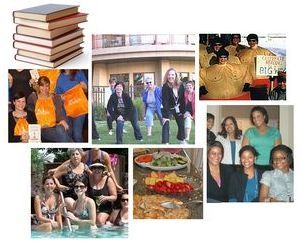
 Feature your book club on LitLovers
We'd love to hear about your group.
Let us know what you're up to . . .
- books you're reading
- which ones you like
- best discussions
- what you do for fun
It's easy to be one of our featured LitClubs — just contact us. We send you a questionnaire, and you take the photos. We do the write-up, and you get final say.
LitClub: Interesting Characters
Goodreads
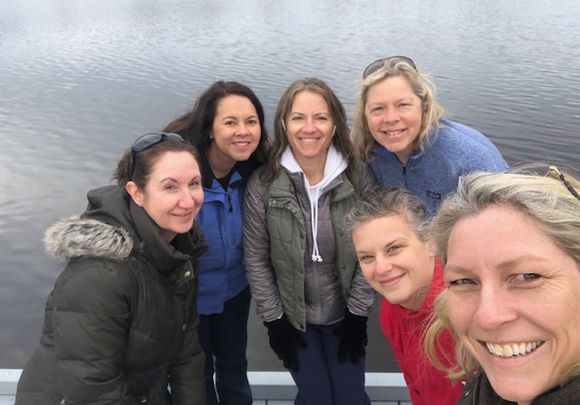
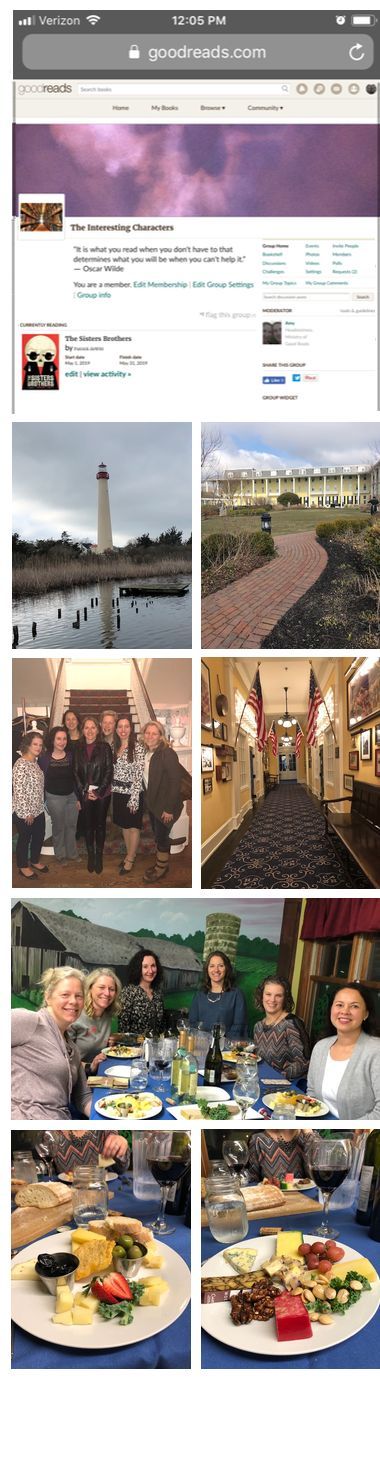 YEARS AFTER MED-SCHOOL and/or college, old friends picked up with one another and formed an online book club. Scattered along the East Coast, they managed a rendezvous in storied Cape May, New Jersey.
We talk with founder of the group, Amy Eschinger.
You "meet" online, right?
Yes—on Goodreads. We have 14 members, all told. But there are 8 of us—the core members—who participate regularly and actively.
Tell us your story—how you got the group together.
I'm a quintessential book nerd, who became disillusioned with my regular book club. It dawned on me that it was more of a social gathering than a serious book discussion group. I wanted something more.
Then what happened?
In 2013 I attended a med-school reunion where I spent a lot of time with old friends discussing books. When I got home, my husband said, "You know, those people are your ideal book club."
He was absolutely right! And since we were all separated by fair distances, an online group seemed like the perfect solution.
How has it worked out?
Wonderfully. We all live crazy lives: half of us are physicians, half have other careers, and most of us are also busy moms.
So the web works remarkably well for discussing books—allowing us the flexibility to write comments on our own time. We don't have to miss out due to the constraints of meeting at a specific time or place.
Plus, members can spend as much time as they want posting thoughtful, insightful comments about the current book.
Do you follow a special procedure?
We discuss books on three different threads.
We start off with a FIRST IMPRESSIONS thread for comments when we begin the book.
At the end of the month, we open up the DISCUSSION, which includes questions.
We close with a FINAL THOUGHTS thread for anything else that occurs to us.
Well, let's talk about what you've read.
Here's our list for the past 12 months:
Educated
Family Life
Cold Comfort Farm
All the Ugly and Wonderful Things
Every Note Played
Haunting of Hill House
Let the Great World Spin
Atomic Weight of Love
Flamingo Rising
Coinman
How about some favorites over the years?
We have so many favorites its hard to choose, but I’d say our all-time favorite books are Salvage the Bones by Jesmyn Ward, Let the Great World Spin by Colum McCann, Flowers for Algernon by Daniel Keyes, and The Absolutely True Diary of a Part Time Indian by Sherman Alexie.
Any disappointments?
We've had a few over the years. We felt Mennonite in a Little Black Dress was juvenile, and Rhoda Janzen’s crass humor detracted from the weightier issues at hand—she was in an abusive relationship.
Although Coinman by Pawan Mishra came highly rated on Goodreads (can't always trust ratings), for us its supposed humor fell short: we felt like we were missing something.
Bend in the River by V.S. Naipaul was a struggle for many of us. The subject matter was one we knew little about, and we had difficultly separating ourselves from the author’s misogynist tendencies.
Did any of your books lead to particularly good discussions?
Educated is such an unbelievable, true story, which lends itself to a great discussion. Having been through a lot of higher education ourselves, we found Tara’s story fascinating. We talked a lot about memoir, it’s accuracy, and whether or not accuracy really matters or is even possible. Finally, we always admire a strong female lead.
A few of us tackled Blood Meridian by Cormac McCarthy. This is by far the most challenging book we’ve read on many levels. But those who stuck it out were rewarded with some fantastic writing and bonding over making it to the end—proving we could read tough, intellectual books out of our comfort zone.
How do you choose your books?
Each month a different member brings 5 suggestions and we vote via poll to choose a winner. Occasionally we all make suggestions for a themed month (Banned books, Books with Winter words in the titles, etc).
There is a nice mix of those who like classics, contemporary women’s lit, and nonfiction. We have a diverse selection of books to read every year.
Does the group engage in any special activities?
Those members who read a lot do side Reading Challenges within the club. Typically its a 22-26 book challenge to be completed within one year. Those who complete the challenge get a small prize.
Every February we celebrate our anniversary with literary quizzes and games. A favorite of mine is the member haiku. We all write haikus about ourselves or something going on in our lives at the time.
I just started a new feature called Monthly Lit Chat where we discuss some reading related topic like "how did you fall in love with reading," "which fictional character would you want to spend the day with and why? What would you do with them," etc.
Also, as I mentioned earlier, we do themed reads, typically Banned Books for September, and usually one other during the year.
A number of you met in Cape May, NJ. What was the occasion?
The occasion was our 5th anniversary, and we decided to really celebrate and go on a trip. We chose Cape May, NJ, as it was most central and within driving distance for many of us. It was nice for members to meet. They all know me, but many had never met in real life and have been discussing books together for years.
We have plans for periodic literary weekends-away in the future!
You also have a favorite charity. How does that work?
I encourage members to support a literary charity that's dear to physicians, Reach Out and Read. The group is a nonprofit organization, which incorporates books into pediatric care to encourage families to read aloud together.
Any final words on behalf of INTERESTING CHARACTERS to our readers?
Yes. I’d encourage those serious readers reading this to consider joining an online book club or creating one.
If you want to seriously discuss books, have a busy schedule, and haven’t found a real-life club that is a good fit for you, an online group may be perfect.
It has taken some trial and error to figure out what works best for our group but its been a lot of fun in the process.

(Refer to this handy chart as you read your book)
|
• Are the characters convincing? Do they come alive for you? How would you describe them — as sympathetic, likeable, thoughtful, intelligent, innocent, naive, strong or weak? Something else? • Do you identify with any characters? Are you able to look at events in the book through their eyes—even if you don’t like or approve of them? Do they remind you of people in your own life? Or yourself? • Are characters developed psychologically and emotionally? Do you have access to their inner thoughts and motivations? Or do you know them mostly through dialogue and action? • Do any characters change or grow by the end of the story? Do they come to view the world and their relationship to it differently?
• Is the story plot-driven, moving briskly from event to event? Or is it character-driven, moving more slowly, delving into characters' inner-lives? • What is the story’s central conflict—character vs. character...vs. society...or vs. nature (external)? Or an emotional struggle within the character (internal)? How does the conflict create tension? • Is the plot chronological? Or does it veer back and forth between past and present? • Is the ending a surprise or predictable? Does the end unfold naturally? Or is it forced, heavy handed, or manipulative? Is the ending satisfying, or would you prefer a different ending?
• Who tells the story—a character (1st-person narrator)? Or an unidentified voice outside the story (3rd-person narrator)? Does one person narrate—or are there shifting points of view? • What does the narrator know? Is the narrator privvy to the inner-life of one or more of the characters...or none? What does the narrator let you know?
• What about theme—the larger meanings behind the work? What ideas does the author explore? What is he or she trying to say? • Symbols intensify meaning. Can you identify any in the book—people, actions or objects that stand for something greater than themselves? • What about irony—a different outcome, or reality, than expected. Irony mimics real life: the opposite happens from what we desire or intend...unintended consequences. (Read-Think-Talk by LitLovers. Please feel free to use, online or off, with attribution. Thanks.) |
Our 10 FREE online courses explore different ways to evaluate literature. You can take individual courses on... • Character |
|||||||||





Use our general nonfiction questions to get book club discussions off to a good start. They're basic but smart.
 1. If your book offers a cultural portrait—of life in another country or region of your own country, start with questions a, b, and c ...
- What observations are made in the book?
Does the author examine economics and
politics, family traditions, the arts, religious beliefs, language or food? - Does the author criticize or admire the culture? Does he/she wish to preserve or
change the way of life? Either way, what
would be risked or gained? - What is different from your own culture? What
do you find most surprising, intriguing or
difficult to understand?
2. What is the central idea discussed in the book? What issues or ideas does the author explore? Are they personal, sociological, global, political, economic, spiritual, medical, or scientific
3. Do the issues affect your life? How so—directly,on a daily basis, or more generally? Now or sometime in the future?
4. What evidence does the author use to support the book's ideas? Is the evidence convincing...definitive or...speculative? Does the author depend on personal opinion, observation, and assessment? Or is the evidence factual—based on science, statistics, historical documents, or quotations from (credible) experts?
5. What kind of language does the author use? Is it objective and dispassionate? Or passionate and earnest? Is it biased, inflammatory, sarcastic? Does the language help or undercut the author's premise?
6. What are the implications for the future? Are there long- or short-term consequences to the issues raised in the book? Are they positive or negative...affirming or frightening?
7.What solutions does the author propose? Are the author's recommendations concrete, sensible, doable? Who would implement those solutions?
8. How controversial are the issues raised in the book? Who is aligned on which sides of the issues? Where do you fall in that line-up?
9. Talk about specific passages that struck you as significant—or interesting, profound, amusing, illuminating, disturbing, sad...? What was memorable?
10. What have you learned after reading this book? Has it broadened your perspective about a difficult issue—personal or societal? Has it introduced you to a culture in another country...or an ethnic or regional culture in your own country?
(Questions by LitLovers. Please feel free to use them, online or off, with attribution. Thanks.)
Use our general fiction questions when you can't find specific discussion questions. They're basic but smart.
 1. How did you experience the book? Were you engaged immediately, or did it take you a while to
"get into it"? How did you feel reading it—amused,
sad, disturbed, confused, bored...?
2. Describe the main characters—personality traits, motivations, and inner qualities.
• Why do characters do what they do?
• Are their actions justified?
• Describe the dynamics between characters (in a
marriage, family, or friendship).
• How has the past shaped their lives?
• Do you admire or disapprove of them?
• Do they remind you of people you know?
3. Are the main characters dynamic—changing or maturing by the end of the book? Do they learn about themselves, how the world works and their role in it?
4. Discuss the plot:
• Is it engaging—do you find the story interesting?
• Is this a plot-driven book—a fast-paced page-turner?
• Does the plot unfold slowly with a focus on character?
• Were you surprised by complications, twists & turns?
• Did you find the plot predictable, even formulaic?
5. Talk about the book's structure.
• Is it a continuous story...or interlocking short stories?
• Does the time-line move forward chronologically?
• Does time shift back & forth from past to present?
• Is there a single viewpoint or shifting viewpoints?
• Why might the author have chosen to tell the story
the way he or she did?
• What difference does the structure make in the way
you read or understand the book?
6. What main ideas—themes—does the author explore? (Consider the title, often a clue to a theme.) Does the author use symbols to reinforce the main ideas? (See our free LitCourses on both Symbol and Theme.)
7. What passages strike you as insightful, even profound? Perhaps a bit of dialog that's funny or poignant or that encapsulates a character? Maybe there's a particular comment that states the book's thematic concerns?
8. Is the ending satisfying? If so, why? If not, why not...and how would you change it?
9. If you could ask the author a question, what would you ask? Have you read other books by the same author? If so how does this book compare. If not, does this book inspire you to read others?
10. Has this novel changed you—broadened your perspective? Have you learned something new or been exposed to different ideas about people or a certain part of the world?
(Questions by LitLovers. Please feel free to use them, online or off, with attribution. Thanks.)
Our ideas can help you lead a discussion, find helpful resources, and be a smart participant.
 How to lead a discussion
1. Toss one question at a time out to the group. Use our LitLovers Resources below to help you with specific questions.
2. Select a number of questions, write each on an index card, and pass them out. Each member (or team of 2 or 3) takes a card and answers the question.
3. Use a prompt (prop) related to the story. It can help stimulate members' thinking about some aspect of the story. It's adult show & tell.
(Think maps, photographs, paintings, food, apparel, a music recording, a clip from a film adaptation.)
4. Pick out a specific passage from the book—a description, an idea, a line of dialogue—and ask members to comment on it.
(Consider how a passage reflects a character...or the work's central meaning...or members' lives or personal beliefs.)
5. Choose a primary character and ask members to comment on him or her.
(Think character traits, motivations, how he/she affects the story's events and characters, or revealing quotations.)
6. Play a literary game. Use one of our Icebreaker Games. They're smart and fun—guaranteed to loosen you up and get your discussion off to a lively, even uproarious start.
7. Distribute hand-outs to everyone in order to refresh memories or to use as talking points. Identify the primary characters and summarize the plot.
LitLovers Resources
- Reading Guides — Discussion Questions, Reviews and Summaries for 3,700 books.
- Generic Discussion Questions for Fiction and Nonfiction to help with almost any book.
- Read-Think-Talk — a Guided-Reading Chart to use while you're reading.
- LitCourse — our 10 Free Online Literature Courses are short and fun...and highly informative. You'll be the smartest person in the room! Guaranteed...or your money back. (Oh, wait. They're free!)
How to participate in a discussion
1. Watch your language! Try to avoid words like "awful" or "idiotic"—even "like" and "dislike." They don't help move discussions forward and can put others on the defensive. Instead, talk about your experience—how you felt as you read the book. See our Read-Think-Talk guide for helpful ideas.
2. Don't be dismissive. If you disagree with someone else, don't refer to her as an ignoramus. Just say, "I'm not sure I see it that way. Here's what I think." Much, much nicer.
3. Support your views. Use specific passages from the book as evidence for your ideas. This is a literary analysis technique called "close reading." (LitCourse 3 has a good discussion of close reading.)
4. Read with a pencil. Take notes or mark passages that strike you—passages you find significant, funny, or insightful. Think about—and bring up in your book club discussion—the reasons for marking those passages.
5. Use LitLovers for help. Check out our Litlovers Resources above. They'll help you get more out of what your read and help you talk about books with greater ease.
Discussion tips by LitLovers. Please feel free to use them, online of off, with attribution. Thanks!)
top of page
Use our ideas to help you organize your book club activities, hold good discussions, and settle tough issues.
 Basic Ground Rules
Members who haven’t read the book
Come anyway. Not everyone can finish every book, but non-readers may still have valuable insights.
Disagreements about the book
Be gracious! There is never any one way to experience or interpret a book. In fact, differing opinions make the best discussions. Just don't get over heated.
Members who would rather socialize
Be gentle but firm. Insist that discussion time be limited to the book. Some clubs hold book discussions first and invite "social members" to join afterward.
Dominating personalities
Never easy. “Let’s hear from some others” is one approach. Some clubs pass an object around the room; you talk only when you hold the object. If the person continues to dominate, a friendly conversation (never e-mail) might work. If all fails, sometimes they've just got to go—for the good of the club. (See our Blog Post—Book Club Blues.)
Meeting Format
Allow 2 to 2-1/2 hours per meeting—
- 30-45 min. — social time (eat, drink, be merry)
- 15-20 min. — administrative matters
- 60-90 min. — book discussion
Holding the Discussion
(Also see How to Discuss a Book)
With a leader
- Rotate discussion leaders each month—maybe it's the person who selects the book or the one who hosts the meeting.
- Appoint a permanent leader: some clubs have a member who enjoys leading all the discussions and has a real gift for doing so.
- Invite an outside facilitator (English teacher, librarian, author) on occasion...or on a permanent basis, paid or unpaid.
- Take turns going around the room, allowing each member to talk about his or her experience reading the book.
- Hand out index cards. Ask everyone to write a question or observation; then select one or more to discuss.
- Discussion Tips—ideas for discussing any book
- Reading Guides—specific discussion questions
- Generic Questions—for fiction and nonfiction
- Read-Think-Talk—a guided-reading chart
- Free LitCourses—short, fun, and guaranteed to make you smarter!
(Book club tips by LitLovers. Please feel free to use them, online or off, with attribution. Thanks!)
Follow these smart tips to help guide your book club selections.
Basic Dos and Don'ts
1. Don't read favorites
Reading a book someone "just loves" can lead to hurt feelings—like inviting people into your living room to critique your decor. Ouch... Best to stay on neutral territory.
 2. Do choose for good discussions
Some books don't offer a lot to chew on in the way of discussion. They may be great reads (romances, spy thrillers) but don't have much to talk about.
- Look for "literary fiction," works rich in characterization and ideas.
- Don't neglect nonfiction—works of historical or sociological significance provide fertile grounds for discussion.
3. Don't choose for the whole year
It ties you into a 12-month-long rigid schedule with no flexibility to add exciting new works you might learn about. And it's unfair for those who miss the one meeting when selections are made.
4. Do choose 2 or 3 at a time
This allows members to read at their own pace. It's especially helpful for those who travel or miss a meeting or two.
5. Don't get stuck in a rut
A steady diet of one thing can be dull, dull, dull—so mix styles and genres. Intersperse heavier reads and lighter ones; fiction (current and classic) with nonfiction, graphic novels, short stories, and drama.
6. Do establish limits
Set some basic ground rules up front, so you don't get into misunderstandings as you go along.
- Some clubs limit selections to paperbacks—easier on the pocketbook; others read both soft and hard-cover.
- Some clubs limit page number—400 pages a month is a healthy read. Other clubs enjoy longer reads at 500-700 pages—or shorter at 300 or less. You can also split up longer books into 2 sessions. Nothing wrong with that.
Make sure everyone gets a say in what books to select. One person shouldn't be in charge of the process, nor should one or two dominate. Make sure to see the three methods for choosing books below.
Selecting Books
Vote—All members make suggestions, followed by an open discussion, and vote.
Rotate—Members take turns, each choosing a book for a given month. In many clubs, the one who hosts the meeting picks the book.
Mixed—Members rotate each month, with the member whose turn it is proposing 3 different titles; members then vote to select 1 book out of the 3 choices.
Finding Book Ideas
Use LitLovers of course!
- Popular Books — our list of book club favorites.
- Book Reviews — our monthly recommendations
- Reading Guides — 3,700 guides with discussion questions, reviews, a summary and author bio.
Check out your public library, local bookstores, and national book chains. Most of them carry their own recommendations or lists of what clubs are reading.
Newspapers & magazines
- Sunday's New York Times Book Review is the biggie;
- Newspapers, such as USA Today and most local papers, especially the big city dailies;
- General interest magazines, such as Time, Newsweek, The New Yorker, Oprah, People, Vanity Fair, and Elle, to name a few;
- Two of my favorite magazines are Bookmarks and BookPage. Your library probably carries one or, maybe, both.
Literary prizes
Keep your eye on annual literary awards, considering both finalists and winners. Here are the most prestigious prizes (for the English language):
- Nobel Prize for Literature
- National Book Award
- Man Booker Prize
- Pulitzer Prize
- National Book Critics Circle Award
- PEN/Faulkner Award
(Book club tips by LitLovers. Please feel free to use them, online or off, with attribution. Thanks!)
Try these fun book club games to liven up your normal routine or break the ice for newcomers!
 1. Extreme Makeover
Update a character or two from a book set in the
past. Place the characters in today's culture—and
invent a new life.
Example: Lydia Bennett (Pride & Prejudice) considers Cosmo great literature and Sex &
the City serious drama. She hits the clubs,
wears designer knock-offs and has Big Hair.
Her eyes are always peeled for Mr. Big.
Example: Jay Gatsby (The Great Gatsby) takes twice-weekly elocution lessons (The Rain in Spain....). He's fastidious—flosses 3 times/day
and wears only Armani. Listens to rap in private but forces himself to attend the opera, alone.
Was a big player in a Wall Street hedge fund but managed to avoid indictment...so far.
2. Alphabet Soup
Working around the room, have each member name a character, event, place, or object from the book—the first letter of which starts with A, the next with B, the next C, and so forth through the alphabet.
3. Extend the End
Jane Austen did it in Pride and Prejudice—she wrote an epilogue telling us how Elizabeth and Darcy fared after the story's last line. Take any novel, or novels, you've read over the past year and write an epilogue. What happens to those characters, say 1 year, 5 years, 10 years out?
Divide up into teams, or go solo. Read the results out loud. Be as funny...romantic...or serious as you want.
4. Literary Grab Bag
Fill a large shopping bag or box with objects from novels. Have everyone pull out an object and guess which novel (and author), which character, and at which point in the story (if relevant) the prop is used.
Obvious examples: stuffed tiger for Life of Pi; potato peels for Guernsey Literary Society, etc...; camera for Memory Keeper's Daughter; sling shot for Kite Runner; a book by Russian author Nikolai Gogol for The Namesake (even better...an old overcoat!), and so on.
5. Hollywood Bowl
Cast a book as a movie. Pass around a bowl with folded slips of paper containing titles of recent book selections. Each member (or team of 2) draws a title and casts the movie. Take turns reading out everyone's choices.
Variation: Using the current book only, have everyone write his/her casting choice.
6. Literary Snowballs
Sounds silly, but it's lots of fun. Divide into 2 teams on either side of the room. Hand everyone an 8 ½ x 11 sheet of paper on which to write a question from the book.
Crumple the sheets into “snowballs” and, at a signal, throw them across the room to the other team. The team who correctly answers the most snowballs correctly wins
Scoring:
2 points—to a team for each correct answer
1 point— to the other team for each incorrect answer.
7. Whose Line Is It Anyway?
Chose someone to read quotes by or about various characters — from the current book or past book selections. Members try to guess who said what and when. If you want, divide into teams and keep score. (This icebreaker will require a bit of prep.)
(Games and Icebreakers by LitLovers. Please feel free to use them, online or off, with attribution. Thanks.)
|
Starting a book club? Just follow our 10 basic steps to good books, good talks, and good eats. 1. What kind of book club? 2. What kind of books? Think about the books you enjoy—in terms of genre and level of difficulty. First, consider a mix of genres.
3. What about members?
4. Meeting—how often and when? The most important thing is to pick a schedule...and stick with it.
5. Where should we meet? Homes, clubhouses, public libraries, churches, Y's, cafes and restaurants—all make good meeting places. 6. What about food? You have to ask? Decide if you want to eat at home or out in restaurants? If at home, do you want full meals, or something lighter—wine & cheese, or dessert & coffee?
7. What should we call ourselves? Give your club an identity — Brookville Book Babes, Reading's Red Hat Readers, New London Literary Lions. Or simply the Lakewood Book Club — that works. (Take a look at the VERY COOL NAMES of some of our Featured Cubs.) 8. How do we keep in touch? Send out monthly meeting reminders via email, Twitter, or Facebook. A number of clubs set up their own blog sites or use Facebook or Pinterest to connect members and highlight their book selections. 9. Keeping memories Keep a club journal—a scrapbook or 3-ring binder—to keep track of the book selections, plot summaries, discussion highlights, and members' opinions. It's especially helpful to bring new members up to speed. Include photos of special events. 10. Giving to the community Collect dues for a scholarship or an annual literacy award at a local school. Purchase books for your local library, or become involved in a tutoring program. Take a look at a couple of our FEATURED BOOK CLUBS for some really terrific ideas for community involvement: ♥ Book Lovers Group of Gainesville ♥ The Breakfast Book Club (Book club tips by LitLovers. Please feel free to use them, online or off, with attribution. Thanks!) |
 |