 The best Christmas stories ever, these are certainly my favorites. Count on them earning a place in your heart—and hopefully on your shelves so you can turn to them Christmas after Christmas. While most are sold as books for children, each invokes the magic of the season, no matter what age. They're for young and old alike.
10 Best Christmas Reads1. The Bible, Luke 1: 26-2:40 — King James, 1611
This choice should go without saying, of course: the very first Christmas story with all the majesty of the King James Bible, the most poetic of all Bibles. Handel surely thought so. Read Luke on Christmas Eve and listen to The Messiah.
2. The Best Christmas Pageant Ever — Barbara Robinson, 1972
The worst kids in the whole world take over the church Christmas pageant—to everyone's horror. But they end up—to everyone's amazement—revealing deeper truths about the very first Christmas. This story is so beloved that publishers have issued a picture book, two teacher guides and a play script. There's even a 1983 TV movie version. But read the book...of course! Delightful, laugh-out-loud shenanigans for kids and adults. (Paperback, 128 pp.)
3. A Christmas Carol — Charles Dickens, 1843; illustrated by P.J. Lynch, 2006
Almost everyone knows the tale of the original Scrooge and his awakening to the true spirit of Christmas. But this version of Dickens' classic is stunning—a real standout. P.J. Lynch's soft palate enhances the text with hauntingly beautiful illustrations. Do spring for the hardcover edition—it's a treasure, a book to keep forever. (Hardcover, 160pp., 9.3 x 7.8 x 1 inches.)
4. A Christmas Memory — Truman Capote, 1956
Capote's endearing account of his growing up years in rural Alabama and one Christmas spent with a favorite 60-ish spinster cousin. The two share adventures as they prepare an honest-to-goodness "handmade" Christmas in the midst of the Depression's scarcity. Use the ISBN number below to find the 1996 hardcover, Modern Library edition, which contains two other fine holiday stories. It's a wonderful, wonderful book. (ISBN: 9780679602378)
5. Letters from Father Christmas — J.R.R. Tolkien, 1976 (1st publication)
From 1920 through 1943, Tolkien "mailed" his children handwritten letters from Father Christmas recounting Santa's adventures and misadventures in the North Pole. This 2004 version, in addition to the full printed text, features Tolkien's own illustrations, as well as reprints of the letters and envelopes in his playful, wispy script. The envelopes are affixed with a hand-drawn Polar stamp. Exquisite to behold and magical to read. (Paperback, 111 pp., 9,7 x 7.5 x 0.3 inches.)
6. The Night Before Christmas — Clement J. Moore, 1823
How could we even get through the holiday without Dasher and Dancer and Prancer and Vixen? Here are my two favorite versions, each enhanced by a top children's illustrator:
- Charles Santore, 2011—rich, sumptuous, and traditional—with a stunning 4-page center fold-out that will catch your breath. A gorgeous edition.
- Bruce Whatley, 1994—vibrant and quirky, with illustrations that jump off the page. The father-narrator is this version's central character as he rediscovers a part of his childhood. Yet it's the reindeer with their wide-eyed abandon steal who the show (Cover and Amazn link, right).
(All hardcover; average size: 44 pp., 12 x 10.5 x 0.5 inches.)
7. The Polar Express — Chris Van Allsburg, 1985
For its sheer imagination and the luxurious quality of its illustrations, Polar Express became a Christmas classic the instant it hit the bookstores. Yes, there's a movie, but get the book instead—about a young boy who takes a magical ride to the North Pole. Gorgeous, simply gorgeous. Although meant as a young children's picture book, adults will find it hard to put down. (Hardcover, 32 pp., 9.2 x 11.5 x 0.5 inches.)
8. Stopping by Woods on a Snowy Evening — Robert Frost, 1956; illustrated by Susan Jeffers, 1978
Though Frost didn't write "Stopping by Woods" as a holiday poem, this lavishly illustrated version of his beloved classic evokes the warmth of the season while managing to maintain (for the most part) the original's eery, haunting quality. Purists may object to its semi-sweet tone, but it's a beautiful introduction to Frost—a slender book to be read over and over, suitable for adults and children. (Hardcover, 32 pp.; 8.6 x 7.3 x 0.4 inches.)
9. The Stupidest Angel — Christopher Moore, 2004
If you've tired of all the sentimentality and need a bracing dash of irreverence, here's the most irreverent Christmas book around—an angel in search of a miracle and a young boy who's sure he's witnessed someone offing Santa. You've got to love Moore to appreciate his wacky humor, off-color language, and off-beat characters. Christmas mayhem—silly at times, even sophomoric, often hilarious, and always fun. This one is not for kids. (Paperback, 320 pp.)
10. Twelve Days of Christmas — Illustrated by Jan Brett, 1997
This illustrated version of the 18th-century English Christmas carol should be in your hands—now! Jan Brett's illustrations are so whimsical, colorful and rich in detail you'll find yourself transported to another world—a world of pure, sumptuous delight. There's also a miniature 6 x 5-inch version, but go for the standard. Why skimp on something so lovely? (Hardcover, 32 pp., 10 x 8 x 0.2 inches.)


I've left out a lot of good ones, many of them novels (John Grisham's Skipping Christmas, Jason Wright's Christmas Jars). I've also omitted Jean Shepherd's Christmas Story, which is actually a novelization of separate stories, not all holiday oriented, that were collated for the film. I've not read the "book," but I love the movie.
For me, though, the real magic of Christmas is found in stories that appeal to children, as well as adults...ones to be read again and again. That, I think, explains most of my choices.
We'd love to hear about your favorites. Let us know on our Facebook page which Christmas stories you love.
 Just to let everyone know…we’ve hit the 800 mark! That’s the number of Reading Guides we have on our main website, LitLovers.
We add new guides all the time, keeping track of titles book clubs want to read. Many are added by request from our users. So to the wonderful readers in our community of LitLovers—thank you! With your help, we’ve built a terrific index.
I think our guides are the best—the most in-depth and thorough on the web. Along with author bios and discussion questions, we include both negative and positive reviews, not just promotional blurbs from publishers. If discussion questions aren’t available, we often develop our own set of ”talking points” to help get discussions off the ground.
A search bar is next—a real grown-up search bar to make it easier to find the title and guide you’re looking for.
Anyway…1,000…here we come!
* As of this date, 11/1/2013, LitLovers has 2,200 Reading Guides!

Treat yourself to an evening out and head to your local library. After a rat-race kind of day, the peace and quiet a library offers is refreshing.
Take a leisurely stroll through the stacks ... or browse through the periodicals … just spend some time exploring all the resources. And if your library is like the one in my center city, there’s a cool cafe with terrific snacks, pastries, and sandwiches.
Go as a book club, or make it a couple's date—it’s an inexpensive night out. If you’re a parent, take the kids. If you’re single, where could you find a cozier spot to just hang-out?
I always come home feeling refreshed…and regenerated with new ideas for books and things to write about–like this blog post!
Oh, that’s one of the libraries I use pictured at the top—Pittsburgh’s Main Carnegie Library (Andrew was a Pittsburgh boy, just so you know).
 By Kristie Sphuler for LitLovers
We know what you're thinking...because we're thinking it, too. In the few days you have off for the holidays, wouldn't it be lovely to spend them with a good book? Dream on, dear reader.
That pesky prepwork for the holidays has your free time sliced down to barely nothing...and your books spending more time with your bookmarks than with you.
If you’re book-obsessed, (don’t worry—we are too) your holiday might look a little like this.
Decorations
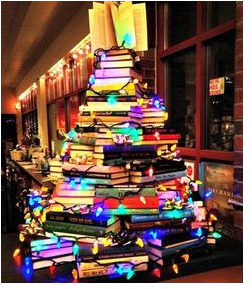
Yes, that's you, traipsing through rain...sleet...or snow to cut down a tree (or buy it off a corner lot), haul it home and decorate it—all because your personal favorite, the book tree, isn’t up to family standards. That little chore takes up precious reading time.Then there's the spectacle of watching people rrrr-i-p pages out of books for decorations. (Books... really?! Books?!) Go ahead (you're thinking), just rip my heart out while you're at it.
Giving
All of your stocking stuffers, and the majority of the gifts you give, come from the book store. It's one-stop shopping—getting it done FAST—so you can get back to that book you're reading. And it's all OK because nothing says love better than the gift of literature.
Receiving
Of course, what you really hope to see under the tree—with your name on it—is a BIG stack of books. Oh, yes, we remember that stab of disappointment from Christmases past...when the gift wasn't lit related. Oh, well, if you don't get books this year, console yourself: you've always got Christmases future.
Holiday Specials
Speaking of Christmases past and future: convincing your family that there is more than ONE book with great Christmas themes takes time and patience. Charles Dickens did not corner the market! (Though it’s still a terrific read...and a good one for the entire family. Everyone should read it.)
Cooking
Baking cookiesand doing Christmas dinner can take up more reading time than you want to spare. Just be careful though—don't get too distracted by your fictional life while baking in your real one or... oops....
Safety first, friends. Safety first.
So, yes, all you LitLovers—the holiday struggle is real. But you'll power through. You always do. Remember, there's a good book waiting when all is said and done.
Happy Holidays. And Happy Reading when it's all over!
Question: Can you really say you’ve “read” a book when you’ve listened to it? Does listenting count as “reading”—and does it work for a book club discussion?
Answer: Well, at least we get through the book! In a busy life, that counts for something.
On the other hand. . .we’re usually multi-tasking when listening, which means the book doesn’t have our full attention. Second, we read at our own pace: pause, ponder, re-read, or jot a note. Hard to do with audio while driving. Third, in a book discussion, it’s easy for everyone to turn to a particular passage on a particular page. Not so easy with audio.
Two other considerations: purists say a narrator’s voice can unfairly influence how we experience a work. And finally, it turns out our memories work better when reading rather than listening. That’s especially true for adults and older students (though the research isn’t definitive).
So not being a purist, my advice is to enjoy audio books whenever you feel like it—but read the printed version when it comes to your book club selection. (See LitLovers Discussion Tips.)
We read plenty about what book clubs think of authors (and their books). But here's a twist— author Cathy Lamb tells us what SHE thinks of book clubs . . .
 Here is a little secret: I love visiting with book groups.
I chat with women here in Oregon and all around the country. Over the years I've heard some pretty funny comments—here are a few of the more amusing ones:
“My husband is an a--h--. He’s like Slick Dick in The Last Time I Was Me.”
“My husband gets irritated sometimes with how much time I spend with the kids but I say to him, ‘The kids hug me and want me to read them stories but you always want to have sex. Of course I’d rather read stories.’”
“The guys from the fire department came to take care of my husband, AGAIN, but I knew they thought he was crazy. He thought he was having another heart attack. His third that week. They didn’t say it, but I heard it: My husband is anxious about his anxiety. That’s what causes his heart to beat too fast.”
“My daughter shaves her legs too much. Is that weird?”
“Should we take off our tops like they did in Julia’s Chocolates?”
“Pot is now legal in Oregon. Do you think we should get a joint for the next book club meeting?”
“Did you run naked by a river, Cathy, like Jeanne in The Last Time I Was Me?”
“Oh, my gosh. We finished ANOTHER bottle of wine!”
“You know that sex therapist in your book, Cathy? How did you learn all that?”
 I visit many book groups during the year. If they’re within twenty minutes of my home, I go to their home. If not, we skype or chat via speaker phone.
I’ve skyped with ladies in New York and Massachusetts, Florida and California, a whole pile of other states, and Canada. If there was a book group on the planet Pluto, I’d skype there, too.
Here’s what I’ve learned: All books groups are fantastically, mightily different from one another.
They all have different goals. Some book groups are very intellectual/literary. I have sat and been drilled about everything from character and plot development, to tone, symbolism, metaphors, pacing, structure, who are my favorite literary writers and why, etc.
Then there are groups who talk about the book half the time and chat and laugh the other half of the time.
There are other groups who read the book, talk about it for fifteen minutes, then dive into their lives. Their book group is a social group. Period. Some of ‘em don’t even hide that anymore.
Then there are groups of women who simply want to meet me, don’t want to talk a whole lot about the book, and did I want more wine? How about a couple more glasses? Beer? Vodka? They have that, too. (I don’t drink, but they do their best to make me happy.) One of my favorite groups only wanted to sit down and have dinner with me. They came in laughing and drank a whole ton of wine. It was a neighborhood book group, no one drove, and they stumbled home singing and chatting. They wanted a nice girlfriend sort of visit. I did not envy them their Book Group Hangovers.
Another book group was the Laughing Book Group. My stomach hurt when I left we laughed so hard. They were all fifty-plus and life was fun.
I once went to a book group that was very, very quiet, almost somber. No one laughed. Not once. They took their reading seriously. I could tell that my book, Julia’s Chocolates, was a wee bit too wild for a few of them. Perhaps they had not liked, Breast Power Psychic Night? Perhaps, Your Hormones and You: Taking Cover, Taking Charge, was a little much? Love scenes too graphic? I don’t know.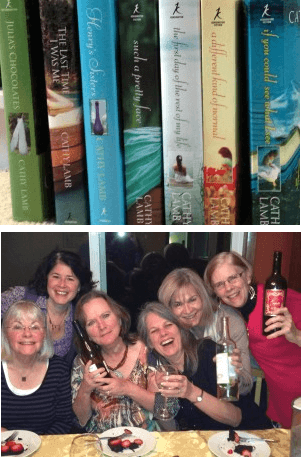 Some groups are small, only four or so women, others are thirty – plus. The age range in most of the groups varies from women in their twenties to women in their seventies.
They want to know how I come up with my ideas, (wild imagination) how I write the book, (carefully, obsessively) what my daily life is like (just like theirs), are my characters based on real people (no), etc.
Anyhow, ladies, I’m happy to attend your book groups. Email me through my website, and we’ll set up a time.
Happy reading.
Cathy Lamb is a LitLovers author—4 of her books are listed here. We were delighted when she offered to do a guest post.
It was hard not to notice the number of recent books with birds on the cover. So I made a brief little survey of book covers just for fun.*
Pause over the cover mage to see title and author; click for a link to our Reading Guide or Amazon (if we don't have a guide).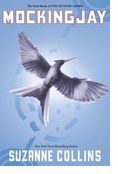
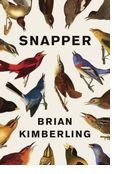
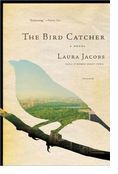
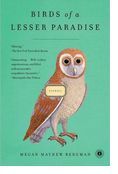
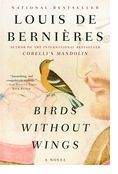
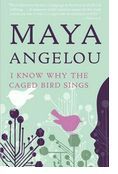
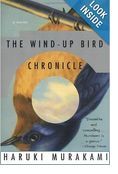
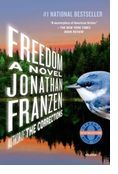
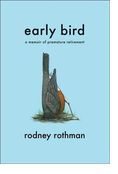
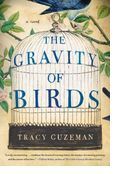
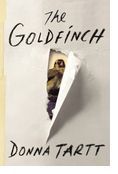
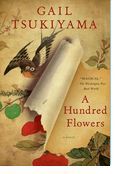
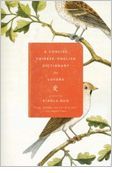
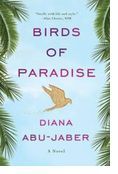
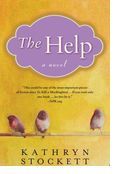
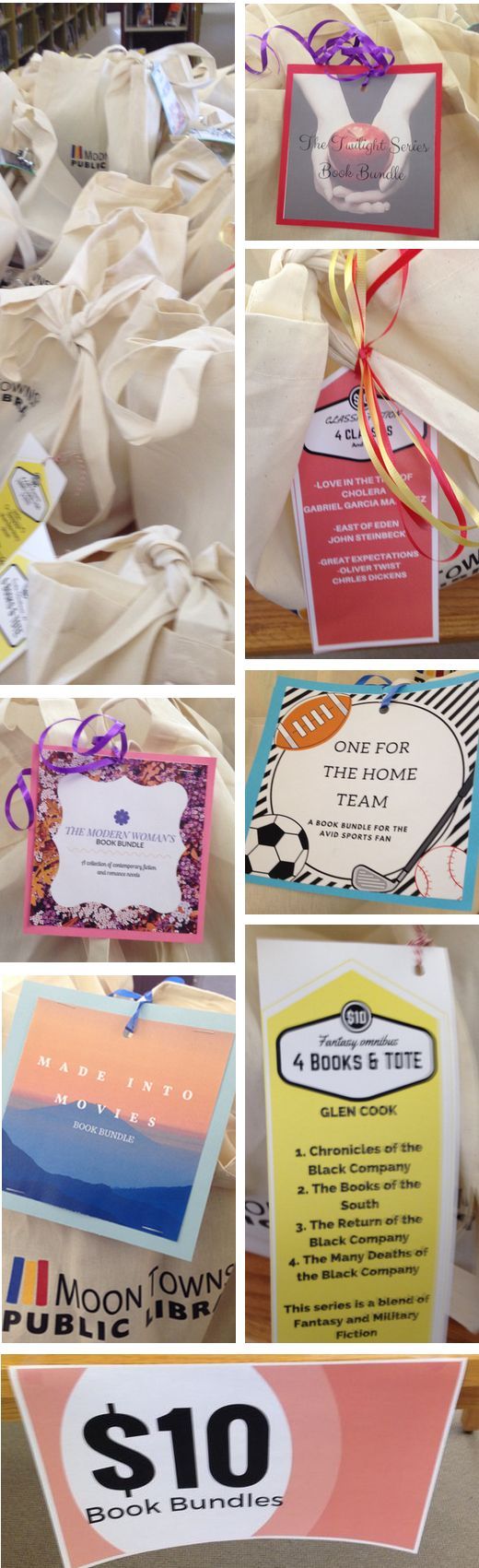
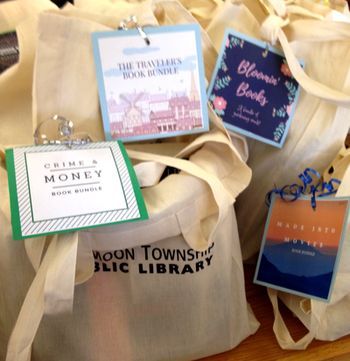 So imagine: you're walking into one of your local library branches, as I was recently, and you find right in front of you a sumptuous table, positively laden with tote bags—each of them charmingly tagged by theme and filled with used books.
For $10 any Book Bundle could be yours. Patrons get the books (from 4 to 6), AND they get the tote bag. It's enchanting.
 One more addiction—this one's not on a plate or in a bottle but online. Pinterest: more fun than any one person should be allowed to have, but it's a great tool for book clubs. Move over, Facebook.
Pinterest is a social media site—it's an online "bulletin board" where you "pin" your favorite images from anywhere on the web, especially from other Pinterest users. Or you can pin images and photos you've already downloaded onto your computer. Pinterest does all the formatting for you. It's simple easy and devilishly clever.
Below is what a "bulletin board" looks like—a snapshot of LitLovers' board on Pinterest. Be sure to visit our real page—"Everthing Books" — to see the complete board. The Pinterest button on LitLovers home page (left-hand colum) will also take you there.
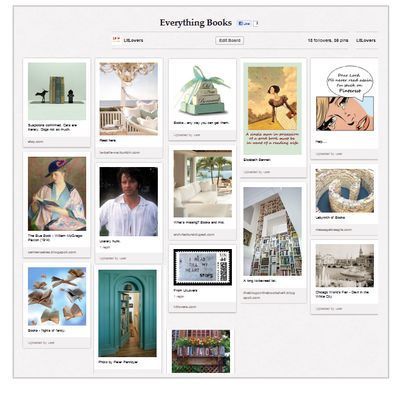
Why would book clubs use Pinterest? Because it's a great way to keep everyone up-to-date and to maintain a visual record of club activities. Your club can have its own page—and you can have as many "bulletin boards" on your club page as you want. You can add everything related to your book club...
- Add a "bulletin board" for the books you're reading—there's a space for captions (say, for titles or meeting date and locale).
- Add comments about each book. Any member can comment; it's just like Facebook.
- Add as many boards as you want—on the same page. Add a 2nd board for potential book ideas, a 3rd for club photos, and 4th for book-related recipes. Anything.
- Add boards for every member—on the same Pinterest page as your book club. Members can use their individual boards to "pin" everything...from the books they're reading on their own, to book-related gifts or personal photos.
Take a look at a snapshot of a standard Pinterest page. You click on the empty gray boxes to add a new "bulletin board" and a title for your board. Then pin away.

It looks more complicated than it is. Believe me... if I can do it, you can do it. Head to the Pinterest Help page to get started. You'll find it under "About" in the upper-right corner. Follow the directions as best you can*...and "pin" to your heart's content.
Be warned, however. Once you get on Pinterest, you'll complsively click all over the place. You may not be able to get off.
* Call on a young person if you get stuck. They know everything.
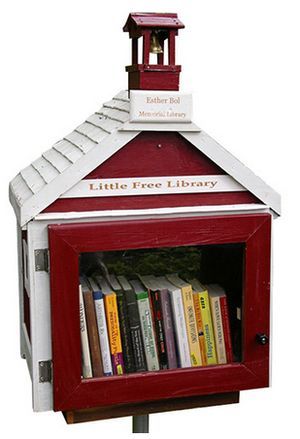 Sometimes little things have big payoffs—which is exactly what's been happening in Detroit, Michigan, a city that's found itself in dire straits over the past several years. And those payoffs? They're something YOUR BOOK CLUB can help generate.
Here's the story. It started with one Little Free Library that Kim Kozlowski installed in her front yard. A returned native, Kim watched the mini-library become a gathering spot for her Detroit neighbors as they stopped to chat while taking a book or returning one. Her Little Library was pulling the neighborhood together. Is there a way, she wondered to take Little Free Libraries citywide?
So Kim made a call to Cindy Dyson, a close friend and a web-designer living Montana. The two did some brainstorming—and Crash! Bang! out popped an idea. Why not start a grassroots movement to turn Detroit into the "Little Free Library Capital of the World"?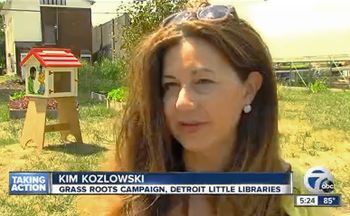 The game was afoot. Kim launched Detroit Little Libraries project in September, 2014, Cindy designed the website, and over the next two years mini-libraries sprung up all over Detroit. In mid-2016, the national Little Free Libraries group, whom Kim collaborated with, honored her by declaring Detroit the FASTEST GROWING LITTLE FREE LIBRARY CITY IN THE COUNTRY. (Btw, Kim accomplished all this while working full-time as a reporter for the Detroit News.)
Then things got serious. Alycia Meriweather, Detroit's acting superintendent of schools, could hardly miss the tiny libraries popping up on lawns and sidewalks all over the city. They gave Alycia had an idea, so she reached out to Kim Kozlowski.

Like Kim, Alycia believed that literacy is one of the fundamentals needed to turn any city around. Yet the book shortage in Detroit's school system is abysmal. The idea: a project to install a Little Library in each of DETROIT'S 97 SCHOOLS—in 97 DAYS!
How are they doing? Well, the project was just launched, and it's already receiving tremendous community support, to say nothing of press attention, local and regional.
This is where YOU come in. Detroit's project is a terrific opportunity for any book club looking for a way TO GIVE BACK. It's the ideal project for anyone who believes in the power of reading to change lives. Cindy Dyson, the web designer, contacted us at LitLovers to tell us the story and to say that HER book club—all the way out in MONTANA—has pitched in for a Detroit Little Library. Even her mother's book club in ALASKA has joined in...and a visitor at her mother's club that day—from NEVADA—took the concept back home to her book club.
So click on 97 Days / 97 Schools image (above left)...and learn how YOUR BOOK CLUB can help. You can make a simple donation, or you can purchase a ready-made library model to be installed and filled with books on your behalf. A small act ON YOUR PART can make a big difference—in a city that's working hard to make a difference.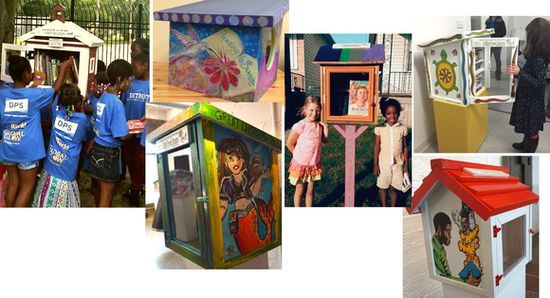
 An intriguing blog post by Joshua Henkin, author of Matrimony, raises some interesting issues about book clubs. I’m using only a brief excerpt here, but there’s so much more to his article that I plan to refer to it in future posts.
Henkin speaks with book clubs around the country, and here’s what he says about the many clubs he’s talked with:
From coast to coast and in between, I’ve found a huge number of careful readers . . . who have noticed things about my novel that I myself hadn’t noticed, who have asked me questions that challenge me, and who have helped me think about my novel (and the next novel I’m working on) in ways that are immensely helpful. I’ve certainly learned more from book groups than from the critics, not because book group members are smarter than the critics (though often they are!), but because . . . they bring to the enterprise a great degree of passion. —Books on the Brain, April 28, 2008.
Be still my heart! Henkin’s experience refutes a disheartening blog discussion I came across a while back. The blogger and her guest were disparaging Oprah and her book selections, as well as the entire book club movement—because they didn’t meet certain standards of literary sophistication (apparently, their standards). Ouch.
Well, I love Josh Henkin’s remarks—they certainly put that ugly assertion to rest. Yea, Josh!!
See my later posts on Joshua Henkin’s book club essay:
 Rarely do I review new books. It’s hard enough to get through my own pile for the website, let alone take on brand new ones. So usually I decline review requests.
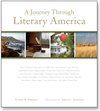
But this book was different. A Journey Through Literary America looked so intriguing…I couldn’t resist the offer. And what a smart decision! This has to be one of the MOST gorgeous books ever born.
Journey is a big coffee-table-sized book, chock-a-block-full of sumptuous photos—the homes of America’s most beloved authors and the locales of their stories.
With wonderful prose to boot—biographies and personal incidents that make up the authors’ lives, as well as the history and inspiration behind their works.
This is a gorgeous book—the perfect gift for your favorite book lover. Which is you, of course!

 It might be time to remove BOOKSTORES and LIBRARIES from the list of endangered species!
Over the past several years, those dealing in print books were preparing themselves for extinction. With ebook sales skyrocketing, it looked as if end times were on the horizon. But that may have changed.
According to the Association for American Publishers (AAP), digital ebook sales have dropped—by about 10%. Okay, that's not a lot, but it's enough to give books-on-shelves some wiggle room...and booksellers some hope. *
Adding to the good news, the American Booksellers Association (ABA) says its member bricks & mortar bookstores have increased their numbers over the past five years—from 1,400 to 1,700.
Moreover, some surveys show that young readers, the ones in love with digital devices, still prefer reading on paper.
Not that we readers are leaving our digitial devices behind: it's more like we're becoming "hybrid readers," toggling from hard copies to ebooks. I'm a hybrid—I love my Kindle but also enjoy the feel of a print book. You can read more in the New York Times.
So what about you? Are you a hybrid reader, strictly ebooks, or strictly paper ones?
* This just in . . . Publishers Weekly reported that April, 2016, book sales rose 8.8% over March—which means bookstore sales have risen every month this year compared to 2015. Even more impressive, bookstore sales have outpaced growth for the entire retail segment for the first five months of 2016.
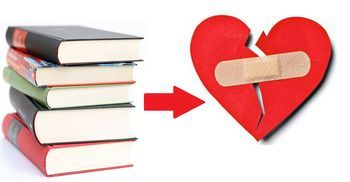 Dear Reader. Maybe it's about time for this post. Like you, I bet, I've been distressed — no, horrified — by the divisiveness and ugliness pervading our public discourse.
We've turned against one another: liberals and conservatives, globalists and populists, blacks and whites, men and women, religious and nonreligious, elites and … well, pretty much everyone else.
But here's the good news. We have BOOKS. Novels, especially, are sources of refuge — with the power to heal, to bind wounds and the wounded.
Through book clubs—with our books—we come together to share the love of story. We visit different cultures and are exposed to different ideas. We grow our empathy. We locate ourselves, for a time, in a wider world. We understand — because we are well read — that change is inevitable. But we also understand that there are lasting values which must be protected, always.
Those "lasting values," though, can get us into trouble; how we define them differs, which makes them easy to politicize. You could say the idea of values is what divides us.
But there ARE lasting values, ones we can all agree on. First and foremost is KINDNESS, and we can find it in literature. Many of our favorite books are those in which kindness is found in unexpected places, in which an open, generous spirit prevails over cruelty and selfishness, anger and fear.
A second is belief in the DIGNITY of every individual. That's a hard one. It's much easier to play the lowest card in the deck and resort to name-calling — I know, I've done it. Yes, shamefully, I've indulged in vitriol.
Yet literature is rife with the acknowledgement of human worth — that individuals, no matter how vile or how degraded, possess an inner core of dignity.
Moral to this blog post: Make the world a better place—READ A BOOK. End of sermon.
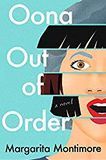 |
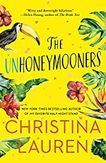 |
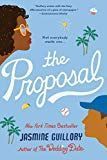 |
|||
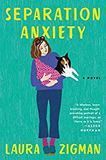 |
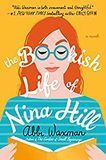 |
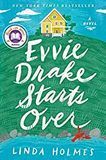 |
|||
| Click on individual cover images. | |||||
It's a cliche to say reading is transformative. So I'll say it anyway—BOOKS permit us to lose ourselves in time and space. At the height of their powers, they even dissolve the boundary of the self.
These six books, all fairly new, offer something else: they can get you to laugh: a deep throated chuckle… all the way to a LAUGH-OUT-LOUD guffaw.
They're funny, which feels good right now, as we "shelter in place."
 By Kristi Spuhler for LitLovers
Now here's a neat idea: a subscription service that identifies specific books just for you—and delivers them straight to your door!
The website, Just The Right Book, chooses titles—based on your personal reading preferences—and sends them to you once a month. Real books...you know, the ones with pages? The things we still love to hold in our hands?
This is how it works: head to the site and place your order for the type of subscription you want. As you navigate through the checkout process, you’ll be prompted to fill out a questionnaire about your favorite genres, titles, and authors. Once they have your reading profile, they’ll begin shipping you personalized novels on a monthly basis (or bi-monthy or quarterly—it's up to you).
For something more daring...there's Book Riot, another subscription service. This one requires a more open-minded reader—it's NOT personalized to your tastes but based on its own editors' monthly picks. Which means you get a surprise every month!—a package that includes the book (usually fiction), a description of that month's theme, author interviews, and other related articles.
So if you’re feeling adventurous give one (or both!) of these services a try. Think you could trust someone else pick your next read? And if you like it, a subscription makes a great gift, especially one from Just The Right Book, which has categories for adults, teens or kids.
 Some books make you wonder why the author bothered...and then make you wonder why YOU'RE bothering. Do you continue with a disappointing book...or put it down?
I've done both recently. I picked up Jaimy Gordon's Lord of Misrule on the basis of its solid reviews. But Gordon's prose felt so clogged and overworked it was offputting. It turns out Gordon is a professor of writing, which maybe is why the book feels a bit like a writing-class exercise. I love dense, rich prose, but not.... Well, anyway, I put the book aside.
Then I picked up Sara Gruen's newest, Ape House, in which a family of apes—who communicate using American Sign Language—eventually become stars in their own reality tv show. Just think of the possibilities! But Gruen's prose is thin and screen-writerish. And her apes turn out to be a lot more interesting than her humanoids.
I finished Gruen's book, though—thinking there might be a payoff. Besides it wasn't painful to read. And there is a sort of pay-off at the end, predictable but sweet.
*Added later...For a truly great read about apes and people, try The Evolution of Bruno Littlemore (sorry, no reading guide)...it's brilliant, funny, and disturbing.
Questions for Book Clubs
What do you do with disappointing books...especially if one is your book club selection? Which ones have disappointed...and why?
 It's easy (for me, at least) to talk about books and writers that disappoint, so maybe it's time to talk about the ones that knock your socks off, the writers that astonish you with their prose. Not just good writing, or even really good writing, but extraordinary writing.
The books I've listed below aren't necessarily my favorites, though some are; they're not always heavy on plot, and a number are interrelated short stories—not my particular structure of choice.
Mainly, they're impressive for the sheer beauty of their prose and vision—the kind of writing that elicits a shiver and a..."how did they do that?" Some are fairly new releases, others have been around for a couple of years. Here's my list...so far.
| Kevin Brockmeier | — | The Illumination |
| Jennifer Egan | — | A Visit from the Goon Squad * |
| Louise Erdrich | — | A Plague of Doves |
| Jeffrey Eugenides | — | Middlesex |
| Jonathan Franzen | — | Freedom * |
| Nicole Krauss | — | Great House |
| David Mitchell | — | A Thousand Autumns of Jacob de Zoet * and Cloud Atlas |
| Elizabeth Strout | — | Olive Kitteridge * |
| Zadie Smith | — | On Beauty * |
| (* Click on title for Reading Guide; click on * for our Book Review.) | ||
Of course, there are plenty of wonderful writers...really, really good ones. Some of my favorites are Kate Atkinson, Margaret Atwood (she probably should be on the superlative list), Anita Brookner, Michael Chabon, Jonathan Safran Foer, Elinor Lipman, China Mieville, Ann Patchett, Richard Russo, and Colm Toibin.
Let us know if you've got some superlatives...or some all-time favorites.
 By Kristi Spuhler for LitLovers
For most of us having a book to read is a given; it's something we take for granted.
But for some a book is a luxury—especially when it comes to underprivileged children whose parents are hard pressed to afford them. Worse: many libraries can't distribute library cards absent a return address.
Without the ability to practice reading, many children fall behind their peers. Here are the dire statistics:
A study by The American Educational Research Association found that 88% percent of children who are not reading on-level by third grade are unlikely to graduate from high school—pretty heavy repercussions from simply being unable to enjoy a book every now and again!Sue Henry wanted to do something in her hometown of Nashua, New Hampshire. So she created a one-time project called BOOKS TO KEEP to bring books to children in a local preschool learning program. That was nearly 20 years ago. Today she and her BOOK CLUB have duplicated the same program in The Villages of central Florida.
Over the last few months, Henry and her book club have delivered 5,000 books through 5 local shelters—and now they’re inviting other book clubs to start their own versions of the Books To Keep, project.
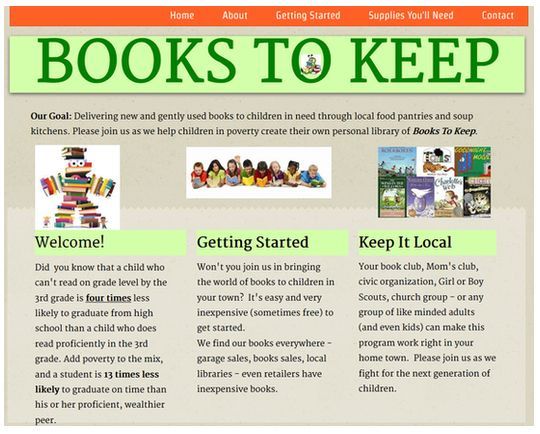
Getting started is simple, and Sue has some suggestions posted right on her site to help you get your project off the ground. To start your own donation organization, all you need to do is collect books, label them and distribute.
The donated books need not be brand new—you’d be surprised what you can find at garage sales, books sales, libraries and thrift stores. Once you begin searching for books and explaining the program, you may be surprised by how excited others are to get involved with your efforts!
The program caters to four basic categories: baby-board books, read-aloud, chapter books and YA/teen fiction. When dropping the books off at the designated pick-up stations, simply divide them into the four categories and wait to see how many of your books are "adopted" by local children in need.
This article from The Village Daily Sun does a wonderful job of outlining the program and displaying the impact Sue has made in just a few short months.
FOR BOOK CLUBS
If you're looking for a community project—a way to make a difference—why not consider starting your own BOOKS TO KEEP program? If you're interested, contact Sue Henry through her website.
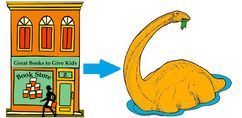 Are local bookstores today's literary dinosaurs? A lot of people think so...and think Amazon has all but ensured their extinction
Author Richard Russo unwittingly kicked off a kerfluffle by penning a NY Times op-ed piece. He, along with some big-ticket authors (Stephen King, Ann Patchett, and Anita Shreve and others), bemoaned the fate of brick & mortar stores. For Patchett bookstores represent "a critical part of our culture." Same with Tom Perrotta, who called them part of a "vital, real-life literary culture.” What's controversial about that?
Well, hold on: a couple of days later, online Slate magazine's Farhad Manjoo weighed in, calling Russo & company's argument "bogus." Pulling no punches, here's what he said:
Russo hangs his tirade on some of the least efficient, least user-friendly, and most mistakenly mythologized local establishments you can find: independent bookstores. Russo and his novelist friends take for granted that sustaining these cultish, moldering institutions is the only way to foster a “real-life literary culture,” as writer Tom Perrotta puts it.
Ouch! That hurts. Catch the words "least user-friendly" and "cultish, moldering institutions"—bookstores, for heaven's sake! But Manjoo makes an interesting case: because of online's low prices, ease of ordering, and instant access through digital readers, people are actually reading MORE. That's real-life literary culture, he says.
As far as preserving local community culture, here's what Manjoo has to say about that:
If you’re spending extra on books at your local indie, you’ve got less money to spend on everything else—including on authentically local cultural experiences...[your] local theater company...city’s museum...locally crafted furniture.... Each of these is a cultural experience that’s created in your community. Buying Steve Jobs at a store down the street isn’t.
My smart husband Pete says that Manjoo's own argument is bogus. It's not buying books that provides a cultural experience. Russo and others are referring to the store itself—a place to gather, real people to talk to, books to touch, chairs to sit on, a friendly storefront that graces a local street.
The issue won't go away; it resurfaced the other day on NPR (6 months after Russo's NY Times piece). The announcer interviewed Manjoo and a local bookstore owner, who sadly couldn't seem to address any of Manjoo's points. All of which allows to ME to pontificate...
Who's right or wrong? It doesn't matter. The fact is that local bookstores are bordering on extinction. It. Will. Happen...at some point. The younger generation was rasied on techno-pablum; they don't get all dewey eyed over books like we do. They get their news online...play games online...connect with friends online...look up words online.... They LIVE online. It's what they've grown up with.
Bye-bye bookstores. Will we miss them? You bet—big time! Will it alter our reading habits or our literary experience? Probably not. Still, it will be a different world, and we'll all have to adjust—I don't think we'll have a choice. Sigh....
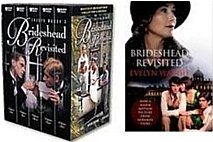 I revisited Brideshead again last week—rereading the book after 25 years—because something about the newest film didn't sit right.
There’s also the 1981 version with Jeremy Irons, the sumputuous mini-series that clocks in at 11 hours. Why remake a perfectly fine wheel? Well, after my marathon reread, I’m even more curious.
I actually like the new 2008 version, primarily because of the performances. They’re terrific! But the two-hour format distorts the storyline and the work’s ultimate meaning.
The biggest problem is the timing of Julia and Charles’s love affair. In the book, the two don’t fall in love until they meet onboard the ship—10 years after they first met at Brideshead. The new film has them fall in love early on—at Brideshead. It’s a serious misreading because it leads to the premise that Sebastian’s unrequited love for Charles is what sucks him into a self-destructive vortex. His decline is far more complicated—and goes to the heart of the book.
The story appears, on the surface at least, to be critical of religion, certainly Catholicism. But the book’s chapter titles provide a real tip-off: “Et In Arcadia Ego” and “The Twitch Upon the Thread.” The novel has to do with the operation of divine grace in the world:
an invisible line which is long enough to let [ the unrepentant ] wander to the ends of the world and still bring him back with a twitch upon the thread.
Willful disobedience gets both Charles and Sebastian thrown out of Arcadia—the paradise / Eden that was Brideshead during the summer of 1923. Only after suffering and disillusionment do the two feel the “twitch upon the thread”—even Charles does at the novel’s end, though it’s unclear whether he’s actually reeled in.
For Book Clubs
Why not revisit Brideshead by reading Waugh...then seeing the 2008 film version? Or for real die-hards watch the 11-hour 1981 version! Choose a weekend—and pack a sleeping bag and pillow! Invite me, too.
 By Kristi Spuhler for LitLovers
What if Ishmael had a cellphone, or any phone for that matter? What kinds of messages would he receive?
That’s the basic premise behind callmeishmael.com—a site where readers call in to share powerful moments they experienced in a favorite book. Maybe the book inspired a new way of thinking or offered comfort during a rough time.
Call Me Ishmael is accessible to anyone, anywhere in the U.S. It's as easy as leaving a voicemail: just dial 774.325.0503, then go to voicemail. After listening to a brief message, record and share your story about what's made your favorite book special to you. Each weekday, "Ishmael" chooses one story to transcribe, record and upload onto the site.
Listening to readers share stories gives us a deeper appreciation of the power of books. It's a terrific way to celebrate literature's unique ability to shape our lives.
But don’t just take our word for it—give it a try yourself. Take a few moments to check out some of the transcriptions on Ishmael. And, of course, leave a story of your own.
So...what story would that be?
*Photo image courtesy of Billy Brown.
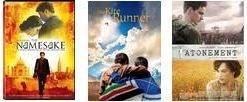 Am I the only person in the US who hasn’t seen Mama Mia? Probably. I’m so late on the uptake. Worse, yesterday I finally got around to seeing The Namesake, based on Jhumpa Lahiri’s novel. Better late than never.
Sometimes a movie is just better than its book. I liked Lahairi’s novel. But I think (at least for now) she’s a better writer of short stories, which is actually a harder craft. (Faulkner claimed short stories to be more difficult than poetry.)
Namesake, The Film is terrific. By nature, it lacks the book’s interiority (and therefore some of its depth and insights), but that may be why I liked the movie’s characters better, particularly Gogol, who isn’t as alienated or self-absorbed as he is in the novel. Granted, the movie doesn’t capture Ashima Ganguli’s isloation from American culture as well as the book, nor her dismay at losing her children to its influence. But I just think the film holds together better. (See our Reading Guide for The Namesake.)
On the to The Kite Runner. Beloved as the book is, it has some structural problems, especially toward the end when Ahmed meets his nemisis 15 years later in Afghanistan. That whole section felt tacked on, manipulative, over-the-top. Again, the film version was better, somehow managing to handle the rescue section with more elegance and power. Same with the final kite flying scene on the California beach. (See our Reading Guide for The Kite Runner.)
And finally Atonement. Wow to both book and film. But I like the film’s ending better than the book’s. The whole birthday party scene (with Briony’s secretiveness about her to-be-published-book and the bad buys sitting right there) feels contrived. But Vanessa Redgrave’s beautifully modulated monologue somehow lent the film more credibility and power, to say nothing of stature. It took my breath away. (See our Reading Guide for Atonement.)
Book Club Questions
- What books have you read that also have film versions? Which did you prefer?
- Does your club show film clips during discussions? Do you talk about a book vs. film version?
 Imagine how it felt on a real ho-hum of a morning to open this missive from far-off Estonia, the beautiful country bordering the Baltic sea.
#1"So what are your students reading?" I write back. And the next morning...I get another email.
Hello...I am an English teacher from Minnesota, living and teaching in Estonia, Europe. I am using your book-club questions to help my students discuss what they are reading for my "home-reading" assignments. Thank you so much—they have really helped my students get more out of their reading.
#2Who is this guy? I wonder. "Who are you," I write"... and what are you doing in Estonia?" His name is Parry...and next morning, I get a 3rd note!
My sixth graders have read some graded readers, Around the World in 80 Days,Last of the Mohicans, some sports books about soccer players and so on.
Older kids are interested in the pop literature of the day—the Divergent Series, Lord of the Rings, Hunger Games, The Fault in our Stars. Some kids read biographies or non-fiction as well. They do a mostly good job of summarizing what they have read, but then have difficulty discussing anything further—that is where your questions have really helped us out.
#3
I teach at a private school in Tallinn, the capital of Estonia. The school, or kool, is called Rocca al Mare ("rock by the sea") and it is right next to the Baltic Sea in a beautiful forest setting. I am from Minnesota but have been living in Estonia for almost 9 years. I have family here now and have no plans to return to the U.S. anytime soon.

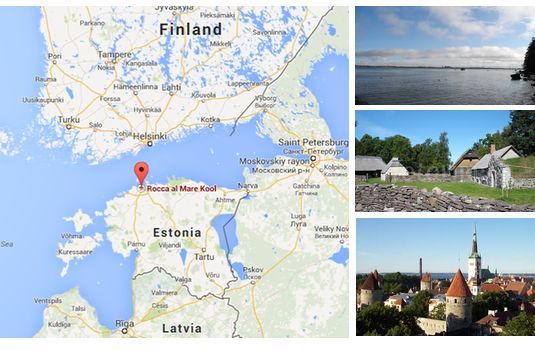
Most of his kids, Parry writes, are quite fluent in English—speaking and writing with relative ease. It's an "A language," which means they begin learning it in first grade. They're also influenced by the Internet and TV—often inserting English words into sentences when speaking in Estonian. Or they'll take an American verb and "Estonianize" it.
Estonia is so small that language-learning is extremely important, says Parry, even in everyday life. Many people can speak 3, 4, even 5 languages, sometimes fluently. Starting in the 3rd grade, students can also choose a "B language"—French, German, Russian, or Spanish—and later can add a "C language," which at that point includes Finnish.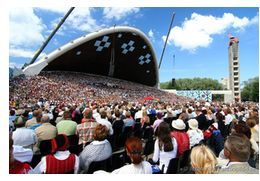 A favorite movie of mine, I tell him, is The Singing Revolution—how Estonia gained independence from the Soviets in 1991. They literally sung their way to freedom. It's a gripping, powerful story.
He knows the movie. "Estonians are very proud of how they won their independence that time. Summer 2014 is the next Summer Song Festival, which is held every four years; you might find videos of past song festivals under the title Laulupidu, which means song festival in Estonian."
Then he ends with..."Of course, Estonia's freedom is very fragile: it has never been free as a nation for any long period of time."
 Do we have to love a book's main character? What happens if we despise the hero/heroine?
I just read a blurb for Zoe Heller's new book, Believers. Critics are praising it up and down, though some find the characters unlikable ... can’t relate to them ... even find them NASTY!
So, back to my question. Can we enjoy a book without liking its characters? Love the book, hate her—as in Serena, another recent book with a heroine no one can stand.
How about Emma—Jane Austen’s masterpiece? Even Austen knew her dear readers would have trouble liking her control-freak-of-a-heroine. Then there's Lolita, featuring one of the most dastardly heroes in all of literature? Humbert Humbert is surely enduring if not endearing—and the book is considered one of the great works of the 20th century.
Still ... it’s hard to get into a book when characters are unlikable. Am I alone? Probably not.
Questions for Book Clubs
- Can a bad character ruin a good book?
- How do you begin most of your book discussions—by talking about the characters? And if you don’t like the main character...where does the discussion go? Does it peter out?
- If a character is unlikable, is it intentional on the part of the author? To what end?
 Has your book club read any chick-lit? If so, is there enough meat, or gum, for a good discussion?
What is chick-lit? Think young urban women obsessed with men, sex, possessions, travel, and partying. Think Sex in the City, All We Ever Wanted Was Everything, or Chasing Harry Winston.
The title of a recent New York Times article, “On the Beach, Under a Tiffany Blue Sky,” situates chick-lit smack in the middle of a beach towel—as escapist summer reading.
Beach reading or not, you can imagine older feminists yanking at the bottoms of their bathing suits in disdain. Is this what all the fuss was about—so daughters could end up as boy-crazy, status-seeking materialists?
But maybe chick-lit is more serious? Maybe it’s a reaction against the earnestness of the previous generation. Here’s author Melissa Banks in a 1999 Salon interview:
The women of my [younger] generation were brought up to think of themselves in terms of what they did rather than of being married or unmarried, and it took on this huge weight. Work was suddenly supposed to be a much bigger thing than work can ever be. You’re supposed to give your soul to it—and ... to be as dedicated to your work as you would be to another person.
Questions for book clubs:
- Is chick-lit a rebellion: “not-your-mother’s-feminism”? Or is it a second-generation taunt at men: ”Anything-you-can-do-I-can-do-better”? (If men can take charge of their own sexuality, careers, dreams and desires, why can’t women?)
- Should chick-lit be taken with a grain of salt (or sand)? Or does it offer an interesting insight into a post-feminist era.
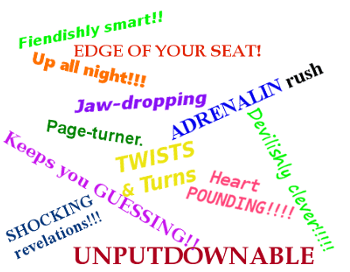 Recognize any of the phrases to the left?
Hard not to. They're taken verbatim from reviews of suspense novels and are repeated over and over in cover blurbs and ads (because, really, how many ways can you say "exciting"?).
Add to that…nearly every thriller gets hailed as "THE NEW GONE GIRL OR THE GIRL ON THE TRAIN!!!!!"
My problem is I've grown tired of heart-thumpers (a phrase not on the list, btw)—of being on the edge of my seat for 384 pages—and reading in PANIC MODE.
So Dear Reader, confession: I skip ahead … to the last couple of pages. I need to see if my favorites make it through intact so that I can just settle back and enjoy the ride. After all, isn't that the point of reading—to savor the words, their rhythms and nuances and to luxuriate in wherever a story happens to take us?
Listen, I LOVE a good thriller—every now and then. But it should come as no surprise that, since Gone Girl, thrillers have been flooding the market. It seems as if the publishing industry has gone mad with its outpouring of beautiful psychopaths.
Worse, even writers of "literary fiction" are adding touches of thrillerdom to jazz up their plots and, I guess, juice up their sales. Oh, well. 'Nuf said.
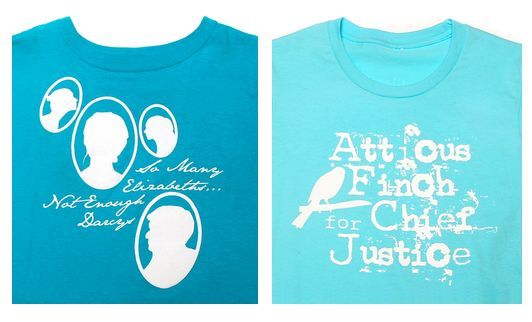
 Take a look at these cool t-shirts by Classic Coup, a literacy project started by devoted teacher and avid reader, Cindy McCain in Nashville. For Each T-shirt sold, money is donated to schools and orphanages in Ecuador, where Cindy taught this past summer (2012).
Lots more where these come from. So head over to her Classic Coup Blog and her Classic Coup Store...and buy t-shirts for all your kids, grandkids, nieces and nephews. Spend some time learning more about what she and her students are doing to make the world a better place for those who need it most.

 By Molly Lundquist, LitLovers
Don't know where YOU live, but where I live we haven't seen sun since, well… since October 30th. A dark, heavy curtain dropped on us. BOOM—no second act.
Occasionally, we get a glimpse of a bright orb (or something) but never for long and NEVER two days in a row. Some speculate it might be the sun. but no one's really sure.
If it sounds dreary, it is.
Ah, but there are lovely compensations. Cold, cloudy weather—plus the end of Day Light Savings—is all the excuse any of us need to hole up in our caves for a GOOD READ.
CLOUDY WEATHER READS
A Few Favorites
• The Dream Daughter - Diane Chamberlain
• How to Change Your Mind: The Science of Psychedelics - Michael Pollan
• The Mermaid and Mrs. Hancock - Imogene Hermes Gowar
• Varina - Charles Frazier
• The Winter Soldier - Daniel Mason
I live in Pittsburgh, by the way. But I've noticed that a lot of the country from the Midwest to the East Coast hasn't had terrific weather either lately, so I figure lots of us have turned to BOOKS—a heartening thought.
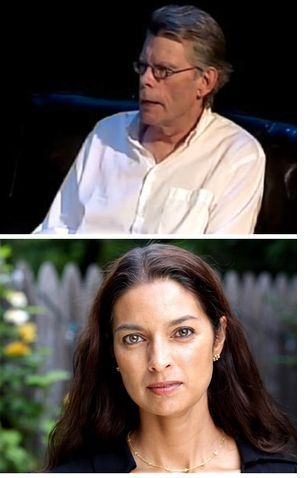 Hardy (or hearty?) congratulations go to STEPHEN KING and JUMPHA LAHIRI, who are to be awarded the prestigious Medal of Arts by President Obama. The presentation will take place at a White House ceremony today.
The National Endowment for the Arts awards medals each year to a wide range of individuals in the arts—actors, authors, dancers, film makers, musicians, and visual artists (painters and sculptors)—recognized for their "outstanding contributions to the excellence, growth, support and availability of the arts in the United States."
A (tiny) sampling of previous recipents includes such luminaries as Saul Bellow, Rene Flemming, Clint Eastwood, Earnest J. Gaines, Dizzy Gillespie, Ray Bradbury, Jacob's Pillow Dance, Roy Lichtenstein.
Below is what the White House has to say about the choice of King and Lahiri:
Stephen King for his contributions as an author. One of the most popular and prolific writers of our time, Mr. King combines his remarkable storytelling with his sharp analysis of human nature. For decades, his works of horror, suspense, science fiction, and fantasy have terrified and delighted audiences around the world.
Jhumpa Lahiri for enlarging the human story. In her works of fiction, Dr. Lahiri has illuminated the Indian-American experience in beautifully wrought narratives of estrangement and belonging.
Couldn't have said it better ourselves.
This year's winners also include theater director John Baldessari, choreographer Ping Chong, actress Miriam Colon, the Doris Duke Charitable Foundation, actress Sally Fields, visual artist Ann Hamilton, composer and singer Meredith Monk, tenor George Shirley, the University Musical Society, author and educator Tobias Wolff.

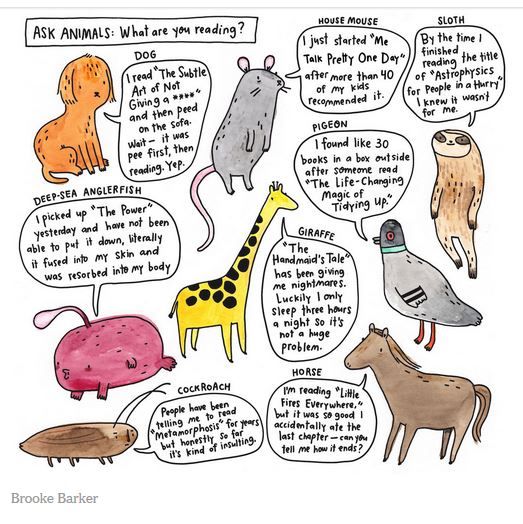
 As "crimes" go, the literary ones are of the lesser sort: plagiarism and phony memoirs don't injure, maim, or kill anyone.
Even so, a few misdemeanors on the docket have managed to show a depressing lapse in ethics or taste.
1. The money grab.
The "discovery" of Go Set a Watchman ranks at the top of the list. Harper Lee's lawyer Tonya Carter claimed to have discovered the original manuscript of To Kill a Mockingbird in February 2015. But others insist it had been discovered in 2011 by an agent from Southeby's—and that Carter had been present when it was found.
Only after Alice Lee, Harper's sister and long-time protector, died did Carter announce her "discovery" of the book. The entire episode reeks of an easy money scheme and, worse, the manipulation of an 89-year-old stroke-afflicted woman. You can find two good articles here: one in the New Republic and another in the New York Times.
2. The tattle tale.
Elena Ferrante's real name, a long-kept secret, was just revealed the other day. In the scheme of things, it's hardly serious—except perhaps for the author of My Brilliant Friend (plus two sequels).
So for what higher purpose did Italian journalist Claudio Gatti spill the beans? Sheer self-aggrandizement, most likely. As the owner of Ferrante's publishing house put it: If someone wants to be left alone, leave her alone.... She’s a writer and isn’t doing anyone any harm.” Amen to that.
3. The whitewash.
Although I haven't read it all the way through (God knows I tried), the new YA novel, My Lady Jane, shows a tone-deaf insensitivity toward one of history's more horrific events—the beheading of 16-year-old Lady Jane Grey. I'll let the book's opening speak for itself:


[O]nce upon a time, there was a sixteen-year-old girl named Jane Grey, who was forced to marry a complete stranger (Lord Guildford or Gilford or Gifford-something-or-other), and shortly thereafter found herself ruler of a country. She was queen for nine days. Then she quite literally lost her head.
Yes, it's a tragedy, if you consider the disengagement of one's head from one's body tragic. (We are merely narrators, and would hate to make assumptions as to what the reader would find tragic.)My Lady Jane
Cynthia Hand and Brodie Ashton
What the . . . ?!
Okay, I could be overly sensitive, but I recall reading an account of Lady Jane Gray in a grad school course on the English Renaissance. Her short life was depressingly sad and her end brutal.
Sugar-coating is one thing, but there's enough misappropriation, misreading, and misuse of history—why must we have "just plain fun" with this? (That quote comes from a Booklist review, which also suggests "joyfully punting" history "out of the way." Omg.)
More to the point, the world has been horrified by certain news from the Middle East—and, yes, we do consider those kinds of events tragic.
See? I'm sensitive AND cranky.
Lady Jane's beheading had a powerful effect on artists, even 300 years after the fact. Here are two renderings: The Execution of Lady Jane Gray (1833) by Paul Delaroche and Lady Jane Grey Preparing for Execution (1835) by George Whiting Flagg.
 Ha! And you thought librarians were goody-two-shoes. Well, here's a TRUE CRIME story that'll make your toes curl.
The AP reported that the county library in Sorrento, Florida, was caught red-handed in a devilishly clever SCAM. Over the course of nine months some 2,000 books had been checked out by a fake card holder.
Now THAT, dear reader, is registration fraud. But get this: the books were always returned. Within an hour. Undamaged.
The Big Reader was Chuck Finley, except Chuck Finley doesn't exist (at least with an East Lake Library card). It turns out two librarians had dummied up an ID and used it to check out books, dozens at a time—everything from John Steinbeck's Cannery Row to Why Do My Ears Pop, a children's book by Ann Fullick.
It was all for a good cause—to save the books from the chopping block because books that HAVEN'T BEEN CHECKED OUT for a period of time are removed from the county system. So the two librarians took it upon themselves to SAVE as many books as they could.
Until someone ratted them out. What a kill joy.
But who's the bad guy here—the fink or the perps? Bleed though our hearts may, it's hard to say. With some 300,000 titles published a year by major U.S. houses (50,000+ for fiction alone), libraries face a serious SHORTAGE of space. Budgets aren't the only thing being squeezed… so are books on shelves.
Still, how can we NOT relate to these two benighted—or beknighted—souls, so enamored of books that they can't bear to have them tossed in the dust bin of history? (Btw, I've no idea what's become of our librarians—to say nothing of all the BOOKS.)
A humorous yet sad tale.
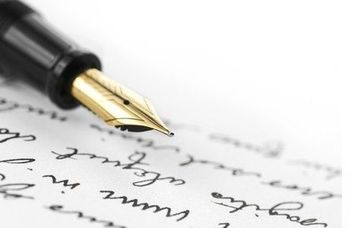 Cursive Cramp
By Kathy Aspeden, Author*
A few years ago I took a creative writing class from Professor Patricia McGraw. It was a three-credit course designed for advanced writers.
Absolutely, I wanted to get the most out of the class.
But I also wanted to get an "A" (grade-seeker — a horrible trait leftover from not having achieved anything athletic in my childhood years). That meant doing all the homework, even the things I found redundant or repetitive. Everything.
Professor McGraw was a huge fan of cursive. She said it got our creative juices flowing to engage our hands in what is quickly becoming a medieval practice. Four handwritten lined-notebook pages a night. Ugh!
It was agony for me. I have terrible, scratchy handwriting. My hands do not form circles. I can’t get anything on my body to make a circle. Ankle rolls during yoga, hula hoop hips, all of it is difficult.
I’m not graceful, I’m purposeful. I can hand-draw a window opening without a level. I’m the chick that does all the cut-in for family painting project.
I don’t create circles or graceful arcs. Cursive is filled with pretty swirls of circles!
Can you imagine getting a mediocre grade because of a simple thing like cursive? It felt positively elementary-schoolish — until I got the hang of it. Yes, like most people my brain works faster than my hands. I had to relax my thoughts, which turned out to allow more time for different, additional thoughts. Who knew?
When I realized that Professor McGraw wasn’t looking at the content, I still felt an obligation to do the task justice. One day I wrote four entire pages of potential book titles that all flowed into one another. "The Life We Made – Making The Pie – A Pie in Your Eye – The Eyes Have It – It Happened in the Park – Park Plaza Promise - Promise You’re Not a Psycho – Psycho is Another Name for Different – A Different Desire…"
Once I wrote a grocery list from when I was a kid, "Chef-Boy-Ardee Raviolis, Captain Crunch Cereal, Frosted Pop Tarts, Tang – the choice of astronauts…" You get the picture.
Before class we’d compare notes about how ridiculous our journals were. One guy wrote everything the NHL Hockey commentator said. Another recorded all the commercials while she power-watched back-to-back episodes of Grey’s Anatomy. Still another student detailed every move her cat made — adding extremely funny dialogue in between actions.
We thought we were beating the system, but we had to admit that something was happening. Ideas were being triggered by the action of writing by hand.
Today, cursive is making a comeback.
I recently saw a news show about the Campaign for Cursive’s 2017 contest winners. It was filled with kids who were treating the learning of cursive like a language or an archeological dig. They were cursive powerhouses, proud to have mastered a language that many of their friends didn’t know existed.
I’ll leave you with a great link to Johanna Silver’s 9 Incredible Ways Writing by Hand Benefits Our Bodies and Brains, as well as a look back at all the hoopla New York Yankees star, Alex Rodriquez, generated with his handwritten apology to the fans of baseball.
Kathy Aspden, is the author of Baklava, Biscotti, and an Irishman, as well as a book reviewer for LitLovers.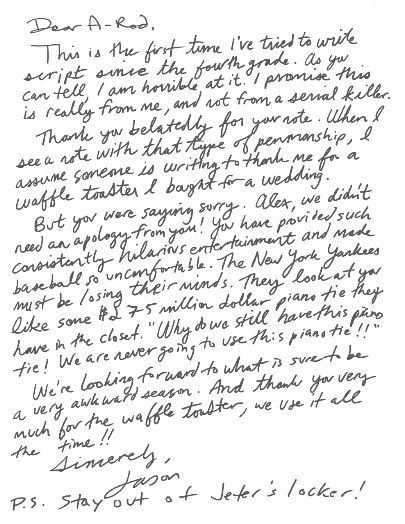
 A little fun: have you noticed—pretty hard not to—all the books entitled Somebody’s Daughter? Recognize any of these?
The Abortionist’s Daughter The Memory Keeper’s Daughter
The Bonesetter’s Daughter The Optimist’s Daughter
The Courtesan's Daughter The Pirate’s Daughter
Galileo’s Daughter Vermeer’s Daughter
Just how many daughterly titles are out there? Turns out, about 360—titles like “Somebody’s Daughter” or “Daughter(s) of the Something-or-Other.” Here's the full list.
So why this fixation on female offspring—a marketing scheme to appeal to women? But one title is nearly 200 years old. It also turns out that Balzac, Dumas, Hawthorne, D.H. Lawrence, Orwell, Walter Scott, and Zola were in on it, too. Did they even have marketing firms back then?
D.H. Lawrence’s short story, “The Horse Dealer’s Daughter,” suggests the young woman of the title inherited her father’s personality and will dominate her fiance as her father did his horses—a title that suggests a belief in familial determinism. (See LitCourse 9.)
Okay, one down, but that leaves 359 titles unexplained. Any theories?
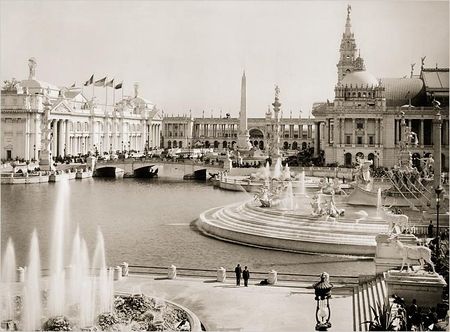
Were you like me, wondering what the World’s Fair looked like in Erik Larson’s book? The book’s photos didn’t help much. Take heart: Below is a photo that appeared in today’s New York Times, front page of the “Week in Review” section. Now we can see what all the fuss was about!
 Writer Joe Queenan thought he might earn a few extra bucks by trying his hand at writing some discussion questions—the ones publishers issue for book clubs. (See our Reading Guides.)
Queenan decided to take a look at what others had done, and what he found surprised him—quirky questions that “force readers to think outside the box.” He refers to them as "off-the-wall questions.” Here’s a sample:
Off the Wall Questions
Anna Karenina—If Anna had lived in our time, how might her story have been different?
Ethan Frome— Is this novel just too grim to be enjoyed? [ For real! ]
Pride and Prejudice— Have you ever seen a movie version in which the woman playing Jane, as Austen imagined her, was truly more beautiful than the woman playing Elizabeth?
“There Will Be a Quiz,” Joe Queenan.
New York Times (4-6-08).
Queenan loves these questions because they “shake up the musty old world of literature.” And that’s great, because I think book clubs have been doing that all along. In fact, hasn’t the role of literature always been to shake things up, to challenge comfortable assumptions? (See our free LitCourse 1—Why We Read.)
But I’ve got some questions of my own:
Questions for book clubs
- Do you use book discussion questions? If so, how Do you try to answer them—or use them as a more general way to help you focus on some aspect of the book?
- What about Generic Book Questions? Do you ever use them? Do they help? To me, they seem to get to the core of a book more quickly than the publishers’ questions—which have a whiff about them of a really, really tough English exam.
 Do book clubs ruin that mysterious quality inherent in the act of reading—being transported to another world?
A New York Times writer says she envies her 11-year-old daughter’s ability to melt into whatever story she’s reading. The author, an analytical reader, says she longs for her girlhood when she could completely lose herself in the magic of a book.
I am not sure when or exactly how I started merely reading books instead of living in them…. But I suppose…the byproduct of growing up is that I formed too many opinions of my own to be able to give in wholeheartedly to the prospect of living inside someone else’s universe.
—”I Wish I Could Read Like a Girl,” Michelle Slatalla, New York Times, 1/1/09
By “merely reading,” I think Slatalla means reading with critical awareness rather than pure enchantment. But for me reading and thinking are synonomous. Opinions, life experiences, and achieved wisdom end up enriching the reading experience.
That may not be true for everyone. And then again, there are plenty of times I like to “just read” without doing the heavy lifting.
Questions for Book Clubs
- Does belonging to a book club require you to read with a more analytical, perhaps even skeptical, eye? If so, does that detract from your reading pleasure?
- Have you ever come away from a book club meeting thinking differently about a book because of the discussion?
- Do you end up reading on your own . . . just for fun?
 Cheap shot, that title. I suspect there are a healthy number of men who do join book clubs — in fact I read about one just recently.
The Second Monday Men’s Book Group in Melbourne, Florida, is featured in the Nov-Dec ’08 issue of Bookmarks magazine. Funny story—before they formed their group, they thought they’d see if they could join one of their wives’ book clubs. Here’s what happened:
We brought it up. They shot it down. We’d change their dynamics by merely being present—and what would happen if we opened our mouths?
Which brings to mind the joke: If a man is alone in the forest and he speaks ... is he still wrong? Apparently so. Anyway, the guys decided to form their own club, now numbering around 7.
In an earlier post, I wondered what kind of books men read. Well here’s how the Second Monday group weighs in:
Nonfiction
Tuxedo Park (radar) | Cadillac Desert (dam-building) | Soul of a New Machine (computers) | Jungle (meat packing) | Washington’s Crossing (history) | American Theocracy (politics) | Surely You’re Joking, Mr. Feynman (physicist’s memoir) | Everglades, River of Grass (history) | West With the Night (female aviator’s memoir) | Why Americans Hate Politics (politics).
FictionAmsterdam by Ian McEwan | Saturday by McEwan | Master and Commander by Patrick O’Brien | My Antonia by Willa Cather | Foundation by Isaac Asimov (sci-fi) | Maltese Falcom by Dashiell Hammett | Big Sleep by Raymond Chandler | Yiddish Policemen’s Union by Michael Chabon | Suite Francaise by Irene Nemirovsky | The Kite Runner by Khaled Hosseini.
Observations?
- Heavy on non-fiction—50%.
- Preponderance of male writers—80%.
- Similar novel choices to female clubs—along with sci-fi (Asimov) and action-adventure /historical fiction (O'Brien).
Question: Is this a typical list for men’s book clubs—with 50% of the books nonfiction and 80% of the writers male?
Also, see So…Where Are the Guys? — an earlier post about men and book clubs.
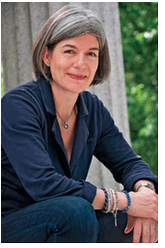 Mention worthy: Publishers Weekly (PW) posed a question to Claire Messud in a recent interview that roused a remarkable response. So remarkable, it's worth reporting on here.
The question concerned the heroine in Messud's new book, The Woman Upstairs.
PW said: "I wouldn’t want to be friends with Nora, would you? Her outlook is almost unbearably grim."
Messud Responds . . .
For heaven’s sake, what kind of question is that? Would you want to be friends with Humbert Humbert?
Would you want to be friends with Mickey Sabbath?
...Saleem Sinai?
...Hamlet?
...Krapp?
...Oedipus?
...Oscar Wao?
...Antigone?
...Raskolnikov?
...Any of the characters in The Corrections?
...Any of the characters in Infinite Jest?
...Any of the characters in anything Pynchon has ever written?
...Or Martin Amis?
...Or Orhan Pamuk?
...Or Alice Munro, for that matter?"
If you’re reading to find friends, you’re in deep trouble. We read to find life, in all its possibilities. The relevant question isn’t “is this a potential friend for me?” but “is this character alive?"
Don't Mess with Messud!—was how PW responded to Messud's response. It's comment had clearly "rankled" the author, PW admitted, BUT...it gave Messud a chance to "show her chops. We're so glad we had that conversation," ended PW graciously.
Messud is the author of the 2006 The Emperor's Children (see reading guide here; see LitLovers review here), as well as this most recent 2013 novel, The Woman Upstairs.
For book clubs to consider:
1. Do we read to find friends?
2. How important is it to like the characters in the books?
3. Do we feel let down when we dislike them?
4. Talk about some of the books you've read and whether or not your enjoyment of them—or disappointment in them—had to do with the likability of the characters.
February 9, 2014
I loved this website so much, that I created my book club TODAY! Approximately 8 members are IN! So, lets see what happens. I named it after my initials. LOL SO it's called MQ's Book Club.
—from MQ,
Dominican Republic
February 24, 2015
Today is the day. I'll send you the notes and some pictures :D i'm so happy. We are 14 girls now, initially. Let's see if it keeps up.
—from MQ
March 2, 2015
Everything went smoothly.... Everyone was happy to join, and I was so excited to make this little dream come true. Our first choices were "The Little Prince" and "The Old Man and the Sea": because they're classics and easy reads. (I didn't wanna start with a book that could give anyone an excuse not to read!).
—from MQ
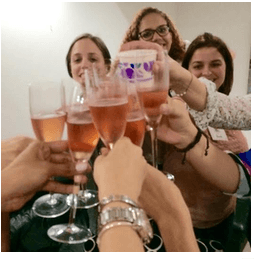
And a couple more photos. Congratulations to MQ's BRAND NEW book club!
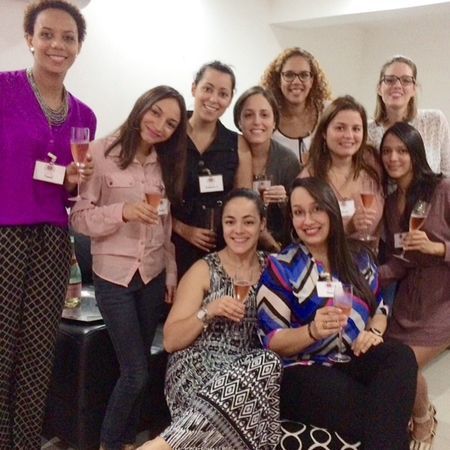
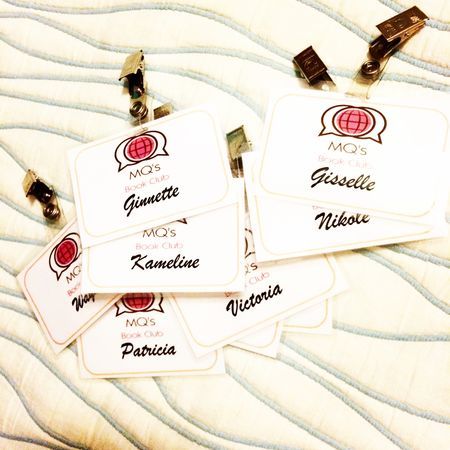
We've got plenty more clubs to read about. Take a look at all of our FEATURED CLUBS...and consider having your club featured on LitLovers.
FICTION IS A MAGIC TRICK of sorts. But at its best it doesn’t just conjure up an imaginary world; it makes the real one disappear, it makes the author disappear. Only a book can do this — let you lose yourself so completely. So, if you can, forget about everything else. Just be there with the book.
Jami Attenberg, Author of All Grown Up
Interview, NY Times Book Review, March 26, 2017
And in the other corner . . .
A GREAT OBSTACLE to good education is the inordinate passion prevalent for novels, and the time lost in that reading which should be instructively employed. When this poison infects the mind, …[t]he result is a bloated imagination, sickly judgment and disgust towards all the real businesses of life.
Thomas Jefferson
Letter to Nathaniel Burwell, March 14, 1818
 Hello…ello…lo…….. Are book clubs like echo chambers—reading and talking about the same books? Joshua Henkin (Matrimony) worries that we are: you know, books like Water for Elephants; Eat, Pray, Love; Kite Runner. We’re all reading them and reviewing the same ones.
Here’s how Henkin puts it:
There are a lot of great books out there that people don’t know about . . . . [At the same time] fewer books have more and more readers. . . . For that reason, it has become harder for all but a handful of books to get the attention they deserve.
—Books on the Brain, 4/29/08
Henkin makes a strong case. Pity new authors trying to get their books noticed. It’s got to be disheartening.
Nonetheless, there’s something delightful that so many of us are on the same page. The book club movement is like the city that promotes a single book for its residents to read. Meet someone at the water cooler, at the mall, on the bus…and a conversation gets started. “Hey, how do you like Eat, Pray, Love? Have you read such & such yet?” It’s suddenly easy to find commonality, even with total strangers.
And while Henkin is right—many more authors deserve our attention—perhaps book club lists have more variety than expected.
Take a look at the list below. It’s a sampling of titles that have cropped up recently on LitLovers website—some are mentioned by our featured book clubs, others come from people who email me to request a reader’s guide. It’s an interesting list.
Chimimanda Ngozi Adichie — Half of a Yellow Sun
Murray Bail — Eucalyptus
Lynne Cox — Grayson
Ivan Doig — Whistling Season; the McCaskill trilogy
Jennifer Cody Epstein — The Painter from Shanghai
Dorothea Benton Frank — Sullivan’s Island
Victor Fankl — Man’s Search for Meaning
Tana French — In the Woods
Beth Gutcheon — Good-bye and Amen; Leeway Cottage
Jim Harrison — Returning to Earth
Kent Haruf — Plainsong; Eventide
Robert Hicks — Widow of the South
Paulette Jiles — Enemy Women
Lesley Kagen — Whistling in the Dark
Aryn Kyle — The God of Animals
Sinclair Lewis — Main Street
J. Nozipo Maraire – Zenzele: Letter for My Daughter
Roland Merullo — Breakfast with Buddha
David Mitchell — Ghostwritten
John O’Hara — Appointment in Samarra
Tom Perotta — Little Children; The Abstinence Teacher
Nancy Pickard — The Virgin of Small Plains
Anthony Powell — Dance to the Music of Time
Richard Powers — The Echo Maker
Reynolds Price — Kate Vaiden
Tatiana de Rosnay — Sarah’s Key
Mary Doria Russell — The Sparrow
Helen Santmyer — And Ladies of the Club
Carol Shields — Stone Diaries; Unless
Ahdaf Soueif — The Map of Love
Nancy Turner — These Is My Words
Larry Watson — Sundown, Yellow Moon; Montana 1948
See all posts on Joshua Henkin’s book club essay.
 Do you ever find yourself mourning the end of a book—you finish the last sentence, and it's like saying goodbye to a dear friend?
I’d been reading Richard Ford’s The Lay of the Land. By the time I reached the end, I’d become so caught up in Frank Bascombe’s mind—his life and his ideas about life—that it was hard to leave him.
Then I turned around to start a new book, and I found it hard. Like making new friends—it required energy and commitment.
Do I even like these people? Do I really want to spend time with them? Do I want to make the effort to learn all about them? Hopefully, we stick with the book, to the point where the story sucks us in—and we beoome engaged once again. Of course...then it's eventually goodbye.
Questions for Book Clubs
1. Which books have been hard ones for you to end—it feels like saying goodbye to dear friends?
2. Which books have you had difficulty getting caught up in? You’re not sure you’ve got the energy or interest to invest in getting to know a new group of people.
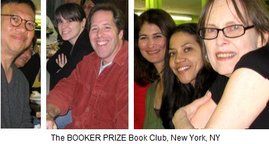 Check out LitLovers newest Featured LitClub—a brainy group of New Yorkers, who tackle the Booker Prize awards list (winners and nominees). That’s some impressive reading!
They also have a great idea for any book club—a Book Swap. The group organized a Swap at a library in SoHo (SoHo…ah, how cool izat?) in conjunction with a Peace Corp veterans book club. It proved so successful the library wants to make it a seasonal event.
The two groups are also considering a joint read and discussion. The Peace Corp group reads international books, which ties in beautifully with the Booker Prize list. *
* Britain’s Man Booker Prize is awarded to English-written novels by authors from the 54-member [British] Commonwealth of Nations, plus Ireland and Zimbabwe. Commonwealth nations include countries in Africa, the South Pacific, and the Carribbean, as well as Australia, Canada, India, New Zealand.
 If you love books on a certain theme…you’ll love Flashlight Worthy Book Recommendations, a new site that lists books thematically. So far the site has 370 different lists, in 50+ categories, with nearly 5,000 books. Here’s a tiny sample:
Flashlight Worthy Lists
Books About . . .
Families in Fiction and Memoir
Women of Another Era
Abraham Lincoln
Dystopia
Crime Fiction–About Women By Women
Love–That Your Club Probably Hasn’t Read Yet
African-Americans–Not Just for Black History Month
WASPS
Madness We Can All Relate to
With the Sea in Sight
So head on over to the website to find some great ideas and recommendations for your book club…or just for yourself.
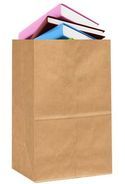 Imagine this: you're staying at a swank hotel in New York City, you're drinking and dining and hobnobbing with literary luminaries, and you receive a giftbag...like the ones handed out at kiddie birthday parties. Only not like them.
Your giftbag contains 12 books...delivered to your hotel room...and selected by a Pulitizer Prize winning author. For you. All for you. Oh! Happy daze, happy daze!
Such is the fate of the Poor Unfortunates who participated in the PEN Festival of International Literature starting April 30, 2012. The reigning Pulitzer winner, by the way, is still Jennifer Egan for A Visit from the Goon Squad. She was invited to select the books for the giftbag—here's what she chose...and why:
Emma by Jane Austen
Politics masquerading as matrimony. Austen was a mathematician of social interaction, and her novels are impossibly, preposterously good. Emma happens to be my favorite.
The Image by Daniel J. Boorstin
In 1961, before the Vietnam War was close to being televised, Boorstin identified...a longing for authenticity that naturally results from increased mediation of human experience. His observations hold eerily true even in the era of Facebook and YouTube.
Don Juan by Lord Byron
Who can resist an epic poem in which the protagonist gets shipwrecked, hides in a harem (and then is chosen by the sultan for an evening of pleasure), has a fling with Catherine the Great, and endless other romps—all narrated in Byron's slouchy, sinuous poetry?
Underworld by Don Delillo
My favorite American novel of the past 25 years. A gigantic vision of the Cold War and its aftermath, in which DeLillo manages to be sweeping, intimate, political, hilarious, and sad.
Middlemarch by George Elliot
A quintessentially swaggering 19-century English novel, thrillingly attentive to a sweep of diverse characters, and impossible to put down.
Invisible Man by Ralph Ellison
A surreal tale that exposes the ravages of racial persecution, yet ultimately subsumes them in a meditation on identity and transformation, whose proportions are nothing short of mythic.
The Transit of Venus by Shirley Hazzard
Utterly unique: a flexible, sharply written, wide-ranging story that encompasses the life of a young Australian woman who comes to England.
The Golden Notebook by Dorris Lessing
An epic, experimental yet utterly human work that manages to fuse a political vision (disillusionment with communism) with a social one (women, men, and the collisions between them).
Good Morning, Midnight by Jean Rhys
Tough, bleak, and deeply atmospheric. Rhys wrests a gripping--even phantasmagoric--narrative from the solitary perambulations of an alcoholic woman in Pais.
Tristam Shandy by Laurence Sterne
One of the first novels in English...and a bouyant, postmodern romp. A heart reminder of the power,malleability, and deep playfulness of the novel form.
The House of Mirth by Edith Wharton
Tragic in the classical sense, yet also hilarious, nuanced, and socially astute; the novel's cool assessment of the calculus of beauty and wealth rings true even in our radically divverent era.
Germinal by Emile Zola
My favorite reportorial 19th-century novel. A vivid story full of spectacular set pieces--like a horse being lowered into a coal mine--and also a brutal indictment of the mining industry's exploitation of its workers.
Thanks to The Daily Beast. And thanks, to my dear librarian, Lynne Schneider, at the Sewickley Public Library, for handing me the printout.
Quite a list. If you've not read them all...well, most of us haven't. They don't spring easily to mind...nor to the top of everyone's reading list. But HERE's THE QUESTION: what would you choose to be in the giftbag?
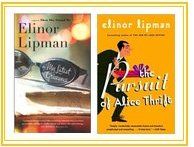 You read ... and read ... and you read. And you think you’re pretty well up on authors.
Then you come across one who’s written 8 books—8 mind you!—and you don’t have a clue. You feel so, so ... can I say it... sob ... so UNREAD!!
That’s what happened with Elinor Lipman. Somewhere I came across her name. Hmmm ... that’s vaguely familiar, but only vaguely ... I check her out ... and holy cow! Stunned I am—by her body of work and the fine reviews she’s garnered over the years. So where have I been?
Why isn’t Lipman on the lips of every book club member in the country? She’s funny, smart, perceptive…and her dialogue crackles. We should be reading her!
I’m working my way backward through her books. So far I’ve read My Latest Grievance, The Pursuit of Alice Thrift and Dearly Departed. Wonderful... Check out our reading guides for Lipman’s other 4 novels — they’re on our LitGuide index...L for Lipman!
I plan on reading all 8 novels ... sometime.
 Boooo...! Halloween’s coming up. A reader asked me to come up with ideas for spooky mystery novels. The writer herself suggested Diane Setterfield’s The Thirteenth Tale. Good one!
Here are some I came up with—mostly older works:
- Rebecca by Daphne Du Maurier, 1938 (an all-time favorite)
- Jane Eyre by Charlotte Bronte, 1847 (the mad women in the attic)
- The Woman in White by Wilkie Collins, 1859-60 (scrumptious)
- The Hound of the Baskervilles by Conan Doyle, 1091-02 (the great Sherlock and Watson)
- Twilight by Stephanie Meyer, 2003 (we have guides for the complete vampire series)
- Anything scary by Stephen King… Any particular suggestions from anyone?
If anyone has some other ideas, let us know. We’d love to hear from you.
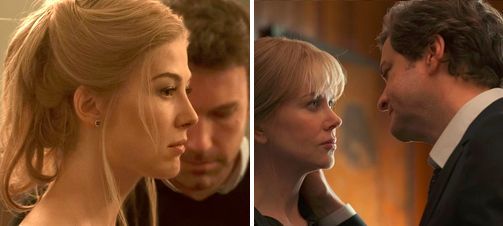
Gone Girl (Rosamund Pike, Ben Affleck) Before I Go to Sleep (Nicole Kidman, Colin Firth)
LOOK at them! These gorgeous people with their messed-up marriages—they captivate us. Of course, they're just characters out of BOOKS, who now find themselves writ extra large on screen, but still...
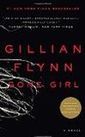 |
 |
 |
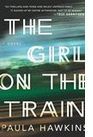 |
 |
 |
 |
 |
| Click on each cover for a summary. | |||
By our count, at least eight domestic thrillers have hit the shelves since 2011 and 2012—with the publication of Before I Go to Sleep and Gone Girl.
Considering the immense attention the books have garnered—both book sales and movie rights—it seems we can't get enough. The question is, why?
Why this morbid fascination? All eight books deal with psychopathically CREEPY marriages; surely, their wide appeal taps into some underlying anxiety on our part. And we haven't even taken TV's Wives with Knives into account!
At the very least, the number of books—and their popularity—suggest a new and disturbing attitude toward marriage, which has always been considered the sine qua non of a fulfilling life. Every single person knows far too well that ubiquitous question, "Ever going to get married?" Maybe it's a suspicion of intimacy, a growing fear that genuine connection is unattainable. All the books reflect an innate distrust of "the other"—indeed, their overarching theme is the impossibility of truly knowing another being, even spouses.
Or perhaps we suspect marriage is no longer up to the task of functioning as a stabilizing or cohesive force in life. Certainly none of the marriages in these books stave off chaos and loneliness. Just the opposite.
But, oh, pshaw! Here we go again, fooling around with mole hills and mountains. As a genre, creepy thrillers have a long history as great entertainment—think Dr. Jekyll and Mr. Hyde...even Hamlet...or go way back to Oedipus, for that matter. This is probably just one more pop culture phenomenon—like Zombies.
But Dear Reader, it's hard to think all this means NOTHING. After all, isn't literature supposed to be about SOMETHING? (Oh, and the Zombie craze? It's raised similar questions...)
So what do you think? Any ideas?