


Einstein: His Life and Universe
Walter Isaacson, 2007
Simon & Schuster
704 pp.
ISBN-13: 9780743264747
Summary
A century after Albert Einstein began postulating his "Big Idea" about time, space, and gravity, a new biography examines the scientist whose public idolization was surpassed only by his legitimacy as one of humanity's greatest thinkers.
Walter Isaacson, the author of excellent profiles of Benjamin Franklin and Henry Kissinger, utilizes a trove of material from recently opened Einstein archives to offer a probing look at a provocatively freethinking individual. (From Barnes & Noble.)
By the author of the acclaimed bestseller Benjamin Franklin, this is the first full biography of Albert Einstein since all of his papers have become available.
How did his mind work? What made him a genius? Isaacson's biography shows how his scientific imagination sprang from the rebellious nature of his personality. His fascinating story is a testament to the connection between creativity and freedom.
Based on newly released personal letters of Einstein, this book explores how an imaginative, impertinent patent clerk — a struggling father in a difficult marriage who couldn't get a teaching job or a doctorate — became the mind reader of the creator of the cosmos, the locksmith of the mysteries of the atom and the universe. His success came from questioning conventional wisdom and marveling at mysteries that struck others as mundane. This led him to embrace a morality and politics based on respect for free minds, free spirits, and free individuals.
These traits are just as vital for this new century of globalization, in which our success will depend on our creativity, as they were for the beginning of the last century, when Einstein helped usher in the modern age. (From the publisher.)
Author Bio
• Birth—May 20, 1952
• Where—New Orleans, Louisiana, USA
• Education—B.A., Harvard University; M.A., Oxford University
• Awards—(see below)
• Currently—Washington, D.C. area
Walter Isaacson is an American writer and journalist. He was the President and CEO of the Aspen Institute, a nonpartisan educational and policy studies organization based in Washington, D.C. He has been the chairman and CEO of Cable News Network (CNN) and the Managing Editor of Time. He has written biographies of Steve Jobs, Benjamin Franklin, Albert Einstein, Henry Kissinger, and Leonardo da Vinci.
Early life and education
Isaacson was born in New Orleans, Louisiana, the son of Irwin and Betty Lee (Seff) Isaacson. His father was a "kindly Jewish distracted humanist engineer with a reverence for science," and his mother was a real estate broker.
Isaacson graduated from Harvard University in 1974, where he earned an A.B. cum laude in history and literature. He later attended the Oxford University as a Rhodes scholar, where he studied Philosophy, Politics, and Economics (PPE) and graduated with first-class honors.
Journalism
Isaacson began his career in journalism at The Sunday Times of London, followed by a position with the New Orleans Times-Picayune. He joined Time magazine in 1978, serving as the magazine's political correspondent, national editor, and editor of new media before becoming the magazine's 14th editor in 1996.
Isaacson became chairman and CEO of CNN in July 2001, two months later guided CNN through the events of 9/11. Shortly after his appointment at CNN, Isaacson attracted attention for seeking the views of Republican Party leaders on Capitol Hill regarding criticisms that CNN broadcast content that was unfair to Republicans or conservatives.
He was quoted in Roll Call magazine as saying: "I was trying to reach out to a lot of Republicans who feel that CNN has not been as open to covering Republicans, and I wanted to hear their concerns." The CEO's conduct was criticized by the left-leaning Fairness & Accuracy in Reporting (FAIR) organization, which said that Isaacson's "pandering" behavior was endowing conservative politicians with power over CNN.
In 2003, Isaacson stepped down as president at CNN to become president of the Aspen Institute. Isaacson served as the president and CEO of the Aspen Institute from 2003 until 2017, when he announced that he would leave to become a professor of history at Tulane University and an advisory partner at the New York City financial services firm Perella Weinberg Partners.
Writing
Isaacson is the co-author, with Evan Thomas, of The Wise Men: Six Friends and the World They Made (1986). He is the author of Kissinger: A Biography (1992), Benjamin Franklin: An American Life (2003), Einstein: His Life and Universe (2007), and American Sketches (2009).
In 2011, Steve Jobs, Isaacson's authorized biography was published, becoming an international best-seller and breaking all sales records for a biography. The book was based on over forty interviews with Jobs over a two-year period up until shortly before his death, and on conversations with friends, family members, and business rivals of the entrepreneur.
Next came another bestseller, The Innovators: How a Group of Inventors, Hackers, Geniuses, and Geeks Created the Digital Revolution (2014), which explores the history of key technological innovations — notably the parallel developments of the computer and the Internet.
Isaacson's biography, Leonardo da Vinci, came out in 2017 to great fanfare and, even before it's actual publication, became the object of a Hollywood bidding war. Leonardo DiCaprio's production company won the film rights with DiCaprio planning to play the title role of da Vinci.
Government positions
In 2005, Louisiana Governor Kathleen Blanco appointed Isaacson vice chairman of the Louisiana Recovery Authority to oversee spending on the recovery from Hurricane Katrina.
In 2007, President George W. Bush appointed him as chairman of the U.S.-Palestinian Partnership, which seeks to create economic and educational opportunities in the Palestinian territories.
He also served as the co-chair of the U.S.-Vietnamese Dialogue on Agent Orange, which in January 2008 announced completion of a project to contain the dioxin left behind by the U.S. at the Da Nang air base and plans to build health centers and a dioxin laboratory in the affected regions.
During the Obama administration, Secretary of State Hillary Clinton appointed him vice-chair of the Partners for a New Beginning, which encourages private-sector investments and partnerships in the Muslim world.
In 2009, President Obama appointed him as chairman of the Broadcasting Board of Governors, which runs Voice of America, Radio Free Europe, and the other international broadcasts of the U.S. government; he served until January 2012.
In 2014, he was appointed by New Orleans Mayor Mitch Landrieu to be the co-chair of the New Orleans Tricentennial Commission, charged with planning the city's 300th-anniversary commemoration in 2018.
In 2015, he was appointed to the board of My Brother's Keeper Alliance, which seeks to carry out President Obama's anti-poverty and youth opportunity initiatives.
Isaacson is the chairman emeritus of the board of Teach for America.
Honors
Time magazine selected Isaacson in 2012 to be on its list of the 100 most influential people in the world. Isaacson is a fellow of the Royal Society of Arts and was awarded its 2013 Benjamin Franklin Medal. He is also a member of the American Academy of Arts and Sciences, the American Philosophical Society and an Honorary Fellow of Pembroke College, Oxford.
In 2014, the National Endowment for the Humanities selected Isaacson for the Jefferson Lecture, the U.S. federal government's highest honor for achievement in the humanities. The title of Isaacson's lecture was "The Intersection of the Humanities and the Sciences." (Adapted from Wikipedia. Retrieved 10/3/2017.)
Book Reviews
With the help of many witty, candid letters, Mr. Isaacson offers a wonderfully rounded portrait of the ever-surprising Einstein personality. Equally important is the Einstein myth, and the material on this subject is even more entertaining. Einstein horrified his colleagues by enjoying his vast celebrity. (“Einstein’s personality, for no clear reasons, triggers outbursts of a kind of mass hysteria,” the German consul reported to Berlin as the great man made one of his rock-star visits to New York.) He also stymied the press in its efforts to keep up with his accomplishments. Mr. Isaacson has great fun with the reportorial frenzy that surrounded each new pearl of Einsteinian wisdom...an illuminating delight.
Janet Maslin - New York Times
In a famous catchphrase, Einstein couldn't believe that God played with dice, and for decades he kept up the search for a "unified field theory" that would make sense of everything. Einstein: His Life and Universe covers all this and much else in a painstaking and reliable biography. You won't go wrong in reading and learning from it.
Michael Dirda - Washington Post
Acclaimed biographer Isaacson examines the remarkable life of "science's preeminent poster boy" in this lucid account (after 2003's Benjamin Franklin and 1992's Kissinger). Contrary to popular myth, the German-Jewish schoolboy Albert Einstein not only excelled in math, he mastered calculus before he was 15. Young Albert's dislike for rote learning, however, led him to compare his teachers to "drill sergeants." That antipathy was symptomatic of Einstein's love of individual and intellectual freedom, beliefs the author revisits as he relates his subject's life and work in the context of world and political events that shaped both, from WWI and II and their aftermath through the Cold War. Isaacson presents Einstein's research—his efforts to understand space and time, resulting in four extraordinary papers in 1905 that introduced the world to special relativity, and his later work on unified field theory—without equations and for the general reader. Isaacson focuses more on Einstein the man: charismatic and passionate, often careless about personal affairs; outspoken and unapologetic about his belief that no one should have to give up personal freedoms to support a state. Fifty years after his death, Isaacson reminds us why Einstein (1879–1955) remains one of the most celebrated figures of the 20th century.
Publishers Weekly
Although the author appropriately makes Einstein's extraordinary scientific achievements the center of attention, he also covers his subject's complex and often painful familial relationships, his political interventions and comments, and his remarkable celebrity status (for a scientist) with the American public. Isaacson himself does not have a strong scientific background, but professional specialists in physics and mathematics assisted him effectively. This work, the first full biography of Einstein since all his papers have been made available, is certainly one of the best and most complete Einstein biographies thus far.
Criticas
This biography of Albert Einstein (1879-1955) takes a cue from Isaacson's recent success, Benjamin Franklin, and is written for a general audience. Although the author appropriately makes Einstein's extraordinary scientific achievements the center of attention, he also covers his subject's complex and often painful familial relationships, his political interventions and comments, and his remarkable celebrity status (for a scientist) with the American public. Isaacson himself does not have a strong scientific background, but professional specialists in physics and mathematics assisted him effectively. This work, the first full biography of Einstein since all his papers have been made available, is well written and sensibly balanced in its treatment of the famed theoretical physicist, his family, and his friends. Certainly one of the best and most complete Einstein biographies thus far; strongly recommended for public and academic libraries.
Jack W. Weigel - Library Journal
A comprehensive and marvelously readable life of the eminent scientist—and more, the eminent counter-culturalist, rebel, humanist and philanderer. "A century after his great triumphs, we are still living in Einstein's universe," writes Aspen Institute president and former CNN head Isaacson (Benjamin Franklin: An American Life, 2003, etc.), "one defined on the macro scale by his theory of relativity and on the micro by a quantum mechanics that has proven durable even as it remains disconcerting to some." Brave enough to tread on such highly specialized ground, and working with newly available archival materials, Isaacson lucidly explains the finer points of Einstein's theories. One, the general theory of relativity, had its birth, Isaacson writes, while Einstein was struggling to write an article on his special theory of relativity; sitting in his office in Bern, where he worked as a patent-examiner, he had the thought, "If a person falls freely, he will not feel his own weight"-"the happiest thought in my life," Einstein recalled-but underlying it is some formidable work in physics and mathematics that took Einstein many subsequent years to express, and Isaacson acquits himself very well in taking readers along some strenuous paths of reasoning. Along with the science, Isaacson gives us an Einstein with whom it might have been fun to enjoy a stein of beer—unless you were married to him, a different story altogether, for by Isaacson's account, Einstein was sufficiently sure of his own genius and the needs it entailed that he refused to be tied down by the ordinary rules applied to husbands and fathers. One daughter he even abandoned without a look back, but this was typical of his nonconformity, which, Isaacson writes, was characteristic of Einstein until the very end of his life. An exemplary biography, at once sympathetic and unsparing. Readers will admire Einstein's greatness as a thinker, but they will now know that he, like all other idols, had feet of clay.
Kirkus Reviews
Discussion Questions
Use our LitLovers Book Club Resources; they can help with discussions for any book:
• How to Discuss a Book (helpful discussion tips)
• Generic Discussion Questions—Fiction and Nonfiction
• Read-Think-Talk (a guided reading chart)
Also consider these LitLovers talking points to help get a discussion started for Einstein:
1. What kind of mind conceives of thought experiments like wondering what it would be like to ride alongside a light beam? In other words, how would you describe the mind that was Einstein's—even in his youth? (Words like brilliant or genius don't count.)
2.Talk about Einstein as a young man, especially his treatment of his first wife, Mileva and his newborn daughter. What kind of a person was he?
3. Overall, how would you describe the outsized personality of Albert Einstein? Consider for instance his reaction to his parents, as well as his teachers at Zurich Polytechnic. What part does Einstein's rebelliousness play in his ability to formulate his scientific breakthroughs? To what degree does he mature or change over the years?
4. How well does Isaacson deal with the science in this book? Do you find the discussion of Einstein's s discoveries lucid or understandable? Does Isaacson help you grasp the concepts of relativity, or the famous equation E=MC2? Or do you still find them too dense to comprehend?
5. In what way did Einstein attempt to justify religious faith with his understanding of the universe. What did he mean when he said that God "would not play dice by allowing things to happen by chance"? Consider, as well, this statement: "I believe in Spinoza's God, who reveals himself in the lawful harmony of all that exists, but not in a God who concerns himself with the fate and doings of mankind."
6. Talk about Einstein's world view—the concepts that undergirded his geo-politics and philosophy toward life. Consider, for example, his stances on racial discrimination, Joseph McCarthy, the cold war, nuclear proliferation, and Nazism.
6. Consider Einstein's dismay regarding his role in creating the atomic bomb. especially his comment that "he would never have lifted a finger" to help the U.S. develop the bomb had he known that Germany could not successfully develop one.
7. What surprised you most about Albert Einstein as you read this book?
8. What particular passages struck you while reading the book: something insightful, controversial, or humorous— anything that strikes you.
(Questions by LitLovers. Please feel free to use them, online or off, with attribution. Thanks.)
top of page (summary)
Leadership Is an Art
Max De Pree 1989
Random House
176 pp.
ISBN-13: 9780440503248
Summary
Leadership Is an Art has long been a must-read not only within the business community but also in professions ranging from academia to medical practices, to the political arena.
The book has sold more than 800,000 copies in hardcover and paperback. This revised edition brings Max De Pree’s timeless words and practical philosophy to a new generation of readers.
De Pree looks at leadership as a kind of stewardship, stressing the importance of building relationships, initiating ideas, and creating a lasting value system within an organization. Rather than focusing on the “hows” of corporate life, he explains the “whys.” He shows that the first responsibility of a leader is to define reality and the last is to say thank you. Along the way, the artful leader must:
• Stimulate effectiveness by enabling others to reach both their personal potential and their institutional potential
• Take a role in developing, expressing, and defending civility and values
• Nurture new leaders and ensure the continuation of the corporate culture
Leadership Is an Art offers a proven design for achieving success by developing the generous spirit within all of us. Now more than ever, it provides the insights and guidelines leaders in every field need. (From the publisher.)
Author Bio
Max De Pree is the retired chairman of Herman Miller, Inc., the primary innovator in the furniture industry for sixty years. Named one of the hundred best companies to work for in the United States, Herman Miller also ranked ninth in a Fortune survey of the most admired corporations and sixth in management excellence. (From the publisher.)
More
Max De Pree is an American writer. A son of D.J. De Pree, founder of Herman Miller office furniture company, he and his brother Hugh De Pree assumed leadership of the company the early 1960s. He succeeded his brother Hugh as CEO in the mid-1980s and served in that capacity to 1990. His book Leadership Is an Art has sold more than 800,000 copies. In 1992, DePree was inducted into Junior Achievement's U.S. Business Hall of Fame.
He studied at Wheaton College but was interrupted by World War II. He served on the European Theatre of Operations. Still in the Army, he studied at the University of Pittsburgh, Haverford College and the University of Paris. After his military service he attended Hope College, graduating with a Bachelor of Arts degree in 1948. (From Wikipedia.)
Book Review
[Leadership Is an Art] overflows with virtue. Mr. De Pree is the head of his family's furniture company, Herman Miller Inc. Herman Miller is a famously good company to work for and manufactures famously good things to sit in—the various Eames chairs, for example. Mr. De Pree devotes his slim text to the idea of applying decency, charity and common sense to business practice. We can't help but like the man. Therefore, let us say that his opus is as worthy as Scripture, and not say that it's as interesting as the Book of Nehemiah.
P.J. O'Rourke - New York Times
Like the elegant furniture his company makes, De Pree?s book provides a valuable lesson in grace, style, and the elements of success.
Time
Perhaps we should banish all of our management books except Max De Pree?s recent gem, Leadership Is an Art. The successful Herman Miller, Inc., chairman...writes only about trust, grace, spirit, and love...such concerns are the essence of organizations, small or large.
Inc. Magazine
This is a wonderful book. It captures Max's spirit.... He's a truly exceptional person. But it also says more about leadership in clearer, more elegant, and more convincing language than many of the much longer books that have been published on the subject.
Peter F. Drucker
Rather than offering a how-to manual on running a business, DePree, CEO of Herman Miller Inc., a manufacturer of office furniture, details, in deceptively simple but imaginative language, a humanitarian approach to leadership. The artful leader, he argues, should recognize human diversity and make full use of his or her employees' gifts. Further, he believes, a leader is responsible not just for the health of a company's financial assets, but for its ethics. Advocating management through persuasion, and the exercise of democratic participation rather than concentrated power, he favors covenantal relationships with employees that rest on shared purpose, dignity and choice. The author stresses the need for communication, but his only direct guidance concerns the need for job performance reviews and self-evaluation.
Publishers Weekly
Discussion Questions
Use our LitLovers Book Club Resources; they can help with discussions for any book:
• How to Discuss a Book (helpful discussion tips)
• Generic Discussion Questions—Fiction and Nonfiction
• Read-Think-Talk (a guided reading chart)
Also consider these LitLovers talking points to help get a discussion started for Leadership Is an Art:
1. Is De Pree's book different than other business manuels you have read on leadership? If so, how is it different? Overall, can you sum up, concisely, De Pree's approach to leadership? Hint: what does it mean, for instance, to liberate people?
2. What does De Pree mean by a "relational community"? On what is it based...and how does one establish such a culture in a business (or any) environment? Does your organization meet the description of a relational community?
3. De Pree talks about the importance of diversity. How does he define the word in the context of leadership?
4. Discuss the statement, "Trust enables the future." What does De Pree mean?
5. How does De Pree see the role of storytelling in an institution? Comment on the following passage from the book:
Every family, every college, every corporation, every institution needs tribal storytellers. The penalty for failing to listen is to lose' one's history, one's historical context, one's binding values.
6. What is the significance of the book's title? In what way is leadership an art? Are there instances when the analogy of an "art form" makes little sense? What is the difference between leadership and management? Do the two require different skill sets? Is one more critical to an organization than the other?
7. How does the work environment—physical surroundings— affect an organization's culture and productivity? De Pree owns a renowned furniture retail operation; ovbiously surroundings are uppermost in his mind. When he purports that a corporate (or any institutional) facility reflects the values and vision of its organization, is his observation applicable to other types of businesses than his own? In other words, is his observation legitmate?
8. What is your vision of an optimal work environment? How would you rate your own organization?
9. How does De Pree define entropy, and why is it important to an organization that desires growth?
10. Discuss De Pree's vision of the Scanlon Plan. Is it realistic or practical...under some, all or no situations? Would such a plan be effective in your organization? Are your employees sufficiently motivated to undertake a project of that nature? Is management sufficiently receptive? What benefits might accrue to your organization?
11. Have you gone through De Pree's extensive review process, list of workers' rights, and signs of disintegration? Talk about the list...or your own findings as they apply to your organization.
12. What does De Pree see as signs of an organization's impending failure?
13. One of De Pree's insights is that "much of a leader's performance cannot be reviewed until after the fact." How does that observation conflict with today's demand for short-term measurements of performance?
14. This book has sometimes been described as "fluff," "touchy-feely," "abstract," even "repetitive." Others describe it as a "classic," or "a must-read." Where do you stand? Is Leadership Is an Art helpful, or not? Does it offer concrete information on which to build a solid leadership style?
(Questions by LitLovers. Please feel free to use them, online or off, with attribution. Thanks.)
top of page (summary)
Summary | Author | Book Reviews | Discussion Questions
1185 Park Avenue: A Memoir
Anne Roiphe, 2000
Simon & Schuster (Touchstone)
272 pp.
ISBN-13: 9780684857329
In Brief
From National Book Award nominee Anne Roiphe comes this moving memoir of growing up in a wealthy Jewish home with a family who had money, status, culture — everything but happiness.
While the nation was at war abroad, Roiphe, who was coming of age in 1940s New York City, saw her parents at war in their living room. Roiphe's evocative writing puts readers right in Apartment 8C, where a constant tension plays out between a disappointed and ineffectual mother, a philandering father who uses his wife's money to entertain other women, and a difficult brother. Behind the leisure culture of wealthy Jewish society — the mahjongg games, the cocktail parties, the summer houses — lurks a brutality that strikes a chord with a daughter who longs to heal the wounds of her troubled family.
Writing with a novelist's sensibility, Roiphe reveals the poignant story of a family that has finally claimed its material wealth in a prosperous America but has yet to claim its spiritual due. (From the publisher.)
top of page
About the Author
• Birth—December 25, 1935
• Where—New York, New York, USA
• Education—B.A., Sarah Lawrence College
• Currently—lives in New York City
Anne Roiphe is an American writer and journalist, best-known as a first-generation feminist and author of the novel Up The Sandbox (1970), which was filmed as a starring vehicle for Barbra Streisand in 1972. In 1996, Salon called the book "a feminist classic."
Over a four-decade career, Roiphe has proven so prolific that the critic Sally Eckoff of Salon observed—"tracing Anne Roiphe's career often feels like following somebody through a revolving door: the requirements of keeping the pace can be trying." (Eckoff described the writer as "a free-thinking welter of contradictions, a never-say-die feminist who's absolutely nuts about children").
Roiphe published her first novel, Digging Out, in 1967. Her second, Up The Sandbox (1970), became a national best-seller and made the author's career.
All told, Roiphe has published nine novels, six works of non-fiction, and three memoirs, while contributing essays and reviews to the New York Times, the New York Times Magazine, New York magazine, and others.
In 1993, the New York Times described her as "a writer who has never toed a party line, feminist or otherwise." Her 1996 memoir Fruitfu: A Memoir of Modem Motherhood was nominated for the National Book Award.
From 1997 to 2002, she served as a columnist for the New York Observer. Roiphe is the mother of author and cultural critic Katie Roiphe. (From Wikipedia.)
top of page
Critics Say . . .
By not trying to make many grand statements about the human experience, Roiphe ends up making a few rather eloquent statments about the human experience....[P]erhaps the larger point of this [book] is that not only can one survive parental.
Karen Lehrman - New York Times Book Review
Probing....Roiphe's [book] is an acute social history as well as a personal account.
Boston Globe
A noted author of fiction (her 1970 Up the Sandbox was a landmark portrayal of women's motherhood and career conflicts) as well as nonfiction (Fruitful was a 1996 National Book Award finalist), Roiphe recalls growing up in a loveless household marked by petty bitterness and fueled by murderous rage. Outwardly, it was a world of privilege, endowed by the fortune of Israel Phillips, her maternal grandfather, the founder of the Phillips Van Heusen shirt company. The family's wealth attracted a tall, handsome husband for Israel's daughter Blanche, but the union was miserable. Anne's mother was prey to neurotic insecurities that were resistant to lifelong psychiatric counseling, and she became a chain-smoking semi-invalid. Like her philandering husband, Blanche displayed little interest in the children, who were consigned to the care of a stern German governess. In this surprising and gripping memoir, Roiphe unflinchingly describes her savage jealousy at the birth of her brother and the anger that always underlay their relationship. Her extended family circle included Roy Cohn, whose attempt to fix Anne up for a blind date with his colleague David Schine's younger brother provides one of the book's lighter moments. She describes with telling detail her passage to adulthood, but the story of her inner journey—how she managed to escape the destructive atmosphere of her home and become a celebrated novelist and critic—remains a puzzle. Nevertheless Roiphe's devastating memoir fully engages the reader in her painful story of hatred and betrayal.
Publishers Weekly
With a rush of words, layer upon layer, acclaimed author Roiphe ( Fruitful; Up the Sandbox, 1970) dissects her childhood family, depicting as well a grim view of growing up rich and Jewish on Upper Park Avenue in the 1940s and 1950s. The daughter of a wealthy, frightened, chainsmoking mother and a handsome, philandering, cold, immigrant father who rejected his past, Roiphe watched her parents savage each other daily. Unable to connect with her asthmatic, hated, hateful younger brother (though later there is some reconciliation), Roiphe forged a relationship with her mother by becoming her confidante while still craving her father's love. The tragedy of her parents' disastrous marriage repeats itself in Roiphe's own life, when she marries a man like her father, who wants her money but not her. This is not pleasurable reading: the subject matter is deceptively brutal, and the writing is marred by too much detail and repetition. Nonetheless, it is hard to put down this mesmerizing memoir. —Francine Fialkoff
Library Journal
There is sometimes too much obsessive detail, but Roiphe's acerbic, passionate sentences twist and turn and stop you short with their wit and painful insight. In simple words, she hears her brother's reason for having only one child: "He told me he would never do to his son what had been done to him, that is me, that is, a sibling." —Hazel Rochman
Booklist
top of page
Book Club Discussion Questions
Use our LitLovers Book Club Resources; they can help with discussions for any book:
• How to Discuss a Book (helpful discussion tips)
• Generic Discussion Questions—Fiction and Nonfiction
• Read-Think-Talk (a guided reading chart)
Also consider these LitLovers talking points to help get a discussion started for 1185 Park Avenue:
1. An obvious place to start discussing this memoir is with the author's parents. Describe them, their characteristics, and then talk their marriage and parenting (or lack thereof). In other words, what's wrong with these people?
2. What is the relationship between Anne and her younger brother...and why? What does Anne discover about why Johnny is always sick.
3. Why does Anne sit outside her mother's room, waiting for her? Why does she crave the attention of a mother who is so obviously deficient in mothering skills? And what about Johnny, of whom Anne says, "He waited for no one"?
3. At one point, Roiphe ponders: "Is this story literally true? I'm not sure exactly. As I tell the tale, and I have told it often, it rings somewhat untrue." Does that remark anger you as a reader...that it's your responsibility, rather than the author's, to ferret out what is true or untrue? Why might Roiphe have admitted such a thing? Is it objective truth she's after...or emotional truth? Is there a difference?
4. How would you describe the tone of Roiphe's writing—is it sensational...or matter-of-fact? Do you find the work more "observational" or more "confessional"? What's the distinction? Does she seek to place blame...and, if so, on whom?
5. When referring to Emma, Roiphe makes the observation that "equal was opportunity not result, but where Emma's opportunity?" What does she mean?
6. How difficult was it for Roiphe to escape the effects of her tortuous childhood? Is it possible for all of us to throw off the painful repercussions of our past—or is Roiphe able to do so because she is particularly gifted? Put another way: are we bound to repeat the patterns of our own upbringing?
7. Does Anne Roiphe see herself as a victim? What does she come to understand about herself and her family? How does she come to terms with familial betrayal—what greater, deeper truth does she arrive at?
8. Is this book an expose of appallingly bad parenting...or a work of social analysis, dissecting a select slice of life in Manhattan during the 1940s and '50s?
9. Which sections of this memoir particularly struck you—as troublesome or painful or interesting...or even funny?
10. Have you read other memoris similar to Roiphe's, books that talk about difficult, or pleasant, growing-up years? If so, how does 1185 Park Avenue compare?
(Questions by LitLovers. Please feel free to use them, online or off, with attribution. Thanks.)
top of page
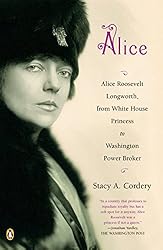
Alice: Alice Roosevelt Longworth, from White House Princess to Washington Power Broker
Stacy A. Cordery, 2007
Viking Penguin
608 pp.
ISBN-13: 9781615581870
Summary
From the moment Teddy Roosevelt's outrageous and charming teenage daughter strode into the White House—carrying a snake and dangling a cigarette—the outspoken Alice began to put her imprint on the whole of the twentieth-century political scene. Her barbed tongue was as infamous as her scandalous personal life, but whenever she talked, powerful people listened, and she reigned for eight decades as the social doyenne in a town where socializing was state business.
Historian Stacy Cordery's unprecedented access to personal papers and family archives enlivens and informs this richly entertaining portrait of America's most memorable first daughter and one of the most influential women in twentieth-century American society and politics. (From the publisher.)
Author Bio
• Birth—1961
• Where—N/A
• Education—B.A., M.A., Ph.D., University of Texas, Austin
• Currently—lives in Monmouth, Illinois, USA
Stacy A. Cordery is chair of the history department at Monmouth College (Illinois) and bibliographer for the National First Ladies' Library. (From .)
Book Reviews
Alice had grown up under the chilly eye of a stepmother, romped her way through a notorious White House girlhood, dazzled the American public as its first teenage celebrity, won her father’s admiration with her savvy political instincts and found a father surrogate to marry.... But by far the most interesting part of this detail-crammed, occasionally arid portrait is its account of the mature, married Alice, casting about for a durable adult persona. (She would live to the age of 97.) And Ms. Cordery constructs and analyzes the remarkable story of how Alice, despite her age and husband, gave birth to the only child of Senator William E. Borah, whose leonine bearing and adventurous Western spirit may have brought her father to mind.
Janet Maslin - New York Times
Cordery...has had more access to Mrs. Longworth’s private papers than previous writers, and she tries to make more of a case for her subject’s political significance. Even so, what she mostly has to deal with is Alice’s “reputation as the leading political wit in Washington.” Competition for that title has rarely been fierce, but Mrs. Longworth did have a claim to it while she lived on and on under her wide-brimmed hat, entertaining politicians in her Dupont Circle home near a pillow whose needlepoint instructed them: “If you can’t say something good about someone, sit right here by me.”
Thomas Mallon - New York Times Book Review
In a country that professes to repudiate royalty but has a soft spot for it anyway, Alice Roosevelt was a princess if not a queen.
Jonathan Yardley - Washington Post
The fiercely intelligent eldest daughter of President Teddy Roosevelt (1884-1981) was rebellious and outspoken partly as the result of her desperation to gain the attention of an emotionally distant father, according to historian Cordery. Utilizing Alice's personal papers, Cordery describes how she was more devastated by the political infidelity of her husband, House speaker Nicholas Longworth, during the 1912 presidential election (he sided with Taft over TR) than by his sexual dalliances. Her own affair with powerful Idaho Sen. William Borah resulted in the birth of her only child, Paulina. When her beloved father died in 1919, the stoic Alice simply omitted it completely from her autobiography, and she was a poor mother to Paulina, who died in 1957, at 32, from an overdose of prescription medicines mixed with alcohol. Alice's independence of mind often led her against the grain: she worked to defeat Wilson's League of Nations and was a WWII isolationist and America First activist. Her witty syndicated newspaper columns criticized FDR and the New Deal, and she betrayed her cousin Eleanor by encouraging FDR's liaison with Lucy Mercer Rutherford. Cordery (Theodore Roosevelt: In the Vanguard of the Modern) pens an authoritative, intriguing portrait of a first daughter who broke the mold. (Includes photos.)
Publishers Weekly
Notorious for her acerbic wit, political acumen, and occasionally outrageous behavior, President Theodore Roosevelt's illustrious daughter, Alice, enjoyed a long life (1884-1980) at the center of American politics and foreign affairs. Her roles as presidential daughter and later as the wife of powerful Republican Congressman Nicholas Longworth placed her at the heart of the capitol's social life, where she wielded remarkable political influence. She actively opposed Wilson's League of Nations, disdained the New Deal politics of the "other" Roosevelts (FDR and Eleanor), and joined the isolationist America First Committee prior to America's entry into World War II. Her checkered personal life included extramarital romances, most notably with Sen. William Borah, who apparently fathered her only child, Paulina, born when Alice was 40. Cordery (history, Monmouth Coll.; Theodore Roosevelt: In the Vanguard of the Modern) undertook exhaustive research for her new book, referring to newly discovered letters and diaries not available to earlier researchers. Thus, her work should quickly take its place as the most complete biography, surpassing James Brough's Princess Aliceand Carol Felsenthal's Alice Roosevelt Longworth. Highly recommended for all academic libraries and appropriate for public libraries with strong political history collections.
Library Journal
Frank, thoroughgoing life of Teddy Roosevelt's oldest daughter, wife of the Speaker of the House, witty Washington hostess and blistering critic of FDR. Cordery (History/Monmouth Coll.; Theodore Roosevelt: In the Vanguard of the Modern, 2002) fully utilizes the personal papers of Alice Roosevelt Longworth (1884-1980), frequently inserting entries from her diary and letters to provide startlingly intimate material. Alice's life was ill-starred at the start. Her birth killed her mother, TR's beloved first wife, on the same day that his own mother died. Subsequently, Teddy ignored Alice, who spent much of her childhood and adolescence trying to capture his attention. By the turn of the century, with TR installed in the White House, Alice enjoyed a spectacular coming-out, embarking as a young celebrity on forays into the world and politics. To gain more independence (and spending money), she married an unsuitable, much older man. Ohio Congressman Nick Longworth was also a philanderer and a hard drinker, but Alice was his match in travel, entertaining and campaigning. Alienated by Nick's affairs and his decision to back Taft rather than her father in the decisive campaign of 1912, Alice teamed up with Idaho senator William Borah, a fellow opponent of Woodrow Wilson and the League of Nations. They became lovers in 1919 and together rode the heady years of the '20s under Harding, Coolidge and Hoover; Cordery accepts as fact the widely held belief that Borah fathered Alice's daughter Paulina, though she was still married to Nick when he died in 1931. Alice's public drubbing of the New Deal and cousins FDR and Eleanor solidified her reputation as the leading political wit in Washington. But Cordery declines to be distracted by bon mots, cogently employing a plethora of detail to get at the character behind the hot air. A rigorous portrait of a woman of strong opinions who surely should have run for office herself. Promises to revive the old dame's reputation.
Kirkus Reviews
Discussion Questions
Use our LitLovers Book Club Resources; they can help with discussions for any book:
• How to Discuss a Book (helpful discussion tips)
• Generic Discussion Questions—Fiction and Nonfiction
• Read-Think-Talk (a guided reading chart)
Also, try these LitLovers discussion pointers to help get you started for Alice:
1. Alice isn't always a likable figure, but she speaks her mind honestly—and to those in power. Do you admire her?Do you consider her forthright, courageous, or simply offensive? Take into account the era in which she came of age and "reigned"—an era when women were to seen but not heard?
2. To what extent did her father's neglect contribute to Alice's unconventional approach to life—all her attention-getting chicanery?
3. Though Alice was "never elected, but always involved" Cordery considers her a politician in her own right. What does Cordery mean by that? Do you agree with her?
4. Alice may well have been the smartest of all the Roosevelt children, and Cordery thinks she would have been capable of holding office. Had she lived in another era, do you see her running for office...and would you could have supported her?
3. Obviously, the most unsettling aspects of Alice's life was her marriage to Nicholas Longworth and subsequent affair and child by Senator William Borah. There's a lot of fodder to chew on for a good discussion! (Also, consider the role she played in FDR's life, encouraging his affair with Lucy Mercy Rutherford.)
(Questions by LitLovers. Please feel free to use them, online and off, with attribution. Thanks.)
top of page (summary)
The Lemon Tree: An Arab, a Jew, and the Heart of the Middle East
Sandy Tolan, 2006
Bloomsbury USA
384 pp.
ISBN-13: 9781596913431
Summary
In 1967, not long after the Six Day War, three young Arabs ventured into the town of Ramla, in Jewish Israel. They were on a pilgrimage to see their separate childhood homes, from which their families had been driven out nearly twenty years before during the Israeli war for independence. Only one was welcomed: Bashir Al-Khayri was greeted at the door by a young woman named Dalia.
This act of kindness in the face of years of animosity and warfare is the starting point for a remarkable true story of two families, one Arab, one Jewish; an unlikely friendship that encompasses the entire modern history of Israelis and Palestinians and that holds in its framework a hope for true peace and reconciliation for the region. (From the publisher
Author Bio
• Birth—ca. 1956
• Where—Milwaukee, Wisconsin, USA (?)
• Education—New York University
• Currently—lives in Los Angeles, California
Sandy Tolan has produced hundreds of documentaries and features for NPR and is a lead producer for Working, a monthly series of profiles for Marketplace on workers around the world. He is a co-founder of Homelands Productions, an independent production company specializing in radio documentaries about land, natural resources, indigenous issues, and the global economy.
Sandy has reported from more than 30 countries, mostly in Latin America, the Middle East, the Balkans and Eastern Europe. He is the author of two books, including The Lemon Tree: An Arab, a Jew, and the Heart of the Middle East (Bloomsbury, 2006), which was a finalist for a National Book Critics Circle award, and which won Booklist’s “Top of the List” award in nonfiction. His other book, Me and Hank: A Boy and His Hero, Twenty- Five Years Later (Free Press, 2000), is an exploration of race, sports, and heroism in America.
Sandy was a 1993 Nieman Fellow at Harvard University and has won more than 25 national and international journalism awards, including a duPont-Columbia Silver Baton, three Robert F. Kennedy awards, a United Nations Gold Medal award, and two honors from the Overseas Press Club.
From 2000 to 2008 he taught international reporting and radio at UC-Berkeley’s Graduate School of Journalism, where he was an I.F . Stone fellow. In 2007, the eleven reporters in Sandy’s climate change class at the Berkeley J-School won the prestigious George Polk award, the first time the award has been given to students.
In early 2008, Sandy moved from Berkeley to Los Angeles, where he is Associate Professor of journalism at the Annenberg School for Communication at USC.
His ongoing projects include Working launched in January 2007 as a regular feature on Marketplace, public radio’s daily show about business and economics. Inspired by Studs Terkel’s classic 1974 book Working: People Talk About What They Do All Day and How They Feel About What They Do, the series consists of intimate, sound-rich portraits of workers in the global economy. Sandy is also faculty advisor and editor for the FRONTLINE/World Fellowship program, designed to nurture new voices in international reporting and widen the spectrum of stories available to the public, using this award-winning PBS Web site as a publishing platform for outstanding work from a new generation of journalists. (From Sandy Tolan's website.)
Book Reviews
[An] extraordinary book.... A sweeping history of the Palestinian-Israeli conundrum...Tolan's narrative provides a much-needed, human dimension to the Israeli-Palestinian conflict. But he also skillfully weaves into this tale a great deal of history, all properly sourced. Despite the complex and controversial nature of the story, this veteran journalist has produced a highly readable and evocative history.
Washington Post
The Lemon Tree: An Arab, a Jew, and the Heart of the Middle East is the story of two people trying to get beyond denial, and closer to a truth they can both live with. By its end, Bashir Khairi and Dalia Eshkenazi are still arguing, talking — and mostly disagreeing. But their natures—intellectual, questing, passionate and committed—may represent the best hope of resolving one of the most intractable disputes in human history.... It is very tempting to write off the Israeli-Palestinian standoff as insoluble. But one lesson of The Lemon Tree is the relatively short span of its history. The conflict between the two peoples is little more than a century old.
Seattle Times
No novel could be more compelling...This book...will haunt you long after you put it down. And it will certainly be one of the best works of nonfiction that you will read this year.
Christian Science Monitor
A graceful, compassionate and unmuddied presentation of Israeli-Palestinian conflict through the lives of an Arab and a Jew, strangers who forge a connection and a reconciliation while never veering from their passionate desires for a homeland.
Milwaukee Journal Sentinel
Quite simply the most important book I've read for ages...a handbook to understanding the Israeli-Palestinian conflict through a narrative that captures its essence through tracing the connected lives of two extraordinary individuals. Literally the single work I’d recommend to anyone seeking to understand why the conflict remains unresolved, and why it continues to dominate the region.
Time
The title of this moving, well-crafted book refers to a tree in the backyard of a home in Ramla, Israel. The home is currently owned by Dalia, a Jewish woman whose family of Holocaust survivors emigrated from Bulgaria. But before Israel gained its independence in 1948, the house was owned by the Palestinian family of Bashir, who meets Dalia when he returns to see his family home after the Six-Day War of 1967. Journalist Tolan traces the history of the Israeli-Palestinian conflict through the parallel personal histories of Dalia and Bashir and their families—all refugees seeking a home. As Tolan takes the story forward, Dalia struggles with her Israeli identity, and Bashir struggles with decades in Israeli prisons for suspected terrorist activities. Those looking for even a symbolic magical solution to that conflict won't find it here: the lemon tree dies in 1998, just as the Israeli-Palestinian peace process stagnates. But as they follow Dalia and Bashir's difficult friendship, readers will experience one of the world's most stubborn conflicts firsthand.
Publishers Weekly
Journalist Tolan (Me and Hank: A Boy and His Hero 25 Years Later) captures the Arab-Israeli struggle in this story of a house and the two families, first Palestinian and then Jewish, who successively lived in it. Members of both families came to know one another and to seek dialog between Arabs and Jews. This wonderful human story vividly depicts the depths of attachment to contested ground. An excellent choice for general readers.
Library Journal
(Starred review.) To see in human scale the tragic collision of the Israeli and Palestinian peoples, Tolan focuses on one small stone house in Ramla—once an Arab community but now Jewish.... Tolan opens the prospect of a new beginning in a concluding account of how Jewish and Arab children have together planted seeds salvaged from one desiccated lemon tree planted long ago behind one stone house. A much-needed antidote to the cynicism of realpolitik. —Bryce Christensen
Booklist
The affecting story of an unlikely truce, even a peace, between Palestinians and Israelis in contested territory. The symbolic center of radio documentarian Tolan's (Me and Hank, 2000) latest could not be simpler: In an old garden in the town Arabs call al-Ramla and Jews Ramla (neither name to be confused with the West Bank town of Ramallah, 20 miles away), a family cultivated a lemon tree that provided shade and refreshment for many years. When the Khairi family left al-Ramla, driven out in the Israeli War of Independence—a time Palestinians call Nakba, "the catastrophe"—a family of Bulgarian Jews took over the property, which, as far as they knew, had been "abandoned." Drawing on interviews and oral histories, Tolan reconstructs the stories each family, Khairi and Eshkenazi, told about their respective displacements, the lands they left behind, those who died and were born. His book begins with the arrival of three young Palestinian men in Ramla shortly after the Six Day War; stopping at houses they had once lived in, they asked the new inhabitants whether they could step inside to see them. Only one woman, a Tel Aviv university student named Dalia Eshkenazi, assented. "She knew," writes Tolan, "that it was not advisable in the wake of war for a young Israeli woman to invite three Arab men inside her house"; yet she did, and from that simple act, a sort of friendship evolved, even as events made Dalia more resolute in her defense of Israel and turned the oldest of the men, Bashir Al-Khairi, into a freedom fighter—or terrorist, if you will—in the Palestinian cause. Through broad sweeps of narrative going back and forward in time, Tolan's sensitively told, eminently fair-minded narrative closes with a return to that lemon tree and its promise of reconciliation. Humane and literate—and rather daring in suggesting that the future of the Middle East need not be violent.
Kirkus Reviews
Discussion Questions
1. The book opens with the journey of Bashir and his cousins on a bus to their childhood homes in al-Ramla. What must have been going through their minds during that time? Can you imagine the internal dialogue in their heads, as they rode the bus, then walked around their old hometown? How would you have felt if you were Bashir, approaching the old home, and pressing the bell?
2. Dalia’s very existence, and her arrival as an infant to Israel in November 1948, is the result of remarkable circumstances that combined to save some 47,000 Bulgarian Jews from the Holocaust. How much importance would you put on the actions of Dimitur Peshev, the parliamentarian, or Bishops Kiril and Stephan—and how much to other factors? Finally, the book (p. 43) describes Dalia as carrying “an extraordinary legacy” with her to Israel in 1948. What was that legacy?
3. The Arab-Israeli war of 1948 is known as the “War of Independence” to Israelis, and the “Nakba,” or “Catastrophe,” to Palestinians. Chapter Four describes how Bashir’s family, and Dalia’s cousin, Yitzhak Yitzkaki, experienced the war. Take the point of view of Bashir, during the first several months of 1948, and tell the group how you experienced those times. Now, do the same with Yitzhaki.
4. Bashir and his family kept their focus on the “right of return,” as promised by U.N. Resolution 194, as their exile extended into the 1950s, and then the 1960s. Why was this such a singular focus for Palestinians during this time? If it were you who had been displaced, would you also demand to return home, or would you, at some point, decide it would be easier to live in peace, if also in exile?
5. Dalia describes herself as growing up in the shadow of the Holocaust (pp. 112-115). Even though her family escaped these atrocities, she nevertheless experienced a young Israel as deeply traumatized. At the same time, she grew up among a new community of Jews who were trying to re-form their identity. On pp. 118-120, a discussion of the Sabra, or “New Israeli Man,” describes a desire among many Israelis to “wash off that old Jew” and “stand tall for the first time.” How much of a role do you think the Holocaust, and reaction to it through the crafting of a Sabra identity, played in the formation of Israel’s national psyche?
6. The emerging trust between Dalia and Bashir was shattered in February, 1969, when a bomb exploded in a Jerusalem supermarket, killing three people. Bashir would later be convicted of complicity in the bombing and sentenced to fifteen years. Is your own view of Bashir transformed by the description of these events? How is this tempered, if at all, by the accounts of his torture and imprisonment? In the meantime, Dalia cuts off all contact with the family. Describe her state of mind during this time, and her own ambivalence about contacting Bashir.
7. After Dalia’s parents died, and Bashir got out of prison, Dalia did indeed get in touch with Bashir. Why? Describe her evolution from being “zealous in the defense of Israel” (p. 180) to meeting Bashir at the home of a Christian minister in Ramallah. At that meeting, Dalia offered to share the home in Ramla. What is the meaning of this gesture? What is the meaning of the agreement Dalia and Bashir forged that day?
8. In 1988, near the beginning of the intifada, Bashir was deported to Lebanon. On the eve of his deportation, Dalia wrote an open letter to Bashir that was published in the Jerusalem Post (pp 200-203). Weeks later, Bashir replied (pp. 216-220). Describe your reaction to both letters.
9. Bashir and Dalia finally meet again, in the midst of rising violence and political tensions, in Ramallah in 2004 (256-262). They find that their political differences are as great as ever, but that their personal relations are as warm as ever. How does one explain that?
10. Near the end of the book (p. 262), Dalia says, “Our enemy is the only partner we have.” What does she mean by that?
(Questions from the author's website.)