
Blog Home ▼
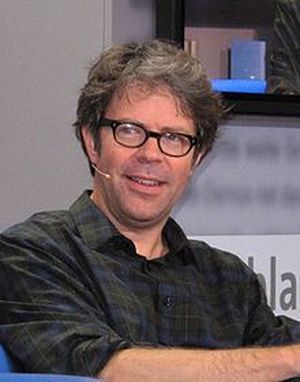 Really, this guy's so good looking—especially if you go for wonky men with GOOD HAIR and a great pair of horned-rims. He's so… so… writer-ly.
But he can't get a break in the media, at least not on Twitter—which is where it all started.
In promoting his newest novel, Crosswords, Jonathan Franzen's publishers touted him as "THE leading writer of his generation" (caps mine).
That's a statement bound to get a reaction. And it does.
One writer quickly retweets that no matter how lauded and applauded any female author's works are, SHE "will never, ever, be called 'the greatest living American writer.'"
In that same publicity announcement, the publishers go on to tweet that Franzen, in this newest work, places the family in all its "intricacy" at the book's center.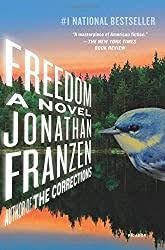 So this gets Roxanne Gay to wondering. Gay (no slouch herself, btw) tweets back asking… Hey, wait. Haven't ALL Franzen's novels centered on the family? In other words, what's the big deal about THIS one that earns him kudos as THE GREATEST WRITER? She's sort of like… ah, c'mon!
Then a guy who writes for an online journal jumps into the DUMPSTER FIRE with these choice words: "Franzen’s a good novelist. Sorry?"
But what does he even mean? Why "SORRY?" Is he sorry because he refers to Franzen as "good" but not "great"? Or is he sorry that others are resentful? Or sorry for himself? And what's with the QUESTION MARK at the end of "sorry"?
Anyway, it's all nutz.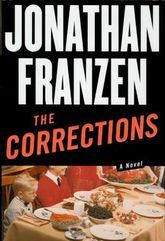 You may remember, 20 years ago, Franzen made literary headlines by dissing Oprah, who had chosen his family-centered novel, The Corrections, for her book club. But Franzen declined!! He didn't want his work given the imprimatur of a woman's book-club pick—because then…omg, MEN WOULDN'T TOUCH IT.
So poor Franzen, there he was, seemingly dissing both Queen Oprah AND women. Whoa! A trifecta (minus one).
Hold on—not so fast. Novelist Meg Wolitzer (no slouch either) has pointed to the same phenomenon, that men don't want to read novels about complex relationships—uh, no thanks, that's for GIRLS.
Let's be honest: Franzen's and Wolitzer's comments say more about men's sensibilities than women's. (See our jokey posts on co-ed book clubs—this one and this one, too.)
One more thing. I had the thrill of hearing Franzen in a live lecture several years back. It was essentially a master class in the ART OF WRITING. Members of the audience, many of them hopeful young writers, asked some of the sharpest, most astute questions I've yet to hear in a lecture—and Franzen was MARVELOUS. Sadly, I can't recall a single thing he said. But I do remember the hair. And his glasses. (Did I mention he's good-looking?)
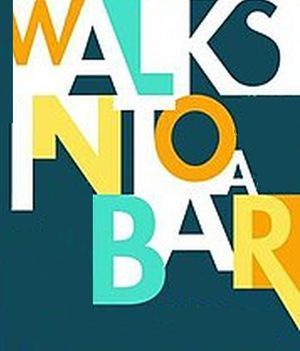 From GrammarBook
• An Oxford comma walks into a bar where it spends the evening watching the television getting drunk and smoking cigars.
• A bar was walked into by the passive voice.
• An oxymoron walked into a bar, and the silence was deafening.
• Two quotation marks walk into a "bar."
• A malapropism walks into a bar, looking for all intensive purposes like a wolf in cheap clothing, muttering epitaphs and casting dispersions on his wife, who takes him for granite.
• Hyperbole totally rips into this insane bar and absolutely destroys everything.
• A question mark walks into a bar?
• A non sequitur walks into a bar. In a strong wind, even turkeys can fly.
• Papyrus and Comic Sans walk into a bar. The bartender says, "Sorry—we don't serve your type."
• A mixed metaphor walks into a bar, seeing the handwriting on the wall but hoping to nip it in the bud.
• A comma splice walks into a bar, it has a drink and then leaves.
• Three intransitive verbs walk into a bar. They sit. They converse. They depart.
• A synonym strolls into a tavern.
• At the end of the day, a cliché walks into a bar—fresh as a daisy, cute as a button, and sharp as a tack.
• A run-on sentence walks into a bar it starts flirting. With a cute little sentence fragment.
• A figure of speech literally walks into a bar and ends up getting figuratively hammered.
• An allusion walks into a bar, despite the fact that alcohol is its Achilles heel.
• The subjunctive would have walked into a bar, had it only known.
• A misplaced modifier walks into a bar owned by a man with a glass eye named Ralph.
• The past, present, and future walked into a bar. It was tense.
• A dyslexic walks into a bra.
• A verb walks into a bar, sees a beautiful noun, and suggests they conjugate. The noun declines.
• A simile walks into a bar, as parched as a desert.
• A gerund and an infinitive walk into a bar, drinking to forget.
• A hyphenated word and a non-hyphenated word walk into a bar and the bartender nearly chokes on the irony.
For Punctuation and Grammar Geeks, these walk-into-a-bar jokes are some of the funniest I've ever read/heard. They come via GrammarBook.com, including some from the site's comment section. Thanks for the great laughs, GrammarBook.
Material created and copyrighted by GrammarBook.com.
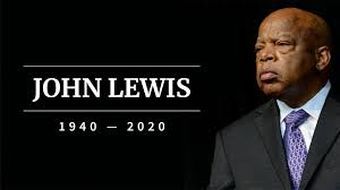 It's perhaps ironic, but surely iconic, that a GIANT of the Civil Rights Movement has died in the midst of the country's protests over George Floyd's death and ongoing racism. That "giant," of course, is U.S. Congressman John Lewis.
In 1998, Lewis (along with writer Michael D'Orso) penned Walking with the Wind, his memoir about growing up on the family's cotton farm in Alabama, his recollections of Jim Crow laws, and his role as a YOUNG LEADER of the Civil Rights Movement of the 1960s.

The Washington Post referred to Walking with the Wind as "the definitive account" of the Civil Rights Movement, declaring it "impossible" to read … "without being moved."
The memoir was reissued in 2015. Two years later, in 2017, Lewis's book went to the top of the bestseller charts—with Amazon announcing it had RUN OUT of new copies, while used ones were going for nearly $100.
Lewis, working with two young writers/illustrators, also published March, a GRAPHIC-NOVEL TRILOGY about the Civil Rights era. The third book of the trilogy won the 2016 National Book Award.
When Book One of the trilogy came out in 2013, Lewis said this about the March project: "It's another way for somebody to understand WHAT IT WAS LIKE and … I want young children to feel it. Almost taste it. To make it real." 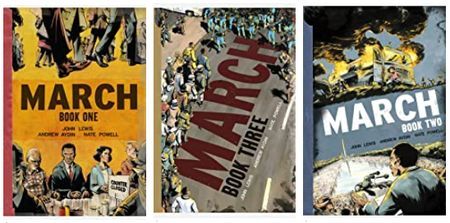
For book clubs that decide to tackle the RACE ISSUE, John Lewis's memoir would be an excellent place to start. Other works of note include the following titles ALSO ON LITLOVERS:
White Fragility
How to Be an Antiracist
Between the World and Me
The Hate U Give
The Warmth of Other Suns
Googling "books on racism," will turn up various lists filled with fine titles. An older one comes to mind immediately: Why Are All the Black Kids Sitting Together in the Cafeteria? (1997), as well as THREE CLASSICS:from the 60s: Black Like Me (1960), The Autobiography of Malcom X (1964), Crisis in Black and White (1964).
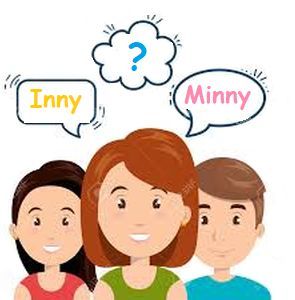 By my reckoning, we're at the onset of the next GREAT VOWEL SHIFT. Okay, maybe not "great," but it feels like a vowel shift, nonetheless.
So what's the Great Vowel Shift, you ask? Well, it took place in England, from approximately 1400-1700, when vowel sounds underwent a profound change. But MORE on that LATER.
The current vowel shift I'm referring to involves the pronunciation of the letters A and E—not the LONG form as in mate or meet, but the SHORT form, mat or met.
Have you noticed the pronunciation for the following words—ANY… MANY… CAN… MEN… BEEN… WHEN… GET? There are more, but these are enough for argument's sake.
If you listen carefully when people speak, you can hear a short-i creeping in? Not the long vowel as in iPhone but the short—as in Fitbit.
Here's what it sounds like—
• Hello. Do you have INNY donuts?
• How MINNY would you like?
• KIN you give me a couple of dozen?
• Sure, even more.
• OK, stop WHIN you get to 100.
Or it sounds like this—
• Now is the time for all good MIN to come to the aid of their country.
A Southern regionalism, you might say. But it's not. You can hear it on national TV, radio, podcasts, and film—and from people in all parts of the country.
So what's happening? Phonetics—it's all about PHONETICS.
Think how much easier it is to say "MIN" rather than "men" … or "INNY" rather than "any." It's easier because the mouth doesn't have to open as widely and the tongue can rest more comfortably in the middle. Phonetically, it's just NOT AS MUCH WORK.
Let's get back to the Great Vowel Shift. No one knows precisely when or where in England it started, or why (theories abound), but the end result was a NOTICEABLE CHANGE in vowel pronunciation.
Mostly it affected the long vowels. BITE once sounded like beet, MATE like maht, BOOT like boat—only three examples, but you get the idea.
Today, some 300 years later—during our own not-so-GREAT VOWEL SHIFT—I wonder if we're KILLLING OFF the short A and E vowels, particularly when followed by the CONSONANT N. I'm as guilty as the next of homicidal tendencies.
Try saying the following words—ones for which I find myself replacing the en sound with in. Here they are: INCOUNTER … INDEAR … INGRAVE … INJOY … INLIVEN … INSURE … INTANGLE … INVELOP (the verb form) … INVIRONMENT. (Don't worry, the spelling won't actually change, just pronunciation.)
Languages are like living organisms, evolving over time. Usually we think it means a change in word usage or the addition of new words to the dictionary, but it also refers to pronunciation. Language is living history, and it SOUNDS like we're in the midst of it.
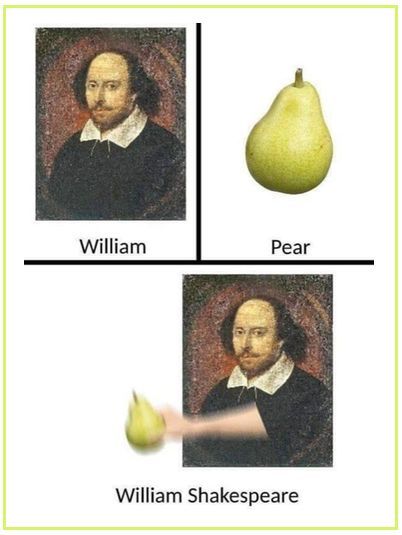
To shake or not to shake. That is the question.
Whether 'tis nobler in the mind to suffer
the slings and arrows of outrageous surnames…
or just shake the damn pear.
Lovely words from the book editors of The New York Times—
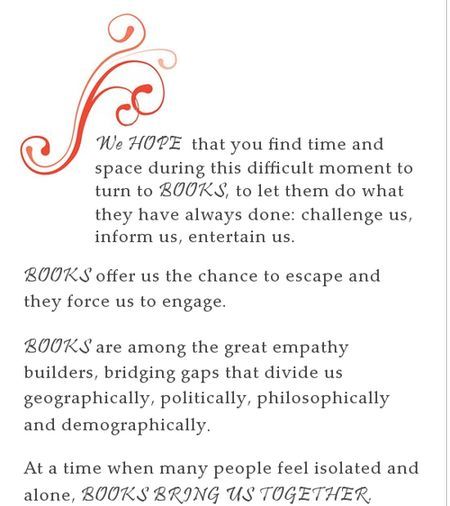
—Letter from the Book Editors
The New York Times Book Review, April 19, 2020
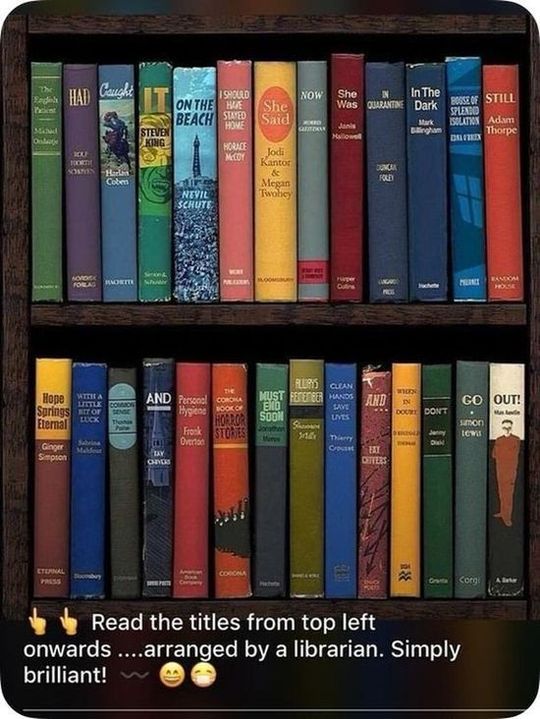
♥ Thanks to my dear friend Sybil.
Btw... the pea-green book—bottom shelf, center—reads: "Always Remember." Even when enlarged, it's hard to read.
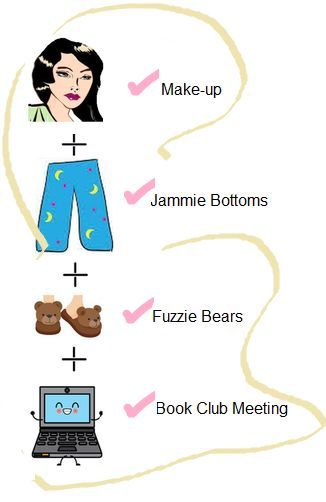 "OK … show of hands: how many of you put on MAKE-UP and a nice top—but still have on your PJ BOTTOMS?"
That's Mary Field opening the first ever online meeting of the VILLAGE LIT CHICKS of Lewes, Delaware.
"It seemed to break the ice," Mary told me. "Everyone LAUGHED, and off we went! A pretty good start."
The 12 members met on ZOOM, a web-based video conferencing app. All signed in without a hitch … except for one member. But her HUSBAND came to the rescue. (Try to have one of them around; that, or know where you can find a 12-year-old.)
To facilitate a sense of order, Mary assigned each member beforehand a Discussion Question for the book— Chances Are... by Richard Russo.
It worked. Conversation flowed, and "everyone was respectful—with very little talking over each other," said Mary. The meeting was such a SUCCESS that the club has planned its next for May.
One final bonus: members sent thank-you notes to Mary for her DELICIOUS New England-themed DINNER—bread bowls of clam chowder, with chilled beer and wine, topped off by a dessert of Boston Cream pie—all of which she had planned, NONE of which she had to cook. Good job, Mary!
See Meeting in the Time of Corona—Part I.
 |
 |
 |
|||
 |
 |
 |
|||
| Click on individual cover images. | |||||
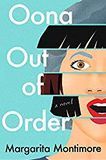
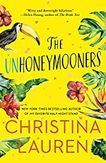
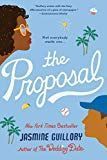
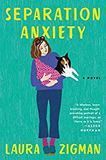
It's a cliche to say reading is transformative. So I'll say it anyway—BOOKS permit us to lose ourselves in time and space. At the height of their powers, they even dissolve the boundary of the self.
These six books, all fairly new, offer something else: they can get you to laugh: a deep throated chuckle… all the way to a LAUGH-OUT-LOUD guffaw.
They're funny, which feels good right now, as we "shelter in place."

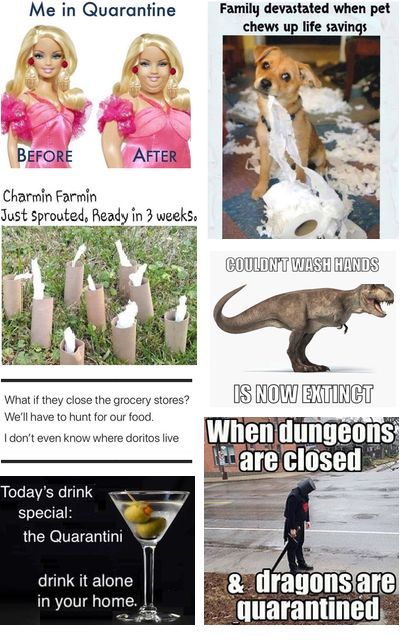
We're worried if not downright panicked. So, of course, GALLOWS HUMOR is on the rise—proof once again that humans will always find a way to laugh in dire times.
Please allow me a DISCLAIMER:
Many find humor tasteless right now—especially if they've taken ill or know someone who has. But laughter is in no way meant to denigrate the seriousness of the virus or make light of how precarious life has become.
Neuroscience tells us that laughing has a BENEFICIAL affect, triggering the release of endorphins, our brain's natural mood elevator, and suppressing cortisol, a stress inducing hormone.
Above are a few memes that have popped up in my texts and emails, brightening my day.* So please, find HUMOR, share a LAUGH, and feel KINSHIP. We're in this together.
♥ Thanks to my sister, Janet, who always keeps me laughing.
Site by BOOM

LitLovers © 2024