
 Do mysteries and thrillers make good book club reads? More important, do they lead to good discussions?
Take a stroll through any bestseller list; you'll find thrillers and detective stories at (or near) the top. I love suspense mysteries (love them)! But here's my suggestion—read them on your own time. They don't necessarily inspire great book club discussions, primarily because characters are short on development...and plot discussion boils down to "what did you know and when did you know it?"
There are, of course, exceptions. A number of recent authors have jumped the genre ... moving the mystery/crime thriller into "literary fiction." What's that mean?
When critics talk like that about a crime thriller—specifically the new Gillian Flynn Gone Girl...or Tana French's Broken Harbor—they're talking about wonderful, often witty, prose; solid character development; and the exploration of philosophical ideas. Kate Atkinson is another writer who's moved the genre into high literary gear.
The three—Flynn, French, and Atkinson—are not only terrific suspense writers...they've been singled out as writers who probe deeply into character, motivation, how the past impinges on the present, and the nature of good and evil. They get us to ponder our own relationships, as well as the untenable choices life sometimes gives us. In other words, they make us think...and thinking always makes for good book conversations!
On top of good writing, two other requirements exist for great mystery/thrillers:
- The author must let the line out slowly, knowing precisely when to withhold—and when to release—information. It's a plot technique known as "suspended revelation,"—mysteries depend on it; in fact, it's their defining characteristic. (See LitCourse 6 on Plot.)
- The clues should be buried in plain sight—yet so cleverly that the reader won't pick up on them. Great mysteries stand up to a re-read, which only then reveals how, when, and where the author hid the clues.
If neither of those conditions is met, the story turns predictable, losing the element of surprise—the very thing that makes mysteries and thrillers so satisfying.
You've seen the cartoons in which characters say one thing—but they're thinking another. Authorial intention is sort of like that.
Contemporary literary theory pretty much debunks the idea that authors say exactly what they mean—because the words on the page don't always support their intended meaning. Or readers find additional meanings that authors hadn't considered.
Here's an interview with Peter Carey*, author of Parrot and Olivier in America and Oscar and Lucinda. An audience member asked Carey about an episode in the latter novel that reminded her of Adam tasting the FORBIDDEN FRUIT.
Here’s Carey’s response:
Your way of reading holds up perfectly, I think, and it’s totally consistent with the book and consistent with my intention, and yet it never occurred to me.
Then he said …
So isn’ t that the extraordinary thing about literature? It only really works when the reader reads it because until then…it’s words on a page…. Everybody brings their own lives, and their own experience, their own intellect… and then a book is made! And that’s the wonder of literature.
No one could have put it better. You can listen to the full interview from this 2003 BBC World Book Club broadcast.
* Carey, by the way, is a double MAN-BOOKER Prize winner. Yes, he won two times—for Oscar and Lucinda (1988) and for True History of the Kelly Gang (2000). (J.M. Coetzee and Hilary Mantel are the only others to win twice.)
 Olive Kitteridge got me thinking about point of view—who gets to tell the story. Elizabeth Strout’s book shifts from character to character, a narrative technique that lends her work its depth and beauty.
We see Olive, not only as she sees herself, but as she’s seen by the community. The pay-off is a richer, far more complicated portrait of Olive than if she alone—or any single narrator—had told us the story.
Point of view, or perspective, is one of the most important decisions an author has to make. Whoever tells the story shapes the story.
A little game: take a couple of novels, change the narrators…and see what happens. Try this as a book club activity. Here are some ideas to get started:
- Remains of the Day: what if Miss Kenton told the story rather than the butler Stevens? We’d miss the rich irony of a hopelessly naive narrator. In fact, if we weren’t inside Stevens’s head, he would seem a pitiless monster of a being.
- Gilead: if we were to see the story through shifty, unreliable Jack Boughton, the story’s prodigal son, we would never experience our own sense shame as we, along with Reverend Ames, willfully pass judgment on a misunderstood character.
More on point of view at a later date. In the meantime take our free LitCourse 8 on Point of View. It’s fun…quick…and informative.
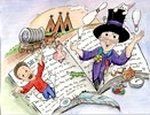 One of the joys of reading is the people we meet within a book’s covers, literary creations who jump off the page and into our lives. How authors do it—how they make their characters come alive for us—is one of the great mysteries of art.
Authors invariably say their characters take on lives of their own. Here’s Stephen L. Carter (The Emperor of Ocean Park):
I was occasionally surprised by the messes my characters got themselves into, and the indignant, presumptuous way they demanded that I write a way for them to escape. Random House interview
And here’s Philip Roth with NPR Fresh Air’s Terry Gross:
Some magic, some alchemy between knowing and intuiting takes over and our characters take on lives of their own. First time this happened to me I felt like a real writer…. Julia Cameron nailed it when she wrote, “It’s not about making things up but taking them down.”
Even playwright Edward Albee (Who’s Afraid of Virginia Woolf) when asked whether his characters control him suggested they were somehow alive:
I like to let them think they do. It’s a trick we play on ourselves. They don’t exist, and they can’t say anything unless we write it for them. But it makes them happy to think they’re independent. Boston Phoenix
All this isn’t to say that writers don’t have to think, and think hard, about their characters. I’d like to continue a discussion of character—what goes into making a good one—in another post. Stay tuned.
Ideas for Book Clubs
- Take our free LitCourse 5—about characterization, how we talk about them and how author's develop them. It’s short and fun...and informative.
- Talk about some of your favorite characters in literature. Or some of literature’s most enduring characters.
 It’s said we live in an age of irony—irony is in; sincerity is out. It’s the importance of NOT being earnest that matters.
What is irony? Think Seinfeld—”Whatever…,” “Duh…,” “Yeah, riiiight”—all said with an arched eyebrow, a knowing wink. The “ironic stance” is detachment.
When it comes to fiction, writers, critics, and readers adore irony—most recently, Jonathan Franzen’s Corrections, Gary Shteyngart’s Absurdistan, Zadie Smith’s On Beauty, and Helen Fielding’s Bridget Jones. Even classics like Pride and Prejudice are plumbed for their irony.
Jane Austen’s brand of irony derives from her subversive wit, which undercuts class structure and decorum. It’s a type of irony in vogue today: one that exposes hypocrisy and punctures holes in pretensions, beliefs and institutions that no longer stand for truth or meaning.
But literary irony is far more complex. It’s been around since Oedipus—he who unwittingly marries his mother; who searches for a king’s murderer, only to find himself; and who attains inner “sight” only when blind.
Writers from Sophoclese on down have used irony because it mimics life. Though irony takes numerous forms, the most common definition is an opposite reality from what is intended or expected: the king brought low; the underdog raised up; best-laid plans gone awry.
To learn more about irony, see LitCourse 8—based on Edith Wharton’s wonderful short story “Roman Fever.” The courses are short, free, and fun! (And that’s not ironic.)
 When is a rose not a rose? When it’s a symbol. Do authors create literary symbols on purpose? Or are symbols just something English teachers invent to torment students. Could be . . . but here’s a little story.
—A Little Story—
I once wrote a poem for my English class about the beauty of a single rose. Understand when I tell you it was insipid.
But the teacher singled it out! It was, she said, a fine example of symbolism: the beauty of the single rose was how she viewed her students. In the collective we had little distinction, but individually we attained a singular beauty. Friends, I’d written a masterpiece . . . and I hadn’t a clue.
My grand inspiration had come from a cheap plastic rose stuck in my pencil holder, and I just happened to hit on the thing as my eye wandered around the room. The beauty of individualism wasn’t anywhere on the radar.
Yet that's exactly what author William J. Kennedy (Ironweed, 1983) was getting at when he wrote in a New York Times piece that the source of a writer's creativity doesn't . . .
rise up from his notepad but up from the deepest part of his unconscious, which knows everything everywhere and always: that secret archive stored in the soul at birth, enhanced by every moment of life….
—William Kennedy, “Why It Took So Long,”
New York Times, 5/20/1990
Writing is a mysterious process, and symbols often spring from the unconscious, reflecting something embedded within an author’s psyche.
In other words, that single rose of mine could just as easily have seemed lonely and forlorn. Or I might have written that its fragrance would gain potency as part of a bouquet. But it turns out I enjoy being alone or with friends one-on-one. And I avoid large groups. So perhaps even as a teen that rose had subconscious resonance.
So, no, authors don’t always intend their symbols; symbols often reflect something deep within. And readers? Our own insights into a work spring up from deep within us, as well.
If you want to learn more about symbolism—why authors use them, how they contribute to a work of fiction—take our LitCourse 9. It’s short, free, and a lot of fun.
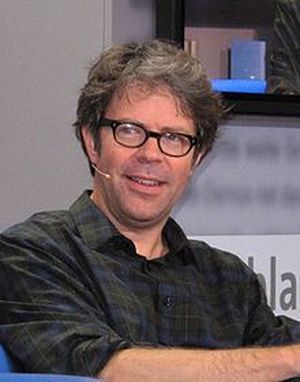 Really, this guy's so good looking—especially if you go for wonky men with GOOD HAIR and a great pair of horned-rims. He's so… so… writer-ly.
But he can't get a break in the media, at least not on Twitter—which is where it all started.
In promoting his newest novel, Crosswords, Jonathan Franzen's publishers touted him as "THE leading writer of his generation" (caps mine).
That's a statement bound to get a reaction. And it does.
One writer quickly retweets that no matter how lauded and applauded any female author's works are, SHE "will never, ever, be called 'the greatest living American writer.'"
In that same publicity announcement, the publishers go on to tweet that Franzen, in this newest work, places the family in all its "intricacy" at the book's center.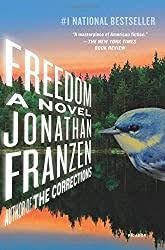 So this gets Roxanne Gay to wondering. Gay (no slouch herself, btw) tweets back asking… Hey, wait. Haven't ALL Franzen's novels centered on the family? In other words, what's the big deal about THIS one that earns him kudos as THE GREATEST WRITER? She's sort of like… ah, c'mon!
Then a guy who writes for an online journal jumps into the DUMPSTER FIRE with these choice words: "Franzen’s a good novelist. Sorry?"
But what does he even mean? Why "SORRY?" Is he sorry because he refers to Franzen as "good" but not "great"? Or is he sorry that others are resentful? Or sorry for himself? And what's with the QUESTION MARK at the end of "sorry"?
Anyway, it's all nutz.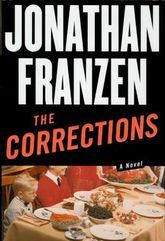 You may remember, 20 years ago, Franzen made literary headlines by dissing Oprah, who had chosen his family-centered novel, The Corrections, for her book club. But Franzen declined!! He didn't want his work given the imprimatur of a woman's book-club pick—because then…omg, MEN WOULDN'T TOUCH IT.
So poor Franzen, there he was, seemingly dissing both Queen Oprah AND women. Whoa! A trifecta (minus one).
Hold on—not so fast. Novelist Meg Wolitzer (no slouch either) has pointed to the same phenomenon, that men don't want to read novels about complex relationships—uh, no thanks, that's for GIRLS.
Let's be honest: Franzen's and Wolitzer's comments say more about men's sensibilities than women's. (See our jokey posts on co-ed book clubs—this one and this one, too.)
One more thing. I had the thrill of hearing Franzen in a live lecture several years back. It was essentially a master class in the ART OF WRITING. Members of the audience, many of them hopeful young writers, asked some of the sharpest, most astute questions I've yet to hear in a lecture—and Franzen was MARVELOUS. Sadly, I can't recall a single thing he said. But I do remember the hair. And his glasses. (Did I mention he's good-looking?)
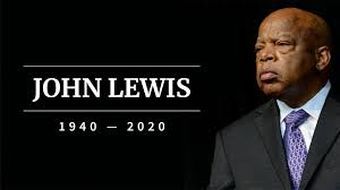 It's perhaps ironic, but surely iconic, that a GIANT of the Civil Rights Movement has died in the midst of the country's protests over George Floyd's death and ongoing racism. That "giant," of course, is U.S. Congressman John Lewis.
In 1998, Lewis (along with writer Michael D'Orso) penned Walking with the Wind, his memoir about growing up on the family's cotton farm in Alabama, his recollections of Jim Crow laws, and his role as a YOUNG LEADER of the Civil Rights Movement of the 1960s.

The Washington Post referred to Walking with the Wind as "the definitive account" of the Civil Rights Movement, declaring it "impossible" to read … "without being moved."
The memoir was reissued in 2015. Two years later, in 2017, Lewis's book went to the top of the bestseller charts—with Amazon announcing it had RUN OUT of new copies, while used ones were going for nearly $100.
Lewis, working with two young writers/illustrators, also published March, a GRAPHIC-NOVEL TRILOGY about the Civil Rights era. The third book of the trilogy won the 2016 National Book Award.
When Book One of the trilogy came out in 2013, Lewis said this about the March project: "It's another way for somebody to understand WHAT IT WAS LIKE and … I want young children to feel it. Almost taste it. To make it real." 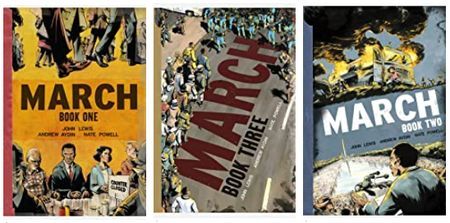
For book clubs that decide to tackle the RACE ISSUE, John Lewis's memoir would be an excellent place to start. Other works of note include the following titles ALSO ON LITLOVERS:
White Fragility
How to Be an Antiracist
Between the World and Me
The Hate U Give
The Warmth of Other Suns
Googling "books on racism," will turn up various lists filled with fine titles. An older one comes to mind immediately: Why Are All the Black Kids Sitting Together in the Cafeteria? (1997), as well as THREE CLASSICS:from the 60s: Black Like Me (1960), The Autobiography of Malcom X (1964), Crisis in Black and White (1964).
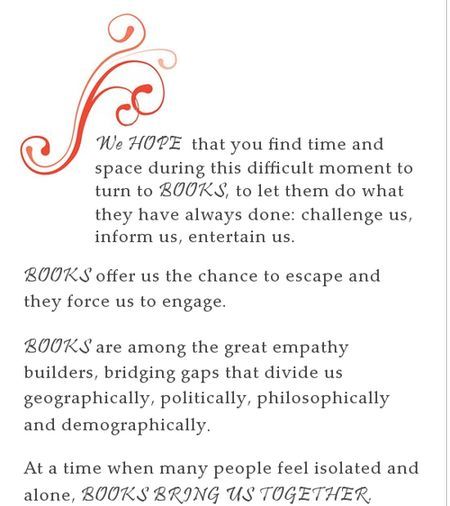
Lovely words from the book editors of The New York Times—
—Letter from the Book Editors
The New York Times Book Review, April 19, 2020
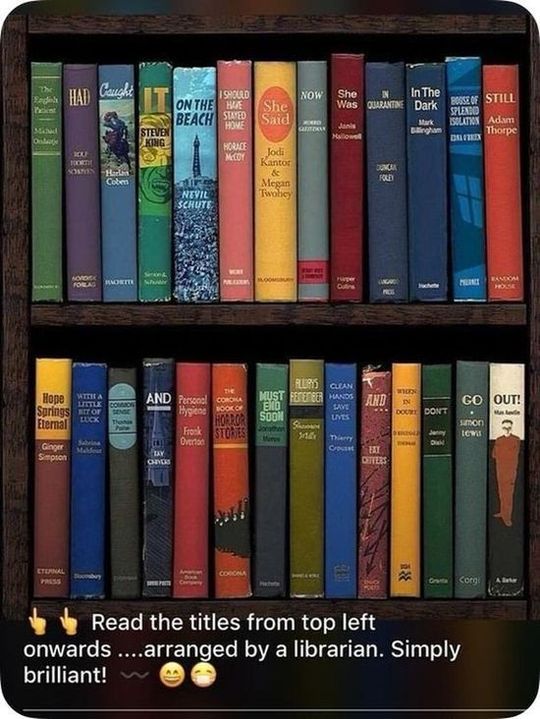
♥ Thanks to my dear friend Sybil.
Btw... the pea-green book—bottom shelf, center—reads: "Always Remember." Even when enlarged, it's hard to read.