
 My friend Gordon showed up again with more word fun—this time JANUS WORDS.
it’s January, named after the Roman deity Janus—who faced both backward and forward, looking to the past and to the future. So this is the ideal month to introduce these crazy words.
Janus words are self-antonyms, or contranyms. They're spelled and pronounced the same but have OPPOSITE meanings.
Don't You Just ♥ Words?
Cleave — to stick together; to cut apart
Clip — to hold together; to cut off
Custom — the norm; unique
Dust — to remove dust; to lightly sprinkle
Fast — held firmly in place; moving quickly
Oversight — to watch carefully; not noticed
Quantum — tiny, in physics; very large, as in ”leap”
Sanction — to approve; a punitive action
Temper — to harden; to soften
This is just a smattering. There are lots more.
 English—what a great language to have fun with! Here’s a silly little grammatical conundrum for which I have no explanation . . . except that it’s idiomatic. Nonetheless, rules are rules—and rules must be obeyed.
Don’t You Just ♥ Words?
You can say
Take the garbage out. —or— Take out the garbage.
And you can say
Take it out. —but not— Take out it.
___________You can say
Butter Mom up. —or— Butter up Mom.
And you can say
Butter her up. —but not— Butter up her.
___________You can say
Turn the lights on. —or— Turn on the lights.
And you can say
Turn them on. —but not— Turn on them.
Verbs and prepositional adverbs—you would think they’re like infinitive verbs—to be or not to be—you’re to never split one of those. I mean “you’re never to split one.” (But we all do.)
But prep-adverbs are different from infinitives. If you use a pronoun, you have to split them up”—not ”split up them.” Strange.
It's a wonder anyone ever learns English.
 English—what a great language to have fun with! Below is a silly tongue-twister. It’s a hoot when you say it fast.
Don’t You Just ♥ Words?sects | section | sex | shun
Sects shun sex in this section.
Even harder . . .
In this section, sects shun sex.
I'm a grown woman — and this is what I do for a living. Feel free to join in the fun. Leave a comment. Can you come up with any? Think of it as brain exercise.
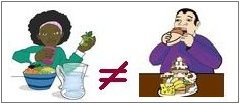
English—what a great language to have fun with! Here’s a funny quirk that struck my husband Pete—a numbers guy, who gets a kick out of language.
Don’t You Just ♥ Words?
You CAN say…
This is good eating. —or— This is eating well.But you CANNOT say…
This is well eating. —or— This is eating good.Why?
Answer: The top two sentences seem similar in meaning; after all, we often use “good” and “well” interchangeably ... but we shouldn’t.
Actually the sentences have slightly different meanings, which has to do with how the word “eating” functions and the difference between adjectives and adverbs.
• This is good eating = the food is tasty.
"Eating" is a noun.
Good is an adjective and precedes a noun—as in good book.• This is eating well = the food is healthy … or expensive & posh.
"Is eating" is the verb...as in "This (the thing I do) is eating well."
Well is an adverb and follows a verb.
So much for niggling rules of grammar. Is it a wonder anyone ever learns?
 English—what a great language to have fun with! Below are several homophones, words that sound alike but have different meanings and often spellings (a few liberties taken, I know). Thanks for this one to my dear friend Gordon Higgins.
Don’t You Just ♥ Words?
gnu | knew | new | nu
Trapped in existential despair, the
new gnu knew he knew nada about nu.
Translation: The young wildebeest realized he had no understanding of the Greek letter N.
 English—what a great language to have fun with! Below are homophones, words that sound alike but have different meanings. (I’ve taken a few liberties here.) My thanks to Gordon Higgins. He’s too, too clever.
Don’t You Just ♥ Words?
She wore two too many tutus to dance.
two | too | tutu | to
It's what I do for a living. Too, too sad. Anyway, hope you’ll join in the fun. These are mine. Can you find others . . . or come up with your own. It’s good exercise for the brain—honest.
 Slough—a great word, and one that’s kept me running to the dictionary over the years. The problem is, it has 4 different pronunciations . . . along with 6 different meanings, and I can never keep them straight. Slough is the perfect example of a heteronym.
Don’t You Just ♥ Words?
Slough — when it sounds like . . .
slow,
is a morass or swamp or . . .
despair (as in Bunyan’s Pilgrim’s Progress)slew,
is a sluice or drainage ditchSl-how . . . (or slouch, minus ch)
is a town near Liverpool, Englandsluff,
is a skin (as in snake)
and a verb: to discard, throw off—Okay, see how quickly
you can get through this—He decided, that poor snake, in a slough of despond to slough off his slough in the slough near the slough outside Slough.
Here’s what it sounds like…
He decided, that poor snake, in a slow of despond to sluff off his sluff in the slew near the slow outside Sl-how
Well...it's how I spend my days. How do you spend yours? Got any cool words? Please join in the fun by leaving us a comment.
 English—what a great language to have fun with! Below are homophones, words that sound alike but have different meanings. (And, yes, I’ve taken a few liberties.)
Don’t You Just ♥ Words?
want | wantin’ | wanton | wont | wonton
My wont isn’t wantin’ to be wanton —
I just want a wonton. Want one?Translation:
I’m not usually fresh; I’m just reaching over you for a fried wonton.
These are mine. See if you can find others . . . or come up with your own. This is good exercise for the brain—so feel free to play along!
 English—what a great language to have fun with! Below is a set of homophones, words that sound alike but have different meanings and often different spellings.
Don’t You Just ♥ Words?
peak | peek | peke | pique
He kicked her peke out of pique when she took a
quick peek before it could peak.Translation:
He kicked her dog in anger when she checked the oven
to see if his, uh...souffle had risen.
Okay. I came up with these. Let us know if you can you find others . . . or come up with some of your own. Leave a comment.
 How anyone ever learns to speak and spell English is a mystery. Below are common words that surely confound anyone—child or adult—trying to learn this quirky language.
Don’t You Just ♥ Words?
If cow rhymes with bough
shouldn’t cow rhyme with cough?If rafter rhymes with laughter
shouldn’t rafter rhyme with daughter?If hoe rhymes with toe
shouldn’t hoe rhyme with shoe?If threw sounds like through
shouldn’t threw rhyme with rough?If lime rhymes with climb
shouldn’t lime rhyme with limb?
These erratic spellings have to do with the development of the English language—which wasn’t really “English” and wasn’t really a language. From the end of the Roman occupation, the ancient Brits spoke a mishmash of Germanic and Norse tongues, with a soupcon of French and Latin throw in by the upper classes.
The language underwent constant change until the 15th century, leading to such confusion that people from one part of England could barely understand those from another.
It was William Claxton, a mid-15th century printer, who first began to consolidate and standardize what was by then "modern" English. But he started a bit too early—printing technology cemented the language before all the kinks could be worked out. Thus, the cow-bough-cough imbroglio.