
 People...! What is wrong with you? Never have so many understood so little about a mere SQUIGGLE on a page.
Meet Semiramis, warrior princess of Assyria, ruler of the semicolon. She is here to HELP you. You will not refuse her.
Have faith. With a little guidance, you too can master the SEMICOLON—which means that you can don the costume and bear the title "Semiramis of the Semicolon." (Spear not included.)
—Semicolons—
Why use a semicolon?
A semicolon connects two sentences.Think of it as a combination of a period and a comma. Notice the mark has one of each—top & bottom.
Why not use a comma?
The comma is a 90-pound weakling. It's far too weakit can't hold two sentences together.

If you use one, you've got yourself a nasty little comma splice.Why not use a period?
You can. Use a period to end the first sentence. Then start the second sentence.The comma is too weak . It can't hold two sentences together.
When do you use a semicolon?
Sometimes you want to link ideas—two sentences that are related to one another. In that case you can use a semicolon.The comma is too weak ; it can't hold two sentences together.
A semicolon is strong ; it can hold two sentences together.What is a sentence?
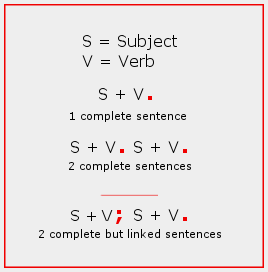
A sentence is a complete thought. A period signals the end of that thought. A semicolon can extend the thought—by linking it to another complete but related thought.
Remember—
You must have two complete sentences in order to use the semicolon — S + V on the left ; S + V on the right.


Example—you have two (related) ideas...
Use 2 sentences —> with a period:
• It was too cold to enjoy the game . She decided not to go.
Use 1 sentence —> with a semicolon:
• It was too cold to enjoy the game ; she decided not to go.
________________
Example—you have two (related) ideas...
Use 2 sentences —> with a period:
• It was too cold to enjoy the game . However, she decided to go anyway.
Use 1 sentence —> with a semicolon:
• It was too cold to enjoy the game ; however, she decided to go anyway.
You don't have to use a semicolon to combine two sentences. You can also use a basic conjunction — and, but, so, for, or, not, yet — always (always, always) with a comma.
• It was too cold to enjoy the game , so she decided not to go.
• It was too cold to enjoy the game , but she decided to go anyway.
• It was too cold to enjoy the game , and she didn't want to go anyway.